Electro-magnetism
Electro Magnetism -
Introduction
Magnetic Effect of Electric
Current - Oersted's Experiment
Maglev train one of
the fastest trains
works on magnetic
effect of current.
MRI machine one of
the most dependable
diagnostic tool works
on magnetic effect of
current
To detect
diseases
and tumor
Magnetic crane used to lift
tons of metallic load
works on magnetic effect
of current.
Electricity can
produce
Magnetism!
Direction of current
influences Direction of
Magnetic Field
Magnetic Effect of Electric Current
Magnetic Field for a Straight Conductor
Thumb is showing
the direction of
current
Hence, curled
fingers will
show the
direction of
magnetic field
Magnitude of current is
increased, magnitude of
field strength increases
Compass needle does
not deflect at large
distance from wire
No deflection
MAGNETIC FIELD FOR A CIRCULAR COIL
Tap the card
board gently.
MAGNETIC FIELD FOR A CIRCULAR COIL
A small part of a huge
looks like a straight lin
Away from the
wire the magnetic
field becomes
weaker
Straight conductor
field is a concentric
circles.
But, why so much
trouble when a
bar magy idy
exists?
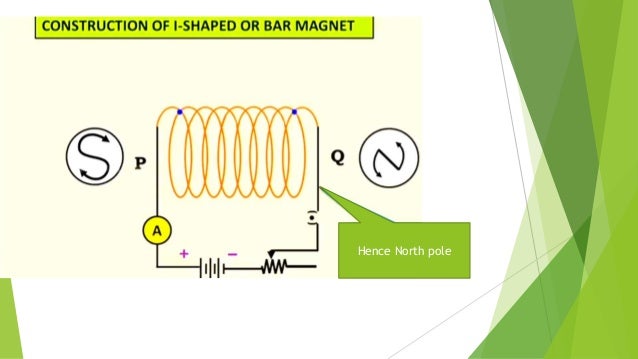
How to make
temporary
magnets?
Switch
off
Hence North pole
What happens if we
switch off the current?
Winding is anti
clockwise
Thus winding are in
opposite sense
Hence it is a
temporary magnet
FARADAY'S LAW
OF INDUCTION
FARADAY'S LAW OF INDUCTION:
 The common point in all the above experiments conducted by
Faraday is that the rate of change of magnetic flux through a
circuit induces an emf in it.
 Faraday stated experimental observations in the form of a law called
Faraday’s law of electromagnetic induction.
The magnitude of the induced emf in a circuit is equal to the rate of
change of magnetic flux through the circuit.
Faraday’s Law
 = -
d B
dt
 Faraday’s Law indicates how to calculate the potential difference
that produces the induced current
 Written in terms of the electromotive force induced in
the wire loop
 The magnitude of the induced emf equals the time rate of change of
the magnetic flux through the circuit.
The negative sign
indicates that induced
emf opposes the change
in flux.
Summary of Faraday’s law:
 The magnitude of the emf is proportional to the rate of change of
the flux.
 e𝛂
𝒅∅
𝒅𝒕
 The induced emf is present even if there is no current in the path
enclosing an area of changing magnetic flux.
 If the rate is constant, then the emf is constant.
 In most cases, this is not possible and AC currents result.
1. The magnitude of induced emf in a circuit is equal to
the rate of change of _______through the circuit.
a) magnetic induction
c) magnetic flux
d) magnetic field
b) induced current
2. Faraday's law indicated how to calculate the _______ that
produces the induced current.
a) resistance
c) inductance
d) potential difference
b) capacitance
3. The flux can change due to _______
a) change in the magnetic field
c) change in the angle
d) all the above
b) change in the area
Lenz’s Law
The induced emf is directed
along the perimeter of the flux
surface. The induced current is
thus perpendicular to B.
 Lenz’s Law gives an easy way to
determine the sign of the induced
emf.
 Lenz’s Law states that the polarity of induced emf is such that it tends
to produce a current which opposes the change in magnetic flux that
is produced in it.
e = -N
d
dt
 Induced emf is generated on account of change in magnetic and
mechanical energy.
 This law explains the direction of induced emf or induced current.
This law is based on
the law of
conservation of
energy.
Conservation of energy
 The mechanical power put into the bar by the external agent is equal
to the electrical power delivered to the resistor.
 Energy is converted from mechanical to electrical, but the total
energy remains the same.
 Conservation of energy is obeyed by electromagnetic phenomena.
1. The induced emf is directed along the perimeter of the
flux surface. The induced current is thus _____to the
magnetic flux.
a) parallel
c) perpendicular
d) none of these
b) at an angle of 450
2. _____ states that the polarity of induced emf is such that it tends to
produce a current which opposes change in magnetic flux that is
produced in it.
a) Faraday’s law
c) Lenz’s law
d) none of these
b) Ampere’s law
3. Lenz’s law is in accordance with the law of conservation of __________
a) electric current
c) electric charge
d) energy
b) electromotive force
Note:
Direction of induced
current can be
obtained by Fleming
right hand rule.
According to this, if middle finger,
fore finger and thumb of right hand
are held mutually perpendicular,
then fore finger represents the
direction of magnetic field,
thumb represents a direction of
velocity of the conductor
and middle finger will represent the
direction of induced current.
Direction of velocity of
the conductor
Induced current
1. When a conductor carrying current is free to move in a
magnetic field the direction in which current will move
is given by ________.
a) Fleming right hand rule
c) Laplace’s rule
d) Maxwell's cork screw rule
b) Fleming left hand rule
2. The direction of induced emf is determined by ______.
a) Fleming right hand rule
c) Amperes swimming rule
d) Maxwell's cork screw rule
b) Fleming left hand rule
Electric motor
DC Electric motor Video
AC generator video
AC GENERATOR
 A device which converts mechanical energy into electical energy is
called AC Generator or AC dynamo.
 It works on the principle of electromagnetic induction.
 There are three main parts in AC generator (or alternator) :-(A)
Armature (rectangular coil) (B) Field magnet(C) Slip rings and
carbon burshes.
An AC generator consists of a
coil that rotates mechanically
on shaft between two poles of
a horse-shoe magnet by some
external means.
The ends of the coil are
connected to an internal
circuit by means of slip
rings and brushes.
 As the coil rotates the flux passing through it changes and hence
induced emf is set up in the circuit.
 By Fleming’s right hand rule, the direction of current through the
coil changes in each half cycle of its motion.
 If  B be magnetic flux linked with the coil at any instant B =NBA
cosθ
=NBAcost (since  = /t)
 From Faraday’s law, the induced emf at any instant ‘e’ is given by
e = -
dB
dt
= −
d
dt
NBA cost =  NBA sin t
Maximum emf is produced
when sin t = 1
 Hence emax = NBA
 sint lies between +1 and -1 at an angle of 900 and 2700 .
 The instantaneous value of the emf ‘e’ varies between +emax and –
emax periodically.
 Hence, the emf induced in the coil of the generator is sinosoidal
alternation.
e = emax sint
1. A device which converts mechanical energy into___is
called AC generator.
a) thermal energy
c) light energy
d) none of these
b) electrical energy
2. sint lies between +1 and -1 at an angle of _____.
a) 900
c) 2700
d) both (a) and (c)
b) 1800
Primary winding Secondary winding
Hence magnetic flux through core also changes.
The amount of magnetic flux depends upon number of
turns of coil.
Electromagnetic induction class 10 ICSE.pptx

Electromagnetic induction class 10 ICSE.pptx

  • 1.
    Electro-magnetism Electro Magnetism - Introduction MagneticEffect of Electric Current - Oersted's Experiment
  • 3.
    Maglev train oneof the fastest trains works on magnetic effect of current. MRI machine one of the most dependable diagnostic tool works on magnetic effect of current To detect diseases and tumor
  • 4.
    Magnetic crane usedto lift tons of metallic load works on magnetic effect of current.
  • 7.
  • 10.
    Direction of current influencesDirection of Magnetic Field
  • 28.
    Magnetic Effect ofElectric Current Magnetic Field for a Straight Conductor
  • 43.
    Thumb is showing thedirection of current Hence, curled fingers will show the direction of magnetic field
  • 51.
    Magnitude of currentis increased, magnitude of field strength increases
  • 53.
    Compass needle does notdeflect at large distance from wire No deflection
  • 54.
    MAGNETIC FIELD FORA CIRCULAR COIL
  • 55.
    MAGNETIC FIELD FORA CIRCULAR COIL
  • 56.
    MAGNETIC FIELD FORA CIRCULAR COIL
  • 57.
    MAGNETIC FIELD FORA CIRCULAR COIL
  • 58.
    MAGNETIC FIELD FORA CIRCULAR COIL
  • 59.
    MAGNETIC FIELD FORA CIRCULAR COIL
  • 60.
    MAGNETIC FIELD FORA CIRCULAR COIL Tap the card board gently.
  • 61.
    MAGNETIC FIELD FORA CIRCULAR COIL
  • 62.
    MAGNETIC FIELD FORA CIRCULAR COIL
  • 63.
    A small partof a huge looks like a straight lin
  • 65.
    Away from the wirethe magnetic field becomes weaker
  • 70.
    Straight conductor field isa concentric circles.
  • 80.
    But, why somuch trouble when a bar magy idy exists?
  • 83.
  • 87.
  • 98.
  • 100.
    What happens ifwe switch off the current?
  • 106.
  • 107.
    Thus winding arein opposite sense
  • 115.
    Hence it isa temporary magnet
  • 157.
  • 158.
    FARADAY'S LAW OFINDUCTION:  The common point in all the above experiments conducted by Faraday is that the rate of change of magnetic flux through a circuit induces an emf in it.  Faraday stated experimental observations in the form of a law called Faraday’s law of electromagnetic induction. The magnitude of the induced emf in a circuit is equal to the rate of change of magnetic flux through the circuit.
  • 159.
    Faraday’s Law  =- d B dt  Faraday’s Law indicates how to calculate the potential difference that produces the induced current  Written in terms of the electromotive force induced in the wire loop  The magnitude of the induced emf equals the time rate of change of the magnetic flux through the circuit. The negative sign indicates that induced emf opposes the change in flux.
  • 160.
    Summary of Faraday’slaw:  The magnitude of the emf is proportional to the rate of change of the flux.  e𝛂 𝒅∅ 𝒅𝒕  The induced emf is present even if there is no current in the path enclosing an area of changing magnetic flux.  If the rate is constant, then the emf is constant.  In most cases, this is not possible and AC currents result.
  • 161.
    1. The magnitudeof induced emf in a circuit is equal to the rate of change of _______through the circuit. a) magnetic induction c) magnetic flux d) magnetic field b) induced current
  • 162.
    2. Faraday's lawindicated how to calculate the _______ that produces the induced current. a) resistance c) inductance d) potential difference b) capacitance
  • 163.
    3. The fluxcan change due to _______ a) change in the magnetic field c) change in the angle d) all the above b) change in the area
  • 165.
    Lenz’s Law The inducedemf is directed along the perimeter of the flux surface. The induced current is thus perpendicular to B.  Lenz’s Law gives an easy way to determine the sign of the induced emf.  Lenz’s Law states that the polarity of induced emf is such that it tends to produce a current which opposes the change in magnetic flux that is produced in it.
  • 166.
    e = -N d dt Induced emf is generated on account of change in magnetic and mechanical energy.  This law explains the direction of induced emf or induced current. This law is based on the law of conservation of energy.
  • 167.
    Conservation of energy The mechanical power put into the bar by the external agent is equal to the electrical power delivered to the resistor.  Energy is converted from mechanical to electrical, but the total energy remains the same.  Conservation of energy is obeyed by electromagnetic phenomena.
  • 168.
    1. The inducedemf is directed along the perimeter of the flux surface. The induced current is thus _____to the magnetic flux. a) parallel c) perpendicular d) none of these b) at an angle of 450
  • 169.
    2. _____ statesthat the polarity of induced emf is such that it tends to produce a current which opposes change in magnetic flux that is produced in it. a) Faraday’s law c) Lenz’s law d) none of these b) Ampere’s law
  • 170.
    3. Lenz’s lawis in accordance with the law of conservation of __________ a) electric current c) electric charge d) energy b) electromotive force
  • 171.
    Note: Direction of induced currentcan be obtained by Fleming right hand rule. According to this, if middle finger, fore finger and thumb of right hand are held mutually perpendicular, then fore finger represents the direction of magnetic field, thumb represents a direction of velocity of the conductor and middle finger will represent the direction of induced current. Direction of velocity of the conductor Induced current
  • 172.
    1. When aconductor carrying current is free to move in a magnetic field the direction in which current will move is given by ________. a) Fleming right hand rule c) Laplace’s rule d) Maxwell's cork screw rule b) Fleming left hand rule
  • 173.
    2. The directionof induced emf is determined by ______. a) Fleming right hand rule c) Amperes swimming rule d) Maxwell's cork screw rule b) Fleming left hand rule
  • 174.
  • 177.
    DC Electric motorVideo AC generator video
  • 179.
    AC GENERATOR  Adevice which converts mechanical energy into electical energy is called AC Generator or AC dynamo.  It works on the principle of electromagnetic induction.  There are three main parts in AC generator (or alternator) :-(A) Armature (rectangular coil) (B) Field magnet(C) Slip rings and carbon burshes.
  • 180.
    An AC generatorconsists of a coil that rotates mechanically on shaft between two poles of a horse-shoe magnet by some external means. The ends of the coil are connected to an internal circuit by means of slip rings and brushes.
  • 181.
     As thecoil rotates the flux passing through it changes and hence induced emf is set up in the circuit.  By Fleming’s right hand rule, the direction of current through the coil changes in each half cycle of its motion.  If  B be magnetic flux linked with the coil at any instant B =NBA cosθ =NBAcost (since  = /t)  From Faraday’s law, the induced emf at any instant ‘e’ is given by e = - dB dt = − d dt NBA cost =  NBA sin t Maximum emf is produced when sin t = 1
  • 182.
     Hence emax= NBA  sint lies between +1 and -1 at an angle of 900 and 2700 .  The instantaneous value of the emf ‘e’ varies between +emax and – emax periodically.  Hence, the emf induced in the coil of the generator is sinosoidal alternation. e = emax sint
  • 183.
    1. A devicewhich converts mechanical energy into___is called AC generator. a) thermal energy c) light energy d) none of these b) electrical energy
  • 184.
    2. sint liesbetween +1 and -1 at an angle of _____. a) 900 c) 2700 d) both (a) and (c) b) 1800
  • 210.
  • 212.
    Hence magnetic fluxthrough core also changes. The amount of magnetic flux depends upon number of turns of coil.