Electromagnetic Induction
Chapter 31
Faraday’s Law
Induced Currents
Lenz’s Law
Induced EMF
Magnetic Flux
Induced Electric Fields
Electromagnetic Induction
A changing magnetic field (intensity, movement)
will induce an electromotive force (emf)
In a closed electric circuit,
a changing magnetic field
will produce an electric current
Electromagnetic Induction
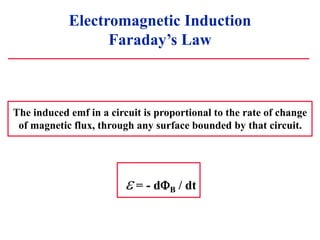
Faraday’s Law
The induced emf in a circuit is proportional to the rate of change
of magnetic flux, through any surface bounded by that circuit.
e = - dB / dt
Faraday’s Experiments
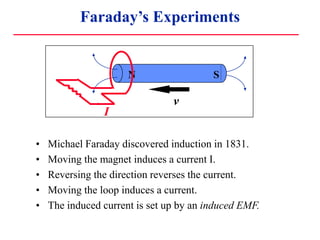
• Michael Faraday discovered induction in 1831.
• Moving the magnet induces a current I.
• Reversing the direction reverses the current.
• Moving the loop induces a current.
• The induced current is set up by an induced EMF.
N S
I
v
Faraday’s Experiments
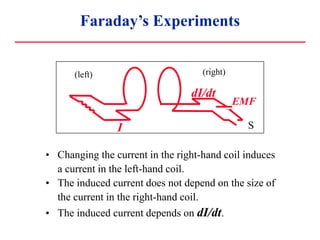
• Changing the current in the right-hand coil induces
a current in the left-hand coil.
• The induced current does not depend on the size of
the current in the right-hand coil.
• The induced current depends on dI/dt.
I
dI/dt
S
EMF
(right)
(left)
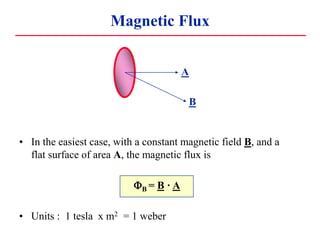
• In the easiest case, with a constant magnetic field B, and a
flat surface of area A, the magnetic flux is
B = B · A
• Units : 1 tesla x m2 = 1 weber
Magnetic Flux
A
B
Magnetic Flux
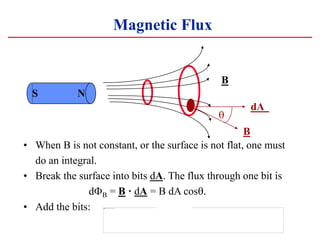
• When B is not constant, or the surface is not flat, one must
do an integral.
• Break the surface into bits dA. The flux through one bit is
dB = B · dA = B dA cosq.
• Add the bits:
B
N
S
dA
B
q
.
Faraday’s Law
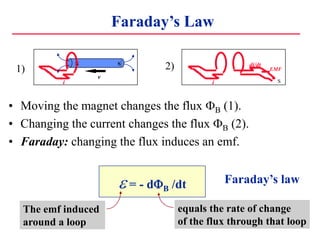
• Moving the magnet changes the flux B (1).
• Changing the current changes the flux B (2).
• Faraday: changing the flux induces an emf.
i
di/dt
S
EMF
N S
i
v
e = - dB /dt
The emf induced
around a loop
equals the rate of change
of the flux through that loop
Faraday’s law
1) 2)
Lenz’s Law
• Faraday’s law gives the direction of the induced emf and therefore
the direction of any induced current.
• Lenz’s law is a simple way to get the directions straight, with less
effort.
• Lenz’s Law:
The induced emf is directed so that any induced current flow
will oppose the change in magnetic flux (which causes the
induced emf).
• This is easier to use than to say ...
Decreasing magnetic flux  emf creates additional magnetic field
Increasing flux  emf creates opposed magnetic field
Lenz’s Law
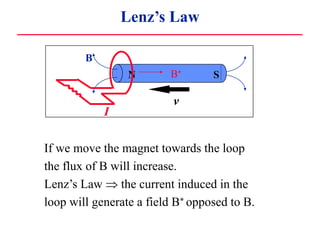
If we move the magnet towards the loop
the flux of B will increase.
Lenz’s Law  the current induced in the
loop will generate a field B opposed to B.
N S
I
v
B
B
Lenz’s Law
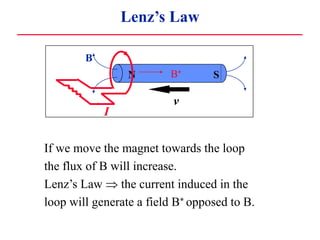
If we move the magnet towards the loop
the flux of B will increase.
Lenz’s Law  the current induced in the
loop will generate a field B opposed to B.
N S
I
v
B
B
Example of Faraday’s Law
B
Consider a coil of radius 5 cm with N = 250 turns.
A magnetic field B, passing through it,
changes in time: B(t)= 0.6 t [T] (t = time in seconds)
The total resistance of the coil is 8 W.
What is the induced current ?
Use Lenz’s law to determine the
direction of the induced current.
Apply Faraday’s law to find the
emf and then the current.
Example of Faraday’s Law
B
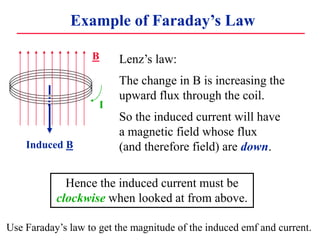
Hence the induced current must be
clockwise when looked at from above.
Lenz’s law:
The change in B is increasing the
upward flux through the coil.
So the induced current will have
a magnetic field whose flux
(and therefore field) are down.
Induced B
I
Use Faraday’s law to get the magnitude of the induced emf and current.
B
Induced B
I
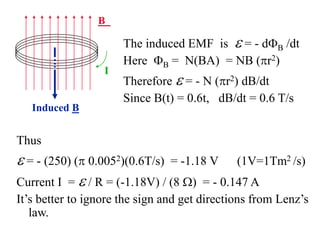
Thus
e = - (250) (p 0.0052)(0.6T/s) = -1.18 V (1V=1Tm2 /s)
Current I = e / R = (-1.18V) / (8 W) = - 0.147 A
It’s better to ignore the sign and get directions from Lenz’s
law.
The induced EMF is e = - dB /dt
Here B = N(BA) = NB (pr2)
Therefore e = - N (pr2) dB/dt
Since B(t) = 0.6t, dB/dt = 0.6 T/s
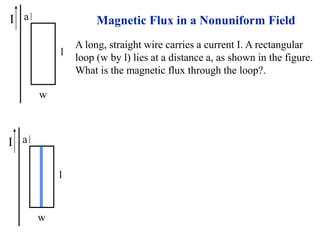
I
w
l
a Magnetic Flux in a Nonuniform Field
A long, straight wire carries a current I. A rectangular
loop (w by l) lies at a distance a, as shown in the figure.
What is the magnetic flux through the loop?.
I
w
l
a
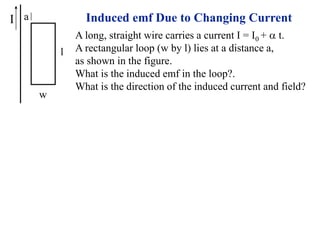
I
w
l
a Induced emf Due to Changing Current
A long, straight wire carries a current I = I0 + a t.
A rectangular loop (w by l) lies at a distance a,
as shown in the figure.
What is the induced emf in the loop?.
What is the direction of the induced current and field?
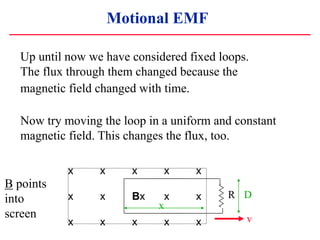
x x x x x
x x Bx x x
x x x x x
Up until now we have considered fixed loops.
The flux through them changed because the
magnetic field changed with time.
Now try moving the loop in a uniform and constant
magnetic field. This changes the flux, too.
Motional EMF
B points
into
screen
R
x
D
v
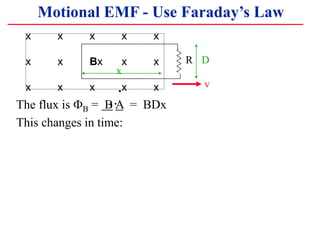
x x x x x
x x Bx x x
x x x x x
R
x
D
v
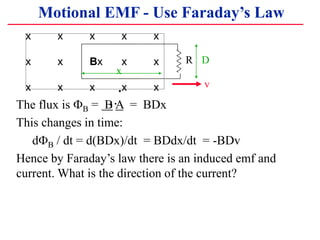
The flux is B = B A = BDx
This changes in time:
.
Motional EMF - Use Faraday’s Law
.
.
The flux is B = B A = BDx
This changes in time:
dB / dt = d(BDx)/dt = BDdx/dt = -BDv
Hence by Faraday’s law there is an induced emf and
current. What is the direction of the current?
x x x x x
x x Bx x x
x x x x x
R
x
D
v
.
Motional EMF - Use Faraday’s Law
.
.
x x x x x
x x Bx x x
x x x x x
R
x
D
v
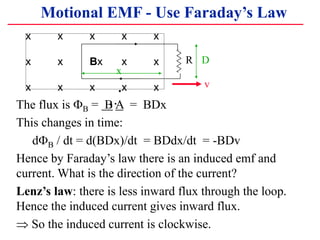
The flux is B = B A = BDx
This changes in time:
dB / dt = d(BDx)/dt = BDdx/dt = -BDv
Hence by Faraday’s law there is an induced emf and
current. What is the direction of the current?
Lenz’s law: there is less inward flux through the loop.
Hence the induced current gives inward flux.
 So the induced current is clockwise.
.
Motional EMF - Use Faraday’s Law
.
.
x x x x x
x x Bx x x
x x x x x
R
x
D
v
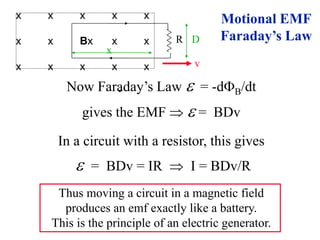
Now Faraday’s Law e = -dB/dt
gives the EMF  e = BDv
In a circuit with a resistor, this gives
e = BDv = IR  I = BDv/R
Thus moving a circuit in a magnetic field
produces an emf exactly like a battery.
This is the principle of an electric generator.
.
Motional EMF
Faraday’s Law
Rotating Loop - The Electric Generator
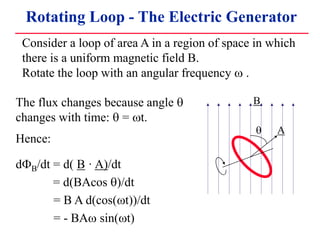
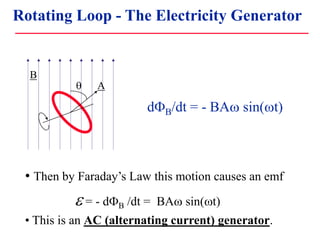
Consider a loop of area A in a region of space in which
there is a uniform magnetic field B.
Rotate the loop with an angular frequency w .
A
B
q
The flux changes because angle q
changes with time: q = wt.
Hence:
dB/dt = d( B · A)/dt
= d(BAcos q)/dt
= B A d(cos(wt))/dt
= - BAw sin(wt)
• Then by Faraday’s Law this motion causes an emf
e = - dB /dt = BAw sin(wt)
• This is an AC (alternating current) generator.
B
A
q
dB/dt = - BAw sin(wt)
Rotating Loop - The Electricity Generator
A New Source of EMF
• If we have a conducting loop in a magnetic field, we
can create an EMF (like a battery) by changing the
value of B · A.
• This can be done by changing the area, by changing
the magnetic field, or the angle between them.
• We can use this source of EMF in electrical circuits in
the same way we used batteries.
• Remember we have to do work to move the loop or to
change B, to generate the EMF (Nothing is for free!).
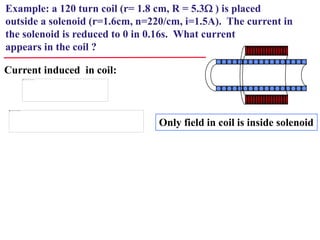
Example: a 120 turn coil (r= 1.8 cm, R = 5.3W ) is placed
outside a solenoid (r=1.6cm, n=220/cm, i=1.5A). The current in
the solenoid is reduced to 0 in 0.16s. What current
appears in the coil ?
Current induced in coil:
Only field in coil is inside solenoid
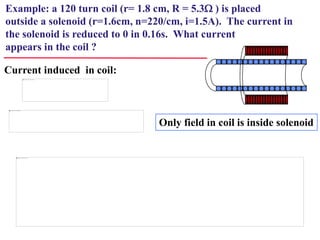
Example: a 120 turn coil (r= 1.8 cm, R = 5.3W ) is placed
outside a solenoid (r=1.6cm, n=220/cm, i=1.5A). The current in
the solenoid is reduced to 0 in 0.16s. What current
appears in the coil ?
Current induced in coil:
Only field in coil is inside solenoid
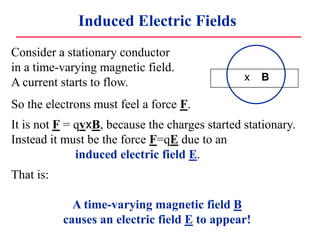
Consider a stationary conductor
in a time-varying magnetic field.
A current starts to flow.
Induced Electric Fields
x B
So the electrons must feel a force F.
It is not F = qvxB, because the charges started stationary.
Instead it must be the force F=qE due to an
induced electric field E.
That is:
A time-varying magnetic field B
causes an electric field E to appear!
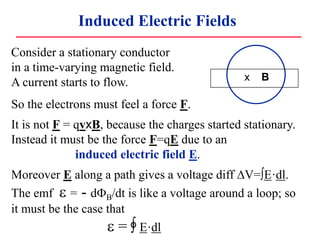
Consider a stationary conductor
in a time-varying magnetic field.
A current starts to flow.
Induced Electric Fields
x B
So the electrons must feel a force F.
It is not F = qvxB, because the charges started stationary.
Instead it must be the force F=qE due to an
induced electric field E.
Moreover E along a path gives a voltage diff DV=E·dl.
The emf e = - dB/dt is like a voltage around a loop; so
it must be the case that
e =  E·dl
o
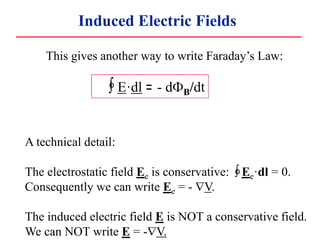
Induced Electric Fields
 E·dl = - dB/dt
o
This gives another way to write Faraday’s Law:
A technical detail:
The electrostatic field Ee is conservative:  Ee·dl = 0.
Consequently we can write Ee = - V.
The induced electric field E is NOT a conservative field.
We can NOT write E = -V.
o
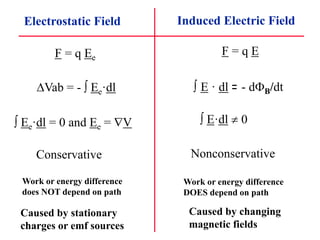
Electrostatic Field Induced Electric Field
F = q Ee
F = q E
DVab = -  Ee·dl
 Ee·dl = 0 and Ee = V
 E · dl = - dB/dt
 E·dl  0
Conservative Nonconservative
Work or energy difference
does NOT depend on path
Work or energy difference
DOES depend on path
Caused by stationary
charges or emf sources
Caused by changing
magnetic fields
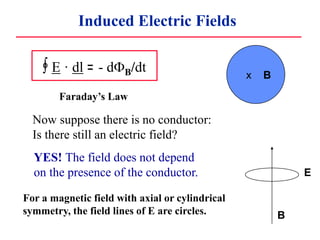
Induced Electric Fields
x B
 E · dl = - dB/dt
o
Faraday’s Law
Now suppose there is no conductor:
Is there still an electric field?
YES! The field does not depend
on the presence of the conductor.
For a magnetic field with axial or cylindrical
symmetry, the field lines of E are circles. B
E

class14.ppt

  • 1.
    Electromagnetic Induction Chapter 31 Faraday’sLaw Induced Currents Lenz’s Law Induced EMF Magnetic Flux Induced Electric Fields
  • 2.
    Electromagnetic Induction A changingmagnetic field (intensity, movement) will induce an electromotive force (emf) In a closed electric circuit, a changing magnetic field will produce an electric current
  • 3.
    Electromagnetic Induction Faraday’s Law Theinduced emf in a circuit is proportional to the rate of change of magnetic flux, through any surface bounded by that circuit. e = - dB / dt
  • 4.
    Faraday’s Experiments • MichaelFaraday discovered induction in 1831. • Moving the magnet induces a current I. • Reversing the direction reverses the current. • Moving the loop induces a current. • The induced current is set up by an induced EMF. N S I v
  • 5.
    Faraday’s Experiments • Changingthe current in the right-hand coil induces a current in the left-hand coil. • The induced current does not depend on the size of the current in the right-hand coil. • The induced current depends on dI/dt. I dI/dt S EMF (right) (left)
  • 6.
    • In theeasiest case, with a constant magnetic field B, and a flat surface of area A, the magnetic flux is B = B · A • Units : 1 tesla x m2 = 1 weber Magnetic Flux A B
  • 7.
    Magnetic Flux • WhenB is not constant, or the surface is not flat, one must do an integral. • Break the surface into bits dA. The flux through one bit is dB = B · dA = B dA cosq. • Add the bits: B N S dA B q .
  • 8.
    Faraday’s Law • Movingthe magnet changes the flux B (1). • Changing the current changes the flux B (2). • Faraday: changing the flux induces an emf. i di/dt S EMF N S i v e = - dB /dt The emf induced around a loop equals the rate of change of the flux through that loop Faraday’s law 1) 2)
  • 9.
    Lenz’s Law • Faraday’slaw gives the direction of the induced emf and therefore the direction of any induced current. • Lenz’s law is a simple way to get the directions straight, with less effort. • Lenz’s Law: The induced emf is directed so that any induced current flow will oppose the change in magnetic flux (which causes the induced emf). • This is easier to use than to say ... Decreasing magnetic flux  emf creates additional magnetic field Increasing flux  emf creates opposed magnetic field
  • 10.
    Lenz’s Law If wemove the magnet towards the loop the flux of B will increase. Lenz’s Law  the current induced in the loop will generate a field B opposed to B. N S I v B B
  • 11.
    Lenz’s Law If wemove the magnet towards the loop the flux of B will increase. Lenz’s Law  the current induced in the loop will generate a field B opposed to B. N S I v B B
  • 12.
    Example of Faraday’sLaw B Consider a coil of radius 5 cm with N = 250 turns. A magnetic field B, passing through it, changes in time: B(t)= 0.6 t [T] (t = time in seconds) The total resistance of the coil is 8 W. What is the induced current ? Use Lenz’s law to determine the direction of the induced current. Apply Faraday’s law to find the emf and then the current.
  • 13.
    Example of Faraday’sLaw B Hence the induced current must be clockwise when looked at from above. Lenz’s law: The change in B is increasing the upward flux through the coil. So the induced current will have a magnetic field whose flux (and therefore field) are down. Induced B I Use Faraday’s law to get the magnitude of the induced emf and current.
  • 14.
    B Induced B I Thus e =- (250) (p 0.0052)(0.6T/s) = -1.18 V (1V=1Tm2 /s) Current I = e / R = (-1.18V) / (8 W) = - 0.147 A It’s better to ignore the sign and get directions from Lenz’s law. The induced EMF is e = - dB /dt Here B = N(BA) = NB (pr2) Therefore e = - N (pr2) dB/dt Since B(t) = 0.6t, dB/dt = 0.6 T/s
  • 15.
    I w l a Magnetic Fluxin a Nonuniform Field A long, straight wire carries a current I. A rectangular loop (w by l) lies at a distance a, as shown in the figure. What is the magnetic flux through the loop?. I w l a
  • 16.
    I w l a Induced emfDue to Changing Current A long, straight wire carries a current I = I0 + a t. A rectangular loop (w by l) lies at a distance a, as shown in the figure. What is the induced emf in the loop?. What is the direction of the induced current and field?
  • 17.
    x x xx x x x Bx x x x x x x x Up until now we have considered fixed loops. The flux through them changed because the magnetic field changed with time. Now try moving the loop in a uniform and constant magnetic field. This changes the flux, too. Motional EMF B points into screen R x D v
  • 18.
    x x xx x x x Bx x x x x x x x R x D v The flux is B = B A = BDx This changes in time: . Motional EMF - Use Faraday’s Law . .
  • 19.
    The flux isB = B A = BDx This changes in time: dB / dt = d(BDx)/dt = BDdx/dt = -BDv Hence by Faraday’s law there is an induced emf and current. What is the direction of the current? x x x x x x x Bx x x x x x x x R x D v . Motional EMF - Use Faraday’s Law . .
  • 20.
    x x xx x x x Bx x x x x x x x R x D v The flux is B = B A = BDx This changes in time: dB / dt = d(BDx)/dt = BDdx/dt = -BDv Hence by Faraday’s law there is an induced emf and current. What is the direction of the current? Lenz’s law: there is less inward flux through the loop. Hence the induced current gives inward flux.  So the induced current is clockwise. . Motional EMF - Use Faraday’s Law . .
  • 21.
    x x xx x x x Bx x x x x x x x R x D v Now Faraday’s Law e = -dB/dt gives the EMF  e = BDv In a circuit with a resistor, this gives e = BDv = IR  I = BDv/R Thus moving a circuit in a magnetic field produces an emf exactly like a battery. This is the principle of an electric generator. . Motional EMF Faraday’s Law
  • 22.
    Rotating Loop -The Electric Generator Consider a loop of area A in a region of space in which there is a uniform magnetic field B. Rotate the loop with an angular frequency w . A B q The flux changes because angle q changes with time: q = wt. Hence: dB/dt = d( B · A)/dt = d(BAcos q)/dt = B A d(cos(wt))/dt = - BAw sin(wt)
  • 23.
    • Then byFaraday’s Law this motion causes an emf e = - dB /dt = BAw sin(wt) • This is an AC (alternating current) generator. B A q dB/dt = - BAw sin(wt) Rotating Loop - The Electricity Generator
  • 24.
    A New Sourceof EMF • If we have a conducting loop in a magnetic field, we can create an EMF (like a battery) by changing the value of B · A. • This can be done by changing the area, by changing the magnetic field, or the angle between them. • We can use this source of EMF in electrical circuits in the same way we used batteries. • Remember we have to do work to move the loop or to change B, to generate the EMF (Nothing is for free!).
  • 25.
    Example: a 120turn coil (r= 1.8 cm, R = 5.3W ) is placed outside a solenoid (r=1.6cm, n=220/cm, i=1.5A). The current in the solenoid is reduced to 0 in 0.16s. What current appears in the coil ? Current induced in coil: Only field in coil is inside solenoid
  • 26.
    Example: a 120turn coil (r= 1.8 cm, R = 5.3W ) is placed outside a solenoid (r=1.6cm, n=220/cm, i=1.5A). The current in the solenoid is reduced to 0 in 0.16s. What current appears in the coil ? Current induced in coil: Only field in coil is inside solenoid
  • 27.
    Consider a stationaryconductor in a time-varying magnetic field. A current starts to flow. Induced Electric Fields x B So the electrons must feel a force F. It is not F = qvxB, because the charges started stationary. Instead it must be the force F=qE due to an induced electric field E. That is: A time-varying magnetic field B causes an electric field E to appear!
  • 28.
    Consider a stationaryconductor in a time-varying magnetic field. A current starts to flow. Induced Electric Fields x B So the electrons must feel a force F. It is not F = qvxB, because the charges started stationary. Instead it must be the force F=qE due to an induced electric field E. Moreover E along a path gives a voltage diff DV=E·dl. The emf e = - dB/dt is like a voltage around a loop; so it must be the case that e =  E·dl o
  • 29.
    Induced Electric Fields E·dl = - dB/dt o This gives another way to write Faraday’s Law: A technical detail: The electrostatic field Ee is conservative:  Ee·dl = 0. Consequently we can write Ee = - V. The induced electric field E is NOT a conservative field. We can NOT write E = -V. o
  • 30.
    Electrostatic Field InducedElectric Field F = q Ee F = q E DVab = -  Ee·dl  Ee·dl = 0 and Ee = V  E · dl = - dB/dt  E·dl  0 Conservative Nonconservative Work or energy difference does NOT depend on path Work or energy difference DOES depend on path Caused by stationary charges or emf sources Caused by changing magnetic fields
  • 31.
    Induced Electric Fields xB  E · dl = - dB/dt o Faraday’s Law Now suppose there is no conductor: Is there still an electric field? YES! The field does not depend on the presence of the conductor. For a magnetic field with axial or cylindrical symmetry, the field lines of E are circles. B E