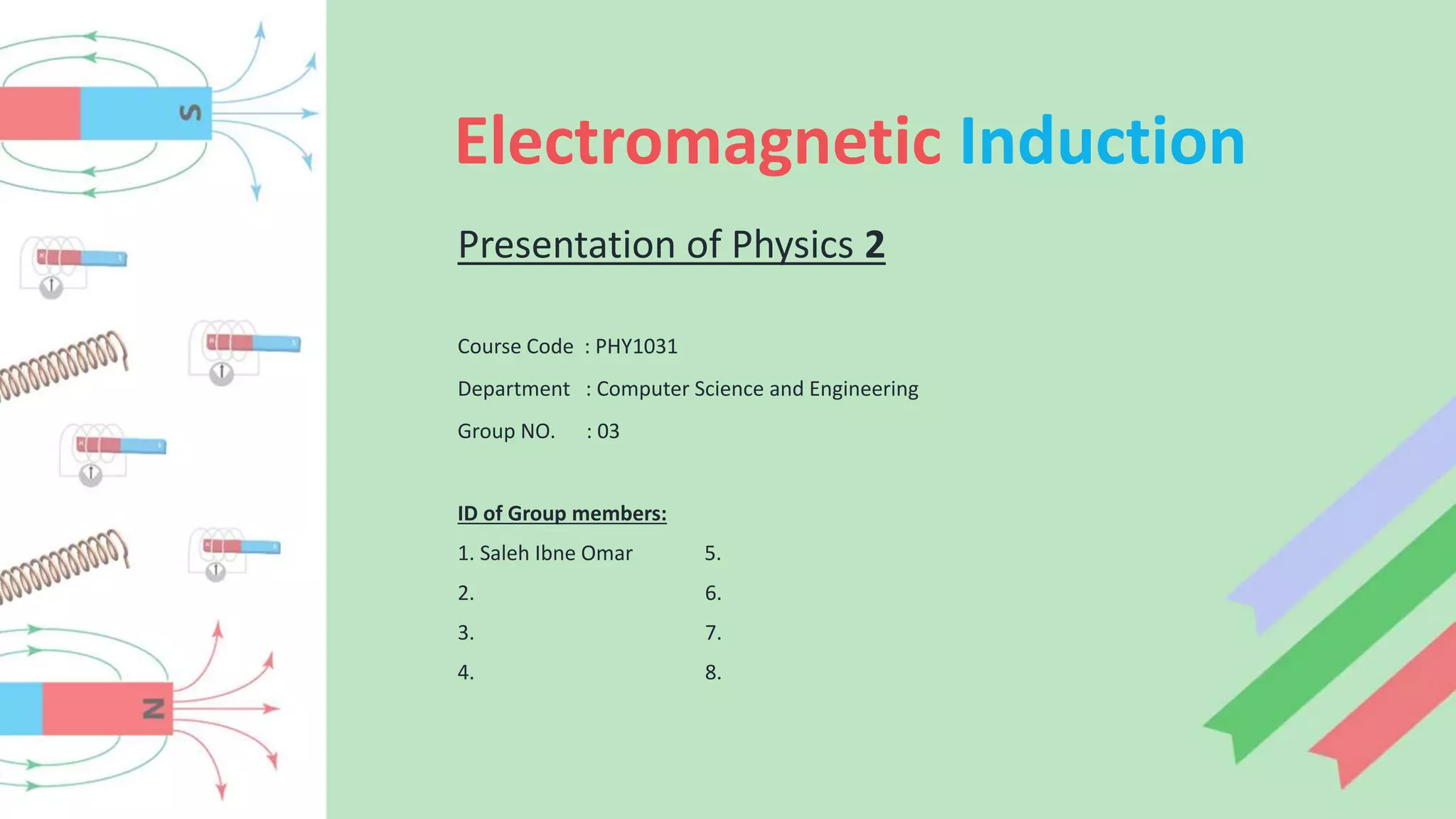
Electromagnetic Induction
Presentation of Physics 2
Course Code : PHY1031
Department : Computer Science and Engineering
Group NO. : 03
ID of Group members:
1. Saleh Ibne Omar 5.
2. 6.
3. 7.
4. 8.
What is Electromagnetic Induction?
 Electromagnetic induction refers to the generation of an electric current by passing a
metal wire through a magnetic field.
 Electromagnetic or magnetic induction is the production of an electromotive force
across an electrical conductor in a changing magnetic field.
 When an induced current is produced because of voltage production (E.M.F) due to a
changing magnetic field, it is called electromagnetic induction.
moving coil stationary B : current is generated
moving B emf current is induced
current carrying conductor
emf is produced: stationary coil , moving B
Brief History of Electromagnetic Induction
 In 1820, Oersted first discovered that a magnetic field is always
associated with an electric current.
 In 1831, August 29, Faraday discovered electromagnetic induction
by his famous induction ring experiment.
Electromagnetic Induction test
 Make a connection between the galvanometer and the copper
coil with the electric wires.
 Try to push the bar inside of the coil.
 Take away the bar from the from the coil.
Type text here
Characteristics of Electromagnetic Induction
 For movements between magnetic bar and the conductor, there will be deflections in
galvanometer.
 If the bar and the conductor remain steady then there will be no deflections in the
galvanometer.
 If the pole of the magnetic bar is changed, the direction of induced current will change.
 When the loops in the coil increases the deflection become greater and when loops
decreases the deflection become smaller.
Faraday’s experiments of Electromagnetic Induction
 Faraday conducted three different experiments to find
electromagnetic induction.
 He used a coil of wire, galvanometer, and a bar magnet, by
noticing deflections he conducted his first experiment.
Faraday’s experiments of Electromagnetic Induction
 He replaced the magnet bar with a current carrying
solenoid to perform his second experiment.
 He placed two coils close together face to face but at rest
with respect to each other and by closing and opening the
circuit he conducted his third experiment.
Magnetic Flux
 The flux of the magnetic field through a surface is defined in a similar manner
as we defined flux in the electric field.
 If the magnetic field is constant, the magnetic flux passing through a surface of
vector area S is ΦB = B.S cosƟ.
Magnetic Flux
 Magnetic flux is usually measured with a flux meter, which contains measuring
coils and electronics, that evaluates the change of voltage in the measuring
coils to calculate the magnetic flux.
 The SI unit of magnetic flux is the weber (Wb) (in derived units: volt-seconds),
and the CGS unit is the Maxwell.
Laws of Electromagnetic Induction
 Faraday’s Law : It states that, the E.M.F induced in a wire is proportional to the
rate of the flux through the loop.
 Neumann's Law : The magnitude of the induced E.M.F is proportional to the
rate of change of the magnetic flux linking the circuit.
 Lenz’s Law : The induced E.M.F acts to the circulate a current in a direction that
oppose the change in flux which caused the induced E.M.F
Explanation of Lenz's Law
 According to Lenz’s law, the direction of included current in a coil
is such that it always opposes the cause which produces it.
 This law follows the law of conservation of energy.
Self-Induction
 Self-Induction is the characteristic of the coil itself.
 When the main current in the coil decreases, the induced
current opposes the decay of current in the coil.
 When the main current in the coil increases, the induced
current opposes the growth of current in the coil.
Mutual-Induction
 Mutual induction is the characteristic of a pair of coils.
 When the main current in the coil decreases, induced
current developed in the neighbouring coil opposes the
decay of current in the coil.
 When the main current in the coil increases, the induced
current developed in the neighbouring coil opposes the
growth of current in the coil.
Some Applications of EMI
 Induction Sealing.
 Induction motors.
 Electrical generators.
 Transformers.
 Contactless charging of rechargeable batteries.
 Induction welding.
Some Applications of EMI
 Magnetic flow meters.
 Transcranial magnetic stimulation.
 Graphics tablet.
 Wireless energy transfer.
 Audio and video tapes.
 Electric Guitar Pickups.
Transformer
 A transformer is an electrical device which, by the
principles of electromagnetic induction.
 It transfers electrical energy from one electric circuit to
another, without changing the frequency.
 Transformers either increases or decreases AC voltage, two
types step-up and step-down.
Electrical generator
 Generator, operates on the principle of electromagnetic
induction.
 A generator is a device that converts motive power into
electrical power for use in an external circuit.
 In the simplest form of generator the conductor is an open
coil of wire rotating between the poles of a permanent
magnet.
Thanks For Watching
This Slideshow

phyfor8ppl-EMF.pdf

  • 1.
    Electromagnetic Induction Presentation ofPhysics 2 Course Code : PHY1031 Department : Computer Science and Engineering Group NO. : 03 ID of Group members: 1. Saleh Ibne Omar 5. 2. 6. 3. 7. 4. 8.
  • 2.
    What is ElectromagneticInduction?  Electromagnetic induction refers to the generation of an electric current by passing a metal wire through a magnetic field.  Electromagnetic or magnetic induction is the production of an electromotive force across an electrical conductor in a changing magnetic field.  When an induced current is produced because of voltage production (E.M.F) due to a changing magnetic field, it is called electromagnetic induction. moving coil stationary B : current is generated moving B emf current is induced current carrying conductor emf is produced: stationary coil , moving B
  • 3.
    Brief History ofElectromagnetic Induction  In 1820, Oersted first discovered that a magnetic field is always associated with an electric current.  In 1831, August 29, Faraday discovered electromagnetic induction by his famous induction ring experiment.
  • 4.
    Electromagnetic Induction test Make a connection between the galvanometer and the copper coil with the electric wires.  Try to push the bar inside of the coil.  Take away the bar from the from the coil. Type text here
  • 5.
    Characteristics of ElectromagneticInduction  For movements between magnetic bar and the conductor, there will be deflections in galvanometer.  If the bar and the conductor remain steady then there will be no deflections in the galvanometer.  If the pole of the magnetic bar is changed, the direction of induced current will change.  When the loops in the coil increases the deflection become greater and when loops decreases the deflection become smaller.
  • 6.
    Faraday’s experiments ofElectromagnetic Induction  Faraday conducted three different experiments to find electromagnetic induction.  He used a coil of wire, galvanometer, and a bar magnet, by noticing deflections he conducted his first experiment.
  • 7.
    Faraday’s experiments ofElectromagnetic Induction  He replaced the magnet bar with a current carrying solenoid to perform his second experiment.  He placed two coils close together face to face but at rest with respect to each other and by closing and opening the circuit he conducted his third experiment.
  • 8.
    Magnetic Flux  Theflux of the magnetic field through a surface is defined in a similar manner as we defined flux in the electric field.  If the magnetic field is constant, the magnetic flux passing through a surface of vector area S is ΦB = B.S cosƟ.
  • 9.
    Magnetic Flux  Magneticflux is usually measured with a flux meter, which contains measuring coils and electronics, that evaluates the change of voltage in the measuring coils to calculate the magnetic flux.  The SI unit of magnetic flux is the weber (Wb) (in derived units: volt-seconds), and the CGS unit is the Maxwell.
  • 10.
    Laws of ElectromagneticInduction  Faraday’s Law : It states that, the E.M.F induced in a wire is proportional to the rate of the flux through the loop.  Neumann's Law : The magnitude of the induced E.M.F is proportional to the rate of change of the magnetic flux linking the circuit.  Lenz’s Law : The induced E.M.F acts to the circulate a current in a direction that oppose the change in flux which caused the induced E.M.F
  • 11.
    Explanation of Lenz'sLaw  According to Lenz’s law, the direction of included current in a coil is such that it always opposes the cause which produces it.  This law follows the law of conservation of energy.
  • 12.
    Self-Induction  Self-Induction isthe characteristic of the coil itself.  When the main current in the coil decreases, the induced current opposes the decay of current in the coil.  When the main current in the coil increases, the induced current opposes the growth of current in the coil.
  • 13.
    Mutual-Induction  Mutual inductionis the characteristic of a pair of coils.  When the main current in the coil decreases, induced current developed in the neighbouring coil opposes the decay of current in the coil.  When the main current in the coil increases, the induced current developed in the neighbouring coil opposes the growth of current in the coil.
  • 14.
    Some Applications ofEMI  Induction Sealing.  Induction motors.  Electrical generators.  Transformers.  Contactless charging of rechargeable batteries.  Induction welding.
  • 15.
    Some Applications ofEMI  Magnetic flow meters.  Transcranial magnetic stimulation.  Graphics tablet.  Wireless energy transfer.  Audio and video tapes.  Electric Guitar Pickups.
  • 16.
    Transformer  A transformeris an electrical device which, by the principles of electromagnetic induction.  It transfers electrical energy from one electric circuit to another, without changing the frequency.  Transformers either increases or decreases AC voltage, two types step-up and step-down.
  • 17.
    Electrical generator  Generator,operates on the principle of electromagnetic induction.  A generator is a device that converts motive power into electrical power for use in an external circuit.  In the simplest form of generator the conductor is an open coil of wire rotating between the poles of a permanent magnet.
  • 18.