ELECTROMAGNETIC
INDUCTION
WHAT IS
ELECTROMAGNETIC
INDUCTION ?
 Electromagnetic induction refers to the generation of an
electric
current by passing a metal wire through a magnetic field.
 Electromagnetic or magnetic induction is the production of
an electromotive force
across an electrical conductor in a changing magnetic field.
 When an induced current is produced because of voltage
production (E.M.F) due to a changing magnetic field, it is
called electromagnetic induction.
CHARACTERISTICS OF
ELECTROMAGNETIC
INDUCTION
 For movements between magnetic bar and the conductor,
there will be deflections in galvanometer.
 If the bar and the conductor remain steady then there will
be no deflections in the galvanometer.
 If the pole of the magnetic bar is changed, the direction of
induced current will change
 When the loops in the coil increases the deflection become
greater and when loops decreases the deflection become
smaller.
HISTORY OF
ELECTROMAGNETIC
INDUCTION
In 1820, Oersted first discovered that a
magnetic field is Always associated with
an electric current.
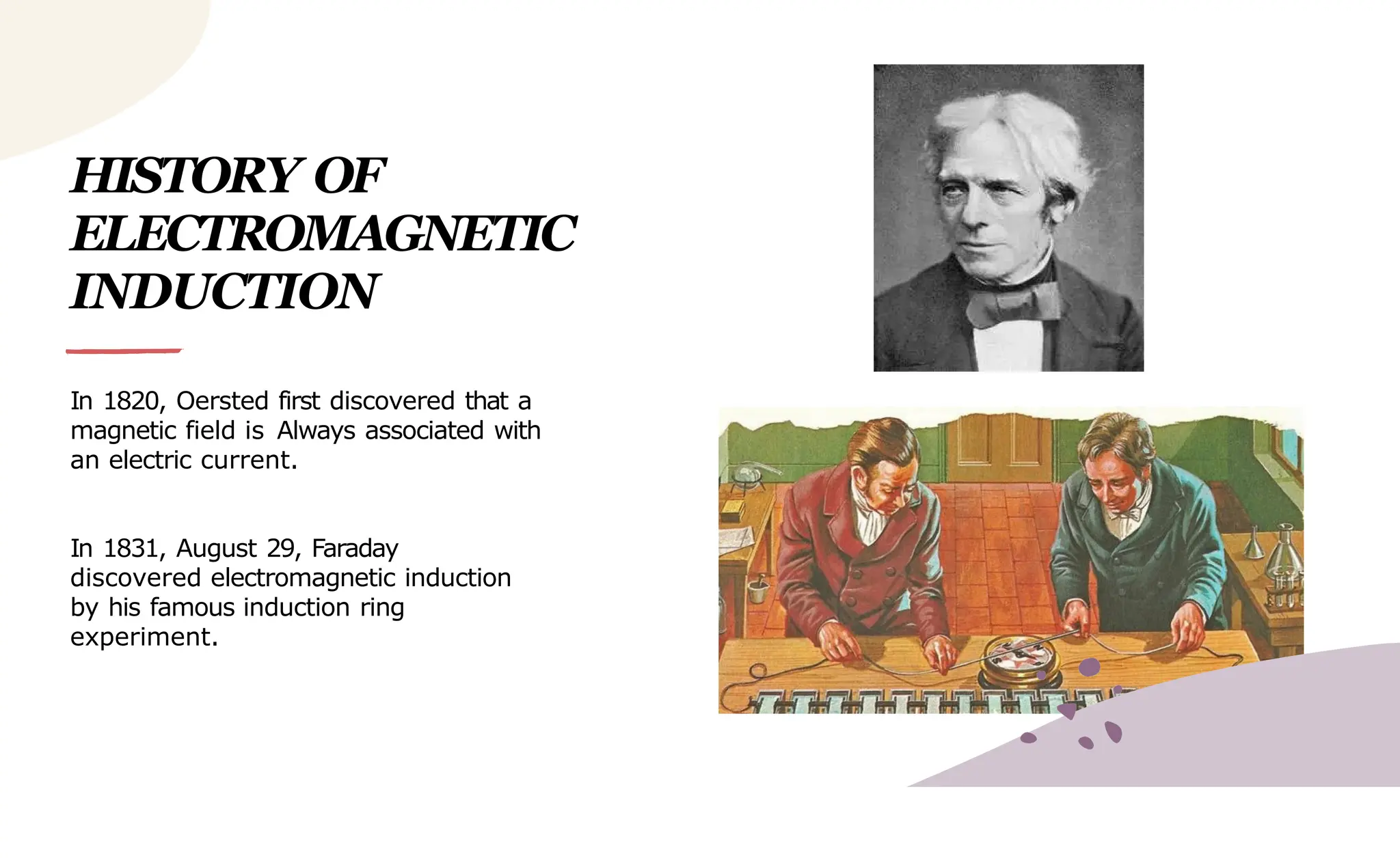
In 1831, August 29, Faraday
discovered electromagnetic induction
by his famous induction ring
experiment.
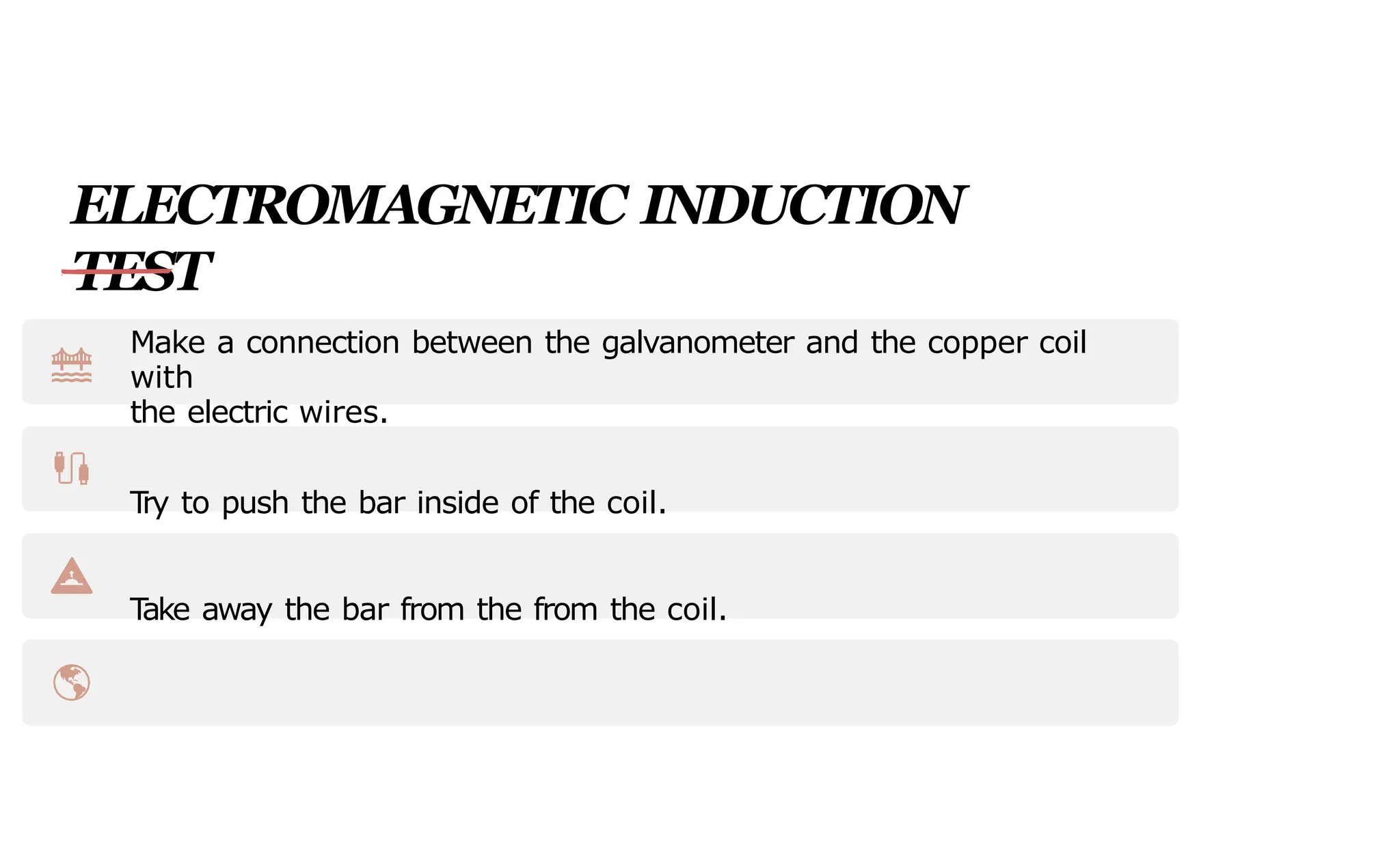
ELECTROMAGNETIC INDUCTION
TEST
Make a connection between the galvanometer and the copper coil
with
the electric wires.
T
ry to push the bar inside of the coil.
T
ake away the bar from the from the coil.
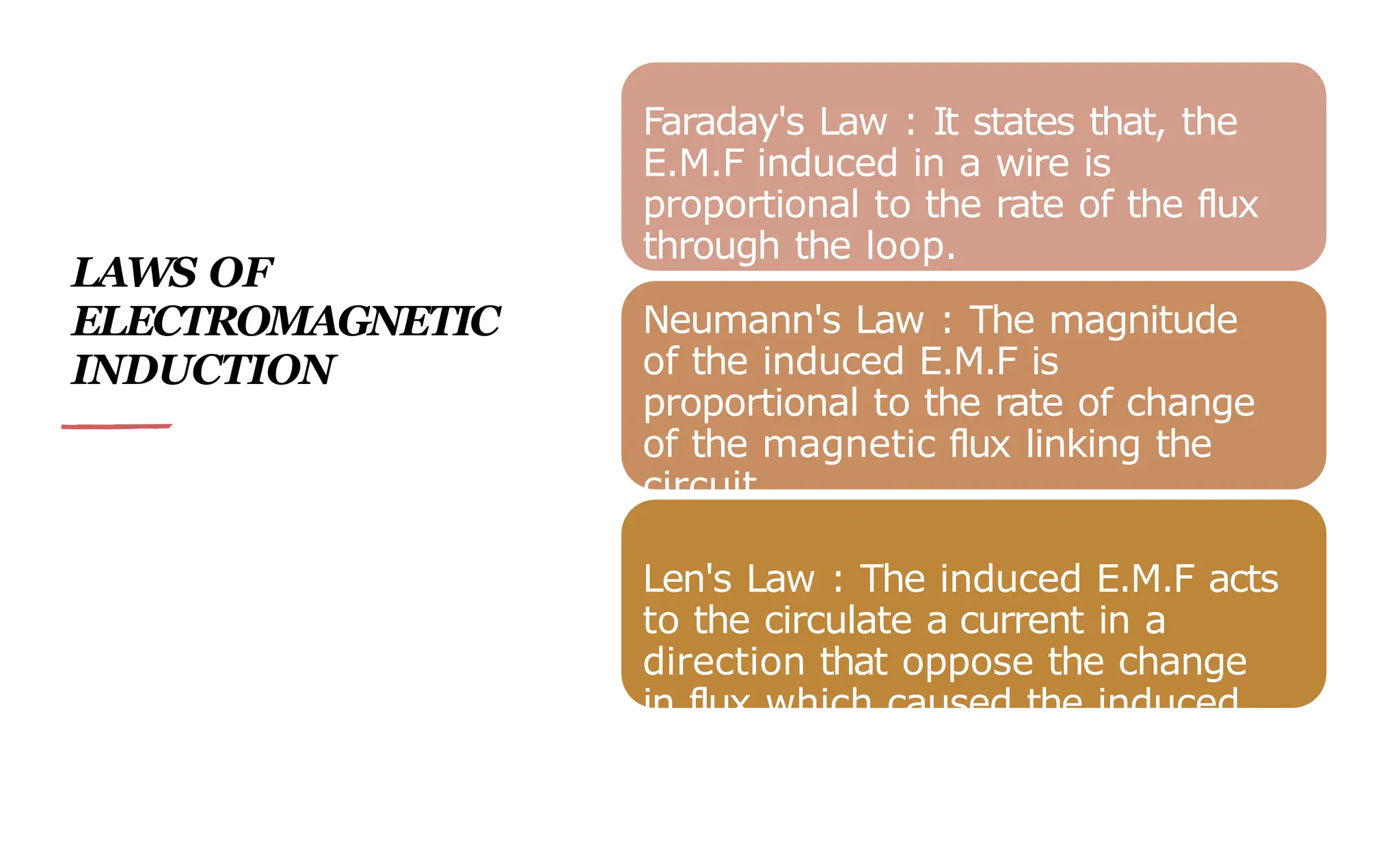
LAWS OF
ELECTROMAGNETIC
INDUCTION
Faraday's Law : It states that, the
E.M.F induced in a wire is
proportional to the rate of the flux
through the loop.
Neumann's Law : The magnitude
of the induced E.M.F is
proportional to the rate of change
of the magnetic flux linking the
circuit.
Len's Law : The induced E.M.F acts
to the circulate a current in a
direction that oppose the change
in flux which caused the induced
E.M.F
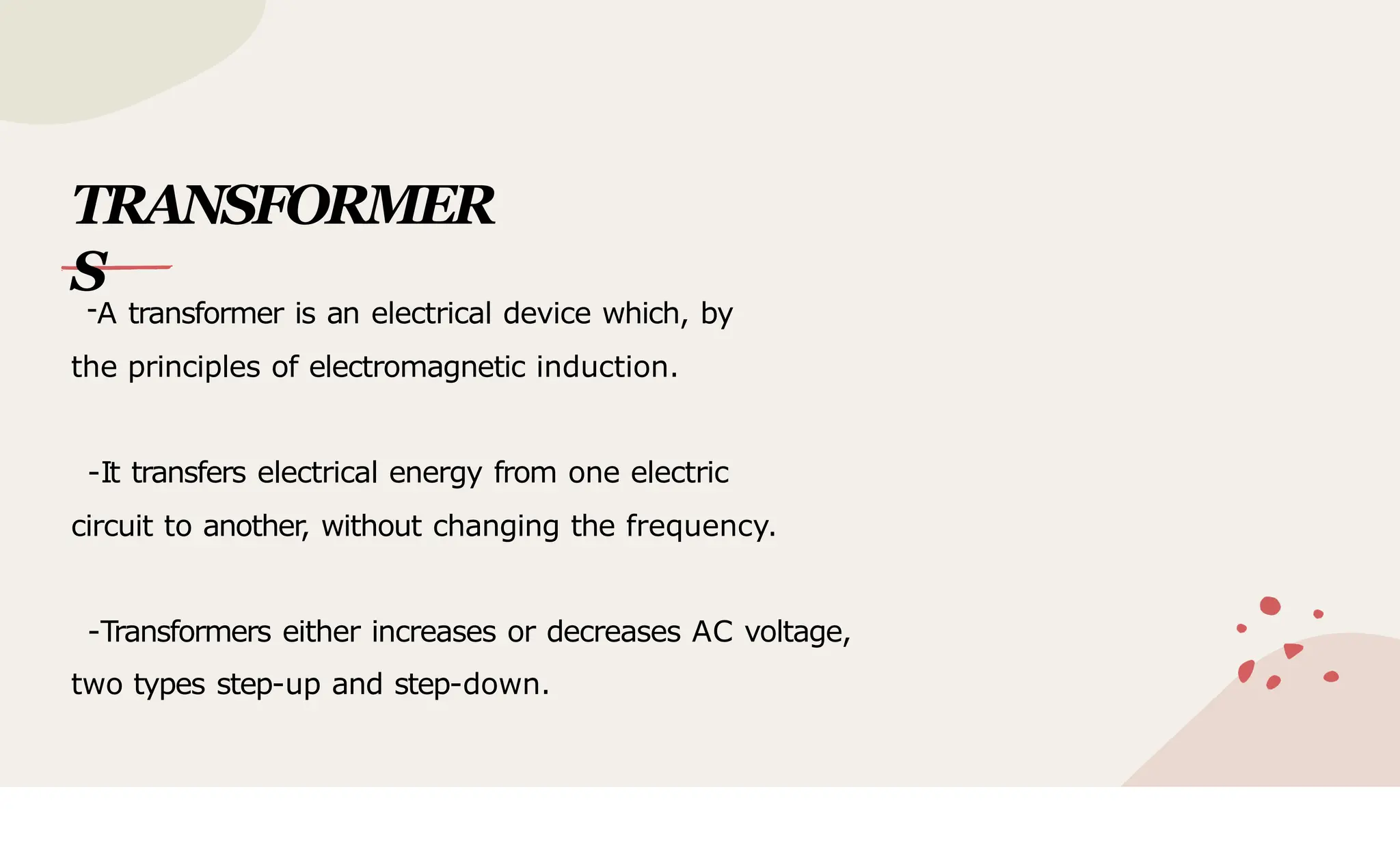
TRANSFORMER
S
-A transformer is an electrical device which, by
the principles of electromagnetic induction.
-It transfers electrical energy from one electric
circuit to another
, without changing the frequency.
-Transformers either increases or decreases AC voltage,
two types step-up and step-down.
ELECTRICAL
GENERATOR
 Generator, operates on the principle
of electromagnetic induction.
 A generator is a device that converts
motive power
into electrical power for use in an
external circuit.
 In the simplest form of generator the conductor
is an open coil of wire rotating between the
poles of a permanent magnet.
QUI
Z
1. The direction of the induced field can be predicted by
Kepler’s law
Newton’s
law Lenz’s
law
Faraday’s
law
2. Fill in the blanks: Electric
generator converts
electrical energy into____
1.Chemical energy
2. Thermal energy
3. Electrical energy
4. Solar energy
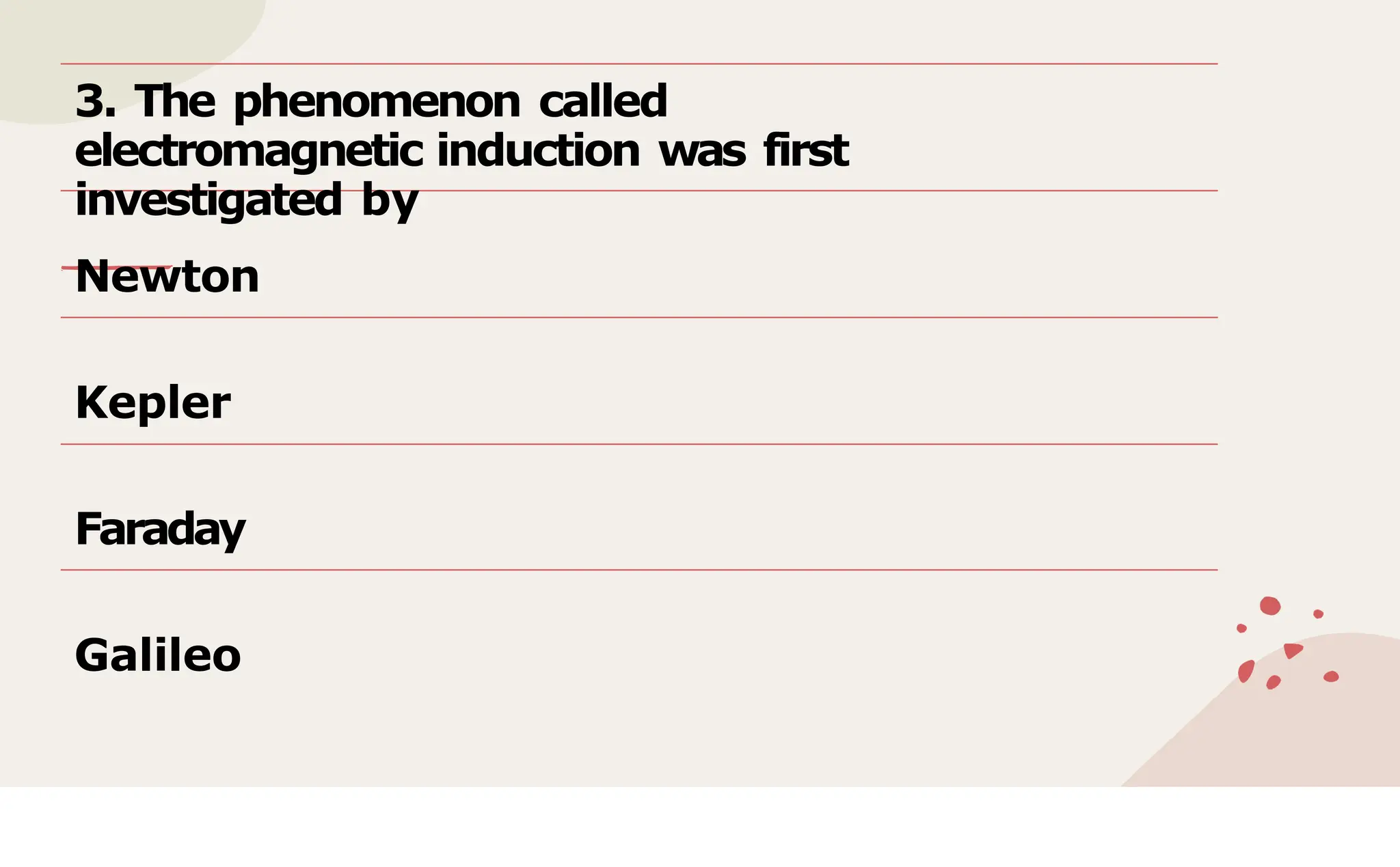
3. The phenomenon called
electromagnetic induction was first
investigated by
Newton
Kepler
Faraday
Galileo
.
4. Lenz’s law is derived
from
Kepler’s law
Newton’s law
Coulomb’s
Law
Faraday’s law
5. Factors that affect the voltage
generation in Faraday’s experiment
is
Number of Coils
Changing Magnetic Field
Changing Environment
Option a) and b)
electromagnetic induction class 12th science

electromagnetic induction class 12th science

  • 1.
  • 3.
    WHAT IS ELECTROMAGNETIC INDUCTION ? Electromagnetic induction refers to the generation of an electric current by passing a metal wire through a magnetic field.  Electromagnetic or magnetic induction is the production of an electromotive force across an electrical conductor in a changing magnetic field.  When an induced current is produced because of voltage production (E.M.F) due to a changing magnetic field, it is called electromagnetic induction.
  • 4.
    CHARACTERISTICS OF ELECTROMAGNETIC INDUCTION  Formovements between magnetic bar and the conductor, there will be deflections in galvanometer.  If the bar and the conductor remain steady then there will be no deflections in the galvanometer.  If the pole of the magnetic bar is changed, the direction of induced current will change  When the loops in the coil increases the deflection become greater and when loops decreases the deflection become smaller.
  • 5.
    HISTORY OF ELECTROMAGNETIC INDUCTION In 1820,Oersted first discovered that a magnetic field is Always associated with an electric current. In 1831, August 29, Faraday discovered electromagnetic induction by his famous induction ring experiment.
  • 6.
    ELECTROMAGNETIC INDUCTION TEST Make aconnection between the galvanometer and the copper coil with the electric wires. T ry to push the bar inside of the coil. T ake away the bar from the from the coil.
  • 7.
    LAWS OF ELECTROMAGNETIC INDUCTION Faraday's Law: It states that, the E.M.F induced in a wire is proportional to the rate of the flux through the loop. Neumann's Law : The magnitude of the induced E.M.F is proportional to the rate of change of the magnetic flux linking the circuit. Len's Law : The induced E.M.F acts to the circulate a current in a direction that oppose the change in flux which caused the induced E.M.F
  • 8.
    TRANSFORMER S -A transformer isan electrical device which, by the principles of electromagnetic induction. -It transfers electrical energy from one electric circuit to another , without changing the frequency. -Transformers either increases or decreases AC voltage, two types step-up and step-down.
  • 9.
    ELECTRICAL GENERATOR  Generator, operateson the principle of electromagnetic induction.  A generator is a device that converts motive power into electrical power for use in an external circuit.  In the simplest form of generator the conductor is an open coil of wire rotating between the poles of a permanent magnet.
  • 10.
    QUI Z 1. The directionof the induced field can be predicted by Kepler’s law Newton’s law Lenz’s law Faraday’s law
  • 11.
    2. Fill inthe blanks: Electric generator converts electrical energy into____ 1.Chemical energy 2. Thermal energy 3. Electrical energy 4. Solar energy
  • 12.
    3. The phenomenoncalled electromagnetic induction was first investigated by Newton Kepler Faraday Galileo
  • 13.
    . 4. Lenz’s lawis derived from Kepler’s law Newton’s law Coulomb’s Law Faraday’s law
  • 14.
    5. Factors thataffect the voltage generation in Faraday’s experiment is Number of Coils Changing Magnetic Field Changing Environment Option a) and b)