1
DRAFT
				Learner’s Material
Grade 10
GOP – Textbook Funds
Electrical Installation and
Maintenance
Department of Education
Republic of the Philippines
GOVERNMENT PROPERTY
NOT FOR SALE
ALLOTTED TO
District/ School: _________________________________________
Division _________________________________________________
First Year of Use: _________________________________________
Source of Fund (Year included):__________________________
2
DRAFT
Technology & Livelihood Education– Grade 10
Learner’s Material
First Edition, 2014
ISBN: ___________
Republic Act 8293, section 176 states that: No copyright
shall subsist in any work of the Government of the Philippines.
However, prior approval of the government agency or office
wherein the work is created shall be necessary for exploitation
of such work for profit. Such agency or office may, among other
things, impose as a condition the payment of royalties.
Borrowed materials (i.e., songs, stories, poems, pictures,
photos, brand names, trademarks, etc.) included in this book are
owned by their respective copyright holders. Every effort has been
exerted to locate and seek permission to use these materials from
their respective copyright owners. The publisher and authors do
not represent nor claim ownership over them.
Published by the Department of Education
Secretary: Br. Armin A. Luistro FSC
Undersecretary: Dina S. Ocampo, Ph.D.
Assistant Secretary: Lorna Dig-Dino, Ph.D.
3
DRAFT
Printed in the Philippines by ____________
Department of Education-Instructional Materials Council
Secretariat (DepEd-IMCS)
Office Address: 2nd Floor Dorm G, Philsports Complex, Meralco
Avenue, Pasig City, Philippines 1600
Telefax:			 (02) 634-1054, 634-1072
E-mail Address:		 imcsetd@yahoo.com
TABLE OF CONTENT PAGE
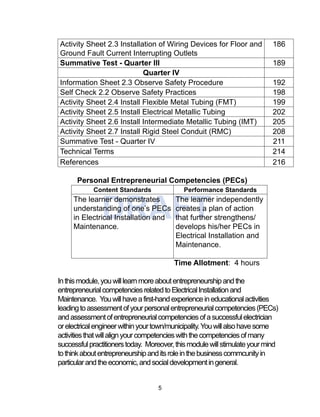
Personal Entrepreneurial Competencies (PECs) 5
Environment and Market (E & M) 19
Process and Delivery (P & D) 41
Quarter I
Introduction 41
Pre-Diagnostic Test 42
Information Sheet 2.1 Wires and Cables 45
Self-Check 2.1 Wires and Cables 59
Information Sheet 2.2 Common Electrical Symbols 61
Self-Check 2.2 Analyze Electrical Symbols 68
Information Sheet 2.3 Wiring Diagrams 70
Self Check 2.3 Wiring Diagram 76
Activity Sheet 2.1 Wiring Diagram 77
Information Sheet 2.4 Flexible Armored Cable Wiring 78
Self Check 2.4 Flexible Armored Cable Wiring 83
Activity Sheet 2.2 Flexible Armored Cable Wiring Installation 84
Activity Sheet 2.3 Flexible Armored Cable Wiring Installation 86
Information Sheet 2.5 Non-Metallic Sheathed Cable 89
Self-Check 2.5 Non-Metallic Sheathed Cable 96
Information Sheet 2.6 Flexible Metallic Tubing (FMT) 97
Self-Check 2.6 Flexible Metallic Tubing 100
Activity Sheet 2.4 Cut Flexible Metallic Tubing 101
Activity Sheet 2.5 Install Flexible Metallic Tubing (FMT) 102
Summative Test - Quarter I 105
4
DRAFT
Quarter II
Introduction 111
Pre-Diagnostic Test 112
Information Sheet 2.7 Rigid Steel Conduit (RSC) 114
Self-Check 2.7 Rigid Steel Conduit 118
Activity Sheet 2.6 Ream Rigid Steel Conduit 119
Activity Sheet 2.7 Bend Rigid Steel Conduit (Elbow Bend) 121
Activity Sheet 2.8 Bend Rigid Steel Conduit (Offset Bend) 123
Activity Sheet 2.9 Install Rigid Steel Conduit 125
Information Sheet 2.8 Intermediate Metallic Tubing (IMT) 128
Self-Check 2.8 Intermediate Metallic Tubing 136
Activity Sheet 2.10 Install Intermediate Metallic Tubing (IMT) 137
Information Sheet 2.9 Republict Act 7832- Anti-Electric and
Electric Transmission Line/Materials Pilferage Act Of 1994
140
Self Check 2.9 Republic Act No. 7832 143
Summative Test - Quarter II 144
Quarter III & IV
Introduction 150
Pre-Diagnostic Test 151
Information Sheet 1.1 Interpret Electrical Wiring Plan 154
Self Check 1.1 Interpret Electrical Wiring Plan 157
Information Sheet 1.2 Type of Wiring Devices 160
Self-Check 1.2 Type of Wiring Devices 163
Information Sheet 1.3 Select Tools and Equipment 164
Self Check 1.3 Select Tools and Equipment 167
Activity Sheet 1.1 Select Tools and Equipment 168
Information Sheet 2.1 PEC provision in installing electrical
boxes
169
Self Check 2.1 Electrical Boxes 176
Activity Sheet 2.1 Installing Box in Finished Space 177
Activity Sheet 2.2 Installation of Electrical Boxes in Wiring
Board
179
Information Sheet 2.2 NEC Provisions on Installing Wiring
Devices
182
5
DRAFT
Activity Sheet 2.3 Installation of Wiring Devices for Floor and
Ground Fault Current Interrupting Outlets
186
Summative Test - Quarter III 189
Quarter IV
Information Sheet 2.3 Observe Safety Procedure 192
Self Check 2.2 Observe Safety Practices 198
Activity Sheet 2.4 Install Flexible Metal Tubing (FMT) 199
Activity Sheet 2.5 Install Electrical Metallic Tubing 202
Activity Sheet 2.6 Install Intermediate Metallic Tubing (IMT) 205
Activity Sheet 2.7 Install Rigid Steel Conduit (RMC) 208
Summative Test - Quarter IV 211
Technical Terms 214
References 216
Personal Entrepreneurial Competencies (PECs)
Content Standards Performance Standards
The learner demonstrates
understanding of one’s PECs
in Electrical Installation and
Maintenance.
The learner independently
creates a plan of action
that further strengthens/
develops his/her PECs in
Electrical Installation and
Maintenance.
			 Time Allotment: 4 hours
Inthismodule,youwilllearnmoreaboutentrepreneurshipandthe
entrepreneurialcompetenciesrelatedtoElectricalInstallationand
Maintenance. Youwillhaveafirst-handexperienceineducationalactivities
leadingtoassessmentofyourpersonalentrepreneurialcompetencies(PECs)
andassessmentofentrepreneurialcompetenciesofasuccessfulelectrician
orelectricalengineerwithinyourtown/municipality.Youwillalsohavesome
activitiesthatwillalignyourcompetencieswiththecompetenciesofmany
successfulpractitionerstoday. Moreover,thismodulewillstimulateyourmind
tothinkaboutentrepreneurshipanditsroleinthebusinesscommcunityin
particularandtheeconomic,andsocialdevelopmentingeneral.
6
DRAFT
Now, to start with this module, let us first understand two
terms such as entrepreneurs and entrepreneurship.
Entrepreneurs are people with skills and capabilities to
see and evaluate business opportunities. They are individuals
that can strategically identify products or services needed by
the community. Consequently, they deliver these products and
services at the right time and at the right place.
Entrepreneurs are agents of economic change. They
organize, manage and assume risks of a business. Some of the
good qualities of an entrepreneur are opportunity seekers, risk
takers, goal setters, excellent planners, confident problem solvers,
hardworking, persistent and committed workers.
Entrepreneurship, on the other hand, is not just a simple
business activity. It is a strategic process of innovation and
creation of new ventures. Basically, entrepreneurship is both an art
and science of converting business ideas into marketable products
or services to improve the quality of living.
Now that you have background knowledge about
entrepreneurs and entrepreneurship, you can now walk through
in assessing your PECs. Always remember that “successful
entrepreneurs continuously develop and improve their PECs.”
To begin with, we will find out the competencies you need to
master upon finishing this module.
Objectives:
At the end of this module, you should be able to:
• identify areas for improvement, development and growth of
your PECs;
• align your PECs according to your business or career choice;
and
• createaplanofactionthatensuressuccessinyourbusinessorcareerchoice.
7
DRAFT
Pre-Assessment
As part of your initial activity, you will be challenged to dig deeper
on your knowledge and previous experiences on the topic. Try
to diagnose or assess what you already know about PECs by
answering Task 1.
Task 1: Matching Type
Match the entrepreneurial competencies in column A with their
meaning in column B. Write the letter of the your answer on the
space provided before each number.
A B
____1. Creative A. make a wise decision towards the set
objectives
____2. Profit-oriented B. strategic thinking and setting of goals
____3. Disciplined C. trust in one’s ability
____4. Sound decision
maker
D. adaptable to change
____5. Possess people skill E. innovative to have edge over other
competitors
____6. Excellent Planner F. solid dedication
____7. Confident G. skillful in record keeping
____8. Hardworking H. always stick to the plan
____9. Ability to accept
change
I. working diligently
____10. Committed J effective and efficient communication
and relation to people
K. always looking for income
Task 2: Guide Questions
Here are guide questions which encapsulate the entire module.
Write your answers on your assignment notebook, then share
these to the class.
8
DRAFT
A. Explain why entrepreneurship is an activity which is important in
social development and progress of the economy.
B. What entrepreneurial activities do you know and are you
capable of doing which are related to Electrical Installation and
Maintenance?
C. Given the opportunity to own a business that relates with
Electrical Installation and Maintenance, do you think you can
manage well? Explain your answer.
D. What do you think are the most important competencies you
must possess in order to be successful in running your chosen
business?
E. Name successful entrepreneurs in your locality whose business
is related to Electrical Installation and Maintenance. Share
with the class some of their PECs that made them successful.
After all the guide questions have been answered, share these
with your classmates. You may compare your insights, personal
knowledge, and relevant experiences with your chosen partners.
Learning Goals and Targets
After understanding the objectives of this module and
having gone through pre-assessment and the guide questions,
you are now asked to set your personal goals. These goals
will motivate you to achieve the goals of this module that will
eventually make you more aware of your PECs.
Figure 1: Strategic process to achieve the objectives of this
module
9
DRAFT
Reading Resources and Instructional Activities
After setting your own personal goals and targets for of this
module, check your inherent knowledge of PECs. Answer the
following guide questions with the help of your classmates.
Task 3: Group Activity
Answer these guide questions. Share your answers to the
class.
1. Explain the importance of assessing one’s PECs before
engaging in any particular entrepreneurial activity.
_____________________________________________________
_____________________________________________________
____________________________________________________.
2. Are there other strategies or approaches to assess your PECs?
Describe and explain how they can help any individual in selecting
a viable business venture.
_____________________________________________________
_____________________________________________________
____________________________________________________.
3. What are the desirable personal characteristics, attributes, skills
and traits of a prospective entrepreneur? Why are they important
to them? Support your argument.
_____________________________________________________
_____________________________________________________
____________________________________________________.
4. Why is there a need to assess one’s PECs in terms of
characteristics, attributes, lifestyles, skills and traits before starting
a particular business?
_____________________________________________________
_____________________________________________________
____________________________________________________.
10
DRAFT
5. What is the significance of evaluating PECs of a successful
entrepreneur?
____________________________________________________
_____________________________________________________
____________________________________________________.
How was your experience in answering the guide questions
with your classmates? Were you able to benefit from them? What
are the insights you have realized?
This time you are going to study the different topics that will
enrich your knowledge of PECs. Read carefully all the important
details about the succeeding topics.
Assessment of Personal Entrepreneurial Competencies
(PECs) and Skills vis-à-vis a Practicing Entrepreneur or
Employee in a Town/Municipality
The entrepreneurial competencies refer to the important
characteristics that an individual should possess in order to
perform entrepreneurial functions effectively. In this module, you
will learn some of the most important characteristics, attributes,
lifestyle, skills and traits of a successful entrepreneur in order to be
successful in a chosen career.
Below are few important characteristics / traits / attributes of
a good entrepreneur:
• Hardworking: This means habitually working diligently for a
long period of time. Hardworking people keep on improving
their performance to produce good products and results, or
provide good services.
11
DRAFT
• Confident: Entrepreneurs have confidence in one’s ability and
own judgment. They exhibit self-confidence in order to cope
with all the risks of operating their own business.				
		
• Disciplined: Successful entrepreneurs always stick to the plan
and fight the temptation to do what is unimportant. 		
• Committed: A good entrepreneur accepts full responsibility of
everything in his/her business. He/she gives full commitment
and solid dedication to make the business successful.		
• Ability to Accept Change: Change occurs frequently. When
one owns a business, he/she should cope-up and thrive on
changes. He/she has to capitalize on positive changes to make
his/her business grow. 							
• Creative: An entrepreneur should be creative and innovative
to stay in the business and have an edge over the other
competitors. 									
• Initiative: An entrepreneur takes the initiative. You must put
yourself in a position where you are responsible for the failure
or success of your business.						
• Profit-Oriented: An entrepreneur enters into the world of
business to generate profit or additional income. This shall
become the bread and butter for you and for your family as well.
Therefore, you must see to it that the business can generate
income.
Here are the important skills of a successful entrepreneur:
• Excellent Planner: Planning is strategic thinking and setting
of goals to achieve objectives by carefully maximizing all the
available resources. A good entrepreneur develops and applies
step-by-step plans to realize the goals. A good entrepreneur
knows that planning is an effective skill only when combined
with action.
12
DRAFT
• Possesses People Skills: It is an important skill in order to
be successful in any kind of business. People skill refers to the
effective and efficient communication and relation to people
working in and out of your business. In the day-to-day business
transactions, you need to deal with people. A well-developed
people skill can spell out the difference between success and
failure of the business.
• Sound Decision Maker: Successful entrepreneurs have the
ability to think quickly by making wise decision towards pre-
determined set objectives. Sound decision should spring out
from given facts and information and should be towards the pre-
determined objectives.
In order to contextualize what you have learned and to have
a better appreciation of the different entrepreneurial competencies,
read the PECs checklist presented, then answer accordingly.
Task 4: PECs Checklist
Using the PECS checklist, assess your strengths and
weaknesses by indicating a check ( ) mark accordingly. After
counting the total scores in each column, form a group and share
the results of your assessment.
13
DRAFT
Table 1: PECs Checklist
Personal Entrepreneurial
Competencies of an Entrepreneur
Personal Assessment in
terms of:
Strengths Development
Areas
Hardworking
- Working diligently
Confident
- Confidence in one’s ability
Disciplined
- Always stick to the plan
Committed
- Solid dedication
Ability to accept changes
- Adaptable
Creative
- Innovative to have edge over
other competitors
Profit-oriented
- Always looking for income
Excellent Planner
- Strategic thinking and setting of
goals
14
DRAFT
Possess People Skill
- effective and efficient
communication and relation to
people
Sound Decision Maker
- make a wise decision towards
the set objectives
TOTAL
Interpretation or Insight:
_____________________________________________________
_____________________________________________________
_____________________________________________________
_____________________________________________________
_____________________________________________________
How was your experience in discovering your strengths
and areas that needs improvement? Have you gained valuable
experiences in exchanging insights with your classmates? To learn
more and deepen your understanding of the PECs, do Task 5
below.
Task 5: Interview
Interview one or two successful electricians or entrepreneurs in
your province whose type of business is related with Electrical
Installation and Maintenance. Focus your interview on the PECs
and other business-related attributes that helped them become
successful. Analyze the results of the interview and reflect on the
similarities and/or differences. -
15
DRAFT
Sample Interview Guide
Name of Proprietor/Practitioner: ___________________________
Age: _______________ Number of Years in Business: _________
Business Name: _______________________________________
Business Address: _____________________________________
What were your preparations before you engaged in this type of
business or job?
_____________________________________________________
_____________________________________________________
What are your special skills and characteristics which are
important in your present business?
_____________________________________________________
_____________________________________________________
How did you solve business-related problems during the early
years of your business operations?
_____________________________________________________
_____________________________________________________
Did you follow the tips from a successful businessman or
practitioner before engaging in your business?
_____________________________________________________
_____________________________________________________
What are your best business practices that you can share with
many aspiring students like me?
_____________________________________________________
_____________________________________________________
What are the salient characteristics, attributes, lifestyles, skills and
traits that have made you successful in this business?
_____________________________________________________
_____________________________________________________
16
DRAFT
Cull the needed information from the interview to supply answer/s
to Row 1 in the table below. Meanwhile, fill out the second row
with your PECs.
Personal
Entrepreneurial
Competencies
Characteristics Attributes Lifestyles Skills Traits
Successful
Entrepreneur
in the
province
My PECS
Using the information on the table above, analyze and reflect
on the similarities and differences with your answers. Note your
reflection on the table below. Write your conclusions on the space
provided.
Personal
Entrepreneurial
Competencies
Similarities Differences
Characteristics
Attributes
Lifestyles
Skills
Traits
17
DRAFT
Conclusions:
________________________________________________
_____________________________________________________
_____________________________________________________
____________________________________________________.
After performing the activities on the importance of PECs, let us
determine how much you have learned by performing Task 6.
Task 6: Preparation of a Plan of Action
Using the table below and the information generated from Task 5
(Interview), prepare an action plan that indicates how you would
align your PECS to the PECS of a successful entrepreneur in
Electrical Installation and Maintenance in your province.
18
DRAFT
Task 7: Essential Questions
Read and analyze these questions.
1. Why is there a need to compare and align one’s PECS with the
PECs of any successful entrepreneur? Support your argument.
_____________________________________________________
_____________________________________________________
_____________________________________________________
_____________________________________________________
____________________________________________________.
2. How does an action plan help you sustain your strong PECs
and address your development areas?
_____________________________________________________
_____________________________________________________
_____________________________________________________
_____________________________________________________
____________________________________________________.
3. What plan of action would you do to address your development
areas? Decribe your personal plans.
_____________________________________________________
_____________________________________________________
_____________________________________________________
_____________________________________________________
____________________________________________________.
19
DRAFT
ENVIRONMENT AND MARKET (EM)
Content Standards Performance Standards
The learner demonstrates
understanding of the
environment and market
in Electrical Installation
and Maintenance in one’s
town/municipality.
The learner independently
creates a business
vicinity map reflective
of potential market in
Electrical Installation and
Maintenance in a town/
municipality.
		 				 Time Allotment: 4 hours
People who aspire to start a business need to explore the
economic, cultural and social conditions prevailing in an area.
Needs and wants of the people in a certain area that are not met
may be considered as business opportunities. Identifying the
needs of the community, its resources, available raw materials,
skills, and appropriate technology can help a new entrepreneur in
seizing business opportunities.
To be successful in any kind of business venture, potential
entrepreneurs should always look closely at the environment
and market. They should always be watchful on the existing
opportunities and constraints as well as spirited enough to take
calculated risks. The opportunities in the business environment
are those factors that provide possibilities for a business to
expand and make more profits. Constraints, on the other hand,
are those factors that limit the business to grow, hence reduce
the chance of generating profit. One of the best ways to evaluate
the opportunities and constraints is to conduct Strengths,
Weaknesses, Opportunities and Threats (SWOT) Analysis.
20
DRAFT
SWOT Analysis is a managerial tool to assess the
environment. This tool gathers important information which in
turn is used in strategic planning. Strengths and weaknesses
are internal in an organization. Basically, they relate to resources
owned by organization, things that you have control over as well
as to the extent of the marketing.
Opportunities and threats exist in the external environment.
Opportunities relate to the market, to the development of new
technologies, and external factors such as government policies,
climate, and trends. Threats relate to what the competition is doing
as well as legal and other constraints.
Now that you have read some important considerations to
look into to be successful in any business, you are now ready to
explore more about the environment and market.
To begin with, let us find out the competencies you need to master
after finishing this module.
Objectives:
At the end of this module, you are expected to:
• identify what is of “value” to the customer;
• identify the customer to sell to;
• explain what makes a product unique and competitive;
• apply creative and innovative techniques to develop marketable
product; and
• employ a unique selling proposition (USP) to the product and/or
service.
		 Now that you have an idea about the expected
learning outcomes, take the first challenge in this module – the
pre-assessment.
21
DRAFT
Pre-Assessment
Task 1: Choose the letter of the best answer. Write your answer
on a separate sheet of paper.
1. This is generated by examining the goods and services sold 		
within the community.
A. business creation				 C. business concept
B. business pricing				 D. business idea
2. process of making a new product to be sold to the customers.
A. product analysis				 C. product development
B. product conceptualization		 D. product implementation
3. These are luxuries, advantages and desires that every individual
considers beyond necessary.
A. wants						 C. requirements
B. desires					 D. needs
4. This is the factor or consideration presented by a seller that
explains why one product or service is different from or better
than that of the competitors.
A. unique selling plan 		 C. unique pricing policy
B. unique selling proposition 		 D. finding value-added
5. In this stage, the needs of the target market are identified,
reviewed and evaluated.
A. concept development 						
B. project development
C. economic analysis
D. refine specification
6. This is the introduction of a new idea to make the product and
services more attractive and saleable to the target customers.
A. new idea		 C. product development
B. creativity			 D. innovation
7. A management tool used to assess the environment and to
gather important information that can be used for strategic
planning.
A. environmental scanning			 C. WOTS Analysis
B. SWOT Analysis				 D. survey analysis
22
DRAFT
8. A marketing practice of creating names, symbols or designs that
identify and differentiate a product from the others.
A. product naming				 C. branding
B. unique selling proposition			 D. tagline
9. This is a meaningful and striking statement that captures the
essence of the brand.
A. product naming				 C. branding
B. unique selling proposition			 D. tagline
10. These are the things that people cannot live without.
A. wants						 C. requirements
B. desires						D. needs
Task 2: Guide Questions:
Read and analyze these guide questions.
1. How does one determine the product or services to be produced
and/or to be delivered to the target customers?
__________________________________________________
_________________________________________________
_________________________________________________
__________________
2. How does one select an entrepreneurial activity?
__________________________________________________
_________________________________________________
_________________________________________________
_________________
3. When can one say that a certain product has “value”?
__________________________________________________
_________________________________________________
_________________________________________________
_________________
23
DRAFT
4. Innovation and creativity to the products/services important? If
not, Why?
__________________________________________________
_________________________________________________
_________________________________________________
__________________
5. How can one effectively respond to the needs of the target
customers?
__________________________________________________
_________________________________________________
_________________________________________________
__________________
6. Express the importance of scanning the environment and
market in generating business ideas from the viewpoint of a
business owner.
__________________________________________________
_________________________________________________
_________________________________________________
_________________
7. Using self-assessment, explain your level of confidence in
formulating a business idea.
__________________________________________________
_________________________________________________
_________________________________________________
_________________
After all the guide questions have been answered and skills have
been mastered, share those with your classmates by discussing
your insights, personal knowledge, and relevant experiences on
the topic.
24
DRAFT
Learning Goals and Target
After understanding the objectives of this module and having gone
through the pre-assessment and guide questions, you are now
asked to set your own personal goals. These goals will motivate
you to achieve the goals of this module that will eventually make
you more aware about Environment and Market.
Figure 2: Strategic process to reach the objectives of the module
Reading Resources and Instructional Activities
After setting your own personal goals and targets in
achieving the objectives of this module, you will have the
opportunity to read and learn more about environment and market.
You will also be given a chance to do practical exercises and
activities to deepen your understanding of the topic.
Product Development
When we talk of product development, we are referring to
the process of making a new product to be sold by a business
or enterprise to its customers. Product development may
involve modification of an existing product or its presentation,
or formulation of an entirely new product that satisfies a newly
defined customer’s needs, wants and/or a market place.
The term development in this module refers collectively to
the entire process of identifying a market opportunity; creating a
product to appeal to the identified market; and testing, modifying
25
DRAFT
and refining the product until it becomes ready for production.
There are basic yet vital questions that you can ask yourself
about product development. When you are able to find acceptable
answers to these, you are now ready to develop a product and/or
render service:
1. For whom are the product/services aimed at?
2. What benefit will the customers expect from the products or
services?
3. How will the product/service differ from the existing brand, or
from its competitors?							
Likewise, needs and wants of the people within an area
should also be taken into big consideration because everyone has
his/her own needs and wants. However, everyone has different
concepts about needs and wants. To illustrate, needs in business
are important things that every individual cannot live without in a
society. These include:
1. basic commodities for consumption
2. clothing and other personal belongings
3. shelter, sanitation and health; and
4. education. 										
			
Basic needs are essential to every individual so he/she can
live with dignity and pride in a community of people. These needs
can obviously help you generate business ideas and subsequently
to product development.
Wants are desires, luxuries and extravagance that signify
a wealthy and expensive way of living. Wants or desires are
considered above all the basic necessities of life. Some examples
are the eagerness or the passion of every individual: fashion
accessories, expensive shoes and clothes. Traveling around,
eating in an expensive restaurant, watching movies, concerts;
having luxurious cars, wearing expensive jewelries and perfume,
living in impressive homes, and others are also examples of
26
DRAFT
people’s wants and desire.
People’s needs and wants are the basic indicators of the
kind of business that you may engage into because they can serve
as the measure of your possible success. Some other good points
that might be considered in business undertakings are the kinds of
people with special needs, wants, lifestyles, culture and tradition,
and social orientation. To summarize, product development
entirely depends on the needs and wants of the customers.
Another important issue to deal with is the key concepts of
developing a product. The succeeding topic shall enlighten you
about the procedure in coming up with a product.
Concepts of Developing a Product
		Concept development is a critical phase in the
development of a product. In this stage, the needs of the target
market are identified; competitive products are reviewed before the
product specifications are defined. The product concept is selected
along with an economic analysis to come up with an outline of
how a product is being developed. Figure 3 shows the stages of
concept development of a product.
		 Figure 3: Stages of Concept Development
ILLUSTRATION MISSING
27
DRAFT
The process of product development follows these stages:
Identify customer needs. Using survey forms, interviews,
researches, focus group discussions, and observations, an
entrepreneur can easily identify customers’ needs and wants. In
this stage, the information that can be possibly gathered here are
product specifications (performance, taste, size, color, shape,
life span of the product, etc.). This stage is considered important
because this would determine the products to be produced or
provided.
Establish target specifications. Based on customers’ needs
and reviews of competitive products, you can now establish target
specifications of the prospective new product and/or services.
Target specifications are essentially a wish-list.
Analyze competitive products. It is imperative to analyze
existing competitive products to provide important information in
establishing products/services specifications. Other products may
exhibit successful design attributes that should be emulated or
improved on in the new product/service.
Generate product concepts. After having gone through with
the previous processes, you may now develop a number of
product concepts to illustrate what types of products/services are
both technically feasible fitting to the requirements of the target
specifications.
Select a product concept. Through the process of evaluation
between attributes, final concept is selected; After the final
selection, additional market research can be applied to gather
feedback from the representative customers.
Refine product specifications. During this stage, the product/
service specifications are refined on the basis of input from the
foregoing activities. Final specifications are the result of extensive
study. Expected service life, and projected selling price and among
others are being considered in this stage.
28
DRAFT
Perform economic analysis. Throughout the process of
product development, it is very important to review and estimate
the economic implications regarding development expenses,
manufacturing costs, and selling price of the product/service to be
offered/provided.
Plan the remaining development project. During this final stage
of concept development, you must prepare a detailed development
plan that includes list of activities, necessary resources and
expenses, and development schedule with milestones for tracking
progress.
Finding Value
People buy products for many reasons. There must
be something in your products/services that have satisfied
or impressed the consumers. In short, when you meet their
expectations, they will continue partronizing your products/
services.
The value that you incorporate to your product is called
value proposition. Value proposition is “a believable collection of
the most persuasive reasons why people should notice you and
take the action you’re asking for.” Value is created by fulfilling deep
desires and solving deep problems. This is the reason why people
spend for your products/services.
Innovation
Innovation is the introduction of something new in your
products/services. This may be a new idea, a new method or
a new device. If you want to increase your sales and profit, you
must innovate. Some of the possible innovations for your products
include changing of packaging, improving of taste, color, size,
shape and adjusting the prices. Some of the possible innovations
in providing services are application of new improved methods,
additional featured services and freebies.
29
DRAFT
Unique Selling Proposition (USP)
		 Unique Selling Proposition is a factor or consideration
presented by a seller to explain why one product or service is
different from or better than the other competitors. Before selling
your product or service to your target customers, you have to sell
yourself to it. This is especially important when your product or
service is similar to those around you.
USP would require careful analysis of other businesses’ ads and
marketing messages. If you analyze what they say or what they
sell, not just their product or service characteristics, you can learn
a great deal about how companies distinguish themselves from
competitors.
Ways to discover your USP to increase your sales and profits.
• Use empathy: Put yourself in the shoes of your
customers. Always focus on the needs of the target customers
and forget falling in love with your own products/services.
Always remember, you are making and providing this products/
services for the target customers to eventually increase sales
and earn profit. Essential questions such as what could make
them come back again and ignore competitions, should be
asked to oneself. Most possible answers may be focused on
quality, availability, convenience, cleanliness, reliability and
friendliness of the products/services.					
• Identify Customer’s Desires. It is important that you
understand what drives and motivates your customers to buy
your products/services. Make some efforts to find out, analyze
and utilize the information what motivates the customers in their
decisions to purchase the product or service.				
								
• Discover customer’s genuine reasons for buying the
product. Information is very important in decision making.
A competitive entrepreneur always improve their products
or services to provide satisfaction and of course retention
30
DRAFT
of customers. As your business grows, you should always
consider the process of asking your customers important
information and questions that you can use to improve your
product/ service.
		In order to firm up your understanding of the topic
previously presented, you will be tasked to form a group and
conduct an interview with a successful entrepreneur or practitioner.
You have to document this interview and present this to the
whole class using a power point presentation for reflection and
appreciation.
Task 3: Interview
Select a successful entrepreneur or practitioner. Conduct an
interview using these set of questions. Document the interview
and present it to the class.
1. How did you identify your customers?					
________________________________________________
________________________________________________
_______________________________________________
_________________________							
2. What were your considerations in selecting your customers?
________________________________________________
________________________________________________
_______________________________________________
_________________________
31
DRAFT
						
3. Explain how your product or service became unique to other
products.									
________________________________________________
________________________________________________
_______________________________________________
________________								
4. Did you consult somebody before you engaged in this
business? Cite sample insights that you gained from the
consultation.									
________________________________________________
________________________________________________
_______________________________________________
_____________									
5. What were your preparations before you started the actual
business?									
________________________________________________
________________________________________________
_______________________________________________
______________								
6. What are the creative and innovative techniques you adopted to
your product or service? What was the effect of the innovative
techniques to the sales and profits of your business?			
__________________________________________________
__________________________________________________
________________________							
7. What strategy did you consider to have a unique selling
proposition to your products/services?				
________________________________________________
________________________________________________
_______________________________________________
________________________
32
DRAFT
Task 4: Video Viewing
Deepen your understanding of the lesson by performing
these tasks:
1. Browse the internet and view the topics related to:
a. customers’ needs and wants
b. techniques in identifying customers’ needs and wants
c. creativity or innovations in products and services
d. unique selling proposition
e. product development
2. Prepare a short narrative report about the aforementioned
topics. You may highlight the “aspects” that intensify your
knowledge of product development.
Task 5: Product Conceptualization
Using the space and figures below, develop your own concept for
your product or service. Utilize bullets in every stage of product
conceptualization in listing important key ideas.
_____________________________________________________
_____________________________________________________
_____________________________________________________
_____________________________________________________
_____________________________________________________
__________________________________________
33
DRAFT
Generating Ideas for Business
The process of developing and generating business idea is
not a simple undertaking. Some people just come up to a numbert
of business ideas but are not really feasible. There are two
problems that arise first is the excessive generation of ideas that
can forever remain as dreaming stage and the second is when
they do not have ideas and do not want to become entrepreneurs.
The most optimal way is to have a systematic approach in
generating and selecting a business idea convertible into real
business. Here are some basic yet very important considerations
that may be used to generate possible ideas for business:
6. Refine Product
Specification
-
-
3. Analyze a
Competitive
Product
-
-
5. Select a product
Concept
-
-
4. Generate
Product Concept
-
-
7. Prepare a
Development Plan
-
-
2. Target
Specifications
-
-
1. Identify
Customers Need
-
-
34
DRAFT
1. Examine existing goods and services. Are you satisfied with the
product/s? What do other people who use the products say about
it/them? How can it/they be improved? There are many ways of
improving a product from the way it is made to the way it is packed
and sold. You can also improve the materials used in crafting the
product. In addition, you can introduce new ways of using the
product, making it more useful and adaptable to the customers’
many needs. You may introduce a new product to replace the old
ones. When you are improving the product or enhancing it, you are
doing an innovation. 						 Also,
business ideas may be generated by examining what goods and
services are sold outside the community. Very often, these products
are sold in a form that can still be enhanced or improved.			
							
2. Examine the present and future needs. Look and listen to what
the customers, institutions, and communities are missing in terms
of goods and services. Sometimes, these needs are already very
obvious. Other needs are not that obvious because they can only
be felt in the future, in the event of certain developments in the
community. For example, a province will have its electrification
facility in the next six months. Only by that time will the entrepreneur
think of electrically-powered or generated business such as photo
copier, computer service, digital printing, etc.					
				
3. Examine how the needs are being satisfied. Needs for the
products and services are referred to as market demand. To satisfy
these needs is to supply the products and services that meet
the demands of the market. The term market refers to whoever
will use or buy the products/services. These may be people or
institutions such as other businesses, establishments, organizations,
or government agencies. In short, there is a very good business
opportunity when there is absolutely no supply to a pressing market
demand. Businesses or industries in the locality also have needs for
goods and services. Their needs for raw materials, maintenance,
and other services such as selling and distribution are good sources
of ideas for business. It is important that entrepreneur reseach these
needs.
35
DRAFT
4. Examine the available resources around you. Observe
what materials or skills are available in abundance in
your area. A business can be started out of available raw
materials by selling them in raw form and by processing and
manufacturing them into finished products. For example, in
a copra-producing town, there are many coconut husks and
shells available as “waste” products. These can be collected
and made into coco rags or doormat and charcoal bricks and
sold profitably outside the community. A group of people in
your neighborhood may have some special skills that can
be harnessed for business. For example, the women in the
Mountain Province possess loom weaving skills that have been
passed on from one generation to another. Some communities
set up weaving businesses to produce blankets, decorative
and various souvenir items for sale to tourists and lowland
communities. Business ideas can come from your own skills.
The work and experience you may have in agricultural arts,
industrial arts, home economics, and ICT classes will provide
you with business opportunities to acquire the needed income-
generating activities. With your skills, you may also tinker
around in your spare time with various things. Many products
have been invented this way.				
5. Read magazines, news articles, and other publications on
new products and techniques or advances in technology.
You can pick up new business ideas from magazines such
as Newsweek, Reader’s Digest, Business Magazines, “Go
Negosyo”, Know About Business (KAB) materials, and Small-
Industry Journal. The Internet also serves as a library where
you may browse and surf on possible businesses. It will also
guide you on how to put the right product in the right place,
at the right price, at the right time. Lastly, listing of possible
business to set up in an area may also be available from banks
or local non-government organizations.
36
DRAFT
Key Concepts in Selecting a Business Idea
Once you have embarked on identifying business
opportunities, you will eventually see that there are many
possibilities that are available for you. It is very unlikely that you
will have enough resources to pursue all of them at once.
You have to select the most promising one among hundreds
of ideas. It will be good to do this in stages. In the first stage, you
screen your ideas to narrow them down to about few choices. In
the next stage, trim down the choices to two options. In the final
stage, choose between the two and decide which business idea is
worth pursuing.
In screening your ideas, examine each one in terms of these guide
questions:
1. How much capital is needed to put up the business?
2. How big is the demand for the product? Do many people need
this product and continue to need it for a long time?
3. How is the demand met? Who are processing the products to
meet the needs (competition or demand)? How much of the
need is now being met (supply)?
4. Do you have the background and experiences needed to run
this particular business?
5. Will the business be legal and does not go against any existing
or foreseeable government regulation?
6. Is the business in line with your interest and expertise?			


Your answers to these questions will be helpful in
screening which ones among your many ideas are worth
examining and worth pursuing further.
37
DRAFT
Branding
Branding is a marketing practice of creating name, symbol
or design that identify and differentiate them from other products/
services. It is also a promise to your customers. It tells them what
they can expect from your products/services. Your brand is derived
from who you are, who you want to be and what people perceive
you to be.
Branding is one of the most important aspects in any
business. An effective brand strategy gives you a major edge in
increasingly competitive markets.
The features of a good product brand are as follows:
- delivers the message clearly;
- confirms your credibility;
- connects your target prospects emotionally;
- motivates the buyer; and
- concretizes user loyalty
Here are some simple tips to publicize your brand:
.
• Develop a tagline. Write a meaningful, unforgettable, and easy
statement that captures the essence of your brand.			
• Get a great logo. Create a logo suitable to your business and
is consistent with your tagline. Place it in any strategic location
visible to the possible consumers.					
• Write down your brand messaging. Select key messages you
want to communicate about your brand with the consumers.
• Be true to your brand. Deliver your brand promise. 		
• Be consistent. Be reliable and consistent every time.
38
DRAFT
In generating business ideas, you should first identify the
type of business suited to your business idea. You should analyze
and scan the potential environment, study the marketing practices
and strategies of your competitors, and analyze the strengths,
weaknesses, opportunities, and the threats in your environment.
This is to ensure that the products or services you are planning
to offer will be patronized within the easy reach of your target
markets/consumers.
Bear in mind these simple rules for successful SWOT
Analysis:
• Be realistic about the strengths and weaknesses of your
business when conducting SWOT Analysis.					
		
• SWOT Analysis should distinguish between where your
business is today, and where it would be in the future.
• SWOT Analysis should always be specific and present realistic
and explicit strengths and weaknesses.
• 											
Always apply SWOT Analysis in relation to your competition
(i.e. better than or worse than your competition).
• 											
Keep your SWOT Analysis short and simple. Avoid complexity
and over analysis.
• 											
Be subjective to your SWOT. Present only real results, not the
fabricated information that will eventually put harm on your
business.
39
DRAFT
Task 6: SWOT Analysis
In generating business ideas, environmental scanning is
very important.Utilize the SWOT Analysis table and to list down all
your observations. Consider the strategies below to select the best
business ideas.
Strength (S) Weaknesses (W)
-
-
-
-
-
-
-
-
-
-
-
-
Opportunities (O) Threats (T)
-
-
-
-
-
-
-
-
-
-
-
-
Strategies:
• SW - Maximize on the strengths to overcome the internal
		 weakness.
• OW - Capitalize on the opportunities to eliminate the internal
		 weakness.
• ST - Maximize on your strengths to eliminate the external
		 threats.
• OT - Take advantage of the available opportunities to eliminate
		 the external threats.
40
DRAFT
Analysis:
_____________________________________________________
_____________________________________________________
_____________________________________________________
___________________________________________________.
Activities:
_____________________________________________________
_____________________________________________________
_____________________________________________________
___________________________________________________.
My Best Business Idea:
_____________________________________________________
_____________________________________________________
_____________________________________________________
________________________________________________.
In order to deepen your understanding of the topics previously
discussed, you will be asked to perform these activities:
Task 7: Extra Readings and Video Viewing
Reading books and watching videos have been considered as
some of the most effective educational activities that can help
learners deepen their understanding on a certain topic. In this
particular task, you will be asked to conduct extra readings and
video viewings in the Internet on the following topics:
A. Steps in selecting business idea
B. Criteria of a viable business idea
41
DRAFT
C. Benefits of a good brand
D. Ways on developing a brand							
After successfully performing the assigned task, make a
narrative report about it and share it to the class.
Task 9: Making My Own Logo
Using the box provided, draw a logo that you will use in your
business, likewise, provide a simple narrative to describe your logo
and its relevance to your proposed business.
				 ____________________________
Logo
Tagline
Logo
42
DRAFT
PROCESS AND DELIVERY
Content Standard Performance Standard
The learner demonstrates an
understanding of the basic
concepts and underlying
theories in electrical installation
and maintenance.
The learner independently
demonstrates the common
competencies in electrical
installation and maintenance
as prescribed by TESDA
Training Regulations.
QUARTER I 		
Time Allotment: 40 Hours
Unit of Lesson: INSTALL ELECTRICAL LIGHTING SYSTEMS,
AUXILIARY OUTLETS AND LIGHTING FIXTURES
This module contains the “know” and “do” practices in
Installation of Electrical Lighting System on Auxiliary Outlets and
Lighting Fixtures.
It covers the knowledge, skills and attitudes required in
installing auxiliary outlets and lighting fixtures. Specifically, this
module covers wires and cables, electrical symbols, wiring
diagram, installation activities using flexible armored cable (BX),
non-metallic sheathed cable (NM) and flexible metallic tubing
(FMT).
This module consists of Learning Outcomes (LO) that
contain learning activities for both knowledge and skills supported
with information sheets, activity sheets and self-check. Before
attempting to perform the manual exercises, make sure that you
have already read and understood the information/activity sheet
and answered correctly the self-check provided in the Learning
Activities.
43
DRAFT
LO2- INSTALL ELECTRICAL LIGHTING SYSTEMS, AUXILIARY
OUTLETS AND LIGHTING FIXTURES
1. Select appropriate electrical tools, equipment and materials for
specific tasks
2. Apply suitable wiring method for the job
3. Install electrical wiring systems using different types of wiring
methods:
• Circuit with one bulb controlled by surface or flush type single
pole switch
• Circuit using 3-way switches in two locations
• Combination of lighting and convenience
PRE-DIAGNOSTIC TEST
Choose the letter of the best answer. Use separate paper for your
answer.
_____1. This is usually bare solid or stranded conductor used for
overhead transmission lines and ground wires.
		 a. Copper or aluminum conductor
		 b. Non-metallic sheathed cable (type NM)
		 c. Thermoplastic covered fixture wire (type TF)
		 d. Copper or aluminum PE insulated line wire
_____2. This is a flame retardant, moisture resistant wire used for
building wiring installation in dry or wet locations.
		 a. Thermoplastic Portable cords (types SJT & ST)
		 b. Thermoplastic wire (type TW)
		 c. Control cable (braided type)
		 d. Flat Cord (type SPT)
_____3. Awire commonly used for wiring motorized engines 			
and appliances with high temperature, and for switch board wiring.
		 a. Temperature wire (type HI)
		 b. Control cable (braided type)
44
DRAFT
		 c. Asbestos covered nickel cord (Rockbestos)
		 d. Steel tape armored power cable with ground wire
			 (Copper)
_____4. This is a multi-conductor cable generally used for 		
interior wiring installations in dry and wet locations.
		a. Power cable
		 b. Nonmetallic sheathed cable (type NMC)
		 c. Royal cable
		 d. Submersible pump cable
_____5. What is the equivalent diameter size of number 10 AWG
wire in millimeter (mm)?
a. 2.05mm b. 2.59mm c. 3.26mm d. 3.11mm
_____6. What is the equivalent diameter size of number 8 AWG
wire in millimeter (mm)?
a. 2.05mm b. 2.59mm c. 3.26mm d. 3.11mm
_____7. It is a type of flexible armored cable that has rubber 		
insulation and a lead sheath between the conductor and
the armor.
a. typeAC b. typeACT c. typeACV d. typeACL
_____8. The appropriate tool used in cutting flexible armored cable.
a. Pliers		 b. Backsaw		 c. Hacksaw		 d. Knife
_____9. What do you call a plastic or metal material that is used
for mounting of convenient outlets and switches on walls?
a. Junction Box b. Frames c. Utility Box d. Fitting
_____10. It is used for branching conductors and enclosing splices.
a. Utility Box b. Fastening Device c. Junction Box d.Adhesive
_____11. What is the safety device which automatically cuts off current
that exceeds the circuit rating?
a. Circuit b. Circuit Breaker c. Conduit d. Galvanic Reaction
45
DRAFT
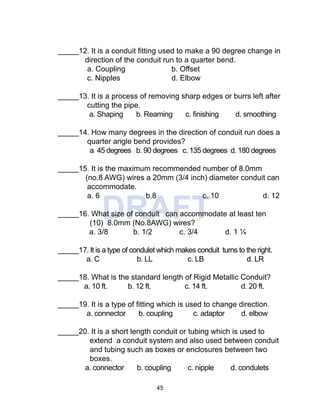
_____12. It is a conduit fitting used to make a 90 degree change in
direction of the conduit run to a quarter bend.
a. Coupling b. Offset
c. Nipples		 d. Elbow
_____13. It is a process of removing sharp edges or burrs left after
cutting the pipe.
a. Shaping b. Reaming c. finishing d. smoothing
_____14. How many degrees in the direction of conduit run does a
quarter angle bend provides?
a 45 degrees b. 90 degrees c. 135 degrees d. 180 degrees
_____15. It is the maximum recommended number of 8.0mm 		
(no.8 AWG) wires a 20mm (3/4 inch) diameter conduit can
accommodate.
a. 6 b.8 c. 10 d. 12
_____16. What size of conduit can accommodate at least ten 		
(10) 8.0mm (No.8AWG) wires?
a. 3/8 b. 1/2 c. 3/4 d. 1 ¼
_____17. It is a type of condulet which makes conduit turns to the right.
a. C b. LL c. LB d. LR
_____18. What is the standard length of Rigid Metallic Conduit?
a. 10 ft. b. 12 ft. c. 14 ft. d. 20 ft.
_____19. It is a type of fitting which is used to change direction.
a. connector b. coupling c. adaptor d. elbow
_____20. It is a short length conduit or tubing which is used to 		
extend a conduit system and also used between conduit
and tubing such as boxes or enclosures between two 		
boxes.
a. connector b. coupling c. nipple d. condulets
46
DRAFT
INFORMATION SHEET 2.1
Wires and Cables
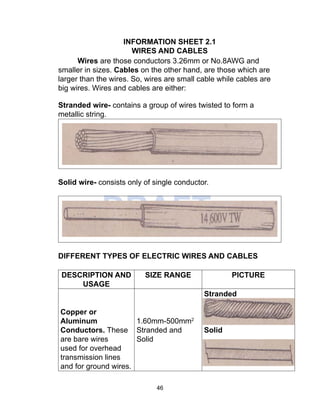
Wires are those conductors 3.26mm or No.8AWG and
smaller in sizes. Cables on the other hand, are those which are
larger than the wires. So, wires are small cable while cables are
big wires. Wires and cables are either:
Stranded wire- contains a group of wires twisted to form a
metallic string.
Solid wire- consists only of single conductor.
DIFFERENT TYPES OF ELECTRIC WIRES AND CABLES
DESCRIPTION AND
USAGE
SIZE RANGE PICTURE
Copper or
Aluminum
Conductors. These
are bare wires
used for overhead
transmission lines
and for ground wires.
1.60mm-500mm2
Stranded and
Solid
Stranded
Solid
47
DRAFT
Thermoplastic
Wires (type TW).
These wires are
flame retardant,
moisture and oil
resistant used for
building wiring in dry
and wet locations.
Copper
1.60mm-500mm2
Solid and
Stranded
Solid
Stranded
Heat, Moisture
Resistant and
Flame Retardant
Cable (type THW).
This has usually
seven strands of
conductors in a cable
used for building
wiring in dry or wet
locations.
Copper
1.60mm-500mm2
Solid and
Stranded
Thermoplastic-
Covered Fixture
Wire (type TF).
This can be solid
or stranded used
for wiring lighting
fixtures and as
terminal wires.
0.60mm-0.30mm2
Solid and
Stranded
48
DRAFT
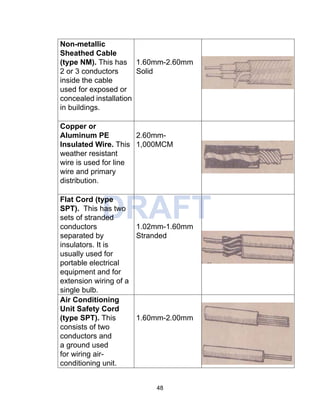
Non-metallic
Sheathed Cable
(type NM). This has
2 or 3 conductors
inside the cable
used for exposed or
concealed installation
in buildings.
1.60mm-2.60mm
Solid
Copper or
Aluminum PE
Insulated Wire. This
weather resistant
wire is used for line
wire and primary
distribution.
2.60mm-
1,000MCM
Flat Cord (type
SPT). This has two
sets of stranded
conductors
separated by
insulators. It is
usually used for
portable electrical
equipment and for
extension wiring of a
single bulb.
1.02mm-1.60mm
Stranded
Air Conditioning
Unit Safety Cord
(type SPT). This
consists of two
conductors and
a ground used
for wiring air-
conditioning unit.
1.60mm-2.00mm
49
DRAFT
Underground
Feeder and Branch
Circuit Cable
(type UF). This is a
jacketed cable, used
for wiring installation
direct burial.
1.60mm-11.68mm
Thermoplastic
Portable Cords
(types SJT & ST).
These types consist
of 2 to 4 stranded
conductors used for
wiring construction of
portable motors and
appliances.
Type SJT
1.02mm-2 .05mm
Type ST
1.02mm-4.11mm
Intercom Cable.
This shielded or
unshielded cable
has 3 conductors
to 100 pairs, used
for wiring interior
communications,
system and sound
distribution jacketed.
0.65mm
Telephone Cable
(type CCP). This
is installed aerial
and duct type for
telephone wiring
with color coded
conductor insulators.
0.40mm-0.91mm
50
DRAFT
Submersible
Pump Cable. This
is thermoplastic
insulated cable
used for wiring
submersible pumps
of deep well water
systems.
1.60mm-11.68mm
Hypertemp 2000
Wire (Magnet Wire).
This is used for
winding motors, oil
filled transformers,
high speed winding,
and wet winding
operations,
0.078mm- 4.11mm
Service Drop Cable.
This is an aluminum
conductor with
neutral messenger
used for a service
drop cable.
4.11mm- 11.68mm
Armored Cable
(type ACT),(BX).
This has 2 or 3
conductors used for
wiring installation in
buildings.
1.60mm-6.54mm
51
DRAFT
Welding Cable. This
is a flexible portable
cable used for wiring
cable of electric arc
welding.
1.29mm-11.68mm
Control Cable
(Braided type). This
is a PVC insulated
and jacketed multi-
conductor control
cable used for
wiring installation of
machinery controls.
1.60mm-2.05mm
Power Cable.
This is used for
underground, aerial,
duct and direct burial
wiring from 6,000
volts to 35 kilovolts.
3.26mm-
1,000MCM
Temperature Wire
(type HI). This is
commonly used for
wiring automobile
engines and
appliances with high
temperature, and for
switch board wiring.
1.02mm-3.26mm
Royal Cord.
This has 2 to 4
conductors, stranded
and used for portable
cords in electrical
equipment.
.65mm-5.19mm
52
DRAFT
Telephone Cable
(type ADT). This
consists of 6 pairs
through 909 pairs
used for aerial and
duct installation.
0.65mm
Appliance or
Electric Heater
Cable. This is used
for wiring cord of
heating equipment in
dry locations.
.65mm-2.05mm
Asbestos Covered
Nickel Cord
(Rockbestos). This
is used for wiring
electric ranges, water
heater, stoves and
hairdryers where
both heat and
moisture resistance
is desirable. It is
constructed of 16
strands of wire and
insulated with pure
asbestos yarn.
0.25mm-1.60mm
53
DRAFT
Automotive Wire.
This is used for
wiring spark plug
and battery cable of
automobile, trucks,
and other vehicles.
1.02mm-6.54mm
Auto Cable PVC
and Braided. This
is used for wiring
automobile light and
for hook-up wires.
Service Entrance
Cable (type SE).
It consists of two
or more insulated
conductors with
one or more bare
conductors for
grounding. It is time-
retardant, moisture-
resistance cable for
service entrance and
interior wiring.
54
DRAFT
Self-supporting
Aerial Telephone
Cable. This is used
for aerial telephone
wiring with color
code insulation of
conductors.
Machine Tool
Wire. This is used
for wiring machine
tools, appliances and
control circuits.
Coaxial Cable. This
is used for radio
frequency antenna
installation and radar
receiver installation.
Direct Burial
Telephone Cable.
This is used for
wiring installation
of telephone lines.
Conductors have
different colors on
insulations.
Durex Wire. This
is used for building
wiring especially for
interior wiring.
55
DRAFT
Duralene (type WP)
. This is polyethylene
insulated line wire
used for wiring
installation of
residential buildings.
Steel Tape Armored
Cable with Ground
Wires. This is used
for general wiring
installation including
underground.
Switchboard
Semi-rigid Plastic
Insulation. This is
a stranded cable for
wiring switchboards
inside power plant.
All Plastic Parallel
Cord. This is used
for wiring pendant or
portable equipment
or device.
56
DRAFT
Nonmetallic
Sheathed Cable
(type NMC). This is a
multi-conductor cable
used for interior
wiring in dry and wet
location.
CONVERSION TABLE OF CONDUCTORS
American Wire Gauge (AWG) TO Wire Diameter Millimeter (mm)
Wire Gauge #
AWG
Diameter in Mil-
limeter (mm)
Wire Gauge #
AWG
Diameter in Mil-
limeter (mm)
#40 AWG 0.078mm #17 AWG 1.150mm
#39 AWG 0.088mm #16 AWG 1.291mm
#38 AWG 0.101mm #15 AWG 1.450mm
#37 AWG 0.114mm #14 AWG 1.628mm
#36 AWG 0.127mm #13 AWG 1.829mm
#35 AWG 0.142mm #12 AWG 2.052mm
#34 AWG 0.160mm #11 AWG 2.300mm
#33 AWG 0.180mm #10 AWG 2.590mm
#32 AWG 0.203mm #9 AWG 2.910mm
#31 AWG 0.226mm #8 AWG 3.263mm
#30 AWG 0.254mm #7 AWG 3.674mm
#29 AWG 0.287mm #6 AWG 4.115mm
#28 AWG 0.320mm #5 AWG 4.621mm
#27 AWG 0.360mm #4 AWG 5.189mm
#26 AWG 0.403mm #3 AWG 5.827mm
#25 AWG 0.454mm #2 AWG 6.543mm
#24 AWG 0.510mm #1 AWG 7.358mm
#23 AWG 0.574mm 0 8.251mm
#22 AWG 0.652mm 00 9.265mm
#21 AWG 0.723mm 000 10.404mm
#20 AWG 0.812mm 0000 11.680mm
#19 AWG 0.911mm 00000 13.120mm
#18 AWG 1.024mm 000000 14.733mm
57
DRAFT
Note: If you want to know the equivalent size of wire using the
conversion table, the # 10 AWG is equal to 2.590mm or 2.60mm
the actual commercial size; the #12 AWG is equal to 2.052 mm
or 2.00mm; and the # 14 AWG is equal to 1.628mm or 1.60mm.
Generally, wires and cables available in the market are even
numbers in American Wire Gauge.
Note: MCM= Thousand Circular Mills
Using the NEC/PEC Charts
The Philippine Electrical Code (PEC) is used throughout the
industry to determine the conductor size for most applications. It
is imperative that an electrician be familiar with code tables and
correction factors.
PEC Article3.10 deals with conductors for general wiring. Table
3.10.1.16 is generally used to select a wire size according
to the requirements of the circuit. It lists ampacities(current-
58
DRAFT
carrying ability) of not more than three single insulated
conductors in raceway or cable or buried in the earth based on
anambient(surrounding)air temperatureof 30 ⁰C.
Table 3.10.1.16 Allowable Ampacities of Insulated Conductors
rated 0-2000 volts, 60% to 90% C
Not more than three conductors in raceways or cable or earth
(directly buried), based on ambient temperature of 30ºC
Size Temperature Rating of Conductor Size
mm2
60 ºC 75 ºC 85 ºC 90 ºC 60 ºC 75 ºC 85 ºC 90 ºC
AWG
or
kcmil
Types
+TW,
+UF
Types
+FEPW,
+RH,
+RHW,
+THW,
+THWN,
+XHHN,
+USE,
+ZW
Types
V
Types
TBS, SIS,
+FEP,
+FEPB,
+RHH,
+THHN,
+THHW,
+XHHW
Types
+TW,
+UF
Types
+FEPW,
+RH,
+RHW,
+THW,
+THWN,
+XHHN,
+USE,
+ZW
Types
V
Types
TBS,
SIS,
+FEP,
+FEPB,
+RHH,
+THHN,
+THHW,
+XHHW
Copper Aluminum or Copper-clad Aluminum
2.0
3.5
5.5
8.0
15
20
30
40
15
20
30
45
25
30
40
50
25
30
40
50
…
15
25
30
…
15
25
40
…
25
30
40
…
25
30
40
14
12
10
8
14
22
30
38
55
70
90
100
65
85
110
125
70
90
115
130
70
90
115
130
40
55
70
80
50
65
85
95
55
70
90
100
55
70
95
100
6
4
2
1
50
60
80
100
120
135
160
185
145
160
195
220
150
170
205
225
150
170
205
225
150
170
205
225
115
125
150
170
120
135
160
180
120
135
160
180
0
00
000
0000
125
150
200
250
210
240
280
315
255
280
330
375
265
295
355
400
265
295
355
400
170
190
225
260
200
230
270
305
210
240
290
330
210
240
290
330
250
300
400
500
325
400
500
370
405
485
435
485
540
470
515
580
470
515
580
295
330
370
355
395
440
380
420
475
380
420
475
600
800
1000
Ampacity Correction Factors
59
DRAFT
Ambient
temp.
ºC
For ambient temperatures other than 30 ºC lasting for three hours or
more, multiply the ampacity shown above by the appropriate factor
shown below.
Ambient
temp. ºC
21-25
26-30
31-35
36-40
41-45
46-50
51-55
56-60
61-70
71-80
1.08
1.00
0.91
0.92
0.71
0.58
0.41
…
…
…
1.05
1.00
0.94
0.88
0.82
0.75
0.67
0.58
0.33
…
1.04
1.00
0.95
0.90
0.85
0.80
0.74
0.67
0.52
0.30
1.04
1.00
0.96
0.91
0.87
0.82
0.76
0.71
0.58
0.41
1.08
1.00
0.91
0.92
0.71
0.58
0.41
…
…
…
1.05
1.00
0.94
0.88
0.82
0.75
0.67
0.58
0.33
…
1.04
1.00
0.95
0.90
0.85
0.80
0.74
0.67
0.52
0.30
1.04
1.00
0.96
0.91
0.87
0.82
0.76
0.71
0.58
0.41
21-25
26-30
31-35
36-40
41-45
46-50
51-55
56-60
61-70
71-80
Unless otherwise specifically permitted elsewhere in the code the
overcurrent protection for conductor types marked with an obelisk (+)
shall not exceed 15 amperes for 2.0 mm2, 20 amperes for 3.5 mm2 and
30 amperes for 5.5 mm2 copper; or 15 amperes for 3.5 mm2, and 25
amperes for 5.5 mm2 aluminum and copper clad aluminum after any
correction factors for ambient temperature and number of conductors
have been applied.
Conductor Material
One of the factors that determines the resistivity of wire is the
material from which the wire is made. The table indicates that
a copper conductor is permitted to carry more current than an
aluminum conductor of the same size and insulation type. An 8.0
mm2 copper conductor with Type TW insulation is rated to carry a
maximum of 40 amperes. An 8.0 mm2 aluminum conductor with
Type TW insulation is rated to carry only 30 amperes.
Another factor that determines the amount of current a conductor
is permitted to carry is the type of insulation used. This is due to
the fact that different types of insulation can withstand more heat
than others. The wire table is divided into columns that list the
trade name: identification letters, maximum operating temperature,
whether the insulation can be used in a wet, damp, or dry location,
material, thickness, and outer covering. A good thing to remember
60
DRAFT
is that insulation materials that contain the letter W, such as
RHW, THW, THWN, and so on may be used in wet locations. A
conductor which has an insulation material that contain dual H(HH)
letters can withstand higher temperature.
Correction Factors
One of the main factors that determines the amount of current a
conductor is permitted to carry is the ambience, or surrounding
air temperature. Table 3.10.1.16, for example, lists the ampacity
of not more than three conductors in a raceway in free air. These
ampacities are based on an ambient air temperature of 30⁰C.
If these conductors are to be used in a location with a higher
ambient temperature, the ampacity of the conductor must be
reduced because the resistance of copper or aluminum increases
with an increase of temperature. The correction factor chart
located at the bottom of the table is used to make this amendment.
The correction factor chart is divided into the same number of
columns as the wire table directly above it. The correction factors
in each column are used for the conductors listed in the same
column of the wire table.
For example, to determine the maximum ampacity of a 22 mm2
copper conductor with Type THWN insulation used in an area with
an ambient temperature of 43⁰C:
a. Determine the ampacity of a 22 mm2 copper conductor with
Type THWN insulation from the wire table. The table lists an
ampacity of 85 A for this conductor.
b. Follow the second column down to the correction factor chart.
Locate 43⁰C in the far left-hand column of the correction factor
chart; 43⁰C falls between 41⁰C and 45⁰C. The chart lists a
correction factor of 0.82.
c. The ampacity of the conductor in the above wire table is to be
multiplied by the correction factor: 85 A x 0.82 = 69.7 A
61
DRAFT
SELF CHECK 2.1
WIRES AND CABLES
On your answer sheet, write the letter of your answer.
1. A wire used for wiring electric ranges, hot water heaters, stoves
and hairdryers where both heat and moisture resistance is
desirable.
a. Duralene (type WP)
b. Coaxial cable
c. Asbestos covered nickel cord (Rockbestos)
d. Steel tape armored power cable with ground wire (Copper)
2. A wire commonly used for wiring motorized engines and
appliances with high temperature, and for switch board wiring.
a. Temperature wire (type HI)
b. Thermoplastic wire (type TW)
c. Asbestos covered nickel cord (Rockbestos)
d. Coaxial cable
3. This is a multi-conductor cable generally used for interior wiring
installations in dry and wet locations.
a. Durex wire
b. Nonmetallic sheathed cable (type NMC)
c. Asbestos covered nickel cord (Rockbestos)
d. Steel tape armored power cable with ground wire (Copper)
4. This wire or cable is used for radio frequency antenna
installation, and radar transceiver installation.
a. Control cable
b. Royal cord
c. Duralene (type WP)
d. Coaxial cable
62
DRAFT
5. This wire or cable has 2, 3 or 4 conductors, stranded, and used
for portable cords in electrical equipment.
a. Control cable
b. Royal cord
c. Intercom cable
d. Coaxial cable
6. This is polyethylene-insulated line wire used for wiring
installation of residential buildings.
a. Intercom cable
b. Royal cord
c. Duralene (type WP)
d. Flat cord (type SPT)
7. This is the maximum ampacity of a 5.5 mm copper with type
THHN insulation if the conductor is to be used in an with
ambient air temperature of 39°C.
a. 40 A
b. 36 A
c. 35 A
d. 34 A
8. This wire cannot be used in wet locations.
a. TW		
b. THW		
c. THHN
d. THWN
9. This is the maximum operating temperature of a THHN wire.
a. 60°C		
b. 75°C 		
c. 85°C
d. 90°C
63
DRAFT
10. A copper conductor is to supply an air conditioning load which
has a nameplate rating of 22 A. What size of THWN wire is safe
and economical?								
a. 8.0mm
b. 2.0mm
c. 3.5mm
d. 5.5mm
INFORMATION SHEET 2.2
COMMON ELECTRICAL SYMBOLS
Electrical Symbols are small drawings or pictograms used
to represent various electrical devices in a diagram or plan of an
electrical circuit. These symbols are used in sketching schematic
diagrams and electrical plans for numerous types of electrical
works. Practically, any electrical fixture found in a house has a
symbol that coincides with said fixture on an electrical wiring
diagram. These are very useful guide for an electrician or electrical
contractor, thus, making the wiring easier to install.
The following are General Electrical Symbols used in sketching
wiring plan and diagram.
DESCRIPTION SYMBOL DESCRIPTION SYMBOL
Lightning
Arrester Circuit Breaker
Surge Arrester
Fuse
or
Ground (Earth) Fuse Cutout
64
DRAFT
Ground (Frame)
Main
Distribution
Panel Board
DESCRIPTION SYMBOL DESCRIPTION SYMBOL
Service
Entrance
(Power)
or
2 – w
3 – w Power Panel
Board
Service
Entrance
(Telephone)
Lighting Panel
Board
Kilowatt-Hour
Meter
or
Motor
Controller, 3
Pole Across-
the-Line
Safety Switch
or Combination
Type Motor,
Controller;
ATL Starter
Plus Fused
Disconnect
Switch
Disconnected
Switch
Combination
Type Motor,
controller; ATL
Starter Plus
Circuit Breaker
Transfer Switch Chandelier
65
DRAFT
Air Circuit
Breaker
Oil Circuit
Breaker
Current
Transformer
Cabinet
Magnetic
Starter
DESCRIPTION SYMBOL DESCRIPTION SYMBOL
SWITCHES
Single Pole S Four-Way S4W
Duplex (2 single
pole switches on
one switch plate)
S2
Automatic
Door
SAD
Triplex (3 single
pole switches on
one switch plate)
S3
Key Operated SK
Double Pole S2P
Master Selector SM
Three Pole S3P
Remote Control
SRC
Three-Way S3W
OUTLETS
CEILING WALL
Incandescent
Lamp
Single
Convenience
Vapor
Discharge Lamp
Duplex
Convenience
66
DRAFT
Drop Cord
Lamp
Weatherproof
Convenience
Exit Lamp Cooking Range
DESCRIPTION SYMBOL DESCRIPTION SYMBOL
CEILING WALL
Fluorescent
Lamp
Convenience
with Switch
Lamp Outlet
with Pull Switch Clothes Dryer
Convenience
Outlet with
Blank Cover
Ground
Fault Circuit
Interrupter
(GFCI)
Fan
Triplex
Convenience
Clock Quadruplex
Convenience
Special
Purpose Outlet
(ACU,WH,D,R,
ect.)
Floor Outlet
(P, T, I)
Antenna Telephone
Microphone Intercom
67
DRAFT
DESCRIPTION SYMBOL DESCRIPTION SYMBOL
Junction Box Bell (Indicate
Voltage)
Pull Box Horn
Riser Up Amplifier
Riser Down Annunciator
Circuit
Homerun
(Indicate Circuit
Number)
Loudspeaker
Ammeter Push Button
Voltmeter
Door Bell
Transformer
Motor
Generator Set
Telephone
Exchange
DESCRIPTION SYMBOL DESCRIPTION SYMBOL
Buzzer (Indicate
Voltage)
Telephone
Terminal
Cabinet
Battery
Converter,
Transmitter
68
DRAFT
Resistor Single-Phase
Bridge-Rectifier
Inductor Plug and Socket
Device
or
Capacitor Filament Lamp
Thermocouple Discharge
Lamp
Three Wires
in Cable or
Raceway
Conductor
Identification
Four Wires
in Cable or
Raceway
Outer
Conductor
DESCRIPTION SYMBOL DESCRIPTION SYMBOL
Crossed Wires
not Connected
Nuetral
Conductor
Crossed Wires
Connected
Line Runs
Upward
Continuous
Row
Fluorescent
Fixtures
Line Runs
Downward
69
DRAFT
WIRING SYMBOLS (cross-lines indicate number of wires)
Conduit
Intercom
Open Wiring
Bell System
Underground
TV Antenna
Emergency Closed Circuit
Television
Fire Alarm Music
Telephone
Clock
ALARM SYSTEM
Manual Flame Detector
Control Panel Smoke Detector
Heat detector Ionization
Detector
70
DRAFT
SELF CHECK 2.2
ELECTRICAL SYMBOLS
Match the electrical symbols in Column A with the corresponding
descriptions in column B. Write the letter of your answer in the
space provided before each number.
Column A			Column B
_______1. S3w a. Service entrance (Three wires)
_______2. 		 b. Three-way Switch
_______3. 			 c. Fuse Cutout
_______4. 		 d. Incandescent lamp
_______5. 		 e. Convenience Outlet
					 f. Power Panel board
					 g. Crossed Wires Connected
Identify the electrical symbols used in the floor plan. Write
your answer in the grid provided.
71
DRAFT
Quantity Description
INFORMATION SHEET 2.3
WIRING DIAGRAMS
A Wiring Diagram is a fundamental conventional graphic
illustration of an electrical circuit. It shows the simplified shapes,
power, lighting, and signal connections between the devices.
Pictorial Diagram is a type of electrical print that shows
external appearance of each component in a circuit. It is much
like a photograph of a wiring installation. It shows more detailed
physical appearance of a circuit or wiring installation.
Schematic Diagram is a wiring diagram using standard
electrical symbols for wiring devices. It is a representation of the
elements of a system using abstract and graphic symbol rather
than realistic pictures.
72
DRAFT
Line Diagram is a presentation of electrical connections of
wiring devices using single line and with slashes indicating the
number of conductors in a line.
Actual Connection Diagram is a sketch of the actual
connections of electrical devices in a circuit or wiring installations.
Like a schematic diagram it also uses electrical symbols which
is more detailed because it shows the wire terminations and
connections.
PICTORIAL DIAGRAM
Pictorial Diagram of “One lamp controlled by a single pole
switch.”
73
DRAFT
SCHEMATIC DIAGRAM
Schematic Diagram of “One lamp controlled by a single pole
switch.”
ACTUAL CONNECTION DIAGRAM
Actual Connection Diagram of “One lamp controlled by a
single pole switch.”
74
DRAFT
LINE DIAGRAM
Line Diagram of “One lamp controlled by a single pole
switch”
PICTORIAL DIAGRAM
Pictorial diagram of “One lamp controlled by two 3-way
switches in different locations”.
75
DRAFT
SCHEMATIC DIAGRAM
Schematic Diagram of “One lamp controlled by two 3-way
switches in different locations.”
ACTUAL CONNECTION DIAGRAM
Actual Connection Diagram of “One lamp controlled by two
3-way switches in different locations.”
76
DRAFT
LINE DIAGRAM
Line Diagram of “One lamp controlled by two 3-way switches
in different locations”
SELF CHECK 2.3
WIRING DIAGRAM
Based on the Pictorial Diagram of “one lamp controlled by a
single pole switch and a convenience outlet”, draw the following:
• Schematic diagram
• Actual connection diagram
• Line diagram
77
DRAFT
ACTIVITY SHEET 2.1
WIRING DIAGRAM
Based on the Pictorial Diagram of “two lamps, first lamp
is controlled by two 3-way switches and the second lamp is
controlled by single pole switch”, draw the following diagrams:
• Schematic diagram
• Actual connection diagram
• Line diagram
Pictorial Diagram of “Two lamps, first lamp is controlled
by two 3-way switches and the second lamp is controlled by
single pole switch”
78
DRAFT
INFORMATION SHEET 2.4
FLEXIBLE ARMORED CABLE WIRING
Flexible Armored Cable (type AC) is a fabricated assembly
of insulated conductors walled in flexible metal sheath. It is
commonly known as BX. It consists of spiraled metal sheet
forming flexible steel tube through which the rubber covered
wires are enclosed. The armor protects the wires from injury and
moisture.
FLEXIBLE ARMORED CABLE (BX)
Type of Flexible Armored Cable
1. Types AC- The conductors inside are insulated with rubber
insulation.
2. Type ACT- The conductors inside are insulated with
thermoplastic insulation.
3. Type ACL- It has a rubber and lead sheath between the
conductor and the armor.
4. Type ACV- It has a varnish cambric insulation.The varnish
cambric is a closely woven fabric of cotton or linen with
insulating varnish.								
				
Usages of Flexible Armored Cable
◦
◦ Type AC and ACT
• Used for both exposed and concealed work in dry
locations.
• Can be embedded in plastic finish on brick or other
masonry work except in damp and wet locations.
79
DRAFT
◦
◦ Type ACV
• Used only for exposed work in dry locations in buildings.
Used for industrial or commercial purposes.
• Shall not be smaller than 5.19mm.
◦
◦ Type ACL
• Can be used when exposed to weather or continuous
moisture.
• For underground runs and embedded in masonry, concrete
or buried in building during constructions.
• Exposed to oil, gasoline or other conditions will have
deteriorating effect on the insulation.					
					
Flexible Armored Cable must not be used in
• Theaters
• Motion picture studios
• Hazardous locations
• Exposure to corrosive fumes and vapors
• Storage battery rooms
• Cranes and hoist
• Hoistways or elevators
Supports
Flexible Armored Cable must be secured by approved
clamps, straps or similar fittings so designed and mounted so as
to destroy cable. The cable shall be secured at the wired surface
approximately every 1 meter interval and within 30mm away from
outlet box or fittings.
Exposed Work
Expose runs of cables must follow closely the surface of the
building finisher of running board except:
◦
◦ lengths of not more than 60 cm where flexibility is desired;
◦
◦ on the undesirable floor joist in basements which is
supported at each floor joist and so located as not to be
subjected to mechanical injury;
80
DRAFT
◦
◦ in accessible attics and roof spaces, cables shall be
installed as follows:
• where run across the top floor joist of within
approximately 2 meters of floor joist across the face
of rafters, the cable shall be protected by guard strips
which are at least as high as the cable. When this
space is not accessible by permanent ladders or stairs,
protection can be required within 2 meters from the attic
entrance.
• where cable is insulated along the sides of rafters,
studs, or floor joist guard strips or running boards are
not needed.
Protection of Cable Ends
At all points, where the cable terminates, a fitting should be
provided to protect the wires from abrasion, unless the design of
the outlet box can afford the equivalent protection to the wires.
An approved insulating bushing should be installed between the
conductors and the armor.
Electrical Continuity of Metal Enclosure
The metal enclosure consists of the cable armor and any
outlet boxes or other box fitting, or cabinets used as electrical
continuity which shall be ensured by setting up tightly all
connectors, clamps, and locknuts.
Grounding
The cable armor and all other parts and enclosure will be
effectively grounded if electrical continuity is ensured through the
wiring system.
Cutting
In cutting a flexible armored cable, the appropriate tools to
be used is hacksaw.
81
DRAFT
Bends
In making bends, precautions must be made in order not to
injure the armor of the cable. The diameter of any bends should
not be less than 5 times the diameter of the cable.
Boxes at Outlets and Free Lengths of Conductor
A box shall be installed at each outlet, switch, or junction
points of the armored cable. At least 150mm of free conductor
shall be left at each outlet and switch points for making up of joints
or connections of fixtures or devices, except where conductors are
intended to be looped without joints.
General Requirements for Wiring Methods
Protection against corrosion and mechanical injury in metal
raceways, armored cable, boxes, cabinets, metallic elbows,
coupling, and fitting, unless made of corrosion resistant material
inside and outside shall be coated with zinc, cadinium and enamel.
Except that ferrous raceways fittings and boxes protected solely
with enamel may be used only for indoors and occupancies not
subject to severe corrosion influences. The following are subject to
corrosive conditions:
◦
◦ Meat packing plants
◦
◦ Tanneries
◦
◦ Hide cellars, glue houses
◦
◦ Salt storage
◦
◦ Metal refineries
◦
◦ Pulp mills
◦
◦ Sugar mills
◦
◦ Casing rooms and stables
82
DRAFT
Components of Flexible Armored Cable (BX)
Connector Assembly, Installing Bushing and Connector,
Locking Connector, Assembling Cable to Junction Box and
Cutting the Armor.
83
DRAFT
SELF CHECK 2.4
FLEXIBLE ARMORED CABLE WIRING
Directions: On your answer sheet, write the letter of your answer.
______1. A type of flexible armored cable with a rubber insulated
conductors inside the armor.
a. type AC b. type ACT c. type ACL d. type ACV
______2. A type of flexible armored cable that has varnish cambric
insulation.
a. type AC b. type ACT c. type ACL d. type ACV
______3. A type of flexible armored cable that has rubber insulation and
a lead sheath between the conductor and the armor.
a. type AC b. type ACT c. type ACL d. type ACV
______4. The appropriate tool used in cutting flexible armored cable.
a. pliers b. hacksaw c. backsaw d. knife
______5. The free conductor inside the outlets or switch points for
making up of joints or connections of fixtures or devices.
a. 100mm b. 120mm. c. 160 mm d. 180mm
84
DRAFT
ACTIVITY SHEET 2.2
FLEXIBLE ARMORED CABLE WIRING INSTALLATION
Install ”one lamp controlled by a single pole switch
using a flexible armored cable”, based on the given Actual
Connection Diagram below.
Actual Connection Diagram of “One lamp controlled by a
single pole switch using a flexible armored cable”.
85
DRAFT
Materials Needed:
Quantity Description
3 meters BX Armored Cable #14/2AWG (1.60mm)
2 pcs. Junction boxes, octagonal, 2” deep (5cm)
1 pc. Lamp holder, flush type
1 pc. Incandescent lamp 25 watts
1 pc. Utility box 2”x 4” (5cm x 10cm)
1 pc. Single Pole Switch, flush type
1 pc. Switch/Face Cover, metal
1 pc. Circuit Breaker, 20 ampere
6 pcs. BX Connectors, straight, ½” diameter
6 pcs. Bushings
6 pcs. Metal Straps
10 pcs. Woods Screws, ¼”
1 roll Electrical tape
1 pc. Wiring Board 4’ x 4’ x ¾”
Work Instructions:
1. Detach knockouts on the boxes where to anchor the armored
cable with fittings.
2. Attach the boxes according to your working plan or layout.
3. Layout the armored cable and cut extra length according to
desired distance. Give allowance of 160mm for connection at
both ends of the cable.
4. Cut the BX armored cable providing 160mm length of
conductors at both ends.
5. Place the BX connectors in the armored cable.
6. Fasten the armored cable with a metal strap and anchor on
both ends of the boxes.
7. Make the proper connections and wrap an electrical tape on the
different joints.
8. Mount the incandescent lamps and test the wiring connections.
86
DRAFT
Suggested Assessment Criteria
The activity will be evaluated based on the following:
MEASUREMENT POINTS
All dimensions will be in mm center to center
with a tolerance of + - 3mm. (in excess of 2mm
from the prescribed tolerance = 0 point)
20 pts.
WORKMANSHIP
Includes appropriate and skillful bending, cut-
ting, supporting and installing flexible armored
cable.
• Bending 10 pts
• Cutting 10 pts.
• Supporting 10 pts.
• Horizontality and verticality 10 pts.
SPEED 10 pts.
SAFETY 10 pts.
Use of appropriate PPE 10 pts
PROPER USE OF TOOLS AND CORRESPOND-
ING SAFETY
10 pts.
TOTAL 100
pts
ACTIVITY SHEET 2.3
FLEXIBLE ARMORED CABLE WIRING INSTALLATION
Based on the Actual Connection Diagram of “one lamp
controlled by two 3-way switches in different locations” given
below.
1. Make a list of electrical materials needed.
2. Install wiring on a 4’ x 4’ x 3/4 ply wood/ply board.
87
DRAFT
Actual Connection Diagram of “one lamp controlled by two
3-way switches in different locations”
Electrical Materials Needed:
Quantity Descriptions
1 pc. Wiring Board 4’ x 4’ x ¾”
88
DRAFT
Work Instructions:
1. Detach knockouts on the boxes where the armored cable with
fittings will be anchored.
2. Attach the boxes according to your working plan or layout.
3. Layout the armored cable and cut extra length according to
desired distance. Give allowance of 160mm for connection at both
ends of the cable.
4. Cut the BX armored cable providing 160mm length of
conductors at both ends.
5. Place the BX connectors in the armored cable.
6. Fasten the armored cable with metal strap and anchor both
ends on the boxes.
7. Make the proper connections and wrap an electrical tape on the
different joints.
8. Mount the incandescent lamps and test the wiring connections.
Assessment Criteria
The activity will be evaluated based on the following:
MEASUREMENT POINTS
All dimensions will be in mm center to center
with a tolerance of + - 3mm. (in excess of 2mm
from the prescribed tolerance = 0 point)
20 pts.
WORKMANSHIP
Includes appropriate and skillful bending, cut-
ting, supporting and installing flexible armored
cable.
• Bending 10 pts
• Cutting 10 pts.
• Supporting 10 pts.
• Horizontality and verticality 10 pts.
SPEED 10 pts.
SAFETY 10 pts.
Use of appropriate PPE 10 pts
89
DRAFT
PROPER USE OF TOOLS AND CORRESPOND-
ING SAFETY
10 pts.
TOTAL 100
pts
INFORMATION SHEET 2.5
NON-METALLIC SHEATHED CABLE (NM,NMC, NMS)
Nonmetallic-sheathed cable is used more often in residential
wiring installations than in any other wiring method. The Philippine
Electrical Code permits this cable to be installed in a building
made of combustible material or wooden frame construction. It
may not be used in other types of building construction without
permission from the electrical inspection authorities.
Cable Construction
There are several basic types of non-metallic sheathed cable.
A. Non-metallic cable for dry locations (NM) is used in normal
residential circuits.
Type NM cable shall be permitted as follows:
1. For both exposed and concealed work in normally dry locations
2. To be installed in air voids in masonry block or tile walls
For concealed work, nonmetallic-sheathed cable should be
installed for it is protected from physical damage often caused by
nails or screws. For practical reasons, care should be taken to
avoid areas where trim, door and window casings, baseboards,
moldings, and so on, are likely to be nailed.
B. Type Nonmetallic cable for wet locations (NMC) is used
in farm buildings or similar structures, where there is usually
more moisture. NMS cable can be buried directly in the earth,
provided adequate protection is given to the cable.
90
DRAFT
NMC cable shall be permitted as follows:
1. For both exposed and concealed work in dry, moist, damp,
or corrosive locations.
2. In outside and inside walls of masonry block or tile
3. In a shallow chase in masonry, concrete, or adobe protected
against nails or screws by a steel plate at least 1.59 mm
(1/16 in.) thick and covered with plaster, adobe, or similar
finish											
Type NMC (corrosion-resistant) cable is required for installation in
dairy barns and similar farm buildings where cable will be exposed
to fumes, vapors, or liquids such as ammonia and barnyard acids.
Under such circumstances, ordinary types of nonmetallic-sheathed
cable have in some cases, deteriorated rapidly due to ammonia
fumes or the growth of fungus or mold.
C. Type NMS.										
			
Type NMS cable shall be permitted as follows:
1. For both exposed and concealed work in normally dry
locations.
2. To be installed or fished in air voids in masonry block or tile
walls.
Types NM, NMC, and NMS cables shall not be permitted as follows:
1. In any dwelling or structure not specifically permitted
above.
2. Exposed in dropped or suspended ceilings in other than
one- and two-family and multifamily dwellings.			
For example, cables installed above a dropped gypsum board
ceiling or dropped gypsum board would not be considered
exposed cable, provided the area above the ceiling is not
accessible (does not have removable tiles or does not contain
an access panel). Very often, hung or dropped ceilings are
accessible; therefore, cables installed above these types of
91
DRAFT
ceilings would be considered exposed cables if the cables do not
have additional physical protection.					
1. As service-entrance cable
2. In commercial garages having hazardous (classified) locations
3. In theaters and similar locations
4. In motion picture studios
5. In storage battery rooms
6. In hoistways or on elevators or escalators
7. Embedded in poured cement, concrete, or aggregate
8. In hazardous (classified) locations
Trade Names.
It was first produced by the Rome Wire and Cable Company,
which named its new product Romex.
This name is still often used in the trades.
Unless otherwise specifically permitted in the electrical code,
the overcurrent protection for conductor types should not
exceed the following:
Copper Conductors
15 amps for #14 AWG,
20 amps for #12 AWG
30 amps for #10 AWG
Aluminum and Copper Clad Conductors
15 amps for #12 AWG
25 amps for #10 AWG
These specifications are determined after any correction
factors for ambient temperature and number of conductors have
been applied. Specific conductor insulation types are determined
based on installation environmental factors such as free-air, dry or
damp locations.
92
DRAFT
Installing Non-metallic Sheathed Cable
A non-metallic (NM) cable is easy to work with and
inexpensive, so it is not surprising that it is the most common type
of cable used in household wiring.
NM cable is sold in lengths of 25, 50, or 100 feet, or more.
When in doubt buy the larger package -- it does not cost much
more and it may come in handy later.
NM’s plastic sheathing does not protect the wires much, so
keep it out of harm’s way. If the cable might get wet, install UF
(underground feed) cable, which encases wires in molded plastic.
Wherever cable is exposed -- in a garage or basement -- many
local codes call for armored cable or conduit.
Codes call for running NM through the center of studs so
drywall nails cannot damage it. If the cable is 1-1/4 inches or less
from the edge of a framing member, install a protective nailing
plate. Some codes require metal plates even if the cable is in the
center of a stud.
Take care not to damage wire insulation when working with
NM cable. Slit the sheathing down the middle using a sharp utility
knife. To avoid slicing the wire insulation, do not cut too deep. Or
use a sheathing stripper.
When cutting cable to length, leave yourself an extra foot
or two. If you make a mistake while stripping, you can re-cut the
cable and try again
.
93
DRAFT
Lay the cable on a flat work surface such as a small sheet of
plywood. Starting 8-10 inches from the end, insert the tip of a utility
knife blade into the center of the cable, pushing just hard enough
to cut through the sheathing.
Slice the sheathing, exerting even pressure. You will feel the tip of
the knife rubbing against the bare ground wire as you slice. With
practice you can cut evenly and quickly without damaging wire
insulation.
Pull back the plastic sheathing, as well as the paper that
wraps the wires, exposing 8-12 inches of wire. Snip the sheathing
and paper with side cutters. If you use a utility knife, cut away from
the wires to avoid cutting or nicking the insulation.
94
DRAFT
Insert the wires into the box. With this type of plastic box, push the
wires through a hole, which has a tab that grabs the cable. Check
that about 1/2 inch of sheathing is visible inside the utiliity/junction
box. Other types of boxes use other clamping methods.
Wherever possible, staple NM cable firmly to a framing member,
out of reach of nails. Staple cable within 8 inches of the box and
every 2-4 feet along the run of the cable. Check your local building
codes.
95
DRAFT
PEC requires that a strap or staple be placed within 30cm of every
box. Doing so prevents any undue strain on the cable from pulling
the conductors out of the box.

Cable supports may be placed as far as 1.5m apart on the runs
between the boxes, but it is often a good idea to place them
together.
96
DRAFT
SELF CHECK 2.5
NON-METALLIC SHEATHED CABLE
On your answer sheet, write the word or words being
described in each of the following statements.
1. It is the support used to hold the non-metallic sheathed cable
in place.
2. It is a type of non-metallic sheathed cable that can only be used
in dry and indoor applications.
3. It is a type of non-metallic sheathed cable that can be used in
dry, moist, and corrosive environments.
4. It is the required short circuit protection rating for a No. 12
AWG(3.5 mm2) non-metallic sheathed cable.
5. It is the required short circuit protection rating for a No. 10
AWG(5.5 mm2) non-metallic sheathed cable.
Enumerate the steps in installing non-metallic sheathed
cable.
97
DRAFT
Information Sheet 2.6
FLEXIBLE METALLIC TUBING (FMT)
INTRODUCTION
Flexible metallic tubing is a kind of wiring installation which is
commonly used for external motor terminal connection. It is being
manufactured in the form of a coil.
FLEXIBLE METALLIC TUBING
This type of wiring method should not be allowed under the
following conditions:
• in wet location
• in hoist way
• in storage battery room
• in hazardous location
• when exposed to oil, gasoline or materials which affects the
rubber
A flexible conduit consists of flexible steel tube which is
made from convex to concave metal strip in a spiral winding with
length from 50 to 200 feet.
Flexible metallic conduit should be supported with a distance
of 136cm or closer. Every turn should be done carefully to avoid
deformity. Straps or clamps can be used to secure the conduit.
98
DRAFT
Flexible metallic conduit (FMT) is used in a connection
where the load being supplied has no definite place and where
flexibility is desired. Some common equipment are the portable
motor, drill press lathe machine, etc.
The minimum size of this type of conduit ranges from ½ to 1
½ inches electrical trade size.
Maximum number of conductors in a trade size conduit
Trade size of
conduit
Size in AWG No. of Conductors
3/8
1/2
3/4
1
1 ½
16
12
8
6
2
8
8
10
12
12
Flexible metallic tubing fittings
FMT Connector Clamps/Straps Adapter/Locknut
Electrical boxes- boxes such as utility, square and octagonal
are used for the installation of electrical wiring fixtures such as
switches, receptacles, and for making electrical termination.
Square box
Octagonal box with
fitting
Octagonal box
99
DRAFT
SELF-CHECK 2.6
FLEXIBLE METALLIC TUBING
On your answer sheet, write the word or words being
described in each of these statements.
1. It is the support used to hold the flexible metallic
tubing.
2. It is the minimum length of conduit in a single roll.
3. It is the maximum number of conductors for a
trade size no. 12 AWG. in a ½ inch diameter size
conduit.
4. FMT means ______________________________.
5. It is the fitting used for joining flexible to metal
conduit.
6. These are the locations where metallic conduits
are not allowed to be use.
Name the following Flexible Metallic Tubing materials.
____________
____________
____________
____________
____________
____________
7. _____________________
7. _____________________ 10. ____________________
8. _____________________
100
DRAFT
ACTIVITY Sheet 2.4
Cut Flexible metallic TUBING
Supplies and Materials
• Pencil
• Chalk
• Rag
• FMT
Tools and Equipment
• Bench vise
• Hacksaw
• Personal Protective Equipment
- Gloves
- Goggles
- Hardhat
Procedure:
1. Prepare the necessary tools, materials, equipment and PPE in
performing the activity.
2. Wear the appropriate PPE. 							


3. Measure and mark the location of the cut.
4. Cut the flexible metallic conduit only on the single armor. Be
careful not to cut conductors inside the FMT.
5. Twist off the armor then pull one end of the flexible conduit.
6. Remove the sharp end of the newly cut conduit using the file
or reamer.
7. Let your teacher check your work.
101
DRAFT
ACTIVITY SHEET 2.5
INSTALL FLEXIBLE METALLIC TUBING (FMT)
Supplies and Materials
• Serving cap
• Circuit breaker
• Utility boxes
• Junction boxes
• Flexible metallic tubing
• Connectors (fmt)
• Metal strap
• Mica tubing
• Wiring plan
• Wiring booth
Tools and Equipment
• Metric rule
• Try square
• Bench vise
• Hack saw / Pipe cutter
• Level
• Plumb bob
• Chalk line/pencil
• Screw driver
• Pliers
• Hammer
• Personal Protective Equipment
- Gloves
- Goggles
- Hardhat
- Tight clothes
102
DRAFT
Plan / Working Drawing
Procedure :
1. Prepare the necessary tools, materials and equipment.
2. Read/interpret the working drawing.
3. Wear appropriate PPE.
4. Remove the knockout on the metallic boxes where conduit will
be inserted.
5. Layout and measure the position of all electrical boxes based
on the given working drawing.
6. Install boxes.
7. Cut conduit to the desired length.
8. Ream conduit ends.
9. Install the FMT by following the given work drawing.
10. Secure conduit to boxes using connector and locknuts
11. Check the horizontality and verticality of the mounted boxes.
12. Perform good housekeeping.
13. Let your teacher check your work.
103
DRAFT
Assessment Criteria
The activity will be evaluated based on the following:
MEASUREMENT POINTS
All dimensions will be in mm center to center with a toler-
ance of + - 3mm. (in excess of 2mm from the prescribed
tolerance = 0 point)
20 pts.
WORKMANSHIP
Includes appropriate and skillful bending, cutting, supporting
and installing flexible metallic tubing.
Bending 10 pts
Cutting 10 pts.
Supporting 10 pts.
Horizontality and verticality 10 pts.
SPEED 10 pts.
SAFETY 10 pts.
Use of appropriate PPE 10 pts
PROPER USE OF TOOLS AND CORRESPONDING
SAFETY
10 pts.
TOTAL 100
pts
SUMMATIVE TEST - QUARTER I
TEST I- KNOWLEDGE
On your answer sheet, write the word or words being
described in each of these statement.
1. It is a type of armored cable that has a varnish cambric insulation.
2. It is a wiring diagram using standard electrical symbols for wiring
devices. It is a representation of the elements of a system using
abstract and graphic symbol rather than realistic pictures.
3. It is the maximum recommended number of 3.5 mm wires for a
trade size of ½” in diameter conduit.
4. This wire is used for winding transformers, high speed winding, wet
winding operations, and oil filled transformers.
5. Draw the symbol for Push Button Switch, Remote, Start and Stop.
104
DRAFT
Identify these electrical boxes, conduits and tubing materials.
Write your answer on the space provided on the opposite side.
1. ____________________________
2. ____________________________
3. ____________________________
4. ____________________________
5. ____________________________
105
DRAFT
Test II- Process (10 points)
Read and analyze the situation very carefully and make
your own recommedations.
Two additional rooms are to be constructed in a house.
The walls will be constructed using concrete and hollow
blocks. The ceiling is to be made using tiled gypsum
boards. The owner wants the wiring circuit concealed.
Recommend suitable wiring methods. Justify your
recommendations.
TEST III- UNDERSTANDING (10 points)
Study the situation carefully and draw a switching pattern.
A room has nine lamps. Each fixture uses three
lamps. It is desired to have three level of illuminations by
independently switching group of lamps. Moreover, all
the lamps have to be controlled in two locations, from two
opposing doors of the room. Draw a switching pattern for
these requirements.
106
DRAFT
TEST IV- PERFORMANCE (10 POINTS)
Directions: Based on the Actual Connection Diagram given below,
Install wiring of “one lamp controlled by two 3-way switches in
different locations”. Use flexible metallic tubing (FMT).
Note: You can use BX or Armored Cable if FMT is not available in
your locality.
Electrical Materials Needed:
Quantity Description
5 meters Flexible metallic tubing (FMT) ½
12 meters Solid/Stranded wire 1.60mm TW
2 pcs. Junction box, octagonal, 2” deep (5cm)
1 pc. Lamp holders, flush type
1 pc. Incandescent lamps 25 watts
2 pcs. Utility box 2”x 4” (5cm x 10cm)
2 pcs. 3-way switches, flush type
2 pcs. Switch/Face cover, metal
1 pc. Circuit breaker, 20 ampere
8 pcs. FMT connectors, straight, ½” diameter
1 ft. Mica tubing
8 pcs. Metal straps
12 pcs. Woods screws, ¼”
1 roll Electrical tape
1 pc. Wiring board 4’ x 4’ x ¾”
107
DRAFT
Procedure :
1. Prepare the necessary tools, materials and equipment.
2. Read/interpret the working drawing.
3. Wear appropriate PPE.
4. Remove the knockout on the metallic boxes where conduit will
be inserted.
5. Layout and measure the position of all electrical boxes based
on the given working drawing.
6. Install boxes.
7. Cut conduit to the desired length.
8. Ream conduit ends.
9. Install the FMT by following the given work drawing.
10. Secure conduit to boxes using connector and locknuts
11. Check the horizontality and verticality of the mounted boxes.
12. Perform good housekeeping.
13. Let your teacher check your work.
Suggested Assessment Criteria
The activity will be evaluated based on the following:
MEASUREMENT POINTS
All dimensions will be in mm center to center with a
tolerance of + - 3mm. (in excess of 2mm from the
prescribed tolerance = 0 point)
20 pts.
WORKMANSHIP
Includes appropriate and skillful bending, cutting, supporting
and installing flexible metallic tubing.
Bending 10 pts
Cutting 10 pts.
Supporting 10 pts.
Horizontality and verticality 10 pts.
SPEED 10 pts.
SAFETY 10 pts.
Use of appropriate PPE 10 pts
PROPER USE OF TOOLS AND CORRESPONDING
SAFETY
10 pts.
TOTAL 100 pts
108
DRAFT
QUARTER I I 		 Time Allotment: 40 Hours
LESSON: INSTALL ELECTRICAL LIGHTING SYSTEMS, AUXILIARY
OUTLETS AND LIGHTING FIXTURES
This module contains the “know” and “do” practices in
Installation of Electrical Lighting System on Auxiliary Outlets and
Lighting Fixtures.
It covers the knowledge, skills and attitudes required in
installing the auxiliary outlets and lighting fixtures. Specifically, this
module covers installation of rigid metal conduits, intermediate
metallic tubing and Republic Act 7032.
This module consists of Learning Outcomes (LO’s) that
contain learning activities for both knowledge and skills supported
with information sheets, activity sheets and self-check. Before
attempting to perform the manual exercises, see to it that you
have already read and understood the information/activity sheet
and answered correctly the self-check provided in the Learning
Activities.
LO2- INSTALL ELECTRICAL LIGHTING SYSTEMS, AUXILIARY
OUTLETS AND LIGHTING FIXTURES
1. Select appropriate electrical tools, equipment and materials for
the specific tasks.
2. Apply suitable wiring method for the job.
3. Install electrical wiring systems using different types of wiring
methods:
• Circuit with one bulb controlled by surface or flush type
single pole switch
• Circuit using 3-way switches in two locations
• Combination of lighting and convenience
109
DRAFT
PRE-DIAGNOSTIC TEST
Choose the letter of the best answer and write the letter of
your answer on the separate sheet of paper:
_____1. It is any associated material for connecting end of stock
securely.
a. Fitting 		 c. Rigid
b. Ground				 d. Wire ways
_____2. It is used for mounting a convenience outlet on walls.
a. Junction Box 		 c. Utility Box
b. Frames 			 d. Fitting
_____3. It is used for splitting conductors and splices.
a. Utility Box 			 c. Junction Box
b. Fastening Device 			 d. Adhesive
_____4. It is a bend used to adopt the conduit from the surface to
		 a particular box or fittings.
a. Bending 				 c. Conduit bending 		
b. Offset 			 d. Strap
_____5. It is a process of removing sharp edges or burrs left after
cutting the pipe.
a. Shaping 			 c. Finishing
b. Reaming 				 d. Smoothing
_____6. What is the tool used to bend a metallic conduit?
a. Hacksaw b. Hickey c. Hammer d. Reamer
_____7. How many degrees is a quarter angle bend?
a. 45 degrees 			 c. 180 degrees			
b. 90 degrees 		 d. 135 degrees
_____8. What type of conduit is designed to lessen or eliminate
fire hazard and electrical accident?
a. Electrical Metallic Tubing c. Polyvinyl Chloride 		
b. Rigid Steel Conduit 		 d. Armored Cable (BX)
110
DRAFT
_____9. How many quarter bends are allowed in a one run of
electrical metallic and nonmetallic conduit as allowed by
the code?
a. 2 b.3 c. 4 d. 6
_____10. What type of fitting is used to secure EMT to metallic 		
boxes?
a. connector
b. condulets
c. adapter with locknut
d. coupling
_____11. What is the type of bend that makes one quarter turn ?
a. offset b. elbow c. saddle d. goose neck
_____12. What is the standard length of Rigid Metallic Conduit?
a. 10 ft. b. 12 ft. c. 14 ft. d. 20 ft.
_____13. A neutral conductor shall be placed within 				
the__________.
a. same conduit 			 b. the other conduit 		
c. separate circuit 			 d. anywhere
_____14. It is the minimum size of conduit which can be installed
in industrial occupancies.
a. ½” b. 3 /4” c. 1” d. 1 ½”
_____15. It is a type of fitting which is used to change direction.
a. connector b. coupling c. adaptor d. elbow
_____16. It is a short length conduit or tubing which is used to 		
extend a conduit system and used between conduit 		
and tubing such as boxes or enclosures between two boxes.
a. connector b. coupling c. nipple d. condulets
111
DRAFT
_____17. It is the type of bend which is used for circuit homerun.
a. offset b. elbow c. saddle d. goose neck
_____18. What electrical materials are used for the installation of
electrical wiring fixtures like switches, receptacles and for
making electrical termination?
a. Utility Box 					 b. Square Box 		
c. Junction Box 		 		 d. Electrical Boxes
______19. What code is responsible for setting the rules and
regulations which govern all electrical wiring installations
wherein standard and specifications must be followed?
a. Municipal Code b. Local Code
c. Philippine Electrical Code d. National Electrical Code
______20. What types of electrical conduit are designed to protect the
		 electrical wiring of building from electrical hazard due to 		
		 faulty wiring?
a. Electrical Metallic Tubing b. Rigid Steel Conduit
c. Polyvinyl Chloride d. Flexible Metallic Tubing
INFORMATION SHEET 2.7
Rigid STEEL conduit (RSc)
A rigid steel conduit serves the same purpose as with the
Electrical Metallic Tubing. It is designed to protect the electrical
wiring of building from electrical hazard due to faulty wiring. It
is usually installed buried in concrete wall floor and ceiling, in
masonry or similar materials. It is also used for exposed and
concealed work, and it provides maximum protection when there
is mechanical damage. For this wiring method to be effective,
safe and reliable, it is a must that it should follow the Philippine
Electrical Code (PEC) standard and specifications.
112
DRAFT
PEC Provisions
The Philippine Electrical Code is a set of rules and regulations
which govern all electrical wiring. The following standard and
specifications must be followed in installing Rigid Metal Conduit:
Standard size of RSC
Rigid metal conduit has smooth inside diameter. Its standard
length follows the gas pipe which is 10 feet and a diameter from
½”, ¾” , up to 6 inches.
Installation under atmospheric condition?
Protected by enamel. Conduit protected only with enamel is
permitted only in indoor occupancies not subjected to severe
corrosive influences.
Dissimilar metal. Contacts of metal to another metal must be
avoided in installing RSC to prevent the possibility of galvanic
reaction.
Corrosion protection. Conduits fitting with corrosion protection
are permitted to be installed in concrete, direct earth burial or in
areas subjected to corrosive influences.
113
DRAFT
Number of conductors inside the conduit
The table below shows the number of conductors permitted in a
single conduit.
Maximum number of conductors allowed in trade size conduit
from ½” - 3 inches.
Conduit trade
size
½ ¾ 1 1 ¼ 1 ½ 2 2 ½ 3
Type letter
Conductor
size AWG
TW, XHHW 14
12
10
8
9
7
5
2
15
12
9
4
25
19
15
7
44
35
26
12
60
47
36
17
99
78
60
28
142
111
85
40
171
131
62
RHW, RHH,THW 14
12
10
8
6
4
4
1
10
8
6
3
16
13
11
5
29
24
19
10
40
32
26
13
65
53
42
22
93
76
61
32
143
117
95
49
TW,THW,RHW
RHH without
covering
6
4
3
2
1
1
1
1
1
2
1
1
1
1
4
3
2
2
1
7
5
4
4
3
10
7
5
5
4
16
12
10
9
6
23
17
15
13
9
36
27
23
20
14
Fittings
these are the types of conduit fittings which are usually used
when the wiring installation make sharp turns. The letter L shows
that an elbow or fitting makes right angle turn. They are:
LR L Right Condulet LB L Box Condulet
114
DRAFT
LL L Left Condulet C Condulet
Bends
Rigid steel conduit can also be bent using a hickey or conduit
bender. It follows the same procedure as that in bending electrical
metallic tubing.
Bending RMC using a hickey Hickey
Cut
The conduit is cut with a hacksaw or pipe cutter. For easy and safe
way of cutting, a bench vise is recommended so that the pipe can
be held firmly while it is being cut.
115
DRAFT
Cutting pipe using hacksaw
Pipe cutter
Ream
After cutting the pipe with hacksaw or pipe cutter, it leaves burrs.
This must be removed to avoid damage of wire insulation when
the wire is inserted in to the pipe. A reamer or round file can be
used to remove burrs.
Threads
Since rigid metal conduit is commonly used in wet places, sealing
of termination can be best done if the pipe is threaded. These will
prevent water from entering the conduit. The use of dies and dies
stock keep the end of the pipe threaded. The sizes of dies stock
ranges from ½ to 6 inches.
116
DRAFT
Dies and dies
stock
Tripod with pipe cut-
ter
Die and dies stock
set
SELF-CHECK 2.7
Rigid STEEL conduit
On your answer sheet, write the letter of your answer.
1. It is a process of removing sharp edges or burrs left after 		
cutting the pipe.
		 a. Reaming b. Cutting c. Bending d. Installing
2. It is a type of condulet which makes the conduit run turn to 		
the right.
		 a. C b. LL c. LB d. LR
3. It is the tool used to thread rigid steel conduit.
		 a. hickey b. dies and dies stock c. reamer d. cutter
4. It is a type of condulet which has an opening at the back.
		 a. C b. LL c. LB d. LR
5. It is the standard length of Rigid Steel Conduit.
		 a. 10 ft. b. 12 ft. c. 14 ft. d. 20 ft.
____________
____________
____________
____________
____________
117
DRAFT
ACTIVITY SHEET 2.6
ream RIGID STEEL conduit
Supplies and Materials
• Pencil
• Chalk
• Rag
• RSC											
Tools and Equipment
• Bench vise
• Flute reamer /file
• Hacksaw
• Personal protective equipment
- Gloves
- Goggles
- Hardhat
Procedure:
1. Prepare the necessary tools, materials, equipment and PPE in
performing the activity.
2. Wear the appropriate PPE.
3. Measure and mark the location of cut.
4. Cut the conduit using hacksaw.
118
DRAFT
5. Ream the newly cut conduit using the flute reamer or file.
6. Measure and mark another 200mm from your first marker.
7. Check if the end of the pipe is smooth.
8. Let your teacher check your work.
Note : Teacher will demonstrate the proper way of reaming
Suggested Assessment Criteria
CRITERIA POINTS
Workmanship 5
Measurement 4
Use of tool 3
Use of PPE 3
Speed 3
Housekeeping 2
TOTAL 20
119
DRAFT
ACTIVITY Sheet 2.7
Bend rigid STEEL conduit (Elbow bend)
Your task is to do the elbow bending of rigid metallic conduit
properly using the given supplies/materials, tools and equipment.
You should follow the procedure correctly.
Supplies and Materials
• Pencil
• Chalk
• Rigid Steel Conduit
Tools and Equipment
• Metric rule
• Try square
• Hickey with handle
• Hacksaw
• Personal Protective Equipment
- Gloves
- Goggles
- Safety shoes
Procedure:
1. Prepare the necessary tools, materials and equipment.
2. Wear the appropriate PPE.
3. Draw a right angle bend on the floor using the try square.
120
DRAFT
4. Draw an arc near the corner.
5. Mark the center of the location of the bend.
6. Insert the RSC into the conduit bender/hickey where the center
of the bend is to be made.
7. Bend the RSC gradually to form a 90° bend. Check the desired
shape by placing the conduit on the layout which can be seen
in step 3.
121
DRAFT
8. Remove the bender on the right angle bent RSC.
9. Observe good housekeeping.
Suggested Assessment Criteria
CRITERIA POINTS
Accuracy of the bend 5
Measurement 4
Use of tool 3
Use of PPE 3
Speed 3
Housekeeping 2
TOTAL 20
122
DRAFT
aCTIVITY Sheet 2.8
BEND RIGID STEEL CONDUIT (OFFSET BEND)
Your task is to do the offset bending of rigid metallic conduit
properly using the given supplies/materials, tools and equipment.
You should follow the procedure correctly.
Supplies and Materials
• - Pencil
• - Chalk
• - Rigid Steel Conduit
Tools and Equipment
• Metric rule
• Try square
• Hickey with handle
• Hacksaw
• Personal Protective Equipment
- Gloves
- Goggles
- Safety shoes
Procedure:
1. Prepare the necessary tools, materials and equipment.
2. Wear the appropriate PPE.
3. Measure the elevation of the box where the bend is to be fitted.
123
DRAFT
4. Draw the depth of the elevation on the floor. This will make two lines.
5. Mark off 100mm from the end of the pipe.
6. Put another 200mm from your first marker.
124
DRAFT
7. Insert the hickey on the second marker and bend gradually with
a backward stroke to follow its depth.
8. Move the hickey on the first marker and bend gradually with a
forward stroke to follow its height.
9. Remove the hickey.
10. Observe good housekeeping.
Suggested Assessment Criteria
CRITERIA POINTS
Accuracy of the bend 5
Measurement 4
Use of tool 3
Use of PPE 3
Speed 3
Housekeeping 2
TOTAL 20
125
DRAFT
ACTIVITY SHEET 2.9
INSTAL RIGID STEEL CONDUIT
Supplies and Materials
• Serving cap
• Circuit breaker
• Utility boxes
• Junction boxes
• Rigid steel conduit
• Connectors (rsc)
• Metal straps
Tools and Equipment
• Metric rule
• Try square
• Bench vise
• Hacksaw/ pipe cutter
• Level
• Plumb bob
• Chalk line/pencil
• Screwdrivers
• Pliers
• Hammer
• Wire stripper
• Personal Protective Equipment
- Gloves
- Goggles
- Hard hat
- Tight clothes
126
DRAFT
Plan / Working Drawing
Procedures:
1. Prepare the necessary tools, materials and equipment.
2. Read/interpret the working drawing.
3. Wear appropriate PPE.
4. Remove knockout on metallic boxes where the conduit will be
inserted.
5. Lay out and measure the position of all electrical boxes based
on the given working drawing.
6. Install boxes.
7. Cut conduit to the desired length.
8. Ream conduit ends.
9. Install the RSC by following the given work drawing.
127
DRAFT
10. Secure conduit to the boxes using the connector and locknuts.
11.		 Check the horizontality and verticality of the mounted boxes.
12. Perform good housekeeping.
13. Let your teacher check your works.
Assessment Criteria
The activity will be evaluated based on the following:
MEASUREMENT POINTS
All dimensions will be in mm center to center with
a tolerance of + - 3mm. (in excess of 2mm from
the prescribed tolerance = 0 point)
20 pts.
WORKMANSHIP
Includes appropriate and skillful bending, cutting,
supporting and installing rigid steel conduit
• Bending 10 pts
• Cutting 10 pts.
• Supporting 10 pts.
• Horizontality and verticality 10 pts.
SPEED 10 pts.
SAFETY 10 pts.
Use of appropriate PPE 10 pts
PROPER USE OF TOOLS AND CORRESPOND-
ING SAFETY
10 pts.
TOTAL 100 pts.
128
DRAFT
Information Sheet 2.8
Intermediate Metallic Tubing (IMT)
Conduit and Tubing
How many of us have used the name conduit to describe all
enclosures in which conductors and cables are used? Raceway
is the accepted name for metallic and non-metallic channels in
which conductors and cables are run. A conduit is correctly used
only for raceways with conduit in the name. These include flexible
and rigid-metal conduit, rigid-nonmetallic conduit and liquid-tight
flexible conduit. Several types of raceways look similar to conduits,
but are called tubing instead. These include flexible-metallic
tubing, electrical nonmetallic tubing and electrical-metallic tubing.
Installation and support requirements are different for conduit and
tubing. Use the generic name “raceway” when you are unsure of
the brand.
Flexible Metallic Conduit
(FMC)
Liquid tight Flexible
Conduit (LFC)
Intermediate Metallic
Conduit (IMC)
Electrical Metallic Tubing
(EMT)
129
DRAFT
Intermediate Metallic Conduit (Ferrous Metal)
The intermediate metallic conduit is listed threaded raceway
of circular cross section with coupling which can be straight tapped
conduit coupling. Intermediate metallic conduits are available in
trade sizes ½” through 4 inches.
Fittings
Elbow is the bent section of the conduit or tubing used to change
raceway direction or bypass obstruction.
Nipples are short length of conduit or tubing materials used to
extend a conduit system. Nipples are used between conduit or
tubing and items such as boxes or enclosures between two boxes.
Coupling is a device connecting two pieces of pipes in order to
extend their length. Each length of IMC is furnished with coupling
on one end, to permit a joint.
130
DRAFT
Electrical boxes such as utility, square and octagonal are used
for the installation of electrical wiring fixtures lsuch as switches,
receptacles, and for making electrical termination.
square box octagonal box with fitting Octagonal box
Conduit Expansion Fittings
131
DRAFT
When this happens, short circuit, or simply short, occurs.
One function of the over current-protection device is to detect
the short and open the circuit before additional damage or a fire
occurs. Sometimes, the metal that is not supposed to be energized
becomes energized. This usually occurs because of damaged
equipment or conductors. Unintentionally energized metal could
include the metal case of some equipment, a metal raceway or
metal pipe. When current “leaks” from its intended path, a ground
fault occurs. If people are part of the ground-fault current path,
they can be electrocuted. However, ground-fault circuit interrupter
(GFCI) detects this leak when an imbalance of the current flow
between the ungrounded and grounded conductors and opens the
circuit.
Concealed and Accessible
Wiring within a building must be accessible if anyone can
reach it for inspection, maintenance or replacement without
damaging the structure or its finishing materials. Access need
not be easy and may require removing a panel, but as long as
reasonable access is possible, the wiring is considered accessible.
For example, most conductor splices and connections must be
accessible in a covered box or conduit body (E3805.1). The box or
conduit body may not be located behind drywall or other finished
material.
Shorts and Faults
When a 120-volt residentia
l electrical circuit is functioning as intended,
electricity flows through the ungrounded (hot)
conductor to the outlet, performs work in the
attached equipment, and returns through the
grounded (neutral) conductor. Sometimes,
because of improper wiring or damaged
conductors, current flows directly between
ungrounded conductors or between an
ungrounded and grounded conductor.
132
DRAFT
Conversely, a component is concealed if access to it requires
damaging the structure or finished materials. Also, NM cables
behind finished walls or in a raceway are considered concealed.
This cable may be run in attics or crawl in spaces, with certain
restrictions. However, when NM and UF cables are installed over
attic flooring, on top of attic joists, or across the face of the studs
or rafters, then substantial guard strips of at least as high as the
cable must protect the cable. If the attic access is by a scuttle hole,
protection is required only within six feet of the nearest edge of the
hole (E3702.2.1).
Some electrical equipment such as service equipment
and panel board cabinets must be readily accessible. Readily
accessible equipment must be reached without removing or
opening locks, moving obstacles or belongings, or using ladders
(E3401 & E3305.4). During a fire or electrical emergency, quick
access to such equipment can surely save lives from harm or
death.
Damp and Wet Locations
A wet location is a place where the equipment or wiring
could be saturated with water. This includes all uncovered outdoor
locations and all underground locations, including concrete and
masonry in direct contact with the ground. Buried raceways are a
wet location because water can accumulate there.
Electricity and water do not go together. Electrical
equipment and wiring that might come in contact
with water must be listed for such contact.
A damp location is one where the equipment
or wiring may be saturated with water. Outdoor
examples include under canopies and roof-covered
porches while indoor locations include basements,
barns, storage sheds, detached garages, and most
ceilings in showers and tub/showers.
133
DRAFT
Specific Installation Requirements
• All exposed raceways should run parallel or perpendicular to
walls or ceilings.
• A sufficient number of home run shall be installed so that
excessive circuit loading will be eliminated.
• If home run are to be concealed by the end of the building
construction, the maximum size of the home run conduit tubing shall
be trade size ¾”.
• The minimum size of raceway in industrial occupancies shall be
trade size ¾”.
• Overhead service conductor shall be run in metallic conduit and
shall not be used for the installations supporting the overhead drop.
Equipment listed for wet locations
may be used in damp location while
equipment listed for damp locations may
be used in damp or dry locations, but
not in wet locations. Wiring listed for wet
locations has the letter W included in the
conductor type and must be used in wet
and damp locations.
134
DRAFT
• Sufficient expansion fitting for the application must be installed.
• Splices and taps must not be made inside the raceway
• Do not use a raceway to support the enclosure except as
permitted by the NEC.
• All conductors and neutrals of the same circuit and all
equipment grounding conductors must be contained within the
same raceway.									


• The raceway system shall be complete, including tightening of
joints, from termination point to termination point prior to the
installation of conductors.
135
DRAFT
SELF-CHECK 2.8
Intermediate metallic tubing
On your answer sheet, write the letter of your answer.
Name the following Intermediate Metallic Conduit materials.
6. 7. 8.
9. 10.
1. Neutral conductor shall be placed:
a. within the same conduit b. the other conduit
c. separate circuit d. anywhere
2. It is the minimum size of conduit which can be 			
installed in an industrial occupancies
a. ½” b.¾” c. 1” d. 1 ½”
3. It is a type of fitting which is used to change direction
a. connector b. coupling c. adaptor d. elbow
4. It is a short length conduit or tubing used for the 			
purpose of short extension
a. connector b. coupling c. nipple d. condulets
5. It is the type of bend used for circuit homerun
a. offset b. elbow c. saddle d. goose neck
_______
_______
_______
_______
_______
136
DRAFT
activity Sheet 2.10
Install WIRING USING Intermediate Metallic tubing (imT)
(Two bulbs, one bulb controlled by two 3-way switches, the other is
controlled by single pole switch. Two convenience outlets, one is for
Airconditioning Unit and the other is ordinary duplex convenience outlet.)
Supplies and Materials
• Serving cap
• Circuit breaker
• Utility boxes
• Junction boxes
• Flush type convenience outlets (duplex andACU)
• Switches (Single pole and 3-way)
• Incandescent bulbs
• Bulb/lamp holder
• Connectors (IMT)
• Metal straps
• IMT
• Solid/stranded wires 2.00mm and 1.60mm
• Elecrical tape/friction tape
• Wiring booth/board
• Electrical tape										
Tools and Equipment
• Metric rule
• Try square
• Bench vise
• Hacksaw / pipe cutter
• Level
• Plumb bob
• Chalk line/pencil
• Screw drivers
• Pliers
• Wire stripper
• Hammer
137
DRAFT
• Personal Protective Equipment
- Gloves
- Goggles
- Hard hat
- Tight clothes
Plan / Working Drawing
Procedure :
1. Prepare the necessary tools, materials and equipment.
2. Read/Interpret the working drawing.
3. Wear appropriate PPE.
4. Remove knockout on metallic boxes where conduit will be
inserted.
138
DRAFT
5. Layout the position at all electrical boxes based on the given
drawing plan.
6. Install boxes.
7. Cut conduit to the desired length.
8. Ream conduit ends.
9. Make the necessary bend of the conduit.
10. Secure conduit to the boxes using the connector and 		
locknuts.
11. Check the horizontality and verticality of the mounted boxes.
12. Insert the wires to the Intermediate Metallic Tubing.
13. Perform necessary wiring connections and terminations
14. Check the wiring installation using multi-tester for ground or
short circuit.
15. Let your teacher check your work.
16. Test the circuit for functionality.
17. Perform good housekeeping.						
Suggested Assessment Criteria
The students will be evaluated based on the following:
MEASUREMENT Points
FUNCTIONALITY 25 pts
All dimensions will be in mm center to center with a toler-
ance of + - 3mm.
20 pts.
WORKMANSHIP
Includes appropriate and skillful bending, cutting, support-
ing and installing intermediate metallic tubing.
• Bending 10 pts
• Cutting 5 pts.
• Supporting 5 pts.
• Horizontality and verticality 5 pts.
Use of Tools 5 pts.
Use of appropriate PPE. 5 pts
SPEED 10 pts.
SAFETY 10 pts.
TOTAL 100 pts
139
DRAFT
INFORMATION SHEET 2.9
RA ACT 7832- ANTI-ELECTRIC AND ELECTRIC
TRANSMISSION LINE/MATERIALS PILFERAGE ACT OF 1994
Republic Act no. 7832 is an act penalizing the pilferage of
electricity and lines/materials, rationalizing system losses by
phasing out pilferage losses as a component thereof, and for other
purposes.
Acts Punishable under RA 7832
Section 2: Illegal Use of Electricity
a. Tap, make or cause to be made any connection with overhead
lines, service drops, or other electric service wires, without
previous authority or consent of the private electric utility
concerned;
b. Tap any connection to the existing service facilities of any
registered customer without the latter’s or utility’s consent/
authority;
c. Tap any connection to the existing service facilities of any
registered customer without the latter’s or utility’s consent/
authority;
d. Tamper, install or use a tampered meter, jumper, etc. or any
device which interferes with the proper and accurate registry
of electric current or otherwise results in its diversion whereby
electricity is stolen or;
e. Damage or destroy an electric meter etc. or allow them to be
damaged/destroyed as to interfere with the proper/accurate
metering of electric current; and
f. Knowingly use or receive the direct benefit of electric service
obtained through the foregoing acts.
140
DRAFT
Section 3: Theft of Electric Power Transmission Lines/
Materials
1. Cut, saw, slice, separate, split, severe, smelt or remove electric
transmission line/material or meter from a tower, pole, or other
installation where it may be rightfully/lawfully stored, deposited,
etc. without the consent of the owner, whether or not for profit or
gain;
2. Take, carry away or remove or transfer any electric power
transmission line/material or meter from tower, pole or any other
installation where it may be rightfully/lawfully stored, deposited,
etc. without the consent of the owner, whether or not for profit or
gain;
3. Store, possess or otherwise keep in premises, custody or
control, any electric power transmission line/material or meter
without consent of the owner, whether or not for profit or gain;
4. Load, carry, ship or move from one place to another, whether
by land, air or sea, any electric power transmission line/material
whether or not for profit or gain without clearance from NPC or
its regional office.
5. In Sec. 3: Take note here that “electrical power transmission
line/material” refers to electric power steel towers, wood poles,
cables, wires, insulators line hardwares, electrical conductors
and other related items with a minimum voltage of 69 kv.
SECTION 4: PRIMA FACIE EVIDENCE OF ILLEGAL USE OF
ELECTRICITY
• Presence of bored hole on the glass cover of meter;
• Presence inside the meter of salt, sugar and other elements
that results in inaccurate registration of meter’s internal parts;
• Existence of wiring connection that affects normal operation/
registration of meter;
• Presence of tampered, broken or fake seal on the meter;
• Presence in any part of the building/premises subject to the
control of consumer or electric meter of a current reversing
transformer, jumper, shorting/shunting wire or loop connection
or similar device;
141
DRAFT
• Mutilation, alteration, etc. of instruments, transformers, and
accessories;
• Destruction or attempt to destroy by integral accessory of
metering device box which encases electric meter;
• Acceptance of money/valuable consideration by employee of
electric utility concerned, or making such offer to employee for
not reporting the presence of the foregoing.
SECTION 7: PENALTIES.
a. Violation of Section 2. – The penalty of prison mayor or a
fine ranging from Ten thousand pesos (P10,000) to Twenty
thousand pesos (P20,000) or both, at the discretion of the court,
shall be imposed on any person found guilty of violating Section
2 hereof.
b. Violation of Section 3. – The penalty of reclusion temporal or
a fine ranging from Fifty thousand pesos (P50,000) to One
hundred thousand pesos (P100,000) or both at the discretion
of the court, shall be imposed on any person found guilty of
violating Section 3 hereof.
c. Provision common to violations of Section 2 and Section 3
hereof. – If the offense is committed by, or in connivance with,
an officer or employee of the power company, private electric
utility or rural electric cooperative concerned, such officer or
employee shall, upon conviction, be punished with a penalty
one (1) degree higher than the penalty provided herein, and
forthwith be dismissed and perpetually disqualified from
employment in any public or private utility or service company
and from holding any public office.
142
DRAFT
POINTS TO REMEMBER
• To constitute prima facie evidence, it is required that the
discovery must be personally witnessed and attested to by an
officer of the law OR a duly authorized representative of ERB
(now ERC).
• Prima facie evidence is one which establishes a fact. Officer
of the law refers to any person who, by direct provision of
law or by election or by appointment by competent authority
, is charged with the maintenance of public order and the
protection and security of life and property, such as barangay
captain/chairman, leader, barangay policeman, PNP policeman,
municipal councilor, and municipal mayor. (Rule III, Sec. 5 IRR
of RA 7832)
◦
◦ Penalties for illegal act regarding the use of electricity.
◦
◦ How electricity is sold to the consumers.
◦
◦ Understanding the rate of electricity. ( The teacher may
arrange the class schedule for a forum with invited
◦
◦ personnel from the utility company to talk about the rates of
electricity )
◦
◦ Who are qualified to install electrical wiring system of a
residential house?
◦
◦ Cost and estimate of residential wiring installation.
◦
◦ Labor for electrical wiring installation and repair.
143
DRAFT
SELF CHECK 2.9
REPUBLIC ACT NO. 7832
Write I if the statement pertains to “Illegal use of electricity”,
T if “Theft of electric power transmission lines/materials”, and P if
“Prima Facie evidence of illegal use of electricity”.
______1. Destruction or attempt to destroy by integral accessory
		 of the metering device box which encases electric meter.
______2. Storage, possession, custody or control, of any electric
		 power transmission line/material or meter without 		
		 consent of the owner, whether or not for profit or gain.
______3. Taping of any connection to the existing service facilities
		 of a registered customer without the latter’s or utility’s 		
		 consent/authority;
______4. Presence of salt, sugar and other elements inside the
		 meter that results in inaccurate registration of meter’s
		internal parts.
______5. Damage or destroy an electric meter, etc. or allow them
		 to be damaged/destroyed as to interfere with the 		
		 proper/accurate metering of electric current.
SUMMATIVE TEST - QUARTER II
TEST I- KNOWLEDGE
On your answer sheet, write the word or words being
referred to by the statement.
_____1. It is the size of the conduit which can be installed in an 		
		industrial occupancies.
_____2. It is a short length of conduit or tubing which is used for
		 the purpose of short extension.
_____3. It is a tool used for cutting rigid metal conduit.
_____4. It is a type of condulet which makes the conduit run turns
		 to the right.
_____5. It is the standard length of rigid metallic conduit (RSC).
144
DRAFT
TEST II- PROCESS
Identify and describe the following electrical tools and
materials. Write your answer on the space provided on the
opposite side.
1. _____________________________
_____________________________
_____________________________
_____________________________
_____________________________
_____________________________
2. _____________________________
_____________________________
_____________________________
_____________________________
_____________________________
3. _____________________________
_____________________________
_____________________________
_____________________________
_____________________________
_____________________________
145
DRAFT
4. _____________________________
_____________________________
_____________________________
_____________________________
_____________________________
5. _____________________________
_____________________________
_____________________________
_____________________________
_____________________________
TEST III- UNDERSTANDING
Below are unarranged procedures in bending rigid steel
conduit (offset bend). Arrange them chronologically. Write your
answer on a separate sheet of paper.
Procedure:
• Wear the appropriate PPE.
• Put another 200mm from your first marker.
• Draw the depth of the elevation on the floor. This will make two
lines
• Move the hickey on the first marker and bend gradual forward
stroke to follow its height.
• Prepare the necessary tools, materials and equipment.
• Remove the hickey
• Observe good housekeeping.
• Insert the hickey on the second marker and bend gradually
backward stroke to follow its depth.
146
DRAFT
• Measure the elevation of the box where the bend is to be fitted.
• Mark off 100mm from the end of the pipe.
TEST IV- PERFORMANCE (10 POINTS)
Based on the working drawing, list of supplies and
materials, tools and equipment and procedure given below install
wiring of “two lamps controlled by two 3-way switches in different
locations and a convenience outlet”. Use Electrical Metallic Tubing
(EMT).
Supplies and Materials:
• Serving cap
• Crcuit breaker
• 3-way switches
• Convenience outlet flush type
• Utility boxes
• Junction boxes
• Incandescent bulbs
• Bulb/lamp holders
• Connectors (EMT)
• Electrical Metallic Tubing
• Metal straps
• Wiring booth/board
• Working plan
• Electrical tape										
Tools and Equipment:
• Metric rule
• Try square
• Bench vise
• Hacksaw / pipe cutter
• Level
• Plumb bob
• Chalk line
• Screw driver
• Hammer
147
DRAFT
• Personal Protective Equipment
- Gloves
- Goggles
- Hard hat
- Tight clothes
Plan / Working Drawing
Procedure:
1. Prepare the necessary tools, materials and equipment.
2. Read/Interpret the working drawing.
3. Wear the appropriate PPE.
4. Remove knockout on metallic boxes where conduit will be inserted.
148
DRAFT
5. Layout the position at all electrical boxes based on the given
drawing plan.
6. Install boxes.
7. Cut conduit to the desired length.
8. Ream conduit ends.
9. Make the necessary bend of the conduit.
10. Secure conduit to the boxes using the connector and 		
locknuts.
11. Check the horizontality and verticality of the mounted boxes.
12. Insert the wires to the Electrical Metallic Tubing.
13. Perform necessary wiring connections and terminations.
14. Check the wiring installation using multitester for ground or
short circuit.
15. Let your teacher check your work.
16. Test the circuit for functionality.
17. Perform good housekeeping.							
Suggested Assessment Criteria
The students will be evaluated based on the following:
MEASUREMENT POINTS
All dimensions will be in mm center to center with
a tolerance of + - 3mm.
20 pts.
WORKMANSHIP
Includes appropriate and skillful bending, cutting,
supporting and installing of electrical metallic tub-
ing.
• Bending 10 pts
• Cutting 5 pts.
• Supporting 5 pts.
• Horizontality and verticality 5 pts.
Use of Tools 5 pts.
Use of appropriate PPE 5 pts
SPEED 10 pts.
SAFETY 10 pts.
TOTAL 100 pts
149
DRAFT
C. PROCESS AND DELIVERY
Content Standard Performance Standard
The learner demonstrates an
understanding of underlying
principles in installing wiring
devices.
The learner independently
installs wiring devices for
floor and ground fault current
interrupter.
QUARTER III & IV 		 Time Allotment: 80 Hours
Unit of Competency: Install wiring devices for
floor and ground fault current interruptING
outlets
This module contains information and suggested learning
activities in the installation of wiring devices for floor and ground
fault current interrupting outlets. It includes instructions and
procedure on how to select and install electrical boxes and other
wiring devices.
This module consists of two (2) learning outcomes. Each
learning outcome will be achieved through the learning activities
supported by instruction sheets. Before you perform the
instructions, read the information sheets and answer the self-
check and activities provided to assess yourself and for your
teacher to determine that you have acquired the knowledge
necessary to perform the skill require in each particular learning
outcome.
Upon completion, report to your teacher to check and
assesss your achievement of knowledge and skills required in
this module. If you pass the assessment, you will be given the
certificate of completion after passing the requirements.
150
DRAFT
LO1- SELECT THE WIRING DEVICES USED FOR FLOOR AND
GROUND FAULT CURRENT INTERRUPTER
◦
◦ Interpret plan/drawing for the selection of wiring devices based
on the job requirement
◦
◦ Identify the correct quantity of wiring materials and devices to
be used based on job requirement
◦
◦ Select tools and equipment to be used based on the job
requirement
◦
◦ Select appropriate Personal Protection Equipment( PPE)
LO2- INSTALL THE WIRING DEVICES FOR FLOOR AND
GROUND FAULT CURRENT INTERRUPTER BASED ON PEC
STANDARDS
◦
◦ Interpret plan/drawing based on the job requirement
◦
◦ Install the wiring devices for floor and ground fault current
interrupter in accordance with the PEC
◦
◦ Observe safety procedure in installing the wiring devices for
floor and ground fault current interrupter in accordance with
(OHS - Occupational Health and Safety) the procedures.
PRE-DIAGNOSTIC TEST
Choose the letter of the best answer and write your
answer on a separate sheet of paper.
____1. What is the device used to protect against over-current and
short circuit conditions that may result in potential fire 		
hazards and explosion?
a. Relay c. Circuit Breaker or Fuse
b. Contactor d. Ground Fault Circuit Interrupter
151
DRAFT
____2. It is an electric power switch, designed for both normally
closed and normally open application.
a. Circuit breaker b. Relay c. Contactor d. Switchgear
____3. It is a condition of a circuit when two live wires touch each
other before reaching the electrical current consuming device.
a. Electrical faults 		 c. Short circuit
b. Over current 				 d. Switchgear
____4. What is the device used against shock and electrocution? It
de-energizes a circuit when it senses a difference in the
amount of electricity passing through the device and
returning through the device, or a leak of current from the circuit.
a. Circuitbreaker 		 c.Contactor
b.Relay					 d.GroundfaultCircuitInterrupter
____5. It is any current in excess of the rated current or ampacity
of a conductor which may result in risk of fire or shock from
insulation damaged by the heat generated by over current
condition.
a. Electrical faults 		 		 b. Over current
c. Fault current d. Excessive current
____6. It is a faulty or accidental connection between two points
of different potential in an electric circuit, by passing the
load and establishing a path of low resistance through 		
which an excessive current can flow.
a. Faulty Wiring 			 b. Over current
c. Short Circuit 			 d. excessive current
____7. What is the device used for making, breaking, or 			
rearranging the connections of an electric circuit?
a. Switchgear b. Relay c. Contactor d. Switch
____8. This electrical material is best for new installation and often
has a nail built-in for quick attachment to the stud.
a. Plastic Box b. Gem Box c. Box d. Drywall box
152
DRAFT
____9. This electrical material is a commonly made box, usually in 2”
wide, 3” high and 2 1/2” deep and made of metal.
a. Plastic Box b. Gem Box c. Box d. Drywall Box
____10. This electrical material has expandable arms that can be
mounted on a drywall.
a. Plastic Box b. Gem Box c. Handy Box d. Drywall box
____11. This electrical material is surface mounted and has 		
rounded corners for safety .
a. Weatherproof Box b. Handy Box c. Box d. Ceiling box
____12. This electrical material known as an outdoor box is used
for exterior switches or receptacles thicker than interior 		
boxes, and it has a rubber gasket between the cover and
the box to keep water out.
a. Weatherproof Box 			 b. Wall Box
c. Rainproof type Box 			 d. Gem box
___13. This electrical material, also known as faceplates, covers a
flat metal, plastic or wooden piece that covers the openings
in the wall made by receptacles and switches.
a. Weatherproof Plates b. Wall Box 			
		 c. Wall Plates		 d. Box Plates and Cover
___14. A type of Ground Fault Circuit Interrupters (GFCI) used in
place of a regular wall outlet.
		 a. Temporary/Portable GFCI b. Receptacle GFCI
		 c. Circuit Breaker GFC d. All of the above
____15. It is a contacting device installed at an outlet for external
connection by means of a plug and flexible cord.
a. Receptacle b. Outlet 			
		 c. Receptacle connector d. Installing Protector
153
DRAFT
Information Sheet 1.1
INTERPRET ELECTRICAL WIRING PLAN
Electrical Wiring Plan is a technical representation of
electrical system proposed to be installed in building or house,
which includes material, devices and equipment. This plan
generally uses electrical symbols to represent the actual materials
or devices. Electrical symbols is one of the most important
electrical principles that engineers, electricians, and technician
should know and understand. It helps them interpret electrical
installation of equipment, fixture and correction stated in the plan.
Aside from drawing pictures or preparing special photograph
of equipment and connections, these symbols are essential in
indicating the parts of an electrical circuit.
these are examples of wiring diagrams and their interpretations:
Electrical Wiring Plan/
Diagram
Interpretation
Wiring Diagram of one lamp
controlled by a single pole
switch; and a convenience
outlet using a circuit breaker.
154
DRAFT
Wiring diagram of one lamp
controlled by two 3-way
switches in different locations
using a circuit breaker.
Wiring diagram of one lamp
controlled by two 3-way
switches in different locations
using a safety switch.
155
DRAFT
Wiring diagram of
four lamps. Lamp A is
controlled by S1
A; lamp B
by S3
B,
S4
B & S3
B; lamp
C by S1
C, also lamp D by
S1
D and a convenience
outlet using circuit
breaker.
Legend:
SB1- 1st
junction box
SB2- 2nd
junction box
S1- 1st
switch
S2- 2nd
switch
S3- 3rd
switch
CO- convenience outlet
CB- circuit breaker
156
DRAFT
SELF CHECKED 1.1
INTERPRET ELECTRICAL WIRING PLAN
Interpret these electrical wiring plan. Write your answer in a
separate sheet of paper.


1. ________________________________________________
___________________________________________________


2. _________________________________________________
____________________________________________________
157
DRAFT
Read and interpret the electrical floor plan. Write your
answer in the table provided.
Typical Bungalow Residential Electrical Wiring Plan
Part of the House Electrical Devices and
Quantity
GARAGE & GAR-
DEN
Convenience Outlets – 2 pcs
Lamp Outlets – 5 pcs.
3-way Switch – 1 pc.
BEDROOM 1 & 2
158
DRAFT
MASTER’S
BEDROOM
DINING &
LIVING AREAS
KITCHEN,TOILET
& BATH
PORCH
159
DRAFT
Information Sheet 1.2
TYPE OF WIRING DEVICES
According to the National Electrical Code (NEC), a device
is a unit of an electrical system that is intended to carry, not to
utilize electric energy. This covers a wide assortment of system
components that include, but not limited to the following:
• Switches
• Relays
• Contactors
• Receptacles
• Conductors
Guide to select wiring devices
1. Select one recognized industry manufacturer.
2. Look for a project with a multi-year warranty.
3. Make sure that there is an easy and clear way to contact the
manufacturers support.
4. Check for a connected equipment damage warranty.
5. Always ask for manufacturer’s manual.
6. Select wiring devices which are well-made and durable.
7. Select materials that are easy to use and install.
8. Select wiring devices according to the job requirements.
Ground Fault Circuit Interrupter (GFCI) Information
Outdoor receptacles including those in kitchens, bathrooms,
and places near the water should be the ground fault circuit
interrupting type (GFCI).
A ground fault circuit interrupter (GFCI) is a modestly priced
electrical device commonly installed in residential electrical
circuits.
The GFCI is designed to guard people and pets from severe
or even fatal, electrical shock. A GFCI detects ground faults and
interrupts the flow of electric current. Picture a hair dryer that is
accidentally knocked off a bathroom counter and into a bathtub
filled with water. The GFCI will stop the flow of electricity within
160
DRAFT
milliseconds when the hair dryer hits the surface of the water. If
someone was in the bath tub, a painful shock may still be felt but
the GFCI will prevent their electrocution or serious injury.
.
How does a Ground Fault Circuit Interrupter work?
The GFCI continually measures electricity flowing within a
circuit to detect any loss of current. If the current passing through
the circuit fluctuates even in a small amount from the current that
is returning (to complete the circuit), the GFCI instantaneously
switches the power off to the affected circuit. The GFCI interrupts
power within milliseconds to prevent a lethal dose of electricity.
A classic example of the GFCI at work. Your toaster is
old and has a loose bare wire inside it touching the outer metal
housing. If the toaster is plugged in, the housing is charged with
electricity. You are cleaning the kitchen and moving counter-top
items around. When you touch the toaster housing with one hand
while the other hand is touching a grounded metal object, like
a kitchen faucet, you will receive a life threatening shock. If the
toaster is plugged into a GFCI protected outlet, the power will be
turned off before a fatal shock is delivered through your body.
161
DRAFT
Types of Ground Fault Circuit Interrupters
Receptacle GFCI. This GFCI is used in place of a regular
wall outlet or “duplex receptacle.” This GFCI is normally found
throughout the house in places such as bathrooms, kitchens,
garages, outdoor areas and other locations where damp conditions
may exist. The receptacle GFCI fits into the standard outlet box
and protects you against ground faults when an electrical product
is connected to the GFCI protected outlet. Modern homes use
receptacle-type GFCl that will protect other electrical outlets
connected on the branch circuit.
Temporary/Portable GFCI. When a permanent GFCI is not
practical, temporary GFCI is used. Temporary GFCI contains the
GFCI circuitry in an enclosure with plug prongs at the back and
receptacle plugs in front. It can be plugged into an unprotected
outlet, and then the electrical appliance/device is plugged into
the temporary GFCI. Portable GFCI is simply an extension cord
combined with a GFCI. It adds flexibility in using receptacles that
are not protected by GFCl. Extension cords with GFCI protection
incorporated are great for use when permanent or portable GFCI
protection is unavailable.
Circuit Breaker GFCI. Residences equipped with circuit
breakers must have circuit breaker GFCI protection installed in the
panel box to give protection for specific circuits. The circuit breaker
GFCI serves two functions: a.) the circuit breaker GFCI will shut
off power to the circuit in the instance of a ground fault; and b.) the
GFCI protected circuit breaker will turn power off if a short circuit
or overload is detected.
Figure 9. Types of GFCI
162
DRAFT
SELF-CHECK 1.2
TYPES OF WIRING DEVICES
Read each statement carefully and identify the item/s being
asked. Write your answer on a separate sheet of paper.
__________1.This is the type of GFCI that will shut off power to
		 the circuit in case of a ground fault and will turn the
		 power off if a short circuit or overload is detected.
__________2.This GFCI is used in place of a regular wall outlet
or duplex receptacle.” It is normally found
		 throughout the house in places like bathrooms,
kitchens, garages, outdoor areas and other 		
		 locations where damp conditions do or could exist.
__________3.This GFCI contains the GFCI circuitry in an
enclosure with plug prongs at the back and 		
receptacle plugs in front.
Write down the proper way of selecting wiring devices.
4.___________________________________________________
5.___________________________________________________
6.___________________________________________________
7.___________________________________________________
8.___________________________________________________
9.___________________________________________________
10.__________________________________________________
163
DRAFT
Information Sheet 1.3
Select tools and equipment
Tools are defined as implements used to modify raw
materials for human use. Tools can be considered as extension
of the human hand thereby increasing its speed, power, and
accuracy.
Importance of Tools
Advantages of using the proper tools:
1. Efficiency of work				
2. High quality of the work
3. Speed of accomplishment 		
4. Accuracy
However, these advantages depend on three factors, namely:
1. Availability and sufficiency of the materials
2. Experience and skill of the workers in their respective fields
3. Good quality of tools and equipment 				
Types of tools and equipment
There are three main types of tools/equipment in the shop.
One type is known as hand tools because your hand supplies the
energy to operate them. The other type is called machine or power
tools/equipment which use either electricity, compressed air, or
hydraulic pressure to make them operate. The last type is referred
to as measuring tools.
Hand tools
1. Screwdrivers are used to drive, or turn screws. The common
type has a single flat blade for driving screws with slotted
heads. The other type has the cross slotted head.
164
DRAFT
2. Hammers are the most commonly used tools in the shop. They
should be gripped at the end of the handle.				
3. Pliers are specified types of adjustable wrenches. The two
legs move on a pivot so that the items of various sizes can be
gripped.										
4. Wrenches are used to turn screws, nuts and bolts with
hexagonal heads. “Hexagonal” means six-sided. A variety of
wrenches is used in the shop.							
5. Pullers are used to remove gears and hubs from shafts,
bushings from blind holes, and cylinder liners from the engine
blocks.
Power Tools/Equipment
A. Electric tools
1. Electric drill has an electric motor that drives a chuck. The chuck
has jaws that can open and close to grip a drill kit.				
			
2. Grinding wheels can be either bench-mounted or pedestal
installed. They may either have grinding wheel, view wheel, or two
grinding wheels.
3. Vacuum cleaner is used for cleaning the floor and car interiors.
B. Pneumatic Tools
1. Air chisel uses reciprocating motion to drive a cutting hammering
tool. An air hammer drives a chisel to cut off a nut that has frozen
to a stud. It can be used with a variety of tool cutters and punches
to do many jobs.						
2. Air impact wrenches use a pounding or impact force to loosen or
tighten nuts or bolts								
3. Air drill is lighter than a portable electric drill. Repeated stalling or
overloading can not damage or overheat the drill.
165
DRAFT
4. Air racket uses the sockets and attachments from a standard
socket set.										
5. Pneumatic floor jack uses compressed air to flow into the jack
cylinder and causes the ram to extend and raise the vehicle.
C. Hydraulic Tools
1. Car lifts, single or double post have pads that must be placed
under the designated lift points of the car frame.				
2. Hydraulic floor jack is used to raise the lifting saddle. A lever on
the handle releases the pressure so that the saddle and load will
settle back down.								
3. Portable crane is used for lifting the engine out of the car. It is
operated hydraulically by a hand pump.					
4. Hydraulic press is used to apply force on bent parts to straighten
them. It can also do such jobs as press brushing in and out, and
can press out rivets.
Measuring Tools
The different kinds of measuring tools that are used in electrical
workshop otherwise known as “Rules” are:
Zig-Zag Rule is available in 4 feet long commonly used by carpenters
for rough layout.
Pull Push Tape is used to measure longer distances available from
one meter to 50 meters long.
Slide Caliper Rule is a special tool used to measure outside
diameter of cylindrical objects.
Marking Gauge is a tool most appropriate in making lines parallel
with the edges of the wood.
166
DRAFT
SELF CHECK 1.3
SELECT TOOLS AND EQUIPMENT
Read each statement carefully and identify the item/s being
described. Write your answer on a separate sheet of paper.
________1. It is used to apply force on bent parts to straighten 		
		 them. It can also do jobs such as press brushing in and
out and including pressing out the rivets.
________2. It has an electric motor that drives a chuck that has
jaws that open and close to grip a drill kit.
________3. It is used to measure longer distances available from
one meter to 50 meters long.
________4. They have pads that must be placed under the 		
		 designated lift points of the car frame.
________5. It uses reciprocating motion to drive a cutting 			
		 hammering tool. An air hammer drives a chisel to cut
		 off a nut that has frozen to a stud. It can be used with
a variety of tools-cutters and punches-to do many jobs.
________6. It is lighter than a portable electric drill. Repeated 		
		 stalling or overloading does not damage or overheat the drill.
________7. It is a tool most appropriate in making lines parallel
		 with the edges of the wood.
________8. It is used to turn screws, nuts and bolts with 			
		 hexagonal heads.
________9. It is used for lifting the engine out of the car. It is 		
		 operated hydraulically by a hand pump.
_______10. It can be either bench-mounted or pedestal installed.
		 They may either have a grindings wheel, view wheel,
		 or two grinding wheels.
167
DRAFT
ACTIVITY SHEET 1.1
SELECT TOOLS AND EQUIPMENT
Based on the designed drawing given below, list down the tools
and equipment needed for the installation.
Tools and Equipment Needed:
_______________________________
_______________________________
_______________________________
_______________________________
_______________________________
_______________________________
_______________________________
_______________________________
_______________________________
_______________________________
_______________________________
_______________________________
_______________________________
_______________________________
168
DRAFT
Information Sheet 2.1
PEC PROVISION IN INSTALLING ELECTRICAL BOXES
The primary function of the electrical box is to house
electrical connections. These connections might be to a switch, a
receptacle, the leads of a light fixture, or other sets of wire.
The Philippine Electrical Codes require that all wire
connections or cable splices must be inside an approved metal
or plastic box, and every box must be accessible and not buried
inside a wall. This protects your home from the danger of fire and
makes it easier to inspect and upgrade your wiring in the future.
The Codes govern how many connections you are allowed
to make within a box. If you must make more connections, you
have to use a larger box.
Boxes for switches and receptacles serve as workhorses in
any electrical installation. Some of the metal ones can be ganged
in to double, triple, or larger multiples by removing one side and
linking them together.
Type of
Box
Size in inches
(Length x Width
x Depth)
Maximum number of wires al-
lowed in a box
Gauge
14
Gauge 12 Gauge 10
Switch 3 x 2 x 1½ 3 3 3
Receptacle 3 x 2 x 2 5 4 4
3 x 2 x 2¼ 5 4 4
3 x 2 x 2½ 6 5 5
3 x 2 x 2 ¾ 7 6 5
3 x 2 x 3½ 9 8 7
Utility 4 x 2⅛ x 1½ 5 4 4
4 x 2⅛ x 1⅞ 6 5 5
4 x 2⅛ x 2 ⅛ 7 6 5
169
DRAFT
Fixture/
Junction
4 x 4 x 1¼
round/octagonal 6 5 5
4 x 4 x 1½
round/octagonal 7 6 6
4 x 4 x 2⅛ 10 9 8
4 x 4 x 1¼
square 9 8 7
4 x 4 x 1½
square 10 9 8
4 x 4 x 2⅛
square 15 13 12
Boxes should be installed so that the outside edges are
flushed with the finishing material. You know what materials you
will be using, but make sure that you know the thickness of any
panel, wallboard, or combinations. (For 3/8-inch drywall plus
¼-inch paneling, for example the box should stick out 5/8-inch
from the front of the framing.) The code allows boxes to be as
deep as ½ inch behind the surface of noncombustible materials,
such as gypsum wallboard, brick, or concrete block. This may
cause some problem but you may line up the receptacle and cover
plate. Have the outside edges flushed with the finishing materials
in all cases.
Mounting Boxes
There are many different types of electrical boxes, but
basically there are only two ways of attaching them to walls
and ceilings. The easiest method, used almost universally in
new construction, is to nail the box directly to the framing of the
new work before any finishing materials are attached to walls or
ceilings.
The most convenient boxes are equipped with mounting
brackets welded to the box itself. Simply nail through the bracket
into the front or sides of the studs or joist bottoms with 1-inch
roofing nails. Other boxes are nailed with 8d (8-penny) nails into
170
DRAFT
the sides of the studs through projections in the top or bottom, or
through holes pre-drilled in the boxes themselves. Some boxes,
usually plastic ones, come with nails already attached through in-
line projections.
Occasionally, a box must be located away from the framing
members. This is often true for ceiling fixtures, and sometimes wall
fixtures, when exact placement is more desirable than it is for a
switch or outlet. For a new work, use wood cleats, metal mounting
straps, or adjustable bar hangers, which are nailed into the studs
or joists on each end. The box can then be slid and locked in
place at the optimum location.
Old Work
It is more difficult to work with existing walls or ceiling, box
mounting, like everything else in old work. When the proper
location of the box is determined, a hole is cut into the wallboard
or paneling to accept the new box. Make a paper or cardboard
template of the box by laying it face down and tracing around it.
(Some box manufacturers supply a template with the box). Trace
around the template onto the wall to mark the rough opening. If
only one or two boxes are involved, you may simply hold the box
itself to the wall.
If the walls consist of gypsum wallboard or paneling, drill
holes about ½ inch in diameter at the corners of the box opening
and cut out the opening with a keyhole saw. When the walls are
made of real plaster, chisel away some of the plaster near the
center of the box first. If there is metal or gypsum lath behind
the plaster, proceed as above for regular walls, but use a fine-
toothed blade, such as a hacksaw blade, to avoid damaging the
plaster. In homes built prior to World War II, you will probably find
the wooden lath behind the plaster. If so, chip away a little more
until you expose a couple of pieces of wood lath. Then adjust
the box location, if necessary, so that the top and bottom of the
boxes will fall in the middle of the lath strips. The lath strips are
171
DRAFT
about 1 ½ inches wide. Cut out the opening as above with a fine-
toothed blade. Then chip away about 3/8 inch more plaster above
and below the opening to allow direct mounting of the box to the
wooden lath with No. 5 wood screws.
Special Mounting Devices
For all other walls, special mounting devices will be needed.
There are several types of mounting devices, many of which are
attached to the boxes themselves. Some have clamp like devices
that hug the back of the wallboard when the attached screws
are turned. Boxes without mounting devices can be attached to
wallboards or thin paneling with “Madison clips,” which are slipped
between the box and wall on both sides, then bent back over
the insides of the boxes. (The longer length at top and bottom
keeps the clips from falling out.) On thick paneling, boxes can be
screwed directly to the wood.
Ceiling boxes in old work should be mounted above when
possible, as in an attic, using adjustable bar hangers.
Installing Wiring in Wood Framing
Receptacle and ceiling box installation. Choose boxes
that are easy to install so that they will be flushed with the finished
wall surface. The most common type of boxes used in residential
occupancies are the non-metallic pre-nailed Nail-on type. Position
the switch and receptacle boxes at uniform heights.
Drilling holes in the studs. Drill holes at the center of the
studs, so that the edges are not less than one and one-fourth
(1+1/4) inches from the edge. If the hole is closer to the edge of
the stud, or if you have to make a notch instead of a hole (where
wiring must go through corner framing, for example), then the NM
cable must be protected from nails by installing a protective metal
plate.
172
DRAFT
Types of Electrical Box
1. Wall boxes
• They are used for housing switches and receptacles.
• They are made of metal or plastic and have the capability to
be mounted to a wall or stud.
• The holes in the side of the box where the conduit enters
the box are called knockouts. In metal boxes, the conduit
can also be secured to the holes.
• One type is a four-inch square box that is only 1 ½” or
2” deep used in places that are too shallow to mount a
standard box.
a. Handy boxes are surface mounted with rounded corners
for safety.
Figure 1. Installing wiring in wood framing
Figure 2. Examples of handy boxes
173
DRAFT
b. Drywall boxes have expandable arms and can be
mounted on a drywall.
3. Plastic boxes are best for new installation and often have
a nail built-in for quick attachment to the stud.
Figure 3. Examples of dry wall boxes
Figure 4. Examples of plastic boxes
174
DRAFT
d. Gem boxes are commonly made boxes, usually in 2”
wide, 3” high and 2 1/2” deep and made of metal. Deeper
boxes are also available.
2. Ceiling Boxes
• They are also known as junction boxes or splice boxes.
• They are used to anchor ceiling fixtures and serve as a junction
box where wires can meet and run to other areas of the room.
• They are either 4” octagonal or round shaped, and either 1-1/2”
or 2-1/8” deep.
• They may also include adjustable mounting hangers that attach
to rafters in the ceiling and allow the box to be placed anywhere
in between.
• Hangers also provide the short nipple or threaded rod that
secures lighting fixtures.
Figure 5. Example of gem boxes
Figure 6. Examples of ceiling boxes
175
DRAFT
3. Weather-proof Boxes
• They are also known as an outdoor box.
• They are used for exterior switches or receptacles.
• They are thicker than interior boxes and has a rubber
gasket between the cover and the box to keep out water.
• Their covers are either screw-on or snap-on.
4. Wall Plates										
• They are known as faceplates or covers.
• They are flat metal, plastic or wooden piece that covers
the openings in the wall made by receptacles and
switches.
• Their openings in the cover match the type and number,
or receptacles or switches being covered. Blank covers
are also available.
Figure 7. Examples of weather proof boxes
176
DRAFT
SELF-CHECK 2.1
electrical boxes
Read each statement carefully and identify the item/s being
asked. Write your answer on a space provided before each
number.
________1. It is made of metal or plastic and has the capability to
		 be mounted on a wall or stud.
________2. It is used for exterior switches or receptacle.
________3. It is also known as faceplates or covers.
________4. It is also known as a junction box or splice box.
________5. It is a metal box, usually 2” wide, 3” high and 2 1/2” deep.
________6. It is best for new installation and often has a nail built-in
		 for quick attachment to the stud.
________7. It has expandable arms and can be mounted on drywall.
________8. It is asurfacemountedboxandhasroundedcornersforsafety.
________9. It is the size required by the code in mounting boxes
		 behind the surface of non-combustible materials.
________10. It is the easiest method in mounting boxes.
Figure 8. Examples of wall plates
177
DRAFT
activity Sheet 2.1
installing boxes in finished space
Supplies and Materials
• Boxes as fitting
• Utility box
• Fastening devices
• Laboratory board
Tools and Equipment
• Gimlet
• Pencil
• Utility knife
• Keyhole saw
• Screwdrivers
• Philips
• Standard/flat
• Push-pull tape rule
• Claw hammer
• Ladder
Safety Rules and Practices during Laboratory Work
• Observe proper handling of tools and equipment
• Always check the materials to make sure that they are not
damage before installing.
Procedure:
1. Prepare all necessary tools and equipment needed.
2. Wear appropriate PPE.
3. Determine the box location.
4. Drill a small hole on the wall.
178
DRAFT
											
Note: Always observe proper measurement and provide allowable
distances in installing boxes.
5. Hold the box against the surface and trace around it, then mark
the center of the holes.
6. Cut the traced outline with the use of a keyhole saw.
7. Insert the box into the wall and secure it firmly in place with the
screw.
8. Check the alignment of the installed electrical box.
9. Perform good housekeeping.
179
DRAFT
Assessment Criteria
Alignment of boxes 10 pts.
Knocked out of box 10 pts.
Proper use of PPE 5 pts.
Proper handling of tools 5 pts.
Speed 5 pts.
TOTAL 35 pts.
Note: For every error committed, there will be a one point deduction.
activity Sheet 2.2
Installation of electrical boxes in wiring board
Supplies and Materials
• Safety box
• Utility boxes
• Junction boxes
• Fastening device
• Laboratory board
Tools and Equipment
• Gimlet
• Pencil
• Metric rule
• Utility knife
• Keyhole saw
• Screwdrivers
• Philips
• Standard/flat
• Push-pull tape rule
• Claw hammer
• Ladder
180
DRAFT
Plan / Working Drawing
Procedure:
1. Prepare all necessary tools and equipment needed as listed.
2. Read and interpret the working drawing.
3. Wear appropriate PPE.
4. Determinetheexactlocationoftheboxconsideringtheallowabledistances
ormeasurementsrequiredbythePEC,whetheritistobeinstalledinwood,
metalstudsorconcretewalls.(Note:Refertothewiringplan.)
181
DRAFT
5. Install boxes in place as designed.
6. Check the alignment of the mounted boxes.
7. Perform good housekeeping.							
Safety Rules and Practices during Laboratory Work
1. Observe proper handling of tools and equipment.
2. Always check the materials to make sure that they are not
damaged before installing.
Evaluation:
The students will be evaluated based on these criteria:
MEASUREMENTS POINTS
All dimensions will be in mm center to center
with tolerance
20 pts
WORKMANSHIP 50 pts
All boxes are properly aligned 25 pts
One box is not properly aligned 20 pts
Two and support are not properly installed 10 pts
No support 0 pts
SAFETY 10 pts
Appropriate use of PPE 10 pts
Not appropriate use of PPE 5 pts
No PPE 0 pts
PROPER HANDLING OF TOOLS 10 pts
Always 10 pts
Sometimes 5 pts
Rarely/never 0 pts
SPEED 10 pts
Done before the allotted time 10 pts
Done within allotted time 8 pts
Done 10 minutes overtime 6 pts
Done 15 minutes overtime 4 pts
Unfinished 2 pts
TOTAL 100 pts
182
DRAFT
Information Sheet 2.2
NEC PROVISIONS ON INSTALLING WIRING DEVICES
This section of the kitchen has been revised to include some
important concepts in the installation of wiring devices, i.e. GFCI
protection for receptacles installed within 6 feet of laundry sinks,
wet bar sinks and utility sinks in dwelling units. This requirement
previously applied only to receptacles installed in countertop
surfaces within 6 feet of wet bar sinks.
SECTION
Revising is made to emphasize the requirement that all 15
and 20A, 125V receptacles within 6 ft of the dwelling unit, laundry
or utility sink have to be GFCI protected. This is because irons,
hair dryers and similar items with ungrounded polarized and non-
polarized cord caps are commonly used in this area and present
the same shock hazard found in other areas where the NEC
currently requires GFCI protection.
183
DRAFT
The GFCI protection requirement for commercial kitchens
was clarified by adding a definition of a kitchen. New requirement
expands the GFCI protection requirements for 15 or 20A,
125V receptacles to include receptacles located outdoors
that are accessible to the public. A new requirement expands
the GFCI protection requirements for the required 15 or 20A,
125V receptacle for heating, air-conditioning, and refrigeration
equipment [Article 210.63 of National Electrical Code series of
2005 p 54].
Since there have been at least three electrocutions reported
over a three-year period from boat hoists, a new subsection was
added. The rule specifies that GFCI protection is required for
“outlets” that supply boat hoists, not just “receptacle outlet.” This
will ensure GFCI protection regardless of whether the unit is cord-
and plug-connected or hard-wired.
The Philippine Electrical Code (PEC) requires that all
exposed metal on equipment and appliances be connected to
an equipment grounding conductor (Article 2.50). Under normal
circumstances, no current flows in the equipment grounding
conductor. The following example illustrates the purpose of the
equipment grounding conductor.
Figure 1: Show the schematic diagram of an appliance
without an equipment conductor connected to the metal chassis.
The appliance is sitting on a wood table, and therefore isolated
from earth ground. The appliance is “turned off”, but a wire
insulation fault has occurred before the switch. The chassis of
the appliance is at an electrical potential of 110 volts with respect
to ground. Since it is switched “off” and there is no path for fault
current to flow, no current flows in this circuit. Hence, the circuit
breaker will not trip, and the fault will go undetected.
184
DRAFT
Figure 1
Now assume that someone is in contact with the earth
ground, at the same time touching the metal chassis. There is now
a path for the fault current to flow through him. This is depicted in
Figure 2.
Figure 2
For the circuit to trip, the sum of the three resistances in the
fault path must be less than 5.5 ohms. The internal resistance of
the human body from one limb to any limb is approximately 500
ohms. In addition, the earth resistance may or may not be less
than 6 ohms. The only requirement in the Philippine Electrical
Code (PEC) is that the resistance of the grounding electrode
(ground-rod) be less than 25 ohms. Hence, even if the appliance
is not isolated from earth ground, the ground resistance may limit
the fault current to below the trip off point of the circuit breaker.
Furthermore, there is usually considerable resistance between the
appliance and earth ground. For example, the appliance may be
sitting on a concrete slab.
185
DRAFT
Figure 3 show the depicts the same appliance with an
equipment grounding conductor connected to the metal chassis.
The equipment grounding conductor provides a low resistance
path for the fault current. If the equipment grounding conductor is
100 feet of copper wire, size#12AWG, then it has a resistance of
less than 0.2 ohms. If the fault resistance is less than 5.3 ohms,
then more than 20 amperes of fault current will flow in this circuit,
and the circuit breaker will trip off and de-energize the circuit. If
the fault resistance is more than 5.3 ohms, the circuit breaker will
not trip off. However, the equipment grounding conductor will still
hold the metal chassis to a safe voltage. More precisely, since the
maximum fault current without the circuit breaker tripping is 20
amperes, the maximum voltage at the metal chassis with respect
to ground is 20x0.2, which is equal to 4 volts.
Figure 3
The fatal level of electric current which causes ventricular
fibrillation is around 50 mA. So, for a human body that has an
average resistance of 500 ohms, a 25 volts earth fault voltage is
enough to cause dangerous electric shock, as if there is is no
equipment grounding conductor installed
186
DRAFT
activity Sheet 2.3
REPLACEMENT OF A REGULAR CONVENIENCE OUTLET
WITH A ground fault current INTERRUPTER (GFCI)
OUTLET
Materials and Tools
• GFCI outlet
• Screwdrivers
• Pliers
• Electrical tape
• Wire strippers
• Wire nuts (connectors)
• 12/2 NM (non-metallic) cable also called Romex
Instrument
Multi tester
										
Procedure:
1. Prepare all tools and materials needed.
2. Wear appropriate PPE.
3. Turn off the power at the circuit-breaker box.
4. Remove the outlet cover plate and the screws holding the outlet in
place (Figure A).
5. Test the outlet with the multi-tester to be sure the power is turned off.
6. Disconnect the wires from the outlet.
7. Separate the wires from the box into two pairs. One set of wires will
be the line, or power supply. The other set will be the load, which
carries power to additional outlets on the same circuit. A GFCI outlet,
properly installed, will protect all the outlets on the load side.
8. Make sure that the wires are completely separated from one
another (Figure B), then turn on the power at the circuit-breaker box.
9. Use the circuit tester to determine which set of wires carries the
power. Turn off the power.
187
DRAFT
10. Connect the power-supply wires to the terminals marked 		
line and the load wires to the terminals marked load. Connect
the white wires to thesilverscrewsandtheblackwirestothe
brass or gold screws (Figure C). The outlet may also indicate 		
appropriate color connections.
11.		 Connect the bare ground wire to the green screw.
12. Put the outlet back into the box. Screw it into place, and then 		
attach the cover plate.
13. Turn the power back on at the circuit-breaker box.
Figure A Figure B Figure C
				
Load side (to another outlet)Line side
Reset button
Ground line
188
DRAFT
GFCI OUTLET
Safety Rules and Practices during Laboratory Work
1. Observe proper handling of tools and equipment.
2. Always check the materials to make sure that they are not
damaged before installing.
3. Shut off power supply before undertaking the job or installing
electrical fixtures.
Assessment Criteria
Accuracy of installation 25 pts.
Splicing and joining 5 pts.
Mounting of boxes 5 pts.
Proper use of PPE 5 pts.
Proper handling of tools and measuring instrument 5 pts.
Good housekeeping 5 pts.
TOTAL 50 pts.
189
DRAFT
SUMMATIVE TEST - QUARTER III
Read each statement carefully and identify the item/s being
asked. Write your answer on the space provided before each
number.
__________1. How many inches are required by the code in
mounting boxes behind the surface of non-			
		 combustible materials?
__________2. This GFCI is used in place of a regular wall outlet or
duplex receptacle. It is normally found throughout
the house in places such as bathrooms, kitchens,
garages, outdoor areas and other locations where
damp conditions do or could exist.
__________3. This GFCI contains the GFCI circuitry in
an enclosure with plug prongs at the back and
receptacle plugs in front.
__________4. It is a metal box, usually in 2” wide, 3” high and 2.5” deep.
__________5. It is best for new installation and often has a nail
built-in for quick attachment to the stud.
Test II- Process
Describe briefly these electrical tools, equipment and devices.
Write your answer on your answer sheet.
1. Plastic box
_____________________________________________________
_____________________________________________________
______________________________________
2. Slide caliper rule
_____________________________________________________
_____________________________________________________
______________________________________
190
DRAFT
3. Hydraulic floor jack
_____________________________________________________
_____________________________________________________
______________________________________
4. Air drill
_____________________________________________________
_____________________________________________________
______________________________________
5. Receptacle GFCI
_____________________________________________________
_____________________________________________________
______________________________________
Test III- Understanding (10 points)
Based on the wiring diagram, make a list of electrical
materials/devices needed in the installation. Use rigid metallic
conduits (RMC).
191
DRAFT
Test IV- Performance (10 points)
Based on the working drawing, install wiring of one lamp
controlled by single pole switch and a GFCI outlet. Use electrical
metallic tubing (EMT).
192
DRAFT
QUARTER IV
INFORMATION SHEET 2.3
OBSERVE SAFETY PROCEDURE
Electrical Safety Practices Save Lives and Properties
Electricity improves life. During power failures, much work
and routine activities halt. However, electricity can cause serious
injury or death and loss of properties if you fail to follow electrical
safety practices, particularly in the workplace.
Electricity is also recognized as a serious workplace hazard
that may cause electric shock, burns, fires, and explosions. In fact,
according to the Bureau of Labor Statistics (BLS), 289 employees
were killed by contact with electric current in 2002. Others were
killed or injured in fires and explosions caused by electricity.
Causes of Electrical Accident
The U.S. Occupational Safety and Health Administration
(OSHA) cites three possible factors causing electrical accidents:
work involving unsafe equipment and installations; workplaces
made unsafe by the environment; and unsafe work performance
(unsafe acts). The first two factors sometimes are combined
and referred to simply as unsafe condition. Thus, electrical
accidents can be generally considered as being caused by unsafe
conditions, unsafe acts, or in most cases, combinations of the two.
It should also be noted that inadequate maintenance can cause
serious damages and can create unsafe conditions.
Occupational Health Safety Act (OHSA) also states
that some unsafe electrical equipment and installations can
be identified by faulty insulation, improper grounding, loose
connections, defective parts, ground faults, unguarded live parts,
and underrated equipment. The environment can also contribute
to electrical accidents, environments containing flammable vapors,
liquids, or gases; areas having corrosive atmospheres; and wet
and damp locations are some unsafe environments affecting
193
DRAFT
electrical safety. Unsafe acts include the failure to de-energize
electric equipment when it is being repaired or inspected, using
obviously defective and unsafe tools, and using tools or equipment
too close to energized parts.
Figure1. Cord and plug-connected equipment without a grounded
connector
SAFE WORK PRACTICES
THE WRONG WAY THE RIGHT WAY
194
DRAFT
Repetitive hand work may
cause pain and result in
permanent injury that limits
your ability to use your
hands in any kind of work.
Use hand tools or power tools
whenever possible.
Keep tools close to your
body to reduce fatigue and to
increase productivity.
The forceful and awkward
posture when puling a wire by
hands is hard and tiring.
Avoid manual wire pulling.
Use a tugger or a hand tool
whenever possible
Communication between the
puller and feeder to coordinate
movements will make the job
easier and safer.
Use light-weight tools.
195
DRAFT
SAFETY TIPS
• LIGHTEN YOUR LOAD.
Plan what you are going to
do. Carry only the tools or
equipment you will need.
Wear a tool belt that fits well
and distribute the tools and
materials evenly.
• PROTECT YOURSELF. Wear safety gear that fits well. Protect your
knees from hard, sharp surfaces by wearing knee pads. Wear appropri-
ate eye protection to protect your eyes from debris and flying particles.
Protect your hands from friction and sharp edges by wearing gloves.
• SELECT THE RIGHT
TOOL. Choose tools with
soft grips that fit your hand
comfortably. A good handle
grip prevents your hand from
slipping while using the tool.
Consider using tools that
reduce the amount of force or
movements to use.
196
DRAFT
• PRACTICE GOOD
HOUSEKEEPING. Pick
up debris and scrap
material to prevent trips,
slips, and falls. Good
housekeeping allows you
and your equipment to
work efficiently.
• CHANGE BODY
POSITIONS. Working
overhead, at floor level, or
in cramped spaces forces
the body into awkward
postures. To relieve muscle
tension and improve
circulation, change body
positions, do alternate tasks,
and stretch your muscle
throughout the day
197
DRAFT
EXAMPLEOFASITUATIONSHOWINGUNSAFEWORKPRACTICES
Spark ignites sawdust in service panel
At a wood product manufacturing plant, a three-phase motor
was single-phasing. To find out why, an electrician tested the
incoming voltage to the electrical components inside a 600-volt
600-amp main service panel. A helper is not a qualified personnel
who assisted him by holding the multi-meter, which was rated at
600 volts. There was a spark across the circuit board inside the
multi-meter. The spark ignited sawdust in the service panel. A
sudden fireball caused burns to both workers.
198
DRAFT
Safe work practices
• Use a good-quality multi-tester
with external fused leads when
measuring voltage on energized
electrical equipment. Fuses
and thermal resistors inside
older multi-meter cannot react
quickly enough to protect against
sudden spikes in voltage.
• Expect line voltages to be
20 percent higher than rated
when build-out capacitors are
connected to the electric circuit.
Investigation revealed that built
capacitors may cause higher
than rated voltages at the motor
input terminals.
• Use a multi-meter rated at least
25 percent higher than the
expected voltage when testing
energized electrical equipment.
This allows spikes in voltage.
• Use electrical testing equipment
that meets specific safety
requirements.
199
DRAFT
Safety Practices
1. Always check the tools/instrument and equipment before using.
2. Use the appropriate materials, tools, instrument and equipment
according to job or task requirement.
3. Always wear personal protective equipment such as gloves,
goggles, hard hat, etc., at all times.
4. Wait for the final instruction before doing the job or task.
5. Report to the person in authority whenever any untoward
incident happens.
SELF CHECK 2.2
OBSERVE SAFETY PRACTICES
Explain briefly these Safety Tips. Write your answer on a
separate sheet of paper.
1. LIGHTEN YOUR LOAD.
____________________________________________________
_____________________________________________________
2. PROTECT YOURSELF.
_____________________________________________________
_____________________________________________________
3. SELECT THE RIGHT TOOL.
_____________________________________________________
_____________________________________________________
4. PRACTICE GOOD HOUSEKEEPING.
_____________________________________________________
_____________________________________________________
5. CHANGE BODY POSITIONS.
_____________________________________________________
_____________________________________________________
200
DRAFT
aCTIVITY Sheet 2.4
install WIRING USING flexible metalLIC TUBING (fmt)
(Four bulbs: bulb A is controlled by S1A; bulb B is controlled by
two S3B and S4B; bulb C is controlled by S1C; and bulb D is
controlled by S1D and a convenience outlet).
Supplies and Materials
• Serving cap/male plug
• Circuit breaker
• Utility boxes
• Octagonal boxes
• Switches flush type ( single pole, 3-way and 4-way)
• Convenience outlet (duplex)
• Incandescent bulbs
• Bulb/Lamp holders
• Flexible metallic tubing
• Connectors (fmt)
• Metal straps
• Wiring plan
• Wiring booth/board
Tools and Equipment
• Metric rule
• Try square
• Bench vise
• Hack saw / Pipe cutter
• Level
• Plumb bob
• Chalk line/pencil
• Screw driver
• Pliers
• Wire stripper
• Hammer
• Personal Protective Equipment (PPE)
- Gloves
- Goggles
- Hardhat
- Tight clothes
201
DRAFT
Plan / Line Diagram
Procedure:
1. Prepare the necessary tools, materials and equipment.
2. Read/interpret the working drawing.
3. Wear appropriate PPE.
4. Remove knockout on metallic boxes where conduit will be
inserted
5. Lay out and measure the position of all electrical boxes based
on the given working drawing.
6. Install boxes.
7. Cut conduit to the desired length.
8. Ream conduit ends.
9. Install the FMT by following the given work drawing.
10. Secure conduit to boxes using connector and locknuts.
11. Check the horizontality and verticality of the mounted boxes.
12. Insert the wires to the Flexible Metallic Tubing.
13. Perform necessary wiring connections and terminations.
14. Check the wiring installation using multi-tester for ground or
short circuit.
202
DRAFT
15. Allow your teacher to check your work.
16. Test the circuit for functionality.
17. Perform good h15.ousekeeping.
Suggested Assessment Criteria
The students will be evaluated based on the following:
MEASUREMENT POINTS
FUNCTIONALITY 25 pts
All dimensions will be in mm center to center with a tol-
erance of + - 3mm.
20 pts
WORKMANSHIP
Includes bending, cutting, supporting and installing flex-
ible metallic tubing.
• Bending 10 pts
• Cutting 5 pts
• Supporting 5 pts
• Horizontality and verticality 5 pts
Appropriate Use of Tools 5 pts
Appropriate Use of PPE 5 pts
SPEED 10 pts
SAFETY 10 pts
TOTAL 100
203
DRAFT
ACTIVITY SHEET 2.5
Install wiring using Electrical Metallic Tubing
(Two bulbs: bulb 1 is controlled by single pole switch, bulb 2 is
controlled by two 3-way switches and a convenience outlet)
Supplies and Materials
• Serving cap
• Circuit breaker
• Electrical metallic tubing
• Utility boxes
• Junction boxes
• Convenience outlet flush type
• Solid/stranded wires 2.00mm and 1.60mm
• Switches (single pole and 3-way)
• Incandescent bulbs
• Bulb/lamp holders
• Electrical Metallic Tubing
• Connectors (EMT)
• Metal straps
• Wiring booth/board
• Wiring plan
• Electrical tape
Tools and Equipment
• Metric rule
• Try square
• Bench vise
• Hacksaw / Pipe cutter
• Level
• Plumb bob
• Chalk line
• Screw drivers
• Pliers
• Wire stripper
• Hammer
204
DRAFT
• Personal Protective Equipment
- Gloves
- Goggles
- Hard hat
- Tight clothes
Plan / Working Drawing
Procedures:
1. Prepare the necessary tools, materials and equipment.
2. Read / interpret the working drawing.
3. Wear appropriate PPE.
4. Remove knockout on metallic boxes where conduit will be inserted.
5. Layout and measure the position of all electrical boxes based
on the given working drawing.
6. Install boxes.
7. Cut conduit to the desired length.
8. Ream conduit ends.
9. Make the necessary bend of the conduit.
205
DRAFT
10. Secure conduit to boxes using connectors and locknuts.
11. Check the horizontality and verticality of the mounted boxes.
12. Insert the wires to the Electrical Metallic Tubing.
13. Perform necessary wiring connections and terminations
14. Check the wiring installation using multi-tester for ground or short
circuit.
15. Have your teacher check your work.
16. Test the circuit for functionality.
17. Perform good housekeeping.
Suggested Assessment Criteria
The students will be evaluated based on the following:
MEASUREMENT POINTS
FUNCTIONALITY 25 pts.
All dimensions will be in mm center to center with
a tolerance of + - 3mm.
20 pts.
WORKMANSHIP
Includes bending, cutting, supporting and
installing electrical metallic tubing.
• Bending 10 pts
• Cutting 5 pts.
• Supporting 5 pts.
• Horizontality and verticality 5 pts.
Appropriate Use of Tools 5 pts.
Appropriate Use of PPE 5 pts
SPEED 10 pts.
SAFETY 10 pts.
TOTAL 100 pts
206
DRAFT
ACTIVITY SHEET 2.6
INSTALL WIRING USING INTERMEDIATE METALLIC TUBING (IMT)
(Four bulbs: bulb A is controlled S1A; bulb B is controlled by two
S3B and S4B; bulb C is controlled by S1C; and bulb D is con-
trolled by S1D and a convenience outlet.)
Supplies and Materials:
• Serving cap/male plug
• Circuit breaker
• Intermediate metallic tubing
• Utility boxes
• Junction boxes
• Convenience outlet flush type
• Solid/Stranded wires (2.00mm and 1.60mm)
• Switches (single pole,3-way and 4-way)
• Incandescent bulbs
• Bulb/lamp holders
• Intermediate Metallic Tubing
• Connectors (IMT)
• Metal straps
• Wiring booth/board
• Wiring plan
• Electrical tape
Tools and Equipment:
• Metric rule
• Try square
• Bench vise
• Hacksaw / pipe cutter
• Level
• Plumb bob
• Chalk line/pencil
• Screw drivers
• Pliers
• Wire stripper
207
DRAFT
• Hammer
• Personal Protective Equipment
- Gloves
- Goggles
- Hard hat
- Tight clothes
Plan / Working Drawing
Procedure :
1. Prepare the necessary tools, materials and equipment.
2. Read / interpret the working drawing.
3. Wear appropriate PPE.
4. Remove knockout on metallic boxes where conduit will be inserted.
5. Layout the position at all electrical boxes based on the designed
drawing plan.
6. Install boxes.
7. Cut conduit to desired length.
8. Ream conduit ends.
9. Make the necessary bend of the conduit.
10.Secure conduit to boxes using connector and locknuts
208
DRAFT
11.Check the horizontality and verticality of the mounted boxes.
12.Insert the wires to the Intermediate Metallic Tubing.
13.Perform necessary wiring connections and terminations.
14.Check the wiring installation using multi-tester for ground or short
circuit.
15.Let your teacher check your work.
16.Test the circuit for functionality.
17.Perform good housekeeping.
Suggested Assessment Criteria
The students will be evaluated based on the following:
MEASUREMENT POINTS
FUNCTIONALITY 25 pts.
All dimensions will be in mm center to center with
a tolerance of + - 3mm.
20 pts.
WORKMANSHIP
Includes bending, cutting, supporting and install-
ing intermediate metallic tubing.
• Bending 10 pts.
• Cutting 5 pts.
• Supporting 5 pts.
• Horizontality and verticality 5 pts.
Appropriate use of Tools 5 pts.
Appropriate use of PPE 5 pts.
SPEED 10 pts.
SAFETY 10 pts.
TOTAL 100 pts
209
DRAFT
aCTIVITY Sheet 2.7
Install WIRING USING rigid steel conduit (RMC)
(Three bulbs: bulb A is controlled S1A; bulbs B and C are
controlled by S3wB, S4wC and S3wD, and a convenience outlet.)
Supplies and Materials:
• Serving cap/male plug
• Circuit breaker
• Rigid steel conduit
• Utility boxes
• Junction boxes
• Convenience outlet flush type
• Solid/Stranded wires (2.00mm and 1.60mm)
• Switches (single pole,3-way and 4-way)
• Incandescent bulbs
• Bulb/Lamp holders
• Rigid Steel Conduit
• Connectors (RSC)
• Metal straps
• Wiring booth/board
• Wiring plan
• Electrical tape
Tools and Equipment:
• Metric rule
• Try square
• Bench vise
• Hacksaw / pipe cutter
• Level
• Plumb bob
• Chalk line/pencil
• Screwdrivers
• Pliers
• Wire stripper
• Hammer
210
DRAFT
• Personal Protective Equipment
- Gloves
- Goggles
- Hard hat
- Tight clothes
Plan / Working Drawing
Job Specification: Rigid steel conduit with 3 bulbs named as
bulbs A, B, and C. Bulb A; controlled in three locations by one
4-way switch
(S4W) and two 3-way switches (S3w). Bulb B & C will be
controlled by a single pole switch (S1) and a convenience outlet.
The size of wiring board is 4’x4’ x3/4” ply wood.
Procedure:
1. Prepare the necessary tools, materials and equipment.
2. Read / interpret the working drawing.
3. Wear appropriate PPE.
211
DRAFT
4. Remove knockout on metallic boxes where conduit will be
inserted.
5. Layout the position at all electrical boxes based on the
designed drawing plan.
6. Install boxes.
7. Cut conduit to the desired length.
8. Ream conduit ends.
9. Make the necessary bend of the conduit.
10. Secure conduit to boxes using connector and locknuts.
11. Check the horizontality and verticality of the mounted boxes.
12. Insert the wires to the Rigid Steel Conduit.
13. Perform necessary wiring connections and terminations.
14. Check the wiring installation using multitester for ground or
short circuit.
15. Let your teacher check your work.
16. Test the circuit for functionality.
17. Perform good housekeeping.
Suggested Assessment Criteria
The students will be evaluated based on the following:
MEASUREMENT POINTS
FUNCTIONALITY 25 pts
All dimensions will be in mm center to center with
a tolerance of + - 3mm.
20 pts.
WORKMANSHIP
Includes bending, cutting, supporting and install-
ing rigid steel conduit
• Bending 10 pts
• Cutting 5 pts.
• Supporting 5 pts.
• Horizontality and verticality 5 pts.
Appropriate use of Tools 5 pts.
Appropriate use of PPE 5 pts
212
DRAFT
SPEED 10 pts.
SAFETY 10 pts.
TOTAL 100 pts
SUMMATIVE TEST - QUARTER IV
Test I- Knowledge & Process
Describe briefly these electrical items. Write your answer in
your answer sheet.
1. Hypertemp 2000 wire (magnet wire) douplex
_____________________________________________________
_____________________________________________________
2. Non-metallic sheathed cable (type NMC)
_____________________________________________________
_____________________________________________________
3. Electrical symbols
_____________________________________________________
_____________________________________________________
4. Schematic diagram
_____________________________________________________
_____________________________________________________
5. Flexible armored cable (BX)
_____________________________________________________
_____________________________________________________
6. Flexible metallic tubing (FMT)
_____________________________________________________
_____________________________________________________
213
DRAFT
7. Rigid steel conduit (RSC)
_____________________________________________________
_____________________________________________________
8. Nipples
_____________________________________________________
_____________________________________________________
9. Couplings
_____________________________________________________
_____________________________________________________
10. Republic Act No. 7832
_____________________________________________________
_____________________________________________________
Test II- Understanding (10 points)
Based on the working designed diagram below, Make
a complete list of electrical materials/devices needed for the
installation. Use Polyvinyl Chloride (PVC).
Working Diagram
214
DRAFT
Test III- Performance (20 points)
Based on the working drawing, install wiring in a 4’ x 4’ x3/4”
plywood/ply board. Use Polyvinyl Chloride (PVC).
Working Diagram
TECHNICAL TERMS
Amperage (Amps) is a measure of electrical current flow.
Circuit breaker is a safety device which automatically opens an
electrical circuit if overloaded.
Circuit refers to tubing, piping or electrical wire installation that
permits flow to and from energy source.
Conduit is a pipe or raceway which serves as passage of
electrical conductors.
Contactor is an electric power switch, not operated manually and
is designed for frequent operation.
215
DRAFT
Dies and dies stock is a tool used to thread a conduit.
Elbow is a 90 degree angle bend fitting commonly used to make
quarter bend.
Electrical Faults is a partial or total failure in an electrical
conductor or any electricity consuming device.
EMT refers to Electrical Metallic Tubing.
FMT refers to Flexible Metallic Tubing.
Galvanic reaction is a reaction between two dissimilar metals.
Ground Fault Circuit Interrupter (GFCI) is used against shock
and electrocution. A GFCI device will de-energize a circuit when
it senses a difference in the amount of electricity passing through
the device and returning through the device, or a leak of current
from the circuit. It is usually used in wet and damp locations.
Ground/grounding is a conducting connection, whether
intentional or accidental by which an electric circuit or equipment
is connected to the earth, or to some conducting body of relatively
large extent that serves in place of the earth.
Handy box is surface mounted box with rounded corners for
safety.
Hazardous location is a place where flammable materials is
stored and will likely be a source of accidents.
Hickey is a tool used to bend a conduit.
IMC refers to Intermediate Metallic Conduit.
Offset is a bend used to adopt the conduit from the surface to a
particular boxes or fittings.
216
DRAFT
OHSS refers to Occupational Health and Safety Standard.
Outlet is a contact device installed along a circuit for the
connection of an attachment plug and flexible cord to supply power
to portable equipment and electrical appliances. It is also known
as receptacles.
Over current is any current in excess of the rated current or
ampacity of a conductor which may result in risk of fire or shock
from insulation damaged from heat generated by over current
condition.
PEC refers to the Philippine Electrical Code.
PPE refers to Personal Protective Equipment.
Quarter bend is a 90 degree angle bend.
Reaming refers to removal of sharp edges at the end of the pipe.
Receptacle is a contacting device installed at an outlet for
connection externally by means of a plug and flexible cord.
RSC refers to Rigid Steel Conduit.
Short circuit a faulty or accidental connection between two points
of different potential in an electric circuit, bypassing the load and
establishing a path of low resistance through which an excessive
current can flow. It can cause damage to the components if the
circuit is not protected by a fuse.
Straps are electrical wiring supports which are used to hold pipe
or raceway.
Switch is a device for making, breaking, or rearranging the
connections of an electric circuit.
217
DRAFT
REFERENCES:
1. Azares, Efren F. and Recana, Cirilo B. Practical Electricity III;
Adriana Publishing: 1999.
2. Agpaoa, Feleciano. Interior and Exterior Wiring
Troubleshooting; National Bookstore: 1991.
3. Richter, Herbert P. and Schwan, Creighton W. Practical
Electrical Wiring:16th Edition.
4. Fajardo, Max P. and Fajardo, Leo B. Electrical Layout and
Estimates.
5. 4.Roland E. Palmquist. Audel House Wiring, 7th Edition.
Publisher: John Wiley & Sons Canada, Ltd.; 7th Edition.,
edition (Feb 28 1991)
6. NFPA 70: National Electrical Code International Electrical Code
Series Property of C.A.S.E enterprises Copyright 2004 One
Batterymarch Park Quincy, Massachussets 02169- 7471
7. www.ehow.com/how_2222734_install-gfci-receptacle: 2008
8. rona.ca/content/installing.gfci-ground_fault_circuit_interrupter:
2008
218
DRAFT
219
DRAFT

ELECTRICAL INSTALLATION AND MAINTENANCE1

  • 1.
    1 DRAFT Learner’s Material Grade 10 GOP– Textbook Funds Electrical Installation and Maintenance Department of Education Republic of the Philippines GOVERNMENT PROPERTY NOT FOR SALE ALLOTTED TO District/ School: _________________________________________ Division _________________________________________________ First Year of Use: _________________________________________ Source of Fund (Year included):__________________________
  • 2.
    2 DRAFT Technology & LivelihoodEducation– Grade 10 Learner’s Material First Edition, 2014 ISBN: ___________ Republic Act 8293, section 176 states that: No copyright shall subsist in any work of the Government of the Philippines. However, prior approval of the government agency or office wherein the work is created shall be necessary for exploitation of such work for profit. Such agency or office may, among other things, impose as a condition the payment of royalties. Borrowed materials (i.e., songs, stories, poems, pictures, photos, brand names, trademarks, etc.) included in this book are owned by their respective copyright holders. Every effort has been exerted to locate and seek permission to use these materials from their respective copyright owners. The publisher and authors do not represent nor claim ownership over them. Published by the Department of Education Secretary: Br. Armin A. Luistro FSC Undersecretary: Dina S. Ocampo, Ph.D. Assistant Secretary: Lorna Dig-Dino, Ph.D.
  • 3.
    3 DRAFT Printed in thePhilippines by ____________ Department of Education-Instructional Materials Council Secretariat (DepEd-IMCS) Office Address: 2nd Floor Dorm G, Philsports Complex, Meralco Avenue, Pasig City, Philippines 1600 Telefax: (02) 634-1054, 634-1072 E-mail Address: imcsetd@yahoo.com TABLE OF CONTENT PAGE Personal Entrepreneurial Competencies (PECs) 5 Environment and Market (E & M) 19 Process and Delivery (P & D) 41 Quarter I Introduction 41 Pre-Diagnostic Test 42 Information Sheet 2.1 Wires and Cables 45 Self-Check 2.1 Wires and Cables 59 Information Sheet 2.2 Common Electrical Symbols 61 Self-Check 2.2 Analyze Electrical Symbols 68 Information Sheet 2.3 Wiring Diagrams 70 Self Check 2.3 Wiring Diagram 76 Activity Sheet 2.1 Wiring Diagram 77 Information Sheet 2.4 Flexible Armored Cable Wiring 78 Self Check 2.4 Flexible Armored Cable Wiring 83 Activity Sheet 2.2 Flexible Armored Cable Wiring Installation 84 Activity Sheet 2.3 Flexible Armored Cable Wiring Installation 86 Information Sheet 2.5 Non-Metallic Sheathed Cable 89 Self-Check 2.5 Non-Metallic Sheathed Cable 96 Information Sheet 2.6 Flexible Metallic Tubing (FMT) 97 Self-Check 2.6 Flexible Metallic Tubing 100 Activity Sheet 2.4 Cut Flexible Metallic Tubing 101 Activity Sheet 2.5 Install Flexible Metallic Tubing (FMT) 102 Summative Test - Quarter I 105
  • 4.
    4 DRAFT Quarter II Introduction 111 Pre-DiagnosticTest 112 Information Sheet 2.7 Rigid Steel Conduit (RSC) 114 Self-Check 2.7 Rigid Steel Conduit 118 Activity Sheet 2.6 Ream Rigid Steel Conduit 119 Activity Sheet 2.7 Bend Rigid Steel Conduit (Elbow Bend) 121 Activity Sheet 2.8 Bend Rigid Steel Conduit (Offset Bend) 123 Activity Sheet 2.9 Install Rigid Steel Conduit 125 Information Sheet 2.8 Intermediate Metallic Tubing (IMT) 128 Self-Check 2.8 Intermediate Metallic Tubing 136 Activity Sheet 2.10 Install Intermediate Metallic Tubing (IMT) 137 Information Sheet 2.9 Republict Act 7832- Anti-Electric and Electric Transmission Line/Materials Pilferage Act Of 1994 140 Self Check 2.9 Republic Act No. 7832 143 Summative Test - Quarter II 144 Quarter III & IV Introduction 150 Pre-Diagnostic Test 151 Information Sheet 1.1 Interpret Electrical Wiring Plan 154 Self Check 1.1 Interpret Electrical Wiring Plan 157 Information Sheet 1.2 Type of Wiring Devices 160 Self-Check 1.2 Type of Wiring Devices 163 Information Sheet 1.3 Select Tools and Equipment 164 Self Check 1.3 Select Tools and Equipment 167 Activity Sheet 1.1 Select Tools and Equipment 168 Information Sheet 2.1 PEC provision in installing electrical boxes 169 Self Check 2.1 Electrical Boxes 176 Activity Sheet 2.1 Installing Box in Finished Space 177 Activity Sheet 2.2 Installation of Electrical Boxes in Wiring Board 179 Information Sheet 2.2 NEC Provisions on Installing Wiring Devices 182
  • 5.
    5 DRAFT Activity Sheet 2.3Installation of Wiring Devices for Floor and Ground Fault Current Interrupting Outlets 186 Summative Test - Quarter III 189 Quarter IV Information Sheet 2.3 Observe Safety Procedure 192 Self Check 2.2 Observe Safety Practices 198 Activity Sheet 2.4 Install Flexible Metal Tubing (FMT) 199 Activity Sheet 2.5 Install Electrical Metallic Tubing 202 Activity Sheet 2.6 Install Intermediate Metallic Tubing (IMT) 205 Activity Sheet 2.7 Install Rigid Steel Conduit (RMC) 208 Summative Test - Quarter IV 211 Technical Terms 214 References 216 Personal Entrepreneurial Competencies (PECs) Content Standards Performance Standards The learner demonstrates understanding of one’s PECs in Electrical Installation and Maintenance. The learner independently creates a plan of action that further strengthens/ develops his/her PECs in Electrical Installation and Maintenance. Time Allotment: 4 hours Inthismodule,youwilllearnmoreaboutentrepreneurshipandthe entrepreneurialcompetenciesrelatedtoElectricalInstallationand Maintenance. Youwillhaveafirst-handexperienceineducationalactivities leadingtoassessmentofyourpersonalentrepreneurialcompetencies(PECs) andassessmentofentrepreneurialcompetenciesofasuccessfulelectrician orelectricalengineerwithinyourtown/municipality.Youwillalsohavesome activitiesthatwillalignyourcompetencieswiththecompetenciesofmany successfulpractitionerstoday. Moreover,thismodulewillstimulateyourmind tothinkaboutentrepreneurshipanditsroleinthebusinesscommcunityin particularandtheeconomic,andsocialdevelopmentingeneral.
  • 6.
    6 DRAFT Now, to startwith this module, let us first understand two terms such as entrepreneurs and entrepreneurship. Entrepreneurs are people with skills and capabilities to see and evaluate business opportunities. They are individuals that can strategically identify products or services needed by the community. Consequently, they deliver these products and services at the right time and at the right place. Entrepreneurs are agents of economic change. They organize, manage and assume risks of a business. Some of the good qualities of an entrepreneur are opportunity seekers, risk takers, goal setters, excellent planners, confident problem solvers, hardworking, persistent and committed workers. Entrepreneurship, on the other hand, is not just a simple business activity. It is a strategic process of innovation and creation of new ventures. Basically, entrepreneurship is both an art and science of converting business ideas into marketable products or services to improve the quality of living. Now that you have background knowledge about entrepreneurs and entrepreneurship, you can now walk through in assessing your PECs. Always remember that “successful entrepreneurs continuously develop and improve their PECs.” To begin with, we will find out the competencies you need to master upon finishing this module. Objectives: At the end of this module, you should be able to: • identify areas for improvement, development and growth of your PECs; • align your PECs according to your business or career choice; and • createaplanofactionthatensuressuccessinyourbusinessorcareerchoice.
  • 7.
    7 DRAFT Pre-Assessment As part ofyour initial activity, you will be challenged to dig deeper on your knowledge and previous experiences on the topic. Try to diagnose or assess what you already know about PECs by answering Task 1. Task 1: Matching Type Match the entrepreneurial competencies in column A with their meaning in column B. Write the letter of the your answer on the space provided before each number. A B ____1. Creative A. make a wise decision towards the set objectives ____2. Profit-oriented B. strategic thinking and setting of goals ____3. Disciplined C. trust in one’s ability ____4. Sound decision maker D. adaptable to change ____5. Possess people skill E. innovative to have edge over other competitors ____6. Excellent Planner F. solid dedication ____7. Confident G. skillful in record keeping ____8. Hardworking H. always stick to the plan ____9. Ability to accept change I. working diligently ____10. Committed J effective and efficient communication and relation to people K. always looking for income Task 2: Guide Questions Here are guide questions which encapsulate the entire module. Write your answers on your assignment notebook, then share these to the class.
  • 8.
    8 DRAFT A. Explain whyentrepreneurship is an activity which is important in social development and progress of the economy. B. What entrepreneurial activities do you know and are you capable of doing which are related to Electrical Installation and Maintenance? C. Given the opportunity to own a business that relates with Electrical Installation and Maintenance, do you think you can manage well? Explain your answer. D. What do you think are the most important competencies you must possess in order to be successful in running your chosen business? E. Name successful entrepreneurs in your locality whose business is related to Electrical Installation and Maintenance. Share with the class some of their PECs that made them successful. After all the guide questions have been answered, share these with your classmates. You may compare your insights, personal knowledge, and relevant experiences with your chosen partners. Learning Goals and Targets After understanding the objectives of this module and having gone through pre-assessment and the guide questions, you are now asked to set your personal goals. These goals will motivate you to achieve the goals of this module that will eventually make you more aware of your PECs. Figure 1: Strategic process to achieve the objectives of this module
  • 9.
    9 DRAFT Reading Resources andInstructional Activities After setting your own personal goals and targets for of this module, check your inherent knowledge of PECs. Answer the following guide questions with the help of your classmates. Task 3: Group Activity Answer these guide questions. Share your answers to the class. 1. Explain the importance of assessing one’s PECs before engaging in any particular entrepreneurial activity. _____________________________________________________ _____________________________________________________ ____________________________________________________. 2. Are there other strategies or approaches to assess your PECs? Describe and explain how they can help any individual in selecting a viable business venture. _____________________________________________________ _____________________________________________________ ____________________________________________________. 3. What are the desirable personal characteristics, attributes, skills and traits of a prospective entrepreneur? Why are they important to them? Support your argument. _____________________________________________________ _____________________________________________________ ____________________________________________________. 4. Why is there a need to assess one’s PECs in terms of characteristics, attributes, lifestyles, skills and traits before starting a particular business? _____________________________________________________ _____________________________________________________ ____________________________________________________.
  • 10.
    10 DRAFT 5. What isthe significance of evaluating PECs of a successful entrepreneur? ____________________________________________________ _____________________________________________________ ____________________________________________________. How was your experience in answering the guide questions with your classmates? Were you able to benefit from them? What are the insights you have realized? This time you are going to study the different topics that will enrich your knowledge of PECs. Read carefully all the important details about the succeeding topics. Assessment of Personal Entrepreneurial Competencies (PECs) and Skills vis-à-vis a Practicing Entrepreneur or Employee in a Town/Municipality The entrepreneurial competencies refer to the important characteristics that an individual should possess in order to perform entrepreneurial functions effectively. In this module, you will learn some of the most important characteristics, attributes, lifestyle, skills and traits of a successful entrepreneur in order to be successful in a chosen career. Below are few important characteristics / traits / attributes of a good entrepreneur: • Hardworking: This means habitually working diligently for a long period of time. Hardworking people keep on improving their performance to produce good products and results, or provide good services.
  • 11.
    11 DRAFT • Confident: Entrepreneurshave confidence in one’s ability and own judgment. They exhibit self-confidence in order to cope with all the risks of operating their own business. • Disciplined: Successful entrepreneurs always stick to the plan and fight the temptation to do what is unimportant. • Committed: A good entrepreneur accepts full responsibility of everything in his/her business. He/she gives full commitment and solid dedication to make the business successful. • Ability to Accept Change: Change occurs frequently. When one owns a business, he/she should cope-up and thrive on changes. He/she has to capitalize on positive changes to make his/her business grow. • Creative: An entrepreneur should be creative and innovative to stay in the business and have an edge over the other competitors. • Initiative: An entrepreneur takes the initiative. You must put yourself in a position where you are responsible for the failure or success of your business. • Profit-Oriented: An entrepreneur enters into the world of business to generate profit or additional income. This shall become the bread and butter for you and for your family as well. Therefore, you must see to it that the business can generate income. Here are the important skills of a successful entrepreneur: • Excellent Planner: Planning is strategic thinking and setting of goals to achieve objectives by carefully maximizing all the available resources. A good entrepreneur develops and applies step-by-step plans to realize the goals. A good entrepreneur knows that planning is an effective skill only when combined with action.
  • 12.
    12 DRAFT • Possesses PeopleSkills: It is an important skill in order to be successful in any kind of business. People skill refers to the effective and efficient communication and relation to people working in and out of your business. In the day-to-day business transactions, you need to deal with people. A well-developed people skill can spell out the difference between success and failure of the business. • Sound Decision Maker: Successful entrepreneurs have the ability to think quickly by making wise decision towards pre- determined set objectives. Sound decision should spring out from given facts and information and should be towards the pre- determined objectives. In order to contextualize what you have learned and to have a better appreciation of the different entrepreneurial competencies, read the PECs checklist presented, then answer accordingly. Task 4: PECs Checklist Using the PECS checklist, assess your strengths and weaknesses by indicating a check ( ) mark accordingly. After counting the total scores in each column, form a group and share the results of your assessment.
  • 13.
    13 DRAFT Table 1: PECsChecklist Personal Entrepreneurial Competencies of an Entrepreneur Personal Assessment in terms of: Strengths Development Areas Hardworking - Working diligently Confident - Confidence in one’s ability Disciplined - Always stick to the plan Committed - Solid dedication Ability to accept changes - Adaptable Creative - Innovative to have edge over other competitors Profit-oriented - Always looking for income Excellent Planner - Strategic thinking and setting of goals
  • 14.
    14 DRAFT Possess People Skill -effective and efficient communication and relation to people Sound Decision Maker - make a wise decision towards the set objectives TOTAL Interpretation or Insight: _____________________________________________________ _____________________________________________________ _____________________________________________________ _____________________________________________________ _____________________________________________________ How was your experience in discovering your strengths and areas that needs improvement? Have you gained valuable experiences in exchanging insights with your classmates? To learn more and deepen your understanding of the PECs, do Task 5 below. Task 5: Interview Interview one or two successful electricians or entrepreneurs in your province whose type of business is related with Electrical Installation and Maintenance. Focus your interview on the PECs and other business-related attributes that helped them become successful. Analyze the results of the interview and reflect on the similarities and/or differences. -
  • 15.
    15 DRAFT Sample Interview Guide Nameof Proprietor/Practitioner: ___________________________ Age: _______________ Number of Years in Business: _________ Business Name: _______________________________________ Business Address: _____________________________________ What were your preparations before you engaged in this type of business or job? _____________________________________________________ _____________________________________________________ What are your special skills and characteristics which are important in your present business? _____________________________________________________ _____________________________________________________ How did you solve business-related problems during the early years of your business operations? _____________________________________________________ _____________________________________________________ Did you follow the tips from a successful businessman or practitioner before engaging in your business? _____________________________________________________ _____________________________________________________ What are your best business practices that you can share with many aspiring students like me? _____________________________________________________ _____________________________________________________ What are the salient characteristics, attributes, lifestyles, skills and traits that have made you successful in this business? _____________________________________________________ _____________________________________________________
  • 16.
    16 DRAFT Cull the neededinformation from the interview to supply answer/s to Row 1 in the table below. Meanwhile, fill out the second row with your PECs. Personal Entrepreneurial Competencies Characteristics Attributes Lifestyles Skills Traits Successful Entrepreneur in the province My PECS Using the information on the table above, analyze and reflect on the similarities and differences with your answers. Note your reflection on the table below. Write your conclusions on the space provided. Personal Entrepreneurial Competencies Similarities Differences Characteristics Attributes Lifestyles Skills Traits
  • 17.
    17 DRAFT Conclusions: ________________________________________________ _____________________________________________________ _____________________________________________________ ____________________________________________________. After performing theactivities on the importance of PECs, let us determine how much you have learned by performing Task 6. Task 6: Preparation of a Plan of Action Using the table below and the information generated from Task 5 (Interview), prepare an action plan that indicates how you would align your PECS to the PECS of a successful entrepreneur in Electrical Installation and Maintenance in your province.
  • 18.
    18 DRAFT Task 7: EssentialQuestions Read and analyze these questions. 1. Why is there a need to compare and align one’s PECS with the PECs of any successful entrepreneur? Support your argument. _____________________________________________________ _____________________________________________________ _____________________________________________________ _____________________________________________________ ____________________________________________________. 2. How does an action plan help you sustain your strong PECs and address your development areas? _____________________________________________________ _____________________________________________________ _____________________________________________________ _____________________________________________________ ____________________________________________________. 3. What plan of action would you do to address your development areas? Decribe your personal plans. _____________________________________________________ _____________________________________________________ _____________________________________________________ _____________________________________________________ ____________________________________________________.
  • 19.
    19 DRAFT ENVIRONMENT AND MARKET(EM) Content Standards Performance Standards The learner demonstrates understanding of the environment and market in Electrical Installation and Maintenance in one’s town/municipality. The learner independently creates a business vicinity map reflective of potential market in Electrical Installation and Maintenance in a town/ municipality. Time Allotment: 4 hours People who aspire to start a business need to explore the economic, cultural and social conditions prevailing in an area. Needs and wants of the people in a certain area that are not met may be considered as business opportunities. Identifying the needs of the community, its resources, available raw materials, skills, and appropriate technology can help a new entrepreneur in seizing business opportunities. To be successful in any kind of business venture, potential entrepreneurs should always look closely at the environment and market. They should always be watchful on the existing opportunities and constraints as well as spirited enough to take calculated risks. The opportunities in the business environment are those factors that provide possibilities for a business to expand and make more profits. Constraints, on the other hand, are those factors that limit the business to grow, hence reduce the chance of generating profit. One of the best ways to evaluate the opportunities and constraints is to conduct Strengths, Weaknesses, Opportunities and Threats (SWOT) Analysis.
  • 20.
    20 DRAFT SWOT Analysis isa managerial tool to assess the environment. This tool gathers important information which in turn is used in strategic planning. Strengths and weaknesses are internal in an organization. Basically, they relate to resources owned by organization, things that you have control over as well as to the extent of the marketing. Opportunities and threats exist in the external environment. Opportunities relate to the market, to the development of new technologies, and external factors such as government policies, climate, and trends. Threats relate to what the competition is doing as well as legal and other constraints. Now that you have read some important considerations to look into to be successful in any business, you are now ready to explore more about the environment and market. To begin with, let us find out the competencies you need to master after finishing this module. Objectives: At the end of this module, you are expected to: • identify what is of “value” to the customer; • identify the customer to sell to; • explain what makes a product unique and competitive; • apply creative and innovative techniques to develop marketable product; and • employ a unique selling proposition (USP) to the product and/or service. Now that you have an idea about the expected learning outcomes, take the first challenge in this module – the pre-assessment.
  • 21.
    21 DRAFT Pre-Assessment Task 1: Choosethe letter of the best answer. Write your answer on a separate sheet of paper. 1. This is generated by examining the goods and services sold within the community. A. business creation C. business concept B. business pricing D. business idea 2. process of making a new product to be sold to the customers. A. product analysis C. product development B. product conceptualization D. product implementation 3. These are luxuries, advantages and desires that every individual considers beyond necessary. A. wants C. requirements B. desires D. needs 4. This is the factor or consideration presented by a seller that explains why one product or service is different from or better than that of the competitors. A. unique selling plan C. unique pricing policy B. unique selling proposition D. finding value-added 5. In this stage, the needs of the target market are identified, reviewed and evaluated. A. concept development B. project development C. economic analysis D. refine specification 6. This is the introduction of a new idea to make the product and services more attractive and saleable to the target customers. A. new idea C. product development B. creativity D. innovation 7. A management tool used to assess the environment and to gather important information that can be used for strategic planning. A. environmental scanning C. WOTS Analysis B. SWOT Analysis D. survey analysis
  • 22.
    22 DRAFT 8. A marketingpractice of creating names, symbols or designs that identify and differentiate a product from the others. A. product naming C. branding B. unique selling proposition D. tagline 9. This is a meaningful and striking statement that captures the essence of the brand. A. product naming C. branding B. unique selling proposition D. tagline 10. These are the things that people cannot live without. A. wants C. requirements B. desires D. needs Task 2: Guide Questions: Read and analyze these guide questions. 1. How does one determine the product or services to be produced and/or to be delivered to the target customers? __________________________________________________ _________________________________________________ _________________________________________________ __________________ 2. How does one select an entrepreneurial activity? __________________________________________________ _________________________________________________ _________________________________________________ _________________ 3. When can one say that a certain product has “value”? __________________________________________________ _________________________________________________ _________________________________________________ _________________
  • 23.
    23 DRAFT 4. Innovation andcreativity to the products/services important? If not, Why? __________________________________________________ _________________________________________________ _________________________________________________ __________________ 5. How can one effectively respond to the needs of the target customers? __________________________________________________ _________________________________________________ _________________________________________________ __________________ 6. Express the importance of scanning the environment and market in generating business ideas from the viewpoint of a business owner. __________________________________________________ _________________________________________________ _________________________________________________ _________________ 7. Using self-assessment, explain your level of confidence in formulating a business idea. __________________________________________________ _________________________________________________ _________________________________________________ _________________ After all the guide questions have been answered and skills have been mastered, share those with your classmates by discussing your insights, personal knowledge, and relevant experiences on the topic.
  • 24.
    24 DRAFT Learning Goals andTarget After understanding the objectives of this module and having gone through the pre-assessment and guide questions, you are now asked to set your own personal goals. These goals will motivate you to achieve the goals of this module that will eventually make you more aware about Environment and Market. Figure 2: Strategic process to reach the objectives of the module Reading Resources and Instructional Activities After setting your own personal goals and targets in achieving the objectives of this module, you will have the opportunity to read and learn more about environment and market. You will also be given a chance to do practical exercises and activities to deepen your understanding of the topic. Product Development When we talk of product development, we are referring to the process of making a new product to be sold by a business or enterprise to its customers. Product development may involve modification of an existing product or its presentation, or formulation of an entirely new product that satisfies a newly defined customer’s needs, wants and/or a market place. The term development in this module refers collectively to the entire process of identifying a market opportunity; creating a product to appeal to the identified market; and testing, modifying
  • 25.
    25 DRAFT and refining theproduct until it becomes ready for production. There are basic yet vital questions that you can ask yourself about product development. When you are able to find acceptable answers to these, you are now ready to develop a product and/or render service: 1. For whom are the product/services aimed at? 2. What benefit will the customers expect from the products or services? 3. How will the product/service differ from the existing brand, or from its competitors? Likewise, needs and wants of the people within an area should also be taken into big consideration because everyone has his/her own needs and wants. However, everyone has different concepts about needs and wants. To illustrate, needs in business are important things that every individual cannot live without in a society. These include: 1. basic commodities for consumption 2. clothing and other personal belongings 3. shelter, sanitation and health; and 4. education. Basic needs are essential to every individual so he/she can live with dignity and pride in a community of people. These needs can obviously help you generate business ideas and subsequently to product development. Wants are desires, luxuries and extravagance that signify a wealthy and expensive way of living. Wants or desires are considered above all the basic necessities of life. Some examples are the eagerness or the passion of every individual: fashion accessories, expensive shoes and clothes. Traveling around, eating in an expensive restaurant, watching movies, concerts; having luxurious cars, wearing expensive jewelries and perfume, living in impressive homes, and others are also examples of
  • 26.
    26 DRAFT people’s wants anddesire. People’s needs and wants are the basic indicators of the kind of business that you may engage into because they can serve as the measure of your possible success. Some other good points that might be considered in business undertakings are the kinds of people with special needs, wants, lifestyles, culture and tradition, and social orientation. To summarize, product development entirely depends on the needs and wants of the customers. Another important issue to deal with is the key concepts of developing a product. The succeeding topic shall enlighten you about the procedure in coming up with a product. Concepts of Developing a Product Concept development is a critical phase in the development of a product. In this stage, the needs of the target market are identified; competitive products are reviewed before the product specifications are defined. The product concept is selected along with an economic analysis to come up with an outline of how a product is being developed. Figure 3 shows the stages of concept development of a product. Figure 3: Stages of Concept Development ILLUSTRATION MISSING
  • 27.
    27 DRAFT The process ofproduct development follows these stages: Identify customer needs. Using survey forms, interviews, researches, focus group discussions, and observations, an entrepreneur can easily identify customers’ needs and wants. In this stage, the information that can be possibly gathered here are product specifications (performance, taste, size, color, shape, life span of the product, etc.). This stage is considered important because this would determine the products to be produced or provided. Establish target specifications. Based on customers’ needs and reviews of competitive products, you can now establish target specifications of the prospective new product and/or services. Target specifications are essentially a wish-list. Analyze competitive products. It is imperative to analyze existing competitive products to provide important information in establishing products/services specifications. Other products may exhibit successful design attributes that should be emulated or improved on in the new product/service. Generate product concepts. After having gone through with the previous processes, you may now develop a number of product concepts to illustrate what types of products/services are both technically feasible fitting to the requirements of the target specifications. Select a product concept. Through the process of evaluation between attributes, final concept is selected; After the final selection, additional market research can be applied to gather feedback from the representative customers. Refine product specifications. During this stage, the product/ service specifications are refined on the basis of input from the foregoing activities. Final specifications are the result of extensive study. Expected service life, and projected selling price and among others are being considered in this stage.
  • 28.
    28 DRAFT Perform economic analysis.Throughout the process of product development, it is very important to review and estimate the economic implications regarding development expenses, manufacturing costs, and selling price of the product/service to be offered/provided. Plan the remaining development project. During this final stage of concept development, you must prepare a detailed development plan that includes list of activities, necessary resources and expenses, and development schedule with milestones for tracking progress. Finding Value People buy products for many reasons. There must be something in your products/services that have satisfied or impressed the consumers. In short, when you meet their expectations, they will continue partronizing your products/ services. The value that you incorporate to your product is called value proposition. Value proposition is “a believable collection of the most persuasive reasons why people should notice you and take the action you’re asking for.” Value is created by fulfilling deep desires and solving deep problems. This is the reason why people spend for your products/services. Innovation Innovation is the introduction of something new in your products/services. This may be a new idea, a new method or a new device. If you want to increase your sales and profit, you must innovate. Some of the possible innovations for your products include changing of packaging, improving of taste, color, size, shape and adjusting the prices. Some of the possible innovations in providing services are application of new improved methods, additional featured services and freebies.
  • 29.
    29 DRAFT Unique Selling Proposition(USP) Unique Selling Proposition is a factor or consideration presented by a seller to explain why one product or service is different from or better than the other competitors. Before selling your product or service to your target customers, you have to sell yourself to it. This is especially important when your product or service is similar to those around you. USP would require careful analysis of other businesses’ ads and marketing messages. If you analyze what they say or what they sell, not just their product or service characteristics, you can learn a great deal about how companies distinguish themselves from competitors. Ways to discover your USP to increase your sales and profits. • Use empathy: Put yourself in the shoes of your customers. Always focus on the needs of the target customers and forget falling in love with your own products/services. Always remember, you are making and providing this products/ services for the target customers to eventually increase sales and earn profit. Essential questions such as what could make them come back again and ignore competitions, should be asked to oneself. Most possible answers may be focused on quality, availability, convenience, cleanliness, reliability and friendliness of the products/services. • Identify Customer’s Desires. It is important that you understand what drives and motivates your customers to buy your products/services. Make some efforts to find out, analyze and utilize the information what motivates the customers in their decisions to purchase the product or service. • Discover customer’s genuine reasons for buying the product. Information is very important in decision making. A competitive entrepreneur always improve their products or services to provide satisfaction and of course retention
  • 30.
    30 DRAFT of customers. Asyour business grows, you should always consider the process of asking your customers important information and questions that you can use to improve your product/ service. In order to firm up your understanding of the topic previously presented, you will be tasked to form a group and conduct an interview with a successful entrepreneur or practitioner. You have to document this interview and present this to the whole class using a power point presentation for reflection and appreciation. Task 3: Interview Select a successful entrepreneur or practitioner. Conduct an interview using these set of questions. Document the interview and present it to the class. 1. How did you identify your customers? ________________________________________________ ________________________________________________ _______________________________________________ _________________________ 2. What were your considerations in selecting your customers? ________________________________________________ ________________________________________________ _______________________________________________ _________________________
  • 31.
    31 DRAFT 3. Explain howyour product or service became unique to other products. ________________________________________________ ________________________________________________ _______________________________________________ ________________ 4. Did you consult somebody before you engaged in this business? Cite sample insights that you gained from the consultation. ________________________________________________ ________________________________________________ _______________________________________________ _____________ 5. What were your preparations before you started the actual business? ________________________________________________ ________________________________________________ _______________________________________________ ______________ 6. What are the creative and innovative techniques you adopted to your product or service? What was the effect of the innovative techniques to the sales and profits of your business? __________________________________________________ __________________________________________________ ________________________ 7. What strategy did you consider to have a unique selling proposition to your products/services? ________________________________________________ ________________________________________________ _______________________________________________ ________________________
  • 32.
    32 DRAFT Task 4: VideoViewing Deepen your understanding of the lesson by performing these tasks: 1. Browse the internet and view the topics related to: a. customers’ needs and wants b. techniques in identifying customers’ needs and wants c. creativity or innovations in products and services d. unique selling proposition e. product development 2. Prepare a short narrative report about the aforementioned topics. You may highlight the “aspects” that intensify your knowledge of product development. Task 5: Product Conceptualization Using the space and figures below, develop your own concept for your product or service. Utilize bullets in every stage of product conceptualization in listing important key ideas. _____________________________________________________ _____________________________________________________ _____________________________________________________ _____________________________________________________ _____________________________________________________ __________________________________________
  • 33.
    33 DRAFT Generating Ideas forBusiness The process of developing and generating business idea is not a simple undertaking. Some people just come up to a numbert of business ideas but are not really feasible. There are two problems that arise first is the excessive generation of ideas that can forever remain as dreaming stage and the second is when they do not have ideas and do not want to become entrepreneurs. The most optimal way is to have a systematic approach in generating and selecting a business idea convertible into real business. Here are some basic yet very important considerations that may be used to generate possible ideas for business: 6. Refine Product Specification - - 3. Analyze a Competitive Product - - 5. Select a product Concept - - 4. Generate Product Concept - - 7. Prepare a Development Plan - - 2. Target Specifications - - 1. Identify Customers Need - -
  • 34.
    34 DRAFT 1. Examine existinggoods and services. Are you satisfied with the product/s? What do other people who use the products say about it/them? How can it/they be improved? There are many ways of improving a product from the way it is made to the way it is packed and sold. You can also improve the materials used in crafting the product. In addition, you can introduce new ways of using the product, making it more useful and adaptable to the customers’ many needs. You may introduce a new product to replace the old ones. When you are improving the product or enhancing it, you are doing an innovation. Also, business ideas may be generated by examining what goods and services are sold outside the community. Very often, these products are sold in a form that can still be enhanced or improved. 2. Examine the present and future needs. Look and listen to what the customers, institutions, and communities are missing in terms of goods and services. Sometimes, these needs are already very obvious. Other needs are not that obvious because they can only be felt in the future, in the event of certain developments in the community. For example, a province will have its electrification facility in the next six months. Only by that time will the entrepreneur think of electrically-powered or generated business such as photo copier, computer service, digital printing, etc. 3. Examine how the needs are being satisfied. Needs for the products and services are referred to as market demand. To satisfy these needs is to supply the products and services that meet the demands of the market. The term market refers to whoever will use or buy the products/services. These may be people or institutions such as other businesses, establishments, organizations, or government agencies. In short, there is a very good business opportunity when there is absolutely no supply to a pressing market demand. Businesses or industries in the locality also have needs for goods and services. Their needs for raw materials, maintenance, and other services such as selling and distribution are good sources of ideas for business. It is important that entrepreneur reseach these needs.
  • 35.
    35 DRAFT 4. Examine theavailable resources around you. Observe what materials or skills are available in abundance in your area. A business can be started out of available raw materials by selling them in raw form and by processing and manufacturing them into finished products. For example, in a copra-producing town, there are many coconut husks and shells available as “waste” products. These can be collected and made into coco rags or doormat and charcoal bricks and sold profitably outside the community. A group of people in your neighborhood may have some special skills that can be harnessed for business. For example, the women in the Mountain Province possess loom weaving skills that have been passed on from one generation to another. Some communities set up weaving businesses to produce blankets, decorative and various souvenir items for sale to tourists and lowland communities. Business ideas can come from your own skills. The work and experience you may have in agricultural arts, industrial arts, home economics, and ICT classes will provide you with business opportunities to acquire the needed income- generating activities. With your skills, you may also tinker around in your spare time with various things. Many products have been invented this way. 5. Read magazines, news articles, and other publications on new products and techniques or advances in technology. You can pick up new business ideas from magazines such as Newsweek, Reader’s Digest, Business Magazines, “Go Negosyo”, Know About Business (KAB) materials, and Small- Industry Journal. The Internet also serves as a library where you may browse and surf on possible businesses. It will also guide you on how to put the right product in the right place, at the right price, at the right time. Lastly, listing of possible business to set up in an area may also be available from banks or local non-government organizations.
  • 36.
    36 DRAFT Key Concepts inSelecting a Business Idea Once you have embarked on identifying business opportunities, you will eventually see that there are many possibilities that are available for you. It is very unlikely that you will have enough resources to pursue all of them at once. You have to select the most promising one among hundreds of ideas. It will be good to do this in stages. In the first stage, you screen your ideas to narrow them down to about few choices. In the next stage, trim down the choices to two options. In the final stage, choose between the two and decide which business idea is worth pursuing. In screening your ideas, examine each one in terms of these guide questions: 1. How much capital is needed to put up the business? 2. How big is the demand for the product? Do many people need this product and continue to need it for a long time? 3. How is the demand met? Who are processing the products to meet the needs (competition or demand)? How much of the need is now being met (supply)? 4. Do you have the background and experiences needed to run this particular business? 5. Will the business be legal and does not go against any existing or foreseeable government regulation? 6. Is the business in line with your interest and expertise? Your answers to these questions will be helpful in screening which ones among your many ideas are worth examining and worth pursuing further.
  • 37.
    37 DRAFT Branding Branding is amarketing practice of creating name, symbol or design that identify and differentiate them from other products/ services. It is also a promise to your customers. It tells them what they can expect from your products/services. Your brand is derived from who you are, who you want to be and what people perceive you to be. Branding is one of the most important aspects in any business. An effective brand strategy gives you a major edge in increasingly competitive markets. The features of a good product brand are as follows: - delivers the message clearly; - confirms your credibility; - connects your target prospects emotionally; - motivates the buyer; and - concretizes user loyalty Here are some simple tips to publicize your brand: . • Develop a tagline. Write a meaningful, unforgettable, and easy statement that captures the essence of your brand. • Get a great logo. Create a logo suitable to your business and is consistent with your tagline. Place it in any strategic location visible to the possible consumers. • Write down your brand messaging. Select key messages you want to communicate about your brand with the consumers. • Be true to your brand. Deliver your brand promise. • Be consistent. Be reliable and consistent every time.
  • 38.
    38 DRAFT In generating businessideas, you should first identify the type of business suited to your business idea. You should analyze and scan the potential environment, study the marketing practices and strategies of your competitors, and analyze the strengths, weaknesses, opportunities, and the threats in your environment. This is to ensure that the products or services you are planning to offer will be patronized within the easy reach of your target markets/consumers. Bear in mind these simple rules for successful SWOT Analysis: • Be realistic about the strengths and weaknesses of your business when conducting SWOT Analysis. • SWOT Analysis should distinguish between where your business is today, and where it would be in the future. • SWOT Analysis should always be specific and present realistic and explicit strengths and weaknesses. • Always apply SWOT Analysis in relation to your competition (i.e. better than or worse than your competition). • Keep your SWOT Analysis short and simple. Avoid complexity and over analysis. • Be subjective to your SWOT. Present only real results, not the fabricated information that will eventually put harm on your business.
  • 39.
    39 DRAFT Task 6: SWOTAnalysis In generating business ideas, environmental scanning is very important.Utilize the SWOT Analysis table and to list down all your observations. Consider the strategies below to select the best business ideas. Strength (S) Weaknesses (W) - - - - - - - - - - - - Opportunities (O) Threats (T) - - - - - - - - - - - - Strategies: • SW - Maximize on the strengths to overcome the internal weakness. • OW - Capitalize on the opportunities to eliminate the internal weakness. • ST - Maximize on your strengths to eliminate the external threats. • OT - Take advantage of the available opportunities to eliminate the external threats.
  • 40.
    40 DRAFT Analysis: _____________________________________________________ _____________________________________________________ _____________________________________________________ ___________________________________________________. Activities: _____________________________________________________ _____________________________________________________ _____________________________________________________ ___________________________________________________. My Best BusinessIdea: _____________________________________________________ _____________________________________________________ _____________________________________________________ ________________________________________________. In order to deepen your understanding of the topics previously discussed, you will be asked to perform these activities: Task 7: Extra Readings and Video Viewing Reading books and watching videos have been considered as some of the most effective educational activities that can help learners deepen their understanding on a certain topic. In this particular task, you will be asked to conduct extra readings and video viewings in the Internet on the following topics: A. Steps in selecting business idea B. Criteria of a viable business idea
  • 41.
    41 DRAFT C. Benefits ofa good brand D. Ways on developing a brand After successfully performing the assigned task, make a narrative report about it and share it to the class. Task 9: Making My Own Logo Using the box provided, draw a logo that you will use in your business, likewise, provide a simple narrative to describe your logo and its relevance to your proposed business. ____________________________ Logo Tagline Logo
  • 42.
    42 DRAFT PROCESS AND DELIVERY ContentStandard Performance Standard The learner demonstrates an understanding of the basic concepts and underlying theories in electrical installation and maintenance. The learner independently demonstrates the common competencies in electrical installation and maintenance as prescribed by TESDA Training Regulations. QUARTER I Time Allotment: 40 Hours Unit of Lesson: INSTALL ELECTRICAL LIGHTING SYSTEMS, AUXILIARY OUTLETS AND LIGHTING FIXTURES This module contains the “know” and “do” practices in Installation of Electrical Lighting System on Auxiliary Outlets and Lighting Fixtures. It covers the knowledge, skills and attitudes required in installing auxiliary outlets and lighting fixtures. Specifically, this module covers wires and cables, electrical symbols, wiring diagram, installation activities using flexible armored cable (BX), non-metallic sheathed cable (NM) and flexible metallic tubing (FMT). This module consists of Learning Outcomes (LO) that contain learning activities for both knowledge and skills supported with information sheets, activity sheets and self-check. Before attempting to perform the manual exercises, make sure that you have already read and understood the information/activity sheet and answered correctly the self-check provided in the Learning Activities.
  • 43.
    43 DRAFT LO2- INSTALL ELECTRICALLIGHTING SYSTEMS, AUXILIARY OUTLETS AND LIGHTING FIXTURES 1. Select appropriate electrical tools, equipment and materials for specific tasks 2. Apply suitable wiring method for the job 3. Install electrical wiring systems using different types of wiring methods: • Circuit with one bulb controlled by surface or flush type single pole switch • Circuit using 3-way switches in two locations • Combination of lighting and convenience PRE-DIAGNOSTIC TEST Choose the letter of the best answer. Use separate paper for your answer. _____1. This is usually bare solid or stranded conductor used for overhead transmission lines and ground wires. a. Copper or aluminum conductor b. Non-metallic sheathed cable (type NM) c. Thermoplastic covered fixture wire (type TF) d. Copper or aluminum PE insulated line wire _____2. This is a flame retardant, moisture resistant wire used for building wiring installation in dry or wet locations. a. Thermoplastic Portable cords (types SJT & ST) b. Thermoplastic wire (type TW) c. Control cable (braided type) d. Flat Cord (type SPT) _____3. Awire commonly used for wiring motorized engines and appliances with high temperature, and for switch board wiring. a. Temperature wire (type HI) b. Control cable (braided type)
  • 44.
    44 DRAFT c. Asbestoscovered nickel cord (Rockbestos) d. Steel tape armored power cable with ground wire (Copper) _____4. This is a multi-conductor cable generally used for interior wiring installations in dry and wet locations. a. Power cable b. Nonmetallic sheathed cable (type NMC) c. Royal cable d. Submersible pump cable _____5. What is the equivalent diameter size of number 10 AWG wire in millimeter (mm)? a. 2.05mm b. 2.59mm c. 3.26mm d. 3.11mm _____6. What is the equivalent diameter size of number 8 AWG wire in millimeter (mm)? a. 2.05mm b. 2.59mm c. 3.26mm d. 3.11mm _____7. It is a type of flexible armored cable that has rubber insulation and a lead sheath between the conductor and the armor. a. typeAC b. typeACT c. typeACV d. typeACL _____8. The appropriate tool used in cutting flexible armored cable. a. Pliers b. Backsaw c. Hacksaw d. Knife _____9. What do you call a plastic or metal material that is used for mounting of convenient outlets and switches on walls? a. Junction Box b. Frames c. Utility Box d. Fitting _____10. It is used for branching conductors and enclosing splices. a. Utility Box b. Fastening Device c. Junction Box d.Adhesive _____11. What is the safety device which automatically cuts off current that exceeds the circuit rating? a. Circuit b. Circuit Breaker c. Conduit d. Galvanic Reaction
  • 45.
    45 DRAFT _____12. It isa conduit fitting used to make a 90 degree change in direction of the conduit run to a quarter bend. a. Coupling b. Offset c. Nipples d. Elbow _____13. It is a process of removing sharp edges or burrs left after cutting the pipe. a. Shaping b. Reaming c. finishing d. smoothing _____14. How many degrees in the direction of conduit run does a quarter angle bend provides? a 45 degrees b. 90 degrees c. 135 degrees d. 180 degrees _____15. It is the maximum recommended number of 8.0mm (no.8 AWG) wires a 20mm (3/4 inch) diameter conduit can accommodate. a. 6 b.8 c. 10 d. 12 _____16. What size of conduit can accommodate at least ten (10) 8.0mm (No.8AWG) wires? a. 3/8 b. 1/2 c. 3/4 d. 1 ¼ _____17. It is a type of condulet which makes conduit turns to the right. a. C b. LL c. LB d. LR _____18. What is the standard length of Rigid Metallic Conduit? a. 10 ft. b. 12 ft. c. 14 ft. d. 20 ft. _____19. It is a type of fitting which is used to change direction. a. connector b. coupling c. adaptor d. elbow _____20. It is a short length conduit or tubing which is used to extend a conduit system and also used between conduit and tubing such as boxes or enclosures between two boxes. a. connector b. coupling c. nipple d. condulets
  • 46.
    46 DRAFT INFORMATION SHEET 2.1 Wiresand Cables Wires are those conductors 3.26mm or No.8AWG and smaller in sizes. Cables on the other hand, are those which are larger than the wires. So, wires are small cable while cables are big wires. Wires and cables are either: Stranded wire- contains a group of wires twisted to form a metallic string. Solid wire- consists only of single conductor. DIFFERENT TYPES OF ELECTRIC WIRES AND CABLES DESCRIPTION AND USAGE SIZE RANGE PICTURE Copper or Aluminum Conductors. These are bare wires used for overhead transmission lines and for ground wires. 1.60mm-500mm2 Stranded and Solid Stranded Solid
  • 47.
    47 DRAFT Thermoplastic Wires (type TW). Thesewires are flame retardant, moisture and oil resistant used for building wiring in dry and wet locations. Copper 1.60mm-500mm2 Solid and Stranded Solid Stranded Heat, Moisture Resistant and Flame Retardant Cable (type THW). This has usually seven strands of conductors in a cable used for building wiring in dry or wet locations. Copper 1.60mm-500mm2 Solid and Stranded Thermoplastic- Covered Fixture Wire (type TF). This can be solid or stranded used for wiring lighting fixtures and as terminal wires. 0.60mm-0.30mm2 Solid and Stranded
  • 48.
    48 DRAFT Non-metallic Sheathed Cable (type NM).This has 2 or 3 conductors inside the cable used for exposed or concealed installation in buildings. 1.60mm-2.60mm Solid Copper or Aluminum PE Insulated Wire. This weather resistant wire is used for line wire and primary distribution. 2.60mm- 1,000MCM Flat Cord (type SPT). This has two sets of stranded conductors separated by insulators. It is usually used for portable electrical equipment and for extension wiring of a single bulb. 1.02mm-1.60mm Stranded Air Conditioning Unit Safety Cord (type SPT). This consists of two conductors and a ground used for wiring air- conditioning unit. 1.60mm-2.00mm
  • 49.
    49 DRAFT Underground Feeder and Branch CircuitCable (type UF). This is a jacketed cable, used for wiring installation direct burial. 1.60mm-11.68mm Thermoplastic Portable Cords (types SJT & ST). These types consist of 2 to 4 stranded conductors used for wiring construction of portable motors and appliances. Type SJT 1.02mm-2 .05mm Type ST 1.02mm-4.11mm Intercom Cable. This shielded or unshielded cable has 3 conductors to 100 pairs, used for wiring interior communications, system and sound distribution jacketed. 0.65mm Telephone Cable (type CCP). This is installed aerial and duct type for telephone wiring with color coded conductor insulators. 0.40mm-0.91mm
  • 50.
    50 DRAFT Submersible Pump Cable. This isthermoplastic insulated cable used for wiring submersible pumps of deep well water systems. 1.60mm-11.68mm Hypertemp 2000 Wire (Magnet Wire). This is used for winding motors, oil filled transformers, high speed winding, and wet winding operations, 0.078mm- 4.11mm Service Drop Cable. This is an aluminum conductor with neutral messenger used for a service drop cable. 4.11mm- 11.68mm Armored Cable (type ACT),(BX). This has 2 or 3 conductors used for wiring installation in buildings. 1.60mm-6.54mm
  • 51.
    51 DRAFT Welding Cable. This isa flexible portable cable used for wiring cable of electric arc welding. 1.29mm-11.68mm Control Cable (Braided type). This is a PVC insulated and jacketed multi- conductor control cable used for wiring installation of machinery controls. 1.60mm-2.05mm Power Cable. This is used for underground, aerial, duct and direct burial wiring from 6,000 volts to 35 kilovolts. 3.26mm- 1,000MCM Temperature Wire (type HI). This is commonly used for wiring automobile engines and appliances with high temperature, and for switch board wiring. 1.02mm-3.26mm Royal Cord. This has 2 to 4 conductors, stranded and used for portable cords in electrical equipment. .65mm-5.19mm
  • 52.
    52 DRAFT Telephone Cable (type ADT).This consists of 6 pairs through 909 pairs used for aerial and duct installation. 0.65mm Appliance or Electric Heater Cable. This is used for wiring cord of heating equipment in dry locations. .65mm-2.05mm Asbestos Covered Nickel Cord (Rockbestos). This is used for wiring electric ranges, water heater, stoves and hairdryers where both heat and moisture resistance is desirable. It is constructed of 16 strands of wire and insulated with pure asbestos yarn. 0.25mm-1.60mm
  • 53.
    53 DRAFT Automotive Wire. This isused for wiring spark plug and battery cable of automobile, trucks, and other vehicles. 1.02mm-6.54mm Auto Cable PVC and Braided. This is used for wiring automobile light and for hook-up wires. Service Entrance Cable (type SE). It consists of two or more insulated conductors with one or more bare conductors for grounding. It is time- retardant, moisture- resistance cable for service entrance and interior wiring.
  • 54.
    54 DRAFT Self-supporting Aerial Telephone Cable. Thisis used for aerial telephone wiring with color code insulation of conductors. Machine Tool Wire. This is used for wiring machine tools, appliances and control circuits. Coaxial Cable. This is used for radio frequency antenna installation and radar receiver installation. Direct Burial Telephone Cable. This is used for wiring installation of telephone lines. Conductors have different colors on insulations. Durex Wire. This is used for building wiring especially for interior wiring.
  • 55.
    55 DRAFT Duralene (type WP) .This is polyethylene insulated line wire used for wiring installation of residential buildings. Steel Tape Armored Cable with Ground Wires. This is used for general wiring installation including underground. Switchboard Semi-rigid Plastic Insulation. This is a stranded cable for wiring switchboards inside power plant. All Plastic Parallel Cord. This is used for wiring pendant or portable equipment or device.
  • 56.
    56 DRAFT Nonmetallic Sheathed Cable (type NMC).This is a multi-conductor cable used for interior wiring in dry and wet location. CONVERSION TABLE OF CONDUCTORS American Wire Gauge (AWG) TO Wire Diameter Millimeter (mm) Wire Gauge # AWG Diameter in Mil- limeter (mm) Wire Gauge # AWG Diameter in Mil- limeter (mm) #40 AWG 0.078mm #17 AWG 1.150mm #39 AWG 0.088mm #16 AWG 1.291mm #38 AWG 0.101mm #15 AWG 1.450mm #37 AWG 0.114mm #14 AWG 1.628mm #36 AWG 0.127mm #13 AWG 1.829mm #35 AWG 0.142mm #12 AWG 2.052mm #34 AWG 0.160mm #11 AWG 2.300mm #33 AWG 0.180mm #10 AWG 2.590mm #32 AWG 0.203mm #9 AWG 2.910mm #31 AWG 0.226mm #8 AWG 3.263mm #30 AWG 0.254mm #7 AWG 3.674mm #29 AWG 0.287mm #6 AWG 4.115mm #28 AWG 0.320mm #5 AWG 4.621mm #27 AWG 0.360mm #4 AWG 5.189mm #26 AWG 0.403mm #3 AWG 5.827mm #25 AWG 0.454mm #2 AWG 6.543mm #24 AWG 0.510mm #1 AWG 7.358mm #23 AWG 0.574mm 0 8.251mm #22 AWG 0.652mm 00 9.265mm #21 AWG 0.723mm 000 10.404mm #20 AWG 0.812mm 0000 11.680mm #19 AWG 0.911mm 00000 13.120mm #18 AWG 1.024mm 000000 14.733mm
  • 57.
    57 DRAFT Note: If youwant to know the equivalent size of wire using the conversion table, the # 10 AWG is equal to 2.590mm or 2.60mm the actual commercial size; the #12 AWG is equal to 2.052 mm or 2.00mm; and the # 14 AWG is equal to 1.628mm or 1.60mm. Generally, wires and cables available in the market are even numbers in American Wire Gauge. Note: MCM= Thousand Circular Mills Using the NEC/PEC Charts The Philippine Electrical Code (PEC) is used throughout the industry to determine the conductor size for most applications. It is imperative that an electrician be familiar with code tables and correction factors. PEC Article3.10 deals with conductors for general wiring. Table 3.10.1.16 is generally used to select a wire size according to the requirements of the circuit. It lists ampacities(current-
  • 58.
    58 DRAFT carrying ability) ofnot more than three single insulated conductors in raceway or cable or buried in the earth based on anambient(surrounding)air temperatureof 30 ⁰C. Table 3.10.1.16 Allowable Ampacities of Insulated Conductors rated 0-2000 volts, 60% to 90% C Not more than three conductors in raceways or cable or earth (directly buried), based on ambient temperature of 30ºC Size Temperature Rating of Conductor Size mm2 60 ºC 75 ºC 85 ºC 90 ºC 60 ºC 75 ºC 85 ºC 90 ºC AWG or kcmil Types +TW, +UF Types +FEPW, +RH, +RHW, +THW, +THWN, +XHHN, +USE, +ZW Types V Types TBS, SIS, +FEP, +FEPB, +RHH, +THHN, +THHW, +XHHW Types +TW, +UF Types +FEPW, +RH, +RHW, +THW, +THWN, +XHHN, +USE, +ZW Types V Types TBS, SIS, +FEP, +FEPB, +RHH, +THHN, +THHW, +XHHW Copper Aluminum or Copper-clad Aluminum 2.0 3.5 5.5 8.0 15 20 30 40 15 20 30 45 25 30 40 50 25 30 40 50 … 15 25 30 … 15 25 40 … 25 30 40 … 25 30 40 14 12 10 8 14 22 30 38 55 70 90 100 65 85 110 125 70 90 115 130 70 90 115 130 40 55 70 80 50 65 85 95 55 70 90 100 55 70 95 100 6 4 2 1 50 60 80 100 120 135 160 185 145 160 195 220 150 170 205 225 150 170 205 225 150 170 205 225 115 125 150 170 120 135 160 180 120 135 160 180 0 00 000 0000 125 150 200 250 210 240 280 315 255 280 330 375 265 295 355 400 265 295 355 400 170 190 225 260 200 230 270 305 210 240 290 330 210 240 290 330 250 300 400 500 325 400 500 370 405 485 435 485 540 470 515 580 470 515 580 295 330 370 355 395 440 380 420 475 380 420 475 600 800 1000 Ampacity Correction Factors
  • 59.
    59 DRAFT Ambient temp. ºC For ambient temperaturesother than 30 ºC lasting for three hours or more, multiply the ampacity shown above by the appropriate factor shown below. Ambient temp. ºC 21-25 26-30 31-35 36-40 41-45 46-50 51-55 56-60 61-70 71-80 1.08 1.00 0.91 0.92 0.71 0.58 0.41 … … … 1.05 1.00 0.94 0.88 0.82 0.75 0.67 0.58 0.33 … 1.04 1.00 0.95 0.90 0.85 0.80 0.74 0.67 0.52 0.30 1.04 1.00 0.96 0.91 0.87 0.82 0.76 0.71 0.58 0.41 1.08 1.00 0.91 0.92 0.71 0.58 0.41 … … … 1.05 1.00 0.94 0.88 0.82 0.75 0.67 0.58 0.33 … 1.04 1.00 0.95 0.90 0.85 0.80 0.74 0.67 0.52 0.30 1.04 1.00 0.96 0.91 0.87 0.82 0.76 0.71 0.58 0.41 21-25 26-30 31-35 36-40 41-45 46-50 51-55 56-60 61-70 71-80 Unless otherwise specifically permitted elsewhere in the code the overcurrent protection for conductor types marked with an obelisk (+) shall not exceed 15 amperes for 2.0 mm2, 20 amperes for 3.5 mm2 and 30 amperes for 5.5 mm2 copper; or 15 amperes for 3.5 mm2, and 25 amperes for 5.5 mm2 aluminum and copper clad aluminum after any correction factors for ambient temperature and number of conductors have been applied. Conductor Material One of the factors that determines the resistivity of wire is the material from which the wire is made. The table indicates that a copper conductor is permitted to carry more current than an aluminum conductor of the same size and insulation type. An 8.0 mm2 copper conductor with Type TW insulation is rated to carry a maximum of 40 amperes. An 8.0 mm2 aluminum conductor with Type TW insulation is rated to carry only 30 amperes. Another factor that determines the amount of current a conductor is permitted to carry is the type of insulation used. This is due to the fact that different types of insulation can withstand more heat than others. The wire table is divided into columns that list the trade name: identification letters, maximum operating temperature, whether the insulation can be used in a wet, damp, or dry location, material, thickness, and outer covering. A good thing to remember
  • 60.
    60 DRAFT is that insulationmaterials that contain the letter W, such as RHW, THW, THWN, and so on may be used in wet locations. A conductor which has an insulation material that contain dual H(HH) letters can withstand higher temperature. Correction Factors One of the main factors that determines the amount of current a conductor is permitted to carry is the ambience, or surrounding air temperature. Table 3.10.1.16, for example, lists the ampacity of not more than three conductors in a raceway in free air. These ampacities are based on an ambient air temperature of 30⁰C. If these conductors are to be used in a location with a higher ambient temperature, the ampacity of the conductor must be reduced because the resistance of copper or aluminum increases with an increase of temperature. The correction factor chart located at the bottom of the table is used to make this amendment. The correction factor chart is divided into the same number of columns as the wire table directly above it. The correction factors in each column are used for the conductors listed in the same column of the wire table. For example, to determine the maximum ampacity of a 22 mm2 copper conductor with Type THWN insulation used in an area with an ambient temperature of 43⁰C: a. Determine the ampacity of a 22 mm2 copper conductor with Type THWN insulation from the wire table. The table lists an ampacity of 85 A for this conductor. b. Follow the second column down to the correction factor chart. Locate 43⁰C in the far left-hand column of the correction factor chart; 43⁰C falls between 41⁰C and 45⁰C. The chart lists a correction factor of 0.82. c. The ampacity of the conductor in the above wire table is to be multiplied by the correction factor: 85 A x 0.82 = 69.7 A
  • 61.
    61 DRAFT SELF CHECK 2.1 WIRESAND CABLES On your answer sheet, write the letter of your answer. 1. A wire used for wiring electric ranges, hot water heaters, stoves and hairdryers where both heat and moisture resistance is desirable. a. Duralene (type WP) b. Coaxial cable c. Asbestos covered nickel cord (Rockbestos) d. Steel tape armored power cable with ground wire (Copper) 2. A wire commonly used for wiring motorized engines and appliances with high temperature, and for switch board wiring. a. Temperature wire (type HI) b. Thermoplastic wire (type TW) c. Asbestos covered nickel cord (Rockbestos) d. Coaxial cable 3. This is a multi-conductor cable generally used for interior wiring installations in dry and wet locations. a. Durex wire b. Nonmetallic sheathed cable (type NMC) c. Asbestos covered nickel cord (Rockbestos) d. Steel tape armored power cable with ground wire (Copper) 4. This wire or cable is used for radio frequency antenna installation, and radar transceiver installation. a. Control cable b. Royal cord c. Duralene (type WP) d. Coaxial cable
  • 62.
    62 DRAFT 5. This wireor cable has 2, 3 or 4 conductors, stranded, and used for portable cords in electrical equipment. a. Control cable b. Royal cord c. Intercom cable d. Coaxial cable 6. This is polyethylene-insulated line wire used for wiring installation of residential buildings. a. Intercom cable b. Royal cord c. Duralene (type WP) d. Flat cord (type SPT) 7. This is the maximum ampacity of a 5.5 mm copper with type THHN insulation if the conductor is to be used in an with ambient air temperature of 39°C. a. 40 A b. 36 A c. 35 A d. 34 A 8. This wire cannot be used in wet locations. a. TW b. THW c. THHN d. THWN 9. This is the maximum operating temperature of a THHN wire. a. 60°C b. 75°C c. 85°C d. 90°C
  • 63.
    63 DRAFT 10. A copperconductor is to supply an air conditioning load which has a nameplate rating of 22 A. What size of THWN wire is safe and economical? a. 8.0mm b. 2.0mm c. 3.5mm d. 5.5mm INFORMATION SHEET 2.2 COMMON ELECTRICAL SYMBOLS Electrical Symbols are small drawings or pictograms used to represent various electrical devices in a diagram or plan of an electrical circuit. These symbols are used in sketching schematic diagrams and electrical plans for numerous types of electrical works. Practically, any electrical fixture found in a house has a symbol that coincides with said fixture on an electrical wiring diagram. These are very useful guide for an electrician or electrical contractor, thus, making the wiring easier to install. The following are General Electrical Symbols used in sketching wiring plan and diagram. DESCRIPTION SYMBOL DESCRIPTION SYMBOL Lightning Arrester Circuit Breaker Surge Arrester Fuse or Ground (Earth) Fuse Cutout
  • 64.
    64 DRAFT Ground (Frame) Main Distribution Panel Board DESCRIPTIONSYMBOL DESCRIPTION SYMBOL Service Entrance (Power) or 2 – w 3 – w Power Panel Board Service Entrance (Telephone) Lighting Panel Board Kilowatt-Hour Meter or Motor Controller, 3 Pole Across- the-Line Safety Switch or Combination Type Motor, Controller; ATL Starter Plus Fused Disconnect Switch Disconnected Switch Combination Type Motor, controller; ATL Starter Plus Circuit Breaker Transfer Switch Chandelier
  • 65.
    65 DRAFT Air Circuit Breaker Oil Circuit Breaker Current Transformer Cabinet Magnetic Starter DESCRIPTIONSYMBOL DESCRIPTION SYMBOL SWITCHES Single Pole S Four-Way S4W Duplex (2 single pole switches on one switch plate) S2 Automatic Door SAD Triplex (3 single pole switches on one switch plate) S3 Key Operated SK Double Pole S2P Master Selector SM Three Pole S3P Remote Control SRC Three-Way S3W OUTLETS CEILING WALL Incandescent Lamp Single Convenience Vapor Discharge Lamp Duplex Convenience
  • 66.
    66 DRAFT Drop Cord Lamp Weatherproof Convenience Exit LampCooking Range DESCRIPTION SYMBOL DESCRIPTION SYMBOL CEILING WALL Fluorescent Lamp Convenience with Switch Lamp Outlet with Pull Switch Clothes Dryer Convenience Outlet with Blank Cover Ground Fault Circuit Interrupter (GFCI) Fan Triplex Convenience Clock Quadruplex Convenience Special Purpose Outlet (ACU,WH,D,R, ect.) Floor Outlet (P, T, I) Antenna Telephone Microphone Intercom
  • 67.
    67 DRAFT DESCRIPTION SYMBOL DESCRIPTIONSYMBOL Junction Box Bell (Indicate Voltage) Pull Box Horn Riser Up Amplifier Riser Down Annunciator Circuit Homerun (Indicate Circuit Number) Loudspeaker Ammeter Push Button Voltmeter Door Bell Transformer Motor Generator Set Telephone Exchange DESCRIPTION SYMBOL DESCRIPTION SYMBOL Buzzer (Indicate Voltage) Telephone Terminal Cabinet Battery Converter, Transmitter
  • 68.
    68 DRAFT Resistor Single-Phase Bridge-Rectifier Inductor Plugand Socket Device or Capacitor Filament Lamp Thermocouple Discharge Lamp Three Wires in Cable or Raceway Conductor Identification Four Wires in Cable or Raceway Outer Conductor DESCRIPTION SYMBOL DESCRIPTION SYMBOL Crossed Wires not Connected Nuetral Conductor Crossed Wires Connected Line Runs Upward Continuous Row Fluorescent Fixtures Line Runs Downward
  • 69.
    69 DRAFT WIRING SYMBOLS (cross-linesindicate number of wires) Conduit Intercom Open Wiring Bell System Underground TV Antenna Emergency Closed Circuit Television Fire Alarm Music Telephone Clock ALARM SYSTEM Manual Flame Detector Control Panel Smoke Detector Heat detector Ionization Detector
  • 70.
    70 DRAFT SELF CHECK 2.2 ELECTRICALSYMBOLS Match the electrical symbols in Column A with the corresponding descriptions in column B. Write the letter of your answer in the space provided before each number. Column A Column B _______1. S3w a. Service entrance (Three wires) _______2. b. Three-way Switch _______3. c. Fuse Cutout _______4. d. Incandescent lamp _______5. e. Convenience Outlet f. Power Panel board g. Crossed Wires Connected Identify the electrical symbols used in the floor plan. Write your answer in the grid provided.
  • 71.
    71 DRAFT Quantity Description INFORMATION SHEET2.3 WIRING DIAGRAMS A Wiring Diagram is a fundamental conventional graphic illustration of an electrical circuit. It shows the simplified shapes, power, lighting, and signal connections between the devices. Pictorial Diagram is a type of electrical print that shows external appearance of each component in a circuit. It is much like a photograph of a wiring installation. It shows more detailed physical appearance of a circuit or wiring installation. Schematic Diagram is a wiring diagram using standard electrical symbols for wiring devices. It is a representation of the elements of a system using abstract and graphic symbol rather than realistic pictures.
  • 72.
    72 DRAFT Line Diagram isa presentation of electrical connections of wiring devices using single line and with slashes indicating the number of conductors in a line. Actual Connection Diagram is a sketch of the actual connections of electrical devices in a circuit or wiring installations. Like a schematic diagram it also uses electrical symbols which is more detailed because it shows the wire terminations and connections. PICTORIAL DIAGRAM Pictorial Diagram of “One lamp controlled by a single pole switch.”
  • 73.
    73 DRAFT SCHEMATIC DIAGRAM Schematic Diagramof “One lamp controlled by a single pole switch.” ACTUAL CONNECTION DIAGRAM Actual Connection Diagram of “One lamp controlled by a single pole switch.”
  • 74.
    74 DRAFT LINE DIAGRAM Line Diagramof “One lamp controlled by a single pole switch” PICTORIAL DIAGRAM Pictorial diagram of “One lamp controlled by two 3-way switches in different locations”.
  • 75.
    75 DRAFT SCHEMATIC DIAGRAM Schematic Diagramof “One lamp controlled by two 3-way switches in different locations.” ACTUAL CONNECTION DIAGRAM Actual Connection Diagram of “One lamp controlled by two 3-way switches in different locations.”
  • 76.
    76 DRAFT LINE DIAGRAM Line Diagramof “One lamp controlled by two 3-way switches in different locations” SELF CHECK 2.3 WIRING DIAGRAM Based on the Pictorial Diagram of “one lamp controlled by a single pole switch and a convenience outlet”, draw the following: • Schematic diagram • Actual connection diagram • Line diagram
  • 77.
    77 DRAFT ACTIVITY SHEET 2.1 WIRINGDIAGRAM Based on the Pictorial Diagram of “two lamps, first lamp is controlled by two 3-way switches and the second lamp is controlled by single pole switch”, draw the following diagrams: • Schematic diagram • Actual connection diagram • Line diagram Pictorial Diagram of “Two lamps, first lamp is controlled by two 3-way switches and the second lamp is controlled by single pole switch”
  • 78.
    78 DRAFT INFORMATION SHEET 2.4 FLEXIBLEARMORED CABLE WIRING Flexible Armored Cable (type AC) is a fabricated assembly of insulated conductors walled in flexible metal sheath. It is commonly known as BX. It consists of spiraled metal sheet forming flexible steel tube through which the rubber covered wires are enclosed. The armor protects the wires from injury and moisture. FLEXIBLE ARMORED CABLE (BX) Type of Flexible Armored Cable 1. Types AC- The conductors inside are insulated with rubber insulation. 2. Type ACT- The conductors inside are insulated with thermoplastic insulation. 3. Type ACL- It has a rubber and lead sheath between the conductor and the armor. 4. Type ACV- It has a varnish cambric insulation.The varnish cambric is a closely woven fabric of cotton or linen with insulating varnish. Usages of Flexible Armored Cable ◦ ◦ Type AC and ACT • Used for both exposed and concealed work in dry locations. • Can be embedded in plastic finish on brick or other masonry work except in damp and wet locations.
  • 79.
    79 DRAFT ◦ ◦ Type ACV •Used only for exposed work in dry locations in buildings. Used for industrial or commercial purposes. • Shall not be smaller than 5.19mm. ◦ ◦ Type ACL • Can be used when exposed to weather or continuous moisture. • For underground runs and embedded in masonry, concrete or buried in building during constructions. • Exposed to oil, gasoline or other conditions will have deteriorating effect on the insulation. Flexible Armored Cable must not be used in • Theaters • Motion picture studios • Hazardous locations • Exposure to corrosive fumes and vapors • Storage battery rooms • Cranes and hoist • Hoistways or elevators Supports Flexible Armored Cable must be secured by approved clamps, straps or similar fittings so designed and mounted so as to destroy cable. The cable shall be secured at the wired surface approximately every 1 meter interval and within 30mm away from outlet box or fittings. Exposed Work Expose runs of cables must follow closely the surface of the building finisher of running board except: ◦ ◦ lengths of not more than 60 cm where flexibility is desired; ◦ ◦ on the undesirable floor joist in basements which is supported at each floor joist and so located as not to be subjected to mechanical injury;
  • 80.
    80 DRAFT ◦ ◦ in accessibleattics and roof spaces, cables shall be installed as follows: • where run across the top floor joist of within approximately 2 meters of floor joist across the face of rafters, the cable shall be protected by guard strips which are at least as high as the cable. When this space is not accessible by permanent ladders or stairs, protection can be required within 2 meters from the attic entrance. • where cable is insulated along the sides of rafters, studs, or floor joist guard strips or running boards are not needed. Protection of Cable Ends At all points, where the cable terminates, a fitting should be provided to protect the wires from abrasion, unless the design of the outlet box can afford the equivalent protection to the wires. An approved insulating bushing should be installed between the conductors and the armor. Electrical Continuity of Metal Enclosure The metal enclosure consists of the cable armor and any outlet boxes or other box fitting, or cabinets used as electrical continuity which shall be ensured by setting up tightly all connectors, clamps, and locknuts. Grounding The cable armor and all other parts and enclosure will be effectively grounded if electrical continuity is ensured through the wiring system. Cutting In cutting a flexible armored cable, the appropriate tools to be used is hacksaw.
  • 81.
    81 DRAFT Bends In making bends,precautions must be made in order not to injure the armor of the cable. The diameter of any bends should not be less than 5 times the diameter of the cable. Boxes at Outlets and Free Lengths of Conductor A box shall be installed at each outlet, switch, or junction points of the armored cable. At least 150mm of free conductor shall be left at each outlet and switch points for making up of joints or connections of fixtures or devices, except where conductors are intended to be looped without joints. General Requirements for Wiring Methods Protection against corrosion and mechanical injury in metal raceways, armored cable, boxes, cabinets, metallic elbows, coupling, and fitting, unless made of corrosion resistant material inside and outside shall be coated with zinc, cadinium and enamel. Except that ferrous raceways fittings and boxes protected solely with enamel may be used only for indoors and occupancies not subject to severe corrosion influences. The following are subject to corrosive conditions: ◦ ◦ Meat packing plants ◦ ◦ Tanneries ◦ ◦ Hide cellars, glue houses ◦ ◦ Salt storage ◦ ◦ Metal refineries ◦ ◦ Pulp mills ◦ ◦ Sugar mills ◦ ◦ Casing rooms and stables
  • 82.
    82 DRAFT Components of FlexibleArmored Cable (BX) Connector Assembly, Installing Bushing and Connector, Locking Connector, Assembling Cable to Junction Box and Cutting the Armor.
  • 83.
    83 DRAFT SELF CHECK 2.4 FLEXIBLEARMORED CABLE WIRING Directions: On your answer sheet, write the letter of your answer. ______1. A type of flexible armored cable with a rubber insulated conductors inside the armor. a. type AC b. type ACT c. type ACL d. type ACV ______2. A type of flexible armored cable that has varnish cambric insulation. a. type AC b. type ACT c. type ACL d. type ACV ______3. A type of flexible armored cable that has rubber insulation and a lead sheath between the conductor and the armor. a. type AC b. type ACT c. type ACL d. type ACV ______4. The appropriate tool used in cutting flexible armored cable. a. pliers b. hacksaw c. backsaw d. knife ______5. The free conductor inside the outlets or switch points for making up of joints or connections of fixtures or devices. a. 100mm b. 120mm. c. 160 mm d. 180mm
  • 84.
    84 DRAFT ACTIVITY SHEET 2.2 FLEXIBLEARMORED CABLE WIRING INSTALLATION Install ”one lamp controlled by a single pole switch using a flexible armored cable”, based on the given Actual Connection Diagram below. Actual Connection Diagram of “One lamp controlled by a single pole switch using a flexible armored cable”.
  • 85.
    85 DRAFT Materials Needed: Quantity Description 3meters BX Armored Cable #14/2AWG (1.60mm) 2 pcs. Junction boxes, octagonal, 2” deep (5cm) 1 pc. Lamp holder, flush type 1 pc. Incandescent lamp 25 watts 1 pc. Utility box 2”x 4” (5cm x 10cm) 1 pc. Single Pole Switch, flush type 1 pc. Switch/Face Cover, metal 1 pc. Circuit Breaker, 20 ampere 6 pcs. BX Connectors, straight, ½” diameter 6 pcs. Bushings 6 pcs. Metal Straps 10 pcs. Woods Screws, ¼” 1 roll Electrical tape 1 pc. Wiring Board 4’ x 4’ x ¾” Work Instructions: 1. Detach knockouts on the boxes where to anchor the armored cable with fittings. 2. Attach the boxes according to your working plan or layout. 3. Layout the armored cable and cut extra length according to desired distance. Give allowance of 160mm for connection at both ends of the cable. 4. Cut the BX armored cable providing 160mm length of conductors at both ends. 5. Place the BX connectors in the armored cable. 6. Fasten the armored cable with a metal strap and anchor on both ends of the boxes. 7. Make the proper connections and wrap an electrical tape on the different joints. 8. Mount the incandescent lamps and test the wiring connections.
  • 86.
    86 DRAFT Suggested Assessment Criteria Theactivity will be evaluated based on the following: MEASUREMENT POINTS All dimensions will be in mm center to center with a tolerance of + - 3mm. (in excess of 2mm from the prescribed tolerance = 0 point) 20 pts. WORKMANSHIP Includes appropriate and skillful bending, cut- ting, supporting and installing flexible armored cable. • Bending 10 pts • Cutting 10 pts. • Supporting 10 pts. • Horizontality and verticality 10 pts. SPEED 10 pts. SAFETY 10 pts. Use of appropriate PPE 10 pts PROPER USE OF TOOLS AND CORRESPOND- ING SAFETY 10 pts. TOTAL 100 pts ACTIVITY SHEET 2.3 FLEXIBLE ARMORED CABLE WIRING INSTALLATION Based on the Actual Connection Diagram of “one lamp controlled by two 3-way switches in different locations” given below. 1. Make a list of electrical materials needed. 2. Install wiring on a 4’ x 4’ x 3/4 ply wood/ply board.
  • 87.
    87 DRAFT Actual Connection Diagramof “one lamp controlled by two 3-way switches in different locations” Electrical Materials Needed: Quantity Descriptions 1 pc. Wiring Board 4’ x 4’ x ¾”
  • 88.
    88 DRAFT Work Instructions: 1. Detachknockouts on the boxes where the armored cable with fittings will be anchored. 2. Attach the boxes according to your working plan or layout. 3. Layout the armored cable and cut extra length according to desired distance. Give allowance of 160mm for connection at both ends of the cable. 4. Cut the BX armored cable providing 160mm length of conductors at both ends. 5. Place the BX connectors in the armored cable. 6. Fasten the armored cable with metal strap and anchor both ends on the boxes. 7. Make the proper connections and wrap an electrical tape on the different joints. 8. Mount the incandescent lamps and test the wiring connections. Assessment Criteria The activity will be evaluated based on the following: MEASUREMENT POINTS All dimensions will be in mm center to center with a tolerance of + - 3mm. (in excess of 2mm from the prescribed tolerance = 0 point) 20 pts. WORKMANSHIP Includes appropriate and skillful bending, cut- ting, supporting and installing flexible armored cable. • Bending 10 pts • Cutting 10 pts. • Supporting 10 pts. • Horizontality and verticality 10 pts. SPEED 10 pts. SAFETY 10 pts. Use of appropriate PPE 10 pts
  • 89.
    89 DRAFT PROPER USE OFTOOLS AND CORRESPOND- ING SAFETY 10 pts. TOTAL 100 pts INFORMATION SHEET 2.5 NON-METALLIC SHEATHED CABLE (NM,NMC, NMS) Nonmetallic-sheathed cable is used more often in residential wiring installations than in any other wiring method. The Philippine Electrical Code permits this cable to be installed in a building made of combustible material or wooden frame construction. It may not be used in other types of building construction without permission from the electrical inspection authorities. Cable Construction There are several basic types of non-metallic sheathed cable. A. Non-metallic cable for dry locations (NM) is used in normal residential circuits. Type NM cable shall be permitted as follows: 1. For both exposed and concealed work in normally dry locations 2. To be installed in air voids in masonry block or tile walls For concealed work, nonmetallic-sheathed cable should be installed for it is protected from physical damage often caused by nails or screws. For practical reasons, care should be taken to avoid areas where trim, door and window casings, baseboards, moldings, and so on, are likely to be nailed. B. Type Nonmetallic cable for wet locations (NMC) is used in farm buildings or similar structures, where there is usually more moisture. NMS cable can be buried directly in the earth, provided adequate protection is given to the cable.
  • 90.
    90 DRAFT NMC cable shallbe permitted as follows: 1. For both exposed and concealed work in dry, moist, damp, or corrosive locations. 2. In outside and inside walls of masonry block or tile 3. In a shallow chase in masonry, concrete, or adobe protected against nails or screws by a steel plate at least 1.59 mm (1/16 in.) thick and covered with plaster, adobe, or similar finish Type NMC (corrosion-resistant) cable is required for installation in dairy barns and similar farm buildings where cable will be exposed to fumes, vapors, or liquids such as ammonia and barnyard acids. Under such circumstances, ordinary types of nonmetallic-sheathed cable have in some cases, deteriorated rapidly due to ammonia fumes or the growth of fungus or mold. C. Type NMS. Type NMS cable shall be permitted as follows: 1. For both exposed and concealed work in normally dry locations. 2. To be installed or fished in air voids in masonry block or tile walls. Types NM, NMC, and NMS cables shall not be permitted as follows: 1. In any dwelling or structure not specifically permitted above. 2. Exposed in dropped or suspended ceilings in other than one- and two-family and multifamily dwellings. For example, cables installed above a dropped gypsum board ceiling or dropped gypsum board would not be considered exposed cable, provided the area above the ceiling is not accessible (does not have removable tiles or does not contain an access panel). Very often, hung or dropped ceilings are accessible; therefore, cables installed above these types of
  • 91.
    91 DRAFT ceilings would beconsidered exposed cables if the cables do not have additional physical protection. 1. As service-entrance cable 2. In commercial garages having hazardous (classified) locations 3. In theaters and similar locations 4. In motion picture studios 5. In storage battery rooms 6. In hoistways or on elevators or escalators 7. Embedded in poured cement, concrete, or aggregate 8. In hazardous (classified) locations Trade Names. It was first produced by the Rome Wire and Cable Company, which named its new product Romex. This name is still often used in the trades. Unless otherwise specifically permitted in the electrical code, the overcurrent protection for conductor types should not exceed the following: Copper Conductors 15 amps for #14 AWG, 20 amps for #12 AWG 30 amps for #10 AWG Aluminum and Copper Clad Conductors 15 amps for #12 AWG 25 amps for #10 AWG These specifications are determined after any correction factors for ambient temperature and number of conductors have been applied. Specific conductor insulation types are determined based on installation environmental factors such as free-air, dry or damp locations.
  • 92.
    92 DRAFT Installing Non-metallic SheathedCable A non-metallic (NM) cable is easy to work with and inexpensive, so it is not surprising that it is the most common type of cable used in household wiring. NM cable is sold in lengths of 25, 50, or 100 feet, or more. When in doubt buy the larger package -- it does not cost much more and it may come in handy later. NM’s plastic sheathing does not protect the wires much, so keep it out of harm’s way. If the cable might get wet, install UF (underground feed) cable, which encases wires in molded plastic. Wherever cable is exposed -- in a garage or basement -- many local codes call for armored cable or conduit. Codes call for running NM through the center of studs so drywall nails cannot damage it. If the cable is 1-1/4 inches or less from the edge of a framing member, install a protective nailing plate. Some codes require metal plates even if the cable is in the center of a stud. Take care not to damage wire insulation when working with NM cable. Slit the sheathing down the middle using a sharp utility knife. To avoid slicing the wire insulation, do not cut too deep. Or use a sheathing stripper. When cutting cable to length, leave yourself an extra foot or two. If you make a mistake while stripping, you can re-cut the cable and try again .
  • 93.
    93 DRAFT Lay the cableon a flat work surface such as a small sheet of plywood. Starting 8-10 inches from the end, insert the tip of a utility knife blade into the center of the cable, pushing just hard enough to cut through the sheathing. Slice the sheathing, exerting even pressure. You will feel the tip of the knife rubbing against the bare ground wire as you slice. With practice you can cut evenly and quickly without damaging wire insulation. Pull back the plastic sheathing, as well as the paper that wraps the wires, exposing 8-12 inches of wire. Snip the sheathing and paper with side cutters. If you use a utility knife, cut away from the wires to avoid cutting or nicking the insulation.
  • 94.
    94 DRAFT Insert the wiresinto the box. With this type of plastic box, push the wires through a hole, which has a tab that grabs the cable. Check that about 1/2 inch of sheathing is visible inside the utiliity/junction box. Other types of boxes use other clamping methods. Wherever possible, staple NM cable firmly to a framing member, out of reach of nails. Staple cable within 8 inches of the box and every 2-4 feet along the run of the cable. Check your local building codes.
  • 95.
    95 DRAFT PEC requires thata strap or staple be placed within 30cm of every box. Doing so prevents any undue strain on the cable from pulling the conductors out of the box. Cable supports may be placed as far as 1.5m apart on the runs between the boxes, but it is often a good idea to place them together.
  • 96.
    96 DRAFT SELF CHECK 2.5 NON-METALLICSHEATHED CABLE On your answer sheet, write the word or words being described in each of the following statements. 1. It is the support used to hold the non-metallic sheathed cable in place. 2. It is a type of non-metallic sheathed cable that can only be used in dry and indoor applications. 3. It is a type of non-metallic sheathed cable that can be used in dry, moist, and corrosive environments. 4. It is the required short circuit protection rating for a No. 12 AWG(3.5 mm2) non-metallic sheathed cable. 5. It is the required short circuit protection rating for a No. 10 AWG(5.5 mm2) non-metallic sheathed cable. Enumerate the steps in installing non-metallic sheathed cable.
  • 97.
    97 DRAFT Information Sheet 2.6 FLEXIBLEMETALLIC TUBING (FMT) INTRODUCTION Flexible metallic tubing is a kind of wiring installation which is commonly used for external motor terminal connection. It is being manufactured in the form of a coil. FLEXIBLE METALLIC TUBING This type of wiring method should not be allowed under the following conditions: • in wet location • in hoist way • in storage battery room • in hazardous location • when exposed to oil, gasoline or materials which affects the rubber A flexible conduit consists of flexible steel tube which is made from convex to concave metal strip in a spiral winding with length from 50 to 200 feet. Flexible metallic conduit should be supported with a distance of 136cm or closer. Every turn should be done carefully to avoid deformity. Straps or clamps can be used to secure the conduit.
  • 98.
    98 DRAFT Flexible metallic conduit(FMT) is used in a connection where the load being supplied has no definite place and where flexibility is desired. Some common equipment are the portable motor, drill press lathe machine, etc. The minimum size of this type of conduit ranges from ½ to 1 ½ inches electrical trade size. Maximum number of conductors in a trade size conduit Trade size of conduit Size in AWG No. of Conductors 3/8 1/2 3/4 1 1 ½ 16 12 8 6 2 8 8 10 12 12 Flexible metallic tubing fittings FMT Connector Clamps/Straps Adapter/Locknut Electrical boxes- boxes such as utility, square and octagonal are used for the installation of electrical wiring fixtures such as switches, receptacles, and for making electrical termination. Square box Octagonal box with fitting Octagonal box
  • 99.
    99 DRAFT SELF-CHECK 2.6 FLEXIBLE METALLICTUBING On your answer sheet, write the word or words being described in each of these statements. 1. It is the support used to hold the flexible metallic tubing. 2. It is the minimum length of conduit in a single roll. 3. It is the maximum number of conductors for a trade size no. 12 AWG. in a ½ inch diameter size conduit. 4. FMT means ______________________________. 5. It is the fitting used for joining flexible to metal conduit. 6. These are the locations where metallic conduits are not allowed to be use. Name the following Flexible Metallic Tubing materials. ____________ ____________ ____________ ____________ ____________ ____________ 7. _____________________ 7. _____________________ 10. ____________________ 8. _____________________
  • 100.
    100 DRAFT ACTIVITY Sheet 2.4 CutFlexible metallic TUBING Supplies and Materials • Pencil • Chalk • Rag • FMT Tools and Equipment • Bench vise • Hacksaw • Personal Protective Equipment - Gloves - Goggles - Hardhat Procedure: 1. Prepare the necessary tools, materials, equipment and PPE in performing the activity. 2. Wear the appropriate PPE. 3. Measure and mark the location of the cut. 4. Cut the flexible metallic conduit only on the single armor. Be careful not to cut conductors inside the FMT. 5. Twist off the armor then pull one end of the flexible conduit. 6. Remove the sharp end of the newly cut conduit using the file or reamer. 7. Let your teacher check your work.
  • 101.
    101 DRAFT ACTIVITY SHEET 2.5 INSTALLFLEXIBLE METALLIC TUBING (FMT) Supplies and Materials • Serving cap • Circuit breaker • Utility boxes • Junction boxes • Flexible metallic tubing • Connectors (fmt) • Metal strap • Mica tubing • Wiring plan • Wiring booth Tools and Equipment • Metric rule • Try square • Bench vise • Hack saw / Pipe cutter • Level • Plumb bob • Chalk line/pencil • Screw driver • Pliers • Hammer • Personal Protective Equipment - Gloves - Goggles - Hardhat - Tight clothes
  • 102.
    102 DRAFT Plan / WorkingDrawing Procedure : 1. Prepare the necessary tools, materials and equipment. 2. Read/interpret the working drawing. 3. Wear appropriate PPE. 4. Remove the knockout on the metallic boxes where conduit will be inserted. 5. Layout and measure the position of all electrical boxes based on the given working drawing. 6. Install boxes. 7. Cut conduit to the desired length. 8. Ream conduit ends. 9. Install the FMT by following the given work drawing. 10. Secure conduit to boxes using connector and locknuts 11. Check the horizontality and verticality of the mounted boxes. 12. Perform good housekeeping. 13. Let your teacher check your work.
  • 103.
    103 DRAFT Assessment Criteria The activitywill be evaluated based on the following: MEASUREMENT POINTS All dimensions will be in mm center to center with a toler- ance of + - 3mm. (in excess of 2mm from the prescribed tolerance = 0 point) 20 pts. WORKMANSHIP Includes appropriate and skillful bending, cutting, supporting and installing flexible metallic tubing. Bending 10 pts Cutting 10 pts. Supporting 10 pts. Horizontality and verticality 10 pts. SPEED 10 pts. SAFETY 10 pts. Use of appropriate PPE 10 pts PROPER USE OF TOOLS AND CORRESPONDING SAFETY 10 pts. TOTAL 100 pts SUMMATIVE TEST - QUARTER I TEST I- KNOWLEDGE On your answer sheet, write the word or words being described in each of these statement. 1. It is a type of armored cable that has a varnish cambric insulation. 2. It is a wiring diagram using standard electrical symbols for wiring devices. It is a representation of the elements of a system using abstract and graphic symbol rather than realistic pictures. 3. It is the maximum recommended number of 3.5 mm wires for a trade size of ½” in diameter conduit. 4. This wire is used for winding transformers, high speed winding, wet winding operations, and oil filled transformers. 5. Draw the symbol for Push Button Switch, Remote, Start and Stop.
  • 104.
    104 DRAFT Identify these electricalboxes, conduits and tubing materials. Write your answer on the space provided on the opposite side. 1. ____________________________ 2. ____________________________ 3. ____________________________ 4. ____________________________ 5. ____________________________
  • 105.
    105 DRAFT Test II- Process(10 points) Read and analyze the situation very carefully and make your own recommedations. Two additional rooms are to be constructed in a house. The walls will be constructed using concrete and hollow blocks. The ceiling is to be made using tiled gypsum boards. The owner wants the wiring circuit concealed. Recommend suitable wiring methods. Justify your recommendations. TEST III- UNDERSTANDING (10 points) Study the situation carefully and draw a switching pattern. A room has nine lamps. Each fixture uses three lamps. It is desired to have three level of illuminations by independently switching group of lamps. Moreover, all the lamps have to be controlled in two locations, from two opposing doors of the room. Draw a switching pattern for these requirements.
  • 106.
    106 DRAFT TEST IV- PERFORMANCE(10 POINTS) Directions: Based on the Actual Connection Diagram given below, Install wiring of “one lamp controlled by two 3-way switches in different locations”. Use flexible metallic tubing (FMT). Note: You can use BX or Armored Cable if FMT is not available in your locality. Electrical Materials Needed: Quantity Description 5 meters Flexible metallic tubing (FMT) ½ 12 meters Solid/Stranded wire 1.60mm TW 2 pcs. Junction box, octagonal, 2” deep (5cm) 1 pc. Lamp holders, flush type 1 pc. Incandescent lamps 25 watts 2 pcs. Utility box 2”x 4” (5cm x 10cm) 2 pcs. 3-way switches, flush type 2 pcs. Switch/Face cover, metal 1 pc. Circuit breaker, 20 ampere 8 pcs. FMT connectors, straight, ½” diameter 1 ft. Mica tubing 8 pcs. Metal straps 12 pcs. Woods screws, ¼” 1 roll Electrical tape 1 pc. Wiring board 4’ x 4’ x ¾”
  • 107.
    107 DRAFT Procedure : 1. Preparethe necessary tools, materials and equipment. 2. Read/interpret the working drawing. 3. Wear appropriate PPE. 4. Remove the knockout on the metallic boxes where conduit will be inserted. 5. Layout and measure the position of all electrical boxes based on the given working drawing. 6. Install boxes. 7. Cut conduit to the desired length. 8. Ream conduit ends. 9. Install the FMT by following the given work drawing. 10. Secure conduit to boxes using connector and locknuts 11. Check the horizontality and verticality of the mounted boxes. 12. Perform good housekeeping. 13. Let your teacher check your work. Suggested Assessment Criteria The activity will be evaluated based on the following: MEASUREMENT POINTS All dimensions will be in mm center to center with a tolerance of + - 3mm. (in excess of 2mm from the prescribed tolerance = 0 point) 20 pts. WORKMANSHIP Includes appropriate and skillful bending, cutting, supporting and installing flexible metallic tubing. Bending 10 pts Cutting 10 pts. Supporting 10 pts. Horizontality and verticality 10 pts. SPEED 10 pts. SAFETY 10 pts. Use of appropriate PPE 10 pts PROPER USE OF TOOLS AND CORRESPONDING SAFETY 10 pts. TOTAL 100 pts
  • 108.
    108 DRAFT QUARTER I I Time Allotment: 40 Hours LESSON: INSTALL ELECTRICAL LIGHTING SYSTEMS, AUXILIARY OUTLETS AND LIGHTING FIXTURES This module contains the “know” and “do” practices in Installation of Electrical Lighting System on Auxiliary Outlets and Lighting Fixtures. It covers the knowledge, skills and attitudes required in installing the auxiliary outlets and lighting fixtures. Specifically, this module covers installation of rigid metal conduits, intermediate metallic tubing and Republic Act 7032. This module consists of Learning Outcomes (LO’s) that contain learning activities for both knowledge and skills supported with information sheets, activity sheets and self-check. Before attempting to perform the manual exercises, see to it that you have already read and understood the information/activity sheet and answered correctly the self-check provided in the Learning Activities. LO2- INSTALL ELECTRICAL LIGHTING SYSTEMS, AUXILIARY OUTLETS AND LIGHTING FIXTURES 1. Select appropriate electrical tools, equipment and materials for the specific tasks. 2. Apply suitable wiring method for the job. 3. Install electrical wiring systems using different types of wiring methods: • Circuit with one bulb controlled by surface or flush type single pole switch • Circuit using 3-way switches in two locations • Combination of lighting and convenience
  • 109.
    109 DRAFT PRE-DIAGNOSTIC TEST Choose theletter of the best answer and write the letter of your answer on the separate sheet of paper: _____1. It is any associated material for connecting end of stock securely. a. Fitting c. Rigid b. Ground d. Wire ways _____2. It is used for mounting a convenience outlet on walls. a. Junction Box c. Utility Box b. Frames d. Fitting _____3. It is used for splitting conductors and splices. a. Utility Box c. Junction Box b. Fastening Device d. Adhesive _____4. It is a bend used to adopt the conduit from the surface to a particular box or fittings. a. Bending c. Conduit bending b. Offset d. Strap _____5. It is a process of removing sharp edges or burrs left after cutting the pipe. a. Shaping c. Finishing b. Reaming d. Smoothing _____6. What is the tool used to bend a metallic conduit? a. Hacksaw b. Hickey c. Hammer d. Reamer _____7. How many degrees is a quarter angle bend? a. 45 degrees c. 180 degrees b. 90 degrees d. 135 degrees _____8. What type of conduit is designed to lessen or eliminate fire hazard and electrical accident? a. Electrical Metallic Tubing c. Polyvinyl Chloride b. Rigid Steel Conduit d. Armored Cable (BX)
  • 110.
    110 DRAFT _____9. How manyquarter bends are allowed in a one run of electrical metallic and nonmetallic conduit as allowed by the code? a. 2 b.3 c. 4 d. 6 _____10. What type of fitting is used to secure EMT to metallic boxes? a. connector b. condulets c. adapter with locknut d. coupling _____11. What is the type of bend that makes one quarter turn ? a. offset b. elbow c. saddle d. goose neck _____12. What is the standard length of Rigid Metallic Conduit? a. 10 ft. b. 12 ft. c. 14 ft. d. 20 ft. _____13. A neutral conductor shall be placed within the__________. a. same conduit b. the other conduit c. separate circuit d. anywhere _____14. It is the minimum size of conduit which can be installed in industrial occupancies. a. ½” b. 3 /4” c. 1” d. 1 ½” _____15. It is a type of fitting which is used to change direction. a. connector b. coupling c. adaptor d. elbow _____16. It is a short length conduit or tubing which is used to extend a conduit system and used between conduit and tubing such as boxes or enclosures between two boxes. a. connector b. coupling c. nipple d. condulets
  • 111.
    111 DRAFT _____17. It isthe type of bend which is used for circuit homerun. a. offset b. elbow c. saddle d. goose neck _____18. What electrical materials are used for the installation of electrical wiring fixtures like switches, receptacles and for making electrical termination? a. Utility Box b. Square Box c. Junction Box d. Electrical Boxes ______19. What code is responsible for setting the rules and regulations which govern all electrical wiring installations wherein standard and specifications must be followed? a. Municipal Code b. Local Code c. Philippine Electrical Code d. National Electrical Code ______20. What types of electrical conduit are designed to protect the electrical wiring of building from electrical hazard due to faulty wiring? a. Electrical Metallic Tubing b. Rigid Steel Conduit c. Polyvinyl Chloride d. Flexible Metallic Tubing INFORMATION SHEET 2.7 Rigid STEEL conduit (RSc) A rigid steel conduit serves the same purpose as with the Electrical Metallic Tubing. It is designed to protect the electrical wiring of building from electrical hazard due to faulty wiring. It is usually installed buried in concrete wall floor and ceiling, in masonry or similar materials. It is also used for exposed and concealed work, and it provides maximum protection when there is mechanical damage. For this wiring method to be effective, safe and reliable, it is a must that it should follow the Philippine Electrical Code (PEC) standard and specifications.
  • 112.
    112 DRAFT PEC Provisions The PhilippineElectrical Code is a set of rules and regulations which govern all electrical wiring. The following standard and specifications must be followed in installing Rigid Metal Conduit: Standard size of RSC Rigid metal conduit has smooth inside diameter. Its standard length follows the gas pipe which is 10 feet and a diameter from ½”, ¾” , up to 6 inches. Installation under atmospheric condition? Protected by enamel. Conduit protected only with enamel is permitted only in indoor occupancies not subjected to severe corrosive influences. Dissimilar metal. Contacts of metal to another metal must be avoided in installing RSC to prevent the possibility of galvanic reaction. Corrosion protection. Conduits fitting with corrosion protection are permitted to be installed in concrete, direct earth burial or in areas subjected to corrosive influences.
  • 113.
    113 DRAFT Number of conductorsinside the conduit The table below shows the number of conductors permitted in a single conduit. Maximum number of conductors allowed in trade size conduit from ½” - 3 inches. Conduit trade size ½ ¾ 1 1 ¼ 1 ½ 2 2 ½ 3 Type letter Conductor size AWG TW, XHHW 14 12 10 8 9 7 5 2 15 12 9 4 25 19 15 7 44 35 26 12 60 47 36 17 99 78 60 28 142 111 85 40 171 131 62 RHW, RHH,THW 14 12 10 8 6 4 4 1 10 8 6 3 16 13 11 5 29 24 19 10 40 32 26 13 65 53 42 22 93 76 61 32 143 117 95 49 TW,THW,RHW RHH without covering 6 4 3 2 1 1 1 1 1 2 1 1 1 1 4 3 2 2 1 7 5 4 4 3 10 7 5 5 4 16 12 10 9 6 23 17 15 13 9 36 27 23 20 14 Fittings these are the types of conduit fittings which are usually used when the wiring installation make sharp turns. The letter L shows that an elbow or fitting makes right angle turn. They are: LR L Right Condulet LB L Box Condulet
  • 114.
    114 DRAFT LL L LeftCondulet C Condulet Bends Rigid steel conduit can also be bent using a hickey or conduit bender. It follows the same procedure as that in bending electrical metallic tubing. Bending RMC using a hickey Hickey Cut The conduit is cut with a hacksaw or pipe cutter. For easy and safe way of cutting, a bench vise is recommended so that the pipe can be held firmly while it is being cut.
  • 115.
    115 DRAFT Cutting pipe usinghacksaw Pipe cutter Ream After cutting the pipe with hacksaw or pipe cutter, it leaves burrs. This must be removed to avoid damage of wire insulation when the wire is inserted in to the pipe. A reamer or round file can be used to remove burrs. Threads Since rigid metal conduit is commonly used in wet places, sealing of termination can be best done if the pipe is threaded. These will prevent water from entering the conduit. The use of dies and dies stock keep the end of the pipe threaded. The sizes of dies stock ranges from ½ to 6 inches.
  • 116.
    116 DRAFT Dies and dies stock Tripodwith pipe cut- ter Die and dies stock set SELF-CHECK 2.7 Rigid STEEL conduit On your answer sheet, write the letter of your answer. 1. It is a process of removing sharp edges or burrs left after cutting the pipe. a. Reaming b. Cutting c. Bending d. Installing 2. It is a type of condulet which makes the conduit run turn to the right. a. C b. LL c. LB d. LR 3. It is the tool used to thread rigid steel conduit. a. hickey b. dies and dies stock c. reamer d. cutter 4. It is a type of condulet which has an opening at the back. a. C b. LL c. LB d. LR 5. It is the standard length of Rigid Steel Conduit. a. 10 ft. b. 12 ft. c. 14 ft. d. 20 ft. ____________ ____________ ____________ ____________ ____________
  • 117.
    117 DRAFT ACTIVITY SHEET 2.6 reamRIGID STEEL conduit Supplies and Materials • Pencil • Chalk • Rag • RSC Tools and Equipment • Bench vise • Flute reamer /file • Hacksaw • Personal protective equipment - Gloves - Goggles - Hardhat Procedure: 1. Prepare the necessary tools, materials, equipment and PPE in performing the activity. 2. Wear the appropriate PPE. 3. Measure and mark the location of cut. 4. Cut the conduit using hacksaw.
  • 118.
    118 DRAFT 5. Ream thenewly cut conduit using the flute reamer or file. 6. Measure and mark another 200mm from your first marker. 7. Check if the end of the pipe is smooth. 8. Let your teacher check your work. Note : Teacher will demonstrate the proper way of reaming Suggested Assessment Criteria CRITERIA POINTS Workmanship 5 Measurement 4 Use of tool 3 Use of PPE 3 Speed 3 Housekeeping 2 TOTAL 20
  • 119.
    119 DRAFT ACTIVITY Sheet 2.7 Bendrigid STEEL conduit (Elbow bend) Your task is to do the elbow bending of rigid metallic conduit properly using the given supplies/materials, tools and equipment. You should follow the procedure correctly. Supplies and Materials • Pencil • Chalk • Rigid Steel Conduit Tools and Equipment • Metric rule • Try square • Hickey with handle • Hacksaw • Personal Protective Equipment - Gloves - Goggles - Safety shoes Procedure: 1. Prepare the necessary tools, materials and equipment. 2. Wear the appropriate PPE. 3. Draw a right angle bend on the floor using the try square.
  • 120.
    120 DRAFT 4. Draw anarc near the corner. 5. Mark the center of the location of the bend. 6. Insert the RSC into the conduit bender/hickey where the center of the bend is to be made. 7. Bend the RSC gradually to form a 90° bend. Check the desired shape by placing the conduit on the layout which can be seen in step 3.
  • 121.
    121 DRAFT 8. Remove thebender on the right angle bent RSC. 9. Observe good housekeeping. Suggested Assessment Criteria CRITERIA POINTS Accuracy of the bend 5 Measurement 4 Use of tool 3 Use of PPE 3 Speed 3 Housekeeping 2 TOTAL 20
  • 122.
    122 DRAFT aCTIVITY Sheet 2.8 BENDRIGID STEEL CONDUIT (OFFSET BEND) Your task is to do the offset bending of rigid metallic conduit properly using the given supplies/materials, tools and equipment. You should follow the procedure correctly. Supplies and Materials • - Pencil • - Chalk • - Rigid Steel Conduit Tools and Equipment • Metric rule • Try square • Hickey with handle • Hacksaw • Personal Protective Equipment - Gloves - Goggles - Safety shoes Procedure: 1. Prepare the necessary tools, materials and equipment. 2. Wear the appropriate PPE. 3. Measure the elevation of the box where the bend is to be fitted.
  • 123.
    123 DRAFT 4. Draw thedepth of the elevation on the floor. This will make two lines. 5. Mark off 100mm from the end of the pipe. 6. Put another 200mm from your first marker.
  • 124.
    124 DRAFT 7. Insert thehickey on the second marker and bend gradually with a backward stroke to follow its depth. 8. Move the hickey on the first marker and bend gradually with a forward stroke to follow its height. 9. Remove the hickey. 10. Observe good housekeeping. Suggested Assessment Criteria CRITERIA POINTS Accuracy of the bend 5 Measurement 4 Use of tool 3 Use of PPE 3 Speed 3 Housekeeping 2 TOTAL 20
  • 125.
    125 DRAFT ACTIVITY SHEET 2.9 INSTALRIGID STEEL CONDUIT Supplies and Materials • Serving cap • Circuit breaker • Utility boxes • Junction boxes • Rigid steel conduit • Connectors (rsc) • Metal straps Tools and Equipment • Metric rule • Try square • Bench vise • Hacksaw/ pipe cutter • Level • Plumb bob • Chalk line/pencil • Screwdrivers • Pliers • Hammer • Wire stripper • Personal Protective Equipment - Gloves - Goggles - Hard hat - Tight clothes
  • 126.
    126 DRAFT Plan / WorkingDrawing Procedures: 1. Prepare the necessary tools, materials and equipment. 2. Read/interpret the working drawing. 3. Wear appropriate PPE. 4. Remove knockout on metallic boxes where the conduit will be inserted. 5. Lay out and measure the position of all electrical boxes based on the given working drawing. 6. Install boxes. 7. Cut conduit to the desired length. 8. Ream conduit ends. 9. Install the RSC by following the given work drawing.
  • 127.
    127 DRAFT 10. Secure conduitto the boxes using the connector and locknuts. 11. Check the horizontality and verticality of the mounted boxes. 12. Perform good housekeeping. 13. Let your teacher check your works. Assessment Criteria The activity will be evaluated based on the following: MEASUREMENT POINTS All dimensions will be in mm center to center with a tolerance of + - 3mm. (in excess of 2mm from the prescribed tolerance = 0 point) 20 pts. WORKMANSHIP Includes appropriate and skillful bending, cutting, supporting and installing rigid steel conduit • Bending 10 pts • Cutting 10 pts. • Supporting 10 pts. • Horizontality and verticality 10 pts. SPEED 10 pts. SAFETY 10 pts. Use of appropriate PPE 10 pts PROPER USE OF TOOLS AND CORRESPOND- ING SAFETY 10 pts. TOTAL 100 pts.
  • 128.
    128 DRAFT Information Sheet 2.8 IntermediateMetallic Tubing (IMT) Conduit and Tubing How many of us have used the name conduit to describe all enclosures in which conductors and cables are used? Raceway is the accepted name for metallic and non-metallic channels in which conductors and cables are run. A conduit is correctly used only for raceways with conduit in the name. These include flexible and rigid-metal conduit, rigid-nonmetallic conduit and liquid-tight flexible conduit. Several types of raceways look similar to conduits, but are called tubing instead. These include flexible-metallic tubing, electrical nonmetallic tubing and electrical-metallic tubing. Installation and support requirements are different for conduit and tubing. Use the generic name “raceway” when you are unsure of the brand. Flexible Metallic Conduit (FMC) Liquid tight Flexible Conduit (LFC) Intermediate Metallic Conduit (IMC) Electrical Metallic Tubing (EMT)
  • 129.
    129 DRAFT Intermediate Metallic Conduit(Ferrous Metal) The intermediate metallic conduit is listed threaded raceway of circular cross section with coupling which can be straight tapped conduit coupling. Intermediate metallic conduits are available in trade sizes ½” through 4 inches. Fittings Elbow is the bent section of the conduit or tubing used to change raceway direction or bypass obstruction. Nipples are short length of conduit or tubing materials used to extend a conduit system. Nipples are used between conduit or tubing and items such as boxes or enclosures between two boxes. Coupling is a device connecting two pieces of pipes in order to extend their length. Each length of IMC is furnished with coupling on one end, to permit a joint.
  • 130.
    130 DRAFT Electrical boxes suchas utility, square and octagonal are used for the installation of electrical wiring fixtures lsuch as switches, receptacles, and for making electrical termination. square box octagonal box with fitting Octagonal box Conduit Expansion Fittings
  • 131.
    131 DRAFT When this happens,short circuit, or simply short, occurs. One function of the over current-protection device is to detect the short and open the circuit before additional damage or a fire occurs. Sometimes, the metal that is not supposed to be energized becomes energized. This usually occurs because of damaged equipment or conductors. Unintentionally energized metal could include the metal case of some equipment, a metal raceway or metal pipe. When current “leaks” from its intended path, a ground fault occurs. If people are part of the ground-fault current path, they can be electrocuted. However, ground-fault circuit interrupter (GFCI) detects this leak when an imbalance of the current flow between the ungrounded and grounded conductors and opens the circuit. Concealed and Accessible Wiring within a building must be accessible if anyone can reach it for inspection, maintenance or replacement without damaging the structure or its finishing materials. Access need not be easy and may require removing a panel, but as long as reasonable access is possible, the wiring is considered accessible. For example, most conductor splices and connections must be accessible in a covered box or conduit body (E3805.1). The box or conduit body may not be located behind drywall or other finished material. Shorts and Faults When a 120-volt residentia l electrical circuit is functioning as intended, electricity flows through the ungrounded (hot) conductor to the outlet, performs work in the attached equipment, and returns through the grounded (neutral) conductor. Sometimes, because of improper wiring or damaged conductors, current flows directly between ungrounded conductors or between an ungrounded and grounded conductor.
  • 132.
    132 DRAFT Conversely, a componentis concealed if access to it requires damaging the structure or finished materials. Also, NM cables behind finished walls or in a raceway are considered concealed. This cable may be run in attics or crawl in spaces, with certain restrictions. However, when NM and UF cables are installed over attic flooring, on top of attic joists, or across the face of the studs or rafters, then substantial guard strips of at least as high as the cable must protect the cable. If the attic access is by a scuttle hole, protection is required only within six feet of the nearest edge of the hole (E3702.2.1). Some electrical equipment such as service equipment and panel board cabinets must be readily accessible. Readily accessible equipment must be reached without removing or opening locks, moving obstacles or belongings, or using ladders (E3401 & E3305.4). During a fire or electrical emergency, quick access to such equipment can surely save lives from harm or death. Damp and Wet Locations A wet location is a place where the equipment or wiring could be saturated with water. This includes all uncovered outdoor locations and all underground locations, including concrete and masonry in direct contact with the ground. Buried raceways are a wet location because water can accumulate there. Electricity and water do not go together. Electrical equipment and wiring that might come in contact with water must be listed for such contact. A damp location is one where the equipment or wiring may be saturated with water. Outdoor examples include under canopies and roof-covered porches while indoor locations include basements, barns, storage sheds, detached garages, and most ceilings in showers and tub/showers.
  • 133.
    133 DRAFT Specific Installation Requirements •All exposed raceways should run parallel or perpendicular to walls or ceilings. • A sufficient number of home run shall be installed so that excessive circuit loading will be eliminated. • If home run are to be concealed by the end of the building construction, the maximum size of the home run conduit tubing shall be trade size ¾”. • The minimum size of raceway in industrial occupancies shall be trade size ¾”. • Overhead service conductor shall be run in metallic conduit and shall not be used for the installations supporting the overhead drop. Equipment listed for wet locations may be used in damp location while equipment listed for damp locations may be used in damp or dry locations, but not in wet locations. Wiring listed for wet locations has the letter W included in the conductor type and must be used in wet and damp locations.
  • 134.
    134 DRAFT • Sufficient expansionfitting for the application must be installed. • Splices and taps must not be made inside the raceway • Do not use a raceway to support the enclosure except as permitted by the NEC. • All conductors and neutrals of the same circuit and all equipment grounding conductors must be contained within the same raceway. • The raceway system shall be complete, including tightening of joints, from termination point to termination point prior to the installation of conductors.
  • 135.
    135 DRAFT SELF-CHECK 2.8 Intermediate metallictubing On your answer sheet, write the letter of your answer. Name the following Intermediate Metallic Conduit materials. 6. 7. 8. 9. 10. 1. Neutral conductor shall be placed: a. within the same conduit b. the other conduit c. separate circuit d. anywhere 2. It is the minimum size of conduit which can be installed in an industrial occupancies a. ½” b.¾” c. 1” d. 1 ½” 3. It is a type of fitting which is used to change direction a. connector b. coupling c. adaptor d. elbow 4. It is a short length conduit or tubing used for the purpose of short extension a. connector b. coupling c. nipple d. condulets 5. It is the type of bend used for circuit homerun a. offset b. elbow c. saddle d. goose neck _______ _______ _______ _______ _______
  • 136.
    136 DRAFT activity Sheet 2.10 InstallWIRING USING Intermediate Metallic tubing (imT) (Two bulbs, one bulb controlled by two 3-way switches, the other is controlled by single pole switch. Two convenience outlets, one is for Airconditioning Unit and the other is ordinary duplex convenience outlet.) Supplies and Materials • Serving cap • Circuit breaker • Utility boxes • Junction boxes • Flush type convenience outlets (duplex andACU) • Switches (Single pole and 3-way) • Incandescent bulbs • Bulb/lamp holder • Connectors (IMT) • Metal straps • IMT • Solid/stranded wires 2.00mm and 1.60mm • Elecrical tape/friction tape • Wiring booth/board • Electrical tape Tools and Equipment • Metric rule • Try square • Bench vise • Hacksaw / pipe cutter • Level • Plumb bob • Chalk line/pencil • Screw drivers • Pliers • Wire stripper • Hammer
  • 137.
    137 DRAFT • Personal ProtectiveEquipment - Gloves - Goggles - Hard hat - Tight clothes Plan / Working Drawing Procedure : 1. Prepare the necessary tools, materials and equipment. 2. Read/Interpret the working drawing. 3. Wear appropriate PPE. 4. Remove knockout on metallic boxes where conduit will be inserted.
  • 138.
    138 DRAFT 5. Layout theposition at all electrical boxes based on the given drawing plan. 6. Install boxes. 7. Cut conduit to the desired length. 8. Ream conduit ends. 9. Make the necessary bend of the conduit. 10. Secure conduit to the boxes using the connector and locknuts. 11. Check the horizontality and verticality of the mounted boxes. 12. Insert the wires to the Intermediate Metallic Tubing. 13. Perform necessary wiring connections and terminations 14. Check the wiring installation using multi-tester for ground or short circuit. 15. Let your teacher check your work. 16. Test the circuit for functionality. 17. Perform good housekeeping. Suggested Assessment Criteria The students will be evaluated based on the following: MEASUREMENT Points FUNCTIONALITY 25 pts All dimensions will be in mm center to center with a toler- ance of + - 3mm. 20 pts. WORKMANSHIP Includes appropriate and skillful bending, cutting, support- ing and installing intermediate metallic tubing. • Bending 10 pts • Cutting 5 pts. • Supporting 5 pts. • Horizontality and verticality 5 pts. Use of Tools 5 pts. Use of appropriate PPE. 5 pts SPEED 10 pts. SAFETY 10 pts. TOTAL 100 pts
  • 139.
    139 DRAFT INFORMATION SHEET 2.9 RAACT 7832- ANTI-ELECTRIC AND ELECTRIC TRANSMISSION LINE/MATERIALS PILFERAGE ACT OF 1994 Republic Act no. 7832 is an act penalizing the pilferage of electricity and lines/materials, rationalizing system losses by phasing out pilferage losses as a component thereof, and for other purposes. Acts Punishable under RA 7832 Section 2: Illegal Use of Electricity a. Tap, make or cause to be made any connection with overhead lines, service drops, or other electric service wires, without previous authority or consent of the private electric utility concerned; b. Tap any connection to the existing service facilities of any registered customer without the latter’s or utility’s consent/ authority; c. Tap any connection to the existing service facilities of any registered customer without the latter’s or utility’s consent/ authority; d. Tamper, install or use a tampered meter, jumper, etc. or any device which interferes with the proper and accurate registry of electric current or otherwise results in its diversion whereby electricity is stolen or; e. Damage or destroy an electric meter etc. or allow them to be damaged/destroyed as to interfere with the proper/accurate metering of electric current; and f. Knowingly use or receive the direct benefit of electric service obtained through the foregoing acts.
  • 140.
    140 DRAFT Section 3: Theftof Electric Power Transmission Lines/ Materials 1. Cut, saw, slice, separate, split, severe, smelt or remove electric transmission line/material or meter from a tower, pole, or other installation where it may be rightfully/lawfully stored, deposited, etc. without the consent of the owner, whether or not for profit or gain; 2. Take, carry away or remove or transfer any electric power transmission line/material or meter from tower, pole or any other installation where it may be rightfully/lawfully stored, deposited, etc. without the consent of the owner, whether or not for profit or gain; 3. Store, possess or otherwise keep in premises, custody or control, any electric power transmission line/material or meter without consent of the owner, whether or not for profit or gain; 4. Load, carry, ship or move from one place to another, whether by land, air or sea, any electric power transmission line/material whether or not for profit or gain without clearance from NPC or its regional office. 5. In Sec. 3: Take note here that “electrical power transmission line/material” refers to electric power steel towers, wood poles, cables, wires, insulators line hardwares, electrical conductors and other related items with a minimum voltage of 69 kv. SECTION 4: PRIMA FACIE EVIDENCE OF ILLEGAL USE OF ELECTRICITY • Presence of bored hole on the glass cover of meter; • Presence inside the meter of salt, sugar and other elements that results in inaccurate registration of meter’s internal parts; • Existence of wiring connection that affects normal operation/ registration of meter; • Presence of tampered, broken or fake seal on the meter; • Presence in any part of the building/premises subject to the control of consumer or electric meter of a current reversing transformer, jumper, shorting/shunting wire or loop connection or similar device;
  • 141.
    141 DRAFT • Mutilation, alteration,etc. of instruments, transformers, and accessories; • Destruction or attempt to destroy by integral accessory of metering device box which encases electric meter; • Acceptance of money/valuable consideration by employee of electric utility concerned, or making such offer to employee for not reporting the presence of the foregoing. SECTION 7: PENALTIES. a. Violation of Section 2. – The penalty of prison mayor or a fine ranging from Ten thousand pesos (P10,000) to Twenty thousand pesos (P20,000) or both, at the discretion of the court, shall be imposed on any person found guilty of violating Section 2 hereof. b. Violation of Section 3. – The penalty of reclusion temporal or a fine ranging from Fifty thousand pesos (P50,000) to One hundred thousand pesos (P100,000) or both at the discretion of the court, shall be imposed on any person found guilty of violating Section 3 hereof. c. Provision common to violations of Section 2 and Section 3 hereof. – If the offense is committed by, or in connivance with, an officer or employee of the power company, private electric utility or rural electric cooperative concerned, such officer or employee shall, upon conviction, be punished with a penalty one (1) degree higher than the penalty provided herein, and forthwith be dismissed and perpetually disqualified from employment in any public or private utility or service company and from holding any public office.
  • 142.
    142 DRAFT POINTS TO REMEMBER •To constitute prima facie evidence, it is required that the discovery must be personally witnessed and attested to by an officer of the law OR a duly authorized representative of ERB (now ERC). • Prima facie evidence is one which establishes a fact. Officer of the law refers to any person who, by direct provision of law or by election or by appointment by competent authority , is charged with the maintenance of public order and the protection and security of life and property, such as barangay captain/chairman, leader, barangay policeman, PNP policeman, municipal councilor, and municipal mayor. (Rule III, Sec. 5 IRR of RA 7832) ◦ ◦ Penalties for illegal act regarding the use of electricity. ◦ ◦ How electricity is sold to the consumers. ◦ ◦ Understanding the rate of electricity. ( The teacher may arrange the class schedule for a forum with invited ◦ ◦ personnel from the utility company to talk about the rates of electricity ) ◦ ◦ Who are qualified to install electrical wiring system of a residential house? ◦ ◦ Cost and estimate of residential wiring installation. ◦ ◦ Labor for electrical wiring installation and repair.
  • 143.
    143 DRAFT SELF CHECK 2.9 REPUBLICACT NO. 7832 Write I if the statement pertains to “Illegal use of electricity”, T if “Theft of electric power transmission lines/materials”, and P if “Prima Facie evidence of illegal use of electricity”. ______1. Destruction or attempt to destroy by integral accessory of the metering device box which encases electric meter. ______2. Storage, possession, custody or control, of any electric power transmission line/material or meter without consent of the owner, whether or not for profit or gain. ______3. Taping of any connection to the existing service facilities of a registered customer without the latter’s or utility’s consent/authority; ______4. Presence of salt, sugar and other elements inside the meter that results in inaccurate registration of meter’s internal parts. ______5. Damage or destroy an electric meter, etc. or allow them to be damaged/destroyed as to interfere with the proper/accurate metering of electric current. SUMMATIVE TEST - QUARTER II TEST I- KNOWLEDGE On your answer sheet, write the word or words being referred to by the statement. _____1. It is the size of the conduit which can be installed in an industrial occupancies. _____2. It is a short length of conduit or tubing which is used for the purpose of short extension. _____3. It is a tool used for cutting rigid metal conduit. _____4. It is a type of condulet which makes the conduit run turns to the right. _____5. It is the standard length of rigid metallic conduit (RSC).
  • 144.
    144 DRAFT TEST II- PROCESS Identifyand describe the following electrical tools and materials. Write your answer on the space provided on the opposite side. 1. _____________________________ _____________________________ _____________________________ _____________________________ _____________________________ _____________________________ 2. _____________________________ _____________________________ _____________________________ _____________________________ _____________________________ 3. _____________________________ _____________________________ _____________________________ _____________________________ _____________________________ _____________________________
  • 145.
    145 DRAFT 4. _____________________________ _____________________________ _____________________________ _____________________________ _____________________________ 5. _____________________________ _____________________________ _____________________________ _____________________________ _____________________________ TESTIII- UNDERSTANDING Below are unarranged procedures in bending rigid steel conduit (offset bend). Arrange them chronologically. Write your answer on a separate sheet of paper. Procedure: • Wear the appropriate PPE. • Put another 200mm from your first marker. • Draw the depth of the elevation on the floor. This will make two lines • Move the hickey on the first marker and bend gradual forward stroke to follow its height. • Prepare the necessary tools, materials and equipment. • Remove the hickey • Observe good housekeeping. • Insert the hickey on the second marker and bend gradually backward stroke to follow its depth.
  • 146.
    146 DRAFT • Measure theelevation of the box where the bend is to be fitted. • Mark off 100mm from the end of the pipe. TEST IV- PERFORMANCE (10 POINTS) Based on the working drawing, list of supplies and materials, tools and equipment and procedure given below install wiring of “two lamps controlled by two 3-way switches in different locations and a convenience outlet”. Use Electrical Metallic Tubing (EMT). Supplies and Materials: • Serving cap • Crcuit breaker • 3-way switches • Convenience outlet flush type • Utility boxes • Junction boxes • Incandescent bulbs • Bulb/lamp holders • Connectors (EMT) • Electrical Metallic Tubing • Metal straps • Wiring booth/board • Working plan • Electrical tape Tools and Equipment: • Metric rule • Try square • Bench vise • Hacksaw / pipe cutter • Level • Plumb bob • Chalk line • Screw driver • Hammer
  • 147.
    147 DRAFT • Personal ProtectiveEquipment - Gloves - Goggles - Hard hat - Tight clothes Plan / Working Drawing Procedure: 1. Prepare the necessary tools, materials and equipment. 2. Read/Interpret the working drawing. 3. Wear the appropriate PPE. 4. Remove knockout on metallic boxes where conduit will be inserted.
  • 148.
    148 DRAFT 5. Layout theposition at all electrical boxes based on the given drawing plan. 6. Install boxes. 7. Cut conduit to the desired length. 8. Ream conduit ends. 9. Make the necessary bend of the conduit. 10. Secure conduit to the boxes using the connector and locknuts. 11. Check the horizontality and verticality of the mounted boxes. 12. Insert the wires to the Electrical Metallic Tubing. 13. Perform necessary wiring connections and terminations. 14. Check the wiring installation using multitester for ground or short circuit. 15. Let your teacher check your work. 16. Test the circuit for functionality. 17. Perform good housekeeping. Suggested Assessment Criteria The students will be evaluated based on the following: MEASUREMENT POINTS All dimensions will be in mm center to center with a tolerance of + - 3mm. 20 pts. WORKMANSHIP Includes appropriate and skillful bending, cutting, supporting and installing of electrical metallic tub- ing. • Bending 10 pts • Cutting 5 pts. • Supporting 5 pts. • Horizontality and verticality 5 pts. Use of Tools 5 pts. Use of appropriate PPE 5 pts SPEED 10 pts. SAFETY 10 pts. TOTAL 100 pts
  • 149.
    149 DRAFT C. PROCESS ANDDELIVERY Content Standard Performance Standard The learner demonstrates an understanding of underlying principles in installing wiring devices. The learner independently installs wiring devices for floor and ground fault current interrupter. QUARTER III & IV Time Allotment: 80 Hours Unit of Competency: Install wiring devices for floor and ground fault current interruptING outlets This module contains information and suggested learning activities in the installation of wiring devices for floor and ground fault current interrupting outlets. It includes instructions and procedure on how to select and install electrical boxes and other wiring devices. This module consists of two (2) learning outcomes. Each learning outcome will be achieved through the learning activities supported by instruction sheets. Before you perform the instructions, read the information sheets and answer the self- check and activities provided to assess yourself and for your teacher to determine that you have acquired the knowledge necessary to perform the skill require in each particular learning outcome. Upon completion, report to your teacher to check and assesss your achievement of knowledge and skills required in this module. If you pass the assessment, you will be given the certificate of completion after passing the requirements.
  • 150.
    150 DRAFT LO1- SELECT THEWIRING DEVICES USED FOR FLOOR AND GROUND FAULT CURRENT INTERRUPTER ◦ ◦ Interpret plan/drawing for the selection of wiring devices based on the job requirement ◦ ◦ Identify the correct quantity of wiring materials and devices to be used based on job requirement ◦ ◦ Select tools and equipment to be used based on the job requirement ◦ ◦ Select appropriate Personal Protection Equipment( PPE) LO2- INSTALL THE WIRING DEVICES FOR FLOOR AND GROUND FAULT CURRENT INTERRUPTER BASED ON PEC STANDARDS ◦ ◦ Interpret plan/drawing based on the job requirement ◦ ◦ Install the wiring devices for floor and ground fault current interrupter in accordance with the PEC ◦ ◦ Observe safety procedure in installing the wiring devices for floor and ground fault current interrupter in accordance with (OHS - Occupational Health and Safety) the procedures. PRE-DIAGNOSTIC TEST Choose the letter of the best answer and write your answer on a separate sheet of paper. ____1. What is the device used to protect against over-current and short circuit conditions that may result in potential fire hazards and explosion? a. Relay c. Circuit Breaker or Fuse b. Contactor d. Ground Fault Circuit Interrupter
  • 151.
    151 DRAFT ____2. It isan electric power switch, designed for both normally closed and normally open application. a. Circuit breaker b. Relay c. Contactor d. Switchgear ____3. It is a condition of a circuit when two live wires touch each other before reaching the electrical current consuming device. a. Electrical faults c. Short circuit b. Over current d. Switchgear ____4. What is the device used against shock and electrocution? It de-energizes a circuit when it senses a difference in the amount of electricity passing through the device and returning through the device, or a leak of current from the circuit. a. Circuitbreaker c.Contactor b.Relay d.GroundfaultCircuitInterrupter ____5. It is any current in excess of the rated current or ampacity of a conductor which may result in risk of fire or shock from insulation damaged by the heat generated by over current condition. a. Electrical faults b. Over current c. Fault current d. Excessive current ____6. It is a faulty or accidental connection between two points of different potential in an electric circuit, by passing the load and establishing a path of low resistance through which an excessive current can flow. a. Faulty Wiring b. Over current c. Short Circuit d. excessive current ____7. What is the device used for making, breaking, or rearranging the connections of an electric circuit? a. Switchgear b. Relay c. Contactor d. Switch ____8. This electrical material is best for new installation and often has a nail built-in for quick attachment to the stud. a. Plastic Box b. Gem Box c. Box d. Drywall box
  • 152.
    152 DRAFT ____9. This electricalmaterial is a commonly made box, usually in 2” wide, 3” high and 2 1/2” deep and made of metal. a. Plastic Box b. Gem Box c. Box d. Drywall Box ____10. This electrical material has expandable arms that can be mounted on a drywall. a. Plastic Box b. Gem Box c. Handy Box d. Drywall box ____11. This electrical material is surface mounted and has rounded corners for safety . a. Weatherproof Box b. Handy Box c. Box d. Ceiling box ____12. This electrical material known as an outdoor box is used for exterior switches or receptacles thicker than interior boxes, and it has a rubber gasket between the cover and the box to keep water out. a. Weatherproof Box b. Wall Box c. Rainproof type Box d. Gem box ___13. This electrical material, also known as faceplates, covers a flat metal, plastic or wooden piece that covers the openings in the wall made by receptacles and switches. a. Weatherproof Plates b. Wall Box c. Wall Plates d. Box Plates and Cover ___14. A type of Ground Fault Circuit Interrupters (GFCI) used in place of a regular wall outlet. a. Temporary/Portable GFCI b. Receptacle GFCI c. Circuit Breaker GFC d. All of the above ____15. It is a contacting device installed at an outlet for external connection by means of a plug and flexible cord. a. Receptacle b. Outlet c. Receptacle connector d. Installing Protector
  • 153.
    153 DRAFT Information Sheet 1.1 INTERPRETELECTRICAL WIRING PLAN Electrical Wiring Plan is a technical representation of electrical system proposed to be installed in building or house, which includes material, devices and equipment. This plan generally uses electrical symbols to represent the actual materials or devices. Electrical symbols is one of the most important electrical principles that engineers, electricians, and technician should know and understand. It helps them interpret electrical installation of equipment, fixture and correction stated in the plan. Aside from drawing pictures or preparing special photograph of equipment and connections, these symbols are essential in indicating the parts of an electrical circuit. these are examples of wiring diagrams and their interpretations: Electrical Wiring Plan/ Diagram Interpretation Wiring Diagram of one lamp controlled by a single pole switch; and a convenience outlet using a circuit breaker.
  • 154.
    154 DRAFT Wiring diagram ofone lamp controlled by two 3-way switches in different locations using a circuit breaker. Wiring diagram of one lamp controlled by two 3-way switches in different locations using a safety switch.
  • 155.
    155 DRAFT Wiring diagram of fourlamps. Lamp A is controlled by S1 A; lamp B by S3 B, S4 B & S3 B; lamp C by S1 C, also lamp D by S1 D and a convenience outlet using circuit breaker. Legend: SB1- 1st junction box SB2- 2nd junction box S1- 1st switch S2- 2nd switch S3- 3rd switch CO- convenience outlet CB- circuit breaker
  • 156.
    156 DRAFT SELF CHECKED 1.1 INTERPRETELECTRICAL WIRING PLAN Interpret these electrical wiring plan. Write your answer in a separate sheet of paper. 1. ________________________________________________ ___________________________________________________ 2. _________________________________________________ ____________________________________________________
  • 157.
    157 DRAFT Read and interpretthe electrical floor plan. Write your answer in the table provided. Typical Bungalow Residential Electrical Wiring Plan Part of the House Electrical Devices and Quantity GARAGE & GAR- DEN Convenience Outlets – 2 pcs Lamp Outlets – 5 pcs. 3-way Switch – 1 pc. BEDROOM 1 & 2
  • 158.
  • 159.
    159 DRAFT Information Sheet 1.2 TYPEOF WIRING DEVICES According to the National Electrical Code (NEC), a device is a unit of an electrical system that is intended to carry, not to utilize electric energy. This covers a wide assortment of system components that include, but not limited to the following: • Switches • Relays • Contactors • Receptacles • Conductors Guide to select wiring devices 1. Select one recognized industry manufacturer. 2. Look for a project with a multi-year warranty. 3. Make sure that there is an easy and clear way to contact the manufacturers support. 4. Check for a connected equipment damage warranty. 5. Always ask for manufacturer’s manual. 6. Select wiring devices which are well-made and durable. 7. Select materials that are easy to use and install. 8. Select wiring devices according to the job requirements. Ground Fault Circuit Interrupter (GFCI) Information Outdoor receptacles including those in kitchens, bathrooms, and places near the water should be the ground fault circuit interrupting type (GFCI). A ground fault circuit interrupter (GFCI) is a modestly priced electrical device commonly installed in residential electrical circuits. The GFCI is designed to guard people and pets from severe or even fatal, electrical shock. A GFCI detects ground faults and interrupts the flow of electric current. Picture a hair dryer that is accidentally knocked off a bathroom counter and into a bathtub filled with water. The GFCI will stop the flow of electricity within
  • 160.
    160 DRAFT milliseconds when thehair dryer hits the surface of the water. If someone was in the bath tub, a painful shock may still be felt but the GFCI will prevent their electrocution or serious injury. . How does a Ground Fault Circuit Interrupter work? The GFCI continually measures electricity flowing within a circuit to detect any loss of current. If the current passing through the circuit fluctuates even in a small amount from the current that is returning (to complete the circuit), the GFCI instantaneously switches the power off to the affected circuit. The GFCI interrupts power within milliseconds to prevent a lethal dose of electricity. A classic example of the GFCI at work. Your toaster is old and has a loose bare wire inside it touching the outer metal housing. If the toaster is plugged in, the housing is charged with electricity. You are cleaning the kitchen and moving counter-top items around. When you touch the toaster housing with one hand while the other hand is touching a grounded metal object, like a kitchen faucet, you will receive a life threatening shock. If the toaster is plugged into a GFCI protected outlet, the power will be turned off before a fatal shock is delivered through your body.
  • 161.
    161 DRAFT Types of GroundFault Circuit Interrupters Receptacle GFCI. This GFCI is used in place of a regular wall outlet or “duplex receptacle.” This GFCI is normally found throughout the house in places such as bathrooms, kitchens, garages, outdoor areas and other locations where damp conditions may exist. The receptacle GFCI fits into the standard outlet box and protects you against ground faults when an electrical product is connected to the GFCI protected outlet. Modern homes use receptacle-type GFCl that will protect other electrical outlets connected on the branch circuit. Temporary/Portable GFCI. When a permanent GFCI is not practical, temporary GFCI is used. Temporary GFCI contains the GFCI circuitry in an enclosure with plug prongs at the back and receptacle plugs in front. It can be plugged into an unprotected outlet, and then the electrical appliance/device is plugged into the temporary GFCI. Portable GFCI is simply an extension cord combined with a GFCI. It adds flexibility in using receptacles that are not protected by GFCl. Extension cords with GFCI protection incorporated are great for use when permanent or portable GFCI protection is unavailable. Circuit Breaker GFCI. Residences equipped with circuit breakers must have circuit breaker GFCI protection installed in the panel box to give protection for specific circuits. The circuit breaker GFCI serves two functions: a.) the circuit breaker GFCI will shut off power to the circuit in the instance of a ground fault; and b.) the GFCI protected circuit breaker will turn power off if a short circuit or overload is detected. Figure 9. Types of GFCI
  • 162.
    162 DRAFT SELF-CHECK 1.2 TYPES OFWIRING DEVICES Read each statement carefully and identify the item/s being asked. Write your answer on a separate sheet of paper. __________1.This is the type of GFCI that will shut off power to the circuit in case of a ground fault and will turn the power off if a short circuit or overload is detected. __________2.This GFCI is used in place of a regular wall outlet or duplex receptacle.” It is normally found throughout the house in places like bathrooms, kitchens, garages, outdoor areas and other locations where damp conditions do or could exist. __________3.This GFCI contains the GFCI circuitry in an enclosure with plug prongs at the back and receptacle plugs in front. Write down the proper way of selecting wiring devices. 4.___________________________________________________ 5.___________________________________________________ 6.___________________________________________________ 7.___________________________________________________ 8.___________________________________________________ 9.___________________________________________________ 10.__________________________________________________
  • 163.
    163 DRAFT Information Sheet 1.3 Selecttools and equipment Tools are defined as implements used to modify raw materials for human use. Tools can be considered as extension of the human hand thereby increasing its speed, power, and accuracy. Importance of Tools Advantages of using the proper tools: 1. Efficiency of work 2. High quality of the work 3. Speed of accomplishment 4. Accuracy However, these advantages depend on three factors, namely: 1. Availability and sufficiency of the materials 2. Experience and skill of the workers in their respective fields 3. Good quality of tools and equipment Types of tools and equipment There are three main types of tools/equipment in the shop. One type is known as hand tools because your hand supplies the energy to operate them. The other type is called machine or power tools/equipment which use either electricity, compressed air, or hydraulic pressure to make them operate. The last type is referred to as measuring tools. Hand tools 1. Screwdrivers are used to drive, or turn screws. The common type has a single flat blade for driving screws with slotted heads. The other type has the cross slotted head.
  • 164.
    164 DRAFT 2. Hammers arethe most commonly used tools in the shop. They should be gripped at the end of the handle. 3. Pliers are specified types of adjustable wrenches. The two legs move on a pivot so that the items of various sizes can be gripped. 4. Wrenches are used to turn screws, nuts and bolts with hexagonal heads. “Hexagonal” means six-sided. A variety of wrenches is used in the shop. 5. Pullers are used to remove gears and hubs from shafts, bushings from blind holes, and cylinder liners from the engine blocks. Power Tools/Equipment A. Electric tools 1. Electric drill has an electric motor that drives a chuck. The chuck has jaws that can open and close to grip a drill kit. 2. Grinding wheels can be either bench-mounted or pedestal installed. They may either have grinding wheel, view wheel, or two grinding wheels. 3. Vacuum cleaner is used for cleaning the floor and car interiors. B. Pneumatic Tools 1. Air chisel uses reciprocating motion to drive a cutting hammering tool. An air hammer drives a chisel to cut off a nut that has frozen to a stud. It can be used with a variety of tool cutters and punches to do many jobs. 2. Air impact wrenches use a pounding or impact force to loosen or tighten nuts or bolts 3. Air drill is lighter than a portable electric drill. Repeated stalling or overloading can not damage or overheat the drill.
  • 165.
    165 DRAFT 4. Air racketuses the sockets and attachments from a standard socket set. 5. Pneumatic floor jack uses compressed air to flow into the jack cylinder and causes the ram to extend and raise the vehicle. C. Hydraulic Tools 1. Car lifts, single or double post have pads that must be placed under the designated lift points of the car frame. 2. Hydraulic floor jack is used to raise the lifting saddle. A lever on the handle releases the pressure so that the saddle and load will settle back down. 3. Portable crane is used for lifting the engine out of the car. It is operated hydraulically by a hand pump. 4. Hydraulic press is used to apply force on bent parts to straighten them. It can also do such jobs as press brushing in and out, and can press out rivets. Measuring Tools The different kinds of measuring tools that are used in electrical workshop otherwise known as “Rules” are: Zig-Zag Rule is available in 4 feet long commonly used by carpenters for rough layout. Pull Push Tape is used to measure longer distances available from one meter to 50 meters long. Slide Caliper Rule is a special tool used to measure outside diameter of cylindrical objects. Marking Gauge is a tool most appropriate in making lines parallel with the edges of the wood.
  • 166.
    166 DRAFT SELF CHECK 1.3 SELECTTOOLS AND EQUIPMENT Read each statement carefully and identify the item/s being described. Write your answer on a separate sheet of paper. ________1. It is used to apply force on bent parts to straighten them. It can also do jobs such as press brushing in and out and including pressing out the rivets. ________2. It has an electric motor that drives a chuck that has jaws that open and close to grip a drill kit. ________3. It is used to measure longer distances available from one meter to 50 meters long. ________4. They have pads that must be placed under the designated lift points of the car frame. ________5. It uses reciprocating motion to drive a cutting hammering tool. An air hammer drives a chisel to cut off a nut that has frozen to a stud. It can be used with a variety of tools-cutters and punches-to do many jobs. ________6. It is lighter than a portable electric drill. Repeated stalling or overloading does not damage or overheat the drill. ________7. It is a tool most appropriate in making lines parallel with the edges of the wood. ________8. It is used to turn screws, nuts and bolts with hexagonal heads. ________9. It is used for lifting the engine out of the car. It is operated hydraulically by a hand pump. _______10. It can be either bench-mounted or pedestal installed. They may either have a grindings wheel, view wheel, or two grinding wheels.
  • 167.
    167 DRAFT ACTIVITY SHEET 1.1 SELECTTOOLS AND EQUIPMENT Based on the designed drawing given below, list down the tools and equipment needed for the installation. Tools and Equipment Needed: _______________________________ _______________________________ _______________________________ _______________________________ _______________________________ _______________________________ _______________________________ _______________________________ _______________________________ _______________________________ _______________________________ _______________________________ _______________________________ _______________________________
  • 168.
    168 DRAFT Information Sheet 2.1 PECPROVISION IN INSTALLING ELECTRICAL BOXES The primary function of the electrical box is to house electrical connections. These connections might be to a switch, a receptacle, the leads of a light fixture, or other sets of wire. The Philippine Electrical Codes require that all wire connections or cable splices must be inside an approved metal or plastic box, and every box must be accessible and not buried inside a wall. This protects your home from the danger of fire and makes it easier to inspect and upgrade your wiring in the future. The Codes govern how many connections you are allowed to make within a box. If you must make more connections, you have to use a larger box. Boxes for switches and receptacles serve as workhorses in any electrical installation. Some of the metal ones can be ganged in to double, triple, or larger multiples by removing one side and linking them together. Type of Box Size in inches (Length x Width x Depth) Maximum number of wires al- lowed in a box Gauge 14 Gauge 12 Gauge 10 Switch 3 x 2 x 1½ 3 3 3 Receptacle 3 x 2 x 2 5 4 4 3 x 2 x 2¼ 5 4 4 3 x 2 x 2½ 6 5 5 3 x 2 x 2 ¾ 7 6 5 3 x 2 x 3½ 9 8 7 Utility 4 x 2⅛ x 1½ 5 4 4 4 x 2⅛ x 1⅞ 6 5 5 4 x 2⅛ x 2 ⅛ 7 6 5
  • 169.
    169 DRAFT Fixture/ Junction 4 x 4x 1¼ round/octagonal 6 5 5 4 x 4 x 1½ round/octagonal 7 6 6 4 x 4 x 2⅛ 10 9 8 4 x 4 x 1¼ square 9 8 7 4 x 4 x 1½ square 10 9 8 4 x 4 x 2⅛ square 15 13 12 Boxes should be installed so that the outside edges are flushed with the finishing material. You know what materials you will be using, but make sure that you know the thickness of any panel, wallboard, or combinations. (For 3/8-inch drywall plus ¼-inch paneling, for example the box should stick out 5/8-inch from the front of the framing.) The code allows boxes to be as deep as ½ inch behind the surface of noncombustible materials, such as gypsum wallboard, brick, or concrete block. This may cause some problem but you may line up the receptacle and cover plate. Have the outside edges flushed with the finishing materials in all cases. Mounting Boxes There are many different types of electrical boxes, but basically there are only two ways of attaching them to walls and ceilings. The easiest method, used almost universally in new construction, is to nail the box directly to the framing of the new work before any finishing materials are attached to walls or ceilings. The most convenient boxes are equipped with mounting brackets welded to the box itself. Simply nail through the bracket into the front or sides of the studs or joist bottoms with 1-inch roofing nails. Other boxes are nailed with 8d (8-penny) nails into
  • 170.
    170 DRAFT the sides ofthe studs through projections in the top or bottom, or through holes pre-drilled in the boxes themselves. Some boxes, usually plastic ones, come with nails already attached through in- line projections. Occasionally, a box must be located away from the framing members. This is often true for ceiling fixtures, and sometimes wall fixtures, when exact placement is more desirable than it is for a switch or outlet. For a new work, use wood cleats, metal mounting straps, or adjustable bar hangers, which are nailed into the studs or joists on each end. The box can then be slid and locked in place at the optimum location. Old Work It is more difficult to work with existing walls or ceiling, box mounting, like everything else in old work. When the proper location of the box is determined, a hole is cut into the wallboard or paneling to accept the new box. Make a paper or cardboard template of the box by laying it face down and tracing around it. (Some box manufacturers supply a template with the box). Trace around the template onto the wall to mark the rough opening. If only one or two boxes are involved, you may simply hold the box itself to the wall. If the walls consist of gypsum wallboard or paneling, drill holes about ½ inch in diameter at the corners of the box opening and cut out the opening with a keyhole saw. When the walls are made of real plaster, chisel away some of the plaster near the center of the box first. If there is metal or gypsum lath behind the plaster, proceed as above for regular walls, but use a fine- toothed blade, such as a hacksaw blade, to avoid damaging the plaster. In homes built prior to World War II, you will probably find the wooden lath behind the plaster. If so, chip away a little more until you expose a couple of pieces of wood lath. Then adjust the box location, if necessary, so that the top and bottom of the boxes will fall in the middle of the lath strips. The lath strips are
  • 171.
    171 DRAFT about 1 ½inches wide. Cut out the opening as above with a fine- toothed blade. Then chip away about 3/8 inch more plaster above and below the opening to allow direct mounting of the box to the wooden lath with No. 5 wood screws. Special Mounting Devices For all other walls, special mounting devices will be needed. There are several types of mounting devices, many of which are attached to the boxes themselves. Some have clamp like devices that hug the back of the wallboard when the attached screws are turned. Boxes without mounting devices can be attached to wallboards or thin paneling with “Madison clips,” which are slipped between the box and wall on both sides, then bent back over the insides of the boxes. (The longer length at top and bottom keeps the clips from falling out.) On thick paneling, boxes can be screwed directly to the wood. Ceiling boxes in old work should be mounted above when possible, as in an attic, using adjustable bar hangers. Installing Wiring in Wood Framing Receptacle and ceiling box installation. Choose boxes that are easy to install so that they will be flushed with the finished wall surface. The most common type of boxes used in residential occupancies are the non-metallic pre-nailed Nail-on type. Position the switch and receptacle boxes at uniform heights. Drilling holes in the studs. Drill holes at the center of the studs, so that the edges are not less than one and one-fourth (1+1/4) inches from the edge. If the hole is closer to the edge of the stud, or if you have to make a notch instead of a hole (where wiring must go through corner framing, for example), then the NM cable must be protected from nails by installing a protective metal plate.
  • 172.
    172 DRAFT Types of ElectricalBox 1. Wall boxes • They are used for housing switches and receptacles. • They are made of metal or plastic and have the capability to be mounted to a wall or stud. • The holes in the side of the box where the conduit enters the box are called knockouts. In metal boxes, the conduit can also be secured to the holes. • One type is a four-inch square box that is only 1 ½” or 2” deep used in places that are too shallow to mount a standard box. a. Handy boxes are surface mounted with rounded corners for safety. Figure 1. Installing wiring in wood framing Figure 2. Examples of handy boxes
  • 173.
    173 DRAFT b. Drywall boxeshave expandable arms and can be mounted on a drywall. 3. Plastic boxes are best for new installation and often have a nail built-in for quick attachment to the stud. Figure 3. Examples of dry wall boxes Figure 4. Examples of plastic boxes
  • 174.
    174 DRAFT d. Gem boxesare commonly made boxes, usually in 2” wide, 3” high and 2 1/2” deep and made of metal. Deeper boxes are also available. 2. Ceiling Boxes • They are also known as junction boxes or splice boxes. • They are used to anchor ceiling fixtures and serve as a junction box where wires can meet and run to other areas of the room. • They are either 4” octagonal or round shaped, and either 1-1/2” or 2-1/8” deep. • They may also include adjustable mounting hangers that attach to rafters in the ceiling and allow the box to be placed anywhere in between. • Hangers also provide the short nipple or threaded rod that secures lighting fixtures. Figure 5. Example of gem boxes Figure 6. Examples of ceiling boxes
  • 175.
    175 DRAFT 3. Weather-proof Boxes •They are also known as an outdoor box. • They are used for exterior switches or receptacles. • They are thicker than interior boxes and has a rubber gasket between the cover and the box to keep out water. • Their covers are either screw-on or snap-on. 4. Wall Plates • They are known as faceplates or covers. • They are flat metal, plastic or wooden piece that covers the openings in the wall made by receptacles and switches. • Their openings in the cover match the type and number, or receptacles or switches being covered. Blank covers are also available. Figure 7. Examples of weather proof boxes
  • 176.
    176 DRAFT SELF-CHECK 2.1 electrical boxes Readeach statement carefully and identify the item/s being asked. Write your answer on a space provided before each number. ________1. It is made of metal or plastic and has the capability to be mounted on a wall or stud. ________2. It is used for exterior switches or receptacle. ________3. It is also known as faceplates or covers. ________4. It is also known as a junction box or splice box. ________5. It is a metal box, usually 2” wide, 3” high and 2 1/2” deep. ________6. It is best for new installation and often has a nail built-in for quick attachment to the stud. ________7. It has expandable arms and can be mounted on drywall. ________8. It is asurfacemountedboxandhasroundedcornersforsafety. ________9. It is the size required by the code in mounting boxes behind the surface of non-combustible materials. ________10. It is the easiest method in mounting boxes. Figure 8. Examples of wall plates
  • 177.
    177 DRAFT activity Sheet 2.1 installingboxes in finished space Supplies and Materials • Boxes as fitting • Utility box • Fastening devices • Laboratory board Tools and Equipment • Gimlet • Pencil • Utility knife • Keyhole saw • Screwdrivers • Philips • Standard/flat • Push-pull tape rule • Claw hammer • Ladder Safety Rules and Practices during Laboratory Work • Observe proper handling of tools and equipment • Always check the materials to make sure that they are not damage before installing. Procedure: 1. Prepare all necessary tools and equipment needed. 2. Wear appropriate PPE. 3. Determine the box location. 4. Drill a small hole on the wall.
  • 178.
    178 DRAFT Note: Always observeproper measurement and provide allowable distances in installing boxes. 5. Hold the box against the surface and trace around it, then mark the center of the holes. 6. Cut the traced outline with the use of a keyhole saw. 7. Insert the box into the wall and secure it firmly in place with the screw. 8. Check the alignment of the installed electrical box. 9. Perform good housekeeping.
  • 179.
    179 DRAFT Assessment Criteria Alignment ofboxes 10 pts. Knocked out of box 10 pts. Proper use of PPE 5 pts. Proper handling of tools 5 pts. Speed 5 pts. TOTAL 35 pts. Note: For every error committed, there will be a one point deduction. activity Sheet 2.2 Installation of electrical boxes in wiring board Supplies and Materials • Safety box • Utility boxes • Junction boxes • Fastening device • Laboratory board Tools and Equipment • Gimlet • Pencil • Metric rule • Utility knife • Keyhole saw • Screwdrivers • Philips • Standard/flat • Push-pull tape rule • Claw hammer • Ladder
  • 180.
    180 DRAFT Plan / WorkingDrawing Procedure: 1. Prepare all necessary tools and equipment needed as listed. 2. Read and interpret the working drawing. 3. Wear appropriate PPE. 4. Determinetheexactlocationoftheboxconsideringtheallowabledistances ormeasurementsrequiredbythePEC,whetheritistobeinstalledinwood, metalstudsorconcretewalls.(Note:Refertothewiringplan.)
  • 181.
    181 DRAFT 5. Install boxesin place as designed. 6. Check the alignment of the mounted boxes. 7. Perform good housekeeping. Safety Rules and Practices during Laboratory Work 1. Observe proper handling of tools and equipment. 2. Always check the materials to make sure that they are not damaged before installing. Evaluation: The students will be evaluated based on these criteria: MEASUREMENTS POINTS All dimensions will be in mm center to center with tolerance 20 pts WORKMANSHIP 50 pts All boxes are properly aligned 25 pts One box is not properly aligned 20 pts Two and support are not properly installed 10 pts No support 0 pts SAFETY 10 pts Appropriate use of PPE 10 pts Not appropriate use of PPE 5 pts No PPE 0 pts PROPER HANDLING OF TOOLS 10 pts Always 10 pts Sometimes 5 pts Rarely/never 0 pts SPEED 10 pts Done before the allotted time 10 pts Done within allotted time 8 pts Done 10 minutes overtime 6 pts Done 15 minutes overtime 4 pts Unfinished 2 pts TOTAL 100 pts
  • 182.
    182 DRAFT Information Sheet 2.2 NECPROVISIONS ON INSTALLING WIRING DEVICES This section of the kitchen has been revised to include some important concepts in the installation of wiring devices, i.e. GFCI protection for receptacles installed within 6 feet of laundry sinks, wet bar sinks and utility sinks in dwelling units. This requirement previously applied only to receptacles installed in countertop surfaces within 6 feet of wet bar sinks. SECTION Revising is made to emphasize the requirement that all 15 and 20A, 125V receptacles within 6 ft of the dwelling unit, laundry or utility sink have to be GFCI protected. This is because irons, hair dryers and similar items with ungrounded polarized and non- polarized cord caps are commonly used in this area and present the same shock hazard found in other areas where the NEC currently requires GFCI protection.
  • 183.
    183 DRAFT The GFCI protectionrequirement for commercial kitchens was clarified by adding a definition of a kitchen. New requirement expands the GFCI protection requirements for 15 or 20A, 125V receptacles to include receptacles located outdoors that are accessible to the public. A new requirement expands the GFCI protection requirements for the required 15 or 20A, 125V receptacle for heating, air-conditioning, and refrigeration equipment [Article 210.63 of National Electrical Code series of 2005 p 54]. Since there have been at least three electrocutions reported over a three-year period from boat hoists, a new subsection was added. The rule specifies that GFCI protection is required for “outlets” that supply boat hoists, not just “receptacle outlet.” This will ensure GFCI protection regardless of whether the unit is cord- and plug-connected or hard-wired. The Philippine Electrical Code (PEC) requires that all exposed metal on equipment and appliances be connected to an equipment grounding conductor (Article 2.50). Under normal circumstances, no current flows in the equipment grounding conductor. The following example illustrates the purpose of the equipment grounding conductor. Figure 1: Show the schematic diagram of an appliance without an equipment conductor connected to the metal chassis. The appliance is sitting on a wood table, and therefore isolated from earth ground. The appliance is “turned off”, but a wire insulation fault has occurred before the switch. The chassis of the appliance is at an electrical potential of 110 volts with respect to ground. Since it is switched “off” and there is no path for fault current to flow, no current flows in this circuit. Hence, the circuit breaker will not trip, and the fault will go undetected.
  • 184.
    184 DRAFT Figure 1 Now assumethat someone is in contact with the earth ground, at the same time touching the metal chassis. There is now a path for the fault current to flow through him. This is depicted in Figure 2. Figure 2 For the circuit to trip, the sum of the three resistances in the fault path must be less than 5.5 ohms. The internal resistance of the human body from one limb to any limb is approximately 500 ohms. In addition, the earth resistance may or may not be less than 6 ohms. The only requirement in the Philippine Electrical Code (PEC) is that the resistance of the grounding electrode (ground-rod) be less than 25 ohms. Hence, even if the appliance is not isolated from earth ground, the ground resistance may limit the fault current to below the trip off point of the circuit breaker. Furthermore, there is usually considerable resistance between the appliance and earth ground. For example, the appliance may be sitting on a concrete slab.
  • 185.
    185 DRAFT Figure 3 showthe depicts the same appliance with an equipment grounding conductor connected to the metal chassis. The equipment grounding conductor provides a low resistance path for the fault current. If the equipment grounding conductor is 100 feet of copper wire, size#12AWG, then it has a resistance of less than 0.2 ohms. If the fault resistance is less than 5.3 ohms, then more than 20 amperes of fault current will flow in this circuit, and the circuit breaker will trip off and de-energize the circuit. If the fault resistance is more than 5.3 ohms, the circuit breaker will not trip off. However, the equipment grounding conductor will still hold the metal chassis to a safe voltage. More precisely, since the maximum fault current without the circuit breaker tripping is 20 amperes, the maximum voltage at the metal chassis with respect to ground is 20x0.2, which is equal to 4 volts. Figure 3 The fatal level of electric current which causes ventricular fibrillation is around 50 mA. So, for a human body that has an average resistance of 500 ohms, a 25 volts earth fault voltage is enough to cause dangerous electric shock, as if there is is no equipment grounding conductor installed
  • 186.
    186 DRAFT activity Sheet 2.3 REPLACEMENTOF A REGULAR CONVENIENCE OUTLET WITH A ground fault current INTERRUPTER (GFCI) OUTLET Materials and Tools • GFCI outlet • Screwdrivers • Pliers • Electrical tape • Wire strippers • Wire nuts (connectors) • 12/2 NM (non-metallic) cable also called Romex Instrument Multi tester Procedure: 1. Prepare all tools and materials needed. 2. Wear appropriate PPE. 3. Turn off the power at the circuit-breaker box. 4. Remove the outlet cover plate and the screws holding the outlet in place (Figure A). 5. Test the outlet with the multi-tester to be sure the power is turned off. 6. Disconnect the wires from the outlet. 7. Separate the wires from the box into two pairs. One set of wires will be the line, or power supply. The other set will be the load, which carries power to additional outlets on the same circuit. A GFCI outlet, properly installed, will protect all the outlets on the load side. 8. Make sure that the wires are completely separated from one another (Figure B), then turn on the power at the circuit-breaker box. 9. Use the circuit tester to determine which set of wires carries the power. Turn off the power.
  • 187.
    187 DRAFT 10. Connect thepower-supply wires to the terminals marked line and the load wires to the terminals marked load. Connect the white wires to thesilverscrewsandtheblackwirestothe brass or gold screws (Figure C). The outlet may also indicate appropriate color connections. 11. Connect the bare ground wire to the green screw. 12. Put the outlet back into the box. Screw it into place, and then attach the cover plate. 13. Turn the power back on at the circuit-breaker box. Figure A Figure B Figure C Load side (to another outlet)Line side Reset button Ground line
  • 188.
    188 DRAFT GFCI OUTLET Safety Rulesand Practices during Laboratory Work 1. Observe proper handling of tools and equipment. 2. Always check the materials to make sure that they are not damaged before installing. 3. Shut off power supply before undertaking the job or installing electrical fixtures. Assessment Criteria Accuracy of installation 25 pts. Splicing and joining 5 pts. Mounting of boxes 5 pts. Proper use of PPE 5 pts. Proper handling of tools and measuring instrument 5 pts. Good housekeeping 5 pts. TOTAL 50 pts.
  • 189.
    189 DRAFT SUMMATIVE TEST -QUARTER III Read each statement carefully and identify the item/s being asked. Write your answer on the space provided before each number. __________1. How many inches are required by the code in mounting boxes behind the surface of non- combustible materials? __________2. This GFCI is used in place of a regular wall outlet or duplex receptacle. It is normally found throughout the house in places such as bathrooms, kitchens, garages, outdoor areas and other locations where damp conditions do or could exist. __________3. This GFCI contains the GFCI circuitry in an enclosure with plug prongs at the back and receptacle plugs in front. __________4. It is a metal box, usually in 2” wide, 3” high and 2.5” deep. __________5. It is best for new installation and often has a nail built-in for quick attachment to the stud. Test II- Process Describe briefly these electrical tools, equipment and devices. Write your answer on your answer sheet. 1. Plastic box _____________________________________________________ _____________________________________________________ ______________________________________ 2. Slide caliper rule _____________________________________________________ _____________________________________________________ ______________________________________
  • 190.
    190 DRAFT 3. Hydraulic floorjack _____________________________________________________ _____________________________________________________ ______________________________________ 4. Air drill _____________________________________________________ _____________________________________________________ ______________________________________ 5. Receptacle GFCI _____________________________________________________ _____________________________________________________ ______________________________________ Test III- Understanding (10 points) Based on the wiring diagram, make a list of electrical materials/devices needed in the installation. Use rigid metallic conduits (RMC).
  • 191.
    191 DRAFT Test IV- Performance(10 points) Based on the working drawing, install wiring of one lamp controlled by single pole switch and a GFCI outlet. Use electrical metallic tubing (EMT).
  • 192.
    192 DRAFT QUARTER IV INFORMATION SHEET2.3 OBSERVE SAFETY PROCEDURE Electrical Safety Practices Save Lives and Properties Electricity improves life. During power failures, much work and routine activities halt. However, electricity can cause serious injury or death and loss of properties if you fail to follow electrical safety practices, particularly in the workplace. Electricity is also recognized as a serious workplace hazard that may cause electric shock, burns, fires, and explosions. In fact, according to the Bureau of Labor Statistics (BLS), 289 employees were killed by contact with electric current in 2002. Others were killed or injured in fires and explosions caused by electricity. Causes of Electrical Accident The U.S. Occupational Safety and Health Administration (OSHA) cites three possible factors causing electrical accidents: work involving unsafe equipment and installations; workplaces made unsafe by the environment; and unsafe work performance (unsafe acts). The first two factors sometimes are combined and referred to simply as unsafe condition. Thus, electrical accidents can be generally considered as being caused by unsafe conditions, unsafe acts, or in most cases, combinations of the two. It should also be noted that inadequate maintenance can cause serious damages and can create unsafe conditions. Occupational Health Safety Act (OHSA) also states that some unsafe electrical equipment and installations can be identified by faulty insulation, improper grounding, loose connections, defective parts, ground faults, unguarded live parts, and underrated equipment. The environment can also contribute to electrical accidents, environments containing flammable vapors, liquids, or gases; areas having corrosive atmospheres; and wet and damp locations are some unsafe environments affecting
  • 193.
    193 DRAFT electrical safety. Unsafeacts include the failure to de-energize electric equipment when it is being repaired or inspected, using obviously defective and unsafe tools, and using tools or equipment too close to energized parts. Figure1. Cord and plug-connected equipment without a grounded connector SAFE WORK PRACTICES THE WRONG WAY THE RIGHT WAY
  • 194.
    194 DRAFT Repetitive hand workmay cause pain and result in permanent injury that limits your ability to use your hands in any kind of work. Use hand tools or power tools whenever possible. Keep tools close to your body to reduce fatigue and to increase productivity. The forceful and awkward posture when puling a wire by hands is hard and tiring. Avoid manual wire pulling. Use a tugger or a hand tool whenever possible Communication between the puller and feeder to coordinate movements will make the job easier and safer. Use light-weight tools.
  • 195.
    195 DRAFT SAFETY TIPS • LIGHTENYOUR LOAD. Plan what you are going to do. Carry only the tools or equipment you will need. Wear a tool belt that fits well and distribute the tools and materials evenly. • PROTECT YOURSELF. Wear safety gear that fits well. Protect your knees from hard, sharp surfaces by wearing knee pads. Wear appropri- ate eye protection to protect your eyes from debris and flying particles. Protect your hands from friction and sharp edges by wearing gloves. • SELECT THE RIGHT TOOL. Choose tools with soft grips that fit your hand comfortably. A good handle grip prevents your hand from slipping while using the tool. Consider using tools that reduce the amount of force or movements to use.
  • 196.
    196 DRAFT • PRACTICE GOOD HOUSEKEEPING.Pick up debris and scrap material to prevent trips, slips, and falls. Good housekeeping allows you and your equipment to work efficiently. • CHANGE BODY POSITIONS. Working overhead, at floor level, or in cramped spaces forces the body into awkward postures. To relieve muscle tension and improve circulation, change body positions, do alternate tasks, and stretch your muscle throughout the day
  • 197.
    197 DRAFT EXAMPLEOFASITUATIONSHOWINGUNSAFEWORKPRACTICES Spark ignites sawdustin service panel At a wood product manufacturing plant, a three-phase motor was single-phasing. To find out why, an electrician tested the incoming voltage to the electrical components inside a 600-volt 600-amp main service panel. A helper is not a qualified personnel who assisted him by holding the multi-meter, which was rated at 600 volts. There was a spark across the circuit board inside the multi-meter. The spark ignited sawdust in the service panel. A sudden fireball caused burns to both workers.
  • 198.
    198 DRAFT Safe work practices •Use a good-quality multi-tester with external fused leads when measuring voltage on energized electrical equipment. Fuses and thermal resistors inside older multi-meter cannot react quickly enough to protect against sudden spikes in voltage. • Expect line voltages to be 20 percent higher than rated when build-out capacitors are connected to the electric circuit. Investigation revealed that built capacitors may cause higher than rated voltages at the motor input terminals. • Use a multi-meter rated at least 25 percent higher than the expected voltage when testing energized electrical equipment. This allows spikes in voltage. • Use electrical testing equipment that meets specific safety requirements.
  • 199.
    199 DRAFT Safety Practices 1. Alwayscheck the tools/instrument and equipment before using. 2. Use the appropriate materials, tools, instrument and equipment according to job or task requirement. 3. Always wear personal protective equipment such as gloves, goggles, hard hat, etc., at all times. 4. Wait for the final instruction before doing the job or task. 5. Report to the person in authority whenever any untoward incident happens. SELF CHECK 2.2 OBSERVE SAFETY PRACTICES Explain briefly these Safety Tips. Write your answer on a separate sheet of paper. 1. LIGHTEN YOUR LOAD. ____________________________________________________ _____________________________________________________ 2. PROTECT YOURSELF. _____________________________________________________ _____________________________________________________ 3. SELECT THE RIGHT TOOL. _____________________________________________________ _____________________________________________________ 4. PRACTICE GOOD HOUSEKEEPING. _____________________________________________________ _____________________________________________________ 5. CHANGE BODY POSITIONS. _____________________________________________________ _____________________________________________________
  • 200.
    200 DRAFT aCTIVITY Sheet 2.4 installWIRING USING flexible metalLIC TUBING (fmt) (Four bulbs: bulb A is controlled by S1A; bulb B is controlled by two S3B and S4B; bulb C is controlled by S1C; and bulb D is controlled by S1D and a convenience outlet). Supplies and Materials • Serving cap/male plug • Circuit breaker • Utility boxes • Octagonal boxes • Switches flush type ( single pole, 3-way and 4-way) • Convenience outlet (duplex) • Incandescent bulbs • Bulb/Lamp holders • Flexible metallic tubing • Connectors (fmt) • Metal straps • Wiring plan • Wiring booth/board Tools and Equipment • Metric rule • Try square • Bench vise • Hack saw / Pipe cutter • Level • Plumb bob • Chalk line/pencil • Screw driver • Pliers • Wire stripper • Hammer • Personal Protective Equipment (PPE) - Gloves - Goggles - Hardhat - Tight clothes
  • 201.
    201 DRAFT Plan / LineDiagram Procedure: 1. Prepare the necessary tools, materials and equipment. 2. Read/interpret the working drawing. 3. Wear appropriate PPE. 4. Remove knockout on metallic boxes where conduit will be inserted 5. Lay out and measure the position of all electrical boxes based on the given working drawing. 6. Install boxes. 7. Cut conduit to the desired length. 8. Ream conduit ends. 9. Install the FMT by following the given work drawing. 10. Secure conduit to boxes using connector and locknuts. 11. Check the horizontality and verticality of the mounted boxes. 12. Insert the wires to the Flexible Metallic Tubing. 13. Perform necessary wiring connections and terminations. 14. Check the wiring installation using multi-tester for ground or short circuit.
  • 202.
    202 DRAFT 15. Allow yourteacher to check your work. 16. Test the circuit for functionality. 17. Perform good h15.ousekeeping. Suggested Assessment Criteria The students will be evaluated based on the following: MEASUREMENT POINTS FUNCTIONALITY 25 pts All dimensions will be in mm center to center with a tol- erance of + - 3mm. 20 pts WORKMANSHIP Includes bending, cutting, supporting and installing flex- ible metallic tubing. • Bending 10 pts • Cutting 5 pts • Supporting 5 pts • Horizontality and verticality 5 pts Appropriate Use of Tools 5 pts Appropriate Use of PPE 5 pts SPEED 10 pts SAFETY 10 pts TOTAL 100
  • 203.
    203 DRAFT ACTIVITY SHEET 2.5 Installwiring using Electrical Metallic Tubing (Two bulbs: bulb 1 is controlled by single pole switch, bulb 2 is controlled by two 3-way switches and a convenience outlet) Supplies and Materials • Serving cap • Circuit breaker • Electrical metallic tubing • Utility boxes • Junction boxes • Convenience outlet flush type • Solid/stranded wires 2.00mm and 1.60mm • Switches (single pole and 3-way) • Incandescent bulbs • Bulb/lamp holders • Electrical Metallic Tubing • Connectors (EMT) • Metal straps • Wiring booth/board • Wiring plan • Electrical tape Tools and Equipment • Metric rule • Try square • Bench vise • Hacksaw / Pipe cutter • Level • Plumb bob • Chalk line • Screw drivers • Pliers • Wire stripper • Hammer
  • 204.
    204 DRAFT • Personal ProtectiveEquipment - Gloves - Goggles - Hard hat - Tight clothes Plan / Working Drawing Procedures: 1. Prepare the necessary tools, materials and equipment. 2. Read / interpret the working drawing. 3. Wear appropriate PPE. 4. Remove knockout on metallic boxes where conduit will be inserted. 5. Layout and measure the position of all electrical boxes based on the given working drawing. 6. Install boxes. 7. Cut conduit to the desired length. 8. Ream conduit ends. 9. Make the necessary bend of the conduit.
  • 205.
    205 DRAFT 10. Secure conduitto boxes using connectors and locknuts. 11. Check the horizontality and verticality of the mounted boxes. 12. Insert the wires to the Electrical Metallic Tubing. 13. Perform necessary wiring connections and terminations 14. Check the wiring installation using multi-tester for ground or short circuit. 15. Have your teacher check your work. 16. Test the circuit for functionality. 17. Perform good housekeeping. Suggested Assessment Criteria The students will be evaluated based on the following: MEASUREMENT POINTS FUNCTIONALITY 25 pts. All dimensions will be in mm center to center with a tolerance of + - 3mm. 20 pts. WORKMANSHIP Includes bending, cutting, supporting and installing electrical metallic tubing. • Bending 10 pts • Cutting 5 pts. • Supporting 5 pts. • Horizontality and verticality 5 pts. Appropriate Use of Tools 5 pts. Appropriate Use of PPE 5 pts SPEED 10 pts. SAFETY 10 pts. TOTAL 100 pts
  • 206.
    206 DRAFT ACTIVITY SHEET 2.6 INSTALLWIRING USING INTERMEDIATE METALLIC TUBING (IMT) (Four bulbs: bulb A is controlled S1A; bulb B is controlled by two S3B and S4B; bulb C is controlled by S1C; and bulb D is con- trolled by S1D and a convenience outlet.) Supplies and Materials: • Serving cap/male plug • Circuit breaker • Intermediate metallic tubing • Utility boxes • Junction boxes • Convenience outlet flush type • Solid/Stranded wires (2.00mm and 1.60mm) • Switches (single pole,3-way and 4-way) • Incandescent bulbs • Bulb/lamp holders • Intermediate Metallic Tubing • Connectors (IMT) • Metal straps • Wiring booth/board • Wiring plan • Electrical tape Tools and Equipment: • Metric rule • Try square • Bench vise • Hacksaw / pipe cutter • Level • Plumb bob • Chalk line/pencil • Screw drivers • Pliers • Wire stripper
  • 207.
    207 DRAFT • Hammer • PersonalProtective Equipment - Gloves - Goggles - Hard hat - Tight clothes Plan / Working Drawing Procedure : 1. Prepare the necessary tools, materials and equipment. 2. Read / interpret the working drawing. 3. Wear appropriate PPE. 4. Remove knockout on metallic boxes where conduit will be inserted. 5. Layout the position at all electrical boxes based on the designed drawing plan. 6. Install boxes. 7. Cut conduit to desired length. 8. Ream conduit ends. 9. Make the necessary bend of the conduit. 10.Secure conduit to boxes using connector and locknuts
  • 208.
    208 DRAFT 11.Check the horizontalityand verticality of the mounted boxes. 12.Insert the wires to the Intermediate Metallic Tubing. 13.Perform necessary wiring connections and terminations. 14.Check the wiring installation using multi-tester for ground or short circuit. 15.Let your teacher check your work. 16.Test the circuit for functionality. 17.Perform good housekeeping. Suggested Assessment Criteria The students will be evaluated based on the following: MEASUREMENT POINTS FUNCTIONALITY 25 pts. All dimensions will be in mm center to center with a tolerance of + - 3mm. 20 pts. WORKMANSHIP Includes bending, cutting, supporting and install- ing intermediate metallic tubing. • Bending 10 pts. • Cutting 5 pts. • Supporting 5 pts. • Horizontality and verticality 5 pts. Appropriate use of Tools 5 pts. Appropriate use of PPE 5 pts. SPEED 10 pts. SAFETY 10 pts. TOTAL 100 pts
  • 209.
    209 DRAFT aCTIVITY Sheet 2.7 InstallWIRING USING rigid steel conduit (RMC) (Three bulbs: bulb A is controlled S1A; bulbs B and C are controlled by S3wB, S4wC and S3wD, and a convenience outlet.) Supplies and Materials: • Serving cap/male plug • Circuit breaker • Rigid steel conduit • Utility boxes • Junction boxes • Convenience outlet flush type • Solid/Stranded wires (2.00mm and 1.60mm) • Switches (single pole,3-way and 4-way) • Incandescent bulbs • Bulb/Lamp holders • Rigid Steel Conduit • Connectors (RSC) • Metal straps • Wiring booth/board • Wiring plan • Electrical tape Tools and Equipment: • Metric rule • Try square • Bench vise • Hacksaw / pipe cutter • Level • Plumb bob • Chalk line/pencil • Screwdrivers • Pliers • Wire stripper • Hammer
  • 210.
    210 DRAFT • Personal ProtectiveEquipment - Gloves - Goggles - Hard hat - Tight clothes Plan / Working Drawing Job Specification: Rigid steel conduit with 3 bulbs named as bulbs A, B, and C. Bulb A; controlled in three locations by one 4-way switch (S4W) and two 3-way switches (S3w). Bulb B & C will be controlled by a single pole switch (S1) and a convenience outlet. The size of wiring board is 4’x4’ x3/4” ply wood. Procedure: 1. Prepare the necessary tools, materials and equipment. 2. Read / interpret the working drawing. 3. Wear appropriate PPE.
  • 211.
    211 DRAFT 4. Remove knockouton metallic boxes where conduit will be inserted. 5. Layout the position at all electrical boxes based on the designed drawing plan. 6. Install boxes. 7. Cut conduit to the desired length. 8. Ream conduit ends. 9. Make the necessary bend of the conduit. 10. Secure conduit to boxes using connector and locknuts. 11. Check the horizontality and verticality of the mounted boxes. 12. Insert the wires to the Rigid Steel Conduit. 13. Perform necessary wiring connections and terminations. 14. Check the wiring installation using multitester for ground or short circuit. 15. Let your teacher check your work. 16. Test the circuit for functionality. 17. Perform good housekeeping. Suggested Assessment Criteria The students will be evaluated based on the following: MEASUREMENT POINTS FUNCTIONALITY 25 pts All dimensions will be in mm center to center with a tolerance of + - 3mm. 20 pts. WORKMANSHIP Includes bending, cutting, supporting and install- ing rigid steel conduit • Bending 10 pts • Cutting 5 pts. • Supporting 5 pts. • Horizontality and verticality 5 pts. Appropriate use of Tools 5 pts. Appropriate use of PPE 5 pts
  • 212.
    212 DRAFT SPEED 10 pts. SAFETY10 pts. TOTAL 100 pts SUMMATIVE TEST - QUARTER IV Test I- Knowledge & Process Describe briefly these electrical items. Write your answer in your answer sheet. 1. Hypertemp 2000 wire (magnet wire) douplex _____________________________________________________ _____________________________________________________ 2. Non-metallic sheathed cable (type NMC) _____________________________________________________ _____________________________________________________ 3. Electrical symbols _____________________________________________________ _____________________________________________________ 4. Schematic diagram _____________________________________________________ _____________________________________________________ 5. Flexible armored cable (BX) _____________________________________________________ _____________________________________________________ 6. Flexible metallic tubing (FMT) _____________________________________________________ _____________________________________________________
  • 213.
    213 DRAFT 7. Rigid steelconduit (RSC) _____________________________________________________ _____________________________________________________ 8. Nipples _____________________________________________________ _____________________________________________________ 9. Couplings _____________________________________________________ _____________________________________________________ 10. Republic Act No. 7832 _____________________________________________________ _____________________________________________________ Test II- Understanding (10 points) Based on the working designed diagram below, Make a complete list of electrical materials/devices needed for the installation. Use Polyvinyl Chloride (PVC). Working Diagram
  • 214.
    214 DRAFT Test III- Performance(20 points) Based on the working drawing, install wiring in a 4’ x 4’ x3/4” plywood/ply board. Use Polyvinyl Chloride (PVC). Working Diagram TECHNICAL TERMS Amperage (Amps) is a measure of electrical current flow. Circuit breaker is a safety device which automatically opens an electrical circuit if overloaded. Circuit refers to tubing, piping or electrical wire installation that permits flow to and from energy source. Conduit is a pipe or raceway which serves as passage of electrical conductors. Contactor is an electric power switch, not operated manually and is designed for frequent operation.
  • 215.
    215 DRAFT Dies and diesstock is a tool used to thread a conduit. Elbow is a 90 degree angle bend fitting commonly used to make quarter bend. Electrical Faults is a partial or total failure in an electrical conductor or any electricity consuming device. EMT refers to Electrical Metallic Tubing. FMT refers to Flexible Metallic Tubing. Galvanic reaction is a reaction between two dissimilar metals. Ground Fault Circuit Interrupter (GFCI) is used against shock and electrocution. A GFCI device will de-energize a circuit when it senses a difference in the amount of electricity passing through the device and returning through the device, or a leak of current from the circuit. It is usually used in wet and damp locations. Ground/grounding is a conducting connection, whether intentional or accidental by which an electric circuit or equipment is connected to the earth, or to some conducting body of relatively large extent that serves in place of the earth. Handy box is surface mounted box with rounded corners for safety. Hazardous location is a place where flammable materials is stored and will likely be a source of accidents. Hickey is a tool used to bend a conduit. IMC refers to Intermediate Metallic Conduit. Offset is a bend used to adopt the conduit from the surface to a particular boxes or fittings.
  • 216.
    216 DRAFT OHSS refers toOccupational Health and Safety Standard. Outlet is a contact device installed along a circuit for the connection of an attachment plug and flexible cord to supply power to portable equipment and electrical appliances. It is also known as receptacles. Over current is any current in excess of the rated current or ampacity of a conductor which may result in risk of fire or shock from insulation damaged from heat generated by over current condition. PEC refers to the Philippine Electrical Code. PPE refers to Personal Protective Equipment. Quarter bend is a 90 degree angle bend. Reaming refers to removal of sharp edges at the end of the pipe. Receptacle is a contacting device installed at an outlet for connection externally by means of a plug and flexible cord. RSC refers to Rigid Steel Conduit. Short circuit a faulty or accidental connection between two points of different potential in an electric circuit, bypassing the load and establishing a path of low resistance through which an excessive current can flow. It can cause damage to the components if the circuit is not protected by a fuse. Straps are electrical wiring supports which are used to hold pipe or raceway. Switch is a device for making, breaking, or rearranging the connections of an electric circuit.
  • 217.
    217 DRAFT REFERENCES: 1. Azares, EfrenF. and Recana, Cirilo B. Practical Electricity III; Adriana Publishing: 1999. 2. Agpaoa, Feleciano. Interior and Exterior Wiring Troubleshooting; National Bookstore: 1991. 3. Richter, Herbert P. and Schwan, Creighton W. Practical Electrical Wiring:16th Edition. 4. Fajardo, Max P. and Fajardo, Leo B. Electrical Layout and Estimates. 5. 4.Roland E. Palmquist. Audel House Wiring, 7th Edition. Publisher: John Wiley & Sons Canada, Ltd.; 7th Edition., edition (Feb 28 1991) 6. NFPA 70: National Electrical Code International Electrical Code Series Property of C.A.S.E enterprises Copyright 2004 One Batterymarch Park Quincy, Massachussets 02169- 7471 7. www.ehow.com/how_2222734_install-gfci-receptacle: 2008 8. rona.ca/content/installing.gfci-ground_fault_circuit_interrupter: 2008
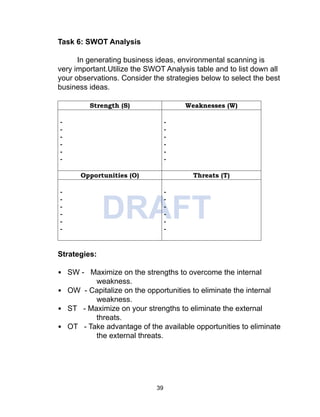
  • 218.
  • 219.