Presented To:
Dr. Hemant Lata Sharma
Professor
Dept. of Education
M.D.U., Rohtak.
SEMINAR ON E-LEARNING
Presented By:
Name: Shikha Sharma
Course: M.Phil.
Roll No.: 91
Dept. of Education
E – Learning
The letter `e’ in e-learning stands for the word
`electronic’. So it is stated as “Electronic Learning”
In 1963 Bernard Luskin installed the first computer
in a community college for instruction as computer
assisted instruction.
E-learning pioneer BERNARD LUSKIN(2001)
explains `e’ as
exciting, energetic, enthusiastic, emotional, extended
and educational.
It is a store house of
education, information, communication, training, kn
owledge and performance management.
Definitions of E - Learning
Darin E. Hartley ( 2001)
Teaching and learning process by using internet media,
intranet or other computer network in order to give the
material to the students.
Matt Comerchero
E-learning is a means of education that incorporates self-
motivation, communication, efficiency, and technology.
Definitions of E - Learning
According to Derek Stockley 2003
The delivery of a learning, training or education program
by electronic means. E-learning involves the use of a
computer or electronic device (e.g. a mobile phone) in
some way to provide training, educational or learning
material.
According to LSDA (2005)
E-learning is learning supported or enhanced through the
application of Information and Communications
Technology.
Features of E- Learning
E-learning is dynamic: today in the era of
globalization, it helps in availing the online
experts, best sources and quick approaches in a
single mouse click.
E-learning is individual i.e. centered across the
learner and personalized to the individual.
E-learning operates in real time that is
available for 24* 7days
E-learning is comprehensive
It is network assisted and often learning is
done within the fraction of time.
Blend of learning methods such as—virtual
classroom, simulation, community and even a
classroom.
ADVANTAGES
DISADVANTAGE
S
DISADVANTAGE
S
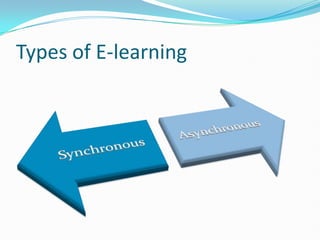
Types of E-learning
Synchronous E-Learning
 Synchronous learning: learning and teaching takes place in
real time (same time) while the trainer and learners are
physically separated from each other.
 Examples include:
 listening to a live radio broadcast
 watching live a television broadcast
 audio/video conferencing
 Internet telephony
 online lectures
 two-way live satellite broadcast
Asynchronous E-learning
 Asynchronous learning is the fact that that the trainer prepares the
courseware material before the course takes place. The learner is free
to decide when he wants to study the courseware.
 In other words Asynchronous e-learning where people are not online
at the same time and interaction does not occur without a time
delay, allowing people to participate on their schedules.
 Examples include:
 self paced courses taken via Internet or CD-ROM
 videotaped classes
 stored audio/video Web presentations or seminars
 recorded audio tapes
 Q & A mentoring
 reading e-mail messages
 Improves efficiency both in learning and teaching
 Increases motivation
 Deepens understanding
 Promotes collaborate learning
 Gives new approach to learning and working
 Provides new ways interacting
 Paves way for personality development
 Increases social skills
 Creates interest in learning
Impacts on Teaching Learning Process
Helpful for self-evaluation
Wide reach and consistent
User convenient
Flexible and rich medium for students
Useful tool to address students with
different learning and cognitive styles
Self-pacing for slow and quick
learners, reduces stress and increases
satisfaction.
Impacts on Teaching Learning Process
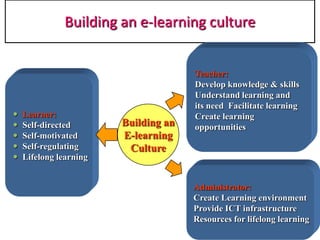
Building an e-learning culture
 Learner:
 Self-directed
 Self-motivated
 Self-regulating
 Lifelong learning
Building an
E-learning
Culture
Teacher:
Develop knowledge & skills
Understand learning and
its need Facilitate learning
Create learning
opportunities
Administrator:
Create Learning environment
Provide ICT infrastructure
Resources for lifelong learning
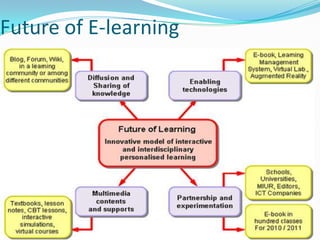
Future of E-learning
CONCLUSION
E-learning is not intended to
replace conventional methods and
learning in classroom. Its aim is to
create an augmented learning
environment where technology is
used to deliver a combined range of
teaching and learning techniques
aimed at maximizing the
individual’s participation and
achieving the goals in the learning
and teaching process as a greener
world.

e-learning-130804031834- phpapp01.pdf

  • 1.
    Presented To: Dr. HemantLata Sharma Professor Dept. of Education M.D.U., Rohtak. SEMINAR ON E-LEARNING Presented By: Name: Shikha Sharma Course: M.Phil. Roll No.: 91 Dept. of Education
  • 2.
    E – Learning Theletter `e’ in e-learning stands for the word `electronic’. So it is stated as “Electronic Learning” In 1963 Bernard Luskin installed the first computer in a community college for instruction as computer assisted instruction. E-learning pioneer BERNARD LUSKIN(2001) explains `e’ as exciting, energetic, enthusiastic, emotional, extended and educational. It is a store house of education, information, communication, training, kn owledge and performance management.
  • 3.
    Definitions of E- Learning Darin E. Hartley ( 2001) Teaching and learning process by using internet media, intranet or other computer network in order to give the material to the students. Matt Comerchero E-learning is a means of education that incorporates self- motivation, communication, efficiency, and technology.
  • 4.
    Definitions of E- Learning According to Derek Stockley 2003 The delivery of a learning, training or education program by electronic means. E-learning involves the use of a computer or electronic device (e.g. a mobile phone) in some way to provide training, educational or learning material. According to LSDA (2005) E-learning is learning supported or enhanced through the application of Information and Communications Technology.
  • 5.
    Features of E-Learning E-learning is dynamic: today in the era of globalization, it helps in availing the online experts, best sources and quick approaches in a single mouse click. E-learning is individual i.e. centered across the learner and personalized to the individual. E-learning operates in real time that is available for 24* 7days E-learning is comprehensive It is network assisted and often learning is done within the fraction of time. Blend of learning methods such as—virtual classroom, simulation, community and even a classroom.
  • 6.
  • 7.
  • 8.
  • 9.
  • 10.
    Synchronous E-Learning  Synchronouslearning: learning and teaching takes place in real time (same time) while the trainer and learners are physically separated from each other.  Examples include:  listening to a live radio broadcast  watching live a television broadcast  audio/video conferencing  Internet telephony  online lectures  two-way live satellite broadcast
  • 11.
    Asynchronous E-learning  Asynchronouslearning is the fact that that the trainer prepares the courseware material before the course takes place. The learner is free to decide when he wants to study the courseware.  In other words Asynchronous e-learning where people are not online at the same time and interaction does not occur without a time delay, allowing people to participate on their schedules.  Examples include:  self paced courses taken via Internet or CD-ROM  videotaped classes  stored audio/video Web presentations or seminars  recorded audio tapes  Q & A mentoring  reading e-mail messages
  • 12.
     Improves efficiencyboth in learning and teaching  Increases motivation  Deepens understanding  Promotes collaborate learning  Gives new approach to learning and working  Provides new ways interacting  Paves way for personality development  Increases social skills  Creates interest in learning Impacts on Teaching Learning Process
  • 13.
    Helpful for self-evaluation Widereach and consistent User convenient Flexible and rich medium for students Useful tool to address students with different learning and cognitive styles Self-pacing for slow and quick learners, reduces stress and increases satisfaction. Impacts on Teaching Learning Process
  • 14.
    Building an e-learningculture  Learner:  Self-directed  Self-motivated  Self-regulating  Lifelong learning Building an E-learning Culture Teacher: Develop knowledge & skills Understand learning and its need Facilitate learning Create learning opportunities Administrator: Create Learning environment Provide ICT infrastructure Resources for lifelong learning
  • 15.
  • 16.
    CONCLUSION E-learning is notintended to replace conventional methods and learning in classroom. Its aim is to create an augmented learning environment where technology is used to deliver a combined range of teaching and learning techniques aimed at maximizing the individual’s participation and achieving the goals in the learning and teaching process as a greener world.