El viaje de Angular1 a Angular2
Antonio de la Torre
#DevFestAsturias 03/11/2016
@adelatorrefoss
Angular
“AngularJS is a structural
framework for dynamic web apps.
It lets you use HTML as your
template language and lets you
extend HTML's syntax to express
your application's components
clearly and succinctly. Angular's
data binding and dependency
injection eliminate much of the code
you would otherwise have to write.
Angular teaches the browser new
syntax through a construct we call
directives.“
https://docs.angularjs.org/guide/introduction
Oyendo hablar de
Angular2 desde el
verano pasado
(2015)
y que Angular 1
está muerto.
Antonio de la Torre
Software Developer
Me mudé en Julio
tras 12 años en Madrid
#Movember
mobro.co/tonodelatorre
¿Qué aporta
Angular?
● Completo.
● Te ahorra la fontanería.
● Bien documentado.
● Mucha comunidad.
● Patrón reconocido MVC.
● ES6.
● Opinionado
(pero si no te gusta tengo otra)
Mundo viejuno
aka Angular < 1.5
Ejemplo de código:
https://angularjs.org/#create-components
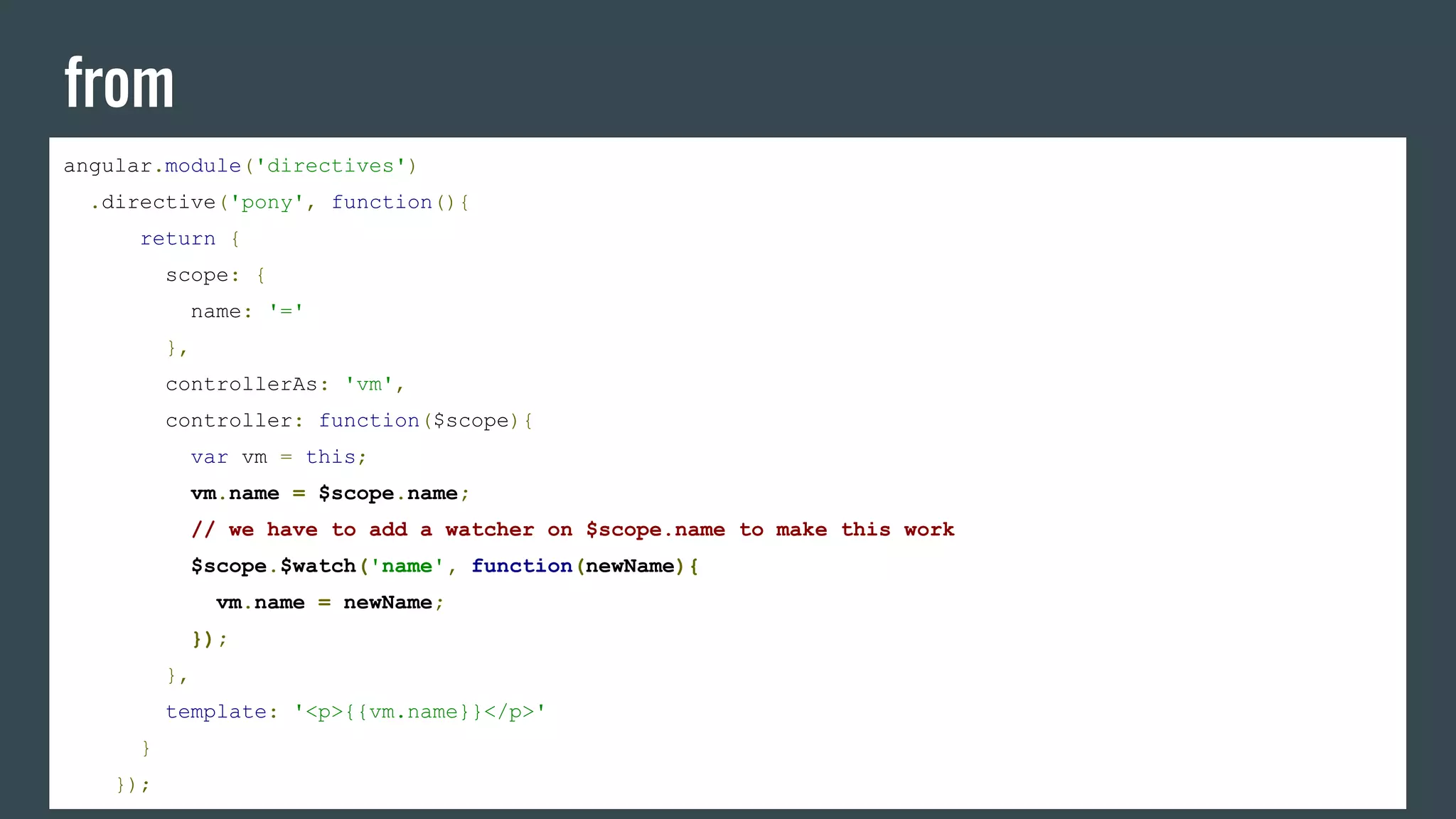
from
angular.module('directives')
.directive('pony', function(){
return {
scope: {
name: '='
},
controllerAs: 'vm',
controller: function($scope){
var vm = this;
vm.name = $scope.name;
// we have to add a watcher on $scope.name to make this work
$scope.$watch('name', function(newName){
vm.name = newName;
});
},
template: '<p>{{vm.name}}</p>'
}
});
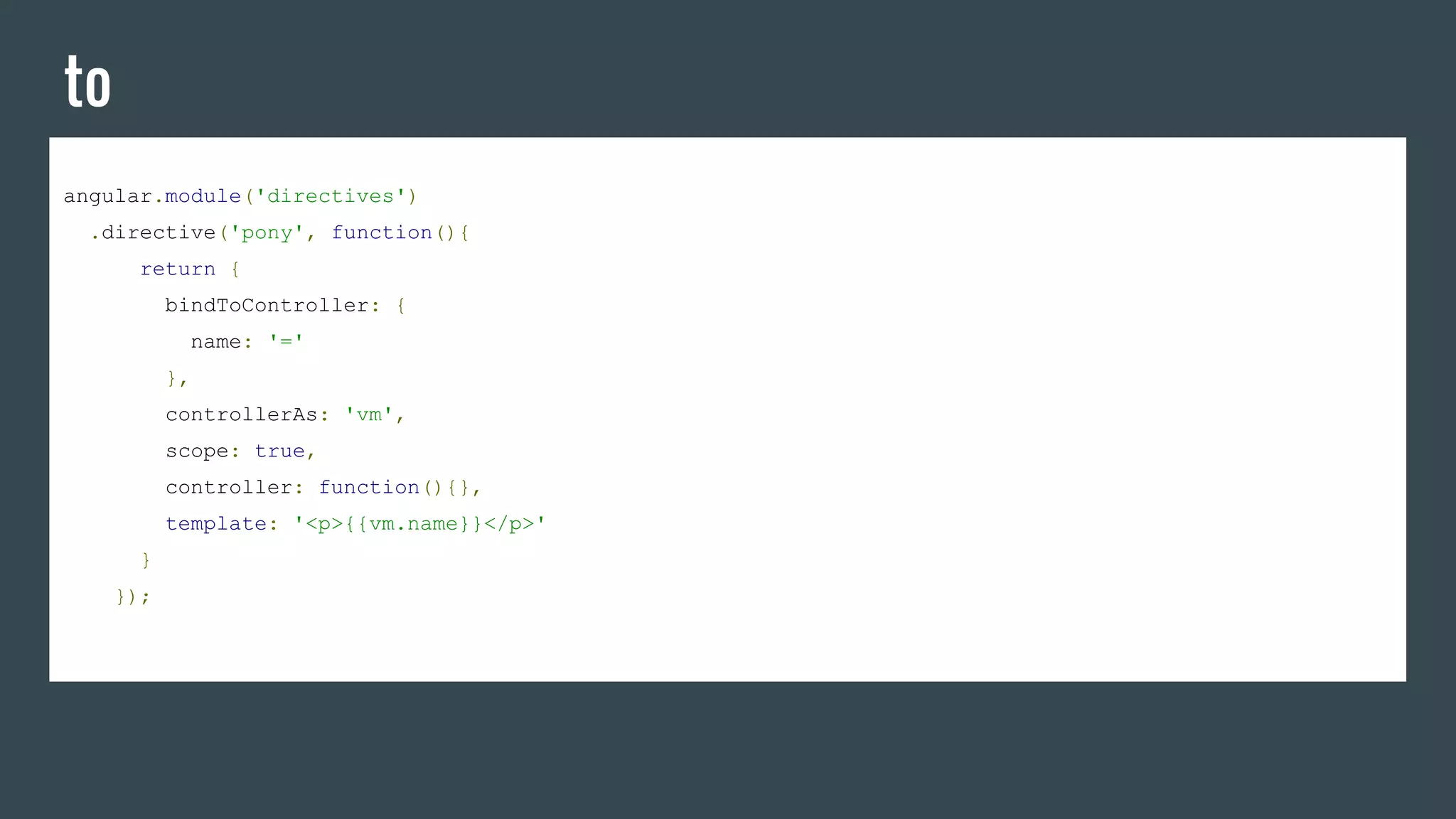
to
angular.module('directives')
.directive('pony', function(){
return {
bindToController: {
name: '='
},
controllerAs: 'vm',
scope: true,
controller: function(){},
template: '<p>{{vm.name}}</p>'
}
});
Componentes
React es lo que
está de moda
Los COMPONENTES están de moda
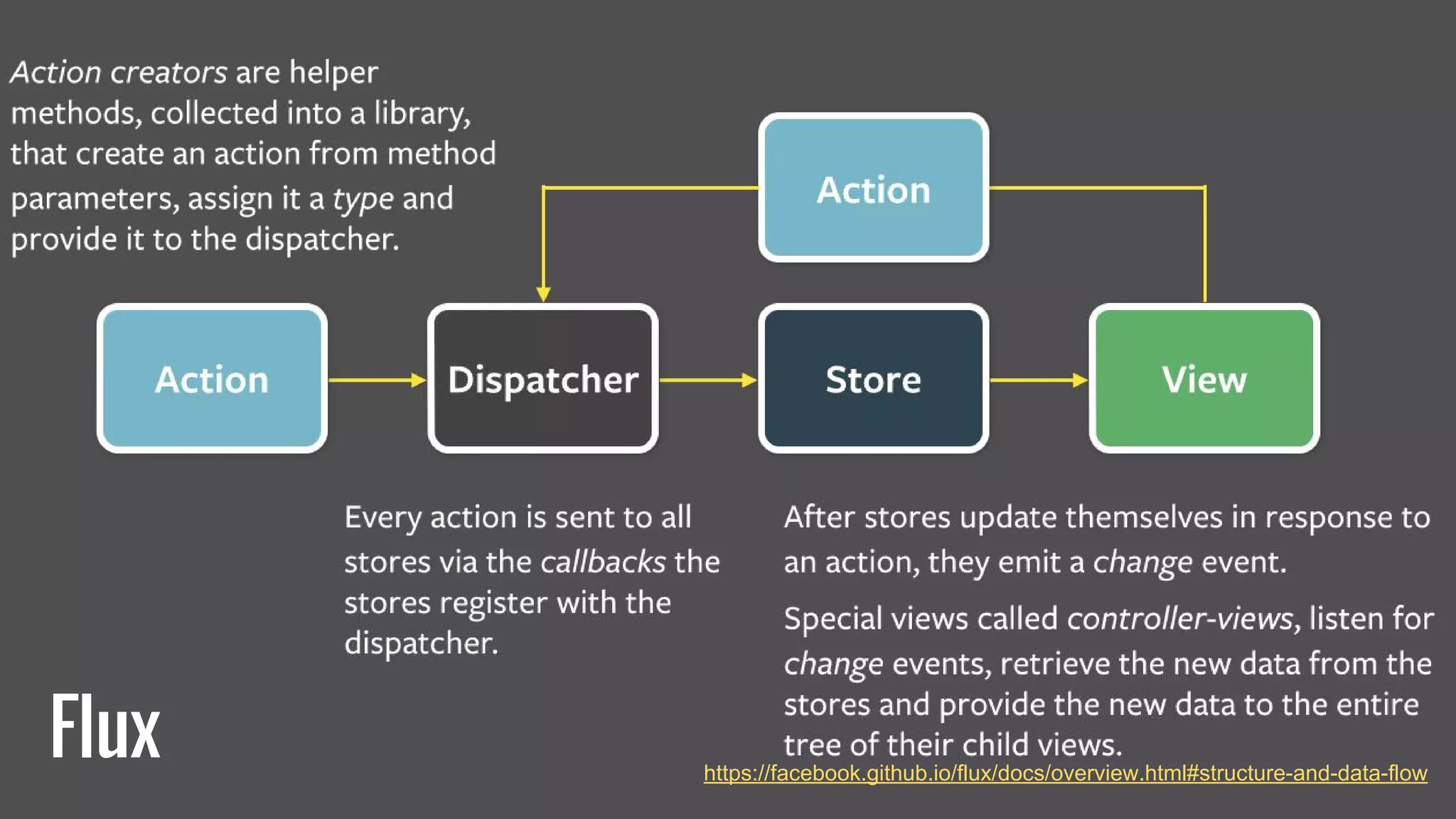
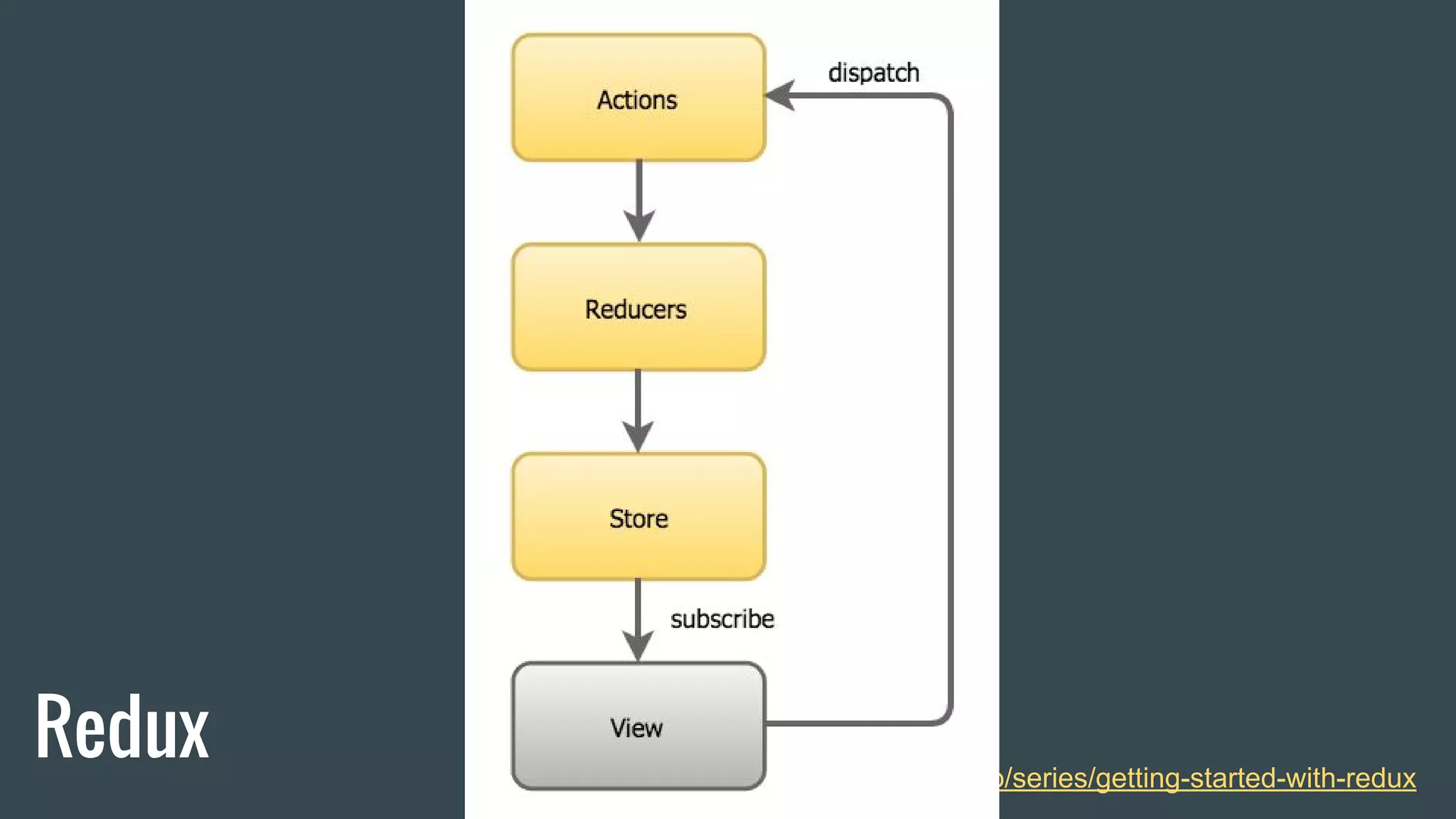
ReduxFlux
https://facebook.github.io/flux/docs/overview.html#structure-and-data-flow
Flux
https://egghead.io/series/getting-started-with-redux
Redux
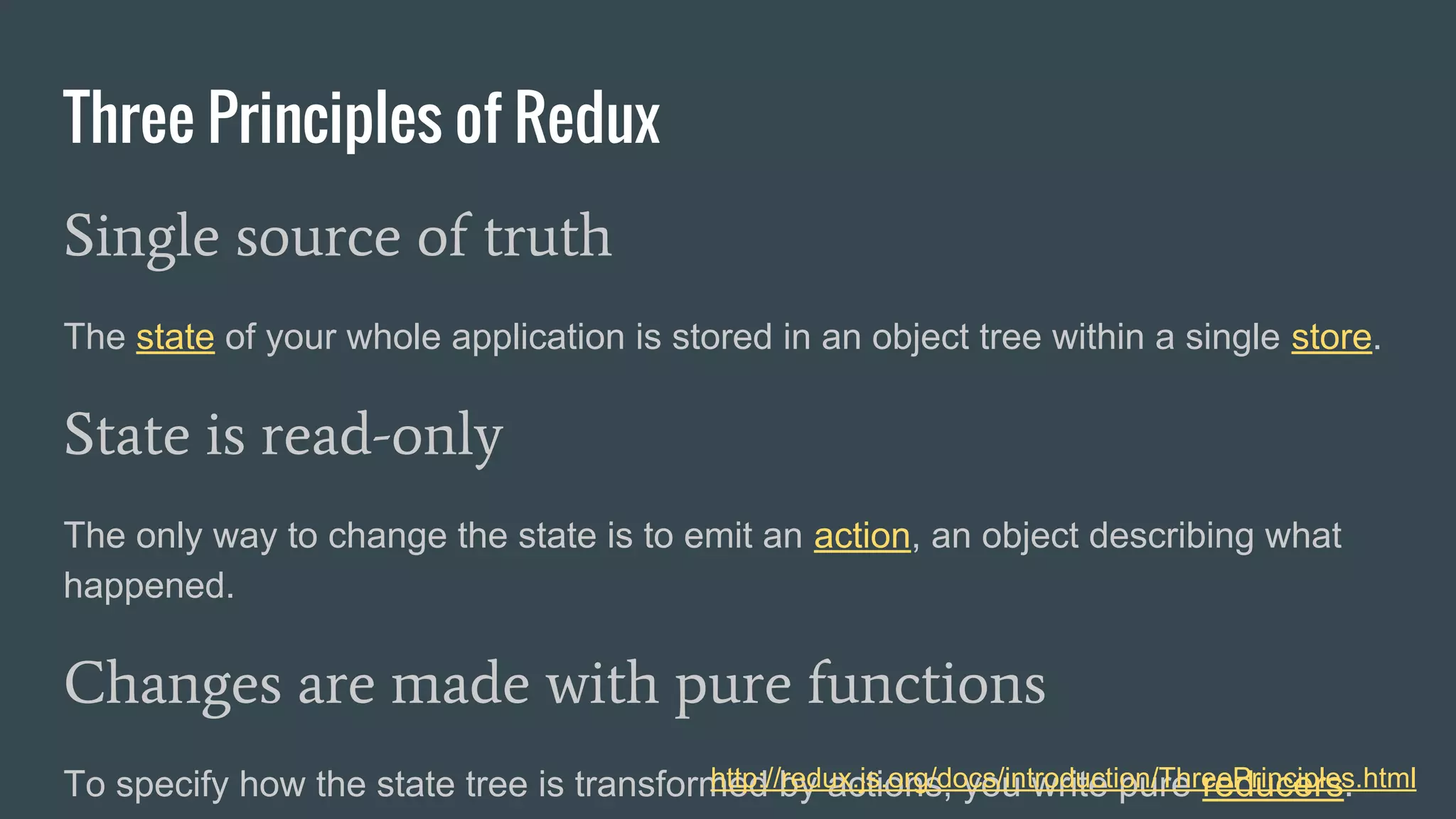
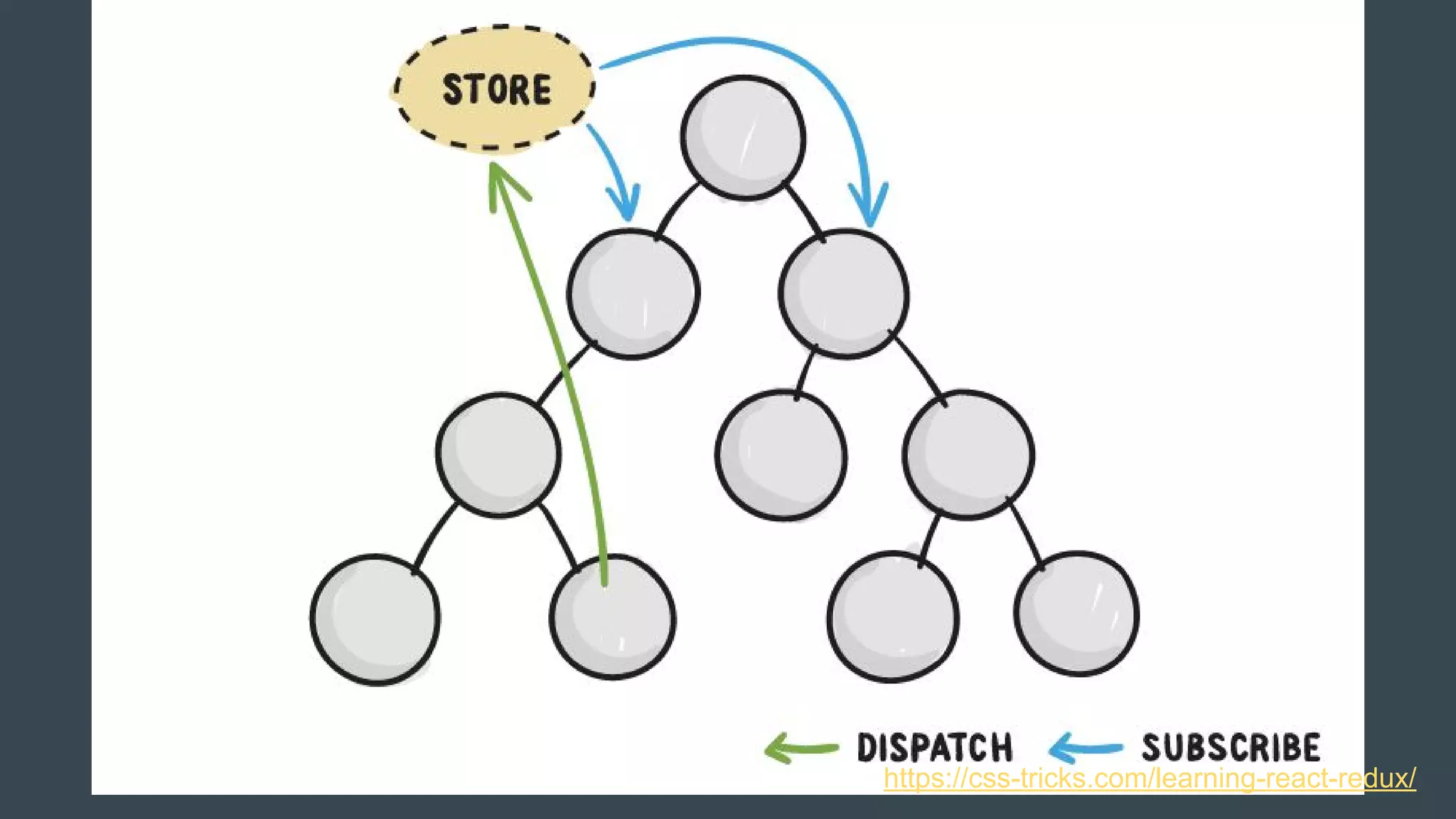
Three Principles of Redux
Single source of truth
The state of your whole application is stored in an object tree within a single store.
State is read-only
The only way to change the state is to emit an action, an object describing what
happened.
Changes are made with pure functions
To specify how the state tree is transformed by actions, you write pure reducers.http://redux.js.org/docs/introduction/ThreePrinciples.html
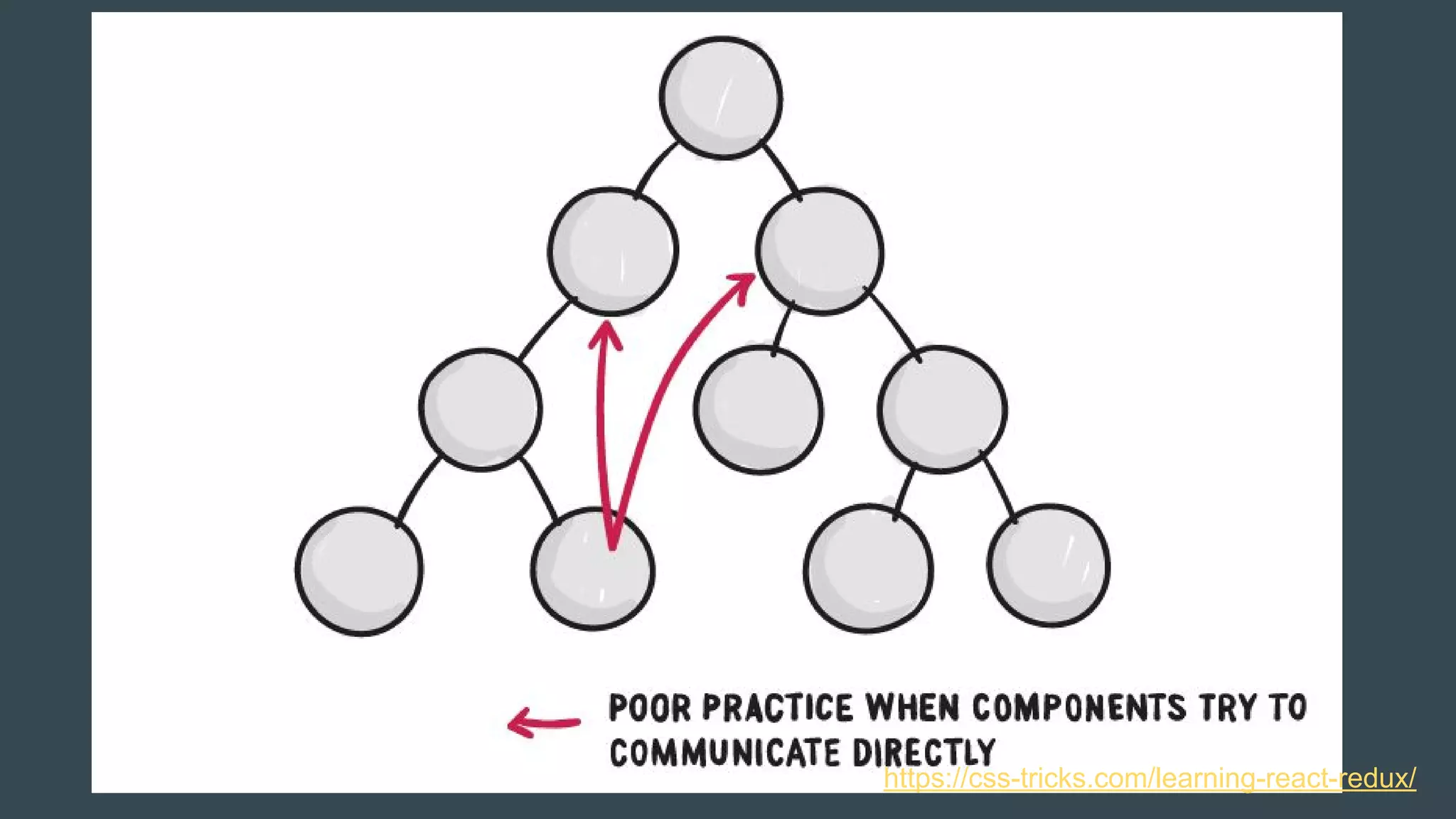
https://css-tricks.com/learning-react-redux/
Javascript Fatigue
“The Javascript pendulum has swung from
restrictive, monolithic frameworks to
modular, boilerplate-hindered libraries.”
EricClemmons
https://medium.com/@ericclemmons/javascript-fatigue-48d4011b6fc4#.nzcp66xkh
Javascript Fatigue Fatigue
Don’t try to know everything – it’s impossible in
modern web development.
I find it important to remain human. Don’t overdo
discipline, don’t become a life improvement
machine. Periods of boredom and doing nothing are
important for recuperating and inspiration.
AxelRauschmayer
http://www.2ality.com/2016/02/js-fatigue-fatigue.html
Guías de estilo
vienen en nuestra ayuda
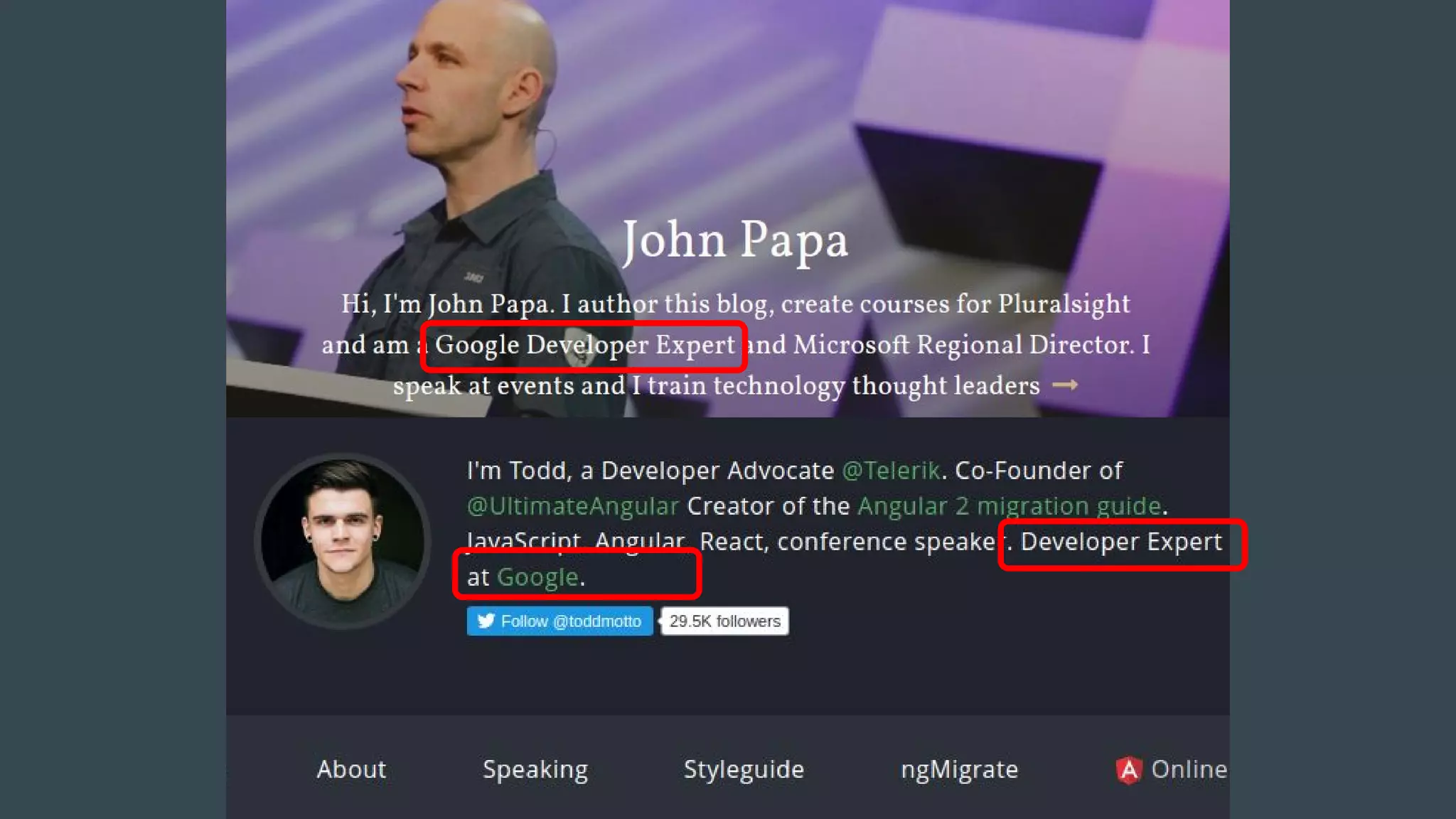
Guías de estilo de
John Papa y Todd Motto
para Angular 1.4 mejoró la situación
https://github.com/johnpapa/angular-styleguide/blob/master/a1/README.md
https://github.com/toddmotto/angular-styleguide
Y Angular crea
.component()
Aparece Angular 1.5 (febrero 2016)
última release 1.x => 2.0
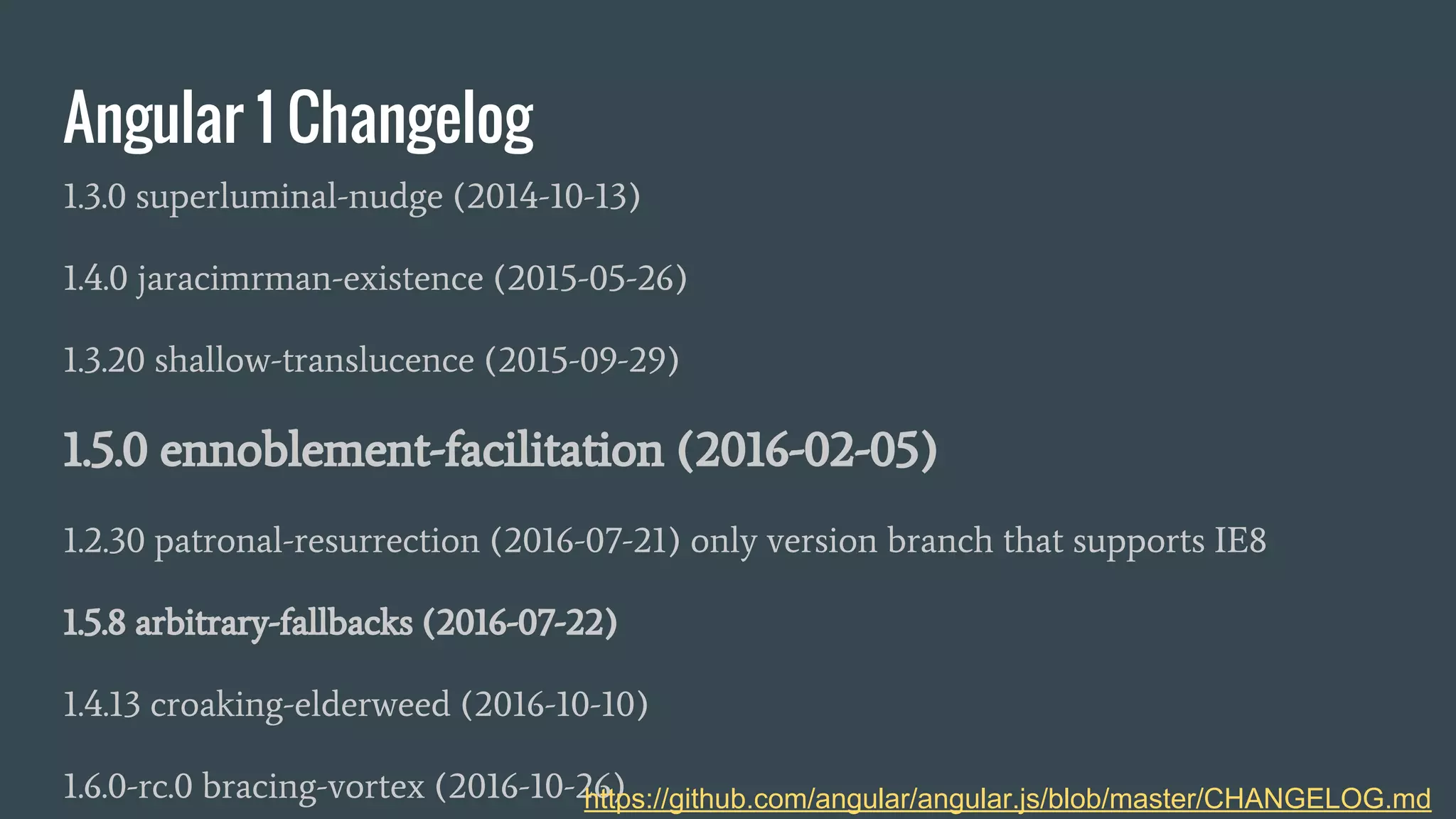
Angular 1 Changelog
1.3.0 superluminal-nudge (2014-10-13)
1.4.0 jaracimrman-existence (2015-05-26)
1.3.20 shallow-translucence (2015-09-29)
1.5.0 ennoblement-facilitation (2016-02-05)
1.2.30 patronal-resurrection (2016-07-21) only version branch that supports IE8
1.5.8 arbitrary-fallbacks (2016-07-22)
1.4.13 croaking-elderweed (2016-10-10)
1.6.0-rc.0 bracing-vortex (2016-10-26)https://github.com/angular/angular.js/blob/master/CHANGELOG.md
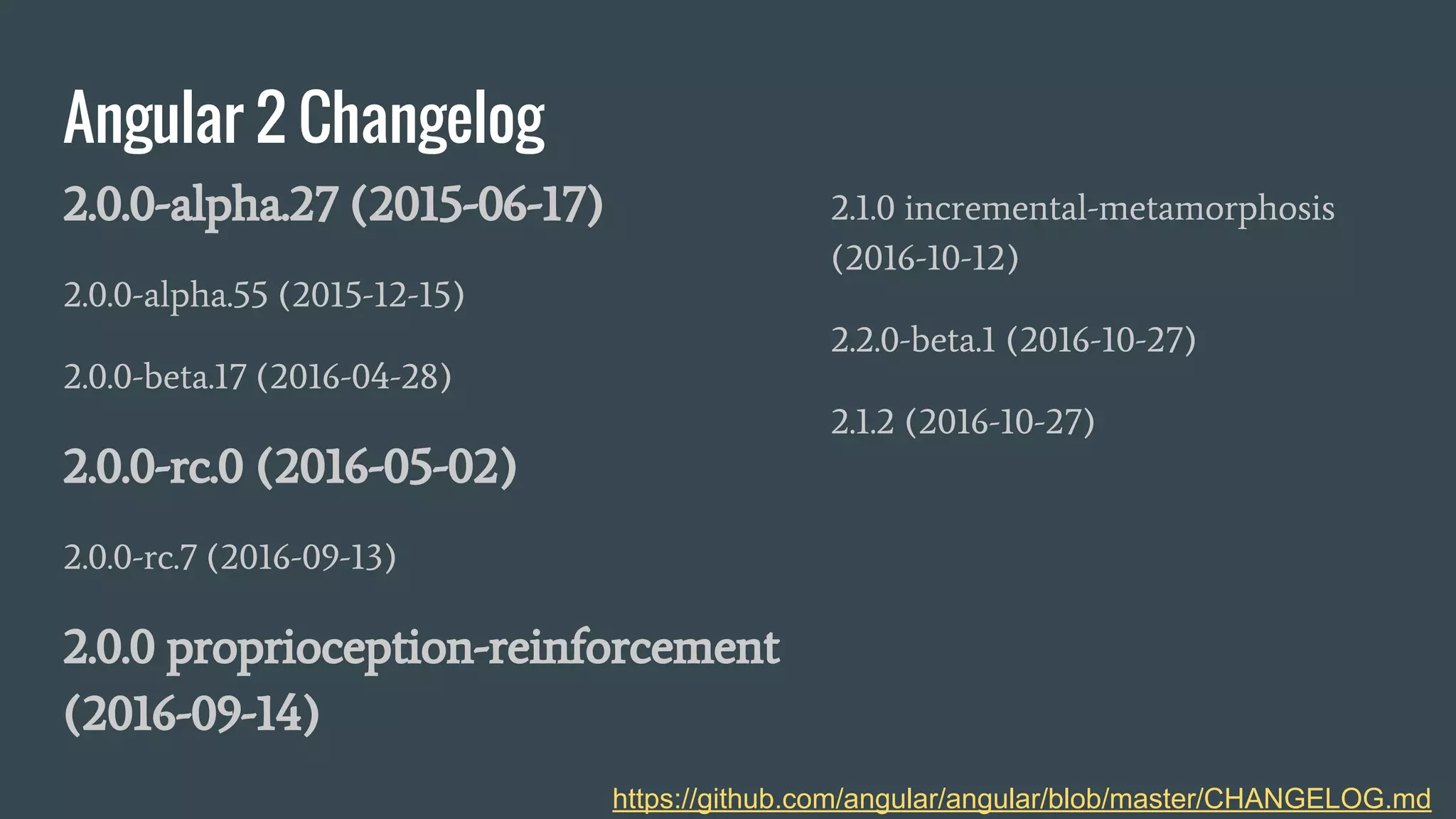
Angular 2 Changelog
2.0.0-alpha.27 (2015-06-17)
2.0.0-alpha.55 (2015-12-15)
2.0.0-beta.17 (2016-04-28)
2.0.0-rc.0 (2016-05-02)
2.0.0-rc.7 (2016-09-13)
2.0.0 proprioception-reinforcement
(2016-09-14)
https://github.com/angular/angular/blob/master/CHANGELOG.md
2.1.0 incremental-metamorphosis
(2016-10-12)
2.2.0-beta.1 (2016-10-27)
2.1.2 (2016-10-27)
La arquitectura de
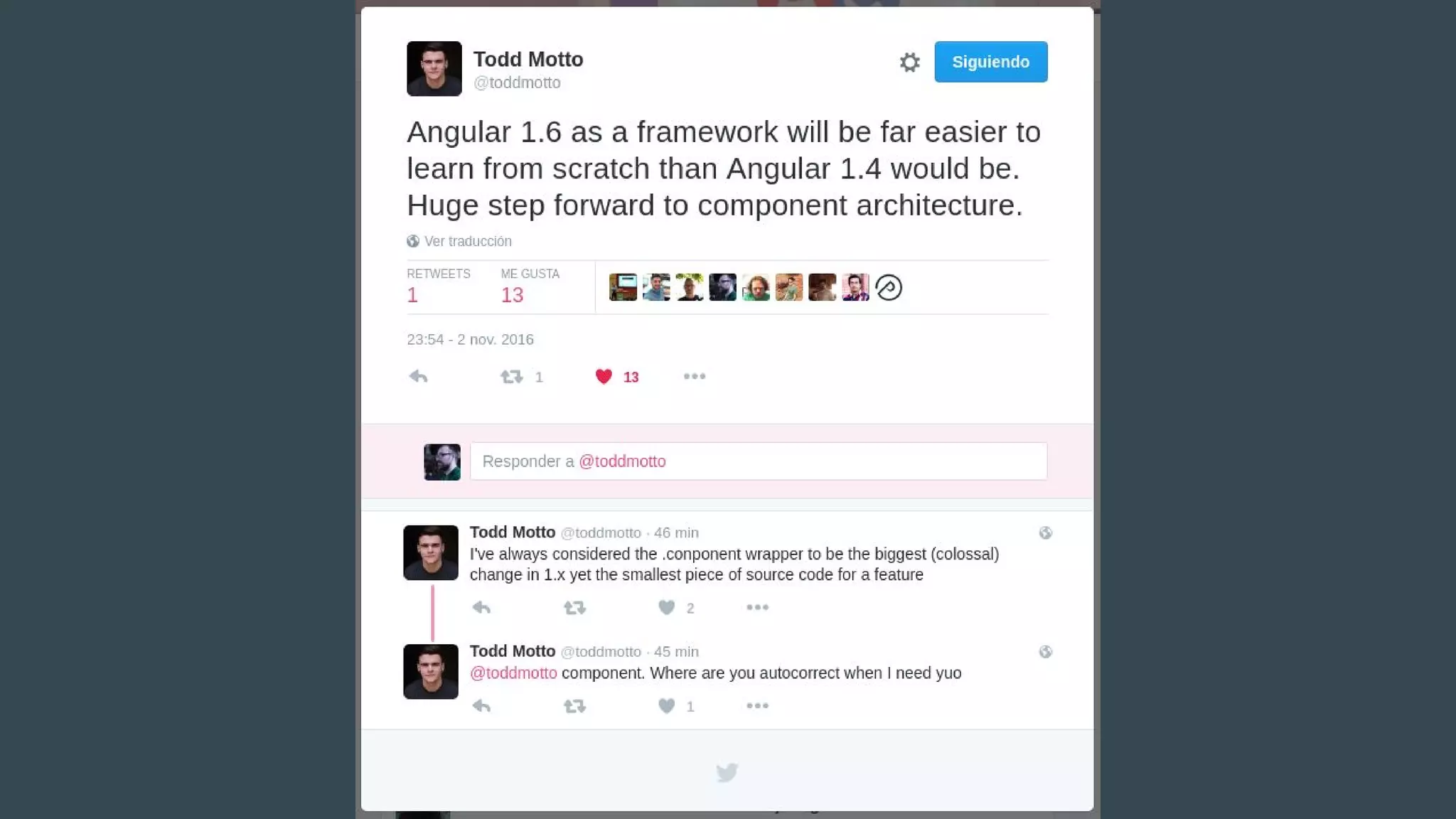
componentes en Angular 1.5
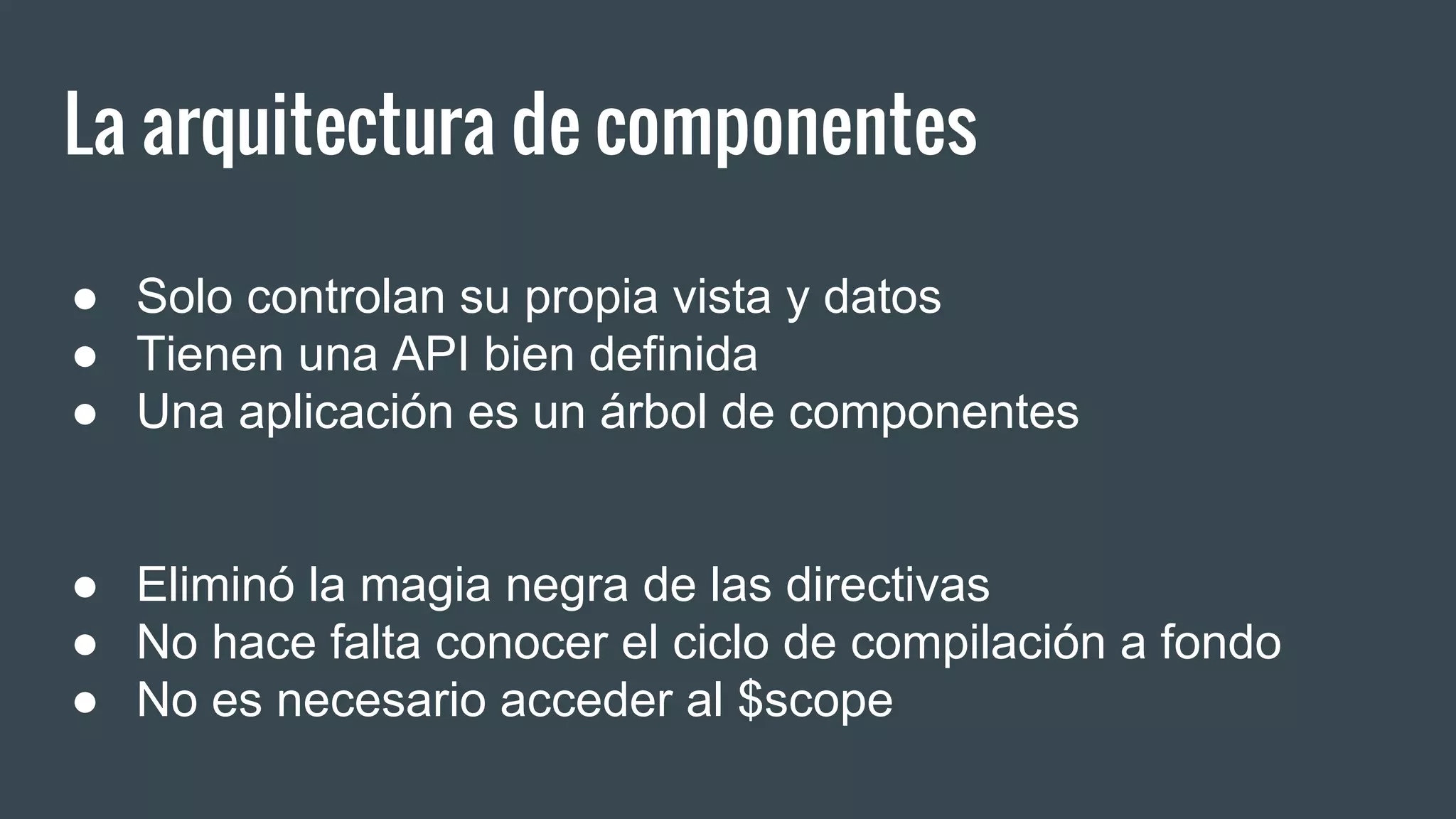
La arquitectura de componentes
● Solo controlan su propia vista y datos
● Tienen una API bien definida
● Una aplicación es un árbol de componentes
● Eliminó la magia negra de las directivas
● No hace falta conocer el ciclo de compilación a fondo
● No es necesario acceder al $scope
ES6
Clases
Módulos
Arrow function
Array (y nuevos tipos)
...
Migrating from 1.4 to 1.5
https://docs.angularjs.org/guide/migration
Angular 1.5 takes a big step towards preparing developers for a smoother transition to
Angular 2 in the future. Architecting your applications using components, multi-slot
transclusion, one-way bindings in isolate scopes, using lifecycle hooks in directive
controllers and relying on native ES6 features (such as classes and arrow functions) are
now all possible with Angular 1.5.
Ejemplo de código:
https://docs.angularjs.org/guide/component
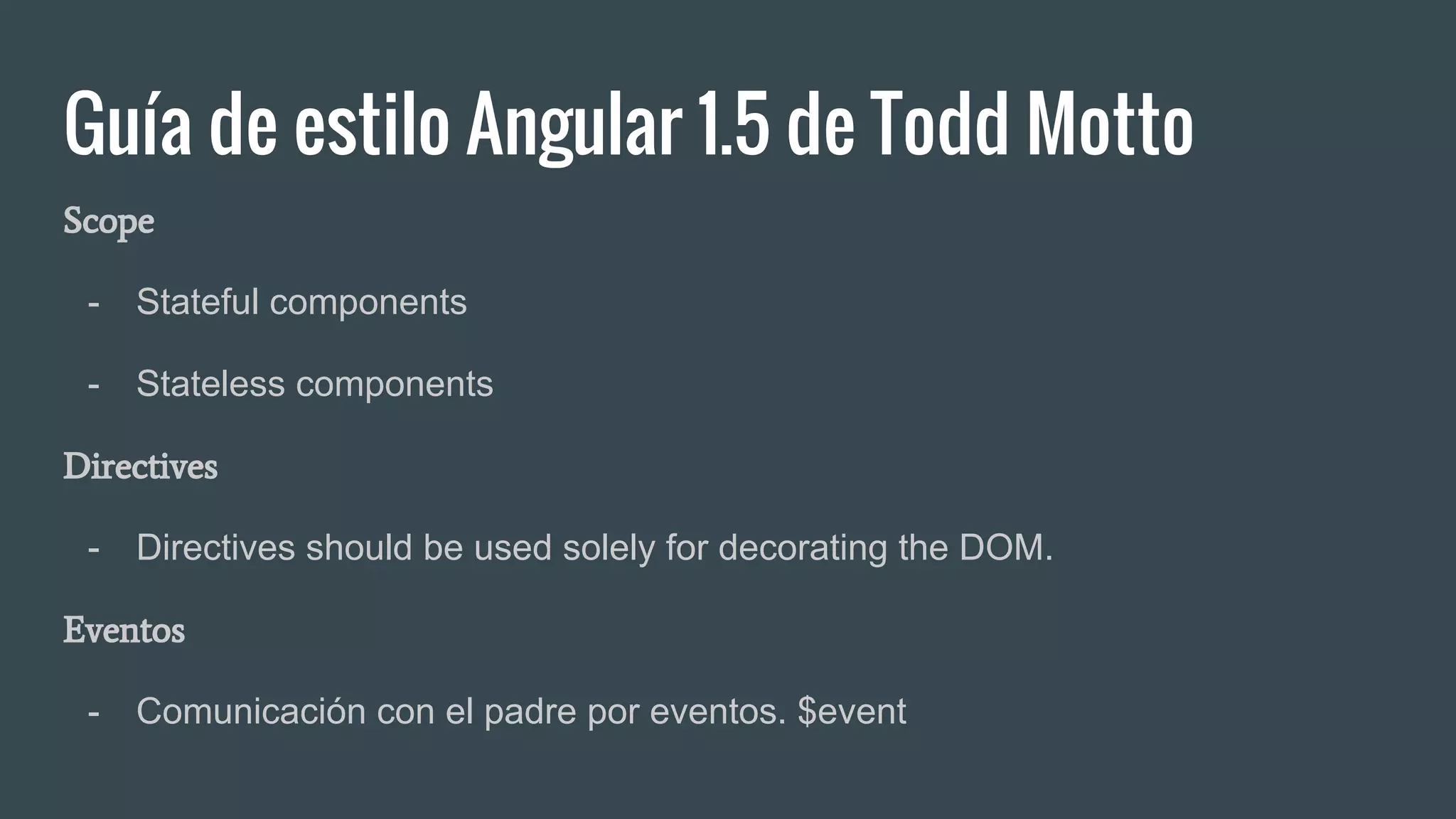
Guía de estilo Angular 1.5 de Todd Motto
Scope
- Stateful components
- Stateless components
Directives
- Directives should be used solely for decorating the DOM.
Eventos
- Comunicación con el padre por eventos. $event
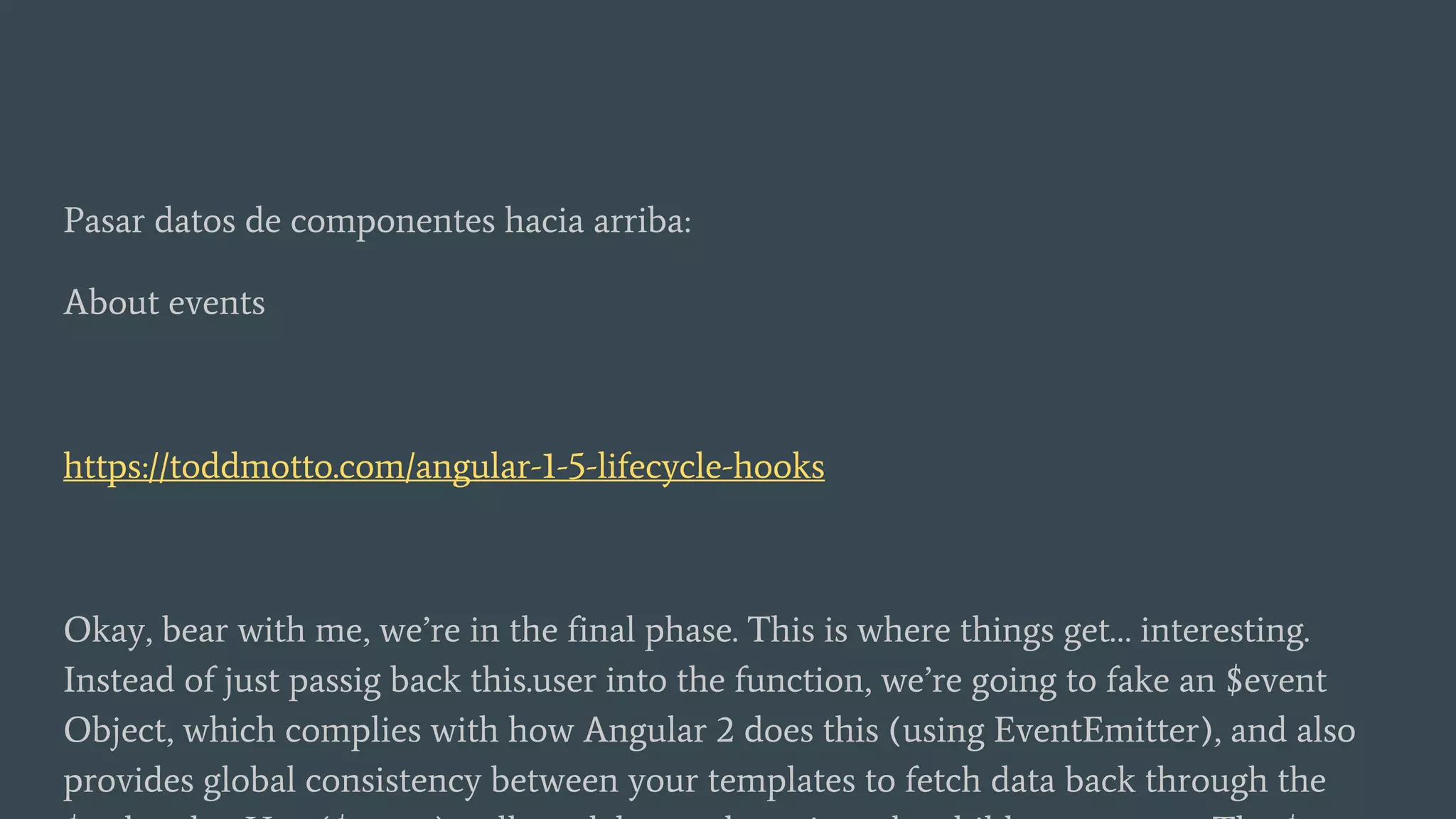
Pasar datos de componentes hacia arriba:
About events
https://toddmotto.com/angular-1-5-lifecycle-hooks
Okay, bear with me, we’re in the final phase. This is where things get… interesting.
Instead of just passig back this.user into the function, we’re going to fake an $event
Object, which complies with how Angular 2 does this (using EventEmitter), and also
provides global consistency between your templates to fetch data back through the
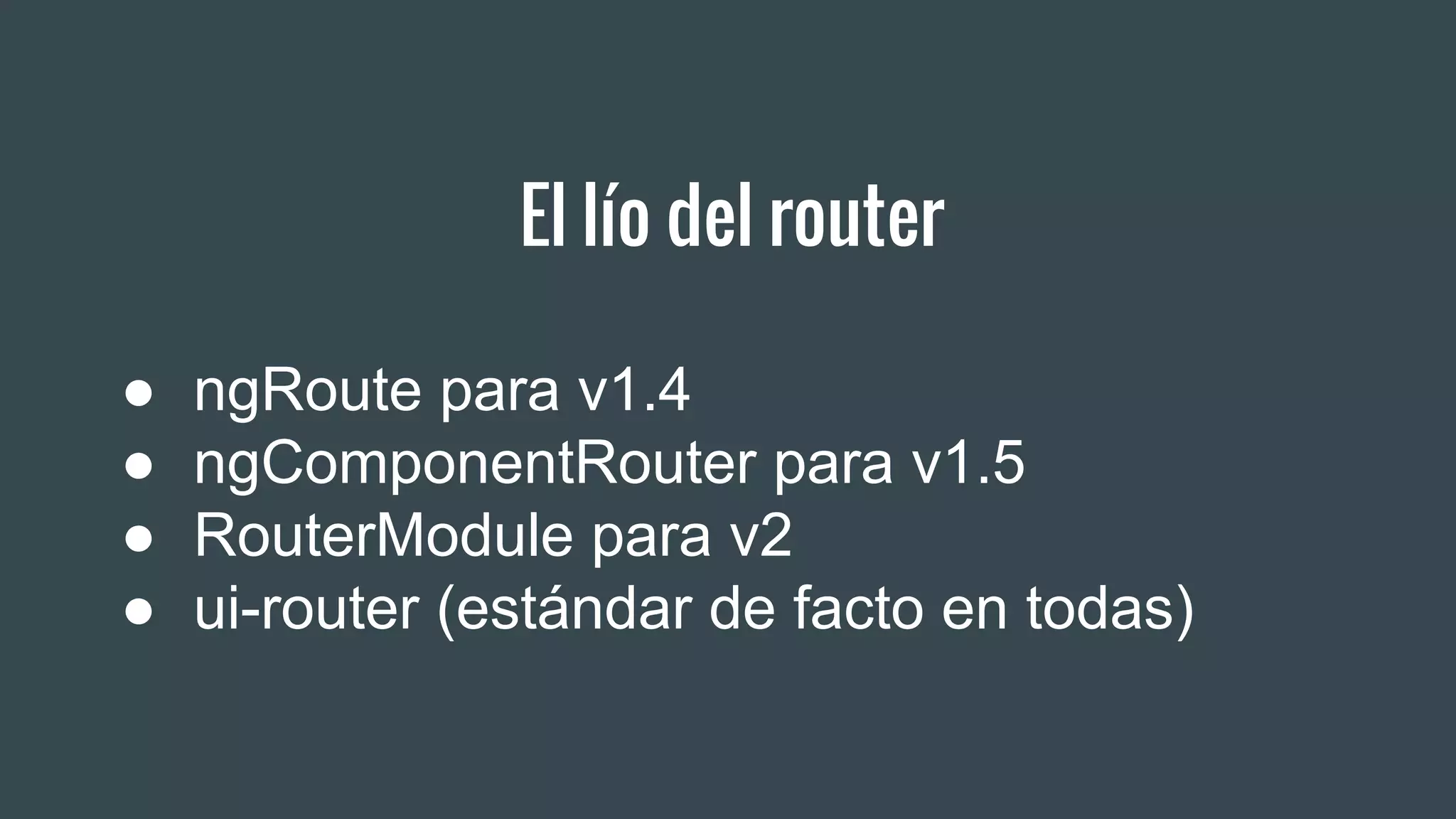
El lío del router
● ngRoute para v1.4
● ngComponentRouter para v1.5
● RouterModule para v2
● ui-router (estándar de facto en todas)
Angular 2
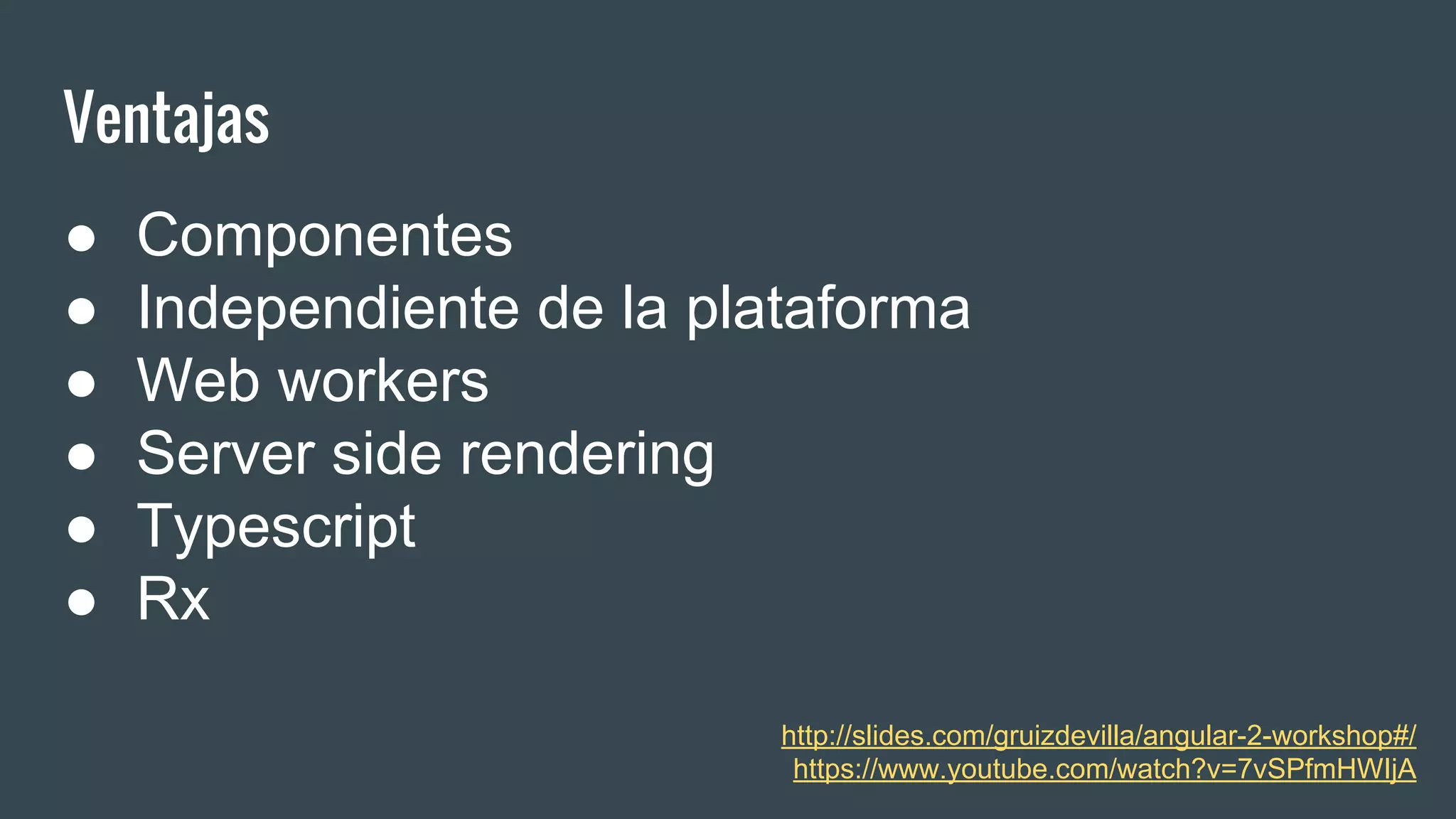
Ventajas
● Componentes
● Independiente de la plataforma
● Web workers
● Server side rendering
● Typescript
● Rx
http://slides.com/gruizdevilla/angular-2-workshop#/
https://www.youtube.com/watch?v=7vSPfmHWIjA
tipos
anotaciones
RxJS
eventos
Event Sourcing
Martin Fowler (2005)
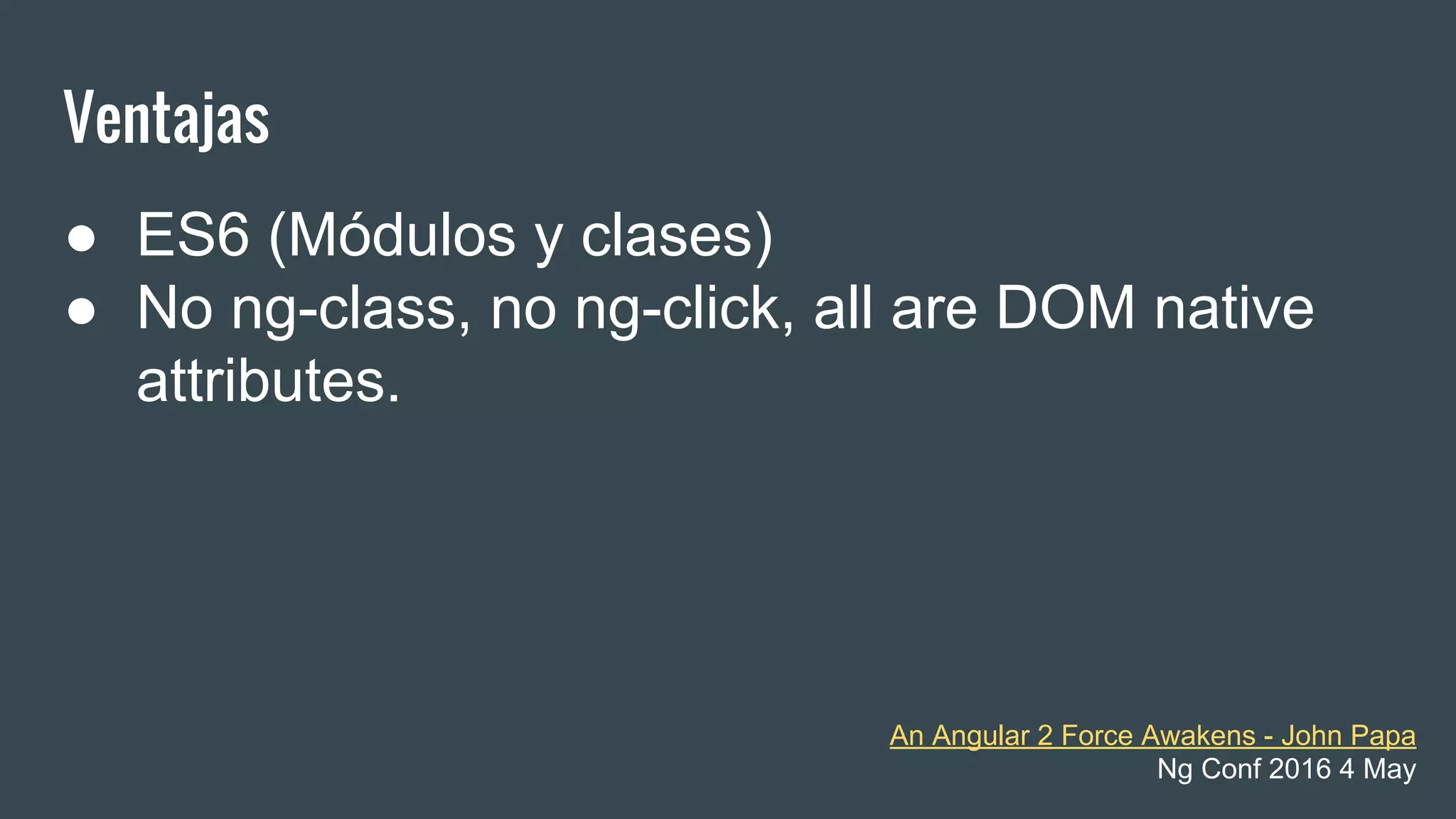
Ventajas
● ES6 (Módulos y clases)
● No ng-class, no ng-click, all are DOM native
attributes.
An Angular 2 Force Awakens - John Papa
Ng Conf 2016 4 May
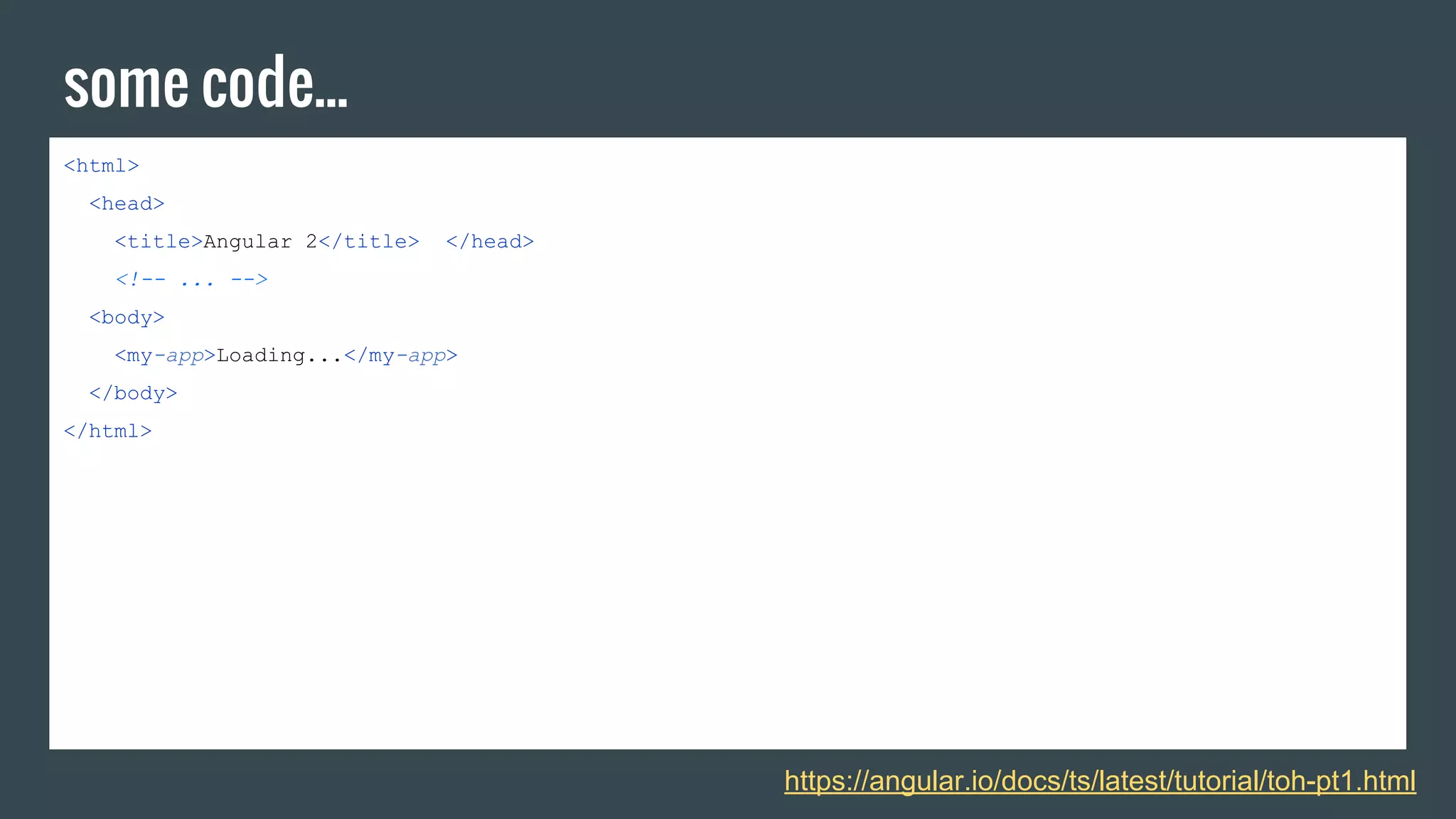
some code...
<html>
<head>
<title>Angular 2</title> </head>
<!-- ... -->
<body>
<my-app>Loading...</my-app>
</body>
</html>
https://angular.io/docs/ts/latest/tutorial/toh-pt1.html
some code...
import { Component } from '@angular/core';
export class Hero {
id: number;
name: string;
}
@Component({
selector: 'my-app',
template: `
<h1>{{title}}</h1>
<h2>{{hero.name}} details!</h2>
<div><label>id: </label>{{hero.id}}</div>
<div>
<label>name: </label>
<input [(ngModel)]="hero.name"
placeholder="name">
</div>
`})
export class AppComponent {
title = 'Tour of Heroes';
hero: Hero = {
id: 1,
name: 'Windstorm'
};
}
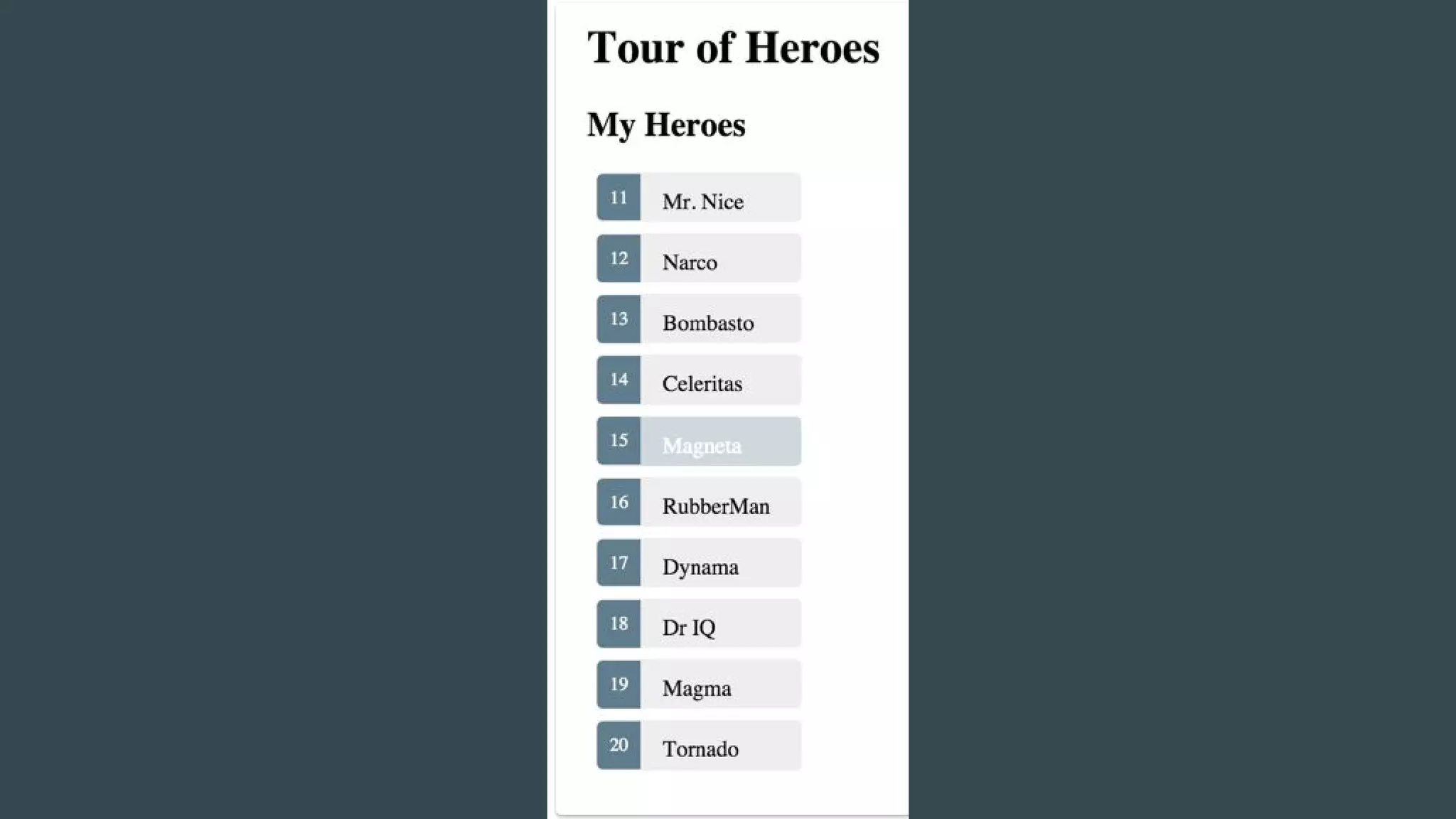
some code...
import { Component } from '@angular/core';
export class Hero {
id: number;
name: string;
}
const HEROES: Hero[] = [
{ id: 11, name: 'Mr. Nice' },...];
@Component({
selector: 'my-app',
template: `
<h1>{{title}}</h1>
<h2>My Heroes</h2>
<ul class="heroes">
<li *ngFor="let hero of heroes"
[class.selected]="hero === selectedHero"
(click)="onSelect(hero)">
<span class="badge">{{hero.id}}</span>
{{hero.name}}
</li>
</ul>
<div *ngIf="selectedHero">
<h2>{{selectedHero.name}} details!</h2>
<div><label>id: </label>{{selectedHero.id}}</div>
<div>
<label>name: </label>
<input [(ngModel)]="selectedHero.name"
placeholder="name"/>
</div>
</div>
`,
styles: [`...`]
})
export class AppComponent {
title = 'Tour of Heroes';
heroes = HEROES;
selectedHero: Hero;
onSelect(hero: Hero): void {
this.selectedHero = hero;
}
}
Guías de estilo (otra vez)
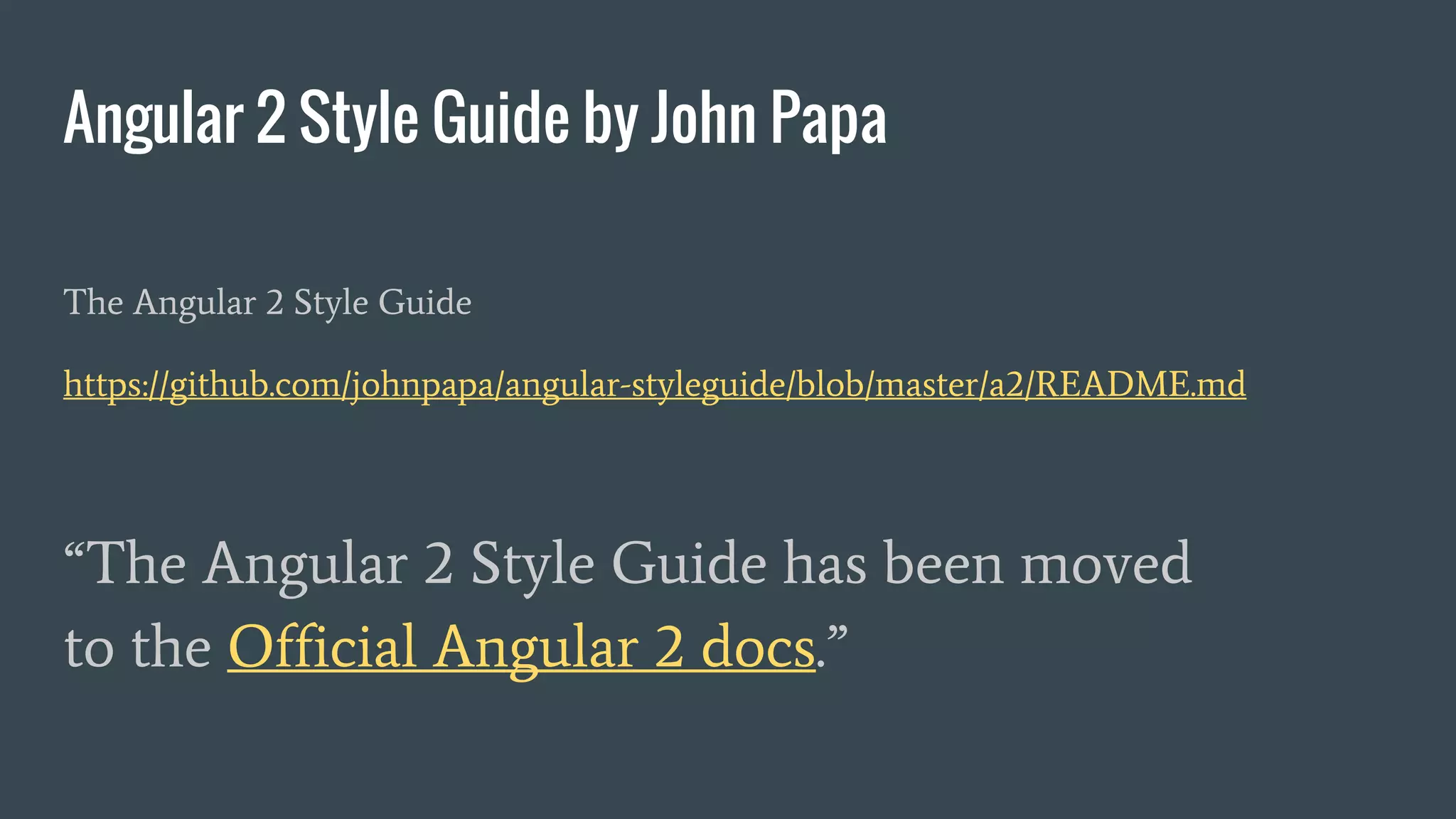
Angular 2 Style Guide by John Papa
The Angular 2 Style Guide
https://github.com/johnpapa/angular-styleguide/blob/master/a2/README.md
“The Angular 2 Style Guide has been moved
to the Official Angular 2 docs.”
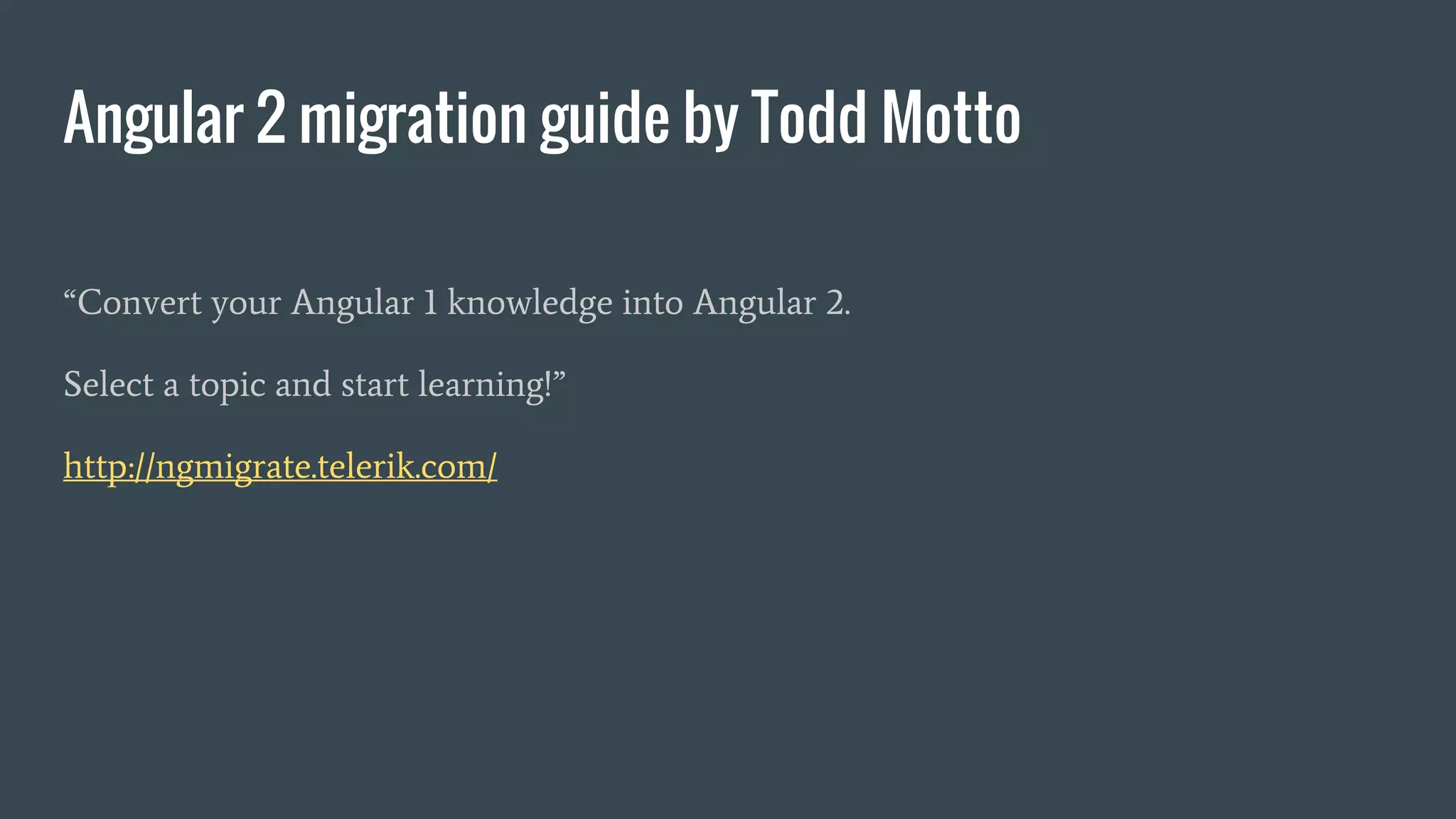
Angular 2 migration guide by Todd Motto
“Convert your Angular 1 knowledge into Angular 2.
Select a topic and start learning!”
http://ngmigrate.telerik.com/
Formación!
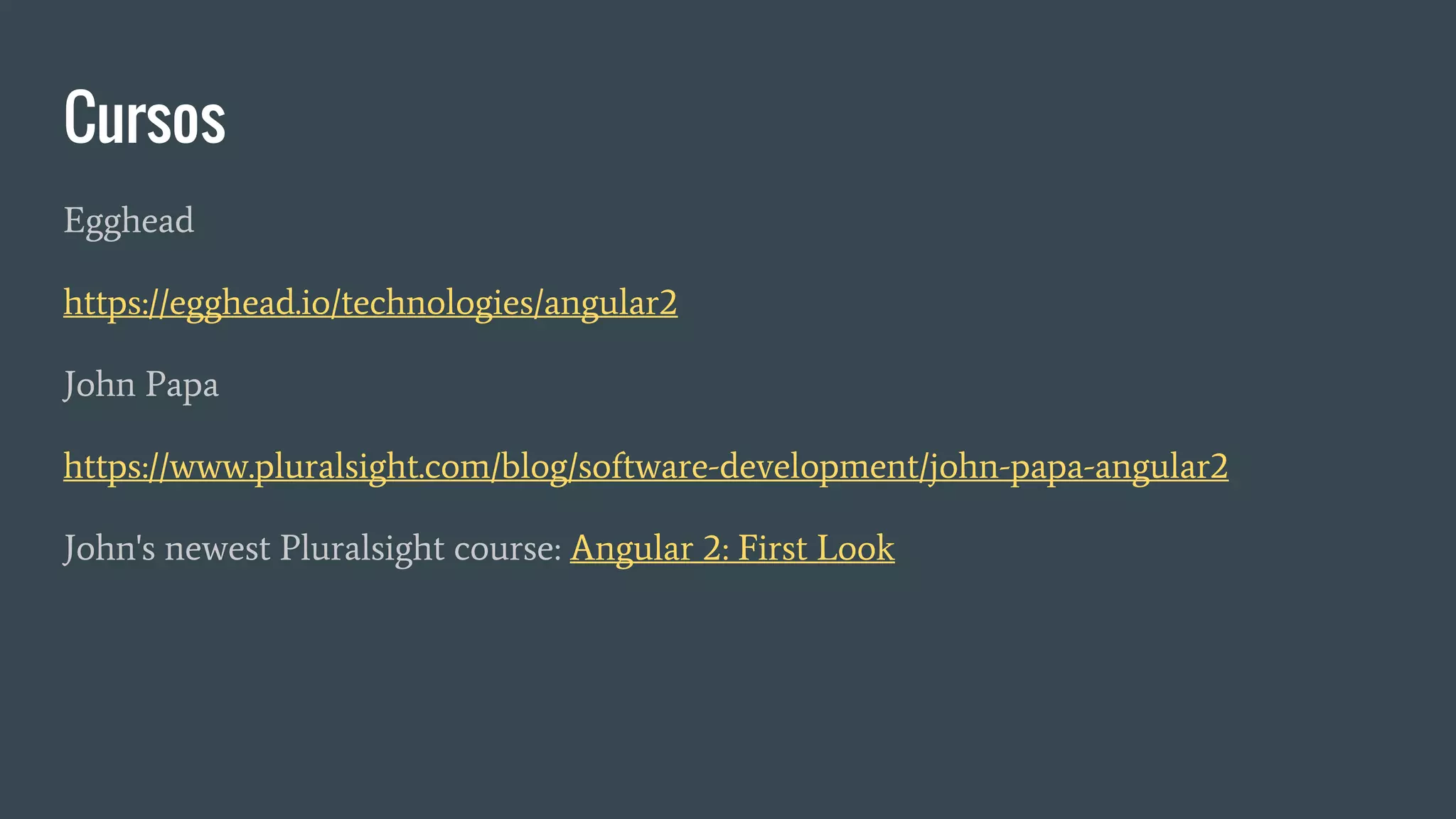
Cursos
Egghead
https://egghead.io/technologies/angular2
John Papa
https://www.pluralsight.com/blog/software-development/john-papa-angular2
John's newest Pluralsight course: Angular 2: First Look
Conferencias
https://github.com/mikedice/ngconf2016-slides/blob/master/ngconf-slides.md
Publicado el 4 may. 2016
http://angularconnect.com/2016/sessions/
Publicado el 27 sept. 2016
Combo!
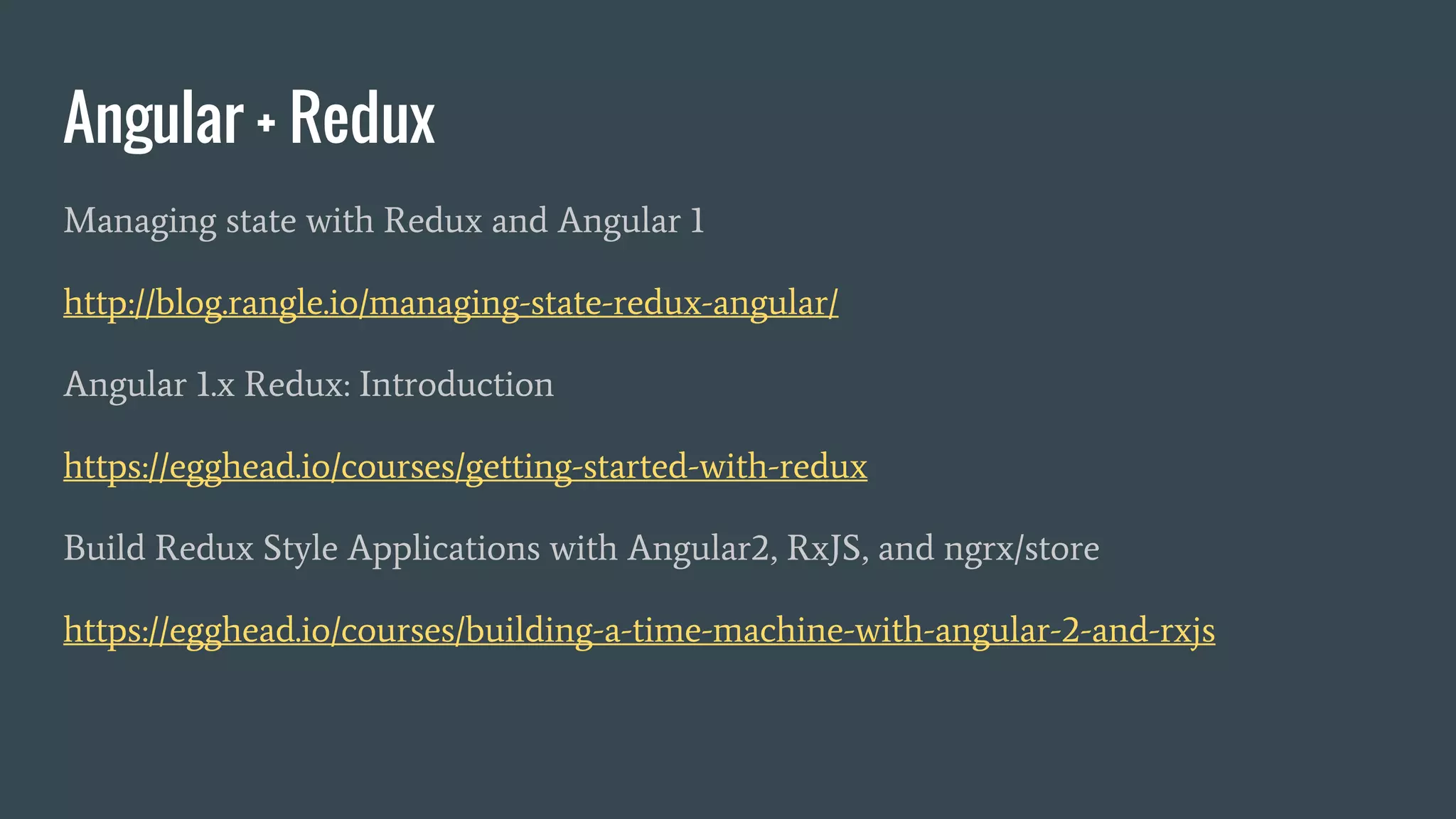
Angular + Redux
Managing state with Redux and Angular 1
http://blog.rangle.io/managing-state-redux-angular/
Angular 1.x Redux: Introduction
https://egghead.io/courses/getting-started-with-redux
Build Redux Style Applications with Angular2, RxJS, and ngrx/store
https://egghead.io/courses/building-a-time-machine-with-angular-2-and-rxjs
¿Qué tal el viaje?
¿Tiene sentido?
gracias
@adelatorrefoss

El viaje de Angular1 a Angular2
  • 1.
    El viaje deAngular1 a Angular2 Antonio de la Torre #DevFestAsturias 03/11/2016 @adelatorrefoss
  • 2.
    Angular “AngularJS is astructural framework for dynamic web apps. It lets you use HTML as your template language and lets you extend HTML's syntax to express your application's components clearly and succinctly. Angular's data binding and dependency injection eliminate much of the code you would otherwise have to write. Angular teaches the browser new syntax through a construct we call directives.“ https://docs.angularjs.org/guide/introduction
  • 3.
    Oyendo hablar de Angular2desde el verano pasado (2015) y que Angular 1 está muerto.
  • 4.
    Antonio de laTorre Software Developer
  • 5.
    Me mudé enJulio tras 12 años en Madrid
  • 6.
  • 7.
    ¿Qué aporta Angular? ● Completo. ●Te ahorra la fontanería. ● Bien documentado. ● Mucha comunidad. ● Patrón reconocido MVC. ● ES6. ● Opinionado (pero si no te gusta tengo otra)
  • 8.
  • 12.
  • 13.
    from angular.module('directives') .directive('pony', function(){ return { scope:{ name: '=' }, controllerAs: 'vm', controller: function($scope){ var vm = this; vm.name = $scope.name; // we have to add a watcher on $scope.name to make this work $scope.$watch('name', function(newName){ vm.name = newName; }); }, template: '<p>{{vm.name}}</p>' } });
  • 14.
    to angular.module('directives') .directive('pony', function(){ return { bindToController:{ name: '=' }, controllerAs: 'vm', scope: true, controller: function(){}, template: '<p>{{vm.name}}</p>' } });
  • 15.
  • 16.
    React es loque está de moda
  • 17.
  • 19.
  • 20.
  • 21.
  • 22.
    Three Principles ofRedux Single source of truth The state of your whole application is stored in an object tree within a single store. State is read-only The only way to change the state is to emit an action, an object describing what happened. Changes are made with pure functions To specify how the state tree is transformed by actions, you write pure reducers.http://redux.js.org/docs/introduction/ThreePrinciples.html
  • 23.
  • 24.
  • 25.
  • 26.
    “The Javascript pendulumhas swung from restrictive, monolithic frameworks to modular, boilerplate-hindered libraries.” EricClemmons https://medium.com/@ericclemmons/javascript-fatigue-48d4011b6fc4#.nzcp66xkh
  • 27.
  • 28.
    Don’t try toknow everything – it’s impossible in modern web development. I find it important to remain human. Don’t overdo discipline, don’t become a life improvement machine. Periods of boredom and doing nothing are important for recuperating and inspiration. AxelRauschmayer http://www.2ality.com/2016/02/js-fatigue-fatigue.html
  • 29.
    Guías de estilo vienenen nuestra ayuda
  • 30.
    Guías de estilode John Papa y Todd Motto para Angular 1.4 mejoró la situación https://github.com/johnpapa/angular-styleguide/blob/master/a1/README.md https://github.com/toddmotto/angular-styleguide
  • 32.
  • 33.
    Aparece Angular 1.5(febrero 2016) última release 1.x => 2.0
  • 34.
    Angular 1 Changelog 1.3.0superluminal-nudge (2014-10-13) 1.4.0 jaracimrman-existence (2015-05-26) 1.3.20 shallow-translucence (2015-09-29) 1.5.0 ennoblement-facilitation (2016-02-05) 1.2.30 patronal-resurrection (2016-07-21) only version branch that supports IE8 1.5.8 arbitrary-fallbacks (2016-07-22) 1.4.13 croaking-elderweed (2016-10-10) 1.6.0-rc.0 bracing-vortex (2016-10-26)https://github.com/angular/angular.js/blob/master/CHANGELOG.md
  • 35.
    Angular 2 Changelog 2.0.0-alpha.27(2015-06-17) 2.0.0-alpha.55 (2015-12-15) 2.0.0-beta.17 (2016-04-28) 2.0.0-rc.0 (2016-05-02) 2.0.0-rc.7 (2016-09-13) 2.0.0 proprioception-reinforcement (2016-09-14) https://github.com/angular/angular/blob/master/CHANGELOG.md 2.1.0 incremental-metamorphosis (2016-10-12) 2.2.0-beta.1 (2016-10-27) 2.1.2 (2016-10-27)
  • 36.
  • 37.
    La arquitectura decomponentes ● Solo controlan su propia vista y datos ● Tienen una API bien definida ● Una aplicación es un árbol de componentes ● Eliminó la magia negra de las directivas ● No hace falta conocer el ciclo de compilación a fondo ● No es necesario acceder al $scope
  • 38.
  • 39.
    Migrating from 1.4to 1.5 https://docs.angularjs.org/guide/migration Angular 1.5 takes a big step towards preparing developers for a smoother transition to Angular 2 in the future. Architecting your applications using components, multi-slot transclusion, one-way bindings in isolate scopes, using lifecycle hooks in directive controllers and relying on native ES6 features (such as classes and arrow functions) are now all possible with Angular 1.5.
  • 40.
  • 41.
    Guía de estiloAngular 1.5 de Todd Motto Scope - Stateful components - Stateless components Directives - Directives should be used solely for decorating the DOM. Eventos - Comunicación con el padre por eventos. $event
  • 42.
    Pasar datos decomponentes hacia arriba: About events https://toddmotto.com/angular-1-5-lifecycle-hooks Okay, bear with me, we’re in the final phase. This is where things get… interesting. Instead of just passig back this.user into the function, we’re going to fake an $event Object, which complies with how Angular 2 does this (using EventEmitter), and also provides global consistency between your templates to fetch data back through the
  • 44.
    El lío delrouter ● ngRoute para v1.4 ● ngComponentRouter para v1.5 ● RouterModule para v2 ● ui-router (estándar de facto en todas)
  • 45.
  • 46.
    Ventajas ● Componentes ● Independientede la plataforma ● Web workers ● Server side rendering ● Typescript ● Rx http://slides.com/gruizdevilla/angular-2-workshop#/ https://www.youtube.com/watch?v=7vSPfmHWIjA
  • 47.
  • 48.
  • 49.
    Ventajas ● ES6 (Módulosy clases) ● No ng-class, no ng-click, all are DOM native attributes. An Angular 2 Force Awakens - John Papa Ng Conf 2016 4 May
  • 50.
    some code... <html> <head> <title>Angular 2</title></head> <!-- ... --> <body> <my-app>Loading...</my-app> </body> </html> https://angular.io/docs/ts/latest/tutorial/toh-pt1.html
  • 51.
    some code... import {Component } from '@angular/core'; export class Hero { id: number; name: string; } @Component({ selector: 'my-app', template: ` <h1>{{title}}</h1> <h2>{{hero.name}} details!</h2> <div><label>id: </label>{{hero.id}}</div> <div> <label>name: </label> <input [(ngModel)]="hero.name" placeholder="name"> </div> `}) export class AppComponent { title = 'Tour of Heroes'; hero: Hero = { id: 1, name: 'Windstorm' }; }
  • 52.
    some code... import {Component } from '@angular/core'; export class Hero { id: number; name: string; } const HEROES: Hero[] = [ { id: 11, name: 'Mr. Nice' },...]; @Component({ selector: 'my-app', template: ` <h1>{{title}}</h1> <h2>My Heroes</h2> <ul class="heroes"> <li *ngFor="let hero of heroes" [class.selected]="hero === selectedHero" (click)="onSelect(hero)"> <span class="badge">{{hero.id}}</span> {{hero.name}} </li> </ul> <div *ngIf="selectedHero"> <h2>{{selectedHero.name}} details!</h2> <div><label>id: </label>{{selectedHero.id}}</div> <div> <label>name: </label> <input [(ngModel)]="selectedHero.name" placeholder="name"/> </div> </div> `, styles: [`...`] }) export class AppComponent { title = 'Tour of Heroes'; heroes = HEROES; selectedHero: Hero; onSelect(hero: Hero): void { this.selectedHero = hero; } }
  • 54.
    Guías de estilo(otra vez)
  • 55.
    Angular 2 StyleGuide by John Papa The Angular 2 Style Guide https://github.com/johnpapa/angular-styleguide/blob/master/a2/README.md “The Angular 2 Style Guide has been moved to the Official Angular 2 docs.”
  • 56.
    Angular 2 migrationguide by Todd Motto “Convert your Angular 1 knowledge into Angular 2. Select a topic and start learning!” http://ngmigrate.telerik.com/
  • 57.
  • 58.
  • 59.
    Conferencias https://github.com/mikedice/ngconf2016-slides/blob/master/ngconf-slides.md Publicado el 4may. 2016 http://angularconnect.com/2016/sessions/ Publicado el 27 sept. 2016
  • 60.
  • 61.
    Angular + Redux Managingstate with Redux and Angular 1 http://blog.rangle.io/managing-state-redux-angular/ Angular 1.x Redux: Introduction https://egghead.io/courses/getting-started-with-redux Build Redux Style Applications with Angular2, RxJS, and ngrx/store https://egghead.io/courses/building-a-time-machine-with-angular-2-and-rxjs
  • 62.
    ¿Qué tal elviaje? ¿Tiene sentido? gracias @adelatorrefoss