Navratansharam
VicePrincipalSMPS
1. Write down the three identities of calculating the GDP of a country by the three
methods. Also briefly , explain why each of these should give us same value
2..Calculate‘GrossNationalProductat Market Price’ from the following data.
(INR in Crores)
(i)Currenttransfer incomefrom Government 25
(II) Compensation of employees 600
(III)Netcurrenttransfer form ROW 20
(IV)Rent 100
(V)Consumption of fixed capital 50
(VI)Interest 120
(VII)NIT 110
(VIII)Profit 80
(IX)Mixed incomefrom self employed 200
(X)Netfactor income from abroad (-10)
3.Whatdo you mean by stagnanteconomy?
4Whatdo you mean by the Barter System explain its draw backs
6.Whatarethe draw backof privatization ?
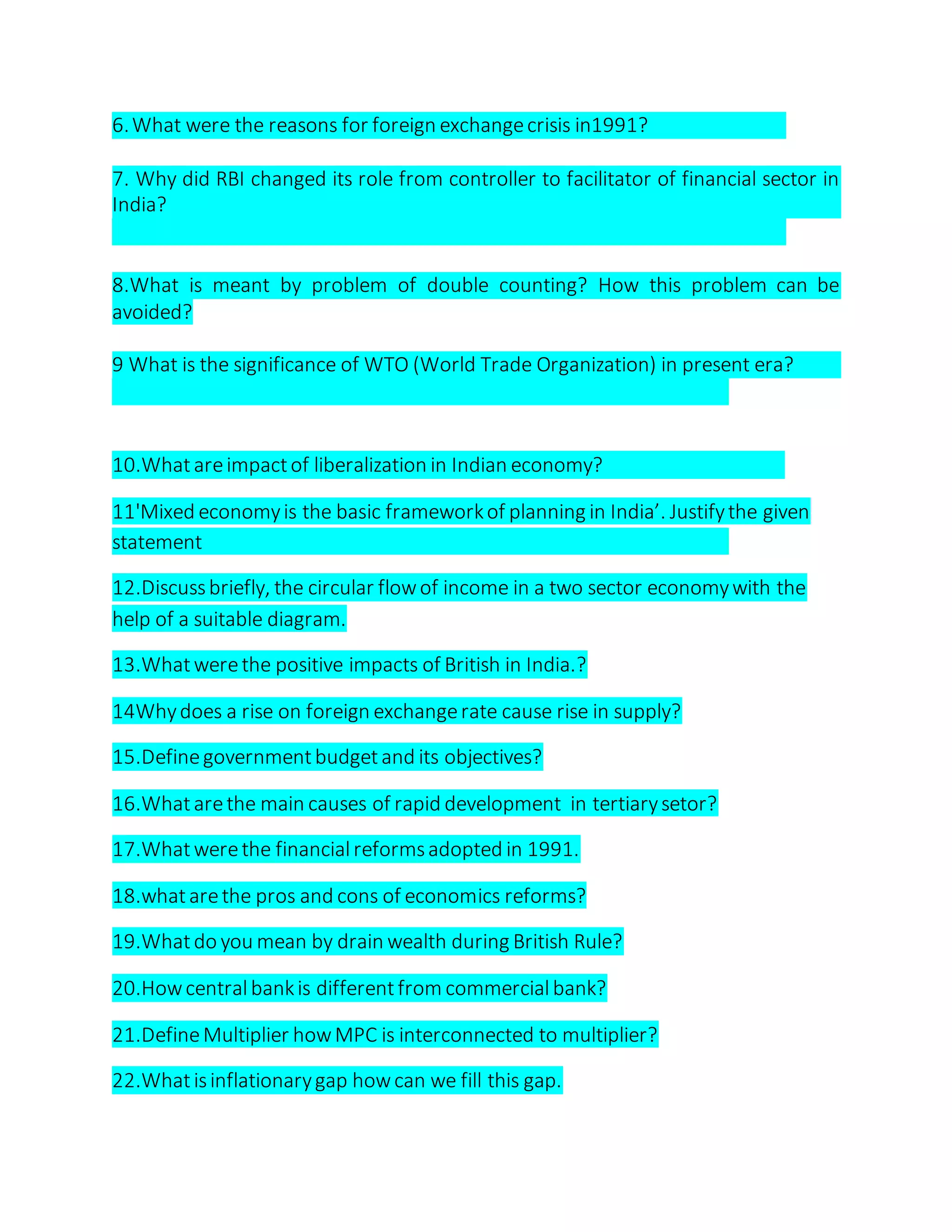
6.What were the reasons for foreign exchangecrisis in1991?
7. Why did RBI changed its role from controller to facilitator of financial sector in
India?
8.What is meant by problem of double counting? How this problem can be
avoided?
9 What is the significance of WTO (World Trade Organization) in present era?
10.Whatareimpactof liberalization in Indian economy?
11'Mixed economyis the basic frameworkof planning in India’. Justifythe given
statement
12.Discussbriefly, the circular flowof income in a two sector economywith the
help of a suitable diagram.
13.Whatwerethe positive impacts of British in India.?
14Whydoes a rise on foreign exchangerate cause rise in supply?
15.Definegovernmentbudgetand its objectives?
16.Whatarethe main causes of rapid development in tertiarysetor?
17.Whatwerethe financialreformsadopted in 1991.
18.whatarethe pros and cons of economics reforms?
19.Whatdo you mean by drain wealth during British Rule?
20.Howcentralbankis differentfrom commercialbank?
21.DefineMultiplier howMPC is interconnected to multiplier?
22.Whatisinflationarygap howcan we fill this gap.
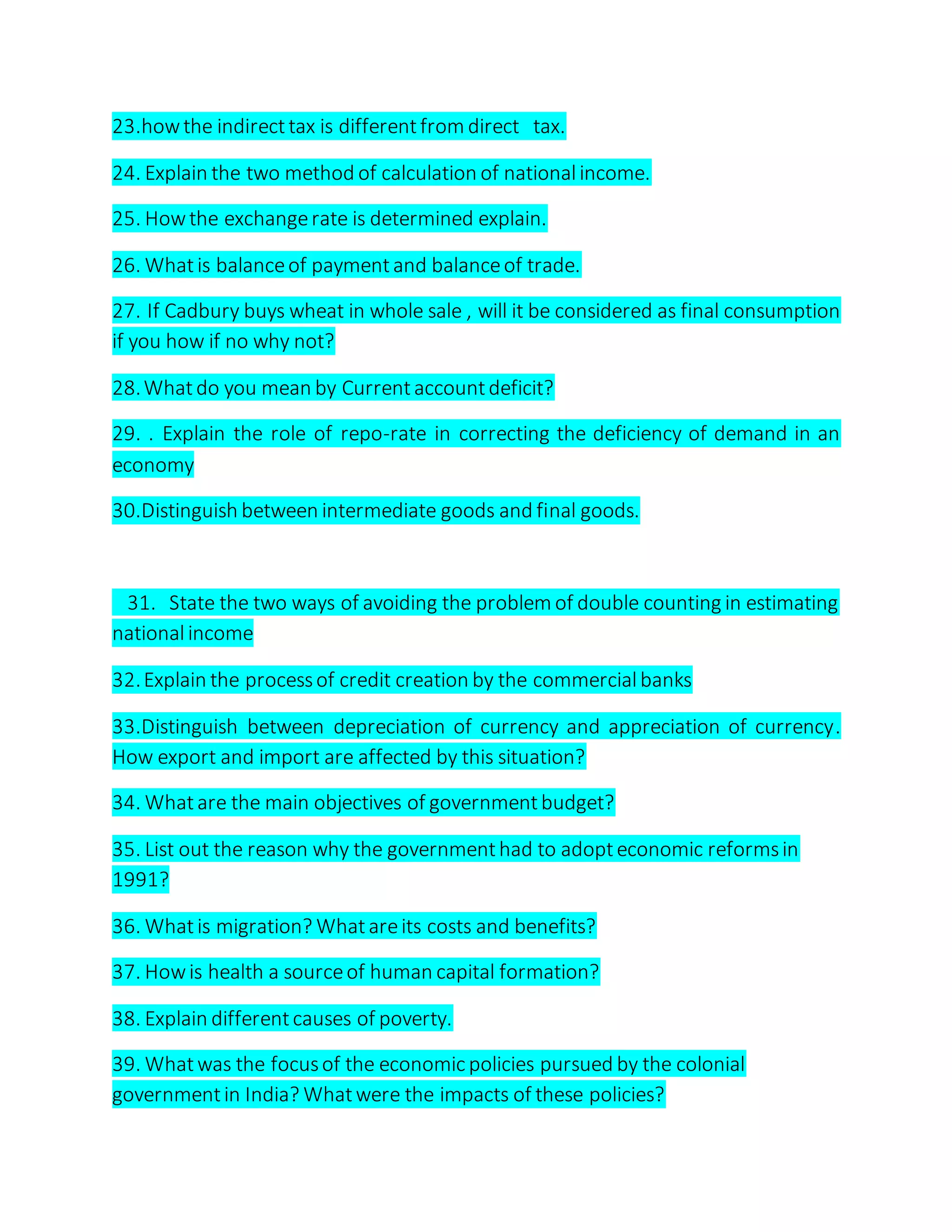
23.howthe indirecttax is differentfrom direct tax.
24. Explain the two method of calculation of nationalincome.
25. Howthe exchangerate is determined explain.
26. Whatis balanceof paymentand balanceof trade.
27. If Cadbury buys wheat in whole sale , will it be considered as final consumption
if you how if no why not?
28.Whatdo you mean by Currentaccountdeficit?
29. . Explain the role of repo-rate in correcting the deficiency of demand in an
economy
30.Distinguish between intermediate goods and final goods.
31. State the two ways of avoiding the problem of double counting in estimating
nationalincome
32.Explain the processof credit creation by the commercialbanks
33.Distinguish between depreciation of currency and appreciation of currency.
How export and import are affected by this situation?
34. Whatare the main objectives of governmentbudget?
35. List out the reason why the governmenthad to adopteconomic reformsin
1991?
36. Whatis migration? Whatareits costs and benefits?
37. Howis health a sourceof human capital formation?
38. Explain differentcauses of poverty.
39. Whatwas the focusof the economic policies pursued by the colonial
governmentin India? Whatwere the impacts of these policies?
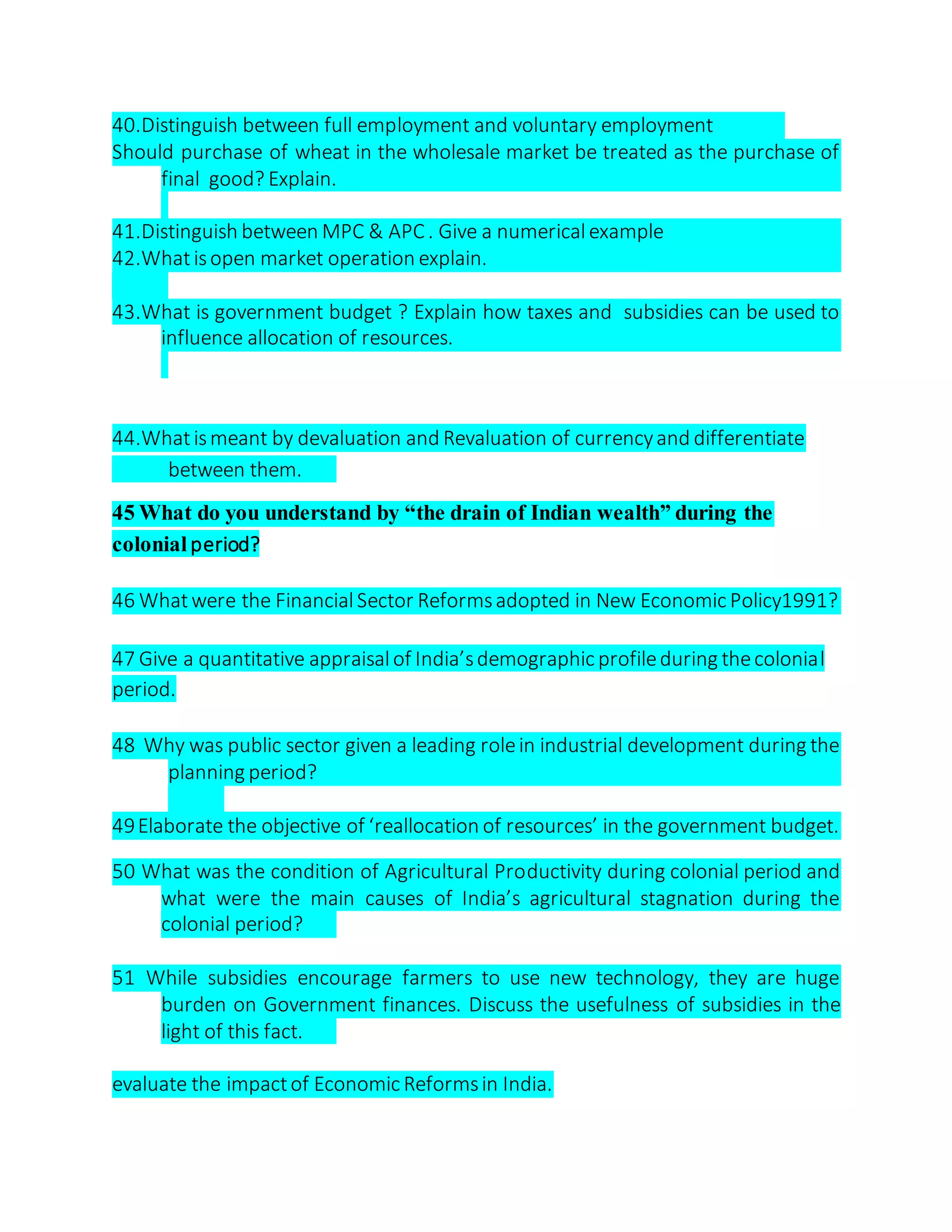
40.Distinguish between full employment and voluntary employment
Should purchase of wheat in the wholesale market be treated as the purchase of
final good? Explain.
41.Distinguish between MPC & APC. Give a numericalexample
42.Whatisopen market operation explain.
43.What is government budget ? Explain how taxes and subsidies can be used to
influence allocation of resources.
44.Whatismeant by devaluation and Revaluation of currencyand differentiate
between them.
45 What do you understand by “the drain of Indian wealth” during the
colonial period?
46 Whatwere the FinancialSector Reformsadopted in New Economic Policy1991?
47 Give a quantitative appraisalof India’sdemographic profileduring thecolonial
period.
48 Why was public sector given a leading rolein industrial development during the
planning period?
49Elaborate the objective of ‘reallocation of resources’ in the government budget.
50 What was the condition of Agricultural Productivity during colonial period and
what were the main causes of India’s agricultural stagnation during the
colonial period?
51 While subsidies encourage farmers to use new technology, they are huge
burden on Government finances. Discuss the usefulness of subsidies in the
light of this fact.
evaluate the impactof Economic Reformsin India.
53.. Definean intermediate good.
54.Name any two quantitative tools to controlcredit creation in an economy.
56.Whataredemand deposits?
57. Discuss any oneof the following functions of a central bank:
(a) As government’sbank (b) Open market operations.

EKO cracks 12

  • 1.
    Navratansharam VicePrincipalSMPS 1. Write downthe three identities of calculating the GDP of a country by the three methods. Also briefly , explain why each of these should give us same value 2..Calculate‘GrossNationalProductat Market Price’ from the following data. (INR in Crores) (i)Currenttransfer incomefrom Government 25 (II) Compensation of employees 600 (III)Netcurrenttransfer form ROW 20 (IV)Rent 100 (V)Consumption of fixed capital 50 (VI)Interest 120 (VII)NIT 110 (VIII)Profit 80 (IX)Mixed incomefrom self employed 200 (X)Netfactor income from abroad (-10) 3.Whatdo you mean by stagnanteconomy? 4Whatdo you mean by the Barter System explain its draw backs 6.Whatarethe draw backof privatization ?
  • 2.
    6.What were thereasons for foreign exchangecrisis in1991? 7. Why did RBI changed its role from controller to facilitator of financial sector in India? 8.What is meant by problem of double counting? How this problem can be avoided? 9 What is the significance of WTO (World Trade Organization) in present era? 10.Whatareimpactof liberalization in Indian economy? 11'Mixed economyis the basic frameworkof planning in India’. Justifythe given statement 12.Discussbriefly, the circular flowof income in a two sector economywith the help of a suitable diagram. 13.Whatwerethe positive impacts of British in India.? 14Whydoes a rise on foreign exchangerate cause rise in supply? 15.Definegovernmentbudgetand its objectives? 16.Whatarethe main causes of rapid development in tertiarysetor? 17.Whatwerethe financialreformsadopted in 1991. 18.whatarethe pros and cons of economics reforms? 19.Whatdo you mean by drain wealth during British Rule? 20.Howcentralbankis differentfrom commercialbank? 21.DefineMultiplier howMPC is interconnected to multiplier? 22.Whatisinflationarygap howcan we fill this gap.
  • 3.
    23.howthe indirecttax isdifferentfrom direct tax. 24. Explain the two method of calculation of nationalincome. 25. Howthe exchangerate is determined explain. 26. Whatis balanceof paymentand balanceof trade. 27. If Cadbury buys wheat in whole sale , will it be considered as final consumption if you how if no why not? 28.Whatdo you mean by Currentaccountdeficit? 29. . Explain the role of repo-rate in correcting the deficiency of demand in an economy 30.Distinguish between intermediate goods and final goods. 31. State the two ways of avoiding the problem of double counting in estimating nationalincome 32.Explain the processof credit creation by the commercialbanks 33.Distinguish between depreciation of currency and appreciation of currency. How export and import are affected by this situation? 34. Whatare the main objectives of governmentbudget? 35. List out the reason why the governmenthad to adopteconomic reformsin 1991? 36. Whatis migration? Whatareits costs and benefits? 37. Howis health a sourceof human capital formation? 38. Explain differentcauses of poverty. 39. Whatwas the focusof the economic policies pursued by the colonial governmentin India? Whatwere the impacts of these policies?
  • 4.
    40.Distinguish between fullemployment and voluntary employment Should purchase of wheat in the wholesale market be treated as the purchase of final good? Explain. 41.Distinguish between MPC & APC. Give a numericalexample 42.Whatisopen market operation explain. 43.What is government budget ? Explain how taxes and subsidies can be used to influence allocation of resources. 44.Whatismeant by devaluation and Revaluation of currencyand differentiate between them. 45 What do you understand by “the drain of Indian wealth” during the colonial period? 46 Whatwere the FinancialSector Reformsadopted in New Economic Policy1991? 47 Give a quantitative appraisalof India’sdemographic profileduring thecolonial period. 48 Why was public sector given a leading rolein industrial development during the planning period? 49Elaborate the objective of ‘reallocation of resources’ in the government budget. 50 What was the condition of Agricultural Productivity during colonial period and what were the main causes of India’s agricultural stagnation during the colonial period? 51 While subsidies encourage farmers to use new technology, they are huge burden on Government finances. Discuss the usefulness of subsidies in the light of this fact. evaluate the impactof Economic Reformsin India.
  • 5.
    53.. Definean intermediategood. 54.Name any two quantitative tools to controlcredit creation in an economy. 56.Whataredemand deposits? 57. Discuss any oneof the following functions of a central bank: (a) As government’sbank (b) Open market operations.