eics22-slides for researchers need when implementing novel imteraction tech
1.
Implementing Novel InteractionTechniques – Raffaillac & Huot –
What do Researchers Need when
Implementing Novel Interaction Techniques?
1
Thibault Raffaillac
École Centrale de Lyon
Stéphane Huot
Inria Lille – Nord Europe
2.
Introduction
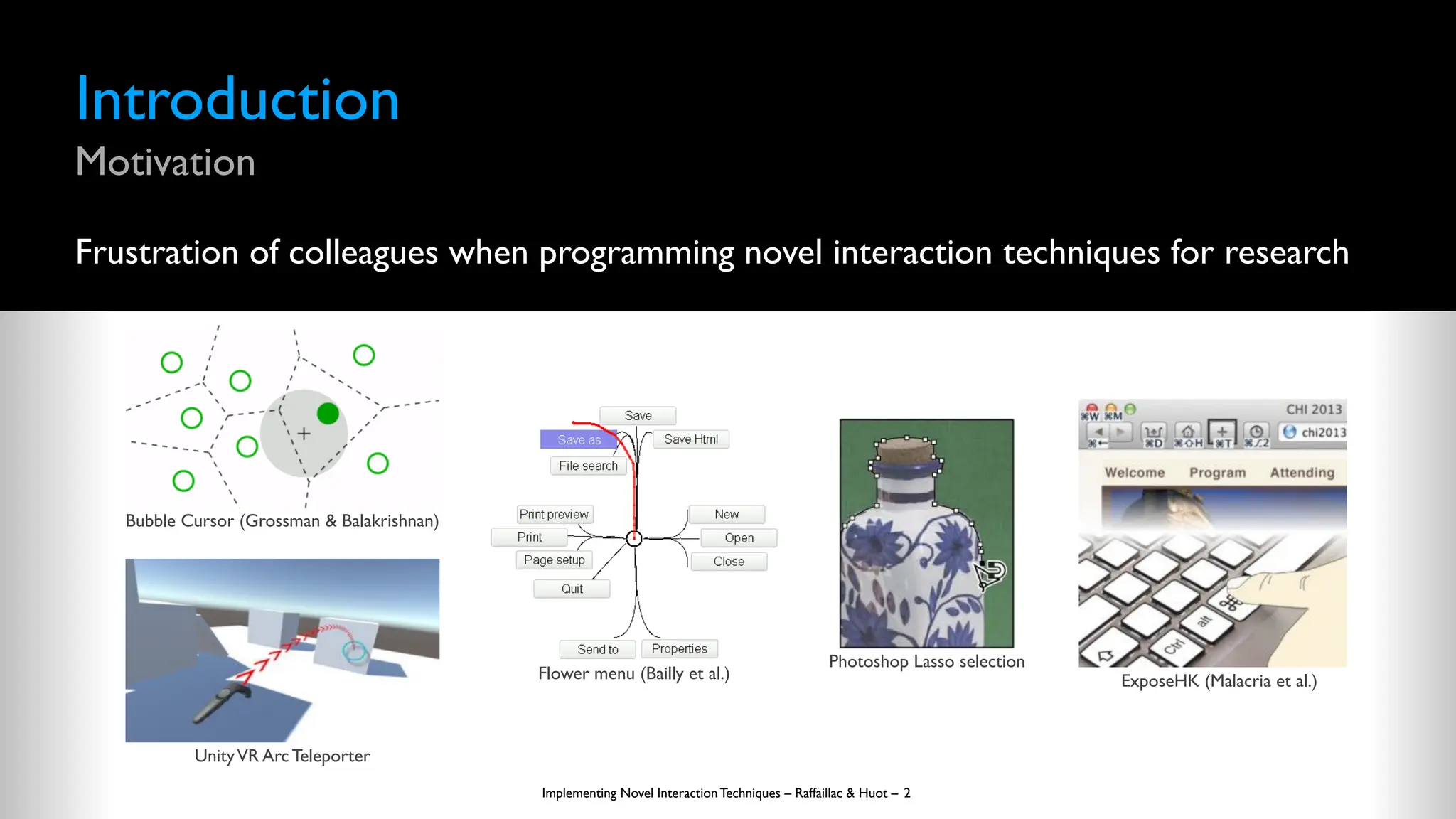
Motivation
Frustration of colleagueswhen programming novel interaction techniques for research
Implementing Novel Interaction Techniques – Raffaillac & Huot – 2
Bubble Cursor (Grossman & Balakrishnan)
UnityVR Arc Teleporter
Flower menu (Bailly et al.)
Photoshop Lasso selection
ExposeHK (Malacria et al.)
3.
Implementing Novel InteractionTechniques – Raffaillac & Huot –
Introduction
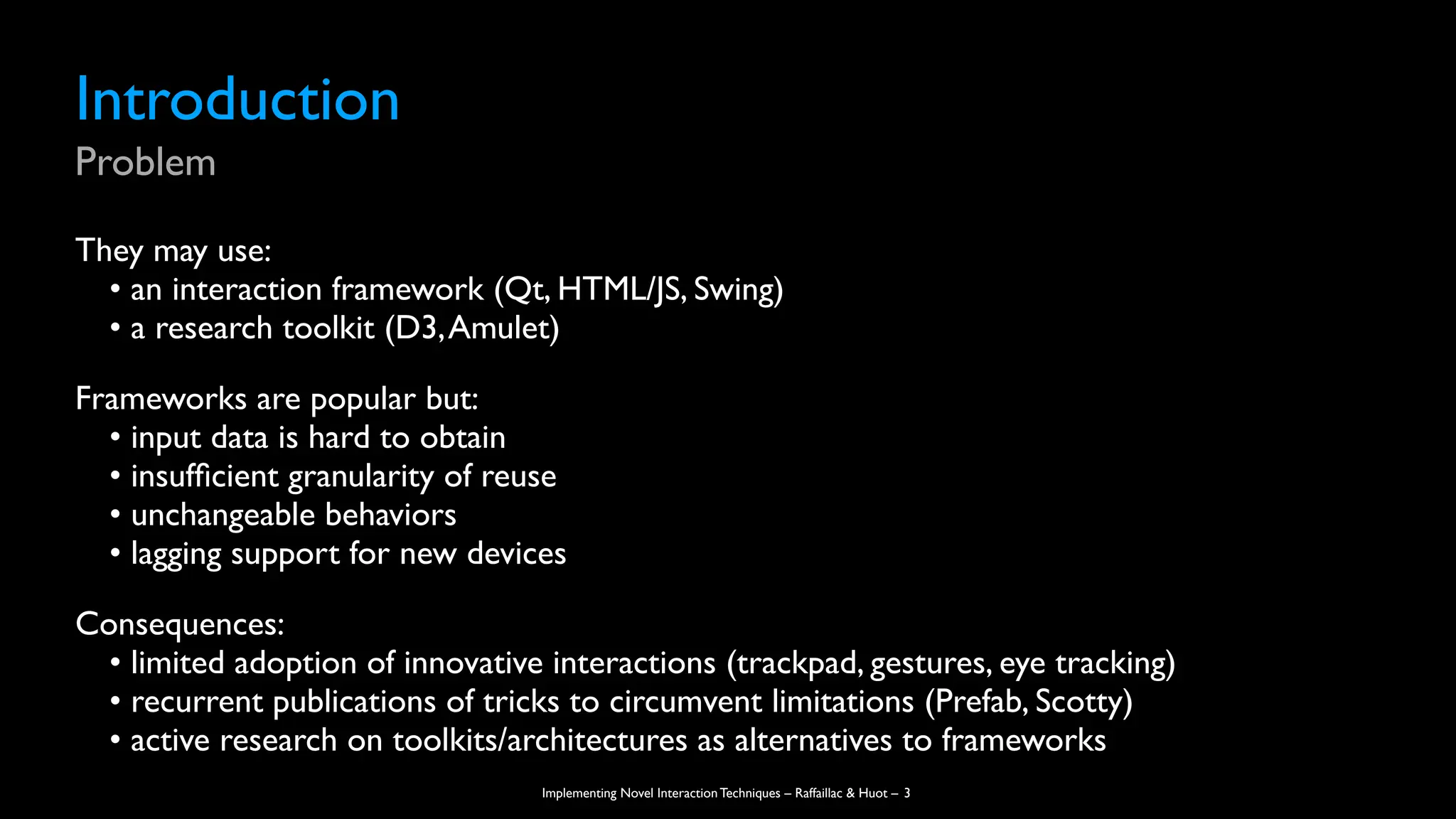
Problem
They may use:
• an interaction framework (Qt, HTML/JS, Swing)
• a research toolkit (D3,Amulet)
Frameworks are popular but:
• input data is hard to obtain
• insuf
fi
cient granularity of reuse
• unchangeable behaviors
• lagging support for new devices
Consequences:
• limited adoption of innovative interactions (trackpad, gestures, eye tracking)
• recurrent publications of tricks to circumvent limitations (Prefab, Scotty)
• active research on toolkits/architectures as alternatives to frameworks
3
4.
Implementing Novel InteractionTechniques – Raffaillac & Huot –
Introduction
Plan & Research questions
• Interviews & Survey
What do researchers do when prototyping new interaction techniques?
• Design recommendations
How can we design or adapt existing frameworks and toolkits to support them?
4
5.
Implementing Novel InteractionTechniques – Raffaillac & Huot –
What do researchers do when prototyping new
interaction techniques?
5
6.
Implementing Novel InteractionTechniques – Raffaillac & Huot –
Interviews & Survey
Methods & Analyses
6
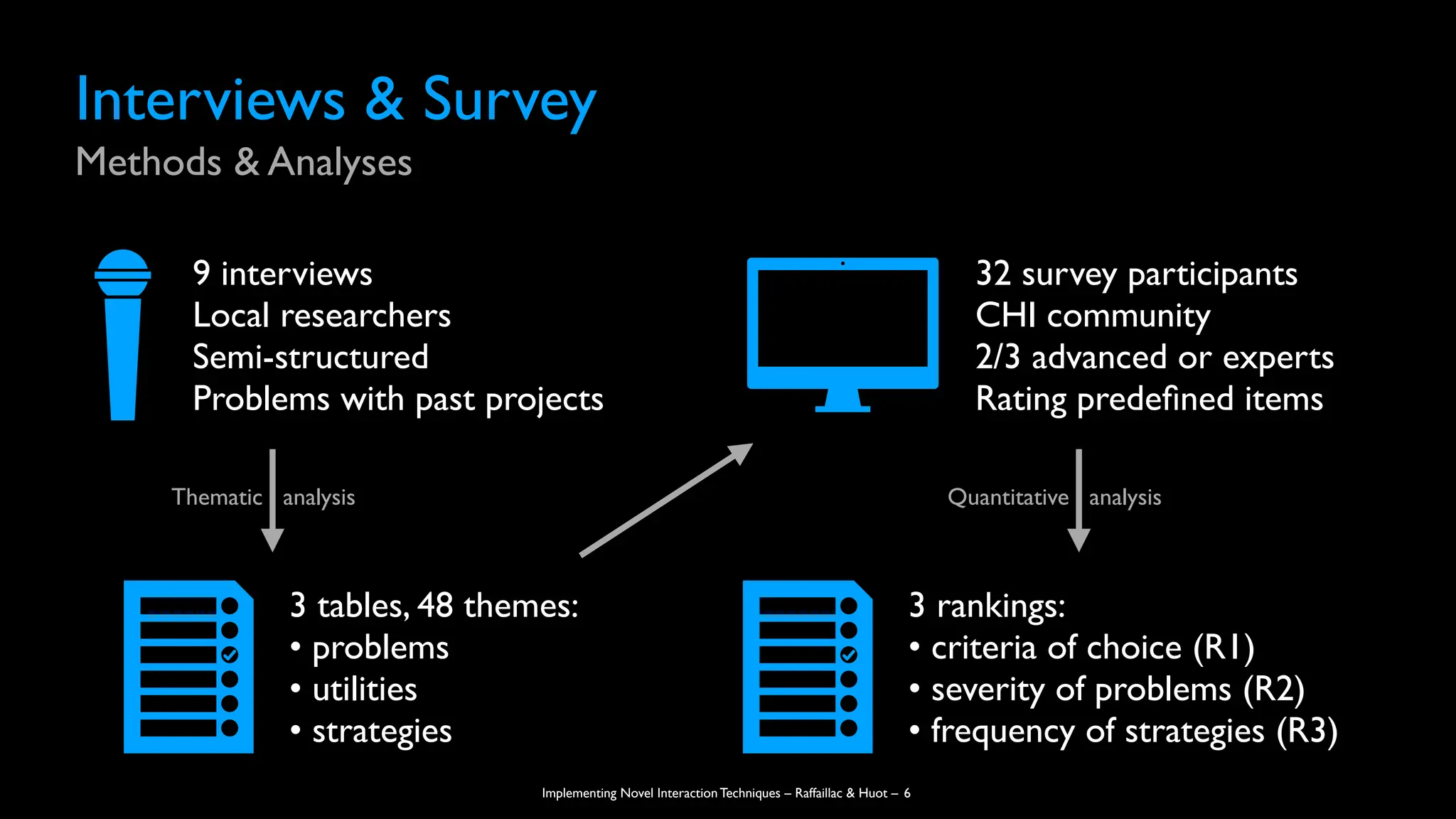
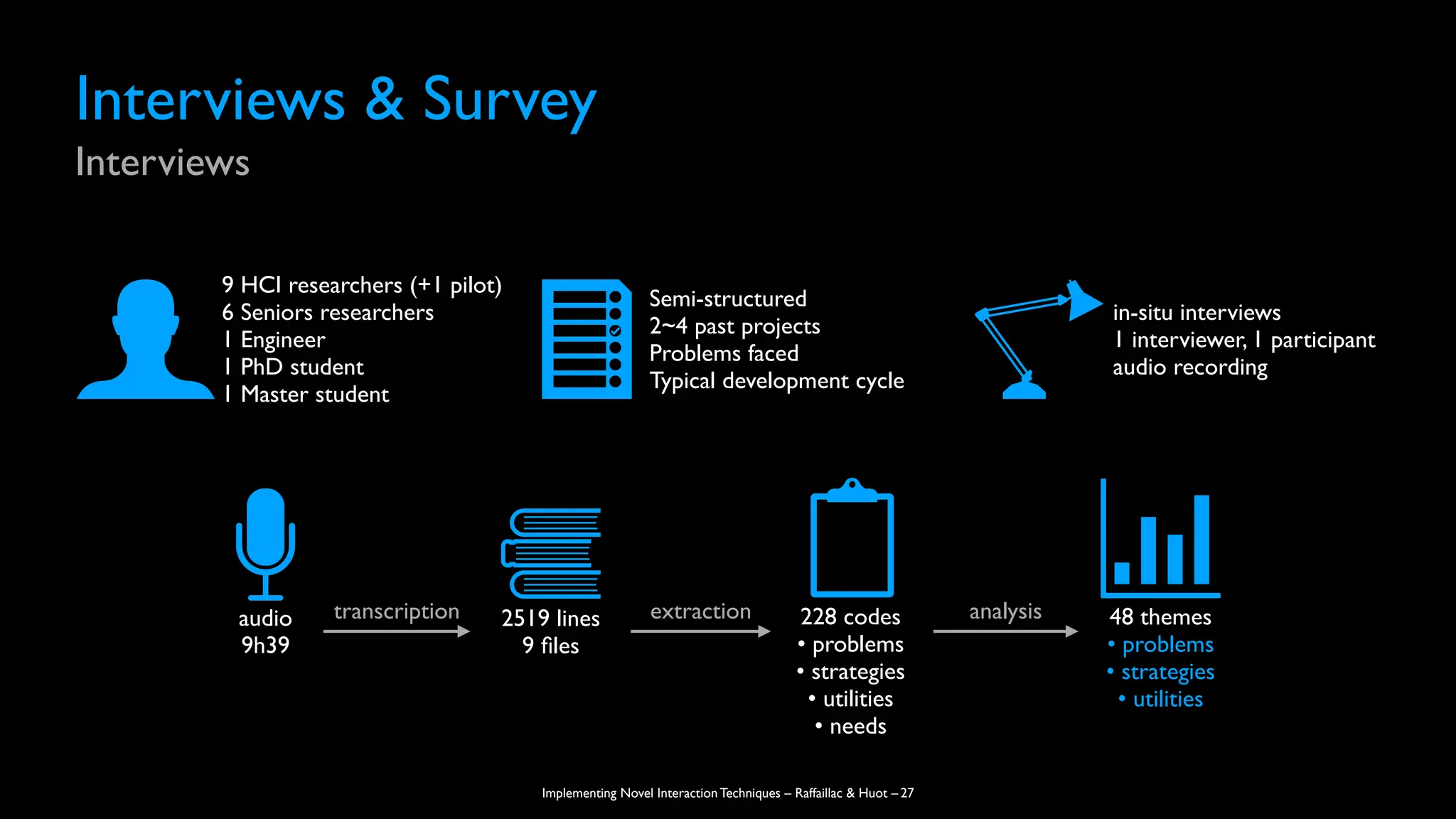
9 interviews
Local researchers
Semi-structured
Problems with past projects
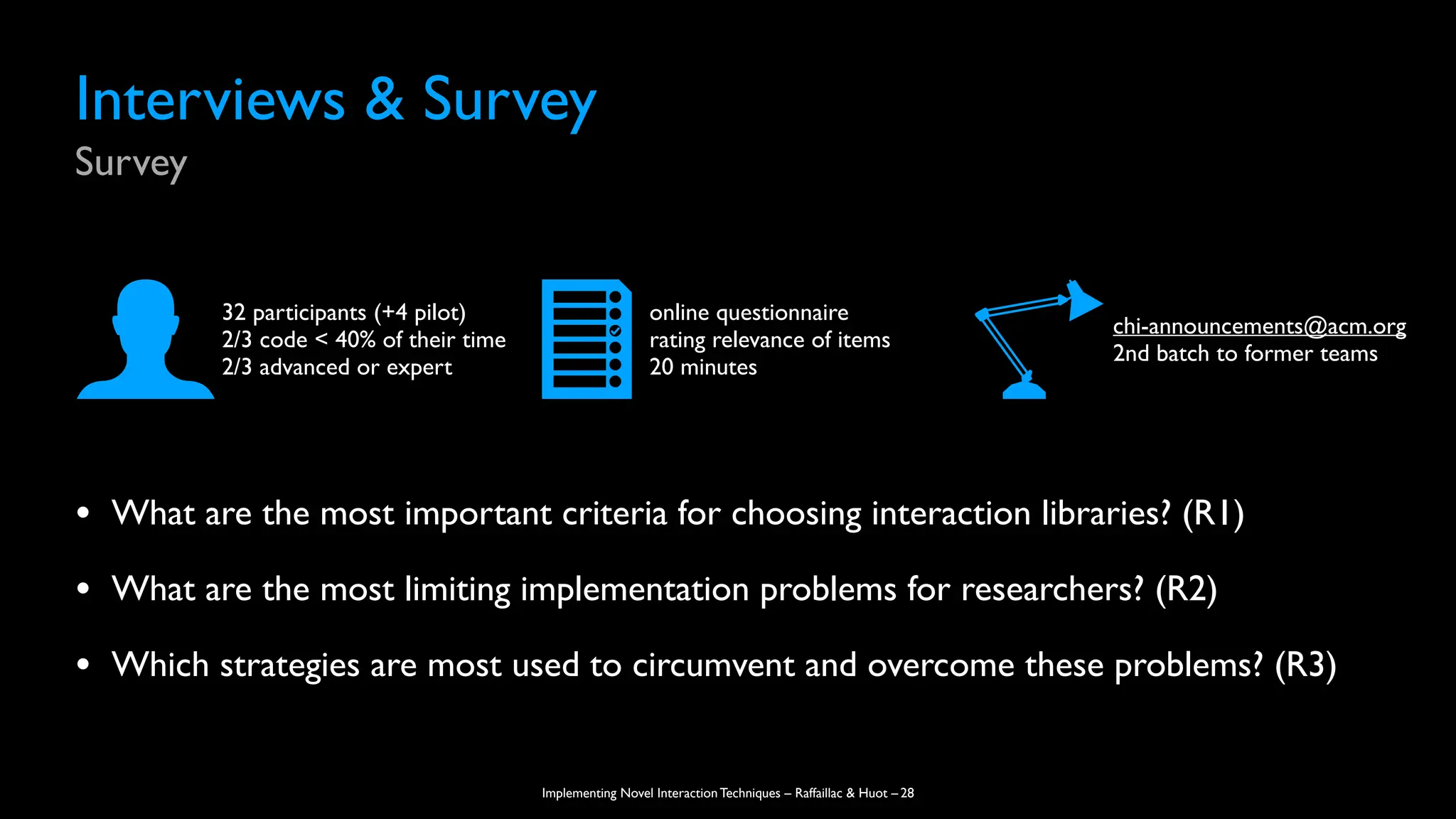
32 survey participants
CHI community
2/3 advanced or experts
Rating prede
fi
ned items
3 tables, 48 themes:
• problems
• utilities
• strategies
3 rankings:
• criteria of choice (R1)
• severity of problems (R2)
• frequency of strategies (R3)
Thematic analysis Quantitative analysis
7.
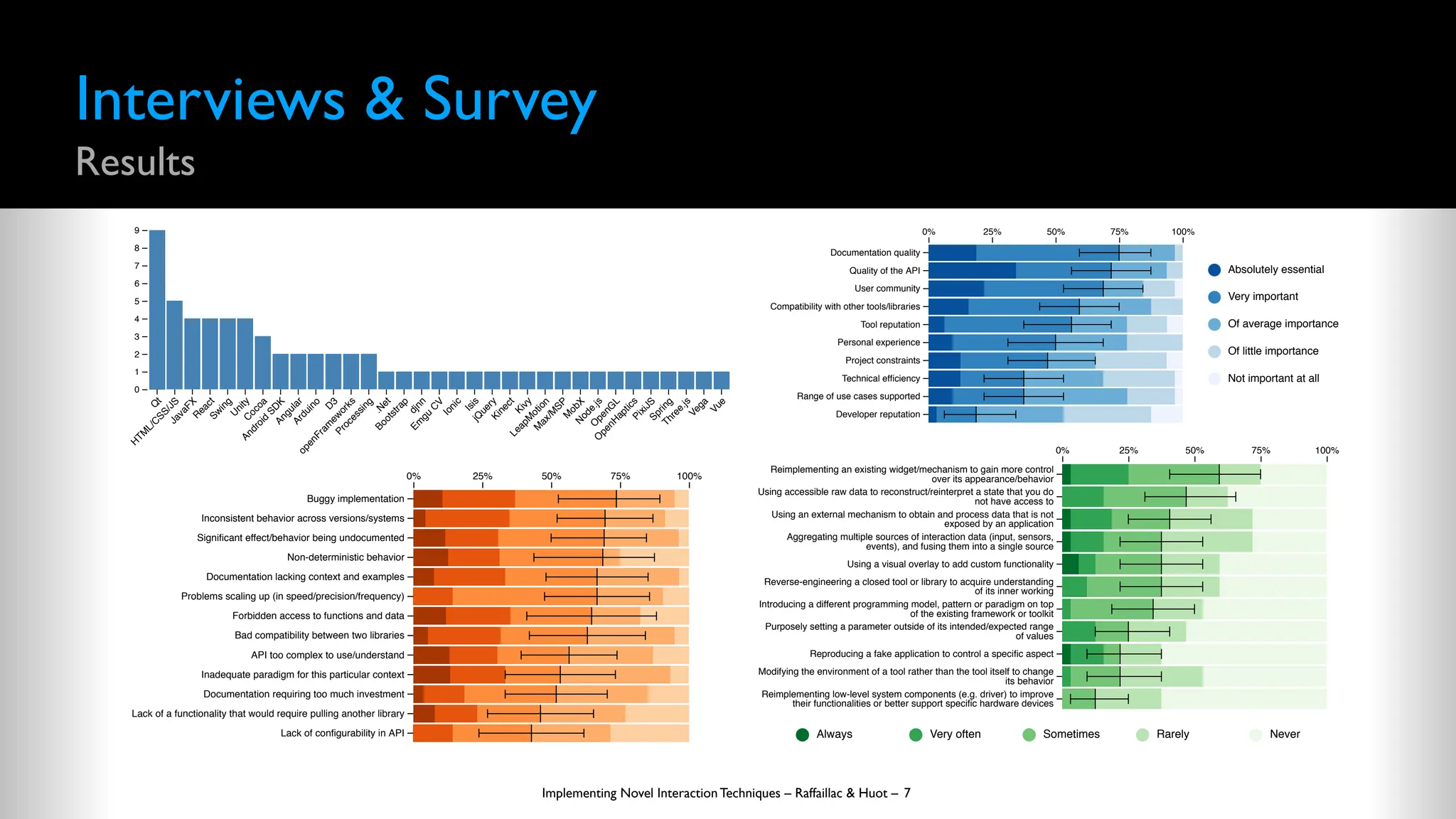
Interviews & Survey
Results
ImplementingNovel Interaction Techniques – Raffaillac & Huot – 7
Not important at all
Of little importance
Of average importance
Very important
Absolutely essential
0% 25% 50% 75% 100%
Documentation quality
Quality of the API
User community
Compatibility with other tools/libraries
Tool reputation
Personal experience
Project constraints
Technical efficiency
Range of use cases supported
Developer reputation
Q
t
H
T
M
L
/
C
S
S
/
J
S
J
a
v
a
F
X
R
e
a
c
t
S
w
i
n
g
U
n
i
t
y
C
o
c
o
a
A
n
d
r
o
i
d
S
D
K
A
n
g
u
l
a
r
A
r
d
u
i
n
o
D
3
o
p
e
n
F
r
a
m
e
w
o
r
k
s
P
r
o
c
e
s
s
i
n
g
.
N
e
t
B
o
o
t
s
t
r
a
p
d
j
n
n
E
m
g
u
C
V
I
o
n
i
c
I
s
i
s
j
Q
u
e
r
y
K
i
n
e
c
t
K
i
v
y
L
e
a
p
M
o
t
i
o
n
M
a
x
/
M
S
P
M
o
b
X
N
o
d
e
.
j
s
O
p
e
n
G
L
O
p
e
n
H
a
p
t
i
c
s
P
i
x
i
J
S
S
p
r
i
n
g
T
h
r
e
e
.
j
s
V
e
g
a
V
u
e
0
1
2
3
4
5
6
7
8
9
0% 25% 50% 75% 100%
Buggy implementation
Inconsistent behavior across versions/systems
Significant effect/behavior being undocumented
Non-deterministic behavior
Documentation lacking context and examples
Problems scaling up (in speed/precision/frequency)
Forbidden access to functions and data
Bad compatibility between two libraries
API too complex to use/understand
Inadequate paradigm for this particular context
Documentation requiring too much investment
Lack of a functionality that would require pulling another library
Lack of configurability in API Never
Rarely
Sometimes
Very often
Always
0% 25% 50% 75% 100%
Reimplementing an existing widget/mechanism to gain more control
over its appearance/behavior
Using accessible raw data to reconstruct/reinterpret a state that you do
not have access to
Using an external mechanism to obtain and process data that is not
exposed by an application
Aggregating multiple sources of interaction data (input, sensors,
events), and fusing them into a single source
Using a visual overlay to add custom functionality
Reverse-engineering a closed tool or library to acquire understanding
of its inner working
Introducing a different programming model, pattern or paradigm on top
of the existing framework or toolkit
Purposely setting a parameter outside of its intended/expected range
of values
Reproducing a fake application to control a specific aspect
Modifying the environment of a tool rather than the tool itself to change
its behavior
Reimplementing low-level system components (e.g. driver) to improve
their functionalities or better support specific hardware devices
8.
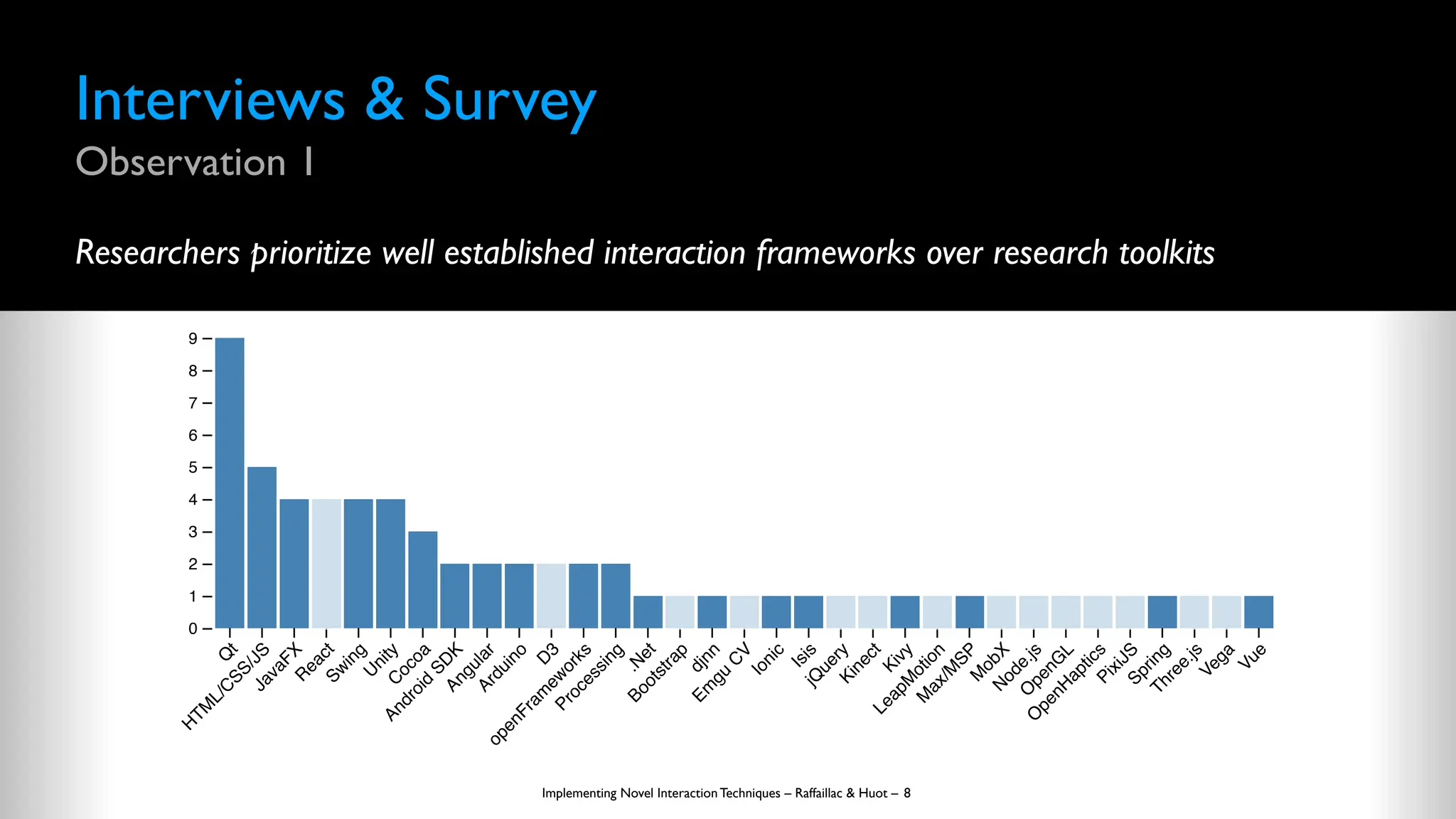
Interviews & Survey
Observation1
Researchers prioritize well established interaction frameworks over research toolkits
Implementing Novel Interaction Techniques – Raffaillac & Huot –
Q
t
H
T
M
L
/
C
S
S
/
J
S
J
a
v
a
F
X
R
e
a
c
t
S
w
i
n
g
U
n
i
t
y
C
o
c
o
a
A
n
d
r
o
i
d
S
D
K
A
n
g
u
l
a
r
A
r
d
u
i
n
o
D
3
o
p
e
n
F
r
a
m
e
w
o
r
k
s
P
r
o
c
e
s
s
i
n
g
.
N
e
t
B
o
o
t
s
t
r
a
p
d
j
n
n
E
m
g
u
C
V
I
o
n
i
c
I
s
i
s
j
Q
u
e
r
y
K
i
n
e
c
t
K
i
v
y
L
e
a
p
M
o
t
i
o
n
M
a
x
/
M
S
P
M
o
b
X
N
o
d
e
.
j
s
O
p
e
n
G
L
O
p
e
n
H
a
p
t
i
c
s
P
i
x
i
J
S
S
p
r
i
n
g
T
h
r
e
e
.
j
s
V
e
g
a
V
u
e
0
1
2
3
4
5
6
7
8
9
8
9.
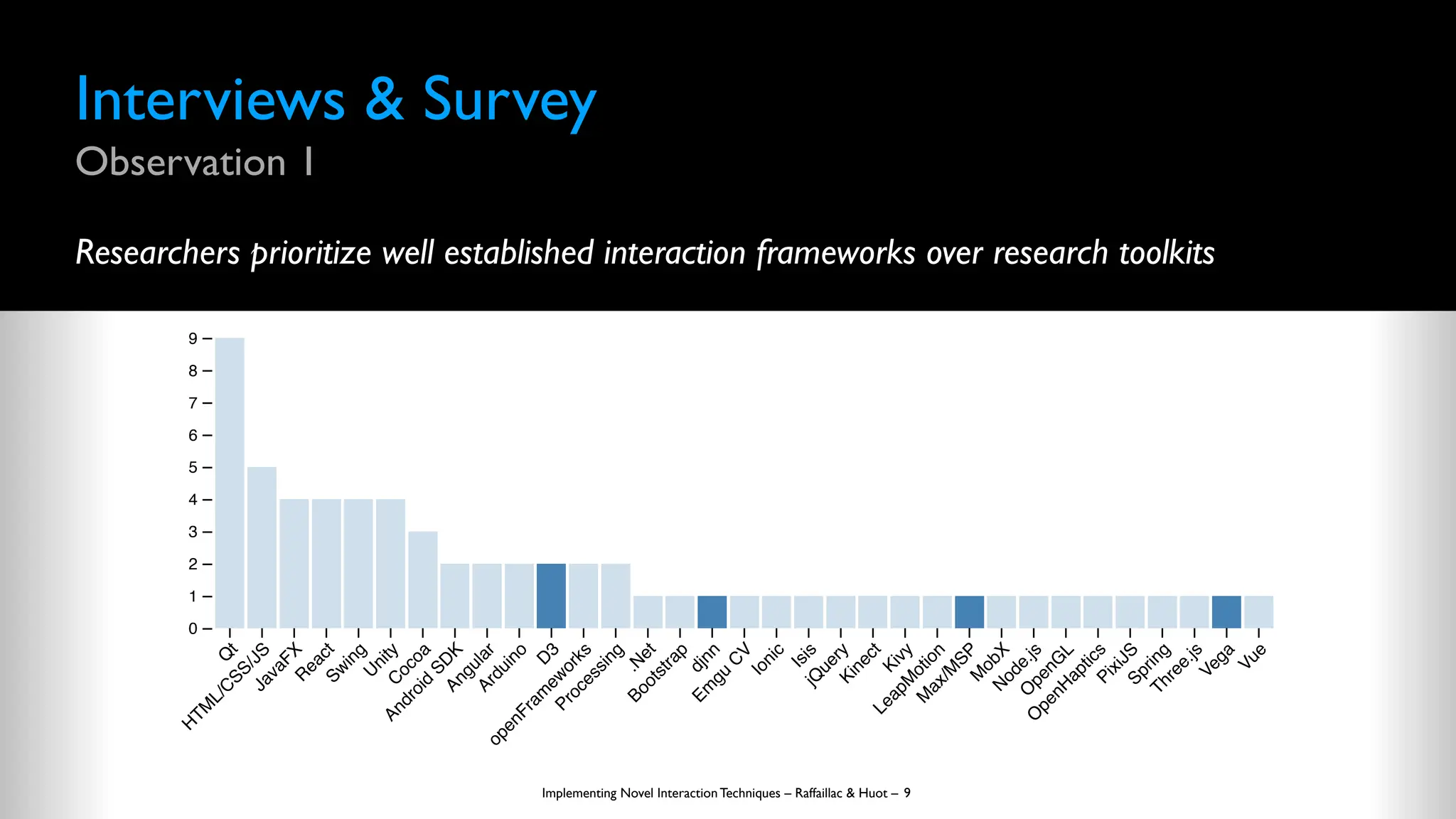
Interviews & Survey
Observation1
Researchers prioritize well established interaction frameworks over research toolkits
Implementing Novel Interaction Techniques – Raffaillac & Huot –
Q
t
H
T
M
L
/
C
S
S
/
J
S
J
a
v
a
F
X
R
e
a
c
t
S
w
i
n
g
U
n
i
t
y
C
o
c
o
a
A
n
d
r
o
i
d
S
D
K
A
n
g
u
l
a
r
A
r
d
u
i
n
o
D
3
o
p
e
n
F
r
a
m
e
w
o
r
k
s
P
r
o
c
e
s
s
i
n
g
.
N
e
t
B
o
o
t
s
t
r
a
p
d
j
n
n
E
m
g
u
C
V
I
o
n
i
c
I
s
i
s
j
Q
u
e
r
y
K
i
n
e
c
t
K
i
v
y
L
e
a
p
M
o
t
i
o
n
M
a
x
/
M
S
P
M
o
b
X
N
o
d
e
.
j
s
O
p
e
n
G
L
O
p
e
n
H
a
p
t
i
c
s
P
i
x
i
J
S
S
p
r
i
n
g
T
h
r
e
e
.
j
s
V
e
g
a
V
u
e
0
1
2
3
4
5
6
7
8
9
9
10.
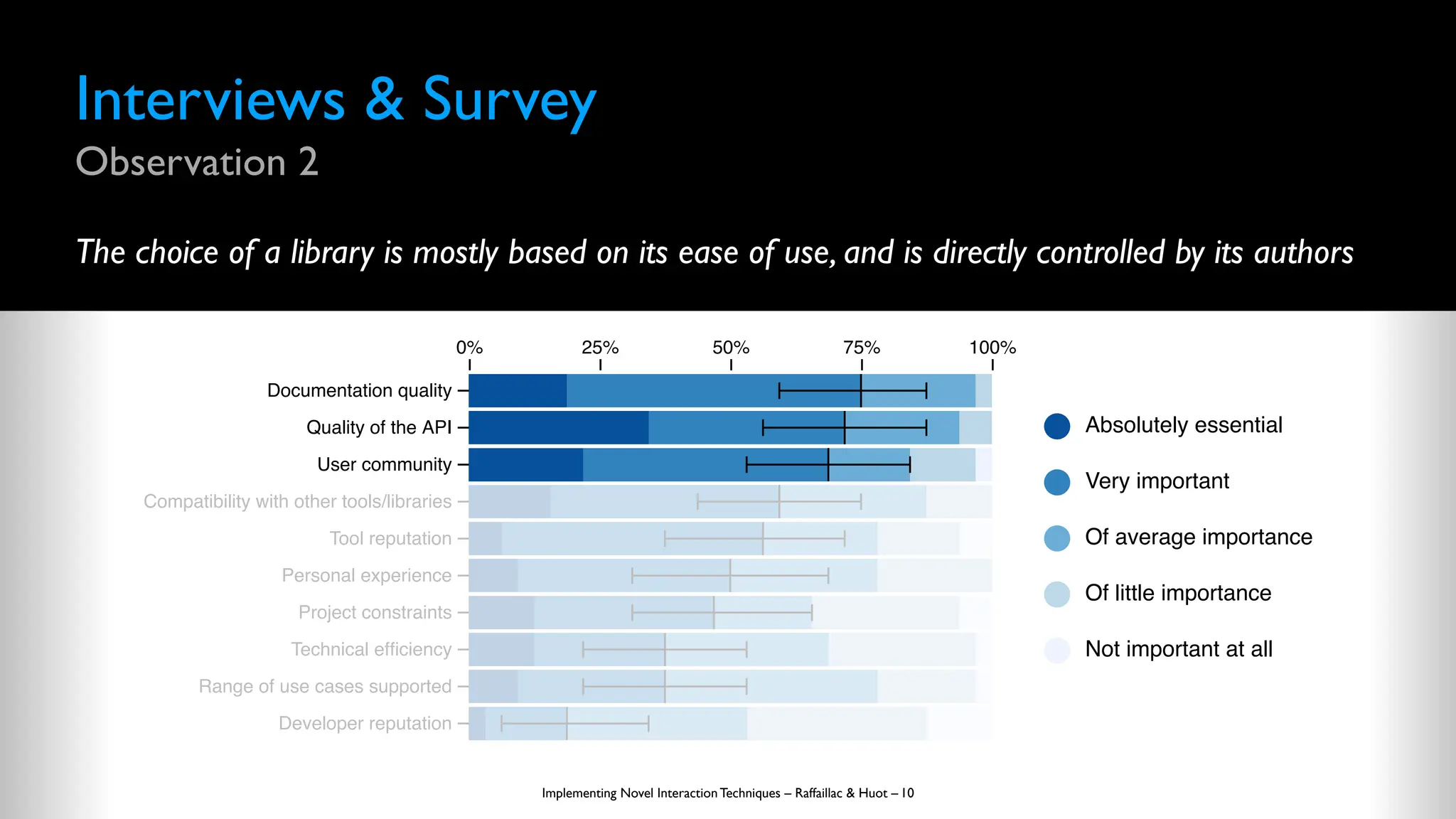
Interviews & Survey
Observation2
The choice of a library is mostly based on its ease of use, and is directly controlled by its authors
Implementing Novel Interaction Techniques – Raffaillac & Huot – 10
Not important at all
Of little importance
Of average importance
Very important
Absolutely essential
0% 25% 50% 75% 100%
Documentation quality
Quality of the API
User community
Compatibility with other tools/libraries
Tool reputation
Personal experience
Project constraints
Technical efficiency
Range of use cases supported
Developer reputation
11.
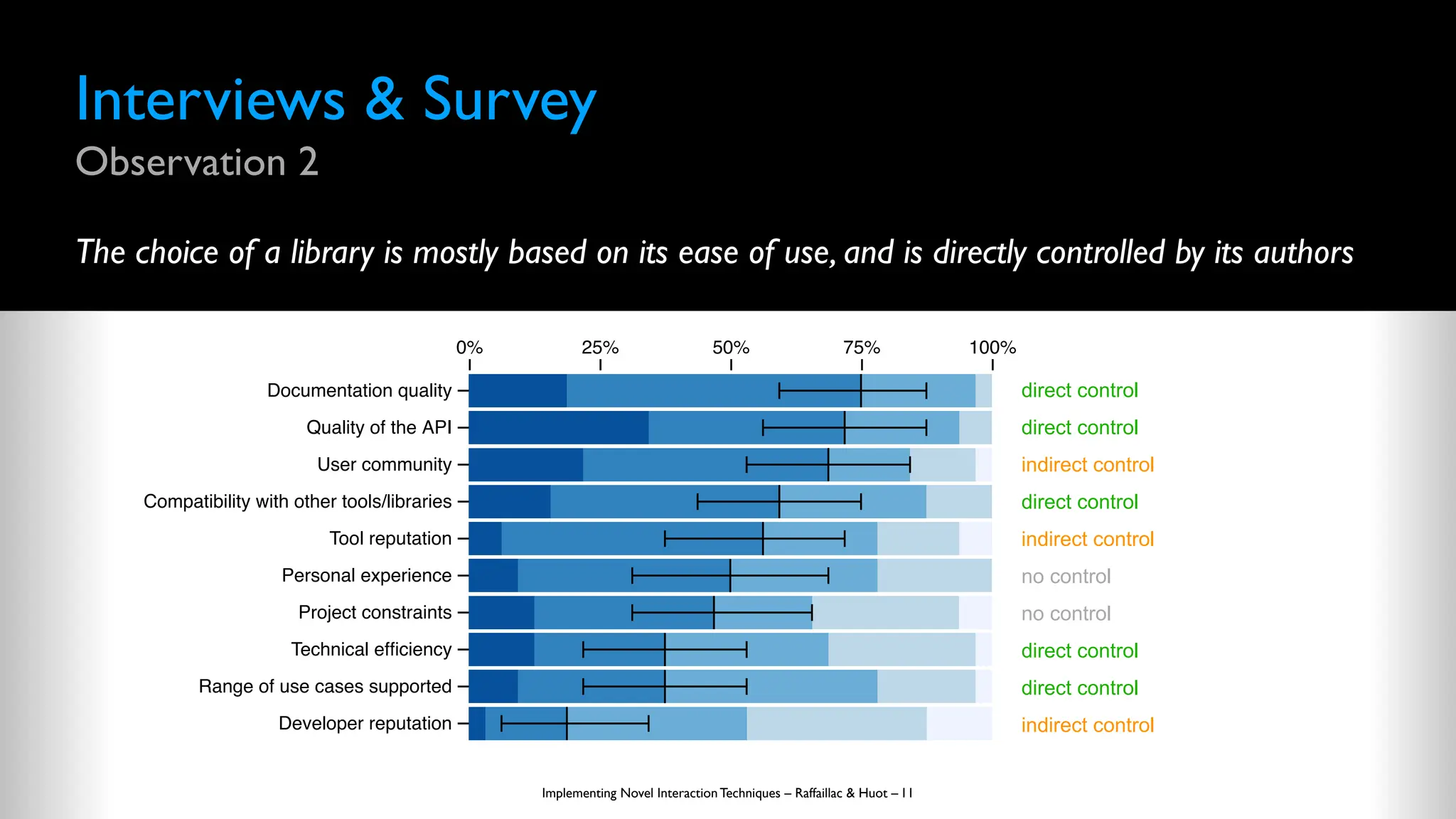
Interviews & Survey
Observation2
The choice of a library is mostly based on its ease of use, and is directly controlled by its authors
Implementing Novel Interaction Techniques – Raffaillac & Huot – 11
Not important at all
Of little importance
Of average importance
Very important
Absolutely essential
0% 25% 50% 75% 100%
Documentation quality
Quality of the API
User community
Compatibility with other tools/libraries
Tool reputation
Personal experience
Project constraints
Technical efficiency
Range of use cases supported
Developer reputation
direct control
direct control
indirect control
direct control
indirect control
no control
no control
direct control
direct control
indirect control
12.
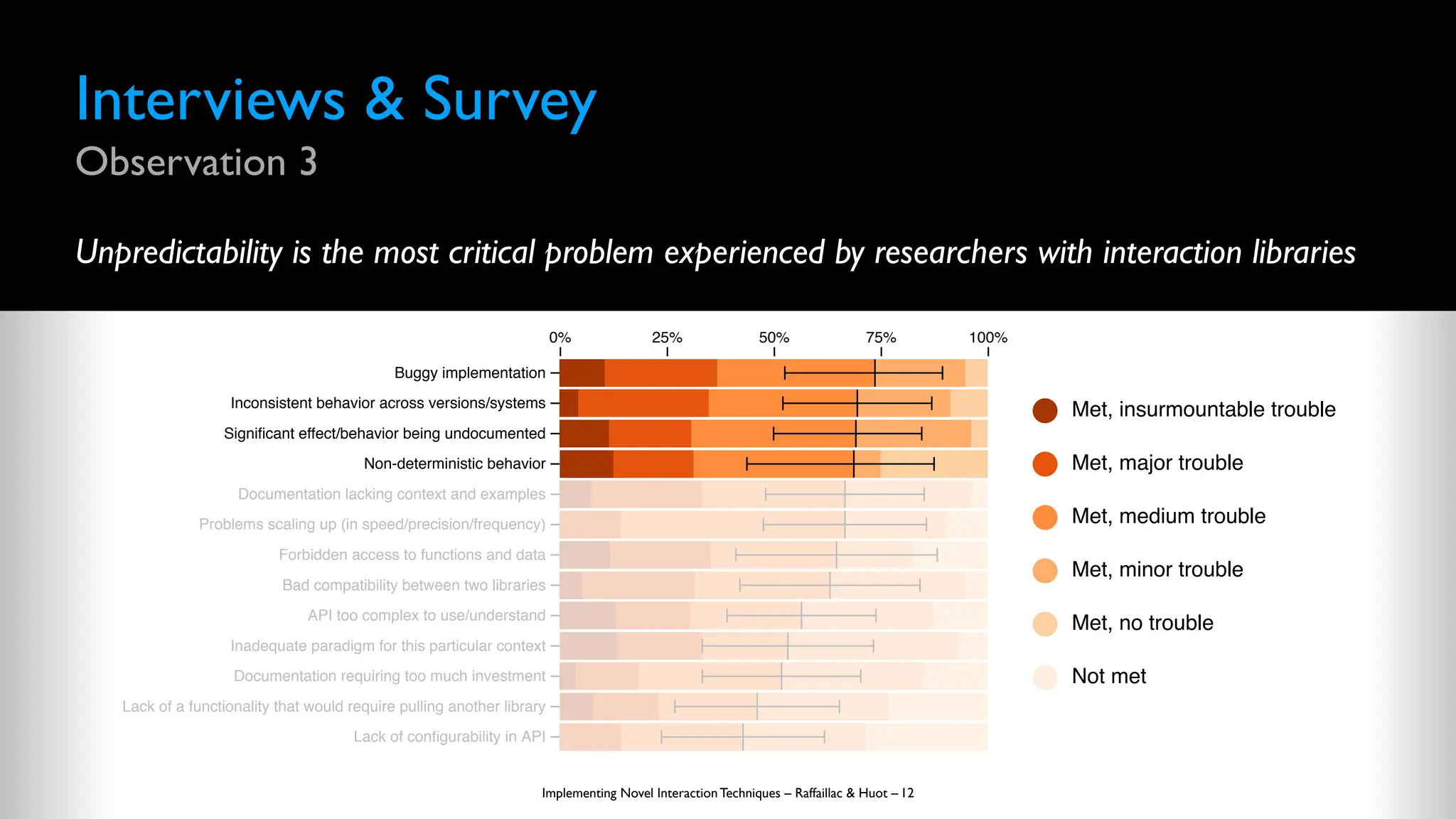
Interviews & Survey
Observation3
Unpredictability is the most critical problem experienced by researchers with interaction libraries
Implementing Novel Interaction Techniques – Raffaillac & Huot – 12
0% 25% 50% 75% 100%
Buggy implementation
Inconsistent behavior across versions/systems
Significant effect/behavior being undocumented
Non-deterministic behavior
Documentation lacking context and examples
Problems scaling up (in speed/precision/frequency)
Forbidden access to functions and data
Bad compatibility between two libraries
API too complex to use/understand
Inadequate paradigm for this particular context
Documentation requiring too much investment
Lack of a functionality that would require pulling another library
Lack of configurability in API
Not met
Met, no trouble
Met, minor trouble
Met, medium trouble
Met, major trouble
Met, insurmountable trouble
13.
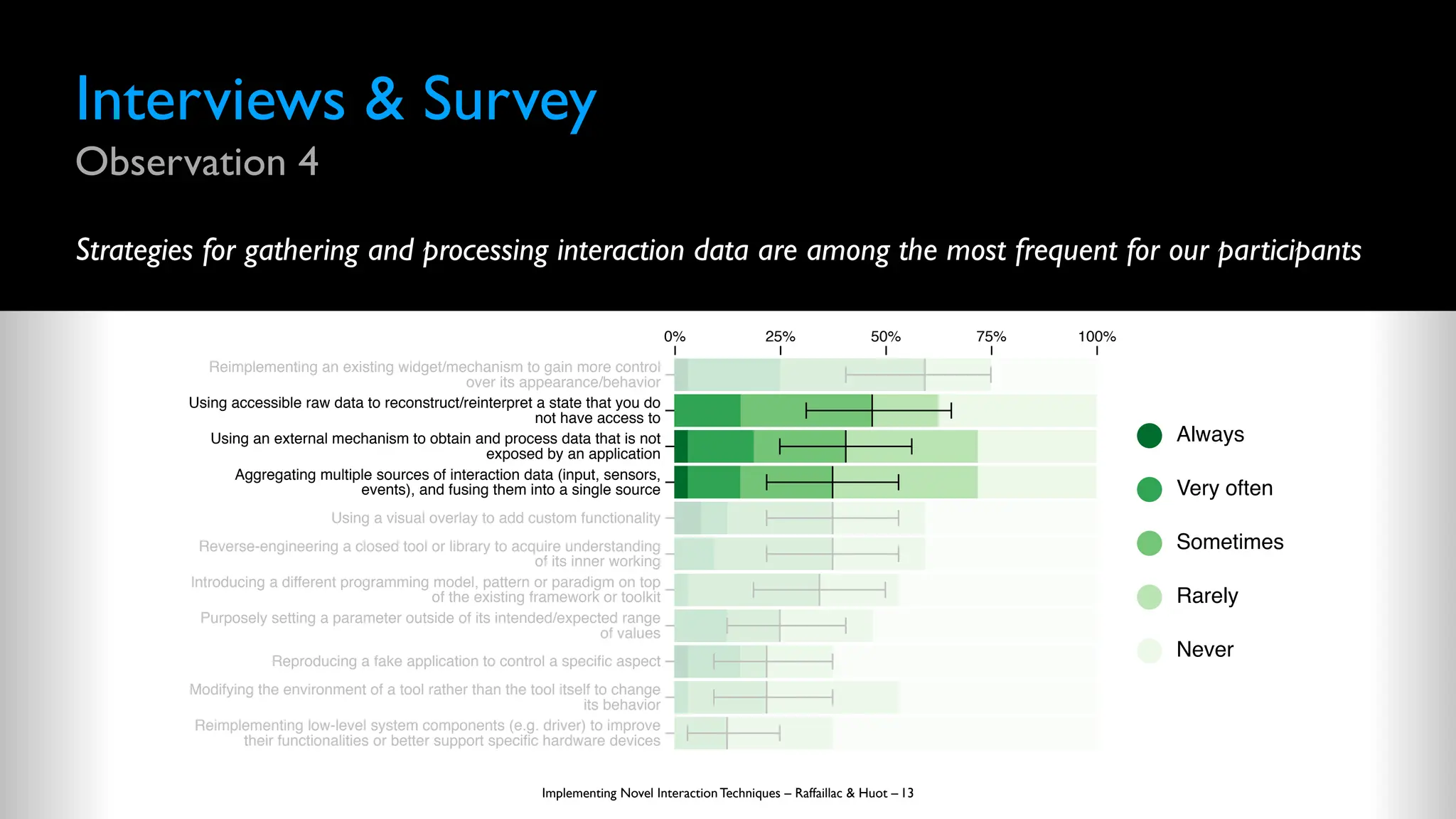
Interviews & Survey
Observation4
Strategies for gathering and processing interaction data are among the most frequent for our participants
Implementing Novel Interaction Techniques – Raffaillac & Huot – 13 Never
Rarely
Sometimes
Very often
Always
0% 25% 50% 75% 100%
Reimplementing an existing widget/mechanism to gain more control
over its appearance/behavior
Using accessible raw data to reconstruct/reinterpret a state that you do
not have access to
Using an external mechanism to obtain and process data that is not
exposed by an application
Aggregating multiple sources of interaction data (input, sensors,
events), and fusing them into a single source
Using a visual overlay to add custom functionality
Reverse-engineering a closed tool or library to acquire understanding
of its inner working
Introducing a different programming model, pattern or paradigm on top
of the existing framework or toolkit
Purposely setting a parameter outside of its intended/expected range
of values
Reproducing a fake application to control a specific aspect
Modifying the environment of a tool rather than the tool itself to change
its behavior
Reimplementing low-level system components (e.g. driver) to improve
their functionalities or better support specific hardware devices
Never
Rarely
Sometimes
Very often
Always
14.
Interviews & Survey
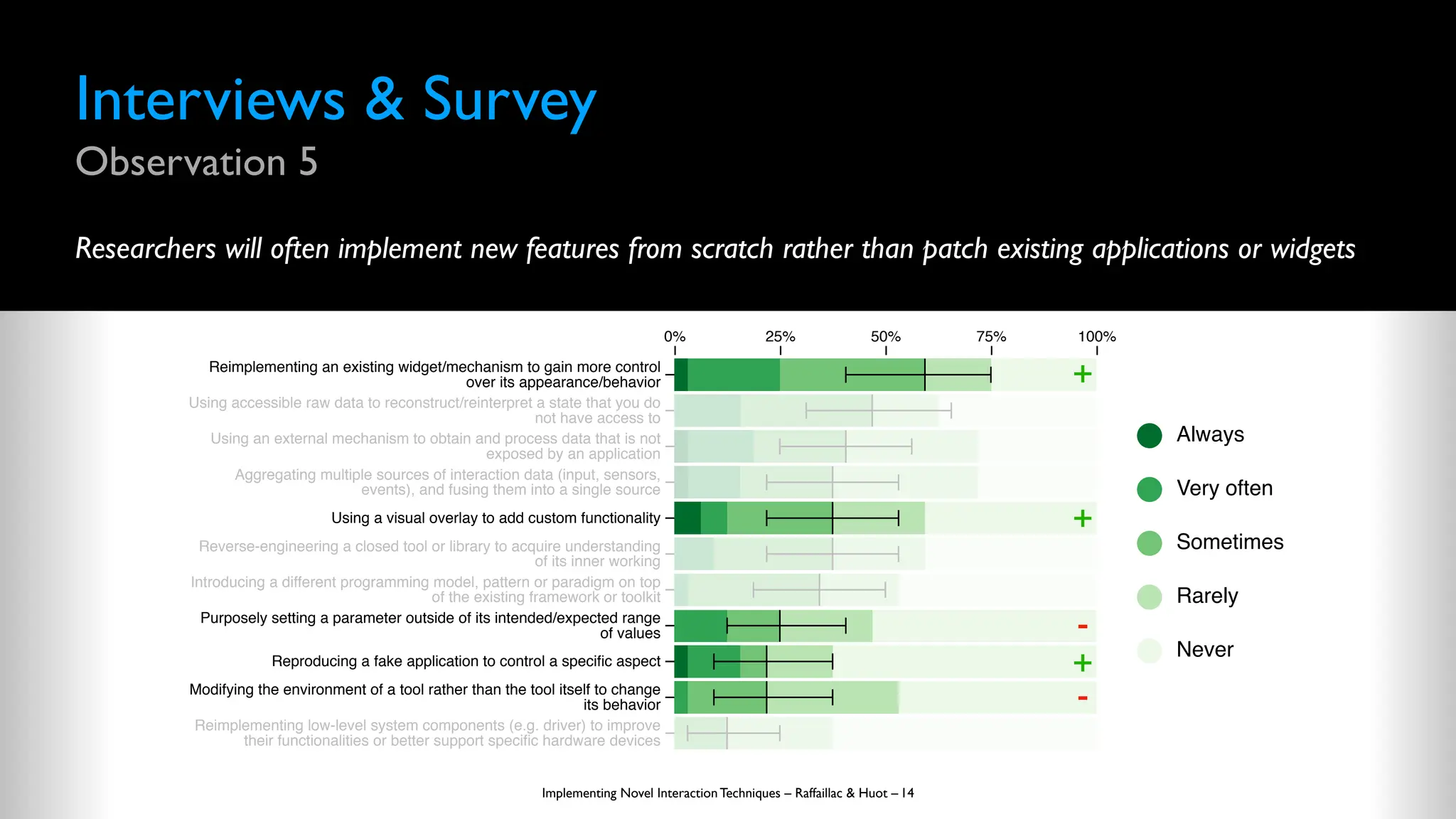
Observation5
Researchers will often implement new features from scratch rather than patch existing applications or widgets
Implementing Novel Interaction Techniques – Raffaillac & Huot – 14 Never
Rarely
Sometimes
Very often
Always
0% 25% 50% 75% 100%
Reimplementing an existing widget/mechanism to gain more control
over its appearance/behavior
Using accessible raw data to reconstruct/reinterpret a state that you do
not have access to
Using an external mechanism to obtain and process data that is not
exposed by an application
Aggregating multiple sources of interaction data (input, sensors,
events), and fusing them into a single source
Using a visual overlay to add custom functionality
Reverse-engineering a closed tool or library to acquire understanding
of its inner working
Introducing a different programming model, pattern or paradigm on top
of the existing framework or toolkit
Purposely setting a parameter outside of its intended/expected range
of values
Reproducing a fake application to control a specific aspect
Modifying the environment of a tool rather than the tool itself to change
its behavior
Reimplementing low-level system components (e.g. driver) to improve
their functionalities or better support specific hardware devices
Never
Rarely
Sometimes
Very often
Always
+
+
+
-
-
15.
Implementing Novel InteractionTechniques – Raffaillac & Huot –
Interviews & Survey
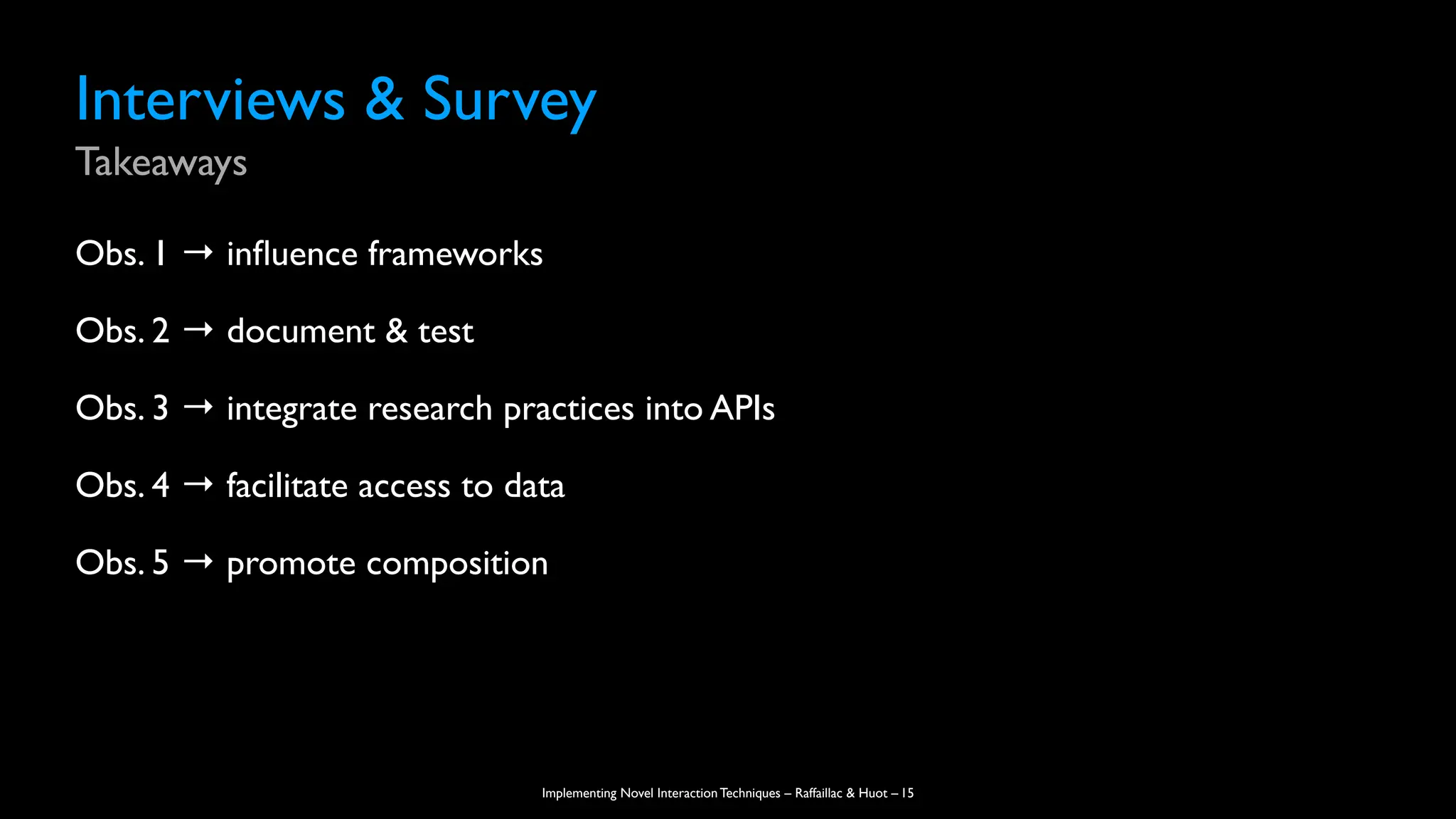
Takeaways
Obs. 1 → in
fl
uence frameworks
Obs. 2 → document & test
Obs. 3 → integrate research practices into APIs
Obs. 4 → facilitate access to data
Obs. 5 → promote composition
15
16.
Implementing Novel InteractionTechniques – Raffaillac & Huot –
How can we design or adapt existing frameworks
and toolkits to support researchers?
16
17.
Implementing Novel InteractionTechniques – Raffaillac & Huot –
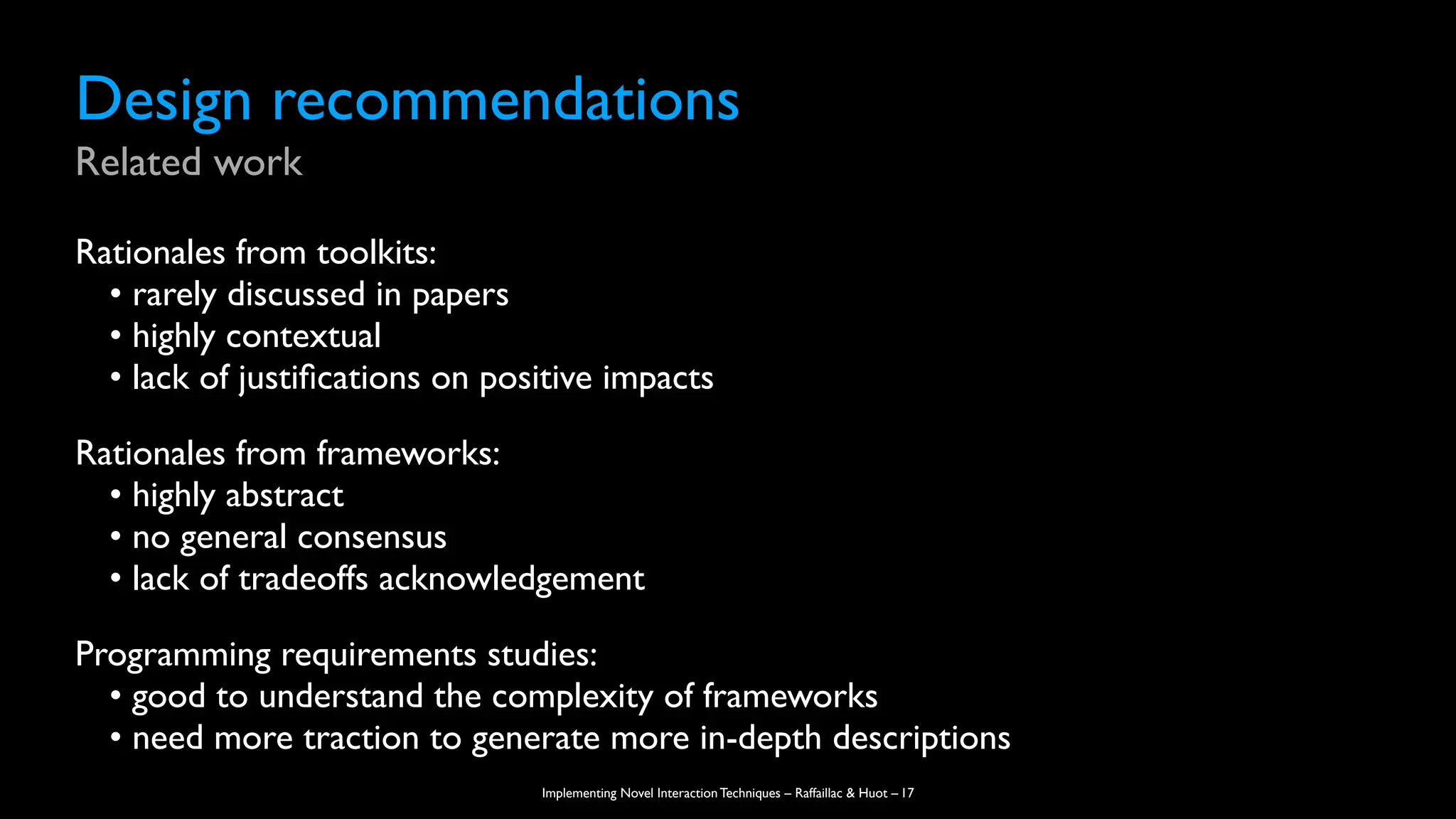
Design recommendations
Related work
Rationales from toolkits:
• rarely discussed in papers
• highly contextual
• lack of justi
fi
cations on positive impacts
Rationales from frameworks:
• highly abstract
• no general consensus
• lack of tradeoffs acknowledgement
Programming requirements studies:
• good to understand the complexity of frameworks
• need more traction to generate more in-depth descriptions
17
18.
Implementing Novel InteractionTechniques – Raffaillac & Huot –
Design recommendations
In
fl
uencing frameworks
How can we have a good impact on frameworks/toolkits?
• code artefact (plugin, toolkit)
• usage study
• tech talk (e.g. Qt World Summit,Android Dev Summit)
• join/create a working group
• design principles
Duplicate,Accumulate, Defer (DAD)
18
19.
Design recommendations
Duplicate
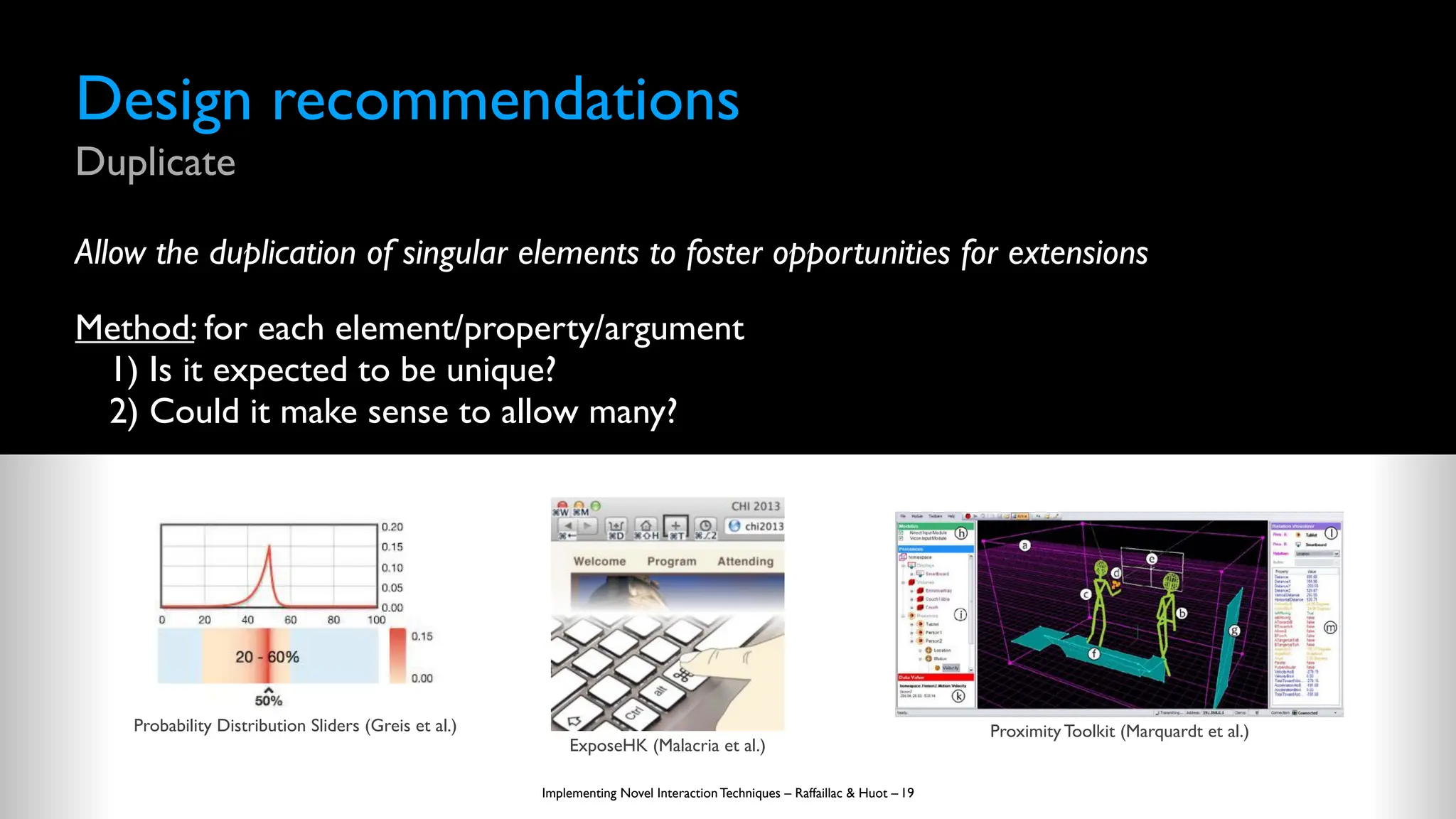
Allow theduplication of singular elements to foster opportunities for extensions
Method: for each element/property/argument
1) Is it expected to be unique?
2) Could it make sense to allow many?
Implementing Novel Interaction Techniques – Raffaillac & Huot – 19
Probability Distribution Sliders (Greis et al.)
ExposeHK (Malacria et al.)
Proximity Toolkit (Marquardt et al.)
20.
Design recommendations
Duplicate
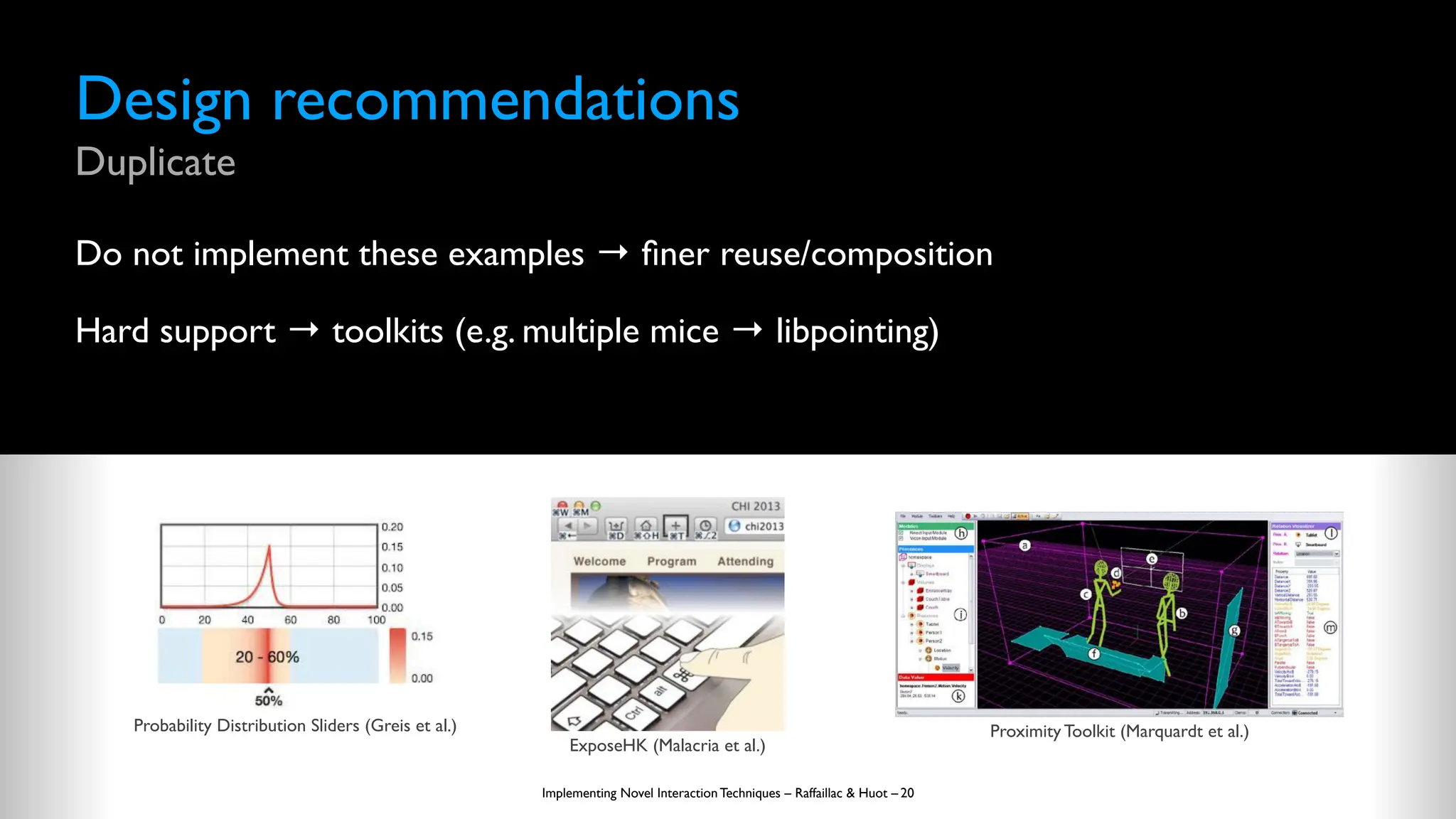
Do notimplement these examples →
fi
ner reuse/composition
Hard support → toolkits (e.g. multiple mice → libpointing)
Implementing Novel Interaction Techniques – Raffaillac & Huot – 20
Probability Distribution Sliders (Greis et al.)
ExposeHK (Malacria et al.)
Proximity Toolkit (Marquardt et al.)
21.
Design recommendations
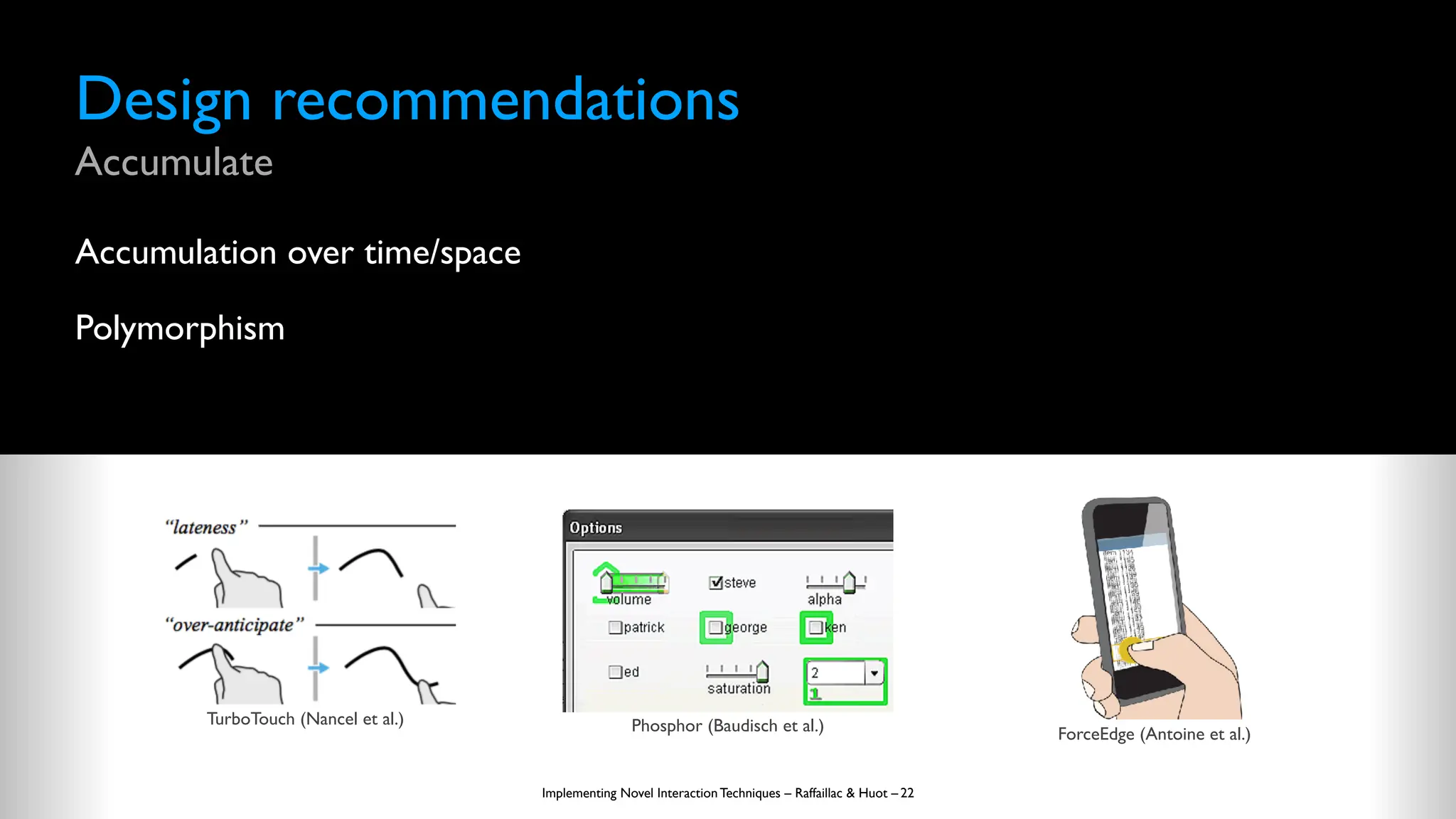
Accumulate
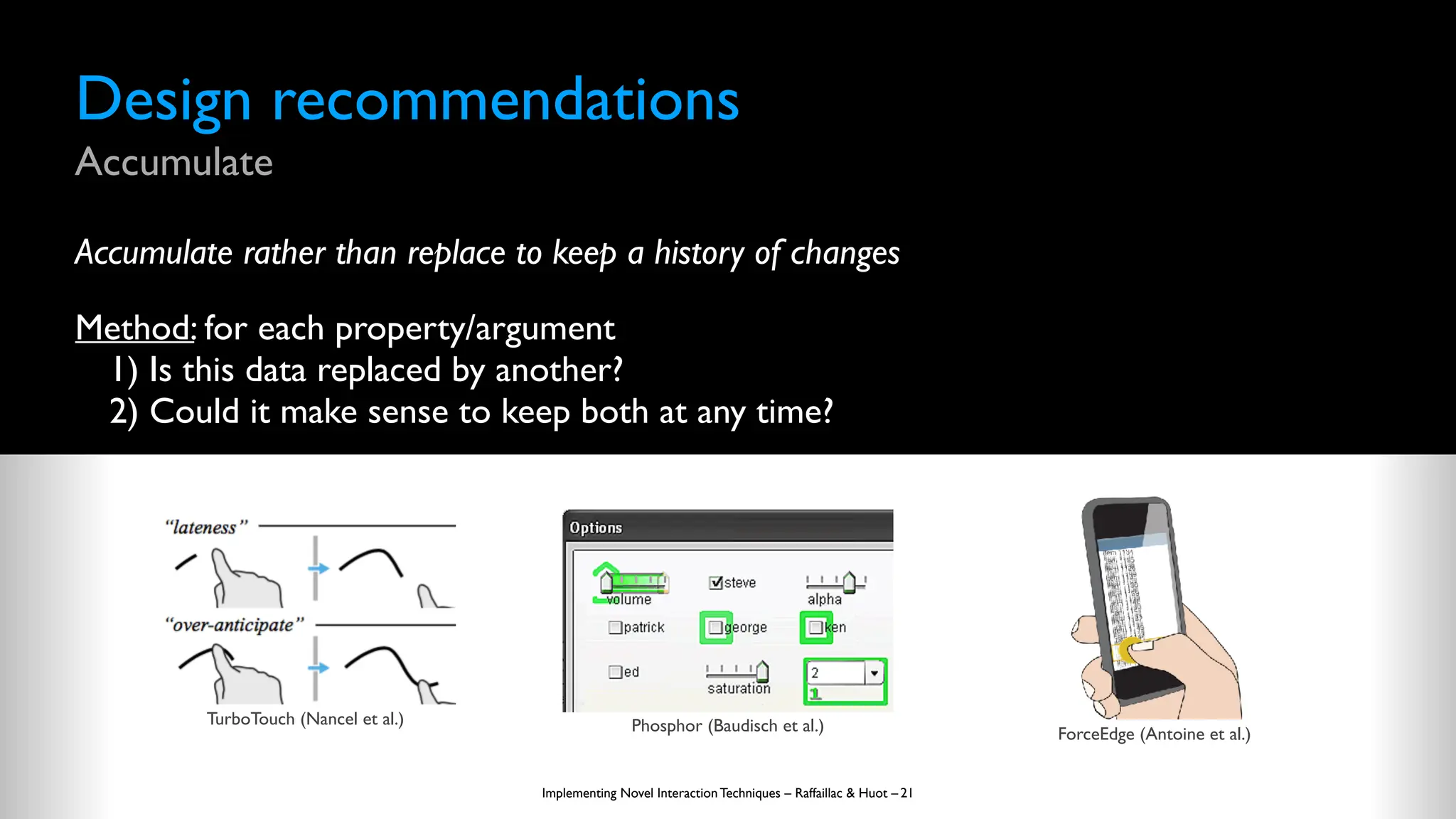
Accumulate ratherthan replace to keep a history of changes
Method: for each property/argument
1) Is this data replaced by another?
2) Could it make sense to keep both at any time?
Implementing Novel Interaction Techniques – Raffaillac & Huot – 21
TurboTouch (Nancel et al.) Phosphor (Baudisch et al.) ForceEdge (Antoine et al.)
22.
Design recommendations
Accumulate
Accumulation overtime/space
Polymorphism
Implementing Novel Interaction Techniques – Raffaillac & Huot – 22
TurboTouch (Nancel et al.) Phosphor (Baudisch et al.) ForceEdge (Antoine et al.)
23.
Design recommendations
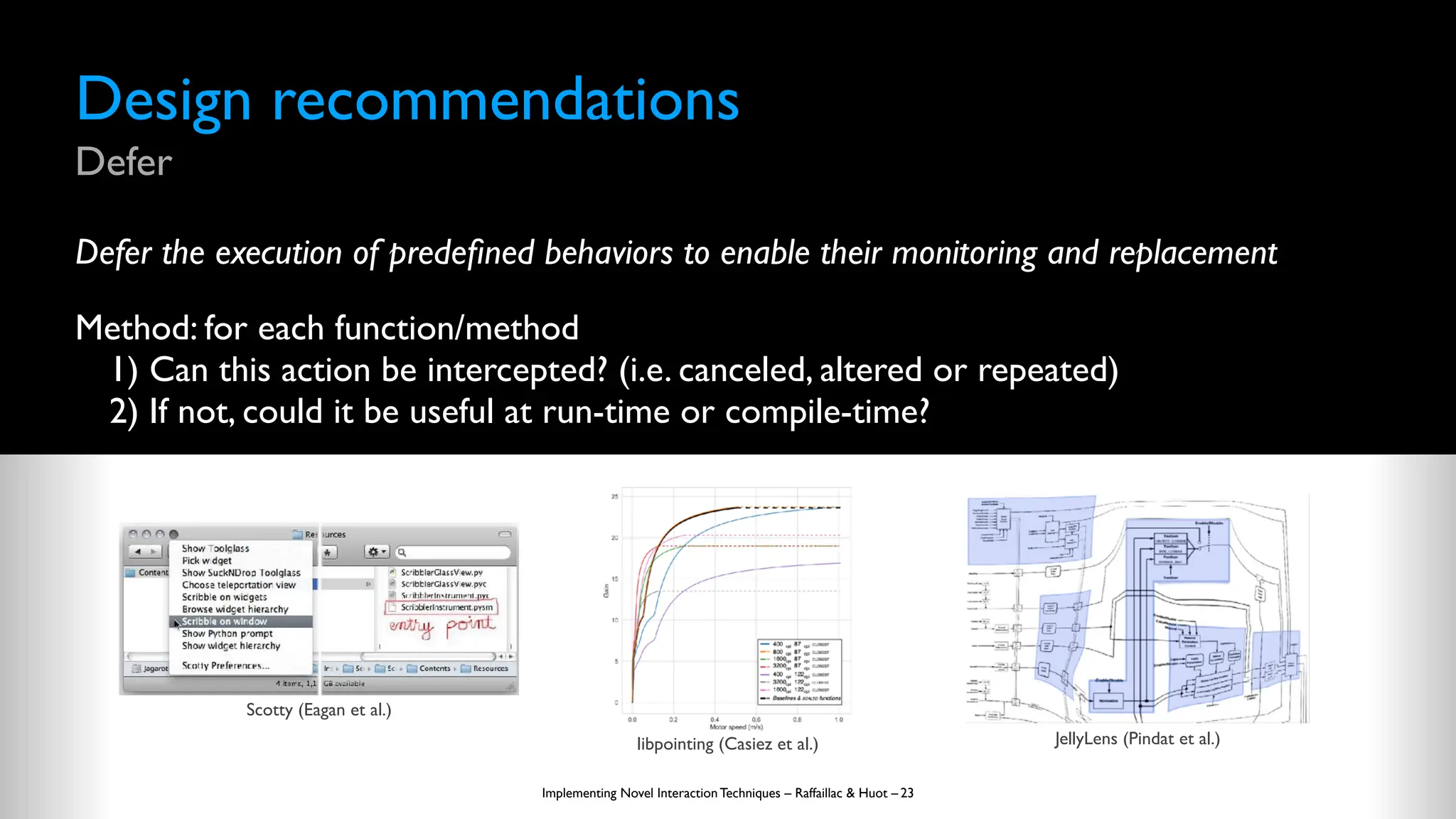
Defer
Defer theexecution of prede
fi
ned behaviors to enable their monitoring and replacement
Method: for each function/method
1) Can this action be intercepted? (i.e. canceled, altered or repeated)
2) If not, could it be useful at run-time or compile-time?
Implementing Novel Interaction Techniques – Raffaillac & Huot – 23
Scotty (Eagan et al.)
libpointing (Casiez et al.) JellyLens (Pindat et al.)
24.
Design recommendations
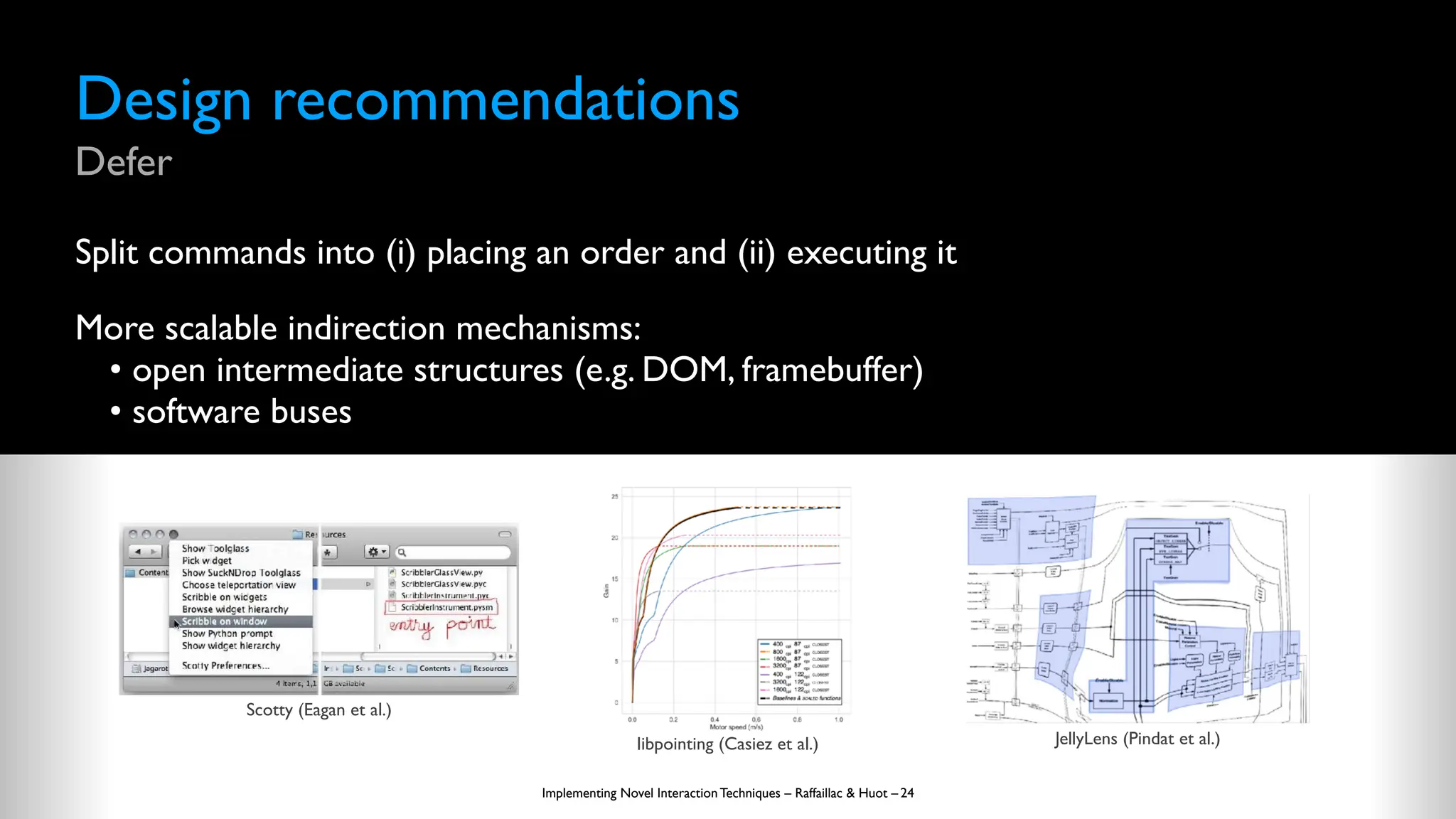
Defer
Split commandsinto (i) placing an order and (ii) executing it
More scalable indirection mechanisms:
• open intermediate structures (e.g. DOM, framebuffer)
• software buses
Implementing Novel Interaction Techniques – Raffaillac & Huot – 24
Scotty (Eagan et al.)
libpointing (Casiez et al.) JellyLens (Pindat et al.)
25.
Implementing Novel InteractionTechniques – Raffaillac & Huot –
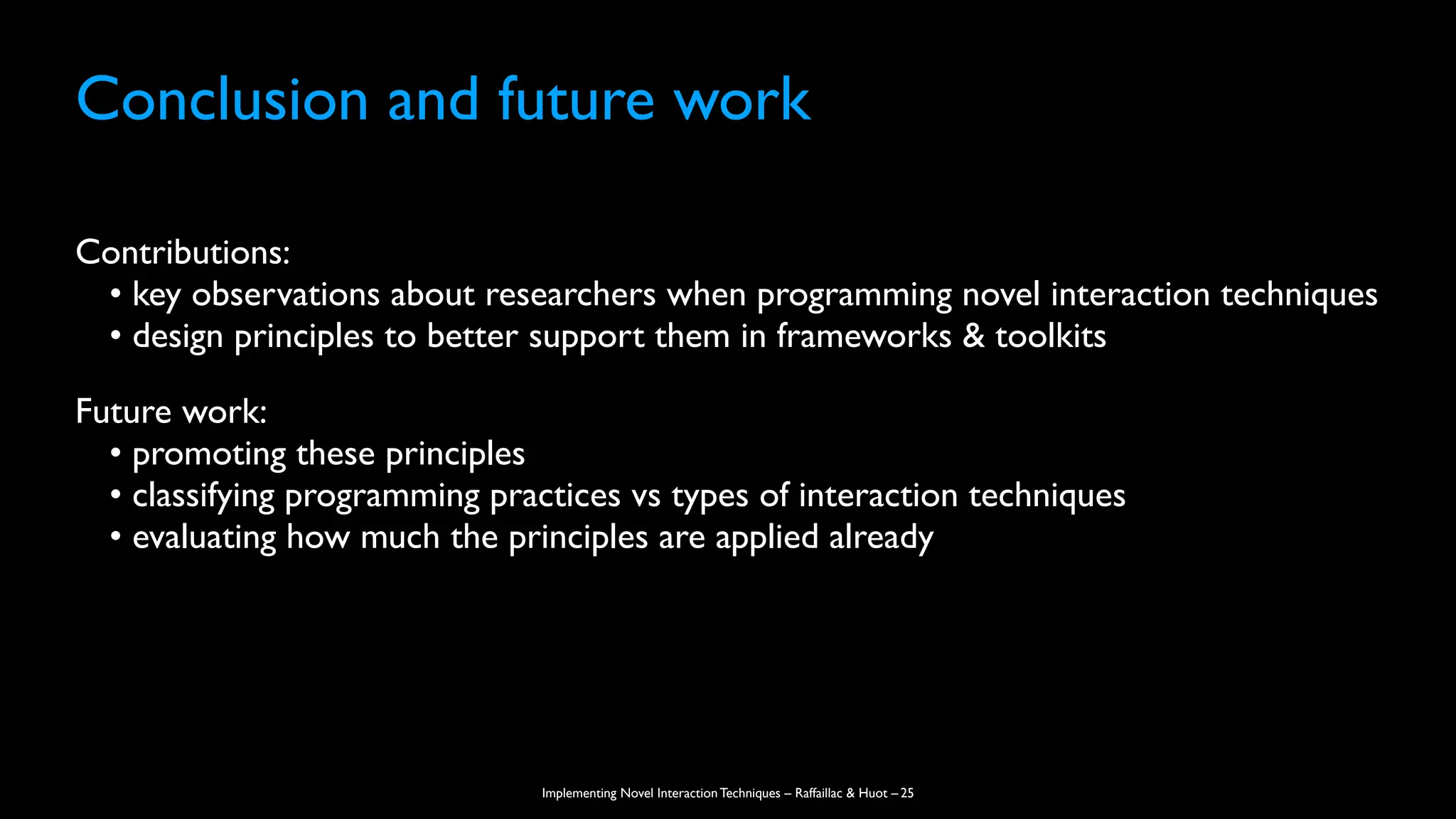
Conclusion and future work
Contributions:
• key observations about researchers when programming novel interaction techniques
• design principles to better support them in frameworks & toolkits
Future work:
• promoting these principles
• classifying programming practices vs types of interaction techniques
• evaluating how much the principles are applied already
25
Implementing Novel InteractionTechniques – Raffaillac & Huot –
• What are the most important criteria for choosing interaction libraries? (R1)
• What are the most limiting implementation problems for researchers? (R2)
• Which strategies are most used to circumvent and overcome these problems? (R3)
Interviews & Survey
Survey
28
32 participants (+4 pilot)
2/3 code < 40% of their time
2/3 advanced or expert
online questionnaire
rating relevance of items
20 minutes
chi-announcements@acm.org
2nd batch to former teams
29.
Implementing Novel InteractionTechniques – Raffaillac & Huot –
Interviews & Survey
Limits & Scope
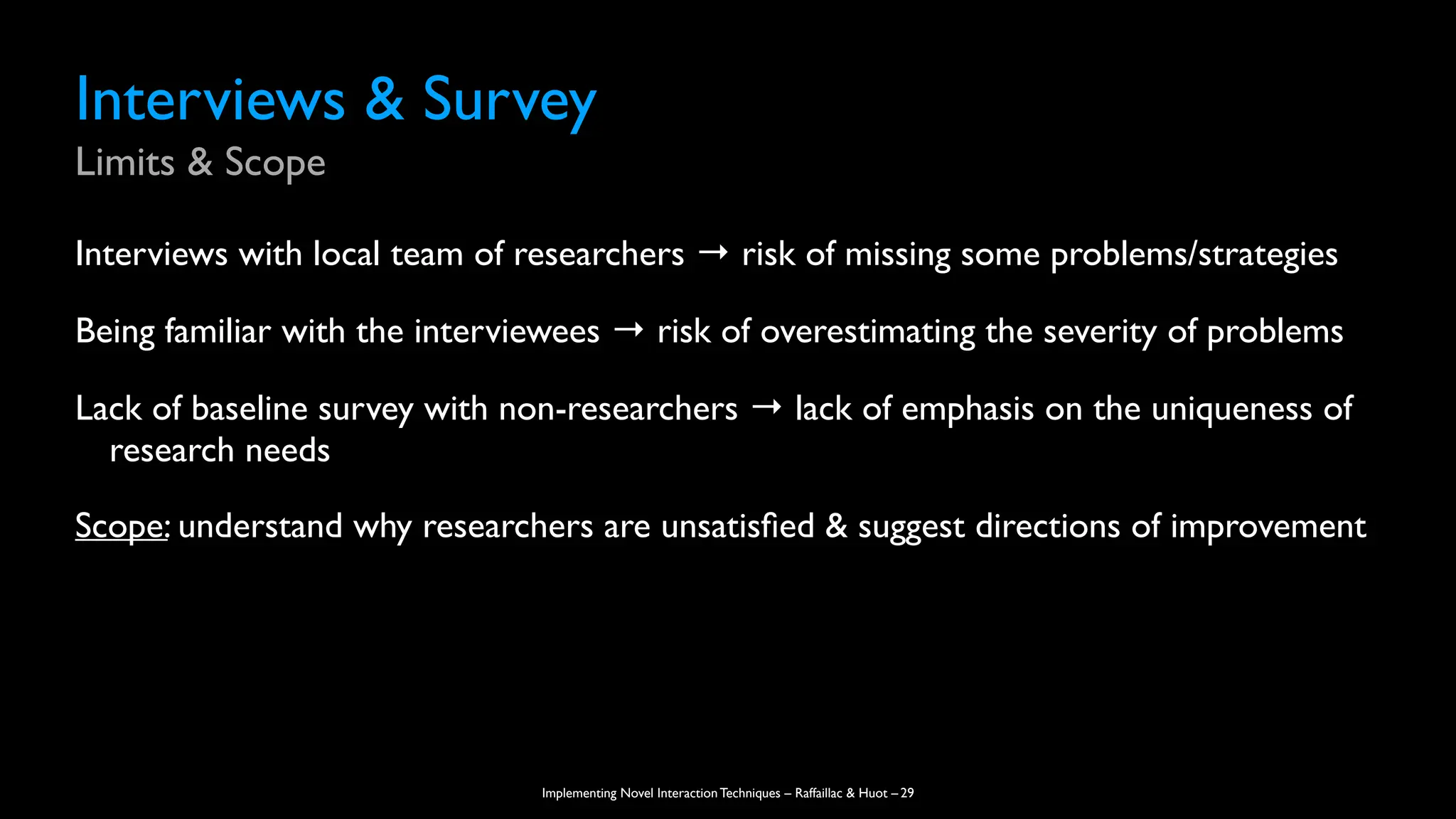
Interviews with local team of researchers → risk of missing some problems/strategies
Being familiar with the interviewees → risk of overestimating the severity of problems
Lack of baseline survey with non-researchers → lack of emphasis on the uniqueness of
research needs
Scope: understand why researchers are unsatis
fi
ed & suggest directions of improvement
29
30.
Implementing Novel InteractionTechniques – Raffaillac & Huot –
Design recommendations
Rationales from toolkits
Example in D3 (Bostock et al., 2011):
• when a scene is generated from data, specify explicit transformations rather than
letting the scene be generated implicitly
• the update of a property depending on another is immediate rather than deferred to
facilitate live inspection and debugging
• intermediate representations rely on existing native formats to leverage existing
user knowledge and helper tools
Extracting recommendations for other frameworks/toolkits:
• rarely discussed in papers
• highly contextual
• lack of justi
fi
cation on their positive impact for users
30
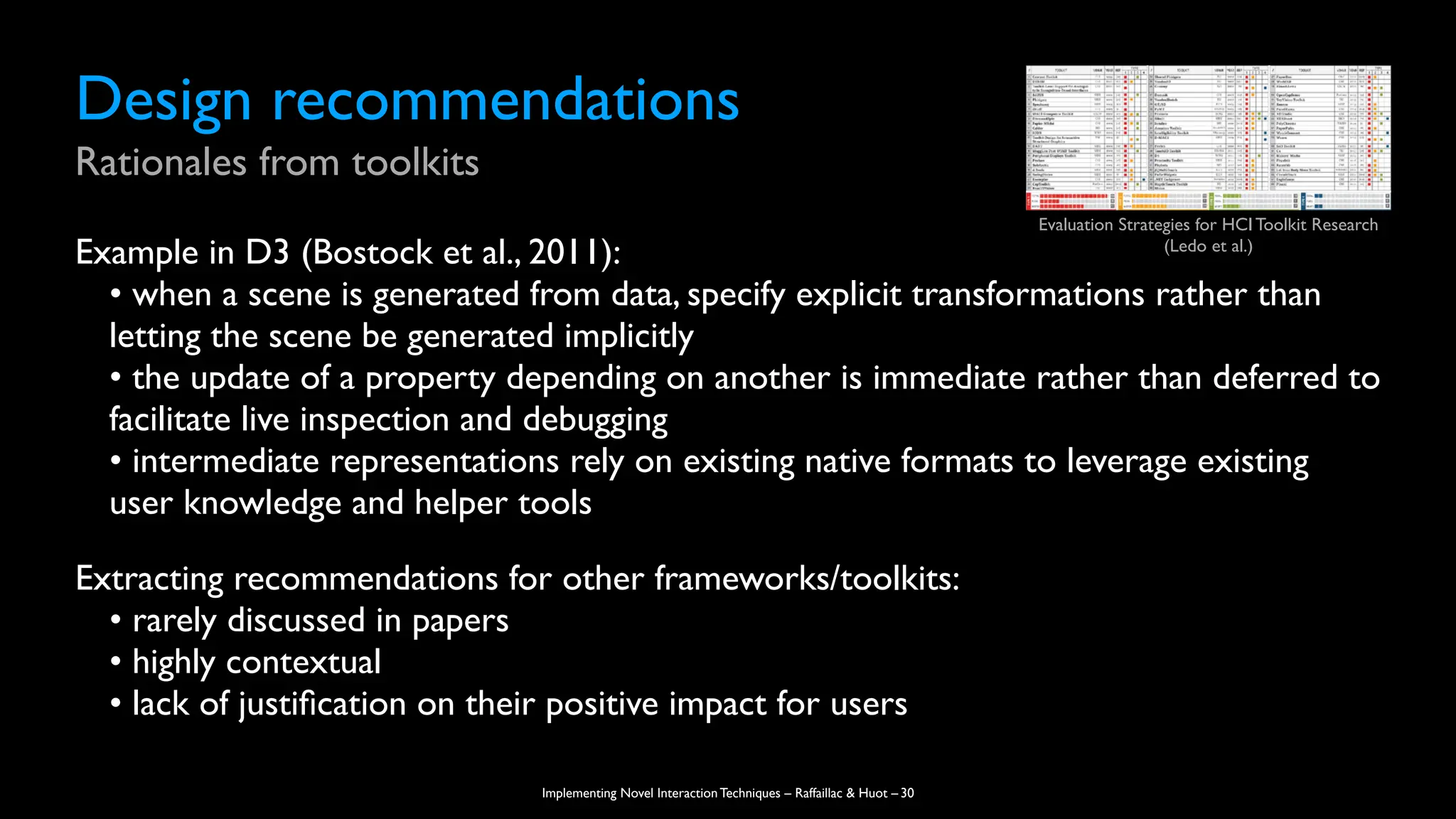
Evaluation Strategies for HCI Toolkit Research
(Ledo et al.)
31.
Implementing Novel InteractionTechniques – Raffaillac & Huot –
Design recommendations
Rationales from frameworks
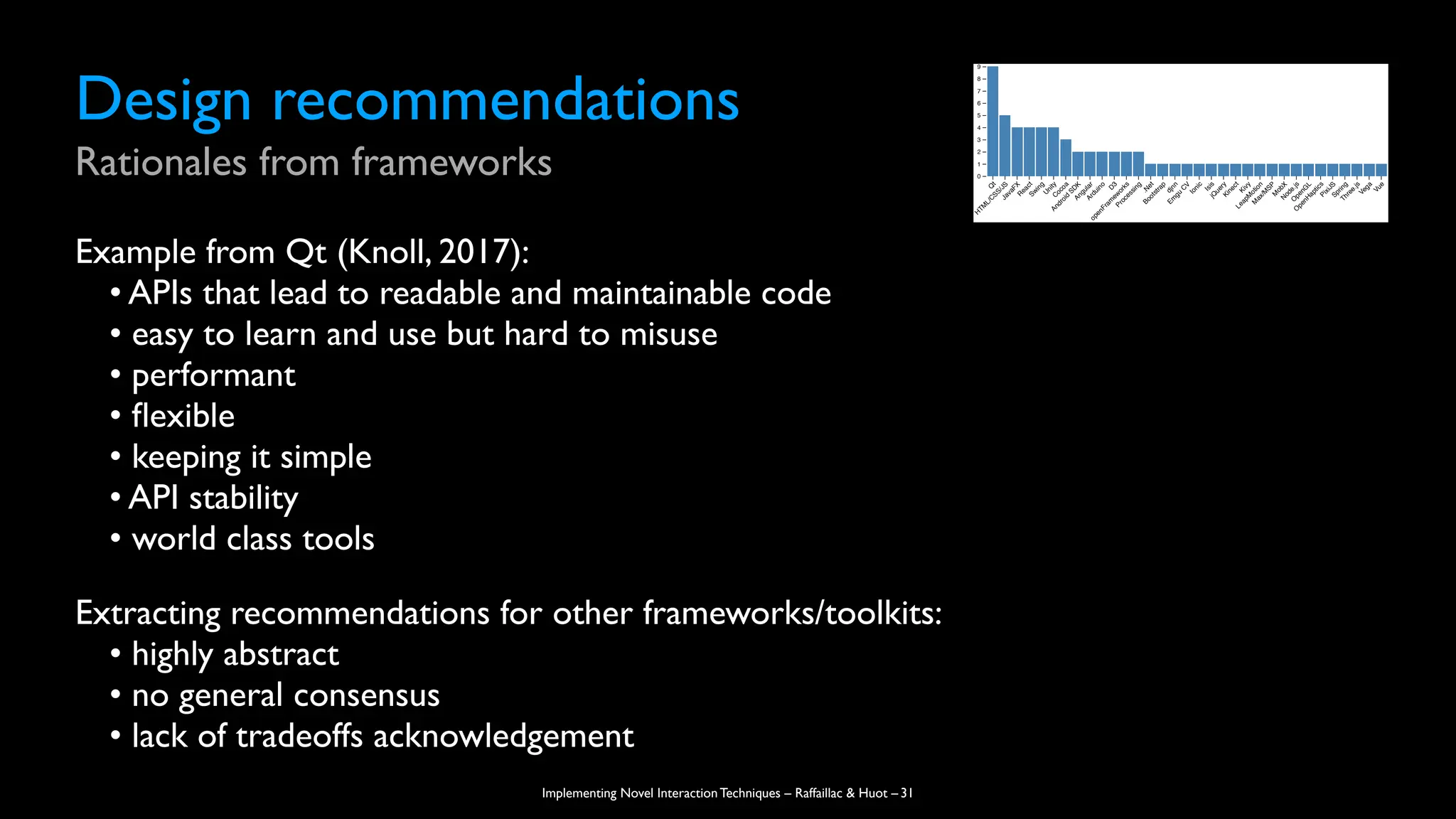
Example from Qt (Knoll, 2017):
• APIs that lead to readable and maintainable code
• easy to learn and use but hard to misuse
• performant
•
fl
exible
• keeping it simple
• API stability
• world class tools
Extracting recommendations for other frameworks/toolkits:
• highly abstract
• no general consensus
• lack of tradeoffs acknowledgement
31
Q
t
H
T
M
L
/
C
S
S
/
J
S
J
a
v
a
F
X
R
e
a
c
t
S
w
i
n
g
U
n
i
t
y
C
o
c
o
a
A
n
d
r
o
i
d
S
D
K
A
n
g
u
l
a
r
A
r
d
u
i
n
o
D
3
o
p
e
n
F
r
a
m
e
w
o
r
k
s
P
r
o
c
e
s
s
i
n
g
.
N
e
t
B
o
o
t
s
t
r
a
p
d
j
n
n
E
m
g
u
C
V
I
o
n
i
c
I
s
i
s
j
Q
u
e
r
y
K
i
n
e
c
t
K
i
v
y
L
e
a
p
M
o
t
i
o
n
M
a
x
/
M
S
P
M
o
b
X
N
o
d
e
.
j
s
O
p
e
n
G
L
O
p
e
n
H
a
p
t
i
c
s
P
i
x
i
J
S
S
p
r
i
n
g
T
h
r
e
e
.
j
s
V
e
g
a
V
u
e
0
1
2
3
4
5
6
7
8
9
32.
Implementing Novel InteractionTechniques – Raffaillac & Huot –
Design recommendations
Studies on researchers’ needs
Example in Usability requirements for interaction-oriented development tools (Letondal, 2010):
• minimising information complexity
• minimising access complexity
• minimising unpredictability
• graphics
• runtime adaptation
• interaction modalities
• distribution
• supporting code production
• matching code and execution
• managing the life cycle
• managing reuse and knowledge capitalization
• managing collective development
Extracting recommendations for other frameworks/toolkits:
• good for understanding complexity of frameworks and comparing them
• need more traction to generate more in-depth descriptions
32



![CleanMyMac X v5.2.8 Crack for MacOS Full Version [Latest] pptx](https://cdn.slidesharecdn.com/ss_thumbnails/softwareoverview-251207194121-a81f0142-thumbnail.jpg?width=640&height=640&fit=bounds)
![Moho Pro 14.4 Crack for MacOS Works Until 2050 [Latest] pptx](https://cdn.slidesharecdn.com/ss_thumbnails/softwareoverview-251207192639-797289c4-thumbnail.jpg?width=640&height=640&fit=bounds)
![AnyTrans for iOS 8.9.14.20251127 With Crack for MacOS [Latest] pptx](https://cdn.slidesharecdn.com/ss_thumbnails/softwareoverview-251207190907-2316965f-thumbnail.jpg?width=640&height=640&fit=bounds)
![PowerISO 9.2 Mac Crack + Serial Key Free Download 2026 [Latest] Software.pptx](https://cdn.slidesharecdn.com/ss_thumbnails/software-251207185653-5d5700e6-thumbnail.jpg?width=640&height=640&fit=bounds)


![Chapter4_Initiation_of_Sediment_Motion_v2[1].pptx](https://cdn.slidesharecdn.com/ss_thumbnails/chapter4initiationofsedimentmotionv21-251208223747-f94ef163-thumbnail.jpg?width=640&height=640&fit=bounds)


