Efforts for ‘Opening up of Access 
to Research Outputs’ in India 
Sridhar Gutam 
Convener, Open Access India 
15 Sept 2014, FAO Rome
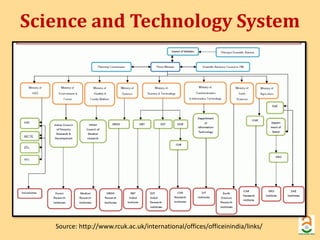
Science and Technology System 
Source: http://www.rcuk.ac.uk/international/offices/officeinindia/links/
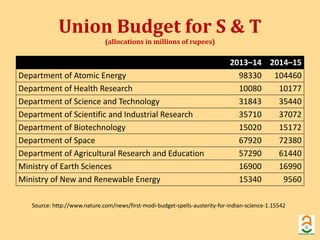
Union Budget for S & T 
(allocations in millions of rupees) 
2013–14 2014–15 
Department of Atomic Energy 98330 104460 
Department of Health Research 10080 10177 
Department of Science and Technology 31843 35440 
Department of Scientific and Industrial Research 35710 37072 
Department of Biotechnology 15020 15172 
Department of Space 67920 72380 
Department of Agricultural Research and Education 57290 61440 
Ministry of Earth Sciences 16900 16990 
Ministry of New and Renewable Energy 15340 9560 
Source: http://www.nature.com/news/first-modi-budget-spells-austerity-for-indian-science-1.15542
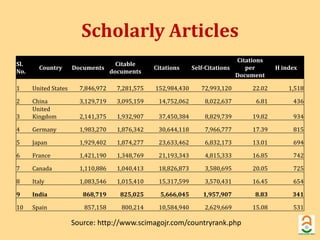
Scholarly Articles 
Sl. 
No. 
Country Documents 
Citable 
documents 
Citations Self-Citations 
Citations 
per 
Document 
H index 
1 United States 7,846,972 7,281,575 152,984,430 72,993,120 22.02 1,518 
2 China 3,129,719 3,095,159 14,752,062 8,022,637 6.81 436 
3 
United 
Kingdom 2,141,375 1,932,907 37,450,384 8,829,739 19.82 934 
4 Germany 1,983,270 1,876,342 30,644,118 7,966,777 17.39 815 
5 Japan 1,929,402 1,874,277 23,633,462 6,832,173 13.01 694 
6 France 1,421,190 1,348,769 21,193,343 4,815,333 16.85 742 
7 Canada 1,110,886 1,040,413 18,826,873 3,580,695 20.05 725 
8 Italy 1,083,546 1,015,410 15,317,599 3,570,431 16.45 654 
9 India 868,719 825,025 5,666,045 1,957,907 8.83 341 
10 Spain 857,158 800,214 10,584,940 2,629,669 15.08 531 
Source: http://www.scimagojr.com/countryrank.php
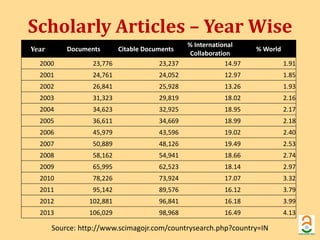
Scholarly Articles – Year Wise 
Year Documents Citable Documents 
% International 
Collaboration 
% World 
2000 23,776 23,237 14.97 1.91 
2001 24,761 24,052 12.97 1.85 
2002 26,841 25,928 13.26 1.93 
2003 31,323 29,819 18.02 2.16 
2004 34,623 32,925 18.95 2.17 
2005 36,611 34,669 18.99 2.18 
2006 45,979 43,596 19.02 2.40 
2007 50,889 48,126 19.49 2.53 
2008 58,162 54,941 18.66 2.74 
2009 65,995 62,523 18.14 2.97 
2010 78,226 73,924 17.07 3.32 
2011 95,142 89,576 16.12 3.79 
2012 102,881 96,841 16.18 3.99 
2013 106,029 98,968 16.49 4.13 
Source: http://www.scimagojr.com/countrysearch.php?country=IN
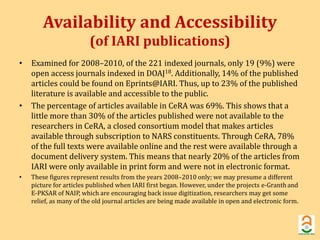
Availability and Accessibility 
(of IARI publications) 
• Examined for 2008–2010, of the 221 indexed journals, only 19 (9%) were 
open access journals indexed in DOAJ18. Additionally, 14% of the published 
articles could be found on Eprints@IARI. Thus, up to 23% of the published 
literature is available and accessible to the public. 
• The percentage of articles available in CeRA was 69%. This shows that a 
little more than 30% of the articles published were not available to the 
researchers in CeRA, a closed consortium model that makes articles 
available through subscription to NARS constituents. Through CeRA, 78% 
of the full texts were available online and the rest were available through a 
document delivery system. This means that nearly 20% of the articles from 
IARI were only available in print form and were not in electronic format. 
• These figures represent results from the years 2008–2010 only; we may presume a different 
picture for articles published when IARI first began. However, under the projects e-Granth and 
E-PKSAR of NAIP, which are encouraging back issue digitization, researchers may get some 
relief, as many of the old journal articles are being made available in open and electronic form.
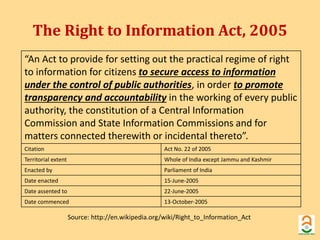
The Right to Information Act, 2005 
“An Act to provide for setting out the practical regime of right 
to information for citizens to secure access to information 
under the control of public authorities, in order to promote 
transparency and accountability in the working of every public 
authority, the constitution of a Central Information 
Commission and State Information Commissions and for 
matters connected therewith or incidental thereto”. 
Citation Act No. 22 of 2005 
Territorial extent Whole of India except Jammu and Kashmir 
Enacted by Parliament of India 
Date enacted 15-June-2005 
Date assented to 22-June-2005 
Date commenced 13-October-2005 
Source: http://en.wikipedia.org/wiki/Right_to_Information_Act
Open Access 
• Means unrestricted online access to peer-reviewed 
scholarly research (also theses, book 
chapters, and scholarly monographs). 
• Comes in two degrees: 
– gratis open access, which is free online access 
– libre open access, which is free online access plus 
some additional usage rights (granted through use of 
Creative Commons licenses). 
Only libre open access is fully compliant with definitions of 
open access such as the Berlin Declaration on Open Access to 
Knowledge in the Sciences and Humanities. 
Source: http://en.wikipedia.org/wiki/Open_access
Budapest Open Access Initiative, 
2001 
• Public statement of principles relating to open access to the research literature. 
• Conference convened in Budapest by the Open Society Institute on December 1–2, 2001 
• to promote open access – at the time also known as Free Online Scholarship. 
• Recognized as one of the major historical, and defining, events of the open access 
movement. 
• On the occasion of the 10th anniversary of the initiative (2012), recommended "the new 
goal that within the next ten years, OA will become the default method for distributing new 
peer-reviewed research in every field and country”. 
Definition of open access : By "open access" to this literature, we mean its free 
availability on the public internet, permitting any users to read, download, copy, 
distribute, print, search, or link to the full texts of these articles, crawl them for 
indexing, pass them as data to software, or use them for any other lawful 
purpose, without financial, legal, or technical barriers other than those 
inseparable from gaining access to the internet itself. The only constraint on 
reproduction and distribution, and the only role for copyright in this domain, 
should be to give authors control over the integrity of their work and the right 
to be properly acknowledged and cited.
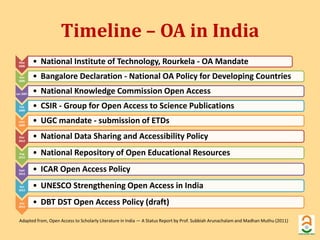
Timeline – OA in India 
May 
2006 
• National Institute of Technology, Rourkela - OA Mandate 
Nov 
2006 
• Bangalore Declaration - National OA Policy for Developing Countries 
Jan 2007 • National Knowledge Commission Open Access 
Feb 
2009 
• CSIR - Group for Open Access to Science Publications 
June 
2009 
• UGC mandate - submission of ETDs 
Mar 
2012 
• National Data Sharing and Accessibility Policy 
Aug 
2013 
• National Repository of Open Educational Resources 
Sept 
2013 
• ICAR Open Access Policy 
Oct 
2013 
• UNESCO Strengthening Open Access in India 
July 
2014 
• DBT DST Open Access Policy (draft) 
Adapted from, Open Access to Scholarly Literature in India — A Status Report by Prof. Subbiah Arunachalam and Madhan Muthu (2011)
Significant OA Policies and 
Mandates 
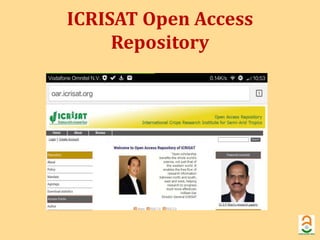
• ICRISAT Open Access Policy Mandate 
• CSIR Open Access Mandate 
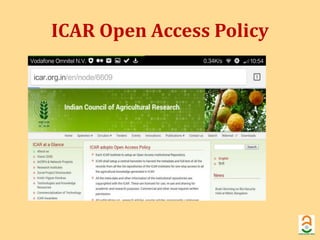
• ICAR Open Access Policy 
• DST-DBT Open Access Policy (draft) 
• Proposals for… 
– National Mandate on Open Access in India 
– Inclusive Open Access
ICAR Open Access Policy
ICRISAT Open Access 
Repository
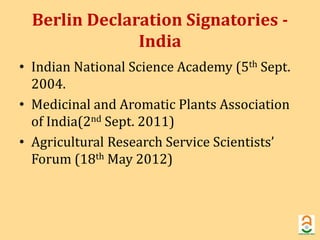
Berlin Declaration Signatories - 
India 
• Indian National Science Academy (5th Sept. 
2004. 
• Medicinal and Aromatic Plants Association 
of India(2nd Sept. 2011) 
• Agricultural Research Service Scientists’ 
Forum (18th May 2012)
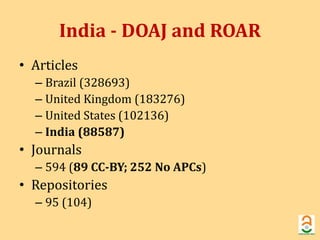
India - DOAJ and ROAR 
• Articles 
– Brazil (328693) 
– United Kingdom (183276) 
– United States (102136) 
– India (88587) 
• Journals 
– 594 (89 CC-BY; 252 No APCs) 
• Repositories 
– 95 (104)
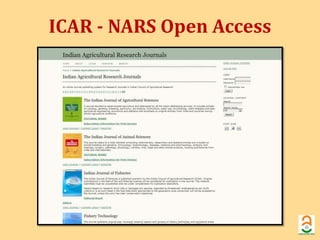
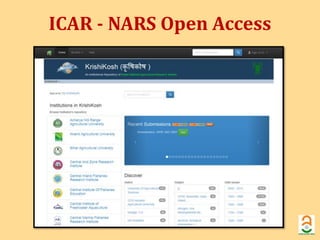
ICAR - NARS Open Access
MOOCs Massive Open Online 
Courses 
• Under the SWAYAM (Study Webs of Active-learning 
for Young Aspiring Minds) 
Programme, professors of centrally funded 
universities like Indian Institutes of 
Technology (IITs), Indian Institutes of 
Management (IIMs) and central universities 
will offer online courses
Caution!! 
• “Fake open-access journals flourish in India: 
Science” 
– The Hindu 
• “The policy (of DBT-DST), therefore, has the 
potential to have a significant negative effect on 
India’s economy” 
– The Association of Learned and Professional Society 
Publishers
The Protection and Utilization of 
Public Funded Intellectual Property 
Bill, 2008 
• Highlights 
– To provide incentives for creating and commercializing 
intellectual property from public funded research. 
– Requires the scientist who creates an intellectual property to 
immediately inform the research institution. 
• Arguments against (The Centre for Internet & Society) 
– May lead to commercialize all government-funded research 
literature and may hamper the movement for open access to 
scholarly literature. 
– Exclusive licensing enables restriction on the dissemination 
of academic research in the marketplace, and increase in cost 
of products based on public-funded research.
Alternate Metrics 
• San Francisco Declaration on Research 
Assessment 
– “Do not use journal-based metrics, such as Journal Impact 
Factors, as a surrogate measure of the quality of 
individual research articles, to assess an individual 
scientist’s contributions, or in hiring, promotion, or 
funding decisions” 
• Altmetric.com 
• ImpactStory
DST – DBT on Metrics 
• “The DBT/DST affirms the principle that the 
intrinsic merit of the work, and not the title of 
the journal in which an author’s work is 
published....” 
• “DBT/DST does not recommend the use of 
journal impact factors, as a surrogate measure 
of the quality of individual research articles, to 
assess an individual scientist’s contributions, 
or in hiring, promotion, or funding decisions”. 
Source: dbtindia.nic.in/docs/DST-DBT_Draft.pdf
NAAS Scoring of Scientific Journals 
• “…a need was felt in the Academy for critically 
assessing the published work of the nominees 
for the Fellowship/Associateship and for 
developing a transparent and quantifiable 
mechanism that avoids arbitrariness in 
assessment”. 
• “Accordingly, the Academy initiated a process 
of rating/scoring of scientific research 
journals…” 
Source: http://naasindia.org/
Next Steps?? 
• Active contribution to AIMS, CIARD, GODAN, 
OKFN, data.gov.in & DataMeet. 
• Forging alliances with other CoP. 
• Establishment of Scholarly repository 
• National mandate on Open Access in India 
• Inclusive Open Access 
• Alternate metrics
Open Access India 
• Contributes to the activities/initiatives of 
– AIMS, CIARD, GODAN, OKFN & DataMeet 
• Conveners 
– Sridhar Gutam& Barnali Roy Choudhury 
• Facebook Group 
– 6922 members (https://www.facebook.com/groups/oaindia/) 
• WordPress Blog 
– 5,383 hits Since Dec 27, 2012 
(http://oaindia2013.wordpress.com/) 
• Facebook Page 
– 646 likes (https://www.facebook.com/oaindia) 
• Twitter 
– 389 followers (https://twitter.com/OpenAccessIndia)
Thank you for your kind attention 
gutam2000@gmail.com

Efforts for 'Opening up of Access to Research Outputs in India"

  • 1.
    Efforts for ‘Openingup of Access to Research Outputs’ in India Sridhar Gutam Convener, Open Access India 15 Sept 2014, FAO Rome
  • 2.
    Science and TechnologySystem Source: http://www.rcuk.ac.uk/international/offices/officeinindia/links/
  • 3.
    Union Budget forS & T (allocations in millions of rupees) 2013–14 2014–15 Department of Atomic Energy 98330 104460 Department of Health Research 10080 10177 Department of Science and Technology 31843 35440 Department of Scientific and Industrial Research 35710 37072 Department of Biotechnology 15020 15172 Department of Space 67920 72380 Department of Agricultural Research and Education 57290 61440 Ministry of Earth Sciences 16900 16990 Ministry of New and Renewable Energy 15340 9560 Source: http://www.nature.com/news/first-modi-budget-spells-austerity-for-indian-science-1.15542
  • 4.
    Scholarly Articles Sl. No. Country Documents Citable documents Citations Self-Citations Citations per Document H index 1 United States 7,846,972 7,281,575 152,984,430 72,993,120 22.02 1,518 2 China 3,129,719 3,095,159 14,752,062 8,022,637 6.81 436 3 United Kingdom 2,141,375 1,932,907 37,450,384 8,829,739 19.82 934 4 Germany 1,983,270 1,876,342 30,644,118 7,966,777 17.39 815 5 Japan 1,929,402 1,874,277 23,633,462 6,832,173 13.01 694 6 France 1,421,190 1,348,769 21,193,343 4,815,333 16.85 742 7 Canada 1,110,886 1,040,413 18,826,873 3,580,695 20.05 725 8 Italy 1,083,546 1,015,410 15,317,599 3,570,431 16.45 654 9 India 868,719 825,025 5,666,045 1,957,907 8.83 341 10 Spain 857,158 800,214 10,584,940 2,629,669 15.08 531 Source: http://www.scimagojr.com/countryrank.php
  • 5.
    Scholarly Articles –Year Wise Year Documents Citable Documents % International Collaboration % World 2000 23,776 23,237 14.97 1.91 2001 24,761 24,052 12.97 1.85 2002 26,841 25,928 13.26 1.93 2003 31,323 29,819 18.02 2.16 2004 34,623 32,925 18.95 2.17 2005 36,611 34,669 18.99 2.18 2006 45,979 43,596 19.02 2.40 2007 50,889 48,126 19.49 2.53 2008 58,162 54,941 18.66 2.74 2009 65,995 62,523 18.14 2.97 2010 78,226 73,924 17.07 3.32 2011 95,142 89,576 16.12 3.79 2012 102,881 96,841 16.18 3.99 2013 106,029 98,968 16.49 4.13 Source: http://www.scimagojr.com/countrysearch.php?country=IN
  • 6.
    Availability and Accessibility (of IARI publications) • Examined for 2008–2010, of the 221 indexed journals, only 19 (9%) were open access journals indexed in DOAJ18. Additionally, 14% of the published articles could be found on Eprints@IARI. Thus, up to 23% of the published literature is available and accessible to the public. • The percentage of articles available in CeRA was 69%. This shows that a little more than 30% of the articles published were not available to the researchers in CeRA, a closed consortium model that makes articles available through subscription to NARS constituents. Through CeRA, 78% of the full texts were available online and the rest were available through a document delivery system. This means that nearly 20% of the articles from IARI were only available in print form and were not in electronic format. • These figures represent results from the years 2008–2010 only; we may presume a different picture for articles published when IARI first began. However, under the projects e-Granth and E-PKSAR of NAIP, which are encouraging back issue digitization, researchers may get some relief, as many of the old journal articles are being made available in open and electronic form.
  • 7.
    The Right toInformation Act, 2005 “An Act to provide for setting out the practical regime of right to information for citizens to secure access to information under the control of public authorities, in order to promote transparency and accountability in the working of every public authority, the constitution of a Central Information Commission and State Information Commissions and for matters connected therewith or incidental thereto”. Citation Act No. 22 of 2005 Territorial extent Whole of India except Jammu and Kashmir Enacted by Parliament of India Date enacted 15-June-2005 Date assented to 22-June-2005 Date commenced 13-October-2005 Source: http://en.wikipedia.org/wiki/Right_to_Information_Act
  • 8.
    Open Access •Means unrestricted online access to peer-reviewed scholarly research (also theses, book chapters, and scholarly monographs). • Comes in two degrees: – gratis open access, which is free online access – libre open access, which is free online access plus some additional usage rights (granted through use of Creative Commons licenses). Only libre open access is fully compliant with definitions of open access such as the Berlin Declaration on Open Access to Knowledge in the Sciences and Humanities. Source: http://en.wikipedia.org/wiki/Open_access
  • 9.
    Budapest Open AccessInitiative, 2001 • Public statement of principles relating to open access to the research literature. • Conference convened in Budapest by the Open Society Institute on December 1–2, 2001 • to promote open access – at the time also known as Free Online Scholarship. • Recognized as one of the major historical, and defining, events of the open access movement. • On the occasion of the 10th anniversary of the initiative (2012), recommended "the new goal that within the next ten years, OA will become the default method for distributing new peer-reviewed research in every field and country”. Definition of open access : By "open access" to this literature, we mean its free availability on the public internet, permitting any users to read, download, copy, distribute, print, search, or link to the full texts of these articles, crawl them for indexing, pass them as data to software, or use them for any other lawful purpose, without financial, legal, or technical barriers other than those inseparable from gaining access to the internet itself. The only constraint on reproduction and distribution, and the only role for copyright in this domain, should be to give authors control over the integrity of their work and the right to be properly acknowledged and cited.
  • 10.
    Timeline – OAin India May 2006 • National Institute of Technology, Rourkela - OA Mandate Nov 2006 • Bangalore Declaration - National OA Policy for Developing Countries Jan 2007 • National Knowledge Commission Open Access Feb 2009 • CSIR - Group for Open Access to Science Publications June 2009 • UGC mandate - submission of ETDs Mar 2012 • National Data Sharing and Accessibility Policy Aug 2013 • National Repository of Open Educational Resources Sept 2013 • ICAR Open Access Policy Oct 2013 • UNESCO Strengthening Open Access in India July 2014 • DBT DST Open Access Policy (draft) Adapted from, Open Access to Scholarly Literature in India — A Status Report by Prof. Subbiah Arunachalam and Madhan Muthu (2011)
  • 11.
    Significant OA Policiesand Mandates • ICRISAT Open Access Policy Mandate • CSIR Open Access Mandate • ICAR Open Access Policy • DST-DBT Open Access Policy (draft) • Proposals for… – National Mandate on Open Access in India – Inclusive Open Access
  • 12.
  • 13.
  • 14.
    Berlin Declaration Signatories- India • Indian National Science Academy (5th Sept. 2004. • Medicinal and Aromatic Plants Association of India(2nd Sept. 2011) • Agricultural Research Service Scientists’ Forum (18th May 2012)
  • 15.
    India - DOAJand ROAR • Articles – Brazil (328693) – United Kingdom (183276) – United States (102136) – India (88587) • Journals – 594 (89 CC-BY; 252 No APCs) • Repositories – 95 (104)
  • 16.
    ICAR - NARSOpen Access
  • 17.
    ICAR - NARSOpen Access
  • 18.
    MOOCs Massive OpenOnline Courses • Under the SWAYAM (Study Webs of Active-learning for Young Aspiring Minds) Programme, professors of centrally funded universities like Indian Institutes of Technology (IITs), Indian Institutes of Management (IIMs) and central universities will offer online courses
  • 19.
    Caution!! • “Fakeopen-access journals flourish in India: Science” – The Hindu • “The policy (of DBT-DST), therefore, has the potential to have a significant negative effect on India’s economy” – The Association of Learned and Professional Society Publishers
  • 20.
    The Protection andUtilization of Public Funded Intellectual Property Bill, 2008 • Highlights – To provide incentives for creating and commercializing intellectual property from public funded research. – Requires the scientist who creates an intellectual property to immediately inform the research institution. • Arguments against (The Centre for Internet & Society) – May lead to commercialize all government-funded research literature and may hamper the movement for open access to scholarly literature. – Exclusive licensing enables restriction on the dissemination of academic research in the marketplace, and increase in cost of products based on public-funded research.
  • 21.
    Alternate Metrics •San Francisco Declaration on Research Assessment – “Do not use journal-based metrics, such as Journal Impact Factors, as a surrogate measure of the quality of individual research articles, to assess an individual scientist’s contributions, or in hiring, promotion, or funding decisions” • Altmetric.com • ImpactStory
  • 22.
    DST – DBTon Metrics • “The DBT/DST affirms the principle that the intrinsic merit of the work, and not the title of the journal in which an author’s work is published....” • “DBT/DST does not recommend the use of journal impact factors, as a surrogate measure of the quality of individual research articles, to assess an individual scientist’s contributions, or in hiring, promotion, or funding decisions”. Source: dbtindia.nic.in/docs/DST-DBT_Draft.pdf
  • 23.
    NAAS Scoring ofScientific Journals • “…a need was felt in the Academy for critically assessing the published work of the nominees for the Fellowship/Associateship and for developing a transparent and quantifiable mechanism that avoids arbitrariness in assessment”. • “Accordingly, the Academy initiated a process of rating/scoring of scientific research journals…” Source: http://naasindia.org/
  • 24.
    Next Steps?? •Active contribution to AIMS, CIARD, GODAN, OKFN, data.gov.in & DataMeet. • Forging alliances with other CoP. • Establishment of Scholarly repository • National mandate on Open Access in India • Inclusive Open Access • Alternate metrics
  • 25.
    Open Access India • Contributes to the activities/initiatives of – AIMS, CIARD, GODAN, OKFN & DataMeet • Conveners – Sridhar Gutam& Barnali Roy Choudhury • Facebook Group – 6922 members (https://www.facebook.com/groups/oaindia/) • WordPress Blog – 5,383 hits Since Dec 27, 2012 (http://oaindia2013.wordpress.com/) • Facebook Page – 646 likes (https://www.facebook.com/oaindia) • Twitter – 389 followers (https://twitter.com/OpenAccessIndia)
  • 26.
    Thank you foryour kind attention gutam2000@gmail.com