Effortless	English	is	published	by	Effortless	English	LLC
1702	A.	Street,	Ste.	C
Sparks,	NV	89431
	
Inquiries:	events@effortlessenglishclub.com
Website:	www.effortlessenglishclub.com
	
Copyright	2014	by	Effortless	English	LLC	and	A.J.	Hoge
All	rights	reserved.
	
ISBN:	978-1-942250-02-9
LCCN:	pending
Library	of	Congress	Cataloging-In-Publication	Data	Has	Been	Applied	For
	
Cover	design	and	ebook	styling:	Enterline	Design	Services	LLC
	
No	part	of	this	publication	may	be	reproduced,	stored	in,	or	included	in	a	retrieval	system,	or	transmitted	in	any	form	without	the	prior	written
consent	of	the	publisher.	Your	support	of	the	author’s	rights	is	appreciated.
Contents
Chapter	1:	A	Better	Way	to	Learn	English
Chapter	2:	The	Problem	with	Schools
Chapter	3:	Psychology	Is	More	Important	Than	Grammar	and	Vocabulary
Chapter	4:	Your	Beliefs	Determine	Your	English	Success
Chapter	5:	English	Is	A	Physical	Sport
Chapter	6:	Use	Big	Real	World	Goals	To	Motivate	Yourself	For	Success
Chapter	7:	Program	Your	Brain	For	English	Success
Chapter	8:	Babies	Learn	Best	—	The	Effortless	English™	Engine
Chapter	9:	The	First	Rule	–	Learn	Phrases	Not	Words
Chapter	10:	The	Second	Rule:	Grammar	Study	Kills	Your	English	Speaking
Chapter	11:	The	Third	Rule:	Learn	With	Your	Ears,	Not	With	Your	Eyes
Chapter	12:	The	Fourth	Rule	–	Repetition	Is	The	Key	To	Spoken	Mastery
Chapter	13:	The	Fifth	Rule:	Learn	Grammar	Intuitively	And	Unconsciously
Chapter	14:	The	Sixth	Rule:	Learn	Real	English	And	Trash	Your	Textbooks
Chapter	15:	The	Seventh	Rule:	Learn	English	With	Compelling	Stories
Chapter	16:	Your	Daily	English	Learning	Plan
Chapter	17:	The	Power	of	Pleasure	Reading
Chapter	18:	The	Secret	To	Good	English	Writing
Chapter	19:	Why	You	Should	Not	Practice	Speaking
Chapter	20:	English	Is	The	Language	Of	International	Business
Chapter	21:	How	To	Give	Powerful	English	Presentations
Chapter	22:	English	Connects	You	With	The	World
Chapter	23:	The	Effortless	English	Code	and	Mission
About	the	Author
CHAPTER	1
A	Better	Way	to	Learn	English
	
If	you’ve	picked	up	this	book,	chances	are	you’ve	wanted	to	speak	English	for	a	while.	Maybe	you’ve
even	 taken	 classes.	 You	 probably	 need	 English	 to	 improve	 your	 career.	 Maybe	 you	 want	 to	 travel
internationally	 or	 study	 abroad.	 You	 know	 that	 English	 is	 the	 key	 to	 international	 business	 and
international	travel.	So	let	me	ask	you	something.
Do	you	feel	nervous	or	shy	when	you	try	to	speak	English?	Do	you	still	struggle	to	understand	what
someone	 is	 saying	 to	 you	 despite	 years	 of	 study?	 Are	 you	 embarrassed	 about	 your	 pronunciation	 or
worried	you	speak	too	slowly?	Are	you	frustrated	that	despite	all	the	time	you’ve	invested	in	learning
English	you	still	can’t	speak	it?	Despite	your	goals,	is	it	difficult	for	you	to	actually	use	English	in	your
job,	travels,	or	studies?	Do	you	sometimes	feel	that	you’ll	never	master	spoken	English?
If	you	answered	yes	to	any	of	these	questions,	you’re	not	alone.	In	fact,	you’re	 fairly	 typical.	 Most
English	students	feel	this	way.	Most	adult	English	learners	are	stressed	and	frustrated	about	their	speaking
ability.	Some	feel	completely	hopeless	and	feel	they’ll	never	be	able	to	speak	English	powerfully.	Not
because	they’re	bad	at	languages,	but	because,	like	you,	they’ve	been	taught	using	the	wrong	methods.
The	good	thing	is	that	it	doesn’t	have	to	be	like	this.	There	is	nothing	wrong	with	you.	You	can	learn	to
speak	English	naturally	and	with	ease.	You	can	use	English	effectively	in	your	job,	travels,	and	studies.
You	can	feel	relaxed	and	confident	every	time	you	speak	English.	In	fact,	as	a	long-time	English	teacher,
I’ve	helped	thousands	of	students	all	over	the	world	become	fluent	and	powerful	English	speakers.
How	did	I	do	it?	I	did	it	using	a	teaching	method	I	developed	called	Effortless	English™.	Effortless
English™	enables	you	to	learn	English	naturally	and	automatically	–	the	way	children	learn	before	they
enter	school.	Too	often,	English	classes	get	so	focused	on	tests,	textbooks,	grades	and	“levels,”	students
forget	why	they’re	there	in	the	first	place.	They	forget	about	the	real	world	goals	of	a	more	successful
career	and	exciting	international	travel.	With	Effortless	English™	you	never	lose	sight	of	the	fact	that	the
ultimate	goal	of	learning	a	language	is	communication.	Instead,	you	learn	to	speak	English	both	quickly
and	with	more	precision.
Effortless?
I	understand	if	you’re	skeptical	–	particularly	if	you’ve	been	trying	to	learn	English	the	traditional	way.
You’ve	put	in	the	hours:	memorizing	vocabulary	lists,	doing	grammar	drills,	reading	boring	textbooks.
“How?”	you’re	thinking,	“can	speaking	English	possibly	be	effortless?”
Believe	me,	I	feel	your	pain.
Back	when	I	started	teaching	15	years	ago,	my	students	were	all	excited	to	begin	conversing	in	English.
And	I	was	excited	to	help	them.	At	that	time,	I	taught	in	the	usual	way.	I	used	textbooks	and	I	focused	on
teaching	grammar.	I	thought	this	was	the	best	way	to	teach,	and	none	of	my	students	complained.
I	still	remember	one	particularly	intelligent	student	of	mine	from	Venezuela	named	Gladys.	Gladys	was
determined	to	speak	English	well.	Talk	about	effort!	Gladys	attended	every	one	of	my	classes.	She	always
sat	in	the	center	of	the	front	row.	I	can	still	picture	her	eager	and	smiling	face.	She	took	detailed	notes.
She	 listened	 to	 every	 word	 I	 said.	 She	 also	 studied	 at	 home.	 Every	 day	 Gladys	 studied	 her	 English
textbooks	for	four	hours	or	more.	She	also	tried	to	learn	50	new	vocabulary	words	by	memorizing	word
lists.	Gladys	was	my	star	student	and	I,	too,	was	sure	she	would	succeed.
Six	months	later,	however,	she	still	could	barely	speak	English.	Her	speech	was	hesitant	and	unnatural.
She	constantly	made	grammar	mistakes	with	even	the	simplest	sentences.	Her	pronunciation	was	difficult
to	understand.	She	still	thought	in	Spanish	and	tried	to	translate	to	and	from	English	when	she	spoke.
Worst	of	all,	Gladys	felt	nervous	every	time	she	tried	to	speak	English.	Speaking	English	was	a	painful
experience	for	her.
Gladys	was	extremely	frustrated.	After	so	much	effort,	she	had	barely	improved.	As	her	teacher,	I	too
was	frustrated.	I	was	sure	Gladys	would	improve	quickly	and	couldn’t	understand	why	she	had	not.	I
followed	all	of	the	traditional	teaching	methods.	I	used	the	standard	textbooks	and	the	standard	classroom
activities.	 Gladys	 was	 intelligent,	 disciplined	 and	 consistent,	 and	 yet	 her	 English	 speaking	 barely
improved.
Sadly,	I	realized	that	Gladys	wasn’t	the	only	one	who	had	not	improved.		Her	classmates	also	had
barely	improved.	It	was	frustrating,	and	I	felt	like	a	complete	failure	as	a	teacher.		But	when	I	asked	my
colleagues	for	help,	it	turned	out	they	had	the	same	problem	–	very	few	of	their	students	were	improving
either!			At	that	point,	I	realized	something	was	wrong	–	something	is	wrong	with	standard	methods	for
teaching	English.	The	worst	part	for	me	was	that	everyone	accepted	this	situation	as	“normal.”	The	other
teachers	didn’t	seem	to	be	concerned	about	their	students’	lack	of	progress.	All	the	teachers	were	using
the	same	methods	and	getting	the	same	poor	results.
In	most	parts	of	the	world,	students	study	English	in	school	for	years.	Yet,	the	vast	majority	of	them
never	 learn	 to	 speak	 English	 well.	 After	 years	 of	 study,	 they	 still	 have	 trouble	 with	 real	 English
conversations.	They	still	feel	nervous	and	shy	about	speaking.
A	few	years	after	my	experience	with	Gladys,	I	got	a	job	as	an	English	teaching	assistant	in	Japan.	I
was	excited	and	eager	to	help	these	young	students	learn	my	language.	I	still	remember	my	first	day.	I	was
sitting	at	the	front	of	the	class	next	to	the	main	teacher,	who	was	Japanese.	As	the	students	came	into	the
room,	they	saw	me	and	giggled	nervously.	They	sat	down	and	continued	to	shyly	glance	up	at	me.	They
were	sweet	and	curious.
Then	the	class	started.	The	main	teacher	wrote	an	English	sentence	on	the	board.	I	don’t	remember	the
exact	 sentence,	 but	 it	 was	 something	 like,	 “The	 little	 girl	 goes	 to	 school.”	 The	 teacher	 pointed	 to	 the
sentence	 and	 began	 to	 talk	 in	 Japanese.	 The	 students	 all	 grabbed	 their	 notebooks	 and	 began	 writing.
Everyone	was	very	serious.
Next,	the	teacher	circled	the	word	“goes.”	She	pointed	at	the	word	and	continued	speaking	in	Japanese.
She	talked	and	talked	and	talked,	in	Japanese.	The	students	wrote	quickly,	filling	their	notebooks	with
information.	Finally,	the	teacher	drew	a	line	from	the	word	“goes”	to	the	word	“girl.”	And	then	she	talked
more,	on	and	on	and	on,	in	Japanese.
This	continued	for	the	entire	class.	The	teacher	drew	lines,	circles,	and	squares.	She	used	different
colored	chalk.	And	she	continued	speaking	Japanese.
I	was	totally	confused.	I	am	a	native	speaker	of	English,	and	I	was	sitting	in	a	beginning	English	class.
Yet	I	could	not	understand	anything	in	the	class	(except	for	that	one	sentence).	I	was	thinking	to	myself,
“What	could	this	teacher	possibly	be	talking	about	so	much?	It’s	just	one	sentence.”	Yet	the	teacher	spent
an	entire	hour	analyzing,	explaining,	and	dissecting	that	one	simple	sentence.	Finally,	at	the	end	of	the
class,	the	teacher	asked	me	to	read	the	sentence	aloud	“for	pronunciation.”	I	read	the	sentence	a	couple	of
times,	and	that	was	the	only	real	English	input	the	students	got	that	day.
Sadly,	 this	 same	 pattern	 repeated	 every	 day.	 Day	 by	 day,	 I	 watched	 the	 students’	 enthusiasm	 and
curiosity	disappear.	They	became	bored.	They	became	stressed	and	confused.	Every	day	they	wrote	pages
of	notes,	mostly	in	Japanese.	Every	day	the	teacher	talked	and	talked	and	talked,	mostly	in	Japanese.	I
couldn’t	understand	why	an	English	class	was	being	taught	mostly	in	Japanese.	During	the	average	class,
the	 students	 were	 listening	 to	 Japanese	 90%	 of	 the	 time	 or	 more.	 They	 heard	 very	 little	 English.	 No
wonder	they	never	learned	to	speak!	No	wonder	they	were	frustrated	and	confused.
Honestly,	it	broke	my	heart	to	watch	as	the	school	crushed	these	students’	natural	love	of	learning.	It
was	terrible	to	watch	them	grow	bored,	frustrated,	and	stressed.	And	six	months	later,	none	of	the	students
could	speak	to	me	at	all,	not	even	the	simplest	conversation.	This	kind	of	situation	is	repeated	in	English
classes	all	over	the	world.
My	experiences	with	Gladys	and	in	Japan	convinced	me	that	traditional	English	language	education	is
broken.	I	knew	there	had	to	be	a	better	way	to	help	my	students	speak	English	than	what	we	were	doing.
So	I	began	the	search	for	a	better	way.	I	devoured	books	about	English	teaching.			I	constantly	tried	out
new	methods	in	my	classes.			I	read	research	studies.	I	traveled	and	taught	English	in	other	parts	of	the
world.
What	 surprised	 me	 was	 how	 little	 the	 actual	 research	 supported	 traditional	 teaching	 methods.	 As
eminent	University	of	Southern	California	linguist	Stephen	Krashen	noted:	“We	acquire	language	when	we
understand	what	people	tell	us	and	what	we	read….there	is	no	need	for	deliberate	memorization.”	If	most
of	us	knew,	intuitively,	that	the	best	way	to	learn	English	was	naturally,	I	wondered,	why	were	so	many
teachers	and	students	still	choosing	to	use	unnatural,	ineffective	and	old	methods	of	teaching?
Eventually,	I	went	back	to	school	and	got	a	master’s	degree	in	(TESOL)	Teaching	English	to	Speakers
of	Other	Languages.	Along	the	way,	I	did	more	research	and	discovered	the	incredible	new	methods	that
would	become	the	basis	for	the	Effortless	English™	program.
I	also	did	my	own	informal	research.	I	searched	for	excellent	English	speakers	who	had	learned	the
language	as	an	adult.	Whenever	I	found	such	a	person,	I	interviewed	them.	Over	time,	I	noticed	patterns.
Most	of	these	successful	speakers	were	independent	students	who	mastered	spoken	English	outside	of
school.	Most	of	them	used	similar	methods,	the	very	same	methods	supported	by	my	master’s	research.
Most	avoided	the	traditional	methods	used	in	most	schools.
I	changed	my	teaching,	and	when	I	used	these	new	strategies	in	classes,	my	students	improved	quickly.	I
couldn’t	believe	it!		They	learned	to	speak	easily	and	powerfully.		And	even	better	–	they	were	enjoying
themselves!	After	years	of	searching	and	experimentation,	I	had	finally	found	methods	that	worked.
Effortless	English	Today
Over	the	years,	I’ve	continued	to	test	and	adapt	these	methods	and	developed	the	Effortless	English™
system.	I’ve	organized	the	program	to	include	seven	essential	rules	for	learning	English,	which	have	led
countless	students	to	fluency.	To	build	on	the	success	of	my	classes,	I	created	audio	courses	and	began
offering	them	online	to	English	students	around	the	world.	My	audio	lessons	are	currently	bestsellers	in
25	countries.
In	 addition,	 I	 founded	 the	 Effortless	 English	 Club™	 to	 create	 an	 international	 English	 learning
community	where	students	can	communicate	with	other	members.	I	wanted	to	create	an	environment	that
encouraged	confidence	and	success	with	English,	because	so	many	learners	struggle	with	nervousness,
shyness,	 frustration	 and	 fear	 when	 speaking.	 In	 fact,	 for	 many	 people	 these	 negative	 emotions	 are	 the
worst	part	of	speaking	English.
In	our	Effortless	English	Club™	students	are	able	to	interact	on	our	forums	and	speak	with	each	other
online.	 It	 is	 an	 extremely	 positive	 and	 encouraging	 community,	 where	 everyone	 is	 free	 to	 “play	 with
English,”	make	mistakes,	and	communicate	without	fear.	In	my	opinion,	we	have	the	best	members	in	the
world.	Every	one	of	our	members	is	focused	not	only	on	their	own	success,	but	also	on	helping	other
members	achieve	success	too.	The	result	is	a	supportive	“family”	of	learners	and	international	leaders.
This	 book	 is	 another	 resource	 for	 students	 looking	 to	 speak	 English	 powerfully	 and	 fluently.	 It	 is
designed	to	guide	you	on	the	road	to	fluency,	to	speed	your	journey	to	confident,	powerful,	effortless
speaking.	In	this	book,	you	will	learn	how	to	re-program	your	negative	emotions	about	English,	develop
confidence	when	speaking,	and	follow	a	powerful	and	effective	road	to	fluency.	You’ll	also	learn	how	to
use	English	to	improve	your	career	and	achieve	the	success	you	want.
Over	the	next	several	chapters,	I	will	describe	the	Effortless	English™	system	in	detail,	explain	the
philosophy	behind	it,	and	tell	you	why	both	psychology	and	method	are	important	for	language	learning.
I’ll	also	tell	you	exactly	how	to	use	the	system	to	reach	your	goals.
Join	me	and	enjoy	the	journey.	You	really	have	nothing	to	fear	by	leaving	the	old	education	system
behind.	So	let	go	of	the	pressure,	the	stress,	the	fear	and	the	boredom.	I	promise	you	this	natural	learning
system	is	fun,	friendly,	and	energetic	–	the	opposite	of	most	school	classrooms.	There	is	no	pressure	–	just
friendly	encouragement	and	support.
Trust	me.	I	have	helped	students	everywhere	in	the	world…	and	now	I	am	eager	to	help	you.	I	promise
I	will	always	do	my	best	to	help	you	speak	excellent	English.
NOT	"LAZY"	ENGLISH
So	what	is	Effortless	English™?	By	"effortless"	I	certainly	don't	mean	lazy	English.	On	the	contrary,
"effortless	English"	is	going	to	be	the	result	of	the	work	you	put	in	every	day.	By	following	my	system,
you	 will	 make	 progress	 and	 achieve	 the	 result	 of	 speaking	 naturally	 and	 "effortlessly"	 (unforced,
without	stress,	hesitation	or	nervousness).
In	other	words,	"effortless"	is	the	result,	not	the	beginning.	Your	goal	is	to	speak	English	effortlessly.
You	want	the	words	to	flow	out	without	thinking,	without	translating,	without	worry	or	hesitation.	You
want	to	speak	English	just	as	you	speak	your	own	native	language.	Effortless	speaking	is	the	final	result,
and	sometimes	it	takes	a	lot	of	effort	to	become	effortless!
It	is	possible,	however,	to	thoroughly	enjoy	that	effort.	The	example	I	like	to	use	is	that	of	an	athlete
or	artist	"in	the	zone."	"In	the	zone"	means	performing	excellently	and	effortlessly.	When	an	athlete	is
"in	 the	 zone"	 at	 one	 level,	 they	 are	 working	 very	 hard	 –	 expending	 a	 lot	 of	 energy,	 pushing,	 totally
focused.	 However,	 when	 they	 are	 enjoying	 themselves	 and	 completely	 focused,	 the	 activity	 FEELS
effortless	to	them.	There	is	no	feeling	of	forcing,	straining,	etc.
In	 fact,	 the	 name	 Effortless	 English™	 was	 inspired	 by	 the	 Taoist	 idea	 of	 "wu	 wei"	 or	 effortless
effort.	It's	a	description	of	that	flow	state	where	you	can	be	expending	a	lot	of	effort	and	yet	it	feels
totally	effortless	and	natural,	not	forced.
So	the	point	is	that	Effortless	English™	is	not	about	laziness,	quick	fixes,	or	impossible	scams...	but
rather	about	finding	that	state	of	"effortless	effort"	or	"wu	wei."	Effortless	English	means	you	speak
English	fluently.	You	don't	struggle	as	you	speak.	You	don't	feel	nervous	or	stressed.	You	don't	think
about	grammar	rules	or	translations.
When	you	speak	English	effortlessly,	you	communicate	your	ideas	clearly.	You	express	your	feelings
powerfully.	You	focus	on	connecting	with	other	people,	not	on	conjugating	verbs.	You	thoroughly	enjoy
the	process	of	speaking	English	as	you	work,	travel	and	learn.
CHAPTER	2
The	Problem	with	Schools
My	teaching	experiences	in	different	parts	of	the	world	convinced	me	that	something	is	wrong	with
English	education.	Everywhere	I	went,	it	was	the	same	situation.	The	students	were	bored,	frustrated,
stressed,	and	nervous.	Most	students,	even	after	years	of	studying	English,	failed	to	speak	the	language
fluently.	You	are	not	alone,	because	it’s	a	global	problem.
One	of	my	students,	Seiko	from	Japan,	described	this	combination	of	failure	and	stress	as	“English
trauma.”	Seiko	said	that	she	hated	English.	She	felt	that	learning	English	was	boring	and	stressful	and
speaking	English	was	even	worse.	In	fact,	the	thought	of	speaking	to	a	native	speaker	immediately	made
Seiko	feel	extremely	nervous	and	shy.	Seiko	felt	she	had	developed	a	psychological	problem	with	English
and	had	named	it	“English	trauma.”	A	“trauma”	is	a	deep	wound	or	injury.	“How	sad,”	I	thought	to	myself,
“that	so	many	people	now	think	of	English	as	a	kind	of	injury	or	mental	disease.”
Throughout	 my	 teaching	 career	 I’ve	 met	 many	 students	 who	 had	 similar	 feelings	 about	 English.	 I
discovered	that	Seiko	was	not	alone.	Rather,	“English	trauma”	is	a	global	epidemic.	Though	most	people
feel	they	must	learn	to	speak	English,	very	few	seem	to	enjoy	it.	Most	who	learn	the	language	struggle
with	the	same	feelings	of	nervousness	and	frustration	that	Seiko	had.
As	I	encountered	this	problem	more	and	more,	I	began	to	look	for	the	root	causes.	I	realized	that	before
I	found	a	solution,	I	needed	to	understand	the	problem.	Just	as	a	doctor	must	first	diagnose	a	disease
before	treating	it.	Think	about	it.	What	is	the	cause	of	all	this	misery	and	failure?	Why	do	so	many	people
fail	to	speak	English	effortlessly	despite	years	of	study?	What	is	wrong	with	English	education?
The	first	and	most	obvious	problem	I	found	with	schools	was	the	way	in	which	they	teach	English.
Most	schools,	everywhere	in	the	world,	use	the	grammar	translation	method.	As	the	name	implies,	the
focus	of	this	method	is	on	grammar	analysis	and	the	memorization	of	translated	vocabulary.	This	method
breaks	English	into	an	endless	series	of	grammar	formulas	to	memorize.	Of	course,	each	grammar	formula
has	exceptions	and	these	must	be	memorized	too.
Schools	like	the	grammar	translation	method	because	it	appears	to	be	serious,	academic	and	complex.
The	 grammar	 translation	 method	 fits	 the	 way	 schools	 teach	 most	 subjects	 —	 with	 textbooks,	 lectures,
notes,	 memorization,	 and	 tests.	 The	 only	 problem,	 as	 you	 know,	 is	 that	 it	 doesn’t	 work.	 In	 real
conversations,	there	simply	is	no	time	to	think	about	grammar	formulas	and	their	exceptions.	The	failure
rate	for	this	method,	therefore,	is	absolutely	horrible.	Despite	the	failure	of	most	students	to	speak	English
fluently,	schools	continue	to	use	this	method.	This	is	an	epic	failure	of	our	education	system.
Recently,	because	students	find	the	grammar	translation	method	so	boring,	some	schools	have	added
“communication	activities”	to	their	curriculum.	Occasionally,	the	teacher	puts	the	students	into	pairs	or
groups.	The	students	then	read	or	repeat	dialogues	from	a	textbook.	Sometimes	they	might	answer	a	few
questions	 from	 a	 worksheet.	 Of	 course,	 these	 activities	 are	 unnatural,	 nothing	 like	 real	 English
conversation.	 Consequently,	 the	 failure	 rate	 of	 “communication	 activities”	 is	 just	 as	 bad	 as	 grammar
translation.
Obviously	the	English	teaching	methods	used	in	schools	do	not	work.	That	was	easy	to	see.	I	knew	it.
The	students	knew	it.	And	many	teachers	know	it	too,	though	few	will	admit	it.
However,	as	I	continued	to	investigate	the	problem	with	schools,	I	found	even	deeper	problems	in	the
education	system.	These	problems	are	less	obvious,	but	in	many	ways	far	more	damaging	to	the	students.	I
call	these	problems	“the	hidden	curriculum”	because	they	are	the	hidden	lessons	taught	by	schools.
The	Hidden	Curriculum
Most	schools,	everywhere	in	the	world,	share	a	similar	hidden	curriculum.	One	element	of	this	curriculum
is	student	passivity.	In	schools,	students	are	trained	to	be	passive,	not	active.	They	sit	in	chairs,	in	rows.
When	they	are	young,	they	are	told	to	be	quiet	and	obey	the	teacher.	As	the	teacher	lectures,	the	students
take	notes.	Later,	they	are	told	to	memorize	these	notes	in	preparation	for	a	test.	The	message	is	clear	—
learning	is	a	passive	activity.	You	listen	to	the	teacher,	you	take	notes,	you	memorize	the	notes.
The	problem	is	that	speaking	English	is	not	a	passive	activity.	You	must	connect	with	other	people.	You
must	constantly	ask	and	answer	questions.	You	must	communicate	ideas,	emotions,	and	descriptions.	You
must	be	ready	for	the	unexpected.	You	must	be	spontaneous.	You	must	actively	interact.	English	is	not
something	you	passively	study,	it’s	something	you	do.
Related	 to	 the	 problem	 of	 passivity	 is	 the	 issue	 of	 energy.	 Sitting	 for	 a	 long	 time	 is	 a	 low-energy
activity.	 The	 longer	 you	 sit,	 the	 more	 your	 energy	 drops.	 And	 as	 your	 energy	 drops,	 so	 does	 your
concentration.	 What’s	 worse,	 we	 know	 that	 some	 learners	 need	 physical	 movement	 in	 order	 to	 learn
effectively.	These	people	are	called	“kinesthetic	learners.”	The	truth	is	we	are	all	“kinesthetic	learners”
to	some	degree,	because	we	all	benefit	from	physical	movement.	Schools	stick	us	in	chairs	and	drain	our
energy.	Eventually,	an	inactive	body	leads	to	an	inactive	mind.
The	One	Right	Answer	Mentality
One	of	the	greatest	flaws	of	school	education	is	the	idea	of	“one	right	answer.”	One	right	answer	is	a
powerful	part	of	the	hidden	curriculum.	It	is	a	result	of	using	textbooks	and	tests.
In	school,	you	are	frequently	taught	that	there	is	one,	and	only	one,	correct	answer	to	a	question	or
problem.	For	example,	you	may	be	asked	to	choose	the	correct	verb	tense	on	a	test,	or	you	may	be	taught
“proper”	English	greetings.	The	hidden	message	is	that	the	teacher’s	way	is	always	right.
Real	life,	and	real	English,	is	not	this	way.	For	example,	sometimes	I	will	tell	a	story	using	the	present
tense,	even	though	the	events	happened	in	the	past.	This	is	a	technique	commonly	used	by	native	speakers.
However,	when	English	learners	hear	these	stories,	many	are	confused	and	upset.	They	are	convinced	that
the	past	tense	is	the	“right	answer”	and	the	only	correct	way	to	tell	the	story.	Some	get	quite	upset	and
even	argue	with	me	about	it.	These	students	are	so	convinced	that	there	is	only	“one	right	answer”	that
they	will	argue	with	native	speakers!
These	students	have	been	trained	to	believe	that	there	is	only	one	correct	way	to	say	things	in	English.
The	truth	is	there	are	always	many	ways	to	say	the	same	thing.	We	can	change	verb	tenses	in	order	to
change	the	feeling	of	the	story.	We	can	use	different	vocabulary	and	different	phrases.	And	we	even	break
grammar	rules	all	the	time!	‘One	right	answer’	thinking	limits	and	confuses	English	learners.	Effective
communication	requires	flexibility	while	the	“one	right	answer”	mentality	trains	students	to	be	rigid	and
unimaginative.
Connected	to	this	problem	is	another	dangerous	part	of	the	hidden	curriculum	—	fear	of	mistakes.	This
is	 one	 of	 the	 most	 negative	 and	 traumatizing	 messages	 taught	 in	 schools.	 How	 is	 the	 fear	 of	 mistakes
taught?	Through	tests	and	corrections.	In	nearly	every	school	all	over	the	world,	teachers	regularly	give
quizzes	 and	 tests.	 The	 teacher	 asks	 questions	 and	 the	 students	 must	 provide	 the	 one	 right	 answer.	 Of
course,	the	one	right	answer	is	always	the	teacher’s	answer.
What	 happens	 if	 the	 student	 provides	 a	 different	 answer?	 They	 are	 punished	 with	 a	 lower	 score.
Students	are	smart,	and	they	quickly	understand	that	in	school,	mistakes	are	bad	and	must	be	avoided.
They	also	understand	that	truth	is	unimportant	and	the	best	way	to	succeed	is	to	simply	give	the	answer
that	the	teacher	wants.	Even	worse	is	when	a	student,	already	feeling	nervous,	tries	to	speak	English	with
the	whole	class	listening.	They	are	just	learning,	so	of	course	they	will	make	mistakes.	When	the	teacher
corrects	these	mistakes,	the	student	is	embarrassed	and	becomes	even	more	nervous.	Eventually,	most
students	try	to	avoid	speaking	English	because	the	situation	is	so	painful.
By	punishing	and	correcting	mistakes,	schools	punish	risk	taking.	Little	by	little,	they	train	students	to
avoid	 risk	 and	 avoid	 doing	 anything	 they	 can’t	 do	 perfectly.	 Yet	 there	 is	 no	 perfection	 with	 English
speaking.	Even	native	speakers	make	mistakes.	We	make	grammar	mistakes.	We	mispronounce	words.	We
forget	vocabulary	words.	It	doesn’t	matter,	because	we	are	focused	on	communicating,	not	on	tests	and
grades.
Of	course,	the	fear	of	mistakes	goes	far	beyond	English	class.	After	years	of	school,	most	people	learn
to	avoid	risk	in	most	parts	of	their	life.	School	trains	them	to	be	passive,	rigid,	timid,	and	obedient.	This
not	only	hurts	your	English	speaking,	it	also	harms	your	career	and	limits	your	success	in	all	areas	of	life.
Fortune	favors	the	bold.	Those	who	are	active,	flexible,	and	passionate	are	the	ones	who	achieve	the
greatest	success	in	life.	The	passive	and	obedient	rarely	live	their	dreams.
You	will	make	many	mistakes	as	you	improve	your	English	speaking.	There	is	no	need	to	be	upset	by
this.	The	truth	is,	most	native	speakers	don’t	care.	They	don’t	care	if	you	make	grammar	mistakes.	They
just	 want	 to	 communicate	 with	 you.	 They	 want	 to	 share	 thoughts,	 ideas	 and	 feelings.	 They	 want	 to
communicate	with	you	as	a	human	being,	not	as	an	“English	student.”	To	communicate	effectively,	you
must	forget	the	idea	of	perfection	and	learn	to	be	flexible.
The	Dirty	Secret	of	English	Teaching
If	the	hidden	curriculum	is	so	bad,	why	do	schools	and	teachers	continue	to	follow	it?	The	truth	about	our
education	system	is	that	the	curriculum	exists	to	benefit	the	schools,	not	the	students.	Teachers	use	these
methods	because	they	are	easier	for	the	teacher,	not	because	they	are	good	for	the	student.	The	hidden
curriculum	creates	passive	students.	It	creates	obedient	students.	Passive	and	obedient	students	are	easier
to	control,	making	life	easier	for	teachers	and	school	administrators.
Textbooks,	for	example,	make	the	teacher’s	job	much	easier.	By	using	a	textbook,	the	teacher	doesn’t
have	to	plan	new	lessons	for	every	class.	Planning	lessons	is	hard	work,	and	a	textbook	makes	it	much
easier.	The	teacher	can	simply	follow	the	textbook	with	minimum	effort.	Many	teachers	are	little	more
than	textbook	readers.	Every	day	they	read	the	textbook	to	their	students,	slavishly	following	the	lessons.
In	 my	 opinion,	 they	 can	 barely	 be	 called	 “teachers”	 at	 all.	 Perhaps	 we	 should	 call	 them	 “textbook
readers”	instead.
Another	benefit	of	textbooks,	for	the	schools,	is	that	they	standardize	learning.	By	using	a	textbook,	the
school	 ensures	 that	 every	 English	 class	 is	 learning	 exactly	 the	 same	 thing.	 School	 officials	 like	 this
because	 it	 makes	 testing	 and	 ranking	 students	 easier.	 Schools	 are	 like	 factories,	 the	 bosses	 want
everything	to	be	the	same.
The	same	is	true	for	tests	and	grades.	These	provide	little	to	no	benefit	to	English	learners.	In	fact,	as
we	have	discussed,	tests	and	grades	increase	stress	and	create	a	fear	of	making	mistakes.	Tests	and	grades
are	 a	 primary	 cause	 of	 “English	 trauma.”	 On	 the	 other	 hand,	 tests	 and	 grades	 are	 a	 powerful	 tool	 of
control	 for	 teachers.	 When	 students	 fear	 bad	 grades,	 they	 obey	 the	 teacher	 more.	 They	 learn	 that	 the
teacher	 is	 always	 right,	 because	 if	 they	 don’t	 agree	 with	 the	 teacher’s	 answer	 they	 are	 punished	 with
lower	scores.
Grades	 are	 a	 means	 of	 ranking	 students.	 Most	 teachers	 and	 administrators	 are	 focused	 on	 ranking
students	rather	than	helping	all	succeed.	In	many	schools,	the	official	policy	is	that	a	certain	percentage	of
students	in	every	class	must	get	poor	grades,	a	certain	percentage	must	get	“medium	level”	grades,	and
only	a	small	percentage	can	be	given	excellent	grades.	In	other	words,	the	system	is	designed	to	create
failure	for	a	large	number	of	students.
While	working	at	a	university	in	Thailand,	I	was	told	directly	by	my	boss	that	too	many	of	my	students
had	high	scores.	My	boss	insisted	that	I	fail	more	students	in	my	class.	I	was	shocked	and	angry.	I	quit	the
job	rather	than	purposely	fail	dedicated	students.	Sadly,	this	mentality	of	“designing	for	failure”	is	present
in	most	school	everywhere	in	the	world.	Schools	benefit	from	ranking	and	controlling	students.
The	 grammar	 translation	 method	 also	 benefits	 the	 teacher	 but	 not	 the	 student.	 By	 teaching	 grammar
rules,	the	teacher	can	simply	lecture	from	the	textbook.	Because	linguistics	is	a	complicated	subject,	the
teacher	appears	knowledgeable	and	thus	establishes	a	position	of	superiority	over	the	students.	Even	if
the	teacher	is	a	non-native	speaker	with	terrible	English	ability,	he	or	she	can	pretend	to	be	an	expert	by
teaching	complex	grammar	from	a	book.	The	shocking	truth	is	that	many	non-native	English	teachers,	in
fact,	speak	English	very	poorly.	By	focusing	on	grammar	they	disguise	their	inability	to	speak	well.
What	about	communication	activities?	Surely	they	are	designed	to	help	students.	Actually,	they	are	not.
These	activities,	as	we	discussed	previously,	are	unnatural.	They	are	nothing	like	a	real	conversation,	and
thus	do	not	prepare	students	to	have	real	conversations.	However,	communication	activities	are	great	for
teachers.	The	teacher	puts	the	students	into	pairs	or	groups	and	asks	them	to	follow	a	textbook	activity.
Often,	the	students	simply	read	a	written	dialogue	from	the	book	or	answer	pre-written	questions	from	the
book.	The	advantage	for	the	teacher	is	that	once	such	an	activity	is	started,	the	teacher	can	rest	and	do
nothing.	 While	 the	 students	 go	 through	 the	 textbook	 activity,	 the	 teacher	 relaxes.	 It’s	 a	 secret	 among
English	teachers	that	communication	activities	are	a	great	way	to	waste	time	and	avoid	work.
One	 particularly	 horrible	 version	 of	 communication	 activities	 is	 the	 use	 of	 movies.	 Used	 correctly,
movies	can	be	a	powerful	English	learning	tool.	Most	teachers,	however,	simply	use	movies	as	a	way	to
waste	time.	They	put	in	a	movie,	turn	out	the	lights,	and	push	play.	For	the	remainder	of	the	class,	the
teacher	happily	does	nothing.	The	students	are	usually	happy,	too,	because	watching	a	movie	is	far	more
interesting	than	grammar,	even	if	they	can’t	understand	most	of	the	film.
Passive	Low	Energy	Benefits	the	Teacher
Finally,	let’s	look	at	the	low	energy	situation	in	most	schools.	From	childhood,	students	are	forced	to	sit
for	hours,	motionless	in	chairs.	They	are	told	to	be	quiet	and	obedient.	By	adulthood,	most	people	are
thoroughly	trained.	They	accept	passive	lectures	and	low	energy	as	a	normal	part	of	learning.
Why	would	schools	and	teachers	want	low	energy?	Again,	because	low	energy	students	are	easier	to
manage.	A	teacher	must	work	much	harder	with	curious,	energetic	students.	Sadly,	most	teachers	prefer
the	easy	way.	It’s	much	easier	for	them	to	lecture	quietly	to	passive	students.
The	truth	is	that	many	teachers	are	tired	and	stressed.	Because	of	this,	they	constantly	look	for	ways	to
make	their	own	job	easier.	Their	first	concern	is	not	the	students.	They	are	not	obsessively	focused	on
getting	 better	 results	 for	 the	 learners.	 Rather,	 they	 just	 want	 to	 get	 through	 their	 workday	 as	 easily	 as
possible.	 There	 are	 many	 reasons	 for	 this	 situation,	 but	 the	 end	 result	 for	 the	 student	 is	 boredom,
frustration,	and	poor	results.
This	is	the	ugly	truth	of	education.	This	is	the	reason	you	cannot	speak	English	well,	despite	years	of
study.	This	is	the	reason	you	find	English	to	be	stressful,	difficult,	and	boring.	This	is	the	cause	of	English
trauma.	This	is	the	source	of	the	problem.
Happily,	there	is	a	solution.	The	Internet	has	made	independent	learning	easy	for	all.	No	matter	where
you	live	or	what	you	do,	it	is	possible	to	master	spoken	English	without	schools.	All	you	need	is	an
Internet	connection!
In	the	next	chapter,	I	will	introduce	the	solution	to	English	trauma.	You	will	learn	how	to	heal	and	how
to	finally	get	the	results	you	want	with	English	speaking.
CHAPTER	3
Psychology	Is	More	Important	
Than	Grammar	and	Vocabulary
Most	people	have	suffered	with	English	for	so	long	they	worry	there	is	no	solution.	Trained	by	schools
to	be	passive,	fear	mistakes,	and	search	for	just	one	right	answer,	most	English	learners	are	stressed	and
frustrated.	 Some	 feel	 nearly	 hopeless.	 They	 have	 spent	 years	 in	 English	 classrooms.	 They	 have	 spent
years	memorizing	grammar	rules	and	vocabulary	lists.	They	have	spent	years	studying	for	exams	such	as
the	TOEFL,	IELTS,	or	TOEIC.
Despite	all	this	work	and	effort,	most	English	learners	are	frustrated.	Many	struggle	with	even	simple
conversations.	 Many	 feel	 nervous	 any	 time	 they	 must	 speak	 English.	 They	 have	 memorized	 countless
grammar	 rules,	 yet	 even	 simple	 conversations	 feel	 difficult.	 Likewise,	 despite	 years	 of	 study,	 most
learners	still	cannot	understand	American	TV	or	movies.
After	 so	 many	 years	 of	 traditional	 learning,	 students	 are	 confused.	 When	 they	 try	 to	 speak,	 they
constantly	think	about	grammar	and	translations.	First	they	think	of	a	sentence	in	their	own	language,	then
they	translate	it	to	English,	then	they	think	about	the	grammar,	and	finally	they	speak.
When	they	listen,	they	go	through	a	similar	process.	They	hear	the	English,	translate	it	into	their	own
language,	think	of	a	response	in	their	own	language,	translate	their	response	into	English,	and	then	think
about	the	grammar	to	be	sure	their	response	is	correct.	No	wonder	their	speech	is	so	slow	and	unnatural!
No	wonder	English	feels	so	stressful	and	difficult!	Real	conversations	are	fast,	and	it’s	nearly	impossible
to	do	all	of	this	thinking	fast	enough,	especially	when	talking	to	a	native	speaker.
If	you	think	about	translations	and	grammar	during	a	real	conversation,	you	will	quickly	become	lost.
Instead	of	listening	carefully	to	the	other	person,	you’ll	be	translating	your	own	responses	and	trying	to
remember	grammar.	Your	speech	will	be	hesitant.	Often,	the	other	person	will	become	frustrated	by	your
lack	of	understanding.	Of	course,	if	you	see	the	other	person	is	losing	patience,	you	will	usually	become
even	more	nervous.	It’s	a	terrible	downward	spiral	that	most	English	learners	know	too	well.
There	is	a	solution.	There	is	a	way	to	escape	the	hidden	curriculum.	There	is	a	road	to	English	fluency
and	you	can	travel	on	it.	You	can	speak	English	powerfully.	You	can	speak	English	clearly,	naturally,	and
effortlessly.	This	solution,	however,	will	require	you	to	completely	change	your	beliefs	about	education
and	completely	change	the	way	you	learn	English.
I	call	the	solution	the	Effortless	English™	system	and	it	has	two	parts:	the	psychology	and	the	method.
Most	schools,	most	teachers,	and	most	learners	focus	only	on	method.	In	other	words,	they	are	solely
focused	on	the	pieces	of	the	English	language	—	vocabulary	and	grammar.	As	we	learned	in	the	last
chapter,	schools	primarily	use	the	“grammar	translation”	method,	with	some	“communication	activities”
added.
While	 schools	 are	 focused	 just	 on	 method,	 they	 completely	 ignore	 the	 first	 part	 of	 the	 Effortless
English™	system	—	the	psychology.	Yet,	psychology	is	probably	the	most	important	element	for	success
with	 English	 speaking.	 When	 you	 think	 of	 your	 own	 English	 speaking,	 you’ll	 realize	 that	 your
nervousness,	lack	of	confidence,	and	frustration	are	major	problems.	How	do	you	change	these?
Without	an	effective	psychological	system,	you	will	struggle	to	find	success	with	even	the	best	language
teaching	method.	Let’s	use	a	story	to	understand	these	two	important	parts	of	the	Effortless	English™
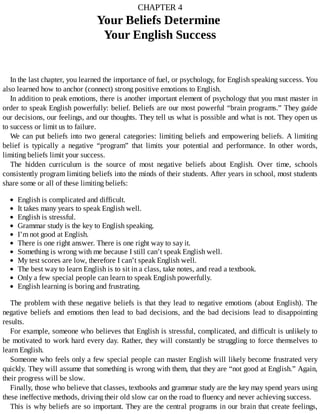
system.	Imagine	that	you	are	on	a	road.	You	are	driving	on	the	road	to	English	fluency.
What	kind	of	car	would	you	want?	Let’s	say	all	you	have	to	drive	is	an	old	slow	car	that	often	breaks
down.	In	addition,	you	fill	this	old	car	with	cheap	gasoline.	What	kind	of	trip	will	you	have?	How	fast
will	you	go	on	this	road	to	fluency?	Most	likely,	your	trip	will	be	slow	and	frustrating,	with	frequent
breakdowns.	In	fact,	you	probably	will	not	reach	your	destination.
Now,	you	could	put	some	high	quality	gas	in	that	old	car,	but	even	then	it	will	likely	take	you	a	long
time	 to	 reach	 your	 destination.	 Better	 gas	 will	 help	 a	 little,	 but	 the	 trip	 is	 still	 likely	 to	 be	 slow	 and
frustrating.
Now	imagine	instead	that	you’ll	be	driving	a	Formula	1	racing	car	on	this	road	to	fluency.	This	car	is
made	for	speed	and	performance.	Clearly,	it	will	go	faster	than	the	old,	slow	car.	But	what	if	you	fill	it	up
with	cheap,	low	quality	fuel?	There	will	likely	be	problems.	Racing	cars	need	racing	fuel	or	they	will	not
perform	well.
Obviously,	the	best	situation	would	be	to	put	high	quality	racing	fuel	into	your	Formula	1	racing	car!
With	this	car	and	this	fuel,	your	trip	on	the	road	to	fluency	will	be	fast	and	exciting.
This	is	how	learning	English	works.	If	you’ve	been	studying	for	a	while,	you	know	by	now	that	there
are	all	sorts	of	systems.	Traditional	classes	at	universities.	Private	lessons	from	language	schools.	Online
or	 packaged	 software	 courses.	 Immersion	 programs	 that	 put	 you	 in	 the	 country	 where	 they	 speak	 the
language	you’re	studying.	In	other	words,	you’ve	got	a	lot	of	different	cars	to	choose	from.	Some	may	be
better	than	others,	some	may	be	faster.	But	even	the	greatest	of	these	methods,	the	Ferrari	of	language
teaching,	if	you	will,	needs	fuel	to	make	it	work.
A	method,	after	all,	is	only	an	engine.	And	if	you	don’t	give	an	engine	the	proper	fuel,	even	a	great	one
won’t	work	the	way	you’d	like	it	to.	To	succeed,	you	need	both	quality	fuel	and	a	powerful	engine.
	
The	right	engine	+	the	right	fuel	=	success
	
Obviously,	I	believe	the	right	engine	would	be	the	Effortless	English™	system.
What	is	the	fuel?	The	fuel	is	your	psychology.	It	is	the	beliefs,	emotions,	and	goals	that	power	your
learning.	Your	fuel	is	your	motivation,	your	confidence,	your	energy,	your	enthusiasm.
Your	Fuel:	Success	Psychology
If	 your	 psychology	 is	 weak,	 even	 the	 best	 method	 will	 fail.	 In	 other	 words,	 if	 you	 have	 connected
stress,	fear,	nervousness,	and	doubt	to	the	process	of	speaking	English	you	will	have	a	lot	of	problems.
Unfortunately,	this	is	exactly	what	happens	in	most	schools.	The	tests,	the	error	corrections,	and	the	boring
and	ineffective	methods	used	in	schools	combine	to	create	powerful	negative	emotions	in	most	students.
Even	if	you’re	using	my	Effortless	English™	method,	you	must	have	strong	psychology.	Unless	you
bring	the	proper	emotional	energy	to	the	language-learning	process,	it	won’t	be	enough.
The	Effortless	English™	system	is	based	upon	a	success	psychology	system	known	as	Neuro-Linguistic
Programming,	 or	 NLP.	 Developed	 by	 Richard	 Bandler	 and	 John	 Grinder,	 NLP	 is	 focused	 on	 the
psychology	of	success,	high-performance,	and	motivation.	Rather	than	study	mentally	ill	people,	Bandler
and	Grinder	researched	the	psychology	of	the	most	successful	people	in	the	world.	They	then	created	a
psychological	system	designed	to	help	individuals	achieve	the	highest	levels	of	success	and	happiness	in
their	lives.
What	Bandler	and	Grinder	found	was	that	happy,	motivated	and	energetic	people	actually	learn	better.
They	perform	better.	They	achieve	more	success	in	all	aspects	of	their	lives.	The	opposite	is	also	true:	If
you’re	feeling	bored,	stressed,	sad,	frustrated	or	even	tired,	your	brain	actually	functions	more	slowly	and
has	a	harder	time	remembering	information.
Clearly,	it	is	important	to	connect	positive,	rather	than	negative,	emotions	to	the	process	of	learning	and
speaking	English.	The	process	of	connecting	emotions	to	an	experience	or	process	is	called	anchoring.
Anchoring	can	be	positive	or	negative.	For	example,	imagine	that	you	listen	to	a	specific	song	when	you
are	feeling	extremely	happy.	If	the	emotion	is	strong	enough,	a	connection	will	be	formed	between	the
song	and	the	emotion.	And	if	you	are	feeling	very	happy	when	you	hear	the	song	again,	that	connection
will	become	stronger.
Eventually,	you	will	create	a	very	strong	connection	between	the	song	and	the	feeling	of	happiness.	At
that	 point,	 anytime	 you	 hear	 the	 song	 you	 will	 automatically	 find	 yourself	 feeling	 happy.	 That’s	 what
happens	with	your	favorite	songs	and	that’s	great!
However,	this	process	also	works	with	negative	emotions.	Imagine	that	you	have	a	stressful	experience
in	 English	 class.	 Maybe	 the	 teacher	 corrects	 one	 of	 your	 errors	 when	 you	 are	 speaking	 and	 you	 feel
embarrassed.	 Now	 imagine	 that	 you	 continue	 to	 have	 a	 series	 of	 negative	 emotional	 experiences	 in
English	classes.	You	frequently	feel	bored,	nervous	and	stressed	while	learning	and	using	English.
Eventually,	a	strong	connection	forms	between	English	and	the	negative	emotions.	This	is	a	negative
anchor.	Once	this	is	formed,	whenever	you	try	to	use	English	you	will	automatically	begin	to	feel	more
nervous	and	stressed.	This	is	why	many	“advanced”	English	learners	still	have	so	much	trouble	when
trying	to	speak.
Sadly,	most	learners	now	have	powerful	negative	anchors	connected	to	their	English	speaking.	The
good	 news	 is	 that	 negative	 anchors	 can	 be	 broken	 and	 reprogrammed.	 This,	 in	 fact,	 is	 your	 first	 step
towards	speaking	English	powerfully.
Instead	 of	 feeling	 nervous,	 imagine	 if	 you	 suddenly	 and	 automatically	 felt	 powerful	 every	 time	 you
spoke	English?	What	if	you	automatically	felt	more	excited	every	time	you	learned	English?	This	change
alone	would	improve	your	speaking.
Through	 the	 power	 of	 anchoring,	 you	 can	 indeed	 connect	 these	 powerful	 emotions	 to	 English.	 The
secret	to	breaking	a	negative	anchor	and	creating	a	new	positive	one	is	intensity.	The	more	powerful	an
emotion	is	felt	(while	using	English),	the	faster	and	deeper	the	connection.
So,	to	create	a	strong	positive	anchor	for	English	requires	a	few	steps.
First,	you	must	create	a	very	intense	positive	emotion.	Most	people	believe	that	emotions	are	something
that	happen	to	them,	but	in	fact,	we	create	our	emotions.	It	is	possible	to	choose	your	emotions	and	to
create	them	consciously.
For	example,	if	you	wished	to	feel	tired	and	sad	right	now,	what	would	you	do?	Let’s	start	with	your
body.	How	would	you	use	your	body	to	create	a	tired	and	sad	feeling?	Would	you	pull	your	shoulders
back,	or	hunch	them	forward?	Would	you	look	up	or	down?	Would	you	smile	or	frown?	In	fact,	by	simply
changing	your	body	you	would	change	your	feelings.
To	make	yourself	feel	even	worse,	you	would	think	about	sad	and	negative	things.	Perhaps	you	would
think	about	a	big	problem	you	have,	or	about	a	big	regret.	And	what	about	your	voice?	You	could	moan,
cry,	or	whine,	and	that	would	make	you	feel	even	worse.
After	doing	all	of	the	above	for	a	few	minutes,	you	would	genuinely	begin	to	feel	sadder	and	more
tired.	This	is	how	you	consciously	can	create	a	negative	emotion.
Of	course,	this	process	works	for	positive	emotions	too,	and	that	is	good	news!	How	would	you	make
yourself	feel	more	excited	right	now?	Again,	start	with	the	body.	Pull	your	shoulders	back	and	push	your
chest	up	and	out.	Bring	your	head	up	and	look	straight	ahead.	Put	a	big	smile	on	your	face	and	hold	it.
Next,	change	your	thoughts.	Think	about	something	great	in	your	life.	Think	about	the	biggest	success
you	have	ever	had.	Think	about	your	future	success	speaking	English	powerfully.	Smile	bigger.	First	you
are	 just	 pretending,	 but	 eventually	 you	 will	 feel	 stronger	 and	 happier.	 That’s	 because	 your	 emotions
change	when	your	body	changes.	It’s	a	simple	technique.
Of	course,	you	can	feel	even	better	by	using	your	body	even	more.	Instead	of	just	standing	and	smiling,
raise	your	arms	over	your	head.	Then	jump	in	the	air	like	you	are	celebrating	a	big	victory.	And	use	your
voice.	Shout	and	cheer	loudly	as	you	jump	and	smile	and	think	of	wonderful	things.	Go	crazy!	This	is
called	a	“peak	emotional	state,”	an	intensely	powerful	positive	emotion.
	
	
The	final	step,	of	course,	is	to	connect	this	great	feeling	to	English.	So,	still	feeling	great,	immediately
start	listening	to	an	easy	English	audio.	As	you	are	listening,	continue	to	smile	and	move	your	body	in	a
strong,	positive	way.
Each	day,	just	before	you	begin	learning	English,	you	will	create	this	peak	emotion.	As	you	repeat	this
process	every	day,	these	strong,	positive	feelings	will	become	connected	to	English.	Eventually,	every
time	you	hear	or	use	English	you	will	automatically	feel	energized,	positive	and	excited.	You	have	broken
the	old	negative	anchor	and	replaced	it	with	a	new	positive	one.
And	there	is	more	good	news.	Research	has	shown	that	people	who	are	excited	and	energized	while
learning	 actually	 learn	 more	 quickly.	 They	 remember	 more	 and	 they	 remember	 longer.	 They	 perform
better.	In	fact,	you	will	speak	English	better	right	now	simply	by	being	in	a	peak	emotional	state.	Creating
this	positive	anchor	to	English,	therefore,	is	your	first	step	to	faster	travel	on	the	road	to	fluency.
Why	Happy	Students	Learn	More
Dr.	Stephen	Krashen,	a	linguist	at	the	University	of	Southern	California	and	one	of	the	top	researchers	on
second	language	learning,	believes	negative	emotions	act	as	a	filter,	reducing	the	amount	of	new	language
input	 you’re	 able	 to	 learn.	 As	 a	 result,	 students	 who	 feel	 bad,	 anxious	 or	 worried	 remember	 less
vocabulary	and	don’t	speak	as	well.	Essentially,	they	learn	more	slowly.
The	 best	 way	 to	 counter	 this,	 Krashen	 says,	 is	 by	 keeping	 students	 interested,	 reducing	 stress	 in
classrooms	and	boosting	learners’	self-confidence.
In	 one	 study,	 researchers	 found	 that	 when	 they	 compared	 the	 performance	 of	 students	 who	 were
energized	and	enjoying	themselves	in	class	with	the	performance	of	students	who	were	just	being	drilled
in	material,	the	energized	students	did	better.	The	same	was	true	when	they	tested	these	students	again	at
three	months	and	later	at	six	months.
I	see	the	same	thing	in	our	Effortless	English	Club™	community.	When	you	look	at	our	most	successful
members,	you’ll	find	a	common	factor.	They	are	all	extremely	enthusiastic.	They	have	a	lot	of	energy.
They’re	very,	very	positive.	They	have	very	strong	positive	emotions.	When	you	use	peak	emotions	you
can	speak	better	–	right	now.
Therefore,	each	and	every	time	you	study	English,	create	a	peak	emotional	state.	Change	your	body	and
your	 mental	 focus	 in	 order	 to	 create	 excitement	 and	 positive	 energy.	 Build	 a	 strong	 anchor,	 a	 strong
connection,	between	English	and	your	most	positive	emotions.	Heal	your	English	trauma.
CHAPTER	4
Your	Beliefs	Determine	
Your	English	Success
In	the	last	chapter,	you	learned	the	importance	of	fuel,	or	psychology,	for	English	speaking	success.	You
also	learned	how	to	anchor	(connect)	strong	positive	emotions	to	English.
In	addition	to	peak	emotions,	there	is	another	important	element	of	psychology	that	you	must	master	in
order	to	speak	English	powerfully:	belief.	Beliefs	are	our	most	powerful	“brain	programs.”	They	guide
our	decisions,	our	feelings,	and	our	thoughts.	They	tell	us	what	is	possible	and	what	is	not.	They	open	us
to	success	or	limit	us	to	failure.
We	can	put	beliefs	into	two	general	categories:	limiting	beliefs	and	empowering	beliefs.	A	limiting
belief	 is	 typically	 a	 negative	 “program”	 that	 limits	 your	 potential	 and	 performance.	 In	 other	 words,
limiting	beliefs	limit	your	success.
The	 hidden	 curriculum	 is	 the	 source	 of	 most	 negative	 beliefs	 about	 English.	 Over	 time,	 schools
consistently	program	limiting	beliefs	into	the	minds	of	their	students.	After	years	in	school,	most	students
share	some	or	all	of	these	limiting	beliefs:
English	is	complicated	and	difficult.
It	takes	many	years	to	speak	English	well.
English	is	stressful.
Grammar	study	is	the	key	to	English	speaking.
I’m	not	good	at	English.
There	is	one	right	answer.	There	is	one	right	way	to	say	it.
Something	is	wrong	with	me	because	I	still	can’t	speak	English	well.
My	test	scores	are	low,	therefore	I	can’t	speak	English	well.
The	best	way	to	learn	English	is	to	sit	in	a	class,	take	notes,	and	read	a	textbook.
Only	a	few	special	people	can	learn	to	speak	English	powerfully.
English	learning	is	boring	and	frustrating.
The	problem	with	these	negative	beliefs	is	that	they	lead	to	negative	emotions	(about	English).	The
negative	beliefs	and	emotions	then	lead	to	bad	decisions,	and	the	bad	decisions	lead	to	disappointing
results.
For	example,	someone	who	believes	that	English	is	stressful,	complicated,	and	difficult	is	unlikely	to
be	motivated	to	work	hard	every	day.	Rather,	they	will	constantly	be	struggling	to	force	themselves	to
learn	English.
Someone	who	feels	only	a	few	special	people	can	master	English	will	likely	become	frustrated	very
quickly.	They	will	assume	that	something	is	wrong	with	them,	that	they	are	“not	good	at	English.”	Again,
their	progress	will	be	slow.
Finally,	those	who	believe	that	classes,	textbooks	and	grammar	study	are	the	key	may	spend	years	using
these	ineffective	methods,	driving	their	old	slow	car	on	the	road	to	fluency	and	never	achieving	success.
This	is	why	beliefs	are	so	important.	They	are	the	central	programs	in	our	brain	that	create	feelings,
decisions	and	actions.	Beliefs	are	what	make	the	difference	between	ultimate	success	or	a	lifetime	of
frustration	with	English.
Beliefs	tell	you	what	an	experience	means.	Whenever	you	have	an	English	language	experience,	your
brain	must	decide	the	meaning	of	what	happened.	In	other	words,	your	brain	generalizes	the	experience.
Your	brain	decides	what	the	event	means	to	your	life	as	a	whole.	And	with	each	negative	experience,	the
belief	can	grow	stronger	and	stronger.	Eventually	you	become	completely	certain	about	the	belief.
For	 example,	 maybe	 you	 were	 repeatedly	 corrected	 by	 an	 English	 teacher.	 After	 each	 of	 these
embarrassing	experiences,	your	brain	had	to	decide	the	meaning	of	what	happened.	Based	on	these	events,
maybe	 you	 decided	 that	 you	 were	 bad	 at	 English.	 Maybe	 you	 decided	 that	 English	 was	 painful	 and
stressful.	Each	negative	experience	made	the	belief	stronger.
The	 problem	 is	 that	 these	 beliefs	 then	 affected	 all	 of	 your	 English	 experiences	 that	 followed.	 So
whenever	you	had	another	encounter	with	English,	it	was	always	with	these	negative	limiting	beliefs.
Because	of	this,	you	automatically	viewed	every	new	experience	with	English	more	negatively.	If	your
beliefs	 are	 strongly	 negative	 and	 you	 don’t	 change	 them,	 you	 can	 completely	 destroy	 your	 ability	 to
succeed	as	an	English	speaker.	Many	English	learners	completely	lose	hope	and	simply	quit,	never	to
succeed.
You	must,	therefore,	replace	your	limiting	beliefs	with	strong	empowering	ones.	“Empowering”	means
“giving	power.”	So	an	empowering	belief	is	one	that	gives	you	power!
What	kind	of	empowering	beliefs	do	you	need	for	English	speaking	success?
Here	is	a	sample	list:
English	is	easy,	fun	and	exciting.
I	can	speak	English	fluently	in	about	six	months.
Mistakes	are	normal	and	necessary.	Even	native	speakers	make	mistakes.
Communication,	not	a	test	score,	is	the	purpose	of	English	speaking.
Grammar	study	kills	English	speaking.
Anyone	can	learn	to	speak	English	powerfully.
There’s	nothing	wrong	with	me,	I’ve	just	been	using	a	bad	method	and	I	can	change	that.
I’m	sure	you	can	see	how	much	stronger	these	beliefs	are.	You	can	see	that	these	beliefs	are	more	likely
to	create	success	than	the	limiting	ones.	You	can	probably	imagine	the	greater	feelings	of	confidence	and
excitement	that	these	beliefs	create.	But	how	do	you	create	these	beliefs?	Clearly	the	empowering	beliefs
are	more	desirable,	but	how	do	you	truly	re-program	your	mind?
One	 powerful	 method	 for	 changing	 beliefs	 is	 called	 modeling.	 Modeling	 simply	 means	 to	 find	 a
successful	person	and	study	them	carefully.	If	you	want	to	speak	English	powerfully,	for	example,	you	find
another	person	who	has	learned	to	do	it.	You	learn	about	them.	You	learn	what	they	did	and	how	they	did
it.	If	possible,	you	talk	to	them	and	learn	about	their	psychology	and	their	methods.	Finally,	of	course,	you
do	your	best	to	do	exactly	what	they	did.
The	more	you	model	successful	people,	the	more	your	beliefs	will	change	automatically.	By	focusing
on	success	instead	of	failure,	you	gradually	re-program	your	brain.	This	is	why	I	created	the	Effortless
English	Club™.	In	our	community,	the	most	successful	members	guide	and	advise	newer	members.	While
I	 hope	 this	 book	 will	 help	 to	 change	 your	 beliefs,	 there	 is	 nothing	 more	 powerful	 than	 hearing	 from
another	person,	just	like	you,	who	achieved	success.
Your	job	now	is	to	find	successful	English	speakers	and	model	them.	You	might	find	them	in	your	town.
You	will	certainly	find	them	online.	When	you	do	find	them,	ask	them	about	their	beliefs	and	methods.
Study	 their	 psychology	 and	 their	 success.	 This	 is	 exactly	 what	 I	 did	 when	 I	 developed	 the	 Effortless
English™	 system.	 I	 studied	 the	 most	 successful	 English	 learners.	 I	 interviewed	 them.	 I	 studied	 their
emotions,	their	beliefs,	their	goals,	and	their	learning	methods.	That	is	how	I	created	a	system	based	on
success,	not	failure.
Remember,	beliefs	are	created	by	the	meaning	we	attach	to	experiences.	The	more	you	focus	on	and
think	about	negative	experiences,	the	stronger	the	limiting	beliefs	become.	You	can	make	empowering
beliefs	stronger	in	the	same	way.	In	other	words,	you	can	use	“selective	memory”	to	create	and	strengthen
your	positive	beliefs.
How	do	you	do	this?	Simply	by	reviewing	all	of	your	past	experiences	with	English.	As	you	remember
all	of	your	past	experiences,	search	your	memory	for	any	that	were	positive.	Maybe	you	remember	a	fun
activity.	 Maybe	 you	 enjoyed	 reading	 a	 short	 story	 in	 English.	 When	 you	 remember	 these	 positive
experiences,	 write	 them	 down.	 Create	 a	 list	 of	 all	 the	 positive	 experiences	 you	 have	 ever	 had	 with
English.
Most	people	can	identify	at	least	a	few	such	experiences.	The	next	step	is	to	focus	your	attention	on
these	 memories	 every	 day.	 Each	 day,	 review	 your	 list	 of	 positive	 English	 memories.	 Remember	 each
experience.	See	each	one	in	your	mind	and	feel	those	positive	feelings	again.
Then	write	down	a	new	empowering	belief	about	English.	You	might	write	“English	is	easy	and	fun.”
You	might	write	“I	enjoy	learning	English	and	I’m	good	at	it.”	Write	this	belief	at	the	top	of	your	list	and
also	review	it	each	day.
And	of	course,	every	time	you	have	a	new	positive	experience	with	English,	add	it	to	your	list.	Your
list	will	grow	longer	and	longer.	And	as	it	grows,	your	empowering	beliefs	will	get	stronger	and	stronger.
We	 all	 know	 the	 computer	 programming	 term	 “garbage	 in,	 garbage	 out.”	 Beliefs	 are	 our	 brain
programs.	 Garbage	 (negative	 limiting)	 beliefs	 create	 negative	 emotions,	 bad	 decisions,	 and	 low
motivation.	These,	in	turn,	create	“garbage	out”	–	terrible	results.	Those	bad	results	then	create	new	and
stronger	 negative	 beliefs,	 and	 the	 whole	 cycle	 starts	 again,	 even	 worse.	 This	 is	 called	 a	 “downward
spiral.”
Positive	beliefs,	on	the	other	hand,	create	an	upward	spiral.	Empowering	beliefs	create	more	positive
emotions,	better	decisions,	and	better	motivation.	These,	in	turn,	create	better	results.	Better	results	then
create	even	stronger	empowering	beliefs.	The	whole	cycle	repeats	again	and	again,	getting	stronger	each
time.	This	upward	spiral	is	the	key	to	rapid	success	with	English.
CHAPTER	5
English	Is	A	Physical	Sport
One	of	the	greatest	errors	of	the	hidden	curriculum	is	that	schools	teach	English	as	an	academic	subject.
In	school	you	study	English.	You	learn	about	English.	You	analyze	the	parts	of	the	language	(grammar,
vocabulary,	etc.).	You	take	tests	about	this	knowledge.
The	problem	is,	English	is	not	a	subject	to	be	studied.	English	is	a	skill	to	be	performed	or	“played.”
Speaking	 is	 something	 you	 do,	 not	 something	 you	 analyze	 and	 think	 about.	 Perhaps	 you	 can	 see	 the
problem.
Real	English	conversations	are	very	fast	and	they	are	unpredictable.	The	other	person	speaks	quickly
and	 you	 never	 know	 exactly	 what	 they	 will	 say.	 You	 must	 be	 able	 to	 listen,	 understand,	 and	 respond
almost	instantly.	There	simply	is	no	time	to	think	about	grammar,	translations,	or	anything	else	you	learned
in	English	class.
English	conversation	is	more	like	playing	soccer	(football).	A	soccer	player	must	act	and	react	almost
instantly.	The	player	must	play	the	game	intuitively.	Soccer	players	do	not	study	physics	formulas	in	order
to	play	well.	They	learn	by	doing.	They	“play”	soccer,	they	don’t	“study”	it.
Studying	grammar	rules	to	speak	English	is	much	like	a	soccer	player	studying	physics	to	play	soccer.	It
might	 be	 interesting	 (or	 not!),	 but	 it	 certainly	 won’t	 help	 performance.	 Your	 job,	 therefore,	 is	 to	 stop
“studying”	English	and	start	“playing”	it!
Remember	 that	 your	 fuel	 is	 an	 important	 part,	 perhaps	 the	 most	 important	 part,	 of	 your	 Effortless
English™	 engine.	 Learning	 to	 play	 English,	 rather	 than	 study	 it,	 is	 a	 powerful	 way	 to	 develop	 strong
psychology	and	go	much	faster	on	the	road	to	fluency.
When	we	first	discussed	fuel,	we	learned	how	to	use	our	bodies	to	change	our	emotions.	It	turns	out	the
body	is,	in	fact,	a	very	important	(and	neglected)	key	to	learning	English.	By	using	physical	actions	while
learning,	it	is	possible	to	learn	faster,	remember	more,	remember	longer	and	speak	better.
Dr.	James	Asher,	a	psychologist	and	professor	emeritus	at	San	José	State	University,	found	that	using
physical	 actions	 in	 language	 class	 actually	 helps	 students	 learn	 vocabulary	 better.	 Dr.	 Asher	 became
curious	 about	 the	 link	 between	 language	 and	 movement	 after	 watching	 how	 young	 children	 learned	 to
speak.	He	noticed	that	when	parents	said	something,	their	children	typically	would	respond	with	a	word
and	some	sort	of	action.	He	also	noticed	that	parents	frequently	used	actions	and	gestures	while	speaking
to	their	babies.
Based	 on	 his	 research	 and	 observations,	 Asher	 developed	 the	 Total	 Physical	 Response	 system	 of
language	teaching	in	which	students	respond	to	teacher	commands	in	the	new	language	with	whole	body
actions.	These	actions	strengthen	the	meaning	of	the	phrase	and	make	it	easier	to	remember.	Dr.	Asher
believes	that	students	can	learn	12	to	36	words	in	an	hour	using	this	method.	I’ve	had	similar	success
using	a	version	of	it	in	my	lessons	and	seminars.
Of	course,	this	is	the	complete	opposite	of	what	happens	in	most	English	classes.	In	school,	you	are
told	to	sit	still	in	your	chair.	You	sit	for	an	hour	or	more.	Naturally,	the	longer	you	sit,	the	more	your
energy	drops.	As	your	energy	drops,	your	concentration	drops,	too.	And	as	your	concentration	drops,	you
learn	less	and	forget	more.	Of	course,	this	lower	energy	frequently	leads	to	feelings	of	boredom.	Less
movement,	 less	 energy,	 lower	 concentration,	 and	 boredom	 naturally	 produce	 worse	 results,	 no	 matter
what	the	method	is,	and	so	we	have	another	downward	spiral.
While	 everyone	 benefits	 from	 physical	 learning,	 some	 people	 absolutely	 need	 it.	 These	 people	 are
called	“kinesthetic	learners.”	They	learn	best	when	they	connect	learning	to	physical	movement.	This	kind
of	learner	tends	to	struggle	in	traditional	classrooms,	where	they	are	required	to	sit	motionless	for	hours.
Schools	and	teachers	often	label	these	people	as	being	“learning	disabled”	or	as	having	“attention	deficit
disorder.”
The	problem,	however,	is	not	that	“kinesthetic	learners”	are	disabled.	Rather,	the	problem	is	a	teaching
disability	—	the	failure	of	schools	to	teach	active	learners	in	an	effective	way.
My	 Effortless	 English™	 seminars	 and	 classes	 are	 quite	 different.	 Many	 have	 described	 them	 as
“English	rock	concerts.”	In	an	Effortless	English™	seminar,	we	frequently	jump,	dance,	shout,	laugh,	and
move.	In	fact,	it	is	rare	for	learners	to	sit	for	more	than	15	minutes	in	one	of	my	seminars.	I	want	them
moving.	I	want	them	energized.	Because	I	know	that	active	and	energized	people	learn	faster,	learn	more,
remember	longer	and	perform	better!
Remember,	English	is	a	performance	skill,	not	a	subject	you	study.	The	more	you	use	your	body	while
learning,	the	more	success	you	will	achieve.	One	way	to	use	movement	while	learning	English	is	to	use
the	 Action	 Vocabulary	 method.	 In	 this	 method,	 you	 connect	 a	 unique	 physical	 movement	 to	 a	 new
vocabulary	 word.	 You	 shout	 the	 word	 (or	 phrase)	 and	 perform	 the	 movement.	 The	 movement	 should
remind	you	of	the	meaning	of	the	word.
By	 doing	 this	 repeatedly,	 you	 connect	 the	 word,	 its	 meaning,	 and	 the	 unique	 physical	 action.	 This
combination	creates	a	stronger	and	deeper	memory,	resulting	in	faster	and	deeper	vocabulary	learning.
This	is	far	more	effective	than	simply	trying	to	memorize	long	lists	of	words.
Another	simple	way	to	use	your	body	is	to	walk	while	learning	English.	With	a	smart	phone	you	can
make	your	learning	mobile!	Instead	of	sitting	on	your	butt,	slowly	losing	energy,	put	on	your	headphones
and	go	for	a	walk	while	listening	to	English.	As	you	walk,	your	heart	will	pump	and	your	brain	will	get
more	blood.	You’ll	feel	more	energy	and	thus	you	will	concentrate	better.	You’ll	probably	enjoy	learning
more,	too.
There	is	no	reason	to	be	limited	by	the	old	school	methods.	You	do	not	need	to	sit	motionless	in	a	chair
while	 you	 learn.	 You	 do	 not	 need	 to	 remain	 silent.	 You	 do	 not	 need	 to	 be	 bored	 and	 tired.	 As	 an
independent	learner,	you	are	free	to	learn	in	the	way	that	is	most	effective	and	most	enjoyable	for	you.
You	are	the	master	of	your	own	learning.	Enjoy	it!
Remember	 the	 peak	 emotion	 exercise	 you	 learned?	 This	 is	 another	 excellent	 way	 to	 use	 your	 body
while	learning	English.	Take	a	short	“energy	break.”	Play	your	favorite	energetic	music.	Jump,	shout,
smile,	cheer	and	dance	for	a	couple	of	minutes.	Fully	energize	your	body	and	create	peak	emotions.	Then
continue	learning	English.	Take	these	energy	breaks	every	20-30	minutes	every	time	you	learn	English.	I
guarantee	you	will	get	better	results.
Watch	children	when	they	are	playing.	They	are	happy,	energetic	and	active.	Children	learn	best	while
playing.	They	bring	an	attitude	of	play	to	everything	they	do.	Small	children	don’t	need	much	effort	or
discipline.	They	are	energized	by	curiosity.	They	learn	actively.	They	learn	by	playing	and	play	while
learning.
It	is	time	for	you	to	rediscover	these	natural	qualities.	As	an	adult,	you	still	learn	best	in	this	way.	You,
too,	benefit	from	being	active	and	energized	while	learning.	You,	too,	benefit	from	physical	movement	and
an	attitude	of	play.	As	you	use	the	techniques	and	methods	in	this	book,	always	do	so	with	a	fun	and
playful	attitude!
There	 are	 two	 major	 parts	 to	 the	 Effortless	 English™	 system:	 the	 psychology	 and	 the	 method.	 You
know	that	psychology	is	the	fuel	that	makes	the	engine	go.	You	must	develop	that	fuel	to	create	higher	and
higher	energy	for	learning.	You	have	learned	how	to	use	peak	emotion	anchoring,	beliefs,	and	physical
movement	to	create	that	fuel.	You	have	learned	the	importance	of	an	active,	playful	attitude.
In	the	next	chapter,	you	will	learn	another	psychological	technique	for	creating	the	most	powerful	fuel
possible	for	English	learning.
(See	below)
	
ACTION	VOCABULARY
So	many	students	waste	time	trying	to	memorize	English	vocabulary.		They	study	long	lists	of	words.	
They	repeat	the	lists	many	times,	trying	to	memorize	the	English	words	and	their	translated	meanings.
Unfortunately,	research	shows	that	80%	of	vocabulary	learned	in	this	way	is	forgotten	in	less	than	a
year.		That’s	a	lot	of	wasted	time	and	effort.
There’s	another	problem	with	this	vocabulary	learning	method	—	it’s	boring,	and	it	kills	long-term
motivation.		As	a	student,	you	must	be	very	careful—	killing	your	motivation	is	the	worst	thing	you	can
do.		Learning	English	is	a	marathon,	it’s	a	long	run.			It	requires	high	levels	of	motivation	that	are
sustained	for	many	years.
Using	boring	vocabulary	learning	methods,	therefore,	is	doubly	bad:		it	is	inefficient	and	it	weakens
motivation.
There	is	a	better	way,	as	participants	in	my	breakthrough	seminars	have	found	out.		It	is	possible	to
learn	new	vocabulary	in	a	way	that	is	far	more	powerful	AND	is	a	lot	of	fun.		When	you	learn	in	this
way,	studies	show	that	you	can	remember	80%	one	year	later!		That’s	powerful.
The	key	to	deep,	powerful,	long	term	vocabulary	learning	is	movement.		When	you	combine	strong
physical	movements	with	understandable	new	vocabulary,	you	create	deep	connections	in	your	 brain
and	body.		These	connections	are	long	term.		They	last!	The	key	is	to	use	a	movement	that	reminds	you
of	the	meaning	of	the	vocabulary.
For	example,	imagine	you	want	to	learn	the	phrase	“to	proclaim.”	First	you	would	find	the	meaning
of	the	word,	which	is	“to	say	or	announce	publicly,	often	in	a	loud	way.”	After	you	know	the	meaning,
you	create	an	action	that	reminds	you	of	it.	You	might	put	your	hands	to	your	mouth	and	pretend	you	are
yelling	loudly	(“to	say	publicly	and	loudly”).	Finally,	you	would	shout	the	phrase	“to	proclaim”	as	you
did	the	gesture	at	the	same	time.
The	more	loudly	you	shout	and	the	more	energetically	you	do	the	gesture,	the	stronger	the	connection
you	 make	 in	 your	 brain.	 By	 simply	 shouting	 the	 phrase	 and	 doing	 the	 movement	 vigorously	 several
times,	you	will	create	a	stronger	and	deeper	memory	of	the	meaning.
In	a	recent	seminar	I	did	in	Vietnam,	I	taught	a	number	of	new	words	using	this	action	vocabulary
method.		The	students	shouted	the	new	words	with	me,	while	simultaneously	using	the	strong	actions	I
showed	them.		Each	action	was	connected	to	the	meaning	of	the	new	word	or	phrase.	By	the	end	of	the
lesson,	they	knew	those	words	completely,	never	to	forget	them.
But	that’s	not	all.		Since	Effortless	English™	is	a	deep	learning	system,	I	repeated	those	new	words
again	—	this	time	in	a	story	lesson.		Each	time	I	used	one	of	the	new	words	in	the	story,	I	asked	the
students	to	use	the	same	strong	gesture	we	had	practiced.		Through	the	Mini-Story	lesson,	the	students
got	even	more	repetition	of	the	vocabulary,	with	emotion	and	strong	actions.
Finally,	I	gave	the	students	homework:		download	the	audio	of	the	same	Mini-Story	lesson,	and	listen
to	that	audio	every	day	for	one	week.	If	students	do	this,	they	will	learn	these	new	vocabulary	words
very	deeply,	and	will	remember	them	forever.		That	is	the	power	of	the	Effortless	English™	system,	and
that	is	the	power	of	using	physical	movement	while	learning!
	
EIGHT	SIMPLE	STEPS	TO	CHANGING	YOUR	EMOTIONS
1.	Find	some	exciting,	energetic	music	that	you	LOVE.
2.	Before	you	start	listening	to	your	English	lesson,	play	the	music.
3.	As	this	exciting	music	plays,	raise	your	head.	Look	up.	Change	your	body.
Pull	your	shoulders	back.	Stand	tall.	Then	smile…	smile	a	big	smile.
Take	deep	breaths.
4.	Next,	move	your	body.	Dance	with	the	music.	Keep	looking	up.	Keep	smiling.	Jump	and	dance.	Lift	your	arms	over	your	head	as	you
jump	and	dance	and	smile.	Feel	the	happiness	and	energy	from	the	music.
5.	Stop	and	say	loudly,	“Yes!”	Say	it	again,	“Yes!”	One	more	time,	“Yes!”
6.	Now	play	your	English	lesson.	As	you	listen,	keep	your	shoulders	back.	Keep	your	eyes	up.	Keep	smiling.	In	fact,	stand	up	and	keep
moving.	Walk	and	breathe	deeply	as	you	listen	to	the	lesson.
7.	When	you	listen	to	my	Mini-Story	lessons,	answer	each	question	loudly.	Don’t	be	shy.	Shout	your	answer!	Keep	your	head	and	eyes	up.
Keep	a	big	smile	on	your	face	as	you	answer	with	a	loud	voice.
8.	If	you	begin	to	feel	tired	or	bored	at	any	time,	pause	the	lesson.	Play	your	favorite	music	again	and	repeat	all	of	these	steps.	Add	more
energy	to	your	body	and	your	emotions.	Then	play	the	lesson	again.
By	managing	your	emotions	in	this	way,	you	will	study	longer,	you	will	remember	more,	and	you	will	learn	2-4	times	faster.	You’ll	also	teach
yourself	to	be	strong	and	confident	when	you	speak	English.
CHAPTER	6
Use	Big	Real	World	Goals	To	
Motivate	Yourself	For	Success
Why,	exactly,	are	you	learning	English?	Why	do	you	want	to	speak	English	powerfully?	Surprisingly,
many	people	have	only	a	vague	idea.	They	know	that	English	is	the	“international	language”	and	they	feel
they	should	learn	it.	In	school,	they	are	told	that	English	is	important.	Some	people	are	focused	on	tests
scores.	They	are	studying	English	in	order	to	get	a	high	score	on	the	TOEFL,	TOEIC,	IELTS	or	other
exam.
Where	do	these	goals	come	from?	Typically,	they	come	from	the	school	system.	In	other	words,	they
are	external	goals	that	are	promoted	by	other	people.	Students	are	told	these	goals	are	important	and	thus
spend	 years	 focusing	 on	 test	 scores.	 The	 problem	 is	 that	 external	 goals	 (goals	 provided	 by	 outside
people)	feel	like	work.	These	goals	feel	like	an	obligation.
These	goals	are	weak	and	uninspiring,	and	that’s	a	problem	because	goals	are	our	brain’s	targeting
system.	Goals	tell	our	brains	what	we	want,	when	we	want	it,	and	why	we	want	it.	A	powerful	goal
energizes,	inspires	and	motivates	us	to	do	more	and	be	more.	A	great	goal	can	totally	change	your	life.
Weak	goals,	on	the	other	hand,	produce	weak	results.
Another	step	in	developing	your	Effortless	English™	fuel	is,	therefore,	to	develop	stronger	goals.	But
what	makes	a	strong	goal?	A	strong	goal	is	one	that	creates	a	positive	obsession	in	your	mind.	A	strong
goal	is	emotional.	A	strong	goal	not	only	motivates	you,	it	seems	to	pull	you	towards	action	and	success.
A	great	goal	is	like	a	positive	addiction.	The	goal	keeps	you	focused	on	what	is	important	in	your	life.
You	can’t	forget	about	it.	In	fact,	with	a	truly	powerful	goal,	you	will	find	it	difficult	to	stop	thinking	about
it.	This	goal	guides	you	and	motivates	you	even	through	difficult	times.
To	be	powerful,	a	goal	must	be	intensely	emotional	in	a	positive	way.	This	is	why	test	score	goals	are
so	weak.	Who	gets	excited	and	inspired	by	tests?	In	fact,	for	most	people,	tests	are	negative	experiences
that	produce	feelings	of	nervousness,	fear	and	stress.	That’s	not	very	energizing	or	inspiring.	No	wonder
so	many	people	feel	bad	about	English.
So	how	do	you	find	and	create	truly	powerful	goals?	Begin	by	asking	yourself	power	questions.	These
are	questions	that	help	you	find	your	deeper	reason	for	speaking	English.	As	you	go	deeper,	you	will	find
more	inspiring	goals.	And	the	best	power	question	of	all	is	simply,	“why?”
Repeatedly	asking	why	is	an	easy	way	to	find	your	deeper	purpose	for	English.	For	example,	you	might
first	 ask	 yourself,	 “Why	 am	 I	 learning	 English?”	 Maybe	 your	 first	 answer	 is,	 “To	 get	 a	 high	 TOEFL
score.”	That’s	a	weak	external	goal.	So	you	ask	yourself	again,	“Why	do	I	want	a	high	TOEFL	score?”
Maybe	you	answer,	“To	get	a	better	job.”	Again	you	ask,	“Why	do	I	want	a	better	job?”	Now	you	are
going	deeper,	finding	your	true	purpose.	Maybe	you	answer,	“To	make	more	money	for	my	family.”	And
then	you	ask,	“Why	do	I	want	to	make	more	money	for	my	family?”	And	you	might	answer,	“Because	I
love	them	and	want	to	provide	an	abundant	and	wonderful	life	for	them.”	You	have	found	your	big	internal
goal.
Your	big	goal	is	not	to	get	a	high	TOEFL	score,	your	true	goal	is	to	create	a	wonderful	life	for	your
family.	English	is	a	tool	to	help	you	with	that	goal.	Isn’t	that	more	powerful	and	emotional?	Doesn’t	that
excite	and	inspire	you	more?	Doesn’t	that	create	much	more	fuel	for	your	engine?
Of	course,	everyone	is	different.	Maybe	your	big	goal	is	to	travel	the	world	and	live	a	life	of	adventure
–	and	you	know	that	English	is	the	international	language.	Maybe	you	dream	of	being	a	rich	and	successful
international	businessperson,	and	English	will	help	you	achieve	that	dream.	Maybe	you	dream	of	studying
abroad	at	an	American	university.	Maybe	you	want	to	make	international	friends	from	many	countries
around	the	world.	Maybe	you	have	more	than	one	big	goal	for	English.
The	point	is	that	English	is	a	tool	for	communication.	Just	knowing	a	lot	of	words	and	grammar	is
useless.	You	must	use	the	language	to	unleash	its	power.	So	the	key	to	finding	your	big	goal	is	to	figure	out
how	you	want	to	use	English	in	the	real	world.
With	English,	you	must	focus	on	your	real	world	reasons	for	speaking	the	language.
Goals	must	excite	you.	You	should	feel	enthusiastic	and	energized	just	thinking	about	your	goals.
Even	though	I’m	writing	on	this	topic,	I	too	have	sometimes	been	guilty	of	having	weak	goals.	For
example,	I	recently	did	a	series	of	seminars	and	presentations	in	Thailand.	My	initial	goals	were:
To	teach	people	about	the	Effortless	English™	system.
To	connect	with	more	people.
Now	these	were	certainly	positive	goals	–	but	they	had	no	power.	They	didn’t	excite	me.	They	didn’t
create	 passion.	 So	 I	 thought	 more	 deeply.	 I	 asked	 myself,	 “Why	 do	 I	 want	 to	 teach	 people	 about	 the
Effortless	English™	system?	Why	do	I	want	to	connect	with	more	people?	What	do	I	want	to	contribute?
What	do	I	want	to	accomplish?”
Better	goals	instantly	came	to	my	mind,	including:
I	want	to	inspire	people	and	change	their	lives!
I	want	to	awaken	people’s	passion	and	love	of	learning.
I	want	to	awaken	their	imaginations!
I	want	to	heal	their	English	trauma!
I	want	to	totally	change	the	way	people	learn	English.
I	want	to	help	people	achieve	their	dreams	using	English	as	a	tool!
I	want	to	build	an	international	family	of	super	enthusiastic	learners!
I	want	to	give	people	incredibly	positive	&	powerful	emotional	experiences!
I	want	to	give	them	happiness,	laughter,	passion,	and	powerful	confidence.
I	want	to	free	people	from	doubt,	from	insecurity,	from	boredom,	from	hesitancy.
I	want	to	help	them	achieve	their	dreams!
Now	these	were	exciting	goals!	These	goals	immediately	gave	me	energy	and	power.	They	made	me
want	to	jump	out	of	bed	and	get	to	work!	They	made	me	want	to	do	a	fantastic	job	as	a	teacher.	They
inspired	me	to	learn	and	grow	better	and	better.	They	made	me	want	to	create	an	amazing	demonstration	–
not	just	some	boring	lecture.
Such	is	the	power	of	big	and	meaningful	goals.	Why	do	you	want	to	learn	English?	What	is	the	most
exciting	outcome	you	can	imagine	speaking	English	will	bring	you?	What	truly	inspires	you	about	learning
English?	Think	bigger.	Dream	bigger!
Do	yourself	a	favor:	Choose	big,	audacious,	powerful	goals	for	learning	English.	Ignite	your	passion!
CHAPTER	7
Program	Your	Brain	For	English	Success
While	teaching	English	at	a	university	in	Thailand,	I	had	a	student	named	Ploy.	On	the	first	day	of	class,
Ploy	sat	in	the	back	row.	During	that	class,	she	did	her	best	to	hide	from	me.	She	hunched	her	shoulders
and	tried	to	disappear	behind	the	student	who	sat	in	front	of	her.	Ploy	remained	silent	during	the	entire
class.
After	class	I	asked	her	to	stay	a	minute.	I	could	see	that	something	was	wrong	and	wanted	to	find	out
how	I	could	help	her.	I	told	her,	“I	noticed	you	were	hiding	during	class,	is	everything	okay?”	She	said,
“I’m	 not	 good	 in	 English.”	 Ploy	 then	 described	 her	 longtime	 frustrations	 with	 English,	 including	 bad
grades,	bad	test	scores,	and	embarrassment.	Because	of	this	history,	she	was	convinced	that	she	had	a
flaw	and	was	“bad	at	English.”
After	talking	with	Ploy,	I	thought	about	her	problem	and	her	beliefs.	I	realized	that	other	students	in	the
class	probably	had	similar	feelings.	Before	I	taught	them	English,	I	knew	I	had	to	find	a	way	to	help	them
reprogram	their	beliefs.	That	week	I	researched	more	psychology	techniques	and	discovered	the	method
of	“mental	movie	programming.”
The	following	week,	I	taught	the	technique	to	the	class	and	continued	to	use	it	throughout	the	semester.
In	just	a	few	weeks,	I	noticed	a	dramatic	difference.	Ploy	grew	more	confident	and	outgoing.	First,	she	sat
in	the	front	row	instead	of	the	back	row.	Then,	she	began	to	participate	in	class.	Her	classmates	likewise
grew	more	confident	week	by	week.	This	experience	showed	me	the	power	of	psychology	and	why	it	is
so	important	to	program	yourself	for	success.
This	 chapter	 is	 the	 final	 step	 to	 reprogramming	 your	 psychology	 for	 English	 success.	 You’ll	 learn
exactly	how	to	program	the	beliefs,	goals	and	peak	emotions	you	need	to	develop	race-car	fuel	for	your
Effortless	English™	engine.
The	problem	for	learners	is	not	a	lack	of	intelligence,	nor	a	lack	of	will	power.	You	are	not	“bad	at
English.”	What	most	people	lack	is	control	over	their	mind	and	emotions.	In	fact,	you	have	all	the	talent,
intelligence	and	power	you	need	to	master	spoken	English	at	the	highest	possible	level.	You	simply	need
to	learn	how	to	control	your	power	and	use	it	to	change	your	emotions,	beliefs,	and	actions	in	an	instant,
exactly	as	you	want.
Like	many	English	learners,	perhaps	you	too	suffer	from	“English	trauma.”	Perhaps	you	hold	limiting
beliefs,	and	feel	frustrated,	nervous	or	stressful	when	trying	to	speak.	You	want	to	feel	confident	and
powerful	when	speaking,	and	to	do	so,	you	must	learn	to	control	your	internal	movies.
Your	internal	movies	are	the	programs	you	use	to	create	feelings,	beliefs	and	goals.	You	create	these
movies	with	your	five	senses:	sight,	hearing,	touch,	taste	and	smell.	Your	memories	and	your	dreams	are
recorded	in	your	mind	as	a	combination	of	these	senses.	These	are	the	ingredients	you	use	to	write	and
direct	your	own	internal	movies.	These	movies	then	create	your	emotions,	thoughts	and	actions.
When	you	want	to	change	the	results	you	get	with	learning	English,	you	want	to	change	two	things:	how
you	 feel	 when	 speaking	 English	 and	 how	 well	 you	 actually	 speak.	 In	 other	 words,	 you	 want	 to	 feel
confident	 while	 speaking	 and	 you	 want	 to	 speak	 skillfully.	 This	 chapter	 is	 about	 how	 to	 change	 your
internal	movies	so	they	program	you	for	both	powerful	feelings	and	skillful	performance	while	speaking.
As	you	think	about	the	movies	you	make	in	your	mind,	realize	that	there	are	two	things	you	can	choose:
What	 is	 in	 your	 movies	 and	 how	 that	 movie	 is	 made.	 If	 you	 frequently	 think	 about	 memories	 of
embarrassment	with	English,	that	will	change	the	way	you	feel.	How	that	memory	is	structured	is	also
important.	For	example,	perhaps	you	remember	a	time	when	you	were	corrected	by	a	teacher	in	class,	and
that	memory	creates	nervousness	about	English.	That	memory	is	a	movie	in	your	mind.	Internally,	you	see
the	event	happening,	you	hear	the	teacher	correcting	you,	and	you	feel	the	embarrassment	(sight,	hearing
and	physical	sensations	are	the	most	common	and	powerful	ingredients	used	in	internal	movies).
For	 most	 people,	 if	 you	 make	 that	 negative	 movie	 larger	 in	 your	 mind,	 the	 bad	 feelings	 will	 get
stronger.	Likewise,	if	you	make	the	teacher’s	voice	louder,	the	bad	feelings	are	likely	to	get	worse.	And
you	could	focus	on	the	sensations	or	feelings	of	embarrassment	and	move	them	faster	in	your	body,	again
making	them	stronger.	By	changing	how	the	movie	is	played	in	your	mind,	you	change	its	power.
These	movie	qualities	are	called	“sub-modalities.”	They	are	the	specific	qualities	of	each	sense	used
in	your	internal	movies.	Each	of	the	senses	has	several	sub-modalities	that	can	be	controlled	and	changed.
Visually,	for	example,	you	can	change	the	colors	of	a	movie,	or	remove	color	completely	to	make	it
black	and	white.	You	can	change	the	size	of	the	images	in	your	mind,	making	them	larger	or	smaller.	If	you
imagine	 the	 movie	 showing	 on	 a	 screen	 inside	 your	 mind,	 you	 can	 change	 the	 distance	 to	 the	 screen,
bringing	it	closer	or	pushing	it	away.	You	can	change	the	brightness	of	a	movie.	You	control	the	movement
of	your	internal	movies	and	can	make	them	fast,	normal,	or	slow	motion.	You	can	change	the	“camera
angle”	of	your	movie,	changing	the	view	of	any	scene.
Internal	 movies	 have	 soundtracks,	 and	 these	 too	 can	 be	 controlled	 and	 changed.	 You	 control	 the
loudness	of	the	sounds	in	your	movie.	You	control	the	rhythm.	You	can	change	the	tone	and	pitch,	making
sounds	higher	or	lower.
And	you	also	control	the	feelings	or	physical	sensations	in	your	movies.	You	control	the	temperature
(colder,	hotter),	the	pressure	(more,	less),	and	the	location	of	sensations.	You	also	control	the	intensity	of
emotions	and	can	make	them	vibrate	faster	or	slower	in	your	body.
Essentially,	 you	 are	 the	 movie	 director	 of	 your	 own	 mind.	 The	 question	 is,	 will	 you	 control	 these
movies	 and	 consciously	 direct	 them,	 or	 will	 you	 let	 them	 control	 you?	 A	 good	 director	 controls	 the
images,	camera	angles,	sounds,	etc.	in	a	movie	to	create	exactly	the	thoughts	and	feelings	he	or	she	wants
the	audience	to	experience.	As	director	of	your	own	mind,	you	can	do	the	same.
You	can,	for	example,	change	your	memory	recordings.	Memories	are	simply	internal	movies	you	have
created	about	an	experience	you	had	in	the	past.	For	most	people,	these	movies	were	created	without
conscious	choice.	The	good	news	is	you	can	re-direct	these	movies	in	order	to	make	them	weaker	or
stronger,	and	change	the	effect	they	have	on	your	life.
Let’s	do	it	now.	Think	of	a	very	happy	memory.	It	can	be	anything,	any	memory	that	makes	you	smile.
Close	your	eyes,	smile,	and	think	of	that	memory	now.	As	you	remember,	notice	the	image	or	movie	in
your	mind.	What	do	you	see?	Then	notice	what	you	hear:	does	your	movie	have	sound?	And	what	about
the	feelings:	how	do	you	feel	in	this	movie?	Where	are	the	feelings	in	your	body?	Do	you	feel	vibrations
in	your	body,	or	feelings	of	tension	or	relaxation?	Just	notice	the	details	of	this	happy	internal	movie.
Now	become	the	director	of	this	memory.	If	you	only	see	a	still	photograph,	make	it	into	a	movie	by
adding	movement.	Then	make	the	image	bigger	in	your	mind,	bring	it	closer	to	you.	As	you	make	it	bigger,
notice	how	your	feelings	change.	For	most	people,	making	the	movie	bigger	increases	the	power	of	the
emotions	(negative	or	positive).	With	a	happy	memory,	you	can	make	it	even	happier	by	making	the	movie
bigger!
Of	 course,	 you	 can	 also	 change	 the	 sound	 and	 the	 feelings.	 Try	 making	 the	 sounds	 a	 bit	 louder,
especially	the	pleasant	sounds.	When	you	notice	the	good	feelings,	locate	where	they	are	in	your	body	and
how	they	are	moving.	Feelings	are	physical	and	are	usually	experienced	as	a	vibration	or	energy	in	the
body.	Make	that	happy	vibration	faster,	and	have	it	move	through	your	body	more.	For	most,	this	will	also
increase	the	feeling	of	happiness.
Congratulations,	you	just	directed	your	first	internal	movie.	You	learned	how	to	increase	feelings	of
happiness	by	becoming	a	better	director.	You	can	use	this	same	skill	with	negative	memories,	thoughts	and
beliefs.	Let’s	try	it.
Remember	a	negative	experience	with	English.	Perhaps	it’s	a	bad	experience	from	school,	or	a	time
when	you	felt	nervous,	frustrated,	bored	or	foolish	trying	to	speak	English.	As	you	remember	this	bad
experience,	again	notice	the	details	of	your	internal	movie.	See	the	memory	in	your	mind.	Notice	if	this
movie	has	sound,	and	notice	how	you	feel	in	the	movie.
First,	bring	this	negative	movie	screen	closer	to	you,	making	it	bigger.	Make	the	sounds	louder	and
vibrate	the	feelings	faster.	Most	people	will	feel	worse	by	doing	this.	That’s	not	what	you	want.	So	now
do	the	opposite.	Push	the	movie	screen	farther	away,	making	the	movie	smaller.	Then	make	the	movie
darker	and	harder	to	see	in	your	mind.	Imagine	this	movie	screen	has	a	button	that	controls	volume.	Grab
that	button	and	turn	it	down,	making	the	sounds	quieter.	In	fact,	turn	off	the	sound	completely.	Finally,	take
a	deep	breath	and	calm	your	feelings.
By	 doing	 all	 of	 these	 things,	 you’ll	 notice	 that	 the	 negative	 feelings	 are	 much	 weaker,	 or	 gone
completely.	You	have	taken	an	unhappy	memory	and	made	it	powerless	by	consciously	directing	your
mind.	Most	people	believe	that	memories	are	unchangeable,	but	you	have	just	proven	that	you	are,	in	fact,
in	control	of	your	memories.	The	same	is	true	of	your	thoughts.
You	have	a	choice.	You	can	be	the	conscious	director	of	your	mind	or	you	can	let	your	brain	run	wild.
Most	people	do	the	latter	and	they	feel	powerless.	They	are	controlled	by	negative	thoughts	and	memories
and	bad	experiences.	This	is	not	necessary.	You	can	choose	to	run	your	brain,	directing	it	to	produce	the
thoughts,	feelings	and	actions	you	desire.
You	can	make	the	negative	powerless	and	you	can	also	increase	the	strength	of	positive	memories,
thoughts,	beliefs	and	goals.	You	can	control	your	brain	instead	of	being	controlled	by	it.	This	process	not
only	works	for	memories,	it	also	works	for	goals	you	want	to	achieve	in	the	future.	Think	of	a	big	goal	for
English,	one	of	those	large	and	inspiring	goals	that	will	change	your	life.
Close	your	eyes	as	you	think	of	this	goal.	Now	consciously	make	a	movie	for	that	goal.	You	are	the
director!	See	yourself	speaking	English	powerfully	to	other	people.	Choose	a	situation	that	inspires	you.
As	you	look	at	this	movie,	notice	the	faces	of	the	other	people	as	they	listen	to	you.	See	them	smiling	as
they	understand	and	enjoy	your	English!	Grab	that	movie	screen	in	your	mind	and	bring	it	closer,	so	the
movie	is	much	bigger.	Then	make	the	colors	more	beautiful.	Make	the	image	a	little	brighter.
As	you	continue	watching	this	great	movie,	notice	the	soundtrack.	Hear	one	of	the	listeners	say,	“Wow,
your	English	is	great!	How	did	you	learn	to	speak	so	well?”	Turn	up	the	sound	so	you	can	hear	this	loud
and	clear!	Notice	how	you	feel	when	you	hear	this	compliment.	You’ll	feel	the	pride	and	happiness	in
your	body	somewhere.	Where	is	it?	Wherever	it	is,	make	that	happy	vibration	faster	and	stronger	and	then
move	it	around	all	of	your	body.	Feels	great!
You	have	just	created	your	English	power	movie,	and	you	are	the	movie	star.	You	are	confident	and
skillful.	You	are	happy.	You	are	amazing,	speaking	English	effortlessly!	Feels	great!
With	this	directing	power,	you	start	to	program	your	brain	for	the	exact	beliefs,	emotions	and	outcomes
that	you	want.	You	focus	on	this	power	movie	every	day,	and	each	time	you	create	the	movie	it	becomes
stronger.	Anytime	a	negative	movie	arises	in	your	mind,	you	use	your	directing	skill	to	make	it	smaller
and	weaker.	Day	by	day,	by	consciously	mastering	your	mind,	you	completely	change	your	life.
Of	course	this	requires	daily	practice.	Those	old	movies	were	created	over	many	years,	so	you	need	to
consciously	create	your	power	movies	every	day.	By	doing	so,	step	by	step	you	will	re-program	yourself
for	English	success.
One	particularly	powerful	way	to	reprogram	your	movies	is	by	using	a	method	called	“the	swish.”	The
swish	 is	 a	 classic	 technique	 of	 success	 psychology	 and	 NLP.	 A	 swish	 is	 a	 way	 to	 instantly	 and
automatically	 change	 a	 negative	 internal	 movie	 into	 a	 power	 movie	 that	 makes	 you	 feel	 great.	 For
example,	 if	 you	 frequently	 feel	 nervous	 when	 speaking	 English,	 you	 can	 program	 your	 mind	 to
automatically	change	to	feeling	powerful	and	confident	every	time	you	speak.
You	must	practice	and	train	this	“swish”	technique	daily,	but	once	it	is	programmed	deeply,	you	will
not	 need	 to	 think	 about	 it.	 Whenever	 you	 need	 to	 speak	 English,	 you	 will	 effortlessly	 feel	 strong	 and
confident.
Here	are	the	steps	for	using	the	swish	technique:
1.	Identify	the	feeling	or	action	you	want	to	change.	Maybe	it’s	a	feeling	of	nervousness	when	speaking
English.	 First,	 make	 a	 movie	 of	 that	 negative	 situation.	 See,	 hear	 and	 feel	 what’s	 happening	 in	 this
negative	movie.
2.	Next	you	will	create	a	power	movie	that	represents	your	goal,	what	you	want	to	feel	and	do	instead.
You	could,	for	example,	use	the	power	movie	in	the	previous	example…	a	movie	of	yourself	speaking
powerfully	and	feeling	great.
3.	Use	the	“swish”	to	connect	the	two	movies	and	create	an	automatic	change	from	the	negative	to	the
power	movie.	Essentially,	you	are	anchoring	the	power	movie	to	the	old	negative	situation.
This	is	how	you	do	the	swish	specifically:
Close	your	eyes	and	start	by	making	a	big	picture	of	the	negative	situation	you	want	to	change.	See	it
clearly.	Then	imagine	there	is	a	small	dark	square	in	the	corner	of	that	picture.	That	small	square	is	your
power	movie.	So	you	have	the	big	negative	movie	on	the	screen	in	front	of	you,	and	in	the	corner	of	that
screen	is	a	small	square	which	contains	the	power	movie.
Next,	say	“Wooosh!”	and	imagine	that	the	small	square	explodes	and	becomes	a	huge	movie	screen.	As
it	explodes,	it	completely	destroys	the	negative	movie	and	replaces	it.	Now	you	see	your	power	movie	in
front	of	you.	It	is	big,	bright,	and	colorful.	It	has	a	great	soundtrack	and	it	feels	great.	Notice	the	movie
and	let	those	happy	feelings	grow	stronger.
Be	sure	to	say	the	word	“Woosh!”	loudly	and	powerfully,	with	a	lot	of	excitement.	Remember	peak
emotion	and	use	a	strong	body	gesture,	too,	in	order	to	increase	the	positive	feelings.	You	are	creating	a
connection,	an	anchor,	between	the	word,	the	gesture,	and	the	power	movie.
Next,	open	your	eyes	for	a	moment	to	reset.	Then	close	your	eyes	and	repeat	the	entire	swish	process.
Each	time,	make	the	explosion	happen	faster.	The	power	movie	explodes	and	destroys	that	old	image.
Shout	“Woosh!”	loudly	and	make	the	peak	emotions	of	your	power	movie	even	stronger.
Then	open	your	eyes	for	a	moment,	reset,	close	your	eyes,	and	do	it	again.	Keep	repeating	the	process,
again	and	again.	Each	day,	practice	doing	this	ten	times	or	more.	Do	it	daily.	It	may	take	thirty	or	more
days	to	program	an	automatic	response.	Once	programmed,	you	will	notice	an	amazing	result.	When	you
are	in	an	English	speaking	situation,	you	may	feel	a	brief	moment	of	nervousness.	Then	suddenly,	you’ll
feel	 better	 —	 more	 powerful,	 more	 relaxed	 and	 more	 confident.	 It	 will	 happen	 automatically	 and
effortlessly.	This	is	the	result	of	the	swish	programming.
Make	this	a	daily	habit.	You	can	do	this	swish	process	every	morning	when	you	wake	up	and	it	will
only	take	a	few	minutes.	During	these	few	minutes,	you	program	your	unconscious	mind	for	success.	You
change	the	old	negative	movies.	You	develop	more	powerful	beliefs	and	feelings	about	English.	You	take
control	and	become	a	skilled	director	of	your	own	mind.
You	now	have	all	the	tools	you	need	to	develop	powerful	success	psychology.	You	know	how	to	create
peak	emotions	and	connect	them	to	English.	You	know	the	importance	of	beliefs	and	how	to	change	them
through	modeling.	You	know	how	to	use	physical	movement	to	create	emotions	and	enhance	memory.	You
know	the	motivational	power	of	big	goals	and	how	to	find	your	deeper	reasons	for	learning	English.	And
you	know	how	to	consciously	direct	your	mind	to	success	by	using	internal	movies.
On	 the	 road	 to	 English	 fluency,	 you	 need	 two	 things:	 powerful	 fuel	 and	 a	 powerful	 car:	 strong
psychology	and	a	great	method.	You	now	know	how	to	create	the	premium	fuel	you	need.
In	the	next	section,	you	will	learn	what	to	do	with	that	fuel	—	the	specific	English	learning	methods	you
must	use	in	order	to	speak	English	powerfully.	It	is	time	to	learn	the	Effortless	English™	engine.
CHAPTER	8
Babies	Learn	Best	—	
The	Effortless	English™	Engine
You	have	now	learned	the	first	part	of	the	Effortless	English™	system:	the	fuel	or	psychology.	You
know	how	to	create	high-quality	emotional	fuel	to	power	your	journey	on	the	road	to	English	fluency.
Now	it’s	time	to	focus	on	the	engine	that	will	use	that	fuel.	This	is	what	I	like	to	call	the	Ferrari	of
language	learning	–	the	Effortless	English™	method.
As	 I	 noted	 earlier,	 Effortless	 English™	 is	 a	 system	 I	 developed	 over	 a	 period	 of	 several	 years	 of
teaching	and	research.	Through	trial	and	error,	I’ve	been	able	to	improve	and	adapt	this	method	to	suit	the
needs	of	learners	all	over	the	world.	As	long	as	you	bring	the	proper	psychology	and	emotional	fuel	to	the
method,	I	guarantee	you’ll	arrive	quickly	at	English	fluency.
For	purposes	of	clarity,	I	have	broken	the	Effortless	English™	method	into	seven	steps.	I	refer	to	these
steps	as	the	“seven	rules.”	In	this	chapter,	I’ll	introduce	these	rules	and	briefly	explain	how	they	work.	I’ll
also	describe	how	this	section	will	be	organized,	so	that	you	can	get	the	maximum	benefits	from	studying
English	each	time	you	sit	down.
Each	of	the	seven	rules	is	a	piece	of	“profound	knowledge”	that	will	completely	change	the	results	you
get	with	English.	Professor	Edwards	Deming	described	profound	knowledge	as	a	new	idea,	strategy	or
distinction	that	powerfully	changes	the	quality	of	results.	Profound	knowledge	is	often	a	simple	change
that	creates	a	big	improvement.
Each	of	the	seven	rules	is	simple,	but	when	used	each	will	produce	large	improvements	in	your	English
speaking.	 Used	 together	 with	 strong	 psychology,	 the	 seven	 rules	 speed	 your	 travel	 along	 the	 road	 to
fluency.
I	should	warn	you	that	this	method	is	completely	different	from	the	hidden	curriculum	you	have	used	in
the	past.	Remember,	Effortless	English™	doesn’t	depend	on	traditional	methods.	Instead,	it	is	designed	to
follow	the	natural	order	of	language	learning	seen	with	small	children.
Babies	Know	Best
In	fact,	babies	and	small	children	are	the	best	English	learners	in	the	world!	They	easily	learn	to	speak	as
a	 native	 speaker,	 with	 excellent	 grammar,	 vocabulary,	 fluency	 and	 pronunciation.	 Instead	 of	 studying
textbooks,	perhaps	we	should	look	at	babies	and	how	they	learn	English.
When	 a	 baby	 first	 starts	 to	 learn	 English,	 or	 any	 language,	 it	 mostly	 just	 listens.	 In	 fact,	 for	 many
months,	the	baby	or	child	will	only	listen	without	any	real	speaking.	This	period	of	listening	is	called	the
“silent	period”	by	linguists.	During	the	silent	period,	the	baby	is	learning	to	understand	the	language.	Of
course,	 when	 a	 baby	 is	 silently	 learning	 the	 parents	 do	 not	 get	 worried.	 They	 don’t	 teach	 the	 baby
grammar.	They	don’t	get	angry	if	the	baby	doesn’t	speak.
What	do	the	parents	do?	They	simply	talk	to	the	baby	using	very	simple	English.	They	use	actions	while
they	 talk.	 For	 example,	 they	 point	 to	 Mom	 and	 say,	 “mama,	 mama,”	 over	 and	 over	 again	 every	 day.
Eventually	the	baby	realizes	that	“mama”	is	the	word	for	his	or	her	mother.
Eventually,	the	baby	will	begin	to	speak.	Perhaps	one	day	they	finally	say	“mama.”	What	happens?	Do
the	 parents	 correct	 the	 baby’s	 pronunciation?	 Do	 they	 try	 to	 teach	 the	 baby	 grammar?	 Of	 course	 not.
Rather,	everyone	goes	crazy	with	happiness	because	the	baby	said	one	correct	word	(usually	with	bad
pronunciation).	Everyone	is	smiling	and	laughing.	Speaking	English	is	a	very	happy	time	for	the	baby!
During	 the	 next	 few	 years,	 the	 baby	 will	 continue	 focusing	 on	 listening.	 Its	 speech	 will	 gradually
become	better.	The	baby	will	use	more	words.	Its	grammar	will	improve,	even	though	it	never	studies
grammar	rules!	The	baby’s	pronunciation	will	improve.	And	yet,	for	many	years,	its	listening	will	still	be
better	than	its	speaking.	The	baby	will	understand	more	than	it	can	say.
This	is	the	natural	way	of	learning	English.	As	you	can	see,	it	is	very	different	than	the	way	you	learned
in	school.	In	school	you	focused	on	reading	textbooks	from	the	beginning.	Perhaps	you	were	forced	to
speak	very	soon,	even	though	you	were	not	ready.	You	focused	on	studying	grammar	rules.	When	you
made	a	mistake,	the	teacher	corrected	you.
Unlike	 the	 baby,	 you	 did	 not	 improve	 quickly.	 You	 didn’t	 improve	 your	 grammar	 naturally	 and
effortlessly.	Your	pronunciation	never	seemed	to	get	much	better.	And	your	speaking	always	seemed	too
slow.	 For	 you,	 English	 probably	 was	 not	 a	 joyful	 experience.	 English	 was	 not	 a	 playful	 and	 natural
experience	that	you	loved.
Clearly	there	is	something	wrong	with	the	traditional	way	of	teaching	English	in	school.	Clearly	we
need	a	better	method,	a	method	that	closely	follows	the	natural	way	that	humans	are	designed	to	learn	a
language.
The	truth	is,	your	brain	is	an	incredible	language-learning	machine.	When	you	have	strong	psychology
and	an	effective	method,	you	learn	English	quickly.	Even	better,	when	you	follow	a	natural	approach,	you
enjoy	the	process	of	learning	because	you	are	no	longer	fighting	against	nature	and	your	own	brain.
You	have	learned	Effortless	English™	psychology.	Now	it	is	time	to	learn	the	engine,	the	method,	of
Effortless	English™.	Each	of	the	seven	rules	is	an	important	part	of	this	method.	Each	rule	is	a	new	way
to	“play	English.”	As	you	learn	and	use	the	seven	rules,	be	sure	to	maintain	a	playful	attitude.	Be	flexible.
Have	fun.	Enjoy	this	new	process	of	learning.
The	seven	rules	are	interconnected	and	work	synergistically.	“Synergistic”	means	the	rules	are	more
powerful	when	used	together	than	they	are	individually.	Each	rule	makes	the	other	rules	stronger.	Together
they	form	a	powerful	method	for	achieving	fluency	and	skill	with	English.
How	to	use	this	section
The	purpose	of	this	section	is	to	help	you	learn	to	speak	English	confidently	and	fluently.	Now	that	I’ve
explained	 the	 psychology	 of	 Effortless	 English™,	 my	 goal	 is	 to	 make	 the	 material	 in	 these	 pages	 as
practical	and	useful	as	possible.	In	the	next	several	chapters,	I’ll	be	explaining	each	of	the	seven	rules	of
Effortless	 English™	 in	 detail.	 I’ll	 also	 be	 including	 more	 motivational	 tips,	 teaching	 examples	 and
sample	practice	exercises	to	assist	you	on	your	road	to	fluency.
As	you	learn	each	rule,	you’ll	get	another	piece	of	the	Effortless	English™	method.	Together	they	form
a	complete	learning	system.	At	the	end	of	this	section	I	will	teach	you	how	to	put	these	rules	together	to
create	your	own	daily	individual	learning	plan.	You’ll	learn	exactly	what	to	do,	each	day,	to	achieve
spoken	English	mastery.
Enjoy	the	ride.
CHAPTER	9
The	First	Rule	–	Learn	Phrases	Not	Words
If	 you’ve	 taken	 English	 classes,	 chances	 are	 you’ve	 had	 plenty	 of	 experience	 memorizing	 lists	 of
vocabulary	words.
With	Effortless	English™	you	are	not	going	to	do	that	anymore.	Why?	Because	vocabulary	lists	are	a
waste	of	time.	Yes,	you	heard	me	right.	Trying	to	memorize	a	bunch	of	random	individual	words	is	not	an
effective	way	to	learn.	Instead,	you’re	going	to	use	the	first	rule	of	the	Effortless	English™	method	and
learn	phrases	not	words.
What	do	I	mean	by	“phrases?”	Phrases	are	groups	of	words	that	are	related,	and	focus	on	an	idea.
Another	 way	 to	 describe	 phrases	 is	 as	 “natural	 chunks	 of	 language.”	 In	 any	 language,	 certain	 words
naturally	go	together	in	a	certain	way.	For	example,	in	English	we	say	“I	am	on	an	island.”	We	don’t	say,
“I	am	at	an	island.”	Why?	There	is	no	logical	reason.	One	is	simply	a	common	and	acceptable	phrase	and
the	other	is	not.
Here’s	another	example.	Let’s	say	that	hate	is	one	of	the	new	words	you	want	to	learn.	In	a	traditional
class,	you’d	write	down	the	word	hate	and	then	go	look	it	up	in	the	dictionary	to	find	its	meaning.	You’d
see	 that	 it	 means	 to	 have	 a	 strong	 and	 intense	 dislike	 for	 something;	 to	 loathe	 or	 detest.	 Then	 you’d
memorize	it	–	hate,	hate,	hate,	hate,	hate.
That’s	the	old	way	–	kind	of	the	textbook	way,	right?	In	school,	you	probably	used	this	strategy	to
remember	a	lot	of	individual	words.	You	had	those	big	vocabulary	lists,	and	you	tried	to	memorize	all	of
them	for	the	test.	For	verbs,	you	also	tried	to	memorize	conjugation	charts.
Even	 worse,	 you	 probably	 learned	 these	 words	 by	 memorizing	 translations	 in	 your	 own	 language.
Because	of	this,	you	often	find	yourself	translating	in	your	head	when	trying	to	speak	English.	First	you
think	of	the	word	in	your	own	language,	then	you	try	to	remember	the	translation	in	English.	This	extra
step	slows	both	your	speaking	and	your	listening	ability.
Trust	me.	It’s	much	better	if	you	learn	a	phrase	–	a	group	of	words.	It’s	easy.	You	listen	to	someone
speaking	real	English,	and	when	you	hear	a	new	word,	you	write	it	down.	Or	when	you	read	a	story	and
you	see	a	new	word,	you	write	it	down.	Only	you	don’t	want	to	just	write	down	that	one	word.	You	want
to	write	down	the	whole	phrase	or	sentence	that	it’s	in.
In	other	words,	you	learn	the	language	in	chunks.	So,	instead	of	just	writing	down	the	word	hate,	you
would	write	down	John	hates	ice	cream.	You	would	write	down	the	whole	phrase	and	its	meaning.
It’s	easy	to	look	up	words	in	an	English	language	dictionary,	which	most	students	own.	Phrases	can	present	more	of	a	challenge,	since	they
can’t	always	be	translated	literally.	That’s	why	I	recommend	all	my	students	get	a	good	idiomatic	dictionary,	or	dictionary	of	English	idioms.
Idioms	are	common	phrases	or	sayings	in	a	language.	If	you	just	search	online	for	“dictionary	of	English	idioms”	you’ll	find	a	ready	selection	of
these	books	to	choose	from.
Why	do	we	do	this?	What’s	the	power	of	phrases?	Well,	for	one	thing,	phrases	give	you	a	lot	more
information.	They	give	you	much	more	information	than	you	would	get	from	a	single	word.	As	a	result,
phrases	 are	 easier	 to	 remember,	 because	 they	 have	 deeper	 meaning.	 They	 present	 you	 with	 a	 kind	 of
picture	or	story,	especially	when	you	get	them	from	something	you	are	listening	to	or	reading.	When	you
hear,	 John	 hates	 ice	 cream,	 you	 remember	 the	 whole	 little	 story.	 You	 remember	 who	 John	 is.	 You
remember	that	he	had	ice	cream,	and	then	you	remember	he	hated	it.	He	didn’t	like	it,	right?	So	you	have
all	 these	 extra	 pieces	 of	 information.	 This	 extra	 information	 puts	 the	 word	 in	 context.	 It	 helps	 you
remember	the	meaning	of	the	phrase	as	well	as	the	meaning	of	that	word!	This	might	not	seem	like	much,
but	in	fact	this	is	a	huge	improvement	for	memory.	By	learning	phrases,	you	will	learn	more	vocabulary,
you’ll	learn	it	faster	and	you’ll	remember	it	longer.
There’s	also	another	bonus.	When	you	learn	phrases,	you	are	not	just	learning	the	individual	word,
you’re	learning	grammar,	too.	You’re	learning	how	to	use	that	word	correctly	with	other	words.	You	don’t
need	to	think	about	the	grammar.	You	don’t	need	to	know	the	rules	or	worry	about	word	order	or	verb
tenses.	It’s	automatic.	You’ll	use	the	word	correctly	in	a	phrase	because	that’s	how	you	remembered	it.
In	 the	 Effortless	 English™	 system,	 this	 is	 one	 way	 that	 you	 learn	 grammar	 intuitively	 and
unconsciously,	without	thinking	about	grammar	rules.	Phrases	teach	you	natural	spoken	English	grammar.
By	learning	phrases,	you	are	automatically	learning	both	grammar	and	vocabulary	at	the	same	time.	Two
for	one!
Learning	the	Natural	Way
This	is	actually	how	native	speakers	first	learn	English	grammar.	It’s	how	you	learned	your	own	language.
When	we’re	children,	we	learn	in	phrases.	We	learn	in	groups	of	words.	Give	it	to	me.	Walk	across	the
street.	He	fell	down.	(Note:	in	some	cases	the	phrases	I’ll	refer	to	could	be	full	sentences,	since	they
contain	both	a	subject	and	a	verb	like	the	previous	example:	He	fell	down.	In	other	cases,	a	phrase	could
be	just	a	few	words	within	a	sentence.	In	this	book	I	am	using	the	word	phrase	to	describe	any	natural
word	group).
The	point	is:	we	learn	groups	of	words,	not	just	one	word.	Word	by	word	is	slow	and	it	doesn’t	help
with	grammar.	But	when	you	learn	a	whole	phrase,	you	are	getting	extra	information.	Maybe	you	don’t
know	it,	but	you	are.
Let’s	return	to	our	example:	John	hates	ice	cream.	Remember,	our	initial	word	was	hate.	But	now	you
see	there’s	an	“s”	at	the	end	–	hates,	right?	John	hates.	You	know	from	grammar	study	that	you’re	making
the	subject	and	verb	agree,	but	you	don’t	need	to	think	about	that.	You	learn	the	grammar	from	just	that
word	in	the	phrase,	that	“s”	on	the	end,	hates.	And	in	the	future,	whenever	you	say	John	hates	ice	cream	or
he	hates	ice	cream,	you	will	automatically	add	the	“s”	because	that’s	how	you	learned	it.	You	won’t	have
to	spend	time	trying	to	remember	the	conjugations	of	the	verb	“hate”	because	you	learned	it	correctly	from
a	phrase	and	now	it’s	automatic.
Of	course,	you	don’t	actually	have	to	think	about	all	of	this	consciously.	Just	by	learning	the	phrase,	you
will	 automatically	 learn	 the	 correct	 verb	 conjugation.	 You	 eliminate	 the	 extra	 step	 of	 labeling	 and
analyzing	grammar	terms.	That’s	why	learning	phrases	leads	to	faster	speech	and	faster	understanding.
On	the	other	hand,	if	you	learn	all	of	this	from	a	textbook,	you’ll	often	just	learn	the	root	of	the	word	“to
hate”	and	you’ll	focus	on	this	form:	hate,	hate,	hate.	So	you	study	it	and	you	memorize	it.	That’s	when	you
start	making	mistakes,	because	you	memorized	it	mostly	in	this	way,	without	other	words.	Later,	you	try	to
remember	 all	 of	 the	 conjugations	 of	 the	 verb.	 But	 because	 you	 didn’t	 learn	 this	 with	 other	 words,
sometimes	you	might	say	“he	hate	ice	cream.”	You’ll	forget	the	“s”	because	you	never	learned	it	correctly
in	a	sentence,	in	a	phrase.	And	in	a	real	conversation	there	is	no	time	to	think	about	verb	conjugations.
Learning	phrases	will	also	help	your	pronunciation.	One	of	the	biggest	problems	I	see	with	English
learners	 is	 they	 speak	 with	 strange	 rhythm	 and	 intonation.	 Rhythm	 and	 intonation	 are	 the	 “music”	 of
English.	While	many	students	worry	about	the	pronunciation	of	individual	sounds	such	as	v,	b,	r,	and	l,
their	biggest	problem	is	unnatural	rhythm.
The	 rhythm	 of	 English	 is	 created	 by	 the	 natural	 pattern	 of	 pauses.	 Native	 speakers	 naturally	 pause
between	phrases.	They	speak	the	language	in	phrases,	in	short	chunks	of	English.	Because	they	learned
English	mostly	from	phrases,	their	pronunciation	is	clear	and	easy	to	understand.	On	the	other	hand,	many
students	learn	English	by	memorizing	individual	words,	and	when	they	speak,	they	speak	word	by	word,
one	at	a	time.	As	a	result,	they	often	pause	in	strange	places.	They	create	unnatural	word	groupings.	This
creates	a	very	strange	and	unnatural	rhythm	that	many	native	speakers	struggle	to	understand.	This	is	very
frustrating	for	the	speaker	and	for	the	listener.
One	of	the	easiest	ways	to	improve	speaking,	therefore,	is	to	learn	phrases	and	to	speak	in	phrases
rather	than	word	by	word.	This	simple	change	will	make	your	English	speaking	much	clearer	and	much
easier	to	understand.	You’ll	sound	more	natural.	The	words	will	flow	out	more	easily.	You’ll	improve
both	pronunciation	and	fluency.	You’ll	even	learn	grammar.
Where	to	Find	Phrases
So	where	does	a	student	get	these	phrases?	How	do	you	know	which	ones	to	learn?	The	good	news	is	that
you	 can	 find	 them	 everywhere.	 Any	 natural	 English	 content	 contains	 a	 wealth	 of	 phrases.	 In	 a	 future
chapter,	I	will	tell	you	specifically	where	to	get	useful	English	phrases.	But	for	now,	focus	on	getting
phrases	from	whatever	English	you	are	listening	to	or	reading.
To	do	this	you	need	to	start	keeping	a	“phrase”	notebook.	Every	time	you	see	or	hear	a	new	word	or
phrase,	 write	 that	 phrase	 in	 your	 notebook.	 When	 you	 find	 new	 English	 vocabulary	 in	 a	 lesson,	 in
something	you	are	listening	to,	in	a	book,	or	in	an	article,	write	down	the	phrase.	Not	just	one	word,	write
down	the	entire	phrase,	and	then	review	that	phrase	again	and	again	each	day.	By	doing	this,	you	will
create	 a	 notebook	 full	 of	 phrases	 and	 sentences	 you	 can	 use,	 not	 just	 individual	 words.	 You’ll	 be
programming	yourself	to	speak	in	phrases	instead	of	word	by	word.
If	you’re	watching	a	movie	about	a	bank	robbery,	for	example,	you	might	hear	a	character	say,	“They’re
getting	away!”	You	know	get	means	“to	obtain”	something,	and	you’re	pretty	sure	away	refers	to	“being
at	a	distance”	–	like	far	away.	But	it’s	confusing.	So	you	write	it	down,	“They	are	getting	away.”	Then
when	you	look	it	up	in	an	idiomatic	dictionary,	you	learn	that	one	meaning	of	“to	get	away”	is	to	escape.
You	might	also	discover	that	sometimes	when	people	are	going	on	vacation,	they	say	they	are	“getting
away.”	Even	if	you	had	previously	memorized	the	words	get	and	away	on	some	vocabulary	list,	you	still
might	not	understand	what	the	character	in	the	movie	is	saying.	But	since	you	wrote	down	the	phrase,	you
now	know	a	new	expression	you	can	use	in	many	different	situations.
Here’s	another	example.	Let’s	say	someone	describes	their	former	pet	by	saying,	“He	was	a	bad	dog.”
It’s	a	fairly	simple	phrase,	but	you	write	it	down	in	your	notebook.	Every	time	you	review,	you	study	that
complete	phrase.	By	doing	that,	you	are	getting	free	grammar	–	he	was.	You	know	this	is	something	that
was	true	in	the	past,	not	he	is,	which	would	mean	the	dog	still	was	around.	You’re	also	getting	some	free
tips	about	word	usage.	We	don’t	 usually	 say	 he	 was	 a	 horrendous	 dog,	 for	 example,	 even	 though	 the
meaning	is	correct.	In	normal	spoken	English,	we	don’t	usually	use	that	word	to	describe	a	dog.	This	is
not	what	you	would	learn	from	studying	the	definition	of	horrendous.	You	learn	it	by	studying	a	phrase.
When	you	write	down	a	phrase,	write	where	it	came	from.	If	you	saw	this	in	a	newspaper	article	about
the	economy,	put	that	down	because	that	is	going	to	trigger	your	memory.	It	will	remind	you	of	how	the
word	was	used	and	in	what	context.	You’ll	start	to	learn	when	certain	phrases	and	words	are	used	and
when	they	are	not.	This	way,	you’ll	begin	to	get	a	feeling	about	what	is	correct	and	how	to	put	sentences
together.
	
IMPROVING	YOUR	PRONUNCIATION
Pronunciation	is	a	big	worry	for	many	English	learners.	Learning	phrases	will	help,	but	there	is	another	exercise	you	can	do	to	improve	even
more.	One	of	the	greatest	challenges	with	pronunciation	is	the	problem	of	feeling	strange	when	trying	to	use	a	native	accent.
For	example,	many	learners	feel	unnatural	when	trying	to	use	an	American	accent.	They	feel	they	are	not	being	normal,	or	not	being
themselves.	Their	voice	sounds	strange	to	them.	This	is	normal	because	speaking	a	different	language	naturally	forces	you	to	create	different
sounds.
So	how	can	you	develop	more	natural	English	pronunciation?	One	strategy	I	suggest	is	to	play	a	little	game	with	movies.	In	this	game	you
try	to	become	your	favorite	English	speaking	actor	or	actress.	This	is	a	variation	of	the	movie	technique,	which	I	will	describe	in	more	detail	in
a	later	chapter.	When	you	speak,	pretend	you	are	that	actor.	Instead	of	worrying	about	your	English,	concentrate	on	speaking	exactly	the	way
the	actor	would.
In	fact,	it’s	important	to	think	of	this	as	a	game	and	to	even	exaggerate	the	actor’s	pronunciation,	movements	and	facial	expressions.
Sometimes	in	my	own	classes	I	imitate	the	famous	actor	John	Wayne,	who	played	the	hero	in	many	old	Westerns	and	was	seen	as	the
typical	American.	I’ll	walk	around	my	classes	like	I’m	wearing	cowboy	boots	and	ready	to	go	after	some	bad	guys.	Maybe	you’ll	feel	more
comfortable	playing	Tom	Cruise,	Julia	Roberts	or	another	movie	star	.	.	.	the	idea	is	to	exaggerate	their	pronunciation	and	push	yourself	to
speak	just	like	them.	Have	fun,	and	you’ll	be	surprised	how	much	this	will	help	your	pronunciation.
The	first	rule	of	the	Effortless	English™	method	is	very	simple.	Yet	this	very	small	change	to	the	way
you	learn	vocabulary	affects	your	grammar,	your	pronunciation	and	your	memory	of	new	words.	Rule	one
is	a	piece	of	profound	knowledge	that	works	synergistically	with	the	other	rules.
In	the	next	chapter	you’ll	learn,	perhaps,	the	most	surprising	rule	of	the	Effortless	English™	system.
Rule	 Two	 frees	 you	 from	 the	 grammar	 translation	 method	 used	 in	 school	 and	 removes	 much	 of	 the
boredom	and	pain	of	English	learning.
CHAPTER	10
The	Second	Rule:	Grammar	Study	Kills	Your	English
Speaking
The	second	rule	of	the	method	is	the	most	shocking	for	most	learners.	After	years	of	studying	English	in
schools,	most	people	believe	that	grammar	study	is	the	key	to	English	speaking.	In	fact,	many	learners
simply	cannot	imagine	learning	English	without	studying	grammar	rules.	They	have	strong	beliefs	deeply
programmed	by	the	hidden	curriculum.
That	is	why	the	second	rule	is	such	a	huge	change.	The	second	rule	of	the	Effortless	English™	method
is:	Do	NOT	study	grammar!	Now	I	know	this	might	be	a	tough	idea	for	you	to	accept.	Let’s	face	it:	for	as
long	as	you’ve	been	studying	English,	you	have	been	told	that	you	must	learn	grammar	rules	–	in	middle
school,	in	high	school,	in	university,	in	language	schools,	everywhere	in	the	world	it’s	grammar,	grammar,
grammar,	grammar.
So	my	first	question	is:	How	did	this	strategy	work	for	you?	Was	it	successful?	If	you	are	reading	this
book,	you’ve	likely	studied	English	for	years	and	you	focused	a	lot	on	grammar	rules.	But	can	you	speak
English	easily,	quickly	and	automatically	right	now?	Did	all	of	this	grammar	study	produce	the	result	you
want?
If	 the	 answer	 is	 no,	 you	 are	 normal.	 Because	 despite	 what	 you	 learned	 in	 school,	 the	 truth	 is	 that
grammar	study	actually	hurts	your	English	speaking.	The	problem	with	studying	grammar	is	that	instead	of
speaking	English	you	focus	on	analyzing	it.	You	become	like	the	soccer	player	who	is	studying	physics	in
order	to	improve.	You	learn	a	lot	of	information	but	your	skill	never	seems	to	get	much	better.
In	other	words,	you	think	about	English	instead	of	doing	it.	You	think	about	the	past	tense,	the	present
tense,	the	future,	the	present	perfect,	the	past	perfect.	Now	for	writing	English,	that’s	not	as	bad.	When	you
write	English,	you	have	time.	You	can	think	about	things	slowly	and	take	your	time.	You	can	erase	your
mistakes.	It’s	less	of	a	problem.	You	don’t	need	to	write	fast.
But	when	it	comes	to	speaking,	there’s	no	time.	You	don’t	have	time	to	think	about	the	rules	for	the
present	perfect	tense	in	English	when	you	are	talking	to	people.	If	someone	asks	you	a	question,	you	have
to	answer	it	immediately.	You	don’t	have	time	to	think	about	prepositions.	You	don’t	have	time	to	think
about	verb	tenses,	possessives,	phrasal	verbs	–	all	the	other	linguistic	terms	you’ve	learned.	There’s	no
time.
A	student	of	mine	in	Barcelona	named	Oscar	once	struggled	with	this	very	issue.	He	wanted	to	improve
his	conversational	skills,	however,	all	he	could	think	of	was	grammar.	Should	I	be	using	present	perfect
or	another	tense?	That	kind	of	thing.	He	said	he	felt	like	he	was	chained	up	and	the	words	just	wouldn’t
come.	So	he	stopped	studying	grammar.	Over	the	next	few	months,	his	speaking	dramatically	improved.
“It	just	started	flowing	out	instead	of	me	consciously	thinking	about	it.”
Research	 supports	 this,	 which	 is	 why	 linguists	 like	 Stephen	 Krashen	 recommend	 a	 more	 natural
approach.	Learning	a	language,	Krashen	notes,	“doesn’t	require	extensive	use	of	conscious	grammatical
rules	and	does	not	require	tedious	drill.”
In	 a	 meta-analysis	 of	 grammar	 instruction,	 researchers	 found	 that	 studies	 over	 the	 last	 century	 have
failed	to	find	a	significant	effect	for	the	teaching	of	grammar	directly.	The	research	is	clear:	Learning
grammar	rules	does	not	improve	your	spoken	grammar.	You	have	seen	this	with	your	own	speaking.	How
many	times	have	you	made	a	grammar	mistake	when	speaking,	even	though	you	“knew”	the	correct	rule?
For	example,	many	students	who	do	well	on	grammar	tests	have	terrible	spoken	grammar.	They	can	tell
you	that	the	past	tense	version	of	“teach”	is	“taught.”	Yet,	when	speaking,	they	will	say	“last	year	he	teach
me.”	They	know	the	rule	intellectually,	but	this	does	not	help	their	speaking.
Another	common	problem	is	slow	and	hesitant	speech.	While	speaking,	a	student	will	constantly	be
thinking	of	verb	conjugations.	All	this	analyzing	slows	their	speech,	making	it	painful	and	unnatural	for	the
listener.	Even	when	they	manage	to	speak	correctly,	they	kill	natural	communication	by	being	so	slow	and
hesitant.
What	Real	English	Sounds	Like
Real	English	conversation	is	tricky.	Real	conversation	isn’t	like	what	you	learned	in	school.	In	fact,	it
often	feels	totally	different.
One	 key	 difference	 is	 the	 fact	 that	 real	 speech	 very	 rarely	 uses	 full	 or	 “grammatically	 correct”
sentences.	Of	course,	in	school,	those	are	the	only	kinds	of	sentences	you	learned.	You	learned	about
Subject-Verb-Object.	You	learned	to	avoid	sentence	fragments.
Then	 you	 hear	 a	 real	 English	 conversation	 with	 real	 native	 speakers	 and	 you	 discover	 that	 they
MOSTLY	use	sentence	fragments!
This	 is	 something	 I	 immediately	 noticed	 when	 I	 read	 the	 transcripts	 for	 some	 of	 our	 Effortless
English™	lessons.	I	knew	that	most	of	us	tend	to	use	a	lot	of	fragments	in	normal	speech,	but	even	I	was
surprised	at	just	how	often	we	do	this.
In	fact,	we	constantly	speak	in	partial	sentences.	We	constantly	use	“run	on”	sentences.	We	constantly
interrupt	our	own	sentences	and	change	our	thoughts	in	the	middle	of	speaking.	A	transcript	of	a	real
conversation	 –	 that	 is,	 a	 totally	 spontaneous	 and	 natural	 conversation	 –	 is	 completely	 different	 than
anything	you	will	find	in	a	textbook.
And	 that	 is	 only	 one	 difference	 –	 there	 are	 many	 other	 major	 differences	 between	 real	 English
conversations	and	textbook	conversations	or	so-called	“dialogues.”
This	helps	to	explain	why	even	“advanced”	English	students	have	such	trouble	when	they	come	to	the
United	 States.	 While	 these	 students	 may	 have	 good	 individual	 vocabulary	 (usually	 formal),	 they	 have
absolutely	no	exposure	to	real	spoken	English.	In	school	they	learned	how	people	“should”	speak	English
–	but	what	they	really	needed	to	learn	is	how	people	actually	DO	speak	English.
	
THE	TRUTH	ABOUT	GRAMMAR
Sometimes	people	will	ask	me,	“A.J.,	why	are	you	against	grammar?”	I	think	it’s	important	to	clarify

that	I	most	definitely	am	NOT	against	grammar.	I	just	think	people	need	to	learn	it	intuitively.	As	a
teacher,	I	need	to	teach	it	indirectly.
What	does	“intuitive	grammar”	mean,	exactly?	Intuitive	mastery	of	spoken	grammar	is	based	on	a
“feeling	 for	 correctness.”	 This	 is	 the	 method	 that	 native	 speakers	 use	 to	 learn	 and	 master	 English
grammar.	 By	 avoiding	 grammar	 study,	 learning	 phrases,	 and	 using	 other	 natural	 methods,	 the	 native
speaker	learns	to	identify	what	“sounds	right.”
You	do	the	same	with	your	own	language.	As	you	speak,	you	do	not	think	about	verb	tenses	or	other
grammar.	 If	 you	 hear	 another	 person	 make	 a	 mistake,	 you	 know	 it’s	 a	 mistake	 because	 it	 “sounds
wrong.”
Intuitive	 grammar	 mastery	 is	 the	 only	 kind	 of	 grammar	 learning	 that	 works	 for	 fast	 English
conversations.	Your	intuition	is	fast,	your	conscious	analytical	mind	is	not.	You	must	learn	to	trust	the
natural	process	and	let	your	grammar	improve	automatically.
My	students	usually	fall	into	two	categories:	those	who	are	excited	about	rule	two	and	those	who	are
skeptical.	I	usually	tell	this	second	group	to	take	a	leap	of	faith.	Be	a	scientist.	You’ve	spent	many	years
trying	to	learn	English	the	traditional	way	and	look	at	the	result.
So	try	a	little	experiment.	For	the	next	six	months,	dedicate	yourself	completely	to	the	Effortless
English™	method.	Use	the	psychology	system.	Use	all	of	the	seven	rules.	Give	all	of	your	effort	for	just
six	months.
Then	check	the	result.	Did	your	English	speaking	improve?	Compare	the	results	you	got	from	six
months	 of	 Effortless	 English™	 to	 the	 results	 you	 got	 with	 the	 old	 school	 methods.	 If	 the	 Effortless
English™	results	are	better,	and	for	most	people	they	are,	then	continue	using	Effortless	English™.	If
you	still	feel	that	grammar	translation	is	better	for	you,	you	can	always	return	to	the	method.
The	Hidden	Curriculum	Can	Be	Hard	to	Break
When	I	was	teaching	English	in	San	Francisco,	I	had	two	Korean	students	named	Jinny	and	Jacky	(their
American	nicknames).	Each	of	these	students	was	struggling	with	her	speaking	and	each	wanted	to	attend
an	American	university.	In	order	to	be	accepted	into	a	university,	the	students	had	to	pass	the	new	TOEFL
test,	which	included	listening	and	speaking	sections.
Jinny	and	Jacky	had	spent	years	studying	English	grammar	in	Korea.	As	a	result,	their	speech	was	slow,
unnatural,	and	hesitant.	They	felt	nervous	when	speaking,	constantly	worried	about	making	a	mistake.
As	students	in	my	class,	I	taught	each	of	them	Rule	Two.	I	told	them	to	stop	studying	grammar.	I	told
them	to	get	rid	of	their	grammar	books	and	their	TOEFL	books.	I	told	them	to	do	their	best	to	stop	even
thinking	about	grammar.
At	first,	both	students	were	skeptical	because	this	advice	went	against	everything	they	had	ever	learned
in	 school.	 Jinny	 eventually	 decided	 to	 accept	 my	 advice,	 while	 Jacky	 did	 not.	 Over	 the	 next	 several
months,	Jinny	completely	avoided	grammar	study.	Jacky,	unfortunately,	continued.	I	would	often	see	Jacky
studying	grammar	and	TOEFL	books	in	a	cafe	after	class.
Gradually,	 Jinny	 began	 to	 feel	 more	 relaxed	 about	 English.	 Her	 speaking	 became	 more	 natural	 and
fluent.	She	was	thrilled	with	the	improvement!	Jacky	did	not	improve.	She	came	to	me	and	again	asked	for
advice.	She	had	once	again	failed	to	achieve	the	required	TOEFL	score.
Again	I	gave	Jacky	the	same	advice,	stop	studying	grammar.	Yet,	despite	her	continued	failure,	she	just
couldn’t	believe	me.	The	beliefs	of	the	hidden	curriculum	were	so	strong	in	her	that	she	simply	couldn’t
accept	another	way.	So	she	continued	to	focus	on	grammar	books	and	TOEFL	books.
When	I	left	that	job,	Jinny	had	moved	on	to	an	American	university.	Jacky,	however,	was	still	stuck	in
the	language	school.	She	was	still	studying	grammar	and	still	failing	to	achieve	success.
Jinny	 and	 Jacky’s	 story	 is	 powerful	 because	 it	 shows	 us	 how	 strong	 the	 hidden	 curriculum	 can	 be.
Despite	years	of	frustration	and	failure,	some	people	just	can’t	seem	to	break	free	from	grammar	study.
They	will	continue	using	the	same	failed	method	for	years,	never	learning	to	speak	English	powerfully.
To	me,	that	is	the	worst	tragedy	of	the	hidden	curriculum.	These	limiting	beliefs	imprison	many	people
into	a	downward	spiral	of	failure.	It	saddens	me	to	see	this	cycle	of	frustration	and	stress.
For	some,	it	may	be	difficult	to	accept	Rule	Two,	but	this	rule	is	essential	for	your	speaking	success.
As	 Jinny	 and	 countless	 Effortless	 English™	 members	 have	 proven,	 spoken	 grammar	 can	 be	 mastered
without	studying	grammar	rules.
What	I	want	you	to	remember	is	very	simple:	Do	not	study	grammar	rules.	If	you	focus	on	grammar
rules,	it	will	hurt	your	speaking.	You	will	speak	more	slowly.	You	will	understand	more	slowly.	To	put	it
strongly,	grammar	kills	your	English	speaking.
So	if	you	have	grammar	books,	throw	them	away.	Say	goodbye	to	grammar	books	forever.	If	you	want,
you	can	even	burn	them,	set	them	on	fire.	Have	a	little	celebration.	Because	grammar	translation	is	worse
than	useless,	it	is	actually	harmful	to	your	speaking	ability.
For	Practice
Exercise:	 Take	 a	 grammar	 holiday.	 For	 the	 next	 six	 months,	 just	 decide	 you	 are	 not	 going	 to	 study
grammar.	 In	 fact,	 do	 your	 best	 to	 completely	 forget	 about	 grammar	 rules.	 Unlearn	 this	 information	 by
avoiding	grammar	books.	Whenever	you	catch	yourself	thinking	about	grammar,	immediately	change	your
focus.	During	this	time,	instead	of	worrying	about	mistakes,	accept	them.	Accept	that	mistakes	are	normal
and	necessary.
Focus	on	communicating.	The	truth	is	that	native	speakers	will	still	understand	you	even	if	you	make
grammar	mistakes.	While	schools	hate	mistakes,	normal	people	really	don’t	care.	They	simply	want	to
hear	your	ideas,	your	feelings,	your	thoughts.	In	fact,	native	speakers	make	grammar	mistakes,	too,	and
they	don’t	get	upset	about	them.
CHAPTER	11
The	Third	Rule:	Learn	With	Your	Ears,	
Not	With	Your	Eyes
My	third	rule	for	learning	to	speak	English	is	simple,	yet	powerful.	In	fact,	I	usually	say	this	is	the	most
important	rule	because	this	is	how	we	all	learn	language	as	children.	It’s	such	an	easy	thing	to	do	that	you
have	to	wonder	why	most	English	classes	don’t	emphasize	it	more.
Here	 it	 is:	 Learn	 with	 your	 ears,	 not	 with	 your	 eyes.	 That’s	 right.	 If	 you	 want	 to	 speak	 excellent
English,	you	have	to	listen.	Listening,	listening	and	more	listening	is	the	key	to	speaking	excellent	English.
If	 you	 listen	 a	 lot,	 you	 are	 going	 to	 learn	 vocabulary.	 You	 will	 learn	 grammar.	 You	 will	 get	 faster	 at
speaking	and	you	will	understand	what	people	are	saying	to	you.	You	will	do	all	of	this	in	a	more	natural
and	enjoyable	manner.	You	will	imitate	the	process	that	babies	and	small	children	use	to	learn	a	language.
Academic	 research	 on	 language	 learning	 has	 consistently	 found	 listening	 to	 be	 the	 biggest	 factor	 in
overall	language	ability	–	particularly	in	the	early	stages.	In	fact,	this	is	true	even	if	you	don’t	understand
most	of	what	you’re	hearing.	That’s	because	our	ability	to	learn	new	words	is	directly	related	to	how
often	we	have	heard	combinations	of	the	sounds	that	make	up	those	words,	says	Dr.	Paul	Sulzberger,	a
researcher	at	Victoria	University	in	New	Zealand	who	conducted	a	2009	study	on	the	subject.	“‘Neural
tissue	required	to	learn	and	understand	a	new	language	will	develop	automatically	from	simple	exposure
to	the	language,”	Dr.	Sulzberger	said.	“This	is	how	babies	learn	their	first	language.”
Remember	the	process	used	by	babies	and	children?	Babies	learn	through	listening.	They	don’t	study
grammar	rules.	They	don’t	use	textbooks.	They	don’t	take	tests.	Yet	small	children	master	spoken	English,
including	grammar.	In	fact,	experts	say,	80	percent	of	your	time	studying	English	should	be	spent	listening,
even	after	you’re	no	longer	a	beginner.	Unfortunately,	most	traditional	language	classes	don’t	emphasize
listening.	 So	 if	 you	 studied	 English	 in	 school,	 you	 probably	 learned	 mostly	 with	 your	 eyes.	 I	 have
observed	 many	 English	 classes	 in	 many	 different	 countries,	 and	 they’re	 all	 the	 same.	 Most	 English
teachers	–	whether	in	middle	school,	high	school,	university	or	private	school	–	focus	on	textbooks	in	the
classroom.	There	may	be	short	“communication	exercises,”	but	the	entire	class	is	defined	and	driven	by	a
textbook.
Now,	if	your	goal	is	to	get	a	degree	in	English	from	a	university,	this	is	a	great	way	to	study.	But	if	you
want	to	speak	real	English,	these	kinds	of	traditional	methods	won’t	get	you	there.	Why?	Because	even	if
you	 study	 for	 many	 years,	 you’ve	 basically	 learned	 English	 analytically.	 You	 learned	 to	 think	 about
English,	talk	about	English	and	translate	English.	You	also	may	know	a	lot	about	grammar	rules.	In	fact,
you	know	more	about	grammar	rules	than	most	Americans,	most	Canadians,	most	British	people	because
native	speakers	don’t	study	that	stuff	very	much.
English	conversation	is	different.
Native	speakers	learned	to	speak	English	with	their	ears	by	listening,	listening,	listening,	and	that’s
what	 you	 must	 do	 if	 you	 want	 to	 speak	 English	 quickly,	 automatically	 and	 naturally	 just	 like	 a	 native
speaker.
The	 most	 important	 factor	 for	 learning	 English	 is	 what	 Dr.	 Stephen	 Krashen	 calls	 “comprehensible
input.”	 In	 other	 words,	 understandable	 input.	 Input	 refers	 to	 what	 is	 coming	 into	 your	 brain.	 You	 get
English	input	in	two	ways:	through	listening	and	through	reading.	Certain	kinds	of	reading	are	very	useful
and	beneficial.	However,	the	most	powerful	kind	of	input	for	learning	to	speak	is	listening.
Comprehensible	(understandable)	input	methods	have	been	shown	to	be	more	effective	than	traditional
methods	(grammar	study,	drills,	exercises,	speaking	practice).	The	research	shows	that	speech	happens	as
a	result	of	listening.
Think	of	babies	and	children	again.	Listening	is	always	the	first	step.	No	child	starts	talking	before	they
understand	 through	 listening.	 They	 always	 listen	 for	 a	 long	 time,	 until	 they	 understand	 a	 lot	 of	 the
language.	Then,	and	only	then,	do	they	begin	to	speak.	This	listening	“silent	period”	is	vitally	important	to
the	process	of	natural	language	learning.
Another	property	of	natural	language	learning	is	that	speech	emerges	naturally	from	listening.	Speech	is
not	a	skill	that	is	consciously	practiced	or	taught.	Rather,	after	enough	understandable	listening,	a	child
will	just	suddenly	begin	to	speak.	Its	seems	to	happen	by	magic.	The	speaking	ability	grows	out	of	the
listening	ability.
Researcher	James	Crawford	has	found	that	speaking	English	is	the	result	of	listening	and	that	English
fluency	frequently	occurs	from	listening	alone.	He	states	that	English	learning	is	an	unconscious	process,
and	while	it’s	happening	we	are	often	not	aware	that	it	is	happening.
You	can	think	of	this	like	a	seed	in	the	ground.	The	seed,	the	potential	for	speaking,	is	always	there.
However,	the	seed	needs	water	in	order	to	grow	and	emerge	from	the	ground.	Likewise,	our	brains	need	a
lot	of	understandable	listening	for	effortless	speech	to	emerge.
As	you	might	imagine,	because	children	spend	so	much	time	listening	before	they	speak,	their	listening
ability	 is	 always	 higher	 than	 their	 speaking	 ability.	 In	 other	 words,	 children	 always	 understand	 more
English	 than	 they	 can	 actually	 use	 in	 speech.	 As	 you	 use	 the	 Effortless	 English™	 system	 you	 will
experience	the	same	thing.	Your	listening	ability	will	naturally	grow	faster	than	your	speaking	ability.
Some	learners	worry	about	this	but	it	is	the	natural	and	correct	process.
Another	 way	 to	 think	 of	 this	 is	 that	 listening	 leads	 speaking	 and	 pulls	 it	 along.	 Listening	 is	 like	 a
balloon	with	a	string	tied	to	speaking.	As	the	listening	level	rises,	it	pulls	the	speaking	ability	up	with	it.
They	go	up	together,	but	the	listening	ability	will	always	be	higher.
	
"BUT	I	CAN	UNDERSTAND	WRITTEN	ENGLISH	PERFECTLY."
I	hear	this	a	lot	from	students	who	don’t	understand	why	they	have	great	comprehension	of	written
English,	but	can’t	speak	it	well.	One	reason	is	because	English	conversation	is	quite	different	from
English	reading.	Conversation	uses	a	different	type	of	English,	including	different	vocabulary.
English	conversational	vocabulary	is	much	more	casual.	In	English,	this	means	we	use	more	words
of	Saxon	or	Old	English	origin	during	conversation.	We	also	use	more	phrasal	verbs	(two-	or	three-
word	phrases	with	either	a	verb	and	an	adverb	or	a	verb	and	a	proposition,	such	as	get	away,	calm
down	or	cheer	someone	up).
The	difference	between	conversation	and	more	formal	English	is	one	reason	that	even	“advanced”
students	have	difficulty	with	everyday	conversations.	The	problem	is	that	students	learn	more	formal
English	in	school.	Formal	English	tends	to	use	more	words	of	French	and	Latin	origin.	This	kind	of
English	is,	in	fact,	much	easier	for	students	who	speak	Romance	languages	such	as	Spanish,	Italian,
Portuguese,	 or	 French.	 These	 students	 often	 do	 quite	 well	 when	 reading	 English,	 but	 have	 a	 lot	 of
trouble	understanding	normal	speech.
So,	 if	 you	 want	 to	 communicate	 with	 native	 speakers,	 it’s	 very	 important	 to	 learn	 from	 English
conversation	and	audios	–	not	just	textbooks	and	reading.
Learn	English	Conversation
This	is	why	listening	is	so	important.	Listening	provides	the	foundation	for	speaking.	As	your	listening
ability	 improves,	 it	 will	 pull	 your	 speaking	 ability	 up,	 too.	 Too	 many	 learners	 are	 focused	 solely	 on
speaking	 and	 they	 neglect	 listening.	 However,	 what	 use	 is	 speaking	 if	 you	 can’t	 understand	 the	 other
person?
Another	 reason	 listening	 is	 important	 is	 because	 the	 dynamics	 of	 spoken	 English	 are	 completely
different	from	those	of	the	written	language.	For	starters,	the	grammar	is	different	since	we	rarely	speak	in
complete	 sentences.	 The	 vocabulary	 is	 also	 different	 with	 a	 lot	 more	 idioms	 and	 slang	 being	 used	 in
speech.	(See	box.)
And	most	importantly,	the	speed	is	different.	Speech	is	fast.	Super	fast.	So	fast	that	you	have	no	time	to
think	about	translations,	or	grammar	rules,	or	textbook	lessons	or	pronunciation.	There	is	no	time.	Your
conscious	brain	simply	cannot	analyze,	translate,	and	organize	real	speech.	This	is	the	reason	your	speech
is	so	slow.	This	is	the	reason	you	can’t	understand	two	native	speakers	talking	to	each	other.
In	fact,	in	order	to	perform	at	real	speaking	speeds,	you	must	turn	off	your	conscious	brain	and	let	your
subconscious	do	its	job.	To	do	that,	you	must	use	methods	which	awaken	your	subconscious.	You	must
learn	holistically,	intuitively,	and	naturally.
Primarily,	this	means	listening	to	lots	of	understandable	English	speech…	and	doing	it	repeatedly.	As
you	listen,	you	quiet	your	conscious	mind	and	just	allow	your	brain	to	understand	the	whole	meaning	of
the	words.	You	don’t	try	to	pick	out	individual	words.	You	don’t	worry	about	the	few	words	you	don’t
understand.	You	relax	and	you	let	the	meaning	wash	over	you.	Your	mind	is	open	and	quiet.	And	then,
when	you	speak,	you	just	let	the	words	come	out.	You	don’t	struggle.	You	don’t	analyze.	You	don’t	think
about	rules.	You	don’t	worry	about	mistakes.	You	don’t	think	about	translations.	You	just	let	the	words
pour	out	of	your	mouth	effortlessly.	This	is	what	my	students	have	learned	to	do.	It	takes	time,	but	as	you
focus	on	listening	and	learning	English	effortlessly,	your	fluency,	confidence	and	correctness	will	grow.
Less	Stress
There’s	another	benefit	to	spending	a	lot	of	time	listening	to	English	–	it	reduces	the	anxiety	people	often
feel	when	speaking	a	new	language.	Many	English	classes	push	new	students	to	speak	right	away,	but	this
is	an	unnatural	approach.
In	 fact,	 being	 required	 to	 speak	 too	 soon	 can	 slow	 down	 language	 learning.	 Your	 brain	 hasn’t	 had
enough	time	to	process	the	new	words	and	store	them	in	your	memory.	So	while	you	may	be	able	to	repeat
familiar	phrases	in	English,	you	still	won’t	understand	what	people	are	saying	to	you.	This	is	an	unnatural
and	stressful	situation.
In	one	study	of	beginning-level	English	students,	researchers	found	that	those	who	weren’t	forced	to
speak	 but	 were	 trained	 in	 listening	 comprehension	 did	 better	 than	 students	 taught	 using	 conventional
methods.	 In	 addition,	 delaying	 speech	 also	 had	 a	 positive	 effect	 on	 students’	 overall	 attitudes	 about
English,	and	kept	the	classroom	free	of	anxiety.
Dr.	 J.	 Marvin	 Brown	 took	 this	 idea	 even	 further.	 The	 director	 of	 a	 Thai	 language	 program	 for
foreigners,	Dr.	Brown	created	a	program	that	mimics	the	silent	period	of	babies	and	small	children.	In	his
AUA	Thai	program,	students	listen	to	understandable	Thai	every	day	but	they	do	not	speak	for	six	months
or	more.	The	students	focus	completely	on	learning	with	their	ears.
For	many	foreigners,	Thai	is	a	difficult	language	to	pronounce.	Dr.	Brown	found	that	the	silent	period
had	a	strong	positive	affect	on	learners’	pronunciation,	eventually	producing	superior	pronunciation	much
closer	to	that	of	a	Thai	native	speaker.
The	same	principle	works	with	English.	Though	a	silent	period	is	not	necessary	for	most	intermediate
learners,	you	still	might	try	it.	Why	not	focus	completely	on	English	listening	for	a	few	months,	and	then
return	to	English	speaking?	You’ll	likely	find	that	your	speaking	has	improved	even	though	you	never
practiced	it.
What	Should	You	Listen	To?
The	most	important	thing	to	keep	in	mind	is	that	you	must	listen	to	easy	English.	It	has	to	be	easy	for	you.
That	means	you	should	understand	95%	or	more	of	what	is	being	said.	That’s	without	stopping	the	audio
and	without	a	dictionary.	So	it	should	be	quite	easy.	I	say	this	because	the	natural	desire	of	most	students
is	to	pick	something	harder,	thinking	it	will	help	them.	It	sounds	more	impressive	to	say	I’m	listening	to
CNN	rather	than	a	children’s	program.	If	you	choose	something	too	difficult,	you	can	get	frustrated.	With
something	easy,	you	get	confidence.
Remember	Dr.	Krashen’s	idea	of	understandable	input.	If	you	don’t	understand,	you	are	not	learning.
No	 understanding	 means	 no	 improvement.	 Easier	 listening	 is	 almost	 always	 better	 than	 difficult.
Eventually,	you	will	be	ready	for	more	difficult	material,	but	take	your	time	and	listen	to	plenty	of	easy
English.
If	you’re	just	starting	out,	try	listening	to	children’s	programs	since	the	English	tends	to	be	simpler.	You
can	buy	audio	books	online	as	a	download,	and	get	the	audio	book	immediately	so	you	can	get	started.
If	you	find	yourself	listening	to	something	more	difficult,	you	can	still	use	it,	but	you	usually	need	the
text.	You	can	get	an	audio	article	or	a	speech,	and	use	the	text	so	you	can	read	and	listen	at	the	same	time.
For	 more	 advanced	 learners,	 another	 great	 source	 of	 casual	 English	 conversation	 is	 film.	 Listen	 to
American	and	English	movies	and	read	the	subtitles.	This	will	also	help	you.	Just	remember,	listening	is
the	most	important	thing.	To	get	the	most	from	films,	use	the	movie	technique	below.
If	 you	 don’t	 have	 an	 audio	 player	 or	 smart	 phone,	 get	 one.	 It	 will	 enable	 you	 to	 listen	 to	 English
conveniently	whenever	you	can.	Listen	in	the	morning	when	you	get	up.	Listen	when	you	go	to	work,	or
when	you	are	at	home.	Listen	when	you	are	at	lunch.	Listen	when	you	are	coming	home	from	work.	Listen
in	 the	 evening	 –	 lots	 and	 lots	 and	 lots	 of	 English	 listening,	 lots	 of	 easy	 listening.	 I	 even	 have	 a	 free
Effortless	English™	podcast	on	iTunes	and	you	can	listen	to	that.	Listen,	Listen,	Listen.
Rule	Three	is	the	reason	that	all	of	my	courses	are	based	on	audio.	Effortless	English™	is	a	listening
system	where	most	learning	is	done	through	the	ears.	It’s	okay	to	use	text	to	help	understanding,	but	focus
most	of	your	time	and	efforts	on	learning	with	audios.
No	matter	how	you	choose	to	do	it,	it’s	important	to	listen	to	English	as	much	as	you	can.	Some	of	my
students	have	been	reluctant	at	first.	But	most	of	them	say	that	getting	to	choose	what	they	listen	to	starts	to
make	it	enjoyable.	Instead	of	suffering	through	yet	another	boring	textbook	drill,	you	can	relax	and	listen
to	something	that	is	interesting	to	you.
	
MORE	LISTENING	PRACTICE
Looking	for	another	great	way	to	practice	listening	to	English?	Perhaps	you	might	want	to	follow	my
weekly	Effortless	English™	Show.	I	do	a	talk	show	about	mastering	spoken	English.		This	show	is	a
great	way	to	get	easy	English	listening.		As	most	Effortless	English™	members	know,	easy	and	relaxed
English	listening	is	an	important	key	to	speaking	English	fluently.
To	speak	English	fluently,	you	must	listen	to	a	lot	of	English	–	preferably	easy	and	understandable
English.		My	show	is	one	way	to	get	plenty	of	English	audio.		These	are	a	great	supplement	to	other
English	lessons	or	materials.
It’s	very	easy	to	get	my	show!	Just	“Follow”	me	on	Twitter.		Go	to	Twitter.com/ajhoge.	If	you	don’t
have	an	account,	create	one.			Then	go	to	my	page	and	click	“Follow.”			That’s	all!		It’s	super	easy.
Each	week,	check	my	Twitter	page	for	“tweets”	about	the	next	Effortless	English™	Show.		Click	on
the	link	in	each	tweet	to	watch	the	video	and	download	the	audio.	
If	you	prefer,	you	can	search	for	the	“Effortless	English™	Podcast”	on	iTunes,	where	I	put	all	of	the
audio	recordings	of	the	show.
The	video	recordings	of	past	shows	are	also	available	on	my	YouTube	channel,	which	is	another
source	of	learning	suggestions	and	English	audio.
Subscribe	to	my	YouTube	channel	at:	Youtube.com/ajhoge
Listening	Practice
To	help	students	improve	their	listening,	I	often	suggest	an	exercise	known	as	the	“Movie	Technique.”	To
do	this,	you	need	to	pick	an	English-language	movie	that	you	enjoy.	Again,	pick	a	fairly	easy	one,	where
you	will	understand	most	of	the	words	used.
Begin	by	watching	the	first	scene.	This	should	take	about	3	to	5	minutes.	Turn	on	the	English	subtitles.
As	you	go	through	it,	pause	if	there	is	a	something	you	don’t	understand.	Look	up	the	meaning	of	the	word
or	phrase	in	an	idiomatic	dictionary.	Watch	the	scene	until	you	know	all	the	words	of	it	and	understand.
The	next	day,	watch	the	same	scene	again,	several	times.	Once	you	understand	the	vocabulary,	turn	off
the	subtitles.	Then	watch	the	scene	again,	listening	without	the	subtitles.	Do	this	every	day	for	the	next
five	days	or	so.	You	might	spend	four	or	five	days	on	one	scene,	but	that’s	okay.	Each	repetition	improves
your	English	listening	ability.
Now	watch	the	scene	again,	but	try	pausing	after	each	sentence	or	phrase.	Repeat	the	sentence	out	loud.
In	 fact,	 don’t	 just	 repeat	 the	 sentence,	 act	 out	 the	 scene.	 Copy	 the	 speech	 of	 the	 actors.	 Copy	 their
movements,	facial	expressions,	and	emotions.	Pretend	you	are	the	characters	in	the	scene.	Remember	the
movie	pronunciation	exercise?	This	is	another	version	of	it.
This	entire	movie	technique	might	take	you	a	whole	week	for	just	one	scene.	When	you	feel	you	have
mastered	the	scene,	you	can	start	the	entire	process	again	with	the	next	scene.	It	might	take	several	months
to	 get	 through	 one	 movie,	 to	 really	 learn	 it,	 but	 that’s	 the	 point.	 The	 movie	 technique	 is	 a	 way	 to
thoroughly	learn	and	master	all	of	the	English	used	in	a	film.	This	method	will	improve	your	listening,
your	fluency,	and	your	pronunciation.	If	you	just	watch	a	movie	once,	without	using	this	process,	you	get
little	to	no	benefit	from	it.
	
WILL	LISTENING	TO	MUSIC	IMPROVE	MY	ENGLISH?
I	get	this	question	a	lot.	Personally,	I	don’t	suggest	learning	English	through	music.	I	get	students
coming	to	me	with	lyrics,	and	I	can’t	understand	half	the	words	the	singer	is	saying.	Music	is	an	art	form
with	lots	of	imagery	in	the	language.	Even	native	speakers	often	don’t	know	what	the	singer	is	trying	to
say.	 Likewise,	 the	 pronunciation	 used	 in	 songs	 is	 not	 normal.	 Singers	 frequently	 change	 the	 natural
pronunciation	in	order	to	fit	the	words	into	the	melody	of	the	music.	In	terms	of	learning	English,	it’s
much	 more	 efficient	 to	 use	 television	 or	 movies.	 The	 meaning	 of	 what	 people	 are	 saying	 is	 usually
clearer,	and	you	also	have	video	to	provide	visual	cues	that	help	you	understand.	So	yes,	please	listen
to	English	language	music	if	you	like	how	it	sounds,	but	don’t	expect	it	to	help	your	own	communication
in	English.
CHAPTER	12
The	Fourth	Rule	–	Repetition	Is	The	
Key	To	Spoken	Mastery
You	want	to	learn	English	and	you	want	to	speak	it	well	RIGHT	NOW.	The	problem	is	most	language
classes	 move	 too	 quickly	 for	 students	 to	 master	 material	 before	 moving	 onto	 something	 new.	 In	 this
chapter,	we’ll	focus	on	the	fourth	rule	of	Effortless	English™	which	advises	you	to	take	your	time	and
learn	deeply.
What	does	it	mean	to	learn	deeply?	To	learn	deeply	means	to	learn	English	to	the	point	where	speaking
and	understanding	are	automatic.	Often	people	know	a	lot	of	English	grammar	and	vocabulary,	but	they
don’t	know	it	deeply.	When	it	comes	time	to	speak,	they’re	translating	vocabulary	and	analyzing	tenses	in
their	 heads	 or	 struggling	 to	 understand	 the	 meaning	 of	 what	 someone	 is	 saying	 to	 them.	 Effortless
English™	emphasizes	training	for	mastery.
Deep	learning	means	repeating	what	you	have	learned,	again	and	again.	This	might	feel	very	different
from	the	way	you	learned	in	school.	Most	schools	have	a	lot	of	pressure	to	move	fast.	They’re	always
pushing	the	students	to	learn	more	grammar	or	a	certain	number	of	new	words	every	week.	The	teachers
rely	primarily	on	textbooks,	and	try	to	finish	them	on	schedule.	The	problem	for	students	is	that	you	learn
a	lot	of	stuff	but	then	you	forget	it.	Or	you	remember	the	basic	idea,	but	you	can’t	use	it.
Take	the	past	tense,	for	example.	If	you’ve	studied	English	before,	chances	are	you	learned	the	past
tense.	Chances	are	also	good	that	you	studied	it	in	a	textbook	and	then	*BOOM*	very	fast,	you	moved	on.
You	went	on	to	learn	more	grammar,	possessives,	the	future	tense	or	the	present	perfect	tense.
Now,	 if	 someone	 asks	 you	 if	 you	 know	 the	 past	 tense,	 you’d	 say,	 “of	 course.”	 But	 the	 truth	 is	 you
haven’t	 mastered	 the	 past	 tense.	 You	 moved	 through	 the	 material	 so	 quickly	 that	 you	 never	 learned	 it
deeply,	like	a	native	speaker.	That’s	why	you	still	make	mistakes	with	the	past	tense.	Even	though	you	may
have	 studied	 English	 for	 many	 years,	 you	 still	 make	 mistakes	 because	 it’s	 not	 automatic.	 You	 haven’t
learned	it	deeply.
Master	the	Fundamentals
To	better	understand	deep	learning,	once	again	let’s	look	at	the	world	of	sports.	Imagine,	for	example,	a
professional	golfer.	How	does	a	professional	golfer	master	the	game	and	continue	to	improve?
The	most	important	skill	for	a	golfer	to	master	is	their	swing.	A	professional	will	practice	their	swing
five	hundred	times	a	day	or	more,	every	day.	A	good	golfer	never	says,	“OK,	I	already	know	how	to
swing,	so	now	I	need	to	do	something	else.”
Golfers	understand	that	the	best	way	to	master	the	game	is	to	master	a	few	fundamental	skills.	They
practice	these	same	few	skills	hundreds	of	times	a	day,	for	years	and	years	—	possibly	for	their	entire
lives.
Unfortunately,	many	English	learners	fail	to	understand	the	importance	of	deep	learning.	In	my	English
classes,	 I	 frequently	 spent	 a	 long	 time	 repeating	 and	 reviewing	 the	 most	 common	 and	 most	 useful
language.	Sometimes	a	student	would	complain.	They	would	say,	for	example,	“I	want	to	learn	advanced

grammar.	I	already	know	the	past	tense.”
Yet,	in	a	casual	conversation,	this	same	student	frequently	made	mistakes	with	the	past	tense.	He	said

“go”	when	he	should	have	said	“went.”	He	didn’t	understand	the	difference	between	knowledge	and	skill.
Remember,	knowledge	is	something	you	analyze	and	think	about.	Skill	is	something	you	do.	Knowing
the	 past	 tense	 is	 useless.	 You	 must	 be	 able	 to	 use	 the	 past	 tense	 instantly	 and	 automatically	 in	 real
conversations.	You	need	English	skill,	not	English	knowledge.
How	To	Learn	Deeply
If	 this	 sounds	 familiar,	 don’t	 despair.	 You	 can	 move	 much	 closer	 to	 your	 goal	 of	 speaking	 excellent
English	simply	by	adjusting	the	way	you	learn.	You	just	need	to	slow	down	and	repeat	everything	you
learn	again	and	again.	For	example,	I	tell	members	of	my	courses	to	repeat	each	lesson	daily	for	at	least
seven	days.	This	is	the	case	even	if	they	think	they	know	it	well	after	listening	to	it	twice.	If	it’s	 still
difficult,	I	advise	them	to	listen	to	the	lesson	daily	for	two,	three	or	even	four	weeks.	Remember,	it’s	not	a
race.	The	point	is	not	to	memorize,	or	recite	the	phrases	back	like	a	bird,	but	to	truly	deeply	understand
the	phrases	you	are	learning.
Often	I	get	a	question	like	this	from	a	student:	“A.J.,	can	I	learn	two	lessons	in	a	week?”	That’s	a	good
question.	People	want	to	go	faster.	They	want	to	do	more.	I	understand	that.	But	if	you	ask	any	of	my
advanced	students,	they	will	all	give	you	the	same	answer:	No.
Why?	Because	deep	learning	is	important.	You	need	to	repeat	each	audio	every	day	for	seven	days.
More	is	fine.	Yes,	14	days	is	better,	30	days	is	even	better	than	that.	Less	than	seven	won’t	get	the	job
done.	You	won’t	be	doing	enough	repetitions	to	have	the	material	sink	in	deeply.	It’s	challenging	to	pace
yourself,	because	I	know	many	people	think	that	faster	is	better.	But	it	doesn’t	work	that	way.	You	need	to
repeat	each	audio	at	least	once	a	day	for	seven	days.	You’re	doing	this	because	you	want	your	knowledge
to	go	deeper	and	deeper.	You	are	learning	for	mastery.
Julia,	a	student	from	Italy,	at	first	had	a	hard	time	accepting	this	idea.	She	thought	she	would	get	bored
and	that	it	might	be	a	waste	of	time.	But	she	wanted	to	improve	her	English,	so	she	was	willing	to	try	it.
Over	time,	she	says,	she	realized	she	had	spent	years	learning	English	but	not	in	a	deep	way.	“When	I
studied	the	second	lesson,”	she	says,	“I	had	already	forgotten	the	first.	“
These	days,	Julia	sometimes	listens	to	an	audio	for	an	entire	month	before	she	moves	on.	“It’s	not	hard
work	anymore,”	she	says.	“I’ve	developed	a	way	to	listen	and	learn	deeply	and	it	has	really	helped	my
English.”
So	if	you	have	an	audio	article	or	podcast,	something	you	listen	to	and	like,	don’t	just	listen	to	it	once.
One	time	is	not	enough.	Five	times	is	not	enough.	You	should	listen	to	that	article,	speech,	whatever	it	is
30	times.	Or	perhaps	50	times,	100	times	or	even	more.
After	you’ve	learned	the	vocabulary,	keep	listening.	Because	knowing	the	vocabulary	means	that	you
can	take	the	test	and	say	the	meaning,	but	when	you	hear	it	do	you	instantly	understand	it?	Can	you	use	it
quickly,	easily	and	automatically?	If	the	answer	is	no,	you	need	to	study	it	again,	you	need	to	listen	to	that
same	audio	again.	Many,	many	times.	This	is	one	of	the	secrets	to	speaking	faster	and	to	really	learning
grammar	and	using	it	correctly.
You	are	like	the	professional	golfer	who	practices	his	swing	hundreds	of	times	per	day.	The	golfer	is
always	looking	for	ways	to	improve	that	same	fundamental	skill.	The	golfer	realizes	that	mastery	of	the
fundamentals	is	more	important	than	a	lot	of	advanced	knowledge.
For	example,	you	might	listen	to	a	story	in	the	past	tense	over	and	over	for	two	weeks.	After	that,	you’ll
listen	to	another	story	for	two	weeks,	and	maybe	another	story	in	the	past	tense	for	the	same	length	of
time.	You	never	stop.	I	am	a	native	speaker	and	all	my	life	I	have	been	learning	the	past	tense.	I	still	listen
to	the	past	tense	now,	and	I	will	as	long	as	I	live.	I’ve	heard	the	same	common	vocabulary	words	every
day	thousands	and	thousands	of	times	and	will	continue	to	hear	them.	That	has	enabled	me	to	use	them
quickly	and	automatically.
That’s	the	secret.	You	never	stop.	You	just	need	more	repetition.	Focus	on	the	most	common	words,
most	common	verbs,	most	common	phrases	through	listening	and	then	repeat,	repeat,	repeat.	When	you	do
that,	you	develop	that	“feeling	for	correctness”	and	will	use	English	more	naturally	and	automatically.
Perhaps	 you	 are	 thinking	 to	 yourself,	 “But	 won’t	 I	 get	 bored	 listening	 to	 the	 same	 thing	 again	 and
again?”	 Of	 course	 this	 is	 possible.	 The	 best	 way	 to	 avoid	 boredom	 is	 to	 choose	 material	 that	 is
compelling	to	you.	Compelling	means	“extremely	interesting.”
How	do	you	find	compelling	content?	One	way	is	to	learn	about	something	you	love,	in	English.	For
example,	 if	 you	 love	 romance	 novels	 in	 your	 own	 language,	 get	 them	 in	 English!	 Find	 easy	 romance
audiobooks	and	listen	to	them	every	day.	Find	the	text	versions	of	the	books,	too,	and	read	while	you
listen.	If	you	love	business,	then	learn	about	business	in	English.	Use	English	as	a	means	of	learning	other
knowledge	and	other	skills.	The	more	you	focus	on	this	compelling	content,	the	easier	it	will	be	to	repeat
it	often.	You’ll	enjoy	hearing	it	again	and	again.
Deep	Learning	Practice
Exercise	1:	Pick	an	audio	that’s	ten	minutes	long.	This	is	going	to	be	your	main	audio	for	the	week.	Listen
to	it	a	few	times.	Repeat	this	process	every	day	for	the	next	week.	Really	commit	yourself	to	mastering	it.
The	idea	is	you’re	not	trying	to	memorize	it,	but	rather	to	thoroughly	know	it.	Imagine	that	each	time	you
listen	to	and	understand	the	audio,	it	is	going	deeper	into	your	brain.	It’s	like	a	seed	you	are	planting	in
your	mind.	Plant	it	deep	and	water	it	with	many	repeated	listenings.
After	you	have	mastered	the	first	audio,	pick	two	additional	audios.	They	should	each	be	5-20	minutes
long.	Listen	to	these	in	the	same	way	as	you	did	the	first.
You	will	notice	yourself	going	through	different	learning	stages	as	you	do	this.	Try	to	be	conscious	of
these	 stages.	 The	 first	 will	 be,	 “Oh	 no,	 I	 don’t	 understand.”	 You	 may	 need	 to	 use	 a	 text	 for	 total
understanding.	You’ll	know	you’ve	hit	the	second	stage	when	you	can	listen	to	the	words	and	phrases
without	reviewing	any	of	them.	The	third	stage	will	be	when	you’re	 hearing	 and	 easily	 understanding
without	the	text.	How	long	does	it	take	you	to	get	to	the	third	stage?	How	does	listening	to	longer	audios
affect	your	understanding?
How	quickly	will	you	progress	and	how	many	repetitions	are	required?	Much	of	this	will	depend	on
your	 state	 of	 mind	 during	 repetition.	 Are	 you	 relaxed?	 Energized?	 When	 I	 teach	 action	 vocabulary	 in
seminars,	students	can	often	master	new	words	and	phrases	in	just	a	few	minutes	because	they	are	moving
and	excited.	Repetition	with	half-concentration	and	low	energy	is	not	as	good	as	repetition	with	engaged
emotional	energy.	So	as	you	are	repeating	the	audios,	stand	up,	move	around,	and	even	shout	the	phrases
to	yourself.	If	you’re	feeling	self-conscious,	close	your	door	and	do	this	in	your	room	until	you	get	more
comfortable	with	it.
Exercise	2:	Select	an	audio	for	listening	practice.	A	common	complaint	I	hear	from	students	about	deep
learning	is	that	they	get	bored	listening	to	the	same	thing	day	after	day.	So	in	this	exercise,	every	few	days
you’re	going	to	change	your	focus.	On	the	first	day,	concentrate	on	just	learning	the	vocabulary.	On	the
next	day,	play	a	game	where	you’re	just	trying	to	understand	the	audio	completely	without	the	text.	A	day
later,	 play	 a	 sentence,	 pause	 the	 tape	 and	 shout	 the	 sentence.	 Copy	 the	 speaker’s	 rhythm,	 tone,	 and
emotion.	Work	on	your	pronunciation.	Next,	try	a	game	where	you	play	two	sentences	and	then	repeat
them	loudly,	with	emotion.	The	next	day,	return	to	just	listening	and	understanding.	Basically,	each	day
you	shift	your	focus	on	the	same	material	so	that	you	learn	from	many	different	angles.	The	important	thing
is	that	each	repetition	you	do	has	a	purpose.
CHAPTER	13
The	Fifth	Rule:	Learn	Grammar	
Intuitively	And	Unconsciously
I’ve	promised	that	you	can	learn	to	speak	English	well,	without	studying	grammar	rules.	I’ve	even	told
you	to	throw	your	grammar	books	away	because	you	don’t	need	them.	Now	I’m	going	to	show	you	what	to
do	instead.
It’s	actually	a	very	simple	technique	–	one	that	I	believe	is	the	best	way	to	learn	grammar	–	not	only	to
learn	English	grammar,	but	grammar	for	any	language.	The	fifth	rule	of	Effortless	English™	is:	Use	Point-
of-View	Stories.	These	are	small,	short	stories	in	which	we	change	the	point	of	view.	In	other	words,	we
change	the	time	frame	and	we	change	the	grammar	to	create	multiple	versions	of	the	same	story.
By	reading	and	listening	to	these	story	variations,	you	can	learn	grammar	intuitively	without	thinking	of
tenses,	conjugations,	etc.	Point-of-view	stories	are	easy	and	fun.	Best	of	all,	they	allow	you	to	absorb	the
grammar	 naturally	 by	 understanding	 the	 context	 of	 stories.	 That	 is	 the	 key	 point.	 Rather	 than	 studying
abstract	grammar	rules,	you	acquire	spoken	grammar	skill	from	meaningful	and	memorable	English.
Point-of-view	stories	were	first	developed	by	Blaine	Ray,	the	creator	of	the	TPRS	learning	system.	In
the	1990s,	Ray	was	a	high	school	Spanish	teacher	in	California	who	was	looking	for	ways	to	engage	his
students	beyond	the	traditional	drill	and	memorization	methods	used	in	language	classes.	TPRS	stands	for
Total	 Physical	 Response	 Storytelling	 (also	 described	 as	 Teaching	 Proficiency)	 through	 Reading	 and
Storytelling	(see	box).	It	was	Ray’s	belief	that	students	could	learn	to	speak	Spanish	more	naturally	by
listening	to	certain	kinds	of	simple	stories.
I	immediately	recognized	the	power	of	these	stories,	and	decided	to	modify	them	for	my	own	teaching
system.	Point-of-view	stories	are	now	a	very	important	part	of	the	Effortless	English™	system.
How	do	point-of-view	stories	work?	In	the	simplest	version,	you	start	by	listening	to	a	main	story	–
usually	told	from	the	past	point	of	view.	In	other	words,	the	story	is	mostly	about	events	that	happened	in
the	past.
Next,	you	listen	to	another	version	of	the	story,	with	a	different	point	of	view.	So,	for	example,	you
might	hear	the	same	story	told	again	in	the	present.	Then	you	listen	to	yet	another	version,	told	as	if	it	will
happen	 in	 the	 future.	 Or	 even	 another	 version	 that	 talks	 about	 past	 events	 that	 have	 continued	 to	 the
present.
Each	point	of	view	story	is	basically	the	same,	but	the	change	in	time	creates	changes	in	the	language
used…	especially	the	verbs.	By	listening	repeatedly	to	these	stories,	you	easily	and	naturally	absorb	the
most	 common	 and	 most	 useful	 English	 grammar	 tenses.	 Because	 you	 learn	 them	 subconsciously	 and
intuitively,	you	will	actually	USE	them	correctly	when	you	speak	–	and	you	won’t	have	to	think	about	it!
An	 important	 focus	 of	 point-of-view	 stories	 is	 that	 they	 should	 focus	 on	 the	 most	 commonly	 used
grammar	 structures.	 Some	 students	 become	 obsessed	 with	 extremely	 rare	 forms	 of	 grammar	 while
neglecting	the	forms	that	native	speakers	constantly	use	on	a	daily	basis.	For	example,	“He	slept	for	six
hours”	 is	 far	 more	 commonly	 used	 than	 “He	 will	 have	 been	 sleeping	 for	 six	 hours.”	 It’s	 far	 more
important	 to	 master	 the	 first	 form	 of	 the	 sentence	 (the	 simple	 past)	 as	 it	 is	 far	 more	 useful	 for
communication.	Thus,	the	point-of-view	stories	you	use	will	be	limited	to	only	the	most	common	forms.
The	great	thing	is,	you	only	need	to	listen	to	these	stories	a	few	times	every	day.	You	don’t	need	to
analyze	 the	 grammar	 changes…	 and	 you	 certainly	 don’t	 need	 to	 identify	 the	 linguistic	 grammar	 rules.
There	is	no	need	to	identify	which	version	is	the	“simple	past,”	or	which	is	the	“past	perfect.”	These
terms	may	be	useful	to	linguists,	but	they	are	distracting	to	those	who	wish	to	speak	quickly,	easily	and
automatically.
You	must	trust	your	intuition	and	simply	listen	to	each	version	of	the	story	without	analyzing	it.	Try	to
quiet	 your	 analytic	 mind.	 Relax	 and	 focus	 on	 the	 events	 of	 the	 story.	 With	 time,	 you	 will	 absorb	 the
grammar	intuitively,	and	use	it	correctly	without	effort.
	
PUTTING	THE	PHYSICAL	INTO	STORYTELLING
Dr.	James	Asher,	a	psychologist	at	San	José	State	University,	was	one	of	the	earliest	researchers	to
identify	 the	 importance	 of	 physical	 movement	 in	 learning.	 Asher	 developed	 the	 “total	 physical
response”	 method	 (TPR)	 after	 discovering	 that	 students	 learned	 language	 more	 effectively	 if	 they
associated	words	and	phrases	with	meaningful	movement.	He	taught	language	without	translation,	solely
through	 the	 use	 of	 actions.	 For	 example,	 he	 would	 say	 to	 a	 class,	 “Sit	 down,”	 and	 then	 he	 would
demonstrate	the	action	of	sitting.	Then	he	would	say,	“Stand	up,”	and	he	would	demonstrate	standing.
After	repeating	this	series	a	few	times,	students	quickly	understood	the	meaning	of	the	phrases	“Sit
down”	and	“Stand	up.”
In	the	next	phase	of	the	lesson,	Asher	indicated	to	the	class	to	join	him.	So	when	he	said	“Stand	up,”
the	whole	class	stood	up	together	with	him.	And	when	he	said	“Sit	down,”	the	class	demonstrated	their
understanding	by	sitting.
In	the	final	phase,	Asher	gave	the	commands	but	did	not	demonstrate	them.	Rather,	he	watched	to	be
sure	the	class	understood.	This	eliminated	the	need	for	translation,	as	the	students	connected	the	phrases
to	the	actions.
With	time,	students	in	Dr.	Asher’s	class	were	able	to	learn	and	demonstrate	very	complex	commands
such	as,	“Stand	up,	turn	around	five	times,	then	walk	backwards	to	the	door	and	close	it.”	Dr.	Asher
built	 core	 fluency	 entirely	 through	 the	 use	 of	 commands	 and	 actions.	 Later,	 Dr.	 Asher	 and	 other
researchers	modified	TPR,	adding	gestures	to	represent	more	abstract	terms	like	“think”	or	“hope.”
TPR	was	a	predecessor	of	Blaine	Ray’s	TPRS	(Total	Physical	Response	Storytelling).	Ray	realized
that	if	the	actions	and	gestures	were	combined	to	create	a	story,	students	would	learn	even	more	quickly.
TPRS	is	a	method	for	getting	students	to	physically	and	verbally	interact	as	part	of	storytelling.	This
technique	was	the	starting	point	for	much	of	the	Effortless	English™	system.
A	Sample	Point-Of-View	Story
Let	me	give	you	a	very	simple	example	of	a	point-of-view	story:	There	is	a	boy.	His	name	is	Bill.	Bill
goes	to	the	store.	He	buys	a	bottle	of	water.	He	pays	two	dollars	for	the	water.
Ok,	that’s	it.	That’s	our	little	story	right	now.	It’s	not	very	interesting,	but	you	understand	it	easily.	It’s
in	the	present	tense,	and	all	you	need	to	do	is	just	understand	it.	If	this	was	an	audio	story,	you	would
listen	to	it	every	day	for	a	week	or	more.	Remember,	we’re	striving	for	deep	learning,	so	you’re	going	to
repeat	it	a	lot	of	times.
Next,	I	tell	you	the	same	story	again,	but	now	it’s	in	the	past:	There	was	a	boy	named	Bill.	Yesterday,
he	went	to	the	store.	He	bought	a	bottle	of	water.	He	paid	two	dollars	for	the	water.
Ok,	that’s	all.	Very	simple.	Of	course,	in	my	lessons	my	point-of-view	stories	are	longer.	They’re	more
difficult	and	they	are	more	interesting.	But	this	is	a	simple	example	to	help	you	understand	the	concept.
So	now	you’ve	read	or	heard	Bill’s	story	in	the	present	and	the	past.	Ideally,	you	have	audio	versions
and	you	listen	to	that	story	in	the	past	many	times.	When	you	listen,	don’t	think	about	the	grammar	rules.
You	don’t	need	to	analyze,	“Oh,	this	is	the	past	tense”	or	“Oh,	’paid’	is	an	irregular	verb.”	No,	no,	no	–	no
need	to	think	about	that.	Just	listen	to	each	story	version	and	understand	the	meaning.	That’s	all	you	need
to	 do.	 Listen	 to	 the	 first	 story	 –	 understand	 the	 meaning.	 Listen	 to	 the	 second	 story	 –	 understand	 the
meaning.	That’s	all.	It’s	easy,	effortless	grammar	learning.
After	that,	you	would	listen	to	the	future	version	of	the	story:	Imagine	there	will	be	a	boy.	His	name
will	be	Bill.	He’ll	go	to	the	store,	and	buy	a	bottle	of	water.	He’s	going	to	pay	two	dollars	for	the
water.	That’s	the	end	of	our	short	example	in	the	future.
Again,	all	you	do	is	just	listen	to	this	little	easy	story.	You	listen	to	the	present	version.	You	listen	to	the
past	version.	You	listen	to	the	future	version.	Every	day	for	seven	days	or	more,	you	listen	to	each	one.
We	can	even	add	more	versions.	We	can	practice	any	kind	of	grammar	with	this.	For	example,	I	might
say:	There	was	boy.	Since	last	year,	he	has	gone	to	the	store	every	day.	He	has	bought	a	bottle	of	water
every	day.	He	has	paid	two	dollars	for	the	water.	You	don’t	need	to	know	the	name	of	the	grammar	or	the
verb	tense	that	I’m	using.	It’s	called	the	present	perfect,	but	you	don’t	need	to	know	that.	I	don’t	want	you
to	think	about	that.	All	you	need	to	do,	again,	is	listen	to	this	version	of	the	story.
Of	course,	I’m	using	extra	phrases	to	help	you	understand	the	meaning.	I	said,	“Since	last	year,”	so	now
you	understand	that	these	verbs	change	because	something	happened	in	the	past	and	it	has	continued	for	a
while,	but	you	don’t	need	to	think	about	that.	That’s	why	these	stories	are	so	easy	and	powerful.	You	just
listen.	You	listen	to	story	number	one.	You	listen	to	story	number	two,	and	you	listen	to	story	number	three
and	to	story	number	four,	and	you	learn	the	grammar	like	a	native	speaker.	Like	a	child.
When	you	learn	grammar	like	this,	using	these	kinds	of	stories,	you	are	training	like	an	athlete	and	you
are	 freeing	 yourself	 from	 the	 hidden	 curriculum.	 This	 is	 the	 difference	 between	 learning	 grammar	 as
abstract	knowledge	and	acquiring	the	skill	of	using	grammar	in	real	speech.	You	want	the	skill.	You	want
to	use	correct	grammar	without	thinking	about	it.
	
HOW	TO	LISTEN	TO	POINT-OF-VIEW	STORIES
To	get	the	most	out	of	a	point-of-view	story,	do	your	best	to	focus	on	the	story	and	imagine	it	in	your	mind	as	you’re	listening	to	it.	Turn	off
that	part	of	your	brain	that	labels	the	tenses	or	thinks	about	grammar.	Instead,	think	of	a	line	going	through	your	body.	Behind	you	is	the	past.
In	front	of	you	is	the	future.	Imagine	now	that	the	story	you’re	hearing	is	inside	a	box	or	radio.	As	you	hear	the	past	version,	try	to	imagine
that	box	sitting	behind	you,	back	in	the	past.	When	you	listen	to	a	future	version,	picture	the	box	in	front	of	you,	up	in	the	future.	Imagining
where	you	would	put	this	box	or	radio	on	the	line	gives	the	story	a	visual	component,	which	will	help	you	to	more	intuitively	understand	the
grammar.
While	it’s	easy	to	understand	this	idea	by	reading	sample	point-of-view	stories,	it	is	essential	that	you
use	audio	versions.	Remember	Rule	Three:	listening	is	the	key	to	speaking.	You	not	only	want	to	learn
grammar	intuitively,	you	also	want	to	learn	spoken	grammar.	That	means,	just	like	vocabulary,	you	need	to
learn	grammar	with	your	ears.
Learning	grammar	with	audio	point-of-view	stories	develops	your	“feeling	for	correctness,”	the	same
skill	used	by	native	speakers.	Each	repetition	and	each	variation	develops	this	feeling.	Eventually,	you
will	instantly	know	correct	grammar	because	it	will	sound	right	to	you.	No	need	to	think	about	linguistic
terms.	That’s	when	you	know	the	point-of-view	stories	are	working.
Remember	that	true	grammar	skill	must	happen	instantly.	In	a	real	conversation,	you	must	produce	the
correct	grammar	without	hesitation.	There	is	no	time	to	think	about	rules.	This	instantaneous	grammar
skill	can	only	be	developed	subconsciously	and	point-of-view	stories	are	one	of	the	best	ways	to	do	this.
By	using	these	stories,	you	skip	the	unnecessary	step	of	thinking	about	abstract	rules.	You	produce	correct
English	 grammar	 intuitively,	 without	 conscious	 thought.	 In	 this	 way,	 you	 use	 grammar	 like	 a	 native
speaker.	It	takes	time	and	repetition,	but	point-of-view	stories	give	you	the	most	effective	training	for
spoken	grammar	mastery.
The	Psychological	Benefits
We	have	discussed	the	benefits	of	point-of-view	stories	to	your	English.	These	are	significant.	However,
the	psychological	benefits	of	these	stories	are	perhaps	even	more	powerful.
For	most	learners,	abstract	grammar	study	is	one	of	the	most	painful	aspects	of	studying	English.	Most
people	 find	 grammar	 study	 to	 be	 boring,	 confusing	 and	 frustrating.	 Many	 dread	 the	 idea	 of	 trying	 to
memorize	yet	another	grammar	rule.	Most	English	learners	have	bad	memories	of	grammar	lessons	and
grammar	tests.
Grammar	study	has	a	way	of	making	intelligent	people	feel	stupid.	They	study	and	memorize	countless
conjugations.	They	analyze	the	use	of	English	articles,	prepositions,	countable	and	uncountable	nouns.
Yet,	when	it’s	time	to	actually	speak,	they	find	themselves	constantly	making	mistakes.	Even	though	they
“know”	the	grammar,	they	struggle	to	use	it.	“What’s	wrong	with	me?”	they	ask	themselves.	“I	know	this.”
They	are	not	stupid.	They	have	simply	confused	knowledge	with	skill.	Leave	grammar	knowledge	to
the	professional	linguists.	Your	job	is	to	acquire	grammar	skill	intuitively,	and	point-of-view	stories	are
the	best	way	to	do	that.
Practice	Exercise
Here’s	 a	 fun	 way	 to	 create	 your	 own	 point-of-view	 stories.	 Find	 a	 simple	 story	 about	 something	 that
interests	you.	The	story	might	contain	a	few	words	or	phrases	that	you	don’t	understand	and	have	to	look
up	in	a	dictionary.	However,	it	should	be	easy.	Five	new	words	is	the	maximum	that	should	appear	in	the
story.
Now,	show	this	story	to	your	English	teacher,	or	an	English-speaking	friend.	Ask	them	to	rewrite	the
story	from	different	points	of	view.	They	will	write	different	versions	for	at	least	the	past,	the	present	and
the	future.	After	they	write	each	version,	ask	them	to	read	each	one	and	record	it.	Then,	for	the	next	week
or	two,	listen	to	all	versions	of	the	story	every	day.
Once	you	have	mastered	those	stories,	repeat	the	process	again	with	a	completely	new	story.	Simply	by
listening	each	day,	you	will	develop	your	spoken	grammar	ability.	Just	like	an	athlete,	you’ll	train	yourself
in	the	skill	of	using	correct	grammar	automatically.
CHAPTER	14
The	Sixth	Rule:	Learn	Real	English	
And	Trash	Your	Textbooks
You’ve	been	studying	English	for	years.	But	when	you	hear	someone	speak	it	doesn’t	sound	like	the
English	you	learned.	You	find	it	hard	to	understand,	and	when	you	speak,	people	look	confused.
Sadly,	 this	 experience	 is	 fairly	 common.	 It’s	 what	 happens	 when	 you’ve	 been	 taught	 English	 the
traditional	way	where	your	teacher	relies	heavily	on	textbooks	and	classroom	drills.
That’s	why	we	don’t	use	textbooks	in	Effortless	English™.	In	fact,	you	have	my	permission	to	throw
your	textbooks	away.	Go	ahead.	Pitch	them	in	the	trash.	As	I’ve	said	before,	textbooks	aren’t	the	way	to
learn	a	language.	With	Effortless	English™,	you	learn	real	English,	and	that	is	Rule	Six.
Textbooks	have	a	number	of	problems.	First,	they	are	grammar-focused.	We	have	already	discussed	the
reasons	you	should	avoid	grammar	study.	Another	huge	problem	is	that	textbooks	mostly	teach	the	formal
form	of	English.	This	is	the	form	of	English	you	commonly	find	in	writing.	Textbooks	rely	heavily	on
written	dialogues	that	are	completely	unnatural.
Perhaps	you	recognize	this	one:
“Hello”
“Hello.	How	are	you?”
“I’m	fine,	and	you?”
The	textbook	may	be	accompanied	by	an	audio,	in	which	actors	read	this	dialogue	using	strange	rhythm
and	completely	unnatural	pronunciation.
So	what	happens	in	real	life?	You	study	this	textbook	dialogue,	and	you	think	you	know	English.	Then
you	travel	to	an	English	speaking	country	such	as	the	United	States.	You	meet	a	person	at	the	bus	stop	and
they	say,	“Hey,	what’s	up?”	Of	course,	they	are	just	greeting	you	and	asking,	“How	are	you?”	but	they	are
using	the	real	casual	English	that	is	much	more	common	among	native	speakers.
In	fact,	as	a	teacher	in	San	Francisco,	I	heard	this	common	complaint	most	often	from	students.	They
traveled	from	many	countries	to	study	in	America.	Many	new	students	thought	of	themselves	as	advanced
English	learners.	Many	had	great	test	scores.
However,	when	they	tried	to	communicate	with	real	people,	they	had	tremendous	problems.	I	remember
one	student	named	Humberto	saying	to	me,	“I	can’t	understand	what	anyone	is	saying.	I	don’t	understand
people	at	the	bus	stop.	I	don’t	understand	the	waitresses	in	restaurants.	I	thought	I	was	advanced,	but	I
can’t	 understand	 anyone.”	 Like	 most	 students,	 Humberto	 had	 studied	 formal	 textbook	 English	 but	 had
never	learned	real	conversational	English.	He	did	well	on	tests	but	could	not	function	in	the	real	world.
Real	pronunciation	is	also	much	different	than	what	you’ll	find	in	textbooks	and	their	audios.	This	is
another	source	of	difficulty	for	those	who	learn	using	traditional	methods.	Schools	typically	teach	the
formal	dictionary	pronunciation	of	English	words.	While	the	textbook	will	teach	you	“How	are	you?”	a
real	American	speaker	is	likely	to	say	something	like,	“Howya	doin’?”	“Howzit	goin’?”	“Hey,	whassup?”
or	“Nice-ta	meetcha.”
To	really	communicate	in	English,	you	absolutely	must	understand	this	real	English.	And	these	are	only
the	 simplest	 examples	 of	 greetings.	 The	 entire	 language	 is	 full	 of	 such	 examples.	 No	 wonder	 even
“advanced”	textbook	English	learners	struggle	to	communicate	with	real	people.
Idioms	are	another	common	problem	for	textbook	learners.	Spoken	American	English	is	full	of	idioms,
yet	you’ll	learn	few	of	them	from	textbooks.	Recently,	I	recorded	a	conversation	with	my	Dad	on	the	topic
of	business.	Later,	as	I	reviewed	the	recording,	I	was	shocked	by	just	how	many	idioms	we	used	in	that
short	conversation.
Idioms	are	phrases	that	have	a	meaning	different	from	the	individual	words	in	it.	They	are	often	based
on	metaphors	or	cultural	topics	and	can	be	quite	hard	to	understand	logically.	For	example,	in	a	business
meeting,	a	colleague	might	say,	“We	scored	a	touchdown	on	that	project.”	This	idiom	comes	from	the
sport	of	American	football,	and	it	means	to	have	a	big	success	or	victory.	You’re	unlikely	to	learn	this
phrase	in	a	textbook,	yet	it	is	very	commonly	used	by	Americans.
Clearly,	textbooks	are	ineffective	learning	tools.	What	tools	will	you	use	then?	You’ll	learn	the	same
way	native	speakers	do:	by	using	real	authentic	materials.	Use	only	real	English	materials:	the	sixth	rule.
What	do	I	mean	by	real?	Well,	I’m	talking	about	English	materials	that	are	for	native	speakers	or	that	are
very	similar	to	those	used	by	native	speakers.	They	can	be	books,	articles,	audio	books,	podcasts,	videos,
etc.
You	can	find	plenty	of	real	English	listening	material	on	the	Internet.	Podcasts	are	perfect.	I	have	a
Podcast.	 You	 can	 go	 to	 https://itunes.apple.com/us/podcast/effortless-english-podcast/id188333691	 and
listen	to	me	talking	about	English,	talking	about	learning,	talking	about	my	ideas.	It’s	free.	It’s	easy.	You
can	just	listen,	listen,	and	listen	–	there	are	a	lot	of	real	materials.	I’m	just	talking	normally	and	I’m	a	real
native	speaker.	I’m	not	acting	and	I’m	not	reading.
And	there	are	a	lot	of	other	podcasts	out	there.	You	can	pick	English	learning	podcasts,	or	better	yet,	a
podcast	on	any	topic	you	like.	If	you	like	sports,	find	English	podcasts	that	talk	about	sports.	If	you	like
cars,	find	ones	that	talk	about	cars.	If	you	like	exercise	or	health,	find	podcasts	about	that.
Audio	 books	 are	 another	 great	 way	 to	 practice	 your	 listening.	 An	 audio	 book	 is	 just	 a	 book	 that
someone’s	reading	and	they	record	it.	So	instead	of	reading	the	book,	you	listen	to	the	book.	The	key	is	to
choose	audiobooks	that	were	created	for	native	speakers.	Also,	choose	audio	books	that	are	easy	for	you.
You	 may	 need	 to	 start	 with	 children’s	 storybooks.	 That’s	 okay.	 I	 can	 guarantee	 that	 listening	 to	 a
children’s	storybook	is	more	interesting	and	more	useful	than	some	boring	textbook.
One	of	my	favorite	examples	of	good	authentic	materials	is	a	children’s	book	with	an	audio	version.
These	are	useful	because	you	can	listen	and	read	along	at	the	same	time.	You	can	also	easily	look	up
unknown	vocabulary	in	a	dictionary.	I	often	have	to	tell	my	adult	students	not	to	be	too	proud	to	get	a	book
for	kids.	You’ll	probably	find	a	book	by	Dr.	Seuss	is	more	interesting	than	a	textbook,	because	it	is	a	real
story	written	for	native	English	speakers.
As	you	get	better,	when	your	English	level	is	higher,	you	can	listen	to	audio	books	for	young	adults	or
for	older	children.	Just	keep	listening	to	real	English.	When	something	gets	too	easy,	choose	something	a
little	more	difficult	until	that	gets	easy.	Eventually,	when	you	are	advanced,	you	can	listen	to	CNN	or	the
BBC,	or	American	movies,	British	movies,	Australian	movies,	etc.	But	again,	that’s	at	an	advanced	level.
Start	with	easy	stuff.
By	 focusing	 on	 real	 English	 materials,	 you	 are	 immersing	 yourself	 in	 the	 language	 used	 by	 native
speakers.	 You	 are	 not	 learning	 a	 strange	 special	 language	 taught	 only	 to	 students.	 By	 listening	 to	 real
English,	you	guarantee	that	you	are	learning	useful	language	that	is	used	in	the	real	world.	At	the	same
time,	because	the	material	you	use	is	authentic,	you	also	learn	idioms	and	culture	–	which	are	vital	to
understanding	spoken	English.
I	have	created	an	audiobook	version	of	this	book	so	you	can	use	this	book	for	English	practice.	See	the
back	of	the	book	for	more	details.
Real	English	materials	will	even	help	you	improve	faster	on	exams	such	as	the	TOEFL.	Research	by
Dr.	Ashley	Hastings	found	that	students	who	learned	with	authentic	materials	(books,	movies,	TV	shows)
improved	35%	more	than	students	who	studied	in	a	TOEFL	preparation	course	using	sample	tests.
What	 about	 reading?	 While	 listening	 will	 be	 your	 main	 focus,	 reading	 authentic	 materials	 is	 also
powerful.	With	reading,	you	follow	the	same	principles	as	you	did	with	authentic	listening	materials.	You
read	 easy	 English	 story	 books	 or	 easy	 English	 novels.	 You	 choose	 books	 that	 are	 pleasurable.	 Pick
something	you	enjoy,	something	that’s	interesting	–	maybe	a	romance	or	maybe	an	adventure	story	or	any
topic	or	category	that	fascinates	you.
Dr.	Krashen	calls	this	“free	voluntary	reading”	and	it	is	the	most	powerful	way	to	increase	your	English
vocabulary.	Reading	authentic	materials	has	been	shown	to	increase	vocabulary	much	faster	than	studying
lists	of	words.	As	you’ll	see	in	a	future	chapter,	this	kind	of	reading	is	also	the	best	possible	activity	you
can	do	in	order	to	improve	your	English	writing	ability.	Research	finds	that	reading	and	listening	for
pleasure	leads	to	superior	TOEFL	performance.	I	always	recommend	my	students	start	with	children’s
novels,	usually	something	for	elementary	or	middle	school	age.	For	beginners,	graded	readers	can	be
useful.	I	also	like	series	of	books	such	as	Goosebumps,	The	Hardy	Boys	and	Nancy	Drew.	These	include
a	lot	of	books,	more	than	30	in	some	cases.	They	are	easy	reading	and	they	will	help	your	writing	ability,
reading	speed,	and	vocabulary.
As	you	improve,	you’ll	naturally	seek	out	more	difficult	books	and	audios.	One	strategy	is	to	find	an
author	you	like	and	read	every	one	of	his	or	her	books.	For	example,	if	you	enjoy	scary	stories	you	could
read	every	book	written	by	Stephen	King.	If	you	enjoy	romance,	why	not	read	all	of	Danielle	Steele’s
books?	If	you	can	find	audiobook	versions	for	these,	even	better.	By	the	time	you	finish	an	entire	series	of
books,	you	will	have	improved	your	real	English	skills	dramatically.
In	my	Effortless	English™	courses,	I	often	focus	on	topics	such	as	self-improvement	and	success.	I
want	members	to	focus	on	the	topics	and	real	English	in	my	lessons,	not	on	the	parts	of	the	language.	The
more	you	connect	emotionally	to	a	topic	in	the	real	world,	the	easier	you	will	learn	the	English.
In	fact,	the	perfect	situation	is	when	you	are	so	interested	in	the	topic	that	you	completely	forget	you	are
listening	to	or	reading	English.	When	this	happens,	language	learning	happens	without	any	effort	at	all.
	
TOO	EASY?	TOO	DIFFICULT?	OR	JUST	RIGHT?
How	 should	 you	 decide	 what	 to	 listen	 to	 or	 read?	 Often,	 my	 students	 worry	 that	 they’ll	 pick
something	too	easy.	My	recommendation:	it’s	best	to	pick	something	you	can	understand	without	too
much	difficulty,	but	that	stretches	you	a	little.	Linguists	call	this	“comprehensible	input	plus	one”	which
they	describe	as	material	that	is	just	one	level	above	where	you	are	currently.	They	believe	students
learn	a	second	language	best	when	they	are	in	a	low	stress	situation	and	are	interested	in	the	topic	being
discussed.
An	easy	test	of	difficulty	is	whether	or	not	you	need	a	dictionary.	You	should	be	able	to	read	and
listen	quickly,	with	only	a	few	unknown	words	per	page.	Because	you	understand	most	of	the	material,
you	 can	 guess	 the	 meaning	 of	 those	 unknown	 words	 without	 interrupting	 yourself.	 Just	 keep	 going,
because	you	will	eventually	encounter	those	same	new	words	again.	When	you	do,	you’ll	make	another,
even	better	guess	about	the	meaning.	Eventually,	you’ll	learn	this	new	vocabulary	simply	by	enjoying
real	English	without	using	a	dictionary.
When	you	listen	to	real	English	materials,	you	get	the	real	English	that	is	actually	used	by	Americans,
Canadians,	Australians,	the	British,	etc.	That’s	how	we	really	speak.	By	replacing	textbooks	with	these
materials,	you	will	be	prepared	for	real	world	communication.	When	someone	greets	you	on	the	street,
you’ll	understand	them.	When	someone	uses	a	common	idiom,	you’ll	understand	them.	Eventually,	you’ll
completely	understand	TV	shows	and	movies	too.
Rule	Six	is	the	key:	learn	real	English.
	
LEARNING	CASUAL	CONVERSATION
In	San	Francisco	where	I	used	to	live,	I	met	many	students	with	high	English	test	scores,	and	great	grades	in	their	English	classes.	Yet,
when	they	sat	in	a	café,	they	couldn’t	understand	what	people	were	saying	around	them.	They	had	absolutely	no	idea	what	normal	Americans
were	saying.
They	had	been	trained	in	formal,	academic	English	–	with	a	focus	on	grammar	rules.	I	think	this	is	totally	backwards.
Common,	casual	conversation	should	be	the	first	thing	you	learn.	The	first	need,	after	all,	is	to	communicate	with	other	people.	You	want	to
chat	with	people	in	a	café.	You	want	to	make	friends	and	understand	what	they	are	saying.	You	want	to	talk	to	your	co-workers.	You	want	to
understand	TV	shows	and	movies.
Common	English	should	be	what	you	learn	first…	then,	and	only	if	you	need	it,	focus	on	academic	English.
To	help	you,	we	have	a	new	collection	of	recorded,	real,	spontaneous	conversations.	These	are	real	conversations	with	friends,	family,	and
business	partners.	We	aren’t	reading	scripts.	We	aren’t	actors.	You’ll	learn	the	real	English	that	we	use	every	day	with	each	other	–	including
slang,	idioms,	swear	words,	jokes,	cultural	references,	etc.
You’ll	 hear	 filler	 words,	 too	 (such	 as	 “ah,”	 “um,”	 “you	 know,”	 “like”),	 which	 are	 a	 common	 element	 of	 English	 that	 is	 missing	 from
textbooks.	You’ll	hear	the	natural	rhythm	of	English	–	the	way	we	go	back	and	forth,	the	way	we	use	phrases,	the	ways	we	interrupt	each
other.
We	have	all	the	conversations	transcribed,	and	include	short	notes	to	explain	the	slang,	idioms,	etc.	that	you	can’t	find	in	a	dictionary.	We
did	this	because	there’s	a	huge	need.	In	fact,	it’s	probably	the	biggest	need	our	members	have.
My	friends	and	I	created	a	course	from	these	conversations,	with	text	and	explanations.	You	can	find	them	at	www.learnrealenglish.com
CHAPTER	15
The	Seventh	Rule:	
Learn	English	With	Compelling	Stories
The	primary	purpose	of	Effortless	English™	is	to	teach	you	to	speak	and	understand	English	quickly,
correctly	and	automatically.	That	“automatic”	part	is	what	separates	this	method	from	so	many	others,	and
automatic	comes	from	thinking	in	English.
When	 you	 think	 in	 English,	 you	 no	 longer	 translate.	 You	 no	 longer	 think	 about	 grammar	 or
pronunciation.	The	language	has	become	a	deep	part	of	you,	just	like	your	own	native	language.
At	this	stage,	you	have	achieved	effortless	English.	You	understand	instantly,	with	no	stress.	Because
you	think	in	English,	words	flow	out	of	your	mouth	quickly	and	easily.	You	use	correct	grammar,	yet	never
consider	grammar	rules.	If	someone	asks	how	you	do	it,	you	probably	say,	“I	don’t	know.	I	just	know	what
sounds	right.”
Speed	 is	 the	 most	 obvious	 change	 at	 this	 stage.	 You	 are	 able	 to	 instantly	 understand	 and	 instantly
respond.	The	hesitation	is	gone.	The	strain,	the	stress,	the	doubt,	the	confusion	–	all	gone.	You	are	like	the
professional	soccer	player,	performing	with	power	and	grace.
At	this	point	on	the	road	to	fluency,	you	have	learned	most	of	the	Effortless	English™	system.	You	have
just	one	more	rule	to	learn	and	I	have	saved	the	best	for	last.
Rule	Seven	is	the	method	that	trains	speed.	So	what	is	it?	Listen-and-answer	stories.	That’s	the	seventh
and	final	rule	of	Effortless	English™.	Learn	to	think	in	English	with	listen-and-answer	stories.
What	are	listen-and-answer	stories,	or,	as	I	sometimes	call	them,	mini-stories?	Well,	remember	in	the
past	when	you	went	to	English	school?	You	probably	were	taught	with	a	lot	of	listen	and	repeat	drills.
You	know,	when	the	teacher	would	say,	“Repeat	after	me.	Hi,	how	are	you?”	And	everyone	in	the	class
would	say	in	unison,	“Hi,	how	are	you?”	Then	the	teacher	would	continue,	“I’m	fine,	and	you?”	Then	all
of	the	class	together	said,	“I’m	fine,	and	you?”	This	is	listen	and	repeat.	It’s	an	old	way	to	learn	English.
But,	it’s	not	powerful.
Why?	When	you	listen	and	repeat,	you	don’t	need	to	think	in	English.	You	don’t	need	to	think	at	all.	You
just	repeat	what	the	teacher	said.	You	don’t	even	need	to	understand	what	you	are	saying,	but	still	you
repeat.	It’s	a	mindless	exercise	with	little	benefit.
Now	sometimes,	after	you’ve	gotten	used	to	listening	and	repeating	in	one	of	these	traditional	classes,
the	teacher	will	start	asking	you	questions	so	you	can	answer	with	some	of	the	responses	you’ve	learned.
For	example,	instead	of	having	you	repeat,	she’ll	ask:	“How	are	you?”	You’ll	say,	“I’m	fine,	and	you?”
This	is	a	bit	better,	since	you’re	at	least	answering	questions	and	not	just	repeating	phrases	you	may	or
may	not	understand.
The	problem	is,	these	are	scripted	answers.	When	the	teacher	asks,	“How	are	you?”	you	always	say,
“I’m	fine,	and	you?”	You	already	know	what	the	teacher	is	going	to	say	and	you	already	know	what	you
are	going	to	say.	Yet,	real	conversations	are	unpredictable.	You	never	know	what	is	coming	next.	You
have	to	be	ready	for	anything.	Listen-and-answer	stories	are	much	more	powerful.
Perhaps	the	first	question	we	should	ask	is,	“Why	stories?”	In	Rule	Five,	I	taught	you	about	point-of-
view	stories.	In	Rule	Six,	I	encouraged	you	to	read	and	listen	to	authentic	materials,	especially	stories.
Now	I’m	telling	you	the	key	to	automatic	English	is	listen-and-answer	stories.
Stories	are	incredibly	powerful,	because	they	are	an	ideal	way	to	deliver	information	to	the	brain.
Human	beings	have	used	stories	to	teach	and	learn	for	thousands	of	years,	since	well	before	the	invention
of	writing.	What	makes	them	powerful?
Stories	are	emotional.	We	love	the	heroes	and	hate	the	villains,	and	that’s	important	because	emotions
create	stronger	memories.	This	is	why	religions	have	used	stories	for	thousands	of	years	to	teach	their
principles.	They	could	just	teach	the	principles	directly,	but	they	know	that	stories	create	a	stronger	and
deeper	impression.
And	when	a	story	is	designed	to	be	strange,	funny,	or	highly	emotional,	it	is	even	easier	to	remember.
This	is	why	listen-and-answer	stories	use	strange	characters	and	exaggerated	events.	Which	is	easier	to
remember:	a	normal	person	with	brown	hair,	or	a	person	who	is	only	one	meter	tall	with	green	hair?	If
you	meet	both	briefly	at	a	party,	which	are	you	most	likely	to	remember	a	year	later?	Usually	it’s	the	one
that	is	not	“normal.”
In	 addition	 to	 being	 strange,	 funny,	 or	 exaggerated,	 listen-and-answer	 stories	 use	 a	 very	 specific
technique	called	“asking	a	story.”	Please	note,	I	did	not	say	telling	a	story.	I	said	asking	a	story.	This	is	a
technique	developed	by	Blaine	Ray.	The	teacher	creates	the	story	by	asking	a	lot	of	very	simple	and	easy
questions.	Why?
Because	the	questions	train	you	to	understand	and	respond	more	quickly.	A	listen-and-answer	story	is
not	 a	 passive	 activity.	 You	 must	 constantly	 understand	 a	 barrage	 of	 endless	 questions,	 and	 you	 must
instantly	respond	to	them.	The	teacher	slowly	builds	the	story	by	adding	more	details.
An	important	aspect	of	these	stories	is	that	the	questions	are	always	easy	and	your	answers	are	always
short.	Most	of	the	time,	you	will	answer	with	only	a	couple	of	words.	The	focus	of	these	stories	is	speed,
not	 length.	 Remember,	 to	 achieve	 the	 highest	 levels	 of	 English	 speaking,	 you	 must	 be	 fast.	 You	 must
understand	and	respond	instantly.
As	you	listen,	sometimes	the	teacher	will	ask	a	question	and	you	won’t	know	the	answer.	When	this
happens,	you	are	encouraged	to	immediately	shout	out	a	guess.
So	the	process	is	a	non-stop	series	of	questions	and	answers.	Through	this	process,	you	overwhelm
your	slow	analytic	brain.	Because	there	are	so	many	questions	and	you	must	answer	so	quickly,	there
simply	isn’t	time	to	think	about	grammar,	vocabulary,	or	anything	else.	This	is	how	listen-and-answer
stories	train	you	for	speed.
When	you	use	these	listen-and-answer	stories,	you	teach	yourself	to	understand	quickly	and	to	respond
quickly.	You	have	to	speak	quickly	and	automatically,	without	thinking,	“What	does	that	word	mean?”
That’s	why	these	stories	are	so	powerful.	You	learn	to	think	in	English,	and	you	learn	to	speak	quickly
without	translating.
How	Mini-Stories	Work
Let	me	give	you	a	very	easy	and	simple	sample	of	a	question-and-answer	mini-story,	just	a	couple	of
sentences.	 Now,	 imagine	 you	 have	 a	 short	 little	 story	 about	 a	 monkey.	 In	 listen-and-answer	 stories,	 it
would	work	this	way.	As	a	teacher,	I	would	say:	“Class,	there	was	a	monkey.	Was	there	a	monkey?”	You
would	 shout:	 “Yes!”	 You	 could	 also	 shout,	 “Yes,	 there	 was	 a	 monkey!”	 but	 a	 one	 word	 answer	 is
sufficient.
Then	I	would	say,	“Was	there	a	monkey	or	was	there	a	girl?	You	would	immediately	shout:	“A	monkey
–	a	monkey.”
And	I	would	say,	“Ah,	so	there	was	a	monkey?”	Again,	you	would	shout,	“Yes,	a	monkey.”
I	would	say,	“Ah,	I	see	there	was	a	monkey.	What	was	his	name?”	Here	you	don’t	know,	so	you	guess
quickly	–	John	or	Jim	–	anything	–	you	would	shout	an	answer	as	fast	as	possible.
“Actually,”	I	would	say,	“his	name	was	Reggie.	Was	Reggie	a	monkey	or	was	Reggie	a	girl?”	And	you
would	shout	again,	“A	monkey!”
This	continues	for	twenty	minutes	or	more,	slowly	building	the	story.	I	continue	to	ask	more	questions,
and	because	you	are	constantly	answering	questions,	you	learn	to	think	in	English.	You	learn	to	respond,
to	answer	faster	and	faster	in	English.	Now	of	course,	this	example	is	very	simple.	My	real	mini-story
lessons	are	longer	and	much	more	interesting,	and	there	are	a	lot	more	questions.	(You	can	download	a
free	 sample	 Effortless	 English™	 lesson,	 including	 a	 listen-and-answer	 story,	 at:
http://EffortlessEnglishClub.com/point-of-view-grammar.)	 And	 when	 you	 use	 these	 lessons,	 you	 will
gradually	train	yourself	to	think	in	English.
Listen-and-answer	 stories	 are	 a	 form	 of	 active	 brain	 exercise.	 Because	 they	 are	 stories,	 you	 can
visualize	 what’s	 happening.	 You	 learn	 the	 phrases,	 grammar	 and	 vocabulary	 in	 a	 meaningful	 context.
Because	the	stories	are	strange	and	funny,	you	remember	the	English	used	in	them	much	longer.	Because
you	constantly	answer	questions,	you	learn	to	think	and	respond	in	English	faster	and	faster.
In	 fact,	 a	 good	 listen-and-answer	 story	 skillfully	 combines	 all	 elements	 of	 the	 Effortless	 English™
system	into	one	powerful	learning	tool.	I	know	of	no	better	tool	for	rapid	improvement	in	spoken	English.
	
HOW	KNOWING	THE	CULTURE	HELPS	YOU	SPEAK	MORE	FLUENTLY
When	I	put	together	mini-stories,	I	try	to	make	them	funny	or	strange	so	that	they’re	easy	to	remember.	I	also	try	to	reflect	American
culture,	as	youll	see	in	the	practice	example	at	the	end	of	this	chapter.
Why	do	I	do	this?	Well,	research	has	shown	that	you	will	learn	a	language	more	quickly	if	you	can	begin	to	identify	with	the	culture.	For
example,	according	to	Dr.	Stephen	Krashen	and	contrary	to	popular	belief,	even	people	who	learn	English	as	an	adult	can	develop	a	perfect
accent.	What	holds	them	back	is	not	some	inability	to	make	new	sounds,	but	rather	their	connection	to	their	home	country	and	its	culture.
When	a	child	comes	to	the	U.S.	and	learns	English,	they	really	want	to	fit	in,	so	they	will	do	everything	they	can	to	be	like	other	Americans.
Adults,	on	the	other	hand,	have	more	established	identities	and	tend	to	stay	more	rooted	to	their	native	culture.
But	there	are	ways	to	get	around	this.	The	best	thing	you	can	do	if	you’re	trying	to	learn	English	is	find	some	part	of	American	culture	that
you	really	love	(or	British	or	Australian	culture,	if	you’re	studying	English	there),	and	can	immerse	yourself	in.	It	can	be	anything	–	music,
movies,	food,	martial	arts,	whatever	–	as	long	as	you	find	it	interesting.	It’s	especially	useful	if	you	can	find	something	that	is	unique	to	the
culture,	like	American	football,	for	example.	Most	important,	you	must	connect	to	and	share	your	interest	with	native	English	speakers	who
love	the	same	thing.
Try	it	and	see.	This	will	not	only	help	you	speak	more	fluently,	but	it	will	also	help	your	pronunciation	as	well.
Movement	and	Mini-Stories
I	mentioned	the	importance	of	movement	in	earlier	chapters.	Dr.	James	Asher’s	total	physical	response
(TPR)	system	emphasizes	the	link	between	movement	and	learning.	Blaine	Ray’s	TPRS	method	(Total
Physical	Response	using	Storytelling)	links	movement	to	stories.	Effortless	English™	uses	both	systems.
When	I	do	a	live	event,	one	of	the	first	things	I	tell	my	students	is	that	they	need	to	make	listening	to	a
mini-story	a	whole	body	activity.	Much	of	the	power	of	(listen-and-answer)	mini-stories	comes	from	how
powerful	your	responses	are.
In	any	(listen-and-answer)	mini	story,	you	will	hear	only	three	types	of	sentences.	You	must	respond	to
each	type	of	sentence	in	a	particular	way.	The	first	type	of	sentence	is	a	statement.	A	statement	is	not	a
question,	 but	 you	 should	 still	 respond	 by	 saying	 “ahhhhhhhhh.”	 Remember,	 stronger	 movements	 and
emotions	are	more	powerful,	so	don’t	just	say	“ahhhh,”	shout	it	and	move	your	body	at	the	same	time.
Pretend	the	statement	is	the	most	interesting	information	you	have	ever	heard!	Nod	your	head	and	smile	as
you	respond.
The	second	type	of	sentence	is	a	question	you	know	the	answer	to.	When	you	hear	this	kind	of	sentence,
you	want	to	shout	an	answer	as	loud	as	you	can,	using	a	full	body	gesture	that	shows	you’re	really	excited
about	it.	Exaggerate.	Throw	your	arms	up	as	you	shout,	“Yes!”
The	third	and	final	type	of	sentence	you	will	hear	in	a	mini	story	is	a	question	where	you	don’t	know
the	answer.	As	I	mentioned	previously,	in	this	case	your	job	is	to	shout	a	guess	as	quickly	as	possible.	As
with	the	other	sentence	types,	shout	your	guess	loudly	and	use	exaggerated	gestures	as	you	do	so.
The	combination	of	speed,	shouting,	and	movement	locks	in	the	memory	of	the	sentence.	Instead	of	just
sound,	you’re	getting	sound	and	movement	and	emotions.	You’ll	need	fewer	repetitions	to	remember	it.
You’ll	also	start	to	connect	speaking	English	to	that	excited	enthusiastic	feeling	because,	at	the	same	time,
you	are	creating	a	positive	anchor.
There’s	no	stress	with	mini-stories	because	anyone	can	say	yes	or	no.	That’s	why	the	questions	are
designed	to	be	super	easy.	It	is	not	a	memory	exercise,	it’s	a	response	exercise.	You	bypass	the	whole
analysis	part	and	go	straight	into	fast	responses.
Another	exercise	we	do	at	live	events	is	story	retelling.	Once	students	have	listened	to	a	story	and	they
know	it	well,	they	retell	it	to	a	friend.	They	stand	up	and	use	their	whole	body	with	big,	strong	gestures
and	tell	the	story	in	a	loud,	enthusiastic	voice.	The	idea	is	to	tell	the	story	as	quickly	as	possible,	focusing
on	speed,	not	accuracy.
You	will	do	this	as	well.	After	you	have	mastered	the	questions	and	answers,	turn	off	the	audio	mini
story.	In	a	peak	emotional	state,	retell	the	story	out	loud	as	fast	as	you	can.	Shout	the	story	and	use	big
gestures	as	you	speak.	Make	it	a	game	and	aim	for	speed.	It’s	okay	to	make	a	mistake	and	it’s	even	okay	to
change	the	details	of	the	story.	Just	practice	speaking	as	fast	as	you	possibly	can.
The	point	is	that	the	best	learning	happens	when	you	are	in	a	peak	state,	involved	and	active.	My	live
lessons	are	like	“English	rock	concerts”	and	everyone	has	tremendous	energy.	To	recreate	this	at	home,
put	on	your	favorite	music.	Close	the	door	so	no	one	can	see	you.	Now	jump	around	just	before	you	do	the
mini-story.	 Feeling	 energized,	 begin	 listening	 to	 the	 mini-story.	 As	 you’re	 doing	 the	 mini-story,	 get
excited.	Get	crazy.	Really	shout	out	the	answers.	Finish	with	a	fast	retelling	of	the	story.	Remember,	the
more	powerful	your	responses	are	and	the	more	energy	you	use,	the	deeper	your	learning	will	go.
Practice	Exercise
Here	is	a	more	advanced	mini-story,	without	the	questions.	Note:	the	bolded	words	are	the	vocabulary	I
would	teach	my	students	in	advance	at	a	seminar.	I’ve	included	part	of	the	transcript	to	give	you	an	idea.
For	a	full	audio	version	of	this	lesson,	including	the	questions,	go	to:
http://effortlessenglishclub.com/point-of-view-grammar
Listen	and	Answer	Mini	Story:	The	Race
It’s	five	o’clock	and	Allen	is	riding	his	motorcycle	in	San	Francisco.	He	is	riding	down	Van	Ness
Street	and	comes	to	a	stop	light.
A	red	Ferrari	pulls	up	next	to	him.	The	driver’s	wearing	dark	sun	glasses.	He	looks	over	at	Allen.
Allen	looks	at	him	and	realizes	that	the	driver	is	Tom!
Tom	sneers	at	Allen.	He	says,	“When	the	light	turns	green,	let’s	race.”
Allen	says,	“All	right,	you’re	on!”
Tom	says,	“I’m	gonna	smoke	you!”
Allen	says,	“You	wish.	I’m	gonna	beat	you	and	your	sorry-ass	car.”
Allen	and	Tom	wait	at	the	light.	They	rev	their	engines.
Suddenly,	the	light	turns	green.	Allen	and	Tom	take	off!	They	zoom	down	Van	Ness	at	top	speed.
Tom	is	winning.
But	suddenly,	blue	and	red	lights	appear	behind	Tom	–	it’s	the	police.	They	pull	him	over.
Allen	zooms	past	Tom,	laughing.	He	yells,	“Better	luck	next	time!”
Allen	is	the	winner!
Download	the	audio	version	of	this	story,	including	the	questions.	Listen	and	respond	to	the	story	every
day	for	seven	days	or	more	(and	remember,	more	is	better	because	of	deep	learning).	Each	time	you	finish
listening	and	responding,	turn	off	the	audio	and	retell	the	story	as	fast	as	possible.	Notice	as	your	speaking
gets	faster	each	day.
CHAPTER	16
Your	Daily	English	Learning	Plan
So	are	you	ready	to	speak	English	effortlessly?	Are	you	ready	to	feel	relaxed	and	confident	every	time
you	speak?	Are	you	ready	to	let	go	of	grammar	study,	textbooks,	vocabulary	lists,	worksheets	and	drills?
Are	you	ready	to	rediscover	the	joy	of	learning?	Are	you	ready	to	focus	on	goals	that	inspire	you?	Are
you	 ready	 to	 focus	 on	 communication	 with	 real	 people?	 Are	 you	 ready	 to	 “play	 English”	 instead	 of
studying	it?
You	now	know	the	core	Effortless	English™	system.	I	have	laid	out	a	plan	to	help	you	learn	to	speak
English	naturally,	fluently	and	with	ease.	Using	the	latest	research	and	my	own	experience	from	more	than
two	decades	of	teaching	English	language	classes	to	thousands	of	students	all	over	the	world,	I’ve	shown
why	traditional	language	teaching	methods	don’t	work.	If	you’ve	been	struggling	with	English	for	a	while,
I’ve	also	tried	to	give	you	hope.	It’s	not	that	you’re	bad	at	English.	Trust	me.	You	just	haven’t	been	taught
the	right	way,	the	natural	way.
When	you	learn	English	naturally	–	the	Effortless	English™	way	–	you	finally	escape	from	the	hidden
curriculum.	You	don’t	rely	on	textbooks	or	repetition	drills.	Instead	you	use	the	simple	methods	of	the
Effortless	English™	system:
Anchor	positive	peak	emotions	to	English
Change	limiting	beliefs	into	empowering	beliefs
Energize	and	move	while	learning
Direct	and	control	your	internal	movies
Focus	on	learning	phrases	not	words
Don’t	study	grammar
Learn	with	your	ears,	not	your	eyes;	devoting	80	percent	of	your	studying	time	to	listening
Learn	deeply;	be	willing	to	put	in	the	time	and	the	numerous	repetitions	necessary	to	truly	master
spoken	English
Use	point-of-view	stories	to	master	grammar
Learn	real	English	by	focusing	on	authentic	English	materials	that	native	speakers	use
Learn	to	think	in	English	with	listen-and-answer	stories,	which	train	you	to	respond	automatically
without	translation
The	seven	rules	are	the	key	to	the	Effortless	English™	method.	This	method	is	the	motor	that	will	drive
you	to	English	fluency.	But	like	any	good	engine,	the	Effortless	English™	method	is	only	as	effective	as
the	fuel	you	put	into	it.	The	fuel	you	need	to	learn	English,	or	anything,	really,	is	the	emotional	energy	and
motivation	you	bring	to	your	studies.	That’s	why	I’ve	focused	so	much	on	the	psychological	aspects	of
learning.	I’ve	shown	you	how	to	generate	the	necessary	emotional	fuel	for	learning	English	by	setting	big
goals.	 I’ve	 discussed	 how	 moving	 and	 using	 your	 body	 can	 help	 you	 learn	 more	 quickly.	 I’ve	 also
demonstrated	ways	to	channel	your	fears	into	the	energy	necessary	to	speak	powerful	and	relaxed	English.
All	you	need	to	do	now	is	get	out	there	and	do	the	work.	After	all,	it’s	not	enough	to	just	know	these
steps,	 you	 have	 to	 take	 action.	 “Work”,	 however,	 is	 the	 wrong	 word	 to	 use	 because	 the	 Effortless
English™	system	is	most	effective	when	combined	with	a	playful	mindset.	You	no	longer	need	to	fear
mistakes.	You	no	longer	need	to	find	the	“one	right	answer.”	You	no	longer	need	to	stress	over	exams	or
grades.
In	 fact,	 you	 will	 no	 longer	 “study	 English,”	 you	 will	 “play	 English.”	 You	 will	 enjoy	 your	 natural
curiosity.	You’ll	use	fun,	interesting,	compelling,	real	materials.	You’ll	feel	energized	and	excited.	You’ll
move	your	body.	You’ll	smile	and	laugh	while	learning.
Fortunately,	there’s	never	been	a	better	time	to	learn	English.	There	have	never	been	more	resources
available.	Thanks	to	the	Internet,	there	are	few	things	you	can’t	access	online	–	whether	it’s	a	website	on
English	learning,	or	articles,	books,	audio	and	video	that	can	all	be	used	to	practice.	You	can	even	hire	a
teacher	or	get	a	language	partner	to	work	with	you	online.
You	are	no	longer	dependent	on	schools.	You	don’t	need	to	follow	the	hidden	curriculum	any	longer.
You	are	now	the	master	of	your	own	education.	English	mastery	is	within	your	reach.
A	Day	in	the	Life	of	Effortless	English™
I’ve	done	my	best	to	explain	the	Effortless	English™	system.	At	this	point,	maybe	you’ve	decided	you
like	the	sound	of	learning	English	the	natural	way.	You	want	to	speak	English	effortlessly.	The	question	is:
How	do	you	get	started?	How	can	you	take	all	of	what	I’ve	told	you	and	put	it	into	a	typical	day	of
learning	English?	What	would	that	day	look	like?
It	is	vitally	important	that	you	establish	daily	English	learning	rituals.	What	is	a	ritual?	A	ritual	is	a
habit	 that	 is	 emotional,	 even	 sacred,	 for	 you.	 Your	 progress	 depends	 on	 consistency.	 By	 continually
making	 tiny	 improvements	 each	 week,	 you	 will	 accelerate	 on	 the	 road	 to	 fluency.	 Each	 improvement
builds	on	the	ones	that	came	before,	creating	momentum.
Week	by	week,	your	listening	improves.	For	a	while,	nothing	seems	to	happen	with	your	speaking.	You
understand	more	but	speaking	seems	to	be	no	different.	Then,	suddenly,	after	a	few	months,	something
amazing	happens.	English	phrases	begin	to	come	out	more	quickly	and	easily.	It	happens	a	little	at	first,
then	more	and	more	each	week.	By	the	time	you	reach	six	months,	you	notice	significant	improvement	in
your	speaking.
This	improvement	is	built	through	consistent	daily	rituals.	When	I	teach	seminars,	I	encourage	students
to	create	Effortless	English™	rituals	for	the	morning,	the	day,	and	the	evening.	For	example:
In	the	morning,	immediately	upon	waking,	play	your	favorite	energizing	music.	As	you	listen	to	this
music,	take	out	your	list	of	positive	English	experiences	and	empowering	beliefs.	Read	each	item	on	the
list,	and	remember	the	emotion	of	the	positive	experience.	Next,	think	about	your	biggest	goals	for	English
–	 how	 you	 will	 use	 the	 language	 to	 create	 a	 better	 life	 for	 yourself	 and	 your	 family.	 Finally,	 use	 the
“swish”	technique	ten	or	more	times	to	direct	and	program	your	power	movies.
At	this	point	you	are	feeling	great,	so	you’ve	worked	yourself	into	a	peak	emotional	state.	With	the
music	still	playing,	jump,	smile	and	shout	until	you	feel	fantastic!	Now	you	are	ready	to	listen	to	English.
Play	an	easy	English	audio.	Ideally,	you	will	play	a	listen-and-answer	mini	story,	followed	by	several
point-of-view	 stories.	 As	 you	 listen,	 shout	 your	 answers	 to	 the	 questions	 and	 use	 big	 movements	 and
gestures.	 If,	 at	 any	 point,	 you	 notice	 your	 energy	 dropping,	 play	 the	 music	 again	 and	 create	 a	 peak
emotional	state.	Then	start	listening	to	English	again.
This	whole	morning	ritual	might	take	only	thirty	minutes.	You	start	your	day	feeling	great,	improving
your	English.	At	that	point,	it’s	probably	time	to	go	to	work,	or	school.	Use	your	travel	time	to	listen	to
more	English.	Since	you’ll	probably	be	around	other	people,	this	is	a	good	time	to	listen	quietly	to	an
audiobook.
At	lunch	you’ll	have	more	free	time,	so	spend	another	thirty	minutes	or	more	listening	to	a	mini-story	or
point-of-view	story.	If	you	have	privacy,	shout	your	answers	just	as	you	did	at	home.
Travel	 home	 is	 another	 opportunity	 for	 more	 easy	 English	 listening.	 Perhaps	 you	 repeat	 that	 same
audiobook	chapter	from	the	morning.	If	you	stay	at	home	with	your	kids,	find	moments	of	listening	time
when	your	kids	are	playing	or	napping.	If	you	walk	somewhere,	or	stand	in	line,	listen	to	English.	Use
every	available	free	moment	to	listen.
When	you	are	home	in	the	evening,	do	more	English	listening.	Ideally,	choose	the	same	time	every	night
and	once	again	listen	to	the	same	mini	story	and	point-of-view	stories	in	a	peak	state.	This	might	take	you
another	thirty	minutes.	Go	into	your	room	if	necessary	to	shout	out	the	answers	and	really	put	your	full
energy	and	emotion	into	it.
Then	you	might	use	the	movie	technique,	studying	and	practicing	a	movie	scene.	And	even	when	you
are	doing	other	tasks,	such	as	cooking	dinner,	always	have	an	English	audio	playing	in	the	background.
Surround	yourself	with	the	sounds	of	English	all	day	long.
By	building	these	daily	habits,	and	dividing	your	study	time	into	four	or	more	chunks	throughout	the
day,	you	create	intensity.	The	next	day,	you	repeat	the	same	rituals.	Because	you	want	to	learn	deeply,	you
repeat	the	same	audios	again.	Listen	to	the	same	mini-story	and	point-of-view	stories.	Listen	to	the	same
audiobook.	Watch	the	same	movie	scene.	Do	this	for	seven	days	or	more	to	really	master	each	of	those
audios.	Next	week,	start	over.
The	great	thing	about	audio	story	lessons	is	that	they	can	be	done	anywhere.	You	can	read	and	listen	at
the	same	time.	Or	you	can	take	a	walk	and	listen,	which	is	even	better.	Do	whatever	works	for	you.	Just
do	it,	and	soon	you’ll	be	speaking	English	fluently	and	with	ease.
For	best	results,	dedicate	yourself	to	an	intense	schedule	for	six	months.	During	that	time,	listen	to
English	every	free	moment	you	have,	however	short.	Always	carry	English	audios	on	your	phone	or	audio
player.	Always	have	it	with	you.	Use	private	time	for	mini	stories,	point-of-view	stories,	and	the	movie
technique.	When	in	public,	listen	quietly	to	audiobooks	or	other	English	audios.	Fill	every	moment	of	your
life	with	English.
This	consistent	habit	is	the	secret	to	your	success.	By	focusing	intensely	for	six	months,	you	will	make
dramatic	improvements	in	your	English	speaking	ability.	You	will	develop	confidence	and	power.	No,
you	will	not	speak	perfectly,	but	no	one	is	perfect,	not	even	native	speakers.
You	have	used	the	old	methods	for	years	and	are	not	happy	with	the	results.	Give	Effortless	English™
at	least	six	months.	During	this	time,	be	fully	committed	to	the	system.	At	the	end	of	six	months,	notice	the
improvement	and	compare	it	to	the	old	methods.	You	will	be	pleasantly	surprised.
You	 will,	 finally,	 develop	 the	 ability	 to	 speak	 effortless	 English.	 The	 words	 will	 come	 out
automatically.	 The	 grammar	 will	 improve	 automatically.	 The	 feelings	 of	 confidence	 will	 appear
automatically.
Welcome	to	Effortless	English™.
In	the	final	section	of	this	book	I	will	discuss	advanced	topics	and	common	questions.	However,	you
should	 not	 focus	 on	 these	 advanced	 methods	 until	 you	 have	 spent	 at	 least	 six	 months	 using	 the	 core
Effortless	English™	system	as	described.	Most	learners	will	only	need	this	core	system.
LEARNING	ENGLISH	ONLINE
As	I	noted	earlier,	the	web	now	has	everything	you	need	to	learn	English	online.	You	can	buy	English
lessons,	find	a	private	teacher,	use	a	translation	dictionary,	save	and	review	new	words,	improve	your
English	grammar,	and	chat	with	other	English	students.	All	of	this,	you	can	do	online.	This	has	been
great	for	language	learners.	Even	students	who	find	it	difficult	to	get	regular	access	to	native	English
speakers	can	now	hear	and	speak	English	every	day	by	simply	logging	onto	the	Internet.	Here	are	some
of	my	recommendations	on	getting	the	best	from	the	web:
Download	MP3	English	Lessons	From	The	Internet	Your	first	step	is	to	find	natural	English
courses	online.	You	want	lessons	that	use	real	English,	not	grammar	or	reading	lessons.	You	also
want	audio	lessons,	not	textbooks.
Audio	lessons	have	several	advantages.	One	advantage	is	that	you	download	them	immediately.
Another	advantage	is	that	they	are	portable	–	simply	put	the	lessons	on	your	phone	or	audio	player
and	you	can	learn	English	anywhere,	anytime.	As	you	know,	audio	lessons	in	general	are	much
more	effective	than	written	textbooks.
Find	An	Online	English	Community	There’s	no	need	to	pay	for	an	expensive	tutor	or	English
school.	You	can	find	English	conversation	partners	online,	often	at	very	reasonable	prices.	Most
conversation	partners	use	voice	chat	programs	which	make	it	easy	to	talk	to	anyone	in	the	world	for
free.	Thus,	you	can	easily	find	a	native	speaker	or	an	advanced	English	learner	–	no	matter	where
you	live.	Some	people	use	video	chat	–	even	better!
A	 community	 also	 gives	 you	 support	 and	 encouragement.	 You’ll	 get	 great	 ideas	 from	 other
learners.	You’ll	also	make	new	friends	from	all	over	the	world.	Members	of	Effortless	English™
courses	automatically	join	our	international	online	community	and	can	use	our	forums	and	social
site.
Online	English	Dictionary	and	Word	Saver	As	you	use	your	English	lessons,	you’ll	sometimes
want	to	look	up	new	words	in	a	dictionary	or	find	a	translation	in	your	language.	Online	dictionaries
are	simply	great	–	much	faster	than	text.
You	 will	 need	 two	 types	 of	 dictionaries.	 The	 first	 is	 a	 standard	 dictionary.	 This	 can	 be	 a
translation	dictionary	for	your	own	language	or	you	can	use	an	English-only	version.	The	other
type	of	dictionary	you	need	is	an	idiomatic	dictionary.	As	you	might	guess,	this	type	of	dictionary
contains	the	common	English	idioms	(phrases)	you	won’t	find	in	a	standard	dictionary.
Audio	and	Video	The	Internet	is	a	buffet	of	authentic	audio	and	video	material.	As	I	noted	in	a
previous	chapter,	you	can	find	podcasts	and	audio	books	on	virtually	any	topic	with	a	simple	Internet
search.	You	can	watch	American	and	British	movies	and	television	on	a	variety	of	websites	as	well.
More	advanced	students	can	listen	to	copies	of	actual	conversations.	These	are	best	for	learners
who	need	to	understand	casual	speech.
CHAPTER	17
The	Power	of	Pleasure	Reading
You	are	using	the	Effortless	English™	system	every	day.	You	focus	most	of	your	time	on	listening	to
compelling	stories.	You	listen	to	point-of-view	stories	to	learn	grammar	naturally.	You	learn	deeply.	As	a
result,	 your	 English	 speaking	 is	 improving.	 Each	 month	 you	 speak	 more	 easily	 and	 effortlessly.	 Your
confidence	is	growing.	You	are	mastering	the	core,	high-frequency	English	used	most	commonly	by	native
speakers.
As	you	continue	improving,	eventually	you	will	want	to	advance	to	a	higher	level	of	English.	Perhaps
you	want	to	study	abroad	in	America	or	Canada.	Perhaps	you	want	to	work	for	an	international	company
that	requires	English.	Perhaps	you	need	to	pass	an	exam	such	as	the	TOEFL,	TOEIC,	or	IELTS.
When	you	reach	this	point,	what	is	the	best	way	to	improve	your	English	reading?	How	can	you	learn	to
read	faster?	How	can	you	use	reading	to	learn	more	words	faster?	How	can	you	improve	your	reading
comprehension?	What’s	the	best	way	to	combine	reading	and	listening?
Most	 schools	 teach	 reading	 using	 an	 academic	 skill-building	 approach.	 Typically,	 students	 read
difficult	articles	and	then	answer	questions	about	them	to	test	their	comprehension.	Students	are	taught
how	to	identify	the	main	idea	of	the	article,	how	to	answer	multiple	choice	questions	about	the	article,	and
how	to	guess	the	meaning	of	unknown	words.	They	are	then	graded	on	their	performance.
During	 my	 teaching	 career,	 I	 have	 found	 that	 most	 students	 are	 bored	 by	 this	 approach.	 Worse,	 a
tremendous	amount	of	research	shows	that	this	method	is	inferior	to	one	that	is	much	more	enjoyable	and
natural.	Students	who	use	this	natural	method	write	better,	have	better	vocabularies,	have	better	grammar
comprehension	and	perform	better	on	the	TOEFL	test	than	those	who	use	the	traditional	methods	found	in
schools	and	textbooks.
Just	what	is	this	powerful	natural	method?	The	research	is	clear	that	simply	reading	for	pleasure	is	the
most	effective	reading	method	of	all.	In	other	words,	all	you	need	to	do	is	read	interesting	and	fairly	easy
books	in	English.	No	exercises	are	necessary.	No	tests	are	necessary.	No	complex	reading	strategies	are
necessary.	No	lessons	are	necessary.	No	required	books	are	necessary.
Easy	High	Volume	Pleasure	Reading
There	is	no	big	secret	to	reading	in	English.	In	fact,	the	answer	couldn’t	be	simpler.	You	need	to	read
books	(in	English)	that	are	interesting	and	fairly	easy	to	you.	You	need	to	read	them	every	day	and	you
need	to	read	a	lot	of	them.
It	 turns	 out	 that	 volume	 is	 the	 key	 to	 improvements	 with	 reading.	 In	 other	 words,	 the	 key	 to	 better
English	 reading	 is	 to	 read	 more	 pages	 every	 day,	 and	 more	 books	 every	 month.	 Choosing	 extremely
difficult	 books	 is	 counter-productive.	 Some	 learners	 think	 they’ll	 improve	 faster	 by	 reading	 difficult
material	but	the	opposite	is	true.	The	best	reading	materials	are	ones	you	can	read	without	the	use	of	a
dictionary.
Compelling	 content	 is	 also	 vital.	 You	 must	 choose	 books	 that	 are	 extremely	 interesting	 to	 you.	 Of
course,	this	will	be	different	for	everyone.	If	you	love	science,	then	you	should	read	easy	books	about
science	and	science	fiction.	If	you	love	romance,	then	you	should	read	easy	romance	books.	If	you	love
comic	books,	then	read	your	favorite	comic	books	in	English!
In	the	beginning,	you	may	need	to	read	books	that	are	designed	for	young	adults.	Read	as	many	as	you
can	every	week.	The	more	you	read	compelling	material,	the	faster	your	reading	will	become	and	the
faster	it	will	improve.	Soon	you’ll	be	reading	novels	and	non-fiction	books	that	are	designed	for	adults.
Kill	Two	Birds	With	One	Stone
The	very	best	approach	to	pleasure	reading	is	to	combine	it	with	listening.	When	you	listen	and	read	at	the
same	time,	you	“kill	two	birds	with	one	stone.”	In	other	words,	you	accomplish	two	goals	at	the	same
time:	you	improve	your	listening	(and	thus	your	speaking)	and	you	improve	your	reading	ability.
Whenever	 possible,	 get	 the	 audiobook	 version	 of	 the	 book	 you	 are	 reading.	 Be	 sure	 to	 get	 the
“unabridged”	audiobook.	The	unabridged	version	will	have	every	word	of	the	book	—	in	audio	form.
You’ll	then	be	able	to	listen	to	each	chapter	as	you	read	along	at	the	same	time.	By	doing	this,	you’ll
automatically	learn	the	correct	pronunciation	of	new	words	you	encounter.	You’ll	also	learn	to	read	a	bit
faster	as	you	must	follow	along	with	a	native	speaker	who	is	reading	the	book	aloud	for	you.
Combined	listening	and	reading	will	build	both	your	written	and	your	spoken	vocabulary.	You	will
continue	learning	new	English	phrases	from	real	natural	materials	at	a	more	advanced	level.	As	your
English	 ability	 becomes	 more	 advanced,	 novels,	 nonfiction	 books	 and	 audiobooks	 will	 become
increasingly	important.	At	the	advanced	level,	you’ll	spend	most	of	your	time	reading	and	listening	to
books	that	are	compelling	to	you.
It’s	as	simple	as	that!	Read	what	you	love	and	read	a	lot.	Listen	to	the	audiobook	version	whenever
possible.	This	is	the	fastest	and	most	enjoyable	way	to	improve	your	English	reading.	As	we’ll	see	in	the
next	chapter,	it’s	also	an	excellent	way	to	improve	your	writing.
For	Practice
Go	online	and	buy	an	English	language	novel	for	young	adults.	I	recommend	starting	with	a	series	of
books	such	as	“The	Hardy	Boys”	or	“Nancy	Drew.”
Read	one	chapter	in	the	book	each	day.	On	a	calendar,	track	the	number	of	pages	you	read.
After	one	week,	increase	average	daily	page	count.	Read	a	little	more.	Your	goal	every	week	is	to	read
more	pages	than	you	read	in	the	previous	week.
When	you	finish	the	first	book,	read	another	in	the	series.	Continue	reading	books	in	the	series	until	you
have	completed	all	of	them.	You	will	then	be	ready	for	somewhat	more	difficult	material.
Of	course,	get	the	audio	versions	of	your	books	whenever	possible.
CHAPTER	18
The	Secret	To	Good	English	Writing
Years	 ago,	 I	 was	 teaching	 an	 advanced	 writing	 class	 in	 San	 Francisco.	 My	 students	 were	 foreign
learners	who	hoped	to	enter	an	American	university.	They	had	just	finished	writing	an	essay	about	why
they	wanted	to	study	in	the	USA.
Each	student	handed	me	their	paper	and	then	walked	out	of	class.	I	sat	down,	grabbed	the	first	one,	and
began	to	read.	I	read	the	first	paragraph	and	was	completely	confused.	The	introduction	was	a	mess.	The
sentences	were	extremely	long	and	complex	and	were	written	in	the	passive	voice.	The	vocabulary	was
complex	and	was	used	incorrectly.
As	 I	 continued	 to	 read,	 I	 was	 horrified.	 The	 student’s	 essay	 was	 unintelligible.	 I	 couldn’t	 even
understand	his	main	idea.	Frustrated,	I	put	the	paper	aside	and	grabbed	another.	I	began	to	read	the	second
essay	and	encountered	the	exact	same	problems.	Once	again	there	were	long	complex	sentences	that	were
impossible	 to	 follow	 or	 understand.	 Once	 again	 the	 student	 used	 complex	 vocabulary	 that	 was
inappropriate	and	used	incorrectly.	Once	again	I	had	no	idea	what	she	was	trying	to	say.
Bewildered,	 I	 went	 through	 every	 essay	 and	 found	 the	 same	 problems	 in	 each	 of	 them:	 convoluted
sentences,	overly	complex	vocabulary,	overuse	of	the	passive	voice,	and	no	clear	message	or	point.	The
essays	were	unreadable.
“What	a	mess,”	I	said	to	myself	as	I	put	down	the	last	paper.
The	Problem	of	Academic	Writing
Why	were	these	essays	so	bad,	and	why	were	they	bad	in	such	similar	ways?	The	answer	lies,	again,	with
the	hidden	curriculum	of	schools.	Each	of	my	students	had	learned	English	writing	in	school.	In	their
classes,	they	had	been	taught	an	academic	style	of	writing	that	emphasized	complex	sentences,	complex
vocabulary,	and	the	passive	voice.
Both	teachers	and	students	use	this	style	of	writing	in	an	attempt	to	sound	intellectual.	The	truth	is,
however,	 that	 most	 academic	 writing	 is	 terrible.	 Academic	 journals,	 for	 example,	 are	 filled	 with
convoluted	 sentences	 that	 seem	 designed	 to	 be	 as	 confusing	 as	 possible.	 Students,	 influenced	 by	 their
professors,	 attempt	 to	 model	 this	 kind	 of	 writing.	 As	 my	 San	 Francisco	 class	 showed,	 the	 results	 are
typically	disastrous.
Write	Like	Hemingway
In	 contrast	 to	 academics,	 Nobel	 prize-winning	 writer	 Ernest	 Hemingway	 was	 famous	 for	 his	 simple,
direct	 style	 of	 writing.	 Hemingway	 typically	 used	 short	 sentences,	 simple	 phrases,	 and	 common
vocabulary	to	create	beautiful	and	powerful	stories.
Though	you	are	unlikely	to	write	as	well	as	Hemingway,	his	general	style	of	writing	is	the	best	one	to
use.	Most	English	learners	write	badly	because	they	make	their	writing	overly	complex.	They	are	trying	to
sound	 “intellectual”	 but	 instead	 end	 up	 sounding	 unintelligible.	 The	 solution	 is	 to	 write	 more
conversationally.	In	other	words,	write	like	you	speak.
Conversational	 writing	 is	 similar	 to	 (though	 not	 exactly	 the	 same)	 as	 speaking.	 When	 you	 speak
English,	you	likely	use	clear,	simple,	direct	sentences.	You	express	your	ideas	as	simply	as	possible.
Short,	direct	sentences	are	best.	Break	long	sentences	into	a	series	of	short,	simple	sentences.	In	most
cases,	use	the	active	voice	rather	than	the	passive.	Model	your	writing	on	journalists	and	Hemingway
rather	than	on	professors,	journal	articles,	or	other	academic	material.
Good	 writing	 is	 a	 process	 of	 cutting	 and	 simplifying.	 Your	 goal,	 therefore,	 is	 to	 communicate	 your
ideas	using	as	few	words	as	possible.	The	simpler	you	make	your	writing,	the	more	clear	and	powerful	it
will	be.
How	To	Develop	Your	English	Writing
So	how	do	you	develop	a	simple,	conversational,	and	direct	writing	style?	It	turns	out	you	already	know
the	answer!	In	the	last	chapter	we	discussed	the	importance	of	pleasure	reading.	The	research	shows	that
this	kind	of	reading	is	not	only	a	great	way	to	improve	your	reading	speed,	reading	comprehension,	and
vocabulary	—	it’s	also	the	best	way	to	improve	your	writing.
Just	 as	 listening	 is	 the	 key	 to	 speaking,	 reading	 is	 the	 key	 to	 writing.	 The	 same	 principle	 applies:
Understandable,	compelling	input	is	the	foundation	for	effective	output.	In	other	words,	listening	is	the
foundation	for	speaking	and	reading	is	the	foundation	for	writing.
Just	 as	 you	 focused	 on	 fairly	 easy	 listening	 to	 improve	 your	 speaking,	 you’ll	 focus	 on	 fairly	 easy
reading	to	improve	your	writing.	Just	as	you	focused	on	listening	to	real	stories	and	authentic	audios	to
master	English	speaking,	you’ll	read	stories	and	authentic	books	to	master	English	writing.	You	needed	a
lot	of	listening	to	speak	effortlessly	and	you’ll	now	need	a	lot	of	reading	in	order	to	write	effortlessly.
This	 is	 why	 your	 number	 one	 activity	 for	 writing	 is	 reading.	 Nothing	 beats	 high-volume	 pleasure
reading	for	improving	written	grammar,	written	vocabulary,	sentence	structure,	spelling,	and	clarity.	The
more	you	read	for	pleasure,	the	more	you	intuitively	absorb	English	sentence	structures.	In	other	words,
you	learn	to	write	best	by	modeling	your	writing	after	good	writers.	The	best	way	to	imitate	good	writers
is	to	read	their	books.
Remember,	when	it	comes	to	pleasure	reading,	the	amount	is	what	is	most	important.	Your	goal	is	to
constantly	increase	the	number	of	pages	you	read	in	English	every	week.	Read	novels	that	you	love.	Read
non-fiction	books	that	fascinate	you.	Read	comic	books.	Read	simple	articles.	It’s	the	amount	you	read
that	is	most	important,	not	how	difficult	it	is.	In	fact,	easier	material	is	usually	best,	especially	for	the
purpose	of	improving	your	writing.
Daily	Writing	Practice:	Speed	Writing
Too	many	English	learners	focus	themselves	on	writing	academic	essays.	As	noted	previously,	these	kinds
of	essays	are	often	overly	complex.	Even	when	well	written,	academic	writing	is	challenging	and	is	one
of	the	most	advanced	levels	of	writing.
This	is	why	most	learners	benefit	by	first	focusing	on	simpler	forms	of	writing.	One	of	the	best	ways	to
do	this	is	to	write	a	daily	journal.	Daily	journal	writing	helps	you	to	improve	sentence	structure,	write
faster	and	write	more	clearly.
The	key	to	journal	writing	is	to	keep	it	short	and	simple.	Each	day,	choose	one	clear	topic	to	write
about.	You	might	write	about	something	you	did	the	day	before.	You	might	write	about	one	of	your	goals.
You	could	write	about	something	you	recently	read,	communicating	your	thoughts	or	feelings	about	it.
The	next	step	is	to	set	a	timer,	with	an	alarm,	for	ten	minutes.	When	you	are	ready	to	begin,	press
“start”	on	the	timer	and	write	as	quickly	as	possible.	The	most	important	point	is	to	never	take	a	break.
You	must	write	during	the	entire	ten	minutes	without	pausing.	Do	not	pause	to	think	of	what	to	write	next.
Do	not	pause	to	correct	mistakes.	Do	not	pause	to	think	of	a	better	phrase.	Do	not	let	your	hand	stop
moving	—	continue	writing	anything	that	comes	into	your	head	for	the	entire	ten	minutes.
This	technique	is	called	“timed	writing”	and	is	commonly	used	by	professional	authors.	By	writing
quickly,	without	pausing,	you	bypass	your	critical	brain	and	learn	to	let	the	words	flow	out.	When	you
first	try	this	you	will	probably	feel	frustrated.	You’ll	struggle	to	think	of	what	to	write.	Your	writing	will
be	disorganized.	You’ll	make	a	lot	of	mistakes.	Don’t	worry.
As	you	continue	doing	timed	writings	each	day,	you	will	improve.	Your	writing	speed	and	fluency	will
get	faster.	You’ll	find	yourself	naturally	using	phrases	that	you	read	in	a	book	or	article.	Because	you	are
writing	fast,	you’ll	be	forced	to	write	more	simply.	You	won’t	have	time	to	think	about	grammar	rules.
Week	by	week,	your	sentence	structure	will	improve.	Perhaps	more	importantly,	your	confidence	with
English	writing	will	improve.	If	you	feel	confident	enough,	you	could	post	your	journal	publicly	online	by
writing	it	as	a	blog.	Each	day,	publish	a	new	post	of	your	timed	writing.
Rewriting	Is	The	Secret	To	Good	Writing
Reading	 for	 pleasure	 and	 daily	 timed	 writing	 are	 the	 foundation	 of	 your	 English	 writing	 practice.
However,	 you	 will	 not	 become	 a	 great	 writer	 by	 only	 using	 these	 two	 methods.	 In	 fact,	 your	 timed
writings	will	probably	never	be	great.	They’ll	always	have	mistakes	and	problems,	and	that’s	fine.
In	 fact,	 your	 imperfect	 journal	 writing	 will	 be	 in	 good	 company.	 This	 is	 a	 secret	 that	 few	 writers
discuss,	but	all	know:	almost	all	first	drafts	are	bad!	In	other	words,	even	professional	native	speakers,
who	get	paid	hundreds	of	thousands	of	dollars	for	their	books,	can	write	badly.	All	writers	make	grammar
mistakes.	All	writers	make	spelling	mistakes.
Great	writers	know	that	the	secret	to	good	writing	is	rewriting.	You	see,	with	writing	we	have	a	great
advantage	compared	to	speaking.	We	have	time.	You	have	time	to	read	what	you	wrote.	You	have	time	to
identify	your	mistakes.	You	have	time	to	correct	those	mistakes.	You	have	time	to	completely	rewrite
everything.	You	even	have	time	to	show	your	writing	to	other	people	and	get	their	help!
For	casual	writing,	such	as	a	blog	post	or	email,	it’s	not	usually	necessary	to	rewrite.	However,	for
important	 communication	 such	 as	 business	 proposals,	 school	 essays,	 important	 emails,	 professional
articles,	etc.,	rewriting	is	absolutely	essential.
The	good	news	is	that	you	don’t	need	to	write	perfectly.	It	is	acceptable	to	make	mistakes	in	your	first
draft.	We	all	do.	It’s	even	acceptable	for	your	first	draft	to	be	terrible.	With	writing,	only	the	final	draft	is
essential	and	it	must	be	mistake	free.
You	create	your	great	final	draft	through	the	editing	process.	First,	use	timed	writing	to	quickly	write
your	first	draft.	Get	your	ideas	on	paper.	Make	mistakes.	Just	write	quickly.
Once	you	have	the	first	draft,	you	have	something	to	work	with.	Think	of	yourself	as	a	sculptor	and	the
first	draft	is	your	clay.	Read	the	draft,	imagining	yourself	as	the	final	reader	(your	audience).	Are	the
ideas	clear?	Is	everything	stated	as	directly	as	possible?	What’s	confusing?	Are	the	ideas	well	organized?
Undoubtedly,	you	will	find	many	problems.	That’s	when	you	rewrite.	Correct	the	problems.	Cut	the
mistakes.	Rewrite	whole	sections,	or	the	whole	thing,	if	necessary.	Your	focus	is	to	make	the	second	draft
simpler,	clearer	and	more	direct.
When	you	finish	your	second	draft,	save	it	and	put	it	aside.	If	possible,	wait	a	day	and	then	reread	it.
Again	imagine	you	are	the	final	reader.	Look	for	overly	complex	sentences.	Look	for	unclear	ideas.	Fix
the	problems	again	and	rewrite	for	the	second	time.
For	 many	 kinds	 of	 writing,	 two	 rewrites	 will	 be	 enough.	 However,	 if	 the	 writing	 is	 particularly
important,	you’ll	need	to	do	more.	For	this	kind	of	writing,	it’s	best	to	get	outside	help	from	an	editor.
Your	editor	might	be	a	friend,	or	a	tutor,	or	even	a	paid	professional.	This	person	will	read	your	third
draft	and	offer	advice.	Ask	them	to	quickly	rewrite	any	sections	that	are	problematic.
Working	with	an	editor	will	help	you	create	the	best	writing	possible.	It’s	not	always	necessary,	but	do
it	whenever	you	can,	and	carefully	notice	their	rewrite	suggestions.
After	a	few	rewrites	with	your	editor,	you’ll	be	ready	to	publish	what	you	have	written.	Before	you	do
so,	be	sure	to	use	spell	check	to	catch	spelling	mistakes	you	may	have	missed.
For	Practice
Do	a	ten	minute	timed	writing	exercise	every	day.	During	this	time,	write	as	quickly	as	possible	without
stopping.
The	next	day,	reread	the	previous	day’s	journal	entry.	Quickly	identify	problems	and	mistakes.	Rewrite
your	journal	entry	to	make	it	clearer.	Cut	out	anything	that	is	unnecessary.
On	day	three,	you’ll	go	back	to	step	one	and	do	another	timed	writing.	Continue	following	this	pattern,
alternating	timed	writing	with	rewrites.
CHAPTER	19
Why	You	Should	Not	Practice	Speaking
During	my	first	English	teaching	job	in	Korea,	I	worked	with	a	staff	member	named	Seo.	Seo	worked	in
the	 sales	 office	 of	 the	 school.	 His	 job	 was	 to	 convince	 parents	 to	 enroll	 their	 children.	 Seo	 was	 an
energetic	and	friendly	guy.	He	was	also	determined	to	improve	his	English,	which	wasn’t	great.
Since	Seo	worked	at	an	English	school	which	employed	over	twenty	native	speakers,	his	strategy	was
to	“practice”	his	English	with	us	at	every	opportunity.	Each	day	Seo	would	look	for	one	of	the	teachers.
When	 he’d	 find	 one,	 he’d	 corner	 them	 and	 talk	 as	 much	 as	 he	 could	 using	 broken	 English.	 He	 was
especially	interested	in	idioms	and	made	a	great	effort	to	use	them	during	these	chats.
During	my	year	in	Korea,	I	was	cornered	by	Seo	many	times.	Though	he	was	a	likable	person,	I	quickly
began	to	dread	my	encounters	with	him.	The	other	teachers	felt	the	same.	Whenever	we	saw	Seo,	we
walked	the	other	way.	No	one	wanted	to	talk	to	him!
What	was	happening?	Were	we	being	mean?	The	truth	is,	we	avoided	Seo	because	he	was	trying	to	use
us	as	free	English	tutors.	Rather	than	communicate	with	us	as	friends,	he	“practiced”	English	on	us.	He
asked	us	to	correct	his	mistakes.	He	asked	us	to	confirm	that	he	was	using	idioms	correctly.	He	asked	for
pronunciation	advice.	Chats	with	Seo	soon	felt	like	teaching	an	English	class	rather	than	communicating
with	a	friend.
By	seeing	us	merely	as	practice	opportunities,	Seo	killed	the	possibility	for	a	true	friendship.	We	felt
he	 was	 trying	 to	 use	 us.	 Conversations	 with	 him	 were	 unnatural	 and	 annoying	 because	 his	 focus	 was
solely	on	the	English	language	rather	than	on	true	communication.
Because	 of	 this	 approach,	 Seo	 never	 made	 friends	 with	 any	 of	 the	 teachers.	 Ironically,	 had	 he	 just
talked	to	us	as	people,	without	focusing	on	English,	he	would	have	easily	made	a	number	of	English-
speaking	friends.	He	would	have	had	the	opportunity	for	many	more	real	conversations.
Unfortunately,	Seo	is	not	unique.	Many	learners	are	obsessed	with	“practicing”	their	English.	Because
their	focus	is	on	practice,	these	learners	search	desperately	for	“conversation	partners.”	Yet,	by	insisting
that	 others	 correct	 their	 mistakes	 or	 offer	 English	 advice,	 these	 learners	 usually	 drive	 away	 native
speakers	who	would	otherwise	be	happy	to	chat	with	them.
This	is	why	you	must	not	try	to	“practice”	English	with	native	speakers.	Instead	of	practicing,	simply
focus	on	being	a	true	friend.	Communicate,	without	focusing	on	the	English	language.	Talk	about	your
shared	interests.	Ask	questions	and	listen	to	their	answers.	Show	your	appreciation	and	understanding.	In
other	words,	treat	them	just	as	you	would	a	friend	who	speaks	your	own	language.
One	of	the	best	ways	to	do	this	is	to	meet	people	who	share	a	common	passion.	For	example,	if	you
love	movies,	join	online	forums	dedicated	to	movie	lovers.	Join	international	fan	clubs	dedicated	to	your
favorite	movies	or	musicians.	Connect	with	others	who	share	a	hobby	with	you.
When	you	communicate	with	these	people,	talk	about	your	shared	passion.	Never	ask	them	to	correct
your	English.	Don’t	apologize	for	your	English.	Don’t	ask	for	any	English	advice	at	all.	They	are	not	your
English	teachers,	they	are	your	friends.	You’ll	learn	far	more	by	just	chatting	with	them	than	by	trying	to
make	them	your	personal	tutor.
Error	Correction	Is	Useless	Anyway
A	meta	research	study	at	the	University	of	Southern	California	found	that	error	correction	has	no	impact	at
all	 on	 spoken	 English.	 In	 other	 words,	 students	 whose	 verbal	 errors	 were	 corrected	 showed	 no
improvement,	 and	 were	 similar	 to	 students	 who	 were	 not	 corrected.	 The	 conclusion:	 verbal	 error
correction	is	useless.
In	fact,	it’s	worse	than	useless.	Error	correction	harms	you	by	forcing	you	to	constantly	think	about
grammar.	Instead	of	focusing	on	communicating	your	ideas,	you	increasingly	focus	on	just	the	language
itself.	 Doing	 so	 usually	 leads	 to	 more	 anxiety,	 which	 we	 know	 slows	 your	 learning	 and	 harms	 your
performance.	This	is	why	you	must	never	ask	a	teacher	or	friend	to	correct	your	spoken	English.	It	is	a
waste	of	their	time	and	yours.	Error	correction	will	also	poison	your	relationship	with	English	speakers
and	drive	them	away,	just	as	Seo	annoyed	the	teachers	at	the	school	in	Korea.
This	truth	is	a	difficult	one	for	many	learners.	Yet	the	research	is	clear.	You	will	get	no	benefit	from
having	your	spoken	errors	corrected	(note	that	writing	is	different	because	it	is	a	slow	process	that	can	be
done	consciously	and	methodically).	So	rather	than	ask	for	error	correction,	ask	others	to	avoid	correcting
your	errors.	If	you	pay	a	conversation	partner,	ask	them	to	avoid	correcting	your	mistakes.	If	they	notice
an	error,	ask	them	to	simply	restate	the	idea	using	correct	English.	By	hearing	your	idea	restated	correctly,
you’ll	intuitively	learn	to	improve	without	thinking	consciously	about	English.
Listen	During	Most	Of	Your	Speaking	Time
When	 thinking	 of	 conversations,	 most	 learners	 focus	 on	 speech.	 They	 worry	 about	 speaking	 correctly.
They	worry	about	remembering	vocabulary	words.	They	fear	making	mistakes.	In	my	experience,	most
English	learners	focus	90%	of	their	energy	on	speaking.
Yet,	the	true	power	of	real	life	conversations	comes	from	listening,	not	speaking.	Think	about	it.	When
you	talk	to	a	native	speaker	you	have	a	tremendous	opportunity.	Because	they	are	a	native	speaker,	they
are	 automatically	 the	 best	 possible	 source	 for	 authentic	 spoken	 English.	 They	 will	 naturally	 use	 high-
frequency	phrases,	idioms,	slang	and	grammar.
If,	 during	 a	 conversation	 with	 a	 native	 speaker,	 you	 spend	 most	 of	 the	 time	 speaking	 —	 you	 have
missed	a	great	opportunity.	When	you	speak	to	a	native	speaker,	how	exactly	are	you	learning?	You	might
get	a	little	practice,	but	you	will	not	learn	anything	new.
On	the	other	hand,	as	you	listen	to	a	native	speaker	you	get	a	wealth	of	learning.	You’ll	hear	true	native
pronunciation.	You’ll	learn	natural	phrases.	You’ll	learn	new	words.	You’ll	learn	idioms	and	slang.	In
fact,	most	of	the	benefit	of	having	English	conversations	happens	when	you	are	listening.
This	is	good	news,	because	most	people	love	to	talk.	You	don’t	need	to	feel	stressed	about	talking	with
a	native	speaker	because	it’s	very	easy.	All	you	have	to	do	is	ask	them	a	lot	of	questions.	Ask	them	about
their	life.	Ask	about	their	job	or	school.	Ask	about	their	family.	Ask	about	their	hobbies	and	interests.	Ask
about	their	past	experiences.
Then	 listen.	 Listen	 carefully.	 As	 they	 speak,	 look	 at	 their	 eyes	 and	 the	 rest	 of	 their	 face.	 Seek	 to
understand	as	well	as	possible.	If	you	don’t	understand	something,	ask	more	questions	for	clarification.
When	your	goal	is	to	listen	rather	than	talk,	you’ll	learn	more	English	and	you	will	also	be	a	better
friend.	Everybody	loves	a	good	listener!	The	added	benefit	to	you	is	that	you	can	relax.	You	don’t	need	to
feel	pressured	to	speak.	With	a	few	simple	questions	you	will	have	all	the	conversations	you	want.
Mini	Story	Retells
We	have	discussed	natural	conversation	situations	and	how	to	approach	them.	In	this	last	section,	I’ll
teach	you	how	to	practice	speaking	and	improve	your	pronunciation.	Though	you’ll	always	spend	the	vast
majority	of	your	time	listening,	advanced	learners	can	also	benefit	from	a	little	bit	of	speaking	practice
daily.
Speaking	practice	is	only	recommended	for	advanced	learners	who	are	already	speaking	effortlessly.
At	that	point,	you	are	ready	to	work	on	your	pronunciation	and	speed.
One	of	the	easiest	ways	to	practice	speaking	is	to	do	mini	story	retells.	As	the	name	suggests,	you	will
use	the	same	mini	stories	described	in	Rule	Seven:	listen	and	answer	mini	stories.	You	will	continue
listening	to	the	stories	daily.	You’ll	continue	shouting	your	answers	to	the	questions.
Then	you	will	add	this	next	step.	After	you	finish	listening	to	the	story,	turn	off	the	audio.	Stand	in	front
of	a	mirror.	Get	yourself	into	a	peak	emotional	state	—	jump,	shout,	smile.	Get	energized!
When	feeling	great,	retell	the	mini	story	you	just	heard.	Do	not	try	to	tell	the	story	exactly,	word	for
word.	Do	not	try	to	memorize	it	word	for	word.	Rather,	as	quickly	as	possible,	retell	the	story	using	your
own	words.	You	can	even	change	the	story	if	you	want.
The	most	important	point	is	to	do	this	quickly.	Strive	for	speed!	In	a	loud	and	energetic	voice,	tell	the
story	to	yourself	in	the	mirror.	This	will	only	take	you	a	few	minutes.	When	you	finish,	take	a	short	break
and	then	repeat	the	process	again.	Try	to	retell	the	story	even	faster	the	next	time.
The	purpose	of	fast	retells	is	to	bypass	your	logical	(and	slow)	left	brain.	By	speaking	quickly,	you	are
forced	to	speak	more	naturally	and	more	intuitively.	As	you	do	this	daily,	your	fluency	will	increase.
You’ll	speak	faster	without	effort.	English	will	flow	out	of	you	more	and	more	easily.	At	this	point,	you
are	ready	for	the	final	step:	pronunciation.
Pronunciation	Retells
Earlier	in	the	book,	I	described	the	movie	technique	and	taught	you	a	method	for	using	it	to	improve
pronunciation.	You	can	use	a	similar	technique	with	mini	story	retells.
First,	repeat	the	steps	in	the	previous	section.	Do	a	few	fast	retells	of	the	story.	When	you	can	do	that
easily,	it’s	time	to	work	on	pronunciation.
Play	one	sentence	from	the	mini	story	and	then	pause	the	audio.	As	you	play	this	sentence,	listen	very
closely.	Focus	especially	on	the	rhythm	and	intonation.	Notice	when	the	speaker	pauses.	Notice	when	the
speaker’s	voice	goes	up	and	when	it	goes	down.	Notice	when	it	gets	louder	and	when	it	gets	softer.
Then	say	the	same	sentence	and	copy	the	speaker’s	voice	exactly.	Again,	imagine	you	are	an	actor
trying	to	exactly	imitate	this	speaker.	Use	their	voice.	Use	their	emotion.	Even	use	your	face	and	body	as
you	imagine	the	speaker	would.	Try	to	become	this	person	as	you	speak.
Then	play	the	next	sentence	and	pause,	repeating	the	process.	In	this	way,	go	through	the	entire	mini
story.	Be	sure	to	mimic	both	the	questions	and	the	answers.
Of	course,	it’s	best	to	choose	a	speaker	that	you	like!
Using	the	methods	in	this	chapter,	you	will	take	your	speaking	to	an	advanced,	near-native	level.
CHAPTER	20
English	Is	The	Language	Of	
International	Business
A	 few	 years	 ago	 I	 was	 reviewing	 business	 proposals.	 Our	 company	 needed	 new	 graphics	 for	 our
website,	so	I	had	posted	a	job	on	an	international	freelancer	forum.	We	got	over	twenty	responses	to	our
job	posting.	Each	posting	contained	a	bid	for	our	project.
As	I	reviewed	the	bids,	I	noticed	the	nationalities	of	the	graphic	artists.	There	was	a	company	from
Argentina.	There	was	an	artist	from	Hungary.	There	was	a	Japanese	bidder.	There	was	a	German	and	a
Malaysian.	There	were	several	from	the	United	States	and	Canada.
As	I	looked	them	over,	I	was	struck	by	this	clear	example	of	globalization.	These	people	were	all
participating	 in	 an	 online	 international	 marketplace.	 Then	 I	 realized	 the	 obvious:	 they	 were	 all	 using
English	to	do	so.	Every	bid	was	written	in	English.	Therefore,	each	of	these	artists	was	competing	not
only	based	on	their	artistic	ability,	but	also	on	their	ability	to	communicate	their	strengths	in	English.
Clearly,	English	is	the	international	language	of	business.	It	is	for	this	reason	that	schools,	everywhere
in	the	world,	offer	English	classes.	English	language	ability	is	a	competitive	advantage	to	any	and	all	who
have	 it.	 English	 opens	 the	 world,	 to	 companies	 and	 freelance	 artists	 alike.	 Lack	 of	 English	 closes
opportunities	and	puts	you	at	a	disadvantage	in	our	global	economy.
These	are	simply	the	facts,	be	they	pleasant	to	you	or	not.	The	simple	truth	is	that	English	is	growing
increasingly	 important	 to	 the	 global	 economy.	 More	 and	 more	 jobs,	 in	 more	 and	 more	 countries,	 are
requiring	 spoken	 English	 proficiency.	 Some	 companies,	 such	 as	 the	 Japanese	 company	 Rakuten,	 are
making	English	their	official	language.
Rakuten’s	founder	and	CEO	Hiroshi	Mikitani	created	an	English-only	policy	for	the	web	commerce
company.	Mr.	Mikitani	said	“one	of	the	things	holding	back	Japanese	firms	from	competing	globally	is	a
language	barrier	that	prevents	them	from	fully	grasping	overseas	competition.”	He	also	said	that	lack	of
English	proficiency	limits	Japanese	companies	from	pursuing	global	talent	and	retaining	non-Japanese
staff.
With	the	new	policy,	all	employees	are	required	to	use	English	for	company	communications,	including
meetings,	presentations,	emails,	proposals,	and	other	documents.	The	company	expects	employees	to	be
proactive	about	learning	English	independently.
While	 this	 is	 a	 developing	 trend	 for	 Japan,	 many	 international	 companies	 are	 increasing	 their
requirements	for	English.	Many,	like	Rakuten,	are	instituting	English-only	policies.	As	this	trend	grows,
the	demand	for	business	English	grows	with	it.
Increasingly,	in	the	business	world	there	is	simply	no	escape	from	English.
It’s	Still	English
Business	 English	 opens	 economic	 opportunities.	 Because	 of	 this,	 a	 large	 variety	 of	 business	 English
classes,	schools,	textbooks	and	lessons	have	arrived	to	fill	the	need.	Not	surprisingly,	most	of	these	use
the	same	old	methods	to	teach	business	English	as	they	used	to	teach	general	English.
Business	English,	however,	is	not	a	separate	type	of	English.	The	happy	truth	is	that	most	of	the	English
used	in	business	situations	is	the	same	English	used	commonly	in	other	situations.	In	business,	you’ll	find
the	same	common	vocabulary,	the	same	common	idioms,	and	the	same	grammar.
The	main	addition	to	business	English	is	simply	vocabulary	related	to	specific	business	topics.	This
vocabulary	falls	into	two	categories:	general	business	terms	and	specialized	jargon.
General	business	terms	are	those	used	throughout	the	business	world.	These	are	common	phrases	often
used	in	meetings,	proposals,	and	presentations.	These	are	quite	easy	to	learn,	using	the	same	Effortless
English™	methods	you	are	already	using.
The	Easy	Way	To	Learn	Business	English
Learning	business	English	is	simply	a	matter	of	selecting	real	materials	that	are	related	to	business	topics.
In	other	words,	you	use	the	exact	same	Effortless	English™	method.
First	you	focus	on	fuel,	your	psychology.	You	change	your	limiting	beliefs.	You	put	yourself	into	a	peak
emotional	state.	Then	you	use	the	seven	Rules.	You	spend	most	of	your	time	listening.	You	learn	deeply.
You	avoid	grammar	books	and	textbooks.	You	listen	to	mini	stories	and	point	of	view	stories	—	choosing
stories	about	business	topics	that	use	business	English	vocabulary.
For	 extra	 listening,	 listen	 to	 real	 business	 English	 materials	 such	 as	 business	 podcasts,	 business
newscasts,	and	business	audiobooks.	When	possible,	get	both	the	text	and	audio	versions.	Read	and	listen
simultaneously.
Just	 as	 you	 did	 with	 general	 English,	 choose	 materials	 that	 are	 interesting	 to	 you.	 If	 you	 are	 a
salesperson,	 choose	 materials	 related	 to	 sales.	 If	 your	 area	 is	 finance,	 then	 focus	 on	 audios	 and	 text
related	to	finance.
You	 have	 nothing	 special	 to	 do.	 Just	 follow	 the	 same	 Effortless	 English™	 system,	 using	 business
materials.
Learn	Specialized	Jargon	Last
Some	fields	of	business	have	a	large	number	of	specialized	words.	This	specialized	vocabulary	is	called
“jargon.”	For	example,	accountants	have	a	large	number	of	accounting	terms	which	are	used	extensively
in	their	jobs.	This	specialized	vocabulary	is	vital	for	accountants.
While	necessary,	jargon	is	the	final	type	of	business	English	you	will	learn.	Before	learning	jargon	you
should	first	focus	on	general	business	English.	Master	the	most	common	business	phrases	by	listening	to
and	reading	real	business	content.	Only	after	you	have	done	this	should	you	concern	yourself	with	jargon.
Of	course,	you’ll	learn	your	field’s	jargon	in	exactly	the	same	way	as	you	learned	general	business
English.	When	you	are	ready,	simply	change	the	material	you	are	listening	to	and	reading.	Gather	real
materials	that	are	specifically	related	to	your	field.
Choose	material	that	is	useful.	Rather	than	focusing	on	the	English,	focus	on	learning	more	about	your
field	 from	 English	 sources.	 Develop	 your	 knowledge	 and	 skills	 using	 these	 sources	 and	 you’ll
automatically	improve	your	business	English	at	the	same	time.
CHAPTER	21
How	To	Give	Powerful	English	Presentations
I	was	standing	at	the	side	of	a	stage,	waiting	to	give	my	first	public	speech	to	a	group	of	thirty	people.
My	heart	was	beating	quickly.	My	breathing	was	tight	and	shallow.	My	entire	body	felt	jittery.	I	looked
down	at	my	hands	and	they	were	shaking.	I	tried	to	control	the	shaking,	but	failed.	I	thought	to	myself,
“What	if	I	forget	everything	and	freeze?”
Suddenly,	I	heard	my	name	as	I	was	introduced	to	the	audience.	I	walked	onto	the	stage.	The	audience
applauded	but	I	couldn’t	hear	them.	I	glanced	up	and	viewed	them	through	tunnel	vision.	My	sight	was
narrowed	and	my	peripheral	vision	had	turned	black.
As	I	started	to	speak,	I	felt	my	throat	tighten.	My	voice	sounded	strange	—	high	pitched	and	weak.	I
fixed	my	gaze	on	the	wall	at	the	back	of	the	room	and	rapidly	gave	my	presentation.	My	only	goal	was	to
finish	as	fast	as	possible	and	get	off	that	stage.	Though	the	speech	was	only	three	minutes	long,	it	felt	like
hours.
When	 I	 finished,	 I	 rushed	 quickly	 off	 the	 stage	 and	 sat	 down.	 My	 hands	 were	 still	 shaking
uncontrollably.
Few	activities	are	as	terrifying	as	public	speaking.	Speeches	are	continually	ranked	as	one	of	the	most
feared	and	stressful	life	experiences	—	dreaded	by	nearly	all	people.	This	nerve-wracking	experience	is
made	even	more	difficult	when	English	is	not	your	native	language.
When	you	feel	fear,	you	have	both	a	mental	and	a	physical	reaction.	It	is	the	physical	reactions	that	are
particularly	difficult	to	handle.	When	terrified,	your	body	produces	an	adrenaline	response.	The	adrenal
glands	release	adrenaline	into	your	blood,	preparing	you	for	“fight	or	flight.”
The	 physical	 responses	 to	 adrenaline	 are	 fairly	 consistent	 and	 predictable	 and	 include	 sweating,
increased	heartbeat,	shallow	rapid	breathing,	muscle	tension,	shaking,	upset	stomach,	tunnel	vision,	and
loss	of	fine	muscle	control.
Adrenaline	produces	mental	changes	as	well.	Your	sense	of	time	changes.	Most	people	experience	a
“slowing	down”	of	time	while	some	experience	“time	speeding	up.”	Worst	of	all	for	speakers,	adrenaline
causes	 your	 higher	 brain	 activities	 to	 slow.	 Brain	 activity	 shifts	 to	 the	 more	 primitive	 and	 emotional
sections	of	the	brain.	This	is	why	you	can	speak	perfectly	well	to	one	person	but	struggle	terribly	when
speaking	in	front	of	a	group.	Your	brain	is	not	working	as	well.
Clearly	the	great	challenge	with	public	speaking	is	overcoming	these	fear	reactions.
Psychology	Is	Eighty	Percent	Of	Success
I	 could	 hear	 the	 crowd	 of	 three	 thousand	 in	 the	 room	 next	 door.	 Loud	 rock	 music	 echoed	 through	 the
venue.	A	buzz	of	energy	grew	as	the	event	organizer	began	my	introduction.
Backstage,	 my	 excitement	 built.	 I	 jumped,	 shouted	 and	 smiled.	 I	 yelled	 to	 myself,	 “I	 am	 here	 to
contribute!	I	will	give	all	my	energy	and	ability	to	help	this	audience	today!	I’m	ready	to	rock!	Yes!	Yes!
Yes!”
I	walked	to	the	door	and	peeked	through	it	to	view	the	audience.	They	were	standing	on	their	feet,
applauding.	And	then	they	began	to	chant	my	name.	“A.J.	Hoge!	A.J.	Hoge!	A.J.	Hoge!”	A	surge	of	energy
went	through	my	body.	I	jumped	and	then	ran	onto	the	stage.	The	audience	continued	to	shout	my	name.
As	I	stood	facing	that	audience	of	three	thousand	people,	I	felt	no	fear.	My	breathing	was	deep,	my
body	relaxed.	In	place	of	fear,	I	felt	tremendous	enthusiasm.	In	place	of	nervousness,	I	felt	eagerness
instead.
My	experience	of	public	speaking	has	totally	transformed.	Before	a	big	speech,	I	now	feel	powerful	—
an	incredible	mix	of	confidence,	excitement,	and	enthusiasm.
How	did	I	make	such	a	dramatic	change?	I	did	it	using	a	few	simple	techniques,	practiced	hundreds	of
times.
The	good	news	is	that	you	can	do	what	I	have	done.	No	matter	how	much	fear	you	have	for	English
presentations,	by	practicing	a	simple	technique	you	can	train	yourself	to	feel	strong	and	confident	every
time	you	give	a	public	speech.
Feeling	strong	and	confident	is	eighty	percent	or	more	of	public	speaking	success.	You	already	know
how	to	speak.	Once	you	overcome	the	fear	of	public	speaking,	you	won’t	have	any	problem	making	great
English	presentations.
Confidence	Must	Be	Trained
Confidence	does	not	just	happen	accidentally.	To	overcome	the	fear	of	public	speaking,	you	must	develop
emotional	mastery	at	a	very	high	level.	Doing	that	requires	practice	and	training.	Great	speakers	train
constantly.
You	will	use	a	very	basic	technique	to	achieve	the	emotional	mastery	necessary	for	public	speaking.
This	 technique	 is	 designed	 to	 overcome	 the	 natural	 fear	 response	 and	 replace	 it	 with	 feelings	 of
confidence.
For	this	technique	to	be	successful,	you	must	practice	it	many	times	before	giving	a	speech.	Ideally,	you
will	repeat	this	technique	hundreds	of	times	before	taking	the	stage.	You’ll	do	this	before	each	and	every
speech	you	ever	make.
You	Can’t	Suppress	Fear,	You	Can	Only	Transform	It
The	adrenaline	response	is	powerful.	Once	it	is	triggered,	it	is	almost	impossible	to	suppress.	You	can’t
fight	it.	In	fact,	any	attempt	to	suppress	the	fear	will	make	it	worse.
For	example,	if	your	hands	begin	to	shake	before	giving	a	speech,	it	is	nearly	impossible	to	stop	them.
The	same	is	true	for	a	rapid	heartbeat,	shallow	breathing,	muscle	tension,	etc.	Once	these	reactions	have
started,	they	can’t	be	fought.	The	adrenaline	is	already	in	your	blood	and	your	body	will	respond.	If	you
try	to	fight	against	the	reactions,	you’ll	grow	frustrated	by	your	inability	to	change	them.	Your	fear	will
multiply	as	you	realize	you	are	not	in	control,	and	the	symptoms	will	worsen.
Once	 the	 adrenaline	 response	 is	 triggered,	 you	 have	 only	 one	 choice	 —	 channel	 the	 energy	 into
something	positive.	Remember	the	purpose	of	adrenaline	—	it	prepares	you	for	flight	or	fight.	This	means
you	 can	 use	 the	 same	 fear/flight	 reactions	 to	 create	 courage	 and	 fighting	 spirit	 instead.	 This	 is	 how	 I
transformed	my	own	fear	of	public	speaking.
By	using	the	energy	instead	of	resisting	it,	you	make	yourself	into	a	dynamic	and	confident	speaker.	The
physical	 responses	 of	 fear	 and	 excitement	 are	 nearly	 identical.	 When	 you	 are	 excited	 your	 heartbeat
increases,	your	breathing	gets	faster,	and	your	muscles	tension	increases.	When	extremely	excited,	you
may	sweat	and	your	hands	may	shake.	In	other	words,	your	body	reacts	the	same.	So	what	makes	the
difference	between	extreme	fear	and	extreme	excitement?
It	is	the	thoughts	and	feelings	you	attach	to	the	physical	reactions	that	determine	whether	you	experience
fear	or	excitement.	By	connecting	positive	experiences	to	the	physical	sensations,	you	will	train	yourself
to	feel	excited	and	powerful	rather	than	afraid.
How	To	Convert	Fear	Into	Power
We	 will	 once	 again	 return	 to	 the	 technique	 of	 anchoring	 to	 program	 your	 brain	 for	 public-speaking
confidence.
The	first	step	is	to	recreate,	as	best	you	can,	the	physical	sensations	of	fear.	You	want	to	get	your	heart
beating	faster.	You	want	to	increase	your	breathing.	You	want	to	tighten	your	muscles.	The	easiest	way	to
do	this	is	to	use	the	peak	state	exercise	you	learned	in	the	beginning	of	this	book.
Put	on	your	favorite	loud,	high-energy	music.	As	you	listen	to	this	music,	begin	to	jump	and	move	your
body.	Little	by	little,	jump	higher	and	jump	faster.	Put	a	huge	smile	on	your	face.	Make	strong	powerful
gestures	with	your	arms.	Shout	aloud,	“Yes!	Yes!	Yes!”	Keep	going	until	your	heart	is	beating	fast	and	you
are	breathing	heavily.
Turn	off	the	music	and,	while	still	breathing	heavily,	begin	to	talk	about	your	topic.	Talk	about	the	main
ideas.	If	you	have	already	planned	the	speech,	do	the	whole	thing.	As	you	talk,	move	your	body.	Walk
from	one	point	of	the	room	to	another.	Use	strong	gestures	to	make	your	point.	Continue	to	smile.
At	first	this	will	likely	be	difficult,	as	you’ll	be	out	of	breath.	Your	heart	will	be	beating	fast	and	it	may
be	difficult	to	think	of	your	speech.	It’s	okay.	Continue	smiling	and	do	the	best	you	can.	When	you	finish,
turn	on	the	music	again	and	repeat	the	entire	process.
Repeat	this	exercise	at	least	four	times	a	day.	Each	day,	try	to	get	your	heart	beating	even	faster	before
you	practice	your	speech.
This	exercise	accomplishes	several	things.	First,	you	create	a	positive	anchor.	By	playing	music	you
love	and	jumping	and	having	fun,	you	generate	strong	positive	emotions.	Feeling	great,	you	then	begin
your	 speech.	 With	 repetition,	 these	 great	 feelings	 become	 connected	 to	 the	 act	 of	 giving	 a	 speech.
Eventually,	just	thinking	about	doing	a	presentation	will	make	you	feel	excited	automatically.
This	 exercise	 also	 trains	 you	 to	 deal	 with	 the	 major	 symptoms	 of	 nervousness:	 fast	 heartbeat,	 fast
breathing,	sweating,	etc.	Most	people	practice	a	speech	when	they	are	feeling	calm.	Because	they	always
practice	in	a	calm	emotional	state,	they	are	unready	for	the	flood	of	emotions	that	come	just	before	the
real	speech.	By	practicing	with	an	elevated	heart	and	breathing	rate,	you	are	training	your	mind	to	expect
these	 reactions	 and	 handle	 them.	 On	 the	 day	 of	 the	 speech,	 you	 won’t	 get	 scared	 by	 these	 symptoms
because	they’ll	be	normal	and	familiar	to	you.	Instead,	you’ll	be	used	to	channeling	this	physical	energy
into	positive	emotions	and	strong	actions.
This	is	the	difference	between	training	and	practicing.	Those	who	practice	simply	review	their	speech.
Those	who	train	do	their	best	to	recreate	the	emotional	and	physical	conditions	that	will	occur	during	the
real	speech.	By	training,	you	prepare	yourself	fully	and	will	be	ready	for	anything.
Practice	Emotional	Mastery	Techniques	Daily
Peak	state	training	takes	time.	It’s	not	enough	to	do	this	just	a	few	times.	Ideally,	you	will	do	this	training
hundreds	of	times	prior	to	every	speech	you	ever	give.	Preparation	and	training	are	what	make	you	a	great
speaker.
You	simply	must	practice	daily	in	order	to	improve	and	master	the	fear	of	public	speaking.	It’s	not	easy,
but	it	is	highly	rewarding.	Public	speaking	mastery	will	open	many	opportunities.	When	you	speak	to	an
audience,	you	are	able	to	reach	tens,	hundreds,	or	even	thousands	of	people	at	a	time.	Your	influence
grows.	As	your	influence	grows,	so	too	will	your	career.
CHAPTER	22
English	Connects	You	With	The	World
Think	about	why	you	are	studying	English.	Chances	are	it	has	something	to	do	with	communicating	or
connecting	with	other	people.	English	conversation	is	about	connection.		That	is	the	purpose	of	English
conversation	–	to	connect	with	people	around	the	world.		We	want	to	connect	personally	and	emotionally.	
We	want	to	connect	with	business	partners,	clients,	and	customers.		We	want	to	connect	with	professional
peers.		We	want	to	connect	with	new	friends.
In	short,	you	need	a	community	to	use	English.	As	a	learner,	it’s	especially	useful	to	join	a	community
of	other	English	learners	in	order	to	practice	and	improve.	The	kind	of	community	you	join,	however,	is
very	important.
Your	peer	group	has	a	strong	effect	upon	your	ultimate	success.	A	“peer	group”	is	simply	a	group	of
people	who	are	interconnected	with	each	other.	Your	friends	are	a	peer	group.	Your	family	is	another	peer
group.	If	you	join	an	English	class	in	a	school,	your	classmates	become	your	peer	group.	When	you	join
an	online	community	of	English	learners,	they	become	your	peer	group.
Peer	groups	influence	their	members	because,	as	a	group,	they	share	and	promote	certain	values	and
behaviors.	The	group	as	a	whole	has	certain	standards	and	every	member	of	the	group	is	pulled	towards
those	standards.	This	group	effect	can	produce	powerful	positive	or	negative	results.
A	negative	peer	group	is	one	with	generally	low	standards.	These	groups	are	typically	characterized	by
frequent	criticism,	focus	on	errors,	complaints,	and	even	insults	among	members.	Such	a	group	tends	to
pull	down	its	members,	discouraging	and	distracting	them	from	success.	Sadly,	such	groups	are	especially
common	in	schools	and	online	–	the	two	most	common	English	learning	environments.
You	want	a	peer	group	to	pull	you	up.	You	want	to	join	a	group	that	encourages	you,	that	feeds	you
positive	thoughts,	that	interests	and	entertains	you.	You	want	a	group	that	will	boost	you	when	you	are
struggling,	and	celebrate	when	you	are	successful.
Peer	groups	create	spirals,	either	upward	or	downward.	Through	their	shared	interactions,	standards
and	values,	peer	group	communities	exert	ever-increasing	influence	upon	you.	Participation	in	a	toxic
peer	group	will	eventually	erode	your	confidence,	no	matter	how	strong	you	are.	On	the	positive	side,	an
inspiring	peer	group	will	empower	you	to	improve,	grow,	and	achieve	tremendous	success,	even	if	you
now	feel	hopeless.
Choose	carefully.	When	considering	a	class	or	online	English	community,	research	it	thoroughly.	Notice
how	the	members	interact	with	each	other.	When	a	member	is	successful,	are	they	celebrated,	or	do	other
members	gossip	jealously?	When	a	community	member	struggles,	do	other	members	jump	in	to	encourage
and	help	them	or	are	they	ignored?
While	 it	 seems	 obvious,	 many	 students	 forget	 the	 ultimate	 reason	 they	 are	 learning.	 	 In	 traditional
English	conversation	classes	it’s	easy	to	get	too	focused	on	tests,	textbooks,	grades,	and	“levels.”		After	a
while,	you	as	a	student	are	so	worried	about	these	artificial	measurements	that	you	forget	your	ultimate
purpose	for	study.
At	 the	 deepest	 level,	 English	 conversation	 is	 about	 international	 community-building	 and	 sustaining
meaningful	 connections	 between	 people.	 What	 kind	 of	 people	 do	 you	 want	 in	 your	 English	 speaking
community?
One	of	my	ongoing	goals	is	to	use	our	seminars	and	courses	and	online	groups	as	a	way	to	create	strong
international	communities.		I	want	to	help	people	connect	and	communicate	in	positive	and	meaningful
ways	 –	 and	 help	 them	 stay	 connected.	 One	 way	 you	 can	 do	 this	 is	 through	 our	 member	 forums	 and
conversation	clubs.	They’re	designed	to	allow	you	to	interact	and	ask	questions	of	other	students	who	are
learning	English	just	like	you.
I	also	want	you	to	always	keep	in	mind	why	you	are	studying	English	in	the	first	place.	Forget	grades,
tests	and	worrying	about	mistakes	or	how	you	might	sound	to	others.	Just	focus	on	communicating	and
trying	to	connect	with	positive	people.	Surround	yourself	with	enthusiastic	people	who	love	speaking
English.
The	more	you	connect	with	people	who	are	excited	about	English,	the	more	excited	you	will	become.
Enthusiasm	is	contagious!	So	is	negativity.	Choose	your	peer	group	wisely.
	
COMMUNITY	IS	IMPORTANT
When	learning	anything,	especially	when	learning	English,	it’s	important	to	have	a	community	–	a	club	of	other	enthusiastic	learners.	This	is
why	people	continue	to	go	to	schools,	even	though	they	know	the	schools’	methods	are	terrible.	People	want	a	community.	They	want	to	join
with	other	people.	They	want	the	increased	motivation,	support,	and	inspiration	that	a	good	community	can	provide.
This	 is	 why	 our	 website	 is	 called	 the	 Effortless	 English	 Club™	 (EffortlessEnglishClub.com).	 Effortless	 English™	 is	 more	 than	 great
courses	–	it’s	also	a	community	of	very	positive	and	enthusiastic	learners.	In	fact,	we	are	very	careful	about	membership	in	our	community.
We	only	accept	the	most	motivated	–	English	learners	who	are	very	positive	and	enthusiastic.
We	 monitor	 our	 club	 quite	 closely,	 and	 we	 have	 zero	 tolerance	 for	 the	 negative,	 insulting,	 or	 childish	 behavior	 usually	 seen	 in	 internet
communities.	On	most	internet	forums,	for	example,	you	find	a	massive	amount	of	insults	and	arguing.	We	don’t	allow	that.	Such	members	are
quickly	and	decisively	eliminated	from	the	club,	and	are	never	allowed	to	re-join.
Yes,	this	is	a	tough	policy.	But	it	is	necessary.	It	can	be	difficult	to	create	a	great	international	learning	club	online.	And	I	admit	–	I	am	not
interested	in	accepting	and	tolerating	everyone.	My	goal	is	to	create	an	international	English	learning	club	of	only	the	most	positive	learners.	I
want	the	most	enthusiastic,	the	most	supportive,	the	friendliest,	the	most	energetic	members	in	the	world…	and	that,	in	fact,	is	exactly	what	we
have.
The	 members	 of	 the	 Effortless	 English	 Club™	 are	 absolutely	 amazing.	 The	 level	 of	 enthusiasm	 and	 friendliness	 is	 tremendous.	 New
members	are	always	very	happy	to	discover	such	a	fun	and	supportive	learning	club.	We	have	many	super	members	who	will	answer	your
questions,	give	you	learning	advice,	encourage	you	when	you	feel	discouraged,	and	inspire	you	with	their	success.
We	 made	 that	 community	 even	 stronger	 when	 we	 launched	 our	 new	 VIP	 Program.	 For	 us,	 VIP	 stands	 for	 Vision,	 Inspiration,
Persistence…	a	monthly	membership	site	where	the	most	dedicated	members	meet…	and	get	new	lessons	from	me	every	month.	All	lessons
have	video,	audio	and	text,	so	you	can	understand	everything…	but	more	importantly,	the	lessons	focus	on	three	powerful	topics:	Advanced
Learning	Strategies,	The	Psychology	of	Success,	and	Positive	Leadership.
The	VIP	Member	Program	focuses	not	only	on	English,	but	also	on	Learning	and	Success	in	general.	This	is	a	place	where	our	most
motivated	students	(the	top	1	percent)	meet	and	learn	together	–	a	powerful	club	and	community	of	the	Best	of	the	Best.	They	are	the	best	not
because	of	their	starting	English	ability,	but	because	of	their	positive	attitudes,	persistence,	and	devotion	to	learning.
CHAPTER	23
The	Effortless	English	Code	and	Mission
The	 Effortless	 English™	 community	 is	 held	 together	 by	 our	 purpose,	 code,	 mission	 and	 values.
Obviously,	our	main	purpose	is	to	help	you	speak	English	powerfully	and	correctly.	We	share,	however,	a
deeper	code,	mission	and	values.
It	 is	 the	 code,	 mission	 and	 values	 that	 have	 created	 our	 positive	 and	 enthusiastic	 community,	 with
members	from	every	continent	of	all	ages,	genders,	and	types	of	people.	The	code	of	Effortless	English™
is	our	simple,	three	part	code	of	conduct.	All	members	of	our	community,	upon	joining,	agree	to	follow
the	code.
The	Code	of	the	Effortless	English	Club™	is:
1.	We	Do	The	Best	We	Can
2.	We	Do	The	Right	Thing
3.	We	Show	Each	Other	We	Care
We	do	the	best	we	can	means	that	we	try	hard	to	improve	but	we	know	that	perfection	is	impossible.
We	 don’t	 worry	 about	 perfection.	 We	 don’t	 get	 upset	 about	 mistakes.	 Our	 focus	 is	 always	 on
improvement,	not	“the	one	right	answer.”
We	do	the	right	thing	means	we	do	not	lie,	gossip,	or	insult	other	members.	We	treat	each	other	as	good
friends	 and	 family	 members.	 We	 follow	 “the	 Golden	 Rule”	 by	 being	 kind	 and	 polite	 within	 our
community.
We	show	each	other	we	care	means	we	go	beyond	just	avoiding	negative	behavior.	Rather,	we	actively
encourage	and	support	other	members.	When	another	member	is	feeling	bad,	we	encourage	them.	When
another	 member	 succeeds,	 we	 cheer	 them,	 congratulate	 them,	 and	 compliment	 them	 sincerely.	 We	 are
always	looking	for	ways	to	help	each	other.
In	addition	to	mastering	spoken	English,	our	community	shares	a	deeper	mission.	Our	mission	is:
To	explore	new	opportunities	for	growth,
To	bring	confidence,	vitality	and	happiness	to	people	all	over	the	world,
To	boldly	go	where	we	have	never	gone	before.
To	explore	new	opportunities	for	growth	means	we	are	always	looking	for	new	ways	to	learn	and
improve.	We	are	dedicated	to	lifelong	learning.	As	we	improve,	we	share	our	success	with	other	people.
We	 help	 others	 to	 feel	 stronger,	 more	 energetic	 and	 happier.	 We	 do	 this	 within	 the	 Effortless	 English
Club™.	We	do	this	within	our	families.	We	do	this	anywhere	we	can.	Finally,	we	strive	to	live	boldly
with	open	minds.	We	are	eager	to	try	new	things,	consider	new	ideas,	and	travel	to	new	places.	We	have
an	adventurous	attitude	toward	life.
The	mission	is	connected	to	our	community	values.	We	have	seven	values:
1.	Devotion	to	the	Mission
As	members	of	the	Effortless	English™	community	we	all	share	the	mission.	The	mission	is	something
we	do	together,	as	a	team,	as	an	international	family.
2.	Enthusiasm
Enthusiasm	is	vital	for	success	in	any	area	of	life.	Enthusiasm	generates	peak	emotion	and	fuels	our
learning	engine.	We	consciously	choose	to	develop	our	enthusiasm	for	learning	and	life.
3.	Constant	and	Never-Ending	Improvement
As	our	mission	suggests,	we	are	dedicated	to	constant	and	never-ending	improvement.	We	know	that
big	success	is	the	result	of	small	but	consistent	improvements.	We	know	that	learning	makes	life	more
interesting	and	enjoyable	and	we	continue	learning	as	long	as	we	are	alive.
4.	Contribution
Personal	 success	 is	 important	 and	 so	 is	 sharing	 that	 success.	 As	 we	 improve,	 we	 focus	 on	 helping
others	do	the	same.	We	are	delighted	by	the	success	of	others	in	our	community.	We	do	our	best	to	help
others	in	whatever	way	we	can.
5.	Self-Reliance
Members	 of	 the	 Effortless	 English	 Club™	 are	 independent	 learners.	 We	 do	 not	 wait	 for	 teachers,
schools	 or	 experts	 to	 tell	 us	 what	 to	 do.	 We	 don’t	 wait	 for	 others	 to	 solve	 our	 problems.	 We	 take
responsibility	for	our	own	lives	and	our	own	problems.	We	are	proactive	learners.
6.	Persistence
Success	is	impossible	without	persistence.	When	something	is	important	to	us,	we	do	not	quit.	Despite
hardships,	despite	challenges,	despite	temporary	failures,	we	keep	going.	We	continue	to	move	forward
until	we	achieve	our	goals.
7.	Positive	Leadership
Every	 member	 of	 the	 Effortless	 English	 Club™	 is	 a	 leader	 because	 each	 of	 us	 can	 encourage	 and
inspire	others.	In	our	community,	we	lead	by	example.	We	don’t	tell	others	what	to	do.	Rather,	we	strive
to	be	good	role	models.	We	work	hard	to	show	the	way.	As	leaders,	we	want	to	make	others	stronger,
more	successful,	and	more	confident.
It	 is	 my	 belief	 that	 all	 schools	 should	 operate	 with	 such	 a	 code,	 mission	 and	 values.	 Many	 of	 the
problems	in	education	would	be	solved	if	teachers,	administrators,	and	students	were	guided	by	the	above
principles.
One	of	the	great	problems	in	schools	is	that	teachers	have	failed	to	recognize	they	must	do	more	than
lecture	to	and	discipline	their	students.	Truly	great	teachers	are	more	than	just	lecturers,	they	are	leaders
and	coaches	who	inspire	their	students	to	greatness.
Think	of	your	favorite	sports	coach	–	someone	who	helped	his	or	her	team	achieve	greatness.	These
people	do	not	simply	teach	the	skills	of	the	game.	Great	coaches	lead	and	inspire.	They	are	experts	in
practical	 psychology.	 They	 know	 how	 to	 energize	 and	 motivate	 their	 players.	 They	 make	 their	 teams
stronger,	more	confident,	and	more	successful.
This	is	why	I	typically	call	myself	an	English	“coach”	rather	than	a	teacher.	The	word	“coach”	reminds
me	to	be	more.	It	reminds	me	to	focus	on	energizing,	leading	and	inspiring	my	team	members.	As	a	coach,
I	must	do	more	than	simply	teach	English,	I	must	help	you	believe	in	yourself.	I	must	convince	you	that	you
can	succeed	with	English,	that,	in	fact,	you	will	succeed.
I	hope	this	book	has	done	exactly	that.	I	hope	you	feel	more	confident.	I	hope	you	are	convinced	that
you	can	and	you	will	finally	succeed	with	English	speaking.	The	past	does	not	equal	the	future.	Whatever
struggles	you	have	had	with	English	are	gone.	Let	them	go.	Today	is	a	new	day	and	you	now	have	a
completely	new	system.
Today	is	your	day.	You	are	now	on	your	way	to	Effortless	English™	speaking.
Enjoy	the	journey!
About	The	Author
A.J.	Hoge	is	the	founder	and	director	of	Effortless	English	LLC,	and	co-founder	of	Learn	Real	English
and	Business	English	Conversations.	He	has	been	described	as	“the	world’s	#1	English	teacher”	and	is
famous	as	the	host	of	The	Effortless	English	Show,	with	over	41,000,000	downloads	worldwide.	He	has
a	master’s	degree	in	TESOL	and	has	been	teaching	English	since	1996.	A.J.	teaches	seminars	around	the
world	 on	 the	 topics	 of	 English,	 public	 speaking,	 effective	 training	 methods,	 career	 development,	 and
online	marketing.
Connect	With	AJ:
AJHoge.com
twitter.com/ajhoge
youtube.com/ajhoge
plus.google.com/+effortlessenglishclub
facebook.com/effortlessenglish
Effortless	English	Audiobook
EffortlessEnglish.com
Speaking,	Seminar,	and	Live	Event	Booking
events@EffortlessEnglishClub.com
Media	Inquiries
events@EffortlessEnglishClub.com
	
Recommended	English	Courses
1.	The	Effortless	English	Audiobook
As	a	service	to	English	learners	I	have	recorded	an	audio	version	of	this	book.	Get	the	audio	version	on
this	book's	website.	Use	the	audio	and	the	text	version	of	the	book	chapter	by	chapter.	Learn	deeply	by
first	reading	and	listening	to	a	chapter	at	the	same	time.	Do	this	for	a	few	days.	Then	put	aside	the	text	and
just	listen	to	the	audio	chapter	for	a	few	days.	Once	you	have	mastered	a	chapter,	begin	the	process	again
with	the	next	chapter.	Get	the	Audiobook	at:	EffortlessEnglish.com
2.	Effortless	English	Courses
Improve	your	English	faster	by	training	with	A.J.	in	one	of	the	official	Effortless	English™	courses.	Train
to	be	a	skillful	and	confident	English	speaker.	Every	course	is	designed	using	the	methods	described	in
this	book.	When	you	join	an	Effortless	English™	course	you'll	improve	your	spoken	English	using	audio
and	video	lessons	taught	by	A.J.	himself.	This	is	the	easiest	way	to	use	the	Effortless	English™	system	for
the	fastest	possible	success.	Join	an	Effortless	English™	course	today	at:	EffortlessEnglishClub.com
3.	AJ	Hoge	Speaking	&	Training
A.J.	prepares	your	people	to	thrive	in	the	global	economy	using	English	fluency	as	a	stepping	stone.	A.J.
consults	to	international	companies	on	4	continents,	speaking	at	corporate	seminars	and	public	venues	in
the	U.S.,	Asia,	Europe,	and	South	America.	A.J.	speaks	on	topics	related	to	English,	teaching	and	training,
public	speaking,	career	development	and	international	marketing.	He	will	customize	his	presentation	to
meet	 your	 organization's	 needs.	 Learn	 more	 about	 A.J.'s	 speaking,	 training,	 and	 consulting	 at:
AJHoge.com
4.	Learn	Real	English™	Courses	For	Travel	and	Friendship
Learn	 real	 English,	 including	 idioms,	 slang,	 and	 casual	 English.	 Learn	 the	 English	 that's	 used	 "on	 the
street"	 by	 native	 speakers.	 All	 courses	 use	 real	 natural	 conversations	 between	 native	 speakers.	 Each
course	is	taught	by	the	Learn	Real	EnglishTM	team	of	A.J.,	Kristin	Dodds,	and	Joe	Weiss.	Join	a	Learn
Real	English	course	at:	LearnRealEnglish.com
5.	Business	English	Courses
Develop	 your	 international	 business	 career.	 Master	 the	 international	 language	 of	 business	 with	 A.J.'s
business	 English	 courses.	 Learn	 more	 about	 business	 English	 courses	 at:
BusinessEnglishConversations.com
Effortless english-learn-to-speak-english-like-a-native-

Effortless english-learn-to-speak-english-like-a-native-