EFFICIENT MARKET
HYPOTHESIS
BY: RASHI VISHNOI
HISTORY
The theory was given by Eugene Fama, a
University of Chicago professor and
Nobel Prize winner.
In 1970, Fama published โ€œEfficient Capital
Markets: A Review of Theory and Empirical
workโ€, which outlined this theory.
MEANING
The efficient-market hypothesis is a
hypothesis in financial economics
that states that asset price reflect all
available information.
A direct implication is that it is
impossible to โ€œbeat the marketโ€
consistently on a risk-adjusted basis
since market price should only react
to new information.
EMH
The theory says that stock trades at fair value
all time.
EMH suggests that it is impossible to find
undervalued stocks or sell it at premium.
It suggests that fundamental or technical
analyses are not useful under EMH.
Weak
3 FORMS OF EMH
All Historical
Prices & Returns
Semi-Strong
All Public Information
Strong
All Information,
Public & Private
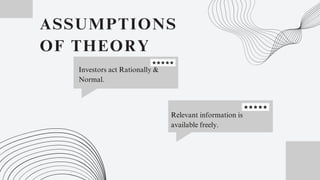
Investors act Rationally &
Normal.
Relevant information is
available freely.
ASSUMPTIONS
OF THEORY
CRITICISMS
OF EMH
Warren Buffett, Paul
Tudor Jones, John
Templeton, and Peter
Lynch have always
beaten the market returns
in long run.
Those against EMH say
that a few financial
events could push the
stock away from their
fair value in a single day.
MARKET
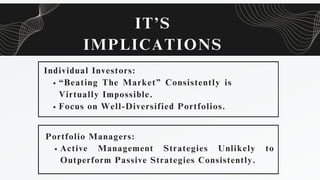
ITโ€™S
IMPLICATIONS
Individual Investors:
โ€œBeating The Marketโ€ Consistently is
Virtually Impossible.
Focus on Well-Diversified Portfolios.
Portfolio Managers:
Active Management Strategies Unlikely to
Outperform Passive Strategies Consistently.
Corporate Finance:
Companyโ€™s Stock is Always Fairly Priced; Indifference
Between Issuing Debt and Equity.
No Impact on Company Value From Financial Decision.
Government Regulation:
Support for Policies Promoting Transparency and
Information Dissemination.
Justification for Prohibiting Insider Trading.

Efficient market hypothesis (EMH) PPT..pdf

  • 1.
  • 2.
    HISTORY The theory wasgiven by Eugene Fama, a University of Chicago professor and Nobel Prize winner. In 1970, Fama published โ€œEfficient Capital Markets: A Review of Theory and Empirical workโ€, which outlined this theory.
  • 3.
    MEANING The efficient-market hypothesisis a hypothesis in financial economics that states that asset price reflect all available information. A direct implication is that it is impossible to โ€œbeat the marketโ€ consistently on a risk-adjusted basis since market price should only react to new information. EMH
  • 4.
    The theory saysthat stock trades at fair value all time. EMH suggests that it is impossible to find undervalued stocks or sell it at premium. It suggests that fundamental or technical analyses are not useful under EMH.
  • 5.
    Weak 3 FORMS OFEMH All Historical Prices & Returns Semi-Strong All Public Information Strong All Information, Public & Private
  • 6.
    Investors act Rationally& Normal. Relevant information is available freely. ASSUMPTIONS OF THEORY
  • 7.
    CRITICISMS OF EMH Warren Buffett,Paul Tudor Jones, John Templeton, and Peter Lynch have always beaten the market returns in long run. Those against EMH say that a few financial events could push the stock away from their fair value in a single day. MARKET
  • 8.
    ITโ€™S IMPLICATIONS Individual Investors: โ€œBeating TheMarketโ€ Consistently is Virtually Impossible. Focus on Well-Diversified Portfolios. Portfolio Managers: Active Management Strategies Unlikely to Outperform Passive Strategies Consistently.
  • 9.
    Corporate Finance: Companyโ€™s Stockis Always Fairly Priced; Indifference Between Issuing Debt and Equity. No Impact on Company Value From Financial Decision. Government Regulation: Support for Policies Promoting Transparency and Information Dissemination. Justification for Prohibiting Insider Trading.