THE COMPLETE
TRAINING PROGRAM
PLANNING GUIDE
INTRO
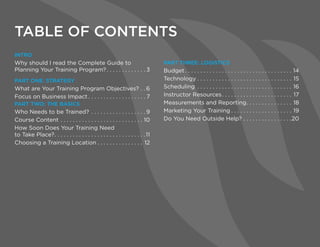
Why should I read the Complete Guide to
Planning Your Training Program?. .  .  .  .  .  .  .  .  .  .  .  . 3
PART ONE: STRATEGY
What are Your Training Program Objectives?.  . 6
Focus on Business Impact.  .  .  .  .  .  .  .  .  .  .  .  .  .  .  .  .  .  . 7
PART TWO: THE BASICS
Who Needs to be Trained?.  .  .  .  .  .  .  .  .  .  .  .  .  .  .  .  .  . 9
Course Content.  .  .  .  .  .  .  .  .  .  .  .  .  .  .  .  .  .  .  .  .  .  .  .  .  .  .  . 10
How Soon Does Your Training Need
to Take Place?
. .  .  .  .  .  .  .  .  .  .  .  .  .  .  .  .  .  .  .  .  .  .  .  .  .  .  .  .  . 11
Choosing a Training Location.  .  .  .  .  .  .  .  .  .  .  .  .  .  .  . 12
PART THREE: LOGISTICS
Budget. .  .  .  .  .  .  .  .  .  .  .  .  .  .  .  .  .  .  .  .  .  .  .  .  .  .  .  .  .  .  .  .  .  .  . 14
Technology.  .  .  .  .  .  .  .  .  .  .  .  .  .  .  .  .  .  .  .  .  .  .  .  .  .  .  .  .  .  .  . 15
Scheduling .  .  .  .  .  .  .  .  .  .  .  .  .  .  .  .  .  .  .  .  .  .  .  .  .  .  .  .  .  .  .  . 16
Instructor Resources. .  .  .  .  .  .  .  .  .  .  .  .  .  .  .  .  .  .  .  .  .  .  . 17
Measurements and Reporting
. .  .  .  .  .  .  .  .  .  .  .  .  .  .  . 18
Marketing Your Training.  .  .  .  .  .  .  .  .  .  .  .  .  .  .  .  .  .  .  .  . 19
Do You Need Outside Help?.  .  .  .  .  .  .  .  .  .  .  .  .  .  .  . 20
TABLE OF CONTENTS
3
Do you need help planning your training program? Call 877-226-7070 • www.mclabs.com
INTRO
Every training organization has one thing in common: the desire to improve the learning experience,
reduce expenses and/or increase profits. But many training managers struggle on how to align their
delivery methods, technology and content to achieve these goals.
WHY SHOULD I READ THIS GUIDE?
INTERNAL V. EXTERNAL
TRAINING
While there are many similarities
in the planning and execution
of internal and external training
programs, there are areas where you
will need to adjust your plan based
on your audience.
Several sections of this guide pull
out areas where you will need to
develop your plan differently based
on whether your training program
is designed for internal or external
training.
This guide provides helpful insights
to create a training plan that will
help you increase the efficiency
and effectiveness of your training
program.
We’ll provide insights for how to:
• Develop a comprehensive
training program plan
• Identify goals and objectives
• Assess training needs
• Address logistical requirements
• Optimize your training plan and
implementation
• Measure and communicate
the success of your training
program
You’ll leave with valuable tools and
tips to make your next training
program a success.
9
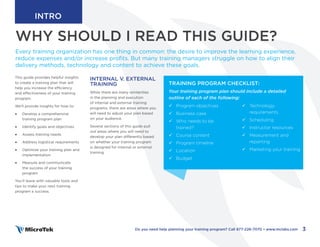
9 Program objectives
9
9 Business case
9
9 Who needs to be
trained?
9
9 Course content
9
9 Program timeline
9
9 Location
9
9 Budget
9
9 Technology
requirements
9
9 Scheduling
9
9 Instructor resources
9
9 Measurement and
reporting
9
9 Marketing your training
TRAINING PROGRAM CHECKLIST:
Your training program plan should include a detailed
outline of each of the following:
4
Do you need help planning your training program? Call 877-226-7070 • www.mclabs.com 4
PART ONE
STRATEGY
PART ONE
5
Do you need help planning your training program? Call 877-226-7070 • www.mclabs.com
WHAT ARE YOUR TRAINING
PROGRAM GOALS AND OBJECTIVES?
NECESSARY FIRST STEP
Understanding and documenting
the goals and objectives of your
training program is the critical first
step in developing your plan. Think
of it in terms of a road map—you
can’t realistically determine the
direction you want to go if you don’t
even know where you’re headed.
Documenting your objectives
will make it easier to determine
considerations such as your
program timing, attendees, budget
and content.
Goals and objectives are often
used interchangeably, however
there is a difference between
them. Goals are broad and general,
whereas objectives are specific
and measurable. Your plan should
include both—starting with your
strategic goal statements and then
drilling down to the more tactical
objective statements.
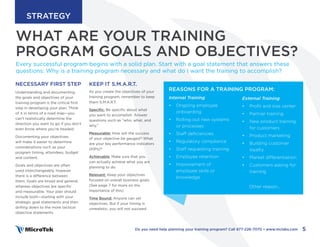
STRATEGY
Every successful program begins with a solid plan. Start with a goal statement that answers these
questions: Why is a training program necessary and what do I want the training to accomplish?
Internal Training
• Ongoing employee
onboarding
• Rolling out new systems
or processes
• Staff deficiencies
• Regulatory compliance
• Staff requesting training
• Employee retention
• Improvement of
employee skills or
knowledge
External Training
• Profit and loss center
• Partner training
• New product training
for customers
• Product marketing
• Building customer
loyalty
• Market differentiation
• Customers asking for
training
REASONS FOR A TRAINING PROGRAM:
KEEP IT S.M.A.R.T.
As you create the objectives of your
training program, remember to keep
them S.M.A.R.T.
Specific: Be specific about what
you want to accomplish. Answer
questions such as “who, what, and
why.”
Measurable: How will the success
of your objective be gauged? What
are your key performance indicators
(KIPs)?
Achievable: Make sure that you
can actually achieve what you are
planning to do.
Relevant: Keep your objectives
focused on overall business goals.
(See page 7 for more on the
importance of this)
Time Bound: Anyone can set
objectives. But if your timing is
unrealistic, you will not succeed.
Other reason...
6
Do you need help planning your training program? Call 877-226-7070 • www.mclabs.com
STRATEGY
You are about to begin a complex training program, involving considerable resources and time. Before
you get into the nitty gritty details of your training plan, it is imperative the goals address the overall
business case for your training program.
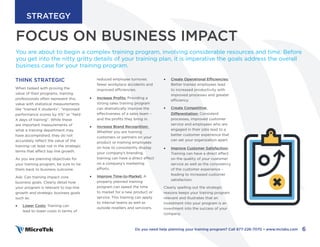
FOCUS ON BUSINESS IMPACT
THINK STRATEGIC
When tasked with proving the
value of their programs, training
professionals often represent this
value with statistical measurements
like “trained X students”, “improved
performance scores by X%” or “held
X days of training”. While these
are important measurements of
what a training department may
have accomplished, they do not
accurately reflect the value of the
training—at least not in the strategic
terms that affect top line growth.
As you are planning objectives for
your training program, be sure to tie
them back to business outcome.
Ask: Can training impact core
business goals. Clearly detail how
your program is relevant to top-line
growth and strategic business goals
such as:
• Lower Costs: Training can
lead to lower costs in terms of
reduced employee turnover,
fewer workplace accidents and
improved efficiencies.
• Increase Profits: Providing a
strong sales training program
can dramatically improve the
effectiveness of a sales team –
and the profits they bring in.
• Increase Brand Recognition:
Whether you are training
customers or partners on your
product or training employees
on how to consistently display
your company’s branding,
training can have a direct effect
on a company’s marketing
efforts.
• Improve Time-to-Market: A
properly planned training
program can speed the time
to market for a new product or
service. This training can apply
to internal teams as well as
outside resellers and servicers.
• Create Operational Efficiencies:
Better trained employees lead
to increased productivity with
improved processes and greater
efficiency.
• Create Competitive
Differentiation: Consistent
processes, improved customer
service and employees who are
engaged in their jobs lead to a
better customer experience that
can set your organization apart.
• Improve Customer Satisfaction:
Training can have a direct effect
on the quality of your customer
service as well as the consistency
of the customer experience –
leading to increased customer
satisfaction.
Clearly spelling out the strategic
reasons keeps your training program
relevant and illustrates that an
investment into your program is an
investment into the success of your
company.
7
Do you need help planning your training program? Call 877-226-7070 • www.mclabs.com 7
PART TWO
THE BASICS
WHO, WHAT, WHEN & WHERE
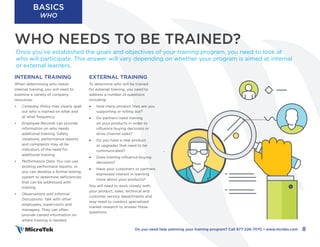
WHO NEEDS TO BE TRAINED?
WHO
INTERNAL TRAINING
When determining who needs
internal training, you will need to
examine a variety of company
resources:
• Company Policy may clearly spell
out who is trained on what and
at what frequency.
• Employee Records can provide
information on who needs
additional training. Safety
violations, performance reports
and complaints may all be
indicators of the need for
additional training.
• Performance Data: You can use
existing performace reports, or
you can develop a formal testing
system to determine deficiencies
that can be addressed with
training.
• Observations and Informal
Discussions: Talk with other
employees, supervisors and
managers. They can often
provide candid information on
where training is needed.
Once you’ve established the goals and objectives of your training program, you need to look at
who will participate. This answer will vary depending on whether your program is aimed at internal
or external learners.
EXTERNAL TRAINING
To determine who will be trained
for external training, you need to
address a number of questions
including:
• How many product lines are you
supporting or rolling out?
• Do partners need training
on your products in order to
influence buying decisions or
drive channel sales?
• Do you have a new product
or upgrades that need to be
communicated?
• Does training influence buying
decisions?
• Have your customers or partners
expressed interest in learning
more about your products?
You will need to work closely with
your product, sales, technical and
customer service departments and
may need to conduct specialized
market research to answer these
questions.
8
Do you need help planning your training program? Call 877-226-7070 • www.mclabs.com
BASICS
WHO
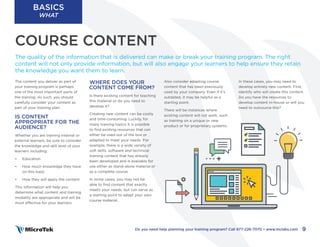
COURSE CONTENT
The quality of the information that is delivered can make or break your training program. The right
content will not only provide information, but will also engage your learners to help ensure they retain
the knowledge you want them to learn.
The content you deliver as part of
your training program is perhaps
one of the most important parts of
the training. As such, you should
carefully consider your content as
part of your training plan.
IS CONTENT
APPROPRIATE FOR THE
AUDIENCE?
Whether you are training internal or
external learners, be sure to consider
the knowledge and skill level of your
learners including:
• Education
• How much knowledge they have
on this topic
• How they will apply the content
This information will help you
determine what content and training
modality are appropriate and will be
most effective for your learners.
CONTENT
WHERE DOES YOUR
CONTENT COME FROM?
Is there existing content for teaching
this material or do you need to
develop it?
Creating new content can be costly
and time-consuming. Luckily, for
many training topics it is possible
to find existing resources that can
either be used out of the box or
adapted to meet your needs. For
example, there is a wide variety of
soft skills, software and technical
training content that has already
been developed and is available for
use either as stand-alone material or
as a complete course.
In some cases, you may not be
able to find content that exactly
meets your needs, but can serve as
a starting point to adapt your own
course material.
Also consider adapting course
content that has been previously
used by your company. Even if it’s
outdated, it may be helpful as a
starting point.
There will be instances where
existing content will not work, such
as training on a unique or new
product or for proprietary systems.
In these cases, you may need to
develop entirely new content. First,
identify who will create this content.
Do you have the resources to
develop content in-house or will you
need to outsource this?
9
Do you need help planning your training program? Call 877-226-7070 • www.mclabs.com
BASICS
WHAT
HOW SOON DOES YOUR TRAINING
NEED TO TAKE PLACE?
WHEN
There are a number of considerations
that will go into determining the
timing and frequency of your training
program.
SPEED TO KNOWLEDGE
Are there outside forces dictating
your learners’ speed to knowledge?
These might include:
• Critical performance issues
• Upcoming new products/service
rollouts
• Regulatory requirements
• Mergers and aquisitions
• Company expansion
Is there a deadline attached to the
nee for knowledge, then a schedule
to complete training is critical.
TIME TO MARKET
Both internal and external facing
training programs can affect a
company’s time to market. Do any of
the following apply to your training
program?
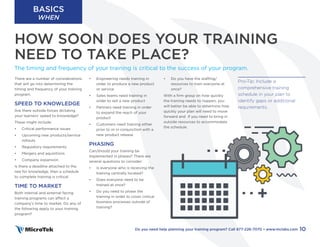
The timing and frequency of your training is critical to the success of your program.
• Engineering needs training in
order to produce a new product
or service
• Sales teams need training in
order to sell a new product
• Partners need training in order
to expand the reach of your
product
• Customers need training either
prior to or in conjunction with a
new product release
PHASING
Can/should your training be
implemented in phases? There are
several questions to consider:
• Is everyone who is receiving the
training centrally located?
• Does everyone need to be
trained at once?
• Do you need to phase the
training in order to cover critical
business processes outside of
training?
• Do you have the staffing/
resources to train everyone at
once?
With a firm grasp on how quickly
the training needs to happen, you
will better be able to determine how
quickly your plan will need to move
forward and if you need to bring in
outside resources to accommodate
the schedule.
Pro-Tip: Include a
comprehensive training
schedule in your plan to
identify gaps or additional
requirements.
10
Do you need help planning your training program? Call 877-226-7070 • www.mclabs.com
BASICS
WHEN
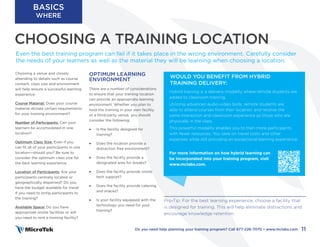
CHOOSING A TRAINING LOCATION
Even the best training program can fail if it takes place in the wrong environment. Carefully consider
the needs of your learners as well as the material they will be learning when choosing a location.
Choosing a venue and closely
attending to details such as course
content, class size and environment
will help ensure a successful learning
experience.
Course Material: Does your course
material dictate certain requirements
for your training environment?
Number of Participants: Can your
learners be accomodated in one
location?
Optimum Class Size: Even if you
can fit all of your participants in one
location—should you? Be sure to
consider the optimum class size for
the best learning experience.
Location of Participants: Are your
participants centrally located or
geographically dispersed? Do you
have the budget available for travel
if you need to bring participants to
the training?
Available Space: Do you have
appropriate onsite facilities or will
you need to rent a training facility?
LOCATION
Hybrid training is a delivery modality where remote students are
added to classroom training.
Utilizing advanced audio-video tools, remote students are
able to attend courses from their location, and receive the
same interaction and classroom experience as those who are
physically in the class.
This powerful modality enables you to train more participants
with fewer resources. You save on travel costs and other
expenses while still providing an exceptional learning experience.
For more information on how hybrid learning can
be incorporated into your training program, visit
www.mclabs.com.
OPTIMUM LEARNING
ENVIRONMENT
There are a number of considerations
to ensure that your training location
can provide an appropriate learning
environment. Whether you plan to
hold the training in your own facility
or a third-party venue, you should
consider the following:
• Is the facility designed for
training?
• Does the location provide a
distraction free environment?
• Does the facility provide a
designated area for breaks?
• Does the facility provide onsite
tech support?
• Does the facility provide catering
and snacks?
• Is your facility equipped with the
technology you need for your
training?
WOULD YOU BENEFIT FROM HYBRID
TRAINING DELIVERY:
Pro-Tip: For the best learning experience, choose a facility that
is designed for training. This will help eliminate distractions and
encourage knowledge retention.
11
Do you need help planning your training program? Call 877-226-7070 • www.mclabs.com
BASICS
WHERE
12
Do you need help planning your training program? Call 877-226-7070 • www.mclabs.com 12
PART THREE
LOGISTICS
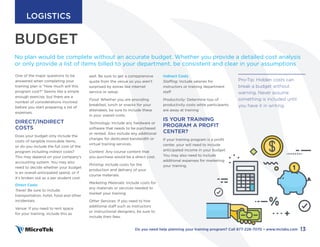
BUDGET
No plan would be complete without an accurate budget. Whether you provide a detailed cost analysis
or only provide a list of items billed to your department, be consistent and clear in your assumptions
well. Be sure to get a compprensive
quote from the venue so you aren’t
surprised by extras like internet
service or setup.
Food: Whether you are providing
breakfast, lunch or snacks for your
attendees, be sure to include these
in your overall costs.
Technology: Include any hardware or
software that needs to be purchased
or rented. Also include any additional
charges for dedicated bandwidth or
virtual training services.
Content: Any course content that
you purchase would be a direct cost.
Printing: Include costs for the
production and delivery of your
course materials.
Marketing Materials: Include costs for
any materials or services needed to
market your training
Other Services: If you need to hire
additional staff such as instructors
or instructional designers, be sure to
include their fees.
Indirect Costs
Staffing: Include salaries for
instructors or training department
staff
Productivity: Determine loss of
productivity costs while participants
are away at training
IS YOUR TRAINING
PROGRAM A PROFIT
CENTER?
If your training program is a profit
center, your will need to include
anticipated income in your budget.
You may also need to include
additional expenses for marketing
your training.
One of the major questions to be
answered when completing your
training plan is “How much will this
program cost?” Seems like a simple
enough exercise, but there are a
number of considerations involved
before you start preparing a list of
expenses.
DIRECT/INDIRECT
COSTS
Does your budget only include the
costs of tangible invoicable items,
or do you include the full cost of the
program including indrect costs?
This may depend on your company’s
accounting system. You may also
need to decide whether your budget
is an overall anticipated spend, or if
it’s broken out as a per student cost.
Direct Costs
Travel: Be sure to include
transportation, hotel, food and other
incidentals.
Venue: If you need to rent space
for your training, include this as
Pro-Tip: Hidden costs can
break a budget without
warning. Never assume
something is included until
you have it in writing.
13
Do you need help planning your training program? Call 877-226-7070 • www.mclabs.com
LOGISTICS
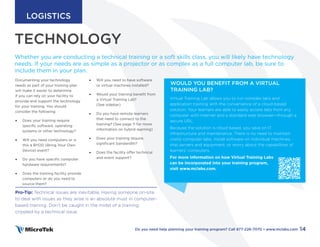
TECHNOLOGY
Whether you are conducting a technical training or a soft skills class, you will likely have technology
needs. If your needs are as simple as a projector or as complex as a full computer lab, be sure to
include them in your plan.
Documenting your technology
needs as part of your training plan
will make it easier to determine
if you can rely on your facility to
provide and support the technology
for your training. You should
consider the following:
• Does your training require
specific software, operating
systems or other technology?
• Will you need computers or is
this a BYOD (Bring Your Own
Device) event?
• Do you have specific computer
hardware requirements?
• Does the training facility provide
computers or do you need to
source them?
PART TWO
• Will you need to have software
or virtual machines installed?
• Would your training benefit from
a Virtual Training Lab?
(See sidebar)
• Do you have remote learners
that need to connect to the
training? (See page 11 for more
information on hybrid learning)
• Does your training require
significant bandwidth?
• Does the facility offer technical
and event support?
Pro-Tip: Technical issues are inevitable. Having someone on-site
to deal with issues as they arise is an absolute must in computer-
based training. Don’t be caught in the midst of a training
crippled by a technical issue.
Virtual Training Lab allows you to run complex labs and
application training with the convenience of a cloud-based
solution. Your learners are able to easily access labs from any
computer with internet and a standard web browser—through a
secure URL.
Because the solution is cloud based, you save on IT
infrastructure and maintenance. There is no need to maintain
costly computer labs, install software on individual machines,
ship servers and equipment, or worry about the capabilities of
learners’ computers.
For more information on how Virtual Training Labs
can be incorporated into your training program,
visit www.mclabs.com.
WOULD YOU BENEFIT FROM A VIRTUAL
TRAINING LAB?
14
Do you need help planning your training program? Call 877-226-7070 • www.mclabs.com
LOGISTICS
SCHEDULING
You want to organize training
sessions in order to maximize
attendance while also using
resources in the most effective way.
When mapping out the times and
dates of your training program,
consider the following:
• When training needs to
be completed (if there is a
deadline)
• Number of learners
• Number of classes
• Location of learners
• Travel time
• Instructor schedules
• Workload of participants (for
internal training)
• Venue availability
• Equipment availability
• Appropriate class spacing for
knowledge retention
The complexity of course scheduling can vary depending on a number of factors. Creating an optimal
training schedule that fits everyone’s agenda requires careful attention to detail.
SCHEDULING
• Time needed to complete out-of-
class exercises
• Competing activities
TECHNOLOGY
There are a number of tools you may
use for your scheduling including on-
line registrations sytems and training
resource management systems.
Training resource management
systems can be especially beneficial
in developing and managing your
schedule—helping you control costs
and avoid mistakes and delays.
Training resource management
systems make it possible to:
• Organize sessions and assign
resources in the most cost-
effective way
• Create and quickly modify the
optimal training schedule to fit
everyone’s agenda.
• Keep track of registration
confirmations, reminder emails,
and important data.
• Track costs, forecast budgets
and monitor profitability details
for each session
15
Do you need help planning your training program? Call 877-226-7070 • www.mclabs.com
LOGISTICS
INSTRUCTOR RESOURCES
• Do you have in-house instructors
or will you need to source
additional instructors?
• Can you utilize a hybrid learning
modality to increase your
instructor utilization? (see page
11 for more information)
• Would you benefit from outside
instructors?
INSTRUCTOR SOURCING
In many cases, you may not have
internal resources and will need to
source additional instructors.
Rather than hiring additional staff,
you may benefit from short term
contracts with an outside instructor
sourcing company. Some of the
benefits include:
• Flexibility: Secure qualified
training talent where and when
you need them.
• Cost effective: Access to
specialized trainers without a
long-term staffing commitment.
The value of training relies heavily on
content and delivery. Finding quality
instructors to deliver your training is
critical to your program’s success.
When looking for instructors keep in
mind that a quality instructor is more
than just a subject matter expert.
The most effective instructors are
also able to engage and motivate
participants.
When planning for instructors,
consider the following:
• What is the optimal class size for
your training?
• How many classes will you hold
and how many instructors will
you need?
• What is the anticipated workload
for instructors? (i.e. how many
classes will they need to teach,
when, how long, etc.)
• Will you need a train-the-trainer
program?
INSTRUCTORS
Instructors are integral to a successful training program. Be sure to include details on
your instructor utilization and preparation in your training plan.
• Assistance with course
materials: In many cases,
you can work with outside
instructors who may already
have their own curriculum and
course materials.
• Focus on core competencies:
Outsourcing your instruction
functions allows you to focus
on core activities, freeing up
valuable time and resources.
Whether you need just one instructor to supplement your team
or hundreds to support a large-scale training rollout, MicroTek’s
comprehensive database contains the names of thousands of
qualified trainers who are experts on a wide range of technical
platforms and business subjects.
For more information on how MicroTek’s
instructor sourcing can benefit your training
program, visit www.mclabs.com.
WOULD YOU BENEFIT FROM MICROTEK’S
INSTRUCTOR SOURCING?
• Fresh approach: For internal
training, an outside instructor
may be especially beneficial as
they can be seen as the expert in
your material, versus a coworker
with preconceived expectations.
16
Do you need help planning your training program? Call 877-226-7070 • www.mclabs.com
LOGISTICS
MEASUREMENTS AND REPORTING
• Satisfaction and cost-analysis
surveys
• Financial indicators
The metrics used to evaluate your
program are also going to vary
based on whether you are providing
internal or external training.
INTERNAL TRAINING
Internal training programs will report
on the impact that the training has
on both individual learners and the
overall organization. Your report
should include the effectiveness of
your training program in four key
categories:
• How well the training program
met the learner’s needs and
objectives
• What knowledge and skills
learners have acquired
• What desirable change it has
brought to learners’ performance
• What organizational benefits it
has yielded
It is important to take the time to
wrap up by analyzing and reporting
on your training program results.
This reporting will be critical as
you begin planning your next
program and will also allow you
to demonstrate the value of your
training program to the company as
a whole.
It is important to prepare in advance
and include Key Performance
Indicators (KPI) in your initial plan.
This ensures you have properly
mapped activities to program goals
and objectives; identifies gaps and
deficiencies and provides valuable
data regarding learning outcomes.
Your program plan should identify
how you intend to evaluate your
program. Possible tools include:
• Post training testing/
assessments
• Performance evaluations
RESULTS
Once your training program is complete, it is important to measure and report on the successes and
challenges as well as the business impact.
EXTERNAL TRAINING
Your ROI for external training should
be determined by evaluating:
• How well the training program
met the learner’s needs and
objectives
• Cost-effectiveness of the
training program
• Revenue generated (if you
charge for your training)
• What organizational benefits it
has yielded
17
Do you need help planning your training program? Call 877-226-7070 • www.mclabs.com
LOGISTICS
MARKETING YOUR TRAINING
As you conduct your classes, survey
your participants on their experience.
Use these testimonials in your email
communications, on your website
and in course materials to help add
credibility to the power and value of
the training.
ENGAGE EVANGELISTS
AND ADVOCATES
Research shows that people are
influenced most by peers that they
trust, so finding champions to speak
about your courses is critical to
successful promotion. Create a blog
or develop articles that contain tips
to making the most of the training
program.
MARKET YOUR
PROGRAM IN ADVANCE
Your training program is a significant
use of resources and money. Keep
your stakeholders excited by
marketing your program in advance.
Provide teaser materials and
descriptions of the program to help
create momentum.
You’ve created a killer plan for
your training program, and you’re
ready to roll it out. So how do you
get management and students on
board? Whether you’re promoting
your training program to internal
employees, channel partners or
customers, there are strategies to
make your program more widely
visible and accepted.
COMMUNICATE THE
BENEFITS
As you develop your training
program marketing plan, be sure
to communicate the benefits of the
training. That’s right, you may need
to “make the case” for why someone
would want to take your courses.
Consider creating a Wiki page, email,
or short FAQ that highlights the
benefits of your program.
Cite industry research and other
resources to get your audience
excited about the training and the
value they’ll get from participating.
PART FOUR
Whether you are providing training to those inside your company, or to customers and partners,
you will need marketing to ensure the program’s sucess.
Pro-Tip: Marketing your hybrid learning-When sending updates
about upcoming courses and new training content, always
mention the option to take the class virtually and provide a link
to your wiki, FAQ page, or other content that provides more
information on your hybrid learning program.
18
Do you need help planning your training program? Call 877-226-7070 • www.mclabs.com
LOGISTICS
DO YOU NEED OUTSIDE HELP?
PART FOUR
The large amount of detail that
goes into planning the logistics
of a training program can be
overwhelming—whether you are
new to the field or are a seasoned
professional.
And if you’re planning a multi-
location event, tasks require
scheduling hundreds of participants,
negotiations with multiple vendors,
complex coordination and other
logistics you may not have even
thought of.
Depending on your available
resources and the complexity of your
program, you may want to consider
enlisting a training solutions provider
to be sure you don’t overlook
anything.
Additionally, depending on your area
of expertise, it might make sense
to work with a supplier for your
planning so that you can focus on
your core responsibilities. A training
outsource provider can help you:
• Create a budget, select venues
and negotiate contracts
• Procure and support technical
equipment
• Contact multiple vendors and
track multiple invoices
• Print and ship courseware and
badging materials
• Book guest accommodations
and concierge services
• Send schedules and reminders to
attendees
Planning the logistics of a large training program requires attention to detail, clear communication,
perfect timing across project tasks, and a high level of coordination. In many instances, it makes sense
to work with an outside vendor for some or all of your planning.
WOULD YOU BENEFIT FROM MICROTEK’S
TRAINING ROLLOUTS SERVICES?
MicroTek allows you to focus on the goals and objectives
for your event while we take care of all the details. Our team
supports large scale technical or non-technical events and
complex meeting logistics for single venues or multiple locations.
For more information on how MicroTek’s
training rollouts services can benefit your
training program, visit www.mclabs.com.
19
Do you need help planning your training program? Call 877-226-7070 • www.mclabs.com
LOGISTICS
WHAT’S NEXT?
PART FOUR
As a single-source training outsourcing provider, MicroTek can help simplify
your training program—wherever you are in the planning process.
Visit www.mclabs.com to
learn more about all of our
services including:
• Training Logistics
• Training Rooms
• Virtual Solutions
• Instructor Sourcing
20
Do you need help planning your training program? Call 877-226-7070 • www.mclabs.com

Effective training-program-planning-guide.pdf

  • 1.
  • 2.
    INTRO Why should Iread the Complete Guide to Planning Your Training Program?. . . . . . . . . . . . . 3 PART ONE: STRATEGY What are Your Training Program Objectives?. . 6 Focus on Business Impact. . . . . . . . . . . . . . . . . . . 7 PART TWO: THE BASICS Who Needs to be Trained?. . . . . . . . . . . . . . . . . . 9 Course Content. . . . . . . . . . . . . . . . . . . . . . . . . . . . 10 How Soon Does Your Training Need to Take Place? . . . . . . . . . . . . . . . . . . . . . . . . . . . . . . 11 Choosing a Training Location. . . . . . . . . . . . . . . . 12 PART THREE: LOGISTICS Budget. . . . . . . . . . . . . . . . . . . . . . . . . . . . . . . . . . . . 14 Technology. . . . . . . . . . . . . . . . . . . . . . . . . . . . . . . . 15 Scheduling . . . . . . . . . . . . . . . . . . . . . . . . . . . . . . . . 16 Instructor Resources. . . . . . . . . . . . . . . . . . . . . . . . 17 Measurements and Reporting . . . . . . . . . . . . . . . . 18 Marketing Your Training. . . . . . . . . . . . . . . . . . . . . 19 Do You Need Outside Help?. . . . . . . . . . . . . . . . 20 TABLE OF CONTENTS
  • 3.
    3 Do you needhelp planning your training program? Call 877-226-7070 • www.mclabs.com INTRO Every training organization has one thing in common: the desire to improve the learning experience, reduce expenses and/or increase profits. But many training managers struggle on how to align their delivery methods, technology and content to achieve these goals. WHY SHOULD I READ THIS GUIDE? INTERNAL V. EXTERNAL TRAINING While there are many similarities in the planning and execution of internal and external training programs, there are areas where you will need to adjust your plan based on your audience. Several sections of this guide pull out areas where you will need to develop your plan differently based on whether your training program is designed for internal or external training. This guide provides helpful insights to create a training plan that will help you increase the efficiency and effectiveness of your training program. We’ll provide insights for how to: • Develop a comprehensive training program plan • Identify goals and objectives • Assess training needs • Address logistical requirements • Optimize your training plan and implementation • Measure and communicate the success of your training program You’ll leave with valuable tools and tips to make your next training program a success. 9 9 Program objectives 9 9 Business case 9 9 Who needs to be trained? 9 9 Course content 9 9 Program timeline 9 9 Location 9 9 Budget 9 9 Technology requirements 9 9 Scheduling 9 9 Instructor resources 9 9 Measurement and reporting 9 9 Marketing your training TRAINING PROGRAM CHECKLIST: Your training program plan should include a detailed outline of each of the following:
  • 4.
    4 Do you needhelp planning your training program? Call 877-226-7070 • www.mclabs.com 4 PART ONE STRATEGY PART ONE
  • 5.
    5 Do you needhelp planning your training program? Call 877-226-7070 • www.mclabs.com WHAT ARE YOUR TRAINING PROGRAM GOALS AND OBJECTIVES? NECESSARY FIRST STEP Understanding and documenting the goals and objectives of your training program is the critical first step in developing your plan. Think of it in terms of a road map—you can’t realistically determine the direction you want to go if you don’t even know where you’re headed. Documenting your objectives will make it easier to determine considerations such as your program timing, attendees, budget and content. Goals and objectives are often used interchangeably, however there is a difference between them. Goals are broad and general, whereas objectives are specific and measurable. Your plan should include both—starting with your strategic goal statements and then drilling down to the more tactical objective statements. STRATEGY Every successful program begins with a solid plan. Start with a goal statement that answers these questions: Why is a training program necessary and what do I want the training to accomplish? Internal Training • Ongoing employee onboarding • Rolling out new systems or processes • Staff deficiencies • Regulatory compliance • Staff requesting training • Employee retention • Improvement of employee skills or knowledge External Training • Profit and loss center • Partner training • New product training for customers • Product marketing • Building customer loyalty • Market differentiation • Customers asking for training REASONS FOR A TRAINING PROGRAM: KEEP IT S.M.A.R.T. As you create the objectives of your training program, remember to keep them S.M.A.R.T. Specific: Be specific about what you want to accomplish. Answer questions such as “who, what, and why.” Measurable: How will the success of your objective be gauged? What are your key performance indicators (KIPs)? Achievable: Make sure that you can actually achieve what you are planning to do. Relevant: Keep your objectives focused on overall business goals. (See page 7 for more on the importance of this) Time Bound: Anyone can set objectives. But if your timing is unrealistic, you will not succeed. Other reason...
  • 6.
    6 Do you needhelp planning your training program? Call 877-226-7070 • www.mclabs.com STRATEGY You are about to begin a complex training program, involving considerable resources and time. Before you get into the nitty gritty details of your training plan, it is imperative the goals address the overall business case for your training program. FOCUS ON BUSINESS IMPACT THINK STRATEGIC When tasked with proving the value of their programs, training professionals often represent this value with statistical measurements like “trained X students”, “improved performance scores by X%” or “held X days of training”. While these are important measurements of what a training department may have accomplished, they do not accurately reflect the value of the training—at least not in the strategic terms that affect top line growth. As you are planning objectives for your training program, be sure to tie them back to business outcome. Ask: Can training impact core business goals. Clearly detail how your program is relevant to top-line growth and strategic business goals such as: • Lower Costs: Training can lead to lower costs in terms of reduced employee turnover, fewer workplace accidents and improved efficiencies. • Increase Profits: Providing a strong sales training program can dramatically improve the effectiveness of a sales team – and the profits they bring in. • Increase Brand Recognition: Whether you are training customers or partners on your product or training employees on how to consistently display your company’s branding, training can have a direct effect on a company’s marketing efforts. • Improve Time-to-Market: A properly planned training program can speed the time to market for a new product or service. This training can apply to internal teams as well as outside resellers and servicers. • Create Operational Efficiencies: Better trained employees lead to increased productivity with improved processes and greater efficiency. • Create Competitive Differentiation: Consistent processes, improved customer service and employees who are engaged in their jobs lead to a better customer experience that can set your organization apart. • Improve Customer Satisfaction: Training can have a direct effect on the quality of your customer service as well as the consistency of the customer experience – leading to increased customer satisfaction. Clearly spelling out the strategic reasons keeps your training program relevant and illustrates that an investment into your program is an investment into the success of your company.
  • 7.
    7 Do you needhelp planning your training program? Call 877-226-7070 • www.mclabs.com 7 PART TWO THE BASICS WHO, WHAT, WHEN & WHERE
  • 8.
    WHO NEEDS TOBE TRAINED? WHO INTERNAL TRAINING When determining who needs internal training, you will need to examine a variety of company resources: • Company Policy may clearly spell out who is trained on what and at what frequency. • Employee Records can provide information on who needs additional training. Safety violations, performance reports and complaints may all be indicators of the need for additional training. • Performance Data: You can use existing performace reports, or you can develop a formal testing system to determine deficiencies that can be addressed with training. • Observations and Informal Discussions: Talk with other employees, supervisors and managers. They can often provide candid information on where training is needed. Once you’ve established the goals and objectives of your training program, you need to look at who will participate. This answer will vary depending on whether your program is aimed at internal or external learners. EXTERNAL TRAINING To determine who will be trained for external training, you need to address a number of questions including: • How many product lines are you supporting or rolling out? • Do partners need training on your products in order to influence buying decisions or drive channel sales? • Do you have a new product or upgrades that need to be communicated? • Does training influence buying decisions? • Have your customers or partners expressed interest in learning more about your products? You will need to work closely with your product, sales, technical and customer service departments and may need to conduct specialized market research to answer these questions. 8 Do you need help planning your training program? Call 877-226-7070 • www.mclabs.com BASICS WHO
  • 9.
    COURSE CONTENT The qualityof the information that is delivered can make or break your training program. The right content will not only provide information, but will also engage your learners to help ensure they retain the knowledge you want them to learn. The content you deliver as part of your training program is perhaps one of the most important parts of the training. As such, you should carefully consider your content as part of your training plan. IS CONTENT APPROPRIATE FOR THE AUDIENCE? Whether you are training internal or external learners, be sure to consider the knowledge and skill level of your learners including: • Education • How much knowledge they have on this topic • How they will apply the content This information will help you determine what content and training modality are appropriate and will be most effective for your learners. CONTENT WHERE DOES YOUR CONTENT COME FROM? Is there existing content for teaching this material or do you need to develop it? Creating new content can be costly and time-consuming. Luckily, for many training topics it is possible to find existing resources that can either be used out of the box or adapted to meet your needs. For example, there is a wide variety of soft skills, software and technical training content that has already been developed and is available for use either as stand-alone material or as a complete course. In some cases, you may not be able to find content that exactly meets your needs, but can serve as a starting point to adapt your own course material. Also consider adapting course content that has been previously used by your company. Even if it’s outdated, it may be helpful as a starting point. There will be instances where existing content will not work, such as training on a unique or new product or for proprietary systems. In these cases, you may need to develop entirely new content. First, identify who will create this content. Do you have the resources to develop content in-house or will you need to outsource this? 9 Do you need help planning your training program? Call 877-226-7070 • www.mclabs.com BASICS WHAT
  • 10.
    HOW SOON DOESYOUR TRAINING NEED TO TAKE PLACE? WHEN There are a number of considerations that will go into determining the timing and frequency of your training program. SPEED TO KNOWLEDGE Are there outside forces dictating your learners’ speed to knowledge? These might include: • Critical performance issues • Upcoming new products/service rollouts • Regulatory requirements • Mergers and aquisitions • Company expansion Is there a deadline attached to the nee for knowledge, then a schedule to complete training is critical. TIME TO MARKET Both internal and external facing training programs can affect a company’s time to market. Do any of the following apply to your training program? The timing and frequency of your training is critical to the success of your program. • Engineering needs training in order to produce a new product or service • Sales teams need training in order to sell a new product • Partners need training in order to expand the reach of your product • Customers need training either prior to or in conjunction with a new product release PHASING Can/should your training be implemented in phases? There are several questions to consider: • Is everyone who is receiving the training centrally located? • Does everyone need to be trained at once? • Do you need to phase the training in order to cover critical business processes outside of training? • Do you have the staffing/ resources to train everyone at once? With a firm grasp on how quickly the training needs to happen, you will better be able to determine how quickly your plan will need to move forward and if you need to bring in outside resources to accommodate the schedule. Pro-Tip: Include a comprehensive training schedule in your plan to identify gaps or additional requirements. 10 Do you need help planning your training program? Call 877-226-7070 • www.mclabs.com BASICS WHEN
  • 11.
    CHOOSING A TRAININGLOCATION Even the best training program can fail if it takes place in the wrong environment. Carefully consider the needs of your learners as well as the material they will be learning when choosing a location. Choosing a venue and closely attending to details such as course content, class size and environment will help ensure a successful learning experience. Course Material: Does your course material dictate certain requirements for your training environment? Number of Participants: Can your learners be accomodated in one location? Optimum Class Size: Even if you can fit all of your participants in one location—should you? Be sure to consider the optimum class size for the best learning experience. Location of Participants: Are your participants centrally located or geographically dispersed? Do you have the budget available for travel if you need to bring participants to the training? Available Space: Do you have appropriate onsite facilities or will you need to rent a training facility? LOCATION Hybrid training is a delivery modality where remote students are added to classroom training. Utilizing advanced audio-video tools, remote students are able to attend courses from their location, and receive the same interaction and classroom experience as those who are physically in the class. This powerful modality enables you to train more participants with fewer resources. You save on travel costs and other expenses while still providing an exceptional learning experience. For more information on how hybrid learning can be incorporated into your training program, visit www.mclabs.com. OPTIMUM LEARNING ENVIRONMENT There are a number of considerations to ensure that your training location can provide an appropriate learning environment. Whether you plan to hold the training in your own facility or a third-party venue, you should consider the following: • Is the facility designed for training? • Does the location provide a distraction free environment? • Does the facility provide a designated area for breaks? • Does the facility provide onsite tech support? • Does the facility provide catering and snacks? • Is your facility equipped with the technology you need for your training? WOULD YOU BENEFIT FROM HYBRID TRAINING DELIVERY: Pro-Tip: For the best learning experience, choose a facility that is designed for training. This will help eliminate distractions and encourage knowledge retention. 11 Do you need help planning your training program? Call 877-226-7070 • www.mclabs.com BASICS WHERE
  • 12.
    12 Do you needhelp planning your training program? Call 877-226-7070 • www.mclabs.com 12 PART THREE LOGISTICS
  • 13.
    BUDGET No plan wouldbe complete without an accurate budget. Whether you provide a detailed cost analysis or only provide a list of items billed to your department, be consistent and clear in your assumptions well. Be sure to get a compprensive quote from the venue so you aren’t surprised by extras like internet service or setup. Food: Whether you are providing breakfast, lunch or snacks for your attendees, be sure to include these in your overall costs. Technology: Include any hardware or software that needs to be purchased or rented. Also include any additional charges for dedicated bandwidth or virtual training services. Content: Any course content that you purchase would be a direct cost. Printing: Include costs for the production and delivery of your course materials. Marketing Materials: Include costs for any materials or services needed to market your training Other Services: If you need to hire additional staff such as instructors or instructional designers, be sure to include their fees. Indirect Costs Staffing: Include salaries for instructors or training department staff Productivity: Determine loss of productivity costs while participants are away at training IS YOUR TRAINING PROGRAM A PROFIT CENTER? If your training program is a profit center, your will need to include anticipated income in your budget. You may also need to include additional expenses for marketing your training. One of the major questions to be answered when completing your training plan is “How much will this program cost?” Seems like a simple enough exercise, but there are a number of considerations involved before you start preparing a list of expenses. DIRECT/INDIRECT COSTS Does your budget only include the costs of tangible invoicable items, or do you include the full cost of the program including indrect costs? This may depend on your company’s accounting system. You may also need to decide whether your budget is an overall anticipated spend, or if it’s broken out as a per student cost. Direct Costs Travel: Be sure to include transportation, hotel, food and other incidentals. Venue: If you need to rent space for your training, include this as Pro-Tip: Hidden costs can break a budget without warning. Never assume something is included until you have it in writing. 13 Do you need help planning your training program? Call 877-226-7070 • www.mclabs.com LOGISTICS
  • 14.
    TECHNOLOGY Whether you areconducting a technical training or a soft skills class, you will likely have technology needs. If your needs are as simple as a projector or as complex as a full computer lab, be sure to include them in your plan. Documenting your technology needs as part of your training plan will make it easier to determine if you can rely on your facility to provide and support the technology for your training. You should consider the following: • Does your training require specific software, operating systems or other technology? • Will you need computers or is this a BYOD (Bring Your Own Device) event? • Do you have specific computer hardware requirements? • Does the training facility provide computers or do you need to source them? PART TWO • Will you need to have software or virtual machines installed? • Would your training benefit from a Virtual Training Lab? (See sidebar) • Do you have remote learners that need to connect to the training? (See page 11 for more information on hybrid learning) • Does your training require significant bandwidth? • Does the facility offer technical and event support? Pro-Tip: Technical issues are inevitable. Having someone on-site to deal with issues as they arise is an absolute must in computer- based training. Don’t be caught in the midst of a training crippled by a technical issue. Virtual Training Lab allows you to run complex labs and application training with the convenience of a cloud-based solution. Your learners are able to easily access labs from any computer with internet and a standard web browser—through a secure URL. Because the solution is cloud based, you save on IT infrastructure and maintenance. There is no need to maintain costly computer labs, install software on individual machines, ship servers and equipment, or worry about the capabilities of learners’ computers. For more information on how Virtual Training Labs can be incorporated into your training program, visit www.mclabs.com. WOULD YOU BENEFIT FROM A VIRTUAL TRAINING LAB? 14 Do you need help planning your training program? Call 877-226-7070 • www.mclabs.com LOGISTICS
  • 15.
    SCHEDULING You want toorganize training sessions in order to maximize attendance while also using resources in the most effective way. When mapping out the times and dates of your training program, consider the following: • When training needs to be completed (if there is a deadline) • Number of learners • Number of classes • Location of learners • Travel time • Instructor schedules • Workload of participants (for internal training) • Venue availability • Equipment availability • Appropriate class spacing for knowledge retention The complexity of course scheduling can vary depending on a number of factors. Creating an optimal training schedule that fits everyone’s agenda requires careful attention to detail. SCHEDULING • Time needed to complete out-of- class exercises • Competing activities TECHNOLOGY There are a number of tools you may use for your scheduling including on- line registrations sytems and training resource management systems. Training resource management systems can be especially beneficial in developing and managing your schedule—helping you control costs and avoid mistakes and delays. Training resource management systems make it possible to: • Organize sessions and assign resources in the most cost- effective way • Create and quickly modify the optimal training schedule to fit everyone’s agenda. • Keep track of registration confirmations, reminder emails, and important data. • Track costs, forecast budgets and monitor profitability details for each session 15 Do you need help planning your training program? Call 877-226-7070 • www.mclabs.com LOGISTICS
  • 16.
    INSTRUCTOR RESOURCES • Doyou have in-house instructors or will you need to source additional instructors? • Can you utilize a hybrid learning modality to increase your instructor utilization? (see page 11 for more information) • Would you benefit from outside instructors? INSTRUCTOR SOURCING In many cases, you may not have internal resources and will need to source additional instructors. Rather than hiring additional staff, you may benefit from short term contracts with an outside instructor sourcing company. Some of the benefits include: • Flexibility: Secure qualified training talent where and when you need them. • Cost effective: Access to specialized trainers without a long-term staffing commitment. The value of training relies heavily on content and delivery. Finding quality instructors to deliver your training is critical to your program’s success. When looking for instructors keep in mind that a quality instructor is more than just a subject matter expert. The most effective instructors are also able to engage and motivate participants. When planning for instructors, consider the following: • What is the optimal class size for your training? • How many classes will you hold and how many instructors will you need? • What is the anticipated workload for instructors? (i.e. how many classes will they need to teach, when, how long, etc.) • Will you need a train-the-trainer program? INSTRUCTORS Instructors are integral to a successful training program. Be sure to include details on your instructor utilization and preparation in your training plan. • Assistance with course materials: In many cases, you can work with outside instructors who may already have their own curriculum and course materials. • Focus on core competencies: Outsourcing your instruction functions allows you to focus on core activities, freeing up valuable time and resources. Whether you need just one instructor to supplement your team or hundreds to support a large-scale training rollout, MicroTek’s comprehensive database contains the names of thousands of qualified trainers who are experts on a wide range of technical platforms and business subjects. For more information on how MicroTek’s instructor sourcing can benefit your training program, visit www.mclabs.com. WOULD YOU BENEFIT FROM MICROTEK’S INSTRUCTOR SOURCING? • Fresh approach: For internal training, an outside instructor may be especially beneficial as they can be seen as the expert in your material, versus a coworker with preconceived expectations. 16 Do you need help planning your training program? Call 877-226-7070 • www.mclabs.com LOGISTICS
  • 17.
    MEASUREMENTS AND REPORTING •Satisfaction and cost-analysis surveys • Financial indicators The metrics used to evaluate your program are also going to vary based on whether you are providing internal or external training. INTERNAL TRAINING Internal training programs will report on the impact that the training has on both individual learners and the overall organization. Your report should include the effectiveness of your training program in four key categories: • How well the training program met the learner’s needs and objectives • What knowledge and skills learners have acquired • What desirable change it has brought to learners’ performance • What organizational benefits it has yielded It is important to take the time to wrap up by analyzing and reporting on your training program results. This reporting will be critical as you begin planning your next program and will also allow you to demonstrate the value of your training program to the company as a whole. It is important to prepare in advance and include Key Performance Indicators (KPI) in your initial plan. This ensures you have properly mapped activities to program goals and objectives; identifies gaps and deficiencies and provides valuable data regarding learning outcomes. Your program plan should identify how you intend to evaluate your program. Possible tools include: • Post training testing/ assessments • Performance evaluations RESULTS Once your training program is complete, it is important to measure and report on the successes and challenges as well as the business impact. EXTERNAL TRAINING Your ROI for external training should be determined by evaluating: • How well the training program met the learner’s needs and objectives • Cost-effectiveness of the training program • Revenue generated (if you charge for your training) • What organizational benefits it has yielded 17 Do you need help planning your training program? Call 877-226-7070 • www.mclabs.com LOGISTICS
  • 18.
    MARKETING YOUR TRAINING Asyou conduct your classes, survey your participants on their experience. Use these testimonials in your email communications, on your website and in course materials to help add credibility to the power and value of the training. ENGAGE EVANGELISTS AND ADVOCATES Research shows that people are influenced most by peers that they trust, so finding champions to speak about your courses is critical to successful promotion. Create a blog or develop articles that contain tips to making the most of the training program. MARKET YOUR PROGRAM IN ADVANCE Your training program is a significant use of resources and money. Keep your stakeholders excited by marketing your program in advance. Provide teaser materials and descriptions of the program to help create momentum. You’ve created a killer plan for your training program, and you’re ready to roll it out. So how do you get management and students on board? Whether you’re promoting your training program to internal employees, channel partners or customers, there are strategies to make your program more widely visible and accepted. COMMUNICATE THE BENEFITS As you develop your training program marketing plan, be sure to communicate the benefits of the training. That’s right, you may need to “make the case” for why someone would want to take your courses. Consider creating a Wiki page, email, or short FAQ that highlights the benefits of your program. Cite industry research and other resources to get your audience excited about the training and the value they’ll get from participating. PART FOUR Whether you are providing training to those inside your company, or to customers and partners, you will need marketing to ensure the program’s sucess. Pro-Tip: Marketing your hybrid learning-When sending updates about upcoming courses and new training content, always mention the option to take the class virtually and provide a link to your wiki, FAQ page, or other content that provides more information on your hybrid learning program. 18 Do you need help planning your training program? Call 877-226-7070 • www.mclabs.com LOGISTICS
  • 19.
    DO YOU NEEDOUTSIDE HELP? PART FOUR The large amount of detail that goes into planning the logistics of a training program can be overwhelming—whether you are new to the field or are a seasoned professional. And if you’re planning a multi- location event, tasks require scheduling hundreds of participants, negotiations with multiple vendors, complex coordination and other logistics you may not have even thought of. Depending on your available resources and the complexity of your program, you may want to consider enlisting a training solutions provider to be sure you don’t overlook anything. Additionally, depending on your area of expertise, it might make sense to work with a supplier for your planning so that you can focus on your core responsibilities. A training outsource provider can help you: • Create a budget, select venues and negotiate contracts • Procure and support technical equipment • Contact multiple vendors and track multiple invoices • Print and ship courseware and badging materials • Book guest accommodations and concierge services • Send schedules and reminders to attendees Planning the logistics of a large training program requires attention to detail, clear communication, perfect timing across project tasks, and a high level of coordination. In many instances, it makes sense to work with an outside vendor for some or all of your planning. WOULD YOU BENEFIT FROM MICROTEK’S TRAINING ROLLOUTS SERVICES? MicroTek allows you to focus on the goals and objectives for your event while we take care of all the details. Our team supports large scale technical or non-technical events and complex meeting logistics for single venues or multiple locations. For more information on how MicroTek’s training rollouts services can benefit your training program, visit www.mclabs.com. 19 Do you need help planning your training program? Call 877-226-7070 • www.mclabs.com LOGISTICS
  • 20.
    WHAT’S NEXT? PART FOUR Asa single-source training outsourcing provider, MicroTek can help simplify your training program—wherever you are in the planning process. Visit www.mclabs.com to learn more about all of our services including: • Training Logistics • Training Rooms • Virtual Solutions • Instructor Sourcing 20 Do you need help planning your training program? Call 877-226-7070 • www.mclabs.com