Effective Strategies to Improve
Engagement, Satisfaction and
Retention
June 13, 2016
4:00-5:00 pm
Heather McNair, VP of Engagement Strategy
Higher Logic
Erik Schonher, VP of Account Development, Research and Media
Marketing General Inc.
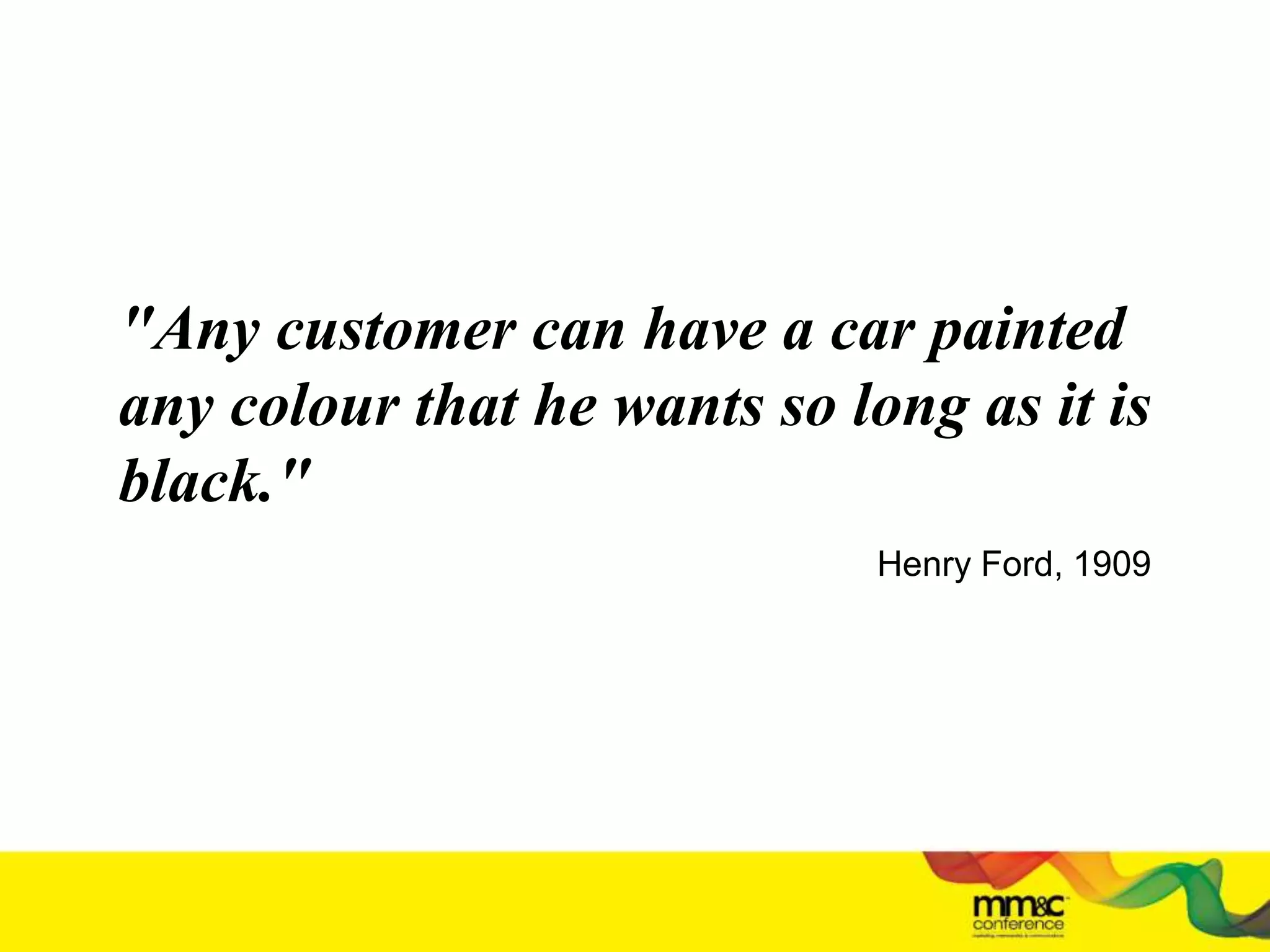
Henry Ford, 1909
"Any customer can have a car painted
any colour that he wants so long as it is
black."
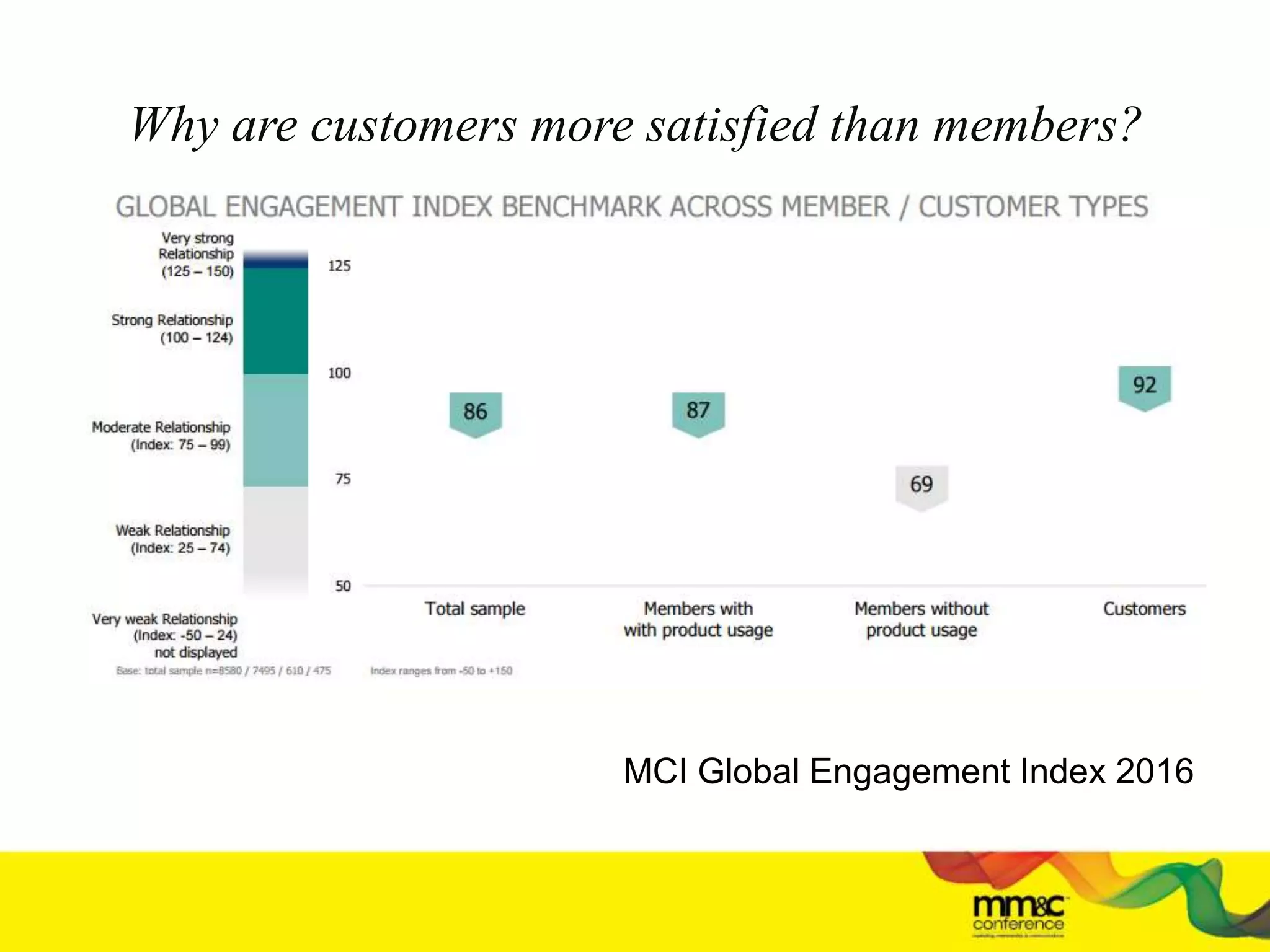
Why are customers more satisfied than members?
MCI Global Engagement Index 2016
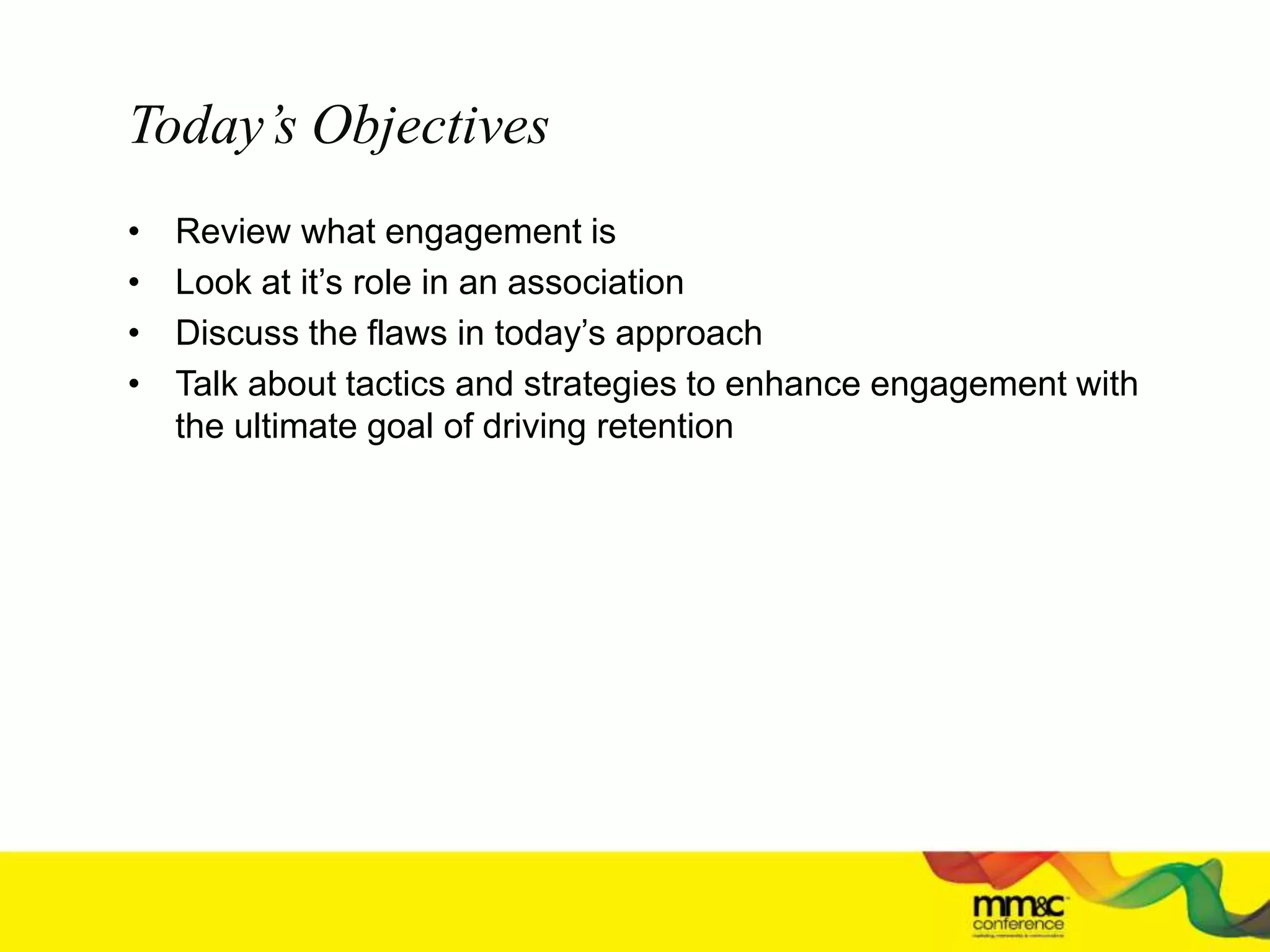
Today’s Objectives
• Review what engagement is
• Look at it’s role in an association
• Discuss the flaws in today’s approach
• Talk about tactics and strategies to enhance engagement with
the ultimate goal of driving retention
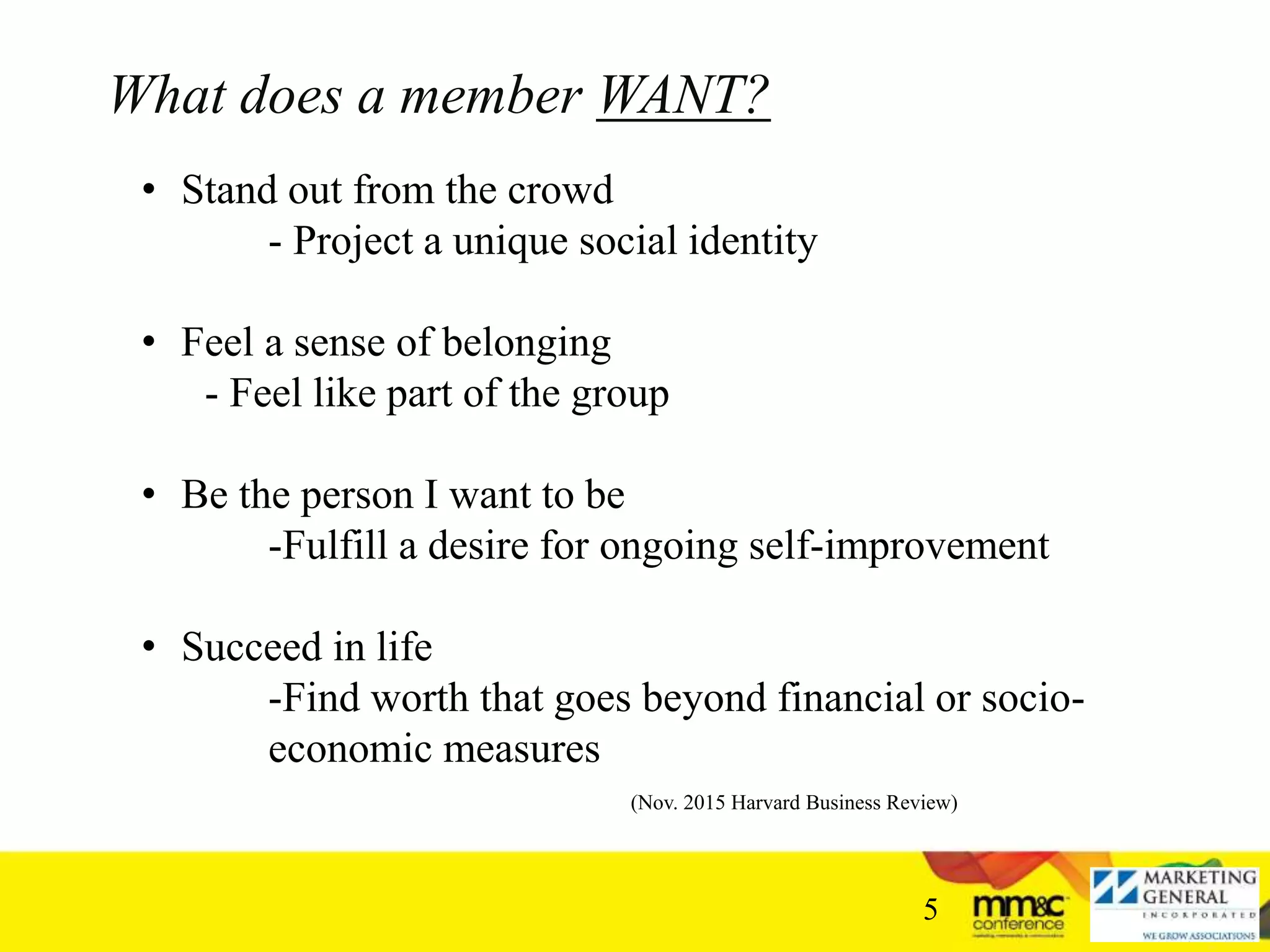
What does a member WANT?
5
(Nov. 2015 Harvard Business Review)
• Stand out from the crowd
- Project a unique social identity
• Feel a sense of belonging
- Feel like part of the group
• Be the person I want to be
-Fulfill a desire for ongoing self-improvement
• Succeed in life
-Find worth that goes beyond financial or socio-
economic measures
2016 Membership Marketing Benchmarking Report
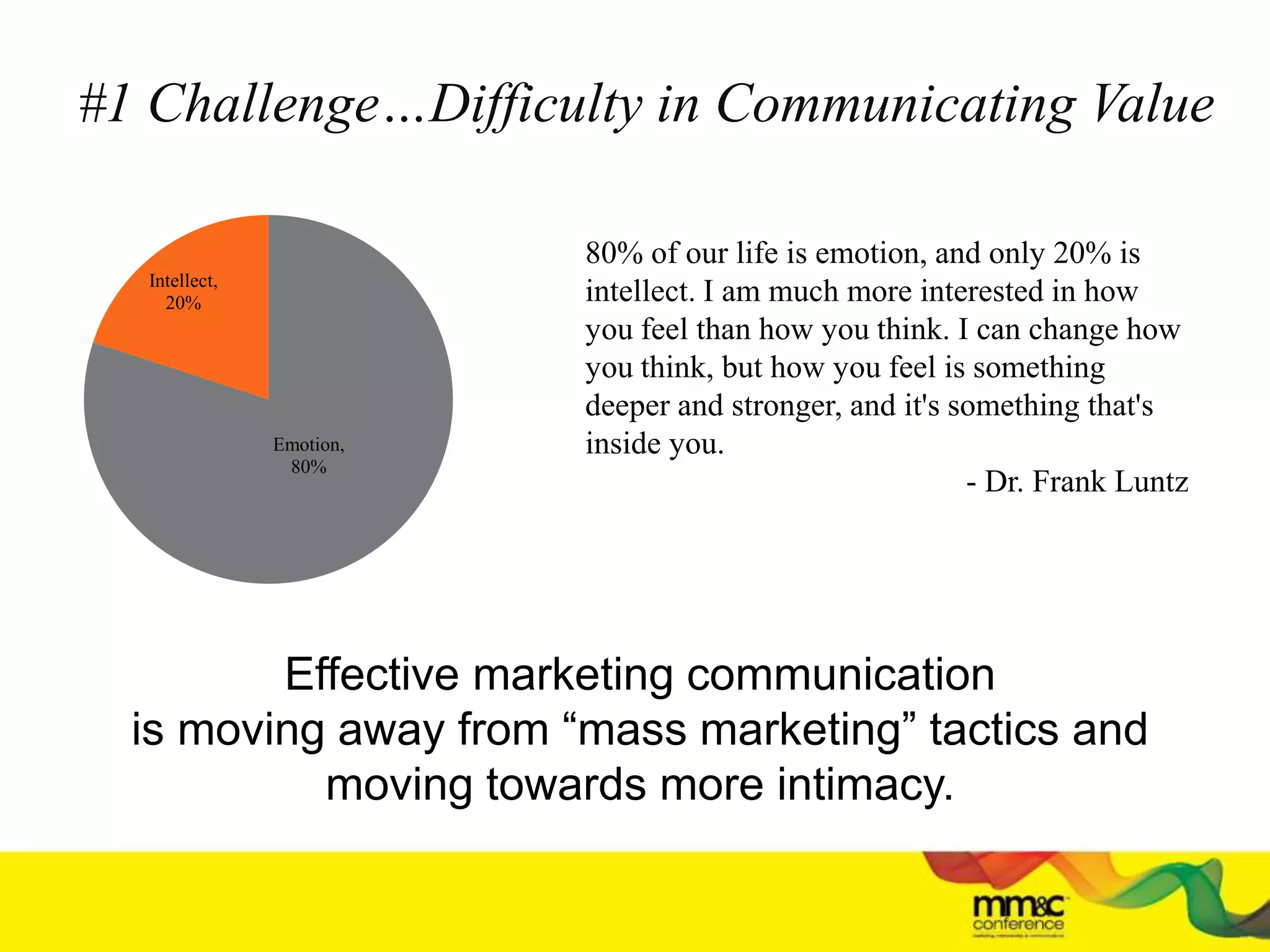
#1 Challenge…Difficulty in Communicating Value
80% of our life is emotion, and only 20% is
intellect. I am much more interested in how
you feel than how you think. I can change how
you think, but how you feel is something
deeper and stronger, and it's something that's
inside you.
- Dr. Frank Luntz
Emotion,
80%
Intellect,
20%
Effective marketing communication
is moving away from “mass marketing” tactics and
moving towards more intimacy.
The Key is Engagement
Engagement = Relationship + Action
“I want to tell AANAC how impressed I am with
the LTC Network Digest on AANAConnect. I am
learning something new every day. And, when I
have questions of my own the answers are always
helpful and prompt. I once posted a question and
received a response in 7 minutes - you just can't
get that kind of attention anywhere else.”
Jan Davis, RN, CRNAC
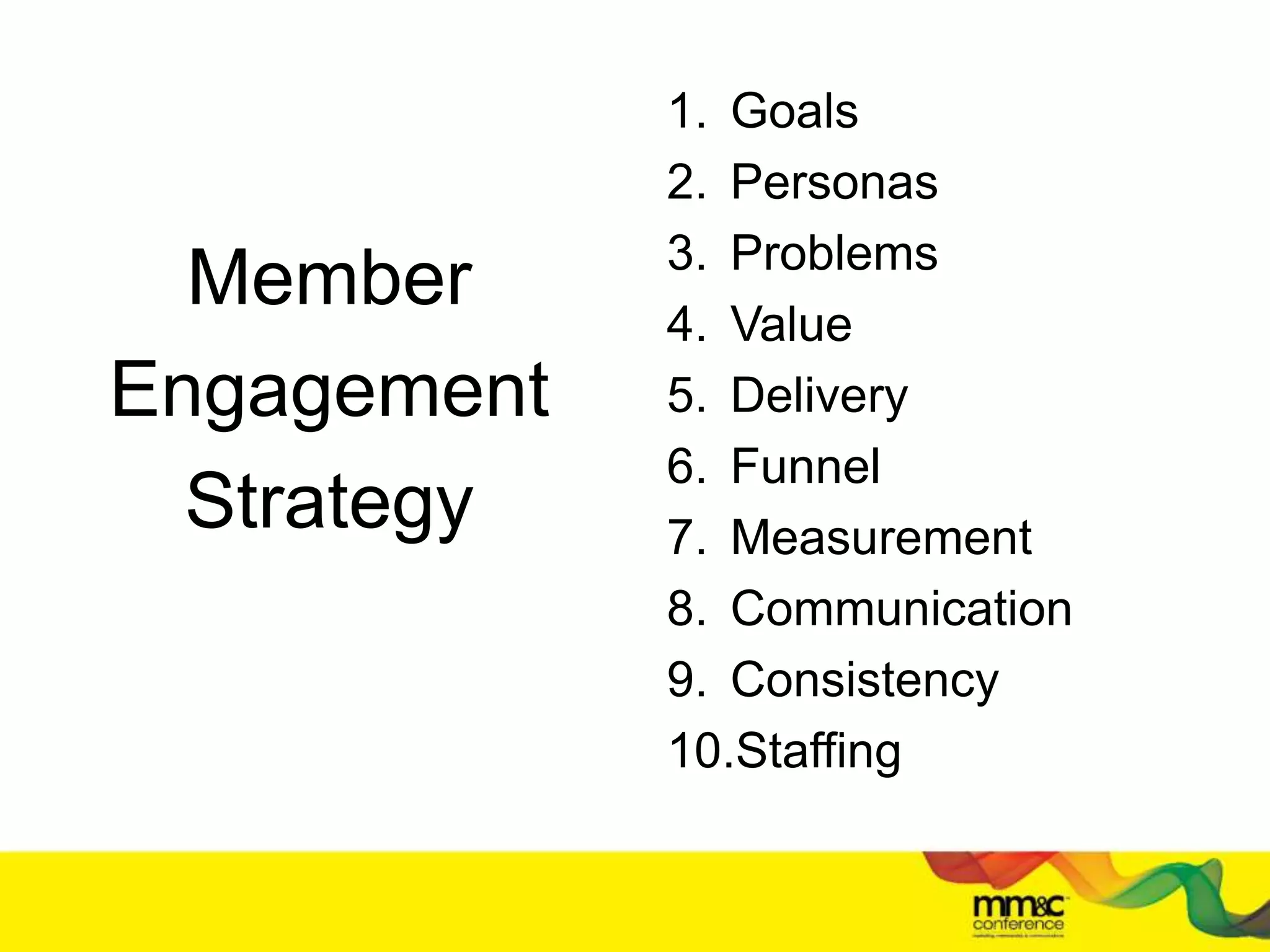
Member
Engagement
Strategy
1. Goals
2. Personas
3. Problems
4. Value
5. Delivery
6. Funnel
7. Measurement
8. Communication
9. Consistency
10.Staffing
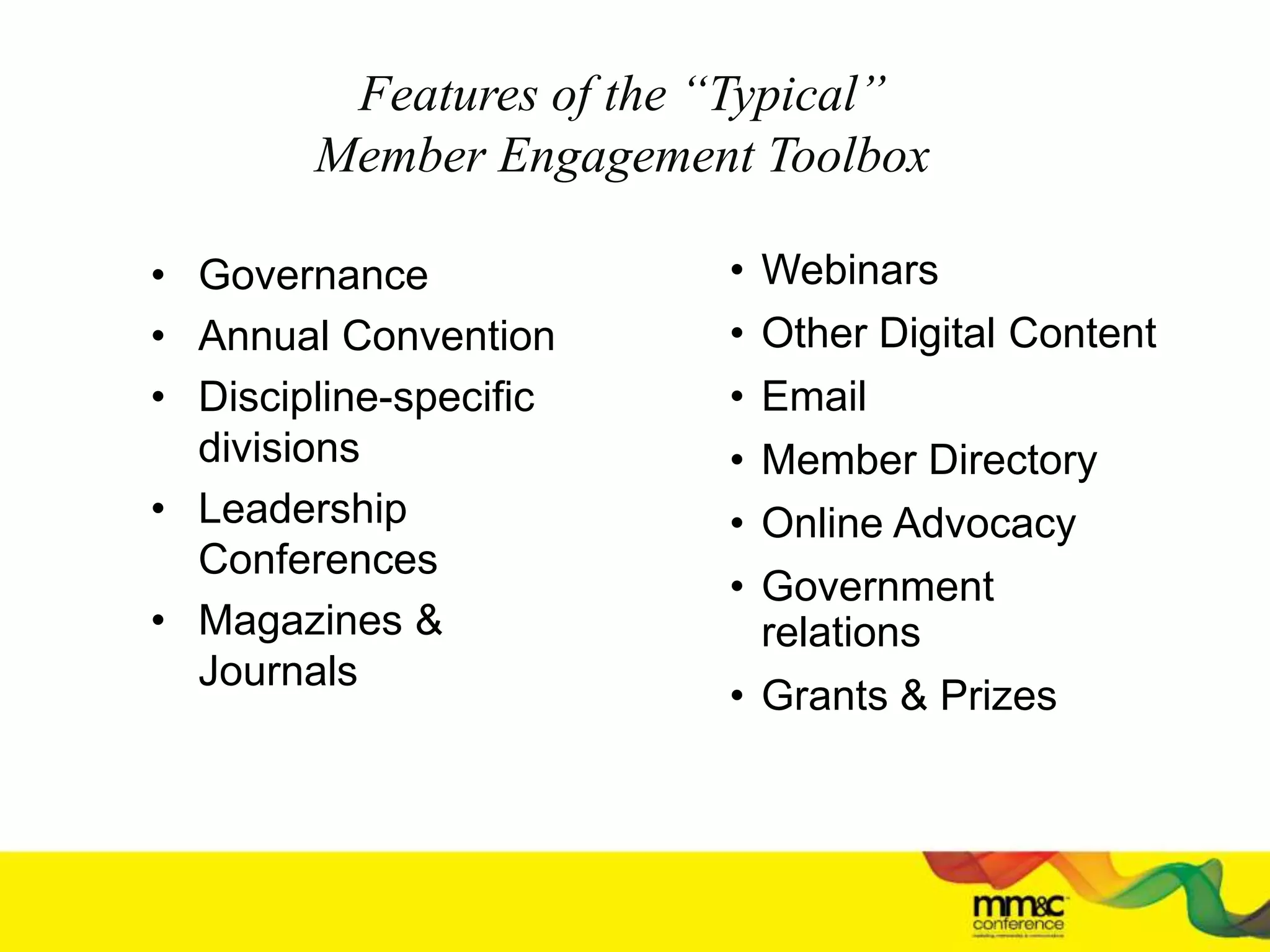
Features of the “Typical”
Member Engagement Toolbox
• Governance
• Annual Convention
• Discipline-specific
divisions
• Leadership
Conferences
• Magazines &
Journals
• Webinars
• Other Digital Content
• Email
• Member Directory
• Online Advocacy
• Government
relations
• Grants & Prizes
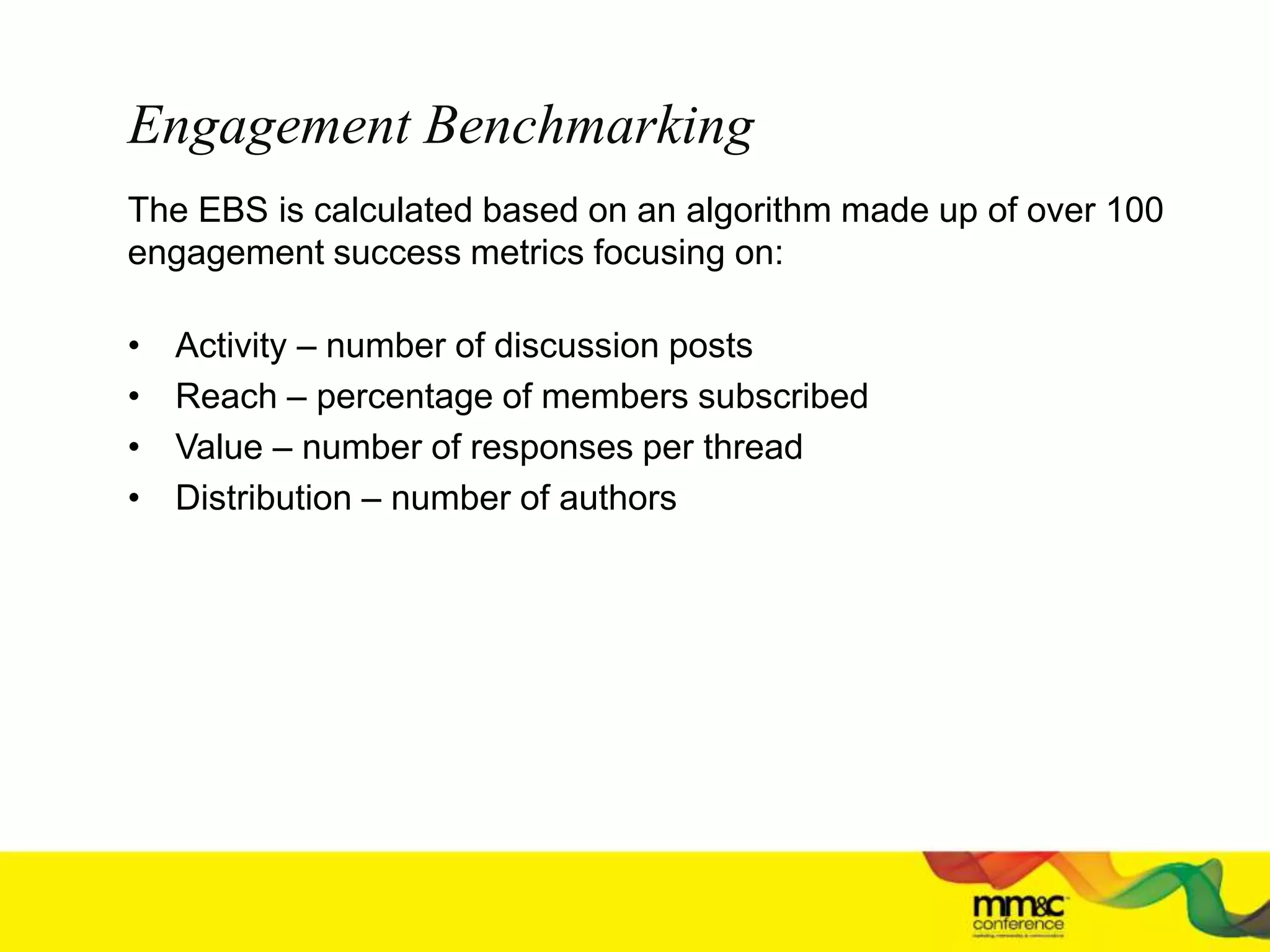
Engagement Benchmarking
The EBS is calculated based on an algorithm made up of over 100
engagement success metrics focusing on:
• Activity – number of discussion posts
• Reach – percentage of members subscribed
• Value – number of responses per thread
• Distribution – number of authors
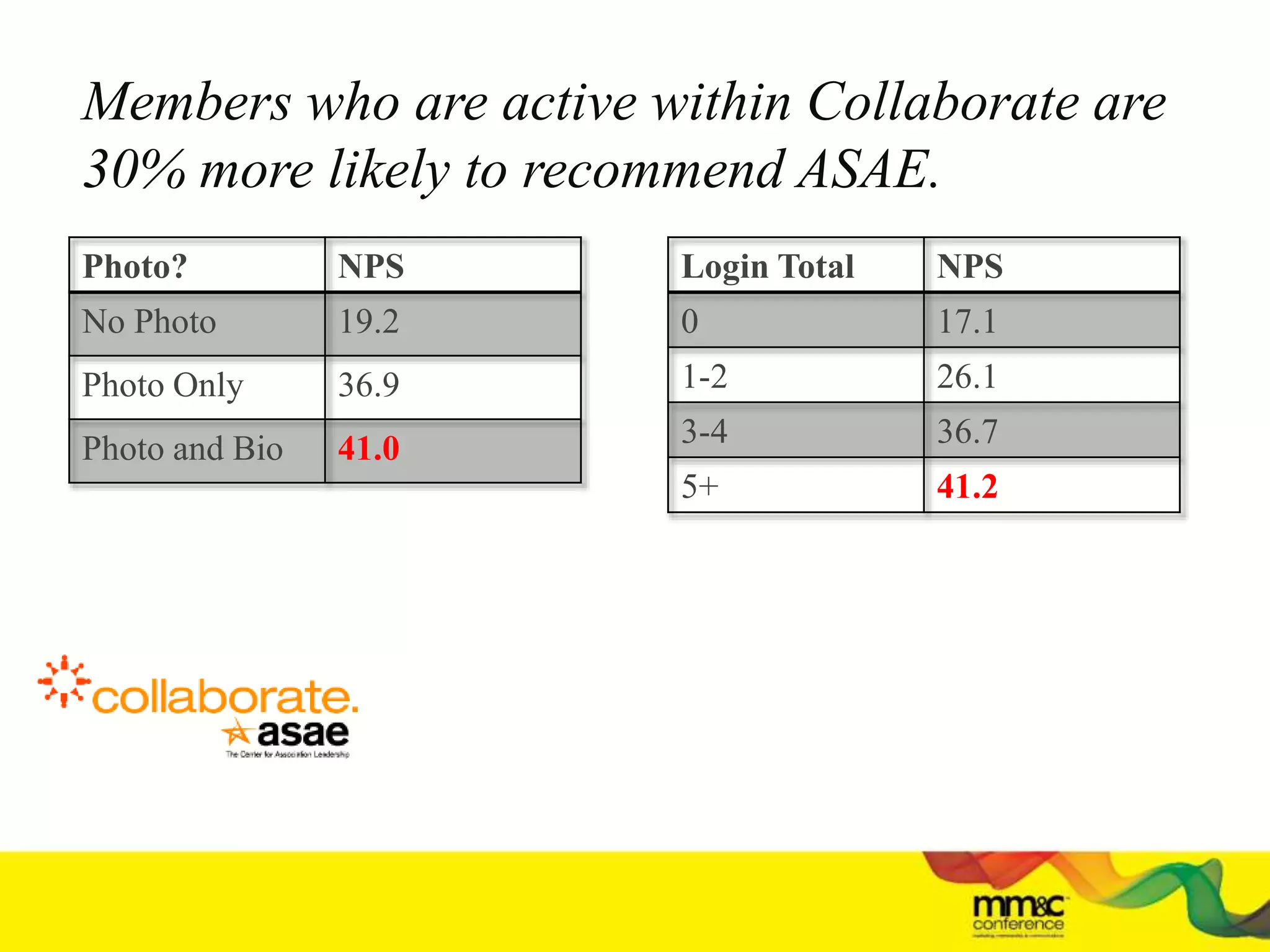
Members who are active within Collaborate are
30% more likely to recommend ASAE.
Photo? NPS
No Photo 19.2
Photo Only 36.9
Photo and Bio 41.0
Login Total NPS
0 17.1
1-2 26.1
3-4 36.7
5+ 41.2
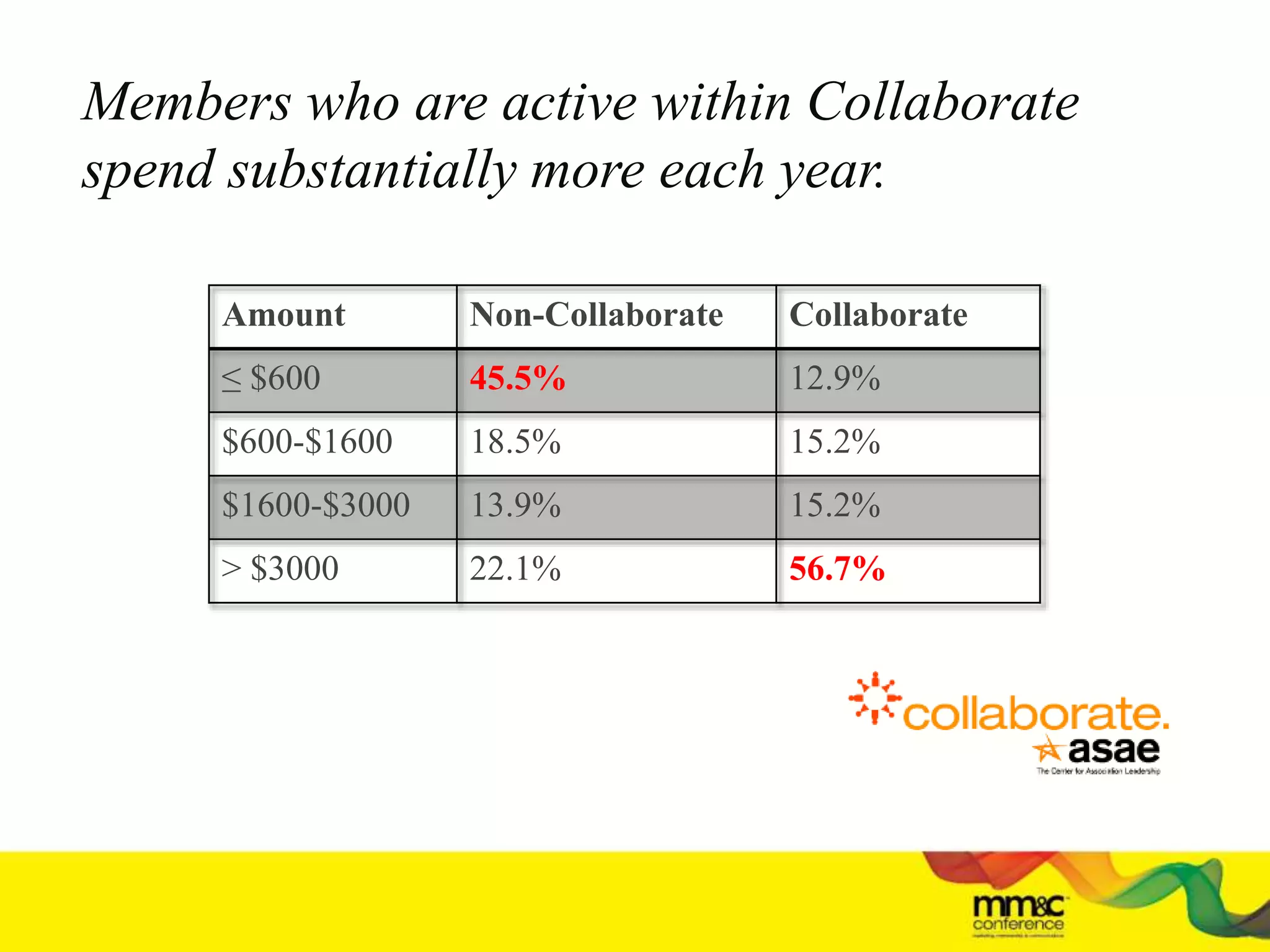
Members who are active within Collaborate
spend substantially more each year.
Amount Non-Collaborate Collaborate
≤ $600 45.5% 12.9%
$600-$1600 18.5% 15.2%
$1600-$3000 13.9% 15.2%
> $3000 22.1% 56.7%
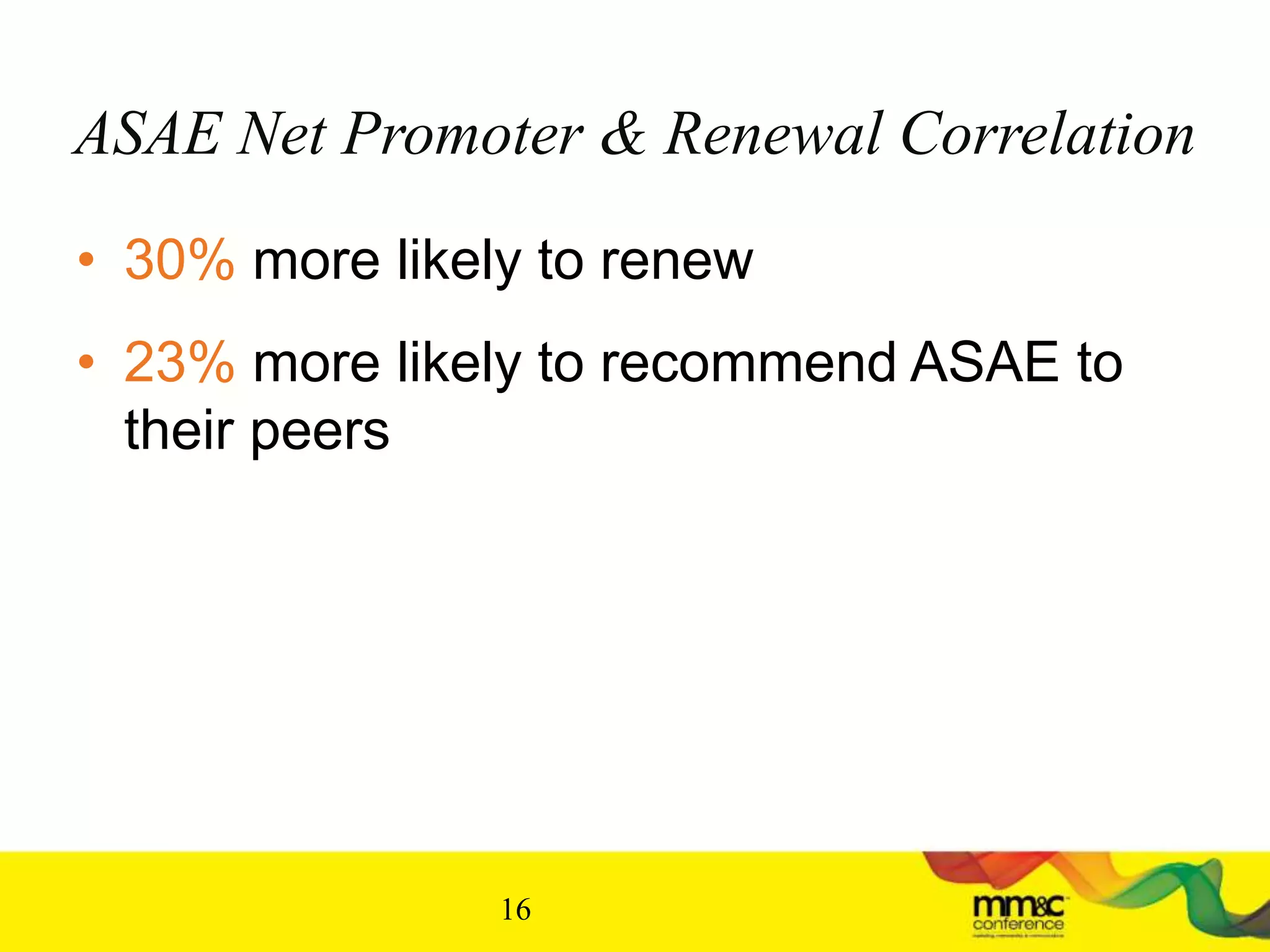
ASAE Net Promoter & Renewal Correlation
• 30% more likely to renew
• 23% more likely to recommend ASAE to
their peers
16
What makes for a successful community?
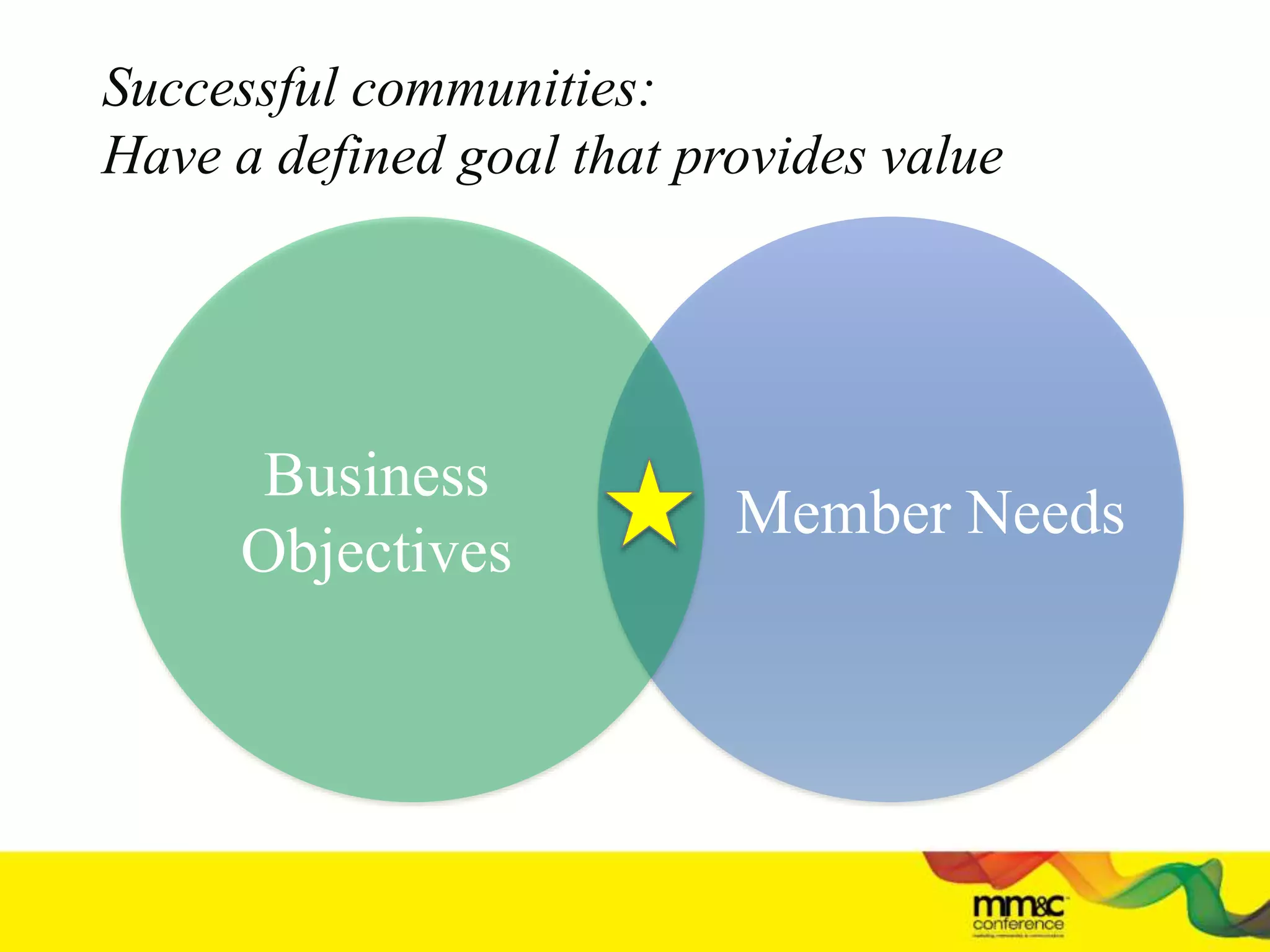
Member Needs
Business
Objectives
Successful communities:
Have a defined goal that provides value
How can a community help a member get what they
joined your organization for more easily, more
effectively and/or more enjoyably?
• Research: talk to your users!
• Find trends about hopes, unmet needs, frustrations
• Build your personas and user stories
• Build your community around these
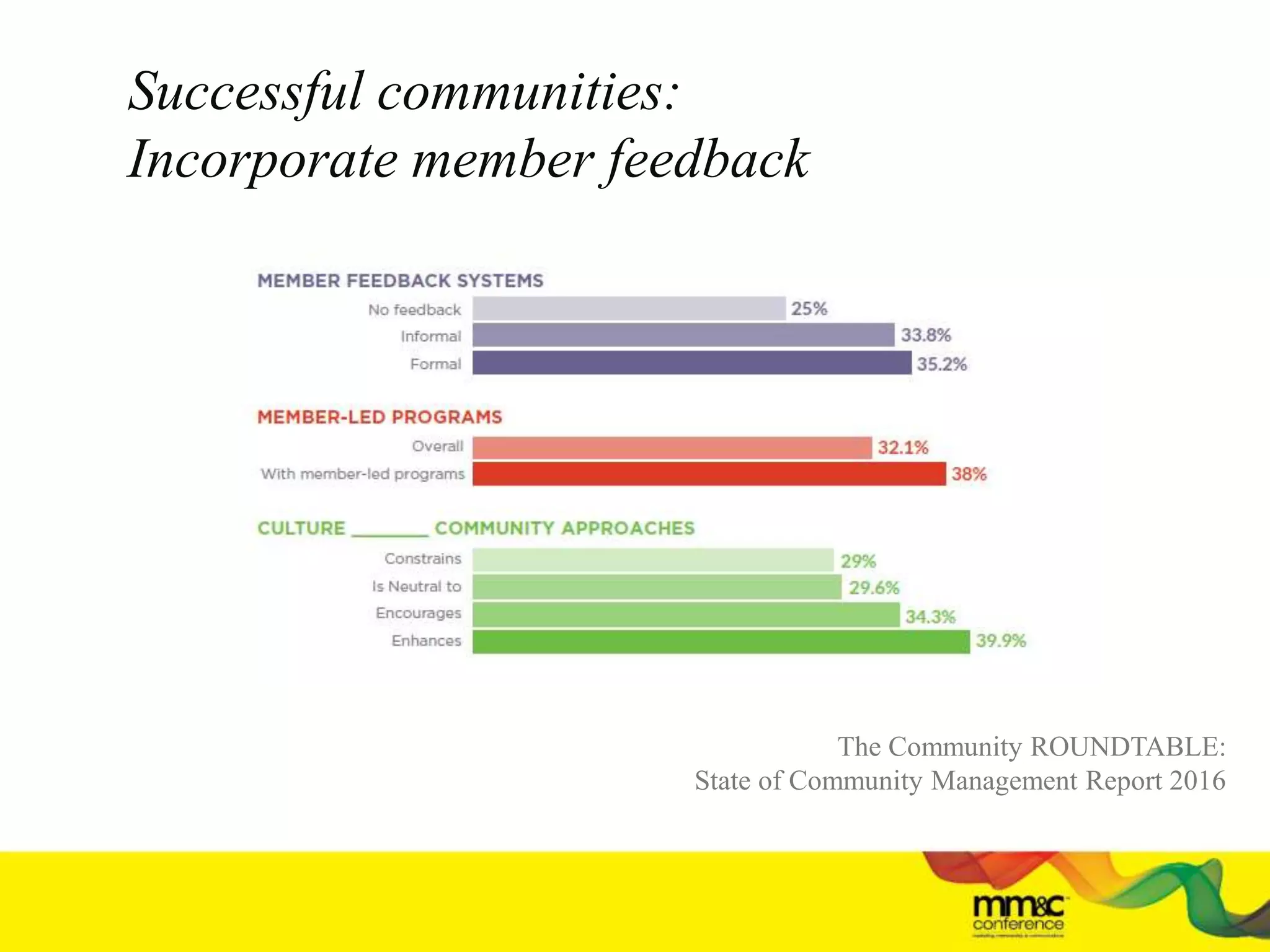
Successful communities:
Incorporate member feedback
The Community ROUNDTABLE:
State of Community Management Report 2016
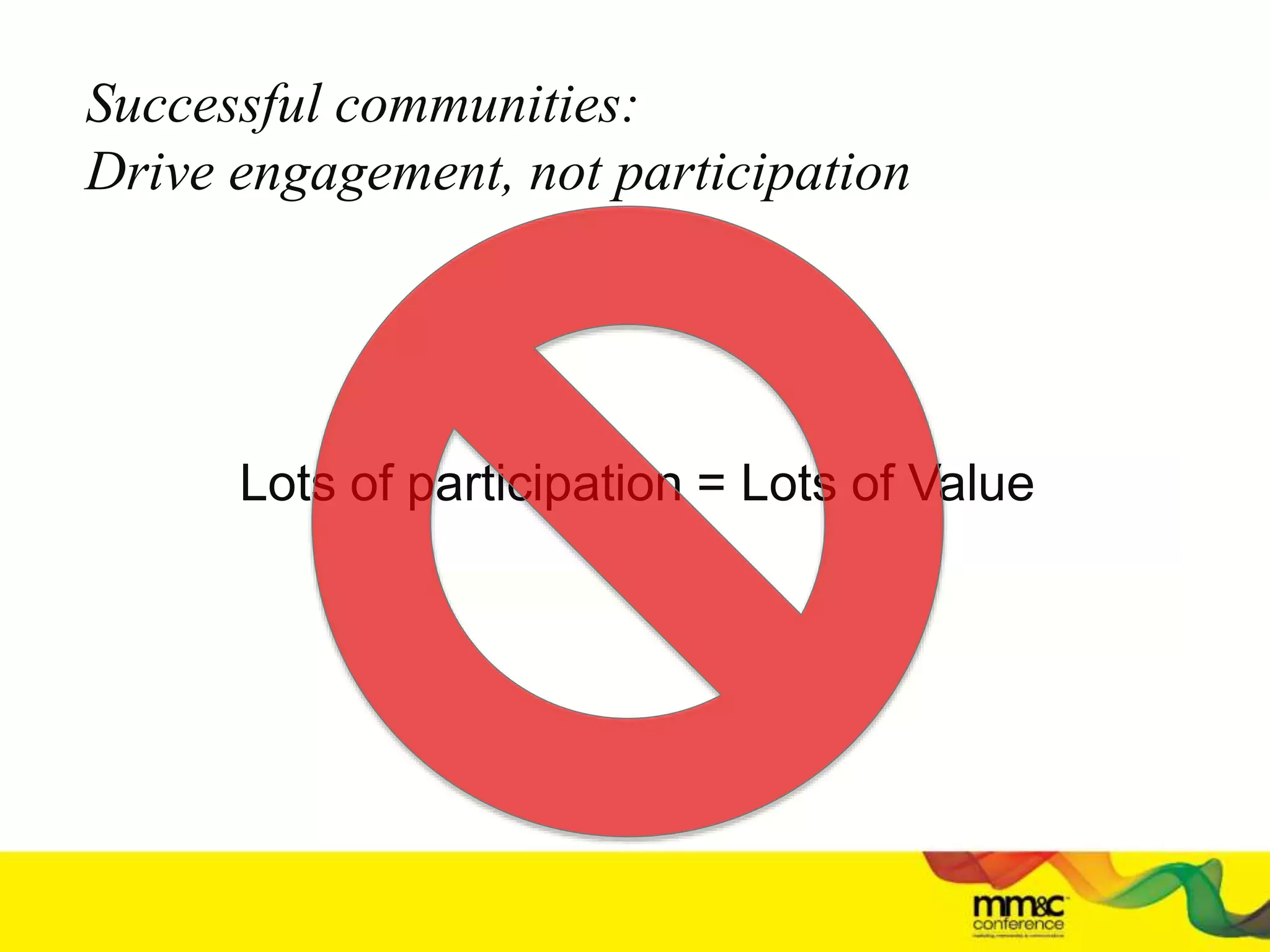
Lots of participation = Lots of Value
Successful communities:
Drive engagement, not participation
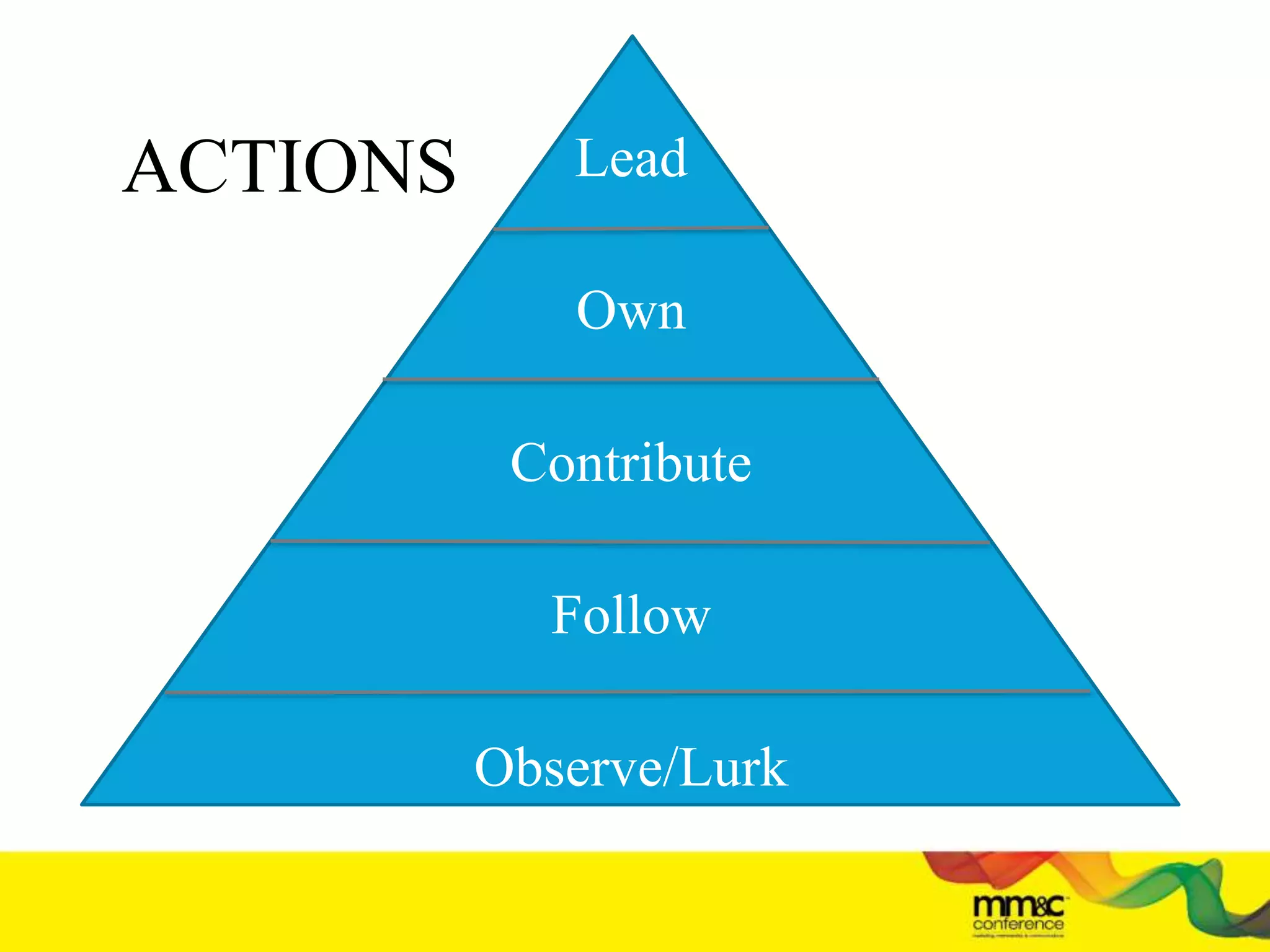
Lead
Own
Contribute
Follow
Observe/Lurk
ACTIONS
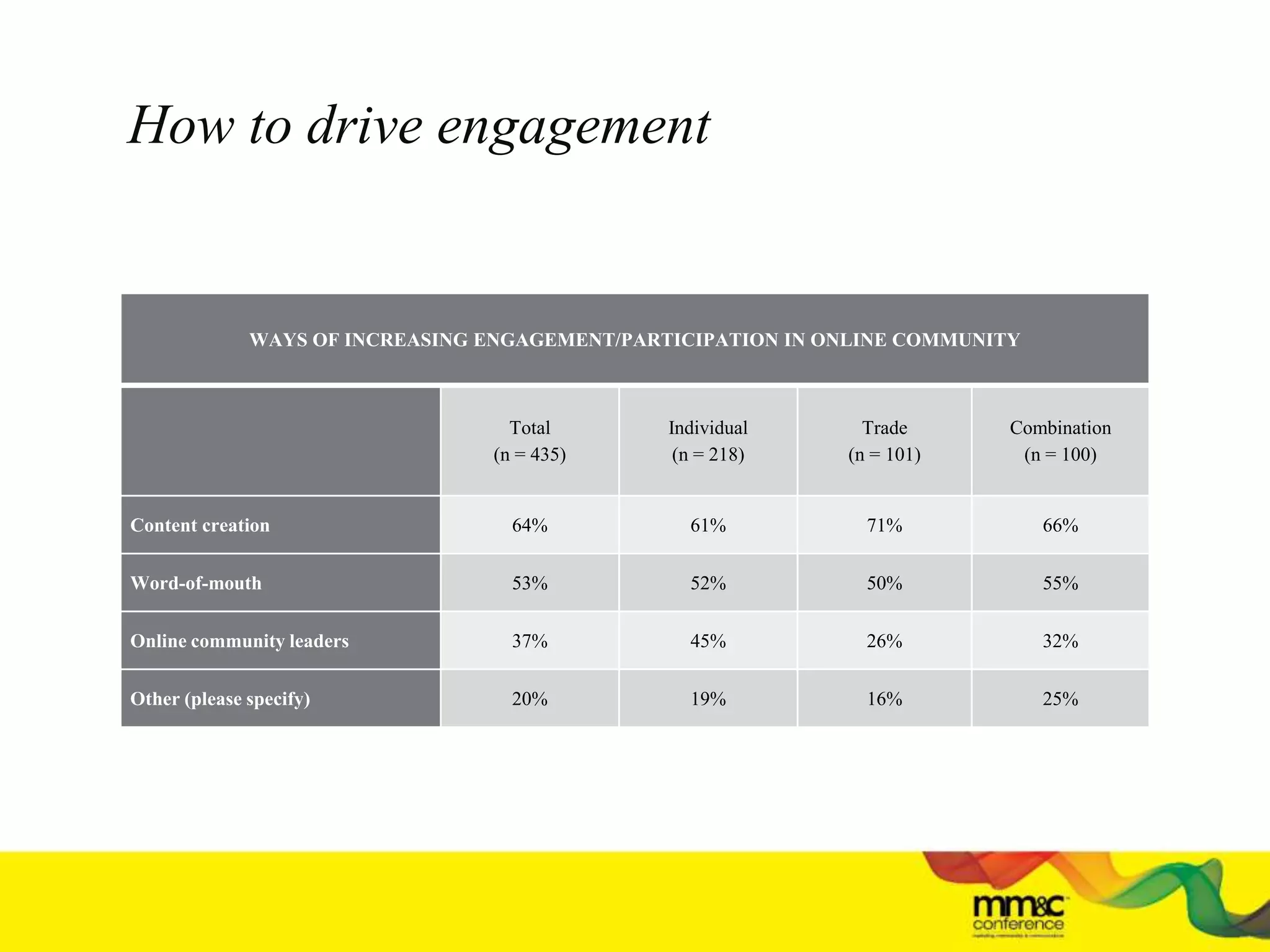
How to drive engagement
WAYS OF INCREASING ENGAGEMENT/PARTICIPATION IN ONLINE COMMUNITY
Total
(n = 435)
Individual
(n = 218)
Trade
(n = 101)
Combination
(n = 100)
Content creation 64% 61% 71% 66%
Word-of-mouth 53% 52% 50% 55%
Online community leaders 37% 45% 26% 32%
Other (please specify) 20% 19% 16% 25%
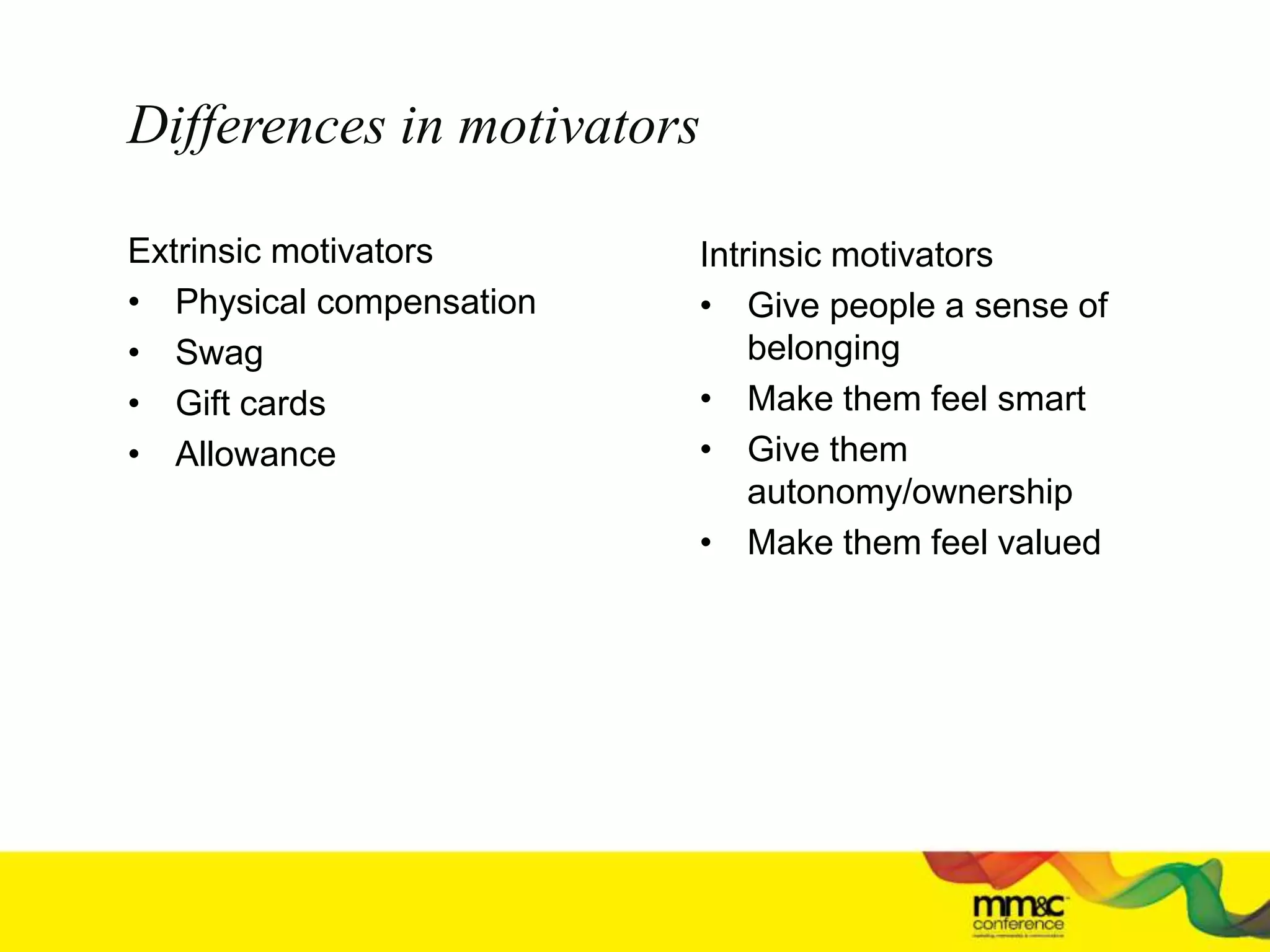
Differences in motivators
Extrinsic motivators
• Physical compensation
• Swag
• Gift cards
• Allowance
Intrinsic motivators
• Give people a sense of
belonging
• Make them feel smart
• Give them
autonomy/ownership
• Make them feel valued
Successful communities:
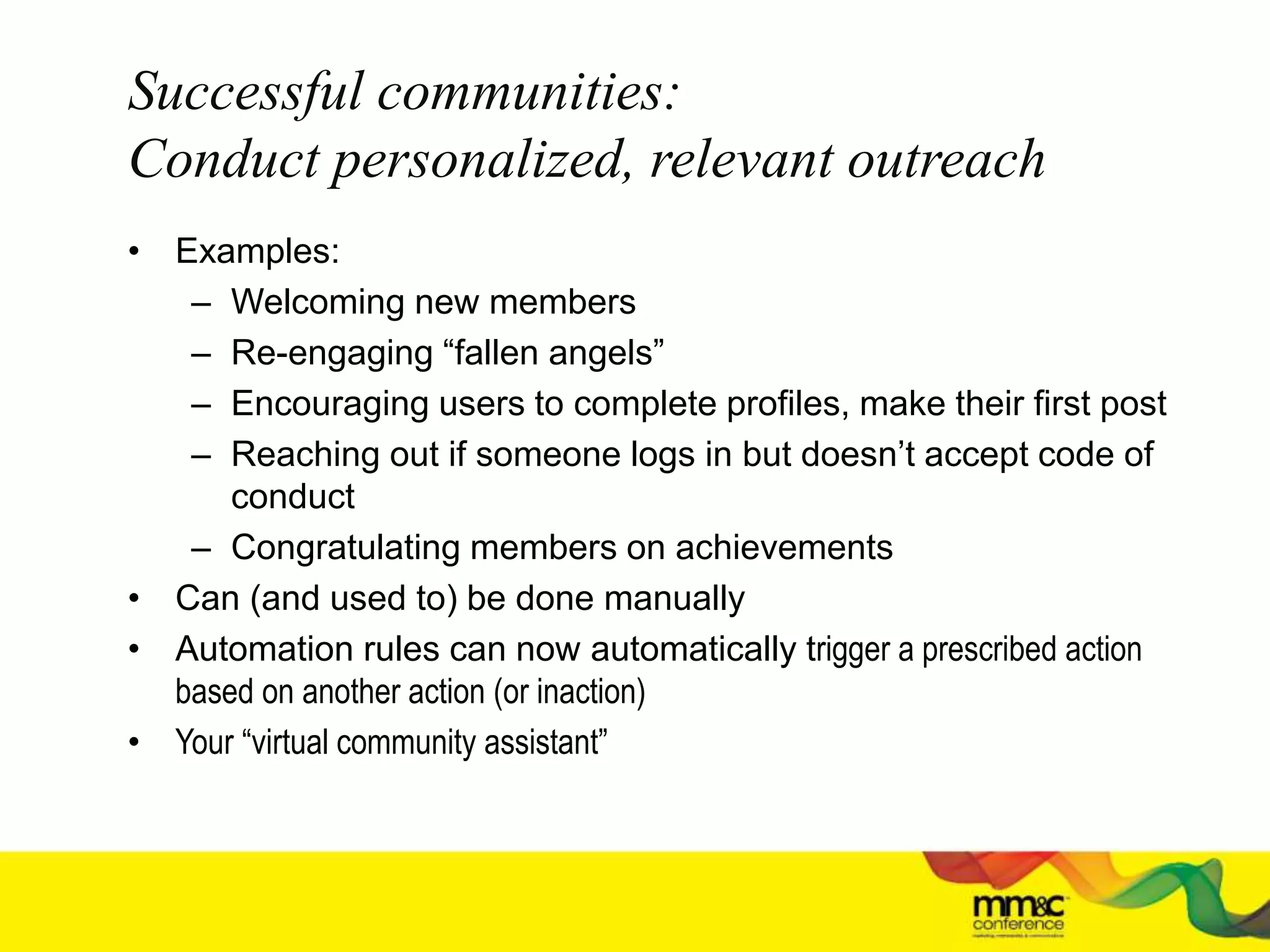
Conduct personalized, relevant outreach
• Examples:
– Welcoming new members
– Re-engaging “fallen angels”
– Encouraging users to complete profiles, make their first post
– Reaching out if someone logs in but doesn’t accept code of
conduct
– Congratulating members on achievements
• Can (and used to) be done manually
• Automation rules can now automatically trigger a prescribed action
based on another action (or inaction)
• Your “virtual community assistant”
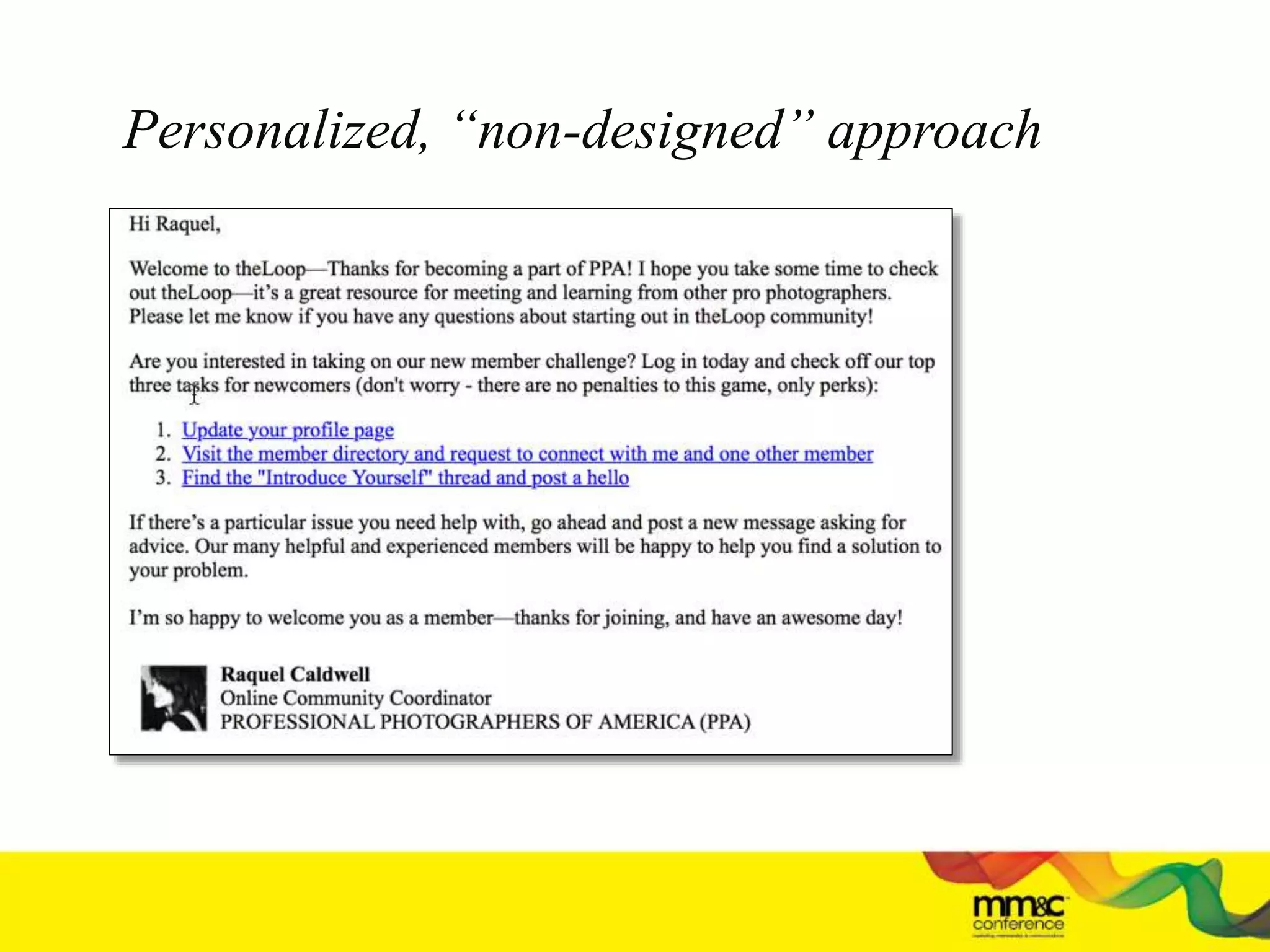
Personalized, “non-designed” approach
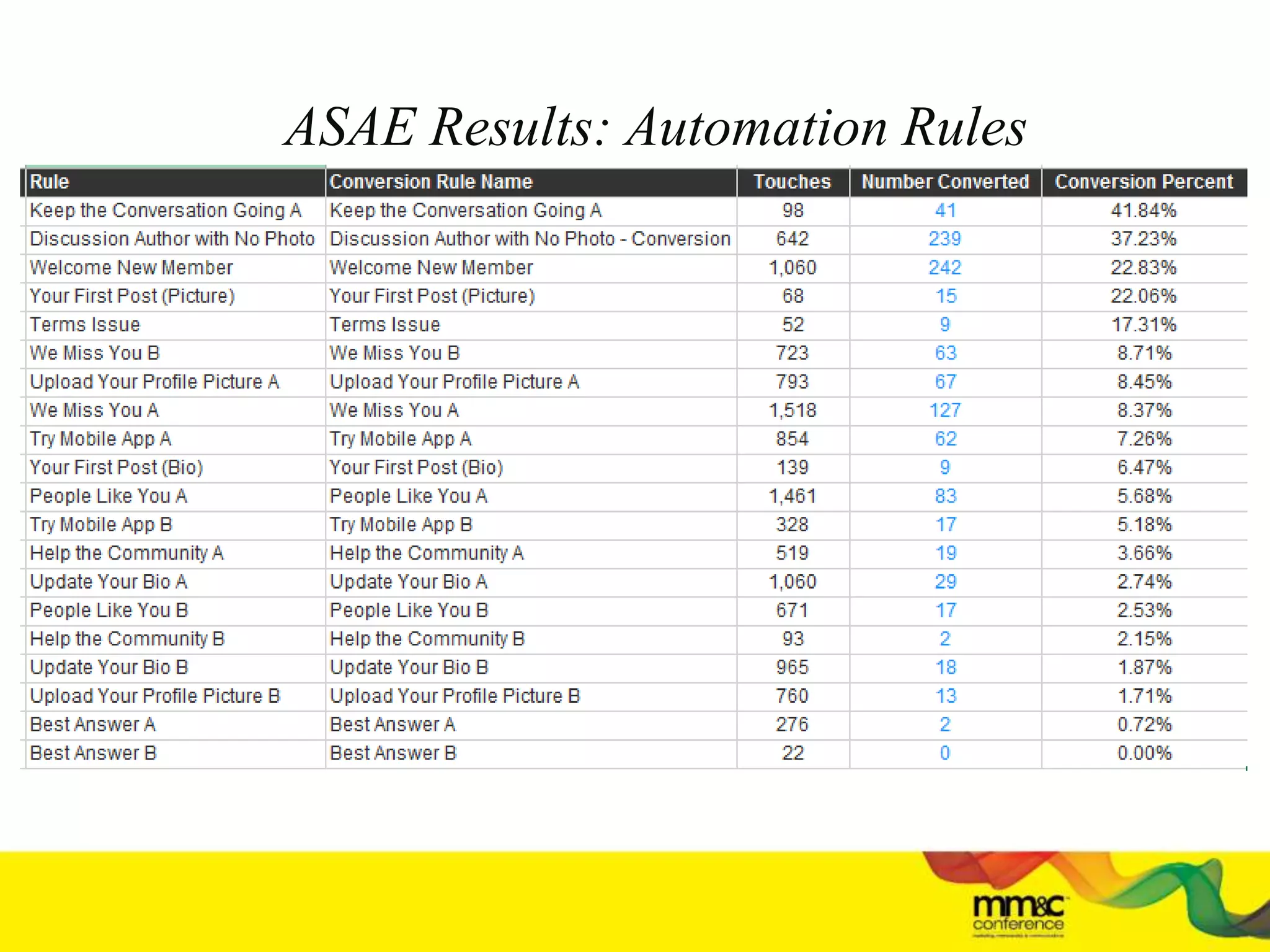
ASAE Results: Automation Rules
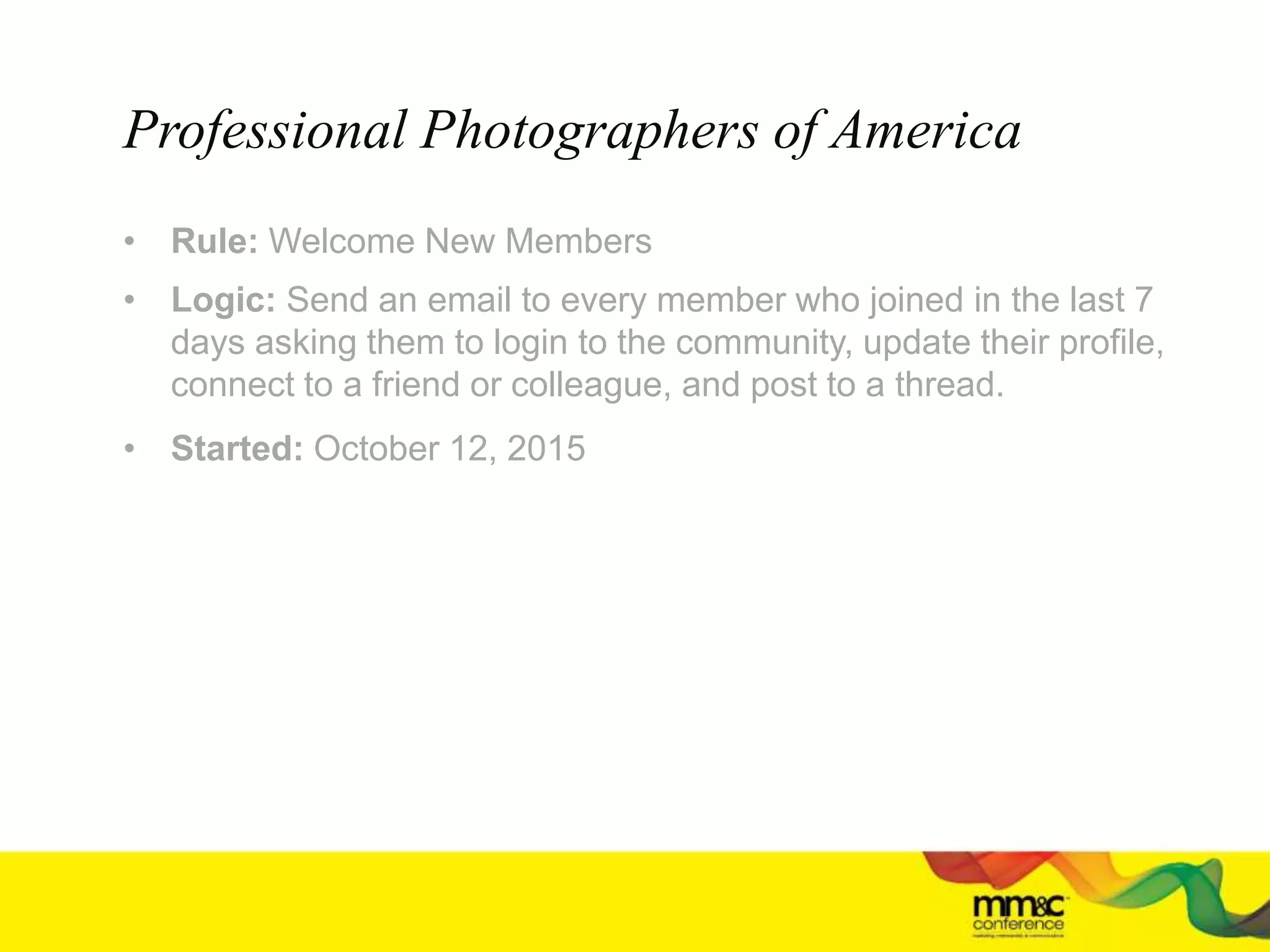
• Rule: Welcome New Members
• Logic: Send an email to every member who joined in the last 7
days asking them to login to the community, update their profile,
connect to a friend or colleague, and post to a thread.
• Started: October 12, 2015
Professional Photographers of America
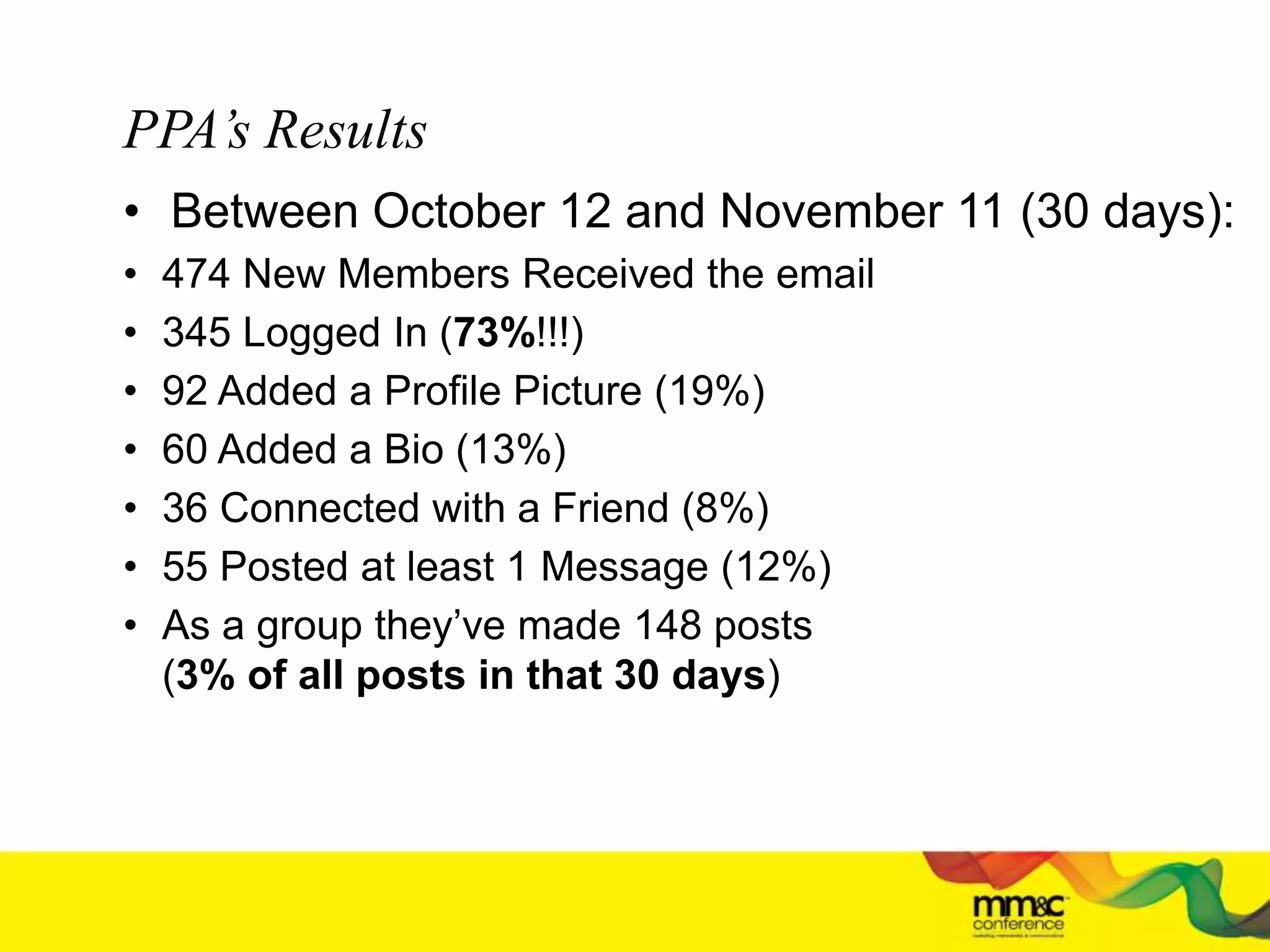
• Between October 12 and November 11 (30 days):
• 474 New Members Received the email
• 345 Logged In (73%!!!)
• 92 Added a Profile Picture (19%)
• 60 Added a Bio (13%)
• 36 Connected with a Friend (8%)
• 55 Posted at least 1 Message (12%)
• As a group they’ve made 148 posts
(3% of all posts in that 30 days)
PPA’s Results
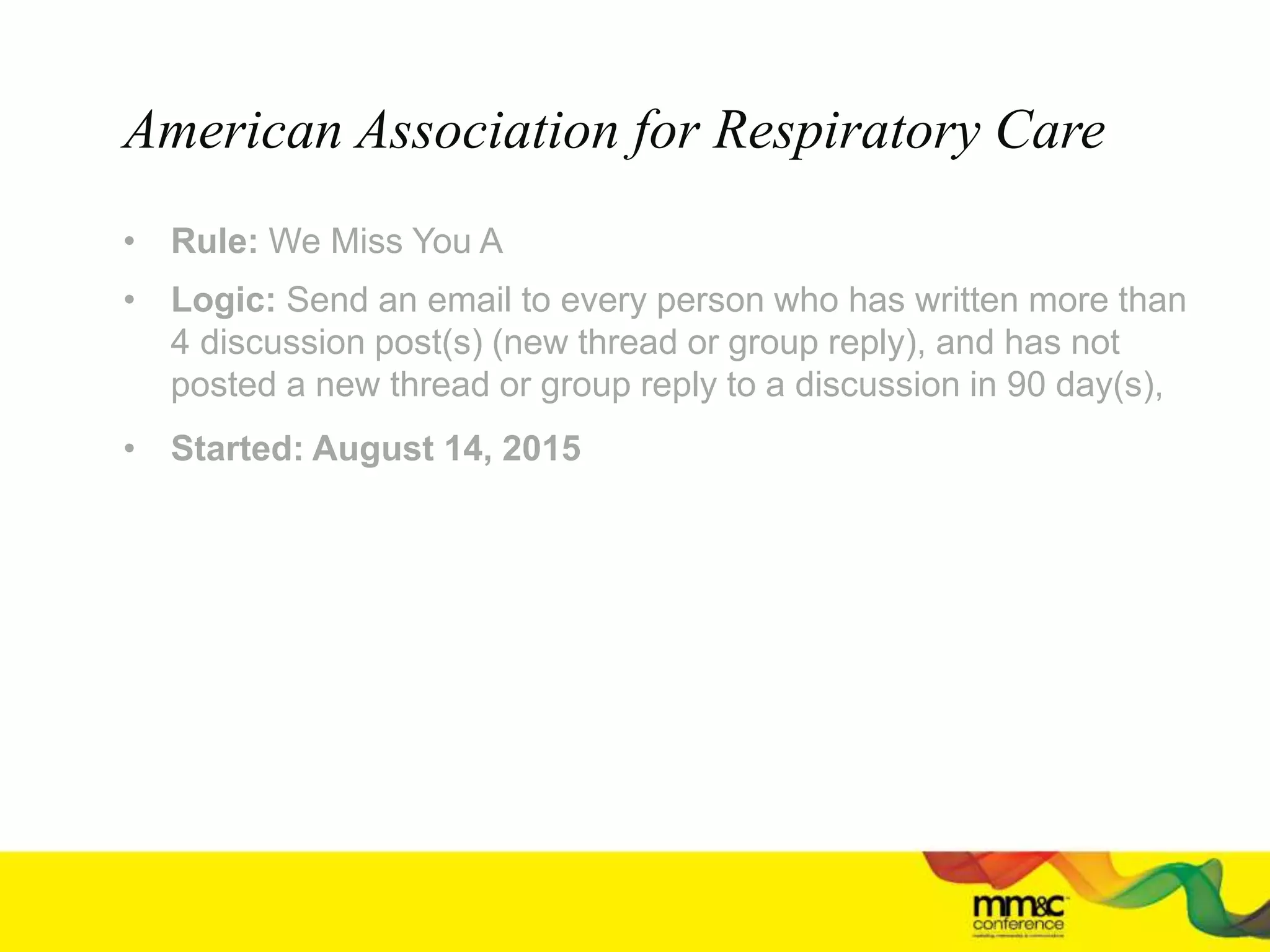
• Rule: We Miss You A
• Logic: Send an email to every person who has written more than
4 discussion post(s) (new thread or group reply), and has not
posted a new thread or group reply to a discussion in 90 day(s),
• Started: August 14, 2015
American Association for Respiratory Care
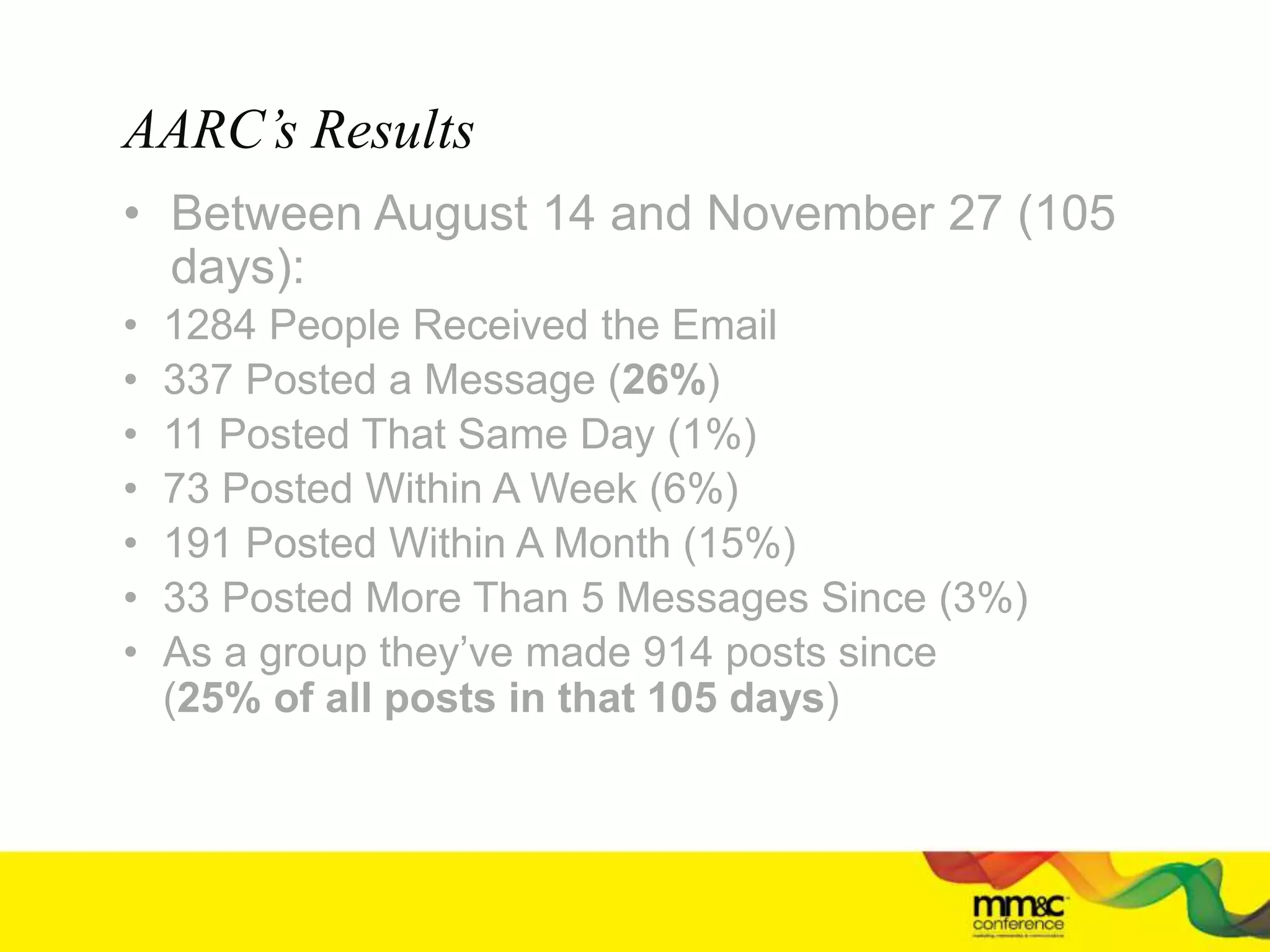
• Between August 14 and November 27 (105
days):
• 1284 People Received the Email
• 337 Posted a Message (26%)
• 11 Posted That Same Day (1%)
• 73 Posted Within A Week (6%)
• 191 Posted Within A Month (15%)
• 33 Posted More Than 5 Messages Since (3%)
• As a group they’ve made 914 posts since
(25% of all posts in that 105 days)
AARC’s Results
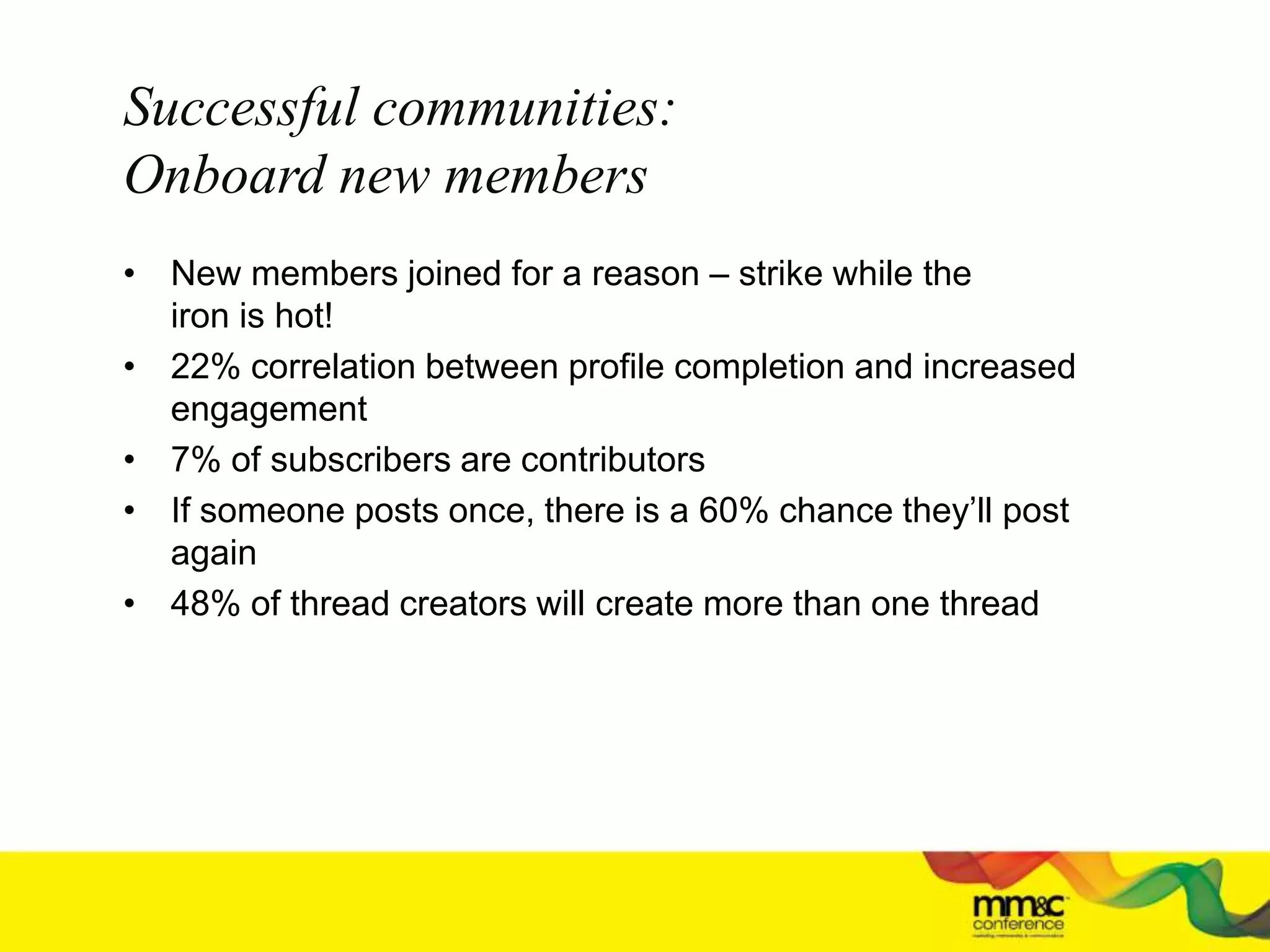
Successful communities:
Onboard new members
• New members joined for a reason – strike while the
iron is hot!
• 22% correlation between profile completion and increased
engagement
• 7% of subscribers are contributors
• If someone posts once, there is a 60% chance they’ll post
again
• 48% of thread creators will create more than one thread
Should be part of larger onboarding process
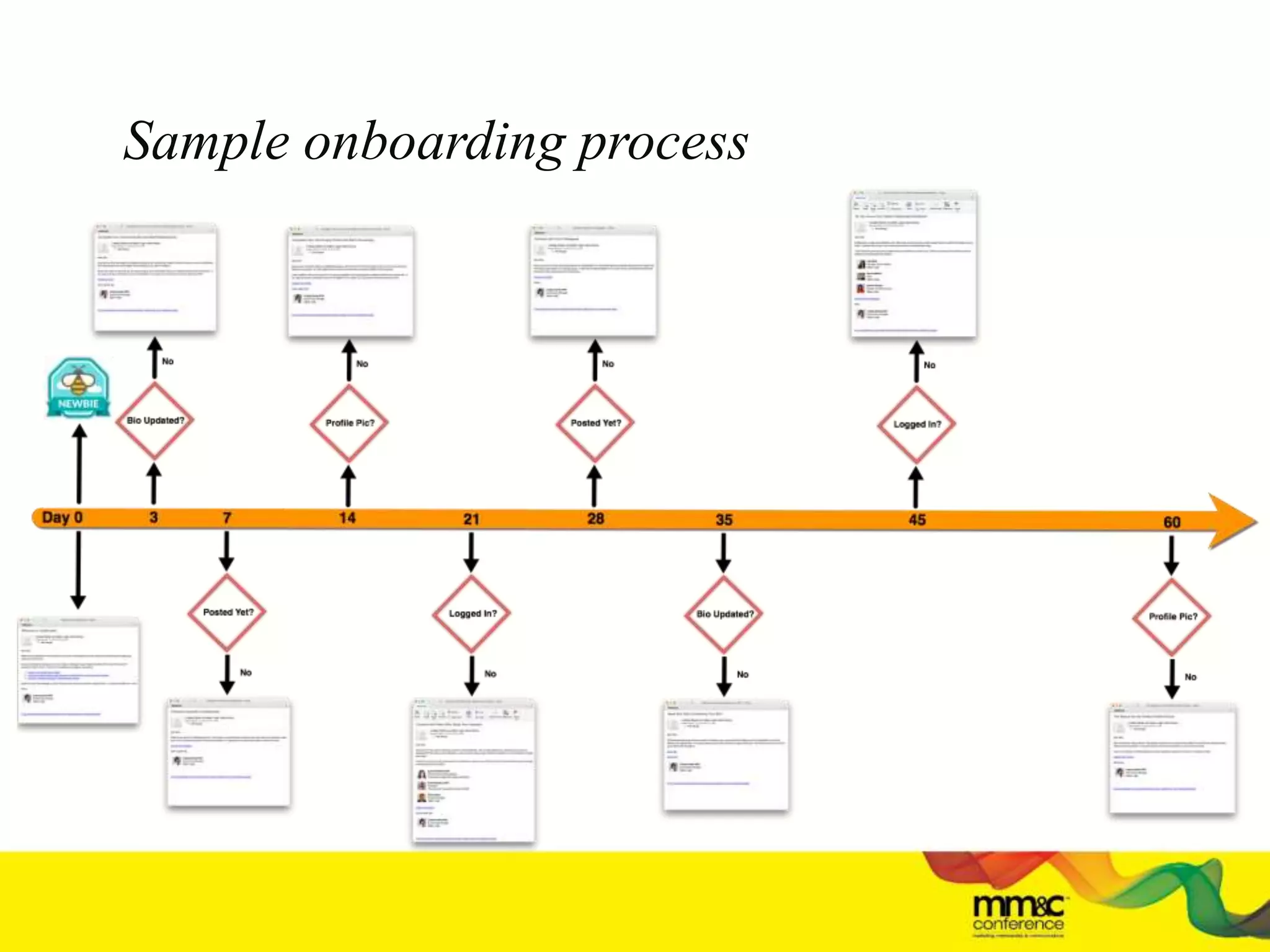
1. A welcome email
2. A new member packet
3. An email containing a one-question survey asking which
benefit/resource he/she is most interested in (sent one month
after joining)
4. An email containing a survey asking which benefits and
services he/she found most useful so far (sent three months
after joining)
5. An email encouraging he/she to get involved by writing a blog
post, presenting or volunteering
Sample onboarding process
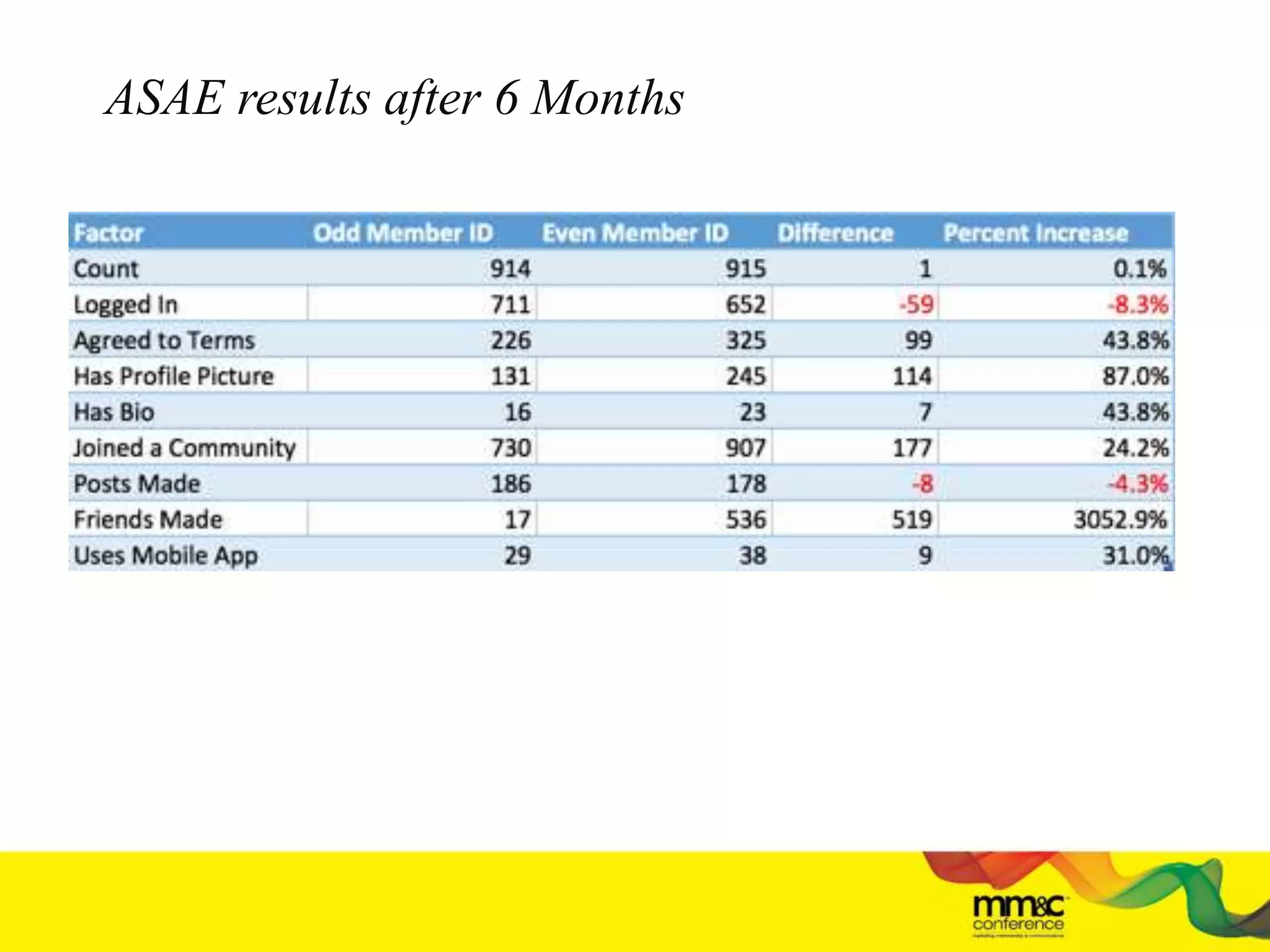
ASAE results after 6 Months
Successful communities:
Use an “open forum” approach at launch
• Open Forum = one all-member (or all user) general community
• Organizations that employed an open forum or similar strategy
score higher on our engagement study
• We found there was a negative correlation between the
engagement score and number of discussion groups for
communities that did not follow this strategy
• Committee groups, work groups and event-specific communities
are OK
• Geographically-based groups are typically NOT successful are
not recommended. The value for international members is in
connecting with members outside of their region.
Successful communities:
Remove barriers to participation
• Prepopulate communities
• Auto-subscribe members
• Prepopulate profiles
• Enable single sign-on and “Remember me” cookies
• Provide means to participate via email and mobile
Successful communities:
Track meaningful key performance indicators
• KPIs are not “one size fits all”
• Start with the behaviors that you want to encourage
• And the goals you want to reach
• Use them as a starting point for finding the right metrics
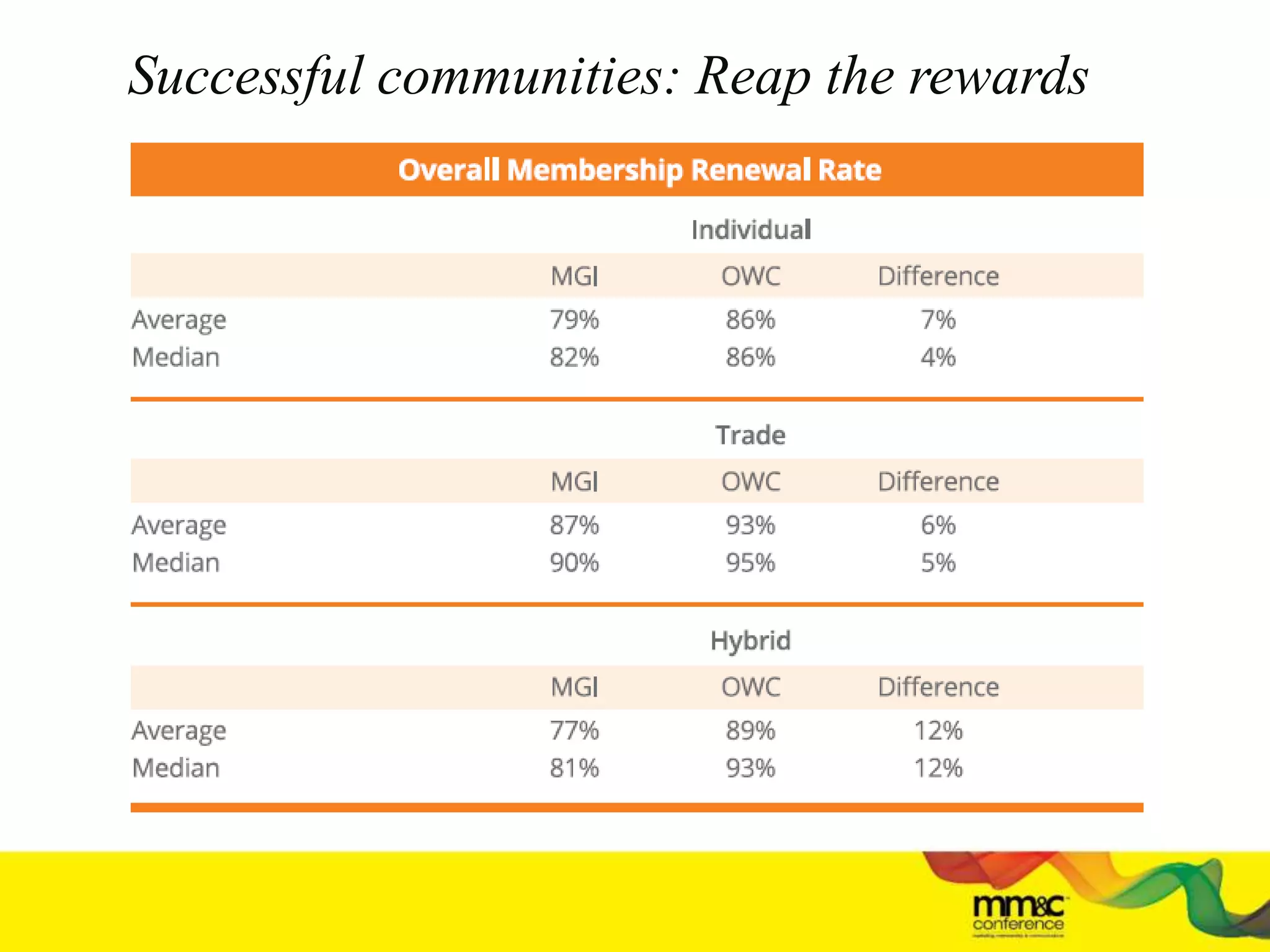
Successful communities: Reap the rewards
Contact Us
Erik Schonher
Vice President
Marketing General
Incorporated
Erik@MarketingGeneral.com
(703) 706-0358
Heather McNair
Vice President of
Engagement Strategy
Higher Logic
heather@higherlogic.com
(202) 350-3502

Effective Strategies to Improve Engagement, Satisfaction and Retnetion

  • 1.
    Effective Strategies toImprove Engagement, Satisfaction and Retention June 13, 2016 4:00-5:00 pm Heather McNair, VP of Engagement Strategy Higher Logic Erik Schonher, VP of Account Development, Research and Media Marketing General Inc.
  • 2.
    Henry Ford, 1909 "Anycustomer can have a car painted any colour that he wants so long as it is black."
  • 3.
    Why are customersmore satisfied than members? MCI Global Engagement Index 2016
  • 4.
    Today’s Objectives • Reviewwhat engagement is • Look at it’s role in an association • Discuss the flaws in today’s approach • Talk about tactics and strategies to enhance engagement with the ultimate goal of driving retention
  • 5.
    What does amember WANT? 5 (Nov. 2015 Harvard Business Review) • Stand out from the crowd - Project a unique social identity • Feel a sense of belonging - Feel like part of the group • Be the person I want to be -Fulfill a desire for ongoing self-improvement • Succeed in life -Find worth that goes beyond financial or socio- economic measures
  • 6.
    2016 Membership MarketingBenchmarking Report
  • 7.
    2016 Membership MarketingBenchmarking Report
  • 8.
    #1 Challenge…Difficulty inCommunicating Value 80% of our life is emotion, and only 20% is intellect. I am much more interested in how you feel than how you think. I can change how you think, but how you feel is something deeper and stronger, and it's something that's inside you. - Dr. Frank Luntz Emotion, 80% Intellect, 20% Effective marketing communication is moving away from “mass marketing” tactics and moving towards more intimacy.
  • 9.
    The Key isEngagement Engagement = Relationship + Action
  • 10.
    “I want totell AANAC how impressed I am with the LTC Network Digest on AANAConnect. I am learning something new every day. And, when I have questions of my own the answers are always helpful and prompt. I once posted a question and received a response in 7 minutes - you just can't get that kind of attention anywhere else.” Jan Davis, RN, CRNAC
  • 11.
    Member Engagement Strategy 1. Goals 2. Personas 3.Problems 4. Value 5. Delivery 6. Funnel 7. Measurement 8. Communication 9. Consistency 10.Staffing
  • 12.
    Features of the“Typical” Member Engagement Toolbox • Governance • Annual Convention • Discipline-specific divisions • Leadership Conferences • Magazines & Journals • Webinars • Other Digital Content • Email • Member Directory • Online Advocacy • Government relations • Grants & Prizes
  • 13.
    Engagement Benchmarking The EBSis calculated based on an algorithm made up of over 100 engagement success metrics focusing on: • Activity – number of discussion posts • Reach – percentage of members subscribed • Value – number of responses per thread • Distribution – number of authors
  • 14.
    Members who areactive within Collaborate are 30% more likely to recommend ASAE. Photo? NPS No Photo 19.2 Photo Only 36.9 Photo and Bio 41.0 Login Total NPS 0 17.1 1-2 26.1 3-4 36.7 5+ 41.2
  • 15.
    Members who areactive within Collaborate spend substantially more each year. Amount Non-Collaborate Collaborate ≤ $600 45.5% 12.9% $600-$1600 18.5% 15.2% $1600-$3000 13.9% 15.2% > $3000 22.1% 56.7%
  • 16.
    ASAE Net Promoter& Renewal Correlation • 30% more likely to renew • 23% more likely to recommend ASAE to their peers 16
  • 17.
    What makes fora successful community?
  • 18.
  • 19.
    How can acommunity help a member get what they joined your organization for more easily, more effectively and/or more enjoyably? • Research: talk to your users! • Find trends about hopes, unmet needs, frustrations • Build your personas and user stories • Build your community around these
  • 20.
    Successful communities: Incorporate memberfeedback The Community ROUNDTABLE: State of Community Management Report 2016
  • 21.
    Lots of participation= Lots of Value Successful communities: Drive engagement, not participation
  • 22.
  • 23.
    How to driveengagement WAYS OF INCREASING ENGAGEMENT/PARTICIPATION IN ONLINE COMMUNITY Total (n = 435) Individual (n = 218) Trade (n = 101) Combination (n = 100) Content creation 64% 61% 71% 66% Word-of-mouth 53% 52% 50% 55% Online community leaders 37% 45% 26% 32% Other (please specify) 20% 19% 16% 25%
  • 24.
    Differences in motivators Extrinsicmotivators • Physical compensation • Swag • Gift cards • Allowance Intrinsic motivators • Give people a sense of belonging • Make them feel smart • Give them autonomy/ownership • Make them feel valued
  • 25.
    Successful communities: Conduct personalized,relevant outreach • Examples: – Welcoming new members – Re-engaging “fallen angels” – Encouraging users to complete profiles, make their first post – Reaching out if someone logs in but doesn’t accept code of conduct – Congratulating members on achievements • Can (and used to) be done manually • Automation rules can now automatically trigger a prescribed action based on another action (or inaction) • Your “virtual community assistant”
  • 26.
  • 27.
  • 28.
    • Rule: WelcomeNew Members • Logic: Send an email to every member who joined in the last 7 days asking them to login to the community, update their profile, connect to a friend or colleague, and post to a thread. • Started: October 12, 2015 Professional Photographers of America
  • 29.
    • Between October12 and November 11 (30 days): • 474 New Members Received the email • 345 Logged In (73%!!!) • 92 Added a Profile Picture (19%) • 60 Added a Bio (13%) • 36 Connected with a Friend (8%) • 55 Posted at least 1 Message (12%) • As a group they’ve made 148 posts (3% of all posts in that 30 days) PPA’s Results
  • 30.
    • Rule: WeMiss You A • Logic: Send an email to every person who has written more than 4 discussion post(s) (new thread or group reply), and has not posted a new thread or group reply to a discussion in 90 day(s), • Started: August 14, 2015 American Association for Respiratory Care
  • 31.
    • Between August14 and November 27 (105 days): • 1284 People Received the Email • 337 Posted a Message (26%) • 11 Posted That Same Day (1%) • 73 Posted Within A Week (6%) • 191 Posted Within A Month (15%) • 33 Posted More Than 5 Messages Since (3%) • As a group they’ve made 914 posts since (25% of all posts in that 105 days) AARC’s Results
  • 32.
    Successful communities: Onboard newmembers • New members joined for a reason – strike while the iron is hot! • 22% correlation between profile completion and increased engagement • 7% of subscribers are contributors • If someone posts once, there is a 60% chance they’ll post again • 48% of thread creators will create more than one thread
  • 33.
    Should be partof larger onboarding process 1. A welcome email 2. A new member packet 3. An email containing a one-question survey asking which benefit/resource he/she is most interested in (sent one month after joining) 4. An email containing a survey asking which benefits and services he/she found most useful so far (sent three months after joining) 5. An email encouraging he/she to get involved by writing a blog post, presenting or volunteering
  • 34.
  • 35.
  • 36.
    Successful communities: Use an“open forum” approach at launch • Open Forum = one all-member (or all user) general community • Organizations that employed an open forum or similar strategy score higher on our engagement study • We found there was a negative correlation between the engagement score and number of discussion groups for communities that did not follow this strategy • Committee groups, work groups and event-specific communities are OK • Geographically-based groups are typically NOT successful are not recommended. The value for international members is in connecting with members outside of their region.
  • 37.
    Successful communities: Remove barriersto participation • Prepopulate communities • Auto-subscribe members • Prepopulate profiles • Enable single sign-on and “Remember me” cookies • Provide means to participate via email and mobile
  • 38.
    Successful communities: Track meaningfulkey performance indicators • KPIs are not “one size fits all” • Start with the behaviors that you want to encourage • And the goals you want to reach • Use them as a starting point for finding the right metrics
  • 39.
  • 40.
    Contact Us Erik Schonher VicePresident Marketing General Incorporated Erik@MarketingGeneral.com (703) 706-0358 Heather McNair Vice President of Engagement Strategy Higher Logic heather@higherlogic.com (202) 350-3502

Editor's Notes

  • #3 This season demonstrated conclusively to me that it was time to put the new policy in force. The salesmen, before I had announced the policy, were spurred by the great sales to think that even greater sales might be had if only we had more models. It is strange how, just as soon as an article becomes successful, somebody starts to think that it would be more successful if only it were different. There is a tendency to keep monkeying with styles and to spoil a good thing by changing it. The salesmen were insistent on increasing the line. They listened to the 5 per cent., the special customers who could say what they wanted, and forgot all about the 95 per cent. who just bought without making any fuss. No business can improve unless it pays the closest possible attention to complaints and suggestions. If there is any defect in service then that must be instantly and rigorously investigated, but when the suggestion is only as to style, one has to make sure whether it is not merely a personal whim that is being voiced. Salesmen always want to cater to whims instead of acquiring sufficient knowledge of their product to be able to explain to the customer with the whim that what they have will satisfy his every requirement—that is, of course, provided what they have does satisfy these requirements.
  • #5 How to use data to determine your member journeys Making sure words resonate with your members Determine how to map performance back to mission, vision and goals The 2016 MGI & Higher Logic Community Benchmarking Report provides great insight into community engagement tactics that work for an array of member demographics. Learn from association examples with proven exponential membership growth using various membership models.. Determine which benchmarks to focus on for your organization and how to measure performance mapped back to your mission, vision and goals. 
  • #6 So it’s about personal relationship with the member. It’s about engaging the member. Engagement is like gasoline for a car.
  • #9 But to engage anyone we need to convey an understanding and appreciation for our common ground. It’s NOT what you show, but what people perceive. It’s NOT what you say, but what people hear. It’s what people UNDERSTAND. This is when we can develop a relationship. HM: In a 2015 study by Gartner Research, they found “By 2016, 89% of companies expect to compete mostly on the basis of customer experience, versus 36% four years ago.
  • #10 You can influence and measure both of these.
  • #13 Community is a direct dial to someone who can help you Magazine, blog is a crapshoot if articles pertain to a subject that is relevant Conference isn’t timely – once a year No matter what the type of association, all of them offer particular benefits to their members that are quite valuable. Most associations offer some tangible benefits—such as products, services, information, and discounts—as well as many intangible benefits, such as networking, a sense of community and common purpose, and even the opportunity to volunteer. Typical features require expenditure of more money, or only touch people periodically – once a month, once a year…
  • #14 Correlation between engagement and satisfaction, and therefore retention
  • #17  ASAE recently did a survey of their membership and found that their members who are engaged in their online community are 30% more likely to renew their dues than those that are not engaged. Further, they found that these engaged members are 23% more likely to recommend ASAE to their peers. So clearly member engagement is a key to success for our association clients.
  • #18 A community has a very similar definition as an association: “A group of people with shared values, behaviors and artifacts.” so as we look as the factors in what makes a community successful, note that you can also apply these to what makes an association successful – or to other specific benefits.
  • #19 Most overlooked and most crucial step. Biggest failure point. Members won’t participate in a community when the organization is trying to drive a conversation around topics the organization wants them to talk about. “Core value” or “mission statement” – that which to gauge every decision against. Across the board, the correlation is clear – the better you can define the value of community, the stronger your community performs overall. It’s one of those data points that makes perfect sense. Understanding the value of your community to your organization and community members gives you a focus for your strategy — but understanding (and being able to articulate and measure) the shared value of the community to those groups sharpens that focus — and allows you to create a community where the organization and members can work together toward shared interests and goals.
  • #20 Value is generated when an individual’s process is easier, more efficient or more rewarding. – Community Roundtable Value is generated when your members can get information from your community that helps them do their job that they can’t get anywhere else or can’t get as easily somewhere else. Find out simple things, like “online community” might sound frivolous. Find out what tools they need to do their jobs better. What do they ask their colleagues about? Or wish they could? What advice do they feel qualified to give to others?
  • #21 This year’s research finds a powerful correlation between communities that give members real opportunity, responsibility, and a voice in community decisions and how to engage members. It’s also critical that the community be indoctrinated in the culture of the organization. Interesting, in organizations where they “are neutral to,” the community is no more successful than in an org where the community is constrained.
  • #22 Let's use an example. GoPro implemented a radical new engagement strategy which uses their popular Instagram account to transform advertising. It’s helped them become the new king of content marketing which you should envy and emulate. They understand the importance of integration...and you should too! By all accounts, sales should be exploding and sales soaring. Alas the company just laid off 7% of their workforce after sales tanked. What do you think happened?  Gimmicks only work for a short time. Extrinsic vs. instrinsic
  • #23 Move from “Lurker to Leader”
  • #24 Don’t want to just create buzz, you want to create value. It needs to be relevant. It needs to fill a need.
  • #25 http://blog.higherlogic.com/motivate-members-intrinsic-rewards-that-actually-work
  • #27 You’ll notice the email look personal and casual. We’ve found if they look like they came from you, out of Outlook, they will get a much better response than a designed email. They go to a specific targeted audience – usually a couple of people at a time. NOT a marketing tool. People reply back!!!
  • #28 ASAE – early results
  • #33 We also know from Marketing General’s annual membership benchmarking study and our experience in the market that first year members traditionally have far lower retention rates than members in subsequent years --but it’s also when members are the most excited and there is the most potential to get them involved. Additionally, once they become disengaged, hard to get them re-engaged. So don’t miss that initial opportunity. Going back to our ASAE slides, you’ll recall members who had a bio, picture and logged in repeatedly were more satisfied. So getting users to take those simple actions is one of the primary focuses of our “new to community” campaigns. This series of touches begins right after someone joins. There are 10 efforts, including their newbie ribbon. However no user will receive all 10 touches. Based on what they do or don’t do, the appropriate subsequent effort is triggered. ASAE is doing a year-long test with us, with half of their new members being onboarded as they have been, and half receiving this series. We’ll look at the initial results momentarily. We’ve known for a while that outreach like this can be very successful in garnering engagement, however campaigns like this used to have to be done manually and required a huge amount of overhead. Automation rules make it easy. Set them up and let them run.
  • #34 Text & Academic Authors Association
  • #35 We also know from Marketing General’s annual membership benchmarking study and our experience in the market that first year members traditionally have far lower retention rates than members in subsequent years --but it’s also when members are the most excited and there is the most potential to get them involved. Additionally, once they become disengaged, hard to get them re-engaged. So don’t miss that initial opportunity. Going back to our ASAE slides, you’ll recall members who had a bio, picture and logged in repeatedly were more satisfied. So getting users to take those simple actions is one of the primary focuses of our “new to community” campaigns. This series of touches begins right after someone joins. There are 10 efforts, including their newbie ribbon. However no user will receive all 10 touches. Based on what they do or don’t do, the appropriate subsequent effort is triggered. ASAE is doing a year-long test with us, with half of their new members being onboarded as they have been, and half receiving this series. We’ll look at the initial results momentarily. We’ve known for a while that outreach like this can be very successful in garnering engagement, however campaigns like this used to have to be done manually and required a huge amount of overhead. Automation rules make it easy. Set them up and let them run.
  • #36 Now, it will take a year to figure out if they are renewing at a higher rater, and we are only 6 months into the study But we already have results on whether or not the even numbered members are more engaged. A few of the things we looked at don’t seem to have made much of a difference. Or the numbers are too small to consider it a valid indication But most of them show significant increases in engagement With 25% increase being the lowest And a 3000% increase being the highest. Look at that one. The odd numbered members have just 17 friends between them While the even numbered members have 536! That actually could just be one guy with 500 friends. We need to look in more detail But the other numbers show marked increases in engagement in the community.
  • #37 #2: Engagement benchmark score that looks at 100 participation variables. #3: If you give people too many choices, they get overwhelmed, confused, and don’t take action. Sheenya Iyengar’s “Jam Jar” experiment, made famous in Malcolm Gladwell’s book Blink. Natasha: “When we segment, we divide.” #5: Helen: Emerging countries are hungry for the information their counterparts in more established countries can provide. Adam???
  • #38 Clients that I’ve worked with who didn’t auto-subscribe initially, then came back later and did because they weren’t seeing the engagement levels they wanted to, consistently end up with 50-100% increases in both the number of posts being generated and the number of unique contributors. However we have to use this approach cautiously outside the US. Those that fully enabled email as a primary means of group collaboration witnessed a 78 percent increase in replies to threads over those that did not. We were also able to measure a 32 percent YoY increase in discussion contributions and a 16 percent increase in EBS. This is significantly better than those that have not removed this friction, which only measured a 10 percent increase in contributions and a 6 percent increase in EBS.
  • #39 Measure what you want to see, not what you have. Data drives decision making – make sure it connects with your goals.