Monica Godfrey
          AIU
 Effective Searching
 Primary Sources
 Verifying Sources
 Strategies for keeping

  track of sources.
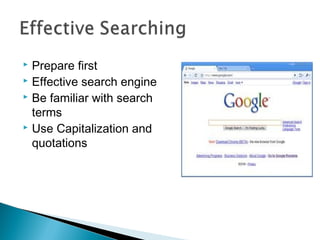
 Prepare first
 Effective search engine
 Be familiar with search

  terms
 Use Capitalization and

  quotations
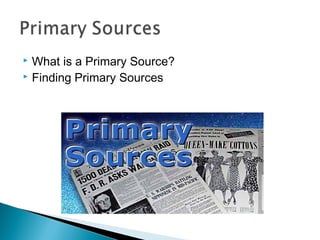
 What is a Primary Source?
 Finding Primary Sources
   The 5 W's of Evaluating Sources
    ◦   Who-the Author
    ◦   What-type of site
    ◦   Where-more information can be found
    ◦   Why-site was created
    ◦   When-site was created
   Popkoff, E. Methods Of Effective InternetResearch. Retrieved September
    8, 2012, from
    http://depthome.brooklyn.cuny.edu/economics/internetresearch.htm
   Teaching Students to Effectively Use the Internet. (2002). Retrieved
    September 8, 2012, from http://dept.sccd.ctc.edu/tlc/resources/teach.html
   Using Primary Sources on the Web | Reference & User Services
    Association (RUSA). (2008, January 10). American Library Association.
    Retrieved September 9, 2012, from
    http://www.ala.org/rusa/sections/history/resources/pubs/usingprimarysourc
    es
   Vidmar, D. (2012, April 13). Tips to Effective Internet Searching. Hannon
    Library at Southern Oregon University. Retrieved September 8, 2012,
    from http://hanlib.sou.edu/searchtools/searchtips.html
   Check Your Sources. (2012). Syrian Sun — Aiding the Revolution with the
    Power of the Pen. Retrieved September 9, 2012, from
    http://syriansun.info/check-your-sources/
   Google Chrome Tutorial Index. (n.d.). Google Chrome Tutorial. Retrieved
    September 8, 2012, from
    http://googlechrometutorial.com/Google-chrome-tutorials.html
   Ohio History Teachers Teacher Resources Primary Sources. (2012). Ohio
    History Teachers. Retrieved September 9, 2012, from
    http://www.ohiohistoryteachers.org/02/04/
   Search Engine Optimization | UK | Web SEO Marketing. (n.d.). Computer
    and Laptop Repairs - EEZY TECH IT Support. Retrieved September 8,
    2012, from http://www.eezytech.co.uk/searchengineoptimization.html

Effective internet search

  • 1.
  • 2.
     Effective Searching Primary Sources  Verifying Sources  Strategies for keeping track of sources.
  • 3.
     Prepare first Effective search engine  Be familiar with search terms  Use Capitalization and quotations
  • 4.
     What isa Primary Source?  Finding Primary Sources
  • 5.
    The 5 W's of Evaluating Sources ◦ Who-the Author ◦ What-type of site ◦ Where-more information can be found ◦ Why-site was created ◦ When-site was created
  • 6.
    Popkoff, E. Methods Of Effective InternetResearch. Retrieved September 8, 2012, from http://depthome.brooklyn.cuny.edu/economics/internetresearch.htm  Teaching Students to Effectively Use the Internet. (2002). Retrieved September 8, 2012, from http://dept.sccd.ctc.edu/tlc/resources/teach.html  Using Primary Sources on the Web | Reference & User Services Association (RUSA). (2008, January 10). American Library Association. Retrieved September 9, 2012, from http://www.ala.org/rusa/sections/history/resources/pubs/usingprimarysourc es  Vidmar, D. (2012, April 13). Tips to Effective Internet Searching. Hannon Library at Southern Oregon University. Retrieved September 8, 2012, from http://hanlib.sou.edu/searchtools/searchtips.html
  • 7.
    Check Your Sources. (2012). Syrian Sun — Aiding the Revolution with the Power of the Pen. Retrieved September 9, 2012, from http://syriansun.info/check-your-sources/  Google Chrome Tutorial Index. (n.d.). Google Chrome Tutorial. Retrieved September 8, 2012, from http://googlechrometutorial.com/Google-chrome-tutorials.html  Ohio History Teachers Teacher Resources Primary Sources. (2012). Ohio History Teachers. Retrieved September 9, 2012, from http://www.ohiohistoryteachers.org/02/04/  Search Engine Optimization | UK | Web SEO Marketing. (n.d.). Computer and Laptop Repairs - EEZY TECH IT Support. Retrieved September 8, 2012, from http://www.eezytech.co.uk/searchengineoptimization.html

Editor's Notes

  • #4 The first step in effective internet searching is to be prepared.  This would include knowing what it is you want to find.  It is difficult to sit down at a computer to do a research on a particular person if you do not know what it is you would like to know about that person.  Second, it is really important to select the appropriate search engine for what you are searching for.  There are many different search engines to choose from with Google being the most popular.  If the search has anything to do with government policies or government officials and documents, an excellent search engine would be www.firstgov.gov or you can check state and local government sites as well (Popkoff, n.d.). Third, it is very important to be familiar with your search terms.  The terms should be concise but still cover what you are looking for (Popkoff, n.d.).  When choosing the terms to search, they should include what it is you are looking for.  Example, if you want to know how much President Obama won by in the election of 2008, you might search "election results 2008."  Using quotations in your search is a good tool for when searching key phrases (Vidmar, 2012).  It is also important to use capitalization when searching proper names and places.  If you are searching the rock group The Doors and you type in doors, you will get results for interior and exterior doors of a house.
  • #5     A primary source is the original record created an event has occurred or after through passing down through generations or through memoirs ("Using Primary Sources on the Web | Reference & User Services Association (RUSA)", 2008).  Primary sources are a more reliable source to use because it has not be altered in any form.  It comes directly from the source without being changed by someone that may not have been at the event to know the truth behind each and every action taken.  If using a search engine such as Google, it is important to use specific terms rather than broad ones.  An example would be to search Pearl Harbor and not World War II.  When looking for an authentic source, it is important to look for sites that are non-biased toward the information.  Many sites may use the information to persuade their readers one way or the other so they may change the information in subtle ways to suit their purpose.  
  • #6 When using internet sources, it is important to make sure that all of your sources are authentic.  First, it is important to know if there is an author and who that author is.  It is important to know whether an individual or an organization created the site.  You should check to see if the author has verifiable credentials and if there is any contact information listed on the page.  The second W would be what type of site are you getting your information from.  Is the site a government, educational or wiki site?  Wiki sites are good to start with but the information can be hard to verify due to the fact that anyone can post or change information on that site.  Next it is important to know if there are any links on this site to more information available on your topic.  The links can also verify the information that you located first.     It is very important to know why a site was created.  Was the site created for educational purposes or was it created to persuade the readers to believe certain ideas.  Lastly, when was this site created or last updated.  If you are writing a paper on 21st century technology, you would not choose a site that was created in 1980 (Teaching Students to Effectively Use the Internet, 2002).