ACADEMIC REGULATIONS
COURSE STRUCTURE AND
DETAILED SYLLABUS
ELECTRICAL AND ELECTRONICS ENGINEERING
B.TECH 4 YEAR UG COURSE
(Applicable for the batches admitted from 2016-2017)
REGULATION: R16
(I, II, III & IV Year Syllabus)
J.B. INSTITUTE OF ENGINEERING & TECHNOLOGY
UGC AUTONOMOUS
Bhaskar Nagar, Yenkapally, Moinabad Mandal, R.R. District,
Hyderabad – 500 075, Telangana State, India
Email: principal@jbiet.edu.in, Website: www.jbiet.edu.in
J.B. INSTITUTE OF ENGIEERING & TECHNOLOGY
UGC AUTONOMOUS
Institute Vision & Mission
Vision
To be a centre of excellence in engineering and management education, research and
application of knowledge to benefit society with blend of ethical values and global
perception.
Mission:
 To provide world class engineering education, encourage research and development.
 To evolve innovative applications of technology and develop entrepreneurship.
 To mould the students into socially responsible and capable leaders.
DEPARTMENT OF ELECTRICAL AND ELECTRONICS ENGINEERING
Department Vision and Mission
Vision
To be a Centre for State-of-the art learning and research in the area of Electrical and
Electronics Engineering, where the stakeholders could explore, experiment and exhibit
their expertise with an industrial outlook.
Mission
 To EQUIP the student with advanced learning skills in the field of Electrical and
Electronics Engineering as well as the professional skills necessary to face the
challenges of the future.
 To ENGINEER the student to engage in research activities leading to innovative
applications of technology for the benefit of society.
 To ENABLE the student with the qualities of leadership and social responsibility.
DEPARTMENT OF ELECTRICAL AND ELECTRONICS ENGINEERING
B.Tech. Electrical and Electronics Engineering
PEOs and PSOs
Program Educational Objectives (PEOs):
PEO1
To Create an excellent academic learning environment by providing awareness on
lifelong learning, apply the technical knowledge in the field of Electrical and Electronics
Engineering to pursue higher studies or in their professional career.
PEO2
To demonstrate technical knowledge to analyse, design, develop, optimize, and
implement complex electrical systems. Also gain multidisciplinary knowledge through
projects and industrial training, providing a sustainable competitive edge in R&D and
meeting industrial needs in the field of Electrical and Electronics Engineering.
PEO3
To possess professional and ethical attitudes with effective communication skills,
entrepreneurial thinking and an ability to relate engineering issues to the broader
social context. Also develop requisite skills to excel in their chosen profession with an
awareness of contemporary issues and the need for life -long learning..
Program Specific Outcomes (PSOs):
PSO1
An ability to mathematically model and analyse the performance of Electrical
Machines, Power Electronic systems, Control & Instrumentation systems, Electrical
Power systems.
PSO2
An ability to Design the hardware and software requirements for the Development of
Electric drives & Control, Conventional & Renewable Energy and Automation.
i
J.B. INSTITUTE OF ENGINEERING AND TECHNOLOGY (JBIET)
UGC AUTONOMOUS
Bhaskar Nagar, Moinabad, Hyderabad – 500075, Telangana, India
ACADEMIC REGULATIONS FOR B.TECH. REGULAR STUDENTS
WITH EFFECT FROM THE ACADEMIC YEAR 2016-17 (R-16)
1.0 Under-Graduate Degree Programme in Engineering & Technology (UGP in E&T)
1.1 JBIET offers a 4-year (8 semesters) Bachelor of Technology (B.Tech.) degree
programme, under Choice Based Credit System (CBCS) with effect from the academic
year 2016-17 in the following branches of Engineering:
Sl. No. Branch
1 Civil Engineering
2 Electrical and Electronics Engineering
3 Mechanical Engineering
4 Electronics and Communication Engineering
5 Computer Science and Engineering
6 Information Technology
7 Electronics and Computer Engineering
8 Mining Engineering
2.0 Eligibility for Admission
2.1 Admission to the under graduate programme shall be made either on the basis of the
merit rank obtained by the qualified candidate in entrance test conducted by the
Telangana State Government (EAMCET) or on the basis of any other order of merit
approved by the University, subject to reservations as prescribed by the government
from time to time.
2.2 The medium of instructions for the entire under graduate programme in E&T will be
English only.
3.0 B.Tech. Programme structure
3.1 A student after securing admission shall pursue the under graduate programme in
B.Tech. in a minimum period of four academic years (8 semesters), and a maximum
period of eight academic years (16 semesters) starting from the date of
commencement of first year first semester, failing which student shall forfeit seat in
B.Tech course.
Each semester is structured to provide 24 credits, totalling to 192 credits for the entire
B.Tech. programme. Each student shall secure 192 credits (with CGPA ≥ 5) required for
the completion of the under graduate programme and award of the B.Tech. degree.
ii
3.2 UGC/ AICTE specified definitions/ descriptions are adopted appropriately for various
terms and abbreviations used in these academic regulations/ norms, which are listed
below.
3.2.1 Semester scheme
Each under graduate programme is of 4 academic years (8 semesters) with the
academic year being divided into two semesters of 22 weeks ( ≥ 90 instructional
days) each, each semester having - ‘Continuous Internal Evaluation (CIE)’ and
‘Semester End Examination (SEE)’. Choice Based Credit System (CBCS) and Credit
Based Semester System (CBSS) as indicated by UGC and curriculum / course
structure as suggested by AICTE are followed.
3.2.2 Credit courses
All subjects/ courses are to be registered by the student in a semester to earn credits
which shall be assigned to each subject/ course in an L: T: P: C (lecture periods:
tutorial periods: practical periods: credits) structure based on the following general
pattern.
1. One credit for one hour/ week/ semester for theory/ lecture (L) courses.
2. One credit for two hours/ week/ semester for laboratory/ practical (P)
courses or Tutorials (T).
Courses like Environmental Studies, Professional Ethics, Gender Sensitization lab are
identified as mandatory courses. These courses will not carry any credits.
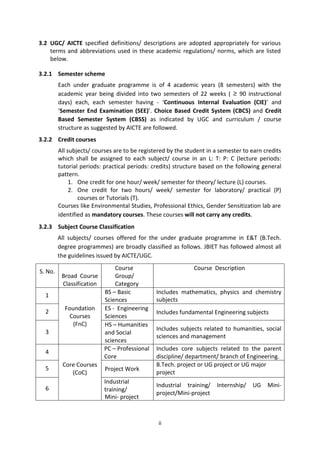
3.2.3 Subject Course Classification
All subjects/ courses offered for the under graduate programme in E&T (B.Tech.
degree programmes) are broadly classified as follows. JBIET has followed almost all
the guidelines issued by AICTE/UGC.
S. No.
Broad Course
Classification
Course
Group/
Category
Course Description
1
Foundation
Courses
(FnC)
BS – Basic
Sciences
Includes mathematics, physics and chemistry
subjects
2
ES - Engineering
Sciences
Includes fundamental Engineering subjects
3
HS – Humanities
and Social
sciences
Includes subjects related to humanities, social
sciences and management
4
Core Courses
(CoC)
PC – Professional
Core
Includes core subjects related to the parent
discipline/ department/ branch of Engineering.
5 Project Work
B.Tech. project or UG project or UG major
project
6
Industrial
training/
Mini- project
Industrial training/ Internship/ UG Mini-
project/Mini-project
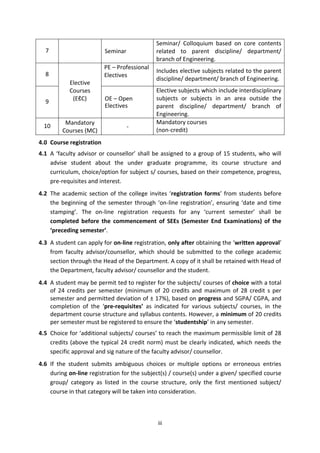
iii
7 Seminar
Seminar/ Colloquium based on core contents
related to parent discipline/ department/
branch of Engineering.
8
Elective
Courses
(EℓC)
PE – Professional
Electives
Includes elective subjects related to the parent
discipline/ department/ branch of Engineering.
9 OE – Open
Electives
Elective subjects which include interdisciplinary
subjects or subjects in an area outside the
parent discipline/ department/ branch of
Engineering.
10
Mandatory
Courses (MC)
-
Mandatory courses
(non-credit)
4.0 Course registration
4.1 A ‘faculty advisor or counsellor’ shall be assigned to a group of 15 students, who will
advise student about the under graduate programme, its course structure and
curriculum, choice/option for subject s/ courses, based on their competence, progress,
pre-requisites and interest.
4.2 The academic section of the college invites ‘registration forms’ from students before
the beginning of the semester through ‘on-line registration’, ensuring ‘date and time
stamping’. The on-line registration requests for any ‘current semester’ shall be
completed before the commencement of SEEs (Semester End Examinations) of the
‘preceding semester’.
4.3 A student can apply for on-line registration, only after obtaining the ‘written approval’
from faculty advisor/counsellor, which should be submitted to the college academic
section through the Head of the Department. A copy of it shall be retained with Head of
the Department, faculty advisor/ counsellor and the student.
4.4 A student may be permit ted to register for the subjects/ courses of choice with a total
of 24 credits per semester (minimum of 20 credits and maximum of 28 credit s per
semester and permitted deviation of ± 17%), based on progress and SGPA/ CGPA, and
completion of the ‘pre-requisites’ as indicated for various subjects/ courses, in the
department course structure and syllabus contents. However, a minimum of 20 credits
per semester must be registered to ensure the ‘studentship’ in any semester.
4.5 Choice for ‘additional subjects/ courses’ to reach the maximum permissible limit of 28
credits (above the typical 24 credit norm) must be clearly indicated, which needs the
specific approval and sig nature of the faculty advisor/ counsellor.
4.6 If the student submits ambiguous choices or multiple options or erroneous entries
during on-line registration for the subject(s) / course(s) under a given/ specified course
group/ category as listed in the course structure, only the first mentioned subject/
course in that category will be taken into consideration.
iv
4.7 Subject/ course options exercised through on-line registration are fin al and cannot be
changed or inter-changed; further, alternate choices also will not be considered.
However, if the subject/ course that has already been listed for registration b y the
Head of the Department in a semester could not be offered due to any unforeseen or
unexpected reasons, then the student shall be allowed to have alternate choice either
for a new subject (subject to offering of such a subject), or for another existing subject
(subject to availability of seats). Such alternate arrangements will be made by the head
of the department, with due notification and time-framed schedule, within the first
week after the commencement of class-work for that semester.
4.8 Dropping of subjects/courses may be permitted, only after obtaining prior approval
from the faculty advisor/counsellor (subject to retaining a minimum of 20 credits),
‘within a period of 15 days’ from the beginning of the current semester.
4.9 Open electives: The students have to choose one open elective (OE -I) in III year I
semester, one (OE-II) in III year II semester, and one (OE-III) in IV year II semester, from
the list of open electives given. However, the student cannot opt for an open elective
subject offered by their own (parent) department, if it is already listed under any
category of the subjects offered by parent department in any semester.
4.10 Professional electives: students have to choose professional elective – I (PE-I),
professional elective – II (PE-II) in III year II semester, Professional electives – III (PE-III),
Professional electives – IV(PE-IV) in IV year I semester, Professional electives – V (PE-V),
Professional electives – VI (PE-VI) in IV year II semester, from the list of professional
electives given. However, the students may opt for professional elective subjects
offered in the related area.
5.0 Subjects/courses to be offered
5.1 A typical section (or class) strength for each semester shall be 60.
5.2 A subject/ course may be offered to the students, only if a minimum of 20 students (1/3
of the section strength) opt for it. The maximum strength of a section is limited to 80
(60 + 1/3 of the section strength).
5.3 More than one faculty member may offer the same subject (lab/ practical may be
included with the corresponding theory subject in the same semester) in any semester.
However, selection of choice for students will be based on - ‘first com e first serve basis
and CGPA criterion’ (i.e. the first focus shall be on early on-line entry from the student
for registration in that semester, and the second focus, if needed, will be on CGPA of
the student).
5.4 If more entries for registration of a subject come into picture, then the Head of
Department concerned shall decide, whether or not to offer such a subject/ course for
two (or multiple) sections.
v
6.0 Attendance requirements:
6.1 A student shall be eligible to appear for the semester end examinations, if student
acquires a minimum of 75% of attendance in aggregate of all the subjects/ courses
(excluding attendance in mandatory courses Environmental Science, Professional
Ethics, Gender Sensitization Lab, NCC/ NSO and NSS) for that semester.
6.2 Shortage of attendance in aggregate up to 10% (65% and above, and below 75%) in
each semester may be condoned by the college academic committee on genuine and
valid grounds, based on the student’s representation with supporting evidence.
6.3 A stipulated fee shall be payable towards condoning of shortage of attendance.
6.4 Shortage of attendance below 65% in aggregate shall in no case be condoned.
6.5 Students whose shortage of attendance is not condoned in any semester are not
eligible to take their end examinations of that semester. They get detained and their
registration for that semester shall stand cancelled. They will not be promoted to the
next semester. They may seek re-registration for all those subjects registered in that
semester in which student was detained, by seeking re-admission into that semester as
and when offered; in case if there are any professional electives and/ or open electives,
the same may also be re-registered if offered. However, if those electives are not
offered in later semesters, then alternate electives may be chosen from the same set of
elective subjects offered under that category.
6.6 A student fulfilling the attendance requirement in the present semester shall not be
eligible for readmission into the same class.
7.0 Academic requirements
The following academic requirements have to be satisfied, in addition to the attendance
requirements mentioned in item no.6.
7.1 A student shall be deemed to have satisfied the academic requirements and earned the
credits allotted to each subject/course, if student secures not less than 35 % marks (26
out of 75 marks) in the semester end examination, and a minimum of 40% of marks in
the sum total of the CIE (Continuous Internal Evaluation) and SEE (Semester End
Examination) taken together; in terms of letter grades, this implies securing ‘C’ grade or
above in that subject/ course.
7.2 A student shall be deemed to have satisfied the academic requirements and earned the
credits allotted to UG mini-project and seminar, if student secures not less than 40%
marks (i.e. 40 out of 100 allotted marks) in each of them. The student would be treated
as failed, if student (i) does not submit a report on UG mini-project, or does not make a
presentation of the same before the evaluation committee as per schedule, or (ii) does
not present the seminar as required in the IV year I Semester, or (iii) secures less than
40% marks in UG mini-project/ seminar evaluations.
Student may reappear once for each of the above evaluations, when they are scheduled
again; if student fails in such ‘one reappearance’ evaluation also, student has to
reappear for the same in the next subsequent semester, as and when it is scheduled.
vi
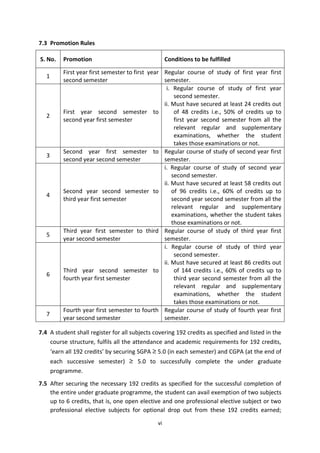
7.3 Promotion Rules
S. No. Promotion Conditions to be fulfilled
1
First year first semester to first year
second semester
Regular course of study of first year first
semester.
2
First year second semester to
second year first semester
i. Regular course of study of first year
second semester.
ii. Must have secured at least 24 credits out
of 48 credits i.e., 50% of credits up to
first year second semester from all the
relevant regular and supplementary
examinations, whether the student
takes those examinations or not.
3
Second year first semester to
second year second semester
Regular course of study of second year first
semester.
4
Second year second semester to
third year first semester
i. Regular course of study of second year
second semester.
ii. Must have secured at least 58 credits out
of 96 credits i.e., 60% of credits up to
second year second semester from all the
relevant regular and supplementary
examinations, whether the student takes
those examinations or not.
5
Third year first semester to third
year second semester
Regular course of study of third year first
semester.
6
Third year second semester to
fourth year first semester
i. Regular course of study of third year
second semester.
ii. Must have secured at least 86 credits out
of 144 credits i.e., 60% of credits up to
third year second semester from all the
relevant regular and supplementary
examinations, whether the student
takes those examinations or not.
7
Fourth year first semester to fourth
year second semester
Regular course of study of fourth year first
semester.
7.4 A student shall register for all subjects covering 192 credits as specified and listed in the
course structure, fulfils all the attendance and academic requirements for 192 credits,
‘earn all 192 credits’ by securing SGPA ≥ 5.0 (in each semester) and CGPA (at the end of
each successive semester) ≥ 5.0 to successfully complete the under graduate
programme.
7.5 After securing the necessary 192 credits as specified for the successful completion of
the entire under graduate programme, the student can avail exemption of two subjects
up to 6 credits, that is, one open elective and one professional elective subject or two
professional elective subjects for optional drop out from these 192 credits earned;
vii
resulting in 186 credits for under graduate programme performance evaluation, i.e., the
performance of the student in these 186 credits shall alone be taken into account for
the calculation of ‘the final CGPA (at the end of under graduate programme, which
takes the SGPA of the IV year II semester into account)’ , and shall be indicated in the
grade card of IV year II semester. However, the performance of student in the earlier
individual semesters, with the corresponding SGPA and CGPA for which grade cards
have already been given will not be altered.
7.6 If a student registers for some more ‘extra subjects’ (in the parent department or other
departments/branches of Engineering.) other than those listed subjects totaling to 192
credits as specified in the course structure of his department, the performances in
those ‘extra subjects’ (although evaluated and graded using the same procedure as that
of the required 192 credits) will not be taken into account while calculating the SGPA
and CGPA. For such ‘extra subjects’ registered, % of marks and letter grade alone will
be indicated in the grade card as a performance measure, subject to completion of the
attendance and academic requirements as stated in regulations 6 and 7.1 – 7.5 above.
7.7 A student eligible to appear in the end semester examination for any subject/ course,
but absent from it or failed (thereby failing to secure ‘C’ grade or above) may reappear
for that subject/ course in the supplementary examination as and when conducted. In
such cases, CIE assessed earlier for that subject/ course will be carried over, and added
to the marks to be obtained in the SEE supplementary examination for evaluating
performance in that subject.
7.8 A student detained in a semester due to shortage of attendance, may be re-admitted
when the same semester is offered in the next academic year for fulfilment of
academic requirement s. The academic regulations under which student has been
readmitted shall be applicable. However, no grade allotments or SGPA/ CGPA
calculations will be done for the entire semester in which student has been detained.
7.9 A student detained due t o lack of credits, shall be promoted to the next academic
year only after acquiring the required academic credits. The academic regulations
under which student has been readmitted shall be applicable to him.
8.0 Evaluation - Distribution and Weightage of marks
8.1 The performance of a student in every subject/course (including practical’s and UG
major project) will be evaluated for 100 marks each, with 25 marks allotted for CIE
(Continuous Internal Evaluation) and 75 marks for SEE (Semester End-Examination).
8.2 For theory subjects, during a semester, there shall be two mid-term examinations. Each
mid-term examination consists of one objective paper, one descriptive paper and one
assignment. The objective paper and the essay paper shall be for 10 m arks each with a
total duration of 1 hour 20 minutes (20 minutes for objective and 60 minutes for essay
paper). The objective paper is set with 20 bits of multiple choice, fill-in the blanks and
matching type of questions for a total of 10 marks. The essay paper shall contain 4 full
viii
questions out of which, the student has to answer 2 questions, each carrying 5 marks.
While the first mid-term examination shall be conducted on 50% of the syllabus, the
second mid-term examination shall be conducted on the remaining 50% of the syllabus.
Five marks are allocated for assignments (as specified by the subject teacher
concerned). The first assignment should be submitted before the conduct of the first
mid-examination, and the second assignment should be submitted before the conduct
of the second mid-examination. The total m arks secured by the student in each mid-
term examination are evaluated for 25 marks, and the average of the two mid-term
examinations shall be taken as the final marks secured by each student in
internals/sessionals. If any student is absent from any subject of a mid-term
examination, an on-line test will be conducted for him by the university. The details of
the question paper pattern are as follows,
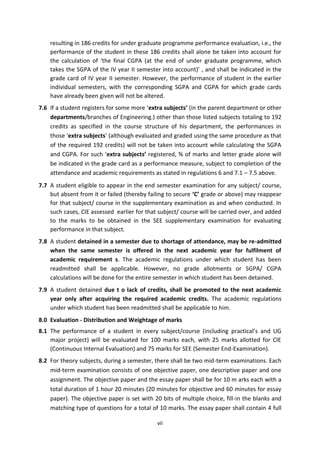
 The end semester examinations will be conducted for 75 marks consisting of two
parts viz. i) Part- A for 25 marks, ii) Part - B for 50 marks.
 Part-A is compulsory question which consists of ten sub-questions. The first five
sub-questions are from each unit and carry 2 marks each. The next five sub-
questions are one from each unit and carry 3 marks each.
 Part-B consists of five questions (numbered from 2 to 6) carrying 10 marks each.
 Each of these questions is from one unit and may contain sub-questions. For
each question there will be an “either” “or” choice, which means that there will
be two questions from each unit and the student should answer either of the
two questions.
8.3 For practical subjects there shall be a continuous internal evaluation during the
semester for 25 sessional marks and 75 semester end examination marks. Out of the 25
marks for internal evaluation, day-to-day work in the laboratory shall be evaluated for
15 marks and internal practical examination shall be evaluated for 10 marks
conducted by the laboratory teacher concerned. The semester end examination shall
be conducted with an external examiner and the laboratory teacher. The external
examiner s hall be appointed from the clusters of colleges which are decided by the
examination branch of the university
8.4 For the subject having design and/or drawing, (such as engineering graphics,
engineering drawing, machine drawing) and estimation, the distribution shall be 25
marks for continuous internal evaluation (15 marks for day-to-day work and 10 m arks
for internal tests) and 75 marks for semester end examination. There shall be two
internal tests in a semester and the average of the two shall be considered for the
award of marks for internal tests.
8.5 There shall be an UG mini-project, in collaboration with an industry of their
specialization. Students will register for this immediately after III year II semester
examinations and pursue it during summer vacation. The UG mini -project shall be
ix
submitted in a report form and presented before the committee in IV year I semester. It
shall be evaluated for 100 marks. The committee consists of an external examiner, Head
of the Department, supervisor of the UG mini-project and a senior faculty member of
the department. There shall be no internal marks for UG mini-project
8.6 There shall be a seminar presentation in IV year II semester. For the seminar, the
student shall collect the information on a specialized topic, prepare a technical report
and submit it to the department. It’s hall be evaluated by the departmental committee
consisting of Head of the Department, seminar supervisor and a senior faculty member.
The seminar report shall be evaluated for 100 marks. There shall be no semester end
examination for the seminar.
8.7 Out of a total of 100 m arks for the UG major project, 25 marks shall be allotted for
internal evaluation and 75 marks for the end semester examination (viva voce). The end
semester examination of the UG major project shall be conducted by the same
committee as appointed for the UG mini-project. In addition, the UG major project
supervisor shall also be included in the committee. The topics for UG mini project,
seminar and UG major project shall be different from one another. The evaluation of U
G major project shall be made at the end of IV year II semester. The internal evaluation
shall be on the basis of two seminars given by each student on the topic of UG major
project.
8.8 The laboratory records and internal test papers shall be preserved in the institution for
two Semesters.
8.9 For mandatory courses viz. environmental studies, professional ethics and gender
sensitization lab, a student has to secure 40 marks out of 100 marks (i.e. 40% of the
marks allotted) in the continuous internal evaluation for passing the subject/course.
8.10 For mandatory courses NCC/ NSO and NSS, a ‘satisfactory participation certificate’
shall be issued to the student from the authorities concerned, only after securing
≥ 65% attendance in such a course.
8.11 No marks or letter grade shall be allotted for all mandatory/non-credit courses.
9.0 Grading procedure
9.1 Marks will be awarded to indicate the performance of student in each theory subject,
laboratory / practical’s, seminar, UG mini project and UG major project. Based on the
percentage of marks obtained (Continuous Internal Evaluation plus Semester End
Examination, both taken together) as specified in item 8 above, a corresponding letter
grade shall be given.
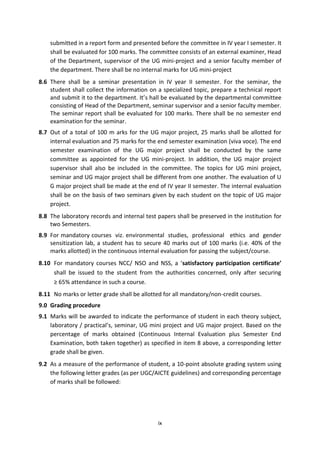
9.2 As a measure of the performance of student, a 10-point absolute grading system using
the following letter grades (as per UGC/AICTE guidelines) and corresponding percentage
of marks shall be followed:
x
% of Marks Secured in a Subject/Course
(Class Intervals)
Letter Grade
(UGC Guidelines)
Grade Points
Greater than or equal to 90%
O
(Outstanding)
10
80 and less than 90%
A+
(Excellent)
9
70 and less than 80%
A
(Very Good)
8
60 and less than 70%
B+
(Good)
7
50 and less than 60%
B
(Average)
6
40 and less than 50%
C
(Pass)
5
Below 40%
F
(FAIL)
0
Absent Ab 0
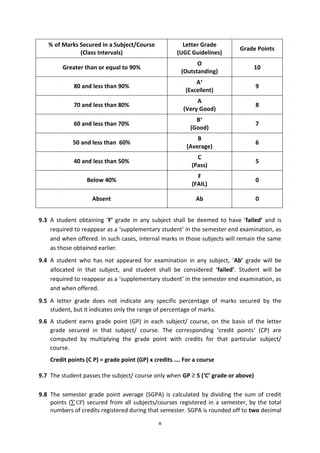
9.3 A student obtaining ‘F’ grade in any subject shall be deemed to have ‘failed’ and is
required to reappear as a ‘supplementary student’ in the semester end examination, as
and when offered. In such cases, internal marks in those subjects will remain the same
as those obtained earlier.
9.4 A student who has not appeared for examination in any subject, ‘Ab’ grade will be
allocated in that subject, and student shall be considered ‘failed’. Student will be
required to reappear as a ‘supplementary student’ in the semester end examination, as
and when offered.
9.5 A letter grade does not indicate any specific percentage of marks secured by the
student, but it indicates only the range of percentage of marks.
9.6 A student earns grade point (GP) in each subject/ course, on the basis of the letter
grade secured in that subject/ course. The corresponding ‘credit points’ (CP) are
computed by multiplying the grade point with credits for that particular subject/
course.
Credit points (C P) = grade point (GP) x credits …. For a course
9.7 The student passes the subject/ course only when GP ≥ 5 (‘C’ grade or above)
9.8 The semester grade point average (SGPA) is calculated by dividing the sum of credit
points (∑ CP) secured from all subjects/courses registered in a semester, by the total
numbers of credits registered during that semester. SGPA is rounded off to two decimal
xi
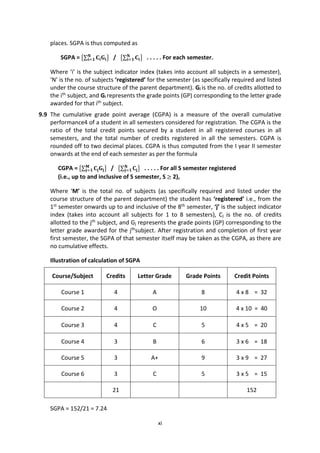
places. SGPA is thus computed as
SGPA = {∑ 𝐂𝐢𝐆𝐢
𝐍
𝐢=𝟏 } / {∑ 𝐂𝐢
𝐍
𝐢=𝟏 } . . . . . For each semester.
Where ‘i’ is the subject indicator index (takes into account all subjects in a semester),
‘N’ is the no. of subjects ‘registered’ for the semester (as specifically required and listed
under the course structure of the parent department). Gi is the no. of credits allotted to
the ith subject, and Gi represents the grade points (GP) corresponding to the letter grade
awarded for that ith subject.
9.9 The cumulative grade point average (CGPA) is a measure of the overall cumulative
performance4 of a student in all semesters considered for registration. The CGPA is the
ratio of the total credit points secured by a student in all registered courses in all
semesters, and the total number of credits registered in all the semesters. CGPA is
rounded off to two decimal places. CGPA is thus computed from the I year II semester
onwards at the end of each semester as per the formula
CGPA = {∑ 𝐂𝐣𝐆𝐣
𝐌
𝐣=𝟏 } / {∑ 𝐂𝐣
𝐍
𝐣=𝟏 } . . . . . For all S semester registered
(i.e., up to and inclusive of S semester, S ≥ 2),
Where ‘M’ is the total no. of subjects (as specifically required and listed under the
course structure of the parent department) the student has ‘registered’ i.e., from the
1st semester onwards up to and inclusive of the 8th semester, ‘j’ is the subject indicator
index (takes into account all subjects for 1 to 8 semesters), Cj is the no. of credits
allotted to the jth subject, and Gj represents the grade points (GP) corresponding to the
letter grade awarded for the jthsubject. After registration and completion of first year
first semester, the SGPA of that semester itself may be taken as the CGPA, as there are
no cumulative effects.
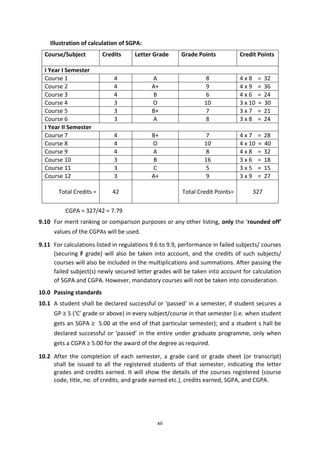
Illustration of calculation of SGPA
Course/Subject Credits Letter Grade Grade Points Credit Points
Course 1 4 A 8 4 x 8 = 32
Course 2 4 O 10 4 x 10 = 40
Course 3 4 C 5 4 x 5 = 20
Course 4 3 B 6 3 x 6 = 18
Course 5 3 A+ 9 3 x 9 = 27
Course 6 3 C 5 3 x 5 = 15
21 152
SGPA = 152/21 = 7.24
xii
Illustration of calculation of SGPA:
Course/Subject Credits Letter Grade Grade Points Credit Points
I Year I Semester
Course 1 4 A 8 4 x 8 = 32
Course 2 4 A+ 9 4 x 9 = 36
Course 3 4 B 6 4 x 6 = 24
Course 4 3 O 10 3 x 10 = 30
Course 5 3 B+ 7 3 x 7 = 21
Course 6 3 A 8 3 x 8 = 24
I Year II Semester
Course 7 4 B+ 7 4 x 7 = 28
Course 8 4 O 10 4 x 10 = 40
Course 9 4 A 8 4 x 8 = 32
Course 10 3 B 16 3 x 6 = 18
Course 11 3 C 5 3 x 5 = 15
Course 12 3 A+ 9 3 x 9 = 27
Total Credits = 42 Total Credit Points= 327
CGPA = 327/42 = 7.79
9.10 For merit ranking or comparison purposes or any other listing, only the ‘rounded off’
values of the CGPAs will be used.
9.11 For calculations listed in regulations 9.6 to 9.9, performance in failed subjects/ courses
(securing F grade) will also be taken into account, and the credits of such subjects/
courses will also be included in the multiplications and summations. After passing the
failed subject(s) newly secured letter grades will be taken into account for calculation
of SGPA and CGPA. However, mandatory courses will not be taken into consideration.
10.0 Passing standards
10.1 A student shall be declared successful or ‘passed’ in a semester, if student secures a
GP ≥ 5 (‘C’ grade or above) in every subject/course in that semester (i.e. when student
gets an SGPA ≥ 5.00 at the end of that particular semester); and a student s hall be
declared successful or ‘passed’ in the entire under graduate programme, only when
gets a CGPA ≥ 5.00 for the award of the degree as required.
10.2 After the completion of each semester, a grade card or grade sheet (or transcript)
shall be issued to all the registered students of that semester, indicating the letter
grades and credits earned. It will show the details of the courses registered (course
code, title, no. of credits, and grade earned etc.), credits earned, SGPA, and CGPA.
xiii
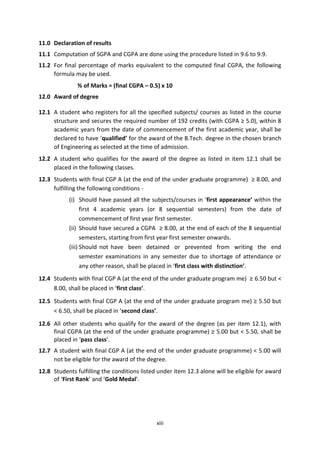
11.0 Declaration of results
11.1 Computation of SGPA and CGPA are done using the procedure listed in 9.6 to 9.9.
11.2 For final percentage of marks equivalent to the computed final CGPA, the following
formula may be used.
% of Marks = (final CGPA – 0.5) x 10
12.0 Award of degree
12.1 A student who registers for all the specified subjects/ courses as listed in the course
structure and secures the required number of 192 credits (with CGPA ≥ 5.0), within 8
academic years from the date of commencement of the first academic year, shall be
declared to have ‘qualified’ for the award of the B.Tech. degree in the chosen branch
of Engineering as selected at the time of admission.
12.2 A student who qualifies for the award of the degree as listed in item 12.1 shall be
placed in the following classes.
12.3 Students with final CGP A (at the end of the under graduate programme) ≥ 8.00, and
fulfilling the following conditions -
(i) Should have passed all the subjects/courses in ‘first appearance’ within the
first 4 academic years (or 8 sequential semesters) from the date of
commencement of first year first semester.
(ii) Should have secured a CGPA ≥ 8.00, at the end of each of the 8 sequential
semesters, starting from first year first semester onwards.
(iii) Should not have been detained or prevented from writing the end
semester examinations in any semester due to shortage of attendance or
any other reason, shall be placed in ‘first class with distinction’.
12.4 Students with final CGP A (at the end of the under graduate program me) ≥ 6.50 but <
8.00, shall be placed in ‘first class’.
12.5 Students with final CGP A (at the end of the under graduate program me) ≥ 5.50 but
< 6.50, shall be placed in ‘second class’.
12.6 All other students who qualify for the award of the degree (as per item 12.1), with
final CGPA (at the end of the under graduate programme) ≥ 5.00 but < 5.50, shall be
placed in ‘pass class’.
12.7 A student with final CGP A (at the end of the under graduate programme) < 5.00 will
not be eligible for the award of the degree.
12.8 Students fulfilling the conditions listed under item 12.3 alone will be eligible for award
of ‘First Rank’ and ‘Gold Medal’.
xiv
13.0 Withholding of results
13.1 If the student has not paid the fees to the university/college at any stage, or has dues
pending due to any reason whatsoever, or if any case of indiscipline is pending, the
result of the student may be withheld, and student will not be allowed to go into the
next higher semester. The award or issue of the degree may also be withheld in such
cases.
14.0 Transitory regulations
14.1 A student who has discontinued for any reason, or has been detained for want of
attendance or lack of required credits as specified, or who has failed after having
undergone the degree programme, may be considered eligible for re admission to the
same subjects/courses ( or equivalent subjects/ courses, as the case may be), and
same professional electives/open electives (or from set/category of elective s or
equivalents suggested, as the case m ay be) as and when they are offered (within the
time-frame of 8 years from the date of commencement of student's first year first
semester).
15.0 Student transfers
15.1 There shall be no branch transfers after the completion of admission process.
15.2 There shall be no transfers from the college/stream to another college.
16.0 Scope
16.1 The academic regulations should be read as a whole, for the purpose of any
interpretation.
16.2 In case of any doubt or ambiguity in the interpretation of the above rules, the decision
of the Head of the Institution is final.
16.3 The institution may change or amend the academic regulations, course structure or
syllabi at any time if necessary, and the changes or amendments made shall be
applicable to all students with effect from the date notified by the JBIET authorities.
xv
J.B. INSTITUTE OF ENGINEERING AND TECHNOLOGY (JBIET)
UGC AUTONOMOUS
Bhaskar Nagar, Moinabad, Hyderabad – 500075, Telangana, India
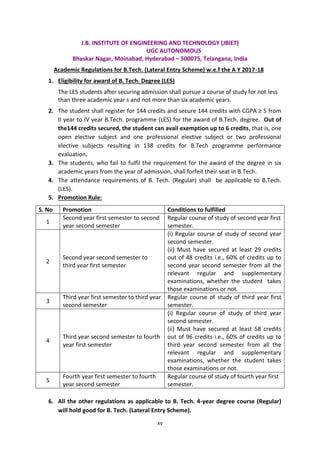
Academic Regulations for B.Tech. (Lateral Entry Scheme) w.e.f the A Y 2017-18
1. Eligibility for award of B. Tech. Degree (LES)
The LES students after securing admission shall pursue a course of study for not less
than three academic year s and not more than six academic years.
2. The student shall register for 144 credits and secure 144 credits with CGPA ≥ 5 from
II year to IV year B.Tech. programme (LES) for the award of B.Tech. degree. Out of
the144 credits secured, the student can avail exemption up to 6 credits, that is, one
open elective subject and one professional elective subject or two professional
elective subjects resulting in 138 credits for B.Tech programme performance
evaluation.
3. The students, who fail to fulfil the requirement for the award of the degree in six
academic years from the year of admission, shall forfeit their seat in B.Tech.
4. The attendance requirements of B. Tech. (Regular) shall be applicable to B.Tech.
(LES).
5. Promotion Rule:
S. No Promotion Conditions to fulfilled
1
Second year first semester to second
year second semester
Regular course of study of second year first
semester.
2
Second year second semester to
third year first semester
(i) Regular course of study of second year
second semester.
(ii) Must have secured at least 29 credits
out of 48 credits i.e., 60% of credits up to
second year second semester from all the
relevant regular and supplementary
examinations, whether the student takes
those examinations or not.
3
Third year first semester to third year
second semester
Regular course of study of third year first
semester.
4
Third year second semester to fourth
year first semester
(i) Regular course of study of third year
second semester.
(ii) Must have secured at least 58 credits
out of 96 credits i.e., 60% of credits up to
third year second semester from all the
relevant regular and supplementary
examinations, whether the student takes
those examinations or not.
5
Fourth year first semester to fourth
year second semester
Regular course of study of fourth year first
semester.
6. All the other regulations as applicable to B. Tech. 4-year degree course (Regular)
will hold good for B. Tech. (Lateral Entry Scheme).
xvi
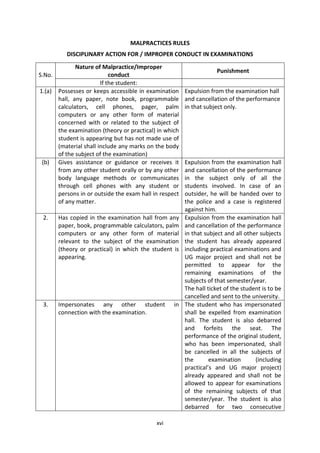
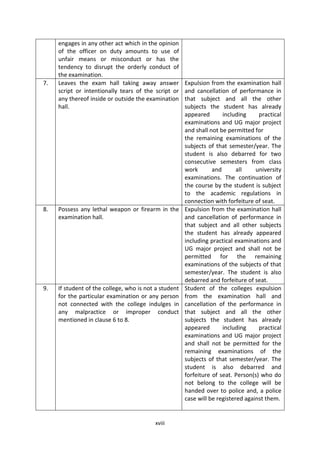
MALPRACTICES RULES
DISCIPLINARY ACTION FOR / IMPROPER CONDUCT IN EXAMINATIONS
S.No.
Nature of Malpractice/Improper
conduct
Punishment
If the student:
1.(a) Possesses or keeps accessible in examination
hall, any paper, note book, programmable
calculators, cell phones, pager, palm
computers or any other form of material
concerned with or related to the subject of
the examination (theory or practical) in which
student is appearing but has not made use of
(material shall include any marks on the body
of the subject of the examination)
Expulsion from the examination hall
and cancellation of the performance
in that subject only.
(b) Gives assistance or guidance or receives it
from any other student orally or by any other
body language methods or communicates
through cell phones with any student or
persons in or outside the exam hall in respect
of any matter.
Expulsion from the examination hall
and cancellation of the performance
in the subject only of all the
students involved. In case of an
outsider, he will be handed over to
the police and a case is registered
against him.
2. Has copied in the examination hall from any
paper, book, programmable calculators, palm
computers or any other form of material
relevant to the subject of the examination
(theory or practical) in which the student is
appearing.
Expulsion from the examination hall
and cancellation of the performance
in that subject and all other subjects
the student has already appeared
including practical examinations and
UG major project and shall not be
permitted to appear for the
remaining examinations of the
subjects of that semester/year.
The hall ticket of the student is to be
cancelled and sent to the university.
3. Impersonates any other student in
connection with the examination.
The student who has impersonated
shall be expelled from examination
hall. The student is also debarred
and forfeits the seat. The
performance of the original student,
who has been impersonated, shall
be cancelled in all the subjects of
the examination (including
practical’s and UG major project)
already appeared and shall not be
allowed to appear for examinations
of the remaining subjects of that
semester/year. The student is also
debarred for two consecutive
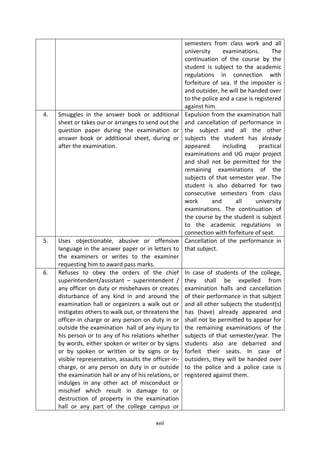
xvii
semesters from class work and all
university examinations. The
continuation of the course by the
student is subject to the academic
regulations in connection with
forfeiture of sea. If the imposter is
and outsider, he will be handed over
to the police and a case is registered
against him.
4. Smuggles in the answer book or additional
sheet or takes our or arranges to send out the
question paper during the examination or
answer book or additional sheet, during or
after the examination.
Expulsion from the examination hall
and cancellation of performance in
the subject and all the other
subjects the student has already
appeared including practical
examinations and UG major project
and shall not be permitted for the
remaining examinations of the
subjects of that semester year. The
student is also debarred for two
consecutive semesters from class
work and all university
examinations. The continuation of
the course by the student is subject
to the academic regulations in
connection with forfeiture of seat.
5. Uses objectionable, abusive or offensive
language in the answer paper or in letters to
the examiners or writes to the examiner
requesting him to award pass marks.
Cancellation of the performance in
that subject.
6. Refuses to obey the orders of the chief
superintendent/assistant – superintendent /
any officer on duty or misbehaves or creates
disturbance of any kind in and around the
examination hall or organizers a walk out or
instigates others to walk out, or threatens the
officer-in charge or any person on duty in or
outside the examination hall of any injury to
his person or to any of his relations whether
by words, either spoken or writer or by signs
or by spoken or written or by signs or by
visible representation, assaults the officer-in-
charge, or any person on duty in or outside
the examination hall or any of his relations, or
indulges in any other act of misconduct or
mischief which result in damage to or
destruction of property in the examination
hall or any part of the college campus or
In case of students of the college,
they shall be expelled from
examination halls and cancellation
of their performance in that subject
and all other subjects the student(s)
has (have) already appeared and
shall not be permitted to appear for
the remaining examinations of the
subjects of that semester/year. The
students also are debarred and
forfeit their seats. In case of
outsiders, they will be handed over
to the police and a police case is
registered against them.
xviii
engages in any other act which in the opinion
of the officer on duty amounts to use of
unfair means or misconduct or has the
tendency to disrupt the orderly conduct of
the examination.
7. Leaves the exam hall taking away answer
script or intentionally tears of the script or
any thereof inside or outside the examination
hall.
Expulsion from the examination hall
and cancellation of performance in
that subject and all the other
subjects the student has already
appeared including practical
examinations and UG major project
and shall not be permitted for
the remaining examinations of the
subjects of that semester/year. The
student is also debarred for two
consecutive semesters from class
work and all university
examinations. The continuation of
the course by the student is subject
to the academic regulations in
connection with forfeiture of seat.
8. Possess any lethal weapon or firearm in the
examination hall.
Expulsion from the examination hall
and cancellation of performance in
that subject and all other subjects
the student has already appeared
including practical examinations and
UG major project and shall not be
permitted for the remaining
examinations of the subjects of that
semester/year. The student is also
debarred and forfeiture of seat.
9. If student of the college, who is not a student
for the particular examination or any person
not connected with the college indulges in
any malpractice or improper conduct
mentioned in clause 6 to 8.
Student of the colleges expulsion
from the examination hall and
cancellation of the performance in
that subject and all the other
subjects the student has already
appeared including practical
examinations and UG major project
and shall not be permitted for the
remaining examinations of the
subjects of that semester/year. The
student is also debarred and
forfeiture of seat. Person(s) who do
not belong to the college will be
handed over to police and, a police
case will be registered against them.
xix
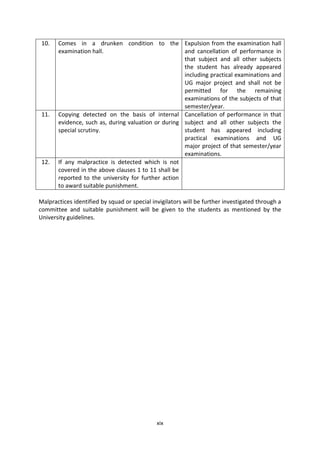
Malpractices identified by squad or special invigilators will be further investigated through a
committee and suitable punishment will be given to the students as mentioned by the
University guidelines.
10. Comes in a drunken condition to the
examination hall.
Expulsion from the examination hall
and cancellation of performance in
that subject and all other subjects
the student has already appeared
including practical examinations and
UG major project and shall not be
permitted for the remaining
examinations of the subjects of that
semester/year.
11. Copying detected on the basis of internal
evidence, such as, during valuation or during
special scrutiny.
Cancellation of performance in that
subject and all other subjects the
student has appeared including
practical examinations and UG
major project of that semester/year
examinations.
12. If any malpractice is detected which is not
covered in the above clauses 1 to 11 shall be
reported to the university for further action
to award suitable punishment.
xx
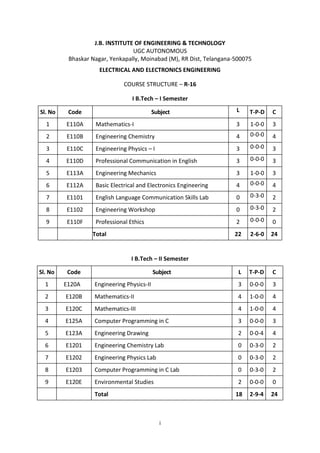
i
J.B. INSTITUTE OF ENGINEERING & TECHNOLOGY
UGC AUTONOMOUS
Bhaskar Nagar, Yenkapally, Moinabad (M), RR Dist, Telangana-500075
ELECTRICAL AND ELECTRONICS ENGINEERING
COURSE STRUCTURE – R-16
I B.Tech – I Semester
Sl. No Code Subject L T-P-D C
1 E110A Mathematics-I 3 1-0-0 3
2 E110B Engineering Chemistry 4 0-0-0 4
3 E110C Engineering Physics – I 3 0-0-0 3
4 E110D Professional Communication in English 3 0-0-0 3
5 E113A Engineering Mechanics 3 1-0-0 3
6 E112A Basic Electrical and Electronics Engineering 4 0-0-0 4
7 E1101 English Language Communication Skills Lab 0 0-3-0 2
8 E1102 Engineering Workshop 0 0-3-0 2
9 E110F Professional Ethics 2 0-0-0 0
Total 22 2-6-0 24
I B.Tech – II Semester
Sl. No Code Subject L T-P-D C
1 E120A Engineering Physics-II 3 0-0-0 3
2 E120B Mathematics-II 4 1-0-0 4
3 E120C Mathematics-III 4 1-0-0 4
4 E125A Computer Programming in C 3 0-0-0 3
5 E123A Engineering Drawing 2 0-0-4 4
6 E1201 Engineering Chemistry Lab 0 0-3-0 2
7 E1202 Engineering Physics Lab 0 0-3-0 2
8 E1203 Computer Programming in C Lab 0 0-3-0 2
9 E120E Environmental Studies 2 0-0-0 0
Total 18 2-9-4 24
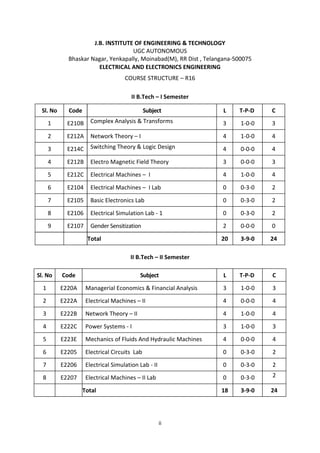
ii
J.B. INSTITUTE OF ENGINEERING & TECHNOLOGY
UGC AUTONOMOUS
Bhaskar Nagar, Yenkapally, Moinabad(M), RR Dist , Telangana-500075
ELECTRICAL AND ELECTRONICS ENGINEERING
COURSE STRUCTURE – R16
II B.Tech – I Semester
Sl. No Code Subject L T-P-D C
1 E210B Complex Analysis & Transforms 3 1-0-0 3
2 E212A Network Theory – I 4 1-0-0 4
3 E214C Switching Theory & Logic Design 4 0-0-0 4
4 E212B Electro Magnetic Field Theory 3 0-0-0 3
5 E212C Electrical Machines – I 4 1-0-0 4
6 E2104 Electrical Machines – I Lab 0 0-3-0 2
7 E2105 Basic Electronics Lab 0 0-3-0 2
8 E2106 Electrical Simulation Lab - 1 0 0-3-0 2
9 E2107 Gender Sensitization 2 0-0-0 0
Total 20 3-9-0 24
II B.Tech – II Semester
Sl. No Code Subject L T-P-D C
1 E220A Managerial Economics & Financial Analysis 3 1-0-0 3
2 E222A Electrical Machines – II 4 0-0-0 4
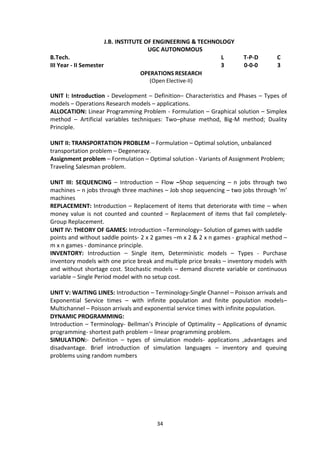
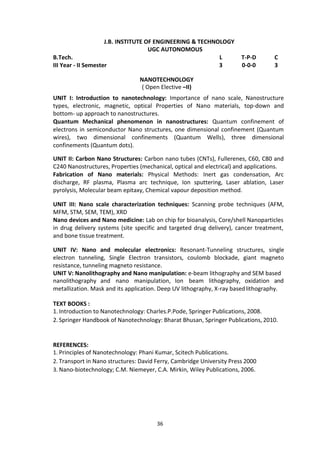
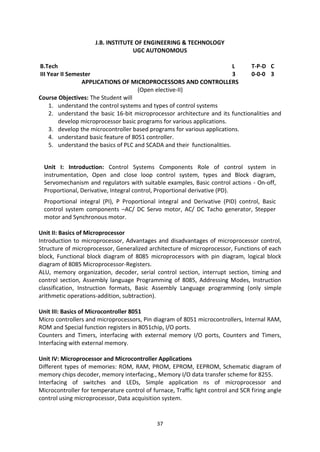
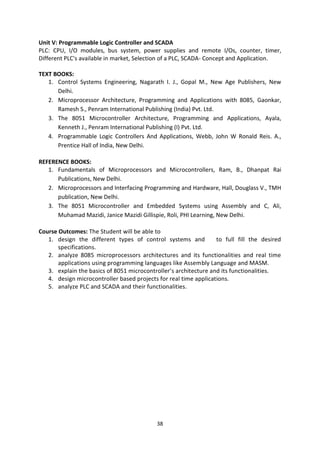
3 E222B Network Theory – II 4 1-0-0 4
4 E222C Power Systems - I 3 1-0-0 3
5 E223E Mechanics of Fluids And Hydraulic Machines 4 0-0-0 4
6 E2205 Electrical Circuits Lab 0 0-3-0 2
7 E2206 Electrical Simulation Lab - II 0 0-3-0 2
8 E2207 Electrical Machines – II Lab 0 0-3-0 2
Total 18 3-9-0 24
iii
J.B. INSTITUTE OF ENGINEERING & TECHNOLOGY
UGC AUTONOMOUS
Bhaskar Nagar, Yenkapally, Moinabad(M), RR Dist , Telangana-500075
ELECTRICAL AND ELECTRONICS ENGINEERING
COURSE STRUCTURE – R16
III B.Tech – I Semester
Sl. No Code Subject L T-P-D C
1 E312A Electrical Machines – III 4 1-0-0 4
2 E312B Control Systems 4 1-0-0 4
3 E312C Power Systems - II 4 1-0-0 4
4 E310B Management Science 3 0-0-0 3
5 OPEN ELECTIVE - I: 3 0-0-0 3
6 E3104
Mechanics of Fluids And Hydraulic
Machines Lab
0 0-3-0 2
7 E3105 Control Systems Lab 0 0-3-0 2
8 E3106
Synchronous Machines & Simulation
Lab
0 0-3-0 2
Total 18 3-9-0 24
III B.Tech – II Semester
Sl. No Code Subject L T-P-D C
1 E322A Power Electronics 4 1-0-0 4
2 E324A Microprocessors and Microcontrollers 4 1-0-0 4
3 OPEN ELECTIVE – II 3 0-0-0 3
4 PROFESSIONAL ELECTIVE – I 4 0-0-0 4
5 PROFESSIONAL ELECTIVE – II 4 0-0-0 4
6 E3204 Power Electronics Lab 0 0-3-0 2
7 E3205
Microprocessors and Microcontrollers
Lab
0 0-3-0 2
8 E3206 Employability Skills Lab 0 0-2-0 1
Total 19 2-8-0 24
iv
J.B. INSTITUTE OF ENGINEERING & TECHNOLOGY
UGC AUTONOMOUS
Bhaskar Nagar, Yenkapally, Moinabad(M), RR Dist , Telangana-500075
ELECTRICAL AND ELECTRONICS ENGINEERING
COURSE STRUCTURE – R16
IV B.Tech – I Semester
Sl. No Code Subject L T-P-D C
1 E412A ElectricalMeasurements 4 1-0-0 4
2 E412B Switch Gear and Protection 4 1-0-0 4
3 PROFESSIONAL ELECTIVE – III 4 0-0-0 4
4 PROFESSIONAL ELECTIVE – IV 4 0-0-0
1-0-0
4
5 PROFESSIONAL ELECTIVE – V 4 0-0-0 4
6 E4103 Electrical Measurements Lab 0 0-3-0 2
7 E4104 Industry Oriented Mini Project 0 0-0-0 2
Total 20 2-3-0 24
IV B.Tech – II Semester
Sl. No Code Subject L T-P-D C
1 E422A Instrumentation 4 1-0-0 4
2 OPEN ELECTIVE – III 3 0-0-0 3
3 E4204 Power Systems & Simulation Lab 0 0-3-0 2
4 E4205 Seminar 0 0-6-0 1
5 E4206 Project Work 0 0-15-0 14
Total 7 1-24-0 24
Note: All end Examinations (Theory and Practical)areof threehours duration.
T-Tutorial L—Theory P—Practical D-Drawing C–Credits
v
J.B. INSTITUTE OF ENGINEERING & TECHNOLOGY
UGC AUTONOMOUS
Bhaskar Nagar, Yenkapally, Moinabad(M), RR Dist , Telangana-500075
ELECTRICAL AND ELECTRONICS ENGINEERING
COURSE STRUCTURE – R16
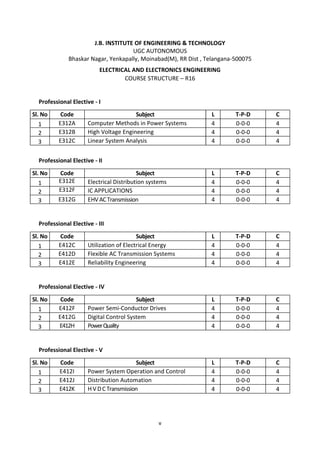
Professional Elective - I
Sl. No Code Subject L T-P-D C
1 E312A Computer Methods in Power Systems 4 0-0-0 4
2 E312B High Voltage Engineering 4 0-0-0 4
3 E312C Linear System Analysis 4 0-0-0 4
Professional Elective - II
Sl. No Code Subject L T-P-D C
1 E312E Electrical Distribution systems 4 0-0-0 4
2 E312F IC APPLICATIONS 4 0-0-0 4
3 E312G EHV ACTransmission 4 0-0-0 4
Professional Elective - III
Sl. No Code Subject L T-P-D C
1 E412C Utilization of Electrical Energy 4 0-0-0 4
2 E412D Flexible AC Transmission Systems 4 0-0-0 4
3 E412E Reliability Engineering 4 0-0-0 4
Professional Elective - IV
Sl. No Code Subject L T-P-D C
1 E412F Power Semi-Conductor Drives 4 0-0-0 4
2 E412G Digital Control System 4 0-0-0 4
3 E412H PowerQuality 4 0-0-0 4
Professional Elective - V
Sl. No Code Subject L T-P-D C
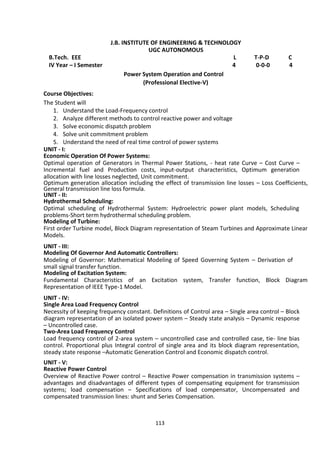
1 E412I Power System Operation and Control 4 0-0-0 4
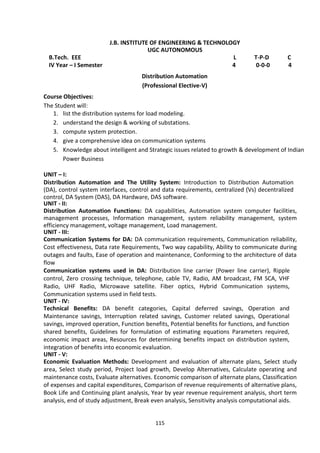
2 E412J Distribution Automation 4 0-0-0 4
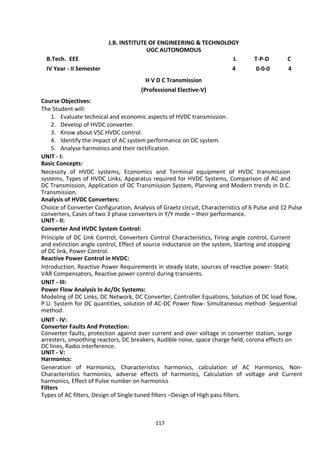
3 E412K HVDCTransmission 4 0-0-0 4
vi
J.B. INSTITUTE OF ENGINEERING & TECHNOLOGY
UGC AUTONOMOUS
Bhaskar Nagar, Yenkapally, Moinabad (M), RR Dist , Telangana-500075
COURSE STRUCTURE – R16
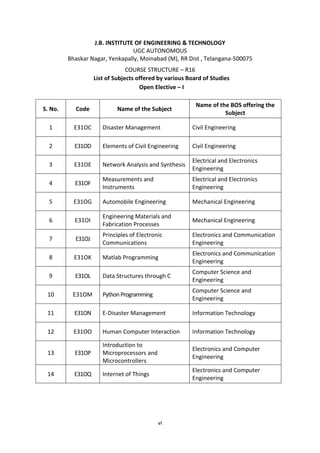
List of Subjects offered by various Board of Studies
Open Elective – I
S. No. Code Name of the Subject
Name of the BOS offering the
Subject
1 E31OC Disaster Management Civil Engineering
2 E31OD Elements of Civil Engineering Civil Engineering
3 E31OE Network Analysis and Synthesis
Electrical and Electronics
Engineering
4 E31OF
Measurements and
Instruments
Electrical and Electronics
Engineering
5 E31OG Automobile Engineering Mechanical Engineering
6 E31OI
Engineering Materials and
Fabrication Processes
Mechanical Engineering
7 E31OJ
Principles of Electronic
Communications
Electronics and Communication
Engineering
8 E31OK Matlab Programming
Electronics and Communication
Engineering
9 E31OL Data Structures through C
Computer Science and
Engineering
10 E31OM PythonProgramming
Computer Science and
Engineering
11 E31ON E-Disaster Management Information Technology
12 E31OO Human Computer Interaction Information Technology
13 E31OP
Introduction to
Microprocessors and
Microcontrollers
Electronics and Computer
Engineering
14 E31OQ Internet of Things
Electronics and Computer
Engineering
vii
J.B. INSTITUTE OF ENGINEERING & TECHNOLOGY
UGC AUTONOMOUS
Bhaskar Nagar, Yenkapally, Moinabad (M), RR Dist , Telangana-500075
COURSE STRUCTURE – R16
List of Subjects offered by various Board of Studies
Open Elective – II
S. No. Code Name of the Subject
Name of the BOS offering the
Subject
1 E32OA
Estimation, Quantity Survey &
Valuation
Civil Engineering
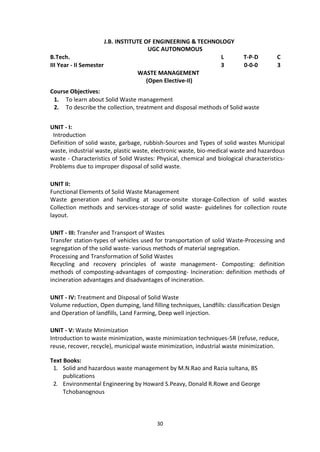
2 E32OB Waste Management Civil Engineering
3 E32OC
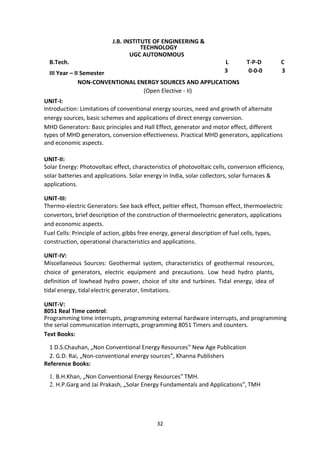
Non-Conventional Energy
Sources and Applications
Electrical and Electronics
Engineering
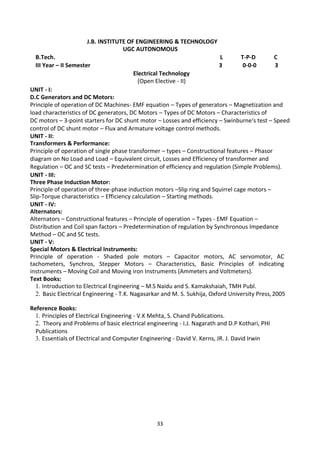
4 E32OD Electrical Technology
Electrical and Electronics
Engineering
5 E32OE Operation Research Mechanical Engineering
6 E32OG Nanotechnology Mechanical Engineering
7 E32OH
Applications of Micro
Processors and Controllers
Electronics and Communication
Engineering
8 E32OI Fundamentals of HDL
Electronics and Communication
Engineering
9 E32OJ
Database Management
Systems
Computer Science Engineering
10 E32OK Cloud Computing Computer Science Engineering
11 E32OL E-Waste Management Information Technology
12 E32OM Introduction to Web Design Information Technology
13 E32ON
Introduction to Embedded
systems
Electronics and Computer
Engineering
14 E32OO Fundamentals of E-Commerce
Electronics and Computer
Engineering
viii
J.B. INSTITUTE OF ENGINEERING & TECHNOLOGY
UGC AUTONOMOUS
Bhaskar Nagar, Yenkapally, Moinabad (M), RR Dist , Telangana-500075
COURSE STRUCTURE – R16
List of Subjects offered by various Board of Studies
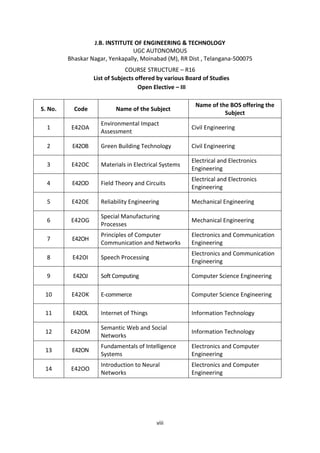
Open Elective – III
S. No. Code Name of the Subject
Name of the BOS offering the
Subject
1 E42OA
Environmental Impact
Assessment
Civil Engineering
2 E42OB Green Building Technology Civil Engineering
3 E42OC Materials in Electrical Systems
Electrical and Electronics
Engineering
4 E42OD Field Theory and Circuits
Electrical and Electronics
Engineering
5 E42OE Reliability Engineering Mechanical Engineering
6 E42OG
Special Manufacturing
Processes
Mechanical Engineering
7 E42OH
Principles of Computer
Communication and Networks
Electronics and Communication
Engineering
8 E42OI Speech Processing
Electronics and Communication
Engineering
9 E42OJ Soft Computing Computer Science Engineering
10 E42OK E-commerce Computer Science Engineering
11 E42OL Internet of Things Information Technology
12 E42OM
Semantic Web and Social
Networks
Information Technology
13 E42ON
Fundamentals of Intelligence
Systems
Electronics and Computer
Engineering
14 E42OO
Introduction to Neural
Networks
Electronics and Computer
Engineering
1
J.B. INSTITUTE OF ENGINEERING & TECHNOLOGY
UGC AUTONOMOUS
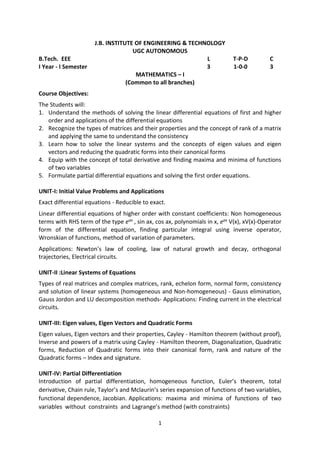
B.Tech. EEE L T-P-D C
I Year - I Semester 3 1-0-0 3
MATHEMATICS – I
(Common to all branches)
Course Objectives:
The Students will:
1. Understand the methods of solving the linear differential equations of first and higher
order and applications of the differential equations
2. Recognize the types of matrices and their properties and the concept of rank of a matrix
and applying the same to understand the consistency
3. Learn how to solve the linear systems and the concepts of eigen values and eigen
vectors and reducing the quadratic forms into their canonical forms
4. Equip with the concept of total derivative and finding maxima and minima of functions
of two variables
5. Formulate partial differential equations and solving the first order equations.
UNIT-I: Initial Value Problems and Applications
Exact differential equations - Reducible to exact.
Linear differential equations of higher order with constant coefficients: Non homogeneous
terms with RHS term of the type eax , sin ax, cos ax, polynomials in x, eax V(x), xV(x)-Operator
form of the differential equation, finding particular integral using inverse operator,
Wronskian of functions, method of variation of parameters.
Applications: Newton’s law of cooling, law of natural growth and decay, orthogonal
trajectories, Electrical circuits.
UNIT-II :Linear Systems of Equations
Types of real matrices and complex matrices, rank, echelon form, normal form, consistency
and solution of linear systems (homogeneous and Non-homogeneous) - Gauss elimination,
Gauss Jordon and LU decomposition methods- Applications: Finding current in the electrical
circuits.
UNIT-III: Eigen values, Eigen Vectors and Quadratic Forms
Eigen values, Eigen vectors and their properties, Cayley - Hamilton theorem (without proof),
Inverse and powers of a matrix using Cayley - Hamilton theorem, Diagonalization, Quadratic
forms, Reduction of Quadratic forms into their canonical form, rank and nature of the
Quadratic forms – Index and signature.
UNIT-IV: Partial Differentiation
Introduction of partial differentiation, homogeneous function, Euler’s theorem, total
derivative, Chain rule, Taylor’s and Mclaurin’s series expansion of functions of two variables,
functional dependence, Jacobian. Applications: maxima and minima of functions of two
variables without constraints and Lagrange’s method (with constraints)
2
UNIT-V First Order Partial Differential Equations
Formation of partial differential equations by elimination of arbitrary constants and
arbitrary functions, Lagranges method to solve the first order linear equations and the
standard type methods to solve the non linear equations.
TEXTBOOKS:
1. Higher Engineering Mathematics by Dr. B. S. Grewal, Khanna Publishers.
2. A first course in differential equations with modeling applications by Dennis G. Zill,
Cengage Learning publishers
REFERENCES:
1. Advanced Engineering Mathematics by E. Kreyszig, John Wiley and Sons Publisher.
2. Engineering Mathematics by N. P. Bali, Lakshmi Publications.
Course outcomes:
The Students will be able to:
1. Solve higher order DE’s and apply them for solving some real world problems
2. Write the matrix representation of a set of linear equations and to analyze the
solution of the system of equations
3. Analyze the Eigen values and Eigen vectors which come across under linear
transformations
4. Examine the values of functions of two variables with/ without constraints.
5. Solve linear partial differential equations of first order.
3
J.B. INSTITUTE OF ENGINEERING & TECHNOLOGY
UGC AUTONOMOUS
B.Tech. EEE L T-P-D C
I Year - I Semester 4 0-0-0 4
ENGINEERING CHEMISTRY
(Common to CSE, EEE, ECE, IT& ECM)
Course Objectives:
The Students will:
1. Acquire the skills to critically assess and solve problems related to water requiring
the application of chemical principles.
2. Familiar with research design methodology and to use problem-solving techniques
associated with electrochemistry.
3. Recognize, organize and present chemical information coherently through oral and
written discourse based on polymers.
4. Apply science and engineering in the analysis and evaluation of process involved in
production of energy efficient fuels.
5. Invent or discover new environmental friendly, energy efficient and economically
effective engg materials in a sustainable manner.
UNIT-I:
Water and its treatment: Introduction – hardness of water – causes of hardness – types of
hardness: temporary and permanent – expression and units of hardness – Estimation of
hardness of water by complexometric method. Numerical problems. Potable water and its
specifications- Steps involved in the treatment of potable water - Disinfection of potable
water by chlorination and Ozonization. Defluoridation – Nalgonda technique -
Determination of F- ion by ion- selective electrode method.
Boiler troubles:
Sludges, scales and Caustic embrittlement. Internal treatment of Boiler feed water (Calgon
conditioning – Phosphate conditioning - Colloidal conditioning). Softening of water by ion-
exchange processes. Desalination of water – Electrodialysis& Reverse osmosis. Numerical
problems.
UNIT-II : Electrochemistry and Batteries:
Electrochemistry: Electrode- electrode potential, standard electrode potential, types of
electrodes – Construction and functioning of Standard hydrogen electrode, calomel,
Quinhydrone and glass electrode. Nernst equation - electrochemical series and its
applications. Electrochemical cells: Daniel cell – cell notation, cell reaction and cell emf –
Potentiometric titrations and Applications- Determination of pH and EMF. Concept of
concentration cells-electrolyte concentration cell. Numerical problems.
Batteries: Cell and battery - Primary battery (dry cell, alkaline cell and Lithium cell) and
Secondary battery (lead acid, Ni-Cd and lithium ion cell), Fuel cells: Hydrogen –oxygen,
phosphoric acid and methanol-oxygen fuel cells – Applications.
UNIT-III: Polymers: Definition – Classification of polymers with examples – Types of
polymerization –
addition and condensation polymerization with examples. Plastics: Definition and
characteristics- thermoplastic and thermosetting plastics, compounding and fabrication of
plastics (compression and injection moulding). Preparation, Properties and engineering
applications of PVC and Bakelite.
4
Fibers: Characteristics of fibers – preparation, properties and applications of Nylon-6, 6 and
Dacron. Kevlar- Liquid crystal polymers-Applications.
Rubbers: Natural rubber and its vulcanization.
Elastomers: Characteristics –preparation – properties and applications of Buna-S, Butyl and
Thiokol rubber.
Biodegradable polymers: Concept and advantages - Polylactic acid and poly vinyl alcohol
and their applications.
UNIT-IV: Fuels and Combustion: Classification- solid fuels: coal – analysis of coal –
proximate and ultimate analysis and their significance. Liquid fuels – petroleum and its
refining, cracking – types – moving bed catalytic cracking. Knocking – octane and cetane
rating, synthetic petrol - Fischer-Tropsch’s process; Gaseous fuels – composition and uses of
natural gas, LPG and CNG.
Combustion: Definition, Calorific value of fuel – HCV, LCV-Dulongs Formula; Calculation of
air quantity required for combustion of a fuel.
UNIT-V : Engineering Materials and applications:
Lubricants-Classification of lubricants with examples-characteristics of a good lubricants –
mechanism of lubrication-properties of lubricants.
Conducting polymers: Characteristics and Classification with examples-mechanism of
conduction in trans-polyacetylene and applications of conducting polymers.
Nanomaterials: Introduction, Preparation-Top down & bottom up process-sol gel method
and self assembly process. Applications of nanomaterials.
Composites: Introduction- Constituents of composites – advantages, classification and
constituents of composites. Fiber reinforced plastics (FRP). Applications of composites.
TEXTBOOKS:
1. Engineering Chemistry by P.C. Jain and M. Jain, Dhanpatrai Publishing Company, New
Delhi
2. Engineering Chemistry by Rama Devi, VenkataRamana Reddy and Rath, Cengage
learning, New Delhi
3. Engineering Chemistry by Shashi Chawla, Dhanpatrai and Company (P) Ltd. Delhi
Course outcomes:
The Students will be able to:
1. Identify the suitability of water for domestic and industrial purposes
2. Apply the basic principle of electro chemistry.
3. Design the new polymeric materials for engineering applications.
4. Develop innovative methods and engineering materials that are useful in every
walk of life.
5. Apply new chemical techniques for the production of fuels that are useful in
every walk of life.
5
J.B. INSTITUTE OF ENGINEERING & TECHNOLOGY
UGC AUTONOMOUS
B.Tech. EEE L T-P-D C
I Year - I Semester 3 0-0-0 3
ENGINEERING PHYSICS-I
(Common to CSE, EEE, ECE, IT& ECM)
Course Objectives:
The Students will
1. Understand interaction of light with matter through interference, diffraction, and
polarization.
2. Distinguish between ordinary light with a laser light and to realize propagation of
light through optical fibers.
3. Analyze various crystal systems and there structures elaborately.
4. Analyze various crystal imperfections and probing methods like X-RD.
5. Understand concepts of latest developments in fiber optics
UNIT-I:
Crystallography: Space lattice, unit cell and lattice parameters, crystal systems,
Bravaislattices, atomic radius, co-ordination number and packing factor of SC, BCC, FCC,
HCP and diamond, Miller indices, crystal planes and directions, inter planar spacing of
orthogonal crystal systems.
UNIT-II :
X-ray Diffraction and Defects in Crystals: Bragg’s law, X-ray diffraction methods:
Lauemethod, powder method; point defects: vacancies, substitutional, interstitial, Frenkel
and Schottky defects, line defects (qualitative) and Burger’s vector, surface defects:
stacking faults, twin, tilt and grain boundaries.
UNIT-III: Fiber Optics: Principle of optical fiber, construction of fiber, acceptance angle and
acceptancecone, numerical aperture, types of optical fibers: step index and graded index
fibers, attenuation in optical fibers, applications of optical fibers in medicine and sensors.
UNIT-IV: Interference: Coherence, division of amplitude and division of wave front,
interference in thinfilms (transmitted and reflected light), Newton’s rings experiment.
Diffraction: Distinction between Fresnel and Fraunhoffer diffraction, diffraction due to
singleslit, N-slits, Diffraction grating experiment.
UNIT-V : Polarization: Introduction, Malus’s law, double refraction, Nicol prism, Quarter
wave and halfwave plates.
TEXTBOOKS:
1. Applied Physics – P.K.Mittal (I.K.Internationalhosesepvt Ltd) (New Edition)
2. Enginnering Physics-P.K Palaniswamy (Scitech Publications India) Pvt Ltd, Fifth Print
2010.)
3. Engineering Physics-Senthilkumar ((VRB Publishers Limited,)
REFERENCES:
1. Applied Physics for Engineers – A.J. Dekker (Macmillan).
2. Elements of Material Science – V.Raghavant (PHI Publications).
3. Solid State Physics – M. Armugam (Anuradha Publications).
4. A Textbook of Engg Physics – M. N. Avadhanulu& P. G. Khsirsagar– S. Chand & Co.
5. Modern Physics by K. Vijaya Kumar, S. Chandralingam: S. Chand &Co.Ltd
6
Course Outcomes:
The Students will be able to:
1. Distinguish between various crystal systems
2. Identify the crystal defects by using X-RD
3. Describe principles of fiber optics, different types of fiber optics and its
applications .
4. Identify concept of reflection and refraction rules of light in different medium
5. Identify characteristics of laser, working of various laser systems and light
propagation through optical fibers.
7
J.B. INSTITUTE OF ENGINEERING & TECHNOLOGY
UGC AUTONOMOUS
B.Tech. EEE L T-P-D C
I Year - I Semester 3 0-0-0 3
PROFESSIONAL COMMUNICATION IN ENGLISH
(Common to CSE, EEE, ECE, IT& ECM)
Course Objectives:
The Students will:
1. Improve the language proficiency of students in English with an emphasis on
Vocabulary, Grammar, Reading and Writing skills.
2. Equip students to study academic subjects more effectively using the theoretical
and Practical components of English syllabus.
3. Develop study skills and communication skills in formal and informal situations.
4. Develop correct reading habits, silently, extensively, and intensively
5. Acquire the ability to use a suitable dictionary
Reading Skills:
Objectives:
 To develop an awareness in students about the significance of silent reading and
comprehension.
 To develop students’ ability to guess meanings of words from the context and grasp
the overall message of the text, draw inferences, etc., by way of:
 Skimming and Scanning the text
 Intensive and Extensive Reading
 Reading for Pleasure
 Identifying the topic sentence
NOTE: The students will be trained in reading skills using the prescribed texts for detailed
study. They will be tested in reading comprehension of different ‘unseen’
passages which may be taken from authentic texts, such as
magazines/newspaper articles.
Writing Skills:
Objectives:
 To develop an awareness in the students about writing as an exact and formal skill
 To create an awareness in students about the components of different forms of
writing, beginning with the lower order ones through;
 Writing of sentences
 Use of appropriate vocabulary
 Paragraph writing
 Coherence and cohesiveness
 Narration / description
 Note Making
 Formal and informal letter writing
 Describing graphs using expressions of comparison
In order to improve the proficiency of the students in the acquisition of language skills
mentioned above, the following text and course contents, divided into Five Units, are
prescribed:
8
UNIT-I:
Chapter entitled ‘Presidential Address’ by Dr. A.P.J. Kalam from “Fluency in English–A
Course book for Engineering Students” published by Orient BlackSwan, Hyderabad.
Vocabulary: Word Formation -- Root Words --The Use of Prefixes and
Suffixes–Collocations– Exercises for Practice.
Grammar: Punctuation – Parts of Speech- Articles -Exercises for Practice.
Reading: Double Angels by David Scott-Reading and Its Importance- Techniques
forEffective Reading- Signal Words- Exercises for Practice
Writing: Writing Sentences- Techniques for Effective Writing-- Paragraph Writing-
Types, Structure and Features of a Paragraph-Coherence and Cohesiveness: Logical, Lexical
and Grammatical Devices - Exercises for Practice
UNIT-II :
Chapter entitled Satya Nadella: Email to Employees on his First Day as CEO from “Fluencyin
English– A Course book for Engineering Students” Published by Orient BlackSwan,
Hyderabad.
Vocabulary: Synonyms and Antonyms–Homonyms, Homophones, Homographs-
Exercisesfor Practice (Chapter 17 ‘Technical Communication-Principles and
Practice’.
Third Edition published by Oxford University Press may also be
followed.)Grammar: Verbs-Transitive, Intransitive and Non-finite Verbs–Mood and Tense—
Gerund – Words with Appropriate Prepositions – Phrasal Verbs - Exercises for
Practice
Reading: Sub-skills of Reading- Skimming, Scanning, Extensive Reading and Intensive
Reading - The Road Not Taken by Robert Frost -- Exercises for Practice
Writing: Letter Writing–Format, Styles, Parts, Language to be used in Formal Letters-Letter
of Apology – Letter of Complaint-Letter of Inquiry with Reply – Letter of Requisition –-
Exercises for Practice
UNIT-III: From the book entitled ‘Technical Communication-Principles and Practice’. Third
Edition published by Oxford University Press.
Vocabulary: Introduction- A Brief History of Words–Using the Dictionary and Thesaurus–
Changing Words from One Form to Another – Confusables (From Chapter
17 entitled ‘Grammar and Vocabulary Development’)
Grammar: Tenses: Present Tense- Past Tense- Future Tense- Active Voice – Passive
Voice- Conditional Sentences – Adjective and Degrees of Comparison. (From
Chapter 17 entitled ‘Grammar and Vocabulary Development’)
Reading: Improving Comprehension Skills – Techniques for Good Comprehension-
Skimming and Scanning- Non-verbal Signals – Structure of the Text –
Structure of Paragraphs – Punctuation – Author’s viewpoint (Inference) –
Reader
Anticipation: Determining the Meaning of Words – Summarizing- Typical
9
Reading Comprehension Questions. (From Chapter 10 entitled ‘Reading
Comprehension’)
Writing: Introduction- Letter Writing-Writing the Cover Letter- Cover Letters
Accompanying Resumes- Emails. (From Chapter 15 entitled ‘Formal Letters,
Memos, and Email’)
UNIT-IV: Chapter entitled ‘Good Manners’ by J.C. Hill from Fluency in English–A Course
book for
Engineering Students” published by Orient Blackswan, Hyderabad.
Vocabulary: Idiomatic Expressions–One- word Substitutes --- Exercises for Practice(Chapter
17 ‘Technical Communication-Principles and Practice’. Third
Edition published by Oxford University Press may also be
followed.)Grammar: Sequence of Tenses- Concord (Subject in Agreement with the Verb)–
Exercises
for Practice
Reading: ‘If’ poem byRudyard Kipling--Tips for Writing a Review ---Author’sViewpoint
– Reader’s Anticipation-- Herein the Students will be required to
Read and Submit a Review of a Book (Literary or Non-literary) of their choice
– Exercises for Practice.
Writing: Information Transfer-Bar Charts-Flow Charts-Tree Diagrams etc., -- Exercises
for Practice.
Introduction - Steps to Effective Precis Writing – Guidelines- Samples
(Chapter
12 entitled ‘The Art of Condensation’ from Technical Communication-Principles and
Practice. Third Edition published by Oxford University Press)
UNIT-V : Chapter entitled ‘Father Dear Father’by Raj Kinger from Fluency in English–A
Coursebook for Engineering Students” Published by Orient BlackSwan, Hyderabad
Vocabulary: Foreign Words—Words borrowed from other Languages- Exercises
forPractice
Grammar: Direct and Indirect Speech- Question Tags- Exercises for Practice
Reading: Predicting the Content- Understanding the Gist – SQ3R Reading Technique-
Study Skills – Note Making - Understanding Discourse Coherence –
Sequencing Sentences. (From Chapter 10 entitled ‘Reading Comprehension’-
Technical Communication- Principles and Practice. Third Edition publishedby
Oxford University Press.)
Writing: Technical Reports- Introduction – Characteristics of a Report – Categories of
Reports –Formats- Prewriting – Structure of Reports (Manuscript Format) -
Types of Reports - Writing the Report. (From Chapter 13 entitled ‘Technical
Reports’ - Technical Communication- Principles and Practice. Third Editionpublished by
Oxford University Press.)
TEXTBOOKS:
1. “Fluency in English – A Course book for Engineering Students” by Board of Editors:
Hyderabad: Orient BlackSwan Pvt. Ltd. 2016. Print.
2. Raman, Meenakshi and Sharma, Sangeeta. “Technical Communication- Principles
andPractice”. Third Edition. New Delhi: Oxford University Press. 2015. Print.
10
REFERENCES:
1. Green, David. Contemporary English Grammar–Structures and Composition.
MacMillan India. 2014 (Print)
2. Rizvi, M. Ashraf. Effective Technical Communication. Tata Mc Graw –Hill. 2015
(Print).
Course Outcomes:
The Students will be able to
1. Identify himself and try to develop the nation.
2. Implement how to dedicate themselves for the development of their
organization and career.
3. Use of technical vocabulary properly,
4. Develop good manners in their life.
5. Realize their parent’s consciousness towards them.
11
J.B. INSTITUTE OF ENGINEERING & TECHNOLOGY
UGC AUTONOMOUS
B.Tech. EEE L T-P-D C
I Year - I Semester 3 1-0-0 3
ENGINEERING MECHANICS
(Common to all Branches)
Course Objectives:
The Students will:
1. Read the concept of system of forces and its applications.
2. Determine the centroid and centre of gravity of different structures
3. Understand the concept of inertia and its real time applications
4. Analyze the bodies in motion
1. 5. Analyze the bodies in motion by considering the force cause the motion
UNIT-I : Introduction to Engineering Mechanics–Basic Concepts. Systems of Forces:
Coplanar Concurrent Forces–Forces in Space–Moment of Force and its Application–
Couples and Resultant of Force Systems. Equilibrium of Force Systems: Free Body
Diagrams, Equations of Equilibrium - Equilibrium of planar Systems -Equilibrium of
Spatial Systems.
UNIT-II : Centroids of simple figures (from basic principles)–Centroids of Composite
Figures Centre of Gravity: Centre of gravity of simple body (from basic principles),
centre of gravity of composite bodies, Pappus theorem.
UNIT-III: Area moment of Inertia : Definition–Polar Moment of Inertia, Transfer
Theorem, Moments of Inertia of Composite Figures, Products of Inertia, Transfer
Formula for Product of Inertia.
UNIT-IV: Kinematics: Rectilinear and Curvilinear motions–Velocity and Acceleration–
Motion of Rigid Body Types and their Analysis in Planar Motion.
UNIT-V: : Kinetics: Analysis as a Particle and Analysis as a Rigid Body in Translation–
Central Force Motion Equations of Plane Motion–Fixed Axis Rotation–Rolling Bodies.
TEXT BOOKS: 1. 1.Engineering. Mechanics / Timoshenko & Young.
2. Engineering Mechanics, Basudev Bhattacharya, Oxford Univ. Press, New Delhi,
Second Edition, 2014.
3.Engineering Mechanics / Fedinand . L. Singer / Harper–Collins.
REFERENCES:
1.Engineering Mechanics / S.S. Bhavikatti& J.G. Rajasekharappa
2.Engineering Mechanics / Irving. H. Shames Prentice–Hall.
3.Engineering Mechanics UmeshRegl / Tayal.
4. Engineering Mechanicas-Basic Concepts, Y.V.D.Rao, M.Manzoor Hussain, K.Govinda
Rajulu, Academic Publishing Company
Course outcomes:
The Students will be able to:
1. Recognize the resultant of a force system acting on an object.
2. Identify the surface area of complex objects.
3. Relate with application of different theorems of moment of inertia.
4. Identify the kinematics involved in a moving object.
5. Analyze the bodies in motion
12
J.B. INSTITUTE OF ENGINEERING & TECHNOLOGY
UGC AUTONOMOUS
B.Tech. EEE L T-P-D C
I Year - I Semester 2 0-0-0 0
PROFESSIONAL ETHICS
(Common to ECE, EEE, CE& ECM)
Course Objectives:
The Students will:
1. Learn ethical values and attitudes.
2. Understand the roles of a professional.
3. Understand the current scenario and engineer’s responsibility towards the
society
4. Know the types of professional ethical codes.
5. Learn the need for ethical audit.
UNIT-I:
Basic Concepts
Introduction, Difference between Ethics/values/Morals, , emotional, intelligence, Indian
and western thoughts on ethics, value education, dimensions of ethics, setting goals in
life, importance of morality and ethics, basic ethical principles, classification of ethical
codes., how to achieve autonomy.
UNIT-II :
Professional Ethics
Meaning of profession, professionalism, professional’s roles and professional risks,
professional accountability, successful professional, engineering professionals,
engineering ethics, roles of engineers, rights and responsibilities as citizens, professional
responsibilities, professional rights.
UNIT-III:
Global issues and safety
Introduction, current scenario, business ethics, environmental ethics, computer ethics,
ethical hacking and its dilemma,, ethics in research, intellectual property rights, patents,
trade marks, managers and engineers responsibility and case studies.
UNIT-IV: Ethical codes and audits
Introduction need and types of professional ethical codes, sample standard codes, ethical
codes for corporate entities and non-profit organization, charitable institutions,
limitations of the codes, need for ethical audit, ethical profile of organizations.
UNIT-V:
Human values and ethical living
Introduction, domains of learning, human values, attitudes, needs and wants of life,
harmony in life, styles of ethical living / models of ethical living, case studies.
13
TEXTBOOKS:
1. Professional ethics and human value by D.R.Kiran, Tata McGraw Hills education.
2. Ethics in engineering by Mike W. Martin and Roland Schinzinger, TMH education.
REFERENCES:
1. Fundamental of Ethics by Edmund G Seebauer and Robert L.Barry, Oxford university
press.
2. Professional ethics and human values by R.S.Nagarajan,
New age international.
3. Professional ethics by R. Subramanian, Oxford press.
Course Outcomes:
The Students will be able to:
1. Use of ethical values and attitudes in their life.
2. Implement once he/she becomes a professional.
3. Solve the issues related with environment and technology
4. Apply the different types of professional ethical codes in their organization.
5. Use of the rules framed by the auditors.
14
J.B. INSTITUTE OF ENGINEERING & TECHNOLOGY
UGC AUTONOMOUS
B.Tech. EEE L T-P-D C
I Year - I Semester 4 0-0-0 4
BASIC ELECTRICAL AND ELECTRONICS ENGINEERING
(Common to CSE, EEE, ECE, IT& ECM)
Course Objectives: -
The Students will:
1. Describe Electric Circuits.
2. Acquire knowledge the given circuit with various theorems and methods.
3. Learn in recognizing of basic electronic devices such as Diodes, Transistors, to build
circuits like
amplifiers and oscillators etc.
4. Acquire knowledge on the various parameters useful for designing electronic system.
5. Acquire the knowledge of various configurations, characteristics, and applications.
UNIT-I: Electrical circuits:
R-L-C Parameters, voltage and current, Independent and Dependent Sources, Source
Transformation-V-I relationship for passive elements, Kirchhoff’s Laws, Network reduction
techniques-series, parallel, series-parallel, star-to-delta, delta-to-star transformation, Nodal
Analysis .
Single Phase AC Circuits : R.M.S. and Average values, Form Factor, steady state analysis of
series, parallel and series-parallel combinations of R, L and C with sinusoidal excitation,
concept of reactance, impedance, susceptance and admittance –phase and phase difference,
concept of power factor, phasor notation, complex and polar forms of representation.
UNIT-II: Resonance:
Series and parallel resonance circuits, concept of bandwidth and Q factor, Locus Diagrams
for RL, RC and RLC Combinations for various parameters.
Network Theorems: Thevenin’s, Norton’s, Maximum power Transfer, Superposition,
Reciprocity, Tellegen’s, Milliman’s and Compensation theorems for DC and AC excitations.
UNIT-III: P-N Junction Diode:
P-N junction as a Diode, Symbol, Diode equation, volt-Ampere characteristics, Temperature
dependence, Ideal versus practical Diode, static and dynamic resistances, Diffusion and
Transition Capacitances.
Rectifiers and Filters:
Diode rectifier: Half wave Rectifier, Ripple Factor-Full Wave Rectifier, Bridge Rectifier,
Rectifiers with Filters: Inductive Filters, Capacitive Filters, L-section Filters, π- section Filters.
UNIT-IV: : Bipolar Junction Transistor ( BJT):
Symbol, Construction, principle of Operation, Current Components in a junction transistor
Common Emitter, Common Base and Common Collector configurations.
Transistor Biasing -Operating point, DC and AC load lines, Fixed Bias, Collector to Base bias,
Self Bias (Voltage divider bias), Bias stability, Stabilization against variations in VBE , β, and Ico.
Small signal Transistor Analysis, h- Parameters, Definitions, Determination of h-parameters
from CE transistor characteristics, Analysis of CE, CB and CC configurations using h-
parameters and their Comparison.
15
UNIT-V : Junction Field Effect Transistor
Construction, Principle of Operation, pinch-off voltage, Volt-Ampere characteristics,
comparison of BJT and JFET, small signal Model, MOSFET: Depletion and Enhancement FETs-
construction characteristics.
Special Purpose Devices: Breakdown Mechanisms in semi-Conductor Diodes, Zener diode
characteristics, Zener diode as a simple regulator, principle of operation and Characteristics
of Tunnel Diode ( with help of Energy band diagram ) Varactor Diode, Principle of operation
of SCR.
TEXTBOOKS:
1. Millman’s Electronic Devices and circuits –J.Millman and C.Halkias, Mc Graw
Hill
2. Micro Electronics by David bell
3. Network Theory by Sudhakar, Shyam Mohan Palli, TMH.
Course Outcomes: -
The student will be able to:
1. Demonstrate strong fundamental background in Electrical Engineering.
2. Analyze and solve problems of ac and dc circuits.
3. Identify the value of different resistors.
4. Analyze and design various electronic circuits
5. Design examples using currently available devices and standard-value
components
16
J.B. INSTITUTE OF ENGINEERING & TECHNOLOGY
UGC AUTONOMOUS
B.Tech. EEE L T-P-D C
I Year - I Semester 0 0-3-0 2
ENGLISH LANGUAGE COMMUNICATION SKILLS (ELCS) LAB
(Common to CSE, EEE, ECE, IT& ECM)
Course Objectives:
The Students will:
1. Sensitize students to the nuances of English speech sounds, word accent,
intonation, and rhythm
2. Bring about a consistent accent and intelligibility in students’ pronunciation of
English by providing an opportunity for practice in speaking
3. Improve the fluency of students in spoken English and neutralize their mother
tongue influence
4. Use language appropriately for public speaking and interviews.
5. Develop to learn debating and oral presentation skills
Exercise – I
CALL Lab:
Understand: Listening Skill- Its importance–Purpose- Process- Types- Barriers- Effective
Listening.
Practice: Introduction to Phonetics–Speech Sounds–Vowels and Consonants–Minimal
Pairs- Consonant Clusters- Past Tense Marker and Plural Marker.
Testing Exercises
ICS Lab:
Understand: Spoken vs. Written language- Formal and Informal English.
Practice: Ice-Breaking Activity and JAM Session- Situational Dialogues–Greetings–Taking
Leave – Introducing Oneself and Others.
Exercise – II
CALL Lab:
Understand: Structure of Syllables–Word Stress–Weak Forms and Strong Forms–Sentence
Stress – Intonation.
Practice: Basic Rules of Word Accent - Stress Shift - Weak Forms and Strong Forms-
Sentence Stress – Intonation.
Testing Exercises
ICS Lab:
Understand: Features of Good Conversation–Strategies for Effective Communication.
Practice: Situational Dialogues–Role-Play- Expressions in Various Situations–Making
Requests and Seeking Permissions - Telephone Etiquette.
17
Exercise - III
CALL Lab:
Understand: Errors in Pronunciation-the Influence of Mother Tongue (MTI).
Practice: Common Indian Variants in Pronunciation – Differences between British
andAmerican Pronunciation.
Testing Exercises
ICS Lab:
Understand: Descriptions- Narrations- Giving Directions and Guidelines.
Practice: Giving Instructions–Seeking Clarifications–Asking for and Giving Directions–Thanking
and Responding – Agreeing and Disagreeing – Seeking and Giving Advice – Making
Suggestions.
Exercise – IV
CALL Lab:
Understand: Listening for General Details.
Practice: Listening Comprehension Tests.
Testing Exercises
ICS Lab:
Understand: Public Speaking–Exposure to Structured Talks - Non-verbal Communication-
Presentation Skills.
Practice: Making a Short Speech–Extempore- Making a Presentation.
Exercise – V
CALL Lab:
Understand: Listening for Specific Details.
Practice: Listening Comprehension Tests.
Testing Exercises
ICS Lab:
Understand: Group Discussion- Interview Skills.
Practice: Group Discussion- Mock Interviews.
Lab Manuals:
1) A book entitled “ELCS Lab Manual– A Workbook for CALL and ICS Lab Activities” by
Board of Editors: Hyderabad: Orient BlackSwan Pvt. Ltd. 2016. Print.
2) Hart, Steve; Nair, Aravind R.; Bhambhani, Veena. “EMBARK- English for
undergraduates” Delhi: Cambridge University Press. 2016. Print.
Suggested Software:
1) Cambridge Advanced Learners’ English Dictionary with CD.
18
2) Grammar Made Easy by Darling Kindersley.
3) Punctuation Made Easy by Darling Kindersley.
4) Oxford Advanced Learner’s Compass, 8th Edition.
5) English in Mind (Series 1-4), Herbert Puchta and Jeff Stranks with Meredith Levy,
Cambridge.
6) English Pronunciation in Use (Elementary, Intermediate, Advanced) Cambridge
University Press.
7) TOEFL and GRE (KAPLAN, AARCO and BARRONS, USA, Cracking GRE by CLIFFS).
References:
1) Jayashree Mohanraj. Let Us Hear Them Speak. New Delhi: Sage Texts. 2015. Print.
Hancock, M. English Pronunciation in Use. Intermediate Cambridge: Cambridge
University Press. 2009. Print.
Course Outcomes:
The student will be able to:
1. Develop correct pronunciation.
2. Use stress and intonation properly while speaking and writing.
3. Develop listening skills
4. Describe himself and others in day to day life situations.
5. Acquire debating and oral presentation skills.
19
J.B. INSTITUTE OF ENGINEERING & TECHNOLOGY
UGC AUTONOMOUS
B.Tech. EEE L T-P-D C
I Year - I Semester 0 0-3-0 2
ENGINEERING WORKSHOP
(Common to CSE, EEE, ECE, IT& ECM)
Course Objectives:
The student will:
1. Execute application of various tools in carpentry, lathe machine works, house wiring
2. Recognize application of metal cutting and drilling
3. Make various shape of wood material and metals
4. Fabricate metal items using welding and power tools
5. Demonstrate the works in foundry and plumbing
TRADES FOR EXERCISES:
1) Carpentry
2) Fitting
3) Tin-Smithy and Development of jobs carried out and soldering.
4) Black Smithy
5) House-wiring
6) Foundry
7) Welding
2. TRADES FOR DEMONSTRATION AND EXPOSURE:
Plumbing, Machine Shop, Power tools in construction, wood working and mechanical
engineering.
Course Outcomes:
The student will be able to:
1. Identify the tools used in workshop of different trades.
2. Practice the carpentry works of small shape and size.
3. Demonstrate the basic fitting and electrical works using the required tools
4. Fabricate metal items using welding and power tools
5. Demonstrate the works in foundry and plumbing
20
J.B. INSTITUTE OF ENGINEERING & TECHNOLOGY
UGC AUTONOMOUS
B.Tech. EEE L T-P-D C
I Year - II Semester 3 0-0-0 3
ENGINEERING PHYSICS – II
(Common to EEE, ECE, CSE, IT&ECM)
Course Objectives:
The student will:
1. Understand the behaviour of a particle quantum mechanically.
2. Distinguish pure and impure semiconductors and understand formation of P-N
Junction.
3. Understand various magnetic and dielectric properties of materials.
4. Practical focus in this curriculum is on nano structured materials, their structural
5 Analyze Mechanical properties, and their applications.
UNIT-I : Principles of Quantum Mechanics: Waves and particles, de-Broglie hypothesis,
matter waves,
Davisson and Germer experiment, Heisenberg uncertainty principle, Schrodinger time
independent wave equation, physical significance of wave function, particle in 1-D
potential box, electron in periodic potential, Kronig-Penny model (qualitative treatment),
E-K curve, origin of energy band formation in solids.
UNIT-II : Semiconductor Physics: Fermi level in intrinsic and extrinsic semiconductors,
calculation of carrier concentration in intrinsic & extrinsic semiconductors, direct and
indirect band gap semiconductors, formation of PN junction, open circuit PN junction,
energy diagram of PN junction diode, solar cell: I-V characteristics and applications
UNIT-III: Dielectric Properties: Electric dipole, dipole moment, dielectric constant,
polarizability, electric susceptibility, displacement vector, electronic, ionic and orientation
polarizations and calculation of their polarizabilities, internal field, Clausius-Mossotti
relation, Piezoelectricity, pyroelectricity and ferroelectricity-BaTiO3 structure.
UNIT-IV Magnetic Properties & Superconductivity: Permeability, field intensity, magnetic
field induction, magnetization, magnetic susceptibility, origin of magnetic moment, Bohr
magneton, classification of dia, para and ferro magnetic materials on the basis of magnetic
moment, hysteresis curve based on domain theory, soft and hard magnetic materials,
properties of anti- ferro and ferri magnetic materials,
Superconductivity: Superconductivity phenomenon, Meissner effect, applications of
superconductivity.
UNIT-V: : Introduction to nanoscience: Origin of nanoscience, nanoscale, surface to volume
ratio,
quantum confinement, dominance of electromagnetic forces, random molecular motion,
bottom-
up fabrication: Sol-gel, CVD and PVD techniques, top-down fabrication: ball mill method,
characterization by XRD, SEM and TEM.
TEXTBOOKS:
1. Solid State Physics, A. J. Dekkar, Macmillan publishers Ind. Ltd.,
2. Solid State Physics, Chales Kittel, Wiley student edition.
3. Fundamentals of Physics, Alan Giambattisa, BM Richardson and Robert C
Richardson,Tata McGraw hill Publishers.
21
Course Outcomes:
The student will be able to:
1. Identify the behavior of a particles in quantum mechanics.
2. Analyze the properties of semiconducting materials and devices.
3. Categorize various magnetic dielectric properties and apply them in engineering
applications.
4. Analyze the basic principles and applications of super conductors.
5. Demonstrate a working knowledge of nanotechnology principles and industry
22
J.B. INSTITUTE OF ENGINEERING & TECHNOLOGY
UGC AUTONOMOUS
B.Tech. EEE L T-P-D C
I Year - II Semester 4 1-0-0 4
MATHEMATICS- II
Advanced Calculus
(Common to EEE, ECE, CSE, IT & ECM)
Course Objectives:
The student will:
1. Geometrical approach to the mean value theorems and their application to the
mathematical problems
2. Evaluation of improper integrals using Beta and Gamma functions.
3. Finding maxima and minima of function of two and three variables
4. Evaluation of multiple integrals and their applications
5. The physical quantities involved in engineering field related to vector valued functions
6. The basic properties of vector valued functions and their applications to line, surface
and volume integrals
UNIT-I Laplace Transforms: Laplace transforms of standard functions, Shifting theorems,
derivatives and integrals, properties- Unit step function, Dirac’s delta function, Periodic
function, Inverse Laplace transforms, Convolution theorem (without proof).
Applications: Solving ordinary differential equations (initial value problems) using Laplace
transforms.
UNIT-II : Beta and Gamma Functions: Beta and Gamma functions, properties, relation
between Beta and Gamma functions, evaluation of integrals using Beta and Gamma
functions. Applications: Evaluation of integrals
UNIT-III: Multiple Integrals: Double and triple integrals, Change of variables, Change of
order of integration.
Applications: Finding areas, volumes& Center of gravity (evaluation using Beta and Gamma
functions).
UNIT-IV : Vector Differentiation: Scalar and vector point functions, Gradient, Divergence,
Curl andtheir physical and geometrical interpretation, Laplacian operator, Vector identities.
UNIT-V: Vector Integration: Line Integral, Work done, Potential function, area, surface and
volume integrals, Vector integral theorems: Greens, Stokes and Gauss divergence theorems
(without proof) and related problems.
TEXT BOOKS:
1. Advanced Engineering Mathematics by R K Jain & S R K Iyengar, Narosa
Publishers
2. Engineering Mathematics by Srimanthapal and Subodh C. Bhunia, Oxford Publishers
REFERENCES:
1. Advanced Engineering Mathematics by Peter V. O. Neil, Cengage Learning
Publishers.
2. Advanced Engineering Mathematics by Lawrence Turyn, CRC Press
23
Course outcomes:
The student will be able to:
1. Use laplace transform techniques for solving de’s.
2. Evaluate integrals using beta and gamma functions.
3. Evaluate the multiple integrals and can apply these concepts to find areas,
volumes, moment of inertia etc of regions on a plane or in space.
4. Calculate the unit tangent vector, the unit normal vector and the unit binormal
vector at a point on a space curve described by a vector-valued position function.
5. Analyze the line, surface, and volume integrals and
converting them from one to another
24
J.B. INSTITUTE OF ENGINEERING & TECHNOLOGY
UGC AUTONOMOUS
B.Tech. EEE L T-P-D C
I Year - II Semester 4 1-0-0 4
Mathematics - III
Statistical and Numerical Methods
(Common to All Branches)
Course Objectives:
The Students will:
1. Importance of Fourier series
2. Basic properties of complex functions and analytic functions
3. Taylor’s series, Maclauren’s and Laurent’s series expansions of complex function
4. Evaluate integrals using residue theorem.
5. Map by general analytic functions W=f(z) .
UNIT-I Introduction, Random variables, Discrete random variable, Continuous random
variable,Probability ,istribution function, Probability density function, Expectation, Moment
generating function, Moments and properties. Discrete distributions: Binomial and
geometric distributions. Continuous distribution: Normal distributions
UNIT-II : Sampling Theory: Introduction, Population and samples, Sampling distribution of
means ( σKnown)-Central limit theorem, t-distribution, Sampling distribution of means (
σunknown)-Sampling distribution of variances – χ2and F- distributions, Point Estimation,
Maximum error of estimate, Interval estimation.
UNIT-III: Tests of Hypothesis: Introduction, Hypothesis, Null and Alternative Hypothesis,
Type I andType II errors,
Level of significance, One tail and two-tail tests, Tests concerning one mean and proportion,
two means
-proportions and their differences-ANOVA for one-way classified data.
UNIT-IV : Algebraic and Transcendental Equations & Curve Fitting: Introduction, Bisection
Method, Method of False position, Iteration methods: fixed point iteration and Newton
Raphson methods. Solving linear system of equations by Gauss-Jacobi and Gauss-Seidal
Methods.
Curve Fitting: Fitting a linear, second degree, exponential, power curve by method of least
squares.
UNIT-V: Numerical Integration and solution of Ordinary Differential equations: Trapezoidal
rule-Simpson’s 1/3rd and 3/8th rule- Solution of ordinary differential equations by Taylor’s
series, Picard’s method of successive approximations, Euler’s method, Runge-Kutta method
(second and fourth order)
25
TEXTBOOKS:
1. Probability and Statistics for Engineers by Richard Arnold Johnson, Irwin Miller and
John E. Freund, New Delhi, Prentice Hall.
2. Probability and Statistics for Engineers and Sciences by Jay L. Devore, Cengage
Learning.
3. Numerical Methods for Scientific and Engineering Computation by M. K. Jain, S. R.
4. K. Iyengar and R. K. Jain, New Age International Publishers
REFERENCES:
1. Fundamentals of Mathematical Statistics by S. C. Guptha& V. K. Kapoor, S. Chand.
2. Introductory Methods of Numerical Analysis by S. S. Sastry, PHI Learning Pvt. Ltd.
3. Mathematics for engineers and scientists by Alan Jeffrey, 6th edition, CRC press.
Course outcomes:
The student will be able to:
1. Differentiate among random variables involved in the probability models which
are useful for all branches of engineering
2. Evaluate mean, proportions and variances of sampling distributions and to make
important decisions for few samples which are taken from a large data
3. Solve the tests of ANOVA for classified data
4. Identify the root of a given equation and solution of a system of equations
&design a curve for a given data
5. Derive the numerical solutions for a given first order initial value problems
26
J.B. INSTITUTE OF ENGINEERING & TECHNOLOGY
UGC AUTONOMOUS
B.Tech. EEE L T-P-D C
I Year - II Semester 3 0-0-0 3
COMPUTER PROGRAMMING IN C
(Common to EEE, ECE, CSE, IT & ECM)
Course Objectives:
The Students will:
1. Learn the fundamentals of computers.
2. Understand the various steps in Program development.
3. Learn the syntax and semantics of C Programming Language.
4. Learn how to write modular and readable C Programs.
5. Learn to write programs using structured programming approach in C to solve
problems.
UNIT-I : Introduction to Computers – Computer Systems, Computing Environments,
Computer Languages, Creating and running programs, Program Development, algorithms
and flowcharts , Number systems-Binary, Decimal, Hexadecimal and Conversions, storing
integers and real numbers.
Introduction to C Language – Background, C Programs, Identifiers, Types, Variables,
Constants, Input / Output, Operators(Arithmetic, relational, logical, bitwise etc.),
Expressions, Precedence and Associativity, Expression Evaluation, Type conversions,
Statements- Selection Statements(making decisions) – if and switch statements, Repetition
statements ( loops)-while, for, do-while statements, Loop examples, other statements
related to looping – break, continue, goto, Simple C Program examples.
UNIT-II : Functions-Designing Structured Programs, Functions, user defined functions, inter
function communication, Standard functions, Scope, Storage classes-auto, register, static,
extern, scope rules, type qualifiers, recursion- recursive functions, Limitations of recursion,
example C programs.
Arrays – Concepts, using arrays in C, inter function communication, array applications- linear
search, binary search and bubble sort, two – dimensional arrays, multidimensional arrays, C
program examples.
UNIT-III: Pointers – Introduction (Basic Concepts), Pointers for inter function
communication, pointers to pointers, compatibility, Pointer Applications-Arrays and
Pointers, Pointer Arithmetic and arrays, Passing an array to a function, memory allocation
functions, array of pointers, programming applications, pointers to void, pointers to
functions.
Strings – Concepts, C Strings, String Input / Output functions, arrays of strings, string
manipulation functions, string / data conversion, C program examples.
UNIT-IV : Enumerated, Structure ,and Union Types– The Type Definition (typedef),
Enumerated types, Structures –Declaration, initialization, accessing structures, operations
27
on structures, Complex structures-Nested structures, structures containing arrays,
structures containing pointers, arrays of structures, structures and functions, Passing
structures through pointers, self referential structures, unions, bit fields, C programming
examples, command–line arguments, Preprocessor commands.
UNIT-V: Input and Output – Concept of a file, streams, text files and binary files, Differences
between text and binary files, State of a file, Opening and Closing files, file input / output
functions (standard library input / output functions for files), file status functions (error
handling), Positioning functions (fseek ,rewind and ftell), C program examples.
TEXTBOOKS:
1. Computer Science: A Structured Programming Approach Using C, B.A. Forouzan and
R. F. Gilberg, Third Edition, Cengage Learning.
2. Programming in C. P. Dey and M Ghosh , Second Edition, Oxford University Press
REFERENCES:
1. The C Programming Language, B.W. Kernighan and Dennis M. Ritchie, Second Edition,
Pearson education.
2. Programming with C, B. Gottfried, 3rdedition, Schaum’s outlines, McGraw Hill
Education(India) Pvt Ltd.
3. C From Theory to Practice, G S. Tselikis and N D. Tselikas, CRC Press.
Course Outcomes:
The Students will be able to:
1. Demonstrate the basic knowledge of computer hardware and software.
2. Write effective programs using c programming language.
3. Choose between different argument passing mechanisms and use
multidimensional arrays.
4. Use pointers with arrays and apply various string functions.
5. Differentiate between structures and unions.
28
J.B. INSTITUTE OF ENGINEERING & TECHNOLOGY
UGC AUTONOMOUS
B.Tech. EEE L T-P-D C
I Year - II Semester 2 0-0-4 4
ENGINEERING DRAWING
(Common to CSE, ECE, ECM, EEE & IT )
Course Objectives:
The Students will:
1. Understand basic knowledge of conventions used in engineering graphics,
constructing engineering scales and various methods in getting engineering curves.
2. Identify the different angles of projections, conventions and the position of objects
in various planes.
3. Distinguish the different orientations of two dimensional planes and right regular
solids at different inclinations with respect to projection planes able to identify the
internal features of object.
4. Analyze the size and shape of required sheet to form a right regular solid.
5. Solving the typical problems from 3-dimensional view to simplified 2-dimensional
view and vice versa.
UNIT-I INTRODUCTION TO ENGINEERING DRAWING: Principles of Engineering Drawing and
their Significance – Drawing Instruments and their Use – Conventions in Drawing – Lettering
– BIS Conventions.
CONSTRUCTION OF CURVES USED IN ENGINEERING PRACTICE:
a) Conic Sections
Ellipse- General, Concxentric Circle, Arcs of circle and Oblong Method
Parabola- General, Tangent and Rectangle Methods
Hyperabola-General, Point/Rectangle Method
b) Cycloid, Epicycloid and Hypocycloid
c) Involute for Circle, Rectangle and Triangle
UNIT-II : PROJECTIONS OF POINTS AND LINES: Principles of Orthographic Projections –
Conventions – First and Third Angle, Projections of Points and Lines inclined to planes, True
lengths, traces.
UNIT-III: PROJECTIONS OF PLANES: Projections of regular Planes, auxiliary planes and
Auxiliary projection inclined to both planes.
UNIT-IV : PROJECTIONS OF SOLIDS: Projections of Regular Solids inclined to both planes –
Auxiliary Views.
UNIT-V: : ISOMETRIC PROJECTIONS: Principles of Isometric Projection – Isometric Scale –
Isometric Views– Conventions – Isometric Views of Lines, Plane Figures, Simple and
Compound Solids – Isometric Projection of objects having non- isometric lines. Isometric
Projection of Spherical Parts.
ORTHOGRAPHIC PROJECTIONS: Conversion of Isometric Views to Orthographic Views –
Conventions.
29
TEXTBOOKS:
1. Engineering Drawing, N.D. Bhat / Charotar
2. Engineering Drawing and Graphics, Venugopal / New age.
3. Engineering Drawing – Basant Agrawal, TMH
REFERENCES: .
1. Engineering drawing – P.J. Shah.S.Chand.
2. Engineering Drawing, Narayana and Kannaiah / Scitech publishers.
3. Engineering Drawing- Johle/Tata Macgraw Hill.
4. Computer Aided Engineering Drawing- Trymbaka Murthy- I.K. International.
Course outcomes:
The Students will be able to
1. Identify the principals of engineering drawings
2. Examine visual aspects of engineering drawing and graphics
3. Draw the three-dimensional objets.
4. Demonstrate the ideas of engineering components in the form of a drawing
5. Design creative Engineering working drawings.
30
J.B. INSTITUTE OF ENGINEERING & TECHNOLOGY
UGC AUTONOMOUS
B.Tech. EEE L T-P-D C
I Year - I Semester 0 0-3-0 2
ENGINEERING CHEMISTRY LAB
(Common to All Branches)
Course Objectives:
The Students will
1. Understand the importance of Chemical analysis in their daily life
2. Learn the different practical skills in conducting the lab experiments
3. Analyse the different results of the experiments when different external factors are
being applied
4. Improve experimental skills
5. Prepare more environment friendly engineering compounds at low cost
Cycle-I
1. Determination of Conc. of KMnO4 by colorimetric method.
2. Estimation of copper by colorimetric method.
3. Conduct of metric titration of mixture of acids vs strong base.
4. Titration of strong acid vs strong base by potentiometry.
5. Determination of pH of the given solution.
6. Determination of viscosity of sample oil by redwood viscometer
7. Preparation of Fe nanoparticles
Cycle-II
8. Estimation of hardness of water by EDTA method.
9. Estimation of manganese dioxide in pyrolusite.
10. Determination of Surface tension of lubricants
11. Preparation of Aspirin
12. Preparation of Thiokol rubber
Course outcomes:
The Students will be able to
1. Identify the importance of chemical analysis in their daily life
2. Use different practical skills to analyse the results associated with the
experiments build practical skills
3. Develop new environmental friendly and cost effective engineering compounds
4. Analyze the concepts of laboratory procedure.
5. Determine the partition coefficient of a organic compound in two immiscible
liquids
31
J.B. INSTITUTE OF ENGINEERING & TECHNOLOGY
UGC AUTONOMOUS
B.Tech. EEE L T-P-D C
I Year - II Semester 0 0-3-0 2
ENGINEERING PHYSICS LAB
(Common to EEE, ECE, CSE, IT & ECM)
Course Objectives:
The Students will:
1. Develop good experiment skills to apply theoretical knowledge in the experimental
verification.
2. Demonstrate the ability to use experimental statistics to determine the precision of a
series of measurements.
3. Demonstrate the ability to prepare a valid laboratory notebook.
4. Design of circuits using new technology and latest components
5. Develop practical applications of engineering materials and use of principle in the right
way to implement the modern technology.
Cycle-I
1. Dispersive power of the material of a prism – Spectrometer.
2. Torsional pendulum – Rigidity modulus.
3. Newton’s Rings – Radius of curvature of Plano convex lens.
4. Melde’s experiment – Transverse and longitudinal modes.
5. Charging, discharging and time constant of an R-C circuit.
6. L-C-R circuit – Resonance & Q-factor.
Cycle-II
7. Magnetic field along the axis of current carrying coil – Stewart and Gees method
and to verify Biot – Savart’s law.
8. Study the characteristics of LED and LASER diode.
9. Bending losses of fibres& Evaluation of numerical aperture of a given fibre.
10. Energy gap of a material of p-n junction.
11. Determination of wavelengths of white source – Diffraction grating.
12. Wavelength of light, resolving power and dispersive power of a diffraction grating
using laser.
13. Dielectric constant of a material / V-I characteristics of a solar cell.
Note: Minimum 10 experiments must be performed.
32
Course Outcomes:
The student will be able to:
1. Identify basic physical concepts and vocabulary used to describe them elasticity
by using Torsional Pendulum
2. Apply the various procedures and techniques for the measurement of resonance
frequency in LCR circuit.
3. Analyze working principle of laser and to summarize its applications.
4. Explore the working principle of semiconductor diode
5. Identify the real time application of electromagnetic theory by Stewart and gee's
method.
33
J.B. INSTITUTE OF ENGINEERING & TECHNOLOGY
UGC AUTONOMOUS
B.Tech. EEE L T-P-D C
I Year - II Semester 0 0-3-0 2
COMPUTER PROGRAMMING IN C LAB
(Common to EEE, ECE, CSE, IT & ECM)
Course Objective:
The Students will:
1. Implement linked list, stack, queue, tree
2. Develop programming skills using the fundamentals and basics of c language
3. Change character strings in c programs.
4. Use pointers to efficiently solve problems
5. Memorize functions from the portable c library and to describe the techniques for
creating program modules using functions and recursive functions.
Recommended Systems/Software Requirements:
 Intel based desktop PC
 GNU C Compiler
1. a) Write a C program to find the factorial of a positive integer.
b) Write a C program to find the roots of a quadratic equation.
2. a) Write a C program to determine if the given number is a prime number or not.
b) A Fibonacci sequence is defined as follows: the first and second terms in the
sequence are 0 and 1. Subsequent terms are found by adding the preceding
two terms in the sequence. Write a C program to generate the first nterms of
the sequence.
3. a) Write a C program to construct a pyramid of numbers.
b) Write a C program to calculate the
following Sum: Sum=1-x2/2! +x4/4!-
x6/6!+x8/8!-x10/10!
4. a) The least common multiple (lcm) of two positive integers a and b is the smallest
integer that is evenly divisible by both a and b. Write a C program that reads two
integers and calls lcm (a, b) function that takes two integer arguments and returns
their lcm. The lcm (a, b) function should calculate the least common multiple by
calling the gcd (a, b) function and using the following relation:
LCM (a,b) = ab / gcd (a,b)
b) Write a C program that reads two integers n and r to compute the ncr value
using the following relation: ncr (n,r) = n! / r! (n-r)! . Use a function for
computing the factorial value of an integer.
5. a) Write C program that reads two integers x and n and calls a recursive function to
compute xn]
b) Write a C program that uses a recursive function to solve the Towers of Hanoi
problem.
c) Write a C program that reads two integers and calls a recursive function to
compute ncr value.
d)
34
6. a) Write a C program to generate all the prime numbers between 1 and n, where n
is a value supplied by the user using Sieve of Eratosthenes algorithm.
b) Write a C program that uses non recursive function to search for a Key value in
a given list of integers. Use linear search method.
7. a) Write a menu-driven C program that allows a user to enter n numbers and then
choose between finding the smallest, largest, sum, or average. The menu and all
the choices are to be functions. Use a switch statement to determine what action
to take. Display an error message if an invalid choice is entered.
b) Write a C program that uses non recursive function to search for a Key value in
a given sorted list of integers. Use binary search method.
8. a) Write a C program that implements the Bubble sort method to sort a given list of
integers in ascending order.
b) Write a C program that reads two matrices and uses functions to perform the
following: i) Addition of two matrices ii) Multiplication of two matrices
9. a) Write a C program that uses functions to perform the following operations:
i) to insert a sub-string into a given main string from a given position.
ii) to delete n characters from a given position in a given string.
b) Write a C program that uses a non recursive function to determine if the given
string is a Palindrome or not.
10. a) Write a C program to replace a substring with another in a given line of text.
b) Write a C program that reads 15 names each of up to 30 characters, stores them in
an array, and uses an array of pointers to display them in ascending (ie. alphabetical)
order.
11. a) 2’s complement of a number is obtained by scanning it from right to left and
complementing all the bits after the first appearance of a 1. Thus 2’s complement of
11100 is 00100. Write a C program to find the 2’s complement of a binary number.
b) Write a C program to convert a positive integer to a roman numeral. Ex. 11 is
converted to XI.
12. a) Write a C program to display the contents of a file to standard output device.
b) Write a C program which copies one file to another, replacing all lowercase
characters with their uppercase equivalents.
13. a) Write a C program to count the number of times a character occurs in a text file.
The file name and the character are supplied as command-line arguments.
b) Write a C program to compare two files, printing the first line where they differ.
14. a) Write a C program to change the nth character (byte) in a text file. Use fseek
function.
b) Write a C program to reverse the first n characters in a file. The file name and n are
specified on the command line. Use fseek function.
15. a) Write a C program to merge two files into a third file (i.e., the contents of the firs t
file followed by those of the second are put in the third file).
b) Define a macro that finds the maximum of two numbers. Write a C program that
uses the macro and prints the maximum of two numbers.
References
1. Mastering C, K.R. Venugopal and S.R. Prasad, TMH Publishers.
2. Computer Programming in C, V. Rajaraman, PHI.
3. Programming in C, Stephen G. Kochan, Fourth Edition, Pearson Education.
4. C++: The complete reference, H. Schildt, TMH Publishers.
35
Course Outcomes
The student will be able to:
1. Write, compile and debug programs using different programming
constructs in C language.
2. Design programs using modular structures
3. Apply and practice logical ability to solve the problems using C
4. Design and present the algorithms flow charts and programs
5. Apply operations like searching, insertion, deletion, traversing
mechanism etc. on various data structures
36
J.B. INSTITUTE OF ENGINEERING & TECHNOLOGY
UGC AUTONOMOUS
B.Tech. EEE L T-P-D C
I Year -II Semester 2 0-0-0 0
ENVIRONMENTAL STUDIES
Course Objectives:
The student will:
1. Discover about the different natural resources available and how to use them.
2. Read about biodiversity.
3. Read about environmental impact assessment and management.
4. Study about the global environmental problems.
5. Study about sustainability.
UNIT-I:
Ecosystems, Natural Resources & Biodiversity: concept, Classification of Resources:
Water resources, Land resources, Forest resources, Mineral resources, Energy
resources. Concept of ecosystem
Classification of ecosystem, Functions of ecosystem. Biodiversity, levels, hotspots, values
of biodiversity, threats to biodiversity, conservation of biodiversity.
UNIT-II:
Environmental Pollution and Control: Classification of pollutions and pollutants, causes
Effects, control measures of water, air, noise, soil pollution,
UNIT-III:
Global Environmental Problems and Global Efforts: Deforestation Greenhouse effect,
Global Warming, Sea level rise, Ozone depletion.
International conventions/protocols green- belt-development, Concept of Green Building,
Clean Development Mechanism(CDM).
UNIT-IV: Environmental Impact Assessment (Eia) And Environmental Management Plan:
definition of Impact, classification of impacts, methods of baseline data acquisition.
Impacts on different components: such as human health resources, air, water, flora, fauna
and society, impact assessment methodologies. Environmental management plan (EMP)
UNIT-V:
Environmental Policy, Legislation, Rules and Regulations & Towards Sustainable
Future: Concept of Sustainable Development, Threats to Sustainability, Strategies for
achieving Sustainable development, Environmental Ethics, Environmental
Economics, Concept of Green Computing
National Environmental Policy, Air (Prevention and control of pollution) Act-1981,
Water (Prevention and control of pollution) Act-1974, Water pollution Cess Act- 1977,
solid waste ( biomedical waste and hazardous waste)management and handling rules.
Textbooks:
1. Environmental Science and Technology by M.Anji Reddy2007
2. Principles of Environmental Science and Engineering by P.VenugopalRao
3. Introduction to Environmental Studies by K.Mukkanti
4. Envirtonmental Studies by Kaushik &AnubhaKaushik
37
Reference Books:
1. Tata McgrawHill : Introduction to Environmental Studies by BennyJoseph
Environmental studies by Erach Bharucha 2005, University Grants Commission,
University Press
Course Outcomes:
The student will be able to:
1. Learn the importance of natural resources and use them efficiently.
2. Identify how to protect and conserve the biodiversity
3. Use environmental plan in developing any sort of environmental projects
4. Apply the environmental legislation in every walk of life
5. Explain importance of the natural resources for their future generations in a
sustainable manner.
38
J.B. INSTITUTE OF ENGINEERING & TECHNOLOGY
UGC AUTONOMOUS
B.Tech. EEE L T-P-D C
II Year - I Semester 3 1-0-0 3
COMPLEX ANALYSIS AND TRANSFORMS
(Common to ECE, EEE & ECM)
Course Objectives:
The student will:
1. Perform algebra with complex numbers. And identify complex-differentiablefunctions.
2. Define functions of a complex variable and then introduce the concepts of limits,
continuity and differentiability for those functions.
3. Compute complex line integral. develop methods of expanding a given function about a
point “a” in powers of “z-a”.
4. Use the residue theorem.
5. Discuss the Fourier series which is mathematical device from which we obtain the
solutions of boundary value problems related to engineering.
UNIT–I: Fourier Series
Introduction-Euler’s Formulae-Conditions foe Fourier Expansion-Functions having points of
Discontinuity-change of interval-Odd and Even function
Expansions of Odd or Even periodic functions-Half range series.
UNIT–II: Z-Transforms
Introduction-Definition-Some standard Z-Transforms-Linearity Property-Damping Rule-some
standard result-Shifting un to the right and to the left Multiplication by n-Two basictheorems
(Initial and Final) – Some useful Z-transforms-Some useful inverse Z-transforms
Convolution Theorem-Convergence of Z-Transforms-Two side Z-Transform-Evaluation of Z-
Transforms- Applications to Difference Equations.
UNIT–III: Functions of a complex variable
Continuity – Differentiability – Analyticity – Properties – Cauchy-Riemann conditions, Maxima
Minima principle, Harmonic and conjugate harmonic functions – Milne – Thompson method.
UNIT–IV: Complex integration
Line integral – evaluation along a path and by indefinite integration – Cauchy’s integral theorem
– Cauchy’s integral formula – Generalized integral formula.
Radius of convergence – Expansion in Taylor’s series, Maclaurin’s series and Laurent series
UNIT-V: Complex power series
Singular point –Isolated singular point – pole of order m
Essential singularity. (Distinction between the real analyticity and complex analyticity)
Contour Integration
Residue – Evaluation of residue by formula and by Laurent series Residue theorem, Evaluation of
integrals of the type
39
Textbooks:
1. Higher Engineering Mathematics by Dr. B. S. Grewal, Khanna Publishers.
2. Advanced Engineering Mathematics by E. Kreyszig, John Wiley and Sons Publisher.
3. Graph Theory with Applications to Engineering and Computer science by NarsingDeo ,
Prentice Hall, Inc.
References:
1. Engineering Mathematics by N. P. Bali, Lakshmi Publications.
2. Advanced Engineering Mathematics by H.K.Dass, S.Chand Publications
Course Outcomes:
The student will be able to
1. Operate with complex numbers and complex derivative functions
2. Use and operate analytic functions, demonstrate knowledge of integration in the
complex plane.
3. Use anti derivatives to compute line integrals, use the Cauchy integral theorem
and Cauchy integral formula, manipulate and use power series.
4. Operate residues and their use in integration.
5. Acquire the knowledge of representation of a function as a Fourier series and
will be able to apply the Fourier integral transforms in areas of engineering
related to conduction of heat, free and forced vibrations of a membrane,
transverse vibrations of a string etc.
40
J.B. INSTITUTE OF ENGINEERING & TECHNOLOGY
UGC AUTONOMOUS
B.Tech. EEE L T-P-D C
II Year - I Semester 4 1-0-0 4
NETWORK THEORY-I
Course Objectives:
The student will:
1. Understand the basic concepts of electrical parameters and responses of various
electrical elements.
2. Able to identify, formulate and solve electrical engineering problems and also will be
able to use analytical techniques in resistive circuits energized by direct current
voltage and current sources.
3. Define various terms related to alternating circuits which are used for all household
appliances and also the concept of impedance, power in ac circuits.
4. Understand the concept of resonance and able to find the relation between
resonance parameters.
5. Understand complex circuits with DC & AC supplies
UNIT-I
Network topology:
Definitions – Graph – Tree, Basic cutest and Basic Tieset matrices for planar networks –
Loop and Nodal methods of analysis of Networks with dependent & independent voltage
and current sources both ac & dc – Duality & Dual networks.
UNIT-II
Magnetic Circuits:
Magnetic circuits-Faraday‘s laws of electromagnetic induction-concept of self and mutual
inductance-dot convention-coefficient of coupling-composite magnetic circuit-analysis of
series and parallel magnetic circuits,Ideal transformer, Comparision of Electrical &
Magnetic Circuits.
UNIT-III
Locus diagrams:
Locus diagrams - series R-L, R-C, R-L-C and parallel combination with variation of various
parameters.
Electrical Safety Measurements:
Safety measures in electrical system-types of wiring-wiring accessories-staircase,
fluorescent lands and corridor wiring: basic principles of earthing- types of earthing.
UNIT-IV
Three phase circuits:
Three phase circuits: Phase sequence- Star and delta connection-Relation between line
and phase voltages and currents in balanced systems-Analysis of balanced and
unbalanced 3 phase circuits-Measurement of active and reactive power.
UNIT-V
Fourier analysis of A.C Circuits
The Fourier theorem, consideration of symmetry, exponential form of Fourier series, line
spectra and phase angle spectra, Fourier integrals and Fourier transforms, properties of
Fourier transforms.
Computer Aided Circuits SimulationCircuit simulation using PSpice
41
TEXTBOOKS:
1. Engineering circuit analysis by William Hayt and Jack E. Kemmerly, McGrawHill
Company, 6th edition 2014.
2. Circuits & Networks by A. Sudhakar and Shyammohan S Palli, Tata McGraw-
Hill2013.
REFERENCE BOOKS:
1. Electric Circuits by 2014 A. Chakrabarthy, DhanipatRai& Sons
2. A Course in Electrical Installation Estimating and Costing Paperback 2013by J.B.
Gupta
Network Analysis by 2012 M.E Van Valkenberg.
Course Outcomes:
The student will be able to:
1. Solve complex circuits by applying different theorems with DC & AC supplies.
2. Analyze any complex circuits with DC & AC supplies
3. Understand the variation of responses with the variations in the parameters of the
network. Apply knowledge of mathematics, science, and engineering to the
analysis and design of electrical circuits.
4. Design an electric system, components or process to meet desired needs within
realistic constraints and understands the concept of magnetic circuits and able to
solve coupled circuit’s problems.
5. Analyze electrical safety precautions
42
J.B. INSTITUTE OF ENGINEERING & TECHNOLOGY
UGC AUTONOMOUS
B.Tech. EEE L T-P-D C
II Year - I Semester 4 0-0-0 4
SWITCHING THEORY AND LOGIC DESIGN
Course Objectives:
The student will:
1. Discuss the basic techniques for the design of digital circuits and fundamental
concepts used in the design of digital systems.
2. Describe the common forms of number representation in digital electronic circuits
and to be able to convert between different representations.
3. Discuss the combinational circuit’s using simple logical operations.
4. Illustrate the concepts of sequential circuits, enabling students to analyze
sequential systems in terms of state machines
5. Explore the techniques to implement synchronous state machines using flip-flops.
UNIT I
Number Systems & Codes
Philosophy of Number Systems, Complement Representation of Negative Numbers, Binary
Arithmetic, Binary Codes, Error Detecting & Error Correcting Codes, Hamming codes.
UNIT II
Boolean Algebra and Switching Functions
Fundamental Postulates of Boolean Algebra, Basic theorems and Properties, Switching
Functions, Canonical and Standard forms, Algebraic simplification Digital Logic Gates,
Properties of XOR gates, Universal Gates, Multilevel NAND/NOR Realizations. Minimization
of Switching Functions: Map method, Prime implicants, Don’t care combinations, Minimal
SOP and POS forms, Tabular Method, Prime –Implicant chart, Simplification rules.
UNIT III
Combinational Logic Design
Design using conventional logic gates, Encoder, Decoder, Multiplexer, De-Multiplexer,
Modular design using IC chips, MUX Realization of switching functions Parity bit generator,
Code-converters, Hazards and Hazard free Realizations.
Programmable Logic Devices & Threshold Logic: Basic PLD’s-ROM, PROM, PLA, PAL,
Realization of Switching functions using PLD’s, Capabilities and Limitations of Threshold
gate, Synthesis of Threshold functions, Multigate Synthesis.
UNIT IV
Sequential Circuits - I :Classification of sequential circuits (Synchronous, Asynchronous,
Pulse mode, Level mode with examples), Basic Flip-Flops, Triggering and Excitation tables,
Steps in Synchronous Sequential Circuit Design, Design of modulo-N Ring & Shift counters,
Serial binary adder, Sequence detector.
Sequential Circuits - II: Finite State Machine-Capabilities and Limitations, Mealy and Moore
models, Minimization of Completely Specified and Incompletely Specified Sequential
Machines, Partition Techniques and Merger chart methods, Concept of Minimal cover
table.
UNIT V
Algorithmic State Machines: Salient features of the ASM chart, Simple examples, System
design using data path and control subsystems, Control implementations, Examples of
Weighing Machine and Binary multiplier.
43
Textbooks:
1. Switching & Finite Automata theory – ZviKohavi, 2 ed., TMH.
2. Digital Design – Morris Mano, 3 ed., 2006, PHI.
References Books:
1. Switching Theory and Logic Design – A. Anand Kumar, 2008, PHI.
2. Fundamentals of Logic Design – Charles H. Roth, 5 ed., 2004, Thomson Publications.
3. Digital Logic Applications and Design – John M. Yarbrough, 2006, Thomson
Publications.
Course Outcomes:
The student will be able to:
1. Understand the basic digital logic fundamentals such as numbering systems, binary
codes and Boolean algebra.
2. Understand the basic building blocks of digital systems like gates and minimization of
Boolean expressions using K-map method
3. Understand the concept of sequential circuits
4. Design counters with the knowledge of combinational and sequential circuits.
5. Design the state diagrams with the knowledge of Mealy and Moore circuits and
algorithmic state machines for binary multipliers.
44
J.B. INSTITUTE OF ENGINEERING & TECHNOLOGY
UGC AUTONOMOUS
B.Tech. EEE L T-P-D C
II Year- I Semester 3 0-0-0 3
ELECTRO MAGNETIC FIELDS THEORY
COURSE OBJECTIVES:
The Student will:
1. Introduce the basic mathematical concepts related to electromagnetic vector fields.
2. Impart knowledge on the concepts of electrostatic fields, electrical potential, energy
density and their applications.
3. Impart knowledge on the concepts of Magneto static fields, magnetic flux density,
vector potential and its applications.
4. Gain concepts of different methods of emf generation and Maxwell’s equations.
5. Understand concepts of Electromagnetic waves and characterizing parameters.
UNIT-I
Static Eletric Field:
Electrostatic Fields – Coulomb’s Law and filed intensity Electric filed due to continuous
charge distributions –Eletric flux density –Gauss”s law –application of Gauss”s law –
Maxwell”s first law-Eletric potential –relation between E&V –An Electric Dipole- Dipole
moment-Potential and electric field due to an Electric Dipole –torque on an Electric Dipole
in an Electric field –Energy density in Electrostatic fields applications.
UNIT-II
Static Electric Fields In Material Space:
Electrostatic material –Properties of materials-Convection and conduction Currents –
Conductors –Polarization in dielectrics dielectric constant and strength –Continuity equation
and relaxation time –Dieletric boundary conditions- Capacitance – Capacitance of parallel
plate and spherical and Co-axial capacitors with composite Dielectrics – Energy stored and
energy density in a static electric field- Laplace’s and Poison’s equations – Solution of
Laplace’s equation in one variable.
UNIT-III
Static Magnetic Field:
Static magnetic fields – Biot-Savart’s law - Oesterd’s experiment - Magnetic field intensity
(MFI) – MFI due to a straight current carrying filament – MFI due to circular, square and
solenoid current – Carrying wire – Relation between magnetic flux, magnetic flux density
and MFI – Maxwell’s second Equation, div(B)=0. - Ampere’s circuital law and its applications
viz. MFI due to an infinite sheet of current and a long current carrying filament – Point form
of Ampere’s circuital law – Maxwell’s third equation, Curl (H)=Jc, Field due to a circular loop,
rectangular and square loops.- Scalar Magnetic potential and its limitations – vector
magnetic potential and its properties – vector magnetic potential due to simple
configurations – vector Poisson’s equations
UNIT -IV
Magnetic Force, Materials And Devices:
Magnetic force - Moving charges in a Magnetic field – Lorentz force equation – force on a
current element in a magnetic field – Force on a straight and a long current carrying
conductor in a magnetic field – Force between two straight long and parallel current
carrying conductors – Magnetic dipole and dipole moment – a differential current loop as a
magnetic dipole – Torque on a current loop placed in a magnetic field.
45
Self and Mutual inductance – Neumans’s formulae – determination of self-inductance of a
solenoid and toroid and mutual inductance between a straight long wire and a square loop
wire in the same plane – energy stored and density in a magnetic field. Introduction to
permanent magnets, their characteristics and applications
UNIT-V
Maxwell’s Equation:
Time varying fields – Faraday’s laws of electromagnetic induction – Its integral and point
forms – Maxwell’s fourth –Time varying potentials –Time varying harmonic field equation,
Curl (E)=-B/t – Statically and Dynamically induced EMFs – Simple problems -Modification
of Maxwell’s equations for time varying fields – Displacement current – Poynting Theorem
and Poynting vector.
Textbooks
1. Engineering Electromagnetics by William H. Hayt& John. A. Buck Mc. GrawHill
Companies, 7th editon.2006.
2. Electromagnetic Fields” by Sadiku, Oxford Publications
References Books
1. Introduction to Electro Dynamics by D J Griffiths, Prentice-Hall of India Pvt.Ltd, 2nd
editon
2. Electromagnetics by J. D Kraus McGraw-Hill Inc. 4th edition 1992. 3. Electromagnetic
fields, by S. Kamakshaiah, Right Publishers, 2007.
COURSE OUTCOMES:
The Student will be able to:
1. Understand the basic mathematical concepts related to electromagnetic vector
fields.
2. Summarize the concepts of electrostatic fields, electrical potential, energy density
and their applications.
3. Explain the concepts of Magneto static fields, magnetic flux density, vector potential
and its applications.
4. Explain the concepts of different methods of emf generation and Maxwell’s
equations.
5. Understand the concepts of Electromagnetic waves and characterizing parameters.
46
J.B. INSTITUTE OF ENGINEERING & TECHNOLOGY
UGC AUTONOMOUS
B.Tech. EEE L T-P-D C
II Year - I Semester 4 1-0-0 4
ELECTRICAL MACHINES I
Course Objectives:
The student will
1. Impart knowledge on magnetic circuit analysis.
2. Study the construction and operation of DC Machine.
3. Familiar with the EMF equation, Torque equation, Armature circuit equation for
motoring and generation.
4. Study the various characteristics of DC Machines and speed control methods.
5. Impart knowledge on construction, operation, types and testing of Transformer.
UNIT – I
Electromechanical Energy Conversion:
Electromechanical Energy conversion – forces and torque in magnetic field systems – energy
balance – energy and force in a singly excited magnetic field system, determination of
magnetic force - co-energy – multi excited magnetic field systems. Torque Expression
UNIT – II
D.C. Generators:
Construction & Operation D.C. Generators – Principle of operation – Action of commutator –
constructional features – DC Armature Windings – lap and wave windings – simplex and
multiplex windings – use of laminated armature – E. M.F Equation. Classification Of Dc
Generators- Self Excited , Separately Excited .Open Circuit Characteristics ,Critical Resistance
& Speed .Causes Of Failure Of Self Excitation & Their Remedies – Problems
UNIT – III
Armature Reaction In D.C. Generator:
Armature reaction –Effects –Distribution Of Field Mmf& Armature Mmf– Cross magnetizing
and de-magnetizing AT/pole – compensating winding – commutation – reactance voltage –
methods of improving commutation. GeneratorCharacteristics-Power Stages-Losses-
Efficiency-Parallel Operation-Problem
UNIT – IV
D.C. Motors:
D.C Motors – Principle of operation – Back E.M.F. - VOLTAGE &Torque equation –
characteristics and application of shunt, series and compound motors – Armature reaction
and commutation. Condition For Maximum Mechanical Power Developed. Power Stages.
Efficiency –Condition For Maximum Efficiency-Problems
UNIT – V
Speed Control Of D.C. Motors:
Speed control of D.C. Motors: Armature voltage and field flux control methods. Ward-
Leonard system. Principle of 3 point and 4 point starters – protective devices. Testing of d.c.
machines: Losses – Constant & Variable losses – calculation of efficiency – condition for
maximum efficiency Methods of Testing – direct, indirect and regenerative testing – brake
test – Swinburne‘s test – Hopkinson‘s test – Field‘s test – Retardation test – separation of
stray losses in a d.c. motor test.
Text Books:
1. Electric Machinery – A. E. Fritzgerald, C. Kingsley and S. Umans, McGraw-Hill
Companies, 5th edition
2. Electrical Machines – P.S. Bimbra., Khanna Publishers
47
Reference Books:
1. Performance and Design of D.C Machines – by Clayton & Hancock, BPB Publishers
2. Electrical Machines -S.K. Battacharya
3. Electric Machines by I.J. Nagrath& D.P. Kothari, Tata McGraw – Hill Publishers, 3rd
edition, 2004.
Course outcomes:
The student will be able to
1. Recollect magnetic field and magnetic circuit.
2. Explain the construction and operation of DC Machine.
3. Derive the EMF equation, Torque equation, Armature circuit equation for motoring
and generation.
4. Demonstrate the various characteristics of DC Machines and speed control methods.
5. Summarize the construction, operation, types and testing of Transformer.
48
J.B. INSTITUTE OF ENGINEERING & TECHNOLOGY
UGC AUTONOMOUS
B.Tech. EEE L T-P-D C
II Year I Semester 0 0-3-0 2
ELECTRICAL MACHINES – I LAB
Course Objectives:
The student will:
1. Expose the students to the operation of D.C. machines and transformers and give
them experimental skill.
2. Conduct testing and experimental procedures on different types of electrical
machines.
3. Practice different types of wiring and devices connections.
4. Analyze the operation of electric machines under different loading conditions.
5. Perform different experiments to obtain characteristic of machines.
Any Ten of the experiments are required to be conducted as compulsory experiments:
Experiment 1. Magnetization characteristics of DC shunt generator. Determination of
critical field resistance and critical speed.
Experiment 2. Load test on DC shunt generator. Determination of characteristics.
Experiment 3. Load test on DC series generator. Determination of characteristics.
Experiment 4. Load test on DC compound generator. Determination of characteristics.
Experiment 5. Hopkinson’s test on DC shunt machines. Predetermination of efficiency.
Experiment 6. Brake test on DC shunt motor. Determination of performance curves.
Experiment 7. Swinburne’s test and speed control of DC shunt motor. Predetermination
of efficiencies.
Experiment 8. Brake test on DC compound motor. Determination of performance curves.
Experiment 9. Fields test on DC series machines. Determination of efficiency.
Experiment 10. Retardation test on DC shunt motor. Determination of losses at rated
speed.
Experiment 11. Separation of losses in DC shunt motor.
Course outcomes:
The student will be able to:
1. Select a suitable measuring instrument for a given application.
2. Analyze the response of any electrical machine.
3. Conduct experiments on DC Machines to find the characteristics.
4. Troubleshoot the operation of an electrical machine.
5. Evaluate the performance of DC machines and Transformers.
49
J.B. INSTITUTE OF ENGINEERING & TECHNOLOGY
UGC AUTONOMOUS
B.Tech. EEE L T-P-D C
II Year - I Semester 0 0-3-0 2
BASIC ELECTRONICS LAB
(COMMON FOR ECE, EEE, ECM)
Course Objectives:
The Students will
1. study basic electronic components.
2. observe characteristics of electronic devices.
3. gain practical knowledge of BJT's, JFET's.
4. study the operation of multimeters.
5. understand the characteristics of rectifiers, zener diode and transistors.
PART A: (Only for Viva-voce Examination)
ELECTRONIC WORKSHOP PRACTICE (in 3 lab sessions) :
1. Identification, Specifications, Testing of R, L, C Components (Color Codes),
Potentiometers, Switches (SPDT, DPDT, and DIP), Coils, Gang Condensers,
Relays, Bread Boards, PCB’s.
2. Identification, Specifications and Testing of Active Devices, Diodes, BJT’s, Low
power JFET’s, MOSFET’s, Power Transistors, LED’s, LCD’s, SCR, UJT.
3. Study and operation of
a. Multimeters (Analog and Digital)
b. Function Generator
c. Regulated Power Supplies
d. CRO
PART B: (For Laboratory Examination – Minimum of 10 experiments)
1. Forward & Reverse Bias Characteristics of PN Junction Diode.
2. Zener diode characteristics and Zener as voltage Regulator.
3. Input & Output Characteristics of Transistor in CB Configuration.
4. Input & Output Characteristics of Transistor in CE Configuration.
5. Half Wave Rectifier with and without filters.
6. Full Wave Rectifier with and without filters.
7. FET characteristics.
8. Measurement of h parameters of transistor in CB, CE, CC configurations.
9. Frequency Response of CC Amplifier.
10. Frequency Response of CE Amplifier.
11. Frequency Response of Common Source FET amplifier.
12. SCR characteristics.
13. UJT Characteristics.
50
Course Outcomes:
The student will be able to
1. measure voltage, frequency and phase of any waveform using CRO.
2. synthesise sine, square and triangular waveforms with required frequency and
amplitude using function generator.
3. explain the characteristics of different electronic devices such as diodes,
transistors.
4. analyze the characteristics of circuits like rectifiers, amplifiers.
5. sketch the characteristics of SCR and UJT.
51
J.B. INSTITUTE OF ENGINEERING & TECHNOLOGY
UGC AUTONOMOUS
B.Tech. EEE L T-P-D C
II Year I Semester 0 0-3-0 2
ELECTRICAL SIMULATION LAB - I
Course Objectives:
The Student will:
1. Develop the basic concepts of network analysis, which is the pre-requisite for all the
electrical engineering subjects.
2. Solve different complex circuits using various network reduction techniques such as Source
transformation, Network theorems etc.
3. Synthesize the transmission line parameters using two-port networks
4. Impart hands on experience in measurement of circuit parameters, study of circuit
characteristics and simulation of time response.
5. Learn analysis of electrical system through computer simulation, using software packages.
Any Ten of the experiments are required to be conducted as compulsory experiments:
Experiment 1. Simulation of Mesh Analysis & Nodal Analysis
Experiment 2. Simulation of Thevenin ‘s, Theorem.
Experiment 3. Simulation of Norton ‘s Theorem.
Experiment 4. Simulation of Maximum Power Transfer Theorem.
Experiment 5. Simulation of Superposition Theorem.
Experiment 6. Simulation of Reciprocity Theorem.
Experiment 7. Simulation of Compensation Theorem.
Experiment 8. Simulation of Milliman’s Theorem.
Experiment 9. Simulation of Locus Diagrams of RL and RC Series Circuits.
Experiment 10. Simulation of Frequency response of Series and Parallel resonance circuits.
Experiment 11. Simulation of Z and Y Parameters.
Experiment 12. Simulation of Transmission and hybrid parameters.
Course Outcomes
The Students will be able to:
1. Become familiar with the basic circuit components and know how to connect them to make a
real electrical circuit.
2. Verify the laws and principles of electrical circuits; understand the relationships and
differences between theory and practice.
3. Gain the knowledge to solve transmission line networks and apply in designing the
transmission lines
4. Carefully and thoroughly document and analyze experimental work.
5. Gain practical experience related to electrical circuits, stimulate more interest and motivation
for further studies of electrical circuits.
52
J.B. INSTITUTE OF ENGINEERING & TECHNOLOGY
UGC AUTONOMOUS
B.Tech. EEE L T-P- D C
II Year – I Semester 2 0-0-0 0
GENDER SENSITIZATION
(Common to all branches)
Course Objectives:
The student will:
1. Understand Caste System
2. Learn women’s work its politics and economics
3. Them aware rebuilding lives.
4. Understand about relationships, responsibilities and gender identities
5. To help students reflect critically on gender violence
Unit-I -Gender: Why should we study it?
Socialization: Making women, Making Men, Introduction, Preparing for Womanhood, Growing
up male, First lessons in caste, Different masculinities.
Unit-II- Women’s Work: Its Politics and Economics
Fact and fiction, Unrecognized and unaccounted work, Further reading: Wages and
conditions of work, Domestic Violence: Speaking Out, Is home a safe place?, When women
unite [Film], Rebuilding lives, Further reading: New forums forjustice.
Unit-III–Just Relationships: Being Together as Equals
Mary kom and Onler, Love and acid just do not mix, Love letters, Mothers and fathers, Further
Reading: Rosa Parks – The brave heart.
Textbooks:
1. Towards a world of equals by A.Suneetha Susic Tharu publication Telugu academy
Hyderabad.
Course Outcomes:
The student will be able to
1. Describes the basic structure of Caste system in India and the major four categories
to which all castes could be
2. Come out of ignorance and archaic indoctrination to make the world a better
place for both men and women.
3. Have learnt to keep themselves safe and alive in the face of domesticviolence.
4. Learnt to maintain equality in gender. The student should have understood the
responsibility of being good
5. Citizens overcoming social evils describes the basic structure of Caste system in India
and the major four categories to which all castes could be
53
J.B. INSTITUTE OF ENGINEERING & TECHNOLOGY
UGC AUTONOMOUS
B.Tech. EEE L T-P-D C
II Year - II Semester 3 1-0-0 3
MANAGERIAL ECONOMICS & FINANCIAL ANALYSIS
(Common to all Branches)
Course Objectives:
The student will:
1. Apply the knowledge of demand, demand elasticity & demand forecasting by using
statistical techniques for any hypothetical enterprise.
2. Assess the cost behavior, costs useful for managerial decision making and determine
breakeven point (bep) of an enterprise.
3. Differentiate & distinguish price and output decisions in different market structures
i.e., perfect, monopoly, monopolistic & oligopoly competition.
4. Know the meaning, importance, steps, methods, uses & limitations of capital
budgeting analysis and rank various projects under pay back, arr, npv, pi & irr
methods.
5. Identify & explain the process & principles of accounting and to maintain journal,
ledger, trial balance, manufacturing a/c, trading a/c., profit & loss a/c. and balance
sheet of any business undertaking
UNIT I
Introduction & Demand Analysis:
Definition, Nature and Scope of Managerial Economics. Demand Analysis: Demand
Determinants, Law of Demand and its exceptions. Elasticity of Demand: Definition, Types,
Measurement and Significance of Elasticity of Demand. Demand Forecasting, Factors
governing demand forecasting, methods of demand forecasting.
UNIT II
Production & Cost Analysis:
Production Function - Isoquants and Isocosts, MRTS, LeastCost Combination of Inputs, Cobb-
Douglas Production function, Laws of Returns, Internal and External Economies of Scale.
Cost Analysis: Cost concepts. Break-even Analysis (BEA)-Determination of Break-Even Point
(simple problems) - Managerial Significance.
UNIT III
Markets & New Economic Environment:
Types of competition and Markets, Features ofPerfect competition, Monopoly and
Monopolistic Competition. Price-Output Determination in
case of Perfect Competition and Monopoly. Pricing: Objectives and Policies of Pricing.
Methods of Pricing. Business: Features and evaluation of different forms of Business
Organisation: Sole Proprietorship, Partnership, Joint Stock Company, Public Enterprises and
their types, New Economic Environment: Changing Business Environment in Post-
liberalization scenario.
UNIT IV
Capital Budgeting:
Capital and its significance, Types of Capital, Estimation of Fixed andWorking capital
requirements, Methods and sources of raising capital - Trading Forecast, Capital Budget,
Cash Budget. Capital Budgeting: features of capital budgeting proposals, Methods of Capital
Budgeting: Payback Method, Accounting Rate of return (ARR) and Net Present Value
Method (simple problems).
54
UNIT V
Introduction to Financial Accounting & Financial Analysis:
Accounting concepts andConventions - Introduction IFRS - Double - Entry Book Keeping,
Journal, Ledger, Trial Balance - Final Accounts (Trasing Account, Profit and Loss Account and
Balance Sheet with simple adjustments). Financial Analysis: Analysis and Interpretation of
Liquidity Ratios, Activity Ratios, and Capital structure Ratios and Profitability ratios. Du Pont
Chart.
TEXTBOOKS:
1. Varshney&Maheswari: Managerial Economics, Sultan Chand, 2009.
2. S.A. Siddiqui& A.S. Siddiqui, Managerial Economics and Financial Analysis, New Age
international Publishers, Hyderabad 2013.
3. M. Kasi Reddy &Saraswathi, Managerial Economics and Financial Analysis, PHI New
Delhi, 2012.
REFERENCES:
1. Ambrish Gupta, Financial Accounting for Management, Pearson Education, New
Delhi, 2012.
2. H. Craig Peterson & W. Cris Lewis, Managerial Economics, Pearson, 2012.
3. Lipsey&Chrystel, Economics, Oxford University Press, 2012.
Course Outcomes:
The student will be able to
1. Understand the market dynamics namely, demand and supply, demand forecasting,
elasticity of demand and supply, pricing methods and pricing in different market
structures.
2. Gain an insight into how production function is carried out to achieve least cost
combination of inputs and cost analysis
3. Develop an understanding of analysis how capital budgeting decisions are carried
out.
4. Understanding the framework for both manual and computerized accounting
process.
5. Know how to analyze and interpret the financial statements through ratio analysis.
55
J.B. INSTITUTE OF ENGINEERING & TECHNOLOGY
UGC AUTONOMOUS
B.Tech. EEE L T-P-D C
II Year II Semester 4 0-0-0 4
ELECTRICAL MACHINES II
Course Objectives:
The student will
1. Pulsating and revolving magnetic fields.
2. Construction, operation, types, characteristics and torque equation of Induction Motors.
3. Construction, principle of operation and performance of single-phase induction motors
and special machines.
4. Construction and performance of salient and non – salient type synchronous generators.
5. Operation and characteristics of synchronous motor.
UNIT – I
Transformers (Part-I)
Transformer principle-Need of Transformer-construction-types of transformers-EMF
equation-core losses- Ideal Transformer, practical transformer on No-load-phasor diagram-
Excitation phenomenon, practical Transformer on load-phasor diagrams Equivalent circuit -
Inrush currents
UNIT – II
Transformers (Part-II)
Voltage Regulation-Dependency of voltage Regulation on load power factor-losses
Efficiency-Condition for maximum efficiency- Testing of Transformers- Polarity Test - OC
Test-SC Test- Sumpner’s Test - Auto transformer- Power and Distribution Transformers
differences-All day efficiency.
UNIT – III
Parallel Operation and Three Phase Transformers:
Parallel operation – conditions - problems - construction of three phase transformer Poly-
phase connections Y/Y, Y/,/Y, / and open , Zig-Zag Connections -Third harmonics in
phase voltages-three winding transformers- Scott connection - On load tap changer, OFF
load tap changer -cooling of a transformer.
UNIT – IV
Poly Phase Induction Motors (Part-I)
Three phase induction motors - construction – Types of rotors – Rotating Magnetic field –
Principle of operation – Slip – Rotor frequency – Rotor Equivalent Circuit – Rotor Input –
Mechanical Power developed- Complete equivalent circuit –Phasor 76 diagrams at starting
and running conditions – Losses and power flow –Efficiency Torque Equation – Starting and
maximum torque – Torque Slip Characteristics – Deep bar and double cage rotors.
UNIT – V
Poly Phase Induction Motors (Part-Ii)
Circle diagram: No load and Blocked rotor tests-Performance Analysis from circle diagram –
starting of Induction motors – Different Starters – Speed control – Control from stator and
rotor sides – Crawling and cogging -Induction Generator.
Textbooks
1. Electrical machines by PS Bhimbra, Khanna Publishers.
2. Electric machinery by A.E. Fritzgerald, C.Kingsley and S.Umans, McGraw Hill
Companies, 5th edition
56
References Books
1. Performance and Design of AC Machines by MG.Say, BPB Publishers
2. Theory of Alternating Current Machinery by Langsdorf, Tata McGraw-Hill Companies,
2nd edition.
3. Electric Machines by I.J.Nagrath and D.P.Kothari,TataMcGraw Hill, 7th Edition.2005
Course outcomes:
The Student will be able to:
1. Understand the concepts of rotating magnetic fields.
2. Identify different speed controlling techniques of Induction motor for the given
application.
3. Acquire knowledge about the constructional details and principle of operation of
three phase and single-phase induction motors.
4. Acquire knowledge about the working of synchronous machines as generators and
motors
5. Acquire knowledge about testing and applications of synchronous machines.
57
J.B. INSTITUTE OF ENGINEERING & TECHNOLOGY
UGC AUTONOMOUS
B.Tech. EEE L T-P-D C
II Year II Semester 4 1-0-0 4
NETWORK THEORY – II
Course Objectives:
The student will
1. Acquire of knowledge about 3-phase circuits.
2. Transient response of RL, RC, and RLC circuits for DC and AC Excitations.
3. Analysis of the Network functions (using Transfer functions).
4. Study of two-port networks. To have the basic concept of filters.
5. Fourier analysis of AC circuits
UNIT-I
D.C Transient Analysis:
Transient response of R-L, R-C, R-L-C circuits (Series and parallel combination) for D.C
Excitation-Initial conditions-solution method using differential equation and Laplace
transforms- Numerical Problems
UNIT-II
A.C Transient Analysis:
Transient response of R-L, R-C, R-L-C circuits (Series and parallel combination) for sinusoidal
excitations-Initial Conditions-Solution method using differential equation and lap lace
transforms- Numerical Problems
UNIT-III
Network Parameters:
Two port network parameters – Z, Y, ABCD and hybrid parameters and their relations.
Cascaded networks, concept of transformed network - 2port network parameters using
transformed variables, T & π-Networks,Terminated Network,Lattice Network,Image
Parameters- Numerical Problems
UNIT-IV
Filters:
Classification of Filters. Filters Networks, Classification of Pass band and Stop band,
Characteristic Impedance in the Pass and stop Bands,
Constant-k Low pass, High pass filters, M-derived T-Section& π-section, Band Pass filter and
Band elimination filter, Illustrative problems.
UNIT-V
Network Functions:
The concept of Complex Frequency, Physical Interpretation of Complex Frequency,
Transform Impedance and Transform Circuits, Series and parallel Combination of Elements,
Terminal Pairs or Ports, Networks Functions for the One-port and Two-port, Poles and Zeros
of Network Functions, Significance of poles and Zeros, Properties of Driving Point Functions,
Properties of Transfer Functions, Necessary Conditions for Driving Point Functions,
Necessary Conditions for Transfer Functions, Time Domain Response from Pole Zero Plot
Textbooks:
1. Electric circuits by A.Chakrabarthy, DhanipatRai& Sons.
2. Circuits & Networks by A. Sudhakar and Shyammohan S Palli, Tata McGraw- Hill.
Reference Books:
1. Electric circuit analysis by B. Subrahmanyam, I.K international Network Analysis by
M.E Van Valkenberg.
2. Electric circuit Analysis by C.L. Wadhwa, New Age international.
3. Electric circuits by David A. Bell, Oxford University press.
58
Course Outcomes:
The student will be able to:
1. Analyze 3-phase balanced and unbalanced circuits
2. Transient analysis of DC&AC circuits
3. Will be able to evaluate two port network parameters and Transformations.
4. Able to design the passive filters.
5. Understand the transfer function and pole- zero representation in the S-plane.
59
J.B. INSTITUTE OF ENGINEERING & TECHNOLOGY
UGC AUTONOMOUS
B.Tech. EEE L T-P-D C
II Year II Semester 3 1-0-0 3
POWER SYSTEMS – I
Course Objectives:
The student will:
1. Understand the working of power generating stations and sub systems
2. Examine A.C. and D.C. distribution systems.
3. Understand classification of substations and examine Air insulated substations and
Gas insulated substations.
4. Understand different types of tariffs and economical aspects of power generation.
5. Understand concepts of Power factor correction and voltage control.
UNIT-I
Thermal Power Stations and Hydro Power Plants:
Line diagram of Thermal Power Station (TPS) showing paths of coal, steam, water, air, ash
and flue gasses. - Brief description of TPS components: Economizers, Boilers, Super heaters,
Turbines, Condensers, Chimney and Cooling towers. Hydro Power Stations: Choice of site,
working principle of Hydro power station.
UNIT-II
Gas and Nuclear Power Stations:
Nuclear Power Stations: Nuclear Fission and Chain reaction.- Nuclear fuels.- Principle of
operation of Nuclear reactor.-Reactor Components: Moderators, Control rods, Reflectors
and Coolants.- Radiation hazards: Shielding and Safety precautions.- Types of Nuclear
reactors and brief description of PWR, BWR and FBR. Gas Power Stations: Principle of
Operation and Components (Block Diagram Approach Only)
UNIT-III
Distribution Systems:
Classification of Distribution Systems - Comparison of DC Vs AC Distribution Systems -
Requirements and Design features of Distribution Systems-Voltage Drop Calculations in D.C
Distribution system for the following cases-Radial system - fed at one end - fed at both the
ends for equal and unequal Voltages, Ring Main Distribution system. Voltage Drop
Calculations in A.C. Distribution system for the following cases - Power Factors referred to
receiving end voltage, with respect to respective load voltages, Numerical problems
Unit-IV
Substations:
Classification of substations: Air insulated substations: - Indoor & Outdoor substations:
Substations layout showing the location of all the substation equipment. Bus bar
arrangements in the Sub-Stations: Simple arrangements like single bus bar, sectionalized
single bus bar, main and transfer bus bar system with relevant diagrams. Gas insulated
substations (GIS): – Advantages of Gas insulated substations, different types of gas insulated
substations, single line diagram of gas insulated substations, bus bar, construction aspects
of GIS, Installation and maintenance of GIS, Comparison of Air insulated substations and Gas
insulated substations.
Unit-V
Power factor and Voltage Control:
Causes of low p.f -Methods of Improving p.f -Phase advancing and generation of reactive
KVAR using static Capacitors --Most economical p.f. for constant KW load and constant KVA
type loads, Numerical Problems. Dependency of Voltage on Reactive Power flow.- Methods
60
of Voltage Control: Shunt Capacitors, Series Capacitors, Synchronous Capacitors, Tap
changing and Booster Transformers.
Economic Aspects of Power Generation:
Load curve and Load duration curves-load, demand, diversity, capacity, utilization and plant
use factors- Numerical Problems. Tariff Methods: Flat Rate, Block- Rate, two-part, three –
part, and power factor tariff methods, effect of load factor, demand and diversity factors on
the cost of electrical energy
Textbooks
1. A Text Book on Power System Engineering by M.L.Soni, P.V.Gupta, U.S.Bhatnagar
and A.Chakraborti, DhanpatRai& Co. Pvt. Ltd., 1999.
2. Principles of Power Systems by V.K Mehta and Rohit Mehta S.CHAND& COMPANY
LTD., New Delhi 2004.
Reference Books
1. Elements of Power Station design and practice by M.V. Deshpande, Wheeler
Publishing.
2. Electrical Power Systems by C.L.Wadhawa New age International (P) Limited,
Publishers 1997.
3. Electrical Power Generation, Transmission and Distribution by S.N.Singh., PHI, 2003.
Course outcomes:
The student will be able to:
1. Understand the concepts of generating stations, substations, tariff systems.
2. Apply concepts in distribution systems to solve problems.
3. Analyze economics of power generation and Power factor correction
4. Evaluate the power tariff methods.
5. Know the importance of Power factor improvement and voltage control.
61
J.B. INSTITUTE OF ENGINEERING & TECHNOLOGY
UGC AUTONOMOUS
B.Tech. EEE L T-P-D C
II Year - II Semester 4 0-0-0 4
MECHANICS OF FLUIDS AND HYDRAULIC MACHINES
Course Objectives:
The student will:
1. Understand the basic principles of fluid mechanics
2. Identify various types of flows
3. Understand various types of head losses in flow through pipes
4. Understand boundary layer concept
5. Evaluate the performance of hydraulic turbines and pumps
UNIT I: Fluid Statics:
Dimensions and units: physical properties of fluids- specific gravity, viscosity, surface
tension-vapour pressure and their influence on fluid motion- atmospheric, gauge and
vacuum pressures – measurement of pressure- Piezometer, U-tube and differential
manometers.
UNIT II: Fluid Kinematics:
Stream line, path line and streak lines and stream tube, classification of flows-steady and
unsteady, uniform and non-uniform, laminar and turbulent, rotational and irrational flows-
equation of continuity for one dimensional flow and three dimensional flows.
Fluid Dynamics: Surface and body forces –Euler’s and Bernoulli’s equations for flow along a
stream line, momentum equation and its application on force on pipe bend.
UNIT III: Closed conduit flow:
Reynold’s experiment- Darcy Weisbach equation- Minor losses in pipes- pipes in series and
pipes in parallel- total energy line-hydraulic gradient line. Measurement of flow: pitot tube,
venturimeter, and orifice meter, Flow nozzle
Boundary Layer Concepts:
Definition, thicknesses, characteristics along thin plate, laminar and turbulent boundary
layers ( No derivation ) boundary layer in transition, separation of boundary layer,
submerged objects – drag and lift.
UNIT IV: Basics of turbo machinery:
Hydrodynamic force of jets on stationary and moving flat, inclined, and curved vanes, jet
striking centrally and at tip, velocity diagrams, work done and efficiency, flow over radial
vanes.
Hydraulic Turbines :
Classification of turbines, Heads and efficiencies, impulse and reaction turbines, Pelton
wheel, Francis turbine and Kaplan turbine-working proportions, work done, efficiencies,
hydraulic design –draft tube theory- functions and efficiency.
Performance of hydraulic turbines: Geometric similarity, Unit and specific quantities,
characteristic curves, governing of turbines, selection of type of turbine, cavitation, surge
tank, water hammer.
UNIT V: Centrifugal pumps:
Classification, working, workdone – barometric head- losses and efficiencies specific speed-
performance characteristic curves, NPSH.
Reciprocating pumps: Working, Discharge, slip, indicator diagrams.
62
Textbooks:
1. Hydraulics, fluid mechanics and Hydraulic machinery MODI and SETH.
2. Fluid Mechanics and Hydraulic Machines by Rajput.
References Books:
1. Fluid Mechanics and Fluid Power Engineering by D.S. Kumar, Kotaria& Sons.
2. Fluid Mechanics and Machinery by D. Rama Durgaiah, New Age International.
3. Hydraulic Machines by Banga& Sharma, Khanna Publishers.
Course Outcomes:
The student will be able to:
1. Explain the effect of fluid properties on a flow system.
2. Identify type of fluid flow patterns and describe continuity equation.
3. Analyze the practical applications of Bernoullis applications to measure flow rate and
velocity of fluid flow
4. Identify the suitable turbines and pumps to work in the given conditions
5. Analyze the performance of hydraulic turbines and pumps
63
J.B. INSTITUTE OF ENGINEERING & TECHNOLOGY
UGC AUTONOMOUS
B.Tech. EEE L T-P-D C
II Year - II Semester 0 0-3-0 2
(E2205) ELECTRICAL CIRCUITS LAB
Course Objectives:
The Student will:
1. Develop the basic concepts of network analysis, which is the pre-requisite for all the
electrical engineering subjects.
2. Solve different complex circuits using various network reduction techniques such as
Source transformation, Network theorems etc.
3. Synthesize the transmission line parameters using two-port networks
4. Impart hands on experience in measurement of circuit parameters, study of circuit
characteristics and simulation of time response.
5. Expose on the usage of CRO, power sources, function generator etc.
Any Ten of the experiments are required to be conducted as compulsory experiments:
Experiment1. Verification of KCL & KVL
Experiment2.Thevenin’s, Norton’s and Maximum Power Transfer Theorems
Experiment3. Verification of Superposition theorem
Experiment4. Verification of Compensation Theorem
Experiment5. Verification of Reciprocity, Milliman’s Theorems
Experiment6. Locus Diagrams of RL and RC Series Circuits
Experiment7. Series and Parallel Resonance
Experiment8. Determination of Self, Mutual Inductances and Coefficient of coupling
Experiment9. Impedance and Admittance Parameters
Experiment10. Transmission and hybrid parameters
Experiment11. Measurement of Active Power for Star and Delta connected balanced loads
Experiment12. Measurement of Reactive Power for Star and Delta connected balanced
loads
Experiment13. Measurement of 3-phase Power by two Wattmeter Method for unbalanced
loads
Course Outcomes:
The Students will be able to:
1. Become familiar with the basic circuit components and know how to connect them to
make a real electrical circuit.
2. Verify the laws and principles of electrical circuits; understand the relationships and
differences between theory and practice.
3. Gain the knowledge to solve transmission line networks and apply in designing the
transmission lines
4. Carefully and thoroughly document and analyze experimental work.
5. Gain practical experience related to electrical circuits, stimulate more interest and
motivation for further studies of electrical circuits.
64
J.B. INSTITUTE OF ENGINEERING & TECHNOLOGY
UGC AUTONOMOUS
B.Tech. EEE L T-P-D C
II Year - II Semester 0 0-3-0 2
ELECTRICAL SIMULATION LAB - II
Course Objectives: -
The Student will:
1. Develop the basic concepts of network analysis, which is the pre-requisite for all the
electrical engineering subjects.
2. Solve different complex circuits using various network reduction techniques such as
Source transformation.
3. Synthesize the transmission line parameters using two-port networks
4. Impart hands on experience in measurement of circuit parameters, study of circuit
characteristics and simulation of time response.
5. Learn analysis of electrical system through computer simulation, using software
packages.
LIST OF EXPERIMENTS
Note: Any 10 experiments to be conducted from the list given below.
Experiment1. DC transient analysis of Electric circuit.
Experiment 2. AC transient analysis of Electric circuit.
Experiment3. Two port network parameters – ABCD and Hybrid parameters
Experiment4. Two port network parameters – Z, Y parameters.
Experiment5. Poles and zeros for given transfer function.
Experiment6. Determination of line and load currents in a three-phase star/delta circuit.
Experiment7. Power Measurement by 2 wattmeter method and calculation of phase angle
Experiment8. Design of constant K low pass & high pass filter
Experiment9. Design of constant K band pass & band elimination filters
Experiment10. Star to Delta and Delta to star transformation.
Experiment11. Measurement of mutual inductance in coupled coils.
Experiment12. Reactive power Measurement using single wattmeter method.
Course Outcomes:
The student will be able to
1. Become familiar with the basic circuit components and know how to connect them
to make a real electrical circuit.
2. Verify the laws and principles of electrical circuits, understand the relationships and
differences between theory and practice.
3. Gain practical experience related to electrical circuits, stimulate more interest and
motivation for further studies of electrical circuits
4. Carefully and thoroughly document and analyze experimental work.
5. Evaluate the parameters of two port networks and can apply in future concepts
65
J.B. INSTITUTE OF ENGINEERING & TECHNOLOGY
UGC AUTONOMOUS
B.Tech. EEE L T-P-D C
II Year - II Semester 0 0-3-0 2
ELECTRICAL MACHINES – II LAB
Course Objectives:
The Student will:
1. Understand the performance of single-phase transformer.
2. Understand the performance of parallel operation of transformer.
3. Understand the performance of induction motor.
4. Understand the regulation of alternator and equivalent circuit of single-phase induction
motor.
5. Understand operation and measurement of Sequence impedance of 3-phase alternator.
Note: Any 10 experiments to be conducted from the list given below.
Experiment1. O.C. & S.C. Tests on Single phase Transformer
Experiment2. Sumpner’s test on a pair of single-phase transformers
Experiment3. Brake test on three phase Induction Motor
Experiment4. No-load & Blocked rotor tests on three phase Induction motor
Methods
Experiment6. V and Inverted V curves of a three—phase synchronous motor.
Experiment7. Equivalent Circuit of a single-phase induction motor
Experiment8. Determination of Xd and Xq of a salient pole synchronous machine
Experiment9. Separation of core losses of a single-phase transformer
Experiment10. Regulation of three-phase alternator by Z.P.F. and A.S.A methods
Experiment11. Parallel operation of Single-phase Transformer
Experiment12. Scott connection of transformer
Experiment13.Efficiency of a three-phase alternator
Experiment14.Measurement of sequence impedance of a three-phase alternator
Course Outcomes:
The Student will be able to:
1. Acquire hands on experience of conducting various tests on alternators and
obtaining their performance indices using standard analytical as well as graphical
methods.
2. Acquire hands on experience of conducting various tests on induction machines and
obtaining their performance indices using standard analytical as well as graphical
methods.
3. Calculate the efficiency of the single-phase transformer, three phase induction
motor, and alternator.
4. Know the parallel operation of single-phase transformer.
5. Calculate the Efficiency of three phase alternator.
66
J.B. INSTITUTE OF ENGINEERING & TECHNOLOGY
UGC AUTONOMOUS
B.Tech. EEE L T-P-D C
III Year – I Semester 4 1-0-0 4
ELECTRICAL MACHINES – III
Course Objectives:
The student will:
1. Learn the operation of synchronous machines and their characteristics
2. Learn the parallel operation of synchronous machines
3. Learn the use of power circle diagrams for synchronous motors
4. Learn the performance of special machines and their applications
5. Understand the concepts of regulation methods.
UNIT – I: Fundamentals of Synchronous Generators
Constructional Features of round rotor and salient pole machines – Armature windings –
Integral slot and fractional slot windings; Distributed and concentrated windings – distribution,
pitch and winding factors – E.M.F Equation. Harmonics in generated e.m.f. – Suppression of
harmonics – armature reaction – leakage reactance, synchronous reactance and impedance –
phas or diagram – load characteristics.
UNIT – II: Regulation of Synchronous Generators
Regulation by synchronous impedance method, M.M.F. method, Z.P.F. method and A.S.A
methods – salient pole alternators – two reaction analysis – experimental determination of
Xd and Xq (Slip test) Phasor diagrams – Regulation of salient pole Alternators
UNIT – III: Parallel Operation of Synchronous Generators
Synchronization of Alternators with infinite bus – Methods of Synchronization- synchronizing
power and torque –Parallel operation and load sharing – Numerical Problems –Effect of
change of excitation and mechanical power input. Short circuit Analysis – determination of
sub- transient, transient and steady state reactance’s.
UNIT – IV: Synchronous Motors
Construction and types of Synchronous Motors – Methods of Starting – Synchronous
induction Motor. Variation of current and power factor with excitation control – phasor
diagrams – V and Inverted V Curves. Synchronous condenser – Applications – Problems –
Mathematical analysis for power developed. Excitation and power circles – hunting and its
suppression.
UNIT – V: Single Phase Motors-Constructional features.
Single phase induction motor – Double field revolving theory – split-phase – Capacitor start –
Capacitor run motors – shaded pole motors. Principle and performance of A.C. Series motor-
Universal motor, Stepper Motor.
Textbooks:
1. Electric Machines by I.J.Nagrath and D.P.Kothari, Tata McGraw Hill Publishers,
7thEdition2005.
2. Electrical Machines by P.S. Bimbra, KhannaPublishers.
67
Reference Books:
1. The Performance and Design of A.C.Machines by M.G.Say, ELBS and Ptiman andSons.
2. Electric Machinery by A.E. Fitzgerald, C.Kingsley and S.Umans, McGraw-Hill
Companies, 5thedition, 1990.
3. Theory of Alternating Current Machinery by Langsdorf, Tata McGraw-Hill, 2ndedition.
Course Outcomes:
The student will be able to:
1. Determine the regulation and efficiency of synchronous machines.
2. Wound the stator and rotor windings of synchronous machines.
3. Apply power circle diagram approach for calculating losses and efficiency of synchronous
motor
4. Select suitable special motor for domestic application.
5. Design the Synchronous the alternators.
68
J.B. INSTITUTE OF ENGINEERING & TECHNOLOGY
UGC AUTONOMOUS
B.Tech. EEE L T-P-D C
III Year – I Semester 4 1-0-0 4
CONTROL SYSTEMS
Course Objectives:
The student will:
1. Understand the applications of control systems in day life.
2. Represent the system with different ways such as transfer function, state space model
3. Assess the system performance using time domain analysis
4. Improve the performance of the system using frequency domain analysis
5. Design the stable systems using compensation techniques
UNIT - I:
Mathematical Modeling of physical Control Systems-I
Basic elements of control system –Classification–Open and closed loop systems: Position Control
Systems, Temperature control of a chamber, Liquid level control, Aircraft wing control system,
Missile direction Control system, Boiler generator control systems, Sun tracking system
– Transfer function– Mathematical Modeling of Electrical, Mechanical, electromechanical
Systems and Thermal Systems.
UNIT - II:
Mathematical Modeling of physical Control Systems-II
Mathematical modeling of Synchro’s – AC and DC servomotors– Block diagram Algebra– Signal
flow graphs, Mason‘s gain Formula.
State variables–State variable representation of continuous time system–state equations–
transfer function from state variable representation–Solutions of the state equations–Concepts
of Controllability and observability and techniques to test them.
UNIT - III:
Time Domain Analysis of Control Systems
Introduction–Typical test signals–Step response analysis of second order systems– Transient
response specifications– steady state error constants– Generalized error series– Effect of P, PI &
PID Controllers.
UNIT - IV:
Stability & Root Locus Techniques
Concept of BIBO stability-absolute stability–Routh-Hurwitz criterion –Root Loci theory–
Application to systems stability studies–Illustration of the effect of addition of a zero and a pole.
UNIT - V:
Frequency Domain Analysis & Design of Control Systems
Introduction– Polar plot –Nyquist stability criterion– Frequency domain indices (Gain margin,
Phase margin and bandwidth) – Correlation between frequency and time response – Bode plot.
Need of Compensators–Design of lag and lead compensators using Bode plots–Applications
Textbooks:
1. Control Systems Engineering ‘, I.J. Nagrath and M. Gopal, New Age International
Publishers, 2007.
2. Automatic Control systems, Pearson Education, Benjamin C. Kuo, New Delhi, 2003.
69
Reference Books:
1. K. Ogata, ‗Modern Control Engineering ‘, 4th edition, PHI, New Delhi, 2002.
2. Norman S. Nise, Control Systems Engineering, 4th Edition, John Wiley, New Delhi, 2007.
3. SamarajitGhosh, Control systems, Pearson Education, New Delhi, 2004
Course outcomes:
The student will be able to:
1. Derive the mathematical model and transfer function of any electrical and mechanical
systems
2. Describe the system in state space model using MATLAB
3. Determine the time response of systems and to design the controllers
4. Analyse the system stability using Routh-Hurwitz Criteria and root locus
5. Sketch the system stability in frequency domain using Bode plot and Nyquist plot.
70
J.B. INSTITUTE OF ENGINEERING & TECHNOLOGY
UGC AUTONOMOUS
B.Tech. EEE L T-P-D C
III Year – I Semester 4 1-0-0 4
POWER SYSTEMS - II
Course Objectives
The student will be able to
1. Design over-head transmission lines.
2. Analyze the performance of transmission lines.
3. Understand the concept of transients in over-head transmission lines.
4. Observe the different effects in over-head transmission lines like skin, proximity, Ferranti,
corona and radio interference effects on over-head transmission lines.
5. Know the Concepts of underground cables – construction, types, insulation, grading and
capacitance calculations.
UNIT - I:
Transmission Line Parameters
Types of conductors - calculation of resistance for solid conductors - Calculation of inductance for
single phase and three phase, single and double circuit lines, concept of GMR and GMD,
symmetrical and asymmetrical conductor configuration with and without transposition - Skin and
Proximity effects - Numerical Problems.
Calculation of capacitance for 2 wire and 3 wire systems, effect of ground on capacitance,
capacitance calculations for symmetrical and asymmetrical single and three phase, single and
double circuit lines - Numerical Problems.
UNIT - II:
Performance Of Transmission Lines
Classification of Transmission Lines, Performance of Short, medium lines - Nominal-T, Nominal-
and A, B, C, D Constants for symmetrical and Asymmetrical Networks - Numerical Problems.
Long Transmission Line-Rigorous Solution, evaluation of A,B,C,D Constants, Representation of
Long Lines - Equivalent-T and Equivalent- network models- Ferranti effect- Surge impedance
and SIL of long lines, wave length and velocity of propagation of waves, - Numericalproblems.
UNIT - III:
Power System Transients And Corona
Types of System Transients - Travelling wave theory - Attenuation, Distortion, Reflection and
Refraction Coefficients - Termination of lines with different types of conditions - Open Circuited
Line, Short Circuited Line, T-Junction, Lumped Reactive Junctions. Bewley‘s Lattice Diagrams-
Numerical Problems.
Corona - Description of the phenomenon, factors affecting corona, critical voltages and power
loss, Radio Interference - Problems.
UNIT - IV:
Mechanical Design And Overhead Line Insulators
Sag and Tension Calculations with equal and unequal heights of towers, Effect of Wind and Ice on
weight of Conductor, Numerical Problems - Stringing chart and sag template and its applications.
Types of Insulators, String efficiency and Methods of improvement- Capacitance grading and
Static Shielding - Numerical Problems.
71
UNIT - V:
Underground Cables
Construction, types of Insulating materials, Types of Cables, Insulation resistance, Capacitance of
Single and 3-Core belted cables-Numerical Problems.
Grading of Cables - Capacitance grading, Description of Inter-sheath grading - Numerical
Problems. Comparison of Over Headlines and Under Ground Cables.
Textbooks:
1. Power System Engineering by I.J.Nagarath and D.P.Kothari, Tata McGraw Hill.
2. Electrical power systems by C.L.Wadhwa, New Age International (P) Limited, Publishers,
1998.
Reference Books:
1. Power system Analysis-by John J Grainger William D Stevenson, TMC Companies,
4thedition
2. PowerSystemAnalysisandDesignbyB.R.Gupta,WheelerPublishing.
3. Modern Power system Analysis by I.J.Nagrath and D.P.Kothari: Tata McGraw-Hill
Publishing Company, 2ndedition.
Course Outcomes
The student will be able to:
1. Understand the methods of finding transmission line parameters & modeling of lines and
their performance.
2. Apply performance criteria to models of short, medium and long lines, determine the values
of A, B, C, D parameters.
3. Analyze transient performance of transmission lines.
4. Understand the mechanical design such as overview of line supports, insulators, sag& Tension
calculations. Explain skin, proximity, Ferranti, Corona & Radio Interference effects.
5. Understand the constructional aspects and grading of underground cables, to find out the
capacitance of single core & 3 core belted cables and their IR values.
72
J.B. INSTITUTE OF ENGINEERING & TECHNOLOGY
UGC AUTONOMOUS
B.Tech. EEE L T-P-D C
III Year – I Semester 3 0-0-0 3
MANAGEMENT SCIENCE
(Common to CSE, IT, ECE, EEE & ECM)
Course Objectives:
The student will
1. Analyze the economic concepts for learning demand, production, and costdecision
2. Learn the concept of marketing and pricing and to know its financial position of business
with long term decisions.
3. Understand the concept of Management principles in effective and efficient manner,
types of organization structure and their suitability and importance ofHRM
4. Know and apply the techniques of operational and project managementfor optimum
utilization of resources
5. Maintain the regular flow of production by purchasing materials of right quality, in a
right quantity at a right time from a right source, on right terms and conditions and at
lower price
UNIT I: Introduction to Management:
Types of Business, Nature and Importance of Management, Functions of Management, Taylor’s
Scientific Management Theory, Fayol’s Principles of Management, Douglas McGregor’s Theory X
and Theory Y, Systems Approach to Management. 7’s framework, Contingency theory, Ethics and
corporate social responsibilities
UNIT II: Planning & Organisational Structures
Types of planning, nature of planning, level of planning, planning process, Vision, mission,
objectives of organization,
Departmentation, Decentralization centralization and Recentralization. Types of Organization
structures - Line organization, Line and staff organization, functional organization, Committee
organization, Matrix organization, Cellular Organization, Virtual Organization, Team structure,
lean and flat organization structure and their merits, demerits and suitability
UNIT III: Operations Management
Types of Plant Layout-Methods of production Job, batch and Mass Production), Work Study -
Basic procedure involved in Method Study and Work Measurement-Statistical Quality Control: X
chart, R chart, c chart, p chart, Quality, Deming principles, EOQ, ABC Analysis, VED Analysis. TQM,
JIT, BPR, Six Sigma.
Project Management (PERT/CPM): Programme Evaluation and Review Technique (PERT), Critical
Path Method (CPM), identifying critical path.
UNIT IV: Human Resources Management (HRM)
Concepts of HRM, Basic functions of HR Manager: Manpower planning, Recruitment, Selection,
Training and Development, Placement, Promotion, Performance Appraisal, Grievance Handling
and Welfare Administration, Job Evaluation and Merit Rating, Bench marking, Compensation,
Leadership, Leadership styles, Motivation, Groups & Teams
73
UNIT V: Marketing
Functions of Marketing, Marketing Mix, Marketing Strategies based on Product Life Cycle.,
Channels of distribution. Retailing and Basics of Rural Marketing, Digital Marketing, Virtual
Marketing, Supply chain management.
Textbooks:
1. Aryasri: Management Science, TMH, New Delhi, 2009
2. Stoner, Management, Pearson, 2009
Reference Books:
1. Kotler Philip & Keller Kevin Lane: Marketing Management PHI, 2009.
2. Koontz, Weihrich, & Aryasri: Principles of Management, TMH, 2009.
3. Thomas N.Duening & John M.Ivancevich Management—Principles and Guidelines,
Cengage, 2009.
Course Outcomes:
The Student will be able to
1. Analyze the demand and supply conditions and assess the position of afirm
2. Give an idea on different types of markets, strategic pricing, capital budget in
estimation and techniques, for the financial performance
3. Learn the concept of Management, organization, Human Resource management
to meet the global challenges for decision making.
4. understand the operationaland project management techniques for critical
decision making.
5. Understand the meaning of materials management and are able to manage and
plan material flows and related information
74
J.B. INSTITUTE OF ENGINEERING & TECHNOLOGY
UGC AUTONOMOUS
B.Tech. EEE L T-P-D C
III Year – I Semester 0 0-3-0 2
MECHANICS OF FLUIDS AND HYDRAULIC MACHINES LAB
Course Objectives:
The Student will:
1. Provide the practical knowledge in verification of principles of fluid flow
2. Impart knowledge in measuring pressure, discharge and velocity of fluid flow.
3. Understand Major and Minor Losses
4. Gain knowledge in performance testing of Hydraulic Turbines and Hydraulic Pumps at constant
speed and Head.
5. Learn a variety of fluid mechanics principles.
Experiment1. Impact of Jets on Vanes.
Experiment 2. Performance Test on Pelton Wheel.
Experiment3. Performance Test on Single Stage Centrifugal Pump.
Experiment4. Performance Test on Multi Stage Centrifugal Pump.
Experiment5. Performance Test on Reciprocating Pump.
Experiment6. Calibration of Venturi meter.
Experiment7. Calibration of Orifice meter.
Experiment8. Determination of friction factor for a given pipe line.
Experiment9. Determination of loss of head due to sudden contraction in a pipeline.
Experiment10. Verification of Bernoulli‘s Theorems
Course Outcomes:
The Student will be able to:
1. Provide a solid foundation in fluid flow principles.
2. Provide the knowledge in calculating performance analysis in turbines and
pumps and can be used in power plants
3. Analyze the practical problems in all power plants and chemical industries
4. Determine the flow rates, pressure changes, minor and major head losses for
viscous flows through pipes, ducts, simple networks and the effects of pumps, fans,
and blowers in such systems.
5. Analyse the problems on hydraulic machines.
75
J.B. INSTITUTE OF ENGINEERING & TECHNOLOGY
UGC AUTONOMOUS
B.Tech. EEE L T-P-D C
III Year - I Semester 0 0-3-0 2
CONTROL SYSTEMS LAB
Total ten experiments to be conducted from part A & part B
PART A
Course Objectives:
The Student will:
1. Understand and practice the modelling, simulation, and implementation of a physical
dynamical system by a linear time invariant ordinary differential equation, to
highlight the electrical modelling of a second order system and analyze the under-
damped, over-damped and critically damped cases
2. Study the effects of poles and zeros location in the s-plane on the transient and
steady state behaviour, to study the effects of Lead, Lag and Lag-Lead series
compensator on a second order system transient and steady state system response
3. Familiarize with Servo-Motor. To implement the basic principles of Servo-Motor
calibration.
4. Investigate the Servo-Motor speed and position control principles by designing and
selecting specific P, I and PI gains for specific responses.
5 Experimentally determine the transfer function of a Servo-Motor using the PC
software, ServoMotor Hardware and skills and techniques learned.
Any Eight of the following experiments are to be conducted:
Experiment1. Time response of Second order system
Experiment2. Characteristics of Synchros
Experiment3. Programmable logic controller – Study and verification of truth tables of logic
gates, simple Boolean expressions and application of speed control of motor.
Experiment 4. Effect of feedback on DC servo motor.
Experiment 5. Transfer function of DC motor
Experiment6. Effect of P, PD, PI, PID Controller on a second order systems .
Experiment7. Lag and lead compensation – Magnitude and phase plot.
Experiment8. Transfer function of DC generator.
Experiment9. Temperature controller using PID controller.
Experiment10. Characteristics of Magnetic amplifiers
Experiment11. Characteristics of AC servo motor
76
PART B
Any two simulation experiments are to be conducted: -
Experiment1. Simulation of Op-Amp based Integrator and Differentiator circuits.
Experiment2. Simulation of Linear system (Time domain analysis, Error analysis).
Experiment3. Simulation of Stability (Bode, Root Locus, Nyquist) of Linear Time Invariant
system.
Experiment 4. Simulation of State space model for classical transfer function and verification.
Course Outcomes:
The Student will be able to
1. Demonstrate what they have learned theoretically in the field of control engineering using
both analog and digital techniques, demonstrate the ability to apply Laplace transform,
transfer functions, modeling RLC circuit, block diagrams for simulation and control.
2. Apply knowledge of mathematics, science, and engineering, demonstrate the ability to
interact and communicate effectively with peers in the group.
3. Function on multi-disciplinary teams, demonstrate an ability to communicate
effectively, demonstrate an ability to use the acquired analogy and digital control
skills to identify, evaluate and solve control engineering problems.
4 Identify, formulate, and solve engineering problems, demonstrate an ability to use the
techniques, skills, and modern engineering tools necessary for engineering practice.
5 5. Demonstrate some practical experience in control engineering which might become a
research point of interest in their field of study, demonstrate some experience in
engineering practice and undergraduate research.
77
J.B. INSTITUTE OF ENGINEERING & TECHNOLOGY
UGC AUTONOMOUS
B.Tech. EEE L T-P-D C
III Year - I Semester 0 0-3-0 2
Synchronous Machines & Simulation Lab
Course Objectives:
The Student will:
1. Gain knowledge on Single line to ground fault (L-G) analysis of synchronous machine
2. Analyze Line to Line fault (L-L) analysis synchronous machine.
3. Understand Double Line to ground fault (L-L-G) analysis of synchronous machine.
4. Have knowledge on Double Line to ground fault (L-L-L-G) analysis of synchronous
machine
5. Gain knowledge onthree phase short circuit analysis in a synchronous machine
Total ten experiments to be conducted from part A & part B
PART A:
Experiment1. Determination of Sequence Impedances of a Cylindrical Rotor Synchronous
Machine.
Experiment2. Single Line to Ground fault (L-G). analysis of Cylindrical Rotor Synchronous
Machine.
Experiment3. Line to Line fault(L-L) analysis of Cylindrical Rotor Synchronous Machine.
Experiment4. Double Line to Ground fault (L-L-G) analysis of Cylindrical Rotor Synchronous
Machine.
Experiment5. Triple Line to Ground fault(L-L-L-G) analysis of Cylindrical Rotor Synchronous
Machine.
Experiment6. Determination of Sub-transient reactance’s of a Salient Pole Synchronous
Machine.
Experiment7. Power angle characteristics of Salient pole. Alternator.
PART B:
Any three simulation experiments are to be conducted: -
Experiment 1. Step response of rotor angle and generator frequency of a Synchronous
Machine.
Experiment 2. Three phase short circuit analysis in a Synchronous Machine.
Experiment 3. Transformer fault analysis, LG, LL, 3-Φ faults and also using PSIM.
Experiment 4. Optimal dispatch including Losses.
Experiment 5. Optimal dispatch neglecting Losses.
Course Outcomes:
The Student will be able to:
1. Have knowledge of various parts of a synchronous machine.
2. Understand areas of application of synchronous and induction machines
3. Ability to conduct experiments on synchronous machineto find the characteristics.
4. Ability to perform test on synchronous Machine to find Direct and quadrature axis
reactance.
5 Ability to perform test on synchronous Machine to find fault analysis(L-G,L-L,L-L-G,L-L-
L-G)
78
J.B. INSTITUTE OF ENGINEERING & TECHNOLOGY
UGC AUTONOMOUS
B.Tech. EEE L T-P-D C
III Year – II Semester 4 1-0-0 4
Power Electronics
Course Objectives:
The Student will:
1. Perform Different types of power semiconductor devices and their switching.
2. Operate, characteristics and performance parameters of Thyristor rectifiers.
3. Operate, switching techniques and basics topologies of DC-DC buck converters.
4. Operate Single phase voltage source converter.
5. Operate Three Phase voltage source converters
UNIT - I:
Power Semiconductor Devices
Thyristors – Silicon Controlled Rectifiers (SCR‘s) – BJT – Power MOSFET – Power IGBT and their
characteristics
Basic theory and operation of SCR – Static and Dynamic characteristics of SCR - Salient points -
Two transistor analogy - UJT firing circuit – Series and Parallel connections of SCRs - Snubber
circuit details – Specifications and Ratings of SCRs, BJT, MOSFET, IGBT, Numerical
problems, natural and forced commutation (Principle only).
UNIT - II:
Single Phase Controlled Converters
Single Phase Half Controlled Converters: Half controlled converters with R, RL and RLE loads
– Derivation of average load voltage and current - without and with free-wheeling Diode –
Numerical problems
Single Phase Fully controlled Converters: Midpoint and Bridge connections with R, RL and RLE
loads- Derivation of average load voltage and current - Performance parameter of single phase
full bridge converter, Effect of source inductance – Derivation of load voltage and current-
Numerical problems.
UNIT - III:
Three Phase Controlled Converters
Three Phase Converters – Three pulse and six pulse converters – Midpoint and bridge
connections, average load voltage with R and RL loads – Effect of Source inductance – Numerical
Problems.
UNIT - IV:
A C Voltage Controllers
Single phase AC voltage controllers with R and RL loads-wave forms – Modes of operation of
Triac – Triac with R and RL loads – Derivation of RMS load voltage, current and power factor –
Numerical problems
Cyclo Converters
Cyclo converters – Single phase midpoint cyclo converters with Resistive and inductive load
(Principle of operation only)-Bridge configuration of single phase cyclo converter (Principle of
operation) – Wave forms
UNIT - V:
Choppers
Time ratio control and Current limit control strategies – Analysis of Buck and Boost converter
with continuous mode of operation - Numerical Problems.
Inverters
Single phase inverter –half and full bridge inverter – Wave forms—performance parameters of
inverters– Voltage control techniques for inverters, Pulse width modulation techniques-single,
multiple and sinusoidal PWM Numerical Problems- Three Phase Inverters : analysis of 180
degree and 120 degree modes of operation with resistive, inductive loads - Numerical Problems.
79
Textbooks:
1. Power Electronics by Mohammed H. Rashid, Pearson Education, Third Edition, First Indian
reprint 2004.
2. Power electronics by P S Bimbhra, Khanna Publishers.
Reference Books:
1. Fundamentals of Power electronics and Drives by A.Chakrabarti, DhanpatRai& Co, 2008
2.Power electronics, by P C Sen, Tata McGraw-Hill Education.
3. Power Electronics by Ned Mohan, Tore M. Undeland and William P. Robbins, John Wiley
and Sons, Second Edition.
Course outcomes:
The Student will be able to:
1. Understand the differences between signal level and power level devices.
2. Analyse controlled rectifier circuits.
3. Analyse the operation of DC-DC choppers.
4. Analyse the operation of voltage source inverters.
5. Learn about the control of various converters.
80
J.B. INSTITUTE OF ENGINEERING & TECHNOLOGY
UGC AUTONOMOUS
B.Tech. EEE L T-P-D C
III Year – II Semester 4 1-0-0 4
Microprocessors and Microcontrollers
Course Objectives:
The Student will:
1. Understand the basic 16-bit microprocessor architecture and its functionalities.
2. Develop the microprocessor-based programs for various applications.
3. interface in between microprocessor and various peripherals.
4. Develop the microcontroller-based programs for various applications.
5. Understand basic feature of 8051 controller
UNIT-I:
8086 Architecture:
8086 Architecture-Functional diagram, Register organization, memory segmentation,
programming model, memory addresses, physical memory organization, architecture of 8086,
signal descriptions of 8086-common function signals, Timing diagrams, interrupts of 8086.
UNIT-II:
Instruction set and assembly language programming of 8086:
Instruction formats, addressing modes, instruction set, assembler directives, macros, simple
programs involving logical, branch and call instructions, sorting, evaluating arithmetic expressions,
string manipulations.
UNIT-III:
I/O Interface:
8255 PPI, Various modes of operation and interfacing to 8086, interfacing keyboard, Display, D/A
and A/D converter.
Interfacing with advanced devices: memory interfacing to 8086 interrupt structure of 8086, vector
interrupt table, interrupts service routine.
Communication interface: serial communication standards, serial data transfer schemes, 8251
USART architecture and interfacing.
UNIT-IV:
Introduction to Microcontrollers:
Overview of 8051 microcontroller, architecture, I/O ports, memory organization, addressing
modes and instruction set of 805, simple programs.
UNIT-V:
8051 Real Time control:
Programming time interrupts, programming external hardware interrupts, and programming the
serial communication interrupts, programming 8051 Timers and counters.
Textbooks:
1. D.V.Hall, Microprocessors and interfacing, TMGH,2nd Edition 2006.
2. Kenneth.J.Ayala, The 8051 Microcontroller, 3rd Ed., Engage Learning.
81
Reference Books:
1. Advanced Microprocessors and peripherals-A.K.Ray and K.M Bhurchandani, TMH,2nd
Edition 2006.
2. The 8051 Microcontrollers. Architecture and programming and applications-
K.UmaRao, AndhePallavi, Pearson, 2009.
3. Micro computer system 8086/8088 family architecture. Programming and design-Du
and GA Gibson, PHI 2nd Edition.
Course outcomes:
The Student will be able to:
1. Analyse 8086 microprocessors architectures and its functionalities.
2. Design 8086 Microprocessor based systems for real time applications using programming
languages like Assembly Language and MASM.
3. Interface and program external peripherals and I/O devices to 8086 microprocessor.
4. Explain the basics of 8051 microcontroller’s architecture and its functionalities.
5. Design microcontroller based projects for real time applications.
82
J.B. INSTITUTE OF ENGINEERING & TECHNOLOGY
UGC AUTONOMOUS
B.Tech. EEE L T-P-D C
III Year – II Semester 4 0-0-0 4
Computer Methods in Power Systems
(Professional Elective-I)
Course Objectives
The Student will:
1. Gain basic idea of different computer methods in power systems
2. Format the Z bus of a transmission line, power flow studies by various methods.
3. Deal the short circuit analysis and analysis of power system for steady state and transient
stability.
4. Analyse the Load flows using different methods.
5. Solid foundation in mathematical and engineering fundamentals required to solve engineering
problems.
UNIT - I:
Power System Network Matrices-1
Graph Theory: Definitions, Bus Incidence Matrix, Ybus formation by Direct and Singular
Transformation Methods, Numerical Problems. Power System Network Matrices-2
Formation of ZBus: Partial network, Algorithm for the Modification of ZBus Matrix for addition
element for the following cases: Addition of element from a new bus to reference, Addition of
element from a new bus to an old bus, Addition of element between an old bus to reference and
Addition of element between two old busses (Derivations and Numerical Problems).-
Modification of ZBusfor the changes in network ( Problems
UNIT - II:
Power flow Studies-1
Necessity of Power Flow Studies – Data for Power Flow Studies – Derivation of Static load flow
equations – Load flow solutions using Gauss Seidel Method: Acceleration Factor, Load flow
solution with and without P-V buses, Algorithm and Flowchart. Numerical Load flow Solution for
Simple Power Systems (Max. 3-Buses): Determination of Bus Voltages, Injected Active and
Reactive Powers (Sample One Iteration only) and finding Line Flows/Losses for the given Bus
Voltages.
Power flow Studies-2
Newton Raphson Method in Rectangular and Polar Co-Ordinates Form: Load Flow Solution with or
without PV Busses- Derivation of Jacobian Elements, Algorithm and Flowchart.
Decoupled and Fast Decoupled Methods. - Comparison of Different Methods – DC load Flow
UNIT - III:
Short Circuit Analysis-1
Per-Unit System of Representation. Per-Unit equivalent reactance network of a three phase Power
System, Numerical Problems.
Symmetrical fault Analysis: Short Circuit Current and MVA Calculations, Fault levels, Application of
Series Reactors, Numerical Problems.
Short Circuit Analysis-2
Symmetrical Component Theory: Symmetrical Component Transformation, Positive, Negative and
Zero sequence components: Voltages, Currents and Impedances.
Sequence Networks: Positive, Negative and Zero sequence Networks, Numerical Problems.
Unsymmetrical Fault Analysis: LG, LL, LLG faults with and without fault impedance, Numerical
Problems
83
UNIT - IV:
Power System Steady State Stability Analysis
Elementary concepts of Steady State, Dynamic and Transient Stabilities.
Description of: Steady State Stability Power Limit, Transfer Reactance, Synchronizing Power
Coefficient, Power Angle Curve and Determination of Steady State Stability and Methods to
improve steady state stability.
UNIT - V:
Power System Transient State Stability Analysis
Derivation of Swing Equation. Determination of Transient Stability by Equal Area Criterion,
Application of Equal Area Criterion, Critical Clearing Angle Calculation.- Solution of Swing
Equation: Point-by-Point Method. Methods to improve Stability - Application of Auto Reclosing
and Fast Operating Circuit Breakers.
Textbooks:
1. Power system Analysis Operation and control, AbhijitChakrabarthi ,SunitaHaldar, 3
ed , PHI,2010.
2. Modern Power system Analysis – by I.J.Nagrath&D.P.Kothari: Tata McGraw-Hill
Publishing company, 2nd edition
Reference Books:
1.Computer Techniques in Power System Analysis by M.A.Pai, TMH Publications
2 Power System Analyses by Grainger and Stevenson, Tata McGraw Hill.
3.Computer techniques and models in power systems, By K.Umarao, I.K.International
Course Outcomes
The Student will be able to:
1. Demonstrate analyse of the nature of the modern power system, including the behaviour of
the constituent components and sub-systems.
2. Describe the construction, operation and equivalent circuit of three-phase transformers.
3. Apply load flow analysis to an electrical power network and interpret the results of the
analysis.
4. Analyze a network under both balanced and unbalanced fault conditions and interpret the
results.
5. Demonstrate and analyze the role of protection in modern power systems and to describe the
operation of a range of protection schemes.
84
J.B. INSTITUTE OF ENGINEERING & TECHNOLOGY
UGC AUTONOMOUS
B.Tech. EEE L T-P-D C
III Year – II Semester 4 0-0-0 4
High Voltage Engineering
(Professional Elective-I)
Prerequisite: Power Systems – I, Electromagnetic Field theory
Course Objectives
The Student will
1. Understand the basics of high voltage engineering
2. Deal with the detailed analysis of Breakdown occurring in gaseous, liquids and solid dielectrics
3. Inform about generation and measurement of High voltage and current
4. Introduce High voltage testing methods
5. Understand the phenomenon of over-voltages, concept of insulation co-ordination.
UNIT - I:
Introduction To High Voltage Technology And Applications
Electric Field Stresses, Gas / Vacuum as Insulator, Liquid Dielectrics, Solids and Composites,
Estimation and Control of Electric Stress, Numerical methods for electric field computation,
Surge voltages, their distribution and control, Applications of insulating materials in
transformers, rotating machines, circuit breakers, cable power capacitors and bushings.
UNIT - II:
Break Down In Gaseous And Liquid Dielectrics
Gases as insulating media, collision process, Ionization process, Townsend‘s criteria of breakdown
in gases, Paschen‘s law. Liquid as Insulator, pure and commercial liquids, breakdown in pure and
commercial liquids.
Break Down In Solid Dielectrics
Intrinsic breakdown, electromechanical breakdown, thermal breakdown, breakdown of solid
dielectrics in practice, Breakdown in composite dielectrics, solid dielectrics used in practice.
UNIT - III:
Generation Of High Voltages And Currents
Generation of High Direct Current Voltages, Generation of High alternating voltages, Generation
of Impulse Voltages, Generation of Impulse currents, Tripping and control of impulse generators.
Measurement Of High Voltages And Currents
Measurement of High Direct Current voltages, Measurement of High Voltages alternating and
impulse, Measurement of High Currents-direct, alternating and Impulse, Oscilloscope for impulse
voltage and current measurements.
UNIT - IV:
Over Voltage Phenomenon And Insulation Co-Ordination
Natural causes for over voltages – Lightning phenomenon, Overvoltage due to switching surges,
system faults and other abnormal conditions, Principles of Insulation Coordination on High
voltage and Extra High Voltage power systems.
UNIT - V:
Non-Destructive Testing Of Material And Electrical Apparatus
Measurement of D.C Resistivity, Measurement of Dielectric Constant and loss factor, Partial
discharge measurements.
High Voltage Testing Of Electrical Apparatus
Testing of Insulators and bushings, Testing of Isolators and circuit breakers, Testing of cables,
Testing of Transformers, Testing of Surge Arresters, and Radio Interference measurements.
85
Textbooks:
1. High Voltage Engineering by M.S.Naidu and V. Kamaraju – TMH Publications, 3rd Edition
2. High Voltage Engineering: Fundamentals by E.Kuffel, W.S.Zaengl, J.Kuffel by Elsevier,
2nd Edition.
Reference Books:
1. High Voltage Engineering by C.L.Wadhwa, New Age Internationals (P) Limited, 1997.
2. High Voltage Insulation Engineering by Ravindra Arora, Wolfgang Mosch, New Age
International (P) Limited, 1995.
3. High Voltage Engineering, Theory and Practice by Mazen Abdel Salam, Hussein Anis,
Ahdan El-Morshedy, Roshdy Radwan , Marcel Dekker
Course Outcomes:
The Student will be able to
1. Acquire knowledge on basics of high voltage engineering
2. Understand break-down phenomenon in different types of dielectrics
3. Understand generation and measurement of high voltages and currents
4. Know testing of various materials and electrical apparatus used in high voltage engineering
5. Understand the phenomenon of over-voltages, concept of insulation co-ordination
86
J.B. INSTITUTE OF ENGINEERING & TECHNOLOGY
UGC AUTONOMOUS
B.Tech. EEE L T-P-D C
III Year – II Semester 4 0-0-0 4
Linear Systems Analysis
(Professional Elective-I)
Course Objectives:
The Student will
1. Knowledge about basic signal and system modeling concept and definitions.
2. Knowledge about the application and use of mathematical transforms in
order to solve engineering problems.
3. Familiarize students with Testing of polynomials and design of networks.
4. develop ability to analyze linear systems and signals.
5. develop critical understanding of mathematical methods to analyze linear
systems and signals
UNIT–I:
Fourier Series And Fourier Transform Representation:
Introduction, Trigonometric form of Fourier series, Exponential form of Fourier series, Wave
symmetry, Fourier integrals and transforms, Fourier transform of a periodic function , Properties
of Fourier Transform , Parseval‘s theorem , Fourier transform of some common signals, Fourier
transform relationship with Laplace Transform.
Applications Of Fourier Series And Fourier Transform Representation:
Introduction, Effective value and average values of non sinusoidal periodic waves, currents,
Power Factor, Effects of harmonics, Application in Circuit Analysis, Circuit Analysis using Fourier
Series.
UNIT – II:
Laplace Transform Applications:
Application of Laplace transform Methods of Analysis – Response of RL, RC, RLC Networks to
Step, Ramp, and impulse functions, Shifting Theorem – Convolution Integral – Applications
UNIT-III:
Testing Of Polynomials:
Elements of reliability-Hurwitz polynomials-positive real functions-Properties-Testing-Sturm‘s Test,
examples.
Network Synthesis:
Network synthesis: Synthesis of one port LC networks-Foster and Cauer methods-Synthesis of RL
and RC one port networks-Foster and Cauer methods
UNIT-IV:
Sampling:
Sampling theorm – Graphical and Analytical proof for Band Limited Signal impulse sampling,
natural and Flat top Sampling, Reconstruction of signal from its samples, effect of under sampling
– Aliasing, introduction to Band Pass sampling, Cross correlation and auto correlation of
functions, properties of correlation function, Energy density spectrum, Power density spectrum,
Relation between auto correlation function and Energy / Power spectral density function.
87
UNIT-V:
Z-Transforms:
Fundamental difference between continous and discrete time signals, discrete time complex,
exponential and sinusoidal signals, periodicity of discrete time complex exponential, concept of Z-
Transform of a discrete sequence. Distinction between Laplace, Fourier and Z-Transforms. Region
of convergence in Z- Transforms, constraints on ROC for various classes of signals, Inverse Z-
Transform properties of Z- Transforms.
Textbooks:
1. Network and Systems – D Roy Chowdhary, New Age International
2. Network Analysis and Synthesis – Umesh Sinha- Satya Prakashan Publications
Reference Books:
1. Linear System Analysis – A N Tripathi, New Age International
2. Engineering Network Analysis and Filter Desgin- Gopal G Bhisk & Umesh
3. Linear system anlysis by A.Cheng, Oxford publishers.Company, 2ndedition.
Course Outcomes:
The Student will be able to:
1. Understand continuous time and discrete time Fourier series/Transforms.
2. Solve the electrical engineering signal and circuit problems.
3. Perform mathematical and graphical convolution of systems.
4. Analyze systems using Laplace and Fourier Transforms techniques.
5. Use mathematical modeling tools to represent linear systems
88
J.B. INSTITUTE OF ENGINEERING & TECHNOLOGY
UGC AUTONOMOUS
B.Tech. EEE L T-P-D C
III Year – II Semester 4 0-0-0 4
Electrical Distribution Systems
(Professional Elective-II)
Course Objectives:
The Student will:
1. Understand different types of power distributions systems and their usage in days life.
2. Familiarize with protection and coordination of protective devices in distribution systems.
3. Familiarize with short circuit analysis
4. Understand how power factor can be improved and need for its improvement.
5. Know the optimal location of substation.
UNIT - I:
General Concepts:
Introduction to distribution systems, Load modeling and characteristics. Load factor,
Coincidence factor, Contribution factor and Loss factor - Relationship between the Load factor
and loss factor. Classification of loads (Residential, Commercial, Agricultural and Industrial) and
theircharacteristics.
Distribution Feeders:
Design Considerations of Distribution Feeders: Radial and loop types of primary feeders, voltage
levels, Factors affecting the feeder voltage level, Feeder loading, Application of general circuit
constants to radial feeders, basic design practice of the secondary distribution system,
secondary banking, secondary network types, secondary mains.
UNIT - II:
Substations:
Location of Substations: Rating of distribution substation, service area with n‘ primary feeders,
Benefits derived through optimal location of substations, optimal location of substations.
Distribution System Analysis:
Voltage drop and Power-loss calculations: Derivation for voltage drop and Power loss in lines,
manual methods of solution for radial networks, three phase balanced primary lines, Analysis of
non-three phase systems.
UNIT - III:
Protection:
Objectives of distribution system protection, types of common faults and procedure for fault
calculations. Protective Devices: Principle of operation of Fuses, Circuit Reclosures, Line
Sectionalizes, and Circuit Breakers,
Coordination:
Coordination of Protective Devices: Objectives of protection coordination, General
coordination procedure.
UNIT - IV:
Compensation for power factor improvement
Capacitive compensation for power-factor control. Different types of power capacitors, shunt
and series capacitors, effect of shunt capacitors (Fixed and switched), Power factor correction,
capacitor allocation - Economic justification - Procedure to determine the best capacitor
location.
UNIT - V:
Voltage Control:
Equipment for voltage control, effect of series capacitors, effect of AVB/AVR, line drop
compensation, voltage fluctuations.
89
Textbooks:
1. Electric Power Distribution system, Engineering by Turan Gonen, TMH.
2. Electric Power Distribution by A.S. Pabla, Tata Mc Graw-hill Publishing Company,
1997, 6th edition.
Reference Books:
1. Electrical Power Distribution and Automation by S.Sivanagaraju,V.Sankar,Dhanpat Rai
andCo.
2. Electrical Power Distribution Systems by V. Kamaraju, TMH Publishers, 2nd Edition.
Course outcomes:
The student will be able to:
1. Know different types of distributions systems and their design.
2. Know the Usage of protective devices and their installation with coordination.
3. Get the in-depth knowledge of power factor and voltage control in Distribution systems
4. Calculate coincidence factor, contribution factor, Loss factor
5. Discuss design considerations of feeders.
90
J.B. INSTITUTE OF ENGINEERING & TECHNOLOGY
UGC AUTONOMOUS
B.Tech. EEE L T-P-D C C
III Year – II Semester 4 0-0-0 4 4
IC APPLICATIONS
(Professional Elective-II)
Course Objectives:
The Student will:
1. Provide a strong foundation on Linear Circuits.
2. Familiarize students with applications of various IC’s.
3. Have a broad coverage in the field that is relevant for engineers to design Linear circuits
using Op-amps.
4. Familiarize the conversion of data from Analog to Digital and Digital to Analog.
5. Learn the application areas of integrated circuits
UNIT - I:
Integrated Circuits
Classification, Chip Size and Circuit Complexity, Ideal and Practical Op-Amp, Op-amp
characteristics-DC and AC Characteristics, 741 Op-Amp and its Features, Concept of Virtual
Ground ,Modes of operation-inverting, non-inverting, differential.
UNIT - II:
Op-Amp Applications
Basic Applications of Op-Amp, Instrumentation Amplifier, AC Amplifier, V to I and I to V
Converters, Sample & Hold Circuits, Differentiators and Integrators, Comparators, Schmitt
Trigger, Multi vibrators
UNIT - III:
Active Filters & Oscillators
Introduction, First Order and Second Order Low Pass, High Pass and Band Pass Filters,
Active Band Reject and All Pass Filters.
Principle of Operation and Types of Oscillators – RC, Wien Bridge and quadrature type.
Waveform Generators – Triangular, Saw Tooth, Square Wave.
UNIT - IV:
Timers & Phase Locked Loops
Introduction to 555 Timer, Functional Diagram, Monostable and Astable Operations and
Applications, Schmitt Trigger, PLL - Introduction, Block Schematic, Principles and
Description of Individual Blocks of 565, VCO. Introduction to Voltage Regulators Features
of 723 Regulators.
UNIT - V:
D-A And A- D Converters
Introduction, Basic DAC Techniques - Weighted Resistor Type, R-2R Ladder Type, Inverted
R- 2R Type. Different types of ADCs – Parallel Comparator Type, Counter Type, Successive
Approximation Register Type and Dual Slope Type. DAC and ADC Specifications.
Text Books:
1. Linear Integrated Circuits –D. Roy Chowdhury, New Age International (p) Ltd, 3rd
Ed., 2008.
2. Digital Fundamentals – Floyd and Jain, Pearson Education,8th Edition, 2005.
91
Reference Books:
1. Op-Amps & Linear ICs – Ramakanth A. Gayakwad, PHI, 1987.
2. Modern Digital Electronics – RP Jain – 4/e – TMH, 2010.
3. Op-Amps and Linear Integrated Circuits – Concepts and Applications by James
M.Fiore, Cengage/ Jaico, 2/e, 2009.
Course Outcomes:
The students will be able to:
1. In-depth knowledge of applying the concepts in real time applications.
2. Construct OP Amp as Summer, Subtractor, Multiplier and Divider.
3. Design OP Amp to generate sine waveform, Square wave form, Triangular wave forms.
4. Use OP Amp to as analog to digital and digital to analog converter.
5. Design and explain the Analog to Digital conversion operation and vice versa.
92
J.B. INSTITUTE OF ENGINEERING & TECHNOLOGY
UGC AUTONOMOUS
B.Tech. EEE L T-P-D C
III Year - II Semester 4 0-0-0 4
EHV A C TRANSMISSION
(Professional Elective-II)
Course Objectives:
The Student will
1. Identify the different aspects of Extra High Voltage A.C and D.C Transmission design and Analysis.
2. Understand the basic concepts of EHV AC transmission.
3. Calculate electrostatic fields of EHV AC lines and its effects.
4. Understand the importance of modern developments of E.H.V and U.H.V transmission systems.
5. Demonstrate EHV AC transmission system components, protection and insulation level for over
voltages.
UNIT- I:
E.H.V.A.C. Transmission line trends and preliminary aspect standard transmission voltages –
Estimation at line and ground parameters-Bundle conductor systems-Inductance and Capacitance of
E.H.V. lines – positive, negative and zero sequence impedance – Line Parameters for Modes of
Propagation.
UNIT- II:
Electrostatic field and voltage gradients – calculations of electrostatic field of AC lines – effect of high
electrostatic field on biological organisms and human beings - surface voltage gradients and maximum
gradients of actual transmission lines – voltage gradients on sub conductor.
UNIT- III:
Electrostatic induction in un energized lines – measurement of field and voltage gradients for three
phase single and double circuit lines – un energized lines. Power Frequency Voltage control and over-
voltages in EHV lines: No load voltage – charging currents at power frequency-voltage control – shunt
and series compensation – static VAR compensation.
UNIT - IV:
Corona in E.H.V. lines – Corona loss formulae- attention of traveling waves due to Corona – Audio noise
due to Corona, its generation, characteristic and limits. Measurements of audio noise radio interference
due to Corona - properties of radio noise – frequency spectrum of RI fields – Measurements of RI and
RIV.
UNIT- V:
Design of EHV lines based on steady state and transient limits - EHV cables and their characteristics.
Text Books:
1. R. D. Begamudre ,―EHVAC Transmission Engineering‖, New Age International (p) Ltd. 3rd
Edition.
2. K.R. Padiyar, ―HVDC Power Transmission Systems‖ New Age International (p) Ltd. 2nd revised
Edition, 2012.
References Books:
1. S. Rao ―EHVAC and HVDC Transmission Engg. Practice‖ Khannapublishers.
2. Arrillaga.J ― High Voltage Direct Current Transmission‖ 2nd Edition (London) peter Peregrines, IEE,
1998.
3. Padiyar.K.R, ― FACTS Controllers in Power Transmission and Distribution‖ New AgeInt.
Publishers, 2007.
93
Course outcomes:
The student will be able to:
1. List the necessity of EHV AC transmission, choice of voltage for transmission, line losses and power
handling capability.
2. Estimate the Statistical procedures for line designs, scientific and engineering principles in power
systems.
3. Understand the voltage gradients of conductor
4. Construct commercial transmission system.
5. Analyze the effects of corona.
94
J.B. INSTITUTE OF ENGINEERING & TECHNOLOGY
UGC AUTONOMOUS
B.Tech. EEE L T-P-D C
III Year - II Semester 0 0-3-0 2
Power Electronics Lab
Course Objectives:
The Student will:
1. Simulate and design various gate firing circuits.
2. Learn the operation and characteristics of power semiconductor devices and passive
components, their practical application in power electronics
3. Understand the operating principles, design and synthesis of different power electronic
converters.
4. Familiarize the students by introducing Pspice and MULTISIM and help them to simulate and
analyze different Converters.
5. Enable the student to study and simulate various Chopper Circuits using MATLAB
List of Experiments
Any Eight of the Experiments in Power Electronics Lab
Experiment 1. Study of Characteristics of SCR, MOSFET & IGBT
Experiment 2. Gate firing circuits for SCR‘s
Experiment 3. Single Phase AC Voltage Controller with R and RL Loads
Experiment 4. Single Phase fully controlled bridge converter with R and RL loads
Experiment 5. Forced Commutation circuits (Class A, Class B, Class C, Class D & Class E)
Experiment 6. DC Jones chopper with R and RL Loads
Experiment 7. Single Phase Parallel, inverter with R and RL loads
Experiment 8. Single Phase Cyclo converter with R and RL loads
Experiment 9. Single Phase Half controlled converter with R load
Experiment 10. Three Phase half-controlled bridge converter with R-load
Experiment 11. Single Phase series inverter with R and RL loads
Experiment 12. Single Phase Bridge converter with R and RL loads
Experiment 13. Single Phase MC Murry Bed fort inverter.
Any two simulation experiments
Experiment 14. Simulation of single-phase full converter using RLE loads and single-phase AC
voltage controller using RLE loads.
Experiment 15. Simulation of resonant pulse commutation circuit and Buck chopper.
Experiment 16. Simulation of single phase Inverter with PWM control.
95
J.B. INSTITUTE OF ENGINEERING & TECHNOLOGY
UGC AUTONOMOUS
B.Tech. EEE L T-P-D C
III Year - II Semester 0 0-3-0 2
Microprocessors and Microcontrollers Lab
Course Objectives
The Student will
1. Understand the basic 16-bit microprocessor architecture and its functionalities.
2. develop the microprocessor based programs for various applications.
3. Make the interfacing in between microprocessor and various peripherals.
4. Develop the microcontroller based programs for various applications.
5. Understand basic feature of 8051 controller.
List of Experiments:
The Following programs/experiments are to be written for assembler and execute the same with
8086 and 8051 kits.
Experiment 1. Programs for 16 bit arithmetic operations for 8086 (using Various Addressing
Modes).
Experiment 2. Program for sorting an array for 8086.
Experiment 3. Program for searching for a number or character in a string for 8086.
Experiment 4. Program for string manipulations for 8086.
Experiment 5. Program for digital clock design using 8086. Experiment
6. Interfacing ADC and DAC to 8086.
Experiment 7. Parallel communication between two microprocessors using 8255.
Experiment 8. Serial communication between two microprocessor kits using 8251.
Experiment 9. Interfacing to 8086 and programming to control stepper motor.
Experiment 10. Programming using arithmetic, logical and bit manipulation instructions of
8051.
Experiment 11. Program and verify Timer/ Counter in 8051.
Experiment 12. Program and verify Interrupt handling in 8051
Experiment 13. UART Operation in 8051.
Experiment 14. Communication between 8051 kit and PC.
Experiment 15. Interfacing LCD to 8051.
Experiment 16. Interfacing Matrix/ Keyboard to 8051.
Experiment 17. Data Transfer from Peripheral to Memory through DMA controller 8237 / 8257.
Note: - Minimum of 12 experiments to be conducted.
Course Outcomes
The Student will be able to
1. Analyse 8086 microprocessors architectures and its functionalities.
2. Design 8086 Microprocessor based systems for real time applications using programming
languages like Assembly Language and MASM.
3. Interface and program external peripherals and I/O devices to 8086 microprocessor.
4. Explain the basics of 8051 microcontroller’s architecture and its functionalities.
5. Design microcontroller based projects for real time applications.
96
J.B. INSTITUTE OF ENGINEERING & TECHNOLOGY
UGC AUTONOMOUS
B.Tech. EEE L T-P-D C
III Year – II Semester 0 0-2-0 1
EMPLOYABILITY SKILLS LAB
LISTENING:
1. Listening Comprehension- exercises • Active Listening
READING:
2. Reading Comprehension – 4 Passages
3.Book Review-Any Novel among the list prescribed by the Department
4.Cloze Test
5. Extempore • Ad Making
SPEAKING:
6.One Act Plays • Poster presentation
7.Public Speaking • Mock Interviews
8.Group Discussions • Assertiveness
9. Interpersonal skills
WRITING:
10.Team building
Vocabulary :
11. Business Vocabulary
Creativity :
12. Short Films • Leadership
Text Books:
1. Effective Technical Communication, M. Ashraf Rizvi, Tata Mc. Graw-Hill Publishing
Company Ltd.
2. Enhancing Employability @ Soft Skills by Shalini Verma –Pearson.
Reference Books :
1. Effective Technical Communication, M. Ashraf Rizvi, Tata Mc. Graw-Hill
2. Publishing Company Ltd.
3. Communication Skills by Leena Sen, Prentice-Hall of India, 2005.
97
J.B. INSTITUTE OF ENGINEERING & TECHNOLOGY
UGC AUTONOMOUS
B.Tech. EEE L T-P-D C
IV Year - I Semester 4 1-0-0 4
Electrical Measurements
Course Objectives
The Student will:
1. Learn testing methods of energy meter and current transformer.
2. Learn measurement of low and medium resistance.
3. Learn the use of ac bridges for L and C measurement.
4. Learn the measurement of power and power factor.
5. Understand the basics of active and reactive power.
UNIT - I:
Analog Ammeters, Voltmeters and instrument transformers
Classification of analog instruments–PMMC and MI Instruments: Principle, construction,
Torque equation, Range Extension, Effect of temperature, Errors, advantages and
disadvantages.
Current Transformer and Potential Transformer: Construction, theory, Phasor diagram, Errors,
testing and applications.
UNIT - II:
Wattmeter , Power factor meter and frequency meters
Electro dynamo meter type Wattmeter: Construction, Theory, Shape of scale, errors–Low power
factor wattmeter– Three phase wattmeter – Measurement of active and reactive power in
single phase and three phase.
Single phase and three phase electro dynamometer type and MI type power factor meters –
Electrical resonance and Weston type frequency meters.
UNIT - III:
Energy meter and potentiometers
Single phase induction type energy meter: Construction, theory, operation, errors,
compensations – Maximum demand indicators–Measurement of VAH, VARh.
Basic Potentiometer–Standardization–Crompton‘s Potentiometer–Polar type and coordinate
type AC potentiometers–Applications of DC& AC potentiometer.
UNIT - IV:
DC & AC Bridges
Classification of resistances–Wheatstone bridge–Sensitivity of Wheatstone bridge– Limitations–
Carey foster slide wire bridge–Kelvin‘s Double bridge–Difficulties in measurement of high
resistances–loss of charge method–Megohm bridge method–measurement of earth resistances.
Measurement of Inductance and capacitances: Maxwell‘s Bridge–Anderson‘s Bridge–Hays Bridge–
Owen‘s Bridge–Desauty‘s Bridge–Schering bridge.
Measurement of Mutual inductance: Campbell‘s Heaviside bridge–Carey foster bridge– Campbell‘s
bridge–Measurement of frequency: Wien‘s Bridge
UNIT - V:
Magnetic Measurements
‘Arsonval galvanometer, Ballistic and flux meters: Construction, Theory, Operation. Ballistic Tests–
Measurement of flux density, magnetizing force–Determination of B-H Curve– Hysteresis loop.
98
Text Books:
1. A.K.Sawhney: A course in Electrical and Electronic Measurements and
Instrumentation, Edition 19, DanapathiRai and Sons, 2007.
2.E.W.Golding&F.C.Widdis,‗ElectricalMeasurements&MeasuringInstruments‘,A.H.Wheel
er&Co,2001
Reference Books:
1. J.B.Gupta: A course in Electrical and Electronic Measurements and Instrumentation,
2. H.S.Kalsi,‗ElectronicInstrumentation‘,TataMcGraw Hill,2004.
Course Outcomes
The students will be able to:
1. Identify the parts of measuring instruments and select a suitable measuring instrument for
Measurement of ac/dc electrical quantity .
2. Differentiate between MI, MC and electrostatic instruments.
3. Use of instrument transformers used during measurement of current and voltages.
4. Design and calculate the resistance, inductance and capacitance by using potentiometers,
ac Bridges.
5. Understand the basics of current transformer and its applications.
99
J.B. INSTITUTE OF ENGINEERING & TECHNOLOGY
UGC AUTONOMOUS
B.Tech. EEE L T-P-D C
IV Year – I Semester 4 1-0-0 4
Switch Gear and Protection
Course Objectives:
The Student will:
1. Introduce students to power system protection and switchgear.
2. Analyze applications of the main components used in power system protection for electric
machines, transformers, bus bars, overhead and underground feeders.
3. Gain knowledge on construction, applications of main types Circuit breakers, Relays for
protection of generators, transformers and protection of feeders from over- voltages and
other hazards. It emphasis on neutral grounding for overall protection
4. Develop an ability and skill to design the feasible protection systems needed for each main
part of a power system
5. Understand about types of relays and its applications.
UNIT - I:
Circuit Breakers-1:
Circuit Breakers: Elementary principles of arc interruption, Recovery, Restricking Voltage and
Recovery voltages.- Restriking Phenomenon, Average and Max. RRRV, Numerical Problems -
Current Chopping and Resistance Switching - CB ratings and Specifications: Types and Numerical
Problems. – Auto reclosures.
Circuit Breakers-2:
Description and Operation of following types of circuit breakers: Minimum Oil Circuit breakers, Air
Blast Circuit Breakers, Vacuum and SF6 circuit breakers.
UNIT - II:
Electromagnetic and Static Relays:
Principle of Operation and Construction of Attracted armature, Balanced Beam, induction Disc
and Induction Cup relays. Relays Classification: Instantaneous, DMT and IDMT types.
Application of relays: Over current/ Under voltage relays, Direction relays, Differential Relays and
Percentage Differential Relays. Universal torque equation, Distance relays: Impedance, Reactance
and Mho and Off-Set Mho relays, Characteristics of Distance Relays and Comparison. Static
Relays: Static Relays verses Electromagnetic Relays
UNIT - III:
Generator Protection:
Protection of generators against Stator faults, Rotor faults, and Abnormal Conditions. Restricted
Earth fault and Inter-turn fault Protection. Numerical Problems on % Winding Unprotected.
Transformer Protection:
Protection of transformers: Percentage Differential Protection, Numerical Problem on Design of
CT s Ratio, Buchholtz relay Protection.
UNIT - IV:
Feeder and Bus-Bar Protection:
Protection of Lines: Over Current, Carrier Current and Three-zone distance relay protection using
Impedance relays. Translay Relay. Protection of Bus bars – Differential protection.
Neutral Grounding:
Grounded and Ungrounded Neutral Systems.- Effects of Ungrounded Neutral on system
performance. Methods of Neutral Grounding: Solid, Resistance, Reactance - Arcing Grounds and
Grounding Practices.
100
UNIT - V:
Protection against over voltages:
Generation of Over Voltages in Power Systems.-Protection against Lightning Over Voltages - Valve
type and Zinc-Oxide Lighting Arresters - Insulation Coordination -BIL, Impulse Ratio, Standard
Impulse Test Wave, Volt-Time Characteristics.
Textbooks:
1.Switchgear and Protection – by Sunil S Rao, Khanna Publlishers
2.Power System Protection and Switchgear by Badari Ram , D.N Viswakarma, TMH
Publications
Reference Books:
1. Transmission network Protection by Y.G. Paithankar, Taylor and Francis, 2009.
2. Power system protection and switch gear by Bhuvanesh Oza, TMH, 2010.
3. Electrical Power Systems – by C.L.Wadhwa, New Age international (P) Limited, Publishers,
3nd editon
Course outcomes:
The student will be able to:
1. Student gains knowledge on different Protective Equipments or Power Systems
2. Know about various protective systems- how it works and where it works
3. Different applications of the relays, circuit breakers, grounding for different elements of
power system are also discussed in the subject.
4. Ability to discuss recovery and Restriking.
5. Ability to express Oil circuit Breaker, Air Blast circuit Breakers, SF6 Circuit Breaker.
101
J.B. INSTITUTE OF ENGINEERING & TECHNOLOGY
UGC AUTONOMOUS
B.Tech. EEE L T-P-D C
IV Year – I Semester 4 0-0-0 4
Utilization of Electrical Energy
(Professional Elective-III)
Course Objectives:
The Student will
1. Comprehend the different issues related to heating
2. Comprehend the different issues related to welding and illumination
3. Provide the students the fundamental concepts of drives and types of drives used in
traction.
4. Analyze the accessing techniques for braking system implementation in traction
5. Provide knowledge on electrical traction systems.
UNIT - I:
Illumination:
Illumination: Definitions, types of lighting schemes, Incandescent lamps and fluorescent lamps
polar curves, effect of voltage variation on efficiency and life of lamps, Distribution and control of
light, lighting calculations, solid angle, Laws of Illumination-calculations, discharge lamps: Sodium
Vapour and Mercury Vapour Lamps, merits of LED Lamps - Illumination Design – Indoor lighting,
factory lighting, flood lighting and street lighting-problems.
UNIT - II:
Heating And Welding:
Electrical heating-advantages, methods and applications, Resistance heating, design of heating
element, efficiency calculations. Induction heating: Core type and Core less furnaces and high
frequency eddy current heating, dielectric heating: principle and applications - Problems, Arc
furnaces: Direct arc and Indirect arc furnaces-Problems. Electric welding- types, merits and
demerits.
UNIT - III:
Electric Drives:
Introduction to Electric vehicle, Types of electric drives, choice of motor, starting and running
characteristics, speed control, Methods of Electric Braking: Plugging, Rheostatic and Regenerative
Braking. Temperature rise, particular applications of electric drives, types of industrial loads,
continuous, intermittent and variable loads, load equalization.
UNIT - IV:
Electric Traction (Part – I):
Traction Systems: types, Electric traction. Modern 25 KV A.C. single phase traction systems:
advantages, equipment and layout of 25 KV single phase A.C. traction system.
Simplified speed time curves, Average and scheduled speed - Quadrilateral and Trapezoidal
speed time curves-Problems.
UNIT - V:
Electric Traction (Part – II):
Mechanics of train movement: Adhesive Weight, coefficient of Adhesion, attractive effort and
specific energy consumption, factors affecting specific energy consumption-problems.
Text Books:
1. Utilization of Electric Energy by E. Openshaw Taylor, Orient Longman private limited,
1971.
2. Art & Science of Utilization of electrical Energy by Partab, Dhanpat Rai & Sons.
102
Reference Books:
1. Utilization of Electrical Power including Electric drives and Electric traction by
N.V.Suryanarayana, New Age International (P) Limited, Publishers, 1996.
2. Generation, Distribution and Utilization of electrical Energy by C.L. Wadhwa, New Age
International (P) Limited, Publishers, 1997.
3. Utilization of Electrical Power by J.B.Gupta, Kataria publishers.
Course outcomes:
The student will be able to:
1. Identify a heating/ welding scheme for a given application
2. Maintain/ Trouble shoot various lamps and fittings in use
3. Analyze the characteristics of electric drives used in an industries
4. Evaluate different schemes of traction schemes and its main components
5. Identify the job/higher education / research opportunities in Electric Utilization industry.
103
J.B. INSTITUTE OF ENGINEERING & TECHNOLOGY
UGC AUTONOMOUS
B.Tech. EEE L T-P-D C
IV Year – I Semester 4 0-0-0 4
Flexible A C Transmission Systems
(Professional Elective-III)
Course Objectives:
The Student willL
1. Introduce various Power Electronics controllers used in the Power Systems for the
fast real and reactive power control.
2. Understand the fundamentals of FACTS Controllers, Importance of controllable
parameters and types of FACTS controllers & their benefits
3. Recall the objectives of Shunt and Series compensation
4. Explain control of STATCOM and SVC and their comparison And the regulation of
STATCOM
5. Analyze the functioning and control of GCSC, TSSC and TCSC.
UNIT - I:
Facts Concepts:
Transmission interconnections power flow in an AC system, loading capability limits, Dynamic
stability considerations, importance of controllable parameters, basic types of FACTS controllers,
and benefits from FACTS controllers.
UNIT - II:
Voltage Source Converters:
Single phase, three phase full wave bridge converters transformer connections for 12 pulse
operation. Three level voltage source converter, pulse width modulation converter, basic
concept of current source Converters, and comparison of current source converters with voltage
source converters.
UNIT - III:
Static Shunt Compensation
Objectives of shunt compensation, midpoint voltage regulation, voltage instability prevention,
improvement of transient stability, Power oscillation damping, Methods of controllable var
generation, variable impedance type static var generators, switching converter type var
generators and hybrid var generators.
UNIT - IV:
SVC And STATCOM:
SVC: FC-TCR and TSC-TCR STATCOM:
The regulation and slope. Comparison between SVC and STATCOM
UNIT - V:
Static Series Compensators:
Objectives of Series compensation, concept of series capacitive compensation, GTO thyristor
controlled series capacitor (GSC), thyristor switched series capacitor (TSSC), and thyristor controlled
series capacitor (TCSC) control schemes for GSC TSSC and TCSC.
Text Books:
1. Utilization Understanding FACTS Devices by N.G. Hingorani and L. Guygi. IEEE Press
Publications 2000.
2. Flexible AC Transmission System by Yong- Hua Song, Allan Johns, IEE Press.
104
Reference Books:
1. Introduction to FACTS Controllers by Kalyan K.Sen and meyling sen, John wiley &
sons, Inc., Hoboken, New Jersey. Mohamed E.EI – Hawary, Series editor.
2. FACTS controllers in power transmission and distribution by K.R Padiyar, Motilal
UK Books of India (2007).
Course outcomes:
The student will be able to:
1. Apply knowledge of FACTS Controllers.
2. Identify, formulate, and solve real network problems with FACTS controllers
3. Understand various systems thoroughly and their requirements
4. Interpret the control circuits of Shunt Controllers SVC & STATCOM for various functions viz.
Transient stability Enhancement, voltage instability prevention and power oscillation
damping
5. Detect the Power and control circuits of Series Controllers GCSC, TSSC and TCSC.
105
J.B. INSTITUTE OF ENGINEERING & TECHNOLOGY
UGC AUTONOMOUS
B.Tech. EEE L T-P-D C
IV Year – I Semester 4 0-0-0 4
Reliability Engineering
(Professional Elective-III)
Course Objectives:
The Student will:
1. List the distribution systems for load modeling.
2. Understand the design & working of substations.
3. Compute system protection.
4. Give a comprehensive idea on communication systems.
5. Analyze different Engineering systems
UNIT - I:
Rules for combining probabilities of events, Definition of Reliability. Significance of the terms
appearing in the definition. Probability distributions: Random variables, probability density and
distribution functions. Mathematical expectation, Binominal distribution, Poisson distribution,
normal distribution, weibull distribution.
UNIT - II:
Hazard rate, derivation of the reliability function in terms of the hazard rate. Failures: Causes of
failures, types of failures (early failures, chance failures and wear-out failures). Bath tub curve.
Preventive and corrective maintenance. Modes of failure. Measures of reliability: mean time to
failure and mean time between failures.
UNIT - III:
Classification of engineering systems: Series, parallel and series-parallel systems- Expressions
for the reliability of the basic configurations.
Reliability evaluation of Non-series-parallel configurations: Decomposition, Path based and
cutest based methods, Deduction of the Paths and cut sets from Event tree.
UNIT - IV:
Discrete Markov Chains: General modelling concepts, stochastic transitional probability matrix, time
dependent probability evaluation and limiting state probability evaluation of one component
repairable model absorbing states.
Continuous Markov Processes: Modelling concepts, State space diagrams, Stochastic Transitional
Probability Matrix, Evaluating time dependent and limiting state Probabilities of one
component repairable model. Evaluation of Limiting state probabilities of two component
repairable model.
UNIT - V:
Approximate system Reliability analysis of Series systems, parallel systems with two and more than
two components, Network reduction techniques. Minimal cutest/failure mode approach.
106
Textbooks:
1. Reliability evaluation of Engineering systems‖, Roy Billinton and Ronald N Allan, BS
Publications.
2. Reliability Engineering‖, Elsayed A. Elsayed, Prentice Hall Publications.
References Books:
1. Reliability Engineering: Theory and Practice‖, By Alessandro Birolini, Springer
Publications.
2. ―An Introduction to Reliability and Maintainability Engineering‖, Charles Ebeling, TMH
Publications.
3. ―Reliability Engineering‖, E. Balaguruswamy, TMH Publications.
Course Outcomes:
The student will be able to:
1. Find the transfer of electrical data in distribution system through digital communication.
2. Predict load forecasting and reliability in economic point of view.
3. Apply distribution automation objectives and SCADA.
4. To have a knowledge on management of different electrical parameters.
5. Apply fundamental knowledge of reliability to model and analyze series parallel and
non- series parallel systems.
107
J.B. INSTITUTE OF ENGINEERING & TECHNOLOGY
UGC AUTONOMOUS
B.Tech. EEE L T-P-D C
IV Year – I Semester 4 0-0-0 4
Power Semi-Conductor Drives
(Professional Elective-IV)
Pre-Requisite: Power Electronics
Course Objectives:
The student will:
1. Ability to use the (1phase & 3phase) Controlled Converters for Speed Control operation of DC
Drives.
2. Understand Multi Quadrant operation of DC Drives by Dual converter, Different Braking
Methods& Improvement of Speed response by Closed loop control.
3. Use the Choppers for Speed Control operation of DC Drives & An understanding of Four
Quadrant operation of Dc drive by chopper.
4. Use the AC voltage controllers to control the speed of an Induction motor.
5. Understand Variable frequency control of Induction Motor by VSI, CSI, Cyclo converters &
PWM Control.
UNIT - I:
Control of Dc Motors By Single Phase And Three Phase Converters
Introduction to Thyristor controlled Drives, Single Phase semi and Fully controlled converters
connected to d.c separately excited and d.c series motors – continuous current operation –
output voltage and current waveforms – Speed and Torque expressions – Speed – Torque
Characteristics- Problems on Converter fed d.c motors.
Three phase semi and fully controlled converters connected to d.c separately excited and d.c
series motors – output voltage and current waveforms – Speed and Torque expressions – Speed –
Torque characteristics – Problems.
UNIT - II:
Four Quadrant Operation of Dc Drives
Introduction to Four quadrant operation – Motoring operations, Electric Braking – Plugging,
Dynamic and Regenerative Braking operations. Four quadrant operation of D.C motors by single
phase and three phase dual converters – Closed loop operation of DC motor (Block Diagram Only)
Control of Dc Motors By Choppers
Single quadrant, Two quadrant and four quadrant chopper fed dc separately excited and series
motors – Continuous current operation – Output voltage and current wave forms – Speed and
torque expressions – speed-torque characteristics – Problems on Chopper fed D.C Motors –
Closed Loop operation ( Block Diagram Only)
UNIT - III:
Control Of Induction Motor Through Stator Voltage And Stator Frequency Variable
voltage characteristics-Control of Induction Motor by Ac Voltage Controllers –
Waveforms – speed torque characteristics.
Variable frequency characteristics-Variable frequency control of induction motor by Voltage
source and current source inverter and cyclo converters- PWM control – Comparison of VSI and
CSI operations – Speed torque characteristics – numerical problems on induction motor drives –
Closed loop operation of induction motor drives (Block Diagram Only)
UNIT - IV:
Rotor Side Control of Induction Motor
Static rotor resistance control – Slip power recovery – Static Scherbius drive – Static Kramer Drive
– their performance and speed torque characteristics – advantages, applications, problems.
108
UNIT - V:
Control of Synchronous Motors
Separate control and self control of synchronous motors – Operation of self controlled
synchronous motors by VSI, CSI and cycloconverters. Load commutated CSI fed Synchronous
Motor – Operation – Waveforms – speed torque characteristics – Applications – Advantages and
Numerical Problems – Closed Loop control operation of synchronous motor drives (Block
Diagram Only), variable frequency control - Cyclo converter, PWM based VSI & CSI.
Textbooks:
1. Fundamentals of Electric Drives by G K Dubey, Narosa Publications.
2. Electric motor drives - modeling, Analysis and control by R.Krishnan, Prentice Hall PTR,
2001
Reference Books:
1. A First course on Electrical Drives – S K Pillai New Age International (P) Ltd. 2nd Edition.
2. Thyristor DC Drives by P.C.Sen, Wiley-Blackwell, 1981
3. Modern Power Electronics and AC Drives by B.K.Bose, PHI.
Course Outcomes:
The student will be able to:
1. Able to design controlled converter for speed control operation of DC drives
2. Develop the circuits for chopper control drive for speed control of DC Motor
3. Analyze the multi quadrant operation of dual converter with breaking plugging operation
4. Design the AC voltage controllers to control the speed of an Induction motor
5. Develop the Variable frequency controllers of Induction Motor by VSI, CSI, Cyclo
converters & PWM Control
109
J.B. INSTITUTE OF ENGINEERING & TECHNOLOGY
UGC AUTONOMOUS
B.Tech. EEE L T-P-D C
IV Year – I Semester 4 0-0-0 4
Digital Control Systems
(Professional Elective-IV)
Course Objectives:
The Student will:
1. Equip the basic knowledge of discretization.
2. Study the stability analysis of digital control system.
3. Determine steady state performance of digital control systems.
4. Design the controller and observer for digital control systems.
5. Know the discrete PID controller.
UNIT - I:
Sampling And Reconstruction:
Introduction, sample and hold operations, sampling theorem, Reconstruction of original
sampled signal to continuous –time signal.
The Z – Transforms
Introduction, Linear difference equations, pulse response, Z – transforms, Theorems of Z –
Transforms, the inverse Z – transforms, Modified Z- Transforms
Z-Plane Analysis Of Discrete-Time Control System
Transform method for solving difference equations; Pulse transfer function, Pulse transfer
function of closed loop system, block diagram analysis of sampled – data systems, mapping
between s-plane and z-plane: primary strips and complementary strips.
UNIT - II:
State Space Analysis
State Space Representation of discrete time systems, Pulse Transfer Function Matrix solving
discrete time state space equations, State transition matrix and it‘s Properties, Methods for
Computation of State Transition Matrix, Discretization of continuous time state – space
equations
Controllability and Observability
Concepts of Controllability and Observability, Tests for controllability and Observability. Duality
between Controllability and Observability, Controllability and Observability conditions for Pulse
Transfer Function
UNIT - III:
Stability Analysis
Stability Analysis of closed loop systems in the Z-Plane. Jury stability test – Stability Analysis by
use of the Bilinear Transformation and Routh Stability criterion. Stability analysis using Liapunov
theorems
UNIT - IV:
Design Of Discrete Time Control System By Conventional Methods
Design based on the frequency response method – Bilinear Transformation and Design
procedure in the w-plane, Lead, Lag and Lead-Lag compensators and digital PID controllers.
Design of digital control through deadbeat response method.
110
UNIT - V:
State Feedback Controllers And Observers
Design of state feedback controller through pole placement – Necessary and sufficient
conditions, Ackerman‘s formula. State Observers – Full order and Reduced order observers.
Linear Quadratic Regulators
Introduction to adaptive controls, Min/Max principle, Linear Quadratic Regulators,Kalman
state estimation through Kalman filter.
Textbooks:
1. Discrete-Time Control systems - K. Ogata, Pearson Education/PHI, 2nd Edition
2. Digital Control and State Variable Methods by M.Gopal,TMH
Reference Books:
1. Digital Control Systems, Kuo, Oxford University Press, 2ndEdition,2003.
2. Digital Control Engineering, M.Gopal, New age internationalpublisher
Course outcomes:
The student will be able to:
1. Understand mathematical models of linear discrete-time control systems using transfer
functions and state-space models.
2. Analyse transient and steady state behaviours of lineardiscretetime control systems.
3. Determine whether performance of linear discretetime control systems meet specified
design criteria.
4. Design controllers and observers for linear discrete-time control systems so that their
performance meets specified design criteria.
5. Design the PID controllers in discrete time intervals.
111
J.B. INSTITUTE OF ENGINEERING & TECHNOLOGY
UGC AUTONOMOUS
B.Tech. EEE L T-P-D C
IV Year – I Semester 4 0-0-0 4
Power Quality
(Professional Elective-IV)
Course Objectives:
The Student will:
1. Know different terms of power quality.
2. Illustrate of voltage power quality issue - short and long interruption.
3. Construct study of characterization of voltage sag magnitude and three phase
unbalancedvoltage sag.
4. Know the behaviour of power electronics loads; induction motors, synchronous motor
etcby the power quality issues.
5. Prepare mitigation of power quality issues by the VSI converters.
UNIT - I:
Introduction:
Introduction of the Power Quality (PQ) problem, Terms used in PQ: Voltage, Sag, Swell, Surges,
Harmonics, over voltages, spikes, Voltage fluctuations, Transients, Interruption, overview of
power quality phenomenon, Remedies to improve power quality, power quality monitoring
UNIT - II:
Long Interruptions:
Interruptions – Definition – Difference between failures, outage, Interruptions – causes of Long
Interruptions – Origin of Interruptions – Limits for the Interruption frequency – Limits for the
interruption duration – costs of Interruption – Overview of Reliability evaluation to power
quality, comparison of observations and reliability evaluation.
Short Interruptions:
Short interruptions – definition, origin of short interruptions, basic principle, fuse saving, voltage
magnitude events due to re-closing, voltage during the interruption, monitoring of short
interruptions, difference between medium and low voltage systems. Multiple events, single
phase tripping – voltage and current during fault period, voltage and current at post fault period,
stochastic prediction of short interruptions
UNIT - III:
Voltage Sag – Characterization – Single Phase:
Voltage sag – definition, causes of voltage sag, voltage sag magnitude, and monitoring,
theoretical calculation of voltage sag magnitude, voltage sag calculation in non-radial systems,
meshed systems, and voltage sag duration.
Voltage Sag – Characterization – Three Phase:
Three phase faults, phase angle jumps, magnitude and phase angle jumps for three phase
unbalanced sags, load influence on voltage sags.
UNIT - IV:
PQ Considerations in Industrial Power Systems:
Voltage sag – equipment behavior of Power electronic loads, induction motors, synchronous
motors, computers, consumer electronics, adjustable speed AC drives and its operation.
Mitigation of AC Drives, adjustable speed DC drives and its operation, mitigation methods of DC
drives.
112
UNIT - V:
Mitigation of Interruptions and Voltage Sags:
Overview of mitigation methods – from fault to trip, reduces the number of faults, reducing the
fault clearing time changing the power system, installing mitigation equipment, improving
equipment, immunity, different events and mitigation methods. System equipment interface –
voltage source converter, series voltage controller, shunt controller, combined shunt and series
controller.
Power quality and emc standards:
Introduction to standardization, IEC Electromagnetic compatibility standards, European voltage
characteristics standards, PQ surveys.
Text Books:
1. Understanding Power Quality Problems‖ by Math H J Bollen. IEEE Press.
2. Bipin Singh, simmi P.Burman
References Books:
1. Roger. C. Dugan, Mark. F. McGranagham, Surya Santoso, H.Wayne Beaty, ‗Electrical
Power Systems Quality‘ McGraw Hill,2003.(For Chapters1,2,3, 4 and 5)
2. G.T. Heydt, 'Electric Power Quality', 2nd Edition. (West Lafayette, IN, Stars in a
Circle Publications, 1994). (For Chapter 1, 2, 3 and 5)
Course outcomes:
The student will be able to:
1. Know the severity of power quality problems in distribution system.
2. Understand the concept of voltage sag transformation from up-stream (higher voltages) to
down-stream (lower voltage).
3. Compute the concept of improving the power quality to sensitive load by various mitigating
custom power devices.
4. Analyze voltage sag problems and suggest preventive techniques
5. Identify the harmonic sources and the effects of harmonic distortion
113
J.B. INSTITUTE OF ENGINEERING & TECHNOLOGY
UGC AUTONOMOUS
B.Tech. EEE L T-P-D C
IV Year – I Semester 4 0-0-0 4
Power System Operation and Control
(Professional Elective-V)
Course Objectives:
The Student will
1. Understand the Load-Frequency control
2. Analyze different methods to control reactive power and voltage
3. Solve economic dispatch problem
4. Solve unit commitment problem
5. Understand the need of real time control of power systems
UNIT - I:
Economic Operation Of Power Systems:
Optimal operation of Generators in Thermal Power Stations, - heat rate Curve – Cost Curve –
Incremental fuel and Production costs, input-output characteristics, Optimum generation
allocation with line losses neglected, Unit commitment.
Optimum generation allocation including the effect of transmission line losses – Loss Coefficients,
General transmission line loss formula.
UNIT - II:
Hydrothermal Scheduling:
Optimal scheduling of Hydrothermal System: Hydroelectric power plant models, Scheduling
problems-Short term hydrothermal scheduling problem.
Modeling of Turbine:
First order Turbine model, Block Diagram representation of Steam Turbines and Approximate Linear
Models.
UNIT - III:
Modeling Of Governor And Automatic Controllers:
Modeling of Governor: Mathematical Modeling of Speed Governing System – Derivation of
small signal transfer function.
Modeling of Excitation System:
Fundamental Characteristics of an Excitation system, Transfer function, Block Diagram
Representation of IEEE Type-1 Model.
UNIT - IV:
Single Area Load Frequency Control
Necessity of keeping frequency constant. Definitions of Control area – Single area control – Block
diagram representation of an isolated power system – Steady state analysis – Dynamic response
– Uncontrolled case.
Two-Area Load Frequency Control
Load frequency control of 2-area system – uncontrolled case and controlled case, tie- line bias
control. Proportional plus Integral control of single area and its block diagram representation,
steady state response –Automatic Generation Control and Economic dispatch control.
UNIT - V:
Reactive Power Control
Overview of Reactive Power control – Reactive Power compensation in transmission systems –
advantages and disadvantages of different types of compensating equipment for transmission
systems; load compensation – Specifications of load compensator, Uncompensated and
compensated transmission lines: shunt and Series Compensation.
114
Textbooks:
1. Modern Power System Analysis – by I.J.Nagrath and D.P.Kothari Tata M Graw – Hill
Publishing Company Ltd, 2nd edition.
2. Electrical Power Systems by C.L.Wadhwa, Newage International-3rd Edition
Reference Books:
1. Power System Analysis and Design by J.Duncan Glover and M.S.Sarma., THOMPSON, 3rd
Edition.
2. Power System Analysis by Grainger and Stevenson, Tata McGrawHill.
3. Power System Analysis by Hadi Saadat , TMHEdition.
Course outcomes:
The student will be able to
1. Analyze Load Frequency Control of single-area and two-area systems
2. Analyze different methods to control reactive power and voltage
3. Solve economic dispatch problem by direct method and λ-iteration method
4. Solve Unit Commitment by Priority-list methods - forward dynamic programming approach
5. Summary the need and operation of real time control of power systems.
115
J.B. INSTITUTE OF ENGINEERING & TECHNOLOGY
UGC AUTONOMOUS
B.Tech. EEE L T-P-D C
IV Year – I Semester 4 0-0-0 4
Distribution Automation
(Professional Elective-V)
Course Objectives:
The Student will:
1. list the distribution systems for load modeling.
2. understand the design & working of substations.
3. compute system protection.
4. give a comprehensive idea on communication systems
5. Knowledge about intelligent and Strategic issues related to growth & development of Indian
Power Business
UNIT – I:
Distribution Automation and The Utility System: Introduction to Distribution Automation
(DA), control system interfaces, control and data requirements, centralized (Vs) decentralized
control, DA System (DAS), DA Hardware, DAS software.
UNIT - II:
Distribution Automation Functions: DA capabilities, Automation system computer facilities,
management processes, Information management, system reliability management, system
efficiency management, voltage management, Load management.
UNIT - III:
Communication Systems for DA: DA communication requirements, Communication reliability,
Cost effectiveness, Data rate Requirements, Two way capability, Ability to communicate during
outages and faults, Ease of operation and maintenance, Conforming to the architecture of data
flow
Communication systems used in DA: Distribution line carrier (Power line carrier), Ripple
control, Zero crossing technique, telephone, cable TV, Radio, AM broadcast, FM SCA, VHF
Radio, UHF Radio, Microwave satellite. Fiber optics, Hybrid Communication systems,
Communication systems used in field tests.
UNIT - IV:
Technical Benefits: DA benefit categories, Capital deferred savings, Operation and
Maintenance savings, Interruption related savings, Customer related savings, Operational
savings, improved operation, Function benefits, Potential benefits for functions, and function
shared benefits, Guidelines for formulation of estimating equations Parameters required,
economic impact areas, Resources for determining benefits impact on distribution system,
integration of benefits into economic evaluation.
UNIT - V:
Economic Evaluation Methods: Development and evaluation of alternate plans, Select study
area, Select study period, Project load growth, Develop Alternatives, Calculate operating and
maintenance costs, Evaluate alternatives. Economic comparison of alternate plans, Classification
of expenses and capital expenditures, Comparison of revenue requirements of alternative plans,
Book Life and Continuing plant analysis, Year by year revenue requirement analysis, short term
analysis, end of study adjustment, Break even analysis, Sensitivity analysis computational aids.
116
Text Books:
1. Control and Automation of Electrical Distribution Systems, James. Northcote – Green
Robert Wilson, CRC Press.
2. Electric Power Distribution Automation, Dr. M. K. Khedkar, Dr. G.M.Dhole, University
Science
Reference Books:
1. IEEE Tutorial Course ―Distribution Automation‖
2. IEEE Working Group on ―Distribution Automation‖
Course outcomes:
The student will be able to:
1. Find the transfer of electrical data in distribution system through digital communication.
2. Predict load forecasting and reliability in economic point of view.
3. Apply distribution automation objectives and SCADA.
4. have a knowledge on management of different electrical parameters.
5. Learn processes for execution and control of regulation in power distribution business in
India
117
J.B. INSTITUTE OF ENGINEERING & TECHNOLOGY
UGC AUTONOMOUS
B.Tech. EEE L T-P-D C
IV Year - II Semester 4 0-0-0 4
H V D C Transmission
(Professional Elective-V)
Course Objectives:
The Student will:
1. Evaluate technical and economic aspects of HVDC transmission.
2. Develop of HVDC converter.
3. Know about VSC HVDC control.
4. Identify the impact of AC system performance on DC system.
5. Analyse harmonics and their rectification.
UNIT - I:
Basic Concepts:
Necessity of HVDC systems, Economics and Terminal equipment of HVDC transmission
systems, Types of HVDC Links, Apparatus required for HVDC Systems, Comparison of AC and
DC Transmission, Application of DC Transmission System, Planning and Modern trends in D.C.
Transmission.
Analysis of HVDC Converters:
Choice of Converter Configuration, Analysis of Graetz circuit, Characteristics of 6 Pulse and 12 Pulse
converters, Cases of two 3 phase converters in Y/Y mode – their performance.
UNIT - II:
Converter And HVDC System Control:
Principle of DC Link Control, Converters Control Characteristics, Firing angle control, Current
and extinction angle control, Effect of source inductance on the system, Starting and stopping
of DC link, Power Control.
Reactive Power Control in HVDC:
Introduction, Reactive Power Requirements in steady state, sources of reactive power- Static
VAR Compensators, Reactive power control during transients.
UNIT - III:
Power Flow Analysis In Ac/Dc Systems:
Modeling of DC Links, DC Network, DC Converter, Controller Equations, Solution of DC load flow,
P.U. System for DC quantities, solution of AC-DC Power flow- Simultaneous method- Sequential
method.
UNIT - IV:
Converter Faults And Protection:
Converter faults, protection against over current and over voltage in converter station, surge
arresters, smoothing reactors, DC breakers, Audible noise, space charge field, corona effects on
DC lines, Radio interference.
UNIT - V:
Harmonics:
Generation of Harmonics, Characteristics harmonics, calculation of AC Harmonics, Non-
Characteristics harmonics, adverse effects of harmonics, Calculation of voltage and Current
harmonics, Effect of Pulse number on harmonics
Filters
Types of AC filters, Design of Single tuned filters –Design of High pass filters.
118
Textbooks:
1. HVDC Power Transmission Systems: Technology and system Interactions by
K.R.Padiyar, New Age International (P) Limited, andPublishers.
2. HVDC Transmission by S K Kamakshaiah, V Kamaraju, TMHPublishers.
Reference Books:
1. EHVAC and HVDC Transmission Engineering and Practice – S.Rao.
2. HVDC Transmission by Jos Arrillaga, The institution of electrical engineers, IEE power &
energy series 29, 2nd edition.
3. Direct Current Transmission by E.W.Kimbark, John Wiley andSons.
Course outcomes:
The student will be able to:
1. Compare the differences between HVDC and HVAC transmission.
2. Analyze the rectifier and inverter commutating circuits.
3. Identification of valve firing control schemes.
4. Estimate the requirement of HVDC filters.
5. Observe the role of AC system faults on HVDC system and know about VSC transmission
advantages.
119
J.B. INSTITUTE OF ENGINEERING & TECHNOLOGY
UGC AUTONOMOUS
B.Tech. EEE L T-P-D C
IV Year - I Semester 0 0-3-0 2
Electrical Measurement Lab
Course Objectives:
The student will:
1. Monitor, analyze any physical system.
2. Choose the suitable method for measurement of active, reactive powers.
3. Understand students how different types of meters work and their construction.
4. Apply the suitable bridge for measurement of resistance, inductance and
capacitance.
5. Examine calibration of LVDT
Any Ten of the experiments are required to be conducted as compulsory experiments:
Experiment 1. Calibration and testing of 1- Ф Energy meter.
Experiment 2. Calibration of dynamometer type Power Factor meter.
Experiment 3. Measurement of Unknown voltage by DC Crompton potentiometer.
Experiment 4. Measurement of Low resistance by using Kelvin‘s double bridges.
Experiment 5. Measurement of Iron losses by using Lloyd, Fisher magnetic method.
Experiment 6. Measurement of unknown capacitance by using Schering bridge.
Experiment 7. Measurement of Inductance by using Anderson bridge.
Experiment 8. Measurement of 3-Ф reactive power with volt ampere method.
Experiment 9. Measurement of parameters of choke coil using three voltmeter
and three Ammeter methods.
Experiment 10. Linear variable differential transformer (LVDT) trainer and capacitance
pickup- Characteristics and calibration.
Experiment 11. Measurement of unknown inductance by using Maxwell‘s bridge.
Experiment 12. Resistance strain guage.
Experiment 13. PT testing by comparison.
Experiment 14. CT testing using mutual inductor.
Course outcomes:
The Student will be able to:
1. Measure various electrical parameters with accuracy, precision, resolution.
2. Make use of AC and DC bridges for relevant parameter measurement.
3. Test current transformers and dielectric strength of oil.
4. Ability to balance Bridges to find unknown values.
5. Demonstrate & Calibrate LVDT and resistance strain gauge.
120
J.B. INSTITUTE OF ENGINEERING & TECHNOLOGY
UGC AUTONOMOUS
B.Tech. EEE L T-P-D C
IV Year - II Semester 4 1-0-0 4
Instrumentation
Course Objectives:
The student will:
1. Introduce students to monitor, analyze and control any physical system.
2. Understand students the meter characteristics.
3. Provide a student a knowledge to design and create novel products and solutions for real
life problems.
4. Introduce students a knowledge to use modern tools necessary for electrical projects.
5. Illustrate various working principles used in various instruments.
UNIT - I:
Characteristics of Signals:
Measuring Systems, Performance Characteristics, – Static characteristics, Dynamic
Characteristics; Errors in Measurement – Gross Errors, Systematic Errors, Statistical Analysis of
Random Errors.
Signals and their representation
Signal and their representation: Standard Test, periodic, aperiodic, modulated signal, sampled
data, pulse modulation and pulse code modulation
UNIT - II:
Oscilloscope:
Cathode ray oscilloscope-Cathode ray tube-time base generator-horizontal and vertical
amplifiers-CRO probes-applications of CRO-Measurement of phase and frequency-lissajous
patterns-Sampling oscilloscope-analog and digital type.
Digital voltmeters
Digital voltmeters- Successive approximation, ramp, dual-Slope integration continuos balance
type-Microprocessor based ramp type DVM digital frequency meter-digital phase angle meter.
UNIT - III:
Signal Analyzers:
Wave Analyses - Frequency selective analyzers, Heterodyne, Application of Wave analyzers-
Harmonic Analyzers, Total Harmonic distortion, spectrum analyzers, Basic spectrum analyzers,
spectral displays, vector impedance meter, Q meter. Peak reading and RMS voltmeters.
UNIT - IV:
Transducers:
Definition of transducers, Classification of transducers, Advantages of Electrical transducers,
Characteristics and choice of transducers; Principle operation of resistor, inductor, LVDT and
capacitor transducers; LVDT Applications, Strain gauge and its principle of operation, gauge
factor, Thermostats, Thermocouples, Synchros, Piezo electric transducers, photovoltaic, photo
conductive cells, photo diodes.
UNIT - V:
Measurement of Non-Electrical Quantities-I:
Measurement of strain, Gauge Sensitivity, Displacement, Velocity, Angular Velocity,
Acceleration, Force, Torque.
Measurement of Non-Electrical Quantities-II:
Measurement of Temperature, Pressure, Vacuum, Flow, Liquid level.
121
Textbooks:
1. Transducers and Instrumentation by D.V.S Murthy, Prentice Hall of India
2. A course in Electrical and Electronic Measurements and Instrumentation, A.K. Sawhney,
Dhanpatrai& Co.
Reference Books:
1. Measurements Systems, Applications and Design – by D O Doeblin
2. Principles of Measurement and Instrumentation – by A.S Morris, Pearson /Prentice Hall
of India
3. Electronic Instrumentation-by H.S.Kalsi Tata MCGraw-Hill Edition, 1995.
Course Outcomes:
The student will be able to:
1. decide the range of meters used for particular application.
2. measure frequency, phase with Oscilloscope.
3. use Digital voltmeters.
4. design the meters used for measurement of non-electrical quantities.
5. measure strain, displacement, Velocity, Angular Velocity, temperature, Pressure,
Vacuum, and Flow.
122
J.B. INSTITUTE OF ENGINEERING & TECHNOLOGY
UGC AUTONOMOUS
B.Tech. EEE L T-P-D C
IV Year - II Semester 0 0-3-0 2
Power Systems & Simulation Lab
Course Objectives:
The student will:
1. Learn various modules in MATLAB software for simulating experiments.
2. Understand the protection of power system devices.
3. Understand use of open-circuit and short-circuit tests to determine sequence
impedance of 3-ϕ transformer.
4. Understand the Characteristics of relays.
5. Evaluate the behavior of generator protection system
Any ten experiments are to be performed, selecting five from each category: -
Hardware based experiments: -
Experiment 1. Differential protection of 1-ϕ transformer.
Experiment 2. Characteristics of over voltage relay.
Experiment 3. Characteristics of over current relay.
Experiment 4. Finding the sequence impedance of 3-ϕ transformer
Experiment 5. Equivalent circuit of a 3 winding Transformer
Simulation based experiments:-
Experiment 6. Sinusoidal Voltages and Currents.
Experiment 7. Equivalent circuit of a Transformer.
Experiment 8. Determination of voltage and power at the sending end, voltage regulation
using medium line model.
Experiment 9. Determination of line performance when loaded at receiving end.
Experiment 10. Computation of line parameters of transmission lines.
Experiment 11. Modeling of short and medium transmission lines.
Experiment 12. Modeling of Long transmission lines.
Experiment 13. Develop a program to simulate Ferranti effect.
Course Outcomes:
The student will be able to:
1. Understand power industry practices for design, operation, and planning.
2. use mathematical tools that are essential for system analysis and design.
3. use commercial software packages in designing solutions to problems.
4 have group participation in design and problem solving.
5 analyze the performance of machine
1
Open Elective - I
2
J.B. INSTITUTE OF ENGINEERING & TECHNOLOGY
UGC AUTONOMOUS
B.Tech. L T-P-D C
III Year - I Semester 3 0-0-0 3
DISASTER MANAGEMENT
(Open Elective – I)
Course Objectives:
The students will :
1. To provide basic conceptual understanding the difference between the hazard and
a disaster.
2. To gain knowledge about the various disasters and their impacts.
3. To provide basic understanding about the hazard and vulnerability profile ofIndia.
4. To have conceptual understanding about the disaster management phases.
5. To gain approaches of Disaster Risk Reduction (DRR) and the relationship between
vulnerability, Disasters, disaster prevention and risk reduction.
UNIT - I:
Concept of Disaster, Different approaches, Concept of Risk, Levels of Disasters, Disaster
Phenomena and Events (Global, national and regional) ,Hazards and Vulnerability, Natural
and man-made hazards, response time, frequency and forewarning levels of different
hazards, Characteristics and damage potential or natural hazards, hazard assessment
,Dimensions of vulnerability factors, vulnerability assessment Vulnerability and disaster
risk ,Vulnerabilities to flood and earthquake hazards.
UNIT II:
Disaster Management Mechanism, Concepts of risk management and crisis
managements. Disaster Management Cycle, Response and Recovery Development,
Prevention, Mitigation and Preparedness ,Planning for Relief.
UNIT - III:
Capacity Building: Concept, Structural and Non-structural Measures ,Capacity
Assessment; Strengthening Capacity for Risk reduction ,Counter-Disaster Resources and
their utility in Disaster Management ,Legislative Support at the state and national levels.
UNIT - IV:
Coping with Disaster, Coping Strategies; alternative adjustment processes, Changing
Concepts of disaster management ,Industrial Safety Plan; Safety norms and survival kits,
Mass media and disaster management.
UNIT - V:
Planning for disaster management, Strategies for disaster management planning, Steps
for formulating a disaster risk reduction plan, Disaster management Act and Policy in
India. Organizational structure for disaster management in India, Preparation of state
and district disaster management plans .
TEXT BOOKS:
1. Alexander, D. Natural Disasters, ULC press Ltd, London, 1993.
2. Carter, W.N. Disaster Management: A Disaster Management Handbook, Asian
Development Bank, Bangkok, 1991.
3. Manual on Natural Disaster Management in India, NCDM, New Delhi, 2001.
3
REFERENCES:
1. Abarquez I. & Murshed Z. Community Based Disaster Risk Management: Field
Practitioner’s Handbook, ADPC, Bangkok, 2004.
2. Goudie, A. Geomorphological Techniques, Unwin Hyman, London 1990.
3. Goswami, S.C Remote Sensing Application in North East India, Purbanchal Prakesh,
Guwahati, 1997.
Course Outcomes:
The Students will be to
1. acquired knowledge on various types of disasters and hazards.
2. distinguish between the hazard and a disaster can be analyzed.
3. acquired knowledge on the various approaches of Disaster Risk Reduction (DRR)
4. ability to understand the relationship between vulnerability, disasters, disaster
prevention and risk reduction.
5. develop ability to respond to different disasters.
4
J.B. INSTITUTE OF ENGINEERING & TECHNOLOGY
UGC AUTONOMOUS
B.Tech. L T-P-D C
III Year - I Semester 3 0-0-0 3
Elements of Civil Engineering
(Open Elective-I)
Course Objectives:
The students will:
1. To understand different methods of surveying for various applications.
2. To familiarize with various types of building materials.
3. To understand transportation and traffic management.
4. The knowledge of water sources, supply& its treatment.
5. Study about Highway development in India, Necessity for Highway planning, different
road development plans..
UNIT - I:
Introduction, history of the civil engineering, sub – disciplines of civil engineering.
UNIT II:
Surveying
Introduction, divisions of surveying, classification of surveying, principles of surveying.
Linear measurements and errors–introduction, methods of linear measurements,
chaining instruments, types of error and correction. Compass surveying – introduction,
angular measurement using compass, whole circle bearing and reduced bearing, fore
bearing and back bearing. Traverse surveying –introduction, chain and compass
traversing, closing error and adjustments. Levelling– introduction, types of levelling
instruments, dumpy level, adjustment of level, levelling staff.
UNIT - III:
Building Materials and Construction
Materials: Introduction to construction materials like ferrous and non ferrous metals,
alloys, Stones, Bricks, Lime, Cement, Timber, Sand, Aggregates, Mortar, Concrete and
bitumen. Construction: Types of building, different loads considered in building design,
types of foundation in building, other developments and constructions of buildings.
UNIT - IV:
Fire and Earthquake Protection in Building Introduction, fire protection in building,
structural and architectural safety requirements of resistive structures, fire resistive
properties of building materials, fire exit requirements, force and acceleration on
building due to earthquake, building response characteristics, building drift.
UNIT - V:
Water Supply, Sanitary and Electrical Works in Building
Introduction, water supply system, water supply layout of a building, house
drainage, traps, electrical works in building.
Highway Engineering:
Introduction, historical background of road or highway, classification of roads,
pavements and roads, traffic control mechanism.
5
TEXT BOOKS:
1. Elements of Civil Engineering Author: Mimi Das Saikia, Bhargab Mohan Das and
Madan Mohan Das Publisher: PHI Learning Private Limited New Delhi.
2. Elements of Civil Engineering Author: Dr. R.K. Jain and Dr. P.P. Lodha Publisher:
McGraw Hill Education, India Pvt. Ltd.
3. Surveying Vol. I Author: Dr. B. C. Punmia, Ashokkumar Jain, Arunkumar Jain16th
Edition Publisher: Laxmi Publication Delhi.
4. Building drawing Author: M.G.Shah, C.M.Kale and S.Y.Patki Publisher: Tata
McGraw Hill.
Reference Books:
1. Surveying Theory and Practice (7th Edition) Author: James M Anderson and Edward
M Mikhail Publisher: McGraw Hill Education, India Pvt. Ltd.
2. Surveying and Leveling Author: R. Subramanian Publisher: Oxford University.
3. Building drawing Author: M.G.Shah, C.M.Kale and S.Y.Patki Publisher: Tata
McGraw Hill.
4. Civil Engg. Drawing Author: S. C. Rangwala Publisher: Charotar Pub. House Anand.
Course Outcomes:
Students will be able to
1. Carry out simple land survey and prepare maps showing the existing details.
2. Find out area of irregular shaped plane areas.
3. Understand building plan, elevation and section.
4. Get acquainted with construction materials and transportation systems.
5. Understand transportation and traffic problems.
6
J.B. INSTITUTE OF ENGINEERING & TECHNOLOGY
UGC AUTONOMOUS
B.Tech. L T-P-D C
III Year – I Semester 3 0-0-0 3
Network Analysis and Synthesis
(Open Elective - I)
UNIT I:
Concept of generalized frequency, circuit representation and their response in terms of
generalized frequency.
UNIT II:
Fourier transforms and series, Laplace transform, its properties, and Z transforms, its
properties and applications, Concept of one port, two-port networks, characteristics and
parameters.
UNIT III:
Generalized network functions (Driving point and Transfer), concepts of poles and zeros,
determination of free and forced response from poles and zeros, concept of minimum
phase networks, analysis of ladder, lattice, T and bridged-T networks.
UNIT IV:
Introduction to state-space representation of networks and their analysis. Concept of
filtering, filter types and characteristics, classical design of T and PI passive filters,
frequency transformations. Introduction to active filters, active filter specifications, design
of first and second order RC –active filters, maximally flat and equi-ripple filter
characteristics, implementation using passive elements and op-amps.
UNIT V:
Network synthesis- Synthesis problem formulation, properties of positive real functions,
Hurwitz polynomials, properties of RC, LC and RL driving point functions, Foster and Cauer
synthesis of LC and RC circuits.
Text Books:
1. Temes & LaPatra – Introduction to circuit Synthesis & Design, McGraw Hill.
2. V. Valkenberg – Modern Network Synthesis, PHI.
Reference Books:
1. Weinberg – Network Analysis & Synthesis, McGraw Hill.
2. Peikari – Fundamentals of Network Analysis & Synthesis, Wiley.
3. V. Atre-- Network Theory and Filter design, TMH.
7
J.B. INSTITUTE OF ENGINEERING & TECHNOLOGY
UGC AUTONOMOUS
B.Tech. L T-P-D C
III Year – I Semester 3 0-0-0 3
Measurements and Instruments
(Open Elective - I)
UNIT - I:
Philosophy Of Measurement- Methods of Measurement, Measurement System,
Classification of instrument system, Characteristics of instruments & measurement
system, Errors in measurement & its analysis, Standards.
Analog Measurement of Electrical Quantities –Electrodynamics , Thermocouple,
Electrostatic & Rectifier type Ammeters & Voltmeters , Electrodynamics’ Wattmeter,
Three Phase Wattmeter, Power in three phase system , errors & remedies in wattmeter
and energy meter. Instrument Transformer and their applications in the extension of
instrument range, Introduction to measurement of speed , frequency and power factor.
UNIT - II:
Measurement of Parameters- Different methods of measuring low, medium and high
resistances, measurement of inductance & capacitance with the help of AC Bridges, Q
Meter.
AC Potentiometer- Polar type & Co-ordinate type AC potentiometers , application of AC
Potentiometers in electrical measurement.
UNIT - III:
Magnetic Measurement- Ballistic Galvanometer, flux meter , determination of hysteresis
loop, measurement of iron losses
UNIT - IV:
Digital Measurement of Electrical Quantities- Concept of digital measurement, block
diagram Study of digital voltmeter, frequency meter Power Analyzer and Harmonics
Analyzer; Electronic Multimeter.
UNIT - V:
Cathode Ray Oscilloscope - Basic CRO circuit (Block Diagram),Cathode ray tube (CRT)
& its components , application of CRO in measurement ,Lissajous Pattern.; Dual Trace
& Dua Beam Oscilloscopes.
Text Books:
1. E.W. Golding & F.C. Widdis, - Electrical Measurement &Measuring
Instrument‖, A.H. Wheeler& Co. India.
2. A.K. Sawhney, ―Electrical & Electronic Measurement & Instrument‖, Dhanpat Rai &
Sons
8
Reference Books:
1. Forest K. Harries,―Electrical Measurement, Willey Eastern Pvt. Ltd. India .
2. M.B. Stout ,―Basic Electrical Measurement‖ Prentice hall of India.
3. W.D. Cooper,‖ Electronic Instrument & Measurement Technique
― Prentice Hall International.
4. Rajendra Prashad ,―Electrical Measurement &Measuring
Instrument‖Khanna Publisher.
5. J.B. Gupta, ―Electrical Measurements and Measuring
Instruments‖, S.K. Kataria & Sons.
9
J.B. INSTITUTE OF ENGINEERING & TECHNOLOGY
UGC AUTONOMOUS
B. Tech. L T-P-D C
III Year - I Semester 3 0-0-0 3
AUTOMOBILE ENGINEERING
( OPEN ELECTIVE-I)
UNIT – I: Introduction : Components of four wheeler automobile – chassis and body –
power unit – power transmission – rear wheel drive, front wheel drive, 4 wheel drive –
types of automobile engines, engine construction – engine lubrication, splash and
pressure lubrication systems, oil filters, oil pumps – crank case ventilation – engine
service, reboring, decarburization, Nitriding of crank shaft. Emission from Automobiles –
Pollution standards, National and international – Pollution Control – Techniques – Noise
Pollution & control.
UNIT – II: Fuel System: S.I. Engine: Fuel supply systems, Mechanical and electrical fuel
pumps – carburetor – types – air filters – petrol injection. Electronic injection system
C.I. Engines: Requirements of diesel injection systems, types of injection systems, fuel
pump, nozzle, Alternative fuels for Automobiles-injection, Classification, Properties,
Hybrid vehicles injection timing, testing of fuel, pumps.
UNIT – III: Cooling System : Cooling Requirements, Air Cooling, Liquid Cooling and Forced
Circulation System – Radiators – Types – Cooling Fan - water pump, thermostat,
evaporating cooling – pressure sealed cooling – antifreeze solutions.
Ignition System : Function of an ignition system, battery ignition system, constructional
features of storage battery, auto transformer, contact breaker points, condenser and
spark plug – Magneto coil ignition system, electronic ignition system using contact
breaker, electronic ignition using contact triggers – spark advance and retard mechanism.
UNIT – IV: Electrical System : Charging circuit, generator, current – voltage regulator –
starting system, bendix drive mechanism solenoid switch, lighting systems, Horn, wiper,
fuel gauge – oil pressure gauge, engine temperature indicator etc
Transmission System : Clutches, principle, types, cone clutch, single plate clutch, multi
plate clutch, magnetic and centrifugal clutches, fluid fly wheel – Gear boxes, types, sliding
mesh, construct mesh, synchro mesh gear boxes, epicyclic gear box , over drive torque
converter.Propeller shaft – Hoatch – Kiss drive, Torque tube drive universal joint,
differential rear axles– types – wheels and tyres.
UNIT – V: Steering System : Steering geometry – camber, castor, king pin rake, combined
angle toe in, center point steering. Types of steering mechanism – Ackerman steering
mechanism, Davis steering mechanism, steering gears – types, steering linkages.
Suspension System : Objects of suspension systems – rigid axle suspension system,
torsion bar, shock absorber, Independent suspension system.
Braking System : Mechanical brake system, Hydraulic brake system, Master cylinder,
wheel cylinder tandem master cylinder Requirement of brake fluid, Pneumatic and
vacuum brakes.
10
TEXT BOOKS :
1. Automobile Engineering ,Vol. 1 & Vol. 2/ Kripal Singh
2. Automobile Engineering , Vol. 1 & Vol. 2 ,by K.M Gupta,Umesh publication
3. Automobile Engineering - K.K.Ramalingam –scitech lab
REFERENCE BOOKS :
1. A System approach to Automotive Technology by Jack Erjavec YesDee publishing
pvt Ltd.
2. Automobile Engineering / William Crouse
3. Automotive Mechanics / Heitner
4. Alternative fuels of Automobiles by P.RamiReddy, Frontline publications.
11
J.B. INSTITUTE OF ENGINEERING & TECHNOLOGY
UGC AUTONOMOUS
B.Tech. L T-P-D C
III Year - I Semester 3 0-0-0 3
ENGINEERING MATERIALS AND FABRICATION PROCESSES
(OPEN ELECTIVE – I)
UNIT-I: FERROUS ALLOYS: Introduction, Designations and classifications for steels, Simple
Heat Treatments, Effect of Alloying Elements.
NONFERROUS ALLOYS: Introduction, properties and applications, Aluminum Alloys,
Magnesium Alloys, Copper Alloys and Titanium Alloys.
CERAMIC MATERIALS: Introduction, Properties and Applications of Ceramics, Glasses and
Refractories
POLYMERS: Introduction, Classification of Polymers, Polymerization, Degree of
Polymerization, Typical Thermoplastics and Thermosets.
COMPOSITES: Introduction, Classification, Properties and Applications of Polymer matrix,
Metal Matrix Ceramic Matrix and Laminar composites.
UNIT-II: Casting : Steps involved in making a casting – Advantage of casting and its
applications; Patterns - Pattern making, Types, Materials used for patterns, pattern
allowances and their construction; Properties of moulding sands.
Methods of Melting - Crucible melting and cupola operation – Defects in castings;
Casting processes – Types – Sand moulding, Centrifugal casting, die- casting, Investment
casting, shell moulding; Principles of Gating – Requirements – Types of gates, Design of
gating systems – Riser – Function, types of Riser and Riser design.
UNIT-III: Welding: Classification – Types of welds and welded joints; Gas welding - Types,
oxy-fuel gas cutting. Arc welding, forge welding, submerged arc welding, Resistance
welding, Thermit welding.
Inert Gas Welding _ TIG Welding, MIG welding, explosive welding, Laser Welding;
Soldering and Brazing; Heat affected zone in welding. Welding defects – causes and
remedies; destructive and non- destructive testing of welds.
UNIT-IV: Hot working, cold working, strain hardening, recovery, re-crystallization and
grain growth. Stamping, forming and other cold working processes. Blanking and piercing
– Bending and forming – Drawing and its types – wire drawing and Tube drawing – coining
– Hot and cold spinning. Types of presses and press tools. Forces and power requirement
in the above operations.
12
UNIT-V: Extrusion of Metals : Basic extrusion process and its characteristics. Hot
extrusion and cold extrusion - Forward extrusion and backward extrusion – Impact
extrusion – Extruding equipment – Tube extrusion and pipe making, Hydrostatic
extrusion. Forces in extrusion
Forging Processes: Forging operations and principles – Tools – Forging methods – Smith
forging, Drop Forging – Roll forging – Forging hammers : Rotary forging – forging defects –
cold forging, swaging, Forces in forging opera1
ti0
ons.
TEXT BOOKS:
1. Donald R. Askland, Pradeep P. Phule, The Science and Engineering of Materials (4th
Edition), Thomson Publishers, 2003.
2. William D. Callister Introduction to Material Science and Engineering, John Wiley and
Sons, 2007.
3. W.F.Smith, Principles of Materials Science and Engineering, Mc Graw Hill, New York,
1994.
13
J.B. INSTITUTE OF ENGINEERING & TECHNOLOGY
UGC AUTONOMOUS
B.Tech. L T-P-D C
III Year - I Semester 3 0-0-0 3
Principles of Electronic Communications
(OPEN ELECTIVE – I)
Course objectives: The Student will
1. gain knowledge about modulation and various analog modulation schemes.
2. have a broad understanding of Pulse modulation schemes.
3. obtain knowledge on Digital modulation techniques.
4. illustrate the wireless networking concepts.
5. understand the principle of cellular mobile radio systems.
Unit I: Introduction
Block diagram of Electrical communication system, Radio communication, Types of
communications: Analog, pulse and digital. Analog Modulation: Need for modulation, Types
of Analog modulation, Amplitude Modulation.
Angle Modulation: Frequency & Phase modulations. Generation and Demodulation
techniques. Advantages of FM over AM, Bandwidth consideration, Narrow band and Wide
band FM, Comparison of FM & PM.
Unit II: Pulse Modulations
Sampling, Nyquist rate of sampling, sampling theorem for Band limited signals, PAM,
regeneration of base band signal.
PWM and PPM, Time Divison Multiplexing, Frequency Divison Multiplexing, Asynchronous
Multiplexing.
Unit III: Digital Communication
Advantages, Block diagram of PCM, Quantization, effect of quantization, quantization error,
Base band digital signal, DM, ADM, ADPCM and comparison.
Digital Modulation: ASK, FSK, PSK, DPSK, QPSK demodulation, offset and non-offset QPSK,
coherent and incoherent reception, Modems.
Unit IV: Introduction to Wireless Networking
Introduction, Difference between wireless and fixed telephone networks,
Development of wireless networks, Traffic routing in wireless networks.
Unit V: Cellular Mobile Radio Systems
Introduction to Cellular Mobile System, concept of frequency reuse, Performance criteria,
uniqueness of mobile radio environment, operation of cellular systems, Hexagonal shaped
cells, Analog and Digital Cellular systems, Cell splitting.
Handoffs and Dropped Calls Handoff, dropped calls and cell splitting, types of handoff,
handoff initiation, delaying handoff, forced handoff, mobile assisted handoff, Intersystem
14
handoff, micro cells, vehicle locating methods, dropped call rates and their evaluation.
TEXT BOOKS:
1. Communication Systems Analog and Digital – R.P. Singh and SD Sapre, TMH, 20th reprint,
2004.
2. Wireless Communications, Principles, Practice – Theodore, S. Rappaport, 2nd Ed.,
2002,PHI.
REFERENCE BOOKS:
1. Wireless Communication and Networking – William Stallings, 2003, PHI.
2. Electronic Communication Systems – Kennedy and Davis, TMH, 4th edition, 2004.
3. Communication Systems Engineering – John. G. Proakis and Masoud Salehi, PHI, 2ndEd.
2004.
Course outcomes: The Student will be able to
1. acquire knowledge about analog and angle modulation techniques.
2. illustrate the concepts of Pulse modulation schemes.
3. obtain knowledge on Digital modulation techniques.
4. describe the wireless networking concepts.
5. understand the basics of cellular mobile radio systems and types of handoff.
15
J.B. INSTITUTE OF ENGINEERING & TECHNOLOGY
UGC AUTONOMOUS
B.Tech L T-P-D C
III Year I Semester 3 0-0-0 3
MATLAB PROGRAMMING
(Open Elective-I)
Course objectives: The Student will
1. gain knowledge in exploring MATLAB software.
2. be able to find approach for solving Engineering problems using simulation tools.
3. be prepared to use MATLAB in their project works.
4. gain a foundation in use of this software for real time applications.
5. practice numerical methods, simulations and understand MATLAB programming.
UNIT-I: MATLAB basics, The MATLAB Environment, Basic computer programming, Variables
and constants, operators and simple calculations, Formulas and functions, MATLAB
toolboxes, Exercises.
UNIT-II: Matricers and vectors, Matrix and linear algebra review, vectors and matrices in
MATLAB.
Matrix operations and function in MATLAB, Exercises.
UNIT-III: Computer programming, Algorithms and structures, MATLAB scripts and functions
(m-files).
Simple sequential algorithms, control structures (if…then, loop), Exercises.
UNIT-IV: MATLAB programming, Reading and writing data, file handling, personalized
functions.
Toolbox structure, MATLAB graphic functions, Exercises.
UNIT-V: Numerical simulations-Numerical methods and simulations, Random number
generation, Montecarlo methods statistics Toolbox, User‘s Guide: Random Number and
Generation Functions).
Hands-on session
Interactive hands-on-session where the whole class will develop one or more MATLAB
scripts that solve an assigned problem.
TEXT BOOK:
1. MATLAB Programming by Y.Kirani Singh, B.B Chowdari , PHI publications,
2007 edition.
2. MATLAB And Its Applications In Engineering By Rajkumar Bansal , Ashok
Kumar Goel, Manoj Kumar Sharma, Pearson Education Publications,
version 7.5.
REFERENCE BOOKS:
1. Getting Started With MATLAB By Rudrapratap, Oxford Publication, 2002 Edition.
Course outcomes: The Student will be able to
1. develop programming and simulation for engineering problems.
2. estimate importance of software’s in research by simulation work.
3. prepare basic mathematical, electrical, electronic problems in MATLAB.
4. synthesis basic electronic circuits in simulink.
5. interpret programming files with GUI Simulink.
16
J.B. INSTITUTE OF ENGINEERING & TECHNOLOGY
UGC AUTONOMOUS
B.Tech L T-P-D C
III Year I Semester 3 0-0-0 3
DATA STRUCTURES THROUGH C
(Open Elective-I)
Course Objectives:
The Student will:
1. Review the basic concepts of data structures and algorithms.
2. Classify basic concepts of stacks, queues.
3. Understanding searching and sorting techniques.
4. Classify basic concepts about stacks, queues ,lists ,trees and graphs.
5. Know step by step approach in solving problems with the help of fundamental data
structures.
UNIT - I:
Data Structures – Introduction to Data Structures, abstract data types, Linear list – singly
linked list implementation, insertion, deletion and searching operations on linear list,
circular linked list implementation, Doubly linked list implementation, insertion, deletion
and searching operations. Applications of linked lists.
UNIT - II:
Stacks-Operations, array and linked representations of stacks, stack applications-infix to
postfix conversion, postfix expression evaluation, recursion implementation. Queues-
operations, array and linked representations. Circular Queue operations, Dequeue,
applications of queue
UNIT - III:
Trees – Definitions, Binary tree representation, Binary search tree, binary tree traversals,
AVL tree – operations, B-tree – operations, B+ trees, Red Black tree.
UNIT - IV:
Graphs: Terminology, sequential and linked representation, graph traversals : Depth First
Search & Breadth First Search implementation. Spanning trees, Prims and Kruskals method.
UNIT - V:
Searching and Sorting – Big O Notation, Sorting- selection sort, bubble sort, insertion sort,
quick sort, merge sort, Searching-linear and binary search methods.
Text Books:
1. Data Structures Using C Reema Thareja, Oxford University Press, 2011 Learning.
2. Data Structures Using C (Paperback) by Aaron M. Tenenbaum
Reference Books:
1. C Programming & Data Structures, B.A.Forouzan and R.F. Gilberg, Third Edition,
Cengage
2. C& Data structures – P. Padmanabham, Third Edition, B.S. Publications.
3. Data Structures using C – A.M.Tanenbaum, Y.Langsam, and M.J. Augenstein, Pearson
Education
17
Course Outcomes:
The student will be able to:
1. Analyze algorithms and algorithm correctness.
2. Apply searching and sorting techniques.
3. Practice stack, queue and linked list operation.
4. Relate tree and graphs concepts.
5. Relates graphs concepts with traversals.
18
J.B. INSTITUTE OF ENGINEERING & TECHNOLOGY
UGC AUTONOMOUS
B.Tech L T-P-D C
III Year I Semester 3 0-0-0 3
PYTHON PROGRAMMING
(Open Elective-I)
Course objectives:
Student will:
1. Learn how to design and program Python applications.
2. Learn how to use lists, tuples, and dictionaries in Python programs.
3. Learn how to identify Python object types, Components ,decision statements, pass
arguments in Python.
4. Learn how to build and package Python modules for reusability, design object
oriented programs with Python classes,use class inheritance in Python for
reusability.
5. Learn how to use exception handling in Python applications for errorhandling
UNIT - I:
Programming paradigms; Structured programming vs object oriented programming, OOPs
fundamentals- class, object, abstraction, encapsulation, polymorphism, and inheritance;
Introduction to Python Getting started to Python- an interpreted high level language,
interactive mode and script mode. Variables, Expressions and Statements Values and types,
Variables and keywords, statements, evaluating expressions, operators and operands, order
of operations, composition. Functions function calls, type conversion, type coercion, pre-
defined functions, composition, user define functions, flow of execution, passing
parameters, function parameters and scope. Conditionals and recursion modulus operator,
Boolean expression, logical operators, conditional execution, alternative execution, chained
and nested conditionals, return statement; Recursion, infinite recursion.
UNIT - II:
Python data structures Strings Creating, initializing and accessing the elements; String
operators, comparing strings using relational operators; String functions and methods. Lists:
Concept of mutable lists, creating, initializing and accessing the elements, traversing,
appending, updating and deleting elements; List operations; List functions and Methods, list
parameters, nested lists, Matrices.
Dictionaries
Concept of key-value pair, creating, initializing and accessing the elements in a dictionary,
dictionary operations traversing, appending, updating and deleting elements, Dictionary
functions and methods.
Tuples
Mutability and tuples, Immutable concept, creating, initializing and accessing the elements
in a tuple, Tuple functions.
19
UNIT - III:
Object oriented programming using Python: creating python classes, classes and objects:
user defined compound types, attributes, instances as arguments, instances as return
values, objects are mutable, copying; classes and functions: pure function, modifiers;
Exceptions: raising exceptions, handling exceptions, exception hierarchy.
UNIT - IV:
Classes and methods: object oriented features, optional arguments, initialization method,
operator overloading and polymorphism. Inheritance: Basic Inheritance: extending built-ins,
overriding and super; Multiple inheritance: the diamond problem, different sets of
arguments.
UNIT - V:
Files handling and Exceptions: Text files, writing variables, Directories, Pickling;
Database Programming in Python: Connection module, connect MySQL Data base, perform
DDL, DML and DQL operations.
Text Books:
1. Python 3 Object Oriented Programming, Dusty Phillips, Packet Publishing, 2010.
2. Programming in Python 3 - A complete Introduction to the Python Language-
Second Edition, Mark Summerfiels, Addison-Wesley 2010.
Reference Books:
1. Programming Python- 4th Edition, Mark Lutz, O’Reilly,2011.
2. Object-Oriented Programming in Python, Michael H, Goldwasser, David Letscher,
Pearson Prentice Hall, 2008.
Course outcomes:
Students will abel to:
1. Describe to design and program Python applications.
2. Analyze and conversion of to use lists, tuples, and dictionaries in Python programs.
3. Explain the concept to identify Python object types, Components,decision
statements, pass arguments in Python.
4. Apply decision for building and package Python modules for reusability, design
object‐oriented programs with Python classes, use class inheritance in Python for
reusability.
20
J.B. INSTITUTE OF ENGINEERING & TECHNOLOGY
UGC AUTONOMOUS
B.Tech. L T-P-D C
III Year - I Semester 3 0-0-0 3
E-DISASTER MANAGEMENT
(OPEN ELECTIVE-I)
Course Objectives
At the end of the course, students will :
1. Explain various disasters and their impacts.
2. Describe storage networking technologies such as FC-SAN, NAS, IP-SAN
and data archival solution – CAS.
3. Identify different storage virtualization technologies and their benefits.
4. Understand and articulate business continuity solutions including,backup
technologies, and local and remote replication.
5. Identify parameters of managing and monitoring storage infrastructure
and describe common storage management activities and solutions.
UNIT-I:
Introduction to Disasters; Examples; Information Availability, Causes of Information
Unavailability, Measuring Information Availability.
Consequences of Downtime; Failure Analysis, Single Point of Failure, Fault Tolerance,
Multi pathing Software.
UNIT-II:
Backup and Recovery: Backup Purpose, Backup Considerations, Backup Granularity,
Recovery Considerations.
Backup Methods, Backup Process Backup and Restore Operations, Backup Topologies,
Backup in NAS Environments, Backup Technologies.
UNIT-III:
Local Replication: Source and Target, Uses of Local Replica, Data Consistency, Local
Replication Technologies, Restore and Restart Considerations Creating Multiple Replicas,
Management. Interface.
Remote Replication: Modes of Remote Replication, Remote ReplicationTechnologies
Network Infrastructure.
UNIT-IV:
Securing the Storage Infrastructure, Storage Security Framework, Risk Triad, Assets,
Threats, Vulnerability. Storage Security Domains, Securing the Application Access Domain.
Securing the Management Access Domain, Securing Backup, Recovery, and Archive
(BURA), Security Implementations in Storage Networking SAN , NAS, IP SAN.
21
UNIT-V:
Monitoring the Storage Infrastructure: Parameters Monitored, Components Monitored,
Monitoring Examples, Alerts, Storage Management Activities, Availability management,
Capacity management, Performance management, Security Management.
Reporting, Storage Management Examples, Storage Infrastructure Management
Challenges, Developing an Ideal, Solution, Storage Management Initiative, Enterprise
Management Platforms.
TEXT BOOK:
1. Information Storage and Management: Storing, Managing, and Protecting Digital
Information, Ganesh Rajaratnam, EMC Education Services. Wiley Publications.
2. Executive Guide to Preventing Information Technology Disasters By Richard Ennals.
Springer.
REFERENCE BOOKS:
1. Information Management & Computer Security, Port Elizabeth Technikon,Port
Elizabeth, MCB UPLtd.
2. Information Security Management Systems, GodesbergerAllee,BSI.
Course Outcomes
At the end of the course , students will be able to:
1. Apply important storage technologies and their features suchas
availability,replication, scalability andperformance.
2. Show employs project teams to install, administer and upgrade
popularstorage solutions.
3. Illustrate virtual servers and storage between remotelocations.
4. Use the knowledge of Disaster ManagementPhases.
22
J.B. INSTITUTE OF ENGINEERING & TECHNOLOGY
UGC AUTONOMOUS
B.Tech. L T-P-D C
III Year - I Semester 3 0-0-0 3
HUMAN COMPUTER INTERACTION
(OPEN ELECTIVE-I)
Course Objectives
At the end of the course , students will :
1. Demonstrate an understanding of guidelines, principles, and theoriesinfluencing
human computer interaction.
2. Recognize how a computer system may be modified to include human diversity.
3. Select an effective style for a specific application.
4. Design mock ups and carry out user and expert evaluation of interfaces
UNIT I
Introduction: Importance of user Interface – definition, importance of good design.
Benefits of good design. A brief history of Screen design, The graphical user interface –
popularity of graphics, the concept of direct manipulation, graphical system,
Characteristics, Web user – Interface popularity, characteristics- Principles of user
interface.
UNIT II
Design process – Human interaction with computers, importance of human characteristics
human consideration, Human interaction speeds, understanding business junctions.
UNIT III
Screen Designing: - Design goals – Screen planning and purpose, organizing screen
elements, ordering of screen data and content – screen navigation and flow – Visually
pleasing composition – amount of information – focus and emphasis – presentation
information simply and meaningfully – information retrieval on web – statistical graphics –
Technological consideration in interface design.
UNIT IV
Windows – New and Navigation schemes selection of window, selection of devices based
and screen based controls Components – text and messages, Icons and increases –
Multimedia,
colors, uses problems, choosing colors.
UNIT V
Software tools – Specification methods, interface – Building Tools. Interaction Devices –
Keyboard and function keys – pointing devices – speech recognition digitization and
generation – image and video displays – drivers.
TEXT BOOK:
1. The essential guide to user interface design, Wilbert O Galitz, WileyDreamTech.
2. Designing the user interface. 3rd Edition Ben Shneidermann , PearsonEducationAsia
23
REFERENCE BOOKS:
1. Human – Computer Interaction. Alan Dix, Janet Fincay, GreGoryd, Abowd,
RussellBealg,PearsonEducation
2. Interaction Design Prece, Rogers, Sharps. WileyDreamtech.
3. User Interface Design, Soren Lauesen , PearsonEducation.
4. Human –Computer Interaction,D.R.Olsen,Cengage Learning.
Course Outcomes
At the end of the course , students will be able to:
1. Explain the human, Computer components functions regarding interactionwith
computer
2. Demonstrate Understanding of Interaction between the human andcomputer
Components.
3. Use Paradigms, HCI in the software process.
4. Implement Interaction design basics.
24
J. B. INSTITUTE OF ENGINEERING & TECHNOLOGY
UGC AUTONOMOUS
B.Tech. L T-P-D C
III Year - I Semester 3 0-0-0 3
INTRODUCTION TO MICROPROCESSORS AND MICROCONTROLLERS
(OPEN ELECTIVE-I)
Course Objectives:
At the end of the course, students will learn:
1. Study the Architecture of 8085&8086 microprocessor
2. Learn the design aspects of I/O and Memory Interfacing circuits.
3. Study the Architecture of 8051 microcontroller
4. Make the interfacing in between microprocessor and various peripherals.
5. Know basic feature of 8051 and AVR controller.
UNIT–I:
8086 Architecture:8086 Architecture Functional diagrams, Register organization, memory
segmentation, programming model, memory addresses, physical memory organization,
architecture of 8086,signal descriptions of 8086-common function signals, Timing diagrams,
interrupts of 8086.
UNIT–II:
Instruction set and assembly language programming of 8086: Instruction formats,
addressing modes, instruction set, assembler directives, macros, simple programs involving
logical, branch and call instructions, sorting, evaluating arithmetic expressions, string
manipulations.
UNIT–III:
I/O Interface: 8255 PPI, Various modes of operation and interfacing to 8086, interfacing
keyboard, Display, D/A and A/D converter.
Interfacing with advanced devices: memory interfacing to 8086, interrupt structure of
8086, vector interrupt table, interrupt service routine.
Communication interface: serial communication standards, serial data transfer schemes,
8251 USART architecture and interfacing.
UNIT–IV:
Introduction to Microcontrollers: overview of 8051 microcontroller, architecture, I/O ports,
memory organization, addressing modes and instruction set of 8051, simple programs.
UNIT-V:
8051 Real Time control: programming time interrupts, programming external hardware
interrupts, Programming the serial communication interrupts, programming 8051 Timers
and counters.
25
Text Books:
1. D.V.Hall, Microprocessors and interfacing,TMGH,2nd Edition 2006.
2. Kenneth.J.Ayala, The8051Microcontroler,3rdEd., C engage Learning.
References:
1. Advanced Microprocessors and Peripherals-A. K. Rayand K.M Bhurchandi, TMH,
2nd Edition 2006.
2. The 8051Microcontrollers.Architecture and programming and applications-K.Uma
Rao, Andhe Pallavi,Pearson, 2009.
3. Microcomputer system 8086/8088 family architecture. Programming and design-
Du and GA Gibson, PHI 2nd Edition.
Course Outcomes:
At the end of the course, students will be able to:
1. Design and implement programs on 8085microprocessors.
2. Design and implement programs on 8086microprocessors.
3. Design interfacing circuits with 8086.
4. Design and implement 8051 microcontroller based systems
5. Understand the concepts related to I/O and memory interfacing
26
J.B. INSTITUTE OF ENGINEERING & TECHNOLOGY
UGC AUTONOMOUS
B.Tech. L T-P-D C
III Year - I Semester 3 0-0-0 3
INTERNET OF THINGS
(OPEN ELECTIVE – I)
Course Objectives:
At the end of the course, students will learn:
1. Explore the interconnection and integration of the physical world and the
cyberspace.
2. Able to design and develop IOT Device.
3. Explore the terminology, technology and its applications
4. Understand the concept of M2M (machine to machine) with necessary
protocols.
5. To introduce the Python Scripting Language which is used in many IoT devices
UNIT–I:
Introduction to Internet of Things –Definition and Characteristics of IoT, Physical Design of
IoT – IoT Protocols, IoT communication models, IoT Communication APIs IoT enabaled
Technologies – Wireless Sensor Networks, Cloud Computing, Big data analytics,
Communication protocols, Embedded Systems, IoT Levels and Templates.
UNIT–II:
Domain Specific IoT – Home, City, Environment, Energy, Retail, Logistics, Agriculture,
Industry, health and Lifestyle
IoT and M2M –Difference between IoT and M2M, SDN, NFV, Difference between SDN
and NFV.
UNIT–III:
Basics of IoT System Management with NETCOZF, YANG- NETCONF, YANG, SNMP
NETOPEER.
UNIT–IV:
Network & Communication aspects
Wireless medium access issues, MAC protocol survey, Survey routing protocols, Sensor
deployment & Node discovery, Data aggregation & dissemination
UNIT-V:
Challenges in IoT
Design challenges, Development challenges, Security challenges, other challenges
Domain specific applications of IoT
Home automation, Industry applications, Surveillance applications, Other IoT applications
27
Text Books:
1. Internet of Things – A Hands-on Approach, Arshdeep Bahga and Vijay Madisetti,
Universities Press, 2015, ISBN: 9788173719547
Course Outcomes:
At the end of the course, students will be able to:
1. Understand the application areas of IOT
2. Realize the revolution of Internet in Mobile Devices, Cloud & Sensor
Networks.
3. Building blocks of Internet of Things and characteristics.
4. Design and implementation/modification of methods involved in IoT.
5. Describe what IoT is and the skill sets needed to be a network analysis.
28
Open Elective - II
29
J.B. INSTITUTE OF ENGINEERING & TECHNOLOGY
UGC AUTONOMOUS
B.Tech. L T-P-D C
III Year - II Semester 3 0-0-0 3
ESTIMATION, QUANTITY SURVEY & VALUATION
(Open Elective-II)
Course Objective
The main objective of the course is to
1. Understand how to estimate the quantities of work, develop the bill of quantitiesand
arrive at the Cost of civil engineering Project
2. Estimate the detailed quantities of various items of work and their rates in building
projects.
3. Estimate the quantities of works and evaluate cost of project.
4. Understand and apply the concept of Valuation for Properties
5. Understand, Apply and Create the Tender and Contract document.
UNIT - I:
General items of work in Building – Standard Units Principles of working out quantities for
detailed and abstract estimates – Approximate method of Estimating
UNIT II:
Detailed Estimates of Buildings - Reinforcement bar bending and bar requirement
schedules
UNIT - III:
Earthwork for roads and canals.
UNIT - IV:
Rate Analysis – Working out data for various items of work over head and contingent
charges.
UNIT - V:
Contracts – Types of contracts – Contract Documents – Conditions of contract, Valuation -
Standard specifications for different items of building construction.
Text Books:
1. Estimating and Costing by B.N. Dutta, UBS publishers, 2000.
2. Estimating and Costing by G.S. Birdie.
30
J.B. INSTITUTE OF ENGINEERING & TECHNOLOGY
UGC AUTONOMOUS
B.Tech. L T-P-D C
III Year - II Semester 3 0-0-0 3
WASTE MANAGEMENT
(Open Elective-II)
Course Objectives:
1. To learn about Solid Waste management
2. To describe the collection, treatment and disposal methods of Solid waste
UNIT - I:
Introduction
Definition of solid waste, garbage, rubbish-Sources and Types of solid wastes Municipal
waste, industrial waste, plastic waste, electronic waste, bio-medical waste and hazardous
waste - Characteristics of Solid Wastes: Physical, chemical and biological characteristics-
Problems due to improper disposal of solid waste.
UNIT II:
Functional Elements of Solid Waste Management
Waste generation and handling at source-onsite storage-Collection of solid wastes
Collection methods and services-storage of solid waste- guidelines for collection route
layout.
UNIT - III: Transfer and Transport of Wastes
Transfer station-types of vehicles used for transportation of solid Waste-Processing and
segregation of the solid waste- various methods of material segregation.
Processing and Transformation of Solid Wastes
Recycling and recovery principles of waste management- Composting: definition
methods of composting-advantages of composting- Incineration: definition methods of
incineration advantages and disadvantages of incineration.
UNIT - IV: Treatment and Disposal of Solid Waste
Volume reduction, Open dumping, land filling techniques, Landfills: classification Design
and Operation of landfills, Land Farming, Deep well injection.
UNIT - V: Waste Minimization
Introduction to waste minimization, waste minimization techniques-5R (refuse, reduce,
reuse, recover, recycle), municipal waste minimization, industrial waste minimization.
Text Books:
1. Solid and hazardous waste management by M.N.Rao and Razia sultana, BS
publications
2. Environmental Engineering by Howard S.Peavy, Donald R.Rowe and George
Tchobanognous
31
Reference Books:
1. Integrated Solid Waste Management by Tchobanognous.
2. Environmental engineering by Y.Anjaneyulu, B.S publication.
3. Environmental Pollution Control Engineering by C.S. Rao; Wiley Eastern Ltd.,New
Delhi.
4. Environmental engineering by Gerad Kiley, Tata Mc Graw Hill
Course Outcomes:
Students will be able to
1. Identify the types and sources of solid waste, and its characteristics.
2. Employ the treatment and disposal methods of solid waste.
3. Apply the concepts of solid waste management.
32
J.B. INSTITUTE OF ENGINEERING &
TECHNOLOGY
UGC AUTONOMOUS
B.Tech. L T-P-D C
III Year – II Semester 3 0-0-0 3
NON-CONVENTIONAL ENERGY SOURCES AND APPLICATIONS
(Open Elective - II)
UNIT-I:
Introduction: Limitations of conventional energy sources, need and growth of alternate
energy sources, basic schemes and applications of direct energy conversion.
MHD Generators: Basic principles and Hall Effect, generator and motor effect, different
types of MHD generators, conversion effectiveness. Practical MHD generators, applications
and economic aspects.
UNIT-II:
Solar Energy: Photovoltaic effect, characteristics of photovoltaic cells, conversion efficiency,
solar batteries and applications. Solar energy in India, solar collectors, solar furnaces &
applications.
UNIT-III:
Thermo-electric Generators: See back effect, peltier effect, Thomson effect, thermoelectric
convertors, brief description of the construction of thermoelectric generators, applications
and economic aspects.
Fuel Cells: Principle of action, gibbs free energy, general description of fuel cells, types,
construction, operational characteristics and applications.
UNIT-IV:
Miscellaneous Sources: Geothermal system, characteristics of geothermal resources,
choice of generators, electric equipment and precautions. Low head hydro plants,
definition of lowhead hydro power, choice of site and turbines. Tidal energy, idea of
tidal energy, tidal electric generator, limitations.
UNIT-V:
8051 Real Time control:
Programming time interrupts, programming external hardware interrupts, and programming
the serial communication interrupts, programming 8051 Timers and counters.
Text Books:
1 D.S.Chauhan, „Non Conventional Energy Resources‟ New Age Publication
2. G.D. Rai, „Non-conventional energy sources‟, Khanna Publishers
Reference Books:
1. B.H.Khan, „Non Conventional Energy Resources‟ TMH.
2. H.P.Garg and Jai Prakash, „Solar Energy Fundamentals and Applications‟, TMH
33
J.B. INSTITUTE OF ENGINEERING & TECHNOLOGY
UGC AUTONOMOUS
B.Tech. L T-P-D C
III Year – II Semester 3 0-0-0 3
Electrical Technology
(Open Elective - II)
UNIT - I:
D.C Generators and DC Motors:
Principle of operation of DC Machines- EMF equation – Types of generators – Magnetization and
load characteristics of DC generators, DC Motors – Types of DC Motors – Characteristics of
DC motors – 3-point starters for DC shunt motor – Losses and efficiency – Swinburne‘s test – Speed
control of DC shunt motor – Flux and Armature voltage control methods.
UNIT - II:
Transformers & Performance:
Principle of operation of single phase transformer – types – Constructional features – Phasor
diagram on No Load and Load – Equivalent circuit, Losses and Efficiency of transformer and
Regulation – OC and SC tests – Predetermination of efficiency and regulation (Simple Problems).
UNIT - III:
Three Phase Induction Motor:
Principle of operation of three-phase induction motors –Slip ring and Squirrel cage motors –
Slip-Torque characteristics – Efficiency calculation – Starting methods.
UNIT - IV:
Alternators:
Alternators – Constructional features – Principle of operation – Types - EMF Equation –
Distribution and Coil span factors – Predetermination of regulation by Synchronous Impedance
Method – OC and SC tests.
UNIT - V:
Special Motors & Electrical Instruments:
Principle of operation - Shaded pole motors – Capacitor motors, AC servomotor, AC
tachometers, Synchros, Stepper Motors – Characteristics, Basic Principles of indicating
instruments – Moving Coil and Moving iron Instruments (Ammeters and Voltmeters).
Text Books:
1. Introduction to Electrical Engineering – M.S Naidu and S. Kamakshaiah, TMH Publ.
2. Basic Electrical Engineering - T.K. Nagasarkar and M. S. Sukhija, Oxford University Press,2005
Reference Books:
1. Principles of Electrical Engineering - V.K Mehta, S. Chand Publications.
2. Theory and Problems of basic electrical engineering - I.J. Nagarath and D.P Kothari, PHI
Publications
3. Essentials of Electrical and Computer Engineering - David V. Kerns, JR. J. David Irwin
34
J.B. INSTITUTE OF ENGINEERING & TECHNOLOGY
UGC AUTONOMOUS
B.Tech. L T-P-D C
III Year - II Semester 3 0-0-0 3
OPERATIONS RESEARCH
(Open Elective-II)
UNIT I: Introduction - Development – Definition– Characteristics and Phases – Types of
models – Operations Research models – applications.
ALLOCATION: Linear Programming Problem - Formulation – Graphical solution – Simplex
method – Artificial variables techniques: Two–phase method, Big-M method; Duality
Principle.
UNIT II: TRANSPORTATION PROBLEM – Formulation – Optimal solution, unbalanced
transportation problem – Degeneracy.
Assignment problem – Formulation – Optimal solution - Variants of Assignment Problem;
Traveling Salesman problem.
UNIT III: SEQUENCING – Introduction – Flow –Shop sequencing – n jobs through two
machines – n jobs through three machines – Job shop sequencing – two jobs through ‘m’
machines
REPLACEMENT: Introduction – Replacement of items that deteriorate with time – when
money value is not counted and counted – Replacement of items that fail completely-
Group Replacement.
UNIT IV: THEORY OF GAMES: Introduction –Terminology– Solution of games with saddle
points and without saddle points- 2 x 2 games –m x 2 & 2 x n games - graphical method –
m x n games - dominance principle.
INVENTORY: Introduction – Single item, Deterministic models – Types - Purchase
inventory models with one price break and multiple price breaks – inventory models with
and without shortage cost. Stochastic models – demand discrete variable or continuous
variable – Single Period model with no setup cost.
UNIT V: WAITING LINES: Introduction – Terminology-Single Channel – Poisson arrivals and
Exponential Service times – with infinite population and finite population models–
Multichannel – Poisson arrivals and exponential service times with infinite population.
DYNAMIC PROGRAMMING:
Introduction – Terminology- Bellman’s Principle of Optimality – Applications of dynamic
programming- shortest path problem – linear programming problem.
SIMULATION:- Definition – types of simulation models- applications ,advantages and
disadvantage. Brief introduction of simulation languages – inventory and queuing
problems using random numbers
35
TEXT BOOKS :
1. Operation Research /J.K.Sharma/MacMilan.
2. Operations Research / ACS Kumar/ Yesdee
REFERENCES:
1. Operations Research: Methods and Problems / Maurice Saseini,
Arhur Yaspan and Lawrence Friedman
2. Operations Research /A.M.Natarajan, P. Balasubramaniam, A.
Tamilarasi/Pearson Education
3. Operations Research / Wagner/ PHI Publications.
4. Introduction to O.R/Hillier & Libermann (TMH).
36
J.B. INSTITUTE OF ENGINEERING & TECHNOLOGY
UGC AUTONOMOUS
B.Tech. L T-P-D C
III Year - II Semester 3 0-0-0 3
NANOTECHNOLOGY
( Open Elective –II)
UNIT I: Introduction to nanotechnology: Importance of nano scale, Nanostructure
types, electronic, magnetic, optical Properties of Nano materials, top-down and
bottom- up approach to nanostructures.
Quantum Mechanical phenomenon in nanostructures: Quantum confinement of
electrons in semiconductor Nano structures, one dimensional confinement (Quantum
wires), two dimensional confinements (Quantum Wells), three dimensional
confinements (Quantum dots).
UNIT II: Carbon Nano Structures: Carbon nano tubes (CNTs), Fullerenes, C60, C80 and
C240 Nanostructures, Properties (mechanical, optical and electrical) and applications.
Fabrication of Nano materials: Physical Methods: Inert gas condensation, Arc
discharge, RF plasma, Plasma arc technique, Ion sputtering, Laser ablation, Laser
pyrolysis, Molecular beam epitaxy, Chemical vapour deposition method.
UNIT III: Nano scale characterization techniques: Scanning probe techniques (AFM,
MFM, STM, SEM, TEM), XRD
Nano devices and Nano medicine: Lab on chip for bioanalysis, Core/shell Nanoparticles
in drug delivery systems (site specific and targeted drug delivery), cancer treatment,
and bone tissue treatment.
UNIT IV: Nano and molecular electronics: Resonant-Tunneling structures, single
electron tunneling, Single Electron transistors, coulomb blockade, giant magneto
resistance, tunneling magneto resistance.
UNIT V: Nanolithography and Nano manipulation: e-beam lithography and SEM based
nanolithography and nano manipulation, Ion beam lithography, oxidation and
metallization. Mask and its application. Deep UV lithography, X-ray basedlithography.
TEXT BOOKS :
1. Introduction to Nanotechnology: Charles.P.Pode, Springer Publications, 2008.
2. Springer Handbook of Nanotechnology: Bharat Bhusan, Springer Publications, 2010.
REFERENCES:
1. Principles of Nanotechnology: Phani Kumar, Scitech Publications.
2. Transport in Nano structures: David Ferry, Cambridge University Press 2000
3. Nano-biotechnology; C.M. Niemeyer, C.A. Mirkin, Wiley Publications, 2006.
37
J.B. INSTITUTE OF ENGINEERING & TECHNOLOGY
UGC AUTONOMOUS
B.Tech L T-P-D C
III Year II Semester 3 0-0-0 3
APPLICATIONS OF MICROPROCESSORS AND CONTROLLERS
(Open elective-II)
Course Objectives: The Student will
1. understand the control systems and types of control systems
2. understand the basic 16-bit microprocessor architecture and its functionalities and
develop microprocessor basic programs for various applications.
3. develop the microcontroller based programs for various applications.
4. understand basic feature of 8051 controller.
5. understand the basics of PLC and SCADA and their functionalities.
Unit I: Introduction: Control Systems Components Role of control system in
instrumentation, Open and close loop control system, types and Block diagram,
Servomechanism and regulators with suitable examples, Basic control actions - On-off,
Proportional, Derivative, Integral control, Proportional derivative (PD).
Proportional integral (PI), P Proportional integral and Derivative (PID) control, Basic
control system components –AC/ DC Servo motor, AC/ DC Tacho generator, Stepper
motor and Synchronous motor.
Unit II: Basics of Microprocessor
Introduction to microprocessor, Advantages and disadvantages of microprocessor control,
Structure of microprocessor, Generalized architecture of microprocessor, Functions of each
block, Functional block diagram of 8085 microprocessors with pin diagram, logical block
diagram of 8085 Microprocessor-Registers.
ALU, memory organization, decoder, serial control section, interrupt section, timing and
control section, Assembly language Programming of 8085, Addressing Modes, Instruction
classification, Instruction formats, Basic Assembly Language programming (only simple
arithmetic operations-addition, subtraction).
Unit III: Basics of Microcontroller 8051
Micro controllers and microprocessors, Pin diagram of 8051 microcontrollers, Internal RAM,
ROM and Special function registers in 8051chip, I/O ports.
Counters and Timers, interfacing with external memory I/O ports, Counters and Timers,
Interfacing with external memory.
Unit IV: Microprocessor and Microcontroller Applications
Different types of memories: ROM, RAM, PROM, EPROM, EEPROM, Schematic diagram of
memory chips decoder, memory interfacing., Memory I/O data transfer scheme for 8255.
Interfacing of switches and LEDs, Simple application ns of microprocessor and
Microcontroller for temperature control of furnace, Traffic light control and SCR firing angle
control using microprocessor, Data acquisition system.
38
Unit V: Programmable Logic Controller and SCADA
PLC: CPU, I/O modules, bus system, power supplies and remote I/Os, counter, timer,
Different PLC's available in market, Selection of a PLC, SCADA- Concept and Application.
TEXT BOOKS:
1. Control Systems Engineering, Nagarath I. J., Gopal M., New Age Publishers, New
Delhi.
2. Microprocessor Architecture, Programming and Applications with 8085, Gaonkar,
Ramesh S., Penram International Publishing (India) Pvt. Ltd.
3. The 8051 Microcontroller Architecture, Programming and Applications, Ayala,
Kenneth J., Penram International Publishing (I) Pvt. Ltd.
4. Programmable Logic Controllers And Applications, Webb, John W Ronald Reis. A.,
Prentice Hall of India, New Delhi.
REFERENCE BOOKS:
1. Fundamentals of Microprocessors and Microcontrollers, Ram, B., Dhanpat Rai
Publications, New Delhi.
2. Microprocessors and Interfacing Programming and Hardware, Hall, Douglass V., TMH
publication, New Delhi.
3. The 8051 Microcontroller and Embedded Systems using Assembly and C, Ali,
Muhamad Mazidi, Janice Mazidi Gillispie, Roli, PHI Learning, New Delhi.
Course Outcomes: The Student will be able to
1. design the different types of control systems and to full fill the desired
specifications.
2. analyze 8085 microprocessors architectures and its functionalities and real time
applications using programming languages like Assembly Language and MASM.
3. explain the basics of 8051 microcontroller’s architecture and its functionalities.
4. design microcontroller based projects for real time applications.
5. analyze PLC and SCADA and their functionalities.
39
J.B. INSTITUTE OF ENGINEERING & TECHNOLOGY
UGC AUTONOMOUS
B.Tech L T-P-D C
III Year II Semester 3 0-0-0 3
FUNDAMENTALS OF HDL
(Open Elective-II)
Course Objectives: Students will
1. learn the fundamental of HDL language.
2. get the Knowledge about different levels of abstract.
3. construct Procedures, Tasks, and Functions using language.
4. write the programs in Mixed –Language Descriptions
5. define Synthesis and mapping of digital design
Unit I: Introduction: Why HDL?, A Brief History of HDL, Structure of HDL Module,
Operators, Data types, Types of Descriptions, simulation and synthesis, Brief comparison of
VHDL and Verilog.
Data –Flow Descriptions: Highlights of Data-Flow Descriptions, Structure of Data-Flow
Description, Data Type – Vectors.
Unit II: Behavioral Descriptions
Behavioral Description highlights, structure of HDL behavioral Description, The VHDL
variable –Assignment Statement, sequential statements.
Structural Descriptions: Highlights of structural Description, Organization of the structural
Descriptions, Binding, state Machines, Generate, Generic, and Parameter statements.
Unit III: Procedures, Tasks, and Functions
Highlights of Procedures, tasks, and Functions, Procedures and tasks, Functions. Advanced
HDL Descriptions: File Processing, Examples of File Processing.
Mixed –Type Descriptions: Why Mixed-Type Description? VHDL User-Defined Types, VHDL
Packages, Mixed-Type Description examples.
Unit IV: Mixed –Language Descriptions
Highlights of Mixed-Language Description, How to invoke One language from the Other.
Mixed-language Description Examples, Limitations of Mixed-Language Description.
Unit V: Synthesis Basics
Highlights of Synthesis, Synthesis information from Entity and Module.
Mapping Process and Always in the Hardware Domain.
TEXT BOOKS:
1. HDL Programming (VHDL and Verilog)- Nazeih M.Botros- John Weily India Pvt. Ltd. 2008.
REFERENCE BOOKS:
1. Fundamentals of HDL – Cyril P.R. Pearson/Sanguin 2010.
2. VHDL -Douglas perry-Tata McGraw-Hill.
40
3. A Verilog HDL Primer- J.Bhaskar – BS Publications.
4. Circuit Design with VHDL-Volnei A.Pedroni-PHI.
Course Outcomes: Students will be able to
1. understand the fundamental of HDL language.
2. analyze different levels of abstract.
3. create Procedures, Tasks, and Functions.
4. implement tasks in Mixed –Language Descriptions.
5. evaluate Synthesis and mapping of digital design.
41
J.B. INSTITUTE OF ENGINEERING & TECHNOLOGY
UGC AUTONOMOUS
B.Tech L T-P-D C
III Year II Semester 3 0-0-0 3
DATABASE MANAGEMENT SYSTEMS
(Open Elective-II)
Course Objectives:
The Student will:
1. Understanding of the architecture and functioning of database managementsystems
as well as associated tools and techniques.
2. Understand and apply the principles of data modeling using entity relationshipand
develop a good database design.
3. Understand the use of structured query language (SQL) and its syntax.
4. Apply normalization techniques to normalize a database.
5. Understand the need of database processing and learn techniques for controllingthe
consequences of concurrent data access.
UNIT - I:
Data base System Applications, data base System VS file System – View of Data – Data
Abstraction –Instances and Schemas – data Models – the ER Model – Relational Model – Other
Models – Database Languages – DDL – DML – database Access for applications Programs –
data base Users and Administrator – Transaction Management – data base System Structure –
Storage Manager – the Query Processor
ER diagrams – Beyond ER Design Entities, Attributes and Entity sets – Relationships and
Relationship sets – Additional features of ER Model – Concept Design with the ER Model
UNIT - II:
Introduction to the Relational Model
-Integrity Constraint Over relations – Enforcing Integrity constraints – Querying relational data
– Logical data base Design – Introduction to Views – Destroying /altering Tables and Views.
Relational Algebra
-Selection and projection set operations – renaming – Joins – Division – Examples of Algebra
overviews – Relational calculus – Tuple relational Calculus – Domain relational calculus –
Expressive Power of Algebra and calculus.
UNIT - III:
Form of Basic SQL Query
-Examples of Basic SQL Queries – Introduction to Nested Queries – Correlated Nested Queries
Set – Comparison Operators – Aggregative Operators – NULL values – Comparison using Null
values – Logical connectivity‟s – AND, OR and NOT – Impact on SQL Constructs – Outer Joins –
Disallowing NULL values – Complex Integrity Constraints in SQL Triggers and Active Data bases.
Schema refinement
-Problems Caused by redundancy – Decompositions – Problem related to decomposition –
reasoning about FDS – FIRST, SECOND, THIRD Normal forms – BCNF – Lossless join
Decomposition – Dependency preserving Decomposition – Schema refinement in Data base
Design – Multi valued Dependencies – FORTH Normal Form.
42
UNIT - IV:
Transaction Concept
-Transaction State- Implementation of Atomicity and Durability – Concurrent – Executions –
Serializability- Recoverability– Implementation of Isolation – Testing for serializability- Lock –
Based Protocols – Timestamp Based Protocols- Validation- Based Protocols – Multiple
Granularity.
Recovery and Atomicity
-Log – Based Recovery – Recovery with Concurrent Transactions – Buffer Management –
Failure with loss of nonvolatile storage-Advance Recovery systems- Remote Backup systems.
UNIT - V:
Data on External Storage
-File Organization and Indexing – Cluster Indexes, Primary and Secondary Indexes – Index
data Structures – Hash Based Indexing – Tree base Indexing – Comparison of File
Organizations – Indexes and Performance Tuning- Intuitions for tree Indexes – Indexed
Sequential Access Methods (ISAM) – B+ Trees: A Dynamic Index Structure.
Advanced Database Management System
Introduction to Distributed Database-Reference Architecture, fragmentation, Allocation,
Joins
Text Books:
1. Data Base Management Systems, Raghurama Krishnan, Johannes Gehrke, TATA
McGrawHill 3rd Edition
2. Data base System Concepts, Silberschatz, Korth, McGraw hill, V edition.
Reference Books:
1. Data base Systems design, Implementation, and Management, Peter Rob & Carlos
Coronel 7th Edition.
2. Fundamentals of Database Systems, Elmasri Navrate Pearson Education
3. Introduction to Database Systems, C.J.Date Pearson Education
Course Outcomes:
The student will be able to:
1. Describe basic concepts of database system.
2. Design a data model and schemas in RDBMS.
3. Use RDBMS for developing industry applications.
4. Be competent in use of structured query language sql.
5. Analyze functional dependencies for designing a robust database
43
J.B. INSTITUTE OF ENGINEERING & TECHNOLOGY
UGC AUTONOMOUS
B.Tech L T-P-D C
III Year II Semester 3 0-0-0 3
CLOUD COMPUTING
(Open Elective-II)
Course Objectives:
Student will:
1. Learn about the cloud environment, services and hadoop
2. Classify cloud platforms and virtualization concepts
3. Identify cloud computing applications and enterprise cloud computing paradigms
4. Demonistrate cloud application development using python
5. Explain security concepts in the cloud
UNIT-I:
Principles of Parallel and Distributed Computing, Introduction to cloud computing, Cloud
computing Architecture, cloud concepts and technologies, cloud services and platforms,
Cloud models, cloud as a service, cloud solutions, cloud offerings, introduction to Hadoop
and Mapreduce.
UNIT-II:
Cloud Platforms for Industry, Healthcare and education, Cloud Platforms in the Industry,
cloud applications. Virtualization, cloud virtualization technology, deep dive: cloud
virtualization,
Migrating in to cloud computing, Virtual Machines Provisioning and Virtual Machine
Migration Services, On the Management of Virtual Machines for cloud Infrastructure,
Comet cloud, T-Systems
UNIT-III:
Cloud computing Applications: Industry, Health, Education, Scientific Applications, Business
and Consumer Applications, Understanding Scientific Applications for Cloud Environments,
Impact of Cloud computing on the role of corporate IT.
Enterprise cloud computing Paradigm, Federated cloud computing Architecture, SLA
Management in Cloud Computing, Developing the cloud: cloud application Design.
UNIT-IV:
Python Basics, Python for cloud, cloud application development in python, Cloud
Application Development in Python.
Programming Google App Engine with Python: A first real cloud Application, Managing Data
in the cloud, Google app engine Services for Login Authentication, Optimizing UI and Logic,
Making the UI Pretty: Templates and CSS, Getting Interactive. Map Reduce Programming
Model and Implementations.
44
UNIT-V:
Cloud management, Organizational Readiness and change management in the cloud age ,
Cloud Security, Data security in the cloud, Legal Issues in the Cloud , Achieving Production
Readiness for the cloud Services
TEXT BOOKS:
1. Cloud Computing: Raj Kumar Buyya , James Broberg, andrzej Goscinski, 2013 Wiley
2. Mastering Cloud Computing: Raj Kumar buyya, Christian Vecchiola,selvi-2013.
REFERENCE BOOKS:
1. Cloud Computing: Arshdeep Bahga, Vijay Madisetti, 2014, University Press.
2. Cloud computing: Dr Kumar Saurab Wiley India 2011.
3. Code in the Cloud: Mark C.Chu-Carroll 2011, SPD.( Second part of IV UNIT)
Course Outcomes:
Student will able to:
1. Understand about the cloud environment, services and hadoop
2. Differentiate cloud platforms and virtualization concepts
3. Describe cloud computing applications and enterprise cloud computing paradigms
4. Implement cloud application development using python
5. Apply security concepts in the cloud
45
J.B. INSTITUTE OF ENGINEERING & TECHNOLOGY
UGC AUTONOMOUS
B.Tech. L T-P-D C
III Year - II Semester 3 0-0-0 3
E-WASTE MANAGEMENT
(OPEN ELECTIVE-II)
Course Objectives
At the end of the course , students will :
1. Know regarding E-Waste Management in India Global E-Waste Growth
2. Analyze the overview of WEEE.
3. Understanding scenarios for E-Waste management.
4. Visualize the basic concepts of E-Waste Regulation
5. Understand the basic concepts of Recycling technologies.
UNIT – I:
Introduction to e-Waste Management in India Global e-waste growth, Dark shadows of
digitization on Indian horizon, e-waste generation, migration, Present practice and
systems, disposal methods, Present processing practices, Initiatives to manage e-waste,
Strengths and weaknesses of the current system.
UNIT – II:
WEEE (waste electrical and electronic equipment) - toxicity and healthHazardous
substances in waste electrical and electronic equipment-toxicity and release, Occupational
and environmental health perspectives of e-waste recycling.
UNIT – III:
Options and Scenarios for e-Waste Management Actions to be considered to achieve goals
of e- waste management, Collection/ take back system, Closing the Plastic loop: Turning
the supplychain into a supply cycle by mining plastics from end-of-life electronics and other
durable
goods.
UNIT – IV:
E-waste regulation: E-waste legislation in the European Union and the Basel Convention.
Regulating e-waste: a review of the international and national legal framework on e-
waste Extended producer responsibility: a key tool for international rules and regulations
on e-waste
UNIT – V:
Recycling technologies for e-waste Recycling of e-scrap in a global environment
opportunities and challenges. Technologies for recovery of resources from e-waste.
Reuse:A Bridge from Unsustainable e-waste to sustainable e-resources.
TEXT BOOKS:
1.Rakesh Johri, E-waste: Implications, regulations, and management inIndia andcurrent
global best practices.
2.Klaus Hieronymi, RamzyKahhat, Eric Williams, E-Waste Management: from Waste
toResource
46
REFERENCE BOOKS:
1. Satish Sinha, PritiMahesh,Waste Electrical and Electronic Equipment The EU andIndia.
2. By Ronald E. Hester, Roy M. Harrison , Electronic WasteManagement.
Course Outcomes
At the end of the course , students will be able to:
1. Demonstrate knowledge of E-Waste management.
2. Implementing environmental health perspectives of E-Waste recycling.
3. Achieve goals of E-Waste management.
4. Develop the skills in E-Waste extended producer responsibility.
5. Describe the technologies for recovery of resources from E-Waste.
47
J.B. INSTITUTE OF ENGINEERING & TECHNOLOGY
UGC AUTONOMOUS
B.Tech. L T-P-D C
III Year - II Semester 3 0-0-0 3
INTRODUCTION TO WEB DESIGN
(OPEN ELECTIVE-II)
Course Objectives
At the end of the course , students will :
1. Know regarding internet related technologies.
2. Understanding of the current industry support for web technologies.
3. Explain the basic concepts of CSS.
4. Visualize the basic concepts of PHP.
5. Understanding PHP functions and Methods
UNIT-I
Basics in Web Design: Brief History of Internet, What is World Wide Web, Why create a
web site, Web Standards, Audience requirement.
Web Design Principles: Basic principles involved in developing a web site, Planning
process , Five Golden rules of web designing, Designing navigation bar ,Page design, Home
Page Layout, Design Concept.
UNIT-II
Introduction to HTML :What is HTML, HTML Documents, Basic structure of an HTML
document, Creating an HTML document, Mark up Tags, Heading-Paragraphs, Line Breaks,
HTML Tags, HTML Tables, HTML Forms.
Elements of HTML: Introduction to elements of HTML, Working with Text Working with
Lists, Tables and Frames, Working with Hyperlinks, Images and Multimedia, Working with
Forms and controls.
UNIT-III
Introduction to Cascading Style Sheets: Concept of CSS, Creating Style Sheet and types of
CSS, CSS Properties, CSS Styling(Background, Text Format, Controlling Fonts), Working
with block elements and objects, Working with Lists and Tables, CSS Id and Class, Box
Model(Introduction, Border properties, Padding Properties, Margin properties).
CSS Advanced (Grouping, Dimension, Display, Positioning, Floating, Align, Pseudo class,
Navigation Bar, Image Sprites, Attribute sector), CSS Colors, Creating page Layout and Site
Designs.
UNIT-IV
Introduction to PHP: Downloading, installing, configuring PHP, The anatomy of a PHP
Page. Basic Security Guidelines, Variables, Data Types, Operators and Expressions,
Constants, Flow Control Functions; Switching Flow, Loops.
Code Blocks and Browser Output, Objects, Strings Processing, Form processing,
Connecting to database, using cookies, dynamic contents.
UNIT-V
Introduction to Web Publishing or Hosting :Creating the Web Site, Saving the site, Working
on the web site, Creating web site structure, Creating Titles for web pages, Themes-
Publishing web sites.
48
TEXT BOOK:
1. Dietel and Dietel : ―Internet and World Wide Web - How to Program‖, 5th Edition,
PHI/Pearson Education,2011
2. Web Technologies: HTML,CSS, XML,Php BlackBook.
REFERENCE BOOKS:
1. Chris Bates, ―Web Programming, building internet applications‖,2ndEdition,
WILEY, Dreamtech,2008.
2. HTML 5 in simple steps Kogent Learning Solutions Inc, DreamtechPress
3. Beginning CSS: Cascading Style Sheets for Web Design Ian Pouncey, ichardYork
Wiley India.
Course Outcomes:
At the end of the course , students will be able to:
1. Develop the application of the HTML for documentstructure.
2. Develop the skills in analyzing the usable of awebsite.
3. Create dynamic webpage, usingPHP.
4. Using PHP to manipulateFiles.
5. Develop the concept of webpublishing
49
J. B. INSTITUTE OF ENGINEERING & TECHNOLOGY
UGC AUTONOMOUS
B.Tech. L T-P-D C
III Year - II Semester 3 0-0-0 3
INTRODUCTION TO EMBEDDED SYSTEMS
(OPEN ELECTIVE-II)
Course Objectives:
At the end of the course, students will learn:
1. Understand the basic concepts of embedded systems and 8051 microcontrollers.
2. Compare and contrast the basics of assembly programming language.
3. Identify the unique characteristics of real-time systems
4. Analyze the general structure of a real-time system and define the unique design
problems and challenges of real-time systems.
5. Acquaint the embedded software development tools and various advanced
architectures.
UNIT–I:
Embedded Computing: Introduction, complex systems and microprocessor, the embedded
system design process, formalisms for system design, design examples.
UNIT–II:
The 8051 Architecture: Introduction, 8051 micro controller hardware, input/output ports
and circuits, external memory, counter and timers, serial data input/output, interrupts.
Basic Assembly Language Programming Concepts: The assembly language programming
process, programming tools and techniques, programming the 8051. Data transfer and
logical instructions, arithmetic operations, decimal arithmetic, jump and call instructions.
UNIT–III:
Introduction to Real-Time Operating Systems: Tasks and task states, tasks and data,
semaphores, and shared data; message queues, mailboxes and pipes, timer functions,
events, memory management, interrupt routines in an RTOS environment.
Basic Design Using a Real-Time Operating System: Principles, semaphores and queues,
hard real-time scheduling considerations, saving memory and power, an example RTOS
like uC-OS (open source).
UNIT–IV:
Embedded Software Development Tools: Host and target machines, linker/locators
for embedded software, getting embedded software into the target system
Debugging Techniques: Testing on host machine, using laboratory tools, an example
system.
50
UNIT-V:
Introduction to advanced Architectures: ARM and SHARC, processor and memory
organization and instruction level parallelism; networked embedded systems: bus
protocols, I2C bus and CAN bus; internet-enabled systems, design example-elevator
controller.
Text Books:
1. Wayne Wolf (2008), Computers as Components-principles of embedded
computer system design, Elseveir, New Delhi, India.
2. Kenneth J. Ayala (2008), The 8051 Microcontroller, 3rd edition, Cengage
Learning, India.
References:
1. David E. Simon (1999), An Embedded Software Primer, Pearson Education, India.
2. Jean J. Labrosse (2000), Embedding System Building Blocks, 2nd edition,
CMP publishers, USA.
3. Raj Kamal (2004), Embedded Systems, Tata McGraw hill, India.
Course Outcomes:
At the end of the course, students will be able to:
1. Program an embedded system
2. Analyze Interfacing with keyboard, A/D & D/A conversions, serial data
Communication, LCD and LED display.
3. Illustrate Tasks, Semaphores, Message queues, pipes, Timer functions.
4. Design embedded systems and real-time systems
5. Compare and contrast ARM, SHARC, internet enabled systems.
51
J. B. INSTITUTE OF ENGINEERING & TECHNOLOGY
UGC AUTONOMOUS
B.Tech. L T-P-D C
III Year - II Semester 3 0-0-0 3
FUNDAMENTALS OF E-COMMERCE
(OPEN ELECTIVE-II)
Course Objectives:
At the end of the course, students will learn:
1. Identify the major categories and trends of e-commerce applications.
2. Identify the essential processes of an e-commerce system.
3. Identify several factors and web store requirements needed to succeed in e-
commerce.
4. Discuss the benefits and trade-offs of various e-commerce clicks and bricks
alternatives.
5. Understand the main technologies behind e-commerce systems and how these
technologies interact.
UNIT–I:
Introduction: Electronic Commerce Framework, The Anatomy of E-Commerce applications,
E-Commerce Consumer applications, E-Commerce organization applications.
UNIT–II:
Consumer Oriented Applications: Mercantile process models, mercantile models from the
consumer’s perspective, Mercantile from the merchant’s perspective.
Types of Electronic Payment Systems, Digital Token-Based Electronic Payment Systems,
Smart Cards & Electronic Payment Systems, Credit Card- Based Electronic Payment Systems,
Risk & Electronic Payment Systems, Designing Electronic Payment Systems.
UNIT–III:
Electronic Data Interchange: EDI Applications in Business, EDI implementation, MIME, and
value added networks.
Intra organizational E-Commerce, Macro forces and Internal Commerce, Work flow
automation and Coordination, Customization and Internal Commerce, Supply Chain
Management(SCM).
UNIT–IV:
Making a business case for a Document Library, Digital document types, Corporate Data
warehouses, Advertising and Marketing, the new age of Information Based Marketing,
advertising on Internet, charting the Online marketing process, Market Research.
UNIT-V:
Consumer Search and Resource Discovery, information search and Retrieval, Electronic
commerce catalogs or directories, Information Filtering.
52
Multimedia and Digital video, Key Multimedia concepts, Digital Video & Electronic
Commerce, Desktop Video Processing, Desktop Video Conferencing.
Text Books:
1. “Frontiers of electronic commerce” – Kalakota, Whinston,Pearson
2. “E-Commerce”, S.Jaiswal – Galgotia
References
1. Ravi Kalakota, Andrew Winston, “Frontiers of Electronic Commerce”,Addison-
Wesley.
2. Goel, Ritendra “E-commerce”, New Age International Laudon, “E-Commerce:
Business, Technology, Society”, Pearson Education
Course Outcomes:
At the end of the course, students will be able to:
1. Identify the business relationships between the organizations and their customers
2. Perform various transactions like payment, data transfer and etc.
3. Examine some typical distributed applications.
4. Detail some of the problems that are encountered when developing distributed
applications.
5. Analyze the technologies that are used to support distributed applications.
53
Open Elective - III
54
J.B. INSTITUTE OF ENGINEERING & TECHNOLOGY
UGC AUTONOMOUS
B.Tech. L T-P-D C
IV Year - II Semester 3 0-0-0 3
ENVIRONMENTAL IMPACT ASSESSMENT
(Open Elective-III)
Course Objectives: The Course objectives of this course are
1. To impart knowledge on Environmental management and environmental impact
assessment.
2. To provide a basic understanding of the EIA process as it is used for research,
planning, project or program evaluation, monitoring and regulatoryenforcement.
3. To outline the impacts on soil, wetlands, flora, fauna, historical structures andthe
other socioeconomic environment.
4. To introduce students to the legal, economic, social, administrative andtechnical
process preparing and evaluating environmental impact documents.
5. To assess the air and water quality parameters; predict the impacts andtheir
mitigation measures.
UNIT - I:
Basics concepts of EIA: Initial environmental examination, elements of EIA, factors
affecting EIA, impact evaluation and analysis, preparation of environmental base map,
classification of environmental parameters.
EIA Methodologies: Introduction, Criteria for the selection of EIA methodology, EIA
methods, Ad-hoc methods, matrix methods, network method, Environmental Media
Quality Index Method (EMQI), Environmental media quality index method, overlay
methods, cost/benefit analysis.
UNIT - II:
Impact of developmental activities and land use: Introduction and methodology for
the assessment of soil and groundwater, delineation of study area, identification of of
activities. Assessment of impact of developmental activities on vegetation and wildlife,
environmental impact of deforestation- causes and effects of deforestation.
UNIT - III:
Procurement of relevant soil quality, impact prediction, assessment of impact
significance, identification and incorporation of mitigation measures.
EIA of surface water, air and biological environment: Methodology for the assessment of
impacts on surface water environment, air pollution sources, generalized approach for
assessment of air pollution impact.
UNIT - IV:
Environmental audit and environmental legislation, objectives of environmental audit,
types of environmental audit, audit protocel, stages of environmental audit onsite
activities, evaluation of audit data and preparation of audit report, post audit activities.
55
UNIT - V:
Environmental protection Act, The water Act, The air Act (prevention and control of
pollution Act), motor act, wild life act. Case studies of preparation of EIAs for various
industries.
Text Books:
1. Environmental impact assessment methodologies, by Y.Anjaneyulu,B.S.Publication,
Sultan bazaar Hyderabad.
2. Environmental impact assessment, by Alan Gilpin, Cambridge University Press
Reference Books:
1. Environmental pollution Control by Dr. H S Bhatia – Galgotia Publications Pvt Ltd,
Delhi.
2. Environmental Impact Assessment and Management Publisher, DayaAuthor:
B Hoisetti, A Kumar
Course Outcomes:
The Students will be able to
1. Explain different methodologies for environmental impact prediction andassessment.
2. Understand the elements of environmental impact assessments and processesby
which they apply.
3. Carry out scoping and screening of developmental projects for environmentaland
social assessments.
4. Evaluate EIA reports.
5. Plan EIAs and environmental management plans
56
J.B. INSTITUTE OF ENGINEERING & TECHNOLOGY
UGC AUTONOMOUS
B.Tech. L T-P-D C
IV Year - II Semester 3 0-0-0 3
GREEN BUILDING TECHNOLOGY
(Open Elective-III)
COURSE OBJECTIVES: The objective of this course is to
1. Create awareness about the principles of green building technology and to have
insight about the criteria for rating systems along with the established Indiancodes
and guidelines.
2. Establish a clear understanding of various renewable and non-renewable sourcesof
energy along with their carbon foot prints and enumerates the process of
performance testing including building modeling and energy analysis.
3. Discuss about the energy efficient green building materials and to have
understanding on the cost-effective Building Technologies, Strategies forGreen
Building Systems and Energy Conservation Measures.
4. Give details on the principles of sustainable development in green building design.
5. Describe the best green building practices adopted along with cost/benefit and life-
cycle analysis of green buildings.
UNIT-I
Concept of Green Buildings: Green building - Definition, Features, Necessity, Initiatives,
Green buildings in India, Green building Assessment – Green Building Rating Systems
(BREEAM, USGBC, LEED, IGBC, TERI-GRIHA, GREEN STAR), Criteria for rating, Energy
efficient criteria, environmental benefits economic benefits, health and social benefits,
Major energy efficiency areas for building, Contribution of buildings towards Global
Warming. Life cycle cost of buildings, Codes and Certification Programs.
UNIT-II
Sources of Energy:
Renewable and Non-renewable sources of energy - Coal, Petroleum, Nuclear, Wind,
Solar, Hydro, Geothermal sources, potential of these sources, hazards, pollution with
reference to Global scenario, demand and supply in India, Global efforts to reduce
carbon emissions, Performance testing. Building modeling- Energy analysis, Metering,
Monitoring.
Carbon emission: Forecasting, Control of carbon emission, Air quality and its monitoring
carbon foot print, Environmental issues, Minimizing carbon emission, Energy retrofits and
Green Remodels.
UNIT-III
Green Building Materials: Sustainable Materials, Depletion of natural resources for
preparation of building materials, renewable and recyclable resources, energy efficient
materials, Embodied Energy of Materials. Green cement, Biodegradable materials,
Smart materials, Manufactured Materials, Volatile Organic Compounds (Voc’s), Natural
Non-Petroleum Based Materials, Recycled materials, Renewable and Indigenous
Building Materials, Engineering evaluation of these materials.
57
Green Building Planning and Specifications: Environment friendly and cost effective
Building Technologies, Integrated Life cycle design of Materials and Structures, Green
Strategies for Building Systems, Alternative Construction Methods, Energy Conservation
Measures in Buildings, Waste and Water management and Recycling by Sustainable
Facilities, Heating, Ventilation and Air Conditioning, Passive Solar and Daylight,
Plumbing and its Effect on Energy Consumption
UNIT-IV
Design of Green Buildings; Sustainable sites, Impact of construction on environment, Life
cycle assessment, Principles of sustainable development in Building Design, Design on
Bioclimatic and solar passive architecture, Considerations of energy consumption, water
use, and system reliability, indoor air quality, noise level, comfort, cost efficiency in
building design, Advanced Green building technologies and innovations.
UNIT-V
Construction of Green Buildings: Energy efficient construction, Practices for thermal
efficiency and natural lighting. Ecofriendly water proofing; Energy conservation building
codes building rating, Maintenance of green buildings, Cost and Performance
Comparisons and Benchmarking, Green Project Management Methods and Best
Practices, Cost/benefit analysis of green buildings, Life-cycle analysis of green buildings,
Case studies of rated buildings (new and existing)
TEXT BOOKS:
1. Alternative Building Materials and Technologies – By K S Jagadeesh, B V Venkata Rama
Reddy & K S Nanjunda Rao – New Age International Publishers
2. Integrated Life Cycle Design of Structures – By AskoSarja – SPONPress
3. Non-conventional Energy Resources – By D S Chauhan and S K Sreevasthava – New
Age International Publishers
4. Green Buildings (McGraw hill publication): by Gevorkian
REFERENCE BOOKS:
1. Emerald Architecture: case studies in green buildings, The Magazine of Sustainable
Design
2. Understanding Green Building Guidelines: For Students and Young Professionals, Traci
Rose Rider, W. W. Norton & Company Publisher.
3. Understanding Green Building Materials, Traci Rose Rider, W. W. Norton &Company
Publisher.
List of free reference guides/resources available on the net:
1. IGBC reference guide
2. Free abridged versions of LEED reference guides
3. ECBC latest version
4. US GBC’s Reference Material
58
COURSE OUTCOMES:
After completion of the course the student will be able to
1. Know the underlying principles, history, environmental and economic impacts of
green building technology and to identify the criteria for rating systems along with
the established Indian codes and guidelines.
2. Identify various Renewable and Non-renewable sources of energy along with their
carbon foot prints and comprehend the techniques and benefits of building
performance testing such as building modeling and energy analysis, monitoringand
metering.
3. Recognize the energy efficient green building materials and explain
the cost effective Building Technologies, Strategies for Green Building
Systems and Energy Conservation Measures.
4. Identify and compare cost and performance of building materials
with recycled components, non-petroleum-based materials,
materials with low volatile organic compounds, materials with low
embodied energy and salvaged materials and incorporate them
into design.
5. Explain the application of design guidelines of Green Building
considering the Energy Conservation Measures.
59
J.B. INSTITUTE OF ENGINEERING & TECHNOLOGY
UGC AUTONOMOUS
B.Tech. L T-P-D C
IV Year - II Semester 3 0-0-0 3
Materials in Electrical Systems
(Open Elective - III)
UNIT - I:
Materials- Conductors-free electron theory and electron scattering Di electrics
Polarization, solid, liquid and gas dielectrics Insulators-Classification, Application in electric
devices.
UNIT - II:
Magnetic materials-classification based on orientation of magnetic dipoles, Optoelectronic
materials, Semiconductors-simple and compound, Refractory Materials. Solders and
contacts, Super conductivity and super conducting materials.
UNIT - III:
Components- Resistors and Capacitors. Display units:-LED, LCD and Monitors. Effect of
environment on components.
UNIT - IV:
Processes- Basic processes used in the manufacture of integrated circuits such as Epitaxy,
masking, photolithography, diffusion, oxidation, Etching, metallization, Scribing, wire
bonding and Encapsulation. Induction and Dielectric heating. Electron beam welding and
cutting.
UNIT - V:
Cables- Calculations of capacity of cables, charging current, stress, grading, heating of
cables, Construction and characteristics of HV & EHV cable
Text Books:
1. S.O. Kasap, Principles of Electrical Engineering Materials,‟ MGH.
2. Mahajan, Principles of growth and processing of semiconductors,‟ MGH.
References Books:
1.Dhir, Electronic components and Materials Principles manufacturing and
Maintenance,‟ TMH.
2. Allison, „Electronic Engineering Materials and Devices,‟ TMH.
3. Ruska N Scot, Microelectronic processing – an introduction to the manufacture of
integrated circuits,‟ MGH.
4. Decker, Electrical Engineering Materials,‟ PHI.
60
J.B. INSTITUTE OF ENGINEERING & TECHNOLOGY
UGC AUTONOMOUS
B.Tech. L T-P-D C
IV Year - II Semester 3 0-0-0 3
Field Theory and Circuits
(Open Elective - III)
UNIT - I: Field Theory:
Review of Vector Analysis- Coordinate Systems, Vectors, gradient, divergence, curl,
Laplacian, divergence theorem, Stoke‟s theorem.
UNIT - II:
Electric and Magnetic fields- Electric fields due to distributed charges configurations line(s)
of charges, uniform plane surface and spherical volume charge distributions; behavior of
conductors and dielectrics in electrostatic fields, boundary conditions, applications of
ampere‟s law and Biot- Savart‟s law; capacitance and inductance calculations for simple
configurations; time varying fields – displacement current, Maxwell‟s equations; Laplace‟s
and Poisson‟s equations.
UNIT - III: Circuit Theory:
Classification of circuits, sources and signals, standard signals, source transformations.
Network topology, graph matrices, formulation and solution of circuit equations based on
graph theory using different analysis techniques- circuit, cut set and mixed. Concept of
duality.
UNIT - IV:
Network theorems and their applications-Superposition, reciprocity, Thevenin, Norton,
Maximum power transfer, Millman, Substitution, Compensation and Tellegan‟s theorem.
Analysis of circuits subject to periodic and non-periodic excitations using Fourier series and
Laplace transforms.
UNIT - V:
Concept of free and forced response of circuits. Time constants and Transient response
under d.c. and a. c. excitation. Analysis of magnetically coupled circuits. Analysis of circuits
with dependent sources.
Text Books:
1. N.N. Rao, „Basic Electromagnetic with applications‟, PHI
2. Desoer & Kuh, ― Basic Circuit theory‖, McGraw Hill.
References Books:
1. E.C. Jordan and K.G. Balmain, „Electromagnetic waves and radiating systems‟, PHI
2. D.J. Griffith, „Introduction to Electrodynamics‟, PHI .
3. Guru & Hiziroglu, „ Electromagnetic field theory fundamentals‟, Vikas Publishing House
4. Van Valkenberg , ―Network Analysis‖, PHI.
5. Valkenberg & Kinariwala , ―Linear Circuits‖, PHI.
6. Trick , ―Introduction to circuit Analysis‖, Wiley.
7. Roy Choudhary , ―Networks & systems‖, Wiley.
61
J. B. INSTITUTE OF ENGINEERING AND TECHNOLOGY
UGC AUTONOMOUS
B.Tech. L T-P-D C
IV Year -II Semester 3 0-0-0 3
RELIABILITY ENGINEERING
(OPEN ELECTIVE-III)
Course Objectives:
The student will
1 Know the micro systems and its manufacturing techniques.
2 Understand the working of micro sensors and actuators.
3 Design Microsystems
Course Outcomes:
The student will be able to
1 Overview of micro systems and explain the micro manufacturing techniques.
2 Discuss the principles and types of micro sensors and actuators.
3 Understand the fundamentals of micro fluidics and design Microsystems.
UNIT - I
Basics concepts of reliability: Introduction, Reliability and quality, Failures and failure
modes, Causes of failures and reliability, Maintainability and availability, History of reliability,
reliability literature.
Reliability mathematics: Introduction, Random experiment , Probability , Random variables,
Distribution functions, Discrete distribution ,Continuous distribution, Numerical
characteristics of random variables , Laplace transform.
UNIT- II
Component reliability and hazard models: Introduction, Component reliability from test
data, Mean time to failure, Time – dependent hazard models, Stress- Dependent hazard
models, Derivation of reliability function using Markov, Treatment of field data.
System reliability models: Introduction - Systems with component within series - Systems
with parallel components - k-out – of- m systems - Non series parallel systems - Systems
with - mixed – mode failures - Fault- tree technique
62
UNIT- III
Maintainability and availability concepts: Introduction - Maintainability function -
Availability function - Frequency of failures - Two-unit parallel systems with repair - k-out- of-
m systems - Preventive maintenance.
Reliability improvement: Introduction - Improvement components - Redundancy - Element
redundancy - Unit redundancy - Stand by redundancy - Optimization - Reliability – cost trade
– off.
UNIT- IV
Economics of reliability engineering: Economic issues - Manufacture’s cost - Customer’s cost
- Reliability achievement cost - models - Reliability utility cost models - Depreciation cost
models - Availability – cost – model of parallel systems
UNIT- V
Reliability management: Reliability programming - Management policies and decision -
Reliability management by objectives - Reliability group - Reliability data: Acquisition and
analysis - Managing people for reliability.
TEXT BOOKS;
1. Reliability Engineering: Balaguruswamy, Tata McGrawHill
2. Reliability Engineering: L.B.Srinath, East West Publications.
REFERENCE BOOKS:
1. Reliability Engineering: Patrick DTO, Wiley Conor-India
2. Reliability Engineering and life testing, Naikan-PHI Publications.
63
J.B. INSTITUTE OF ENGINEERING & TECHNOLOGY
UGC AUTONOMOUS
B. Tech. L T-P-D C
IV Year - II Semester 3 0-0-0 3
SPECIAL MANUFACTURING PROCESS
(OPEN ELECTIVE-III)
Course Objectives:
The Student will :
1. To expose the students to a variety of manufacturing processes including their typical
use and capabilities.
2. To teach the important effects that manufacturing processes may have on the
material properties of the processed part with a focus on the most common
processes.
3. To teach the thermal and mechanical aspects, such as force, stress, strain, and
temperature, of the most common processes.
4. To provide a technical understanding of common processes to aid in appropriate
process selection for the material and required tolerances
5. To provide a technical understanding of common processes to aid in appropriate
material selection for a predetermined process
UNIT I: Casting: Steps involved in making a casting – Advantage of casting and its
applications; Patterns – Pattern making, Types, Materials used for patterns, pattern
allowances and their construction; Properties of moulding sands. Methods of Melting –
Crucible melting and cupola operation – Defects in castings; Casting processes – Types –
Sand moulding, Centrifugal casting, die- casting, Investment casting, shell moulding;
Principles of Gating – Requirements – Types of gates, Design of gating systems – Riser –
Function, types of Riser and Riser design. Solidification of casting – Solidification of pure
metal – Nucleation and grain growth, casting design considerations.
UNIT II: Welding: Classification – Types of welds and welded joints; Gas welding – Types,
oxy-fuel gas cutting – standard time and cost calculations. Arc welding, forge welding,
submerged arc welding, Resistance welding, Thermit welding.
UNIT III: Inert Gas Welding _ TIG Welding, MIG welding, Friction welding, induction
welding, explosive welding, Laser Welding; Soldering and Brazing; Heat affected zone in
welding. Welding defects – causes and remedies; destructive and non- destructive testing
of welds.
64
UNIT IV: Hot working, cold working, strain hardening, recovery, recrystallisation and
grain growth. Rolling fundamentals – theory of rolling, types of Rolling mills and products.
Forces in rolling and power requirements Stamping, forming and other cold working
processes. Blanking and piercing – Bending and forming – Drawing and its types – wire
drawing and Tube drawing – coining – Hot and cold spinning. Types of presses and press
tools. Forces and power requirement in the above operations.
UNIT V: Extrusion of Metals: Basic extrusion process and its characteristics. Hot
extrusion and cold extrusion – Forward extrusion and backward extrusion – Impact
extrusion – Extruding equipment – Tube extrusion and pipe making, Hydrostatic
extrusion. Forces in extrusion Forging Processes: Forging operations and principles –
Tools – Forging methods – Smith forging, Drop Forging – Roll forging – Forging hammers:
Rotary forging – forging defects – cold forging, swaging, Forces in forging operations.
TEXT BOOKS :
1. Manufacturing Technology / P.N. Rao Vol.1 & 2 / Mc Graw Hill
2. Manufacturing Engineering & Technology / Serope Kalpakjian / StevenR.
Schmid /Pearson
REFERENCES:
1. Metal Casting / T.V Ramana Rao / New Age
2. Production Technology / G. Thirupathi Reddy / Scitech
Course outcomes:
The student will be able to:
1. Understand the idea for selecting materials for patterns. Types and allowances of
patterns used in casting and analyze the components of moulds.
2. Design core, core print and gating system in metal casting processes
3. Understand arc, gas, solid state and resistance welding processes.
4. Develop process-maps for metal forming processes using plasticity principles.
5. Identify the effect of process variables to manufacture defect free products
65
Analog and Digital Communication Concepts: Representing data as analog
signals, representing data as digital signals, data rate and bandwidth reduction, Digital
Carrier Systems.
UNIT II
Overview of Computer Communications and Networking: Introduction to
Computer Communications and Networking, Introduction to Computer Network, Types of
Computer Networks, Network Addressing, Routing, Reliability, Interoperability and Security,
Network Standards, The Telephone System and Data Communications.
UNIT III
Essential Terms and Concepts: Computer Applications and application protocols, Computer
Communications and Networking models, Communication Service Methods and data
transmission modes, analog and Digital Communications, Speed and capacity of
a Communication Channel, Multiplexing and switching, Network architecture and the
OSI reference model.
UNIT IV
Physical and data link layer Concepts: The Physical and Electrical Characteristics of
wire, Copper media, fiber optic media, wireless Communications. Introduction to data link
Layer, the logical link control and medium access control sub-layers.
UNIT V
Network Hardware Components: Introduction to Connectors, Transreceivers and
media convertors, repeaters, network interference cards and PC cards, bridges, switches,
switches Vs Routers.
J.B. INSTITUTE OF ENGINEERING & TECHNOLOGY
UGC AUTONOMOUS
B.Tech. L T-P-D C
IV Year - II Semester 3 0-0-0 3
PRINCIPLES OF COMPUTER COMMUNICATION AND NETWORKS
(Open Elective-III)
Course Objectives:
1. To understand the Analog and Digital Communication concepts.
2. To understand the concept of computer communication.
3. To learn about the networking concept, layered protocols.
4. To understand various communications concepts.
5. To get the knowledge of various networking equipments.
UNIT-I
66
TEXT BOOKS:
1. Computer Communications and Networking Technologies, Michel A. Gallo
and William H. Hancock, Thomson Brooks / Cole.
2. Data Communications and Networking – Behrouz A. Forouzan, Fourth Edition
MC GRAW HILL EDUCATION, 2006.
REFERENCE BOOKS:
1. Principles of Computer Networks and Communications, M. Barry Dumas,
Morris Schwartz, Pearson.
2. Computer Networking: A Top-Down Approach Featuring the Internet, James
F. Kurose, K. W. Ross, 3rd Edition, Pearson Education.
5. get knowledge about network hardware components.
Course Outcomes: The student will be able to
1. explain the networking of computers and data transmission between computers.
2. exposure about the various communication concepts.
3. get awareness about the structure and equipment of computer network
structures.
4. illustrate the Physical and data link layer concepts.
67
J.B. INSTITUTE OF ENGINEERING & TECHNOLOGY
UGC AUTONOMOUS
B.Tech. L T-P-D C
IV Year - II Semester 3 0-0-0 3
SPEECH PROCESSING
(Open Elective-III)
Course Objectives:
1. To introduce speech production and related parameters of speech.
2. To show the computation and use of techniques such as short time Fourier
transform, linear predictive coefficients and other coefficients in the analysis of
speech.
3. To understand different speech modeling procedures such as Markov and their
implementation issues.
4. To understand the basic concepts of speech recognition.
5. To gain knowledge on speech synthesis.
UNIT- I :BASIC CONCEPTS:
Speech Fundamentals: Articulatory Phonetics – Production and Classification of Speech
Sounds; Acoustic Phonetics – acoustics of speech production; Review of Digital Signal
Processing concepts; Short-Time Fourier Transform, Filter-Bank and LPC Methods.
UNIT- II: SPEECH ANALYSIS:
Features, Feature Extraction and Pattern Comparison Techniques: Speech distortion
measures – mathematical and perceptual – Log Spectral Distance, Cepstral Distances,
Weighted Cepstral Distances and Filtering, Likelihood Distortions, Spectral Distortion using a
Warped Frequency Scale, LPC, PLP and MFCC Coefficients, Time Alignment and
Normalization – Dynamic Time Warping, Multiple Time – Alignment Paths.
UNIT- III: SPEECH MODELING:
Hidden Markov Models: Markov Processes, HMMs – Evaluation, Optimal State Sequence –
Viterbi Search, Baum-Welch Parameter Re-estimation, and Implementation issues. Speech
Recognition: Large Vocabulary Continuous.
UNIT- IV: SPEECH RECOGNITION:
Architecture of a large vocabulary continuous speech recognition system – acoustics and
language models – ngrams, context dependent sub-word units; Applications and present
status.
UNIT –V: SPEECH SYNTHESIS:
Text-to-Speech Synthesis: Concatenative and waveform synthesis methods, sub word units
for TTS, intelligibility and naturalness – role of prosody, Applications and present status.
68
Text Books:
1. Lawrence Rabiner and Biing-Hwang Juang, “Fundamentals of Speech Recognition”,
Pearson education, 2003.
2. Daniel Jurafsky and James H Martin, “Speech and Language Processing – An
Introduction to Natural language Processing, Computational Linguistics, and Speech
Recognition”, Pearson Education, 2002.
References:
1. Steven W. Smith, “The Scientist and Engineer‟s Guide to Digital Signal Processing”,
California Technical Publishing, 1997.
2. Thomas F Quatieri, “Discrete-Time Speech Signal Processing – Principles and
Practice”, Pearson Education, 2004.
Course Outcomes:
Upon completion of the course, students will be able to:
1. model speech production system and describe the fundamentals of speech.
2. extract and compare different speech parameters.
3. choose an appropriate statistical speech model for a given application.
4. design a speech recognition system.
5. use different speech synthesis techniques.
69
J.B. INSTITUTE OF ENGINEERING & TECHNOLOGY
UGC AUTONOMOUS
B.Tech. L T-P-D C
IV Year – II Semester 3 0-0-0 3
SOFT COMPUTING
(Open Elective-III)
Course Objectives:
Student will:
1. Classify the fundamental theory and concepts of neural networks, neuro-
modeling, several neural network paradigms and its applications
2. Develop the understanding concepts of fuzzy sets, knowledge representation
using fuzzy rules, approximate reasoning, fuzzy inference systems, and fuzzy logic
control and other machine intelligence applications of fuzzy logic.
3. To understand the basics of an evolutionary computing paradigm known as
genetic algorithms and its application to engineering.
4. Decribe fuzzy systems with membership functions
5. Determine the genetic algorithms, its applications and advances.
UNIT-I:
Introduction: Neural Networks, Fuzzy Logic, Genetic Algorithms, Hybrid Systems, Soft
Computing, Soft Computing Constituents, Soft Computing Characteristics. Artificial Neural
Networks: Introduction, Fundamental Concept, Evolution of Neural Networks, Basic
models of ANN, Important Terminologies.
UNIT-II:
Supervised Learning Networks : Introduction, Perceptron Networks, Adaptive Linear
Neuron, Back propagation Network. Associative Memory Networks : Introduction,
Training Algorithms for pattern association and Hopfield Networks.
UNIT-III:
Unsupervised Learning Network : Introduction, Fixed Weight Competitive Nets, Kohonen
Self-Organizing Feature Maps, Counter Propagation Networks.
Fuzzy Sets : Introduction, Classical Sets, Fuzzy Sets, Classical Relations, Fuzzy Relations
UNIT-IV:
Membership functions- Features, Fuzzification, Membership value assignments,
Defuzzification Methods, Fuzzy Arithmetic, Fuzzy Measures, Fuzzy Inference Systems,
Fuzzy Logic Control Systems
UNIT-V:
Genetic Algorithms- Introduction, Basic operators and terminology, Traditional Algorithm
vs Genetic Algorithm, Simple GA, General GA, Classification of GA, Genetic Programming,
Applications of GA.
Applications of Soft Computing : Internet Search Technique, Hybrid Fuzzy Controllers.
70
TEXT BOOKS:
1. Principles of Soft Computing- S N Sivanandam, S N Deepa, Wiley India, 2007
2. Neuro-Fuzzy and Soft Computing A Computational Approach to Learning and
Machine Intelligence – J.S.R.Jang, C.T.Sun, E.Mizutani, PHI 177
REFERENCE BOOKS:
1. Artificial Intelligence and Soft Computing- Behavioral and Cognitive Modeling of
the Human Brain- Amit Konar, CRC press, Taylor and Francis Group.
2. Soft Computing and Intelligent System Design -Fakhreddine O Karray, Clarence D
Silva,. Pearson Edition, 2004.
3. Artificial Intelligence – Patric Henry Winston – Third Edition, Pearson Education.
Course Outcomes:
Student will able to:
1. Learn about soft computing techniques and their applications
2. Analyze various neural network architectures
3. Apply perceptrons and counter propagation networks.
4. Define the fuzzy systems
5. Analyze the genetic algorithms and their applications
71
J.B. INSTITUTE OF ENGINEERING & TECHNOLOGY
UGC AUTONOMOUS
B.Tech. L T-P-D C
IV Year – II Semester 3 0-0-0 3
E-COMMERCE
(Open Elective-III)
Course objectives:
1. Gain knowledge about the main objective and at the same time need is transaction
on your web store. Of, course if you are selling products online what you require are
customers. If you are getting good reach ability then your business will definitely
grow. Therefore one of the objectives is high reachability.
2. Solve conversions i.e., if people are coming on your web store and purchasing
something then it will calculate as conversions and from the number of peoplewho
are buying stuff from your web store we can calculate the conversion rate.
3. Provide customer satisfaction i.e., customer is the main part of any e-commerce
business so it’s very important to make your customer happy and satisfied by
providing quality and desirable products, on time delivery, 24*7 customersupport,
and timely sale & best deal offers you can make your customer happy. It is one of
the main objectives of e-commerce.
4. Receive social popularity i.e., unless and until you are not famous and popular
among people you cannot establish your brand. Social presence with omnichannel
and digital marketing is essential for any e-commerce business.
5. Know about Consumer Search and Resource Discovery.
UNIT-I:
Introduction, Electronic Commerce Framework, The Anatomy of E-Commerce applications,
E-Commerce Consumer applications, E-Commerce organization applications.
UNIT-II:
Consumer Oriented Applications, mercantile process models, mercantile models from the
consumer’s perspective, Mercantile from the merchant’s perspective.
Types of Electronic Payment Systems, Digital Token-Based Electronic Payment Systems,
Smart Cards & Electronic Payment Systems, Credit Card- Based Electronic Payment Systems,
Risk & Electronic Payment Systems, Designing Electronic Payment Systems.
UNIT-III:
Electronic Data Interchange, EDI Applications in Business, EDI implementation, MIME, and
value added networks.
Intra organizational E-Commerce, Macro forces and Internal Commerce, Work flow
automation and Coordination, Customization and Internal Commerce, Supply Chain
Management(SCM).
UNIT-IV:
Making a business case for a Document Library, Digital document types, Corporate Data
warehouses, Advertising and Marketing, the new age of Information Based Marketing,
advertising on Internet, charting the Online marketing process, Market Research.
72
UNIT-V:
Consumer Search and Resource Discovery, information search and Retrieval, Electronic
commerce catalogs or directories, Information Filtering.
Multimedia and Digital video, Key Multimedia concepts, Digital Video & Electronic
Commerce, Desktop Video Processing, Desktop Video Conferencing.
Text Books
1. “Frontiers of electronic commerce” – Kalakota, Whinston, Pearson
2. “E-Commerce”, S.Jaiswal – Galgotia
References
1. Ravi Kalakota, Andrew Winston, “Frontiers of Electronic Commerce”, Addison-
Wesley.
2. Goel, Ritendra “E-commerce”, New Age International
3. Laudon, “E-Commerce: Business, Technology, Society”, Pearson Education
Course outcomes:
1. Demonstrate an understanding of the foundations and importance of e-commerce.
2. Demonstrate an understanding of retailing in e-commerce by:
a. Analyzing branding and pricing strategies,
b. Using and determining the effectiveness of market research.
c. Assessing the effects of disintermediation.
3. Analyze the impact of e-commerce on business models and strategy.
4. Describe internet trading relationships including business-to-business,
intraorganizational.
5. Describe the infrastructure for E-Commerce.
73
J.B. INSTITUTE OF ENGINEERING & TECHNOLOGY
UGC AUTONOMOUS
B.Tech. L T-P-D C
IV Year – II Semester 3 0-0-0 3
INTERNET OF THINGS
(Open Elective-III)
Course Objectives
1. Understand the current vision of the Internet of Things and its impact on theworld
2. Classify basic concepts of IoT and M2M &IoT system management
3. Describe concepts of python language and different python packages.
4. Explain how to design IoT Physical devices with built-ins of python Programs
5. Identify the advanced concepts of IoT physical servers, cloud offerings.
UNIT-I:
Introduction to Internet of Things –Introduction, Definition and Characteristics of IoT,
Physical Design of IoT – Things inIoT, IoT Protocols, Logical Design of IOT- IoT Functional
Blocks,IoTCommunication Models, IoT Communication APIs
IoT Enabling Technologies – Wireless Sensor Networks, Cloud Computing, Big Data
Analytics, Communication Protocols, Embedded Systems
Domain Specific IoTs – Introduction, Home Automation, Cities, Environment, Energy, Retail,
Logistics, Agriculture, Industry, Health and Lifestyle.
UNIT-II:
IoT and M2M – Introduction,M2M,Difference between IOT and M2M,SDN and NFV for IoT-
Software Defined Networking, Network Function Virtualization,
IoT System Management with NETCONF-YANG- Need for IoT Systems Management, Simple
Network Management Protocol (SNMP), Network Operator Requirements,NETCONF, YANG,
NETOPEER.
UNIT-III:
IoT Systems-Logical Design Using Python-Introduction, Installing Python, Data types and
Data Structures, Control Flow, Functions, Modules, Packages, File handling, Date/Time
Operations, Classes.
Python Packages of Interest for IoT- JSON, XML, HTTPLib, URLLib, SMTPLib.
UNIT-IV:
IoT Physical Devices and Endpoints – What is an IoTDevice,Exemplary Device: Raspberry
Pi,About the Board,Linux on Raspberry Pi, Raspberry PI-Interfaces (Serial, SPI,
I2C),Programming
Raspberry Pi with Python-Controlling LED, interfacing an LED and Switch and interfacing a
light sensor with Raspberry Pi,
UNIT-V:
IoT Physical Servers and Cloud Offerings – Introduction to Cloud Storage Models and
communication APIs.
WAMP-AutoBahn for IoT,Xively Cloud for IoT, Python web application framework
Designing a RESTful web API,
74
TEXT BOOKS:
1. Internet of Things - A Hands-on Approach, ArshdeepBahga and Vijay Madisetti,
Universities Press, 2015, ISBN: 9788173719547
2. Getting Started with Raspberry Pi, Matt Richardson & Shawn Wallace, O'Reilly
(SPD), 2014, ISBN: 9789350239759
Course Outcomes
1. Analyze current vision of the Internet of Things and its impact on the world.
2. Demonstrate basic concepts of IoT and M2M &IoT system management
3. Practice the concepts of python language using different python packages
4. Design IoT Physical devices using python Programming.
5. Categorize advanced concepts of IoT physical servers, cloud offerings.
75
J.B. INSTITUTE OF ENGINEERING & TECHNOLOGY
UGC AUTONOMOUS
B.Tech. L T-P-D C
IV Year II- Semester 3 0-0-0 3
SEMANTIC WEB AND SOCIAL NETWORKS
(Open Elective-III)
Course Objectives
1. Explain the fundamentals of Semantic Web technologies.
2.Explain the Implementation of semantic web applications and the architectures of social
networking
3.Discuss which brings together forward looking research and technology that will shape
our world more intimately than ever before as computing becomes an extension of
human experience;
4.Discuss that covers all aspects of computing that is very closely tied to human perception,
understanding and experience;
5.Discuss which brings together computing that deal with semantics, perception and
experience and serves as the Plat form for exchange of both practical technologies and far
reaching research.
UNIT I
Thinking and Intelligent Web Applications, The Information Age, The World Wide Web,
Limitations of Today’s Web, The Next Generation Web
Machine Intelligence, Artificial Intelligence, Ontology, Inference engines, Software Agents,
Berners-Lee, www, Semantic Web Road Map, Logic on the semantic Web.
UNIT II
Ontologies and their role in the semantic web, Ontologies Languages for the Semantic Web -
Resource Description Framework (RDF) / RDF Schema. Ontology Web Language (OWL),
UML, XML and XML Schema.
Ontology Engineering, Constructing Ontology, Ontology Development Tools, Ontology
Methods, Ontology Sharing and Merging, Ontology Libraries and Ontology Mapping,
UNIT III
Logic, Rule and Inference Engines. Semantic Web applications and services. Semantic
Search,e-learning, Semantic Bioinformatics, Knowledge Base
UNIT IV
XML Based Web Services, Creating an OWL-S Ontology for Web Services. Semantic Search
Technology, Web Search Agents and Semantic Methods,
UNIT V
What is social Networks analysis, development of the social networks analysis.Electronic
Sources for Network Analysis - Electronic Discussion networks.
Blogs and Online Communities. Web Based Networks. Building Semantic Web Applications
with social network features.
76
TEXTBOOKS:
1. Thinking on the Web - Berners Lee.Godel and Turing,Wiley interscience,20()8.
2. Social Networks and the Semantic Web, Peter Mika, Springer, 2007.
REFERENCE BOOKS:
1. Semantic Web Technologies,Trends and Research in Ontology Based Systems,
J.Davies, Rudi Studer. Paul Warren, John Wiley & Sons.
2. Semantic Web and Semantic Web Services -Liyang Lu Chapman and Hall/CRC
Publishers,(Taylor & Francis Group)
3. Information Sharing on the semantic Web – Heiner Stuckenschmidt; Frank Van
Harmelen, Springer Publications.
Course Outcomes
1. Demonstrate knowledge and be able to explain the three different “named”
generations of the web
2. Demonstrate the ability to participate materially in projects that develop
Programmes relating to Web applications and the analysis of Web data.
3. Analyze key Web applications including search engines and social networking sites.
4. Illustrate the key aspects of Web architecture and why these are important to the
continued functioning of the World Wide Web.
5. Analyze and explain how technical changes affect the social aspects of Web-based
computing.
77
J. B. INSTITUTE OF ENGINEERING & TECHNOLOGY
UGC AUTONOMOUS
B.Tech. L T-P-D C
IV Year - II Semester 3 0-0-0 3
FUNDAMENTALS OF INTELLIGENCE SYSTEMS
(OPENELECTIVE-III)
Course Objectives:
1. Understand In-depth of specialist bodies of knowledge within the engineering
discipline.
2. Establish engineering methods to complex engineering problem solving.
3. Be Fluent application of engineering techniques, tools and resources .
4. Learn the difference between optimal reasoning vs human like reasoning.
5. Understand the notions of state space representation, exhaustive search, heuristic
search along with the time and space complexities
UNIT–I:
Introduction to Artificial Intelligence: Introduction to AI-Problem formulation, Problem
Definition -Production systems
Control strategies, Search strategies. Problem, characteristics, Production system
characteristics -Specialized production system
UNIT–II:
Representation of Knowledge: Game playing - Knowledge representation, Knowledge
representation using Predicate logic, Introduction to predicate calculus, Resolution
Use of predicate calculus, Knowledge representation using other logic Structured
representation of knowledge.
UNIT–III:
Knowledge Inference: Knowledge representation Production based system, Frame based
system
UNIT–IV:
Inference - Backward chaining, forward chaining, Rule value approach Fuzzy reasoning -
Certainty factors, Bayesian Theory-Bayesian Network-Dempster - Shafer theory.
UNIT-V:
Expert Systems: Expert systems - Architecture of expert systems
Roles of expert systems - Knowledge Acquisition –Meta knowledge, Heuristics.
Text Books:
1. Kevin Night, Elaine Rich, Nair B., “Artificial Intelligence (SIE)”, Tata McGraw-Hill
Education Private Limited, 3rd edition, 2009, ISBN: 978-0070678163.
2. Dan W. Patterson, “Introduction to AI and ES”, Pearson Education, 2nd edition,
2007.ISBN, 0132097680.
78
Course Outcomes:
1. Gain basic understanding of the underlying principles and philosophy of
computational intelligence systems Technologies.
2. Be capable of constructing intelligent systems (in software) that perform useful
engineering tasks.
3. Possess the ability to formulate an efficient problem space for a problem expressed
in English.
4. Possess the ability to select a search algorithm for a problem and characterize its
time and space complexities.
5. Possess the skill for representing knowledge using the appropriate technique.
79
J. B. INSTITUTE OF ENGINEERING & TECHNOLOGY
UGC AUTONOMOUS
B.Tech. L T-P-D C
IV Year - II Semester 3 0-0-0 3
INTRODUCTION TO NEURAL NETWORKS
(OPEN ELECTIVE-III)
Course Objectives:
1. Understand the differences and similarities neural network, human brain and
feedback systems
2. Learn the different learning techniques
3. Familiar with the concept of single layer perceptron and its algorithms.
4. Familiar with the concept of multilayer perceptron and its algorithms
5. Know the self-organisation mapping techniques.
UNIT–I:
Introduction: What is a neural network? Human Brain, Models of a Neuron, Neural
networks viewed as Directed Graphs
Network Architectures, Knowledge Representation, Artificial Intelligence and Neural
Networks.
UNIT–II:
Learning Process: Error Correction learning, Memory based learning, Hebbian learning,
Competitive, Boltzmann learning
Credit Assignment Problem, Memory, Adaption, Statistical nature of the learning process.
UNIT–III:
Single layer perceptrons: Adaptive filtering problem, Unconstrained Organization
Techniques, Linear least square filters, least mean square algorithm, learning curves
Learning rate annealing techniques, perception-convergence theorem, Relation between
perception and Bayes classifier foe a Gaussian Environment.
UNIT–IV:
Multilayer Perceptrons: Back propagation algorithm XOR problem
Heuristics, Output representation and decision rule, computer experiment, feature
detection.
UNIT-V:
Self –Organization Maps: Two basic feature mapping models, Self-Organization maps, SOM
algorithm.
Hopfield models: Hopfield models, computer experiment.
80
Text Books:
1. Neural networks A comprehensive foundation, Simon Haykin, PHIedition.
2. Artificial neural networks- B. Vegnanarayana Prentice Halll of India P Ltd 2005.
Reference Books:
1. Neural networks in Computer intelligence, Li Min Fu TMH 2003.
2. Neural networks James A Freeman David M S kapura. Pearson education 2004.
Course Outcomes:
1. Know differences and similarities between neural network, human brain and
feedback systems
2. Get the knowledge of different learning techniques
3. Describe the concept of single layer perceptron and its algorithms.
4. Describe the concept of multilayer perceptron and its algorithms.
5. Analyse the self-organisation mapping techniques.

Eee r16

  • 1.
    ACADEMIC REGULATIONS COURSE STRUCTUREAND DETAILED SYLLABUS ELECTRICAL AND ELECTRONICS ENGINEERING B.TECH 4 YEAR UG COURSE (Applicable for the batches admitted from 2016-2017) REGULATION: R16 (I, II, III & IV Year Syllabus) J.B. INSTITUTE OF ENGINEERING & TECHNOLOGY UGC AUTONOMOUS Bhaskar Nagar, Yenkapally, Moinabad Mandal, R.R. District, Hyderabad – 500 075, Telangana State, India Email: principal@jbiet.edu.in, Website: www.jbiet.edu.in
  • 3.
    J.B. INSTITUTE OFENGIEERING & TECHNOLOGY UGC AUTONOMOUS Institute Vision & Mission Vision To be a centre of excellence in engineering and management education, research and application of knowledge to benefit society with blend of ethical values and global perception. Mission:  To provide world class engineering education, encourage research and development.  To evolve innovative applications of technology and develop entrepreneurship.  To mould the students into socially responsible and capable leaders. DEPARTMENT OF ELECTRICAL AND ELECTRONICS ENGINEERING Department Vision and Mission Vision To be a Centre for State-of-the art learning and research in the area of Electrical and Electronics Engineering, where the stakeholders could explore, experiment and exhibit their expertise with an industrial outlook. Mission  To EQUIP the student with advanced learning skills in the field of Electrical and Electronics Engineering as well as the professional skills necessary to face the challenges of the future.  To ENGINEER the student to engage in research activities leading to innovative applications of technology for the benefit of society.  To ENABLE the student with the qualities of leadership and social responsibility.
  • 4.
    DEPARTMENT OF ELECTRICALAND ELECTRONICS ENGINEERING B.Tech. Electrical and Electronics Engineering PEOs and PSOs Program Educational Objectives (PEOs): PEO1 To Create an excellent academic learning environment by providing awareness on lifelong learning, apply the technical knowledge in the field of Electrical and Electronics Engineering to pursue higher studies or in their professional career. PEO2 To demonstrate technical knowledge to analyse, design, develop, optimize, and implement complex electrical systems. Also gain multidisciplinary knowledge through projects and industrial training, providing a sustainable competitive edge in R&D and meeting industrial needs in the field of Electrical and Electronics Engineering. PEO3 To possess professional and ethical attitudes with effective communication skills, entrepreneurial thinking and an ability to relate engineering issues to the broader social context. Also develop requisite skills to excel in their chosen profession with an awareness of contemporary issues and the need for life -long learning.. Program Specific Outcomes (PSOs): PSO1 An ability to mathematically model and analyse the performance of Electrical Machines, Power Electronic systems, Control & Instrumentation systems, Electrical Power systems. PSO2 An ability to Design the hardware and software requirements for the Development of Electric drives & Control, Conventional & Renewable Energy and Automation.
  • 5.
    i J.B. INSTITUTE OFENGINEERING AND TECHNOLOGY (JBIET) UGC AUTONOMOUS Bhaskar Nagar, Moinabad, Hyderabad – 500075, Telangana, India ACADEMIC REGULATIONS FOR B.TECH. REGULAR STUDENTS WITH EFFECT FROM THE ACADEMIC YEAR 2016-17 (R-16) 1.0 Under-Graduate Degree Programme in Engineering & Technology (UGP in E&T) 1.1 JBIET offers a 4-year (8 semesters) Bachelor of Technology (B.Tech.) degree programme, under Choice Based Credit System (CBCS) with effect from the academic year 2016-17 in the following branches of Engineering: Sl. No. Branch 1 Civil Engineering 2 Electrical and Electronics Engineering 3 Mechanical Engineering 4 Electronics and Communication Engineering 5 Computer Science and Engineering 6 Information Technology 7 Electronics and Computer Engineering 8 Mining Engineering 2.0 Eligibility for Admission 2.1 Admission to the under graduate programme shall be made either on the basis of the merit rank obtained by the qualified candidate in entrance test conducted by the Telangana State Government (EAMCET) or on the basis of any other order of merit approved by the University, subject to reservations as prescribed by the government from time to time. 2.2 The medium of instructions for the entire under graduate programme in E&T will be English only. 3.0 B.Tech. Programme structure 3.1 A student after securing admission shall pursue the under graduate programme in B.Tech. in a minimum period of four academic years (8 semesters), and a maximum period of eight academic years (16 semesters) starting from the date of commencement of first year first semester, failing which student shall forfeit seat in B.Tech course. Each semester is structured to provide 24 credits, totalling to 192 credits for the entire B.Tech. programme. Each student shall secure 192 credits (with CGPA ≥ 5) required for the completion of the under graduate programme and award of the B.Tech. degree.
  • 6.
    ii 3.2 UGC/ AICTEspecified definitions/ descriptions are adopted appropriately for various terms and abbreviations used in these academic regulations/ norms, which are listed below. 3.2.1 Semester scheme Each under graduate programme is of 4 academic years (8 semesters) with the academic year being divided into two semesters of 22 weeks ( ≥ 90 instructional days) each, each semester having - ‘Continuous Internal Evaluation (CIE)’ and ‘Semester End Examination (SEE)’. Choice Based Credit System (CBCS) and Credit Based Semester System (CBSS) as indicated by UGC and curriculum / course structure as suggested by AICTE are followed. 3.2.2 Credit courses All subjects/ courses are to be registered by the student in a semester to earn credits which shall be assigned to each subject/ course in an L: T: P: C (lecture periods: tutorial periods: practical periods: credits) structure based on the following general pattern. 1. One credit for one hour/ week/ semester for theory/ lecture (L) courses. 2. One credit for two hours/ week/ semester for laboratory/ practical (P) courses or Tutorials (T). Courses like Environmental Studies, Professional Ethics, Gender Sensitization lab are identified as mandatory courses. These courses will not carry any credits. 3.2.3 Subject Course Classification All subjects/ courses offered for the under graduate programme in E&T (B.Tech. degree programmes) are broadly classified as follows. JBIET has followed almost all the guidelines issued by AICTE/UGC. S. No. Broad Course Classification Course Group/ Category Course Description 1 Foundation Courses (FnC) BS – Basic Sciences Includes mathematics, physics and chemistry subjects 2 ES - Engineering Sciences Includes fundamental Engineering subjects 3 HS – Humanities and Social sciences Includes subjects related to humanities, social sciences and management 4 Core Courses (CoC) PC – Professional Core Includes core subjects related to the parent discipline/ department/ branch of Engineering. 5 Project Work B.Tech. project or UG project or UG major project 6 Industrial training/ Mini- project Industrial training/ Internship/ UG Mini- project/Mini-project
  • 7.
    iii 7 Seminar Seminar/ Colloquiumbased on core contents related to parent discipline/ department/ branch of Engineering. 8 Elective Courses (EℓC) PE – Professional Electives Includes elective subjects related to the parent discipline/ department/ branch of Engineering. 9 OE – Open Electives Elective subjects which include interdisciplinary subjects or subjects in an area outside the parent discipline/ department/ branch of Engineering. 10 Mandatory Courses (MC) - Mandatory courses (non-credit) 4.0 Course registration 4.1 A ‘faculty advisor or counsellor’ shall be assigned to a group of 15 students, who will advise student about the under graduate programme, its course structure and curriculum, choice/option for subject s/ courses, based on their competence, progress, pre-requisites and interest. 4.2 The academic section of the college invites ‘registration forms’ from students before the beginning of the semester through ‘on-line registration’, ensuring ‘date and time stamping’. The on-line registration requests for any ‘current semester’ shall be completed before the commencement of SEEs (Semester End Examinations) of the ‘preceding semester’. 4.3 A student can apply for on-line registration, only after obtaining the ‘written approval’ from faculty advisor/counsellor, which should be submitted to the college academic section through the Head of the Department. A copy of it shall be retained with Head of the Department, faculty advisor/ counsellor and the student. 4.4 A student may be permit ted to register for the subjects/ courses of choice with a total of 24 credits per semester (minimum of 20 credits and maximum of 28 credit s per semester and permitted deviation of ± 17%), based on progress and SGPA/ CGPA, and completion of the ‘pre-requisites’ as indicated for various subjects/ courses, in the department course structure and syllabus contents. However, a minimum of 20 credits per semester must be registered to ensure the ‘studentship’ in any semester. 4.5 Choice for ‘additional subjects/ courses’ to reach the maximum permissible limit of 28 credits (above the typical 24 credit norm) must be clearly indicated, which needs the specific approval and sig nature of the faculty advisor/ counsellor. 4.6 If the student submits ambiguous choices or multiple options or erroneous entries during on-line registration for the subject(s) / course(s) under a given/ specified course group/ category as listed in the course structure, only the first mentioned subject/ course in that category will be taken into consideration.
  • 8.
    iv 4.7 Subject/ courseoptions exercised through on-line registration are fin al and cannot be changed or inter-changed; further, alternate choices also will not be considered. However, if the subject/ course that has already been listed for registration b y the Head of the Department in a semester could not be offered due to any unforeseen or unexpected reasons, then the student shall be allowed to have alternate choice either for a new subject (subject to offering of such a subject), or for another existing subject (subject to availability of seats). Such alternate arrangements will be made by the head of the department, with due notification and time-framed schedule, within the first week after the commencement of class-work for that semester. 4.8 Dropping of subjects/courses may be permitted, only after obtaining prior approval from the faculty advisor/counsellor (subject to retaining a minimum of 20 credits), ‘within a period of 15 days’ from the beginning of the current semester. 4.9 Open electives: The students have to choose one open elective (OE -I) in III year I semester, one (OE-II) in III year II semester, and one (OE-III) in IV year II semester, from the list of open electives given. However, the student cannot opt for an open elective subject offered by their own (parent) department, if it is already listed under any category of the subjects offered by parent department in any semester. 4.10 Professional electives: students have to choose professional elective – I (PE-I), professional elective – II (PE-II) in III year II semester, Professional electives – III (PE-III), Professional electives – IV(PE-IV) in IV year I semester, Professional electives – V (PE-V), Professional electives – VI (PE-VI) in IV year II semester, from the list of professional electives given. However, the students may opt for professional elective subjects offered in the related area. 5.0 Subjects/courses to be offered 5.1 A typical section (or class) strength for each semester shall be 60. 5.2 A subject/ course may be offered to the students, only if a minimum of 20 students (1/3 of the section strength) opt for it. The maximum strength of a section is limited to 80 (60 + 1/3 of the section strength). 5.3 More than one faculty member may offer the same subject (lab/ practical may be included with the corresponding theory subject in the same semester) in any semester. However, selection of choice for students will be based on - ‘first com e first serve basis and CGPA criterion’ (i.e. the first focus shall be on early on-line entry from the student for registration in that semester, and the second focus, if needed, will be on CGPA of the student). 5.4 If more entries for registration of a subject come into picture, then the Head of Department concerned shall decide, whether or not to offer such a subject/ course for two (or multiple) sections.
  • 9.
    v 6.0 Attendance requirements: 6.1A student shall be eligible to appear for the semester end examinations, if student acquires a minimum of 75% of attendance in aggregate of all the subjects/ courses (excluding attendance in mandatory courses Environmental Science, Professional Ethics, Gender Sensitization Lab, NCC/ NSO and NSS) for that semester. 6.2 Shortage of attendance in aggregate up to 10% (65% and above, and below 75%) in each semester may be condoned by the college academic committee on genuine and valid grounds, based on the student’s representation with supporting evidence. 6.3 A stipulated fee shall be payable towards condoning of shortage of attendance. 6.4 Shortage of attendance below 65% in aggregate shall in no case be condoned. 6.5 Students whose shortage of attendance is not condoned in any semester are not eligible to take their end examinations of that semester. They get detained and their registration for that semester shall stand cancelled. They will not be promoted to the next semester. They may seek re-registration for all those subjects registered in that semester in which student was detained, by seeking re-admission into that semester as and when offered; in case if there are any professional electives and/ or open electives, the same may also be re-registered if offered. However, if those electives are not offered in later semesters, then alternate electives may be chosen from the same set of elective subjects offered under that category. 6.6 A student fulfilling the attendance requirement in the present semester shall not be eligible for readmission into the same class. 7.0 Academic requirements The following academic requirements have to be satisfied, in addition to the attendance requirements mentioned in item no.6. 7.1 A student shall be deemed to have satisfied the academic requirements and earned the credits allotted to each subject/course, if student secures not less than 35 % marks (26 out of 75 marks) in the semester end examination, and a minimum of 40% of marks in the sum total of the CIE (Continuous Internal Evaluation) and SEE (Semester End Examination) taken together; in terms of letter grades, this implies securing ‘C’ grade or above in that subject/ course. 7.2 A student shall be deemed to have satisfied the academic requirements and earned the credits allotted to UG mini-project and seminar, if student secures not less than 40% marks (i.e. 40 out of 100 allotted marks) in each of them. The student would be treated as failed, if student (i) does not submit a report on UG mini-project, or does not make a presentation of the same before the evaluation committee as per schedule, or (ii) does not present the seminar as required in the IV year I Semester, or (iii) secures less than 40% marks in UG mini-project/ seminar evaluations. Student may reappear once for each of the above evaluations, when they are scheduled again; if student fails in such ‘one reappearance’ evaluation also, student has to reappear for the same in the next subsequent semester, as and when it is scheduled.
  • 10.
    vi 7.3 Promotion Rules S.No. Promotion Conditions to be fulfilled 1 First year first semester to first year second semester Regular course of study of first year first semester. 2 First year second semester to second year first semester i. Regular course of study of first year second semester. ii. Must have secured at least 24 credits out of 48 credits i.e., 50% of credits up to first year second semester from all the relevant regular and supplementary examinations, whether the student takes those examinations or not. 3 Second year first semester to second year second semester Regular course of study of second year first semester. 4 Second year second semester to third year first semester i. Regular course of study of second year second semester. ii. Must have secured at least 58 credits out of 96 credits i.e., 60% of credits up to second year second semester from all the relevant regular and supplementary examinations, whether the student takes those examinations or not. 5 Third year first semester to third year second semester Regular course of study of third year first semester. 6 Third year second semester to fourth year first semester i. Regular course of study of third year second semester. ii. Must have secured at least 86 credits out of 144 credits i.e., 60% of credits up to third year second semester from all the relevant regular and supplementary examinations, whether the student takes those examinations or not. 7 Fourth year first semester to fourth year second semester Regular course of study of fourth year first semester. 7.4 A student shall register for all subjects covering 192 credits as specified and listed in the course structure, fulfils all the attendance and academic requirements for 192 credits, ‘earn all 192 credits’ by securing SGPA ≥ 5.0 (in each semester) and CGPA (at the end of each successive semester) ≥ 5.0 to successfully complete the under graduate programme. 7.5 After securing the necessary 192 credits as specified for the successful completion of the entire under graduate programme, the student can avail exemption of two subjects up to 6 credits, that is, one open elective and one professional elective subject or two professional elective subjects for optional drop out from these 192 credits earned;
  • 11.
    vii resulting in 186credits for under graduate programme performance evaluation, i.e., the performance of the student in these 186 credits shall alone be taken into account for the calculation of ‘the final CGPA (at the end of under graduate programme, which takes the SGPA of the IV year II semester into account)’ , and shall be indicated in the grade card of IV year II semester. However, the performance of student in the earlier individual semesters, with the corresponding SGPA and CGPA for which grade cards have already been given will not be altered. 7.6 If a student registers for some more ‘extra subjects’ (in the parent department or other departments/branches of Engineering.) other than those listed subjects totaling to 192 credits as specified in the course structure of his department, the performances in those ‘extra subjects’ (although evaluated and graded using the same procedure as that of the required 192 credits) will not be taken into account while calculating the SGPA and CGPA. For such ‘extra subjects’ registered, % of marks and letter grade alone will be indicated in the grade card as a performance measure, subject to completion of the attendance and academic requirements as stated in regulations 6 and 7.1 – 7.5 above. 7.7 A student eligible to appear in the end semester examination for any subject/ course, but absent from it or failed (thereby failing to secure ‘C’ grade or above) may reappear for that subject/ course in the supplementary examination as and when conducted. In such cases, CIE assessed earlier for that subject/ course will be carried over, and added to the marks to be obtained in the SEE supplementary examination for evaluating performance in that subject. 7.8 A student detained in a semester due to shortage of attendance, may be re-admitted when the same semester is offered in the next academic year for fulfilment of academic requirement s. The academic regulations under which student has been readmitted shall be applicable. However, no grade allotments or SGPA/ CGPA calculations will be done for the entire semester in which student has been detained. 7.9 A student detained due t o lack of credits, shall be promoted to the next academic year only after acquiring the required academic credits. The academic regulations under which student has been readmitted shall be applicable to him. 8.0 Evaluation - Distribution and Weightage of marks 8.1 The performance of a student in every subject/course (including practical’s and UG major project) will be evaluated for 100 marks each, with 25 marks allotted for CIE (Continuous Internal Evaluation) and 75 marks for SEE (Semester End-Examination). 8.2 For theory subjects, during a semester, there shall be two mid-term examinations. Each mid-term examination consists of one objective paper, one descriptive paper and one assignment. The objective paper and the essay paper shall be for 10 m arks each with a total duration of 1 hour 20 minutes (20 minutes for objective and 60 minutes for essay paper). The objective paper is set with 20 bits of multiple choice, fill-in the blanks and matching type of questions for a total of 10 marks. The essay paper shall contain 4 full
  • 12.
    viii questions out ofwhich, the student has to answer 2 questions, each carrying 5 marks. While the first mid-term examination shall be conducted on 50% of the syllabus, the second mid-term examination shall be conducted on the remaining 50% of the syllabus. Five marks are allocated for assignments (as specified by the subject teacher concerned). The first assignment should be submitted before the conduct of the first mid-examination, and the second assignment should be submitted before the conduct of the second mid-examination. The total m arks secured by the student in each mid- term examination are evaluated for 25 marks, and the average of the two mid-term examinations shall be taken as the final marks secured by each student in internals/sessionals. If any student is absent from any subject of a mid-term examination, an on-line test will be conducted for him by the university. The details of the question paper pattern are as follows,  The end semester examinations will be conducted for 75 marks consisting of two parts viz. i) Part- A for 25 marks, ii) Part - B for 50 marks.  Part-A is compulsory question which consists of ten sub-questions. The first five sub-questions are from each unit and carry 2 marks each. The next five sub- questions are one from each unit and carry 3 marks each.  Part-B consists of five questions (numbered from 2 to 6) carrying 10 marks each.  Each of these questions is from one unit and may contain sub-questions. For each question there will be an “either” “or” choice, which means that there will be two questions from each unit and the student should answer either of the two questions. 8.3 For practical subjects there shall be a continuous internal evaluation during the semester for 25 sessional marks and 75 semester end examination marks. Out of the 25 marks for internal evaluation, day-to-day work in the laboratory shall be evaluated for 15 marks and internal practical examination shall be evaluated for 10 marks conducted by the laboratory teacher concerned. The semester end examination shall be conducted with an external examiner and the laboratory teacher. The external examiner s hall be appointed from the clusters of colleges which are decided by the examination branch of the university 8.4 For the subject having design and/or drawing, (such as engineering graphics, engineering drawing, machine drawing) and estimation, the distribution shall be 25 marks for continuous internal evaluation (15 marks for day-to-day work and 10 m arks for internal tests) and 75 marks for semester end examination. There shall be two internal tests in a semester and the average of the two shall be considered for the award of marks for internal tests. 8.5 There shall be an UG mini-project, in collaboration with an industry of their specialization. Students will register for this immediately after III year II semester examinations and pursue it during summer vacation. The UG mini -project shall be
  • 13.
    ix submitted in areport form and presented before the committee in IV year I semester. It shall be evaluated for 100 marks. The committee consists of an external examiner, Head of the Department, supervisor of the UG mini-project and a senior faculty member of the department. There shall be no internal marks for UG mini-project 8.6 There shall be a seminar presentation in IV year II semester. For the seminar, the student shall collect the information on a specialized topic, prepare a technical report and submit it to the department. It’s hall be evaluated by the departmental committee consisting of Head of the Department, seminar supervisor and a senior faculty member. The seminar report shall be evaluated for 100 marks. There shall be no semester end examination for the seminar. 8.7 Out of a total of 100 m arks for the UG major project, 25 marks shall be allotted for internal evaluation and 75 marks for the end semester examination (viva voce). The end semester examination of the UG major project shall be conducted by the same committee as appointed for the UG mini-project. In addition, the UG major project supervisor shall also be included in the committee. The topics for UG mini project, seminar and UG major project shall be different from one another. The evaluation of U G major project shall be made at the end of IV year II semester. The internal evaluation shall be on the basis of two seminars given by each student on the topic of UG major project. 8.8 The laboratory records and internal test papers shall be preserved in the institution for two Semesters. 8.9 For mandatory courses viz. environmental studies, professional ethics and gender sensitization lab, a student has to secure 40 marks out of 100 marks (i.e. 40% of the marks allotted) in the continuous internal evaluation for passing the subject/course. 8.10 For mandatory courses NCC/ NSO and NSS, a ‘satisfactory participation certificate’ shall be issued to the student from the authorities concerned, only after securing ≥ 65% attendance in such a course. 8.11 No marks or letter grade shall be allotted for all mandatory/non-credit courses. 9.0 Grading procedure 9.1 Marks will be awarded to indicate the performance of student in each theory subject, laboratory / practical’s, seminar, UG mini project and UG major project. Based on the percentage of marks obtained (Continuous Internal Evaluation plus Semester End Examination, both taken together) as specified in item 8 above, a corresponding letter grade shall be given. 9.2 As a measure of the performance of student, a 10-point absolute grading system using the following letter grades (as per UGC/AICTE guidelines) and corresponding percentage of marks shall be followed:
  • 14.
    x % of MarksSecured in a Subject/Course (Class Intervals) Letter Grade (UGC Guidelines) Grade Points Greater than or equal to 90% O (Outstanding) 10 80 and less than 90% A+ (Excellent) 9 70 and less than 80% A (Very Good) 8 60 and less than 70% B+ (Good) 7 50 and less than 60% B (Average) 6 40 and less than 50% C (Pass) 5 Below 40% F (FAIL) 0 Absent Ab 0 9.3 A student obtaining ‘F’ grade in any subject shall be deemed to have ‘failed’ and is required to reappear as a ‘supplementary student’ in the semester end examination, as and when offered. In such cases, internal marks in those subjects will remain the same as those obtained earlier. 9.4 A student who has not appeared for examination in any subject, ‘Ab’ grade will be allocated in that subject, and student shall be considered ‘failed’. Student will be required to reappear as a ‘supplementary student’ in the semester end examination, as and when offered. 9.5 A letter grade does not indicate any specific percentage of marks secured by the student, but it indicates only the range of percentage of marks. 9.6 A student earns grade point (GP) in each subject/ course, on the basis of the letter grade secured in that subject/ course. The corresponding ‘credit points’ (CP) are computed by multiplying the grade point with credits for that particular subject/ course. Credit points (C P) = grade point (GP) x credits …. For a course 9.7 The student passes the subject/ course only when GP ≥ 5 (‘C’ grade or above) 9.8 The semester grade point average (SGPA) is calculated by dividing the sum of credit points (∑ CP) secured from all subjects/courses registered in a semester, by the total numbers of credits registered during that semester. SGPA is rounded off to two decimal
  • 15.
    xi places. SGPA isthus computed as SGPA = {∑ 𝐂𝐢𝐆𝐢 𝐍 𝐢=𝟏 } / {∑ 𝐂𝐢 𝐍 𝐢=𝟏 } . . . . . For each semester. Where ‘i’ is the subject indicator index (takes into account all subjects in a semester), ‘N’ is the no. of subjects ‘registered’ for the semester (as specifically required and listed under the course structure of the parent department). Gi is the no. of credits allotted to the ith subject, and Gi represents the grade points (GP) corresponding to the letter grade awarded for that ith subject. 9.9 The cumulative grade point average (CGPA) is a measure of the overall cumulative performance4 of a student in all semesters considered for registration. The CGPA is the ratio of the total credit points secured by a student in all registered courses in all semesters, and the total number of credits registered in all the semesters. CGPA is rounded off to two decimal places. CGPA is thus computed from the I year II semester onwards at the end of each semester as per the formula CGPA = {∑ 𝐂𝐣𝐆𝐣 𝐌 𝐣=𝟏 } / {∑ 𝐂𝐣 𝐍 𝐣=𝟏 } . . . . . For all S semester registered (i.e., up to and inclusive of S semester, S ≥ 2), Where ‘M’ is the total no. of subjects (as specifically required and listed under the course structure of the parent department) the student has ‘registered’ i.e., from the 1st semester onwards up to and inclusive of the 8th semester, ‘j’ is the subject indicator index (takes into account all subjects for 1 to 8 semesters), Cj is the no. of credits allotted to the jth subject, and Gj represents the grade points (GP) corresponding to the letter grade awarded for the jthsubject. After registration and completion of first year first semester, the SGPA of that semester itself may be taken as the CGPA, as there are no cumulative effects. Illustration of calculation of SGPA Course/Subject Credits Letter Grade Grade Points Credit Points Course 1 4 A 8 4 x 8 = 32 Course 2 4 O 10 4 x 10 = 40 Course 3 4 C 5 4 x 5 = 20 Course 4 3 B 6 3 x 6 = 18 Course 5 3 A+ 9 3 x 9 = 27 Course 6 3 C 5 3 x 5 = 15 21 152 SGPA = 152/21 = 7.24
  • 16.
    xii Illustration of calculationof SGPA: Course/Subject Credits Letter Grade Grade Points Credit Points I Year I Semester Course 1 4 A 8 4 x 8 = 32 Course 2 4 A+ 9 4 x 9 = 36 Course 3 4 B 6 4 x 6 = 24 Course 4 3 O 10 3 x 10 = 30 Course 5 3 B+ 7 3 x 7 = 21 Course 6 3 A 8 3 x 8 = 24 I Year II Semester Course 7 4 B+ 7 4 x 7 = 28 Course 8 4 O 10 4 x 10 = 40 Course 9 4 A 8 4 x 8 = 32 Course 10 3 B 16 3 x 6 = 18 Course 11 3 C 5 3 x 5 = 15 Course 12 3 A+ 9 3 x 9 = 27 Total Credits = 42 Total Credit Points= 327 CGPA = 327/42 = 7.79 9.10 For merit ranking or comparison purposes or any other listing, only the ‘rounded off’ values of the CGPAs will be used. 9.11 For calculations listed in regulations 9.6 to 9.9, performance in failed subjects/ courses (securing F grade) will also be taken into account, and the credits of such subjects/ courses will also be included in the multiplications and summations. After passing the failed subject(s) newly secured letter grades will be taken into account for calculation of SGPA and CGPA. However, mandatory courses will not be taken into consideration. 10.0 Passing standards 10.1 A student shall be declared successful or ‘passed’ in a semester, if student secures a GP ≥ 5 (‘C’ grade or above) in every subject/course in that semester (i.e. when student gets an SGPA ≥ 5.00 at the end of that particular semester); and a student s hall be declared successful or ‘passed’ in the entire under graduate programme, only when gets a CGPA ≥ 5.00 for the award of the degree as required. 10.2 After the completion of each semester, a grade card or grade sheet (or transcript) shall be issued to all the registered students of that semester, indicating the letter grades and credits earned. It will show the details of the courses registered (course code, title, no. of credits, and grade earned etc.), credits earned, SGPA, and CGPA.
  • 17.
    xiii 11.0 Declaration ofresults 11.1 Computation of SGPA and CGPA are done using the procedure listed in 9.6 to 9.9. 11.2 For final percentage of marks equivalent to the computed final CGPA, the following formula may be used. % of Marks = (final CGPA – 0.5) x 10 12.0 Award of degree 12.1 A student who registers for all the specified subjects/ courses as listed in the course structure and secures the required number of 192 credits (with CGPA ≥ 5.0), within 8 academic years from the date of commencement of the first academic year, shall be declared to have ‘qualified’ for the award of the B.Tech. degree in the chosen branch of Engineering as selected at the time of admission. 12.2 A student who qualifies for the award of the degree as listed in item 12.1 shall be placed in the following classes. 12.3 Students with final CGP A (at the end of the under graduate programme) ≥ 8.00, and fulfilling the following conditions - (i) Should have passed all the subjects/courses in ‘first appearance’ within the first 4 academic years (or 8 sequential semesters) from the date of commencement of first year first semester. (ii) Should have secured a CGPA ≥ 8.00, at the end of each of the 8 sequential semesters, starting from first year first semester onwards. (iii) Should not have been detained or prevented from writing the end semester examinations in any semester due to shortage of attendance or any other reason, shall be placed in ‘first class with distinction’. 12.4 Students with final CGP A (at the end of the under graduate program me) ≥ 6.50 but < 8.00, shall be placed in ‘first class’. 12.5 Students with final CGP A (at the end of the under graduate program me) ≥ 5.50 but < 6.50, shall be placed in ‘second class’. 12.6 All other students who qualify for the award of the degree (as per item 12.1), with final CGPA (at the end of the under graduate programme) ≥ 5.00 but < 5.50, shall be placed in ‘pass class’. 12.7 A student with final CGP A (at the end of the under graduate programme) < 5.00 will not be eligible for the award of the degree. 12.8 Students fulfilling the conditions listed under item 12.3 alone will be eligible for award of ‘First Rank’ and ‘Gold Medal’.
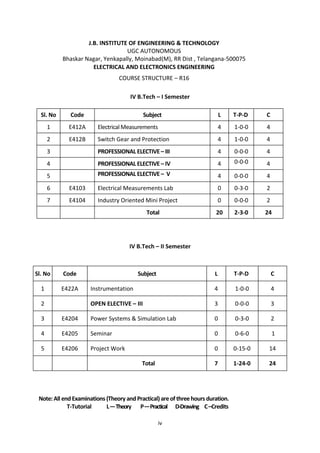
  • 18.
    xiv 13.0 Withholding ofresults 13.1 If the student has not paid the fees to the university/college at any stage, or has dues pending due to any reason whatsoever, or if any case of indiscipline is pending, the result of the student may be withheld, and student will not be allowed to go into the next higher semester. The award or issue of the degree may also be withheld in such cases. 14.0 Transitory regulations 14.1 A student who has discontinued for any reason, or has been detained for want of attendance or lack of required credits as specified, or who has failed after having undergone the degree programme, may be considered eligible for re admission to the same subjects/courses ( or equivalent subjects/ courses, as the case may be), and same professional electives/open electives (or from set/category of elective s or equivalents suggested, as the case m ay be) as and when they are offered (within the time-frame of 8 years from the date of commencement of student's first year first semester). 15.0 Student transfers 15.1 There shall be no branch transfers after the completion of admission process. 15.2 There shall be no transfers from the college/stream to another college. 16.0 Scope 16.1 The academic regulations should be read as a whole, for the purpose of any interpretation. 16.2 In case of any doubt or ambiguity in the interpretation of the above rules, the decision of the Head of the Institution is final. 16.3 The institution may change or amend the academic regulations, course structure or syllabi at any time if necessary, and the changes or amendments made shall be applicable to all students with effect from the date notified by the JBIET authorities.
  • 19.
    xv J.B. INSTITUTE OFENGINEERING AND TECHNOLOGY (JBIET) UGC AUTONOMOUS Bhaskar Nagar, Moinabad, Hyderabad – 500075, Telangana, India Academic Regulations for B.Tech. (Lateral Entry Scheme) w.e.f the A Y 2017-18 1. Eligibility for award of B. Tech. Degree (LES) The LES students after securing admission shall pursue a course of study for not less than three academic year s and not more than six academic years. 2. The student shall register for 144 credits and secure 144 credits with CGPA ≥ 5 from II year to IV year B.Tech. programme (LES) for the award of B.Tech. degree. Out of the144 credits secured, the student can avail exemption up to 6 credits, that is, one open elective subject and one professional elective subject or two professional elective subjects resulting in 138 credits for B.Tech programme performance evaluation. 3. The students, who fail to fulfil the requirement for the award of the degree in six academic years from the year of admission, shall forfeit their seat in B.Tech. 4. The attendance requirements of B. Tech. (Regular) shall be applicable to B.Tech. (LES). 5. Promotion Rule: S. No Promotion Conditions to fulfilled 1 Second year first semester to second year second semester Regular course of study of second year first semester. 2 Second year second semester to third year first semester (i) Regular course of study of second year second semester. (ii) Must have secured at least 29 credits out of 48 credits i.e., 60% of credits up to second year second semester from all the relevant regular and supplementary examinations, whether the student takes those examinations or not. 3 Third year first semester to third year second semester Regular course of study of third year first semester. 4 Third year second semester to fourth year first semester (i) Regular course of study of third year second semester. (ii) Must have secured at least 58 credits out of 96 credits i.e., 60% of credits up to third year second semester from all the relevant regular and supplementary examinations, whether the student takes those examinations or not. 5 Fourth year first semester to fourth year second semester Regular course of study of fourth year first semester. 6. All the other regulations as applicable to B. Tech. 4-year degree course (Regular) will hold good for B. Tech. (Lateral Entry Scheme).
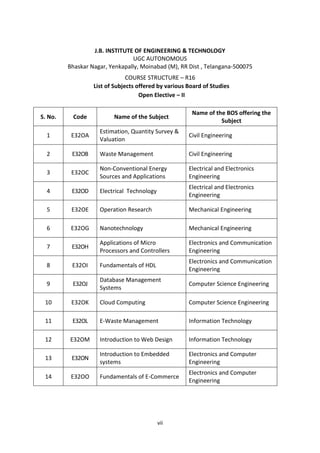
  • 20.
    xvi MALPRACTICES RULES DISCIPLINARY ACTIONFOR / IMPROPER CONDUCT IN EXAMINATIONS S.No. Nature of Malpractice/Improper conduct Punishment If the student: 1.(a) Possesses or keeps accessible in examination hall, any paper, note book, programmable calculators, cell phones, pager, palm computers or any other form of material concerned with or related to the subject of the examination (theory or practical) in which student is appearing but has not made use of (material shall include any marks on the body of the subject of the examination) Expulsion from the examination hall and cancellation of the performance in that subject only. (b) Gives assistance or guidance or receives it from any other student orally or by any other body language methods or communicates through cell phones with any student or persons in or outside the exam hall in respect of any matter. Expulsion from the examination hall and cancellation of the performance in the subject only of all the students involved. In case of an outsider, he will be handed over to the police and a case is registered against him. 2. Has copied in the examination hall from any paper, book, programmable calculators, palm computers or any other form of material relevant to the subject of the examination (theory or practical) in which the student is appearing. Expulsion from the examination hall and cancellation of the performance in that subject and all other subjects the student has already appeared including practical examinations and UG major project and shall not be permitted to appear for the remaining examinations of the subjects of that semester/year. The hall ticket of the student is to be cancelled and sent to the university. 3. Impersonates any other student in connection with the examination. The student who has impersonated shall be expelled from examination hall. The student is also debarred and forfeits the seat. The performance of the original student, who has been impersonated, shall be cancelled in all the subjects of the examination (including practical’s and UG major project) already appeared and shall not be allowed to appear for examinations of the remaining subjects of that semester/year. The student is also debarred for two consecutive
  • 21.
    xvii semesters from classwork and all university examinations. The continuation of the course by the student is subject to the academic regulations in connection with forfeiture of sea. If the imposter is and outsider, he will be handed over to the police and a case is registered against him. 4. Smuggles in the answer book or additional sheet or takes our or arranges to send out the question paper during the examination or answer book or additional sheet, during or after the examination. Expulsion from the examination hall and cancellation of performance in the subject and all the other subjects the student has already appeared including practical examinations and UG major project and shall not be permitted for the remaining examinations of the subjects of that semester year. The student is also debarred for two consecutive semesters from class work and all university examinations. The continuation of the course by the student is subject to the academic regulations in connection with forfeiture of seat. 5. Uses objectionable, abusive or offensive language in the answer paper or in letters to the examiners or writes to the examiner requesting him to award pass marks. Cancellation of the performance in that subject. 6. Refuses to obey the orders of the chief superintendent/assistant – superintendent / any officer on duty or misbehaves or creates disturbance of any kind in and around the examination hall or organizers a walk out or instigates others to walk out, or threatens the officer-in charge or any person on duty in or outside the examination hall of any injury to his person or to any of his relations whether by words, either spoken or writer or by signs or by spoken or written or by signs or by visible representation, assaults the officer-in- charge, or any person on duty in or outside the examination hall or any of his relations, or indulges in any other act of misconduct or mischief which result in damage to or destruction of property in the examination hall or any part of the college campus or In case of students of the college, they shall be expelled from examination halls and cancellation of their performance in that subject and all other subjects the student(s) has (have) already appeared and shall not be permitted to appear for the remaining examinations of the subjects of that semester/year. The students also are debarred and forfeit their seats. In case of outsiders, they will be handed over to the police and a police case is registered against them.
  • 22.
    xviii engages in anyother act which in the opinion of the officer on duty amounts to use of unfair means or misconduct or has the tendency to disrupt the orderly conduct of the examination. 7. Leaves the exam hall taking away answer script or intentionally tears of the script or any thereof inside or outside the examination hall. Expulsion from the examination hall and cancellation of performance in that subject and all the other subjects the student has already appeared including practical examinations and UG major project and shall not be permitted for the remaining examinations of the subjects of that semester/year. The student is also debarred for two consecutive semesters from class work and all university examinations. The continuation of the course by the student is subject to the academic regulations in connection with forfeiture of seat. 8. Possess any lethal weapon or firearm in the examination hall. Expulsion from the examination hall and cancellation of performance in that subject and all other subjects the student has already appeared including practical examinations and UG major project and shall not be permitted for the remaining examinations of the subjects of that semester/year. The student is also debarred and forfeiture of seat. 9. If student of the college, who is not a student for the particular examination or any person not connected with the college indulges in any malpractice or improper conduct mentioned in clause 6 to 8. Student of the colleges expulsion from the examination hall and cancellation of the performance in that subject and all the other subjects the student has already appeared including practical examinations and UG major project and shall not be permitted for the remaining examinations of the subjects of that semester/year. The student is also debarred and forfeiture of seat. Person(s) who do not belong to the college will be handed over to police and, a police case will be registered against them.
  • 23.
    xix Malpractices identified bysquad or special invigilators will be further investigated through a committee and suitable punishment will be given to the students as mentioned by the University guidelines. 10. Comes in a drunken condition to the examination hall. Expulsion from the examination hall and cancellation of performance in that subject and all other subjects the student has already appeared including practical examinations and UG major project and shall not be permitted for the remaining examinations of the subjects of that semester/year. 11. Copying detected on the basis of internal evidence, such as, during valuation or during special scrutiny. Cancellation of performance in that subject and all other subjects the student has appeared including practical examinations and UG major project of that semester/year examinations. 12. If any malpractice is detected which is not covered in the above clauses 1 to 11 shall be reported to the university for further action to award suitable punishment.
  • 24.
  • 25.
    i J.B. INSTITUTE OFENGINEERING & TECHNOLOGY UGC AUTONOMOUS Bhaskar Nagar, Yenkapally, Moinabad (M), RR Dist, Telangana-500075 ELECTRICAL AND ELECTRONICS ENGINEERING COURSE STRUCTURE – R-16 I B.Tech – I Semester Sl. No Code Subject L T-P-D C 1 E110A Mathematics-I 3 1-0-0 3 2 E110B Engineering Chemistry 4 0-0-0 4 3 E110C Engineering Physics – I 3 0-0-0 3 4 E110D Professional Communication in English 3 0-0-0 3 5 E113A Engineering Mechanics 3 1-0-0 3 6 E112A Basic Electrical and Electronics Engineering 4 0-0-0 4 7 E1101 English Language Communication Skills Lab 0 0-3-0 2 8 E1102 Engineering Workshop 0 0-3-0 2 9 E110F Professional Ethics 2 0-0-0 0 Total 22 2-6-0 24 I B.Tech – II Semester Sl. No Code Subject L T-P-D C 1 E120A Engineering Physics-II 3 0-0-0 3 2 E120B Mathematics-II 4 1-0-0 4 3 E120C Mathematics-III 4 1-0-0 4 4 E125A Computer Programming in C 3 0-0-0 3 5 E123A Engineering Drawing 2 0-0-4 4 6 E1201 Engineering Chemistry Lab 0 0-3-0 2 7 E1202 Engineering Physics Lab 0 0-3-0 2 8 E1203 Computer Programming in C Lab 0 0-3-0 2 9 E120E Environmental Studies 2 0-0-0 0 Total 18 2-9-4 24
  • 26.
    ii J.B. INSTITUTE OFENGINEERING & TECHNOLOGY UGC AUTONOMOUS Bhaskar Nagar, Yenkapally, Moinabad(M), RR Dist , Telangana-500075 ELECTRICAL AND ELECTRONICS ENGINEERING COURSE STRUCTURE – R16 II B.Tech – I Semester Sl. No Code Subject L T-P-D C 1 E210B Complex Analysis & Transforms 3 1-0-0 3 2 E212A Network Theory – I 4 1-0-0 4 3 E214C Switching Theory & Logic Design 4 0-0-0 4 4 E212B Electro Magnetic Field Theory 3 0-0-0 3 5 E212C Electrical Machines – I 4 1-0-0 4 6 E2104 Electrical Machines – I Lab 0 0-3-0 2 7 E2105 Basic Electronics Lab 0 0-3-0 2 8 E2106 Electrical Simulation Lab - 1 0 0-3-0 2 9 E2107 Gender Sensitization 2 0-0-0 0 Total 20 3-9-0 24 II B.Tech – II Semester Sl. No Code Subject L T-P-D C 1 E220A Managerial Economics & Financial Analysis 3 1-0-0 3 2 E222A Electrical Machines – II 4 0-0-0 4 3 E222B Network Theory – II 4 1-0-0 4 4 E222C Power Systems - I 3 1-0-0 3 5 E223E Mechanics of Fluids And Hydraulic Machines 4 0-0-0 4 6 E2205 Electrical Circuits Lab 0 0-3-0 2 7 E2206 Electrical Simulation Lab - II 0 0-3-0 2 8 E2207 Electrical Machines – II Lab 0 0-3-0 2 Total 18 3-9-0 24
  • 27.
    iii J.B. INSTITUTE OFENGINEERING & TECHNOLOGY UGC AUTONOMOUS Bhaskar Nagar, Yenkapally, Moinabad(M), RR Dist , Telangana-500075 ELECTRICAL AND ELECTRONICS ENGINEERING COURSE STRUCTURE – R16 III B.Tech – I Semester Sl. No Code Subject L T-P-D C 1 E312A Electrical Machines – III 4 1-0-0 4 2 E312B Control Systems 4 1-0-0 4 3 E312C Power Systems - II 4 1-0-0 4 4 E310B Management Science 3 0-0-0 3 5 OPEN ELECTIVE - I: 3 0-0-0 3 6 E3104 Mechanics of Fluids And Hydraulic Machines Lab 0 0-3-0 2 7 E3105 Control Systems Lab 0 0-3-0 2 8 E3106 Synchronous Machines & Simulation Lab 0 0-3-0 2 Total 18 3-9-0 24 III B.Tech – II Semester Sl. No Code Subject L T-P-D C 1 E322A Power Electronics 4 1-0-0 4 2 E324A Microprocessors and Microcontrollers 4 1-0-0 4 3 OPEN ELECTIVE – II 3 0-0-0 3 4 PROFESSIONAL ELECTIVE – I 4 0-0-0 4 5 PROFESSIONAL ELECTIVE – II 4 0-0-0 4 6 E3204 Power Electronics Lab 0 0-3-0 2 7 E3205 Microprocessors and Microcontrollers Lab 0 0-3-0 2 8 E3206 Employability Skills Lab 0 0-2-0 1 Total 19 2-8-0 24
  • 28.
    iv J.B. INSTITUTE OFENGINEERING & TECHNOLOGY UGC AUTONOMOUS Bhaskar Nagar, Yenkapally, Moinabad(M), RR Dist , Telangana-500075 ELECTRICAL AND ELECTRONICS ENGINEERING COURSE STRUCTURE – R16 IV B.Tech – I Semester Sl. No Code Subject L T-P-D C 1 E412A ElectricalMeasurements 4 1-0-0 4 2 E412B Switch Gear and Protection 4 1-0-0 4 3 PROFESSIONAL ELECTIVE – III 4 0-0-0 4 4 PROFESSIONAL ELECTIVE – IV 4 0-0-0 1-0-0 4 5 PROFESSIONAL ELECTIVE – V 4 0-0-0 4 6 E4103 Electrical Measurements Lab 0 0-3-0 2 7 E4104 Industry Oriented Mini Project 0 0-0-0 2 Total 20 2-3-0 24 IV B.Tech – II Semester Sl. No Code Subject L T-P-D C 1 E422A Instrumentation 4 1-0-0 4 2 OPEN ELECTIVE – III 3 0-0-0 3 3 E4204 Power Systems & Simulation Lab 0 0-3-0 2 4 E4205 Seminar 0 0-6-0 1 5 E4206 Project Work 0 0-15-0 14 Total 7 1-24-0 24 Note: All end Examinations (Theory and Practical)areof threehours duration. T-Tutorial L—Theory P—Practical D-Drawing C–Credits
  • 29.
    v J.B. INSTITUTE OFENGINEERING & TECHNOLOGY UGC AUTONOMOUS Bhaskar Nagar, Yenkapally, Moinabad(M), RR Dist , Telangana-500075 ELECTRICAL AND ELECTRONICS ENGINEERING COURSE STRUCTURE – R16 Professional Elective - I Sl. No Code Subject L T-P-D C 1 E312A Computer Methods in Power Systems 4 0-0-0 4 2 E312B High Voltage Engineering 4 0-0-0 4 3 E312C Linear System Analysis 4 0-0-0 4 Professional Elective - II Sl. No Code Subject L T-P-D C 1 E312E Electrical Distribution systems 4 0-0-0 4 2 E312F IC APPLICATIONS 4 0-0-0 4 3 E312G EHV ACTransmission 4 0-0-0 4 Professional Elective - III Sl. No Code Subject L T-P-D C 1 E412C Utilization of Electrical Energy 4 0-0-0 4 2 E412D Flexible AC Transmission Systems 4 0-0-0 4 3 E412E Reliability Engineering 4 0-0-0 4 Professional Elective - IV Sl. No Code Subject L T-P-D C 1 E412F Power Semi-Conductor Drives 4 0-0-0 4 2 E412G Digital Control System 4 0-0-0 4 3 E412H PowerQuality 4 0-0-0 4 Professional Elective - V Sl. No Code Subject L T-P-D C 1 E412I Power System Operation and Control 4 0-0-0 4 2 E412J Distribution Automation 4 0-0-0 4 3 E412K HVDCTransmission 4 0-0-0 4
  • 30.
    vi J.B. INSTITUTE OFENGINEERING & TECHNOLOGY UGC AUTONOMOUS Bhaskar Nagar, Yenkapally, Moinabad (M), RR Dist , Telangana-500075 COURSE STRUCTURE – R16 List of Subjects offered by various Board of Studies Open Elective – I S. No. Code Name of the Subject Name of the BOS offering the Subject 1 E31OC Disaster Management Civil Engineering 2 E31OD Elements of Civil Engineering Civil Engineering 3 E31OE Network Analysis and Synthesis Electrical and Electronics Engineering 4 E31OF Measurements and Instruments Electrical and Electronics Engineering 5 E31OG Automobile Engineering Mechanical Engineering 6 E31OI Engineering Materials and Fabrication Processes Mechanical Engineering 7 E31OJ Principles of Electronic Communications Electronics and Communication Engineering 8 E31OK Matlab Programming Electronics and Communication Engineering 9 E31OL Data Structures through C Computer Science and Engineering 10 E31OM PythonProgramming Computer Science and Engineering 11 E31ON E-Disaster Management Information Technology 12 E31OO Human Computer Interaction Information Technology 13 E31OP Introduction to Microprocessors and Microcontrollers Electronics and Computer Engineering 14 E31OQ Internet of Things Electronics and Computer Engineering
  • 31.
    vii J.B. INSTITUTE OFENGINEERING & TECHNOLOGY UGC AUTONOMOUS Bhaskar Nagar, Yenkapally, Moinabad (M), RR Dist , Telangana-500075 COURSE STRUCTURE – R16 List of Subjects offered by various Board of Studies Open Elective – II S. No. Code Name of the Subject Name of the BOS offering the Subject 1 E32OA Estimation, Quantity Survey & Valuation Civil Engineering 2 E32OB Waste Management Civil Engineering 3 E32OC Non-Conventional Energy Sources and Applications Electrical and Electronics Engineering 4 E32OD Electrical Technology Electrical and Electronics Engineering 5 E32OE Operation Research Mechanical Engineering 6 E32OG Nanotechnology Mechanical Engineering 7 E32OH Applications of Micro Processors and Controllers Electronics and Communication Engineering 8 E32OI Fundamentals of HDL Electronics and Communication Engineering 9 E32OJ Database Management Systems Computer Science Engineering 10 E32OK Cloud Computing Computer Science Engineering 11 E32OL E-Waste Management Information Technology 12 E32OM Introduction to Web Design Information Technology 13 E32ON Introduction to Embedded systems Electronics and Computer Engineering 14 E32OO Fundamentals of E-Commerce Electronics and Computer Engineering
  • 32.
    viii J.B. INSTITUTE OFENGINEERING & TECHNOLOGY UGC AUTONOMOUS Bhaskar Nagar, Yenkapally, Moinabad (M), RR Dist , Telangana-500075 COURSE STRUCTURE – R16 List of Subjects offered by various Board of Studies Open Elective – III S. No. Code Name of the Subject Name of the BOS offering the Subject 1 E42OA Environmental Impact Assessment Civil Engineering 2 E42OB Green Building Technology Civil Engineering 3 E42OC Materials in Electrical Systems Electrical and Electronics Engineering 4 E42OD Field Theory and Circuits Electrical and Electronics Engineering 5 E42OE Reliability Engineering Mechanical Engineering 6 E42OG Special Manufacturing Processes Mechanical Engineering 7 E42OH Principles of Computer Communication and Networks Electronics and Communication Engineering 8 E42OI Speech Processing Electronics and Communication Engineering 9 E42OJ Soft Computing Computer Science Engineering 10 E42OK E-commerce Computer Science Engineering 11 E42OL Internet of Things Information Technology 12 E42OM Semantic Web and Social Networks Information Technology 13 E42ON Fundamentals of Intelligence Systems Electronics and Computer Engineering 14 E42OO Introduction to Neural Networks Electronics and Computer Engineering
  • 33.
    1 J.B. INSTITUTE OFENGINEERING & TECHNOLOGY UGC AUTONOMOUS B.Tech. EEE L T-P-D C I Year - I Semester 3 1-0-0 3 MATHEMATICS – I (Common to all branches) Course Objectives: The Students will: 1. Understand the methods of solving the linear differential equations of first and higher order and applications of the differential equations 2. Recognize the types of matrices and their properties and the concept of rank of a matrix and applying the same to understand the consistency 3. Learn how to solve the linear systems and the concepts of eigen values and eigen vectors and reducing the quadratic forms into their canonical forms 4. Equip with the concept of total derivative and finding maxima and minima of functions of two variables 5. Formulate partial differential equations and solving the first order equations. UNIT-I: Initial Value Problems and Applications Exact differential equations - Reducible to exact. Linear differential equations of higher order with constant coefficients: Non homogeneous terms with RHS term of the type eax , sin ax, cos ax, polynomials in x, eax V(x), xV(x)-Operator form of the differential equation, finding particular integral using inverse operator, Wronskian of functions, method of variation of parameters. Applications: Newton’s law of cooling, law of natural growth and decay, orthogonal trajectories, Electrical circuits. UNIT-II :Linear Systems of Equations Types of real matrices and complex matrices, rank, echelon form, normal form, consistency and solution of linear systems (homogeneous and Non-homogeneous) - Gauss elimination, Gauss Jordon and LU decomposition methods- Applications: Finding current in the electrical circuits. UNIT-III: Eigen values, Eigen Vectors and Quadratic Forms Eigen values, Eigen vectors and their properties, Cayley - Hamilton theorem (without proof), Inverse and powers of a matrix using Cayley - Hamilton theorem, Diagonalization, Quadratic forms, Reduction of Quadratic forms into their canonical form, rank and nature of the Quadratic forms – Index and signature. UNIT-IV: Partial Differentiation Introduction of partial differentiation, homogeneous function, Euler’s theorem, total derivative, Chain rule, Taylor’s and Mclaurin’s series expansion of functions of two variables, functional dependence, Jacobian. Applications: maxima and minima of functions of two variables without constraints and Lagrange’s method (with constraints)
  • 34.
    2 UNIT-V First OrderPartial Differential Equations Formation of partial differential equations by elimination of arbitrary constants and arbitrary functions, Lagranges method to solve the first order linear equations and the standard type methods to solve the non linear equations. TEXTBOOKS: 1. Higher Engineering Mathematics by Dr. B. S. Grewal, Khanna Publishers. 2. A first course in differential equations with modeling applications by Dennis G. Zill, Cengage Learning publishers REFERENCES: 1. Advanced Engineering Mathematics by E. Kreyszig, John Wiley and Sons Publisher. 2. Engineering Mathematics by N. P. Bali, Lakshmi Publications. Course outcomes: The Students will be able to: 1. Solve higher order DE’s and apply them for solving some real world problems 2. Write the matrix representation of a set of linear equations and to analyze the solution of the system of equations 3. Analyze the Eigen values and Eigen vectors which come across under linear transformations 4. Examine the values of functions of two variables with/ without constraints. 5. Solve linear partial differential equations of first order.
  • 35.
    3 J.B. INSTITUTE OFENGINEERING & TECHNOLOGY UGC AUTONOMOUS B.Tech. EEE L T-P-D C I Year - I Semester 4 0-0-0 4 ENGINEERING CHEMISTRY (Common to CSE, EEE, ECE, IT& ECM) Course Objectives: The Students will: 1. Acquire the skills to critically assess and solve problems related to water requiring the application of chemical principles. 2. Familiar with research design methodology and to use problem-solving techniques associated with electrochemistry. 3. Recognize, organize and present chemical information coherently through oral and written discourse based on polymers. 4. Apply science and engineering in the analysis and evaluation of process involved in production of energy efficient fuels. 5. Invent or discover new environmental friendly, energy efficient and economically effective engg materials in a sustainable manner. UNIT-I: Water and its treatment: Introduction – hardness of water – causes of hardness – types of hardness: temporary and permanent – expression and units of hardness – Estimation of hardness of water by complexometric method. Numerical problems. Potable water and its specifications- Steps involved in the treatment of potable water - Disinfection of potable water by chlorination and Ozonization. Defluoridation – Nalgonda technique - Determination of F- ion by ion- selective electrode method. Boiler troubles: Sludges, scales and Caustic embrittlement. Internal treatment of Boiler feed water (Calgon conditioning – Phosphate conditioning - Colloidal conditioning). Softening of water by ion- exchange processes. Desalination of water – Electrodialysis& Reverse osmosis. Numerical problems. UNIT-II : Electrochemistry and Batteries: Electrochemistry: Electrode- electrode potential, standard electrode potential, types of electrodes – Construction and functioning of Standard hydrogen electrode, calomel, Quinhydrone and glass electrode. Nernst equation - electrochemical series and its applications. Electrochemical cells: Daniel cell – cell notation, cell reaction and cell emf – Potentiometric titrations and Applications- Determination of pH and EMF. Concept of concentration cells-electrolyte concentration cell. Numerical problems. Batteries: Cell and battery - Primary battery (dry cell, alkaline cell and Lithium cell) and Secondary battery (lead acid, Ni-Cd and lithium ion cell), Fuel cells: Hydrogen –oxygen, phosphoric acid and methanol-oxygen fuel cells – Applications. UNIT-III: Polymers: Definition – Classification of polymers with examples – Types of polymerization – addition and condensation polymerization with examples. Plastics: Definition and characteristics- thermoplastic and thermosetting plastics, compounding and fabrication of plastics (compression and injection moulding). Preparation, Properties and engineering applications of PVC and Bakelite.
  • 36.
    4 Fibers: Characteristics offibers – preparation, properties and applications of Nylon-6, 6 and Dacron. Kevlar- Liquid crystal polymers-Applications. Rubbers: Natural rubber and its vulcanization. Elastomers: Characteristics –preparation – properties and applications of Buna-S, Butyl and Thiokol rubber. Biodegradable polymers: Concept and advantages - Polylactic acid and poly vinyl alcohol and their applications. UNIT-IV: Fuels and Combustion: Classification- solid fuels: coal – analysis of coal – proximate and ultimate analysis and their significance. Liquid fuels – petroleum and its refining, cracking – types – moving bed catalytic cracking. Knocking – octane and cetane rating, synthetic petrol - Fischer-Tropsch’s process; Gaseous fuels – composition and uses of natural gas, LPG and CNG. Combustion: Definition, Calorific value of fuel – HCV, LCV-Dulongs Formula; Calculation of air quantity required for combustion of a fuel. UNIT-V : Engineering Materials and applications: Lubricants-Classification of lubricants with examples-characteristics of a good lubricants – mechanism of lubrication-properties of lubricants. Conducting polymers: Characteristics and Classification with examples-mechanism of conduction in trans-polyacetylene and applications of conducting polymers. Nanomaterials: Introduction, Preparation-Top down & bottom up process-sol gel method and self assembly process. Applications of nanomaterials. Composites: Introduction- Constituents of composites – advantages, classification and constituents of composites. Fiber reinforced plastics (FRP). Applications of composites. TEXTBOOKS: 1. Engineering Chemistry by P.C. Jain and M. Jain, Dhanpatrai Publishing Company, New Delhi 2. Engineering Chemistry by Rama Devi, VenkataRamana Reddy and Rath, Cengage learning, New Delhi 3. Engineering Chemistry by Shashi Chawla, Dhanpatrai and Company (P) Ltd. Delhi Course outcomes: The Students will be able to: 1. Identify the suitability of water for domestic and industrial purposes 2. Apply the basic principle of electro chemistry. 3. Design the new polymeric materials for engineering applications. 4. Develop innovative methods and engineering materials that are useful in every walk of life. 5. Apply new chemical techniques for the production of fuels that are useful in every walk of life.
  • 37.
    5 J.B. INSTITUTE OFENGINEERING & TECHNOLOGY UGC AUTONOMOUS B.Tech. EEE L T-P-D C I Year - I Semester 3 0-0-0 3 ENGINEERING PHYSICS-I (Common to CSE, EEE, ECE, IT& ECM) Course Objectives: The Students will 1. Understand interaction of light with matter through interference, diffraction, and polarization. 2. Distinguish between ordinary light with a laser light and to realize propagation of light through optical fibers. 3. Analyze various crystal systems and there structures elaborately. 4. Analyze various crystal imperfections and probing methods like X-RD. 5. Understand concepts of latest developments in fiber optics UNIT-I: Crystallography: Space lattice, unit cell and lattice parameters, crystal systems, Bravaislattices, atomic radius, co-ordination number and packing factor of SC, BCC, FCC, HCP and diamond, Miller indices, crystal planes and directions, inter planar spacing of orthogonal crystal systems. UNIT-II : X-ray Diffraction and Defects in Crystals: Bragg’s law, X-ray diffraction methods: Lauemethod, powder method; point defects: vacancies, substitutional, interstitial, Frenkel and Schottky defects, line defects (qualitative) and Burger’s vector, surface defects: stacking faults, twin, tilt and grain boundaries. UNIT-III: Fiber Optics: Principle of optical fiber, construction of fiber, acceptance angle and acceptancecone, numerical aperture, types of optical fibers: step index and graded index fibers, attenuation in optical fibers, applications of optical fibers in medicine and sensors. UNIT-IV: Interference: Coherence, division of amplitude and division of wave front, interference in thinfilms (transmitted and reflected light), Newton’s rings experiment. Diffraction: Distinction between Fresnel and Fraunhoffer diffraction, diffraction due to singleslit, N-slits, Diffraction grating experiment. UNIT-V : Polarization: Introduction, Malus’s law, double refraction, Nicol prism, Quarter wave and halfwave plates. TEXTBOOKS: 1. Applied Physics – P.K.Mittal (I.K.Internationalhosesepvt Ltd) (New Edition) 2. Enginnering Physics-P.K Palaniswamy (Scitech Publications India) Pvt Ltd, Fifth Print 2010.) 3. Engineering Physics-Senthilkumar ((VRB Publishers Limited,) REFERENCES: 1. Applied Physics for Engineers – A.J. Dekker (Macmillan). 2. Elements of Material Science – V.Raghavant (PHI Publications). 3. Solid State Physics – M. Armugam (Anuradha Publications). 4. A Textbook of Engg Physics – M. N. Avadhanulu& P. G. Khsirsagar– S. Chand & Co. 5. Modern Physics by K. Vijaya Kumar, S. Chandralingam: S. Chand &Co.Ltd
  • 38.
    6 Course Outcomes: The Studentswill be able to: 1. Distinguish between various crystal systems 2. Identify the crystal defects by using X-RD 3. Describe principles of fiber optics, different types of fiber optics and its applications . 4. Identify concept of reflection and refraction rules of light in different medium 5. Identify characteristics of laser, working of various laser systems and light propagation through optical fibers.
  • 39.
    7 J.B. INSTITUTE OFENGINEERING & TECHNOLOGY UGC AUTONOMOUS B.Tech. EEE L T-P-D C I Year - I Semester 3 0-0-0 3 PROFESSIONAL COMMUNICATION IN ENGLISH (Common to CSE, EEE, ECE, IT& ECM) Course Objectives: The Students will: 1. Improve the language proficiency of students in English with an emphasis on Vocabulary, Grammar, Reading and Writing skills. 2. Equip students to study academic subjects more effectively using the theoretical and Practical components of English syllabus. 3. Develop study skills and communication skills in formal and informal situations. 4. Develop correct reading habits, silently, extensively, and intensively 5. Acquire the ability to use a suitable dictionary Reading Skills: Objectives:  To develop an awareness in students about the significance of silent reading and comprehension.  To develop students’ ability to guess meanings of words from the context and grasp the overall message of the text, draw inferences, etc., by way of:  Skimming and Scanning the text  Intensive and Extensive Reading  Reading for Pleasure  Identifying the topic sentence NOTE: The students will be trained in reading skills using the prescribed texts for detailed study. They will be tested in reading comprehension of different ‘unseen’ passages which may be taken from authentic texts, such as magazines/newspaper articles. Writing Skills: Objectives:  To develop an awareness in the students about writing as an exact and formal skill  To create an awareness in students about the components of different forms of writing, beginning with the lower order ones through;  Writing of sentences  Use of appropriate vocabulary  Paragraph writing  Coherence and cohesiveness  Narration / description  Note Making  Formal and informal letter writing  Describing graphs using expressions of comparison In order to improve the proficiency of the students in the acquisition of language skills mentioned above, the following text and course contents, divided into Five Units, are prescribed:
  • 40.
    8 UNIT-I: Chapter entitled ‘PresidentialAddress’ by Dr. A.P.J. Kalam from “Fluency in English–A Course book for Engineering Students” published by Orient BlackSwan, Hyderabad. Vocabulary: Word Formation -- Root Words --The Use of Prefixes and Suffixes–Collocations– Exercises for Practice. Grammar: Punctuation – Parts of Speech- Articles -Exercises for Practice. Reading: Double Angels by David Scott-Reading and Its Importance- Techniques forEffective Reading- Signal Words- Exercises for Practice Writing: Writing Sentences- Techniques for Effective Writing-- Paragraph Writing- Types, Structure and Features of a Paragraph-Coherence and Cohesiveness: Logical, Lexical and Grammatical Devices - Exercises for Practice UNIT-II : Chapter entitled Satya Nadella: Email to Employees on his First Day as CEO from “Fluencyin English– A Course book for Engineering Students” Published by Orient BlackSwan, Hyderabad. Vocabulary: Synonyms and Antonyms–Homonyms, Homophones, Homographs- Exercisesfor Practice (Chapter 17 ‘Technical Communication-Principles and Practice’. Third Edition published by Oxford University Press may also be followed.)Grammar: Verbs-Transitive, Intransitive and Non-finite Verbs–Mood and Tense— Gerund – Words with Appropriate Prepositions – Phrasal Verbs - Exercises for Practice Reading: Sub-skills of Reading- Skimming, Scanning, Extensive Reading and Intensive Reading - The Road Not Taken by Robert Frost -- Exercises for Practice Writing: Letter Writing–Format, Styles, Parts, Language to be used in Formal Letters-Letter of Apology – Letter of Complaint-Letter of Inquiry with Reply – Letter of Requisition –- Exercises for Practice UNIT-III: From the book entitled ‘Technical Communication-Principles and Practice’. Third Edition published by Oxford University Press. Vocabulary: Introduction- A Brief History of Words–Using the Dictionary and Thesaurus– Changing Words from One Form to Another – Confusables (From Chapter 17 entitled ‘Grammar and Vocabulary Development’) Grammar: Tenses: Present Tense- Past Tense- Future Tense- Active Voice – Passive Voice- Conditional Sentences – Adjective and Degrees of Comparison. (From Chapter 17 entitled ‘Grammar and Vocabulary Development’) Reading: Improving Comprehension Skills – Techniques for Good Comprehension- Skimming and Scanning- Non-verbal Signals – Structure of the Text – Structure of Paragraphs – Punctuation – Author’s viewpoint (Inference) – Reader Anticipation: Determining the Meaning of Words – Summarizing- Typical
  • 41.
    9 Reading Comprehension Questions.(From Chapter 10 entitled ‘Reading Comprehension’) Writing: Introduction- Letter Writing-Writing the Cover Letter- Cover Letters Accompanying Resumes- Emails. (From Chapter 15 entitled ‘Formal Letters, Memos, and Email’) UNIT-IV: Chapter entitled ‘Good Manners’ by J.C. Hill from Fluency in English–A Course book for Engineering Students” published by Orient Blackswan, Hyderabad. Vocabulary: Idiomatic Expressions–One- word Substitutes --- Exercises for Practice(Chapter 17 ‘Technical Communication-Principles and Practice’. Third Edition published by Oxford University Press may also be followed.)Grammar: Sequence of Tenses- Concord (Subject in Agreement with the Verb)– Exercises for Practice Reading: ‘If’ poem byRudyard Kipling--Tips for Writing a Review ---Author’sViewpoint – Reader’s Anticipation-- Herein the Students will be required to Read and Submit a Review of a Book (Literary or Non-literary) of their choice – Exercises for Practice. Writing: Information Transfer-Bar Charts-Flow Charts-Tree Diagrams etc., -- Exercises for Practice. Introduction - Steps to Effective Precis Writing – Guidelines- Samples (Chapter 12 entitled ‘The Art of Condensation’ from Technical Communication-Principles and Practice. Third Edition published by Oxford University Press) UNIT-V : Chapter entitled ‘Father Dear Father’by Raj Kinger from Fluency in English–A Coursebook for Engineering Students” Published by Orient BlackSwan, Hyderabad Vocabulary: Foreign Words—Words borrowed from other Languages- Exercises forPractice Grammar: Direct and Indirect Speech- Question Tags- Exercises for Practice Reading: Predicting the Content- Understanding the Gist – SQ3R Reading Technique- Study Skills – Note Making - Understanding Discourse Coherence – Sequencing Sentences. (From Chapter 10 entitled ‘Reading Comprehension’- Technical Communication- Principles and Practice. Third Edition publishedby Oxford University Press.) Writing: Technical Reports- Introduction – Characteristics of a Report – Categories of Reports –Formats- Prewriting – Structure of Reports (Manuscript Format) - Types of Reports - Writing the Report. (From Chapter 13 entitled ‘Technical Reports’ - Technical Communication- Principles and Practice. Third Editionpublished by Oxford University Press.) TEXTBOOKS: 1. “Fluency in English – A Course book for Engineering Students” by Board of Editors: Hyderabad: Orient BlackSwan Pvt. Ltd. 2016. Print. 2. Raman, Meenakshi and Sharma, Sangeeta. “Technical Communication- Principles andPractice”. Third Edition. New Delhi: Oxford University Press. 2015. Print.
  • 42.
    10 REFERENCES: 1. Green, David.Contemporary English Grammar–Structures and Composition. MacMillan India. 2014 (Print) 2. Rizvi, M. Ashraf. Effective Technical Communication. Tata Mc Graw –Hill. 2015 (Print). Course Outcomes: The Students will be able to 1. Identify himself and try to develop the nation. 2. Implement how to dedicate themselves for the development of their organization and career. 3. Use of technical vocabulary properly, 4. Develop good manners in their life. 5. Realize their parent’s consciousness towards them.
  • 43.
    11 J.B. INSTITUTE OFENGINEERING & TECHNOLOGY UGC AUTONOMOUS B.Tech. EEE L T-P-D C I Year - I Semester 3 1-0-0 3 ENGINEERING MECHANICS (Common to all Branches) Course Objectives: The Students will: 1. Read the concept of system of forces and its applications. 2. Determine the centroid and centre of gravity of different structures 3. Understand the concept of inertia and its real time applications 4. Analyze the bodies in motion 1. 5. Analyze the bodies in motion by considering the force cause the motion UNIT-I : Introduction to Engineering Mechanics–Basic Concepts. Systems of Forces: Coplanar Concurrent Forces–Forces in Space–Moment of Force and its Application– Couples and Resultant of Force Systems. Equilibrium of Force Systems: Free Body Diagrams, Equations of Equilibrium - Equilibrium of planar Systems -Equilibrium of Spatial Systems. UNIT-II : Centroids of simple figures (from basic principles)–Centroids of Composite Figures Centre of Gravity: Centre of gravity of simple body (from basic principles), centre of gravity of composite bodies, Pappus theorem. UNIT-III: Area moment of Inertia : Definition–Polar Moment of Inertia, Transfer Theorem, Moments of Inertia of Composite Figures, Products of Inertia, Transfer Formula for Product of Inertia. UNIT-IV: Kinematics: Rectilinear and Curvilinear motions–Velocity and Acceleration– Motion of Rigid Body Types and their Analysis in Planar Motion. UNIT-V: : Kinetics: Analysis as a Particle and Analysis as a Rigid Body in Translation– Central Force Motion Equations of Plane Motion–Fixed Axis Rotation–Rolling Bodies. TEXT BOOKS: 1. 1.Engineering. Mechanics / Timoshenko & Young. 2. Engineering Mechanics, Basudev Bhattacharya, Oxford Univ. Press, New Delhi, Second Edition, 2014. 3.Engineering Mechanics / Fedinand . L. Singer / Harper–Collins. REFERENCES: 1.Engineering Mechanics / S.S. Bhavikatti& J.G. Rajasekharappa 2.Engineering Mechanics / Irving. H. Shames Prentice–Hall. 3.Engineering Mechanics UmeshRegl / Tayal. 4. Engineering Mechanicas-Basic Concepts, Y.V.D.Rao, M.Manzoor Hussain, K.Govinda Rajulu, Academic Publishing Company Course outcomes: The Students will be able to: 1. Recognize the resultant of a force system acting on an object. 2. Identify the surface area of complex objects. 3. Relate with application of different theorems of moment of inertia. 4. Identify the kinematics involved in a moving object. 5. Analyze the bodies in motion
  • 44.
    12 J.B. INSTITUTE OFENGINEERING & TECHNOLOGY UGC AUTONOMOUS B.Tech. EEE L T-P-D C I Year - I Semester 2 0-0-0 0 PROFESSIONAL ETHICS (Common to ECE, EEE, CE& ECM) Course Objectives: The Students will: 1. Learn ethical values and attitudes. 2. Understand the roles of a professional. 3. Understand the current scenario and engineer’s responsibility towards the society 4. Know the types of professional ethical codes. 5. Learn the need for ethical audit. UNIT-I: Basic Concepts Introduction, Difference between Ethics/values/Morals, , emotional, intelligence, Indian and western thoughts on ethics, value education, dimensions of ethics, setting goals in life, importance of morality and ethics, basic ethical principles, classification of ethical codes., how to achieve autonomy. UNIT-II : Professional Ethics Meaning of profession, professionalism, professional’s roles and professional risks, professional accountability, successful professional, engineering professionals, engineering ethics, roles of engineers, rights and responsibilities as citizens, professional responsibilities, professional rights. UNIT-III: Global issues and safety Introduction, current scenario, business ethics, environmental ethics, computer ethics, ethical hacking and its dilemma,, ethics in research, intellectual property rights, patents, trade marks, managers and engineers responsibility and case studies. UNIT-IV: Ethical codes and audits Introduction need and types of professional ethical codes, sample standard codes, ethical codes for corporate entities and non-profit organization, charitable institutions, limitations of the codes, need for ethical audit, ethical profile of organizations. UNIT-V: Human values and ethical living Introduction, domains of learning, human values, attitudes, needs and wants of life, harmony in life, styles of ethical living / models of ethical living, case studies.
  • 45.
    13 TEXTBOOKS: 1. Professional ethicsand human value by D.R.Kiran, Tata McGraw Hills education. 2. Ethics in engineering by Mike W. Martin and Roland Schinzinger, TMH education. REFERENCES: 1. Fundamental of Ethics by Edmund G Seebauer and Robert L.Barry, Oxford university press. 2. Professional ethics and human values by R.S.Nagarajan, New age international. 3. Professional ethics by R. Subramanian, Oxford press. Course Outcomes: The Students will be able to: 1. Use of ethical values and attitudes in their life. 2. Implement once he/she becomes a professional. 3. Solve the issues related with environment and technology 4. Apply the different types of professional ethical codes in their organization. 5. Use of the rules framed by the auditors.
  • 46.
    14 J.B. INSTITUTE OFENGINEERING & TECHNOLOGY UGC AUTONOMOUS B.Tech. EEE L T-P-D C I Year - I Semester 4 0-0-0 4 BASIC ELECTRICAL AND ELECTRONICS ENGINEERING (Common to CSE, EEE, ECE, IT& ECM) Course Objectives: - The Students will: 1. Describe Electric Circuits. 2. Acquire knowledge the given circuit with various theorems and methods. 3. Learn in recognizing of basic electronic devices such as Diodes, Transistors, to build circuits like amplifiers and oscillators etc. 4. Acquire knowledge on the various parameters useful for designing electronic system. 5. Acquire the knowledge of various configurations, characteristics, and applications. UNIT-I: Electrical circuits: R-L-C Parameters, voltage and current, Independent and Dependent Sources, Source Transformation-V-I relationship for passive elements, Kirchhoff’s Laws, Network reduction techniques-series, parallel, series-parallel, star-to-delta, delta-to-star transformation, Nodal Analysis . Single Phase AC Circuits : R.M.S. and Average values, Form Factor, steady state analysis of series, parallel and series-parallel combinations of R, L and C with sinusoidal excitation, concept of reactance, impedance, susceptance and admittance –phase and phase difference, concept of power factor, phasor notation, complex and polar forms of representation. UNIT-II: Resonance: Series and parallel resonance circuits, concept of bandwidth and Q factor, Locus Diagrams for RL, RC and RLC Combinations for various parameters. Network Theorems: Thevenin’s, Norton’s, Maximum power Transfer, Superposition, Reciprocity, Tellegen’s, Milliman’s and Compensation theorems for DC and AC excitations. UNIT-III: P-N Junction Diode: P-N junction as a Diode, Symbol, Diode equation, volt-Ampere characteristics, Temperature dependence, Ideal versus practical Diode, static and dynamic resistances, Diffusion and Transition Capacitances. Rectifiers and Filters: Diode rectifier: Half wave Rectifier, Ripple Factor-Full Wave Rectifier, Bridge Rectifier, Rectifiers with Filters: Inductive Filters, Capacitive Filters, L-section Filters, π- section Filters. UNIT-IV: : Bipolar Junction Transistor ( BJT): Symbol, Construction, principle of Operation, Current Components in a junction transistor Common Emitter, Common Base and Common Collector configurations. Transistor Biasing -Operating point, DC and AC load lines, Fixed Bias, Collector to Base bias, Self Bias (Voltage divider bias), Bias stability, Stabilization against variations in VBE , β, and Ico. Small signal Transistor Analysis, h- Parameters, Definitions, Determination of h-parameters from CE transistor characteristics, Analysis of CE, CB and CC configurations using h- parameters and their Comparison.
  • 47.
    15 UNIT-V : JunctionField Effect Transistor Construction, Principle of Operation, pinch-off voltage, Volt-Ampere characteristics, comparison of BJT and JFET, small signal Model, MOSFET: Depletion and Enhancement FETs- construction characteristics. Special Purpose Devices: Breakdown Mechanisms in semi-Conductor Diodes, Zener diode characteristics, Zener diode as a simple regulator, principle of operation and Characteristics of Tunnel Diode ( with help of Energy band diagram ) Varactor Diode, Principle of operation of SCR. TEXTBOOKS: 1. Millman’s Electronic Devices and circuits –J.Millman and C.Halkias, Mc Graw Hill 2. Micro Electronics by David bell 3. Network Theory by Sudhakar, Shyam Mohan Palli, TMH. Course Outcomes: - The student will be able to: 1. Demonstrate strong fundamental background in Electrical Engineering. 2. Analyze and solve problems of ac and dc circuits. 3. Identify the value of different resistors. 4. Analyze and design various electronic circuits 5. Design examples using currently available devices and standard-value components
  • 48.
    16 J.B. INSTITUTE OFENGINEERING & TECHNOLOGY UGC AUTONOMOUS B.Tech. EEE L T-P-D C I Year - I Semester 0 0-3-0 2 ENGLISH LANGUAGE COMMUNICATION SKILLS (ELCS) LAB (Common to CSE, EEE, ECE, IT& ECM) Course Objectives: The Students will: 1. Sensitize students to the nuances of English speech sounds, word accent, intonation, and rhythm 2. Bring about a consistent accent and intelligibility in students’ pronunciation of English by providing an opportunity for practice in speaking 3. Improve the fluency of students in spoken English and neutralize their mother tongue influence 4. Use language appropriately for public speaking and interviews. 5. Develop to learn debating and oral presentation skills Exercise – I CALL Lab: Understand: Listening Skill- Its importance–Purpose- Process- Types- Barriers- Effective Listening. Practice: Introduction to Phonetics–Speech Sounds–Vowels and Consonants–Minimal Pairs- Consonant Clusters- Past Tense Marker and Plural Marker. Testing Exercises ICS Lab: Understand: Spoken vs. Written language- Formal and Informal English. Practice: Ice-Breaking Activity and JAM Session- Situational Dialogues–Greetings–Taking Leave – Introducing Oneself and Others. Exercise – II CALL Lab: Understand: Structure of Syllables–Word Stress–Weak Forms and Strong Forms–Sentence Stress – Intonation. Practice: Basic Rules of Word Accent - Stress Shift - Weak Forms and Strong Forms- Sentence Stress – Intonation. Testing Exercises ICS Lab: Understand: Features of Good Conversation–Strategies for Effective Communication. Practice: Situational Dialogues–Role-Play- Expressions in Various Situations–Making Requests and Seeking Permissions - Telephone Etiquette.
  • 49.
    17 Exercise - III CALLLab: Understand: Errors in Pronunciation-the Influence of Mother Tongue (MTI). Practice: Common Indian Variants in Pronunciation – Differences between British andAmerican Pronunciation. Testing Exercises ICS Lab: Understand: Descriptions- Narrations- Giving Directions and Guidelines. Practice: Giving Instructions–Seeking Clarifications–Asking for and Giving Directions–Thanking and Responding – Agreeing and Disagreeing – Seeking and Giving Advice – Making Suggestions. Exercise – IV CALL Lab: Understand: Listening for General Details. Practice: Listening Comprehension Tests. Testing Exercises ICS Lab: Understand: Public Speaking–Exposure to Structured Talks - Non-verbal Communication- Presentation Skills. Practice: Making a Short Speech–Extempore- Making a Presentation. Exercise – V CALL Lab: Understand: Listening for Specific Details. Practice: Listening Comprehension Tests. Testing Exercises ICS Lab: Understand: Group Discussion- Interview Skills. Practice: Group Discussion- Mock Interviews. Lab Manuals: 1) A book entitled “ELCS Lab Manual– A Workbook for CALL and ICS Lab Activities” by Board of Editors: Hyderabad: Orient BlackSwan Pvt. Ltd. 2016. Print. 2) Hart, Steve; Nair, Aravind R.; Bhambhani, Veena. “EMBARK- English for undergraduates” Delhi: Cambridge University Press. 2016. Print. Suggested Software: 1) Cambridge Advanced Learners’ English Dictionary with CD.
  • 50.
    18 2) Grammar MadeEasy by Darling Kindersley. 3) Punctuation Made Easy by Darling Kindersley. 4) Oxford Advanced Learner’s Compass, 8th Edition. 5) English in Mind (Series 1-4), Herbert Puchta and Jeff Stranks with Meredith Levy, Cambridge. 6) English Pronunciation in Use (Elementary, Intermediate, Advanced) Cambridge University Press. 7) TOEFL and GRE (KAPLAN, AARCO and BARRONS, USA, Cracking GRE by CLIFFS). References: 1) Jayashree Mohanraj. Let Us Hear Them Speak. New Delhi: Sage Texts. 2015. Print. Hancock, M. English Pronunciation in Use. Intermediate Cambridge: Cambridge University Press. 2009. Print. Course Outcomes: The student will be able to: 1. Develop correct pronunciation. 2. Use stress and intonation properly while speaking and writing. 3. Develop listening skills 4. Describe himself and others in day to day life situations. 5. Acquire debating and oral presentation skills.
  • 51.
    19 J.B. INSTITUTE OFENGINEERING & TECHNOLOGY UGC AUTONOMOUS B.Tech. EEE L T-P-D C I Year - I Semester 0 0-3-0 2 ENGINEERING WORKSHOP (Common to CSE, EEE, ECE, IT& ECM) Course Objectives: The student will: 1. Execute application of various tools in carpentry, lathe machine works, house wiring 2. Recognize application of metal cutting and drilling 3. Make various shape of wood material and metals 4. Fabricate metal items using welding and power tools 5. Demonstrate the works in foundry and plumbing TRADES FOR EXERCISES: 1) Carpentry 2) Fitting 3) Tin-Smithy and Development of jobs carried out and soldering. 4) Black Smithy 5) House-wiring 6) Foundry 7) Welding 2. TRADES FOR DEMONSTRATION AND EXPOSURE: Plumbing, Machine Shop, Power tools in construction, wood working and mechanical engineering. Course Outcomes: The student will be able to: 1. Identify the tools used in workshop of different trades. 2. Practice the carpentry works of small shape and size. 3. Demonstrate the basic fitting and electrical works using the required tools 4. Fabricate metal items using welding and power tools 5. Demonstrate the works in foundry and plumbing
  • 52.
    20 J.B. INSTITUTE OFENGINEERING & TECHNOLOGY UGC AUTONOMOUS B.Tech. EEE L T-P-D C I Year - II Semester 3 0-0-0 3 ENGINEERING PHYSICS – II (Common to EEE, ECE, CSE, IT&ECM) Course Objectives: The student will: 1. Understand the behaviour of a particle quantum mechanically. 2. Distinguish pure and impure semiconductors and understand formation of P-N Junction. 3. Understand various magnetic and dielectric properties of materials. 4. Practical focus in this curriculum is on nano structured materials, their structural 5 Analyze Mechanical properties, and their applications. UNIT-I : Principles of Quantum Mechanics: Waves and particles, de-Broglie hypothesis, matter waves, Davisson and Germer experiment, Heisenberg uncertainty principle, Schrodinger time independent wave equation, physical significance of wave function, particle in 1-D potential box, electron in periodic potential, Kronig-Penny model (qualitative treatment), E-K curve, origin of energy band formation in solids. UNIT-II : Semiconductor Physics: Fermi level in intrinsic and extrinsic semiconductors, calculation of carrier concentration in intrinsic & extrinsic semiconductors, direct and indirect band gap semiconductors, formation of PN junction, open circuit PN junction, energy diagram of PN junction diode, solar cell: I-V characteristics and applications UNIT-III: Dielectric Properties: Electric dipole, dipole moment, dielectric constant, polarizability, electric susceptibility, displacement vector, electronic, ionic and orientation polarizations and calculation of their polarizabilities, internal field, Clausius-Mossotti relation, Piezoelectricity, pyroelectricity and ferroelectricity-BaTiO3 structure. UNIT-IV Magnetic Properties & Superconductivity: Permeability, field intensity, magnetic field induction, magnetization, magnetic susceptibility, origin of magnetic moment, Bohr magneton, classification of dia, para and ferro magnetic materials on the basis of magnetic moment, hysteresis curve based on domain theory, soft and hard magnetic materials, properties of anti- ferro and ferri magnetic materials, Superconductivity: Superconductivity phenomenon, Meissner effect, applications of superconductivity. UNIT-V: : Introduction to nanoscience: Origin of nanoscience, nanoscale, surface to volume ratio, quantum confinement, dominance of electromagnetic forces, random molecular motion, bottom- up fabrication: Sol-gel, CVD and PVD techniques, top-down fabrication: ball mill method, characterization by XRD, SEM and TEM. TEXTBOOKS: 1. Solid State Physics, A. J. Dekkar, Macmillan publishers Ind. Ltd., 2. Solid State Physics, Chales Kittel, Wiley student edition. 3. Fundamentals of Physics, Alan Giambattisa, BM Richardson and Robert C Richardson,Tata McGraw hill Publishers.
  • 53.
    21 Course Outcomes: The studentwill be able to: 1. Identify the behavior of a particles in quantum mechanics. 2. Analyze the properties of semiconducting materials and devices. 3. Categorize various magnetic dielectric properties and apply them in engineering applications. 4. Analyze the basic principles and applications of super conductors. 5. Demonstrate a working knowledge of nanotechnology principles and industry
  • 54.
    22 J.B. INSTITUTE OFENGINEERING & TECHNOLOGY UGC AUTONOMOUS B.Tech. EEE L T-P-D C I Year - II Semester 4 1-0-0 4 MATHEMATICS- II Advanced Calculus (Common to EEE, ECE, CSE, IT & ECM) Course Objectives: The student will: 1. Geometrical approach to the mean value theorems and their application to the mathematical problems 2. Evaluation of improper integrals using Beta and Gamma functions. 3. Finding maxima and minima of function of two and three variables 4. Evaluation of multiple integrals and their applications 5. The physical quantities involved in engineering field related to vector valued functions 6. The basic properties of vector valued functions and their applications to line, surface and volume integrals UNIT-I Laplace Transforms: Laplace transforms of standard functions, Shifting theorems, derivatives and integrals, properties- Unit step function, Dirac’s delta function, Periodic function, Inverse Laplace transforms, Convolution theorem (without proof). Applications: Solving ordinary differential equations (initial value problems) using Laplace transforms. UNIT-II : Beta and Gamma Functions: Beta and Gamma functions, properties, relation between Beta and Gamma functions, evaluation of integrals using Beta and Gamma functions. Applications: Evaluation of integrals UNIT-III: Multiple Integrals: Double and triple integrals, Change of variables, Change of order of integration. Applications: Finding areas, volumes& Center of gravity (evaluation using Beta and Gamma functions). UNIT-IV : Vector Differentiation: Scalar and vector point functions, Gradient, Divergence, Curl andtheir physical and geometrical interpretation, Laplacian operator, Vector identities. UNIT-V: Vector Integration: Line Integral, Work done, Potential function, area, surface and volume integrals, Vector integral theorems: Greens, Stokes and Gauss divergence theorems (without proof) and related problems. TEXT BOOKS: 1. Advanced Engineering Mathematics by R K Jain & S R K Iyengar, Narosa Publishers 2. Engineering Mathematics by Srimanthapal and Subodh C. Bhunia, Oxford Publishers REFERENCES: 1. Advanced Engineering Mathematics by Peter V. O. Neil, Cengage Learning Publishers. 2. Advanced Engineering Mathematics by Lawrence Turyn, CRC Press
  • 55.
    23 Course outcomes: The studentwill be able to: 1. Use laplace transform techniques for solving de’s. 2. Evaluate integrals using beta and gamma functions. 3. Evaluate the multiple integrals and can apply these concepts to find areas, volumes, moment of inertia etc of regions on a plane or in space. 4. Calculate the unit tangent vector, the unit normal vector and the unit binormal vector at a point on a space curve described by a vector-valued position function. 5. Analyze the line, surface, and volume integrals and converting them from one to another
  • 56.
    24 J.B. INSTITUTE OFENGINEERING & TECHNOLOGY UGC AUTONOMOUS B.Tech. EEE L T-P-D C I Year - II Semester 4 1-0-0 4 Mathematics - III Statistical and Numerical Methods (Common to All Branches) Course Objectives: The Students will: 1. Importance of Fourier series 2. Basic properties of complex functions and analytic functions 3. Taylor’s series, Maclauren’s and Laurent’s series expansions of complex function 4. Evaluate integrals using residue theorem. 5. Map by general analytic functions W=f(z) . UNIT-I Introduction, Random variables, Discrete random variable, Continuous random variable,Probability ,istribution function, Probability density function, Expectation, Moment generating function, Moments and properties. Discrete distributions: Binomial and geometric distributions. Continuous distribution: Normal distributions UNIT-II : Sampling Theory: Introduction, Population and samples, Sampling distribution of means ( σKnown)-Central limit theorem, t-distribution, Sampling distribution of means ( σunknown)-Sampling distribution of variances – χ2and F- distributions, Point Estimation, Maximum error of estimate, Interval estimation. UNIT-III: Tests of Hypothesis: Introduction, Hypothesis, Null and Alternative Hypothesis, Type I andType II errors, Level of significance, One tail and two-tail tests, Tests concerning one mean and proportion, two means -proportions and their differences-ANOVA for one-way classified data. UNIT-IV : Algebraic and Transcendental Equations & Curve Fitting: Introduction, Bisection Method, Method of False position, Iteration methods: fixed point iteration and Newton Raphson methods. Solving linear system of equations by Gauss-Jacobi and Gauss-Seidal Methods. Curve Fitting: Fitting a linear, second degree, exponential, power curve by method of least squares. UNIT-V: Numerical Integration and solution of Ordinary Differential equations: Trapezoidal rule-Simpson’s 1/3rd and 3/8th rule- Solution of ordinary differential equations by Taylor’s series, Picard’s method of successive approximations, Euler’s method, Runge-Kutta method (second and fourth order)
  • 57.
    25 TEXTBOOKS: 1. Probability andStatistics for Engineers by Richard Arnold Johnson, Irwin Miller and John E. Freund, New Delhi, Prentice Hall. 2. Probability and Statistics for Engineers and Sciences by Jay L. Devore, Cengage Learning. 3. Numerical Methods for Scientific and Engineering Computation by M. K. Jain, S. R. 4. K. Iyengar and R. K. Jain, New Age International Publishers REFERENCES: 1. Fundamentals of Mathematical Statistics by S. C. Guptha& V. K. Kapoor, S. Chand. 2. Introductory Methods of Numerical Analysis by S. S. Sastry, PHI Learning Pvt. Ltd. 3. Mathematics for engineers and scientists by Alan Jeffrey, 6th edition, CRC press. Course outcomes: The student will be able to: 1. Differentiate among random variables involved in the probability models which are useful for all branches of engineering 2. Evaluate mean, proportions and variances of sampling distributions and to make important decisions for few samples which are taken from a large data 3. Solve the tests of ANOVA for classified data 4. Identify the root of a given equation and solution of a system of equations &design a curve for a given data 5. Derive the numerical solutions for a given first order initial value problems
  • 58.
    26 J.B. INSTITUTE OFENGINEERING & TECHNOLOGY UGC AUTONOMOUS B.Tech. EEE L T-P-D C I Year - II Semester 3 0-0-0 3 COMPUTER PROGRAMMING IN C (Common to EEE, ECE, CSE, IT & ECM) Course Objectives: The Students will: 1. Learn the fundamentals of computers. 2. Understand the various steps in Program development. 3. Learn the syntax and semantics of C Programming Language. 4. Learn how to write modular and readable C Programs. 5. Learn to write programs using structured programming approach in C to solve problems. UNIT-I : Introduction to Computers – Computer Systems, Computing Environments, Computer Languages, Creating and running programs, Program Development, algorithms and flowcharts , Number systems-Binary, Decimal, Hexadecimal and Conversions, storing integers and real numbers. Introduction to C Language – Background, C Programs, Identifiers, Types, Variables, Constants, Input / Output, Operators(Arithmetic, relational, logical, bitwise etc.), Expressions, Precedence and Associativity, Expression Evaluation, Type conversions, Statements- Selection Statements(making decisions) – if and switch statements, Repetition statements ( loops)-while, for, do-while statements, Loop examples, other statements related to looping – break, continue, goto, Simple C Program examples. UNIT-II : Functions-Designing Structured Programs, Functions, user defined functions, inter function communication, Standard functions, Scope, Storage classes-auto, register, static, extern, scope rules, type qualifiers, recursion- recursive functions, Limitations of recursion, example C programs. Arrays – Concepts, using arrays in C, inter function communication, array applications- linear search, binary search and bubble sort, two – dimensional arrays, multidimensional arrays, C program examples. UNIT-III: Pointers – Introduction (Basic Concepts), Pointers for inter function communication, pointers to pointers, compatibility, Pointer Applications-Arrays and Pointers, Pointer Arithmetic and arrays, Passing an array to a function, memory allocation functions, array of pointers, programming applications, pointers to void, pointers to functions. Strings – Concepts, C Strings, String Input / Output functions, arrays of strings, string manipulation functions, string / data conversion, C program examples. UNIT-IV : Enumerated, Structure ,and Union Types– The Type Definition (typedef), Enumerated types, Structures –Declaration, initialization, accessing structures, operations
  • 59.
    27 on structures, Complexstructures-Nested structures, structures containing arrays, structures containing pointers, arrays of structures, structures and functions, Passing structures through pointers, self referential structures, unions, bit fields, C programming examples, command–line arguments, Preprocessor commands. UNIT-V: Input and Output – Concept of a file, streams, text files and binary files, Differences between text and binary files, State of a file, Opening and Closing files, file input / output functions (standard library input / output functions for files), file status functions (error handling), Positioning functions (fseek ,rewind and ftell), C program examples. TEXTBOOKS: 1. Computer Science: A Structured Programming Approach Using C, B.A. Forouzan and R. F. Gilberg, Third Edition, Cengage Learning. 2. Programming in C. P. Dey and M Ghosh , Second Edition, Oxford University Press REFERENCES: 1. The C Programming Language, B.W. Kernighan and Dennis M. Ritchie, Second Edition, Pearson education. 2. Programming with C, B. Gottfried, 3rdedition, Schaum’s outlines, McGraw Hill Education(India) Pvt Ltd. 3. C From Theory to Practice, G S. Tselikis and N D. Tselikas, CRC Press. Course Outcomes: The Students will be able to: 1. Demonstrate the basic knowledge of computer hardware and software. 2. Write effective programs using c programming language. 3. Choose between different argument passing mechanisms and use multidimensional arrays. 4. Use pointers with arrays and apply various string functions. 5. Differentiate between structures and unions.
  • 60.
    28 J.B. INSTITUTE OFENGINEERING & TECHNOLOGY UGC AUTONOMOUS B.Tech. EEE L T-P-D C I Year - II Semester 2 0-0-4 4 ENGINEERING DRAWING (Common to CSE, ECE, ECM, EEE & IT ) Course Objectives: The Students will: 1. Understand basic knowledge of conventions used in engineering graphics, constructing engineering scales and various methods in getting engineering curves. 2. Identify the different angles of projections, conventions and the position of objects in various planes. 3. Distinguish the different orientations of two dimensional planes and right regular solids at different inclinations with respect to projection planes able to identify the internal features of object. 4. Analyze the size and shape of required sheet to form a right regular solid. 5. Solving the typical problems from 3-dimensional view to simplified 2-dimensional view and vice versa. UNIT-I INTRODUCTION TO ENGINEERING DRAWING: Principles of Engineering Drawing and their Significance – Drawing Instruments and their Use – Conventions in Drawing – Lettering – BIS Conventions. CONSTRUCTION OF CURVES USED IN ENGINEERING PRACTICE: a) Conic Sections Ellipse- General, Concxentric Circle, Arcs of circle and Oblong Method Parabola- General, Tangent and Rectangle Methods Hyperabola-General, Point/Rectangle Method b) Cycloid, Epicycloid and Hypocycloid c) Involute for Circle, Rectangle and Triangle UNIT-II : PROJECTIONS OF POINTS AND LINES: Principles of Orthographic Projections – Conventions – First and Third Angle, Projections of Points and Lines inclined to planes, True lengths, traces. UNIT-III: PROJECTIONS OF PLANES: Projections of regular Planes, auxiliary planes and Auxiliary projection inclined to both planes. UNIT-IV : PROJECTIONS OF SOLIDS: Projections of Regular Solids inclined to both planes – Auxiliary Views. UNIT-V: : ISOMETRIC PROJECTIONS: Principles of Isometric Projection – Isometric Scale – Isometric Views– Conventions – Isometric Views of Lines, Plane Figures, Simple and Compound Solids – Isometric Projection of objects having non- isometric lines. Isometric Projection of Spherical Parts. ORTHOGRAPHIC PROJECTIONS: Conversion of Isometric Views to Orthographic Views – Conventions.
  • 61.
    29 TEXTBOOKS: 1. Engineering Drawing,N.D. Bhat / Charotar 2. Engineering Drawing and Graphics, Venugopal / New age. 3. Engineering Drawing – Basant Agrawal, TMH REFERENCES: . 1. Engineering drawing – P.J. Shah.S.Chand. 2. Engineering Drawing, Narayana and Kannaiah / Scitech publishers. 3. Engineering Drawing- Johle/Tata Macgraw Hill. 4. Computer Aided Engineering Drawing- Trymbaka Murthy- I.K. International. Course outcomes: The Students will be able to 1. Identify the principals of engineering drawings 2. Examine visual aspects of engineering drawing and graphics 3. Draw the three-dimensional objets. 4. Demonstrate the ideas of engineering components in the form of a drawing 5. Design creative Engineering working drawings.
  • 62.
    30 J.B. INSTITUTE OFENGINEERING & TECHNOLOGY UGC AUTONOMOUS B.Tech. EEE L T-P-D C I Year - I Semester 0 0-3-0 2 ENGINEERING CHEMISTRY LAB (Common to All Branches) Course Objectives: The Students will 1. Understand the importance of Chemical analysis in their daily life 2. Learn the different practical skills in conducting the lab experiments 3. Analyse the different results of the experiments when different external factors are being applied 4. Improve experimental skills 5. Prepare more environment friendly engineering compounds at low cost Cycle-I 1. Determination of Conc. of KMnO4 by colorimetric method. 2. Estimation of copper by colorimetric method. 3. Conduct of metric titration of mixture of acids vs strong base. 4. Titration of strong acid vs strong base by potentiometry. 5. Determination of pH of the given solution. 6. Determination of viscosity of sample oil by redwood viscometer 7. Preparation of Fe nanoparticles Cycle-II 8. Estimation of hardness of water by EDTA method. 9. Estimation of manganese dioxide in pyrolusite. 10. Determination of Surface tension of lubricants 11. Preparation of Aspirin 12. Preparation of Thiokol rubber Course outcomes: The Students will be able to 1. Identify the importance of chemical analysis in their daily life 2. Use different practical skills to analyse the results associated with the experiments build practical skills 3. Develop new environmental friendly and cost effective engineering compounds 4. Analyze the concepts of laboratory procedure. 5. Determine the partition coefficient of a organic compound in two immiscible liquids
  • 63.
    31 J.B. INSTITUTE OFENGINEERING & TECHNOLOGY UGC AUTONOMOUS B.Tech. EEE L T-P-D C I Year - II Semester 0 0-3-0 2 ENGINEERING PHYSICS LAB (Common to EEE, ECE, CSE, IT & ECM) Course Objectives: The Students will: 1. Develop good experiment skills to apply theoretical knowledge in the experimental verification. 2. Demonstrate the ability to use experimental statistics to determine the precision of a series of measurements. 3. Demonstrate the ability to prepare a valid laboratory notebook. 4. Design of circuits using new technology and latest components 5. Develop practical applications of engineering materials and use of principle in the right way to implement the modern technology. Cycle-I 1. Dispersive power of the material of a prism – Spectrometer. 2. Torsional pendulum – Rigidity modulus. 3. Newton’s Rings – Radius of curvature of Plano convex lens. 4. Melde’s experiment – Transverse and longitudinal modes. 5. Charging, discharging and time constant of an R-C circuit. 6. L-C-R circuit – Resonance & Q-factor. Cycle-II 7. Magnetic field along the axis of current carrying coil – Stewart and Gees method and to verify Biot – Savart’s law. 8. Study the characteristics of LED and LASER diode. 9. Bending losses of fibres& Evaluation of numerical aperture of a given fibre. 10. Energy gap of a material of p-n junction. 11. Determination of wavelengths of white source – Diffraction grating. 12. Wavelength of light, resolving power and dispersive power of a diffraction grating using laser. 13. Dielectric constant of a material / V-I characteristics of a solar cell. Note: Minimum 10 experiments must be performed.
  • 64.
    32 Course Outcomes: The studentwill be able to: 1. Identify basic physical concepts and vocabulary used to describe them elasticity by using Torsional Pendulum 2. Apply the various procedures and techniques for the measurement of resonance frequency in LCR circuit. 3. Analyze working principle of laser and to summarize its applications. 4. Explore the working principle of semiconductor diode 5. Identify the real time application of electromagnetic theory by Stewart and gee's method.
  • 65.
    33 J.B. INSTITUTE OFENGINEERING & TECHNOLOGY UGC AUTONOMOUS B.Tech. EEE L T-P-D C I Year - II Semester 0 0-3-0 2 COMPUTER PROGRAMMING IN C LAB (Common to EEE, ECE, CSE, IT & ECM) Course Objective: The Students will: 1. Implement linked list, stack, queue, tree 2. Develop programming skills using the fundamentals and basics of c language 3. Change character strings in c programs. 4. Use pointers to efficiently solve problems 5. Memorize functions from the portable c library and to describe the techniques for creating program modules using functions and recursive functions. Recommended Systems/Software Requirements:  Intel based desktop PC  GNU C Compiler 1. a) Write a C program to find the factorial of a positive integer. b) Write a C program to find the roots of a quadratic equation. 2. a) Write a C program to determine if the given number is a prime number or not. b) A Fibonacci sequence is defined as follows: the first and second terms in the sequence are 0 and 1. Subsequent terms are found by adding the preceding two terms in the sequence. Write a C program to generate the first nterms of the sequence. 3. a) Write a C program to construct a pyramid of numbers. b) Write a C program to calculate the following Sum: Sum=1-x2/2! +x4/4!- x6/6!+x8/8!-x10/10! 4. a) The least common multiple (lcm) of two positive integers a and b is the smallest integer that is evenly divisible by both a and b. Write a C program that reads two integers and calls lcm (a, b) function that takes two integer arguments and returns their lcm. The lcm (a, b) function should calculate the least common multiple by calling the gcd (a, b) function and using the following relation: LCM (a,b) = ab / gcd (a,b) b) Write a C program that reads two integers n and r to compute the ncr value using the following relation: ncr (n,r) = n! / r! (n-r)! . Use a function for computing the factorial value of an integer. 5. a) Write C program that reads two integers x and n and calls a recursive function to compute xn] b) Write a C program that uses a recursive function to solve the Towers of Hanoi problem. c) Write a C program that reads two integers and calls a recursive function to compute ncr value. d)
  • 66.
    34 6. a) Writea C program to generate all the prime numbers between 1 and n, where n is a value supplied by the user using Sieve of Eratosthenes algorithm. b) Write a C program that uses non recursive function to search for a Key value in a given list of integers. Use linear search method. 7. a) Write a menu-driven C program that allows a user to enter n numbers and then choose between finding the smallest, largest, sum, or average. The menu and all the choices are to be functions. Use a switch statement to determine what action to take. Display an error message if an invalid choice is entered. b) Write a C program that uses non recursive function to search for a Key value in a given sorted list of integers. Use binary search method. 8. a) Write a C program that implements the Bubble sort method to sort a given list of integers in ascending order. b) Write a C program that reads two matrices and uses functions to perform the following: i) Addition of two matrices ii) Multiplication of two matrices 9. a) Write a C program that uses functions to perform the following operations: i) to insert a sub-string into a given main string from a given position. ii) to delete n characters from a given position in a given string. b) Write a C program that uses a non recursive function to determine if the given string is a Palindrome or not. 10. a) Write a C program to replace a substring with another in a given line of text. b) Write a C program that reads 15 names each of up to 30 characters, stores them in an array, and uses an array of pointers to display them in ascending (ie. alphabetical) order. 11. a) 2’s complement of a number is obtained by scanning it from right to left and complementing all the bits after the first appearance of a 1. Thus 2’s complement of 11100 is 00100. Write a C program to find the 2’s complement of a binary number. b) Write a C program to convert a positive integer to a roman numeral. Ex. 11 is converted to XI. 12. a) Write a C program to display the contents of a file to standard output device. b) Write a C program which copies one file to another, replacing all lowercase characters with their uppercase equivalents. 13. a) Write a C program to count the number of times a character occurs in a text file. The file name and the character are supplied as command-line arguments. b) Write a C program to compare two files, printing the first line where they differ. 14. a) Write a C program to change the nth character (byte) in a text file. Use fseek function. b) Write a C program to reverse the first n characters in a file. The file name and n are specified on the command line. Use fseek function. 15. a) Write a C program to merge two files into a third file (i.e., the contents of the firs t file followed by those of the second are put in the third file). b) Define a macro that finds the maximum of two numbers. Write a C program that uses the macro and prints the maximum of two numbers. References 1. Mastering C, K.R. Venugopal and S.R. Prasad, TMH Publishers. 2. Computer Programming in C, V. Rajaraman, PHI. 3. Programming in C, Stephen G. Kochan, Fourth Edition, Pearson Education. 4. C++: The complete reference, H. Schildt, TMH Publishers.
  • 67.
    35 Course Outcomes The studentwill be able to: 1. Write, compile and debug programs using different programming constructs in C language. 2. Design programs using modular structures 3. Apply and practice logical ability to solve the problems using C 4. Design and present the algorithms flow charts and programs 5. Apply operations like searching, insertion, deletion, traversing mechanism etc. on various data structures
  • 68.
    36 J.B. INSTITUTE OFENGINEERING & TECHNOLOGY UGC AUTONOMOUS B.Tech. EEE L T-P-D C I Year -II Semester 2 0-0-0 0 ENVIRONMENTAL STUDIES Course Objectives: The student will: 1. Discover about the different natural resources available and how to use them. 2. Read about biodiversity. 3. Read about environmental impact assessment and management. 4. Study about the global environmental problems. 5. Study about sustainability. UNIT-I: Ecosystems, Natural Resources & Biodiversity: concept, Classification of Resources: Water resources, Land resources, Forest resources, Mineral resources, Energy resources. Concept of ecosystem Classification of ecosystem, Functions of ecosystem. Biodiversity, levels, hotspots, values of biodiversity, threats to biodiversity, conservation of biodiversity. UNIT-II: Environmental Pollution and Control: Classification of pollutions and pollutants, causes Effects, control measures of water, air, noise, soil pollution, UNIT-III: Global Environmental Problems and Global Efforts: Deforestation Greenhouse effect, Global Warming, Sea level rise, Ozone depletion. International conventions/protocols green- belt-development, Concept of Green Building, Clean Development Mechanism(CDM). UNIT-IV: Environmental Impact Assessment (Eia) And Environmental Management Plan: definition of Impact, classification of impacts, methods of baseline data acquisition. Impacts on different components: such as human health resources, air, water, flora, fauna and society, impact assessment methodologies. Environmental management plan (EMP) UNIT-V: Environmental Policy, Legislation, Rules and Regulations & Towards Sustainable Future: Concept of Sustainable Development, Threats to Sustainability, Strategies for achieving Sustainable development, Environmental Ethics, Environmental Economics, Concept of Green Computing National Environmental Policy, Air (Prevention and control of pollution) Act-1981, Water (Prevention and control of pollution) Act-1974, Water pollution Cess Act- 1977, solid waste ( biomedical waste and hazardous waste)management and handling rules. Textbooks: 1. Environmental Science and Technology by M.Anji Reddy2007 2. Principles of Environmental Science and Engineering by P.VenugopalRao 3. Introduction to Environmental Studies by K.Mukkanti 4. Envirtonmental Studies by Kaushik &AnubhaKaushik
  • 69.
    37 Reference Books: 1. TataMcgrawHill : Introduction to Environmental Studies by BennyJoseph Environmental studies by Erach Bharucha 2005, University Grants Commission, University Press Course Outcomes: The student will be able to: 1. Learn the importance of natural resources and use them efficiently. 2. Identify how to protect and conserve the biodiversity 3. Use environmental plan in developing any sort of environmental projects 4. Apply the environmental legislation in every walk of life 5. Explain importance of the natural resources for their future generations in a sustainable manner.
  • 70.
    38 J.B. INSTITUTE OFENGINEERING & TECHNOLOGY UGC AUTONOMOUS B.Tech. EEE L T-P-D C II Year - I Semester 3 1-0-0 3 COMPLEX ANALYSIS AND TRANSFORMS (Common to ECE, EEE & ECM) Course Objectives: The student will: 1. Perform algebra with complex numbers. And identify complex-differentiablefunctions. 2. Define functions of a complex variable and then introduce the concepts of limits, continuity and differentiability for those functions. 3. Compute complex line integral. develop methods of expanding a given function about a point “a” in powers of “z-a”. 4. Use the residue theorem. 5. Discuss the Fourier series which is mathematical device from which we obtain the solutions of boundary value problems related to engineering. UNIT–I: Fourier Series Introduction-Euler’s Formulae-Conditions foe Fourier Expansion-Functions having points of Discontinuity-change of interval-Odd and Even function Expansions of Odd or Even periodic functions-Half range series. UNIT–II: Z-Transforms Introduction-Definition-Some standard Z-Transforms-Linearity Property-Damping Rule-some standard result-Shifting un to the right and to the left Multiplication by n-Two basictheorems (Initial and Final) – Some useful Z-transforms-Some useful inverse Z-transforms Convolution Theorem-Convergence of Z-Transforms-Two side Z-Transform-Evaluation of Z- Transforms- Applications to Difference Equations. UNIT–III: Functions of a complex variable Continuity – Differentiability – Analyticity – Properties – Cauchy-Riemann conditions, Maxima Minima principle, Harmonic and conjugate harmonic functions – Milne – Thompson method. UNIT–IV: Complex integration Line integral – evaluation along a path and by indefinite integration – Cauchy’s integral theorem – Cauchy’s integral formula – Generalized integral formula. Radius of convergence – Expansion in Taylor’s series, Maclaurin’s series and Laurent series UNIT-V: Complex power series Singular point –Isolated singular point – pole of order m Essential singularity. (Distinction between the real analyticity and complex analyticity) Contour Integration Residue – Evaluation of residue by formula and by Laurent series Residue theorem, Evaluation of integrals of the type
  • 71.
    39 Textbooks: 1. Higher EngineeringMathematics by Dr. B. S. Grewal, Khanna Publishers. 2. Advanced Engineering Mathematics by E. Kreyszig, John Wiley and Sons Publisher. 3. Graph Theory with Applications to Engineering and Computer science by NarsingDeo , Prentice Hall, Inc. References: 1. Engineering Mathematics by N. P. Bali, Lakshmi Publications. 2. Advanced Engineering Mathematics by H.K.Dass, S.Chand Publications Course Outcomes: The student will be able to 1. Operate with complex numbers and complex derivative functions 2. Use and operate analytic functions, demonstrate knowledge of integration in the complex plane. 3. Use anti derivatives to compute line integrals, use the Cauchy integral theorem and Cauchy integral formula, manipulate and use power series. 4. Operate residues and their use in integration. 5. Acquire the knowledge of representation of a function as a Fourier series and will be able to apply the Fourier integral transforms in areas of engineering related to conduction of heat, free and forced vibrations of a membrane, transverse vibrations of a string etc.
  • 72.
    40 J.B. INSTITUTE OFENGINEERING & TECHNOLOGY UGC AUTONOMOUS B.Tech. EEE L T-P-D C II Year - I Semester 4 1-0-0 4 NETWORK THEORY-I Course Objectives: The student will: 1. Understand the basic concepts of electrical parameters and responses of various electrical elements. 2. Able to identify, formulate and solve electrical engineering problems and also will be able to use analytical techniques in resistive circuits energized by direct current voltage and current sources. 3. Define various terms related to alternating circuits which are used for all household appliances and also the concept of impedance, power in ac circuits. 4. Understand the concept of resonance and able to find the relation between resonance parameters. 5. Understand complex circuits with DC & AC supplies UNIT-I Network topology: Definitions – Graph – Tree, Basic cutest and Basic Tieset matrices for planar networks – Loop and Nodal methods of analysis of Networks with dependent & independent voltage and current sources both ac & dc – Duality & Dual networks. UNIT-II Magnetic Circuits: Magnetic circuits-Faraday‘s laws of electromagnetic induction-concept of self and mutual inductance-dot convention-coefficient of coupling-composite magnetic circuit-analysis of series and parallel magnetic circuits,Ideal transformer, Comparision of Electrical & Magnetic Circuits. UNIT-III Locus diagrams: Locus diagrams - series R-L, R-C, R-L-C and parallel combination with variation of various parameters. Electrical Safety Measurements: Safety measures in electrical system-types of wiring-wiring accessories-staircase, fluorescent lands and corridor wiring: basic principles of earthing- types of earthing. UNIT-IV Three phase circuits: Three phase circuits: Phase sequence- Star and delta connection-Relation between line and phase voltages and currents in balanced systems-Analysis of balanced and unbalanced 3 phase circuits-Measurement of active and reactive power. UNIT-V Fourier analysis of A.C Circuits The Fourier theorem, consideration of symmetry, exponential form of Fourier series, line spectra and phase angle spectra, Fourier integrals and Fourier transforms, properties of Fourier transforms. Computer Aided Circuits SimulationCircuit simulation using PSpice
  • 73.
    41 TEXTBOOKS: 1. Engineering circuitanalysis by William Hayt and Jack E. Kemmerly, McGrawHill Company, 6th edition 2014. 2. Circuits & Networks by A. Sudhakar and Shyammohan S Palli, Tata McGraw- Hill2013. REFERENCE BOOKS: 1. Electric Circuits by 2014 A. Chakrabarthy, DhanipatRai& Sons 2. A Course in Electrical Installation Estimating and Costing Paperback 2013by J.B. Gupta Network Analysis by 2012 M.E Van Valkenberg. Course Outcomes: The student will be able to: 1. Solve complex circuits by applying different theorems with DC & AC supplies. 2. Analyze any complex circuits with DC & AC supplies 3. Understand the variation of responses with the variations in the parameters of the network. Apply knowledge of mathematics, science, and engineering to the analysis and design of electrical circuits. 4. Design an electric system, components or process to meet desired needs within realistic constraints and understands the concept of magnetic circuits and able to solve coupled circuit’s problems. 5. Analyze electrical safety precautions
  • 74.
    42 J.B. INSTITUTE OFENGINEERING & TECHNOLOGY UGC AUTONOMOUS B.Tech. EEE L T-P-D C II Year - I Semester 4 0-0-0 4 SWITCHING THEORY AND LOGIC DESIGN Course Objectives: The student will: 1. Discuss the basic techniques for the design of digital circuits and fundamental concepts used in the design of digital systems. 2. Describe the common forms of number representation in digital electronic circuits and to be able to convert between different representations. 3. Discuss the combinational circuit’s using simple logical operations. 4. Illustrate the concepts of sequential circuits, enabling students to analyze sequential systems in terms of state machines 5. Explore the techniques to implement synchronous state machines using flip-flops. UNIT I Number Systems & Codes Philosophy of Number Systems, Complement Representation of Negative Numbers, Binary Arithmetic, Binary Codes, Error Detecting & Error Correcting Codes, Hamming codes. UNIT II Boolean Algebra and Switching Functions Fundamental Postulates of Boolean Algebra, Basic theorems and Properties, Switching Functions, Canonical and Standard forms, Algebraic simplification Digital Logic Gates, Properties of XOR gates, Universal Gates, Multilevel NAND/NOR Realizations. Minimization of Switching Functions: Map method, Prime implicants, Don’t care combinations, Minimal SOP and POS forms, Tabular Method, Prime –Implicant chart, Simplification rules. UNIT III Combinational Logic Design Design using conventional logic gates, Encoder, Decoder, Multiplexer, De-Multiplexer, Modular design using IC chips, MUX Realization of switching functions Parity bit generator, Code-converters, Hazards and Hazard free Realizations. Programmable Logic Devices & Threshold Logic: Basic PLD’s-ROM, PROM, PLA, PAL, Realization of Switching functions using PLD’s, Capabilities and Limitations of Threshold gate, Synthesis of Threshold functions, Multigate Synthesis. UNIT IV Sequential Circuits - I :Classification of sequential circuits (Synchronous, Asynchronous, Pulse mode, Level mode with examples), Basic Flip-Flops, Triggering and Excitation tables, Steps in Synchronous Sequential Circuit Design, Design of modulo-N Ring & Shift counters, Serial binary adder, Sequence detector. Sequential Circuits - II: Finite State Machine-Capabilities and Limitations, Mealy and Moore models, Minimization of Completely Specified and Incompletely Specified Sequential Machines, Partition Techniques and Merger chart methods, Concept of Minimal cover table. UNIT V Algorithmic State Machines: Salient features of the ASM chart, Simple examples, System design using data path and control subsystems, Control implementations, Examples of Weighing Machine and Binary multiplier.
  • 75.
    43 Textbooks: 1. Switching &Finite Automata theory – ZviKohavi, 2 ed., TMH. 2. Digital Design – Morris Mano, 3 ed., 2006, PHI. References Books: 1. Switching Theory and Logic Design – A. Anand Kumar, 2008, PHI. 2. Fundamentals of Logic Design – Charles H. Roth, 5 ed., 2004, Thomson Publications. 3. Digital Logic Applications and Design – John M. Yarbrough, 2006, Thomson Publications. Course Outcomes: The student will be able to: 1. Understand the basic digital logic fundamentals such as numbering systems, binary codes and Boolean algebra. 2. Understand the basic building blocks of digital systems like gates and minimization of Boolean expressions using K-map method 3. Understand the concept of sequential circuits 4. Design counters with the knowledge of combinational and sequential circuits. 5. Design the state diagrams with the knowledge of Mealy and Moore circuits and algorithmic state machines for binary multipliers.
  • 76.
    44 J.B. INSTITUTE OFENGINEERING & TECHNOLOGY UGC AUTONOMOUS B.Tech. EEE L T-P-D C II Year- I Semester 3 0-0-0 3 ELECTRO MAGNETIC FIELDS THEORY COURSE OBJECTIVES: The Student will: 1. Introduce the basic mathematical concepts related to electromagnetic vector fields. 2. Impart knowledge on the concepts of electrostatic fields, electrical potential, energy density and their applications. 3. Impart knowledge on the concepts of Magneto static fields, magnetic flux density, vector potential and its applications. 4. Gain concepts of different methods of emf generation and Maxwell’s equations. 5. Understand concepts of Electromagnetic waves and characterizing parameters. UNIT-I Static Eletric Field: Electrostatic Fields – Coulomb’s Law and filed intensity Electric filed due to continuous charge distributions –Eletric flux density –Gauss”s law –application of Gauss”s law – Maxwell”s first law-Eletric potential –relation between E&V –An Electric Dipole- Dipole moment-Potential and electric field due to an Electric Dipole –torque on an Electric Dipole in an Electric field –Energy density in Electrostatic fields applications. UNIT-II Static Electric Fields In Material Space: Electrostatic material –Properties of materials-Convection and conduction Currents – Conductors –Polarization in dielectrics dielectric constant and strength –Continuity equation and relaxation time –Dieletric boundary conditions- Capacitance – Capacitance of parallel plate and spherical and Co-axial capacitors with composite Dielectrics – Energy stored and energy density in a static electric field- Laplace’s and Poison’s equations – Solution of Laplace’s equation in one variable. UNIT-III Static Magnetic Field: Static magnetic fields – Biot-Savart’s law - Oesterd’s experiment - Magnetic field intensity (MFI) – MFI due to a straight current carrying filament – MFI due to circular, square and solenoid current – Carrying wire – Relation between magnetic flux, magnetic flux density and MFI – Maxwell’s second Equation, div(B)=0. - Ampere’s circuital law and its applications viz. MFI due to an infinite sheet of current and a long current carrying filament – Point form of Ampere’s circuital law – Maxwell’s third equation, Curl (H)=Jc, Field due to a circular loop, rectangular and square loops.- Scalar Magnetic potential and its limitations – vector magnetic potential and its properties – vector magnetic potential due to simple configurations – vector Poisson’s equations UNIT -IV Magnetic Force, Materials And Devices: Magnetic force - Moving charges in a Magnetic field – Lorentz force equation – force on a current element in a magnetic field – Force on a straight and a long current carrying conductor in a magnetic field – Force between two straight long and parallel current carrying conductors – Magnetic dipole and dipole moment – a differential current loop as a magnetic dipole – Torque on a current loop placed in a magnetic field.
  • 77.
    45 Self and Mutualinductance – Neumans’s formulae – determination of self-inductance of a solenoid and toroid and mutual inductance between a straight long wire and a square loop wire in the same plane – energy stored and density in a magnetic field. Introduction to permanent magnets, their characteristics and applications UNIT-V Maxwell’s Equation: Time varying fields – Faraday’s laws of electromagnetic induction – Its integral and point forms – Maxwell’s fourth –Time varying potentials –Time varying harmonic field equation, Curl (E)=-B/t – Statically and Dynamically induced EMFs – Simple problems -Modification of Maxwell’s equations for time varying fields – Displacement current – Poynting Theorem and Poynting vector. Textbooks 1. Engineering Electromagnetics by William H. Hayt& John. A. Buck Mc. GrawHill Companies, 7th editon.2006. 2. Electromagnetic Fields” by Sadiku, Oxford Publications References Books 1. Introduction to Electro Dynamics by D J Griffiths, Prentice-Hall of India Pvt.Ltd, 2nd editon 2. Electromagnetics by J. D Kraus McGraw-Hill Inc. 4th edition 1992. 3. Electromagnetic fields, by S. Kamakshaiah, Right Publishers, 2007. COURSE OUTCOMES: The Student will be able to: 1. Understand the basic mathematical concepts related to electromagnetic vector fields. 2. Summarize the concepts of electrostatic fields, electrical potential, energy density and their applications. 3. Explain the concepts of Magneto static fields, magnetic flux density, vector potential and its applications. 4. Explain the concepts of different methods of emf generation and Maxwell’s equations. 5. Understand the concepts of Electromagnetic waves and characterizing parameters.
  • 78.
    46 J.B. INSTITUTE OFENGINEERING & TECHNOLOGY UGC AUTONOMOUS B.Tech. EEE L T-P-D C II Year - I Semester 4 1-0-0 4 ELECTRICAL MACHINES I Course Objectives: The student will 1. Impart knowledge on magnetic circuit analysis. 2. Study the construction and operation of DC Machine. 3. Familiar with the EMF equation, Torque equation, Armature circuit equation for motoring and generation. 4. Study the various characteristics of DC Machines and speed control methods. 5. Impart knowledge on construction, operation, types and testing of Transformer. UNIT – I Electromechanical Energy Conversion: Electromechanical Energy conversion – forces and torque in magnetic field systems – energy balance – energy and force in a singly excited magnetic field system, determination of magnetic force - co-energy – multi excited magnetic field systems. Torque Expression UNIT – II D.C. Generators: Construction & Operation D.C. Generators – Principle of operation – Action of commutator – constructional features – DC Armature Windings – lap and wave windings – simplex and multiplex windings – use of laminated armature – E. M.F Equation. Classification Of Dc Generators- Self Excited , Separately Excited .Open Circuit Characteristics ,Critical Resistance & Speed .Causes Of Failure Of Self Excitation & Their Remedies – Problems UNIT – III Armature Reaction In D.C. Generator: Armature reaction –Effects –Distribution Of Field Mmf& Armature Mmf– Cross magnetizing and de-magnetizing AT/pole – compensating winding – commutation – reactance voltage – methods of improving commutation. GeneratorCharacteristics-Power Stages-Losses- Efficiency-Parallel Operation-Problem UNIT – IV D.C. Motors: D.C Motors – Principle of operation – Back E.M.F. - VOLTAGE &Torque equation – characteristics and application of shunt, series and compound motors – Armature reaction and commutation. Condition For Maximum Mechanical Power Developed. Power Stages. Efficiency –Condition For Maximum Efficiency-Problems UNIT – V Speed Control Of D.C. Motors: Speed control of D.C. Motors: Armature voltage and field flux control methods. Ward- Leonard system. Principle of 3 point and 4 point starters – protective devices. Testing of d.c. machines: Losses – Constant & Variable losses – calculation of efficiency – condition for maximum efficiency Methods of Testing – direct, indirect and regenerative testing – brake test – Swinburne‘s test – Hopkinson‘s test – Field‘s test – Retardation test – separation of stray losses in a d.c. motor test. Text Books: 1. Electric Machinery – A. E. Fritzgerald, C. Kingsley and S. Umans, McGraw-Hill Companies, 5th edition 2. Electrical Machines – P.S. Bimbra., Khanna Publishers
  • 79.
    47 Reference Books: 1. Performanceand Design of D.C Machines – by Clayton & Hancock, BPB Publishers 2. Electrical Machines -S.K. Battacharya 3. Electric Machines by I.J. Nagrath& D.P. Kothari, Tata McGraw – Hill Publishers, 3rd edition, 2004. Course outcomes: The student will be able to 1. Recollect magnetic field and magnetic circuit. 2. Explain the construction and operation of DC Machine. 3. Derive the EMF equation, Torque equation, Armature circuit equation for motoring and generation. 4. Demonstrate the various characteristics of DC Machines and speed control methods. 5. Summarize the construction, operation, types and testing of Transformer.
  • 80.
    48 J.B. INSTITUTE OFENGINEERING & TECHNOLOGY UGC AUTONOMOUS B.Tech. EEE L T-P-D C II Year I Semester 0 0-3-0 2 ELECTRICAL MACHINES – I LAB Course Objectives: The student will: 1. Expose the students to the operation of D.C. machines and transformers and give them experimental skill. 2. Conduct testing and experimental procedures on different types of electrical machines. 3. Practice different types of wiring and devices connections. 4. Analyze the operation of electric machines under different loading conditions. 5. Perform different experiments to obtain characteristic of machines. Any Ten of the experiments are required to be conducted as compulsory experiments: Experiment 1. Magnetization characteristics of DC shunt generator. Determination of critical field resistance and critical speed. Experiment 2. Load test on DC shunt generator. Determination of characteristics. Experiment 3. Load test on DC series generator. Determination of characteristics. Experiment 4. Load test on DC compound generator. Determination of characteristics. Experiment 5. Hopkinson’s test on DC shunt machines. Predetermination of efficiency. Experiment 6. Brake test on DC shunt motor. Determination of performance curves. Experiment 7. Swinburne’s test and speed control of DC shunt motor. Predetermination of efficiencies. Experiment 8. Brake test on DC compound motor. Determination of performance curves. Experiment 9. Fields test on DC series machines. Determination of efficiency. Experiment 10. Retardation test on DC shunt motor. Determination of losses at rated speed. Experiment 11. Separation of losses in DC shunt motor. Course outcomes: The student will be able to: 1. Select a suitable measuring instrument for a given application. 2. Analyze the response of any electrical machine. 3. Conduct experiments on DC Machines to find the characteristics. 4. Troubleshoot the operation of an electrical machine. 5. Evaluate the performance of DC machines and Transformers.
  • 81.
    49 J.B. INSTITUTE OFENGINEERING & TECHNOLOGY UGC AUTONOMOUS B.Tech. EEE L T-P-D C II Year - I Semester 0 0-3-0 2 BASIC ELECTRONICS LAB (COMMON FOR ECE, EEE, ECM) Course Objectives: The Students will 1. study basic electronic components. 2. observe characteristics of electronic devices. 3. gain practical knowledge of BJT's, JFET's. 4. study the operation of multimeters. 5. understand the characteristics of rectifiers, zener diode and transistors. PART A: (Only for Viva-voce Examination) ELECTRONIC WORKSHOP PRACTICE (in 3 lab sessions) : 1. Identification, Specifications, Testing of R, L, C Components (Color Codes), Potentiometers, Switches (SPDT, DPDT, and DIP), Coils, Gang Condensers, Relays, Bread Boards, PCB’s. 2. Identification, Specifications and Testing of Active Devices, Diodes, BJT’s, Low power JFET’s, MOSFET’s, Power Transistors, LED’s, LCD’s, SCR, UJT. 3. Study and operation of a. Multimeters (Analog and Digital) b. Function Generator c. Regulated Power Supplies d. CRO PART B: (For Laboratory Examination – Minimum of 10 experiments) 1. Forward & Reverse Bias Characteristics of PN Junction Diode. 2. Zener diode characteristics and Zener as voltage Regulator. 3. Input & Output Characteristics of Transistor in CB Configuration. 4. Input & Output Characteristics of Transistor in CE Configuration. 5. Half Wave Rectifier with and without filters. 6. Full Wave Rectifier with and without filters. 7. FET characteristics. 8. Measurement of h parameters of transistor in CB, CE, CC configurations. 9. Frequency Response of CC Amplifier. 10. Frequency Response of CE Amplifier. 11. Frequency Response of Common Source FET amplifier. 12. SCR characteristics. 13. UJT Characteristics.
  • 82.
    50 Course Outcomes: The studentwill be able to 1. measure voltage, frequency and phase of any waveform using CRO. 2. synthesise sine, square and triangular waveforms with required frequency and amplitude using function generator. 3. explain the characteristics of different electronic devices such as diodes, transistors. 4. analyze the characteristics of circuits like rectifiers, amplifiers. 5. sketch the characteristics of SCR and UJT.
  • 83.
    51 J.B. INSTITUTE OFENGINEERING & TECHNOLOGY UGC AUTONOMOUS B.Tech. EEE L T-P-D C II Year I Semester 0 0-3-0 2 ELECTRICAL SIMULATION LAB - I Course Objectives: The Student will: 1. Develop the basic concepts of network analysis, which is the pre-requisite for all the electrical engineering subjects. 2. Solve different complex circuits using various network reduction techniques such as Source transformation, Network theorems etc. 3. Synthesize the transmission line parameters using two-port networks 4. Impart hands on experience in measurement of circuit parameters, study of circuit characteristics and simulation of time response. 5. Learn analysis of electrical system through computer simulation, using software packages. Any Ten of the experiments are required to be conducted as compulsory experiments: Experiment 1. Simulation of Mesh Analysis & Nodal Analysis Experiment 2. Simulation of Thevenin ‘s, Theorem. Experiment 3. Simulation of Norton ‘s Theorem. Experiment 4. Simulation of Maximum Power Transfer Theorem. Experiment 5. Simulation of Superposition Theorem. Experiment 6. Simulation of Reciprocity Theorem. Experiment 7. Simulation of Compensation Theorem. Experiment 8. Simulation of Milliman’s Theorem. Experiment 9. Simulation of Locus Diagrams of RL and RC Series Circuits. Experiment 10. Simulation of Frequency response of Series and Parallel resonance circuits. Experiment 11. Simulation of Z and Y Parameters. Experiment 12. Simulation of Transmission and hybrid parameters. Course Outcomes The Students will be able to: 1. Become familiar with the basic circuit components and know how to connect them to make a real electrical circuit. 2. Verify the laws and principles of electrical circuits; understand the relationships and differences between theory and practice. 3. Gain the knowledge to solve transmission line networks and apply in designing the transmission lines 4. Carefully and thoroughly document and analyze experimental work. 5. Gain practical experience related to electrical circuits, stimulate more interest and motivation for further studies of electrical circuits.
  • 84.
    52 J.B. INSTITUTE OFENGINEERING & TECHNOLOGY UGC AUTONOMOUS B.Tech. EEE L T-P- D C II Year – I Semester 2 0-0-0 0 GENDER SENSITIZATION (Common to all branches) Course Objectives: The student will: 1. Understand Caste System 2. Learn women’s work its politics and economics 3. Them aware rebuilding lives. 4. Understand about relationships, responsibilities and gender identities 5. To help students reflect critically on gender violence Unit-I -Gender: Why should we study it? Socialization: Making women, Making Men, Introduction, Preparing for Womanhood, Growing up male, First lessons in caste, Different masculinities. Unit-II- Women’s Work: Its Politics and Economics Fact and fiction, Unrecognized and unaccounted work, Further reading: Wages and conditions of work, Domestic Violence: Speaking Out, Is home a safe place?, When women unite [Film], Rebuilding lives, Further reading: New forums forjustice. Unit-III–Just Relationships: Being Together as Equals Mary kom and Onler, Love and acid just do not mix, Love letters, Mothers and fathers, Further Reading: Rosa Parks – The brave heart. Textbooks: 1. Towards a world of equals by A.Suneetha Susic Tharu publication Telugu academy Hyderabad. Course Outcomes: The student will be able to 1. Describes the basic structure of Caste system in India and the major four categories to which all castes could be 2. Come out of ignorance and archaic indoctrination to make the world a better place for both men and women. 3. Have learnt to keep themselves safe and alive in the face of domesticviolence. 4. Learnt to maintain equality in gender. The student should have understood the responsibility of being good 5. Citizens overcoming social evils describes the basic structure of Caste system in India and the major four categories to which all castes could be
  • 85.
    53 J.B. INSTITUTE OFENGINEERING & TECHNOLOGY UGC AUTONOMOUS B.Tech. EEE L T-P-D C II Year - II Semester 3 1-0-0 3 MANAGERIAL ECONOMICS & FINANCIAL ANALYSIS (Common to all Branches) Course Objectives: The student will: 1. Apply the knowledge of demand, demand elasticity & demand forecasting by using statistical techniques for any hypothetical enterprise. 2. Assess the cost behavior, costs useful for managerial decision making and determine breakeven point (bep) of an enterprise. 3. Differentiate & distinguish price and output decisions in different market structures i.e., perfect, monopoly, monopolistic & oligopoly competition. 4. Know the meaning, importance, steps, methods, uses & limitations of capital budgeting analysis and rank various projects under pay back, arr, npv, pi & irr methods. 5. Identify & explain the process & principles of accounting and to maintain journal, ledger, trial balance, manufacturing a/c, trading a/c., profit & loss a/c. and balance sheet of any business undertaking UNIT I Introduction & Demand Analysis: Definition, Nature and Scope of Managerial Economics. Demand Analysis: Demand Determinants, Law of Demand and its exceptions. Elasticity of Demand: Definition, Types, Measurement and Significance of Elasticity of Demand. Demand Forecasting, Factors governing demand forecasting, methods of demand forecasting. UNIT II Production & Cost Analysis: Production Function - Isoquants and Isocosts, MRTS, LeastCost Combination of Inputs, Cobb- Douglas Production function, Laws of Returns, Internal and External Economies of Scale. Cost Analysis: Cost concepts. Break-even Analysis (BEA)-Determination of Break-Even Point (simple problems) - Managerial Significance. UNIT III Markets & New Economic Environment: Types of competition and Markets, Features ofPerfect competition, Monopoly and Monopolistic Competition. Price-Output Determination in case of Perfect Competition and Monopoly. Pricing: Objectives and Policies of Pricing. Methods of Pricing. Business: Features and evaluation of different forms of Business Organisation: Sole Proprietorship, Partnership, Joint Stock Company, Public Enterprises and their types, New Economic Environment: Changing Business Environment in Post- liberalization scenario. UNIT IV Capital Budgeting: Capital and its significance, Types of Capital, Estimation of Fixed andWorking capital requirements, Methods and sources of raising capital - Trading Forecast, Capital Budget, Cash Budget. Capital Budgeting: features of capital budgeting proposals, Methods of Capital Budgeting: Payback Method, Accounting Rate of return (ARR) and Net Present Value Method (simple problems).
  • 86.
    54 UNIT V Introduction toFinancial Accounting & Financial Analysis: Accounting concepts andConventions - Introduction IFRS - Double - Entry Book Keeping, Journal, Ledger, Trial Balance - Final Accounts (Trasing Account, Profit and Loss Account and Balance Sheet with simple adjustments). Financial Analysis: Analysis and Interpretation of Liquidity Ratios, Activity Ratios, and Capital structure Ratios and Profitability ratios. Du Pont Chart. TEXTBOOKS: 1. Varshney&Maheswari: Managerial Economics, Sultan Chand, 2009. 2. S.A. Siddiqui& A.S. Siddiqui, Managerial Economics and Financial Analysis, New Age international Publishers, Hyderabad 2013. 3. M. Kasi Reddy &Saraswathi, Managerial Economics and Financial Analysis, PHI New Delhi, 2012. REFERENCES: 1. Ambrish Gupta, Financial Accounting for Management, Pearson Education, New Delhi, 2012. 2. H. Craig Peterson & W. Cris Lewis, Managerial Economics, Pearson, 2012. 3. Lipsey&Chrystel, Economics, Oxford University Press, 2012. Course Outcomes: The student will be able to 1. Understand the market dynamics namely, demand and supply, demand forecasting, elasticity of demand and supply, pricing methods and pricing in different market structures. 2. Gain an insight into how production function is carried out to achieve least cost combination of inputs and cost analysis 3. Develop an understanding of analysis how capital budgeting decisions are carried out. 4. Understanding the framework for both manual and computerized accounting process. 5. Know how to analyze and interpret the financial statements through ratio analysis.
  • 87.
    55 J.B. INSTITUTE OFENGINEERING & TECHNOLOGY UGC AUTONOMOUS B.Tech. EEE L T-P-D C II Year II Semester 4 0-0-0 4 ELECTRICAL MACHINES II Course Objectives: The student will 1. Pulsating and revolving magnetic fields. 2. Construction, operation, types, characteristics and torque equation of Induction Motors. 3. Construction, principle of operation and performance of single-phase induction motors and special machines. 4. Construction and performance of salient and non – salient type synchronous generators. 5. Operation and characteristics of synchronous motor. UNIT – I Transformers (Part-I) Transformer principle-Need of Transformer-construction-types of transformers-EMF equation-core losses- Ideal Transformer, practical transformer on No-load-phasor diagram- Excitation phenomenon, practical Transformer on load-phasor diagrams Equivalent circuit - Inrush currents UNIT – II Transformers (Part-II) Voltage Regulation-Dependency of voltage Regulation on load power factor-losses Efficiency-Condition for maximum efficiency- Testing of Transformers- Polarity Test - OC Test-SC Test- Sumpner’s Test - Auto transformer- Power and Distribution Transformers differences-All day efficiency. UNIT – III Parallel Operation and Three Phase Transformers: Parallel operation – conditions - problems - construction of three phase transformer Poly- phase connections Y/Y, Y/,/Y, / and open , Zig-Zag Connections -Third harmonics in phase voltages-three winding transformers- Scott connection - On load tap changer, OFF load tap changer -cooling of a transformer. UNIT – IV Poly Phase Induction Motors (Part-I) Three phase induction motors - construction – Types of rotors – Rotating Magnetic field – Principle of operation – Slip – Rotor frequency – Rotor Equivalent Circuit – Rotor Input – Mechanical Power developed- Complete equivalent circuit –Phasor 76 diagrams at starting and running conditions – Losses and power flow –Efficiency Torque Equation – Starting and maximum torque – Torque Slip Characteristics – Deep bar and double cage rotors. UNIT – V Poly Phase Induction Motors (Part-Ii) Circle diagram: No load and Blocked rotor tests-Performance Analysis from circle diagram – starting of Induction motors – Different Starters – Speed control – Control from stator and rotor sides – Crawling and cogging -Induction Generator. Textbooks 1. Electrical machines by PS Bhimbra, Khanna Publishers. 2. Electric machinery by A.E. Fritzgerald, C.Kingsley and S.Umans, McGraw Hill Companies, 5th edition
  • 88.
    56 References Books 1. Performanceand Design of AC Machines by MG.Say, BPB Publishers 2. Theory of Alternating Current Machinery by Langsdorf, Tata McGraw-Hill Companies, 2nd edition. 3. Electric Machines by I.J.Nagrath and D.P.Kothari,TataMcGraw Hill, 7th Edition.2005 Course outcomes: The Student will be able to: 1. Understand the concepts of rotating magnetic fields. 2. Identify different speed controlling techniques of Induction motor for the given application. 3. Acquire knowledge about the constructional details and principle of operation of three phase and single-phase induction motors. 4. Acquire knowledge about the working of synchronous machines as generators and motors 5. Acquire knowledge about testing and applications of synchronous machines.
  • 89.
    57 J.B. INSTITUTE OFENGINEERING & TECHNOLOGY UGC AUTONOMOUS B.Tech. EEE L T-P-D C II Year II Semester 4 1-0-0 4 NETWORK THEORY – II Course Objectives: The student will 1. Acquire of knowledge about 3-phase circuits. 2. Transient response of RL, RC, and RLC circuits for DC and AC Excitations. 3. Analysis of the Network functions (using Transfer functions). 4. Study of two-port networks. To have the basic concept of filters. 5. Fourier analysis of AC circuits UNIT-I D.C Transient Analysis: Transient response of R-L, R-C, R-L-C circuits (Series and parallel combination) for D.C Excitation-Initial conditions-solution method using differential equation and Laplace transforms- Numerical Problems UNIT-II A.C Transient Analysis: Transient response of R-L, R-C, R-L-C circuits (Series and parallel combination) for sinusoidal excitations-Initial Conditions-Solution method using differential equation and lap lace transforms- Numerical Problems UNIT-III Network Parameters: Two port network parameters – Z, Y, ABCD and hybrid parameters and their relations. Cascaded networks, concept of transformed network - 2port network parameters using transformed variables, T & π-Networks,Terminated Network,Lattice Network,Image Parameters- Numerical Problems UNIT-IV Filters: Classification of Filters. Filters Networks, Classification of Pass band and Stop band, Characteristic Impedance in the Pass and stop Bands, Constant-k Low pass, High pass filters, M-derived T-Section& π-section, Band Pass filter and Band elimination filter, Illustrative problems. UNIT-V Network Functions: The concept of Complex Frequency, Physical Interpretation of Complex Frequency, Transform Impedance and Transform Circuits, Series and parallel Combination of Elements, Terminal Pairs or Ports, Networks Functions for the One-port and Two-port, Poles and Zeros of Network Functions, Significance of poles and Zeros, Properties of Driving Point Functions, Properties of Transfer Functions, Necessary Conditions for Driving Point Functions, Necessary Conditions for Transfer Functions, Time Domain Response from Pole Zero Plot Textbooks: 1. Electric circuits by A.Chakrabarthy, DhanipatRai& Sons. 2. Circuits & Networks by A. Sudhakar and Shyammohan S Palli, Tata McGraw- Hill. Reference Books: 1. Electric circuit analysis by B. Subrahmanyam, I.K international Network Analysis by M.E Van Valkenberg. 2. Electric circuit Analysis by C.L. Wadhwa, New Age international. 3. Electric circuits by David A. Bell, Oxford University press.
  • 90.
    58 Course Outcomes: The studentwill be able to: 1. Analyze 3-phase balanced and unbalanced circuits 2. Transient analysis of DC&AC circuits 3. Will be able to evaluate two port network parameters and Transformations. 4. Able to design the passive filters. 5. Understand the transfer function and pole- zero representation in the S-plane.
  • 91.
    59 J.B. INSTITUTE OFENGINEERING & TECHNOLOGY UGC AUTONOMOUS B.Tech. EEE L T-P-D C II Year II Semester 3 1-0-0 3 POWER SYSTEMS – I Course Objectives: The student will: 1. Understand the working of power generating stations and sub systems 2. Examine A.C. and D.C. distribution systems. 3. Understand classification of substations and examine Air insulated substations and Gas insulated substations. 4. Understand different types of tariffs and economical aspects of power generation. 5. Understand concepts of Power factor correction and voltage control. UNIT-I Thermal Power Stations and Hydro Power Plants: Line diagram of Thermal Power Station (TPS) showing paths of coal, steam, water, air, ash and flue gasses. - Brief description of TPS components: Economizers, Boilers, Super heaters, Turbines, Condensers, Chimney and Cooling towers. Hydro Power Stations: Choice of site, working principle of Hydro power station. UNIT-II Gas and Nuclear Power Stations: Nuclear Power Stations: Nuclear Fission and Chain reaction.- Nuclear fuels.- Principle of operation of Nuclear reactor.-Reactor Components: Moderators, Control rods, Reflectors and Coolants.- Radiation hazards: Shielding and Safety precautions.- Types of Nuclear reactors and brief description of PWR, BWR and FBR. Gas Power Stations: Principle of Operation and Components (Block Diagram Approach Only) UNIT-III Distribution Systems: Classification of Distribution Systems - Comparison of DC Vs AC Distribution Systems - Requirements and Design features of Distribution Systems-Voltage Drop Calculations in D.C Distribution system for the following cases-Radial system - fed at one end - fed at both the ends for equal and unequal Voltages, Ring Main Distribution system. Voltage Drop Calculations in A.C. Distribution system for the following cases - Power Factors referred to receiving end voltage, with respect to respective load voltages, Numerical problems Unit-IV Substations: Classification of substations: Air insulated substations: - Indoor & Outdoor substations: Substations layout showing the location of all the substation equipment. Bus bar arrangements in the Sub-Stations: Simple arrangements like single bus bar, sectionalized single bus bar, main and transfer bus bar system with relevant diagrams. Gas insulated substations (GIS): – Advantages of Gas insulated substations, different types of gas insulated substations, single line diagram of gas insulated substations, bus bar, construction aspects of GIS, Installation and maintenance of GIS, Comparison of Air insulated substations and Gas insulated substations. Unit-V Power factor and Voltage Control: Causes of low p.f -Methods of Improving p.f -Phase advancing and generation of reactive KVAR using static Capacitors --Most economical p.f. for constant KW load and constant KVA type loads, Numerical Problems. Dependency of Voltage on Reactive Power flow.- Methods
  • 92.
    60 of Voltage Control:Shunt Capacitors, Series Capacitors, Synchronous Capacitors, Tap changing and Booster Transformers. Economic Aspects of Power Generation: Load curve and Load duration curves-load, demand, diversity, capacity, utilization and plant use factors- Numerical Problems. Tariff Methods: Flat Rate, Block- Rate, two-part, three – part, and power factor tariff methods, effect of load factor, demand and diversity factors on the cost of electrical energy Textbooks 1. A Text Book on Power System Engineering by M.L.Soni, P.V.Gupta, U.S.Bhatnagar and A.Chakraborti, DhanpatRai& Co. Pvt. Ltd., 1999. 2. Principles of Power Systems by V.K Mehta and Rohit Mehta S.CHAND& COMPANY LTD., New Delhi 2004. Reference Books 1. Elements of Power Station design and practice by M.V. Deshpande, Wheeler Publishing. 2. Electrical Power Systems by C.L.Wadhawa New age International (P) Limited, Publishers 1997. 3. Electrical Power Generation, Transmission and Distribution by S.N.Singh., PHI, 2003. Course outcomes: The student will be able to: 1. Understand the concepts of generating stations, substations, tariff systems. 2. Apply concepts in distribution systems to solve problems. 3. Analyze economics of power generation and Power factor correction 4. Evaluate the power tariff methods. 5. Know the importance of Power factor improvement and voltage control.
  • 93.
    61 J.B. INSTITUTE OFENGINEERING & TECHNOLOGY UGC AUTONOMOUS B.Tech. EEE L T-P-D C II Year - II Semester 4 0-0-0 4 MECHANICS OF FLUIDS AND HYDRAULIC MACHINES Course Objectives: The student will: 1. Understand the basic principles of fluid mechanics 2. Identify various types of flows 3. Understand various types of head losses in flow through pipes 4. Understand boundary layer concept 5. Evaluate the performance of hydraulic turbines and pumps UNIT I: Fluid Statics: Dimensions and units: physical properties of fluids- specific gravity, viscosity, surface tension-vapour pressure and their influence on fluid motion- atmospheric, gauge and vacuum pressures – measurement of pressure- Piezometer, U-tube and differential manometers. UNIT II: Fluid Kinematics: Stream line, path line and streak lines and stream tube, classification of flows-steady and unsteady, uniform and non-uniform, laminar and turbulent, rotational and irrational flows- equation of continuity for one dimensional flow and three dimensional flows. Fluid Dynamics: Surface and body forces –Euler’s and Bernoulli’s equations for flow along a stream line, momentum equation and its application on force on pipe bend. UNIT III: Closed conduit flow: Reynold’s experiment- Darcy Weisbach equation- Minor losses in pipes- pipes in series and pipes in parallel- total energy line-hydraulic gradient line. Measurement of flow: pitot tube, venturimeter, and orifice meter, Flow nozzle Boundary Layer Concepts: Definition, thicknesses, characteristics along thin plate, laminar and turbulent boundary layers ( No derivation ) boundary layer in transition, separation of boundary layer, submerged objects – drag and lift. UNIT IV: Basics of turbo machinery: Hydrodynamic force of jets on stationary and moving flat, inclined, and curved vanes, jet striking centrally and at tip, velocity diagrams, work done and efficiency, flow over radial vanes. Hydraulic Turbines : Classification of turbines, Heads and efficiencies, impulse and reaction turbines, Pelton wheel, Francis turbine and Kaplan turbine-working proportions, work done, efficiencies, hydraulic design –draft tube theory- functions and efficiency. Performance of hydraulic turbines: Geometric similarity, Unit and specific quantities, characteristic curves, governing of turbines, selection of type of turbine, cavitation, surge tank, water hammer. UNIT V: Centrifugal pumps: Classification, working, workdone – barometric head- losses and efficiencies specific speed- performance characteristic curves, NPSH. Reciprocating pumps: Working, Discharge, slip, indicator diagrams.
  • 94.
    62 Textbooks: 1. Hydraulics, fluidmechanics and Hydraulic machinery MODI and SETH. 2. Fluid Mechanics and Hydraulic Machines by Rajput. References Books: 1. Fluid Mechanics and Fluid Power Engineering by D.S. Kumar, Kotaria& Sons. 2. Fluid Mechanics and Machinery by D. Rama Durgaiah, New Age International. 3. Hydraulic Machines by Banga& Sharma, Khanna Publishers. Course Outcomes: The student will be able to: 1. Explain the effect of fluid properties on a flow system. 2. Identify type of fluid flow patterns and describe continuity equation. 3. Analyze the practical applications of Bernoullis applications to measure flow rate and velocity of fluid flow 4. Identify the suitable turbines and pumps to work in the given conditions 5. Analyze the performance of hydraulic turbines and pumps
  • 95.
    63 J.B. INSTITUTE OFENGINEERING & TECHNOLOGY UGC AUTONOMOUS B.Tech. EEE L T-P-D C II Year - II Semester 0 0-3-0 2 (E2205) ELECTRICAL CIRCUITS LAB Course Objectives: The Student will: 1. Develop the basic concepts of network analysis, which is the pre-requisite for all the electrical engineering subjects. 2. Solve different complex circuits using various network reduction techniques such as Source transformation, Network theorems etc. 3. Synthesize the transmission line parameters using two-port networks 4. Impart hands on experience in measurement of circuit parameters, study of circuit characteristics and simulation of time response. 5. Expose on the usage of CRO, power sources, function generator etc. Any Ten of the experiments are required to be conducted as compulsory experiments: Experiment1. Verification of KCL & KVL Experiment2.Thevenin’s, Norton’s and Maximum Power Transfer Theorems Experiment3. Verification of Superposition theorem Experiment4. Verification of Compensation Theorem Experiment5. Verification of Reciprocity, Milliman’s Theorems Experiment6. Locus Diagrams of RL and RC Series Circuits Experiment7. Series and Parallel Resonance Experiment8. Determination of Self, Mutual Inductances and Coefficient of coupling Experiment9. Impedance and Admittance Parameters Experiment10. Transmission and hybrid parameters Experiment11. Measurement of Active Power for Star and Delta connected balanced loads Experiment12. Measurement of Reactive Power for Star and Delta connected balanced loads Experiment13. Measurement of 3-phase Power by two Wattmeter Method for unbalanced loads Course Outcomes: The Students will be able to: 1. Become familiar with the basic circuit components and know how to connect them to make a real electrical circuit. 2. Verify the laws and principles of electrical circuits; understand the relationships and differences between theory and practice. 3. Gain the knowledge to solve transmission line networks and apply in designing the transmission lines 4. Carefully and thoroughly document and analyze experimental work. 5. Gain practical experience related to electrical circuits, stimulate more interest and motivation for further studies of electrical circuits.
  • 96.
    64 J.B. INSTITUTE OFENGINEERING & TECHNOLOGY UGC AUTONOMOUS B.Tech. EEE L T-P-D C II Year - II Semester 0 0-3-0 2 ELECTRICAL SIMULATION LAB - II Course Objectives: - The Student will: 1. Develop the basic concepts of network analysis, which is the pre-requisite for all the electrical engineering subjects. 2. Solve different complex circuits using various network reduction techniques such as Source transformation. 3. Synthesize the transmission line parameters using two-port networks 4. Impart hands on experience in measurement of circuit parameters, study of circuit characteristics and simulation of time response. 5. Learn analysis of electrical system through computer simulation, using software packages. LIST OF EXPERIMENTS Note: Any 10 experiments to be conducted from the list given below. Experiment1. DC transient analysis of Electric circuit. Experiment 2. AC transient analysis of Electric circuit. Experiment3. Two port network parameters – ABCD and Hybrid parameters Experiment4. Two port network parameters – Z, Y parameters. Experiment5. Poles and zeros for given transfer function. Experiment6. Determination of line and load currents in a three-phase star/delta circuit. Experiment7. Power Measurement by 2 wattmeter method and calculation of phase angle Experiment8. Design of constant K low pass & high pass filter Experiment9. Design of constant K band pass & band elimination filters Experiment10. Star to Delta and Delta to star transformation. Experiment11. Measurement of mutual inductance in coupled coils. Experiment12. Reactive power Measurement using single wattmeter method. Course Outcomes: The student will be able to 1. Become familiar with the basic circuit components and know how to connect them to make a real electrical circuit. 2. Verify the laws and principles of electrical circuits, understand the relationships and differences between theory and practice. 3. Gain practical experience related to electrical circuits, stimulate more interest and motivation for further studies of electrical circuits 4. Carefully and thoroughly document and analyze experimental work. 5. Evaluate the parameters of two port networks and can apply in future concepts
  • 97.
    65 J.B. INSTITUTE OFENGINEERING & TECHNOLOGY UGC AUTONOMOUS B.Tech. EEE L T-P-D C II Year - II Semester 0 0-3-0 2 ELECTRICAL MACHINES – II LAB Course Objectives: The Student will: 1. Understand the performance of single-phase transformer. 2. Understand the performance of parallel operation of transformer. 3. Understand the performance of induction motor. 4. Understand the regulation of alternator and equivalent circuit of single-phase induction motor. 5. Understand operation and measurement of Sequence impedance of 3-phase alternator. Note: Any 10 experiments to be conducted from the list given below. Experiment1. O.C. & S.C. Tests on Single phase Transformer Experiment2. Sumpner’s test on a pair of single-phase transformers Experiment3. Brake test on three phase Induction Motor Experiment4. No-load & Blocked rotor tests on three phase Induction motor Methods Experiment6. V and Inverted V curves of a three—phase synchronous motor. Experiment7. Equivalent Circuit of a single-phase induction motor Experiment8. Determination of Xd and Xq of a salient pole synchronous machine Experiment9. Separation of core losses of a single-phase transformer Experiment10. Regulation of three-phase alternator by Z.P.F. and A.S.A methods Experiment11. Parallel operation of Single-phase Transformer Experiment12. Scott connection of transformer Experiment13.Efficiency of a three-phase alternator Experiment14.Measurement of sequence impedance of a three-phase alternator Course Outcomes: The Student will be able to: 1. Acquire hands on experience of conducting various tests on alternators and obtaining their performance indices using standard analytical as well as graphical methods. 2. Acquire hands on experience of conducting various tests on induction machines and obtaining their performance indices using standard analytical as well as graphical methods. 3. Calculate the efficiency of the single-phase transformer, three phase induction motor, and alternator. 4. Know the parallel operation of single-phase transformer. 5. Calculate the Efficiency of three phase alternator.
  • 98.
    66 J.B. INSTITUTE OFENGINEERING & TECHNOLOGY UGC AUTONOMOUS B.Tech. EEE L T-P-D C III Year – I Semester 4 1-0-0 4 ELECTRICAL MACHINES – III Course Objectives: The student will: 1. Learn the operation of synchronous machines and their characteristics 2. Learn the parallel operation of synchronous machines 3. Learn the use of power circle diagrams for synchronous motors 4. Learn the performance of special machines and their applications 5. Understand the concepts of regulation methods. UNIT – I: Fundamentals of Synchronous Generators Constructional Features of round rotor and salient pole machines – Armature windings – Integral slot and fractional slot windings; Distributed and concentrated windings – distribution, pitch and winding factors – E.M.F Equation. Harmonics in generated e.m.f. – Suppression of harmonics – armature reaction – leakage reactance, synchronous reactance and impedance – phas or diagram – load characteristics. UNIT – II: Regulation of Synchronous Generators Regulation by synchronous impedance method, M.M.F. method, Z.P.F. method and A.S.A methods – salient pole alternators – two reaction analysis – experimental determination of Xd and Xq (Slip test) Phasor diagrams – Regulation of salient pole Alternators UNIT – III: Parallel Operation of Synchronous Generators Synchronization of Alternators with infinite bus – Methods of Synchronization- synchronizing power and torque –Parallel operation and load sharing – Numerical Problems –Effect of change of excitation and mechanical power input. Short circuit Analysis – determination of sub- transient, transient and steady state reactance’s. UNIT – IV: Synchronous Motors Construction and types of Synchronous Motors – Methods of Starting – Synchronous induction Motor. Variation of current and power factor with excitation control – phasor diagrams – V and Inverted V Curves. Synchronous condenser – Applications – Problems – Mathematical analysis for power developed. Excitation and power circles – hunting and its suppression. UNIT – V: Single Phase Motors-Constructional features. Single phase induction motor – Double field revolving theory – split-phase – Capacitor start – Capacitor run motors – shaded pole motors. Principle and performance of A.C. Series motor- Universal motor, Stepper Motor. Textbooks: 1. Electric Machines by I.J.Nagrath and D.P.Kothari, Tata McGraw Hill Publishers, 7thEdition2005. 2. Electrical Machines by P.S. Bimbra, KhannaPublishers.
  • 99.
    67 Reference Books: 1. ThePerformance and Design of A.C.Machines by M.G.Say, ELBS and Ptiman andSons. 2. Electric Machinery by A.E. Fitzgerald, C.Kingsley and S.Umans, McGraw-Hill Companies, 5thedition, 1990. 3. Theory of Alternating Current Machinery by Langsdorf, Tata McGraw-Hill, 2ndedition. Course Outcomes: The student will be able to: 1. Determine the regulation and efficiency of synchronous machines. 2. Wound the stator and rotor windings of synchronous machines. 3. Apply power circle diagram approach for calculating losses and efficiency of synchronous motor 4. Select suitable special motor for domestic application. 5. Design the Synchronous the alternators.
  • 100.
    68 J.B. INSTITUTE OFENGINEERING & TECHNOLOGY UGC AUTONOMOUS B.Tech. EEE L T-P-D C III Year – I Semester 4 1-0-0 4 CONTROL SYSTEMS Course Objectives: The student will: 1. Understand the applications of control systems in day life. 2. Represent the system with different ways such as transfer function, state space model 3. Assess the system performance using time domain analysis 4. Improve the performance of the system using frequency domain analysis 5. Design the stable systems using compensation techniques UNIT - I: Mathematical Modeling of physical Control Systems-I Basic elements of control system –Classification–Open and closed loop systems: Position Control Systems, Temperature control of a chamber, Liquid level control, Aircraft wing control system, Missile direction Control system, Boiler generator control systems, Sun tracking system – Transfer function– Mathematical Modeling of Electrical, Mechanical, electromechanical Systems and Thermal Systems. UNIT - II: Mathematical Modeling of physical Control Systems-II Mathematical modeling of Synchro’s – AC and DC servomotors– Block diagram Algebra– Signal flow graphs, Mason‘s gain Formula. State variables–State variable representation of continuous time system–state equations– transfer function from state variable representation–Solutions of the state equations–Concepts of Controllability and observability and techniques to test them. UNIT - III: Time Domain Analysis of Control Systems Introduction–Typical test signals–Step response analysis of second order systems– Transient response specifications– steady state error constants– Generalized error series– Effect of P, PI & PID Controllers. UNIT - IV: Stability & Root Locus Techniques Concept of BIBO stability-absolute stability–Routh-Hurwitz criterion –Root Loci theory– Application to systems stability studies–Illustration of the effect of addition of a zero and a pole. UNIT - V: Frequency Domain Analysis & Design of Control Systems Introduction– Polar plot –Nyquist stability criterion– Frequency domain indices (Gain margin, Phase margin and bandwidth) – Correlation between frequency and time response – Bode plot. Need of Compensators–Design of lag and lead compensators using Bode plots–Applications Textbooks: 1. Control Systems Engineering ‘, I.J. Nagrath and M. Gopal, New Age International Publishers, 2007. 2. Automatic Control systems, Pearson Education, Benjamin C. Kuo, New Delhi, 2003.
  • 101.
    69 Reference Books: 1. K.Ogata, ‗Modern Control Engineering ‘, 4th edition, PHI, New Delhi, 2002. 2. Norman S. Nise, Control Systems Engineering, 4th Edition, John Wiley, New Delhi, 2007. 3. SamarajitGhosh, Control systems, Pearson Education, New Delhi, 2004 Course outcomes: The student will be able to: 1. Derive the mathematical model and transfer function of any electrical and mechanical systems 2. Describe the system in state space model using MATLAB 3. Determine the time response of systems and to design the controllers 4. Analyse the system stability using Routh-Hurwitz Criteria and root locus 5. Sketch the system stability in frequency domain using Bode plot and Nyquist plot.
  • 102.
    70 J.B. INSTITUTE OFENGINEERING & TECHNOLOGY UGC AUTONOMOUS B.Tech. EEE L T-P-D C III Year – I Semester 4 1-0-0 4 POWER SYSTEMS - II Course Objectives The student will be able to 1. Design over-head transmission lines. 2. Analyze the performance of transmission lines. 3. Understand the concept of transients in over-head transmission lines. 4. Observe the different effects in over-head transmission lines like skin, proximity, Ferranti, corona and radio interference effects on over-head transmission lines. 5. Know the Concepts of underground cables – construction, types, insulation, grading and capacitance calculations. UNIT - I: Transmission Line Parameters Types of conductors - calculation of resistance for solid conductors - Calculation of inductance for single phase and three phase, single and double circuit lines, concept of GMR and GMD, symmetrical and asymmetrical conductor configuration with and without transposition - Skin and Proximity effects - Numerical Problems. Calculation of capacitance for 2 wire and 3 wire systems, effect of ground on capacitance, capacitance calculations for symmetrical and asymmetrical single and three phase, single and double circuit lines - Numerical Problems. UNIT - II: Performance Of Transmission Lines Classification of Transmission Lines, Performance of Short, medium lines - Nominal-T, Nominal- and A, B, C, D Constants for symmetrical and Asymmetrical Networks - Numerical Problems. Long Transmission Line-Rigorous Solution, evaluation of A,B,C,D Constants, Representation of Long Lines - Equivalent-T and Equivalent- network models- Ferranti effect- Surge impedance and SIL of long lines, wave length and velocity of propagation of waves, - Numericalproblems. UNIT - III: Power System Transients And Corona Types of System Transients - Travelling wave theory - Attenuation, Distortion, Reflection and Refraction Coefficients - Termination of lines with different types of conditions - Open Circuited Line, Short Circuited Line, T-Junction, Lumped Reactive Junctions. Bewley‘s Lattice Diagrams- Numerical Problems. Corona - Description of the phenomenon, factors affecting corona, critical voltages and power loss, Radio Interference - Problems. UNIT - IV: Mechanical Design And Overhead Line Insulators Sag and Tension Calculations with equal and unequal heights of towers, Effect of Wind and Ice on weight of Conductor, Numerical Problems - Stringing chart and sag template and its applications. Types of Insulators, String efficiency and Methods of improvement- Capacitance grading and Static Shielding - Numerical Problems.
  • 103.
    71 UNIT - V: UndergroundCables Construction, types of Insulating materials, Types of Cables, Insulation resistance, Capacitance of Single and 3-Core belted cables-Numerical Problems. Grading of Cables - Capacitance grading, Description of Inter-sheath grading - Numerical Problems. Comparison of Over Headlines and Under Ground Cables. Textbooks: 1. Power System Engineering by I.J.Nagarath and D.P.Kothari, Tata McGraw Hill. 2. Electrical power systems by C.L.Wadhwa, New Age International (P) Limited, Publishers, 1998. Reference Books: 1. Power system Analysis-by John J Grainger William D Stevenson, TMC Companies, 4thedition 2. PowerSystemAnalysisandDesignbyB.R.Gupta,WheelerPublishing. 3. Modern Power system Analysis by I.J.Nagrath and D.P.Kothari: Tata McGraw-Hill Publishing Company, 2ndedition. Course Outcomes The student will be able to: 1. Understand the methods of finding transmission line parameters & modeling of lines and their performance. 2. Apply performance criteria to models of short, medium and long lines, determine the values of A, B, C, D parameters. 3. Analyze transient performance of transmission lines. 4. Understand the mechanical design such as overview of line supports, insulators, sag& Tension calculations. Explain skin, proximity, Ferranti, Corona & Radio Interference effects. 5. Understand the constructional aspects and grading of underground cables, to find out the capacitance of single core & 3 core belted cables and their IR values.
  • 104.
    72 J.B. INSTITUTE OFENGINEERING & TECHNOLOGY UGC AUTONOMOUS B.Tech. EEE L T-P-D C III Year – I Semester 3 0-0-0 3 MANAGEMENT SCIENCE (Common to CSE, IT, ECE, EEE & ECM) Course Objectives: The student will 1. Analyze the economic concepts for learning demand, production, and costdecision 2. Learn the concept of marketing and pricing and to know its financial position of business with long term decisions. 3. Understand the concept of Management principles in effective and efficient manner, types of organization structure and their suitability and importance ofHRM 4. Know and apply the techniques of operational and project managementfor optimum utilization of resources 5. Maintain the regular flow of production by purchasing materials of right quality, in a right quantity at a right time from a right source, on right terms and conditions and at lower price UNIT I: Introduction to Management: Types of Business, Nature and Importance of Management, Functions of Management, Taylor’s Scientific Management Theory, Fayol’s Principles of Management, Douglas McGregor’s Theory X and Theory Y, Systems Approach to Management. 7’s framework, Contingency theory, Ethics and corporate social responsibilities UNIT II: Planning & Organisational Structures Types of planning, nature of planning, level of planning, planning process, Vision, mission, objectives of organization, Departmentation, Decentralization centralization and Recentralization. Types of Organization structures - Line organization, Line and staff organization, functional organization, Committee organization, Matrix organization, Cellular Organization, Virtual Organization, Team structure, lean and flat organization structure and their merits, demerits and suitability UNIT III: Operations Management Types of Plant Layout-Methods of production Job, batch and Mass Production), Work Study - Basic procedure involved in Method Study and Work Measurement-Statistical Quality Control: X chart, R chart, c chart, p chart, Quality, Deming principles, EOQ, ABC Analysis, VED Analysis. TQM, JIT, BPR, Six Sigma. Project Management (PERT/CPM): Programme Evaluation and Review Technique (PERT), Critical Path Method (CPM), identifying critical path. UNIT IV: Human Resources Management (HRM) Concepts of HRM, Basic functions of HR Manager: Manpower planning, Recruitment, Selection, Training and Development, Placement, Promotion, Performance Appraisal, Grievance Handling and Welfare Administration, Job Evaluation and Merit Rating, Bench marking, Compensation, Leadership, Leadership styles, Motivation, Groups & Teams
  • 105.
    73 UNIT V: Marketing Functionsof Marketing, Marketing Mix, Marketing Strategies based on Product Life Cycle., Channels of distribution. Retailing and Basics of Rural Marketing, Digital Marketing, Virtual Marketing, Supply chain management. Textbooks: 1. Aryasri: Management Science, TMH, New Delhi, 2009 2. Stoner, Management, Pearson, 2009 Reference Books: 1. Kotler Philip & Keller Kevin Lane: Marketing Management PHI, 2009. 2. Koontz, Weihrich, & Aryasri: Principles of Management, TMH, 2009. 3. Thomas N.Duening & John M.Ivancevich Management—Principles and Guidelines, Cengage, 2009. Course Outcomes: The Student will be able to 1. Analyze the demand and supply conditions and assess the position of afirm 2. Give an idea on different types of markets, strategic pricing, capital budget in estimation and techniques, for the financial performance 3. Learn the concept of Management, organization, Human Resource management to meet the global challenges for decision making. 4. understand the operationaland project management techniques for critical decision making. 5. Understand the meaning of materials management and are able to manage and plan material flows and related information
  • 106.
    74 J.B. INSTITUTE OFENGINEERING & TECHNOLOGY UGC AUTONOMOUS B.Tech. EEE L T-P-D C III Year – I Semester 0 0-3-0 2 MECHANICS OF FLUIDS AND HYDRAULIC MACHINES LAB Course Objectives: The Student will: 1. Provide the practical knowledge in verification of principles of fluid flow 2. Impart knowledge in measuring pressure, discharge and velocity of fluid flow. 3. Understand Major and Minor Losses 4. Gain knowledge in performance testing of Hydraulic Turbines and Hydraulic Pumps at constant speed and Head. 5. Learn a variety of fluid mechanics principles. Experiment1. Impact of Jets on Vanes. Experiment 2. Performance Test on Pelton Wheel. Experiment3. Performance Test on Single Stage Centrifugal Pump. Experiment4. Performance Test on Multi Stage Centrifugal Pump. Experiment5. Performance Test on Reciprocating Pump. Experiment6. Calibration of Venturi meter. Experiment7. Calibration of Orifice meter. Experiment8. Determination of friction factor for a given pipe line. Experiment9. Determination of loss of head due to sudden contraction in a pipeline. Experiment10. Verification of Bernoulli‘s Theorems Course Outcomes: The Student will be able to: 1. Provide a solid foundation in fluid flow principles. 2. Provide the knowledge in calculating performance analysis in turbines and pumps and can be used in power plants 3. Analyze the practical problems in all power plants and chemical industries 4. Determine the flow rates, pressure changes, minor and major head losses for viscous flows through pipes, ducts, simple networks and the effects of pumps, fans, and blowers in such systems. 5. Analyse the problems on hydraulic machines.
  • 107.
    75 J.B. INSTITUTE OFENGINEERING & TECHNOLOGY UGC AUTONOMOUS B.Tech. EEE L T-P-D C III Year - I Semester 0 0-3-0 2 CONTROL SYSTEMS LAB Total ten experiments to be conducted from part A & part B PART A Course Objectives: The Student will: 1. Understand and practice the modelling, simulation, and implementation of a physical dynamical system by a linear time invariant ordinary differential equation, to highlight the electrical modelling of a second order system and analyze the under- damped, over-damped and critically damped cases 2. Study the effects of poles and zeros location in the s-plane on the transient and steady state behaviour, to study the effects of Lead, Lag and Lag-Lead series compensator on a second order system transient and steady state system response 3. Familiarize with Servo-Motor. To implement the basic principles of Servo-Motor calibration. 4. Investigate the Servo-Motor speed and position control principles by designing and selecting specific P, I and PI gains for specific responses. 5 Experimentally determine the transfer function of a Servo-Motor using the PC software, ServoMotor Hardware and skills and techniques learned. Any Eight of the following experiments are to be conducted: Experiment1. Time response of Second order system Experiment2. Characteristics of Synchros Experiment3. Programmable logic controller – Study and verification of truth tables of logic gates, simple Boolean expressions and application of speed control of motor. Experiment 4. Effect of feedback on DC servo motor. Experiment 5. Transfer function of DC motor Experiment6. Effect of P, PD, PI, PID Controller on a second order systems . Experiment7. Lag and lead compensation – Magnitude and phase plot. Experiment8. Transfer function of DC generator. Experiment9. Temperature controller using PID controller. Experiment10. Characteristics of Magnetic amplifiers Experiment11. Characteristics of AC servo motor
  • 108.
    76 PART B Any twosimulation experiments are to be conducted: - Experiment1. Simulation of Op-Amp based Integrator and Differentiator circuits. Experiment2. Simulation of Linear system (Time domain analysis, Error analysis). Experiment3. Simulation of Stability (Bode, Root Locus, Nyquist) of Linear Time Invariant system. Experiment 4. Simulation of State space model for classical transfer function and verification. Course Outcomes: The Student will be able to 1. Demonstrate what they have learned theoretically in the field of control engineering using both analog and digital techniques, demonstrate the ability to apply Laplace transform, transfer functions, modeling RLC circuit, block diagrams for simulation and control. 2. Apply knowledge of mathematics, science, and engineering, demonstrate the ability to interact and communicate effectively with peers in the group. 3. Function on multi-disciplinary teams, demonstrate an ability to communicate effectively, demonstrate an ability to use the acquired analogy and digital control skills to identify, evaluate and solve control engineering problems. 4 Identify, formulate, and solve engineering problems, demonstrate an ability to use the techniques, skills, and modern engineering tools necessary for engineering practice. 5 5. Demonstrate some practical experience in control engineering which might become a research point of interest in their field of study, demonstrate some experience in engineering practice and undergraduate research.
  • 109.
    77 J.B. INSTITUTE OFENGINEERING & TECHNOLOGY UGC AUTONOMOUS B.Tech. EEE L T-P-D C III Year - I Semester 0 0-3-0 2 Synchronous Machines & Simulation Lab Course Objectives: The Student will: 1. Gain knowledge on Single line to ground fault (L-G) analysis of synchronous machine 2. Analyze Line to Line fault (L-L) analysis synchronous machine. 3. Understand Double Line to ground fault (L-L-G) analysis of synchronous machine. 4. Have knowledge on Double Line to ground fault (L-L-L-G) analysis of synchronous machine 5. Gain knowledge onthree phase short circuit analysis in a synchronous machine Total ten experiments to be conducted from part A & part B PART A: Experiment1. Determination of Sequence Impedances of a Cylindrical Rotor Synchronous Machine. Experiment2. Single Line to Ground fault (L-G). analysis of Cylindrical Rotor Synchronous Machine. Experiment3. Line to Line fault(L-L) analysis of Cylindrical Rotor Synchronous Machine. Experiment4. Double Line to Ground fault (L-L-G) analysis of Cylindrical Rotor Synchronous Machine. Experiment5. Triple Line to Ground fault(L-L-L-G) analysis of Cylindrical Rotor Synchronous Machine. Experiment6. Determination of Sub-transient reactance’s of a Salient Pole Synchronous Machine. Experiment7. Power angle characteristics of Salient pole. Alternator. PART B: Any three simulation experiments are to be conducted: - Experiment 1. Step response of rotor angle and generator frequency of a Synchronous Machine. Experiment 2. Three phase short circuit analysis in a Synchronous Machine. Experiment 3. Transformer fault analysis, LG, LL, 3-Φ faults and also using PSIM. Experiment 4. Optimal dispatch including Losses. Experiment 5. Optimal dispatch neglecting Losses. Course Outcomes: The Student will be able to: 1. Have knowledge of various parts of a synchronous machine. 2. Understand areas of application of synchronous and induction machines 3. Ability to conduct experiments on synchronous machineto find the characteristics. 4. Ability to perform test on synchronous Machine to find Direct and quadrature axis reactance. 5 Ability to perform test on synchronous Machine to find fault analysis(L-G,L-L,L-L-G,L-L- L-G)
  • 110.
    78 J.B. INSTITUTE OFENGINEERING & TECHNOLOGY UGC AUTONOMOUS B.Tech. EEE L T-P-D C III Year – II Semester 4 1-0-0 4 Power Electronics Course Objectives: The Student will: 1. Perform Different types of power semiconductor devices and their switching. 2. Operate, characteristics and performance parameters of Thyristor rectifiers. 3. Operate, switching techniques and basics topologies of DC-DC buck converters. 4. Operate Single phase voltage source converter. 5. Operate Three Phase voltage source converters UNIT - I: Power Semiconductor Devices Thyristors – Silicon Controlled Rectifiers (SCR‘s) – BJT – Power MOSFET – Power IGBT and their characteristics Basic theory and operation of SCR – Static and Dynamic characteristics of SCR - Salient points - Two transistor analogy - UJT firing circuit – Series and Parallel connections of SCRs - Snubber circuit details – Specifications and Ratings of SCRs, BJT, MOSFET, IGBT, Numerical problems, natural and forced commutation (Principle only). UNIT - II: Single Phase Controlled Converters Single Phase Half Controlled Converters: Half controlled converters with R, RL and RLE loads – Derivation of average load voltage and current - without and with free-wheeling Diode – Numerical problems Single Phase Fully controlled Converters: Midpoint and Bridge connections with R, RL and RLE loads- Derivation of average load voltage and current - Performance parameter of single phase full bridge converter, Effect of source inductance – Derivation of load voltage and current- Numerical problems. UNIT - III: Three Phase Controlled Converters Three Phase Converters – Three pulse and six pulse converters – Midpoint and bridge connections, average load voltage with R and RL loads – Effect of Source inductance – Numerical Problems. UNIT - IV: A C Voltage Controllers Single phase AC voltage controllers with R and RL loads-wave forms – Modes of operation of Triac – Triac with R and RL loads – Derivation of RMS load voltage, current and power factor – Numerical problems Cyclo Converters Cyclo converters – Single phase midpoint cyclo converters with Resistive and inductive load (Principle of operation only)-Bridge configuration of single phase cyclo converter (Principle of operation) – Wave forms UNIT - V: Choppers Time ratio control and Current limit control strategies – Analysis of Buck and Boost converter with continuous mode of operation - Numerical Problems. Inverters Single phase inverter –half and full bridge inverter – Wave forms—performance parameters of inverters– Voltage control techniques for inverters, Pulse width modulation techniques-single, multiple and sinusoidal PWM Numerical Problems- Three Phase Inverters : analysis of 180 degree and 120 degree modes of operation with resistive, inductive loads - Numerical Problems.
  • 111.
    79 Textbooks: 1. Power Electronicsby Mohammed H. Rashid, Pearson Education, Third Edition, First Indian reprint 2004. 2. Power electronics by P S Bimbhra, Khanna Publishers. Reference Books: 1. Fundamentals of Power electronics and Drives by A.Chakrabarti, DhanpatRai& Co, 2008 2.Power electronics, by P C Sen, Tata McGraw-Hill Education. 3. Power Electronics by Ned Mohan, Tore M. Undeland and William P. Robbins, John Wiley and Sons, Second Edition. Course outcomes: The Student will be able to: 1. Understand the differences between signal level and power level devices. 2. Analyse controlled rectifier circuits. 3. Analyse the operation of DC-DC choppers. 4. Analyse the operation of voltage source inverters. 5. Learn about the control of various converters.
  • 112.
    80 J.B. INSTITUTE OFENGINEERING & TECHNOLOGY UGC AUTONOMOUS B.Tech. EEE L T-P-D C III Year – II Semester 4 1-0-0 4 Microprocessors and Microcontrollers Course Objectives: The Student will: 1. Understand the basic 16-bit microprocessor architecture and its functionalities. 2. Develop the microprocessor-based programs for various applications. 3. interface in between microprocessor and various peripherals. 4. Develop the microcontroller-based programs for various applications. 5. Understand basic feature of 8051 controller UNIT-I: 8086 Architecture: 8086 Architecture-Functional diagram, Register organization, memory segmentation, programming model, memory addresses, physical memory organization, architecture of 8086, signal descriptions of 8086-common function signals, Timing diagrams, interrupts of 8086. UNIT-II: Instruction set and assembly language programming of 8086: Instruction formats, addressing modes, instruction set, assembler directives, macros, simple programs involving logical, branch and call instructions, sorting, evaluating arithmetic expressions, string manipulations. UNIT-III: I/O Interface: 8255 PPI, Various modes of operation and interfacing to 8086, interfacing keyboard, Display, D/A and A/D converter. Interfacing with advanced devices: memory interfacing to 8086 interrupt structure of 8086, vector interrupt table, interrupts service routine. Communication interface: serial communication standards, serial data transfer schemes, 8251 USART architecture and interfacing. UNIT-IV: Introduction to Microcontrollers: Overview of 8051 microcontroller, architecture, I/O ports, memory organization, addressing modes and instruction set of 805, simple programs. UNIT-V: 8051 Real Time control: Programming time interrupts, programming external hardware interrupts, and programming the serial communication interrupts, programming 8051 Timers and counters. Textbooks: 1. D.V.Hall, Microprocessors and interfacing, TMGH,2nd Edition 2006. 2. Kenneth.J.Ayala, The 8051 Microcontroller, 3rd Ed., Engage Learning.
  • 113.
    81 Reference Books: 1. AdvancedMicroprocessors and peripherals-A.K.Ray and K.M Bhurchandani, TMH,2nd Edition 2006. 2. The 8051 Microcontrollers. Architecture and programming and applications- K.UmaRao, AndhePallavi, Pearson, 2009. 3. Micro computer system 8086/8088 family architecture. Programming and design-Du and GA Gibson, PHI 2nd Edition. Course outcomes: The Student will be able to: 1. Analyse 8086 microprocessors architectures and its functionalities. 2. Design 8086 Microprocessor based systems for real time applications using programming languages like Assembly Language and MASM. 3. Interface and program external peripherals and I/O devices to 8086 microprocessor. 4. Explain the basics of 8051 microcontroller’s architecture and its functionalities. 5. Design microcontroller based projects for real time applications.
  • 114.
    82 J.B. INSTITUTE OFENGINEERING & TECHNOLOGY UGC AUTONOMOUS B.Tech. EEE L T-P-D C III Year – II Semester 4 0-0-0 4 Computer Methods in Power Systems (Professional Elective-I) Course Objectives The Student will: 1. Gain basic idea of different computer methods in power systems 2. Format the Z bus of a transmission line, power flow studies by various methods. 3. Deal the short circuit analysis and analysis of power system for steady state and transient stability. 4. Analyse the Load flows using different methods. 5. Solid foundation in mathematical and engineering fundamentals required to solve engineering problems. UNIT - I: Power System Network Matrices-1 Graph Theory: Definitions, Bus Incidence Matrix, Ybus formation by Direct and Singular Transformation Methods, Numerical Problems. Power System Network Matrices-2 Formation of ZBus: Partial network, Algorithm for the Modification of ZBus Matrix for addition element for the following cases: Addition of element from a new bus to reference, Addition of element from a new bus to an old bus, Addition of element between an old bus to reference and Addition of element between two old busses (Derivations and Numerical Problems).- Modification of ZBusfor the changes in network ( Problems UNIT - II: Power flow Studies-1 Necessity of Power Flow Studies – Data for Power Flow Studies – Derivation of Static load flow equations – Load flow solutions using Gauss Seidel Method: Acceleration Factor, Load flow solution with and without P-V buses, Algorithm and Flowchart. Numerical Load flow Solution for Simple Power Systems (Max. 3-Buses): Determination of Bus Voltages, Injected Active and Reactive Powers (Sample One Iteration only) and finding Line Flows/Losses for the given Bus Voltages. Power flow Studies-2 Newton Raphson Method in Rectangular and Polar Co-Ordinates Form: Load Flow Solution with or without PV Busses- Derivation of Jacobian Elements, Algorithm and Flowchart. Decoupled and Fast Decoupled Methods. - Comparison of Different Methods – DC load Flow UNIT - III: Short Circuit Analysis-1 Per-Unit System of Representation. Per-Unit equivalent reactance network of a three phase Power System, Numerical Problems. Symmetrical fault Analysis: Short Circuit Current and MVA Calculations, Fault levels, Application of Series Reactors, Numerical Problems. Short Circuit Analysis-2 Symmetrical Component Theory: Symmetrical Component Transformation, Positive, Negative and Zero sequence components: Voltages, Currents and Impedances. Sequence Networks: Positive, Negative and Zero sequence Networks, Numerical Problems. Unsymmetrical Fault Analysis: LG, LL, LLG faults with and without fault impedance, Numerical Problems
  • 115.
    83 UNIT - IV: PowerSystem Steady State Stability Analysis Elementary concepts of Steady State, Dynamic and Transient Stabilities. Description of: Steady State Stability Power Limit, Transfer Reactance, Synchronizing Power Coefficient, Power Angle Curve and Determination of Steady State Stability and Methods to improve steady state stability. UNIT - V: Power System Transient State Stability Analysis Derivation of Swing Equation. Determination of Transient Stability by Equal Area Criterion, Application of Equal Area Criterion, Critical Clearing Angle Calculation.- Solution of Swing Equation: Point-by-Point Method. Methods to improve Stability - Application of Auto Reclosing and Fast Operating Circuit Breakers. Textbooks: 1. Power system Analysis Operation and control, AbhijitChakrabarthi ,SunitaHaldar, 3 ed , PHI,2010. 2. Modern Power system Analysis – by I.J.Nagrath&D.P.Kothari: Tata McGraw-Hill Publishing company, 2nd edition Reference Books: 1.Computer Techniques in Power System Analysis by M.A.Pai, TMH Publications 2 Power System Analyses by Grainger and Stevenson, Tata McGraw Hill. 3.Computer techniques and models in power systems, By K.Umarao, I.K.International Course Outcomes The Student will be able to: 1. Demonstrate analyse of the nature of the modern power system, including the behaviour of the constituent components and sub-systems. 2. Describe the construction, operation and equivalent circuit of three-phase transformers. 3. Apply load flow analysis to an electrical power network and interpret the results of the analysis. 4. Analyze a network under both balanced and unbalanced fault conditions and interpret the results. 5. Demonstrate and analyze the role of protection in modern power systems and to describe the operation of a range of protection schemes.
  • 116.
    84 J.B. INSTITUTE OFENGINEERING & TECHNOLOGY UGC AUTONOMOUS B.Tech. EEE L T-P-D C III Year – II Semester 4 0-0-0 4 High Voltage Engineering (Professional Elective-I) Prerequisite: Power Systems – I, Electromagnetic Field theory Course Objectives The Student will 1. Understand the basics of high voltage engineering 2. Deal with the detailed analysis of Breakdown occurring in gaseous, liquids and solid dielectrics 3. Inform about generation and measurement of High voltage and current 4. Introduce High voltage testing methods 5. Understand the phenomenon of over-voltages, concept of insulation co-ordination. UNIT - I: Introduction To High Voltage Technology And Applications Electric Field Stresses, Gas / Vacuum as Insulator, Liquid Dielectrics, Solids and Composites, Estimation and Control of Electric Stress, Numerical methods for electric field computation, Surge voltages, their distribution and control, Applications of insulating materials in transformers, rotating machines, circuit breakers, cable power capacitors and bushings. UNIT - II: Break Down In Gaseous And Liquid Dielectrics Gases as insulating media, collision process, Ionization process, Townsend‘s criteria of breakdown in gases, Paschen‘s law. Liquid as Insulator, pure and commercial liquids, breakdown in pure and commercial liquids. Break Down In Solid Dielectrics Intrinsic breakdown, electromechanical breakdown, thermal breakdown, breakdown of solid dielectrics in practice, Breakdown in composite dielectrics, solid dielectrics used in practice. UNIT - III: Generation Of High Voltages And Currents Generation of High Direct Current Voltages, Generation of High alternating voltages, Generation of Impulse Voltages, Generation of Impulse currents, Tripping and control of impulse generators. Measurement Of High Voltages And Currents Measurement of High Direct Current voltages, Measurement of High Voltages alternating and impulse, Measurement of High Currents-direct, alternating and Impulse, Oscilloscope for impulse voltage and current measurements. UNIT - IV: Over Voltage Phenomenon And Insulation Co-Ordination Natural causes for over voltages – Lightning phenomenon, Overvoltage due to switching surges, system faults and other abnormal conditions, Principles of Insulation Coordination on High voltage and Extra High Voltage power systems. UNIT - V: Non-Destructive Testing Of Material And Electrical Apparatus Measurement of D.C Resistivity, Measurement of Dielectric Constant and loss factor, Partial discharge measurements. High Voltage Testing Of Electrical Apparatus Testing of Insulators and bushings, Testing of Isolators and circuit breakers, Testing of cables, Testing of Transformers, Testing of Surge Arresters, and Radio Interference measurements.
  • 117.
    85 Textbooks: 1. High VoltageEngineering by M.S.Naidu and V. Kamaraju – TMH Publications, 3rd Edition 2. High Voltage Engineering: Fundamentals by E.Kuffel, W.S.Zaengl, J.Kuffel by Elsevier, 2nd Edition. Reference Books: 1. High Voltage Engineering by C.L.Wadhwa, New Age Internationals (P) Limited, 1997. 2. High Voltage Insulation Engineering by Ravindra Arora, Wolfgang Mosch, New Age International (P) Limited, 1995. 3. High Voltage Engineering, Theory and Practice by Mazen Abdel Salam, Hussein Anis, Ahdan El-Morshedy, Roshdy Radwan , Marcel Dekker Course Outcomes: The Student will be able to 1. Acquire knowledge on basics of high voltage engineering 2. Understand break-down phenomenon in different types of dielectrics 3. Understand generation and measurement of high voltages and currents 4. Know testing of various materials and electrical apparatus used in high voltage engineering 5. Understand the phenomenon of over-voltages, concept of insulation co-ordination
  • 118.
    86 J.B. INSTITUTE OFENGINEERING & TECHNOLOGY UGC AUTONOMOUS B.Tech. EEE L T-P-D C III Year – II Semester 4 0-0-0 4 Linear Systems Analysis (Professional Elective-I) Course Objectives: The Student will 1. Knowledge about basic signal and system modeling concept and definitions. 2. Knowledge about the application and use of mathematical transforms in order to solve engineering problems. 3. Familiarize students with Testing of polynomials and design of networks. 4. develop ability to analyze linear systems and signals. 5. develop critical understanding of mathematical methods to analyze linear systems and signals UNIT–I: Fourier Series And Fourier Transform Representation: Introduction, Trigonometric form of Fourier series, Exponential form of Fourier series, Wave symmetry, Fourier integrals and transforms, Fourier transform of a periodic function , Properties of Fourier Transform , Parseval‘s theorem , Fourier transform of some common signals, Fourier transform relationship with Laplace Transform. Applications Of Fourier Series And Fourier Transform Representation: Introduction, Effective value and average values of non sinusoidal periodic waves, currents, Power Factor, Effects of harmonics, Application in Circuit Analysis, Circuit Analysis using Fourier Series. UNIT – II: Laplace Transform Applications: Application of Laplace transform Methods of Analysis – Response of RL, RC, RLC Networks to Step, Ramp, and impulse functions, Shifting Theorem – Convolution Integral – Applications UNIT-III: Testing Of Polynomials: Elements of reliability-Hurwitz polynomials-positive real functions-Properties-Testing-Sturm‘s Test, examples. Network Synthesis: Network synthesis: Synthesis of one port LC networks-Foster and Cauer methods-Synthesis of RL and RC one port networks-Foster and Cauer methods UNIT-IV: Sampling: Sampling theorm – Graphical and Analytical proof for Band Limited Signal impulse sampling, natural and Flat top Sampling, Reconstruction of signal from its samples, effect of under sampling – Aliasing, introduction to Band Pass sampling, Cross correlation and auto correlation of functions, properties of correlation function, Energy density spectrum, Power density spectrum, Relation between auto correlation function and Energy / Power spectral density function.
  • 119.
    87 UNIT-V: Z-Transforms: Fundamental difference betweencontinous and discrete time signals, discrete time complex, exponential and sinusoidal signals, periodicity of discrete time complex exponential, concept of Z- Transform of a discrete sequence. Distinction between Laplace, Fourier and Z-Transforms. Region of convergence in Z- Transforms, constraints on ROC for various classes of signals, Inverse Z- Transform properties of Z- Transforms. Textbooks: 1. Network and Systems – D Roy Chowdhary, New Age International 2. Network Analysis and Synthesis – Umesh Sinha- Satya Prakashan Publications Reference Books: 1. Linear System Analysis – A N Tripathi, New Age International 2. Engineering Network Analysis and Filter Desgin- Gopal G Bhisk & Umesh 3. Linear system anlysis by A.Cheng, Oxford publishers.Company, 2ndedition. Course Outcomes: The Student will be able to: 1. Understand continuous time and discrete time Fourier series/Transforms. 2. Solve the electrical engineering signal and circuit problems. 3. Perform mathematical and graphical convolution of systems. 4. Analyze systems using Laplace and Fourier Transforms techniques. 5. Use mathematical modeling tools to represent linear systems
  • 120.
    88 J.B. INSTITUTE OFENGINEERING & TECHNOLOGY UGC AUTONOMOUS B.Tech. EEE L T-P-D C III Year – II Semester 4 0-0-0 4 Electrical Distribution Systems (Professional Elective-II) Course Objectives: The Student will: 1. Understand different types of power distributions systems and their usage in days life. 2. Familiarize with protection and coordination of protective devices in distribution systems. 3. Familiarize with short circuit analysis 4. Understand how power factor can be improved and need for its improvement. 5. Know the optimal location of substation. UNIT - I: General Concepts: Introduction to distribution systems, Load modeling and characteristics. Load factor, Coincidence factor, Contribution factor and Loss factor - Relationship between the Load factor and loss factor. Classification of loads (Residential, Commercial, Agricultural and Industrial) and theircharacteristics. Distribution Feeders: Design Considerations of Distribution Feeders: Radial and loop types of primary feeders, voltage levels, Factors affecting the feeder voltage level, Feeder loading, Application of general circuit constants to radial feeders, basic design practice of the secondary distribution system, secondary banking, secondary network types, secondary mains. UNIT - II: Substations: Location of Substations: Rating of distribution substation, service area with n‘ primary feeders, Benefits derived through optimal location of substations, optimal location of substations. Distribution System Analysis: Voltage drop and Power-loss calculations: Derivation for voltage drop and Power loss in lines, manual methods of solution for radial networks, three phase balanced primary lines, Analysis of non-three phase systems. UNIT - III: Protection: Objectives of distribution system protection, types of common faults and procedure for fault calculations. Protective Devices: Principle of operation of Fuses, Circuit Reclosures, Line Sectionalizes, and Circuit Breakers, Coordination: Coordination of Protective Devices: Objectives of protection coordination, General coordination procedure. UNIT - IV: Compensation for power factor improvement Capacitive compensation for power-factor control. Different types of power capacitors, shunt and series capacitors, effect of shunt capacitors (Fixed and switched), Power factor correction, capacitor allocation - Economic justification - Procedure to determine the best capacitor location. UNIT - V: Voltage Control: Equipment for voltage control, effect of series capacitors, effect of AVB/AVR, line drop compensation, voltage fluctuations.
  • 121.
    89 Textbooks: 1. Electric PowerDistribution system, Engineering by Turan Gonen, TMH. 2. Electric Power Distribution by A.S. Pabla, Tata Mc Graw-hill Publishing Company, 1997, 6th edition. Reference Books: 1. Electrical Power Distribution and Automation by S.Sivanagaraju,V.Sankar,Dhanpat Rai andCo. 2. Electrical Power Distribution Systems by V. Kamaraju, TMH Publishers, 2nd Edition. Course outcomes: The student will be able to: 1. Know different types of distributions systems and their design. 2. Know the Usage of protective devices and their installation with coordination. 3. Get the in-depth knowledge of power factor and voltage control in Distribution systems 4. Calculate coincidence factor, contribution factor, Loss factor 5. Discuss design considerations of feeders.
  • 122.
    90 J.B. INSTITUTE OFENGINEERING & TECHNOLOGY UGC AUTONOMOUS B.Tech. EEE L T-P-D C C III Year – II Semester 4 0-0-0 4 4 IC APPLICATIONS (Professional Elective-II) Course Objectives: The Student will: 1. Provide a strong foundation on Linear Circuits. 2. Familiarize students with applications of various IC’s. 3. Have a broad coverage in the field that is relevant for engineers to design Linear circuits using Op-amps. 4. Familiarize the conversion of data from Analog to Digital and Digital to Analog. 5. Learn the application areas of integrated circuits UNIT - I: Integrated Circuits Classification, Chip Size and Circuit Complexity, Ideal and Practical Op-Amp, Op-amp characteristics-DC and AC Characteristics, 741 Op-Amp and its Features, Concept of Virtual Ground ,Modes of operation-inverting, non-inverting, differential. UNIT - II: Op-Amp Applications Basic Applications of Op-Amp, Instrumentation Amplifier, AC Amplifier, V to I and I to V Converters, Sample & Hold Circuits, Differentiators and Integrators, Comparators, Schmitt Trigger, Multi vibrators UNIT - III: Active Filters & Oscillators Introduction, First Order and Second Order Low Pass, High Pass and Band Pass Filters, Active Band Reject and All Pass Filters. Principle of Operation and Types of Oscillators – RC, Wien Bridge and quadrature type. Waveform Generators – Triangular, Saw Tooth, Square Wave. UNIT - IV: Timers & Phase Locked Loops Introduction to 555 Timer, Functional Diagram, Monostable and Astable Operations and Applications, Schmitt Trigger, PLL - Introduction, Block Schematic, Principles and Description of Individual Blocks of 565, VCO. Introduction to Voltage Regulators Features of 723 Regulators. UNIT - V: D-A And A- D Converters Introduction, Basic DAC Techniques - Weighted Resistor Type, R-2R Ladder Type, Inverted R- 2R Type. Different types of ADCs – Parallel Comparator Type, Counter Type, Successive Approximation Register Type and Dual Slope Type. DAC and ADC Specifications. Text Books: 1. Linear Integrated Circuits –D. Roy Chowdhury, New Age International (p) Ltd, 3rd Ed., 2008. 2. Digital Fundamentals – Floyd and Jain, Pearson Education,8th Edition, 2005.
  • 123.
    91 Reference Books: 1. Op-Amps& Linear ICs – Ramakanth A. Gayakwad, PHI, 1987. 2. Modern Digital Electronics – RP Jain – 4/e – TMH, 2010. 3. Op-Amps and Linear Integrated Circuits – Concepts and Applications by James M.Fiore, Cengage/ Jaico, 2/e, 2009. Course Outcomes: The students will be able to: 1. In-depth knowledge of applying the concepts in real time applications. 2. Construct OP Amp as Summer, Subtractor, Multiplier and Divider. 3. Design OP Amp to generate sine waveform, Square wave form, Triangular wave forms. 4. Use OP Amp to as analog to digital and digital to analog converter. 5. Design and explain the Analog to Digital conversion operation and vice versa.
  • 124.
    92 J.B. INSTITUTE OFENGINEERING & TECHNOLOGY UGC AUTONOMOUS B.Tech. EEE L T-P-D C III Year - II Semester 4 0-0-0 4 EHV A C TRANSMISSION (Professional Elective-II) Course Objectives: The Student will 1. Identify the different aspects of Extra High Voltage A.C and D.C Transmission design and Analysis. 2. Understand the basic concepts of EHV AC transmission. 3. Calculate electrostatic fields of EHV AC lines and its effects. 4. Understand the importance of modern developments of E.H.V and U.H.V transmission systems. 5. Demonstrate EHV AC transmission system components, protection and insulation level for over voltages. UNIT- I: E.H.V.A.C. Transmission line trends and preliminary aspect standard transmission voltages – Estimation at line and ground parameters-Bundle conductor systems-Inductance and Capacitance of E.H.V. lines – positive, negative and zero sequence impedance – Line Parameters for Modes of Propagation. UNIT- II: Electrostatic field and voltage gradients – calculations of electrostatic field of AC lines – effect of high electrostatic field on biological organisms and human beings - surface voltage gradients and maximum gradients of actual transmission lines – voltage gradients on sub conductor. UNIT- III: Electrostatic induction in un energized lines – measurement of field and voltage gradients for three phase single and double circuit lines – un energized lines. Power Frequency Voltage control and over- voltages in EHV lines: No load voltage – charging currents at power frequency-voltage control – shunt and series compensation – static VAR compensation. UNIT - IV: Corona in E.H.V. lines – Corona loss formulae- attention of traveling waves due to Corona – Audio noise due to Corona, its generation, characteristic and limits. Measurements of audio noise radio interference due to Corona - properties of radio noise – frequency spectrum of RI fields – Measurements of RI and RIV. UNIT- V: Design of EHV lines based on steady state and transient limits - EHV cables and their characteristics. Text Books: 1. R. D. Begamudre ,―EHVAC Transmission Engineering‖, New Age International (p) Ltd. 3rd Edition. 2. K.R. Padiyar, ―HVDC Power Transmission Systems‖ New Age International (p) Ltd. 2nd revised Edition, 2012. References Books: 1. S. Rao ―EHVAC and HVDC Transmission Engg. Practice‖ Khannapublishers. 2. Arrillaga.J ― High Voltage Direct Current Transmission‖ 2nd Edition (London) peter Peregrines, IEE, 1998. 3. Padiyar.K.R, ― FACTS Controllers in Power Transmission and Distribution‖ New AgeInt. Publishers, 2007.
  • 125.
    93 Course outcomes: The studentwill be able to: 1. List the necessity of EHV AC transmission, choice of voltage for transmission, line losses and power handling capability. 2. Estimate the Statistical procedures for line designs, scientific and engineering principles in power systems. 3. Understand the voltage gradients of conductor 4. Construct commercial transmission system. 5. Analyze the effects of corona.
  • 126.
    94 J.B. INSTITUTE OFENGINEERING & TECHNOLOGY UGC AUTONOMOUS B.Tech. EEE L T-P-D C III Year - II Semester 0 0-3-0 2 Power Electronics Lab Course Objectives: The Student will: 1. Simulate and design various gate firing circuits. 2. Learn the operation and characteristics of power semiconductor devices and passive components, their practical application in power electronics 3. Understand the operating principles, design and synthesis of different power electronic converters. 4. Familiarize the students by introducing Pspice and MULTISIM and help them to simulate and analyze different Converters. 5. Enable the student to study and simulate various Chopper Circuits using MATLAB List of Experiments Any Eight of the Experiments in Power Electronics Lab Experiment 1. Study of Characteristics of SCR, MOSFET & IGBT Experiment 2. Gate firing circuits for SCR‘s Experiment 3. Single Phase AC Voltage Controller with R and RL Loads Experiment 4. Single Phase fully controlled bridge converter with R and RL loads Experiment 5. Forced Commutation circuits (Class A, Class B, Class C, Class D & Class E) Experiment 6. DC Jones chopper with R and RL Loads Experiment 7. Single Phase Parallel, inverter with R and RL loads Experiment 8. Single Phase Cyclo converter with R and RL loads Experiment 9. Single Phase Half controlled converter with R load Experiment 10. Three Phase half-controlled bridge converter with R-load Experiment 11. Single Phase series inverter with R and RL loads Experiment 12. Single Phase Bridge converter with R and RL loads Experiment 13. Single Phase MC Murry Bed fort inverter. Any two simulation experiments Experiment 14. Simulation of single-phase full converter using RLE loads and single-phase AC voltage controller using RLE loads. Experiment 15. Simulation of resonant pulse commutation circuit and Buck chopper. Experiment 16. Simulation of single phase Inverter with PWM control.
  • 127.
    95 J.B. INSTITUTE OFENGINEERING & TECHNOLOGY UGC AUTONOMOUS B.Tech. EEE L T-P-D C III Year - II Semester 0 0-3-0 2 Microprocessors and Microcontrollers Lab Course Objectives The Student will 1. Understand the basic 16-bit microprocessor architecture and its functionalities. 2. develop the microprocessor based programs for various applications. 3. Make the interfacing in between microprocessor and various peripherals. 4. Develop the microcontroller based programs for various applications. 5. Understand basic feature of 8051 controller. List of Experiments: The Following programs/experiments are to be written for assembler and execute the same with 8086 and 8051 kits. Experiment 1. Programs for 16 bit arithmetic operations for 8086 (using Various Addressing Modes). Experiment 2. Program for sorting an array for 8086. Experiment 3. Program for searching for a number or character in a string for 8086. Experiment 4. Program for string manipulations for 8086. Experiment 5. Program for digital clock design using 8086. Experiment 6. Interfacing ADC and DAC to 8086. Experiment 7. Parallel communication between two microprocessors using 8255. Experiment 8. Serial communication between two microprocessor kits using 8251. Experiment 9. Interfacing to 8086 and programming to control stepper motor. Experiment 10. Programming using arithmetic, logical and bit manipulation instructions of 8051. Experiment 11. Program and verify Timer/ Counter in 8051. Experiment 12. Program and verify Interrupt handling in 8051 Experiment 13. UART Operation in 8051. Experiment 14. Communication between 8051 kit and PC. Experiment 15. Interfacing LCD to 8051. Experiment 16. Interfacing Matrix/ Keyboard to 8051. Experiment 17. Data Transfer from Peripheral to Memory through DMA controller 8237 / 8257. Note: - Minimum of 12 experiments to be conducted. Course Outcomes The Student will be able to 1. Analyse 8086 microprocessors architectures and its functionalities. 2. Design 8086 Microprocessor based systems for real time applications using programming languages like Assembly Language and MASM. 3. Interface and program external peripherals and I/O devices to 8086 microprocessor. 4. Explain the basics of 8051 microcontroller’s architecture and its functionalities. 5. Design microcontroller based projects for real time applications.
  • 128.
    96 J.B. INSTITUTE OFENGINEERING & TECHNOLOGY UGC AUTONOMOUS B.Tech. EEE L T-P-D C III Year – II Semester 0 0-2-0 1 EMPLOYABILITY SKILLS LAB LISTENING: 1. Listening Comprehension- exercises • Active Listening READING: 2. Reading Comprehension – 4 Passages 3.Book Review-Any Novel among the list prescribed by the Department 4.Cloze Test 5. Extempore • Ad Making SPEAKING: 6.One Act Plays • Poster presentation 7.Public Speaking • Mock Interviews 8.Group Discussions • Assertiveness 9. Interpersonal skills WRITING: 10.Team building Vocabulary : 11. Business Vocabulary Creativity : 12. Short Films • Leadership Text Books: 1. Effective Technical Communication, M. Ashraf Rizvi, Tata Mc. Graw-Hill Publishing Company Ltd. 2. Enhancing Employability @ Soft Skills by Shalini Verma –Pearson. Reference Books : 1. Effective Technical Communication, M. Ashraf Rizvi, Tata Mc. Graw-Hill 2. Publishing Company Ltd. 3. Communication Skills by Leena Sen, Prentice-Hall of India, 2005.
  • 129.
    97 J.B. INSTITUTE OFENGINEERING & TECHNOLOGY UGC AUTONOMOUS B.Tech. EEE L T-P-D C IV Year - I Semester 4 1-0-0 4 Electrical Measurements Course Objectives The Student will: 1. Learn testing methods of energy meter and current transformer. 2. Learn measurement of low and medium resistance. 3. Learn the use of ac bridges for L and C measurement. 4. Learn the measurement of power and power factor. 5. Understand the basics of active and reactive power. UNIT - I: Analog Ammeters, Voltmeters and instrument transformers Classification of analog instruments–PMMC and MI Instruments: Principle, construction, Torque equation, Range Extension, Effect of temperature, Errors, advantages and disadvantages. Current Transformer and Potential Transformer: Construction, theory, Phasor diagram, Errors, testing and applications. UNIT - II: Wattmeter , Power factor meter and frequency meters Electro dynamo meter type Wattmeter: Construction, Theory, Shape of scale, errors–Low power factor wattmeter– Three phase wattmeter – Measurement of active and reactive power in single phase and three phase. Single phase and three phase electro dynamometer type and MI type power factor meters – Electrical resonance and Weston type frequency meters. UNIT - III: Energy meter and potentiometers Single phase induction type energy meter: Construction, theory, operation, errors, compensations – Maximum demand indicators–Measurement of VAH, VARh. Basic Potentiometer–Standardization–Crompton‘s Potentiometer–Polar type and coordinate type AC potentiometers–Applications of DC& AC potentiometer. UNIT - IV: DC & AC Bridges Classification of resistances–Wheatstone bridge–Sensitivity of Wheatstone bridge– Limitations– Carey foster slide wire bridge–Kelvin‘s Double bridge–Difficulties in measurement of high resistances–loss of charge method–Megohm bridge method–measurement of earth resistances. Measurement of Inductance and capacitances: Maxwell‘s Bridge–Anderson‘s Bridge–Hays Bridge– Owen‘s Bridge–Desauty‘s Bridge–Schering bridge. Measurement of Mutual inductance: Campbell‘s Heaviside bridge–Carey foster bridge– Campbell‘s bridge–Measurement of frequency: Wien‘s Bridge UNIT - V: Magnetic Measurements ‘Arsonval galvanometer, Ballistic and flux meters: Construction, Theory, Operation. Ballistic Tests– Measurement of flux density, magnetizing force–Determination of B-H Curve– Hysteresis loop.
  • 130.
    98 Text Books: 1. A.K.Sawhney:A course in Electrical and Electronic Measurements and Instrumentation, Edition 19, DanapathiRai and Sons, 2007. 2.E.W.Golding&F.C.Widdis,‗ElectricalMeasurements&MeasuringInstruments‘,A.H.Wheel er&Co,2001 Reference Books: 1. J.B.Gupta: A course in Electrical and Electronic Measurements and Instrumentation, 2. H.S.Kalsi,‗ElectronicInstrumentation‘,TataMcGraw Hill,2004. Course Outcomes The students will be able to: 1. Identify the parts of measuring instruments and select a suitable measuring instrument for Measurement of ac/dc electrical quantity . 2. Differentiate between MI, MC and electrostatic instruments. 3. Use of instrument transformers used during measurement of current and voltages. 4. Design and calculate the resistance, inductance and capacitance by using potentiometers, ac Bridges. 5. Understand the basics of current transformer and its applications.
  • 131.
    99 J.B. INSTITUTE OFENGINEERING & TECHNOLOGY UGC AUTONOMOUS B.Tech. EEE L T-P-D C IV Year – I Semester 4 1-0-0 4 Switch Gear and Protection Course Objectives: The Student will: 1. Introduce students to power system protection and switchgear. 2. Analyze applications of the main components used in power system protection for electric machines, transformers, bus bars, overhead and underground feeders. 3. Gain knowledge on construction, applications of main types Circuit breakers, Relays for protection of generators, transformers and protection of feeders from over- voltages and other hazards. It emphasis on neutral grounding for overall protection 4. Develop an ability and skill to design the feasible protection systems needed for each main part of a power system 5. Understand about types of relays and its applications. UNIT - I: Circuit Breakers-1: Circuit Breakers: Elementary principles of arc interruption, Recovery, Restricking Voltage and Recovery voltages.- Restriking Phenomenon, Average and Max. RRRV, Numerical Problems - Current Chopping and Resistance Switching - CB ratings and Specifications: Types and Numerical Problems. – Auto reclosures. Circuit Breakers-2: Description and Operation of following types of circuit breakers: Minimum Oil Circuit breakers, Air Blast Circuit Breakers, Vacuum and SF6 circuit breakers. UNIT - II: Electromagnetic and Static Relays: Principle of Operation and Construction of Attracted armature, Balanced Beam, induction Disc and Induction Cup relays. Relays Classification: Instantaneous, DMT and IDMT types. Application of relays: Over current/ Under voltage relays, Direction relays, Differential Relays and Percentage Differential Relays. Universal torque equation, Distance relays: Impedance, Reactance and Mho and Off-Set Mho relays, Characteristics of Distance Relays and Comparison. Static Relays: Static Relays verses Electromagnetic Relays UNIT - III: Generator Protection: Protection of generators against Stator faults, Rotor faults, and Abnormal Conditions. Restricted Earth fault and Inter-turn fault Protection. Numerical Problems on % Winding Unprotected. Transformer Protection: Protection of transformers: Percentage Differential Protection, Numerical Problem on Design of CT s Ratio, Buchholtz relay Protection. UNIT - IV: Feeder and Bus-Bar Protection: Protection of Lines: Over Current, Carrier Current and Three-zone distance relay protection using Impedance relays. Translay Relay. Protection of Bus bars – Differential protection. Neutral Grounding: Grounded and Ungrounded Neutral Systems.- Effects of Ungrounded Neutral on system performance. Methods of Neutral Grounding: Solid, Resistance, Reactance - Arcing Grounds and Grounding Practices.
  • 132.
    100 UNIT - V: Protectionagainst over voltages: Generation of Over Voltages in Power Systems.-Protection against Lightning Over Voltages - Valve type and Zinc-Oxide Lighting Arresters - Insulation Coordination -BIL, Impulse Ratio, Standard Impulse Test Wave, Volt-Time Characteristics. Textbooks: 1.Switchgear and Protection – by Sunil S Rao, Khanna Publlishers 2.Power System Protection and Switchgear by Badari Ram , D.N Viswakarma, TMH Publications Reference Books: 1. Transmission network Protection by Y.G. Paithankar, Taylor and Francis, 2009. 2. Power system protection and switch gear by Bhuvanesh Oza, TMH, 2010. 3. Electrical Power Systems – by C.L.Wadhwa, New Age international (P) Limited, Publishers, 3nd editon Course outcomes: The student will be able to: 1. Student gains knowledge on different Protective Equipments or Power Systems 2. Know about various protective systems- how it works and where it works 3. Different applications of the relays, circuit breakers, grounding for different elements of power system are also discussed in the subject. 4. Ability to discuss recovery and Restriking. 5. Ability to express Oil circuit Breaker, Air Blast circuit Breakers, SF6 Circuit Breaker.
  • 133.
    101 J.B. INSTITUTE OFENGINEERING & TECHNOLOGY UGC AUTONOMOUS B.Tech. EEE L T-P-D C IV Year – I Semester 4 0-0-0 4 Utilization of Electrical Energy (Professional Elective-III) Course Objectives: The Student will 1. Comprehend the different issues related to heating 2. Comprehend the different issues related to welding and illumination 3. Provide the students the fundamental concepts of drives and types of drives used in traction. 4. Analyze the accessing techniques for braking system implementation in traction 5. Provide knowledge on electrical traction systems. UNIT - I: Illumination: Illumination: Definitions, types of lighting schemes, Incandescent lamps and fluorescent lamps polar curves, effect of voltage variation on efficiency and life of lamps, Distribution and control of light, lighting calculations, solid angle, Laws of Illumination-calculations, discharge lamps: Sodium Vapour and Mercury Vapour Lamps, merits of LED Lamps - Illumination Design – Indoor lighting, factory lighting, flood lighting and street lighting-problems. UNIT - II: Heating And Welding: Electrical heating-advantages, methods and applications, Resistance heating, design of heating element, efficiency calculations. Induction heating: Core type and Core less furnaces and high frequency eddy current heating, dielectric heating: principle and applications - Problems, Arc furnaces: Direct arc and Indirect arc furnaces-Problems. Electric welding- types, merits and demerits. UNIT - III: Electric Drives: Introduction to Electric vehicle, Types of electric drives, choice of motor, starting and running characteristics, speed control, Methods of Electric Braking: Plugging, Rheostatic and Regenerative Braking. Temperature rise, particular applications of electric drives, types of industrial loads, continuous, intermittent and variable loads, load equalization. UNIT - IV: Electric Traction (Part – I): Traction Systems: types, Electric traction. Modern 25 KV A.C. single phase traction systems: advantages, equipment and layout of 25 KV single phase A.C. traction system. Simplified speed time curves, Average and scheduled speed - Quadrilateral and Trapezoidal speed time curves-Problems. UNIT - V: Electric Traction (Part – II): Mechanics of train movement: Adhesive Weight, coefficient of Adhesion, attractive effort and specific energy consumption, factors affecting specific energy consumption-problems. Text Books: 1. Utilization of Electric Energy by E. Openshaw Taylor, Orient Longman private limited, 1971. 2. Art & Science of Utilization of electrical Energy by Partab, Dhanpat Rai & Sons.
  • 134.
    102 Reference Books: 1. Utilizationof Electrical Power including Electric drives and Electric traction by N.V.Suryanarayana, New Age International (P) Limited, Publishers, 1996. 2. Generation, Distribution and Utilization of electrical Energy by C.L. Wadhwa, New Age International (P) Limited, Publishers, 1997. 3. Utilization of Electrical Power by J.B.Gupta, Kataria publishers. Course outcomes: The student will be able to: 1. Identify a heating/ welding scheme for a given application 2. Maintain/ Trouble shoot various lamps and fittings in use 3. Analyze the characteristics of electric drives used in an industries 4. Evaluate different schemes of traction schemes and its main components 5. Identify the job/higher education / research opportunities in Electric Utilization industry.
  • 135.
    103 J.B. INSTITUTE OFENGINEERING & TECHNOLOGY UGC AUTONOMOUS B.Tech. EEE L T-P-D C IV Year – I Semester 4 0-0-0 4 Flexible A C Transmission Systems (Professional Elective-III) Course Objectives: The Student willL 1. Introduce various Power Electronics controllers used in the Power Systems for the fast real and reactive power control. 2. Understand the fundamentals of FACTS Controllers, Importance of controllable parameters and types of FACTS controllers & their benefits 3. Recall the objectives of Shunt and Series compensation 4. Explain control of STATCOM and SVC and their comparison And the regulation of STATCOM 5. Analyze the functioning and control of GCSC, TSSC and TCSC. UNIT - I: Facts Concepts: Transmission interconnections power flow in an AC system, loading capability limits, Dynamic stability considerations, importance of controllable parameters, basic types of FACTS controllers, and benefits from FACTS controllers. UNIT - II: Voltage Source Converters: Single phase, three phase full wave bridge converters transformer connections for 12 pulse operation. Three level voltage source converter, pulse width modulation converter, basic concept of current source Converters, and comparison of current source converters with voltage source converters. UNIT - III: Static Shunt Compensation Objectives of shunt compensation, midpoint voltage regulation, voltage instability prevention, improvement of transient stability, Power oscillation damping, Methods of controllable var generation, variable impedance type static var generators, switching converter type var generators and hybrid var generators. UNIT - IV: SVC And STATCOM: SVC: FC-TCR and TSC-TCR STATCOM: The regulation and slope. Comparison between SVC and STATCOM UNIT - V: Static Series Compensators: Objectives of Series compensation, concept of series capacitive compensation, GTO thyristor controlled series capacitor (GSC), thyristor switched series capacitor (TSSC), and thyristor controlled series capacitor (TCSC) control schemes for GSC TSSC and TCSC. Text Books: 1. Utilization Understanding FACTS Devices by N.G. Hingorani and L. Guygi. IEEE Press Publications 2000. 2. Flexible AC Transmission System by Yong- Hua Song, Allan Johns, IEE Press.
  • 136.
    104 Reference Books: 1. Introductionto FACTS Controllers by Kalyan K.Sen and meyling sen, John wiley & sons, Inc., Hoboken, New Jersey. Mohamed E.EI – Hawary, Series editor. 2. FACTS controllers in power transmission and distribution by K.R Padiyar, Motilal UK Books of India (2007). Course outcomes: The student will be able to: 1. Apply knowledge of FACTS Controllers. 2. Identify, formulate, and solve real network problems with FACTS controllers 3. Understand various systems thoroughly and their requirements 4. Interpret the control circuits of Shunt Controllers SVC & STATCOM for various functions viz. Transient stability Enhancement, voltage instability prevention and power oscillation damping 5. Detect the Power and control circuits of Series Controllers GCSC, TSSC and TCSC.
  • 137.
    105 J.B. INSTITUTE OFENGINEERING & TECHNOLOGY UGC AUTONOMOUS B.Tech. EEE L T-P-D C IV Year – I Semester 4 0-0-0 4 Reliability Engineering (Professional Elective-III) Course Objectives: The Student will: 1. List the distribution systems for load modeling. 2. Understand the design & working of substations. 3. Compute system protection. 4. Give a comprehensive idea on communication systems. 5. Analyze different Engineering systems UNIT - I: Rules for combining probabilities of events, Definition of Reliability. Significance of the terms appearing in the definition. Probability distributions: Random variables, probability density and distribution functions. Mathematical expectation, Binominal distribution, Poisson distribution, normal distribution, weibull distribution. UNIT - II: Hazard rate, derivation of the reliability function in terms of the hazard rate. Failures: Causes of failures, types of failures (early failures, chance failures and wear-out failures). Bath tub curve. Preventive and corrective maintenance. Modes of failure. Measures of reliability: mean time to failure and mean time between failures. UNIT - III: Classification of engineering systems: Series, parallel and series-parallel systems- Expressions for the reliability of the basic configurations. Reliability evaluation of Non-series-parallel configurations: Decomposition, Path based and cutest based methods, Deduction of the Paths and cut sets from Event tree. UNIT - IV: Discrete Markov Chains: General modelling concepts, stochastic transitional probability matrix, time dependent probability evaluation and limiting state probability evaluation of one component repairable model absorbing states. Continuous Markov Processes: Modelling concepts, State space diagrams, Stochastic Transitional Probability Matrix, Evaluating time dependent and limiting state Probabilities of one component repairable model. Evaluation of Limiting state probabilities of two component repairable model. UNIT - V: Approximate system Reliability analysis of Series systems, parallel systems with two and more than two components, Network reduction techniques. Minimal cutest/failure mode approach.
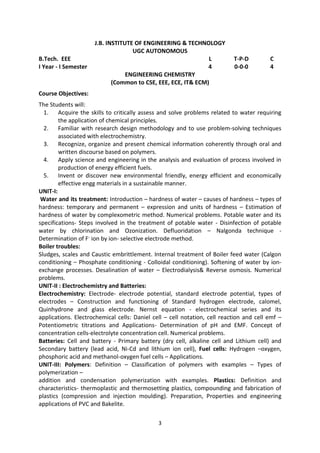
  • 138.
    106 Textbooks: 1. Reliability evaluationof Engineering systems‖, Roy Billinton and Ronald N Allan, BS Publications. 2. Reliability Engineering‖, Elsayed A. Elsayed, Prentice Hall Publications. References Books: 1. Reliability Engineering: Theory and Practice‖, By Alessandro Birolini, Springer Publications. 2. ―An Introduction to Reliability and Maintainability Engineering‖, Charles Ebeling, TMH Publications. 3. ―Reliability Engineering‖, E. Balaguruswamy, TMH Publications. Course Outcomes: The student will be able to: 1. Find the transfer of electrical data in distribution system through digital communication. 2. Predict load forecasting and reliability in economic point of view. 3. Apply distribution automation objectives and SCADA. 4. To have a knowledge on management of different electrical parameters. 5. Apply fundamental knowledge of reliability to model and analyze series parallel and non- series parallel systems.
  • 139.
    107 J.B. INSTITUTE OFENGINEERING & TECHNOLOGY UGC AUTONOMOUS B.Tech. EEE L T-P-D C IV Year – I Semester 4 0-0-0 4 Power Semi-Conductor Drives (Professional Elective-IV) Pre-Requisite: Power Electronics Course Objectives: The student will: 1. Ability to use the (1phase & 3phase) Controlled Converters for Speed Control operation of DC Drives. 2. Understand Multi Quadrant operation of DC Drives by Dual converter, Different Braking Methods& Improvement of Speed response by Closed loop control. 3. Use the Choppers for Speed Control operation of DC Drives & An understanding of Four Quadrant operation of Dc drive by chopper. 4. Use the AC voltage controllers to control the speed of an Induction motor. 5. Understand Variable frequency control of Induction Motor by VSI, CSI, Cyclo converters & PWM Control. UNIT - I: Control of Dc Motors By Single Phase And Three Phase Converters Introduction to Thyristor controlled Drives, Single Phase semi and Fully controlled converters connected to d.c separately excited and d.c series motors – continuous current operation – output voltage and current waveforms – Speed and Torque expressions – Speed – Torque Characteristics- Problems on Converter fed d.c motors. Three phase semi and fully controlled converters connected to d.c separately excited and d.c series motors – output voltage and current waveforms – Speed and Torque expressions – Speed – Torque characteristics – Problems. UNIT - II: Four Quadrant Operation of Dc Drives Introduction to Four quadrant operation – Motoring operations, Electric Braking – Plugging, Dynamic and Regenerative Braking operations. Four quadrant operation of D.C motors by single phase and three phase dual converters – Closed loop operation of DC motor (Block Diagram Only) Control of Dc Motors By Choppers Single quadrant, Two quadrant and four quadrant chopper fed dc separately excited and series motors – Continuous current operation – Output voltage and current wave forms – Speed and torque expressions – speed-torque characteristics – Problems on Chopper fed D.C Motors – Closed Loop operation ( Block Diagram Only) UNIT - III: Control Of Induction Motor Through Stator Voltage And Stator Frequency Variable voltage characteristics-Control of Induction Motor by Ac Voltage Controllers – Waveforms – speed torque characteristics. Variable frequency characteristics-Variable frequency control of induction motor by Voltage source and current source inverter and cyclo converters- PWM control – Comparison of VSI and CSI operations – Speed torque characteristics – numerical problems on induction motor drives – Closed loop operation of induction motor drives (Block Diagram Only) UNIT - IV: Rotor Side Control of Induction Motor Static rotor resistance control – Slip power recovery – Static Scherbius drive – Static Kramer Drive – their performance and speed torque characteristics – advantages, applications, problems.
  • 140.
    108 UNIT - V: Controlof Synchronous Motors Separate control and self control of synchronous motors – Operation of self controlled synchronous motors by VSI, CSI and cycloconverters. Load commutated CSI fed Synchronous Motor – Operation – Waveforms – speed torque characteristics – Applications – Advantages and Numerical Problems – Closed Loop control operation of synchronous motor drives (Block Diagram Only), variable frequency control - Cyclo converter, PWM based VSI & CSI. Textbooks: 1. Fundamentals of Electric Drives by G K Dubey, Narosa Publications. 2. Electric motor drives - modeling, Analysis and control by R.Krishnan, Prentice Hall PTR, 2001 Reference Books: 1. A First course on Electrical Drives – S K Pillai New Age International (P) Ltd. 2nd Edition. 2. Thyristor DC Drives by P.C.Sen, Wiley-Blackwell, 1981 3. Modern Power Electronics and AC Drives by B.K.Bose, PHI. Course Outcomes: The student will be able to: 1. Able to design controlled converter for speed control operation of DC drives 2. Develop the circuits for chopper control drive for speed control of DC Motor 3. Analyze the multi quadrant operation of dual converter with breaking plugging operation 4. Design the AC voltage controllers to control the speed of an Induction motor 5. Develop the Variable frequency controllers of Induction Motor by VSI, CSI, Cyclo converters & PWM Control
  • 141.
    109 J.B. INSTITUTE OFENGINEERING & TECHNOLOGY UGC AUTONOMOUS B.Tech. EEE L T-P-D C IV Year – I Semester 4 0-0-0 4 Digital Control Systems (Professional Elective-IV) Course Objectives: The Student will: 1. Equip the basic knowledge of discretization. 2. Study the stability analysis of digital control system. 3. Determine steady state performance of digital control systems. 4. Design the controller and observer for digital control systems. 5. Know the discrete PID controller. UNIT - I: Sampling And Reconstruction: Introduction, sample and hold operations, sampling theorem, Reconstruction of original sampled signal to continuous –time signal. The Z – Transforms Introduction, Linear difference equations, pulse response, Z – transforms, Theorems of Z – Transforms, the inverse Z – transforms, Modified Z- Transforms Z-Plane Analysis Of Discrete-Time Control System Transform method for solving difference equations; Pulse transfer function, Pulse transfer function of closed loop system, block diagram analysis of sampled – data systems, mapping between s-plane and z-plane: primary strips and complementary strips. UNIT - II: State Space Analysis State Space Representation of discrete time systems, Pulse Transfer Function Matrix solving discrete time state space equations, State transition matrix and it‘s Properties, Methods for Computation of State Transition Matrix, Discretization of continuous time state – space equations Controllability and Observability Concepts of Controllability and Observability, Tests for controllability and Observability. Duality between Controllability and Observability, Controllability and Observability conditions for Pulse Transfer Function UNIT - III: Stability Analysis Stability Analysis of closed loop systems in the Z-Plane. Jury stability test – Stability Analysis by use of the Bilinear Transformation and Routh Stability criterion. Stability analysis using Liapunov theorems UNIT - IV: Design Of Discrete Time Control System By Conventional Methods Design based on the frequency response method – Bilinear Transformation and Design procedure in the w-plane, Lead, Lag and Lead-Lag compensators and digital PID controllers. Design of digital control through deadbeat response method.
  • 142.
    110 UNIT - V: StateFeedback Controllers And Observers Design of state feedback controller through pole placement – Necessary and sufficient conditions, Ackerman‘s formula. State Observers – Full order and Reduced order observers. Linear Quadratic Regulators Introduction to adaptive controls, Min/Max principle, Linear Quadratic Regulators,Kalman state estimation through Kalman filter. Textbooks: 1. Discrete-Time Control systems - K. Ogata, Pearson Education/PHI, 2nd Edition 2. Digital Control and State Variable Methods by M.Gopal,TMH Reference Books: 1. Digital Control Systems, Kuo, Oxford University Press, 2ndEdition,2003. 2. Digital Control Engineering, M.Gopal, New age internationalpublisher Course outcomes: The student will be able to: 1. Understand mathematical models of linear discrete-time control systems using transfer functions and state-space models. 2. Analyse transient and steady state behaviours of lineardiscretetime control systems. 3. Determine whether performance of linear discretetime control systems meet specified design criteria. 4. Design controllers and observers for linear discrete-time control systems so that their performance meets specified design criteria. 5. Design the PID controllers in discrete time intervals.
  • 143.
    111 J.B. INSTITUTE OFENGINEERING & TECHNOLOGY UGC AUTONOMOUS B.Tech. EEE L T-P-D C IV Year – I Semester 4 0-0-0 4 Power Quality (Professional Elective-IV) Course Objectives: The Student will: 1. Know different terms of power quality. 2. Illustrate of voltage power quality issue - short and long interruption. 3. Construct study of characterization of voltage sag magnitude and three phase unbalancedvoltage sag. 4. Know the behaviour of power electronics loads; induction motors, synchronous motor etcby the power quality issues. 5. Prepare mitigation of power quality issues by the VSI converters. UNIT - I: Introduction: Introduction of the Power Quality (PQ) problem, Terms used in PQ: Voltage, Sag, Swell, Surges, Harmonics, over voltages, spikes, Voltage fluctuations, Transients, Interruption, overview of power quality phenomenon, Remedies to improve power quality, power quality monitoring UNIT - II: Long Interruptions: Interruptions – Definition – Difference between failures, outage, Interruptions – causes of Long Interruptions – Origin of Interruptions – Limits for the Interruption frequency – Limits for the interruption duration – costs of Interruption – Overview of Reliability evaluation to power quality, comparison of observations and reliability evaluation. Short Interruptions: Short interruptions – definition, origin of short interruptions, basic principle, fuse saving, voltage magnitude events due to re-closing, voltage during the interruption, monitoring of short interruptions, difference between medium and low voltage systems. Multiple events, single phase tripping – voltage and current during fault period, voltage and current at post fault period, stochastic prediction of short interruptions UNIT - III: Voltage Sag – Characterization – Single Phase: Voltage sag – definition, causes of voltage sag, voltage sag magnitude, and monitoring, theoretical calculation of voltage sag magnitude, voltage sag calculation in non-radial systems, meshed systems, and voltage sag duration. Voltage Sag – Characterization – Three Phase: Three phase faults, phase angle jumps, magnitude and phase angle jumps for three phase unbalanced sags, load influence on voltage sags. UNIT - IV: PQ Considerations in Industrial Power Systems: Voltage sag – equipment behavior of Power electronic loads, induction motors, synchronous motors, computers, consumer electronics, adjustable speed AC drives and its operation. Mitigation of AC Drives, adjustable speed DC drives and its operation, mitigation methods of DC drives.
  • 144.
    112 UNIT - V: Mitigationof Interruptions and Voltage Sags: Overview of mitigation methods – from fault to trip, reduces the number of faults, reducing the fault clearing time changing the power system, installing mitigation equipment, improving equipment, immunity, different events and mitigation methods. System equipment interface – voltage source converter, series voltage controller, shunt controller, combined shunt and series controller. Power quality and emc standards: Introduction to standardization, IEC Electromagnetic compatibility standards, European voltage characteristics standards, PQ surveys. Text Books: 1. Understanding Power Quality Problems‖ by Math H J Bollen. IEEE Press. 2. Bipin Singh, simmi P.Burman References Books: 1. Roger. C. Dugan, Mark. F. McGranagham, Surya Santoso, H.Wayne Beaty, ‗Electrical Power Systems Quality‘ McGraw Hill,2003.(For Chapters1,2,3, 4 and 5) 2. G.T. Heydt, 'Electric Power Quality', 2nd Edition. (West Lafayette, IN, Stars in a Circle Publications, 1994). (For Chapter 1, 2, 3 and 5) Course outcomes: The student will be able to: 1. Know the severity of power quality problems in distribution system. 2. Understand the concept of voltage sag transformation from up-stream (higher voltages) to down-stream (lower voltage). 3. Compute the concept of improving the power quality to sensitive load by various mitigating custom power devices. 4. Analyze voltage sag problems and suggest preventive techniques 5. Identify the harmonic sources and the effects of harmonic distortion
  • 145.
    113 J.B. INSTITUTE OFENGINEERING & TECHNOLOGY UGC AUTONOMOUS B.Tech. EEE L T-P-D C IV Year – I Semester 4 0-0-0 4 Power System Operation and Control (Professional Elective-V) Course Objectives: The Student will 1. Understand the Load-Frequency control 2. Analyze different methods to control reactive power and voltage 3. Solve economic dispatch problem 4. Solve unit commitment problem 5. Understand the need of real time control of power systems UNIT - I: Economic Operation Of Power Systems: Optimal operation of Generators in Thermal Power Stations, - heat rate Curve – Cost Curve – Incremental fuel and Production costs, input-output characteristics, Optimum generation allocation with line losses neglected, Unit commitment. Optimum generation allocation including the effect of transmission line losses – Loss Coefficients, General transmission line loss formula. UNIT - II: Hydrothermal Scheduling: Optimal scheduling of Hydrothermal System: Hydroelectric power plant models, Scheduling problems-Short term hydrothermal scheduling problem. Modeling of Turbine: First order Turbine model, Block Diagram representation of Steam Turbines and Approximate Linear Models. UNIT - III: Modeling Of Governor And Automatic Controllers: Modeling of Governor: Mathematical Modeling of Speed Governing System – Derivation of small signal transfer function. Modeling of Excitation System: Fundamental Characteristics of an Excitation system, Transfer function, Block Diagram Representation of IEEE Type-1 Model. UNIT - IV: Single Area Load Frequency Control Necessity of keeping frequency constant. Definitions of Control area – Single area control – Block diagram representation of an isolated power system – Steady state analysis – Dynamic response – Uncontrolled case. Two-Area Load Frequency Control Load frequency control of 2-area system – uncontrolled case and controlled case, tie- line bias control. Proportional plus Integral control of single area and its block diagram representation, steady state response –Automatic Generation Control and Economic dispatch control. UNIT - V: Reactive Power Control Overview of Reactive Power control – Reactive Power compensation in transmission systems – advantages and disadvantages of different types of compensating equipment for transmission systems; load compensation – Specifications of load compensator, Uncompensated and compensated transmission lines: shunt and Series Compensation.
  • 146.
    114 Textbooks: 1. Modern PowerSystem Analysis – by I.J.Nagrath and D.P.Kothari Tata M Graw – Hill Publishing Company Ltd, 2nd edition. 2. Electrical Power Systems by C.L.Wadhwa, Newage International-3rd Edition Reference Books: 1. Power System Analysis and Design by J.Duncan Glover and M.S.Sarma., THOMPSON, 3rd Edition. 2. Power System Analysis by Grainger and Stevenson, Tata McGrawHill. 3. Power System Analysis by Hadi Saadat , TMHEdition. Course outcomes: The student will be able to 1. Analyze Load Frequency Control of single-area and two-area systems 2. Analyze different methods to control reactive power and voltage 3. Solve economic dispatch problem by direct method and λ-iteration method 4. Solve Unit Commitment by Priority-list methods - forward dynamic programming approach 5. Summary the need and operation of real time control of power systems.
  • 147.
    115 J.B. INSTITUTE OFENGINEERING & TECHNOLOGY UGC AUTONOMOUS B.Tech. EEE L T-P-D C IV Year – I Semester 4 0-0-0 4 Distribution Automation (Professional Elective-V) Course Objectives: The Student will: 1. list the distribution systems for load modeling. 2. understand the design & working of substations. 3. compute system protection. 4. give a comprehensive idea on communication systems 5. Knowledge about intelligent and Strategic issues related to growth & development of Indian Power Business UNIT – I: Distribution Automation and The Utility System: Introduction to Distribution Automation (DA), control system interfaces, control and data requirements, centralized (Vs) decentralized control, DA System (DAS), DA Hardware, DAS software. UNIT - II: Distribution Automation Functions: DA capabilities, Automation system computer facilities, management processes, Information management, system reliability management, system efficiency management, voltage management, Load management. UNIT - III: Communication Systems for DA: DA communication requirements, Communication reliability, Cost effectiveness, Data rate Requirements, Two way capability, Ability to communicate during outages and faults, Ease of operation and maintenance, Conforming to the architecture of data flow Communication systems used in DA: Distribution line carrier (Power line carrier), Ripple control, Zero crossing technique, telephone, cable TV, Radio, AM broadcast, FM SCA, VHF Radio, UHF Radio, Microwave satellite. Fiber optics, Hybrid Communication systems, Communication systems used in field tests. UNIT - IV: Technical Benefits: DA benefit categories, Capital deferred savings, Operation and Maintenance savings, Interruption related savings, Customer related savings, Operational savings, improved operation, Function benefits, Potential benefits for functions, and function shared benefits, Guidelines for formulation of estimating equations Parameters required, economic impact areas, Resources for determining benefits impact on distribution system, integration of benefits into economic evaluation. UNIT - V: Economic Evaluation Methods: Development and evaluation of alternate plans, Select study area, Select study period, Project load growth, Develop Alternatives, Calculate operating and maintenance costs, Evaluate alternatives. Economic comparison of alternate plans, Classification of expenses and capital expenditures, Comparison of revenue requirements of alternative plans, Book Life and Continuing plant analysis, Year by year revenue requirement analysis, short term analysis, end of study adjustment, Break even analysis, Sensitivity analysis computational aids.
  • 148.
    116 Text Books: 1. Controland Automation of Electrical Distribution Systems, James. Northcote – Green Robert Wilson, CRC Press. 2. Electric Power Distribution Automation, Dr. M. K. Khedkar, Dr. G.M.Dhole, University Science Reference Books: 1. IEEE Tutorial Course ―Distribution Automation‖ 2. IEEE Working Group on ―Distribution Automation‖ Course outcomes: The student will be able to: 1. Find the transfer of electrical data in distribution system through digital communication. 2. Predict load forecasting and reliability in economic point of view. 3. Apply distribution automation objectives and SCADA. 4. have a knowledge on management of different electrical parameters. 5. Learn processes for execution and control of regulation in power distribution business in India
  • 149.
    117 J.B. INSTITUTE OFENGINEERING & TECHNOLOGY UGC AUTONOMOUS B.Tech. EEE L T-P-D C IV Year - II Semester 4 0-0-0 4 H V D C Transmission (Professional Elective-V) Course Objectives: The Student will: 1. Evaluate technical and economic aspects of HVDC transmission. 2. Develop of HVDC converter. 3. Know about VSC HVDC control. 4. Identify the impact of AC system performance on DC system. 5. Analyse harmonics and their rectification. UNIT - I: Basic Concepts: Necessity of HVDC systems, Economics and Terminal equipment of HVDC transmission systems, Types of HVDC Links, Apparatus required for HVDC Systems, Comparison of AC and DC Transmission, Application of DC Transmission System, Planning and Modern trends in D.C. Transmission. Analysis of HVDC Converters: Choice of Converter Configuration, Analysis of Graetz circuit, Characteristics of 6 Pulse and 12 Pulse converters, Cases of two 3 phase converters in Y/Y mode – their performance. UNIT - II: Converter And HVDC System Control: Principle of DC Link Control, Converters Control Characteristics, Firing angle control, Current and extinction angle control, Effect of source inductance on the system, Starting and stopping of DC link, Power Control. Reactive Power Control in HVDC: Introduction, Reactive Power Requirements in steady state, sources of reactive power- Static VAR Compensators, Reactive power control during transients. UNIT - III: Power Flow Analysis In Ac/Dc Systems: Modeling of DC Links, DC Network, DC Converter, Controller Equations, Solution of DC load flow, P.U. System for DC quantities, solution of AC-DC Power flow- Simultaneous method- Sequential method. UNIT - IV: Converter Faults And Protection: Converter faults, protection against over current and over voltage in converter station, surge arresters, smoothing reactors, DC breakers, Audible noise, space charge field, corona effects on DC lines, Radio interference. UNIT - V: Harmonics: Generation of Harmonics, Characteristics harmonics, calculation of AC Harmonics, Non- Characteristics harmonics, adverse effects of harmonics, Calculation of voltage and Current harmonics, Effect of Pulse number on harmonics Filters Types of AC filters, Design of Single tuned filters –Design of High pass filters.
  • 150.
    118 Textbooks: 1. HVDC PowerTransmission Systems: Technology and system Interactions by K.R.Padiyar, New Age International (P) Limited, andPublishers. 2. HVDC Transmission by S K Kamakshaiah, V Kamaraju, TMHPublishers. Reference Books: 1. EHVAC and HVDC Transmission Engineering and Practice – S.Rao. 2. HVDC Transmission by Jos Arrillaga, The institution of electrical engineers, IEE power & energy series 29, 2nd edition. 3. Direct Current Transmission by E.W.Kimbark, John Wiley andSons. Course outcomes: The student will be able to: 1. Compare the differences between HVDC and HVAC transmission. 2. Analyze the rectifier and inverter commutating circuits. 3. Identification of valve firing control schemes. 4. Estimate the requirement of HVDC filters. 5. Observe the role of AC system faults on HVDC system and know about VSC transmission advantages.
  • 151.
    119 J.B. INSTITUTE OFENGINEERING & TECHNOLOGY UGC AUTONOMOUS B.Tech. EEE L T-P-D C IV Year - I Semester 0 0-3-0 2 Electrical Measurement Lab Course Objectives: The student will: 1. Monitor, analyze any physical system. 2. Choose the suitable method for measurement of active, reactive powers. 3. Understand students how different types of meters work and their construction. 4. Apply the suitable bridge for measurement of resistance, inductance and capacitance. 5. Examine calibration of LVDT Any Ten of the experiments are required to be conducted as compulsory experiments: Experiment 1. Calibration and testing of 1- Ф Energy meter. Experiment 2. Calibration of dynamometer type Power Factor meter. Experiment 3. Measurement of Unknown voltage by DC Crompton potentiometer. Experiment 4. Measurement of Low resistance by using Kelvin‘s double bridges. Experiment 5. Measurement of Iron losses by using Lloyd, Fisher magnetic method. Experiment 6. Measurement of unknown capacitance by using Schering bridge. Experiment 7. Measurement of Inductance by using Anderson bridge. Experiment 8. Measurement of 3-Ф reactive power with volt ampere method. Experiment 9. Measurement of parameters of choke coil using three voltmeter and three Ammeter methods. Experiment 10. Linear variable differential transformer (LVDT) trainer and capacitance pickup- Characteristics and calibration. Experiment 11. Measurement of unknown inductance by using Maxwell‘s bridge. Experiment 12. Resistance strain guage. Experiment 13. PT testing by comparison. Experiment 14. CT testing using mutual inductor. Course outcomes: The Student will be able to: 1. Measure various electrical parameters with accuracy, precision, resolution. 2. Make use of AC and DC bridges for relevant parameter measurement. 3. Test current transformers and dielectric strength of oil. 4. Ability to balance Bridges to find unknown values. 5. Demonstrate & Calibrate LVDT and resistance strain gauge.
  • 152.
    120 J.B. INSTITUTE OFENGINEERING & TECHNOLOGY UGC AUTONOMOUS B.Tech. EEE L T-P-D C IV Year - II Semester 4 1-0-0 4 Instrumentation Course Objectives: The student will: 1. Introduce students to monitor, analyze and control any physical system. 2. Understand students the meter characteristics. 3. Provide a student a knowledge to design and create novel products and solutions for real life problems. 4. Introduce students a knowledge to use modern tools necessary for electrical projects. 5. Illustrate various working principles used in various instruments. UNIT - I: Characteristics of Signals: Measuring Systems, Performance Characteristics, – Static characteristics, Dynamic Characteristics; Errors in Measurement – Gross Errors, Systematic Errors, Statistical Analysis of Random Errors. Signals and their representation Signal and their representation: Standard Test, periodic, aperiodic, modulated signal, sampled data, pulse modulation and pulse code modulation UNIT - II: Oscilloscope: Cathode ray oscilloscope-Cathode ray tube-time base generator-horizontal and vertical amplifiers-CRO probes-applications of CRO-Measurement of phase and frequency-lissajous patterns-Sampling oscilloscope-analog and digital type. Digital voltmeters Digital voltmeters- Successive approximation, ramp, dual-Slope integration continuos balance type-Microprocessor based ramp type DVM digital frequency meter-digital phase angle meter. UNIT - III: Signal Analyzers: Wave Analyses - Frequency selective analyzers, Heterodyne, Application of Wave analyzers- Harmonic Analyzers, Total Harmonic distortion, spectrum analyzers, Basic spectrum analyzers, spectral displays, vector impedance meter, Q meter. Peak reading and RMS voltmeters. UNIT - IV: Transducers: Definition of transducers, Classification of transducers, Advantages of Electrical transducers, Characteristics and choice of transducers; Principle operation of resistor, inductor, LVDT and capacitor transducers; LVDT Applications, Strain gauge and its principle of operation, gauge factor, Thermostats, Thermocouples, Synchros, Piezo electric transducers, photovoltaic, photo conductive cells, photo diodes. UNIT - V: Measurement of Non-Electrical Quantities-I: Measurement of strain, Gauge Sensitivity, Displacement, Velocity, Angular Velocity, Acceleration, Force, Torque. Measurement of Non-Electrical Quantities-II: Measurement of Temperature, Pressure, Vacuum, Flow, Liquid level.
  • 153.
    121 Textbooks: 1. Transducers andInstrumentation by D.V.S Murthy, Prentice Hall of India 2. A course in Electrical and Electronic Measurements and Instrumentation, A.K. Sawhney, Dhanpatrai& Co. Reference Books: 1. Measurements Systems, Applications and Design – by D O Doeblin 2. Principles of Measurement and Instrumentation – by A.S Morris, Pearson /Prentice Hall of India 3. Electronic Instrumentation-by H.S.Kalsi Tata MCGraw-Hill Edition, 1995. Course Outcomes: The student will be able to: 1. decide the range of meters used for particular application. 2. measure frequency, phase with Oscilloscope. 3. use Digital voltmeters. 4. design the meters used for measurement of non-electrical quantities. 5. measure strain, displacement, Velocity, Angular Velocity, temperature, Pressure, Vacuum, and Flow.
  • 154.
    122 J.B. INSTITUTE OFENGINEERING & TECHNOLOGY UGC AUTONOMOUS B.Tech. EEE L T-P-D C IV Year - II Semester 0 0-3-0 2 Power Systems & Simulation Lab Course Objectives: The student will: 1. Learn various modules in MATLAB software for simulating experiments. 2. Understand the protection of power system devices. 3. Understand use of open-circuit and short-circuit tests to determine sequence impedance of 3-ϕ transformer. 4. Understand the Characteristics of relays. 5. Evaluate the behavior of generator protection system Any ten experiments are to be performed, selecting five from each category: - Hardware based experiments: - Experiment 1. Differential protection of 1-ϕ transformer. Experiment 2. Characteristics of over voltage relay. Experiment 3. Characteristics of over current relay. Experiment 4. Finding the sequence impedance of 3-ϕ transformer Experiment 5. Equivalent circuit of a 3 winding Transformer Simulation based experiments:- Experiment 6. Sinusoidal Voltages and Currents. Experiment 7. Equivalent circuit of a Transformer. Experiment 8. Determination of voltage and power at the sending end, voltage regulation using medium line model. Experiment 9. Determination of line performance when loaded at receiving end. Experiment 10. Computation of line parameters of transmission lines. Experiment 11. Modeling of short and medium transmission lines. Experiment 12. Modeling of Long transmission lines. Experiment 13. Develop a program to simulate Ferranti effect. Course Outcomes: The student will be able to: 1. Understand power industry practices for design, operation, and planning. 2. use mathematical tools that are essential for system analysis and design. 3. use commercial software packages in designing solutions to problems. 4 have group participation in design and problem solving. 5 analyze the performance of machine
  • 155.
  • 156.
    2 J.B. INSTITUTE OFENGINEERING & TECHNOLOGY UGC AUTONOMOUS B.Tech. L T-P-D C III Year - I Semester 3 0-0-0 3 DISASTER MANAGEMENT (Open Elective – I) Course Objectives: The students will : 1. To provide basic conceptual understanding the difference between the hazard and a disaster. 2. To gain knowledge about the various disasters and their impacts. 3. To provide basic understanding about the hazard and vulnerability profile ofIndia. 4. To have conceptual understanding about the disaster management phases. 5. To gain approaches of Disaster Risk Reduction (DRR) and the relationship between vulnerability, Disasters, disaster prevention and risk reduction. UNIT - I: Concept of Disaster, Different approaches, Concept of Risk, Levels of Disasters, Disaster Phenomena and Events (Global, national and regional) ,Hazards and Vulnerability, Natural and man-made hazards, response time, frequency and forewarning levels of different hazards, Characteristics and damage potential or natural hazards, hazard assessment ,Dimensions of vulnerability factors, vulnerability assessment Vulnerability and disaster risk ,Vulnerabilities to flood and earthquake hazards. UNIT II: Disaster Management Mechanism, Concepts of risk management and crisis managements. Disaster Management Cycle, Response and Recovery Development, Prevention, Mitigation and Preparedness ,Planning for Relief. UNIT - III: Capacity Building: Concept, Structural and Non-structural Measures ,Capacity Assessment; Strengthening Capacity for Risk reduction ,Counter-Disaster Resources and their utility in Disaster Management ,Legislative Support at the state and national levels. UNIT - IV: Coping with Disaster, Coping Strategies; alternative adjustment processes, Changing Concepts of disaster management ,Industrial Safety Plan; Safety norms and survival kits, Mass media and disaster management. UNIT - V: Planning for disaster management, Strategies for disaster management planning, Steps for formulating a disaster risk reduction plan, Disaster management Act and Policy in India. Organizational structure for disaster management in India, Preparation of state and district disaster management plans . TEXT BOOKS: 1. Alexander, D. Natural Disasters, ULC press Ltd, London, 1993. 2. Carter, W.N. Disaster Management: A Disaster Management Handbook, Asian Development Bank, Bangkok, 1991. 3. Manual on Natural Disaster Management in India, NCDM, New Delhi, 2001.
  • 157.
    3 REFERENCES: 1. Abarquez I.& Murshed Z. Community Based Disaster Risk Management: Field Practitioner’s Handbook, ADPC, Bangkok, 2004. 2. Goudie, A. Geomorphological Techniques, Unwin Hyman, London 1990. 3. Goswami, S.C Remote Sensing Application in North East India, Purbanchal Prakesh, Guwahati, 1997. Course Outcomes: The Students will be to 1. acquired knowledge on various types of disasters and hazards. 2. distinguish between the hazard and a disaster can be analyzed. 3. acquired knowledge on the various approaches of Disaster Risk Reduction (DRR) 4. ability to understand the relationship between vulnerability, disasters, disaster prevention and risk reduction. 5. develop ability to respond to different disasters.
  • 158.
    4 J.B. INSTITUTE OFENGINEERING & TECHNOLOGY UGC AUTONOMOUS B.Tech. L T-P-D C III Year - I Semester 3 0-0-0 3 Elements of Civil Engineering (Open Elective-I) Course Objectives: The students will: 1. To understand different methods of surveying for various applications. 2. To familiarize with various types of building materials. 3. To understand transportation and traffic management. 4. The knowledge of water sources, supply& its treatment. 5. Study about Highway development in India, Necessity for Highway planning, different road development plans.. UNIT - I: Introduction, history of the civil engineering, sub – disciplines of civil engineering. UNIT II: Surveying Introduction, divisions of surveying, classification of surveying, principles of surveying. Linear measurements and errors–introduction, methods of linear measurements, chaining instruments, types of error and correction. Compass surveying – introduction, angular measurement using compass, whole circle bearing and reduced bearing, fore bearing and back bearing. Traverse surveying –introduction, chain and compass traversing, closing error and adjustments. Levelling– introduction, types of levelling instruments, dumpy level, adjustment of level, levelling staff. UNIT - III: Building Materials and Construction Materials: Introduction to construction materials like ferrous and non ferrous metals, alloys, Stones, Bricks, Lime, Cement, Timber, Sand, Aggregates, Mortar, Concrete and bitumen. Construction: Types of building, different loads considered in building design, types of foundation in building, other developments and constructions of buildings. UNIT - IV: Fire and Earthquake Protection in Building Introduction, fire protection in building, structural and architectural safety requirements of resistive structures, fire resistive properties of building materials, fire exit requirements, force and acceleration on building due to earthquake, building response characteristics, building drift. UNIT - V: Water Supply, Sanitary and Electrical Works in Building Introduction, water supply system, water supply layout of a building, house drainage, traps, electrical works in building. Highway Engineering: Introduction, historical background of road or highway, classification of roads, pavements and roads, traffic control mechanism.
  • 159.
    5 TEXT BOOKS: 1. Elementsof Civil Engineering Author: Mimi Das Saikia, Bhargab Mohan Das and Madan Mohan Das Publisher: PHI Learning Private Limited New Delhi. 2. Elements of Civil Engineering Author: Dr. R.K. Jain and Dr. P.P. Lodha Publisher: McGraw Hill Education, India Pvt. Ltd. 3. Surveying Vol. I Author: Dr. B. C. Punmia, Ashokkumar Jain, Arunkumar Jain16th Edition Publisher: Laxmi Publication Delhi. 4. Building drawing Author: M.G.Shah, C.M.Kale and S.Y.Patki Publisher: Tata McGraw Hill. Reference Books: 1. Surveying Theory and Practice (7th Edition) Author: James M Anderson and Edward M Mikhail Publisher: McGraw Hill Education, India Pvt. Ltd. 2. Surveying and Leveling Author: R. Subramanian Publisher: Oxford University. 3. Building drawing Author: M.G.Shah, C.M.Kale and S.Y.Patki Publisher: Tata McGraw Hill. 4. Civil Engg. Drawing Author: S. C. Rangwala Publisher: Charotar Pub. House Anand. Course Outcomes: Students will be able to 1. Carry out simple land survey and prepare maps showing the existing details. 2. Find out area of irregular shaped plane areas. 3. Understand building plan, elevation and section. 4. Get acquainted with construction materials and transportation systems. 5. Understand transportation and traffic problems.
  • 160.
    6 J.B. INSTITUTE OFENGINEERING & TECHNOLOGY UGC AUTONOMOUS B.Tech. L T-P-D C III Year – I Semester 3 0-0-0 3 Network Analysis and Synthesis (Open Elective - I) UNIT I: Concept of generalized frequency, circuit representation and their response in terms of generalized frequency. UNIT II: Fourier transforms and series, Laplace transform, its properties, and Z transforms, its properties and applications, Concept of one port, two-port networks, characteristics and parameters. UNIT III: Generalized network functions (Driving point and Transfer), concepts of poles and zeros, determination of free and forced response from poles and zeros, concept of minimum phase networks, analysis of ladder, lattice, T and bridged-T networks. UNIT IV: Introduction to state-space representation of networks and their analysis. Concept of filtering, filter types and characteristics, classical design of T and PI passive filters, frequency transformations. Introduction to active filters, active filter specifications, design of first and second order RC –active filters, maximally flat and equi-ripple filter characteristics, implementation using passive elements and op-amps. UNIT V: Network synthesis- Synthesis problem formulation, properties of positive real functions, Hurwitz polynomials, properties of RC, LC and RL driving point functions, Foster and Cauer synthesis of LC and RC circuits. Text Books: 1. Temes & LaPatra – Introduction to circuit Synthesis & Design, McGraw Hill. 2. V. Valkenberg – Modern Network Synthesis, PHI. Reference Books: 1. Weinberg – Network Analysis & Synthesis, McGraw Hill. 2. Peikari – Fundamentals of Network Analysis & Synthesis, Wiley. 3. V. Atre-- Network Theory and Filter design, TMH.
  • 161.
    7 J.B. INSTITUTE OFENGINEERING & TECHNOLOGY UGC AUTONOMOUS B.Tech. L T-P-D C III Year – I Semester 3 0-0-0 3 Measurements and Instruments (Open Elective - I) UNIT - I: Philosophy Of Measurement- Methods of Measurement, Measurement System, Classification of instrument system, Characteristics of instruments & measurement system, Errors in measurement & its analysis, Standards. Analog Measurement of Electrical Quantities –Electrodynamics , Thermocouple, Electrostatic & Rectifier type Ammeters & Voltmeters , Electrodynamics’ Wattmeter, Three Phase Wattmeter, Power in three phase system , errors & remedies in wattmeter and energy meter. Instrument Transformer and their applications in the extension of instrument range, Introduction to measurement of speed , frequency and power factor. UNIT - II: Measurement of Parameters- Different methods of measuring low, medium and high resistances, measurement of inductance & capacitance with the help of AC Bridges, Q Meter. AC Potentiometer- Polar type & Co-ordinate type AC potentiometers , application of AC Potentiometers in electrical measurement. UNIT - III: Magnetic Measurement- Ballistic Galvanometer, flux meter , determination of hysteresis loop, measurement of iron losses UNIT - IV: Digital Measurement of Electrical Quantities- Concept of digital measurement, block diagram Study of digital voltmeter, frequency meter Power Analyzer and Harmonics Analyzer; Electronic Multimeter. UNIT - V: Cathode Ray Oscilloscope - Basic CRO circuit (Block Diagram),Cathode ray tube (CRT) & its components , application of CRO in measurement ,Lissajous Pattern.; Dual Trace & Dua Beam Oscilloscopes. Text Books: 1. E.W. Golding & F.C. Widdis, - Electrical Measurement &Measuring Instrument‖, A.H. Wheeler& Co. India. 2. A.K. Sawhney, ―Electrical & Electronic Measurement & Instrument‖, Dhanpat Rai & Sons
  • 162.
    8 Reference Books: 1. ForestK. Harries,―Electrical Measurement, Willey Eastern Pvt. Ltd. India . 2. M.B. Stout ,―Basic Electrical Measurement‖ Prentice hall of India. 3. W.D. Cooper,‖ Electronic Instrument & Measurement Technique ― Prentice Hall International. 4. Rajendra Prashad ,―Electrical Measurement &Measuring Instrument‖Khanna Publisher. 5. J.B. Gupta, ―Electrical Measurements and Measuring Instruments‖, S.K. Kataria & Sons.
  • 163.
    9 J.B. INSTITUTE OFENGINEERING & TECHNOLOGY UGC AUTONOMOUS B. Tech. L T-P-D C III Year - I Semester 3 0-0-0 3 AUTOMOBILE ENGINEERING ( OPEN ELECTIVE-I) UNIT – I: Introduction : Components of four wheeler automobile – chassis and body – power unit – power transmission – rear wheel drive, front wheel drive, 4 wheel drive – types of automobile engines, engine construction – engine lubrication, splash and pressure lubrication systems, oil filters, oil pumps – crank case ventilation – engine service, reboring, decarburization, Nitriding of crank shaft. Emission from Automobiles – Pollution standards, National and international – Pollution Control – Techniques – Noise Pollution & control. UNIT – II: Fuel System: S.I. Engine: Fuel supply systems, Mechanical and electrical fuel pumps – carburetor – types – air filters – petrol injection. Electronic injection system C.I. Engines: Requirements of diesel injection systems, types of injection systems, fuel pump, nozzle, Alternative fuels for Automobiles-injection, Classification, Properties, Hybrid vehicles injection timing, testing of fuel, pumps. UNIT – III: Cooling System : Cooling Requirements, Air Cooling, Liquid Cooling and Forced Circulation System – Radiators – Types – Cooling Fan - water pump, thermostat, evaporating cooling – pressure sealed cooling – antifreeze solutions. Ignition System : Function of an ignition system, battery ignition system, constructional features of storage battery, auto transformer, contact breaker points, condenser and spark plug – Magneto coil ignition system, electronic ignition system using contact breaker, electronic ignition using contact triggers – spark advance and retard mechanism. UNIT – IV: Electrical System : Charging circuit, generator, current – voltage regulator – starting system, bendix drive mechanism solenoid switch, lighting systems, Horn, wiper, fuel gauge – oil pressure gauge, engine temperature indicator etc Transmission System : Clutches, principle, types, cone clutch, single plate clutch, multi plate clutch, magnetic and centrifugal clutches, fluid fly wheel – Gear boxes, types, sliding mesh, construct mesh, synchro mesh gear boxes, epicyclic gear box , over drive torque converter.Propeller shaft – Hoatch – Kiss drive, Torque tube drive universal joint, differential rear axles– types – wheels and tyres. UNIT – V: Steering System : Steering geometry – camber, castor, king pin rake, combined angle toe in, center point steering. Types of steering mechanism – Ackerman steering mechanism, Davis steering mechanism, steering gears – types, steering linkages. Suspension System : Objects of suspension systems – rigid axle suspension system, torsion bar, shock absorber, Independent suspension system. Braking System : Mechanical brake system, Hydraulic brake system, Master cylinder, wheel cylinder tandem master cylinder Requirement of brake fluid, Pneumatic and vacuum brakes.
  • 164.
    10 TEXT BOOKS : 1.Automobile Engineering ,Vol. 1 & Vol. 2/ Kripal Singh 2. Automobile Engineering , Vol. 1 & Vol. 2 ,by K.M Gupta,Umesh publication 3. Automobile Engineering - K.K.Ramalingam –scitech lab REFERENCE BOOKS : 1. A System approach to Automotive Technology by Jack Erjavec YesDee publishing pvt Ltd. 2. Automobile Engineering / William Crouse 3. Automotive Mechanics / Heitner 4. Alternative fuels of Automobiles by P.RamiReddy, Frontline publications.
  • 165.
    11 J.B. INSTITUTE OFENGINEERING & TECHNOLOGY UGC AUTONOMOUS B.Tech. L T-P-D C III Year - I Semester 3 0-0-0 3 ENGINEERING MATERIALS AND FABRICATION PROCESSES (OPEN ELECTIVE – I) UNIT-I: FERROUS ALLOYS: Introduction, Designations and classifications for steels, Simple Heat Treatments, Effect of Alloying Elements. NONFERROUS ALLOYS: Introduction, properties and applications, Aluminum Alloys, Magnesium Alloys, Copper Alloys and Titanium Alloys. CERAMIC MATERIALS: Introduction, Properties and Applications of Ceramics, Glasses and Refractories POLYMERS: Introduction, Classification of Polymers, Polymerization, Degree of Polymerization, Typical Thermoplastics and Thermosets. COMPOSITES: Introduction, Classification, Properties and Applications of Polymer matrix, Metal Matrix Ceramic Matrix and Laminar composites. UNIT-II: Casting : Steps involved in making a casting – Advantage of casting and its applications; Patterns - Pattern making, Types, Materials used for patterns, pattern allowances and their construction; Properties of moulding sands. Methods of Melting - Crucible melting and cupola operation – Defects in castings; Casting processes – Types – Sand moulding, Centrifugal casting, die- casting, Investment casting, shell moulding; Principles of Gating – Requirements – Types of gates, Design of gating systems – Riser – Function, types of Riser and Riser design. UNIT-III: Welding: Classification – Types of welds and welded joints; Gas welding - Types, oxy-fuel gas cutting. Arc welding, forge welding, submerged arc welding, Resistance welding, Thermit welding. Inert Gas Welding _ TIG Welding, MIG welding, explosive welding, Laser Welding; Soldering and Brazing; Heat affected zone in welding. Welding defects – causes and remedies; destructive and non- destructive testing of welds. UNIT-IV: Hot working, cold working, strain hardening, recovery, re-crystallization and grain growth. Stamping, forming and other cold working processes. Blanking and piercing – Bending and forming – Drawing and its types – wire drawing and Tube drawing – coining – Hot and cold spinning. Types of presses and press tools. Forces and power requirement in the above operations.
  • 166.
    12 UNIT-V: Extrusion ofMetals : Basic extrusion process and its characteristics. Hot extrusion and cold extrusion - Forward extrusion and backward extrusion – Impact extrusion – Extruding equipment – Tube extrusion and pipe making, Hydrostatic extrusion. Forces in extrusion Forging Processes: Forging operations and principles – Tools – Forging methods – Smith forging, Drop Forging – Roll forging – Forging hammers : Rotary forging – forging defects – cold forging, swaging, Forces in forging opera1 ti0 ons. TEXT BOOKS: 1. Donald R. Askland, Pradeep P. Phule, The Science and Engineering of Materials (4th Edition), Thomson Publishers, 2003. 2. William D. Callister Introduction to Material Science and Engineering, John Wiley and Sons, 2007. 3. W.F.Smith, Principles of Materials Science and Engineering, Mc Graw Hill, New York, 1994.
  • 167.
    13 J.B. INSTITUTE OFENGINEERING & TECHNOLOGY UGC AUTONOMOUS B.Tech. L T-P-D C III Year - I Semester 3 0-0-0 3 Principles of Electronic Communications (OPEN ELECTIVE – I) Course objectives: The Student will 1. gain knowledge about modulation and various analog modulation schemes. 2. have a broad understanding of Pulse modulation schemes. 3. obtain knowledge on Digital modulation techniques. 4. illustrate the wireless networking concepts. 5. understand the principle of cellular mobile radio systems. Unit I: Introduction Block diagram of Electrical communication system, Radio communication, Types of communications: Analog, pulse and digital. Analog Modulation: Need for modulation, Types of Analog modulation, Amplitude Modulation. Angle Modulation: Frequency & Phase modulations. Generation and Demodulation techniques. Advantages of FM over AM, Bandwidth consideration, Narrow band and Wide band FM, Comparison of FM & PM. Unit II: Pulse Modulations Sampling, Nyquist rate of sampling, sampling theorem for Band limited signals, PAM, regeneration of base band signal. PWM and PPM, Time Divison Multiplexing, Frequency Divison Multiplexing, Asynchronous Multiplexing. Unit III: Digital Communication Advantages, Block diagram of PCM, Quantization, effect of quantization, quantization error, Base band digital signal, DM, ADM, ADPCM and comparison. Digital Modulation: ASK, FSK, PSK, DPSK, QPSK demodulation, offset and non-offset QPSK, coherent and incoherent reception, Modems. Unit IV: Introduction to Wireless Networking Introduction, Difference between wireless and fixed telephone networks, Development of wireless networks, Traffic routing in wireless networks. Unit V: Cellular Mobile Radio Systems Introduction to Cellular Mobile System, concept of frequency reuse, Performance criteria, uniqueness of mobile radio environment, operation of cellular systems, Hexagonal shaped cells, Analog and Digital Cellular systems, Cell splitting. Handoffs and Dropped Calls Handoff, dropped calls and cell splitting, types of handoff, handoff initiation, delaying handoff, forced handoff, mobile assisted handoff, Intersystem
  • 168.
    14 handoff, micro cells,vehicle locating methods, dropped call rates and their evaluation. TEXT BOOKS: 1. Communication Systems Analog and Digital – R.P. Singh and SD Sapre, TMH, 20th reprint, 2004. 2. Wireless Communications, Principles, Practice – Theodore, S. Rappaport, 2nd Ed., 2002,PHI. REFERENCE BOOKS: 1. Wireless Communication and Networking – William Stallings, 2003, PHI. 2. Electronic Communication Systems – Kennedy and Davis, TMH, 4th edition, 2004. 3. Communication Systems Engineering – John. G. Proakis and Masoud Salehi, PHI, 2ndEd. 2004. Course outcomes: The Student will be able to 1. acquire knowledge about analog and angle modulation techniques. 2. illustrate the concepts of Pulse modulation schemes. 3. obtain knowledge on Digital modulation techniques. 4. describe the wireless networking concepts. 5. understand the basics of cellular mobile radio systems and types of handoff.
  • 169.
    15 J.B. INSTITUTE OFENGINEERING & TECHNOLOGY UGC AUTONOMOUS B.Tech L T-P-D C III Year I Semester 3 0-0-0 3 MATLAB PROGRAMMING (Open Elective-I) Course objectives: The Student will 1. gain knowledge in exploring MATLAB software. 2. be able to find approach for solving Engineering problems using simulation tools. 3. be prepared to use MATLAB in their project works. 4. gain a foundation in use of this software for real time applications. 5. practice numerical methods, simulations and understand MATLAB programming. UNIT-I: MATLAB basics, The MATLAB Environment, Basic computer programming, Variables and constants, operators and simple calculations, Formulas and functions, MATLAB toolboxes, Exercises. UNIT-II: Matricers and vectors, Matrix and linear algebra review, vectors and matrices in MATLAB. Matrix operations and function in MATLAB, Exercises. UNIT-III: Computer programming, Algorithms and structures, MATLAB scripts and functions (m-files). Simple sequential algorithms, control structures (if…then, loop), Exercises. UNIT-IV: MATLAB programming, Reading and writing data, file handling, personalized functions. Toolbox structure, MATLAB graphic functions, Exercises. UNIT-V: Numerical simulations-Numerical methods and simulations, Random number generation, Montecarlo methods statistics Toolbox, User‘s Guide: Random Number and Generation Functions). Hands-on session Interactive hands-on-session where the whole class will develop one or more MATLAB scripts that solve an assigned problem. TEXT BOOK: 1. MATLAB Programming by Y.Kirani Singh, B.B Chowdari , PHI publications, 2007 edition. 2. MATLAB And Its Applications In Engineering By Rajkumar Bansal , Ashok Kumar Goel, Manoj Kumar Sharma, Pearson Education Publications, version 7.5. REFERENCE BOOKS: 1. Getting Started With MATLAB By Rudrapratap, Oxford Publication, 2002 Edition. Course outcomes: The Student will be able to 1. develop programming and simulation for engineering problems. 2. estimate importance of software’s in research by simulation work. 3. prepare basic mathematical, electrical, electronic problems in MATLAB. 4. synthesis basic electronic circuits in simulink. 5. interpret programming files with GUI Simulink.
  • 170.
    16 J.B. INSTITUTE OFENGINEERING & TECHNOLOGY UGC AUTONOMOUS B.Tech L T-P-D C III Year I Semester 3 0-0-0 3 DATA STRUCTURES THROUGH C (Open Elective-I) Course Objectives: The Student will: 1. Review the basic concepts of data structures and algorithms. 2. Classify basic concepts of stacks, queues. 3. Understanding searching and sorting techniques. 4. Classify basic concepts about stacks, queues ,lists ,trees and graphs. 5. Know step by step approach in solving problems with the help of fundamental data structures. UNIT - I: Data Structures – Introduction to Data Structures, abstract data types, Linear list – singly linked list implementation, insertion, deletion and searching operations on linear list, circular linked list implementation, Doubly linked list implementation, insertion, deletion and searching operations. Applications of linked lists. UNIT - II: Stacks-Operations, array and linked representations of stacks, stack applications-infix to postfix conversion, postfix expression evaluation, recursion implementation. Queues- operations, array and linked representations. Circular Queue operations, Dequeue, applications of queue UNIT - III: Trees – Definitions, Binary tree representation, Binary search tree, binary tree traversals, AVL tree – operations, B-tree – operations, B+ trees, Red Black tree. UNIT - IV: Graphs: Terminology, sequential and linked representation, graph traversals : Depth First Search & Breadth First Search implementation. Spanning trees, Prims and Kruskals method. UNIT - V: Searching and Sorting – Big O Notation, Sorting- selection sort, bubble sort, insertion sort, quick sort, merge sort, Searching-linear and binary search methods. Text Books: 1. Data Structures Using C Reema Thareja, Oxford University Press, 2011 Learning. 2. Data Structures Using C (Paperback) by Aaron M. Tenenbaum Reference Books: 1. C Programming & Data Structures, B.A.Forouzan and R.F. Gilberg, Third Edition, Cengage 2. C& Data structures – P. Padmanabham, Third Edition, B.S. Publications. 3. Data Structures using C – A.M.Tanenbaum, Y.Langsam, and M.J. Augenstein, Pearson Education
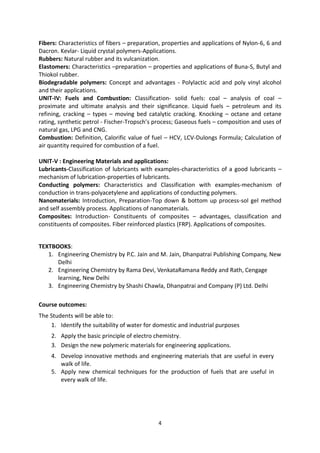
  • 171.
    17 Course Outcomes: The studentwill be able to: 1. Analyze algorithms and algorithm correctness. 2. Apply searching and sorting techniques. 3. Practice stack, queue and linked list operation. 4. Relate tree and graphs concepts. 5. Relates graphs concepts with traversals.
  • 172.
    18 J.B. INSTITUTE OFENGINEERING & TECHNOLOGY UGC AUTONOMOUS B.Tech L T-P-D C III Year I Semester 3 0-0-0 3 PYTHON PROGRAMMING (Open Elective-I) Course objectives: Student will: 1. Learn how to design and program Python applications. 2. Learn how to use lists, tuples, and dictionaries in Python programs. 3. Learn how to identify Python object types, Components ,decision statements, pass arguments in Python. 4. Learn how to build and package Python modules for reusability, design object oriented programs with Python classes,use class inheritance in Python for reusability. 5. Learn how to use exception handling in Python applications for errorhandling UNIT - I: Programming paradigms; Structured programming vs object oriented programming, OOPs fundamentals- class, object, abstraction, encapsulation, polymorphism, and inheritance; Introduction to Python Getting started to Python- an interpreted high level language, interactive mode and script mode. Variables, Expressions and Statements Values and types, Variables and keywords, statements, evaluating expressions, operators and operands, order of operations, composition. Functions function calls, type conversion, type coercion, pre- defined functions, composition, user define functions, flow of execution, passing parameters, function parameters and scope. Conditionals and recursion modulus operator, Boolean expression, logical operators, conditional execution, alternative execution, chained and nested conditionals, return statement; Recursion, infinite recursion. UNIT - II: Python data structures Strings Creating, initializing and accessing the elements; String operators, comparing strings using relational operators; String functions and methods. Lists: Concept of mutable lists, creating, initializing and accessing the elements, traversing, appending, updating and deleting elements; List operations; List functions and Methods, list parameters, nested lists, Matrices. Dictionaries Concept of key-value pair, creating, initializing and accessing the elements in a dictionary, dictionary operations traversing, appending, updating and deleting elements, Dictionary functions and methods. Tuples Mutability and tuples, Immutable concept, creating, initializing and accessing the elements in a tuple, Tuple functions.

  • 173.
    19 UNIT - III: Objectoriented programming using Python: creating python classes, classes and objects: user defined compound types, attributes, instances as arguments, instances as return values, objects are mutable, copying; classes and functions: pure function, modifiers; Exceptions: raising exceptions, handling exceptions, exception hierarchy. UNIT - IV: Classes and methods: object oriented features, optional arguments, initialization method, operator overloading and polymorphism. Inheritance: Basic Inheritance: extending built-ins, overriding and super; Multiple inheritance: the diamond problem, different sets of arguments. UNIT - V: Files handling and Exceptions: Text files, writing variables, Directories, Pickling; Database Programming in Python: Connection module, connect MySQL Data base, perform DDL, DML and DQL operations. Text Books: 1. Python 3 Object Oriented Programming, Dusty Phillips, Packet Publishing, 2010. 2. Programming in Python 3 - A complete Introduction to the Python Language- Second Edition, Mark Summerfiels, Addison-Wesley 2010. Reference Books: 1. Programming Python- 4th Edition, Mark Lutz, O’Reilly,2011. 2. Object-Oriented Programming in Python, Michael H, Goldwasser, David Letscher, Pearson Prentice Hall, 2008. Course outcomes: Students will abel to: 1. Describe to design and program Python applications. 2. Analyze and conversion of to use lists, tuples, and dictionaries in Python programs. 3. Explain the concept to identify Python object types, Components,decision statements, pass arguments in Python. 4. Apply decision for building and package Python modules for reusability, design object‐oriented programs with Python classes, use class inheritance in Python for reusability.
  • 174.
    20 J.B. INSTITUTE OFENGINEERING & TECHNOLOGY UGC AUTONOMOUS B.Tech. L T-P-D C III Year - I Semester 3 0-0-0 3 E-DISASTER MANAGEMENT (OPEN ELECTIVE-I) Course Objectives At the end of the course, students will : 1. Explain various disasters and their impacts. 2. Describe storage networking technologies such as FC-SAN, NAS, IP-SAN and data archival solution – CAS. 3. Identify different storage virtualization technologies and their benefits. 4. Understand and articulate business continuity solutions including,backup technologies, and local and remote replication. 5. Identify parameters of managing and monitoring storage infrastructure and describe common storage management activities and solutions. UNIT-I: Introduction to Disasters; Examples; Information Availability, Causes of Information Unavailability, Measuring Information Availability. Consequences of Downtime; Failure Analysis, Single Point of Failure, Fault Tolerance, Multi pathing Software. UNIT-II: Backup and Recovery: Backup Purpose, Backup Considerations, Backup Granularity, Recovery Considerations. Backup Methods, Backup Process Backup and Restore Operations, Backup Topologies, Backup in NAS Environments, Backup Technologies. UNIT-III: Local Replication: Source and Target, Uses of Local Replica, Data Consistency, Local Replication Technologies, Restore and Restart Considerations Creating Multiple Replicas, Management. Interface. Remote Replication: Modes of Remote Replication, Remote ReplicationTechnologies Network Infrastructure. UNIT-IV: Securing the Storage Infrastructure, Storage Security Framework, Risk Triad, Assets, Threats, Vulnerability. Storage Security Domains, Securing the Application Access Domain. Securing the Management Access Domain, Securing Backup, Recovery, and Archive (BURA), Security Implementations in Storage Networking SAN , NAS, IP SAN.
  • 175.
    21 UNIT-V: Monitoring the StorageInfrastructure: Parameters Monitored, Components Monitored, Monitoring Examples, Alerts, Storage Management Activities, Availability management, Capacity management, Performance management, Security Management. Reporting, Storage Management Examples, Storage Infrastructure Management Challenges, Developing an Ideal, Solution, Storage Management Initiative, Enterprise Management Platforms. TEXT BOOK: 1. Information Storage and Management: Storing, Managing, and Protecting Digital Information, Ganesh Rajaratnam, EMC Education Services. Wiley Publications. 2. Executive Guide to Preventing Information Technology Disasters By Richard Ennals. Springer. REFERENCE BOOKS: 1. Information Management & Computer Security, Port Elizabeth Technikon,Port Elizabeth, MCB UPLtd. 2. Information Security Management Systems, GodesbergerAllee,BSI. Course Outcomes At the end of the course , students will be able to: 1. Apply important storage technologies and their features suchas availability,replication, scalability andperformance. 2. Show employs project teams to install, administer and upgrade popularstorage solutions. 3. Illustrate virtual servers and storage between remotelocations. 4. Use the knowledge of Disaster ManagementPhases.
  • 176.
    22 J.B. INSTITUTE OFENGINEERING & TECHNOLOGY UGC AUTONOMOUS B.Tech. L T-P-D C III Year - I Semester 3 0-0-0 3 HUMAN COMPUTER INTERACTION (OPEN ELECTIVE-I) Course Objectives At the end of the course , students will : 1. Demonstrate an understanding of guidelines, principles, and theoriesinfluencing human computer interaction. 2. Recognize how a computer system may be modified to include human diversity. 3. Select an effective style for a specific application. 4. Design mock ups and carry out user and expert evaluation of interfaces UNIT I Introduction: Importance of user Interface – definition, importance of good design. Benefits of good design. A brief history of Screen design, The graphical user interface – popularity of graphics, the concept of direct manipulation, graphical system, Characteristics, Web user – Interface popularity, characteristics- Principles of user interface. UNIT II Design process – Human interaction with computers, importance of human characteristics human consideration, Human interaction speeds, understanding business junctions. UNIT III Screen Designing: - Design goals – Screen planning and purpose, organizing screen elements, ordering of screen data and content – screen navigation and flow – Visually pleasing composition – amount of information – focus and emphasis – presentation information simply and meaningfully – information retrieval on web – statistical graphics – Technological consideration in interface design. UNIT IV Windows – New and Navigation schemes selection of window, selection of devices based and screen based controls Components – text and messages, Icons and increases – Multimedia, colors, uses problems, choosing colors. UNIT V Software tools – Specification methods, interface – Building Tools. Interaction Devices – Keyboard and function keys – pointing devices – speech recognition digitization and generation – image and video displays – drivers. TEXT BOOK: 1. The essential guide to user interface design, Wilbert O Galitz, WileyDreamTech. 2. Designing the user interface. 3rd Edition Ben Shneidermann , PearsonEducationAsia
  • 177.
    23 REFERENCE BOOKS: 1. Human– Computer Interaction. Alan Dix, Janet Fincay, GreGoryd, Abowd, RussellBealg,PearsonEducation 2. Interaction Design Prece, Rogers, Sharps. WileyDreamtech. 3. User Interface Design, Soren Lauesen , PearsonEducation. 4. Human –Computer Interaction,D.R.Olsen,Cengage Learning. Course Outcomes At the end of the course , students will be able to: 1. Explain the human, Computer components functions regarding interactionwith computer 2. Demonstrate Understanding of Interaction between the human andcomputer Components. 3. Use Paradigms, HCI in the software process. 4. Implement Interaction design basics.
  • 178.
    24 J. B. INSTITUTEOF ENGINEERING & TECHNOLOGY UGC AUTONOMOUS B.Tech. L T-P-D C III Year - I Semester 3 0-0-0 3 INTRODUCTION TO MICROPROCESSORS AND MICROCONTROLLERS (OPEN ELECTIVE-I) Course Objectives: At the end of the course, students will learn: 1. Study the Architecture of 8085&8086 microprocessor 2. Learn the design aspects of I/O and Memory Interfacing circuits. 3. Study the Architecture of 8051 microcontroller 4. Make the interfacing in between microprocessor and various peripherals. 5. Know basic feature of 8051 and AVR controller. UNIT–I: 8086 Architecture:8086 Architecture Functional diagrams, Register organization, memory segmentation, programming model, memory addresses, physical memory organization, architecture of 8086,signal descriptions of 8086-common function signals, Timing diagrams, interrupts of 8086. UNIT–II: Instruction set and assembly language programming of 8086: Instruction formats, addressing modes, instruction set, assembler directives, macros, simple programs involving logical, branch and call instructions, sorting, evaluating arithmetic expressions, string manipulations. UNIT–III: I/O Interface: 8255 PPI, Various modes of operation and interfacing to 8086, interfacing keyboard, Display, D/A and A/D converter. Interfacing with advanced devices: memory interfacing to 8086, interrupt structure of 8086, vector interrupt table, interrupt service routine. Communication interface: serial communication standards, serial data transfer schemes, 8251 USART architecture and interfacing. UNIT–IV: Introduction to Microcontrollers: overview of 8051 microcontroller, architecture, I/O ports, memory organization, addressing modes and instruction set of 8051, simple programs. UNIT-V: 8051 Real Time control: programming time interrupts, programming external hardware interrupts, Programming the serial communication interrupts, programming 8051 Timers and counters.
  • 179.
    25 Text Books: 1. D.V.Hall,Microprocessors and interfacing,TMGH,2nd Edition 2006. 2. Kenneth.J.Ayala, The8051Microcontroler,3rdEd., C engage Learning. References: 1. Advanced Microprocessors and Peripherals-A. K. Rayand K.M Bhurchandi, TMH, 2nd Edition 2006. 2. The 8051Microcontrollers.Architecture and programming and applications-K.Uma Rao, Andhe Pallavi,Pearson, 2009. 3. Microcomputer system 8086/8088 family architecture. Programming and design- Du and GA Gibson, PHI 2nd Edition. Course Outcomes: At the end of the course, students will be able to: 1. Design and implement programs on 8085microprocessors. 2. Design and implement programs on 8086microprocessors. 3. Design interfacing circuits with 8086. 4. Design and implement 8051 microcontroller based systems 5. Understand the concepts related to I/O and memory interfacing
  • 180.
    26 J.B. INSTITUTE OFENGINEERING & TECHNOLOGY UGC AUTONOMOUS B.Tech. L T-P-D C III Year - I Semester 3 0-0-0 3 INTERNET OF THINGS (OPEN ELECTIVE – I) Course Objectives: At the end of the course, students will learn: 1. Explore the interconnection and integration of the physical world and the cyberspace. 2. Able to design and develop IOT Device. 3. Explore the terminology, technology and its applications 4. Understand the concept of M2M (machine to machine) with necessary protocols. 5. To introduce the Python Scripting Language which is used in many IoT devices UNIT–I: Introduction to Internet of Things –Definition and Characteristics of IoT, Physical Design of IoT – IoT Protocols, IoT communication models, IoT Communication APIs IoT enabaled Technologies – Wireless Sensor Networks, Cloud Computing, Big data analytics, Communication protocols, Embedded Systems, IoT Levels and Templates. UNIT–II: Domain Specific IoT – Home, City, Environment, Energy, Retail, Logistics, Agriculture, Industry, health and Lifestyle IoT and M2M –Difference between IoT and M2M, SDN, NFV, Difference between SDN and NFV. UNIT–III: Basics of IoT System Management with NETCOZF, YANG- NETCONF, YANG, SNMP NETOPEER. UNIT–IV: Network & Communication aspects Wireless medium access issues, MAC protocol survey, Survey routing protocols, Sensor deployment & Node discovery, Data aggregation & dissemination UNIT-V: Challenges in IoT Design challenges, Development challenges, Security challenges, other challenges Domain specific applications of IoT Home automation, Industry applications, Surveillance applications, Other IoT applications
  • 181.
    27 Text Books: 1. Internetof Things – A Hands-on Approach, Arshdeep Bahga and Vijay Madisetti, Universities Press, 2015, ISBN: 9788173719547 Course Outcomes: At the end of the course, students will be able to: 1. Understand the application areas of IOT 2. Realize the revolution of Internet in Mobile Devices, Cloud & Sensor Networks. 3. Building blocks of Internet of Things and characteristics. 4. Design and implementation/modification of methods involved in IoT. 5. Describe what IoT is and the skill sets needed to be a network analysis.
  • 182.
  • 183.
    29 J.B. INSTITUTE OFENGINEERING & TECHNOLOGY UGC AUTONOMOUS B.Tech. L T-P-D C III Year - II Semester 3 0-0-0 3 ESTIMATION, QUANTITY SURVEY & VALUATION (Open Elective-II) Course Objective The main objective of the course is to 1. Understand how to estimate the quantities of work, develop the bill of quantitiesand arrive at the Cost of civil engineering Project 2. Estimate the detailed quantities of various items of work and their rates in building projects. 3. Estimate the quantities of works and evaluate cost of project. 4. Understand and apply the concept of Valuation for Properties 5. Understand, Apply and Create the Tender and Contract document. UNIT - I: General items of work in Building – Standard Units Principles of working out quantities for detailed and abstract estimates – Approximate method of Estimating UNIT II: Detailed Estimates of Buildings - Reinforcement bar bending and bar requirement schedules UNIT - III: Earthwork for roads and canals. UNIT - IV: Rate Analysis – Working out data for various items of work over head and contingent charges. UNIT - V: Contracts – Types of contracts – Contract Documents – Conditions of contract, Valuation - Standard specifications for different items of building construction. Text Books: 1. Estimating and Costing by B.N. Dutta, UBS publishers, 2000. 2. Estimating and Costing by G.S. Birdie.
  • 184.
    30 J.B. INSTITUTE OFENGINEERING & TECHNOLOGY UGC AUTONOMOUS B.Tech. L T-P-D C III Year - II Semester 3 0-0-0 3 WASTE MANAGEMENT (Open Elective-II) Course Objectives: 1. To learn about Solid Waste management 2. To describe the collection, treatment and disposal methods of Solid waste UNIT - I: Introduction Definition of solid waste, garbage, rubbish-Sources and Types of solid wastes Municipal waste, industrial waste, plastic waste, electronic waste, bio-medical waste and hazardous waste - Characteristics of Solid Wastes: Physical, chemical and biological characteristics- Problems due to improper disposal of solid waste. UNIT II: Functional Elements of Solid Waste Management Waste generation and handling at source-onsite storage-Collection of solid wastes Collection methods and services-storage of solid waste- guidelines for collection route layout. UNIT - III: Transfer and Transport of Wastes Transfer station-types of vehicles used for transportation of solid Waste-Processing and segregation of the solid waste- various methods of material segregation. Processing and Transformation of Solid Wastes Recycling and recovery principles of waste management- Composting: definition methods of composting-advantages of composting- Incineration: definition methods of incineration advantages and disadvantages of incineration. UNIT - IV: Treatment and Disposal of Solid Waste Volume reduction, Open dumping, land filling techniques, Landfills: classification Design and Operation of landfills, Land Farming, Deep well injection. UNIT - V: Waste Minimization Introduction to waste minimization, waste minimization techniques-5R (refuse, reduce, reuse, recover, recycle), municipal waste minimization, industrial waste minimization. Text Books: 1. Solid and hazardous waste management by M.N.Rao and Razia sultana, BS publications 2. Environmental Engineering by Howard S.Peavy, Donald R.Rowe and George Tchobanognous
  • 185.
    31 Reference Books: 1. IntegratedSolid Waste Management by Tchobanognous. 2. Environmental engineering by Y.Anjaneyulu, B.S publication. 3. Environmental Pollution Control Engineering by C.S. Rao; Wiley Eastern Ltd.,New Delhi. 4. Environmental engineering by Gerad Kiley, Tata Mc Graw Hill Course Outcomes: Students will be able to 1. Identify the types and sources of solid waste, and its characteristics. 2. Employ the treatment and disposal methods of solid waste. 3. Apply the concepts of solid waste management.
  • 186.
    32 J.B. INSTITUTE OFENGINEERING & TECHNOLOGY UGC AUTONOMOUS B.Tech. L T-P-D C III Year – II Semester 3 0-0-0 3 NON-CONVENTIONAL ENERGY SOURCES AND APPLICATIONS (Open Elective - II) UNIT-I: Introduction: Limitations of conventional energy sources, need and growth of alternate energy sources, basic schemes and applications of direct energy conversion. MHD Generators: Basic principles and Hall Effect, generator and motor effect, different types of MHD generators, conversion effectiveness. Practical MHD generators, applications and economic aspects. UNIT-II: Solar Energy: Photovoltaic effect, characteristics of photovoltaic cells, conversion efficiency, solar batteries and applications. Solar energy in India, solar collectors, solar furnaces & applications. UNIT-III: Thermo-electric Generators: See back effect, peltier effect, Thomson effect, thermoelectric convertors, brief description of the construction of thermoelectric generators, applications and economic aspects. Fuel Cells: Principle of action, gibbs free energy, general description of fuel cells, types, construction, operational characteristics and applications. UNIT-IV: Miscellaneous Sources: Geothermal system, characteristics of geothermal resources, choice of generators, electric equipment and precautions. Low head hydro plants, definition of lowhead hydro power, choice of site and turbines. Tidal energy, idea of tidal energy, tidal electric generator, limitations. UNIT-V: 8051 Real Time control: Programming time interrupts, programming external hardware interrupts, and programming the serial communication interrupts, programming 8051 Timers and counters. Text Books: 1 D.S.Chauhan, „Non Conventional Energy Resources‟ New Age Publication 2. G.D. Rai, „Non-conventional energy sources‟, Khanna Publishers Reference Books: 1. B.H.Khan, „Non Conventional Energy Resources‟ TMH. 2. H.P.Garg and Jai Prakash, „Solar Energy Fundamentals and Applications‟, TMH
  • 187.
    33 J.B. INSTITUTE OFENGINEERING & TECHNOLOGY UGC AUTONOMOUS B.Tech. L T-P-D C III Year – II Semester 3 0-0-0 3 Electrical Technology (Open Elective - II) UNIT - I: D.C Generators and DC Motors: Principle of operation of DC Machines- EMF equation – Types of generators – Magnetization and load characteristics of DC generators, DC Motors – Types of DC Motors – Characteristics of DC motors – 3-point starters for DC shunt motor – Losses and efficiency – Swinburne‘s test – Speed control of DC shunt motor – Flux and Armature voltage control methods. UNIT - II: Transformers & Performance: Principle of operation of single phase transformer – types – Constructional features – Phasor diagram on No Load and Load – Equivalent circuit, Losses and Efficiency of transformer and Regulation – OC and SC tests – Predetermination of efficiency and regulation (Simple Problems). UNIT - III: Three Phase Induction Motor: Principle of operation of three-phase induction motors –Slip ring and Squirrel cage motors – Slip-Torque characteristics – Efficiency calculation – Starting methods. UNIT - IV: Alternators: Alternators – Constructional features – Principle of operation – Types - EMF Equation – Distribution and Coil span factors – Predetermination of regulation by Synchronous Impedance Method – OC and SC tests. UNIT - V: Special Motors & Electrical Instruments: Principle of operation - Shaded pole motors – Capacitor motors, AC servomotor, AC tachometers, Synchros, Stepper Motors – Characteristics, Basic Principles of indicating instruments – Moving Coil and Moving iron Instruments (Ammeters and Voltmeters). Text Books: 1. Introduction to Electrical Engineering – M.S Naidu and S. Kamakshaiah, TMH Publ. 2. Basic Electrical Engineering - T.K. Nagasarkar and M. S. Sukhija, Oxford University Press,2005 Reference Books: 1. Principles of Electrical Engineering - V.K Mehta, S. Chand Publications. 2. Theory and Problems of basic electrical engineering - I.J. Nagarath and D.P Kothari, PHI Publications 3. Essentials of Electrical and Computer Engineering - David V. Kerns, JR. J. David Irwin
  • 188.
    34 J.B. INSTITUTE OFENGINEERING & TECHNOLOGY UGC AUTONOMOUS B.Tech. L T-P-D C III Year - II Semester 3 0-0-0 3 OPERATIONS RESEARCH (Open Elective-II) UNIT I: Introduction - Development – Definition– Characteristics and Phases – Types of models – Operations Research models – applications. ALLOCATION: Linear Programming Problem - Formulation – Graphical solution – Simplex method – Artificial variables techniques: Two–phase method, Big-M method; Duality Principle. UNIT II: TRANSPORTATION PROBLEM – Formulation – Optimal solution, unbalanced transportation problem – Degeneracy. Assignment problem – Formulation – Optimal solution - Variants of Assignment Problem; Traveling Salesman problem. UNIT III: SEQUENCING – Introduction – Flow –Shop sequencing – n jobs through two machines – n jobs through three machines – Job shop sequencing – two jobs through ‘m’ machines REPLACEMENT: Introduction – Replacement of items that deteriorate with time – when money value is not counted and counted – Replacement of items that fail completely- Group Replacement. UNIT IV: THEORY OF GAMES: Introduction –Terminology– Solution of games with saddle points and without saddle points- 2 x 2 games –m x 2 & 2 x n games - graphical method – m x n games - dominance principle. INVENTORY: Introduction – Single item, Deterministic models – Types - Purchase inventory models with one price break and multiple price breaks – inventory models with and without shortage cost. Stochastic models – demand discrete variable or continuous variable – Single Period model with no setup cost. UNIT V: WAITING LINES: Introduction – Terminology-Single Channel – Poisson arrivals and Exponential Service times – with infinite population and finite population models– Multichannel – Poisson arrivals and exponential service times with infinite population. DYNAMIC PROGRAMMING: Introduction – Terminology- Bellman’s Principle of Optimality – Applications of dynamic programming- shortest path problem – linear programming problem. SIMULATION:- Definition – types of simulation models- applications ,advantages and disadvantage. Brief introduction of simulation languages – inventory and queuing problems using random numbers
  • 189.
    35 TEXT BOOKS : 1.Operation Research /J.K.Sharma/MacMilan. 2. Operations Research / ACS Kumar/ Yesdee REFERENCES: 1. Operations Research: Methods and Problems / Maurice Saseini, Arhur Yaspan and Lawrence Friedman 2. Operations Research /A.M.Natarajan, P. Balasubramaniam, A. Tamilarasi/Pearson Education 3. Operations Research / Wagner/ PHI Publications. 4. Introduction to O.R/Hillier & Libermann (TMH).
  • 190.
    36 J.B. INSTITUTE OFENGINEERING & TECHNOLOGY UGC AUTONOMOUS B.Tech. L T-P-D C III Year - II Semester 3 0-0-0 3 NANOTECHNOLOGY ( Open Elective –II) UNIT I: Introduction to nanotechnology: Importance of nano scale, Nanostructure types, electronic, magnetic, optical Properties of Nano materials, top-down and bottom- up approach to nanostructures. Quantum Mechanical phenomenon in nanostructures: Quantum confinement of electrons in semiconductor Nano structures, one dimensional confinement (Quantum wires), two dimensional confinements (Quantum Wells), three dimensional confinements (Quantum dots). UNIT II: Carbon Nano Structures: Carbon nano tubes (CNTs), Fullerenes, C60, C80 and C240 Nanostructures, Properties (mechanical, optical and electrical) and applications. Fabrication of Nano materials: Physical Methods: Inert gas condensation, Arc discharge, RF plasma, Plasma arc technique, Ion sputtering, Laser ablation, Laser pyrolysis, Molecular beam epitaxy, Chemical vapour deposition method. UNIT III: Nano scale characterization techniques: Scanning probe techniques (AFM, MFM, STM, SEM, TEM), XRD Nano devices and Nano medicine: Lab on chip for bioanalysis, Core/shell Nanoparticles in drug delivery systems (site specific and targeted drug delivery), cancer treatment, and bone tissue treatment. UNIT IV: Nano and molecular electronics: Resonant-Tunneling structures, single electron tunneling, Single Electron transistors, coulomb blockade, giant magneto resistance, tunneling magneto resistance. UNIT V: Nanolithography and Nano manipulation: e-beam lithography and SEM based nanolithography and nano manipulation, Ion beam lithography, oxidation and metallization. Mask and its application. Deep UV lithography, X-ray basedlithography. TEXT BOOKS : 1. Introduction to Nanotechnology: Charles.P.Pode, Springer Publications, 2008. 2. Springer Handbook of Nanotechnology: Bharat Bhusan, Springer Publications, 2010. REFERENCES: 1. Principles of Nanotechnology: Phani Kumar, Scitech Publications. 2. Transport in Nano structures: David Ferry, Cambridge University Press 2000 3. Nano-biotechnology; C.M. Niemeyer, C.A. Mirkin, Wiley Publications, 2006.
  • 191.
    37 J.B. INSTITUTE OFENGINEERING & TECHNOLOGY UGC AUTONOMOUS B.Tech L T-P-D C III Year II Semester 3 0-0-0 3 APPLICATIONS OF MICROPROCESSORS AND CONTROLLERS (Open elective-II) Course Objectives: The Student will 1. understand the control systems and types of control systems 2. understand the basic 16-bit microprocessor architecture and its functionalities and develop microprocessor basic programs for various applications. 3. develop the microcontroller based programs for various applications. 4. understand basic feature of 8051 controller. 5. understand the basics of PLC and SCADA and their functionalities. Unit I: Introduction: Control Systems Components Role of control system in instrumentation, Open and close loop control system, types and Block diagram, Servomechanism and regulators with suitable examples, Basic control actions - On-off, Proportional, Derivative, Integral control, Proportional derivative (PD). Proportional integral (PI), P Proportional integral and Derivative (PID) control, Basic control system components –AC/ DC Servo motor, AC/ DC Tacho generator, Stepper motor and Synchronous motor. Unit II: Basics of Microprocessor Introduction to microprocessor, Advantages and disadvantages of microprocessor control, Structure of microprocessor, Generalized architecture of microprocessor, Functions of each block, Functional block diagram of 8085 microprocessors with pin diagram, logical block diagram of 8085 Microprocessor-Registers. ALU, memory organization, decoder, serial control section, interrupt section, timing and control section, Assembly language Programming of 8085, Addressing Modes, Instruction classification, Instruction formats, Basic Assembly Language programming (only simple arithmetic operations-addition, subtraction). Unit III: Basics of Microcontroller 8051 Micro controllers and microprocessors, Pin diagram of 8051 microcontrollers, Internal RAM, ROM and Special function registers in 8051chip, I/O ports. Counters and Timers, interfacing with external memory I/O ports, Counters and Timers, Interfacing with external memory. Unit IV: Microprocessor and Microcontroller Applications Different types of memories: ROM, RAM, PROM, EPROM, EEPROM, Schematic diagram of memory chips decoder, memory interfacing., Memory I/O data transfer scheme for 8255. Interfacing of switches and LEDs, Simple application ns of microprocessor and Microcontroller for temperature control of furnace, Traffic light control and SCR firing angle control using microprocessor, Data acquisition system.
  • 192.
    38 Unit V: ProgrammableLogic Controller and SCADA PLC: CPU, I/O modules, bus system, power supplies and remote I/Os, counter, timer, Different PLC's available in market, Selection of a PLC, SCADA- Concept and Application. TEXT BOOKS: 1. Control Systems Engineering, Nagarath I. J., Gopal M., New Age Publishers, New Delhi. 2. Microprocessor Architecture, Programming and Applications with 8085, Gaonkar, Ramesh S., Penram International Publishing (India) Pvt. Ltd. 3. The 8051 Microcontroller Architecture, Programming and Applications, Ayala, Kenneth J., Penram International Publishing (I) Pvt. Ltd. 4. Programmable Logic Controllers And Applications, Webb, John W Ronald Reis. A., Prentice Hall of India, New Delhi. REFERENCE BOOKS: 1. Fundamentals of Microprocessors and Microcontrollers, Ram, B., Dhanpat Rai Publications, New Delhi. 2. Microprocessors and Interfacing Programming and Hardware, Hall, Douglass V., TMH publication, New Delhi. 3. The 8051 Microcontroller and Embedded Systems using Assembly and C, Ali, Muhamad Mazidi, Janice Mazidi Gillispie, Roli, PHI Learning, New Delhi. Course Outcomes: The Student will be able to 1. design the different types of control systems and to full fill the desired specifications. 2. analyze 8085 microprocessors architectures and its functionalities and real time applications using programming languages like Assembly Language and MASM. 3. explain the basics of 8051 microcontroller’s architecture and its functionalities. 4. design microcontroller based projects for real time applications. 5. analyze PLC and SCADA and their functionalities.
  • 193.
    39 J.B. INSTITUTE OFENGINEERING & TECHNOLOGY UGC AUTONOMOUS B.Tech L T-P-D C III Year II Semester 3 0-0-0 3 FUNDAMENTALS OF HDL (Open Elective-II) Course Objectives: Students will 1. learn the fundamental of HDL language. 2. get the Knowledge about different levels of abstract. 3. construct Procedures, Tasks, and Functions using language. 4. write the programs in Mixed –Language Descriptions 5. define Synthesis and mapping of digital design Unit I: Introduction: Why HDL?, A Brief History of HDL, Structure of HDL Module, Operators, Data types, Types of Descriptions, simulation and synthesis, Brief comparison of VHDL and Verilog. Data –Flow Descriptions: Highlights of Data-Flow Descriptions, Structure of Data-Flow Description, Data Type – Vectors. Unit II: Behavioral Descriptions Behavioral Description highlights, structure of HDL behavioral Description, The VHDL variable –Assignment Statement, sequential statements. Structural Descriptions: Highlights of structural Description, Organization of the structural Descriptions, Binding, state Machines, Generate, Generic, and Parameter statements. Unit III: Procedures, Tasks, and Functions Highlights of Procedures, tasks, and Functions, Procedures and tasks, Functions. Advanced HDL Descriptions: File Processing, Examples of File Processing. Mixed –Type Descriptions: Why Mixed-Type Description? VHDL User-Defined Types, VHDL Packages, Mixed-Type Description examples. Unit IV: Mixed –Language Descriptions Highlights of Mixed-Language Description, How to invoke One language from the Other. Mixed-language Description Examples, Limitations of Mixed-Language Description. Unit V: Synthesis Basics Highlights of Synthesis, Synthesis information from Entity and Module. Mapping Process and Always in the Hardware Domain. TEXT BOOKS: 1. HDL Programming (VHDL and Verilog)- Nazeih M.Botros- John Weily India Pvt. Ltd. 2008. REFERENCE BOOKS: 1. Fundamentals of HDL – Cyril P.R. Pearson/Sanguin 2010. 2. VHDL -Douglas perry-Tata McGraw-Hill.
  • 194.
    40 3. A VerilogHDL Primer- J.Bhaskar – BS Publications. 4. Circuit Design with VHDL-Volnei A.Pedroni-PHI. Course Outcomes: Students will be able to 1. understand the fundamental of HDL language. 2. analyze different levels of abstract. 3. create Procedures, Tasks, and Functions. 4. implement tasks in Mixed –Language Descriptions. 5. evaluate Synthesis and mapping of digital design.
  • 195.
    41 J.B. INSTITUTE OFENGINEERING & TECHNOLOGY UGC AUTONOMOUS B.Tech L T-P-D C III Year II Semester 3 0-0-0 3 DATABASE MANAGEMENT SYSTEMS (Open Elective-II) Course Objectives: The Student will: 1. Understanding of the architecture and functioning of database managementsystems as well as associated tools and techniques. 2. Understand and apply the principles of data modeling using entity relationshipand develop a good database design. 3. Understand the use of structured query language (SQL) and its syntax. 4. Apply normalization techniques to normalize a database. 5. Understand the need of database processing and learn techniques for controllingthe consequences of concurrent data access. UNIT - I: Data base System Applications, data base System VS file System – View of Data – Data Abstraction –Instances and Schemas – data Models – the ER Model – Relational Model – Other Models – Database Languages – DDL – DML – database Access for applications Programs – data base Users and Administrator – Transaction Management – data base System Structure – Storage Manager – the Query Processor ER diagrams – Beyond ER Design Entities, Attributes and Entity sets – Relationships and Relationship sets – Additional features of ER Model – Concept Design with the ER Model UNIT - II: Introduction to the Relational Model -Integrity Constraint Over relations – Enforcing Integrity constraints – Querying relational data – Logical data base Design – Introduction to Views – Destroying /altering Tables and Views. Relational Algebra -Selection and projection set operations – renaming – Joins – Division – Examples of Algebra overviews – Relational calculus – Tuple relational Calculus – Domain relational calculus – Expressive Power of Algebra and calculus. UNIT - III: Form of Basic SQL Query -Examples of Basic SQL Queries – Introduction to Nested Queries – Correlated Nested Queries Set – Comparison Operators – Aggregative Operators – NULL values – Comparison using Null values – Logical connectivity‟s – AND, OR and NOT – Impact on SQL Constructs – Outer Joins – Disallowing NULL values – Complex Integrity Constraints in SQL Triggers and Active Data bases. Schema refinement -Problems Caused by redundancy – Decompositions – Problem related to decomposition – reasoning about FDS – FIRST, SECOND, THIRD Normal forms – BCNF – Lossless join Decomposition – Dependency preserving Decomposition – Schema refinement in Data base Design – Multi valued Dependencies – FORTH Normal Form.
  • 196.
    42 UNIT - IV: TransactionConcept -Transaction State- Implementation of Atomicity and Durability – Concurrent – Executions – Serializability- Recoverability– Implementation of Isolation – Testing for serializability- Lock – Based Protocols – Timestamp Based Protocols- Validation- Based Protocols – Multiple Granularity. Recovery and Atomicity -Log – Based Recovery – Recovery with Concurrent Transactions – Buffer Management – Failure with loss of nonvolatile storage-Advance Recovery systems- Remote Backup systems. UNIT - V: Data on External Storage -File Organization and Indexing – Cluster Indexes, Primary and Secondary Indexes – Index data Structures – Hash Based Indexing – Tree base Indexing – Comparison of File Organizations – Indexes and Performance Tuning- Intuitions for tree Indexes – Indexed Sequential Access Methods (ISAM) – B+ Trees: A Dynamic Index Structure. Advanced Database Management System Introduction to Distributed Database-Reference Architecture, fragmentation, Allocation, Joins Text Books: 1. Data Base Management Systems, Raghurama Krishnan, Johannes Gehrke, TATA McGrawHill 3rd Edition 2. Data base System Concepts, Silberschatz, Korth, McGraw hill, V edition. Reference Books: 1. Data base Systems design, Implementation, and Management, Peter Rob & Carlos Coronel 7th Edition. 2. Fundamentals of Database Systems, Elmasri Navrate Pearson Education 3. Introduction to Database Systems, C.J.Date Pearson Education Course Outcomes: The student will be able to: 1. Describe basic concepts of database system. 2. Design a data model and schemas in RDBMS. 3. Use RDBMS for developing industry applications. 4. Be competent in use of structured query language sql. 5. Analyze functional dependencies for designing a robust database
  • 197.
    43 J.B. INSTITUTE OFENGINEERING & TECHNOLOGY UGC AUTONOMOUS B.Tech L T-P-D C III Year II Semester 3 0-0-0 3 CLOUD COMPUTING (Open Elective-II) Course Objectives: Student will: 1. Learn about the cloud environment, services and hadoop 2. Classify cloud platforms and virtualization concepts 3. Identify cloud computing applications and enterprise cloud computing paradigms 4. Demonistrate cloud application development using python 5. Explain security concepts in the cloud UNIT-I: Principles of Parallel and Distributed Computing, Introduction to cloud computing, Cloud computing Architecture, cloud concepts and technologies, cloud services and platforms, Cloud models, cloud as a service, cloud solutions, cloud offerings, introduction to Hadoop and Mapreduce. UNIT-II: Cloud Platforms for Industry, Healthcare and education, Cloud Platforms in the Industry, cloud applications. Virtualization, cloud virtualization technology, deep dive: cloud virtualization, Migrating in to cloud computing, Virtual Machines Provisioning and Virtual Machine Migration Services, On the Management of Virtual Machines for cloud Infrastructure, Comet cloud, T-Systems UNIT-III: Cloud computing Applications: Industry, Health, Education, Scientific Applications, Business and Consumer Applications, Understanding Scientific Applications for Cloud Environments, Impact of Cloud computing on the role of corporate IT. Enterprise cloud computing Paradigm, Federated cloud computing Architecture, SLA Management in Cloud Computing, Developing the cloud: cloud application Design. UNIT-IV: Python Basics, Python for cloud, cloud application development in python, Cloud Application Development in Python. Programming Google App Engine with Python: A first real cloud Application, Managing Data in the cloud, Google app engine Services for Login Authentication, Optimizing UI and Logic, Making the UI Pretty: Templates and CSS, Getting Interactive. Map Reduce Programming Model and Implementations.
  • 198.
    44 UNIT-V: Cloud management, OrganizationalReadiness and change management in the cloud age , Cloud Security, Data security in the cloud, Legal Issues in the Cloud , Achieving Production Readiness for the cloud Services TEXT BOOKS: 1. Cloud Computing: Raj Kumar Buyya , James Broberg, andrzej Goscinski, 2013 Wiley 2. Mastering Cloud Computing: Raj Kumar buyya, Christian Vecchiola,selvi-2013. REFERENCE BOOKS: 1. Cloud Computing: Arshdeep Bahga, Vijay Madisetti, 2014, University Press. 2. Cloud computing: Dr Kumar Saurab Wiley India 2011. 3. Code in the Cloud: Mark C.Chu-Carroll 2011, SPD.( Second part of IV UNIT) Course Outcomes: Student will able to: 1. Understand about the cloud environment, services and hadoop 2. Differentiate cloud platforms and virtualization concepts 3. Describe cloud computing applications and enterprise cloud computing paradigms 4. Implement cloud application development using python 5. Apply security concepts in the cloud
  • 199.
    45 J.B. INSTITUTE OFENGINEERING & TECHNOLOGY UGC AUTONOMOUS B.Tech. L T-P-D C III Year - II Semester 3 0-0-0 3 E-WASTE MANAGEMENT (OPEN ELECTIVE-II) Course Objectives At the end of the course , students will : 1. Know regarding E-Waste Management in India Global E-Waste Growth 2. Analyze the overview of WEEE. 3. Understanding scenarios for E-Waste management. 4. Visualize the basic concepts of E-Waste Regulation 5. Understand the basic concepts of Recycling technologies. UNIT – I: Introduction to e-Waste Management in India Global e-waste growth, Dark shadows of digitization on Indian horizon, e-waste generation, migration, Present practice and systems, disposal methods, Present processing practices, Initiatives to manage e-waste, Strengths and weaknesses of the current system. UNIT – II: WEEE (waste electrical and electronic equipment) - toxicity and healthHazardous substances in waste electrical and electronic equipment-toxicity and release, Occupational and environmental health perspectives of e-waste recycling. UNIT – III: Options and Scenarios for e-Waste Management Actions to be considered to achieve goals of e- waste management, Collection/ take back system, Closing the Plastic loop: Turning the supplychain into a supply cycle by mining plastics from end-of-life electronics and other durable goods. UNIT – IV: E-waste regulation: E-waste legislation in the European Union and the Basel Convention. Regulating e-waste: a review of the international and national legal framework on e- waste Extended producer responsibility: a key tool for international rules and regulations on e-waste UNIT – V: Recycling technologies for e-waste Recycling of e-scrap in a global environment opportunities and challenges. Technologies for recovery of resources from e-waste. Reuse:A Bridge from Unsustainable e-waste to sustainable e-resources. TEXT BOOKS: 1.Rakesh Johri, E-waste: Implications, regulations, and management inIndia andcurrent global best practices. 2.Klaus Hieronymi, RamzyKahhat, Eric Williams, E-Waste Management: from Waste toResource
  • 200.
    46 REFERENCE BOOKS: 1. SatishSinha, PritiMahesh,Waste Electrical and Electronic Equipment The EU andIndia. 2. By Ronald E. Hester, Roy M. Harrison , Electronic WasteManagement. Course Outcomes At the end of the course , students will be able to: 1. Demonstrate knowledge of E-Waste management. 2. Implementing environmental health perspectives of E-Waste recycling. 3. Achieve goals of E-Waste management. 4. Develop the skills in E-Waste extended producer responsibility. 5. Describe the technologies for recovery of resources from E-Waste.
  • 201.
    47 J.B. INSTITUTE OFENGINEERING & TECHNOLOGY UGC AUTONOMOUS B.Tech. L T-P-D C III Year - II Semester 3 0-0-0 3 INTRODUCTION TO WEB DESIGN (OPEN ELECTIVE-II) Course Objectives At the end of the course , students will : 1. Know regarding internet related technologies. 2. Understanding of the current industry support for web technologies. 3. Explain the basic concepts of CSS. 4. Visualize the basic concepts of PHP. 5. Understanding PHP functions and Methods UNIT-I Basics in Web Design: Brief History of Internet, What is World Wide Web, Why create a web site, Web Standards, Audience requirement. Web Design Principles: Basic principles involved in developing a web site, Planning process , Five Golden rules of web designing, Designing navigation bar ,Page design, Home Page Layout, Design Concept. UNIT-II Introduction to HTML :What is HTML, HTML Documents, Basic structure of an HTML document, Creating an HTML document, Mark up Tags, Heading-Paragraphs, Line Breaks, HTML Tags, HTML Tables, HTML Forms. Elements of HTML: Introduction to elements of HTML, Working with Text Working with Lists, Tables and Frames, Working with Hyperlinks, Images and Multimedia, Working with Forms and controls. UNIT-III Introduction to Cascading Style Sheets: Concept of CSS, Creating Style Sheet and types of CSS, CSS Properties, CSS Styling(Background, Text Format, Controlling Fonts), Working with block elements and objects, Working with Lists and Tables, CSS Id and Class, Box Model(Introduction, Border properties, Padding Properties, Margin properties). CSS Advanced (Grouping, Dimension, Display, Positioning, Floating, Align, Pseudo class, Navigation Bar, Image Sprites, Attribute sector), CSS Colors, Creating page Layout and Site Designs. UNIT-IV Introduction to PHP: Downloading, installing, configuring PHP, The anatomy of a PHP Page. Basic Security Guidelines, Variables, Data Types, Operators and Expressions, Constants, Flow Control Functions; Switching Flow, Loops. Code Blocks and Browser Output, Objects, Strings Processing, Form processing, Connecting to database, using cookies, dynamic contents. UNIT-V Introduction to Web Publishing or Hosting :Creating the Web Site, Saving the site, Working on the web site, Creating web site structure, Creating Titles for web pages, Themes- Publishing web sites.
  • 202.
    48 TEXT BOOK: 1. Dieteland Dietel : ―Internet and World Wide Web - How to Program‖, 5th Edition, PHI/Pearson Education,2011 2. Web Technologies: HTML,CSS, XML,Php BlackBook. REFERENCE BOOKS: 1. Chris Bates, ―Web Programming, building internet applications‖,2ndEdition, WILEY, Dreamtech,2008. 2. HTML 5 in simple steps Kogent Learning Solutions Inc, DreamtechPress 3. Beginning CSS: Cascading Style Sheets for Web Design Ian Pouncey, ichardYork Wiley India. Course Outcomes: At the end of the course , students will be able to: 1. Develop the application of the HTML for documentstructure. 2. Develop the skills in analyzing the usable of awebsite. 3. Create dynamic webpage, usingPHP. 4. Using PHP to manipulateFiles. 5. Develop the concept of webpublishing
  • 203.
    49 J. B. INSTITUTEOF ENGINEERING & TECHNOLOGY UGC AUTONOMOUS B.Tech. L T-P-D C III Year - II Semester 3 0-0-0 3 INTRODUCTION TO EMBEDDED SYSTEMS (OPEN ELECTIVE-II) Course Objectives: At the end of the course, students will learn: 1. Understand the basic concepts of embedded systems and 8051 microcontrollers. 2. Compare and contrast the basics of assembly programming language. 3. Identify the unique characteristics of real-time systems 4. Analyze the general structure of a real-time system and define the unique design problems and challenges of real-time systems. 5. Acquaint the embedded software development tools and various advanced architectures. UNIT–I: Embedded Computing: Introduction, complex systems and microprocessor, the embedded system design process, formalisms for system design, design examples. UNIT–II: The 8051 Architecture: Introduction, 8051 micro controller hardware, input/output ports and circuits, external memory, counter and timers, serial data input/output, interrupts. Basic Assembly Language Programming Concepts: The assembly language programming process, programming tools and techniques, programming the 8051. Data transfer and logical instructions, arithmetic operations, decimal arithmetic, jump and call instructions. UNIT–III: Introduction to Real-Time Operating Systems: Tasks and task states, tasks and data, semaphores, and shared data; message queues, mailboxes and pipes, timer functions, events, memory management, interrupt routines in an RTOS environment. Basic Design Using a Real-Time Operating System: Principles, semaphores and queues, hard real-time scheduling considerations, saving memory and power, an example RTOS like uC-OS (open source). UNIT–IV: Embedded Software Development Tools: Host and target machines, linker/locators for embedded software, getting embedded software into the target system Debugging Techniques: Testing on host machine, using laboratory tools, an example system.
  • 204.
    50 UNIT-V: Introduction to advancedArchitectures: ARM and SHARC, processor and memory organization and instruction level parallelism; networked embedded systems: bus protocols, I2C bus and CAN bus; internet-enabled systems, design example-elevator controller. Text Books: 1. Wayne Wolf (2008), Computers as Components-principles of embedded computer system design, Elseveir, New Delhi, India. 2. Kenneth J. Ayala (2008), The 8051 Microcontroller, 3rd edition, Cengage Learning, India. References: 1. David E. Simon (1999), An Embedded Software Primer, Pearson Education, India. 2. Jean J. Labrosse (2000), Embedding System Building Blocks, 2nd edition, CMP publishers, USA. 3. Raj Kamal (2004), Embedded Systems, Tata McGraw hill, India. Course Outcomes: At the end of the course, students will be able to: 1. Program an embedded system 2. Analyze Interfacing with keyboard, A/D & D/A conversions, serial data Communication, LCD and LED display. 3. Illustrate Tasks, Semaphores, Message queues, pipes, Timer functions. 4. Design embedded systems and real-time systems 5. Compare and contrast ARM, SHARC, internet enabled systems.
  • 205.
    51 J. B. INSTITUTEOF ENGINEERING & TECHNOLOGY UGC AUTONOMOUS B.Tech. L T-P-D C III Year - II Semester 3 0-0-0 3 FUNDAMENTALS OF E-COMMERCE (OPEN ELECTIVE-II) Course Objectives: At the end of the course, students will learn: 1. Identify the major categories and trends of e-commerce applications. 2. Identify the essential processes of an e-commerce system. 3. Identify several factors and web store requirements needed to succeed in e- commerce. 4. Discuss the benefits and trade-offs of various e-commerce clicks and bricks alternatives. 5. Understand the main technologies behind e-commerce systems and how these technologies interact. UNIT–I: Introduction: Electronic Commerce Framework, The Anatomy of E-Commerce applications, E-Commerce Consumer applications, E-Commerce organization applications. UNIT–II: Consumer Oriented Applications: Mercantile process models, mercantile models from the consumer’s perspective, Mercantile from the merchant’s perspective. Types of Electronic Payment Systems, Digital Token-Based Electronic Payment Systems, Smart Cards & Electronic Payment Systems, Credit Card- Based Electronic Payment Systems, Risk & Electronic Payment Systems, Designing Electronic Payment Systems. UNIT–III: Electronic Data Interchange: EDI Applications in Business, EDI implementation, MIME, and value added networks. Intra organizational E-Commerce, Macro forces and Internal Commerce, Work flow automation and Coordination, Customization and Internal Commerce, Supply Chain Management(SCM). UNIT–IV: Making a business case for a Document Library, Digital document types, Corporate Data warehouses, Advertising and Marketing, the new age of Information Based Marketing, advertising on Internet, charting the Online marketing process, Market Research. UNIT-V: Consumer Search and Resource Discovery, information search and Retrieval, Electronic commerce catalogs or directories, Information Filtering.
  • 206.
    52 Multimedia and Digitalvideo, Key Multimedia concepts, Digital Video & Electronic Commerce, Desktop Video Processing, Desktop Video Conferencing. Text Books: 1. “Frontiers of electronic commerce” – Kalakota, Whinston,Pearson 2. “E-Commerce”, S.Jaiswal – Galgotia References 1. Ravi Kalakota, Andrew Winston, “Frontiers of Electronic Commerce”,Addison- Wesley. 2. Goel, Ritendra “E-commerce”, New Age International Laudon, “E-Commerce: Business, Technology, Society”, Pearson Education Course Outcomes: At the end of the course, students will be able to: 1. Identify the business relationships between the organizations and their customers 2. Perform various transactions like payment, data transfer and etc. 3. Examine some typical distributed applications. 4. Detail some of the problems that are encountered when developing distributed applications. 5. Analyze the technologies that are used to support distributed applications.
  • 207.
  • 208.
    54 J.B. INSTITUTE OFENGINEERING & TECHNOLOGY UGC AUTONOMOUS B.Tech. L T-P-D C IV Year - II Semester 3 0-0-0 3 ENVIRONMENTAL IMPACT ASSESSMENT (Open Elective-III) Course Objectives: The Course objectives of this course are 1. To impart knowledge on Environmental management and environmental impact assessment. 2. To provide a basic understanding of the EIA process as it is used for research, planning, project or program evaluation, monitoring and regulatoryenforcement. 3. To outline the impacts on soil, wetlands, flora, fauna, historical structures andthe other socioeconomic environment. 4. To introduce students to the legal, economic, social, administrative andtechnical process preparing and evaluating environmental impact documents. 5. To assess the air and water quality parameters; predict the impacts andtheir mitigation measures. UNIT - I: Basics concepts of EIA: Initial environmental examination, elements of EIA, factors affecting EIA, impact evaluation and analysis, preparation of environmental base map, classification of environmental parameters. EIA Methodologies: Introduction, Criteria for the selection of EIA methodology, EIA methods, Ad-hoc methods, matrix methods, network method, Environmental Media Quality Index Method (EMQI), Environmental media quality index method, overlay methods, cost/benefit analysis. UNIT - II: Impact of developmental activities and land use: Introduction and methodology for the assessment of soil and groundwater, delineation of study area, identification of of activities. Assessment of impact of developmental activities on vegetation and wildlife, environmental impact of deforestation- causes and effects of deforestation. UNIT - III: Procurement of relevant soil quality, impact prediction, assessment of impact significance, identification and incorporation of mitigation measures. EIA of surface water, air and biological environment: Methodology for the assessment of impacts on surface water environment, air pollution sources, generalized approach for assessment of air pollution impact. UNIT - IV: Environmental audit and environmental legislation, objectives of environmental audit, types of environmental audit, audit protocel, stages of environmental audit onsite activities, evaluation of audit data and preparation of audit report, post audit activities.
  • 209.
    55 UNIT - V: Environmentalprotection Act, The water Act, The air Act (prevention and control of pollution Act), motor act, wild life act. Case studies of preparation of EIAs for various industries. Text Books: 1. Environmental impact assessment methodologies, by Y.Anjaneyulu,B.S.Publication, Sultan bazaar Hyderabad. 2. Environmental impact assessment, by Alan Gilpin, Cambridge University Press Reference Books: 1. Environmental pollution Control by Dr. H S Bhatia – Galgotia Publications Pvt Ltd, Delhi. 2. Environmental Impact Assessment and Management Publisher, DayaAuthor: B Hoisetti, A Kumar Course Outcomes: The Students will be able to 1. Explain different methodologies for environmental impact prediction andassessment. 2. Understand the elements of environmental impact assessments and processesby which they apply. 3. Carry out scoping and screening of developmental projects for environmentaland social assessments. 4. Evaluate EIA reports. 5. Plan EIAs and environmental management plans
  • 210.
    56 J.B. INSTITUTE OFENGINEERING & TECHNOLOGY UGC AUTONOMOUS B.Tech. L T-P-D C IV Year - II Semester 3 0-0-0 3 GREEN BUILDING TECHNOLOGY (Open Elective-III) COURSE OBJECTIVES: The objective of this course is to 1. Create awareness about the principles of green building technology and to have insight about the criteria for rating systems along with the established Indiancodes and guidelines. 2. Establish a clear understanding of various renewable and non-renewable sourcesof energy along with their carbon foot prints and enumerates the process of performance testing including building modeling and energy analysis. 3. Discuss about the energy efficient green building materials and to have understanding on the cost-effective Building Technologies, Strategies forGreen Building Systems and Energy Conservation Measures. 4. Give details on the principles of sustainable development in green building design. 5. Describe the best green building practices adopted along with cost/benefit and life- cycle analysis of green buildings. UNIT-I Concept of Green Buildings: Green building - Definition, Features, Necessity, Initiatives, Green buildings in India, Green building Assessment – Green Building Rating Systems (BREEAM, USGBC, LEED, IGBC, TERI-GRIHA, GREEN STAR), Criteria for rating, Energy efficient criteria, environmental benefits economic benefits, health and social benefits, Major energy efficiency areas for building, Contribution of buildings towards Global Warming. Life cycle cost of buildings, Codes and Certification Programs. UNIT-II Sources of Energy: Renewable and Non-renewable sources of energy - Coal, Petroleum, Nuclear, Wind, Solar, Hydro, Geothermal sources, potential of these sources, hazards, pollution with reference to Global scenario, demand and supply in India, Global efforts to reduce carbon emissions, Performance testing. Building modeling- Energy analysis, Metering, Monitoring. Carbon emission: Forecasting, Control of carbon emission, Air quality and its monitoring carbon foot print, Environmental issues, Minimizing carbon emission, Energy retrofits and Green Remodels. UNIT-III Green Building Materials: Sustainable Materials, Depletion of natural resources for preparation of building materials, renewable and recyclable resources, energy efficient materials, Embodied Energy of Materials. Green cement, Biodegradable materials, Smart materials, Manufactured Materials, Volatile Organic Compounds (Voc’s), Natural Non-Petroleum Based Materials, Recycled materials, Renewable and Indigenous Building Materials, Engineering evaluation of these materials.
  • 211.
    57 Green Building Planningand Specifications: Environment friendly and cost effective Building Technologies, Integrated Life cycle design of Materials and Structures, Green Strategies for Building Systems, Alternative Construction Methods, Energy Conservation Measures in Buildings, Waste and Water management and Recycling by Sustainable Facilities, Heating, Ventilation and Air Conditioning, Passive Solar and Daylight, Plumbing and its Effect on Energy Consumption UNIT-IV Design of Green Buildings; Sustainable sites, Impact of construction on environment, Life cycle assessment, Principles of sustainable development in Building Design, Design on Bioclimatic and solar passive architecture, Considerations of energy consumption, water use, and system reliability, indoor air quality, noise level, comfort, cost efficiency in building design, Advanced Green building technologies and innovations. UNIT-V Construction of Green Buildings: Energy efficient construction, Practices for thermal efficiency and natural lighting. Ecofriendly water proofing; Energy conservation building codes building rating, Maintenance of green buildings, Cost and Performance Comparisons and Benchmarking, Green Project Management Methods and Best Practices, Cost/benefit analysis of green buildings, Life-cycle analysis of green buildings, Case studies of rated buildings (new and existing) TEXT BOOKS: 1. Alternative Building Materials and Technologies – By K S Jagadeesh, B V Venkata Rama Reddy & K S Nanjunda Rao – New Age International Publishers 2. Integrated Life Cycle Design of Structures – By AskoSarja – SPONPress 3. Non-conventional Energy Resources – By D S Chauhan and S K Sreevasthava – New Age International Publishers 4. Green Buildings (McGraw hill publication): by Gevorkian REFERENCE BOOKS: 1. Emerald Architecture: case studies in green buildings, The Magazine of Sustainable Design 2. Understanding Green Building Guidelines: For Students and Young Professionals, Traci Rose Rider, W. W. Norton & Company Publisher. 3. Understanding Green Building Materials, Traci Rose Rider, W. W. Norton &Company Publisher. List of free reference guides/resources available on the net: 1. IGBC reference guide 2. Free abridged versions of LEED reference guides 3. ECBC latest version 4. US GBC’s Reference Material
  • 212.
    58 COURSE OUTCOMES: After completionof the course the student will be able to 1. Know the underlying principles, history, environmental and economic impacts of green building technology and to identify the criteria for rating systems along with the established Indian codes and guidelines. 2. Identify various Renewable and Non-renewable sources of energy along with their carbon foot prints and comprehend the techniques and benefits of building performance testing such as building modeling and energy analysis, monitoringand metering. 3. Recognize the energy efficient green building materials and explain the cost effective Building Technologies, Strategies for Green Building Systems and Energy Conservation Measures. 4. Identify and compare cost and performance of building materials with recycled components, non-petroleum-based materials, materials with low volatile organic compounds, materials with low embodied energy and salvaged materials and incorporate them into design. 5. Explain the application of design guidelines of Green Building considering the Energy Conservation Measures.
  • 213.
    59 J.B. INSTITUTE OFENGINEERING & TECHNOLOGY UGC AUTONOMOUS B.Tech. L T-P-D C IV Year - II Semester 3 0-0-0 3 Materials in Electrical Systems (Open Elective - III) UNIT - I: Materials- Conductors-free electron theory and electron scattering Di electrics Polarization, solid, liquid and gas dielectrics Insulators-Classification, Application in electric devices. UNIT - II: Magnetic materials-classification based on orientation of magnetic dipoles, Optoelectronic materials, Semiconductors-simple and compound, Refractory Materials. Solders and contacts, Super conductivity and super conducting materials. UNIT - III: Components- Resistors and Capacitors. Display units:-LED, LCD and Monitors. Effect of environment on components. UNIT - IV: Processes- Basic processes used in the manufacture of integrated circuits such as Epitaxy, masking, photolithography, diffusion, oxidation, Etching, metallization, Scribing, wire bonding and Encapsulation. Induction and Dielectric heating. Electron beam welding and cutting. UNIT - V: Cables- Calculations of capacity of cables, charging current, stress, grading, heating of cables, Construction and characteristics of HV & EHV cable Text Books: 1. S.O. Kasap, Principles of Electrical Engineering Materials,‟ MGH. 2. Mahajan, Principles of growth and processing of semiconductors,‟ MGH. References Books: 1.Dhir, Electronic components and Materials Principles manufacturing and Maintenance,‟ TMH. 2. Allison, „Electronic Engineering Materials and Devices,‟ TMH. 3. Ruska N Scot, Microelectronic processing – an introduction to the manufacture of integrated circuits,‟ MGH. 4. Decker, Electrical Engineering Materials,‟ PHI.
  • 214.
    60 J.B. INSTITUTE OFENGINEERING & TECHNOLOGY UGC AUTONOMOUS B.Tech. L T-P-D C IV Year - II Semester 3 0-0-0 3 Field Theory and Circuits (Open Elective - III) UNIT - I: Field Theory: Review of Vector Analysis- Coordinate Systems, Vectors, gradient, divergence, curl, Laplacian, divergence theorem, Stoke‟s theorem. UNIT - II: Electric and Magnetic fields- Electric fields due to distributed charges configurations line(s) of charges, uniform plane surface and spherical volume charge distributions; behavior of conductors and dielectrics in electrostatic fields, boundary conditions, applications of ampere‟s law and Biot- Savart‟s law; capacitance and inductance calculations for simple configurations; time varying fields – displacement current, Maxwell‟s equations; Laplace‟s and Poisson‟s equations. UNIT - III: Circuit Theory: Classification of circuits, sources and signals, standard signals, source transformations. Network topology, graph matrices, formulation and solution of circuit equations based on graph theory using different analysis techniques- circuit, cut set and mixed. Concept of duality. UNIT - IV: Network theorems and their applications-Superposition, reciprocity, Thevenin, Norton, Maximum power transfer, Millman, Substitution, Compensation and Tellegan‟s theorem. Analysis of circuits subject to periodic and non-periodic excitations using Fourier series and Laplace transforms. UNIT - V: Concept of free and forced response of circuits. Time constants and Transient response under d.c. and a. c. excitation. Analysis of magnetically coupled circuits. Analysis of circuits with dependent sources. Text Books: 1. N.N. Rao, „Basic Electromagnetic with applications‟, PHI 2. Desoer & Kuh, ― Basic Circuit theory‖, McGraw Hill. References Books: 1. E.C. Jordan and K.G. Balmain, „Electromagnetic waves and radiating systems‟, PHI 2. D.J. Griffith, „Introduction to Electrodynamics‟, PHI . 3. Guru & Hiziroglu, „ Electromagnetic field theory fundamentals‟, Vikas Publishing House 4. Van Valkenberg , ―Network Analysis‖, PHI. 5. Valkenberg & Kinariwala , ―Linear Circuits‖, PHI. 6. Trick , ―Introduction to circuit Analysis‖, Wiley. 7. Roy Choudhary , ―Networks & systems‖, Wiley.
  • 215.
    61 J. B. INSTITUTEOF ENGINEERING AND TECHNOLOGY UGC AUTONOMOUS B.Tech. L T-P-D C IV Year -II Semester 3 0-0-0 3 RELIABILITY ENGINEERING (OPEN ELECTIVE-III) Course Objectives: The student will 1 Know the micro systems and its manufacturing techniques. 2 Understand the working of micro sensors and actuators. 3 Design Microsystems Course Outcomes: The student will be able to 1 Overview of micro systems and explain the micro manufacturing techniques. 2 Discuss the principles and types of micro sensors and actuators. 3 Understand the fundamentals of micro fluidics and design Microsystems. UNIT - I Basics concepts of reliability: Introduction, Reliability and quality, Failures and failure modes, Causes of failures and reliability, Maintainability and availability, History of reliability, reliability literature. Reliability mathematics: Introduction, Random experiment , Probability , Random variables, Distribution functions, Discrete distribution ,Continuous distribution, Numerical characteristics of random variables , Laplace transform. UNIT- II Component reliability and hazard models: Introduction, Component reliability from test data, Mean time to failure, Time – dependent hazard models, Stress- Dependent hazard models, Derivation of reliability function using Markov, Treatment of field data. System reliability models: Introduction - Systems with component within series - Systems with parallel components - k-out – of- m systems - Non series parallel systems - Systems with - mixed – mode failures - Fault- tree technique
  • 216.
    62 UNIT- III Maintainability andavailability concepts: Introduction - Maintainability function - Availability function - Frequency of failures - Two-unit parallel systems with repair - k-out- of- m systems - Preventive maintenance. Reliability improvement: Introduction - Improvement components - Redundancy - Element redundancy - Unit redundancy - Stand by redundancy - Optimization - Reliability – cost trade – off. UNIT- IV Economics of reliability engineering: Economic issues - Manufacture’s cost - Customer’s cost - Reliability achievement cost - models - Reliability utility cost models - Depreciation cost models - Availability – cost – model of parallel systems UNIT- V Reliability management: Reliability programming - Management policies and decision - Reliability management by objectives - Reliability group - Reliability data: Acquisition and analysis - Managing people for reliability. TEXT BOOKS; 1. Reliability Engineering: Balaguruswamy, Tata McGrawHill 2. Reliability Engineering: L.B.Srinath, East West Publications. REFERENCE BOOKS: 1. Reliability Engineering: Patrick DTO, Wiley Conor-India 2. Reliability Engineering and life testing, Naikan-PHI Publications.
  • 217.
    63 J.B. INSTITUTE OFENGINEERING & TECHNOLOGY UGC AUTONOMOUS B. Tech. L T-P-D C IV Year - II Semester 3 0-0-0 3 SPECIAL MANUFACTURING PROCESS (OPEN ELECTIVE-III) Course Objectives: The Student will : 1. To expose the students to a variety of manufacturing processes including their typical use and capabilities. 2. To teach the important effects that manufacturing processes may have on the material properties of the processed part with a focus on the most common processes. 3. To teach the thermal and mechanical aspects, such as force, stress, strain, and temperature, of the most common processes. 4. To provide a technical understanding of common processes to aid in appropriate process selection for the material and required tolerances 5. To provide a technical understanding of common processes to aid in appropriate material selection for a predetermined process UNIT I: Casting: Steps involved in making a casting – Advantage of casting and its applications; Patterns – Pattern making, Types, Materials used for patterns, pattern allowances and their construction; Properties of moulding sands. Methods of Melting – Crucible melting and cupola operation – Defects in castings; Casting processes – Types – Sand moulding, Centrifugal casting, die- casting, Investment casting, shell moulding; Principles of Gating – Requirements – Types of gates, Design of gating systems – Riser – Function, types of Riser and Riser design. Solidification of casting – Solidification of pure metal – Nucleation and grain growth, casting design considerations. UNIT II: Welding: Classification – Types of welds and welded joints; Gas welding – Types, oxy-fuel gas cutting – standard time and cost calculations. Arc welding, forge welding, submerged arc welding, Resistance welding, Thermit welding. UNIT III: Inert Gas Welding _ TIG Welding, MIG welding, Friction welding, induction welding, explosive welding, Laser Welding; Soldering and Brazing; Heat affected zone in welding. Welding defects – causes and remedies; destructive and non- destructive testing of welds.
  • 218.
    64 UNIT IV: Hotworking, cold working, strain hardening, recovery, recrystallisation and grain growth. Rolling fundamentals – theory of rolling, types of Rolling mills and products. Forces in rolling and power requirements Stamping, forming and other cold working processes. Blanking and piercing – Bending and forming – Drawing and its types – wire drawing and Tube drawing – coining – Hot and cold spinning. Types of presses and press tools. Forces and power requirement in the above operations. UNIT V: Extrusion of Metals: Basic extrusion process and its characteristics. Hot extrusion and cold extrusion – Forward extrusion and backward extrusion – Impact extrusion – Extruding equipment – Tube extrusion and pipe making, Hydrostatic extrusion. Forces in extrusion Forging Processes: Forging operations and principles – Tools – Forging methods – Smith forging, Drop Forging – Roll forging – Forging hammers: Rotary forging – forging defects – cold forging, swaging, Forces in forging operations. TEXT BOOKS : 1. Manufacturing Technology / P.N. Rao Vol.1 & 2 / Mc Graw Hill 2. Manufacturing Engineering & Technology / Serope Kalpakjian / StevenR. Schmid /Pearson REFERENCES: 1. Metal Casting / T.V Ramana Rao / New Age 2. Production Technology / G. Thirupathi Reddy / Scitech Course outcomes: The student will be able to: 1. Understand the idea for selecting materials for patterns. Types and allowances of patterns used in casting and analyze the components of moulds. 2. Design core, core print and gating system in metal casting processes 3. Understand arc, gas, solid state and resistance welding processes. 4. Develop process-maps for metal forming processes using plasticity principles. 5. Identify the effect of process variables to manufacture defect free products
  • 219.
    65 Analog and DigitalCommunication Concepts: Representing data as analog signals, representing data as digital signals, data rate and bandwidth reduction, Digital Carrier Systems. UNIT II Overview of Computer Communications and Networking: Introduction to Computer Communications and Networking, Introduction to Computer Network, Types of Computer Networks, Network Addressing, Routing, Reliability, Interoperability and Security, Network Standards, The Telephone System and Data Communications. UNIT III Essential Terms and Concepts: Computer Applications and application protocols, Computer Communications and Networking models, Communication Service Methods and data transmission modes, analog and Digital Communications, Speed and capacity of a Communication Channel, Multiplexing and switching, Network architecture and the OSI reference model. UNIT IV Physical and data link layer Concepts: The Physical and Electrical Characteristics of wire, Copper media, fiber optic media, wireless Communications. Introduction to data link Layer, the logical link control and medium access control sub-layers. UNIT V Network Hardware Components: Introduction to Connectors, Transreceivers and media convertors, repeaters, network interference cards and PC cards, bridges, switches, switches Vs Routers. J.B. INSTITUTE OF ENGINEERING & TECHNOLOGY UGC AUTONOMOUS B.Tech. L T-P-D C IV Year - II Semester 3 0-0-0 3 PRINCIPLES OF COMPUTER COMMUNICATION AND NETWORKS (Open Elective-III) Course Objectives: 1. To understand the Analog and Digital Communication concepts. 2. To understand the concept of computer communication. 3. To learn about the networking concept, layered protocols. 4. To understand various communications concepts. 5. To get the knowledge of various networking equipments. UNIT-I
  • 220.
    66 TEXT BOOKS: 1. ComputerCommunications and Networking Technologies, Michel A. Gallo and William H. Hancock, Thomson Brooks / Cole. 2. Data Communications and Networking – Behrouz A. Forouzan, Fourth Edition MC GRAW HILL EDUCATION, 2006. REFERENCE BOOKS: 1. Principles of Computer Networks and Communications, M. Barry Dumas, Morris Schwartz, Pearson. 2. Computer Networking: A Top-Down Approach Featuring the Internet, James F. Kurose, K. W. Ross, 3rd Edition, Pearson Education. 5. get knowledge about network hardware components. Course Outcomes: The student will be able to 1. explain the networking of computers and data transmission between computers. 2. exposure about the various communication concepts. 3. get awareness about the structure and equipment of computer network structures. 4. illustrate the Physical and data link layer concepts.
  • 221.
    67 J.B. INSTITUTE OFENGINEERING & TECHNOLOGY UGC AUTONOMOUS B.Tech. L T-P-D C IV Year - II Semester 3 0-0-0 3 SPEECH PROCESSING (Open Elective-III) Course Objectives: 1. To introduce speech production and related parameters of speech. 2. To show the computation and use of techniques such as short time Fourier transform, linear predictive coefficients and other coefficients in the analysis of speech. 3. To understand different speech modeling procedures such as Markov and their implementation issues. 4. To understand the basic concepts of speech recognition. 5. To gain knowledge on speech synthesis. UNIT- I :BASIC CONCEPTS: Speech Fundamentals: Articulatory Phonetics – Production and Classification of Speech Sounds; Acoustic Phonetics – acoustics of speech production; Review of Digital Signal Processing concepts; Short-Time Fourier Transform, Filter-Bank and LPC Methods. UNIT- II: SPEECH ANALYSIS: Features, Feature Extraction and Pattern Comparison Techniques: Speech distortion measures – mathematical and perceptual – Log Spectral Distance, Cepstral Distances, Weighted Cepstral Distances and Filtering, Likelihood Distortions, Spectral Distortion using a Warped Frequency Scale, LPC, PLP and MFCC Coefficients, Time Alignment and Normalization – Dynamic Time Warping, Multiple Time – Alignment Paths. UNIT- III: SPEECH MODELING: Hidden Markov Models: Markov Processes, HMMs – Evaluation, Optimal State Sequence – Viterbi Search, Baum-Welch Parameter Re-estimation, and Implementation issues. Speech Recognition: Large Vocabulary Continuous. UNIT- IV: SPEECH RECOGNITION: Architecture of a large vocabulary continuous speech recognition system – acoustics and language models – ngrams, context dependent sub-word units; Applications and present status. UNIT –V: SPEECH SYNTHESIS: Text-to-Speech Synthesis: Concatenative and waveform synthesis methods, sub word units for TTS, intelligibility and naturalness – role of prosody, Applications and present status.
  • 222.
    68 Text Books: 1. LawrenceRabiner and Biing-Hwang Juang, “Fundamentals of Speech Recognition”, Pearson education, 2003. 2. Daniel Jurafsky and James H Martin, “Speech and Language Processing – An Introduction to Natural language Processing, Computational Linguistics, and Speech Recognition”, Pearson Education, 2002. References: 1. Steven W. Smith, “The Scientist and Engineer‟s Guide to Digital Signal Processing”, California Technical Publishing, 1997. 2. Thomas F Quatieri, “Discrete-Time Speech Signal Processing – Principles and Practice”, Pearson Education, 2004. Course Outcomes: Upon completion of the course, students will be able to: 1. model speech production system and describe the fundamentals of speech. 2. extract and compare different speech parameters. 3. choose an appropriate statistical speech model for a given application. 4. design a speech recognition system. 5. use different speech synthesis techniques.
  • 223.
    69 J.B. INSTITUTE OFENGINEERING & TECHNOLOGY UGC AUTONOMOUS B.Tech. L T-P-D C IV Year – II Semester 3 0-0-0 3 SOFT COMPUTING (Open Elective-III) Course Objectives: Student will: 1. Classify the fundamental theory and concepts of neural networks, neuro- modeling, several neural network paradigms and its applications 2. Develop the understanding concepts of fuzzy sets, knowledge representation using fuzzy rules, approximate reasoning, fuzzy inference systems, and fuzzy logic control and other machine intelligence applications of fuzzy logic. 3. To understand the basics of an evolutionary computing paradigm known as genetic algorithms and its application to engineering. 4. Decribe fuzzy systems with membership functions 5. Determine the genetic algorithms, its applications and advances. UNIT-I: Introduction: Neural Networks, Fuzzy Logic, Genetic Algorithms, Hybrid Systems, Soft Computing, Soft Computing Constituents, Soft Computing Characteristics. Artificial Neural Networks: Introduction, Fundamental Concept, Evolution of Neural Networks, Basic models of ANN, Important Terminologies. UNIT-II: Supervised Learning Networks : Introduction, Perceptron Networks, Adaptive Linear Neuron, Back propagation Network. Associative Memory Networks : Introduction, Training Algorithms for pattern association and Hopfield Networks. UNIT-III: Unsupervised Learning Network : Introduction, Fixed Weight Competitive Nets, Kohonen Self-Organizing Feature Maps, Counter Propagation Networks. Fuzzy Sets : Introduction, Classical Sets, Fuzzy Sets, Classical Relations, Fuzzy Relations UNIT-IV: Membership functions- Features, Fuzzification, Membership value assignments, Defuzzification Methods, Fuzzy Arithmetic, Fuzzy Measures, Fuzzy Inference Systems, Fuzzy Logic Control Systems UNIT-V: Genetic Algorithms- Introduction, Basic operators and terminology, Traditional Algorithm vs Genetic Algorithm, Simple GA, General GA, Classification of GA, Genetic Programming, Applications of GA. Applications of Soft Computing : Internet Search Technique, Hybrid Fuzzy Controllers.
  • 224.
    70 TEXT BOOKS: 1. Principlesof Soft Computing- S N Sivanandam, S N Deepa, Wiley India, 2007 2. Neuro-Fuzzy and Soft Computing A Computational Approach to Learning and Machine Intelligence – J.S.R.Jang, C.T.Sun, E.Mizutani, PHI 177 REFERENCE BOOKS: 1. Artificial Intelligence and Soft Computing- Behavioral and Cognitive Modeling of the Human Brain- Amit Konar, CRC press, Taylor and Francis Group. 2. Soft Computing and Intelligent System Design -Fakhreddine O Karray, Clarence D Silva,. Pearson Edition, 2004. 3. Artificial Intelligence – Patric Henry Winston – Third Edition, Pearson Education. Course Outcomes: Student will able to: 1. Learn about soft computing techniques and their applications 2. Analyze various neural network architectures 3. Apply perceptrons and counter propagation networks. 4. Define the fuzzy systems 5. Analyze the genetic algorithms and their applications
  • 225.
    71 J.B. INSTITUTE OFENGINEERING & TECHNOLOGY UGC AUTONOMOUS B.Tech. L T-P-D C IV Year – II Semester 3 0-0-0 3 E-COMMERCE (Open Elective-III) Course objectives: 1. Gain knowledge about the main objective and at the same time need is transaction on your web store. Of, course if you are selling products online what you require are customers. If you are getting good reach ability then your business will definitely grow. Therefore one of the objectives is high reachability. 2. Solve conversions i.e., if people are coming on your web store and purchasing something then it will calculate as conversions and from the number of peoplewho are buying stuff from your web store we can calculate the conversion rate. 3. Provide customer satisfaction i.e., customer is the main part of any e-commerce business so it’s very important to make your customer happy and satisfied by providing quality and desirable products, on time delivery, 24*7 customersupport, and timely sale & best deal offers you can make your customer happy. It is one of the main objectives of e-commerce. 4. Receive social popularity i.e., unless and until you are not famous and popular among people you cannot establish your brand. Social presence with omnichannel and digital marketing is essential for any e-commerce business. 5. Know about Consumer Search and Resource Discovery. UNIT-I: Introduction, Electronic Commerce Framework, The Anatomy of E-Commerce applications, E-Commerce Consumer applications, E-Commerce organization applications. UNIT-II: Consumer Oriented Applications, mercantile process models, mercantile models from the consumer’s perspective, Mercantile from the merchant’s perspective. Types of Electronic Payment Systems, Digital Token-Based Electronic Payment Systems, Smart Cards & Electronic Payment Systems, Credit Card- Based Electronic Payment Systems, Risk & Electronic Payment Systems, Designing Electronic Payment Systems. UNIT-III: Electronic Data Interchange, EDI Applications in Business, EDI implementation, MIME, and value added networks. Intra organizational E-Commerce, Macro forces and Internal Commerce, Work flow automation and Coordination, Customization and Internal Commerce, Supply Chain Management(SCM). UNIT-IV: Making a business case for a Document Library, Digital document types, Corporate Data warehouses, Advertising and Marketing, the new age of Information Based Marketing, advertising on Internet, charting the Online marketing process, Market Research.
  • 226.
    72 UNIT-V: Consumer Search andResource Discovery, information search and Retrieval, Electronic commerce catalogs or directories, Information Filtering. Multimedia and Digital video, Key Multimedia concepts, Digital Video & Electronic Commerce, Desktop Video Processing, Desktop Video Conferencing. Text Books 1. “Frontiers of electronic commerce” – Kalakota, Whinston, Pearson 2. “E-Commerce”, S.Jaiswal – Galgotia References 1. Ravi Kalakota, Andrew Winston, “Frontiers of Electronic Commerce”, Addison- Wesley. 2. Goel, Ritendra “E-commerce”, New Age International 3. Laudon, “E-Commerce: Business, Technology, Society”, Pearson Education Course outcomes: 1. Demonstrate an understanding of the foundations and importance of e-commerce. 2. Demonstrate an understanding of retailing in e-commerce by: a. Analyzing branding and pricing strategies, b. Using and determining the effectiveness of market research. c. Assessing the effects of disintermediation. 3. Analyze the impact of e-commerce on business models and strategy. 4. Describe internet trading relationships including business-to-business, intraorganizational. 5. Describe the infrastructure for E-Commerce.
  • 227.
    73 J.B. INSTITUTE OFENGINEERING & TECHNOLOGY UGC AUTONOMOUS B.Tech. L T-P-D C IV Year – II Semester 3 0-0-0 3 INTERNET OF THINGS (Open Elective-III) Course Objectives 1. Understand the current vision of the Internet of Things and its impact on theworld 2. Classify basic concepts of IoT and M2M &IoT system management 3. Describe concepts of python language and different python packages. 4. Explain how to design IoT Physical devices with built-ins of python Programs 5. Identify the advanced concepts of IoT physical servers, cloud offerings. UNIT-I: Introduction to Internet of Things –Introduction, Definition and Characteristics of IoT, Physical Design of IoT – Things inIoT, IoT Protocols, Logical Design of IOT- IoT Functional Blocks,IoTCommunication Models, IoT Communication APIs IoT Enabling Technologies – Wireless Sensor Networks, Cloud Computing, Big Data Analytics, Communication Protocols, Embedded Systems Domain Specific IoTs – Introduction, Home Automation, Cities, Environment, Energy, Retail, Logistics, Agriculture, Industry, Health and Lifestyle. UNIT-II: IoT and M2M – Introduction,M2M,Difference between IOT and M2M,SDN and NFV for IoT- Software Defined Networking, Network Function Virtualization, IoT System Management with NETCONF-YANG- Need for IoT Systems Management, Simple Network Management Protocol (SNMP), Network Operator Requirements,NETCONF, YANG, NETOPEER. UNIT-III: IoT Systems-Logical Design Using Python-Introduction, Installing Python, Data types and Data Structures, Control Flow, Functions, Modules, Packages, File handling, Date/Time Operations, Classes. Python Packages of Interest for IoT- JSON, XML, HTTPLib, URLLib, SMTPLib. UNIT-IV: IoT Physical Devices and Endpoints – What is an IoTDevice,Exemplary Device: Raspberry Pi,About the Board,Linux on Raspberry Pi, Raspberry PI-Interfaces (Serial, SPI, I2C),Programming Raspberry Pi with Python-Controlling LED, interfacing an LED and Switch and interfacing a light sensor with Raspberry Pi, UNIT-V: IoT Physical Servers and Cloud Offerings – Introduction to Cloud Storage Models and communication APIs. WAMP-AutoBahn for IoT,Xively Cloud for IoT, Python web application framework Designing a RESTful web API,
  • 228.
    74 TEXT BOOKS: 1. Internetof Things - A Hands-on Approach, ArshdeepBahga and Vijay Madisetti, Universities Press, 2015, ISBN: 9788173719547 2. Getting Started with Raspberry Pi, Matt Richardson & Shawn Wallace, O'Reilly (SPD), 2014, ISBN: 9789350239759 Course Outcomes 1. Analyze current vision of the Internet of Things and its impact on the world. 2. Demonstrate basic concepts of IoT and M2M &IoT system management 3. Practice the concepts of python language using different python packages 4. Design IoT Physical devices using python Programming. 5. Categorize advanced concepts of IoT physical servers, cloud offerings.
  • 229.
    75 J.B. INSTITUTE OFENGINEERING & TECHNOLOGY UGC AUTONOMOUS B.Tech. L T-P-D C IV Year II- Semester 3 0-0-0 3 SEMANTIC WEB AND SOCIAL NETWORKS (Open Elective-III) Course Objectives 1. Explain the fundamentals of Semantic Web technologies. 2.Explain the Implementation of semantic web applications and the architectures of social networking 3.Discuss which brings together forward looking research and technology that will shape our world more intimately than ever before as computing becomes an extension of human experience; 4.Discuss that covers all aspects of computing that is very closely tied to human perception, understanding and experience; 5.Discuss which brings together computing that deal with semantics, perception and experience and serves as the Plat form for exchange of both practical technologies and far reaching research. UNIT I Thinking and Intelligent Web Applications, The Information Age, The World Wide Web, Limitations of Today’s Web, The Next Generation Web Machine Intelligence, Artificial Intelligence, Ontology, Inference engines, Software Agents, Berners-Lee, www, Semantic Web Road Map, Logic on the semantic Web. UNIT II Ontologies and their role in the semantic web, Ontologies Languages for the Semantic Web - Resource Description Framework (RDF) / RDF Schema. Ontology Web Language (OWL), UML, XML and XML Schema. Ontology Engineering, Constructing Ontology, Ontology Development Tools, Ontology Methods, Ontology Sharing and Merging, Ontology Libraries and Ontology Mapping, UNIT III Logic, Rule and Inference Engines. Semantic Web applications and services. Semantic Search,e-learning, Semantic Bioinformatics, Knowledge Base UNIT IV XML Based Web Services, Creating an OWL-S Ontology for Web Services. Semantic Search Technology, Web Search Agents and Semantic Methods, UNIT V What is social Networks analysis, development of the social networks analysis.Electronic Sources for Network Analysis - Electronic Discussion networks. Blogs and Online Communities. Web Based Networks. Building Semantic Web Applications with social network features.
  • 230.
    76 TEXTBOOKS: 1. Thinking onthe Web - Berners Lee.Godel and Turing,Wiley interscience,20()8. 2. Social Networks and the Semantic Web, Peter Mika, Springer, 2007. REFERENCE BOOKS: 1. Semantic Web Technologies,Trends and Research in Ontology Based Systems, J.Davies, Rudi Studer. Paul Warren, John Wiley & Sons. 2. Semantic Web and Semantic Web Services -Liyang Lu Chapman and Hall/CRC Publishers,(Taylor & Francis Group) 3. Information Sharing on the semantic Web – Heiner Stuckenschmidt; Frank Van Harmelen, Springer Publications. Course Outcomes 1. Demonstrate knowledge and be able to explain the three different “named” generations of the web 2. Demonstrate the ability to participate materially in projects that develop Programmes relating to Web applications and the analysis of Web data. 3. Analyze key Web applications including search engines and social networking sites. 4. Illustrate the key aspects of Web architecture and why these are important to the continued functioning of the World Wide Web. 5. Analyze and explain how technical changes affect the social aspects of Web-based computing.
  • 231.
    77 J. B. INSTITUTEOF ENGINEERING & TECHNOLOGY UGC AUTONOMOUS B.Tech. L T-P-D C IV Year - II Semester 3 0-0-0 3 FUNDAMENTALS OF INTELLIGENCE SYSTEMS (OPENELECTIVE-III) Course Objectives: 1. Understand In-depth of specialist bodies of knowledge within the engineering discipline. 2. Establish engineering methods to complex engineering problem solving. 3. Be Fluent application of engineering techniques, tools and resources . 4. Learn the difference between optimal reasoning vs human like reasoning. 5. Understand the notions of state space representation, exhaustive search, heuristic search along with the time and space complexities UNIT–I: Introduction to Artificial Intelligence: Introduction to AI-Problem formulation, Problem Definition -Production systems Control strategies, Search strategies. Problem, characteristics, Production system characteristics -Specialized production system UNIT–II: Representation of Knowledge: Game playing - Knowledge representation, Knowledge representation using Predicate logic, Introduction to predicate calculus, Resolution Use of predicate calculus, Knowledge representation using other logic Structured representation of knowledge. UNIT–III: Knowledge Inference: Knowledge representation Production based system, Frame based system UNIT–IV: Inference - Backward chaining, forward chaining, Rule value approach Fuzzy reasoning - Certainty factors, Bayesian Theory-Bayesian Network-Dempster - Shafer theory. UNIT-V: Expert Systems: Expert systems - Architecture of expert systems Roles of expert systems - Knowledge Acquisition –Meta knowledge, Heuristics. Text Books: 1. Kevin Night, Elaine Rich, Nair B., “Artificial Intelligence (SIE)”, Tata McGraw-Hill Education Private Limited, 3rd edition, 2009, ISBN: 978-0070678163. 2. Dan W. Patterson, “Introduction to AI and ES”, Pearson Education, 2nd edition, 2007.ISBN, 0132097680.
  • 232.
    78 Course Outcomes: 1. Gainbasic understanding of the underlying principles and philosophy of computational intelligence systems Technologies. 2. Be capable of constructing intelligent systems (in software) that perform useful engineering tasks. 3. Possess the ability to formulate an efficient problem space for a problem expressed in English. 4. Possess the ability to select a search algorithm for a problem and characterize its time and space complexities. 5. Possess the skill for representing knowledge using the appropriate technique.
  • 233.
    79 J. B. INSTITUTEOF ENGINEERING & TECHNOLOGY UGC AUTONOMOUS B.Tech. L T-P-D C IV Year - II Semester 3 0-0-0 3 INTRODUCTION TO NEURAL NETWORKS (OPEN ELECTIVE-III) Course Objectives: 1. Understand the differences and similarities neural network, human brain and feedback systems 2. Learn the different learning techniques 3. Familiar with the concept of single layer perceptron and its algorithms. 4. Familiar with the concept of multilayer perceptron and its algorithms 5. Know the self-organisation mapping techniques. UNIT–I: Introduction: What is a neural network? Human Brain, Models of a Neuron, Neural networks viewed as Directed Graphs Network Architectures, Knowledge Representation, Artificial Intelligence and Neural Networks. UNIT–II: Learning Process: Error Correction learning, Memory based learning, Hebbian learning, Competitive, Boltzmann learning Credit Assignment Problem, Memory, Adaption, Statistical nature of the learning process. UNIT–III: Single layer perceptrons: Adaptive filtering problem, Unconstrained Organization Techniques, Linear least square filters, least mean square algorithm, learning curves Learning rate annealing techniques, perception-convergence theorem, Relation between perception and Bayes classifier foe a Gaussian Environment. UNIT–IV: Multilayer Perceptrons: Back propagation algorithm XOR problem Heuristics, Output representation and decision rule, computer experiment, feature detection. UNIT-V: Self –Organization Maps: Two basic feature mapping models, Self-Organization maps, SOM algorithm. Hopfield models: Hopfield models, computer experiment.
  • 234.
    80 Text Books: 1. Neuralnetworks A comprehensive foundation, Simon Haykin, PHIedition. 2. Artificial neural networks- B. Vegnanarayana Prentice Halll of India P Ltd 2005. Reference Books: 1. Neural networks in Computer intelligence, Li Min Fu TMH 2003. 2. Neural networks James A Freeman David M S kapura. Pearson education 2004. Course Outcomes: 1. Know differences and similarities between neural network, human brain and feedback systems 2. Get the knowledge of different learning techniques 3. Describe the concept of single layer perceptron and its algorithms. 4. Describe the concept of multilayer perceptron and its algorithms. 5. Analyse the self-organisation mapping techniques.