Achieving Strategic Goals, by definition, requires organizational improvement
in (most often) multiple parts of the organization.
• This, in turn, requires enough people with the right skills to achieve
Strategic Goals.
• In many cases, having employees with the right skills will require new
and/or enhanced skills that will be needed to achieve Strategic Goals.
SBL’s organization improvements are deployed/integrated through the
organization as follows: Strategic Goals  Department Goals  Individual
Goals.
• Individual Goals are defined in Passports and Annual Performance Plans.
• A part of Passports and/or Annual Performance Plans addresses training
and education.
 Part of an individual’s training and education goals must
address new and/or enhanced skills needed to achieve
Strategic Goals.
Training & Education Effectiveness
Building the Case
Not just education and training hours…
Develop and sustain knowledge and skills that will
enable us to achieve our Strategic Goals.
TRAINING
EFFECTIVENESS
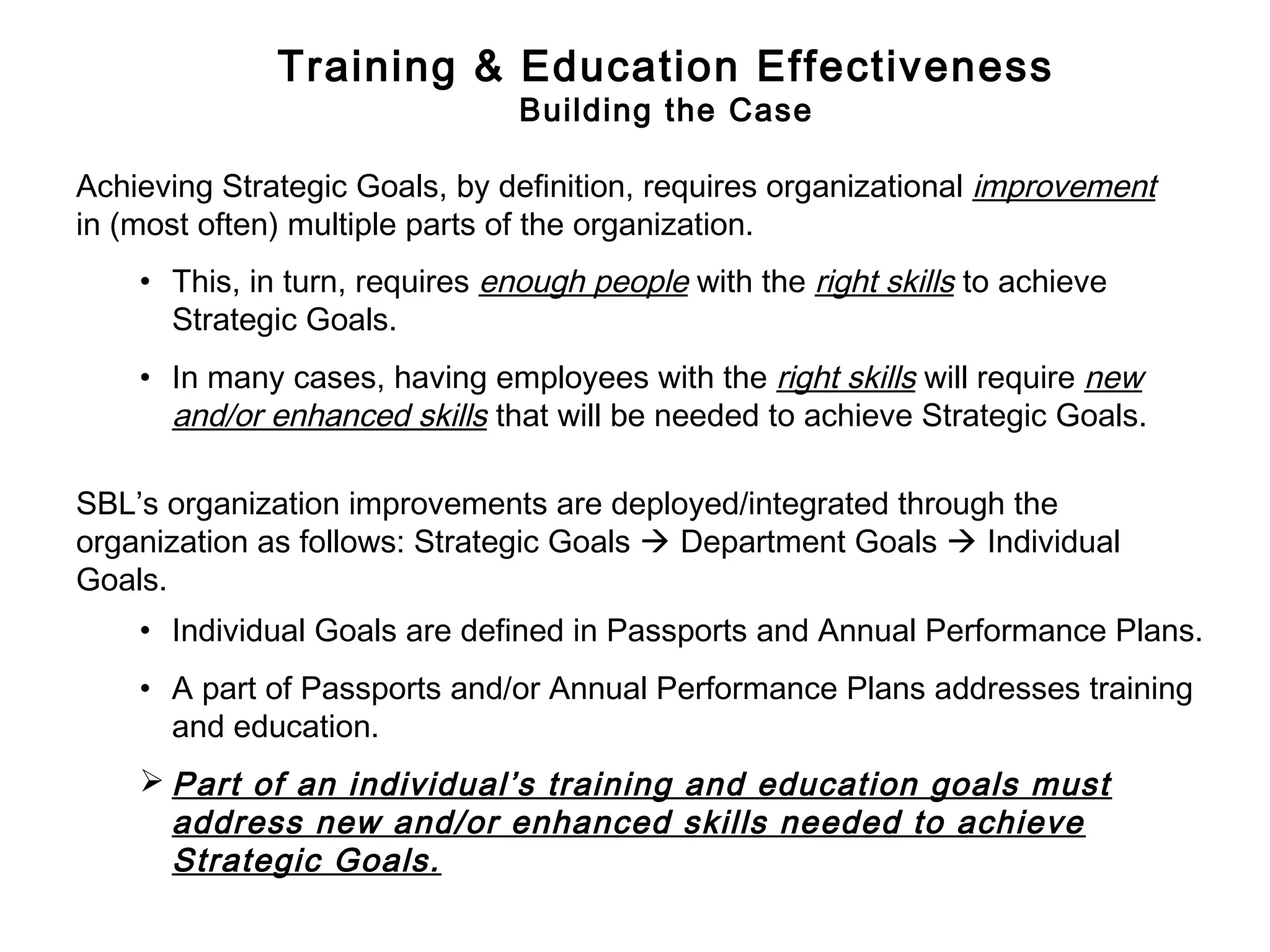
THEREFORE, an individual’s education & training can be linked to
specific Strategic Goals (at least, that’s the important concept),
AND a measure of training effectiveness can directly relate to how
much of an individual’s Strategy-related education is completed
(assuming that the individual’s Education Plan accurately outlines the required new
and/or enhanced skills).
Training & Education Effectiveness
Building the Case
Education required to
achieve Strategic
Goals is accurately
identified.
The planned
education is
completed.
Strategic Goals are
achieved through new
and/or enhanced skills.
EducationEducation**
Annual Performance PlanAnnual Performance Plan
PerformancePerformance
GoalsGoals
Goals based on
an employee’s
job description.
Education/ training
required for AAll
employees.
(A hours)
Job-specific training
(e.g., keeping up with
technology,
certifications).
(J hours)
Goals based on
an employee’s
contribution to
achieving
Strategic Goals.
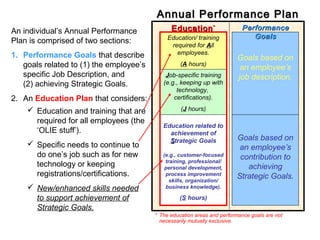
An individual’s Annual Performance
Plan is comprised of two sections:
1. Performance Goals that describe
goals related to (1) the employee’s
specific Job Description, and
(2) achieving Strategic Goals.
2. An Education Plan that considers:
 Education and training that are
required for all employees (the
‘OLIE stuff’).
 Specific needs to continue to
do one’s job such as for new
technology or keeping
registrations/certifications.
 New/enhanced skills needed
to support achievement of
Strategic Goals.
* The education areas and performance goals are not
necessarily mutually exclusive.
Education related to
achievement of
SStrategic Goals
(e.g., customer-focused
training, professional/
personal development,
process improvement
skills, organization/
business knowledge).
(S hours)
Strategic Goals
Department Goals
Individual Goals
EducationEducation**
Annual Performance PlanAnnual Performance Plan
PerformancePerformance
GoalsGoals
Goals based on
an employee’s
job description.
Education/ training
required for AAll
employees.
(A hours)
Job-specific training
(e.g., keeping up with
technology,
certifications).
(J hours)
Education Hours
Goals based on
an employee’s
contribution to
achieving
Strategic Goals.
As noted on the previous page, part
of an individual’s Annual Performance
Plan addresses education needs.
Needs specific to achieving Strategic
Goals are part of an individual’s
Education Plan.
• All employees.
• Job-specific.
• Strategy-related.
* The education areas and performance goals are not
necessarily mutually exclusive.
Education related to
achievement of
SStrategic Goals
(e.g., customer-focused
training, professional/
personal development,
process improvement
skills, organization/
business knowledge).
(S hours)
Strategic Goals
Department Goals
Individual Goals
EducationEducation**
Annual Performance PlanAnnual Performance Plan
PerformancePerformance
GoalsGoals
Goals based on
an employee’s
job description.
Education/ training
required for AAll
employees.
(A hours)
Job-specific training
(e.g., keeping up with
technology,
certifications).
(J hours)
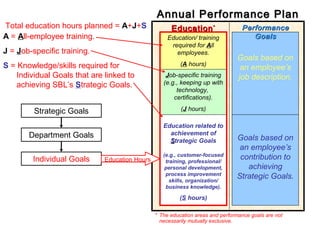
Total education hours planned = A+J+S
Education Hours
A = All-employee training.
J = Job-specific training.
S = Knowledge/skills required for
Individual Goals that are linked to
achieving SBL’s Strategic Goals.
Goals based on
an employee’s
contribution to
achieving
Strategic Goals.
* The education areas and performance goals are not
necessarily mutually exclusive.
Education related to
achievement of
SStrategic Goals
(e.g., customer-focused
training, professional/
personal development,
process improvement
skills, organization/
business knowledge).
(S hours)
Strategic Goals
Department Goals
Individual Goals
EducationEducation**
Annual Performance PlanAnnual Performance Plan
PerformancePerformance
GoalsGoals
Goals based on
an employee’s
job description.
Education/ training
required for AAll
employees.
(A hours)
Job-specific training
(e.g., keeping up with
technology,
certifications).
(J hours)
Education related to
achievement of
SStrategic Goals
(e.g., customer-focused
training, professional/
personal development,
process improvement
skills, organization/
business knowledge).
(S hours)
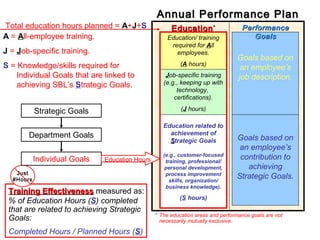
Training EffectivenessTraining Effectiveness measured as:
Total education hours planned = A+J+S
Education Hours
A = All-employee training.
J = Job-specific training.
S = Knowledge/skills required for
Individual Goals that are linked to
achieving SBL’s Strategic Goals.
% of Education Hours (S) completed
that are related to achieving Strategic
Goals:
Completed Hours / Planned Hours (S)
Goals based on
an employee’s
contribution to
achieving
Strategic Goals.Just
#Hours
* The education areas and performance goals are not
necessarily mutually exclusive.

Education_Effectiveness

  • 1.
    Achieving Strategic Goals,by definition, requires organizational improvement in (most often) multiple parts of the organization. • This, in turn, requires enough people with the right skills to achieve Strategic Goals. • In many cases, having employees with the right skills will require new and/or enhanced skills that will be needed to achieve Strategic Goals. SBL’s organization improvements are deployed/integrated through the organization as follows: Strategic Goals  Department Goals  Individual Goals. • Individual Goals are defined in Passports and Annual Performance Plans. • A part of Passports and/or Annual Performance Plans addresses training and education.  Part of an individual’s training and education goals must address new and/or enhanced skills needed to achieve Strategic Goals. Training & Education Effectiveness Building the Case
  • 2.
    Not just educationand training hours… Develop and sustain knowledge and skills that will enable us to achieve our Strategic Goals. TRAINING EFFECTIVENESS THEREFORE, an individual’s education & training can be linked to specific Strategic Goals (at least, that’s the important concept), AND a measure of training effectiveness can directly relate to how much of an individual’s Strategy-related education is completed (assuming that the individual’s Education Plan accurately outlines the required new and/or enhanced skills). Training & Education Effectiveness Building the Case Education required to achieve Strategic Goals is accurately identified. The planned education is completed. Strategic Goals are achieved through new and/or enhanced skills.
  • 5.
    EducationEducation** Annual Performance PlanAnnualPerformance Plan PerformancePerformance GoalsGoals Goals based on an employee’s job description. Education/ training required for AAll employees. (A hours) Job-specific training (e.g., keeping up with technology, certifications). (J hours) Goals based on an employee’s contribution to achieving Strategic Goals. An individual’s Annual Performance Plan is comprised of two sections: 1. Performance Goals that describe goals related to (1) the employee’s specific Job Description, and (2) achieving Strategic Goals. 2. An Education Plan that considers:  Education and training that are required for all employees (the ‘OLIE stuff’).  Specific needs to continue to do one’s job such as for new technology or keeping registrations/certifications.  New/enhanced skills needed to support achievement of Strategic Goals. * The education areas and performance goals are not necessarily mutually exclusive. Education related to achievement of SStrategic Goals (e.g., customer-focused training, professional/ personal development, process improvement skills, organization/ business knowledge). (S hours)
  • 6.
    Strategic Goals Department Goals IndividualGoals EducationEducation** Annual Performance PlanAnnual Performance Plan PerformancePerformance GoalsGoals Goals based on an employee’s job description. Education/ training required for AAll employees. (A hours) Job-specific training (e.g., keeping up with technology, certifications). (J hours) Education Hours Goals based on an employee’s contribution to achieving Strategic Goals. As noted on the previous page, part of an individual’s Annual Performance Plan addresses education needs. Needs specific to achieving Strategic Goals are part of an individual’s Education Plan. • All employees. • Job-specific. • Strategy-related. * The education areas and performance goals are not necessarily mutually exclusive. Education related to achievement of SStrategic Goals (e.g., customer-focused training, professional/ personal development, process improvement skills, organization/ business knowledge). (S hours)
  • 7.
    Strategic Goals Department Goals IndividualGoals EducationEducation** Annual Performance PlanAnnual Performance Plan PerformancePerformance GoalsGoals Goals based on an employee’s job description. Education/ training required for AAll employees. (A hours) Job-specific training (e.g., keeping up with technology, certifications). (J hours) Total education hours planned = A+J+S Education Hours A = All-employee training. J = Job-specific training. S = Knowledge/skills required for Individual Goals that are linked to achieving SBL’s Strategic Goals. Goals based on an employee’s contribution to achieving Strategic Goals. * The education areas and performance goals are not necessarily mutually exclusive. Education related to achievement of SStrategic Goals (e.g., customer-focused training, professional/ personal development, process improvement skills, organization/ business knowledge). (S hours)
  • 8.
    Strategic Goals Department Goals IndividualGoals EducationEducation** Annual Performance PlanAnnual Performance Plan PerformancePerformance GoalsGoals Goals based on an employee’s job description. Education/ training required for AAll employees. (A hours) Job-specific training (e.g., keeping up with technology, certifications). (J hours) Education related to achievement of SStrategic Goals (e.g., customer-focused training, professional/ personal development, process improvement skills, organization/ business knowledge). (S hours) Training EffectivenessTraining Effectiveness measured as: Total education hours planned = A+J+S Education Hours A = All-employee training. J = Job-specific training. S = Knowledge/skills required for Individual Goals that are linked to achieving SBL’s Strategic Goals. % of Education Hours (S) completed that are related to achieving Strategic Goals: Completed Hours / Planned Hours (S) Goals based on an employee’s contribution to achieving Strategic Goals.Just #Hours * The education areas and performance goals are not necessarily mutually exclusive.