Ethical Leadership inEducation:
Characteristics and Organizational
Safeguards
Presented by: Supreeth Prasad (he/him)
Building Trust Through Integrity
and Accountability
2.
Definition: Consistency betweenstated values and actual behavior; alignment of words, actions,
and principles across all contexts, regardless of external pressure or personal consequence.
Why This Matters in Educational Leadership:
• Foundation for organizational trust and credibility
• Models authentic behavior for entire school community
• Creates psychological safety for truth-telling
• Enables difficult conversations about equity and justice
Real-World Application: When a university president publicly commits to diversity goals,
integrity demands transparent reporting on progress, acknowledgment of shortfalls, and
resource allocation matching stated priorities rather than symbolic gestures disconnected from
budget decisions.
ETHICAL CHARACTERISTIC 1 - INTEGRITY
| 2
3.
Definition: Willingness toaccept responsibility for decisions, outcomes, and organizational
performance; transparent acknowledgment of both successes and failures without deflection or
excuse-making.
Why This Matters in Educational Leadership:
• Demonstrates respect for those affected by leadership decisions
• Builds credibility through honest assessment of outcomes
• Models learning from failure rather than concealing it
• Creates culture where problems surface rather than hide
Real-World Application: When completion rates fall short of targets, accountable college
presidents don't blame students, funding levels, or external factors exclusively. Instead, they
examine institutional practices, acknowledge leadership responsibility, and articulate concrete
improvement strategies.
ETHICAL CHARACTERISTIC 2 - ACCOUNTABILITY
| 3
4.
Definition: Openness indecision-making processes, clear communication about rationale for
choices, accessible information sharing, and honest acknowledgment of constraints and
limitations.
Why This Matters in Educational Leadership:
• Reduces speculation and rumor that erode trust
• Enables informed participation in shared governance
• Demonstrates respect for stakeholders' right to information
• Surfaces concerns early rather than allowing festering
Real-World Application: During budget reduction processes, transparent leaders share financial
data with campus community, explain decision criteria explicitly, acknowledge painful trade-offs
honestly, and create opportunities for input before finalizing cuts.
ETHICAL CHARACTERISTIC 3 - TRANSPARENCY
| 4
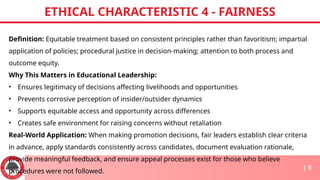
5.
Definition: Equitable treatmentbased on consistent principles rather than favoritism; impartial
application of policies; procedural justice in decision-making; attention to both process and
outcome equity.
Why This Matters in Educational Leadership:
• Ensures legitimacy of decisions affecting livelihoods and opportunities
• Prevents corrosive perception of insider/outsider dynamics
• Supports equitable access and opportunity across differences
• Creates safe environment for raising concerns without retaliation
Real-World Application: When making promotion decisions, fair leaders establish clear criteria
in advance, apply standards consistently across candidates, document evaluation rationale,
provide meaningful feedback, and ensure appeal processes exist for those who believe
procedures were not followed.
ETHICAL CHARACTERISTIC 4 - FAIRNESS
| 5
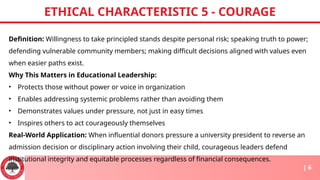
6.
Definition: Willingness totake principled stands despite personal risk; speaking truth to power;
defending vulnerable community members; making difficult decisions aligned with values even
when easier paths exist.
Why This Matters in Educational Leadership:
• Protects those without power or voice in organization
• Enables addressing systemic problems rather than avoiding them
• Demonstrates values under pressure, not just in easy times
• Inspires others to act courageously themselves
Real-World Application: When influential donors pressure a university president to reverse an
admission decision or disciplinary action involving their child, courageous leaders defend
institutional integrity and equitable processes regardless of financial consequences.
ETHICAL CHARACTERISTIC 5 - COURAGE
| 6
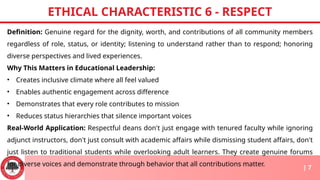
7.
Definition: Genuine regardfor the dignity, worth, and contributions of all community members
regardless of role, status, or identity; listening to understand rather than to respond; honoring
diverse perspectives and lived experiences.
Why This Matters in Educational Leadership:
• Creates inclusive climate where all feel valued
• Enables authentic engagement across difference
• Demonstrates that every role contributes to mission
• Reduces status hierarchies that silence important voices
Real-World Application: Respectful deans don't just engage with tenured faculty while ignoring
adjunct instructors, don't just consult with academic affairs while dismissing student affairs, don't
just listen to traditional students while overlooking adult learners. They create genuine forums
for diverse voices and demonstrate through behavior that all contributions matter.
ETHICAL CHARACTERISTIC 6 - RESPECT
| 7
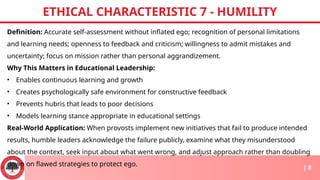
8.
Definition: Accurate self-assessmentwithout inflated ego; recognition of personal limitations
and learning needs; openness to feedback and criticism; willingness to admit mistakes and
uncertainty; focus on mission rather than personal aggrandizement.
Why This Matters in Educational Leadership:
• Enables continuous learning and growth
• Creates psychologically safe environment for constructive feedback
• Prevents hubris that leads to poor decisions
• Models learning stance appropriate in educational settings
Real-World Application: When provosts implement new initiatives that fail to produce intended
results, humble leaders acknowledge the failure publicly, examine what they misunderstood
about the context, seek input about what went wrong, and adjust approach rather than doubling
down on flawed strategies to protect ego.
ETHICAL CHARACTERISTIC 7 - HUMILITY
| 8
9.
Definition: Active commitmentto identifying and addressing systemic inequities; centering marginalized
voices in decision-making; using positional power to dismantle rather than perpetuate unjust structures;
prioritizing equitable outcomes not just equal processes.
Why This Matters in Educational Leadership:
• Addresses root causes of opportunity and achievement gaps
• Ensures leadership serves all students, not just privileged few
• Challenges structures that systematically advantage some while disadvantaging others
• Aligns institutional practice with espoused values of access and inclusion
Real-World Application: Justice-oriented community college presidents don't just track completion rates
overall - they disaggregate data by race, income, and other demographics, identify disproportionate impacts
of policies on specific student populations, and redesign systems producing inequitable outcomes rather
than blaming students for failing to navigate inequitable systems.
ETHICAL CHARACTERISTIC 8 - JUSTICE ORIENTATION
| 9
10.
What This Involves:
•Mandatory ethics training for all leaders at hire and annually thereafter
• Case-based scenarios addressing real ethical dilemmas in educational contexts
• Ethical decision-making frameworks integrated into leadership development
• Regular professional development on evolving ethical challenges
Why This Works:
• Explicit instruction prevents assumption that ethics are intuitive or universal
• Scenario-based learning develops judgment before crises occur
• Ongoing training signals organizational priority on ethical conduct
• Provides common language and frameworks for ethical discussions
Implementation Example: A state university system requires all newly appointed department chairs, deans, and vice
presidents to complete a three-day ethical leadership institute before assuming their roles, followed by annual ethics
updates addressing emerging challenges like AI in education, research integrity, and inclusive leadership practices.
ORGANIZATIONAL SAFEGUARD 1 - ETHICS TRAINING AND
DEVELOPMENT
| 10
11.
What This Involves:
•Clear ethical expectations articulated in leadership performance evaluations
• 360-degree feedback including specific questions about ethical conduct
• Regular ethical climate surveys assessing organizational culture
• Public reporting on ethical metrics and improvement goals
Why This Works:
• What gets measured signals what matters organizationally
• Multiple perspectives surface ethical concerns invisible from top
• Transparency about ethics creates pressure for authentic practice
• Regular assessment enables intervention before small problems escalate
Implementation Example: A community college district includes ethics-related questions in annual employee
engagement surveys, requires all administrators to receive 360-degree feedback including ethical leadership dimensions,
incorporates ethical performance as weighted component in executive evaluations, and publishes aggregated results with
improvement plans on public website.
ORGANIZATIONAL SAFEGUARD 2 - TRANSPARENT
ACCOUNTABILITY SYSTEMS
| 11
12.
What This Involves:
•Anonymous reporting channels for ethical concerns
• Clear non-retaliation policies with teeth
• Ombudsperson or ethics officer independent from leadership chain
• Transparent investigation processes with defined timelines
• Protection for those who raise concerns in good faith
Why This Works:
• Power differentials often prevent direct confrontation of leaders
• Anonymity enables reporting without fear of retaliation
• Independent investigation ensures impartiality
• Protection policies reduce chilling effect on legitimate concerns
Implementation Example: A university establishes an Office of Ethics and Compliance reporting to the Board of Trustees rather
than executive leadership, creates anonymous hotline and online reporting system, implements strict non-retaliation policy with
burden of proof on institution to demonstrate any adverse action following a complaint was unrelated, and publicizes the process
widely across campus.
ORGANIZATIONAL SAFEGUARD 3 - PROTECTED REPORTING
MECHANISMS
| 12
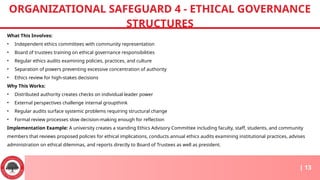
13.
What This Involves:
•Independent ethics committees with community representation
• Board of trustees training on ethical governance responsibilities
• Regular ethics audits examining policies, practices, and culture
• Separation of powers preventing excessive concentration of authority
• Ethics review for high-stakes decisions
Why This Works:
• Distributed authority creates checks on individual leader power
• External perspectives challenge internal groupthink
• Regular audits surface systemic problems requiring structural change
• Formal review processes slow decision-making enough for reflection
Implementation Example: A university creates a standing Ethics Advisory Committee including faculty, staff, students, and community
members that reviews proposed policies for ethical implications, conducts annual ethics audits examining institutional practices, advises
administration on ethical dilemmas, and reports directly to Board of Trustees as well as president.
ORGANIZATIONAL SAFEGUARD 4 - ETHICAL GOVERNANCE
STRUCTURES
| 13
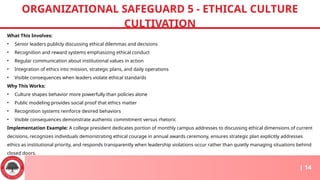
14.
What This Involves:
•Senior leaders publicly discussing ethical dilemmas and decisions
• Recognition and reward systems emphasizing ethical conduct
• Regular communication about institutional values in action
• Integration of ethics into mission, strategic plans, and daily operations
• Visible consequences when leaders violate ethical standards
Why This Works:
• Culture shapes behavior more powerfully than policies alone
• Public modeling provides social proof that ethics matter
• Recognition systems reinforce desired behaviors
• Visible consequences demonstrate authentic commitment versus rhetoric
Implementation Example: A college president dedicates portion of monthly campus addresses to discussing ethical dimensions of current
decisions, recognizes individuals demonstrating ethical courage in annual awards ceremony, ensures strategic plan explicitly addresses
ethics as institutional priority, and responds transparently when leadership violations occur rather than quietly managing situations behind
closed doors.
ORGANIZATIONAL SAFEGUARD 5 - ETHICAL CULTURE
CULTIVATION
| 14
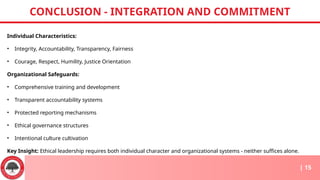
15.
Individual Characteristics:
• Integrity,Accountability, Transparency, Fairness
• Courage, Respect, Humility, Justice Orientation
Organizational Safeguards:
• Comprehensive training and development
• Transparent accountability systems
• Protected reporting mechanisms
• Ethical governance structures
• Intentional culture cultivation
Key Insight: Ethical leadership requires both individual character and organizational systems - neither suffices alone.
CONCLUSION - INTEGRATION AND COMMITMENT
| 15
16.
REFERENCES
| 16
1. Brown,M. E., & Treviño, L. K. (2006). Ethical leadership: A review and future directions. The Leadership Quarterly, 17(6), 595-616.
2. Collins, J. (2001). Level 5 leadership: The triumph of humility and fierce resolve. Harvard Business Review, 79(1), 66-76.
3. Fullan, M. (2011). Change leader: Learning to do what matters most. Jossey-Bass.
4. Gay, G. (2018). Culturally responsive teaching: Theory, research, and practice (3rd ed.). Teachers College Press.
5. Marshall, C., & Oliva, M. (2010). Leadership for social justice: Making revolutions in education (2nd ed.). Pearson.
6. Near, J. P., & Miceli, M. P. (1995). Effective whistle-blowing. Academy of Management Review, 20(3), 679-708.
7. Northouse, P. G. (2022). Leadership: Theory and practice (9th ed.). SAGE Publications.
8. Owens, B. P., & Hekman, D. R. (2012). Modeling how to grow: An inductive examination of humble leader behaviors, contingencies, and outcomes. Academy of
Management Journal, 55(4), 787-818.
9. Palmer, P. J. (2007). The courage to teach: Exploring the inner landscape of a teacher's life. Jossey-Bass.
10.Rest, J. R. (1986). Moral development: Advances in research and theory. Praeger.
11.Schein, E. H. (2010). Organizational culture and leadership (4th ed.). Jossey-Bass.
12.Sergiovanni, T. J. (1992). Moral leadership: Getting to the heart of school improvement. Jossey-Bass.
13.Shields, C. M. (2010). Transformative leadership: Working for equity in diverse contexts. Educational Administration Quarterly, 46(4), 558-589.
14.Theoharis, G. (2007). Social justice educational leaders and resistance: Toward a theory of social justice leadership. Educational Administration Quarterly, 43(2),
221-258.
15.Treviño, L. K., Weaver, G. R., & Reynolds, S. J. (2006). Behavioral ethics in organizations: A review. Journal of Management, 32(6), 951-990.
16.Tschannen-Moran, M. (2014). Trust matters: Leadership for successful schools (2nd ed.). Jossey-Bass.
Editor's Notes
#1 Welcome to this critical examination of ethical leadership characteristics in educational settings. In an era where trust in institutions faces unprecedented scrutiny, understanding the ethical dimensions of leadership becomes not merely aspirational but essential. Today's presentation explores eight foundational characteristics that distinguish ethically grounded leaders and examines five concrete organizational measures that institutions can implement to cultivate and sustain ethical leadership practice. Educational leaders face complex moral dilemmas daily - from resource allocation decisions affecting equity to personnel matters impacting livelihoods to policy choices shaping student futures. The frameworks we discuss today provide both conceptual grounding and practical guidance for navigating these challenges with integrity.
#2 Integrity represents the bedrock of ethical leadership - it's the characteristic upon which all others rest. Educational leaders with integrity don't compartmentalize their values, applying them selectively when convenient but abandoning them when challenging. Instead, they maintain consistency between private beliefs and public actions, between what they say in boardrooms and what they do in budget meetings. Research consistently demonstrates that followers forgive mistakes far more readily than they forgive hypocrisy. When leaders exhibit integrity, they create what organizational scholars call "moral capital" - a reservoir of trust that enables them to lead through inevitable challenges and setbacks. In community colleges particularly, where leaders serve diverse stakeholders with competing interests, integrity becomes the anchor that prevents values drift when pressures mount. As Sergiovanni argued in his work on moral leadership, integrity isn't simply about avoiding wrong - it's about consistently doing right even when no one is watching, even when easier paths present themselves, even when personal cost is involved.
#3 Accountability distinguishes ethical leaders from those who lead through positional authority alone. In educational contexts, accountability takes on special significance because leaders' decisions directly impact human lives - students' educational trajectories, faculty members' career development, staff members' professional growth. Ethically grounded leaders recognize this responsibility and embrace rather than evade it. Fullan's research on change leadership emphasizes that accountability paired with capacity-building creates sustainable improvement, while accountability without support breeds defensiveness and blame. Educational leaders demonstrate accountability not only when things go well but especially when initiatives fall short, when mistakes occur, when outcomes disappoint. This means resisting the common leadership tendency to claim credit for successes while attributing failures to external circumstances. Instead, accountable leaders ask themselves difficult questions when problems arise: What did I miss in the planning process? How did my decisions contribute to this outcome? What should I have done differently? This reflective accountability creates organizational cultures where learning from failure becomes normative rather than threatening, where continuous improvement replaces defensive justification.
#4 Transparency serves as the operational manifestation of integrity - it's how leaders demonstrate trustworthiness through actual practice rather than merely claiming it. In higher education particularly, where shared governance traditions run deep and faculty expect substantive involvement in institutional decisions, transparency becomes non-negotiable for legitimate leadership. However, transparency doesn't mean sharing every piece of information indiscriminately or conducting all deliberations publicly. Rather, it means being clear about what can and cannot be shared, explaining why certain information remains confidential when necessary, and ensuring that decision-making processes themselves are visible even when specific discussions require privacy. Tschannen-Moran's research on trust in educational settings demonstrates that transparency about constraints actually increases rather than decreases follower trust, because stakeholders respect honesty about genuine limitations more than they appreciate overpromising or obfuscation. When leaders say "here's what we can do and here's what we cannot do given current constraints," people appreciate the candor. When leaders remain vague about limitations while promising ambitious outcomes, skepticism grows. Ethically transparent leaders invite scrutiny rather than avoiding it, recognizing that sunlight remains the best disinfectant for organizational dysfunction.
#5 Fairness represents a complex ethical characteristic because it requires balancing competing conceptions of justice - procedural fairness focused on consistent processes, distributive fairness concerned with equitable outcomes, and restorative fairness aimed at addressing historical inequities. Educational leaders committed to fairness recognize that treating everyone identically doesn't necessarily produce equitable results when people begin from different starting points. This becomes particularly salient in discussions of equity-focused leadership, where treating historically marginalized groups differently isn't unfair but rather represents necessary correction for systemic disadvantages. Theoharis's research on social justice leadership demonstrates that fair leaders distinguish between equal treatment and equitable treatment, recognizing that fairness sometimes demands differentiated responses based on differential needs. However, this nuanced understanding of fairness doesn't give leaders license for arbitrary favoritism or inconsistent application of stated principles. Instead, fair leaders are transparent about when and why differential treatment serves equity goals, they ground differentiation in articulated values rather than personal preference, and they create clear criteria for resource allocation rather than distributing opportunities based on relationships or politics. When people believe leaders are fundamentally fair even if they disagree with specific decisions, organizational trust remains intact. When people suspect favoritism or arbitrary decision-making, trust evaporates regardless of actual outcomes.
#6 Courage distinguishes leaders who possess ethical values from those who actually practice them when tested. Educational contexts regularly present situations demanding moral courage - confronting influential board members who want special treatment for relatives, challenging funding sources whose priorities conflict with educational mission, defending faculty members whose scholarship or teaching offends powerful constituencies, allocating resources toward equity initiatives despite vocal opposition from some stakeholders. Leaders demonstrating moral courage recognize that their positional authority carries responsibility to protect those with less power, to speak uncomfortable truths about systemic problems, and to advocate for what serves students even when it costs personally or politically. Palmer's work on courage in educational leadership emphasizes that courage isn't the absence of fear but rather action despite fear, grounded in values deeper than self-interest. Courageous leaders ask themselves what decision they could live with long-term rather than what feels expedient short-term. They recognize that avoiding conflict in the moment often creates larger problems down the road, that maintaining relationships with powerful people at the expense of principle ultimately corrodes leadership credibility. Marshall and Oliva's research on social justice leadership demonstrates that courageous leaders are willing to risk their positions for their values, understanding that leadership without courage becomes mere management - competent execution divorced from moral purpose.
#7 Respect in educational leadership extends far beyond basic civility or politeness - it represents deep recognition of shared humanity and inherent dignity regardless of organizational position or social identity. Leaders who embody respect demonstrate it through the quality of their attention, the thoughtfulness of their listening, and the seriousness with which they engage others' perspectives even when they ultimately disagree. Respect becomes particularly critical in diverse educational environments where leaders work with people from varied cultural backgrounds, socioeconomic circumstances, and life experiences. Gay's scholarship on culturally responsive leadership emphasizes that respect requires moving beyond superficial multiculturalism to genuine engagement with different worldviews, recognition that dominant cultural norms don't represent universal standards, and willingness to learn from those with different knowledge bases and lived experiences. Respectful leaders don't assume they possess all relevant expertise simply because they hold formal authority. Instead, they recognize that the custodian who has worked at an institution for twenty years may understand campus culture more deeply than administrators with advanced degrees but limited tenure, that students themselves are experts in their own educational experiences, that staff members closest to operational realities often see problems that leaders in executive suites miss. Demonstrating respect means creating structures that invite these diverse perspectives into decision-making rather than simply asking for input after decisions are already made.
#8 Humility might seem paradoxical in leadership contexts where decisiveness and confidence often receive emphasis, yet research increasingly demonstrates that humble leadership produces superior organizational outcomes compared to more egocentric approaches. Collins's work on Level 5 Leadership found that the most effective leaders combined fierce professional will with personal humility, channeling ambition toward organizational mission rather than personal acclaim. In educational settings particularly, where knowledge creation and continuous learning constitute core values, humble leadership feels congruent with institutional purpose in ways that arrogant, know-it-all leadership cannot. Humble leaders recognize the limits of their own expertise and actively seek input from those with different knowledge and perspectives. They create space for dissenting views rather than surrounding themselves with yes-people who affirm their existing beliefs. They acknowledge uncertainty when it exists rather than projecting false confidence about unknowable futures. Importantly, humility doesn't mean weakness, indecisiveness, or lack of conviction. Humble leaders still make difficult decisions, still take stands on important issues, still provide direction during ambiguity. However, they do so while maintaining awareness that they might be wrong, that better approaches might exist than those they initially conceived, that learning from others strengthens rather than weakens leadership. Owens and Hekman's research on humble leadership demonstrates that when leaders model intellectual humility, organizational members feel more comfortable acknowledging their own learning needs, surfacing problems early, and engaging in the productive conflict that enables innovation.
#9 Justice orientation represents perhaps the most demanding ethical characteristic because it requires leaders to acknowledge how institutions they lead may perpetuate injustices, to recognize how they themselves benefit from systemic advantages, and to use their power to transform structures rather than simply helping individuals navigate unjust systems more successfully. Theoharis defines social justice leadership as practices that make schools more democratic, equitable, and just, while Shields describes transformative leadership as addressing systemic inequities rather than simply helping historically marginalized groups succeed within existing unjust frameworks. Leaders with justice orientation recognize that good intentions don't ensure equitable outcomes, that meritocratic rhetoric often obscures structural barriers, and that colorblind or identity-neutral approaches typically perpetuate rather than interrupt existing inequalities. These leaders make equity explicit rather than implicit, they name injustices directly rather than speaking euphemistically about "achievement gaps" without acknowledging opportunity gaps that produce them, and they allocate resources strategically to address historical inequities rather than distributing them equally across contexts with vastly different needs. Importantly, justice-oriented leadership involves risk - it means potentially alienating stakeholders invested in existing hierarchies, it means facing accusations of favoritism when providing differentiated support, it means enduring criticism from those who benefit from current arrangements. Yet leaders committed to justice recognize that educational institutions exist to expand rather than restrict opportunity, that leadership without justice orientation becomes complicit in perpetuating privilege, and that history ultimately judges leaders not by their rhetoric but by whose opportunities expanded under their leadership.
#10 Organizations cannot simply assume leaders possess ethical judgment or will intuitively know how to navigate complex moral dilemmas in educational contexts. Instead, institutions must provide explicit ethics training that builds leaders' capacity to recognize ethical dimensions of decisions, analyze competing values systematically, and act with integrity under pressure. Effective ethics training moves beyond abstract philosophical discussions to engage concrete scenarios leaders actually face - how to respond when discovering research misconduct, how to balance transparency with confidentiality in personnel matters, how to navigate competing stakeholder interests in resource allocation decisions. Rest's Four Component Model of ethical decision-making provides a useful framework, suggesting that ethical action requires moral sensitivity to recognize ethical dimensions, moral judgment to determine right action, moral motivation to prioritize ethics over competing interests, and moral character to follow through despite obstacles. Training programs should explicitly develop each component, recognizing that brilliant academics may not naturally possess well-developed moral sensitivity, that intelligent leaders may struggle with moral judgment when multiple values conflict, that even well-intentioned individuals may lack moral courage to act on their convictions when personal costs loom large. By making ethics training mandatory, ongoing, and case-based, institutions signal that ethical leadership isn't peripheral to educational administration but rather constitutes its core.
#11 Organizations reliably get what they measure and reward, making accountability systems essential mechanisms for ensuring ethical leadership practice. However, traditional performance metrics in educational contexts often emphasize quantifiable outcomes like enrollment growth, fundraising totals, and graduation rates while treating ethics as an implicit expectation rather than an explicit evaluation criterion. This sends a tacit message that ethical conduct matters less than measurable results, creating conditions where leaders feel pressure to achieve metrics by any means necessary. Robust accountability systems integrate ethics explicitly into leadership evaluation through multiple mechanisms. First, performance reviews should include specific ethical leadership competencies rather than vague statements about "maintaining integrity." Second, 360-degree feedback processes should solicit input from diverse stakeholders - supervisors, peers, direct reports, students, and community members - because ethical breaches often appear differently depending on one's position relative to the leader. Third, organizations should conduct regular ethical climate surveys that assess whether people feel safe raising concerns, whether they observe ethical conduct modeled by leaders, whether they believe ethics are genuinely valued. Fourth, institutions should publicly report on ethics-related metrics, creating external accountability and demonstrating authentic commitment rather than performative ethics visible only internally. Brown and Treviño's research on ethical leadership demonstrates that accountability systems work best when they emphasize positive modeling and development rather than exclusively focusing on rule violations and punishment, combining clear standards with genuine support for ethical growth.
#12 Even organizations with strong ethical cultures and well-intentioned leaders need robust reporting mechanisms because power dynamics inherently create barriers to surfacing concerns about those in authority. Faculty members fear retaliation if they report deans, staff members worry about career consequences if they challenge vice presidents, students feel vulnerable when considering complaints about professors, and junior administrators recognize that speaking truth to power can derail advancement. These fears are often justified - research consistently demonstrates that whistleblowers frequently experience professional and personal costs despite formal protections, creating rational incentives for silence even when witnessing serious misconduct. Effective reporting systems address these dynamics through multiple design features. First, they provide anonymous channels so people can raise concerns without identifying themselves, reducing immediate retaliation risk. Second, they situate ethics oversight outside regular leadership chains of authority, preventing situations where individuals investigate supervisors they depend on for career advancement. Third, they establish explicit non-retaliation policies with real consequences for leaders who punish those raising concerns, shifting burden of proof to institutions to demonstrate that any adverse action following a complaint was unrelated rather than requiring complainants to prove causation. Fourth, they create transparent investigation processes with defined timelines so concerns don't simply disappear into black holes where nothing happens and reporters never learn outcomes. Near and Miceli's research on whistleblowing demonstrates that organizational responsiveness to concerns matters enormously - when people see that raising issues produces genuine investigation and appropriate action, reporting increases, but when concerns vanish without consequence, silence becomes the rational response regardless of what formal policies promise.
#13 Relying exclusively on individual leader ethics creates fragile systems vulnerable to single points of failure - when the ethical leader departs or an unethical one assumes power, organizational integrity collapses absent structural safeguards. Robust governance systems distribute authority, create checks and balances, and institutionalize ethics beyond any particular individual's moral compass. Effective governance structures operate on multiple levels. At the board level, trustees themselves need ethics training because they set institutional tone, select and evaluate executives, and make high-stakes decisions about mission, strategy, and resource allocation. Board members must understand their fiduciary and ethical responsibilities, recognize conflicts of interest, and model the integrity they expect throughout the organization. At the institutional level, ethics committees composed of diverse stakeholders bring multiple perspectives to policy review, challenge assumptions embedded in proposed changes, and surface potential unintended consequences before implementation. Regular ethics audits function like financial audits - systematic examination of institutional practices, policies, and culture to identify problems requiring correction. These audits assess not just formal policies but actual implementation, recognizing that espoused values often differ from values-in-use. Separation of powers remains crucial - when presidents also chair boards, when administrative authority concentrates excessively, when shared governance erodes, conditions emerge where ethical breaches become more likely because insufficient checks exist on leadership authority. Requiring ethics review for high-stakes decisions - major partnerships, resource allocation changes, policy revisions with broad impact - builds reflection time into decision-making processes, preventing hasty choices driven by political pressure or financial temptation.
#14 Policies, training programs, and governance structures provide necessary infrastructure, but organizational culture ultimately determines whether ethical leadership flourishes or withers. Schein's research on organizational culture emphasizes that culture forms through repeated patterns of behavior that become assumed ways of operating, shaped powerfully by what leaders pay attention to, how they allocate resources and rewards, what they role model, and how they respond when values are violated. Cultivating ethical culture requires intentionality across multiple dimensions. First, senior leaders must make ethics visible by publicly discussing ethical dimensions of decisions rather than presenting choices as purely technical or financial. When presidents explain that they chose a more expensive option because the cheaper alternative would have compromised institutional values, they teach the community that ethics matter more than efficiency. Second, recognition and reward systems must explicitly emphasize ethical conduct rather than exclusively celebrating quantifiable outcomes. When institutions honor whistleblowers who surfaced problems rather than punishing them for making leadership uncomfortable, when they celebrate leaders who admitted mistakes and changed course rather than persisting with flawed approaches to save face, they signal authentic commitment to ethics. Third, regular communication about values must move beyond rhetoric to concrete examples of values-in-action, showing how abstract principles like integrity or justice translate into actual decisions about resource allocation, policy implementation, or strategic direction. Fourth, visible consequences when leaders violate ethical standards provide the most powerful cultural signal - when institutions hold senior leaders accountable in the same way they would staff members, when they investigate complaints against powerful figures as rigorously as those against people without influence, when they impose meaningful consequences rather than protecting their own, they demonstrate that ethics matter regardless of position or status. Treviño's research on ethical culture emphasizes that alignment between espoused values and actual practices determines whether organizations develop ethical or hypocritical cultures.
#15 Ethical leadership in educational settings represents neither purely individual virtue nor purely organizational structures, but rather the dynamic interaction between character-driven individuals and institutions that support, demand, and enable ethical practice. The eight characteristics we examined - integrity, accountability, transparency, fairness, courage, respect, humility, and justice orientation - provide essential personal foundations that individual leaders must cultivate through ongoing reflection, feedback, and development. However, even leaders possessing these characteristics face systemic pressures that can compromise ethical judgment when organizational contexts fail to support principled leadership. Conversely, even the most robust organizational safeguards prove insufficient when leaders lack fundamental ethical commitments or when institutional cultures devalue integrity. Therefore, comprehensive approaches to ethical leadership must address both dimensions simultaneously. Organizations must select leaders carefully, assessing not just technical competence but ethical character. They must provide ongoing development that strengthens moral sensitivity, judgment, and courage. They must create accountability systems that reward ethical conduct rather than exclusively emphasizing measurable outcomes achieved by any means. They must establish reporting mechanisms that enable concerns to surface without career-ending retaliation. They must design governance structures distributing authority and creating checks on concentrated power. They must cultivate cultures where ethics remain central to identity rather than peripheral to mission. When institutions implement these safeguards while simultaneously developing leaders who embody ethical characteristics, they create conditions where principled leadership becomes not just possible but normative. The complexity of contemporary educational challenges - from artificial intelligence integration to persistent equity gaps to financial sustainability pressures - demands nothing less than this comprehensive commitment to ethical leadership. Our students, our faculty, our staff, and our communities deserve leaders and institutions that match their ethical rhetoric with authentic ethical practice. The frameworks presented today provide roadmaps for achieving that essential goal.


![Ethics[2]](https://cdn.slidesharecdn.com/ss_thumbnails/ethics2-100420221849-phpapp01-thumbnail.jpg?width=640&height=640&fit=bounds)


