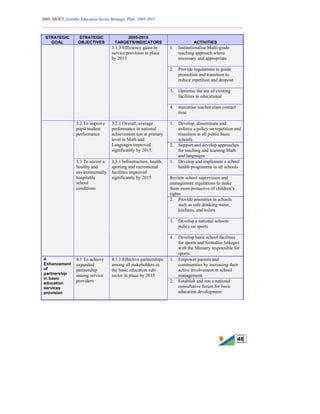
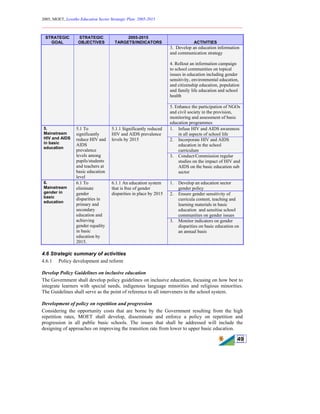
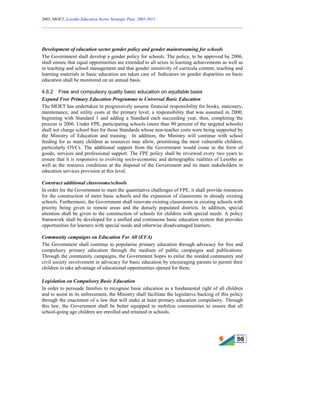
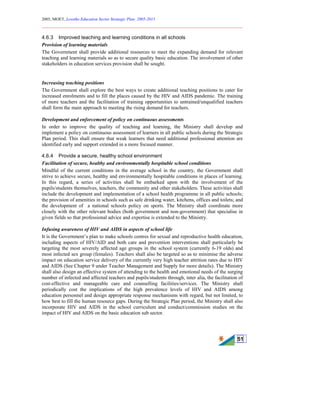
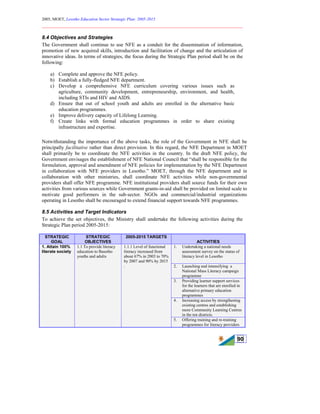
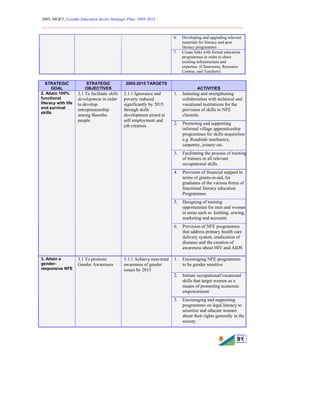
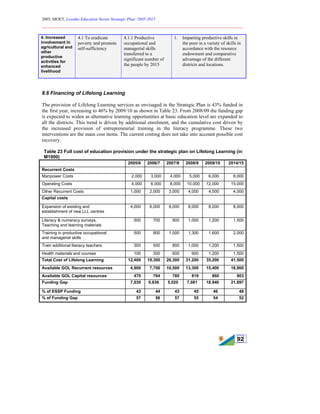
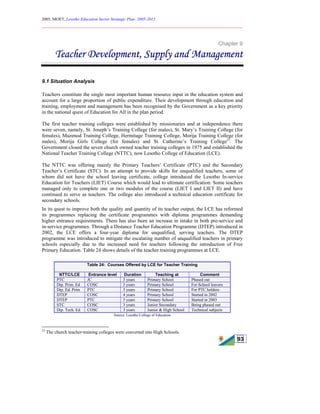
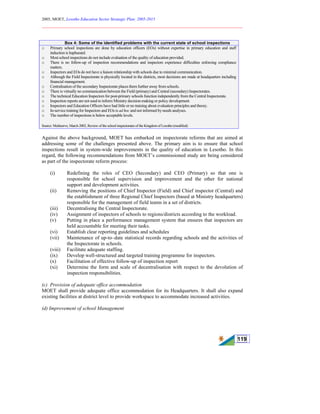
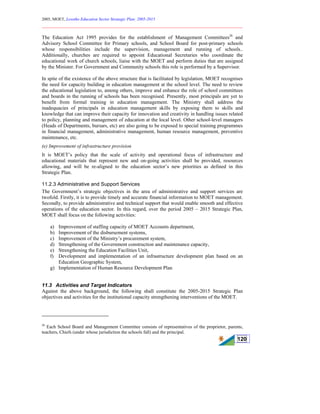
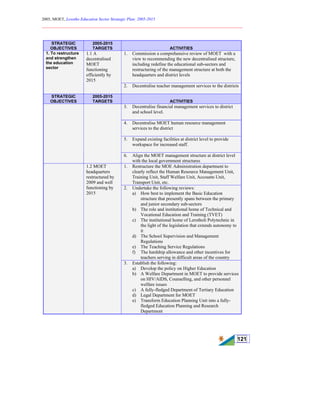
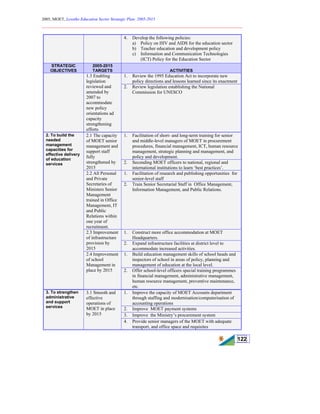
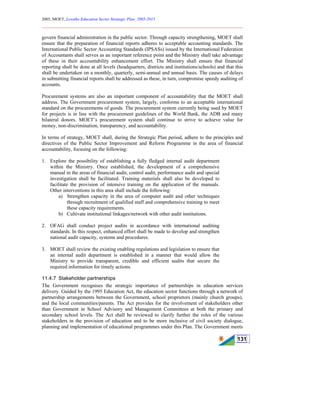
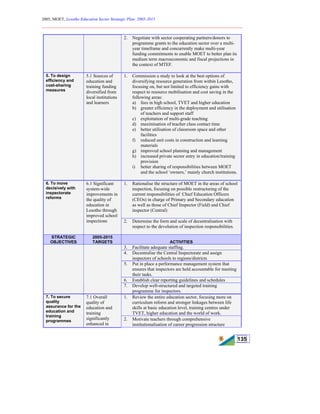
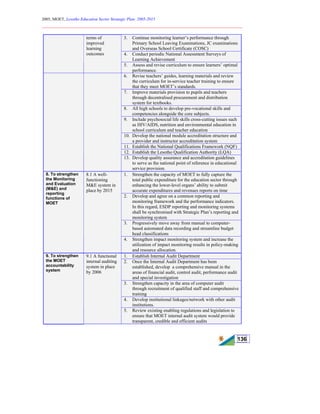
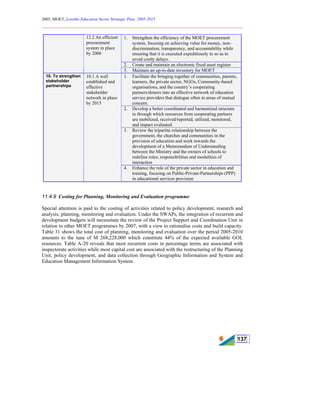
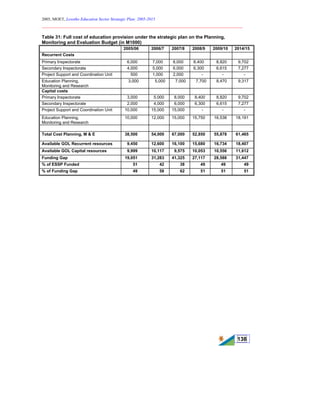
Education Sector Strategic Plan
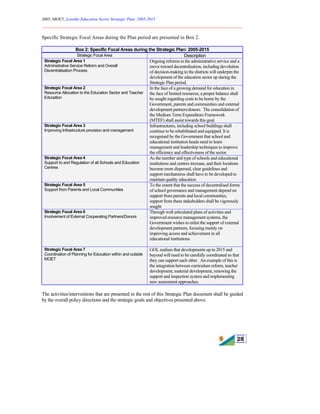
2005-2015
Government of Lesotho
Ministry of Education and Training
Maseru
March 2005
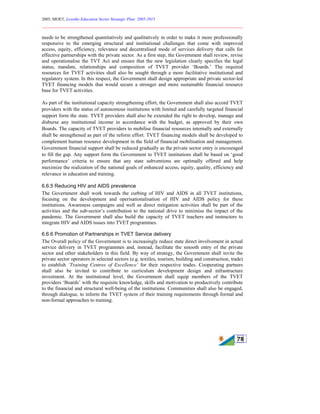
2005, MOET, Lesotho Education Sector Strategic Plan: 2005-2015
________________________________________________________________________
1
Vision
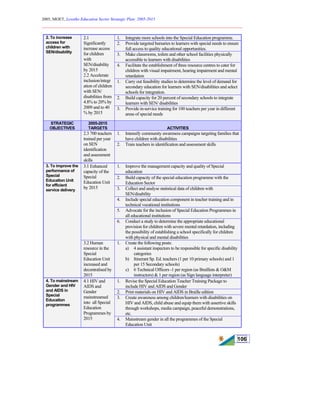
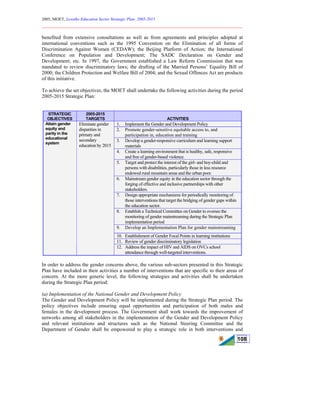
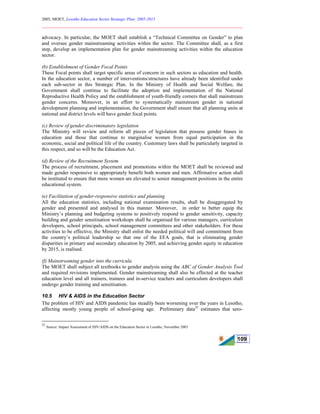
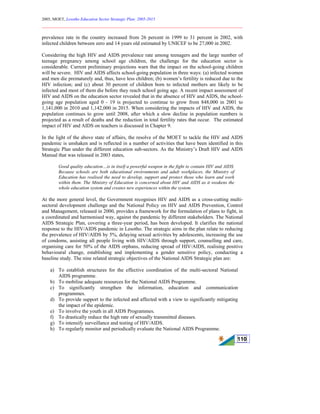
Basotho shall be a functionally literate society
with well-grounded moral and ethical values;
adequate social, scientific and technical
knowledge and skills by the year 2020.
Mission Statement
To develop and implement policies which ensure
acquisition of functional literacy among all
Basotho and development of a productive, quality
human resource base through education and
training.
Sector Objectives
1. To improve access, efficiency and equity of education
and training at all levels.
2. To improve the quality of education and training.
3. To ensure that curricula and materials are relevant to
the needs of Lesotho, are consonant with the
appropriate standards and gender responsive.
4. To ensure that both vocational-technical and non-
formal education programs respond to the needs of
industry and the communities in general.
5. To develop and implement a common system of
regular collection and reporting of information on the
current status and future demand and supply, and on
priority educational areas in the country.
6. To progressively achieve the equivalence,
harmonization and standardization of the education
and training systems nationally, regionally and
internationally.
7. To effectively participate in regional and international
educational sector development initiatives.
8. To promote gender equality and ensure
empowerment disadvantaged groups.
9. Address the challenges posed by HIV and AIDS in
education and training.
2005, MOET, Lesotho Education Sector Strategic Plan: 2005-2015
________________________________________________________________________
2
Preface
Our national Constitution stipulates that Lesotho shall endeavour to make education available to all
and shall adopt policies aimed at ensuring that:
a) education is directed to the full development of the human personality and sense of dignity
and strengthening the respect for human rights and fundamental freedom;
b) primary education is compulsory and available to all...; and
c) fundamental education is encouraged or intensified as far as possible for those persons who
have not received or completed their primary education.1
This Strategic Plan is a step towards fulfilling this constitutional obligation. We have come a long
way, taking gigantic steps that have provided direction for the development of the country. Key
documents like Vision 2020, Poverty Reduction Strategy and Public Sector Improvement and Reform
Programme provide the focus into the long term future. Since the nation was consulted in different
forums during their preparation, they represent the true aspirations of Basotho. Also, taken into
consideration were the Education for All goals, Millennium Development Goals, international and
regional conventions, treaties, protocols, agreements and declarations to which Lesotho fully
subscribes.
The government is committed to providing universal free and compulsory primary education. In this
regard, in 2000, free primary education was introduced in Lesotho on an annual incremental basis
from standard one. At the point of this plan, we are already in standard six. In addition, nationwide
consultations have commenced to amend the Education Act No. 10 of 1995 designed to improve the
delivery of education and training and make primary education free and compulsory.
The envisaged economic development for Lesotho is dependent on the availability of highly skilled
manpower. To achieve this, the government will adopt a new Technical and Vocational Education and
Training or skills development strategy and policy which will revolutionise the skills profile of the
Lesotho workforce thus promoting economic growth and alleviating poverty through provision of
demand-driven training programmes. Other priority areas in this Strategic Plan include lifelong
learning; early childhood development; and teacher development, supply and management. Cross
cutting issues that affect education and training have been adequately addresses, especially, gender,
HIV and AIDS.
The Plan has been developed based on Medium Term Expenditure Framework (MTEF). The first 3
years show the approved budget and the rest are projections. Certainly, this provides guidelines on the
availability of resources. Hence, desirable decisions can be made confidently.
This Strategic Plan has been costed. What emerges is that the Government of Lesotho resource
envelope is not sufficient to sustain the envisaged activities. Since the funding gap is indicated, our
Development Partners will easily determine the areas to be considered for support. We look forward
to their continued cooperation.
________________________________
M. K. Tsekoa MP
Minister of Education and Training
1
The Constitution of Lesotho, Section 28
2005, MOET, Lesotho Education Sector Strategic Plan: 2005-2015
________________________________________________________________________
3
Foreword
The Ministry of Education and Training acknowledges the invaluable contributions from all those
who took part in the preparation of this Education Sector Strategic Plan (ESSP). Various
programmes outlined their objectives and strategic activities that will be undertaken to
accomplish the (ESSP). All these formed a skeleton on which this Strategic Plan was developed.
It is worth noting that this document took some time to develop. Several consultants made their
inputs at one stage or another. We acknowledge their work very much because a working
document was developed. This working document was given to the cooperating and development
partners to critique. In September, 2004, a Donor Coordination Conference was held to provide
opportunity for further inputs into the development of this Strategic Plan.
Following the conference, it emerged that some refinements still had to be made on the Strategic
Plan before it could be printed. A working group of some MOET staff was set up to fine tune the
Plan, so that It conforms with the Education for All declaration. Their commitment, despite
several other engagements, has earned us this comprehensive document. This is commendable.
The responsibility to translate this plan into tangible results that will change the lives of Basotho
lies in the hands all of us involved in the education sector with assistance from our development
partners. The year 2005 marks the beginning of our joint march towards quality education for all.
Our success lies in our hands.
__________________________________________
N. I. Kokome (Ms.)
Principal Secretary for Education and Training
March 2005
2005, MOET, Lesotho Education Sector Strategic Plan: 2005-2015
________________________________________________________________________
4
Contents
Contents...............................................................................................................................4
Acronyms ................................................................................................................................................. 8
Tables and Figures................................................................................................................................... 10
Introduction ........................................................................................................................................... 12
Chapter 1 .......................................................................................................................14
Strategic Plan Context ...........................................................................................................14
1.1 MACROECONOMIC AND SOCIAL CONTEXT.......................................................................................... 14
1.1.1 Performance ............................................................................................................................... 14
1.1.2 Macro-level Policies and Strategies ........................................................................................... 15
1.2 EDUCATION SECTOR CONTEXT ........................................................................................................... 15
1.2.1 Conditions................................................................................................................................... 15
1.2.2 Financing.................................................................................................................................... 17
1.3 ORGANISATIONAL STRUCTURE............................................................................................................ 17
Chapter 2 .......................................................................................................................20
Mission, Goals and Objectives..................................................................................................20
2.1 BACKGROUND..................................................................................................................................... 20
2.2 MISSION STATEMENT.......................................................................................................................... 25
2.3 VISION ................................................................................................................................................ 25
2.4 EDUCATION POLICY ............................................................................................................................ 26
2.5 STRATEGIC GOALS AND OBJECTIVES .................................................................................................. 27
Chapter 3 .......................................................................................................................30
Integrated Early Childhood Care and Development........................................................................30
3.1 SITUATION ANALYSIS.......................................................................................................................... 30
3.2 MAIN POLICIES ................................................................................................................................... 32
3.3 CRITICAL CHALLENGES ...................................................................................................................... 32
3.4 OBJECTIVES AND STRATEGIES ............................................................................................................ 32
3.5 ACTIVITIES AND TARGET INDICATORS................................................................................................ 33
3.6 STRATEGIC SUMMARY OF ACTIVITIES.................................................................................................. 35
3.6.1 IECCD Policy............................................................................................................................. 35
3.6.2 Increased Access......................................................................................................................... 35
3.6.3 Equitable Access......................................................................................................................... 36
3.6.4 Quality Improvement .................................................................................................................. 37
3.6.5 Planning and Management......................................................................................................... 38
3.6.6 Gender Mainstreaming Gender and HIV and AIDS concerns in IECCD................................... 38
3.7 COSTING OF IECCD PLAN .................................................................................................................. 39
Chapter 4 .......................................................................................................................40
Basic Education...................................................................................................................40
4.1 SITUATION ANALYSIS ......................................................................................................................... 40
4.1.1 Primary education ...................................................................................................................... 40
4.1.2 Junior Secondary Education....................................................................................................... 42
4.2 MAIN POLICIES IN BASIC EDUCATION................................................................................................. 42
4.3 CRITICAL CHALLENGES ...................................................................................................................... 43
4.4 CRITICAL CHALLENGES ...................................................................................................................... 43
2005, MOET, Lesotho Education Sector Strategic Plan: 2005-2015
________________________________________________________________________
5
OBJECTIVES AND STRATEGIES .................................................................................................................. 43
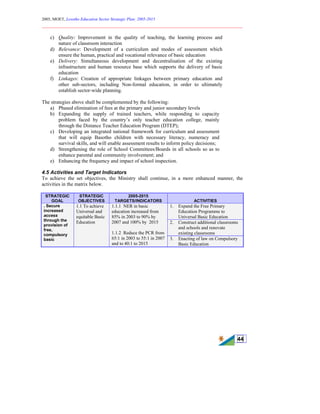
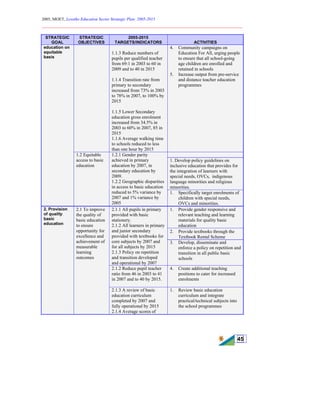
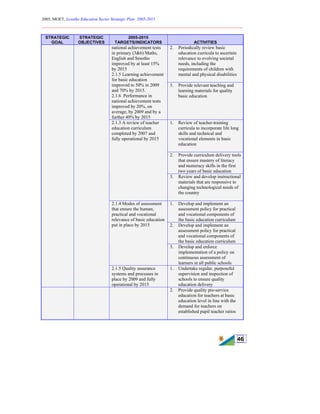
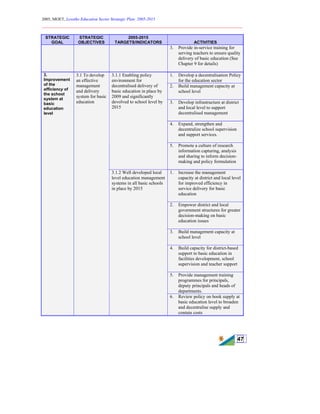
4.5 ACTIVITIES AND TARGET INDICATORS................................................................................................ 44
4.6 STRATEGIC SUMMARY OF ACTIVITIES.................................................................................................. 49
4.6.2 Free and compulsory quality basic education on equitable basis.......................................... 50
4.6.3 Improved teaching and learning conditions in all schools..................................................... 51
4.6.4 Provide a secure, healthy school environment ....................................................................... 51
4.6.5 Facilitation of quality assurance systems and processes........................................................ 52
4.6.7 Offer relevant curricula.......................................................................................................... 52
4.6.8 Improve linkages with other Stakeholders.............................................................................. 53
4.7 Critical Benchmarks for Achieving Basic Education for All .................................................. 53
4.8 Costing for Basic Education................................................................................................... 55
Chapter 5 .......................................................................................................................57
Secondary Education .............................................................................................................57
5.1 SITUATION ANALYSIS .................................................................................................................. 57
5.2 MAIN POLICIES ............................................................................................................................ 60
5.3 CRITICAL CHALLENGES ............................................................................................................... 60
5.4 OBJECTIVES AND STRATEGIES ..................................................................................................... 60
5.5 ACTIVITIES AND TARGET INDICATORS......................................................................................... 61
5.6 STRATEGIC SUMMARY OF ACTIVITIES .......................................................................................... 64
5.6.1 Improve Access to Secondary Education.................................................................................... 64
5.6.2 Improve quality in secondary education..................................................................................... 64
5.3.3 Develop an efficient management system for secondary education............................................ 64
5.6.4 Develop gender equity and parity within the Secondary Education System............................... 65
5.6.5 Develop HIV and AIDS Mitigation Strategies in Secondary Education System......................... 65
5.6.6 Improve partnerships among education service providers and stakeholders............................. 65
5.7 COSTING FOR SENIOR SECONDARY EDUCATION.......................................................................... 66
Chapter 6 .......................................................................................................................68
Technical and Vocational Education and Training ........................................................................68
6.1 SITUATION ANALYSIS ......................................................................................................................... 68
6.2 MAIN POLICIES ................................................................................................................................... 71
6.3 CRITICAL CHALLENGES ...................................................................................................................... 72
6.4 OBJECTIVES AND STRATEGIES ............................................................................................................ 72
6.5 ACTIVITIES AND TARGET INDICATORS................................................................................................ 72
6.6 STRATEGIC SUMMARY OF ACTIVITIES.................................................................................................. 76
6.6.1 Enhanced access to technical and vocational training............................................................... 76
6.6.2 Quality improvement................................................................................................................... 77
6.6.3 Enhancing the Relevance of TVET programmes ........................................................................ 77
6.6.4 Creating a supporting Institutional and Regulatory Regime...................................................... 77
6.6.5 Reducing HIV and AIDS prevalence........................................................................................... 78
6.6.6 Promotion of Partnerships in TVET Service delivery................................................................. 78
6.7 FUNDING FOR TVET.................................................................................................................... 79
Chapter 7 .......................................................................................................................80
Higher Education .................................................................................................................80
7.1 SITUATION ANALYSIS.................................................................................................................. 80
7.2 MAIN POLICIES ............................................................................................................................ 82
7.3 CRITICAL CHALLENGES ............................................................................................................... 82
7.4 OBJECTIVES AND STRATEGIES ..................................................................................................... 82
7.5 ACTIVITIES AND TARGET INDICATORS......................................................................................... 83
7.6 STRATEGIC SUMMARY OF ACTIVITIES .......................................................................................... 85
7.6.1 Increased Enrolments............................................................................................................. 85
2005, MOET, Lesotho Education Sector Strategic Plan: 2005-2015
________________________________________________________________________
6
7.6.2 Improved quality of training programmes.................................................................................. 85
7.6.3 Increased relevance of training programmes ............................................................................. 85
7.6.4 Establishment of efficient and effective management systems .................................................... 85
7.6.5 Integrating Gender in Higher education .................................................................................... 86
7.6.6 Reducing HIV and AIDS prevalence levels................................................................................. 86
7.6.7 Effective partnerships in higher education in place ................................................................... 86
7.7 FINANCING FOR HIGHER EDUCATION .......................................................................................... 86
Chapter 8 .......................................................................................................................88
Lifelong Learning and Non-Formal Education.............................................................................88
8.1 SITUATION ANALYSIS.................................................................................................................. 88
8.2 MAIN POLICIES ............................................................................................................................ 89
8.3 CRITICAL CHALLENGES ............................................................................................................... 89
8.4 OBJECTIVES AND STRATEGIES ..................................................................................................... 90
8.5 ACTIVITIES AND TARGET INDICATORS......................................................................................... 90
8.6 FINANCING OF LIFELONG LEARNING ........................................................................................... 92
Chapter 9 .......................................................................................................................93
Teacher Development, Supply and Management............................................................................93
9.1 SITUATION ANALYSIS.................................................................................................................. 93
9.2 POLICIES...................................................................................................................................... 97
9.3 STRATEGY ................................................................................................................................... 98
9.4 CRITICAL CHALLENGES ............................................................................................................... 98
9.5 ACTIVITIES AND TARGET INDICATORS......................................................................................... 98
9.6 FUNDING FOR TEACHER EDUCATION AND SUPPLY............................................................................ 100
Chapter 10 ...................................................................................................................102
Cross-cutting Issues and Activities..........................................................................................102
10.1 INTRODUCTION .......................................................................................................................... 102
10.2 CURRICULUM AND ASSESSMENT ............................................................................................... 102
10.2.1 COSTING OF CURRICULUM DEVELOPMENT, ASSESSMENT AND EDUCATION SUPPORT .......... 104
10.3 SPECIAL EDUCATION ................................................................................................................. 105
10.4 GENDER IN EDUCATION............................................................................................................. 107
10.5 HIV & AIDS IN THE EDUCATION SECTOR ................................................................................. 109
10.6 SPECIAL PROGRAMMES.............................................................................................................. 113
10.6.1 UNESCOM ............................................................................................................................. 113
10.6.2 Prince Mohato Award Scheme................................................................................................ 114
10.7 COSTING FOR SPECIAL PROGRAMMES........................................................................................ 115
Chapter 11 ...................................................................................................................116
Institutional Capacity Considerations ......................................................................................116
11.1 RATIONALE FOR INSTITUTIONAL CAPACITY STRENGTHENING................................................... 116
11.2 BUILDING EFFECTIVE AND EFFICIENT EDUCATION SECTOR ...................................................... 116
11.2.1 Decentralisation ..................................................................................................................... 116
11.2.2 Capacity Strengthening.................................................................................................... 117
11.2.3 Administrative and Support Services...................................................................................... 120
11.3 ACTIVITIES AND TARGET INDICATORS....................................................................................... 120
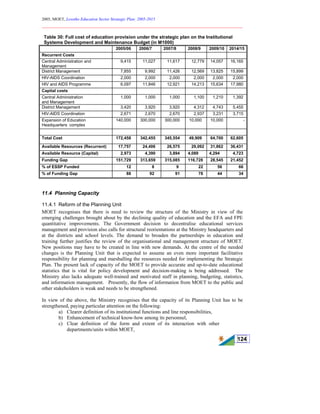
11.3.1 COSTING FOR INSTITUTIONAL AND SYSTEMS DEVELOPMENT ................................................ 123
11.4 PLANNING CAPACITY ................................................................................................................ 124
11.4.1 Reform of the Planning Unit ............................................................................................ 124
11.4.2 Budgeting and Financial Management Improvement ...................................................... 126
11.4.3 Efficiency and Cost-sharing Measures............................................................................. 128
2005, MOET, Lesotho Education Sector Strategic Plan: 2005-2015
________________________________________________________________________
7
11.4.4 Quality Assurance ............................................................................................................ 128
11.4.5 Monitoring and Reporting................................................................................................ 129
11.4.6 Accountability .................................................................................................................. 130
11.4.7 Stakeholder partnerships.................................................................................................. 131
11.4.8 ACTIVITIES AND TARGET INDICATORS .................................................................................. 132
11.4.9 COSTING FOR PLANNING, MONITORING AND EVALUATION PROGRAMME ............................. 137
Chapter 12 ...................................................................................................................140
Implementation Framework ..................................................................................................140
12.1 INTRODUCTION .......................................................................................................................... 140
12.2 PRIORITISATION AND PHASING OF THE STRATEGIC PLAN .......................................................... 140
12.2.1 Prioritisation........................................................................................................................... 140
12.2.2 Phasing ................................................................................................................................... 140
12.3 STRATEGIC PLAN IMPLEMENTATION STRUCTURE...................................................................... 141
12.4 MONITORING, REPORTING AND EVALUATION ........................................................................... 141
12.6 IMPLEMENTATION FRAMEWORK ..................................................................................................... 145
Chapter 13 ...................................................................................................................146
Costing and Financing of the ESSP.........................................................................................146
13.1 RATIONALE FOR ESSP COSTING AND FINANCING........................................................................... 146
13.2 COSTING METHODOLOGY ............................................................................................................... 147
13.3 OVERALL ESSP COSTING ............................................................................................................... 150
13.4 FUNDING GAP........................................................................................................................ 151
13.5 ESSP FINANCING................................................................................................................... 153
Log-frame: Strategic Plan Implementation Framework: 2005-2015 .......................154
2005, MOET, Lesotho Education Sector Strategic Plan: 2005-2015
________________________________________________________________________
8
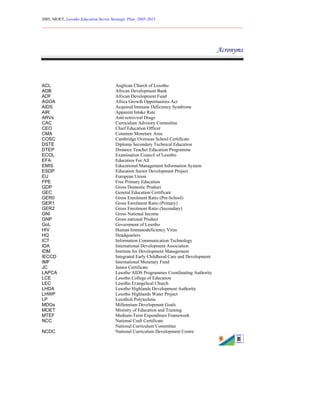
Acronyms
ACL Anglican Church of Lesotho
ADB African Development Bank
ADF African Development Fund
AGOA Africa Growth Opportunities Act
AIDS Acquired Immune Deficiency Syndrome
AIR Apparent Intake Rate
ARVs Anti-retroviral Drugs
CAC Curriculum Advisory Committee
CEO Chief Education Officer
CMA Common Monetary Area
COSC Cambridge Overseas School Certificate
DSTE Diploma Secondary Technical Education
DTEP Distance Teacher Education Programme
ECOL Examination Council of Lesotho
EFA Education For All
EMIS Educational Management Information System
ESDP Education Sector Development Project
EU European Union
FPE Free Primary Education
GDP Gross Domestic Product
GEC General Education Certificate
GER0 Gross Enrolment Ratio (Pre-School)
GER1 Gross Enrolment Ratio (Primary)
GER2 Gross Enrolment Ratio (Secondary)
GNI Gross National Income
GNP Gross national Product
GoL Government of Lesotho
HIV Human Immunodeficiency Virus
HQ Headquarters
ICT Information Communication Technology
IDA International Development Association
IDM Institute for Development Management
IECCD Integrated Early Childhood Care and Development
IMF International Monetary Fund
JC Junior Certificate
LAPCA Lesotho AIDS Programmes Coordinating Authority
LCE Lesotho College of Education
LEC Lesotho Evangelical Church
LHDA Lesotho Highlands Development Authority
LHWP Lesotho Highlands Water Project
LP Lerotholi Polytechnic
MDGs Millennium Development Goals
MOET Ministry of Education and Training
MTEF Medium-Term Expenditure Framework
NCC National Craft Certificate
National Curriculum Committee
NCDC National Curriculum Development Centre
2005, MOET, Lesotho Education Sector Strategic Plan: 2005-2015
________________________________________________________________________
9
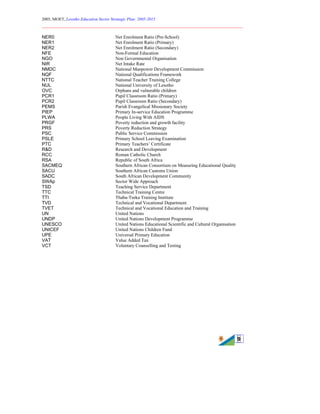
NER0 Net Enrolment Ratio (Pre-School)
NER1 Net Enrolment Ratio (Primary)
NER2 Net Enrolment Ratio (Secondary)
NFE Non-Formal Education
NGO Non Governmental Organisation
NIR Net Intake Rate
NMDC National Manpower Development Commission
NQF National Qualifications Framework
NTTC National Teacher Training College
NUL National University of Lesotho
OVC Orphans and vulnerable children
PCR1 Pupil Classroom Ratio (Primary)
PCR2 Pupil Classroom Ratio (Secondary)
PEMS Parish Evangelical Missionary Society
PIEP Primary In-service Education Programme
PLWA People Living With AIDS
PRGF Poverty reduction and growth facility
PRS Poverty Reduction Strategy
PSC Public Service Commission
PSLE Primary School Leaving Examination
PTC Primary Teachers’ Certificate
R&D Research and Development
RCC Roman Catholic Church
RSA Republic of South Africa
SACMEQ Southern African Consortium on Measuring Educational Quality
SACU Southern African Customs Union
SADC South African Development Community
SWAp Sector Wide Approach
TSD Teaching Service Department
TTC Technical Training Centre
TTI Thaba-Tseka Training Institute
TVD Technical and Vocational Department
TVET Technical and Vocational Education and Training
UN United Nations
UNDP United Nations Development Programme
UNESCO United Nations Educational Scientific and Cultural Organisation
UNICEF United Nations Children Fund
UPE Universal Primary Education
VAT Value Added Tax
VCT Voluntary Counselling and Testing
2005, MOET, Lesotho Education Sector Strategic Plan: 2005-2015
________________________________________________________________________
10
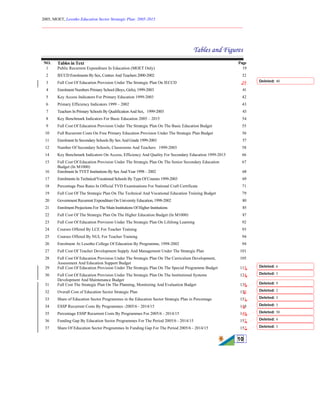
Tables and Figures
NO. Tables in Text Page
1 Public Recurrent Expenditure In Education (MOET Only) 19
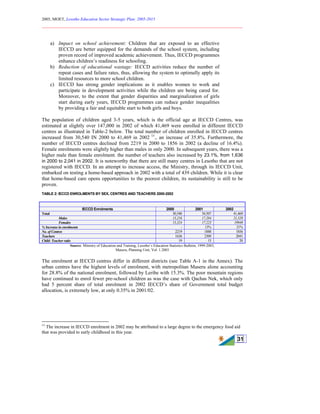
2 IECCD Enrolments By Sex, Centres And Teachers 2000-2002 32
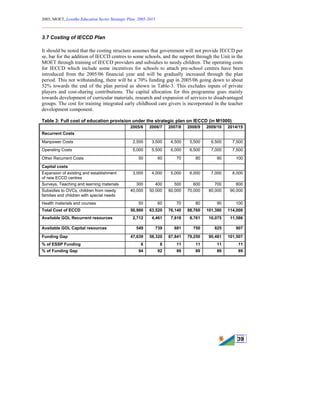
3 Full Cost Of Education Provision Under The Strategic Plan On IECCD 39
4 Enrolment Numbers Primary School (Boys, Girls), 1999-2003 41
5 Key Access Indicators For Primary Education 1999-2003 42
6 Primary Efficiency Indicators 1999 – 2002 43
7 Teachers In Primary Schools By Qualification And Sex, 1999-2003 43
8 Key Benchmark Indicators For Basic Education 2005 – 2015 54
9 Full Cost Of Education Provision Under The Strategic Plan On The Basic Education Budget 55
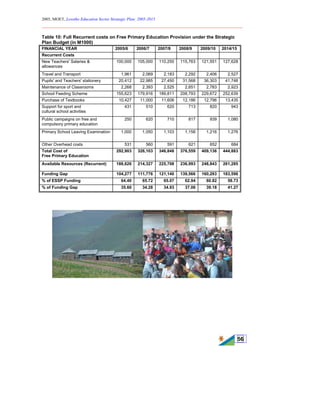
10 Full Recurrent Costs On Free Primary Education Provision Under The Strategic Plan Budget 56
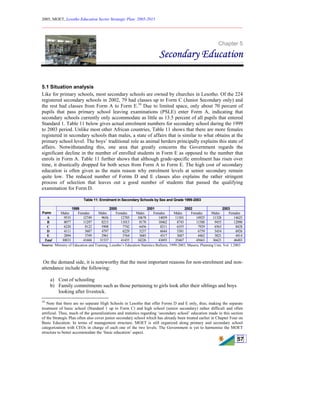
11 Enrolment In Secondary Schools By Sex And Grade 1999-2003 57
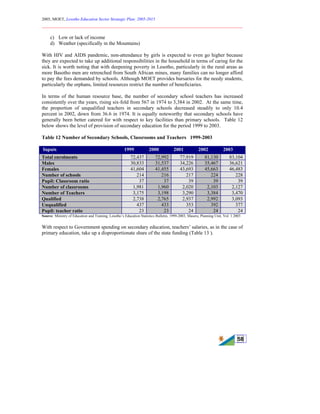
12 Number Of Secondary Schools, Classrooms And Teachers 1999-2003 58
14 Key Benchmark Indicators On Access, Efficiency And Quality For Secondary Education 1999-2015 66
15 Full Cost Of Education Provision Under The Strategic Plan On The Senior Secondary Education
Budget (In M1000)
67
16 Enrolment In TVET Institutions By Sex And Year 1998 – 2002 68
17 Enrolments In Technical/Vocational Schools By Type Of Courses 1999-2003 69
18 Percentage Pass Rates In Official TVD Examinations For National Craft Certificate 71
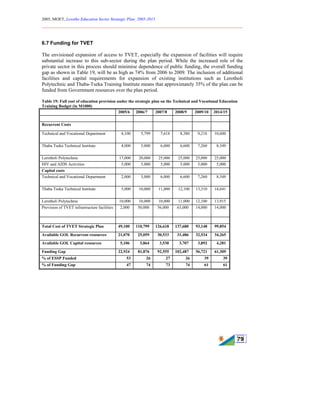
19 Full Cost Of The Strategic Plan On The Technical And Vocational Education Training Budget 79
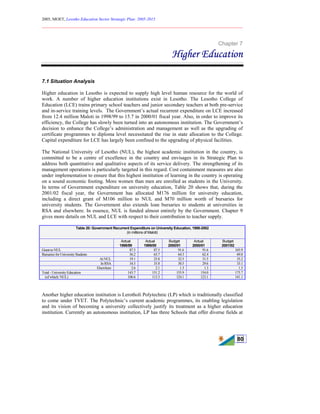
20 Government Recurrent Expenditure On University Education, 1998-2002 80
21 Enrolment Projections For The Main Institutions Of Higher Institutions 85
22 Full Cost Of The Strategic Plan On The Higher Education Budget (In M1000) 87
23 Full Cost Of Education Provision Under The Strategic Plan On Lifelong Learning 92
24 Courses Offered By LCE For Teacher Training 93
25 Courses Offered By NUL For Teacher Training 94
26 Enrolment At Lesotho College Of Education By Programme, 1998-2002 94
27 Full Cost Of Teacher Development Supply And Management Under The Strategic Plan 101
28 Full Cost Of Education Provision Under The Strategic Plan On The Curriculum Development,
Assessment And Education Support Budget
105
29 Full Cost Of Education Provision Under The Strategic Plan On The Special Programme Budget 115
30 Full Cost Of Education Provision Under The Strategic Plan On The Institutional Systems
Development And Maintenance Budget
124
31 Full Cost The Strategic Plan On The Planning, Monitoring And Evaluation Budget 138
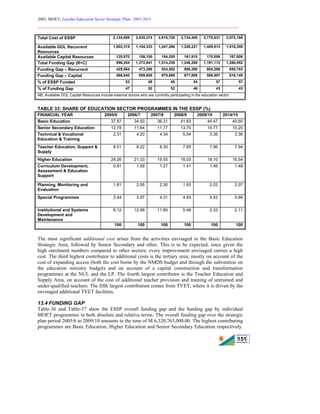
32 Overall Cost of Education Sector Strategic Plan 150
33 Share of Education Sector Programmes in the Education Sector Strategic Plan in Percentage 151
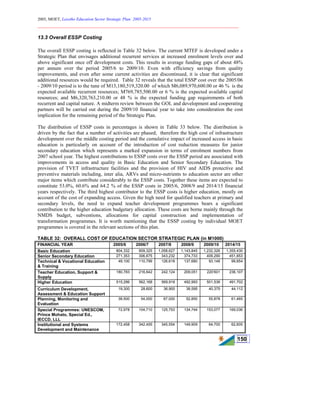
34 ESSP Recurrent Costs By Programmes -2005/6 - 2014/15 149
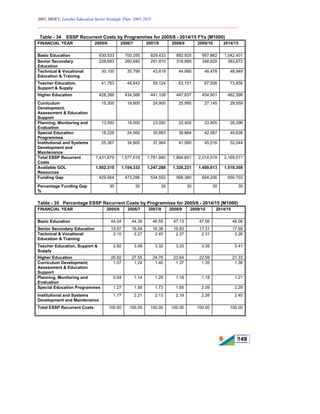
35 Percentage ESSP Recurrent Costs By Programmes For 2005/6 - 2014/15 149
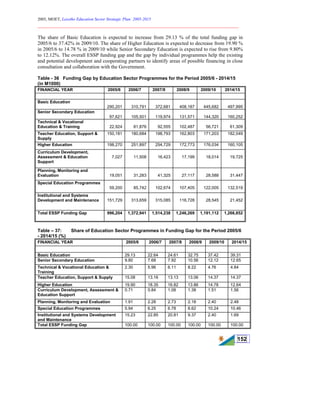
36 Funding Gap By Education Sector Programmes For The Period 2005/6 - 2014/15 152
37 Share Of Education Sector Programmes In Funding Gap For The Period 2005/6 - 2014/15 152
Deleted: 40
Deleted: 6
Deleted: 5
Deleted: 9
Deleted: 2
Deleted: 3
Deleted: 3
Deleted: 50
Deleted: 4
Deleted: 5
2005, MOET, Lesotho Education Sector Strategic Plan: 2005-2015
________________________________________________________________________
11
TABLES IN THE ANNEXURE Page
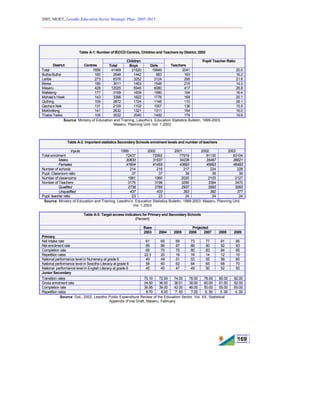
A-1 Number Of IECCD Centres, Children And Teachers By District, 2002 171
A-2 Important Statistics Secondary Schools Enrolment Levels And Number Of Teachers 171
A-3 Target Access Indicators For Primary And Secondary Schools (Percent) 171
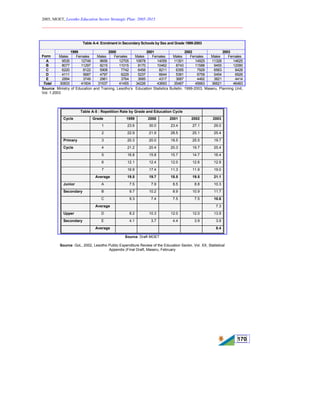
A-4 Enrolment In Secondary Schools By Sex And Grade 1999-2003 172
A-5 Repetition Rate By Grade And Education Cycle 173
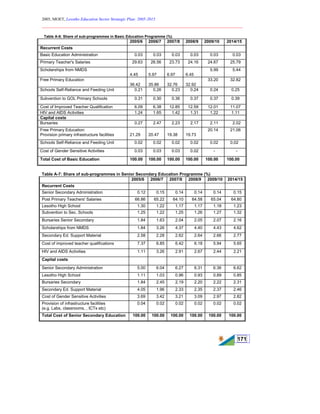
A-6 Share Of Sub-Programmes In Basic Education Programme (%) 173
A-7 Share Of Sub-Programmes In Senior Secondary Education Programme (%) 173
A-8 Share Of Sub-Programmes In Technical And Vocational Training Budget (%) 174
A-9 Share Of Sub-Programmes In Teacher Development, Supply And Management Budget 174
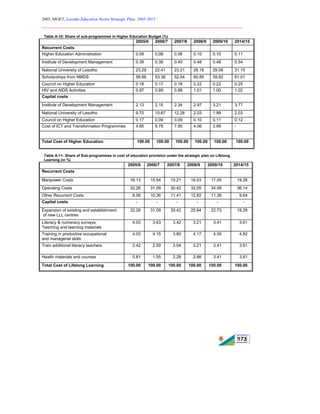
A-10 Share Of Sub-Programmes In Higher Education Budget (%) 175
A-11 Share Of Sub-Programmes In Cost Of The Strategic Plan On Lifelong Learning (%) 175
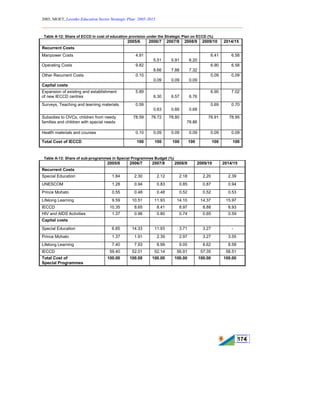
A-12 Share Of IECCD In Cost Of Education Provision Under The Strategic Plan On IECCD 175
A-13 Share Of Sub-Programmes In Special Programmes Budget (%) 176
A-14 Share Of Institutional And Systems Development And Maintenance Budget (%) 176
A-15 Share of Sub-programmes in curriculum development, assessment and education support Budget (%)
A-16 Share of SUB-PROGRAMMES in Planning, Monitoring and Evaluation Budget (%)
A-17 Projected Primary Enrolments 2004 – 2007 176
FIGURES
1 Number of Primary and Secondary Schools by ownership in 2002 17
2 MOET Organogram 20
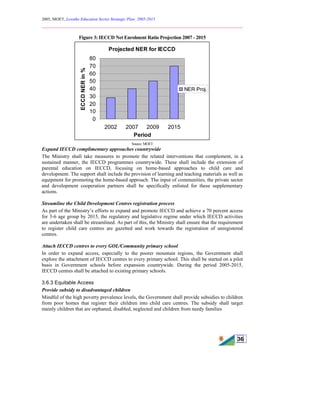
3 IECCD Net Enrolment Ratio Projection 2007 – 2015 37
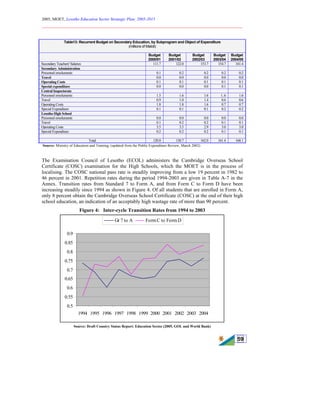
4 Inter-cycle Transition Rates from 1994 to 2003 59
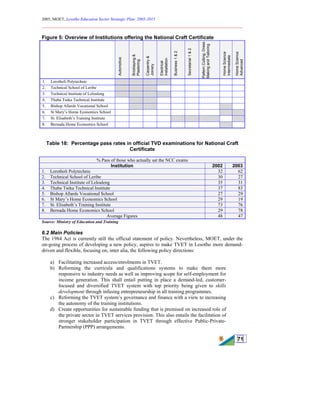
5 Overview of Institutions offering the National Craft Certificate 71
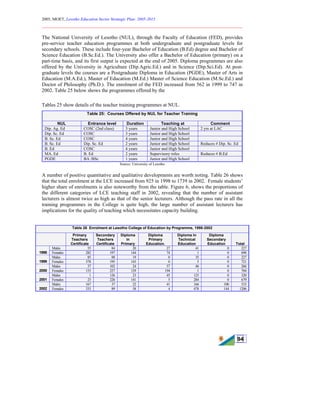
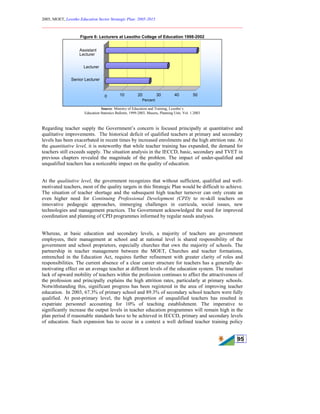
6 Lecturers at Lesotho College of Education 1998-2002 95
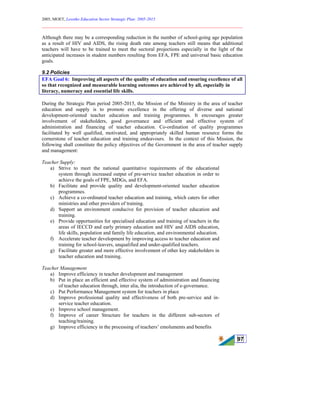
7 Projected Cumulative AIDS Deaths among Teachers, 2000 – 2015 96
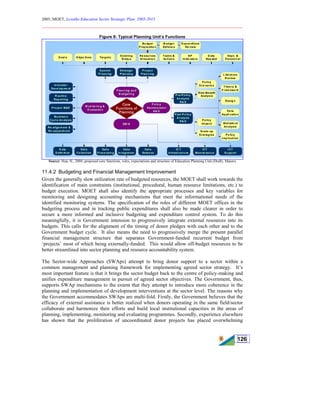
8 Typical Planning Unit’s Functions 127
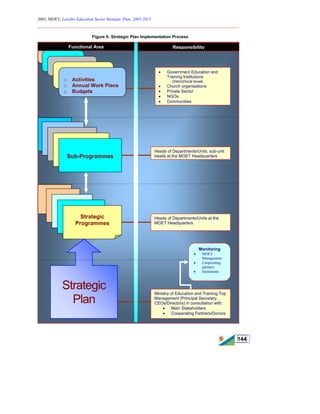
9 Strategic Plan Implementation Process 145
2005, MOET, Lesotho Education Sector Strategic Plan: 2005-2015
________________________________________________________________________
12
Introduction
The Government of Lesotho envisages the provision of an equitable basic education to all the
people as a key developmental goal. Basic education is seen as an essential part of social and
economic development and is regarded by the Government as a fundamental human right. It is
also seen as an essential pre-condition for mid-level employment and secondary and post-
secondary education and training. In line with broad Government objectives, it is Government
policy to move decisively towards enrolment expansion and retention in all the educational sub-
sectors. The education sector is also striving to improve the quality of education by equipping
schools and educational centres; reforming the curriculum; ensuring the provision of teaching and
learning materials; investing in teacher training and professional development; and providing
cost-effective and efficient teacher supervision and support. In its quantitative and qualitative
improvements of the education sector, the Government counts on development partnerships with
religious organisations, the private sector, NGOs, communities, and development partners.
This Strategic Plan is intended to provide the Ministry of Education and Training (MOET) with
an effective long term planning instrument over the 2005 to 2015 period and it is divided into
three parts. Part One gives the Strategic plan context and broad objectives. It starts with Chapter 1
that highlights, firstly, the macroeconomic and social context of Lesotho and, secondly, the broad
overview of the education and training sector. Chapter 2, in turn, presents the Strategic Plan’s
Mission, Vision, Goals and Objectives that are founded on such global goals as Education for All
(EFA) and MDGs as well as national ones (e.g. those in the Constitution, the PRS, and Vision
2020).
Part Two of the Plan covers the education sector’s main strategic programmes and cross-cutting
issues. Under each sub-sector, it presents a situation analysis, main policies, strategies, critical
challenges, and planned activities (with target indicators) over the 2005-2015 Strategic Plan
period. Chapters cover the Integrated Early Childhood Education (Chapter 3); Basic Education
(Chapter 4); Secondary Education (Chapter 5); Technical and Vocational Education and Training
(Chapter 6); Higher Education (Chapter 7); Non-Formal Education (Chapter 8); Teacher
Development, Supply and Management (Chapter 9); and Cross-cutting Issues (Chapter 10) that
includes Curriculum and Assessment, Special Education, Gender in Education, HIV and AIDS,
and Special Programmes. Part Two ends with Chapter 11 on Institutional Capacity
Considerations, focusing on the Government’s policies, strategies and activities related to
capacity building for the effective and efficient delivery of educational and training services.
Lastly, Part Three on Implementation Framework and Financing begins with Chapter 12 on
Implementation Framework, presenting the Government’s planned approaches for the execution
of the Strategic Plan, covering such areas as implementation prioritisation, funding modalities,
Strategic Plan implementation structure, monitoring, reporting and evaluation, and the
implementation framework with a log frame. Part Three ends with Chapter 13 on the Costing and
Financing of Plan.
Maseru
March 2005
2005, MOET, Lesotho Education Sector Strategic Plan: 2005-2015
________________________________________________________________________
13
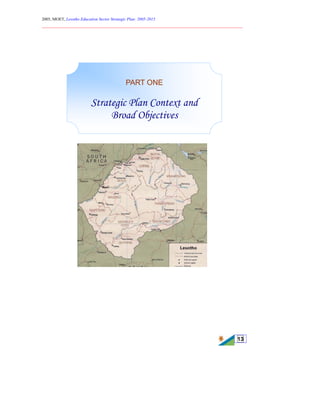
PART ONE
Strategic Plan Context and
Broad Objectives
2005, MOET, Lesotho Education Sector Strategic Plan: 2005-2015
________________________________________________________________________
14
Chapter 1
Strategic Plan Context
1.1 Macroeconomic and Social Context
1.1.1 Performance
Lesotho, a largely mountainous and landlocked country, has a population of 2.2 million people
and offers quite limited agricultural potential, mainly pastoral production. A considerable
proportion of the male population is employed in South Africa’s mining industry. Opportunities
for enhanced industrial growth are evident, as demonstrated by the sizeable expansion in the
largely export-oriented garment sub-sector that specialises mainly in textile, clothing and leather.
There is also light manufacturing. Additions that are more recent are royalties from the Lesotho
Highlands Water Project (LHWP) that generates electricity and exports water to South Africa.
This large project has provided added stimulus to the country’s economic diversification and
explained, to a significant degree, the recorded economic growth during the mid-1990s onwards.
In 2001, infrastructure and utilities were facilitated in the Thetsane Industrial Area of Maseru in
an effort to create more jobs through textile industry investment. This initiative was partially
motivated by export opportunities in the United States through the provisions of the African
Growth and Opportunities Act (AGOA). Under the AGOA terms, Lesotho textiles and clothing
have unlimited access to the US market, an opportunity that, in 2002, recorded a 40 percent
increase in the exportation of these commodities. Investors from South Africa and East Asia are
particularly being targeted, through special incentives, to establish textile and other labour-
intensive industries that target the US market.
Lesotho has recorded a real annual average GDP growth rate over the 1980 to 2002 period.
During the 1990s, the primary sectors (mainly agriculture and livestock) accounted for 20 percent
of GDP while secondary sectors (including manufacturing and construction), and services
accounting for 38 percent and 42 percent, respectively. Particularly during the mid-1990s, The
IMF/World Bank-supported Structural Adjustment Programme (SAP) that was started in 1988
provided the requisite foundation for economic stability. GDP growth averaged 6.3 percent over
the 1988 to 1997 period. Under SAP, the government budget deficit of 10 percent of GNP in
1987/88 was eliminated and the 1992/93-1997/98 period recorded an average budget surplus of
2.1. Inflation as measured by the Consumer Price Index also dropped by half during the same
period. Similarly, in the 1988 to 1998 period, Lesotho recorded an annual average surplus of
more than 8 months of import coverage, thus, indicating a positive external sector performance.
A major economic turnaround was witnessed in 1998 when the economy began to decline, as
signalled by the 4.6 percent contraction of the gross domestic output against the 8 percent growth
rate the previous year. The poor economic performance was sparked by the civil and political
unrest of 1998. This condition was worsened by a number of factors that happened around the
same time. They include the following:
a) The 1996/97 effects of El Nino that adversely affected agricultural
production.
b) The winding down of the first phase of LHWP, resulting in an adverse
effect on the building and construction sector.
2005, MOET, Lesotho Education Sector Strategic Plan: 2005-2015
________________________________________________________________________
15
c) Continued labour retrenchment in the South African gold mines,
resulting in the severe reduction in the number of Basotho migrant mine
workers from 127,000 in 1989/90 to about 69,000 in 1999.
d) Poorly performing manufacturing sector due to a slump in output as a
result of productive capacity constraints.
e) Under-performing state-dominated financial sector, particularly the
Lesotho Agricultural Development Bank and the Lesotho Bank.
f) Poorly performing state-owned utility companies, especially the
telephone and electricity sub-sectors, further weaken investor
confidence.
The effect of retrenchments of Basotho miners in South Africa resulted in the decline of their
remittances from 62 percent of GNP in 1989/90 to 18 percent in 1998/99 and the economy has
not yet fully recovered from the above difficulties. Poverty is highly concentrated in the largely
rural and remote Mountain and Senqu River areas. In these areas, more than 80 percent of the
population is classified as being poor or destitute. Urban poverty is also on the increase. The high
rate of unemployment seems to explain, to a large degree, the phenomenal level of poverty
prevalence in Lesotho.
1.1.2 Macro-level Policies and Strategies
To form the basis for addressing the main developmental challenges in Lesotho, the Government
began in 2000 the process of developing a National Vision that takes a long-term perspective up
to 2020, focusing on attaining, inter-alia, stable and united democracy, well developed human
resource base, a strong economy, and technological advancement (See Chapter 2 for details). On
the revenue side, the improvement of tax administration and the broadening of the tax net are
among the strategies opted for. Value-added tax (VAT) was introduced in 2003/04 while the
Central Bank of Lesotho sought to check broad money growth as well as strengthening its
capacity in monetary control. Overall, as stated in the country’s PRS, the main objective of the
Government’s comprehensive macroeconomic policy framework is to address the critical
challenge posed by the high levels of poverty by providing the basis for sound and consistent
macroeconomic management and improving public sector performance through aggregate fiscal
discipline; concentrating public resources on a core set of activities which contribute significantly
to a pro-poor growth; and improving operational efficiency.
With respect to the challenges being posed by the high level of unemployment, employment
generation has been given top priority in the country’s PRS. Market liberalisation that facilitates
an enabling environment for private sector investment and growth, accompanied by legislative
reforms, is seen as one way of creating employment opportunities. The under-exploited tourism
potential is particularly being targeted in this regard.
1.2 Education Sector Context
1.2.1 Conditions
There is great pressure for an expansion of education in Lesotho. Current statistics indicate that
there are an increasing number of pupils that commence and conclude their primary education,
particularly in the aftermath of the introduction of Free Primary Education. Huge disparities
across districts are, nevertheless, observable. The majority of children from disadvantaged social
groups, particularly in rural areas, are yet to access ten years of basic education. The Government
is also quite concerned that the present curriculum is characterised by an excessive number of
subjects that are fairly academic with minimum practical skills that are essential for the
integration of graduates into the employment market. The Government further recognises that the
2005, MOET, Lesotho Education Sector Strategic Plan: 2005-2015
________________________________________________________________________
16
present system of evaluating examinations is potentially vulnerable to anomalies, which has
resulted in high rates of repetition and dropouts. With regard to infrastructure provision, although
the situation is improving, many schools, especially at the primary level, still go without adequate
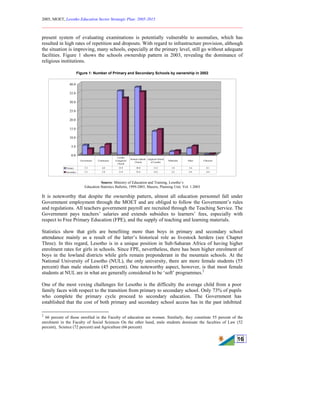
facilities. Figure 1 shows the schools ownership pattern in 2003, revealing the dominance of
religious institutions.
Figure 1: Number of Primary and Secondary Schools by ownership in 2002
0.0
5.0
10.0
15.0
20.0
25.0
30.0
35.0
40.0
Primary 5.3 4.0 35.9 38.0 13.2 1.8 3.6 0.1
Secondary 3.3 5.8 31.9 35.4 14.2 2.2 4.9 0.4
Government Community
Lesotho
Evangelical
Church
Roman Catholic
Church
Anglican Church
of Lesotho
Methodist Other Unknown
Source: Ministry of Education and Training, Lesotho’s
Education Statistics Bulletin, 1999-2003, Maseru, Planning Unit, Vol. 1.2003
It is noteworthy that despite the ownership pattern, almost all education personnel fall under
Government employment through the MOET and are obliged to follow the Government’s rules
and regulations. All teachers government payroll are recruited through the Teaching Service. The
Government pays teachers’ salaries and extends subsidies to learners’ fees, especially with
respect to Free Primary Education (FPE), and the supply of teaching and learning materials.
Statistics show that girls are benefiting more than boys in primary and secondary school
attendance mainly as a result of the latter’s historical role as livestock herders (see Chapter
Three). In this regard, Lesotho is in a unique position in Sub-Saharan Africa of having higher
enrolment rates for girls in schools. Since FPE, nevertheless, there has been higher enrolment of
boys in the lowland districts while girls remain preponderant in the mountain schools. At the
National University of Lesotho (NUL), the only university, there are more female students (55
percent) than male students (45 percent). One noteworthy aspect, however, is that most female
students at NUL are in what are generally considered to be ‘soft’ programmes.2
One of the most vexing challenges for Lesotho is the difficulty the average child from a poor
family faces with respect to the transition from primary to secondary school. Only 73% of pupils
who complete the primary cycle proceed to secondary education. The Government has
established that the cost of both primary and secondary school access has in the past inhibited
2
66 percent of those enrolled in the Faculty of education are women. Similarly, they constitute 55 percent of the
enrolment in the Faculty of Social Sciences On the other hand, male students dominate the faculties of Law (52
percent), Science (72 percent) and Agriculture (66 percent)
2005, MOET, Lesotho Education Sector Strategic Plan: 2005-2015
________________________________________________________________________
17
enrolment of children from poorer families. The Government is equally concerned about the
generally poor quality of education that is being delivered, a phenomenon that is explained
principally by the high pupil-teacher ratios; inadequately trained teachers; weak and over-
centralised school management systems; etc. More devastating, the education sector has been
severely impacted by the HIV and AIDS.
1.2.2 Financing
The share of the education sector in total government spending has been on the increase over the
years, with the sector claiming 29.9 percent of the government budget for the 2004/05 financial
year. Lesotho’s expenditure on education is higher than the average for comparable Sub-Saharan
countries. In terms of the Government’s apportionment of the budgetary allocation to the
education sector, primary education takes the larger share. Total Government recurrent allocation
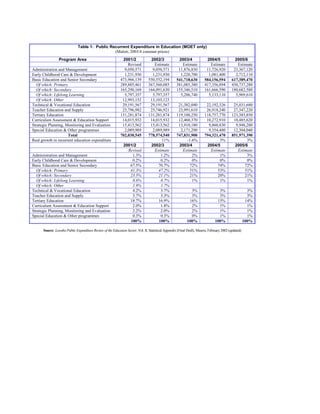
to the Ministry of Education and Training over the period 2001/02 - 2005/06 is shown in Table 1.
Statistics that show trends in government expenditure per student reveal a phenomenally high
inequity in the application of public funds across the different levels of learners. Whereas a TVET
level learner received as much as 31 times more than the primary school pupil in 2001/02, this
soared to 84 times for a student at university level. The trend has not changed significantly since.
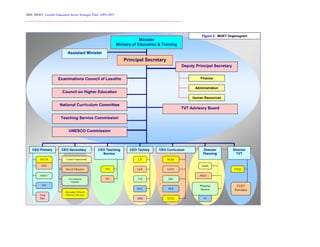
1.3 Organisational structure
The current organisational structure of the Ministry of Education and Training is shown in Figure
2. The Minister of Education and Training is the political head of the Ministry and is assisted in
this role by the Assistant Minister. The Principal Secretary is the administrative head of the
Ministry and is assisted by the Deputy Principal Secretary. A number of councils, commissions,
boards and committees with decision-making authority are answerable to the Minister through the
Principal Secretary. The Ministry has 7 programmes/departments, each headed by a Chief
Education Officer (CEO) or a Director. These are Primary,3
Secondary,4
Teaching Services,5
Tertiary,6
Curriculum Services,7
Planning,8
and Technical and Vocational Training.9
3
Primary Department includes Early Childhood Care and Development.
4
The Secondary Department includes Special Education and Supervision of Government Schools
5
Teaching Services includes the Teaching Service Department and the Teaching Service Commission.
6
The Tertiary Department also oversees the Lesotho Qualifications Authority
7
Curriculum Services include the Lesotho Distance Teaching Centre, the School Supply Unit, the Non-Formal
Education, and the Examination Council of Lesotho.
8
Planning Department also includes the Project Support and Coordination Unit and Information Technology.
9
Technical and Vocational Training oversees TVET providers.
Table 1: Public Recurrent Expenditure in Education (MOET only)
(Maloti, 2003/4 constant prices)
Program Area 2001/2 2002/3 2003/4 2004/5 2005/6
Revised Estimate Estimate Estimate Estimate
Administration and Management 9,050,571 9,050,571 11,876,830 11,726,920 23,367,120
Early Childhood Care & Development 1,231,930 1,231,930 1,220,700 1,081,400 2,712,110
Basic Education and Senior Secondary 473,966,139 550,552,194 541,718,630 584,156,594 617,389,470
Of which: Primary 289,885,461 367,560,085 381,085,380 417,356,894 430,737,280
Of which: Secondary 165,290,169 164,091,630 155,346,510 161,666,590 180,682,580
Of which: Lifelong Learning 5,797,357 5,797,357 5,286,740 5,133,110 5,969,610
Of which: Other 12,993,152 13,103,123
Technical & Vocational Education 29,191,567 29,191,567 21,382,040 22,192,326 25,031,680
Teacher Education and Supply 25,796,982 25,746,921 23,991,610 26,918,240 27,347,220
Tertiary Education 131,281,874 131,281,874 119,100,250 118,757,770 123,385,850
Curriculum Assessment & Education Support 14,015,932 14,015,932 12,460,370 10,272,910 10,485,620
Strategic Planning, Monitoring and Evaluation 15,413,562 15,413,562 13,910,180 9,860,830 9,948,280
Special Education & Other programmes 2,089,989 2,089,989 2,171,290 9,354,480 12,304,040
Total 702,038,545 778,574,540 747,831,900 794,321,470 851,971,390
Real growth in recurrent education expenditure 11% -1.6% 3% 3%
2001/2 2002/3 2003/4 2004/5 2005/6
Revised Estimate Estimate Estimate Estimate
Administration and Management 1.3% 1.2% 2% 1% 3%
Early Childhood Care & Development 0.2% 0.2% 0% 0% 0%
Basic Education and Senior Secondary 67.5% 70.7% 72% 74% 72%
Of which: Primary 41.3% 47.2% 51% 53% 51%
Of which: Secondary 23.5% 21.1% 21% 20% 21%
Of which: Lifelong Learning 0.8% 0.7% 1% 1% 1%
Of which: Other 1.9% 1.7%
Technical & Vocational Education 4.2% 3.7% 3% 3% 3%
Teacher Education and Supply 3.7% 3.3% 3% 3% 3%
Tertiary Education 18.7% 16.9% 16% 15% 14%
Curriculum Assessment & Education Support 2.0% 1.8% 2% 1% 1%
Strategic Planning, Monitoring and Evaluation 2.2% 2.0% 2% 1% 1%
Special Education & Other programmes 0.3% 0.3% 0% 1% 1%
100% 100% 100% 100% 100%
Source: Lesotho Public Expenditure Review of the Education Sector, Vol. II, Statistical Appendix (Final Draft), Maseru, February 2002 (updated)
2005, MOET, Lesotho Education Sector Strategic Plan: 2005-2015
________________________________________________________________________
19
Minister
Ministry of Education & Training
Assistant Minister
Principal Secretary
Examinations Council of Lesotho
TVT Advisory Board
UNESCO Commission
National Curriculum Committee
Teaching Service Commission
Deputy Principal Secretary
Director
TVT
Director
Planning
CEO CurriculumCEO TertiaryCEO Teaching
Service
CEO SecondaryCEO Primary
Administration
Finance
Human Resources
IECCD Central Inspectorate
Special Education
Secondary Schools
Advisory Services
Government
Schools
TSC
TSD
LP
LCE
IDM
NUL
TTI
NCDC
ECOL
NFE
SSU
LDTC
IT
Planning
Section
PSCU
EMISPIEP
SSRFU
Field
Insp.
FPE
Figure 2: MOET Organogram
TVD
TVET
Providers
Council on Higher Education
2005, MOET, Lesotho Education Sector Strategic Plan: 2005-2015
________________________________________________________________________
20
Chapter 2
Mission, Goals and Objectives
2.1 Background
The national and global context within which the objectives of this Strategic Plan have been
developed ought to be understood from the outset. The Government of Lesotho has participated in
a number of regional and international forums that focused on how best to improve education
service provision and some of these have made an important impression on the manner in which
the country has redefined its goals, objectives and priorities for the education sector. The regional
initiatives in which Lesotho has participated include the Southern Africa Development
Community (SADC) Protocol on Education and Training and the New Initiative for Africa’s
Development (NEPAD) Human Resource Development Initiative.
At the international level, the most important ones in terms of the considerable degree in which
they have conditioned Lesotho’s education policies are (a) the Education for All (EFA)
initiative/process and the Millennium Development Goals (MDGs). EFA is essentially a
worldwide initiative to make a giant step forward in improving basic education, based on the
understanding that education is a fundamental human right. From the standpoint of the
Government, the following EFA goals and targets agreed upon at the World Education Forum in
Dakar in 2000 provided hope for the development of basic education in Lesotho and shall, thus,
continue to guide policy actions in the fields of education ad training:
i) Expanding and improving comprehensive early childhood care and education,
especially for the most vulnerable and disadvantaged children;
ii) Ensuring that by 2015 all children, particularly girls, children in difficult
circumstances and those belonging to ethnic minorities, have access to and
complete, free and compulsory primary education of good quality;
iii) Ensuring that the learning needs of all young people and adults are met through
equitable access to appropriate learning and life-skills programmes;
iv) Achieving a 50 per cent improvement in levels of adult literacy by 2015,
especially for women, and equitable access to basic and continuing education for
all adults;
v) Eliminating gender disparities in primary and secondary education by 2005, and
achieving gender equality in education by 2015, with a focus on ensuring girls’
full and equal access to and achievement in basic education of good quality;
vi) Improving all aspects of the quality of education and ensuring excellence of all so
that recognized and measurable learning outcomes are achieved by all, especially
in literacy, numeracy and essential life skills.10
In order to achieve these goals, it was agreed that EFA forums shall be strengthened at the
national, regional and international levels. For Sub-Saharan African countries, of which Lesotho
is part, the EFA goals are expected to be realized through strategizing at the national level,
10
Dakar Framework for Action 2000
2005, MOET, Lesotho Education Sector Strategic Plan: 2005-2015
________________________________________________________________________
21
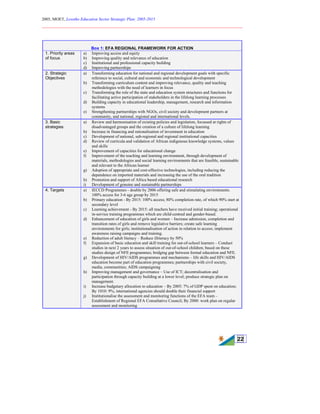
complemented by concerted action at the African regional level. Box 1 below summarises the
objectives, strategies and targets that were formulated for this EFA Regional Framework for
Action.
For Lesotho, the Jomtien EFA Conference and the Dakar Framework of Action are understood as
being rooted in fundamental values about the basic human rights of every individual. These
values include:
a) justice, equity and fairness to all individuals;
b) obligation of the society to the educational needs of all its people;
c) the right of all people everywhere to basic education as a fundamental human
right;
d) fair and equitable treatment of all learners - infants, children, youth and adults;
e) establishment of better learning environments;
f) promotion of learning achievement as a significant measure of real education
opportunities; and
g) education as a basis for better living of individuals and communities.
Lesotho further understands that included in the broad vision of Dakar are such considerations as:
a) the importance of political will and commitment to the goal of Education For
All;
b) attending to cost-effectiveness and improved efficiency in the educational
system;
c) promoting local empowerment and community action in educational provision;
d) partnership in the development of education with all stakeholders;
e) attention to girls’ education and the education of disadvantaged groups;
f) paying special attention to the training of teachers and improving their terms
and conditions of service;
g) making provision for child care and development, and
h) allowing for private and voluntary funding sources for education.
Four major targets do capture the underlining spirit of Dakar EFA objectives in Lesotho, and
these shall continue to be used as the primary point of reference in all interventions in the
educational sector in the country. The first is access, which shall emphasize commitment to
universal provision of opportunities for a defined minimum level of education. Although this
principle is often taken to be principally concerned with opportunities for the school-age
population, the Government of Lesotho maintains that it shall also embrace the provision for the
adult population, which in the earlier years did not have access to such opportunities.
The second target is equity, which stresses the need to ensure that the distribution and utilization
of opportunities in education would be fairly targeted in order to reach the disadvantaged groups
in society. This target calls for specific measures and explicit strategies in favour of groups that
had not been able to fully participate in the education process. Women, disadvantaged children,
particularly Orphans and Vulnerable Children (OVCs), the extremely poor people found mainly
in isolated mountain regions of the country, people with physical and learning disabilities, etc.,
are all specifically targeted to allow then to equitably enjoy the rights and opportunities that are
offered by education.
2005, MOET, Lesotho Education Sector Strategic Plan: 2005-2015
________________________________________________________________________
22
Box 1: EFA REGIONAL FRAMEWORK FOR ACTION
1. Priority areas
of focus
a) Improving access and equity
b) Improving quality and relevance of education
c) Institutional and professional capacity building
d) Improving partnerships
2. Strategic
Objectives
a) Transforming education for national and regional development goals with specific
reference to social, cultural and economic and technological development
b) Transforming curriculum content and improving relevance, quality and teaching
methodologies with the need of learners in focus
c) Transforming the role of the state and education system structures and functions for
facilitating active participation of stakeholders in the lifelong learning processes
d) Building capacity in educational leadership, management, research and information
systems
e) Strengthening partnerships with NGOs, civil society and development partners at
community, and national, regional and international levels.
3. Basic
strategies
a) Review and harmonisation of existing policies and legislation, focussed at rights of
disadvantaged groups and the creation of a culture of lifelong learning
b) Increase in financing and rationalisation of investment in education
c) Development of national, sub-regional and regional institutional capacities
d) Review of curricula and validation of African indigenous knowledge systems, values
and skills
e) Improvement of capacities for educational change
f) Improvement of the teaching and learning environment, through development of
materials, methodologies and social learning environments that are feasible, sustainable
and relevant to the African learner
g) Adoption of appropriate and cost-effective technologies, including reducing the
dependence on imported materials and increasing the use of the oral tradition
h) Promotion and support of Africa based educational research
i) Development of genuine and sustainable partnerships
4. Targets a) IECCD Programmes - double by 2006 offering safe and stimulating environments.
100% access for 3-6 age group by 2015
b) Primary education - By 2015: 100% access; 80% completion rate, of which 90% start at
secondary level
c) Learning achievement - By 2015: all teachers have received initial training; operational
in-service training programmes which are child-centred and gender-based.
d) Enhancement of education of girls and women – Increase admission, completion and
transition rates of girls and remove legislative barriers; create safe learning
environments for girls; institutionalisation of action in relation to access; implement
awareness raising campaigns and training.
e) Reduction of adult literacy – Reduce illiteracy by 50%
f) Expansion of basic education and skill training for out-of-school learners – Conduct
studies in next 2 years to assess situation of out-of-school children; based on these
studies design of NFE programmes; bridging gap between formal education and NFE.
g) Development of HIV/AIDS programmes and mechanisms – life skills and HIV/AIDS
education become part of education programmes; partnerships with civil society,
media, communities; AIDS campaigning
h) Improving management and governance – Use of ICT; decentralisation and
participation through capacity building at a lower level; produce strategic plan on
management.
i) Increase budgetary allocation to education – By 2005: 7% of GDP spent on education;
By 1010: 9%; international agencies should double their financial support
j) Institutionalise the assessment and monitoring functions of the EFA team –
Establishment of Regional EFA Consultative Council; By 2000: work plan on regular
assessment and monitoring
2005, MOET, Lesotho Education Sector Strategic Plan: 2005-2015
________________________________________________________________________
23
The third target regards learning achievement, which emphasizes the need to focus on well-
defined learning accomplishments as a major outcome of the education process. In this Strategic
Plan, this principle is strongly linked to relevance, effectiveness and efficiency which, together,
help to define the quality aspects of education. Lastly, the issue of partnerships has emerged as an
important consideration in educational service provision and is deriving its significance from the
EFA and MDGs principles. As resources at the disposal of the Government dwindle against a tide
of competing demands, the need to invite other providers to educational services is no longer just
an option; it is an imperative. Partnerships and alliances in service provision are also founded on
the principles of democracy and inclusiveness that call for the direct involvement of both
providers of, and beneficiaries from, the education system not only in meeting the cost of
provision but also in directly participating in decision-making processes. For Lesotho, the main
partners include church organisations, the private sector, NGOs, CBOs, traditional leadership,
communities, parents, and learners themselves. Included among stakeholders are development
cooperating partners that shall be called upon not only to provide complementary financial
resources but also technical assistance so that most, if not all the EFA goals are achieved by 2015.
The Millennium Development Goals have also set important targets that call upon the Lesotho’s
education sector to respond The MDGs - Eradicate extreme poverty and hunger; Achieve
Universal Primary Education; MDG Promote gender equality; combat HIV/AIDS, malaria and
other diseases - all set performance targets that are either directly related to educational service
provision or the educational sector is indirectly expected to play an important facilitative role.
The achievement of universal primary education, for example, does set targets that are related to
the EFA goals and, in this sense, also sets the tempo for Lesotho in this area of intervention.
It is noteworthy that a number of important initiatives have been taken at the national level that,
like at the international initiatives, significantly influenced the Government’s current policies and
strategies in the educational sector. At the apex of the national drive is the Constitution that
stipulates, inter alia, that Lesotho shall endeavour to make education available to all and shall
adopt policies aimed at ensuring that:
d) education is directed to the full development of the human personality and
sense of dignity and strengthening the respect for human rights and
fundamental freedom;
e) primary education is compulsory and available to all...; and
f) fundamental education is encouraged or intensified as far as possible for those
persons who have not received or completed their primary education.11
In addition to this, the Government’s policy of Free Primary Education has been informed by the
1999 study on poverty that revealed the magnitude of the problem and the limited opportunity for
the poor to access educational opportunities.
The Public Sector Improvement and Reform Programme Policy Framework (PSIRP) is another
initiative at the national level that seeks to address the problems of inefficiencies in delivery,
mismanagement of resources, unethical behaviour of public servants, weak control mechanisms,
“ghost employees” and unbalanced staffing levels. The aim is to improve the quality and
efficiency in the delivery of the public services through the right sizing of the public service,
performance management application, concentration on core functions of expertise and through a
coordinated approach to the management of Government business. The specific outcomes of the
PSIRP include the improvement of decision-making processes; timely implementation of
decisions; building of a professional and politically neutral public service; accountable
11
The Constitution of Lesotho, Section 28
2005, MOET, Lesotho Education Sector Strategic Plan: 2005-2015
________________________________________________________________________
24
management; and timely and impartial administration of justice. The professionalisation and right
sizing of the public service is among the planned activities, as is financial management reforms
that would strengthen public expenditure management and fiscal policy formulation and
monitoring in order to achieve greater efficiency and effectiveness in service delivery. The most
relevant in the context of the education sector is the Education Sector Reform Programme, which
focuses at improving and increasing access, quality and efficiency of the educational system,
including some commitment to decentralisation.
The Lesotho National Vision 2020 is set in a manner that acknowledges the important role of the
educational sector in achieving it. The Vision Statement is quite clear on this:
By 2020, Lesotho shall be a stable democracy, united prosperous nation at peace
with itself and its neighbours. It shall have a healthy and well-developed human
resource base. Its economy will be strong, its environment well managed and its
technology well established [emphasis added].
It is clear from this Vision that the role of the educational sector in facilitating the development of
the ‘human resource base’ cannot be overemphasized. Indeed, two of the main strategies of the
National Vision 2020 directly relate to the education sector, namely,
Well-developed human resource base
Upgrading/establishing educational and training institutions; create research,
science and technology institutions; reform curriculum/materials according to
employment needs, more focussed at TVET; promote concept of mentoring of
SMEs by big enterprises; adopt 3-stage approach: (i) provide incentives to retain
good [personnel], (ii) formulate policy to develop high level expertise for
export, (iii) explore possibilities of using expertise of Lesotho citizens abroad or
working in international organisations; develop career guidance; engage in
active talent search (incl. sports, arts and scientific research; promote social
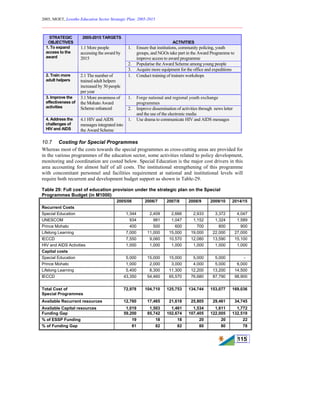
development; develop a national fund for Education and HRD; include Basotho
culture and values in curriculum; promote special education and universal basic
literacy.
Technologically well equipped Lesotho
Provide effective research for application of science and modern technology;
allocate sufficient resources for research and development (R&D); allocate
resources for implementation of ICT programme for schools and health
institutions; promote IT applications; use IT to ensure information rich society.
Similarly, the Poverty Reduction Strategy Paper reiterates the Government’s commitment to the
development of the human resource base, again deriving encouragement from the EFA and
MDGs. In the PRSP, it is stated that the “Government is convinced that investment in appropriate
education is the single most important contribution that it can make to the long-term socio-
economic development of the country. For this reason the education budget remains the highest of
all ministries, and is set to grow over the next three years.” The PRS sets five key objectives to be
achieved over the period 2004/05 -2006/09, all of which are in line with the EFA targets, namely:
a) expand and promote Early Childhood Care and Development (IECCD);
b) ensure that all children have access to and complete quality basic and
secondary education;
c) develop and expand Technical and Vocational Education Training to cater for
the economic needs of the country;
2005, MOET, Lesotho Education Sector Strategic Plan: 2005-2015
________________________________________________________________________
25
d) strengthen non formal education programmes;
e) increase access to tertiary education.
Lastly, the Government also recognises the strategic importance of Information Communication
Technology (ICT) in national development, in general, and education service provision, in
particular. It sees the existing knowledge or information gaps (the so-called digital divide)
between itself and the advance world as a development constraint that needs to be addressed. At
the level of strategy, the Government, the private sector, and researchers in tertiary institutions are
expected to play their parts in transforming Lesotho into an ICT-literate society. In the area of
Human Resource Development, the Government shall endeavour, in partnership with the private
sector and learning/training institutions, to endeavour to train the requisite human resource that is
needed in the IT and allied disciplines. In the area of electronic governance (e-governance), ICT
can, and shall be deployed in the transformation of the education management and school
systems.
The above international, regional and national context, complemented by the performance of the
economy, in general, and the educational sector, in particular (as presented in Chapter One), form
the basis of the education sector’s Mission, Vision, Policies, Strategic Goals and Objectives. For
operational purposes/convenience, this Strategic Plan covers the period 2005-2009 in the first
instance. However, its targets go well beyond this period, up to 2015, so that the MDGs and EFA
goals and targets are not lost sight of. In this regard, the Mission and Goals are essentially
covering a 2005-2015 time span.
2.2 Mission Statement
In the context of the global perspectives and targets, the Mission of the Ministry of Education and
Training during the period 2005-2015 is:
To develop and implement policies which ensure acquisition of functional literacy among
all Basotho and development of a productive, quality human resource base through
education and training.
2.3 Vision
The mission of the Ministry of Education and Training is:
Basotho shall be a functionally literate society with well-grounded moral and ethical values;
adequate social, scientific and technical knowledge and skills by the year 2020.
In striving to attain its Mission and Vision, the Ministry of Education and Training shall be
guided by the following ideals and values:
a) Access
b) Quality
c) Equity12
d) Relevance
e) Service delivery: productivity, efficiency, effectiveness
f) Intra and inter linkages
g) Professionalism, integrity, transparency and accountability
h) Social responsibility
i) Democracy: devolution and decentralization
12
This includes gender equality.
2005, MOET, Lesotho Education Sector Strategic Plan: 2005-2015
________________________________________________________________________
26
2.4 Education Policy
The more global policy principle of the MOET, guided by the MDGs and EFA, is that basic
education is an integral part of social and economic development and that it is a fundamental
human right. It is also seen as an essential pre-condition for mid-level employment and secondary
and post-secondary education and training, which is expected to create the practical skills and
knowledge that will facilitate rapid and better integration of the population, men, women and
children, into a unified society. In the context of this principle, the following are the broad
policies of the MOET:
1. The Government shall pursue the achievement of universal and equitable
access and completion to ten years of basic education. In this regard, the
Government shall provide free and compulsory primary education of a good
quality to all Basotho people.
2. Every pre-school child shall be provided with opportunities that enable him/her
to develop physically, mentally, morally, spiritually, socially and emotionally
in a free atmosphere and under healthy conditions. In this regard, the
Government shall enable the provision of an integrated Early Childhood Care
and Development (IECCD) in partnership with other stakeholders.
3. Access to secondary education shall be improved through the construction of
additional schools, focusing more on remote areas and the densely populated
districts.
4. Enrolment and completion at all levels of education shall be expanded and the
minimum quality standards shall be raised while enhancing equity particularly
for children from disadvantaged groups.
5. Basotho boys and girls shall be prepared for mid-level employment in the
private and public sector through secondary education, technical and vocational
training and life-long learning.
6. The quality of instruction shall be improved by focusing more teacher
development towards learner-centred teaching methodologies.
7. Functional literacy education shall be promoted through non-formal education.
8. Assessment practices and student performance standards across the sector shall
be reviewed and improved upon in order to secure quality education.
9. The quality of education shall be improved by equipping schools and
educational centres with the requisite skills through investing in teacher
training and professional development and providing improved teacher
supervision and support.
10. Provision of and facilities such as teaching and learning materials as well as
adequate school infrastructure, including classrooms, administrative facilities,
libraries and laboratories.
11. Reforms of the curriculum at all levels of schooling and training shall be part of
quality improvement and the strengthening of developmental relevance of the
education system.
12. Effective partnerships with other stakeholders in educational services provision
shall be developed, focusing on churches and other religious organisations, the
private sector, NGOs, community-based organisations, traditional leadership,
development cooperation partners, and individual education entrepreneurs.
Local communities shall be empowered in the management of education
through devolution of decision-making powers to local levels and provision of
training where necessary.
2005, MOET, Lesotho Education Sector Strategic Plan: 2005-2015
________________________________________________________________________
27
13. The Government shall actively encourage the private sector to participate in
educational services provision and training through public private partnerships.
2.5 Strategic Goals and Objectives
Strategic goals and objectives are specific and measurable statements of all the necessary tasks
that the MOET shall pursue in order to accomplish its Mission and Vision. It is these tasks that
the MOET shall be held accountable for during the Strategic Plan period. The Ministry shall
ensure that its strategic goals and objectives are realistic and attainable during the Strategic Plan
period and within the resource envelope at the disposal of the Government and its partner
stakeholders. In this regard, the following shall be the overall sector goals and objectives for the
education sector over the 2005 to 2015 period:
1. To improve access, efficiency and equity of education and training at all levels.
2. To improve the quality of education and training.
3. To ensure that curricula and materials are relevant to the needs of Lesotho, are consonant
with the appropriate standards and gender responsive.
4. To ensure that both vocational-technical and non-formal education programs respond to
the needs of industry and the communities in general.
5. To develop and implement a common system of regular collection and reporting of
information on the current status and future demand and supply, and on priority
educational areas in the country.
6. To progressively achieve the equivalence, harmonization and standardization of the
education and training systems in nationally, regionally and internationally.
7. To effectively participate in regional and international educational sector development
initiatives.
8. To promote gender equality and ensure empowerment disadvantaged groups.
9. Address the challenges posed by HIV and AIDS in education and training.
2005, MOET, Lesotho Education Sector Strategic Plan: 2005-2015
________________________________________________________________________
28
Specific Strategic Focal Areas during the Plan period are presented in Box 2.
Box 2: Specific Focal Areas during the Strategic Plan: 2005-2015
Strategic Focal Area Description
Strategic Focal Area 1
Administrative Service Reform and Overall
Decentralisation Process
Ongoing reforms in the administrative service and a
move toward decentralisation, including devolution
of decision-making to the districts will underpin the
development of the education sector up during the
Strategic Plan period.
Strategic Focal Area 2
Resource Allocation to the Education Sector and Teacher
Education
In the face of a growing demand for education in
the face of limited resources, a proper balance shall
be sought regarding costs to be borne by the
Government, parents and communities and external
development partners/donors. The consolidation of
the Medium Term Expenditure Framework
(MTEF) shall assist towards this goal.
Strategic Focal Area 3
Improving Infrastructure provision and management
Infrastructures, including school buildings shall
continue to be rehabilitated and equipped. It is
recognised by the Government that school and
educational institution heads need to learn
management and leadership techniques to improve
the efficiency and effectiveness of the sector.
Strategic Focal Area 4
Support to and Regulation of all Schools and Education
Centres
As the number and type of schools and educational
institutions and centres increase, and their locations
become more dispersed, clear guidelines and
support mechanisms shall have to be developed to
maintain quality education.
Strategic Focal Area 5
Support from Parents and Local Communities
To the extent that the success of decentralised forms
of school governance and management depend on
support from parents and local communities,
support from these stakeholders shall be vigorously
sought
Strategic Focal Area 6
Involvement of External Cooperating Partners/Donors
Through well articulated plans of activities and
improved resource management systems, the
Government wishes to enlist the support of external
development partners, focusing mainly on
improving access and achievement in all
educational institutions.
Strategic Focal Area 7
Coordination of Planning for Education within and outside
MOET
GOL realises that developments up to 2015 and
beyond will need to be carefully coordinated so that
they can support each other. An example of this is
the integration between curriculum reform, teacher
development, material development, renewing the
support and inspection system and implementing
new assessment approaches.
The activities/interventions that are presented in the rest of this Strategic Plan document shall be guided
by the overall policy directions and the strategic goals and objectives presented above.
2005, MOET, Lesotho Education Sector Strategic Plan: 2005-2015
________________________________________________________________________
29
PART TWO
Strategic Programmes and
Cross-cutting Issues
2005, MOET, Lesotho Education Sector Strategic Plan: 2005-2015
________________________________________________________________________
30
Chapter 3
Integrated Early Childhood Care and Development
3.1 Situation analysis
The period of early childhood is between 0 to 6 years of age and is the time of greatest growth
and development when the brain develops most rapidly; a period when walking, talking, self-
esteem, vision of the world and moral foundations are developed. Care, as an element of
Integrated Early Childhood Care and Development (IECCD), refers to a set of practices and
actions that are provided by caregivers (families, communities, and services institutions) in order
to ensure the child’s survival, growth and development. It is the sum of the requisite enabling
environment that promotes intellectual, spiritual, and psychosocial development of the child. It
incorporates the development of life skills in children, and involves care at home and outside
home where different activities and practices are undertaken according to the different ages of
children. It also includes the early detection of disabilities that may necessitate early intervention.
The rationale for including IECCD as an integral part of the pre-schooling process is clearly
evident. The early years of life are critical to the development of intelligence, personality and
social behaviour. Research on brain development attests to the fact that if key mental, physical
and social capabilities are not well developed from the start, and especially if neurological
damage occurs, the learning potential is adversely affected. The child’s growth and development
is influenced by a combination of interrelated factors that constitute the overall environment and
the basic needs of the child have to be met by ensuring appropriate nutrition, good health, and a
loving and secure learning atmosphere. This calls for integrated comprehensive actions and
interactions between the family, the schools, health centres, and the community. The Government
of Lesotho recognizes the importance of the early years of life as a foundation for human
development and lifelong learning. The 1991/92-1995/96 Education Sector Development Plan
stipulated that all children from 2 to 6 years of age should have access to integrated early
childhood education by the year 2000, a target that was not reached. The Government of Lesotho
remains committed to supporting IECCD providers, especially for the pre-school years from 2 to
6 years.
The role of IECCD Unit at the MOET headquarters is basically facilitative and, thus, is not
involved in direct delivery of field services. It is responsible for the following functions.
a) planning of IECCD programme activities countrywide;
b) policy formulation and implementation;
c) establishment and regulation of IECCD centres;
d) training of personnel involved in IECCD provision, including local committee
members;
e) monitoring, supervision and evaluation of IECCD activities;
f) development of curricula;
g) establishment of appropriate structures for implementation of the IECCD
programme;
h) feasibility and needs assessment studies; and
i) social mobilisation, advocacy and infrastructure dissemination.
From the perspective of the MOET, the IECCD dividends include the following:
2005, MOET, Lesotho Education Sector Strategic Plan: 2005-2015
________________________________________________________________________
31
a) Impact on school achievement: Children that are exposed to an effective
IECCD are better equipped for the demands of the school system, including
proven record of improved academic achievement. Thus, IECCD programmes
enhance children’s readiness for schooling.
b) Reduction of educational wastage: IECCD activities reduce the number of
repeat cases and failure rates, thus, allowing the system to optimally apply its
limited resources to more school children.
c) IECCD has strong gender implications as it enables women to work and
participate in development activities while the children are being cared for.
Moreover, to the extent that gender disparities and marginalization of girls
start during early years, IECCD programmes can reduce gender inequalities
by providing a fair and equitable start to both girls and boys.
The population of children aged 3-5 years, which is the official age at IECCD Centres, was
estimated at slightly over 147,000 in 2002 of which 41,469 were enrolled in different IECCD
centres as illustrated in Table-2 below. The total number of children enrolled in IECCD centres
increased from 30,540 IN 2000 to 41,469 in 2002 13
., an increase of 35.8%. Furthermore, the
number of IECCD centres declined from 2219 in 2000 to 1856 in 2002 (a decline of 16.4%).
Female enrolments were slightly higher than males in only 2000. In subsequent years, there was a
higher male than female enrolment. the number of teachers also increased by 23.1%, from 1,636
in 2000 to 2,041 in 2002. It is noteworthy that there are still many centres in Lesotho that are not
registered with IECCD. In an attempt to increase access, the Ministry, through its IECCD Unit,
embarked on testing a home-based approach in 2002 with a total of 439 children. While it is clear
that home-based care opens opportunities to the poorest children, its sustainability is still to be
proven.
TABLE 2: IECCD ENROLMENTS BY SEX, CENTRES AND TEACHERS 2000-2002
IECCD Enrolments 2000 2001 2002
Total 30,540 34,507 41,469
Males 15,216 17,284 21,520
Females 15,324 17,223 19949
% Increase in enrolments - 13% 21%
No. of Centres 2219 1888 1856
Teachers 1636 2309 2041
Child: Teacher ratio 19 15 20
Source: Ministry of Education and Training, Lesotho’s Education Statistics Bulletin, 1999-2003,
Maseru, Planning Unit, Vol. 1.2003
The enrolment at IECCD centres differ in different districts (see Table A-1 in the Annex). The
urban centres have the highest levels of enrolment, with metropolitan Maseru alone accounting
for 28.8% of the national enrolment, followed by Leribe with 15.3%. The poor mountain regions
have continued to enrol fewer pre-school children as was the case with Qachas Nek, which only
had 5 percent share of total enrolment in 2002 IECCD’s share of Government total budget
allocation, is extremely low, at only 0.35% in 2001/02.
13
The increase in IECCD enrolment in 2002 may be attributed to a large degree to the emergency food aid
that was provided to early childhood in this year.
2005, MOET, Lesotho Education Sector Strategic Plan: 2005-2015
________________________________________________________________________
32
3.2 Main Policies
EFA Goal No. 1: Expanding and improving comprehensive early childhood care and
education, especially for the most vulnerable and disadvantaged children.
In 1998, the Government decided to develop an IECCD policy framework that is linked to the
overall national development goals. The policy framework that sets the IECCD vision, mission,
objectives and strategies is funded on the position that the period of life between 0-6 years of age
is crucial in human development. The Government further recognises that such a framework
would facilitate the advancement of the rights of the child. In this regard, the following are the
policy objectives of IECCD in Lesotho:
a) Provide a system of guidelines and standards and a mechanism to put the rights
and needs of all children at the centre of national development.
b) Mobilise, advocate for, and empower all the stakeholders at different levels to
enable them to fully support and participate in various IECCD approaches.
c) Provide a legal structure where people from the grassroots to the national level
will participate in the planning, monitoring and evaluation of the IECCD
programme and other related activities.
d) Ensure that research, piloting of activities and documentation of best practices
in IECCD are done, and that, based on the findings, the IECCD programme is
improved and high quality services maintained.
e) Create a trust fund to ensure a regular, permanent flow of funds for IECCD
services.
3.3 Critical Challenges
In the light of the above, the following are the critical challenges during the Strategic Plan period:
a) Accelerating inclusive access to IECCD
b) Improving the quality of IECCD programme.
c) Capacity building and empowerment of all stakeholders, particularly the
private sector and NGOs to assume an enhanced role is IECCD services
provision through training and upgrading of knowledge and skills
d) Mobilisation of the requisite resources for IECCD through, inter alia,
improved collaboration and networking/partnerships among and between
local and international stakeholders
e) Establishment of an appropriate and sustainable IECCD organisational
structure at national and district levels
3.4 Objectives and Strategies
The IECCD programmes will involve a massive mobilisation at the national level, and will
include educating parents, families and communities about the holistic view of child
development. Centre and home-based sustainable approaches will be included and will
accommodate flexible options for IECCD. Particular emphasis will be placed on the most
deprived and underprivileged children, i.e. those living in difficult socio-economic conditions and
at risk and OVCs. A National Early Childhood Care and Development Council will be formed by
the Government to coordinate the work of IECCD. It will have a wide representation of all
stakeholders at national and local levels. The strategies shall be built on a comprehensive, multi-
dimensional approach, including health, nutrition, education and psychosocial elements. They are
as follows:
2005, MOET, Lesotho Education Sector Strategic Plan: 2005-2015
________________________________________________________________________
33
a) The role of the Government in IECCD direct involvement shall be maintained at
the bearable minimum and shall largely be facilitative rather than direct
provisioning. This shall entail the need for capacity building and empowerment of
stakeholders through training and upgrading of knowledge and skills (i.e. through
using IECCD directory of human resources, certification of trainees, accreditation
of training centres, decentralisation of resource centres, M&E of training
programmes, establishing a body for coordination of training efforts, pre-and in-
service training by LCE and NUL, in-service training by IECCD workshops).
b) Social mobilisation and advocacy with all stakeholders for effective participation
and support of the IECCD programme and inclusion of all children, especially
those orphaned by HIV/AIDS.
c) Collaboration and networking among and between local and international
stakeholders for effective and efficient resource utilisation under IECCD
programmes.
d) Involving communities in the creation, implementation and sustainability of IECCD
activities in order to forge partnership and linkages for ensuring high quality
IECCD Programme.
e) Establishing an appropriate organisational structure at national and district levels in
order to facilitate the consolidation and expansion of IECCD programme.
f) Providing monitoring and permanent evaluation mechanisms (including
maintaining a database on IECCD, data collection by collaborating ministries,
M&E activities built into all IECCD activities, review of current legislation, study
to provide more complete documentation about the situation of young children).
g) Accelerating inclusive access to IECCD
h) Improving the quality of IECCD programme.
i) Increasing management capacity of IECCD programme.
j) Mainstreaming gender in IECCD activity.
k) Addressing the HIV and AIDS challenges in IECCD.
3.5 Activities and Target Indicators
The matrix below highlights the planned activities during period 2005-2015.
STRATEGIC
GOAL
STRATEGIC
OBJECTIVES 2005-2015 TARGETS ACTIVITIES
1.1 To provide
policy guidelines
and minimum
standard for an
effective nationwide
IECCD programme
1.1 IECCD Policy
approved by 2006
1. Secure the approval of the IECCD
policy
1. Increase government resource
allocations to IECCD
2.1 40% IECCD NER
for 3-6 age group
attained by 2007 and
70% by 2015
2. Expand IECCD complimentary
approaches countrywide
1. Streamline the Child Development
Centres registration process
1. Expanding
and improving
comprehensive
early childhood
care and
education,
especially for
the most
vulnerable and
disadvantaged
children
1.2 To expand and
promote IECCD
2.2 Attach pre-schools
to at least all existing
GOL / Community
primary schools by
2007 and all primary
schools by 2015
2. Provide support for pre-schools
attached to existing GOL / Community
primary school
2005, MOET, Lesotho Education Sector Strategic Plan: 2005-2015
________________________________________________________________________
34
1. Provide subsidy to all OVCs from
needy families, as well as to children
with mental disability
1.3 To provide
equitable access to
IECCD facilities
3.1 70% IECCD access
by disadvantaged
groups, including
orphaned and
vulnerable children
(OVCs) attained by
2015
3.2 Provide 100%
equitable access to
IECCD facilities by
2015
2. Strive to attain inclusive access to
IECCD by expanding opportunities in
the less covered areas, particularly
those in the disadvantaged mountain
regions
3. Ensure the integration of children with
special educational needs, including
OVCs in IECCD programmes
4. Develop and run programmes for
children with special talents
1. Undertake studies on improving child
performance under IECCD and take
appropriate measures
2. Expose caregivers/facilitators to
training opportunities that are offered
regionally and internationally
2.1.1 Significant child
achievement rates
attained by 2015
3. Train all unqualified IECCD facilitators
1. Develop inclusive integrated
curriculum
2. Develop Teachers’ Guides
3. Produce and procure materials for
children of minority (e.g. Xhosa,
Ndebele, Baphuthi, etc.)
4. Translate policy document into Sesotho
5. Introduce e-schooling in IECCD
2.1. To improve the
quality of IECCD
programme
2.1.2 Significantly
improved IECCD
curriculum by 2015
6. Attend to the health aspects of the
child, including children with
disabilities
1. Monitor and coordinate implementation
of IECCD Policy
2. Transfer the function of IECCD
curriculum development to NCDC
2.2.1 A better managed
and decentralised
IECCD programme
achieved by 2015
3. Enhance the human resource base of
the IECCD Department and at the
district level.
2.2.2 Participation of
stakeholders in IECCD
significantly increased
1. Run countrywide IECCD advocacy
workshops at community levels
1. Incorporate statistical data on child care
and development into annual
educational statistical data
2. Improve the
quality of IECCD
programmes.
2.2. To increase the
planning and
management
capacity of IECCD
at the headquarters
and districts
2.2.3 IECCD planning
and management
functions streamlined
by 2015 2. Develop enrolment indicators and train
caregivers and field staff on how to
capture these indicators
2005, MOET, Lesotho Education Sector Strategic Plan: 2005-2015
________________________________________________________________________
35
3.6 Strategic summary of activities
3.6.1 IECCD Policy
Securing the approval of the IECCD policy
The MOET has developed the IECCD policy. This shall be further reviewed and refined and
subsequently submitted to the Cabinet for approval by end of 2006. Once approved, the Policy
shall serve as the basis for future interventions with respect to the IECCD programmes and
activities. The Ministry shall allocate sufficient funds to prepare ground for the approval of the
IECCD Policy.
3.6.2 Increased Access
Increase IECCD government resource allocations
As the PRS stipulates, expanding and promoting IECCD, “from a poverty reduction point of view
… is considered to be highly important.” In this regard, the Government shall allocate additional
resources to start covering some of the costs of the schools, particularly feeding of children in the
mountain areas. Additional support earmarked in the PRS and which shall require additional
funding during the 2005-2015 Strategic Plan period include the provision of structures, staffing
and guidelines and standards to ensure that an effective nationwide IECCD programme is in
place; developing and providing inclusive learning and teaching materials and equipment for
promoting a home-based approach; and ensuring the integration of children with special
educational needs in IECCD programmes. While some of these activities shall be borne from the
usual funding of IECCD, specific targeted interventions shall be included in annual plans and
resources accordingly sought from other sources. The Ministry aims at achieving the net IECCD
enrolment rate of 40% by 2007 and 70% by the year 2015, from 32.5 percent in 2003.
Furthermore, the Ministry is putting in place various interventions to ensure that children that are
registered in Child Care Centres remain in there until they are registered in Standard 1. Figure 3
gives the IECCD target access indicators.
STRATEGIC
GOAL
STRATEGIC
OBJECTIVES
2005-2015
TARGETS ACTIVITIES
2.3. To
increase the
role of the
private sector
in IECCD
2.3.1 Private
sector’s
participation in
IECCD
programmes
significantly
enhanced by
2015
1. Exploration of the incentive structures and
other activities to entice more involvement
of the private sector in IECCD programmes
2.4. To
mainstream
gender and
HIV and AIDS
in IECCD
activity
2.4.1 Gender
and HIV and
AIDS fully
mainstreamed
into the IECCD
programmes by
2015
1. Review the IECCD curriculum to be gender
sensitive and incorporate HIV and AID
education
2. Develop guidelines for IECCD providers
that incorporate gender and HIV/AIDS in
decision-making and planning processes
2005, MOET, Lesotho Education Sector Strategic Plan: 2005-2015
________________________________________________________________________
36
Figure 3: IECCD Net Enrolment Ratio Projection 2007 - 2015
Projected NER for IECCD
0
10
20
30
40
50
60
70
80
2002 2007 2009 2015
Period
ECCDNERin%
NER Proj.
Source: MOET
Expand IECCD complimentary approaches countrywide
The Ministry shall take measures to promote the related interventions that complement, in a
sustained manner, the IECCD programmes countrywide. These shall include the extension of
parental education on IECCD, focusing on home-based approaches to child care and
development. The support shall include the provision of learning and teaching materials as well as
equipment for promoting the home-based approach. The input of communities, the private sector
and development cooperation partners shall be specifically enlisted for these supplementary
actions.
Streamline the Child Development Centres registration process
As part of the Ministry’s efforts to expand and promote IECCD and achieve a 70 percent access
for 3-6 age group by 2015, the regulatory and legislative regime under which IECCD activities
are undertaken shall be streamlined. As part of this, the Ministry shall ensure that the requirement
to register child care centres are gazetted and work towards the registration of unregistered
centres.
Attach IECCD centres to every GOL/Community primary school
In order to expand access, especially to the poorer mountain regions, the Government shall
explore the attachment of IECCD centres to every primary school. This shall be started on a pilot
basis in Government schools before expansion countrywide. During the period 2005-2015,
IECCD centres shall be attached to existing primary schools.
3.6.3 Equitable Access
Provide subsidy to disadvantaged children
Mindful of the high poverty prevalence levels, the Government shall provide subsidies to children
from poor homes that register their children into child care centres. The subsidy shall target
mainly children that are orphaned, disabled, neglected and children from needy families
2005, MOET, Lesotho Education Sector Strategic Plan: 2005-2015
________________________________________________________________________
37
IECCD expansion to disadvantaged areas
The Government shall make special effort to extend IECCD activities to disadvantaged areas,
particularly the poorer mountain regions. Partnerships with local communities, NGOs and CBOs
shall be particularly targeted for this. One of the ways in which expansion shall be achieved is
through the attachment of the IECCD programme to already existing primary schools.
Integration into IECCD of children with special needs
The Government shall undertake a study to establish the magnitude of the challenge of addressing
children with special disabilities and design the best strategies on how to integrate them into the
IECCD programmes. They include children that are visually impaired, the hard of hearing,
physically disabled, OVCs, and the neglected children (‘street children). Better structured
partnership modalities between the Government and other caregivers (existing and potential) shall
be vigorously sought.
3.6.4 Quality Improvement
Child Performance improvement studies
The Ministry shall initiate performance improvement studies with a view to seeking the best
methods of ensuring improved child performance under IECCD. Appropriate measures shall then
be taken to address the situation accordingly.
Further advanced training for Caregivers and training for unqualified IECCD facilitators
The Government shall expose caregivers/facilitators to training opportunities that are available
regionally and internationally on how best to provide care and pre-schooling. Similarly, the
Government shall provide training opportunities to all unqualified IECCD facilitators by 2009.
The Government shall negotiate with LCE and NUL in offering both in-service and pre-service
IECCD training as well as facilitating the mounting of special training workshops for IECCD
caregivers and facilitators.
Development of integrated curriculum
The Ministry shall review the pre-school curriculum in collaboration with LCE, NUL, and NCDC
with a view to ensuring that it is responding to the main challenges that the average pre-school
child, taking into accounts the gender and HIV and AIDS considerations.
Produce and procure materials for children of indigenous minority language groups
In its effort to accommodate all the children in the IECCD activities, the Ministry shall produce
and procure materials for children of minorities (e.g. Xhosa, Ndebele, Baphuthi, etc.) to enable
them better access existing knowledge using their main language of communication.
Translating policy document into Sesotho
The Ministry shall translate all policy and strategy documents that are relevant to IECCD
activities into the local Sesotho language to ensure better comprehension of their contents by
more children. Once translated, the documents shall be widely circulated.
2005, MOET, Lesotho Education Sector Strategic Plan: 2005-2015
________________________________________________________________________
38
3.6.5 Planning and Management
Monitor and coordinate implementation of IECCD Policy
The Government shall develop monitoring indicators and oversee the implementation of the
IECCD Policy once it has been approved. Furthermore, mechanisms shall be developed that
would enable IECCD stakeholders to better coordinate and harmonise their interventions
Transfer the function of curriculum development to NCDC
In its rationalisation process, the Ministry shall transfer the functions of IECCD curriculum
development to the NCDC. This shall facilitate a better bridge between pre-school and primary
school curriculum. In this regard, the Government shall ensure that adequate resources are made
available for this process to be smooth.
Enhance the IECCD human resource base
The Government is concerned that there is currently a high concentration of IECCD human
resource in urban centres to the disadvantage of other districts. Moreover, the management of
IECCD activities are still over-centralised with little district level involvement. Consequently, the
headquarters is overstretched. In the short-term, there is need to fill human resource gaps at the
centre while, in the medium-term, more decentralised management system have to be established
so that the district and sub-district level providers are given the latitude to make decisions that
best respond to the felt needs in their respective localities. In this regard, the Ministry shall,
during the Strategic Plan period, enhance the human resource base of the IECCD Department at
the headquarters as well as those at the district level. Offices shall, thus, be established at the
district level.
Countrywide IECCD advocacy workshops at community levels
To facilitate the establishment of effective alliances in the provision of childcare and development
under the IECCD programme, the Government shall organise and run a series of workshops and
seminars that target the community. The workshops shall focus on the IECCD principles, values
and Government policy and how best to engage the community and other stakeholders in the
provision of child-friendly pre-school activities.
Incorporate IECCD statistical data into national databases
In order to ensure that IECCD statistical information is fully taken advantage of in policy making
pertaining to child care, education and welfare, the Ministry shall ensure that it is incorporated
into the annual educational statistical data from 2006 onwards.
Develop enrolment indicators
The Ministry shall develop IECCD enrolment indicators that are disaggregated by age, gender
and location. The aim is to ensure that appropriate interventions are taken that are sensitive to the
peculiarities and special needs of the targeted children. Furthermore, the Ministry shall train
caregivers and field staff on how to capture and apply these indicators in their day-to-day
monitoring of their activities.
3.6.6 Gender Mainstreaming Gender and HIV and AIDS concerns in IECCD
To the extent that mainstream gender and HIV and AIDS in the IECCD decision-making and
planning processes is considered by the Government as essential, the Ministry shall ensure that
this is taken into account, particularly during the revision of curriculum and in childcare
activities.
2005, MOET, Lesotho Education Sector Strategic Plan: 2005-2015
________________________________________________________________________
39
3.7 Costing of IECCD Plan
It should be noted that the costing structure assumes that government will not provide IECCD per
se, bar for the addition of IECCD centres to some schools, and the support through the Unit in the
MOET through training of IECCD providers and subsidies to needy children. The operating costs
for IECCD which include some incentives for schools to attach pre-school centres have been
introduced from the 2005/06 financial year and will be gradually increased through the plan
period. This not withstanding, there will be a 70% funding gap in 2005/06 going down to about
52% towards the end of the plan period as shown in Table-3. This excludes inputs of private
players and cost-sharing contributions. The capital allocation for this programme goes mainly
towards development of curricular materials, research and expansion of services to disadvantaged
groups. The cost for training integrated early childhood care givers is incorporated in the teacher
development component.
Table 3: Full cost of education provision under the strategic plan on IECCD (in M1000)
2005/6 2006/7 2007/8 2008/9 2009/10 2014/15
Recurrent Costs
Manpower Costs 2,500 3,500 4,500 5,500 6,500 7,500
Operating Costs 5,000 5,500 6,000 6,500 7,000 7,500
Other Recurrent Costs 50 60 70 80 90 100
Capital costs
Expansion of existing and establishment
of new ECCD centres
3,000 4,000 5,000 6,000 7,000 8,000
Surveys, Teaching and learning materials 300 400 500 600 700 800
Subsidies to OVCs, children from needy
families and children with special needs
40,000 50,000 60,000 70,000 80,000 90,000
Health materials and courses 50 60 70 80 90 100
Total Cost of ECCD 50,900 63,520 76,140 88,760 101,380 114,000
Available GOL Recurrent resources 2,712 4,461 7,618 8,761 10,075 11,586
Available GOL Capital resources 549 739 681 750 825 907
Funding Gap 47,639 58,320 67,841 79,250 90,481 101,507
% of ESSP Funding 6 8 11 11 11 11
% of Funding Gap 94 92 89 89 89 89
2005, MOET, Lesotho Education Sector Strategic Plan: 2005-2015
________________________________________________________________________
40
Chapter 4
Basic Education
4.1 Situation Analysis
Basic education is defined to cover ten years of continuous learning in line with the SADC
Protocol on Education and Training. This comprises seven years of primary and the first three
years of secondary education.
4.1.1 Primary education
Enrolment rates are among the important indicators that offer a picture on the degree to which the
education system is meeting demand. For the period 1974-1994, the number of primary schools
as well as pupils increased on a consistent basis. The economic difficulties from the mid 1990s
resulted in significant declines in enrolment. The introduction of Free Primary Education (FPE) in
2000, starting with Grade 1, resulted in a dramatic rise in intake and overall enrolment, which
increased from 364,951 in 1999 to 410,745 in 2000; a rise of 12.5 percent. Much of the increase
was due to increased intake in grade 1. Enrolment continued to increase in 2001, 2002 and 2003
though at a much slower rate than expected. Table 4 shows the actual number of boys and girls
that were enrolled in primary school over the period 1999-2003. The increase in the number of
schools was mainly due to the establishment of new community-based schools by the
Government under FPE
Table 4: Enrolment Numbers and Primary School (Boys, Girls), 1999-2003
Primary Enrolments 1999 2000 2001 2002 2003
Total 364,951 410,745 415,007 418,668 429,720
Males 176,365 202,760 206,665 209,024 214,746
Females 188,586 207,985 208,342 209,644 214,974
Number of schools 1,272 1,283 1, 295 1, 333 1,355
% Change in enrolments -1.3 12.5 1.1 0.9 2.6
Source: Ministry of Education and Training, Lesotho’s
Education Statistics Bulletin, 1999-2003, Maseru, Planning Unit, Vol. 1.2003
As a result of FPE there has been a growth in both the Net Enrolment Rate (NER) and the Gross
Enrolment Rate (GER) from 60.2% and 106.5% in 1999 to 85 and 124.9% in 2003 respectively
(see Table 5). The high GER is mainly explained by enrolment of over-age pupils as well as the
high repetition rates, while the former explains the high Apparent Intake Rate from 2000. All of
these indicators have to converge towards 100% by 2015 as access and efficiency are improved.
In spite of increases in enrolment figures, the increase in repetition and the subsequent decrease in
completion rate over this period, as shown in Table 6, is a course for concern.
2005, MOET, Lesotho Education Sector Strategic Plan: 2005-2015
________________________________________________________________________
41
Table 5: Key Access Indicators for Primary Education 1999-2003
Gross Enrolment Net Enrolment Pupil
Teacher
Ratio
Apparent Intake Rate
(AIR)
Net Intake Rate (NIR)
Years
Males Females Total Males Females Total Male Female Total Male Female Total
1999 102.3 110.7 106.5 56.6 63.8 60.2 44.4 103.9 105.0 104.5 26.8 28.3 27.5
2000 118.1 122.6 120.3 78.7 85.3 82.0 47.9 210.9 190.8 200.9 26.8 26.8 26.8
2001 120.6 123.2 121.9 79.5 85.4 82.7 47.4 150.0 134.0 142.1 63.2 63.2 63.2
2002 122.7 124.9 123.8 81.1 87.0 84.0 47.0 129.2 121.0 125.1 61.7 61.7 61.7
2003 128.3 125.9 124.9 82.0 88.1 85.0 46.2 124.9 118.0 121.5 60.2 60.2 60.2
Source: Ministry of Education and Training, Lesotho’s
Education Statistics Bulletin, 1999-2003, Maseru, Planning Unit, Vol. 1.2003
Table 6: Primary Efficiency Indicators 1999 – 2002
Promotion Rate Repetition Rate Dropout Rate Completion Rate
Year ‘99 ‘00 ‘01 ‘02 ‘99 ‘00 ‘01 ‘02 ‘99 ‘00 ‘01 ‘02 ‘99 ‘00 ‘01 ‘02
Male 69.5 71.3 70.9 - 21.8 20.7 21.6 24.1 8.6 7.9 7.4 6.4
Female 76.4 77.8 78.3 - 16.8 16.4 17.4 18.7 5.5 6.6 4.2 3.2
Total 73.0 74.6 74.6 76.5 19.3 18.6 18.5 21.4 7.1 7.3 5.8 4.8 59.3 66 64.5 57.5
Source: Ministry of Education and Training, Lesotho’s
Education Statistics Bulletin, 1999-2003, Maseru, Planning Unit, Vol. 1.2003
In 2003, the pupil classroom ratio was estimated at 67:1 and the pupil teacher ratio at about 46:1.
About a quarter of primary school, pupils did not have seats in 2003 and there was an average of
six books per pupil. The class size envisioned by the MOET by 2015 is 40 pupils all seated and a
minimum of five books per pupil covering core subjects. Whereas the MOET has run a fairly
successful textbook rental scheme at primary education since the early 1980s, there is need to
open up the book market by changing the textbook provision system from one prescribed book to
a range of approved books in order to improve quality and reduce the cost of provision of books
by giving schools choices. The Government is also determined to continue to provide other
teaching learning materials, facilities and services that will enhance the quality of life and
education of primary school pupils.
The shortage of qualified teachers as well as overcrowding in classrooms is among the factors
that contribute to the low quality and efficiency of primary education. However, the total number
of teachers increased steadily, more than doubling from 4,139 in 1974 to 8,908 in 2002. But the
number of qualified teachers has not increased proportionately as a percentage of all teachers
during this period. There also have been important gains in the pupil teacher ratio. As of 2002, for
example, there was an average of 47 pupils for every teacher, down from 52.7 in 1974. Despite
these trends, the ratio is still well above the desired 40:1 set by the MOET, compounded by the
inequitable distribution of teachers between and within regions and schools. The ratio of pupils
per qualified teacher was even higher at 69:1 in 2003. The poor quality of teaching and learning
was revealed in the Southern African Consortium on Measuring Educational Quality (SACMEQ)
survey carried out in 2001 and the Baseline Study on attainment in numeracy and literacy carried
out in 2003. Both studies revealed that the majority of primary school pupils in Lesotho do not
attain the minimum expected levels of competency at both grades three and six. The role played
by inadequately trained teachers in this low achievement cannot be overstated.
2005, MOET, Lesotho Education Sector Strategic Plan: 2005-2015
________________________________________________________________________
42
The MOET has committed itself to improving the quality of primary education through upgrading
of teacher qualifications to at least diploma level. Table 7 shows the increase in the number of
unqualified primary school teachers since 1999 as result of an ever-escalating demand for more
teaching personnel to fill in new positions and vacancies from retirement and death. The output of
trained teachers from the Lesotho College of Education has not been able to keep up with this
ever increasing need for qualified teachers. Gender disparities are also observed within the
primary school teaching personnel. In 2003, nearly four out every five teachers were females.
TABLE 7: TEACHERS IN PRIMARY SCHOOLS BY QUALIFICATION AND SEX, 1999-2003
Degree Certificate & Diploma Unqualified Total
Males Females Males Females Males Females Males Females
1999 253 1549 854 3760 523 1286 1630 6595
2000 240 1571 807 3744 653 1563 1700 6878
2001 239 1578 824 3917 683 1521 1746 7016
2002 229 1517 828 3892 746 1696 1803 7105
2003 229 1514 783 3733 924 2111 1936 7358
Source: Ministry of Education and Training, Lesotho’s Education Statistics Bulletin, 1999-2003,
Maseru, Planning Unit, Vol. 1.2003
Over the years, the Government overall budgetary allocation to primary education has
increased, with teachers’ salaries accounting for as much as 95 percent of total primary
recurrent budget in 1998/99. The Recurrent budgetary allocation to primary education
increased from M182.2 million in 1999/2000 to 404.7 million 2004/05.
4.1.2 Junior Secondary Education14
The Transition rate from primary to junior secondary has been increasing steadily from 61% in
1998 to 73% in 2003. With respect to junior secondary education which is part of basic education,
in 2002, 79 of the 224 registered schools had classes up to Form C (Junior Secondary only) and
145 had classes from Form A to Form E. There was a consistent increase in secondary school
enrolment over the period 1974-2002, with girls dominating throughout the period. Table A-2 in
the Annex gives important statistics on number of secondary schools, classrooms and teachers
during the period 1999-2003.
In terms of performance, roughly two-thirds of all those taking the JC exam pass the
examinations. Roughly half of all pupils who make it to Form A reach Form C, while 36% pass
the JC examination. Of all of those entering Form A, only 21% reach Form E, and only 8%
obtain the Cambridge Overseas School Certificate (COSC) i.e. for every 1,000 pupils that enter
secondary education, only 92 complete Form E and pass their COSC, giving a phenomenally high
overall wastage.
4.2 Main Policies in Basic Education
EFA Goal 2: Ensuring that by 2015 all children, particularly girls, children in difficult
circumstances and those belonging to ethnic minorities, have access to and complete, free
and compulsory primary education of good quality.
14
Note that although this section intends to give the background only to the first three years of secondary
education that is part of basic education, the current management and infrastructure provisions make it
difficult to separate these three levels from the other two forms at secondary level (i.e. Forms D and E).
Hence, much of the statistics in this section refer to the entire secondary school level.
2005, MOET, Lesotho Education Sector Strategic Plan: 2005-2015
________________________________________________________________________
43
The overall goal of the Government’s policy for basic education is to contribute to the reduction
of poverty in Lesotho through the provision of a sustainable, improved, quality assured, universal
free and compulsory primary education. This provision will gradually be extended to junior
secondary education. In this context, the strategic objectives of basic education during the period
2005-2015 are as follows:
a) Ensure that all children have access to and complete 10 years of quality basic
education.
b) Improve all aspects of the quality of basic education to ensure opportunity for
excellence and achievement of measurable learning outcomes by all.
c) Develop an efficient secondary education system.
d) Develop a policy framework for a unified and continuous basic education
system that provides opportunities for learners with special needs and otherwise
disadvantaged learners.
e) Develop a decentralised management and delivery system for basic education
that support greater community participation.
f) Develop curricula and modes of assessment, which ensure the human, practical
and vocational relevance of basic education.
g) Eliminate gender disparities in primary and secondary education and achieving
gender equality in basic education.
h) Create a child friendly school environment that is healthy, tolerant, gender
sensitive and respects children’s rights.
i) Promote a culture of research and information capturing, analysis and sharing
to influence decision-making and policy formulation on basic education.
j) Provide opportunities for pupil participation in extra-curricular activities that
promote development in sports and culture.
4.3 Critical Challenges
The following are the critical challenges during the 2005-2015 Strategic Plan period:
a) Mobilisation of the required financial and human resources to provide free and
compulsory basic education at a time when global aid flows to developing
countries are on the decline.
b) Addressing the low efficiency rate
c) Quality assurance as numbers in basic education grow
d) Sustaining adequate levels of teachers against a high attrition rate due to factors
that include unattractive conditions of service for teachers and the HIV and
AIDS pandemic.
e) Integrating skills development in the curriculum.
f) How best to enhance the role of the private sector in service provision.
g) Forge relationships with NGOs and civil society in education.
4.4 Critical Challenges
Objectives and Strategies
In the light of the performance of the basic education sub-sector presented above, Government
will continue to focus on the following:
a) Access: Improved access, enrolment and completion of basic education
b) Equity: Development of equality of opportunity and equity of achievement
2005, MOET, Lesotho Education Sector Strategic Plan: 2005-2015
________________________________________________________________________
44
c) Quality: Improvement in the quality of teaching, the learning process and
nature of classroom interaction
d) Relevance: Development of a curriculum and modes of assessment which
ensure the human, practical and vocational relevance of basic education
e) Delivery: Simultaneous development and decentralisation of the existing
infrastructure and human resource base which supports the delivery of basic
education
f) Linkages: Creation of appropriate linkages between primary education and
other sub-sectors, including Non-formal education, in order to ultimately
establish sector-wide planning.
The strategies above shall be complemented by the following:
a) Phased elimination of fees at the primary and junior secondary levels
b) Expanding the supply of trained teachers, while responding to capacity
problem faced by the country’s only teacher education college, mainly
through the Distance Teacher Education Program (DTEP);
c) Developing an integrated national framework for curriculum and assessment
that will equip Basotho children with necessary literacy, numeracy and
survival skills, and will enable assessment results to inform policy decisions;
d) Strengthening the role of School Committees/Boards in all schools so as to
enhance parental and community involvement; and
e) Enhancing the frequency and impact of school inspection.
4.5 Activities and Target Indicators
To achieve the set objectives, the Ministry shall continue, in a more enhanced manner, the
activities in the matrix below.
STRATEGIC
GOAL
STRATEGIC
OBJECTIVES
2005-2015
TARGETS/INDICATORS ACTIVITIES
1. Expand the Free Primary
Education Programme to
Universal Basic Education
2. Construct additional classrooms
and schools and renovate
existing classrooms
. Secure
increased
access
through the
provision of
free,
compulsory
basic
1.1 To achieve
Universal and
equitable Basic
Education
1.1.1 NER in basic
education increased from
85% in 2003 to 90% by
2007 and 100% by 2015
1.1.2 Reduce the PCR from
65:1 in 2003 to 55:1 in 2007
and to 40:1 to 2015
3. Enacting of law on Compulsory
Basic Education
2005, MOET, Lesotho Education Sector Strategic Plan: 2005-2015
________________________________________________________________________
45
STRATEGIC
GOAL
STRATEGIC
OBJECTIVES
2005-2015
TARGETS/INDICATORS ACTIVITIES
1.1.3 Reduce numbers of
pupils per qualified teacher
from 69:1 in 2003 to 60 in
2009 and to 40 in 2015
1.1.4 Transition rate from
primary to secondary
increased from 73% in 2003
to 78% in 2007, to 100% by
2015
1.1.5 Lower Secondary
education gross enrolment
increased from 34.5% in
2003 to 60% in 2007, 85 in
2015
1.1.6 Average walking time
to schools reduced to less
than one hour by 2015
4. Community campaigns on
Education For All, urging people
to ensure that all school-going
age children are enrolled and
retained in schools
5. Increase output from pre-service
and distance teacher education
programmes
1. Develop policy guidelines on
inclusive education that provides for
the integration of learners with
special needs, OVCs, indigenous
language minorities and religious
minorities.
education on
equitable
basis
1.2 Equitable
access to basic
education
1.2.1 Gender parity
achieved in primary
education by 2007, in
secondary education by
2009.
1.2.2 Geographic disparities
in access to basic education
reduced to 5% variance by
2007 and 1% variance by
2005
1. Specifically target enrolments of
children with special needs,
OVCs and minorities.
1. Provide gender responsive and
relevant teaching and learning
materials for quality basic
education
2. Provide textbooks through the
Textbook Rental Scheme
2.1.1 All pupils in primary
provided with basic
stationery.
2.1.2 All learners in primary
and junior secondary
provided with textbooks for
core subjects by 2007 and
for all subjects by 2015
2.1.3 Policy on repetition
and transition developed
and operational by 2007
3. Develop, disseminate and
enforce a policy on repetition and
transition in all public basic
schools
2.1.2 Reduce pupil teacher
ratio from 46 in 2003 to 41
in 2007 and to 40 by 2015.
4. Create additional teaching
positions to cater for increased
enrolments
2. Provision
of quality
basic
education
2.1 To improve
the quality of
basic education
to ensure
opportunity for
excellence and
achievement of
measurable
learning
outcomes
2.1.3 A review of basic
education curriculum
completed by 2007 and
fully operational by 2015
2.1.4 Average scores of
1. Review basic education
curriculum and integrate
practical/technical subjects into
the school programmes
2005, MOET, Lesotho Education Sector Strategic Plan: 2005-2015
________________________________________________________________________
46
STRATEGIC
GOAL
STRATEGIC
OBJECTIVES
2005-2015
TARGETS/INDICATORS ACTIVITIES
2. Periodically review basic
education curricula to ascertain
relevance to evolving societal
needs, including the
requirements of children with
mental and physical disabilities
national achievement tests
in primary (3&6) Maths,
English and Sesotho
improved by at least 15%
by 2015
2.1.5 Learning achievement
for basic education
improved to 50% in 2009
and 70% by 2015.
2.1.6 Performance in
national achievement tests
improved by 20%, on
average, by 2009 and by a
further 40% by 2015
3. Provide relevant teaching and
learning materials for quality
basic education
1. Review of teacher-training
curricula to incorporate life long
skills and technical and
vocational elements in basic
education
2. Provide curriculum delivery tools
that ensure mastery of literacy
and numeracy skills in the first
two years of basic education
2.1.3 A review of teacher
education curriculum
completed by 2007 and
fully operational by 2015
3. Review and develop instructional
materials that are responsive to
changing technological needs of
the country
1. Develop and implement an
assessment policy for practical
and vocational components of
the basic education curriculum
2. Develop and implement an
assessment policy for practical
and vocational components of
the basic education curriculum
2.1.4 Modes of assessment
that ensure the human,
practical and vocational
relevance of basic education
put in place by 2015
3. Develop and enforce
implementation of a policy on
continuous assessment of
learners in all public schools
2.1.5 Quality assurance
systems and processes in
place by 2009 and fully
operational by 2015
1. Undertake regular, purposeful
supervision and inspection of
schools to ensure quality
education delivery
2. Provide quality pre-service
education for teachers at basic
education level in line with the
demand for teachers on
established pupil teacher ratios
2005, MOET, Lesotho Education Sector Strategic Plan: 2005-2015
________________________________________________________________________
47
STRATEGIC
GOAL
STRATEGIC
OBJECTIVES
2005-2015
TARGETS/INDICATORS ACTIVITIES
3. Provide in-service training for
serving teachers to ensure quality
delivery of basic education (See
Chapter 9 for details)
1. Develop a decentralisation Policy
for the education sector
2. Build management capacity at
school level
3. Develop infrastructure at district
and local level to support
decentralised management
4. Expand, strengthen and
decentralize school supervision
and support services.
3.1.1 Enabling policy
environment for
decentralised delivery of
basic education in place by
2009 and significantly
devolved to school level by
2015
5. Promote a culture of research
information capturing, analysis
and sharing to inform decision-
making and policy formulation
1. Increase the management
capacity at district and local level
for improved efficiency in
service delivery for basic
education
2. Empower district and local
government structures for greater
decision-making on basic
education issues
3. Build management capacity at
school level
4. Build capacity for district-based
support to basic education in
facilities development, school
supervision and teacher support
5. Provide management training
programmes for principals,
deputy principals and heads of
departments.
3.
Improvement
of the
efficiency of
the school
system at
basic
education
level
3.1 To develop
an effective
management
and delivery
system for basic
education
3.1.2 Well developed local
level education management
systems in all basic schools
in place by 2015
6. Review policy on book supply at
basic education level to broaden
and decentralise supply and
contain costs
2005, MOET, Lesotho Education Sector Strategic Plan: 2005-2015
________________________________________________________________________
48
STRATEGIC
GOAL
STRATEGIC
OBJECTIVES
2005-2015
TARGETS/INDICATORS ACTIVITIES
1. Institutionalise Multi-grade
teaching approach where
necessary and appropriate
2. Provide regulations to guide
promotion and transition to
reduce repetition and dropout.
3. Optimise the use of existing
facilities in educational
3.1.3 Efficiency gains in
service provision in place
by 2015
4. maximise teacher class contact
time
1. Develop, disseminate and
enforce a policy on repetition and
transition in all public basic
schools.
3.2 To improve
pupil/student
performance
3.2.1 Overall, average
performance in national
achievement test at primary
level in Math and
Languages improved
significantly by 2015.
2. Support and develop approaches
for teaching and learning Math
and languages
1. Develop and implement a school
health programme in all schools
Review school supervision and
management regulations to make
them more protective of children’s
rights
2. Provide amenities in schools
such as safe drinking water,
kitchens, and toilets
3. Develop a national schools
policy on sports
3.3 To secure a
healthy and
environmentally
hospitable
school
conditions
3.3.1 Infrastructure, health,
sporting and recreational
facilities improved
significantly by 2015
4. Develop basic school facilities
for sports and formalise linkages
with the Ministry responsible for
sports.
1. Empower parents and
communities by increasing their
active involvement in school
management.
4.
Enhancement
of
partnership
in basic
education
services
provision
4.1 To achieve
expanded
partnership
among service
providers
4.1.1 Effective partnerships
among all stakeholders in
the basic education sub-
sector in place by 2015
2. Establish and run a national
consultative forum for basic
education development
2005, MOET, Lesotho Education Sector Strategic Plan: 2005-2015
________________________________________________________________________
49
STRATEGIC
GOAL
STRATEGIC
OBJECTIVES
2005-2015
TARGETS/INDICATORS ACTIVITIES
3. Develop an education information
and communication strategy
4. Rollout an information campaign
to school communities on topical
issues in education including gender
sensitivity, environmental education,
and citizenship education, population
and family life education and school
health
5. Enhance the participation of NGOs
and civil society in the provision,
monitoring and assessment of basic
education programmes
1. Infuse HIV and AIDS awareness
in all aspects of school life
2. Incorporate HIV and AIDS
education in the school
curriculum
5.
Mainstream
HIV and AIDS
in basic
education
5.1 To
significantly
reduce HIV and
AIDS
prevalence
levels among
pupils/students
and teachers at
basic education
level
5.1.1 Significantly reduced
HIV and AIDS prevalence
levels by 2015
3. Conduct/Commission regular
studies on the impact of HIV and
AIDS on the basic education sub
sector
1. Develop an education sector
gender policy
2. Ensure gender sensitivity of
curricula content, teaching and
learning materials in basic
education and sensitise school
communities on gender issues
6.
Mainstream
gender in
basic
education
6.1 To
eliminate
gender
disparities in
primary and
secondary
education and
achieving
gender equality
in basic
education by
2015.
6.1.1 An education system
that is free of gender
disparities in place by 2015
3. Monitor indicators on gender
disparities on basic education on
an annual basis
4.6 Strategic summary of activities
4.6.1 Policy development and reform
Develop Policy Guidelines on inclusive education
The Government shall develop policy guidelines on inclusive education, focusing on how best to
integrate learners with special needs, indigenous language minorities and religious minorities.
The Guidelines shall serve as the point of reference to all interveners in the school system.
Development of policy on repetition and progression
Considering the opportunity costs that are borne by the Government resulting from the high
repetition rates, MOET shall develop, disseminate and enforce a policy on repetition and
progression in all public basic schools. The issues that shall be addressed will include the
designing of approaches on improving the transition rate from lower to upper basic education.
2005, MOET, Lesotho Education Sector Strategic Plan: 2005-2015
________________________________________________________________________
50
Development of education sector gender policy and gender mainstreaming for schools
The Government shall develop a gender policy for schools. The policy, to be approved by 2006,
shall ensure that equal opportunities are extended to all sexes in learning achievements as well as
in teaching and school management and that gender sensitivity of curricula content, teaching and
learning materials in basic education are taken care of. Indicators on gender disparities on basic
education shall be monitored on an annual basis.
4.6.2 Free and compulsory quality basic education on equitable basis
Expand Free Primary Education Programme to Universal Basic Education
The MOET has undertaken to progressively assume financial responsibility for books, stationery,
maintenance, and utility costs at the primary level, a responsibility that was assumed in 2000,
beginning with Standard 1 and adding a Standard each succeeding year, thus, completing the
process is 2006. Under FPE, participating schools (more than 90 percent of the targeted schools)
shall not charge school fees for those Standards whose non-teacher costs were being supported by
the Ministry of Education and training. In addition, the Ministry will continue with school
feeding for as many children as resources may allow, prioritising the most vulnerable children,
particularly OVCs. The additional support from the Government would come in the form of
goods, services and professional support. The FPE policy shall be reviewed every two years to
ensure that it is responsive to evolving socio-economic and demographic realities of Lesotho as
well as the resource conditions at the disposal of the Government and its main stakeholders in
education services provision at this level.
Construct additional classrooms/schools
In order for the Government to meet the quantitative challenges of FPE, it shall provide resources
for the construction of more basic schools and the expansion of classrooms in already existing
schools. Furthermore, the Government shall renovate existing classrooms in existing schools with
priority being given to remote areas and the densely populated districts. In addition, special
attention shall be given to the construction of schools for children with special needs. A policy
framework shall be developed for a unified and continuous basic education system that provides
opportunities for learners with special needs and otherwise disadvantaged learners.
Community campaigns on Education For All (EFA)
The Government shall continue to popularise primary education through advocacy for free and
compulsory primary education through the medium of public campaigns and publications.
Through the community campaigns, the Government hopes to enlist the needed community and
civil society involvement in advocacy for basic education by encouraging parents to permit their
children to take advantage of educational opportunities opened for them.
Legislation on Compulsory Basic Education
In order to persuade families to recognise basic education as a fundamental right of all children
and to assist in its enforcement, the Ministry shall facilitate the legislative backing of this policy
through the enactment of a law that will make at least primary education compulsory. Through
this law, the Government shall be better equipped to mobilize communities to ensure that all
school-going age children are enrolled and retained in schools.
2005, MOET, Lesotho Education Sector Strategic Plan: 2005-2015
________________________________________________________________________
51
4.6.3 Improved teaching and learning conditions in all schools
Provision of learning materials
The Government shall provide additional resources to meet the expanding demand for relevant
teaching and learning materials so as to secure quality basic education. The involvement of other
stakeholders in education services provision shall be sought.
Increasing teaching positions
The Government shall explore the best ways to create additional teaching positions to cater for
increased enrolments and to fill the places caused by the HIV and AIDS pandemic. The training
of more teachers and the facilitation of training opportunities to untrained/unqualified teachers
shall form the main approach to meeting the rising demand for teachers.
Development and enforcement of policy on continuous assessments
In order to improve the quality of teaching and learning, the Ministry shall develop and
implement a policy on continuous assessment of learners in all public schools during the Strategic
Plan period. This shall ensure that weak learners that need additional professional attention are
identified early and support extended in a more focused manner.
4.6.4 Provide a secure, healthy school environment
Facilitation of secure, healthy and environmentally hospitable school conditions
Mindful of the current conditions in the average school in the country, the Government shall
strive to achieve secure, healthy and environmentally hospitable conditions in places of learning.
In this regard, a series of activities shall be embarked upon with the involvement of the
pupils/students themselves, teachers, the community and other stakeholders. These activities shall
include the development and implementation of a school health programme in all public schools;
the provision of amenities in schools such as safe drinking water, kitchens, offices and toilets; and
the development of a national schools policy on sports. The Ministry shall coordinate more
closely with the other relevant bodies (both government and non-government) that specialise in
given fields so that professional advice and expertise is extended to the Ministry.
Infusing awareness of HIV and AIDS in aspects of school life
It is the Government’s plan to make schools centres for sexual and reproductive health education,
including aspects of HIV/AID and both care and prevention interventions shall particularly be
targeting the most severely affected age groups in the school system (currently 6-19 olds) and
most infected sex group (females). Teachers shall also be targeted so as to minimise the adverse
impact on education service delivery of the currently very high teacher attrition rates due to HIV
and AIDS (See Chapter 9 under Teacher Management and Supply for more details). The Ministry
shall also design an effective system of attending to the health and emotional needs of the surging
number of infected and affected teachers and pupils/students through, inter alia, the facilitation of
cost-effective and manageable care and counselling facilities/services. The Ministry shall
periodically cost the implications of the high prevalence levels of HIV and AIDS among
education personnel and design appropriate response mechanisms with regard, but not limited, to
how best to fill the human resource gaps. During the Strategic Plan period, the Ministry shall also
incorporate HIV and AIDS in the school curriculum and conduct/commission studies on the
impact of HIV and AIDS on the basic education sub sector.
2005, MOET, Lesotho Education Sector Strategic Plan: 2005-2015
________________________________________________________________________
52
4.6.5 Facilitation of quality assurance systems and processes
Improve the quality and intensity of school supervision and inspection
In its effort to improve the qualitative aspects of education service delivery, the Ministry shall
undertake regular, purposeful supervision and inspection of schools to ensure quality education.
This shall entail the facilitation of more resources (human, financial and technical) in order to
ensure wider quality inspection/supervision coverage.
Improvement of quality of teaching
The Government shall provide quality pre-service education for teachers at basic education level,
focusing on, inter alia, the target of 40:1 pupil teacher ratio and the provision of in-service
training for serving teachers to ensure quality delivery of basic education and the facilitation of
opportunities for higher education for teachers.
4.6.6 Development of the education sector decentralisation programme
Prepare Decentralisation Policy for the Education Sector
The Government shall institute a Taskforce to prepare the Decentralisation Policy for the entire
MOET and facilitate its approval by the Government. To accomplish the idea of decentralisation,
the Government shall build the requisite financial and administrative management capacities at
the school level. The infrastructures at district and local levels that are required to support a
decentralised management system shall be improved. As an integral part of the decentralised
mode of service delivery, the Ministry shall facilitate the empowerment of district and local
government structures and officials for greater decision-making on basic education issues.
Capacity building programmes in the acquisition of skills required for management of facilities,,
school supervision and teacher support shall be developed.
Enhance management capacity at school level
The Government recognises the need for capacity building in education management at the school
level. School heads at the basic education level do not only have low formal education but most
of them lack formal training in education management. In its effort to strengthen school level
management capacity, the Government shall provide management training programmes for
principals, deputy principals and heads of departments. The inadequacies of school heads in
education management skills requires exposing them to skills and knowledge that can improve
their capacity for innovation, imagination and creativity in handling problems related to policy,
planning and management of education at the local level. This shall cost-effectively be done
through carefully structured seminars and workshops that would expose senior officers at the
district level to special training programmes in financial management, administrative
management, human resource management, preventive maintenance, etc.
4.6.7 Offer relevant curricula
Curriculum review
The Ministry shall review the basic education and teacher-training curricula to incorporate
technical and vocational elements in basic education and in order to secure quality assurance,
develop and implement an assessment policy for practical and vocational components of the basic
education curriculum. The Government shall also periodically review basic education curricula to
ascertain relevance to evolving societal needs and challenges. Instructional materials shall also be
reviewed regularly to ensure that they respond positively to the changing technological world in
order to bridge the ‘digital divide.’ The Government shall also ensure that the Ministry, through
the basic education curriculum, facilitates and strengthens the inclusion of lifelong skills.
2005, MOET, Lesotho Education Sector Strategic Plan: 2005-2015
________________________________________________________________________
53
4.6.8 Improve linkages with other Stakeholders
Enhancement of partnerships
The Government recognises that many of its planned interventions over the period 2005-2015
would not be realised fully without the involvement of other partners in education service
provision. In this respect, the Ministry shall empower parents and communities by increasing
their active involvement in school management. The national consultative forum for basic
education development shall be established and institutionalised. The Government will also
enhance the role of civil society in the provision and monitoring of basic education.
4.7 Critical Benchmarks for Achieving Basic Education for All
Table 8 shows trends from 1999 to 2003 and targets for 2007 and 20015 in levels of Primary
Gross Enrolment Ratios (GER1), Net Enrolment Ratio (GER1), and Apparent Intake Ratio
(AIR1); it also shows projected targets for 2007 and 2015. Through the strategic interventions
above, these key indicators are expected to converge towards 100% by 2015.
2005, MOET, Lesotho Education Sector Strategic Plan: 2005-2015
________________________________________________________________________
54
Table 8: Key Benchmark Indicators for Basic Education 1999 - 2015
Primary Education Level Targets
1999 2000 2001 2002 2003 200415
2007 2015
A. Access
1. GER1
Males 102.3 118.1 120.6 122.7 123.8 126.2 115 100%
Females 110.7 122.6 123.2 124.9 125.9 127.0 115 100%
Total 106.5 120.3 121.9 123.8 124.9 126.6 115 100%
2. NER1
Males 56.6 78.7 79.5 81.1 82 81 88% 100%
Females 63.8 85.3 85.4 87 88.1 86 92% 100%
Total 60.2 80.2 82.7 84 85 83 90% 100%
3. AIR1
Males 103.9 210.9 150.0 129.2 124.9 151.4 115% 100%
Females 105.0 190.8 134.0 121.0 118.0 182.9 105 100%
Total 104.5 200.9 142.1 125.1 121.5 167.0 110 100
4. NIR1
Males 26.8 63.2 61.7 60.2 61.3 58.3
Females 39.4 65.1 62.8 62.5 63.0 60.2
Total 33.0 64.1 62.2 61.3 62.1 59.2 75 100
1999 2000 2001 2002 2003 2004 2007 2015
B. Efficiency Rates
1. Completion
Total 59.3 66 64.5 57.5 64.9 83% 100%
2. Repetitions
Males 22.8 23.2 22.6 24.1 25.3 20.7
Females 17.7 18.1 17.4 18.7 19.2 15.4
Total 20.1 20.6 19.9 21.4 22.3 18.0 14% 7%
3. Drop outs
Males 8.6 7.9 7.5 6.4
Females 5.5 6.6 4.2 3.2
Total 7.1 7.3 5.9 4.8 3% 1%
4. Transition rate (prim. – sec.) - - 66.8 75.0 78.0 100
C. Quality Indicators
a) Pupil: Teacher Ratio 44 48 47 47 46 40 40
b) Pupil: Qualified Teacher Ratio 69 60 40
c) Pupil :Classroom Ratio 63 65 55 40
d) National Performance Level in Numeracy
at Grade 6
49% 55% 80%
e) National Performance Level in Sesotho
Literacy at Grade 6
58% 65% 90%
f) National Performance Level in English
Literacy at Grade 6
45% 50% 85%
15
The 2004 figures are based on preliminary census analysis
2005, MOET, Lesotho Education Sector Strategic Plan: 2005-2015
________________________________________________________________________
55
4.8 Costing for Basic Education
The cost of education provision in this strategic area is approximately 65% funded over the first
three years of the MTEF. The cost of increased access to primary and junior secondary is the
major contributor to additional resource requirements even with target reduced repetition and
dropout rates. While the phased introduction of FPE has been the biggest contributor to increasing
resource requirement since 2000, from 2007 increasing access to secondary education will be a
major contributor. The highest cost item of increasing access to basic education is the personnel
and infrastructure costs as shown in Table 9. The cost of improving teacher qualifications and, the
cost of providing bursaries to vulnerable children in junior secondary are also major cost items.
Besides teachers’ salaries, the aggregated incremental cost of FPE (broken down in Table 10) is
the biggest contributor to the basic education budget at 30% (see Table-4 in the Annex). Since the
FPE budget covers a range of services managed under different programmes, some transaction
costs related to FPE are borne right across the programmes of the education sector. Table 10 also
shows that school feeding accounts for the biggest non-salary cost for primary education, though
it is expected to decrease in real terms with anticipated increase in food security envisaged in the
Poverty Reduction Strategy.
Table 9: Full cost of education provision under the strategic plan on the Basic Education
Budget (in M1000)
FINANCIAL YEAR 2005/6 2006/7 2007/8 2008/9 2009/10 2014/15
Recurrent Costs
Basic Education Administration 240 268 286 315 346 398
Primary Teacher's Salaries 238,314 241,510 251,239 276,363 303,999 349,599
Scholarships from NMDS 35,819 54,289 73,775 73,775 73,775 73,775
Free Primary Education 292,903 326,103 346,848 376,559 409,136 444,883
Schools Self-Reliance
and Feeding Unit
1,728 2,319 2,476 2,724 2,996 3,445
Subvention to Primary Schools 2,530 2,766 3,809 4,190 4,609 5,300
Cost of Improved
Teacher Qualification
49,000 58,000 136,000 144,000 148,000 150,000
HIV and AIDS Activities 10,000 15,000 15,000 15,000 15,000 15,000
Capital costs
Bursaries 2,141 22,500 23,625 24,806 26,047 27,349
Provision of primary education
Facilities & infrastructure
171,270 186,159 205,124 225,636 248,200 285,430
Schools Self-Reliance 150 160 180 198 218 250
Cost of Gender Activities 238 251 265 279 - -
Total Cost of
Basic Education Strategic Plan
804,332 909,325 1,058,627 1,143,845 1,232,326 1,355,430
Available Resources (Recurrent) 441,373 490,178 580,603 625,048 670,503 729,680
Available Resources (Capital) 72,757 108,355 105,343 110,610 116,141 127,755
Funding Gap 290,201 310,791 372,681 408,187 445,682 497,995
% of ESSP Funding 64 66 65 64 64 63
% of Funding Gap 36 34 35 36 36 37
2005, MOET, Lesotho Education Sector Strategic Plan: 2005-2015
________________________________________________________________________
56
Table 10: Full Recurrent costs on Free Primary Education Provision under the Strategic
Plan Budget (in M1000)
FINANCIAL YEAR 2005/6 2006/7 2007/8 2008/9 2009/10 2014/15
Recurrent Costs
New Teachers' Salaries &
allowances
100,000 105,000 110,250 115,763 121,551 127,628
Travel and Transport 1,961 2,069 2,183 2,292 2,406 2,527
Pupils' and Teachers' stationery 20,412 22,985 27,450 31,568 36,303 41,748
Maintenance of Classrooms 2,268 2,393 2,525 2,651 2,783 2,923
School Feeding Scheme 155,623 179,916 189,811 208,793 229,672 252,639
Purchase of Textbooks 10,427 11,000 11,606 12,186 12,796 13,435
Support for sport and
cultural school activities
431 510 620 713 820 943
Public campaigns on free and
compulsory primary education
250 620 710 817 939 1,080
Primary School Leaving Examination 1,000 1,050 1,103 1,158 1,216 1,276
Other Overhead costs 531 560 591 621 652 684
Total Cost of
Free Primary Education
292,903 326,103 346,848 376,559 409,136 444,883
Available Resources (Recurrent) 188,626 214,327 225,708 236,993 248,843 261,285
Funding Gap 104,277 111,776 121,140 139,566 160,293 183,598
% of ESSP Funding 64.40 65.72 65.07 62.94 60.82 58.73
% of Funding Gap 35.60 34.28 34.93 37.06 39.18 41.27
2005, MOET, Lesotho Education Sector Strategic Plan: 2005-2015
________________________________________________________________________
57
Chapter 5
Secondary Education
5.1 Situation analysis
Like for primary schools, most secondary schools are owned by churches in Lesotho. Of the 224
registered secondary schools in 2002, 79 had classes up to Form C (Junior Secondary only) and
the rest had classes from Form A to Form E.16
Due to limited space, only about 70 percent of
pupils that pass primary school leaving examinations (PSLE) enter Form A, indicating that
secondary schools currently only accommodate as little as 13.5 percent of all pupils that entered
Standard 1. Table 11 below gives actual enrolment numbers for secondary school during the 1999
to 2003 period. Unlike most other African countries, Table 11 shows that there are more females
registered in secondary schools than males, a state of affairs that is similar to what obtains at the
primary school level. The boys’ traditional role as animal herders principally explains this state of
affairs. Notwithstanding this, one area that greatly concerns the Government regards the
significant decline in the number of enrolled students in Form E as opposed to the number that
enrols in Form A. Table 11 further shows that although grade-specific enrolment has risen over
time, it drastically dropped for both sexes from Form A to Form E. The high cost of secondary
education is often given as the main reason why enrolment levels at senior secondary remain
quite low. The reduced number of Forms D and E classes also explains the rather stringent
process of selection that leaves out a good number of students that passed the qualifying
examination for Form D.
Table 11: Enrolment in Secondary Schools by Sex and Grade 1999-2003
1999 2000 2001 2002 2003
Form Males Females Males Females Males Females Males Females Males Females
A 9535 12749 9656 12705 10678 14059 11301 14925 11328 14625
B 8077 11297 8215 11015 8170 10462 8743 11588 9455 12090
C 6220 8122 5908 7742 6456 8211 6355 7929 6563 8428
D 4111 5687 4797 6229 5237 6644 5381 6759 5454 6926
E 2894 3749 2961 3764 3685 4317 3687 4462 3821 4414
Total 30833 41604 31537 41455 34226 43693 35467 45663 36621 46483
Source: Ministry of Education and Training, Lesotho’s Education Statistics Bulletin, 1999-2003, Maseru, Planning Unit, Vol. 1.2003
On the demand side, it is noteworthy that the most important reasons for non-enrolment and non-
attendance include the following:
a) Cost of schooling
b) Family commitments such as those pertaining to girls look after their siblings and boys
looking after livestock.
16
Note that there are no separate High Schools in Lesotho that offer Forms D and E only, thus, making the separate
treatment of basic school (Standard 1 up to Form C) and high school (senior secondary) rather difficult and often
artificial. Thus, much of the generalizations and statistics regarding ‘secondary school’ education made in this section
of the Strategic Plan often also cover junior secondary school which has already been treated earlier in Chapter Four on
Basic Education. In terms of management structure, MOET is still organized along primary and secondary school
categorization with CEOs in charge of each one of the two levels. The Government is yet to harmonise the MOET
structure to better accommodate the ‘basic education’ aspect.
2005, MOET, Lesotho Education Sector Strategic Plan: 2005-2015
________________________________________________________________________
58
c) Low or lack of income
d) Weather (specifically in the Mountains)
With HIV and AIDS pandemic, non-attendance by girls is expected to even go higher because
they are expected to take up additional responsibilities in the household in terms of caring for the
sick. It is worth noting that with deepening poverty in Lesotho, particularly in the rural areas as
more Basotho men are retrenched from South African mines, many families can no longer afford
to pay the fees demanded by schools. Although MOET provides bursaries for the needy students,
particularly the orphans, limited resources restrict the number of beneficiaries.
In terms of the human resource base, the number of secondary school teachers has increased
consistently over the years, rising six-fold from 567 in 1974 to 3,384 in 2002. At the same time,
the proportion of unqualified teachers in secondary schools decreased steadily to only 10.4
percent in 2002, down from 36.6 in 1974. It is equally noteworthy that secondary schools have
generally been better catered for with respect to key facilities than primary schools. Table 12
below shows the level of provision of secondary education for the period 1999 to 2003.
Table 12 Number of Secondary Schools, Classrooms and Teachers 1999-2003
Inputs 1999 2000 2001 2002 2003
Total enrolments 72,437 72,992 77,919 81,130 83,104
Males 30,833 31,537 34,226 35,467 36,621
Females 41,604 41,455 43,693 45,663 46,483
Number of schools 214 216 217 224 228
Pupil: Classroom ratio 37 37 39 39 39
Number of classrooms 1,981 1,960 2,020 2,103 2,127
Number of Teachers 3,175 3,198 3,290 3,384 3,470
Qualified 2,738 2,765 2,937 2,992 3,093
Unqualified 437 433 353 392 377
Pupil: teacher ratio 23 23 24 24 24
Source: Ministry of Education and Training, Lesotho’s Education Statistics Bulletin, 1999-2003, Maseru, Planning Unit, Vol. 1.2003
With respect to Government spending on secondary education, teachers’ salaries, as in the case of
primary education, take up a disproportionate share of the state funding (Table 13 ).
2005, MOET, Lesotho Education Sector Strategic Plan: 2005-2015
________________________________________________________________________
59
Table13: Recurrent Budget on Secondary Education, by Subprogram and Object of Expenditure
(millions of Maloti)
Budget
2000/01
Budget
2001/02
Budget
2002/03
Budget
2003/04
Budget
2004/05
Secondary Teachers' Salaries 111.7 122.0 153.7 154.7 161.4
Secondary Administration
Personnel emoluments 0.1 0.2 0.2 0.2 0.2
Travel 0.0 0.0 0.0 0.0 0.0
Operating Costs 0.1 0.1 0.1 0.1 0.1
Special expenditure 0.0 0.0 0.0 0.1 0.1
Central Inspectorate
Personnel emoluments 1.5 1.6 1.6 1..6 1.6
Travel 0.9 1.0 1.4 0.6 0.6
Operating Costs 1.8 1.8 1.6 0.7 0.7
Special Expenditure 0.1 0.1 0.1 0.2 0.2
Lesotho High School
Personnel emoluments 0.0 0.0 0.0 0.0 0.0
Travel 0.1 0.2 0.2 0.1 0.1
Operating Costs 3.5 3.5 2.9 3.0 3.0
Special Expenditure 0.2 0.2 0.2 0.1 0.1
Total 120.0 130.7 162.0 161.4 168.1
Source: Ministry of Education and Training, (updated from the Public Expenditure Review, March 2002)
The Examination Council of Lesotho (ECOL) administers the Cambridge Overseas School
Certificate (COSC) examination for the High Schools, which the MOET is in the process of
localising. The COSC national pass rate is steadily improving from a low 19 percent in 1982 to
46 percent in 2001. Repetition rates during the period 1994-2003 are given in Table A-7 in the
Annex. Transition rates from Standard 7 to Form A, and from Form C to Form D have been
increasing steadily since 1994 as shown in Figure 4. Of all students that are enrolled in Form A,
only 8 percent obtain the Cambridge Overseas School Certificate (COSC) at the end of their high
school education, an indication of an acceptably high wastage rate of more than 90 percent.
Figure 4: Inter-cycle Transition Rates from 1994 to 2003
0.5
0.55
0.6
0.65
0.7
0.75
0.8
0.85
0.9
1994 1995 1996 1997 1998 1999 2000 2001 2002 2003 2004
Gr 7 to A FormC to FormD
Source: Draft Country Status Report: Education Sector (2005, GOL and World Bank)
2005, MOET, Lesotho Education Sector Strategic Plan: 2005-2015
________________________________________________________________________
60
5.2 Main Policies
The Government’s overall policy for secondary education during the 2005-2015 shall focus on
the following:
a) Improvement of access to secondary education.
b) Ensuring that the quality of secondary education is at acceptable level
to meet local and international experiences.
c) Developing an efficient secondary education system.
d) Ensuring gender equity and parity within the secondary education
system.
e) Mainstreaming HIV and AIDS awareness in the education system.
In realising these policy goals, the Government shall, during the earlier part of the Strategic Plan
period, focus more on redressing the low quality of the system through consolidation,
rationalisation and efficiency improvements with only a limited amount of expansion.
5.3 Critical Challenges
Given the current state of affairs in the secondary education system, the following shall constitute
the critical challenges during the Strategic Plan period 2005-2015:
a) Improvement of the quality of secondary education in a manner that would
make it more responsive to the national needs.
b) Extension of FPE to universal basic education would entail the need to
provide additional space to accommodate all Standard 7 pupils into the first
three years of secondary education.
c) Improvement of the quality of delivery so as to minimise wastage and
enhance efficiency. Decentralisation of service delivery shall constitute an
important element of strive for efficiency gains.
d) Improvement of access to senior secondary education on equitable terms.
5.4 Objectives and Strategies
Taking into account the above state of affairs in the secondary school sub-sector, the core
objective of the Government, according to the PRS, is to “ensure that all have access to and
complete quality basic and secondary education.” Although the Government strategies on
Secondary Education in Lesotho do not differ much from Primary Education, the emphasis at the
secondary school level has been more on redressing the low quality and increasing efficiency. In
the context of the above, the strategic objectives of MOET on secondary education during the
Strategic Plan period are as follows:
a) Improve access to Secondary Education
o Improve transition rate from lower to upper basic education.
o Expand school infrastructure and teaching resources (including human
resources) to accommodate the demands from the FPE policy and,
consequently, universal basic education.
o Increase the number of schools with special needs facilities.
o Diversify the provision of formal education to cater for all ability levels.
b) Ensure that the quality of secondary education is at acceptable level to meet
local and international experiences
o Continue improving teaching and learning conditions in all schools.
o Improve teaching and learning processes in all schools.
o Diversify curriculum and assessment of technical and practical subjects in
line with Vision 2020 and PRS.
2005, MOET, Lesotho Education Sector Strategic Plan: 2005-2015
________________________________________________________________________
61
o Improve achievement rates at secondary completion level.
c) Develop an efficient Secondary Education System
o Minimise wastage.
o Expand, strengthen and decentralize supervision and support services.
o Continuously develop appropriate management practices in schools.
o Build management and competency capacity of all inspectors and support
staff.
o Up-grade the level of office equipment and utilities to match the current
ICT demands.
d) Develop gender equity and parity within the Secondary Education System
o Achieve gender equity by 2009 and gender parity.
e) Develop HIV and AIDS awareness in the Education System
o Establish structures for the effective coordination of HIV and AIDS
activities within the sector.
o Incorporate HIV and AIDS issues in the school curriculum.
o Promote workplace interventions to maximise continued labour force
participation.
5.5 Activities and Target Indicators
In the context of the above strategic objectives, the Ministry will continue with, and/or initiate the
activities in the matrix below during the Strategic Plan period.
STRATEGIC
GOAL
STRATEGIC
OBJECTIVES
2005-2015
TARGETS ACTIVITIES
1. Expand and improve facilities in existing
schools to cater for other children with
special needs
1.1.1 Improved
transition rate from
lower to secondary
education to 90%
by 2015
2. Reduce parental fees
1. Establish a second additional special school
1. Achieve
maximum access
by all to
secondary
school education
1.1 To
improve
Access to
Secondary
Education
1.1.2 Training
facilities in schools
with special needs
increased by 50%
in 2015
2. Establish two schools in the north and south
regions
1.1.3 Diversified
provision of formal
education to cater
for all ability levels
1. Reinforce provision of private studies for all
learners in addition to face-to-face teaching
and learning activities
1. Continue to increase intake into teacher
training institutions to match the level of
demand in schools
2. Support library development in schools
where this is required
3. Provide textbooks through the Textbook
Rental Scheme
2. Achieve
quality
secondary
school education
2.1 To
improve
Quality in
Secondary
Education
2.1.1 Improved
teaching and
learning conditions
in all schools by
2015
2.1.2 Achieve a
1:25 teacher/pupil
ratio by 2009
4. Develop an appropriate system of
distributing basic education graduates into
secondary schools
2005, MOET, Lesotho Education Sector Strategic Plan: 2005-2015
________________________________________________________________________
62
5. Mobilise financial support to introduce
book rental system and other teaching
learning materials in schools
1. Improve the quality of schooling through
teacher training and availability of teaching
and learning materials
2. Provide opportunities for remedial lessons
for slow learners
3. Develop an ICT policy and strategy for
secondary schools
4. Facilitate the procurement of ICT
equipment for schools and monitoring
offices
2.1.3 Improved
teaching and
learning processes
in all schools by
2015
5. Design appropriate models for continuous
practical assessment and profiling and train
practical subject teachers and principals on
the new assessment models
STRATEGIC
GOAL
STRATEGIC
OBJECTIVES
2005-2015
TARGETS ACTIVITIES
2.1.4 Diversified
curriculum and
assessment of
technical and
practical subjects
in place by 2015
1. Consult industry and the labour market to
ensure that curriculum is responsive to
national human resource requirements.
1. Expand, strengthen and decentralize
supervision and support services
2. Build management and competency
capacity of all inspectors and support staff
3. Improve the quality of schooling through
teacher training and availability of teaching
and learning materials
4. Review of school policies that influence the
standards of instruction, assessment and
transition criteria
3.1.1 Minimised
wastage by 50% by
2009 and by 100%
by 2015
5. Increase opportunities to learn and improve
teaching processes by lengthening the
school year
1. Draw a prioritised training plan
3. Achieving
efficient
administration,
financing and
management
structures
3.1 To develop
an efficient
management
system for
Secondary
Education
3.1.2 Appropriate
management
systems and
practice in schools
well established by
2015
2. Review the management training
programmes for principals, deputy
principals and heads of departments and
take appropriate actions to improve service
delivery
2005, MOET, Lesotho Education Sector Strategic Plan: 2005-2015
________________________________________________________________________
63
3. Undertake staff audit on the basis of which
recruitment and redeployment of staff shall
be made
4. Conduct a training needs assessment of all
officers and prioritise training needs
5. Implement full-scale training of all
education officers and inspectors on the new
inspection style
6. Facilitate post-graduate training for
inspectorate officers
7. Implement accountability tool/system in all
secondary schools
8. Draw a performance appraisal schedule to
include all officers
9. Train school principals in financial
management
STRATEGIC
GOAL
STRATEGIC
OBJECTIVES
2005-2015
TARGETS ACTIVITIES
1. Develop and disseminate a gender policy
2. Ensure that there is parity in enrolments
between males and females
4. Achieve
gender equality
4.1 To develop
gender equity
and parity
within the
Secondary
Education
System
4.1.1 Attained
gender equity and
gender parity
3. Revise curricula to make it gender
responsive
1. Develop and implement the HIV and AIDS
co-ordination programme of intervention by
the MOET
2. Establish the HIV and AIDS co-ordination
unit and engage appropriate staff
3. Incorporate HIV and AIDS issues in the
teacher training and school curricula
4. Implement improved HIV and AIDS
workplace intervention guidelines in all
schools
5. Liaise with the Ministry of Health and the
HIV and AIDS Commission to establish
relevant structures dealing with HIV and
AIDS in the education sector
5. Eliminate HIV
AND AIDS from
the school
system
5.1 To
strengthen
HIV and AIDS
mitigation in
the Education
System
5.1.1 Structures for
the effective
coordination of
HIV and AIDS
activities within the
sub-sector well
established and
operational by
2015
6. Conduct training programmes for teachers,
principals and school boards on addressing
HIV and AIDS and its impact in the school
environment
7. Establish support systems in schools for
children affected by HIV and AIDS
6. Build effective
partnerships in
service delivery
6.1 Improve
partnerships
among
6.1.1 Consultative
structures for
enhanced dialogue
1. Commission a study on how best to engage
communities in resource mobilisation for
the educational system
2005, MOET, Lesotho Education Sector Strategic Plan: 2005-2015
________________________________________________________________________
64
2. Increase parents’ and communities’ active
involvement in school management
education
service
providers and
stakeholders
among service
providers
operational by
2009 and enhanced
partnerships
registered by 2015
3. Design effective coordination and
harmonisation mechanisms between the
MOET and development cooperating
partners in the area of education support and
development.
5.6 Strategic summary of activities
5.6.1 Improve Access to Secondary Education
During the period 2005-2015, the Government shall work towards the improvement of access to
secondary school education. The target is three-pronged, namely, to improve the transition rate
from lower to secondary education from 82 percent in 2003 to 9517
percent in by 2015; Increase
by 20 percent the training facilities in those schools with special needs, particularly in the poorer
mountain regions; and diversify the provision of formal education to cater for all ability levels,
including those that are disadvantaged as a result of physical disabilities or financial/economic
conditions.
Furthermore, the Ministry shall ensure that as many students that are enrolled in Form D onwards
remain in school until they complete Form E. Where financial need is established to be the main
reason for failure to complete, such cases shall be addressed through, inter alia, regulation and
reduction of fees. Chapter Ten gives some performance indicator targets. In terms of actual
activities, the Ministry shall facilitate distance learning for all learners, in addition to face-to-face
teaching and learning activities. The Government shall also expand and improve the facilities in
existing schools and establish additional schools for all children with different abilities, mindful
of the need for gender responsiveness and the need to target more the disadvantaged regions.
5.6.2 Improve quality in secondary education
One of the Government’s strategic objectives shall be the improvement of quality in secondary
schools, targeting improved teaching and learning conditions in all schools; improved teaching
and learning processes in all schools. In terms of actual activities, the Government shall
strengthen quality training through the supply of qualified teachers so that student/teacher ratios
are reduced. This shall entail increasing intake into teacher training institutions to match the level
of demand in schools. Total teacher requirements have been given in Chapter Four.
In addition to filling the gap for teachers, the Government shall provide more resources for
educational materials, including library resources; ensure that education graduates form NUL are
fairly distributed in existing schools; taking advantage of what ICT offers in terms of learning and
communications; development of effective continuous assessment systems; and being responsive
to the demands of the labour market by revising the curricula to integrate technical/vocational
skills training.
5.3.3 Develop an efficient management system for secondary education
In its effort to run the education system efficiently, the Government shall invest in the
minimisation of wastage and the enhancement of effective management systems. In terms of
actual activities, the Government shall invest time and financial resources in the extension,
17
The rate of transition is expected to be affected by the planned expansion of intake and completion of
junior secondary as part of basic education for all and transition from Forms C to D is like to deep before
taking off again.
2005, MOET, Lesotho Education Sector Strategic Plan: 2005-2015
________________________________________________________________________
65
strengthening, and decentralising its supervision functions and support services. Through training
at different levels, the Governments shall strengthen the management and competency of all
school inspectors and support staff. The review of school policies that influence the standards of
instruction, assessment and transition criteria shall be done. Similarly, the Ministry shall
implement the new accountability tool/system in all secondary schools and a performance
appraisal system shall be operationalised to cover all officers.
5.6.4 Develop gender equity and parity within the Secondary Education System
The Government’s aim at this level is to attain gender equity and gender parity in the secondary
school system. As an important first step during the Strategic Plan period, the Government shall
develop and disseminate widely the Gender policy of the education sector. In implementing the
sector’s gender policy, the Ministry shall ensure that there is parity in enrolments between males
and females and the secondary school curricula shall be made more gender responsive in order to
better address the gender challenges that still face the country, in general, and the education
sector, in particular.
5.6.5 Develop HIV and AIDS Mitigation Strategies in Secondary Education System
The Government’s main target at this level is to have a well established and functional structure
for the effective coordination of HIV and AIDS activities within the education sector. In this
regard, among the Ministry’s priority over the period 2005-2015 shall be the development and
implementation of the HIV and AIDS co-ordination programme of intervention. As part of the
implementation facilitative process, the Ministry shall establish the HIV and AIDS co-ordination
unit and engage appropriate staff. The incorporation of HIV and AIDS issues in the teacher
training and school curricula shall be among the activities, as will be the implementation of
improved HIV and AIDS workplace intervention guidelines in all secondary schools. The
Government shall also conduct training programmes for teachers, principals and school boards on
how best to address HIV and AIDS and its impact in the school environment.
5.6.6 Improve partnerships among education service providers and stakeholders
The Government’s aim here is to establish effective consultative structures for enhanced dialogue
among service providers in the education sector. The targeted activities during the Strategic Plan
period shall include the commissioning of a study on how best to engage communities in resource
mobilisation for the educational system. The aim is to ensure that communities are better
organised in the provision of the requisite resources for secondary education. The involvement of
communities in school management shall be enhanced and the level of community and private
sector involvement in the life of schools. As an integral part of its partnerships enhancement, the
Ministry shall pay particular attention during the period 2005-2015 by increasing effective
coordination and harmonisation mechanisms between the Government and development
cooperating partners/donors in the area of education support and development. The dialogue
architecture shall be developed that would enable the Government to better enlist the input
(financial, technical and technical assistance) of collaborates that support the education sector.
Modalities of donor funding as well as monitoring and reporting mechanisms shall be developed
as part of the partnership strengthening process.
2005, MOET, Lesotho Education Sector Strategic Plan: 2005-2015
________________________________________________________________________
66
Table-14: Key Benchmark Indicators on Access, Efficiency and Quality for Secondary
Education 1999-2015
INDICATORS Targets
1999 2000 2001 2002 2003 2007 2015
A. Access
1 GER2
Males 25.5 25.8 27.9 29.0 30.1 55 85
Females 35.4 34.9 36.6 38.8 39.1 65 85
Total 30.4 30.3 32.2 33.6 34.5 60 85
2. NER2
Males 12.8 14.5 16.4 17.2 17.9 22 50
Females 22.3 24.2 26.3 27.0 27.0 28 50
Total 17.5 19.2 21.3 22 22.4 25 50
B. Efficiency
Transition rate (prim. – sec.) 58.0 66.0 68.8 63.5 78.0 100
Transition from JC to Senior Sec. 69.8 77.3 73.0 74.8 80 90
C. Quality
Pupil: Teacher Ratio (PTR) 23 23 24 24 25 25 25
Pupil: Classroom Ratio (PCR) 37 37 39 39 40 40 40
School Certificate pass rate 44.0 42.9 45.0 46.2 52 60 70
5.7 Costing for Senior Secondary Education
The costing of Senior Secondary Education is complicated by the fact that despite a policy
departure to define basic education to include junior secondary, a majority of schools offer junior
and senior secondary education, making it difficult to separate costs towards senior secondary.
Nonetheless, teachers’ salaries at an average of 68% (see Table A-7 in the Annex) will continue
to account for the biggest share of costs. Table 15 shows a persistent funding gap of about 35%
over the plan period. The diversification of subjects at this level to include vocational and
technical subjects will contribute significantly to the additional costs of qualified teachers and
teaching support materials. Provision of bursaries to orphaned and vulnerable children will also
require substantial additional resources estimated at just less than M20 million by 2010.
2005, MOET, Lesotho Education Sector Strategic Plan: 2005-2015
________________________________________________________________________
67
Table 15: Full cost of education provision under the strategic plan on the Senior
Secondary Education Budget (in M1000)
FINANCIAL YEAR 2005/6 2006/7 2007/8 2008/9 2009/10 2014/15
Recurrent Costs
Senior Secondary Administration 334 446 476 524 576 662
Post Primary Teachers' Salaries 181,430 200,000 220,000 242,000 266,200 292,820
Lesotho High School 3,526 3,747 3,999 4,399 4,839 5,565
Subvention to other Schools 3,393 3,747 4,285 4,714 5,185 5,963
Bursaries Secondary 5,000 5,000 7,000 7,700 8,470 9,741
Scholarships from NMDS 5,000 10,000 15,000 16,500 18,150 20,873
Secondary Ed. Support Material 7,000 7,000 9,000 9,900 10,890 12,524
Cost of improved teacher qualifications 20,000 21,000 22,050 23,153 24,310 25,526
HIV and AIDS Activities 3,000 10,000 10,000 10,000 10,000 10,000
Capital costs - - -
Senior Secondary Administration 13,570 18,510 21,510 23,661 26,027 29,931
Lesotho High School 3,000 3,150 3,308 3,473 3,647 3,829
Bursaries Secondary 5,000 7,500 7,500 8,250 9,075 10,436
Secondary Ed. Support Material 11,000 6,000 8,000 8,800 9,680 11,132
Provision of infrastructure facilities
(e.g. Labs, classrooms, ICTs etc)
10,000 10,500 11,025 11,576 12,155 12,763
Cost of Gender Sensitive Activities 100 75 79 84 87 90
Total Cost of
Senior Secondary Education
271,353 306,675 343,232 374,733 409,290 451,853
Available GOL Recurrent resources 160,078 182,658 204,267 223,222 244,034 268,570
Available GOL Capital resources 13,653 18,516 18,990 19,940 20,937 23,030
Funding Gap 97,621 105,501 119,974 131,571 144,320 160,252
% of ESSP funded 64 66 65 65 65 65
% of Funding Gap 36 34 35 35 35 35
2005, MOET, Lesotho Education Sector Strategic Plan: 2005-2015
________________________________________________________________________
68
Chapter 6
Technical and Vocational Education and Training
6.1 Situation Analysis
Given Lesotho’s unique geographic situation and limited employment opportunities, the
Government recognizes the importance of adapting its training policies to produce workers with
marketable skills that will make the trainees competitive in both the local and regional markets.
The Department of Technical and Vocational Training (TVD) of the MOET is the umbrella
regulatory body that aims to improve the quality of delivery systems and mechanisms through
curriculum development; inspection and assessment; accreditation of programmes and
institutions; administration of trade tests to determine skills proficiency levels of workers; support
in terms of provision of workshops and equipment, training of staff at TVET institutions and
schools; and continual assessment of skills need. Presently, there are eight TVET institutions in
Lesotho.18
Thaba-Tseka Technical Institute (TTI) is recognised as a sub-programme of the MOET
because it is government owned while the other six institutions that are church owned receive
Government budgetary support for teacher salaries. The Lerotholi Polytechnic (LP) assumed
autonomy from 2002 and receives an annual subvention from the MOET. A number of private
providers exist in the field of TVET including informal training and traditional apprenticeship.
Table 16 below illustrates enrolment levels over the 1999 to 2003 period. The overall enrolment
increased from 1722 in 1999 to 1837 in 2003, an increase of 16.1%. The gender disaggregated
enrolment by year shows that, unlike what obtains in the primary and secondary levels of
education, the proportion of males enrolled was higher than that of their female counterparts.
Table 16: Enrolment in TVET Institutions by Sex and Year 1998 – 2002
Years 1999 2000 2001 2002 2003
Total 1722 1859 1939 1859 1837
Males 877 966 1050 1040 1010
Females 845 893 889 819 827
% Change in enrolments 14.1 8.0 4.3 -4.1 -1.2
Number of schools 8 8 8 8 8
Teachers 165 170 161 162 166
Males 79 91 82 85 87
Females 56 79 79 77 79
Source: Ministry of Education and Training, Lesotho’s
Education Statistics Bulletin, 1999-2003, Maseru, Planning Unit, Vol. 1.2003
18
These are Bernarda, Bishop, Leloaleng Trade School, Lerotholi Polytechnic, St. Elizabeth, St. Mary’s Home, TTI, and Technical
School of Leribe. While Lerotholi Polytechnic School offers mainly Post-COSC courses with a few post-JC Courses, the other seven
offer mainly post PSLE and post JC courses.
2005, MOET, Lesotho Education Sector Strategic Plan: 2005-2015
________________________________________________________________________
69
The number of teachers in TVET institutions increased from 165 in 1999 to 170 in 2000, an increase of
5.5%. Thereafter there was a notable decline from 170 in 2000 to 166 in 2003. During the period, there
were predominantly more male teachers than their female counterparts. Teachers who held a
diploma/certificate plus Technical Training constituted 68.0% of all teachers, while those who held
Degree plus Technical/Training qualifications and Degree only were 16.9% and 6.4% of all teachers
respectively.
Table 17 further shows the range of courses offered in different TVET institutions between 1999
and 2003. The profile of the courses that are offered under TVET are varied, with Home
Economics, preferred predominantly by females, registering the largest numbers over the 1999-
2003 period, followed by the male-dominated Brick Laying. Mechanical Engineering and
Carpentry ranked third.
Table 17: Enrolments in Technical/Vocational Schools by Type of Courses 1999-2003
Type of Course 1999 2000 2001 2002 2003
Architecture 33 34 51 51 51
Auto Electrics 0 0 10 10 10
Basic Electronics 8 10 0 0 0
Bricklaying 183 262 237 229 230
Business Studies 59 59 60 120 121
Carpentry 116 107 162 161 155
Civil Engineering 36 38 54 54 54
Commercial Studies 97 57 0 0 0
Dressmaking 15 15 15 37 37
Electrical Engineering 49 52 55 92 58
Electrical Installation 121 135 132 96 131
Fitting and Turning 41 38 45 45 45
Home Economics 595 681 655 423 424
Marketing 20 20 24 44 44
Mechanical Engineering 46 51 53 47 47
Motor Mechanics 142 154 174 163 148
Panel Beating 31 32 32 31 31
Plumbing 97 74 84 88 84
Secretarial Studies 0 0 60 120 121
Tailoring 15 15 15 25 25
Welding 8 8 9 9 9
Leather Works 10 17 12 14 12
Total 1722 1859 1939 1857 1837
Source: Ministry of Education and Training, Lesotho’s
Education Statistics Bulletin, 1999-2003, Maseru, Planning Unit, Vol. 1.2003
Generally, the Ministry recognises the existence of major challenges that have to be addressed
during the Strategic Plan period 2005-2015 and beyond. In its recent document,19
the Ministry has
acknowledged the following factors that continue to compromise the realisation of the TVET
mission:
a) TTI’s are under-funded and under-performing.
b) Lack of confidence by employers in Trades Training Institute (TTI) graduates,
demonstrated by the very low placement rates.
c) Absence of planning for TVET in the form of national, industry or
institutional skills development plans, through which skills requirements can
be identified. This has resulted in training being largely supply-driven.
19
Ministry of Education and Training (2004), The development of a new technical and vocational education and training strategy and
policy, Cabinet Information Paper, March
2005, MOET, Lesotho Education Sector Strategic Plan: 2005-2015
________________________________________________________________________
70
d) Unregulated and stagnated apprenticeship scheme.
e) Weak governance and management of TVET at national and institutional
level with private participation in the TVET Board being largely symbolic.
f) Limited training tailored to the needs of small business and the informal
sector.
g) Weak quality assurance.
h) No TVD accreditation system
Recognising these challenges, the Government has challenged TVET institutions to seek
alternative sources of revenue to complement state subventions. Presently, the main TVET
funders are:
a) Government at the level of meeting salaries (to two of them), bursaries to students,
support towards examinations and inspection
b) Private sources
c) Students’ tuition, and boarding fees
d) Income generating activities
e) Donor support
The National Craft Certificate (NCC) and national diplomas are presently the only certificates
that TVD officially awards. Figure 5 shows the colleges that offered NCC in different fields
during 2003. Performance in NCC examinations, as shown Table 18, is quite low, with pass rates
averaging 48 percent in 2002 and 47 percent in 2003.
2005, MOET, Lesotho Education Sector Strategic Plan: 2005-2015
________________________________________________________________________
71
Figure 5: Overview of Institutions offering the National Craft Certificate
Automotive
Bricklaying&
Plastering
Carpentry&
Joinery
Electrical
Installation
Business1&2
Secretarial1&2
PatternCutting;Dress
MakingandTailoring
HomeScience
Intermediate
HomeScience
Advanced
1. Lerotholi Polytechnic
2. Technical School of Leribe
3. Technical Institute of Leloaleng
4. Thaba Tseka Technical Institute
5. Bishop Allards Vocational School
6. St Mary’s Home Economics School
7. St. Elisabeth’s Training Institute
8. Bernada Home Economics School
Table 18: Percentage pass rates in official TVD examinations for National Craft
Certificate
% Pass of those who actually sat the NCC exams
Institution 2002 2003
1. Lerotholi Polytechnic 32 62
2. Technical School of Leribe 30 27
3. Technical Institute of Leloaleng 35 31
4. Thaba Tseka Technical Institute 37 83
5. Bishop Allards Vocational School 27 29
6. St Mary’s Home Economics School 29 19
7. St. Elisabeth’s Training Institute 73 76
8. Bernada Home Economics School 29 78
Average Figures 48 47
Source: Ministry of Education and Training
6.2 Main Policies
The 1984 Act is currently still the official statement of policy. Nevertheless, MOET, under the
on-going process of developing a new policy, aspires to make TVET in Lesotho more demand-
driven and flexible, focusing on, inter alia, the following policy directions:
a) Facilitating increased access/enrolments in TVET.
b) Reforming the curricula and qualifications systems to make them more
responsive to industry needs as well as improving scope for self-employment for
income generation. This shall entail putting in place a demand-led, customer-
focused and diversified TVET system with top priority being given to skills
development through infusing entrepreneurship in all training programmes.
c) Reforming the TVET system’s governance and finance with a view to increasing
the autonomy of the training institutions.
d) Create opportunities for sustainable funding that is premised on increased role of
the private sector in TVET services provision. This also entails the facilitation of
stronger stakeholder participation in TVET through effective Public-Private-
Partnership (PPP) arrangements.
2005, MOET, Lesotho Education Sector Strategic Plan: 2005-2015
________________________________________________________________________
72
The issue of skills development is assumes a particularly high priority in the GOL’s PRS and this
is to be reflected in the TVET policies. The development of skills as a priority ought to be
understood against the background of the current problems within the labour market. Lesotho’s
labour force is growing at an average of 25,000 new entrants per annum while the employment
absorptive capacity is limited to about 9,000 annually. Employment problems have, for some
time, been exacerbated by the substantial reduction in opportunities for migrant miners in South
Africa, once Lesotho’s principal source of formal sector employment. To correct this state of
affairs, the Government recognises that skills development, focusing mainly on the more
technical fields, would offer alternative livelihood opportunities for school graduates in both the
formal and informal sectors.
6.3 Critical Challenges
In view of the current conditions in the TVET system, the following shall constitute the critical
challenges during the period 2005-2015 Strategic Plan:
a) Approval of the new national policy on TVET
b) Reconstituting of the TVET structure to make it
responsive to the labour market demands and to the
creation of self-employment.
c) Facilitation of the entry of the private sector into the
TVET system and assume dominance while the
state retracts into a more facilitative role.
6.4 Objectives and Strategies
a) Increasing TVET total enrolment.
b) Increasing equity in TVET system by enrolling more women and other
disadvantaged groups, particularly in more technical fields.
c) Reviewing and diversifying TVET programmes to make then more responsive
to the needs of country and industry, including those of the informal sector and
small-scale sectors.
d) Achieving high level of excellence in the quality of TVET programmes.
e) Putting in place an effective TVET governance structure.
f) Improving the funding position of TVET institutions through cost-clearing fees
and enhanced entry of the private sector and other stakeholders in the provision
of TVET programmes.
g) Mainstream HIV and AIDS in TVET programmes.
6.5 Activities and Target Indicators
In the light of the above, The Ministry maintains that a more radical approach is required to the
restructuring of the TVET system and put it in good stead to better enlist private sector entry into
service provision at this level. The following are the targets and planned activities during the
Strategic plan period.
2005, MOET, Lesotho Education Sector Strategic Plan: 2005-2015
________________________________________________________________________
73
Strategic Goal Strategic
Objectives
2005-2015
Targets 2005-2009 Activities
1. Build additional workshops and classrooms that are
accessible even to physically handicapped children
2. Encourage private sector to establish or expand
training centres.
1.1 To increase
access to
Quality
Technical and
Vocational
Education and
Training for all
Basotho
1.1.1 Total
enrolment
increased by
40% by 2009
and by a further
50% by 2015
3. Design, develop and run flexible programmes with
multiple entry and exit points.
1. Take an affirmative action to specifically target
women’s enrolment in the ‘hard’ technical and
vocational fields that have thus far traditionally
been male-dominated
2. Identify TVET training needs of persons with
disabilities, particularly those in rural areas, and
design and develop interest-tailored training
programmes for them
1. Access to
technical and
vocational
training
enhanced
Equitably
1.2 To
implement
targeted equity
programmes
for the
marginalized
groups
1.2.1 Total
enrolment in the
more technical
fields increased
by 70% for
women and
disadvantaged
groups by 2015
3. Pilot training programmes in special education.
4. Develop and implement bridging courses for
potential graduates with low pass marks.
1. Restructure the TVET system through a complete
overhaul of the legislative, regulatory and
institutional structures and processes to make both
the management and course offerings demand-
driven in a manner that is responsive to the needs
and requirements of both the labour market and
those of local communities.
2. Following the TVET structural and organizational
overhaul, work towards the reduction of the
number of TVET providers to 2-3 “larger” outfits
that the state would support and upgrade, in the
short-term, before they are weaned off and given
organizational and fiscal autonomy.
3. Develop and endorse a nationally approved
approach for curriculum development and review
the roles and responsibilities for the current
structures that are responsible for TVET curriculum
development.
4. A national technical teacher training programme
must be developed and implemented. The
programme must support competency based
learning.
5. Develop and operationalise a market-responsive
training programme for TVET teachers and
instructors as well as for TVD staff.
6. Explore the merits of competency-based modular
training approach and adopt this when appropriate
2. The Quality of
TVET
programmes
improved
significantly
2.1 To
improve the
quality of
TVET
programmes.
2.1.1 TVET
programmes that
cater for the
special needs of
the country and
industry
developed,
expanded and
improved by
2015
7. Identify new qualifications/programmes in
collaboration with the private sector
2005, MOET, Lesotho Education Sector Strategic Plan: 2005-2015
________________________________________________________________________
74
Strategic Goal Strategic
Objectives
2005-2015
Targets 2005-2009 Activities
8. Develop regulations that regulate apprenticeships
and industrial training/attachment but that are
sensitive to the conditions of young people with
physical disabilities
1. Define a national module accreditation structure
and subsequently put in place a new provider and
instructor accreditation system
2. Establish a National Vocational Qualifications
Framework (NVQF) that will ensure that
qualifications are recognised and accepted by
employers
3. Establish National Quality Assurance Framework.
2.2 To attain
quality
assurance at
the level of
TVET
providers and
graduates
2.2.1 Excellence
in the quality of
TVET
programmes
attained by 2015
4. Reform and re-orientate the existing TVET
curriculum to comply with new standards as defined in
consultation with industry/employers (through a
consultative process) with a focus on learning from
similar regional and international norms
3. Standardise the entry criteria and qualifications for
all TVET programmes and modules as a way of
securing uniform recognition of graduate’s
qualifications
4. Develop a nationally-administrated summative
examination approaches that allow for practical and
project based assessment
5. Develop instruments that streamline the many
different assessment approaches in existence
(NCC, Trade Tests; Provider Assessment and
Foreign Assessment) into one unified assessment
system.
6. Facilitate the linking up of TVET providers in
Lesotho with regional training institutions that offer
quality training programmes.
1. Undertake needs assessment to inform TVET
provision
2. Conduct tracer studies on TVET graduates
3.1 To
facilitate skills
development in
response to
labour market
requirements
3.1.1 Closer link
between TVET
programmes and
market
requirements
achieved by
2015
3. Review the curriculum of all TVET courses to
make them more demand-driven
1. Design special training programmes that address
the production requirements of the various
categories of informal sector operators so that there
is greater preparedness for self employment upon
graduation.
3. The
Relevance of
TVET
programmes
significantly
enhanced
3.2 To offer
TVET
programmes
that promote
self-
employment
3.2.1 Informal
sector-relevant
programmes
offered to a
significant
number of
learners by 2015
2. Integrate trading skills in the TVET programmes to
ensure that informal sector operators can better
dispose of their products in both the national and
regional markets through cross-border trade to
generate more income
2005, MOET, Lesotho Education Sector Strategic Plan: 2005-2015
________________________________________________________________________
75
Strategic Goal Strategic
Objectives
2005-2015
Targets 2005-2009 Activities
1. Facilitate greater decentralisation of TVET systems
and greater institutional autonomy.
2. Review, revise and operationalise the TVT Act and
ensure that the new TVET legislation clearly
specifies the legal status, mandate, relationships
and composition of TVET provider ‘Boards’ and
where employers/business and labour shall assume
a prominent functional role.
3. TVD shall develop Guidelines/requirements for
registration and accreditation of all TVET
providers (training institutions) and seek the
development of enabling legislation to make
registration of training centres compulsory.
4. A supporting
Institutional and
Regulatory
Regime for
TVET activities
functional
4.1 To
improve the
TVET
governance
and
management
system to
make it more
responsive to
the country’s
training needs
4.1.1 An
effective TVET
governance
structure in place
by 2007 and
functioning
efficiently by
2015
4. TVD to facilitate a comprehensive system of
registration and accreditation of all TVET
providers
5. TVD to facilitate a comprehensive system of
registering all TVET trainers (teachers and
instructors)
6. Design appropriate and private sector-led TVET
financing models that would secure a stronger and
more sustainable financial resource base when the
Government progressively reduces its subventions
to TVET institutions.
7. Review and align the current TVD staff structure to
the emerging structural and institutional challenges
that come with improved access, equity, efficiency,
relevance and decentralised mode of training
services delivery that encourages enhanced
partnerships with the private sector.
8. Introduce e-governance in TVET programmes
through more utilisation of ICT
9. Accord TVET providers with the status of
autonomous institutions with limited and carefully
targeted financial support from the state and with
full right to develop, manage and disburse any
institutional income in accordance with the budget
approved by their own Boards.
10. Improve TVET providers’ staff competencies
through well planned, and targeted training and
through accreditation (for both management and
teaching staff)
1. Develop the financial mobilisation and financial
management capacities of the managers of TVET
providers through special training programmes and
study visits to institutions outside the country with
well functioning systems
4.2 To
improve the
Funding base
and modalities
4.2.1 The
funding position
of TVET
institutions
significantly
improved by
2015
2. Design appropriate TVET financing models that
would guide the development by all state-supported
TVET providers of Financing Plans
2005, MOET, Lesotho Education Sector Strategic Plan: 2005-2015
________________________________________________________________________
76
Strategic Goal Strategic
Objectives
2005-2015
Targets 2005-2009 Activities
3. Encourage TVET providers to gravitate
progressively towards cost-recovery tuition and
other fees as long as there is a financing gap from
alternative sources of revenue.
4. Link the TVET providers’ state funding to
performance of the provider. The Ministry shall
develop the criteria for assessing ‘good
performance.’
5. Develop comprehensive resource mobilisation
options and strategies from within the TVET
system, focusing on the Government, private
sources, students’ fees (for conventional and short-
duration courses), and income generating activities
6. Develop the strategy for a coordinated external
resource mobilization for TVET institutions
1. Develop policy and operationalise guidelines on
HIV and AIDS.
2. Provide HIV and AIDS prevention support to TVD
and TVET institutions.
3. Intensify HIV and AIDS awareness campaigns and
support.
5. HIV and AIDS
cases reduced
5.1 To curb
HIV and AIDS
prevalence in
TVET
institutions
5.1.1 HIV and
AIDS prevalence
levels in TVET
institutions
significantly
reduced by 2015
4. Build the capacity of teachers and instructors to
integrate HIV and AIDS issues into TVET
programmes.
1. Invite the private sector operators in selected
sectors to establish ‘Training Centres of
Excellence’ for their respective trades. Special
incentives shall be explored to entice the private
sector to set up these centres.
2. Increase the contribution of cooperating partners to
curriculum development and infrastructure
investment
3. Equip members of the TVET providers ‘Boards’
with the requisite knowledge, skills and motivation
to productively contribute to the financial and
structural well-being of the institutions
6. Partnerships
in TVET Service
delivery
enhanced
6.1 To
promote
partnership in
the provision
of TVET
programmes
6.1.1 The private
sector and other
stakeholders
more involved in
TVET activities
by 2015
4. Engage communities, through dialogue, to inform
the TVET system of their requirements through
formal and non-formal approaches to training.
6.6 Strategic summary of activities
6.6.1 Enhanced access to technical and vocational training
The Government shall strive to increase equitable access to existing TVET institutions by raising
the current levels of enrolment by 40 percent by 2009 and by a further 40 percent by 2015. This
shall be achieved through the construction of additional workshops and classrooms in existing
institutions. The role of the private sector shall be enhanced in both the expansion of existing
centres and in the establishment of new ones. With regard to equitable access, the Government
shall take an affirmative action to encourage women to register in the so-called ‘hard’ technical
programmes such as engineering and related fields. Persons with physical disabilities shall
2005, MOET, Lesotho Education Sector Strategic Plan: 2005-2015
________________________________________________________________________
77
particularly be targeted, especially those in poorer rural areas where opportunities for gainful
employment are scarce.
6.6.2 Quality improvement
Given the relatively low quality of TVET programmes, the Government shall ensure that training
providers are facilitated to cater for the special needs of the country and industry. The
Government recognises that, given the present structure of the TVET system, this cannot be
achieved. As a first step, therefore, the Government shall restructure the TVET system through a
complete overhaul of the legislative, regulatory and institutional structures and processes to make
both the management and course offerings demand-driven in a manner that is responsive to the
needs and requirements of both the labour market and those of local communities. The reduction
of the number of TVET providers to 2-3 “larger” outfits is envisaged as part of the reorganization
process. In terms of the actual improvement of the programme offerings, a nationally approved
approach for curriculum development shall be undertaken and the roles and responsibilities for
the current structures that are responsible for TVET curriculum development shall be reviewed to
align them to the emerging qualitative and quantitative challenges. Excellence in the quality of
TVET programmes shall be attained through, inter alia, the development of the national module
accreditation structure and subsequently a provider and instructor accreditation system. The
establishment of the National Qualifications Framework (NQF) shall also be effected as part of
the quality assurance effort of Government. The existing TVET programmes shall be reviewed so
that they comply with new standards that shall be set through a consultative process that shall
include the involvement of industry/employers. Emulation of ‘good practices’ from other regional
and international technical and vocational training institutions shall be part of the quality
improvement strategy.
6.6.3 Enhancing the Relevance of TVET programmes
In its effort to enhance the relevance of TVET, closer link between the programmes being offered
and labour market requirements shall be pursued so that training in these areas is demand-driven.
To achieve this, TVD shall initiate the process of undertaking a needs assessment whose results
shall inform TVET providers regarding what the market requires. Tracer studies shall also be
conducted to further inform the level of demand for TVET graduates, itself an important source
of policy decisions. The TVET curriculum shall subsequently be reviewed to make it responsive
to the needs of the labour market as well as community requirement. With respect to the latter
aspect, TVET programmes are expected to respond positively to the demands of the informal
sector as this is closely linked to the small-scale productive sector that, in the average developing
country, offer opportunities for self-driven indigenous entrepreneurial development. At this level,
the Government shall facilitate a hospitable environment to design special training programmes
that shall focus on the production requirements of the various categories of informal sector
operators. The integration of trading/commercial skills in the TVET programmes shall be done to
ensure that informal sector operators can acquire the required knowledge and skills to be able to
better dispose of their products in the national, regional and international markets.
6.6.4 Creating a supporting Institutional and Regulatory Regime
The Government recognises that the degree to which it is able to facilitate the needed changes in
the TVET system is dependant on the existence of a supportive institutional, regulatory and
legislative system. The TVET governance and management system would, therefore, be
improved to make it more responsive to the country’s training needs and the facilitation of greater
decentralisation and greater institutional autonomy is seen in this context. At the centre of this
‘restoration’ of the TVET system is the TVD staff structure. In its present shape, this structure
2005, MOET, Lesotho Education Sector Strategic Plan: 2005-2015
________________________________________________________________________
78
needs to be strengthened quantitatively and qualitatively in order to make it more professionally
responsive to the emerging structural and institutional challenges that come with improved
access, equity, efficiency, relevance and decentralised mode of services delivery that calls for
effective partnerships with the private sector. As a first step, the Government shall review, revise
and operationalise the TVT Act and ensure that the new legislation clearly specifies the legal
status, mandate, relationships and composition of TVET provider ‘Boards.’ The required
resources for TVET activities shall also be sought through a more facilitative institutional and
regulatory system. In this respect, the Government shall design appropriate and private sector-led
TVET financing models that would secure a stronger and more sustainable financial resource
base for TVET activities.
As part of the institutional capacity strengthening effort, the Government shall also accord TVET
providers with the status of autonomous institutions with limited and carefully targeted financial
support form the state. TVET providers shall also be extended the right to develop, manage and
disburse any institutional income in accordance with the budget, as approved by their own
Boards. The capacity of TVET providers to mobilise financial resources internally and externally
shall be strengthened as part of the reform effort. TVET financing models shall be developed to
complement human resource development in the field of financial mobilisation and management.
Government financial support shall be reduced gradually as the private sector entry is encouraged
to fill the gap. Any support form the Government to TVET institutions shall be based on ‘good
performance’ criteria to ensure that any state subventions are optimally offered and help
maximize the realization of the national goals of enhanced access, equity, quality, efficiency and
relevance in education and training.
6.6.5 Reducing HIV and AIDS prevalence
The Government shall work towards the curbing of HIV and AIDS in all TVET institutions,
focusing on the development and operisationalisation of HIV and AIDS policy for these
institutions. Awareness campaigns and well as direct mitigation activities shall be part of the
activities and the sub-sector’s contribution to the national drive to minimise the impact of the
pandemic. The Government shall also build the capacity of TVET teachers and instructors to
integrate HIV and AIDS issues into TVET programmes.
6.6.6 Promotion of Partnerships in TVET Service delivery
The Overall policy of the Government is to increasingly reduce state direct involvement in actual
service delivery in TVET programmes and, instead, facilitate the smooth entry of the private
sector and other stakeholders in this field. By way of strategy, the Government shall invite the
private sector operators in selected sectors (e.g. textiles, tourism, building and construction, trade)
to establish ‘Training Centres of Excellence’ for their respective trades. Cooperating partners
shall also be invited to contribute to curriculum development design and infrastructure
investment. At the institutional level, the Government shall equip members of the TVET
providers ‘Boards’ with the requisite knowledge, skills and motivation to productively contribute
to the financial and structural well-being of the institutions. Communities shall also be engaged,
through dialogue, to inform the TVET system of their training requirements through formal and
non-formal approaches to training.
2005, MOET, Lesotho Education Sector Strategic Plan: 2005-2015
________________________________________________________________________
79
6.7 Funding for TVET
The envisioned expansion of access to TVET, especially the expansion of facilities will require
substantial increase to this sub-sector during the plan period. While the increased role of the
private sector in this process should minimise dependence of public funding, the overall funding
gap as shown in Table 19, will be as high as 74% from 2006 to 2009. The inclusion of additional
facilities and capital requirements for expansion of existing institutions such as Lerotholi
Polytechnic and Thaba-Tseka Training Institute means that approximately 35% of the plan can be
funded from Government resources over the plan period.
Table 19: Full cost of education provision under the strategic plan on the Technical and Vocational Education
Training Budget (in M1000)
2005/6 2006/7 2007/8 2008/9 2009/10 2014/15
Recurrent Costs
Technical and Vocational Department 4,100 5,799 7,618 8,380 9,218 10,600
Thaba Tseka Technical Institute 4,000 5,000 6,000 6,600 7,260 8,349
Lerotholi Polytechnic 17,000 20,000 25,000 25,000 25,000 25,000
HIV and AIDS Activities 5,000 5,000 5,000 5,000 5,000 5,000
Capital costs
Technical and Vocational Department 2,000 5,000 6,000 6,600 7,260 8,349
Thaba Tseka Technical Institute 5,000 10,000 11,000 12,100 13,310 14,641
Lerotholi Polytechnic 10,000 10,000 10,000 11,000 12,100 13,915
Provision of TVET infrastructure facilities 2,000 50,000 56,000 63,000 14,000 14,000
Total Cost of TVET Strategic Plan 49,100 110,799 126,618 137,680 93,148 99,854
Available GOL Recurrent resources 21,070 25,059 30,533 31,486 32,534 34,265
Available GOL Capital resources 5,106 3,864 3,530 3,707 3,892 4,281
Funding Gap 22,924 81,876 92,555 102,487 56,721 61,309
% of ESSP Funded 53 26 27 26 39 39
% of Funding Gap 47 74 73 74 61 61
2005, MOET, Lesotho Education Sector Strategic Plan: 2005-2015
________________________________________________________________________
80
Chapter 7
Higher Education
7.1 Situation Analysis
Higher education in Lesotho is expected to supply high level human resource for the world of
work. A number of higher education institutions exist in Lesotho. The Lesotho College of
Education (LCE) trains primary school teachers and junior secondary teachers at both pre-service
and in-service training levels. The Government’s actual recurrent expenditure on LCE increased
from 12.4 million Maloti in 1998/99 to 15.7 in 2000/01 fiscal year. Also, in order to improve its
efficiency, the College has slowly been turned into an autonomous institution. The Government’s
decision to enhance the College’s administration and management as well as the upgrading of
certificate programmes to diploma level necessitated the rise in state allocation to the College.
Capital expenditure for LCE has largely been confined to the upgrading of physical facilities.
The National University of Lesotho (NUL), the highest academic institution in the country, is
committed to be a centre of excellence in the country and envisages in its Strategic Plan to
address both quantitative and qualitative aspects of its service delivery. The strengthening of its
management operations is particularly targeted in this regard. Cost containment measures are also
under implementation to ensure that this highest institution of learning in the country is operating
on a sound economic footing. More women than men are enrolled as students in the University.
In terms of Government expenditure on university education, Table 20 shows that, during the
2001/02 fiscal year, the Government has allocated M176 million for university education,
including a direct grant of M106 million to NUL and M70 million worth of bursaries for
university students. The Government also extends loan bursaries to students at universities in
RSA and elsewhere. In essence, NUL is funded almost entirely by the Government. Chapter 9
gives more details on NUL and LCE with respect to their contribution to teacher supply.
Table 20: Government Recurrent Expenditure on University Education, 1998-2002
(in millions of Maloti)
Actual
1998/99
Actual
1999/00
Budget
2000/01
Actual
2000/01
Budget
2001/02
Grant to NUL 87.5 87.5 91.6 91.6 105.9
Bursaries for University Students 56.2 63.7 64.3 62.4 69.8
At NUL 19.1 25.8 32.5 31.5 35.2
In RSA 34.5 35.8 30.5 29.6 33.1
Elsewhere 2.6 2.1 1.3 1.3 1.5
Total - University Education 143.7 151.2 155.9 154.0 175.7
(of which: NUL) 106.6 113.3 124.1 123.1 141.1
Another higher education institution is Lerotholi Polytechnic (LP) which is traditionally classified
to come under TVET. The Polytechnic’s current academic programmes, its enabling legislation
and its vision of becoming a university collectively justify its treatment as a higher education
institution. Currently an autonomous institution, LP has three Schools that offer diverse fields at
2005, MOET, Lesotho Education Sector Strategic Plan: 2005-2015
________________________________________________________________________
81
diploma and certificate levels. These are the School of Technology,20
the School of Built
Environment,21
and the School of Commerce and Applied Studies.22
It is LP’s desire, as
expressed in its current strategic plan, to be “a leading institution in the country and the region
that offers the highest quality of programs that are relevant to the market, and equip their
graduates with the skills that will make them more self-reliant and self-sufficient.” With a vision
of becoming “a leading, self-sustaining and responsive university of science and technology
university by 2015,” LP aspires to be acknowledged for its excellent programs and services.
Notwithstanding LP’s vision, a review of the 2002/2003 operational plan by the Polytechnic itself
revealed some challenges in the institution’s capacity to implement the planned activities. The
main constraints identified include high staff attrition, inadequate funding, and inadequate
infrastructure. There is also recognition of the need to restructure its programmes so that they are
responsive to the technological and industrial developments in Lesotho.
It is the Government’s position that higher education institutions have to rationalize the
composition of their expenditures and explore complementary ways of enhancing their self-
generated revenue base. Increasing student enrolment in these institutions shall be given priority
in this regard. The reconstruction and refurbishment of LCE student hostels has opened
opportunities for increased enrolment. Similarly, NUL, under its new management, has embarked
on a cost containment strategy that include the exploration of opportunities for the diversification
of its revenue base beyond Government funding through, for example, income generating projects
such as research and new investments in real estate. The expansion of student hostels around the
fairly isolated Roma Campus would not only lead to enrolment expansion but also to the
minimization of physical insecurity for students, (particularly females) who have to make sub-
optimal accommodation arrangements outside campus in a generally rural environment.
In terms of the governance structure for higher education, the Higher Education Bill envisages the
provision of a legal framework for the regulation of higher education in Lesotho and specifically
focuses on the establishment, governance and funding of a Council for Higher Education (CHE).
This new body has the following main responsibilities:
a) Monitoring and implementing of policy on higher education institutions.
b) Advising the Minister on every aspect of higher education, including quality
promotion and assurance; research; structure and planning of the higher education
system; mechanisms for allocation of public funds; appropriate
incentives/sanctions; student bursaries; governance of the higher education
institutions and systems
c) Through the Higher Education Quality Committee: promoting quality assurance;
audit QA mechanisms in higher education institutions; accrediting higher
education programmes; monitoring and evaluating performance of academic
programmes
d) Publishing information on higher education developments on a regular basis and
promoting access of students to higher education
20
Covers mechanical engineering, electrical engineering, electrical installation, automotive, auto-electric, panel beating
and spray painting, and welding
21
Covers civil engineering, construction studies, bricklaying and plastering, plumbing and sheet metal work, and
carpentry and joinery
22
Covers business studies, secretarial studies, marketing and salesmanship, tailoring, and dressmaking
2005, MOET, Lesotho Education Sector Strategic Plan: 2005-2015
________________________________________________________________________
82
Apart from the establishment of the CHE, the Higher Education Bill addresses governance and
funding issues in relation to public and private higher education institutions as well as the
provision of quality assurance in higher education.
7.2 Main Policies
The following shall constitute the main policies for the higher education sub-sector during the
Strategic Plan period 2005-2015:
a) Increased access (on equitable basis) to higher education.
b) Improve the relevance of higher education to make it responsive to the demands of
the Labour market.
c) Improve efficiency in institutions of higher learning.
d) Mainstream gender, HIV and AIDS in higher education curriculum and activities.
7.3 Critical Challenges
a) Enhancing the quality of higher education through well programmed and
structured curriculum improvement.
b) Improving the developmental relevance of higher education.
c) Addressing the structural/infrastructure expansion of institutions of higher
learning to facilitate quality and secure learning environment.
d) Improving management efficiency and effectiveness in higher learning
institutions.
e) Expanding the involvement of the private sector in the provision of higher
education programmes.
f) Enhancing ICT capacity and e-governance.
7.4 Objectives and Strategies
In the light of the policies and challenges above, the Government’s strategies during the period
2005-2015 in the area higher education are as follows:
a) Invest in infrastructure development and rehabilitation for higher education
institutions.
b) Review the curriculum.
c) Establish national quality assurance mechanisms for higher education sub-
sector.
d) Establish national accreditation mechanisms for the higher education sub-
sector.
e) Improve management efficiency and effectiveness.
f) Ensure collaboration among institutions of Higher Learning locally,
regionally and internationally
g) Mainstream gender in higher education programmes
h) Mainstream HIV and AIDS interventions
i) Enhance effective partnerships among higher education stakeholders
2005, MOET, Lesotho Education Sector Strategic Plan: 2005-2015
________________________________________________________________________
83
7.5 Activities and Target Indicators
In the light of the above, the following shall be the 2005-2015 strategic goals, targets and planned
activities in the area of higher education.
STRATEGIC
GOAL
STRATEGIC
OBJECTIVES
2005-2015
TARGETS ACTIVITIES
1. Upgrade, expand and/or extend the
existing institutions as necessary
1. Construct additional infrastructure
(classrooms, lecture theatres, laboratories,
library facilities, student hostels, etc) as per
the requirements of each institution of
higher education
1. Enhanced
opportunities for
accessing quality
higher education by
Basotho people
.
1.1 To increase
access to higher
education
1.1. Enrolments
increased by
30% by 2010
and by a further
40% by 2015
2. Increase intake at NUL, LP, LCE & other
tertiary institutions
STRATEGIC
GOAL
STRATEGIC
OBJECTIVES
2005-2015
TARGETS ACTIVITIES
1. Determine the human resource gaps and
training needs of the different levels of
higher education institutions and embark
on well-structured training programmes
2. Establish national quality assurance
mechanisms for higher education
3. Establish national accreditation
mechanisms for higher education
4. Adopt and implement quality assurance
mechanisms
5. Prepare higher education staff
development plan
6. Establish the ICT requirements of
institutions of higher learning and facilitate
the acquisition of the needed hardware,
software and training requirements
2. Good quality
higher education
2.1 To achieve
high standards in
higher education
2.1.1 The
quality of
training
programmes
improved
significantly by
2015
7. Develop qualifications framework
1. Revise curricula to reflect national human
resource needs.
3. Improved
relevance of higher
education
3.1 To improve
the
developmental
relevance of
higher education
3.1.1 The
relevance of
training
programmes
increased
significantly by
2015
2. Diversification of programmes
4. Improved
management
efficiency and
4.1 To improve
management
efficiency and
4.1.1
Management
systems that are
1. Provide training of personnel in the
identified emerging areas
2005, MOET, Lesotho Education Sector Strategic Plan: 2005-2015
________________________________________________________________________
84
2. To cut costs, negotiate with the
Government of South Africa (under the
Joint Bilateral Co-operation Commission)
for low-fee access for Basotho to South
African universities.
3. Implement inter-library loan policy
guidelines
4. Ensure collaboration among institutions of
Higher Learning locally, regionally and
internationally
5. Develop constitution of the association of
heads of institutions
effectiveness of
higher education
institutions
effectiveness in
institutions of
higher learning
efficient and
effective in
place by 2015
6. Increase the application of ICT in
institutional planning, financial
management, monitoring and reporting
1. Review curricula to ensure that it is
responsive to gender
5. Address gender
concerns
5.1 To fully
mainstream
gender in higher
education
programmes
5.1.1 Gender
issues fully
integrated in
Higher
education
programmes by
2015
2. Work out interventions that minimise
gender stereotypes for/in particular study
disciplines
STRATEGIC
GOAL
STRATEGIC
OBJECTIVES
2005-2015
TARGETS ACTIVITIES
3. Strive to attain gender parity in enrolments
for courses in higher education institutions
1. Develop and operationalise policy
guidelines on HIV and AIDS issues in
institutions of higher learning
2. Formulate HIV and AIDS strategic plan
3. Establish HIV and AIDS guidance and
counselling centres at each of the higher
education institutions
4. Sensitise and mobilise higher education
institutions to develop their respective
capacities to effectively implement HIV
and AIDS workplace programmes.
6. Reducing and
ultimately
eliminating HIV AND
AIDS in higher
education
institutions
6.1 To
mainstream HIV
and AIDS
interventions
6.1.1 HIV and
AIDS
prevalence
levels in higher
education
institutions
reduced
significantly
reduced by
2015.
5. Establish and strengthen HIV and AIDS
awareness creation activities (help line,
radio broadcast, brochure/pamphlets)
1. Establish strong partnerships and
consultative mechanisms between
institutions of higher learning and the
private sector, NGOs and the community
7. Proactive
partnerships
among
stakeholders in
place
7.1 To enhance
effective
partnerships
among higher
education
stakeholders
7.1.1 Effective
partnerships in
higher
education in
place by 2015
2. Establish strong modalities for dialogue
between the Government and cooperating
partners/donors that support higher
education
2005, MOET, Lesotho Education Sector Strategic Plan: 2005-2015
________________________________________________________________________
85
7.6 Strategic summary of activities
7.6.1 Increased Enrolments
The Government shall strive to increase the number of students that are enrolled in the country’s
main institutions of higher education, particularly at NUL, LCE and LP. The activities shall
include the upgrading and expansion of the existing infrastructure. This would entail the need for
each institution of higher learning to develop a physical development/restoration plan, cost this,
and mobilise resources to meet the capital development components of their annual work plans.
The mobilisation of money from the private sector and cooperating partners/donors shall be made
based on elaborate physical development plans. The work shall cover the construction of
additional infrastructure (classrooms, lecture theatres, laboratories, student hostels, etc) and
preventive maintenance programmes. These developments shall facilitate increased student intake
at NUL, LP and LCE. The actual targets shall be based on the progress made with respect to both
physical infrastructure expansion and the availability of sufficient training personnel. Table 21
gives projected student enrolment levels over the period 2005-2009 for NUL, LCE, and LP.
Table 21: Enrolment projections for the main institutions of higher institutions
Base Projected
2003 2004 2005 2006 2007 2008 2009
NUL 4,076 5,160 6,087 6,956 7,996 9,234 10,629
LCE 1,752 2,074 2,540 2,900 3,200 3,500 3,800
Lerotholi Polytechnic 600 700 1005 1330 1455 1680 1905
7.6.2 Improved quality of training programmes
The Ministry shall strive to improve the quality of training in all institutions of higher learning
and, in this regard, the Government shall explore the best ways to create additional teaching
positions in higher education institutions to cater for increased enrolments. As part of the quality
improvement effort, the Government, in collaboration with the respective institutions, shall
establish national accreditation mechanisms for higher education and shall use these to
complement other initiatives to enhance quality assurance in higher education institutions.
Furthermore, the Government shall establish the ICT requirements for each institutions of higher
learning and facilitate the acquisition of the needed hardware, software and training requisites.
7.6.3 Increased relevance of training programmes
In its effort to realign the training programmes in institutions of higher learning to the human
resource needs of Lesotho, the Government shall facilitate the revision of their curricula. The
involvement of the private sector, NGOs and other stakeholders in the reorientation of curricula
in these institutions shall be vigorously sought.
7.6.4 Establishment of efficient and effective management systems
Recognising that the Strategic Plan’s qualitative and quantitative targets shall not be achieved
without effective management systems in institutions of higher education, the Government shall
make resources available to enable these institutions develop and implement effective staff
development programmes/plans that shall focus primarily on the provision of training of
personnel in the needy management areas. Strong collaborative links with other institutions of
learning both within the country, regionally and international shall be explored in this regard. The
adoption of ICT in institutional planning, financial management, monitoring and reporting shall
be pursued to enable the sub-sector to be at the cutting edge of emerging technological
innovations in management systems.
2005, MOET, Lesotho Education Sector Strategic Plan: 2005-2015
________________________________________________________________________
86
7.6.5 Integrating Gender in Higher education
The Government shall ensure that the review of higher education programmes shall be responsive
to gender and interventions that minimise gender stereotypes in the choice of study disciplines.
Similarly, the Government shall strive to attain gender parity in enrolments for courses in higher
education institutions so that all, both male and females, receive equal opportunities.
7.6.6 Reducing HIV and AIDS prevalence levels
Considering that the age group of students in higher education institutions is highly infected with
the HIV and AIDS pandemic, the Government shall develop and operationalise policy guidelines
on HIV and AIDS issues in these institutions and the HIV and AIDS strategic Plan shall be
developed during the Strategic Plan period. The Government shall also urge management in all
these institutions to establish HIV and AIDS guidance and counselling centres and the needed
capacities to better manage the associated problems shall be top priority.
7.6.7 Effective partnerships in higher education in place
The Government recognises the value of improving its partnership with other stakeholders in the
higher education sub-sector so as to ensure that their positions are reflected in the manner the sub-
sector is evolving. The private sector, in particular, has a special interest in the calibre of higher
education graduates and a closer link at this level would provide important information regarding
the labour market demand for this trained human resource. At another level, the form of
relationship between the Government and cooperating partners/donors is equally important and
the modalities of interaction could have important implications with respect to how the sub-sector
is funded. The refinement of the Government-donor relationship in the sub-sector shall, therefore,
be done.
7.7 Financing for Higher Education
The main cost driver in tertiary education is the construction of additional facilities for higher
education institutions. The provision of bursaries to additional tertiary students associated with
increased enrolment is also significant, as is the increase in the subvention associated with higher
student numbers. Whereas, these bursaries provided from the National Manpower Development
Secretariat budget do not have a direct impact on the budgetary allocation of the MOET, they are
part of national expenditure on education. While the award of bursaries for individual learners in
higher education is to be reviewed with in tent to strengthen cost recovery in higher education,
the need to expand teacher education and in information and communication technology skills
will require subsidies to tertiary learners. Over the 2005/6 - 2009/10 ESSP period the average
funding gap of about 40% shown in Table 22 will prevail assuming there is no drastic decrease in
the government budget allocation for higher education. Yet the short-fall has to be addressed
mainly through cost-sharing and private public partnership initiatives.
2005, MOET, Lesotho Education Sector Strategic Plan: 2005-2015
________________________________________________________________________
87
Table 22: Full cost of education provision under the strategic plan on the Higher Education
Budget (in M1000)
2005/06 2006/7 2007/8 2008/9 2009/10 2014/15
Recurrent Costs
Higher Education Administration 458 446 476 490 505 555
Institute of
Development Management
2,016 2,141 2,285 2,354 2,424 2,667
National University of Lesotho 120,000 126,000 132,300 138,915 145,861 153,154
Scholarships from NMDS 300,000 300,000 300,000 300,000 300,000 300,000
Council on Higher Education 912 981 1,047 1,078 1,111 1,222
HIV and AIDS Activities 5,000 5,000 5,000 5,000 5,000 5,000
Capital costs
Institute of
Development Management
11,000 12,100 13,310 14,641 16,105 18,521
National University of Lesotho 50,000 60,000 70,000 10,000 10,000 10,000
Council on Higher Education 900 500 500 515 530 583
Cost of ICT and
Transformation Programmes
25,000 55,000 45,000 20,000 20,000 -
Total Cost of
Higher Education
515,286 562,168 569,918 492,993 501,536 491,702
Available Recurrent resources 299,870 304,198 308,776 313,486 318,430 323,818
Available GOL Capital resources 17,145 6,074 6,414 6,735 7,071 7,778
Funding Gap 198,270 251,897 254,729 172,773 176,034 160,105
% of ESSP Funded 62 55 55 65 65 67
% of Funding Gap 38 45 45 35 35 33
2005, MOET, Lesotho Education Sector Strategic Plan: 2005-2015
________________________________________________________________________
88
Chapter 8
Lifelong Learning and Non-Formal Education
8.1 Situation Analysis
The guiding principle of non-formal education (NFE) is to foster good and meaningful life to all
citizens by developing an informed and skilled citizenry through the provision of non-formal
educational programmes and support services running throughout one’s life. The Government
maintains that NFE is a catalyst of development which can be used in the dissemination of
information, promotion of new acquired skills, introduction and facilitation of change and the
articulation of innovative drive within any organized society. This is ultimately to achieve the
stimulation of a lifelong learning society and thereby reducing the levels of illiteracy and poverty.
NFE in Lesotho addresses the demand for less-formal training and retraining among
disadvantaged groups such as herd boys, out of school youths, adults who missed on formal
education, and retrenched miners. In 1999, full-time participation in formal education was only
45.8% of the school-age population (i.e. 6-24 years) and one third of Basotho youth and adults
are illiterate. In this regard, non-formal education is a vehicle towards improving literacy in
Lesotho. Lifelong Learning and Life skills sub-programme which is an integral part of NFE
focuses on adult literacy. It is an important goal for the EFA Programme of which Lesotho is a
part and forms an important economic goal as increased adult literacy is associated with better
agricultural productivity as well as better health standards.
The MOET offers non-formal education courses through Lesotho Distance Teaching Centre
(LDTC). The Institute of Extra Mural Studies (IEMS), which is part of the National University of
Lesotho, offers adult education. Main NFE providers in Lesotho are the NGO’s (e.g. the Lesotho
Association of Non-Formal Education - LANFE), the community, private individuals and some
church organizations.
NFE providers in Lesotho offer a wide range of programs and support services that include:
a) Literacy and numeracy for adults and out of school youths
b) Continuing Education
c) Community Education which encompasses environmental issues, health,
population and family life education, gender equality, agricultural and
extension education, rural development, leadership, human rights education and
disaster management
d) Business/Commercial, Technical and Vocational Education
e) Professional and Managerial Skills development
f) Guidance and Counselling.
From the above list, it is clear that NFE, when effectively managed and funded, can offer a viable
strategy in the education of all citizens as it informs all to be aware of the environment within
which they live. By gaining functional literacy skills, citizens can readily access information and
skills that will facilitate their participation in the social, economic and political development of
their country. The Government maintains that NFE is an important tool which can be used in
poverty alleviation through the provision of skills for self-employment as well as for job creation.
2005, MOET, Lesotho Education Sector Strategic Plan: 2005-2015
________________________________________________________________________
89
Through NFE, citizens can be better informed to cope with life challenges, both nationally as well
as globally.
The Non-Formal Education Department of the MOET oversees and coordinates all NFE activities
in the country. LDTC develops the training modules and distributes the materials to the learning
posts. It also disseminates information through the media. Total Government recurrent
expenditure on NFE has remained over the years at an average of 0.77% since 1998/99, catering
mainly for salaries of professional and administrative staff. There are hardly any capital
expenditure outlays for NFE.
8.2 Main Policies
EFA Goal 3: Ensuring that the learning needs of all young people and adults are met
through equitable access to appropriate learning and life-skills programmes;
EFA Goal 4: Achieving a 50 per cent improvement in levels of adult literacy by
2015, especially for women, and equitable access to basic and continuing education
for all adults;
The NFE policy goals are given as follows in the NFE Policy that was released in 2001:
a) To provide literacy, functional literacy education and ICT literacy to adults
and youths, focusing more on Skills Development.
b) to eradicate ignorance and poverty through the provision of income
generation skills aimed at self employment and job creation
c) to provide productive occupational and managerial skills to Basotho people
for the purpose of promoting and enhancing efficiency of high quality work.
d) to sustain environmental and social conditions which enhance the quality of
life, produce responsible citizenship and an ordered society.
e) to enhance self-reliance and self-sufficiency at individual and at national
levels so as to reflect the country’s cultural heritage and national aspiration.
f) to promote creativity in the provision of life skills so as to enhance full
participation in societal development.
g) to guarantee healthy living and the reduction of mortality rate among the
Basotho people through the provision of NFE programmes that address
primary health care delivery system, eradication of diseases and the creation
of awareness about HIV and AIDS.
8.3 Critical Challenges
The following shall constitute the critical challenges during the Strategic Plan over the period
2005-2015:
a) How best to mobilise more direct involvement of the private sector and
other non-state actors in the provision of literacy and functional literacy as
the Government’s role is progressively reduced to a facilitative one.
b) How best to secure healthy living and the reduction of mortality rate among
the Basotho people through the provision of NFE programmes that address
primary health care, in general, and HIV and AIDS, in particular.
c) How to promote self-reliance and self-sufficiency at individual level through
more effective integration of vocational and technical skills in NFE.
2005, MOET, Lesotho Education Sector Strategic Plan: 2005-2015
________________________________________________________________________
90
8.4 Objectives and Strategies
The Government shall continue to use NFE as a conduit for the dissemination of information,
promotion of new acquired skills, introduction and facilitation of change and the articulation of
innovative ideas. In terms of strategies, the focus during the Strategic Plan period shall be on the
following:
a) Complete and approve the NFE policy.
b) Establish a fully-fledged NFE department.
c) Develop a comprehensive NFE curriculum covering various issues such as
agriculture, community development, entrepreneurship, environment, and health,
including STIs and HIV and AIDS.
d) Ensure that out of school youth and adults are enrolled in the alternative basic
education programmes.
e) Improve delivery capacity of Lifelong Learning.
f) Create links with formal education programmes in order to share existing
infrastructure and expertise.
Notwithstanding the importance of the above tasks, the role of the Government in NFE shall be
principally facilitative rather than direct provision. In this regard, the NFE Department in MOET
shall primarily be to coordinate the NFE activities in the country. In the draft NFE policy, the
Government envisages the establishment of NFE National Council that “shall be responsible for the
formulation, approval and amendment of NFE policies for implementation by the NFE Department
in collaboration with NFE providers in Lesotho.” MOET, through the NFE department and in
collaboration with other ministries, shall coordinate NFE activities while non-governmental
providers shall offer NFE programme. NFE institutional providers shall source funds for their own
activities from various sources while Government grants-in-aid shall be provided on limited scale to
motivate good performers in the sub-sector. NGOs and commercial/industrial organizations
operating in Lesotho shall be encouraged to extend financial support towards NFE programmes.
8.5 Activities and Target Indicators
To achieve the set objectives, the Ministry shall undertake the following activities during the
Strategic Plan period 2005-2015:
STRATEGIC
GOAL
STRATEGIC
OBJECTIVES
2005-2015 TARGETS
ACTIVITIES
1. Undertaking a national needs
assessment survey on the status of
literacy level in Lesotho
2. Launching and intensifying a
National Mass Literacy campaign
programme
3. Providing learner support services
for the learners that are enrolled in
alternative primary education
programmes
4. Increasing access by strengthening
existing centres and establishing
more Community Learning Centres
in the ten districts.
1. Attain 100%
literate society
1.1 To provide literacy
education to Basotho
youths and adults
1.1.1 Level of functional
literacy increased from
about 67% in 2003 to 70%
by 2007 and 90% by 2015
.
5. Offering training and re-training
programmes for literacy providers
2005, MOET, Lesotho Education Sector Strategic Plan: 2005-2015
________________________________________________________________________
91
6. Developing and upgrading relevant
materials for literacy and post
literacy programmes
7. Create links with formal education
programmes in order to share
existing infrastructure and
expertise. (Classrooms, Resource
Centres, and Teachers)
STRATEGIC
GOAL
STRATEGIC
OBJECTIVES
2005-2015 TARGETS
ACTIVITIES
1. Initiating and strengthening
collaboration with technical and
vocational institutions for the
provision of skills to NFE
clientele.
2. Promoting and supporting
informal village apprenticeship
programmes for skills acquisition
e.g. Roadside mechanics,
carpentry, joinery etc.
3. Facilitating the process of training
of trainers in all relevant
occupational skills.
4. Provision of financial support in
terms of grants-in-aid, for
graduates of the various forms of
functional literacy education
Programmes
5. Designing of training
opportunities for men and women
in areas such as knitting, sewing,
marketing and accounts
2. Attain 100%
functional
literacy with life
and survival
skills
2.1 To facilitate skills
development in order
to develop
entrepreneurship
among Basotho
people
2.1.1 Ignorance and
poverty reduced
significantly by 2015
through skills
development aimed at
self employment and
job creation.
6. Provision of NFE programmes
that address primary health care
delivery system, eradication of
diseases and the creation of
awareness about HIV and AIDS
1. Encouraging NFE programmes
to be gender sensitive
2. Initiate occupational/vocational
skills that target women as a
means of promoting economic
empowerment
3. Attain a
gender-
responsive NFE
3.1 To promote
Gender Awareness
3.1.1 Achieve near-total
awareness of gender
issues by 2015
3. Encouraging and supporting
programmes on legal literacy to
sensitize and educate women
about their rights generally in the
society.
2005, MOET, Lesotho Education Sector Strategic Plan: 2005-2015
________________________________________________________________________
92
4. Increased
involvement in
agricultural and
other
productive
activities for
enhanced
livelihood
4.1 To eradicate
poverty and promote
self-sufficiency
4.1.1 Productive
occupational and
managerial skills
transferred to a
significant number of
the people by 2015
1. Imparting productive skills in
the poor in a variety of skills in
accordance with the resource
endowment and comparative
advantage of the different
districts and locations.
8.6 Financing of Lifelong Learning
The provision of Lifelong Learning services as envisaged in the Strategic Plan is 43% funded in
the first year, increasing to 46% by 2009/10 as shown in Table 23. From 2008/09 the funding gap
is expected to widen as alternative learning opportunities at basic education level are expanded to
all the districts. This trend is driven by additional enrolment, and the cumulative cost driven by
the increased provision of entrepreneurial training in the literacy programme. These two
interventions are the main cost items. The current costing does not take into account possible cost
recovery.
Table 23 Full cost of education provision under the strategic plan on Lifelong Learning (in
M1000)
2005/6 2006/7 2007/8 2008/9 2009/10 2014/15
Recurrent Costs
Manpower Costs 2,000 3,000 4,000 5,000 6,000 8,000
Operating Costs 4,000 6,000 8,000 10,000 12,000 15,000
Other Recurrent Costs 1,000 2,000 3,000 4,000 4,000 4,000
Capital costs
Expansion of existing and
establishment of new LLL centres
4,000 6,000 8,000 8,000 8,000 8,000
Literacy & numeracy surveys,
Teaching and learning materials
500 700 900 1,000 1,200 1,500
Training in productive occupational
and managerial skills
500 800 1,000 1,300 1,600 2,000
Train additional literacy teachers 300 500 800 1,000 1,200 1,500
Health materials and courses 100 300 600 900 1,200 1,500
Total Cost of Lifelong Learning 12,400 19,300 26,300 31,200 35,200 41,500
Available GOL Recurrent resources 4,900 7,700 10,500 13,300 15,400 18,900
Available GOL Capital resources 470 764 780 819 860 903
Funding Gap 7,030 0,836 5,020 7,081 18,940 21,697
% of ESSP Funding 43 44 43 45 46 48
% of Funding Gap 57 56 57 55 54 52
2005, MOET, Lesotho Education Sector Strategic Plan: 2005-2015
________________________________________________________________________
93
Chapter 9
Teacher Development, Supply and Management
9.1 Situation Analysis
Teachers constitute the single most important human resource input in the education system and
account for a large proportion of public expenditure. Their development through education and
training, employment and management has been recognised by the Government as a key priority
in the national quest of Education for All in the plan period.
The first teacher training colleges were established by missionaries and at independence there
were seven, namely, St. Joseph’s Training College (for males), St. Mary’s Training College (for
females), Mazenod Training College, Hermitage Training College, Morija Training College (for
males), Morija Girls College (for females) and St. Catherine’s Training College23
. The
Government closed the seven church owned teacher training colleges in 1975 and established the
National Teacher Training College (NTTC), now Lesotho College of Education (LCE).
The NTTC was offering mainly the Primary Teachers’ Certificate (PTC) and the Secondary
Teacher’s Certificate (STC). In an attempt to provide skills for unqualified teachers, some of
whom did not have the school leaving certificate, college introduced the Lesotho In-service
Education for Teachers (LIET) Course which would lead to ultimate certification. Some teachers
managed only to complete one or two modules of the course (LIET I and LIET II) and have
continued to serve as teachers. The college also introduced a technical education certificate for
secondary schools.
In its quest to improve both the quality and quantity of its teacher output, the LCE has reformed
its programmes replacing the certificate programmes with diploma programmes demanding
higher entrance requirements. There has also been an increase in intake in both pre-service and
in-service programmes. Through a Distance Teacher Education Programme (DTEP) introduced in
2002, the LCE offers a four-year diploma for unqualified, serving teachers. The DTEP
programme was introduced to mitigate the escalating number of unqualified teachers in primary
schools especially due to the increased need for teachers following the introduction of Free
Primary Education. Table 24 shows details of the teacher training programmes at LCE.
Table 24: Courses Offered by LCE for Teacher Training
NTTC/LCE Entrance level Duration Teaching at Comment
PTC JC 3 years Primary School Phased out
Dip. Prim. Ed COSC 3 years Primary School For School leavers
Dip. Ed. Prim PTC 3 years Primary School For PTC holders
DTEP COSC 4 years Primary School Started in 2002
DTEP PTC 3 years Primary School Started in 2003
STC COSC 3 years Junior Secondary Being phased out
Dip. Tech. Ed COSC 3 years Junior & High School Technical subjects
Source: Lesotho College of Education
23
The church teacher-training colleges were converted into High Schools.
2005, MOET, Lesotho Education Sector Strategic Plan: 2005-2015
________________________________________________________________________
94
The National University of Lesotho (NUL), through the Faculty of Education (FED), provides
pre-service teacher education programmes at both undergraduate and postgraduate levels for
secondary schools. These include four-year Bachelor of Education (B.Ed) degree and Bachelor of
Science Education (B.Sc.Ed.). The University also offer a Bachelor of Education (primary) on a
part-time basis, and its first output is expected at the end of 2005. Diploma programmes are also
offered by the University in Agriculture (Dip.Agric.Ed.) and in Science (Dip.Sci.Ed). At post-
graduate levels the courses are a Postgraduate Diploma in Education (PGDE), Master of Arts in
Education (M.A.Ed.), Master of Education (M.Ed.) Master of Science Education (M.Sc.Ed.) and
Doctor of Philosophy (Ph.D.). The enrolment of the FED increased from 562 in 1999 to 747 in
2002. Table 25 below shows the programmes offered by the
Tables 25 show details of the teacher training programmes at NUL.
Table 25: Courses Offered by NUL for Teacher Training
NUL Entrance level Duration Teaching at Comment
Dip. Ag. Ed COSC (2nd class) 3 years Junior and High School 2 yrs at LAC
Dip. Sc. Ed COSC 3 years Junior and High School
B. Sc. Ed COSC 4 years Junior and High School
B. Sc. Ed Dip. Sc. Ed 2 years Junior and High School Reduces # Dip. Sc. Ed
B. Ed COSC 4 years Junior and High School
MA. Ed B. Ed 2 years Supervisory roles Reduces # B.Ed
PGDE BA /BSc 1 years Junior and High School
Source: University of Lesotho
A number of positive quantitative and qualitative developments are worth noting. Table 26 shows
that the total enrolment at the LCE increased from 925 in 1998 to 1739 in 2002. Female students’
higher share of enrolments is also noteworthy from the table. Figure 6, shows the proportions of
the different categories of LCE teaching staff in 2002, revealing that the number of assistant
lecturers is almost twice as high as that of the senior lecturers. Although the pass rate in all the
training programmes in the College is quite high, the large number of assistant lecturers has
implications for the quality of teaching which necessitates capacity building.
Table 26 Enrolment at Lesotho College of Education by Programme, 1998-2002
Primary
Teachers
Certificate
Secondary
Teachers
Certificate
Diploma
in
Primary
Diploma
Primary
Education.
Diploma In
Technical
Education
Diploma
Secondary
Education Total
Males 55 84 20 27 41 0 227
1998 Females 282 197 144 74 1 0 698
Males 85 88 19 0 35 0 227
1999 Females 378 195 143 0 5 0 721
Males 37 102 24 57 46 0 266
2000 Females 153 227 129 194 1 0 704
Males 1 126 23 45 125 0 320
2001 Females 23 226 141 5 284 0 679
Males 167 37 22 41 166 100 533
2002 Females 333 89 58 4 478 144 1206
2005, MOET, Lesotho Education Sector Strategic Plan: 2005-2015
________________________________________________________________________
95
Figure 6: Lecturers at Lesotho College of Education 1998-2002
Source: Ministry of Education and Training, Lesotho’s
Education Statistics Bulletin, 1999-2003, Maseru, Planning Unit, Vol. 1.2003
Regarding teacher supply the Government’s concern is focused principally at quantitative and
qualitative improvements. The historical deficit of qualified teachers at primary and secondary
levels has been exacerbated in recent times by increased enrolments and the high attrition rate. At
the quantitative level, it is noteworthy that while teacher training has expanded, the demand for
teachers still exceeds supply. The situation analysis in the IECCD, basic, secondary and TVET in
previous chapters revealed the magnitude of the problem. The impact of under-qualified and
unqualified teachers has a noticeable impact on the quality of education.
At the qualitative level, the government recognizes that without sufficient, qualified and well-
motivated teachers, most of the quality targets in this Strategic Plan would be difficult to achieve.
The situation of teacher shortage and the subsequent high teacher turnover can only create an
even higher need for Continuing Professional Development (CPD) to re-skill teachers on
innovative pedagogic approaches, immerging challenges in curricula, social issues, new
technologies and management practices. The Government acknowledged the need for improved
coordination and planning of CPD programmes informed by regular needs analyses.
Whereas, at basic education and secondary levels, a majority of teachers are government
employees, their management at school and at national level is shared responsibility of the
government and school proprietors, especially churches that own the majority of schools. The
partnership in teacher management between the MOET, Churches and teacher formations,
entrenched in the Education Act, requires further refinement with greater clarity of roles and
responsibilities. The current absence of a clear career structure for teachers has a generally de-
motivating effect on an average teacher at different levels of the education system. The resultant
lack of upward mobility of teachers within the profession continues to affect the attractiveness of
the profession and principally explains the high attrition rates, particularly at primary schools.
Notwithstanding this, significant progress has been registered in the area of improving teacher
education. In 2003, 67.3% of primary school and 89.3% of secondary school teachers were fully
qualified. At post-primary level, the high proportion of unqualified teachers has resulted in
expatriate personnel accounting for 10% of teaching establishment. The imperative to
significantly increase the output levels in teacher education programmes will remain high in the
plan period if reasonable standards have to be achieved in IECCD, primary and secondary levels
of education. Such expansion has to occur in a context a well defined teacher training policy
0 10 20 30 40 50
Percent
Senior Lecturer
Lecturer
Assistant
Lecturer
2005, MOET, Lesotho Education Sector Strategic Plan: 2005-2015
________________________________________________________________________
96
based on the principles of quality programming, cost-effectiveness and improved working
conditions of teachers.
Improving the conditions of service for teachers has been made more urgent than before in the
light of the consequence of one of the priority goals for the sector, namely, increasing access and
quality for basic education, as it can only be met with increased supply - and retention - of
teachers. The quality goal of reducing student teacher ratios also entails the need to train more
teachers to attain the Government’s PTR goal of 40:1 at primary level. The associated goal of
raising the level of teacher qualifications has a direct effect on demand for teacher education and
it is in this context that there is added justification for increased Government subsidy to teacher
education programmes within institutions such as NUL and LCE.
In its effort to improve the quality of teachers, the Government has placed considerable value on
in-service training as an important aspect of teachers’ continuing professional development. In
this regard, various institutions continue to contribute to the in-training of teachers. They include
the Institute of Development Management (IDM), teachers’ organizations and other Ministry of
Education departments, NUL education units (the Faculty of Education and the Institute of
Education) and LCE. Individuals and groups of consultants are sometimes commissioned by
MOET to offer short in-service courses for teachers on specific topics. The NUL Faculty of
Education, through its Induction Programme, for example, runs regular short-term in-service
training workshops for fresh graduate teachers.
The qualitative and quantitative impact of HIV and AIDS on teachers has been estimated to be
high. The projections from the impact assessment study show that, in 2003, teacher prevalence
was 27 percent and 22 percent for high and low prevalence projections, respectively, and that this
will peak in 2007 at 30 percent and 25 percent respectively, before it stabilises from 2008 to
2010, and thereafter slowly decline. The assessment further revealed that for the low prevalence
projection, AIDS-related deaths among teachers amounted to approximately 2 percent of the
teacher population in 2003, increasing to 2.5 percent in 2015. For the high prevalence projection,
AIDS related deaths amount to approximately 2% of the teacher population in 2003, increasing to
3% in 2015. These deaths are over and above the normal death rate within the population of
teachers and they substantially add to the high attrition levels currently being suffered by the
profession in recent years, estimated at around 7 percent for primary and 10 percent for secondary
teachers. Figure 7 presents projected cumulative deaths that are related to AIDS among teachers
in Lesotho.
Figure 7: Projected Cumulative AIDS Deaths among Teachers, 2000 - 2015
0
1000
2000
3000
4000
5000
6000
7000
8000
2000
2002
2004
2006
2008
2010
2012
2014
High
Low
Source: Impact Assessment of HIV/AIDS on the Education Sector in Lesotho, November 2003
2005, MOET, Lesotho Education Sector Strategic Plan: 2005-2015
________________________________________________________________________
97
Although there may be a corresponding reduction in the number of school-going age population
as a result of HIV and AIDS, the rising death rate among teachers still means that additional
teachers will have to be trained to meet the sectoral projections especially in the light of the
anticipated increases in student numbers resulting from EFA, FPE and universal basic education
goals.
9.2 Policies
EFA Goal 6: Improving all aspects of the quality of education and ensuring excellence of all
so that recognized and measurable learning outcomes are achieved by all, especially in
literacy, numeracy and essential life skills.
During the Strategic Plan period 2005-2015, the Mission of the Ministry in the area of teacher
education and supply is to promote excellence in the offering of diverse and national
development-oriented teacher education and training programmes. It encourages greater
involvement of stakeholders, good governance and efficient and effective system of
administration and financing of teacher education. Co-ordination of quality programmes
facilitated by well qualified, motivated, and appropriately skilled human resource forms the
cornerstone of teacher education and training endeavours. In the context of this Mission, the
following shall constitute the policy objectives of the Government in the area of teacher supply
and management:
Teacher Supply:
a) Strive to meet the national quantitative requirements of the educational
system through increased output of pre-service teacher education in order to
achieve the goals of FPE, MDGs, and EFA.
b) Facilitate and provide quality and development-oriented teacher education
programmes.
c) Achieve a co-ordinated teacher education and training, which caters for other
ministries and other providers of training.
d) Support an environment conducive for provision of teacher education and
training.
e) Provide opportunities for specialised education and training of teachers in the
areas of IECCD and early primary education and HIV and AIDS education,
life skills, population and family life education, and environmental education.
f) Accelerate teacher development by improving access to teacher education and
training for school-leavers, unqualified and under-qualified teachers.
g) Facilitate greater and more effective involvement of other key stakeholders in
teacher education and training.
Teacher Management
a) Improve efficiency in teacher development and management
b) Put in place an efficient and effective system of administration and financing
of teacher education through, inter alia, the introduction of e-governance.
c) Put Performance Management system for teachers in place
d) Improve professional quality and effectiveness of both pre-service and in-
service teacher education.
e) Improve school management.
f) Improve of career Structure for teachers in the different sub-sectors of
teaching/training.
g) Improve efficiency in the processing of teachers’ emoluments and benefits
2005, MOET, Lesotho Education Sector Strategic Plan: 2005-2015
________________________________________________________________________
98
9.3 Strategy
a) Establish a national system of accreditation of providers and courses/
certificates.
b) Ensure equitable distribution of resources across the different sub-sectors of
teacher training.
c) Develop and maintain a database for In-service (INSET)/Continuing
Professional Development (CPD).
d) Support the provision of diversified training and learning experiences that
include open and distance learning courses and part time courses.
e) Develop and put in place an effective and efficient monitoring and evaluation
system, including the introduction of Performance Management System for
teachers.
f) Establish a representative National Standard Body that will oversee the
development of national standards for teachers, setting up of minimum standard
facilities for registration of schools and training institutions, accreditation of
providers and programmes, realignment of education and training programmes
with counterpart programmes in the SADC region, professionalism of the
teaching service, compliance with legislation governing education and training,
etc.
g) Develop an improved system of registration for teachers.
h) Improve efficiency in the processing of teachers’ emoluments and benefits.
i) Review of structural relationships within the Teaching Service
j) Setting up of Teacher In-Service Unit within the Teaching Service.
k) Closing gender gap in the Teaching Service
9.4 Critical Challenges
a) Meeting the national requirements for teachers in the light of FPE, MDGs,
and EFA goals.
b) Improving the Career Structure for teachers
c) Increasing the involvement of the private sector in teacher supply.
d) Support a conducive environment for provision of teacher education and
training
h) Putting in place an efficient and effective system of managing and financing
of teacher education
9.5 Activities and Target Indicators
In the context of the above, the following shall constitute the main interventions in the area of
teacher education and supply during the period 2005-2015:
STRATEGIC
GOAL
STRATEGIC
OBJECTIVES
2005-2015
TARGETS ACTIVITIES
1. Recruitment of sufficient teachers to meet the
quantitative and qualitative targets
2. Expand learning facilities for trainee teachers
at NUL and LCE
3. Expand enrolment of student teachers at NUL
1. Attain
quantitative
improvements
in teacher
supply
1.1 To achieve
adequate
supply of
teachers
1.1.1 Fill 80% of
required posts
2010 and 100%
by 2015
4. Expand enrolment of student teachers at LCE
2005, MOET, Lesotho Education Sector Strategic Plan: 2005-2015
________________________________________________________________________
99
5. Expand Distance Teacher Education
programme
STRATEGIC
GOAL
STRATEGIC
OBJECTIVES
2005-2015
TARGETS ACTIVITIES
6. Offer more scholarships for studies in the region
for teacher training
7. Mobilise more resources from the private sector
and development cooperating partners/donors for
teacher training programmes
8. Facilitate diversified training and learning that shall
include distance learning courses and part time
courses.
1. Review and/or design programmes that respond to
the country’s development requirements, focusing
on the putting in place of appropriate curriculum
2. Ensure that teacher education curricula follow
practical approaches to meet individual and
societal concerns.
3. Ensure that teacher education programmes equip
students with skills that enable them to initiate
and implement interventions that are in line with
national development.
1.2 To
enhance the
quality of
teacher
education
1.2.1
Significantly
improved
quality
education by
2015
4. Monitor programmes to ensure that they are
responsive to critical emerging issues.
1. Establish an Oversight body on quality control
and quantitative improvements in teacher supply
2. Establish the Teacher In-Service Unit within the
Teaching Service
3. Design and implement Performance Management
System for teachers at different levels
4. Ensure that supply and demand of qualified
teachers/trainers meets the demand of high
population growth resulting from the adoption of
the policy of universal basic education.
2. Improve the
quality of
teacher
management
2.1 To put in
place effective
management
and quality
assurance
systems for
teacher
education and
supply
2.1.1
Programmes
that respond to
the country’s
development
requirements
significantly
expanded by
2015
5. Introduce of e-governance in teacher
management
1. Develop a framework that ensures that
teachers/trainers at all levels develop professionally.
2. Develop a clear career structure for teachers
3. Have in place a co-ordinated In-service (INSET) /
Continuing Professional Development
4. Establish a national system of accreditation of
providers and courses/ certificates.
5. Develop an improved system of
registration for teachers.
6. Improve efficiency in the processing of teachers’
emoluments and benefits
3. Improve the
motivation of
teachers
3.1 To
enhance the
status, morale
and
professionalis
m of teachers
3.1.1
Motivated and
satisfied
teachers in the
teaching
service by
2015
7. Establish a database for In-service (INSET)/
Continuing Professional Development (CPD).
2005, MOET, Lesotho Education Sector Strategic Plan: 2005-2015
________________________________________________________________________
100
STRATEGIC
GOAL
STRATEGIC
OBJECTIVES
2005-2015
TARGETS ACTIVITIES
1. Put in place a diversified efficient and effective
system of managing and financing teacher
education
2. Mobilise more resources from the private sector
and communities for teacher education
4. Diversify
the types of
service
providers
4.1 To
facilitate
greater and
involvement
of other key
stakeholders
in teacher
education and
training.
4.1.1 Private
sector and
community
involvement in
the provision/
funding teacher
training
significantly
increased by
2015.
3. Provide incentives for private sector entry into
teacher training support/provision
1. Integrate HIV and AIDS issues in teacher
education curriculum
2. Intensify HIV and AIDS messages among trainee
teachers
5. Reduced
incidence of
HIV and AIDS
among
teachers
5.1 To
mainstream
HIV and
AIDS in
teacher
education,
supply and
management
5.1.1 HIV and
AIDS prevalence
levels among
teachers reduced
significantly by
2015
3. Facilitate testing and counselling facilities in all
teacher training institutions
6. Increased
parity in
enrolment
among men
and women in
teacher
training
programmes
6.1 To
expand the
enrolment of
men in the
teaching
profession
6.1.1 Men’s
enrolment in
teacher training
programmes
increased by
20% by 2009 and
by 50% by 2015
4. Encourage males to enrol in teacher education
programmes, especially at primary level.
9.6 Funding for Teacher Education and Supply
The main cost factor in the full cost of teacher education and supply services derive from other
strategic areas such as expansion, early childhood development, basic and senior secondary
education, which will require additional teachers. The other significant item is the provision for
additional infrastructure and development of programmes at the LCE. The increase in the
teaching personnel requires improvement in Human Resource Management and e-Governance
capacity in the Teaching Service Commission and Teaching Service Department, which will
require some increase in funding. The steady increase in recurrent budget costs is mainly driven
by the increased intake and enrolment, improved learner/educator ratios and the impact of HIV
and AIDS envisaged in other strategic areas.
A degree of efficiency savings is built into the costing, in that the continued training of the
baseline service provision educator numbers need to happen at 20% less cost. The biggest cost
driver in this strategic area over 2005/6 = 209/10 period is towards teacher development at LCE
(46% recurrent and 22% capital inclusive of DTEP as shown in Table 27 below (also refer to
Table A-15 in the Annexes). The average 81% funding gap in this area over the plan period is
mainly in teacher development as some costs are subsumed under other programmes such as
higher education, institutional capacity building and other beneficiary programmes.
2005, MOET, Lesotho Education Sector Strategic Plan: 2005-2015
________________________________________________________________________
101
Table 27: Full cost of Teacher Development Supply and Management under the strategic
plan (in M1000)
2005/6 2006/7 2007/8 2008/9 2009/10 2014/15
Recurrent Costs
Teaching Services Administration 209 223 238 250 262 289
Teaching Service Commission 1,000 2,000 3,000 3,150 3,308 3,638
Teaching Service Department 4,000 5,000 6,000 6,300 6,615 7,277
Lesotho College of Education 21,000 23,100 25,410 27,951 30,746 33,821
School Based Support &
Advisory Service
1,574 2,319 2,476 2,600 2,730 3,003
In - Service Training (primary & sec.) 10,000 12,000 18,000 18,900 19,845 21,830
HIV and AIDS Activities 4,000 4,000 4,000 4,000 4,000 4,000
Capital costs
Lesotho College of Education 25,000 50,000 60,000 20,000 21,000 23,100
Production of 2000 new primary & 1000
Secondary education teachers p.a.
108,000 108,000 108,000 113,400 119,070 125,024
Distance Teacher Education Program 3,000 6,000 10,000 10,500 11,025 12,128
Review of Teacher education
Training Curricula
3,000 4,000 5,000 2,000 2,000 2,000
Total Cost of Teacher Ed.,
Support & Supply S/Plan
180,783 216,642 242,124 209,051 220,601 236,107
Available Resources (Recurrent) 29,248 34,049 41,387 44,205 47,254 51,699
Available Resources (Capital) 1,354 1,909 1,945 2,042 2,144 2,358
Funding Gap 150,181 180,684 198,793 162,803 171,203 182,049
% of ESSP Funded 17 17 18 22 22 23
% of Funding Gap 83 83 82 78 78 77
2005, MOET, Lesotho Education Sector Strategic Plan: 2005-2015
________________________________________________________________________
102
Chapter 10
Cross-cutting Issues and Activities
10.1 Introduction
In this Strategic Plan, the following are considered as key cross-cutting issues:
a) Curriculum and Assessment
b) Special Education
c) Gender in Education
d) HIV and AIDS pandemic
e) Administrative and Support Services
f) Special Programmes
The Strategic Plan’s activities during the period 2005-2015 are presented below under these
cross-cutting issues.
10.2 Curriculum and Assessment
EFA Goal 6: Improving all aspects of the quality of education and ensuring excellence of all
so that recognized and measurable learning outcomes are achieved by all, especially in
literacy, numeracy and essential life skills.
The Government recognises the need for regular curricular review to ensure the relevance,
flexibility and affordability of school curricula. The Government established the National
Curriculum Development Centre (NCDC) in 1980 to facilitate the development of curriculum that
responds to the learners’ and the country’s needs. The NCDC works through national subject
panels comprising representatives of teachers, teacher-training institutions, the Inspectorates,
teacher associations and subject specialists. The National Curriculum Committee (NCC), upon
recommendation from the NCDC, advises the Minister of Education and Training on all school
curriculum matters. The NCC is a widely representative statutory body including senior
government officials, representatives of tertiary institutions, teacher associations and school
proprietors. Through these two mechanisms, the curriculum development process has
representative of a wide spectrum of stakeholders.
All curriculum materials intended for use in the schools must be approved by the government on
the advice of the NCC. Instructional materials are prescribed or recommended by the Government
and provided to schools. At primary level, as part of Free Primary Education, the MOET School
Supply Unit (SSU) provides a range of curricular materials including textbooks, science kits and
mathematical instruments. The primary curriculum is somewhat overloaded with ten compulsory
subjects24
though only five (Sesotho, English, mathematics, science and social studies) are
examined in the PSLE.
The curriculum in secondary schools is guided by the government policy of diversification that
ensures that, in addition to the core subjects such as Sesotho, English, mathematics and science,
there is a selection of practical subjects comprising agriculture, basic handicrafts, woodwork,
metalwork, technical drawing, home economics and business education. The Government’s aim
24
Sesotho, English, mathematics, science, social studies, agriculture, home economics, health & physical
education, arts (fine art & music) and religious education.
2005, MOET, Lesotho Education Sector Strategic Plan: 2005-2015
________________________________________________________________________
103
here is to help to prepare students for the world of work. . Other subjects offered at secondary
level include history, geography, development studies and religious education. The liberty that
schools have in the selection of additional subjects often leads to overloaded curricular in some
schools.
As part of addressing the outstanding challenges in this area, an initiative to reform Curriculum
and Assessment is a key component of the Second Education Sector Development Project (ESDP
II). The threefold objective of this component is to develop an integrated national framework for
curriculum and assessment for primary and secondary education; design and carry out a pilot
national assessment for a selected sample of Standard 3 and Standard 6 students in Math, English
and Sesotho; and upgrade the Examination Council of Lesotho (ECOL) and strengthen its
capacity to enable it to carry out its mandate and enforce national examinations and certification
standards in an effective and efficient manner.
Despite earlier setback in the reform initiatives in the curriculum and assessment sub-sector, a
number of positive developments have been acknowledged as noteworthy. Firstly, some
groundwork has been done towards the development of an integrated National Framework for
Curriculum Development and Assessment. Secondly, a Baseline Pilot National Assessment for a
selected sample of Standard 3 and Standard 6 students in Math, English and Sesotho was also
conducted and produced important results and lessons for future action. Thirdly, in the area of
capacity strengthening, the Project facilitated the twinning agreement between ECOL and the
Scottish Qualifications Authority (SQA) through which the former has received training
opportunities, regular visits, and support towards the development of national assessment, thus,
enhancing the Ministry’s professional capacity in developing and implementing valid and reliable
national examinations. In this respect, the twinning arrangement has enhanced technical support
to further develop Lesotho’s system of assessment in line with the country’s needs and
international best practices. The ultimate goal is to reform the system to localise all school
curricula and examinations, especially the COSC, to ensure greater responsiveness of
examinations to national needs, and to entrench the pivotal role of assessment and evaluation
mechanisms in improving the quality of teaching and learning.
In the light of the above, the strategic objectives of the MOET in the area of Curriculum and
Assessment are as follows:
a) Develop suitable curricula and instruction materials to meet the needs of Lesotho;
b) Disseminate curricula and instructional materials to schools;
c) Devise an evaluation system for curriculum activities and for assessment of
students’ learning;
d) Facilitate collaboration among institutions in matters related to curriculum and
assessment;
In the context of the above, the following shall constitute the main interventions in the area of
Curriculum and Assessment during the Strategic Plan period:
STRATEGIC
OBJECTIVES
2005-2015
TARGETS ACTIVITIES
1. Develop the Curriculum and Assessment Policy1. To provide a
facilitative policy
environment for
curriculum
development and
assessment
1.1 Functional
Curriculum and
Assessment Policy in
place by 2006
2. Develop an integrated national framework for curriculum
and assessment for basic and senior secondary schools
2005, MOET, Lesotho Education Sector Strategic Plan: 2005-2015
________________________________________________________________________
104
1. Conduct needs assessment to determine priority areas and
emerging issues
1. curriculum at both primary and secondary level and make
it
a) Developmentally-relevant
b) Gender sensitive
c) Responsive to the HIV and AIDS challenges
d) Sensitive to the requirements of learners with
disabilities
2. Localize curriculum and examinations for senior secondary
2. To make the
curriculum more
relevant to the
needs of the
country.
2.1 Curricula and
instruction materials
redesigned and meet
the needs of Lesotho
3. Review existing curriculum and assessment of practical
subjects
3.1 Curricula and
instructional materials
effectively being
disseminated to
schools by 2015
1. Develop and disseminate curriculum and assessment
packages
3.
To make
curriculum
accessible
3.2 Language policy
in curriculum and
assessment issues
approved and
implemented by 2009
1. Develop a curriculum language policy for different levels of
education to render curricular materials accessible to educators
and learners.
STRATEGIC
OBJECTIVES
2005-2015
TARGETS ACTIVITIES
1. Monitor educational System performance through public
examinations and surveys continuously
2. Periodically carry out national assessments
4. To devise an
evaluation
system for
curriculum
activities and for
assessment of
students’
learning
4.1 An effective
evaluation/assessment
system in place by
2015 3. Sensitise Teacher Training Institutions towards inclusion of
assessment in their curriculum for pre-service and in-
service
1. Explore and enter into curriculum and assessment
collaborative links with ministries of education in the
region and internationally
5. To collaborate
with other
institutions on
matters related to
curriculum
5.1 Diversified
network of partners in
curriculum
development and
assessment in place by
2015
2. Strengthen collaboration with other regional and
international qualifications / examinations authorities
10.2.1 Costing of Curriculum Development, Assessment and Education Support
The issue of enthusing relevance in curricula from IECCD to Senior Secondary create a great
need for activity in curriculum development. Though some of the curriculum development
exercises will be funded from the respective programmes, the NCDC and ECOL will need a great
deal of capacity to deal with curriculum and assessment issues especially those related to the new
policy framework. Each of these are 60% funded as shown in Table 28, with a great deal of cost
sharing and cost recovery opportunities to make up for their short-falls. Yet the funding gap will
have to be addressed significantly in the first two years of this plan when most critical activities
are to be resumed.
2005, MOET, Lesotho Education Sector Strategic Plan: 2005-2015
________________________________________________________________________
105
Table 28: Full cost of education provision under the strategic plan on the Curriculum
Development, Assessment and Education Support Budget (in M1000)
2005/06 2006/7 2007/8 2008/9 2009/10 2014/15
Recurrent Costs
Curriculum Administration 300 600 900 945 992 1,091
Curriculum Development 6,000 7,000 8,000 8,400 8,820 9,702
Examination Council of Lesotho 3,000 4,000 5,000 5,250 5,513 6,064
School Supply 3,000 5,000 8,000 8,400 8,820 9,702
HIV and AIDS Activities 3,000 3,000 3,000 3,000 3,000 3,000
Capital costs
Curriculum Development 2,000 5,000 6,000 6,300 6,615 7,277
Examination Council of Lesotho 2,000 4,000 6,000 6,300 6,615 7,277
Total Cost of Curriculum Development,
Assessment and Support Strategic Plan
19,300 28,600 36,900 38,595 40,375 44,112
Available GOL Recurrent resources 10,710 13,720 17,430 18,197 19,001 20,691
Available GOL Capital resources 1,563 3,372 3,047 3,200 3,360 3,696
Funding Gap 7,027 11,508 16,423 17,199 18,014 19,725
% of ESSP Funded 64 60 55 55 55 55
% of Funding Gap 36 40 45 45 45 45
10.3 Special Education
The main objective of the Special Education programme is to advocate the integration/inclusion
of learners with special educational needs/disabilities into the regular school system at all levels
in order to enable them to acquire appropriate life skills and education. The learners include those
who have physical and sensory impairments as well as those with learning difficulties, the gifted
and talented, intellectually disabled/mental retardation and those with behavioural disorders.
Notwithstanding this, the MOET recognises the need for support to specialised schools to cater
for learners with extreme needs, for who care and development is provided. The Government
recognises that these learners require special educational facilities over and above what
mainstream schools offer. To handle these responsibilities, the Special Education Unit was
established in 1991 and focuses on four fields, namely, visual impairment, hearing impairment,
physical disability and intellectual impairment. The integrative approach, that is preferred for the
majority of learners at all levels of education, require a conscious effort on the side of
Government to develop educational facilities, curriculum materials and assessment mechanisms
that are accessible and user friendly to learners with special needs. The need for training
educators and other caregivers for learners with special needs has been recognised and needs to
be an integral part of the capacity building in the education sector.
During the period 2005-2009, the Special Education programme will carry out the following
activities, guided by the specified targets
STRATEGIC
OBJECTIVES
2005-2015
TARGETS ACTIVITIES
1. Conduct a needs assessment study on the current needs and gaps
within the Special Education Programme
1. To increase
the provision of
education of
children with
SEN/disability
1.1 Have a
Special
Education
Policy in place
by 2006
2. Develop Special Education Policy through a review of the
current special education policies, drawing some lessons from the
experiences of other countries
2005, MOET, Lesotho Education Sector Strategic Plan: 2005-2015
________________________________________________________________________
106
1. Integrate more schools into the Special Education programme.
2. Provide targeted bursaries to learners with special needs to ensure
full access to quality educational opportunities.
3. Make classrooms, toilets and other school facilities physically
accessible to learners with disabilities
4. Facilitate the establishment of three resource centres to cater for
children with visual impairment, hearing impairment and mental
retardation
1. Carry out feasibility studies to determine the level of demand for
secondary education for learners with SEN/disabilities and select
schools for integration.
2. Build capacity for 20 percent of secondary schools to integrate
learners with SEN/ disabilities
2. To increase
access for
children with
SEN/disability
2.1
Significantly
increase access
for children
with
SEN/disability
by 2015
2.2 Accelerate
inclusion/integr
ation of children
with SEN/
disabilities from
4.8% to 20% by
2009 and to 40
% by 2015
3. Provide in-service training for 100 teachers per year in different
areas of special needs
STRATEGIC
OBJECTIVES
2005-2015
TARGETS ACTIVITIES
1. Intensify community awareness campaigns targeting families that
have children with disabilities
2.3 700 teachers
trained per year
on SEN
identification
and assessment
skills
2. Train teachers in identification and assessment skills
1. Improve the management capacity and quality of Special
education
2. Build capacity of the special education programme with the
Education Sector
3. Collect and analyse statistical data of children with
SEN/disability
4. Include special education component in teacher training and in
technical vocational institutions
5. Advocate for the inclusion of Special Education Programmes in
all educational institutions
3.1 Enhanced
capacity of the
Special
Education Unit
by 2015
6. Conduct a study to determine the appropriate educational
provision for children with severe mental retardation, including
the possibility of establishing a school specifically for children
with physical and mental disabilities
3. To improve the
performance of
Special
Education Unit
for efficient
service delivery
3.2 Human
resource in the
Special
Education Unit
increased and
decentralised by
2015
1. Create the following posts:
a) 4 assistant inspectors to be responsible for specific disability
categories
b) Itinerant Sp. Ed. teachers (1 per 10 primary schools) and 1
per 15 Secondary schools)
c) 6 Technical Officers -1 per region (as Braillists & O&M
instructors) & 1 per region (as Sign language interpreter)
1. Revise the Special Education Teacher Training Package to
include HIV and AIDS and Gender
2. Print materials on HIV and AIDS in Braille edition
3. Create awareness among children/learners with disabilities on
HIV and AIDS, child abuse and equip them with assertive skills
through workshops, media campaign, peaceful demonstrations,
etc.
4. To mainstream
Gender and HIV
and AIDS in
Special
Education
programmes
4.1 HIV and
AIDS and
Gender
mainstreamed
into all Special
Education
Programmes by
2015 4. Mainstream gender in all the programmes of the Special
Education Unit
2005, MOET, Lesotho Education Sector Strategic Plan: 2005-2015
________________________________________________________________________
107
10.4 Gender in Education
EFA Goal 5: Eliminating gender disparities in primary and secondary education by
2005, and achieving gender equality in education by 2015, with a focus on ensuring
girls’ full and equal access to and achievement in basic education of good quality.
The Government’s position on gender as an overarching and cross-cutting challenge is well
articulated in the PRS, thus:
The Government is striving to fulfil a vision of an inclusive and participatory
society that will motivate Basotho [from] all walks of life. Achieving greater
equality of the sexes at home, at work and within the larger community is a
critical part of the effort. This entails uplifting both men and women. Gender
equity is…a holistic approach to ensuring that both sexes contribute equal effort
to the development of their homes and their communities, receive [equal]
protection and treatment before the laws of the land and share [equal]
entitlements or opportunities society has to offer. This has such far reaching and
cross-cutting consequences that it is not possible to compartmentalise gender
equity as a distinct sectoral programme. Rather, Government wishes to ensure
that all efforts and interventions are gender-sensitive and are always approached
with the above ideals in mind.
Despite the impressive advances made by women in educational attainments, unequal gender
relations are still a dominant feature in Lesotho. The Lesotho society’s patrilineal and patriarchal
system continues to subordinate women to men and the customary laws classify women as minors
that are perpetually subjected to the guardianship of their male counterparts. School curriculum
also continues to perpetuate gender stereotypes. Consequently, women’s rights are marginalised
and their educational advantage over men does not translate into economic, political and social
empowerment. Although the current law on land matters (the Land Act of 1979) is gender neutral
in its provisions, customary practice still offers this valuable asset to the head of the household,
traditionally a man.
Gender disparities in Education persist at all levels reflecting a numerical preponderance of
females in enrolments and numbers of educators at all levels with Technical and Vocational
Education being the exception. Following the introduction of Free Primary Education, however,
national enrolment figures showed remarkable narrowing of the gender gap at that level, reaching
near parity by 2003. Nevertheless, the primary enrolments in the lowlands districts showed
marginally higher enrolment for boys while girls remained dominant in the mountain areas. Other
qualitative measures of equity reflect gender stereotypes in the choice of school subjects and
careers, particularly at secondary education level. The Gender Audit of the Education Sector
conducted in 2003 by the MOET in collaboration with UNICEF, identified a need to clarify
gender policies in the areas of:
o Governance, management, legal and policy framework in education,
o Curriculum and learning materials,
o Participation in education,
o School environment and sanitation facilities, and
o Human resource management – recruitment, training and promotion.
In response to the above gender-related challenges, the Government’s commitment towards
gender equality finds expression in the 1993 Constitution under Section 26, (i) and Section 30 (a).
At a more practical level, the Department of Gender in the Ministry of Gender, Youth, Sports and
Recreation is working on the action plan for the Gender and Development Policy that has
2005, MOET, Lesotho Education Sector Strategic Plan: 2005-2015
________________________________________________________________________
108
benefited from extensive consultations as well as from agreements and principles adopted at
international conventions such as the 1995 Convention on the Elimination of all forms of
Discrimination Against Women (CEDAW); the Beijing Platform of Action; the International
Conference on Population and Development; The SADC Declaration on Gender and
Development; etc. In 1997, the Government established a Law Reform Commission that was
mandated to review discriminatory laws; the drafting of the Married Persons’ Equality Bill of
2000; the Children Protection and Welfare Bill of 2004; and the Sexual Offences Act are products
of this initiative.
To achieve the set objectives, the MOET shall undertake the following activities during the period
2005-2015 Strategic Plan:
STRATEGIC
OBJECTIVES
2005-2015
TARGETS ACTIVITIES
1. Implement the Gender and Development Policy
2. Promote gender-sensitive equitable access to, and
participation in, education and training
3. Develop a gender-responsive curriculum and learning support
materials
4. Create a learning environment that is healthy, safe, responsive
and free of gender-based violence.
5. Target and protect the interest of the girl- and boy-child and
persons with disabilities, particularly those in less resource
endowed rural mountain areas and the urban poor.
6. Mainstream gender equity in the education sector through the
forging of effective and inclusive partnerships with other
stakeholders.
7. Design appropriate mechanisms for periodically monitoring of
those interventions that target the bridging of gender gaps within
the education sector.
8. Establish a Technical Committee on Gender to oversee the
monitoring of gender mainstreaming during the Strategic Plan
implementation period
9. Develop an Implementation Plan for gender mainstreaming
10. Establishment of Gender Focal Points in learning institutions
11. Review of gender discriminatory legislation
Attain gender
equity and
parity in the
educational
system
Eliminate gender
disparities in
primary and
secondary
education by 2015
12. Address the impact of HIV and AIDS on OVCs school
attendance through well-targeted interventions.
In order to address the gender concerns above, the various sub-sectors presented in this Strategic
Plan have included in their activities a number of interventions that are specific to their areas of
concern. At the more generic level, the following strategies and activities shall be undertaken
during the Strategic Plan period:
(a) Implementation of the National Gender and Development Policy
The Gender and Development Policy will be implemented during the Strategic Plan period. The
policy objectives include ensuring equal opportunities and participation of both males and
females in the development process. The Government shall work towards the improvement of
networks among all stakeholders in the implementation of the Gender and Development Policy
and relevant institutions and structures such as the National Steering Committee and the
Department of Gender shall be empowered to play a strategic role in both interventions and
2005, MOET, Lesotho Education Sector Strategic Plan: 2005-2015
________________________________________________________________________
109
advocacy. In particular, the MOET shall establish a “Technical Committee on Gender” to plan
and oversee gender mainstreaming activities within the sector. The Committee shall, as a first
step, develop an implementation plan for gender mainstreaming activities within the education
sector.
(b) Establishment of Gender Focal Points
These Focal points shall target specific areas of concern in such sectors as education and health.
In the education sector, a number of interventions/structures have already been identified under
each sub-sector in this Strategic Plan. In the Ministry of Health and Social Welfare, the
Government shall continue to facilitate the adoption and implementation of the National
Reproductive Health Policy and the establishment of youth-friendly corners that shall mainstream
gender concerns. Moreover, in an effort to systematically mainstream gender in national
development planning and implementation, the Government shall ensure that all planning units at
national and district levels will have gender focal points.
(c) Review of gender discriminatory legislation
The Ministry will review and reform all pieces of legislation that possess gender biases in
education and those that continue to marginalise women from equal participation in the
economic, social and political life of the country. Customary laws shall be particularly targeted in
this respect, and so will be the Education Act.
(d) Review of the Recruitment System
The process of recruitment, placement and promotions within the MOET shall be reviewed and
made gender responsive to appropriately benefit both women and men. Affirmative action shall
be instituted to ensure that more women are elevated to senior management positions in the entire
educational system.
(e) Facilitation of gender-responsive statistics and planning
All the education statistics, including national examination results, shall be disaggregated by
gender and presented and analysed in this manner. Moreover, in order to better equip the
Ministry’s planning and budgeting systems to positively respond to gender sensitivity, capacity
building and gender sensitisation workshops shall be organised for various managers, curriculum
developers, school principals, school management committees and other stakeholders. For these
activities to be effective, the Ministry shall enlist the needed political will and commitment from
the country’s political leadership so that one of the EFA goals, that is eliminating gender
disparities in primary and secondary education by 2005, and achieving gender equity in education
by 2015, is realised.
(f) Mainstreaming gender into the curricula
The MOET shall subject all textbooks to gender analysis using the ABC of Gender Analysis Tool
and required revisions implemented. Gender mainstreaming shall also be effected at the teacher
education level and all trainers, trainees and in-service teachers and curriculum developers shall
undergo gender training and sensitisation.
10.5 HIV & AIDS in the Education Sector
The problem of HIV and AIDS pandemic has steadily been worsening over the years in Lesotho,
affecting mostly young people of school-going age. Preliminary data25
estimates that sero-
25
Source: Impact Assessment of HIV/AIDS on the Education Sector in Lesotho, November 2003
2005, MOET, Lesotho Education Sector Strategic Plan: 2005-2015
________________________________________________________________________
110
prevalence rate in the country increased from 26 percent in 1999 to 31 percent in 2002, with
infected children between zero and 14 years old estimated by UNICEF to be 27,000 in 2002.
Considering the high HIV and AIDS prevalence rate among teenagers and the large number of
teenage pregnancy among school age children, the challenge for the education sector is
considerable. Current preliminary projections warn that the impact on the school-going children
will be severe. HIV and AIDS affects school-going population in three ways: (a) infected women
and men die prematurely and, thus, have less children; (b) women’s fertility is reduced due to the
HIV infection; and (c) about 30 percent of children born to infected mothers are likely to be
infected and most of them die before they reach school going age. A recent impact assessment of
HIV and AIDS on the education sector revealed that in the absence of HIV and AIDS, the school-
going age population aged 0 - 19 is projected to continue to grow from 848,000 in 2001 to
1,141,000 in 2010 and 1,142,000 in 2015. When considering the impacts of HIV and AIDS, the
population continues to grow until 2008, after which a slow decline in population numbers is
projected as a result of deaths and the reduction in total fertility rates that occur. The estimated
impact of HIV and AIDS on teachers is discussed in Chapter 9.
In the light of the above state of affairs, the resolve of the MOET to tackle the HIV and AIDS
pandemic is unshaken and is reflected in a number of activities that have been identified in this
Strategic Plan under the different education sub-sectors. As the Ministry’s Draft HIV and AIDS
Manual that was released in 2003 states,
Good quality education…is in itself a powerful weapon in the fight to contain HIV and AIDS.
Because schools are both educational environments and adult workplaces, the Ministry of
Education has realised the need to develop, support and protect those who learn and work
within them. The Ministry of Education is concerned about HIV and AIDS as it weakens the
whole education system and creates new experiences within the system.
At the more general level, the Government recognises HIV and AIDS as a cross-cutting multi-
sectoral development challenge and the National Policy on HIV and AIDS Prevention, Control
and Management, released in 2000, provides a framework for the formulation of plans to fight, in
a coordinated and harmonised way, against the pandemic by different stakeholders. The National
AIDS Strategic Plan, covering a three-year period, has been developed. It clarifies the national
response to the HIV/AIDS pandemic in Lesotho. The strategic aims in the plan relate to reducing
the prevalence of HIV/AIDS by 5%, delaying sexual activities by adolescents, increasing the use
of condoms, assisting all people living with HIV/AIDS through support, counselling and care,
organising care for 50% of the AIDS orphans, reducing spread of HIV/AIDS, realising positive
behavioural change, establishing and implementing a gender sensitive policy, conducting a
baseline study. The nine related strategic objectives of the National AIDS Strategic plan are:
a) To establish structures for the effective coordination of the multi-sectoral National
AIDS programme.
b) To mobilise adequate resources for the National AIDS Programme.
c) To significantly strengthen the information, education and communication
programmes.
d) To provide support to the infected and affected with a view to significantly mitigating
the impact of the epidemic.
e) To involve the youth in all AIDS Programmes.
f) To drastically reduce the high rate of sexually transmitted diseases.
g) To intensify surveillance and testing of HIV/AIDS.
h) To regularly monitor and periodically evaluate the National AIDS Programme.
2005, MOET, Lesotho Education Sector Strategic Plan: 2005-2015
________________________________________________________________________
111
i) To conduct baseline study/update on stated strategic aims.
The Government has put in place a number of structures that include the establishment of the
Lesotho AIDS Programmes Co-ordinating Authority (LAPCA), and has developed a National
Strategic Plan to address the problem. The Government has further committed 2 percent of its
2003/04 resources to “arrest the spread of HIV and AIDS infections through prevention and
education campaigns; give support to people living with HIV and AIDS; implement the use of
anti-retroviral drugs; give support to the increasing number of orphans.” In close collaboration
with other stakeholders that include associations of employers, NGOs, the private sector, civil
society, and development partners, the Government is set, through a scaled up fight, to reduce the
HIV prevalence rate from 31 percent in 2002 to 25 percent by 2007. Box 3 gives the
Government’s strategies and institutional framework for the fight against HIV and AIDS, as
expressed in the PRS.
Box 3: Fight against HIV and AIDS: The National PRS Approach
Strengthen the institutional and policy framework
It is evident that progress has been made, but not to the levels required for all-out combat against the
disease. For this reason eight specific activities have been selected that will form an important part of the
PRS implementation period. During this time Government will:
o implement the National Policy on HIV/ AIDS Prevention, Control and Management (2000);
o review the existing institutional needs;
o review legislation (such as the Labour Code) and identify gaps for amendments or new
legislation;
o mobilise financial and human resources to fight the pandemic;
o establish National Aids Commission and strengthen its Secretariat.
o conduct HIV and AIDS impact assessments for the entire Civil Service;
o introduce core-streaming of HIV and AIDS in all GOL departments;
o establish clear linkages between GOL, the churches, traditional leaders, NGOs and CHAL
institutions for a combined fight against the spread of HIV.
Combat the spread of HIV and AIDS
This strategy is considered to be of utmost importance as it is the only one which can preserve those not
yet infected from the pain and suffering of those who already are. It seeks to expand the ‘window of
opportunity’ thus saving young lives. Under this strategy Government will:
o conduct HIV and AIDS awareness campaigns based on Knowledge, Attitudes and Practices
(KAP) and Impact Assessment surveys;
o provide and distribute condoms free of charge and through social marketing;
o implement the Prevention of Mother to Child Transmission (PMCT) programme;
o establish stand-alone Voluntary Counselling and Testing (VCT) sites as an entry point for HIV
prevention and care.
Develop effective support systems to mitigate impact on affected households
Whether households are prepared to admit to HIV and AIDS being a cause of death or not, it is apparent
from the infection levels that a large proportion have had to cope with the nursing and then burying of
sick members. These households, particularly those who are left impoverished by the loss of a productive
member, urgently need special care and support. Over the next few years the focus will, therefore, be on:
o designing and providing nutritional packages for vulnerable groups, including mothers
practicing exclusive breast feeding;
o devising labour saving strategies for intensive and integrated agriculture focusing on
homesteads (land immediately around the home);
o providing for orphans through access to education (fee exemptions), nutritional packages, health
care, preferably through families and communities;
2005, MOET, Lesotho Education Sector Strategic Plan: 2005-2015
________________________________________________________________________
112
o mobilising women support groups and faith based organisations to provide assistance to orphans
and vulnerable children.
Develop effective support systems for infected persons
For those who are already infected by the virus Government is determined to prolong their lives as far as
possible. Not only is this humane but it also makes eminent economic sense: in many cases, it is likely to
be far more expensive to replace a skilled person (such as a school teacher) than it is to provide the
critical anti-retrovirals (ARVs) needed to prolong his or her life. Naturally, these should be provided in a
sensible and carefully planned manner, closely linked to VCT services, and in accordance with the policy
framework. Over the next few years Government will:
o provide ARVs in accordance with HIV and AIDS policy;
o provide micro-nutrient supplements to Persons Living With AIDS (PLWA);
o mobilise communities to expand and increase voluntary support groups;
o improve supply and quality of Community Home Based Care (CHBC) kits to support groups;
o work with NGOs and CBOs to provide advice and support to infected persons.
Source: Government of Lesotho, Poverty Reduction Strategy Paper 2004/05 – 2006/07, Maseru, 2004
In the context of the above and guided by the PRS approach, the following shall constitute the
main interventions over the period 2005-2015 in the area of HIV and AIDS in the education
sector:
STRATEGIC
OBJECTIVES
2005-2015
TARGETS ACTIVITIES
1. Implement those aspects of the National Policy on HIV and
AIDS Prevention, Control and Management that are best handled
by the education sector
2. Review the existing education sector’s institutional needs and
strengthen them with a view to better manage the HIV and AIDS
challenges
3. Review the education legislation and identify gaps that
compromise more direct attention being given to HIV and AIDS
problems and effect the required amendments and/or enact new
legislation
4. Mobilise financial and human resources to fight the pandemic
within the education sector
5. Introduce core-streaming of HIV and AIDS in all education sub-
sectors and activities
1. To strengthen
the education
sector’s
institutional and
policy framework
for HIV and AIDS
interventions
1.1 A well
functioning
HIV and AIDS
institutional and
policy
framework in
place by 2015
6. Establish clear linkages between the Ministry, teachers,
management, students/pupils, the churches, traditional leaders,
and NGOs for a combined fight against the spread of HIV.
1. Make schools focal points for reproductive health education,
including aspects of HIV and AIDS and its link to gender.
2. Conduct HIV and AIDS awareness campaigns within the
education sector based on Knowledge, Attitudes and Practices
(KAP) and Impact Assessment surveys
3. Target interventions (both prevention and care) to the most
severely affected age groups in the school system, paying
particular attention on the minimisation of new infections
2. To combat the
spread of HIV
and AIDS
Significantly
reduce the HIV
infection rate
among pupils/
students and
teachers by
2015
4. Design effective strategies to address the impact on education
service delivery of high teacher attrition rates due to HIV and
AIDS, focusing more on effective approaches to replenishments
of lost human resource and matching of current and projected
teacher supply to rising (current and projected) demand
2005, MOET, Lesotho Education Sector Strategic Plan: 2005-2015
________________________________________________________________________
113
5. Design an effective system of attending to the health and
emotional needs of the surging number of infected and affected
teachers and pupils/students through, inter alia, the facilitation of
cost-effective and manageable care and counselling
facilities/services
STRATEGIC
OBJECTIVES
2005-2015
TARGETS ACTIVITIES
6. Periodically cost the implications of the high prevalence levels of
HIV and AIDS among education personnel and design
appropriate response mechanisms with regard, but not limited, to
how best to fill the resource gaps.
7. Continue to provide and distribute condoms free of charge and
through social marketing
8. Introduce firm regulations against the girl-child sexual
assault/harassment within the school system
9. Establish in every educational institution Voluntary Counselling
sites as an entry point for HIV prevention.
10. Provide counselling facilities that target girls considering the high
teenage pregnancy rate.
1. Provide the critical anti-retroviral (ARV) drugs to those that need
them and in accordance with HIV and AIDS policy
2. Provide micro-nutrient supplements to persons living with AIDS
3. Mobilise communities to expand and increase voluntary support
groups
4. Improve supply and quality of Community Home Based Care
(CHBC) kits to support groups
5. Work with NGOs and CBOs to provide advice and support to
infected persons
3. To develop
effective support
systems for
infected pupils,
students and
teachers
3.1 Effective
support systems
that target both
learners and
teachers in
place by 2015
6. Mobilise support groups and faith-based organisations to provide
assistance to orphans and vulnerable children within the education
system
4. To Provide
educational
opportunities
for orphaned
and vulnerable
children
1. Provide educational bursaries for orphaned and vulnerable
children
10.6 Special Programmes
Special Programmes in the Education Sector UNESCOM and Prince Mohato.
10.6.1 UNESCOM
With Respect to UNESCOM, the strategic objectives during the period 2005-2009 shall be as
follows:
a) Review the legislation which set up the National Commission in order to
improve its operations
b) Improve the delivery capacity of the Commission
c) Facilitate the implementation of resolutions made at UNESCO’s
International and Intergovernmental Conferences and Conventions
d) Enhance the role of the National Commission in the Poverty Reduction
efforts at the grassroots
e) Strengthen the role of the National Commission in the fight against HIV and
AIDS
2005, MOET, Lesotho Education Sector Strategic Plan: 2005-2015
________________________________________________________________________
114
f) Develop the Commission’s human resource
g) Play an enhanced role in Lesotho’s poverty alleviation strategy
In the context of the above, the following shall constitute the Strategic Plan objectives and
activities for UNESCOM.
STRATEGIC
OBJECTIVES
2005-2015
TARGETS ACTIVITIES
1. Review the Order that set up the National Commission for
UNESCO and examine the structure and function of the
National Commission
2. Create 2 more positions of Programme Coordinators (Culture
& Communications)
3. Procure funds for office space, furniture and equipment
4. Create an Assistant Administrative Officer position
5. Train staff
1. To improve
the
effectiveness
and efficiency
of UNESCOM
1.1 The capacity
of the
Commission
improved
6. Computerize the library
1.2 Enhanced
implementation
of resolutions
made at
UNESCO’s
international and
intergovernment
al conferences
and Conventions
1. Carry out the following activities as follow-up and
implementation of UNESCO’s Conferences and Conventions:
a) Disseminate information,
b) Organise meetings with stakeholders
c) Establish National focal Points and Committees,
d) Draw up National Plans and Strategies
e) Disseminate the services available at the National
Commission widely
2. To enhance
the relevance of
UNESCOM
2.1 The role of
the Commission
in the Poverty
Reduction
efforts enhanced
1. Play an enhanced role in Lesotho’s poverty alleviation strategy
1. Set up an HIV and AIDS Resource Centre within the National
Commission
2. Develop a library collection on HIV and AIDS
3. To
mainstream
HIV and AIDS in
the
Commission’s
activities
3.1 Strengthened
role of the
National
Commission in
the fight against
HIV and AIDS
3. Disseminate information on HIV and AIDS
10.6.2 Prince Mohato Award Scheme
The following are the strategic objectives of Prince Mohato
a) To increase the number of young people participating in the award
programme
b) To train more adult helpers
c) To build management and competence.
d) To encourage young people to know their HIV status
In the context of the above, the following shall constitute the Strategic Plan objectives and
activities for Prince Mohato.
2005, MOET, Lesotho Education Sector Strategic Plan: 2005-2015
________________________________________________________________________
115
STRATEGIC
OBJECTIVES
2005-2015 TARGETS
ACTIVITIES
1. Ensure that institutions, community policing, youth
groups, and NGOs take part in the Award Programme to
improve access to award programme
2. Popularise the Award Scheme among young people
1. To expand
access to the
award
1.1 More people
accessing the award by
2015
3. Acquire more equipment for the office and expeditions
2. Train more
adult helpers
2.1 The number of
trained adult helpers
increased by 30 people
per year
1. Conduct training of trainers workshops
1. Forge national and regional youth exchange
programmes
3. Improve the
effectiveness of
activities
3.1 More awareness of
the Mohato Award
Scheme enhanced 2. Improve dissemination of activities through news letter
and the use of the electronic media
4. Address the
challenges of
HIV and AIDS
4.1 HIV and AIDS
messages integrated into
the Award Scheme
1. Use drama to communicate HIV and AIDS messages
10.7 Costing for Special Programmes
Whereas most of the costs towards the special programmes as cross-cutting areas are provided for
in the various programmes of the education sector, some activities related to policy development,
monitoring and coordination are costed below. Special Education is the major cost drivers in this
area accounting for almost half of all costs. The institutional strengthening of this programme
with concomitant personnel and facilities requirement at national and institutional levels will
require both recurrent and development budget support as shown in Table-29.
Table 29: Full cost of education provision under the strategic plan on the Special
Programmes Budget (in M1000)
2005/06 2006/7 2007/8 2008/9 2009/10 2014/15
Recurrent Costs
Special Education 1,344 2,409 2,666 2,933 3,372 4,047
UNESCOM 934 981 1,047 1,152 1,324 1,589
Prince Mohato 400 500 600 700 800 900
Lifelong Learning 7,000 11,000 15,000 19,000 22,000 27,000
IECCD 7,550 9,060 10,570 12,080 13,590 15,100
HIV and AIDS Activities 1,000 1,000 1,000 1,000 1,000 1,000
Capital costs
Special Education 5,000 15,000 15,000 5,000 5,000 -
Prince Mohato 1,000 2,000 3,000 4,000 5,000 6,000
Lifelong Learning 5,400 8,300 11,300 12,200 13,200 14,500
IECCD 43,350 54,460 65,570 76,680 87,790 98,900
Total Cost of
Special Programmes
72,978 104,710 125,753 134,744 153,077 169,036
Available Recurrent resources 12,760 17,465 21,618 25,805 29,461 34,745
Available Capital resources 1,019 1,503 1,461 1,534 1,611 1,772
Funding Gap 59,200 85,742 102,674 107,405 122,005 132,519
% of ESSP Funding 19 18 18 20 20 22
% of Funding Gap 81 82 82 80 80 78
2005, MOET, Lesotho Education Sector Strategic Plan: 2005-2015
________________________________________________________________________
116
Chapter 11
Institutional Capacity Considerations
11.1 Rationale for Institutional Capacity Strengthening
The Government of Lesotho has recognised that the institutional framework within which a plan
is implemented ultimately determines the prospects of its success. This Strategic Plan has
presented the Government’s aim to improve the conditions in the education sector, focusing on
both quantitative and qualitative considerations that include issues around access, quality,
efficiency and equity in the provision of education. Given the many institutional and human
resource capacity limitations that still face the education sector as revealed in the respective
chapters of this Strategic Plan, the Government has decided to place institutional reforms and
capacity strengthening as part of its strategic goals during the period 2005-2015. In this regard,
concerted effort shall be made during the implementation of this Strategic Plan to build the
requisite capacities, guided by the following objectives:
a) Strengthening capacity of the MOET through the review of the management
structure and reporting systems.
b) Through the Ministry’s MTEF, continue re-orienting the sector Budget to
the financing of core functions, and to eventually integrate government and
donor funding within a Sector-wide Approach (SWAp).
c) Integration of government budget resources and donor resources within a
mutually-agreed MOET programme of activities as defined in this Strategic
Plan and guided by the EFA goals and MDGs.
d) Emphasising efficiency, transparency and realism in the design and
implementation of the Strategic plan.
e) Fostering a sense of co-operation and partnership with all stakeholders
through regular consultation and reporting while firmly maintaining control
and leadership within MOET.
f) Developing and/or strengthening of mechanisms for measuring sector
performance.
g) Recognition of the importance of consensus on education policy, reform
activities and objectives between the Government, cooperating
partners/donors and other stakeholders through, inter-alia, formal and
informal consultation to ensure that there is common understanding on both
the processes and instruments of Strategic Plan implementation.
h) To establish a monitoring and evaluation system that ensures timely
interventions during implementation as well as providing information on
sector performance by reconstituting and strengthening the Planning Unit
and the School Inspectorate.
i) Recognition of decentralisation as an important way of enlisting the interest
and participation of local stakeholders at district, local and school levels in
line with the Local Government structures to be established from 2005.
11.2 Building Effective and Efficient Education Sector
11.2.1 Decentralisation
In its effort to improve service delivery through institutional capacity strengthening, the MOET
shall strive to put in place an effective and efficient education delivery system. This shall be
2005, MOET, Lesotho Education Sector Strategic Plan: 2005-2015
________________________________________________________________________
117
founded on a decentralised mode in partnership with local authorities, and target the untapped
resources and skills. By the end of this Strategic Plan period, the Government anticipates that
educational service delivery shall be fully managed and monitored by decentralised institutions
with the Ministry Headquarters providing only technical support and guidance through District
Offices. While the modalities of decentralising authority to the lower levels are to be clearly
refined, this may be initiated in a phased manner with more decision-making powers and resource
management devolved to lower levels of governance as capacity is enhanced. Under the
decentralised mode, districts shall handle their respective funds covering local procurement of
materials, maintenance of facilities, district-level capacity building, etc. More authority shall be
extended to school committees and boards in the fields of planning and expenditure management.
Significant inroads have already been registered in the Ministry’s commitment to decentralisation
by way of the building of District Resource Centres and legalising school boards and committees
under the Education Act of 1995. Similarly, more departments of the MOET have representation
in the districts. Notwithstanding the successes thus far, the Ministry recognises that the reform
that would prepare opportunities for enhanced decentralisation calls for the management of
change beyond what has been achieved so far. New skills and added responsibilities for education
managers at all levels are, therefore, needed especially since, presently, most of the managers
have no formal training in education management. The efficiency and effectiveness demanded by
the decentralisation process will, therefore, call for significant investments in management
abilities of CEOs, District Education Officers, Inspectors, School Principals and members of the
School Boards and Committees. In this regard, the Ministry plans to make training in education
management an integral part of the Strategic Plan and a well programmed human resource
development scheme shall be developed and implemented.
To empower lower level structures to assume added devolved responsibilities, MOET shall also
address the improvement of the education management capacity of staff at the district level. In
particular, the Ministry shall target the improvement of knowledge and skills of lower level
personnel in education decision making, policy analysis, budgeting and expenditure control,
education strategic planning and implementation, supervision, human relations, and data
collection, analysis and utilisation. Viewed within the context of SWAp, capacity building at this
level shall also entail developing sector-specific strategic capacities both inside and outside
government institutions. Thus, community leaders, school committees / boards and civil society
shall also be targeted to enable them to meaningfully participate in education service delivery.
11.2.2 Capacity Strengthening
The capacity building and retention component of this Strategic Plan has been identified as a
priority area and is planned to include amongst others the following activities (a) human resource
development and management; (b) improve management culture and styles within a decentralised
context; and (c) institutionalise stakeholder engagement and networks in educational services
delivery. Rapid and comprehensive restructuring of the Ministry at all levels, within the context
of the Public Sector Improvement and Reform Programme (PSIRP), shall constitute a priority
intervention. The Ministry’s first priority for institutional capacity development is, thus, to
establish a dependable management structure at the headquarters that is sufficiently equipped to
marshal the policy and strategic reforms that are needed for the entire education sector. The
Ministry’s institutional capacity to manage the Strategic Plan’s implementation processes depend
on the existence of a highly motivated management at the headquarters that would provide policy
and strategy direction. The reform and capacity enhancement of the Ministry’s headquarters is,
thus, crucial.
2005, MOET, Lesotho Education Sector Strategic Plan: 2005-2015
________________________________________________________________________
118
In view of the above, the Government shall focus on the following capacity enhancement
interventions:
(a) Senior Management Capacity Strengthening
The MOET management capacity will be strengthened through the provision of short- and long-
term training for senior and middle-level managers in the following areas:
o procurement procedures and financial management,
o strategic planning, management and policy development, and
o sector specific competencies (curriculum, school supervision etc.).
MOET officers shall be attached to relevant institutions, nationally, regionally and internationally
in order to enable them to keep abreast of new developments and best practices. Senior MOET
officials shall also be provided with opportunities to undertake research and publish on issues that
are related to their work.
(b) Inspectorate Reform
The legislated function of the Inspectorate is to periodically inspect schools. At present, the
Inspectorate has three types of inspections, namely, panel inspections, management inspections
and subject inspections. Although a full-scale inspection of every secondary and high school is
required every two years, this legal requirement is currently not being fulfilled due to a host of
factors, including the current nature of the Inspectorate’s structure and the limited number of
inspectors/field officers to. MOET is also concerned that the management inspection and the
subject inspection are also limited in scope. For example, in the six years from 1996 to 2001, the
Central Inspectorate undertook only seven full-scale (panel) inspections and serious delays in
submitting inspection reports to the schools are evident.
In the absence of sufficient inspection coverage, combined with the generally poor quality of
reporting, MOET is concerned that school improvement is unlikely to occur. The Ministry
maintains that evaluations made by school inspectors ought to be useful both to schools
themselves and to the central decision-makers at the sector headquarters. It is expected that the
process should provide detailed information about the performance of the education system as
well as information that helps teachers, principals, School Boards and Advisory School
Committees to better manage their respective schools. When well managed, school inspections
should provide the requisite information that is essential for informed interventions in curriculum
development/review, school management reforms, and teacher development. In addition, well
managed school inspection processes should provide useful insights for taking appropriate
decisions regarding school buildings/infrastructure, safety, nutrition and feeding programmes,
school enrolments and the effect of increased access to quality basic education, retention rates,
repetition rates and school finances. Box 4 presents some of the key problems identified with the
current state of school inspections.
2005, MOET, Lesotho Education Sector Strategic Plan: 2005-2015
________________________________________________________________________
119
Box 4: Some of the identified problems with the current state of school inspections
o Primary school inspections are done by education officers (EOs) without expertise in primary education and staff
induction is haphazard.
o Most school inspections do not include evaluation of the quality of education provided.
o There is no follow-up of inspection recommendations and inspectors experience difficulties enforcing compliance
matters.
o Inspectors and EOs do not have a liaison relationship with schools due to minimal communication.
o Although the Field Inspectorate is physically located in the districts, most decisions are made at headquarters including
financial management.
o Centralisation of the secondary Inspectorate places them further away from schools.
o There is virtually no communication between the Field (primary) and Central (secondary) Inspectorates.
o The technical Education Inspectors for post-primary schools function independently from the Central Inspectorate.
o Inspection reports are not used to inform Ministry decision-making or policy development.
o Inspectors and Education Officers have had little or no training about evaluation principles and theory.
o In-service training for Inspectors and EOs is ad hoc and not informed by needs analyses.
o The number of inspections is below acceptable levels.
Source: Multiserve, March 2002, Review of the school inspectorates of the Kingdom of Lesotho (modified)
Against the above background, MOET has embarked on inspectorate reforms that are aimed at
addressing some of the challenges presented above. The primary aim is to ensure that school
inspections result in system-wide improvements in the quality of education in Lesotho. In this
regard, the following recommendations from MOET’s commissioned study are being considered
as part of the inspectorate reform process:
(i) Redefining the roles of CEO (Secondary) and CEO (Primary) so that one is
responsible for school supervision and improvement and the other for national
support and development activities.
(ii) Removing the positions of Chief Inspector (Field) and Chief inspector (Central) and
the establishment of three Regional Chief Inspectors (based at Ministry headquarters)
responsible for the management of field teams in a set of districts.
(iii) Decentralising the Central Inspectorate.
(iv) Assignment of inspectors of schools to regions/districts according to the workload.
(v) Putting in place a performance management system that ensures that inspectors are
held accountable for meeting their tasks.
(vi) Establish clear reporting guidelines and schedules
(vii) Maintenance of up-to–date statistical records regarding schools and the activities of
the Inspectorate in schools.
(viii) Facilitate adequate staffing.
(ix) Develop well-structured and targeted training programme for inspectors.
(x) Facilitation of effective follow-up of inspection report
(xi) Determine the form and scale of decentralisation with respect to the devolution of
inspection responsibilities.
(c) Provision of adequate office accommodation
MOET shall provide adequate office accommodation for its Headquarters. It shall also expand
existing facilities at district level to provide workspace to accommodate increased activities.
(d) Improvement of school Management
2005, MOET, Lesotho Education Sector Strategic Plan: 2005-2015
________________________________________________________________________
120
The Education Act 1995 provides for the establishment of Management Committees26
and
Advisory School Committee for Primary schools, and School Board for post-primary schools
whose responsibilities include the supervision, management and running of schools..
Additionally, churches are required to appoint Educational Secretaries who coordinate the
educational work of church schools, liaise with the MOET and perform duties that are assigned
by the Minister. For Government and Community schools this role is performed by a Supervisor.
In spite of the existence of the above structure that is facilitated by legislation, MOET recognises
the need for capacity building in education management at the school level. The need to review
the educational legislation to, among others, improve and enhance the role of school committees
and boards in the running of schools has been recognised. Presently, most principals are yet to
benefit from formal training in education management. The Ministry shall address the
inadequacies of principals in education management skills by exposing them to skills and
knowledge that can improve their capacity for innovation and creativity in handling issues related
to policy, planning and management of education at the local level. Other school-level managers
(Heads of Departments, bursars, etc) are also going to be exposed to special training programmes
in financial management, administrative management, human resource management, preventive
maintenance, etc.
(e) Improvement of infrastructure provision
It is MOET’s policy that the scale of activity and operational focus of infrastructure and
educational materials that represent new and on-going activities shall be provided, resources
allowing, and will be re-aligned to the education sector’s new priorities as defined in this
Strategic Plan.
11.2.3 Administrative and Support Services
The Government’s strategic objectives in the area of administrative and support services are
twofold. Firstly, it is to provide timely and accurate financial information to MOET management.
Secondly, to provide administrative and technical support that would enable smooth and effective
operations of the education sector. In this regard, over the period 2005 – 2015 Strategic Plan,
MOET shall focus on the following activities:
a) Improvement of staffing capacity of MOET Accounts department,
b) Improvement of the disbursement systems,
c) Improvement of the Ministry’s procurement system,
d) Strengthening of the Government construction and maintenance capacity,
e) Strengthening the Education Facilities Unit,
f) Development and implementation of an infrastructure development plan based on an
Education Geographic System,
g) Implementation of Human Resource Development Plan
11.3 Activities and Target Indicators
Against the above background, the following shall constitute the 2005-2015 Strategic Plan
objectives and activities for the institutional capacity strengthening interventions of the MOET.
26
Each School Board and Management Committee consists of representatives of the proprietor, parents,
teachers, Chiefs (under whose jurisdiction the schools fall) and the principal.
2005, MOET, Lesotho Education Sector Strategic Plan: 2005-2015
________________________________________________________________________
121
STRATEGIC
OBJECTIVES
2005-2015
TARGETS ACTIVITIES
1. Commission a comprehensive review of MOET with a
view to recommending the new decentralised structure,
including redefine the educational sub-sectors and
restructuring of the management structure at both the
headquarters and district levels
1. To restructure
and strengthen
the education
sector
1.1 A
decentralised
MOET
functioning
efficiently by
2015
2. Decentralise teacher management services to the districts
STRATEGIC
OBJECTIVES
2005-2015
TARGETS ACTIVITIES
3. Decentralise financial management services to district
and school level.
4. Decentralise MOET human resource management
services to the district
5. Expand existing facilities at district level to provide
workspace for increased staff.
6. Align the MOET management structure at district level
with the local government structures
1. Restructure the MOE Administration department to
clearly reflect the Human Resource Management Unit,
Training Unit, Staff Welfare Unit, Accounts Unit,
Transport Unit, etc.
2. Undertake the following reviews:
a) How best to implement the Basic Education
structure that presently spans between the primary
and junior secondary sub-sectors
b) The role and institutional home of Technical and
Vocational Education and Training (TVET)
c) The institutional home of Lerotholi Polytechnic in
the light of the legislation that extends autonomy to
it
d) The School Supervision and Management
Regulations
e) The Teaching Service Regulations
f) The hardship allowance and other incentives for
teachers serving in difficult areas of the country
1.2 MOET
headquarters
restructured by
2009 and well
functioning by
2015
3. Establish the following:
a) Develop the policy on Higher Education
b) A Welfare Department in MOET to provide services
on HIV/AIDS, Counselling, and other personnel
welfare issues
c) A fully-fledged Department of Tertiary Education
d) Legal Department for MOET
e) Transform Education Planning Unit into a fully-
fledged Education Planning and Research
Department
2005, MOET, Lesotho Education Sector Strategic Plan: 2005-2015
________________________________________________________________________
122
4. Develop the following policies:
a) Policy on HIV and AIDS for the education sector
b) Teacher education and development policy
c) Information and Communication Technologies
(ICT) Policy for the Education Sector
STRATEGIC
OBJECTIVES
2005-2015
TARGETS ACTIVITIES
1. Review the 1995 Education Act to incorporate new
policy directions and lessons learned since its enactment
1.3 Enabling
legislation
reviewed and
amended by
2007 to
accommodate
new policy
orientations ad
capacity
strengthening
efforts
2. Review legislation establishing the National
Commission for UNESCO
1. Facilitation of short- and long-term training for senior
and middle-level managers of MOET in procurement
procedures, financial management, ICT, human resource
management, strategic planning and management, and
policy and development.
2.1 The capacity
of MOET senior
management and
support staff
fully
strengthened by
2015
2. Seconding MOET officers to national, regional and
international institutions to learn ‘best practices’.
1. Facilitation of research and publishing opportunities for
senior-level staff
2.2 All Personal
and Private
Secretaries of
Ministers Senior
Management
trained in Office
Management, IT
and Public
Relations within
one year of
recruitment.
2. Train Senior Secretarial Staff in Office Management,
Information Management, and Public Relations.
1. Construct more office accommodation at MOET
Headquarters.
2.3 Improvement
of infrastructure
provision by
2015
2. Expand infrastructure facilities at district level to
accommodate increased activities.
1. Build education management skills of school heads and
inspectors of school in areas of policy, planning and
management of education at the local level.
2. To build the
needed
management
capacities for
effective delivery
of education
services
2.4 Improvement
of school
Management in
place by 2015 2. Offer school-level officers special training programmes
in financial management, administrative management,
human resource management, preventive maintenance,
etc.
1. Improve the capacity of MOET Accounts department
through staffing and modernisation/computerisation of
accounting operations
2. Improve MOET payment systems
3. Improve the Ministry’s procurement system
3. To strengthen
administrative
and support
services
3.1 Smooth and
effective
operations of
MOET in place
by 2015
4. Provide senior managers of the MOET with adequate
transport, and office space and requisites
2005, MOET, Lesotho Education Sector Strategic Plan: 2005-2015
________________________________________________________________________
123
5. Strengthen the facilities construction and maintenance
capacity
6. Strengthening the EFU
7. Develop and implement the MOET infrastructure
development plan
8. Computerise the administration support services
9. Implement the Ministry’s Training Plan
10. Adopt e-governance
11.3.1 Costing for Institutional and Systems development
The provision of adequate office accommodation at MOET headquarters and in the districts is the
single biggest contributor to the cost of this strategic area. The total cost of activities related to
institutional systems development and sustainability over the strategic period 2005/06 to 2009/10,
amounts to the tune of M1,075,077,000 of which 79% or M850,000,000 goes to feasibility and
construction of MOET headquarters building complex including provision of initial furniture and
equipment. About 21% (M225, 766,140) goes to institutional capacity building and strengthening
of the MOET, development and maintenance of management systems and improved service
delivery. These costs are spread annually over the strategic plan period as reflected in Table 30 in
absolute terms.
Table 30 reveal that the expected available GOL recurrent resources for institutional and systems
development and maintenance over the period 2005/06 – 2009/10 amount to M185,273,000 or
17% of the total cost of institutional and systems development and maintenance. The expected
available GOL capital resource is to the tune of M19, 640,000, which constitutes only 2% of the
total costs. Therefore, the expected funding gap amounts to M870, 163,000 which constitutes
81% of the total cost of institutional and systems development and maintenance. The MOET
intends to pursue public private partnerships to meet the financing short-fall for office
accommodation.
2005, MOET, Lesotho Education Sector Strategic Plan: 2005-2015
________________________________________________________________________
124
Table 30: Full cost of education provision under the strategic plan on the Institutional
Systems Development and Maintenance Budget (in M1000)
2005/06 2006/7 2007/8 2008/9 2009/10 2014/15
Recurrent Costs
Central Administration and
Management
9,415 11,027 11,617 12,779 14,057 16,165
District Management 7,855 9,992 11,426 12,569 13,825 15,899
HIV-AIDS Coordination 2,000 2,000 2,000 2,000 2,000 2,000
HIV and AIDS Programme 6,097 11,846 12,921 14,213 15,634 17,980
Capital costs
Central Administration
and Management
1,000 1,000 1,000 1,100 1,210 1,392
District Management 3,420 3,920 3,920 4,312 4,743 5,455
HIV-AIDS Coordination 2,671 2,670 2,670 2,937 3,231 3,715
Expansion of Education
Headquarters complex
140,000 300,000 300,000 10,000 10,000 -
Total Cost 172,458 342,455 345,554 49,909 64,700 62,605
Available Resources (Recurrent) 17,757 24,406 26,575 29,092 31,862 36,431
Available Resource (Capital) 2,973 4,390 3,894 4,089 4,294 4,723
Funding Gap 151,729 313,659 315,085 116,728 28,545 21,452
% of ESSP Funded 12 8 9 22 56 66
% of Funding Gap 88 92 91 78 44 34
11.4 Planning Capacity
11.4.1 Reform of the Planning Unit
MOET recognises that there is need to review the structure of the Ministry in view of the
emerging challenges brought about by the declining quality of education and the EFA and FPE
quantitative improvements. The Government decision to decentralise educational services
management and provision also calls for structural reorientations at the Ministry headquarters and
at the districts and school levels. The demand to broaden the partnerships in education and
training further justifies the review of the organisational and management structure of MOET.
New positions may have to be created in line with new demands. At the centre of the needed
changes is the Planning Unit that is expected to assume an even more important facilitative
responsibility for planning and marshalling the resources needed for implementing the Strategic
Plan. The present lack of capacity of the MOET to provide accurate and up-to-date educational
statistics that is vital for policy development and decision-making is being addressed. The
Ministry also lacks adequate well-trained and motivated staff in planning, budgeting, statistics,
and information management. Presently, the flow of information from MOET to the public and
other stakeholders is weak and needs to be strengthened.
In view of the above, the Ministry recognises that the capacity of its Planning Unit has to be
strengthened, paying particular attention on the following:
a) Clearer definition of its institutional functions and line responsibilities,
b) Enhancement of technical know-how among its personnel,
c) Clear definition of the form and extent of its interaction with other
departments/units within MOET,
2005, MOET, Lesotho Education Sector Strategic Plan: 2005-2015
________________________________________________________________________
125
d) Strengthened capacity to release accurate education statistical information
in a timely manner, and
e) Enhanced functional leadership and professional support.
During the Strategic Plan period, the Planning Unit’s core functions shall be clarified, focusing
attention on the following typical line responsibilities:
a) Planning and Budgeting
b) Contribution to policy development through pre-policy research and analysis
c) Monitoring and Evaluation
d) Education management information system
The Unit’s education sector planning function shall include school age cohort analysis and
forecast; system development capacity and projection; sector budgetary resource estimates; the
development of sectoral program indicators; project planning (school sites selection plan, teacher
training plan, curriculum development plan, and capital investment project plan); and cost-benefit
analysis. Monitoring and evaluation is also an important line responsibility that the Planning Unit
shall assume. The Planning Unit’s capacity to develop performance indicators shall be enhanced,
and so shall be reporting and information sharing functions. MOET’s current initiatives to
strengthen the Education Management Information System (EMIS) shall be continued, focusing
on the Planning Unit personnel’s capacity for data definition, collection, processing and
integration. Once these capacities are built and strengthened in a sustainable manner, the
competence of the Planning Unit in sectoral planning, budgeting, policy research and analysis,
monitoring and evaluation, and information management is expected to be enhanced. Figure 8
shows the typical functional responsibilities of a planning department.
For the Planning Unit to effectively assume the responsibilities above, MOET shall take a number
of correctional actions. Firstly, the leadership in the Planning Unit shall be strengthened in a
manner that would inculcate leadership based on performance management instead of reactive
and administrative control. This would entail not only a much clear definition of the functional
responsibility of the Unit but also the equipping of the management of the department with the
requisite skills and knowledge in planning in the education context. Once this is done, the
Ministry would have succeeded in putting in place output-oriented or indicator-based
management style that would boost the professional creativity of the Unit’s personnel. Rule-based
professional and administrative relationship and interaction between the Planning Unit and the
other MOET departments shall also be facilitated.
The Planning Unit shall also assume a strategic position in the cultivation of the Ministry’s much
sought out partnerships with other stakeholders. In the context of this, the implementation of the
Strategic Plan activities are expected to be a product of collective action and collaboration
between government, co-operating partners and the other stakeholders under the guidance of a
restructured and strengthened Planning Unit of MOET.
2005, MOET, Lesotho Education Sector Strategic Plan: 2005-2015
________________________________________________________________________
126
Figure 8: Typical Planning Unit’s Functions
Source: Hua, H., 2004, proposed core functions, roles, expectations and structure of Education Planning Unit (Draft), Maseru
11.4.2 Budgeting and Financial Management Improvement
Given the generally slow utilization rate of budgeted resources, the MOET shall work towards the
identification of main constraints (institutional, procedural, human resource limitations, etc.) to
budget execution. MOET shall also identify the appropriate processes and key variables for
monitoring and designing accounting mechanisms that meet the informational needs of the
identified monitoring systems. The specification of the roles of different MOET offices in the
budgeting process and in tracking public expenditures shall also be made clearer in order to
secure a more informed and inclusive budgeting and expenditure control system. To do this
meaningfully, it is Government intension to progressively integrate external resources into its
budgets. This calls for the alignment of the timing of donor pledges with each other and to the
Government budget cycle. It also means the need to progressively merge the present parallel
financial management structure that separates Government-funded recurrent budget from
‘projects’ most of which being externally-funded. This would allow off-budget resources to be
better streamlined into sector planning and resource accountability system.
The Sector-wide Approaches (SWAps) attempt to bring donor support to a sector within a
common management and planning framework for implementing agreed sector strategy. It’s
most important feature is that it brings the sector budget back to the centre of policy-making and
unifies expenditure management in pursuit of agreed sector objectives. The Government, thus,
supports SWAp mechanisms to the extent that they attempt to introduce more coherence in the
planning and implementation of development interventions at the sector level. The reasons why
the Government accommodates SWAps are multi-fold. Firstly, the Government believes that the
efficacy of external assistance is better realized when donors operating in the same field/sector
collaborate and harmonize their efforts and build local institutional capacities in the areas of
planning, implementing, monitoring and evaluating programmes. Secondly, experience elsewhere
has shown that the proliferation of uncoordinated donor projects has placed overwhelming
O bjec tivesG oal s Targ ets
Existin g
Statu s
Re sou rces
Al locatio n
Dep t. &
Person n el
KP
In dic ato rs
D ata
Nee ded
T asks &
Action s
Plan n ing an d
B ud getin g
M on ito rin g &
Evalua tio n
Po licy
Develo p men t
R& D
Pre-Po licy
An alysis
R& D
Post-Po licy
An alysis
R& D
System
Pl ann ing
Strategic
Plan nin g
Pro ject
Plan n ing
Po licy
Sce nario s
Risk-Benefit
Analysis
Po licy
Im pa ct
Scale-up
Stra teg ies
EM IS
Data
Co llection
D ata
D efin iti on
Data
Proce ssin g
Data
In tegration
Data
Relea se
In d icato r
Deve lop me nt
R ou tin e
Rep orting
Re-align m ent &
Re -ad jus tm ent
Bu sines s
Cycl e An alysis
IC T
In frastructu re
ICT
Main te nan ce
I CT
Su pp ort
L iterature
R eview
T heo ry &
F ram ewo rk
Desig n
Da ta
Ap pli catio n
Statistic al
An alysis
Po licy
I mp lication
Bu dg et
Prep aratio n
B ud ge t
Defens e
Exp en diture
Re view
Core
Functions of
Planning
Pro ject M&E
2005, MOET, Lesotho Education Sector Strategic Plan: 2005-2015
________________________________________________________________________
127
functional stress on the country’s overstretched government bureaucracy. Under SWAp, effective
partnerships have emerged, incorporating broad-based stakeholders beyond governments.
In the light of the analysis above, the Government intends to pursue the following strategies in the
areas budgeting and financial management:
1. To prevent the proliferation of conditions imposed by individual donors on the
Government, cooperating partners shall limit their conditionality to the commonly agreed
framework, which would guide their individual operations. In this respect, MOET shall
facilitate the development of a Joint Statement of Intent between the Government and the
sector’s cooperating partners/donor that would state areas of cooperation and
collaboration.
2. The Government shall continue its effort of strengthening its policy-relevant management
information systems so as to secure data integrity in planning, budgeting and financial
reporting. Through its Education Management Information System (EMIS), MOET shall
take advantage of existing advances in IT solutions, focusing on hardware and software
acquisition; skills enhancement through training; and communications infrastructure
improvement. The role of cooperating partners/donors is particularly required at this
level.
3. The Government expects its cooperating partners to programme grants over a multi-year
timeframe and concurrently make multi-year funding commitments to enable MOET to
better plan its medium term macroeconomic and fiscal projections in the context of
MTEF. This would also reduce transaction costs; allow allocation efficiency in education
sector spending; increase predictability of aid flows; enhance the effectiveness of sector
management; improve monitoring and evaluation; and strengthen financial
accountability.
4. In order to fill the major gaps in economic statistics pertaining to the flow of grants to the
education sector, all cooperating partners are requested, on agreed regular basis, to make
full disclosure of their respective external assistance to the education sector and using
reporting formats that are compatible with the MOET’s public financial management
system. To facilitate this, the Planning Unit of MOET shall develop the standard
reporting format.
5. The timing of cooperating partners’ financial commitments and disbursements as well as
their review processes shall be aligned with MOET’s budget cycles and any deviations
from this expectation shall be maintained to the bearable minimum.
6. MOET would continue to strengthen its approach to sectoral planning behind PRS,
MDGs, Vision 2020, and EFA. This shall mean that all cooperating partners shall
formally adopt PRS and this Strategic Plan as the primary guide in their support to the
education sector during the period 2005 - 2015.
7. As part of the decentralization deepening process, district-level offices shall be
empowered as centres of lower-level education sector development and delivery.
Resources shall, therefore, be directed towards this level to enable them handle
responsibilities pertaining to education service provision.
2005, MOET, Lesotho Education Sector Strategic Plan: 2005-2015
________________________________________________________________________
128
8. The Government shall facilitate a more coordinated policy, legislative and regulatory
regime for non-state actors in education and training so that their operations are better
recorded and their roles fully acknowledged as important partners.
9. MOET’s information and data generation capacity shall be strengthened so that accurate,
reliable, timely, and user-friendly data that is required for both MOET performance
monitoring and broader aspects of policy analysis is readily available. The Ministry
recognizes that regional governments’ capacity in economic forecasting, programming
and strategic planning also depends on the availability of timely and reliable data. The
human resource capacity building in this area is to be achieved primarily through training
(short- and long-term professional studies; study tours; secondments; training workshops;
and on-the-job training).
10. The Government shall ensure that the procedures and timetables for the Education Sector
Development Project shall be synchronized with the monitoring and annual reviews of
this Strategic Plan so that progress at the ESDP level feeds into the overall Strategic plan
performance assessment. The need to dovetail the activities of ESDP into the Strategic
Plan calendar and indicators is essential given the fact that the former is not only a
sectoral programme/project but, more importantly, it brings together MOET, donors and
other stakeholders under consultative frameworks that seek agreement on monitorable
indicators for the education sector. ESDP process also includes the conducting of routine
reviews whose outcomes are very important for this Strategic Plan’s progress.
11.4.3 Efficiency and Cost-sharing Measures
The Government recognises that the prospects for cost sharing and cost-recovery in education are
quite limited in Lesotho as a result of the persistently high poverty levels. Notwithstanding this,
there is recognition that efficiency gains could still be achievable, particularly in high school,
TVET and higher education through cost-shearing school fees, better utilisation of teaching staff,
reduced unit costs in infrastructure and learning materials, and improved school planning and
management. The potential for partnerships with the private sector at these levels of education
and training, through leasing of land, encouragement for local companies to invest in educational
facilities, tax incentives, and teacher provision/sharing all provide opportunities for efficiency
gains in educational services provision. Relationships with traditional partners such as churches
would also be reviewed to optimally share the cost of education. Nevertheless, the financing gap,
at least for now, shall continue to demand the involvement of cooperating partners/donors.
Another key strategy that MOET shall pursue regards greater efficiency in the deployment and
utilisation of teachers and classroom space, including multi-grade teaching and double shift
schools. Teachers will be utilised more efficiently in terms of maximising their class contact time
in each subject area.
11.4.4 Quality Assurance
One of MOET’s greatest challenges during the 2005-2015 Strategic plan period is to enhance the
overall quality of education and training in terms of improved learning outcomes. The quality of
education shall be assessed through:
♦ pupils’ performance in the school certificate examination and the targets shall be monitored
through continuous assessment and by tracking surveys to determine where school graduates
have gone after Form E,
♦ regular assessments using, inter alia, competency-based tests,
2005, MOET, Lesotho Education Sector Strategic Plan: 2005-2015
________________________________________________________________________
129
♦ the Primary School Leaving Examinations, JC examinations and Overseas School Certificate
(COSC) which shall be reviewed to ensure that they continue to provide quality and
efficiency indicators of the education sector,
♦ periodically conducted National Assessment Surveys of Learning Achievement that inform
the Government of the learning achievement levels and how they change over time in the
context of various inputs and contextual issues.
In terms of inputs, curriculum at different levels of education and training shall be assessed and,
when necessary, revised to ensure learners’ optimal performance. This will be supplemented by
improved and revised teachers’ guides and learning materials. Comprehensive in-service training
of teachers and regular monitoring by inspectors shall also be pursued. Complementary to this,
the MOET shall work towards the improvement of materials provision to pupils and teachers and
a decentralised procurement and distribution system for textbooks is expected to assist in reaching
the targeted pupil book ratios.
During the first two years of the Strategic Plan, a major review of the entire education sector will
be made, focusing more on curriculum reform and stronger linkages between life skills at basic
education level, training centres under TVET, higher education and the world of work. As part of
this exercise, MOET shall develop a framework of competencies that shall be dovetailed into the
different levels and courses that the sector is offering across the different institutions. As part of
the Ministry’s stress on practical programmes and the desire to bridge the ‘digital divide,’ such
fields as design and technology and ICT shall receive emphasis in this regard. As part of the
Ministry’s emphasis on relevance and as an integral part of the curriculum review process, all
high schools shall be required to develop pre-vocational skills and competencies alongside the
core subjects. In addition to his, psychosocial life skills such as assertiveness, gender equality,
human rights and governance shall be included together with the other cross-cutting issues such
as HIV/AIDS, nutrition and environmental education. Teacher education curriculum as well as
the syllabi for in-service training programmes shall integrate these new areas. Consequently,
changes in teaching style, especially with life skills, will have to be effected.
Quality assurance in educational and training programmes shall be attained through, inter alia, the
development of the national module accreditation structure and subsequently a provider and
instructor accreditation system particularly in the more practical fields such as those being offered
under TVET. The establishment of the National Qualifications Framework (NQF) shall also be
effected as part of the quality assurance effort MOET and the establishment of the Lesotho
Qualification Authority (LQA) is envisaged. Quality assurance and accreditation guidelines shall
also be developed to serve as the national point of reference in educational service provision. The
emulation of ‘good practices’ from other regional and international educational and training
institutions shall be part of the quality assurance strategy of the Ministry.
11.4.5 Monitoring and Reporting
MOET recognises the critical importance of monitoring and reporting to the success of this
Strategic plan. A special section is presented in Chapter 12 on Monitoring, Reporting and
Evaluation. Suffice to note here that the following shall constitute the MOET strategies during the
period 2005-2015 in the area of monitoring and reporting:
1. This Strategic Plan shall remain the reference point for monitoring the performance of the
education sector. Consequently, the following tenets shall guide action:
2005, MOET, Lesotho Education Sector Strategic Plan: 2005-2015
________________________________________________________________________
130
a) In monitoring education sector performance, the Government and donors shall
use the performance indicators that are included in this Strategic Plan. This
shall continue to entail the tracking of changes in the overall sectoral
performance, focusing on impact on access, equity, quality, efficiency and
relevance. Where there is genuine need for the introduction of additional
monitoring and/or accountability indicators, these shall be added only with the
approval of MOET.
b) A common monitoring framework shall be agreed upon between the
Government and all major stakeholders, including the country’s cooperating
partners, and the performance indicators shall always be kept simple, specific,
measurable, time-bound, achievable, realistic, and easily verifiable.
c) The Government would ensure that sector and project reporting and monitoring
requirements under ESDP shall feed into the Strategic Plan’s overall reporting
and monitoring system and that their timing is synchronized with key planning
cycles, including the Ministry’s budget process and the Strategic Plan’s annual
progress reviews.
2. Donors shall rely on the Government’s financial reporting and monitoring system and would
work towards the simplification of these.
3. Impact Monitoring System shall be strengthened, focusing on (a) the improvement of the
relevance and adequacy of the collected data; (b) the timeliness and quality of processing,
analysis and publication/dissemination; and (c) the utilization of impact monitoring results in
policy-making and resource allocation. In this regard, the monitoring and reporting functions
of all the education sub-sectors shall be reviewed to heighten their profile in MOET and to
align them better with EFA goals and ideals so that it can more effectively monitor the
impact/outcomes (not just outputs) of the Government’s interventions in the education sector.
4. The reporting and monitoring communication infrastructure (both hardware and software)
shall continue to be strengthened through dial-up connections and access to the Internet. In
this regard, MOET shall continue with its on-going enhancement of data/information sharing
through the Internet and Wireless Local Area Networks.
11.4.6 Accountability
An effective and well supported auditing function is as one of the most important oversight
systems that ensure that public resources, including those originating from cooperating partners,
are accounted for. An audit is essentially an ex-post review of the implementing organization’s or
project’s financial statements, financial systems, records, transactions and operations performed
by professional accountants for the purpose of providing assurance of accountability, giving
credibility to the financial statements and other management reports, identifying weaknesses in
internal controls and financial systems, and making appropriate recommendations for
improvements. In the average developing country, ministries have internal audit units that
undertake a 100 percent compliance validation of all payments in their sphere of control.
Independent audits by qualified auditors also provide a valuable additional resource and
assurance on the reliability of financial reports.
Presently, although it is subjected to the Auditor General’s audits, an Internal Audit function has
only recently been introduced to the MOET and will require strengthening especially in readiness
for the SWAp approach to financial receipts, reporting and management. Complementary to this,
MOET shall ensure that bookkeeping systems are according to the regulations and directives that
2005, MOET, Lesotho Education Sector Strategic Plan: 2005-2015
________________________________________________________________________
131
govern financial administration in the public sector. Through capacity strengthening, MOET shall
ensure that the preparation of financial reports adheres to acceptable accounting standards. The
International Public Sector Accounting Standards (IPSASs) issued by the International Federation
of Accountants shall serves as an important reference point and the Ministry shall take advantage
of these in their accountability enhancement effort. The Ministry shall ensure that financial
reporting shall be done at all levels (headquarters, districts and institutions/schools) and that this
shall be undertaken on a monthly, quarterly, semi-annual and annual basis. The causes of delays
in submitting financial reports shall be addressed as these, in turn, compromise speedy auditing of
accounts.
Procurement systems are also an important component of accountability that the MOET shall
address. The Government procurement system, largely, conforms to an acceptable international
standard on the procurements of goods. The procurement system currently being used by MOET
for projects is in line with the procurement guidelines of the World Bank, the ADB and many
bilateral donors. MOET’s procurement system shall continue to strive to achieve value for
money, non-discrimination, transparency, and accountability.
In terms of strategy, MOET shall, during the Strategic Plan period, adhere to the principles and
directives of the Public Sector Improvement and Reform Programme in the area of financial
accountability, focusing on the following:
1. Explore the possibility of establishing a fully fledged internal audit department
within the Ministry. Once established, the development of a comprehensive
manual in the areas of financial audit, control audit, performance audit and special
investigation shall be facilitated. Training materials shall also be developed to
facilitate the provision of intensive training on the application of the manuals.
Other interventions in this area shall include the following:
a) Strengthen capacity in the area of computer audit and other techniques
through recruitment of qualified staff and comprehensive training to meet
these capacity requirements.
b) Cultivate institutional linkages/network with other audit institutions.
2. OFAG shall conduct project audits in accordance with international auditing
standards. In this respect, enhanced effort shall be made to develop and strengthen
national audit capacity, systems and procedures.
3. MOET shall review the existing enabling regulations and legislation to ensure that
an internal audit department is established in a manner that would allow the
Ministry to provide transparent, credible and efficient audits that secure the
required information for timely actions.
11.4.7 Stakeholder partnerships
The Government recognises the strategic importance of partnerships in education services
delivery. Guided by the 1995 Education Act, the education sector functions through a network of
partnership arrangements between the Government, school proprietors (mainly church groups),
and the local communities/parents. The Act provides for the involvement of stakeholders other
than Government in School Advisory and Management Committees at both the primary and
secondary school levels. The Act shall be reviewed to clarify further the roles of the various
stakeholders in the provision of education and to be more inclusive of civil society dialogue,
planning and implementation of educational programmes under this Plan. The Government meets
2005, MOET, Lesotho Education Sector Strategic Plan: 2005-2015
________________________________________________________________________
132
teachers’ salaries, instructional materials and infrastructure also designs and develops the
curriculum that is used in schools and sets both policy and standards. This raises legitimate
questions regarding the real meaning of ‘ownership’ of the school system in Lesotho and does
have long-term implications on how the Government’s planned physical expansions of schools to
enhance enrolments could best be handled. It is increasingly becoming obvious that the
operational, if not legislative, relationship between the state and churches with respect to school
operations has to be defined.
In this regard, MOET shall use every opportunity to build and nurture networks among the
cooperating stakeholders in the education sector. Presently, while there exist considerable
opportunity for alliances and more direct forms of interaction among stakeholders in the
education sector, the nature and degree of partnerships are, with a few exceptions, still largely
informal. It is clear that a number of private sector operators have entered the educational sector
but their links to the government system are quite weak. In some cases, the schools are not
registered and, thus, operate illegally. Communities, parents, learners, the private sector, NGOs,
Community-based organisations, faith-based organisations and the country’s cooperating
partners/donors collectively constitute important players in the functional network of educational
service stakeholders. The role of donors is particularly important in this regard. As more and
more cooperating partners enter the educational sector, a better coordinated and harmonized effort
is essential to optimally realize the sector goals. The elaboration of the relationship between the
Government/MOET and owners of schools, particularly church organisations, shall be pursued
during the Strategic Plan period in order to facilitate better partnerships.
The role of the private sector in education and training, focusing on Public-Private-Partnerships
(PPP) in educational services provision shall be enhanced. The role of the private sector in those
areas where the state is expected to assume less of a provisioning and more of a facilitative
function27
shall be enhanced through a combination of incentives and the creation of an
environment conducive for non-state actor entry and operations.
11.4.8 Activities and Target Indicators
Against the above background, the following shall constitute the 2005-2015 Strategic Plan
objectives and activities for planning and monitoring and evaluation interventions of the MOET.
STRATEGIC
OBJECTIVES
2005-2015
TARGETS ACTIVITIES
1. Restructure the Planning Unit and re-name it as Planning
Department
2. Define more clearly the Planning Department’s:
a. institutional functions and line responsibilities
b. the form and extent of its interaction with other
departments/units within MOET.
3. Strengthen the leadership of the Planning Department to
improve its professional support to its key functions
4. Enhancement of technical know-how among its
personnel
5. Recruiting and train additional planners and EMIS staff
1. To build the
planning
capacity of
MOET
1.1 A
restructured,
well-functioning
and effective
Planning
Department in
place by 2007 at
the latest
6. Complete the upgrading of EMIS, e.g. the Educational
Geographical Information System (EGIS) and the
Educational Facilities Management Facilities
27
These include in the main TVET, IECCD, Lifelong Learning and higher education.
2005, MOET, Lesotho Education Sector Strategic Plan: 2005-2015
________________________________________________________________________
133
7. Improve the data dissemination function of the Planning
Department through speedy releases of statistical data
and preparation and dissemination of statistical policy
briefs
8. Train staff on monitoring, reporting and evaluation skills
9. Review the implementation of the Medium Term
Expenditure Framework (MTEF)
10. Explore the utilisation of Sector-wide Approach (SWAp)
in planning and resource utilisation
11. Strengthen the capacity of the Planning Department in
the area of active stakeholder partnership creation.
1. Facilitate enhanced commitment to teamwork among
MOET managers at the headquarters
2. Move decisively towards rapid and comprehensive
restructuring of the Ministry at all levels
3. Establish a dependable management structure at the
headquarters with the capacity to spearhead the policy
and strategic reforms, including decentralisation
4. Strengthen the Ministry’s information dissemination
function and public relations.
2. To build the
institutional
capacity of
MOET to
enable it
discharge its
mandate
more
effectively
2.1 Capacity
building
programmes put
in place by 2015
1. Strengthen planning systems and capacities in terms of:
a) human and institutional capacity improvement
b) inculcating improved management culture and
styles within a decentralised context
c) putting in place a system that accommodates the
formation of active stakeholder engagement and
networks
1. Recruit qualified accounting staff
2. Develop an integrated financial management system for
the education sector
3. Train existing staff in accounts and automated
accounting systems
4. Provide timely, accurate and reliable financial
information
3. To
strengthen
budgeting
and financial
management
capacities of
MOET
3.1 Well
functioning
decentralised
financial
management
services to
district and
school levels by
2015
5. Provide IT equipment and software for accounting and
stores purposes
STRATEGIC
OBJECTIVES
2005-2015
TARGETS ACTIVITIES
6. Train district level officials in financial planning,
management and expenditure control/tracking
7. Decentralize accounting and stores systems to the
districts
1. Encourage autonomous and quasi-autonomous
learning/training institutions to charge cost-recovery fees
for the services that they offer
2. Encourage autonomous and quasi-autonomous
learning/training institutions to diversify their revenue
bases in order to reduce their dependence on state
subventions
3.2 Revenue
collection
significantly
enhanced by
2015
3. Enhance revenue management and collection systems
3.3 Well
established,
reliable and
1. Review MOET’s budgeting and expenditure control
processes in order to improve its accuracy and
dependability as a planning tool in the context of MTEF
2005, MOET, Lesotho Education Sector Strategic Plan: 2005-2015
________________________________________________________________________
134
efficient
budgeting
process and
expenditure
tracking in place
by 2015
2. Study the main constraints (institutional, procedural,
human resource limitations, etc.) to budget execution
with a view to improving the absorptive capacity of the
budgeted resources by MOET.
3. Strengthen, through restructuring, the financial reporting
processes within MOET as well as accounting
mechanisms so as to meet the informational needs of the
Ministry’s monitoring systems.
4. Progressively integrate external resources into the
MOET through the merger of the present parallel
financial management structure so that off-budget
resources are streamlined into sector planning and
resource accountability system.
5. Progressively adopt the Sector-Wide Approach (SWAp)
in financial resource receipt, management, reporting, and
monitoring. Begin this with entering into a Statement of
Intent (SOI) that would be updated every three years and
which shall define the Government and development
partners’ commitment to SWAp.
6. Strengthen the Ministry’s EMIS, exploiting the
opportunities offered by IT solutions, focusing on
hardware and software acquisition; skills enhancement
through training; and communications infrastructure
improvement.
7. Strengthen the financial and operational reporting
systems so as to secure policy-relevant information. IT
solutions shall be used in the strengthening of reporting
processes.
STRATEGIC
OBJECTIVES
2005-2015
TARGETS ACTIVITIES
4. To design a
strategy for
external
resource
mobilisation
from both the
traditional
donors and
those that
are yet to
join the
sector.
4.1 Resource
flow from into
the education
sector from
more
cooperating
partners
significantly
increased by
2009
1. Hire a consultant to design a strategy for external
resource mobilisation for the Strategic Plan, focusing on
the following:
a) review of the existing donors’ aid modalities and
procedures
b) determine the general expectations of existing and
potential donors with respect to what should be in
place before financial commitments could be
made/enhanced
c) establish the sub-sectoral donor preferences
d) recommend the donor-MOET consultation and
coordination/harmonisation structure that would
best allow for effective receipt and management of
external resources
2005, MOET, Lesotho Education Sector Strategic Plan: 2005-2015
________________________________________________________________________
135
2. Negotiate with sector cooperating partners/donors to
programme grants to the education sector over a multi-
year timeframe and concurrently make multi-year
funding commitments to enable MOET to better plan its
medium term macroeconomic and fiscal projections in
the context of MTEF.
5. To design
efficiency and
cost-sharing
measures
5.1 Sources of
education and
training funding
diversified from
local institutions
and learners
1. Commission a study to look at the best options of
diversifying resource generation from within Lesotho,
focusing on, but not limited to efficiency gains with
respect to resource mobilisation and cost saving in the
following areas:
a) fees in high school, TVET and higher education
b) greater efficiency in the deployment and utilisation
of teachers and support staff
c) exploitation of multi-grade teaching
d) maximisation of teacher class contact time
e) better utilisation of classroom space and other
facilities
f) reduced unit costs in construction and learning
materials
g) improved school planning and management
h) increased private sector entry in education/training
provision
i) better sharing of responsibilities between MOET
and the school ‘owners,’ mainly church institutions.
1. Rationalise the structure of MOET in the areas of school
inspection, focusing on possible restructuring of the
current responsibilities of Chief Education Officers
(CEOs) in charge of Primary and Secondary education
as well as those of Chief Inspector (Field) and Chief
inspector (Central)
6. To move
decisively with
inspectorate
reforms
6.1 Significant
system-wide
improvements in
the quality of
education in
Lesotho through
improved school
inspections 2. Determine the form and scale of decentralisation with
respect to the devolution of inspection responsibilities.
STRATEGIC
OBJECTIVES
2005-2015
TARGETS ACTIVITIES
3. Facilitate adequate staffing.
4. Decentralise the Central Inspectorate and assign
inspectors of schools to regions/districts
5. Put in place a performance management system that
ensures that inspectors are held accountable for meeting
their tasks.
6. Establish clear reporting guidelines and schedules
7. Develop well-structured and targeted training
programme for inspectors.
1. Review the entire education sector, focusing more on
curriculum reform and stronger linkages between life
skills at basic education level, training centres under
TVET, higher education and the world of work.
7. To secure
quality
assurance for the
education and
training
programmes
7.1 Overall
quality of
education and
training
significantly
enhanced in
2. Motivate teachers through comprehensive
institutionalisation of career progression structure
2005, MOET, Lesotho Education Sector Strategic Plan: 2005-2015
________________________________________________________________________
136
3. Continue monitoring learner’s performance through
Primary School Leaving Examinations, JC examinations
and Overseas School Certificate (COSC)
4. Conduct periodic National Assessment Surveys of
Learning Achievement
terms of
improved
learning
outcomes
5. Assess and revise curriculum to ensure learners’ optimal
performance.
6. Revise teachers’ guides, learning materials and review
the curriculum for in-service teacher training to ensure
that they meet MOET’s standards.
7. Improve materials provision to pupils and teachers
through decentralised procurement and distribution
system for textbooks.
8. All high schools to develop pre-vocational skills and
competencies alongside the core subjects.
9. Include psychosocial life skills cross-cutting issues such
as HIV/AIDS, nutrition and environmental education in
school curriculum and teacher education
10. Develop the national module accreditation structure and
a provider and instructor accreditation system
11. Establish the National Qualifications Framework (NQF)
12. Establish the Lesotho Qualification Authority (LQA)
13. Develop quality assurance and accreditation guidelines
to serve as the national point of reference in educational
service provision.
1. Strengthen the capacity of MOET to fully capture the
total public expenditure for the education sector through
enhancing the lower-level organs’ ability to submit
accurate expenditures and revenues reports on time
2. Develop and agree on a common reporting and
monitoring framework and the performance indicators.
In this regard, ESDP reporting and monitoring systems
shall be synchronised with Strategic Plan’s reporting and
monitoring system
3. Progressively move away from manual to computer-
based automated data recording and streamline budget
head classifications
8. To strengthen
the Monitoring
and Evaluation
(M&E) and
reporting
functions of
MOET
8.1 A well-
functioning
M&E system in
place by 2015
4. Strengthen impact monitoring system and increase the
utilization of impact monitoring results in policy-making
and resource allocation.
1. Establish Internal Audit Department
2. Once the Internal Audit Department has been
established, develop a comprehensive manual in the
areas of financial audit, control audit, performance audit
and special investigation
3. Strengthen capacity in the area of computer audit
through recruitment of qualified staff and comprehensive
training
4. Develop institutional linkages/network with other audit
institutions.
9. To strengthen
the MOET
accountability
system
9.1 A functional
internal auditing
system in place
by 2006
5. Review existing enabling regulations and legislation to
ensure that MOET internal audit system would provide
transparent, credible and efficient audits
2005, MOET, Lesotho Education Sector Strategic Plan: 2005-2015
________________________________________________________________________
137
1. Strengthen the efficiency of the MOET procurement
system, focusing on achieving value for money, non-
discrimination, transparency, and accountability while
ensuring that it is executed expeditiously to so as to
avoid costly delays.
2. Create and maintain an electronic fixed asset register
12.2 An efficient
procurement
system in place
by 2006
3. Maintain an up-to-date inventory for MOET
1. Facilitate the bringing together of communities, parents,
learners, the private sector, NGOs, Community-based
organisations, and the country’s cooperating
partners/donors into an effective network of education
service providers that dialogue often in areas of mutual
concern.
2. Develop a better coordinated and harmonized structure
in through which resources from cooperating partners
are mobilized, received/reported, utilized, monitored,
and impact evaluated.
3. Review the tripartite relationship between the
government, the churches and communities in the
provision of education and work towards the
development of a Memorandum of Understanding
between the Ministry and the owners of schools to
redefine roles, responsibilities and modalities of
interaction
10. To strengthen
stakeholder
partnerships
10.1 A well
established and
effective
stakeholder
network in place
by 2015
4. Enhance the role of the private sector in education and
training, focusing on Public-Private-Partnerships (PPP)
in educational services provision
11.4.9 Costing for Planning, Monitoring and Evaluation programme
Special attention is paid to the costing of activities related to policy development, research and
analysis, planning, monitoring and evaluation. Under the SWAPs, the integration of recurrent and
development budgets will necessitate the review of the Project Support and Coordination Unit in
relation to other MOET programmes by 2007, with a view to rationalise costs and build capacity.
Table 31 shows the total cost of planning, monitoring and evaluation over the period 2005-2010
amounts to the tune of M 268,228,000 which constitute 44% of the expected available GOL
resources. Table A-20 reveals that most recurrent costs in percentage terms are associated with
inspectorate activities while most capital cost are associated with the restructuring of the Planning
Unit, policy development, and data collection through Geographic Information and System and
Education Management Information System.
2005, MOET, Lesotho Education Sector Strategic Plan: 2005-2015
________________________________________________________________________
138
Table 31: Full cost of education provision under the strategic plan on the Planning,
Monitoring and Evaluation Budget (in M1000)
2005/06 2006/7 2007/8 2008/9 2009/10 2014/15
Recurrent Costs
Primary Inspectorate 6,000 7,000 8,000 8,400 8,820 9,702
Secondary Inspectorate 4,000 5,000 6,000 6,300 6,615 7,277
Project Support and Coordination Unit 500 1,000 2,000 - - -
Education Planning,
Monitoring and Research
3,000 5,000 7,000 7,700 8,470 9,317
Capital costs
Primary Inspectorate 3,000 5,000 8,000 8,400 8,820 9,702
Secondary Inspectorate 2,000 4,000 6,000 6,300 6,615 7,277
Project Support and Coordination Unit 10,000 15,000 15,000 - - -
Education Planning,
Monitoring and Research
10,000 12,000 15,000 15,750 16,538 18,191
Total Cost Planning, M & E 38,500 54,000 67,000 52,850 55,878 61,465
Available GOL Recurrent resources 9,450 12,600 16,100 15,680 16,734 18,407
Available GOL Capital resources 9,999 10,117 9,575 10,053 10,556 11,612
Funding Gap 19,051 31,283 41,325 27,117 28,588 31,447
% of ESSP Funded 51 42 38 49 49 49
% of Funding Gap 49 58 62 51 51 51
2005, MOET, Lesotho Education Sector Strategic Plan: 2005-2015
________________________________________________________________________
139
PART THREE
Implementation Framework and
Financing
2005, MOET, Lesotho Education Sector Strategic Plan: 2005-2015
________________________________________________________________________
140
Chapter 12
Implementation Framework
12.1 Introduction
The Vision of the Ministry of Education and Training is “Basotho shall be a functionally literate
society with well grounded moral values and adequate scientific and technical skills by the year
2020..” In order to realise this Vision, the MOET has formulated this ten-year Strategic Plan that
covers the period 2005-2015. In terms of many of its targets, the Plan takes into account the
strategic targets of the Millennium Development Goals (MDGs), Education For All (EFA), and
Universal Basic Education (UBE). This Chapter aims to provide the basis for a coordinated
approach during the implementation of the Strategic Plan and enlists the involvement, in an
inclusive manner, of various stakeholders.
In implementing the Strategic Plan, the MOET shall target five strategic outputs and all
interventions shall use these as the principal reference point towards the attainment of the sector’s
Mission. These are:
a) Access
b) Equity
c) Quality
d) Efficiency
e) Relevance
12.2 Prioritisation and Phasing of the Strategic Plan
12.2.1 Prioritisation
In implementing the Strategic Plan, resource allocation prioritisation shall be guided, primarily by
the EFA principle that takes basic education as a human right. In this regard, the attainment of
universal basic education shall constitute the top-most priority, beginning with access to quality
Free Primary Education. In this respect, the provision of free, compulsory and quality primary
education shall be top priority at the level of Government resource allocation. The delivery of skills
development through improvement in the quality and relevance of education shall constitute the
second most important priority. In this regard, the reorganisation/restructuring of TVET to align it
to the emerging challenges of an expanding economy, focussing on skills-based human resource
development shall be particularly targeted. As a preparatory process towards this ideal, the school
curriculum shall be enriched with technical and vocational subjects that would better prepare the
graduates to the world of work and productivity. The strengthening of comprehension of
mathematics and sciences, to the extent that these are essential for enhanced technical orientation of
primary and secondary school graduates, shall be given priority. The role of other stakeholders,
particularly the private sector, in service provision in education and training shall be vigorously
pursued for both the improvement of the relevance of the school system and the need to harness
available resources in the improvement of educational services delivery.
12.2.2 Phasing
While the extent that the speed of the Strategic Plan implementation shall be dependant on resource
availability (both human and financial), the actual phasing of interventions shall be defined in
Annual Work Plans. Notwithstanding this, the reorganisation of the Ministry, including the
2005, MOET, Lesotho Education Sector Strategic Plan: 2005-2015
________________________________________________________________________
141
decentralisation of functions to the district levels, shall receive top priority during the early stages
of the implementation of the Strategic Plan.
12.3 Strategic Plan Implementation Structure
In the spirit of partnership and information sharing, MOET management shall, firstly, orient all
officers within the Ministry to the contents and process of the Strategic Plan. After this, secondly,
the Strategic Plan shall be disseminated to local and external stakeholders, defining its main
components/targets, and enlisting support for those targets. The functional relationships of different
stakeholders shall be further redefined and the modalities of cooperation agreed upon through
consultative processes.
The magnitude of the challenges identified in this Strategic Plan mean that its implementation has
to be a product of collective action and collaboration between the Government, co-operating
partners/donors, the private sector, and the other stakeholders under the guidance of the MOET
Principal Secretary, supported by the strengthened Planning Unit of the Ministry. In this regard, the
Strategic Plan’s implementation, supervisory, and monitoring structure shall be developed in a
manner that would provide guidance in (a) strategy direction; (b) activities coordination; (c)
implementation sequencing; (d) the monitoring of implementation; and (e) periodic impact
assessments. The Ministry shall ensure that crosscutting issues that are usually not housed in any
particular department of unit shall be accommodated through the consultative mechanisms that shall
guide the implementation of the Strategic Plan. These include the more over-arching aspects of
human resource development, educational relevance, decentralisation, equity/gender, HIV and
AIDS, and advocacy/sensitisation.
The existing programmes/departments shall constitute the Strategic Plan’s implementation organs
and the existing committees under the various programmes shall be realigned to the targeted goals,
objectives and activities of the Strategic Plan. In this regard, by internalising the strategic plan
implementation into the existing MOET structures, only very few committees/forums may be
established, especially those that aspire to bring cooperating partners and other stakeholders closer
to MOET at the level of implementation and monitoring the Strategic plan activities. It is,
nevertheless, noteworthy that the Ministry, as it is restructured and strengthened in the context of
the on-going public sector reforms, new systems may emerge that could alter the implementation
structure of the Strategic Plan. At the national consultative level, the National Forum for Education
shall be established that shall bring together all partners in educational services provision to review
the Strategic Plan bi-annually.
There will be Annual Work Plans that shall define in detail the sub-sectoral activities, functional
responsibilities of the various players, annual targets, and the Ministry’s resource envelopes as they
annually become known from the Government budget. Moreover, in order to better integrate
Government resources with those derived from cooperating partners, the Ministry shall strive to
synchronise donor pledges to the Ministry’s financial cycle, an aspect that would be a feature of the
SWAp approach. The consultative mechanisms between the Ministry and the cooperating
partners/donors in the education sector shall be developed around the SWAp principles highlighted
above.
12.4 Monitoring, Reporting and Evaluation
Effective reporting and monitoring of the activities of a strategic plan are critical functions of
delivery. Firstly, these processes provide essential data and insights for drawing lessons, priority
setting and forward planning. Secondly, they offer the assurance that funds are used for agreed
purposes. Financial reporting, in particular, entails the recording of financial information/data that
2005, MOET, Lesotho Education Sector Strategic Plan: 2005-2015
________________________________________________________________________
142
relates to management and project/programme resources with a view to maintaining an account of
how and where the resources are applied. Good quality financial reporting is critical to the effective
implementation of the Strategic Plan and to accountability in the use of resources. Equally
noteworthy, the integrity of MOET’s financial reporting has a bearing on the degree to which
cooperating partners may have faith in the system before they can consider providing increased
resource support to the education sector, in general, and getting involved in SWAps, in particular.
There is a distinction between implementation monitoring that involves oversight at the level of
processes and the registered progress with respect to the timely use of the budgeted resources; and
results monitoring, which concerns the measurement of results and the attainment of the set
objectives. MOET is interested in both.
In the light of the above, MOET shall work towards strengthening the reporting and monitoring
systems in a way that would allow it to fully capture the total public expenditure for the education
sector whether Government or donor-funded. To expedite this process, MOET shall work towards
ensuring that lower-level organs submit their expenditures and revenue reports on time by
demanding timely submissions and by progressively moving away from manual to computer-based
automated recording. The streamlining of budget classifications (particularly between recurrent and
capital expenditure) would also improve the integrity of consolidated data. In order to improve
upon the reporting and monitoring functions during the Strategic Plan period, the following shall
constitute the MOET strategies during the Strategic Plan period 2005-2015
1. This Strategic Plan shall remain the reference point for monitoring the performance of
the education sector. Consequently, the following tenets shall guide action:
a) In monitoring education sector performance, the Government and cooperating
partners shall use the performance indicators that are included in this Strategic Plan.
This shall entail the tracking of changes in the overall sectoral performance, focusing
on impact on access, equity, quality, efficiency and relevance. Where there is
genuine need for the introduction of additional monitoring and/or accountability
indicators, these shall be added only with the approval of MOET.
b) A common monitoring framework shall be agreed upon between MOET and all
major stakeholders, including the country’s cooperating partners, and the
performance indicators shall always be kept simple, specific, measurable, time-
bound, achievable, realistic, and easily verifiable.
c) MOET would ensure that sector and project reporting and monitoring requirements
under ESDP shall feed into the Strategic Plan’s overall reporting and monitoring
system and that their timing is synchronized with key planning cycles, including the
Ministry’s budget process and the Strategic Plan’s annual progress reviews.
2. Cooperating partners shall rely on the Government’s financial reporting and monitoring
system and would work towards the simplification of these.
3. Impact monitoring system shall be strengthened, focusing on (a) the improvement of
relevant data collection; (b) the timeliness and quality of processing, analysis and
publication/dissemination; and (c) the utilization of impact monitoring results in policy-
making and resource allocation. In this regard, the monitoring and reporting functions of
all the education sub-sectors shall be reviewed to heighten their profile in MOET and to
align them better with EFA goals and ideals so that it can more effectively monitor the
impact/outcomes (not just outputs) of the Government’s interventions in the education
sector. The strengthening of the Planning Unit in this respect shall receive priority
attention.
2005, MOET, Lesotho Education Sector Strategic Plan: 2005-2015
________________________________________________________________________
143
4. The reporting and monitoring communication infrastructure (both hardware and
software) shall continue to be strengthened through dial-up connections and access to the
Internet. In this regard, MOET shall continue with its on-going enhancement of
data/information sharing through the Internet and Wireless Local Area Networks.
At the more practical level, the monitoring processes shall use, as the main point of reference, the
indicators and targets that are defined in this Strategic Plan’s Implementation Framework (see
below) as well as in the more detailed Annual Work Plans that shall operationalise the Strategic
Plan. The regular meetings of the top and middle management staff of MOET will secure the
monitoring of planned activities on a day-to-day basis. To enlist the input of participation of
cooperating partners in monitoring the implementation of the Strategic Plan, MOET shall institute
Joint Strategic Plan Reviews (JSPRs) every six months. Monitoring will also be carried out as one
of the main functions of the District Education Offices and respective managements and boards at
the school/learning institution levels. Each monitoring body shall produce quarterly reports that will
include details of progress, financial expenditure profiles and actions to be taken forward. The
quarterly reports will form the basis of the Ministry’s Annual Reports on the Strategic Plan that
shall be shared with all other stakeholders. The results of each Annual Work Plan will be reflected
in the MOET Annual Reports and the overall progress will be tracked against the objectives,
indicators and targets as set in this Strategic Plan. A Mid-Term Evaluation of the Strategic Plan
shall be carried out in the fifth year of the Plan implementation (i.e. 2010). This evaluation will
include an impact assessment of the main activities of the Strategic Plan, set against the Ministry’s
overall goals and sub-sector goals and objectives within the 2005-2015 timeframe. Figure 9
presents a rough guide to the Strategic Plan implementation process.
5. The following selection of indicators will be used to assess ESSP implementation progress
during joint annual consultative meetings between GOL – MOET and development partners:
a) Access indicators: these include, amongst others, gross enrolment ratio, net enrolment
ratio, apparent intake ratio, net intake ratio.
b) Efficiency indicators: promotion, transition, repetition, dropout and completion rates.
c) Quality indicators: these include amongst others, pupil : teacher ratio, pass rates,
national performance per subject per grade, pupil : classroom ratio, pupil : qualified
teacher ratio, pupil : textbook ratio per subject per grade
d) Financial indicators: these include, inter alia, budgetary performance indicators with
respect to revenue, recurrent and capital. These also include absorptive capacity
indicators such as funds utilization rates and triggers.
e) Output indicators / contract performance indicators: these include, amongst others,
indicators relating to consultancies, goods and equipment, civil works, service delivery.
2005, MOET, Lesotho Education Sector Strategic Plan: 2005-2015
________________________________________________________________________
144
Figure 9: Strategic Plan Implementation Process
o Activities
o Annual Work Plans
o Budgets
Sub-Programmes
Strategic
Programmes
Functional Area
Ministry of Education and Training Top
Management (Principal Secretary,
CEOs/Directors) in consultation with:
• Main Stakeholders
• Cooperating Partners/Donors
Heads of Departments/Units at the
MOET Headquarters
Heads of Departments/Units, sub-unit
heads at the MOET Headquarters
• Government Education and
Training Institutions
- District/local levels
• Church organisations
• Private Sector
• NGOs
• Communities
Monitoring
• MOET
Management
• Cooperating
partners
• Institutions
Strategic
Plan
Responsibility
2005, MOET, Lesotho Education Sector Strategic Plan: 2005-2015
________________________________________________________________________
145
12.6 Implementation Framework
Taking into account the above considerations, the Strategic Plan Implementation Framework
constitutes the basis for Strategic Plan implementation and defines the broad output targets;
performance indicators; means of verifying achievements; and who shall be the main actor during
implementation. This Framework’s performance indicators are useful for establishing the Plan’s
outputs and form the basis of impact /outcome assessment. The Framework is presented in generic
terms and should be read in conjunction with the strategic objectives, goals and activities that are
presented in detail under each sub-sector and cross-cutting issues under the respective Chapter of
the Strategic Plan.
The Implementation Framework shall form the basis for developing Annual Work Plans at levels of
implementation. The Annual Work Plan shall guide actual implementation while the Strategic Plan
only presents strategic goals and objectives as well as indicative activities. Annual Work Plans shall
be prepared at the operational/functional levels (e.g. at the Ministry headquarters for those activities
of strategic nature, at the educational institutional level, at the district level, etc.). All the activities
that shall be implemented annually shall focus of the realisation of one or more of the Strategic
Plan’s four strategic outputs, namely, access, equity, quality, efficiency and relevance. As a general
guide, Annual Work Plans shall give the following details:
a) Sub Sector objectives/ targets
b) Programme and its strategic objective(s)
c) Main activities covering the Strategic Plan period (2005-2015)
d) Sub activities, giving yearly activities to be identified by each level of implementation
e) Budget (giving source: GOL, pool/donor and /or other source)
f) Timeline for the specific year
g) Annual Target
h) Implementation modality
The Strategic Plan Implementation Framework for the period 2005-2015 is presented in the log
frame matrix in the following pages. In the matrix, sub-sector outputs are presented under the main
Strategic Plan outputs of Access/Equity, quality, and relevance. The matrix begins with the more
generic outputs that are planned for the Strategic Plan period, guided by the 2015 targets.
2005, MOET, Lesotho Education Sector Strategic Plan: 2005-2015
________________________________________________________________________
146
Chapter 13
Costing and Financing of the ESSP
13.1 Rationale for ESSP Costing and Financing
Prior to the development of this ESSP the conventional way of determining the costing and
financing of recurrent and development programmes was based firstly, on the historical expenditure
patterns, actual expenditures and projected out-turns. The budget allocation process was not taking
into account policy reforms, structural changes and emerging development needs and challenges.
Secondly, the budget allocations were done based on available resources on the part of recurrent
expenditure while on the part of capital expenditure GOL would allocate actual and fictitious
resources. Fictitious resources are that part of the budget allocation for which the GOL is yet to
mobilize resources externally and for which no commitment has been secured from any
development and cooperating partner. This led to an element of uncertainty as to whether a
development programme would be fully or partially implemented. The GOL capital budget
allocations were done on a project by project basis and on a donor by donor basis. Since most of the
projects were donor driven, different donor policies, management, operational and reporting
procedures had to be followed and the GOL had to respond to the business cycles of different
development and cooperating partners. All these led to problems of lack of coordination, time
management and disorder in planning and managing the national development process, inefficiency
and ineffectiveness in implementation of development projects and programmes. Thirdly, different
Lesotho economic and social sectors were operating in an ad hoc manner, without robust sectoral
policies and strategies. This made it difficult for development and cooperating partners to channel
their resources properly by synchronizing their policies with those of the GOL, especially when
they were developing country support strategy programmes.
In order to correct the above mentioned situation the GOL – MOET decided to develop an The
costing methodology takes cognizance of the fact that the Strategic Plan is in conformity with the
national Constitution and education sector wide strategic plan as a main policy document with a
detailed education sector investment programme covering the period 2005/6 to 2014/15. The plan is
expected to be realized through medium term expenditure framework using sector wide approach,
public expenditure management and public expenditure review
The methodology of costing and financing the Lesotho Education Sector Strategic Plan (ESSP) is
based on the Government of Lesotho (GOL) policy of providing accessible, relevant and high
quality education for all in the country. The methodology takes into account proper and sector wide
planning and implementation of focused and targeted development programmes. The methodology
takes cognizance of the fact that the ESSP is reinforcing the Free Primary Education (FPE) Strategy
with respect to provision of packages for teaching and learning materials, core textbooks, school
feeding, school infrastructure facilities, school maintenance and qualified teachers. The
methodology also takes into account the fact that the ESSP serves as an important guide to the
Ministry’s activities and it provides basic input to the development and implementation of Medium
Term Expenditure Framework (MTEF), Sector-Wide Approach (SWAP), Public Expenditure
Management and Public expenditure Review (PER).
2005, MOET, Lesotho Education Sector Strategic Plan: 2005-2015
________________________________________________________________________
147
The costing and financing methodology takes cognizance of the fact that the Strategic Plan is in
conformity with the national constitution and legislation, the Lesotho Vision 2020, Lesotho Poverty
Reduction Strategy (PRS), the Public Sector Improvement and Reform Program (PSIRP),
Education for All, the Millennium Challenge Account, Millennium Development Goals (MDGs)
and other education and training related, regional and international protocols, treaties, agreements,
declarations and conventions. The costing methodology takes into account he fact that the strategic
plan is a product of widespread and comprehensive consultations, covering different consulting
firms, grassroots communities, different GOL ministries and departments, civil society, NGOs, the
private sector, development and cooperating partners.
An ESSP – SWAP donor coordination conference was held successfully in Maseru Lesotho in
September 2004. During the conference, the ESSP document and the SWAP Study report were
presented in detail. In-depth discussions and comprehensive consultations took place. The
discussions and consultations included, amongst others, the successfully on-going reforms
regarding development and implementation of Medium Term Expenditure Framework (MTEF) and
Public Expenditure Review (PER). Towards the closure of the conference, a Statement of Intent for
economic cooperation was signed between development partners and GOL – MOET. One of the
major conclusions and recommendations of the conference was that there should be greater
predictability of internally and externally mobilized resource flow into the education and training
sector, guided by the Strategic Plan priorities. This would best be realized through agreeing on
financial commitments over a multi-year timeframe, accompanied by multi-year funding
commitments to enable MOET better plan its medium term macroeconomic and fiscal projections
in the context of MTEF. This would also reduce transaction costs; allow allocation efficiency in
public spending; increase predictability of aid flows to the sector; enhance the effectiveness of
MOET financial management; improve reporting, monitoring and evaluation; and strengthen
domestic accountability.
13.2 Costing Methodology
The costing methodology has been enriched by the comments, tit-bits of advice, conclusions and
decisions made during the September 2004 ESSP – SWAP donor coordination conference. The
crux of the costing methodology is as follows:
Firstly, the linkages and integration of ESSP and MOET MTEF figures were established. The
rational and philosophy behind this is that the ESSP is practically realized through development and
implementation of three-year rolling MTEF programmes using, amongst others, Sector Wide
Approaches. For this reason, the first three years of the Plan (2005/06 – 20007/08), available
resources are based on approved financial estimates.
Secondly, since on the one hand the MOET recurrent budget MTEF figures are based on recurrent
budget sectoral ceilings set by the Ministry of Finance and Development Planning (MOFDP); and
on the other hand the MOET capital budget MTEF figures are based on the overall national capital
budget ceiling also set by MOFDP, the ESSP costs are adjusted by GOL sectoral financial
capability factor, i.e. what the GOL actually affords over a sectoral submission, or sectoral
programme cost contribution factor. This is computed as the amount allocated to a programme in
the MTEF budget submission over the overall MTEF budget submission of the Ministry in a
particular category of expenditure (e.g. capital) in a particular financial year. The cost contribution
factor is used mainly to determine capital expenditure while financial capability factor is used to
determine recurrent expenditure. For example, since the financial capability factor used to
determine available annual recurrent budget is 0.7, this implies that the GOL is expected to be able
2005, MOET, Lesotho Education Sector Strategic Plan: 2005-2015
________________________________________________________________________
148
to afford only 70% of the expected annual ESSP recurrent costs throughout the education sector
strategic plan period as reflected in Table 32 and Table 33 respectively.
Thirdly, the figures on National Manpower Development Secretariat (NMDS) cover bursaries for
all educational levels except IECCD and Non Formal Education. Of the total financial resources
allocated to NMDS by MOFDP for bursaries, M300 million goes to senior secondary education,
TVET and higher education while the remainder goes to basic education (i.e. primary and junior
secondary) every year during the period 2005/6 to 2014/15.
Fourthly, whereas the MOET MTEF budget submission was constrained by ceilings set by
MOFDP, the ESSP figures are on the higher side thus reflecting the actual recurrent and capital
needs of the MOET. This helps to better determine the scope and magnitude of the funding gap
requirements. Activities emanating from the ESSP that are not part of the current budget lines are
indicated and costed separately under each programme.
Fifthly, the costing for activities of cross-cutting nature is explicitly expressed in individual
education sector programmes. For example, HIV and AIDS activities are costed under every
programme except Planning, Monitoring and Evaluation which is taken care of under Institutional
and Systems Development and Maintenance Programme. The HIV and AIDS activities include,
amongst others, the following:
- HIV and AIDS policy development and implementation
- Revision of curricula to incorporate HIV and AIDS
- Training of education administrators, educators, school management committees and
boards
- Establishment of HIV and AIDS counselling VCCT centres and training of HIV and AIDS
counsellors
- HIV and AIDS propagation, e.g._ workshops and awareness campaigns
- Distribution of HIV and AIDS preventive materials, ARVs and micro-nutrients
Finally, a more detailed cost breakdown of the ESSP recurrent costs is done in order to express
explicitly the share of each individual programme in the total ESSP recurrent costs in absolute and
in relative terms in each financial year over the period 2005/6 to 2014/15. This helps to establish
how the GOL – MOET intends to address benchmarks and triggers set out under ongoing projects
between Lesotho and some of the development and cooperating partners. This point is supported by
figures in Table 34 and Table 35 respectively.
2005, MOET, Lesotho Education Sector Strategic Plan: 2005-2015
________________________________________________________________________
149
Table - 34 ESSP Recurrent Costs by Programmes for 2005/6 - 2014/15 FYs (M1000)
FINANCIAL YEAR 2005/6 2006/7 2007/8 2008/9 2009/10 2014/15
Basic Education 630,533 700,255 829,433 892,925 957,862 1,042,401
Senior Secondary
Education
228,683 260,940 291,810 318,889 348,620 383,672
Technical & Vocational
Education & Training
30,100 35,799 43,618 44,980 46,478 48,949
Teacher Education,
Support & Supply
41,783 48,642 59,124 63,151 67,506 73,856
Higher Education 428,386 434,568 441,108 447,837 454,901 462,598
Curriculum
Development,
Assessment & Education
Support
15,300 19,600 24,900 25,995 27,145 29,559
Planning, Monitoring and
Evaluation
13,500 18,000 23,000 22,400 23,905 26,296
Special Education
Programmes
18,228 24,950 30,883 36,864 42,087 49,636
Institutional and Systems
Development and
Maintenance
25,367 34,865 37,964 41,560 45,516 52,044
Total ESSP Recurrent
Costs
1,431,879 1,577,619 1,781,840 1,894,601 2,014,019 2,169,011
Available GOL
Resources
1,002,315 1,104,333 1,247,288 1,326,221 1,409,813 1,518,308
Funding Gap 429,564 473,286 534,552 568,380 604,206 650,703
Percentage Funding Gap
%
30 30 30 30 30 30
Table - 35 Percentage ESSP Recurrent Costs by Programmes for 2005/6 - 2014/15 (M1000)
FINANCIAL YEAR 2005/6 2006/7 2007/8 2008/9 2009/10 2014/15
Basic Education 44.04 44.39 46.55 47.13 47.56 48.06
Senior Secondary Education 15.97 16.54 16.38 16.83 17.31 17.69
Technical & Vocational
Education & Training
2.10 2.27 2.45 2.37 2.31 2.26
Teacher Education, Support &
Supply
2.92 3.08 3.32 3.33 3.35 3.41
Higher Education 29.92 27.55 24.76 23.64 22.59 21.33
Curriculum Development,
Assessment & Education
Support
1.07 1.24 1.40 1.37 1.35 1.36
Planning, Monitoring and
Evaluation
0.94 1.14 1.29 1.18 1.19 1.21
Special Education Programmes 1.27 1.58 1.73 1.95 2.09 2.29
Institutional and Systems
Development and Maintenance
1.77 2.21 2.13 2.19 2.26 2.40
Total ESSP Recurrent Costs 100.00 100.00 100.00 100.00 100.00 100.00
2005, MOET, Lesotho Education Sector Strategic Plan: 2005-2015
________________________________________________________________________
150
13.3 Overall ESSP Costing
The overall ESSP costing is reflected in Table 32 below. The current MTEF is developed under a
Strategic Plan that envisages additional recurrent services at increased enrolment levels over and
above significant once off development costs. This results in average funding gaps of about 48%
per annum over the period 2005/6 to 2009/10. Even with efficiency savings from quality
improvements, and even after some current activities are discontinued, it is clear that significant
additional resources would be required. Table 32 reveals that the total ESSP cost over the 2005/06
- 2009/10 period is to the tune of M13,180,519,320.00 of which M6,089,970,600.00 or 46 % is the
expected available recurrent resources; M769,785,500.00 or 6 % is the expected available capital
resources; and M6,320,763,210.00 or 48 % is the expected funding gap requirements of both
recurrent and capital nature. A midterm review between the GOL and development and cooperating
partners will be carried out during the 2009/10 financial year to take into consideration the cost
implication for the remaining period of the Strategic Plan.
The distribution of ESSP costs in percentages is shown in Table 33 below. The distribution is
driven by the fact that a number of activities are phased; therefore the high cost of infrastructure
development over the middle costing period and the cumulative impact of increased access in basic
education is particularly on account of the introduction of cost reduction measures for junior
secondary education which represents a marked expansion in terms of enrolment numbers from
2007 school year. The highest contributions to ESSP costs over the ESSP period are associated with
improvements in access and quality in Basic Education and Senior Secondary Education. The
provision of TVET infrastructure facilities and the provision of HIV and AIDS protective and
preventive materials including, inter alia, ARVs and micro-nutrients to education sector are other
major items which contribute considerably to the ESSP costs. Together these items are expected to
constitute 53.0%, 60.6% and 64.2 % of the ESSP costs in 2005/6, 2008/9 and 2014/15 financial
years respectively. The third highest contributor to the ESSP costs is higher education, mostly on
account of the cost of expanding access. Given the high need for qualified teachers at primary and
secondary levels, the need to expand teacher development programmes bears a significant
contribution to the higher education budgetary allocation. These costs are borne mainly through the
NMDS budget, subventions, allocations for capital construction and implementation of
transformation programmes. It is worth mentioning that the ESSP costing by individual MOET
programmes is covered in the relevant sections of this plan.
TABLE 32: OVERALL COST OF EDUCATION SECTOR STRATEGIC PLAN (in M1000)
FINANCIAL YEAR 2005/6 2006/7 2007/8 2008/9 2009/10 2014/15
Basic Education 804,332 909,325 1,058,627 1,143,845 1,232,326 1,355,430
Senior Secondary Education 271,353 306,675 343,232 374,733 409,290 451,853
Technical & Vocational Education
& Training
49,100 110,799 126,618 137,680 93,148 99,854
Teacher Education, Support &
Supply
180,783 216,642 242,124 209,051 220’601 236,107
Higher Education 515,286 562,168 569,918 492,993 501,536 491,702
Curriculum Development,
Assessment & Education Support
19,300 28,600 36,900 38,595 40,375 44,112
Planning, Monitoring and
Evaluation
38,500 54,000 67,000 52,850 55,878 61,465
Special Programmes: UNESCOM,
Prince Mohato, Special Ed.,
IECCD, LLL
72,978 104,710 125,753 134,744 153,077 169,036
Institutional and Systems
Development and Maintenance
172,458 342,455 345,554 149,909 64,700 62,605
2005, MOET, Lesotho Education Sector Strategic Plan: 2005-2015
________________________________________________________________________
151
Total Cost of ESSP 2,124,089 2,635,374 2,915,726 2,734,400 2,770,931 2,972,166
Available GOL Recurrent
Resources
1,002,315 1,104,333 1,247,288 1,326,221 1,409,813 1,518,308
Available Capital Resources 125,570 158,100 154,200 161,910 170,006 187,006
Total Funding Gap (R+C) 996,204 1,372,941 1,514,238 1,246,269 1,191,112 1,266,852
Funding Gap – Recurrent 429,564 473,286 534,552 568,380 604,206 650,703
Funding Gap – Capital 566,640 899,655 979,686 677,889 586,907 616,149
% of ESSP Funded 53 48 48 54 57 57
% of Funding Gap 47 52 52 46 43 43
NB: Available GOL Capital Resources include external donors who are currently participating in the education sector.
TABLE 33: SHARE OF EDUCATION SECTOR PROGRAMMES IN THE ESSP (%)
FINANCIAL YEAR 2005/6 2006/7 2007/8 2008/9 2009/10 2014/15
Basic Education 37.87 34.50 36.31 41.83 44.47 45.60
Senior Secondary Education 12.78 11.64 11.77 13.70 14.77 15.20
Technical & Vocational
Education & Training
2.31 4.20 4.34 5.04 3.36 3.36
Teacher Education, Support &
Supply
8.51 8.22 8.30 7.65 7.96 7.94
Higher Education 24.26 21.33 19.55 18.03 18.10 16.54
Curriculum Development,
Assessment & Education
Support
0.91 1.09 1.27 1.41 1.46 1.48
Planning, Monitoring and
Evaluation
1.81 2.05 2.30 1.93 2.02 2.07
Special Programmes 3.44 3.97 4.31 4.93 5.52 5.69
Institutional and Systems
Development and
Maintenance
8.12 12.99 11.85 5.48 2.33 2.11
100 100 100 100 100 100
The most significant additional cost arises from the activities envisaged in the Basic Education
Strategic Area, followed by Senior Secondary and other. This is to be expected, since given the
high enrolment numbers compared to other sectors; every improvement envisaged carries a high
cost. The third highest contributor to additional costs is the tertiary area, mostly on account of the
cost of expanding access (both the cost borne by the NMDS budget and through the subvention on
the education ministry budget) and on account of a capital construction and transformation
programmes at the NUL and the LP. The fourth largest contributor is the Teacher Education and
Supply Area, on account of the cost of additional teacher provision and training of untrained and
under-qualified teachers. The fifth largest contribution comes from TVET, where it is driven by the
envisaged additional TVET facilities.
13.4 FUNDING GAP
Table-36 and Table-37 show the ESSP overall funding gap and the funding gap by individual
MOET programmes in both absolute and relative terms. The overall funding gap over the strategic
plan period 2005/6 to 2009/10 amounts to the tune of M 6,320,763,000.00. The highest contributing
programmes are Basic Education, Higher Education and Senior Secondary Education respectively.
2005, MOET, Lesotho Education Sector Strategic Plan: 2005-2015
________________________________________________________________________
152
The share of Basic Education is expected to increase from 29.13 % of the total funding gap in
2005/6 to 37.42% in 2009/10. The share of Higher Education is expected to decrease from 19.90 %
in 2005/6 to 14.78 % in 2009/10 while Senior Secondary Education is expected to rise from 9.80%
to 12.12%. The overall ESSP funding gap and the gap by individual programmes help the existing
and potential development and cooperating partners to identify areas of possible financing in close
consultation and collaboration with the Government.
Table - 36 Funding Gap by Education Sector Programmes for the Period 2005/6 - 2014/15
(in M1000)
FINANCIAL YEAR 2005/6 2006/7 2007/8 2008/9 2009/10 2014/15
Basic Education
290,201 310,791 372,681 408,187 445,682 497,995
Senior Secondary Education
97,621 105,501 119,974 131,571 144,320 160,252
Technical & Vocational
Education & Training 22,924 81,876 92,555 102,487 56,721 61,309
Teacher Education, Support &
Supply
150,181 180,684 198,793 162,803 171,203 182,049
Higher Education 198,270 251,897 254,729 172,773 176,034 160,105
Curriculum Development,
Assessment & Education
Support
7,027 11,508 16,423 17,199 18,014 19,725
Planning, Monitoring and
Evaluation 19,051 31,283 41,325 27,117 28,588 31,447
Special Education Programmes
59,200 85,742 102,674 107,405 122,005 132,519
Institutional and Systems
Development and Maintenance 151,729 313,659 315,085 116,728 28,545 21,452
Total ESSP Funding Gap 996,204 1,372,941 1,514,238 1,246,269 1,191,112 1,266,852
Table – 37: Share of Education Sector Programmes in Funding Gap for the Period 2005/6
- 2014/15 (%)
FINANCIAL YEAR 2005/6 2006/7 2007/8 2008/9 2009/10 2014/15
Basic Education 29.13 22.64 24.61 32.75 37.42 39.31
Senior Secondary Education 9.80 7.68 7.92 10.56 12.12 12.65
Technical & Vocational Education &
Training
2.30 5.96 6.11 8.22 4.76 4.84
Teacher Education, Support & Supply 15.08 13.16 13.13 13.06 14.37 14.37
Higher Education 19.90 18.35 16.82 13.86 14.78 12.64
Curriculum Development, Assessment &
Education Support
0.71 0.84 1.08 1.38 1.51 1.56
Planning, Monitoring and Evaluation 1.91 2.28 2.73 2.18 2.40 2.48
Special Education Programmes 5.94 6.25 6.78 8.62 10.24 10.46
Institutional and Systems Development
and Maintenance
15.23 22.85 20.81 9.37 2.40 1.69
Total ESSP Funding Gap 100.00 100.00 100.00 100.00 100.00 100.00
2005, MOET, Lesotho Education Sector Strategic Plan: 2005-2015
________________________________________________________________________
153
13.5 ESSP FINANCING
The MOET shall work towards the integrated sector-wide approach (SWAp) as the guiding
modality for financing implementation of the Education Sector Strategic Plan. Sector Wide
Approach shall be guided by, amongst others, the following principles:
a) The co-ordination of MOET and donor activities in support of an agreed
common prioritised policy framework and the Strategic Plan.
b) The integration of government budget resources and aid within a mutually-
agreed government programme for the improvement of the education sector.
c) Emphasis on efficiency, transparency and realism in the design and
implementation of the Strategic Plan.
d) Strengthening of links between the sub-sector expenditure programme and the
MOET’s Medium-Term Expenditure Framework (MTEF).
e) Fostering a sense of co-operation and partnership with all stakeholders through
regular consultation and reporting while firmly maintaining control and
leadership within MOET’s Planning Unit.
f) A programme design that takes into account cross-cutting objectives such as
poverty reduction, HIV and AIDS, and gender.
g) The development and/or strengthening of mechanisms for monitoring the
performance of Strategic Plan interventions.
As a first step, the Government of Lesotho and its Development and Cooperating partners in
education shall negotiate and sign a Statement of Intent that shall guide their relationship in the
sector, initially focusing on common reporting and monitoring mechanism before opportunities for
resource pooling are explored. This is going to be followed by development of memoranda of
understanding and establishment of relevant management and implementation structures.
During an ESSP – SWAP donor coordination conference held in Maseru Lesotho in September
2004 a Statement of Intent for economic cooperation was signed between GOL – MOET and
development and cooperating partners participating in the development of Lesotho education and
training sector. It is expected that more development and cooperating partners will join in signing
the statement of intent.
The Government of Lesotho is currently implementing reforms aims at strengthening and
expanding the overall government revenue bases in order to reduce the extent of dependency on
donor financing. A clear example of this is establishment of an operational competent Lesotho
Revenue Authority, opening of other sources of revenue and establishment of mechanisms for
recovering revenue from tax evaders.
2005, MOET, Lesotho Education Sector Strategic Plan: 2005-2015
________________________________________________________________________
154
Log-frame: Strategic Plan Implementation Framework: 2005-2015
responsibility
Narrative Summary Performance Indicators
Means of
Verification
CRITICAL
Assumptions Government Others
1 Overall Goal: To improve access, quality, equity and relevance of education and Training at all levels
1.1 Improving Access
and Equity of
education and
training at all levels
1. Share of total recurrent budget devoted to
primary and secondary education
increased from 63% in 2003 to 70% from
2007
2. Free and compulsory primary education
and Universal Basic Education by 2015
3. Attainment by 2015 of equitable access to
education and training at all levels
through formal and informal modes of
delivery
4. Special support structures/mechanisms
for socially disadvantaged groups,
including OVCs and the girl-child,
facilitated in the school/training
environment in order to balance access to
education by 2015
5. Safe learning environments for girls
created by 2015, focusing on elimination
of child abuse, including sexual
harassment
6. Admission, completion and transition
rates of both boys and girls in schools and
training institutions increased by 2015
7. Gender parity in access attained by 2015
8. Access to lifelong learning significantly
increased by 2015
9. All legislative and social/cultural barriers
to equal education access by all Basotho
1. Statistical
surveys by the
Planning Unit
of MOET
2. Annual School
Census
3. National
Assessment
results
1. Current Government
budgetary
allocations to
MOET are increased
2. Cooperating
partners/donors
maintain sufficient
external funding to
meet financing gap
3. Strengthened
capacity of MOET
Management
4. Enhanced resource
absorptive capacity
5. Adoption and
implementation of
MOET
reforms/decentralisa
tion
6. MOET shall
urgently strengthen
its statistical data
collection, analytical
and reporting
capacity
1. Ministry of
Finance
2. MOET
management
at HQ
1. Cooperating
Partners/donors
2. Education
service
providers,
particularly
churches
2005, MOET, Lesotho Education Sector Strategic Plan: 2005-2015
________________________________________________________________________
155
people removed by 2015
10. More new community schools built by
2015 and more upgrading of selected
schools effected
2005, MOET, Lesotho Education Sector Strategic Plan: 2005-2015
________________________________________________________________________
156
responsibility
Narrative Summary Performance Indicators
Means of
Verification
CRITICAL Assumptions
Government Others
1.2 Improving Quality 1. Learning achievement for both basic and
secondary school pupils/students improved to
50% by 2009 and 75% by 2015
2. Synergies between TVET training programmes
and the labour market demands enhanced
significantly by 2015
3. Pupil per qualified teacher ratio at primary level
increased to 40:1 by 2015
4. The assessment and monitoring functions of the
Education for All ( EFA) Team institutionalised
by 2015 through a clear and realistic Work Plan
on regular assessment and monitoring of
progress
5. Drinking water and toilets facilitated in all
schools by 2015
6. The implementation of ICT programme for all
institutions of learning receive sufficient
resources by 2015
7. Effective research for the application of science
and modern technology adequately funded by
2015
8. Sufficient, skilled and motivated human
resource for the education and training system
developed through use of ICT
1. Improved school
inspections for
quality and
relevance
2. Results from the
Southern Africa
Consortium for
Monitoring
Education Quality
(SACMEQ)
3. Surveys by the
Planning Unit of
MOET
4. MOET
Departmental
reports
4. UNDP Human
Development
Reports and other
international
reports
MOET management
at HQ
1. Cooperating
Partners/donors
(funding
studies/assessment
)
2. Service providers,
particularly
churches
2005, MOET, Lesotho Education Sector Strategic Plan: 2005-2015
________________________________________________________________________
157
responsibility
Narrative Summary Performance Indicators
Means of
Verification
CRITICAL Assumptions
Government Others
1.3 Improving Relevance 1. MOET Headquarters’ capacities for educational
change improved significantly by 2015 through
training and restructuring
2. Commitment to curriculum improvement
significantly increased by 2015
3. Curriculum and Assessment Framework
revised by 2015
4. By 2015, all teachers exposed to in-service
training programmes which are child-centred,
gender-sensitive, and that include sexual and
reproductive health (particularly HIV/ and
AIDS aspects) in pre-service and in-service
courses.
5. The Inspectorate transformed by 2015 to focus
on achievement and educational outcomes
6. By 2015, sufficient resources being allocated to
R&D in educational and training institutions
1. Statistical surveys
by the Planning
Unit of MOET
2. MOET
Departmental
reports
3. UNDP Human
Development
Reports and other
international
reports
Ability and readiness of
MOET to change the
curricula
1. MOET
Management at
HQ
2. National
Curriculum
Development
Centre (NCDC)
Industry in determining
appropriate curriculum
1.4 Enhanced efficiency of
the education system
through improving
administration,
financing and
management structures
1. A national decentralisation policy for the
education sector developed by 2007, focusing
on the devolution of fiscal and management
authority to the districts and schools
2. The Decentralisation Operational Framework in
place by 2008, giving the timeline and resource
requirements for the implementation of the
Decentralisation policy
3. Administrative service reforms of the education
sector undertaken through moving decisively
during the 2005-2015 period towards
decentralisation, including devolution of
decision-making power and authority to the
districts
4. E-governance through the use of ICT
introduced by 2015
Review of MOET
management system
Availability of resources to
undertake the
restructuring/reform process
MOET Management
at HQ
1. Cooperating
partners/donors by
contributing to
sectoral reforms
2. Other education
services providers,
especially
churches
2005, MOET, Lesotho Education Sector Strategic Plan: 2005-2015
________________________________________________________________________
158
responsibility
Narrative Summary Performance Indicators
Means of
Verification
CRITICAL
Assumptions Government Others
5. The process of MOET institutional strengthening
at headquarters and district levels in place by
2006, focusing, inter alia, on strategic planning,
programme implementation, financial
management/expenditure control, monitoring
and evaluation of activities, procurement
systems, and in mainstreaming gender and HIV
and AIDS in planning and management systems
6. Capacity in educational leadership, management,
research and information systems developed for
Ministry management staff by 2015
3.
7. Resource mobilisation strategy designed by 2007
for the education sector (at different levels of
service provision), targeting development
cooperation partners/donors, multilateral
agencies, local and external/regional
bodies/institutions, church organisations, the
private sector, NGOs, CBOs, communities and
individuals.
4.
1.5 Improving
partnerships/linkages
in education service
provision
1. Existence by 2015 of effective and sustained
partnership arrangements with the different
categories of stakeholders and funding
organisations/agencies
2. Existence by 2015 of formalised modalities of
cooperation/collaboration between MOET/GOL
and partners in the education sector (e.g. donors,
the church, the community, private sector) by
defining more clearly the level and degree of
involvement.
Periodic reviews of
partnership
arrangements, focusing
less on their ‘presence’
and more on their actual
effectiveness
Ability and/or willingness
on the part of parties to
arrange for, and enter into
formalised and structured
arrangements
MOET Management
at HQ
Cooperating
partners/donors
2005, MOET, Lesotho Education Sector Strategic Plan: 2005-2015
________________________________________________________________________
159
responsibility
Narrative Summary Performance Indicators
Means of
Verification
CRITICAL
Assumptions Government Others
2 Strategic Plan Outputs: Access & Equity
2.1 Early Childhood Education
Expanding and
improving
comprehensive early
childhood care and
education
1. 100% IECCD access for 3-6 age group by 2015
2. Linking of IECCD programmes to 80% of
existing primary schools initiated and running
smoothly by 2015
3. Attainment of 70% and 100% IECCD access by
disadvantaged groups by 2009 and 2015,
respectively
4. By 2015, all districts have at least two home-
based centres established, with sufficient
manuals, basic materials, and exposure of
teachers, caregivers and parents to relevant
workshops-based training
5. Integration of early child education into the basic
education structure by 2015
6. Gender effectively mainstreamed in IECCD
activity by 2015
1. Statistical surveys
by the Planning
Unit of MOET
2. Inspection Reports
3. MOET
departmental
reports
4. EMIS reports
1. MOET shall urgently
strengthen its
statistical data
collection, analytical
and reporting capacity
2. Parents are willing to
enrol their children
into IECCD
programmes
3. The Government is
willing and able to
make available
primary school
infrastructure for use
by IECCD
programmes
1. MOET
Management at
HQ
2. IECCD/Field
Inspectorate
Communities/parents
in terms of contributing
to construction and
maintenance of
physical facilities
2.2 Basic Education
Increasing Enrolment
Rate in basic education
through expansion of
available schools and
construction of additional
ones
1. Net Enrolment ratio in primary education
increased from 85% in 2003 to 100% by 2015
2. Primary completion rate increased to 90% in
2009 and 100% in 2015
3. Lower secondary (Forms A-C) Gross Enrolment
Rate increased to 60% in 2007 and 85% in 2015
4. 15,000 bursaries to be provided annually for
orphans and other needy pupils/students as a
targeted equity-based programme
5. Average walking time to schools reduced to less
than 1 hour 30 minutes by 2009 and to less than
1 hour by 2015
6. Gender equity and parity within the basic
Education System achieved by 2015
1. Statistical surveys
by the Planning
Unit of MOET
2. Results from
SACMEQ
3. Household Survey
4. Annual School
Census, School
Surveys
5. Inspection reports
6. MOET
departmental
reports
7. EMIS reports
1. MOET shall
strengthen its
statistical data
collection and analysis
capacity
2. Government has
sufficient resources at
its disposal to
construct more
facilities
3. The community is
willing and able to
register their children
in Standard 1
MOET Management
at HQ
2005, MOET, Lesotho Education Sector Strategic Plan: 2005-2015
________________________________________________________________________
160
responsibility
Narrative Summary Performance Indicators
Means of
Verification
CRITICAL
Assumptions Government Others
2.3 Secondary Education
Improve Access to equity
Secondary Education
1. At least three Government-owned secondary
schools constructed annually up to 2015
2. At least 3,000 bursaries provided annually for
orphans and other needy students up to 2015
3. One week-long separate in-service workshops
held annually for secondary school
teachers/principals, inspectors, advisors, and
School Boards
4. 50% and 80% high school net enrolment by 2009
and 2015, respectively
5. Transition rate from primary to secondary
education increased from 77% to 90% by 2009
and to 100% by 2015
6. Increased by 50 percent the training facilities in
schools with special needs by 2015
7. The provision of formal education to cater for all
ability levels diversified by 2015
8. Teaching and learning conditions in all schools
significantly improved by 2015
9. Teaching and learning processes in all schools
enhanced considerably by 2015
10. Gender equity and parity within the Secondary
Education System attained by 2015
1. Statistical surveys
by the Planning
Unit of MOET
2. Results from
National and
regional
Assessments such
as the SACMEQ
3. MOET Annual
reviews
4. Annual School
Census, School
Surveys
5. Inspectors Reports
6. EMIS reports
7. Departmental
reports
1. There is a steady
increase in the number
of secondary schools
2. There is sufficient
budgetary allocations
for access-enhancing
programmes/
activities
MOET Management
at HQ
Cooperating
partners/donors in
terms of provision of
resources for physical
infrastructure
development
2.4 Technical and Vocational Education and Training
Increase access to
Quality Technical and
Vocational Education
and Training for Basotho
people
1. TVET enrolment increased by 40% by 2009 and
by a further 40% by 2015
2. Strategy for targeted equity programmes for the
marginalized groups in place by 2007
3. Legal and regulatory framework conducive to
establishing a demand-driven TVET system in
place by 2007
4. Skills development centres in place, one in every
district, by 2015
5. Private sector-driven skills development fund in
place by 2015
1. Statistical surveys
by the Planning
Unit of MOET
2. TVET institutions’
annual reports
3. Departmental
reports
4. EMIS reports
1. TVET’s legal and
regulatory framework
in place, clarified, and
implemented
2. Willingness of the
private sector to
participate
3. Existence of demand-
driven curriculum
1. MOET
Management at
HQ
2. TVET training
institutions
1. Learners through
contributing cost-
recovery fees
2. Trade and
Industry through
benefaction
2005, MOET, Lesotho Education Sector Strategic Plan: 2005-2015
________________________________________________________________________
161
responsibility
Narrative Summary Performance Indicators
Means of
Verification
CRITICAL
Assumptions Government Others
2.5 Higher Education
Enhanced
opportunities for
accessing quality
higher education by
Basotho people
1. Enrolments increased by 30 percent in 2009 and by
a further 40 percent in 2015
2. Intake into teacher training institutions significantly
enhanced by 2015, in response to increased teacher
demand
3. Facilities in institutions of higher learning
expanded by 2015 through offering of more
training programmes
1. Statistical surveys
by the Planning
Unit of MOET
2. Results from
SACMEQ
Strengthened tertiary
education institution’s
management systems,
especially in strategic
planning and financial
management
1. MOET
Management at
HQ
2. Management of
institutions of
higher learning
1. Learners through
contributing cost-
recovery fees
2. Cooperating
partners/donors in
terms of physical
infrastructure and
equipment support
2.6 Lifelong Learning/Non-Formal Education
Achieve a 100%
literate society
1. 80% and 100% access by disadvantaged groups to
lifelong learning by 2009 and 2015, respectively
2. Established Lifelong Learning centres in all
districts (10 centres constructed, equipped and
staffed by 2015)
3. Have learning posts in all districts by 2015
4. 70% of the present 57% functionally illiterate
adults and youths to have received
vocational/practical training by 2015
5. Functional illiteracy reduced significantly by 2015
6. More women trained in vocations generally
assumed to be men’s domain
1. Statistical surveys
by the Planning
Unit of MOET
2. Departmental
reports
3. EMIS reports
More lifelong leaning centres
and Home-based centres
constructed with involvement
of communities and support
form the Government
MOET Management
at HQ/IECCD
1. Learners through
financial
contributions
2. Communities
through financial
and in-kind
contributions
3 Strategic Plan Output: Quality
3.1 Early Childhood Education
Improve the quality of
IECCD programmes
1. Approved IECCD Policy in place by 2006
2. Structures, staffing, guidelines and standards for
an effective nationwide IECCD programme in
place by 2015
3. Significant child achievement rates recorded by
2015
4. Improved IECCD curriculum by 2015
5. Caregivers/facilitators exposed to training
opportunities for quality improvement by 2015
6. Improved planning and management capacity of
IECCD at the headquarters and districts by 2015
7. Well-managed and decentralised IECCD
programme in place by 2015
1. Annual reviews
by MOET
2. Annual reports
childcare centres
3. Inspection reports
4. Departmental
reports
5. EMIS reports
IECCD policy in place to
guide both qualitative and
quantitative interventions
MOET Management
at HQ, mainly
through support for
training of teachers
Communities
2005, MOET, Lesotho Education Sector Strategic Plan: 2005-2015
________________________________________________________________________
162
responsibility
Narrative Summary Performance Indicators
Means of
Verification
CRITICAL Assumptions
Government Others
3.2 Basic Education
Provision of quality basic
education
1. Average scores of national achievement tests in
primary (3&6) Maths, English and Sesotho
improved by at least 15% by 2015
2. Learning achievement for basic education
improved to 50% in 2009 and 70% by 2015.
3. Performance in national achievement tests
improved by 20%, on average, by 2009 and by
a further 40% by 2015
4. Primary completion rate increased from 77% in
2001 to 85% in 2009 and to 100% by 2015
5. Average pupil classroom ratio reduced from
1:65 in 2003 to 1:55 in 2007 to 40:1 by 2015.
6. Pupil teacher ratio reduced from 46 in 2003 to
41 in 2007 to 40 by 2015.
7. Quality assurance systems and processes in
place by 2015
8. Basic education curriculum reviewed by 2007
and operational by 2015.
9. Teacher education curriculum reviewed by
2007 and operational by 2015.
10. 100% increase in effective use of C&A
packages by basic education teachers by 2015
11. Gender disparities in primary and secondary
education eliminated and gender equality
achieved by 2015.
12. Assured availability of teaching and learning
materials: Procure core textbooks by 2007 to
maintain primary pupil/textbook ration of 1:5
by 2015
1. Statistical surveys
by the Planning
Unit of MOET
2. Innovation
Configuration
Matrix
(observation
instrument used
to assess
classroom
interaction) and
Concerns-Based
Adoption Model
3. Curriculum and
Assessment
(C&A) annual
reports
4. Results from
SACMEQ
5. Inspection reports
6. Departmental
reports
7. EMIS reports
Sufficient resources
channelled to basic
education from both GOL
and cooperating partners in
order to meet the quality-
enhancing targets
1. MOET
Management at
HQ
2. District-level
education
officers under
decentralised
system of
education
services
delivery
1. Cooperating
partners/donors
through funding
assessments,
personnel training,
and equipment
and learning and
teaching materials
provision
2005, MOET, Lesotho Education Sector Strategic Plan: 2005-2015
________________________________________________________________________
163
responsibility
Narrative Summary Performance Indicators
Means of
Verification
CRITICAL Assumptions
Government Others
13. Quality pre-service and in-service education for
teachers at basic education level in place by 2015
14. School supervision and support services
expanded and decentralised by 2015
15. Inspection Manual used and periodically
reviewed/upgraded by 2015
16. 40 primary inspectors and Special Education
inspectors trained annually on school supervision
17. 85 primary advisors trained annually on school
improvements, curriculum materials and
instructional supervision
18. The use of e-education institutionalised by 2015
19. The provision of formal education to cater for all
ability levels diversified by 2015
20. Teaching and learning conditions in all schools
significantly improved by 2015
2.
3.3 Secondary Education
Improved Quality in
Secondary Education
1. Teaching and learning conditions in all schools
significantly improved by 2015
2. C&A of technical and practical subjects
diversified by 2015
3. Effective use of curriculum and assessment
(C&A) packages by basic secondary teachers
increased by 100% in 2015
4. Secondary textbooks supplied for every subject
by 2015
5. Integrated C&A Framework in place
6. National Assessment Studies conducted
periodically
7. Effective and decentralised secondary school
management system in place by 2015
8. Library facilities in the average secondary school
significantly improved by 2015
9. Utilisation of ICT in teaching and learning
significantly increased by 2015
10. A pupil teacher ratio of 1:25 achieved by 2009.
1. Statistical
surveys by the
Planning Unit of
MOET
2. Innovation
Configuration
Matrix and
Concerns-Based
Adoption Model
3. Annual reviews
by MOET
4. Curriculum and
Assessment
(C&A) annual
reports
5. Inspectors
Reports
More budgetary resources
allocated to quality-
enhancing interventions,
including curriculum
development and school
inspection
MOET Management
at HQ
Cooperating
partners/donors
through funding
assessments, personnel
training, and
equipment and learning
and teaching materials
provision
2005, MOET, Lesotho Education Sector Strategic Plan: 2005-2015
________________________________________________________________________
164
responsibility
Narrative Summary Performance Indicators
Means of
Verification
CRITICAL Assumptions
Government Others
3.4 Technical and Vocational Education and Training
Improved quality of
TVET programmes
1. TVET curriculum reviewed to make it
more responsive to more modern learning
systems
2. Accreditation Council established that
oversees the quality aspects of TVET
activities
3. ICT used more as an important tool for
expanding the learning environment
4. Acceptance of TVET graduates by the
labour market
1. Annual reviews
by MOET
2. Reviews by
respective
TVET
institutions
Curriculum reviews
intensely undertaken
1. MOET
Management
at HQ
2. Management
of TVET
institutions
1. Private sector
2. Learners
through cost-
recovery fees
3.5 Higher Education
Enhance quality of
higher education
1. The higher education’s human resource
gaps established and well-structured
quality improvement training programme
in place
2. National quality assurance/accreditation
mechanisms for higher education in place
3. ICT requirements of institutions of higher
learning established and a programme of
acquiring these in place at all the main
institutions of higher learning
1. Annual reviews
by MOET
2. Reviews by
respective
Higher
education
institutions
Investment in ICT
utilisation and priority
given to science
courses/subjects
1. MOET
Management
at HQ
2. Management
of higher
education
institutions
3. Council for
Higher
Education
1. Private sector
2. Learners
through cost-
recovery fees
3. Cooperating
partners/donors
through support
for development
of learning
infrastructure
and equipment
2005, MOET, Lesotho Education Sector Strategic Plan: 2005-2015
________________________________________________________________________
165
responsibility
Narrative Summary Performance Indicators
Means of
Verification
CRITICAL Assumptions
Government Others
3.6 Lifelong Learning/Non-Formal Education
Improve the quality of
non-formal training
1. Adult illiteracy reduced by 50% by 2015
2. Basic education and skill training for out-
of-school learners expanded significantly
by 2015
3. On-going NFE staff training programme
strengthened: 20 permanent staff trained in
fields of specialisation by 2015
4. By 2015, lifelong learning component of
NFE strengthened and effective through
the establishment of learning centres in all
districts, complemented by an effective
staff training programme
5. Strong collaboration arrangements
between NFE system and technical and
vocational institutions established by 2015
6. Most NFE teachers/instructors exposed to
training skills by 2015
1. Annual reviews
by MOET
2. Inspectors
Reports
Increased investment in
staff training
MOET
Management at
HQ
Communities
4 Strategic Plan Output: Relevance
4.1 Early Childhood Education
Provide IECCD
programme that is
relevant to the
cognitive, intellectual
and emotional needs
of the child
1. The performance rating of children in
terms of their readiness to enter into
Standard 1 significantly improved by 2015
2. Children with special educational needs
well integrated into IECCD programmes
by 2015
3. Inclusive integrated curriculum in place by
2015
1. Annual reviews
by MOET
2. Inspectors
Reports
More training for IECCD
facilitators/caregivers
MOET
Management at
HQ
Communities
2005, MOET, Lesotho Education Sector Strategic Plan: 2005-2015
________________________________________________________________________
166
responsibility
Narrative Summary Performance Indicators
Means of
Verification
CRITICAL Assumptions
Government Others
4.2 Basic Education
Improve the relevance
of Basic Education
1. Vocational and practical skills included in
basic education curriculum by 2015
2. Curriculum reformed by 2015 to reflect the
national needs and aspirations
3. Enhanced student interest in mathematics
and science subjects in place by 2015
4. Basic education programmes that address
primary health care and HIV and AIDS
issues in place by 2015
1. Annual reviews
by MOET
2. Inspectors
Reports
Priority given to
curriculum development
1. MOET
Management
at HQ
especially
NCDC
2. District level
education
offices
---
4.3 Secondary Education
Improve the relevance
of Secondary
education
1. Practical subjects in secondary education
curriculum included by 2015
2. The provision and student interest in
mathematics and science subjects
enhanced significantly by 2015
3. Localised senior secondary curriculum and
assessment in place by 2015
1. Annual reviews
by MOET
2. Inspectors
Reports
Priority given to
curriculum development ,
focusing on the inclusion
of practical subjects
3. MOET
Management
at HQ
especially
NCDC
4. District level
education
offices
---
4.4 Technical and Vocational Education and Training
Reform curriculum in
response to labour
market demands
1. TVET curriculum content transformed and
models of assessment improved by 2015 to
ensure human, practical and vocational
relevance, focusing on learners’ needs
2. Curriculum in TVET institutions made
more market-responsive by 2015
3. Modularised training programmes that
promote self-employment and income
generation in place by 2015
1. Annual reviews
by MOET
2. Annual reviews
by respective
institutions
Priority given to
curriculum development
1. MOET
Management
especially
TVET
2. TVET
institutions,
focusing on
curriculum
reforms and
introduction of
market-
responsive
programmes
1. Private sector
2. Learners
2005, MOET, Lesotho Education Sector Strategic Plan: 2005-2015
________________________________________________________________________
167
responsibility
Narrative Summary Performance Indicators
Means of
Verification
CRITICAL Assumptions
Government Others
4.5 Higher Education
Improve the
developmental
relevance of higher
education
1. Teacher training reviewed by 2007 to
incorporate life long skills and technical
and vocational elements
2. More resources invested in the sciences
and engineering fields in tertiary
institutions by 2015
1. Annual reviews
by MOET
2. Annual reviews
by respective
institutions
Priority given to
curriculum development
1. MOET
Management
at HQ
especially the
Tertiary
Department
2. Higher
institutions,
focusing on
curriculum
reforms and
curriculum
diversification
.
Cooperating
partners/donors in
terms of support for
assessments that
monitor relevance
4.6 Lifelong Learning/Non-Formal Education
Provide functional
Literacy Education with
life and survival skills
1. Informal sector/village apprenticeship
programmes (e.g. Roadside mechanics,
carpentry, joinery etc.) promoted in NFE
and efficiently functional by 2015
2. Alternative learning opportunities
diversification: At least 20 additional
modules at primary, 8 new courses at
secondary, and 10 income generating
modules developed by 2015
3. An NFE programme on training of trainers
in relevant occupational skills in place
running efficiently by 2015
4. NFE programmes that address primary
health care and HIV and AIDS issues in
place by 2015
1. Annual reviews
by MOET
2. Inspectors’
annual reviews
Priority given to lifelong
learning opportunities
MOET
Management at
HQ especially the
section in charge
of Non-Formal
Education
1. Communities
2. Private sector
2005, MOET, Lesotho Education Sector Strategic Plan: 2005-2015
________________________________________________________________________
168
Tables Annex
2005, MOET, Lesotho Education Sector Strategic Plan: 2005-2015
________________________________________________________________________
169
Table A-1: Number of IECCD Centres, Children and Teachers by District, 2002
Children
District Centres Total Boys Girls Teachers
Pupil/ Teacher Ratio
Total 1856 41469 21520 19949 2041 20.5
Butha-Buthe 160 2648 1442 883 163 16.2
Leribe 273 6376 3252 3124 295 21.6
Berea 185 3011 1463 1548 215 14.0
Maseru 428 12025 5945 6080 417 28.8
Mafeteng 177 3189 1609 1580 194 16.4
Mohale’s Hoek 143 3398 1622 1776 169 20.1
Quthing 109 2872 1724 1148 110 26.1
Qacha’s Nek 131 2109 1102 1007 136 15.5
Mokhotlong 141 2632 1321 1311 164 16.0
Thaba-Tseka 109 3532 2040 1492 178 19.8
Source: Ministry of Education and Training, Lesotho’s Education Statistics Bulletin, 1999-2003,
Maseru, Planning Unit, Vol. 1.2003
Table A-2: Important statistics Secondary Schools enrolment levels and number of teachers
Inputs 1999 2000 2001 2002 2003
Total enrolment 72437 72992 77919 81130 83104
Males 30833 31537 34226 35467 36621
Females 41604 41455 43693 45663 46483
Number of schools 214 216 217 224 228
Pupil: Classroom ratio 37 37 39 39 39
Number of classrooms 1981 1960 2020 2103 2127
Number of Teachers 3175 3198 3290 3384 3470
Qualified 2738 2765 2937 2992 3093
Unqualified 437 433 353 392 377
Pupil: teacher ratio 23 23 24 24 24
Source: Ministry of Education and Training, Lesotho’s Education Statistics Bulletin, 1999-2003, Maseru, Planning Unit,
Vol. 1.2003
Table A-3: Target access indicators for Primary and Secondary Schools
(Percent)
Base Projected
2003 2004 2005 2006 2007 2008 2009
Primary
Net Intake rate 61 65 69 73 77 81 85
Net enrolment rate 85 86 87 88 90 92 93
Completion rate 65 70 75 80 83 84 85
Repetition rates 22.3 20 18 16 14 12 10
National performance level in Numeracy at grade 6 49 49 51 53 55 58 60
National performance level in Sesotho Literacy at grade 6 58 60 62 64 65 68 70
National performance level in English Literacy at grade 6 45 45 47 49 50 52 55
Junior Secondary
Transition rates 70.10 72.00 74.00 76.00 78.00 80.00 82.00
Gross enrolment rate 34.50 36.00 38.01 39.00 60.00 61.00 62.00
Completion rate 36.95 39.00 42.00 46.00 50.00 55.00 60.00
Repetition rates 8.70 8.00 7. 50 7.00 6. 50 5. 00 4. 00
Source: GoL, 2002, Lesotho Public Expenditure Review of the Education Sector, Vol. XX, Statistical
Appendix (Final Draft, Maseru, February
2005, MOET, Lesotho Education Sector Strategic Plan: 2005-2015
________________________________________________________________________
170
Table A-4: Enrolment in Secondary Schools by Sex and Grade 1999-2003
1999 2000 2001 2002 2003
Form Males Females Males Females Males Females Males Females Males Females
A 9535 12749 9656 12705 10678 14059 11301 14925 11328 14625
B 8077 11297 8215 11015 8170 10462 8743 11588 9455 12090
C 6220 8122 5908 7742 6456 8211 6355 7929 6563 8428
D 4111 5687 4797 6229 5237 6644 5381 6759 5454 6926
E 2894 3749 2961 3764 3685 4317 3687 4462 3821 4414
Total 30833 41604 31537 41455 34226 43693 35467 45663 36621 46483
Source: Ministry of Education and Training, Lesotho’s Education Statistics Bulletin, 1999-2003, Maseru, Planning Unit,
Vol. 1.2003
Table A-5 : Repetition Rate by Grade and Education Cycle
Cycle Grade 1999 2000 2001 2002 2003
1 23.6 30.0 23.4 27.1 29.0
2 22.9 21.9 28.5 25.1 25.4
Primary 3 20.3 20.0 18.5 25.5 19.7
Cycle 4 21.2 20.4 20.3 19.7 25.4
5 16.8 15.8 15.7 14.7 16.4
6 12.1 12.4 12.0 12.6 12.9
7 19.9 17.4 11.3 11.9 19.0
Average 19.5 19.7 18.5 19.5 21.1
Junior A 7.5 7.9 8.5 8.8 10.3
Secondary B 9.7 10.2 8.9 10.9 11.7
C 9.3 7.4 7.5 7.5 10.6
Average 7.3
Upper D 8.2 10.3 12.0 12.0 13.9
Secondary E 4.1 3.7 4.4 3.9 3.9
Average 8.4
Source: Draft MOET
Source: GoL, 2002, Lesotho Public Expenditure Review of the Education Sector, Vol. XX, Statistical
Appendix (Final Draft, Maseru, February
2005, MOET, Lesotho Education Sector Strategic Plan: 2005-2015
________________________________________________________________________
171
Table A-6: Share of sub-programmes in Basic Education Programme (%)
2005/6 2006/7 2007/8 2008/9 2009/10 2014/15
Recurrent Costs
Basic Education Administration 0.03 0.03 0.03 0.03 0.03 0.03
Primary Teacher's Salaries 29.63 26.56 23.73 24.16 24.67 25.79
Scholarships from NMDS
4.45 5.97 6.97 6.45
5.99 5.44
Free Primary Education
36.42 35.86 32.76 32.92
33.20 32.82
Schools Self-Reliance and Feeding Unit 0.21 0.26 0.23 0.24 0.24 0.25
Subvention to GOL Primary Schools 0.31 0.30 0.36 0.37 0.37 0.39
Cost of Improved Teacher Qualification 6.09 6.38 12.85 12.59 12.01 11.07
HIV and AIDS Activities 1.24 1.65 1.42 1.31 1.22 1.11
Capital costs
Bursaries 0.27 2.47 2.23 2.17 2.11 2.02
Free Primary Education:
Provision primary infrastructure facilities 21.29 20.47 19.38 19.73
20.14 21.06
Schools Self-Reliance and Feeding Unit 0.02 0.02 0.02 0.02 0.02 0.02
Cost of Gender Sensitive Activities 0.03 0.03 0.03 0.02 - -
Total Cost of Basic Education 100.00 100.00 100.00 100.00 100.00 100.00
Table A-7: Share of sub-programmes in Senior Secondary Education Programme (%)
2005/6 2006/7 2007/8 2008/9 2009/10 2014/15
Recurrent Costs
Senior Secondary Administration 0.12 0.15 0.14 0.14 0.14 0.15
Post Primary Teachers' Salaries 66.86 65.22 64.10 64.58 65.04 64.80
Lesotho High School 1.30 1.22 1.17 1.17 1.18 1.23
Subvention to Sec. Schools 1.25 1.22 1.25 1.26 1.27 1.32
Bursaries Senior Secondary 1.84 1.63 2.04 2.05 2.07 2.16
Scholarships from NMDS 1.84 3.26 4.37 4.40 4.43 4.62
Secondary Ed. Support Material 2.58 2.28 2.62 2.64 2.66 2.77
Cost of improved teacher qualifications 7.37 6.85 6.42 6.18 5.94 5.65
HIV and AIDS Activities 1.11 3.26 2.91 2.67 2.44 2.21
Capital costs
Senior Secondary Administration 5.00 6.04 6.27 6.31 6.36 6.62
Lesotho High School 1.11 1.03 0.96 0.93 0.89 0.85
Bursaries Secondary 1.84 2.45 2.19 2.20 2.22 2.31
Secondary Ed. Support Material 4.05 1.96 2.33 2.35 2.37 2.46
Cost of Gender Sensitive Activities 3.69 3.42 3.21 3.09 2.97 2.82
Provision of infrastructure facilities
(e.g. Labs, classrooms, , ICTs etc)
0.04 0.02 0.02 0.02 0.02 0.02
Total Cost of Senior Secondary Education 100.00 100.00 100.00 100.00 100.00 100.00
2005, MOET, Lesotho Education Sector Strategic Plan: 2005-2015
________________________________________________________________________
172
Table A-8: Share of sub-programmes in Technical and Vocational Training Budget (%)
2005/6 2006/7 2007/8 2008/9 2009/10 2014/15
Recurrent Costs
Technical and Vocational Department 8.35 5.23 6.02 6.09 9.90 10.62
Thaba Tseka Technical Institute 8.15 4.51 4.74 4.79 7.79 8.36
Lerotholi Polytechnic 34.62 18.05 19.74 18.16 26.84 25.04
HIV and AIDS Activities 10.18 4.51 3.95 3.63 5.37 5.01
Capital costs
Technical and Vocational Department 4.07 4.51 4.74 4.79 7.79 8.36
Thaba Tseka Technical Institute 10.18 9.03 8.69 8.79 14.29 14.66
Lerotholi Polytechnic 20.37 9.03 7.90 7.99 12.99 13.94
Provision of TVET infrastructure facilities 4.07 45.13 44.23 45.76 15.03 14.02
Total Cost of TVET 100.00 100.00 100.00 100.00 100.00 100.00
Table A-9: Share of sub-programmes in Teacher Development, Supply and Management Budget (%)
2005/6 2006/7 2007/8 2008/9 2009/10 2014/15
Recurrent Costs
Teaching Services Administration 0.12 0.10 0.10 0.12 0.12 0.12
Teaching Service Commission 0.55 0.92 1.24 1.51 1.50 1.54
Teaching Service Department 2.21 2.31 2.48 3.01 3.00 3.08
Lesotho College of Education 11.62 10.66 10.49 13.37 13.94 14.32
Distance Teacher Education Program - - - - - -
School Based Support Advisory Service 0.87 1.07 1.02 1.24 1.24 1.27
In – Service Training (primary & sec. ed.) 5.53 5.54 7.43 9.04 9.00 9.25
HIV and AIDS Activities 2.21 1.85 1.65 1.91 1.81 1.69
Capital costs
Lesotho College of Education 13.83 23.08 24.78 9.57 9.52 9.78
Production of 2000 new primary and 1000
secondary education teachers per annum
59.74 49.85 44.61 54.25 53.98 52.95
Distance Teacher Education Program 1.66 2.77 4.13 5.02 5.00 5.14
Review of Teacher education
and Training Curricula
1.66 1.85 2.07 0.96 0.91 0.85
Total Cost of Teacher Education,
Support and Supply
100.00 100.00 100.00 100.00 100.00 100.00
2005, MOET, Lesotho Education Sector Strategic Plan: 2005-2015
________________________________________________________________________
173
Table A-10: Share of sub-programmes in Higher Education Budget (%)
2005/6 2006/7 2007/8 2008/9 2009/10 2014/15
Recurrent Costs
Higher Education Administration 0.09 0.08 0.08 0.10 0.10 0.11
Institute of Development Management 0.39 0.38 0.40 0.48 0.48 0.54
National University of Lesotho 23.29 22.41 23.21 28.18 29.08 31.15
Scholarships from NMDS 58.88 53.36 52.64 60.85 59.82 61.01
Council on Higher Education 0.18 0.17 0.18 0.22 0.22 0.25
HIV and AIDS Activities 0.97 0.89 0.88 1.01 1.00 1.02
Capital costs
Institute of Development Management 2.13 2.15 2.34 2.97 3.21 3.77
National University of Lesotho 9.70 10.67 12.28 2.03 1.99 2.03
Council on Higher Education 0.17 0.09 0.09 0.10 0.11 0.12
Cost of ICT and Transformation Programmes 4.85 9.78 7.90 4.06 3.99 -
Total Cost of Higher Education 100.00 100.00 100.00 100.00 100.00 100.00
Table A-11- Share of Sub-programmes in cost of education provision under the strategic plan on Lifelong
Learning (in %)
2005/6 2006/7 2007/8 2008/9 2009/10 2014/15
Recurrent Costs
Manpower Costs 16.13 15.54 15.21 16.03 17.05 19.28
Operating Costs 32.26 31.09 30.42 32.05 34.09 36.14
Other Recurrent Costs 8.06 10.36 11.41 12.82 11.36 9.64
Capital costs - - - - - -
Expansion of existing and establishment
of new LLL centres
32.26 31.09 30.42 25.64 22.73 19.28
Literacy & numeracy surveys,
Teaching and learning materials
4.03 3.63 3.42 3.21 3.41 3.61
Training in productive occupational
and managerial skills
4.03 4.15 3.80 4.17 4.55 4.82
Train additional literacy teachers 2.42 2.59 3.04 3.21 3.41 3.61
Health materials and courses 0.81 1.55 2.28 2.88 3.41 3.61
Total Cost of Lifelong Learning 100.00 100.00 100.00 100.00 100.00 100.00
2005, MOET, Lesotho Education Sector Strategic Plan: 2005-2015
________________________________________________________________________
174
Table A-12: Share of ECCD in cost of education provision under the Strategic Plan on ECCD (%)
2005/6 2006/7 2007/8 2008/9 2009/10 2014/15
Recurrent Costs
Manpower Costs 4.91
5.51 5.91 6.20
6.41 6.58
Operating Costs 9.82
8.66 7.88 7.32
6.90 6.58
Other Recurrent Costs 0.10
0.09 0.09 0.09
0.09 0.09
Capital costs
Expansion of existing and establishment
of new IECCD centres
5.89
6.30 6.57 6.76
6.90 7.02
Surveys, Teaching and learning materials 0.59
0.63 0.66 0.68
0.69 0.70
Subsidies to OVCs, children from needy
families and children with special needs
78.59 78.72 78.80
78.86
78.91 78.95
Health materials and courses 0.10 0.09 0.09 0.09 0.09 0.09
Total Cost of IECCD 100 100 100 100 100 100
Table A-13: Share of sub-programmes in Special Programmes Budget (%)
2005/6 2006/7 2007/8 2008/9 2009/10 2014/15
Recurrent Costs
Special Education 1.84 2.30 2.12 2.18 2.20 2.39
UNESCOM 1.28 0.94 0.83 0.85 0.87 0.94
Prince Mohato 0.55 0.48 0.48 0.52 0.52 0.53
Lifelong Learning 9.59 10.51 11.93 14.10 14.37 15.97
IECCD 10.35 8.65 8.41 8.97 8.88 8.93
HIV and AIDS Activities 1.37 0.96 0.80 0.74 0.65 0.59
Capital costs
Special Education 6.85 14.33 11.93 3.71 3.27 -
Prince Mohato 1.37 1.91 2.39 2.97 3.27 3.55
Lifelong Learning 7.40 7.93 8.99 9.05 8.62 8.58
IECCD 59.40 52.01 52.14 56.91 57.35 58.51
Total Cost of
Special Programmes
100.00 100.00 100.00 100.00 100.00 100.00
2005, MOET, Lesotho Education Sector Strategic Plan: 2005-2015
________________________________________________________________________
175
Table A-14: Share of Institutional and Systems Development and Maintenance Budget (%)
Table A-14: Share of sub-programmes in Institutional and Systems Development and Maintenance
Budget (%)
2005/6 2006/7 2007/8 2008/9 2009/10 2014/15
Recurrent Costs
Central Administration and Management 5.46 3.22 3.36 8.52 21.73 25.82
District Management 4.55 2.92 3.31 8.38 21.37 25.40
HIV-AIDS Coordination 1.16 0.58 0.58 1.33 3.09 3.19
HIV and AIDS Programme 3.54 3.46 3.74 9.48 24.16 28.72
Capital costs
Central Administration and Management 0.58 0.29 0.29 0.73 1.87 2.22
District Management 1.98 1.14 1.13 2.88 7.33 8.71
HIV-AIDS Coordination 1.55 0.78 0.77 1.96 4.99 5.93
Feasibility and Construction of MOET
Headquarters Building Complex including
provision of initial Furniture
81.18 87.60 86.82 66.71 15.46 -
Total Cost of Institutional and Systems
Development and Maintenance
100.00 100.00 100.00 100.00 100.00 100.00
Table A-15: Share of SUB-PROGRAMMES in Curriculum Development, Assessment and Education Support
Budget (%)
2005/6 2006/7 2007/8 2008/9 2009/10 2014/15
Recurrent Costs
Curriculum Administration 1.55 2.10 2.44 2.45 2.46 2.47
Curriculum Development 31.09 24.48 21.68 21.76 21.85 21.99
Examination Council of Lesotho 15.54 13.99 13.55 13.60 13.65 13.75
School Supply 15.54 17.48 21.68 21.76 21.85 21.99
HIV and AIDS Activities 15.54 10.49 8.13 7.77 7.43 6.80
Capital costs
Curriculum Development 10.36 17.48 16.26 16.32 16.38 16.50
Examination Council of Lesotho 10.36 13.99 16.26 16.32 16.38 16.50
Total Cost of Curriculum Development,
Assessment and Education Support
100.00 100.00 100.00 100.00 100.00 100.00
2005, MOET, Lesotho Education Sector Strategic Plan: 2005-2015
________________________________________________________________________
176
Table A-16: Share of SUB-PROGRAMMES in Planning, Monitoring and Evaluation Budget (%)
2005/6 2006/7 2007/8 2008/9 2009/10 2014/15
Recurrent Costs
Primary Inspectorate 15.58 12.96 11.94 15.89 15.78 15.78
Central Inspectorate 10.39 9.26 8.96 11.92 11.84 11.84
Project Support and Coordination Unit 1.30 1.85 2.99 - - -
Education Planning, Monitoring and Research 7.79 9.26 10.45 14.57 15.16 15.16
Capital costs
Primary Inspectorate 7.79 9.26 11.94 15.89 15.78 15.78
Central Inspectorate 5.19 7.41 8.96 11.92 11.84 11.84
Project Support and Coordination Unit 25.97 27.78 22.39 - - -
Education Planning, Monitoring and Research 25.97 22.22 22.39 29.80 29.60 29.60
Total Cost of Planning, M & E 100.00 100.00 100.00 100.00 100.00 100.00
Table A-17 Projected Primary Enrolments, 2004-2007
Projected Male Primary Enrolments
Grade 2003 2004 2005 2006 2007
1 45,420 46,497 49,534 53,362 57,923
2 40,183 36,143 37,000 39,417 42,463
3 38,360 34,782 31,285 32,026 34,118
4 35,053 33,881 30,721 27,632 28,287
5 20,312 29,873 28,874 26,181 23,548
6 18,286 16,947 25,458 24,607 22,312
7 17,132 16,521 15,311 21,696 20,971
Total 214746 214643 218,183 224,921 229622
Projected Female Primary Enrolments
Grade 2003 2004 2005 2006 2007
1 38,992 39,534 41,180 43,170 45,490
2 35,131 32,734 33,189 34,571 36,241
3 35,218 32,050 29,863 30,278 31,539
4 37,022 33,163 30,180 28,121 28,512
5 22,807 33,657 30,149 27,437 25,565
6 22,668 20,645 30,599 27,409 24,944
7 23,136 21,753 19,812 27,818 24,918
Total 214,974 213,536 214,972 218,804 217,209
Projected Total Primary Enrolments
Grade 2003 2004 2005 2006 2007
1 84,342 86,031 90,714 96,532 103,413
2 76,214 68,818 70,189 73,987 78,704
3 73,578 66,832 61,094 62,305 65,657
4 72,075 67,044 60,901 55,702 56,799
5 43,119 63,530 59,023 53,618 49,068
6 40,954 37,592 56,057 52,016 47,256
7 40,268 38,274 35,123 49,514 45,889
Total 429,720 428,179 433,155 443,725 446,831
2005, MOET, Lesotho Education Sector Strategic Plan: 2005-2015
________________________________________________________________________
177
Projected Population Aged 6-12 and Gross Enrolment Ratio
Population 2003 2004 2005 2006 2007
Male 169,900 169,480 168,832 168,200 167,782
Female 167,296 166,726 165,980 165,311 164,867
Total 337,196 336,206 335,558 333,511 332,649
Enrolment
Male 214,746 214,643 218,183 224,921 229,622
Female 214,974 213,537 214,972 218,804 217,209
Total 429,720 428,180 433,155 443,725 446,831
GER
Males 126.4 126.6 129.2 133.7 136.9
Females 128.5 128.1 129.5 132.4 131.7
Total 127.4 127.4 129.1 133.0 134.3

Education sector strategic plan

  • 1.
    Education Sector StrategicPlan 2005-2015 Government of Lesotho Ministry of Education and Training Maseru March 2005
  • 2.
    2005, MOET, LesothoEducation Sector Strategic Plan: 2005-2015 ________________________________________________________________________ 1 Vision Basotho shall be a functionally literate society with well-grounded moral and ethical values; adequate social, scientific and technical knowledge and skills by the year 2020. Mission Statement To develop and implement policies which ensure acquisition of functional literacy among all Basotho and development of a productive, quality human resource base through education and training. Sector Objectives 1. To improve access, efficiency and equity of education and training at all levels. 2. To improve the quality of education and training. 3. To ensure that curricula and materials are relevant to the needs of Lesotho, are consonant with the appropriate standards and gender responsive. 4. To ensure that both vocational-technical and non- formal education programs respond to the needs of industry and the communities in general. 5. To develop and implement a common system of regular collection and reporting of information on the current status and future demand and supply, and on priority educational areas in the country. 6. To progressively achieve the equivalence, harmonization and standardization of the education and training systems nationally, regionally and internationally. 7. To effectively participate in regional and international educational sector development initiatives. 8. To promote gender equality and ensure empowerment disadvantaged groups. 9. Address the challenges posed by HIV and AIDS in education and training.
  • 3.
    2005, MOET, LesothoEducation Sector Strategic Plan: 2005-2015 ________________________________________________________________________ 2 Preface Our national Constitution stipulates that Lesotho shall endeavour to make education available to all and shall adopt policies aimed at ensuring that: a) education is directed to the full development of the human personality and sense of dignity and strengthening the respect for human rights and fundamental freedom; b) primary education is compulsory and available to all...; and c) fundamental education is encouraged or intensified as far as possible for those persons who have not received or completed their primary education.1 This Strategic Plan is a step towards fulfilling this constitutional obligation. We have come a long way, taking gigantic steps that have provided direction for the development of the country. Key documents like Vision 2020, Poverty Reduction Strategy and Public Sector Improvement and Reform Programme provide the focus into the long term future. Since the nation was consulted in different forums during their preparation, they represent the true aspirations of Basotho. Also, taken into consideration were the Education for All goals, Millennium Development Goals, international and regional conventions, treaties, protocols, agreements and declarations to which Lesotho fully subscribes. The government is committed to providing universal free and compulsory primary education. In this regard, in 2000, free primary education was introduced in Lesotho on an annual incremental basis from standard one. At the point of this plan, we are already in standard six. In addition, nationwide consultations have commenced to amend the Education Act No. 10 of 1995 designed to improve the delivery of education and training and make primary education free and compulsory. The envisaged economic development for Lesotho is dependent on the availability of highly skilled manpower. To achieve this, the government will adopt a new Technical and Vocational Education and Training or skills development strategy and policy which will revolutionise the skills profile of the Lesotho workforce thus promoting economic growth and alleviating poverty through provision of demand-driven training programmes. Other priority areas in this Strategic Plan include lifelong learning; early childhood development; and teacher development, supply and management. Cross cutting issues that affect education and training have been adequately addresses, especially, gender, HIV and AIDS. The Plan has been developed based on Medium Term Expenditure Framework (MTEF). The first 3 years show the approved budget and the rest are projections. Certainly, this provides guidelines on the availability of resources. Hence, desirable decisions can be made confidently. This Strategic Plan has been costed. What emerges is that the Government of Lesotho resource envelope is not sufficient to sustain the envisaged activities. Since the funding gap is indicated, our Development Partners will easily determine the areas to be considered for support. We look forward to their continued cooperation. ________________________________ M. K. Tsekoa MP Minister of Education and Training 1 The Constitution of Lesotho, Section 28
  • 4.
    2005, MOET, LesothoEducation Sector Strategic Plan: 2005-2015 ________________________________________________________________________ 3 Foreword The Ministry of Education and Training acknowledges the invaluable contributions from all those who took part in the preparation of this Education Sector Strategic Plan (ESSP). Various programmes outlined their objectives and strategic activities that will be undertaken to accomplish the (ESSP). All these formed a skeleton on which this Strategic Plan was developed. It is worth noting that this document took some time to develop. Several consultants made their inputs at one stage or another. We acknowledge their work very much because a working document was developed. This working document was given to the cooperating and development partners to critique. In September, 2004, a Donor Coordination Conference was held to provide opportunity for further inputs into the development of this Strategic Plan. Following the conference, it emerged that some refinements still had to be made on the Strategic Plan before it could be printed. A working group of some MOET staff was set up to fine tune the Plan, so that It conforms with the Education for All declaration. Their commitment, despite several other engagements, has earned us this comprehensive document. This is commendable. The responsibility to translate this plan into tangible results that will change the lives of Basotho lies in the hands all of us involved in the education sector with assistance from our development partners. The year 2005 marks the beginning of our joint march towards quality education for all. Our success lies in our hands. __________________________________________ N. I. Kokome (Ms.) Principal Secretary for Education and Training March 2005
  • 5.
    2005, MOET, LesothoEducation Sector Strategic Plan: 2005-2015 ________________________________________________________________________ 4 Contents Contents...............................................................................................................................4 Acronyms ................................................................................................................................................. 8 Tables and Figures................................................................................................................................... 10 Introduction ........................................................................................................................................... 12 Chapter 1 .......................................................................................................................14 Strategic Plan Context ...........................................................................................................14 1.1 MACROECONOMIC AND SOCIAL CONTEXT.......................................................................................... 14 1.1.1 Performance ............................................................................................................................... 14 1.1.2 Macro-level Policies and Strategies ........................................................................................... 15 1.2 EDUCATION SECTOR CONTEXT ........................................................................................................... 15 1.2.1 Conditions................................................................................................................................... 15 1.2.2 Financing.................................................................................................................................... 17 1.3 ORGANISATIONAL STRUCTURE............................................................................................................ 17 Chapter 2 .......................................................................................................................20 Mission, Goals and Objectives..................................................................................................20 2.1 BACKGROUND..................................................................................................................................... 20 2.2 MISSION STATEMENT.......................................................................................................................... 25 2.3 VISION ................................................................................................................................................ 25 2.4 EDUCATION POLICY ............................................................................................................................ 26 2.5 STRATEGIC GOALS AND OBJECTIVES .................................................................................................. 27 Chapter 3 .......................................................................................................................30 Integrated Early Childhood Care and Development........................................................................30 3.1 SITUATION ANALYSIS.......................................................................................................................... 30 3.2 MAIN POLICIES ................................................................................................................................... 32 3.3 CRITICAL CHALLENGES ...................................................................................................................... 32 3.4 OBJECTIVES AND STRATEGIES ............................................................................................................ 32 3.5 ACTIVITIES AND TARGET INDICATORS................................................................................................ 33 3.6 STRATEGIC SUMMARY OF ACTIVITIES.................................................................................................. 35 3.6.1 IECCD Policy............................................................................................................................. 35 3.6.2 Increased Access......................................................................................................................... 35 3.6.3 Equitable Access......................................................................................................................... 36 3.6.4 Quality Improvement .................................................................................................................. 37 3.6.5 Planning and Management......................................................................................................... 38 3.6.6 Gender Mainstreaming Gender and HIV and AIDS concerns in IECCD................................... 38 3.7 COSTING OF IECCD PLAN .................................................................................................................. 39 Chapter 4 .......................................................................................................................40 Basic Education...................................................................................................................40 4.1 SITUATION ANALYSIS ......................................................................................................................... 40 4.1.1 Primary education ...................................................................................................................... 40 4.1.2 Junior Secondary Education....................................................................................................... 42 4.2 MAIN POLICIES IN BASIC EDUCATION................................................................................................. 42 4.3 CRITICAL CHALLENGES ...................................................................................................................... 43 4.4 CRITICAL CHALLENGES ...................................................................................................................... 43
  • 6.
    2005, MOET, LesothoEducation Sector Strategic Plan: 2005-2015 ________________________________________________________________________ 5 OBJECTIVES AND STRATEGIES .................................................................................................................. 43 4.5 ACTIVITIES AND TARGET INDICATORS................................................................................................ 44 4.6 STRATEGIC SUMMARY OF ACTIVITIES.................................................................................................. 49 4.6.2 Free and compulsory quality basic education on equitable basis.......................................... 50 4.6.3 Improved teaching and learning conditions in all schools..................................................... 51 4.6.4 Provide a secure, healthy school environment ....................................................................... 51 4.6.5 Facilitation of quality assurance systems and processes........................................................ 52 4.6.7 Offer relevant curricula.......................................................................................................... 52 4.6.8 Improve linkages with other Stakeholders.............................................................................. 53 4.7 Critical Benchmarks for Achieving Basic Education for All .................................................. 53 4.8 Costing for Basic Education................................................................................................... 55 Chapter 5 .......................................................................................................................57 Secondary Education .............................................................................................................57 5.1 SITUATION ANALYSIS .................................................................................................................. 57 5.2 MAIN POLICIES ............................................................................................................................ 60 5.3 CRITICAL CHALLENGES ............................................................................................................... 60 5.4 OBJECTIVES AND STRATEGIES ..................................................................................................... 60 5.5 ACTIVITIES AND TARGET INDICATORS......................................................................................... 61 5.6 STRATEGIC SUMMARY OF ACTIVITIES .......................................................................................... 64 5.6.1 Improve Access to Secondary Education.................................................................................... 64 5.6.2 Improve quality in secondary education..................................................................................... 64 5.3.3 Develop an efficient management system for secondary education............................................ 64 5.6.4 Develop gender equity and parity within the Secondary Education System............................... 65 5.6.5 Develop HIV and AIDS Mitigation Strategies in Secondary Education System......................... 65 5.6.6 Improve partnerships among education service providers and stakeholders............................. 65 5.7 COSTING FOR SENIOR SECONDARY EDUCATION.......................................................................... 66 Chapter 6 .......................................................................................................................68 Technical and Vocational Education and Training ........................................................................68 6.1 SITUATION ANALYSIS ......................................................................................................................... 68 6.2 MAIN POLICIES ................................................................................................................................... 71 6.3 CRITICAL CHALLENGES ...................................................................................................................... 72 6.4 OBJECTIVES AND STRATEGIES ............................................................................................................ 72 6.5 ACTIVITIES AND TARGET INDICATORS................................................................................................ 72 6.6 STRATEGIC SUMMARY OF ACTIVITIES.................................................................................................. 76 6.6.1 Enhanced access to technical and vocational training............................................................... 76 6.6.2 Quality improvement................................................................................................................... 77 6.6.3 Enhancing the Relevance of TVET programmes ........................................................................ 77 6.6.4 Creating a supporting Institutional and Regulatory Regime...................................................... 77 6.6.5 Reducing HIV and AIDS prevalence........................................................................................... 78 6.6.6 Promotion of Partnerships in TVET Service delivery................................................................. 78 6.7 FUNDING FOR TVET.................................................................................................................... 79 Chapter 7 .......................................................................................................................80 Higher Education .................................................................................................................80 7.1 SITUATION ANALYSIS.................................................................................................................. 80 7.2 MAIN POLICIES ............................................................................................................................ 82 7.3 CRITICAL CHALLENGES ............................................................................................................... 82 7.4 OBJECTIVES AND STRATEGIES ..................................................................................................... 82 7.5 ACTIVITIES AND TARGET INDICATORS......................................................................................... 83 7.6 STRATEGIC SUMMARY OF ACTIVITIES .......................................................................................... 85 7.6.1 Increased Enrolments............................................................................................................. 85
  • 7.
    2005, MOET, LesothoEducation Sector Strategic Plan: 2005-2015 ________________________________________________________________________ 6 7.6.2 Improved quality of training programmes.................................................................................. 85 7.6.3 Increased relevance of training programmes ............................................................................. 85 7.6.4 Establishment of efficient and effective management systems .................................................... 85 7.6.5 Integrating Gender in Higher education .................................................................................... 86 7.6.6 Reducing HIV and AIDS prevalence levels................................................................................. 86 7.6.7 Effective partnerships in higher education in place ................................................................... 86 7.7 FINANCING FOR HIGHER EDUCATION .......................................................................................... 86 Chapter 8 .......................................................................................................................88 Lifelong Learning and Non-Formal Education.............................................................................88 8.1 SITUATION ANALYSIS.................................................................................................................. 88 8.2 MAIN POLICIES ............................................................................................................................ 89 8.3 CRITICAL CHALLENGES ............................................................................................................... 89 8.4 OBJECTIVES AND STRATEGIES ..................................................................................................... 90 8.5 ACTIVITIES AND TARGET INDICATORS......................................................................................... 90 8.6 FINANCING OF LIFELONG LEARNING ........................................................................................... 92 Chapter 9 .......................................................................................................................93 Teacher Development, Supply and Management............................................................................93 9.1 SITUATION ANALYSIS.................................................................................................................. 93 9.2 POLICIES...................................................................................................................................... 97 9.3 STRATEGY ................................................................................................................................... 98 9.4 CRITICAL CHALLENGES ............................................................................................................... 98 9.5 ACTIVITIES AND TARGET INDICATORS......................................................................................... 98 9.6 FUNDING FOR TEACHER EDUCATION AND SUPPLY............................................................................ 100 Chapter 10 ...................................................................................................................102 Cross-cutting Issues and Activities..........................................................................................102 10.1 INTRODUCTION .......................................................................................................................... 102 10.2 CURRICULUM AND ASSESSMENT ............................................................................................... 102 10.2.1 COSTING OF CURRICULUM DEVELOPMENT, ASSESSMENT AND EDUCATION SUPPORT .......... 104 10.3 SPECIAL EDUCATION ................................................................................................................. 105 10.4 GENDER IN EDUCATION............................................................................................................. 107 10.5 HIV & AIDS IN THE EDUCATION SECTOR ................................................................................. 109 10.6 SPECIAL PROGRAMMES.............................................................................................................. 113 10.6.1 UNESCOM ............................................................................................................................. 113 10.6.2 Prince Mohato Award Scheme................................................................................................ 114 10.7 COSTING FOR SPECIAL PROGRAMMES........................................................................................ 115 Chapter 11 ...................................................................................................................116 Institutional Capacity Considerations ......................................................................................116 11.1 RATIONALE FOR INSTITUTIONAL CAPACITY STRENGTHENING................................................... 116 11.2 BUILDING EFFECTIVE AND EFFICIENT EDUCATION SECTOR ...................................................... 116 11.2.1 Decentralisation ..................................................................................................................... 116 11.2.2 Capacity Strengthening.................................................................................................... 117 11.2.3 Administrative and Support Services...................................................................................... 120 11.3 ACTIVITIES AND TARGET INDICATORS....................................................................................... 120 11.3.1 COSTING FOR INSTITUTIONAL AND SYSTEMS DEVELOPMENT ................................................ 123 11.4 PLANNING CAPACITY ................................................................................................................ 124 11.4.1 Reform of the Planning Unit ............................................................................................ 124 11.4.2 Budgeting and Financial Management Improvement ...................................................... 126 11.4.3 Efficiency and Cost-sharing Measures............................................................................. 128
  • 8.
    2005, MOET, LesothoEducation Sector Strategic Plan: 2005-2015 ________________________________________________________________________ 7 11.4.4 Quality Assurance ............................................................................................................ 128 11.4.5 Monitoring and Reporting................................................................................................ 129 11.4.6 Accountability .................................................................................................................. 130 11.4.7 Stakeholder partnerships.................................................................................................. 131 11.4.8 ACTIVITIES AND TARGET INDICATORS .................................................................................. 132 11.4.9 COSTING FOR PLANNING, MONITORING AND EVALUATION PROGRAMME ............................. 137 Chapter 12 ...................................................................................................................140 Implementation Framework ..................................................................................................140 12.1 INTRODUCTION .......................................................................................................................... 140 12.2 PRIORITISATION AND PHASING OF THE STRATEGIC PLAN .......................................................... 140 12.2.1 Prioritisation........................................................................................................................... 140 12.2.2 Phasing ................................................................................................................................... 140 12.3 STRATEGIC PLAN IMPLEMENTATION STRUCTURE...................................................................... 141 12.4 MONITORING, REPORTING AND EVALUATION ........................................................................... 141 12.6 IMPLEMENTATION FRAMEWORK ..................................................................................................... 145 Chapter 13 ...................................................................................................................146 Costing and Financing of the ESSP.........................................................................................146 13.1 RATIONALE FOR ESSP COSTING AND FINANCING........................................................................... 146 13.2 COSTING METHODOLOGY ............................................................................................................... 147 13.3 OVERALL ESSP COSTING ............................................................................................................... 150 13.4 FUNDING GAP........................................................................................................................ 151 13.5 ESSP FINANCING................................................................................................................... 153 Log-frame: Strategic Plan Implementation Framework: 2005-2015 .......................154
  • 9.
    2005, MOET, LesothoEducation Sector Strategic Plan: 2005-2015 ________________________________________________________________________ 8 Acronyms ACL Anglican Church of Lesotho ADB African Development Bank ADF African Development Fund AGOA Africa Growth Opportunities Act AIDS Acquired Immune Deficiency Syndrome AIR Apparent Intake Rate ARVs Anti-retroviral Drugs CAC Curriculum Advisory Committee CEO Chief Education Officer CMA Common Monetary Area COSC Cambridge Overseas School Certificate DSTE Diploma Secondary Technical Education DTEP Distance Teacher Education Programme ECOL Examination Council of Lesotho EFA Education For All EMIS Educational Management Information System ESDP Education Sector Development Project EU European Union FPE Free Primary Education GDP Gross Domestic Product GEC General Education Certificate GER0 Gross Enrolment Ratio (Pre-School) GER1 Gross Enrolment Ratio (Primary) GER2 Gross Enrolment Ratio (Secondary) GNI Gross National Income GNP Gross national Product GoL Government of Lesotho HIV Human Immunodeficiency Virus HQ Headquarters ICT Information Communication Technology IDA International Development Association IDM Institute for Development Management IECCD Integrated Early Childhood Care and Development IMF International Monetary Fund JC Junior Certificate LAPCA Lesotho AIDS Programmes Coordinating Authority LCE Lesotho College of Education LEC Lesotho Evangelical Church LHDA Lesotho Highlands Development Authority LHWP Lesotho Highlands Water Project LP Lerotholi Polytechnic MDGs Millennium Development Goals MOET Ministry of Education and Training MTEF Medium-Term Expenditure Framework NCC National Craft Certificate National Curriculum Committee NCDC National Curriculum Development Centre
  • 10.
    2005, MOET, LesothoEducation Sector Strategic Plan: 2005-2015 ________________________________________________________________________ 9 NER0 Net Enrolment Ratio (Pre-School) NER1 Net Enrolment Ratio (Primary) NER2 Net Enrolment Ratio (Secondary) NFE Non-Formal Education NGO Non Governmental Organisation NIR Net Intake Rate NMDC National Manpower Development Commission NQF National Qualifications Framework NTTC National Teacher Training College NUL National University of Lesotho OVC Orphans and vulnerable children PCR1 Pupil Classroom Ratio (Primary) PCR2 Pupil Classroom Ratio (Secondary) PEMS Parish Evangelical Missionary Society PIEP Primary In-service Education Programme PLWA People Living With AIDS PRGF Poverty reduction and growth facility PRS Poverty Reduction Strategy PSC Public Service Commission PSLE Primary School Leaving Examination PTC Primary Teachers’ Certificate R&D Research and Development RCC Roman Catholic Church RSA Republic of South Africa SACMEQ Southern African Consortium on Measuring Educational Quality SACU Southern African Customs Union SADC South African Development Community SWAp Sector Wide Approach TSD Teaching Service Department TTC Technical Training Centre TTI Thaba-Tseka Training Institute TVD Technical and Vocational Department TVET Technical and Vocational Education and Training UN United Nations UNDP United Nations Development Programme UNESCO United Nations Educational Scientific and Cultural Organisation UNICEF United Nations Children Fund UPE Universal Primary Education VAT Value Added Tax VCT Voluntary Counselling and Testing
  • 11.
    2005, MOET, LesothoEducation Sector Strategic Plan: 2005-2015 ________________________________________________________________________ 10 Tables and Figures NO. Tables in Text Page 1 Public Recurrent Expenditure In Education (MOET Only) 19 2 IECCD Enrolments By Sex, Centres And Teachers 2000-2002 32 3 Full Cost Of Education Provision Under The Strategic Plan On IECCD 39 4 Enrolment Numbers Primary School (Boys, Girls), 1999-2003 41 5 Key Access Indicators For Primary Education 1999-2003 42 6 Primary Efficiency Indicators 1999 – 2002 43 7 Teachers In Primary Schools By Qualification And Sex, 1999-2003 43 8 Key Benchmark Indicators For Basic Education 2005 – 2015 54 9 Full Cost Of Education Provision Under The Strategic Plan On The Basic Education Budget 55 10 Full Recurrent Costs On Free Primary Education Provision Under The Strategic Plan Budget 56 11 Enrolment In Secondary Schools By Sex And Grade 1999-2003 57 12 Number Of Secondary Schools, Classrooms And Teachers 1999-2003 58 14 Key Benchmark Indicators On Access, Efficiency And Quality For Secondary Education 1999-2015 66 15 Full Cost Of Education Provision Under The Strategic Plan On The Senior Secondary Education Budget (In M1000) 67 16 Enrolment In TVET Institutions By Sex And Year 1998 – 2002 68 17 Enrolments In Technical/Vocational Schools By Type Of Courses 1999-2003 69 18 Percentage Pass Rates In Official TVD Examinations For National Craft Certificate 71 19 Full Cost Of The Strategic Plan On The Technical And Vocational Education Training Budget 79 20 Government Recurrent Expenditure On University Education, 1998-2002 80 21 Enrolment Projections For The Main Institutions Of Higher Institutions 85 22 Full Cost Of The Strategic Plan On The Higher Education Budget (In M1000) 87 23 Full Cost Of Education Provision Under The Strategic Plan On Lifelong Learning 92 24 Courses Offered By LCE For Teacher Training 93 25 Courses Offered By NUL For Teacher Training 94 26 Enrolment At Lesotho College Of Education By Programme, 1998-2002 94 27 Full Cost Of Teacher Development Supply And Management Under The Strategic Plan 101 28 Full Cost Of Education Provision Under The Strategic Plan On The Curriculum Development, Assessment And Education Support Budget 105 29 Full Cost Of Education Provision Under The Strategic Plan On The Special Programme Budget 115 30 Full Cost Of Education Provision Under The Strategic Plan On The Institutional Systems Development And Maintenance Budget 124 31 Full Cost The Strategic Plan On The Planning, Monitoring And Evaluation Budget 138 32 Overall Cost of Education Sector Strategic Plan 150 33 Share of Education Sector Programmes in the Education Sector Strategic Plan in Percentage 151 34 ESSP Recurrent Costs By Programmes -2005/6 - 2014/15 149 35 Percentage ESSP Recurrent Costs By Programmes For 2005/6 - 2014/15 149 36 Funding Gap By Education Sector Programmes For The Period 2005/6 - 2014/15 152 37 Share Of Education Sector Programmes In Funding Gap For The Period 2005/6 - 2014/15 152 Deleted: 40 Deleted: 6 Deleted: 5 Deleted: 9 Deleted: 2 Deleted: 3 Deleted: 3 Deleted: 50 Deleted: 4 Deleted: 5
  • 12.
    2005, MOET, LesothoEducation Sector Strategic Plan: 2005-2015 ________________________________________________________________________ 11 TABLES IN THE ANNEXURE Page A-1 Number Of IECCD Centres, Children And Teachers By District, 2002 171 A-2 Important Statistics Secondary Schools Enrolment Levels And Number Of Teachers 171 A-3 Target Access Indicators For Primary And Secondary Schools (Percent) 171 A-4 Enrolment In Secondary Schools By Sex And Grade 1999-2003 172 A-5 Repetition Rate By Grade And Education Cycle 173 A-6 Share Of Sub-Programmes In Basic Education Programme (%) 173 A-7 Share Of Sub-Programmes In Senior Secondary Education Programme (%) 173 A-8 Share Of Sub-Programmes In Technical And Vocational Training Budget (%) 174 A-9 Share Of Sub-Programmes In Teacher Development, Supply And Management Budget 174 A-10 Share Of Sub-Programmes In Higher Education Budget (%) 175 A-11 Share Of Sub-Programmes In Cost Of The Strategic Plan On Lifelong Learning (%) 175 A-12 Share Of IECCD In Cost Of Education Provision Under The Strategic Plan On IECCD 175 A-13 Share Of Sub-Programmes In Special Programmes Budget (%) 176 A-14 Share Of Institutional And Systems Development And Maintenance Budget (%) 176 A-15 Share of Sub-programmes in curriculum development, assessment and education support Budget (%) A-16 Share of SUB-PROGRAMMES in Planning, Monitoring and Evaluation Budget (%) A-17 Projected Primary Enrolments 2004 – 2007 176 FIGURES 1 Number of Primary and Secondary Schools by ownership in 2002 17 2 MOET Organogram 20 3 IECCD Net Enrolment Ratio Projection 2007 – 2015 37 4 Inter-cycle Transition Rates from 1994 to 2003 59 5 Overview of Institutions offering the National Craft Certificate 71 6 Lecturers at Lesotho College of Education 1998-2002 95 7 Projected Cumulative AIDS Deaths among Teachers, 2000 – 2015 96 8 Typical Planning Unit’s Functions 127 9 Strategic Plan Implementation Process 145
  • 13.
    2005, MOET, LesothoEducation Sector Strategic Plan: 2005-2015 ________________________________________________________________________ 12 Introduction The Government of Lesotho envisages the provision of an equitable basic education to all the people as a key developmental goal. Basic education is seen as an essential part of social and economic development and is regarded by the Government as a fundamental human right. It is also seen as an essential pre-condition for mid-level employment and secondary and post- secondary education and training. In line with broad Government objectives, it is Government policy to move decisively towards enrolment expansion and retention in all the educational sub- sectors. The education sector is also striving to improve the quality of education by equipping schools and educational centres; reforming the curriculum; ensuring the provision of teaching and learning materials; investing in teacher training and professional development; and providing cost-effective and efficient teacher supervision and support. In its quantitative and qualitative improvements of the education sector, the Government counts on development partnerships with religious organisations, the private sector, NGOs, communities, and development partners. This Strategic Plan is intended to provide the Ministry of Education and Training (MOET) with an effective long term planning instrument over the 2005 to 2015 period and it is divided into three parts. Part One gives the Strategic plan context and broad objectives. It starts with Chapter 1 that highlights, firstly, the macroeconomic and social context of Lesotho and, secondly, the broad overview of the education and training sector. Chapter 2, in turn, presents the Strategic Plan’s Mission, Vision, Goals and Objectives that are founded on such global goals as Education for All (EFA) and MDGs as well as national ones (e.g. those in the Constitution, the PRS, and Vision 2020). Part Two of the Plan covers the education sector’s main strategic programmes and cross-cutting issues. Under each sub-sector, it presents a situation analysis, main policies, strategies, critical challenges, and planned activities (with target indicators) over the 2005-2015 Strategic Plan period. Chapters cover the Integrated Early Childhood Education (Chapter 3); Basic Education (Chapter 4); Secondary Education (Chapter 5); Technical and Vocational Education and Training (Chapter 6); Higher Education (Chapter 7); Non-Formal Education (Chapter 8); Teacher Development, Supply and Management (Chapter 9); and Cross-cutting Issues (Chapter 10) that includes Curriculum and Assessment, Special Education, Gender in Education, HIV and AIDS, and Special Programmes. Part Two ends with Chapter 11 on Institutional Capacity Considerations, focusing on the Government’s policies, strategies and activities related to capacity building for the effective and efficient delivery of educational and training services. Lastly, Part Three on Implementation Framework and Financing begins with Chapter 12 on Implementation Framework, presenting the Government’s planned approaches for the execution of the Strategic Plan, covering such areas as implementation prioritisation, funding modalities, Strategic Plan implementation structure, monitoring, reporting and evaluation, and the implementation framework with a log frame. Part Three ends with Chapter 13 on the Costing and Financing of Plan. Maseru March 2005
  • 14.
    2005, MOET, LesothoEducation Sector Strategic Plan: 2005-2015 ________________________________________________________________________ 13 PART ONE Strategic Plan Context and Broad Objectives
  • 15.
    2005, MOET, LesothoEducation Sector Strategic Plan: 2005-2015 ________________________________________________________________________ 14 Chapter 1 Strategic Plan Context 1.1 Macroeconomic and Social Context 1.1.1 Performance Lesotho, a largely mountainous and landlocked country, has a population of 2.2 million people and offers quite limited agricultural potential, mainly pastoral production. A considerable proportion of the male population is employed in South Africa’s mining industry. Opportunities for enhanced industrial growth are evident, as demonstrated by the sizeable expansion in the largely export-oriented garment sub-sector that specialises mainly in textile, clothing and leather. There is also light manufacturing. Additions that are more recent are royalties from the Lesotho Highlands Water Project (LHWP) that generates electricity and exports water to South Africa. This large project has provided added stimulus to the country’s economic diversification and explained, to a significant degree, the recorded economic growth during the mid-1990s onwards. In 2001, infrastructure and utilities were facilitated in the Thetsane Industrial Area of Maseru in an effort to create more jobs through textile industry investment. This initiative was partially motivated by export opportunities in the United States through the provisions of the African Growth and Opportunities Act (AGOA). Under the AGOA terms, Lesotho textiles and clothing have unlimited access to the US market, an opportunity that, in 2002, recorded a 40 percent increase in the exportation of these commodities. Investors from South Africa and East Asia are particularly being targeted, through special incentives, to establish textile and other labour- intensive industries that target the US market. Lesotho has recorded a real annual average GDP growth rate over the 1980 to 2002 period. During the 1990s, the primary sectors (mainly agriculture and livestock) accounted for 20 percent of GDP while secondary sectors (including manufacturing and construction), and services accounting for 38 percent and 42 percent, respectively. Particularly during the mid-1990s, The IMF/World Bank-supported Structural Adjustment Programme (SAP) that was started in 1988 provided the requisite foundation for economic stability. GDP growth averaged 6.3 percent over the 1988 to 1997 period. Under SAP, the government budget deficit of 10 percent of GNP in 1987/88 was eliminated and the 1992/93-1997/98 period recorded an average budget surplus of 2.1. Inflation as measured by the Consumer Price Index also dropped by half during the same period. Similarly, in the 1988 to 1998 period, Lesotho recorded an annual average surplus of more than 8 months of import coverage, thus, indicating a positive external sector performance. A major economic turnaround was witnessed in 1998 when the economy began to decline, as signalled by the 4.6 percent contraction of the gross domestic output against the 8 percent growth rate the previous year. The poor economic performance was sparked by the civil and political unrest of 1998. This condition was worsened by a number of factors that happened around the same time. They include the following: a) The 1996/97 effects of El Nino that adversely affected agricultural production. b) The winding down of the first phase of LHWP, resulting in an adverse effect on the building and construction sector.
  • 16.
    2005, MOET, LesothoEducation Sector Strategic Plan: 2005-2015 ________________________________________________________________________ 15 c) Continued labour retrenchment in the South African gold mines, resulting in the severe reduction in the number of Basotho migrant mine workers from 127,000 in 1989/90 to about 69,000 in 1999. d) Poorly performing manufacturing sector due to a slump in output as a result of productive capacity constraints. e) Under-performing state-dominated financial sector, particularly the Lesotho Agricultural Development Bank and the Lesotho Bank. f) Poorly performing state-owned utility companies, especially the telephone and electricity sub-sectors, further weaken investor confidence. The effect of retrenchments of Basotho miners in South Africa resulted in the decline of their remittances from 62 percent of GNP in 1989/90 to 18 percent in 1998/99 and the economy has not yet fully recovered from the above difficulties. Poverty is highly concentrated in the largely rural and remote Mountain and Senqu River areas. In these areas, more than 80 percent of the population is classified as being poor or destitute. Urban poverty is also on the increase. The high rate of unemployment seems to explain, to a large degree, the phenomenal level of poverty prevalence in Lesotho. 1.1.2 Macro-level Policies and Strategies To form the basis for addressing the main developmental challenges in Lesotho, the Government began in 2000 the process of developing a National Vision that takes a long-term perspective up to 2020, focusing on attaining, inter-alia, stable and united democracy, well developed human resource base, a strong economy, and technological advancement (See Chapter 2 for details). On the revenue side, the improvement of tax administration and the broadening of the tax net are among the strategies opted for. Value-added tax (VAT) was introduced in 2003/04 while the Central Bank of Lesotho sought to check broad money growth as well as strengthening its capacity in monetary control. Overall, as stated in the country’s PRS, the main objective of the Government’s comprehensive macroeconomic policy framework is to address the critical challenge posed by the high levels of poverty by providing the basis for sound and consistent macroeconomic management and improving public sector performance through aggregate fiscal discipline; concentrating public resources on a core set of activities which contribute significantly to a pro-poor growth; and improving operational efficiency. With respect to the challenges being posed by the high level of unemployment, employment generation has been given top priority in the country’s PRS. Market liberalisation that facilitates an enabling environment for private sector investment and growth, accompanied by legislative reforms, is seen as one way of creating employment opportunities. The under-exploited tourism potential is particularly being targeted in this regard. 1.2 Education Sector Context 1.2.1 Conditions There is great pressure for an expansion of education in Lesotho. Current statistics indicate that there are an increasing number of pupils that commence and conclude their primary education, particularly in the aftermath of the introduction of Free Primary Education. Huge disparities across districts are, nevertheless, observable. The majority of children from disadvantaged social groups, particularly in rural areas, are yet to access ten years of basic education. The Government is also quite concerned that the present curriculum is characterised by an excessive number of subjects that are fairly academic with minimum practical skills that are essential for the integration of graduates into the employment market. The Government further recognises that the
  • 17.
    2005, MOET, LesothoEducation Sector Strategic Plan: 2005-2015 ________________________________________________________________________ 16 present system of evaluating examinations is potentially vulnerable to anomalies, which has resulted in high rates of repetition and dropouts. With regard to infrastructure provision, although the situation is improving, many schools, especially at the primary level, still go without adequate facilities. Figure 1 shows the schools ownership pattern in 2003, revealing the dominance of religious institutions. Figure 1: Number of Primary and Secondary Schools by ownership in 2002 0.0 5.0 10.0 15.0 20.0 25.0 30.0 35.0 40.0 Primary 5.3 4.0 35.9 38.0 13.2 1.8 3.6 0.1 Secondary 3.3 5.8 31.9 35.4 14.2 2.2 4.9 0.4 Government Community Lesotho Evangelical Church Roman Catholic Church Anglican Church of Lesotho Methodist Other Unknown Source: Ministry of Education and Training, Lesotho’s Education Statistics Bulletin, 1999-2003, Maseru, Planning Unit, Vol. 1.2003 It is noteworthy that despite the ownership pattern, almost all education personnel fall under Government employment through the MOET and are obliged to follow the Government’s rules and regulations. All teachers government payroll are recruited through the Teaching Service. The Government pays teachers’ salaries and extends subsidies to learners’ fees, especially with respect to Free Primary Education (FPE), and the supply of teaching and learning materials. Statistics show that girls are benefiting more than boys in primary and secondary school attendance mainly as a result of the latter’s historical role as livestock herders (see Chapter Three). In this regard, Lesotho is in a unique position in Sub-Saharan Africa of having higher enrolment rates for girls in schools. Since FPE, nevertheless, there has been higher enrolment of boys in the lowland districts while girls remain preponderant in the mountain schools. At the National University of Lesotho (NUL), the only university, there are more female students (55 percent) than male students (45 percent). One noteworthy aspect, however, is that most female students at NUL are in what are generally considered to be ‘soft’ programmes.2 One of the most vexing challenges for Lesotho is the difficulty the average child from a poor family faces with respect to the transition from primary to secondary school. Only 73% of pupils who complete the primary cycle proceed to secondary education. The Government has established that the cost of both primary and secondary school access has in the past inhibited 2 66 percent of those enrolled in the Faculty of education are women. Similarly, they constitute 55 percent of the enrolment in the Faculty of Social Sciences On the other hand, male students dominate the faculties of Law (52 percent), Science (72 percent) and Agriculture (66 percent)
  • 18.
    2005, MOET, LesothoEducation Sector Strategic Plan: 2005-2015 ________________________________________________________________________ 17 enrolment of children from poorer families. The Government is equally concerned about the generally poor quality of education that is being delivered, a phenomenon that is explained principally by the high pupil-teacher ratios; inadequately trained teachers; weak and over- centralised school management systems; etc. More devastating, the education sector has been severely impacted by the HIV and AIDS. 1.2.2 Financing The share of the education sector in total government spending has been on the increase over the years, with the sector claiming 29.9 percent of the government budget for the 2004/05 financial year. Lesotho’s expenditure on education is higher than the average for comparable Sub-Saharan countries. In terms of the Government’s apportionment of the budgetary allocation to the education sector, primary education takes the larger share. Total Government recurrent allocation to the Ministry of Education and Training over the period 2001/02 - 2005/06 is shown in Table 1. Statistics that show trends in government expenditure per student reveal a phenomenally high inequity in the application of public funds across the different levels of learners. Whereas a TVET level learner received as much as 31 times more than the primary school pupil in 2001/02, this soared to 84 times for a student at university level. The trend has not changed significantly since. 1.3 Organisational structure The current organisational structure of the Ministry of Education and Training is shown in Figure 2. The Minister of Education and Training is the political head of the Ministry and is assisted in this role by the Assistant Minister. The Principal Secretary is the administrative head of the Ministry and is assisted by the Deputy Principal Secretary. A number of councils, commissions, boards and committees with decision-making authority are answerable to the Minister through the Principal Secretary. The Ministry has 7 programmes/departments, each headed by a Chief Education Officer (CEO) or a Director. These are Primary,3 Secondary,4 Teaching Services,5 Tertiary,6 Curriculum Services,7 Planning,8 and Technical and Vocational Training.9 3 Primary Department includes Early Childhood Care and Development. 4 The Secondary Department includes Special Education and Supervision of Government Schools 5 Teaching Services includes the Teaching Service Department and the Teaching Service Commission. 6 The Tertiary Department also oversees the Lesotho Qualifications Authority 7 Curriculum Services include the Lesotho Distance Teaching Centre, the School Supply Unit, the Non-Formal Education, and the Examination Council of Lesotho. 8 Planning Department also includes the Project Support and Coordination Unit and Information Technology. 9 Technical and Vocational Training oversees TVET providers.
  • 19.
    Table 1: PublicRecurrent Expenditure in Education (MOET only) (Maloti, 2003/4 constant prices) Program Area 2001/2 2002/3 2003/4 2004/5 2005/6 Revised Estimate Estimate Estimate Estimate Administration and Management 9,050,571 9,050,571 11,876,830 11,726,920 23,367,120 Early Childhood Care & Development 1,231,930 1,231,930 1,220,700 1,081,400 2,712,110 Basic Education and Senior Secondary 473,966,139 550,552,194 541,718,630 584,156,594 617,389,470 Of which: Primary 289,885,461 367,560,085 381,085,380 417,356,894 430,737,280 Of which: Secondary 165,290,169 164,091,630 155,346,510 161,666,590 180,682,580 Of which: Lifelong Learning 5,797,357 5,797,357 5,286,740 5,133,110 5,969,610 Of which: Other 12,993,152 13,103,123 Technical & Vocational Education 29,191,567 29,191,567 21,382,040 22,192,326 25,031,680 Teacher Education and Supply 25,796,982 25,746,921 23,991,610 26,918,240 27,347,220 Tertiary Education 131,281,874 131,281,874 119,100,250 118,757,770 123,385,850 Curriculum Assessment & Education Support 14,015,932 14,015,932 12,460,370 10,272,910 10,485,620 Strategic Planning, Monitoring and Evaluation 15,413,562 15,413,562 13,910,180 9,860,830 9,948,280 Special Education & Other programmes 2,089,989 2,089,989 2,171,290 9,354,480 12,304,040 Total 702,038,545 778,574,540 747,831,900 794,321,470 851,971,390 Real growth in recurrent education expenditure 11% -1.6% 3% 3% 2001/2 2002/3 2003/4 2004/5 2005/6 Revised Estimate Estimate Estimate Estimate Administration and Management 1.3% 1.2% 2% 1% 3% Early Childhood Care & Development 0.2% 0.2% 0% 0% 0% Basic Education and Senior Secondary 67.5% 70.7% 72% 74% 72% Of which: Primary 41.3% 47.2% 51% 53% 51% Of which: Secondary 23.5% 21.1% 21% 20% 21% Of which: Lifelong Learning 0.8% 0.7% 1% 1% 1% Of which: Other 1.9% 1.7% Technical & Vocational Education 4.2% 3.7% 3% 3% 3% Teacher Education and Supply 3.7% 3.3% 3% 3% 3% Tertiary Education 18.7% 16.9% 16% 15% 14% Curriculum Assessment & Education Support 2.0% 1.8% 2% 1% 1% Strategic Planning, Monitoring and Evaluation 2.2% 2.0% 2% 1% 1% Special Education & Other programmes 0.3% 0.3% 0% 1% 1% 100% 100% 100% 100% 100% Source: Lesotho Public Expenditure Review of the Education Sector, Vol. II, Statistical Appendix (Final Draft), Maseru, February 2002 (updated)
  • 20.
    2005, MOET, LesothoEducation Sector Strategic Plan: 2005-2015 ________________________________________________________________________ 19 Minister Ministry of Education & Training Assistant Minister Principal Secretary Examinations Council of Lesotho TVT Advisory Board UNESCO Commission National Curriculum Committee Teaching Service Commission Deputy Principal Secretary Director TVT Director Planning CEO CurriculumCEO TertiaryCEO Teaching Service CEO SecondaryCEO Primary Administration Finance Human Resources IECCD Central Inspectorate Special Education Secondary Schools Advisory Services Government Schools TSC TSD LP LCE IDM NUL TTI NCDC ECOL NFE SSU LDTC IT Planning Section PSCU EMISPIEP SSRFU Field Insp. FPE Figure 2: MOET Organogram TVD TVET Providers Council on Higher Education
  • 21.
    2005, MOET, LesothoEducation Sector Strategic Plan: 2005-2015 ________________________________________________________________________ 20 Chapter 2 Mission, Goals and Objectives 2.1 Background The national and global context within which the objectives of this Strategic Plan have been developed ought to be understood from the outset. The Government of Lesotho has participated in a number of regional and international forums that focused on how best to improve education service provision and some of these have made an important impression on the manner in which the country has redefined its goals, objectives and priorities for the education sector. The regional initiatives in which Lesotho has participated include the Southern Africa Development Community (SADC) Protocol on Education and Training and the New Initiative for Africa’s Development (NEPAD) Human Resource Development Initiative. At the international level, the most important ones in terms of the considerable degree in which they have conditioned Lesotho’s education policies are (a) the Education for All (EFA) initiative/process and the Millennium Development Goals (MDGs). EFA is essentially a worldwide initiative to make a giant step forward in improving basic education, based on the understanding that education is a fundamental human right. From the standpoint of the Government, the following EFA goals and targets agreed upon at the World Education Forum in Dakar in 2000 provided hope for the development of basic education in Lesotho and shall, thus, continue to guide policy actions in the fields of education ad training: i) Expanding and improving comprehensive early childhood care and education, especially for the most vulnerable and disadvantaged children; ii) Ensuring that by 2015 all children, particularly girls, children in difficult circumstances and those belonging to ethnic minorities, have access to and complete, free and compulsory primary education of good quality; iii) Ensuring that the learning needs of all young people and adults are met through equitable access to appropriate learning and life-skills programmes; iv) Achieving a 50 per cent improvement in levels of adult literacy by 2015, especially for women, and equitable access to basic and continuing education for all adults; v) Eliminating gender disparities in primary and secondary education by 2005, and achieving gender equality in education by 2015, with a focus on ensuring girls’ full and equal access to and achievement in basic education of good quality; vi) Improving all aspects of the quality of education and ensuring excellence of all so that recognized and measurable learning outcomes are achieved by all, especially in literacy, numeracy and essential life skills.10 In order to achieve these goals, it was agreed that EFA forums shall be strengthened at the national, regional and international levels. For Sub-Saharan African countries, of which Lesotho is part, the EFA goals are expected to be realized through strategizing at the national level, 10 Dakar Framework for Action 2000
  • 22.
    2005, MOET, LesothoEducation Sector Strategic Plan: 2005-2015 ________________________________________________________________________ 21 complemented by concerted action at the African regional level. Box 1 below summarises the objectives, strategies and targets that were formulated for this EFA Regional Framework for Action. For Lesotho, the Jomtien EFA Conference and the Dakar Framework of Action are understood as being rooted in fundamental values about the basic human rights of every individual. These values include: a) justice, equity and fairness to all individuals; b) obligation of the society to the educational needs of all its people; c) the right of all people everywhere to basic education as a fundamental human right; d) fair and equitable treatment of all learners - infants, children, youth and adults; e) establishment of better learning environments; f) promotion of learning achievement as a significant measure of real education opportunities; and g) education as a basis for better living of individuals and communities. Lesotho further understands that included in the broad vision of Dakar are such considerations as: a) the importance of political will and commitment to the goal of Education For All; b) attending to cost-effectiveness and improved efficiency in the educational system; c) promoting local empowerment and community action in educational provision; d) partnership in the development of education with all stakeholders; e) attention to girls’ education and the education of disadvantaged groups; f) paying special attention to the training of teachers and improving their terms and conditions of service; g) making provision for child care and development, and h) allowing for private and voluntary funding sources for education. Four major targets do capture the underlining spirit of Dakar EFA objectives in Lesotho, and these shall continue to be used as the primary point of reference in all interventions in the educational sector in the country. The first is access, which shall emphasize commitment to universal provision of opportunities for a defined minimum level of education. Although this principle is often taken to be principally concerned with opportunities for the school-age population, the Government of Lesotho maintains that it shall also embrace the provision for the adult population, which in the earlier years did not have access to such opportunities. The second target is equity, which stresses the need to ensure that the distribution and utilization of opportunities in education would be fairly targeted in order to reach the disadvantaged groups in society. This target calls for specific measures and explicit strategies in favour of groups that had not been able to fully participate in the education process. Women, disadvantaged children, particularly Orphans and Vulnerable Children (OVCs), the extremely poor people found mainly in isolated mountain regions of the country, people with physical and learning disabilities, etc., are all specifically targeted to allow then to equitably enjoy the rights and opportunities that are offered by education.
  • 23.
    2005, MOET, LesothoEducation Sector Strategic Plan: 2005-2015 ________________________________________________________________________ 22 Box 1: EFA REGIONAL FRAMEWORK FOR ACTION 1. Priority areas of focus a) Improving access and equity b) Improving quality and relevance of education c) Institutional and professional capacity building d) Improving partnerships 2. Strategic Objectives a) Transforming education for national and regional development goals with specific reference to social, cultural and economic and technological development b) Transforming curriculum content and improving relevance, quality and teaching methodologies with the need of learners in focus c) Transforming the role of the state and education system structures and functions for facilitating active participation of stakeholders in the lifelong learning processes d) Building capacity in educational leadership, management, research and information systems e) Strengthening partnerships with NGOs, civil society and development partners at community, and national, regional and international levels. 3. Basic strategies a) Review and harmonisation of existing policies and legislation, focussed at rights of disadvantaged groups and the creation of a culture of lifelong learning b) Increase in financing and rationalisation of investment in education c) Development of national, sub-regional and regional institutional capacities d) Review of curricula and validation of African indigenous knowledge systems, values and skills e) Improvement of capacities for educational change f) Improvement of the teaching and learning environment, through development of materials, methodologies and social learning environments that are feasible, sustainable and relevant to the African learner g) Adoption of appropriate and cost-effective technologies, including reducing the dependence on imported materials and increasing the use of the oral tradition h) Promotion and support of Africa based educational research i) Development of genuine and sustainable partnerships 4. Targets a) IECCD Programmes - double by 2006 offering safe and stimulating environments. 100% access for 3-6 age group by 2015 b) Primary education - By 2015: 100% access; 80% completion rate, of which 90% start at secondary level c) Learning achievement - By 2015: all teachers have received initial training; operational in-service training programmes which are child-centred and gender-based. d) Enhancement of education of girls and women – Increase admission, completion and transition rates of girls and remove legislative barriers; create safe learning environments for girls; institutionalisation of action in relation to access; implement awareness raising campaigns and training. e) Reduction of adult literacy – Reduce illiteracy by 50% f) Expansion of basic education and skill training for out-of-school learners – Conduct studies in next 2 years to assess situation of out-of-school children; based on these studies design of NFE programmes; bridging gap between formal education and NFE. g) Development of HIV/AIDS programmes and mechanisms – life skills and HIV/AIDS education become part of education programmes; partnerships with civil society, media, communities; AIDS campaigning h) Improving management and governance – Use of ICT; decentralisation and participation through capacity building at a lower level; produce strategic plan on management. i) Increase budgetary allocation to education – By 2005: 7% of GDP spent on education; By 1010: 9%; international agencies should double their financial support j) Institutionalise the assessment and monitoring functions of the EFA team – Establishment of Regional EFA Consultative Council; By 2000: work plan on regular assessment and monitoring
  • 24.
    2005, MOET, LesothoEducation Sector Strategic Plan: 2005-2015 ________________________________________________________________________ 23 The third target regards learning achievement, which emphasizes the need to focus on well- defined learning accomplishments as a major outcome of the education process. In this Strategic Plan, this principle is strongly linked to relevance, effectiveness and efficiency which, together, help to define the quality aspects of education. Lastly, the issue of partnerships has emerged as an important consideration in educational service provision and is deriving its significance from the EFA and MDGs principles. As resources at the disposal of the Government dwindle against a tide of competing demands, the need to invite other providers to educational services is no longer just an option; it is an imperative. Partnerships and alliances in service provision are also founded on the principles of democracy and inclusiveness that call for the direct involvement of both providers of, and beneficiaries from, the education system not only in meeting the cost of provision but also in directly participating in decision-making processes. For Lesotho, the main partners include church organisations, the private sector, NGOs, CBOs, traditional leadership, communities, parents, and learners themselves. Included among stakeholders are development cooperating partners that shall be called upon not only to provide complementary financial resources but also technical assistance so that most, if not all the EFA goals are achieved by 2015. The Millennium Development Goals have also set important targets that call upon the Lesotho’s education sector to respond The MDGs - Eradicate extreme poverty and hunger; Achieve Universal Primary Education; MDG Promote gender equality; combat HIV/AIDS, malaria and other diseases - all set performance targets that are either directly related to educational service provision or the educational sector is indirectly expected to play an important facilitative role. The achievement of universal primary education, for example, does set targets that are related to the EFA goals and, in this sense, also sets the tempo for Lesotho in this area of intervention. It is noteworthy that a number of important initiatives have been taken at the national level that, like at the international initiatives, significantly influenced the Government’s current policies and strategies in the educational sector. At the apex of the national drive is the Constitution that stipulates, inter alia, that Lesotho shall endeavour to make education available to all and shall adopt policies aimed at ensuring that: d) education is directed to the full development of the human personality and sense of dignity and strengthening the respect for human rights and fundamental freedom; e) primary education is compulsory and available to all...; and f) fundamental education is encouraged or intensified as far as possible for those persons who have not received or completed their primary education.11 In addition to this, the Government’s policy of Free Primary Education has been informed by the 1999 study on poverty that revealed the magnitude of the problem and the limited opportunity for the poor to access educational opportunities. The Public Sector Improvement and Reform Programme Policy Framework (PSIRP) is another initiative at the national level that seeks to address the problems of inefficiencies in delivery, mismanagement of resources, unethical behaviour of public servants, weak control mechanisms, “ghost employees” and unbalanced staffing levels. The aim is to improve the quality and efficiency in the delivery of the public services through the right sizing of the public service, performance management application, concentration on core functions of expertise and through a coordinated approach to the management of Government business. The specific outcomes of the PSIRP include the improvement of decision-making processes; timely implementation of decisions; building of a professional and politically neutral public service; accountable 11 The Constitution of Lesotho, Section 28
  • 25.
    2005, MOET, LesothoEducation Sector Strategic Plan: 2005-2015 ________________________________________________________________________ 24 management; and timely and impartial administration of justice. The professionalisation and right sizing of the public service is among the planned activities, as is financial management reforms that would strengthen public expenditure management and fiscal policy formulation and monitoring in order to achieve greater efficiency and effectiveness in service delivery. The most relevant in the context of the education sector is the Education Sector Reform Programme, which focuses at improving and increasing access, quality and efficiency of the educational system, including some commitment to decentralisation. The Lesotho National Vision 2020 is set in a manner that acknowledges the important role of the educational sector in achieving it. The Vision Statement is quite clear on this: By 2020, Lesotho shall be a stable democracy, united prosperous nation at peace with itself and its neighbours. It shall have a healthy and well-developed human resource base. Its economy will be strong, its environment well managed and its technology well established [emphasis added]. It is clear from this Vision that the role of the educational sector in facilitating the development of the ‘human resource base’ cannot be overemphasized. Indeed, two of the main strategies of the National Vision 2020 directly relate to the education sector, namely, Well-developed human resource base Upgrading/establishing educational and training institutions; create research, science and technology institutions; reform curriculum/materials according to employment needs, more focussed at TVET; promote concept of mentoring of SMEs by big enterprises; adopt 3-stage approach: (i) provide incentives to retain good [personnel], (ii) formulate policy to develop high level expertise for export, (iii) explore possibilities of using expertise of Lesotho citizens abroad or working in international organisations; develop career guidance; engage in active talent search (incl. sports, arts and scientific research; promote social development; develop a national fund for Education and HRD; include Basotho culture and values in curriculum; promote special education and universal basic literacy. Technologically well equipped Lesotho Provide effective research for application of science and modern technology; allocate sufficient resources for research and development (R&D); allocate resources for implementation of ICT programme for schools and health institutions; promote IT applications; use IT to ensure information rich society. Similarly, the Poverty Reduction Strategy Paper reiterates the Government’s commitment to the development of the human resource base, again deriving encouragement from the EFA and MDGs. In the PRSP, it is stated that the “Government is convinced that investment in appropriate education is the single most important contribution that it can make to the long-term socio- economic development of the country. For this reason the education budget remains the highest of all ministries, and is set to grow over the next three years.” The PRS sets five key objectives to be achieved over the period 2004/05 -2006/09, all of which are in line with the EFA targets, namely: a) expand and promote Early Childhood Care and Development (IECCD); b) ensure that all children have access to and complete quality basic and secondary education; c) develop and expand Technical and Vocational Education Training to cater for the economic needs of the country;
  • 26.
    2005, MOET, LesothoEducation Sector Strategic Plan: 2005-2015 ________________________________________________________________________ 25 d) strengthen non formal education programmes; e) increase access to tertiary education. Lastly, the Government also recognises the strategic importance of Information Communication Technology (ICT) in national development, in general, and education service provision, in particular. It sees the existing knowledge or information gaps (the so-called digital divide) between itself and the advance world as a development constraint that needs to be addressed. At the level of strategy, the Government, the private sector, and researchers in tertiary institutions are expected to play their parts in transforming Lesotho into an ICT-literate society. In the area of Human Resource Development, the Government shall endeavour, in partnership with the private sector and learning/training institutions, to endeavour to train the requisite human resource that is needed in the IT and allied disciplines. In the area of electronic governance (e-governance), ICT can, and shall be deployed in the transformation of the education management and school systems. The above international, regional and national context, complemented by the performance of the economy, in general, and the educational sector, in particular (as presented in Chapter One), form the basis of the education sector’s Mission, Vision, Policies, Strategic Goals and Objectives. For operational purposes/convenience, this Strategic Plan covers the period 2005-2009 in the first instance. However, its targets go well beyond this period, up to 2015, so that the MDGs and EFA goals and targets are not lost sight of. In this regard, the Mission and Goals are essentially covering a 2005-2015 time span. 2.2 Mission Statement In the context of the global perspectives and targets, the Mission of the Ministry of Education and Training during the period 2005-2015 is: To develop and implement policies which ensure acquisition of functional literacy among all Basotho and development of a productive, quality human resource base through education and training. 2.3 Vision The mission of the Ministry of Education and Training is: Basotho shall be a functionally literate society with well-grounded moral and ethical values; adequate social, scientific and technical knowledge and skills by the year 2020. In striving to attain its Mission and Vision, the Ministry of Education and Training shall be guided by the following ideals and values: a) Access b) Quality c) Equity12 d) Relevance e) Service delivery: productivity, efficiency, effectiveness f) Intra and inter linkages g) Professionalism, integrity, transparency and accountability h) Social responsibility i) Democracy: devolution and decentralization 12 This includes gender equality.
  • 27.
    2005, MOET, LesothoEducation Sector Strategic Plan: 2005-2015 ________________________________________________________________________ 26 2.4 Education Policy The more global policy principle of the MOET, guided by the MDGs and EFA, is that basic education is an integral part of social and economic development and that it is a fundamental human right. It is also seen as an essential pre-condition for mid-level employment and secondary and post-secondary education and training, which is expected to create the practical skills and knowledge that will facilitate rapid and better integration of the population, men, women and children, into a unified society. In the context of this principle, the following are the broad policies of the MOET: 1. The Government shall pursue the achievement of universal and equitable access and completion to ten years of basic education. In this regard, the Government shall provide free and compulsory primary education of a good quality to all Basotho people. 2. Every pre-school child shall be provided with opportunities that enable him/her to develop physically, mentally, morally, spiritually, socially and emotionally in a free atmosphere and under healthy conditions. In this regard, the Government shall enable the provision of an integrated Early Childhood Care and Development (IECCD) in partnership with other stakeholders. 3. Access to secondary education shall be improved through the construction of additional schools, focusing more on remote areas and the densely populated districts. 4. Enrolment and completion at all levels of education shall be expanded and the minimum quality standards shall be raised while enhancing equity particularly for children from disadvantaged groups. 5. Basotho boys and girls shall be prepared for mid-level employment in the private and public sector through secondary education, technical and vocational training and life-long learning. 6. The quality of instruction shall be improved by focusing more teacher development towards learner-centred teaching methodologies. 7. Functional literacy education shall be promoted through non-formal education. 8. Assessment practices and student performance standards across the sector shall be reviewed and improved upon in order to secure quality education. 9. The quality of education shall be improved by equipping schools and educational centres with the requisite skills through investing in teacher training and professional development and providing improved teacher supervision and support. 10. Provision of and facilities such as teaching and learning materials as well as adequate school infrastructure, including classrooms, administrative facilities, libraries and laboratories. 11. Reforms of the curriculum at all levels of schooling and training shall be part of quality improvement and the strengthening of developmental relevance of the education system. 12. Effective partnerships with other stakeholders in educational services provision shall be developed, focusing on churches and other religious organisations, the private sector, NGOs, community-based organisations, traditional leadership, development cooperation partners, and individual education entrepreneurs. Local communities shall be empowered in the management of education through devolution of decision-making powers to local levels and provision of training where necessary.
  • 28.
    2005, MOET, LesothoEducation Sector Strategic Plan: 2005-2015 ________________________________________________________________________ 27 13. The Government shall actively encourage the private sector to participate in educational services provision and training through public private partnerships. 2.5 Strategic Goals and Objectives Strategic goals and objectives are specific and measurable statements of all the necessary tasks that the MOET shall pursue in order to accomplish its Mission and Vision. It is these tasks that the MOET shall be held accountable for during the Strategic Plan period. The Ministry shall ensure that its strategic goals and objectives are realistic and attainable during the Strategic Plan period and within the resource envelope at the disposal of the Government and its partner stakeholders. In this regard, the following shall be the overall sector goals and objectives for the education sector over the 2005 to 2015 period: 1. To improve access, efficiency and equity of education and training at all levels. 2. To improve the quality of education and training. 3. To ensure that curricula and materials are relevant to the needs of Lesotho, are consonant with the appropriate standards and gender responsive. 4. To ensure that both vocational-technical and non-formal education programs respond to the needs of industry and the communities in general. 5. To develop and implement a common system of regular collection and reporting of information on the current status and future demand and supply, and on priority educational areas in the country. 6. To progressively achieve the equivalence, harmonization and standardization of the education and training systems in nationally, regionally and internationally. 7. To effectively participate in regional and international educational sector development initiatives. 8. To promote gender equality and ensure empowerment disadvantaged groups. 9. Address the challenges posed by HIV and AIDS in education and training.
  • 29.
    2005, MOET, LesothoEducation Sector Strategic Plan: 2005-2015 ________________________________________________________________________ 28 Specific Strategic Focal Areas during the Plan period are presented in Box 2. Box 2: Specific Focal Areas during the Strategic Plan: 2005-2015 Strategic Focal Area Description Strategic Focal Area 1 Administrative Service Reform and Overall Decentralisation Process Ongoing reforms in the administrative service and a move toward decentralisation, including devolution of decision-making to the districts will underpin the development of the education sector up during the Strategic Plan period. Strategic Focal Area 2 Resource Allocation to the Education Sector and Teacher Education In the face of a growing demand for education in the face of limited resources, a proper balance shall be sought regarding costs to be borne by the Government, parents and communities and external development partners/donors. The consolidation of the Medium Term Expenditure Framework (MTEF) shall assist towards this goal. Strategic Focal Area 3 Improving Infrastructure provision and management Infrastructures, including school buildings shall continue to be rehabilitated and equipped. It is recognised by the Government that school and educational institution heads need to learn management and leadership techniques to improve the efficiency and effectiveness of the sector. Strategic Focal Area 4 Support to and Regulation of all Schools and Education Centres As the number and type of schools and educational institutions and centres increase, and their locations become more dispersed, clear guidelines and support mechanisms shall have to be developed to maintain quality education. Strategic Focal Area 5 Support from Parents and Local Communities To the extent that the success of decentralised forms of school governance and management depend on support from parents and local communities, support from these stakeholders shall be vigorously sought Strategic Focal Area 6 Involvement of External Cooperating Partners/Donors Through well articulated plans of activities and improved resource management systems, the Government wishes to enlist the support of external development partners, focusing mainly on improving access and achievement in all educational institutions. Strategic Focal Area 7 Coordination of Planning for Education within and outside MOET GOL realises that developments up to 2015 and beyond will need to be carefully coordinated so that they can support each other. An example of this is the integration between curriculum reform, teacher development, material development, renewing the support and inspection system and implementing new assessment approaches. The activities/interventions that are presented in the rest of this Strategic Plan document shall be guided by the overall policy directions and the strategic goals and objectives presented above.
  • 30.
    2005, MOET, LesothoEducation Sector Strategic Plan: 2005-2015 ________________________________________________________________________ 29 PART TWO Strategic Programmes and Cross-cutting Issues
  • 31.
    2005, MOET, LesothoEducation Sector Strategic Plan: 2005-2015 ________________________________________________________________________ 30 Chapter 3 Integrated Early Childhood Care and Development 3.1 Situation analysis The period of early childhood is between 0 to 6 years of age and is the time of greatest growth and development when the brain develops most rapidly; a period when walking, talking, self- esteem, vision of the world and moral foundations are developed. Care, as an element of Integrated Early Childhood Care and Development (IECCD), refers to a set of practices and actions that are provided by caregivers (families, communities, and services institutions) in order to ensure the child’s survival, growth and development. It is the sum of the requisite enabling environment that promotes intellectual, spiritual, and psychosocial development of the child. It incorporates the development of life skills in children, and involves care at home and outside home where different activities and practices are undertaken according to the different ages of children. It also includes the early detection of disabilities that may necessitate early intervention. The rationale for including IECCD as an integral part of the pre-schooling process is clearly evident. The early years of life are critical to the development of intelligence, personality and social behaviour. Research on brain development attests to the fact that if key mental, physical and social capabilities are not well developed from the start, and especially if neurological damage occurs, the learning potential is adversely affected. The child’s growth and development is influenced by a combination of interrelated factors that constitute the overall environment and the basic needs of the child have to be met by ensuring appropriate nutrition, good health, and a loving and secure learning atmosphere. This calls for integrated comprehensive actions and interactions between the family, the schools, health centres, and the community. The Government of Lesotho recognizes the importance of the early years of life as a foundation for human development and lifelong learning. The 1991/92-1995/96 Education Sector Development Plan stipulated that all children from 2 to 6 years of age should have access to integrated early childhood education by the year 2000, a target that was not reached. The Government of Lesotho remains committed to supporting IECCD providers, especially for the pre-school years from 2 to 6 years. The role of IECCD Unit at the MOET headquarters is basically facilitative and, thus, is not involved in direct delivery of field services. It is responsible for the following functions. a) planning of IECCD programme activities countrywide; b) policy formulation and implementation; c) establishment and regulation of IECCD centres; d) training of personnel involved in IECCD provision, including local committee members; e) monitoring, supervision and evaluation of IECCD activities; f) development of curricula; g) establishment of appropriate structures for implementation of the IECCD programme; h) feasibility and needs assessment studies; and i) social mobilisation, advocacy and infrastructure dissemination. From the perspective of the MOET, the IECCD dividends include the following:
  • 32.
    2005, MOET, LesothoEducation Sector Strategic Plan: 2005-2015 ________________________________________________________________________ 31 a) Impact on school achievement: Children that are exposed to an effective IECCD are better equipped for the demands of the school system, including proven record of improved academic achievement. Thus, IECCD programmes enhance children’s readiness for schooling. b) Reduction of educational wastage: IECCD activities reduce the number of repeat cases and failure rates, thus, allowing the system to optimally apply its limited resources to more school children. c) IECCD has strong gender implications as it enables women to work and participate in development activities while the children are being cared for. Moreover, to the extent that gender disparities and marginalization of girls start during early years, IECCD programmes can reduce gender inequalities by providing a fair and equitable start to both girls and boys. The population of children aged 3-5 years, which is the official age at IECCD Centres, was estimated at slightly over 147,000 in 2002 of which 41,469 were enrolled in different IECCD centres as illustrated in Table-2 below. The total number of children enrolled in IECCD centres increased from 30,540 IN 2000 to 41,469 in 2002 13 ., an increase of 35.8%. Furthermore, the number of IECCD centres declined from 2219 in 2000 to 1856 in 2002 (a decline of 16.4%). Female enrolments were slightly higher than males in only 2000. In subsequent years, there was a higher male than female enrolment. the number of teachers also increased by 23.1%, from 1,636 in 2000 to 2,041 in 2002. It is noteworthy that there are still many centres in Lesotho that are not registered with IECCD. In an attempt to increase access, the Ministry, through its IECCD Unit, embarked on testing a home-based approach in 2002 with a total of 439 children. While it is clear that home-based care opens opportunities to the poorest children, its sustainability is still to be proven. TABLE 2: IECCD ENROLMENTS BY SEX, CENTRES AND TEACHERS 2000-2002 IECCD Enrolments 2000 2001 2002 Total 30,540 34,507 41,469 Males 15,216 17,284 21,520 Females 15,324 17,223 19949 % Increase in enrolments - 13% 21% No. of Centres 2219 1888 1856 Teachers 1636 2309 2041 Child: Teacher ratio 19 15 20 Source: Ministry of Education and Training, Lesotho’s Education Statistics Bulletin, 1999-2003, Maseru, Planning Unit, Vol. 1.2003 The enrolment at IECCD centres differ in different districts (see Table A-1 in the Annex). The urban centres have the highest levels of enrolment, with metropolitan Maseru alone accounting for 28.8% of the national enrolment, followed by Leribe with 15.3%. The poor mountain regions have continued to enrol fewer pre-school children as was the case with Qachas Nek, which only had 5 percent share of total enrolment in 2002 IECCD’s share of Government total budget allocation, is extremely low, at only 0.35% in 2001/02. 13 The increase in IECCD enrolment in 2002 may be attributed to a large degree to the emergency food aid that was provided to early childhood in this year.
  • 33.
    2005, MOET, LesothoEducation Sector Strategic Plan: 2005-2015 ________________________________________________________________________ 32 3.2 Main Policies EFA Goal No. 1: Expanding and improving comprehensive early childhood care and education, especially for the most vulnerable and disadvantaged children. In 1998, the Government decided to develop an IECCD policy framework that is linked to the overall national development goals. The policy framework that sets the IECCD vision, mission, objectives and strategies is funded on the position that the period of life between 0-6 years of age is crucial in human development. The Government further recognises that such a framework would facilitate the advancement of the rights of the child. In this regard, the following are the policy objectives of IECCD in Lesotho: a) Provide a system of guidelines and standards and a mechanism to put the rights and needs of all children at the centre of national development. b) Mobilise, advocate for, and empower all the stakeholders at different levels to enable them to fully support and participate in various IECCD approaches. c) Provide a legal structure where people from the grassroots to the national level will participate in the planning, monitoring and evaluation of the IECCD programme and other related activities. d) Ensure that research, piloting of activities and documentation of best practices in IECCD are done, and that, based on the findings, the IECCD programme is improved and high quality services maintained. e) Create a trust fund to ensure a regular, permanent flow of funds for IECCD services. 3.3 Critical Challenges In the light of the above, the following are the critical challenges during the Strategic Plan period: a) Accelerating inclusive access to IECCD b) Improving the quality of IECCD programme. c) Capacity building and empowerment of all stakeholders, particularly the private sector and NGOs to assume an enhanced role is IECCD services provision through training and upgrading of knowledge and skills d) Mobilisation of the requisite resources for IECCD through, inter alia, improved collaboration and networking/partnerships among and between local and international stakeholders e) Establishment of an appropriate and sustainable IECCD organisational structure at national and district levels 3.4 Objectives and Strategies The IECCD programmes will involve a massive mobilisation at the national level, and will include educating parents, families and communities about the holistic view of child development. Centre and home-based sustainable approaches will be included and will accommodate flexible options for IECCD. Particular emphasis will be placed on the most deprived and underprivileged children, i.e. those living in difficult socio-economic conditions and at risk and OVCs. A National Early Childhood Care and Development Council will be formed by the Government to coordinate the work of IECCD. It will have a wide representation of all stakeholders at national and local levels. The strategies shall be built on a comprehensive, multi- dimensional approach, including health, nutrition, education and psychosocial elements. They are as follows:
  • 34.
    2005, MOET, LesothoEducation Sector Strategic Plan: 2005-2015 ________________________________________________________________________ 33 a) The role of the Government in IECCD direct involvement shall be maintained at the bearable minimum and shall largely be facilitative rather than direct provisioning. This shall entail the need for capacity building and empowerment of stakeholders through training and upgrading of knowledge and skills (i.e. through using IECCD directory of human resources, certification of trainees, accreditation of training centres, decentralisation of resource centres, M&E of training programmes, establishing a body for coordination of training efforts, pre-and in- service training by LCE and NUL, in-service training by IECCD workshops). b) Social mobilisation and advocacy with all stakeholders for effective participation and support of the IECCD programme and inclusion of all children, especially those orphaned by HIV/AIDS. c) Collaboration and networking among and between local and international stakeholders for effective and efficient resource utilisation under IECCD programmes. d) Involving communities in the creation, implementation and sustainability of IECCD activities in order to forge partnership and linkages for ensuring high quality IECCD Programme. e) Establishing an appropriate organisational structure at national and district levels in order to facilitate the consolidation and expansion of IECCD programme. f) Providing monitoring and permanent evaluation mechanisms (including maintaining a database on IECCD, data collection by collaborating ministries, M&E activities built into all IECCD activities, review of current legislation, study to provide more complete documentation about the situation of young children). g) Accelerating inclusive access to IECCD h) Improving the quality of IECCD programme. i) Increasing management capacity of IECCD programme. j) Mainstreaming gender in IECCD activity. k) Addressing the HIV and AIDS challenges in IECCD. 3.5 Activities and Target Indicators The matrix below highlights the planned activities during period 2005-2015. STRATEGIC GOAL STRATEGIC OBJECTIVES 2005-2015 TARGETS ACTIVITIES 1.1 To provide policy guidelines and minimum standard for an effective nationwide IECCD programme 1.1 IECCD Policy approved by 2006 1. Secure the approval of the IECCD policy 1. Increase government resource allocations to IECCD 2.1 40% IECCD NER for 3-6 age group attained by 2007 and 70% by 2015 2. Expand IECCD complimentary approaches countrywide 1. Streamline the Child Development Centres registration process 1. Expanding and improving comprehensive early childhood care and education, especially for the most vulnerable and disadvantaged children 1.2 To expand and promote IECCD 2.2 Attach pre-schools to at least all existing GOL / Community primary schools by 2007 and all primary schools by 2015 2. Provide support for pre-schools attached to existing GOL / Community primary school
  • 35.
    2005, MOET, LesothoEducation Sector Strategic Plan: 2005-2015 ________________________________________________________________________ 34 1. Provide subsidy to all OVCs from needy families, as well as to children with mental disability 1.3 To provide equitable access to IECCD facilities 3.1 70% IECCD access by disadvantaged groups, including orphaned and vulnerable children (OVCs) attained by 2015 3.2 Provide 100% equitable access to IECCD facilities by 2015 2. Strive to attain inclusive access to IECCD by expanding opportunities in the less covered areas, particularly those in the disadvantaged mountain regions 3. Ensure the integration of children with special educational needs, including OVCs in IECCD programmes 4. Develop and run programmes for children with special talents 1. Undertake studies on improving child performance under IECCD and take appropriate measures 2. Expose caregivers/facilitators to training opportunities that are offered regionally and internationally 2.1.1 Significant child achievement rates attained by 2015 3. Train all unqualified IECCD facilitators 1. Develop inclusive integrated curriculum 2. Develop Teachers’ Guides 3. Produce and procure materials for children of minority (e.g. Xhosa, Ndebele, Baphuthi, etc.) 4. Translate policy document into Sesotho 5. Introduce e-schooling in IECCD 2.1. To improve the quality of IECCD programme 2.1.2 Significantly improved IECCD curriculum by 2015 6. Attend to the health aspects of the child, including children with disabilities 1. Monitor and coordinate implementation of IECCD Policy 2. Transfer the function of IECCD curriculum development to NCDC 2.2.1 A better managed and decentralised IECCD programme achieved by 2015 3. Enhance the human resource base of the IECCD Department and at the district level. 2.2.2 Participation of stakeholders in IECCD significantly increased 1. Run countrywide IECCD advocacy workshops at community levels 1. Incorporate statistical data on child care and development into annual educational statistical data 2. Improve the quality of IECCD programmes. 2.2. To increase the planning and management capacity of IECCD at the headquarters and districts 2.2.3 IECCD planning and management functions streamlined by 2015 2. Develop enrolment indicators and train caregivers and field staff on how to capture these indicators
  • 36.
    2005, MOET, LesothoEducation Sector Strategic Plan: 2005-2015 ________________________________________________________________________ 35 3.6 Strategic summary of activities 3.6.1 IECCD Policy Securing the approval of the IECCD policy The MOET has developed the IECCD policy. This shall be further reviewed and refined and subsequently submitted to the Cabinet for approval by end of 2006. Once approved, the Policy shall serve as the basis for future interventions with respect to the IECCD programmes and activities. The Ministry shall allocate sufficient funds to prepare ground for the approval of the IECCD Policy. 3.6.2 Increased Access Increase IECCD government resource allocations As the PRS stipulates, expanding and promoting IECCD, “from a poverty reduction point of view … is considered to be highly important.” In this regard, the Government shall allocate additional resources to start covering some of the costs of the schools, particularly feeding of children in the mountain areas. Additional support earmarked in the PRS and which shall require additional funding during the 2005-2015 Strategic Plan period include the provision of structures, staffing and guidelines and standards to ensure that an effective nationwide IECCD programme is in place; developing and providing inclusive learning and teaching materials and equipment for promoting a home-based approach; and ensuring the integration of children with special educational needs in IECCD programmes. While some of these activities shall be borne from the usual funding of IECCD, specific targeted interventions shall be included in annual plans and resources accordingly sought from other sources. The Ministry aims at achieving the net IECCD enrolment rate of 40% by 2007 and 70% by the year 2015, from 32.5 percent in 2003. Furthermore, the Ministry is putting in place various interventions to ensure that children that are registered in Child Care Centres remain in there until they are registered in Standard 1. Figure 3 gives the IECCD target access indicators. STRATEGIC GOAL STRATEGIC OBJECTIVES 2005-2015 TARGETS ACTIVITIES 2.3. To increase the role of the private sector in IECCD 2.3.1 Private sector’s participation in IECCD programmes significantly enhanced by 2015 1. Exploration of the incentive structures and other activities to entice more involvement of the private sector in IECCD programmes 2.4. To mainstream gender and HIV and AIDS in IECCD activity 2.4.1 Gender and HIV and AIDS fully mainstreamed into the IECCD programmes by 2015 1. Review the IECCD curriculum to be gender sensitive and incorporate HIV and AID education 2. Develop guidelines for IECCD providers that incorporate gender and HIV/AIDS in decision-making and planning processes
  • 37.
    2005, MOET, LesothoEducation Sector Strategic Plan: 2005-2015 ________________________________________________________________________ 36 Figure 3: IECCD Net Enrolment Ratio Projection 2007 - 2015 Projected NER for IECCD 0 10 20 30 40 50 60 70 80 2002 2007 2009 2015 Period ECCDNERin% NER Proj. Source: MOET Expand IECCD complimentary approaches countrywide The Ministry shall take measures to promote the related interventions that complement, in a sustained manner, the IECCD programmes countrywide. These shall include the extension of parental education on IECCD, focusing on home-based approaches to child care and development. The support shall include the provision of learning and teaching materials as well as equipment for promoting the home-based approach. The input of communities, the private sector and development cooperation partners shall be specifically enlisted for these supplementary actions. Streamline the Child Development Centres registration process As part of the Ministry’s efforts to expand and promote IECCD and achieve a 70 percent access for 3-6 age group by 2015, the regulatory and legislative regime under which IECCD activities are undertaken shall be streamlined. As part of this, the Ministry shall ensure that the requirement to register child care centres are gazetted and work towards the registration of unregistered centres. Attach IECCD centres to every GOL/Community primary school In order to expand access, especially to the poorer mountain regions, the Government shall explore the attachment of IECCD centres to every primary school. This shall be started on a pilot basis in Government schools before expansion countrywide. During the period 2005-2015, IECCD centres shall be attached to existing primary schools. 3.6.3 Equitable Access Provide subsidy to disadvantaged children Mindful of the high poverty prevalence levels, the Government shall provide subsidies to children from poor homes that register their children into child care centres. The subsidy shall target mainly children that are orphaned, disabled, neglected and children from needy families
  • 38.
    2005, MOET, LesothoEducation Sector Strategic Plan: 2005-2015 ________________________________________________________________________ 37 IECCD expansion to disadvantaged areas The Government shall make special effort to extend IECCD activities to disadvantaged areas, particularly the poorer mountain regions. Partnerships with local communities, NGOs and CBOs shall be particularly targeted for this. One of the ways in which expansion shall be achieved is through the attachment of the IECCD programme to already existing primary schools. Integration into IECCD of children with special needs The Government shall undertake a study to establish the magnitude of the challenge of addressing children with special disabilities and design the best strategies on how to integrate them into the IECCD programmes. They include children that are visually impaired, the hard of hearing, physically disabled, OVCs, and the neglected children (‘street children). Better structured partnership modalities between the Government and other caregivers (existing and potential) shall be vigorously sought. 3.6.4 Quality Improvement Child Performance improvement studies The Ministry shall initiate performance improvement studies with a view to seeking the best methods of ensuring improved child performance under IECCD. Appropriate measures shall then be taken to address the situation accordingly. Further advanced training for Caregivers and training for unqualified IECCD facilitators The Government shall expose caregivers/facilitators to training opportunities that are available regionally and internationally on how best to provide care and pre-schooling. Similarly, the Government shall provide training opportunities to all unqualified IECCD facilitators by 2009. The Government shall negotiate with LCE and NUL in offering both in-service and pre-service IECCD training as well as facilitating the mounting of special training workshops for IECCD caregivers and facilitators. Development of integrated curriculum The Ministry shall review the pre-school curriculum in collaboration with LCE, NUL, and NCDC with a view to ensuring that it is responding to the main challenges that the average pre-school child, taking into accounts the gender and HIV and AIDS considerations. Produce and procure materials for children of indigenous minority language groups In its effort to accommodate all the children in the IECCD activities, the Ministry shall produce and procure materials for children of minorities (e.g. Xhosa, Ndebele, Baphuthi, etc.) to enable them better access existing knowledge using their main language of communication. Translating policy document into Sesotho The Ministry shall translate all policy and strategy documents that are relevant to IECCD activities into the local Sesotho language to ensure better comprehension of their contents by more children. Once translated, the documents shall be widely circulated.
  • 39.
    2005, MOET, LesothoEducation Sector Strategic Plan: 2005-2015 ________________________________________________________________________ 38 3.6.5 Planning and Management Monitor and coordinate implementation of IECCD Policy The Government shall develop monitoring indicators and oversee the implementation of the IECCD Policy once it has been approved. Furthermore, mechanisms shall be developed that would enable IECCD stakeholders to better coordinate and harmonise their interventions Transfer the function of curriculum development to NCDC In its rationalisation process, the Ministry shall transfer the functions of IECCD curriculum development to the NCDC. This shall facilitate a better bridge between pre-school and primary school curriculum. In this regard, the Government shall ensure that adequate resources are made available for this process to be smooth. Enhance the IECCD human resource base The Government is concerned that there is currently a high concentration of IECCD human resource in urban centres to the disadvantage of other districts. Moreover, the management of IECCD activities are still over-centralised with little district level involvement. Consequently, the headquarters is overstretched. In the short-term, there is need to fill human resource gaps at the centre while, in the medium-term, more decentralised management system have to be established so that the district and sub-district level providers are given the latitude to make decisions that best respond to the felt needs in their respective localities. In this regard, the Ministry shall, during the Strategic Plan period, enhance the human resource base of the IECCD Department at the headquarters as well as those at the district level. Offices shall, thus, be established at the district level. Countrywide IECCD advocacy workshops at community levels To facilitate the establishment of effective alliances in the provision of childcare and development under the IECCD programme, the Government shall organise and run a series of workshops and seminars that target the community. The workshops shall focus on the IECCD principles, values and Government policy and how best to engage the community and other stakeholders in the provision of child-friendly pre-school activities. Incorporate IECCD statistical data into national databases In order to ensure that IECCD statistical information is fully taken advantage of in policy making pertaining to child care, education and welfare, the Ministry shall ensure that it is incorporated into the annual educational statistical data from 2006 onwards. Develop enrolment indicators The Ministry shall develop IECCD enrolment indicators that are disaggregated by age, gender and location. The aim is to ensure that appropriate interventions are taken that are sensitive to the peculiarities and special needs of the targeted children. Furthermore, the Ministry shall train caregivers and field staff on how to capture and apply these indicators in their day-to-day monitoring of their activities. 3.6.6 Gender Mainstreaming Gender and HIV and AIDS concerns in IECCD To the extent that mainstream gender and HIV and AIDS in the IECCD decision-making and planning processes is considered by the Government as essential, the Ministry shall ensure that this is taken into account, particularly during the revision of curriculum and in childcare activities.
  • 40.
    2005, MOET, LesothoEducation Sector Strategic Plan: 2005-2015 ________________________________________________________________________ 39 3.7 Costing of IECCD Plan It should be noted that the costing structure assumes that government will not provide IECCD per se, bar for the addition of IECCD centres to some schools, and the support through the Unit in the MOET through training of IECCD providers and subsidies to needy children. The operating costs for IECCD which include some incentives for schools to attach pre-school centres have been introduced from the 2005/06 financial year and will be gradually increased through the plan period. This not withstanding, there will be a 70% funding gap in 2005/06 going down to about 52% towards the end of the plan period as shown in Table-3. This excludes inputs of private players and cost-sharing contributions. The capital allocation for this programme goes mainly towards development of curricular materials, research and expansion of services to disadvantaged groups. The cost for training integrated early childhood care givers is incorporated in the teacher development component. Table 3: Full cost of education provision under the strategic plan on IECCD (in M1000) 2005/6 2006/7 2007/8 2008/9 2009/10 2014/15 Recurrent Costs Manpower Costs 2,500 3,500 4,500 5,500 6,500 7,500 Operating Costs 5,000 5,500 6,000 6,500 7,000 7,500 Other Recurrent Costs 50 60 70 80 90 100 Capital costs Expansion of existing and establishment of new ECCD centres 3,000 4,000 5,000 6,000 7,000 8,000 Surveys, Teaching and learning materials 300 400 500 600 700 800 Subsidies to OVCs, children from needy families and children with special needs 40,000 50,000 60,000 70,000 80,000 90,000 Health materials and courses 50 60 70 80 90 100 Total Cost of ECCD 50,900 63,520 76,140 88,760 101,380 114,000 Available GOL Recurrent resources 2,712 4,461 7,618 8,761 10,075 11,586 Available GOL Capital resources 549 739 681 750 825 907 Funding Gap 47,639 58,320 67,841 79,250 90,481 101,507 % of ESSP Funding 6 8 11 11 11 11 % of Funding Gap 94 92 89 89 89 89
  • 41.
    2005, MOET, LesothoEducation Sector Strategic Plan: 2005-2015 ________________________________________________________________________ 40 Chapter 4 Basic Education 4.1 Situation Analysis Basic education is defined to cover ten years of continuous learning in line with the SADC Protocol on Education and Training. This comprises seven years of primary and the first three years of secondary education. 4.1.1 Primary education Enrolment rates are among the important indicators that offer a picture on the degree to which the education system is meeting demand. For the period 1974-1994, the number of primary schools as well as pupils increased on a consistent basis. The economic difficulties from the mid 1990s resulted in significant declines in enrolment. The introduction of Free Primary Education (FPE) in 2000, starting with Grade 1, resulted in a dramatic rise in intake and overall enrolment, which increased from 364,951 in 1999 to 410,745 in 2000; a rise of 12.5 percent. Much of the increase was due to increased intake in grade 1. Enrolment continued to increase in 2001, 2002 and 2003 though at a much slower rate than expected. Table 4 shows the actual number of boys and girls that were enrolled in primary school over the period 1999-2003. The increase in the number of schools was mainly due to the establishment of new community-based schools by the Government under FPE Table 4: Enrolment Numbers and Primary School (Boys, Girls), 1999-2003 Primary Enrolments 1999 2000 2001 2002 2003 Total 364,951 410,745 415,007 418,668 429,720 Males 176,365 202,760 206,665 209,024 214,746 Females 188,586 207,985 208,342 209,644 214,974 Number of schools 1,272 1,283 1, 295 1, 333 1,355 % Change in enrolments -1.3 12.5 1.1 0.9 2.6 Source: Ministry of Education and Training, Lesotho’s Education Statistics Bulletin, 1999-2003, Maseru, Planning Unit, Vol. 1.2003 As a result of FPE there has been a growth in both the Net Enrolment Rate (NER) and the Gross Enrolment Rate (GER) from 60.2% and 106.5% in 1999 to 85 and 124.9% in 2003 respectively (see Table 5). The high GER is mainly explained by enrolment of over-age pupils as well as the high repetition rates, while the former explains the high Apparent Intake Rate from 2000. All of these indicators have to converge towards 100% by 2015 as access and efficiency are improved. In spite of increases in enrolment figures, the increase in repetition and the subsequent decrease in completion rate over this period, as shown in Table 6, is a course for concern.
  • 42.
    2005, MOET, LesothoEducation Sector Strategic Plan: 2005-2015 ________________________________________________________________________ 41 Table 5: Key Access Indicators for Primary Education 1999-2003 Gross Enrolment Net Enrolment Pupil Teacher Ratio Apparent Intake Rate (AIR) Net Intake Rate (NIR) Years Males Females Total Males Females Total Male Female Total Male Female Total 1999 102.3 110.7 106.5 56.6 63.8 60.2 44.4 103.9 105.0 104.5 26.8 28.3 27.5 2000 118.1 122.6 120.3 78.7 85.3 82.0 47.9 210.9 190.8 200.9 26.8 26.8 26.8 2001 120.6 123.2 121.9 79.5 85.4 82.7 47.4 150.0 134.0 142.1 63.2 63.2 63.2 2002 122.7 124.9 123.8 81.1 87.0 84.0 47.0 129.2 121.0 125.1 61.7 61.7 61.7 2003 128.3 125.9 124.9 82.0 88.1 85.0 46.2 124.9 118.0 121.5 60.2 60.2 60.2 Source: Ministry of Education and Training, Lesotho’s Education Statistics Bulletin, 1999-2003, Maseru, Planning Unit, Vol. 1.2003 Table 6: Primary Efficiency Indicators 1999 – 2002 Promotion Rate Repetition Rate Dropout Rate Completion Rate Year ‘99 ‘00 ‘01 ‘02 ‘99 ‘00 ‘01 ‘02 ‘99 ‘00 ‘01 ‘02 ‘99 ‘00 ‘01 ‘02 Male 69.5 71.3 70.9 - 21.8 20.7 21.6 24.1 8.6 7.9 7.4 6.4 Female 76.4 77.8 78.3 - 16.8 16.4 17.4 18.7 5.5 6.6 4.2 3.2 Total 73.0 74.6 74.6 76.5 19.3 18.6 18.5 21.4 7.1 7.3 5.8 4.8 59.3 66 64.5 57.5 Source: Ministry of Education and Training, Lesotho’s Education Statistics Bulletin, 1999-2003, Maseru, Planning Unit, Vol. 1.2003 In 2003, the pupil classroom ratio was estimated at 67:1 and the pupil teacher ratio at about 46:1. About a quarter of primary school, pupils did not have seats in 2003 and there was an average of six books per pupil. The class size envisioned by the MOET by 2015 is 40 pupils all seated and a minimum of five books per pupil covering core subjects. Whereas the MOET has run a fairly successful textbook rental scheme at primary education since the early 1980s, there is need to open up the book market by changing the textbook provision system from one prescribed book to a range of approved books in order to improve quality and reduce the cost of provision of books by giving schools choices. The Government is also determined to continue to provide other teaching learning materials, facilities and services that will enhance the quality of life and education of primary school pupils. The shortage of qualified teachers as well as overcrowding in classrooms is among the factors that contribute to the low quality and efficiency of primary education. However, the total number of teachers increased steadily, more than doubling from 4,139 in 1974 to 8,908 in 2002. But the number of qualified teachers has not increased proportionately as a percentage of all teachers during this period. There also have been important gains in the pupil teacher ratio. As of 2002, for example, there was an average of 47 pupils for every teacher, down from 52.7 in 1974. Despite these trends, the ratio is still well above the desired 40:1 set by the MOET, compounded by the inequitable distribution of teachers between and within regions and schools. The ratio of pupils per qualified teacher was even higher at 69:1 in 2003. The poor quality of teaching and learning was revealed in the Southern African Consortium on Measuring Educational Quality (SACMEQ) survey carried out in 2001 and the Baseline Study on attainment in numeracy and literacy carried out in 2003. Both studies revealed that the majority of primary school pupils in Lesotho do not attain the minimum expected levels of competency at both grades three and six. The role played by inadequately trained teachers in this low achievement cannot be overstated.
  • 43.
    2005, MOET, LesothoEducation Sector Strategic Plan: 2005-2015 ________________________________________________________________________ 42 The MOET has committed itself to improving the quality of primary education through upgrading of teacher qualifications to at least diploma level. Table 7 shows the increase in the number of unqualified primary school teachers since 1999 as result of an ever-escalating demand for more teaching personnel to fill in new positions and vacancies from retirement and death. The output of trained teachers from the Lesotho College of Education has not been able to keep up with this ever increasing need for qualified teachers. Gender disparities are also observed within the primary school teaching personnel. In 2003, nearly four out every five teachers were females. TABLE 7: TEACHERS IN PRIMARY SCHOOLS BY QUALIFICATION AND SEX, 1999-2003 Degree Certificate & Diploma Unqualified Total Males Females Males Females Males Females Males Females 1999 253 1549 854 3760 523 1286 1630 6595 2000 240 1571 807 3744 653 1563 1700 6878 2001 239 1578 824 3917 683 1521 1746 7016 2002 229 1517 828 3892 746 1696 1803 7105 2003 229 1514 783 3733 924 2111 1936 7358 Source: Ministry of Education and Training, Lesotho’s Education Statistics Bulletin, 1999-2003, Maseru, Planning Unit, Vol. 1.2003 Over the years, the Government overall budgetary allocation to primary education has increased, with teachers’ salaries accounting for as much as 95 percent of total primary recurrent budget in 1998/99. The Recurrent budgetary allocation to primary education increased from M182.2 million in 1999/2000 to 404.7 million 2004/05. 4.1.2 Junior Secondary Education14 The Transition rate from primary to junior secondary has been increasing steadily from 61% in 1998 to 73% in 2003. With respect to junior secondary education which is part of basic education, in 2002, 79 of the 224 registered schools had classes up to Form C (Junior Secondary only) and 145 had classes from Form A to Form E. There was a consistent increase in secondary school enrolment over the period 1974-2002, with girls dominating throughout the period. Table A-2 in the Annex gives important statistics on number of secondary schools, classrooms and teachers during the period 1999-2003. In terms of performance, roughly two-thirds of all those taking the JC exam pass the examinations. Roughly half of all pupils who make it to Form A reach Form C, while 36% pass the JC examination. Of all of those entering Form A, only 21% reach Form E, and only 8% obtain the Cambridge Overseas School Certificate (COSC) i.e. for every 1,000 pupils that enter secondary education, only 92 complete Form E and pass their COSC, giving a phenomenally high overall wastage. 4.2 Main Policies in Basic Education EFA Goal 2: Ensuring that by 2015 all children, particularly girls, children in difficult circumstances and those belonging to ethnic minorities, have access to and complete, free and compulsory primary education of good quality. 14 Note that although this section intends to give the background only to the first three years of secondary education that is part of basic education, the current management and infrastructure provisions make it difficult to separate these three levels from the other two forms at secondary level (i.e. Forms D and E). Hence, much of the statistics in this section refer to the entire secondary school level.
  • 44.
    2005, MOET, LesothoEducation Sector Strategic Plan: 2005-2015 ________________________________________________________________________ 43 The overall goal of the Government’s policy for basic education is to contribute to the reduction of poverty in Lesotho through the provision of a sustainable, improved, quality assured, universal free and compulsory primary education. This provision will gradually be extended to junior secondary education. In this context, the strategic objectives of basic education during the period 2005-2015 are as follows: a) Ensure that all children have access to and complete 10 years of quality basic education. b) Improve all aspects of the quality of basic education to ensure opportunity for excellence and achievement of measurable learning outcomes by all. c) Develop an efficient secondary education system. d) Develop a policy framework for a unified and continuous basic education system that provides opportunities for learners with special needs and otherwise disadvantaged learners. e) Develop a decentralised management and delivery system for basic education that support greater community participation. f) Develop curricula and modes of assessment, which ensure the human, practical and vocational relevance of basic education. g) Eliminate gender disparities in primary and secondary education and achieving gender equality in basic education. h) Create a child friendly school environment that is healthy, tolerant, gender sensitive and respects children’s rights. i) Promote a culture of research and information capturing, analysis and sharing to influence decision-making and policy formulation on basic education. j) Provide opportunities for pupil participation in extra-curricular activities that promote development in sports and culture. 4.3 Critical Challenges The following are the critical challenges during the 2005-2015 Strategic Plan period: a) Mobilisation of the required financial and human resources to provide free and compulsory basic education at a time when global aid flows to developing countries are on the decline. b) Addressing the low efficiency rate c) Quality assurance as numbers in basic education grow d) Sustaining adequate levels of teachers against a high attrition rate due to factors that include unattractive conditions of service for teachers and the HIV and AIDS pandemic. e) Integrating skills development in the curriculum. f) How best to enhance the role of the private sector in service provision. g) Forge relationships with NGOs and civil society in education. 4.4 Critical Challenges Objectives and Strategies In the light of the performance of the basic education sub-sector presented above, Government will continue to focus on the following: a) Access: Improved access, enrolment and completion of basic education b) Equity: Development of equality of opportunity and equity of achievement
  • 45.
    2005, MOET, LesothoEducation Sector Strategic Plan: 2005-2015 ________________________________________________________________________ 44 c) Quality: Improvement in the quality of teaching, the learning process and nature of classroom interaction d) Relevance: Development of a curriculum and modes of assessment which ensure the human, practical and vocational relevance of basic education e) Delivery: Simultaneous development and decentralisation of the existing infrastructure and human resource base which supports the delivery of basic education f) Linkages: Creation of appropriate linkages between primary education and other sub-sectors, including Non-formal education, in order to ultimately establish sector-wide planning. The strategies above shall be complemented by the following: a) Phased elimination of fees at the primary and junior secondary levels b) Expanding the supply of trained teachers, while responding to capacity problem faced by the country’s only teacher education college, mainly through the Distance Teacher Education Program (DTEP); c) Developing an integrated national framework for curriculum and assessment that will equip Basotho children with necessary literacy, numeracy and survival skills, and will enable assessment results to inform policy decisions; d) Strengthening the role of School Committees/Boards in all schools so as to enhance parental and community involvement; and e) Enhancing the frequency and impact of school inspection. 4.5 Activities and Target Indicators To achieve the set objectives, the Ministry shall continue, in a more enhanced manner, the activities in the matrix below. STRATEGIC GOAL STRATEGIC OBJECTIVES 2005-2015 TARGETS/INDICATORS ACTIVITIES 1. Expand the Free Primary Education Programme to Universal Basic Education 2. Construct additional classrooms and schools and renovate existing classrooms . Secure increased access through the provision of free, compulsory basic 1.1 To achieve Universal and equitable Basic Education 1.1.1 NER in basic education increased from 85% in 2003 to 90% by 2007 and 100% by 2015 1.1.2 Reduce the PCR from 65:1 in 2003 to 55:1 in 2007 and to 40:1 to 2015 3. Enacting of law on Compulsory Basic Education
  • 46.
    2005, MOET, LesothoEducation Sector Strategic Plan: 2005-2015 ________________________________________________________________________ 45 STRATEGIC GOAL STRATEGIC OBJECTIVES 2005-2015 TARGETS/INDICATORS ACTIVITIES 1.1.3 Reduce numbers of pupils per qualified teacher from 69:1 in 2003 to 60 in 2009 and to 40 in 2015 1.1.4 Transition rate from primary to secondary increased from 73% in 2003 to 78% in 2007, to 100% by 2015 1.1.5 Lower Secondary education gross enrolment increased from 34.5% in 2003 to 60% in 2007, 85 in 2015 1.1.6 Average walking time to schools reduced to less than one hour by 2015 4. Community campaigns on Education For All, urging people to ensure that all school-going age children are enrolled and retained in schools 5. Increase output from pre-service and distance teacher education programmes 1. Develop policy guidelines on inclusive education that provides for the integration of learners with special needs, OVCs, indigenous language minorities and religious minorities. education on equitable basis 1.2 Equitable access to basic education 1.2.1 Gender parity achieved in primary education by 2007, in secondary education by 2009. 1.2.2 Geographic disparities in access to basic education reduced to 5% variance by 2007 and 1% variance by 2005 1. Specifically target enrolments of children with special needs, OVCs and minorities. 1. Provide gender responsive and relevant teaching and learning materials for quality basic education 2. Provide textbooks through the Textbook Rental Scheme 2.1.1 All pupils in primary provided with basic stationery. 2.1.2 All learners in primary and junior secondary provided with textbooks for core subjects by 2007 and for all subjects by 2015 2.1.3 Policy on repetition and transition developed and operational by 2007 3. Develop, disseminate and enforce a policy on repetition and transition in all public basic schools 2.1.2 Reduce pupil teacher ratio from 46 in 2003 to 41 in 2007 and to 40 by 2015. 4. Create additional teaching positions to cater for increased enrolments 2. Provision of quality basic education 2.1 To improve the quality of basic education to ensure opportunity for excellence and achievement of measurable learning outcomes 2.1.3 A review of basic education curriculum completed by 2007 and fully operational by 2015 2.1.4 Average scores of 1. Review basic education curriculum and integrate practical/technical subjects into the school programmes
  • 47.
    2005, MOET, LesothoEducation Sector Strategic Plan: 2005-2015 ________________________________________________________________________ 46 STRATEGIC GOAL STRATEGIC OBJECTIVES 2005-2015 TARGETS/INDICATORS ACTIVITIES 2. Periodically review basic education curricula to ascertain relevance to evolving societal needs, including the requirements of children with mental and physical disabilities national achievement tests in primary (3&6) Maths, English and Sesotho improved by at least 15% by 2015 2.1.5 Learning achievement for basic education improved to 50% in 2009 and 70% by 2015. 2.1.6 Performance in national achievement tests improved by 20%, on average, by 2009 and by a further 40% by 2015 3. Provide relevant teaching and learning materials for quality basic education 1. Review of teacher-training curricula to incorporate life long skills and technical and vocational elements in basic education 2. Provide curriculum delivery tools that ensure mastery of literacy and numeracy skills in the first two years of basic education 2.1.3 A review of teacher education curriculum completed by 2007 and fully operational by 2015 3. Review and develop instructional materials that are responsive to changing technological needs of the country 1. Develop and implement an assessment policy for practical and vocational components of the basic education curriculum 2. Develop and implement an assessment policy for practical and vocational components of the basic education curriculum 2.1.4 Modes of assessment that ensure the human, practical and vocational relevance of basic education put in place by 2015 3. Develop and enforce implementation of a policy on continuous assessment of learners in all public schools 2.1.5 Quality assurance systems and processes in place by 2009 and fully operational by 2015 1. Undertake regular, purposeful supervision and inspection of schools to ensure quality education delivery 2. Provide quality pre-service education for teachers at basic education level in line with the demand for teachers on established pupil teacher ratios
  • 48.
    2005, MOET, LesothoEducation Sector Strategic Plan: 2005-2015 ________________________________________________________________________ 47 STRATEGIC GOAL STRATEGIC OBJECTIVES 2005-2015 TARGETS/INDICATORS ACTIVITIES 3. Provide in-service training for serving teachers to ensure quality delivery of basic education (See Chapter 9 for details) 1. Develop a decentralisation Policy for the education sector 2. Build management capacity at school level 3. Develop infrastructure at district and local level to support decentralised management 4. Expand, strengthen and decentralize school supervision and support services. 3.1.1 Enabling policy environment for decentralised delivery of basic education in place by 2009 and significantly devolved to school level by 2015 5. Promote a culture of research information capturing, analysis and sharing to inform decision- making and policy formulation 1. Increase the management capacity at district and local level for improved efficiency in service delivery for basic education 2. Empower district and local government structures for greater decision-making on basic education issues 3. Build management capacity at school level 4. Build capacity for district-based support to basic education in facilities development, school supervision and teacher support 5. Provide management training programmes for principals, deputy principals and heads of departments. 3. Improvement of the efficiency of the school system at basic education level 3.1 To develop an effective management and delivery system for basic education 3.1.2 Well developed local level education management systems in all basic schools in place by 2015 6. Review policy on book supply at basic education level to broaden and decentralise supply and contain costs
  • 49.
    2005, MOET, LesothoEducation Sector Strategic Plan: 2005-2015 ________________________________________________________________________ 48 STRATEGIC GOAL STRATEGIC OBJECTIVES 2005-2015 TARGETS/INDICATORS ACTIVITIES 1. Institutionalise Multi-grade teaching approach where necessary and appropriate 2. Provide regulations to guide promotion and transition to reduce repetition and dropout. 3. Optimise the use of existing facilities in educational 3.1.3 Efficiency gains in service provision in place by 2015 4. maximise teacher class contact time 1. Develop, disseminate and enforce a policy on repetition and transition in all public basic schools. 3.2 To improve pupil/student performance 3.2.1 Overall, average performance in national achievement test at primary level in Math and Languages improved significantly by 2015. 2. Support and develop approaches for teaching and learning Math and languages 1. Develop and implement a school health programme in all schools Review school supervision and management regulations to make them more protective of children’s rights 2. Provide amenities in schools such as safe drinking water, kitchens, and toilets 3. Develop a national schools policy on sports 3.3 To secure a healthy and environmentally hospitable school conditions 3.3.1 Infrastructure, health, sporting and recreational facilities improved significantly by 2015 4. Develop basic school facilities for sports and formalise linkages with the Ministry responsible for sports. 1. Empower parents and communities by increasing their active involvement in school management. 4. Enhancement of partnership in basic education services provision 4.1 To achieve expanded partnership among service providers 4.1.1 Effective partnerships among all stakeholders in the basic education sub- sector in place by 2015 2. Establish and run a national consultative forum for basic education development
  • 50.
    2005, MOET, LesothoEducation Sector Strategic Plan: 2005-2015 ________________________________________________________________________ 49 STRATEGIC GOAL STRATEGIC OBJECTIVES 2005-2015 TARGETS/INDICATORS ACTIVITIES 3. Develop an education information and communication strategy 4. Rollout an information campaign to school communities on topical issues in education including gender sensitivity, environmental education, and citizenship education, population and family life education and school health 5. Enhance the participation of NGOs and civil society in the provision, monitoring and assessment of basic education programmes 1. Infuse HIV and AIDS awareness in all aspects of school life 2. Incorporate HIV and AIDS education in the school curriculum 5. Mainstream HIV and AIDS in basic education 5.1 To significantly reduce HIV and AIDS prevalence levels among pupils/students and teachers at basic education level 5.1.1 Significantly reduced HIV and AIDS prevalence levels by 2015 3. Conduct/Commission regular studies on the impact of HIV and AIDS on the basic education sub sector 1. Develop an education sector gender policy 2. Ensure gender sensitivity of curricula content, teaching and learning materials in basic education and sensitise school communities on gender issues 6. Mainstream gender in basic education 6.1 To eliminate gender disparities in primary and secondary education and achieving gender equality in basic education by 2015. 6.1.1 An education system that is free of gender disparities in place by 2015 3. Monitor indicators on gender disparities on basic education on an annual basis 4.6 Strategic summary of activities 4.6.1 Policy development and reform Develop Policy Guidelines on inclusive education The Government shall develop policy guidelines on inclusive education, focusing on how best to integrate learners with special needs, indigenous language minorities and religious minorities. The Guidelines shall serve as the point of reference to all interveners in the school system. Development of policy on repetition and progression Considering the opportunity costs that are borne by the Government resulting from the high repetition rates, MOET shall develop, disseminate and enforce a policy on repetition and progression in all public basic schools. The issues that shall be addressed will include the designing of approaches on improving the transition rate from lower to upper basic education.
  • 51.
    2005, MOET, LesothoEducation Sector Strategic Plan: 2005-2015 ________________________________________________________________________ 50 Development of education sector gender policy and gender mainstreaming for schools The Government shall develop a gender policy for schools. The policy, to be approved by 2006, shall ensure that equal opportunities are extended to all sexes in learning achievements as well as in teaching and school management and that gender sensitivity of curricula content, teaching and learning materials in basic education are taken care of. Indicators on gender disparities on basic education shall be monitored on an annual basis. 4.6.2 Free and compulsory quality basic education on equitable basis Expand Free Primary Education Programme to Universal Basic Education The MOET has undertaken to progressively assume financial responsibility for books, stationery, maintenance, and utility costs at the primary level, a responsibility that was assumed in 2000, beginning with Standard 1 and adding a Standard each succeeding year, thus, completing the process is 2006. Under FPE, participating schools (more than 90 percent of the targeted schools) shall not charge school fees for those Standards whose non-teacher costs were being supported by the Ministry of Education and training. In addition, the Ministry will continue with school feeding for as many children as resources may allow, prioritising the most vulnerable children, particularly OVCs. The additional support from the Government would come in the form of goods, services and professional support. The FPE policy shall be reviewed every two years to ensure that it is responsive to evolving socio-economic and demographic realities of Lesotho as well as the resource conditions at the disposal of the Government and its main stakeholders in education services provision at this level. Construct additional classrooms/schools In order for the Government to meet the quantitative challenges of FPE, it shall provide resources for the construction of more basic schools and the expansion of classrooms in already existing schools. Furthermore, the Government shall renovate existing classrooms in existing schools with priority being given to remote areas and the densely populated districts. In addition, special attention shall be given to the construction of schools for children with special needs. A policy framework shall be developed for a unified and continuous basic education system that provides opportunities for learners with special needs and otherwise disadvantaged learners. Community campaigns on Education For All (EFA) The Government shall continue to popularise primary education through advocacy for free and compulsory primary education through the medium of public campaigns and publications. Through the community campaigns, the Government hopes to enlist the needed community and civil society involvement in advocacy for basic education by encouraging parents to permit their children to take advantage of educational opportunities opened for them. Legislation on Compulsory Basic Education In order to persuade families to recognise basic education as a fundamental right of all children and to assist in its enforcement, the Ministry shall facilitate the legislative backing of this policy through the enactment of a law that will make at least primary education compulsory. Through this law, the Government shall be better equipped to mobilize communities to ensure that all school-going age children are enrolled and retained in schools.
  • 52.
    2005, MOET, LesothoEducation Sector Strategic Plan: 2005-2015 ________________________________________________________________________ 51 4.6.3 Improved teaching and learning conditions in all schools Provision of learning materials The Government shall provide additional resources to meet the expanding demand for relevant teaching and learning materials so as to secure quality basic education. The involvement of other stakeholders in education services provision shall be sought. Increasing teaching positions The Government shall explore the best ways to create additional teaching positions to cater for increased enrolments and to fill the places caused by the HIV and AIDS pandemic. The training of more teachers and the facilitation of training opportunities to untrained/unqualified teachers shall form the main approach to meeting the rising demand for teachers. Development and enforcement of policy on continuous assessments In order to improve the quality of teaching and learning, the Ministry shall develop and implement a policy on continuous assessment of learners in all public schools during the Strategic Plan period. This shall ensure that weak learners that need additional professional attention are identified early and support extended in a more focused manner. 4.6.4 Provide a secure, healthy school environment Facilitation of secure, healthy and environmentally hospitable school conditions Mindful of the current conditions in the average school in the country, the Government shall strive to achieve secure, healthy and environmentally hospitable conditions in places of learning. In this regard, a series of activities shall be embarked upon with the involvement of the pupils/students themselves, teachers, the community and other stakeholders. These activities shall include the development and implementation of a school health programme in all public schools; the provision of amenities in schools such as safe drinking water, kitchens, offices and toilets; and the development of a national schools policy on sports. The Ministry shall coordinate more closely with the other relevant bodies (both government and non-government) that specialise in given fields so that professional advice and expertise is extended to the Ministry. Infusing awareness of HIV and AIDS in aspects of school life It is the Government’s plan to make schools centres for sexual and reproductive health education, including aspects of HIV/AID and both care and prevention interventions shall particularly be targeting the most severely affected age groups in the school system (currently 6-19 olds) and most infected sex group (females). Teachers shall also be targeted so as to minimise the adverse impact on education service delivery of the currently very high teacher attrition rates due to HIV and AIDS (See Chapter 9 under Teacher Management and Supply for more details). The Ministry shall also design an effective system of attending to the health and emotional needs of the surging number of infected and affected teachers and pupils/students through, inter alia, the facilitation of cost-effective and manageable care and counselling facilities/services. The Ministry shall periodically cost the implications of the high prevalence levels of HIV and AIDS among education personnel and design appropriate response mechanisms with regard, but not limited, to how best to fill the human resource gaps. During the Strategic Plan period, the Ministry shall also incorporate HIV and AIDS in the school curriculum and conduct/commission studies on the impact of HIV and AIDS on the basic education sub sector.
  • 53.
    2005, MOET, LesothoEducation Sector Strategic Plan: 2005-2015 ________________________________________________________________________ 52 4.6.5 Facilitation of quality assurance systems and processes Improve the quality and intensity of school supervision and inspection In its effort to improve the qualitative aspects of education service delivery, the Ministry shall undertake regular, purposeful supervision and inspection of schools to ensure quality education. This shall entail the facilitation of more resources (human, financial and technical) in order to ensure wider quality inspection/supervision coverage. Improvement of quality of teaching The Government shall provide quality pre-service education for teachers at basic education level, focusing on, inter alia, the target of 40:1 pupil teacher ratio and the provision of in-service training for serving teachers to ensure quality delivery of basic education and the facilitation of opportunities for higher education for teachers. 4.6.6 Development of the education sector decentralisation programme Prepare Decentralisation Policy for the Education Sector The Government shall institute a Taskforce to prepare the Decentralisation Policy for the entire MOET and facilitate its approval by the Government. To accomplish the idea of decentralisation, the Government shall build the requisite financial and administrative management capacities at the school level. The infrastructures at district and local levels that are required to support a decentralised management system shall be improved. As an integral part of the decentralised mode of service delivery, the Ministry shall facilitate the empowerment of district and local government structures and officials for greater decision-making on basic education issues. Capacity building programmes in the acquisition of skills required for management of facilities,, school supervision and teacher support shall be developed. Enhance management capacity at school level The Government recognises the need for capacity building in education management at the school level. School heads at the basic education level do not only have low formal education but most of them lack formal training in education management. In its effort to strengthen school level management capacity, the Government shall provide management training programmes for principals, deputy principals and heads of departments. The inadequacies of school heads in education management skills requires exposing them to skills and knowledge that can improve their capacity for innovation, imagination and creativity in handling problems related to policy, planning and management of education at the local level. This shall cost-effectively be done through carefully structured seminars and workshops that would expose senior officers at the district level to special training programmes in financial management, administrative management, human resource management, preventive maintenance, etc. 4.6.7 Offer relevant curricula Curriculum review The Ministry shall review the basic education and teacher-training curricula to incorporate technical and vocational elements in basic education and in order to secure quality assurance, develop and implement an assessment policy for practical and vocational components of the basic education curriculum. The Government shall also periodically review basic education curricula to ascertain relevance to evolving societal needs and challenges. Instructional materials shall also be reviewed regularly to ensure that they respond positively to the changing technological world in order to bridge the ‘digital divide.’ The Government shall also ensure that the Ministry, through the basic education curriculum, facilitates and strengthens the inclusion of lifelong skills.
  • 54.
    2005, MOET, LesothoEducation Sector Strategic Plan: 2005-2015 ________________________________________________________________________ 53 4.6.8 Improve linkages with other Stakeholders Enhancement of partnerships The Government recognises that many of its planned interventions over the period 2005-2015 would not be realised fully without the involvement of other partners in education service provision. In this respect, the Ministry shall empower parents and communities by increasing their active involvement in school management. The national consultative forum for basic education development shall be established and institutionalised. The Government will also enhance the role of civil society in the provision and monitoring of basic education. 4.7 Critical Benchmarks for Achieving Basic Education for All Table 8 shows trends from 1999 to 2003 and targets for 2007 and 20015 in levels of Primary Gross Enrolment Ratios (GER1), Net Enrolment Ratio (GER1), and Apparent Intake Ratio (AIR1); it also shows projected targets for 2007 and 2015. Through the strategic interventions above, these key indicators are expected to converge towards 100% by 2015.
  • 55.
    2005, MOET, LesothoEducation Sector Strategic Plan: 2005-2015 ________________________________________________________________________ 54 Table 8: Key Benchmark Indicators for Basic Education 1999 - 2015 Primary Education Level Targets 1999 2000 2001 2002 2003 200415 2007 2015 A. Access 1. GER1 Males 102.3 118.1 120.6 122.7 123.8 126.2 115 100% Females 110.7 122.6 123.2 124.9 125.9 127.0 115 100% Total 106.5 120.3 121.9 123.8 124.9 126.6 115 100% 2. NER1 Males 56.6 78.7 79.5 81.1 82 81 88% 100% Females 63.8 85.3 85.4 87 88.1 86 92% 100% Total 60.2 80.2 82.7 84 85 83 90% 100% 3. AIR1 Males 103.9 210.9 150.0 129.2 124.9 151.4 115% 100% Females 105.0 190.8 134.0 121.0 118.0 182.9 105 100% Total 104.5 200.9 142.1 125.1 121.5 167.0 110 100 4. NIR1 Males 26.8 63.2 61.7 60.2 61.3 58.3 Females 39.4 65.1 62.8 62.5 63.0 60.2 Total 33.0 64.1 62.2 61.3 62.1 59.2 75 100 1999 2000 2001 2002 2003 2004 2007 2015 B. Efficiency Rates 1. Completion Total 59.3 66 64.5 57.5 64.9 83% 100% 2. Repetitions Males 22.8 23.2 22.6 24.1 25.3 20.7 Females 17.7 18.1 17.4 18.7 19.2 15.4 Total 20.1 20.6 19.9 21.4 22.3 18.0 14% 7% 3. Drop outs Males 8.6 7.9 7.5 6.4 Females 5.5 6.6 4.2 3.2 Total 7.1 7.3 5.9 4.8 3% 1% 4. Transition rate (prim. – sec.) - - 66.8 75.0 78.0 100 C. Quality Indicators a) Pupil: Teacher Ratio 44 48 47 47 46 40 40 b) Pupil: Qualified Teacher Ratio 69 60 40 c) Pupil :Classroom Ratio 63 65 55 40 d) National Performance Level in Numeracy at Grade 6 49% 55% 80% e) National Performance Level in Sesotho Literacy at Grade 6 58% 65% 90% f) National Performance Level in English Literacy at Grade 6 45% 50% 85% 15 The 2004 figures are based on preliminary census analysis
  • 56.
    2005, MOET, LesothoEducation Sector Strategic Plan: 2005-2015 ________________________________________________________________________ 55 4.8 Costing for Basic Education The cost of education provision in this strategic area is approximately 65% funded over the first three years of the MTEF. The cost of increased access to primary and junior secondary is the major contributor to additional resource requirements even with target reduced repetition and dropout rates. While the phased introduction of FPE has been the biggest contributor to increasing resource requirement since 2000, from 2007 increasing access to secondary education will be a major contributor. The highest cost item of increasing access to basic education is the personnel and infrastructure costs as shown in Table 9. The cost of improving teacher qualifications and, the cost of providing bursaries to vulnerable children in junior secondary are also major cost items. Besides teachers’ salaries, the aggregated incremental cost of FPE (broken down in Table 10) is the biggest contributor to the basic education budget at 30% (see Table-4 in the Annex). Since the FPE budget covers a range of services managed under different programmes, some transaction costs related to FPE are borne right across the programmes of the education sector. Table 10 also shows that school feeding accounts for the biggest non-salary cost for primary education, though it is expected to decrease in real terms with anticipated increase in food security envisaged in the Poverty Reduction Strategy. Table 9: Full cost of education provision under the strategic plan on the Basic Education Budget (in M1000) FINANCIAL YEAR 2005/6 2006/7 2007/8 2008/9 2009/10 2014/15 Recurrent Costs Basic Education Administration 240 268 286 315 346 398 Primary Teacher's Salaries 238,314 241,510 251,239 276,363 303,999 349,599 Scholarships from NMDS 35,819 54,289 73,775 73,775 73,775 73,775 Free Primary Education 292,903 326,103 346,848 376,559 409,136 444,883 Schools Self-Reliance and Feeding Unit 1,728 2,319 2,476 2,724 2,996 3,445 Subvention to Primary Schools 2,530 2,766 3,809 4,190 4,609 5,300 Cost of Improved Teacher Qualification 49,000 58,000 136,000 144,000 148,000 150,000 HIV and AIDS Activities 10,000 15,000 15,000 15,000 15,000 15,000 Capital costs Bursaries 2,141 22,500 23,625 24,806 26,047 27,349 Provision of primary education Facilities & infrastructure 171,270 186,159 205,124 225,636 248,200 285,430 Schools Self-Reliance 150 160 180 198 218 250 Cost of Gender Activities 238 251 265 279 - - Total Cost of Basic Education Strategic Plan 804,332 909,325 1,058,627 1,143,845 1,232,326 1,355,430 Available Resources (Recurrent) 441,373 490,178 580,603 625,048 670,503 729,680 Available Resources (Capital) 72,757 108,355 105,343 110,610 116,141 127,755 Funding Gap 290,201 310,791 372,681 408,187 445,682 497,995 % of ESSP Funding 64 66 65 64 64 63 % of Funding Gap 36 34 35 36 36 37
  • 57.
    2005, MOET, LesothoEducation Sector Strategic Plan: 2005-2015 ________________________________________________________________________ 56 Table 10: Full Recurrent costs on Free Primary Education Provision under the Strategic Plan Budget (in M1000) FINANCIAL YEAR 2005/6 2006/7 2007/8 2008/9 2009/10 2014/15 Recurrent Costs New Teachers' Salaries & allowances 100,000 105,000 110,250 115,763 121,551 127,628 Travel and Transport 1,961 2,069 2,183 2,292 2,406 2,527 Pupils' and Teachers' stationery 20,412 22,985 27,450 31,568 36,303 41,748 Maintenance of Classrooms 2,268 2,393 2,525 2,651 2,783 2,923 School Feeding Scheme 155,623 179,916 189,811 208,793 229,672 252,639 Purchase of Textbooks 10,427 11,000 11,606 12,186 12,796 13,435 Support for sport and cultural school activities 431 510 620 713 820 943 Public campaigns on free and compulsory primary education 250 620 710 817 939 1,080 Primary School Leaving Examination 1,000 1,050 1,103 1,158 1,216 1,276 Other Overhead costs 531 560 591 621 652 684 Total Cost of Free Primary Education 292,903 326,103 346,848 376,559 409,136 444,883 Available Resources (Recurrent) 188,626 214,327 225,708 236,993 248,843 261,285 Funding Gap 104,277 111,776 121,140 139,566 160,293 183,598 % of ESSP Funding 64.40 65.72 65.07 62.94 60.82 58.73 % of Funding Gap 35.60 34.28 34.93 37.06 39.18 41.27
  • 58.
    2005, MOET, LesothoEducation Sector Strategic Plan: 2005-2015 ________________________________________________________________________ 57 Chapter 5 Secondary Education 5.1 Situation analysis Like for primary schools, most secondary schools are owned by churches in Lesotho. Of the 224 registered secondary schools in 2002, 79 had classes up to Form C (Junior Secondary only) and the rest had classes from Form A to Form E.16 Due to limited space, only about 70 percent of pupils that pass primary school leaving examinations (PSLE) enter Form A, indicating that secondary schools currently only accommodate as little as 13.5 percent of all pupils that entered Standard 1. Table 11 below gives actual enrolment numbers for secondary school during the 1999 to 2003 period. Unlike most other African countries, Table 11 shows that there are more females registered in secondary schools than males, a state of affairs that is similar to what obtains at the primary school level. The boys’ traditional role as animal herders principally explains this state of affairs. Notwithstanding this, one area that greatly concerns the Government regards the significant decline in the number of enrolled students in Form E as opposed to the number that enrols in Form A. Table 11 further shows that although grade-specific enrolment has risen over time, it drastically dropped for both sexes from Form A to Form E. The high cost of secondary education is often given as the main reason why enrolment levels at senior secondary remain quite low. The reduced number of Forms D and E classes also explains the rather stringent process of selection that leaves out a good number of students that passed the qualifying examination for Form D. Table 11: Enrolment in Secondary Schools by Sex and Grade 1999-2003 1999 2000 2001 2002 2003 Form Males Females Males Females Males Females Males Females Males Females A 9535 12749 9656 12705 10678 14059 11301 14925 11328 14625 B 8077 11297 8215 11015 8170 10462 8743 11588 9455 12090 C 6220 8122 5908 7742 6456 8211 6355 7929 6563 8428 D 4111 5687 4797 6229 5237 6644 5381 6759 5454 6926 E 2894 3749 2961 3764 3685 4317 3687 4462 3821 4414 Total 30833 41604 31537 41455 34226 43693 35467 45663 36621 46483 Source: Ministry of Education and Training, Lesotho’s Education Statistics Bulletin, 1999-2003, Maseru, Planning Unit, Vol. 1.2003 On the demand side, it is noteworthy that the most important reasons for non-enrolment and non- attendance include the following: a) Cost of schooling b) Family commitments such as those pertaining to girls look after their siblings and boys looking after livestock. 16 Note that there are no separate High Schools in Lesotho that offer Forms D and E only, thus, making the separate treatment of basic school (Standard 1 up to Form C) and high school (senior secondary) rather difficult and often artificial. Thus, much of the generalizations and statistics regarding ‘secondary school’ education made in this section of the Strategic Plan often also cover junior secondary school which has already been treated earlier in Chapter Four on Basic Education. In terms of management structure, MOET is still organized along primary and secondary school categorization with CEOs in charge of each one of the two levels. The Government is yet to harmonise the MOET structure to better accommodate the ‘basic education’ aspect.
  • 59.
    2005, MOET, LesothoEducation Sector Strategic Plan: 2005-2015 ________________________________________________________________________ 58 c) Low or lack of income d) Weather (specifically in the Mountains) With HIV and AIDS pandemic, non-attendance by girls is expected to even go higher because they are expected to take up additional responsibilities in the household in terms of caring for the sick. It is worth noting that with deepening poverty in Lesotho, particularly in the rural areas as more Basotho men are retrenched from South African mines, many families can no longer afford to pay the fees demanded by schools. Although MOET provides bursaries for the needy students, particularly the orphans, limited resources restrict the number of beneficiaries. In terms of the human resource base, the number of secondary school teachers has increased consistently over the years, rising six-fold from 567 in 1974 to 3,384 in 2002. At the same time, the proportion of unqualified teachers in secondary schools decreased steadily to only 10.4 percent in 2002, down from 36.6 in 1974. It is equally noteworthy that secondary schools have generally been better catered for with respect to key facilities than primary schools. Table 12 below shows the level of provision of secondary education for the period 1999 to 2003. Table 12 Number of Secondary Schools, Classrooms and Teachers 1999-2003 Inputs 1999 2000 2001 2002 2003 Total enrolments 72,437 72,992 77,919 81,130 83,104 Males 30,833 31,537 34,226 35,467 36,621 Females 41,604 41,455 43,693 45,663 46,483 Number of schools 214 216 217 224 228 Pupil: Classroom ratio 37 37 39 39 39 Number of classrooms 1,981 1,960 2,020 2,103 2,127 Number of Teachers 3,175 3,198 3,290 3,384 3,470 Qualified 2,738 2,765 2,937 2,992 3,093 Unqualified 437 433 353 392 377 Pupil: teacher ratio 23 23 24 24 24 Source: Ministry of Education and Training, Lesotho’s Education Statistics Bulletin, 1999-2003, Maseru, Planning Unit, Vol. 1.2003 With respect to Government spending on secondary education, teachers’ salaries, as in the case of primary education, take up a disproportionate share of the state funding (Table 13 ).
  • 60.
    2005, MOET, LesothoEducation Sector Strategic Plan: 2005-2015 ________________________________________________________________________ 59 Table13: Recurrent Budget on Secondary Education, by Subprogram and Object of Expenditure (millions of Maloti) Budget 2000/01 Budget 2001/02 Budget 2002/03 Budget 2003/04 Budget 2004/05 Secondary Teachers' Salaries 111.7 122.0 153.7 154.7 161.4 Secondary Administration Personnel emoluments 0.1 0.2 0.2 0.2 0.2 Travel 0.0 0.0 0.0 0.0 0.0 Operating Costs 0.1 0.1 0.1 0.1 0.1 Special expenditure 0.0 0.0 0.0 0.1 0.1 Central Inspectorate Personnel emoluments 1.5 1.6 1.6 1..6 1.6 Travel 0.9 1.0 1.4 0.6 0.6 Operating Costs 1.8 1.8 1.6 0.7 0.7 Special Expenditure 0.1 0.1 0.1 0.2 0.2 Lesotho High School Personnel emoluments 0.0 0.0 0.0 0.0 0.0 Travel 0.1 0.2 0.2 0.1 0.1 Operating Costs 3.5 3.5 2.9 3.0 3.0 Special Expenditure 0.2 0.2 0.2 0.1 0.1 Total 120.0 130.7 162.0 161.4 168.1 Source: Ministry of Education and Training, (updated from the Public Expenditure Review, March 2002) The Examination Council of Lesotho (ECOL) administers the Cambridge Overseas School Certificate (COSC) examination for the High Schools, which the MOET is in the process of localising. The COSC national pass rate is steadily improving from a low 19 percent in 1982 to 46 percent in 2001. Repetition rates during the period 1994-2003 are given in Table A-7 in the Annex. Transition rates from Standard 7 to Form A, and from Form C to Form D have been increasing steadily since 1994 as shown in Figure 4. Of all students that are enrolled in Form A, only 8 percent obtain the Cambridge Overseas School Certificate (COSC) at the end of their high school education, an indication of an acceptably high wastage rate of more than 90 percent. Figure 4: Inter-cycle Transition Rates from 1994 to 2003 0.5 0.55 0.6 0.65 0.7 0.75 0.8 0.85 0.9 1994 1995 1996 1997 1998 1999 2000 2001 2002 2003 2004 Gr 7 to A FormC to FormD Source: Draft Country Status Report: Education Sector (2005, GOL and World Bank)
  • 61.
    2005, MOET, LesothoEducation Sector Strategic Plan: 2005-2015 ________________________________________________________________________ 60 5.2 Main Policies The Government’s overall policy for secondary education during the 2005-2015 shall focus on the following: a) Improvement of access to secondary education. b) Ensuring that the quality of secondary education is at acceptable level to meet local and international experiences. c) Developing an efficient secondary education system. d) Ensuring gender equity and parity within the secondary education system. e) Mainstreaming HIV and AIDS awareness in the education system. In realising these policy goals, the Government shall, during the earlier part of the Strategic Plan period, focus more on redressing the low quality of the system through consolidation, rationalisation and efficiency improvements with only a limited amount of expansion. 5.3 Critical Challenges Given the current state of affairs in the secondary education system, the following shall constitute the critical challenges during the Strategic Plan period 2005-2015: a) Improvement of the quality of secondary education in a manner that would make it more responsive to the national needs. b) Extension of FPE to universal basic education would entail the need to provide additional space to accommodate all Standard 7 pupils into the first three years of secondary education. c) Improvement of the quality of delivery so as to minimise wastage and enhance efficiency. Decentralisation of service delivery shall constitute an important element of strive for efficiency gains. d) Improvement of access to senior secondary education on equitable terms. 5.4 Objectives and Strategies Taking into account the above state of affairs in the secondary school sub-sector, the core objective of the Government, according to the PRS, is to “ensure that all have access to and complete quality basic and secondary education.” Although the Government strategies on Secondary Education in Lesotho do not differ much from Primary Education, the emphasis at the secondary school level has been more on redressing the low quality and increasing efficiency. In the context of the above, the strategic objectives of MOET on secondary education during the Strategic Plan period are as follows: a) Improve access to Secondary Education o Improve transition rate from lower to upper basic education. o Expand school infrastructure and teaching resources (including human resources) to accommodate the demands from the FPE policy and, consequently, universal basic education. o Increase the number of schools with special needs facilities. o Diversify the provision of formal education to cater for all ability levels. b) Ensure that the quality of secondary education is at acceptable level to meet local and international experiences o Continue improving teaching and learning conditions in all schools. o Improve teaching and learning processes in all schools. o Diversify curriculum and assessment of technical and practical subjects in line with Vision 2020 and PRS.
  • 62.
    2005, MOET, LesothoEducation Sector Strategic Plan: 2005-2015 ________________________________________________________________________ 61 o Improve achievement rates at secondary completion level. c) Develop an efficient Secondary Education System o Minimise wastage. o Expand, strengthen and decentralize supervision and support services. o Continuously develop appropriate management practices in schools. o Build management and competency capacity of all inspectors and support staff. o Up-grade the level of office equipment and utilities to match the current ICT demands. d) Develop gender equity and parity within the Secondary Education System o Achieve gender equity by 2009 and gender parity. e) Develop HIV and AIDS awareness in the Education System o Establish structures for the effective coordination of HIV and AIDS activities within the sector. o Incorporate HIV and AIDS issues in the school curriculum. o Promote workplace interventions to maximise continued labour force participation. 5.5 Activities and Target Indicators In the context of the above strategic objectives, the Ministry will continue with, and/or initiate the activities in the matrix below during the Strategic Plan period. STRATEGIC GOAL STRATEGIC OBJECTIVES 2005-2015 TARGETS ACTIVITIES 1. Expand and improve facilities in existing schools to cater for other children with special needs 1.1.1 Improved transition rate from lower to secondary education to 90% by 2015 2. Reduce parental fees 1. Establish a second additional special school 1. Achieve maximum access by all to secondary school education 1.1 To improve Access to Secondary Education 1.1.2 Training facilities in schools with special needs increased by 50% in 2015 2. Establish two schools in the north and south regions 1.1.3 Diversified provision of formal education to cater for all ability levels 1. Reinforce provision of private studies for all learners in addition to face-to-face teaching and learning activities 1. Continue to increase intake into teacher training institutions to match the level of demand in schools 2. Support library development in schools where this is required 3. Provide textbooks through the Textbook Rental Scheme 2. Achieve quality secondary school education 2.1 To improve Quality in Secondary Education 2.1.1 Improved teaching and learning conditions in all schools by 2015 2.1.2 Achieve a 1:25 teacher/pupil ratio by 2009 4. Develop an appropriate system of distributing basic education graduates into secondary schools
  • 63.
    2005, MOET, LesothoEducation Sector Strategic Plan: 2005-2015 ________________________________________________________________________ 62 5. Mobilise financial support to introduce book rental system and other teaching learning materials in schools 1. Improve the quality of schooling through teacher training and availability of teaching and learning materials 2. Provide opportunities for remedial lessons for slow learners 3. Develop an ICT policy and strategy for secondary schools 4. Facilitate the procurement of ICT equipment for schools and monitoring offices 2.1.3 Improved teaching and learning processes in all schools by 2015 5. Design appropriate models for continuous practical assessment and profiling and train practical subject teachers and principals on the new assessment models STRATEGIC GOAL STRATEGIC OBJECTIVES 2005-2015 TARGETS ACTIVITIES 2.1.4 Diversified curriculum and assessment of technical and practical subjects in place by 2015 1. Consult industry and the labour market to ensure that curriculum is responsive to national human resource requirements. 1. Expand, strengthen and decentralize supervision and support services 2. Build management and competency capacity of all inspectors and support staff 3. Improve the quality of schooling through teacher training and availability of teaching and learning materials 4. Review of school policies that influence the standards of instruction, assessment and transition criteria 3.1.1 Minimised wastage by 50% by 2009 and by 100% by 2015 5. Increase opportunities to learn and improve teaching processes by lengthening the school year 1. Draw a prioritised training plan 3. Achieving efficient administration, financing and management structures 3.1 To develop an efficient management system for Secondary Education 3.1.2 Appropriate management systems and practice in schools well established by 2015 2. Review the management training programmes for principals, deputy principals and heads of departments and take appropriate actions to improve service delivery
  • 64.
    2005, MOET, LesothoEducation Sector Strategic Plan: 2005-2015 ________________________________________________________________________ 63 3. Undertake staff audit on the basis of which recruitment and redeployment of staff shall be made 4. Conduct a training needs assessment of all officers and prioritise training needs 5. Implement full-scale training of all education officers and inspectors on the new inspection style 6. Facilitate post-graduate training for inspectorate officers 7. Implement accountability tool/system in all secondary schools 8. Draw a performance appraisal schedule to include all officers 9. Train school principals in financial management STRATEGIC GOAL STRATEGIC OBJECTIVES 2005-2015 TARGETS ACTIVITIES 1. Develop and disseminate a gender policy 2. Ensure that there is parity in enrolments between males and females 4. Achieve gender equality 4.1 To develop gender equity and parity within the Secondary Education System 4.1.1 Attained gender equity and gender parity 3. Revise curricula to make it gender responsive 1. Develop and implement the HIV and AIDS co-ordination programme of intervention by the MOET 2. Establish the HIV and AIDS co-ordination unit and engage appropriate staff 3. Incorporate HIV and AIDS issues in the teacher training and school curricula 4. Implement improved HIV and AIDS workplace intervention guidelines in all schools 5. Liaise with the Ministry of Health and the HIV and AIDS Commission to establish relevant structures dealing with HIV and AIDS in the education sector 5. Eliminate HIV AND AIDS from the school system 5.1 To strengthen HIV and AIDS mitigation in the Education System 5.1.1 Structures for the effective coordination of HIV and AIDS activities within the sub-sector well established and operational by 2015 6. Conduct training programmes for teachers, principals and school boards on addressing HIV and AIDS and its impact in the school environment 7. Establish support systems in schools for children affected by HIV and AIDS 6. Build effective partnerships in service delivery 6.1 Improve partnerships among 6.1.1 Consultative structures for enhanced dialogue 1. Commission a study on how best to engage communities in resource mobilisation for the educational system
  • 65.
    2005, MOET, LesothoEducation Sector Strategic Plan: 2005-2015 ________________________________________________________________________ 64 2. Increase parents’ and communities’ active involvement in school management education service providers and stakeholders among service providers operational by 2009 and enhanced partnerships registered by 2015 3. Design effective coordination and harmonisation mechanisms between the MOET and development cooperating partners in the area of education support and development. 5.6 Strategic summary of activities 5.6.1 Improve Access to Secondary Education During the period 2005-2015, the Government shall work towards the improvement of access to secondary school education. The target is three-pronged, namely, to improve the transition rate from lower to secondary education from 82 percent in 2003 to 9517 percent in by 2015; Increase by 20 percent the training facilities in those schools with special needs, particularly in the poorer mountain regions; and diversify the provision of formal education to cater for all ability levels, including those that are disadvantaged as a result of physical disabilities or financial/economic conditions. Furthermore, the Ministry shall ensure that as many students that are enrolled in Form D onwards remain in school until they complete Form E. Where financial need is established to be the main reason for failure to complete, such cases shall be addressed through, inter alia, regulation and reduction of fees. Chapter Ten gives some performance indicator targets. In terms of actual activities, the Ministry shall facilitate distance learning for all learners, in addition to face-to-face teaching and learning activities. The Government shall also expand and improve the facilities in existing schools and establish additional schools for all children with different abilities, mindful of the need for gender responsiveness and the need to target more the disadvantaged regions. 5.6.2 Improve quality in secondary education One of the Government’s strategic objectives shall be the improvement of quality in secondary schools, targeting improved teaching and learning conditions in all schools; improved teaching and learning processes in all schools. In terms of actual activities, the Government shall strengthen quality training through the supply of qualified teachers so that student/teacher ratios are reduced. This shall entail increasing intake into teacher training institutions to match the level of demand in schools. Total teacher requirements have been given in Chapter Four. In addition to filling the gap for teachers, the Government shall provide more resources for educational materials, including library resources; ensure that education graduates form NUL are fairly distributed in existing schools; taking advantage of what ICT offers in terms of learning and communications; development of effective continuous assessment systems; and being responsive to the demands of the labour market by revising the curricula to integrate technical/vocational skills training. 5.3.3 Develop an efficient management system for secondary education In its effort to run the education system efficiently, the Government shall invest in the minimisation of wastage and the enhancement of effective management systems. In terms of actual activities, the Government shall invest time and financial resources in the extension, 17 The rate of transition is expected to be affected by the planned expansion of intake and completion of junior secondary as part of basic education for all and transition from Forms C to D is like to deep before taking off again.
  • 66.
    2005, MOET, LesothoEducation Sector Strategic Plan: 2005-2015 ________________________________________________________________________ 65 strengthening, and decentralising its supervision functions and support services. Through training at different levels, the Governments shall strengthen the management and competency of all school inspectors and support staff. The review of school policies that influence the standards of instruction, assessment and transition criteria shall be done. Similarly, the Ministry shall implement the new accountability tool/system in all secondary schools and a performance appraisal system shall be operationalised to cover all officers. 5.6.4 Develop gender equity and parity within the Secondary Education System The Government’s aim at this level is to attain gender equity and gender parity in the secondary school system. As an important first step during the Strategic Plan period, the Government shall develop and disseminate widely the Gender policy of the education sector. In implementing the sector’s gender policy, the Ministry shall ensure that there is parity in enrolments between males and females and the secondary school curricula shall be made more gender responsive in order to better address the gender challenges that still face the country, in general, and the education sector, in particular. 5.6.5 Develop HIV and AIDS Mitigation Strategies in Secondary Education System The Government’s main target at this level is to have a well established and functional structure for the effective coordination of HIV and AIDS activities within the education sector. In this regard, among the Ministry’s priority over the period 2005-2015 shall be the development and implementation of the HIV and AIDS co-ordination programme of intervention. As part of the implementation facilitative process, the Ministry shall establish the HIV and AIDS co-ordination unit and engage appropriate staff. The incorporation of HIV and AIDS issues in the teacher training and school curricula shall be among the activities, as will be the implementation of improved HIV and AIDS workplace intervention guidelines in all secondary schools. The Government shall also conduct training programmes for teachers, principals and school boards on how best to address HIV and AIDS and its impact in the school environment. 5.6.6 Improve partnerships among education service providers and stakeholders The Government’s aim here is to establish effective consultative structures for enhanced dialogue among service providers in the education sector. The targeted activities during the Strategic Plan period shall include the commissioning of a study on how best to engage communities in resource mobilisation for the educational system. The aim is to ensure that communities are better organised in the provision of the requisite resources for secondary education. The involvement of communities in school management shall be enhanced and the level of community and private sector involvement in the life of schools. As an integral part of its partnerships enhancement, the Ministry shall pay particular attention during the period 2005-2015 by increasing effective coordination and harmonisation mechanisms between the Government and development cooperating partners/donors in the area of education support and development. The dialogue architecture shall be developed that would enable the Government to better enlist the input (financial, technical and technical assistance) of collaborates that support the education sector. Modalities of donor funding as well as monitoring and reporting mechanisms shall be developed as part of the partnership strengthening process.
  • 67.
    2005, MOET, LesothoEducation Sector Strategic Plan: 2005-2015 ________________________________________________________________________ 66 Table-14: Key Benchmark Indicators on Access, Efficiency and Quality for Secondary Education 1999-2015 INDICATORS Targets 1999 2000 2001 2002 2003 2007 2015 A. Access 1 GER2 Males 25.5 25.8 27.9 29.0 30.1 55 85 Females 35.4 34.9 36.6 38.8 39.1 65 85 Total 30.4 30.3 32.2 33.6 34.5 60 85 2. NER2 Males 12.8 14.5 16.4 17.2 17.9 22 50 Females 22.3 24.2 26.3 27.0 27.0 28 50 Total 17.5 19.2 21.3 22 22.4 25 50 B. Efficiency Transition rate (prim. – sec.) 58.0 66.0 68.8 63.5 78.0 100 Transition from JC to Senior Sec. 69.8 77.3 73.0 74.8 80 90 C. Quality Pupil: Teacher Ratio (PTR) 23 23 24 24 25 25 25 Pupil: Classroom Ratio (PCR) 37 37 39 39 40 40 40 School Certificate pass rate 44.0 42.9 45.0 46.2 52 60 70 5.7 Costing for Senior Secondary Education The costing of Senior Secondary Education is complicated by the fact that despite a policy departure to define basic education to include junior secondary, a majority of schools offer junior and senior secondary education, making it difficult to separate costs towards senior secondary. Nonetheless, teachers’ salaries at an average of 68% (see Table A-7 in the Annex) will continue to account for the biggest share of costs. Table 15 shows a persistent funding gap of about 35% over the plan period. The diversification of subjects at this level to include vocational and technical subjects will contribute significantly to the additional costs of qualified teachers and teaching support materials. Provision of bursaries to orphaned and vulnerable children will also require substantial additional resources estimated at just less than M20 million by 2010.
  • 68.
    2005, MOET, LesothoEducation Sector Strategic Plan: 2005-2015 ________________________________________________________________________ 67 Table 15: Full cost of education provision under the strategic plan on the Senior Secondary Education Budget (in M1000) FINANCIAL YEAR 2005/6 2006/7 2007/8 2008/9 2009/10 2014/15 Recurrent Costs Senior Secondary Administration 334 446 476 524 576 662 Post Primary Teachers' Salaries 181,430 200,000 220,000 242,000 266,200 292,820 Lesotho High School 3,526 3,747 3,999 4,399 4,839 5,565 Subvention to other Schools 3,393 3,747 4,285 4,714 5,185 5,963 Bursaries Secondary 5,000 5,000 7,000 7,700 8,470 9,741 Scholarships from NMDS 5,000 10,000 15,000 16,500 18,150 20,873 Secondary Ed. Support Material 7,000 7,000 9,000 9,900 10,890 12,524 Cost of improved teacher qualifications 20,000 21,000 22,050 23,153 24,310 25,526 HIV and AIDS Activities 3,000 10,000 10,000 10,000 10,000 10,000 Capital costs - - - Senior Secondary Administration 13,570 18,510 21,510 23,661 26,027 29,931 Lesotho High School 3,000 3,150 3,308 3,473 3,647 3,829 Bursaries Secondary 5,000 7,500 7,500 8,250 9,075 10,436 Secondary Ed. Support Material 11,000 6,000 8,000 8,800 9,680 11,132 Provision of infrastructure facilities (e.g. Labs, classrooms, ICTs etc) 10,000 10,500 11,025 11,576 12,155 12,763 Cost of Gender Sensitive Activities 100 75 79 84 87 90 Total Cost of Senior Secondary Education 271,353 306,675 343,232 374,733 409,290 451,853 Available GOL Recurrent resources 160,078 182,658 204,267 223,222 244,034 268,570 Available GOL Capital resources 13,653 18,516 18,990 19,940 20,937 23,030 Funding Gap 97,621 105,501 119,974 131,571 144,320 160,252 % of ESSP funded 64 66 65 65 65 65 % of Funding Gap 36 34 35 35 35 35
  • 69.
    2005, MOET, LesothoEducation Sector Strategic Plan: 2005-2015 ________________________________________________________________________ 68 Chapter 6 Technical and Vocational Education and Training 6.1 Situation Analysis Given Lesotho’s unique geographic situation and limited employment opportunities, the Government recognizes the importance of adapting its training policies to produce workers with marketable skills that will make the trainees competitive in both the local and regional markets. The Department of Technical and Vocational Training (TVD) of the MOET is the umbrella regulatory body that aims to improve the quality of delivery systems and mechanisms through curriculum development; inspection and assessment; accreditation of programmes and institutions; administration of trade tests to determine skills proficiency levels of workers; support in terms of provision of workshops and equipment, training of staff at TVET institutions and schools; and continual assessment of skills need. Presently, there are eight TVET institutions in Lesotho.18 Thaba-Tseka Technical Institute (TTI) is recognised as a sub-programme of the MOET because it is government owned while the other six institutions that are church owned receive Government budgetary support for teacher salaries. The Lerotholi Polytechnic (LP) assumed autonomy from 2002 and receives an annual subvention from the MOET. A number of private providers exist in the field of TVET including informal training and traditional apprenticeship. Table 16 below illustrates enrolment levels over the 1999 to 2003 period. The overall enrolment increased from 1722 in 1999 to 1837 in 2003, an increase of 16.1%. The gender disaggregated enrolment by year shows that, unlike what obtains in the primary and secondary levels of education, the proportion of males enrolled was higher than that of their female counterparts. Table 16: Enrolment in TVET Institutions by Sex and Year 1998 – 2002 Years 1999 2000 2001 2002 2003 Total 1722 1859 1939 1859 1837 Males 877 966 1050 1040 1010 Females 845 893 889 819 827 % Change in enrolments 14.1 8.0 4.3 -4.1 -1.2 Number of schools 8 8 8 8 8 Teachers 165 170 161 162 166 Males 79 91 82 85 87 Females 56 79 79 77 79 Source: Ministry of Education and Training, Lesotho’s Education Statistics Bulletin, 1999-2003, Maseru, Planning Unit, Vol. 1.2003 18 These are Bernarda, Bishop, Leloaleng Trade School, Lerotholi Polytechnic, St. Elizabeth, St. Mary’s Home, TTI, and Technical School of Leribe. While Lerotholi Polytechnic School offers mainly Post-COSC courses with a few post-JC Courses, the other seven offer mainly post PSLE and post JC courses.
  • 70.
    2005, MOET, LesothoEducation Sector Strategic Plan: 2005-2015 ________________________________________________________________________ 69 The number of teachers in TVET institutions increased from 165 in 1999 to 170 in 2000, an increase of 5.5%. Thereafter there was a notable decline from 170 in 2000 to 166 in 2003. During the period, there were predominantly more male teachers than their female counterparts. Teachers who held a diploma/certificate plus Technical Training constituted 68.0% of all teachers, while those who held Degree plus Technical/Training qualifications and Degree only were 16.9% and 6.4% of all teachers respectively. Table 17 further shows the range of courses offered in different TVET institutions between 1999 and 2003. The profile of the courses that are offered under TVET are varied, with Home Economics, preferred predominantly by females, registering the largest numbers over the 1999- 2003 period, followed by the male-dominated Brick Laying. Mechanical Engineering and Carpentry ranked third. Table 17: Enrolments in Technical/Vocational Schools by Type of Courses 1999-2003 Type of Course 1999 2000 2001 2002 2003 Architecture 33 34 51 51 51 Auto Electrics 0 0 10 10 10 Basic Electronics 8 10 0 0 0 Bricklaying 183 262 237 229 230 Business Studies 59 59 60 120 121 Carpentry 116 107 162 161 155 Civil Engineering 36 38 54 54 54 Commercial Studies 97 57 0 0 0 Dressmaking 15 15 15 37 37 Electrical Engineering 49 52 55 92 58 Electrical Installation 121 135 132 96 131 Fitting and Turning 41 38 45 45 45 Home Economics 595 681 655 423 424 Marketing 20 20 24 44 44 Mechanical Engineering 46 51 53 47 47 Motor Mechanics 142 154 174 163 148 Panel Beating 31 32 32 31 31 Plumbing 97 74 84 88 84 Secretarial Studies 0 0 60 120 121 Tailoring 15 15 15 25 25 Welding 8 8 9 9 9 Leather Works 10 17 12 14 12 Total 1722 1859 1939 1857 1837 Source: Ministry of Education and Training, Lesotho’s Education Statistics Bulletin, 1999-2003, Maseru, Planning Unit, Vol. 1.2003 Generally, the Ministry recognises the existence of major challenges that have to be addressed during the Strategic Plan period 2005-2015 and beyond. In its recent document,19 the Ministry has acknowledged the following factors that continue to compromise the realisation of the TVET mission: a) TTI’s are under-funded and under-performing. b) Lack of confidence by employers in Trades Training Institute (TTI) graduates, demonstrated by the very low placement rates. c) Absence of planning for TVET in the form of national, industry or institutional skills development plans, through which skills requirements can be identified. This has resulted in training being largely supply-driven. 19 Ministry of Education and Training (2004), The development of a new technical and vocational education and training strategy and policy, Cabinet Information Paper, March
  • 71.
    2005, MOET, LesothoEducation Sector Strategic Plan: 2005-2015 ________________________________________________________________________ 70 d) Unregulated and stagnated apprenticeship scheme. e) Weak governance and management of TVET at national and institutional level with private participation in the TVET Board being largely symbolic. f) Limited training tailored to the needs of small business and the informal sector. g) Weak quality assurance. h) No TVD accreditation system Recognising these challenges, the Government has challenged TVET institutions to seek alternative sources of revenue to complement state subventions. Presently, the main TVET funders are: a) Government at the level of meeting salaries (to two of them), bursaries to students, support towards examinations and inspection b) Private sources c) Students’ tuition, and boarding fees d) Income generating activities e) Donor support The National Craft Certificate (NCC) and national diplomas are presently the only certificates that TVD officially awards. Figure 5 shows the colleges that offered NCC in different fields during 2003. Performance in NCC examinations, as shown Table 18, is quite low, with pass rates averaging 48 percent in 2002 and 47 percent in 2003.
  • 72.
    2005, MOET, LesothoEducation Sector Strategic Plan: 2005-2015 ________________________________________________________________________ 71 Figure 5: Overview of Institutions offering the National Craft Certificate Automotive Bricklaying& Plastering Carpentry& Joinery Electrical Installation Business1&2 Secretarial1&2 PatternCutting;Dress MakingandTailoring HomeScience Intermediate HomeScience Advanced 1. Lerotholi Polytechnic 2. Technical School of Leribe 3. Technical Institute of Leloaleng 4. Thaba Tseka Technical Institute 5. Bishop Allards Vocational School 6. St Mary’s Home Economics School 7. St. Elisabeth’s Training Institute 8. Bernada Home Economics School Table 18: Percentage pass rates in official TVD examinations for National Craft Certificate % Pass of those who actually sat the NCC exams Institution 2002 2003 1. Lerotholi Polytechnic 32 62 2. Technical School of Leribe 30 27 3. Technical Institute of Leloaleng 35 31 4. Thaba Tseka Technical Institute 37 83 5. Bishop Allards Vocational School 27 29 6. St Mary’s Home Economics School 29 19 7. St. Elisabeth’s Training Institute 73 76 8. Bernada Home Economics School 29 78 Average Figures 48 47 Source: Ministry of Education and Training 6.2 Main Policies The 1984 Act is currently still the official statement of policy. Nevertheless, MOET, under the on-going process of developing a new policy, aspires to make TVET in Lesotho more demand- driven and flexible, focusing on, inter alia, the following policy directions: a) Facilitating increased access/enrolments in TVET. b) Reforming the curricula and qualifications systems to make them more responsive to industry needs as well as improving scope for self-employment for income generation. This shall entail putting in place a demand-led, customer- focused and diversified TVET system with top priority being given to skills development through infusing entrepreneurship in all training programmes. c) Reforming the TVET system’s governance and finance with a view to increasing the autonomy of the training institutions. d) Create opportunities for sustainable funding that is premised on increased role of the private sector in TVET services provision. This also entails the facilitation of stronger stakeholder participation in TVET through effective Public-Private- Partnership (PPP) arrangements.
  • 73.
    2005, MOET, LesothoEducation Sector Strategic Plan: 2005-2015 ________________________________________________________________________ 72 The issue of skills development is assumes a particularly high priority in the GOL’s PRS and this is to be reflected in the TVET policies. The development of skills as a priority ought to be understood against the background of the current problems within the labour market. Lesotho’s labour force is growing at an average of 25,000 new entrants per annum while the employment absorptive capacity is limited to about 9,000 annually. Employment problems have, for some time, been exacerbated by the substantial reduction in opportunities for migrant miners in South Africa, once Lesotho’s principal source of formal sector employment. To correct this state of affairs, the Government recognises that skills development, focusing mainly on the more technical fields, would offer alternative livelihood opportunities for school graduates in both the formal and informal sectors. 6.3 Critical Challenges In view of the current conditions in the TVET system, the following shall constitute the critical challenges during the period 2005-2015 Strategic Plan: a) Approval of the new national policy on TVET b) Reconstituting of the TVET structure to make it responsive to the labour market demands and to the creation of self-employment. c) Facilitation of the entry of the private sector into the TVET system and assume dominance while the state retracts into a more facilitative role. 6.4 Objectives and Strategies a) Increasing TVET total enrolment. b) Increasing equity in TVET system by enrolling more women and other disadvantaged groups, particularly in more technical fields. c) Reviewing and diversifying TVET programmes to make then more responsive to the needs of country and industry, including those of the informal sector and small-scale sectors. d) Achieving high level of excellence in the quality of TVET programmes. e) Putting in place an effective TVET governance structure. f) Improving the funding position of TVET institutions through cost-clearing fees and enhanced entry of the private sector and other stakeholders in the provision of TVET programmes. g) Mainstream HIV and AIDS in TVET programmes. 6.5 Activities and Target Indicators In the light of the above, The Ministry maintains that a more radical approach is required to the restructuring of the TVET system and put it in good stead to better enlist private sector entry into service provision at this level. The following are the targets and planned activities during the Strategic plan period.
  • 74.
    2005, MOET, LesothoEducation Sector Strategic Plan: 2005-2015 ________________________________________________________________________ 73 Strategic Goal Strategic Objectives 2005-2015 Targets 2005-2009 Activities 1. Build additional workshops and classrooms that are accessible even to physically handicapped children 2. Encourage private sector to establish or expand training centres. 1.1 To increase access to Quality Technical and Vocational Education and Training for all Basotho 1.1.1 Total enrolment increased by 40% by 2009 and by a further 50% by 2015 3. Design, develop and run flexible programmes with multiple entry and exit points. 1. Take an affirmative action to specifically target women’s enrolment in the ‘hard’ technical and vocational fields that have thus far traditionally been male-dominated 2. Identify TVET training needs of persons with disabilities, particularly those in rural areas, and design and develop interest-tailored training programmes for them 1. Access to technical and vocational training enhanced Equitably 1.2 To implement targeted equity programmes for the marginalized groups 1.2.1 Total enrolment in the more technical fields increased by 70% for women and disadvantaged groups by 2015 3. Pilot training programmes in special education. 4. Develop and implement bridging courses for potential graduates with low pass marks. 1. Restructure the TVET system through a complete overhaul of the legislative, regulatory and institutional structures and processes to make both the management and course offerings demand- driven in a manner that is responsive to the needs and requirements of both the labour market and those of local communities. 2. Following the TVET structural and organizational overhaul, work towards the reduction of the number of TVET providers to 2-3 “larger” outfits that the state would support and upgrade, in the short-term, before they are weaned off and given organizational and fiscal autonomy. 3. Develop and endorse a nationally approved approach for curriculum development and review the roles and responsibilities for the current structures that are responsible for TVET curriculum development. 4. A national technical teacher training programme must be developed and implemented. The programme must support competency based learning. 5. Develop and operationalise a market-responsive training programme for TVET teachers and instructors as well as for TVD staff. 6. Explore the merits of competency-based modular training approach and adopt this when appropriate 2. The Quality of TVET programmes improved significantly 2.1 To improve the quality of TVET programmes. 2.1.1 TVET programmes that cater for the special needs of the country and industry developed, expanded and improved by 2015 7. Identify new qualifications/programmes in collaboration with the private sector
  • 75.
    2005, MOET, LesothoEducation Sector Strategic Plan: 2005-2015 ________________________________________________________________________ 74 Strategic Goal Strategic Objectives 2005-2015 Targets 2005-2009 Activities 8. Develop regulations that regulate apprenticeships and industrial training/attachment but that are sensitive to the conditions of young people with physical disabilities 1. Define a national module accreditation structure and subsequently put in place a new provider and instructor accreditation system 2. Establish a National Vocational Qualifications Framework (NVQF) that will ensure that qualifications are recognised and accepted by employers 3. Establish National Quality Assurance Framework. 2.2 To attain quality assurance at the level of TVET providers and graduates 2.2.1 Excellence in the quality of TVET programmes attained by 2015 4. Reform and re-orientate the existing TVET curriculum to comply with new standards as defined in consultation with industry/employers (through a consultative process) with a focus on learning from similar regional and international norms 3. Standardise the entry criteria and qualifications for all TVET programmes and modules as a way of securing uniform recognition of graduate’s qualifications 4. Develop a nationally-administrated summative examination approaches that allow for practical and project based assessment 5. Develop instruments that streamline the many different assessment approaches in existence (NCC, Trade Tests; Provider Assessment and Foreign Assessment) into one unified assessment system. 6. Facilitate the linking up of TVET providers in Lesotho with regional training institutions that offer quality training programmes. 1. Undertake needs assessment to inform TVET provision 2. Conduct tracer studies on TVET graduates 3.1 To facilitate skills development in response to labour market requirements 3.1.1 Closer link between TVET programmes and market requirements achieved by 2015 3. Review the curriculum of all TVET courses to make them more demand-driven 1. Design special training programmes that address the production requirements of the various categories of informal sector operators so that there is greater preparedness for self employment upon graduation. 3. The Relevance of TVET programmes significantly enhanced 3.2 To offer TVET programmes that promote self- employment 3.2.1 Informal sector-relevant programmes offered to a significant number of learners by 2015 2. Integrate trading skills in the TVET programmes to ensure that informal sector operators can better dispose of their products in both the national and regional markets through cross-border trade to generate more income
  • 76.
    2005, MOET, LesothoEducation Sector Strategic Plan: 2005-2015 ________________________________________________________________________ 75 Strategic Goal Strategic Objectives 2005-2015 Targets 2005-2009 Activities 1. Facilitate greater decentralisation of TVET systems and greater institutional autonomy. 2. Review, revise and operationalise the TVT Act and ensure that the new TVET legislation clearly specifies the legal status, mandate, relationships and composition of TVET provider ‘Boards’ and where employers/business and labour shall assume a prominent functional role. 3. TVD shall develop Guidelines/requirements for registration and accreditation of all TVET providers (training institutions) and seek the development of enabling legislation to make registration of training centres compulsory. 4. A supporting Institutional and Regulatory Regime for TVET activities functional 4.1 To improve the TVET governance and management system to make it more responsive to the country’s training needs 4.1.1 An effective TVET governance structure in place by 2007 and functioning efficiently by 2015 4. TVD to facilitate a comprehensive system of registration and accreditation of all TVET providers 5. TVD to facilitate a comprehensive system of registering all TVET trainers (teachers and instructors) 6. Design appropriate and private sector-led TVET financing models that would secure a stronger and more sustainable financial resource base when the Government progressively reduces its subventions to TVET institutions. 7. Review and align the current TVD staff structure to the emerging structural and institutional challenges that come with improved access, equity, efficiency, relevance and decentralised mode of training services delivery that encourages enhanced partnerships with the private sector. 8. Introduce e-governance in TVET programmes through more utilisation of ICT 9. Accord TVET providers with the status of autonomous institutions with limited and carefully targeted financial support from the state and with full right to develop, manage and disburse any institutional income in accordance with the budget approved by their own Boards. 10. Improve TVET providers’ staff competencies through well planned, and targeted training and through accreditation (for both management and teaching staff) 1. Develop the financial mobilisation and financial management capacities of the managers of TVET providers through special training programmes and study visits to institutions outside the country with well functioning systems 4.2 To improve the Funding base and modalities 4.2.1 The funding position of TVET institutions significantly improved by 2015 2. Design appropriate TVET financing models that would guide the development by all state-supported TVET providers of Financing Plans
  • 77.
    2005, MOET, LesothoEducation Sector Strategic Plan: 2005-2015 ________________________________________________________________________ 76 Strategic Goal Strategic Objectives 2005-2015 Targets 2005-2009 Activities 3. Encourage TVET providers to gravitate progressively towards cost-recovery tuition and other fees as long as there is a financing gap from alternative sources of revenue. 4. Link the TVET providers’ state funding to performance of the provider. The Ministry shall develop the criteria for assessing ‘good performance.’ 5. Develop comprehensive resource mobilisation options and strategies from within the TVET system, focusing on the Government, private sources, students’ fees (for conventional and short- duration courses), and income generating activities 6. Develop the strategy for a coordinated external resource mobilization for TVET institutions 1. Develop policy and operationalise guidelines on HIV and AIDS. 2. Provide HIV and AIDS prevention support to TVD and TVET institutions. 3. Intensify HIV and AIDS awareness campaigns and support. 5. HIV and AIDS cases reduced 5.1 To curb HIV and AIDS prevalence in TVET institutions 5.1.1 HIV and AIDS prevalence levels in TVET institutions significantly reduced by 2015 4. Build the capacity of teachers and instructors to integrate HIV and AIDS issues into TVET programmes. 1. Invite the private sector operators in selected sectors to establish ‘Training Centres of Excellence’ for their respective trades. Special incentives shall be explored to entice the private sector to set up these centres. 2. Increase the contribution of cooperating partners to curriculum development and infrastructure investment 3. Equip members of the TVET providers ‘Boards’ with the requisite knowledge, skills and motivation to productively contribute to the financial and structural well-being of the institutions 6. Partnerships in TVET Service delivery enhanced 6.1 To promote partnership in the provision of TVET programmes 6.1.1 The private sector and other stakeholders more involved in TVET activities by 2015 4. Engage communities, through dialogue, to inform the TVET system of their requirements through formal and non-formal approaches to training. 6.6 Strategic summary of activities 6.6.1 Enhanced access to technical and vocational training The Government shall strive to increase equitable access to existing TVET institutions by raising the current levels of enrolment by 40 percent by 2009 and by a further 40 percent by 2015. This shall be achieved through the construction of additional workshops and classrooms in existing institutions. The role of the private sector shall be enhanced in both the expansion of existing centres and in the establishment of new ones. With regard to equitable access, the Government shall take an affirmative action to encourage women to register in the so-called ‘hard’ technical programmes such as engineering and related fields. Persons with physical disabilities shall
  • 78.
    2005, MOET, LesothoEducation Sector Strategic Plan: 2005-2015 ________________________________________________________________________ 77 particularly be targeted, especially those in poorer rural areas where opportunities for gainful employment are scarce. 6.6.2 Quality improvement Given the relatively low quality of TVET programmes, the Government shall ensure that training providers are facilitated to cater for the special needs of the country and industry. The Government recognises that, given the present structure of the TVET system, this cannot be achieved. As a first step, therefore, the Government shall restructure the TVET system through a complete overhaul of the legislative, regulatory and institutional structures and processes to make both the management and course offerings demand-driven in a manner that is responsive to the needs and requirements of both the labour market and those of local communities. The reduction of the number of TVET providers to 2-3 “larger” outfits is envisaged as part of the reorganization process. In terms of the actual improvement of the programme offerings, a nationally approved approach for curriculum development shall be undertaken and the roles and responsibilities for the current structures that are responsible for TVET curriculum development shall be reviewed to align them to the emerging qualitative and quantitative challenges. Excellence in the quality of TVET programmes shall be attained through, inter alia, the development of the national module accreditation structure and subsequently a provider and instructor accreditation system. The establishment of the National Qualifications Framework (NQF) shall also be effected as part of the quality assurance effort of Government. The existing TVET programmes shall be reviewed so that they comply with new standards that shall be set through a consultative process that shall include the involvement of industry/employers. Emulation of ‘good practices’ from other regional and international technical and vocational training institutions shall be part of the quality improvement strategy. 6.6.3 Enhancing the Relevance of TVET programmes In its effort to enhance the relevance of TVET, closer link between the programmes being offered and labour market requirements shall be pursued so that training in these areas is demand-driven. To achieve this, TVD shall initiate the process of undertaking a needs assessment whose results shall inform TVET providers regarding what the market requires. Tracer studies shall also be conducted to further inform the level of demand for TVET graduates, itself an important source of policy decisions. The TVET curriculum shall subsequently be reviewed to make it responsive to the needs of the labour market as well as community requirement. With respect to the latter aspect, TVET programmes are expected to respond positively to the demands of the informal sector as this is closely linked to the small-scale productive sector that, in the average developing country, offer opportunities for self-driven indigenous entrepreneurial development. At this level, the Government shall facilitate a hospitable environment to design special training programmes that shall focus on the production requirements of the various categories of informal sector operators. The integration of trading/commercial skills in the TVET programmes shall be done to ensure that informal sector operators can acquire the required knowledge and skills to be able to better dispose of their products in the national, regional and international markets. 6.6.4 Creating a supporting Institutional and Regulatory Regime The Government recognises that the degree to which it is able to facilitate the needed changes in the TVET system is dependant on the existence of a supportive institutional, regulatory and legislative system. The TVET governance and management system would, therefore, be improved to make it more responsive to the country’s training needs and the facilitation of greater decentralisation and greater institutional autonomy is seen in this context. At the centre of this ‘restoration’ of the TVET system is the TVD staff structure. In its present shape, this structure
  • 79.
    2005, MOET, LesothoEducation Sector Strategic Plan: 2005-2015 ________________________________________________________________________ 78 needs to be strengthened quantitatively and qualitatively in order to make it more professionally responsive to the emerging structural and institutional challenges that come with improved access, equity, efficiency, relevance and decentralised mode of services delivery that calls for effective partnerships with the private sector. As a first step, the Government shall review, revise and operationalise the TVT Act and ensure that the new legislation clearly specifies the legal status, mandate, relationships and composition of TVET provider ‘Boards.’ The required resources for TVET activities shall also be sought through a more facilitative institutional and regulatory system. In this respect, the Government shall design appropriate and private sector-led TVET financing models that would secure a stronger and more sustainable financial resource base for TVET activities. As part of the institutional capacity strengthening effort, the Government shall also accord TVET providers with the status of autonomous institutions with limited and carefully targeted financial support form the state. TVET providers shall also be extended the right to develop, manage and disburse any institutional income in accordance with the budget, as approved by their own Boards. The capacity of TVET providers to mobilise financial resources internally and externally shall be strengthened as part of the reform effort. TVET financing models shall be developed to complement human resource development in the field of financial mobilisation and management. Government financial support shall be reduced gradually as the private sector entry is encouraged to fill the gap. Any support form the Government to TVET institutions shall be based on ‘good performance’ criteria to ensure that any state subventions are optimally offered and help maximize the realization of the national goals of enhanced access, equity, quality, efficiency and relevance in education and training. 6.6.5 Reducing HIV and AIDS prevalence The Government shall work towards the curbing of HIV and AIDS in all TVET institutions, focusing on the development and operisationalisation of HIV and AIDS policy for these institutions. Awareness campaigns and well as direct mitigation activities shall be part of the activities and the sub-sector’s contribution to the national drive to minimise the impact of the pandemic. The Government shall also build the capacity of TVET teachers and instructors to integrate HIV and AIDS issues into TVET programmes. 6.6.6 Promotion of Partnerships in TVET Service delivery The Overall policy of the Government is to increasingly reduce state direct involvement in actual service delivery in TVET programmes and, instead, facilitate the smooth entry of the private sector and other stakeholders in this field. By way of strategy, the Government shall invite the private sector operators in selected sectors (e.g. textiles, tourism, building and construction, trade) to establish ‘Training Centres of Excellence’ for their respective trades. Cooperating partners shall also be invited to contribute to curriculum development design and infrastructure investment. At the institutional level, the Government shall equip members of the TVET providers ‘Boards’ with the requisite knowledge, skills and motivation to productively contribute to the financial and structural well-being of the institutions. Communities shall also be engaged, through dialogue, to inform the TVET system of their training requirements through formal and non-formal approaches to training.
  • 80.
    2005, MOET, LesothoEducation Sector Strategic Plan: 2005-2015 ________________________________________________________________________ 79 6.7 Funding for TVET The envisioned expansion of access to TVET, especially the expansion of facilities will require substantial increase to this sub-sector during the plan period. While the increased role of the private sector in this process should minimise dependence of public funding, the overall funding gap as shown in Table 19, will be as high as 74% from 2006 to 2009. The inclusion of additional facilities and capital requirements for expansion of existing institutions such as Lerotholi Polytechnic and Thaba-Tseka Training Institute means that approximately 35% of the plan can be funded from Government resources over the plan period. Table 19: Full cost of education provision under the strategic plan on the Technical and Vocational Education Training Budget (in M1000) 2005/6 2006/7 2007/8 2008/9 2009/10 2014/15 Recurrent Costs Technical and Vocational Department 4,100 5,799 7,618 8,380 9,218 10,600 Thaba Tseka Technical Institute 4,000 5,000 6,000 6,600 7,260 8,349 Lerotholi Polytechnic 17,000 20,000 25,000 25,000 25,000 25,000 HIV and AIDS Activities 5,000 5,000 5,000 5,000 5,000 5,000 Capital costs Technical and Vocational Department 2,000 5,000 6,000 6,600 7,260 8,349 Thaba Tseka Technical Institute 5,000 10,000 11,000 12,100 13,310 14,641 Lerotholi Polytechnic 10,000 10,000 10,000 11,000 12,100 13,915 Provision of TVET infrastructure facilities 2,000 50,000 56,000 63,000 14,000 14,000 Total Cost of TVET Strategic Plan 49,100 110,799 126,618 137,680 93,148 99,854 Available GOL Recurrent resources 21,070 25,059 30,533 31,486 32,534 34,265 Available GOL Capital resources 5,106 3,864 3,530 3,707 3,892 4,281 Funding Gap 22,924 81,876 92,555 102,487 56,721 61,309 % of ESSP Funded 53 26 27 26 39 39 % of Funding Gap 47 74 73 74 61 61
  • 81.
    2005, MOET, LesothoEducation Sector Strategic Plan: 2005-2015 ________________________________________________________________________ 80 Chapter 7 Higher Education 7.1 Situation Analysis Higher education in Lesotho is expected to supply high level human resource for the world of work. A number of higher education institutions exist in Lesotho. The Lesotho College of Education (LCE) trains primary school teachers and junior secondary teachers at both pre-service and in-service training levels. The Government’s actual recurrent expenditure on LCE increased from 12.4 million Maloti in 1998/99 to 15.7 in 2000/01 fiscal year. Also, in order to improve its efficiency, the College has slowly been turned into an autonomous institution. The Government’s decision to enhance the College’s administration and management as well as the upgrading of certificate programmes to diploma level necessitated the rise in state allocation to the College. Capital expenditure for LCE has largely been confined to the upgrading of physical facilities. The National University of Lesotho (NUL), the highest academic institution in the country, is committed to be a centre of excellence in the country and envisages in its Strategic Plan to address both quantitative and qualitative aspects of its service delivery. The strengthening of its management operations is particularly targeted in this regard. Cost containment measures are also under implementation to ensure that this highest institution of learning in the country is operating on a sound economic footing. More women than men are enrolled as students in the University. In terms of Government expenditure on university education, Table 20 shows that, during the 2001/02 fiscal year, the Government has allocated M176 million for university education, including a direct grant of M106 million to NUL and M70 million worth of bursaries for university students. The Government also extends loan bursaries to students at universities in RSA and elsewhere. In essence, NUL is funded almost entirely by the Government. Chapter 9 gives more details on NUL and LCE with respect to their contribution to teacher supply. Table 20: Government Recurrent Expenditure on University Education, 1998-2002 (in millions of Maloti) Actual 1998/99 Actual 1999/00 Budget 2000/01 Actual 2000/01 Budget 2001/02 Grant to NUL 87.5 87.5 91.6 91.6 105.9 Bursaries for University Students 56.2 63.7 64.3 62.4 69.8 At NUL 19.1 25.8 32.5 31.5 35.2 In RSA 34.5 35.8 30.5 29.6 33.1 Elsewhere 2.6 2.1 1.3 1.3 1.5 Total - University Education 143.7 151.2 155.9 154.0 175.7 (of which: NUL) 106.6 113.3 124.1 123.1 141.1 Another higher education institution is Lerotholi Polytechnic (LP) which is traditionally classified to come under TVET. The Polytechnic’s current academic programmes, its enabling legislation and its vision of becoming a university collectively justify its treatment as a higher education institution. Currently an autonomous institution, LP has three Schools that offer diverse fields at
  • 82.
    2005, MOET, LesothoEducation Sector Strategic Plan: 2005-2015 ________________________________________________________________________ 81 diploma and certificate levels. These are the School of Technology,20 the School of Built Environment,21 and the School of Commerce and Applied Studies.22 It is LP’s desire, as expressed in its current strategic plan, to be “a leading institution in the country and the region that offers the highest quality of programs that are relevant to the market, and equip their graduates with the skills that will make them more self-reliant and self-sufficient.” With a vision of becoming “a leading, self-sustaining and responsive university of science and technology university by 2015,” LP aspires to be acknowledged for its excellent programs and services. Notwithstanding LP’s vision, a review of the 2002/2003 operational plan by the Polytechnic itself revealed some challenges in the institution’s capacity to implement the planned activities. The main constraints identified include high staff attrition, inadequate funding, and inadequate infrastructure. There is also recognition of the need to restructure its programmes so that they are responsive to the technological and industrial developments in Lesotho. It is the Government’s position that higher education institutions have to rationalize the composition of their expenditures and explore complementary ways of enhancing their self- generated revenue base. Increasing student enrolment in these institutions shall be given priority in this regard. The reconstruction and refurbishment of LCE student hostels has opened opportunities for increased enrolment. Similarly, NUL, under its new management, has embarked on a cost containment strategy that include the exploration of opportunities for the diversification of its revenue base beyond Government funding through, for example, income generating projects such as research and new investments in real estate. The expansion of student hostels around the fairly isolated Roma Campus would not only lead to enrolment expansion but also to the minimization of physical insecurity for students, (particularly females) who have to make sub- optimal accommodation arrangements outside campus in a generally rural environment. In terms of the governance structure for higher education, the Higher Education Bill envisages the provision of a legal framework for the regulation of higher education in Lesotho and specifically focuses on the establishment, governance and funding of a Council for Higher Education (CHE). This new body has the following main responsibilities: a) Monitoring and implementing of policy on higher education institutions. b) Advising the Minister on every aspect of higher education, including quality promotion and assurance; research; structure and planning of the higher education system; mechanisms for allocation of public funds; appropriate incentives/sanctions; student bursaries; governance of the higher education institutions and systems c) Through the Higher Education Quality Committee: promoting quality assurance; audit QA mechanisms in higher education institutions; accrediting higher education programmes; monitoring and evaluating performance of academic programmes d) Publishing information on higher education developments on a regular basis and promoting access of students to higher education 20 Covers mechanical engineering, electrical engineering, electrical installation, automotive, auto-electric, panel beating and spray painting, and welding 21 Covers civil engineering, construction studies, bricklaying and plastering, plumbing and sheet metal work, and carpentry and joinery 22 Covers business studies, secretarial studies, marketing and salesmanship, tailoring, and dressmaking
  • 83.
    2005, MOET, LesothoEducation Sector Strategic Plan: 2005-2015 ________________________________________________________________________ 82 Apart from the establishment of the CHE, the Higher Education Bill addresses governance and funding issues in relation to public and private higher education institutions as well as the provision of quality assurance in higher education. 7.2 Main Policies The following shall constitute the main policies for the higher education sub-sector during the Strategic Plan period 2005-2015: a) Increased access (on equitable basis) to higher education. b) Improve the relevance of higher education to make it responsive to the demands of the Labour market. c) Improve efficiency in institutions of higher learning. d) Mainstream gender, HIV and AIDS in higher education curriculum and activities. 7.3 Critical Challenges a) Enhancing the quality of higher education through well programmed and structured curriculum improvement. b) Improving the developmental relevance of higher education. c) Addressing the structural/infrastructure expansion of institutions of higher learning to facilitate quality and secure learning environment. d) Improving management efficiency and effectiveness in higher learning institutions. e) Expanding the involvement of the private sector in the provision of higher education programmes. f) Enhancing ICT capacity and e-governance. 7.4 Objectives and Strategies In the light of the policies and challenges above, the Government’s strategies during the period 2005-2015 in the area higher education are as follows: a) Invest in infrastructure development and rehabilitation for higher education institutions. b) Review the curriculum. c) Establish national quality assurance mechanisms for higher education sub- sector. d) Establish national accreditation mechanisms for the higher education sub- sector. e) Improve management efficiency and effectiveness. f) Ensure collaboration among institutions of Higher Learning locally, regionally and internationally g) Mainstream gender in higher education programmes h) Mainstream HIV and AIDS interventions i) Enhance effective partnerships among higher education stakeholders
  • 84.
    2005, MOET, LesothoEducation Sector Strategic Plan: 2005-2015 ________________________________________________________________________ 83 7.5 Activities and Target Indicators In the light of the above, the following shall be the 2005-2015 strategic goals, targets and planned activities in the area of higher education. STRATEGIC GOAL STRATEGIC OBJECTIVES 2005-2015 TARGETS ACTIVITIES 1. Upgrade, expand and/or extend the existing institutions as necessary 1. Construct additional infrastructure (classrooms, lecture theatres, laboratories, library facilities, student hostels, etc) as per the requirements of each institution of higher education 1. Enhanced opportunities for accessing quality higher education by Basotho people . 1.1 To increase access to higher education 1.1. Enrolments increased by 30% by 2010 and by a further 40% by 2015 2. Increase intake at NUL, LP, LCE & other tertiary institutions STRATEGIC GOAL STRATEGIC OBJECTIVES 2005-2015 TARGETS ACTIVITIES 1. Determine the human resource gaps and training needs of the different levels of higher education institutions and embark on well-structured training programmes 2. Establish national quality assurance mechanisms for higher education 3. Establish national accreditation mechanisms for higher education 4. Adopt and implement quality assurance mechanisms 5. Prepare higher education staff development plan 6. Establish the ICT requirements of institutions of higher learning and facilitate the acquisition of the needed hardware, software and training requirements 2. Good quality higher education 2.1 To achieve high standards in higher education 2.1.1 The quality of training programmes improved significantly by 2015 7. Develop qualifications framework 1. Revise curricula to reflect national human resource needs. 3. Improved relevance of higher education 3.1 To improve the developmental relevance of higher education 3.1.1 The relevance of training programmes increased significantly by 2015 2. Diversification of programmes 4. Improved management efficiency and 4.1 To improve management efficiency and 4.1.1 Management systems that are 1. Provide training of personnel in the identified emerging areas
  • 85.
    2005, MOET, LesothoEducation Sector Strategic Plan: 2005-2015 ________________________________________________________________________ 84 2. To cut costs, negotiate with the Government of South Africa (under the Joint Bilateral Co-operation Commission) for low-fee access for Basotho to South African universities. 3. Implement inter-library loan policy guidelines 4. Ensure collaboration among institutions of Higher Learning locally, regionally and internationally 5. Develop constitution of the association of heads of institutions effectiveness of higher education institutions effectiveness in institutions of higher learning efficient and effective in place by 2015 6. Increase the application of ICT in institutional planning, financial management, monitoring and reporting 1. Review curricula to ensure that it is responsive to gender 5. Address gender concerns 5.1 To fully mainstream gender in higher education programmes 5.1.1 Gender issues fully integrated in Higher education programmes by 2015 2. Work out interventions that minimise gender stereotypes for/in particular study disciplines STRATEGIC GOAL STRATEGIC OBJECTIVES 2005-2015 TARGETS ACTIVITIES 3. Strive to attain gender parity in enrolments for courses in higher education institutions 1. Develop and operationalise policy guidelines on HIV and AIDS issues in institutions of higher learning 2. Formulate HIV and AIDS strategic plan 3. Establish HIV and AIDS guidance and counselling centres at each of the higher education institutions 4. Sensitise and mobilise higher education institutions to develop their respective capacities to effectively implement HIV and AIDS workplace programmes. 6. Reducing and ultimately eliminating HIV AND AIDS in higher education institutions 6.1 To mainstream HIV and AIDS interventions 6.1.1 HIV and AIDS prevalence levels in higher education institutions reduced significantly reduced by 2015. 5. Establish and strengthen HIV and AIDS awareness creation activities (help line, radio broadcast, brochure/pamphlets) 1. Establish strong partnerships and consultative mechanisms between institutions of higher learning and the private sector, NGOs and the community 7. Proactive partnerships among stakeholders in place 7.1 To enhance effective partnerships among higher education stakeholders 7.1.1 Effective partnerships in higher education in place by 2015 2. Establish strong modalities for dialogue between the Government and cooperating partners/donors that support higher education
  • 86.
    2005, MOET, LesothoEducation Sector Strategic Plan: 2005-2015 ________________________________________________________________________ 85 7.6 Strategic summary of activities 7.6.1 Increased Enrolments The Government shall strive to increase the number of students that are enrolled in the country’s main institutions of higher education, particularly at NUL, LCE and LP. The activities shall include the upgrading and expansion of the existing infrastructure. This would entail the need for each institution of higher learning to develop a physical development/restoration plan, cost this, and mobilise resources to meet the capital development components of their annual work plans. The mobilisation of money from the private sector and cooperating partners/donors shall be made based on elaborate physical development plans. The work shall cover the construction of additional infrastructure (classrooms, lecture theatres, laboratories, student hostels, etc) and preventive maintenance programmes. These developments shall facilitate increased student intake at NUL, LP and LCE. The actual targets shall be based on the progress made with respect to both physical infrastructure expansion and the availability of sufficient training personnel. Table 21 gives projected student enrolment levels over the period 2005-2009 for NUL, LCE, and LP. Table 21: Enrolment projections for the main institutions of higher institutions Base Projected 2003 2004 2005 2006 2007 2008 2009 NUL 4,076 5,160 6,087 6,956 7,996 9,234 10,629 LCE 1,752 2,074 2,540 2,900 3,200 3,500 3,800 Lerotholi Polytechnic 600 700 1005 1330 1455 1680 1905 7.6.2 Improved quality of training programmes The Ministry shall strive to improve the quality of training in all institutions of higher learning and, in this regard, the Government shall explore the best ways to create additional teaching positions in higher education institutions to cater for increased enrolments. As part of the quality improvement effort, the Government, in collaboration with the respective institutions, shall establish national accreditation mechanisms for higher education and shall use these to complement other initiatives to enhance quality assurance in higher education institutions. Furthermore, the Government shall establish the ICT requirements for each institutions of higher learning and facilitate the acquisition of the needed hardware, software and training requisites. 7.6.3 Increased relevance of training programmes In its effort to realign the training programmes in institutions of higher learning to the human resource needs of Lesotho, the Government shall facilitate the revision of their curricula. The involvement of the private sector, NGOs and other stakeholders in the reorientation of curricula in these institutions shall be vigorously sought. 7.6.4 Establishment of efficient and effective management systems Recognising that the Strategic Plan’s qualitative and quantitative targets shall not be achieved without effective management systems in institutions of higher education, the Government shall make resources available to enable these institutions develop and implement effective staff development programmes/plans that shall focus primarily on the provision of training of personnel in the needy management areas. Strong collaborative links with other institutions of learning both within the country, regionally and international shall be explored in this regard. The adoption of ICT in institutional planning, financial management, monitoring and reporting shall be pursued to enable the sub-sector to be at the cutting edge of emerging technological innovations in management systems.
  • 87.
    2005, MOET, LesothoEducation Sector Strategic Plan: 2005-2015 ________________________________________________________________________ 86 7.6.5 Integrating Gender in Higher education The Government shall ensure that the review of higher education programmes shall be responsive to gender and interventions that minimise gender stereotypes in the choice of study disciplines. Similarly, the Government shall strive to attain gender parity in enrolments for courses in higher education institutions so that all, both male and females, receive equal opportunities. 7.6.6 Reducing HIV and AIDS prevalence levels Considering that the age group of students in higher education institutions is highly infected with the HIV and AIDS pandemic, the Government shall develop and operationalise policy guidelines on HIV and AIDS issues in these institutions and the HIV and AIDS strategic Plan shall be developed during the Strategic Plan period. The Government shall also urge management in all these institutions to establish HIV and AIDS guidance and counselling centres and the needed capacities to better manage the associated problems shall be top priority. 7.6.7 Effective partnerships in higher education in place The Government recognises the value of improving its partnership with other stakeholders in the higher education sub-sector so as to ensure that their positions are reflected in the manner the sub- sector is evolving. The private sector, in particular, has a special interest in the calibre of higher education graduates and a closer link at this level would provide important information regarding the labour market demand for this trained human resource. At another level, the form of relationship between the Government and cooperating partners/donors is equally important and the modalities of interaction could have important implications with respect to how the sub-sector is funded. The refinement of the Government-donor relationship in the sub-sector shall, therefore, be done. 7.7 Financing for Higher Education The main cost driver in tertiary education is the construction of additional facilities for higher education institutions. The provision of bursaries to additional tertiary students associated with increased enrolment is also significant, as is the increase in the subvention associated with higher student numbers. Whereas, these bursaries provided from the National Manpower Development Secretariat budget do not have a direct impact on the budgetary allocation of the MOET, they are part of national expenditure on education. While the award of bursaries for individual learners in higher education is to be reviewed with in tent to strengthen cost recovery in higher education, the need to expand teacher education and in information and communication technology skills will require subsidies to tertiary learners. Over the 2005/6 - 2009/10 ESSP period the average funding gap of about 40% shown in Table 22 will prevail assuming there is no drastic decrease in the government budget allocation for higher education. Yet the short-fall has to be addressed mainly through cost-sharing and private public partnership initiatives.
  • 88.
    2005, MOET, LesothoEducation Sector Strategic Plan: 2005-2015 ________________________________________________________________________ 87 Table 22: Full cost of education provision under the strategic plan on the Higher Education Budget (in M1000) 2005/06 2006/7 2007/8 2008/9 2009/10 2014/15 Recurrent Costs Higher Education Administration 458 446 476 490 505 555 Institute of Development Management 2,016 2,141 2,285 2,354 2,424 2,667 National University of Lesotho 120,000 126,000 132,300 138,915 145,861 153,154 Scholarships from NMDS 300,000 300,000 300,000 300,000 300,000 300,000 Council on Higher Education 912 981 1,047 1,078 1,111 1,222 HIV and AIDS Activities 5,000 5,000 5,000 5,000 5,000 5,000 Capital costs Institute of Development Management 11,000 12,100 13,310 14,641 16,105 18,521 National University of Lesotho 50,000 60,000 70,000 10,000 10,000 10,000 Council on Higher Education 900 500 500 515 530 583 Cost of ICT and Transformation Programmes 25,000 55,000 45,000 20,000 20,000 - Total Cost of Higher Education 515,286 562,168 569,918 492,993 501,536 491,702 Available Recurrent resources 299,870 304,198 308,776 313,486 318,430 323,818 Available GOL Capital resources 17,145 6,074 6,414 6,735 7,071 7,778 Funding Gap 198,270 251,897 254,729 172,773 176,034 160,105 % of ESSP Funded 62 55 55 65 65 67 % of Funding Gap 38 45 45 35 35 33
  • 89.
    2005, MOET, LesothoEducation Sector Strategic Plan: 2005-2015 ________________________________________________________________________ 88 Chapter 8 Lifelong Learning and Non-Formal Education 8.1 Situation Analysis The guiding principle of non-formal education (NFE) is to foster good and meaningful life to all citizens by developing an informed and skilled citizenry through the provision of non-formal educational programmes and support services running throughout one’s life. The Government maintains that NFE is a catalyst of development which can be used in the dissemination of information, promotion of new acquired skills, introduction and facilitation of change and the articulation of innovative drive within any organized society. This is ultimately to achieve the stimulation of a lifelong learning society and thereby reducing the levels of illiteracy and poverty. NFE in Lesotho addresses the demand for less-formal training and retraining among disadvantaged groups such as herd boys, out of school youths, adults who missed on formal education, and retrenched miners. In 1999, full-time participation in formal education was only 45.8% of the school-age population (i.e. 6-24 years) and one third of Basotho youth and adults are illiterate. In this regard, non-formal education is a vehicle towards improving literacy in Lesotho. Lifelong Learning and Life skills sub-programme which is an integral part of NFE focuses on adult literacy. It is an important goal for the EFA Programme of which Lesotho is a part and forms an important economic goal as increased adult literacy is associated with better agricultural productivity as well as better health standards. The MOET offers non-formal education courses through Lesotho Distance Teaching Centre (LDTC). The Institute of Extra Mural Studies (IEMS), which is part of the National University of Lesotho, offers adult education. Main NFE providers in Lesotho are the NGO’s (e.g. the Lesotho Association of Non-Formal Education - LANFE), the community, private individuals and some church organizations. NFE providers in Lesotho offer a wide range of programs and support services that include: a) Literacy and numeracy for adults and out of school youths b) Continuing Education c) Community Education which encompasses environmental issues, health, population and family life education, gender equality, agricultural and extension education, rural development, leadership, human rights education and disaster management d) Business/Commercial, Technical and Vocational Education e) Professional and Managerial Skills development f) Guidance and Counselling. From the above list, it is clear that NFE, when effectively managed and funded, can offer a viable strategy in the education of all citizens as it informs all to be aware of the environment within which they live. By gaining functional literacy skills, citizens can readily access information and skills that will facilitate their participation in the social, economic and political development of their country. The Government maintains that NFE is an important tool which can be used in poverty alleviation through the provision of skills for self-employment as well as for job creation.
  • 90.
    2005, MOET, LesothoEducation Sector Strategic Plan: 2005-2015 ________________________________________________________________________ 89 Through NFE, citizens can be better informed to cope with life challenges, both nationally as well as globally. The Non-Formal Education Department of the MOET oversees and coordinates all NFE activities in the country. LDTC develops the training modules and distributes the materials to the learning posts. It also disseminates information through the media. Total Government recurrent expenditure on NFE has remained over the years at an average of 0.77% since 1998/99, catering mainly for salaries of professional and administrative staff. There are hardly any capital expenditure outlays for NFE. 8.2 Main Policies EFA Goal 3: Ensuring that the learning needs of all young people and adults are met through equitable access to appropriate learning and life-skills programmes; EFA Goal 4: Achieving a 50 per cent improvement in levels of adult literacy by 2015, especially for women, and equitable access to basic and continuing education for all adults; The NFE policy goals are given as follows in the NFE Policy that was released in 2001: a) To provide literacy, functional literacy education and ICT literacy to adults and youths, focusing more on Skills Development. b) to eradicate ignorance and poverty through the provision of income generation skills aimed at self employment and job creation c) to provide productive occupational and managerial skills to Basotho people for the purpose of promoting and enhancing efficiency of high quality work. d) to sustain environmental and social conditions which enhance the quality of life, produce responsible citizenship and an ordered society. e) to enhance self-reliance and self-sufficiency at individual and at national levels so as to reflect the country’s cultural heritage and national aspiration. f) to promote creativity in the provision of life skills so as to enhance full participation in societal development. g) to guarantee healthy living and the reduction of mortality rate among the Basotho people through the provision of NFE programmes that address primary health care delivery system, eradication of diseases and the creation of awareness about HIV and AIDS. 8.3 Critical Challenges The following shall constitute the critical challenges during the Strategic Plan over the period 2005-2015: a) How best to mobilise more direct involvement of the private sector and other non-state actors in the provision of literacy and functional literacy as the Government’s role is progressively reduced to a facilitative one. b) How best to secure healthy living and the reduction of mortality rate among the Basotho people through the provision of NFE programmes that address primary health care, in general, and HIV and AIDS, in particular. c) How to promote self-reliance and self-sufficiency at individual level through more effective integration of vocational and technical skills in NFE.
  • 91.
    2005, MOET, LesothoEducation Sector Strategic Plan: 2005-2015 ________________________________________________________________________ 90 8.4 Objectives and Strategies The Government shall continue to use NFE as a conduit for the dissemination of information, promotion of new acquired skills, introduction and facilitation of change and the articulation of innovative ideas. In terms of strategies, the focus during the Strategic Plan period shall be on the following: a) Complete and approve the NFE policy. b) Establish a fully-fledged NFE department. c) Develop a comprehensive NFE curriculum covering various issues such as agriculture, community development, entrepreneurship, environment, and health, including STIs and HIV and AIDS. d) Ensure that out of school youth and adults are enrolled in the alternative basic education programmes. e) Improve delivery capacity of Lifelong Learning. f) Create links with formal education programmes in order to share existing infrastructure and expertise. Notwithstanding the importance of the above tasks, the role of the Government in NFE shall be principally facilitative rather than direct provision. In this regard, the NFE Department in MOET shall primarily be to coordinate the NFE activities in the country. In the draft NFE policy, the Government envisages the establishment of NFE National Council that “shall be responsible for the formulation, approval and amendment of NFE policies for implementation by the NFE Department in collaboration with NFE providers in Lesotho.” MOET, through the NFE department and in collaboration with other ministries, shall coordinate NFE activities while non-governmental providers shall offer NFE programme. NFE institutional providers shall source funds for their own activities from various sources while Government grants-in-aid shall be provided on limited scale to motivate good performers in the sub-sector. NGOs and commercial/industrial organizations operating in Lesotho shall be encouraged to extend financial support towards NFE programmes. 8.5 Activities and Target Indicators To achieve the set objectives, the Ministry shall undertake the following activities during the Strategic Plan period 2005-2015: STRATEGIC GOAL STRATEGIC OBJECTIVES 2005-2015 TARGETS ACTIVITIES 1. Undertaking a national needs assessment survey on the status of literacy level in Lesotho 2. Launching and intensifying a National Mass Literacy campaign programme 3. Providing learner support services for the learners that are enrolled in alternative primary education programmes 4. Increasing access by strengthening existing centres and establishing more Community Learning Centres in the ten districts. 1. Attain 100% literate society 1.1 To provide literacy education to Basotho youths and adults 1.1.1 Level of functional literacy increased from about 67% in 2003 to 70% by 2007 and 90% by 2015 . 5. Offering training and re-training programmes for literacy providers
  • 92.
    2005, MOET, LesothoEducation Sector Strategic Plan: 2005-2015 ________________________________________________________________________ 91 6. Developing and upgrading relevant materials for literacy and post literacy programmes 7. Create links with formal education programmes in order to share existing infrastructure and expertise. (Classrooms, Resource Centres, and Teachers) STRATEGIC GOAL STRATEGIC OBJECTIVES 2005-2015 TARGETS ACTIVITIES 1. Initiating and strengthening collaboration with technical and vocational institutions for the provision of skills to NFE clientele. 2. Promoting and supporting informal village apprenticeship programmes for skills acquisition e.g. Roadside mechanics, carpentry, joinery etc. 3. Facilitating the process of training of trainers in all relevant occupational skills. 4. Provision of financial support in terms of grants-in-aid, for graduates of the various forms of functional literacy education Programmes 5. Designing of training opportunities for men and women in areas such as knitting, sewing, marketing and accounts 2. Attain 100% functional literacy with life and survival skills 2.1 To facilitate skills development in order to develop entrepreneurship among Basotho people 2.1.1 Ignorance and poverty reduced significantly by 2015 through skills development aimed at self employment and job creation. 6. Provision of NFE programmes that address primary health care delivery system, eradication of diseases and the creation of awareness about HIV and AIDS 1. Encouraging NFE programmes to be gender sensitive 2. Initiate occupational/vocational skills that target women as a means of promoting economic empowerment 3. Attain a gender- responsive NFE 3.1 To promote Gender Awareness 3.1.1 Achieve near-total awareness of gender issues by 2015 3. Encouraging and supporting programmes on legal literacy to sensitize and educate women about their rights generally in the society.
  • 93.
    2005, MOET, LesothoEducation Sector Strategic Plan: 2005-2015 ________________________________________________________________________ 92 4. Increased involvement in agricultural and other productive activities for enhanced livelihood 4.1 To eradicate poverty and promote self-sufficiency 4.1.1 Productive occupational and managerial skills transferred to a significant number of the people by 2015 1. Imparting productive skills in the poor in a variety of skills in accordance with the resource endowment and comparative advantage of the different districts and locations. 8.6 Financing of Lifelong Learning The provision of Lifelong Learning services as envisaged in the Strategic Plan is 43% funded in the first year, increasing to 46% by 2009/10 as shown in Table 23. From 2008/09 the funding gap is expected to widen as alternative learning opportunities at basic education level are expanded to all the districts. This trend is driven by additional enrolment, and the cumulative cost driven by the increased provision of entrepreneurial training in the literacy programme. These two interventions are the main cost items. The current costing does not take into account possible cost recovery. Table 23 Full cost of education provision under the strategic plan on Lifelong Learning (in M1000) 2005/6 2006/7 2007/8 2008/9 2009/10 2014/15 Recurrent Costs Manpower Costs 2,000 3,000 4,000 5,000 6,000 8,000 Operating Costs 4,000 6,000 8,000 10,000 12,000 15,000 Other Recurrent Costs 1,000 2,000 3,000 4,000 4,000 4,000 Capital costs Expansion of existing and establishment of new LLL centres 4,000 6,000 8,000 8,000 8,000 8,000 Literacy & numeracy surveys, Teaching and learning materials 500 700 900 1,000 1,200 1,500 Training in productive occupational and managerial skills 500 800 1,000 1,300 1,600 2,000 Train additional literacy teachers 300 500 800 1,000 1,200 1,500 Health materials and courses 100 300 600 900 1,200 1,500 Total Cost of Lifelong Learning 12,400 19,300 26,300 31,200 35,200 41,500 Available GOL Recurrent resources 4,900 7,700 10,500 13,300 15,400 18,900 Available GOL Capital resources 470 764 780 819 860 903 Funding Gap 7,030 0,836 5,020 7,081 18,940 21,697 % of ESSP Funding 43 44 43 45 46 48 % of Funding Gap 57 56 57 55 54 52
  • 94.
    2005, MOET, LesothoEducation Sector Strategic Plan: 2005-2015 ________________________________________________________________________ 93 Chapter 9 Teacher Development, Supply and Management 9.1 Situation Analysis Teachers constitute the single most important human resource input in the education system and account for a large proportion of public expenditure. Their development through education and training, employment and management has been recognised by the Government as a key priority in the national quest of Education for All in the plan period. The first teacher training colleges were established by missionaries and at independence there were seven, namely, St. Joseph’s Training College (for males), St. Mary’s Training College (for females), Mazenod Training College, Hermitage Training College, Morija Training College (for males), Morija Girls College (for females) and St. Catherine’s Training College23 . The Government closed the seven church owned teacher training colleges in 1975 and established the National Teacher Training College (NTTC), now Lesotho College of Education (LCE). The NTTC was offering mainly the Primary Teachers’ Certificate (PTC) and the Secondary Teacher’s Certificate (STC). In an attempt to provide skills for unqualified teachers, some of whom did not have the school leaving certificate, college introduced the Lesotho In-service Education for Teachers (LIET) Course which would lead to ultimate certification. Some teachers managed only to complete one or two modules of the course (LIET I and LIET II) and have continued to serve as teachers. The college also introduced a technical education certificate for secondary schools. In its quest to improve both the quality and quantity of its teacher output, the LCE has reformed its programmes replacing the certificate programmes with diploma programmes demanding higher entrance requirements. There has also been an increase in intake in both pre-service and in-service programmes. Through a Distance Teacher Education Programme (DTEP) introduced in 2002, the LCE offers a four-year diploma for unqualified, serving teachers. The DTEP programme was introduced to mitigate the escalating number of unqualified teachers in primary schools especially due to the increased need for teachers following the introduction of Free Primary Education. Table 24 shows details of the teacher training programmes at LCE. Table 24: Courses Offered by LCE for Teacher Training NTTC/LCE Entrance level Duration Teaching at Comment PTC JC 3 years Primary School Phased out Dip. Prim. Ed COSC 3 years Primary School For School leavers Dip. Ed. Prim PTC 3 years Primary School For PTC holders DTEP COSC 4 years Primary School Started in 2002 DTEP PTC 3 years Primary School Started in 2003 STC COSC 3 years Junior Secondary Being phased out Dip. Tech. Ed COSC 3 years Junior & High School Technical subjects Source: Lesotho College of Education 23 The church teacher-training colleges were converted into High Schools.
  • 95.
    2005, MOET, LesothoEducation Sector Strategic Plan: 2005-2015 ________________________________________________________________________ 94 The National University of Lesotho (NUL), through the Faculty of Education (FED), provides pre-service teacher education programmes at both undergraduate and postgraduate levels for secondary schools. These include four-year Bachelor of Education (B.Ed) degree and Bachelor of Science Education (B.Sc.Ed.). The University also offer a Bachelor of Education (primary) on a part-time basis, and its first output is expected at the end of 2005. Diploma programmes are also offered by the University in Agriculture (Dip.Agric.Ed.) and in Science (Dip.Sci.Ed). At post- graduate levels the courses are a Postgraduate Diploma in Education (PGDE), Master of Arts in Education (M.A.Ed.), Master of Education (M.Ed.) Master of Science Education (M.Sc.Ed.) and Doctor of Philosophy (Ph.D.). The enrolment of the FED increased from 562 in 1999 to 747 in 2002. Table 25 below shows the programmes offered by the Tables 25 show details of the teacher training programmes at NUL. Table 25: Courses Offered by NUL for Teacher Training NUL Entrance level Duration Teaching at Comment Dip. Ag. Ed COSC (2nd class) 3 years Junior and High School 2 yrs at LAC Dip. Sc. Ed COSC 3 years Junior and High School B. Sc. Ed COSC 4 years Junior and High School B. Sc. Ed Dip. Sc. Ed 2 years Junior and High School Reduces # Dip. Sc. Ed B. Ed COSC 4 years Junior and High School MA. Ed B. Ed 2 years Supervisory roles Reduces # B.Ed PGDE BA /BSc 1 years Junior and High School Source: University of Lesotho A number of positive quantitative and qualitative developments are worth noting. Table 26 shows that the total enrolment at the LCE increased from 925 in 1998 to 1739 in 2002. Female students’ higher share of enrolments is also noteworthy from the table. Figure 6, shows the proportions of the different categories of LCE teaching staff in 2002, revealing that the number of assistant lecturers is almost twice as high as that of the senior lecturers. Although the pass rate in all the training programmes in the College is quite high, the large number of assistant lecturers has implications for the quality of teaching which necessitates capacity building. Table 26 Enrolment at Lesotho College of Education by Programme, 1998-2002 Primary Teachers Certificate Secondary Teachers Certificate Diploma in Primary Diploma Primary Education. Diploma In Technical Education Diploma Secondary Education Total Males 55 84 20 27 41 0 227 1998 Females 282 197 144 74 1 0 698 Males 85 88 19 0 35 0 227 1999 Females 378 195 143 0 5 0 721 Males 37 102 24 57 46 0 266 2000 Females 153 227 129 194 1 0 704 Males 1 126 23 45 125 0 320 2001 Females 23 226 141 5 284 0 679 Males 167 37 22 41 166 100 533 2002 Females 333 89 58 4 478 144 1206
  • 96.
    2005, MOET, LesothoEducation Sector Strategic Plan: 2005-2015 ________________________________________________________________________ 95 Figure 6: Lecturers at Lesotho College of Education 1998-2002 Source: Ministry of Education and Training, Lesotho’s Education Statistics Bulletin, 1999-2003, Maseru, Planning Unit, Vol. 1.2003 Regarding teacher supply the Government’s concern is focused principally at quantitative and qualitative improvements. The historical deficit of qualified teachers at primary and secondary levels has been exacerbated in recent times by increased enrolments and the high attrition rate. At the quantitative level, it is noteworthy that while teacher training has expanded, the demand for teachers still exceeds supply. The situation analysis in the IECCD, basic, secondary and TVET in previous chapters revealed the magnitude of the problem. The impact of under-qualified and unqualified teachers has a noticeable impact on the quality of education. At the qualitative level, the government recognizes that without sufficient, qualified and well- motivated teachers, most of the quality targets in this Strategic Plan would be difficult to achieve. The situation of teacher shortage and the subsequent high teacher turnover can only create an even higher need for Continuing Professional Development (CPD) to re-skill teachers on innovative pedagogic approaches, immerging challenges in curricula, social issues, new technologies and management practices. The Government acknowledged the need for improved coordination and planning of CPD programmes informed by regular needs analyses. Whereas, at basic education and secondary levels, a majority of teachers are government employees, their management at school and at national level is shared responsibility of the government and school proprietors, especially churches that own the majority of schools. The partnership in teacher management between the MOET, Churches and teacher formations, entrenched in the Education Act, requires further refinement with greater clarity of roles and responsibilities. The current absence of a clear career structure for teachers has a generally de- motivating effect on an average teacher at different levels of the education system. The resultant lack of upward mobility of teachers within the profession continues to affect the attractiveness of the profession and principally explains the high attrition rates, particularly at primary schools. Notwithstanding this, significant progress has been registered in the area of improving teacher education. In 2003, 67.3% of primary school and 89.3% of secondary school teachers were fully qualified. At post-primary level, the high proportion of unqualified teachers has resulted in expatriate personnel accounting for 10% of teaching establishment. The imperative to significantly increase the output levels in teacher education programmes will remain high in the plan period if reasonable standards have to be achieved in IECCD, primary and secondary levels of education. Such expansion has to occur in a context a well defined teacher training policy 0 10 20 30 40 50 Percent Senior Lecturer Lecturer Assistant Lecturer
  • 97.
    2005, MOET, LesothoEducation Sector Strategic Plan: 2005-2015 ________________________________________________________________________ 96 based on the principles of quality programming, cost-effectiveness and improved working conditions of teachers. Improving the conditions of service for teachers has been made more urgent than before in the light of the consequence of one of the priority goals for the sector, namely, increasing access and quality for basic education, as it can only be met with increased supply - and retention - of teachers. The quality goal of reducing student teacher ratios also entails the need to train more teachers to attain the Government’s PTR goal of 40:1 at primary level. The associated goal of raising the level of teacher qualifications has a direct effect on demand for teacher education and it is in this context that there is added justification for increased Government subsidy to teacher education programmes within institutions such as NUL and LCE. In its effort to improve the quality of teachers, the Government has placed considerable value on in-service training as an important aspect of teachers’ continuing professional development. In this regard, various institutions continue to contribute to the in-training of teachers. They include the Institute of Development Management (IDM), teachers’ organizations and other Ministry of Education departments, NUL education units (the Faculty of Education and the Institute of Education) and LCE. Individuals and groups of consultants are sometimes commissioned by MOET to offer short in-service courses for teachers on specific topics. The NUL Faculty of Education, through its Induction Programme, for example, runs regular short-term in-service training workshops for fresh graduate teachers. The qualitative and quantitative impact of HIV and AIDS on teachers has been estimated to be high. The projections from the impact assessment study show that, in 2003, teacher prevalence was 27 percent and 22 percent for high and low prevalence projections, respectively, and that this will peak in 2007 at 30 percent and 25 percent respectively, before it stabilises from 2008 to 2010, and thereafter slowly decline. The assessment further revealed that for the low prevalence projection, AIDS-related deaths among teachers amounted to approximately 2 percent of the teacher population in 2003, increasing to 2.5 percent in 2015. For the high prevalence projection, AIDS related deaths amount to approximately 2% of the teacher population in 2003, increasing to 3% in 2015. These deaths are over and above the normal death rate within the population of teachers and they substantially add to the high attrition levels currently being suffered by the profession in recent years, estimated at around 7 percent for primary and 10 percent for secondary teachers. Figure 7 presents projected cumulative deaths that are related to AIDS among teachers in Lesotho. Figure 7: Projected Cumulative AIDS Deaths among Teachers, 2000 - 2015 0 1000 2000 3000 4000 5000 6000 7000 8000 2000 2002 2004 2006 2008 2010 2012 2014 High Low Source: Impact Assessment of HIV/AIDS on the Education Sector in Lesotho, November 2003
  • 98.
    2005, MOET, LesothoEducation Sector Strategic Plan: 2005-2015 ________________________________________________________________________ 97 Although there may be a corresponding reduction in the number of school-going age population as a result of HIV and AIDS, the rising death rate among teachers still means that additional teachers will have to be trained to meet the sectoral projections especially in the light of the anticipated increases in student numbers resulting from EFA, FPE and universal basic education goals. 9.2 Policies EFA Goal 6: Improving all aspects of the quality of education and ensuring excellence of all so that recognized and measurable learning outcomes are achieved by all, especially in literacy, numeracy and essential life skills. During the Strategic Plan period 2005-2015, the Mission of the Ministry in the area of teacher education and supply is to promote excellence in the offering of diverse and national development-oriented teacher education and training programmes. It encourages greater involvement of stakeholders, good governance and efficient and effective system of administration and financing of teacher education. Co-ordination of quality programmes facilitated by well qualified, motivated, and appropriately skilled human resource forms the cornerstone of teacher education and training endeavours. In the context of this Mission, the following shall constitute the policy objectives of the Government in the area of teacher supply and management: Teacher Supply: a) Strive to meet the national quantitative requirements of the educational system through increased output of pre-service teacher education in order to achieve the goals of FPE, MDGs, and EFA. b) Facilitate and provide quality and development-oriented teacher education programmes. c) Achieve a co-ordinated teacher education and training, which caters for other ministries and other providers of training. d) Support an environment conducive for provision of teacher education and training. e) Provide opportunities for specialised education and training of teachers in the areas of IECCD and early primary education and HIV and AIDS education, life skills, population and family life education, and environmental education. f) Accelerate teacher development by improving access to teacher education and training for school-leavers, unqualified and under-qualified teachers. g) Facilitate greater and more effective involvement of other key stakeholders in teacher education and training. Teacher Management a) Improve efficiency in teacher development and management b) Put in place an efficient and effective system of administration and financing of teacher education through, inter alia, the introduction of e-governance. c) Put Performance Management system for teachers in place d) Improve professional quality and effectiveness of both pre-service and in- service teacher education. e) Improve school management. f) Improve of career Structure for teachers in the different sub-sectors of teaching/training. g) Improve efficiency in the processing of teachers’ emoluments and benefits
  • 99.
    2005, MOET, LesothoEducation Sector Strategic Plan: 2005-2015 ________________________________________________________________________ 98 9.3 Strategy a) Establish a national system of accreditation of providers and courses/ certificates. b) Ensure equitable distribution of resources across the different sub-sectors of teacher training. c) Develop and maintain a database for In-service (INSET)/Continuing Professional Development (CPD). d) Support the provision of diversified training and learning experiences that include open and distance learning courses and part time courses. e) Develop and put in place an effective and efficient monitoring and evaluation system, including the introduction of Performance Management System for teachers. f) Establish a representative National Standard Body that will oversee the development of national standards for teachers, setting up of minimum standard facilities for registration of schools and training institutions, accreditation of providers and programmes, realignment of education and training programmes with counterpart programmes in the SADC region, professionalism of the teaching service, compliance with legislation governing education and training, etc. g) Develop an improved system of registration for teachers. h) Improve efficiency in the processing of teachers’ emoluments and benefits. i) Review of structural relationships within the Teaching Service j) Setting up of Teacher In-Service Unit within the Teaching Service. k) Closing gender gap in the Teaching Service 9.4 Critical Challenges a) Meeting the national requirements for teachers in the light of FPE, MDGs, and EFA goals. b) Improving the Career Structure for teachers c) Increasing the involvement of the private sector in teacher supply. d) Support a conducive environment for provision of teacher education and training h) Putting in place an efficient and effective system of managing and financing of teacher education 9.5 Activities and Target Indicators In the context of the above, the following shall constitute the main interventions in the area of teacher education and supply during the period 2005-2015: STRATEGIC GOAL STRATEGIC OBJECTIVES 2005-2015 TARGETS ACTIVITIES 1. Recruitment of sufficient teachers to meet the quantitative and qualitative targets 2. Expand learning facilities for trainee teachers at NUL and LCE 3. Expand enrolment of student teachers at NUL 1. Attain quantitative improvements in teacher supply 1.1 To achieve adequate supply of teachers 1.1.1 Fill 80% of required posts 2010 and 100% by 2015 4. Expand enrolment of student teachers at LCE
  • 100.
    2005, MOET, LesothoEducation Sector Strategic Plan: 2005-2015 ________________________________________________________________________ 99 5. Expand Distance Teacher Education programme STRATEGIC GOAL STRATEGIC OBJECTIVES 2005-2015 TARGETS ACTIVITIES 6. Offer more scholarships for studies in the region for teacher training 7. Mobilise more resources from the private sector and development cooperating partners/donors for teacher training programmes 8. Facilitate diversified training and learning that shall include distance learning courses and part time courses. 1. Review and/or design programmes that respond to the country’s development requirements, focusing on the putting in place of appropriate curriculum 2. Ensure that teacher education curricula follow practical approaches to meet individual and societal concerns. 3. Ensure that teacher education programmes equip students with skills that enable them to initiate and implement interventions that are in line with national development. 1.2 To enhance the quality of teacher education 1.2.1 Significantly improved quality education by 2015 4. Monitor programmes to ensure that they are responsive to critical emerging issues. 1. Establish an Oversight body on quality control and quantitative improvements in teacher supply 2. Establish the Teacher In-Service Unit within the Teaching Service 3. Design and implement Performance Management System for teachers at different levels 4. Ensure that supply and demand of qualified teachers/trainers meets the demand of high population growth resulting from the adoption of the policy of universal basic education. 2. Improve the quality of teacher management 2.1 To put in place effective management and quality assurance systems for teacher education and supply 2.1.1 Programmes that respond to the country’s development requirements significantly expanded by 2015 5. Introduce of e-governance in teacher management 1. Develop a framework that ensures that teachers/trainers at all levels develop professionally. 2. Develop a clear career structure for teachers 3. Have in place a co-ordinated In-service (INSET) / Continuing Professional Development 4. Establish a national system of accreditation of providers and courses/ certificates. 5. Develop an improved system of registration for teachers. 6. Improve efficiency in the processing of teachers’ emoluments and benefits 3. Improve the motivation of teachers 3.1 To enhance the status, morale and professionalis m of teachers 3.1.1 Motivated and satisfied teachers in the teaching service by 2015 7. Establish a database for In-service (INSET)/ Continuing Professional Development (CPD).
  • 101.
    2005, MOET, LesothoEducation Sector Strategic Plan: 2005-2015 ________________________________________________________________________ 100 STRATEGIC GOAL STRATEGIC OBJECTIVES 2005-2015 TARGETS ACTIVITIES 1. Put in place a diversified efficient and effective system of managing and financing teacher education 2. Mobilise more resources from the private sector and communities for teacher education 4. Diversify the types of service providers 4.1 To facilitate greater and involvement of other key stakeholders in teacher education and training. 4.1.1 Private sector and community involvement in the provision/ funding teacher training significantly increased by 2015. 3. Provide incentives for private sector entry into teacher training support/provision 1. Integrate HIV and AIDS issues in teacher education curriculum 2. Intensify HIV and AIDS messages among trainee teachers 5. Reduced incidence of HIV and AIDS among teachers 5.1 To mainstream HIV and AIDS in teacher education, supply and management 5.1.1 HIV and AIDS prevalence levels among teachers reduced significantly by 2015 3. Facilitate testing and counselling facilities in all teacher training institutions 6. Increased parity in enrolment among men and women in teacher training programmes 6.1 To expand the enrolment of men in the teaching profession 6.1.1 Men’s enrolment in teacher training programmes increased by 20% by 2009 and by 50% by 2015 4. Encourage males to enrol in teacher education programmes, especially at primary level. 9.6 Funding for Teacher Education and Supply The main cost factor in the full cost of teacher education and supply services derive from other strategic areas such as expansion, early childhood development, basic and senior secondary education, which will require additional teachers. The other significant item is the provision for additional infrastructure and development of programmes at the LCE. The increase in the teaching personnel requires improvement in Human Resource Management and e-Governance capacity in the Teaching Service Commission and Teaching Service Department, which will require some increase in funding. The steady increase in recurrent budget costs is mainly driven by the increased intake and enrolment, improved learner/educator ratios and the impact of HIV and AIDS envisaged in other strategic areas. A degree of efficiency savings is built into the costing, in that the continued training of the baseline service provision educator numbers need to happen at 20% less cost. The biggest cost driver in this strategic area over 2005/6 = 209/10 period is towards teacher development at LCE (46% recurrent and 22% capital inclusive of DTEP as shown in Table 27 below (also refer to Table A-15 in the Annexes). The average 81% funding gap in this area over the plan period is mainly in teacher development as some costs are subsumed under other programmes such as higher education, institutional capacity building and other beneficiary programmes.
  • 102.
    2005, MOET, LesothoEducation Sector Strategic Plan: 2005-2015 ________________________________________________________________________ 101 Table 27: Full cost of Teacher Development Supply and Management under the strategic plan (in M1000) 2005/6 2006/7 2007/8 2008/9 2009/10 2014/15 Recurrent Costs Teaching Services Administration 209 223 238 250 262 289 Teaching Service Commission 1,000 2,000 3,000 3,150 3,308 3,638 Teaching Service Department 4,000 5,000 6,000 6,300 6,615 7,277 Lesotho College of Education 21,000 23,100 25,410 27,951 30,746 33,821 School Based Support & Advisory Service 1,574 2,319 2,476 2,600 2,730 3,003 In - Service Training (primary & sec.) 10,000 12,000 18,000 18,900 19,845 21,830 HIV and AIDS Activities 4,000 4,000 4,000 4,000 4,000 4,000 Capital costs Lesotho College of Education 25,000 50,000 60,000 20,000 21,000 23,100 Production of 2000 new primary & 1000 Secondary education teachers p.a. 108,000 108,000 108,000 113,400 119,070 125,024 Distance Teacher Education Program 3,000 6,000 10,000 10,500 11,025 12,128 Review of Teacher education Training Curricula 3,000 4,000 5,000 2,000 2,000 2,000 Total Cost of Teacher Ed., Support & Supply S/Plan 180,783 216,642 242,124 209,051 220,601 236,107 Available Resources (Recurrent) 29,248 34,049 41,387 44,205 47,254 51,699 Available Resources (Capital) 1,354 1,909 1,945 2,042 2,144 2,358 Funding Gap 150,181 180,684 198,793 162,803 171,203 182,049 % of ESSP Funded 17 17 18 22 22 23 % of Funding Gap 83 83 82 78 78 77
  • 103.
    2005, MOET, LesothoEducation Sector Strategic Plan: 2005-2015 ________________________________________________________________________ 102 Chapter 10 Cross-cutting Issues and Activities 10.1 Introduction In this Strategic Plan, the following are considered as key cross-cutting issues: a) Curriculum and Assessment b) Special Education c) Gender in Education d) HIV and AIDS pandemic e) Administrative and Support Services f) Special Programmes The Strategic Plan’s activities during the period 2005-2015 are presented below under these cross-cutting issues. 10.2 Curriculum and Assessment EFA Goal 6: Improving all aspects of the quality of education and ensuring excellence of all so that recognized and measurable learning outcomes are achieved by all, especially in literacy, numeracy and essential life skills. The Government recognises the need for regular curricular review to ensure the relevance, flexibility and affordability of school curricula. The Government established the National Curriculum Development Centre (NCDC) in 1980 to facilitate the development of curriculum that responds to the learners’ and the country’s needs. The NCDC works through national subject panels comprising representatives of teachers, teacher-training institutions, the Inspectorates, teacher associations and subject specialists. The National Curriculum Committee (NCC), upon recommendation from the NCDC, advises the Minister of Education and Training on all school curriculum matters. The NCC is a widely representative statutory body including senior government officials, representatives of tertiary institutions, teacher associations and school proprietors. Through these two mechanisms, the curriculum development process has representative of a wide spectrum of stakeholders. All curriculum materials intended for use in the schools must be approved by the government on the advice of the NCC. Instructional materials are prescribed or recommended by the Government and provided to schools. At primary level, as part of Free Primary Education, the MOET School Supply Unit (SSU) provides a range of curricular materials including textbooks, science kits and mathematical instruments. The primary curriculum is somewhat overloaded with ten compulsory subjects24 though only five (Sesotho, English, mathematics, science and social studies) are examined in the PSLE. The curriculum in secondary schools is guided by the government policy of diversification that ensures that, in addition to the core subjects such as Sesotho, English, mathematics and science, there is a selection of practical subjects comprising agriculture, basic handicrafts, woodwork, metalwork, technical drawing, home economics and business education. The Government’s aim 24 Sesotho, English, mathematics, science, social studies, agriculture, home economics, health & physical education, arts (fine art & music) and religious education.
  • 104.
    2005, MOET, LesothoEducation Sector Strategic Plan: 2005-2015 ________________________________________________________________________ 103 here is to help to prepare students for the world of work. . Other subjects offered at secondary level include history, geography, development studies and religious education. The liberty that schools have in the selection of additional subjects often leads to overloaded curricular in some schools. As part of addressing the outstanding challenges in this area, an initiative to reform Curriculum and Assessment is a key component of the Second Education Sector Development Project (ESDP II). The threefold objective of this component is to develop an integrated national framework for curriculum and assessment for primary and secondary education; design and carry out a pilot national assessment for a selected sample of Standard 3 and Standard 6 students in Math, English and Sesotho; and upgrade the Examination Council of Lesotho (ECOL) and strengthen its capacity to enable it to carry out its mandate and enforce national examinations and certification standards in an effective and efficient manner. Despite earlier setback in the reform initiatives in the curriculum and assessment sub-sector, a number of positive developments have been acknowledged as noteworthy. Firstly, some groundwork has been done towards the development of an integrated National Framework for Curriculum Development and Assessment. Secondly, a Baseline Pilot National Assessment for a selected sample of Standard 3 and Standard 6 students in Math, English and Sesotho was also conducted and produced important results and lessons for future action. Thirdly, in the area of capacity strengthening, the Project facilitated the twinning agreement between ECOL and the Scottish Qualifications Authority (SQA) through which the former has received training opportunities, regular visits, and support towards the development of national assessment, thus, enhancing the Ministry’s professional capacity in developing and implementing valid and reliable national examinations. In this respect, the twinning arrangement has enhanced technical support to further develop Lesotho’s system of assessment in line with the country’s needs and international best practices. The ultimate goal is to reform the system to localise all school curricula and examinations, especially the COSC, to ensure greater responsiveness of examinations to national needs, and to entrench the pivotal role of assessment and evaluation mechanisms in improving the quality of teaching and learning. In the light of the above, the strategic objectives of the MOET in the area of Curriculum and Assessment are as follows: a) Develop suitable curricula and instruction materials to meet the needs of Lesotho; b) Disseminate curricula and instructional materials to schools; c) Devise an evaluation system for curriculum activities and for assessment of students’ learning; d) Facilitate collaboration among institutions in matters related to curriculum and assessment; In the context of the above, the following shall constitute the main interventions in the area of Curriculum and Assessment during the Strategic Plan period: STRATEGIC OBJECTIVES 2005-2015 TARGETS ACTIVITIES 1. Develop the Curriculum and Assessment Policy1. To provide a facilitative policy environment for curriculum development and assessment 1.1 Functional Curriculum and Assessment Policy in place by 2006 2. Develop an integrated national framework for curriculum and assessment for basic and senior secondary schools
  • 105.
    2005, MOET, LesothoEducation Sector Strategic Plan: 2005-2015 ________________________________________________________________________ 104 1. Conduct needs assessment to determine priority areas and emerging issues 1. curriculum at both primary and secondary level and make it a) Developmentally-relevant b) Gender sensitive c) Responsive to the HIV and AIDS challenges d) Sensitive to the requirements of learners with disabilities 2. Localize curriculum and examinations for senior secondary 2. To make the curriculum more relevant to the needs of the country. 2.1 Curricula and instruction materials redesigned and meet the needs of Lesotho 3. Review existing curriculum and assessment of practical subjects 3.1 Curricula and instructional materials effectively being disseminated to schools by 2015 1. Develop and disseminate curriculum and assessment packages 3. To make curriculum accessible 3.2 Language policy in curriculum and assessment issues approved and implemented by 2009 1. Develop a curriculum language policy for different levels of education to render curricular materials accessible to educators and learners. STRATEGIC OBJECTIVES 2005-2015 TARGETS ACTIVITIES 1. Monitor educational System performance through public examinations and surveys continuously 2. Periodically carry out national assessments 4. To devise an evaluation system for curriculum activities and for assessment of students’ learning 4.1 An effective evaluation/assessment system in place by 2015 3. Sensitise Teacher Training Institutions towards inclusion of assessment in their curriculum for pre-service and in- service 1. Explore and enter into curriculum and assessment collaborative links with ministries of education in the region and internationally 5. To collaborate with other institutions on matters related to curriculum 5.1 Diversified network of partners in curriculum development and assessment in place by 2015 2. Strengthen collaboration with other regional and international qualifications / examinations authorities 10.2.1 Costing of Curriculum Development, Assessment and Education Support The issue of enthusing relevance in curricula from IECCD to Senior Secondary create a great need for activity in curriculum development. Though some of the curriculum development exercises will be funded from the respective programmes, the NCDC and ECOL will need a great deal of capacity to deal with curriculum and assessment issues especially those related to the new policy framework. Each of these are 60% funded as shown in Table 28, with a great deal of cost sharing and cost recovery opportunities to make up for their short-falls. Yet the funding gap will have to be addressed significantly in the first two years of this plan when most critical activities are to be resumed.
  • 106.
    2005, MOET, LesothoEducation Sector Strategic Plan: 2005-2015 ________________________________________________________________________ 105 Table 28: Full cost of education provision under the strategic plan on the Curriculum Development, Assessment and Education Support Budget (in M1000) 2005/06 2006/7 2007/8 2008/9 2009/10 2014/15 Recurrent Costs Curriculum Administration 300 600 900 945 992 1,091 Curriculum Development 6,000 7,000 8,000 8,400 8,820 9,702 Examination Council of Lesotho 3,000 4,000 5,000 5,250 5,513 6,064 School Supply 3,000 5,000 8,000 8,400 8,820 9,702 HIV and AIDS Activities 3,000 3,000 3,000 3,000 3,000 3,000 Capital costs Curriculum Development 2,000 5,000 6,000 6,300 6,615 7,277 Examination Council of Lesotho 2,000 4,000 6,000 6,300 6,615 7,277 Total Cost of Curriculum Development, Assessment and Support Strategic Plan 19,300 28,600 36,900 38,595 40,375 44,112 Available GOL Recurrent resources 10,710 13,720 17,430 18,197 19,001 20,691 Available GOL Capital resources 1,563 3,372 3,047 3,200 3,360 3,696 Funding Gap 7,027 11,508 16,423 17,199 18,014 19,725 % of ESSP Funded 64 60 55 55 55 55 % of Funding Gap 36 40 45 45 45 45 10.3 Special Education The main objective of the Special Education programme is to advocate the integration/inclusion of learners with special educational needs/disabilities into the regular school system at all levels in order to enable them to acquire appropriate life skills and education. The learners include those who have physical and sensory impairments as well as those with learning difficulties, the gifted and talented, intellectually disabled/mental retardation and those with behavioural disorders. Notwithstanding this, the MOET recognises the need for support to specialised schools to cater for learners with extreme needs, for who care and development is provided. The Government recognises that these learners require special educational facilities over and above what mainstream schools offer. To handle these responsibilities, the Special Education Unit was established in 1991 and focuses on four fields, namely, visual impairment, hearing impairment, physical disability and intellectual impairment. The integrative approach, that is preferred for the majority of learners at all levels of education, require a conscious effort on the side of Government to develop educational facilities, curriculum materials and assessment mechanisms that are accessible and user friendly to learners with special needs. The need for training educators and other caregivers for learners with special needs has been recognised and needs to be an integral part of the capacity building in the education sector. During the period 2005-2009, the Special Education programme will carry out the following activities, guided by the specified targets STRATEGIC OBJECTIVES 2005-2015 TARGETS ACTIVITIES 1. Conduct a needs assessment study on the current needs and gaps within the Special Education Programme 1. To increase the provision of education of children with SEN/disability 1.1 Have a Special Education Policy in place by 2006 2. Develop Special Education Policy through a review of the current special education policies, drawing some lessons from the experiences of other countries
  • 107.
    2005, MOET, LesothoEducation Sector Strategic Plan: 2005-2015 ________________________________________________________________________ 106 1. Integrate more schools into the Special Education programme. 2. Provide targeted bursaries to learners with special needs to ensure full access to quality educational opportunities. 3. Make classrooms, toilets and other school facilities physically accessible to learners with disabilities 4. Facilitate the establishment of three resource centres to cater for children with visual impairment, hearing impairment and mental retardation 1. Carry out feasibility studies to determine the level of demand for secondary education for learners with SEN/disabilities and select schools for integration. 2. Build capacity for 20 percent of secondary schools to integrate learners with SEN/ disabilities 2. To increase access for children with SEN/disability 2.1 Significantly increase access for children with SEN/disability by 2015 2.2 Accelerate inclusion/integr ation of children with SEN/ disabilities from 4.8% to 20% by 2009 and to 40 % by 2015 3. Provide in-service training for 100 teachers per year in different areas of special needs STRATEGIC OBJECTIVES 2005-2015 TARGETS ACTIVITIES 1. Intensify community awareness campaigns targeting families that have children with disabilities 2.3 700 teachers trained per year on SEN identification and assessment skills 2. Train teachers in identification and assessment skills 1. Improve the management capacity and quality of Special education 2. Build capacity of the special education programme with the Education Sector 3. Collect and analyse statistical data of children with SEN/disability 4. Include special education component in teacher training and in technical vocational institutions 5. Advocate for the inclusion of Special Education Programmes in all educational institutions 3.1 Enhanced capacity of the Special Education Unit by 2015 6. Conduct a study to determine the appropriate educational provision for children with severe mental retardation, including the possibility of establishing a school specifically for children with physical and mental disabilities 3. To improve the performance of Special Education Unit for efficient service delivery 3.2 Human resource in the Special Education Unit increased and decentralised by 2015 1. Create the following posts: a) 4 assistant inspectors to be responsible for specific disability categories b) Itinerant Sp. Ed. teachers (1 per 10 primary schools) and 1 per 15 Secondary schools) c) 6 Technical Officers -1 per region (as Braillists & O&M instructors) & 1 per region (as Sign language interpreter) 1. Revise the Special Education Teacher Training Package to include HIV and AIDS and Gender 2. Print materials on HIV and AIDS in Braille edition 3. Create awareness among children/learners with disabilities on HIV and AIDS, child abuse and equip them with assertive skills through workshops, media campaign, peaceful demonstrations, etc. 4. To mainstream Gender and HIV and AIDS in Special Education programmes 4.1 HIV and AIDS and Gender mainstreamed into all Special Education Programmes by 2015 4. Mainstream gender in all the programmes of the Special Education Unit
  • 108.
    2005, MOET, LesothoEducation Sector Strategic Plan: 2005-2015 ________________________________________________________________________ 107 10.4 Gender in Education EFA Goal 5: Eliminating gender disparities in primary and secondary education by 2005, and achieving gender equality in education by 2015, with a focus on ensuring girls’ full and equal access to and achievement in basic education of good quality. The Government’s position on gender as an overarching and cross-cutting challenge is well articulated in the PRS, thus: The Government is striving to fulfil a vision of an inclusive and participatory society that will motivate Basotho [from] all walks of life. Achieving greater equality of the sexes at home, at work and within the larger community is a critical part of the effort. This entails uplifting both men and women. Gender equity is…a holistic approach to ensuring that both sexes contribute equal effort to the development of their homes and their communities, receive [equal] protection and treatment before the laws of the land and share [equal] entitlements or opportunities society has to offer. This has such far reaching and cross-cutting consequences that it is not possible to compartmentalise gender equity as a distinct sectoral programme. Rather, Government wishes to ensure that all efforts and interventions are gender-sensitive and are always approached with the above ideals in mind. Despite the impressive advances made by women in educational attainments, unequal gender relations are still a dominant feature in Lesotho. The Lesotho society’s patrilineal and patriarchal system continues to subordinate women to men and the customary laws classify women as minors that are perpetually subjected to the guardianship of their male counterparts. School curriculum also continues to perpetuate gender stereotypes. Consequently, women’s rights are marginalised and their educational advantage over men does not translate into economic, political and social empowerment. Although the current law on land matters (the Land Act of 1979) is gender neutral in its provisions, customary practice still offers this valuable asset to the head of the household, traditionally a man. Gender disparities in Education persist at all levels reflecting a numerical preponderance of females in enrolments and numbers of educators at all levels with Technical and Vocational Education being the exception. Following the introduction of Free Primary Education, however, national enrolment figures showed remarkable narrowing of the gender gap at that level, reaching near parity by 2003. Nevertheless, the primary enrolments in the lowlands districts showed marginally higher enrolment for boys while girls remained dominant in the mountain areas. Other qualitative measures of equity reflect gender stereotypes in the choice of school subjects and careers, particularly at secondary education level. The Gender Audit of the Education Sector conducted in 2003 by the MOET in collaboration with UNICEF, identified a need to clarify gender policies in the areas of: o Governance, management, legal and policy framework in education, o Curriculum and learning materials, o Participation in education, o School environment and sanitation facilities, and o Human resource management – recruitment, training and promotion. In response to the above gender-related challenges, the Government’s commitment towards gender equality finds expression in the 1993 Constitution under Section 26, (i) and Section 30 (a). At a more practical level, the Department of Gender in the Ministry of Gender, Youth, Sports and Recreation is working on the action plan for the Gender and Development Policy that has
  • 109.
    2005, MOET, LesothoEducation Sector Strategic Plan: 2005-2015 ________________________________________________________________________ 108 benefited from extensive consultations as well as from agreements and principles adopted at international conventions such as the 1995 Convention on the Elimination of all forms of Discrimination Against Women (CEDAW); the Beijing Platform of Action; the International Conference on Population and Development; The SADC Declaration on Gender and Development; etc. In 1997, the Government established a Law Reform Commission that was mandated to review discriminatory laws; the drafting of the Married Persons’ Equality Bill of 2000; the Children Protection and Welfare Bill of 2004; and the Sexual Offences Act are products of this initiative. To achieve the set objectives, the MOET shall undertake the following activities during the period 2005-2015 Strategic Plan: STRATEGIC OBJECTIVES 2005-2015 TARGETS ACTIVITIES 1. Implement the Gender and Development Policy 2. Promote gender-sensitive equitable access to, and participation in, education and training 3. Develop a gender-responsive curriculum and learning support materials 4. Create a learning environment that is healthy, safe, responsive and free of gender-based violence. 5. Target and protect the interest of the girl- and boy-child and persons with disabilities, particularly those in less resource endowed rural mountain areas and the urban poor. 6. Mainstream gender equity in the education sector through the forging of effective and inclusive partnerships with other stakeholders. 7. Design appropriate mechanisms for periodically monitoring of those interventions that target the bridging of gender gaps within the education sector. 8. Establish a Technical Committee on Gender to oversee the monitoring of gender mainstreaming during the Strategic Plan implementation period 9. Develop an Implementation Plan for gender mainstreaming 10. Establishment of Gender Focal Points in learning institutions 11. Review of gender discriminatory legislation Attain gender equity and parity in the educational system Eliminate gender disparities in primary and secondary education by 2015 12. Address the impact of HIV and AIDS on OVCs school attendance through well-targeted interventions. In order to address the gender concerns above, the various sub-sectors presented in this Strategic Plan have included in their activities a number of interventions that are specific to their areas of concern. At the more generic level, the following strategies and activities shall be undertaken during the Strategic Plan period: (a) Implementation of the National Gender and Development Policy The Gender and Development Policy will be implemented during the Strategic Plan period. The policy objectives include ensuring equal opportunities and participation of both males and females in the development process. The Government shall work towards the improvement of networks among all stakeholders in the implementation of the Gender and Development Policy and relevant institutions and structures such as the National Steering Committee and the Department of Gender shall be empowered to play a strategic role in both interventions and
  • 110.
    2005, MOET, LesothoEducation Sector Strategic Plan: 2005-2015 ________________________________________________________________________ 109 advocacy. In particular, the MOET shall establish a “Technical Committee on Gender” to plan and oversee gender mainstreaming activities within the sector. The Committee shall, as a first step, develop an implementation plan for gender mainstreaming activities within the education sector. (b) Establishment of Gender Focal Points These Focal points shall target specific areas of concern in such sectors as education and health. In the education sector, a number of interventions/structures have already been identified under each sub-sector in this Strategic Plan. In the Ministry of Health and Social Welfare, the Government shall continue to facilitate the adoption and implementation of the National Reproductive Health Policy and the establishment of youth-friendly corners that shall mainstream gender concerns. Moreover, in an effort to systematically mainstream gender in national development planning and implementation, the Government shall ensure that all planning units at national and district levels will have gender focal points. (c) Review of gender discriminatory legislation The Ministry will review and reform all pieces of legislation that possess gender biases in education and those that continue to marginalise women from equal participation in the economic, social and political life of the country. Customary laws shall be particularly targeted in this respect, and so will be the Education Act. (d) Review of the Recruitment System The process of recruitment, placement and promotions within the MOET shall be reviewed and made gender responsive to appropriately benefit both women and men. Affirmative action shall be instituted to ensure that more women are elevated to senior management positions in the entire educational system. (e) Facilitation of gender-responsive statistics and planning All the education statistics, including national examination results, shall be disaggregated by gender and presented and analysed in this manner. Moreover, in order to better equip the Ministry’s planning and budgeting systems to positively respond to gender sensitivity, capacity building and gender sensitisation workshops shall be organised for various managers, curriculum developers, school principals, school management committees and other stakeholders. For these activities to be effective, the Ministry shall enlist the needed political will and commitment from the country’s political leadership so that one of the EFA goals, that is eliminating gender disparities in primary and secondary education by 2005, and achieving gender equity in education by 2015, is realised. (f) Mainstreaming gender into the curricula The MOET shall subject all textbooks to gender analysis using the ABC of Gender Analysis Tool and required revisions implemented. Gender mainstreaming shall also be effected at the teacher education level and all trainers, trainees and in-service teachers and curriculum developers shall undergo gender training and sensitisation. 10.5 HIV & AIDS in the Education Sector The problem of HIV and AIDS pandemic has steadily been worsening over the years in Lesotho, affecting mostly young people of school-going age. Preliminary data25 estimates that sero- 25 Source: Impact Assessment of HIV/AIDS on the Education Sector in Lesotho, November 2003
  • 111.
    2005, MOET, LesothoEducation Sector Strategic Plan: 2005-2015 ________________________________________________________________________ 110 prevalence rate in the country increased from 26 percent in 1999 to 31 percent in 2002, with infected children between zero and 14 years old estimated by UNICEF to be 27,000 in 2002. Considering the high HIV and AIDS prevalence rate among teenagers and the large number of teenage pregnancy among school age children, the challenge for the education sector is considerable. Current preliminary projections warn that the impact on the school-going children will be severe. HIV and AIDS affects school-going population in three ways: (a) infected women and men die prematurely and, thus, have less children; (b) women’s fertility is reduced due to the HIV infection; and (c) about 30 percent of children born to infected mothers are likely to be infected and most of them die before they reach school going age. A recent impact assessment of HIV and AIDS on the education sector revealed that in the absence of HIV and AIDS, the school- going age population aged 0 - 19 is projected to continue to grow from 848,000 in 2001 to 1,141,000 in 2010 and 1,142,000 in 2015. When considering the impacts of HIV and AIDS, the population continues to grow until 2008, after which a slow decline in population numbers is projected as a result of deaths and the reduction in total fertility rates that occur. The estimated impact of HIV and AIDS on teachers is discussed in Chapter 9. In the light of the above state of affairs, the resolve of the MOET to tackle the HIV and AIDS pandemic is unshaken and is reflected in a number of activities that have been identified in this Strategic Plan under the different education sub-sectors. As the Ministry’s Draft HIV and AIDS Manual that was released in 2003 states, Good quality education…is in itself a powerful weapon in the fight to contain HIV and AIDS. Because schools are both educational environments and adult workplaces, the Ministry of Education has realised the need to develop, support and protect those who learn and work within them. The Ministry of Education is concerned about HIV and AIDS as it weakens the whole education system and creates new experiences within the system. At the more general level, the Government recognises HIV and AIDS as a cross-cutting multi- sectoral development challenge and the National Policy on HIV and AIDS Prevention, Control and Management, released in 2000, provides a framework for the formulation of plans to fight, in a coordinated and harmonised way, against the pandemic by different stakeholders. The National AIDS Strategic Plan, covering a three-year period, has been developed. It clarifies the national response to the HIV/AIDS pandemic in Lesotho. The strategic aims in the plan relate to reducing the prevalence of HIV/AIDS by 5%, delaying sexual activities by adolescents, increasing the use of condoms, assisting all people living with HIV/AIDS through support, counselling and care, organising care for 50% of the AIDS orphans, reducing spread of HIV/AIDS, realising positive behavioural change, establishing and implementing a gender sensitive policy, conducting a baseline study. The nine related strategic objectives of the National AIDS Strategic plan are: a) To establish structures for the effective coordination of the multi-sectoral National AIDS programme. b) To mobilise adequate resources for the National AIDS Programme. c) To significantly strengthen the information, education and communication programmes. d) To provide support to the infected and affected with a view to significantly mitigating the impact of the epidemic. e) To involve the youth in all AIDS Programmes. f) To drastically reduce the high rate of sexually transmitted diseases. g) To intensify surveillance and testing of HIV/AIDS. h) To regularly monitor and periodically evaluate the National AIDS Programme.
  • 112.
    2005, MOET, LesothoEducation Sector Strategic Plan: 2005-2015 ________________________________________________________________________ 111 i) To conduct baseline study/update on stated strategic aims. The Government has put in place a number of structures that include the establishment of the Lesotho AIDS Programmes Co-ordinating Authority (LAPCA), and has developed a National Strategic Plan to address the problem. The Government has further committed 2 percent of its 2003/04 resources to “arrest the spread of HIV and AIDS infections through prevention and education campaigns; give support to people living with HIV and AIDS; implement the use of anti-retroviral drugs; give support to the increasing number of orphans.” In close collaboration with other stakeholders that include associations of employers, NGOs, the private sector, civil society, and development partners, the Government is set, through a scaled up fight, to reduce the HIV prevalence rate from 31 percent in 2002 to 25 percent by 2007. Box 3 gives the Government’s strategies and institutional framework for the fight against HIV and AIDS, as expressed in the PRS. Box 3: Fight against HIV and AIDS: The National PRS Approach Strengthen the institutional and policy framework It is evident that progress has been made, but not to the levels required for all-out combat against the disease. For this reason eight specific activities have been selected that will form an important part of the PRS implementation period. During this time Government will: o implement the National Policy on HIV/ AIDS Prevention, Control and Management (2000); o review the existing institutional needs; o review legislation (such as the Labour Code) and identify gaps for amendments or new legislation; o mobilise financial and human resources to fight the pandemic; o establish National Aids Commission and strengthen its Secretariat. o conduct HIV and AIDS impact assessments for the entire Civil Service; o introduce core-streaming of HIV and AIDS in all GOL departments; o establish clear linkages between GOL, the churches, traditional leaders, NGOs and CHAL institutions for a combined fight against the spread of HIV. Combat the spread of HIV and AIDS This strategy is considered to be of utmost importance as it is the only one which can preserve those not yet infected from the pain and suffering of those who already are. It seeks to expand the ‘window of opportunity’ thus saving young lives. Under this strategy Government will: o conduct HIV and AIDS awareness campaigns based on Knowledge, Attitudes and Practices (KAP) and Impact Assessment surveys; o provide and distribute condoms free of charge and through social marketing; o implement the Prevention of Mother to Child Transmission (PMCT) programme; o establish stand-alone Voluntary Counselling and Testing (VCT) sites as an entry point for HIV prevention and care. Develop effective support systems to mitigate impact on affected households Whether households are prepared to admit to HIV and AIDS being a cause of death or not, it is apparent from the infection levels that a large proportion have had to cope with the nursing and then burying of sick members. These households, particularly those who are left impoverished by the loss of a productive member, urgently need special care and support. Over the next few years the focus will, therefore, be on: o designing and providing nutritional packages for vulnerable groups, including mothers practicing exclusive breast feeding; o devising labour saving strategies for intensive and integrated agriculture focusing on homesteads (land immediately around the home); o providing for orphans through access to education (fee exemptions), nutritional packages, health care, preferably through families and communities;
  • 113.
    2005, MOET, LesothoEducation Sector Strategic Plan: 2005-2015 ________________________________________________________________________ 112 o mobilising women support groups and faith based organisations to provide assistance to orphans and vulnerable children. Develop effective support systems for infected persons For those who are already infected by the virus Government is determined to prolong their lives as far as possible. Not only is this humane but it also makes eminent economic sense: in many cases, it is likely to be far more expensive to replace a skilled person (such as a school teacher) than it is to provide the critical anti-retrovirals (ARVs) needed to prolong his or her life. Naturally, these should be provided in a sensible and carefully planned manner, closely linked to VCT services, and in accordance with the policy framework. Over the next few years Government will: o provide ARVs in accordance with HIV and AIDS policy; o provide micro-nutrient supplements to Persons Living With AIDS (PLWA); o mobilise communities to expand and increase voluntary support groups; o improve supply and quality of Community Home Based Care (CHBC) kits to support groups; o work with NGOs and CBOs to provide advice and support to infected persons. Source: Government of Lesotho, Poverty Reduction Strategy Paper 2004/05 – 2006/07, Maseru, 2004 In the context of the above and guided by the PRS approach, the following shall constitute the main interventions over the period 2005-2015 in the area of HIV and AIDS in the education sector: STRATEGIC OBJECTIVES 2005-2015 TARGETS ACTIVITIES 1. Implement those aspects of the National Policy on HIV and AIDS Prevention, Control and Management that are best handled by the education sector 2. Review the existing education sector’s institutional needs and strengthen them with a view to better manage the HIV and AIDS challenges 3. Review the education legislation and identify gaps that compromise more direct attention being given to HIV and AIDS problems and effect the required amendments and/or enact new legislation 4. Mobilise financial and human resources to fight the pandemic within the education sector 5. Introduce core-streaming of HIV and AIDS in all education sub- sectors and activities 1. To strengthen the education sector’s institutional and policy framework for HIV and AIDS interventions 1.1 A well functioning HIV and AIDS institutional and policy framework in place by 2015 6. Establish clear linkages between the Ministry, teachers, management, students/pupils, the churches, traditional leaders, and NGOs for a combined fight against the spread of HIV. 1. Make schools focal points for reproductive health education, including aspects of HIV and AIDS and its link to gender. 2. Conduct HIV and AIDS awareness campaigns within the education sector based on Knowledge, Attitudes and Practices (KAP) and Impact Assessment surveys 3. Target interventions (both prevention and care) to the most severely affected age groups in the school system, paying particular attention on the minimisation of new infections 2. To combat the spread of HIV and AIDS Significantly reduce the HIV infection rate among pupils/ students and teachers by 2015 4. Design effective strategies to address the impact on education service delivery of high teacher attrition rates due to HIV and AIDS, focusing more on effective approaches to replenishments of lost human resource and matching of current and projected teacher supply to rising (current and projected) demand
  • 114.
    2005, MOET, LesothoEducation Sector Strategic Plan: 2005-2015 ________________________________________________________________________ 113 5. Design an effective system of attending to the health and emotional needs of the surging number of infected and affected teachers and pupils/students through, inter alia, the facilitation of cost-effective and manageable care and counselling facilities/services STRATEGIC OBJECTIVES 2005-2015 TARGETS ACTIVITIES 6. Periodically cost the implications of the high prevalence levels of HIV and AIDS among education personnel and design appropriate response mechanisms with regard, but not limited, to how best to fill the resource gaps. 7. Continue to provide and distribute condoms free of charge and through social marketing 8. Introduce firm regulations against the girl-child sexual assault/harassment within the school system 9. Establish in every educational institution Voluntary Counselling sites as an entry point for HIV prevention. 10. Provide counselling facilities that target girls considering the high teenage pregnancy rate. 1. Provide the critical anti-retroviral (ARV) drugs to those that need them and in accordance with HIV and AIDS policy 2. Provide micro-nutrient supplements to persons living with AIDS 3. Mobilise communities to expand and increase voluntary support groups 4. Improve supply and quality of Community Home Based Care (CHBC) kits to support groups 5. Work with NGOs and CBOs to provide advice and support to infected persons 3. To develop effective support systems for infected pupils, students and teachers 3.1 Effective support systems that target both learners and teachers in place by 2015 6. Mobilise support groups and faith-based organisations to provide assistance to orphans and vulnerable children within the education system 4. To Provide educational opportunities for orphaned and vulnerable children 1. Provide educational bursaries for orphaned and vulnerable children 10.6 Special Programmes Special Programmes in the Education Sector UNESCOM and Prince Mohato. 10.6.1 UNESCOM With Respect to UNESCOM, the strategic objectives during the period 2005-2009 shall be as follows: a) Review the legislation which set up the National Commission in order to improve its operations b) Improve the delivery capacity of the Commission c) Facilitate the implementation of resolutions made at UNESCO’s International and Intergovernmental Conferences and Conventions d) Enhance the role of the National Commission in the Poverty Reduction efforts at the grassroots e) Strengthen the role of the National Commission in the fight against HIV and AIDS
  • 115.
    2005, MOET, LesothoEducation Sector Strategic Plan: 2005-2015 ________________________________________________________________________ 114 f) Develop the Commission’s human resource g) Play an enhanced role in Lesotho’s poverty alleviation strategy In the context of the above, the following shall constitute the Strategic Plan objectives and activities for UNESCOM. STRATEGIC OBJECTIVES 2005-2015 TARGETS ACTIVITIES 1. Review the Order that set up the National Commission for UNESCO and examine the structure and function of the National Commission 2. Create 2 more positions of Programme Coordinators (Culture & Communications) 3. Procure funds for office space, furniture and equipment 4. Create an Assistant Administrative Officer position 5. Train staff 1. To improve the effectiveness and efficiency of UNESCOM 1.1 The capacity of the Commission improved 6. Computerize the library 1.2 Enhanced implementation of resolutions made at UNESCO’s international and intergovernment al conferences and Conventions 1. Carry out the following activities as follow-up and implementation of UNESCO’s Conferences and Conventions: a) Disseminate information, b) Organise meetings with stakeholders c) Establish National focal Points and Committees, d) Draw up National Plans and Strategies e) Disseminate the services available at the National Commission widely 2. To enhance the relevance of UNESCOM 2.1 The role of the Commission in the Poverty Reduction efforts enhanced 1. Play an enhanced role in Lesotho’s poverty alleviation strategy 1. Set up an HIV and AIDS Resource Centre within the National Commission 2. Develop a library collection on HIV and AIDS 3. To mainstream HIV and AIDS in the Commission’s activities 3.1 Strengthened role of the National Commission in the fight against HIV and AIDS 3. Disseminate information on HIV and AIDS 10.6.2 Prince Mohato Award Scheme The following are the strategic objectives of Prince Mohato a) To increase the number of young people participating in the award programme b) To train more adult helpers c) To build management and competence. d) To encourage young people to know their HIV status In the context of the above, the following shall constitute the Strategic Plan objectives and activities for Prince Mohato.
  • 116.
    2005, MOET, LesothoEducation Sector Strategic Plan: 2005-2015 ________________________________________________________________________ 115 STRATEGIC OBJECTIVES 2005-2015 TARGETS ACTIVITIES 1. Ensure that institutions, community policing, youth groups, and NGOs take part in the Award Programme to improve access to award programme 2. Popularise the Award Scheme among young people 1. To expand access to the award 1.1 More people accessing the award by 2015 3. Acquire more equipment for the office and expeditions 2. Train more adult helpers 2.1 The number of trained adult helpers increased by 30 people per year 1. Conduct training of trainers workshops 1. Forge national and regional youth exchange programmes 3. Improve the effectiveness of activities 3.1 More awareness of the Mohato Award Scheme enhanced 2. Improve dissemination of activities through news letter and the use of the electronic media 4. Address the challenges of HIV and AIDS 4.1 HIV and AIDS messages integrated into the Award Scheme 1. Use drama to communicate HIV and AIDS messages 10.7 Costing for Special Programmes Whereas most of the costs towards the special programmes as cross-cutting areas are provided for in the various programmes of the education sector, some activities related to policy development, monitoring and coordination are costed below. Special Education is the major cost drivers in this area accounting for almost half of all costs. The institutional strengthening of this programme with concomitant personnel and facilities requirement at national and institutional levels will require both recurrent and development budget support as shown in Table-29. Table 29: Full cost of education provision under the strategic plan on the Special Programmes Budget (in M1000) 2005/06 2006/7 2007/8 2008/9 2009/10 2014/15 Recurrent Costs Special Education 1,344 2,409 2,666 2,933 3,372 4,047 UNESCOM 934 981 1,047 1,152 1,324 1,589 Prince Mohato 400 500 600 700 800 900 Lifelong Learning 7,000 11,000 15,000 19,000 22,000 27,000 IECCD 7,550 9,060 10,570 12,080 13,590 15,100 HIV and AIDS Activities 1,000 1,000 1,000 1,000 1,000 1,000 Capital costs Special Education 5,000 15,000 15,000 5,000 5,000 - Prince Mohato 1,000 2,000 3,000 4,000 5,000 6,000 Lifelong Learning 5,400 8,300 11,300 12,200 13,200 14,500 IECCD 43,350 54,460 65,570 76,680 87,790 98,900 Total Cost of Special Programmes 72,978 104,710 125,753 134,744 153,077 169,036 Available Recurrent resources 12,760 17,465 21,618 25,805 29,461 34,745 Available Capital resources 1,019 1,503 1,461 1,534 1,611 1,772 Funding Gap 59,200 85,742 102,674 107,405 122,005 132,519 % of ESSP Funding 19 18 18 20 20 22 % of Funding Gap 81 82 82 80 80 78
  • 117.
    2005, MOET, LesothoEducation Sector Strategic Plan: 2005-2015 ________________________________________________________________________ 116 Chapter 11 Institutional Capacity Considerations 11.1 Rationale for Institutional Capacity Strengthening The Government of Lesotho has recognised that the institutional framework within which a plan is implemented ultimately determines the prospects of its success. This Strategic Plan has presented the Government’s aim to improve the conditions in the education sector, focusing on both quantitative and qualitative considerations that include issues around access, quality, efficiency and equity in the provision of education. Given the many institutional and human resource capacity limitations that still face the education sector as revealed in the respective chapters of this Strategic Plan, the Government has decided to place institutional reforms and capacity strengthening as part of its strategic goals during the period 2005-2015. In this regard, concerted effort shall be made during the implementation of this Strategic Plan to build the requisite capacities, guided by the following objectives: a) Strengthening capacity of the MOET through the review of the management structure and reporting systems. b) Through the Ministry’s MTEF, continue re-orienting the sector Budget to the financing of core functions, and to eventually integrate government and donor funding within a Sector-wide Approach (SWAp). c) Integration of government budget resources and donor resources within a mutually-agreed MOET programme of activities as defined in this Strategic Plan and guided by the EFA goals and MDGs. d) Emphasising efficiency, transparency and realism in the design and implementation of the Strategic plan. e) Fostering a sense of co-operation and partnership with all stakeholders through regular consultation and reporting while firmly maintaining control and leadership within MOET. f) Developing and/or strengthening of mechanisms for measuring sector performance. g) Recognition of the importance of consensus on education policy, reform activities and objectives between the Government, cooperating partners/donors and other stakeholders through, inter-alia, formal and informal consultation to ensure that there is common understanding on both the processes and instruments of Strategic Plan implementation. h) To establish a monitoring and evaluation system that ensures timely interventions during implementation as well as providing information on sector performance by reconstituting and strengthening the Planning Unit and the School Inspectorate. i) Recognition of decentralisation as an important way of enlisting the interest and participation of local stakeholders at district, local and school levels in line with the Local Government structures to be established from 2005. 11.2 Building Effective and Efficient Education Sector 11.2.1 Decentralisation In its effort to improve service delivery through institutional capacity strengthening, the MOET shall strive to put in place an effective and efficient education delivery system. This shall be
  • 118.
    2005, MOET, LesothoEducation Sector Strategic Plan: 2005-2015 ________________________________________________________________________ 117 founded on a decentralised mode in partnership with local authorities, and target the untapped resources and skills. By the end of this Strategic Plan period, the Government anticipates that educational service delivery shall be fully managed and monitored by decentralised institutions with the Ministry Headquarters providing only technical support and guidance through District Offices. While the modalities of decentralising authority to the lower levels are to be clearly refined, this may be initiated in a phased manner with more decision-making powers and resource management devolved to lower levels of governance as capacity is enhanced. Under the decentralised mode, districts shall handle their respective funds covering local procurement of materials, maintenance of facilities, district-level capacity building, etc. More authority shall be extended to school committees and boards in the fields of planning and expenditure management. Significant inroads have already been registered in the Ministry’s commitment to decentralisation by way of the building of District Resource Centres and legalising school boards and committees under the Education Act of 1995. Similarly, more departments of the MOET have representation in the districts. Notwithstanding the successes thus far, the Ministry recognises that the reform that would prepare opportunities for enhanced decentralisation calls for the management of change beyond what has been achieved so far. New skills and added responsibilities for education managers at all levels are, therefore, needed especially since, presently, most of the managers have no formal training in education management. The efficiency and effectiveness demanded by the decentralisation process will, therefore, call for significant investments in management abilities of CEOs, District Education Officers, Inspectors, School Principals and members of the School Boards and Committees. In this regard, the Ministry plans to make training in education management an integral part of the Strategic Plan and a well programmed human resource development scheme shall be developed and implemented. To empower lower level structures to assume added devolved responsibilities, MOET shall also address the improvement of the education management capacity of staff at the district level. In particular, the Ministry shall target the improvement of knowledge and skills of lower level personnel in education decision making, policy analysis, budgeting and expenditure control, education strategic planning and implementation, supervision, human relations, and data collection, analysis and utilisation. Viewed within the context of SWAp, capacity building at this level shall also entail developing sector-specific strategic capacities both inside and outside government institutions. Thus, community leaders, school committees / boards and civil society shall also be targeted to enable them to meaningfully participate in education service delivery. 11.2.2 Capacity Strengthening The capacity building and retention component of this Strategic Plan has been identified as a priority area and is planned to include amongst others the following activities (a) human resource development and management; (b) improve management culture and styles within a decentralised context; and (c) institutionalise stakeholder engagement and networks in educational services delivery. Rapid and comprehensive restructuring of the Ministry at all levels, within the context of the Public Sector Improvement and Reform Programme (PSIRP), shall constitute a priority intervention. The Ministry’s first priority for institutional capacity development is, thus, to establish a dependable management structure at the headquarters that is sufficiently equipped to marshal the policy and strategic reforms that are needed for the entire education sector. The Ministry’s institutional capacity to manage the Strategic Plan’s implementation processes depend on the existence of a highly motivated management at the headquarters that would provide policy and strategy direction. The reform and capacity enhancement of the Ministry’s headquarters is, thus, crucial.
  • 119.
    2005, MOET, LesothoEducation Sector Strategic Plan: 2005-2015 ________________________________________________________________________ 118 In view of the above, the Government shall focus on the following capacity enhancement interventions: (a) Senior Management Capacity Strengthening The MOET management capacity will be strengthened through the provision of short- and long- term training for senior and middle-level managers in the following areas: o procurement procedures and financial management, o strategic planning, management and policy development, and o sector specific competencies (curriculum, school supervision etc.). MOET officers shall be attached to relevant institutions, nationally, regionally and internationally in order to enable them to keep abreast of new developments and best practices. Senior MOET officials shall also be provided with opportunities to undertake research and publish on issues that are related to their work. (b) Inspectorate Reform The legislated function of the Inspectorate is to periodically inspect schools. At present, the Inspectorate has three types of inspections, namely, panel inspections, management inspections and subject inspections. Although a full-scale inspection of every secondary and high school is required every two years, this legal requirement is currently not being fulfilled due to a host of factors, including the current nature of the Inspectorate’s structure and the limited number of inspectors/field officers to. MOET is also concerned that the management inspection and the subject inspection are also limited in scope. For example, in the six years from 1996 to 2001, the Central Inspectorate undertook only seven full-scale (panel) inspections and serious delays in submitting inspection reports to the schools are evident. In the absence of sufficient inspection coverage, combined with the generally poor quality of reporting, MOET is concerned that school improvement is unlikely to occur. The Ministry maintains that evaluations made by school inspectors ought to be useful both to schools themselves and to the central decision-makers at the sector headquarters. It is expected that the process should provide detailed information about the performance of the education system as well as information that helps teachers, principals, School Boards and Advisory School Committees to better manage their respective schools. When well managed, school inspections should provide the requisite information that is essential for informed interventions in curriculum development/review, school management reforms, and teacher development. In addition, well managed school inspection processes should provide useful insights for taking appropriate decisions regarding school buildings/infrastructure, safety, nutrition and feeding programmes, school enrolments and the effect of increased access to quality basic education, retention rates, repetition rates and school finances. Box 4 presents some of the key problems identified with the current state of school inspections.
  • 120.
    2005, MOET, LesothoEducation Sector Strategic Plan: 2005-2015 ________________________________________________________________________ 119 Box 4: Some of the identified problems with the current state of school inspections o Primary school inspections are done by education officers (EOs) without expertise in primary education and staff induction is haphazard. o Most school inspections do not include evaluation of the quality of education provided. o There is no follow-up of inspection recommendations and inspectors experience difficulties enforcing compliance matters. o Inspectors and EOs do not have a liaison relationship with schools due to minimal communication. o Although the Field Inspectorate is physically located in the districts, most decisions are made at headquarters including financial management. o Centralisation of the secondary Inspectorate places them further away from schools. o There is virtually no communication between the Field (primary) and Central (secondary) Inspectorates. o The technical Education Inspectors for post-primary schools function independently from the Central Inspectorate. o Inspection reports are not used to inform Ministry decision-making or policy development. o Inspectors and Education Officers have had little or no training about evaluation principles and theory. o In-service training for Inspectors and EOs is ad hoc and not informed by needs analyses. o The number of inspections is below acceptable levels. Source: Multiserve, March 2002, Review of the school inspectorates of the Kingdom of Lesotho (modified) Against the above background, MOET has embarked on inspectorate reforms that are aimed at addressing some of the challenges presented above. The primary aim is to ensure that school inspections result in system-wide improvements in the quality of education in Lesotho. In this regard, the following recommendations from MOET’s commissioned study are being considered as part of the inspectorate reform process: (i) Redefining the roles of CEO (Secondary) and CEO (Primary) so that one is responsible for school supervision and improvement and the other for national support and development activities. (ii) Removing the positions of Chief Inspector (Field) and Chief inspector (Central) and the establishment of three Regional Chief Inspectors (based at Ministry headquarters) responsible for the management of field teams in a set of districts. (iii) Decentralising the Central Inspectorate. (iv) Assignment of inspectors of schools to regions/districts according to the workload. (v) Putting in place a performance management system that ensures that inspectors are held accountable for meeting their tasks. (vi) Establish clear reporting guidelines and schedules (vii) Maintenance of up-to–date statistical records regarding schools and the activities of the Inspectorate in schools. (viii) Facilitate adequate staffing. (ix) Develop well-structured and targeted training programme for inspectors. (x) Facilitation of effective follow-up of inspection report (xi) Determine the form and scale of decentralisation with respect to the devolution of inspection responsibilities. (c) Provision of adequate office accommodation MOET shall provide adequate office accommodation for its Headquarters. It shall also expand existing facilities at district level to provide workspace to accommodate increased activities. (d) Improvement of school Management
  • 121.
    2005, MOET, LesothoEducation Sector Strategic Plan: 2005-2015 ________________________________________________________________________ 120 The Education Act 1995 provides for the establishment of Management Committees26 and Advisory School Committee for Primary schools, and School Board for post-primary schools whose responsibilities include the supervision, management and running of schools.. Additionally, churches are required to appoint Educational Secretaries who coordinate the educational work of church schools, liaise with the MOET and perform duties that are assigned by the Minister. For Government and Community schools this role is performed by a Supervisor. In spite of the existence of the above structure that is facilitated by legislation, MOET recognises the need for capacity building in education management at the school level. The need to review the educational legislation to, among others, improve and enhance the role of school committees and boards in the running of schools has been recognised. Presently, most principals are yet to benefit from formal training in education management. The Ministry shall address the inadequacies of principals in education management skills by exposing them to skills and knowledge that can improve their capacity for innovation and creativity in handling issues related to policy, planning and management of education at the local level. Other school-level managers (Heads of Departments, bursars, etc) are also going to be exposed to special training programmes in financial management, administrative management, human resource management, preventive maintenance, etc. (e) Improvement of infrastructure provision It is MOET’s policy that the scale of activity and operational focus of infrastructure and educational materials that represent new and on-going activities shall be provided, resources allowing, and will be re-aligned to the education sector’s new priorities as defined in this Strategic Plan. 11.2.3 Administrative and Support Services The Government’s strategic objectives in the area of administrative and support services are twofold. Firstly, it is to provide timely and accurate financial information to MOET management. Secondly, to provide administrative and technical support that would enable smooth and effective operations of the education sector. In this regard, over the period 2005 – 2015 Strategic Plan, MOET shall focus on the following activities: a) Improvement of staffing capacity of MOET Accounts department, b) Improvement of the disbursement systems, c) Improvement of the Ministry’s procurement system, d) Strengthening of the Government construction and maintenance capacity, e) Strengthening the Education Facilities Unit, f) Development and implementation of an infrastructure development plan based on an Education Geographic System, g) Implementation of Human Resource Development Plan 11.3 Activities and Target Indicators Against the above background, the following shall constitute the 2005-2015 Strategic Plan objectives and activities for the institutional capacity strengthening interventions of the MOET. 26 Each School Board and Management Committee consists of representatives of the proprietor, parents, teachers, Chiefs (under whose jurisdiction the schools fall) and the principal.
  • 122.
    2005, MOET, LesothoEducation Sector Strategic Plan: 2005-2015 ________________________________________________________________________ 121 STRATEGIC OBJECTIVES 2005-2015 TARGETS ACTIVITIES 1. Commission a comprehensive review of MOET with a view to recommending the new decentralised structure, including redefine the educational sub-sectors and restructuring of the management structure at both the headquarters and district levels 1. To restructure and strengthen the education sector 1.1 A decentralised MOET functioning efficiently by 2015 2. Decentralise teacher management services to the districts STRATEGIC OBJECTIVES 2005-2015 TARGETS ACTIVITIES 3. Decentralise financial management services to district and school level. 4. Decentralise MOET human resource management services to the district 5. Expand existing facilities at district level to provide workspace for increased staff. 6. Align the MOET management structure at district level with the local government structures 1. Restructure the MOE Administration department to clearly reflect the Human Resource Management Unit, Training Unit, Staff Welfare Unit, Accounts Unit, Transport Unit, etc. 2. Undertake the following reviews: a) How best to implement the Basic Education structure that presently spans between the primary and junior secondary sub-sectors b) The role and institutional home of Technical and Vocational Education and Training (TVET) c) The institutional home of Lerotholi Polytechnic in the light of the legislation that extends autonomy to it d) The School Supervision and Management Regulations e) The Teaching Service Regulations f) The hardship allowance and other incentives for teachers serving in difficult areas of the country 1.2 MOET headquarters restructured by 2009 and well functioning by 2015 3. Establish the following: a) Develop the policy on Higher Education b) A Welfare Department in MOET to provide services on HIV/AIDS, Counselling, and other personnel welfare issues c) A fully-fledged Department of Tertiary Education d) Legal Department for MOET e) Transform Education Planning Unit into a fully- fledged Education Planning and Research Department
  • 123.
    2005, MOET, LesothoEducation Sector Strategic Plan: 2005-2015 ________________________________________________________________________ 122 4. Develop the following policies: a) Policy on HIV and AIDS for the education sector b) Teacher education and development policy c) Information and Communication Technologies (ICT) Policy for the Education Sector STRATEGIC OBJECTIVES 2005-2015 TARGETS ACTIVITIES 1. Review the 1995 Education Act to incorporate new policy directions and lessons learned since its enactment 1.3 Enabling legislation reviewed and amended by 2007 to accommodate new policy orientations ad capacity strengthening efforts 2. Review legislation establishing the National Commission for UNESCO 1. Facilitation of short- and long-term training for senior and middle-level managers of MOET in procurement procedures, financial management, ICT, human resource management, strategic planning and management, and policy and development. 2.1 The capacity of MOET senior management and support staff fully strengthened by 2015 2. Seconding MOET officers to national, regional and international institutions to learn ‘best practices’. 1. Facilitation of research and publishing opportunities for senior-level staff 2.2 All Personal and Private Secretaries of Ministers Senior Management trained in Office Management, IT and Public Relations within one year of recruitment. 2. Train Senior Secretarial Staff in Office Management, Information Management, and Public Relations. 1. Construct more office accommodation at MOET Headquarters. 2.3 Improvement of infrastructure provision by 2015 2. Expand infrastructure facilities at district level to accommodate increased activities. 1. Build education management skills of school heads and inspectors of school in areas of policy, planning and management of education at the local level. 2. To build the needed management capacities for effective delivery of education services 2.4 Improvement of school Management in place by 2015 2. Offer school-level officers special training programmes in financial management, administrative management, human resource management, preventive maintenance, etc. 1. Improve the capacity of MOET Accounts department through staffing and modernisation/computerisation of accounting operations 2. Improve MOET payment systems 3. Improve the Ministry’s procurement system 3. To strengthen administrative and support services 3.1 Smooth and effective operations of MOET in place by 2015 4. Provide senior managers of the MOET with adequate transport, and office space and requisites
  • 124.
    2005, MOET, LesothoEducation Sector Strategic Plan: 2005-2015 ________________________________________________________________________ 123 5. Strengthen the facilities construction and maintenance capacity 6. Strengthening the EFU 7. Develop and implement the MOET infrastructure development plan 8. Computerise the administration support services 9. Implement the Ministry’s Training Plan 10. Adopt e-governance 11.3.1 Costing for Institutional and Systems development The provision of adequate office accommodation at MOET headquarters and in the districts is the single biggest contributor to the cost of this strategic area. The total cost of activities related to institutional systems development and sustainability over the strategic period 2005/06 to 2009/10, amounts to the tune of M1,075,077,000 of which 79% or M850,000,000 goes to feasibility and construction of MOET headquarters building complex including provision of initial furniture and equipment. About 21% (M225, 766,140) goes to institutional capacity building and strengthening of the MOET, development and maintenance of management systems and improved service delivery. These costs are spread annually over the strategic plan period as reflected in Table 30 in absolute terms. Table 30 reveal that the expected available GOL recurrent resources for institutional and systems development and maintenance over the period 2005/06 – 2009/10 amount to M185,273,000 or 17% of the total cost of institutional and systems development and maintenance. The expected available GOL capital resource is to the tune of M19, 640,000, which constitutes only 2% of the total costs. Therefore, the expected funding gap amounts to M870, 163,000 which constitutes 81% of the total cost of institutional and systems development and maintenance. The MOET intends to pursue public private partnerships to meet the financing short-fall for office accommodation.
  • 125.
    2005, MOET, LesothoEducation Sector Strategic Plan: 2005-2015 ________________________________________________________________________ 124 Table 30: Full cost of education provision under the strategic plan on the Institutional Systems Development and Maintenance Budget (in M1000) 2005/06 2006/7 2007/8 2008/9 2009/10 2014/15 Recurrent Costs Central Administration and Management 9,415 11,027 11,617 12,779 14,057 16,165 District Management 7,855 9,992 11,426 12,569 13,825 15,899 HIV-AIDS Coordination 2,000 2,000 2,000 2,000 2,000 2,000 HIV and AIDS Programme 6,097 11,846 12,921 14,213 15,634 17,980 Capital costs Central Administration and Management 1,000 1,000 1,000 1,100 1,210 1,392 District Management 3,420 3,920 3,920 4,312 4,743 5,455 HIV-AIDS Coordination 2,671 2,670 2,670 2,937 3,231 3,715 Expansion of Education Headquarters complex 140,000 300,000 300,000 10,000 10,000 - Total Cost 172,458 342,455 345,554 49,909 64,700 62,605 Available Resources (Recurrent) 17,757 24,406 26,575 29,092 31,862 36,431 Available Resource (Capital) 2,973 4,390 3,894 4,089 4,294 4,723 Funding Gap 151,729 313,659 315,085 116,728 28,545 21,452 % of ESSP Funded 12 8 9 22 56 66 % of Funding Gap 88 92 91 78 44 34 11.4 Planning Capacity 11.4.1 Reform of the Planning Unit MOET recognises that there is need to review the structure of the Ministry in view of the emerging challenges brought about by the declining quality of education and the EFA and FPE quantitative improvements. The Government decision to decentralise educational services management and provision also calls for structural reorientations at the Ministry headquarters and at the districts and school levels. The demand to broaden the partnerships in education and training further justifies the review of the organisational and management structure of MOET. New positions may have to be created in line with new demands. At the centre of the needed changes is the Planning Unit that is expected to assume an even more important facilitative responsibility for planning and marshalling the resources needed for implementing the Strategic Plan. The present lack of capacity of the MOET to provide accurate and up-to-date educational statistics that is vital for policy development and decision-making is being addressed. The Ministry also lacks adequate well-trained and motivated staff in planning, budgeting, statistics, and information management. Presently, the flow of information from MOET to the public and other stakeholders is weak and needs to be strengthened. In view of the above, the Ministry recognises that the capacity of its Planning Unit has to be strengthened, paying particular attention on the following: a) Clearer definition of its institutional functions and line responsibilities, b) Enhancement of technical know-how among its personnel, c) Clear definition of the form and extent of its interaction with other departments/units within MOET,
  • 126.
    2005, MOET, LesothoEducation Sector Strategic Plan: 2005-2015 ________________________________________________________________________ 125 d) Strengthened capacity to release accurate education statistical information in a timely manner, and e) Enhanced functional leadership and professional support. During the Strategic Plan period, the Planning Unit’s core functions shall be clarified, focusing attention on the following typical line responsibilities: a) Planning and Budgeting b) Contribution to policy development through pre-policy research and analysis c) Monitoring and Evaluation d) Education management information system The Unit’s education sector planning function shall include school age cohort analysis and forecast; system development capacity and projection; sector budgetary resource estimates; the development of sectoral program indicators; project planning (school sites selection plan, teacher training plan, curriculum development plan, and capital investment project plan); and cost-benefit analysis. Monitoring and evaluation is also an important line responsibility that the Planning Unit shall assume. The Planning Unit’s capacity to develop performance indicators shall be enhanced, and so shall be reporting and information sharing functions. MOET’s current initiatives to strengthen the Education Management Information System (EMIS) shall be continued, focusing on the Planning Unit personnel’s capacity for data definition, collection, processing and integration. Once these capacities are built and strengthened in a sustainable manner, the competence of the Planning Unit in sectoral planning, budgeting, policy research and analysis, monitoring and evaluation, and information management is expected to be enhanced. Figure 8 shows the typical functional responsibilities of a planning department. For the Planning Unit to effectively assume the responsibilities above, MOET shall take a number of correctional actions. Firstly, the leadership in the Planning Unit shall be strengthened in a manner that would inculcate leadership based on performance management instead of reactive and administrative control. This would entail not only a much clear definition of the functional responsibility of the Unit but also the equipping of the management of the department with the requisite skills and knowledge in planning in the education context. Once this is done, the Ministry would have succeeded in putting in place output-oriented or indicator-based management style that would boost the professional creativity of the Unit’s personnel. Rule-based professional and administrative relationship and interaction between the Planning Unit and the other MOET departments shall also be facilitated. The Planning Unit shall also assume a strategic position in the cultivation of the Ministry’s much sought out partnerships with other stakeholders. In the context of this, the implementation of the Strategic Plan activities are expected to be a product of collective action and collaboration between government, co-operating partners and the other stakeholders under the guidance of a restructured and strengthened Planning Unit of MOET.
  • 127.
    2005, MOET, LesothoEducation Sector Strategic Plan: 2005-2015 ________________________________________________________________________ 126 Figure 8: Typical Planning Unit’s Functions Source: Hua, H., 2004, proposed core functions, roles, expectations and structure of Education Planning Unit (Draft), Maseru 11.4.2 Budgeting and Financial Management Improvement Given the generally slow utilization rate of budgeted resources, the MOET shall work towards the identification of main constraints (institutional, procedural, human resource limitations, etc.) to budget execution. MOET shall also identify the appropriate processes and key variables for monitoring and designing accounting mechanisms that meet the informational needs of the identified monitoring systems. The specification of the roles of different MOET offices in the budgeting process and in tracking public expenditures shall also be made clearer in order to secure a more informed and inclusive budgeting and expenditure control system. To do this meaningfully, it is Government intension to progressively integrate external resources into its budgets. This calls for the alignment of the timing of donor pledges with each other and to the Government budget cycle. It also means the need to progressively merge the present parallel financial management structure that separates Government-funded recurrent budget from ‘projects’ most of which being externally-funded. This would allow off-budget resources to be better streamlined into sector planning and resource accountability system. The Sector-wide Approaches (SWAps) attempt to bring donor support to a sector within a common management and planning framework for implementing agreed sector strategy. It’s most important feature is that it brings the sector budget back to the centre of policy-making and unifies expenditure management in pursuit of agreed sector objectives. The Government, thus, supports SWAp mechanisms to the extent that they attempt to introduce more coherence in the planning and implementation of development interventions at the sector level. The reasons why the Government accommodates SWAps are multi-fold. Firstly, the Government believes that the efficacy of external assistance is better realized when donors operating in the same field/sector collaborate and harmonize their efforts and build local institutional capacities in the areas of planning, implementing, monitoring and evaluating programmes. Secondly, experience elsewhere has shown that the proliferation of uncoordinated donor projects has placed overwhelming O bjec tivesG oal s Targ ets Existin g Statu s Re sou rces Al locatio n Dep t. & Person n el KP In dic ato rs D ata Nee ded T asks & Action s Plan n ing an d B ud getin g M on ito rin g & Evalua tio n Po licy Develo p men t R& D Pre-Po licy An alysis R& D Post-Po licy An alysis R& D System Pl ann ing Strategic Plan nin g Pro ject Plan n ing Po licy Sce nario s Risk-Benefit Analysis Po licy Im pa ct Scale-up Stra teg ies EM IS Data Co llection D ata D efin iti on Data Proce ssin g Data In tegration Data Relea se In d icato r Deve lop me nt R ou tin e Rep orting Re-align m ent & Re -ad jus tm ent Bu sines s Cycl e An alysis IC T In frastructu re ICT Main te nan ce I CT Su pp ort L iterature R eview T heo ry & F ram ewo rk Desig n Da ta Ap pli catio n Statistic al An alysis Po licy I mp lication Bu dg et Prep aratio n B ud ge t Defens e Exp en diture Re view Core Functions of Planning Pro ject M&E
  • 128.
    2005, MOET, LesothoEducation Sector Strategic Plan: 2005-2015 ________________________________________________________________________ 127 functional stress on the country’s overstretched government bureaucracy. Under SWAp, effective partnerships have emerged, incorporating broad-based stakeholders beyond governments. In the light of the analysis above, the Government intends to pursue the following strategies in the areas budgeting and financial management: 1. To prevent the proliferation of conditions imposed by individual donors on the Government, cooperating partners shall limit their conditionality to the commonly agreed framework, which would guide their individual operations. In this respect, MOET shall facilitate the development of a Joint Statement of Intent between the Government and the sector’s cooperating partners/donor that would state areas of cooperation and collaboration. 2. The Government shall continue its effort of strengthening its policy-relevant management information systems so as to secure data integrity in planning, budgeting and financial reporting. Through its Education Management Information System (EMIS), MOET shall take advantage of existing advances in IT solutions, focusing on hardware and software acquisition; skills enhancement through training; and communications infrastructure improvement. The role of cooperating partners/donors is particularly required at this level. 3. The Government expects its cooperating partners to programme grants over a multi-year timeframe and concurrently make multi-year funding commitments to enable MOET to better plan its medium term macroeconomic and fiscal projections in the context of MTEF. This would also reduce transaction costs; allow allocation efficiency in education sector spending; increase predictability of aid flows; enhance the effectiveness of sector management; improve monitoring and evaluation; and strengthen financial accountability. 4. In order to fill the major gaps in economic statistics pertaining to the flow of grants to the education sector, all cooperating partners are requested, on agreed regular basis, to make full disclosure of their respective external assistance to the education sector and using reporting formats that are compatible with the MOET’s public financial management system. To facilitate this, the Planning Unit of MOET shall develop the standard reporting format. 5. The timing of cooperating partners’ financial commitments and disbursements as well as their review processes shall be aligned with MOET’s budget cycles and any deviations from this expectation shall be maintained to the bearable minimum. 6. MOET would continue to strengthen its approach to sectoral planning behind PRS, MDGs, Vision 2020, and EFA. This shall mean that all cooperating partners shall formally adopt PRS and this Strategic Plan as the primary guide in their support to the education sector during the period 2005 - 2015. 7. As part of the decentralization deepening process, district-level offices shall be empowered as centres of lower-level education sector development and delivery. Resources shall, therefore, be directed towards this level to enable them handle responsibilities pertaining to education service provision.
  • 129.
    2005, MOET, LesothoEducation Sector Strategic Plan: 2005-2015 ________________________________________________________________________ 128 8. The Government shall facilitate a more coordinated policy, legislative and regulatory regime for non-state actors in education and training so that their operations are better recorded and their roles fully acknowledged as important partners. 9. MOET’s information and data generation capacity shall be strengthened so that accurate, reliable, timely, and user-friendly data that is required for both MOET performance monitoring and broader aspects of policy analysis is readily available. The Ministry recognizes that regional governments’ capacity in economic forecasting, programming and strategic planning also depends on the availability of timely and reliable data. The human resource capacity building in this area is to be achieved primarily through training (short- and long-term professional studies; study tours; secondments; training workshops; and on-the-job training). 10. The Government shall ensure that the procedures and timetables for the Education Sector Development Project shall be synchronized with the monitoring and annual reviews of this Strategic Plan so that progress at the ESDP level feeds into the overall Strategic plan performance assessment. The need to dovetail the activities of ESDP into the Strategic Plan calendar and indicators is essential given the fact that the former is not only a sectoral programme/project but, more importantly, it brings together MOET, donors and other stakeholders under consultative frameworks that seek agreement on monitorable indicators for the education sector. ESDP process also includes the conducting of routine reviews whose outcomes are very important for this Strategic Plan’s progress. 11.4.3 Efficiency and Cost-sharing Measures The Government recognises that the prospects for cost sharing and cost-recovery in education are quite limited in Lesotho as a result of the persistently high poverty levels. Notwithstanding this, there is recognition that efficiency gains could still be achievable, particularly in high school, TVET and higher education through cost-shearing school fees, better utilisation of teaching staff, reduced unit costs in infrastructure and learning materials, and improved school planning and management. The potential for partnerships with the private sector at these levels of education and training, through leasing of land, encouragement for local companies to invest in educational facilities, tax incentives, and teacher provision/sharing all provide opportunities for efficiency gains in educational services provision. Relationships with traditional partners such as churches would also be reviewed to optimally share the cost of education. Nevertheless, the financing gap, at least for now, shall continue to demand the involvement of cooperating partners/donors. Another key strategy that MOET shall pursue regards greater efficiency in the deployment and utilisation of teachers and classroom space, including multi-grade teaching and double shift schools. Teachers will be utilised more efficiently in terms of maximising their class contact time in each subject area. 11.4.4 Quality Assurance One of MOET’s greatest challenges during the 2005-2015 Strategic plan period is to enhance the overall quality of education and training in terms of improved learning outcomes. The quality of education shall be assessed through: ♦ pupils’ performance in the school certificate examination and the targets shall be monitored through continuous assessment and by tracking surveys to determine where school graduates have gone after Form E, ♦ regular assessments using, inter alia, competency-based tests,
  • 130.
    2005, MOET, LesothoEducation Sector Strategic Plan: 2005-2015 ________________________________________________________________________ 129 ♦ the Primary School Leaving Examinations, JC examinations and Overseas School Certificate (COSC) which shall be reviewed to ensure that they continue to provide quality and efficiency indicators of the education sector, ♦ periodically conducted National Assessment Surveys of Learning Achievement that inform the Government of the learning achievement levels and how they change over time in the context of various inputs and contextual issues. In terms of inputs, curriculum at different levels of education and training shall be assessed and, when necessary, revised to ensure learners’ optimal performance. This will be supplemented by improved and revised teachers’ guides and learning materials. Comprehensive in-service training of teachers and regular monitoring by inspectors shall also be pursued. Complementary to this, the MOET shall work towards the improvement of materials provision to pupils and teachers and a decentralised procurement and distribution system for textbooks is expected to assist in reaching the targeted pupil book ratios. During the first two years of the Strategic Plan, a major review of the entire education sector will be made, focusing more on curriculum reform and stronger linkages between life skills at basic education level, training centres under TVET, higher education and the world of work. As part of this exercise, MOET shall develop a framework of competencies that shall be dovetailed into the different levels and courses that the sector is offering across the different institutions. As part of the Ministry’s stress on practical programmes and the desire to bridge the ‘digital divide,’ such fields as design and technology and ICT shall receive emphasis in this regard. As part of the Ministry’s emphasis on relevance and as an integral part of the curriculum review process, all high schools shall be required to develop pre-vocational skills and competencies alongside the core subjects. In addition to his, psychosocial life skills such as assertiveness, gender equality, human rights and governance shall be included together with the other cross-cutting issues such as HIV/AIDS, nutrition and environmental education. Teacher education curriculum as well as the syllabi for in-service training programmes shall integrate these new areas. Consequently, changes in teaching style, especially with life skills, will have to be effected. Quality assurance in educational and training programmes shall be attained through, inter alia, the development of the national module accreditation structure and subsequently a provider and instructor accreditation system particularly in the more practical fields such as those being offered under TVET. The establishment of the National Qualifications Framework (NQF) shall also be effected as part of the quality assurance effort MOET and the establishment of the Lesotho Qualification Authority (LQA) is envisaged. Quality assurance and accreditation guidelines shall also be developed to serve as the national point of reference in educational service provision. The emulation of ‘good practices’ from other regional and international educational and training institutions shall be part of the quality assurance strategy of the Ministry. 11.4.5 Monitoring and Reporting MOET recognises the critical importance of monitoring and reporting to the success of this Strategic plan. A special section is presented in Chapter 12 on Monitoring, Reporting and Evaluation. Suffice to note here that the following shall constitute the MOET strategies during the period 2005-2015 in the area of monitoring and reporting: 1. This Strategic Plan shall remain the reference point for monitoring the performance of the education sector. Consequently, the following tenets shall guide action:
  • 131.
    2005, MOET, LesothoEducation Sector Strategic Plan: 2005-2015 ________________________________________________________________________ 130 a) In monitoring education sector performance, the Government and donors shall use the performance indicators that are included in this Strategic Plan. This shall continue to entail the tracking of changes in the overall sectoral performance, focusing on impact on access, equity, quality, efficiency and relevance. Where there is genuine need for the introduction of additional monitoring and/or accountability indicators, these shall be added only with the approval of MOET. b) A common monitoring framework shall be agreed upon between the Government and all major stakeholders, including the country’s cooperating partners, and the performance indicators shall always be kept simple, specific, measurable, time-bound, achievable, realistic, and easily verifiable. c) The Government would ensure that sector and project reporting and monitoring requirements under ESDP shall feed into the Strategic Plan’s overall reporting and monitoring system and that their timing is synchronized with key planning cycles, including the Ministry’s budget process and the Strategic Plan’s annual progress reviews. 2. Donors shall rely on the Government’s financial reporting and monitoring system and would work towards the simplification of these. 3. Impact Monitoring System shall be strengthened, focusing on (a) the improvement of the relevance and adequacy of the collected data; (b) the timeliness and quality of processing, analysis and publication/dissemination; and (c) the utilization of impact monitoring results in policy-making and resource allocation. In this regard, the monitoring and reporting functions of all the education sub-sectors shall be reviewed to heighten their profile in MOET and to align them better with EFA goals and ideals so that it can more effectively monitor the impact/outcomes (not just outputs) of the Government’s interventions in the education sector. 4. The reporting and monitoring communication infrastructure (both hardware and software) shall continue to be strengthened through dial-up connections and access to the Internet. In this regard, MOET shall continue with its on-going enhancement of data/information sharing through the Internet and Wireless Local Area Networks. 11.4.6 Accountability An effective and well supported auditing function is as one of the most important oversight systems that ensure that public resources, including those originating from cooperating partners, are accounted for. An audit is essentially an ex-post review of the implementing organization’s or project’s financial statements, financial systems, records, transactions and operations performed by professional accountants for the purpose of providing assurance of accountability, giving credibility to the financial statements and other management reports, identifying weaknesses in internal controls and financial systems, and making appropriate recommendations for improvements. In the average developing country, ministries have internal audit units that undertake a 100 percent compliance validation of all payments in their sphere of control. Independent audits by qualified auditors also provide a valuable additional resource and assurance on the reliability of financial reports. Presently, although it is subjected to the Auditor General’s audits, an Internal Audit function has only recently been introduced to the MOET and will require strengthening especially in readiness for the SWAp approach to financial receipts, reporting and management. Complementary to this, MOET shall ensure that bookkeeping systems are according to the regulations and directives that
  • 132.
    2005, MOET, LesothoEducation Sector Strategic Plan: 2005-2015 ________________________________________________________________________ 131 govern financial administration in the public sector. Through capacity strengthening, MOET shall ensure that the preparation of financial reports adheres to acceptable accounting standards. The International Public Sector Accounting Standards (IPSASs) issued by the International Federation of Accountants shall serves as an important reference point and the Ministry shall take advantage of these in their accountability enhancement effort. The Ministry shall ensure that financial reporting shall be done at all levels (headquarters, districts and institutions/schools) and that this shall be undertaken on a monthly, quarterly, semi-annual and annual basis. The causes of delays in submitting financial reports shall be addressed as these, in turn, compromise speedy auditing of accounts. Procurement systems are also an important component of accountability that the MOET shall address. The Government procurement system, largely, conforms to an acceptable international standard on the procurements of goods. The procurement system currently being used by MOET for projects is in line with the procurement guidelines of the World Bank, the ADB and many bilateral donors. MOET’s procurement system shall continue to strive to achieve value for money, non-discrimination, transparency, and accountability. In terms of strategy, MOET shall, during the Strategic Plan period, adhere to the principles and directives of the Public Sector Improvement and Reform Programme in the area of financial accountability, focusing on the following: 1. Explore the possibility of establishing a fully fledged internal audit department within the Ministry. Once established, the development of a comprehensive manual in the areas of financial audit, control audit, performance audit and special investigation shall be facilitated. Training materials shall also be developed to facilitate the provision of intensive training on the application of the manuals. Other interventions in this area shall include the following: a) Strengthen capacity in the area of computer audit and other techniques through recruitment of qualified staff and comprehensive training to meet these capacity requirements. b) Cultivate institutional linkages/network with other audit institutions. 2. OFAG shall conduct project audits in accordance with international auditing standards. In this respect, enhanced effort shall be made to develop and strengthen national audit capacity, systems and procedures. 3. MOET shall review the existing enabling regulations and legislation to ensure that an internal audit department is established in a manner that would allow the Ministry to provide transparent, credible and efficient audits that secure the required information for timely actions. 11.4.7 Stakeholder partnerships The Government recognises the strategic importance of partnerships in education services delivery. Guided by the 1995 Education Act, the education sector functions through a network of partnership arrangements between the Government, school proprietors (mainly church groups), and the local communities/parents. The Act provides for the involvement of stakeholders other than Government in School Advisory and Management Committees at both the primary and secondary school levels. The Act shall be reviewed to clarify further the roles of the various stakeholders in the provision of education and to be more inclusive of civil society dialogue, planning and implementation of educational programmes under this Plan. The Government meets
  • 133.
    2005, MOET, LesothoEducation Sector Strategic Plan: 2005-2015 ________________________________________________________________________ 132 teachers’ salaries, instructional materials and infrastructure also designs and develops the curriculum that is used in schools and sets both policy and standards. This raises legitimate questions regarding the real meaning of ‘ownership’ of the school system in Lesotho and does have long-term implications on how the Government’s planned physical expansions of schools to enhance enrolments could best be handled. It is increasingly becoming obvious that the operational, if not legislative, relationship between the state and churches with respect to school operations has to be defined. In this regard, MOET shall use every opportunity to build and nurture networks among the cooperating stakeholders in the education sector. Presently, while there exist considerable opportunity for alliances and more direct forms of interaction among stakeholders in the education sector, the nature and degree of partnerships are, with a few exceptions, still largely informal. It is clear that a number of private sector operators have entered the educational sector but their links to the government system are quite weak. In some cases, the schools are not registered and, thus, operate illegally. Communities, parents, learners, the private sector, NGOs, Community-based organisations, faith-based organisations and the country’s cooperating partners/donors collectively constitute important players in the functional network of educational service stakeholders. The role of donors is particularly important in this regard. As more and more cooperating partners enter the educational sector, a better coordinated and harmonized effort is essential to optimally realize the sector goals. The elaboration of the relationship between the Government/MOET and owners of schools, particularly church organisations, shall be pursued during the Strategic Plan period in order to facilitate better partnerships. The role of the private sector in education and training, focusing on Public-Private-Partnerships (PPP) in educational services provision shall be enhanced. The role of the private sector in those areas where the state is expected to assume less of a provisioning and more of a facilitative function27 shall be enhanced through a combination of incentives and the creation of an environment conducive for non-state actor entry and operations. 11.4.8 Activities and Target Indicators Against the above background, the following shall constitute the 2005-2015 Strategic Plan objectives and activities for planning and monitoring and evaluation interventions of the MOET. STRATEGIC OBJECTIVES 2005-2015 TARGETS ACTIVITIES 1. Restructure the Planning Unit and re-name it as Planning Department 2. Define more clearly the Planning Department’s: a. institutional functions and line responsibilities b. the form and extent of its interaction with other departments/units within MOET. 3. Strengthen the leadership of the Planning Department to improve its professional support to its key functions 4. Enhancement of technical know-how among its personnel 5. Recruiting and train additional planners and EMIS staff 1. To build the planning capacity of MOET 1.1 A restructured, well-functioning and effective Planning Department in place by 2007 at the latest 6. Complete the upgrading of EMIS, e.g. the Educational Geographical Information System (EGIS) and the Educational Facilities Management Facilities 27 These include in the main TVET, IECCD, Lifelong Learning and higher education.
  • 134.
    2005, MOET, LesothoEducation Sector Strategic Plan: 2005-2015 ________________________________________________________________________ 133 7. Improve the data dissemination function of the Planning Department through speedy releases of statistical data and preparation and dissemination of statistical policy briefs 8. Train staff on monitoring, reporting and evaluation skills 9. Review the implementation of the Medium Term Expenditure Framework (MTEF) 10. Explore the utilisation of Sector-wide Approach (SWAp) in planning and resource utilisation 11. Strengthen the capacity of the Planning Department in the area of active stakeholder partnership creation. 1. Facilitate enhanced commitment to teamwork among MOET managers at the headquarters 2. Move decisively towards rapid and comprehensive restructuring of the Ministry at all levels 3. Establish a dependable management structure at the headquarters with the capacity to spearhead the policy and strategic reforms, including decentralisation 4. Strengthen the Ministry’s information dissemination function and public relations. 2. To build the institutional capacity of MOET to enable it discharge its mandate more effectively 2.1 Capacity building programmes put in place by 2015 1. Strengthen planning systems and capacities in terms of: a) human and institutional capacity improvement b) inculcating improved management culture and styles within a decentralised context c) putting in place a system that accommodates the formation of active stakeholder engagement and networks 1. Recruit qualified accounting staff 2. Develop an integrated financial management system for the education sector 3. Train existing staff in accounts and automated accounting systems 4. Provide timely, accurate and reliable financial information 3. To strengthen budgeting and financial management capacities of MOET 3.1 Well functioning decentralised financial management services to district and school levels by 2015 5. Provide IT equipment and software for accounting and stores purposes STRATEGIC OBJECTIVES 2005-2015 TARGETS ACTIVITIES 6. Train district level officials in financial planning, management and expenditure control/tracking 7. Decentralize accounting and stores systems to the districts 1. Encourage autonomous and quasi-autonomous learning/training institutions to charge cost-recovery fees for the services that they offer 2. Encourage autonomous and quasi-autonomous learning/training institutions to diversify their revenue bases in order to reduce their dependence on state subventions 3.2 Revenue collection significantly enhanced by 2015 3. Enhance revenue management and collection systems 3.3 Well established, reliable and 1. Review MOET’s budgeting and expenditure control processes in order to improve its accuracy and dependability as a planning tool in the context of MTEF
  • 135.
    2005, MOET, LesothoEducation Sector Strategic Plan: 2005-2015 ________________________________________________________________________ 134 efficient budgeting process and expenditure tracking in place by 2015 2. Study the main constraints (institutional, procedural, human resource limitations, etc.) to budget execution with a view to improving the absorptive capacity of the budgeted resources by MOET. 3. Strengthen, through restructuring, the financial reporting processes within MOET as well as accounting mechanisms so as to meet the informational needs of the Ministry’s monitoring systems. 4. Progressively integrate external resources into the MOET through the merger of the present parallel financial management structure so that off-budget resources are streamlined into sector planning and resource accountability system. 5. Progressively adopt the Sector-Wide Approach (SWAp) in financial resource receipt, management, reporting, and monitoring. Begin this with entering into a Statement of Intent (SOI) that would be updated every three years and which shall define the Government and development partners’ commitment to SWAp. 6. Strengthen the Ministry’s EMIS, exploiting the opportunities offered by IT solutions, focusing on hardware and software acquisition; skills enhancement through training; and communications infrastructure improvement. 7. Strengthen the financial and operational reporting systems so as to secure policy-relevant information. IT solutions shall be used in the strengthening of reporting processes. STRATEGIC OBJECTIVES 2005-2015 TARGETS ACTIVITIES 4. To design a strategy for external resource mobilisation from both the traditional donors and those that are yet to join the sector. 4.1 Resource flow from into the education sector from more cooperating partners significantly increased by 2009 1. Hire a consultant to design a strategy for external resource mobilisation for the Strategic Plan, focusing on the following: a) review of the existing donors’ aid modalities and procedures b) determine the general expectations of existing and potential donors with respect to what should be in place before financial commitments could be made/enhanced c) establish the sub-sectoral donor preferences d) recommend the donor-MOET consultation and coordination/harmonisation structure that would best allow for effective receipt and management of external resources
  • 136.
    2005, MOET, LesothoEducation Sector Strategic Plan: 2005-2015 ________________________________________________________________________ 135 2. Negotiate with sector cooperating partners/donors to programme grants to the education sector over a multi- year timeframe and concurrently make multi-year funding commitments to enable MOET to better plan its medium term macroeconomic and fiscal projections in the context of MTEF. 5. To design efficiency and cost-sharing measures 5.1 Sources of education and training funding diversified from local institutions and learners 1. Commission a study to look at the best options of diversifying resource generation from within Lesotho, focusing on, but not limited to efficiency gains with respect to resource mobilisation and cost saving in the following areas: a) fees in high school, TVET and higher education b) greater efficiency in the deployment and utilisation of teachers and support staff c) exploitation of multi-grade teaching d) maximisation of teacher class contact time e) better utilisation of classroom space and other facilities f) reduced unit costs in construction and learning materials g) improved school planning and management h) increased private sector entry in education/training provision i) better sharing of responsibilities between MOET and the school ‘owners,’ mainly church institutions. 1. Rationalise the structure of MOET in the areas of school inspection, focusing on possible restructuring of the current responsibilities of Chief Education Officers (CEOs) in charge of Primary and Secondary education as well as those of Chief Inspector (Field) and Chief inspector (Central) 6. To move decisively with inspectorate reforms 6.1 Significant system-wide improvements in the quality of education in Lesotho through improved school inspections 2. Determine the form and scale of decentralisation with respect to the devolution of inspection responsibilities. STRATEGIC OBJECTIVES 2005-2015 TARGETS ACTIVITIES 3. Facilitate adequate staffing. 4. Decentralise the Central Inspectorate and assign inspectors of schools to regions/districts 5. Put in place a performance management system that ensures that inspectors are held accountable for meeting their tasks. 6. Establish clear reporting guidelines and schedules 7. Develop well-structured and targeted training programme for inspectors. 1. Review the entire education sector, focusing more on curriculum reform and stronger linkages between life skills at basic education level, training centres under TVET, higher education and the world of work. 7. To secure quality assurance for the education and training programmes 7.1 Overall quality of education and training significantly enhanced in 2. Motivate teachers through comprehensive institutionalisation of career progression structure
  • 137.
    2005, MOET, LesothoEducation Sector Strategic Plan: 2005-2015 ________________________________________________________________________ 136 3. Continue monitoring learner’s performance through Primary School Leaving Examinations, JC examinations and Overseas School Certificate (COSC) 4. Conduct periodic National Assessment Surveys of Learning Achievement terms of improved learning outcomes 5. Assess and revise curriculum to ensure learners’ optimal performance. 6. Revise teachers’ guides, learning materials and review the curriculum for in-service teacher training to ensure that they meet MOET’s standards. 7. Improve materials provision to pupils and teachers through decentralised procurement and distribution system for textbooks. 8. All high schools to develop pre-vocational skills and competencies alongside the core subjects. 9. Include psychosocial life skills cross-cutting issues such as HIV/AIDS, nutrition and environmental education in school curriculum and teacher education 10. Develop the national module accreditation structure and a provider and instructor accreditation system 11. Establish the National Qualifications Framework (NQF) 12. Establish the Lesotho Qualification Authority (LQA) 13. Develop quality assurance and accreditation guidelines to serve as the national point of reference in educational service provision. 1. Strengthen the capacity of MOET to fully capture the total public expenditure for the education sector through enhancing the lower-level organs’ ability to submit accurate expenditures and revenues reports on time 2. Develop and agree on a common reporting and monitoring framework and the performance indicators. In this regard, ESDP reporting and monitoring systems shall be synchronised with Strategic Plan’s reporting and monitoring system 3. Progressively move away from manual to computer- based automated data recording and streamline budget head classifications 8. To strengthen the Monitoring and Evaluation (M&E) and reporting functions of MOET 8.1 A well- functioning M&E system in place by 2015 4. Strengthen impact monitoring system and increase the utilization of impact monitoring results in policy-making and resource allocation. 1. Establish Internal Audit Department 2. Once the Internal Audit Department has been established, develop a comprehensive manual in the areas of financial audit, control audit, performance audit and special investigation 3. Strengthen capacity in the area of computer audit through recruitment of qualified staff and comprehensive training 4. Develop institutional linkages/network with other audit institutions. 9. To strengthen the MOET accountability system 9.1 A functional internal auditing system in place by 2006 5. Review existing enabling regulations and legislation to ensure that MOET internal audit system would provide transparent, credible and efficient audits
  • 138.
    2005, MOET, LesothoEducation Sector Strategic Plan: 2005-2015 ________________________________________________________________________ 137 1. Strengthen the efficiency of the MOET procurement system, focusing on achieving value for money, non- discrimination, transparency, and accountability while ensuring that it is executed expeditiously to so as to avoid costly delays. 2. Create and maintain an electronic fixed asset register 12.2 An efficient procurement system in place by 2006 3. Maintain an up-to-date inventory for MOET 1. Facilitate the bringing together of communities, parents, learners, the private sector, NGOs, Community-based organisations, and the country’s cooperating partners/donors into an effective network of education service providers that dialogue often in areas of mutual concern. 2. Develop a better coordinated and harmonized structure in through which resources from cooperating partners are mobilized, received/reported, utilized, monitored, and impact evaluated. 3. Review the tripartite relationship between the government, the churches and communities in the provision of education and work towards the development of a Memorandum of Understanding between the Ministry and the owners of schools to redefine roles, responsibilities and modalities of interaction 10. To strengthen stakeholder partnerships 10.1 A well established and effective stakeholder network in place by 2015 4. Enhance the role of the private sector in education and training, focusing on Public-Private-Partnerships (PPP) in educational services provision 11.4.9 Costing for Planning, Monitoring and Evaluation programme Special attention is paid to the costing of activities related to policy development, research and analysis, planning, monitoring and evaluation. Under the SWAPs, the integration of recurrent and development budgets will necessitate the review of the Project Support and Coordination Unit in relation to other MOET programmes by 2007, with a view to rationalise costs and build capacity. Table 31 shows the total cost of planning, monitoring and evaluation over the period 2005-2010 amounts to the tune of M 268,228,000 which constitute 44% of the expected available GOL resources. Table A-20 reveals that most recurrent costs in percentage terms are associated with inspectorate activities while most capital cost are associated with the restructuring of the Planning Unit, policy development, and data collection through Geographic Information and System and Education Management Information System.
  • 139.
    2005, MOET, LesothoEducation Sector Strategic Plan: 2005-2015 ________________________________________________________________________ 138 Table 31: Full cost of education provision under the strategic plan on the Planning, Monitoring and Evaluation Budget (in M1000) 2005/06 2006/7 2007/8 2008/9 2009/10 2014/15 Recurrent Costs Primary Inspectorate 6,000 7,000 8,000 8,400 8,820 9,702 Secondary Inspectorate 4,000 5,000 6,000 6,300 6,615 7,277 Project Support and Coordination Unit 500 1,000 2,000 - - - Education Planning, Monitoring and Research 3,000 5,000 7,000 7,700 8,470 9,317 Capital costs Primary Inspectorate 3,000 5,000 8,000 8,400 8,820 9,702 Secondary Inspectorate 2,000 4,000 6,000 6,300 6,615 7,277 Project Support and Coordination Unit 10,000 15,000 15,000 - - - Education Planning, Monitoring and Research 10,000 12,000 15,000 15,750 16,538 18,191 Total Cost Planning, M & E 38,500 54,000 67,000 52,850 55,878 61,465 Available GOL Recurrent resources 9,450 12,600 16,100 15,680 16,734 18,407 Available GOL Capital resources 9,999 10,117 9,575 10,053 10,556 11,612 Funding Gap 19,051 31,283 41,325 27,117 28,588 31,447 % of ESSP Funded 51 42 38 49 49 49 % of Funding Gap 49 58 62 51 51 51
  • 140.
    2005, MOET, LesothoEducation Sector Strategic Plan: 2005-2015 ________________________________________________________________________ 139 PART THREE Implementation Framework and Financing
  • 141.
    2005, MOET, LesothoEducation Sector Strategic Plan: 2005-2015 ________________________________________________________________________ 140 Chapter 12 Implementation Framework 12.1 Introduction The Vision of the Ministry of Education and Training is “Basotho shall be a functionally literate society with well grounded moral values and adequate scientific and technical skills by the year 2020..” In order to realise this Vision, the MOET has formulated this ten-year Strategic Plan that covers the period 2005-2015. In terms of many of its targets, the Plan takes into account the strategic targets of the Millennium Development Goals (MDGs), Education For All (EFA), and Universal Basic Education (UBE). This Chapter aims to provide the basis for a coordinated approach during the implementation of the Strategic Plan and enlists the involvement, in an inclusive manner, of various stakeholders. In implementing the Strategic Plan, the MOET shall target five strategic outputs and all interventions shall use these as the principal reference point towards the attainment of the sector’s Mission. These are: a) Access b) Equity c) Quality d) Efficiency e) Relevance 12.2 Prioritisation and Phasing of the Strategic Plan 12.2.1 Prioritisation In implementing the Strategic Plan, resource allocation prioritisation shall be guided, primarily by the EFA principle that takes basic education as a human right. In this regard, the attainment of universal basic education shall constitute the top-most priority, beginning with access to quality Free Primary Education. In this respect, the provision of free, compulsory and quality primary education shall be top priority at the level of Government resource allocation. The delivery of skills development through improvement in the quality and relevance of education shall constitute the second most important priority. In this regard, the reorganisation/restructuring of TVET to align it to the emerging challenges of an expanding economy, focussing on skills-based human resource development shall be particularly targeted. As a preparatory process towards this ideal, the school curriculum shall be enriched with technical and vocational subjects that would better prepare the graduates to the world of work and productivity. The strengthening of comprehension of mathematics and sciences, to the extent that these are essential for enhanced technical orientation of primary and secondary school graduates, shall be given priority. The role of other stakeholders, particularly the private sector, in service provision in education and training shall be vigorously pursued for both the improvement of the relevance of the school system and the need to harness available resources in the improvement of educational services delivery. 12.2.2 Phasing While the extent that the speed of the Strategic Plan implementation shall be dependant on resource availability (both human and financial), the actual phasing of interventions shall be defined in Annual Work Plans. Notwithstanding this, the reorganisation of the Ministry, including the
  • 142.
    2005, MOET, LesothoEducation Sector Strategic Plan: 2005-2015 ________________________________________________________________________ 141 decentralisation of functions to the district levels, shall receive top priority during the early stages of the implementation of the Strategic Plan. 12.3 Strategic Plan Implementation Structure In the spirit of partnership and information sharing, MOET management shall, firstly, orient all officers within the Ministry to the contents and process of the Strategic Plan. After this, secondly, the Strategic Plan shall be disseminated to local and external stakeholders, defining its main components/targets, and enlisting support for those targets. The functional relationships of different stakeholders shall be further redefined and the modalities of cooperation agreed upon through consultative processes. The magnitude of the challenges identified in this Strategic Plan mean that its implementation has to be a product of collective action and collaboration between the Government, co-operating partners/donors, the private sector, and the other stakeholders under the guidance of the MOET Principal Secretary, supported by the strengthened Planning Unit of the Ministry. In this regard, the Strategic Plan’s implementation, supervisory, and monitoring structure shall be developed in a manner that would provide guidance in (a) strategy direction; (b) activities coordination; (c) implementation sequencing; (d) the monitoring of implementation; and (e) periodic impact assessments. The Ministry shall ensure that crosscutting issues that are usually not housed in any particular department of unit shall be accommodated through the consultative mechanisms that shall guide the implementation of the Strategic Plan. These include the more over-arching aspects of human resource development, educational relevance, decentralisation, equity/gender, HIV and AIDS, and advocacy/sensitisation. The existing programmes/departments shall constitute the Strategic Plan’s implementation organs and the existing committees under the various programmes shall be realigned to the targeted goals, objectives and activities of the Strategic Plan. In this regard, by internalising the strategic plan implementation into the existing MOET structures, only very few committees/forums may be established, especially those that aspire to bring cooperating partners and other stakeholders closer to MOET at the level of implementation and monitoring the Strategic plan activities. It is, nevertheless, noteworthy that the Ministry, as it is restructured and strengthened in the context of the on-going public sector reforms, new systems may emerge that could alter the implementation structure of the Strategic Plan. At the national consultative level, the National Forum for Education shall be established that shall bring together all partners in educational services provision to review the Strategic Plan bi-annually. There will be Annual Work Plans that shall define in detail the sub-sectoral activities, functional responsibilities of the various players, annual targets, and the Ministry’s resource envelopes as they annually become known from the Government budget. Moreover, in order to better integrate Government resources with those derived from cooperating partners, the Ministry shall strive to synchronise donor pledges to the Ministry’s financial cycle, an aspect that would be a feature of the SWAp approach. The consultative mechanisms between the Ministry and the cooperating partners/donors in the education sector shall be developed around the SWAp principles highlighted above. 12.4 Monitoring, Reporting and Evaluation Effective reporting and monitoring of the activities of a strategic plan are critical functions of delivery. Firstly, these processes provide essential data and insights for drawing lessons, priority setting and forward planning. Secondly, they offer the assurance that funds are used for agreed purposes. Financial reporting, in particular, entails the recording of financial information/data that
  • 143.
    2005, MOET, LesothoEducation Sector Strategic Plan: 2005-2015 ________________________________________________________________________ 142 relates to management and project/programme resources with a view to maintaining an account of how and where the resources are applied. Good quality financial reporting is critical to the effective implementation of the Strategic Plan and to accountability in the use of resources. Equally noteworthy, the integrity of MOET’s financial reporting has a bearing on the degree to which cooperating partners may have faith in the system before they can consider providing increased resource support to the education sector, in general, and getting involved in SWAps, in particular. There is a distinction between implementation monitoring that involves oversight at the level of processes and the registered progress with respect to the timely use of the budgeted resources; and results monitoring, which concerns the measurement of results and the attainment of the set objectives. MOET is interested in both. In the light of the above, MOET shall work towards strengthening the reporting and monitoring systems in a way that would allow it to fully capture the total public expenditure for the education sector whether Government or donor-funded. To expedite this process, MOET shall work towards ensuring that lower-level organs submit their expenditures and revenue reports on time by demanding timely submissions and by progressively moving away from manual to computer-based automated recording. The streamlining of budget classifications (particularly between recurrent and capital expenditure) would also improve the integrity of consolidated data. In order to improve upon the reporting and monitoring functions during the Strategic Plan period, the following shall constitute the MOET strategies during the Strategic Plan period 2005-2015 1. This Strategic Plan shall remain the reference point for monitoring the performance of the education sector. Consequently, the following tenets shall guide action: a) In monitoring education sector performance, the Government and cooperating partners shall use the performance indicators that are included in this Strategic Plan. This shall entail the tracking of changes in the overall sectoral performance, focusing on impact on access, equity, quality, efficiency and relevance. Where there is genuine need for the introduction of additional monitoring and/or accountability indicators, these shall be added only with the approval of MOET. b) A common monitoring framework shall be agreed upon between MOET and all major stakeholders, including the country’s cooperating partners, and the performance indicators shall always be kept simple, specific, measurable, time- bound, achievable, realistic, and easily verifiable. c) MOET would ensure that sector and project reporting and monitoring requirements under ESDP shall feed into the Strategic Plan’s overall reporting and monitoring system and that their timing is synchronized with key planning cycles, including the Ministry’s budget process and the Strategic Plan’s annual progress reviews. 2. Cooperating partners shall rely on the Government’s financial reporting and monitoring system and would work towards the simplification of these. 3. Impact monitoring system shall be strengthened, focusing on (a) the improvement of relevant data collection; (b) the timeliness and quality of processing, analysis and publication/dissemination; and (c) the utilization of impact monitoring results in policy- making and resource allocation. In this regard, the monitoring and reporting functions of all the education sub-sectors shall be reviewed to heighten their profile in MOET and to align them better with EFA goals and ideals so that it can more effectively monitor the impact/outcomes (not just outputs) of the Government’s interventions in the education sector. The strengthening of the Planning Unit in this respect shall receive priority attention.
  • 144.
    2005, MOET, LesothoEducation Sector Strategic Plan: 2005-2015 ________________________________________________________________________ 143 4. The reporting and monitoring communication infrastructure (both hardware and software) shall continue to be strengthened through dial-up connections and access to the Internet. In this regard, MOET shall continue with its on-going enhancement of data/information sharing through the Internet and Wireless Local Area Networks. At the more practical level, the monitoring processes shall use, as the main point of reference, the indicators and targets that are defined in this Strategic Plan’s Implementation Framework (see below) as well as in the more detailed Annual Work Plans that shall operationalise the Strategic Plan. The regular meetings of the top and middle management staff of MOET will secure the monitoring of planned activities on a day-to-day basis. To enlist the input of participation of cooperating partners in monitoring the implementation of the Strategic Plan, MOET shall institute Joint Strategic Plan Reviews (JSPRs) every six months. Monitoring will also be carried out as one of the main functions of the District Education Offices and respective managements and boards at the school/learning institution levels. Each monitoring body shall produce quarterly reports that will include details of progress, financial expenditure profiles and actions to be taken forward. The quarterly reports will form the basis of the Ministry’s Annual Reports on the Strategic Plan that shall be shared with all other stakeholders. The results of each Annual Work Plan will be reflected in the MOET Annual Reports and the overall progress will be tracked against the objectives, indicators and targets as set in this Strategic Plan. A Mid-Term Evaluation of the Strategic Plan shall be carried out in the fifth year of the Plan implementation (i.e. 2010). This evaluation will include an impact assessment of the main activities of the Strategic Plan, set against the Ministry’s overall goals and sub-sector goals and objectives within the 2005-2015 timeframe. Figure 9 presents a rough guide to the Strategic Plan implementation process. 5. The following selection of indicators will be used to assess ESSP implementation progress during joint annual consultative meetings between GOL – MOET and development partners: a) Access indicators: these include, amongst others, gross enrolment ratio, net enrolment ratio, apparent intake ratio, net intake ratio. b) Efficiency indicators: promotion, transition, repetition, dropout and completion rates. c) Quality indicators: these include amongst others, pupil : teacher ratio, pass rates, national performance per subject per grade, pupil : classroom ratio, pupil : qualified teacher ratio, pupil : textbook ratio per subject per grade d) Financial indicators: these include, inter alia, budgetary performance indicators with respect to revenue, recurrent and capital. These also include absorptive capacity indicators such as funds utilization rates and triggers. e) Output indicators / contract performance indicators: these include, amongst others, indicators relating to consultancies, goods and equipment, civil works, service delivery.
  • 145.
    2005, MOET, LesothoEducation Sector Strategic Plan: 2005-2015 ________________________________________________________________________ 144 Figure 9: Strategic Plan Implementation Process o Activities o Annual Work Plans o Budgets Sub-Programmes Strategic Programmes Functional Area Ministry of Education and Training Top Management (Principal Secretary, CEOs/Directors) in consultation with: • Main Stakeholders • Cooperating Partners/Donors Heads of Departments/Units at the MOET Headquarters Heads of Departments/Units, sub-unit heads at the MOET Headquarters • Government Education and Training Institutions - District/local levels • Church organisations • Private Sector • NGOs • Communities Monitoring • MOET Management • Cooperating partners • Institutions Strategic Plan Responsibility
  • 146.
    2005, MOET, LesothoEducation Sector Strategic Plan: 2005-2015 ________________________________________________________________________ 145 12.6 Implementation Framework Taking into account the above considerations, the Strategic Plan Implementation Framework constitutes the basis for Strategic Plan implementation and defines the broad output targets; performance indicators; means of verifying achievements; and who shall be the main actor during implementation. This Framework’s performance indicators are useful for establishing the Plan’s outputs and form the basis of impact /outcome assessment. The Framework is presented in generic terms and should be read in conjunction with the strategic objectives, goals and activities that are presented in detail under each sub-sector and cross-cutting issues under the respective Chapter of the Strategic Plan. The Implementation Framework shall form the basis for developing Annual Work Plans at levels of implementation. The Annual Work Plan shall guide actual implementation while the Strategic Plan only presents strategic goals and objectives as well as indicative activities. Annual Work Plans shall be prepared at the operational/functional levels (e.g. at the Ministry headquarters for those activities of strategic nature, at the educational institutional level, at the district level, etc.). All the activities that shall be implemented annually shall focus of the realisation of one or more of the Strategic Plan’s four strategic outputs, namely, access, equity, quality, efficiency and relevance. As a general guide, Annual Work Plans shall give the following details: a) Sub Sector objectives/ targets b) Programme and its strategic objective(s) c) Main activities covering the Strategic Plan period (2005-2015) d) Sub activities, giving yearly activities to be identified by each level of implementation e) Budget (giving source: GOL, pool/donor and /or other source) f) Timeline for the specific year g) Annual Target h) Implementation modality The Strategic Plan Implementation Framework for the period 2005-2015 is presented in the log frame matrix in the following pages. In the matrix, sub-sector outputs are presented under the main Strategic Plan outputs of Access/Equity, quality, and relevance. The matrix begins with the more generic outputs that are planned for the Strategic Plan period, guided by the 2015 targets.
  • 147.
    2005, MOET, LesothoEducation Sector Strategic Plan: 2005-2015 ________________________________________________________________________ 146 Chapter 13 Costing and Financing of the ESSP 13.1 Rationale for ESSP Costing and Financing Prior to the development of this ESSP the conventional way of determining the costing and financing of recurrent and development programmes was based firstly, on the historical expenditure patterns, actual expenditures and projected out-turns. The budget allocation process was not taking into account policy reforms, structural changes and emerging development needs and challenges. Secondly, the budget allocations were done based on available resources on the part of recurrent expenditure while on the part of capital expenditure GOL would allocate actual and fictitious resources. Fictitious resources are that part of the budget allocation for which the GOL is yet to mobilize resources externally and for which no commitment has been secured from any development and cooperating partner. This led to an element of uncertainty as to whether a development programme would be fully or partially implemented. The GOL capital budget allocations were done on a project by project basis and on a donor by donor basis. Since most of the projects were donor driven, different donor policies, management, operational and reporting procedures had to be followed and the GOL had to respond to the business cycles of different development and cooperating partners. All these led to problems of lack of coordination, time management and disorder in planning and managing the national development process, inefficiency and ineffectiveness in implementation of development projects and programmes. Thirdly, different Lesotho economic and social sectors were operating in an ad hoc manner, without robust sectoral policies and strategies. This made it difficult for development and cooperating partners to channel their resources properly by synchronizing their policies with those of the GOL, especially when they were developing country support strategy programmes. In order to correct the above mentioned situation the GOL – MOET decided to develop an The costing methodology takes cognizance of the fact that the Strategic Plan is in conformity with the national Constitution and education sector wide strategic plan as a main policy document with a detailed education sector investment programme covering the period 2005/6 to 2014/15. The plan is expected to be realized through medium term expenditure framework using sector wide approach, public expenditure management and public expenditure review The methodology of costing and financing the Lesotho Education Sector Strategic Plan (ESSP) is based on the Government of Lesotho (GOL) policy of providing accessible, relevant and high quality education for all in the country. The methodology takes into account proper and sector wide planning and implementation of focused and targeted development programmes. The methodology takes cognizance of the fact that the ESSP is reinforcing the Free Primary Education (FPE) Strategy with respect to provision of packages for teaching and learning materials, core textbooks, school feeding, school infrastructure facilities, school maintenance and qualified teachers. The methodology also takes into account the fact that the ESSP serves as an important guide to the Ministry’s activities and it provides basic input to the development and implementation of Medium Term Expenditure Framework (MTEF), Sector-Wide Approach (SWAP), Public Expenditure Management and Public expenditure Review (PER).
  • 148.
    2005, MOET, LesothoEducation Sector Strategic Plan: 2005-2015 ________________________________________________________________________ 147 The costing and financing methodology takes cognizance of the fact that the Strategic Plan is in conformity with the national constitution and legislation, the Lesotho Vision 2020, Lesotho Poverty Reduction Strategy (PRS), the Public Sector Improvement and Reform Program (PSIRP), Education for All, the Millennium Challenge Account, Millennium Development Goals (MDGs) and other education and training related, regional and international protocols, treaties, agreements, declarations and conventions. The costing methodology takes into account he fact that the strategic plan is a product of widespread and comprehensive consultations, covering different consulting firms, grassroots communities, different GOL ministries and departments, civil society, NGOs, the private sector, development and cooperating partners. An ESSP – SWAP donor coordination conference was held successfully in Maseru Lesotho in September 2004. During the conference, the ESSP document and the SWAP Study report were presented in detail. In-depth discussions and comprehensive consultations took place. The discussions and consultations included, amongst others, the successfully on-going reforms regarding development and implementation of Medium Term Expenditure Framework (MTEF) and Public Expenditure Review (PER). Towards the closure of the conference, a Statement of Intent for economic cooperation was signed between development partners and GOL – MOET. One of the major conclusions and recommendations of the conference was that there should be greater predictability of internally and externally mobilized resource flow into the education and training sector, guided by the Strategic Plan priorities. This would best be realized through agreeing on financial commitments over a multi-year timeframe, accompanied by multi-year funding commitments to enable MOET better plan its medium term macroeconomic and fiscal projections in the context of MTEF. This would also reduce transaction costs; allow allocation efficiency in public spending; increase predictability of aid flows to the sector; enhance the effectiveness of MOET financial management; improve reporting, monitoring and evaluation; and strengthen domestic accountability. 13.2 Costing Methodology The costing methodology has been enriched by the comments, tit-bits of advice, conclusions and decisions made during the September 2004 ESSP – SWAP donor coordination conference. The crux of the costing methodology is as follows: Firstly, the linkages and integration of ESSP and MOET MTEF figures were established. The rational and philosophy behind this is that the ESSP is practically realized through development and implementation of three-year rolling MTEF programmes using, amongst others, Sector Wide Approaches. For this reason, the first three years of the Plan (2005/06 – 20007/08), available resources are based on approved financial estimates. Secondly, since on the one hand the MOET recurrent budget MTEF figures are based on recurrent budget sectoral ceilings set by the Ministry of Finance and Development Planning (MOFDP); and on the other hand the MOET capital budget MTEF figures are based on the overall national capital budget ceiling also set by MOFDP, the ESSP costs are adjusted by GOL sectoral financial capability factor, i.e. what the GOL actually affords over a sectoral submission, or sectoral programme cost contribution factor. This is computed as the amount allocated to a programme in the MTEF budget submission over the overall MTEF budget submission of the Ministry in a particular category of expenditure (e.g. capital) in a particular financial year. The cost contribution factor is used mainly to determine capital expenditure while financial capability factor is used to determine recurrent expenditure. For example, since the financial capability factor used to determine available annual recurrent budget is 0.7, this implies that the GOL is expected to be able
  • 149.
    2005, MOET, LesothoEducation Sector Strategic Plan: 2005-2015 ________________________________________________________________________ 148 to afford only 70% of the expected annual ESSP recurrent costs throughout the education sector strategic plan period as reflected in Table 32 and Table 33 respectively. Thirdly, the figures on National Manpower Development Secretariat (NMDS) cover bursaries for all educational levels except IECCD and Non Formal Education. Of the total financial resources allocated to NMDS by MOFDP for bursaries, M300 million goes to senior secondary education, TVET and higher education while the remainder goes to basic education (i.e. primary and junior secondary) every year during the period 2005/6 to 2014/15. Fourthly, whereas the MOET MTEF budget submission was constrained by ceilings set by MOFDP, the ESSP figures are on the higher side thus reflecting the actual recurrent and capital needs of the MOET. This helps to better determine the scope and magnitude of the funding gap requirements. Activities emanating from the ESSP that are not part of the current budget lines are indicated and costed separately under each programme. Fifthly, the costing for activities of cross-cutting nature is explicitly expressed in individual education sector programmes. For example, HIV and AIDS activities are costed under every programme except Planning, Monitoring and Evaluation which is taken care of under Institutional and Systems Development and Maintenance Programme. The HIV and AIDS activities include, amongst others, the following: - HIV and AIDS policy development and implementation - Revision of curricula to incorporate HIV and AIDS - Training of education administrators, educators, school management committees and boards - Establishment of HIV and AIDS counselling VCCT centres and training of HIV and AIDS counsellors - HIV and AIDS propagation, e.g._ workshops and awareness campaigns - Distribution of HIV and AIDS preventive materials, ARVs and micro-nutrients Finally, a more detailed cost breakdown of the ESSP recurrent costs is done in order to express explicitly the share of each individual programme in the total ESSP recurrent costs in absolute and in relative terms in each financial year over the period 2005/6 to 2014/15. This helps to establish how the GOL – MOET intends to address benchmarks and triggers set out under ongoing projects between Lesotho and some of the development and cooperating partners. This point is supported by figures in Table 34 and Table 35 respectively.
  • 150.
    2005, MOET, LesothoEducation Sector Strategic Plan: 2005-2015 ________________________________________________________________________ 149 Table - 34 ESSP Recurrent Costs by Programmes for 2005/6 - 2014/15 FYs (M1000) FINANCIAL YEAR 2005/6 2006/7 2007/8 2008/9 2009/10 2014/15 Basic Education 630,533 700,255 829,433 892,925 957,862 1,042,401 Senior Secondary Education 228,683 260,940 291,810 318,889 348,620 383,672 Technical & Vocational Education & Training 30,100 35,799 43,618 44,980 46,478 48,949 Teacher Education, Support & Supply 41,783 48,642 59,124 63,151 67,506 73,856 Higher Education 428,386 434,568 441,108 447,837 454,901 462,598 Curriculum Development, Assessment & Education Support 15,300 19,600 24,900 25,995 27,145 29,559 Planning, Monitoring and Evaluation 13,500 18,000 23,000 22,400 23,905 26,296 Special Education Programmes 18,228 24,950 30,883 36,864 42,087 49,636 Institutional and Systems Development and Maintenance 25,367 34,865 37,964 41,560 45,516 52,044 Total ESSP Recurrent Costs 1,431,879 1,577,619 1,781,840 1,894,601 2,014,019 2,169,011 Available GOL Resources 1,002,315 1,104,333 1,247,288 1,326,221 1,409,813 1,518,308 Funding Gap 429,564 473,286 534,552 568,380 604,206 650,703 Percentage Funding Gap % 30 30 30 30 30 30 Table - 35 Percentage ESSP Recurrent Costs by Programmes for 2005/6 - 2014/15 (M1000) FINANCIAL YEAR 2005/6 2006/7 2007/8 2008/9 2009/10 2014/15 Basic Education 44.04 44.39 46.55 47.13 47.56 48.06 Senior Secondary Education 15.97 16.54 16.38 16.83 17.31 17.69 Technical & Vocational Education & Training 2.10 2.27 2.45 2.37 2.31 2.26 Teacher Education, Support & Supply 2.92 3.08 3.32 3.33 3.35 3.41 Higher Education 29.92 27.55 24.76 23.64 22.59 21.33 Curriculum Development, Assessment & Education Support 1.07 1.24 1.40 1.37 1.35 1.36 Planning, Monitoring and Evaluation 0.94 1.14 1.29 1.18 1.19 1.21 Special Education Programmes 1.27 1.58 1.73 1.95 2.09 2.29 Institutional and Systems Development and Maintenance 1.77 2.21 2.13 2.19 2.26 2.40 Total ESSP Recurrent Costs 100.00 100.00 100.00 100.00 100.00 100.00
  • 151.
    2005, MOET, LesothoEducation Sector Strategic Plan: 2005-2015 ________________________________________________________________________ 150 13.3 Overall ESSP Costing The overall ESSP costing is reflected in Table 32 below. The current MTEF is developed under a Strategic Plan that envisages additional recurrent services at increased enrolment levels over and above significant once off development costs. This results in average funding gaps of about 48% per annum over the period 2005/6 to 2009/10. Even with efficiency savings from quality improvements, and even after some current activities are discontinued, it is clear that significant additional resources would be required. Table 32 reveals that the total ESSP cost over the 2005/06 - 2009/10 period is to the tune of M13,180,519,320.00 of which M6,089,970,600.00 or 46 % is the expected available recurrent resources; M769,785,500.00 or 6 % is the expected available capital resources; and M6,320,763,210.00 or 48 % is the expected funding gap requirements of both recurrent and capital nature. A midterm review between the GOL and development and cooperating partners will be carried out during the 2009/10 financial year to take into consideration the cost implication for the remaining period of the Strategic Plan. The distribution of ESSP costs in percentages is shown in Table 33 below. The distribution is driven by the fact that a number of activities are phased; therefore the high cost of infrastructure development over the middle costing period and the cumulative impact of increased access in basic education is particularly on account of the introduction of cost reduction measures for junior secondary education which represents a marked expansion in terms of enrolment numbers from 2007 school year. The highest contributions to ESSP costs over the ESSP period are associated with improvements in access and quality in Basic Education and Senior Secondary Education. The provision of TVET infrastructure facilities and the provision of HIV and AIDS protective and preventive materials including, inter alia, ARVs and micro-nutrients to education sector are other major items which contribute considerably to the ESSP costs. Together these items are expected to constitute 53.0%, 60.6% and 64.2 % of the ESSP costs in 2005/6, 2008/9 and 2014/15 financial years respectively. The third highest contributor to the ESSP costs is higher education, mostly on account of the cost of expanding access. Given the high need for qualified teachers at primary and secondary levels, the need to expand teacher development programmes bears a significant contribution to the higher education budgetary allocation. These costs are borne mainly through the NMDS budget, subventions, allocations for capital construction and implementation of transformation programmes. It is worth mentioning that the ESSP costing by individual MOET programmes is covered in the relevant sections of this plan. TABLE 32: OVERALL COST OF EDUCATION SECTOR STRATEGIC PLAN (in M1000) FINANCIAL YEAR 2005/6 2006/7 2007/8 2008/9 2009/10 2014/15 Basic Education 804,332 909,325 1,058,627 1,143,845 1,232,326 1,355,430 Senior Secondary Education 271,353 306,675 343,232 374,733 409,290 451,853 Technical & Vocational Education & Training 49,100 110,799 126,618 137,680 93,148 99,854 Teacher Education, Support & Supply 180,783 216,642 242,124 209,051 220’601 236,107 Higher Education 515,286 562,168 569,918 492,993 501,536 491,702 Curriculum Development, Assessment & Education Support 19,300 28,600 36,900 38,595 40,375 44,112 Planning, Monitoring and Evaluation 38,500 54,000 67,000 52,850 55,878 61,465 Special Programmes: UNESCOM, Prince Mohato, Special Ed., IECCD, LLL 72,978 104,710 125,753 134,744 153,077 169,036 Institutional and Systems Development and Maintenance 172,458 342,455 345,554 149,909 64,700 62,605
  • 152.
    2005, MOET, LesothoEducation Sector Strategic Plan: 2005-2015 ________________________________________________________________________ 151 Total Cost of ESSP 2,124,089 2,635,374 2,915,726 2,734,400 2,770,931 2,972,166 Available GOL Recurrent Resources 1,002,315 1,104,333 1,247,288 1,326,221 1,409,813 1,518,308 Available Capital Resources 125,570 158,100 154,200 161,910 170,006 187,006 Total Funding Gap (R+C) 996,204 1,372,941 1,514,238 1,246,269 1,191,112 1,266,852 Funding Gap – Recurrent 429,564 473,286 534,552 568,380 604,206 650,703 Funding Gap – Capital 566,640 899,655 979,686 677,889 586,907 616,149 % of ESSP Funded 53 48 48 54 57 57 % of Funding Gap 47 52 52 46 43 43 NB: Available GOL Capital Resources include external donors who are currently participating in the education sector. TABLE 33: SHARE OF EDUCATION SECTOR PROGRAMMES IN THE ESSP (%) FINANCIAL YEAR 2005/6 2006/7 2007/8 2008/9 2009/10 2014/15 Basic Education 37.87 34.50 36.31 41.83 44.47 45.60 Senior Secondary Education 12.78 11.64 11.77 13.70 14.77 15.20 Technical & Vocational Education & Training 2.31 4.20 4.34 5.04 3.36 3.36 Teacher Education, Support & Supply 8.51 8.22 8.30 7.65 7.96 7.94 Higher Education 24.26 21.33 19.55 18.03 18.10 16.54 Curriculum Development, Assessment & Education Support 0.91 1.09 1.27 1.41 1.46 1.48 Planning, Monitoring and Evaluation 1.81 2.05 2.30 1.93 2.02 2.07 Special Programmes 3.44 3.97 4.31 4.93 5.52 5.69 Institutional and Systems Development and Maintenance 8.12 12.99 11.85 5.48 2.33 2.11 100 100 100 100 100 100 The most significant additional cost arises from the activities envisaged in the Basic Education Strategic Area, followed by Senior Secondary and other. This is to be expected, since given the high enrolment numbers compared to other sectors; every improvement envisaged carries a high cost. The third highest contributor to additional costs is the tertiary area, mostly on account of the cost of expanding access (both the cost borne by the NMDS budget and through the subvention on the education ministry budget) and on account of a capital construction and transformation programmes at the NUL and the LP. The fourth largest contributor is the Teacher Education and Supply Area, on account of the cost of additional teacher provision and training of untrained and under-qualified teachers. The fifth largest contribution comes from TVET, where it is driven by the envisaged additional TVET facilities. 13.4 FUNDING GAP Table-36 and Table-37 show the ESSP overall funding gap and the funding gap by individual MOET programmes in both absolute and relative terms. The overall funding gap over the strategic plan period 2005/6 to 2009/10 amounts to the tune of M 6,320,763,000.00. The highest contributing programmes are Basic Education, Higher Education and Senior Secondary Education respectively.
  • 153.
    2005, MOET, LesothoEducation Sector Strategic Plan: 2005-2015 ________________________________________________________________________ 152 The share of Basic Education is expected to increase from 29.13 % of the total funding gap in 2005/6 to 37.42% in 2009/10. The share of Higher Education is expected to decrease from 19.90 % in 2005/6 to 14.78 % in 2009/10 while Senior Secondary Education is expected to rise from 9.80% to 12.12%. The overall ESSP funding gap and the gap by individual programmes help the existing and potential development and cooperating partners to identify areas of possible financing in close consultation and collaboration with the Government. Table - 36 Funding Gap by Education Sector Programmes for the Period 2005/6 - 2014/15 (in M1000) FINANCIAL YEAR 2005/6 2006/7 2007/8 2008/9 2009/10 2014/15 Basic Education 290,201 310,791 372,681 408,187 445,682 497,995 Senior Secondary Education 97,621 105,501 119,974 131,571 144,320 160,252 Technical & Vocational Education & Training 22,924 81,876 92,555 102,487 56,721 61,309 Teacher Education, Support & Supply 150,181 180,684 198,793 162,803 171,203 182,049 Higher Education 198,270 251,897 254,729 172,773 176,034 160,105 Curriculum Development, Assessment & Education Support 7,027 11,508 16,423 17,199 18,014 19,725 Planning, Monitoring and Evaluation 19,051 31,283 41,325 27,117 28,588 31,447 Special Education Programmes 59,200 85,742 102,674 107,405 122,005 132,519 Institutional and Systems Development and Maintenance 151,729 313,659 315,085 116,728 28,545 21,452 Total ESSP Funding Gap 996,204 1,372,941 1,514,238 1,246,269 1,191,112 1,266,852 Table – 37: Share of Education Sector Programmes in Funding Gap for the Period 2005/6 - 2014/15 (%) FINANCIAL YEAR 2005/6 2006/7 2007/8 2008/9 2009/10 2014/15 Basic Education 29.13 22.64 24.61 32.75 37.42 39.31 Senior Secondary Education 9.80 7.68 7.92 10.56 12.12 12.65 Technical & Vocational Education & Training 2.30 5.96 6.11 8.22 4.76 4.84 Teacher Education, Support & Supply 15.08 13.16 13.13 13.06 14.37 14.37 Higher Education 19.90 18.35 16.82 13.86 14.78 12.64 Curriculum Development, Assessment & Education Support 0.71 0.84 1.08 1.38 1.51 1.56 Planning, Monitoring and Evaluation 1.91 2.28 2.73 2.18 2.40 2.48 Special Education Programmes 5.94 6.25 6.78 8.62 10.24 10.46 Institutional and Systems Development and Maintenance 15.23 22.85 20.81 9.37 2.40 1.69 Total ESSP Funding Gap 100.00 100.00 100.00 100.00 100.00 100.00
  • 154.
    2005, MOET, LesothoEducation Sector Strategic Plan: 2005-2015 ________________________________________________________________________ 153 13.5 ESSP FINANCING The MOET shall work towards the integrated sector-wide approach (SWAp) as the guiding modality for financing implementation of the Education Sector Strategic Plan. Sector Wide Approach shall be guided by, amongst others, the following principles: a) The co-ordination of MOET and donor activities in support of an agreed common prioritised policy framework and the Strategic Plan. b) The integration of government budget resources and aid within a mutually- agreed government programme for the improvement of the education sector. c) Emphasis on efficiency, transparency and realism in the design and implementation of the Strategic Plan. d) Strengthening of links between the sub-sector expenditure programme and the MOET’s Medium-Term Expenditure Framework (MTEF). e) Fostering a sense of co-operation and partnership with all stakeholders through regular consultation and reporting while firmly maintaining control and leadership within MOET’s Planning Unit. f) A programme design that takes into account cross-cutting objectives such as poverty reduction, HIV and AIDS, and gender. g) The development and/or strengthening of mechanisms for monitoring the performance of Strategic Plan interventions. As a first step, the Government of Lesotho and its Development and Cooperating partners in education shall negotiate and sign a Statement of Intent that shall guide their relationship in the sector, initially focusing on common reporting and monitoring mechanism before opportunities for resource pooling are explored. This is going to be followed by development of memoranda of understanding and establishment of relevant management and implementation structures. During an ESSP – SWAP donor coordination conference held in Maseru Lesotho in September 2004 a Statement of Intent for economic cooperation was signed between GOL – MOET and development and cooperating partners participating in the development of Lesotho education and training sector. It is expected that more development and cooperating partners will join in signing the statement of intent. The Government of Lesotho is currently implementing reforms aims at strengthening and expanding the overall government revenue bases in order to reduce the extent of dependency on donor financing. A clear example of this is establishment of an operational competent Lesotho Revenue Authority, opening of other sources of revenue and establishment of mechanisms for recovering revenue from tax evaders.
  • 155.
    2005, MOET, LesothoEducation Sector Strategic Plan: 2005-2015 ________________________________________________________________________ 154 Log-frame: Strategic Plan Implementation Framework: 2005-2015 responsibility Narrative Summary Performance Indicators Means of Verification CRITICAL Assumptions Government Others 1 Overall Goal: To improve access, quality, equity and relevance of education and Training at all levels 1.1 Improving Access and Equity of education and training at all levels 1. Share of total recurrent budget devoted to primary and secondary education increased from 63% in 2003 to 70% from 2007 2. Free and compulsory primary education and Universal Basic Education by 2015 3. Attainment by 2015 of equitable access to education and training at all levels through formal and informal modes of delivery 4. Special support structures/mechanisms for socially disadvantaged groups, including OVCs and the girl-child, facilitated in the school/training environment in order to balance access to education by 2015 5. Safe learning environments for girls created by 2015, focusing on elimination of child abuse, including sexual harassment 6. Admission, completion and transition rates of both boys and girls in schools and training institutions increased by 2015 7. Gender parity in access attained by 2015 8. Access to lifelong learning significantly increased by 2015 9. All legislative and social/cultural barriers to equal education access by all Basotho 1. Statistical surveys by the Planning Unit of MOET 2. Annual School Census 3. National Assessment results 1. Current Government budgetary allocations to MOET are increased 2. Cooperating partners/donors maintain sufficient external funding to meet financing gap 3. Strengthened capacity of MOET Management 4. Enhanced resource absorptive capacity 5. Adoption and implementation of MOET reforms/decentralisa tion 6. MOET shall urgently strengthen its statistical data collection, analytical and reporting capacity 1. Ministry of Finance 2. MOET management at HQ 1. Cooperating Partners/donors 2. Education service providers, particularly churches
  • 156.
    2005, MOET, LesothoEducation Sector Strategic Plan: 2005-2015 ________________________________________________________________________ 155 people removed by 2015 10. More new community schools built by 2015 and more upgrading of selected schools effected
  • 157.
    2005, MOET, LesothoEducation Sector Strategic Plan: 2005-2015 ________________________________________________________________________ 156 responsibility Narrative Summary Performance Indicators Means of Verification CRITICAL Assumptions Government Others 1.2 Improving Quality 1. Learning achievement for both basic and secondary school pupils/students improved to 50% by 2009 and 75% by 2015 2. Synergies between TVET training programmes and the labour market demands enhanced significantly by 2015 3. Pupil per qualified teacher ratio at primary level increased to 40:1 by 2015 4. The assessment and monitoring functions of the Education for All ( EFA) Team institutionalised by 2015 through a clear and realistic Work Plan on regular assessment and monitoring of progress 5. Drinking water and toilets facilitated in all schools by 2015 6. The implementation of ICT programme for all institutions of learning receive sufficient resources by 2015 7. Effective research for the application of science and modern technology adequately funded by 2015 8. Sufficient, skilled and motivated human resource for the education and training system developed through use of ICT 1. Improved school inspections for quality and relevance 2. Results from the Southern Africa Consortium for Monitoring Education Quality (SACMEQ) 3. Surveys by the Planning Unit of MOET 4. MOET Departmental reports 4. UNDP Human Development Reports and other international reports MOET management at HQ 1. Cooperating Partners/donors (funding studies/assessment ) 2. Service providers, particularly churches
  • 158.
    2005, MOET, LesothoEducation Sector Strategic Plan: 2005-2015 ________________________________________________________________________ 157 responsibility Narrative Summary Performance Indicators Means of Verification CRITICAL Assumptions Government Others 1.3 Improving Relevance 1. MOET Headquarters’ capacities for educational change improved significantly by 2015 through training and restructuring 2. Commitment to curriculum improvement significantly increased by 2015 3. Curriculum and Assessment Framework revised by 2015 4. By 2015, all teachers exposed to in-service training programmes which are child-centred, gender-sensitive, and that include sexual and reproductive health (particularly HIV/ and AIDS aspects) in pre-service and in-service courses. 5. The Inspectorate transformed by 2015 to focus on achievement and educational outcomes 6. By 2015, sufficient resources being allocated to R&D in educational and training institutions 1. Statistical surveys by the Planning Unit of MOET 2. MOET Departmental reports 3. UNDP Human Development Reports and other international reports Ability and readiness of MOET to change the curricula 1. MOET Management at HQ 2. National Curriculum Development Centre (NCDC) Industry in determining appropriate curriculum 1.4 Enhanced efficiency of the education system through improving administration, financing and management structures 1. A national decentralisation policy for the education sector developed by 2007, focusing on the devolution of fiscal and management authority to the districts and schools 2. The Decentralisation Operational Framework in place by 2008, giving the timeline and resource requirements for the implementation of the Decentralisation policy 3. Administrative service reforms of the education sector undertaken through moving decisively during the 2005-2015 period towards decentralisation, including devolution of decision-making power and authority to the districts 4. E-governance through the use of ICT introduced by 2015 Review of MOET management system Availability of resources to undertake the restructuring/reform process MOET Management at HQ 1. Cooperating partners/donors by contributing to sectoral reforms 2. Other education services providers, especially churches
  • 159.
    2005, MOET, LesothoEducation Sector Strategic Plan: 2005-2015 ________________________________________________________________________ 158 responsibility Narrative Summary Performance Indicators Means of Verification CRITICAL Assumptions Government Others 5. The process of MOET institutional strengthening at headquarters and district levels in place by 2006, focusing, inter alia, on strategic planning, programme implementation, financial management/expenditure control, monitoring and evaluation of activities, procurement systems, and in mainstreaming gender and HIV and AIDS in planning and management systems 6. Capacity in educational leadership, management, research and information systems developed for Ministry management staff by 2015 3. 7. Resource mobilisation strategy designed by 2007 for the education sector (at different levels of service provision), targeting development cooperation partners/donors, multilateral agencies, local and external/regional bodies/institutions, church organisations, the private sector, NGOs, CBOs, communities and individuals. 4. 1.5 Improving partnerships/linkages in education service provision 1. Existence by 2015 of effective and sustained partnership arrangements with the different categories of stakeholders and funding organisations/agencies 2. Existence by 2015 of formalised modalities of cooperation/collaboration between MOET/GOL and partners in the education sector (e.g. donors, the church, the community, private sector) by defining more clearly the level and degree of involvement. Periodic reviews of partnership arrangements, focusing less on their ‘presence’ and more on their actual effectiveness Ability and/or willingness on the part of parties to arrange for, and enter into formalised and structured arrangements MOET Management at HQ Cooperating partners/donors
  • 160.
    2005, MOET, LesothoEducation Sector Strategic Plan: 2005-2015 ________________________________________________________________________ 159 responsibility Narrative Summary Performance Indicators Means of Verification CRITICAL Assumptions Government Others 2 Strategic Plan Outputs: Access & Equity 2.1 Early Childhood Education Expanding and improving comprehensive early childhood care and education 1. 100% IECCD access for 3-6 age group by 2015 2. Linking of IECCD programmes to 80% of existing primary schools initiated and running smoothly by 2015 3. Attainment of 70% and 100% IECCD access by disadvantaged groups by 2009 and 2015, respectively 4. By 2015, all districts have at least two home- based centres established, with sufficient manuals, basic materials, and exposure of teachers, caregivers and parents to relevant workshops-based training 5. Integration of early child education into the basic education structure by 2015 6. Gender effectively mainstreamed in IECCD activity by 2015 1. Statistical surveys by the Planning Unit of MOET 2. Inspection Reports 3. MOET departmental reports 4. EMIS reports 1. MOET shall urgently strengthen its statistical data collection, analytical and reporting capacity 2. Parents are willing to enrol their children into IECCD programmes 3. The Government is willing and able to make available primary school infrastructure for use by IECCD programmes 1. MOET Management at HQ 2. IECCD/Field Inspectorate Communities/parents in terms of contributing to construction and maintenance of physical facilities 2.2 Basic Education Increasing Enrolment Rate in basic education through expansion of available schools and construction of additional ones 1. Net Enrolment ratio in primary education increased from 85% in 2003 to 100% by 2015 2. Primary completion rate increased to 90% in 2009 and 100% in 2015 3. Lower secondary (Forms A-C) Gross Enrolment Rate increased to 60% in 2007 and 85% in 2015 4. 15,000 bursaries to be provided annually for orphans and other needy pupils/students as a targeted equity-based programme 5. Average walking time to schools reduced to less than 1 hour 30 minutes by 2009 and to less than 1 hour by 2015 6. Gender equity and parity within the basic Education System achieved by 2015 1. Statistical surveys by the Planning Unit of MOET 2. Results from SACMEQ 3. Household Survey 4. Annual School Census, School Surveys 5. Inspection reports 6. MOET departmental reports 7. EMIS reports 1. MOET shall strengthen its statistical data collection and analysis capacity 2. Government has sufficient resources at its disposal to construct more facilities 3. The community is willing and able to register their children in Standard 1 MOET Management at HQ
  • 161.
    2005, MOET, LesothoEducation Sector Strategic Plan: 2005-2015 ________________________________________________________________________ 160 responsibility Narrative Summary Performance Indicators Means of Verification CRITICAL Assumptions Government Others 2.3 Secondary Education Improve Access to equity Secondary Education 1. At least three Government-owned secondary schools constructed annually up to 2015 2. At least 3,000 bursaries provided annually for orphans and other needy students up to 2015 3. One week-long separate in-service workshops held annually for secondary school teachers/principals, inspectors, advisors, and School Boards 4. 50% and 80% high school net enrolment by 2009 and 2015, respectively 5. Transition rate from primary to secondary education increased from 77% to 90% by 2009 and to 100% by 2015 6. Increased by 50 percent the training facilities in schools with special needs by 2015 7. The provision of formal education to cater for all ability levels diversified by 2015 8. Teaching and learning conditions in all schools significantly improved by 2015 9. Teaching and learning processes in all schools enhanced considerably by 2015 10. Gender equity and parity within the Secondary Education System attained by 2015 1. Statistical surveys by the Planning Unit of MOET 2. Results from National and regional Assessments such as the SACMEQ 3. MOET Annual reviews 4. Annual School Census, School Surveys 5. Inspectors Reports 6. EMIS reports 7. Departmental reports 1. There is a steady increase in the number of secondary schools 2. There is sufficient budgetary allocations for access-enhancing programmes/ activities MOET Management at HQ Cooperating partners/donors in terms of provision of resources for physical infrastructure development 2.4 Technical and Vocational Education and Training Increase access to Quality Technical and Vocational Education and Training for Basotho people 1. TVET enrolment increased by 40% by 2009 and by a further 40% by 2015 2. Strategy for targeted equity programmes for the marginalized groups in place by 2007 3. Legal and regulatory framework conducive to establishing a demand-driven TVET system in place by 2007 4. Skills development centres in place, one in every district, by 2015 5. Private sector-driven skills development fund in place by 2015 1. Statistical surveys by the Planning Unit of MOET 2. TVET institutions’ annual reports 3. Departmental reports 4. EMIS reports 1. TVET’s legal and regulatory framework in place, clarified, and implemented 2. Willingness of the private sector to participate 3. Existence of demand- driven curriculum 1. MOET Management at HQ 2. TVET training institutions 1. Learners through contributing cost- recovery fees 2. Trade and Industry through benefaction
  • 162.
    2005, MOET, LesothoEducation Sector Strategic Plan: 2005-2015 ________________________________________________________________________ 161 responsibility Narrative Summary Performance Indicators Means of Verification CRITICAL Assumptions Government Others 2.5 Higher Education Enhanced opportunities for accessing quality higher education by Basotho people 1. Enrolments increased by 30 percent in 2009 and by a further 40 percent in 2015 2. Intake into teacher training institutions significantly enhanced by 2015, in response to increased teacher demand 3. Facilities in institutions of higher learning expanded by 2015 through offering of more training programmes 1. Statistical surveys by the Planning Unit of MOET 2. Results from SACMEQ Strengthened tertiary education institution’s management systems, especially in strategic planning and financial management 1. MOET Management at HQ 2. Management of institutions of higher learning 1. Learners through contributing cost- recovery fees 2. Cooperating partners/donors in terms of physical infrastructure and equipment support 2.6 Lifelong Learning/Non-Formal Education Achieve a 100% literate society 1. 80% and 100% access by disadvantaged groups to lifelong learning by 2009 and 2015, respectively 2. Established Lifelong Learning centres in all districts (10 centres constructed, equipped and staffed by 2015) 3. Have learning posts in all districts by 2015 4. 70% of the present 57% functionally illiterate adults and youths to have received vocational/practical training by 2015 5. Functional illiteracy reduced significantly by 2015 6. More women trained in vocations generally assumed to be men’s domain 1. Statistical surveys by the Planning Unit of MOET 2. Departmental reports 3. EMIS reports More lifelong leaning centres and Home-based centres constructed with involvement of communities and support form the Government MOET Management at HQ/IECCD 1. Learners through financial contributions 2. Communities through financial and in-kind contributions 3 Strategic Plan Output: Quality 3.1 Early Childhood Education Improve the quality of IECCD programmes 1. Approved IECCD Policy in place by 2006 2. Structures, staffing, guidelines and standards for an effective nationwide IECCD programme in place by 2015 3. Significant child achievement rates recorded by 2015 4. Improved IECCD curriculum by 2015 5. Caregivers/facilitators exposed to training opportunities for quality improvement by 2015 6. Improved planning and management capacity of IECCD at the headquarters and districts by 2015 7. Well-managed and decentralised IECCD programme in place by 2015 1. Annual reviews by MOET 2. Annual reports childcare centres 3. Inspection reports 4. Departmental reports 5. EMIS reports IECCD policy in place to guide both qualitative and quantitative interventions MOET Management at HQ, mainly through support for training of teachers Communities
  • 163.
    2005, MOET, LesothoEducation Sector Strategic Plan: 2005-2015 ________________________________________________________________________ 162 responsibility Narrative Summary Performance Indicators Means of Verification CRITICAL Assumptions Government Others 3.2 Basic Education Provision of quality basic education 1. Average scores of national achievement tests in primary (3&6) Maths, English and Sesotho improved by at least 15% by 2015 2. Learning achievement for basic education improved to 50% in 2009 and 70% by 2015. 3. Performance in national achievement tests improved by 20%, on average, by 2009 and by a further 40% by 2015 4. Primary completion rate increased from 77% in 2001 to 85% in 2009 and to 100% by 2015 5. Average pupil classroom ratio reduced from 1:65 in 2003 to 1:55 in 2007 to 40:1 by 2015. 6. Pupil teacher ratio reduced from 46 in 2003 to 41 in 2007 to 40 by 2015. 7. Quality assurance systems and processes in place by 2015 8. Basic education curriculum reviewed by 2007 and operational by 2015. 9. Teacher education curriculum reviewed by 2007 and operational by 2015. 10. 100% increase in effective use of C&A packages by basic education teachers by 2015 11. Gender disparities in primary and secondary education eliminated and gender equality achieved by 2015. 12. Assured availability of teaching and learning materials: Procure core textbooks by 2007 to maintain primary pupil/textbook ration of 1:5 by 2015 1. Statistical surveys by the Planning Unit of MOET 2. Innovation Configuration Matrix (observation instrument used to assess classroom interaction) and Concerns-Based Adoption Model 3. Curriculum and Assessment (C&A) annual reports 4. Results from SACMEQ 5. Inspection reports 6. Departmental reports 7. EMIS reports Sufficient resources channelled to basic education from both GOL and cooperating partners in order to meet the quality- enhancing targets 1. MOET Management at HQ 2. District-level education officers under decentralised system of education services delivery 1. Cooperating partners/donors through funding assessments, personnel training, and equipment and learning and teaching materials provision
  • 164.
    2005, MOET, LesothoEducation Sector Strategic Plan: 2005-2015 ________________________________________________________________________ 163 responsibility Narrative Summary Performance Indicators Means of Verification CRITICAL Assumptions Government Others 13. Quality pre-service and in-service education for teachers at basic education level in place by 2015 14. School supervision and support services expanded and decentralised by 2015 15. Inspection Manual used and periodically reviewed/upgraded by 2015 16. 40 primary inspectors and Special Education inspectors trained annually on school supervision 17. 85 primary advisors trained annually on school improvements, curriculum materials and instructional supervision 18. The use of e-education institutionalised by 2015 19. The provision of formal education to cater for all ability levels diversified by 2015 20. Teaching and learning conditions in all schools significantly improved by 2015 2. 3.3 Secondary Education Improved Quality in Secondary Education 1. Teaching and learning conditions in all schools significantly improved by 2015 2. C&A of technical and practical subjects diversified by 2015 3. Effective use of curriculum and assessment (C&A) packages by basic secondary teachers increased by 100% in 2015 4. Secondary textbooks supplied for every subject by 2015 5. Integrated C&A Framework in place 6. National Assessment Studies conducted periodically 7. Effective and decentralised secondary school management system in place by 2015 8. Library facilities in the average secondary school significantly improved by 2015 9. Utilisation of ICT in teaching and learning significantly increased by 2015 10. A pupil teacher ratio of 1:25 achieved by 2009. 1. Statistical surveys by the Planning Unit of MOET 2. Innovation Configuration Matrix and Concerns-Based Adoption Model 3. Annual reviews by MOET 4. Curriculum and Assessment (C&A) annual reports 5. Inspectors Reports More budgetary resources allocated to quality- enhancing interventions, including curriculum development and school inspection MOET Management at HQ Cooperating partners/donors through funding assessments, personnel training, and equipment and learning and teaching materials provision
  • 165.
    2005, MOET, LesothoEducation Sector Strategic Plan: 2005-2015 ________________________________________________________________________ 164 responsibility Narrative Summary Performance Indicators Means of Verification CRITICAL Assumptions Government Others 3.4 Technical and Vocational Education and Training Improved quality of TVET programmes 1. TVET curriculum reviewed to make it more responsive to more modern learning systems 2. Accreditation Council established that oversees the quality aspects of TVET activities 3. ICT used more as an important tool for expanding the learning environment 4. Acceptance of TVET graduates by the labour market 1. Annual reviews by MOET 2. Reviews by respective TVET institutions Curriculum reviews intensely undertaken 1. MOET Management at HQ 2. Management of TVET institutions 1. Private sector 2. Learners through cost- recovery fees 3.5 Higher Education Enhance quality of higher education 1. The higher education’s human resource gaps established and well-structured quality improvement training programme in place 2. National quality assurance/accreditation mechanisms for higher education in place 3. ICT requirements of institutions of higher learning established and a programme of acquiring these in place at all the main institutions of higher learning 1. Annual reviews by MOET 2. Reviews by respective Higher education institutions Investment in ICT utilisation and priority given to science courses/subjects 1. MOET Management at HQ 2. Management of higher education institutions 3. Council for Higher Education 1. Private sector 2. Learners through cost- recovery fees 3. Cooperating partners/donors through support for development of learning infrastructure and equipment
  • 166.
    2005, MOET, LesothoEducation Sector Strategic Plan: 2005-2015 ________________________________________________________________________ 165 responsibility Narrative Summary Performance Indicators Means of Verification CRITICAL Assumptions Government Others 3.6 Lifelong Learning/Non-Formal Education Improve the quality of non-formal training 1. Adult illiteracy reduced by 50% by 2015 2. Basic education and skill training for out- of-school learners expanded significantly by 2015 3. On-going NFE staff training programme strengthened: 20 permanent staff trained in fields of specialisation by 2015 4. By 2015, lifelong learning component of NFE strengthened and effective through the establishment of learning centres in all districts, complemented by an effective staff training programme 5. Strong collaboration arrangements between NFE system and technical and vocational institutions established by 2015 6. Most NFE teachers/instructors exposed to training skills by 2015 1. Annual reviews by MOET 2. Inspectors Reports Increased investment in staff training MOET Management at HQ Communities 4 Strategic Plan Output: Relevance 4.1 Early Childhood Education Provide IECCD programme that is relevant to the cognitive, intellectual and emotional needs of the child 1. The performance rating of children in terms of their readiness to enter into Standard 1 significantly improved by 2015 2. Children with special educational needs well integrated into IECCD programmes by 2015 3. Inclusive integrated curriculum in place by 2015 1. Annual reviews by MOET 2. Inspectors Reports More training for IECCD facilitators/caregivers MOET Management at HQ Communities
  • 167.
    2005, MOET, LesothoEducation Sector Strategic Plan: 2005-2015 ________________________________________________________________________ 166 responsibility Narrative Summary Performance Indicators Means of Verification CRITICAL Assumptions Government Others 4.2 Basic Education Improve the relevance of Basic Education 1. Vocational and practical skills included in basic education curriculum by 2015 2. Curriculum reformed by 2015 to reflect the national needs and aspirations 3. Enhanced student interest in mathematics and science subjects in place by 2015 4. Basic education programmes that address primary health care and HIV and AIDS issues in place by 2015 1. Annual reviews by MOET 2. Inspectors Reports Priority given to curriculum development 1. MOET Management at HQ especially NCDC 2. District level education offices --- 4.3 Secondary Education Improve the relevance of Secondary education 1. Practical subjects in secondary education curriculum included by 2015 2. The provision and student interest in mathematics and science subjects enhanced significantly by 2015 3. Localised senior secondary curriculum and assessment in place by 2015 1. Annual reviews by MOET 2. Inspectors Reports Priority given to curriculum development , focusing on the inclusion of practical subjects 3. MOET Management at HQ especially NCDC 4. District level education offices --- 4.4 Technical and Vocational Education and Training Reform curriculum in response to labour market demands 1. TVET curriculum content transformed and models of assessment improved by 2015 to ensure human, practical and vocational relevance, focusing on learners’ needs 2. Curriculum in TVET institutions made more market-responsive by 2015 3. Modularised training programmes that promote self-employment and income generation in place by 2015 1. Annual reviews by MOET 2. Annual reviews by respective institutions Priority given to curriculum development 1. MOET Management especially TVET 2. TVET institutions, focusing on curriculum reforms and introduction of market- responsive programmes 1. Private sector 2. Learners
  • 168.
    2005, MOET, LesothoEducation Sector Strategic Plan: 2005-2015 ________________________________________________________________________ 167 responsibility Narrative Summary Performance Indicators Means of Verification CRITICAL Assumptions Government Others 4.5 Higher Education Improve the developmental relevance of higher education 1. Teacher training reviewed by 2007 to incorporate life long skills and technical and vocational elements 2. More resources invested in the sciences and engineering fields in tertiary institutions by 2015 1. Annual reviews by MOET 2. Annual reviews by respective institutions Priority given to curriculum development 1. MOET Management at HQ especially the Tertiary Department 2. Higher institutions, focusing on curriculum reforms and curriculum diversification . Cooperating partners/donors in terms of support for assessments that monitor relevance 4.6 Lifelong Learning/Non-Formal Education Provide functional Literacy Education with life and survival skills 1. Informal sector/village apprenticeship programmes (e.g. Roadside mechanics, carpentry, joinery etc.) promoted in NFE and efficiently functional by 2015 2. Alternative learning opportunities diversification: At least 20 additional modules at primary, 8 new courses at secondary, and 10 income generating modules developed by 2015 3. An NFE programme on training of trainers in relevant occupational skills in place running efficiently by 2015 4. NFE programmes that address primary health care and HIV and AIDS issues in place by 2015 1. Annual reviews by MOET 2. Inspectors’ annual reviews Priority given to lifelong learning opportunities MOET Management at HQ especially the section in charge of Non-Formal Education 1. Communities 2. Private sector
  • 169.
    2005, MOET, LesothoEducation Sector Strategic Plan: 2005-2015 ________________________________________________________________________ 168 Tables Annex
  • 170.
    2005, MOET, LesothoEducation Sector Strategic Plan: 2005-2015 ________________________________________________________________________ 169 Table A-1: Number of IECCD Centres, Children and Teachers by District, 2002 Children District Centres Total Boys Girls Teachers Pupil/ Teacher Ratio Total 1856 41469 21520 19949 2041 20.5 Butha-Buthe 160 2648 1442 883 163 16.2 Leribe 273 6376 3252 3124 295 21.6 Berea 185 3011 1463 1548 215 14.0 Maseru 428 12025 5945 6080 417 28.8 Mafeteng 177 3189 1609 1580 194 16.4 Mohale’s Hoek 143 3398 1622 1776 169 20.1 Quthing 109 2872 1724 1148 110 26.1 Qacha’s Nek 131 2109 1102 1007 136 15.5 Mokhotlong 141 2632 1321 1311 164 16.0 Thaba-Tseka 109 3532 2040 1492 178 19.8 Source: Ministry of Education and Training, Lesotho’s Education Statistics Bulletin, 1999-2003, Maseru, Planning Unit, Vol. 1.2003 Table A-2: Important statistics Secondary Schools enrolment levels and number of teachers Inputs 1999 2000 2001 2002 2003 Total enrolment 72437 72992 77919 81130 83104 Males 30833 31537 34226 35467 36621 Females 41604 41455 43693 45663 46483 Number of schools 214 216 217 224 228 Pupil: Classroom ratio 37 37 39 39 39 Number of classrooms 1981 1960 2020 2103 2127 Number of Teachers 3175 3198 3290 3384 3470 Qualified 2738 2765 2937 2992 3093 Unqualified 437 433 353 392 377 Pupil: teacher ratio 23 23 24 24 24 Source: Ministry of Education and Training, Lesotho’s Education Statistics Bulletin, 1999-2003, Maseru, Planning Unit, Vol. 1.2003 Table A-3: Target access indicators for Primary and Secondary Schools (Percent) Base Projected 2003 2004 2005 2006 2007 2008 2009 Primary Net Intake rate 61 65 69 73 77 81 85 Net enrolment rate 85 86 87 88 90 92 93 Completion rate 65 70 75 80 83 84 85 Repetition rates 22.3 20 18 16 14 12 10 National performance level in Numeracy at grade 6 49 49 51 53 55 58 60 National performance level in Sesotho Literacy at grade 6 58 60 62 64 65 68 70 National performance level in English Literacy at grade 6 45 45 47 49 50 52 55 Junior Secondary Transition rates 70.10 72.00 74.00 76.00 78.00 80.00 82.00 Gross enrolment rate 34.50 36.00 38.01 39.00 60.00 61.00 62.00 Completion rate 36.95 39.00 42.00 46.00 50.00 55.00 60.00 Repetition rates 8.70 8.00 7. 50 7.00 6. 50 5. 00 4. 00 Source: GoL, 2002, Lesotho Public Expenditure Review of the Education Sector, Vol. XX, Statistical Appendix (Final Draft, Maseru, February
  • 171.
    2005, MOET, LesothoEducation Sector Strategic Plan: 2005-2015 ________________________________________________________________________ 170 Table A-4: Enrolment in Secondary Schools by Sex and Grade 1999-2003 1999 2000 2001 2002 2003 Form Males Females Males Females Males Females Males Females Males Females A 9535 12749 9656 12705 10678 14059 11301 14925 11328 14625 B 8077 11297 8215 11015 8170 10462 8743 11588 9455 12090 C 6220 8122 5908 7742 6456 8211 6355 7929 6563 8428 D 4111 5687 4797 6229 5237 6644 5381 6759 5454 6926 E 2894 3749 2961 3764 3685 4317 3687 4462 3821 4414 Total 30833 41604 31537 41455 34226 43693 35467 45663 36621 46483 Source: Ministry of Education and Training, Lesotho’s Education Statistics Bulletin, 1999-2003, Maseru, Planning Unit, Vol. 1.2003 Table A-5 : Repetition Rate by Grade and Education Cycle Cycle Grade 1999 2000 2001 2002 2003 1 23.6 30.0 23.4 27.1 29.0 2 22.9 21.9 28.5 25.1 25.4 Primary 3 20.3 20.0 18.5 25.5 19.7 Cycle 4 21.2 20.4 20.3 19.7 25.4 5 16.8 15.8 15.7 14.7 16.4 6 12.1 12.4 12.0 12.6 12.9 7 19.9 17.4 11.3 11.9 19.0 Average 19.5 19.7 18.5 19.5 21.1 Junior A 7.5 7.9 8.5 8.8 10.3 Secondary B 9.7 10.2 8.9 10.9 11.7 C 9.3 7.4 7.5 7.5 10.6 Average 7.3 Upper D 8.2 10.3 12.0 12.0 13.9 Secondary E 4.1 3.7 4.4 3.9 3.9 Average 8.4 Source: Draft MOET Source: GoL, 2002, Lesotho Public Expenditure Review of the Education Sector, Vol. XX, Statistical Appendix (Final Draft, Maseru, February
  • 172.
    2005, MOET, LesothoEducation Sector Strategic Plan: 2005-2015 ________________________________________________________________________ 171 Table A-6: Share of sub-programmes in Basic Education Programme (%) 2005/6 2006/7 2007/8 2008/9 2009/10 2014/15 Recurrent Costs Basic Education Administration 0.03 0.03 0.03 0.03 0.03 0.03 Primary Teacher's Salaries 29.63 26.56 23.73 24.16 24.67 25.79 Scholarships from NMDS 4.45 5.97 6.97 6.45 5.99 5.44 Free Primary Education 36.42 35.86 32.76 32.92 33.20 32.82 Schools Self-Reliance and Feeding Unit 0.21 0.26 0.23 0.24 0.24 0.25 Subvention to GOL Primary Schools 0.31 0.30 0.36 0.37 0.37 0.39 Cost of Improved Teacher Qualification 6.09 6.38 12.85 12.59 12.01 11.07 HIV and AIDS Activities 1.24 1.65 1.42 1.31 1.22 1.11 Capital costs Bursaries 0.27 2.47 2.23 2.17 2.11 2.02 Free Primary Education: Provision primary infrastructure facilities 21.29 20.47 19.38 19.73 20.14 21.06 Schools Self-Reliance and Feeding Unit 0.02 0.02 0.02 0.02 0.02 0.02 Cost of Gender Sensitive Activities 0.03 0.03 0.03 0.02 - - Total Cost of Basic Education 100.00 100.00 100.00 100.00 100.00 100.00 Table A-7: Share of sub-programmes in Senior Secondary Education Programme (%) 2005/6 2006/7 2007/8 2008/9 2009/10 2014/15 Recurrent Costs Senior Secondary Administration 0.12 0.15 0.14 0.14 0.14 0.15 Post Primary Teachers' Salaries 66.86 65.22 64.10 64.58 65.04 64.80 Lesotho High School 1.30 1.22 1.17 1.17 1.18 1.23 Subvention to Sec. Schools 1.25 1.22 1.25 1.26 1.27 1.32 Bursaries Senior Secondary 1.84 1.63 2.04 2.05 2.07 2.16 Scholarships from NMDS 1.84 3.26 4.37 4.40 4.43 4.62 Secondary Ed. Support Material 2.58 2.28 2.62 2.64 2.66 2.77 Cost of improved teacher qualifications 7.37 6.85 6.42 6.18 5.94 5.65 HIV and AIDS Activities 1.11 3.26 2.91 2.67 2.44 2.21 Capital costs Senior Secondary Administration 5.00 6.04 6.27 6.31 6.36 6.62 Lesotho High School 1.11 1.03 0.96 0.93 0.89 0.85 Bursaries Secondary 1.84 2.45 2.19 2.20 2.22 2.31 Secondary Ed. Support Material 4.05 1.96 2.33 2.35 2.37 2.46 Cost of Gender Sensitive Activities 3.69 3.42 3.21 3.09 2.97 2.82 Provision of infrastructure facilities (e.g. Labs, classrooms, , ICTs etc) 0.04 0.02 0.02 0.02 0.02 0.02 Total Cost of Senior Secondary Education 100.00 100.00 100.00 100.00 100.00 100.00
  • 173.
    2005, MOET, LesothoEducation Sector Strategic Plan: 2005-2015 ________________________________________________________________________ 172 Table A-8: Share of sub-programmes in Technical and Vocational Training Budget (%) 2005/6 2006/7 2007/8 2008/9 2009/10 2014/15 Recurrent Costs Technical and Vocational Department 8.35 5.23 6.02 6.09 9.90 10.62 Thaba Tseka Technical Institute 8.15 4.51 4.74 4.79 7.79 8.36 Lerotholi Polytechnic 34.62 18.05 19.74 18.16 26.84 25.04 HIV and AIDS Activities 10.18 4.51 3.95 3.63 5.37 5.01 Capital costs Technical and Vocational Department 4.07 4.51 4.74 4.79 7.79 8.36 Thaba Tseka Technical Institute 10.18 9.03 8.69 8.79 14.29 14.66 Lerotholi Polytechnic 20.37 9.03 7.90 7.99 12.99 13.94 Provision of TVET infrastructure facilities 4.07 45.13 44.23 45.76 15.03 14.02 Total Cost of TVET 100.00 100.00 100.00 100.00 100.00 100.00 Table A-9: Share of sub-programmes in Teacher Development, Supply and Management Budget (%) 2005/6 2006/7 2007/8 2008/9 2009/10 2014/15 Recurrent Costs Teaching Services Administration 0.12 0.10 0.10 0.12 0.12 0.12 Teaching Service Commission 0.55 0.92 1.24 1.51 1.50 1.54 Teaching Service Department 2.21 2.31 2.48 3.01 3.00 3.08 Lesotho College of Education 11.62 10.66 10.49 13.37 13.94 14.32 Distance Teacher Education Program - - - - - - School Based Support Advisory Service 0.87 1.07 1.02 1.24 1.24 1.27 In – Service Training (primary & sec. ed.) 5.53 5.54 7.43 9.04 9.00 9.25 HIV and AIDS Activities 2.21 1.85 1.65 1.91 1.81 1.69 Capital costs Lesotho College of Education 13.83 23.08 24.78 9.57 9.52 9.78 Production of 2000 new primary and 1000 secondary education teachers per annum 59.74 49.85 44.61 54.25 53.98 52.95 Distance Teacher Education Program 1.66 2.77 4.13 5.02 5.00 5.14 Review of Teacher education and Training Curricula 1.66 1.85 2.07 0.96 0.91 0.85 Total Cost of Teacher Education, Support and Supply 100.00 100.00 100.00 100.00 100.00 100.00
  • 174.
    2005, MOET, LesothoEducation Sector Strategic Plan: 2005-2015 ________________________________________________________________________ 173 Table A-10: Share of sub-programmes in Higher Education Budget (%) 2005/6 2006/7 2007/8 2008/9 2009/10 2014/15 Recurrent Costs Higher Education Administration 0.09 0.08 0.08 0.10 0.10 0.11 Institute of Development Management 0.39 0.38 0.40 0.48 0.48 0.54 National University of Lesotho 23.29 22.41 23.21 28.18 29.08 31.15 Scholarships from NMDS 58.88 53.36 52.64 60.85 59.82 61.01 Council on Higher Education 0.18 0.17 0.18 0.22 0.22 0.25 HIV and AIDS Activities 0.97 0.89 0.88 1.01 1.00 1.02 Capital costs Institute of Development Management 2.13 2.15 2.34 2.97 3.21 3.77 National University of Lesotho 9.70 10.67 12.28 2.03 1.99 2.03 Council on Higher Education 0.17 0.09 0.09 0.10 0.11 0.12 Cost of ICT and Transformation Programmes 4.85 9.78 7.90 4.06 3.99 - Total Cost of Higher Education 100.00 100.00 100.00 100.00 100.00 100.00 Table A-11- Share of Sub-programmes in cost of education provision under the strategic plan on Lifelong Learning (in %) 2005/6 2006/7 2007/8 2008/9 2009/10 2014/15 Recurrent Costs Manpower Costs 16.13 15.54 15.21 16.03 17.05 19.28 Operating Costs 32.26 31.09 30.42 32.05 34.09 36.14 Other Recurrent Costs 8.06 10.36 11.41 12.82 11.36 9.64 Capital costs - - - - - - Expansion of existing and establishment of new LLL centres 32.26 31.09 30.42 25.64 22.73 19.28 Literacy & numeracy surveys, Teaching and learning materials 4.03 3.63 3.42 3.21 3.41 3.61 Training in productive occupational and managerial skills 4.03 4.15 3.80 4.17 4.55 4.82 Train additional literacy teachers 2.42 2.59 3.04 3.21 3.41 3.61 Health materials and courses 0.81 1.55 2.28 2.88 3.41 3.61 Total Cost of Lifelong Learning 100.00 100.00 100.00 100.00 100.00 100.00
  • 175.
    2005, MOET, LesothoEducation Sector Strategic Plan: 2005-2015 ________________________________________________________________________ 174 Table A-12: Share of ECCD in cost of education provision under the Strategic Plan on ECCD (%) 2005/6 2006/7 2007/8 2008/9 2009/10 2014/15 Recurrent Costs Manpower Costs 4.91 5.51 5.91 6.20 6.41 6.58 Operating Costs 9.82 8.66 7.88 7.32 6.90 6.58 Other Recurrent Costs 0.10 0.09 0.09 0.09 0.09 0.09 Capital costs Expansion of existing and establishment of new IECCD centres 5.89 6.30 6.57 6.76 6.90 7.02 Surveys, Teaching and learning materials 0.59 0.63 0.66 0.68 0.69 0.70 Subsidies to OVCs, children from needy families and children with special needs 78.59 78.72 78.80 78.86 78.91 78.95 Health materials and courses 0.10 0.09 0.09 0.09 0.09 0.09 Total Cost of IECCD 100 100 100 100 100 100 Table A-13: Share of sub-programmes in Special Programmes Budget (%) 2005/6 2006/7 2007/8 2008/9 2009/10 2014/15 Recurrent Costs Special Education 1.84 2.30 2.12 2.18 2.20 2.39 UNESCOM 1.28 0.94 0.83 0.85 0.87 0.94 Prince Mohato 0.55 0.48 0.48 0.52 0.52 0.53 Lifelong Learning 9.59 10.51 11.93 14.10 14.37 15.97 IECCD 10.35 8.65 8.41 8.97 8.88 8.93 HIV and AIDS Activities 1.37 0.96 0.80 0.74 0.65 0.59 Capital costs Special Education 6.85 14.33 11.93 3.71 3.27 - Prince Mohato 1.37 1.91 2.39 2.97 3.27 3.55 Lifelong Learning 7.40 7.93 8.99 9.05 8.62 8.58 IECCD 59.40 52.01 52.14 56.91 57.35 58.51 Total Cost of Special Programmes 100.00 100.00 100.00 100.00 100.00 100.00
  • 176.
    2005, MOET, LesothoEducation Sector Strategic Plan: 2005-2015 ________________________________________________________________________ 175 Table A-14: Share of Institutional and Systems Development and Maintenance Budget (%) Table A-14: Share of sub-programmes in Institutional and Systems Development and Maintenance Budget (%) 2005/6 2006/7 2007/8 2008/9 2009/10 2014/15 Recurrent Costs Central Administration and Management 5.46 3.22 3.36 8.52 21.73 25.82 District Management 4.55 2.92 3.31 8.38 21.37 25.40 HIV-AIDS Coordination 1.16 0.58 0.58 1.33 3.09 3.19 HIV and AIDS Programme 3.54 3.46 3.74 9.48 24.16 28.72 Capital costs Central Administration and Management 0.58 0.29 0.29 0.73 1.87 2.22 District Management 1.98 1.14 1.13 2.88 7.33 8.71 HIV-AIDS Coordination 1.55 0.78 0.77 1.96 4.99 5.93 Feasibility and Construction of MOET Headquarters Building Complex including provision of initial Furniture 81.18 87.60 86.82 66.71 15.46 - Total Cost of Institutional and Systems Development and Maintenance 100.00 100.00 100.00 100.00 100.00 100.00 Table A-15: Share of SUB-PROGRAMMES in Curriculum Development, Assessment and Education Support Budget (%) 2005/6 2006/7 2007/8 2008/9 2009/10 2014/15 Recurrent Costs Curriculum Administration 1.55 2.10 2.44 2.45 2.46 2.47 Curriculum Development 31.09 24.48 21.68 21.76 21.85 21.99 Examination Council of Lesotho 15.54 13.99 13.55 13.60 13.65 13.75 School Supply 15.54 17.48 21.68 21.76 21.85 21.99 HIV and AIDS Activities 15.54 10.49 8.13 7.77 7.43 6.80 Capital costs Curriculum Development 10.36 17.48 16.26 16.32 16.38 16.50 Examination Council of Lesotho 10.36 13.99 16.26 16.32 16.38 16.50 Total Cost of Curriculum Development, Assessment and Education Support 100.00 100.00 100.00 100.00 100.00 100.00
  • 177.
    2005, MOET, LesothoEducation Sector Strategic Plan: 2005-2015 ________________________________________________________________________ 176 Table A-16: Share of SUB-PROGRAMMES in Planning, Monitoring and Evaluation Budget (%) 2005/6 2006/7 2007/8 2008/9 2009/10 2014/15 Recurrent Costs Primary Inspectorate 15.58 12.96 11.94 15.89 15.78 15.78 Central Inspectorate 10.39 9.26 8.96 11.92 11.84 11.84 Project Support and Coordination Unit 1.30 1.85 2.99 - - - Education Planning, Monitoring and Research 7.79 9.26 10.45 14.57 15.16 15.16 Capital costs Primary Inspectorate 7.79 9.26 11.94 15.89 15.78 15.78 Central Inspectorate 5.19 7.41 8.96 11.92 11.84 11.84 Project Support and Coordination Unit 25.97 27.78 22.39 - - - Education Planning, Monitoring and Research 25.97 22.22 22.39 29.80 29.60 29.60 Total Cost of Planning, M & E 100.00 100.00 100.00 100.00 100.00 100.00 Table A-17 Projected Primary Enrolments, 2004-2007 Projected Male Primary Enrolments Grade 2003 2004 2005 2006 2007 1 45,420 46,497 49,534 53,362 57,923 2 40,183 36,143 37,000 39,417 42,463 3 38,360 34,782 31,285 32,026 34,118 4 35,053 33,881 30,721 27,632 28,287 5 20,312 29,873 28,874 26,181 23,548 6 18,286 16,947 25,458 24,607 22,312 7 17,132 16,521 15,311 21,696 20,971 Total 214746 214643 218,183 224,921 229622 Projected Female Primary Enrolments Grade 2003 2004 2005 2006 2007 1 38,992 39,534 41,180 43,170 45,490 2 35,131 32,734 33,189 34,571 36,241 3 35,218 32,050 29,863 30,278 31,539 4 37,022 33,163 30,180 28,121 28,512 5 22,807 33,657 30,149 27,437 25,565 6 22,668 20,645 30,599 27,409 24,944 7 23,136 21,753 19,812 27,818 24,918 Total 214,974 213,536 214,972 218,804 217,209 Projected Total Primary Enrolments Grade 2003 2004 2005 2006 2007 1 84,342 86,031 90,714 96,532 103,413 2 76,214 68,818 70,189 73,987 78,704 3 73,578 66,832 61,094 62,305 65,657 4 72,075 67,044 60,901 55,702 56,799 5 43,119 63,530 59,023 53,618 49,068 6 40,954 37,592 56,057 52,016 47,256 7 40,268 38,274 35,123 49,514 45,889 Total 429,720 428,179 433,155 443,725 446,831
  • 178.
    2005, MOET, LesothoEducation Sector Strategic Plan: 2005-2015 ________________________________________________________________________ 177 Projected Population Aged 6-12 and Gross Enrolment Ratio Population 2003 2004 2005 2006 2007 Male 169,900 169,480 168,832 168,200 167,782 Female 167,296 166,726 165,980 165,311 164,867 Total 337,196 336,206 335,558 333,511 332,649 Enrolment Male 214,746 214,643 218,183 224,921 229,622 Female 214,974 213,537 214,972 218,804 217,209 Total 429,720 428,180 433,155 443,725 446,831 GER Males 126.4 126.6 129.2 133.7 136.9 Females 128.5 128.1 129.5 132.4 131.7 Total 127.4 127.4 129.1 133.0 134.3