EDUCATION SECTOR MID-TERM
DEVELOPMENT PLAN
2021-2030
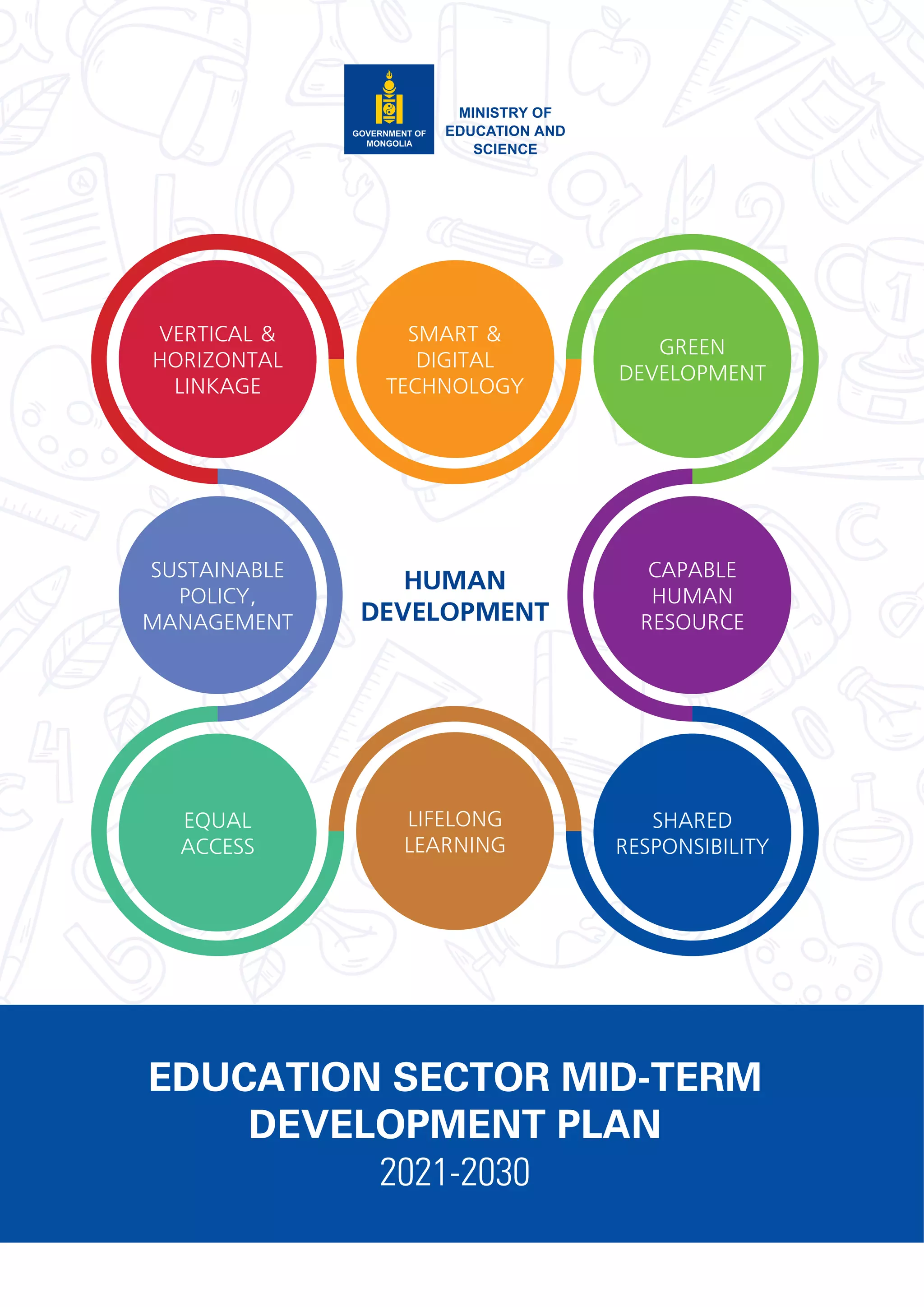
VERTICAL &
HORIZONTAL
LINKAGE
SMART &
DIGITAL
TECHNOLOGY
CAPABLE
HUMAN
RESOURCE
HUMAN
DEVELOPMENT
SHARED
RESPONSIBILITY
LIFELONG
LEARNING
EQUAL
ACCESS
SUSTAINABLE
POLICY,
MANAGEMENT
GREEN
DEVELOPMENT
MINISTRY OF
EDUCATION AND
SCIENCE
Ulaanbaatar
October 2020
EDUCATION SECTOR MID-TERM
DEVELOPMENT PLAN
2021-2030
MINISTRY OF
EDUCATION AND
SCIENCE
This plan has been developed with the technical support of ADB TA MON 51103-001: Supporting
the Education Sector Master Plan Development Project. Additional support has been provided by the
Global Partnership for Education’s (GPE) Education Sector Plan Development Grant (ESPDG) which
was managed by the World Bank Group.
3
EDUCATION SECTOR MID-TERM DEVELOPMENT PLAN 2021-2030
CONTENTS
LIST OF ACRYONYMS.......................................................................................................................7
FOREWORD.......................................................................................................................................9
EXECUTIVE SUMMARY....................................................................................................................12
CHAPTER ONE. DEVELOPMENT POLICY AND INTERNATIONAL TRENDS TO BE ADHERED TO IN
THE EDUCATION SECTOR MID-TERM DEVELOPMENT PLAN.......................................................... 15
1.1	 Mongolia Development Concept and Education Policy............................................................. 16
1.2	 Global Trends in Education Development.................................................................................. 18
1.3	 Implementation of the Education Development Master Plan 2006-2015 and
Lessons Learned........................................................................................................................ 19
CHAPTER TWO. CURRENT SITUATION AND CONTEXT FOR EDUCATION
DEVELOPMENT DURING 2021-2030................................................................................................23
2.1	 Population and Socio-Economic Context of Mongolia and Trends Toward 2030......................24
2.2 	
Education Sector Resources and Opportunities ........................................................................28
2.3	Summary of Issues and Challenges in the Education Sector.....................................................36
CHAPTER THREE. EDUCATION SECTOR MID-TERM DEVELOPMENT AREAS AND OBJECTIVES
DURING 2021-2030.........................................................................................................................45
3.1	 Aim of the Education Sector Mid-Term Development Plan...................................................... 46
3.2	Principles of the Education Sector Mid-Term Development Plan ............................................ 46
3.3	Policy Priorities in the Education Sector Mid-Term Development Plan..................................... 46
3.4	Scope and Timeline of the Education Sector Mid-Term Development Plan .............................47
3.5	Summary of Objectives and Outcomes.....................................................................................47
CHAPTER FOUR. EDUCATION PRIORITIES AND STRATEGIES..........................................................49
4.1	 Sector Level .............................................................................................................................50
4.2	Sub-sector Level ......................................................................................................................55
4.2.1	 Pre-primary education.....................................................................................................55
4.2.2	Primary and secondary education....................................................................................59
4.2.3	Vocational Education and Training.................................................................................. 64
4.2.4	Higher Education.............................................................................................................67
CHAPTER FIVE. IMPLEMENTATION PLAN FOR 2021-2025...............................................................73
5.1	 Plan to implement objectives and activities .............................................................................74
EDUCATION SECTOR MID-TERM DEVELOPMENT PLAN 2021-2030
4
CHAPTER SIX. EDUCATION SECTOR NEEDS AND COST PROJECTIONS...........................................93
6.1	 Projections of Education Needs............................................................................................... 96
6.1.1	Pre-primary..................................................................................................................... 96
6.1.2	 Primary-Secondary Education.......................................................................................... 98
6.1.3	 Vocational Education and Training..................................................................................101
6.1.4	 Higher Education........................................................................................................... 102
6.1.5	 Lifelong Learning........................................................................................................... 104
6.2	Education Sector Cost Projections........................................................................................... 105
6.3	Government Consolidated Budget and Education Sector Budget (MTEF), and Financing Gap
Calculation...............................................................................................................................110
6.4	Financing Strategy.....................................................................................................................111
CHAPTER SEVEN: MONITORING AND EVALUATION FRAMEWORK............................................... 115
7.1.	 M&E arrangements..................................................................................................................116
7.1.1.	 M&E legal environment ................................................................................................116
7.1.2.	 M&E activities ................................................................................................................118
7.2.	Possible Risks and Mitigation Measures ................................................................................. 120
7.3	 Indicators and targets.............................................................................................................. 121
APPENDICIES..................................................................................................................................129
Appendix 1 – The list of participants involved in preparation of the ESMTDP ............................ 130
Appendix 2 – Results Frameworks................................................................................................137
Appendix 3 – General Procedure to formulate development policy document – Estimated
Calculations....................................................................................................................................176
LIST OF TABLES
Table 2.1. 	 Population of selected countries, GNI, GDP, 2018,
(WB classification by income and region).....................................................................26
Table 2.2.	 Mongolia`s GDP growth trends and projections........................................................... 27
Table 2.3.	 Components of variable costs .....................................................................................29
Table 2.4. 	 Variable cost normative (thousand MNT), as of 2018...................................................29
Table 2.5. 	 Education sector investment amount (million MNT), and share of the Minister of
Education budget package of 2015-2019......................................................................30
Table 2.6. 	 Shift coefficient distribution of general education schools, by property type and
classification.................................................................................................................. 31
Table 2.7. 	 Number of school teachers required for primary and secondary schools ....................34
Table 2.8. 	 Projections of student growth .....................................................................................35
Table 2.9. 	 Children and youth population growth, in comparison with 2018 ...............................35
Table 4.1. 	 Sector programs and activities......................................................................................53
Table 4.2. 	 Pre-primary programs and activities.............................................................................57
5
EDUCATION SECTOR MID-TERM DEVELOPMENT PLAN 2021-2030
Table 4.3. 	 Primary and secondary education programs and activities...........................................62
Table 4.4. 	TVET programs and main activities...............................................................................66
Table 4.5. 	 HE programs and main activities....................................................................................71
Table 6.1. 	 Variable cost components.............................................................................................95
Table 6.2. 	 Normative variable costs, MNT, 2019............................................................................95
Table 6.3. 	 Pre-primary age population 2021-2030........................................................................ 96
Table 6.4. 	Pre-primary enrollment rates........................................................................................ 96
Table 6.5. 	 Pre-primary enrollees................................................................................................... 96
Table 6.6. 	Share of enrollees in public and private pre-primary servics.........................................97
Table 6.7. 	 Share of enrollees in public pre-primary, by type of service.........................................97
Table 6.8. 	Enrollees in pre-primary services...................................................................................97
Table 6.9. 	 Staff for public pre-primary services........................................................................... 98
Table 6.10. 	Primary-secondary age population 2021-2030 (official projection of NSO 2015-2045).
98
Table 6.11. 	Primary-secondary enrollment rates............................................................................. 99
Table 6.12. 	Enrollees in primary-secondary schools........................................................................ 99
Table 6.13. 	Share of enrollees in public and private primary-secondary schools........................... 100
Table 6.14	 Students of primary-secondary schools...................................................................... 100
Table 6.15. 	Staff of public primary-secondary schools.................................................................. 100
Table 6.16. 	TVET enrollee age population, 2021-2030....................................................................101
Table 6.17. 	TVET enrollment rate...................................................................................................101
Table 6.18. 	
Enrollees in TVET schools.............................................................................................101
Table 6.19. 	Students in TVET schools, by type of school.............................................................. 102
Table 6.20 	Students in TVET schools............................................................................................ 102
Table 6.21. 	HE enrollee age population, 2021-2030...................................................................... 102
Table 6.22	 Higher education enrollment rate............................................................................... 103
Table 6.23.	Students in higher education institutions.................................................................... 103
Table 6.24.	Students in HEIs by type of HEI.................................................................................. 103
Table 6.25.	Students in HEIs.......................................................................................................... 103
Table 6.26.	Enrollees in literacy training, ages 15-24 .................................................................... 104
Table 6.27.	Enrollees in equivalency programs.............................................................................. 104
Table 6.28.	Pre-primary cost projections (billion MNT)................................................................. 105
Table 6 29.	Primary-secondary cost projections (bilion MNT)....................................................... 106
Table 6.30.	TVET cost projections (billion MNT)............................................................................107
Table 6.31. 	Higher Education cost projections (billion MNT).........................................................108
Table 6.32.	Lifelong Learning cost projection (billions MNT)........................................................108
Table 6.33.	Education and science poligy and administration projections (billion MNT)............... 109
Table 6.34.	Education sector cost projections................................................................................ 109
Table 6.35.	Projection of GDP, the share of government budget in GDP and education
expenditure in government budget produced by the NDA..........................................110
Table 6.36.	Financing gap by share and amounts..........................................................................110
EDUCATION SECTOR MID-TERM DEVELOPMENT PLAN 2021-2030
6
Table 6.37.	Investment from development partners........................................................................111
Table 6.38.	Costing of ESMTPD (million MNT)............................................................................... 112
Table 6.39.	Education sector cost projections including ESMTDP (billion MNT)............................. 113
Table 6 40.	Education sector budget (billion MNT) and financing gaps by share and amount ..... 113
Table 7.1. 	 Positions and responsibilities within the M&E division.................................................116
Table 7. 2 	 Capacity of M&E responsible unit or staff at each organizations under MES............. 117
Table 7.3. 	 Capacity of M&E responsible unit or staff at each organizations under MoLSP.......... 117
Table 7.4. 	 Surveys and evaluative studies, pre-primary education................................................118
Table 7.5. 	 Surveys and evaluative studies, primary and secondary education..............................118
Table 7.6. 	 Surveys and evaluative studies, technical and vocational education............................. 119
Table 7.7. 	 Recap of M&E activities............................................................................................... 119
Table 7.8. 	 Possible risks during plan implementation and mitigation measures........................... 120
Table 7.9 	 Sector key performance indicators............................................................................... 121
Table 7.10.	 Pre-primary education key performance indicators .....................................................123
Table 7.11 	 Primary and secondary education key performance indicators ...................................124
Table 7.12. 	TVET key performance indicators................................................................................125
Table 7.13. 	Higher education key performance indicators ............................................................127
LIST OF FIGURES
Figure 2.1	 Population growth up to 2030, by age and class (thousand people) ..........................25
Figure 2.2	 Mongolian population and urbanization trends up to 2050.........................................26
Figure 2.3.	 GDP per capita (million MNT), 2010-2018.................................................................... 27
Figure 2.4.	Education budget expenditure dynamics, nominal and 2010 current prices..................28
Figure 2.5.	 Education sector budget expenditure structure by sub-sector, 2018.............................29
Figure 2.6. 	Education expense per capita, nominal and real prices (thousand MNT), 2008-2018..30
Figure 2.7. 	Number of kindergartens..............................................................................................32
Figure 2.8. 	
Numbers of students enrolled at state-owned and private schools .............................34
7
EDUCATION SECTOR MID-TERM DEVELOPMENT PLAN 2021-2030
LIST OF ACRYONYMS
ADB 	 Asian Development Bank
AE	 Adult Education
CBT	 Competency Based Training
CC	 Career counselling
COUC	 Consortium of Universities and Colleges
CPD	 Continuing Professional Development
CSO	 Civil Society Organization
CWD	 Children with disabilities	
VETPICD	 Vocational Education and Training Policy Implementation and Coordination Department
ECD	 Educational and Culture Department
ECE	 Early Childhood Education
EEC	 Education Evaluation Center
EMIS	 Education Management and Information System
EPSSim	 Education Policy and Strategy Simulation
ESMTDP	 Education Sector Mid-Term Development Plan
EU	 European Union
GALSWS	 General Authority for Labor and Social Welfare Services
GASI	 General Authority of Specialized Investigation
GDP	 Gross Domestic Products
GER	 Gross enrollment rate
GES	 Graduate`s Employment Survey
GNI	 Gross National Income
GPE	 Global Partnership for Education
GRE	 Global Report on Education
HDI	 Human Development Index
HE	 Higher Education
HEI	 Higher Education Institutions
HEMIS	 Higher Education Management and Information System
HSES	 Household Socio-Economic Survey
ICE	 International Classification of Education
ICT	 Information and Communication Technology
IIEP	 International Institution for Education Planning (UNESCO)
IMF	 International Monetary Fund
ISCED	 International Standard Classification of Education
ITPD	 Institute of Teacher`s Professional Development
KPI	 Key Performance Indicator
LLE	 Life-long Education
LLL	 Life-Long Learning
LM	 Labor Market
MASM	 Mongolian Agency for Standard and Meteorology
MEA	 Mongolian Education Alliance	
MES	 Ministry of Education and Science
MICS	 Multiple Indicator Cluster Survey
MIER	 Mongolian Institute of Education Research
MNCEA	 Mongolian National Council for Education Accreditation
MOH	 Ministry of Health
EDUCATION SECTOR MID-TERM DEVELOPMENT PLAN 2021-2030
8
MoLSP	 Ministry of Labor and Social Protection
MOF	 Ministry of Finance
MSUE 	 Mongolian State University of Education
MTEF	 Medium Term Expenditure Framework
NCEA	 National Council for Education Accreditation
NCLLE	 National Center of Lifelong Education
NCNFEDL	 National Center for Non-Formal Education and Distance Learning
NCVET	 National Council for Vocational Education and Training
NDA	 National Development Agency
NER	 Net Enrollment Rate
NQF	 National Qualification Framework
NSC	 National Security Council
NSO	 National Statistical Office
OECD	 Organisation for Economic Co-operation and Development
PC	 Polytechnic College
PISA	 Programme for International Student Assessment
PMT	 Proxy Means Testing
PPE	 Pre-Primary Education
PPEI 	 Pre-Primary Education Institution
PPP	 Public Private Partnership
PSE	 Primary and Secondary Education
PWD	 People with Disabilities
QA	 Quality Assurance
RILSP	 Research Institute for Labor and Social Protection
RMC	 Regional Methodological Center
RPL	 Recognition of Prior Learning
SDE	 Sustainable Development Education
SDG	 Sustainable Development Goals
SDV	 Sustainable Development Vision
STC	 Save the Children
STR	 Student Teacher Ratio
TLM	 Teacher/Learning Materials
TVET	 Technical and Vocational Education and Training
TVETMIS	 Technical and Vocational Education and Training Management and Information System
UIL	 Institute for Lifelong Learning (UNESCO)
UN	 United Nations
UNDP	 United Nations Development Programme
UNESCO	 United Nations Educational, Scientific and Cultural Organization
UNFPA	 United Nations Population Fund
UNICEF	 United Nations Fund for Children
VET	 Vocational Education and Training
VETAMIC	 Vocational Education and Training Assessment, Methodology and Information Center
VETP	 Vocational Education and Training Partnership
VETPICD	 Vocational Education and Training Policy Implementation and Coordination Department
VTPC	 Vocational Training and Production Center
WASH	 Water, Sanitation and Health
WB	 World Bank
9
EDUCATION SECTOR MID-TERM DEVELOPMENT PLAN 2021-2030
FOREWORD
My warmest regards to the readers of this policy document.
It’s my pleasure to present to you Mongolia’s Education Sector Medium-Term Development Plan
(2021-2030) after its approval.
A large team, comprised of government, non-government organizations, professional
organizations, academics, and researchers in the sector, developed Mongolia’s Education Sector
Medium-Term Development Plan in conformity with Mongolia’s long-term development policy
document - Vision 2050, and relevant laws, policies, and regulations. After a thorough analysis
and review of the education sector achievements, constraints, and gaps of the past decade, the
team managed the difficult task of identifying the future strategic development objectives, in close
consultation with the stakeholders.
I would like to highlight the support of the Asian Development Bank (ADB), which was critical
to the development of this plan. I would like to extend my sincere gratitude to the ADB for its
long-standing knowledge and investment support to the nation’s education sector since 1992. My
gratitude also extends to our partners, including Global Partnership for Education, World Bank,
Embassy of Japan in Mongolia, UNESCO, UNICEF, for their valuable financial support and active
technical expertise in the review and assessment process leading up to this plan as well as the
development of the plan itself.
The end goal of Mongolia’s Education Sector Medium-Term Development Plan (2021-2030) is
to “To ensure the holistic development of Mongolian citizens with competencies to thrive
in the digital technology era as active participants in a knowledge-based society which
enables life-long learning through quality, open, inclusive and flexible education services”.
The Ministry of Education and Science, sectoral organizations, and practitioners will join forces
and make every effort to implement the plan with excellent outcomes.
I wish all of you success and all the best in your future endeavors.
MINSTER OF EDUCATION AND SCIENCE	
L.TSEDEVSUREN
EDUCATION SECTOR MID-TERM DEVELOPMENT PLAN 2021-2030
10
11
EDUCATION SECTOR MID-TERM DEVELOPMENT PLAN 2021-2030
12
EXECUTIVE SUMMARY
1	
Amended in 2020.
2	
https://www.mier.mn/archives/3716.
3	
Монгол Улсын боловсролын бодлогын тойм шинжилгээ., ЮНЕСКО, 2020.
The Government of Mongolia has
implemented a succession of education plans
over the past three decades: the Master Plan for
Developing the Education Sector of Mongolia
in 1993, the Strategic Plan for Education during
2000-2005, and the Master Plan for Education
of Mongolia during 2006-2015.
The 2006-2015 Master Plan enabled the
education sector to achieve significant outcomes
in terms of modifying pre-primary, primary and
secondary education curricula and vocational
education and training, higher education um and
program content, revising student textbooks and
learning materials and establishing a favorable
learning environment. Positive changes were
also made in the supply of qualified teachers
and the capacity of kindergarten and school
buildings.
Despite these significant outcomes, the
sector still faces the following challenges:
-	Enhancing the quality of education
services
-	Eliminating the urban-rural gap in
education
-	 Establishing a child-friendly and accessible
learning environment
-	 Strengthening cross-sector linkages and
building partnerships with all stakeholders
-	 Improving governance and management
of the education system.
This Education Sector Medium-Term
Development Plan (ESMTDP) for 2021-2030 is
aligned with related legal and policy documents
such as UN-Sustainable Development Goals
2030, the Mongolia Long-Term Development
Policy Planning Law,1
the Mongolia Long-Term
Development Vision 2050 and the Government
Policy for Education 2014-2024.
In conformity with Clause 5 of the Long-
Term Development Policy Planning Law, the
Education Sector Plan for 2021-2030 is designed
to provide all citizens with equal access to
education services, ensure vertical and horizontal
links in education policies, disseminate smart
and digital technology at all levels of education,
and promote green development in the learning
environment and materials.
The Plan has been developed and revised
based on feedback and recommendations
provided by the following study reports and
workshop discussions:
-	 Education in Mongolia: Country Report
2019,2
produced by the Mongolian
Institute of Education Research and other
sector institutions.
-	 Mongolia Education Policy Review 2020,3
analyzed by UNESCO expert teams.
-	 Education Sub-Sector Analysis Reports
2019-2020, led by ADB national experts
and technical teams.
-	 User Satisfaction Survey Report 2019,
conducted by the Mongolian Institute for
Educational Research.
-	Donor organization workshops and
discussions led by local education group
during 2019-2020.
-	
Stakeholder workshops (total of
12), including representatives from
professional organizations, researchers,
experts, teachers, parents and learners
during 2018-2020.
-	 External Appraisal Report supported by
Global Education Partnership in 2020.
The Education Sector Medium-Term
Development Plan aims to ensure the holistic
development of Mongolian citizens through
quality, open, inclusive and flexible education
services that enhance their capacity to live
and work in the digital technology era,
actively participate in knowledge-based
society and engage in lifelong learning.
13
EDUCATION SECTOR MID-TERM DEVELOPMENT PLAN 2021-2030
The Plan identifies policy priorities in each
sub-sector to:
•	 Enhance the quality and relevance of the
education system and services;
•	 Increase equal access and inclusiveness;
•	 Improve the efficiency of education
governance, management and
administration;
Within the umbrella of above priorities, the
Plan sets 15 strategic objectives, 47 programs
and 254 actions.
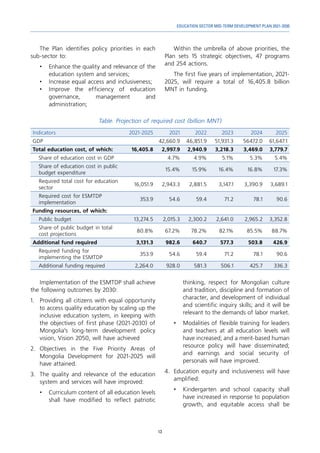
The first five years of implementation, 2021-
2025, will require a total of 16,405.8 billion
MNT in funding.
Table. Projection of required cost (billion MNT)
Indicators 2021-2025 2021 2022 2023 2024 2025
GDP 42,660.9 46,851.9 51,931.3 56472.0 61,647.1
Total education cost, of which: 16,405.8 2,997.9 2,940.9 3,218.3 3,469.0 3,779.7
Share of education cost in GDP 4.7% 4.9% 5.1% 5.3% 5.4%
Share of education cost in public
budget expenditure
15.4% 15.9% 16.4% 16.8% 17.3%
Required total cost for education
sector
16,051.9 2,943.3 2,881.5 3,147.1 3,390.9 3,689.1
Required cost for ESMTDP
implementation
353.9 54.6 59.4 71.2 78.1 90.6
Funding resources, of which:
Public budget 13,274.5 2,015.3 2,300.2 2,641.0 2,965.2 3,352.8
Share of public budget in total
cost projections
80.8% 67.2% 78.2% 82.1% 85.5% 88.7%
Additional fund required 3,131.3 982.6 640.7 577.3 503.8 426.9
Required funding for
implementing the ESMTDP
353.9 54.6 59.4 71.2 78.1 90.6
Additional funding required 2,264.0 928.0 581.3 506.1 425.7 336.3
Implementation of the ESMTDP shall achieve
the following outcomes by 2030:
1.	 Providing all citizens with equal opportunity
to access quality education by scaling up the
inclusive education system, in keeping with
the objectives of first phase (2021-2030) of
Mongolia’s long-term development policy
vision, Vision 2050, will have achieved
2.	Objectives in the Five Priority Areas of
Mongolia Development for 2021-2025 will
have attained.
3.	 The quality and relevance of the education
system and services will have improved:
•	 Curriculum content of all education levels
shall have modified to reflect patriotic
thinking, respect for Mongolian culture
and tradition, discipline and formation of
character, and development of individual
and scientific inquiry skills; and it will be
relevant to the demands of labor market.
•	 Modalities of flexible training for leaders
and teachers at all education levels will
have increased; and a merit-based human
resource policy will have disseminated;
and earnings and social security of
personals will have improved.
4.	 Education equity and inclusiveness will have
amplified:
•	 Kindergarten and school capacity shall
have increased in response to population
growth, and equitable access shall be
EDUCATION SECTOR MID-TERM DEVELOPMENT PLAN 2021-2030
14
promoted. Open education services
shall be diversified. All kindergartens
and schools will have the enabling
environment to include special needs
children.
•	 In relation to technology and innovation
reforms, the education system will have
transitioned into the digital system; and
a flexible system of lifelong learning for
all citizens will have established.
•	 Equal and quality education opportunities
shall have provided to all citizens
regardless of their developmental needs,
location and lifestyles.
5.	Education governance, management and
administration shall will have strengthened.
•	 Independent, autonomous governance
and management system for TVET and
higher education institutions will have
established at the national level.
•	 For the sake of efficiency of education
budgeting and effectiveness of policy
implementation, primary and secondary
school structures and types will have
mapped and aligned with local population
growth and regional development
perspectives. Based upon the result of
the mapping, specialized high school
policy will have promoted.
•	 Internal and external quality assurance
systems will have reinforced at all
education levels.
---оОо---
2
CHAPTER ONE. DEVELOPMENT POLICY AND
INTERNATIONAL TRENDS TO BE ADHERED
TO IN THE EDUCATION SECTOR MID-TERM
DEVELOPMENT PLAN
•	 Mongolia Development Concept and Education Policy
•	 Global Trends in Education Development
•	 Implementation of the Education Development Master Plan
2006-2015 and Lessons Learned
EDUCATION SECTOR MID-TERM DEVELOPMENT PLAN 2021-2030
16
CHAPTER ONE. DEVELOPMENT POLICY AND INTERNATIONAL TRENDS TO BE
ADHERED TO IN THE EDUCATION SECTOR MID-TERM DEVELOPMENT PLAN
1.1	 MONGOLIA DEVELOPMENT CONCEPT AND EDUCATION POLICY
A key focus of Vision 2050 is Human
Development; and its chapter on education
specifies the strategic objective of developing
socially active and healthy citizens by affording
them access quality education. This objective
is key to the security of family life and the
development of the country in a manner that
ensures the well-being of all Mongolians. The
implementation and outcomes of the objective
are defined three phases.
During the first phase (2021-2030), all
citizens shall be provided equal opportunity
to access quality education and reforming an
inclusive education system. This phase includes
specific actions for each sub-sector:
The pre-primary education sub-sector is
perceived as a fundamental period for child
character formation and development. Therefore,
actions are intended to enhance the quality of
kindergarten services and training. It annually
updates the nutritional needs and food cost for
children aged 1-3 and 4-6, respectively; establish
an equal opportunity environment where all
children from herder, migrated, and low-income
families are able to access quality education,
taking into account their special and distinctive
needs; and build the capacity of parents and
guardians to provide a learning environment
for their children. The Plan includes integrated
actions to promote child development through
active participation of parents and guardians.
In primary and secondary education,
attention is given to children who cannot access
education services and those at risk. Each child
of this group shall be given necessary support
to be included in education. Moreover, the
quality of primary and secondary education
shall be improved by modifying the curriculum
content and methodology to reflect Mongolian
language, history, culture and tradition, patriotic
thinking, individual development, character
formation, bilingual education and common
values of humanity. Actions in this sub-sector
also include a factor analysis of student learning
achievement, with results to be reflected in
policy planning and implementation.
The vocational education and training sub-
sector, in alignment with long-term development
policy, shall be reformed to respond to labor
market demands and needs reforming training
system. By 2030, the workforce shall be fully
supplied by high-skilled, qualified workers.
In higher education, training providers shall
be developed in line with international standards,
and their partnerships with higher education
institutions and industries shall be strengthened
by drawing the results of graduates’ employment
surveys and employer satisfaction surveys.
Qualification programs shall be revised, with at
least 20 credit hours of learning converted into
internships inconfirmity with regional features
economic priorities research universities will be
developed.
Lifelong education shall be strengthened
through the development of open education
systems. An integrated platform for online
training shall be created; and lifelong learning
opportunities for all citizens shall be afforded
regardless of time and location.
State Policy on Education 2014-2024 aims to
provide all citizens with opportunities to acquire
knowledge, skills and competencies to develop
their talents, work productively, increase their
well-being, and respect humanity and national
values throughout this. In particular, the State
Policy sets the following objectives:
•	 Ensure the participation of all stakeholders
(policymakers, professional associations,
research institutes, experts and citizens)
in the development and implementation
17
EDUCATION SECTOR MID-TERM DEVELOPMENT PLAN 2021-2030
of education policy, strategy, plans,
programs and projects,
•	
Pursue principles of openness,
transparency, good governance and
evidence-based decision making,
•	 Take into consideration the structure,
location, characteristics and type of
education facilities in sector policymaking
and planning.
•	 Ensure the interrelationship of functions
and operations of government, local,
professional, and public organizations,
•	 Develop and expand the Education
Management and Information System
(EMIS) and ensure its security and
transparency,
Within the scope of these objectives, the
State Policy on Education sets policies aimed
at enabling all children to access pre-primary
education by promoting alternative services;
implementing core curricula that provide
opportunities for all children to develop
through creative actions based on individual
characteristics; and sharing the cost of food
with parents and caretakers. Some of these
policies have been successfully implemented.
For primary and secondary education, the
State Policy sets objectives related to adher
internationally recognized progression pathways
and structures; learning through flexible
curricula; and implementing core curricula.
The technical and vocation education and
training (TVET) sub-sector has successfully
implemented policies to develop curriculum in
line with labor market demand and technology
advancement, improve training and quality
assurance, and set standards for internal and
external accreditations. Policies are also aimed at
developing specialized TVET provider campuses
and establishing a National Qualification
Framework.
In higher education, policies are aimed at
supporting and implementing improved labor
market orientation of programs, research and
development, quality assurance with elaboration
of an accreditation system, development
of different types of modalities guided by
international common standards, international
training programs, and mutual recognition of
graduate degrees.
Moreover the ESMTDP 2021-2030 will
establish conditions and support implementation
of the objectives of both Vision 2050 and the
State Policy on Education 2014-2024, and attain
targeted outcomes by 2025 and 2030.
EDUCATION SECTOR MID-TERM DEVELOPMENT PLAN 2021-2030
18
1.2	GLOBAL TRENDS IN EDUCATION DEVELOPMENT
4	
UNESCO UIL. 2009.
5	
UNESCO. 2018. Global Education Monitoring Report, page 8.
6	
ADB, MES. 2019. Lifelong Education Analysis Report.
Global trends in education development were
identified by UNESCO as well as from directives
and initiatives on education followed by the
Organisation for Economic Co-Operation and
Development (OECD). The Incheon Declaration
2030 is the main strategy to develop education
until 2030.
The Incheon Declaration
The Incheon Declaration 2030 promotes
quality lifelong learning opportunities for all,
in all settings and at all levels of education.
This includes equitable and increased access to
quality technical and vocational education and
training and higher education and research, with
due attention to quality assurance. In addition,
the Declaration includes important provisions
for flexible learning pathways, as well as for
the recognition, validation and accreditation of
knowledge, skills and competencies acquired
through non-formal and informal education.
It also commits to quality education and to
improving learning outcomes, which requires
strengthening inputs, processes and evaluation of
outcomes and mechanisms to measure progress.
The Declaration also ensures the empowerment,
recruitment, training, professional qualifications,
and motivation of teachers and educators
within well-resourced, efficient and effectively
governed systems. It encourages the provision
of at least one year of free and compulsory
quality pre-primary education through changes
in education policies and a focus on the most
disadvantaged, especially girls and children with
special needs.
Moreover, according to the “Global Report on
Adult Learning and Education” by the UNESCO
Institute of Lifelong Education4
and the UNESCO
“Global Education Monitoring Report”:
“Lifelong learning comprises all learning
activities undertaken throughout life with
the aim of improving knowledge, skills and
competencies, within personal, civic, social and
employment-related perspectives.” 5
The first report uses the concepts of both
“lifelong education” and “lifelong learning,”
while the second report more often uses
the concept of “lifelong learning.” The term
“lifelong learning” is more commonly used in
UNESCO documents because it is less focused
on structure and institutions and puts individuals
at the center of the learning process. One clear
example is that “lifelong learning” is the term
used in the Sustainable Development Goals
Target 4.6
UNESCO’s Futures of Education:
“Learning to Become” Initiative
UNESCO’s Futures of Education: “Learning
to Become” initiative aims to rethink education
and shape the future. The initiative is catalyzing
a global debate on how knowledge, education
and learning need to be reimagined in a world
of increasing complexity, uncertainty and
precariousness. It aims to mobilize the many rich
ways of being and knowing in order to leverage
humanity’s collective intelligence. The initiative
relies on a broad, open consultative process
that involves youth, educators, civil society,
governments, business and other stakeholders.
The work will be guided by a high-level
International Commission of thought leaders
from diverse fields and different regions of the
world. In November 2021, the Commission will
publish a report designed to share a forward-
looking vision of what education and learning
might become and offer a policy agenda on
how to catalyze knowledge and learning to
shape the future of humanity and the planet.
The concept of learning to become points
to a philosophy of education and an approach
to pedagogy that views learning as a process of
continual unfolding that is ongoing and lifelong.
To think in terms of “becoming” is to invoke
a line of thought that emphasizes potentials,
rejects determinism and expresses a flexible
openness to the new. Learning to become also
invokes the need to develop the capacity to
19
EDUCATION SECTOR MID-TERM DEVELOPMENT PLAN 2021-2030
imagine a good and fulfilling life. Around the
globe, for the many that live in conditions of
poverty, exclusion, displacement and violence,
the future can appear more as a set of shrinking
possibilities than a world of hope and promise.
When human aspiration is wasted, the world
suffers. As we come to terms with human-
caused changes to the planet and face the
possibilities of fundamental transformations
in social organization, human consciousness
and human identity, humanity needs to devote
attention to the question: what do we want to
become? Knowledge and learning are at the
core of transformations in human minds and
societies.
OECD’s Future of Education and Skills
2030 Project
The OECD Future of Education and Skills
2030 project has identified some innovative
features of education systems that are just
emerging but may become the new normal in
tomorrow’s education systems. Education is part
of a larger eco-system; and decisionmaking and
responsibilities are shared among stakeholders,
including parents, employers, communities
and students. The shared responsibility means
that everyone works together and assumes
7	
ADB, MES. 2019. Pre-primary Education Sub-sector Analysis Report.
8	
By the 2015-2016 academic year, EMIS reported that 8.9% of dropout students studied in the equivalent program.
responsibility for a student’s education, and
students also learn to be responsible for their
own learning. An effective and quality school
experience values not only outcomes but also
process. In addition to student performance
and student achievements, students’ learning
experiences are in and of themselves recognized
as having intrinsic value. This means a focus
not only on academic performance but also
on holistic student well-being. It also means an
approach to curriculum design and learning that
emphasizes a non-linear progression in which
each student has his/her own learning path
and is equipped with different prior knowledge,
skills and attitudes when he/she starts school.
Through the Future of Education and Skills 2030
project, the curriculum analysis will shift its
focus from “curriculum redesign” to “curriculum
implementation.”
Modern problems such as climate change,
urbanization, new technologies, sustainability
of the environment, inclusiveness and gender
equality will influence the future of education,
andareaddressedintheSustainableDevelopment
Vision of Mongolia. Education planning needs
to be in line with these challenges.
1.3	IMPLEMENTATION OF THE EDUCATION DEVELOPMENT MASTER PLAN 2006-2015 AND
LESSONS LEARNED
The Education Development Master Plan
2006-2015 laid the groundwork for preparation
of the ESMTDP by setting goals related to
the development of the education sub-sector
and non-formal education, and to education
sector performance during 2018-2019 academic
year. The Master Plan 2006-2015 set several
objectives in early childhood education, primary
and secondary, informal education, vocational
training, technical education and higher
education and cross-sector areas as follow:
In pre-primary education, performance
indicators imply that 52 percent of the targets
included in the pre-primary education plan have
been fully achieved, 36 percent have not been
realized, and 11 percent have been partially
attained.7 Objectives of reducing class size,
increasing the supply of qualified teachers to all
kindergartens and building the capacity of %)
percent of teachers are not well implemented.
In primary and secondary education, 18
objectives are set in the quality area; in which,
38.9 percent have been fully implemented and
16.7 percent partially achieved. In education
management, 50 percent of the objectives are
not implemented. For instances, objectives to
enable 40.0 percent of dropout students to
access education service through equivalency
of learning programs in non-formal education8
and to exercise primary and secondary school
EDUCATION SECTOR MID-TERM DEVELOPMENT PLAN 2021-2030
20
mapping are not implemented.
In the TVET sub-sector, out of 18 objectives,
70.6 percent are successfully implemented and
attained the target value; 23.5 percent are
partially implemented and 5.9 percent are not
been implemented.9
In higher education, objectives to increase
the percentage of learners in engineering
and technology, natural science, teaching and
agriculture from 29.1 to 45.0 percent; and
decrease. the percentage of learners in other
qualifications from 38.9 percent to 34.0 percent
are not fully implemented.
The Master Plan 2006-2015 contained a
dedicated section on non-formal education
and adult learning. The following targets were
put forward in the areas of access, quality and
management:
•	 To make non-formal education meet the
needs of users;
•	 To improve the learning environment at
all levels of non-formal education and
increase capacity through additional
resources;
•	 To elaborate a policy and strategy for
the non-formal education sector, and
establish a finance system;
•	 To achieve a literacy of 97.7 – 99.0
percent by 2008;
•	 To re-educate 40 percent of students
who are school dropouts through non-
formal education and equivalency of
learning programs;
•	 To increase the funding for non-formal
education, for the national center for
distance learning, and for centers for
non-formal education in soums and
districts every year by 8 percent;
9	
ADB, MES. 2019. TVET Sector Analysis Report.
10	
Begz, N. 2020. 25-year Experience in Development of Mongolian Education: Experience and Lessons Learned (1992-
2017).
•	 To include costs for teachers’ professional
development in the overall expenditure
and finance these costs annually;
•	 To establish a nationwide education
information, monitoring and evaluation
system;
As of the academic year 2018-2019, 6
fundamental directions of lifelong education are
not expanded, staff and teacher professional
development system has not been established;
all lifelong education centers do not have
building facilities, no database system; and a
monitoring and evaluation system are not been
established.
Although this Master Plan could not
achieve all the target values, it had significant
achievements in some areas. Pre-primary,
primary, secondary, TVET and higher education
curricula were optimized; student textbooks and
learning materials were upgraded; favorable
learning environments were established; the
supply and capacity of school leaders and
teachers were strengthened to some extent.
Significant achievements were also observed
in constructing schools and kindergartens in
urban areas. Furthermore, informal education
programs for school dropout children were
significantly improved, giving them a foundation
for lifelong learning. One of the crucial lessons
from implementation of the Master Plan was
the need to establish a donor coordination
mechanism; this mechanism was a main factor
in the achievement of the Plan’s objectives.10
In addition, it should be noted that during
first half of implementation, the Ministry of
Education, Culture and Science (former name;
now the Ministry of Science, MES) reflected
related strategies and objectives in its policies
and annual plans and monitored outputs and
outcomes. However, during the second half,
implementation was not seriously managed by
the Ministry.
This lesson implies that the Ministry needs
21
EDUCATION SECTOR MID-TERM DEVELOPMENT PLAN 2021-2030
to prioritize implementation of the ESMTDP and
establish a mechanism, including a responsible
unit, to ensure coherence and integration of
planning at all levels with the ESMTDP strategies;
oversee implementation; review outputs and
outcomes; and reflect feedback on the ESMTDP.
The ESMTDP 2021-2030 is developed based
on the studies and diagnostic analysis carried out
in 2018 and 2019; thus, all data are withdrawn
from 2018-2019 academic year.
CHAPTER TWO. CURRENT SITUATION AND
CONTEXT FOR EDUCATION DEVELOPMENT
DURING 2021-2030
•	 Population and Socio-Economic Context of Mongolia and
Trends Toward 2030
•	 Education Sector Resources and Opportunities
•	 Summary of Issues and Challenges in the Education Sector
EDUCATION SECTOR MID-TERM DEVELOPMENT PLAN 2021-2030
24
CHAPTER TWO. CURRENT SITUATION AND CONTEXT FOR EDUCATION
DEVELOPMENT DURING 2021-2030
2.1	 POPULATION AND SOCIO-ECONOMIC CONTEXT OF MONGOLIA AND TRENDS
TOWARD 2030
Demographic Context
11	
NSO website: www.1212.mn вэбсайт
12	
NSO website: www. 1212.mn вэбсайт
13	
ADB, MES. (2019). Life-Long education sub-sector analysis report
14	
ADB, MES. (2019). Primary and Secondary Education Sub-sector Analysis Report.
15	
ADB, MES. (2019). Lifelong Education Sub-sector Analysis Report.
16	
NSO website: www.1212.mn.
17	
Population growth projection based on population statistics provided by NSO 2018 population data.
18	
Estimation is made by UNESCO EPPSim 2.9 by using EMIS data, MES.
19	
Updated Population growth estimation by the NSO, 1212.mn.
As of 2018, the total population of Mongolia
is 3,238,479, of which 50.4 percent are female
and 49.6 percent are male. The total population
has increased by 61.6 thousand people (1.9
percent). Children up to 15 years old comprise
32.6 percent of the total population; young
people under 35 years comprise 63.8 percent,
and people over 65 make up 3.5 percent. As of
2018, 3.3 percent of the total population (105,730
people) are officially registered as people with
disabilities; of these, 33.7 percent live in the
capital, Ulaanbaatar, while the remainder reside
in rural and remote areas.11
The population
density is higher in urban areas; 53.4 percent
of Mongolians live in urban areas while 46.6
percent live in rural or remote areas.12
In total,
1588.9 thousand people reside in rural areas,
of which 483 thousand reside in soum centers
and 667.1 thousand in remote areas.13
More
than half - 51.7 percent of soums have resident
populations below 3,000; 30.1 percent of the
soums have populations between 3,000-5,000.
And 8.5 percent of soums have populations
between 5,001-7,000 citizens; Only 9.7 percent
of the soums have over 7,001 residents.
Due to the decreasing birth rate and
low child mortality rate, life expectancy has
increased from 60.3 in 1990 to 69.5 in 2018.
The difference between men’s and women’s life
expectancy has increased annually and the gap
is now 9 years (66 for men and 75 for women),
This gap has negatively impacted Mongolia’s
average life expectancy index.14
According to 2010 Population and Housing
Census data, the completion rate for secondary
education is relatively higher among people
aged 20-40 than for other age groups, but the
completion rate for people over 35 has been
decreasing. If the current numbers remain static,
the needs of older adults for life long education
access is like to increase in the near future.15
According to the projections of population
growth,16
by 2025 the population is likely to
increase by 13.1 percent over the 2018 population;
and is likely to reach at 3,662,221 by 2030. A
population increase of 18.01 percent (high
scenario) implies that the number will reach
3,950,052.17
More importantly, this growth is
likely to mostly occur in Ulaanbaatar. By 2030,
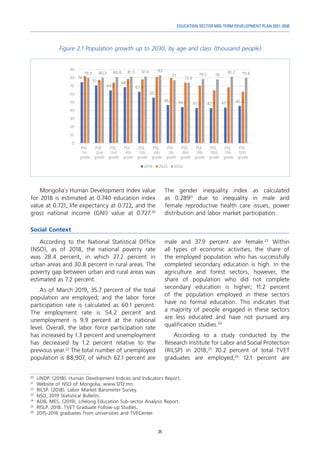
the 2 to 5 year age group is projected to
increase by 0.4 percent relative to 2019, the 6-14
age group by 26 percent, the 15-17 age group
by 84.8 percent, and the 18-22 age group by
46.6 percent.18
However, starting in 2030, this
growth is projected to slow and the population
aged 5-14 will decrease.19
25
EDUCATION SECTOR MID-TERM DEVELOPMENT PLAN 2021-2030
Figure 2.1 Population growth up to 2030, by age and class (thousand people)
20	
UNDP. (2018). Human Development Indices and Indicators Report.
21	
Website of NSO of Mongolia, www.1212.mn.
22	
RILSP. (2018). Labor Market Barometer Survey.
23
	 NSO, 2019 Statistical Bulletin.
24	
ADB, MES, (2019). Lifelong Education Sub-sector Analysis Report.
25	
RISLP. 2018. TVET Graduate Follow-up Studies.
26	
2015-2016 graduates from universities and TVECenter.
Mongolia`s Human Development Index value
for 2018 is estimated at 0.740 education index
value at 0.721, life expectancy at 0.722, and the
gross national income (GNI) value at 0.727.20
The gender inequality index as calculated
as 0.28921
due to inequality in male and
female reproductive health care issues, power
distribution and labor market participation.
Social Context
According to the National Statistical Office
(NSO), as of 2018, the national poverty rate
was 28.4 percent, in which 27.2 percent in
urban areas and 30.8 percent in rural areas. The
poverty gap between urban and rural areas was
estimated as 7.2 percent.
As of March 2019, 35.7 percent of the total
population are employed; and the labor force
participation rate is calculated as 60.1 percent.
The employment rate is 54.2 percent and
unemployment is 9.9 percent at the national
level. Overall, the labor force participation rate
has increased by 1.3 percent and unemployment
has decreased by 1.2 percent relative to the
previous year.22
The total number of unemployed
population is 88,907, of which 62.1 percent are
male and 37.9 percent are female.23
Within
all types of economic activities, the share of
the employed population who has successfully
completed secondary education is high. In the
agriculture and forest sectors, however, the
share of population who did not complete
secondary education is higher; 11.2 percent
of the population employed in these sectors
have no formal education. This indicates that
a majority of people engaged in these sectors
are less educated and have not pursued any
qualification studies.24
According to a study conducted by the
Research Institute for Labor and Social Protection
(RILSP) in 2018,25
70.2 percent of total TVET
graduates are employed,26
12.1 percent are
EDUCATION SECTOR MID-TERM DEVELOPMENT PLAN 2021-2030
26
unemployed, and 17.7 percent are registered as
economically inactive. Of the total number of
higher education institution (HEI) graduates,
75.2 percent are employed.
In recent years, internal migration and
rapid urbanization have been identified as key
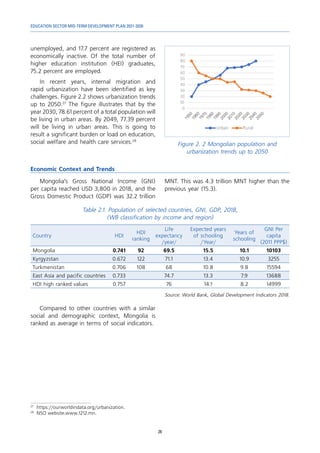
challenges. Figure 2.2 shows urbanization trends
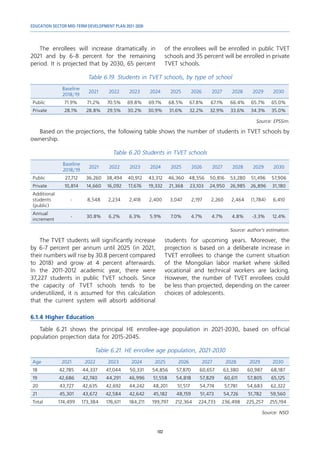
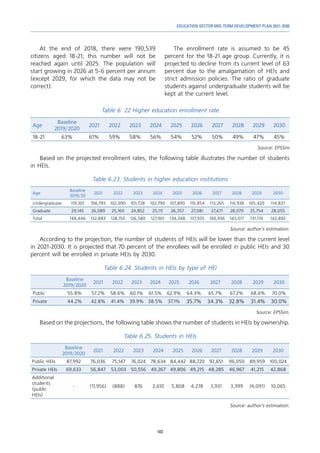
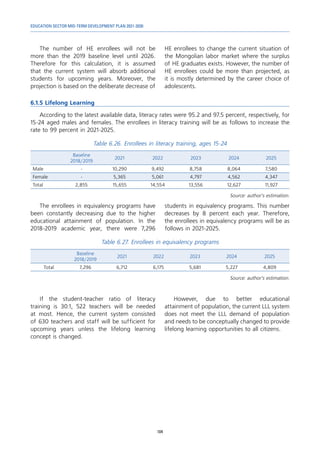
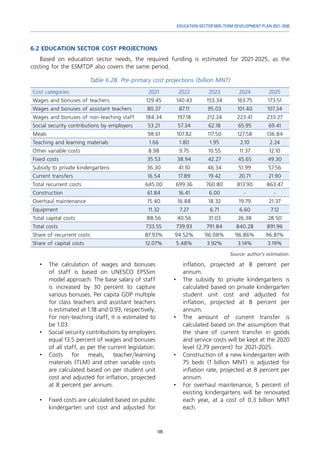
up to 2050.27
The figure illustrates that by the
year 2030, 78.61 percent of a total population will
be living in urban areas. By 2049, 77.39 percent
will be living in urban areas. This is going to
result a significant burden or load on education,
social welfare and health care services.28
27
	https://ourworldindata.org/urbanization.
28	
NSO website.www.1212.mn.
Figure 2. 2 Mongolian population and
urbanization trends up to 2050
Economic Context and Trends
Mongolia’s Gross National Income (GNI)
per capita reached USD 3,800 in 2018, and the
Gross Domestic Product (GDP) was 32.2 trillion
MNT. This was 4.3 trillion MNT higher than the
previous year (15.3).
Table 2.1. Population of selected countries, GNI, GDP, 2018,
(WB classification by income and region)
Country HDI
HDI
ranking
Life
expectancy
/year/
Expected years
of schooling
/Year/
Years of
schooling
GNI Per
capita
(2011 PPP$)
Mongolia 0.741 92 69.5 15.5 10.1 10103
Kyrgyzstan 0.672 122 71.1 13.4 10.9 3255
Turkmenistan 0.706 108 68 10.8 9.8 15594
East Asia and pacific countries 0.733 74.7 13.3 7.9 13688
HDI high ranked values 0.757 76 14.1 8.2 14999
Source: World Bank, Global Development Indicators 2018.
Compared to other countries with a similar
social and demographic context, Mongolia is
ranked as average in terms of social indicators.
27
EDUCATION SECTOR MID-TERM DEVELOPMENT PLAN 2021-2030
Figure 2.3. GDP per capita (million MNT), 2010-2018
29	
https://mof.gov.mn/article/entry/mongol-uls.
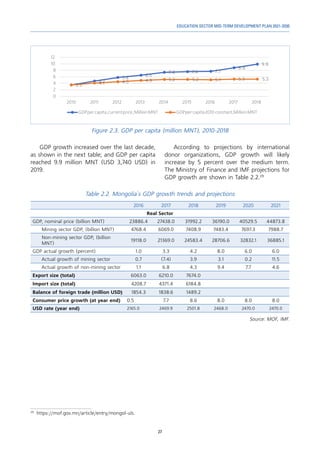
GDP growth increased over the last decade,
as shown in the next table; and GDP per capita
reached 9.9 million MNT (USD 3,740 USD) in
2019.
According to projections by international
donor organizations, GDP growth will likely
increase by 5 percent over the medium term.
The Ministry of Finance and IMF projections for
GDP growth are shown in Table 2.2.29
Table 2.2. Mongolia`s GDP growth trends and projections
2016 2017 2018 2019 2020 2021
Real Sector
GDP, nominal price (billion MNT) 23886.4 27438.0 31992.2 36190.0 40529.5 44873.8
Mining sector GDP, (billion MNT) 4768.4 6069.0 7408.9 7483.4 7697.3 7988.7
Non-mining sector GDP, (billion
MNT)
19118.0 21369.0 24583.4 28706.6 32832.1 36885.1
GDP actual growth (percent) 1.0 3.3 4.2 8.0 6.0 6.0
Actual growth of mining sector 0.7 (7.4) 3.9 3.1 0.2 11.5
Actual growth of non-mining sector 1.1 6.8 4.3 9.4 7.7 4.6
Export size (total) 6063.0 6210.0 7674.0
Import size (total) 4208.7 4371.4 6184.8
Balance of foreign trade (million USD) 1854.3 1838:6 1489.2
Consumer price growth (at year end) 0.5 7.7 8.6 8.0 8.0 8.0
USD rate (year end) 2165.0 2469.9 2501.8 2468.0 2470.0 2470.0
Source: MOF, IMF.
EDUCATION SECTOR MID-TERM DEVELOPMENT PLAN 2021-2030
28
2.2 EDUCATION SECTOR RESOURCES AND OPPORTUNITIES
Finance and Investment
30	
ADB, MES. 2019. Education Financing and Investment Report.
31	
Mongolian Law on Education, provisions 40, 41.
32	
https://www.legalinfo.mn/law/details/11937?lawid=11937.
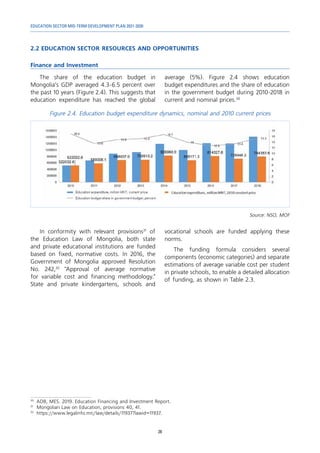
The share of the education budget in
Mongolia’s GDP averaged 4.3-6.5 percent over
the past 10 years (Figure 2.4). This suggests that
education expenditure has reached the global
average (5%). Figure 2.4 shows education
budget expenditures and the share of education
in the government budget during 2010-2018 in
current and nominal prices.30
Figure 2.4. Education budget expenditure dynamics, nominal and 2010 current prices
Source: NSO, MOF
In conformity with relevant provisions31
of
the Education Law of Mongolia, both state
and private educational institutions are funded
based on fixed, normative costs. In 2016, the
Government of Mongolia approved Resolution
No. 242,32
"Approval of average normative
for variable cost and financing methodology."
State and private kindergartens, schools and
vocational schools are funded applying these
norms.
The funding formula considers several
components (economic categories) and separate
estimations of average variable cost per student
in private schools, to enable a detailed allocation
of funding, as shown in Table 2.3.
29
EDUCATION SECTOR MID-TERM DEVELOPMENT PLAN 2021-2030
Table 2.3.Components of variable costs
№ INDICATORS
1
Teacher salary and incentives, kindergarten and dormitory teachers and staff salary and some
additional benefits. Some additional benefits include supplementary salary for rural employment,
special skills, classroom teacher, and teaching methodology
2 Social insurance premium payable by employer for basic and additional salary of teacher
3
Other variable costs of goods and
services
1. Training and production practice
2. Stationery
3. Books and publications
4. Mailing and internet fee
5. Domestic work trip
6. Inexpensive household items
7. Clothes and soft items
8. Medications
9. Waste disposal, disposal of rodents and disinfectants
10. Fee for outsourcing of common work and service
11. Other goods and services
Source: MES.
Under the Education Law of Mongolia, all
kindergartens, schools and vocational schools
are funded applying norm-based funding; and
as of the 2019 physical year, the following
norms are applied.
Table 2.4. Variable cost normative (thousand MNT), as of 2018
Items Kindergarten School Resolution
Variable cost per child per year
Government Resolution No.
242 of 2016
Aimag and soum center 905.3 437.9
Metropolitan area 807.8 374.0
Dormitory 387.5
Meals per day 1.650
Government Resolution No.
106 of 2012
Meal for dormitory children per day 2.315
Lunch/tea per day for 1-5 grade pupils 0.600
Lunch meal per day for special education
schools
2.400
Government Resolution
No.162 of 2017
Source: MES.
Figure 2.5. Education sector budget expenditure structure by sub-sector, 2018
Management of educational
and scientific organizations 18%
Primarys secondary
education 46%
Higher education 9%
Technicals vocational
education, training 4%
Preschool education 23%
EDUCATION SECTOR MID-TERM DEVELOPMENT PLAN 2021-2030
30
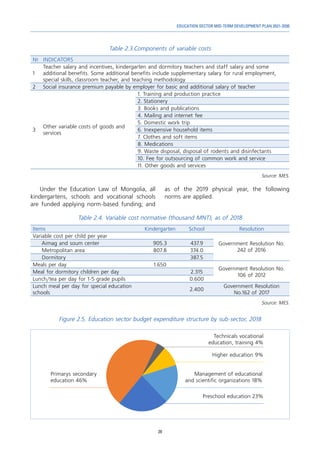
As of 2018, 46 percent of the education
budget was spent in the primary and secondary
sub-sectors, 23 percent on pre-primary
education, 18 percent on management of the
MES, 9 percent on higher education, and 4
percent in the vocational education and training
sub-sector. The 4 percent allocated to vocational
education and training can be explained by
the fact that VET is attached to the Ministry
of Labor and Social Protection (MoLSP); thus,
most of its budget is allocated from the MoLSP
budget package. The 4 percent to VET from the
government budget goes to fund the delivery
33
	 ADB, MES. 2019. Education Sector Finance and Investment Report.
34	
ADB, MES. 2019. Education Sector Finance and Investment Report.
of general education courses to students in VET
schools.
On average, over the last 10 years, about
85 percent of budget expenditures on
education has been spent on recurrent or daily
consumption expenditures, and about 15 percent
on investments or long-term funding. During
2017-2018, the education sector investment
policy was aimed at increasing pre-primary
enrollment, eliminating three shifts in general
education schools, and financing construction,
repair and equipment.33
Table 2.5. Education sector investment amount (million MNT), and share of the Minister of
Education budget package of 2015-2019
Indicator 2015 2016 2017 2018 2019
Total investment (including loan) 127,905.5 179,305.9 178,475.0 371,082.7 616,453.7
Education sector investment 96,701.6 115,107.1 77,197.5 211,642.6 488,997.2
Percentage of the total investment 75.6% 64.2% 43.3% 57.0% 79.3%
Source: MES.
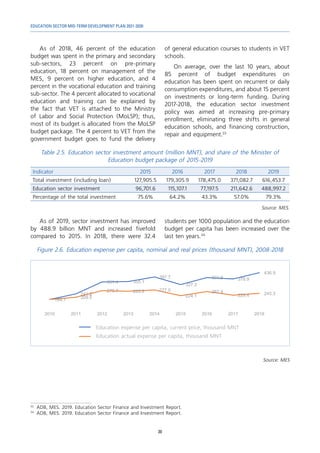
As of 2019, sector investment has improved
by 488.9 billion MNT and increased fivefold
compared to 2015. In 2018, there were 32.4
students per 1000 population and the education
budget per capita has been increased over the
last ten years.34
Figure 2.6. Education expense per capita, nominal and real prices (thousand MNT), 2008-2018
Education expense per capita, current price, thousand MNT
Education actual expense per capita, thousand MNT
Source: MES
31
EDUCATION SECTOR MID-TERM DEVELOPMENT PLAN 2021-2030
The state budget for 2008-2017 included
2586.0 billion MNT for investment in the
education sector, but actual investment was
only 880.0 billion MNT (34 percent of the
target). The performance of the investment
varied throughout the fiscal years, but averaged
around 34 percent. In 2010-2018, a total of 536
projects were implemented in the sector; the
35	
ADB, MES. 2019. Education Sector Finance and Investment Report
36	
MES, EMIS data and projection
number of seats was increased by 103453 and a
total of 657.5 billion MNT was spent. However,
there was a lack of financial management
and solutions for the realization of investment
needs and financial and social benefits. The
table of estimates below shows the shift usage
coefficient of the buildings of general education
schools.35
Table 2.6. Shift coefficient distribution of general education schools, by property type and
classification
Shift coefficient Property type Number
Elementary
school
Secondary
school
Upper secondary
school
Complex
school
Up to 0-0.1
State-owned 24 3 5 15 1
Private 11 3 - 8
0.1-0.5
State-owned 59 18 23 18
Private 53 11 - 40 2
0.5-1
State-owned 181 18 56 101 6
Private 64 8 - 54 2
1-1.5
State-owned 187 8 23 144 12
Private 15 2 - 13
State & private
owned
1 1
1.5-2
State-owned 117 3 6 95 13
Private 2 1 1
2 and above
State-owned 87 5 2 72 8
Private 1 1
TOTAL 802 79 115 563 45
Note: EMIS researchers’ calculations based on UNESCO’s EPSSim program information.
Based on 2017-2018 academic year statistics,36
a projection has been made on the shift usage
coefficient of secondary school buildings used
by private and state-owned secondary schools,
and there is a vast difference between the
two. For instance, in Ulaanbaatar, state-owned
secondary schools have three shifts, while in
rural areas, secondary schools do not have a
sufficient number of students. Private secondary
schools have fewer students than state- owned
secondary schools.
Capacity of Professional Institutions
The Education Law and other legal
instruments and policies are implemented
under leadership of the Ministry of Education
in cooperation with professional and training
institutions. Government and national
professional institutions are (i) MES, (ii) the
Mongolian Institute for Educational Research
(MIER), (iii) the Education Loan Fund, (iv) the
National Council for Educational Accreditation
(NCEA), (v) the Institute of Teacher`s Professional
Development (ITPD), (vi) the National Center for
Lifelong Education (NCLLE), (vii) the Education
EDUCATION SECTOR MID-TERM DEVELOPMENT PLAN 2021-2030
32
Evaluation Center; and at regional level, (viii) the
Education and Culture Department and (ix) the
Lifelong Education Center. Since 2012, technical
and vocational education and training has been
under management of the Ministry of Labor
and Social Protection; and key professional
institutions in TVET are (i) the National Council
for Vocational Education and Training, (ii) the
Department of TVET Policy Implementation
and Coordination within MoLSP and (iii) the
TVET Evaluation, Information and Methodology
Center.37
An assessment has identified the following
issues and challenges in relation to these
education institutions38
:
•	Lack of inter-ministerial and inter-
institutional coordination mechanisms;
•	 Frequent changes of staff and leaders,
leading to a lack of continuity of policies
and sustainable implementation;
•	Lack of data-driven planning and
management system;
•	 Limited budget, organizational structure
and capacity of professional institutions,
leading to improper operation of legal
functions;
•	Insufficient research materials and
online/offline library to access education
37	
Formerly, VET Assessment Center, restructured in 2019 as TVET Evaluation, Information and Methodology Center,
38	
Interviews were conducted with senior managers of MES and professional organizations.
39
	 Including MOE specialists, staff of local education departments, MIER researchers, ITPD methodologists, EEC officers,
school principals and managers; and under the MoLSP, VETPICD specialists, VET AMIC staff, VET school principals
and managers.
40
	 ADB, MES. 2019. Primary and Secondary Education Sub-sector Analysis Report.
research findings from the higher-rank
journals and references;
•	
Lack of professional development
opportunities for staff of MIER, NCEA,
NCLLE;
•	 Lack of autonomy and independence of
education institutions, which negatively
impacts financial and operational
planning and implementation;
•	 Staff lack opportunities and funding to
visit schools and oversee implementation
of policies and programs;
•	
Lack of VET management and
information system negatively impacts
policy implementation.
Under the Education Law, the rights
and responsibilities of education leaders are
formulated in a centralized administrative
manner, which limits the implementation of
legal provisions related to decentralizing school
and local education management. The sector
also faces challenges in establishing a system
for preparing mid to high-level staff,39
ensuring
the sustainability of human resources and
developing professional skills. Furthermore, the
institutions encounter difficulties in providing
consultancy and professional management
services to the sector units.40
Capacity of Training Providers
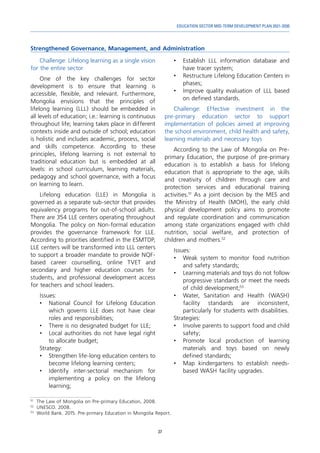
Figure 2.7. Number of kindergartens
Capital
city
Public Private
Aimag
center
Soum Bagh
In the 2018-2019 academic year, a total of
1,435 kindergartens were operating throughout
the country. Of these, 889 kindergartens are
state owned and 546 are privately owned
(Figure 2.7). Of the state-owned kindergartens,
27.1 percent are in Ulaanbaatar, 27.8 percent are
operating in aimag centers, 40.4 percent are
in soum centers, and 4.4 percent are in bag
centers. Eighty percent of the privately owned
kindergartens are in Ulaanbaatar. During the
2018-2019 academic year, a total of 261,354
children were covered. Of these, 239,764
33
EDUCATION SECTOR MID-TERM DEVELOPMENT PLAN 2021-2030
preschoolers (91.7 percent) were enrolled in
regular kindergarten and 21,590 (8.3 percent)
were enrolled in alternative programs.
A total of 7,903 classes were full and
operational. The number of students in class was
36.9 percent in state-owned kindergartens and
22.6 percent in privately owned kindergartens.
As of 2018, there are 27,172 people employed
at preschool education institutions. Five
percent are kindergarten principals, 2 percent
are methodologists, 28 percent are teachers,
26 percent are assistant teachers, 39 percent
are other staff members. Of the teachers, 88
percent are classroom teachers, 9 percent are
music instructors and one percent are teachers
at alternative preschool education services.41
According to MES projections based on EMIS
data, there will be only a small increase in the
number of children in the 0-5 age group and a
decrease in the number of age 5 children until
2024, then a slight increase in 2024 (81,947),
then a decrease down to numbers similar to 2019.
Therefore, it is likely that the net enrollment rate
of preschoolers may not increase more than 2
percent until 2030.42
Also in the 2018-2019 academic year, a total
of 803 (public 656, private 147) primary and
secondary schools were operating. Of these, 558
are in rural areas and 245 are in Ulaanbaatar.
These schools have a total of 20,574 classes
with 593,150 students and 49,441 staff, of
41
	 ADB, MES, 2019. Pre-primary Education Sub-sector Analysis Report.
42	
MES, 2019. EMIS projection.
43	
MES. 2019. 2018-2019 academic year statistics.
44	
ADB, MES. 2019. Primary and Secondary Education Sub-sector Analysis Report.
45	
Please refer to demographics in this chapter.
46	
Based on 2018-2019 training plan and annual retirement projections.
which 30,411 are full-time teachers.43
According
to 2018-2019 academic year statistics, 8,451
students are attending 212 third-shift classes in
28 schools. Of the 28 schools with three shifts,
7,743 students are in 188 classes in Ulaanbaatar.
This indicates that school location and student
load are imbalanced between urban and rural
areas.44
Class sizes are different among education
levels; on average, there are 30.3 students
in primary classes, 26.9 students in lower
secondary classes and 30.3 students in upper
secondary class. When the class size is further
analyzed nationwide, the average class size is
31.5 students in urban areas and 26.1 students
in rural areas (30.7 at aimag center schools,
24.5 at the bag and khoroo levels, and 18.2 in
rural village schools). In the 2017-2018 academic
year, 6.1 percent, or 35,012 students, were
enrolled at private secondary schools. In last
twelve years, the number of students enrolled
at private secondary schools increased by 1.1
point annually. (Figure 2.8). In 2006, the rate of
students enrolled at private secondary education
was 5.3 percent; in 2015, it was 5.8 percent (5.6
percent in primary schools, 5.0 percent in lower
secondary, and 7.2 in upper secondary).
Based on population growth projections45
and the subject syllabus for 2018-2019,
approximately, 30,000 teachers will be needed
by 2030.46
EDUCATION SECTOR MID-TERM DEVELOPMENT PLAN 2021-2030
34
Figure 2.8. Numbers of students enrolled at state-owned and private schools
Public school Private school Share of private schools
Table 2.7 shows the number of teachers required for primary and secondary schools to 2030.
Table 2.7. Number of school teachers required for primary and secondary schools
№ Subject
2018 2020 2025 2030
Current Total New Total New Total New Total New
1 Primary class 10397 10759 362 11727 1590 12265 3428 12696 5158
2
Mongolian language, scripts and
literature
2654 3370 716 3808 1220 5257 3001 5762 3838
3 Math 2363 2425 62 2740 436 3783 1774 4147 2433
4 Information technology 705 703 -2 795 107 1097 498 1203 691
5 Physics 998 1137 139 1285 312 1774 925 1944 1221
6 Biology 844 1137 293 1285 462 1774 1056 1944 1332
7 Chemistry 739 1137 398 1285 564 1774 1145 1944 1408
8 Geography 602 758 156 856 269 1182 671 1296 860
9 History 634 954 320 1078 460 1488 949 1631 1171
10 Social study, Citizen`s education 1106 1716 610 1939 861 2677 1737 2934 2133
11 Fine art, topography 1943 2684 741 3033 1139 4187 2536 4590 3181
12 Music 1080 1413 333 1597 544 2204 1286 2416 1633
13 Physical education 2042 2308 266 2608 617 3601 1865 3947 2467
14 Health 345 813 468 919 583 1269 976 1391 1141
15 English language 2766 2341 -425 2646 -51 3653 1301 4004 1998
16 Russian language 720 667 -53 754 52 1041 429 1141 619
Total 29940 34323 4383 38355 9163 49025 23576 53082 31284
47	
ADB, MES. 2019. Education Sector Data and Information Analysis Report.
48
	 ADB, MES. 2019. TVET Sub-sector Analysis Report.
By 2025, 23,576 new teachers will be
required for primary and secondary schools.47
By 2030 teacher need that number is projected
to be 53,000, of which 31,284 teachers will
need additional preparation.
In the TVET sub-sector, as of the 2018-
2019 academic year, a total of 86 polytechnic
colleges and Vocational Training and Production
Centers (VTPCs) have been providing vocational
education and skill training. These colleges and
VTPCs have a total of 38,526 students, 4,624
workers, 2,469 primary teachers, 103 directors
and deputy directors, 80 heads of training
units, 339 managerial level staff and 1,633 other
staff.48
35
EDUCATION SECTOR MID-TERM DEVELOPMENT PLAN 2021-2030
In the higher education sub-sector, as
of academic year 2018-2019, there are 94
institutions, of which 18 are state owned, 73
are privately owned, and 3 are universities with
foreign investment. A total of 157,625 students
are enrolled in these institutions, of which 87,992
are at state-owned universities, 69,370 students
are at private higher education institutions and
263 students are studying at universities with
foreign investment. A total of 12,634 people are
employed in the higher education sub-sector,
of which 6,668 are full-time teachers. Of all
full-time teachers, 62.7 percent are employed at
state owned institutions. Of the newly enrolled
49	
MES. 2018-2019 academic year statistics.
50	
ADB, MES. 2019. Education Sector Data Analysis Report.	
students at HE institutions, 71.6 percent are
secondary school graduates. Out of the total
number of students, 27.5 percent are majoring
in business administration or law; 14.8 percent
in education; 4.5 percent in engineering or
industrial production; and 14.2 percent in health
or social protection sector.49
Based on population growth projections to
2030, the expected growth of each sub-sector
is shown in Table 2.850 and Table 2.9 compares
growth projections with baseline data from
2018.
Table 2.8. Projections of student growth
Level 2019 2020 2021 2022 2023 2024 2025 2026 2027 2028 2029 2030
Pre-primary
312,
447
308,
213
312,
052
315,
128
322,
460
326,
240
324,
655
322,
659
319,
721
317,
055
314,
949
313,
729
Primary
secondary
697,
205
734,
991
770,
085
805,
629
835,
460
865,
749
891,
865
910,
630
923,
468
939,
660
949,
353
954,
476
Higher
education
189,
219
185,
184
179,
695
174,
471
173,
074
176,
312
189,
079
208,
872
233,
129
250,
939
265,
730
277,
345
TVET
38,
257
38,
497
39,
235
40,
382
41,
798
43,
352
45,
438
47,
113
48,
885
50,
829
49,
895
54,
527
Table 2.9. Children and youth population growth, in comparison with 2018
Education level 2018-baseline 2019 2020 2025 2030
Pre-primary
318,422 312,447 308,213 324,655 313,729
Growth rate -2 -3 2 -1
Primary and
secondary
Primary
341,257 358,321 371,142 389,702 403,922
Growth rate 5 9 14 18
Secondary, upper
secondary
321,538 338,884 363,849 502,163 550,554
Growth rate 5 13 56 71
Higher
190,539 189,219 185,184 189,079 277,345
Growth rate -1 -3 -1 46
TVET
38,526 38,257 38,497 45,438 54,527
Growth rate -1 0 18 42
Based on these projections, the number of
students in secondary and upper secondary
school will increase by 56 percent by 2025, and
by 71 percent by 2030 in comparison to the
baseline.
The number of students in pre-primary
education tends to be relatively stable over the
period.
On the other hand, the number of students
in higher education will increase by 46 percent
by 2030. The number of TVET students is
projected to increase by 42 percent by 2030.
EDUCATION SECTOR MID-TERM DEVELOPMENT PLAN 2021-2030
36
2.3	SUMMARY OF ISSUES AND CHALLENGES IN THE EDUCATION SECTOR
The issues and challenges discussed in this
section are divided among the key priority areas
that frame the ESMTDP. Though there are some
sub-sector specific issues, many issues and
challenges are germane to the sector as a whole.
Issues such as legal framework, coordination,
human resource capacity, demographic shift,
teacher supply, infrastructure, teacher pre-
service and in-service training, quality assurance,
and infrastructure are among those that affect
the entire sector.
The overarching focus of the ESMTDP is on
quality human resources, quality of provision,
and flexibility through lifelong learning, within
an overall framework of quality, access, and
governance. Three overarching issues and
challenges related to these issues are highlighted
below:
Policy Environment. The Law on Education
(2016) governs the sector, with numerous policy
amendments to address specific policy issues that
have subsequently emerged. As the current legal
framework is not forward thinking, however,
an education policy review will be necessary to
achieve the development vision and priorities
defined by the government. For instance,
the current policy designates school leaders
as administrative, with no responsibility for
academic leadership—a necessary responsibility
of school leaders. Further, the purpose of ICT
in education, its integration with curricula and
learning outcomes, and its financial support
are not well defined. The purpose of higher
education is defined as primarily academic,
with little provision for linkages to industry or
more professional alignment with emerging
marketplace needs. There are many more
examples that are identified within specific
priority areas.
Demographic Bubble. One of the main
issues facing Mongolia is the demographic
bubble of students currently moving through
the education system. Population projections
forecast that by 2024, the secondary school
student population will nearly double, with
impacts felt mostly in the capital city. Moreover,
the bubble will move through the system,
requiring a huge mobilization of resources to
accommodate the surge in students by 2024.
Teacher supply and infrastructure capacity are
the two main challenges, particularly given the
fact that teacher and infrastructure needs for
2024 will diminish by 2030. Low-cost portable
classrooms may be one infrastructure solution.
The shift in teacher supply needs is a more
difficult issue. Pre-service programs can be
scaled up, but teacher layoffs will likely be
inevitable once the bubble has passed.
Quality of Learning. Learning assessments
indicate that Mongolian students struggle with
basic literacy (language) and numeracy, as well
as science. Students are weak at information
processing, critical thinking and problem solving.
This reality implies that the means and mode
of instruction are not adequate to provide the
necessary learning environment for improving
learning outcomes. Improvements in human
resource capacity, curriculum, school learning
environment, and system capabilities are needed
to efficiently and effectively deliver quality
education. Current pre-service and in-service
teacher development is not standards based or
coherent. Learning materials production is not
defined by a specific policy, and the curriculum
cycle is relatively inflexible to emerging learning
needs.
Though international attention is on universal
access, Mongolia’s policy focus for the next ten
years is on quality improvement through human
resource development. The focus on quality,
however, has led the government to identify
access priorities, and to propose measures to
improve access for children with disabilities
and special needs, with a particular focus on
herder children’s access, school readiness,
safety, nutrition, and improved lifelong learning
services supported by ICT.
37
EDUCATION SECTOR MID-TERM DEVELOPMENT PLAN 2021-2030
Strengthened Governance, Management, and Administration
51	
The Law of Mongolia on Pre-primary Education, 2008.
52	
UNESCO. 2008.
53	
World Bank. 2015. Pre-primary Education in Mongolia Report.
Challenge: Lifelong learning as a single vision
for the entire sector
One of the key challenges for sector
development is to ensure that learning is
accessible, flexible, and relevant. Furthermore,
Mongolia envisions that the principles of
lifelong learning (LLL) should be embedded in
all levels of education; i.e.: learning is continuous
throughout life; learning takes place in different
contexts inside and outside of school; education
is holistic and includes academic, process, social
and skills competence. According to these
principles, lifelong learning is not external to
traditional education but is embedded at all
levels: in school curriculum, learning materials,
pedagogy and school governance, with a focus
on learning to learn.
Lifelong education (LLE) in Mongolia is
governed as a separate sub-sector that provides
equivalency programs for out-of-school adults.
There are 354 LLE centers operating throughout
Mongolia. The policy on Non-formal education
provides the governance framework for LLE.
According to priorities identified in the ESMTDP,
LLE centers will be transformed into LLL centers
to support a broader mandate to provide NQF-
based career counselling, online TVET and
secondary and higher education courses for
students, and professional development access
for teachers and school leaders.
Issues:
•	 National Council for Lifelong Education
which governs LLE does not have clear
roles and responsibilities;
•	 There is no designated budget for LLE;
•	 Local authorities do not have legal right
to allocate budget;
Strategy:
•	 Strengthen life-long education centers to
become lifelong learning centers;
•	 Identify inter-sectorial mechanism for
implementing a policy on the lifelong
learning;
•	 Establish LLL information database and
have tracer system;
•	 Restructure Lifelong Education Centers in
phases;
•	 Improve quality evaluation of LLL based
on defined standards.
Challenge: Effective investment in the
pre-primary education sector to support
implementation of policies aimed at improving
the school environment, child health and safety,
learning materials and necessary toys
According to the Law of Mongolia on Pre-
primary Education, the purpose of pre-primary
education is to establish a basis for lifelong
education that is appropriate to the age, skills
and creativity of children through care and
protection services and educational training
activities.51
As a joint decision by the MES and
the Ministry of Health (MOH), the early child
physical development policy aims to promote
and regulate coordination and communication
among state organizations engaged with child
nutrition, social welfare, and protection of
children and mothers.52
Issues:
•	 Weak system to monitor food nutrition
and safety standards;
•	 Learning materials and toys do not follow
progressive standards or meet the needs
of child development;53
•	 Water, Sanitation and Health (WASH)
facility standards are inconsistent,
particularly for students with disabilities.
Strategies:
•	 Involve parents to support food and child
safety;
•	 Promote local production of learning
materials and toys based on newly
defined standards;
•	 Map kindergartens to establish needs-
based WASH facility upgrades.
EDUCATION SECTOR MID-TERM DEVELOPMENT PLAN 2021-2030
38
Challenge: Understanding the contextual
situation of each school for improved evidence-
based, data-driven planning and efficiency
As part of the implementation of previous
Education Sector Master Plans, the structure
of primary and secondary education was
changed twice and school entrance age was
set at six years.54 However, information on
socio-economic, socio-cultural, demographic,
geographic, transportation, and other factors
important for effective and efficient planning
are not available for individual schools.
Issues:
•	Weak human resource capacity to
undertake a national school mapping
exercise;
•	 Lack of an MES coordination mechanism
forefficientandeffectiveimplementation;
•	 School mapping urgently needed to
enable better planning for the projected
demographic shift.
Strategy:
•	
Undertake comprehensive school
mapping based on scientific rationale,
in-depth study and evidence, in line with
the country context and the different
characteristics of school children (age,
physical and mental development);55
•	 Review and improve EMIS facility to
enable better filtering of information,
reporting and validation;
•	Improve evidence-based, data-driven
planning.
Challenge: Improved school leader
qualifications and skills56
The Law of Mongolia on Education and other
laws state that the roles and responsibilities of
management staff at all levels of education
institutions are administrative. However, within
the school community, school leaders are seen
as key agents of change and learning.
54	
In 2006, the ages for TV Center primary, lower secondary and high secondary were 6, 3 and 3 years, respectively. In
2012, the ages were 5, 4 and 3.
55	
School Mapping Project Report.
56	
UNICEF. 2019. End-User Sample Survey on Education Sector Services – Final Report.
57	
UNICEF. 2019. End-User Sample Survey on Education Sector Services – Final Report.
58
	 ADB, MES. 2019. Primary and Secondary Education Sub-Sector Report.
Issues:
•	 Policies limit the leadership role of school
managers;
•	 The selection and appointment of primary
and secondary education management
does not follow defined policy;57
•	 There is no systematic approach or
framework to train and re-train school
managers.
•	 Training opportunities are limited.58
Strategies:
•	 Define school leader standards, and
reformulate relevant policies;
•	 Review and update school leader job
descriptions based on new standards;
•	Review and improve school leader
professional development programs;
•	
Provide continuous professional
development for school leaders.
Challenge: Improved coordination within the
TVET sub-sector
Since 2012, management of the TVET
sub-sector has been under the authority of
the Ministry of Labor and Social Protection
(MoLSP). According to the Law on Vocational
Education, the highest administrative body
in the sub-sector is the National Council of
Vocational Education, which defines the tasks
and duties of school managers and provides
inter-sectoral coordination among the relevant
ministries, private sector and representative
organizations. The MoLSP’s department for
TVET policy implementation and coordination
serves as the central administrative institution
for TVET matters, including policy, legislation
and implementation of the sub-sector.
Issue:
•	 Lack of efficiency in the current TVET
management system for effective inter-
sectoral coordination.
39
EDUCATION SECTOR MID-TERM DEVELOPMENT PLAN 2021-2030
Strategy:
•	 Establish effective TVET management led
by inter-sectoral coordination principles
and public-private partnerships.59,60
Challenge: Improved quality assurance in the
TVET sub-sector
The TVET Assessment Center was
established in 2016 with the primary mandate of
carrying out competency-based training (CBT)
assessments and quality assurance of training
institutions. Regional Methodological Centers
were established in 2012 under the Regional
Development Policy, with the primary mission of
developing teachers and implementing the CBT
system. These two institutions were restructured
in December 2019 as one institution.
Issues:
•	 TVET program quality assurance system
not standardized;
•	 Lack of efficiency and relevance between
CBT curriculum and certification system;
•	Lack of cross-sectoral competence
framework, leading to weak coherence.
Strategies:
•	 Improve cooperation among skills-based
sectors;
•	 Strengthen TVET data management;
•	 Strengthen labor market information
system.
Challenge: Align higher education programs
with the National Qualifications Framework
(NQF) to support professionalism as well as
academic achievement
Universities and colleges approved and
utilized higher education standards for 130
programs during 2003-2013. Since 2014, higher
education institutions have used “The general
requirements for bachelor’s programs” and “The
general requirements for master’s programs” as
guidelines. Previously, the higher education sub-
sector subscribed to a “professional standard”
59	
MoLSP. 2019. TVET Development and PPP – Cooperation Memorandum of Understanding.
60	
Operational Procedures of TVET National Council.
61	
ADB. 2019. Higher Education Sub-sector Report.
62	
ADB, MES. 2019. Lifelong Education Sub-sector Analysis Report.
system that emphasized not learning outcomes
but rather the core contents of the field of
study.61
Issues:
•	 Emphasis on core contents of academic
studies detracts from studies relevant to
market needs;
•	 Weak linkages between HE and private
industry;
•	Lack of capacity for institutional
assessment against international
standards.
Strategies:
•	 Update HE qualification indices and
programs based on NQF, and disseminate
new programs;
•	Enhance partnerships between HE
institutions and industry;
•	 Improve linkages of higher education
MIS with labor market needs;
•	
Disseminate outcome-based internal
quality assurance system.
Enhanced quality and relevance of
education
Challenge: Strengthening lifelong learning
centers to align with NQF
The NQF provides a framework for learning
hard and soft skills relevant to emerging market
needs. Transformation from LLE to LLL to more
broadly support all areas of learning will use
the NQF as a guiding framework for quality
improvement of the system.
Issues:
•	 High rate of staff/teacher turnover due
to poor work environment, lack of social
security and other benefits; 62
•	
Lack of continuing professional
development for LLL center teachers/
staff.
EDUCATION SECTOR MID-TERM DEVELOPMENT PLAN 2021-2030
40
Strategies:
•	Implement a National Program on
Lifelong Learning;
•	 Build the capacity of teachers and staff
at the Center for Lifelong Learning;
•	 Strengthen learning assessments aligned
with NQF standards.
Challenge: Improving the quality of the pre-
primary system, and addressing the skills gaps
of underserved children
In 2011, child development standards were
approved; and in 2014, a pre-primary core
curriculum was developed and implemented.
The core curriculum emphasizes that pre-primary
education will be based on children’s individual
development, and includes a mechanism to
monitor and evaluate curriculum implementation
and child development.
Issues:
•	 Lack of proper training of school teachers
and staff to address underserved
learners;
•	 Skills gaps are high among children from
rural areas, vulnerable families, and
ethnic minorities, many of whom lag
behind their peers in terms of cognitive,
language and emotional development;63
•	 School readiness of the underserved is
low;64
•	 The difference between pre-primary age
children’s development is different in
urban and rural areas;65
•	 Assistant teachers are not well trained to
support academic and social learning;66
•	 The CPD system for pre-primary teachers
is not sufficient to address professional
development needs.
Strategies:
•	Develop and implement pre-primary
education curricula and assessment
standards;
•	 Implement a support program for parents
with children 0-5 years old;
63	
Wordl Bank. 2018. Монгол улсын цогц дүн шинжилгээ.
64	
ADB, MES. 2019. Pre-primary Sector Study
65	
World Bank. 2015. Pre-primary Education in Mongolia.
66	
ADB, MES. 2019. Pre-primary Sector Study.
67	
ADB, MES. 2019. Primary and Secondary Education Sub-Sector Study Report,
•	Regularly conduct a comprehensive
development study of each child;
•	Develop and implement pre-primary
teacher standards;
•	Develop flexible in-service training
pathways for pre-primary education
teachers;
•	 Train and develop pre-primary education
assistant teachers;
•	 Develop and implement a regulation to
assess school readiness of children aged
5;
•	Support open and distant learning
initiatives in pre-primary education.
Challenge: Ensuring that primary and
secondary curricula remain relevant and support
the learning vision of the country
The core curricula were developed during
2012-2018 under a new 10-year curriculum cycle,
and are now being implemented. Concepts
such as sustainable development, holistic
human development, continuous (lifelong)
learning, and green environmental issues are
included. Academic as well as soft skills are
emphasized. These include cooperating with
others, developing skills for continuous scientific
inquiry, developing and integrating life choices
with awareness of the surrounding environment
and its importance for social and economic
wellbeing. These objectives are strongly related
to SDG 2030 goals for Mongolia, and require
that school leaders manage more effectively;
that school teachers update their teaching and
professional competencies; and that school
social workers and parents be more supportive
of children choosing their own electives. School
staff and parents should also ensure that classes
are arranged efficiently and reflect the needs of
the community and different types of students,
and that resources are used effectively.
Issues:
•	 Implementation has commenced without
sufficient school preparedness training;67
41
EDUCATION SECTOR MID-TERM DEVELOPMENT PLAN 2021-2030
•	 Assessment of student learning against
defined benchmarks is lacking;
•	 Primary and secondary teacher standards
are lacking;
•	 School-based support for teachers is
lacking;
•	 Mongolian language proficiency is weak
among teachers;68
•	 Students’ basic skills are low compared
with learning standards.
Strategies:
•	
Implement Curriculum Management
Cycle and review the implementation;
•	Regularly conduct a comprehensive
development study of each child;
•	 Strengthen standards-based in-service
teacher development;
•	
Develop a Mongolian language
proficiency evaluation system;69
•	 Strengthen inquiry learning skills.
Challenge: Strengthening the TVET system
to improve market relevance of student skills
Basic indicators for defining the quality of
TVET have been graduate employment and
acquisition of skills needed for the labor market.
The quality and performance of teachers is one
of the main factors that directly impact the
quality of student training. Optimally, the TVET
sector requires an effective pre- and in-service
teacher training system to better ensure overall
quality. As labor market demand changes,
teachers need to develop new competencies
to ensure that Mongolian workers have the
appropriate skills.70
Issues:
•	 TVET providers do not meet the needs of
the labor market;71
•	TVET providers do not reference
recognized standards and requirements
for establishing the learning environment,
68
	 ADB, MES. 2019. Primary and Secondary Education Sub-Sector Study Report,
69
	 World Bank. (2017. Early Grade Reading and Mathematics Ability Assessment Report.
70
	 UNESCO. 2019. Education Policy Review.
71
	 ADB, MES, 2019. TVET Sub-sector Study Report,
72
	 RILSP. 2018. Graduate`s Employment Survey.
73
	 UNESCO. 2019. Education Policy Review.
74
	 UNESCO, MIER. 2019. Education Policy Review Country Background Paper.
identify the competence framework, use
the proper materials and tools, or assess
learner outcomes;
•	TVET providers do not emphasize
the development of soft skills such as
attitude toward the job, problem solving,
team work, communicating with others
and entrepreneurial skills; 72
•	 Teachers’ skills are not adequate to teach
required skills to students;
•	 There is no effective teacher pre- and in-
service training system;73
•	 Teacher Development Centers are not
operating at full capacity.
Strategies:
•	 Develop and implement occupational
standards and a competency-based
training curriculum;
•	 Disseminate a TVET teacher development
program;
•	 Enhance the research and innovation
capacity of TVET;
•	 Improve utilization of labor market
information for TVET.
Challenge: Transforming higher education to
ensure graduates leave with relevant knowledge
and skills to meet the needs of Mongolia
Academic coherence among HE institutions
is important to ensure equivalency in the
delivery of quality programs that give students
the opportunity to gain relevant skills for
employment and socio-cultural harmony.
HE policy focuses on academic achievement
through quality programs and strength in
research. However, there is increasing emphasis
on research and professionalism within HE
institutions internationally, in order to bring
more relevance into students’ studies.74
To
better align HE programs with labor market
realities, it has been determined that the course
and program indexes for the professions need
EDUCATION SECTOR MID-TERM DEVELOPMENT PLAN 2021-2030
42
to be renewed to ensure professional alignment
and marketplace relevance.75
A further shift
from the andragogical, constructivist approach
to a heutagogical self-directed, connectivist
approach should be encouraged.76
Issues:
•	 Academic programs among institutions
are not of equivalent quality;
•	 Recruitment in many institutions is driven
by financing;
•	 Poor employment of graduates due to
oversupply in the labor market;
•	 Curricula are not aligned to the structure
and demands of national and domestic
labor markets and characteristics;
•	Ineffective forms of teaching and
learning, and weak promotion of
research-led teaching;
•	 A lack of open and distance learning
opportunities.
Strategies:
•	 Update HE qualification indices and
programs, and disseminate new programs
that embed national identity;
•	 Develop HE internship program;
•	 Implement HE professional excellence
program;
•	 Develop and support open and distance
learning initiatives and resource materials;
•	
Enhance partnership between HE
institutions and industries.
Increased equitable access and retention
Challenge: Improving access to lifelong
education for all citizens
Lifelong education includes the following
key areas: 1) Literacy curriculum, 2) Equivalent
training curriculum, 3) Life skills and other
(family, civic, moral maturity, life science, and
aesthetic).77
During 2007-2018, a total of 78,499
citizens were covered by the literacy curriculum
implemented by the Lifelong Education Centers;
75	
UNESCO, MIER. 2019. Mongolia Education Policy Review.
76	
UNESCO, MIER. 2019. Education Policy Review.
77	
ADB, MES. 2019. Life-long Education Sub-sector Study Report.
78	
UNDP. 2016.
79	
National Center for Lifelong Education. 2018.
80 percent were young adults age 15 and older.
Of the participants under 15 years, the majority
were children with disabilities. The equivalent
training curriculum is open to any citizen who
is willing to obtain primary and secondary
education. Citizens or groups covered by this
service are children, youth, adults, housewives,
unemployed, migrants, pre-kindergartens, their
parents, vulnerable groups, and disabled people
who have dropped out and are out-of-school.
Illiterate and dropouts, especially those who are
over 15 years of age, are among the majority of
learners in equivalent training.
Issues:
•	 The literacy program is perceived as
dedicated to dropouts or children with
disabilities;
•	 There is limited access to education for
young people with disabilities;
•	Nearly half the total number of
congenitally disabled youth are illiterate
or uneducated;78
•	 Limited access by those living in rural and
remote areas;
•	 Sixty percent of lifelong education centers
do not meet hygienic requirements; desk
chairs are insufficient, non-standard and
non-ergonomic for adult bodies;79
•	 Demand for learning materials exceeds
their availability in most centers.
Strategies:
•	 Improve infrastructure of the Lifelong
Education Centers to support lifelong
learning;
•	 Identify form and type of lifelong
learning at each educational level and its
alignment with the NQF.
43
EDUCATION SECTOR MID-TERM DEVELOPMENT PLAN 2021-2030
Challenge: Achieving 100 percent access to
pre-primary education
During the 2018-2019 academic year, access
to pre-primary education was 82.8 percent.80
Attendance of children aged 3- 5 years living
in urban areas was 81.4 percent, compared to
58.2 in rural areas. The wealth index indicates
that children from the fifth quintile have a
higher likelihood (88.5 percent) of being placed
in kindergartens, followed by the fourth (86.5
percent), second (79.9 percent) and middle
(77.2 percent) quintiles. Only 34.1 percent of
preschool children from the poorest families
attend kindergartens.81
Of the total number
of children enrolled in pre-primary education,
herders’ children make up 11.5 percent. Only
45.2 percent of herder children are enrolled
in kindergartens compared to 90.2 percent
of children residing in aimag centers.82
The
enrollment of herders’ children by year shows
that during 2006-2015, their numbers increased
by 44 percent but fell by around 9 percent in
2018. Nationwide, pre-primary enrollment of
children with disabilities was 21.4 points lower
than average enrollment.83
Approximately 30
percent of total non-state kindergartens have
inadequate arrangements for storage and
processing of children's food (27.1 percent of
them are at high risk of food-borne illness),
lower access to the outdoors, inadequate child
safety measures (25.1 percent are at high risk of
injury), as well as inadequate teacher training.84
Issues:
•	 Lack of proper understanding, knowledge
and experience among parents on
the importance of early childhood
education and development for school
preparedness;85
•	 Significant disparity in access between
urban and rural pre-primary aged
students;
80	
GPE, Education Alliance. 2019. Pre-primary Education Sub-sector Analysis.
81
	 Children from those households under the poverty line, HH livelihood status is assessed through proxy means testing
(PMT) methodology, and households are divided into 20 different groups depending on their score.
82
	 NSO, UNFPA, UNICEF. 2018. Multiple Indicator Cluster Survey (MICS).
83	
GPE, EDU Alliance. 2019. Pre-primary Education Sub-sector Study Report.
84
	 ADB. 2019. Pre-primary Sector Study.
85	
GPE, EDU Alliance. 2019. Pre-primary Education Sub-sector Sudy Report.
86	
UNESCO. 2019. Education Policy Review.
87	
UNESCO. 2019. Education Policy Review.
•	 Herder children’s access is significantly
lower that all other demographic groups;
•	 Access by children with disabilities is low;
•	 Lack of kindergarten food safety.
Strategies:
•	
Improve pre-primary education
environments to be more inclusive and
accessible for children with disabilities;
•	 Improve food safety and nutritional value
of kindergarten meals.
•	 Ensure 100 percent enrollment of children
from vulnerable groups and herders in
pre-primary education.
Challenge: Improve TVET learning
environment to enable the achievement of
relevant skill competencies
Overall, there were 38,526 students in the
2018-2019 academic year, of which 15,097 were
female. In terms of location, 19,085 students
were in the city and 17,954 were in rural
areas. Of the total number of students, 18.4
percent study technical education, 77 percent
participate in vocational education programs,
and the remaining 4 percent participate in
professional training to get a competency
certificate. In general, the enrollment rate for
TVET tends to be dependent on political and
government decisions on financial incentives
or stipends provided by the TVET schools. This
results in the formal TVET enrollment capacity
being under-utilized.86
Instead of utilizing an
incentive-based TVET enrollment policy, the
sector policy shall henceforth be focused on
promoting lifelong learning opportunities for
all citizens to support the acquisition of new
knowledge and skills, while supporting and
recognizing their prior learning. There is still a
need to develop individual trainings and curricula
for citizens with disabilities.87
The equipment,
buildings, furniture and other materials used
EDUCATION SECTOR MID-TERM DEVELOPMENT PLAN 2021-2030
44
in the vocational education and training sector
are generally outdated and do not meet the
demands of industry.88
Issues:
•	
TVET providers lack adequate
infrastructure, equipment and ICT;
•	 TVET facilities are not used efficiently;
•	 Lack of specialized TVET institutions
leads to inefficiencies;
•	 TVET financing does not keep pace with
demand;
•	 Access to services is limited to schools;
little flexibility for learners far from TVET
facilities;
•	 No system to recognize non-formally
acquired skills.
Strategies:
•	
Upgrade infrastructure, equipment,
technology and simulation technology at
TVET institutions;
•	 Promote shared workshops among TVET
providers;
•	 Develop specialized TVET schools;
•	 Develop partnerships for local production
of learning materials, tools and furniture;
•	Increase TVET access through the
promotion of various modalities and
lifelong, continuous and flexible learning
pathways;
•	 Scale up student support services;
•	 Establish and implement a Recognition
of Prior Learning (RPL) system.
Challenge: Improve the higher education
environment and accessibility for a more relevant
and flexible system
Share of the senior secondary school
graduates in total entrants in HEI were, on
average, 74 percent during 2007-2009, 70
percent during 2010-2013, and 81 percent
during 2014-2018. In academic year 2017-2018,
59.4 percent of the total number of graduates
were female and 40.6 percent were male, a
88	
UNESCO, MIER. 2019. Mongolia Education Policy Review - Country Background Paper.
89	
UNESCO, MIER. 2019. Education Policy Review.
90	
UNESCO, MIER. 2019. Education Policy Review.
91	
ADB Higher Education Sub-sector Study.
92	
ADB Higher Education Sub-sector Study.
gender gap of 1.46 (146 female graduates per
100 male graduates). To improve the overall
quality of enrollment and prepare qualified
personnel for the labor market, the threshold
score to enter an HE institution is 480 for both
public and private schools, according to the
Decree №A/195 of Minister of MES. Starting
in 2018, applicants from rural areas with scores
of 420 have been admitted in order to increase
enrollment from rural areas. Although it has
been repeatedly reflected in national policy and
priorities that higher education must coincide
with labor market demand, it still does not do
so.89
There is also a need to formulate policy
solutions to increase the quality of HE in rural
areas and reduce the differences in quality of
education services among urban, rural and
regional centers. The quality and effectiveness
of HE can also be improved by increasing open
sources and online platforms for HE programs,
and providing professional development and
lifelong learning opportunities for graduates.90
Issues:
•	 Outdated infrastructure;91
•	 HE admission policies do not measure
future academic success or knowledge,
skills, attitude and character at
graduation;92
•	 Access to HE services limited to urban
and regional institutions.
Strategies:
•	 Upgrade infrastructure of HE institutions;
•	Revise undergraduate and graduate
admission procedures;
•	 Promote flexible learning policies to
include delivery of online and distance
courses.
CHAPTER THREE. EDUCATION SECTOR
MID-TERM DEVELOPMENT AREAS AND
OBJECTIVES DURING 2021-2030
•	 Aim of the Education Sector Mid-Term Development Plan
•	 Principles of the Education Sector Mid-Term Development Plan
•	 Policy Priorities in the Education Sector Mid-Term
Development Plan
•	 Scope and Timeline of the Education Sector Mid-Term
Development Plan
•	 Summary of Objectives and Outcomes
EDUCATION SECTOR MID-TERM DEVELOPMENT PLAN 2021-2030
46
CHAPTER THREE. EDUCATION SECTOR MID-TERM DEVELOPMENT AREAS AND
OBJECTIVES DURING 2021-2030
3.1	 AIM OF THE EDUCATION SECTOR MID-TERM DEVELOPMENT PLAN
The aim of the ESMTDP is to ensure the
holistic development of Mongolian citizens, with
competencies to work and live in the digital era,
actively participate in knowledge-based society,
and engage in lifelong learning through quality,
open, inclusive and flexible education services
that meet their development needs. The Plan
envisions the continuous development of the
human being from birth throughout life by
keeping pace with the Industrial Revolution 4.0,
while considering the fact that new technologies
such as the Internet of Things, Big Data and
Artificial Intelligence are concretely influencing
the industrial sectors.
3.2	PRINCIPLES OF THE EDUCATION SECTOR MID-TERM DEVELOPMENT PLAN
With its focus on holistic human development,
the Plan is based on the following overarching
principles:
-	 Provide equal opportunity to all citizens
to access education services;
-	
Strengthen and support shared
responsibility and accountability among
stakeholders;
-	 Strengthen sustainable and professional
management in the sector;
-	 Ensure vertical and horizontal linkages of
education policies;
-	 Utilize smart and digital technology at all
education levels;
-	 Promote green development in learning
environment and materials.
3.3	POLICY PRIORITIES IN THE EDUCATION SECTOR MID-TERM DEVELOPMENT PLAN
In the development of lifelong learning
for all citizens through quality education, the
ESMTDP prioritizes:
1.	 Quality and relevance
Various studies and analyses of the education
sector, as well as a series of discussions with
stakeholders, have shown that the most
challenging issue in the sector is low quality
and lack of relevance of education services. In
particular, student low performance and lack of
skills demanded by the labor market, the urban-
rural achievement gap, and learning gap due to
socio-economic status are the most important
areas for quality improvement. Strategies
have been identified to enhance the quality
of curricula and training programs, promote
integration among different programs, improve
linkages between the curriculum and assessment,
strengthen teacher capacity, promote smooth
transitions among the education levels and
increase relevance to the labor market. The
strategies give specific attention to improving
the quality of rural schools and teachers.
2.	 Equal access and inclusiveness
The Education Sector Medium-Term
Development Plan aims to ensure the holistic
development of Mongolian citizens through
quality, open, inclusive and flexible education
services that enhance their capacity to live and
work in the digital technology era, actively
participate in knowledge-based society and
engage in lifelong learning. Moreover, to enable
students with special needs be included in
mainstream schools and training organizations, it
is necessary to provide an enabling environment
and identify more alternative education services
for children from herder and disadvantaged
families.
3.	 Efficiency of Governance,
Management and Administration
Mongolia’s education sector faces a particular
governance and management challenge related
to the lack of a sustainable human resources
policy. Resources for education management
are changed every four years based on political
decisions, which affects the continuity and
sustainability of policy implementation. Once
47
EDUCATION SECTOR MID-TERM DEVELOPMENT PLAN 2021-2030
new management is appointed, implementation
of the previous policy is often suspended and
a new policy initiated without proper evidence.
This has been an obstacle to development of the
sector. To address this challenge, the ESMTDP
identifies strategies to enhance coordination
and build the capacity of professional education
organizations; implement human resource
policies that are merit based and independent
of political decisions; promote evidence-based,
93
	 First digit of the code represents the sector or sub-sector, and second is priority area.
data-driven policy planning; and disseminate
an internal and external quality assurance
management system. The human resource policy
shall not only modify the present appointment
mechanism for education leaders but also
improve teacher management. In addition, to
promote the efficiency of the system, the Plan
promotes pre-primary, primary and secondary
school mapping and reorganization.
3.4	SCOPE AND TIMELINE OF THE EDUCATION SECTOR MID-TERM DEVELOPMENT PLAN
The Plan is intended to develop the lifelong learning, pre-primary, primary, secondary, technical
and vocational education and higher education sub-sectors for the period 2021-2030.
3.5	SUMMARY OF OBJECTIVES AND OUTCOMES
Summary of Objectives
1. SECTOR LEVEL
Code93
Objectives
1.1 Enhance quality, integration and relevance of education services
1.2 Increase citizens’ opportunities to access equal and inclusive education throughout their life
1.3 Enhance efficiency of education governance, management and administration
2. PRE-PRIMARY EDUCATION
Code Objectives
2.1 Strengthen the quality of pre-primary education services, focusing on children’s holistic
development and ensuring relevance to next level of education
2.2 Increase children’s opportunities to access pre-primary education services regardless of their level
of development, geographical location and socio-economic status
2.3 Improve the efficiency of pre-primary education providers’ management and administration
3. PRIMARY AND SECONDARY EDUCATION
Code Objectives
3.1 Improve the quality and relevance of primary and secondary education
3.2 Increase all children’s opportunities to access primary and secondary education regardless of
their level of development and geographical location, and promote equal and inclusive education
services
3.3 Strengthen primary and secondary education management and administration to enhance the
efficiency of schools
4. VOCATIONAL EDUCATION AND TRAINING
Code Objectives
4.1 Improve the quality of TVET, ensuring relevance to learner needs, labor market demand, employer
requirements and international standards
4.2 Enhance TVET access and inclusiveness by expanding flexible and open learning opportunities, to
enable citizens to upgrade their technical and vocation competencies throughout their life
4.3 Establish autonomous TVET governance and management with public-private partnerships and
cross-sector coordination
EDUCATION SECTOR MID-TERM DEVELOPMENT PLAN 2021-2030
48
5. HIGHER EDUCATION
Code Objectives
5.1 Improve the quality of higher education, respond to learner needs and aligning with the science
and economic priorities of the country and international standards
5.2 Increase higher education equal opportunities through the promotion of a flexible, open
education system
5.3 Strengthen higher education governance and management
Summary of Expected Outcomes
1. SECTOR LEVEL
Code Outcomes
1.1 The quality and relevance of education at all levels will be equivalent in urban and rural areas;
and qualified, professional, sustainable human resources will have been established in the
sector
1.2 Citizens will have been provided with equal and inclusive lifelong learning opportunities to
access education services regardless of time, location and level of development
1.3 Efficiency at all levels of education will have been enhanced
2. PRE-PRIMARY EDUCATION
Code Outcomes
2.1 All children aged 5 will have been properly prepared for primary school
2.2 Children, especially those from herder and vulnerable families and children with special needs,
will have accessed pre-primary education services aligned with their needs and potentials
2.3 Quality assurance tools for effective policy implementation outcomes will have been developed
and utilized
3. PRIMARY AND SECONDARY EDUCATION
Code Outcomes
3.1 Learning achievements of primary and secondary students will have improved; and achievement
gaps will have become smaller for ethnic minority, special needs and rural children
3.2 All children will have accessed primary and secondary education services regardless of their level
of development, location, and socio-economic situation
3.3 Efficiency of general education schools will have improved; and quality assurance tools will have
been developed and implemented
4. VOCATIONAL EDUCATION AND TRAINING
Code Outcomes
4.1 The quality and relevance of TVET providers and teachers will have improved in relation to labor
market needs and the requirements of Industrial Revolution 4.0
4.2 TVET access will have been enhanced, supporting people with special needs and enabling
flexible learning pathways
4.3 TVET providers will have established specialized and autonomous management systems
5. HIGHER EDUCATION
Code Outcomes
5.1 HE graduates will have met international standards and labor market requirements. The capacity
of teachers in rural HE institutions will have been strengthened; and teachers with PhDs will
have reached 50 percent of the total number of teachers
5.2 Open, online and distance training modalities will have expanded; and talented students from
rural HE institutions will have received support from the Government
5.3 State-owned HE institutions will have instituted autonomous governance; and all HE institutions
will have been ranked. HE institutions will have developed in line with regional development
concepts, and research universities will have been established and supported by the Government
CHAPTER FOUR. EDUCATION PRIORITIES AND
STRATEGIES
•	 Sector Level Objectives and activities
•	 Sub-sector Level Objectives and activities
EDUCATION SECTOR MID-TERM DEVELOPMENT PLAN 2021-2030
50
CHAPTER FOUR. EDUCATION PRIORITIES AND STRATEGIES
4.1	 SECTOR LEVEL
1. Objectives
94	
UNESCO, MIER. (2019. Country Background Paper.
95
	 UNESCO, MIER. 2019. Education Policy Review.
96	
UNESCO, MIER 2019. Country Background Paper.
Objective 1.1 (Quality): Enhance quality,
integration and relevance of education services
Expected outcome: The quality and
relevance of education at all levels will be the
same in urban and rural areas; and qualified,
professional, sustainable human resources will
have been established in the sector.
Studies and analysis indicate that the
quality and relevance of education are weak.
In particular, frequent changes in curricula,
programs and syllabus, assessment, evaluation
and learning materials, including textbooks,
affect the quality of education and interrupt
the continuity of education development. For
instance, education terms and terminologies
such as action-oriented pre-primary education,
competence-based primary and secondary
education, competence-based VET, program
and learning outcome-based HE, have been
introduced to the sector without proper
development and conceptual frameworks. The
use of different terminologies at different levels
of educations creates misperceptions and makes
integration of different levels of education more
difficult.94
It also negatively affects the relevance
of education.
Engaging all 5-year old children in pre-primary
education enables them to be prepared for
primary school and enhances their performance
in school. Therefore, it is important to provide
more alternative services targeting herder
children and deliver special programs to herder
parents to enable them to help their children.
Integration across secondary, VET and
HE education is weak; thus, senior secondary
education curricula and evaluation must be
linked with VET and lower HE studies.
Research on the correlation between
education level and employment95
has shown
that 8.3 percent of citizens who completed
senior secondary education and 7.5 percent
higher education graduates are unemployed.
It has also been challenging for VET to find
employment.
Another challenge is the gap in the quality of
urbanandruraleducation.Cognitivedevelopment
of children in pre-primary education, learning
achievement in primary and secondary
education, and employment of TVET and HE
graduates are weak and varied in the urban and
rural context. Rural education quality needs to
be supported with a focus on school leaders
and teacher capacity, learning environment and
materials. Local education departments must
play a role in providing continuous support to
teachers. In addition to poor quality, ethnic
minority student achievement is lagging behind
that of their peers due to their poor proficiency
in the Mongolian language. It is necessary to
implement a national program to promote the
language ability of ethnic minority students and
their teachers.
Evidenced by sector studies, quality-related
challenges and issues are caused mainly by
weak professionalism of human resources, low
retention of school leaders, subjective influence
of political decisions, and the abandonment of
the merit principle in education policy.96
These
challenges are compounded by the absence
of education leaders, well-prepared education
managers, or a continuous training system. The
majority of education leaders and managers
lack experience, professional capacity and
the background for effective leadership. As
a consequence, they become a burden rather
than effective leaders of the complex and
51
EDUCATION SECTOR MID-TERM DEVELOPMENT PLAN 2021-2030
diverse reforms in the education sector.97
Thus,
it is a pressing priority to update the human
resource policy emphasizing professionalism
and merit-based principles. Any decision on
human resources must be independent from
political influence. Job profiles and requirements
for all positions need to be updated to align
with NQF. All appointment procedures need
to be transparent, merit-based, professional,
and insulated from politics. If the procedures
are violated, appropriate measures need to be
taken.98
Another human resource issue is related to
teacher management. Teachers spend most of
their time on administrative tasks; thus, they do
not have sufficient time to focus on teaching
and support of students’ learning. In the coming
years, the education sector is likely to face a
shortage of qualified teachers. The professional
capacity of sector personnel are lagging behind.
Professionals in institutes such as MIER, ITPD,
EEC and the Vocational Education and Training
Assessment, Methodology and Information
Center (VETAMIC) have not had opportunities
to build their capacity and continue their
professional development. Researchers and
methodologists at MIER and ITPD do not have
time to visit schools and kindergartens to provide
continuous support to teachers and leaders,
and identify problems and challenges faced by
learners and children. Their job profiles need to
be updated and aligned with the legal functions
of their institutions.
Therefore, the sector’s human resource policy
must updated to address issues such as job
descriptions, selection, recruitment, retention,
appointment, career pathways, workloads,
professional preparation, retraining, lifelong
development, health and social security, demand
and supply, shortages, retirement, human
resource management system, salary and other
compensation. An integrated human resource
information system needs to be developed,
97	
UNESCO, MIER. 2019. Country Background Paper.
98	
UNESCO, MIER. 2019. Country Background Paper. Recommendation 1.2.2.
99	
ADB, MES. 2019. Lifelong Education Analysis Report.
100	
Education 2030 Framework for Action.
101	
Education 2030 Framework for Action.
dedicated modules for human resources in the
education sector. It is also necessary to develop a
manager-level human resource preparation and
continuous professional development system in
cooperation with related HEIs.
Objective 1.2 (Access): Increase citizens’
opportunities to access equal and inclusive
education throughout their lifetimes.
Expected outcome: Citizens will have been
provided with equal and inclusive lifelong
learning opportunities to access education
services regardless of time, location and level of
development.
The people of Mongolia have insufficient
and unequal opportunities to access education
to develop and improve their competencies
throughout their lifetimes. The existing system is
very rigid and unconnected. For example, merely
two-thirds of school drop-outs are able to access
education services through an equivalence
program. Once students have dropped out or
left school, most do not have a second chance
for education. Lifelong education in Mongolia
only covers out-of-school individuals, focuses on
school and higher education, and pays much
less attention to non-formal education or adult
learning in non-formal settings.99
Within the international framework,100
lifelong learning entails the integration of
learning and living, covering learning activities
for people of all ages (children, young people,
adults and the elderly, girls and boys, women
and men) in all life contexts (family, school,
community, workplace and so on) and through
a variety of modalities (formal, non-formal and
informal) which together meet a wide range
of learning needs and demands. Therefore, in
the ESDMTP, lifelong learning is defined as an
organizing principle of education covering all
levels of education and all forms of learning –
formal and non-formal education and informal
learning.101
EDUCATION SECTOR MID-TERM DEVELOPMENT PLAN 2021-2030
52
To realize quality lifelong learning for all
citizens of Mongolia, the major tasks are
to identify people’s needs and to promote
inclusion and equity by reaching out to
disadvantaged individuals. At the international
level, lifelong learning is aimed at all citizens
for self-development and improving the quality
of their work and life in flexible ways, rather
than at certain people in targeted groups.
Technological and social development over the
recent years has influenced the training needs
of the citizens of all ages.102
Identification of the
needs of all citizens will enable the creation of
a framework for lifelong learning in Mongolia,
and the development of related capacity. In the
promotion of inclusion and equity in education,
open education and blended, flexible learning
will all be utilized. At each level, interventions
such as providing the enabling environment will
take place. Presently, there are open education
centers in major universities of Mongolia; thus,
it is feasible to develop open education relying
on HEIs. To advance open education, Mongolia
needs to strengthen the capacity of teachers
and staff in schools and training institutions to
develop open content and resource materials
to facilitate learning. The information and
communication technology (ICT) environment
also needs to be improved to enable citizens to
access the learning modalities.
Students, teachers and the community at
large need to be engaged in understanding and
implementing lifelong learning. Professionals
working in institutions devoted to delivery,
such as community learning centers and online
learning platforms, also need continuing
professional development (CPD)103
and capacity
building.
The transition between different learning
modalities and the recognition, validation and
accreditation of learning outcomes from non-
formal education and informal learning could
improve the prospects of the people enrolled in
these types of continuous learning.104
102	
UNESCO. 2019. Initiative for Future Education.
103	
Lifelong learning in transformation: Promising practices in Southeast Asia
104	
Lifelong learning in transformation: Promising practices in Southeast Asia
105	
Interview notes with authorties of professional organizations in September 2019
Objective 1.3 (Management): Enhance
efficiencyofeducationgovernance,management
and administration
Expected outcome: Efficiency at all levels of
education will have been enhanced.
An institutional assessment105
identified inter-
ministerial coordination and the interrelation
among education institutions as weak. These
institutions also lack resource materials and
libraries. The absence of a system for professional
development , lack of independence, and
limited budget are the main challenges for these
institutions. Researchers and methodologists at
MIER and ITPD do not have opportunities to
properly carry out the legal functions of the
institutes. For example, MIER researchers in
charge of curriculum development are not able
to visit schools and identify problems related to
the curriculum implementation due to lack of
budget and too much unnecessary workload.
One of the priorities of the ESMTDP is to
establish a system to build human and physical
resource capacity and a mechanism to strengthen
MIER as a policy institute, ITPD as an institute
to manage professional development of leaders
and teachers, EEC as a psychometric unit, the
Mongolian National Council for Education
Accreditation (MNCEA) as an autonomous
institute to ensure the quality of education
providers, and VETAMIC as an institute to
support the recognition of prior learning (RPL)
and skill upgrades of individuals and manage
RPL at the national level.
Local education departments must then
be restructured, and legal functions reviewed
and updated. Policies for strengthening
local education departments need to include
organizational and structural changes, and
continuous professional development for staff
depending upon their actual needs.
An education management and information
system plays a critical role in education
planning. At present, as identified by sector
studies, the EMIS unit lacks professional
53
EDUCATION SECTOR MID-TERM DEVELOPMENT PLAN 2021-2030
capacity to provide data and information for
policy planning. Instead, EMIS modules are
focused mainly on administration. According to
UNESCO’s International Institute for Education
Planning (IIEP), a well-functioning information
system is at the heart of effective planning and
management; without data and proper analysis
and communication of these data, planning and
management decisions may not be based on
accurate information.
106	 UNESCO, MIER. 2019. Country Background Paper.
Administrative data indicators need to be
modified, and staff need to be trained on how
to process and analyze data for education policy
planning and decisionmaking. EMIS data must
be utilized in the monitoring and evaluation of
policy and programs, and reporting should be
customer friendly. Sub-sector analysis has found
that teachers struggle to enter administrative
data in the system due to lack of hardware and
low-speed internet at locals. Investment should
be made into the physical capacity of EMIS.106
More digital tools need to be developed and
utilized.
2.	 PROGRAMS AND ACTIVITIES
Table 4.1. Sector programs and activities
Program Main activities
Objective 1.1 Enhance quality, integration and relevance of education services
Program 1.1.1: Strengthen
integration of all level
curricula and program
1.	 Strengthen integration of curriculum content and relevance of evaluation at
all levels
2.	 Implement Mongolian language policy and program for ethnic minorities
3.	 Implement Mongolian language proficiency evaluation and to introduce to
all levels of education
4.	 Expand the career guidance services to all education levels
Program 1.1.2: Implement
merit-based human
resource policy, apply
labor productivity and
performance-based
principles into teacher
evaluation
1.	 Approve NQF, to register and verify the qualifications in the education
sector and update the job descriptions and requirements and implement
career promotion policy, promote awareness of gender-based human
resource policy
2.	 Promote professionalism and merit-based selection and appointment that is
independent and free from political influence
3.	 Evaluate teacher labor productivity realistically, implement outcome-based,
performance-oriented teacher incentive policy, and increase teacher real
salary above the national average
4.	Improve teacher living conditions and provide an opportunity to be in
accommodation program
5.	 Investigate demand and supply characteristics of education sector human
resources; conduct surveillance study on explicit and implicit shortage of
teachers
6.	Create education sector human resources database modules within the
current structure of EMIS, and apply the data in policy and financial
planning
7.	Disseminate flexible, blended learning pathways in human resources
professional development system using open education and digital learning
technology
8.	Establish university-based continuous professional development training
system for school leaders and managers
Program 1.1.3: Improve
the quality of education
and training providers in
rural areas
1.	 Build the capacity of rural kindergarten, school, VET and HE institution
managers and teachers
2.	 Improve the learning environment of rural kindergarten, school, VET and
HE institutions
EDUCATION SECTOR MID-TERM DEVELOPMENT PLAN 2021-2030
54
Priority 1.2 Increase citizens’ opportunities to access equal, inclusive education services
throughout their life
Program 1.2.1: Encourage
lifelong learning for all
1.	 Administer nationwide survey to identify citizen`s needs of lifelong learning;
and identify the content, modalities, alternatives of lifelong learning at all
education levels aligning with National Qualification Framework
2.	 Implement cross-sector financing mechanism for lifelong learning
3.	Re-structure national centers of lifelong education and scale up lifelong
learning policy in consultation and collaboration with government, NGOs,
professional and training organizations and private entities.
4.	 Strengthen human resource capacity to facilitate lifelong learning of citizens
5.	Provide professional support and methodology to Mongolian language
and culture centers in overseas for delivering language, history and culture
trainings; and encourage overseas lifelong education centers
6.	Establish a system to recognize, verify and accredit outcomes of lifelong
learning of citizens
7.	 Develop a database module to register and verify lifelong learning at the
EMIS
Program 1.2.2: Develop
online training platform,
programs and disseminate
online content and
resources
1.	 Enable all sectors to exchange data and information through dissemination
of innovations in education sector information and scale up of the integrated
2.	Implement IT education policy in line with international level, establish
outsourcing centers and strengthen the capacity
3.	Prepare human resource for artificial intelligence, Big Data, information
security
4.	Develop computational linguistics in phases, produce online content and
training resources and utilize in life long education context
5.	 Provide computers to all teachers and establish smart school, smart class
project
6.	To register and verify the quality of open, online and distance learning
content, resources and tools
Priority 1.3 Enhance efficiency of education governance, management and coordination
Program 1.3.1: Promote
shared responsibility in
the management
1.	 Strengthen shared responsibility of education institutions and promote
shared responsibilities of all related stakeholders, and transfer delivery of
some selected education services to accredited non-government or private
entities
Program 1.3.2: Enhance
effective management
and administration
1.	Implement data-driven and evidence-based planning in policy and
investment
2.	 Promote investment planning based on population growth and geographical
database system; Establish quality assurance system and integrate the
internal quality assurance with external mechanisms
3.	 Integrate VET information system with sector management and information
system, and add up related indicators in the system
4.	 Improve hardware and software of EMIS
5.	 Develop an evaluation methodology for SDG 4 implementation and use it
in mid-term and final stage of the implementation
Program 1.3.3: Build
physical and human
capacity of education
professional organizations
1.	 Assess legal functions of the institutions in conformity with human and
physical capacity of MIER, IPTD, EEC, NCEA, TVET Assessment, Methodology
and Information Center and education and culture departments at local
level; and update the management and inter-institutional linkages
2.	 Optimize functions of research and training institutions
3.	Establish university-based professional development system for personals
of above organizations
4.	 Establish open, online and distance advising environment at the professional
institutions
5.	
Improve infrastructure, environment and equipment of professional
institutions for enabling their sustainable, quality and effective operation
6.	 Improve infrastructure, IT environment of local lifelong education centers
55
EDUCATION SECTOR MID-TERM DEVELOPMENT PLAN 2021-2030
4.2 SUB-SECTOR LEVEL
4.2.1 Pre-primary education
107	
Sammons et al., 2008; Sylva et al., 2004.
108	
ADB, MES. 2019. Pre-primary Education Sub-sector Study Report.
109	
OECD. 2018. Starting Strong Report.
110	
World Bank. 2018. Mongolia Comprehensive Analysis.
Goal: Develop accessible, standards-based,
high-qualitypre-primaryeducationforallchildren
within a safe, healthy and green environment
which encourages parents’ participation and
supports children’s school preparation.
As studies reveal, quality pre-primary
education services are crucial for supporting
children’s ability to achieve employment, poverty
reduction, social participation and interpersonal
relationships throughout their lifetimes.107
Thus, it is necessary to improve the quality of
teaching by strengthening pre-service and in-
service training; and by introducing teacher
standards and evidence-based and data-driven
policy planning, implementation and evaluation
to ensure adequate school preparation of all
children.108
Teachers’ qualifications, caring interactions
with children, and support from parents play
important roles in the quality of early childhood
education (ECE), as revealed by research
conducted by international organizations.109
This
research indicates the need to allow more space
to mobilize resources and the participation
of parents and communities in pre-primary
education.
1. Objectives
Objective 2.1 (Quality): Strengthen the
quality of pre-primary education services,
focusing on children’s holistic development and
ensuring relevance to next levels of education
Expected Outcome: All children aged 5 will
have been prepared for primary school.
Mongolian children lag behind their peers
in countries at similar levels of development,
particularly in literacy and numeracy skills. Merely
9 percent of children aged 3-5 in Mongolia have
simple literacy and numeracy knowledge, which
is relatively low compared to other countries.
There is also a gap in the skills of rural,
vulnerable and ethnic minority children. Their
cognitive development and language, and
social and emotional skills are lower than their
peers in urban area.110
Teachers’ professional
capacity is a key determinant of early childhood
development, and pre-primary teachers have
limited opportunities to continuously improve
their professional development. Due to an
overly heavy workload, teachers do not take
advantage of even limited opportunities to
improve their professional capacity or prepare for
training activities. This challenge can be solved
through in-class trainings as well as flexible and
continuous professional development activities
that can be organized as on-the-job training
regardless of time and geographical location.
The school preparedness of 5 year-olds is
not sufficient at the national level. In particular,
the school preparedness of 5 year-olds from
poorer households is 63.1 percent, which is 27.2
percent lower than other age groups. Eighty-
two percent of surveyed parents believe that
in order to support child development in this
age group, it is important to give parents the
tools to work with their children at home.
This clearly indicates that early childhood
development efforts should not only be limited
by kindergarten activities. Researchers highlight
that implementing “parent education programs”
that will increase parents’ knowledge of brain
and cognitive development of younger children,
their psychological and physical development
and socialization will have a positive impact on
early childhood development.
Another challenge in early childhood
development is the lack of benchmark indicator.
Without such indicators, it is relatively difficult
to identify and validate the changes and
achievements in a child`s cognitive and emotional
EDUCATION SECTOR MID-TERM DEVELOPMENT PLAN 2021-2030
56
development status, as well as in education and
non-educational activities. Therefore, one of the
pre-primary education sub-sector priorities is
aimed at conducting conduct child development
studies on regular basis, to develop a child`s
development benchmark indicators and reflect
them into educational activities and the teacher`s
methodology. It is important to conduct a study
on school preparedness of 5 year- old children,
including those who have been fully covered
by pre-primary education services, those who
have not been covered, and those covered by
temporary pre-primary education services.
Objective 2.2 (Access): Increase children’s
opportunities to access pre-primary education
services regardless of their level of development,
geographical location and socio-economic status
Expected Outcome: Children, in particular
children from herder and vulnerable families and
children with special needs, will have accessed
pre-primary education services aligned with
their needs and potential.
Based on population growth projections
until 2030, the growth rate of the population
to be covered by pre-primary education services
is estimated to be 1-2 percent by 2026. Starting
in 2027, that population is likely to decrease by
1 percent. Based on this growth projection and
education target set forth in the Sustainable
Development Vision 2030, i.e. to decrease the
number of students per teacher to 20 students,
accommodations for 24,200 additional students
will be required. Moreover, in rural areas, the
capital city and provincial centers, the number
of students has already exceeded the allowed
numbers and sanitation facilities are not built
in accordance with relevant standards, which
will have negative impact on children`s health
and safety. Therefore, based on needs and
demands, there will be a need to add more
beds and update sanitation facilities.
One of the key challenges in terms of
equitable access for early childhood education
is education services for children from herder
households, vulnerable households and children
111	
WB, GPE. 2019 . Pre-primary Sector Study Report.
112	
WB, GPE. 2019. Pre-primary Sector Study Report.
with disabilities, who comprise the majority of
children not covered by pre-primary education
services. There is still a gap of 45.2 percent in
the pre-primary education access of herders’
children, which is mostly related to the nomadic
lifestyle, increased internal migration from rural
to urban areas, and the decrease in the quality
and financing of alternative preschool services.111
In spite of alternative preschool services focused
on above mentioned age group, the enrollment
rates in these services are varied, and problems
encountered when delivering pre-primary
education services are still not fully solved.
Therefore, in order to tackle this challenge,
the types of alternative pre-primary education
services should be increased.
It is alarming that only 34 percent of
preschool children from the poorest families
attend kindergarten.112 Focus group discussions
with teachers and parents revealed that school
supplies and other materials required from
each child in the beginning of school year,
voluntary contributions from parents to improve
the learning environment of classrooms, costs
related to kindergarten art and sport activities
and seasonal clothes for children are the major
barriers for children from poorest households to
attend kindergarten.
The enrollment rate of children with
disabilities in pre-primary education services has
not changed in last decade. The heavy workload
of teachers and manager at kindergartens, lack
of professional development activities, and a
poor enabling environment for children with
disabilities, all tend to discourage the enrollment
of such children. Creating an enabling
environment for children with disabilities,
improving training for teachers who work with
children with disabilities, including those skills in
teacher standards, and increasing the number
of assistant teachers will all help to increase the
enrollment rate of children with disabilities at
pre-primary education.
Another effective solution to increase the
enrollment rate and access to pre-primary
57
EDUCATION SECTOR MID-TERM DEVELOPMENT PLAN 2021-2030
education services is to develop open education
and training modules for parents, which will
enable them to participate in their child’s
development. If parents are well informed
and able to determine the level of their child’s
development, and accordingly seek necessary
support from pre-primary education institutions,
it will have a positive impact on the child`s
continuous development.
Objective 2.3 (Management): Improve the
efficiency of pre-primary education providers’
management and administration
Expected Outcome: Quality assurance tools
for effective policy implementation outcomes
will have been developed and utilized.
One of the organizational challenges in the
pre-primary education sub-sector is that the
pre-primary aged population is greater than
the capacity of the pre-primary system to serve
them. The Vision 2030 aimed to reduce the
number of children to 25 per teacher, which
113	
This package takes into account the socio-economic background of parents and their literacy level.
required mapping of kindergartens based on
geographic location, characteristics of the
population and its projected growth rate, in
order to identify practical needs and carry out
investment planning.
Service for children aged 0-3 are not
sufficient; thus, it is necessary to map out
existing kindergartens and initiate alternative
service to include all children.
Another key challenge is the lack of a quality
assurance system. The current mechanisms to
evaluate the quality of pre-primary education
institutions are weak and inconsistent, and
create more work for teachers and managers
rather than contributing to early childhood
development and quality of kindergarten. In
order to solve this challenge, it is important to
strengthen the internal quality assurance system
for pre-primary education institutions and
harmonize it with other external mechanisms.
2.	 Programs and activities
Table 4.2. Pre-primary programs and activities
Programs Main Activities
Objective 2.1 (Quality): Strengthen the quality of pre-primary education services focusing on
children’s holistic development ensuring relevance to next levels of education
Program 2.1.1: Modify
pre-primary education
curriculum enriching with
discipline of Mongolian
child
1.	 Enrich pre-primary education content with Mongolian language, history,
culture and tradition respect to discipline of Mongolian child and implement
2.	Modify pre-primary curriculum, syllabus, assessment in conformity with
development features of children with disabilities and learning ability
Program 2.1.2: Implement
competent teacher
program, introduce
professional standards
and disseminate labor
productivity, performance-
based evaluation system
1.	 Develop and verify preschool teacher standards including skills to work
with children with special needs
2.	 Align with the above standards, provide environment and opportunities for
continuous professional skill development of pre-primary teachers
3.	 Provide special education teachers and shift to all kindergartens
4.	 Prepare pre-primary assistant teachers in related universities
Program 2.1.3: Parental
education program
1.	 Conduct a baseline survey to assess parental skills
2.	Develop parents’ training package113 on their skills to support child
development
3.	Deliver the above trainings based on local education departments and
lifelong education centers
EDUCATION SECTOR MID-TERM DEVELOPMENT PLAN 2021-2030
58
Program 2.1.4: Increase
the quality and relevance
of childhood development
research and evaluation
to facilitate policy
development
1.	 Conduct comprehensive developmental research for children aged 0-5 years
every 3 years and set up a national benchmark for child development,
2.	Incorporate research results into preschool curricula, methodologies,
learning materials and teacher training
3.	Administer national evaluation of school preparedness of 5-year-old
children, annually
Objective 2.2 (Access): Increase children’s opportunities to access pre-primary education services
regardless of their development features, geographical location and socio-economic status
Program 2.2.1: Improve
kindergarten infrastructure
and environment
1.	Optimally identify kindergarten capacity, structure, building age, and
location
2.	In relation to growth of kindergarten children, improve the capacity
(construct kindergartens)
3.	Construct standard, modern toilets in kindergartens with outside toilets
annually
4.	 Provide toys and learning materials in line with learning objectives
Program 2.2.2: Increase
up kindergarten food
expense 2 times
1.	 Improve nutrition value of food in line with the norms
2.	 Qualify food staff skills
3.	 Increase kindergarten food expense and share the expense with parents/
guardians
Program 2.2.3: Provide
necessary materials
to children from poor
households
1.	Integrate EMIS data on vulnerable children with MoLSP database on
vulnerable households
2.	 Update a list for kindergarten and provide necessary material support to
children from poor households114
Program 2.2.4: Establish
condition for CWD
to access pre-primary
education services
1.	 Establish a condition for CWD to access pre-primary education within the
residential area,
2.	 Expand the special kindergartens, renovate soft items including furniture
and equipment
3.	 Develop teacher training modules focusing on specific disability features of
children
4.	 Re-train pre-primary teachers focusing on specific skills related to children
disability type in distance, online and face-to-face training
Program 2.2.5: Open
online pre-primary
education program
1.	 Develop open, online and distance learning content and resources for
children and their parents in cooperation with related professional
organizations, universities and civil society organizations, companies
2.	 Develop open, online and distance teacher training content and resources
in cooperation with related professional organizations, universities and civil
society organizations, companies
3.	Support MNCEA to verify the quality of the above open, online and
distance content and resources
Objective 2.3 (Management): Improve the efficiency of pre-primary education providers’
management and administration
Program 2.3.1: Set up
the quality assurance
mechanisms to guide
implementation of
Programs under 2.1
(quality)
1.	 Develop standardized evaluation tools115
for internal quality evaluation of
kindergartens
2.	 Deliver local trainings on internal quality evaluation to kindergarten leaders
and methodologists as well as local education department staffs
3.	Update the annual planning of local education departments reflecting
results of the internal quality evaluation of kindergartens
114	
БСШУС-ын сайдын тушаал №292.
115	
Includes indicators, guides, approaches, etc.
59
EDUCATION SECTOR MID-TERM DEVELOPMENT PLAN 2021-2030
4.2.2 Primary and secondary education
116	
ADB, MES, 2019. Primary and Secondary Education Sub-sector Analysis Report.
117	
UNESCO, MIER. 2019. Country Background Paper.
Goal: Develop inclusive, efficient primary
and secondary education with skilled teachers
who nurture disciplined and internationally
competent citizens with respect for Mongolian
language, history and culture.
One of the goals of Mongolia’s Long-
Term Development Policy is to enhance the
competitiveness of Mongolian citizens. In order
to be competitive, learners need to acquire new
skills through inquiry learning and soft skills to
be prepared for necessary changes in economic
sectors. The rapid development of technology
affects large industries; as a result, workplace
features have been evolving. Primary and
secondary school students need to acquire basic
employment skills, cooperative attitudes and
competencies in line with global peers.
Coupled with soft-skills development,
inquiry-based learning enables students to
master competencies to respond to new
situations, and greatly improve their likelihood of
success. Schools will be transformed to become
human development centers, where schools
offer not only knowledge, education and skills
to children, but also help them grow up healthy,
with a positive mind-set, well-disciplined and
able to lead a dignified, patriotic life proud of
their Mongolian heritage.
Mongolia has joined OECD’s student
assessment process, and the baseline assessment
will be set in 2022. In anticipation of the baseline,
it makes sense to undertake a coherent, long-
term strengthening of the system to promote
inquiry-based learning skills—a competency that
will improve learning of Mongolian students
against international standards.
1. Objectives
Objective 3.1 (Quality): Improve the
quality and relevance of primary and secondary
education
Expected Outcome: Learning achievements
of primary and secondary students will have
improved; and smaller achievement gaps will
have been identified for ethnic minority, special
needs and rural children.
One of the key challenges to improving the
quality of primary and secondary education
is that student learning achievements are low
(below 60 percent). Further analysis has found
that the gap in the learning achievements among
students in rural and urban is mainly associated
with the professional capacity of teachers. Pre-
service and in-service training plays an important
role in increasing teachers’ professional capacity.
In addition, in Mongolia, teachers are prepared
at universities and higher education universities.
These universities operate with different,
unaccredited pedagogical curricula that affect
the quality of teachers graduating from these
schools. Moreover, there is no linkage between
in-service and on-the-job training organized
at local and national levels; the content of
the trainings does not provide the necessary
knowledge and required skills for teachers,
which has a negative impact on teacher`s
professional development.116 In order to ensure
the continuous professional development of
primary and secondary education teachers, a
special teacher development program or CPD
plan, including on-the-job and online training,
shall be developed and implemented.
There is a vast difference between national
and local assessment results. For instance,
according to the qualitative study in 2018,
external and self-assessment results on entrance
exams were inconsistent as follows: in primary
education assessments, results ranged from
31.1–41.1 percent; in lower secondary, 29.4–
46.8; and in upper secondary, 30.1– 51.5
percent. This gap is mainly associated with
the assessment method and methodology,
different concepts of level, and differences in
cognitive assessment settings and performance
assessment methodology.117 Therefore, there
is a need to update and standardize the
assessment of primary and secondary school
student`s learning achievements.
EDUCATION SECTOR MID-TERM DEVELOPMENT PLAN 2021-2030
60
Moreover, the quality of primary and
secondary education is often affected by the
frequent changes in the curriculum. One of
the ways to prevent these frequent changes is
to have a curriculum management policy that
updates the curriculum by certain cycles. As
an example, a curriculum management cycle
was approved in 2018, and during the review
of its implementation in 2019, it was revealed
that there is no clear understanding as to
the participation of relevant stakeholders and
cooperation among them. Furthermore, given
the speed of technological development and
future-results of the PISA 2022,118 a 10-year cycle
is not suitable and may need to be shortened.
In order to solve this challenge and improve
curriculum flexibility, it is necessary to revise the
length of the cycle, clearly define the roles and
participation of relevant stakeholders, conduct
regular reviews of the management cycle,
and use its final results as the key mechanism
to increase the quality of training activities.
Therefore, until 2025, the roles and participation
of the stakeholders in the management cycle
and the length of the management cycle shall
be reviewed, in line with education policy and
curriculum implementation status.
Another important issue in curriculum
implementation, in particular for upper
secondary students, is that even though there
is a policy directive to enable students to select
their preferred subjects and create their own
curriculum, its implementation is not sufficient,
due to lack of linkage between the selected
curriculum and the next level of education and
training activities. There is a need for assessment
and verification tailored to selected curriculum.
Objective 3.2 (Access): Increase all
children’s opportunities to access primary and
secondary education regardless of their level
of development and geographical location, to
promote equal and inclusive education services.
Expected Outcome: All children will have
accessed primary and secondary education
services regardless of level of development,
location and socio-economic situation.
118	
OECD’s Programme for International Student Assessment.
The key issue in access to primary and
secondary education is the projected growth
in the number of students by 2030. Based
on growth of the age 6-18 population, the
number of students will increase by 56 percent
by 2024 and 71 percent by 2030, compared to
2018. In order to achieve the goal set forth in
Sustainable Development Vision 2030—to reduce
the number students per class to 20, a total of
43,104 additional seats will be required by 2030.
More seats shall be added in phases, depending
on the need and situation.
The increased number of school-age
population will directly impact teacher demand;
however, as long as the number of university
graduates specializing in teaching remains
constant, there will not be an issue with teacher
supply. On the other hand, there is a clear
shortage of teachers in some locations. This
can be solved through mapping of primary and
secondary schools.
Another key issue for the equity of primary
and secondary education is the lower rate of
enrollment of children with special needs.
Currently, the majority of children with special
needs are enrolled at schools designated
for special needs, and their enrollment rate
at regular primary and secondary school is
extremely low. The key reason is that regular
schools do not have an enabling environment
for children with special needs, teachers are
not supportive of receiving children with special
needs and there is a lack of learning materials,
including textbooks, for these children. Teachers
are not prepared and did not receive necessary
training to work and communicate with children
with special needs. Children with special needs
who are not enrolled at primary or secondary
education schools, tend to attend equivalent
programs delivered through lifelong learning
centers; however, those programs do not fit
their development patterns and needs, and as
a result, they do not continue to attend these
programs. In order to overcome this challenge,
the type and number of equivalence programs
delivered through lifelong education centers
61
EDUCATION SECTOR MID-TERM DEVELOPMENT PLAN 2021-2030
can be improved and increased; and learning
obtained through open, online and distance
learning shall be accepted and verified. Children
with special needs also need dedicated learning
materials.
The introduction of school lunch programs
and food safety, the increased supply of
textbooks and dormitory services are also key
solutions to increase the access and equity of
primary and secondary education services, and
these need to be continuously improved and
updated. In terms of textbook supply, the key
challenge is the efficient use of accumulated
funds from textbook rentals. Ideally, the
accumulated income from textbook rentals
should be used for updating and reprinting
of necessary textbooks. However, this is not
happening. This clearly indicates that financing
mechanisms for textbook renting are not utilized
effectively.
Objective 3.3 (Management): Strengthen
primary and secondary education management
and administration to enhance school efficiency
Expected Outcome: Efficiency of general
education schools will have improved; and
quality assurance tools will have been developed
and used.
Other pressing issues in primary and
secondary education management and
governance are school types, locations and
patterns of usage. For instance, regardless of
the school capacity and population size of a
particular administrative unit, all soums, aimags
and the capital city have complete secondary
schools, which is not cost-effective. When the
shift coefficient is estimated based on school
capacity and the number of students, the
majority of schools have a shift coefficient of
0.5 or lower, which clearly shows the inefficient
use of these schools. It should be noted that
the concept of school mapping is related
to the noticeable differences and disparities
in school location among different regions,
in particular regions with lower population
density as well as socio-economic and cultural
condition and factors. The distance between
school and home, travel time between school
and home, transportation and vehicles, natural
and geographical characteristics of the region
(mountain, hills, rivers, lakes) must be considered
when calculating the coverage of schools. It
is also useful to estimate the highest and the
lowest capacity of the schools and its standards,
in order to increase the internal efficiency of the
primary and secondary education sub-sector.
There are specific challenges for upper
secondary students. These students have the
opportunity to select subjects for their selected
professions based on career counseling;
however, there may be no teachers specialized
in these subjects in some rural schools. This
negatively affects the further education choices
of many upper secondary students. One of the
solutions to this problem is to conduct a school
mapping exercise based on geographic location,
population size and its growth trend and socio-
economic conditions, and establish specialized
high schools in phases. Specialized high schools
provide opportunities for teachers to conduct
quality training activities through their extended
professional networks and create an enabling
environment for students.
Another challenge in the management
and governance of the primary and secondary
education sub-sector is inefficient quality
assurance for training activities, which is directly
associated with the lack of a quality monitoring
and evaluation system. Ideally, in order to
increase the internal efficiency of primary and
secondary education activities, it would be useful
to establish a system that enables each school to
strengthen its internal quality assurance, which
will be assured by the external assessment at a
later stage.
EDUCATION SECTOR MID-TERM DEVELOPMENT PLAN 2021-2030
62
2.	 Programs and activities
Table 4.3. Primary and secondary education programs and activities
Programs Main activities
Objective 3.1 ( Quality ) : Improve the quality and relevance of primary and secondary education
Program 3.1.1:
Implement curriculum
enriched by content
with Mongolian
language, history,
culture and tradition
and embed
internationally
recognized content
respect to discipline
of Mongolian child
1.	 Enrich pre-primary education content with Mongolian language, history, culture
and tradition and embed internationally recognized content respect to discipline
of Mongolian child
2.	 Implement the enriched curriculum
3.	Update requirements for primary and secondary student learning tools and
materials and develop open, optional and online resources
4.	 Modify primary and secondary education curriculum, syllabus, assessment based
on development features of children and their learning ability
5.	
Conduct Child Comprehensive Development research and identify child
development benchmarks every three years
6.	 Scale up secondary school student career guidance activities
Program 3.1.2:
Implement
Competent Teacher
Program
1.	 Develop Professional Standards119
for primary and secondary education teacher
2.	 Amend teacher pre-service training program in line with Professional Standards
3.	Update the current Minister Order #287 to make the primary and secondary
school teachers’ professional development system more flexible
4.	 Establish environment and condition for continuous professional development
5.	 Re-train special education teachers and supply schools with psychologists
6.	Implement school-based mentor-teacher activities for newly recruited teachers
at each school
Program 3.1.3:
Revision of primary
and secondary
student learning
assessment
1.	 Administer Quality Evaluation annually and improve the quality based on results
and feedback
2.	 Participate in PISA assessment in 2022
3.	 Based on PISA 2022 results, reform assessment policy
4.	 Build capacity of teachers and assessment experts who administer assessments
5.	Update EEC Item bank reflecting the above skills in mathematics and science
subject items
6.	 Align national school leaving and graduation exams with the learning objectives
stated in the curricula
7.	 Initiate improvisation of relevance and integration of school leaving and grade
promoting assessment
Program 3.1.4:
Improving quality
of rural education
program
1.	 Conduct teacher development needs assessment by local Education Departments
and report assessment results to ITPD and MIER, annually
2.	 Disseminate advisory-activities to rural schools
3.	 Implement teacher exchange program between aimag and soum school leaders
and teachers
4.	 Deliver capacity building trainings to rural school teachers focusing on IT skills
5.	Implement dormitory-based after-school learning activities engaging teachers
whose teaching hour do not meet the specified norm120
Objective 3.2 (Access): Increase all children opportunities to access primary and secondary
education regardless of their development features and geographical location promoting equal
and inclusive education services
119	
These standards should be aligned with National Qualification Framework of Mongolia.
120	
By the regulation, 19 teaching hours per week.,
63
EDUCATION SECTOR MID-TERM DEVELOPMENT PLAN 2021-2030
Program 3.2.1:
Classroom
construction and
infrastructure
improvisation
1.	 Optimally identify school capacity, infrastructure, building age and location
2.	 Increase school capacity based on school-aged population growth
3.	Improve schools’ toilet and water and sanitation conditions with standard
facilities
4.	 Ensure the implementation of school dormitory standards
5.	 Align school, dormitory food production and service expenses with the standards
and provide nutritious and healthy food to students
6.	Produce school soft items and furniture at local facilities and ensuring the
standards
Program 3.2.2:
Increase primary and
secondary education
access and provide
equal opportunities
1.	 Establish condition for CWD to access primary and secondary education within
the residential area
2.	 Expand the special schools, renovate items including furniture and equipment
3.	Develop teacher training modules focusing on specific disability features of
students
Program 3.2.3:
Open education
promotion program
1.	 Establish school-based open, online, distance learning centers in local areas
2.	 Develop open, distance and online learning resources for students and parents to
access primary and secondary education, self-development and career guidance
services regardless of learners’ development feature, location and time
3.	 Develop open, distance and online training resources for teachers regardless of
teaching experience, location and time
4.	Deliver capacity building trainings to school leaders and teachers to develop
open, distance and online learning resources and to utilize these resources in
teaching
5.	 Establish a mechanism for recognizing, validating, and accrediting the results of
formal, informal and non-formal learning
Program 3.2.4:
Strengthen
paper-based and
e-textbook system
1.	 Plan development, publishing, distribution, use, and revision of paper-based and
e-textbook timely manner using a fund that is accumulated from the textbook
renting
2.	 Conduct a textbook use survey every two years
Objective 3.3 (Management): Strengthen primary and secondary education management and
administration to enhance efficiency of schools
Program 3.3.1:
Specialized high
schools
1.	Conduct needs assessment of specialized high schools; and optimize the
specialization
2.	Estimate required financial and human resources for establishing specialized
high schools and approve the in-phase investment plan for school construction,
facilities and teaching and learning materials
3.	 Establish specialized high schools in districts of Ulaanbaatar and some aimags
and soums
4.	 Re-train high school teachers
5.	 Establish international curriculum schools in aimags and Ulaanbaatar in phases
Program 3.3.2:
Education provision
efficiency program
1.	 Conduct mapping exercise of schools in terms of location, structure (primary,
junior secondary, high school structure) and type of schools and provide
recommendation on school efficiency
2.	 Re-plan schools as of type, location and structure taking into account of existing
physical and human resources
3.	 Based on the above plan, re-structure schools in phases (in at least 3 areas)
4.	Scale up development of EMIS data indicators related to education policy
planning
5.	 Train professional institutions and local education department staff and school
leaders to use EMIS data for effective planning
Program 3.3.3:
School internal
quality assurance
(pilot program)
1.	 Develop standardized evaluation tools121
for internal quality assurance of schools
2.	Deliver local trainings on internal quality evaluation to school leaders and
managers as well as local education department staff
121	
Includes indicators, guides and approaches.
EDUCATION SECTOR MID-TERM DEVELOPMENT PLAN 2021-2030
64
4.2.3	 Vocational Education and Training
122	
MoLSP. 2016. National Vocational and Technical Education Development Program 2016-2021.
123	
RILSP. 2018. Graduate Employment Survey.
124	
ADB, MES. 2019. Technical and Vocational Education and Training Sector Analysis Report.
125	
MoLSP. 2019. A New Image of a TVET Teacher. Presentation by S. Chinzorig.
126	
MoLSP. 2016. National Vocational and Technical Education Development Program 2016-2021.
127	
UNESCO, MIER. 2019. An Overview of Technical and Vocational Education and Training Policy.
128	
MoLSP. 2019. Memorandum of Understanding and Cooperation on Vocational Education and Training Development,
Public-Private Sector. Article 6.
129	
MoLSP. 2019. Minister for Labor and Social Protection S. Chinzorig “A new image of a TVET teacher” presentation
130	
ADB, MES. 2019. Technical and vocational education and training sector analysis report
131	
MoLSP. 2016. National Vocational and Technical Education Development Program 2016-2021
Goal: Bring TVET to international standards
by strengthening public-private partnerships and
intersectoral coordination mechanisms.
The TVET sector aims to meet the needs of
the labor market, create and develop an effective
public-private partnership mechanism, diversify
in line with the needs of industrial development,
update TVET standards and curricula, train
teachers at the level of qualified engineers
and technicians, implement the objectives of
modernizing the training base and laboratories,
provide textbooks and training materials, and
introduce services based on the needs of
citizens.122
In the future, it will be necessary to
implement the reform objectives by establishing
a sectoral governance system with cross-sector
coordination.
1.	Objectives
Objective 4.1 (Quality) Improve the quality
of TVET, ensuring its relevance to learner needs,
labor market demand, employer requirements
and international standards
Expected outcome: The quality of TVET
providers and teachers will have improved in
its relevance to labor market needs and the
requirements of Industrial Revolution 4.0.
There is an urgent need to improve the
quality of TVET, increase the employment
rate of graduates, and improve the attitudes,
maturity, and problem solving, teamwork and
entrepreneurial skills required in the workplace.
In addition to the insufficient professional
and personal skills of TVET graduates,123
the
quantitative and qualitative research on the
demand for labor market, the leading sectors of
the economy, and the labor force required for
large-scale construction is not well established;
nor is there a mechanism to identify and report
on demand in the short term.
TVET standards and curricula should be
developed and updated based on the demands
of the labor market to ensure the continuity of
technical education, vocational education and
vocational training content.
There is an insufficient supply of and funding
for raw materials, training materials and an
enabling learning environment for competency-
based training.124
Digital skills, information technology, foreign
languages, green education, and conversion skills
need to be acquired as part of teacher training
and continuous professional development. Due
to the new technical and technological changes,
the implementation of special programs to
improve the professional skills of teachers in
the workplace, in cooperation with the private
sector and employers, is related to the lack
of a teacher training and retraining system in
TVET.125,126,127,128
Bringing technical, innovation
and research to the institutional level,129,130,131
and creating a TVET system sensitive to future
industrial revolutions and changes, is one of the
priorities of the TVET sub-sector.
Objective 4.2 (Access) Enhance TVET access
and inclusiveness and flexible and open learning
opportunities to enable citizens to upgrade
their technical and vocational competencies
throughout their lifetime.
Expected outcome: TVET access will have
enhanced support for people with special needs
and enable flexible learning pathways.
65
EDUCATION SECTOR MID-TERM DEVELOPMENT PLAN 2021-2030
There is a need to improve awareness of TVET,
career guidance and career choices for children
among parents, target groups, governmental
and non-governmental organizations, and
businesses, and to improve the sub-sector’s
reputation. According to sub-sector surveys,
the poor reputation of TVET is a major factor
influencing the expansion of access.
In addition to formal training to provide
citizens with lifelong learning, professional skills
and competencies, there is a need for policy
planning; improved human resources; financial
support for open, online and distance learning;
and for recognition, validation and accreditation
of prior knowledge and skills.132
About 2 percent of TVET students have special
needs. At the national level, there are few TVET
schools for people with special needs. Rather
than establishing special education institutions
to increase inclusive education, TVET needs to
create an adjustable environment that allows
these students to study alongside other peers.
Support for special needs and other learners is
important for inclusive and equitable enrollment.
In the TVET sector, the main purpose of student
support services is to provide career guidance
to entrants and students, increase graduates'
entrepreneurial skills, mediate in the education
and labor markets, provide information, and
organize internships in cooperation with
enterprises.
With the support of international donor
projects, the supply of learning facilities
and equipment is constantly increasing, but
some training institutions need to upgrade
their equipment, facilities, furniture, fixtures,
textbooks, and training materials to meet
modern needs.
Objective 4.3 (Management) Establish
autonomous TVET governance and management
with public-private partnerships and cross-sector
coordination
132	
ADB, MES. 2019. Technical and Vocational Education and Training Sector Analysis Report.
133	
UNESCO, MIER. 2019. Country Background Paper.
134	
UNESCO, MIER. 2019. An Overview of Technical and Vocational Education and Training Policy.
135	
MoLSP. 2019. A New Image of a TVET Teacher. Presentation S. Chinzorig.
136
	UNESCO, MIER. 2019. An Overview of Technical and Vocational Education and Training Policy.
137	
Ts. Batdorj. 2019. Presentation on Current Utilization of Data and Information of Labor Market in Mongolia.
Expected outcome: VET providers will have
established a specialized and autonomous
management system.
The TVET management system has
limited capacity to implement cross-sectoral
coordination and does not provide sustainability
in project and investment planning.133
The TVET sector is a demand-driven specific
sector with cross-sectoral coordination.134,135
As
it is not possible to train the national workforce
without the participation of employers and the
support of other sectors, there is a need to
further develop an independent management
system based on public-private partnerships.
In line with Mongolia's regional development
concept, there is a need to diversify TVET schools,
create campus development policies, plan and
implement project and investment planning, and
conduct monitoring and evaluation activities to
increase the efficiency of TVET financing and
investment.
The quality of the TVET management,
evaluation and certification system needs to be
improved.
One of the immediate and future priorities
of the TVET sub-sector is to improve the use
of labor market information in operations
and policy planning. Many sub-sector policy
documents have targeted this issue. In 2019,
UNESCO's policy review of TVET in Mongolia
provided recommendations136,137
on how to
use labor market information and improve
policy coherence. Therefore, one of the goals
of the TVET sub-sector in the next five years
is to improve the coordination of information
between the labor market and the sub-sector.
Moreover, in addition to labor market
demand and labor force data, regular research
on the required skills of the labor force will have
an important impact on improving the quality
of TVET.
EDUCATION SECTOR MID-TERM DEVELOPMENT PLAN 2021-2030
66
2.	 Programs and activities
Table 4.4. TVET programs and main activities
Program Main activities
Objective 4.1 (Quality): Improve the quality of TVET ensuring its relevance to learner needs,
labor market demand, employer requirements and international standards
Program 4.1.1:
Improving
the quality of
trainings and
its relevance to
needs
1.	 Develop and approve career directories, TVET standards, and CBT programs in
cooperation with employers and professional associations
2.	Ensure the continuity of the content of technical education, vocational education
and vocational training in accordance with the requirements of the Labor market,
when developing and updating TVET standards and programs
3.	Correspond the technical education curricula with the university curricula in
accordance with NQF
4.	Incorporate and implement professional and personal development skills in the
curriculum
5.	Improve provision and access to CBT environment, necessities, training materials,
resources
6.	Organize trainings for directors, managers, methodologists, teachers and industry
trainers to support the training institutions and the implementation of the TVET
programs
7.	 Involve teachers in methodological trainings of curriculum evaluation and improve
the curriculum in accordance with the results of external evaluation
8.	 Create a database of formal and informal training content and materials
Program 4.1.2:
Training and
retraining of new
teachers
1.	 Establish a system for training new teachers and for continuously improving teachers'
skills
2.	Develop and implement a training program for preparing new teachers and for
continuous professional development of teachers
3.	Implement programs of open, online and distance training for TVET teachers in
cooperation with professional organizations, competency centers, universities and
employers
4.	Recognize and validate open and distance learning outcomes and prior knowledge
and skills
5.	Implement TVET teacher development program in cooperation with professional
universities, employers, professional associations and competency center
6.	Develop and implement professional development programs for teachers in the
production and in the workplace in line with new technical and technological changes
7.	 Train the TVET teachers in research methodology and prepare teachers for research
Objective 4.2 (Access): Enhance TVET access and inclusiveness enabling all citizens flexible and
open learning opportunities to upgrade their technical and vocational competences throughout
their life
Program 4.2.1:
Increase TVET
equal access
1.	 Improve the awareness and positive image of TVET in society
2.	 Conduct formal and informal trainings in form of open, online and distance learning
3.	Organize open, online and distance learning TVET trainings for implementers and
stakeholders
4.	 Improve the environment, type and quality of services that support students
5.	 Develop an optional training program for people with special needs
6.	 Step-by-step training of teachers and human resources for people with special needs
and target groups
7.	 Analyze the gender situation in the TVET sector
8.	 Develop and implement a gender policy based on research findings
9.	 Teacher training for career guidance and choice of profession
10.	
Support and develop versatile forms that support career guidance and choice of
profession
67
EDUCATION SECTOR MID-TERM DEVELOPMENT PLAN 2021-2030
Program 4.2.2:
Improve VET
infrastructure
and learning
environment
1.	 Increase the supply of training equipment, technology and simulation equipment of
training institutions
2.	Renew the required equipment, facilities, furniture, belongings, textbooks, and
training materials
3.	Conduct research and develop a plan to build an inter-school and inter-sectorial
internship base
4.	 Establish an interdisciplinary training base
5.	 Creating an anabling environment with professional features for TVET students with
special needs
Program 4.2.3:
Encourage
lifelong learning
1.	 Implement open, online and distance trainings for citizens, that provides with
possibilities to access TVET and opportunities of self-development, and assure its
quality in cooperation with relevant organizations
2.	 Strengthen the system for recognizing and validating prior knowledge and skills
3.	 Continuously organize activities for citizens to acquire employment skills and update
their vocational skills, and validate the results
Objective 4.3 (Management): Establish autonomous TVET governance and management with
public-private partnerships and cross-sectoral coordination
Program 4.3.1:
Upgrade the
independent
governance and
management
of TVET with
public-private
partnerships and
cross-sectoral
coordination
1.	 Establish an independent governance system with an inter-sectoral coordination
based on public-private partnerships
2.	 Develop and implement a policy to diversify TVET and to develop it as a campus
3.	 Update the financing mechanism of the sector
4.	 Develop and improve the TVET management information system
5.	Improve the coherence and use of the IMIS-Integrated Vocational Education and
Training Information System and the labor market information system
6.	 Organize trainings to stakeholders on improving the use of labor market information
and the use of information systems and statistics
Program 4.3.2:
Strengthen TVET
quality assurance
1.	 Improve the quality management, TVET evaluation and certification system of the
TVET sector
2.	 Develop internal and external quality assurance of the training institution
3.	Organized trainings on internal quality assurance for TVET management, teachers
and staff
4.	 Develop and disseminate quality standards, related methodologies and digital tools
for TVET internal quality assurance
5.	 Integrate the report of the TVET external quality assurance into the TVET information
system
4.2.4 Higher Education
Goal: Develop flexible and advanced
research-based HE that provides equal
opportunities to citizens and prepares them to
continuously produce knowledge and technology
in line with science and economic priorities at
the international level.
Without producing and approving a
national qualification framework (NQF) based
on the International Standard Classification of
Education (ISCED), Mongolia’s labor market and
its unique characteristics such as pastoral animal
husbandry, a complete development of HE
programs cannot be realized. As a result of NQF
approval, HE training curriculum development
will be completed and HEIs can prepare human
resources that can meet the requirements of
employers as well as benefit from employment
opportunities in other sectors, based on lifelong
learning skills.
Student-centered learning principles will
be followed, which will enable students to
develop their own curriculum. An outcome-
based training policy will be implemented with
the aim of improving academic quality in higher
education. Raising the standards of HEI against
international standards will help to strengthen
the institutions as well as improve the overall
academic and professional quality of the
EDUCATION SECTOR MID-TERM DEVELOPMENT PLAN 2021-2030
68
professors. Cooperation with globally known
foreign scholars will be important. A redesign
of human resource recruitment, promotion and
award system based on standards of academic
and professional achievement will help bring
more relevance to the system. Such strategies
as design and implementation of a post-doc
program, and implementation of a professor
exchange program will serve to improve
research capacity and the overall stature of HE
in Mongolia.
1.	Objectives
Objective 5.1 (Quality): Improve the quality
of higher education, responding to learner
needs and aligning with science and economic
priorities of the country and international
standards Expected
Outcome: HE graduates will have met
international standards and labor market
requirements. The capacity of teachers in rural
HE institutions will have built; and the share of
PhD teachers will have reached 50 percent.
Professors and teachers in rural higher
education institutes need to be knowledgeable;
and 50 percentage of rural HE institutes teachers
need to have earned PhD degree. Mongolian
HEIs do not have research-based training
cultures, and university professors emphasize
teaching rather than research and innovation138
.
Lack of a research culture is the weakest point
of HE of Mongolia and affects the quality of
the sub-sector. Therefore, a research-based
university development technical assistance
project is being launched with financial support
from ADB. This project shall design the research
university development concept and a plan to
be implemented in coming years.
Developing university-based research
and innovation system is not only beneficial
to higher education sub-sector, but also it
becomes a pillar for the country development.
During the implementation of the ESMTDP,
identifying research priorities of university and
national institutes, and engaging customers and
138	
UNESCO, MIER. (2019). Country Background Report
139	
Sustainable development Vision of Mongolia, 2.2.3. Knowledge based society and skilled Mongolian, Objective 5
end-users for mutual control of the research
investment, funding risks and accountability
system will be regulated. The Plan intends to
establish legal coordination and management to
diversify the research funding, and endowment
(endowment fund, endowed professorship/
chair, etc).
Moreover, it is planned to build up the system
for financial and other supports (tax exemption,
incentives for social responsibility, etc) for
entities that invest in education. The Plan also
enables to improve the learning environment
that supports outcomes of learning responding
to social and labor market needs, strengthen a
partnership between representatives of public
organizations, industry, business entities and
professional civic organizations and establish
open laboratories for research and development
under universities.
For the quality of higher education, it
is necessary to promote higher education
internship-based training model. Disseminating
a university-industry partnership program
through internship-training at workplace path
enables student and graduates to quickly adapt
in workplace and develop their practical skills.
Establishing the cross-sector, open laboratories
of universities in industries will engage employers
and business developers in more efficient way
of cooperation139
.
Reform and revision of training program
needs to be intensified in line with national
science and economic priorities, labor market
demands and National Qualification Framework.
Enhancing graduates’ quality using a system like
European ISC needs will have positive impacts
on the higher education relevance to the
recognized needs. In this case, graduates will
have recognition of qualifications that fits with
emerging workplaces as an attachment to the
transcript.
It is required to develop professional
standards and pursue it in the program and
training. Emerging needs and demands in higher
education need to be reflected in the legal
69
EDUCATION SECTOR MID-TERM DEVELOPMENT PLAN 2021-2030
documents integrating with changes occurred
in other sectors. In other words, legal reform
needs to be aligned with system changes.
Learning outcomes, training methodology and
learning environment must continuously revised
responding to employer ‘needs and reflecting
employer satisfaction survey results. Student
evaluation must be changed; and quality of
training outcomes needs to be continuously
assured. Thus, the Plan will implement a policy
on outcome-based quality assurance system in
a more comprehensive way.
Another factor that influences the quality
of HE relates to new entrants. To attract more
quality entrants, HE admissions policies need
to be reviewed and revised, and HE admission
exams need to be aligned with senior secondary
education curriculum and outcomes, and apply
credit transfer system. Students should have an
opportunity to transit from polytechnic colleges
to bachelor study applying credit transfer
system.
All higher education institutes will be ranked.
Universities will be ranked based on quality
of departments and professors. Competitive
funding mechanism will be utilized for the
best universities and teachers. It will enable
new entrants and students to choose the best
programs, trainings and teachers. The ranking
will be prerequisite condition for international
ranking in conformity with internationally
recognized standards.
There is a need to update the development
policy for professors and implement professor
excellence programs that will enable them to
pursue continuous professional development.
Professor development policy will be updated and
teaching capacity will be continuously built140
;
as a result, entry requirements for university
teachers will be scaled up. The requirements will
enable more ethical, responsible, leader, experts,
creative and initiative ones will be recruited as
teachers in higher education institutes.
140	
National program on “Outcome-based Education” 2019, Objective to improve professional and methodological skills
of higher education teachers
141	
Mongolia regional development concept, 2001
142	
Development Policy for Outcome-Based Education, 2018, Objective 3: Higher education professor professional and
methodological skills development
Policies to prepare and develop new teachers,
improving all teachers’ professional skills and
training methodology, enabling them to attend
in short and long term trainings in overseas,
supporting teacher to update research skills,
exchange practices and develop at workplace
will be implemented. Teacher performance
will be evaluated based on training-research-
innovation-social service-professional skills.
Teacher credit based evaluation system will be
updated applying merit –based principle.
Capacity of teaching resources in rural
higher education institutions will be built.
Regional development policy141
encourages the
participation of rural higher education institutes
in economic and social development in regions.
Participation, leadership and obligations of rural
universities in regional development will be
assured; and open education centers attached
to universities will promote lifelong learning
through online, distance learning modalities.
It is necessary to disseminate open, online
and distance trainings for teacher professional
development and recognize the outcome. Higher
education professor excellence program142
will
provide an opportunity to build local teacher
capacity and improve the quality of training.
Objective 5.2 (Access): Increase equal
access to higher education through the
promotion of flexible learning pathways and an
open education system
Expected Outcome: Open, online and
distance training modalities will have been
expanded; and talented students from rural
HE institutions will have received Government
support.
Infrastructure of higher education institutes
needs to be improved. It is critical to develop
requirement for an environment that supports
student-centered learning and establish
standard-based infrastructure.
EDUCATION SECTOR MID-TERM DEVELOPMENT PLAN 2021-2030
70
ESMTDP will implement a policy and projects
for develop regional research universities. At
present, 2 campuses are established. These are
Mongolia-German Mineral Resource Technology
University campus and Training Hospital campus
attached to Medical Science University.
Policies on open and joint laboratories,
attached hospitals and research facilities will
be implemented in cooperation with business
entities.
Learning environment and technology
conditions will be improved. Regardless of
location, comprehensive policies to enable
all citizens to participate in the quality higher
education will be implemented.
ESMTDP intends to expand student services
responding to development needs; and deliver
support services to the employment. Currently,
learning environment in universities do not meet
needs of special needs students. This situation
causes drop outs among students with special
needs.
Student support services will cover health,
employment service and enable students to gain
labor experiences through volunteer programs.
Student scholarship and financial assistance
programs will be implements targeting advanced
study students, high-demand profession-
students, special need students and students
from disadvantaged groups.
In order to increase HE access, it is necessary
to promote flexible learning pathways, open
education and learning modalities such as
blended learning, to provide space for citizens
to upgrade their professional and employability
skills; and to recognize, validate and accredit the
143	
UNESCO, MIER. (2019). Country Background Report
144	
ADB, MECSS. (2019). Higher education sub-sector analysis report
learning outcomes. Flexible learning pathway
is one of the solutions to equip students with
transfer skills and increase the benefit and
efficiency of lifelong learning143
.
University-based open education system
must be developed. Through these centers, all
citizens of Mongolia will get opportunity to
develop and upgrade their employment skills
and improve the quality of life.
Objective 5.3 (Management): Strengthen
higher education management
Expected Outcomes: State-owned HE
institutions will have established autonomous
governance, and all HE institutions will have
been ranked. HE institutions will have developed
in line with the regional development concept,
and Government-supported research universities
will have been established.
An important issue in HE management is
related to variety of internal quality assurance
systems used by different HEIs. In order to
accelerate impact of the quality assurance
system, there is a need to develop an information
management system for HE programs that
focuses on performance and quality indicators.
There is an urgent need to develop an
integrated database for advanced research, and
establish research funding mechanisms that
protect intellectual property. Related policies and
software need to be disseminated according to
the Intellectual Property Law of Mongolia.
To scale up the global competitiveness of HEIs
of Mongolia, a benchmark and ranking system
needs to be developed and disseminated144
.
71
EDUCATION SECTOR MID-TERM DEVELOPMENT PLAN 2021-2030
2.	 Programs and activities
Table 4.5. HE programs and main activities
Programs Main Activities
Objective 5.1 (Quality): Improve the quality of higher education responding to learner needs and
aligning with science and economic priorities of the country and international standards
Program 5.1.1:
Improve
the quality and
relevance
of HE programs
and research
1.	 Update university programs for developing Mongolian citizens who are competitive
at international level, regional economic priorities
2.	 Align advanced training and research with international standards/levels
3.	
Establish support system for internationally recognized research articles,
innovations, patents
4.	 Disseminate new knowledge and patent in economic development
5.	Comprehensive monitoring, evaluating and recognition mechanism for research;
and establish a flexible, competitive funding system for new projects based on
criteria referenced from monitoring and evaluation results
6.	 Increase research funding and introduce Endowment Funding system145
7.	Develop an industry-partnership research university policy reflecting Industry
Revolution 4.0 features
8.	Upgrade current industry-training system in credit-based universities; make it
integrated, pilot and disseminate nationwide
9.	Amend qualification programs of universities in line with NQF and market
requirements
10.	
Revise pre-primary, primary and secondary education teacher qualification
programs aligning with Teacher Professional Standards and enabling prospective
teachers to learn knowledge and skills to work with CWDs
11.	Update admission requirements for universities with teaching qualifications
12.	
Align higher education admission requirements with compulsive and optional
subject curricula in senior secondary education
13.	
Scale up higher education qualification system in line with human resource
demand and supply survey, and qualify and update classification criteria for higher
education institutions
Program 5.1.2:
University professor
excellence
1.	 Develop University Professor Standards
2.	 Build rural university professor capacity and deliver trainings
3.	Introduce open, online and distance training modalities into HE teaching staff
continuous professional development and recognize and validate the outcomes
Objective 5.2 (Access): Increase higher education opportunities through the promotion of
flexible, open education system
Program 5.2.1:
Improve HE
infrastructure and
environment
1.	 Update standards for university learning environment ensuring green evaluation
and smart technology
2.	 Implement a building project for university campuses in regional centers and locals
in phases (Dornod, Khovd, Darkhan and Baganuur)146
3.	 Improve learning environment in higher education institutions to enable CWDs to
access the services
4.	Introduce work incentive policy for university students studying teaching during
teaching practicum
5.	 Implement national scholarship program for supporting students
6.	Implement a coordination policy to dispatch/appoint graduates who earned
qualifications from national and international higher education institutions with
support of government scholarship in line with labor market demands
145	
ADB TA: Project 52013-001.
146	
The project has been designed and all related costs have been estimated.
Program 5.2.2:
Open education
1.	 Upgrade and establish university-based open education centers in urban and rural
areas
2.	Deliver capacity building trainings to education and industry leaders, experts,
teachers, entrepreneurs and trainers focusing on development of open, online and
distance learning resources such as Massive, Online Open Courses (MOOC)
3.	 Establish recognition, validation and accreditation of prior learning (RPL) system
at the open education centers
4.	Establish a credit transfer system among high schools, universities and technical
colleges
Objective 5.3 Strengthen higher education governance and management
Program 5.3.1:
Autonomy of
higher education
governance
1.	 Ensure autonomy and independence of higher education institutions
Program 5.3.2:
Develop HEMIS
1.	 Upgrade existing Higher Education Information Management system /HEMIS/
developing more modules such as HE research, innovation, employment of
graduates, student tracking, etc.
2.	 Improve the accessibility of HEMIS data and information developing its platform,
server and software
Program 5.3.3:
Development of HE
quality assurance
1.	 Develop and verify outcome-based quality standards and requirements for quality
assurance system
2.	 Deliver capacity building trainings on HE internal quality assurance to university
leaders, managers and responsible staffs as well as industry representatives
CHAPTER FIVE. IMPLEMENTATION PLAN FOR
2021-2025
•	 Plan to implement objectives and activities
EDUCATION SECTOR MID-TERM DEVELOPMENT PLAN 2021-2030
74
CHAPTER
FIVE.
IMPLEMENTATION
PLAN
FOR
2021-2025
5.1	
PLAN
TO
IMPLEMENT
OBJECTIVES
AND
ACTIVITIES
Code
Activities
2021
2022
2023
2024
2025
Responsible
body
1.	
CROSS
SECTORAL
1.1.1
1.	
Strengthen
integration
of
curriculum
content
and
relevance
of
evaluation
at
all
levels




Policy
Planning
Department,
Higher
Education
Department,
Pre-primary
Education
Department,
Primary
and
Secondary
Education
Department
in
MES,
MIER,
EEC,
2.	
Implement
Mongolian
language
policy
and
program
for
ethnic
minorities




EDU
EEC,
National
Council
on
Language
Policy
3.	
Implement
Mongolian
language
proficiency
evaluation
and
to
introduce
to
all
levels
of
education




Primary
and
Secondary
Education
Department
in
MES,
MIER
4.	
Expand
the
career
guidance
services
to
all
education
levels





PSED,
HED
MES,
VET
Policy
Implementation
Coordination
Department,
MOLSP
1.1.2
1.	
Approve
NQF,
to
register
and
verify
the
qualifications
in
education
sector
and
update
the
job
descriptions
and
requirements
and
implement
career
promotion
policy,
promote
awareness
of
gender-based
human
resource
policy





Policy
Planning
Department,
MES,
Policy
and
Planning
Department,
MOLSP
2.	
Promote
professionalism
and
merit-based
selection
and
appointment
that
is
independent
and
free
from
political
influence




Policy
Planning
Department,
MES,
Policy
and
Planning
Department,
MOLSP,
3.	
Evaluate
teacher
labor
productivity
realistically,
implement
outcome-based,
performance
oriented
teacher
incentive
policy,
and
increase
teacher
real
salary
above
the
national
average




Policy
Planning
Department,
MES,
Policy
and
Planning
Department,
MOLSP,
4.	
Improve
teacher
living
conditions
and
provide
an
opportunity
to
be
in
accommodation
program




Policy
Planning
Department,
Higher
Education
Department,
Pre-primary
Education
Department,
Primary
and
Secondary
Education
Department
in
MES,
Ministry
of
Health
5.	
Investigate
demand
and
supply
characteristics
of
education
sector
human
resources;
conduct
surveillance
study
on
explicit
and
implicit
shortage
of
teachers




Policy
Planning
Department,
Higher
Education
Department,
Pre-primary
Education
Department,
Primary
and
Secondary
Education
Department
in
MES,
75
EDUCATION SECTOR MID-TERM DEVELOPMENT PLAN 2021-2030
Code
Activities
2021
2022
2023
2024
2025
Responsible
body
6.	
Create
education
sector
human
resource
database
modules
within
the
current
structure
of
EMIS,
and
apply
the
data
in
policy
and
financial
planning




Policy
Planning
Department,
MES,
Policy
and
Planning
Department,
MOLSP
7.	
Disseminate
flexible,
blended
learning
pathways
in
human
resource
professional
development
system
using
open
education
and
digital
learning
technology


Policy
Planning
Department,
MES,
ITSD
8.	
Establish
university-based
continuous
professional
development
training
system
for
school
leaders
and
managers


Teacher
Development
and
Teaching
Technology
Department,
Training
Institution
Management
Unit
ITPD,
HDRU,
MIER,
Universities
1.1.3
1.	
Build
the
capacity
of
rural
kindergarten,
school,
VET
and
HE
institution
managers
and
teachers





Teacher
Development
and
Teaching
Technology
Department,
ITPD,
Local
education
departments
2.	
Improve
the
learning
environment
of
rural
kindergarten,
school,
VET
and
HE
institutions

Policy
Planning
Department,
MES,
IPD,
VET
Policy
Implementation
Coordination
Department,
MES
1.2.1
1.	
Administer
nationwide
survey
to
identify
citizen`s
needs
of
lifelong
learning;
and
identify
the
content,
modalities,
alternatives
of
lifelong
learning
at
all
education
levels
aligning
with
National
Qualification
Framework



HDRU,
MIER,
LLL
CENTERS
2.	
Implement
cross-sector
financing
mechanism
for
lifelong
learning



3.	
Re-structure
national
centers
of
life
long
education
and
scale
up
lifelong
learning
policy
in
consultation
and
collaboration
with
government,
NGOs,
professional
and
training
organizations
and
private
entities.


Policy
Planning
Department,
Finance
and
Economy
Department
MES,
VET
Policy
Implementation
Coordination
Department,
MES,
NGOs
4.	
Strengthen
human
resources
capacity
to
facilitate
lifelong
learning
of
citizens


Teacher
Development
and
Teaching
Technology
Department,
ITPD,
LLL
CENTERS,
Open
Education
Center
MUST,
VET
Competency
Centers,
NGOs
5.	
Provide
professional
support
and
methodology
to
Mongolian
language
and
culture
centers
in
overseas
for
delivering
language,
history
and
culture
trainings;
and
encourage
overseas
lifelong
education
centers





Policy
Planning
Department,
MES,
MIER,
NCLLE
EDUCATION SECTOR MID-TERM DEVELOPMENT PLAN 2021-2030
76
Code
Activities
2021
2022
2023
2024
2025
Responsible
body
6.	
Establish
a
system
to
recognize,
verify
and
accredit
outcomes
of
lifelong
learning
of
citizens




Policy
Planning
Department,
MES,
VET
Policy
Implementation
Coordination
Department,
MES,
БҮТ,
МБСҮТ,
Secretariat
of
MNCEA
7.	
Develop
a
database
module
to
register
and
verify
lifelong
learning
at
the
EMIS




ITSD
MES,
LLE
CENTERS
1.2.2
1.	
Enable
all
sectors
to
exchange
data
and
information
through
dissemination
of
innovations
in
education
sector
information
and
scale
up
of
the
integrated




Policy
Planning
Department,
MES,
EMIS
2.	
Implement
IT
education
policy
in
line
with
international
level,
establish
outsourcing
centers
and
strengthen
the
capacity




Policy
Planning
Department,
MES,
EMIS
3.	
Prepare
human
resource
for
artificial
intelligence,
Big
Data,
information
security




Policy
Planning
Department,
MES,
EMIS
4.	
Develop
computational
linguistics
in
phases,
produce
online
content
and
training
resources
and
utilize
in
life
long
education
context




Policy
Planning
Department,
MES,
EMIS
5.	
Provide
computers
to
all
teachers
and
establish
smart
school,
smart
class
project




Policy
Planning
Department,
MES,
EMIS
6.	
To
register
and
verify
the
quality
of
open,
online
and
distance
learning
content,
resources
and
tools


PPED,
MES,
Schools
1.3.1
1.	
Strengthen
shared
responsibility
of
education
institutions
and
promote
shared
responsibilities
of
all
related
stakeholders,
and
transfer
delivery
of
some
selected
education
services
to
accredited
non-government
or
private
entities


Policy
Planning
Department,
MES,
VET
Policy
Implementation
Coordination
Department,
MES,
Professional
Associations,
MONEF
1.3.2
1.	
Implement
data-driven
and
evidence-based
planning
in
policy
and
investment





Policy
Planning
Department,
MES,
ITSD
MES,
Higher
and
Vocational
Education
Research
Unit
MIER
2.	
Promote
investment
planning
based
on
population
growth
and
geographical
database
system;
Establish
quality
assurance
system
and
integrate
the
internal
quality
assurance
with
external
mechanisms





77
EDUCATION SECTOR MID-TERM DEVELOPMENT PLAN 2021-2030
Code
Activities
2021
2022
2023
2024
2025
Responsible
body
3.	
Integrate
VET
information
system
with
sector
management
and
information
system,
and
add
up
related
indicators
in
the
system


1.3.3
1.	
Assess
legal
functions
of
the
institutions
in
conformity
with
human
and
physical
capacity
of
MIER,
IPTD,
EEC,
NCEA,
TVET
Assessment,
Methodology
and
Information
Center
and
education
and
culture
departments
at
local
level;
and
update
the
management
and
inter-institutional
linkages


Policy
Planning
Department,
Investment
and
Production
Department
MES,
Teacher
Development
and
Teaching
Technology
Department,
ITPD,
Universities
2.	
Optimize
functions
of
research
and
training
institutions


3.	
Establish
university
–
based
professional
development
system
for
personals
of
above
organizations




4.	
Establish
open,
online
and
distance
advising
environment
at
the
professional
institutions



5.	
Improve
infrastructure,
environment
and
equipment
of
professional
institutions
for
enabling
their
sustainable,
quality
and
effective
operation



6.	
Improve
infrastructure,
IT
environment
of
local
lifelong
education
centers



Policy
Planning
Department,
MES,
EMIS,
Universities
2.	
PRE-PRIMARY
EDUCATION
2.1.1
1.	
Enrich
pre-primary
education
content
with
Mongolian
language,
history,
culture
and
tradition
respect
to
discipline
of
Mongolian
child
and
implement




Pre-primary
Education
Department,
MES,
MASM,
Teacher
Development
and
Teaching
Technology
Department,
ITPD,
Universities
preparing
PPE
teachers
2.	
Modify
pre-primary
curriculum,
syllabus,
assessment
in
conformity
with
development
features
of
children
with
disabilities
and
learning
ability




2.1.2
1.	
Develop
and
verify
preschool
teacher
standards
including
skills
to
work
with
children
with
special
needs




2.	
Align
with
the
above
standards,
provide
environment
and
opportunities
for
continuous
professional
skill
development
of
pre-primary
teachers




3.	
Provide
special
education
teachers
and
shift
to
all
kindergartens




Teacher
Development
and
Teaching
Technology
Department,
ITPD,
Universities
preparing
PPE
teachers
EDUCATION SECTOR MID-TERM DEVELOPMENT PLAN 2021-2030
78
Code
Activities
2021
2022
2023
2024
2025
Responsible
body
4.	
Prepare
pre-primary
assistant
teachers
in
related
universities




Universities
preparing
PPE
teachers
2.1.3
1.	
Conduct
a
baseline
survey
to
assess
parental
skills


HDRU,
MIER
2.	
Develop
parents’
training
package
147
on
their
skills
to
support
child
development


HDRU
MIER,
LLL
Centers,
School
of
PPE,
Education
University
3.	
Deliver
the
above
trainings
based
on
local
education
departments
and
lifelong
education
centers




Local
education
departments,
LLL
Centers,
Universities
preparing
PPE
teachers
2.1.4
1.	
Conduct
comprehensive
developmental
research
for
children
aged
0-5
years
every
3
years
and
set
up
a
national
benchmark
for
child
development,


Human
Development
Research
Unit,
MIER
2.	
Incorporate
research
results
into
preschool
curricula,
methodologies,
learning
materials
and
teacher
training


Education
Program
Research
Unit,
MIER,
Teacher
Development
and
Teaching
Technology
Department,
ITPD,
Pre-
primary
Education
School,
University
of
Education,
Other
universities
3.	
Administer
national
evaluation
of
school
preparedness
of
5-year-old
children,
annually





EDD
of
EEC,
Local
education
departments,
Kindergartens
2.2.1
1.	
Optimally
identify
kindergarten
capacity,
structure,
building
age,
and
location




MES
IPD,
Local
education
departments,
Local
authorities
2.	
In
relation
to
growth
of
kindergarten
children,
improve
the
capacity
(construct
kindergartens)




3.	
Construct
standard,
modern
toilets
in
kindergartens
with
outside
toilets
annually




4.	
Provide
toys
and
learning
materials
in
line
with
learning
objectives




2.2.2
1.	
Improve
nutritional
value
of
food
in
line
with
the
norms




Policy
Planning
Department,
Pre-Primary
Education
Department,
MES,
Ministry
of
Finance
2.	
Qualify
food
staff
skills




3.	
Increase
kindergarten
food
expenses
and
share
the
expenses
with
parents/guardians




2.2.3
1.	
Integrate
EMIS
data
on
vulnerable
children
with
MoLSP
database
on
vulnerable
households

MES
ITSD
147	
This
package
takes
into
account
of
socio-economic
background
of
parents
and
their
literacy
level
79
EDUCATION SECTOR MID-TERM DEVELOPMENT PLAN 2021-2030
Code
Activities
2021
2022
2023
2024
2025
Responsible
body
2.	
Update
a
list
for
kindergarten
and
provide
necessary
material
support
to
children
from
poor
households
148




MES
Finance
and
Economy
Department,
Local
education
departments
3.	
Integrate
EMIS
data
on
vulnerable
children
with
MoLSP
database
on
vulnerable
households




2.2.4
1.	
Establish
a
condition
for
CWD
to
access
pre-primary
education
within
the
residential
area

MES
IPD,
PPE
Department,
Local
education
departments
2.	
Expand
the
special
kindergartens,
renovate
items
including
furniture
and
equipment

Policy
Planning
Department,
Pre-Primary
Education
Department,
MES,
Ministry
of
Finance,
MIER
3.	
Develop
teacher
training
modules
focusing
on
specific
disability
features
of
children




Teacher
Development
and
Teaching
Technology
Department,
ITPD,
Local
education
departments,
Pre-primary
Education
School,
University
of
Education,
Other
universities
4.	
Re-train
pre-primary
teachers
focusing
on
specific
skills
related
to
children
disability
type
in
distance,
online
and
face-to-face
training




2.2.5
1.	
Develop
open,
online
and
distance
learning
content
and
resources
for
children
and
their
parents
in
cooperation
with
related
professional
organizations,
universities
and
civil
society
organizations,
companies




HDRU
MIER,
Pre-primary
Education
School,
University
of
Education,
Open
Education
Center
of
MUST,
Private
Sector
2.	
Develop
open,
online
and
distance
teacher
training
content
and
resources
in
cooperation
with
related
professional
organizations,
universities
and
civil
society
organizations,
companies




Policy
Planning
Department,
Pre-Primary
Education
Department,
MES,
Ministry
of
Finance,
MIER
3.	
Support
MNCEA
to
verify
the
quality
of
the
above
open,
online
and
distance
content
and
resources

2.3.1
1.	
Develop
standardized
evaluation
tools
149
for
internal
quality
evaluation
of
kindergartens




Pre-primary
Education
Department,
ITPD,
ITSD,
Textbook
and
Learning
Environment
Research
Unit,
MIER
148	
БСШУС-ын
сайдын
тушаал
№292
149	
Includes
indicators,
guides,
approaches,
etc.
EDUCATION SECTOR MID-TERM DEVELOPMENT PLAN 2021-2030
80
Code
Activities
2021
2022
2023
2024
2025
Responsible
body
2.	
Deliver
local
trainings
on
internal
quality
evaluation
to
kindergarten
leaders
and
methodologists
as
well
as
local
education
department
staffs




3.	
Update
the
annual
planning
of
local
education
departments
reflecting
results
of
the
internal
quality
evaluation
of
kindergartens




3.	
PRIMARY
AND
SECONDARY
EDUCATION
3.1.1
1.	
Enrich
pre-primary
education
content
with
Mongolian
language,
history,
culture
and
tradition
and
embed
internationally
recognized
content
respect
to
discipline
of
Mongolian
child




PSED
MES,
MASM,
Education
Program
Research
Unit,
MIER,
Higher
and
Vocational
Education
Research
Unit,
Teacher
Development
and
Teaching
Technology
Department,
ITPD,
Teacher
School,
University
of
Education,
Universities
preparing
teachers
2.	
Implement
the
enriched
curriculum




3.	
Update
requirements
for
primary
and
secondary
student
learning
tools
and
materials
and
develop
open,
optional
and
online
resources




4.	
Modify
primary
and
secondary
education
curriculum,
syllabus,
assessment
based
on
development
features
of
children
and
their
learning
ability




5.	
Conduct
Child
Comprehensive
Development
research
and
identify
child
development
benchmarks
every
three
years



6.	
Scale
up
secondary
school
student
career
guidance
activities



3.1.2
1.	
Develop
Professional
Standards
150
for
primary
and
secondary
education
teacher

Policy
Planning
Department,
PSED
MES,
Teacher
Development
and
Teaching
Technology
Department,
ITPD
2.	
Amend
teacher
pre-service
training
program
in
line
with
Professional
Standards

3.	
Update
the
current
Minister
Order
#287
to
make
the
primary
and
secondary
school
teachers’
professional
development
system
more
flexible





PSED
MES,
Teacher
Development
and
Teaching
Technology
Department,
ITPD
150	
These
standards
should
be
aligned
with
National
Qualification
Framework
of
Mongolia
81
EDUCATION SECTOR MID-TERM DEVELOPMENT PLAN 2021-2030
Code
Activities
2021
2022
2023
2024
2025
Responsible
body
4.	
Establish
environment
and
condition
for
continuous
professional
development




PSED
MES,
Teacher
Development
and
Teaching
Technology
Department,
ITPD
5.	
Re-train
special
education
teachers
and
supply
schools
with
psychologists




Teacher
Development
and
Teaching
Technology
Department,
ITPD,
Teacher
School,
University
of
Education,
Universities
preparing
teachers,
Private
sector,
NGOs
6.	
Implement
school-based
mentor-teacher
activities
for
newly
recruited
teachers
at
each
school



Local
education
departments,
Schools
3.1.3
1.	
Administer
Quality
Evaluation
annually
and
improve
the
quality
based
on
results
and
feedback





ERU
EEC,
selected
Schools
2.	
Participate
in
PISA
assessment
in
2022

3.	
Based
on
PISA
2022
results,
reform
assessment
policy



4.	
Build
capacity
of
teachers
and
assessment
experts
who
administer
assessments



PSED
MES,
ERU
EEC
5.	
Update
EEC
Item
bank
reflecting
the
above
skills
in
mathematics
and
science
subject
items



ERU
EEC,
Student
Development
Unit
ITPD,
Teacher
Development
and
Teaching
Technology
Unit
ITPD
6.	
Align
national
school
leaving
and
graduation
exams
with
the
learning
objectives
stated
in
the
curricula




ERU
EEC
7.	
Initiate
improvisation
of
relevance
and
integration
of
school
leaving
and
grade
promoting
assessment





ERU
EEC
3.1.4
1.	
Conduct
teacher
development
needs
assessment
by
local
Education
Departments
and
report
assessment
results
to
ITPD
and
MIER,
annually




PSED
MES,
Education
Program
Research
Unit
MIER,
HDRU
MIER,
Evaluation
and
Development
Unit
EEC
2.	
Disseminate
advisory-activities
to
rural
schools





3.	
Implement
teacher
exchange
program
between
aimag
and
soum
school
leaders
and
teachers





4.	
Deliver
capacity
building
trainings
to
rural
school
teachers
focusing
on
IT
skills




Teacher
Development
and
Teaching
Technology
Department,
ITPD,
Local
education
departments
EDUCATION SECTOR MID-TERM DEVELOPMENT PLAN 2021-2030
82
Code
Activities
2021
2022
2023
2024
2025
Responsible
body
5.	
Implement
dormitory-based
after-school
learning
activities
engaging
teachers
whose
teaching
hour
do
not
meet
the
specified
norm
151





HDRU,
MIER
3.2.1
1.	
Optimally
identify
school
capacity,
infrastructure,
building
age
and
location




Policy
Planning
Department,
PSED
MES
2.	
Increase
school
capacity
based
on
school-aged
population
growth




3.	
Improve
schools’
toilet
and
water
and
sanitation
condition
with
standard
facilities




4.	
Ensure
the
implementation
of
school
dormitory
standards




Policy
Planning
Department,
Primary
and
Secondary
Education
Department
MES
5.	
Align
school,
dormitory
food
production
and
service
expenses
with
the
standards
and
provide
nutritious
and
healthy
food
to
students




Policy
Planning
Department,
Primary
and
Secondary
Education
Department
MES
6.	
Produce
school
soft
items
and
furniture
at
local
facilities
and
ensuring
the
standards




Student
Food
Production
Division,
Finance
and
Economy
Department,
MES,
Schools
3.2.2
1.	
Establish
condition
for
CWD
to
access
primary
and
secondary
education
within
the
residential
area,




Policy
Planning
Department,
Primary
and
Secondary
Education
Department,
Finance
and
Economy
Department
MES
2.	
Expand
the
special
schools,
renovate
soft
items
including
furniture
and
equipment




Policy
Planning
Department,
Primary
and
Secondary
Education
Department
MES
3.	
Develop
teacher
training
modules
focusing
on
specific
disability
features
of
children




Policy
Planning
Department,
Primary
and
Secondary
Education
Department
MES,
Teacher
Development
and
Teaching
Technology
Department,
ITPD,
3.2.3
1.	
Establish
school-based
open,
online,
distance
learning
centers
in
locals





HDRU,
MIER,
Secretariat
of
MNCEA,
Teacher
School,
University
of
Education,
Open
Education
Center
of
MUST,
Private
sector
151	
By
the
regulation,
19
teaching
hours
per
week
83
EDUCATION SECTOR MID-TERM DEVELOPMENT PLAN 2021-2030
Code
Activities
2021
2022
2023
2024
2025
Responsible
body
2.	
Develop
open,
distance
and
online
learning
resources
for
students
and
parents
to
access
primary
and
secondary
education,
self-development
and
career
guidance
services
regardless
of
learners’
development
feature,
location
and
time





Teacher
Development
and
Teaching
Technology
Department,
ITPD,
Teacher
School,
University
of
Education,
Open
Education
Center
MUST,
Other
universities,
Private
Sector
3.	
Develop
open,
distance
and
online
training
resources
for
teachers
regardless
of
teaching
experience,
location
and
time


4.	
Deliver
capacity
building
trainings
to
school
leaders
and
teachers
to
develop
open,
distance
and
online
learning
resources
and
to
utilize
these
resources
in
teaching



PSED
MES,
EDU
EEC
5.	
Establish
a
mechanism
for
recognizing,
validating,
and
accrediting
the
results
of
formal,
informal
and
non-formal
learning



Teacher
Development
and
Teaching
Technology
Department,
Training
institution
Management
Unit
ITPD
3.2.4
1.	
Plan
development,
publishing,
distribution,
use,
and
revision
of
paper-based
and
e-textbook
timely
manner
using
a
fund
that
is
accumulated
from
the
textbook
renting





PSED,
Finance
and
Economy
Department
MES,
Ministry
of
Finance
2.	
Plan
development,
publishing,
distribution,
use,
and
revision
of
paper-based
and
e-textbook
timely
manner
using
a
fund
that
is
accumulated
from
the
textbook
renting



Textbook
and
Learning
Environment
Research
Unit,
MIER
3.3.1
1.	
Conduct
needs
assessment
of
specialized
high
schools;
and
optimize
the
specialization

Education
Program
Research
Unit,
Textbook
and
Learning
Environment
Research
Unit
MIER
2.	
Estimate
required
financial
and
human
resources
for
establishing
specialized
high
schools
and
approve
the
in-
phase
investment
plan
for
school
construction,
facilities
and
teaching
and
learning
materials




Policy
Planning
Department,
PSED
MES
3.	
Establish
specialized
high
schools
in
districts
of
Ulaanbaatar
and
some
aimags
and
soums




Policy
Planning
Department,
PSED,
Finance
and
Economy
Department,
MES,
ITPD
4.	
Re-train
high
school
teachers




5.	
Establish
international
curriculum
schools
in
aimags
and
Ulaanbaatar
in
phases
Policy
Planning
Department,
PSED,
Finance
and
Economy
Department,
MES,
Local
Education
Departments
EDUCATION SECTOR MID-TERM DEVELOPMENT PLAN 2021-2030
84
Code
Activities
2021
2022
2023
2024
2025
Responsible
body
3.3.2
1.	
Conduct
mapping
exercise
of
schools
in
terms
of
location,
structure
(primary,
junior
secondary,
high
school
structure)
and
type
of
schools
and
provide
recommendation
on
school
efficiency

Education
Program
Research
Unit,
MIER,
Textbook
and
Learning
Environment
Research
Unit
MIER
2.	
Re-plan
schools
as
of
type,
location
and
structure
taking
into
account
of
existing
physical
and
human
resources

PSED,
Policy
Planning
Department
MES,
Local
education
departments
3.	
Based
on
the
above
plan,
re-structure
schools
in
phases
(at
least
3
areas)

4.	
Scale
up
development
of
EMIS
data
indicators
related
to
education
policy
planning

5.	
Train
professional
institution
and
local
education
department
staffs
and
school
leaders
to
use
EMIS
data
for
the
effective
planning


ITSD
Policy
Planning
Department,
MES
3.3.3
1.	
Develop
standardized
evaluation
tools
152
for
internal
quality
assurance
of
schools
PSED
MES,
Secretariat
of
MNCEA,
MASM,
Training
institution
Management
Unit
ITPD,
Secretariat
of
MNCEA,
Local
education
departments
2.	
Deliver
local
trainings
on
internal
quality
evaluation
to
school
leaders
and
managers
as
well
as
local
education
department
staffs
4.	
VOCATIONAL
EDUCATION
AND
TRAINING
4.1.1
1.	
Develop
and
approve
occupational
references,
TVET
standards,
and
CBT
programs
in
cooperation
with
employers
and
professional
associations



TVET
Assessment,
Information
and
Methodology
Centre
2.	
Ensure
the
continuity
of
the
content
of
technical
education,
vocational
education
and
vocational
training
in
accordance
with
the
requirements
of
the
Labor
market,
when
developing
and
updating
TVET
standards
and
programs



TVET
Assessment,
Information
and
Methodology
Centre
3.	
Correspond
the
technical
education
curricula
with
the
university
curricula
in
accordance
with
NQF



Department
of
TVET
Policy
Implementation
and
Coordination,
MOLSP
4.	
Incorporate
and
implement
professional
and
personal
development
skills
in
the
curriculum



TVET
Assessment,
Information
and
Methodology
Centre
152	
Includes
indicators,
guides,
approaches,
etc.
85
EDUCATION SECTOR MID-TERM DEVELOPMENT PLAN 2021-2030
Code
Activities
2021
2022
2023
2024
2025
Responsible
body
5.	
Improve
provision
and
access
to
CBT
environment,
necessities,
training
materials,
and
resources





Department
of
TVET
Policy
Implementation
and
Coordination,
MOLSP
6.	
Organize
trainings
for
directors,
managers,
methodologists,
teachers
and
industry
trainers
to
support
the
training
institutions
and
the
implementation
of
the
TVET
programs


TVET
Assessment,
Information
and
Methodology
Centre
7.	
Involve
teachers
in
methodological
trainings
of
curriculum
evaluation
and
improve
the
curriculum
in
accordance
with
the
results
of
external
evaluation


TVET
Assessment,
Information
and
Methodology
Centre
8.	
Create
a
database
of
formal
and
informal
training
content
and
materials





Department
of
TVET
Policy
Implementation
and
Coordination,
MOLSP,
TVET
Assessment,
Information
and
Methodology
Centre,
Professional
Associations,
TVET
Schools
4.1.2
1.	
Establish
a
system
for
training
new
teachers
and
for
continuously
improving
teachers'
skills



Department
of
TVET
Policy
Implementation
and
Coordination,
MOLSP,
TVET
Assessment,
Information
and
Methodology
Centre
2.	
Develop
and
implement
a
training
program
for
preparing
new
teachers
and
for
continuous
professional
development
of
teachers



3.	
Implement
programs
of
open,
online
and
distance
training
for
TVET
teachers
in
cooperation
with
professional
organizations,
competency
centers,
universities
and
employers



Department
of
TVET
Policy
Implementation
and
Coordination,
MOLSP,
TVET
Assessment,
Information
and
Methodology
Centre
Professional
Associations,
TVET
Schools,
Universities,
Employers,
Competency
Center
4.	
Recognize
and
validate
open
and
distance
learning
outcomes,
knowledge
and
skills




Department
of
TVET
Policy
Implementation
and
Coordination,
MOLSP,
TVET
Assessment,
Information
and
Methodology
Centre
5.	
Implement
TVET
teacher
development
program
in
cooperation
with
professional
universities,
employers,
professional
associations
and
competency
centers




Department
of
TVET
Policy
Implementation
and
Coordination,
MOLSP,
TVET
Assessment,
Information
and
Methodology
Centre
EDUCATION SECTOR MID-TERM DEVELOPMENT PLAN 2021-2030
86
Code
Activities
2021
2022
2023
2024
2025
Responsible
body
6.	
Develop
and
implement
professional
development
programs
for
teachers
in
the
production
and
in
the
workplace
in
line
with
new
technical
and
technological
changes



Department
of
TVET
Policy
Implementation
and
Coordination,
MOLSP,
TVET
Assessment,
Information
and
Methodology
Centre,
Professional
Associations,
TVET
Schools,
Competency
Center
7.	
Train
the
TVET
teachers
in
research
methodology
and
prepare
teachers
for
research



Department
of
TVET
Policy
Implementation
and
Coordination,
MOLSP,
Universities,
Competency
Center
4.2.1
1.	
Improve
the
awareness
and
positive
image
of
TVET
in
society





Department
of
TVET
Policy
Implementation
and
Coordination,
MOLSP,
TVET
Assessment,
Information
and
Methodology
Centre
2.	
Conduct
formal
and
informal
trainings
in
form
of
open,
online
and
distance
learning



TVET
Schools,
Competency
Center
3.	
Organize
open,
online
and
distance
learning
TVET
trainings
for
implementers
and
stakeholders


Department
of
TVET
Policy
Implementation
and
Coordination,
MOLSP,
TVET
Assessment,
Information
and
Methodology
Centre
4.	
Improve
the
environment,
type
and
quality
of
student
support
services



TVET
Schools
5.	
Develop
alternative
training
programs
for
people
with
special
needs

TVET
Assessment,
Information
and
Methodology
Centre,
TVET
Center
for
Disabled
Citizens
6.	
Conduct
training
of
teachers
and
human
resources
for
people
with
special
needs
and
target
groups
in
phases


TVET
Assessment,
Information
and
Methodology
Centre,
TVET
Center
for
Disabled
Citizens,
Association
of
Disabled
Citizens
7.	
Analyze
the
gender
situation
in
the
TVET
sector

TVET
Assessment,
Information
and
Methodology
Centre,
8.	
Develop
and
implement
a
gender
policy
based
on
research
findings

87
EDUCATION SECTOR MID-TERM DEVELOPMENT PLAN 2021-2030
Code
Activities
2021
2022
2023
2024
2025
Responsible
body
9.	
To
train
counselors
for
career
guidance
and
choice
of
profession


TVET
Assessment,
Information
and
Methodology
Centre,
TVET
Center
for
Disabled
Citizens,
Professional
Associations,
School
of
Social
Sciences,
NUM
10.	Support
and
develop
various
forms
that
support
career
guidance
and
choice
of
profession



TVET
Schools
4.2.2
1.	
Increase
the
supply
of
training
equipment,
technology
and
simulation
equipment
of
training
institutions



Department
of
TVET
Policy
Implementation
and
Coordination,
MOLSP
2.	
Conduct
research
and
develop
a
plan
to
build
an
inter-
school
and
inter-sectorial
internship
base


Department
of
TVET
Policy
Implementation
and
Coordination,
MOLSP
3.	
Establish
an
interdisciplinary
training
base



4.	
Create
an
adjustable
environment
with
professional
features
for
TVET
students
with
special
needs


Department
of
TVET
Policy
Implementation
and
Coordination,
MOLSP
Department
of
TVET
policy
implementation
and
coordination,
MOLSP
5.	
Renew
the
required
equipment,
facilities,
furniture,
belongings,
textbooks,
and
training
materials




Department
of
TVET
Policy
Implementation
and
Coordination,
MOLSP
4.2.3
1.	
Implement
open,
online
and
distance
trainings
for
citizens,
that
provides
with
possibilities
to
access
TVET
and
opportunities
of
self-development,
and
assure
its
quality
in
cooperation
with
relevant
organizations



Department
of
TVET
Policy
Implementation
and
Coordination,
MOLSP,
TVET
Assessment,
Information
and
Methodology
Centre
2.	
Strengthen
the
system
for
RPL


Department
of
TVET
Policy
Implementation
and
Coordination,
MOLSP,
TVET
Assessment,
Information
and
Methodology
Centre
3.	
Recognize,
validate,
and
certify
prior
knowledge
and
skills





TVET
Assessment,
Information
and
Methodology
Centre
4.	
Organize
continuous
activities
for
citizens
to
acquire
employment
skills
and
improve
their
professional
skills,
and
validate
the
results





Department
of
TVET
Policy
Implementation
and
Coordination,
MOLSP,
TVET
Schools,
Competency
Center
4.3.1
1.	
Establish
an
independent
management
system
with
an
inter-
sectorial
coordination
based
on
public-private
partnerships

GOM,
Department
of
TVET
Policy
Implementation
and
Coordination,
MOLSP
EDUCATION SECTOR MID-TERM DEVELOPMENT PLAN 2021-2030
88
Code
Activities
2021
2022
2023
2024
2025
Responsible
body
2.	
Develop
and
implement
a
policy
to
specialize
TVET
and
develop
it
as
a
campus





GOM,
Department
of
TVET
Policy
Implementation
and
Coordination,
MOLSP
3.	
Update
the
financing
mechanism
of
the
sector


GOM,
Department
of
TVET
Policy
Implementation
and
Coordination,
MOLSP
4.	
Develop
and
improve
the
TVET
management
information
system



TVET
Assessment,
Information
and
Methodology
Centre
5.	
Improve
the
coherence
and
use
of
the
IMIS-Integrated
Vocational
Education
and
Training
Information
System
and
the
labor
market
information
system



TVET
Assessment,
Information
and
Methodology
Centre
6.	
Organize
trainings
to
stakeholders
on
improving
the
use
of
labor
market
information
and
the
use
of
information
systems
and
statistics



TVET
Assessment,
Information
and
Methodology
Centre
4.3.2
1.	
Improve
the
quality
management,
TVET
evaluation
and
certification
system
of
the
TVET
sector

Department
of
TVET
Policy
Implementation
and
Coordination,
MOLSP,
TVET
Assessment,
Information
and
Methodology
Centre
2.	
Develop
internal
and
external
quality
assurance
of
the
training
institution


Department
of
TVET
Policy
Implementation
and
Coordination,
MOLSP,
TVET
Assessment,
Information
and
Methodology
Centre,
TVET
Schools,
Competency
Center
3.	
Organize
trainings
on
internal
quality
assurance
for
TVET
management,
teachers
and
staff


TVET
Assessment,
Information
and
Methodology
Centre,
Competency
Center
4.	
Develop
and
disseminate
quality
standards,
related
methodologies
and
digital
tools
for
TVET
internal
quality
assurance



TVET
Assessment,
Information
and
Methodology
Centre,
Competency
Center
5.	
Integrate
the
report
of
the
TVET
external
quality
assurance
into
the
TVET
information
system




TVET
Assessment,
Information
and
Methodology
Centre
5.	
HIGHER
EDUCATION
5.1.1
1.	
Update
university
programs
for
developing
Mongolian
citizens
who
are
competitive
at
international
level,
regional
economic
priorities




Policy
Planning
Department,
HED,
Science
and
Technology
Department
MES
2.	
Align
advanced
training
and
research
with
international
standards/levels




89
EDUCATION SECTOR MID-TERM DEVELOPMENT PLAN 2021-2030
Code
Activities
2021
2022
2023
2024
2025
Responsible
body
3.	
Establish
support
system
for
internationally
recognized
research
articles,
innovations,
patents




Policy
Planning
Department,
HED,
Finance
and
Economy
Department
MES
4.	
Disseminate
new
knowledge
and
patent
in
economic
development




Policy
Planning
Department,
HED,
Science
and
Technology
Department
MES,
Universities,
Private
Sector
5.	
Comprehend
monitoring,
evaluating
and
recognition
mechanism
for
research;
and
establish
an
flexible,
competitive
funding
system
for
new
projects
based
on
criteria
referenced
from
monitoring
and
evaluation
results




Universities
6.	
Increase
research
funding
and
introduce
Endowment
Funding
system
153




Universities,
Private
Sector
7.	
Develop
an
industry-partnership
research
university
policy
reflecting
Industry
Revolution
4.0
features




Universities
8.	
Upgrade
current
industry-training
system
in
credit-based
universities;
make
it
integrated,
pilot
and
disseminate
nationwide




PPD,
HED
MES,
Universities
9.	
Amend
qualification
programs
of
universities
in
line
with
NQF
and
market
requirements




Universities
10.	Revise
pre-primary,
primary
and
secondary
education
teacher
qualification
programs
aligning
with
Teacher
Professional
Standards
and
enabling
prospective
teachers
to
learn
knowledge
and
skills
to
work
with
CWDs




Special
Education
Unit
MES,
Universities
preparing
Pre-primary
teachers
11.	Update
admission
requirements
for
universities
with
teaching
qualifications




Universities
preparing
teachers
12.	Align
higher
education
admission
requirements
with
compulsive
and
optional
subject
curricula
in
senior
secondary
education




HED
MES,
Consortium
of
Higher
Educational
Institutions
13.	Scale
up
higher
education
qualification
system
in
line
with
human
resource
demand
and
supply
survey,
and
qualify
and
update
classification
criteria
for
higher
education
institutions




HED
MES,
Secretariat
of
MNCEA
5.1.2
1.	
Develop
University
Professor
Standards

HED
MES,
MASM,
Consortium
of
Higher
Educational
Institutions,
153	
ADB
TA:
52013-001
Project
EDUCATION SECTOR MID-TERM DEVELOPMENT PLAN 2021-2030
90
Code
Activities
2021
2022
2023
2024
2025
Responsible
body
2.	
Build
rural
university
professor
capacity
and
deliver
trainings




HED
MES,
Universities
3.	
To
introduce
open,
online
and
distance
training
modalities
into
HE
teaching
staff
continuous
professional
development
and
recognize
and
validate
the
outcomes




HED
MES,
Secretariat
of
MNCEA,
Universities
5.2.1
1.	
Update
standards
for
university
learning
environment
ensuring
green
evaluation
and
smart
technology


PPD,HED,
MES,
MASM,
Consortium
of
Higher
Educational
Institutions
2.	
Implement
an
building
project
for
university
campuses
in
regional
centers
and
locals
in
phases
(Dornod,
Khovd,
Darkhan
and
Baganuur)
154





PPD,HED,
MES
3.	
Ameliorate
learning
environment
in
higher
education
institutions
for
enabling
CWDs
to
access
the
services



PPD,HED,
MES,
MASM,
Consortium
of
Higher
Educational
Institutions
4.	
Introduce
work
incentive
policy
to
teacher
university
students
during
teaching
practicum




PPD,HED,
MES,
5.	
Implement
national
scholarship
Program
for
supporting
students





6.	
Implement
a
coordination
policy
to
dispatch/appoint
graduates
who
earned
qualifications
from
national
and
international
higher
education
institutions
with
support
of
government
scholarship
in
line
with
labor
market
demands





HED
MES,
Campus
project
5.2.2
1.	
Upgrade
and
establish
university-based
open
education
centers
in
urban
and
rural
areas




Policy
Planning
Department,
HED,
IPD
MES,
LLL
CENTERS,
Universities
2.	
Deliver
capacity
building
trainings
to
education
and
industry
leaders,
experts,
teachers,
entrepreneurs
and
trainers
focusing
on
development
of
open,
online
and
distance
learning
resources
such
as
Massive,
Online
Open
Courses
(MOOC)



Universities,
Private
Sector
3.	
Establish
recognition,
validation
and
accreditation
of
prior
learning
(RPL)
system
at
the
open
education
centers

HED
MES,
Secretariat
of
MNCEA,
Universities
4.	
Establish
a
credit
transfer
system
among
high
schools,
universities
and
technical
colleges

HED
MES,
Universities
5.3.1
1.	
Ensure
autonomy
and
independence
of
higher
education
institutions




Policy
Planning
Department,
MES
154	
The
project
has
designed
and
estimated
all
related
costs.
91
EDUCATION SECTOR MID-TERM DEVELOPMENT PLAN 2021-2030
Code
Activities
2021
2022
2023
2024
2025
Responsible
body
5.3.2
1.	
Upgrade
existing
Higher
Education
Information
Management
system
/HEMIS/
developing
more
modules
such
as
HE
research,
innovation,
employment
of
graduates,
student
tracking
etc.


HED,
ITSD
MES
2.	
Improve
the
accessibility
of
HEMIS
data
and
information
developing
its
platform,
server
and
software


ITSD
MES
5.3.3
1.	
Develop
and
verify
outcome-based
quality
standards
and
requirements
for
quality
assurance
system

HED
MES,
Secretariat
of
MNCEA
2.	
Deliver
capacity
building
trainings
on
HE
internal
quality
assurance
to
university
leaders,
managers
and
responsible
staffs
as
well
as
industry
representatives



HED
MES,
Secretariat
of
MNCEA
3.	
Dispatch
MNCEA
experts
overseas
for
capacity
building
trainings
on
international
accreditation
Secretariat
of
MNCEA
CHAPTER SIX. EDUCATION SECTOR NEEDS
AND COST PROJECTIONS
•	 Projections of Education Needs
•	 Education Sector Cost Projections
•	 Government Consolidated Budget and Education
Sector Budget (MTEF), and Financing Gap Calculation
•	 Financing Strategy
EDUCATION SECTOR MID-TERM DEVELOPMENT PLAN 2021-2030
94
CHAPTER SIX. EDUCATION SECTOR NEEDS AND COST PROJECTIONS
155	
40th, 41st clauses of Education Law.
156	
https://www.legalinfo.mn/law/details/11937?lawid=11937.
Funding for the education sector is
organized through fiscal relations based on
policy documents such as the Constitution,
the relevant provisions of the Education Laws,
the Budget Law, the Mongolian Sustainable
Development Vision based on other laws, and
the Government Action Plan.
Based on the relevant budget and financial
provisions of the Law on Education, educational
institutions are funded at fixed and normative
costs. These costs are identified by program,
purpose, and economic classifications. The
economic classification is divided into variable
costs, fixed costs, tuition loans, one-time
allowances, incentives, and investment costs.
The Budget Law came into force in 2013,
and the budgets of local education institutions
are approved by local self-governing bodies as
part of the aimag and capital city local budgets
in the form of special transfers through the
General Budget Governor. In making these
transfers, the General Budget Governor enters
into agreements with aimag and capital city
governors to implement some government
functions on behalf of the Ministry of Education
in local areas.
In the case of higher education, funding and
investment are based on the Law on Education,
the Law on Financing Higher Education and
Social Security for Students. The main funding
is cited as “Student loans, grants, tuition loans
for undergraduate and graduate students,
and tuition loans for students in the top 100
universities in the world.”
At present, the main investment policy of
the sector is to increase pre-primary enrollment
and eliminate the three shifts of secondary
schools. The required budget for construction,
overhaul and equipment has been approved and
implemented.
According to the relevant provisions155
of
the Law on Education, both state and non-
governmental educational institutions are
funded at regular and normative levels. The
Government approved Resolution No. 242,156
"Approval of average normative of variable cost
and financing methodology," in 2016. This norm
based funding is providedto public and private
children's kindergartens, schools and vocational
schools.
The Resolution provides an opportunity to
allocate variable cost expenditures separately,
as a methodology to finance the average
normative variable cost per student for pre-
primary, primary and secondary schools, and
the average normative variable cost expenditure
per pupil in non-state-owned schools.
95
EDUCATION SECTOR MID-TERM DEVELOPMENT PLAN 2021-2030
Table 6.1. Variable cost components
№ INDICATORS
1
Teacher salary and additional salary, kindergarten and dormitory teachers and staff salary and some
additional benefits /Some additional benefits include salary, rural employment, skills, class teacher,
and teaching methodology supplementary
2 Social insurance premium payable by the employer for basic and additional salary of the teacher
3
Other variable
costs of
goods and
services
1. Class and manufacturing practice
2. Stationary
3. Books and publications
4. Mailing and internet fee
5. Domestic work trip
6. Cheap, quick wearing household items
7. Clothes and soft items
8. Medications
9. Waste disposal, disposal of rodents and disinfectants
10. Fee for outsourcing of common work and service
11. Other expenses of goods and services
Source: MES.
Under the Education Law, the following normative variable costs were spent on rural pre-
primary preschools in the 2019 fiscal year:
Table 6.2. Normative variable costs, MNT, 2019
Expense type Preschool
General education
school
Resolution
Variable cost /per child per year thousand MNT/
Government
Resolution No
242 of 2016
Center of the soum and province 905.3 437.9
Capital 807.8 374.0
Dormitory 387.5
Meals /per day/ 1.650 Government
Resolution No
106 of 2012
Meal for children in dormitory /per day/ 2.315
Afternoon tea break /per day/ 1-5 years 0.600
Special school lunch /per day/ 2.400
Government
Resolution No
162 of 2017
Source: MES.
EDUCATION SECTOR MID-TERM DEVELOPMENT PLAN 2021-2030
96
6.1	 PROJECTIONS OF EDUCATION NEEDS
6.1.1 Pre-primary
Table 6.3 shows the pre-primary age population in 2021-2030 based on official population
projection data by NSO for 2015-2045.
Table 6.3. Pre-primary age population 2021-2030
Age 2021 2022 2023 2024 2025 2026 2027 2028 2029 2030
2 82,580 82,409 82,088 81,639 80,193 79,679 79,303 79,111 82,893 79,769
3 82,471 82,466 82,299 81,984 80,650 80,121 79,608 79,233 83,126 79,554
4 81,754 82,385 82,382 82,220 81,055 80,599 80,070 79,556 83,439 79,591
5 80,966 81,692 82,325 82,324 81,375 81,022 80,565 80,035 83,787 79,849
Total 327,771 328,952 329,094 328,167 323,273 321,421 319,546 317,935 333,245 318,763
Source: NSO.
At the end of 2018, the pre-primary age
population was 318,422. This number is expected
to grow by 3 percent in 2021 and 0.4 percent in
2022-2023. Beginning in 2024 (except 2029, for
which data may not be correct), the pre-primary
age population will decrease to the 2018 level by
2030.
The pre-primary enrollment rates by 2030
are projected to 70 percent for children aged 2,
and 100 percent for children aged 5.
Table 6.4. Pre-primary enrollment rates
Age
Baseline
2019/2020
2021 2022 2023 2024 2025 2026 2027 2028 2029 2030
2 62.50 63.25% 64.00% 64.75% 65.50% 66.25% 67.00% 67.75% 68.50% 69.25% 70.00%
3 80.79 81.71% 82.63% 83.55% 84.47% 85.40% 86.32% 87.24% 88.16% 89.08% 90.00%
4 85.02 86.02% 87.02% 88.01% 89.01% 90.01% 91.01% 92.01% 93.00% 94.00% 95.00%
5 90.80 100.00% 100.00% 100.00% 100.00% 100.00% 100.00% 100.00% 100.00% 100.00% 100.00%
Average 79.78% 82.74% 83.41% 84.08% 84.75% 85.41% 86.08% 86.75% 87.42% 88.08% 88.75%
Source: EPSSim.
Based on the projected enrollment rates, the following table illustrates the number of children
who will receive pre-primary services.
Table 6.5. Pre-primary enrollees
Age
Baseline
2019/2020
2021 2022 2023 2024 2025 2026 2027 2028 2029 2030
2 57,766* 52,232 52,742 53,152 53,474 53,128 53,385 53,728 54,191 57,403 55,838
3 63,175 67,388 68,143 68,763 69,255 68,871 69,157 69,448 69,850 74,048 71,599
4 69,209 70,323 71,688 72,508 73,186 72,958 73,352 73,669 73,990 78,434 75,611
5 73,183** 80,966 81,692 82,325 82,324 81,375 81,022 80,565 80,035 83,787 79,849
Total 263,333 270,909 274,265 276,748 278,238 276,332 276,916 277,410 278,067 293,673 282,897
Annual
increment
- 2.9% 1.2% 0.9% 0.5% -0.7% 0.2% 0.2% 0.2% 5.6% -3.7%
*, **-inclusive of children aged up to 2 and 6, respectively.
Source: author’s estimation.
97
EDUCATION SECTOR MID-TERM DEVELOPMENT PLAN 2021-2030
The enrollees will increase by up to 3 percent in 2021-2023 and decrease for the remaining
period. It is projected that 80 percent of the enrollees will receive public pre-primary services and
20 percent will receive private pre-primary services by 2030.
Table 6.6. Share of enrollees in public and private pre-primary servics
Baseline
2019/2020
2021 2022 2023 2024 2025 2026 2027 2028 2029 2030
Public 85.4% 84.9% 84.3% 83.8% 83.2% 82.7% 82.2% 81.6% 81.1% 80.5% 80.0%
Private 14.6% 15.1% 15.7% 16.2% 16.8% 17.3% 17.8% 18.4% 18.9% 19.5% 20.0%
Source: EPSSim.
For public pre-primary services, it is expected that 90 percent of the enrollees will attend regular
kindergartens and 10 percent will receive alternative services by 2030.
Table 6.7. Share of enrollees in public pre-primary, by type of service
Baseline
2019/2020
2021 2022 2023 2024 2025 2026 2027 2028 2029 2030
Kindergarten 90.8% 90.7% 90.6% 90.6% 90.5% 90.4% 90.3% 90.2% 90.2% 90.1% 90.0%
Alternative
services
9.2% 9.3% 9.4% 9.4% 9.5% 9.6% 9.7% 9.8% 9.8% 9.9% 10.0%
Source: EPSSim.
Based on these projections, the following table shows pre-primary enrollees by school ownership
and type of services.
Table 6.8. Enrollees in pre-primary services
Baseline
2019/2020
2021 2022 2023 2024 2025 2026 2027 2028 2029 2030
Public
kindergarten
204,265 208,559 209,614 209,972 209,557 206,588 205,491 204,323 203,271 213,061 203,686
Public alternative
services
20,710 21,334 21,646 21,888 22,049 21,939 22,023 22,099 22,185 23,463 22,632
Private pre-
primary services
38,358 41,016 43,005 44,889 46,633 47,805 49,402 50,988 52,610 57,149 56,579
Public pre-
primary services
224,975 229,893 231,260 231,859 231,606 228,526 227,514 226,422 225,456 236,524 226,318
Additional
enrollees (public
pre-primary
services)
- 4,918 1,367 599 (254) (3,079) (1,012) (1,092) (965) 11,068 (10,206)
Additional
enrollees (public
kindergarten)
- 4,294 1,055 357 (415) (2,969) (1,097) (1,168) (1,052) 9,789 (9,375)
New
kindergarten
needed (with 75
beds)
- 57 14 5 - - - - - 131 -
Source: author’s estimation.
Enrollment in pre-primary services will reach
its peak in 2023 and decrease afterwards. A
total of 76 kindergartens with 75 beds will be
needed to accommodate additional enrollees in
public kindergartens. For this calculation, it is
assumed that the current class size will remain
unchanged.
Based on the number of enrollees, the
number of staff who will deliver public pre-
primary services is projected. The student-
EDUCATION SECTOR MID-TERM DEVELOPMENT PLAN 2021-2030
98
teacher ratio (STR) is assumed to be 30:1 for
class teachers and assistant teachers. The ratio
of other teachers against class teachers and
assistant teachers will be kept at the current
level, and ratio of non-teaching staff against
total teachers will drop from 92.4 percent
(baseline 2019/2020) to 80 percent by 2030.
Table 6.9. Staff for public pre-primary services
Baseline
2019/2020
2021 2022 2023 2024 2025 2026 2027 2028 2029 2030
Total
teachers
6,750 8,764 8,816 8,839 8,829 8,711 8,673 8,631 8,594 9,016 8,627
Class
teachers
5,745 7,663 7,709 7,729 7,720 7,618 7,584 7,547 7,515 7,884 7,544
Other
teachers
825 1,100 1,107 1,110 1,109 1,094 1,089 1,084 1,079 1,132 1,083
Assistant
teachers
5,623 6,952 6,987 6,999 6,985 6,886 6,850 6,811 6,776 7,102 6,790
Non-
teaching
staff
11,269 14,326 14,210 14,045 13,828 13,445 13,188 12,928 12,677 13,095 12,333
Total staff 23,462 30,042 30,013 29,882 29,642 29,043 28,710 28,370 28,047 29,213 27,750
Source: author’s estimation.
Depending on the enrollees, additional teachers will be needed in 2021-2023, while the number
of non-teaching staff will tend to decline throughout the period.
6.1.2 Primary-Secondary Education
Table 6.10 shows primary-secondary age population in 2021-2030, based on official NSO
projections for 2015-2045.
Table 6.10. Primary-secondary age population 2021-2030 (official projection of NSO 2015-2045)
Age 2021 2022 2023 2024 2025 2026 2027 2028 2029 2030
6 81,345 80,906 81,633 82,267 81,553 81,342 80,989 80,530 84,109 80,275
7 76,389 81,292 80,854 81,583 81,584 81,527 81,314 80,959 84,312 80,815
8 72,105 76,343 81,245 80,810 81,283 81,562 81,503 81,288 84,084 81,288
9 68,542 72,065 76,302 81,203 80,572 81,264 81,540 81,480 83,738 81,686
10 65,495 68,506 72,029 76,265 79,449 80,554 81,244 81,519 84,940 81,957
11 62,711 65,460 68,472 71,994 77,971 79,432 80,535 81,224 82,368 82,077
12 59,970 62,679 65,428 68,439 73,517 77,954 79,413 80,514 79,779 82,036
13 57,067 59,939 62,647 65,394 69,649 73,501 77,936 79,393 77,518 81,363
14 53,869 57,033 59,905 62,613 66,376 69,630 73,480 77,911 75,166 80,592
15 50,456 53,833 56,996 59,867 63,481 66,354 69,605 73,451 71,101 80,975
16 47,128 50,418 53,793 56,956 60,726 63,454 66,324 69,573 67,505 76,036
17 44,380 47,089 50,376 53,750 57,905 60,694 63,420 66,288 64,194 71,757
Total 739,457 775,563 809,680 841,141 874,066 897,268 917,303 934,130 938,814 960,857
Source: NSO.
99
EDUCATION SECTOR MID-TERM DEVELOPMENT PLAN 2021-2030
At the end of 2018, there were 662,795
primary-secondary age children in Mongolia.
This population is expected to grow by 12
percent in 2021 and 4 to 5 percent in 2022-
2025. In 2026-2030 (except 2029, when data
may not be correct), the primary-secondary
age population will rise by 2 percent a year.
Therefore, the primary-secondary sub-sector
will see the greatest expansion in the coming
years.
The primary-secondary enrollment rates are
projected to be 100 percent for grades 1-9, and
85, 85 and 70 percent, respectively, for grades
10, 11 and 12. The baseline rates were 77.6, 80.9
and 62.8, respectively, in 2019-2020 academic
year.
Table 6.11. Primary-secondary enrollment rates
Age 2021 2022 2023 2024 2025 2026 2027 2028 2029 2030
6 100% 100% 100% 100% 100% 100% 100% 100% 100% 100%
7 100% 100% 100% 100% 100% 100% 100% 100% 100% 100%
8 100% 100% 100% 100% 100% 100% 100% 100% 100% 100%
9 100% 100% 100% 100% 100% 100% 100% 100% 100% 100%
10 100% 100% 100% 100% 100% 100% 100% 100% 100% 100%
11 100% 100% 100% 100% 100% 100% 100% 100% 100% 100%
12 100% 100% 100% 100% 100% 100% 100% 100% 100% 100%
13 100% 100% 100% 100% 100% 100% 100% 100% 100% 100%
14 100% 100% 100% 100% 100% 100% 100% 100% 100% 100%
15 78.3% 79.1% 79.8% 80.6% 81.3% 82.0% 82.8% 83.5% 84.3% 85.0%
16 81.3% 81.7% 82.1% 82.5% 83.0% 83.4% 83.8% 84.2% 84.6% 85.0%
17 63.5% 64.2% 65.0% 65.7% 66.4% 67.1% 67.8% 68.6% 69.3% 70.0%
Average 94% 94% 94% 94% 94% 94% 95% 95% 95% 95%
Source: EPSSim.
Based on the projected enrollment rates, the following table illustrates the number of children
who will enroll in primary-secondary schools.
Table 6.12. Enrollees in primary-secondary schools
Age
Baseline
2019/2020
2021 2022 2023 2024 2025 2026 2027 2028 2029 2030
6 77,101 81,345 80,906 81,633 82,267 81,553 81,342 80,989 80,530 84,109 80,275
7 72,347 76,389 81,292 80,854 81,583 81,584 81,527 81,314 80,959 84,312 80,815
8 67,633 72,105 76,343 81,245 80,810 81,283 81,562 81,503 81,288 84,084 81,288
9 61,202 68,542 72,065 76,302 81,203 80,572 81,264 81,540 81,480 83,738 81,686
10 64,351 65,495 68,506 72,029 76,265 79,449 80,554 81,244 81,519 84,940 81,957
11 60,291 62,711 65,460 68,472 71,994 77,971 79,432 80,535 81,224 82,368 82,077
12 53,188 59,970 62,679 65,428 68,439 73,517 77,954 79,413 80,514 79,779 82,036
13 44,764 57,067 59,939 62,647 65,394 69,649 73,501 77,936 79,393 77,518 81,363
14 42,563 53,869 57,033 59,905 62,613 66,376 69,630 73,480 77,911 75,166 80,592
15 33,291 39,527 42,571 45,494 48,229 51,610 54,437 57,619 61,346 59,910 68,829
16 35,151 38,320 41,202 44,180 47,011 50,372 52,895 55,560 58,567 57,102 64,631
17 28,567 28,190 30,250 32,724 35,303 38,449 40,738 43,024 45,447 44,474 50,230
Total 640,449 703,530 738,246 770,914 801,111 832,385 854,836 874,157 890,178 897,500 915,778
Annual
increment
- 9.8% 4.9% 4.4% 3.9% 3.9% 2.7% 2.3% 1.8% 0.8% 2.0%
Source: author’s estimation.
EDUCATION SECTOR MID-TERM DEVELOPMENT PLAN 2021-2030
100
The enrollees will increase by up to 10 percent
in 2021-2025 and 2 percent over the remaining
period. It is projected that 90 percent of the
enrollees will be in public primary-secondary
schools and 10 percent will in private primary-
secondary schools by 2030.
Table 6.13. Share of enrollees in public and private primary-secondary schools
Type
Baseline
2019/2020
2021 2022 2023 2024 2025 2026 2027 2028 2029 2030
Public 92.7% 92.4% 92.2% 91.9% 91.6% 91.4% 91.1% 90.8% 90.5% 90.3% 90.0%
Private 7.3% 7.6% 7.8% 8.1% 8.4% 8.7% 8.9% 9.2% 9.5% 9.7% 10.0%
Source: EPSSim.
Based on the projections, the following table shows the enrollees in primary-secondary schools
by school ownership.
Table 6. 14 Students of primary-secondary schools
Baseline
2019/2020
2021 2022 2023 2024 2025 2026 2027 2028 2029 2030
Public 593,438 650,273 680,367 708,393 733,978 760,384 778,585 793,822 805,967 810,173 824,200
Private 47,011 53,257 57,878 62,521 67,133 72,001 76,251 80,335 84,211 87,327 91,578
Additional
students (public)
- 56,835 30,094 28,025 25,586 26,406 18,201 15,237 12,145 4,206 14,027
New schools
needed (640
seats)
- 89 47 44 40 41 28 24 19 7 22
Source: author’s estimation.
The number of primary-secondary students
will increase significantly, by 4 to 5 percent a year
until 2025 (in 2021, it will rise by 10 percent) and
grow by 2 percent thereafter. Three hundred and
sixty-one schools with 640 seats will be needed
to accommodate these additional students. It is
assumed that the current class size will remain
the same.
Based on the enrollees, the STR is assumed
to be 30:1 for primary class teachers. The ratios
of other teachers and non-teaching staff against
primary class teachers will be kept at the current
level.
Table 6.15. Staff of public primary-secondary schools
Baseline
2019/2020
2021 2022 2023 2024 2025 2026 2027 2028 2029 2030
Primary class
teachers
9,853 11,211 11,646 12,009 12,281 12,315 12,334 12,307 12,246 12,673 12,181
Lower
secondary
teachers
12,386 14,093 14,640 15,096 15,438 15,481 15,504 15,471 15,395 15,931 15,312
Upper
secondary
teachers
6,528 7,428 7,716 7,956 8,137 8,159 8,172 8,154 8,114 8,397 8,070
Non-teaching
staff
17,521 19,936 20,710 21,355 21,839 21,899 21,932 21,886 21,777 22,536 21,660
Total staff 46,288 52,668 54,713 56,416 57,694 57,855 57,942 57,819 57,531 59,538 57,223
Source: author’s estimation.
Depending on the number of students, additional staff will be needed in 2021-2026, then this
number will start to decline slightly in 2027.
101
EDUCATION SECTOR MID-TERM DEVELOPMENT PLAN 2021-2030
6.1.3 Vocational Education and Training
Table 6.16 shows the TVET enrollee-age population in 2021-2030, based on NSO’s official
population projection data for 2015-2045.
Table 6.16. TVET enrollee age population, 2021-2030
Age 2021 2022 2023 2024 2025 2026 2027 2028 2029 2030
15 50,456 53,833 56,996 59,867 63,481 66,354 69,605 73,451 71,101 80,975
16 47,128 50,418 53,793 56,956 60,726 63,454 66,324 69,573 67,505 76,036
17 44,380 47,089 50,376 53,750 57,905 60,694 63,420 66,288 64,194 71,757
18 42,785 44,337 47,044 50,331 54,856 57,870 60,657 63,380 60,987 68,187
Total 184,749 195,677 208,209 220,904 236,968 248,372 260,006 272,692 263,787 296,955
Source: NSO.
At the end of 2018, the population of 15-18
year olds was 180,086. This number is expected
to grow by 3 percent in 2021 and 6-7 percent
in 2022-2025. In 2026-2030 (except 2029, for
which data may not be correct), this population
will increase by 4 percent per annum.
The TVET enrollment rate is projected
to be as follows. For the age 15 population,
those who are not enrolled in Grade 10 will
attend TVET schools. For other age groups, the
enrollment rate is assumed to reach 15 percent
for age groups 16, 17 and 18, up from 12.8, 11.2,
and 8 percent, respectively. For adults, the ratio
against the principal TVET age group enrollees is
projected to be 1 (currently, it is 0.963).
Table 6.17. TVET enrollment rate
Age
Baseline
2018/19
2021 2022 2023 2024 2025 2026 2027 2028 2029 2030
15 11.5% 21.7% 20.9% 20.2% 19.4% 18.7% 18.0% 17.2% 16.5% 15.7% 15.0%
16 12.8% 13.0% 13.2% 13.5% 13.7% 13.9% 14.1% 14.3% 14.6% 14.8% 15.0%
17 11.2% 11.6% 12.0% 12.3% 12.7% 13.1% 13.5% 13.9% 14.2% 14.6% 15.0%
18 8% 8.7% 9.4% 10.1% 10.8% 11.5% 12.2% 12.9% 13.6% 14.3% 15.0%
Adults 96.3% 96.4% 96.8% 97.2% 97.6% 98.0% 98.4% 98.8% 99.2% 99.6% 100.0%
Source: EPSSim.
Based on the projected enrollment rates, the following table illustrates the number of enrollees
in TVET schools.
Table 6.18. Enrollees in TVET schools
Age
Baseline
2018/19
2021 2022 2023 2024 2025 2026 2027 2028 2029 2030
15 4,932 10,929 11,262 11,502 11,638 11,871 11,917 11,986 12,105 11,191 12,146
16 5,578 6,136 6,675 7,241 7,792 8,441 8,960 9,511 10,130 9,977 11,405
17 5,115 5,139 5,632 6,216 6,837 7,586 8,182 8,790 9,439 9,385 10,764
18 4,004 3,722 4,168 4,751 5,436 6,308 7,060 7,825 8,620 8,721 10,228
Adults 18,897 24,993 26,849 28,878 30,942 33,522 35,541 37,654 39,971 39,118 44,543
Total 38,526 50,919 54,586 58,588 62,644 67,728 71,659 75,766 80,265 78,393 89,087
Source: author’s estimation.
EDUCATION SECTOR MID-TERM DEVELOPMENT PLAN 2021-2030
102
The enrollees will increase dramatically in
2021 and by 6-8 percent for the remaining
period. It is projected that by 2030, 65 percent
of the enrollees will be enrolled in public TVET
schools and 35 percent will be enrolled in private
TVET schools.
Table 6.19. Students in TVET schools, by type of school
Baseline
2018/19
2021 2022 2023 2024 2025 2026 2027 2028 2029 2030
Public 71.9% 71.2% 70.5% 69.8% 69.1% 68.5% 67.8% 67.1% 66.4% 65.7% 65.0%
Private 28.1% 28.8% 29.5% 30.2% 30.9% 31.6% 32.2% 32.9% 33.6% 34.3% 35.0%
Source: EPSSim.
Based on the projections, the following table shows the number of students in TVET schools by
ownership.
Table 6.20 Students in TVET schools
Baseline
2018/19
2021 2022 2023 2024 2025 2026 2027 2028 2029 2030
Public 27,712 36,260 38,494 40,912 43,312 46,360 48,556 50,816 53,280 51,496 57,906
Private 10,814 14,660 16,092 17,676 19,332 21,368 23,103 24,950 26,985 26,896 31,180
Additional
students
(public)
- 8,548 2,234 2,418 2,400 3,047 2,197 2,260 2,464 (1,784) 6,410
Annual
increment
- 30.8% 6.2% 6.3% 5.9% 7.0% 4.7% 4.7% 4.8% -3.3% 12.4%
Source: author’s estimation.
The TVET students will significantly increase
by 6-7 percent per annum until 2025 (in 2021,
their numbers will rise by 30.8 percent compared
to 2018) and grow at 4 percent afterwards.
In the 2011-2012 academic year, there were
37,227 students in public TVET schools. Since
the capacity of TVET schools tends to be
underutilized, it is assumed for this calculation
that the current system will absorb additional
students for upcoming years. Moreover, the
projection is based on a deliberate increase in
TVET enrollees to change the current situation
of the Mongolian labor market where skilled
vocational and technical workers are lacking.
However, the number of TVET enrollees could
be less than projected, depending on the career
choices of adolescents.
6.1.4 Higher Education
Table 6.21 shows the principal HE enrollee-age population in 2021-2030, based on official
population projection data for 2015-2045.
Table 6.21. HE enrollee age population, 2021-2030
Age 2021 2022 2023 2024 2025 2026 2027 2028 2029 2030
18 42,785 44,337 47,044 50,331 54,856 57,870 60,657 63,380 60,987 68,187
19 42,686 42,740 44,291 46,996 51,558 54,818 57,829 60,611 57,805 65,125
20 43,727 42,635 42,692 44,242 48,201 51,517 54,774 57,781 54,683 62,322
21 45,301 43,672 42,584 42,642 45,182 48,159 51,473 54,726 51,782 59,560
Total 174,499 173,384 176,611 184,211 199,797 212,364 224,733 236,498 225,257 255,194
Source: NSO.
103
EDUCATION SECTOR MID-TERM DEVELOPMENT PLAN 2021-2030
At the end of 2018, there were 190,539
citizens aged 18-21; this number will not be
reached again until 2025. The population will
start growing in 2026 at 5-6 percent per annum
(except 2029, for which the data may not be
correct).
The enrollment rate is assumed to be 45
percent for the 18-21 age group. Currently, it is
projected to decline from its current level of 63
percent due to the amalgamation of HEIs and
strict admission policies. The ratio of graduate
students against undergraduate students will be
kept at the current level.
Table 6. 22 Higher education enrollment rate
Age
Baseline
2019/2020
2021 2022 2023 2024 2025 2026 2027 2028 2029 2030
18-21 63% 61% 59% 58% 56% 54% 52% 50% 49% 47% 45%
Source: EPSSim
Based on the projected enrollment rates, the following table illustrates the number of students
in HEIs.
Table 6.23. Students in higher education institutions
Age
Baseline
2019/20
2021 2022 2023 2024 2025 2026 2027 2028 2029 2030
Undergraduate 119,301 106,793 102,990 101,728 102,790 107,890 110,854 113,265 114,938 105,420 114,837
Graduate 29,145 26,089 25,160 24,852 25,111 26,357 27,081 27,671 28,079 25,754 28,055
Total 148,446 132,883 128,150 126,580 127,901 134,248 137,935 140,936 143,017 131,174 142,892
Source: author’s estimation.
According to the projection, the number of students of HEIs will be lower than the current level
in 2021-2030. It is projected that 70 percent of the enrollees will be enrolled in public HEIs and 30
percent will be enrolled in private HEIs by 2030.
Table 6.24. Students in HEIs by type of HEI
Baseline
2019/2020
2021 2022 2023 2024 2025 2026 2027 2028 2029 2030
Public 55.8% 57.2% 58.6% 60.1% 61.5% 62.9% 64.3% 65.7% 67.2% 68.6% 70.0%
Private 44.2% 42.8% 41.4% 39.9% 38.5% 37.1% 35.7% 34.3% 32.8% 31.4% 30.0%
Source: EPSSim.
Based on the projections, the following table shows the number of students in HEIs by ownership.
Table 6.25. Students in HEIs
Baseline
2019/2020
2021 2022 2023 2024 2025 2026 2027 2028 2029 2030
Public HEIs 87,992 76,036 75,147 76,024 78,634 84,442 88,720 92,651 96,050 89,959 100,024
Private HEIs 69,633 56,847 53,003 50,556 49,267 49,806 49,215 48,285 46,967 41,215 42,868
Additional
students
(public
HEIs)
- (11,956) (888) 876 2,610 5,808 4,278 3,931 3,399 (6,091) 10,065
Source: author’s estimation.
EDUCATION SECTOR MID-TERM DEVELOPMENT PLAN 2021-2030
104
The number of HE enrollees will not be
more than the 2019 baseline level until 2026.
Therefore for this calculation, it is assumed
that the current system will absorb additional
students for upcoming years. Moreover, the
projection is based on the deliberate decrease of
HE enrollees to change the current situation of
the Mongolian labor market where the surplus
of HE graduates exists. However, the number of
HE enrollees could be more than projected, as
it is mostly determined by the career choice of
adolescents.
6.1.5 Lifelong Learning
According to the latest available data, literacy rates were 95.2 and 97.5 percent, respectively, for
15-24 aged males and females. The enrollees in literacy training will be as follows to increase the
rate to 99 percent in 2021-2025.
Table 6.26. Enrollees in literacy training, ages 15-24
Baseline
2018/2019
2021 2022 2023 2024 2025
Male - 10,290 9,492 8,758 8,064 7,580
Female - 5,365 5,061 4,797 4,562 4,347
Total 2,855 15,655 14,554 13,556 12,627 11,927
Source: author’s estimation.
The enrollees in equivalency programs have
been constantly decreasing due to the higher
educational attainment of population. In the
2018-2019 academic year, there were 7,296
students in equivalency programs. This number
decreases by 8 percent each year. Therefore,
the enrollees in equivalency programs will be as
follows in 2021-2025.
Table 6.27. Enrollees in equivalency programs
Baseline
2018/2019
2021 2022 2023 2024 2025
Total 7,296 6,712 6,175 5,681 5,227 4,809
Source: author’s estimation.
If the student-teacher ratio of literacy
training is 30:1, 522 teachers will be needed
at most. Hence, the current system consisted
of 630 teachers and staff will be sufficient for
upcoming years unless the lifelong learning
concept is changed.
However, due to better educational
attainment of population, the current LLL system
does not meet the LLL demand of population
and needs to be conceptually changed to provide
lifelong learning opportunities to all citizens.
105
EDUCATION SECTOR MID-TERM DEVELOPMENT PLAN 2021-2030
6.2 EDUCATION SECTOR COST PROJECTIONS
Based on education sector needs, the required funding is estimated for 2021-2025, as the
costing for the ESMTDP also covers the same period.
Table 6.28. Pre-primary cost projections (billion MNT)
Cost categories 2021 2022 2023 2024 2025
Wages and bonuses of teachers 129.45 140.43 153.34 163.75 173.51
Wages and bonuses of assistant teachers 80.37 87.11 95.03 101.40 107.34
Wages and bonuses of non-teaching staff 184.34 197.18 212.24 223.41 233.27
Social security contributions by employers 53.21 57.34 62.18 65.95 69.41
Meals 98.61 107.82 117.50 127.58 136.84
Teaching and learning materials 1.66 1.80 1.95 2.10 2.24
Other variable costs 8.98 9.75 10.55 11.37 12.10
Fixed costs 35.53 38.94 42.27 45.65 49.30
Subsidy to private kindergartens 36.30 41.10 46.34 51.99 57.56
Current transfers 16.54 17.89 19.42 20.71 21.90
Total recurrent costs 645.00 699.36 760.80 813.90 863.47
Construction 61.84 16.41 6.00 - -
Overhaul maintenance 15.40 16.88 18.32 19.79 21.37
Equipment 11.32 7.27 6.71 6.60 7.12
Total capital costs 88.56 40.56 31.03 26.38 28.50
Total costs 733.55 739.93 791.84 840.28 891.96
Share of recurrent costs 87.93% 94.52% 96.08% 96.86% 96.81%
Share of capital costs 12.07% 5.48% 3.92% 3.14% 3.19%
Source: author’s estimation.
•	 The calculation of wages and bonuses
of staff is based on UNESCO EPSSim
model approach. The base salary of staff
is increased by 30 percent to capture
various bonuses. Per capita GDP multiple
for class teachers and assistant teachers
is estimated at 1.18 and 0.93, respectively.
For non-teaching staff, it is estimated to
be 1.03.
•	 Social security contributions by employers
equal 13.5 percent of wages and bonuses
of all staff, as per the current legislation.
•	
Costs for meals, teacher/learning
materials (TLM) and other variable costs
are calculated based on per student unit
cost and adjusted for inflation, projected
at 8 percent per annum.
•	 Fixed costs are calculated based on public
kindergarten unit cost and adjusted for
inflation, projected at 8 percent per
annum.
•	 The subsidy to private kindergartens is
calculated based on private kindergarten
student unit cost and adjusted for
inflation, projected at 8 percent per
annum.
•	 The amount of current transfer is
calculated based on the assumption that
the share of current transfer in goods
and service costs will be kept at the 2020
level (2.79 percent) for 2021-2025.
•	 Construction of a new kindergarten with
75 beds (1 billion MNT) is adjusted for
inflation rate, projected at 8 percent per
annum.
•	 For overhaul maintenance, 5 percent of
existing kindergartens will be renovated
each year, at a cost of 0.3 billion MNT
each.
EDUCATION SECTOR MID-TERM DEVELOPMENT PLAN 2021-2030
106
•	 All new kindergartens and 5 percent of
existing kindergartens will be provided
with equipment at a cost of 0.1 billion
MNT each year.
Table 6 29. Primary-secondary cost projections (bilion MNT)
Cost categories 2021 2022 2023 2024 2025
Wages and bonuses of teachers 483.50 541.66 608.26 665.03 716.14
Wages and bonuses of non-teaching staff 256.52 287.38 322.71 352.83 379.94
Social security contributions by employers 99.90 111.92 125.68 137.41 147.97
Meals 34.36 38.67 43.19 47.84 51.96
Teaching and learning materials 4.66 5.27 5.92 6.63 7.42
Other variable costs 32.79 37.05 41.66 46.62 52.16
Fixed costs 127.56 146.40 166.79 188.69 213.32
Subsidy to private schools 25.58 30.03 35.03 40.62 47.05
Current transfers 105.84 118.98 133.83 147.16 159.77
Total recurrent costs 1,170.72 1,317.34 1,483.08 1,632.82 1,775.73
Construction 498.73 285.20 286.84 282.82 315.24
Overhaul maintenance 20.27 23.26 26.50 29.98 33.90
Equipment 136.45 101.38 108.17 114.36 128.42
Total capital costs 655.45 409.84 421.52 427.17 477.56
Total costs 1,826.17 1,727.19 1,904.60 2,059.99 2,253.29
Share of recurrent costs 64.11% 76.27% 77.87% 79.26% 78.81%
Share of capital costs 35.89% 23.73% 22.13% 20.74% 21.19%
Source: author’s estimation.
•	 The calculation of wages and bonuses of
staff is based on the UNESCO EPSSim
model approach. The base salary of staff
is increased by 30 percent to capture
various bonuses. Per capital GDP multiple
for teachers is estimated at 1.18 and for
non-teaching staff, it is estimated to be
1.03.
•	 Social security contributions by employers
equal 13.5 percent of wages and bonuses
of all staff, as per the current legislation.
•	 Costs for meals, TLM and other variable
costs are calculated based on per student
unit cost and adjusted for annual,
projected at 8 percent per annum.
•	 Fixed costs are calculated based on per
public school unit cost and adjusted for
inflation, projected at 8 percent per
annum.
•	 The subsidy to private schools is calculated
based on private school student unit cost
and adjusted for inflation, projected at 8
percent per annum.
•	 The amount of current transfer is
calculated based on the assumption that
the share of current transfer in goods
and service costs will be kept at the level
of 2020 (10.18 percent) for 2021-2025.
•	 Construction of a new school with 640
seats (5.2 billion MNT) is adjusted for
annual inflation, projected at 8 percent
per annum.
•	 For overhaul maintenance, 5 percent of
existing schools will be renovated each
year, in the amount of 0.5 billion MNT
each.
•	 All new schools and 5 percent of existing
schools will be provided with equipment
amounting to 1 billion MNT each year.
107
EDUCATION SECTOR MID-TERM DEVELOPMENT PLAN 2021-2030
Table 6.30. TVET cost projections (billion MNT)
Cost categories 2021 2022 2023 2024 2025
Wages and bonuses of teachers 31.03 33.46 36.44 38.96 41.83
Wages and bonuses of administrative staff 7.04 7.60 8.27 8.84 9.50
Wages and bonuses of support staff 17.72 19.11 20.81 22.25 23.89
Social security contributions by employers 7.53 8.12 8.85 9.46 10.15
Teaching and learning materials 18.59 21.38 24.47 27.96 32.34
Other variable costs 8.88 10.21 11.68 13.35 15.45
Fixed costs 11.18 12.11 13.04 14.08 15.22
Subsidy to private TVET schools 0.86 1.03 1.22 1.44 1.72
Current transfers 5.20 5.71 6.30 6.88 7.57
Student stipend 101.84 109.17 117.18 125.29 135.46
Total recurrent costs 209.86 227.89 248.25 268.49 293.12
Total capital costs (20% of total recurrent costs) 41.97 45.58 49.65 53.70 58.62
Total costs 251.84 273.47 297.90 322.19 351.74
Share of recurrent costs 83.33% 83.33% 83.33% 83.33% 83.33%
Share of capital costs 16.67% 16.67% 16.67% 16.67% 16.67%
Source: author’s estimation.
•	 The calculation of wages and bonuses of
staff is based on the UNESCO EPSSim
model approach. The base salary of staff
is increased by 30 percent to capture
various bonuses. Per capital GDP multiple
for teachers is estimated at 1.24 and for
non-teaching administrative and support
staff, it is estimated to be 1.43 and 1.03,
respectively.
•	 Social security contributions by employers
equal 13.5 percent of wages and bonuses
of all staff, as per the current legislation.
•	TLM and other variable costs are
calculated based on per student unit cost
and adjusted for inflation, projected at 8
percent per annum.
•	 Fixed costs are adjusted for annual
inflation, projected at 8 percent per
annum.
•	 The subsidy to private TVET schools is
calculated based on private TVET school
student unit cost and adjusted for annual
inflation, projected at 8 percent per
annum.
•	 The amount of current transfer is
calculated based on the assumption that
the share of current transfer in goods
and service costs will be kept at the level
of 2020 (5.1 percent) for 2021-2025.
•	 The amount of student stipend is
assumed to be at the same level as 2020.
•	 Since no new construction is planned, total
capital costs are projected to be equal
to 20 percent of total recurrent costs to
cover required overhaul maintenance and
equipment purchase.
EDUCATION SECTOR MID-TERM DEVELOPMENT PLAN 2021-2030
108
Table 6.31. Higher Education cost projections (billion MNT)
Cost categories 2021 2022 2023 2024 2025
Scholarships and tuition fees waiver programs 21.11 21.98 23.30 25.33 28.63
Education loans 50.96 55.43 61.29 69.38 81.59
Other current transfers 9.54 10.25 11.20 12.54 14.59
Total recurrent costs 81.61 87.66 95.79 107.24 124.82
Total capital costs (20% of total recurrent costs) 16.32 17.53 19.16 21.45 24.96
Total costs 97.93 105.19 114.94 128.69 149.78
Share of recurrent costs 83.33% 83.33% 83.33% 83.33% 83.33%
Share of capital costs 16.67% 16.67% 16.67% 16.67% 16.67%
Source: author’s estimation.
•	 For HE costs, scholarships and tuition
fees waiver programs and education
loans constitute the majority of total
recurrent costs.
•	 It is assumed that 4.07-4.13 percent of
total undergraduate students will benefit
from scholarships and tuition fee waiver
programs in 2021-2025 (it was 4.14
percent in the 2018-2019 academic year).
This is projected to go down to 4 percent
by 2030. Using per undergraduate
student unit cost, the total amount
of scholarships and tuition fee waiver
programs is calculated and adjusted
for inflation projected at 8 percent per
annum.
•	 It is projected that 3.7-4.3 percent of
total undergraduate students will receive
education loans in 2021-2025 (it was 3.5
percent in 2018-2019 academic year).
This is assumed to rise to 5 percent by
2030. Using per undergraduate student
unit cost, the total amount of education
loans is calculated and adjusted for
annual inflation projected at 8 percent
per annum.
•	 For other current transfers, its share in
costs of scholarships and tuition fee
waiver programs and education loans is
projected to be at the current level, 13.2
percent.
•	 Since no new construction is planned,
total capital costs are projected to be
equal to 20 percent of total recurrent
costs.
Table 6.32. Lifelong Learning cost projection (billions MNT)
Cost categories 2021 2022 2023 2024 2025
Wages and bonuses of teachers 7.71 7.73 7.84 7.81 7.92
Social security contributions by employers 1.04 1.04 1.06 1.05 1.07
Teaching and learning materials 0.28 0.29 0.29 0.29 0.29
Other variable costs 0.31 0.31 0.31 0.31 0.32
Total recurrent costs 9.34 9.37 9.49 9.46 9.59
Total capital costs (20% of total recurrent costs) 1.87 1.87 1.90 1.89 1.92
Total costs 11.21 11.24 11.39 11.35 11.51
Share of recurrent costs 83.33% 83.33% 83.33% 83.33% 83.33%
Share of capital costs 16.67% 16.67% 16.67% 16.67% 16.67%
Source: author’s estimation.
•	 The calculation of wages and bonuses of
staff is based on the UNESCO EPSSim
model approach. The base salary of staff
is increased by 30 percent to capture
various bonuses. Per capital GDP multiple
for teachers is estimated at 1.18.
•	 Social security contributions by employers
equal 13.5 percent of wages and bonuses
109
EDUCATION SECTOR MID-TERM DEVELOPMENT PLAN 2021-2030
of all staff, as per the current legislation.
•	TLM and other variable costs are
calculated based on per student unit cost
and adjusted for inflation, projected at 8
percent per annum.
•	 Since no new construction is planned, total
capital costs are projected to be equal
to 20 percent of total recurrent costs to
cover required overhaul maintenance and
equipment purchase.
Table 6.33. Education and science poligy and administration projections (billion MNT)
Cost categories 2021 2022 2023 2024 2025
Total recurrent costs 18.84 20.41 21.98 23.73 25.65
Total capital costs (20% of total recurrent costs) 3.77 4.08 4.40 4.75 5.13
Total costs 22.61 24.50 26.38 28.47 30.78
Share of recurrent costs 83.33% 83.33% 83.33% 83.33% 83.33%
Share of capital costs 16.67% 16.67% 16.67% 16.67% 16.67%
Source: author’s estimation.
•	 Total recurrent costs are 17.45 billion
MNT in 2020 and adjusted for inflation,
projected at 8 percent per annum in
2021-2025.
•	 Total capital costs are projected to be
equal to 20 percent of total recurrent
costs.
Table 6.34. Education sector cost projections
Sub-sector 2021 2022 2023 2024 2025
Pre-primary 733.55 739.93 791.84 840.28 891.96
Recurrent costs 645.00 699.36 760.80 813.90 863.47
Capital costs 88.56 40.56 31.03 26.38 28.50
Primary-secondary 1,826.17 1,727.19 1,904.60 2,059.99 2,253.29
Recurrent costs 1,170.72 1,317.34 1,483.08 1,632.82 1,775.73
Capital costs 655.45 409.84 421.52 427.17 477.56
TVET 251.84 273.47 297.90 322.19 351.74
Recurrent costs 209.86 227.89 248.25 268.49 293.12
Capital costs 41.97 45.58 49.65 53.70 58.62
Higher education 97.93 105.19 114.94 128.69 149.78
Recurrent costs 81.61 87.66 95.79 107.24 124.82
Capital costs 16.32 17.53 19.16 21.45 24.96
LLL 11.21 11.24 11.39 11.35 11.51
Recurrent costs 9.34 9.37 9.49 9.46 9.59
Capital costs 1.87 1.87 1.90 1.89 1.92
Education and science policy and
administration
22.61 24.50 26.38 28.47 30.78
Recurrent costs 18.84 20.41 21.98 23.73 25.65
Capital costs 3.77 4.08 4.40 4.75 5.13
TOTAL 2,943.32 2,881.51 3,147.06 3,390.98 3,689.07
Recurrent costs 2,135.38 2,362.04 2,619.40 2,855.64 3,092.38
Capital costs 807.94 519.47 527.66 535.34 596.69
Share of recurrent costs 72.55% 81.97% 83.23% 84.21% 83.83%
Share of capital costs 27.45% 18.03% 16.77% 15.79% 16.17%
Source: author’s estimation.
EDUCATION SECTOR MID-TERM DEVELOPMENT PLAN 2021-2030
110
6.3	GOVERNMENT CONSOLIDATED BUDGET AND EDUCATION SECTOR BUDGET (MTEF),
AND FINANCING GAP CALCULATION
The MTEF is based on the projection of GDP, the share of government budget in GDP and
education expenditure in government budget produced by the National Development Agency
(NDA). Table 6.35 summarizes the data.
Table 6.35. Projection of GDP, the share of government budget in GDP and education expenditure
in government budget produced by the NDA
Indicator 2021 2022 2023 2024 2025
GDP*, billion MNT 42660.9 46851.9 51931.3 56472 61647.1
Share of government budget in GDP 30.6% 30.9% 31.1% 31.2% 31.4%
Government consolidated budget, billion MNT 13,054.24 14,477.24 16,150.63 17,619.26 19,357.19
Education expenditure in government budget** 15.44% 15.89% 16.35% 16.83% 17.32%
Education sector expenditure, billion MNT 2,015.29 2,300.20 2,640.96 2,965.20 3,352.76
Education sector expenditure in GDP 4.7 4.9 5.1 5.3 5.4
Source: Author’s estimation based on MTEF IV Report, NDA.
Note: *The NDA forecast GDP based on 3 scenarios: low, medium and high.
The medium-level projection is used in the MTEF.
** The share will reach 20 percent by 2030 (annual increment of 2.9 percent), following WB recommendation.
When comparing the education sector cost projections and MTEF, there are significant gaps
which which require considerable additional financing.
Table 6.36. Financing gap by share and amounts
Indicator 2021 2022 2023 2024 2025
Share of education budget in education sector cost projections 68.5% 79.8% 83.9% 87.4% 90.9%
Financing gap, percent 31.5% 20.2% 16.1% 12.6% 9.1%
Financing gap, billion MNT 928.04 581.31 506.09 425.78 336.30
Of which: Recurrent 432.74 430.43 415.04 395.61 327.62
Capital 495.29 150.88 91.06 30.17 8.69
Source: author’s estimation.
Due to the increased number of enrollees,
mostly in primary-secondary schools, and related
infrastructure development, and recurrent
costs such as wages for teachers, there will be
substantial financing gaps throughout the first
phase of the ESMTDP (2021-2025).
111
EDUCATION SECTOR MID-TERM DEVELOPMENT PLAN 2021-2030
6.4	FINANCING STRATEGY
157	
Data from direct consultation with respective development partner missions in Mongolia.
Public funding is not sufficient to increase
teacher salary 7-9 percent annually aligning with
GDP growth.
The subsidies to private sector and TVET
student stipends may be ceased to cut recurrent
costs.
The share of enrollees in public education
institutions shall be gradually reduced to lessen
the burden on the government budget.
In that case, the recurrent expenditures of
the education sector will have to be financed
from the state budget, and investments in the
sector in 2021-2025 will be financed mainly
from external sources.
Development partners are making a
significant contribution to education sector
development in Mongolia through loans and
grants. The following table shows the nature and
distribution of funds from development partners
through existing and proposed projects.157
Table 6.37. Investment from development partners
DP Project name Duration
Investment in USD
Grant (TA) Loan
ADB Research University Sector Development Program 2018-2022 800,000
(Proposed)
30,000,000
Strengthening Systems for Promoting Science,
Technology, and Innovation
2017-2020 600,000
Supporting the Development of an Education Sector
Master Plan
2017-2020 600,000
Sustaining Access to and Quality of Education During
Economic Difficulties Project
2018-2021 50,000,000
Skills for Employment Project 2015-2021 25,000,000
Higher Education Reform Project 2012-2020 20,000,000
Support for Inclusive Education (Proposed) 2,000,000
WB
Entrepreneurship-focused socio-emotional skills for the
most vulnerable youth in rural Mongolia (implemented
by Save the Children)
2019-2023 2,750,000
Education Quality Reform Project 2014-2020 30,000,000
UNFPA Adolescents and Youth 2017-2021 9,300,000
UNICEF Child survival and development 2017-2021 8,702,000
Inclusive, healthy and quality learning environments 2017-2021 9,720,000
GIZ
(BMZ)
Cooperative Technical and Vocational Education and
Training (cTVET)
Co-Financed: BMZ: 6 mil USD; KOICA: 3.78 mil USD;
DFAT: 905K USD
2019-2022 6,000,000
Strategic Alliance to establish an internationally
recognized Vocational Education Programs in Welding
in Mongolia (MoLSP): BMZ: 600k USD; Private: 600K
USD
2019-2021 1,200,000
Strategic Alliance for Capacity Development through
TVET in the construction sector in Mongolia (MoLSP;
MoCUD): BMZ: 980k USD; Private: 1.2 mil USD
2019-2022 2,180,000
EDUCATION SECTOR MID-TERM DEVELOPMENT PLAN 2021-2030
112
Build4Skills (B4S) global project (TVET infrastructure) 2018-2020 4,350,000
EU
Multi-annual indicative Program: Support for better
employment opportunities
2014-2020 33,215,482
JICA Higher Engineering Education Development Project 2018-2020 69.370,000
Improvement of primary and secondary education in
Ulaanbaatar
Grant
Education in Rural Mongolia through Development of
STEM Teacher Training Materials
Partnership
Program
SDC Education for Sustainable Development Phase 2 2019-2022 1,055,525
Vocational Education and Training Phase III (VET III)
“Youth Employment Promotion”
2019-2020 2,052,000
KOICA
CPS: Education (KOICA will no longer invest in the
education sector from 2020)
2016-2020 3,780,000
DFAT (cTVET) – co-financing 2019-2022 905,000
UNESCO
Estimated Total in USD 89,210,007 224,370,000
Where possible, activities under ESMTDP priorities and programs will be funded from the state
budget. Due to the pressure on the state budget, it may be appropriate to organize some activities
in the form of projects funded by international organizations.
The following table summarizes the costing of ESMTDP for each sub-sector and by year.
Table 6.38. Costing of ESMTPD (million MNT)
№ Sub-sector 2021 2022 2023 2024 2025 Total
1 Cross sector 9,929.29 12,045.23 13,160.85 13,344.09 13,052.37 61,531.82
1.1 Recurrent costs 4,154.29 6,270.23 6,835.85 6,457.89 6,744.24 30,462.49
1.2 Capital costs 5,775.00 5,775.00 6,325.00 6,886.20 6,308.13 31,069.33
2 Pre-primary 12,453.56 12,454.73 11,919.27 11,826.27 11,800.12 60,453.95
2.1 Recurrent costs 2,453.56 2,454.73 1,919.27 1,826.27 1,800.12 10,453.95
2.2 Capital costs 10,000.00 10,000.00 10,000.00 10,000.00 10,000.00 50,000.00
3 Primary-secondary 22,810.36 22,401.19 25,947.51 32,017.42 40,701.05 143,877.53
3.1 Recurrent costs 2,810.36 2,401.19 5,947.51 12,017.42 20,701.05 43,877.53
3.2 Capital costs 20,000.00 20,000.00 20,000.00 20,000.00 20,000.00 100,000.00
4 TVET 6,033 8,384 8,709 8,761 11,978 43,865
4.1 Recurrent costs 3,283 2,718 2,810 3,011 3,228 15,050
4.2 Capital costs 2,750 5,666 5,899 5,750 8,750 28,815
5 Higher education 3,320 4,063 11,381 12,150 13,099 44,013
5.1 Recurrent costs 3,320 4,063 3,067 3,171 3,401 17,022
5.2 Capital costs 0 0 8,314 8,979 9,698 26,991
Total 54,545.9 59,348.0 71,118.4 78,099.2 90,630.4 353,741.9
Recurrent costs 16,020.85 17,907.03 20,580.02 26,483.79 35,874.67 116,866.4
Capital costs 38,525.00 41,441.00 50,538.38 51,615.43 54,755.70 236,875.5
Source: author’s estimation.
The costs for ESMTDP implementation will be 353.7 billion MNT in 2021-2025. This amount will
be added to the education sector cost projections. Therefore, the education sector cost projections
will be as follows.
113
EDUCATION SECTOR MID-TERM DEVELOPMENT PLAN 2021-2030
Table 6.39. Education sector cost projections including ESMTDP (billion MNT)
Costs 2021 2022 2023 2024 2025
Education sector cost projections 2,943.32 2,881.51 3,147.06 3,390.98 3,689.07
Recurrent costs 2,135.38 2,362.04 2,619.40 2,855.64 3,092.38
Capital costs 807.94 519.47 527.66 535.34 596.69
Share of recurrent costs 72.55% 81.97% 83.23% 84.21% 83.83%
Share of capital costs 27.45% 18.03% 16.77% 15.79% 16.17%
ESMTDP costs 54.6 59.4 71.2 78.1 90.6
Recurrent costs 16.0 17.9 20.6 26.5 35.9
Capital costs 38.6 41.5 50.6 51.6 54.7
Share of recurrent costs 29.4% 30.2% 28.9% 33.9% 39.6%
Share of capital costs 70.6% 69.8% 71.1% 66.1% 60.4%
TOTAL COSTS (Education + ESMTDP) 2,997.92 2,940.91 3,218.26 3,469.08 3,779.67
Recurrent costs 2,151.38 2,379.94 2,640.00 2,882.14 3,128.28
Capital costs 846.54 560.97 578.26 586.94 651.39
Share of recurrent costs 71.8% 80.9% 82.0% 83.1% 82.8%
Share of capital costs 28.2% 19.1% 18.0% 16.9% 17.2%
Source: author’s estimation.
In this case, the following tables estimate the lack of resources in the education sector.
Table 6 40. Education sector budget (billion MNT) and financing gaps by share and amount
2021 2022 2023 2024 2025
Education sector budget, billion MNT 2,015.29 2,300.20 2,640.96 2,965.20 3,352.76
Education sector costs, billion MNT 2,997.92 2,940.91 3,218.26 3,469.08 3,779.67
Share of education budget in education
sector cost projections
67.22 78.21 82.06 85.48 88.71
Financing gap, percent 32.78 21.79 17.94 14.52 11.29
Financing gap, billion MNT 982.63 640.71 577.3 503.88 426.91
Source: author’s estimation.
Given the additional costs of implementing
the ESMTDP, there will be a deficit of 11.29-
32.78 percent in the education sector of
Mongolia. This shortcoming has to be financed
with funding from development partners.
The following programs and activities
outlined in the ESMTDP can be more effective
if supported by international organizations due
to the insufficient existing expertise in Mongolia
and the scope and financial burden of the
activities:
1.	 A project to strengthen staff capacity
and improve learning environment
(infrastructure) of local educational
institutions at all education levels;
2.	 A project to develop and deliver flexible,
online, distance and blended training
contents for staff and students of all
education levels (especially in disaster
and emergency situations);
3.	A project to support LLL of citizens
(including required infrastructure for
LLL).
CHAPTER SEVEN: MONITORING AND
EVALUATION FRAMEWORK
•	 M&E arrangements
•	 Possible Risks and Mitigation Measures
•	 Indicators and targets
EDUCATION SECTOR MID-TERM DEVELOPMENT PLAN 2021-2030
116
CHAPTER SEVEN: MONITORING AND EVALUATION FRAMEWORK
7.1.	M&E ARRANGEMENTS
7.1.1.	 M&E legal environment
158	
As of 14 May 2020.
159	
Government Resolution No.91 approved in 2016.
The M&E framework of the ESMTDP 2030
shall be framed in conformity with Clause 21 of
Development Policy Planning and Management
Law of Mongolia; and have the following
phases:
1.	 Collect, classify and integrate information
2.	 Evaluate performance of objectives
3.	 Evaluate impact of the performance
4.	 Evaluate internal and external factors
5.	
Correlation of planning and
implementation
6.	 Evaluate performance levels
7.	
Feedback and recommendations to
improve the policy documents
In the M&E framework, tools and
methodology shall be as indicated in the Clause
6 of the common regulation for M&E of
government institutions.
By regulation, MES has a dedicated division
for M&E and internal auditing. The division
has seven staff. According to the current MES
structure,158
two staff are responsible specifically
for M&E in the education sector, as shown in
Table 1.
Table 7.1. Positions and responsibilities within the M&E division
Position No staff Responsibility
1 Head of the division 1 Overall management and supervision of the M&E and auditing
2 Senior specialist 1 M&E of primary and secondary education
3 Specialist 1 M&E of pre-primary education
4 Specialist 1
M&E of higher education, culture, science and technology,
innovation sub-sectors
5 Internal auditor 1 Expenditure of sector budget, investment, donor projects
6 Internal auditor 1 Sector financing and investment
This division has responsibilities159
related to
monitoring and auditing the implementation
of sector policies, programs, projects and
strategic operations of the Ministry; evaluating
of outputs and outcomes; and providing
recommendations regarding the attainment of
objectives and actions to be taken to improve
policy implementation. It also proposes actions
to mitigate risks.
The main users of reports prepared by the
M&E division are the Minister, Vice-Minister,
State Secretary, MES departments and their staff,
professional organizations, universities, schools,
kindergartens and related stakeholders. There
are also indirect users such as other ministries,
public agencies, local administrative organizations
and other bodies. Partners of the M&E division
are Government Cabinet Secretariat, ministries,
government and non-government organizations
and citizens associated with M&E.
Regarding the TVET sub-sector, the VETPIC
under MoLSP has its own division responsible
for M&E of VET policy, programs and projects.
The staff reports to the M&E division of MoLSP,
which has the same functions and procedures as
the MES M&E division. VETNC has a responsibility
to oversee the implementation of the policies
and programs and provide feedback.
117
EDUCATION SECTOR MID-TERM DEVELOPMENT PLAN 2021-2030
M&E and auditing of the MES and MoLSP are reported to the Government Cabinet Secretariat;
and based on the attained outcomes, the performance of the sector is appraised.
Table 7. 2 Capacity of M&E responsible unit or staff at each organizations under MES
Organization Unit Staff Responsibilities
MES MEIAD 2 M&E staff
In education
sector
•	 M&E of pre-primary, primary and secondary
education sub-sectors
•	 M&E higher education, culture, science and
technology, innovation subsectors and national
programs
MIER Administrative
unit
1 staff •	 Administrative tasks
•	 M&E of the organization operations
ITPD Registration,
planning and
information
unit (RPIU)
2 staff •	 Registration of the trainings
•	 Planning of the training
•	 Information sharing
•	 M&E of the organization operations
EEC Exam and
research unit
(ERU)
1 staff •	 School exam development and research
•	 HE exam development and research
•	 Quality assurance and M&E
(MNCEA NA NA
Local Education
Department
(LED)
Administrative
unit
1 staff •	 Internal operations and administrative tasks
•	 M&E of the organization operations
HE institution M&E unit 2-3 staff •	 M&E of the programs and training
•	 M&E of the operations
Primary and
Secondary school
NA NA
Kindergarten NA NA
TVET is under the responsibility of MoLSP. It has a separate M&E organizational structure, as
shown in Table 3.
Table 7.3. Capacity of M&E responsible unit or staff at each organizations under MoLSP
Organization Unit Staff Responsibilities
MoLSP MEIAD
1 M&E
staff
•	 M&E of labor relation and VET policy
implementation
VETAMC Administrative unit 1 staff •	 M&E of the organization operations
VET provider –
Polytechnic College
and VETPC
Training unit 1 staff •	 M&E of the organization operations
In spite of existing regulations and
organizational setup, the M&E structure in
the past has not always been fully effective
in performing its functions with regard to
ESMTDP implementation monitoring and
evaluation. Therefore, it is proposed that for
ESMTDP 2021-2030, a joint committee for
M&E be appointed with membership to include
local education organizations, donors, civil
society organizations, and other line ministries;
professional organizations and representatives of
schools, universities, VET providers and experts.
These would function as an external M&E body.
EDUCATION SECTOR MID-TERM DEVELOPMENT PLAN 2021-2030
118
7.1.2. M&E activities
Periodic reviews will be conducted by the
M&E and Internal Audit Divisions of MES and
MoLSP. The reviews shall be based on the
information provided by the officials directly
in charge of specific programs and activities
such as the Pre-primary Education Department,
General Secondary Education Department,
Higher Education Department and TVET Policy
Implementation and Coordination Department
of MoLSP. The reviews will be conducted on
a quarterly basis. Results will be for internal
ministry use. Based on the findings of periodic
quarterly reviews, the departments will plan and
coordinate their activities for the next quarter
to achieve expected annual results and targets.
Annual reviews will be conducted to
systematically assess the progress made towards
achieving the objectives of the Education Sector
Plan and identify implementation challenges
encountered during the year. The achievements
of each program will be compared systematically
with the annual and medium-term expected
results and targets. The Policy Planning
Department of MES shall be responsible for the
annual reviews.
A mid-term review will be conducted in
2025 to carefully examine the results obtained
and problems encountered to support
decisionmaking and possible revision of the
targets and programs foreseen for the second
term of the Plan (2026-2030). The review and
report will be prepared by the MES and MoLSP.
It will be complemented by evaluation studies
carried out by external evaluators, or by a team
of MOE staff and external evaluation specialists.
The final review and evaluation will be
conducted after 2030. It will evaluate final
results and impact, their relevance, effectiveness,
efficiency and sustainability; analyze why
certain results were achieved and others not;
and derive lessons for possible policy revision
and for preparing the next planning cycle. The
final review and evaluation shall be conducted
by external experts in order to increase the
objectivity of the evaluation with the involvement
of internal and external stakeholders, such as
donors and civil society organizations (CSOs).
For pre-primary education, the following
surveys and evaluative studies shall be conducted
to provide M&E information:
Table 7.4. Surveys and evaluative studies, pre-primary education
# Name of survey When By whom
1 5-year-old child`s school preparedness survey Annual EDU, EEC
2 Baseline survey to assess parental skills 2020 HDRS, MIER
3 Evaluative study on children’s progress in their development whose
parents attended parent education program
Annual HDRS, MIER
4 Comprehensive development research for children aged 0-5 years Every 3 years HDRS, MIER
5 Survey on herder children accessing alternative services 2020 ECRS, MIER
For Primary and secondary education, the following surveys and evaluative studies shall be
conducted to provide M&E information:
Table 7.5. Surveys and evaluative studies, primary and secondary education
# Name of survey When By whom
1 Comprehensive development research for children aged 6-18 years
Every 3
years
HDRS, MIER
2 Teacher training needs assessment Annual LED
3
Survey on parents who are engaged in food safety program at
school level
Annual Schools
119
EDUCATION SECTOR MID-TERM DEVELOPMENT PLAN 2021-2030
4 Textbook use survey
Every two
years
TLERS, MIER
5 Needs assessment of specialized high schools 2020
ECRS & TLERS,
MIER
6
Mapping exercise of schools in terms of location, structure and
type of schools
2020
SPPD & GED of
MES, ECRS &
TLERS, MIER
For TVET, the following surveys and evaluative studies shall be conducted to provide M&E
information:
Table 7.6. Surveys and evaluative studies, technical and vocational education
# Name of survey When By whom
1 Graduates Tracer Study Annual EPRU, RILSP
2 Skills for Employment Survey Every 2 years EPRU, RILSP
3 Labor market barometer study Annual EPRU, RILSP
For higher education, no additional surveys and evaluative studies shall be conducted to provide
M&E information.
Table 7.7. Recap of M&E activities
When Purpose Content By whom For whom
Periodic progress
report/periodic
internal review on
activity programs
Every
quarter
To support the routine
supervision of plan
implementation within the
different departments
Inputs and
outputs
MEIAD MES
and MOLSP
PrePED,
GED, HED,
MES and
VETPICD,
MoLSP
Annual
performance
report/annual
reviews
Annual
To systematically assess
the progress made towards
achieving the education
sector plan objectives and the
implementation challenges
encountered during the year
Annual
outputs and
targets
SPPD, MES
Minister,
Vice-
minister,
State
Secretary,
DPs and
CSOs
Midterm review/
evaluation reports
2025
To examine of results obtained
and problems encountered to
support decision making and
possible revision of the targets
and programs foreseen for the
second term of the plan
Outcomes
and targets
MES,
MOLSP,
external
evaluators
Minister,
Vice-
minister,
State
Secretary,
DPs and
CSOs
Final review and
evaluation reports
After
2030
To evaluate final results
and impact, their relevance,
effectiveness, efficiency, and
sustainability; but also to analyze
the reasons why certain results
have been achieved and not
others, and to derive lessons
for possible policy revision and
for preparing the next planning
cycle
Outcomes,
impacts and
KPIs
External
experts,
MES,
MOLSP, DPs
and CSOs
Minister,
Vice-
minister,
State
Secretary,
LEG
EDUCATION SECTOR MID-TERM DEVELOPMENT PLAN 2021-2030
120
7.2.	POSSIBLE RISKS AND MITIGATION MEASURES
A number of possible risks have
been identified that may occur during the
implementation of the Plan. They are listed
below together with proposed mitigation
measures and actions. The risks include:
1.	
Unstable and weak economic
performance, leading to insufficient
budget resources with implications for
resource allocation and investments in
the education sector;
2.	
The percentage share of education
budget in total government budget may
not reach 20 percent, as assumed in the
macro-economic framework;
3.	Frequent changes in the government
and unstable political and governance
environment may affect plan
implementation;
4.	 Natural disaster – harsh winters, floods,
and droughts, among others – may render
conditions for plan implementation more
difficult than anticipated;
5.	 Delays in the implementation of priority
goals, strategy and programs due to
uncertain, unstable political condition
and a shortage of financial resources;
6.	
Social emergency, disaster, pandemic
such as COVID-19.
Any of these factors, isolated or in
combination, may lead to delays in the
implementation of the Plan and programs and
pose a risk for reaching policy goals and priority
objectives.
Table 7.8. Possible risks during plan implementation and mitigation measures
Risk Mitigation
Responsible
body
1.	 Due to unstable and weak
economic performance,
insufficient budget and
investment allocation for
education sector
-	 To apply needs-based rigorous fiscal discipline and mechanism
-	 Strengthen the partnership between donor organizations, to
reduce non-budgetary expenses, to increase financial support
by donor organizations
-	 In order to increase fiscal discipline, to apply strengthen
governance and responsibility ·
-	 To implement needs-based investment planning
PPD & FED,
MES
VETPICD,
MoLSP
2.	 The percentage share
of education budget in
government budget may not
reach up to 20 percent
-	 To increase the share of financial and investment support by
donor organizations for the plan implementation
-	 To reduce the investment in the sector budget
PPD & FED,
MES
3.	 Frequent change in the
government and unstable
political and governance
environment
-	 To implement relevant laws
PPD, MES
VETPICD,
MoLSP
4.	 Natural Disaster
-	 To develop and implement emergency policy and mitigation
measures of education sector
-	 To conduct risk and disaster mapping of professional and
training organizations of education sector
-	 To strengthen the capacity of teachers and managers of
education institutions in the field of risk assessment, disaster
prevention and responsiveness and preparedness
-	 To establish open, online training sources
GoM;
PPD, MES;
VETPICD,
MoLSP
ITPD,
5.	 Delay in the implementation
of priority goals, strategy and
programs due to uncertain,
unstable political condition and
shortage of financial resources
-	 To consider or prioritize the plan goals when conducting
sector wide reforms,
-	 To allocate necessary budget for implementing sector wide
communication strategy
PPD &
FED MES;
VETPICD,
MoLSP;
6.	 Social disaster, pandemic such
as COVID-19
-	 To update to address the implications of further security and
sanitary risks on the plan
-	 To prepare Open, distance and online education resources
PPD &
FED MES;
VETPICD,
MoLSP;
121
EDUCATION SECTOR MID-TERM DEVELOPMENT PLAN 2021-2030
7.3	
INDICATORS
AND
TARGETS
The
list
of
Key
Performance
Indicators
(KPI)
is
presented
below.
The
KPI
will
be
an
instrument
to
monitor
progress
towards
achieving
education
policy
goals
and
sub-sector
objectives
(related
to
quality,
access
and
management)
for
education
sector
development.
A
synthesis
of
the
ESMTDP
objectives,
programs
and
activities
with
monitoring
indicators
and
targets
for
2025
and
2030
is
presented
in
the
Results
Matrix
in
Annex
2.
Table
7.
9
Sector
key
performance
indicators
Areas
Indicators
Baseline
value
Target
value
(2025)
Target
value
(2030)
Source
of
verification
Frequency
Responsible
body
1.1.
Quality
Percentage
of
5-year
old
children
who
meet
health,
learning,
psychology,
social
wellbeing,
by
sex
NA
80%,
by
sex
and
location
100%,
by
sex
and
location
Child
Development
Study
Report
Every
3
year
CDSS,
MIER
Share
of
children
and
youth
with
basic
reading
and
numeracy
skills,
by
sex
TBD
80%,
by
sex
and
location
100%,
by
sex
and
location
Grade
5
Student
Reading
and
Numeracy
Evaluation
Report
Annual
EEC
Share
of
children
and
youth
with
basic
reading
and
numeracy
skills,
by
sex
TBD
80%,
by
sex
and
location
100%,
by
sex
and
location
Grade
9
Student
Reading
and
Numeracy
Evaluation
Report
Annual
EEC
Share
of
VET
graduates
who
meet
employer
requirements
TBD
50%
80%
Employer
Satisfaction
Survey
Report
Every
3
year
RILSP,
MoLSP
Share
of
HE
graduates
who
meet
employer
requirements
TBD
50%
80%
Employer
Satisfaction
Survey
Report
Every
3
year
RILSP,
MoLSP
Percentage
of
school
leaders
who
successfully
completed
capacity
building
trainings
on
education
management
and
leadership,
by
sex
and
location
NA
80%
100%
Annual
Reports
of
ITPD
and
Universities
Annual
ME
Staffs,
ITPD
Retention
rate
of
school
leaders,
by
sex
and
location
NA
80%
100%
Annual
Reports
of
ITPD
and
Universities
Annual
ME
Staffs,
ITPD
EDUCATION SECTOR MID-TERM DEVELOPMENT PLAN 2021-2030
122
1.2
Access
Access
rate
in
formal
and
informal
education
(offline,
only,
open,
distance)
NA
65%
100%
EMIS
Report
Annual
MEIAD,
MES
Class
size,
by
levels
Kindergarten
–
33
School
in
Ulaanbaatar
–
35
School
in
locals
-
28
25-30
20-25
EMIS
Report
Annual
MEIAD,
MES
Gender
disparity
index,by
sex
and
level
NA
TDB
TDB
EMIS
Report
Annual
MEIAD,
MES
GER,
by
level,
sex
and
location
NA
100%
100%
EMIS
Report
Annual
MEIAD,
MES
Transition
rate,
by
sex,
level
NA
100%
100%
EMIS
Report
Annual
MEIAD,
MES
Transition
rate,
by
sex
and
level
NA
100%
100%
EMIS
Report
Annual
MEIAD,
MES
1.3
Governance,
management
and
administration
Re-structuring
of
professional
institutes
NA
Approved
regulation
-
MES
Report
Annual
MEIAD,
MES
Percentage
of
professional
institution
staffs
who
successfully
completed
capacity
building
trainings
13%
60%
100%
MES
Report
Annual
MEIAD,
MES
123
EDUCATION SECTOR MID-TERM DEVELOPMENT PLAN 2021-2030
Table
7.
10.
Pre-primary
education
key
performance
indicators
Areas
Indicators
Baseline
value
Target
value
(2025)
Target
value
(2030)
Source
of
verification
Frequency
Responsible
body
2.1
Quality
%
of
5-year
old
children
ready
for
primary
school,
by
gender
and
by
location
TBD,
by
gender
and
by
location
80%,
by
gender
and
by
location
100%,
by
gender
and
by
location
Survey/PPE
Providers
Annual
EDU,
EEC
2.2
Access
NER,
by
sex
and
location
81.5
89.4
Survey/PPE
Providers
Annual
PPED
and
ITSD,
MES
Access
rate
of
5-year
old
children
in
pre-primary
education,
by
sex,
location
90.1
100
100
Survey/PPE
Providers
A
number
of
children
for
one
teacher
34.1
25
20
Survey/PPE
Providers
Vulnerable
household
children
GER,
by
gender
34%,
by
gender
50%,
by
gender
60%,
by
gender
EMIS,
Household
socio-economic
survey
Children
with
special
needs
GER,
by
gender
NA
TBD,
by
gender
TBD,
by
gender
EMIS,
Household
socio-economic
survey
2.3
Management
Policy
research
database
in
place
NA
Database
in
place
MES
Report
Once
PPED
and
ITSD,
MES
%
of
internally
evaluated
kindergartens
NA
50%
100%
Kindergarten
Reports
Annual
EDUCATION SECTOR MID-TERM DEVELOPMENT PLAN 2021-2030
124
Table
7.
11
Primary
and
secondary
education
key
performance
indicators
Sector/areas
Indicators
Baseline
value
Target
value
(2025)
Target
value
(2030)
Source
of
verification
Frequency
Responsible
body
3.1
Quality
Achievement
rank
of
the
PISA,
by
gender,
location
and
school
type
NA,
PISA
2021
To
improve
ranking
by
5
in
2024
PISA
2021,
2024
reports
Every
3
years
ERU,
EEC
7-14
aged
children
reading
and
numeracy
skills
61.6
51.5
70
80
Literacy
and
numeracy
evaluation
report
Every
5
year
ERU,
EEC
National
average
of
Kazakh
and
Tuva
children
performance
in
Mongolian
Language
evaluation
at
grade
12,
by
location,
by
gender
TBD,
by
gender
National
average
is
no
lower
than
70%
National
average
is
no
lower
than
80%
EEC
Annual
Mongolia
language
proficiency
test
Annual
ERU,
EEC
Gap
in
urban
and
rural
school
children
performance
in
grade
6,
9
and
12
exams
in
math,
by
location,
by
gender
TBD,
by
gender
Gap
U/R
Grade
6,
less
than
15%
Gap
U/R
Grade
6,
less
than
15%
EEC
Annual
School
leaving
exam
at
grade
6
Annual
ERU,
EEC
TBD,
by
gender
Gap
U/R
Grade
9,
less
than
10%
Gap
U/R
Grade
9,
less
than
5%
EEC
Annual
School
leaving
exam
at
grade
9
Annual
ERU,
EEC
TBD,
by
gender
Gap
U/R
Grade
12,
less
than
15%
Gap
U/R
Grade
12,
less
than
10%
EEC
Annual
School
leaving
exam
at
grade
12
Annual
ERU,
EEC
3.2
Access
NER
of
primary
and
secondary
education
by
gender
TBD,
by
gender
TBD,
by
gender
TBD,
by
gender
EMIS
report
Annual
MEIAD,
MES
Junior
secondary
education
NER,
by
sex,
location
94.9
95.9
100%
EMIS
report
Annual
MEIAD,
MES
Primary
student/teacher
ratio
31.1
34.4
–
Urban
28.5
-
Rural
25
Urban
–
30
Rural
-
25
20
Urban
–
25
Rural
-
20
EMIS
report
Annual
MEIAD,
MES
NER
secondary
education
by
gender
TBD,
by
gender
TBD,
by
gender
TBD,
by
gender
EMIS
report
Annual
MEIAD,
MES
125
EDUCATION SECTOR MID-TERM DEVELOPMENT PLAN 2021-2030
GER
of
students
with
special
need
enrolled
in
primary
school
by
gender,
location
TBD,
by
gender
and
location
TBD,
by
gender
and
location
TBD,
by
gender
and
location
EMIS
report
Annual
MEIAD,
MES
GER
of
students
with
special
need
enrolled
in
secondary
school
by
gender,
location
TBD,
by
gender
and
location
TBD,
by
gender
and
location
TBD,
by
gender
and
location
EMIS
report
Annual
MEIAD,
MES
%
of
textbooks
re-printed
from
the
fund
from
renting
fee
0%
60%
100%
MES
report
Annual
MEIAD,
MES
3.3
Management
Primary
education
internal
efficiency
coefficient
TBD
TBD
TBD
EMIS
report
Annual
MEIAD,
MES
Secondary
education
internal
efficiency
coefficient
TBD
TBD
TBD
EMIS
report
Annual
MEIAD,
MES
Number
of
specialized
high
schools
set
up
NA
3
in
UB
and
2
in
regions
9
in
UB
and
10
in
regions
MES
Report/LED
report
Annual
MEIAD,
MES
Table
7.
12.
TVET
key
performance
indicators
Sector/areas
Indicators
Baseline
value
Target
value
(2025)
Target
value
(2030)
Source
of
verification
Frequency
Responsible
body
4.1
Quality
The
percentage
of
basic
education
graduates
enrolled
in
the
TVET
program
(CBC)
has
increased
20%
of
basic
education
graduates
25%
30%
Statistics
Annual
Statistics
of
MES,
Department
of
TVET
policy
implementation
and
coordination
Employment
rate
of
25-64
years
old
people,
who
have
completed
5-6
level
of
TVET
(ISCED
4
and
5
levels)
has
increased
Professional
employment
of
all
TVET
graduates
is
44%
50%
70%
Alumni
Employment
Survey,
Research
institute
of
Labor
and
Social
protection
Annual
ERU,
EEC
Unemployment
rate
of
people
over
15
years
old,
who
have
acquired
professional
skills
and
are
developed
professionally
through
short-term
trainings
has
decreased
Unemployment
rate
of
people
over
15
years
old
is
10%
(at
national
level)
9%
8%
NSO
information
for
2020
Annual
NSO
EDUCATION SECTOR MID-TERM DEVELOPMENT PLAN 2021-2030
126
Number
of
newly
trained
teachers
Number
of
new
teachers
required
194
1082
2352
TVET
statistics
Annual
Statistics
of
Department
of
TVET
policy
implementation
and
coordination
Percentage
of
teachers,
who
were
involved
in
re-training
and
in
service
trainings,
out
of
total
number
of
teachers
66%
80%
90%
Teacher
development
department
of
TVET
Assessment,
Information
and
Methodology
Centre
Annual
TVET
Assessment,
Information
and
Methodology
Centre
4.2
Access
The
percentage
of
people,
studied
TVET
program
has
increased
(per
100,000
people)
About
1.2%
2.20%
2.40%
Department
of
TVET
policy
implementation
and
coordination
Annual
Statistics
of
Department
of
TVET
policy
implementation
and
coordination
Number
of
competency
certificates
issued
as
a
result
of
prior
knowledge
and
skills
assessment
3200
6000
9000
Evaluation
and
certification
unit
of
Department
of
TVET
policy
implementation
and
coordination
Annual
TVET
Assessment,
Information
and
Methodology
Centre
The
percentage
of
people
with
special
needs
studying
in
an
adjustable
environment
through
adaptive
curriculum
has
increased,
out
of
all
students
About
2%
out
of
all
students
3%
4%
Department
of
TVET
policy
implementation
and
coordination
Annual
Statistics
of
Department
of
TVET
policy
implementation
and
coordination
An
interdisciplinary
internship
department
is
established
NA
3
in
priority
areas
of
economy
6
in
priority
areas
of
economy
Department
of
TVET
policy
implementation
and
coordination
Annual
Statistics
of
Department
of
TVET
policy
implementation
and
coordination
Number
of
training
institutions
that
have
strengthened
their
training
equipment
and
base
in
accordance
with
the
requirements
of
the
labor
market
and
employers
6
benchmark
schools,
7
competency
centers
10
competency
centers
(+
ADB
certification
center
3)
The
operation
of
10
competency
centers
is
stabilized
Department
of
TVET
policy
implementation
and
coordination
Annual
Statistics
of
Department
of
TVET
policy
implementation
and
coordination
Percentage
of
professional
employment
rate
of
TVET
campus
graduates
NA
50%
Department
of
TVET
policy
implementation
and
coordination
Annual
Statistics
of
Department
of
TVET
policy
implementation
and
coordination
Percentage
of
students
aged
24-64,
who
are
learning
through
open
and
distance
learning
programs
NA
5%
10%
Department
of
TVET
policy
implementation
and
coordination
Annual
Statistics
of
Department
of
TVET
policy
implementation
and
coordination
127
EDUCATION SECTOR MID-TERM DEVELOPMENT PLAN 2021-2030
4.3
Management
Inter-sectorial
TVET
agency
NA
Consists
of
20
persons
The
operation
is
stabilized
and
the
capacity
is
strengthened
MOLSP
Annual
MOLSP
Number
of
professional
specialists
in
the
TVET
sector/
organizations
NA
70
persons
The
operation
is
stabilized
and
the
capacity
is
strengthened
MOLSP
Annual
MOLSP
The
coherence
between
EMIS-
TVET
Integrated
database
and
labor
market
is
established
NA
Mechanism
is
established
The
continuous
flow
and
use
of
information
is
improved
MOLSP
Annual
Statistics
of
Department
of
TVET
policy
implementation
and
coordination
Number
of
accredited
educational
institutions
8
15
30
Department
of
TVET
policy
implementation
and
coordination
Annual
Statistics
of
Department
of
TVET
policy
implementation
and
coordination
Table
7.
13.
Higher
education
key
performance
indicators
Sector/areas
Indicators
Baseline
value
Target
value
(2025)
Target
value
(2030)
Source
of
verification
Frequency
Responsible
body
5.1
Quality
Share
of
PhD
teachers
in
HE
teachers
30.5
45
40
HEMIS
Report
Annual
MEIAD,
MES
%
of
students
who
have
successfully
completed
1,
2
and
3rd
years
in
universities,
by
sex
NA
80%
100%
HEMIS
report
Annual
MEIAD,
MES
Teacher-to-Student
Ratio
1:23
1:19
1:15
HEMIS
report
Annual
MEIAD,
MES
Graduate
employment
level,
by
sex,
by
HE
specialization
TBD
(M/F)
TBD
(M/F)
TBD
(M/F)
HEMIS
report
Annual
MEIAD,
MES
5.2
Access
Number
of
students
for
10,000
population,
by
sex
TBD
(M/F)
TBD
(M/F)
TBD
(M/F)
HEMIS
report
Annual
MEIAD,
MES
%
of
rural
students
in
total
HE
students,
by
sex
NA
TBD
TBD
HEMIS
report
Annual
MEIAD,
MES
%
of
students
in
open,
online
and
distance
programs,
by
sex
NA
TBD
TBD
HEMIS
report
Annual
MEIAD,
MES
5.3
Management
%
of
HEI
accredited
by
HENUMBER
NA
50%
95%
HEMIS
report
Annual
MEIAD,
MES
APPENDICIES
EDUCATION SECTOR MID-TERM DEVELOPMENT PLAN 2021-2030
130
APPENDIX 1 – THE LIST OF PARTICIPANTS INVOLVED IN PREPARATION OF THE ESMTDP
High level political officers
1. Yo. Baatarbileg Minister of Education, Culture, Science and Sports
2. Ts. Munkh-orgil MP, Head of the Parliament WG on revising education sector laws
Composition of the Core Technical Working group for ESMTDP Development
Head of the working group S. Munkhbat Senior Advisor of the Minister of MES
Advisor D. Badarch Director, Open Education Center, MUST
Representatives of public organizations
Members: J. Doljinsuren Director, Department of Policy Planning, National
Development Agency
M. Sanjaadorj Director, Division of Budget policy and planning , The
Ministry of Finance
A.Amarbal Director, Department of Population and Social
Statistics, National Statistical Office of Mongolia
A.Khaliunaa Head of Vocational Education and Training Policy
Implementation Coordination Department, Ministry of
Labor and Social Protection
Ch.Khatanbaatar Senior officer, responsible for culture, religion and
education issues, National Security Council.
S.Enkhzorig Senior officer, responsible for culture, religion and
education issues, National Security Council
Representatives of the Ministry of Education, Culture , Science and Sports
G.Dulamjav Director of Department of Pre-Education Policy, MES
T.Nyam-Ochir Head of Department of Secondary Education, MES
T.Amarjargalan Head of Department of Higher Education, MES
S.Nansalmaa Director of Industrial Division , MES
J. AriuNumberold Director, Mongolian National Council For Education
Accreditation
P.Lkhagvasuren Director, Institute of Education Research
J.Gan-Erdene Director, Education Assessment Center
T. Heruuga President , Mongolian University of Life Science
J.Bolor Officer, Department of External Relations,
International Cooperation and Programs, Projects
R.Bandii Deputy Team Leader, TA Project Team
P.Oyunaa Education specialist, TA Project Team
Representatives of International Organizations
Miyashita
Khiromichi
Director, Division of Economic and development
cooperation, 1st Secretary. Japanese Embassy in
Ulaanbaatar
L. Itgel Senior Education Specialist, ADB
G. Pagmaa Operation Officer, World Bank
D. Mikesell
Yo. Munkhtuya
Senior Education Specialist, World Bank
Specialist, National Commission, UNESCO
N.Tserennadmid Education Specialist, UNICEF
131
EDUCATION SECTOR MID-TERM DEVELOPMENT PLAN 2021-2030
Fuji Erita Specialist responsible for Education and Social Issues
at JICA
Representatives of Civil Society Organizations
B.Batjargal Director, Education Alliance
D.Tsetsegee Director, Mongolian Teacher`s Association
Kh.Ganbaatar President, Mongolian Employer`s Association
S.Selenge President, Mongolian Association of Parents with
children with disabilities
Secretary of the Working
Group
T.Uuganbayar, Director, International Projects and External
Cooperation Department, MES
Composition of the Sub-technical Working Group on Pre-primary
Head of the
Working Group
G. Dulamjav. Director of Department of Pre-Education Policy, MES
Members J. Batdelger Teacher of the Pre-primary Education, MNUE
T. Tsendsuren Teacher of the Pre-primary Education, MNUE
Sh. Tserennadmid Head of teaching methodology department of pre-primary, MNUE
G. Mongolkhatan Officer of Mongolian Institute of Educational Research
Z. Bolormaa Specialist of Metropolitan Educational Department
A.Kherlen Teacher of the National Academy of Governance
B.Turtogtokh Teacher of the Pre-Primary Education, MNUE
Ch.Purev-Ochir Save the Children
Secretary of the
working group
L. Otgonsuren
Specialist in charge of pre-primary education development policy
and planning, MES
Compositions of the Sub-Technical Working Group on Primary-Secondary
Head of the
working group:
T.Nyam-Ochir Head of Department of Primary and Secondary Education, MES
Members B.Shirnen Officer, National Security Council
S.Sanjaabadam Academic secretary, Mongolian Institute of Educational Research
L.Lodoiravsal Teacher of the national University of Mongolia
N.Naranchimeg
Training Manager of the School of Management, National
Academy of Governance
Sh.Oyuntsetseg
Methodologist, Institute of Teacher’s Professional
Development
D.Tungalag Coordinator, National Coalition for “Education for All” NGO
L.Ganbat Evaluation Development Division, Educational Evaluation Center
Ye.Batchuluun Mongolian State University of Education
Kh.Tsetsegjargal Researcher of Higher Education Sector, MIER
Zokhikhsuren.P Sub-sector Expert
Secretary of the
working group
D.Battsetseg
Specialist in Department of Primary and Secondary Education,
MES
EDUCATION SECTOR MID-TERM DEVELOPMENT PLAN 2021-2030
132
Composition of the Sub-technical Working Group on Higher Education
Head of the
working group:
T.Amarjargalan Head of Department of Higher Education, MES
Members: Ya.Dolgorjav Member, National Security Council
B.Odgerel
President, Humanity School of Otgontenger
University
U.Myagmarjav Researcher of Bachelor degree program and content sector, MIER
Ts. Bayasgalan
Secretary, National Council of Educational
Accreditation
B.Batsukh
Senior Officer, Evaluation Development
Division, Educational Evaluation Center
M.Enkhee
Specialist in charge of higher training curriculum
Policy and Planning, MES
B.Otgontugs Education Loan Fund
D.Sarangerel
Officer, in charge of Vocational Education Content and curriculum,
Mongolian institute of Educational Research
G.Battuvshin
Senior Officer responsible for Higher Education Planning and
management, Mongolian institute of Educational Research
J.Tungalag Officer, NCEA
Secretary of the
working group
D.Bayar Specialist in department of Higher Education, MES
Composition of the Sub-technical Working Group on TVET
Head of the
Working Group
A.Khaliunaa
Head of Vocational Education and Training Department,
Ministry of Labor and Social Protection
Members D.Adilbish
Specialist, Vocational and Training Department, Ministry of
Labor and Social Protection
Batdorj.Ts
Director, Assessment Center of Vocational Education and
Training
Mishigjav.B Vocational Education and Training National Council
P.Bolormaa
Specialist, Vocational and Training Department, Ministry of
Labor and Social Protection
Itgelmaa.T
Specialist, Vocational and Training Department, Ministry of
Labor and Social Protection
Gantsetseg.O
Specialist, Vocational and Training Department, Ministry of
Labor and Social Protection
Tungalag.Cho Director, “Vocational and Training Education Partnership NGO”
J.Yura President, Vocational Education and Training National Council
D.Gerelmaa Researcher, MIER
Secretary of the
working group
B.Bolor-erdene
Specialist, Vocational and Training Department, Ministry of
Labor and Social Protection
133
EDUCATION SECTOR MID-TERM DEVELOPMENT PLAN 2021-2030
Composition of the Sub-technical Working Group on Financing and Investment
Head of the
Working Group
S. Nansalmaa Director of Industrial Division , MES
Members D.Byambasuren Director of Industrial Division, MES
Yu.Altantuya Specialist, MES
G.Burmaa Finance Department, National University of Mongolia
Naranchimeg.L Accountant Department, National University of Mongolia
J. Otgonbat
Specialist, budget policy and planning of Higher education and
culture, MES
G.Suvdaa Teacher, National University of Mongolia,
S.Battsetseg Teacher, Mongolian University of Education
Secretary of the
Working Group
J.Ganbaatar
Specialist in charge of integrated budged, policy of cultural
department and division, planning and coordination, MES
Composition of the Sub-technical Working Group on Life-Long Education
Head of the
Working Group
L. Bolortungalag Acting Director, Life-long Education Center
Members L.Munkhtuya MNUE, Information and Distance Learning Unit,
L.Erdenechimeg Specialist, National center for Life-Long Education
L.Altansukh Researcher, MIER
Secretary of the
Working Group
B.Erdenechimeg Researcher, MIER
National Experts and Consultants Worked on Education Sector Analysis and Draft Plan
1. S.Sanjaabadam National consultant on preprimary, primary and secondary education
2. D.Tumenbold National consultant on Higher Education
3. B.Myangan National consultant on TVET
4. S.Battulga National consultant on Education Finance
5. M.Mend-Amar National expert on Education data and information
6. Ch.Purevochir National expert on ECE
7. P.Zohikhsuren National expert on PSE
8. Kh.Tsetsegjargal National expert on PSE
9. J.Tungalag National expert on HE
10. Y.Batchuluun National expert on LLL
11. S.Battsetseg National expert on Education Financing and Investment
12. D.Suvdaa National expert on Education Financing and Investment
EDUCATION SECTOR MID-TERM DEVELOPMENT PLAN 2021-2030
134
Representatives of international organizations
1. Tajima Eisuke Asian Development Bank
2. Robert Parua UNESCO Beijing Office
3. Specious Hakizamana Ndabihero UNICEF
4. Rabia Ali/Deborah Mikesell WB
5. D.Khishigbuyan WB GPE Consultant
6. S.Uyanga UNESCO National Commission
7. B.Bolorchimeg UNICEF Education specialist
8. S.Ulziisaikhan UNICEF ECE Specialist
9. Tanaka Tomoaki JICA Education Specialist
10. B.Erdenechimeg Save the Children
11. N.Purevdorj Save the Children
MES, Government and Non-government Organizations
1 B.Bayarsaikhan MES State Secretary
2 I.Gardi MES, International Cooperation Department
3 L.Tsedevsuren MES, Legal Division
4 O.Khuyagtsogt MES, Public Administration Department
5 А.Tsolmon MES, Department of Primary and Secondary Education
6 Ch.Gantsetseg MES, Department of Primary and Secondary Education
7 Ts.Chimedlkham MES, Department of Primary and Secondary Education
8 O.Dunjinnamdag MES, IT Department
9 D.Altanbileg MES, International Cooperation Department
10 L.Bayarsaikhan MES, Finance and Investment
11 Y.Delgermaa MES, Department of Higher Education Policy Department
12 G. Yanjmaa MES, Department of Higher Education Policy Department
13 O.Yanjmaa MES, Department of Higher Education Policy Department
14 D.Naranzul MES, Department of Higher Education Policy Department
15 B.Ganbat Former Minister`s advisor
16 A.Galsankhuu MES, Finance and Investment
18 Р.Bolormaa	 Parliament Standing Committee Advisor
19 J.Narantuya Cabinet Secretariat, Ad hoc advisor
20 A.Munkhbold National Development Agency, Department of Development Policy
21 A.Suzanne National Development Agency, Department of Development Policy
22 B.Batmunkh National Development Agency
23 E.Tumendemberel Ministry of Labor and Social Protection, Officer, Responsible for teacher
development
24 D.Naranzul TVET Assessment center
25 B.Enkhzul Technical and Vocational Education Assessment Center
26 D.Surenchimeg Institute of Teacher`s Professional Development, Acting Director
27 O.Oyuntungalag Institute of Teacher`s Professional Development
28 D.Sarantuya MIER, advisor
29 Н.Begz MIER advisor
135
EDUCATION SECTOR MID-TERM DEVELOPMENT PLAN 2021-2030
30 N.Nergui MIER advisor
31 B.Bayartsetseg MIER advisor
32 Б.Lhamsuren MIER, Researcher
33 J.Batkhuu National University of Mongolia
34 G.Ulziisaikhan National Education University
35 G.Bold TVET teacher
36 J.Ariunaa State Conservatoire University
37 A.Tsanjid Etugen university
38 B.Tamir “Lorinet” Education foundation
39 Ch.Undrakhbayar “Tugeemel khugjil” independent life support center
40 Ya.Avirmed “Tugeemel khugjil” independent life support center
41 N.Tamirkhuu “Tugeemel khugjil” independent life support center
42 U.Batbayar “West nudge bat” private school teacher
43 B.Doloojin National Institute of Ethics
44 R.Bat-erdene ADB “Research University program” team leader
45 J.Narantuya Cabinet Secretariat of Mongolia, Advisor responsible for social and
education sector
46 J.Byambatsogt WB, GPE study on primary education sub-sector
47 M.Batbaatar National University of Mongolia, Department of Sociology
Asian Development Bank – TA Team of Consultants
1. John Henly
ADB TA 9376: Supporting the education Sector Master Plan of Mongolia, Team
Leader
2. R.Bandii
ADB TA 9376: Supporting the education Sector Master Plan of Mongolia, Deputy
Team Leader
3. P.Oyunaa
ADB TA 9376: Supporting the education Sector Master Plan of Mongolia,
Education Specialist
4. Ronald Titus International consultant on TVET and HE
5. Ch.Tserennadmid Project non-key expert
Representatives from Local Education and Culture Departments
1. G.Enkhbat Director of Laboratory school, Uvs aimag
2. N.Enkhgerel Officer, Education Culture Department, Arkhangai province
3. R.Serikbol Director, Education Culture Department, Bayan-Ulgii province
4. N.Baigalmaa Officer, Education Culture Department, Govi-Altai province
5. B.Gantulga Officer, Education Culture Department, Darkhan-Uul province
6. D.Tsengel Officer, Education Culture Department, Dornogovi province
7. A.Nansalmaa Officer, Education Culture Department, Dornod province
8. D.Dashnyam Senior Officer, Education Culture Department, Erdenet province
9. Ch.Altanuya Officer, Education Culture Department, Selenge province
10. M.Enebish Officer, Education Culture Department, Arkhangai province
11. M.Purevkhuu Officer, Education Culture Department, Khovd province
EDUCATION SECTOR MID-TERM DEVELOPMENT PLAN 2021-2030
136
12. S.Munkhtsetseg Officer, Education Culture Department, Khentii province
13. J.Purevsuren Director, Education Culture Department, Uvurkhangai province
14. G.Bat-Erdene Director, Education Culture Department, Umnugovi province
15. B.Bayarsaikhan Senior officer, Education Division, Bayangol district, Ulaanbaatar
16. M.Tsogzolmaa Director, Education Division, Bayanzurkh district, Ulaanbaatar
17. А.Duudee Senior officer, Education Division, Songinokhairkhan district, Ulaanbaatar
18. N.Galbadrakh Senior officer, Education Division, Chingeltei district, Ulaanbaatar
19. Z.Erdenechimeg Director, Education Division, Baganuur district, Ulaanbaatar
20. D.Otgonjargal Officer, Education Division, Nalaikh district, Ulaanbaatar
137
EDUCATION SECTOR MID-TERM DEVELOPMENT PLAN 2021-2030
APPENDIX
2
–
RESULTS
FRAMEWORKS
PRE-PRIMARY
EDUCATION
Pre-primary
sub-sector
goal
:
Develop
accessible,
standard-based,
high
quality
pre-primary
education
for
all
children
with
safe,
healthy
and
green
environment
which
encourages
parents’
participation
and
supports
to
children’s
school
preparation
Program/sub-
Program
Objective/expected
results
Indicators
Baseline
value
Target
value
(2025)
Target
value
(2030)
Source
of
verification
Frequency
Responsible
body
2.1
Quality
Outcome
2.1:
Strengthen
pre-primary
education
services
to
address
children’s
holistic
development
needs
and
integrated
with
the
next
level
of
education
%
of
5-year
old
children
ready
for
primary
school,
by
gender
(M/F)
and
by
location
(U/R)
TBD,
by
gender
(M/F)
and
by
location
(U/R)
80%,
by
gender
(M/F)
and
by
location
(U/R)
100%,
by
gender
(100%/100%)
and
by
location
(100%/100%)
Survey/PPE
Providers
Annual
Evaluation
and
Development
Division,
Education
Evaluation
Center
Program
2.1.1
Strengthen
professional
capacity
of
pre-
primary
teachers
and
non-teaching
staff
Output
2.1.1.1:
Develop
and
verify
preschool
teacher
standards
including
skills
to
work
with
children
with
special
needs
PPE
teacher
standard
approved
(Professional,
ICT,
and
foreign
language).
NA
Standards
available
-
MES
report
Once
in
2021
Pre-primary
Education
Department,
MES
Output
2.1.1.2:
Develop
and
implement
sample/
reference
program
for
preschool
teacher
in-service
training
in
accordance
with
the
above-mentioned
standards
%
of
teachers
covered
under
trainings
for
capacity
strengthening
NA
TBD
TBD
Administrative
data
Annual
Teacher
Development
and
Teaching
Technology
Department,
ITPD
Output
2.1.1.3:
Develop
flexible
(as
of
type
and
time)
types
of
professional
development
training
for
preschool
teachers
regardless
of
location
and
time
focusing
on
skills
to
work
with
children
with
special
needs
%
of
PPE
teachers
undertaking
open,
online
and
distance-training
TBD
TBD
TBD
Administrative
data
Annual
Output
2.1.1.4:
Prepare
preschool
assistant
teachers
in
related
universities
%
of
assistant
teachers
prepared
at
higher
education
Institutions
NA
30%
80%
EMIS,
Administrative
data
Annual
Information
Technology
and
Statistics
Division,
MES
EDUCATION SECTOR MID-TERM DEVELOPMENT PLAN 2021-2030
138
Output
2.1.1.5:
Deliver
needs-based
capacity
building
trainings
for
rural
preschool
teachers
taking
into
account
of
local
features
in
cooperation
with
local
education
departments
%
of
local
teachers
covered
under
trainings
for
capacity
strengthening
NA
TBD
TBD
Administrative
data
Annual
Teacher
Development
and
Teaching
Technology
Department,
ITPD
and
Local
Education
Departments
Program
2.1.2
Parental
education
Program
Output
2.1.2.1:
Conduct
a
baseline
survey
to
assess
parental
skills
Baseline
survey
conducted
NA
Survey
results
are
available
-
Baseline
survey
report
Human
Development
Research
Unit,
MIER
Output
2.1.2.2:
Develop
parents’
training
package
on
their
skills
to
support
child
development
Number
of
developed
training
package
NA
4
8
Annual
Report
Annual
Education
Program
Research
Unit,
MIER
Output
2.1.2.3:
Deliver
the
above
trainings
based
on
local
education
departments
and
lifelong
education
centers
Number
of
parents
attended
training
NA
2000
5000
MIER
Annual
Survey
Annual
Local
Education
Department
and
LLE
Centers
Number
and
%
of
households
with
0-5
years
old
children
benefiting
from
the
parental
education
Program
NA
TBD
TBD
Annual
Human
Development
Research
Unit,
MIER
Output
2.1.2.4:
Evaluate
children’s
progress
in
their
development
based
on
identified
national
benchmarks
for
child
development
Score
of
children
holistic
development
TBD
TBD
TBD
MIER
Annual
Survey
Annual
Human
Development
Research
Unit,
MIER
Program
2.1.3
Increase
the
quality
and
relevance
of
childhood
development
research
and
evaluation
to
facilitate
policy
development
Output
2.1.3.1:
Conduct
comprehensive
developmental
research
for
children
aged
0-5
years
every
3
years
and
set
up
a
national
benchmark
for
child
development
Benchmark
for
holistic
development
of
0-5
years
children
approved
(Cognitive,
physical
and
emotional
benchmark)
NA
Benchmark
approved
-
Annual
report
2021
Human
Development
Research
Unit,
MIER
139
EDUCATION SECTOR MID-TERM DEVELOPMENT PLAN 2021-2030
Research
conducted
every
3
years
NA
Yes
Yes
Research
report
Every
3
years
Output
2.1.3.2:
Incorporate
research
results
into
preschool
curricula,
methodologies,
learning
materials
and
teacher
training
Number
and
%
of
updated
preschool
curricula,
methodologies,
learning
materials
and
teacher
training
programs
NA
TBD
TBD
Report
Annual
Education
Program
Research
Unit
&
Teacher
Development
and
Teaching
Technology
Department,
ITPD
Output
2.1.3.3:
Administer
national
evaluation
of
school
preparedness
of
5
year-old
children,
annually
5
years
old
school
preparedness
survey
conducted
NA
Yes
Yes
Survey
Annual
Evaluation
and
Development
Division,
Education
Evaluation
Center
2.2
Access
Outcome
2.2:
Increase
all
children’s
opportunities
to
access
pre-primary
education
services
regardless
of
their
development
features,
geographical
location
and
socio-economic
status
of
their
parents
Herder
household
children
gross
enrollment
rate,
by
gender
45.2%,
by
gender
(M/F)
60%,
by
gender
70%,
by
gender
EMIS
Annual
Information
Technology
and
Statistics
Division,
MES
Vulnerable
household
children
gross
enrollment
rate,
by
gender
34%,
by
gender
50%,
by
gender
60%,
by
gender
EMIS,
Household
socio-
economic
survey
Annual
Children
with
special
needs
gross
enrollment
rate,
by
gender
NA
TBD,
by
gender
TBD,
by
gender
EMIS,
Household
socio-
economic
survey
Annual
Program
2.2.1
Improve
kindergarten
infrastructure
and
environment
Output
2.2.1.1:
Increase
a
number
of
kindergarten
buildings/beds
in
line
with
a
number
of
kindergarten-
aged
population
Number
of
additional
beds
TBD
TBD
TBD
EMIS
Annual
Information
Technology
and
Statistics
Division,
MES
EDUCATION SECTOR MID-TERM DEVELOPMENT PLAN 2021-2030
140
Output
2.2.1.2:
Improve
water
and
sanitation
facilities
in
local
kindergartens
based
on
needs
%
of
kindergartens
with
improved
water
and
sanitation
facilities
in
rural
areas
TBD
20%
50%
EMIS
Annual
Output
2.2.1.3:
Supply
toys
and
learning
materials
that
are
relevant
to
learning
objectives
of
the
curriculum
to
kindergartens
%
of
kindergartens
with
supplied
toys
and
learning
materials
TBD
50%
100%
EMIS
Annual
Program
2.2.2
Increase
equitable
access
to
pre-
primary
education,
in
particular
for
children
from
herder
families
Output
2.2.2.1:
Conduct
a
survey
on
what
extent
herder
children
are
able
to
access
the
existing
alternative
services
of
preprimary
education
and
identify
more
effective
alternatives
Survey
conducted
NA
Survey
results
are
available
Survey
report
Once
in
2021
Education
Program
Research
Unit,
MIER
Output
2.2.2.2:
Pilot
and
implement
the
identified
alternative
services
in
phases
Number
of
alternative
services
developed
3
TBD
TBD
MIER
report
2021-2022
Number
of
children
attending
the
pilot
program
NA
30000
MES
report
2022-2023
Information
Technology
and
Statistics
Division,
MES
Output
2.2.2.3:
Disseminate
the
alternatives
to
nationwide
setting
up
the
needed
financial
and
human
resources
and
engagement
of
local
authorities
Budget
for
the
alternatives
NA
TBD
TBD
MES
report
Annual
Finance
and
Economic
Department,
MES
Output
2.2.2.4:
Implement
the
program
%
of
herder
children
benefiting
from
the
Program
NA
50%
100%
EMIS
report
Annual
Information
Technology
and
Statistics
Division,
MES
Program
2.2.3
Provision
of
supplies
for
children
from
poorest
families,
both
urban
and
rural
Output
2.2.3.1:
Integrate
poor
household
database
in
the
MoLSP
with
EMIS
Integrated
database
in
place
NA
Database
in
place
Report
2021
Information
Technology
and
Statistics
Division,
MES
&
MOLSP
141
EDUCATION SECTOR MID-TERM DEVELOPMENT PLAN 2021-2030
Output
2.2.3.2:
Based
on
EMIS
data,
provide
transportation
pass
to
parents
of
poorest
families
for
sending
their
children
to
kindergartens
or
child
care
services
%
of
parents
provided
with
transportation
pass
NA
50%
100%
Integrated
database
Annual
Output
2.2.3.3:
Update
the
list
up
the
necessary
learning
and
hygiene
materials
for
children
from
poorest
families
and
provide
funding
of
these
materials
to
kindergartens
and
child
care
service
centers
%
of
poor
children
receiving
the
necessary
learning
and
hygiene
materials
NA
50%
100%
Integrated
database
Annual
Program
2.2.4
Facilitate
access
of
children
with
disabilities
in
ECE
Output
2.2.3.1:
Improve
the
kindergarten
environment
for
children
with
disabilities
in
conformity
with
“the
enabling
environment”
regulation
No…..
%
of
kindergarten
with
facilities
for
children
of
disabilities
TBD
20%
50%
EMIS
Annual
Investment
and
Production
Department,
MES
Output
2.2.3.2:
Develop
teacher
training
modules
focusing
on
specific
disability
features
of
children
Number
of
developed
modules
NA
5
10
Report
Annual
Teacher
Development
and
Teaching
Technology
Department,
ITPD
Output
2.2.3.3:
Train
pre-
primary
teachers
focusing
on
specific
skills
related
to
children
disability
type
in
distance,
online
and
face-
to-face
training
%
of
teachers
covered
under
trainings
for
capacity
strengthening
NA
50%
100%
Report
Annual
Program
2.2.5
Open
education
program
Output
2.2.5.1:
Develop
open,
online
and
distance
learning
content
and
resources
for
children
and
their
parents
in
cooperation
with
related
professional
organizations,
universities
and
civil
society
organizations,
companies
Number
of
developed
open,
online
and
distance
learning
content
and
resources
for
children
NA
5
10
Report
Annual
Education
Program
Research
Unit,
MIER
EDUCATION SECTOR MID-TERM DEVELOPMENT PLAN 2021-2030
142
Number
of
developed
open,
online
and
distance
learning
content
and
resources
for
parents
NA
5
10
Report
Annual
Output
2.2.5.2:
Develop
open,
online
and
distance
teacher
training
content
and
resources
in
cooperation
with
related
professional
organizations,
universities
and
civil
society
organizations,
companies
Number
of
open,
online
and
distance
teacher
training
content
and
resources
NA
5
10
Report
Annual
Teacher
Development
and
Teaching
Technology
Department,
ITPD
Output
2.2.5.3:
Support
MNCEA
to
verify
the
quality
of
the
above
open,
online
and
distance
content
and
resources
Number
of
verified
open,
online
and
distance
content
and
resources
NA
15
30
Report
Secretariat
of
MNCEA
2.3
Management
Outcome
2.3:
Improve
the
efficiency
of
pre-
primary
education
providers’
management
and
arrangements
for
service
delivery
Policy
research
database
in
place
NA
Database
in
place
Report
Annual
Information
Technology
and
Statistics
Division,
MES
%
of
internally
evaluated
kindergartens
NA
50%
100%
Report
Annual
Pre-primary
Education
Department,
Information
Technology
and
Statistics
Division,
MES
Program
2.3.1
Policy
research
and
baseline
studies
to
provide
orientation
about
options
for
implementation
of
Programs
under
2.2
(access)
Output
2.3.1.1:
Conduct
needs
assessment
for
the
construction
of
new
kindergartens
Annual
needs
assessment
conducted
TBD
Yes
Yes
Report
Annual
Pre-primary
Education
Department,
Investment
and
Production
Department,
MES
Output
2.3.1.2:
Carry
out
needs
assessment
water
and
sanitation
facilities
in
kindergartens
Annual
needs
assessment
conducted
TBD
Yes
Yes
Report
Annual
143
EDUCATION SECTOR MID-TERM DEVELOPMENT PLAN 2021-2030
Output
2.3.1.3:
Review
of
the
existing
toys
and
learning
materials
matching
with
learning
objectives
in
the
curriculum
and
identify
needs
Existing
toys
and
learning
materials
matched
NA
Toys
and
learning
materials
matched
Report
Annual
Textbook
and
Learning
Environment
Research
Unit,
MIER
Output
2.3.1.4:
Develop
policy
research
database
at
EMIS
Policy
research
database
updated
annually
NA
Yes
Yes
Report
Annual
Pre-primary
Education
Department,
MES
Secretariat
of
MIER
Program
2.3.2
Set
up
the
quality
assurance
mechanisms
to
guide
implementation
of
Programs
under
2.1
(quality)
education,
in
particular
for
children
from
herder
families
Output
2.3.2.1:
Update
a
job
description
for
a
staff
with
responsibility
of
internal
quality
evaluation
Job
description
updated
NA
JD
updated
-
Report
2021
Pre-primary
Education
Department,
MES
Output
2.3.2.2:
Develop
standardized
evaluation
tools
for
internal
quality
evaluation
of
kindergartens
Number
of
standardized
evaluation
tools
for
internal
quality
evaluation
of
kindergartens
NA
TBD
TBD
Report
Annual
Secretariat
of
MNCEA
Output
2.3.2.3:
Deliver
local
trainings
on
internal
quality
evaluation
to
kindergarten
leaders
and
methodologists
as
well
as
local
education
department
staffs
%
of
kindergarten
staff
attended
trainings
NA
50%
100%
Report
from
Kindergartens
Annual
Local
education
departments
%
of
local
education
department
staff
attended
trainings
NA
50%
100%
Report
Annual
Output
2.3.2.4:
Update
the
annual
planning
of
local
education
departments
reflecting
results
of
the
internal
quality
evaluation
of
kindergartens
%
of
local
education
departments
updated
annual
planning
NA
50%
100%
Report
Annual
Local
education
departments
EDUCATION SECTOR MID-TERM DEVELOPMENT PLAN 2021-2030
144
PRIMARY
AND
SECONDARY
EDUCATION
Primary
and
secondary
sub-sector
goal
:
Build
the
foundation
for
a
knowledge-based
society
applying
life-long
education
and
a
research-oriented
mindset
for
socio-economic
development
Program/sub-
Program
Objective/expected
results
Indicators
Baseline
value
Target
value
(2025)
Target
value
(2030)
Source
of
verification
Frequency
Responsible
body
3.1
Quality
Outcome
3.1:
Improve
the
quality
and
relevance
of
primary
and
secondary
education
aligning
with
student
holistic
development
needs
Achievement
rank
of
the
PISA,
by
location
(U/R),
by
gender
(M/F),
and
school
type
TBD,
PISA
2021,
by
location
(U/R),
by
gender
(M/F),
and
school
type
To
improve
ranking
by
5
in
2024,
by
location
(U/R),
by
gender
(M/F),
and
school
type
TBD
PISA
survey
Every
3
years
ERU,
EEC
National
average
of
Kazakh
and
Tuva
children
performance
in
Mongolian
Language
evaluation
at
grade
12,
by
location,
by
gender
TBD,
by
location,
by
gender
National
average
is
no
lower
than
70%,
by
location,
by
gender
National
average
is
no
lower
than
80%,
by
location,
by
gender
EEC
Annual
Mongolia
language
proficiency
test
Annual
ERU,
EEC
Gap
in
urban
and
rural
school
children
performance
in
grade
6,
9
and
12
exams
in
math,
by
location,
by
gender
TBD,
by
location,
by
gender
Gap
U/R
Grade
6,
less
than
15%;
by
location,
by
gender
Gap
U/R
Grade
6,
less
than
15%,
by
location,
by
gender
EEC
Annual
School
leaving
exam
at
grade
6
Annual
ERU,
EEC
TBD,
by
location,
by
gender
Gap
U/R
Grade
9,
less
than
10%,
by
location,
by
gender
Gap
U/R
Grade
9,
less
than
5%,
by
location,
by
gender
EEC
Annual
School
leaving
exam
at
grade
9
Annual
ERU,
EEC
TBD,
by
location,
by
gender
Gap
U/R
Grade
12,
less
than
15%,
by
location,
by
gender
Gap
U/R
Grade
12,
less
than
10%,
by
location,
by
gender
EEC
Annual
School
leaving
exam
at
grade
12
Annual
ERU,
EEC
145
EDUCATION SECTOR MID-TERM DEVELOPMENT PLAN 2021-2030
Program
3.1.1
Revision
of
teacher
pre-
and
in-service
training
program
to
ensure
common
quality
standards
for
teachers
Output
3.1.1.1:
Review
the
teacher
pre-
and
in-service
training
programs
of
all
the
teacher
training
universities
and
in-service
programs
Number
of
standard-based
programs
and
curricula
in
pre-
and
in-service
trainings
reviewed
NA
15
25
University
annual
reports
and
ITPD
report
Annual
NSMO,
Validated
standard
bank
Output
3.1.1.2:
Develop
Professional
Standards
for
a
Primary
and
Secondary
Education
Teacher
P&S
Teacher
Standards
approved
NA
Approved
standard
NSMO
report
Annual
Teacher
pre-service
universities
Output
3.1.1.3:
Re-
introduce
a
teaching
license
mechanism
Flexible
(in
terms
of
timing)Teaching
certificate
%
of
novice
teachers
who
are
licensed
as
school
teachers,
by
location,
gender
NA
60%
100%
ITPD
report
Annual
RPIU,
ITPD
Output
3.1.1.4:
Update
the
current
Minister
Order
#287
to
make
the
primary
and
secondary
school
teachers’
professional
development
system
more
flexible
Minister
Order
#287
updated
NA
Order
updated
MES
report
Annual
MEIAD,
MES
Output
3.1.1.5:
Engage
teacher
universities,
professional
organizations,
civil
society
organizations
and
companies
in
needs-
based
teacher
continuous
professional
development
activities
%
of
in-service
trainings
delivered
by
teacher
universities
NA
30%
60%
RPIU,
ITPD
%
of
in-service
trainings
delivered
by
private
entities
NA
18%
34%
RPIU,
ITPD
Output
3.1.1.6:
Implement
school-based
mentor-
teacher
activities
for
newly
recruited
teachers
at
each
school
%
of
schools
with
mentor-teacher
support
policy
NA
40%
60%
School
annual
reports
Annual
Statistics
Unit,
LED
EDUCATION SECTOR MID-TERM DEVELOPMENT PLAN 2021-2030
146
Program
3.1.2
Revision
of
primary
and
secondary
student
learning
assessment
Output
3.1.2.1:
Improve
PISA
assessment
ranks
by
5
in
2024
compared
to
2021
Achievement
rank
of
the
PISA,
by
location,
gender,
school
type
TBD,
2021
PISA
report
5
ranks
ahead
than
2021
results
PISA
2021,
2024
Reports
Every
3
years
ERU,
EEC
Output
3.1.2.2:
Update
student
learning
assessment
policy
based
on
PISA
2021
results
and
reflect
student
creative
thinking,
ICT
skills
and
mathematical
literacy
in
the
assessment,
and
engage
more
rural
school
teachers
Student
assessment
policy
amended
Policy
approved
in
2019
Amended
policy
Policy
reviewed
Report
Annual
MEIAD,
MES
Output
3.1.2.3:
Deliver
teacher
trainings
and
assessment
experts
to
develop
items
focusing
on
student
creative
thinking,
ICT
skills
and
mathematical
literacy;
and
engage
more
rural
school
teachers
%
of
Mathematics
teachers
trained,
by
location
NA
100%
ITPD
report
Annual
M&E
staff,
ITPD
%
of
Science
teachers
trained,
by
location
NA
100%
ITPD
report
Annual
RPIU,
ITPD
Output
3.1.2.4:
Update
EEC
Item
bank
reflecting
the
above
skills
in
mathematics
and
science
subject
items
Number
of
new
items
in
math
test
bank
reflecting
creative
thinking,
ICT
skills
and
mathematical
literacy
NA
400
700
EEC
report
Annual
ERU,
EEC
Number
of
new
items
in
science
test
bank
reflecting
creative
thinking,
ICT
skills
and
mathematical
literacy
NA
600
900
EEC
report
Annual
ERU,
EEC
147
EDUCATION SECTOR MID-TERM DEVELOPMENT PLAN 2021-2030
Output
3.1.2.5:
Align
national
school
leaving
and
grade-end
point
exams
with
the
learning
objectives
stated
in
the
curricula
Content
validity
of
school
leaving
exams
verified
Not
verified
Verified
Verified
School
leaving
exam
technical
report
Annual
ERU,
EEC
Content
validity
of
grade-end
point
exams
verified
Not
verified
Verified
Verified
Annual
ERU,
EEC
Output
3.1.2.6:
Align
the
validity
of
national,
local
and
school-based
exams
focusing
on
item
development
Gap
in
achievement
averages
of
national,
local
and
school
level
exams,
by
gender
NA
Gap
is
less
than
12
marks,
by
gender
Gap
is
less
than
5
marks,
by
gender
Exam
reports
Annual
ERU,
EEC
Program
3.1.3
Curriculum
policy
review
and
reform
program
Output
3.1.3.1:
Update
primary
and
secondary
curriculum
focusing
on
student
creative
thinking,
ICT
skills
and
mathematical
literacy
and
on
the
results
and
recommendations
of
national
education
quality
evaluation,
related
policies
and
Child
Comprehensive
Development
research
Curriculum
Management
Cycle
Procedure
approved
NA
Procedures
approved
Minister
decree
on
CMC
Procedures
MES
report
MIER
Curriculum
Implementation
Report
Annual
MEIAD,
MECCS
Core
curriculum
updated
Existing
curriculum
Updated
core
curriculum
MES
report
MIER
Curriculum
Implementation
Report
Annual
MEIAD,
MECCS
Output
3.1.3.2:
Deliver
trainings
to
school
teachers,
leaders
and
staffs
of
local
education
departments,
experts
for
implementing
the
updated
curriculum
%
of
school
teachers
trained
NA
60%
100%
ITPD
report
Annual
RPIU,
ITPD
%
of
school
leaders
trained
NA
60%
100%
ITPD
report
Annual
RPIU,
ITPD
EDUCATION SECTOR MID-TERM DEVELOPMENT PLAN 2021-2030
148
%
of
school
local
education
department
staffs
trained
NA
60%
100%
ITPD
report
Annual
RPIU,
ITPD
Output
3.1.3.3:
Conduct
Child
Comprehensive
Development
research
and
identify
child
development
benchmarks
every
three
years
Benchmark
for
6-18
aged
children
development
updated
NA
Benchmark
approved
Benchmark
modified
Child
Development
Research
Report
every
3
years
M&E
unit,
MIER
Output
3.1.3.4:
Scale
up
secondary
school
student
career
guidance
activities
%
of
grades
10-12
students
visited
to
Career
Guidance
Centers
by
location,
gender
and
age
NA
60%
100%
Center
report
Annual
MEIAD,
MECCS
Number
of
individuals
accessed
Online
career
guidance
NA
800
2000
Center
report
Annual
MEIAD,
MECCS
Program
3.1.4
Improving
rural
education
quality
Output
3.1.4.1:
Conduct
teacher
training
needs
assessment
by
local
Education
Departments
and
report
assessment
results
to
ITPD
and
MIER
Teacher
training
need
identified
NA
Needs
of
all
subject
teachers
identified
Needs
of
all
subject
teachers
identified
TNA
reports
Annual
RPIU,
ITPD
Output
3.1.4.2:
Deliver
teacher
in-service
trainings
and
activities
responding
to
needs
of
teachers
through
blended-learning
approaches
%
of
teachers
trained
on
identified
subjects,
as
needed,
by
gender,
subject
NA
60%
100%
Training
reports
Annual
M&E
staff,
ITPD
Output
3.1.4.3:
Develop
an
local
education
department-
based
open
platform
for
rural
teachers
for
providing
daily
support
%
of
rural
teacher
accessed
support
platform
NA
50%
80%
LED
report
Annual
M&E
staff,
LED
Output
3.1.4.4:
Deliver
capacity
building
trainings
to
rural
school
leaders
focusing
on
quality
management
skills
%
of
teachers
from
rural
schools
trained
NA
50%
100%
LED
report;
Annual
M&E
staff,
LED
149
EDUCATION SECTOR MID-TERM DEVELOPMENT PLAN 2021-2030
Output
3.1.4.5:
Implement
dormitory-based
after-
school
learning
activities
engaging
teachers
whose
teaching
hour
do
not
meet
the
specified
norm
Number
of
teachers
delivered
additional
lessons
to
dormitory
children,
by
gender,
and
subject
NA
TBD
TBD
Survey
report
Annual
M&E
staff,
LED
Output
3.1.4.6:
Deliver
Mongolian
language
training
to
teachers
who
teach
to
ethnic
minority
children
%
of
Kazakh
and
Tuva
teachers
attended
in
Mongolian
language
training
by
gender
and
subject
NA
80%
100%
ITDP
Report
Annual
RPIU,
ITPD
Output
3.1.4.7:
Decrease
a
number
of
hidden
teachers
in
rural
schools
%
of
hidden
teachers
in
soum
schools
by
gender,
and
subject
NA
10%
0%
EMIS
report
Annual
MEIAD,
MECCS
3.2
Access
Outcome
3.2:
Increase
the
opportunities
for
all
children
to
access
primary
and
secondary
education
regardless
of
their
development
features
and
geographical
location,
in
an
equitable
and
inclusive
manner
NER
of
primary
education,
by
gender
TBD,
by
gender
TBD,
by
gender
TBD,
by
gender
EMIS
report
Annual
MEIAD,
MES
NER
secondary
education,
by
gender
TBD,
by
gender
TBD,
by
gender
TBD,
by
gender
EMIS
report
Annual
MEIAD,
MES
GER
of
students
with
special
need
enrolled
in
primary
school
by
gender,
by
location
TBD,
by
gender
and
location
TBD,
by
gender
and
location
TBD,
by
gender
and
location
EMIS
report
Annual
MEIAD,
MES
GER
of
students
with
special
need
enrolled
in
secondary
school
by
gender,
by
location
TBD,
by
gender
and
location
TBD,
by
gender
and
location
TBD,
by
gender
and
location
EMIS
report
Annual
MEIAD,
MES
EDUCATION SECTOR MID-TERM DEVELOPMENT PLAN 2021-2030
150
%
of
textbooks
re-printed
from
the
fund
from
renting
fee
0%
60%
100%
EMIS
report
Annual
MEIAD,
MES
Program
3.2.1
Classroom
construction
and
infrastructure
Program
Output
3.2.1.1:
Increase
the
number
of
school
buildings,
facilities,
dormitories
and
seats
in
accordance
with
growth
of
school-aged
population
year
by
year
Number
of
added
seats
TBD
125327
19312
MES
Financial
report
Annual
MEIAD,
MES
Output
3.2.1.2:
Improve
water,
sanitation
facilities
and
equipment
of
schools
and
dormitories
based
on
needs
by
gender
%
of
schools
with
inside
toilets
for
boys
TBD
TBD
100%
School
reports
Annual
MEIAD,
MES
%
of
schools
with
inside
toilets
for
girls
100%
School
reports
Annual
MEIAD,
MES
Output
3.2.1.3:
Engage
parents
in
school
food
safety
and
security
in
cooperation
with
school
nutritionist
%
of
parents
of
primary
school
students
who
are
engaged
in
food
safety
program
at
school
level,
by
location
NA
40%
100%
School
reports
Annual
M&E
staff,
LED
Output
3.2.1.4:
Introduce
lunch
service
in
all
schools
%
of
primary
school
providing
lunch
NA
45%
90%
School
report
Annual
M&E
staff,
LED
Output
3.2.1.5:
Allocate
school
nutritionists
to
all
schools
%
of
schools
with
nutritionists
NA
100%
100%
EMIS
report
Annual
M&E
staff,
LED
Output
3.2.1.6:
Produce
school
furniture,
materials
and
soft
goods
based
on
local
VETPC
Number
of
local
production
centers
established
NA
3
6
Center
report
Annual
MEIAD,
MES
151
EDUCATION SECTOR MID-TERM DEVELOPMENT PLAN 2021-2030
Program
3.2.2
Pilot
Program
to
integrate
children
with
special
needs
into
regular
classes
(infrastructure
&
teacher
training)
Output
3.2.2.1:
Improve
the
kindergarten
environment
for
children
with
disabilities
in
conformity
with
“the
enabling
environment”
regulation
No…..
in
phases
%
of
schools
meeting
“the
enabling
environment”
regulation
TBD
60%
100%
EMIS
report
Annual
MEIAD,
MES
Output
3.2.2.2:
Develop
teacher
training
modules
focusing
on
specific
disability
features
of
children
Number
of
approved
training
modules
focusing
on
teaching
to
children
with
disabilities
NA
2
Modules
for
hearing
and
mobile
disabilities
2
Modules
for
vision
and
intellectual
disabilities
EMIS
report
Annual
MEIAD,
MES
Output
3.2.2.3:
Train
primary
and
secondary
teachers
focusing
on
specific
skills
related
to
children
disability
type
in
distance,
online
and
face-
to-face
training
Number
and
%
of
mainstreamed
primary
school
teachers
who
teach
to
children
with
special
needs
by
gender,
location,
subject
TBD
TBD
TBD
EMIS
report
Annual
MEIAD,
MES
Number
and
%
of
mainstreamed
secondary
school
teachers
who
teach
to
children
with
special
needs
by
gender,
location,
subject
TBD
TBD
TBD
EMIS
report
Annual
MEIAD,
MES
Output
3.2.2.4:
Establish
a
center
for
producing
teaching
and
learning
materials
for
children
with
special
needs
based
on
VET
provider
for
disabled
learners
Number
of
local
centers
that
produce
learning
materials
for
children
with
disabilities
NA
3
6
Center
report
Annual
MEIAD,
MES
EDUCATION SECTOR MID-TERM DEVELOPMENT PLAN 2021-2030
152
Program
3.2.3
Open
education
promotion
Program
Output
3.2.3.1:
Develop
open,
distance
and
online
learning
resources
for
students
and
parents
to
access
primary
and
secondary
education,
self-
development
and
career
guidance
services
regardless
of
learners’
development
feature,
location
and
time
%
of
6-18
aged
children
who
attended
online
courses
in
Mongolian
language
and
math,
by
gender,
age,
location
NA
TBD,
by
gender,
age,
location
TBD,
by
gender,
age,
location
Open
education
center
report
Annual
MEIAD,
MES
Output
3.2.3.2:
Develop
open,
distance
and
online
training
resources
for
teachers
regardless
of
teaching
experience,
location
and
time
%
of
school
teachers
who
accessed
online
and
distance
training
in
innovative
teaching
and
assessment
methodology
by
gender,
location,
subject
NA
30%,
by
gender,
location,
subject
50%,
by
gender,
location,
subject
ITPD
report
Annual
M&E
staff,
ITPD
Output
3.2.3.3:
Engage
universities,
professional
organizations
and
the
private
sector
in
developing
the
open,
distance
and
online
resources
Number
of
Open
Education
Centers
attached
to
universities
2:MUST
&
NUM
6
15
University
report
Annual
MEIAD,
MES
Output
3.2.3.4:
Establish
a
mechanism
for
recognizing,
validating,
and
accrediting
the
results
of
formal,
informal
and
non-formal
learning
Number
of
children
whose
informal
and
non-
formal
learning
is
recognized
by
gender,
age,
location,
subject
NA
100,
by
gender,
age,
location,
subject
250,
by
gender,
age,
location,
subject
EEC
report
Annual
M&E
staff,
EEC
Output
3.2.3.5:
Deliver
capacity
building
trainings
to
school
leaders
and
teachers
to
develop
open,
distance
and
online
learning
resources
and
to
utilize
these
resources
in
teaching
%
of
school
leaders
who
attended
online
and
distance
courses
in
leadership
and
management
by
gender,
location,
subject
NA
40%,
by
gender,
location,
subject
70%,
by
gender,
location,
subject
ITPD
report
Annual
RPIU,
ITDP
153
EDUCATION SECTOR MID-TERM DEVELOPMENT PLAN 2021-2030
%
of
school
leaders
who
attended
capacity
building
training
on
developing
open
learning
resources
by
gender,
location
NA
50%,
by
gender,
location
100%,
by
gender,
location
ITPD
report
Annual
RPIU,
ITDP
%
of
school
teachers
who
attended
capacity
building
training
on
developing
open
learning
resources
by
gender,
location,
subject
NA
50%,
by
gender,
location,
subject
80%,
by
gender,
location,
subject
ITPD
report
Annual
RPIU,
ITDP
Program
3.2.4
Textbook
renting
and
reprinting
program
Output
3.2.3.1:
Develop
and
approve
a
mechanism
to
utilize
the
fund
that
is
accumulated
from
the
textbook
renting
for
re-
printing
or
newly
printing
textbooks
in
consultation
with
MoF
Textbook
re-
printing
funding
mechanism
in
place
NA
Mechanism
established
MES
report
Annual
MEIAD,
MES
Output
3.2.3.2:
Conduct
a
textbook
supply
survey
in
every
two
Supply
rate
of
textbook
NA
100%
100%
MES
report
Annual
MEIAD,
MES
3.3
Management
Outcome
3.3:
Strengthen
primary
and
secondary
education
management
and
organization
to
enhance
efficiency
of
schools
Primary
education
internal
efficiency
coefficient
TBD
TBD
TBD
EMIS
report
Annual
MEIAD,
MES
Secondary
education
internal
efficiency
coefficient
TBD
TBD
TBD
EMIS
report
Annual
MEIAD,
MES
Number
of
specialized
high
schools
set
up
NA
3
in
UB
and
2
in
regions
9
in
UB
and
10
in
regions
MES
report
Annual
MEIAD,
MES
EDUCATION SECTOR MID-TERM DEVELOPMENT PLAN 2021-2030
154
Primary
and
secondary
education
quality
assurance
management
system
in
place
NA
QA
policy
available
School
annual
reports
Annual
M&E
staff,
LED
Program
3.3.1
Specialized
high
schools
in
rural
areas
(pilot
Program)
Output
3.3.1.1:
Conduct
needs
assessment
of
specialized
high
schools
and
identify
specializations
Needs
assessment
conducted
NA
Needs
assessment
conducted
Needs
assessment
report
Once
M&E
unit,
MIER
Output
3.3.1.2:
Based
on
the
needs,
conduct
mapping
exercise
of
establishing
specialized
high
schools
and
approve
the
roadmap
Roadmap
of
establishing
specialized
high
schools
approved
NA
Approved
roadmap
MES
Report
Annual
MEIAD,
MES
Output
3.3.1.3:
Estimate
required
financial
and
human
resources
for
establishing
specialized
high
schools
and
approve
the
in-phase
investment
plan
for
school
construction,
facilities
and
teaching
and
learning
materials
Specialized
high
school
investment
plan
approved
NA
Approved
plan
MES
Report
Annual
MEIAD,
MES
Output
3.3.1.4:
Establish
specialized
high
schools
in
districts
of
Ulaanbaatar
and
regions
one
by
one
Number
of
specialized
high
schools
setup
NA
3
in
UB
and
2
in
regions
9
in
UB
and
10
in
regions
MES
report
Annual
MEIAD,
MES
Output
3.3.1.5:
E5.
Train
established
high
school
teachers
in
conformity
with
school
%
of
high
school
teachers
who
attended
capacity
building
training
NA
40%
100%
ITPD
Report
Annual
RPIU,
ITDP
Program
3.3.2
Education
provision
efficiency
Program
Output
3.3.2.1:
Conduct
mapping
exercise
of
schools
in
terms
of
location,
structure
(primary,
junior
secondary,
high
school
structure)
and
type
of
schools
and
provide
recommendation
on
school
efficiency
Mapping
exercise
conducted
NA
Finalized
exercise
Mapping
exercise
report
Once
MEIAD,
MES
155
EDUCATION SECTOR MID-TERM DEVELOPMENT PLAN 2021-2030
Output
3.3.2.2:
Re-plan
schools
as
of
type,
location
and
structure
taking
into
account
of
existing
physical
and
human
resources
%
of
re-
structured
schools
NA
50%
100%
LED
report
Annual
M&E
staff,
LED
Output
3.3.2.3:
Based
on
the
above
plan,
re-structure
schools
in
phases
(at
least
3
areas)
Numbers
of
primary
and
secondary
schools
with
less
than
1
shift
by
location
50%
30%
10%
EMIS
report
Annual
MEIAD,
MES
Output
3.3.2.4:
Scale
up
development
of
EMIS
data
indicators
related
to
education
policy
planning
EMIS
data
modules
on
policy
planning
available
NA
TBD
TBD
EMIS
Report
Annual
MEIAD,
MES
Output
3.3.2.5:
Train
MES,
MIER,
ITPD
and
local
education
department
staffs
and
school
leaders
to
use
EMIS
data
for
the
effective
planning
%
of
MES
staffs
who
attended
capacity
building
trainings
on
EMIS
use,
by
gender
NA
60%
100%
EMIS
Report
Annual
MEIAD,
MES
%
of
local
education
department
staffs
who
attended
capacity
building
trainings
on
EMIS
use,
by
gender,
location
NA
40%
100%
EMIS
Report
Annual
MEIAD,
MES
Program
3.3.3
School-
internal
quality
assurance
(pilot
Program)
Output
3.3.3.1:
Update
a
job
description
for
a
staff
with
responsibility
of
internal
quality
evaluation
JD
validated
NA
JD
validated
MES
report
Annual
MEIAD,
MES
Output
3.3.3.2:
Develop
standardized
evaluation
tools
for
internal
quality
evaluation
of
schools
Quality
evaluation
tools
including
digital
tools
developed
NA
Tools
for
quality
of
core,
support
and
management
processes
available
EMIS
report
Annual
MEIAD,
MES
EDUCATION SECTOR MID-TERM DEVELOPMENT PLAN 2021-2030
156
Output
3.3.3.3:
Deliver
local
trainings
on
internal
quality
evaluation
to
school
leaders
and
managers
as
well
as
local
education
department
staffs
%
of
school
leaders
who
attended
capacity
building
training
on
QA
by
gender,
location
and
school
NA
50%
100%
LED
report
Annual
M&E
staff,
LED
%
of
local
education
department
staffs
who
attended
capacity
building
training
on
QA
by
gender,
location
NA
50%
100%
LED
report
Annual
M&E
staff,
LED
%
of
schools
who
reported
internal
quality
assurance
in
place
NA
50%
100%
LED
report
Annual
M&E
staff,
LED
157
EDUCATION SECTOR MID-TERM DEVELOPMENT PLAN 2021-2030
TVET
TVET
sub-sector
goal:
Establish
a
TVET
system
with
a
public-private
partnerships
and
cross-sectorial
coordination
and
promote
the
economic
growth
through
training
of
skilled
professional
workers
that
meets
the
needs
of
labor
market.
Program/sub-
Program
Objective/expected
results
Indicators
Baseline
value
Target
value
(2025)
Target
value
(2030)
Source
of
verification
Frequency
Responsible
body
4.1
Quality
Outcome
4.1:
Improve
the
quality
of
TVET
in
line
with
the
needs
of
citizens'
skills,
labor
market
demand,
employer
requirements
and
international
standards
The
percentage
of
basic
education
graduates
enrolled
in
the
TVET
program
(CBC)
has
increased
20%
of
basic
education
graduates
25%
30%
Statistics
Annual
Statistics
of
MES,
Department
of
TVET
policy
implementation
and
coordination
Employment
rate
of
25-64
years
old
people,
who
have
completed
5-6
level
of
TVET
(ISCED
4
and
5
levels)
has
increased
Professional
employment
of
all
TVET
graduates
is
44%
50%
70%
Alumni
Employment
Survey,
Research
institute
of
Labor
and
Social
protection
Annual
ERU,
EEC
Unemployment
rate
of
people
over
15
years
old,
who
have
acquired
professional
skills
and
are
developed
professionally
through
short-term
trainings
has
decreased
Unemployment
rate
of
people
over
15
years
old
is
10%
(at
national
level)
9%
8%
NSO
information
for
2020
Annual
NSO
Number
of
newly
trained
teachers
Number
of
new
teachers
required
194
1082
2352
TVET
statistics
Annual
Statistics
of
Department
of
TVET
policy
implementation
and
coordination
Percentage
of
teachers,
who
were
involved
in
re-
training
and
in
service
trainings,
out
of
total
number
of
teachers
66%
80%
90%
Teacher
development
department
of
TVET
Assessment,
Information
and
Methodology
Centre
Annual
TVET
Assessment,
Information
and
Methodology
Centre
EDUCATION SECTOR MID-TERM DEVELOPMENT PLAN 2021-2030
158
Program
4.1.1
Improving
the
compliance
between
the
quality
of
trainings
and
demand
of
training
Output
4.1.1.1:
Develop
and
approve
career
directories,
TVET
standards,
and
CBT
programs
in
cooperation
with
employers
and
professional
associations
Number
of
certified
career
directories
/
standards
56
100
250
Output
4.1.1.2:
Ensure
the
continuity
of
the
content
of
technical
education,
vocational
education
and
vocational
training
in
accordance
with
the
requirements
of
the
Labor
market,
when
developing
and
updating
TVET
standards
and
programs
Skills
research
in
the
labor
market
It
was
done
once
in
9
professions
in
2017
Survey
once
in
every
2
years
Survey
once
in
every
2
years
Output
4.1.1.3:
Correspond
the
technical
education
curricula
with
the
university
curricula
in
accordance
with
NQF
Percentage
of
polytechnic
college
with
the
curricula,
that
corresponds
to
the
university
curricula,
out
of
total
number
of
polytechnic
colleges
27%
40%
60%
Output
4.1.1.4:
Incorporate
and
implement
professional
and
personal
development
skills
in
the
curriculum
Output
4.1.1.5:
Improve
provision
and
access
to
CBT
environment,
necessities,
training
materials,
resources
159
EDUCATION SECTOR MID-TERM DEVELOPMENT PLAN 2021-2030
Output
4.1.1.6:
Organize
trainings
for
directors,
managers,
methodologists,
teachers
and
industry
trainers
to
support
the
training
institutions
and
the
implementation
of
the
TVET
programs
Number
of
principals,
managers,
methodologists,
teachers
and
trainers
involved
in
the
training
NA
300
500
Output
4.1.1.7:
Involve
teachers
in
methodological
trainings
of
curriculum
evaluation
and
improve
the
curriculum
in
accordance
with
the
results
of
external
evaluation
Output
4.1.1.8:
Create
a
database
of
formal
and
informal
training
content
and
materials
Program
4.1.2
Training
and
retraining
of
new
teachers
Output
4.1.2.1:
Establish
a
system
for
training
new
teachers
and
for
continuously
improving
teachers'
skills
Percentage
of
teachers
of
TVET
schools
who
involved
in
trainings
66%
80%
90%
UMATZ,
Teacher
Development
Department
Annual
Department
of
TVET
policy
implementation
and
coordination,
TVET
Assessment,
Information
and
Methodology
Centre
Percentage
of
teachers
trained
through
teacher
development
center
of
each
school,
nationwide
NA
30%
60%
TVET
Annual
Department
of
TVET
policy
implementation
and
coordination,
TVET
Assessment,
Information
and
Methodology
Centre
EDUCATION SECTOR MID-TERM DEVELOPMENT PLAN 2021-2030
160
Output
4.1.2.2:
Develop
and
implement
a
training
program
for
preparing
new
teachers
and
for
continuous
professional
development
of
teachers
Number
of
newly
trained
teachers
1000
teachers
involved
in
trainings
to
acquire
teachers
license
1082
2352
UMATZ,
Teacher
Development
Department
Annual
Department
of
TVET
policy
implementation
and
coordination,
TVET
Assessment,
Information
and
Methodology
Centre
Output
4.1.2.3:
Implement
programs
of
open,
online
and
distance
training
for
TVET
teachers
in
cooperation
with
professional
organizations,
competency
centers,
universities
and
employers
Percentage
of
teachers
involved
in
open,
online
and
distance
learning
NA
30%
40%
UMATZ,
Teacher
Development
Department
Annual
Department
of
TVET
policy
implementation
and
coordination,
TVET
Assessment,
Information
and
Methodology
Centre
Output
4.1.2.4:
Recognize
and
validate
open
and
distance
learning
outcomes
and
prior
knowledge
and
skills
Number
of
teachers
who
participated
in
the
RPL
assessment
and
got
their
professional
skills
assessed
NA
30%
40%
UMATZ,
Teacher
Development
Department
Annual
Department
of
TVET
policy
implementation
and
coordination,
TVET
Assessment,
Information
and
Methodology
Centre
Output
4.1.2.5:
Implement
TVET
teacher
development
program
in
cooperation
with
professional
universities,
employers,
professional
associations
and
competency
centers
Percentage
of
implemented
teacher
development
programs
at
the
national
level
NA
40%
80%
Department
of
TVET
policy
implementation
and
coordination
Annual
Department
of
TVET
policy
implementation
and
coordination,
TVET
Assessment,
Information
and
Methodology
Centre
161
EDUCATION SECTOR MID-TERM DEVELOPMENT PLAN 2021-2030
Output
4.1.2.6:
Develop
and
implement
professional
development
programs
for
teachers
in
the
production
and
in
the
workplace
in
line
with
new
technical
and
technological
changes
Percentage
of
professional
teachers
trained
at
the
factories
and
enterprises
NA
40%
80%
Department
of
TVET
policy
implementation
and
coordination
Annual
Department
of
TVET
policy
implementation
and
coordination,
TVET
Assessment,
Information
and
Methodology
Centre
Output
4.1.2.7:
Train
the
TVET
teachers
in
research
methodology
and
prepare
teachers
for
research
Number
of
teachers
involved
in
the
training
NA
30%
50%
UMATZ,
Teacher
Development
Department
Annual
Department
of
TVET
policy
implementation
and
coordination,
TVET
Assessment,
Information
and
Methodology
Centre
4.2
Access
Outcome
4.2:
Increase
the
access
and
equitable
enrollment
of
citizens
to
TVET
by
providing
with
possibilities
of
lifelong,
flexible
and
open
learning
and
to
develop
their
skills
and
competencies
The
percentage
of
people,
studied
TVET
program
has
increased
(per
100,000
people)
About
1.2%
2.20%
2.40%
Department
of
TVET
policy
implementation
and
coordination
Annual
Statistics
of
Department
of
TVET
policy
implementation
and
coordination
Number
of
competency
certificates
issued
as
a
result
of
prior
knowledge
and
skills
assessment
3200
6000
9000
Evaluation
and
certification
unit
of
Department
of
TVET
policy
implementation
and
coordination
Annual
TVET
Assessment,
Information
and
Methodology
Centre
The
percentage
of
people
with
special
needs
studied
in
an
adjustable
environment
through
adaptive
curriculum
has
increased,
out
of
all
students
About
2%
out
of
all
students
3%
4%
Department
of
TVET
policy
implementation
and
coordination
Annual
Statistics
of
Department
of
TVET
policy
implementation
and
coordination
EDUCATION SECTOR MID-TERM DEVELOPMENT PLAN 2021-2030
162
An
interdisciplinary
internship
department
is
established
NA
3
in
priority
areas
of
economy
6
in
priority
areas
of
economy
Department
of
TVET
policy
implementation
and
coordination
Annual
Statistics
of
Department
of
TVET
policy
implementation
and
coordination
Number
of
training
institutions
that
have
strengthened
their
training
equipment
and
base
in
accordance
with
the
requirements
of
the
labor
market
and
employers
6
benchmark
schools,
7
competency
centers
10
competency
centers
(+
ADB
certification
center
3)
The
operation
of
10
competency
centers
is
stabilized
Department
of
TVET
policy
implementation
and
coordination
Annual
Statistics
of
Department
of
TVET
policy
implementation
and
coordination
Percentage
of
professional
employment
rate
of
TVET
campus
graduates
NA
50%
Department
of
TVET
policy
implementation
and
coordination
Statistics
of
Department
of
TVET
policy
implementation
and
coordination
Percentage
of
students
aged
24-64,
who
are
learning
through
open
and
distance
learning
programs
NA
5%
10%
Department
of
TVET
policy
implementation
and
coordination
Annual
Statistics
of
Department
of
TVET
policy
implementation
and
coordination
Program
4.2.1
Increase
TVET
equal
enrollment
Output
4.2.1.1:
Improve
the
awareness
and
positive
image
of
TVET
in
society
Number
of
TVET
students
38526
67728
89087
TVET
statistics
Annual
MBSBHZG,
statistics
Output
4.2.1.2:
Conduct
formal
and
informal
trainings
in
form
of
open,
online
and
distance
learning
Number
of
schools
that
have
organized
open
online
training
NА
10
25
Teacher
development
department
of
TVET
Assessment,
Information
and
Methodology
Centre
Annual
Department
of
TVET
policy
implementation
and
coordination,
TVET
Assessment,
Information
and
Methodology
Centre
163
EDUCATION SECTOR MID-TERM DEVELOPMENT PLAN 2021-2030
Output
4.2.1.3:
Organize
open,
online
and
distance
learning
TVET
trainings
for
implementers
and
stakeholders
Number
of
people,
who
involved
in
trainings
NA
300
500
Teacher
development
department
of
TVET
Assessment,
Information
and
Methodology
Centre
Annual
Department
of
TVET
policy
implementation
and
coordination,
TVET
Assessment,
Information
and
Methodology
Centre
Output
4.2.1.4:
Improve
the
environment,
type
and
quality
of
services
that
support
students
Annual
Department
of
TVET
policy
implementation
and
coordination,
TVET
Assessment,
Information
and
Methodology
Centre
Output
4.2.1.5:
Develop
an
optional
training
program
for
people
with
special
needs
Percentage
of
special
needs
students
in
the
TVET
program
2%
3%
4%
TVET
statistics
Annual
Statistics
of
TVET
policy
implementation
and
coordination,
TVET
Assessment,
Information
and
Methodology
Centre
Output
4.2.1.6:
Step-
by-step
training
of
teachers
and
human
resources
for
people
with
special
needs
and
target
groups
Number
of
teachers
and
staff
involved
in
the
training
NA
200
400
Teacher
development
department
of
TVET
Assessment,
Information
and
Methodology
Centre
Annual
Department
of
TVET
policy
implementation
and
coordination,
TVET
Assessment,
Information
and
Methodology
Centre
Output
4.2.1.7:
Analyze
the
gender
situation
in
the
TVET
sector
Output
4.2.1.8:
Develop
and
implement
a
gender
policy
based
on
research
findings
Number
of
teachers
and
staff
involved
in
gender
training
NA
200
400
Teacher
development
department
of
TVET
Assessment,
Information
and
Methodology
Centre
Annual
Department
of
TVET
policy
implementation
and
coordination,
TVET
Assessment,
Information
and
Methodology
Centre
EDUCATION SECTOR MID-TERM DEVELOPMENT PLAN 2021-2030
164
Number
of
students
who
benefited
from
the
gender
policy
NA
?
?
Teacher
development
department
of
TVET
Assessment,
Information
and
Methodology
Centre
Annual
TVET
Output
4.2.1.9:
Training
for
consultant
teachers
for
career
guidance
and
choice
of
profession
Number
of
teachers
and
staff
trained
in
the
career
guidance
program
NA
200
400
Teacher
development
department
of
TVET
Assessment,
Information
and
Methodology
Centre
Annual
TVET
Output
4.2.1.10:
Support
and
develop
versatile
forms
that
support
career
guidance
and
choice
of
profession
Percentage
of
students
involved
in
career
guidance
programs
NA
50%
80%
Teacher
development
department
of
TVET
Assessment,
Information
and
Methodology
Centre
Annual
TVET
Program
4.2.2
Improve
the
TVET
infrastructure
and
environment
Output
4.2.2.1:
Increase
the
supply
of
training
equipment,
technology
and
simulation
equipment
of
training
institutions
Quantity
of
investments
in
equipment
and
tools
1
billion
MNT
2.5
billion
MNT
4
billion
MNT
Investment
specialist,
Department
of
TVET
policy
implementation
and
coordination
Annual
Statistics
of
Department
of
TVET
policy
implementation
and
coordination
Output
4.2.2.2:
Renew
the
required
equipment,
facilities,
furniture,
belongings,
textbooks,
and
training
materials
165
EDUCATION SECTOR MID-TERM DEVELOPMENT PLAN 2021-2030
Output
4.2.2.3:
Conduct
research
and
develop
a
plan
to
build
an
inter-school
and
inter-sectorial
internship
base
Number
of
new
interdisciplinary
internship
bases
NA
3
6
Department
of
TVET
policy
implementation
and
coordination
Statistics
of
Department
of
TVET
policy
implementation
and
coordination
Output
4.2.2.4
Establish
an
interdisciplinary
training
base
Output
4.2.2.5:Creating
an
adjustable
environment
with
professional
features
for
TVET
students
with
special
needs
The
percentage
of
professionals,
for
which
an
environment
tailored
to
the
needs
of
special
needs
of
the
citizens
is
created
NA
10%
Program
4.2.3
Encourage
lifelong
learning
Output
4.2.3.1:
Implement
open,
online
and
distance
trainings
for
citizens,
that
provides
with
possibilities
to
access
TVET
and
opportunities
of
self-development,
and
assure
its
quality
in
cooperation
with
relevant
organizations
Number
of
people
involved
in
open
distance
training
NA
1000
1500
Evaluation
and
certification
unit
of
TVET
Assessment,
Information
and
Methodology
Centre
Annual
TVET
Assessment,
Information
and
Methodology
Centre
Output
4.2.3.2:
Strengthen
the
system
for
recognizing
and
validating
prior
knowledge
and
skills
Number
of
certificates
of
recognition
of
previous
knowledge
and
skills
3200
6000
9000
Department
of
TVET
policy
implementation
and
coordination
Statistics
of
TVET
Assessment,
Information
and
Methodology
Centre
Output
4.2.3.3:
Recognize,
validate,
and
certify
prior
knowledge
and
skills
EDUCATION SECTOR MID-TERM DEVELOPMENT PLAN 2021-2030
166
Output
4.2.3.4:
Continuously
organize
activities
for
citizens
to
acquire
employment
skills
and
improve
their
professional
skills,
and
validate
the
results
Number
of
people
over
the
age
of
15,
who
provide
regular
information
on
career
guidance
and
employment
skills
(monthly)
NA
300
500
Evaluation
and
certification
unit
of
TVET
Assessment,
Information
and
Methodology
Centre
Annual
TVET
Assessment,
Information
and
Methodology
Centre
4.3
Management
Outcome
4.3:
Upgrade
the
independent
governance
and
management
of
TVET
with
public-private
partnerships
and
cross-
sectorial
coordination
TVET
agency
with
inter-sectorial
coordination
NA
Consists
of
20
persons
The
operation
is
stabilized
and
the
capacity
is
strengthened
MOLSP
Annual
MOLSP
Number
of
professional
specialists
in
the
TVET
sector/
organizations
NA
70
persons
The
operation
is
stabilized
and
the
capacity
is
strengthened
MOLSP
Annual
MOLSP
The
coherence
between
EMIS-TVET
Integrated
database
and
Labor
market
is
established
NA
Mechanism
is
established
The
continuous
flow
and
use
of
information
is
improved
MOLSP
Annual
Statistics
of
Department
of
TVET
policy
implementation
and
coordination
Number
of
accredited
educational
institutions
8
15
30
Department
of
TVET
policy
implementation
and
coordination
Annual
Statistics
of
Department
of
TVET
policy
implementation
and
coordination
Program
4.3.1
Upgrade
the
management
and
organization
of
TVET
Output
4.3.1.1:
Establish
an
independent
governance
system
with
an
inter-sectorial
coordination
based
on
public-private
partnerships
An
independent
TVET
agency
is
established
NA
Consists
of
20
people
Operation
is
stabilized
and
capacity
is
strengthened
MOLSP
Annual
MOLSP
167
EDUCATION SECTOR MID-TERM DEVELOPMENT PLAN 2021-2030
Output
4.3.1.2:
Develop
and
implement
a
policy
to
diversify
TVET
and
to
develop
it
as
a
campus
Percentage
of
trained
staff
of
professional
organizations
(TVET
agency,
TVET
evaluation
and
methodological
center)
NA
70%
100%
continuous
development
mechanism
is
created
MOLSP
Annual
MOLSP
Output
4.3.1.3:
Update
the
financing
mechanism
of
the
sector
Introduced
a
methodology
for
calculating
professional
costs
at
own
costs
Investment
specialist,
Department
of
TVET
policy
implementation
and
coordination
Output
4.3.1.4:
Develop
and
improve
the
TVET
management
information
system
Increased
use
of
the
IMS-TVET
database-
mergejil.mn
by
TVET
organizations
and
other
stakeholders
NA
The
mechanism
is
created
Stabilized
TVET
statistics
Annual
Statistics
of
TVET
policy
implementation
and
coordination,
TVET
Assessment,
Information
and
Methodology
Centre
Output
4.3.1.5:
Improve
the
coherence
and
use
of
the
IMIS-
Integrated
Vocational
Education
and
Training
Information
System
and
the
labor
market
information
system
Output
4.3.1.6:
Organize
trainings
to
stakeholders
on
improving
the
use
of
labor
market
information
and
the
use
of
information
systems
and
statistics
Number
of
people
involved
in
trainings
NA
200
400
Department
of
teacher
development
of
the
TVET
Assessment,
Information
and
Methodology
Centre
Annual
TVET
Assessment,
Information
and
Methodology
Centre
EDUCATION SECTOR MID-TERM DEVELOPMENT PLAN 2021-2030
168
Program
4.3.2
Strengthen
TVET
quality
assurance
Output
4.3.2.1:
Improve
the
quality
management,
TVET
evaluation
and
certification
system
of
the
TVET
sector
Number
of
specialists,
who
are
specialized
in
the
quality
assurance
of
the
sector
NA
100
150
Department
of
TVET
policy
implementation
and
coordination
Annual
TVET
Assessment,
Information
and
Methodology
Centre
Output
4.3.2.2:
Develop
internal
and
external
quality
assurance
of
the
training
institution
Number
of
staff
trained
in
internal
quality
assurance
trainings
NA
80
Department
of
TVET
policy
implementation
and
coordination
Annual
TVET
Assessment,
Information
and
Methodology
Centre
Output
4.3.2.3:
Organized
trainings
on
internal
quality
assurance
for
TVET
management,
teachers
and
staff
Department
of
TVET
policy
implementation
and
coordination
Annual
TVET
Assessment,
Information
and
Methodology
Centre
Output
4.3.2.4:
Develop
and
disseminate
quality
standards,
related
methodologies
and
digital
tools
for
TVET
internal
quality
assurance
NA
TBD
TBD
Department
of
TVET
policy
implementation
and
coordination
Annual
TVET
Assessment,
Information
and
Methodology
Centre
Output
4.3.2.5:
Integrate
the
report
of
the
TVET
external
quality
assurance
into
the
TVET
information
system
Number
of
TVET
institutions
that
are
internally
and
externally
accredited
8
15
20
Department
of
TVET
policy
implementation
and
coordination
Annual
TVET
Assessment,
Information
and
Methodology
Centre
169
EDUCATION SECTOR MID-TERM DEVELOPMENT PLAN 2021-2030
HIGHER
EDUCATION
Higher
Education
sub-sector
goal:
Implement
international
standards
for
higher
education
to
increase
Mongolia’s
human
capital
Program/sub-
Program
Objective/expected
results
Indicators
Baseline
value
Target
value
(2025)
Target
value
(2030)
Source
of
verification
Frequency
Responsible
body
5.1
Quality
Outcome
5.1:
Improve
the
quality
of
higher
education
aligning
research
innovation
with
international
level
and
responding
to
needs
of
individuals
and
science
and
economic
priorities
%
of
entrants
enrolled
in
the
fields
of
new
qualifications,
by
sex
TBD
(M/F)
TBD
(M/F)
TBD
EMIS/HE,
administrative
data
Annual
MES
%
of
students
who
have
successfully
completed
1,
2
and
3rd
years
in
universities,
by
sex
NA
80%
100%
EMIS/HE,
administrative
data
Annual
MECCS
Faculty-to-Student
Ratio
1:23
1:19
1:15
EMIS/HE,
administrative
data
Annual
MECCS
Youth
unemployment,
by
sex,
by
HE
specialization
TBD
TBD
TBD
Program
5.1.1
Improving
the
quality
and
relevance
of
HE
programs
and
research
program
Output
5.1.1.1:
Develop
and
approve
science
and
technology
park
development
strategy
and
its
planning
Science
and
technology
park
development
strategy
and
its
planning
approved
NA
Strategy
and
its
planning
approved
HEI
administrative
data
MES
Output
5.1.1.2:
Develop
and
approve
funding
and
governance
mechanisms
for
research
university
conducting
in-depth
assessment
of
graduate
programs
and
schools,
university
research
Number
of
research
universities
established
NA
1
4
HEI
administrative
data
MES
EDUCATION SECTOR MID-TERM DEVELOPMENT PLAN 2021-2030
170
Output
5.1.1.3:
Develop
and
approve
a
policy
for
supporting
the
establishment
of
IR
4.0–
oriented
environment
in
universities
partnering
with
industries
Number
of
IR
4.0–oriented
environment
in
universities
partnering
with
industries
NA
4
8
HEI
administrative
data
MES
Output
5.1.1.4:
Update
public
university
programs
aligning
with
economic
priorities
of
regional
development
%
of
accredited
programs
in
public
universities
by
HENUMBER
TBD
45%
90%
HEI
administrative
data
Annual
MECCS/
HENUMBER
Output
5.1.1.5:
Integrate
and
scale
up
the
existing
industry-based
internship
programs
in
universities
with
the
credit
system
Number
of
public-private
partnership
MOUs
for
internship
programs
signed
between
HEI
and
Industries
NA
30
200
HEI
administrative
data
MES
Output
5.1.1.6:
Update
all
university
programs
in
line
with
NQF
and
labor
market
demands
Number
of
faculty
staffs
from
HEI
trained
for
internship
partnership
capacity
building
program
in
line
with
NQF
NA
100
300
HEI
administrative
data
MES
Output
5.1.1.7:
Update
pre-
primary
teacher
university
program
including
specific
skills
for
teaching
to
children
with
special
needs
Pre-primary
teacher
university
program
including
specific
skills
for
teaching
to
children
with
special
needs
upgraded
Output
5.1.1.8:
Update
teacher
education
programs
in
universities
aligning
with
Teacher
Professional
Standards
Teacher
education
programs
in
universities
aligning
with
Teacher
Professional
Standards
updated
Output
5.1.1.9:
Link
HE
admission
with
high
school
mandatory
and
elective
studies
%
of
students
enrolled
in
HEI
on
the
coherence
of
high
school
mandatory
and
elective
studies
NA
TBD
TBD
HEMIS
/
HEI
administrative
data
Annual
MECCS
Output
5.1.1.10:
Rate
HE
institutions
and
disseminate
the
rating
system
national
level
%
of
HEIs
rated
by
HENUMBER
NA
50%
100%
HEI
administrative
data
Annual
MECCS/
HENUMBER
171
EDUCATION SECTOR MID-TERM DEVELOPMENT PLAN 2021-2030
Program
5.1.2
University
professor
excellence
Program
Output
5.1.2.1:
Develop
and
verify
standards
and
requirements
for
HE
teaching
staffs
%
of
lecturers
who
have
done
research
studies
and
analysis
(Research
articles
and
publication
at
Internationally
accepted
journal)
TBD
TBD
TBD
EMIS/HE,
administrative
data
Annual
MECCS
Output
5.1.2.2:
Deliver
capacity
building
trainings
to
teaching
staffs
of
rural
HE
institutions
%
of
lecturers
in
rural
areas
who
have
done
research
studies
and
analysis
(Research
articles
and
publication
at
Internationally
accepted
journal)
TBD
TBD
TBD
EMIS/HE,
administrative
data
Annual
MECCS
Output
5.1.2.3:
Develop
open,
online
and
distance
training
modalities
into
HE
teaching
staff
continuous
professional
development
and
recognize
and
validate
the
learning
Number
of
lecturers
taken
open,
online
and
distance
learnings
and
got
their
obtained
knowledge
and
skills
verified
TBD
TBD
TBD
EMIS/HE,
administrative
data
Annual
MECCS
5.2
Access
Outcome
5.2:
Increase
higher
education
equitable
access
and
inclusiveness
through
the
promotion
of
flexible
learning
pathways
and
open
education
centers
Number
of
students
for
10,000
population,
by
sex
TBD
MES
%
of
students
in
non-capital
city
areas,
by
sex
NA
TBD
TBD
EMIS/HE,
administrative
data
Annual
MECCS
%
of
students
in
new
flexible
programs,
by
sex
NA
TBD
TBD
EMIS/HE,
administrative
data
Annual
MECCS
%
of
administrative
spending
per
student
NA
TBD
RBD
EMIS/HE,
administrative
data
Annual
MECCS
EDUCATION SECTOR MID-TERM DEVELOPMENT PLAN 2021-2030
172
Program
5.2.1
Improving
HE
infrastructure
and
learning
environment
Output
5.2.1.1:
Upgrade
and
verify
the
standards
for
HE
learning
environment
in
line
with
green
metrics
and
smart
technology
Standards
for
HE
learning
environment
in
line
with
green
metrics
and
smart
technology
verified
and
upgraded
TBD
TBD
TBD
HEI,
administrative
data
Annual
MECCS
Output
5.2.1.2:
Implement
HE
science
and
technology
campus
project
in
phases
%
of
HEIs
with
upgraded
learning
space
with
smart
technologies
TBD
TBD
TBD
HEI,
administrative
data
Annual
MECCS
Output
5.2.1.3:
Upgrade
HE
learning
environment
for
enabling
students
with
special
needs
to
access
all
the
services
in
the
institution
%
of
students
with
special
needs
enrolled
in
campus
universities,
by
sex
TBD
TBD
TBD
HEI,
administrative
data
Annual
MECCS
Output
5.2.1.4:
Increase
student
support
services
responding
to
all
student
needs
to
transit
to
next
level
of
education
and
labor
market
%
of
administrative
spending
per
student
NA
TBD
RBD
HEI,
administrative
data
Annual
MECCS
Program
5.2.2
Open
education
center
development
program
Output
5.2.2.1:
Upgrade
and
establish
university-based
open
education
centers
in
urban
and
rural
areas
Number
of
Open
education
centers
established
NA
6
New
6
HEI,
administrative
data
Annual
MES
Output
5.2.2.2:
Based
on
the
centers,
deliver
capacity
building
trainings
to
education
and
industry
leaders,
experts,
teachers,
entrepreneurs
and
trainers
focusing
on
development
of
open,
online
and
distance
learning
resources
such
as
Massive,
Online
Open
Courses
(MOOC)
Number
of
trained
faculty
staffs
benefiting
from
the
Open
education
capacity
building
program
NA
100
500
HEI,
administrative
data
Annual
MES
Number
of
trainees
received
MOOC
and
certified
TBD
TBD
TBD
HEI,
administrative
data
Annual
MES
173
EDUCATION SECTOR MID-TERM DEVELOPMENT PLAN 2021-2030
Output
5.2.2.3:
Establish
recognition,
validation
and
accreditation
of
prior
learning
(RPL)
system
at
the
open
education
centers
%
of
students
covered
with
RPL
system,
by
sex
NA
TBD
(M/F)
TBD
HEI,
administrative
data
Annual
MES
Output
5.2.2.4:
Establish
a
credit
transfer
system
among
universities
and
technical
colleges
5.3
Management
Outcome
5.3:
Strengthen
higher
education
governance
and
management
HE
National
Board
operational
NA
MES
%
of
Graduates
from
Secondary
education
who
received
data
service
from
HEMIS
NA
25%
75%
HE/EMIS
data
MECCS
%
of
HEI
accredited
by
HENUMBER
NA
50%
95%
HEI
administrative
data
MECCS
Program
5.3.1
Higher
Education
National
Board
Output
5.3.1.1:
Regulate
HE
National
Board
in
related
laws
and
legislations
and
identify
the
board
membership
and
duties
Existing
relevant
laws
&
policies
updated
and
approved
Output
5.3.1.2:
Develop
Higher
Education
National
Board’s
strategic
plan
and
approve
it
by
Cabinet
Higher
Education
National
Board’s
strategic
plan
developed
and
approved
by
Cabinet
Output
5.3.1.3:
Harmonize
the
functions
Education
Loan
Fund
with
Higher
Education
National
Board
management
Output
5.3.1.4:
Operate
the
board
and
monitor
the
performance
of
the
Higher
Education
National
Board
Output
5.3.1.5:
Report
the
performance
of
the
board
to
the
Cabinet
EDUCATION SECTOR MID-TERM DEVELOPMENT PLAN 2021-2030
174
Program
5.3.2
HEMIS
development
Output
5.3.2.1:
Upgrade
the
existing
Higher
Education
Information
Management
system
/HEMIS/
developing
more
modules
such
as
HE
research,
innovation,
employment
of
graduates,
student
tracking,
etc.
Output
5.3.2.2:
Improve
the
accessibility
of
HEMIS
data
and
information
developing
its
platform,
server
and
software
%
of
Graduates
from
Secondary
education
who
received
data
service
from
HEMIS
NA
25%
75%
HE/EMIS
data
MECCS
Program
5.3.3
HE
internal
quality
assurance
development
Output
5.3.3.1:
Develop
and
verify
outcome-based
quality
standards
and
requirements
Number
of
outcome-based
quality
standards
and
requirements
developed
and
verified
Output
5.3.3.2:
Deliver
capacity
building
trainings
on
HE
internal
quality
assurance
to
university
leaders,
managers
and
responsible
staffs
as
well
as
industry
representatives
Output
5.3.3.3:
Administer
the
quality
evaluation
of
HE
institutions
annually
(by
HENUMBER)
%
of
HEI
accredited
by
HENUMBER
NA
50%
95%
HEI
administrative
data
MECCS
Output
5.3.3.4:
Dispatch
MNCEA
experts
to
overseas
capacity
building
trainings
on
international
accreditation
175
EDUCATION SECTOR MID-TERM DEVELOPMENT PLAN 2021-2030
APPENDIX
3
–
GENERAL
PROCEDURE
TO
FORMULATE
DEVELOPMENT
POLICY
DOCUMENT
–
ESTIMATED
CALCULATIONS
Estimated
Calculation
of
Required
Funding
and
Sources
of
Financing
for
the
Implementation
of
Development
Policy
Document
(Billion
MNT)
№
Objectives
and
targets
of
policy
Start/
End
date
Fiscal
Year
1
(1)
Fiscal
Year
2
(2)
Fiscal
Year
3
(3)
Fiscal
Year
4
(4)
Fiscal
Year
5
(5)
Total
required
funding
Recurrent
expenditure
Investment
Total
required
funding
Recurrent
expenditure
Investment
Total
required
funding
Recurrent
expenditure
Investment
Total
required
funding
Recurrent
expenditure
Investment
Total
required
funding
Recurrent
expenditure
Investment
1
Quality
and
relevance
of
education
2021-
2025
5.1
5.1
-
4.1
4.1
-
7.92
7.9
-
14.5
14.5
-
23.5
23.5
-
1.1
Strengthen
quality,
integration
and
relevance
of
education
services
2021-
2025
-
-
-
-
-
-
-
-
-
0.4
0.4
-
0.4
0.4
-
2.1
Strengthen
pre-primary
education
services
to
address
children’s
holistic
development
needs
and
integrated
with
the
next
level
of
education
2021-
2025
1.6
1.6
-
1.4
1.4
-
1.65
1.7
-
1.6
1.6
-
1.5
1.5
-
3.1
Improve
the
quality
and
relevance
of
primary
and
secondary
education
aligning
with
student
holistic
development
needs
2021-
2025
1.9
1.9
-
1.4
1.4
-
5.08
5.1
-
11.3
11.3
-
20.2
20.2
-
4.1
Improve
the
quality
of
TVET
in
line
with
the
needs
of
citizens'
skills,
labor
market
demand,
employer
requirements
and
international
standards
2021-
2025
0.6
0.6
-
0.5
0.5
-
0.52
0.5
-
0.6
0.6
-
0.6
0.6
-
5.1
Improve
the
quality
of
higher
education
aligning
research
innovation
with
international
level
and
responding
to
needs
of
individuals
and
science
and
economic
priorities
2021-
2025
1.0
1.0
-
0.9
0.9
-
0.67
0.7
-
0.7
0.7
-
0.8
0.8
-
2
Equitable
access
and
inclusive
education
2021-
2025
40.2
2.0
38.3
46.1
5.0
41.2
54.05
4.3
49.7
53.2
3.0
50.2
56.7
2.8
53.9
1.2
Increase
all
citizens’
opportunities
to
access
equitable
and
inclusive
education
throughout
their
life
2021-
2025
5.6
0.1
5.5
7.4
1.9
5.5
7.90
2.4
5.5
6.7
1.2
5.5
6.7
1.2
5.5
EDUCATION SECTOR MID-TERM DEVELOPMENT PLAN 2021-2030
176
2.2
Increase
all
children’s
opportunities
to
access
pre-primary
education
services
regardless
of
their
development
features,
geographical
location
and
socio-economic
status
of
their
parents
2021-
2025
10.3
0.3
10.0
11.0
1.0
10.0
10.27
0.3
10.0
10.3
0.3
10.0
10.3
0.3
10.0
3.2
Increase
the
opportunities
for
all
children
to
access
primary
and
secondary
education
regardless
of
their
development
features
and
geographical
location,
in
an
equitable
and
inclusive
manner
2021-
2025
20.4
0.4
20.0
21.0
1.0
20.0
20.87
0.9
20.0
20.7
0.7
20.0
20.5
0.5
20.0
4.2
Increase
the
access
and
equitable
enrollment
of
citizens
to
TVET
by
providing
with
possibilities
of
lifelong,
flexible
and
open
learning
and
to
develop
their
skills
and
competencies
2021-
2025
3.4
0.7
2.8
6.1
0.4
5.7
6.30
0.4
5.9
6.2
0.4
5.8
9.2
0.4
8.8
5.2
Increase
higher
education
equitable
access
and
inclusiveness
through
the
promotion
of
flexible
learning
pathways
and
open
education
centers
2021-
2025
0.4
0.4
-
0.7
0.7
-
8.72
0.4
8.3
9.4
0.4
9.0
10.1
0.4
9.7
3
Efficient
governance,
management
and
coordination
2021-
2025
9.3
9.0
0.3
9.1
8.8
0.3
9.25
8.4
0.8
10.4
9.0
1.4
10.5
9.7
0.8
1.3
Enhance
efficiency
of
education
governance,
management
and
coordination
2021-
2025
4.4
4.1
0.3
4.7
4.4
0.3
5.36
4.5
0.8
6.3
4.9
1.4
6.1
5.3
0.8
2.3
Improve
the
efficiency
of
pre-primary
education
providers’
management
and
arrangements
for
service
delivery
2021-
2025
0.5
0.5
-
0.1
0.1
-
-
-
-
-
-
-
-
-
-
3.3
Strengthen
primary
and
secondary
education
management
and
organization
to
enhance
efficiency
of
schools
2021-
2025
0.5
0.5
-
0.1
0.1
-
-
-
-
-
-
-
-
-
-
4.3
Upgrade
the
independent
governance
and
management
of
TVET
with
public-private
partnerships
and
cross-
sectorial
coordination
2021-
2025
2.0
2.0
-
1.8
1.8
-
1.89
1.9
-
2.0
2.0
-
2.2
2.2
-
5.3
Strengthen
higher
education
governance
and
management
2021-
2025
1.9
1.9
-
2.4
2.4
-
2.00
2.0
-
2.0
2.0
-
2.2
2.2
-
Total
required
funding
2021-
2025
54.6
16.11
38.53
59.3
17.91
41.44
71.22
20.68
50.54
78.1
26.48
51.62
90.8
36.00
54.76
EDUCATION SACTOR MID-TERM DEVELOPMENT PLAN 2021-2030

EDUCATION SACTOR MID-TERM DEVELOPMENT PLAN 2021-2030

  • 1.
    EDUCATION SECTOR MID-TERM DEVELOPMENTPLAN 2021-2030 VERTICAL & HORIZONTAL LINKAGE SMART & DIGITAL TECHNOLOGY CAPABLE HUMAN RESOURCE HUMAN DEVELOPMENT SHARED RESPONSIBILITY LIFELONG LEARNING EQUAL ACCESS SUSTAINABLE POLICY, MANAGEMENT GREEN DEVELOPMENT MINISTRY OF EDUCATION AND SCIENCE
  • 3.
    Ulaanbaatar October 2020 EDUCATION SECTORMID-TERM DEVELOPMENT PLAN 2021-2030 MINISTRY OF EDUCATION AND SCIENCE
  • 4.
    This plan hasbeen developed with the technical support of ADB TA MON 51103-001: Supporting the Education Sector Master Plan Development Project. Additional support has been provided by the Global Partnership for Education’s (GPE) Education Sector Plan Development Grant (ESPDG) which was managed by the World Bank Group.
  • 5.
    3 EDUCATION SECTOR MID-TERMDEVELOPMENT PLAN 2021-2030 CONTENTS LIST OF ACRYONYMS.......................................................................................................................7 FOREWORD.......................................................................................................................................9 EXECUTIVE SUMMARY....................................................................................................................12 CHAPTER ONE. DEVELOPMENT POLICY AND INTERNATIONAL TRENDS TO BE ADHERED TO IN THE EDUCATION SECTOR MID-TERM DEVELOPMENT PLAN.......................................................... 15 1.1 Mongolia Development Concept and Education Policy............................................................. 16 1.2 Global Trends in Education Development.................................................................................. 18 1.3 Implementation of the Education Development Master Plan 2006-2015 and Lessons Learned........................................................................................................................ 19 CHAPTER TWO. CURRENT SITUATION AND CONTEXT FOR EDUCATION DEVELOPMENT DURING 2021-2030................................................................................................23 2.1 Population and Socio-Economic Context of Mongolia and Trends Toward 2030......................24 2.2 Education Sector Resources and Opportunities ........................................................................28 2.3 Summary of Issues and Challenges in the Education Sector.....................................................36 CHAPTER THREE. EDUCATION SECTOR MID-TERM DEVELOPMENT AREAS AND OBJECTIVES DURING 2021-2030.........................................................................................................................45 3.1 Aim of the Education Sector Mid-Term Development Plan...................................................... 46 3.2 Principles of the Education Sector Mid-Term Development Plan ............................................ 46 3.3 Policy Priorities in the Education Sector Mid-Term Development Plan..................................... 46 3.4 Scope and Timeline of the Education Sector Mid-Term Development Plan .............................47 3.5 Summary of Objectives and Outcomes.....................................................................................47 CHAPTER FOUR. EDUCATION PRIORITIES AND STRATEGIES..........................................................49 4.1 Sector Level .............................................................................................................................50 4.2 Sub-sector Level ......................................................................................................................55 4.2.1 Pre-primary education.....................................................................................................55 4.2.2 Primary and secondary education....................................................................................59 4.2.3 Vocational Education and Training.................................................................................. 64 4.2.4 Higher Education.............................................................................................................67 CHAPTER FIVE. IMPLEMENTATION PLAN FOR 2021-2025...............................................................73 5.1 Plan to implement objectives and activities .............................................................................74
  • 6.
    EDUCATION SECTOR MID-TERMDEVELOPMENT PLAN 2021-2030 4 CHAPTER SIX. EDUCATION SECTOR NEEDS AND COST PROJECTIONS...........................................93 6.1 Projections of Education Needs............................................................................................... 96 6.1.1 Pre-primary..................................................................................................................... 96 6.1.2 Primary-Secondary Education.......................................................................................... 98 6.1.3 Vocational Education and Training..................................................................................101 6.1.4 Higher Education........................................................................................................... 102 6.1.5 Lifelong Learning........................................................................................................... 104 6.2 Education Sector Cost Projections........................................................................................... 105 6.3 Government Consolidated Budget and Education Sector Budget (MTEF), and Financing Gap Calculation...............................................................................................................................110 6.4 Financing Strategy.....................................................................................................................111 CHAPTER SEVEN: MONITORING AND EVALUATION FRAMEWORK............................................... 115 7.1. M&E arrangements..................................................................................................................116 7.1.1. M&E legal environment ................................................................................................116 7.1.2. M&E activities ................................................................................................................118 7.2. Possible Risks and Mitigation Measures ................................................................................. 120 7.3 Indicators and targets.............................................................................................................. 121 APPENDICIES..................................................................................................................................129 Appendix 1 – The list of participants involved in preparation of the ESMTDP ............................ 130 Appendix 2 – Results Frameworks................................................................................................137 Appendix 3 – General Procedure to formulate development policy document – Estimated Calculations....................................................................................................................................176 LIST OF TABLES Table 2.1. Population of selected countries, GNI, GDP, 2018, (WB classification by income and region).....................................................................26 Table 2.2. Mongolia`s GDP growth trends and projections........................................................... 27 Table 2.3. Components of variable costs .....................................................................................29 Table 2.4. Variable cost normative (thousand MNT), as of 2018...................................................29 Table 2.5. Education sector investment amount (million MNT), and share of the Minister of Education budget package of 2015-2019......................................................................30 Table 2.6. Shift coefficient distribution of general education schools, by property type and classification.................................................................................................................. 31 Table 2.7. Number of school teachers required for primary and secondary schools ....................34 Table 2.8. Projections of student growth .....................................................................................35 Table 2.9. Children and youth population growth, in comparison with 2018 ...............................35 Table 4.1. Sector programs and activities......................................................................................53 Table 4.2. Pre-primary programs and activities.............................................................................57
  • 7.
    5 EDUCATION SECTOR MID-TERMDEVELOPMENT PLAN 2021-2030 Table 4.3. Primary and secondary education programs and activities...........................................62 Table 4.4. TVET programs and main activities...............................................................................66 Table 4.5. HE programs and main activities....................................................................................71 Table 6.1. Variable cost components.............................................................................................95 Table 6.2. Normative variable costs, MNT, 2019............................................................................95 Table 6.3. Pre-primary age population 2021-2030........................................................................ 96 Table 6.4. Pre-primary enrollment rates........................................................................................ 96 Table 6.5. Pre-primary enrollees................................................................................................... 96 Table 6.6. Share of enrollees in public and private pre-primary servics.........................................97 Table 6.7. Share of enrollees in public pre-primary, by type of service.........................................97 Table 6.8. Enrollees in pre-primary services...................................................................................97 Table 6.9. Staff for public pre-primary services........................................................................... 98 Table 6.10. Primary-secondary age population 2021-2030 (official projection of NSO 2015-2045). 98 Table 6.11. Primary-secondary enrollment rates............................................................................. 99 Table 6.12. Enrollees in primary-secondary schools........................................................................ 99 Table 6.13. Share of enrollees in public and private primary-secondary schools........................... 100 Table 6.14 Students of primary-secondary schools...................................................................... 100 Table 6.15. Staff of public primary-secondary schools.................................................................. 100 Table 6.16. TVET enrollee age population, 2021-2030....................................................................101 Table 6.17. TVET enrollment rate...................................................................................................101 Table 6.18. Enrollees in TVET schools.............................................................................................101 Table 6.19. Students in TVET schools, by type of school.............................................................. 102 Table 6.20 Students in TVET schools............................................................................................ 102 Table 6.21. HE enrollee age population, 2021-2030...................................................................... 102 Table 6.22 Higher education enrollment rate............................................................................... 103 Table 6.23. Students in higher education institutions.................................................................... 103 Table 6.24. Students in HEIs by type of HEI.................................................................................. 103 Table 6.25. Students in HEIs.......................................................................................................... 103 Table 6.26. Enrollees in literacy training, ages 15-24 .................................................................... 104 Table 6.27. Enrollees in equivalency programs.............................................................................. 104 Table 6.28. Pre-primary cost projections (billion MNT)................................................................. 105 Table 6 29. Primary-secondary cost projections (bilion MNT)....................................................... 106 Table 6.30. TVET cost projections (billion MNT)............................................................................107 Table 6.31. Higher Education cost projections (billion MNT).........................................................108 Table 6.32. Lifelong Learning cost projection (billions MNT)........................................................108 Table 6.33. Education and science poligy and administration projections (billion MNT)............... 109 Table 6.34. Education sector cost projections................................................................................ 109 Table 6.35. Projection of GDP, the share of government budget in GDP and education expenditure in government budget produced by the NDA..........................................110 Table 6.36. Financing gap by share and amounts..........................................................................110
  • 8.
    EDUCATION SECTOR MID-TERMDEVELOPMENT PLAN 2021-2030 6 Table 6.37. Investment from development partners........................................................................111 Table 6.38. Costing of ESMTPD (million MNT)............................................................................... 112 Table 6.39. Education sector cost projections including ESMTDP (billion MNT)............................. 113 Table 6 40. Education sector budget (billion MNT) and financing gaps by share and amount ..... 113 Table 7.1. Positions and responsibilities within the M&E division.................................................116 Table 7. 2 Capacity of M&E responsible unit or staff at each organizations under MES............. 117 Table 7.3. Capacity of M&E responsible unit or staff at each organizations under MoLSP.......... 117 Table 7.4. Surveys and evaluative studies, pre-primary education................................................118 Table 7.5. Surveys and evaluative studies, primary and secondary education..............................118 Table 7.6. Surveys and evaluative studies, technical and vocational education............................. 119 Table 7.7. Recap of M&E activities............................................................................................... 119 Table 7.8. Possible risks during plan implementation and mitigation measures........................... 120 Table 7.9 Sector key performance indicators............................................................................... 121 Table 7.10. Pre-primary education key performance indicators .....................................................123 Table 7.11 Primary and secondary education key performance indicators ...................................124 Table 7.12. TVET key performance indicators................................................................................125 Table 7.13. Higher education key performance indicators ............................................................127 LIST OF FIGURES Figure 2.1 Population growth up to 2030, by age and class (thousand people) ..........................25 Figure 2.2 Mongolian population and urbanization trends up to 2050.........................................26 Figure 2.3. GDP per capita (million MNT), 2010-2018.................................................................... 27 Figure 2.4. Education budget expenditure dynamics, nominal and 2010 current prices..................28 Figure 2.5. Education sector budget expenditure structure by sub-sector, 2018.............................29 Figure 2.6. Education expense per capita, nominal and real prices (thousand MNT), 2008-2018..30 Figure 2.7. Number of kindergartens..............................................................................................32 Figure 2.8. Numbers of students enrolled at state-owned and private schools .............................34
  • 9.
    7 EDUCATION SECTOR MID-TERMDEVELOPMENT PLAN 2021-2030 LIST OF ACRYONYMS ADB Asian Development Bank AE Adult Education CBT Competency Based Training CC Career counselling COUC Consortium of Universities and Colleges CPD Continuing Professional Development CSO Civil Society Organization CWD Children with disabilities VETPICD Vocational Education and Training Policy Implementation and Coordination Department ECD Educational and Culture Department ECE Early Childhood Education EEC Education Evaluation Center EMIS Education Management and Information System EPSSim Education Policy and Strategy Simulation ESMTDP Education Sector Mid-Term Development Plan EU European Union GALSWS General Authority for Labor and Social Welfare Services GASI General Authority of Specialized Investigation GDP Gross Domestic Products GER Gross enrollment rate GES Graduate`s Employment Survey GNI Gross National Income GPE Global Partnership for Education GRE Global Report on Education HDI Human Development Index HE Higher Education HEI Higher Education Institutions HEMIS Higher Education Management and Information System HSES Household Socio-Economic Survey ICE International Classification of Education ICT Information and Communication Technology IIEP International Institution for Education Planning (UNESCO) IMF International Monetary Fund ISCED International Standard Classification of Education ITPD Institute of Teacher`s Professional Development KPI Key Performance Indicator LLE Life-long Education LLL Life-Long Learning LM Labor Market MASM Mongolian Agency for Standard and Meteorology MEA Mongolian Education Alliance MES Ministry of Education and Science MICS Multiple Indicator Cluster Survey MIER Mongolian Institute of Education Research MNCEA Mongolian National Council for Education Accreditation MOH Ministry of Health
  • 10.
    EDUCATION SECTOR MID-TERMDEVELOPMENT PLAN 2021-2030 8 MoLSP Ministry of Labor and Social Protection MOF Ministry of Finance MSUE Mongolian State University of Education MTEF Medium Term Expenditure Framework NCEA National Council for Education Accreditation NCLLE National Center of Lifelong Education NCNFEDL National Center for Non-Formal Education and Distance Learning NCVET National Council for Vocational Education and Training NDA National Development Agency NER Net Enrollment Rate NQF National Qualification Framework NSC National Security Council NSO National Statistical Office OECD Organisation for Economic Co-operation and Development PC Polytechnic College PISA Programme for International Student Assessment PMT Proxy Means Testing PPE Pre-Primary Education PPEI Pre-Primary Education Institution PPP Public Private Partnership PSE Primary and Secondary Education PWD People with Disabilities QA Quality Assurance RILSP Research Institute for Labor and Social Protection RMC Regional Methodological Center RPL Recognition of Prior Learning SDE Sustainable Development Education SDG Sustainable Development Goals SDV Sustainable Development Vision STC Save the Children STR Student Teacher Ratio TLM Teacher/Learning Materials TVET Technical and Vocational Education and Training TVETMIS Technical and Vocational Education and Training Management and Information System UIL Institute for Lifelong Learning (UNESCO) UN United Nations UNDP United Nations Development Programme UNESCO United Nations Educational, Scientific and Cultural Organization UNFPA United Nations Population Fund UNICEF United Nations Fund for Children VET Vocational Education and Training VETAMIC Vocational Education and Training Assessment, Methodology and Information Center VETP Vocational Education and Training Partnership VETPICD Vocational Education and Training Policy Implementation and Coordination Department VTPC Vocational Training and Production Center WASH Water, Sanitation and Health WB World Bank
  • 11.
    9 EDUCATION SECTOR MID-TERMDEVELOPMENT PLAN 2021-2030 FOREWORD My warmest regards to the readers of this policy document. It’s my pleasure to present to you Mongolia’s Education Sector Medium-Term Development Plan (2021-2030) after its approval. A large team, comprised of government, non-government organizations, professional organizations, academics, and researchers in the sector, developed Mongolia’s Education Sector Medium-Term Development Plan in conformity with Mongolia’s long-term development policy document - Vision 2050, and relevant laws, policies, and regulations. After a thorough analysis and review of the education sector achievements, constraints, and gaps of the past decade, the team managed the difficult task of identifying the future strategic development objectives, in close consultation with the stakeholders. I would like to highlight the support of the Asian Development Bank (ADB), which was critical to the development of this plan. I would like to extend my sincere gratitude to the ADB for its long-standing knowledge and investment support to the nation’s education sector since 1992. My gratitude also extends to our partners, including Global Partnership for Education, World Bank, Embassy of Japan in Mongolia, UNESCO, UNICEF, for their valuable financial support and active technical expertise in the review and assessment process leading up to this plan as well as the development of the plan itself. The end goal of Mongolia’s Education Sector Medium-Term Development Plan (2021-2030) is to “To ensure the holistic development of Mongolian citizens with competencies to thrive in the digital technology era as active participants in a knowledge-based society which enables life-long learning through quality, open, inclusive and flexible education services”. The Ministry of Education and Science, sectoral organizations, and practitioners will join forces and make every effort to implement the plan with excellent outcomes. I wish all of you success and all the best in your future endeavors. MINSTER OF EDUCATION AND SCIENCE L.TSEDEVSUREN
  • 12.
    EDUCATION SECTOR MID-TERMDEVELOPMENT PLAN 2021-2030 10
  • 13.
    11 EDUCATION SECTOR MID-TERMDEVELOPMENT PLAN 2021-2030
  • 14.
    EDUCATION SECTOR MID-TERMDEVELOPMENT PLAN 2021-2030 12 EXECUTIVE SUMMARY 1 Amended in 2020. 2 https://www.mier.mn/archives/3716. 3 Монгол Улсын боловсролын бодлогын тойм шинжилгээ., ЮНЕСКО, 2020. The Government of Mongolia has implemented a succession of education plans over the past three decades: the Master Plan for Developing the Education Sector of Mongolia in 1993, the Strategic Plan for Education during 2000-2005, and the Master Plan for Education of Mongolia during 2006-2015. The 2006-2015 Master Plan enabled the education sector to achieve significant outcomes in terms of modifying pre-primary, primary and secondary education curricula and vocational education and training, higher education um and program content, revising student textbooks and learning materials and establishing a favorable learning environment. Positive changes were also made in the supply of qualified teachers and the capacity of kindergarten and school buildings. Despite these significant outcomes, the sector still faces the following challenges: - Enhancing the quality of education services - Eliminating the urban-rural gap in education - Establishing a child-friendly and accessible learning environment - Strengthening cross-sector linkages and building partnerships with all stakeholders - Improving governance and management of the education system. This Education Sector Medium-Term Development Plan (ESMTDP) for 2021-2030 is aligned with related legal and policy documents such as UN-Sustainable Development Goals 2030, the Mongolia Long-Term Development Policy Planning Law,1 the Mongolia Long-Term Development Vision 2050 and the Government Policy for Education 2014-2024. In conformity with Clause 5 of the Long- Term Development Policy Planning Law, the Education Sector Plan for 2021-2030 is designed to provide all citizens with equal access to education services, ensure vertical and horizontal links in education policies, disseminate smart and digital technology at all levels of education, and promote green development in the learning environment and materials. The Plan has been developed and revised based on feedback and recommendations provided by the following study reports and workshop discussions: - Education in Mongolia: Country Report 2019,2 produced by the Mongolian Institute of Education Research and other sector institutions. - Mongolia Education Policy Review 2020,3 analyzed by UNESCO expert teams. - Education Sub-Sector Analysis Reports 2019-2020, led by ADB national experts and technical teams. - User Satisfaction Survey Report 2019, conducted by the Mongolian Institute for Educational Research. - Donor organization workshops and discussions led by local education group during 2019-2020. - Stakeholder workshops (total of 12), including representatives from professional organizations, researchers, experts, teachers, parents and learners during 2018-2020. - External Appraisal Report supported by Global Education Partnership in 2020. The Education Sector Medium-Term Development Plan aims to ensure the holistic development of Mongolian citizens through quality, open, inclusive and flexible education services that enhance their capacity to live and work in the digital technology era, actively participate in knowledge-based society and engage in lifelong learning.
  • 15.
    13 EDUCATION SECTOR MID-TERMDEVELOPMENT PLAN 2021-2030 The Plan identifies policy priorities in each sub-sector to: • Enhance the quality and relevance of the education system and services; • Increase equal access and inclusiveness; • Improve the efficiency of education governance, management and administration; Within the umbrella of above priorities, the Plan sets 15 strategic objectives, 47 programs and 254 actions. The first five years of implementation, 2021- 2025, will require a total of 16,405.8 billion MNT in funding. Table. Projection of required cost (billion MNT) Indicators 2021-2025 2021 2022 2023 2024 2025 GDP 42,660.9 46,851.9 51,931.3 56472.0 61,647.1 Total education cost, of which: 16,405.8 2,997.9 2,940.9 3,218.3 3,469.0 3,779.7 Share of education cost in GDP 4.7% 4.9% 5.1% 5.3% 5.4% Share of education cost in public budget expenditure 15.4% 15.9% 16.4% 16.8% 17.3% Required total cost for education sector 16,051.9 2,943.3 2,881.5 3,147.1 3,390.9 3,689.1 Required cost for ESMTDP implementation 353.9 54.6 59.4 71.2 78.1 90.6 Funding resources, of which: Public budget 13,274.5 2,015.3 2,300.2 2,641.0 2,965.2 3,352.8 Share of public budget in total cost projections 80.8% 67.2% 78.2% 82.1% 85.5% 88.7% Additional fund required 3,131.3 982.6 640.7 577.3 503.8 426.9 Required funding for implementing the ESMTDP 353.9 54.6 59.4 71.2 78.1 90.6 Additional funding required 2,264.0 928.0 581.3 506.1 425.7 336.3 Implementation of the ESMTDP shall achieve the following outcomes by 2030: 1. Providing all citizens with equal opportunity to access quality education by scaling up the inclusive education system, in keeping with the objectives of first phase (2021-2030) of Mongolia’s long-term development policy vision, Vision 2050, will have achieved 2. Objectives in the Five Priority Areas of Mongolia Development for 2021-2025 will have attained. 3. The quality and relevance of the education system and services will have improved: • Curriculum content of all education levels shall have modified to reflect patriotic thinking, respect for Mongolian culture and tradition, discipline and formation of character, and development of individual and scientific inquiry skills; and it will be relevant to the demands of labor market. • Modalities of flexible training for leaders and teachers at all education levels will have increased; and a merit-based human resource policy will have disseminated; and earnings and social security of personals will have improved. 4. Education equity and inclusiveness will have amplified: • Kindergarten and school capacity shall have increased in response to population growth, and equitable access shall be
  • 16.
    EDUCATION SECTOR MID-TERMDEVELOPMENT PLAN 2021-2030 14 promoted. Open education services shall be diversified. All kindergartens and schools will have the enabling environment to include special needs children. • In relation to technology and innovation reforms, the education system will have transitioned into the digital system; and a flexible system of lifelong learning for all citizens will have established. • Equal and quality education opportunities shall have provided to all citizens regardless of their developmental needs, location and lifestyles. 5. Education governance, management and administration shall will have strengthened. • Independent, autonomous governance and management system for TVET and higher education institutions will have established at the national level. • For the sake of efficiency of education budgeting and effectiveness of policy implementation, primary and secondary school structures and types will have mapped and aligned with local population growth and regional development perspectives. Based upon the result of the mapping, specialized high school policy will have promoted. • Internal and external quality assurance systems will have reinforced at all education levels. ---оОо---
  • 17.
    2 CHAPTER ONE. DEVELOPMENTPOLICY AND INTERNATIONAL TRENDS TO BE ADHERED TO IN THE EDUCATION SECTOR MID-TERM DEVELOPMENT PLAN • Mongolia Development Concept and Education Policy • Global Trends in Education Development • Implementation of the Education Development Master Plan 2006-2015 and Lessons Learned
  • 18.
    EDUCATION SECTOR MID-TERMDEVELOPMENT PLAN 2021-2030 16 CHAPTER ONE. DEVELOPMENT POLICY AND INTERNATIONAL TRENDS TO BE ADHERED TO IN THE EDUCATION SECTOR MID-TERM DEVELOPMENT PLAN 1.1 MONGOLIA DEVELOPMENT CONCEPT AND EDUCATION POLICY A key focus of Vision 2050 is Human Development; and its chapter on education specifies the strategic objective of developing socially active and healthy citizens by affording them access quality education. This objective is key to the security of family life and the development of the country in a manner that ensures the well-being of all Mongolians. The implementation and outcomes of the objective are defined three phases. During the first phase (2021-2030), all citizens shall be provided equal opportunity to access quality education and reforming an inclusive education system. This phase includes specific actions for each sub-sector: The pre-primary education sub-sector is perceived as a fundamental period for child character formation and development. Therefore, actions are intended to enhance the quality of kindergarten services and training. It annually updates the nutritional needs and food cost for children aged 1-3 and 4-6, respectively; establish an equal opportunity environment where all children from herder, migrated, and low-income families are able to access quality education, taking into account their special and distinctive needs; and build the capacity of parents and guardians to provide a learning environment for their children. The Plan includes integrated actions to promote child development through active participation of parents and guardians. In primary and secondary education, attention is given to children who cannot access education services and those at risk. Each child of this group shall be given necessary support to be included in education. Moreover, the quality of primary and secondary education shall be improved by modifying the curriculum content and methodology to reflect Mongolian language, history, culture and tradition, patriotic thinking, individual development, character formation, bilingual education and common values of humanity. Actions in this sub-sector also include a factor analysis of student learning achievement, with results to be reflected in policy planning and implementation. The vocational education and training sub- sector, in alignment with long-term development policy, shall be reformed to respond to labor market demands and needs reforming training system. By 2030, the workforce shall be fully supplied by high-skilled, qualified workers. In higher education, training providers shall be developed in line with international standards, and their partnerships with higher education institutions and industries shall be strengthened by drawing the results of graduates’ employment surveys and employer satisfaction surveys. Qualification programs shall be revised, with at least 20 credit hours of learning converted into internships inconfirmity with regional features economic priorities research universities will be developed. Lifelong education shall be strengthened through the development of open education systems. An integrated platform for online training shall be created; and lifelong learning opportunities for all citizens shall be afforded regardless of time and location. State Policy on Education 2014-2024 aims to provide all citizens with opportunities to acquire knowledge, skills and competencies to develop their talents, work productively, increase their well-being, and respect humanity and national values throughout this. In particular, the State Policy sets the following objectives: • Ensure the participation of all stakeholders (policymakers, professional associations, research institutes, experts and citizens) in the development and implementation
  • 19.
    17 EDUCATION SECTOR MID-TERMDEVELOPMENT PLAN 2021-2030 of education policy, strategy, plans, programs and projects, • Pursue principles of openness, transparency, good governance and evidence-based decision making, • Take into consideration the structure, location, characteristics and type of education facilities in sector policymaking and planning. • Ensure the interrelationship of functions and operations of government, local, professional, and public organizations, • Develop and expand the Education Management and Information System (EMIS) and ensure its security and transparency, Within the scope of these objectives, the State Policy on Education sets policies aimed at enabling all children to access pre-primary education by promoting alternative services; implementing core curricula that provide opportunities for all children to develop through creative actions based on individual characteristics; and sharing the cost of food with parents and caretakers. Some of these policies have been successfully implemented. For primary and secondary education, the State Policy sets objectives related to adher internationally recognized progression pathways and structures; learning through flexible curricula; and implementing core curricula. The technical and vocation education and training (TVET) sub-sector has successfully implemented policies to develop curriculum in line with labor market demand and technology advancement, improve training and quality assurance, and set standards for internal and external accreditations. Policies are also aimed at developing specialized TVET provider campuses and establishing a National Qualification Framework. In higher education, policies are aimed at supporting and implementing improved labor market orientation of programs, research and development, quality assurance with elaboration of an accreditation system, development of different types of modalities guided by international common standards, international training programs, and mutual recognition of graduate degrees. Moreover the ESMTDP 2021-2030 will establish conditions and support implementation of the objectives of both Vision 2050 and the State Policy on Education 2014-2024, and attain targeted outcomes by 2025 and 2030.
  • 20.
    EDUCATION SECTOR MID-TERMDEVELOPMENT PLAN 2021-2030 18 1.2 GLOBAL TRENDS IN EDUCATION DEVELOPMENT 4 UNESCO UIL. 2009. 5 UNESCO. 2018. Global Education Monitoring Report, page 8. 6 ADB, MES. 2019. Lifelong Education Analysis Report. Global trends in education development were identified by UNESCO as well as from directives and initiatives on education followed by the Organisation for Economic Co-Operation and Development (OECD). The Incheon Declaration 2030 is the main strategy to develop education until 2030. The Incheon Declaration The Incheon Declaration 2030 promotes quality lifelong learning opportunities for all, in all settings and at all levels of education. This includes equitable and increased access to quality technical and vocational education and training and higher education and research, with due attention to quality assurance. In addition, the Declaration includes important provisions for flexible learning pathways, as well as for the recognition, validation and accreditation of knowledge, skills and competencies acquired through non-formal and informal education. It also commits to quality education and to improving learning outcomes, which requires strengthening inputs, processes and evaluation of outcomes and mechanisms to measure progress. The Declaration also ensures the empowerment, recruitment, training, professional qualifications, and motivation of teachers and educators within well-resourced, efficient and effectively governed systems. It encourages the provision of at least one year of free and compulsory quality pre-primary education through changes in education policies and a focus on the most disadvantaged, especially girls and children with special needs. Moreover, according to the “Global Report on Adult Learning and Education” by the UNESCO Institute of Lifelong Education4 and the UNESCO “Global Education Monitoring Report”: “Lifelong learning comprises all learning activities undertaken throughout life with the aim of improving knowledge, skills and competencies, within personal, civic, social and employment-related perspectives.” 5 The first report uses the concepts of both “lifelong education” and “lifelong learning,” while the second report more often uses the concept of “lifelong learning.” The term “lifelong learning” is more commonly used in UNESCO documents because it is less focused on structure and institutions and puts individuals at the center of the learning process. One clear example is that “lifelong learning” is the term used in the Sustainable Development Goals Target 4.6 UNESCO’s Futures of Education: “Learning to Become” Initiative UNESCO’s Futures of Education: “Learning to Become” initiative aims to rethink education and shape the future. The initiative is catalyzing a global debate on how knowledge, education and learning need to be reimagined in a world of increasing complexity, uncertainty and precariousness. It aims to mobilize the many rich ways of being and knowing in order to leverage humanity’s collective intelligence. The initiative relies on a broad, open consultative process that involves youth, educators, civil society, governments, business and other stakeholders. The work will be guided by a high-level International Commission of thought leaders from diverse fields and different regions of the world. In November 2021, the Commission will publish a report designed to share a forward- looking vision of what education and learning might become and offer a policy agenda on how to catalyze knowledge and learning to shape the future of humanity and the planet. The concept of learning to become points to a philosophy of education and an approach to pedagogy that views learning as a process of continual unfolding that is ongoing and lifelong. To think in terms of “becoming” is to invoke a line of thought that emphasizes potentials, rejects determinism and expresses a flexible openness to the new. Learning to become also invokes the need to develop the capacity to
  • 21.
    19 EDUCATION SECTOR MID-TERMDEVELOPMENT PLAN 2021-2030 imagine a good and fulfilling life. Around the globe, for the many that live in conditions of poverty, exclusion, displacement and violence, the future can appear more as a set of shrinking possibilities than a world of hope and promise. When human aspiration is wasted, the world suffers. As we come to terms with human- caused changes to the planet and face the possibilities of fundamental transformations in social organization, human consciousness and human identity, humanity needs to devote attention to the question: what do we want to become? Knowledge and learning are at the core of transformations in human minds and societies. OECD’s Future of Education and Skills 2030 Project The OECD Future of Education and Skills 2030 project has identified some innovative features of education systems that are just emerging but may become the new normal in tomorrow’s education systems. Education is part of a larger eco-system; and decisionmaking and responsibilities are shared among stakeholders, including parents, employers, communities and students. The shared responsibility means that everyone works together and assumes 7 ADB, MES. 2019. Pre-primary Education Sub-sector Analysis Report. 8 By the 2015-2016 academic year, EMIS reported that 8.9% of dropout students studied in the equivalent program. responsibility for a student’s education, and students also learn to be responsible for their own learning. An effective and quality school experience values not only outcomes but also process. In addition to student performance and student achievements, students’ learning experiences are in and of themselves recognized as having intrinsic value. This means a focus not only on academic performance but also on holistic student well-being. It also means an approach to curriculum design and learning that emphasizes a non-linear progression in which each student has his/her own learning path and is equipped with different prior knowledge, skills and attitudes when he/she starts school. Through the Future of Education and Skills 2030 project, the curriculum analysis will shift its focus from “curriculum redesign” to “curriculum implementation.” Modern problems such as climate change, urbanization, new technologies, sustainability of the environment, inclusiveness and gender equality will influence the future of education, andareaddressedintheSustainableDevelopment Vision of Mongolia. Education planning needs to be in line with these challenges. 1.3 IMPLEMENTATION OF THE EDUCATION DEVELOPMENT MASTER PLAN 2006-2015 AND LESSONS LEARNED The Education Development Master Plan 2006-2015 laid the groundwork for preparation of the ESMTDP by setting goals related to the development of the education sub-sector and non-formal education, and to education sector performance during 2018-2019 academic year. The Master Plan 2006-2015 set several objectives in early childhood education, primary and secondary, informal education, vocational training, technical education and higher education and cross-sector areas as follow: In pre-primary education, performance indicators imply that 52 percent of the targets included in the pre-primary education plan have been fully achieved, 36 percent have not been realized, and 11 percent have been partially attained.7 Objectives of reducing class size, increasing the supply of qualified teachers to all kindergartens and building the capacity of %) percent of teachers are not well implemented. In primary and secondary education, 18 objectives are set in the quality area; in which, 38.9 percent have been fully implemented and 16.7 percent partially achieved. In education management, 50 percent of the objectives are not implemented. For instances, objectives to enable 40.0 percent of dropout students to access education service through equivalency of learning programs in non-formal education8 and to exercise primary and secondary school
  • 22.
    EDUCATION SECTOR MID-TERMDEVELOPMENT PLAN 2021-2030 20 mapping are not implemented. In the TVET sub-sector, out of 18 objectives, 70.6 percent are successfully implemented and attained the target value; 23.5 percent are partially implemented and 5.9 percent are not been implemented.9 In higher education, objectives to increase the percentage of learners in engineering and technology, natural science, teaching and agriculture from 29.1 to 45.0 percent; and decrease. the percentage of learners in other qualifications from 38.9 percent to 34.0 percent are not fully implemented. The Master Plan 2006-2015 contained a dedicated section on non-formal education and adult learning. The following targets were put forward in the areas of access, quality and management: • To make non-formal education meet the needs of users; • To improve the learning environment at all levels of non-formal education and increase capacity through additional resources; • To elaborate a policy and strategy for the non-formal education sector, and establish a finance system; • To achieve a literacy of 97.7 – 99.0 percent by 2008; • To re-educate 40 percent of students who are school dropouts through non- formal education and equivalency of learning programs; • To increase the funding for non-formal education, for the national center for distance learning, and for centers for non-formal education in soums and districts every year by 8 percent; 9 ADB, MES. 2019. TVET Sector Analysis Report. 10 Begz, N. 2020. 25-year Experience in Development of Mongolian Education: Experience and Lessons Learned (1992- 2017). • To include costs for teachers’ professional development in the overall expenditure and finance these costs annually; • To establish a nationwide education information, monitoring and evaluation system; As of the academic year 2018-2019, 6 fundamental directions of lifelong education are not expanded, staff and teacher professional development system has not been established; all lifelong education centers do not have building facilities, no database system; and a monitoring and evaluation system are not been established. Although this Master Plan could not achieve all the target values, it had significant achievements in some areas. Pre-primary, primary, secondary, TVET and higher education curricula were optimized; student textbooks and learning materials were upgraded; favorable learning environments were established; the supply and capacity of school leaders and teachers were strengthened to some extent. Significant achievements were also observed in constructing schools and kindergartens in urban areas. Furthermore, informal education programs for school dropout children were significantly improved, giving them a foundation for lifelong learning. One of the crucial lessons from implementation of the Master Plan was the need to establish a donor coordination mechanism; this mechanism was a main factor in the achievement of the Plan’s objectives.10 In addition, it should be noted that during first half of implementation, the Ministry of Education, Culture and Science (former name; now the Ministry of Science, MES) reflected related strategies and objectives in its policies and annual plans and monitored outputs and outcomes. However, during the second half, implementation was not seriously managed by the Ministry. This lesson implies that the Ministry needs
  • 23.
    21 EDUCATION SECTOR MID-TERMDEVELOPMENT PLAN 2021-2030 to prioritize implementation of the ESMTDP and establish a mechanism, including a responsible unit, to ensure coherence and integration of planning at all levels with the ESMTDP strategies; oversee implementation; review outputs and outcomes; and reflect feedback on the ESMTDP. The ESMTDP 2021-2030 is developed based on the studies and diagnostic analysis carried out in 2018 and 2019; thus, all data are withdrawn from 2018-2019 academic year.
  • 25.
    CHAPTER TWO. CURRENTSITUATION AND CONTEXT FOR EDUCATION DEVELOPMENT DURING 2021-2030 • Population and Socio-Economic Context of Mongolia and Trends Toward 2030 • Education Sector Resources and Opportunities • Summary of Issues and Challenges in the Education Sector
  • 26.
    EDUCATION SECTOR MID-TERMDEVELOPMENT PLAN 2021-2030 24 CHAPTER TWO. CURRENT SITUATION AND CONTEXT FOR EDUCATION DEVELOPMENT DURING 2021-2030 2.1 POPULATION AND SOCIO-ECONOMIC CONTEXT OF MONGOLIA AND TRENDS TOWARD 2030 Demographic Context 11 NSO website: www.1212.mn вэбсайт 12 NSO website: www. 1212.mn вэбсайт 13 ADB, MES. (2019). Life-Long education sub-sector analysis report 14 ADB, MES. (2019). Primary and Secondary Education Sub-sector Analysis Report. 15 ADB, MES. (2019). Lifelong Education Sub-sector Analysis Report. 16 NSO website: www.1212.mn. 17 Population growth projection based on population statistics provided by NSO 2018 population data. 18 Estimation is made by UNESCO EPPSim 2.9 by using EMIS data, MES. 19 Updated Population growth estimation by the NSO, 1212.mn. As of 2018, the total population of Mongolia is 3,238,479, of which 50.4 percent are female and 49.6 percent are male. The total population has increased by 61.6 thousand people (1.9 percent). Children up to 15 years old comprise 32.6 percent of the total population; young people under 35 years comprise 63.8 percent, and people over 65 make up 3.5 percent. As of 2018, 3.3 percent of the total population (105,730 people) are officially registered as people with disabilities; of these, 33.7 percent live in the capital, Ulaanbaatar, while the remainder reside in rural and remote areas.11 The population density is higher in urban areas; 53.4 percent of Mongolians live in urban areas while 46.6 percent live in rural or remote areas.12 In total, 1588.9 thousand people reside in rural areas, of which 483 thousand reside in soum centers and 667.1 thousand in remote areas.13 More than half - 51.7 percent of soums have resident populations below 3,000; 30.1 percent of the soums have populations between 3,000-5,000. And 8.5 percent of soums have populations between 5,001-7,000 citizens; Only 9.7 percent of the soums have over 7,001 residents. Due to the decreasing birth rate and low child mortality rate, life expectancy has increased from 60.3 in 1990 to 69.5 in 2018. The difference between men’s and women’s life expectancy has increased annually and the gap is now 9 years (66 for men and 75 for women), This gap has negatively impacted Mongolia’s average life expectancy index.14 According to 2010 Population and Housing Census data, the completion rate for secondary education is relatively higher among people aged 20-40 than for other age groups, but the completion rate for people over 35 has been decreasing. If the current numbers remain static, the needs of older adults for life long education access is like to increase in the near future.15 According to the projections of population growth,16 by 2025 the population is likely to increase by 13.1 percent over the 2018 population; and is likely to reach at 3,662,221 by 2030. A population increase of 18.01 percent (high scenario) implies that the number will reach 3,950,052.17 More importantly, this growth is likely to mostly occur in Ulaanbaatar. By 2030, the 2 to 5 year age group is projected to increase by 0.4 percent relative to 2019, the 6-14 age group by 26 percent, the 15-17 age group by 84.8 percent, and the 18-22 age group by 46.6 percent.18 However, starting in 2030, this growth is projected to slow and the population aged 5-14 will decrease.19
  • 27.
    25 EDUCATION SECTOR MID-TERMDEVELOPMENT PLAN 2021-2030 Figure 2.1 Population growth up to 2030, by age and class (thousand people) 20 UNDP. (2018). Human Development Indices and Indicators Report. 21 Website of NSO of Mongolia, www.1212.mn. 22 RILSP. (2018). Labor Market Barometer Survey. 23 NSO, 2019 Statistical Bulletin. 24 ADB, MES, (2019). Lifelong Education Sub-sector Analysis Report. 25 RISLP. 2018. TVET Graduate Follow-up Studies. 26 2015-2016 graduates from universities and TVECenter. Mongolia`s Human Development Index value for 2018 is estimated at 0.740 education index value at 0.721, life expectancy at 0.722, and the gross national income (GNI) value at 0.727.20 The gender inequality index as calculated as 0.28921 due to inequality in male and female reproductive health care issues, power distribution and labor market participation. Social Context According to the National Statistical Office (NSO), as of 2018, the national poverty rate was 28.4 percent, in which 27.2 percent in urban areas and 30.8 percent in rural areas. The poverty gap between urban and rural areas was estimated as 7.2 percent. As of March 2019, 35.7 percent of the total population are employed; and the labor force participation rate is calculated as 60.1 percent. The employment rate is 54.2 percent and unemployment is 9.9 percent at the national level. Overall, the labor force participation rate has increased by 1.3 percent and unemployment has decreased by 1.2 percent relative to the previous year.22 The total number of unemployed population is 88,907, of which 62.1 percent are male and 37.9 percent are female.23 Within all types of economic activities, the share of the employed population who has successfully completed secondary education is high. In the agriculture and forest sectors, however, the share of population who did not complete secondary education is higher; 11.2 percent of the population employed in these sectors have no formal education. This indicates that a majority of people engaged in these sectors are less educated and have not pursued any qualification studies.24 According to a study conducted by the Research Institute for Labor and Social Protection (RILSP) in 2018,25 70.2 percent of total TVET graduates are employed,26 12.1 percent are
  • 28.
    EDUCATION SECTOR MID-TERMDEVELOPMENT PLAN 2021-2030 26 unemployed, and 17.7 percent are registered as economically inactive. Of the total number of higher education institution (HEI) graduates, 75.2 percent are employed. In recent years, internal migration and rapid urbanization have been identified as key challenges. Figure 2.2 shows urbanization trends up to 2050.27 The figure illustrates that by the year 2030, 78.61 percent of a total population will be living in urban areas. By 2049, 77.39 percent will be living in urban areas. This is going to result a significant burden or load on education, social welfare and health care services.28 27 https://ourworldindata.org/urbanization. 28 NSO website.www.1212.mn. Figure 2. 2 Mongolian population and urbanization trends up to 2050 Economic Context and Trends Mongolia’s Gross National Income (GNI) per capita reached USD 3,800 in 2018, and the Gross Domestic Product (GDP) was 32.2 trillion MNT. This was 4.3 trillion MNT higher than the previous year (15.3). Table 2.1. Population of selected countries, GNI, GDP, 2018, (WB classification by income and region) Country HDI HDI ranking Life expectancy /year/ Expected years of schooling /Year/ Years of schooling GNI Per capita (2011 PPP$) Mongolia 0.741 92 69.5 15.5 10.1 10103 Kyrgyzstan 0.672 122 71.1 13.4 10.9 3255 Turkmenistan 0.706 108 68 10.8 9.8 15594 East Asia and pacific countries 0.733 74.7 13.3 7.9 13688 HDI high ranked values 0.757 76 14.1 8.2 14999 Source: World Bank, Global Development Indicators 2018. Compared to other countries with a similar social and demographic context, Mongolia is ranked as average in terms of social indicators.
  • 29.
    27 EDUCATION SECTOR MID-TERMDEVELOPMENT PLAN 2021-2030 Figure 2.3. GDP per capita (million MNT), 2010-2018 29 https://mof.gov.mn/article/entry/mongol-uls. GDP growth increased over the last decade, as shown in the next table; and GDP per capita reached 9.9 million MNT (USD 3,740 USD) in 2019. According to projections by international donor organizations, GDP growth will likely increase by 5 percent over the medium term. The Ministry of Finance and IMF projections for GDP growth are shown in Table 2.2.29 Table 2.2. Mongolia`s GDP growth trends and projections 2016 2017 2018 2019 2020 2021 Real Sector GDP, nominal price (billion MNT) 23886.4 27438.0 31992.2 36190.0 40529.5 44873.8 Mining sector GDP, (billion MNT) 4768.4 6069.0 7408.9 7483.4 7697.3 7988.7 Non-mining sector GDP, (billion MNT) 19118.0 21369.0 24583.4 28706.6 32832.1 36885.1 GDP actual growth (percent) 1.0 3.3 4.2 8.0 6.0 6.0 Actual growth of mining sector 0.7 (7.4) 3.9 3.1 0.2 11.5 Actual growth of non-mining sector 1.1 6.8 4.3 9.4 7.7 4.6 Export size (total) 6063.0 6210.0 7674.0 Import size (total) 4208.7 4371.4 6184.8 Balance of foreign trade (million USD) 1854.3 1838:6 1489.2 Consumer price growth (at year end) 0.5 7.7 8.6 8.0 8.0 8.0 USD rate (year end) 2165.0 2469.9 2501.8 2468.0 2470.0 2470.0 Source: MOF, IMF.
  • 30.
    EDUCATION SECTOR MID-TERMDEVELOPMENT PLAN 2021-2030 28 2.2 EDUCATION SECTOR RESOURCES AND OPPORTUNITIES Finance and Investment 30 ADB, MES. 2019. Education Financing and Investment Report. 31 Mongolian Law on Education, provisions 40, 41. 32 https://www.legalinfo.mn/law/details/11937?lawid=11937. The share of the education budget in Mongolia’s GDP averaged 4.3-6.5 percent over the past 10 years (Figure 2.4). This suggests that education expenditure has reached the global average (5%). Figure 2.4 shows education budget expenditures and the share of education in the government budget during 2010-2018 in current and nominal prices.30 Figure 2.4. Education budget expenditure dynamics, nominal and 2010 current prices Source: NSO, MOF In conformity with relevant provisions31 of the Education Law of Mongolia, both state and private educational institutions are funded based on fixed, normative costs. In 2016, the Government of Mongolia approved Resolution No. 242,32 "Approval of average normative for variable cost and financing methodology." State and private kindergartens, schools and vocational schools are funded applying these norms. The funding formula considers several components (economic categories) and separate estimations of average variable cost per student in private schools, to enable a detailed allocation of funding, as shown in Table 2.3.
  • 31.
    29 EDUCATION SECTOR MID-TERMDEVELOPMENT PLAN 2021-2030 Table 2.3.Components of variable costs № INDICATORS 1 Teacher salary and incentives, kindergarten and dormitory teachers and staff salary and some additional benefits. Some additional benefits include supplementary salary for rural employment, special skills, classroom teacher, and teaching methodology 2 Social insurance premium payable by employer for basic and additional salary of teacher 3 Other variable costs of goods and services 1. Training and production practice 2. Stationery 3. Books and publications 4. Mailing and internet fee 5. Domestic work trip 6. Inexpensive household items 7. Clothes and soft items 8. Medications 9. Waste disposal, disposal of rodents and disinfectants 10. Fee for outsourcing of common work and service 11. Other goods and services Source: MES. Under the Education Law of Mongolia, all kindergartens, schools and vocational schools are funded applying norm-based funding; and as of the 2019 physical year, the following norms are applied. Table 2.4. Variable cost normative (thousand MNT), as of 2018 Items Kindergarten School Resolution Variable cost per child per year Government Resolution No. 242 of 2016 Aimag and soum center 905.3 437.9 Metropolitan area 807.8 374.0 Dormitory 387.5 Meals per day 1.650 Government Resolution No. 106 of 2012 Meal for dormitory children per day 2.315 Lunch/tea per day for 1-5 grade pupils 0.600 Lunch meal per day for special education schools 2.400 Government Resolution No.162 of 2017 Source: MES. Figure 2.5. Education sector budget expenditure structure by sub-sector, 2018 Management of educational and scientific organizations 18% Primarys secondary education 46% Higher education 9% Technicals vocational education, training 4% Preschool education 23%
  • 32.
    EDUCATION SECTOR MID-TERMDEVELOPMENT PLAN 2021-2030 30 As of 2018, 46 percent of the education budget was spent in the primary and secondary sub-sectors, 23 percent on pre-primary education, 18 percent on management of the MES, 9 percent on higher education, and 4 percent in the vocational education and training sub-sector. The 4 percent allocated to vocational education and training can be explained by the fact that VET is attached to the Ministry of Labor and Social Protection (MoLSP); thus, most of its budget is allocated from the MoLSP budget package. The 4 percent to VET from the government budget goes to fund the delivery 33 ADB, MES. 2019. Education Sector Finance and Investment Report. 34 ADB, MES. 2019. Education Sector Finance and Investment Report. of general education courses to students in VET schools. On average, over the last 10 years, about 85 percent of budget expenditures on education has been spent on recurrent or daily consumption expenditures, and about 15 percent on investments or long-term funding. During 2017-2018, the education sector investment policy was aimed at increasing pre-primary enrollment, eliminating three shifts in general education schools, and financing construction, repair and equipment.33 Table 2.5. Education sector investment amount (million MNT), and share of the Minister of Education budget package of 2015-2019 Indicator 2015 2016 2017 2018 2019 Total investment (including loan) 127,905.5 179,305.9 178,475.0 371,082.7 616,453.7 Education sector investment 96,701.6 115,107.1 77,197.5 211,642.6 488,997.2 Percentage of the total investment 75.6% 64.2% 43.3% 57.0% 79.3% Source: MES. As of 2019, sector investment has improved by 488.9 billion MNT and increased fivefold compared to 2015. In 2018, there were 32.4 students per 1000 population and the education budget per capita has been increased over the last ten years.34 Figure 2.6. Education expense per capita, nominal and real prices (thousand MNT), 2008-2018 Education expense per capita, current price, thousand MNT Education actual expense per capita, thousand MNT Source: MES
  • 33.
    31 EDUCATION SECTOR MID-TERMDEVELOPMENT PLAN 2021-2030 The state budget for 2008-2017 included 2586.0 billion MNT for investment in the education sector, but actual investment was only 880.0 billion MNT (34 percent of the target). The performance of the investment varied throughout the fiscal years, but averaged around 34 percent. In 2010-2018, a total of 536 projects were implemented in the sector; the 35 ADB, MES. 2019. Education Sector Finance and Investment Report 36 MES, EMIS data and projection number of seats was increased by 103453 and a total of 657.5 billion MNT was spent. However, there was a lack of financial management and solutions for the realization of investment needs and financial and social benefits. The table of estimates below shows the shift usage coefficient of the buildings of general education schools.35 Table 2.6. Shift coefficient distribution of general education schools, by property type and classification Shift coefficient Property type Number Elementary school Secondary school Upper secondary school Complex school Up to 0-0.1 State-owned 24 3 5 15 1 Private 11 3 - 8 0.1-0.5 State-owned 59 18 23 18 Private 53 11 - 40 2 0.5-1 State-owned 181 18 56 101 6 Private 64 8 - 54 2 1-1.5 State-owned 187 8 23 144 12 Private 15 2 - 13 State & private owned 1 1 1.5-2 State-owned 117 3 6 95 13 Private 2 1 1 2 and above State-owned 87 5 2 72 8 Private 1 1 TOTAL 802 79 115 563 45 Note: EMIS researchers’ calculations based on UNESCO’s EPSSim program information. Based on 2017-2018 academic year statistics,36 a projection has been made on the shift usage coefficient of secondary school buildings used by private and state-owned secondary schools, and there is a vast difference between the two. For instance, in Ulaanbaatar, state-owned secondary schools have three shifts, while in rural areas, secondary schools do not have a sufficient number of students. Private secondary schools have fewer students than state- owned secondary schools. Capacity of Professional Institutions The Education Law and other legal instruments and policies are implemented under leadership of the Ministry of Education in cooperation with professional and training institutions. Government and national professional institutions are (i) MES, (ii) the Mongolian Institute for Educational Research (MIER), (iii) the Education Loan Fund, (iv) the National Council for Educational Accreditation (NCEA), (v) the Institute of Teacher`s Professional Development (ITPD), (vi) the National Center for Lifelong Education (NCLLE), (vii) the Education
  • 34.
    EDUCATION SECTOR MID-TERMDEVELOPMENT PLAN 2021-2030 32 Evaluation Center; and at regional level, (viii) the Education and Culture Department and (ix) the Lifelong Education Center. Since 2012, technical and vocational education and training has been under management of the Ministry of Labor and Social Protection; and key professional institutions in TVET are (i) the National Council for Vocational Education and Training, (ii) the Department of TVET Policy Implementation and Coordination within MoLSP and (iii) the TVET Evaluation, Information and Methodology Center.37 An assessment has identified the following issues and challenges in relation to these education institutions38 : • Lack of inter-ministerial and inter- institutional coordination mechanisms; • Frequent changes of staff and leaders, leading to a lack of continuity of policies and sustainable implementation; • Lack of data-driven planning and management system; • Limited budget, organizational structure and capacity of professional institutions, leading to improper operation of legal functions; • Insufficient research materials and online/offline library to access education 37 Formerly, VET Assessment Center, restructured in 2019 as TVET Evaluation, Information and Methodology Center, 38 Interviews were conducted with senior managers of MES and professional organizations. 39 Including MOE specialists, staff of local education departments, MIER researchers, ITPD methodologists, EEC officers, school principals and managers; and under the MoLSP, VETPICD specialists, VET AMIC staff, VET school principals and managers. 40 ADB, MES. 2019. Primary and Secondary Education Sub-sector Analysis Report. research findings from the higher-rank journals and references; • Lack of professional development opportunities for staff of MIER, NCEA, NCLLE; • Lack of autonomy and independence of education institutions, which negatively impacts financial and operational planning and implementation; • Staff lack opportunities and funding to visit schools and oversee implementation of policies and programs; • Lack of VET management and information system negatively impacts policy implementation. Under the Education Law, the rights and responsibilities of education leaders are formulated in a centralized administrative manner, which limits the implementation of legal provisions related to decentralizing school and local education management. The sector also faces challenges in establishing a system for preparing mid to high-level staff,39 ensuring the sustainability of human resources and developing professional skills. Furthermore, the institutions encounter difficulties in providing consultancy and professional management services to the sector units.40 Capacity of Training Providers Figure 2.7. Number of kindergartens Capital city Public Private Aimag center Soum Bagh In the 2018-2019 academic year, a total of 1,435 kindergartens were operating throughout the country. Of these, 889 kindergartens are state owned and 546 are privately owned (Figure 2.7). Of the state-owned kindergartens, 27.1 percent are in Ulaanbaatar, 27.8 percent are operating in aimag centers, 40.4 percent are in soum centers, and 4.4 percent are in bag centers. Eighty percent of the privately owned kindergartens are in Ulaanbaatar. During the 2018-2019 academic year, a total of 261,354 children were covered. Of these, 239,764
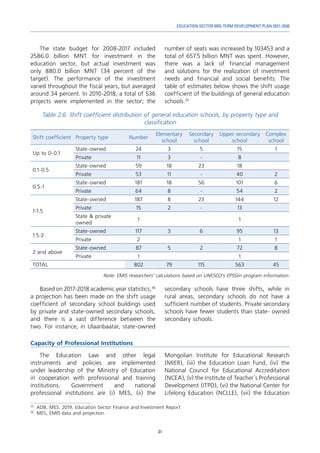
  • 35.
    33 EDUCATION SECTOR MID-TERMDEVELOPMENT PLAN 2021-2030 preschoolers (91.7 percent) were enrolled in regular kindergarten and 21,590 (8.3 percent) were enrolled in alternative programs. A total of 7,903 classes were full and operational. The number of students in class was 36.9 percent in state-owned kindergartens and 22.6 percent in privately owned kindergartens. As of 2018, there are 27,172 people employed at preschool education institutions. Five percent are kindergarten principals, 2 percent are methodologists, 28 percent are teachers, 26 percent are assistant teachers, 39 percent are other staff members. Of the teachers, 88 percent are classroom teachers, 9 percent are music instructors and one percent are teachers at alternative preschool education services.41 According to MES projections based on EMIS data, there will be only a small increase in the number of children in the 0-5 age group and a decrease in the number of age 5 children until 2024, then a slight increase in 2024 (81,947), then a decrease down to numbers similar to 2019. Therefore, it is likely that the net enrollment rate of preschoolers may not increase more than 2 percent until 2030.42 Also in the 2018-2019 academic year, a total of 803 (public 656, private 147) primary and secondary schools were operating. Of these, 558 are in rural areas and 245 are in Ulaanbaatar. These schools have a total of 20,574 classes with 593,150 students and 49,441 staff, of 41 ADB, MES, 2019. Pre-primary Education Sub-sector Analysis Report. 42 MES, 2019. EMIS projection. 43 MES. 2019. 2018-2019 academic year statistics. 44 ADB, MES. 2019. Primary and Secondary Education Sub-sector Analysis Report. 45 Please refer to demographics in this chapter. 46 Based on 2018-2019 training plan and annual retirement projections. which 30,411 are full-time teachers.43 According to 2018-2019 academic year statistics, 8,451 students are attending 212 third-shift classes in 28 schools. Of the 28 schools with three shifts, 7,743 students are in 188 classes in Ulaanbaatar. This indicates that school location and student load are imbalanced between urban and rural areas.44 Class sizes are different among education levels; on average, there are 30.3 students in primary classes, 26.9 students in lower secondary classes and 30.3 students in upper secondary class. When the class size is further analyzed nationwide, the average class size is 31.5 students in urban areas and 26.1 students in rural areas (30.7 at aimag center schools, 24.5 at the bag and khoroo levels, and 18.2 in rural village schools). In the 2017-2018 academic year, 6.1 percent, or 35,012 students, were enrolled at private secondary schools. In last twelve years, the number of students enrolled at private secondary schools increased by 1.1 point annually. (Figure 2.8). In 2006, the rate of students enrolled at private secondary education was 5.3 percent; in 2015, it was 5.8 percent (5.6 percent in primary schools, 5.0 percent in lower secondary, and 7.2 in upper secondary). Based on population growth projections45 and the subject syllabus for 2018-2019, approximately, 30,000 teachers will be needed by 2030.46
  • 36.
    EDUCATION SECTOR MID-TERMDEVELOPMENT PLAN 2021-2030 34 Figure 2.8. Numbers of students enrolled at state-owned and private schools Public school Private school Share of private schools Table 2.7 shows the number of teachers required for primary and secondary schools to 2030. Table 2.7. Number of school teachers required for primary and secondary schools № Subject 2018 2020 2025 2030 Current Total New Total New Total New Total New 1 Primary class 10397 10759 362 11727 1590 12265 3428 12696 5158 2 Mongolian language, scripts and literature 2654 3370 716 3808 1220 5257 3001 5762 3838 3 Math 2363 2425 62 2740 436 3783 1774 4147 2433 4 Information technology 705 703 -2 795 107 1097 498 1203 691 5 Physics 998 1137 139 1285 312 1774 925 1944 1221 6 Biology 844 1137 293 1285 462 1774 1056 1944 1332 7 Chemistry 739 1137 398 1285 564 1774 1145 1944 1408 8 Geography 602 758 156 856 269 1182 671 1296 860 9 History 634 954 320 1078 460 1488 949 1631 1171 10 Social study, Citizen`s education 1106 1716 610 1939 861 2677 1737 2934 2133 11 Fine art, topography 1943 2684 741 3033 1139 4187 2536 4590 3181 12 Music 1080 1413 333 1597 544 2204 1286 2416 1633 13 Physical education 2042 2308 266 2608 617 3601 1865 3947 2467 14 Health 345 813 468 919 583 1269 976 1391 1141 15 English language 2766 2341 -425 2646 -51 3653 1301 4004 1998 16 Russian language 720 667 -53 754 52 1041 429 1141 619 Total 29940 34323 4383 38355 9163 49025 23576 53082 31284 47 ADB, MES. 2019. Education Sector Data and Information Analysis Report. 48 ADB, MES. 2019. TVET Sub-sector Analysis Report. By 2025, 23,576 new teachers will be required for primary and secondary schools.47 By 2030 teacher need that number is projected to be 53,000, of which 31,284 teachers will need additional preparation. In the TVET sub-sector, as of the 2018- 2019 academic year, a total of 86 polytechnic colleges and Vocational Training and Production Centers (VTPCs) have been providing vocational education and skill training. These colleges and VTPCs have a total of 38,526 students, 4,624 workers, 2,469 primary teachers, 103 directors and deputy directors, 80 heads of training units, 339 managerial level staff and 1,633 other staff.48
  • 37.
    35 EDUCATION SECTOR MID-TERMDEVELOPMENT PLAN 2021-2030 In the higher education sub-sector, as of academic year 2018-2019, there are 94 institutions, of which 18 are state owned, 73 are privately owned, and 3 are universities with foreign investment. A total of 157,625 students are enrolled in these institutions, of which 87,992 are at state-owned universities, 69,370 students are at private higher education institutions and 263 students are studying at universities with foreign investment. A total of 12,634 people are employed in the higher education sub-sector, of which 6,668 are full-time teachers. Of all full-time teachers, 62.7 percent are employed at state owned institutions. Of the newly enrolled 49 MES. 2018-2019 academic year statistics. 50 ADB, MES. 2019. Education Sector Data Analysis Report. students at HE institutions, 71.6 percent are secondary school graduates. Out of the total number of students, 27.5 percent are majoring in business administration or law; 14.8 percent in education; 4.5 percent in engineering or industrial production; and 14.2 percent in health or social protection sector.49 Based on population growth projections to 2030, the expected growth of each sub-sector is shown in Table 2.850 and Table 2.9 compares growth projections with baseline data from 2018. Table 2.8. Projections of student growth Level 2019 2020 2021 2022 2023 2024 2025 2026 2027 2028 2029 2030 Pre-primary 312, 447 308, 213 312, 052 315, 128 322, 460 326, 240 324, 655 322, 659 319, 721 317, 055 314, 949 313, 729 Primary secondary 697, 205 734, 991 770, 085 805, 629 835, 460 865, 749 891, 865 910, 630 923, 468 939, 660 949, 353 954, 476 Higher education 189, 219 185, 184 179, 695 174, 471 173, 074 176, 312 189, 079 208, 872 233, 129 250, 939 265, 730 277, 345 TVET 38, 257 38, 497 39, 235 40, 382 41, 798 43, 352 45, 438 47, 113 48, 885 50, 829 49, 895 54, 527 Table 2.9. Children and youth population growth, in comparison with 2018 Education level 2018-baseline 2019 2020 2025 2030 Pre-primary 318,422 312,447 308,213 324,655 313,729 Growth rate -2 -3 2 -1 Primary and secondary Primary 341,257 358,321 371,142 389,702 403,922 Growth rate 5 9 14 18 Secondary, upper secondary 321,538 338,884 363,849 502,163 550,554 Growth rate 5 13 56 71 Higher 190,539 189,219 185,184 189,079 277,345 Growth rate -1 -3 -1 46 TVET 38,526 38,257 38,497 45,438 54,527 Growth rate -1 0 18 42 Based on these projections, the number of students in secondary and upper secondary school will increase by 56 percent by 2025, and by 71 percent by 2030 in comparison to the baseline. The number of students in pre-primary education tends to be relatively stable over the period. On the other hand, the number of students in higher education will increase by 46 percent by 2030. The number of TVET students is projected to increase by 42 percent by 2030.
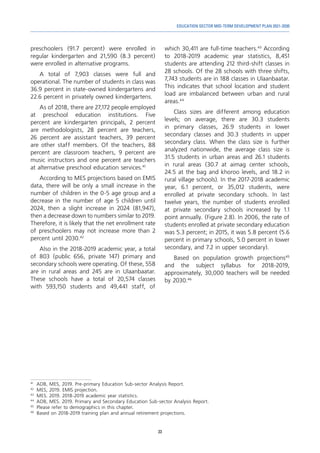
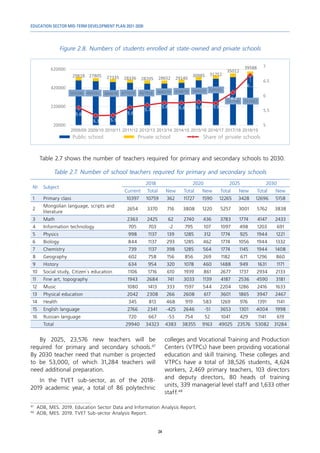
  • 38.
    EDUCATION SECTOR MID-TERMDEVELOPMENT PLAN 2021-2030 36 2.3 SUMMARY OF ISSUES AND CHALLENGES IN THE EDUCATION SECTOR The issues and challenges discussed in this section are divided among the key priority areas that frame the ESMTDP. Though there are some sub-sector specific issues, many issues and challenges are germane to the sector as a whole. Issues such as legal framework, coordination, human resource capacity, demographic shift, teacher supply, infrastructure, teacher pre- service and in-service training, quality assurance, and infrastructure are among those that affect the entire sector. The overarching focus of the ESMTDP is on quality human resources, quality of provision, and flexibility through lifelong learning, within an overall framework of quality, access, and governance. Three overarching issues and challenges related to these issues are highlighted below: Policy Environment. The Law on Education (2016) governs the sector, with numerous policy amendments to address specific policy issues that have subsequently emerged. As the current legal framework is not forward thinking, however, an education policy review will be necessary to achieve the development vision and priorities defined by the government. For instance, the current policy designates school leaders as administrative, with no responsibility for academic leadership—a necessary responsibility of school leaders. Further, the purpose of ICT in education, its integration with curricula and learning outcomes, and its financial support are not well defined. The purpose of higher education is defined as primarily academic, with little provision for linkages to industry or more professional alignment with emerging marketplace needs. There are many more examples that are identified within specific priority areas. Demographic Bubble. One of the main issues facing Mongolia is the demographic bubble of students currently moving through the education system. Population projections forecast that by 2024, the secondary school student population will nearly double, with impacts felt mostly in the capital city. Moreover, the bubble will move through the system, requiring a huge mobilization of resources to accommodate the surge in students by 2024. Teacher supply and infrastructure capacity are the two main challenges, particularly given the fact that teacher and infrastructure needs for 2024 will diminish by 2030. Low-cost portable classrooms may be one infrastructure solution. The shift in teacher supply needs is a more difficult issue. Pre-service programs can be scaled up, but teacher layoffs will likely be inevitable once the bubble has passed. Quality of Learning. Learning assessments indicate that Mongolian students struggle with basic literacy (language) and numeracy, as well as science. Students are weak at information processing, critical thinking and problem solving. This reality implies that the means and mode of instruction are not adequate to provide the necessary learning environment for improving learning outcomes. Improvements in human resource capacity, curriculum, school learning environment, and system capabilities are needed to efficiently and effectively deliver quality education. Current pre-service and in-service teacher development is not standards based or coherent. Learning materials production is not defined by a specific policy, and the curriculum cycle is relatively inflexible to emerging learning needs. Though international attention is on universal access, Mongolia’s policy focus for the next ten years is on quality improvement through human resource development. The focus on quality, however, has led the government to identify access priorities, and to propose measures to improve access for children with disabilities and special needs, with a particular focus on herder children’s access, school readiness, safety, nutrition, and improved lifelong learning services supported by ICT.
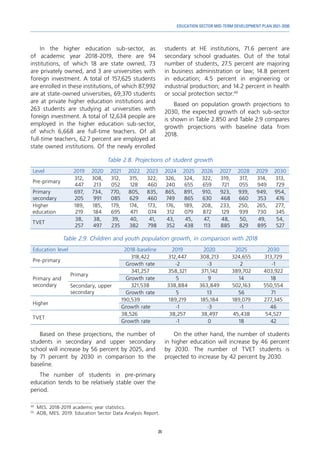
  • 39.
    37 EDUCATION SECTOR MID-TERMDEVELOPMENT PLAN 2021-2030 Strengthened Governance, Management, and Administration 51 The Law of Mongolia on Pre-primary Education, 2008. 52 UNESCO. 2008. 53 World Bank. 2015. Pre-primary Education in Mongolia Report. Challenge: Lifelong learning as a single vision for the entire sector One of the key challenges for sector development is to ensure that learning is accessible, flexible, and relevant. Furthermore, Mongolia envisions that the principles of lifelong learning (LLL) should be embedded in all levels of education; i.e.: learning is continuous throughout life; learning takes place in different contexts inside and outside of school; education is holistic and includes academic, process, social and skills competence. According to these principles, lifelong learning is not external to traditional education but is embedded at all levels: in school curriculum, learning materials, pedagogy and school governance, with a focus on learning to learn. Lifelong education (LLE) in Mongolia is governed as a separate sub-sector that provides equivalency programs for out-of-school adults. There are 354 LLE centers operating throughout Mongolia. The policy on Non-formal education provides the governance framework for LLE. According to priorities identified in the ESMTDP, LLE centers will be transformed into LLL centers to support a broader mandate to provide NQF- based career counselling, online TVET and secondary and higher education courses for students, and professional development access for teachers and school leaders. Issues: • National Council for Lifelong Education which governs LLE does not have clear roles and responsibilities; • There is no designated budget for LLE; • Local authorities do not have legal right to allocate budget; Strategy: • Strengthen life-long education centers to become lifelong learning centers; • Identify inter-sectorial mechanism for implementing a policy on the lifelong learning; • Establish LLL information database and have tracer system; • Restructure Lifelong Education Centers in phases; • Improve quality evaluation of LLL based on defined standards. Challenge: Effective investment in the pre-primary education sector to support implementation of policies aimed at improving the school environment, child health and safety, learning materials and necessary toys According to the Law of Mongolia on Pre- primary Education, the purpose of pre-primary education is to establish a basis for lifelong education that is appropriate to the age, skills and creativity of children through care and protection services and educational training activities.51 As a joint decision by the MES and the Ministry of Health (MOH), the early child physical development policy aims to promote and regulate coordination and communication among state organizations engaged with child nutrition, social welfare, and protection of children and mothers.52 Issues: • Weak system to monitor food nutrition and safety standards; • Learning materials and toys do not follow progressive standards or meet the needs of child development;53 • Water, Sanitation and Health (WASH) facility standards are inconsistent, particularly for students with disabilities. Strategies: • Involve parents to support food and child safety; • Promote local production of learning materials and toys based on newly defined standards; • Map kindergartens to establish needs- based WASH facility upgrades.
  • 40.
    EDUCATION SECTOR MID-TERMDEVELOPMENT PLAN 2021-2030 38 Challenge: Understanding the contextual situation of each school for improved evidence- based, data-driven planning and efficiency As part of the implementation of previous Education Sector Master Plans, the structure of primary and secondary education was changed twice and school entrance age was set at six years.54 However, information on socio-economic, socio-cultural, demographic, geographic, transportation, and other factors important for effective and efficient planning are not available for individual schools. Issues: • Weak human resource capacity to undertake a national school mapping exercise; • Lack of an MES coordination mechanism forefficientandeffectiveimplementation; • School mapping urgently needed to enable better planning for the projected demographic shift. Strategy: • Undertake comprehensive school mapping based on scientific rationale, in-depth study and evidence, in line with the country context and the different characteristics of school children (age, physical and mental development);55 • Review and improve EMIS facility to enable better filtering of information, reporting and validation; • Improve evidence-based, data-driven planning. Challenge: Improved school leader qualifications and skills56 The Law of Mongolia on Education and other laws state that the roles and responsibilities of management staff at all levels of education institutions are administrative. However, within the school community, school leaders are seen as key agents of change and learning. 54 In 2006, the ages for TV Center primary, lower secondary and high secondary were 6, 3 and 3 years, respectively. In 2012, the ages were 5, 4 and 3. 55 School Mapping Project Report. 56 UNICEF. 2019. End-User Sample Survey on Education Sector Services – Final Report. 57 UNICEF. 2019. End-User Sample Survey on Education Sector Services – Final Report. 58 ADB, MES. 2019. Primary and Secondary Education Sub-Sector Report. Issues: • Policies limit the leadership role of school managers; • The selection and appointment of primary and secondary education management does not follow defined policy;57 • There is no systematic approach or framework to train and re-train school managers. • Training opportunities are limited.58 Strategies: • Define school leader standards, and reformulate relevant policies; • Review and update school leader job descriptions based on new standards; • Review and improve school leader professional development programs; • Provide continuous professional development for school leaders. Challenge: Improved coordination within the TVET sub-sector Since 2012, management of the TVET sub-sector has been under the authority of the Ministry of Labor and Social Protection (MoLSP). According to the Law on Vocational Education, the highest administrative body in the sub-sector is the National Council of Vocational Education, which defines the tasks and duties of school managers and provides inter-sectoral coordination among the relevant ministries, private sector and representative organizations. The MoLSP’s department for TVET policy implementation and coordination serves as the central administrative institution for TVET matters, including policy, legislation and implementation of the sub-sector. Issue: • Lack of efficiency in the current TVET management system for effective inter- sectoral coordination.
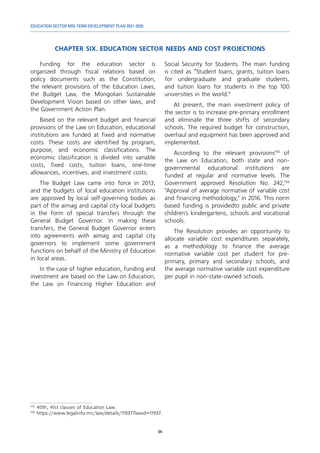
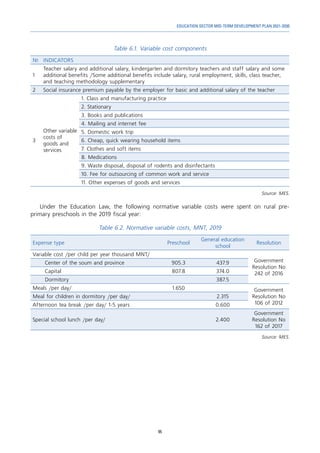
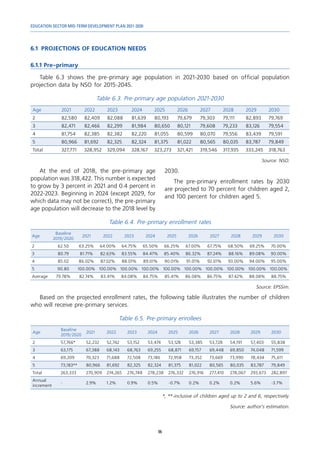
  • 41.
    39 EDUCATION SECTOR MID-TERMDEVELOPMENT PLAN 2021-2030 Strategy: • Establish effective TVET management led by inter-sectoral coordination principles and public-private partnerships.59,60 Challenge: Improved quality assurance in the TVET sub-sector The TVET Assessment Center was established in 2016 with the primary mandate of carrying out competency-based training (CBT) assessments and quality assurance of training institutions. Regional Methodological Centers were established in 2012 under the Regional Development Policy, with the primary mission of developing teachers and implementing the CBT system. These two institutions were restructured in December 2019 as one institution. Issues: • TVET program quality assurance system not standardized; • Lack of efficiency and relevance between CBT curriculum and certification system; • Lack of cross-sectoral competence framework, leading to weak coherence. Strategies: • Improve cooperation among skills-based sectors; • Strengthen TVET data management; • Strengthen labor market information system. Challenge: Align higher education programs with the National Qualifications Framework (NQF) to support professionalism as well as academic achievement Universities and colleges approved and utilized higher education standards for 130 programs during 2003-2013. Since 2014, higher education institutions have used “The general requirements for bachelor’s programs” and “The general requirements for master’s programs” as guidelines. Previously, the higher education sub- sector subscribed to a “professional standard” 59 MoLSP. 2019. TVET Development and PPP – Cooperation Memorandum of Understanding. 60 Operational Procedures of TVET National Council. 61 ADB. 2019. Higher Education Sub-sector Report. 62 ADB, MES. 2019. Lifelong Education Sub-sector Analysis Report. system that emphasized not learning outcomes but rather the core contents of the field of study.61 Issues: • Emphasis on core contents of academic studies detracts from studies relevant to market needs; • Weak linkages between HE and private industry; • Lack of capacity for institutional assessment against international standards. Strategies: • Update HE qualification indices and programs based on NQF, and disseminate new programs; • Enhance partnerships between HE institutions and industry; • Improve linkages of higher education MIS with labor market needs; • Disseminate outcome-based internal quality assurance system. Enhanced quality and relevance of education Challenge: Strengthening lifelong learning centers to align with NQF The NQF provides a framework for learning hard and soft skills relevant to emerging market needs. Transformation from LLE to LLL to more broadly support all areas of learning will use the NQF as a guiding framework for quality improvement of the system. Issues: • High rate of staff/teacher turnover due to poor work environment, lack of social security and other benefits; 62 • Lack of continuing professional development for LLL center teachers/ staff.
  • 42.
    EDUCATION SECTOR MID-TERMDEVELOPMENT PLAN 2021-2030 40 Strategies: • Implement a National Program on Lifelong Learning; • Build the capacity of teachers and staff at the Center for Lifelong Learning; • Strengthen learning assessments aligned with NQF standards. Challenge: Improving the quality of the pre- primary system, and addressing the skills gaps of underserved children In 2011, child development standards were approved; and in 2014, a pre-primary core curriculum was developed and implemented. The core curriculum emphasizes that pre-primary education will be based on children’s individual development, and includes a mechanism to monitor and evaluate curriculum implementation and child development. Issues: • Lack of proper training of school teachers and staff to address underserved learners; • Skills gaps are high among children from rural areas, vulnerable families, and ethnic minorities, many of whom lag behind their peers in terms of cognitive, language and emotional development;63 • School readiness of the underserved is low;64 • The difference between pre-primary age children’s development is different in urban and rural areas;65 • Assistant teachers are not well trained to support academic and social learning;66 • The CPD system for pre-primary teachers is not sufficient to address professional development needs. Strategies: • Develop and implement pre-primary education curricula and assessment standards; • Implement a support program for parents with children 0-5 years old; 63 Wordl Bank. 2018. Монгол улсын цогц дүн шинжилгээ. 64 ADB, MES. 2019. Pre-primary Sector Study 65 World Bank. 2015. Pre-primary Education in Mongolia. 66 ADB, MES. 2019. Pre-primary Sector Study. 67 ADB, MES. 2019. Primary and Secondary Education Sub-Sector Study Report, • Regularly conduct a comprehensive development study of each child; • Develop and implement pre-primary teacher standards; • Develop flexible in-service training pathways for pre-primary education teachers; • Train and develop pre-primary education assistant teachers; • Develop and implement a regulation to assess school readiness of children aged 5; • Support open and distant learning initiatives in pre-primary education. Challenge: Ensuring that primary and secondary curricula remain relevant and support the learning vision of the country The core curricula were developed during 2012-2018 under a new 10-year curriculum cycle, and are now being implemented. Concepts such as sustainable development, holistic human development, continuous (lifelong) learning, and green environmental issues are included. Academic as well as soft skills are emphasized. These include cooperating with others, developing skills for continuous scientific inquiry, developing and integrating life choices with awareness of the surrounding environment and its importance for social and economic wellbeing. These objectives are strongly related to SDG 2030 goals for Mongolia, and require that school leaders manage more effectively; that school teachers update their teaching and professional competencies; and that school social workers and parents be more supportive of children choosing their own electives. School staff and parents should also ensure that classes are arranged efficiently and reflect the needs of the community and different types of students, and that resources are used effectively. Issues: • Implementation has commenced without sufficient school preparedness training;67
  • 43.
    41 EDUCATION SECTOR MID-TERMDEVELOPMENT PLAN 2021-2030 • Assessment of student learning against defined benchmarks is lacking; • Primary and secondary teacher standards are lacking; • School-based support for teachers is lacking; • Mongolian language proficiency is weak among teachers;68 • Students’ basic skills are low compared with learning standards. Strategies: • Implement Curriculum Management Cycle and review the implementation; • Regularly conduct a comprehensive development study of each child; • Strengthen standards-based in-service teacher development; • Develop a Mongolian language proficiency evaluation system;69 • Strengthen inquiry learning skills. Challenge: Strengthening the TVET system to improve market relevance of student skills Basic indicators for defining the quality of TVET have been graduate employment and acquisition of skills needed for the labor market. The quality and performance of teachers is one of the main factors that directly impact the quality of student training. Optimally, the TVET sector requires an effective pre- and in-service teacher training system to better ensure overall quality. As labor market demand changes, teachers need to develop new competencies to ensure that Mongolian workers have the appropriate skills.70 Issues: • TVET providers do not meet the needs of the labor market;71 • TVET providers do not reference recognized standards and requirements for establishing the learning environment, 68 ADB, MES. 2019. Primary and Secondary Education Sub-Sector Study Report, 69 World Bank. (2017. Early Grade Reading and Mathematics Ability Assessment Report. 70 UNESCO. 2019. Education Policy Review. 71 ADB, MES, 2019. TVET Sub-sector Study Report, 72 RILSP. 2018. Graduate`s Employment Survey. 73 UNESCO. 2019. Education Policy Review. 74 UNESCO, MIER. 2019. Education Policy Review Country Background Paper. identify the competence framework, use the proper materials and tools, or assess learner outcomes; • TVET providers do not emphasize the development of soft skills such as attitude toward the job, problem solving, team work, communicating with others and entrepreneurial skills; 72 • Teachers’ skills are not adequate to teach required skills to students; • There is no effective teacher pre- and in- service training system;73 • Teacher Development Centers are not operating at full capacity. Strategies: • Develop and implement occupational standards and a competency-based training curriculum; • Disseminate a TVET teacher development program; • Enhance the research and innovation capacity of TVET; • Improve utilization of labor market information for TVET. Challenge: Transforming higher education to ensure graduates leave with relevant knowledge and skills to meet the needs of Mongolia Academic coherence among HE institutions is important to ensure equivalency in the delivery of quality programs that give students the opportunity to gain relevant skills for employment and socio-cultural harmony. HE policy focuses on academic achievement through quality programs and strength in research. However, there is increasing emphasis on research and professionalism within HE institutions internationally, in order to bring more relevance into students’ studies.74 To better align HE programs with labor market realities, it has been determined that the course and program indexes for the professions need
  • 44.
    EDUCATION SECTOR MID-TERMDEVELOPMENT PLAN 2021-2030 42 to be renewed to ensure professional alignment and marketplace relevance.75 A further shift from the andragogical, constructivist approach to a heutagogical self-directed, connectivist approach should be encouraged.76 Issues: • Academic programs among institutions are not of equivalent quality; • Recruitment in many institutions is driven by financing; • Poor employment of graduates due to oversupply in the labor market; • Curricula are not aligned to the structure and demands of national and domestic labor markets and characteristics; • Ineffective forms of teaching and learning, and weak promotion of research-led teaching; • A lack of open and distance learning opportunities. Strategies: • Update HE qualification indices and programs, and disseminate new programs that embed national identity; • Develop HE internship program; • Implement HE professional excellence program; • Develop and support open and distance learning initiatives and resource materials; • Enhance partnership between HE institutions and industries. Increased equitable access and retention Challenge: Improving access to lifelong education for all citizens Lifelong education includes the following key areas: 1) Literacy curriculum, 2) Equivalent training curriculum, 3) Life skills and other (family, civic, moral maturity, life science, and aesthetic).77 During 2007-2018, a total of 78,499 citizens were covered by the literacy curriculum implemented by the Lifelong Education Centers; 75 UNESCO, MIER. 2019. Mongolia Education Policy Review. 76 UNESCO, MIER. 2019. Education Policy Review. 77 ADB, MES. 2019. Life-long Education Sub-sector Study Report. 78 UNDP. 2016. 79 National Center for Lifelong Education. 2018. 80 percent were young adults age 15 and older. Of the participants under 15 years, the majority were children with disabilities. The equivalent training curriculum is open to any citizen who is willing to obtain primary and secondary education. Citizens or groups covered by this service are children, youth, adults, housewives, unemployed, migrants, pre-kindergartens, their parents, vulnerable groups, and disabled people who have dropped out and are out-of-school. Illiterate and dropouts, especially those who are over 15 years of age, are among the majority of learners in equivalent training. Issues: • The literacy program is perceived as dedicated to dropouts or children with disabilities; • There is limited access to education for young people with disabilities; • Nearly half the total number of congenitally disabled youth are illiterate or uneducated;78 • Limited access by those living in rural and remote areas; • Sixty percent of lifelong education centers do not meet hygienic requirements; desk chairs are insufficient, non-standard and non-ergonomic for adult bodies;79 • Demand for learning materials exceeds their availability in most centers. Strategies: • Improve infrastructure of the Lifelong Education Centers to support lifelong learning; • Identify form and type of lifelong learning at each educational level and its alignment with the NQF.
  • 45.
    43 EDUCATION SECTOR MID-TERMDEVELOPMENT PLAN 2021-2030 Challenge: Achieving 100 percent access to pre-primary education During the 2018-2019 academic year, access to pre-primary education was 82.8 percent.80 Attendance of children aged 3- 5 years living in urban areas was 81.4 percent, compared to 58.2 in rural areas. The wealth index indicates that children from the fifth quintile have a higher likelihood (88.5 percent) of being placed in kindergartens, followed by the fourth (86.5 percent), second (79.9 percent) and middle (77.2 percent) quintiles. Only 34.1 percent of preschool children from the poorest families attend kindergartens.81 Of the total number of children enrolled in pre-primary education, herders’ children make up 11.5 percent. Only 45.2 percent of herder children are enrolled in kindergartens compared to 90.2 percent of children residing in aimag centers.82 The enrollment of herders’ children by year shows that during 2006-2015, their numbers increased by 44 percent but fell by around 9 percent in 2018. Nationwide, pre-primary enrollment of children with disabilities was 21.4 points lower than average enrollment.83 Approximately 30 percent of total non-state kindergartens have inadequate arrangements for storage and processing of children's food (27.1 percent of them are at high risk of food-borne illness), lower access to the outdoors, inadequate child safety measures (25.1 percent are at high risk of injury), as well as inadequate teacher training.84 Issues: • Lack of proper understanding, knowledge and experience among parents on the importance of early childhood education and development for school preparedness;85 • Significant disparity in access between urban and rural pre-primary aged students; 80 GPE, Education Alliance. 2019. Pre-primary Education Sub-sector Analysis. 81 Children from those households under the poverty line, HH livelihood status is assessed through proxy means testing (PMT) methodology, and households are divided into 20 different groups depending on their score. 82 NSO, UNFPA, UNICEF. 2018. Multiple Indicator Cluster Survey (MICS). 83 GPE, EDU Alliance. 2019. Pre-primary Education Sub-sector Study Report. 84 ADB. 2019. Pre-primary Sector Study. 85 GPE, EDU Alliance. 2019. Pre-primary Education Sub-sector Sudy Report. 86 UNESCO. 2019. Education Policy Review. 87 UNESCO. 2019. Education Policy Review. • Herder children’s access is significantly lower that all other demographic groups; • Access by children with disabilities is low; • Lack of kindergarten food safety. Strategies: • Improve pre-primary education environments to be more inclusive and accessible for children with disabilities; • Improve food safety and nutritional value of kindergarten meals. • Ensure 100 percent enrollment of children from vulnerable groups and herders in pre-primary education. Challenge: Improve TVET learning environment to enable the achievement of relevant skill competencies Overall, there were 38,526 students in the 2018-2019 academic year, of which 15,097 were female. In terms of location, 19,085 students were in the city and 17,954 were in rural areas. Of the total number of students, 18.4 percent study technical education, 77 percent participate in vocational education programs, and the remaining 4 percent participate in professional training to get a competency certificate. In general, the enrollment rate for TVET tends to be dependent on political and government decisions on financial incentives or stipends provided by the TVET schools. This results in the formal TVET enrollment capacity being under-utilized.86 Instead of utilizing an incentive-based TVET enrollment policy, the sector policy shall henceforth be focused on promoting lifelong learning opportunities for all citizens to support the acquisition of new knowledge and skills, while supporting and recognizing their prior learning. There is still a need to develop individual trainings and curricula for citizens with disabilities.87 The equipment, buildings, furniture and other materials used
  • 46.
    EDUCATION SECTOR MID-TERMDEVELOPMENT PLAN 2021-2030 44 in the vocational education and training sector are generally outdated and do not meet the demands of industry.88 Issues: • TVET providers lack adequate infrastructure, equipment and ICT; • TVET facilities are not used efficiently; • Lack of specialized TVET institutions leads to inefficiencies; • TVET financing does not keep pace with demand; • Access to services is limited to schools; little flexibility for learners far from TVET facilities; • No system to recognize non-formally acquired skills. Strategies: • Upgrade infrastructure, equipment, technology and simulation technology at TVET institutions; • Promote shared workshops among TVET providers; • Develop specialized TVET schools; • Develop partnerships for local production of learning materials, tools and furniture; • Increase TVET access through the promotion of various modalities and lifelong, continuous and flexible learning pathways; • Scale up student support services; • Establish and implement a Recognition of Prior Learning (RPL) system. Challenge: Improve the higher education environment and accessibility for a more relevant and flexible system Share of the senior secondary school graduates in total entrants in HEI were, on average, 74 percent during 2007-2009, 70 percent during 2010-2013, and 81 percent during 2014-2018. In academic year 2017-2018, 59.4 percent of the total number of graduates were female and 40.6 percent were male, a 88 UNESCO, MIER. 2019. Mongolia Education Policy Review - Country Background Paper. 89 UNESCO, MIER. 2019. Education Policy Review. 90 UNESCO, MIER. 2019. Education Policy Review. 91 ADB Higher Education Sub-sector Study. 92 ADB Higher Education Sub-sector Study. gender gap of 1.46 (146 female graduates per 100 male graduates). To improve the overall quality of enrollment and prepare qualified personnel for the labor market, the threshold score to enter an HE institution is 480 for both public and private schools, according to the Decree №A/195 of Minister of MES. Starting in 2018, applicants from rural areas with scores of 420 have been admitted in order to increase enrollment from rural areas. Although it has been repeatedly reflected in national policy and priorities that higher education must coincide with labor market demand, it still does not do so.89 There is also a need to formulate policy solutions to increase the quality of HE in rural areas and reduce the differences in quality of education services among urban, rural and regional centers. The quality and effectiveness of HE can also be improved by increasing open sources and online platforms for HE programs, and providing professional development and lifelong learning opportunities for graduates.90 Issues: • Outdated infrastructure;91 • HE admission policies do not measure future academic success or knowledge, skills, attitude and character at graduation;92 • Access to HE services limited to urban and regional institutions. Strategies: • Upgrade infrastructure of HE institutions; • Revise undergraduate and graduate admission procedures; • Promote flexible learning policies to include delivery of online and distance courses.
  • 47.
    CHAPTER THREE. EDUCATIONSECTOR MID-TERM DEVELOPMENT AREAS AND OBJECTIVES DURING 2021-2030 • Aim of the Education Sector Mid-Term Development Plan • Principles of the Education Sector Mid-Term Development Plan • Policy Priorities in the Education Sector Mid-Term Development Plan • Scope and Timeline of the Education Sector Mid-Term Development Plan • Summary of Objectives and Outcomes
  • 48.
    EDUCATION SECTOR MID-TERMDEVELOPMENT PLAN 2021-2030 46 CHAPTER THREE. EDUCATION SECTOR MID-TERM DEVELOPMENT AREAS AND OBJECTIVES DURING 2021-2030 3.1 AIM OF THE EDUCATION SECTOR MID-TERM DEVELOPMENT PLAN The aim of the ESMTDP is to ensure the holistic development of Mongolian citizens, with competencies to work and live in the digital era, actively participate in knowledge-based society, and engage in lifelong learning through quality, open, inclusive and flexible education services that meet their development needs. The Plan envisions the continuous development of the human being from birth throughout life by keeping pace with the Industrial Revolution 4.0, while considering the fact that new technologies such as the Internet of Things, Big Data and Artificial Intelligence are concretely influencing the industrial sectors. 3.2 PRINCIPLES OF THE EDUCATION SECTOR MID-TERM DEVELOPMENT PLAN With its focus on holistic human development, the Plan is based on the following overarching principles: - Provide equal opportunity to all citizens to access education services; - Strengthen and support shared responsibility and accountability among stakeholders; - Strengthen sustainable and professional management in the sector; - Ensure vertical and horizontal linkages of education policies; - Utilize smart and digital technology at all education levels; - Promote green development in learning environment and materials. 3.3 POLICY PRIORITIES IN THE EDUCATION SECTOR MID-TERM DEVELOPMENT PLAN In the development of lifelong learning for all citizens through quality education, the ESMTDP prioritizes: 1. Quality and relevance Various studies and analyses of the education sector, as well as a series of discussions with stakeholders, have shown that the most challenging issue in the sector is low quality and lack of relevance of education services. In particular, student low performance and lack of skills demanded by the labor market, the urban- rural achievement gap, and learning gap due to socio-economic status are the most important areas for quality improvement. Strategies have been identified to enhance the quality of curricula and training programs, promote integration among different programs, improve linkages between the curriculum and assessment, strengthen teacher capacity, promote smooth transitions among the education levels and increase relevance to the labor market. The strategies give specific attention to improving the quality of rural schools and teachers. 2. Equal access and inclusiveness The Education Sector Medium-Term Development Plan aims to ensure the holistic development of Mongolian citizens through quality, open, inclusive and flexible education services that enhance their capacity to live and work in the digital technology era, actively participate in knowledge-based society and engage in lifelong learning. Moreover, to enable students with special needs be included in mainstream schools and training organizations, it is necessary to provide an enabling environment and identify more alternative education services for children from herder and disadvantaged families. 3. Efficiency of Governance, Management and Administration Mongolia’s education sector faces a particular governance and management challenge related to the lack of a sustainable human resources policy. Resources for education management are changed every four years based on political decisions, which affects the continuity and sustainability of policy implementation. Once
  • 49.
    47 EDUCATION SECTOR MID-TERMDEVELOPMENT PLAN 2021-2030 new management is appointed, implementation of the previous policy is often suspended and a new policy initiated without proper evidence. This has been an obstacle to development of the sector. To address this challenge, the ESMTDP identifies strategies to enhance coordination and build the capacity of professional education organizations; implement human resource policies that are merit based and independent of political decisions; promote evidence-based, 93 First digit of the code represents the sector or sub-sector, and second is priority area. data-driven policy planning; and disseminate an internal and external quality assurance management system. The human resource policy shall not only modify the present appointment mechanism for education leaders but also improve teacher management. In addition, to promote the efficiency of the system, the Plan promotes pre-primary, primary and secondary school mapping and reorganization. 3.4 SCOPE AND TIMELINE OF THE EDUCATION SECTOR MID-TERM DEVELOPMENT PLAN The Plan is intended to develop the lifelong learning, pre-primary, primary, secondary, technical and vocational education and higher education sub-sectors for the period 2021-2030. 3.5 SUMMARY OF OBJECTIVES AND OUTCOMES Summary of Objectives 1. SECTOR LEVEL Code93 Objectives 1.1 Enhance quality, integration and relevance of education services 1.2 Increase citizens’ opportunities to access equal and inclusive education throughout their life 1.3 Enhance efficiency of education governance, management and administration 2. PRE-PRIMARY EDUCATION Code Objectives 2.1 Strengthen the quality of pre-primary education services, focusing on children’s holistic development and ensuring relevance to next level of education 2.2 Increase children’s opportunities to access pre-primary education services regardless of their level of development, geographical location and socio-economic status 2.3 Improve the efficiency of pre-primary education providers’ management and administration 3. PRIMARY AND SECONDARY EDUCATION Code Objectives 3.1 Improve the quality and relevance of primary and secondary education 3.2 Increase all children’s opportunities to access primary and secondary education regardless of their level of development and geographical location, and promote equal and inclusive education services 3.3 Strengthen primary and secondary education management and administration to enhance the efficiency of schools 4. VOCATIONAL EDUCATION AND TRAINING Code Objectives 4.1 Improve the quality of TVET, ensuring relevance to learner needs, labor market demand, employer requirements and international standards 4.2 Enhance TVET access and inclusiveness by expanding flexible and open learning opportunities, to enable citizens to upgrade their technical and vocation competencies throughout their life 4.3 Establish autonomous TVET governance and management with public-private partnerships and cross-sector coordination
  • 50.
    EDUCATION SECTOR MID-TERMDEVELOPMENT PLAN 2021-2030 48 5. HIGHER EDUCATION Code Objectives 5.1 Improve the quality of higher education, respond to learner needs and aligning with the science and economic priorities of the country and international standards 5.2 Increase higher education equal opportunities through the promotion of a flexible, open education system 5.3 Strengthen higher education governance and management Summary of Expected Outcomes 1. SECTOR LEVEL Code Outcomes 1.1 The quality and relevance of education at all levels will be equivalent in urban and rural areas; and qualified, professional, sustainable human resources will have been established in the sector 1.2 Citizens will have been provided with equal and inclusive lifelong learning opportunities to access education services regardless of time, location and level of development 1.3 Efficiency at all levels of education will have been enhanced 2. PRE-PRIMARY EDUCATION Code Outcomes 2.1 All children aged 5 will have been properly prepared for primary school 2.2 Children, especially those from herder and vulnerable families and children with special needs, will have accessed pre-primary education services aligned with their needs and potentials 2.3 Quality assurance tools for effective policy implementation outcomes will have been developed and utilized 3. PRIMARY AND SECONDARY EDUCATION Code Outcomes 3.1 Learning achievements of primary and secondary students will have improved; and achievement gaps will have become smaller for ethnic minority, special needs and rural children 3.2 All children will have accessed primary and secondary education services regardless of their level of development, location, and socio-economic situation 3.3 Efficiency of general education schools will have improved; and quality assurance tools will have been developed and implemented 4. VOCATIONAL EDUCATION AND TRAINING Code Outcomes 4.1 The quality and relevance of TVET providers and teachers will have improved in relation to labor market needs and the requirements of Industrial Revolution 4.0 4.2 TVET access will have been enhanced, supporting people with special needs and enabling flexible learning pathways 4.3 TVET providers will have established specialized and autonomous management systems 5. HIGHER EDUCATION Code Outcomes 5.1 HE graduates will have met international standards and labor market requirements. The capacity of teachers in rural HE institutions will have been strengthened; and teachers with PhDs will have reached 50 percent of the total number of teachers 5.2 Open, online and distance training modalities will have expanded; and talented students from rural HE institutions will have received support from the Government 5.3 State-owned HE institutions will have instituted autonomous governance; and all HE institutions will have been ranked. HE institutions will have developed in line with regional development concepts, and research universities will have been established and supported by the Government
  • 51.
    CHAPTER FOUR. EDUCATIONPRIORITIES AND STRATEGIES • Sector Level Objectives and activities • Sub-sector Level Objectives and activities
  • 52.
    EDUCATION SECTOR MID-TERMDEVELOPMENT PLAN 2021-2030 50 CHAPTER FOUR. EDUCATION PRIORITIES AND STRATEGIES 4.1 SECTOR LEVEL 1. Objectives 94 UNESCO, MIER. (2019. Country Background Paper. 95 UNESCO, MIER. 2019. Education Policy Review. 96 UNESCO, MIER 2019. Country Background Paper. Objective 1.1 (Quality): Enhance quality, integration and relevance of education services Expected outcome: The quality and relevance of education at all levels will be the same in urban and rural areas; and qualified, professional, sustainable human resources will have been established in the sector. Studies and analysis indicate that the quality and relevance of education are weak. In particular, frequent changes in curricula, programs and syllabus, assessment, evaluation and learning materials, including textbooks, affect the quality of education and interrupt the continuity of education development. For instance, education terms and terminologies such as action-oriented pre-primary education, competence-based primary and secondary education, competence-based VET, program and learning outcome-based HE, have been introduced to the sector without proper development and conceptual frameworks. The use of different terminologies at different levels of educations creates misperceptions and makes integration of different levels of education more difficult.94 It also negatively affects the relevance of education. Engaging all 5-year old children in pre-primary education enables them to be prepared for primary school and enhances their performance in school. Therefore, it is important to provide more alternative services targeting herder children and deliver special programs to herder parents to enable them to help their children. Integration across secondary, VET and HE education is weak; thus, senior secondary education curricula and evaluation must be linked with VET and lower HE studies. Research on the correlation between education level and employment95 has shown that 8.3 percent of citizens who completed senior secondary education and 7.5 percent higher education graduates are unemployed. It has also been challenging for VET to find employment. Another challenge is the gap in the quality of urbanandruraleducation.Cognitivedevelopment of children in pre-primary education, learning achievement in primary and secondary education, and employment of TVET and HE graduates are weak and varied in the urban and rural context. Rural education quality needs to be supported with a focus on school leaders and teacher capacity, learning environment and materials. Local education departments must play a role in providing continuous support to teachers. In addition to poor quality, ethnic minority student achievement is lagging behind that of their peers due to their poor proficiency in the Mongolian language. It is necessary to implement a national program to promote the language ability of ethnic minority students and their teachers. Evidenced by sector studies, quality-related challenges and issues are caused mainly by weak professionalism of human resources, low retention of school leaders, subjective influence of political decisions, and the abandonment of the merit principle in education policy.96 These challenges are compounded by the absence of education leaders, well-prepared education managers, or a continuous training system. The majority of education leaders and managers lack experience, professional capacity and the background for effective leadership. As a consequence, they become a burden rather than effective leaders of the complex and
  • 53.
    51 EDUCATION SECTOR MID-TERMDEVELOPMENT PLAN 2021-2030 diverse reforms in the education sector.97 Thus, it is a pressing priority to update the human resource policy emphasizing professionalism and merit-based principles. Any decision on human resources must be independent from political influence. Job profiles and requirements for all positions need to be updated to align with NQF. All appointment procedures need to be transparent, merit-based, professional, and insulated from politics. If the procedures are violated, appropriate measures need to be taken.98 Another human resource issue is related to teacher management. Teachers spend most of their time on administrative tasks; thus, they do not have sufficient time to focus on teaching and support of students’ learning. In the coming years, the education sector is likely to face a shortage of qualified teachers. The professional capacity of sector personnel are lagging behind. Professionals in institutes such as MIER, ITPD, EEC and the Vocational Education and Training Assessment, Methodology and Information Center (VETAMIC) have not had opportunities to build their capacity and continue their professional development. Researchers and methodologists at MIER and ITPD do not have time to visit schools and kindergartens to provide continuous support to teachers and leaders, and identify problems and challenges faced by learners and children. Their job profiles need to be updated and aligned with the legal functions of their institutions. Therefore, the sector’s human resource policy must updated to address issues such as job descriptions, selection, recruitment, retention, appointment, career pathways, workloads, professional preparation, retraining, lifelong development, health and social security, demand and supply, shortages, retirement, human resource management system, salary and other compensation. An integrated human resource information system needs to be developed, 97 UNESCO, MIER. 2019. Country Background Paper. 98 UNESCO, MIER. 2019. Country Background Paper. Recommendation 1.2.2. 99 ADB, MES. 2019. Lifelong Education Analysis Report. 100 Education 2030 Framework for Action. 101 Education 2030 Framework for Action. dedicated modules for human resources in the education sector. It is also necessary to develop a manager-level human resource preparation and continuous professional development system in cooperation with related HEIs. Objective 1.2 (Access): Increase citizens’ opportunities to access equal and inclusive education throughout their lifetimes. Expected outcome: Citizens will have been provided with equal and inclusive lifelong learning opportunities to access education services regardless of time, location and level of development. The people of Mongolia have insufficient and unequal opportunities to access education to develop and improve their competencies throughout their lifetimes. The existing system is very rigid and unconnected. For example, merely two-thirds of school drop-outs are able to access education services through an equivalence program. Once students have dropped out or left school, most do not have a second chance for education. Lifelong education in Mongolia only covers out-of-school individuals, focuses on school and higher education, and pays much less attention to non-formal education or adult learning in non-formal settings.99 Within the international framework,100 lifelong learning entails the integration of learning and living, covering learning activities for people of all ages (children, young people, adults and the elderly, girls and boys, women and men) in all life contexts (family, school, community, workplace and so on) and through a variety of modalities (formal, non-formal and informal) which together meet a wide range of learning needs and demands. Therefore, in the ESDMTP, lifelong learning is defined as an organizing principle of education covering all levels of education and all forms of learning – formal and non-formal education and informal learning.101
  • 54.
    EDUCATION SECTOR MID-TERMDEVELOPMENT PLAN 2021-2030 52 To realize quality lifelong learning for all citizens of Mongolia, the major tasks are to identify people’s needs and to promote inclusion and equity by reaching out to disadvantaged individuals. At the international level, lifelong learning is aimed at all citizens for self-development and improving the quality of their work and life in flexible ways, rather than at certain people in targeted groups. Technological and social development over the recent years has influenced the training needs of the citizens of all ages.102 Identification of the needs of all citizens will enable the creation of a framework for lifelong learning in Mongolia, and the development of related capacity. In the promotion of inclusion and equity in education, open education and blended, flexible learning will all be utilized. At each level, interventions such as providing the enabling environment will take place. Presently, there are open education centers in major universities of Mongolia; thus, it is feasible to develop open education relying on HEIs. To advance open education, Mongolia needs to strengthen the capacity of teachers and staff in schools and training institutions to develop open content and resource materials to facilitate learning. The information and communication technology (ICT) environment also needs to be improved to enable citizens to access the learning modalities. Students, teachers and the community at large need to be engaged in understanding and implementing lifelong learning. Professionals working in institutions devoted to delivery, such as community learning centers and online learning platforms, also need continuing professional development (CPD)103 and capacity building. The transition between different learning modalities and the recognition, validation and accreditation of learning outcomes from non- formal education and informal learning could improve the prospects of the people enrolled in these types of continuous learning.104 102 UNESCO. 2019. Initiative for Future Education. 103 Lifelong learning in transformation: Promising practices in Southeast Asia 104 Lifelong learning in transformation: Promising practices in Southeast Asia 105 Interview notes with authorties of professional organizations in September 2019 Objective 1.3 (Management): Enhance efficiencyofeducationgovernance,management and administration Expected outcome: Efficiency at all levels of education will have been enhanced. An institutional assessment105 identified inter- ministerial coordination and the interrelation among education institutions as weak. These institutions also lack resource materials and libraries. The absence of a system for professional development , lack of independence, and limited budget are the main challenges for these institutions. Researchers and methodologists at MIER and ITPD do not have opportunities to properly carry out the legal functions of the institutes. For example, MIER researchers in charge of curriculum development are not able to visit schools and identify problems related to the curriculum implementation due to lack of budget and too much unnecessary workload. One of the priorities of the ESMTDP is to establish a system to build human and physical resource capacity and a mechanism to strengthen MIER as a policy institute, ITPD as an institute to manage professional development of leaders and teachers, EEC as a psychometric unit, the Mongolian National Council for Education Accreditation (MNCEA) as an autonomous institute to ensure the quality of education providers, and VETAMIC as an institute to support the recognition of prior learning (RPL) and skill upgrades of individuals and manage RPL at the national level. Local education departments must then be restructured, and legal functions reviewed and updated. Policies for strengthening local education departments need to include organizational and structural changes, and continuous professional development for staff depending upon their actual needs. An education management and information system plays a critical role in education planning. At present, as identified by sector studies, the EMIS unit lacks professional
  • 55.
    53 EDUCATION SECTOR MID-TERMDEVELOPMENT PLAN 2021-2030 capacity to provide data and information for policy planning. Instead, EMIS modules are focused mainly on administration. According to UNESCO’s International Institute for Education Planning (IIEP), a well-functioning information system is at the heart of effective planning and management; without data and proper analysis and communication of these data, planning and management decisions may not be based on accurate information. 106 UNESCO, MIER. 2019. Country Background Paper. Administrative data indicators need to be modified, and staff need to be trained on how to process and analyze data for education policy planning and decisionmaking. EMIS data must be utilized in the monitoring and evaluation of policy and programs, and reporting should be customer friendly. Sub-sector analysis has found that teachers struggle to enter administrative data in the system due to lack of hardware and low-speed internet at locals. Investment should be made into the physical capacity of EMIS.106 More digital tools need to be developed and utilized. 2. PROGRAMS AND ACTIVITIES Table 4.1. Sector programs and activities Program Main activities Objective 1.1 Enhance quality, integration and relevance of education services Program 1.1.1: Strengthen integration of all level curricula and program 1. Strengthen integration of curriculum content and relevance of evaluation at all levels 2. Implement Mongolian language policy and program for ethnic minorities 3. Implement Mongolian language proficiency evaluation and to introduce to all levels of education 4. Expand the career guidance services to all education levels Program 1.1.2: Implement merit-based human resource policy, apply labor productivity and performance-based principles into teacher evaluation 1. Approve NQF, to register and verify the qualifications in the education sector and update the job descriptions and requirements and implement career promotion policy, promote awareness of gender-based human resource policy 2. Promote professionalism and merit-based selection and appointment that is independent and free from political influence 3. Evaluate teacher labor productivity realistically, implement outcome-based, performance-oriented teacher incentive policy, and increase teacher real salary above the national average 4. Improve teacher living conditions and provide an opportunity to be in accommodation program 5. Investigate demand and supply characteristics of education sector human resources; conduct surveillance study on explicit and implicit shortage of teachers 6. Create education sector human resources database modules within the current structure of EMIS, and apply the data in policy and financial planning 7. Disseminate flexible, blended learning pathways in human resources professional development system using open education and digital learning technology 8. Establish university-based continuous professional development training system for school leaders and managers Program 1.1.3: Improve the quality of education and training providers in rural areas 1. Build the capacity of rural kindergarten, school, VET and HE institution managers and teachers 2. Improve the learning environment of rural kindergarten, school, VET and HE institutions
  • 56.
    EDUCATION SECTOR MID-TERMDEVELOPMENT PLAN 2021-2030 54 Priority 1.2 Increase citizens’ opportunities to access equal, inclusive education services throughout their life Program 1.2.1: Encourage lifelong learning for all 1. Administer nationwide survey to identify citizen`s needs of lifelong learning; and identify the content, modalities, alternatives of lifelong learning at all education levels aligning with National Qualification Framework 2. Implement cross-sector financing mechanism for lifelong learning 3. Re-structure national centers of lifelong education and scale up lifelong learning policy in consultation and collaboration with government, NGOs, professional and training organizations and private entities. 4. Strengthen human resource capacity to facilitate lifelong learning of citizens 5. Provide professional support and methodology to Mongolian language and culture centers in overseas for delivering language, history and culture trainings; and encourage overseas lifelong education centers 6. Establish a system to recognize, verify and accredit outcomes of lifelong learning of citizens 7. Develop a database module to register and verify lifelong learning at the EMIS Program 1.2.2: Develop online training platform, programs and disseminate online content and resources 1. Enable all sectors to exchange data and information through dissemination of innovations in education sector information and scale up of the integrated 2. Implement IT education policy in line with international level, establish outsourcing centers and strengthen the capacity 3. Prepare human resource for artificial intelligence, Big Data, information security 4. Develop computational linguistics in phases, produce online content and training resources and utilize in life long education context 5. Provide computers to all teachers and establish smart school, smart class project 6. To register and verify the quality of open, online and distance learning content, resources and tools Priority 1.3 Enhance efficiency of education governance, management and coordination Program 1.3.1: Promote shared responsibility in the management 1. Strengthen shared responsibility of education institutions and promote shared responsibilities of all related stakeholders, and transfer delivery of some selected education services to accredited non-government or private entities Program 1.3.2: Enhance effective management and administration 1. Implement data-driven and evidence-based planning in policy and investment 2. Promote investment planning based on population growth and geographical database system; Establish quality assurance system and integrate the internal quality assurance with external mechanisms 3. Integrate VET information system with sector management and information system, and add up related indicators in the system 4. Improve hardware and software of EMIS 5. Develop an evaluation methodology for SDG 4 implementation and use it in mid-term and final stage of the implementation Program 1.3.3: Build physical and human capacity of education professional organizations 1. Assess legal functions of the institutions in conformity with human and physical capacity of MIER, IPTD, EEC, NCEA, TVET Assessment, Methodology and Information Center and education and culture departments at local level; and update the management and inter-institutional linkages 2. Optimize functions of research and training institutions 3. Establish university-based professional development system for personals of above organizations 4. Establish open, online and distance advising environment at the professional institutions 5. Improve infrastructure, environment and equipment of professional institutions for enabling their sustainable, quality and effective operation 6. Improve infrastructure, IT environment of local lifelong education centers
  • 57.
    55 EDUCATION SECTOR MID-TERMDEVELOPMENT PLAN 2021-2030 4.2 SUB-SECTOR LEVEL 4.2.1 Pre-primary education 107 Sammons et al., 2008; Sylva et al., 2004. 108 ADB, MES. 2019. Pre-primary Education Sub-sector Study Report. 109 OECD. 2018. Starting Strong Report. 110 World Bank. 2018. Mongolia Comprehensive Analysis. Goal: Develop accessible, standards-based, high-qualitypre-primaryeducationforallchildren within a safe, healthy and green environment which encourages parents’ participation and supports children’s school preparation. As studies reveal, quality pre-primary education services are crucial for supporting children’s ability to achieve employment, poverty reduction, social participation and interpersonal relationships throughout their lifetimes.107 Thus, it is necessary to improve the quality of teaching by strengthening pre-service and in- service training; and by introducing teacher standards and evidence-based and data-driven policy planning, implementation and evaluation to ensure adequate school preparation of all children.108 Teachers’ qualifications, caring interactions with children, and support from parents play important roles in the quality of early childhood education (ECE), as revealed by research conducted by international organizations.109 This research indicates the need to allow more space to mobilize resources and the participation of parents and communities in pre-primary education. 1. Objectives Objective 2.1 (Quality): Strengthen the quality of pre-primary education services, focusing on children’s holistic development and ensuring relevance to next levels of education Expected Outcome: All children aged 5 will have been prepared for primary school. Mongolian children lag behind their peers in countries at similar levels of development, particularly in literacy and numeracy skills. Merely 9 percent of children aged 3-5 in Mongolia have simple literacy and numeracy knowledge, which is relatively low compared to other countries. There is also a gap in the skills of rural, vulnerable and ethnic minority children. Their cognitive development and language, and social and emotional skills are lower than their peers in urban area.110 Teachers’ professional capacity is a key determinant of early childhood development, and pre-primary teachers have limited opportunities to continuously improve their professional development. Due to an overly heavy workload, teachers do not take advantage of even limited opportunities to improve their professional capacity or prepare for training activities. This challenge can be solved through in-class trainings as well as flexible and continuous professional development activities that can be organized as on-the-job training regardless of time and geographical location. The school preparedness of 5 year-olds is not sufficient at the national level. In particular, the school preparedness of 5 year-olds from poorer households is 63.1 percent, which is 27.2 percent lower than other age groups. Eighty- two percent of surveyed parents believe that in order to support child development in this age group, it is important to give parents the tools to work with their children at home. This clearly indicates that early childhood development efforts should not only be limited by kindergarten activities. Researchers highlight that implementing “parent education programs” that will increase parents’ knowledge of brain and cognitive development of younger children, their psychological and physical development and socialization will have a positive impact on early childhood development. Another challenge in early childhood development is the lack of benchmark indicator. Without such indicators, it is relatively difficult to identify and validate the changes and achievements in a child`s cognitive and emotional
  • 58.
    EDUCATION SECTOR MID-TERMDEVELOPMENT PLAN 2021-2030 56 development status, as well as in education and non-educational activities. Therefore, one of the pre-primary education sub-sector priorities is aimed at conducting conduct child development studies on regular basis, to develop a child`s development benchmark indicators and reflect them into educational activities and the teacher`s methodology. It is important to conduct a study on school preparedness of 5 year- old children, including those who have been fully covered by pre-primary education services, those who have not been covered, and those covered by temporary pre-primary education services. Objective 2.2 (Access): Increase children’s opportunities to access pre-primary education services regardless of their level of development, geographical location and socio-economic status Expected Outcome: Children, in particular children from herder and vulnerable families and children with special needs, will have accessed pre-primary education services aligned with their needs and potential. Based on population growth projections until 2030, the growth rate of the population to be covered by pre-primary education services is estimated to be 1-2 percent by 2026. Starting in 2027, that population is likely to decrease by 1 percent. Based on this growth projection and education target set forth in the Sustainable Development Vision 2030, i.e. to decrease the number of students per teacher to 20 students, accommodations for 24,200 additional students will be required. Moreover, in rural areas, the capital city and provincial centers, the number of students has already exceeded the allowed numbers and sanitation facilities are not built in accordance with relevant standards, which will have negative impact on children`s health and safety. Therefore, based on needs and demands, there will be a need to add more beds and update sanitation facilities. One of the key challenges in terms of equitable access for early childhood education is education services for children from herder households, vulnerable households and children 111 WB, GPE. 2019 . Pre-primary Sector Study Report. 112 WB, GPE. 2019. Pre-primary Sector Study Report. with disabilities, who comprise the majority of children not covered by pre-primary education services. There is still a gap of 45.2 percent in the pre-primary education access of herders’ children, which is mostly related to the nomadic lifestyle, increased internal migration from rural to urban areas, and the decrease in the quality and financing of alternative preschool services.111 In spite of alternative preschool services focused on above mentioned age group, the enrollment rates in these services are varied, and problems encountered when delivering pre-primary education services are still not fully solved. Therefore, in order to tackle this challenge, the types of alternative pre-primary education services should be increased. It is alarming that only 34 percent of preschool children from the poorest families attend kindergarten.112 Focus group discussions with teachers and parents revealed that school supplies and other materials required from each child in the beginning of school year, voluntary contributions from parents to improve the learning environment of classrooms, costs related to kindergarten art and sport activities and seasonal clothes for children are the major barriers for children from poorest households to attend kindergarten. The enrollment rate of children with disabilities in pre-primary education services has not changed in last decade. The heavy workload of teachers and manager at kindergartens, lack of professional development activities, and a poor enabling environment for children with disabilities, all tend to discourage the enrollment of such children. Creating an enabling environment for children with disabilities, improving training for teachers who work with children with disabilities, including those skills in teacher standards, and increasing the number of assistant teachers will all help to increase the enrollment rate of children with disabilities at pre-primary education. Another effective solution to increase the enrollment rate and access to pre-primary
  • 59.
    57 EDUCATION SECTOR MID-TERMDEVELOPMENT PLAN 2021-2030 education services is to develop open education and training modules for parents, which will enable them to participate in their child’s development. If parents are well informed and able to determine the level of their child’s development, and accordingly seek necessary support from pre-primary education institutions, it will have a positive impact on the child`s continuous development. Objective 2.3 (Management): Improve the efficiency of pre-primary education providers’ management and administration Expected Outcome: Quality assurance tools for effective policy implementation outcomes will have been developed and utilized. One of the organizational challenges in the pre-primary education sub-sector is that the pre-primary aged population is greater than the capacity of the pre-primary system to serve them. The Vision 2030 aimed to reduce the number of children to 25 per teacher, which 113 This package takes into account the socio-economic background of parents and their literacy level. required mapping of kindergartens based on geographic location, characteristics of the population and its projected growth rate, in order to identify practical needs and carry out investment planning. Service for children aged 0-3 are not sufficient; thus, it is necessary to map out existing kindergartens and initiate alternative service to include all children. Another key challenge is the lack of a quality assurance system. The current mechanisms to evaluate the quality of pre-primary education institutions are weak and inconsistent, and create more work for teachers and managers rather than contributing to early childhood development and quality of kindergarten. In order to solve this challenge, it is important to strengthen the internal quality assurance system for pre-primary education institutions and harmonize it with other external mechanisms. 2. Programs and activities Table 4.2. Pre-primary programs and activities Programs Main Activities Objective 2.1 (Quality): Strengthen the quality of pre-primary education services focusing on children’s holistic development ensuring relevance to next levels of education Program 2.1.1: Modify pre-primary education curriculum enriching with discipline of Mongolian child 1. Enrich pre-primary education content with Mongolian language, history, culture and tradition respect to discipline of Mongolian child and implement 2. Modify pre-primary curriculum, syllabus, assessment in conformity with development features of children with disabilities and learning ability Program 2.1.2: Implement competent teacher program, introduce professional standards and disseminate labor productivity, performance- based evaluation system 1. Develop and verify preschool teacher standards including skills to work with children with special needs 2. Align with the above standards, provide environment and opportunities for continuous professional skill development of pre-primary teachers 3. Provide special education teachers and shift to all kindergartens 4. Prepare pre-primary assistant teachers in related universities Program 2.1.3: Parental education program 1. Conduct a baseline survey to assess parental skills 2. Develop parents’ training package113 on their skills to support child development 3. Deliver the above trainings based on local education departments and lifelong education centers
  • 60.
    EDUCATION SECTOR MID-TERMDEVELOPMENT PLAN 2021-2030 58 Program 2.1.4: Increase the quality and relevance of childhood development research and evaluation to facilitate policy development 1. Conduct comprehensive developmental research for children aged 0-5 years every 3 years and set up a national benchmark for child development, 2. Incorporate research results into preschool curricula, methodologies, learning materials and teacher training 3. Administer national evaluation of school preparedness of 5-year-old children, annually Objective 2.2 (Access): Increase children’s opportunities to access pre-primary education services regardless of their development features, geographical location and socio-economic status Program 2.2.1: Improve kindergarten infrastructure and environment 1. Optimally identify kindergarten capacity, structure, building age, and location 2. In relation to growth of kindergarten children, improve the capacity (construct kindergartens) 3. Construct standard, modern toilets in kindergartens with outside toilets annually 4. Provide toys and learning materials in line with learning objectives Program 2.2.2: Increase up kindergarten food expense 2 times 1. Improve nutrition value of food in line with the norms 2. Qualify food staff skills 3. Increase kindergarten food expense and share the expense with parents/ guardians Program 2.2.3: Provide necessary materials to children from poor households 1. Integrate EMIS data on vulnerable children with MoLSP database on vulnerable households 2. Update a list for kindergarten and provide necessary material support to children from poor households114 Program 2.2.4: Establish condition for CWD to access pre-primary education services 1. Establish a condition for CWD to access pre-primary education within the residential area, 2. Expand the special kindergartens, renovate soft items including furniture and equipment 3. Develop teacher training modules focusing on specific disability features of children 4. Re-train pre-primary teachers focusing on specific skills related to children disability type in distance, online and face-to-face training Program 2.2.5: Open online pre-primary education program 1. Develop open, online and distance learning content and resources for children and their parents in cooperation with related professional organizations, universities and civil society organizations, companies 2. Develop open, online and distance teacher training content and resources in cooperation with related professional organizations, universities and civil society organizations, companies 3. Support MNCEA to verify the quality of the above open, online and distance content and resources Objective 2.3 (Management): Improve the efficiency of pre-primary education providers’ management and administration Program 2.3.1: Set up the quality assurance mechanisms to guide implementation of Programs under 2.1 (quality) 1. Develop standardized evaluation tools115 for internal quality evaluation of kindergartens 2. Deliver local trainings on internal quality evaluation to kindergarten leaders and methodologists as well as local education department staffs 3. Update the annual planning of local education departments reflecting results of the internal quality evaluation of kindergartens 114 БСШУС-ын сайдын тушаал №292. 115 Includes indicators, guides, approaches, etc.
  • 61.
    59 EDUCATION SECTOR MID-TERMDEVELOPMENT PLAN 2021-2030 4.2.2 Primary and secondary education 116 ADB, MES, 2019. Primary and Secondary Education Sub-sector Analysis Report. 117 UNESCO, MIER. 2019. Country Background Paper. Goal: Develop inclusive, efficient primary and secondary education with skilled teachers who nurture disciplined and internationally competent citizens with respect for Mongolian language, history and culture. One of the goals of Mongolia’s Long- Term Development Policy is to enhance the competitiveness of Mongolian citizens. In order to be competitive, learners need to acquire new skills through inquiry learning and soft skills to be prepared for necessary changes in economic sectors. The rapid development of technology affects large industries; as a result, workplace features have been evolving. Primary and secondary school students need to acquire basic employment skills, cooperative attitudes and competencies in line with global peers. Coupled with soft-skills development, inquiry-based learning enables students to master competencies to respond to new situations, and greatly improve their likelihood of success. Schools will be transformed to become human development centers, where schools offer not only knowledge, education and skills to children, but also help them grow up healthy, with a positive mind-set, well-disciplined and able to lead a dignified, patriotic life proud of their Mongolian heritage. Mongolia has joined OECD’s student assessment process, and the baseline assessment will be set in 2022. In anticipation of the baseline, it makes sense to undertake a coherent, long- term strengthening of the system to promote inquiry-based learning skills—a competency that will improve learning of Mongolian students against international standards. 1. Objectives Objective 3.1 (Quality): Improve the quality and relevance of primary and secondary education Expected Outcome: Learning achievements of primary and secondary students will have improved; and smaller achievement gaps will have been identified for ethnic minority, special needs and rural children. One of the key challenges to improving the quality of primary and secondary education is that student learning achievements are low (below 60 percent). Further analysis has found that the gap in the learning achievements among students in rural and urban is mainly associated with the professional capacity of teachers. Pre- service and in-service training plays an important role in increasing teachers’ professional capacity. In addition, in Mongolia, teachers are prepared at universities and higher education universities. These universities operate with different, unaccredited pedagogical curricula that affect the quality of teachers graduating from these schools. Moreover, there is no linkage between in-service and on-the-job training organized at local and national levels; the content of the trainings does not provide the necessary knowledge and required skills for teachers, which has a negative impact on teacher`s professional development.116 In order to ensure the continuous professional development of primary and secondary education teachers, a special teacher development program or CPD plan, including on-the-job and online training, shall be developed and implemented. There is a vast difference between national and local assessment results. For instance, according to the qualitative study in 2018, external and self-assessment results on entrance exams were inconsistent as follows: in primary education assessments, results ranged from 31.1–41.1 percent; in lower secondary, 29.4– 46.8; and in upper secondary, 30.1– 51.5 percent. This gap is mainly associated with the assessment method and methodology, different concepts of level, and differences in cognitive assessment settings and performance assessment methodology.117 Therefore, there is a need to update and standardize the assessment of primary and secondary school student`s learning achievements.
  • 62.
    EDUCATION SECTOR MID-TERMDEVELOPMENT PLAN 2021-2030 60 Moreover, the quality of primary and secondary education is often affected by the frequent changes in the curriculum. One of the ways to prevent these frequent changes is to have a curriculum management policy that updates the curriculum by certain cycles. As an example, a curriculum management cycle was approved in 2018, and during the review of its implementation in 2019, it was revealed that there is no clear understanding as to the participation of relevant stakeholders and cooperation among them. Furthermore, given the speed of technological development and future-results of the PISA 2022,118 a 10-year cycle is not suitable and may need to be shortened. In order to solve this challenge and improve curriculum flexibility, it is necessary to revise the length of the cycle, clearly define the roles and participation of relevant stakeholders, conduct regular reviews of the management cycle, and use its final results as the key mechanism to increase the quality of training activities. Therefore, until 2025, the roles and participation of the stakeholders in the management cycle and the length of the management cycle shall be reviewed, in line with education policy and curriculum implementation status. Another important issue in curriculum implementation, in particular for upper secondary students, is that even though there is a policy directive to enable students to select their preferred subjects and create their own curriculum, its implementation is not sufficient, due to lack of linkage between the selected curriculum and the next level of education and training activities. There is a need for assessment and verification tailored to selected curriculum. Objective 3.2 (Access): Increase all children’s opportunities to access primary and secondary education regardless of their level of development and geographical location, to promote equal and inclusive education services. Expected Outcome: All children will have accessed primary and secondary education services regardless of level of development, location and socio-economic situation. 118 OECD’s Programme for International Student Assessment. The key issue in access to primary and secondary education is the projected growth in the number of students by 2030. Based on growth of the age 6-18 population, the number of students will increase by 56 percent by 2024 and 71 percent by 2030, compared to 2018. In order to achieve the goal set forth in Sustainable Development Vision 2030—to reduce the number students per class to 20, a total of 43,104 additional seats will be required by 2030. More seats shall be added in phases, depending on the need and situation. The increased number of school-age population will directly impact teacher demand; however, as long as the number of university graduates specializing in teaching remains constant, there will not be an issue with teacher supply. On the other hand, there is a clear shortage of teachers in some locations. This can be solved through mapping of primary and secondary schools. Another key issue for the equity of primary and secondary education is the lower rate of enrollment of children with special needs. Currently, the majority of children with special needs are enrolled at schools designated for special needs, and their enrollment rate at regular primary and secondary school is extremely low. The key reason is that regular schools do not have an enabling environment for children with special needs, teachers are not supportive of receiving children with special needs and there is a lack of learning materials, including textbooks, for these children. Teachers are not prepared and did not receive necessary training to work and communicate with children with special needs. Children with special needs who are not enrolled at primary or secondary education schools, tend to attend equivalent programs delivered through lifelong learning centers; however, those programs do not fit their development patterns and needs, and as a result, they do not continue to attend these programs. In order to overcome this challenge, the type and number of equivalence programs delivered through lifelong education centers
  • 63.
    61 EDUCATION SECTOR MID-TERMDEVELOPMENT PLAN 2021-2030 can be improved and increased; and learning obtained through open, online and distance learning shall be accepted and verified. Children with special needs also need dedicated learning materials. The introduction of school lunch programs and food safety, the increased supply of textbooks and dormitory services are also key solutions to increase the access and equity of primary and secondary education services, and these need to be continuously improved and updated. In terms of textbook supply, the key challenge is the efficient use of accumulated funds from textbook rentals. Ideally, the accumulated income from textbook rentals should be used for updating and reprinting of necessary textbooks. However, this is not happening. This clearly indicates that financing mechanisms for textbook renting are not utilized effectively. Objective 3.3 (Management): Strengthen primary and secondary education management and administration to enhance school efficiency Expected Outcome: Efficiency of general education schools will have improved; and quality assurance tools will have been developed and used. Other pressing issues in primary and secondary education management and governance are school types, locations and patterns of usage. For instance, regardless of the school capacity and population size of a particular administrative unit, all soums, aimags and the capital city have complete secondary schools, which is not cost-effective. When the shift coefficient is estimated based on school capacity and the number of students, the majority of schools have a shift coefficient of 0.5 or lower, which clearly shows the inefficient use of these schools. It should be noted that the concept of school mapping is related to the noticeable differences and disparities in school location among different regions, in particular regions with lower population density as well as socio-economic and cultural condition and factors. The distance between school and home, travel time between school and home, transportation and vehicles, natural and geographical characteristics of the region (mountain, hills, rivers, lakes) must be considered when calculating the coverage of schools. It is also useful to estimate the highest and the lowest capacity of the schools and its standards, in order to increase the internal efficiency of the primary and secondary education sub-sector. There are specific challenges for upper secondary students. These students have the opportunity to select subjects for their selected professions based on career counseling; however, there may be no teachers specialized in these subjects in some rural schools. This negatively affects the further education choices of many upper secondary students. One of the solutions to this problem is to conduct a school mapping exercise based on geographic location, population size and its growth trend and socio- economic conditions, and establish specialized high schools in phases. Specialized high schools provide opportunities for teachers to conduct quality training activities through their extended professional networks and create an enabling environment for students. Another challenge in the management and governance of the primary and secondary education sub-sector is inefficient quality assurance for training activities, which is directly associated with the lack of a quality monitoring and evaluation system. Ideally, in order to increase the internal efficiency of primary and secondary education activities, it would be useful to establish a system that enables each school to strengthen its internal quality assurance, which will be assured by the external assessment at a later stage.
  • 64.
    EDUCATION SECTOR MID-TERMDEVELOPMENT PLAN 2021-2030 62 2. Programs and activities Table 4.3. Primary and secondary education programs and activities Programs Main activities Objective 3.1 ( Quality ) : Improve the quality and relevance of primary and secondary education Program 3.1.1: Implement curriculum enriched by content with Mongolian language, history, culture and tradition and embed internationally recognized content respect to discipline of Mongolian child 1. Enrich pre-primary education content with Mongolian language, history, culture and tradition and embed internationally recognized content respect to discipline of Mongolian child 2. Implement the enriched curriculum 3. Update requirements for primary and secondary student learning tools and materials and develop open, optional and online resources 4. Modify primary and secondary education curriculum, syllabus, assessment based on development features of children and their learning ability 5. Conduct Child Comprehensive Development research and identify child development benchmarks every three years 6. Scale up secondary school student career guidance activities Program 3.1.2: Implement Competent Teacher Program 1. Develop Professional Standards119 for primary and secondary education teacher 2. Amend teacher pre-service training program in line with Professional Standards 3. Update the current Minister Order #287 to make the primary and secondary school teachers’ professional development system more flexible 4. Establish environment and condition for continuous professional development 5. Re-train special education teachers and supply schools with psychologists 6. Implement school-based mentor-teacher activities for newly recruited teachers at each school Program 3.1.3: Revision of primary and secondary student learning assessment 1. Administer Quality Evaluation annually and improve the quality based on results and feedback 2. Participate in PISA assessment in 2022 3. Based on PISA 2022 results, reform assessment policy 4. Build capacity of teachers and assessment experts who administer assessments 5. Update EEC Item bank reflecting the above skills in mathematics and science subject items 6. Align national school leaving and graduation exams with the learning objectives stated in the curricula 7. Initiate improvisation of relevance and integration of school leaving and grade promoting assessment Program 3.1.4: Improving quality of rural education program 1. Conduct teacher development needs assessment by local Education Departments and report assessment results to ITPD and MIER, annually 2. Disseminate advisory-activities to rural schools 3. Implement teacher exchange program between aimag and soum school leaders and teachers 4. Deliver capacity building trainings to rural school teachers focusing on IT skills 5. Implement dormitory-based after-school learning activities engaging teachers whose teaching hour do not meet the specified norm120 Objective 3.2 (Access): Increase all children opportunities to access primary and secondary education regardless of their development features and geographical location promoting equal and inclusive education services 119 These standards should be aligned with National Qualification Framework of Mongolia. 120 By the regulation, 19 teaching hours per week.,
  • 65.
    63 EDUCATION SECTOR MID-TERMDEVELOPMENT PLAN 2021-2030 Program 3.2.1: Classroom construction and infrastructure improvisation 1. Optimally identify school capacity, infrastructure, building age and location 2. Increase school capacity based on school-aged population growth 3. Improve schools’ toilet and water and sanitation conditions with standard facilities 4. Ensure the implementation of school dormitory standards 5. Align school, dormitory food production and service expenses with the standards and provide nutritious and healthy food to students 6. Produce school soft items and furniture at local facilities and ensuring the standards Program 3.2.2: Increase primary and secondary education access and provide equal opportunities 1. Establish condition for CWD to access primary and secondary education within the residential area 2. Expand the special schools, renovate items including furniture and equipment 3. Develop teacher training modules focusing on specific disability features of students Program 3.2.3: Open education promotion program 1. Establish school-based open, online, distance learning centers in local areas 2. Develop open, distance and online learning resources for students and parents to access primary and secondary education, self-development and career guidance services regardless of learners’ development feature, location and time 3. Develop open, distance and online training resources for teachers regardless of teaching experience, location and time 4. Deliver capacity building trainings to school leaders and teachers to develop open, distance and online learning resources and to utilize these resources in teaching 5. Establish a mechanism for recognizing, validating, and accrediting the results of formal, informal and non-formal learning Program 3.2.4: Strengthen paper-based and e-textbook system 1. Plan development, publishing, distribution, use, and revision of paper-based and e-textbook timely manner using a fund that is accumulated from the textbook renting 2. Conduct a textbook use survey every two years Objective 3.3 (Management): Strengthen primary and secondary education management and administration to enhance efficiency of schools Program 3.3.1: Specialized high schools 1. Conduct needs assessment of specialized high schools; and optimize the specialization 2. Estimate required financial and human resources for establishing specialized high schools and approve the in-phase investment plan for school construction, facilities and teaching and learning materials 3. Establish specialized high schools in districts of Ulaanbaatar and some aimags and soums 4. Re-train high school teachers 5. Establish international curriculum schools in aimags and Ulaanbaatar in phases Program 3.3.2: Education provision efficiency program 1. Conduct mapping exercise of schools in terms of location, structure (primary, junior secondary, high school structure) and type of schools and provide recommendation on school efficiency 2. Re-plan schools as of type, location and structure taking into account of existing physical and human resources 3. Based on the above plan, re-structure schools in phases (in at least 3 areas) 4. Scale up development of EMIS data indicators related to education policy planning 5. Train professional institutions and local education department staff and school leaders to use EMIS data for effective planning Program 3.3.3: School internal quality assurance (pilot program) 1. Develop standardized evaluation tools121 for internal quality assurance of schools 2. Deliver local trainings on internal quality evaluation to school leaders and managers as well as local education department staff 121 Includes indicators, guides and approaches.
  • 66.
    EDUCATION SECTOR MID-TERMDEVELOPMENT PLAN 2021-2030 64 4.2.3 Vocational Education and Training 122 MoLSP. 2016. National Vocational and Technical Education Development Program 2016-2021. 123 RILSP. 2018. Graduate Employment Survey. 124 ADB, MES. 2019. Technical and Vocational Education and Training Sector Analysis Report. 125 MoLSP. 2019. A New Image of a TVET Teacher. Presentation by S. Chinzorig. 126 MoLSP. 2016. National Vocational and Technical Education Development Program 2016-2021. 127 UNESCO, MIER. 2019. An Overview of Technical and Vocational Education and Training Policy. 128 MoLSP. 2019. Memorandum of Understanding and Cooperation on Vocational Education and Training Development, Public-Private Sector. Article 6. 129 MoLSP. 2019. Minister for Labor and Social Protection S. Chinzorig “A new image of a TVET teacher” presentation 130 ADB, MES. 2019. Technical and vocational education and training sector analysis report 131 MoLSP. 2016. National Vocational and Technical Education Development Program 2016-2021 Goal: Bring TVET to international standards by strengthening public-private partnerships and intersectoral coordination mechanisms. The TVET sector aims to meet the needs of the labor market, create and develop an effective public-private partnership mechanism, diversify in line with the needs of industrial development, update TVET standards and curricula, train teachers at the level of qualified engineers and technicians, implement the objectives of modernizing the training base and laboratories, provide textbooks and training materials, and introduce services based on the needs of citizens.122 In the future, it will be necessary to implement the reform objectives by establishing a sectoral governance system with cross-sector coordination. 1. Objectives Objective 4.1 (Quality) Improve the quality of TVET, ensuring its relevance to learner needs, labor market demand, employer requirements and international standards Expected outcome: The quality of TVET providers and teachers will have improved in its relevance to labor market needs and the requirements of Industrial Revolution 4.0. There is an urgent need to improve the quality of TVET, increase the employment rate of graduates, and improve the attitudes, maturity, and problem solving, teamwork and entrepreneurial skills required in the workplace. In addition to the insufficient professional and personal skills of TVET graduates,123 the quantitative and qualitative research on the demand for labor market, the leading sectors of the economy, and the labor force required for large-scale construction is not well established; nor is there a mechanism to identify and report on demand in the short term. TVET standards and curricula should be developed and updated based on the demands of the labor market to ensure the continuity of technical education, vocational education and vocational training content. There is an insufficient supply of and funding for raw materials, training materials and an enabling learning environment for competency- based training.124 Digital skills, information technology, foreign languages, green education, and conversion skills need to be acquired as part of teacher training and continuous professional development. Due to the new technical and technological changes, the implementation of special programs to improve the professional skills of teachers in the workplace, in cooperation with the private sector and employers, is related to the lack of a teacher training and retraining system in TVET.125,126,127,128 Bringing technical, innovation and research to the institutional level,129,130,131 and creating a TVET system sensitive to future industrial revolutions and changes, is one of the priorities of the TVET sub-sector. Objective 4.2 (Access) Enhance TVET access and inclusiveness and flexible and open learning opportunities to enable citizens to upgrade their technical and vocational competencies throughout their lifetime. Expected outcome: TVET access will have enhanced support for people with special needs and enable flexible learning pathways.
  • 67.
    65 EDUCATION SECTOR MID-TERMDEVELOPMENT PLAN 2021-2030 There is a need to improve awareness of TVET, career guidance and career choices for children among parents, target groups, governmental and non-governmental organizations, and businesses, and to improve the sub-sector’s reputation. According to sub-sector surveys, the poor reputation of TVET is a major factor influencing the expansion of access. In addition to formal training to provide citizens with lifelong learning, professional skills and competencies, there is a need for policy planning; improved human resources; financial support for open, online and distance learning; and for recognition, validation and accreditation of prior knowledge and skills.132 About 2 percent of TVET students have special needs. At the national level, there are few TVET schools for people with special needs. Rather than establishing special education institutions to increase inclusive education, TVET needs to create an adjustable environment that allows these students to study alongside other peers. Support for special needs and other learners is important for inclusive and equitable enrollment. In the TVET sector, the main purpose of student support services is to provide career guidance to entrants and students, increase graduates' entrepreneurial skills, mediate in the education and labor markets, provide information, and organize internships in cooperation with enterprises. With the support of international donor projects, the supply of learning facilities and equipment is constantly increasing, but some training institutions need to upgrade their equipment, facilities, furniture, fixtures, textbooks, and training materials to meet modern needs. Objective 4.3 (Management) Establish autonomous TVET governance and management with public-private partnerships and cross-sector coordination 132 ADB, MES. 2019. Technical and Vocational Education and Training Sector Analysis Report. 133 UNESCO, MIER. 2019. Country Background Paper. 134 UNESCO, MIER. 2019. An Overview of Technical and Vocational Education and Training Policy. 135 MoLSP. 2019. A New Image of a TVET Teacher. Presentation S. Chinzorig. 136 UNESCO, MIER. 2019. An Overview of Technical and Vocational Education and Training Policy. 137 Ts. Batdorj. 2019. Presentation on Current Utilization of Data and Information of Labor Market in Mongolia. Expected outcome: VET providers will have established a specialized and autonomous management system. The TVET management system has limited capacity to implement cross-sectoral coordination and does not provide sustainability in project and investment planning.133 The TVET sector is a demand-driven specific sector with cross-sectoral coordination.134,135 As it is not possible to train the national workforce without the participation of employers and the support of other sectors, there is a need to further develop an independent management system based on public-private partnerships. In line with Mongolia's regional development concept, there is a need to diversify TVET schools, create campus development policies, plan and implement project and investment planning, and conduct monitoring and evaluation activities to increase the efficiency of TVET financing and investment. The quality of the TVET management, evaluation and certification system needs to be improved. One of the immediate and future priorities of the TVET sub-sector is to improve the use of labor market information in operations and policy planning. Many sub-sector policy documents have targeted this issue. In 2019, UNESCO's policy review of TVET in Mongolia provided recommendations136,137 on how to use labor market information and improve policy coherence. Therefore, one of the goals of the TVET sub-sector in the next five years is to improve the coordination of information between the labor market and the sub-sector. Moreover, in addition to labor market demand and labor force data, regular research on the required skills of the labor force will have an important impact on improving the quality of TVET.
  • 68.
    EDUCATION SECTOR MID-TERMDEVELOPMENT PLAN 2021-2030 66 2. Programs and activities Table 4.4. TVET programs and main activities Program Main activities Objective 4.1 (Quality): Improve the quality of TVET ensuring its relevance to learner needs, labor market demand, employer requirements and international standards Program 4.1.1: Improving the quality of trainings and its relevance to needs 1. Develop and approve career directories, TVET standards, and CBT programs in cooperation with employers and professional associations 2. Ensure the continuity of the content of technical education, vocational education and vocational training in accordance with the requirements of the Labor market, when developing and updating TVET standards and programs 3. Correspond the technical education curricula with the university curricula in accordance with NQF 4. Incorporate and implement professional and personal development skills in the curriculum 5. Improve provision and access to CBT environment, necessities, training materials, resources 6. Organize trainings for directors, managers, methodologists, teachers and industry trainers to support the training institutions and the implementation of the TVET programs 7. Involve teachers in methodological trainings of curriculum evaluation and improve the curriculum in accordance with the results of external evaluation 8. Create a database of formal and informal training content and materials Program 4.1.2: Training and retraining of new teachers 1. Establish a system for training new teachers and for continuously improving teachers' skills 2. Develop and implement a training program for preparing new teachers and for continuous professional development of teachers 3. Implement programs of open, online and distance training for TVET teachers in cooperation with professional organizations, competency centers, universities and employers 4. Recognize and validate open and distance learning outcomes and prior knowledge and skills 5. Implement TVET teacher development program in cooperation with professional universities, employers, professional associations and competency center 6. Develop and implement professional development programs for teachers in the production and in the workplace in line with new technical and technological changes 7. Train the TVET teachers in research methodology and prepare teachers for research Objective 4.2 (Access): Enhance TVET access and inclusiveness enabling all citizens flexible and open learning opportunities to upgrade their technical and vocational competences throughout their life Program 4.2.1: Increase TVET equal access 1. Improve the awareness and positive image of TVET in society 2. Conduct formal and informal trainings in form of open, online and distance learning 3. Organize open, online and distance learning TVET trainings for implementers and stakeholders 4. Improve the environment, type and quality of services that support students 5. Develop an optional training program for people with special needs 6. Step-by-step training of teachers and human resources for people with special needs and target groups 7. Analyze the gender situation in the TVET sector 8. Develop and implement a gender policy based on research findings 9. Teacher training for career guidance and choice of profession 10. Support and develop versatile forms that support career guidance and choice of profession
  • 69.
    67 EDUCATION SECTOR MID-TERMDEVELOPMENT PLAN 2021-2030 Program 4.2.2: Improve VET infrastructure and learning environment 1. Increase the supply of training equipment, technology and simulation equipment of training institutions 2. Renew the required equipment, facilities, furniture, belongings, textbooks, and training materials 3. Conduct research and develop a plan to build an inter-school and inter-sectorial internship base 4. Establish an interdisciplinary training base 5. Creating an anabling environment with professional features for TVET students with special needs Program 4.2.3: Encourage lifelong learning 1. Implement open, online and distance trainings for citizens, that provides with possibilities to access TVET and opportunities of self-development, and assure its quality in cooperation with relevant organizations 2. Strengthen the system for recognizing and validating prior knowledge and skills 3. Continuously organize activities for citizens to acquire employment skills and update their vocational skills, and validate the results Objective 4.3 (Management): Establish autonomous TVET governance and management with public-private partnerships and cross-sectoral coordination Program 4.3.1: Upgrade the independent governance and management of TVET with public-private partnerships and cross-sectoral coordination 1. Establish an independent governance system with an inter-sectoral coordination based on public-private partnerships 2. Develop and implement a policy to diversify TVET and to develop it as a campus 3. Update the financing mechanism of the sector 4. Develop and improve the TVET management information system 5. Improve the coherence and use of the IMIS-Integrated Vocational Education and Training Information System and the labor market information system 6. Organize trainings to stakeholders on improving the use of labor market information and the use of information systems and statistics Program 4.3.2: Strengthen TVET quality assurance 1. Improve the quality management, TVET evaluation and certification system of the TVET sector 2. Develop internal and external quality assurance of the training institution 3. Organized trainings on internal quality assurance for TVET management, teachers and staff 4. Develop and disseminate quality standards, related methodologies and digital tools for TVET internal quality assurance 5. Integrate the report of the TVET external quality assurance into the TVET information system 4.2.4 Higher Education Goal: Develop flexible and advanced research-based HE that provides equal opportunities to citizens and prepares them to continuously produce knowledge and technology in line with science and economic priorities at the international level. Without producing and approving a national qualification framework (NQF) based on the International Standard Classification of Education (ISCED), Mongolia’s labor market and its unique characteristics such as pastoral animal husbandry, a complete development of HE programs cannot be realized. As a result of NQF approval, HE training curriculum development will be completed and HEIs can prepare human resources that can meet the requirements of employers as well as benefit from employment opportunities in other sectors, based on lifelong learning skills. Student-centered learning principles will be followed, which will enable students to develop their own curriculum. An outcome- based training policy will be implemented with the aim of improving academic quality in higher education. Raising the standards of HEI against international standards will help to strengthen the institutions as well as improve the overall academic and professional quality of the
  • 70.
    EDUCATION SECTOR MID-TERMDEVELOPMENT PLAN 2021-2030 68 professors. Cooperation with globally known foreign scholars will be important. A redesign of human resource recruitment, promotion and award system based on standards of academic and professional achievement will help bring more relevance to the system. Such strategies as design and implementation of a post-doc program, and implementation of a professor exchange program will serve to improve research capacity and the overall stature of HE in Mongolia. 1. Objectives Objective 5.1 (Quality): Improve the quality of higher education, responding to learner needs and aligning with science and economic priorities of the country and international standards Expected Outcome: HE graduates will have met international standards and labor market requirements. The capacity of teachers in rural HE institutions will have built; and the share of PhD teachers will have reached 50 percent. Professors and teachers in rural higher education institutes need to be knowledgeable; and 50 percentage of rural HE institutes teachers need to have earned PhD degree. Mongolian HEIs do not have research-based training cultures, and university professors emphasize teaching rather than research and innovation138 . Lack of a research culture is the weakest point of HE of Mongolia and affects the quality of the sub-sector. Therefore, a research-based university development technical assistance project is being launched with financial support from ADB. This project shall design the research university development concept and a plan to be implemented in coming years. Developing university-based research and innovation system is not only beneficial to higher education sub-sector, but also it becomes a pillar for the country development. During the implementation of the ESMTDP, identifying research priorities of university and national institutes, and engaging customers and 138 UNESCO, MIER. (2019). Country Background Report 139 Sustainable development Vision of Mongolia, 2.2.3. Knowledge based society and skilled Mongolian, Objective 5 end-users for mutual control of the research investment, funding risks and accountability system will be regulated. The Plan intends to establish legal coordination and management to diversify the research funding, and endowment (endowment fund, endowed professorship/ chair, etc). Moreover, it is planned to build up the system for financial and other supports (tax exemption, incentives for social responsibility, etc) for entities that invest in education. The Plan also enables to improve the learning environment that supports outcomes of learning responding to social and labor market needs, strengthen a partnership between representatives of public organizations, industry, business entities and professional civic organizations and establish open laboratories for research and development under universities. For the quality of higher education, it is necessary to promote higher education internship-based training model. Disseminating a university-industry partnership program through internship-training at workplace path enables student and graduates to quickly adapt in workplace and develop their practical skills. Establishing the cross-sector, open laboratories of universities in industries will engage employers and business developers in more efficient way of cooperation139 . Reform and revision of training program needs to be intensified in line with national science and economic priorities, labor market demands and National Qualification Framework. Enhancing graduates’ quality using a system like European ISC needs will have positive impacts on the higher education relevance to the recognized needs. In this case, graduates will have recognition of qualifications that fits with emerging workplaces as an attachment to the transcript. It is required to develop professional standards and pursue it in the program and training. Emerging needs and demands in higher education need to be reflected in the legal
  • 71.
    69 EDUCATION SECTOR MID-TERMDEVELOPMENT PLAN 2021-2030 documents integrating with changes occurred in other sectors. In other words, legal reform needs to be aligned with system changes. Learning outcomes, training methodology and learning environment must continuously revised responding to employer ‘needs and reflecting employer satisfaction survey results. Student evaluation must be changed; and quality of training outcomes needs to be continuously assured. Thus, the Plan will implement a policy on outcome-based quality assurance system in a more comprehensive way. Another factor that influences the quality of HE relates to new entrants. To attract more quality entrants, HE admissions policies need to be reviewed and revised, and HE admission exams need to be aligned with senior secondary education curriculum and outcomes, and apply credit transfer system. Students should have an opportunity to transit from polytechnic colleges to bachelor study applying credit transfer system. All higher education institutes will be ranked. Universities will be ranked based on quality of departments and professors. Competitive funding mechanism will be utilized for the best universities and teachers. It will enable new entrants and students to choose the best programs, trainings and teachers. The ranking will be prerequisite condition for international ranking in conformity with internationally recognized standards. There is a need to update the development policy for professors and implement professor excellence programs that will enable them to pursue continuous professional development. Professor development policy will be updated and teaching capacity will be continuously built140 ; as a result, entry requirements for university teachers will be scaled up. The requirements will enable more ethical, responsible, leader, experts, creative and initiative ones will be recruited as teachers in higher education institutes. 140 National program on “Outcome-based Education” 2019, Objective to improve professional and methodological skills of higher education teachers 141 Mongolia regional development concept, 2001 142 Development Policy for Outcome-Based Education, 2018, Objective 3: Higher education professor professional and methodological skills development Policies to prepare and develop new teachers, improving all teachers’ professional skills and training methodology, enabling them to attend in short and long term trainings in overseas, supporting teacher to update research skills, exchange practices and develop at workplace will be implemented. Teacher performance will be evaluated based on training-research- innovation-social service-professional skills. Teacher credit based evaluation system will be updated applying merit –based principle. Capacity of teaching resources in rural higher education institutions will be built. Regional development policy141 encourages the participation of rural higher education institutes in economic and social development in regions. Participation, leadership and obligations of rural universities in regional development will be assured; and open education centers attached to universities will promote lifelong learning through online, distance learning modalities. It is necessary to disseminate open, online and distance trainings for teacher professional development and recognize the outcome. Higher education professor excellence program142 will provide an opportunity to build local teacher capacity and improve the quality of training. Objective 5.2 (Access): Increase equal access to higher education through the promotion of flexible learning pathways and an open education system Expected Outcome: Open, online and distance training modalities will have been expanded; and talented students from rural HE institutions will have received Government support. Infrastructure of higher education institutes needs to be improved. It is critical to develop requirement for an environment that supports student-centered learning and establish standard-based infrastructure.
  • 72.
    EDUCATION SECTOR MID-TERMDEVELOPMENT PLAN 2021-2030 70 ESMTDP will implement a policy and projects for develop regional research universities. At present, 2 campuses are established. These are Mongolia-German Mineral Resource Technology University campus and Training Hospital campus attached to Medical Science University. Policies on open and joint laboratories, attached hospitals and research facilities will be implemented in cooperation with business entities. Learning environment and technology conditions will be improved. Regardless of location, comprehensive policies to enable all citizens to participate in the quality higher education will be implemented. ESMTDP intends to expand student services responding to development needs; and deliver support services to the employment. Currently, learning environment in universities do not meet needs of special needs students. This situation causes drop outs among students with special needs. Student support services will cover health, employment service and enable students to gain labor experiences through volunteer programs. Student scholarship and financial assistance programs will be implements targeting advanced study students, high-demand profession- students, special need students and students from disadvantaged groups. In order to increase HE access, it is necessary to promote flexible learning pathways, open education and learning modalities such as blended learning, to provide space for citizens to upgrade their professional and employability skills; and to recognize, validate and accredit the 143 UNESCO, MIER. (2019). Country Background Report 144 ADB, MECSS. (2019). Higher education sub-sector analysis report learning outcomes. Flexible learning pathway is one of the solutions to equip students with transfer skills and increase the benefit and efficiency of lifelong learning143 . University-based open education system must be developed. Through these centers, all citizens of Mongolia will get opportunity to develop and upgrade their employment skills and improve the quality of life. Objective 5.3 (Management): Strengthen higher education management Expected Outcomes: State-owned HE institutions will have established autonomous governance, and all HE institutions will have been ranked. HE institutions will have developed in line with the regional development concept, and Government-supported research universities will have been established. An important issue in HE management is related to variety of internal quality assurance systems used by different HEIs. In order to accelerate impact of the quality assurance system, there is a need to develop an information management system for HE programs that focuses on performance and quality indicators. There is an urgent need to develop an integrated database for advanced research, and establish research funding mechanisms that protect intellectual property. Related policies and software need to be disseminated according to the Intellectual Property Law of Mongolia. To scale up the global competitiveness of HEIs of Mongolia, a benchmark and ranking system needs to be developed and disseminated144 .
  • 73.
    71 EDUCATION SECTOR MID-TERMDEVELOPMENT PLAN 2021-2030 2. Programs and activities Table 4.5. HE programs and main activities Programs Main Activities Objective 5.1 (Quality): Improve the quality of higher education responding to learner needs and aligning with science and economic priorities of the country and international standards Program 5.1.1: Improve the quality and relevance of HE programs and research 1. Update university programs for developing Mongolian citizens who are competitive at international level, regional economic priorities 2. Align advanced training and research with international standards/levels 3. Establish support system for internationally recognized research articles, innovations, patents 4. Disseminate new knowledge and patent in economic development 5. Comprehensive monitoring, evaluating and recognition mechanism for research; and establish a flexible, competitive funding system for new projects based on criteria referenced from monitoring and evaluation results 6. Increase research funding and introduce Endowment Funding system145 7. Develop an industry-partnership research university policy reflecting Industry Revolution 4.0 features 8. Upgrade current industry-training system in credit-based universities; make it integrated, pilot and disseminate nationwide 9. Amend qualification programs of universities in line with NQF and market requirements 10. Revise pre-primary, primary and secondary education teacher qualification programs aligning with Teacher Professional Standards and enabling prospective teachers to learn knowledge and skills to work with CWDs 11. Update admission requirements for universities with teaching qualifications 12. Align higher education admission requirements with compulsive and optional subject curricula in senior secondary education 13. Scale up higher education qualification system in line with human resource demand and supply survey, and qualify and update classification criteria for higher education institutions Program 5.1.2: University professor excellence 1. Develop University Professor Standards 2. Build rural university professor capacity and deliver trainings 3. Introduce open, online and distance training modalities into HE teaching staff continuous professional development and recognize and validate the outcomes Objective 5.2 (Access): Increase higher education opportunities through the promotion of flexible, open education system Program 5.2.1: Improve HE infrastructure and environment 1. Update standards for university learning environment ensuring green evaluation and smart technology 2. Implement a building project for university campuses in regional centers and locals in phases (Dornod, Khovd, Darkhan and Baganuur)146 3. Improve learning environment in higher education institutions to enable CWDs to access the services 4. Introduce work incentive policy for university students studying teaching during teaching practicum 5. Implement national scholarship program for supporting students 6. Implement a coordination policy to dispatch/appoint graduates who earned qualifications from national and international higher education institutions with support of government scholarship in line with labor market demands 145 ADB TA: Project 52013-001. 146 The project has been designed and all related costs have been estimated.
  • 74.
    Program 5.2.2: Open education 1. Upgrade and establish university-based open education centers in urban and rural areas 2. Deliver capacity building trainings to education and industry leaders, experts, teachers, entrepreneurs and trainers focusing on development of open, online and distance learning resources such as Massive, Online Open Courses (MOOC) 3. Establish recognition, validation and accreditation of prior learning (RPL) system at the open education centers 4. Establish a credit transfer system among high schools, universities and technical colleges Objective 5.3 Strengthen higher education governance and management Program 5.3.1: Autonomy of higher education governance 1. Ensure autonomy and independence of higher education institutions Program 5.3.2: Develop HEMIS 1. Upgrade existing Higher Education Information Management system /HEMIS/ developing more modules such as HE research, innovation, employment of graduates, student tracking, etc. 2. Improve the accessibility of HEMIS data and information developing its platform, server and software Program 5.3.3: Development of HE quality assurance 1. Develop and verify outcome-based quality standards and requirements for quality assurance system 2. Deliver capacity building trainings on HE internal quality assurance to university leaders, managers and responsible staffs as well as industry representatives
  • 75.
    CHAPTER FIVE. IMPLEMENTATIONPLAN FOR 2021-2025 • Plan to implement objectives and activities
  • 76.
    EDUCATION SECTOR MID-TERMDEVELOPMENT PLAN 2021-2030 74 CHAPTER FIVE. IMPLEMENTATION PLAN FOR 2021-2025 5.1 PLAN TO IMPLEMENT OBJECTIVES AND ACTIVITIES Code Activities 2021 2022 2023 2024 2025 Responsible body 1. CROSS SECTORAL 1.1.1 1. Strengthen integration of curriculum content and relevance of evaluation at all levels     Policy Planning Department, Higher Education Department, Pre-primary Education Department, Primary and Secondary Education Department in MES, MIER, EEC, 2. Implement Mongolian language policy and program for ethnic minorities     EDU EEC, National Council on Language Policy 3. Implement Mongolian language proficiency evaluation and to introduce to all levels of education     Primary and Secondary Education Department in MES, MIER 4. Expand the career guidance services to all education levels      PSED, HED MES, VET Policy Implementation Coordination Department, MOLSP 1.1.2 1. Approve NQF, to register and verify the qualifications in education sector and update the job descriptions and requirements and implement career promotion policy, promote awareness of gender-based human resource policy      Policy Planning Department, MES, Policy and Planning Department, MOLSP 2. Promote professionalism and merit-based selection and appointment that is independent and free from political influence     Policy Planning Department, MES, Policy and Planning Department, MOLSP, 3. Evaluate teacher labor productivity realistically, implement outcome-based, performance oriented teacher incentive policy, and increase teacher real salary above the national average     Policy Planning Department, MES, Policy and Planning Department, MOLSP, 4. Improve teacher living conditions and provide an opportunity to be in accommodation program     Policy Planning Department, Higher Education Department, Pre-primary Education Department, Primary and Secondary Education Department in MES, Ministry of Health 5. Investigate demand and supply characteristics of education sector human resources; conduct surveillance study on explicit and implicit shortage of teachers     Policy Planning Department, Higher Education Department, Pre-primary Education Department, Primary and Secondary Education Department in MES,
  • 77.
    75 EDUCATION SECTOR MID-TERMDEVELOPMENT PLAN 2021-2030 Code Activities 2021 2022 2023 2024 2025 Responsible body 6. Create education sector human resource database modules within the current structure of EMIS, and apply the data in policy and financial planning     Policy Planning Department, MES, Policy and Planning Department, MOLSP 7. Disseminate flexible, blended learning pathways in human resource professional development system using open education and digital learning technology   Policy Planning Department, MES, ITSD 8. Establish university-based continuous professional development training system for school leaders and managers   Teacher Development and Teaching Technology Department, Training Institution Management Unit ITPD, HDRU, MIER, Universities 1.1.3 1. Build the capacity of rural kindergarten, school, VET and HE institution managers and teachers      Teacher Development and Teaching Technology Department, ITPD, Local education departments 2. Improve the learning environment of rural kindergarten, school, VET and HE institutions  Policy Planning Department, MES, IPD, VET Policy Implementation Coordination Department, MES 1.2.1 1. Administer nationwide survey to identify citizen`s needs of lifelong learning; and identify the content, modalities, alternatives of lifelong learning at all education levels aligning with National Qualification Framework    HDRU, MIER, LLL CENTERS 2. Implement cross-sector financing mechanism for lifelong learning    3. Re-structure national centers of life long education and scale up lifelong learning policy in consultation and collaboration with government, NGOs, professional and training organizations and private entities.   Policy Planning Department, Finance and Economy Department MES, VET Policy Implementation Coordination Department, MES, NGOs 4. Strengthen human resources capacity to facilitate lifelong learning of citizens   Teacher Development and Teaching Technology Department, ITPD, LLL CENTERS, Open Education Center MUST, VET Competency Centers, NGOs 5. Provide professional support and methodology to Mongolian language and culture centers in overseas for delivering language, history and culture trainings; and encourage overseas lifelong education centers      Policy Planning Department, MES, MIER, NCLLE
  • 78.
    EDUCATION SECTOR MID-TERMDEVELOPMENT PLAN 2021-2030 76 Code Activities 2021 2022 2023 2024 2025 Responsible body 6. Establish a system to recognize, verify and accredit outcomes of lifelong learning of citizens     Policy Planning Department, MES, VET Policy Implementation Coordination Department, MES, БҮТ, МБСҮТ, Secretariat of MNCEA 7. Develop a database module to register and verify lifelong learning at the EMIS     ITSD MES, LLE CENTERS 1.2.2 1. Enable all sectors to exchange data and information through dissemination of innovations in education sector information and scale up of the integrated     Policy Planning Department, MES, EMIS 2. Implement IT education policy in line with international level, establish outsourcing centers and strengthen the capacity     Policy Planning Department, MES, EMIS 3. Prepare human resource for artificial intelligence, Big Data, information security     Policy Planning Department, MES, EMIS 4. Develop computational linguistics in phases, produce online content and training resources and utilize in life long education context     Policy Planning Department, MES, EMIS 5. Provide computers to all teachers and establish smart school, smart class project     Policy Planning Department, MES, EMIS 6. To register and verify the quality of open, online and distance learning content, resources and tools   PPED, MES, Schools 1.3.1 1. Strengthen shared responsibility of education institutions and promote shared responsibilities of all related stakeholders, and transfer delivery of some selected education services to accredited non-government or private entities   Policy Planning Department, MES, VET Policy Implementation Coordination Department, MES, Professional Associations, MONEF 1.3.2 1. Implement data-driven and evidence-based planning in policy and investment      Policy Planning Department, MES, ITSD MES, Higher and Vocational Education Research Unit MIER 2. Promote investment planning based on population growth and geographical database system; Establish quality assurance system and integrate the internal quality assurance with external mechanisms     
  • 79.
    77 EDUCATION SECTOR MID-TERMDEVELOPMENT PLAN 2021-2030 Code Activities 2021 2022 2023 2024 2025 Responsible body 3. Integrate VET information system with sector management and information system, and add up related indicators in the system   1.3.3 1. Assess legal functions of the institutions in conformity with human and physical capacity of MIER, IPTD, EEC, NCEA, TVET Assessment, Methodology and Information Center and education and culture departments at local level; and update the management and inter-institutional linkages   Policy Planning Department, Investment and Production Department MES, Teacher Development and Teaching Technology Department, ITPD, Universities 2. Optimize functions of research and training institutions   3. Establish university – based professional development system for personals of above organizations     4. Establish open, online and distance advising environment at the professional institutions    5. Improve infrastructure, environment and equipment of professional institutions for enabling their sustainable, quality and effective operation    6. Improve infrastructure, IT environment of local lifelong education centers    Policy Planning Department, MES, EMIS, Universities 2. PRE-PRIMARY EDUCATION 2.1.1 1. Enrich pre-primary education content with Mongolian language, history, culture and tradition respect to discipline of Mongolian child and implement     Pre-primary Education Department, MES, MASM, Teacher Development and Teaching Technology Department, ITPD, Universities preparing PPE teachers 2. Modify pre-primary curriculum, syllabus, assessment in conformity with development features of children with disabilities and learning ability     2.1.2 1. Develop and verify preschool teacher standards including skills to work with children with special needs     2. Align with the above standards, provide environment and opportunities for continuous professional skill development of pre-primary teachers     3. Provide special education teachers and shift to all kindergartens     Teacher Development and Teaching Technology Department, ITPD, Universities preparing PPE teachers
  • 80.
    EDUCATION SECTOR MID-TERMDEVELOPMENT PLAN 2021-2030 78 Code Activities 2021 2022 2023 2024 2025 Responsible body 4. Prepare pre-primary assistant teachers in related universities     Universities preparing PPE teachers 2.1.3 1. Conduct a baseline survey to assess parental skills   HDRU, MIER 2. Develop parents’ training package 147 on their skills to support child development   HDRU MIER, LLL Centers, School of PPE, Education University 3. Deliver the above trainings based on local education departments and lifelong education centers     Local education departments, LLL Centers, Universities preparing PPE teachers 2.1.4 1. Conduct comprehensive developmental research for children aged 0-5 years every 3 years and set up a national benchmark for child development,   Human Development Research Unit, MIER 2. Incorporate research results into preschool curricula, methodologies, learning materials and teacher training   Education Program Research Unit, MIER, Teacher Development and Teaching Technology Department, ITPD, Pre- primary Education School, University of Education, Other universities 3. Administer national evaluation of school preparedness of 5-year-old children, annually      EDD of EEC, Local education departments, Kindergartens 2.2.1 1. Optimally identify kindergarten capacity, structure, building age, and location     MES IPD, Local education departments, Local authorities 2. In relation to growth of kindergarten children, improve the capacity (construct kindergartens)     3. Construct standard, modern toilets in kindergartens with outside toilets annually     4. Provide toys and learning materials in line with learning objectives     2.2.2 1. Improve nutritional value of food in line with the norms     Policy Planning Department, Pre-Primary Education Department, MES, Ministry of Finance 2. Qualify food staff skills     3. Increase kindergarten food expenses and share the expenses with parents/guardians     2.2.3 1. Integrate EMIS data on vulnerable children with MoLSP database on vulnerable households  MES ITSD 147 This package takes into account of socio-economic background of parents and their literacy level
  • 81.
    79 EDUCATION SECTOR MID-TERMDEVELOPMENT PLAN 2021-2030 Code Activities 2021 2022 2023 2024 2025 Responsible body 2. Update a list for kindergarten and provide necessary material support to children from poor households 148     MES Finance and Economy Department, Local education departments 3. Integrate EMIS data on vulnerable children with MoLSP database on vulnerable households     2.2.4 1. Establish a condition for CWD to access pre-primary education within the residential area  MES IPD, PPE Department, Local education departments 2. Expand the special kindergartens, renovate items including furniture and equipment  Policy Planning Department, Pre-Primary Education Department, MES, Ministry of Finance, MIER 3. Develop teacher training modules focusing on specific disability features of children     Teacher Development and Teaching Technology Department, ITPD, Local education departments, Pre-primary Education School, University of Education, Other universities 4. Re-train pre-primary teachers focusing on specific skills related to children disability type in distance, online and face-to-face training     2.2.5 1. Develop open, online and distance learning content and resources for children and their parents in cooperation with related professional organizations, universities and civil society organizations, companies     HDRU MIER, Pre-primary Education School, University of Education, Open Education Center of MUST, Private Sector 2. Develop open, online and distance teacher training content and resources in cooperation with related professional organizations, universities and civil society organizations, companies     Policy Planning Department, Pre-Primary Education Department, MES, Ministry of Finance, MIER 3. Support MNCEA to verify the quality of the above open, online and distance content and resources  2.3.1 1. Develop standardized evaluation tools 149 for internal quality evaluation of kindergartens     Pre-primary Education Department, ITPD, ITSD, Textbook and Learning Environment Research Unit, MIER 148 БСШУС-ын сайдын тушаал №292 149 Includes indicators, guides, approaches, etc.
  • 82.
    EDUCATION SECTOR MID-TERMDEVELOPMENT PLAN 2021-2030 80 Code Activities 2021 2022 2023 2024 2025 Responsible body 2. Deliver local trainings on internal quality evaluation to kindergarten leaders and methodologists as well as local education department staffs     3. Update the annual planning of local education departments reflecting results of the internal quality evaluation of kindergartens     3. PRIMARY AND SECONDARY EDUCATION 3.1.1 1. Enrich pre-primary education content with Mongolian language, history, culture and tradition and embed internationally recognized content respect to discipline of Mongolian child     PSED MES, MASM, Education Program Research Unit, MIER, Higher and Vocational Education Research Unit, Teacher Development and Teaching Technology Department, ITPD, Teacher School, University of Education, Universities preparing teachers 2. Implement the enriched curriculum     3. Update requirements for primary and secondary student learning tools and materials and develop open, optional and online resources     4. Modify primary and secondary education curriculum, syllabus, assessment based on development features of children and their learning ability     5. Conduct Child Comprehensive Development research and identify child development benchmarks every three years    6. Scale up secondary school student career guidance activities    3.1.2 1. Develop Professional Standards 150 for primary and secondary education teacher  Policy Planning Department, PSED MES, Teacher Development and Teaching Technology Department, ITPD 2. Amend teacher pre-service training program in line with Professional Standards  3. Update the current Minister Order #287 to make the primary and secondary school teachers’ professional development system more flexible      PSED MES, Teacher Development and Teaching Technology Department, ITPD 150 These standards should be aligned with National Qualification Framework of Mongolia
  • 83.
    81 EDUCATION SECTOR MID-TERMDEVELOPMENT PLAN 2021-2030 Code Activities 2021 2022 2023 2024 2025 Responsible body 4. Establish environment and condition for continuous professional development     PSED MES, Teacher Development and Teaching Technology Department, ITPD 5. Re-train special education teachers and supply schools with psychologists     Teacher Development and Teaching Technology Department, ITPD, Teacher School, University of Education, Universities preparing teachers, Private sector, NGOs 6. Implement school-based mentor-teacher activities for newly recruited teachers at each school    Local education departments, Schools 3.1.3 1. Administer Quality Evaluation annually and improve the quality based on results and feedback      ERU EEC, selected Schools 2. Participate in PISA assessment in 2022  3. Based on PISA 2022 results, reform assessment policy    4. Build capacity of teachers and assessment experts who administer assessments    PSED MES, ERU EEC 5. Update EEC Item bank reflecting the above skills in mathematics and science subject items    ERU EEC, Student Development Unit ITPD, Teacher Development and Teaching Technology Unit ITPD 6. Align national school leaving and graduation exams with the learning objectives stated in the curricula     ERU EEC 7. Initiate improvisation of relevance and integration of school leaving and grade promoting assessment      ERU EEC 3.1.4 1. Conduct teacher development needs assessment by local Education Departments and report assessment results to ITPD and MIER, annually     PSED MES, Education Program Research Unit MIER, HDRU MIER, Evaluation and Development Unit EEC 2. Disseminate advisory-activities to rural schools      3. Implement teacher exchange program between aimag and soum school leaders and teachers      4. Deliver capacity building trainings to rural school teachers focusing on IT skills     Teacher Development and Teaching Technology Department, ITPD, Local education departments
  • 84.
    EDUCATION SECTOR MID-TERMDEVELOPMENT PLAN 2021-2030 82 Code Activities 2021 2022 2023 2024 2025 Responsible body 5. Implement dormitory-based after-school learning activities engaging teachers whose teaching hour do not meet the specified norm 151      HDRU, MIER 3.2.1 1. Optimally identify school capacity, infrastructure, building age and location     Policy Planning Department, PSED MES 2. Increase school capacity based on school-aged population growth     3. Improve schools’ toilet and water and sanitation condition with standard facilities     4. Ensure the implementation of school dormitory standards     Policy Planning Department, Primary and Secondary Education Department MES 5. Align school, dormitory food production and service expenses with the standards and provide nutritious and healthy food to students     Policy Planning Department, Primary and Secondary Education Department MES 6. Produce school soft items and furniture at local facilities and ensuring the standards     Student Food Production Division, Finance and Economy Department, MES, Schools 3.2.2 1. Establish condition for CWD to access primary and secondary education within the residential area,     Policy Planning Department, Primary and Secondary Education Department, Finance and Economy Department MES 2. Expand the special schools, renovate soft items including furniture and equipment     Policy Planning Department, Primary and Secondary Education Department MES 3. Develop teacher training modules focusing on specific disability features of children     Policy Planning Department, Primary and Secondary Education Department MES, Teacher Development and Teaching Technology Department, ITPD, 3.2.3 1. Establish school-based open, online, distance learning centers in locals      HDRU, MIER, Secretariat of MNCEA, Teacher School, University of Education, Open Education Center of MUST, Private sector 151 By the regulation, 19 teaching hours per week
  • 85.
    83 EDUCATION SECTOR MID-TERMDEVELOPMENT PLAN 2021-2030 Code Activities 2021 2022 2023 2024 2025 Responsible body 2. Develop open, distance and online learning resources for students and parents to access primary and secondary education, self-development and career guidance services regardless of learners’ development feature, location and time      Teacher Development and Teaching Technology Department, ITPD, Teacher School, University of Education, Open Education Center MUST, Other universities, Private Sector 3. Develop open, distance and online training resources for teachers regardless of teaching experience, location and time   4. Deliver capacity building trainings to school leaders and teachers to develop open, distance and online learning resources and to utilize these resources in teaching    PSED MES, EDU EEC 5. Establish a mechanism for recognizing, validating, and accrediting the results of formal, informal and non-formal learning    Teacher Development and Teaching Technology Department, Training institution Management Unit ITPD 3.2.4 1. Plan development, publishing, distribution, use, and revision of paper-based and e-textbook timely manner using a fund that is accumulated from the textbook renting      PSED, Finance and Economy Department MES, Ministry of Finance 2. Plan development, publishing, distribution, use, and revision of paper-based and e-textbook timely manner using a fund that is accumulated from the textbook renting    Textbook and Learning Environment Research Unit, MIER 3.3.1 1. Conduct needs assessment of specialized high schools; and optimize the specialization  Education Program Research Unit, Textbook and Learning Environment Research Unit MIER 2. Estimate required financial and human resources for establishing specialized high schools and approve the in- phase investment plan for school construction, facilities and teaching and learning materials     Policy Planning Department, PSED MES 3. Establish specialized high schools in districts of Ulaanbaatar and some aimags and soums     Policy Planning Department, PSED, Finance and Economy Department, MES, ITPD 4. Re-train high school teachers     5. Establish international curriculum schools in aimags and Ulaanbaatar in phases Policy Planning Department, PSED, Finance and Economy Department, MES, Local Education Departments
  • 86.
    EDUCATION SECTOR MID-TERMDEVELOPMENT PLAN 2021-2030 84 Code Activities 2021 2022 2023 2024 2025 Responsible body 3.3.2 1. Conduct mapping exercise of schools in terms of location, structure (primary, junior secondary, high school structure) and type of schools and provide recommendation on school efficiency  Education Program Research Unit, MIER, Textbook and Learning Environment Research Unit MIER 2. Re-plan schools as of type, location and structure taking into account of existing physical and human resources  PSED, Policy Planning Department MES, Local education departments 3. Based on the above plan, re-structure schools in phases (at least 3 areas)  4. Scale up development of EMIS data indicators related to education policy planning  5. Train professional institution and local education department staffs and school leaders to use EMIS data for the effective planning   ITSD Policy Planning Department, MES 3.3.3 1. Develop standardized evaluation tools 152 for internal quality assurance of schools PSED MES, Secretariat of MNCEA, MASM, Training institution Management Unit ITPD, Secretariat of MNCEA, Local education departments 2. Deliver local trainings on internal quality evaluation to school leaders and managers as well as local education department staffs 4. VOCATIONAL EDUCATION AND TRAINING 4.1.1 1. Develop and approve occupational references, TVET standards, and CBT programs in cooperation with employers and professional associations    TVET Assessment, Information and Methodology Centre 2. Ensure the continuity of the content of technical education, vocational education and vocational training in accordance with the requirements of the Labor market, when developing and updating TVET standards and programs    TVET Assessment, Information and Methodology Centre 3. Correspond the technical education curricula with the university curricula in accordance with NQF    Department of TVET Policy Implementation and Coordination, MOLSP 4. Incorporate and implement professional and personal development skills in the curriculum    TVET Assessment, Information and Methodology Centre 152 Includes indicators, guides, approaches, etc.
  • 87.
    85 EDUCATION SECTOR MID-TERMDEVELOPMENT PLAN 2021-2030 Code Activities 2021 2022 2023 2024 2025 Responsible body 5. Improve provision and access to CBT environment, necessities, training materials, and resources      Department of TVET Policy Implementation and Coordination, MOLSP 6. Organize trainings for directors, managers, methodologists, teachers and industry trainers to support the training institutions and the implementation of the TVET programs   TVET Assessment, Information and Methodology Centre 7. Involve teachers in methodological trainings of curriculum evaluation and improve the curriculum in accordance with the results of external evaluation   TVET Assessment, Information and Methodology Centre 8. Create a database of formal and informal training content and materials      Department of TVET Policy Implementation and Coordination, MOLSP, TVET Assessment, Information and Methodology Centre, Professional Associations, TVET Schools 4.1.2 1. Establish a system for training new teachers and for continuously improving teachers' skills    Department of TVET Policy Implementation and Coordination, MOLSP, TVET Assessment, Information and Methodology Centre 2. Develop and implement a training program for preparing new teachers and for continuous professional development of teachers    3. Implement programs of open, online and distance training for TVET teachers in cooperation with professional organizations, competency centers, universities and employers    Department of TVET Policy Implementation and Coordination, MOLSP, TVET Assessment, Information and Methodology Centre Professional Associations, TVET Schools, Universities, Employers, Competency Center 4. Recognize and validate open and distance learning outcomes, knowledge and skills     Department of TVET Policy Implementation and Coordination, MOLSP, TVET Assessment, Information and Methodology Centre 5. Implement TVET teacher development program in cooperation with professional universities, employers, professional associations and competency centers     Department of TVET Policy Implementation and Coordination, MOLSP, TVET Assessment, Information and Methodology Centre
  • 88.
    EDUCATION SECTOR MID-TERMDEVELOPMENT PLAN 2021-2030 86 Code Activities 2021 2022 2023 2024 2025 Responsible body 6. Develop and implement professional development programs for teachers in the production and in the workplace in line with new technical and technological changes    Department of TVET Policy Implementation and Coordination, MOLSP, TVET Assessment, Information and Methodology Centre, Professional Associations, TVET Schools, Competency Center 7. Train the TVET teachers in research methodology and prepare teachers for research    Department of TVET Policy Implementation and Coordination, MOLSP, Universities, Competency Center 4.2.1 1. Improve the awareness and positive image of TVET in society      Department of TVET Policy Implementation and Coordination, MOLSP, TVET Assessment, Information and Methodology Centre 2. Conduct formal and informal trainings in form of open, online and distance learning    TVET Schools, Competency Center 3. Organize open, online and distance learning TVET trainings for implementers and stakeholders   Department of TVET Policy Implementation and Coordination, MOLSP, TVET Assessment, Information and Methodology Centre 4. Improve the environment, type and quality of student support services    TVET Schools 5. Develop alternative training programs for people with special needs  TVET Assessment, Information and Methodology Centre, TVET Center for Disabled Citizens 6. Conduct training of teachers and human resources for people with special needs and target groups in phases   TVET Assessment, Information and Methodology Centre, TVET Center for Disabled Citizens, Association of Disabled Citizens 7. Analyze the gender situation in the TVET sector  TVET Assessment, Information and Methodology Centre, 8. Develop and implement a gender policy based on research findings 
  • 89.
    87 EDUCATION SECTOR MID-TERMDEVELOPMENT PLAN 2021-2030 Code Activities 2021 2022 2023 2024 2025 Responsible body 9. To train counselors for career guidance and choice of profession   TVET Assessment, Information and Methodology Centre, TVET Center for Disabled Citizens, Professional Associations, School of Social Sciences, NUM 10. Support and develop various forms that support career guidance and choice of profession    TVET Schools 4.2.2 1. Increase the supply of training equipment, technology and simulation equipment of training institutions    Department of TVET Policy Implementation and Coordination, MOLSP 2. Conduct research and develop a plan to build an inter- school and inter-sectorial internship base   Department of TVET Policy Implementation and Coordination, MOLSP 3. Establish an interdisciplinary training base    4. Create an adjustable environment with professional features for TVET students with special needs   Department of TVET Policy Implementation and Coordination, MOLSP Department of TVET policy implementation and coordination, MOLSP 5. Renew the required equipment, facilities, furniture, belongings, textbooks, and training materials     Department of TVET Policy Implementation and Coordination, MOLSP 4.2.3 1. Implement open, online and distance trainings for citizens, that provides with possibilities to access TVET and opportunities of self-development, and assure its quality in cooperation with relevant organizations    Department of TVET Policy Implementation and Coordination, MOLSP, TVET Assessment, Information and Methodology Centre 2. Strengthen the system for RPL   Department of TVET Policy Implementation and Coordination, MOLSP, TVET Assessment, Information and Methodology Centre 3. Recognize, validate, and certify prior knowledge and skills      TVET Assessment, Information and Methodology Centre 4. Organize continuous activities for citizens to acquire employment skills and improve their professional skills, and validate the results      Department of TVET Policy Implementation and Coordination, MOLSP, TVET Schools, Competency Center 4.3.1 1. Establish an independent management system with an inter- sectorial coordination based on public-private partnerships  GOM, Department of TVET Policy Implementation and Coordination, MOLSP
  • 90.
    EDUCATION SECTOR MID-TERMDEVELOPMENT PLAN 2021-2030 88 Code Activities 2021 2022 2023 2024 2025 Responsible body 2. Develop and implement a policy to specialize TVET and develop it as a campus      GOM, Department of TVET Policy Implementation and Coordination, MOLSP 3. Update the financing mechanism of the sector   GOM, Department of TVET Policy Implementation and Coordination, MOLSP 4. Develop and improve the TVET management information system    TVET Assessment, Information and Methodology Centre 5. Improve the coherence and use of the IMIS-Integrated Vocational Education and Training Information System and the labor market information system    TVET Assessment, Information and Methodology Centre 6. Organize trainings to stakeholders on improving the use of labor market information and the use of information systems and statistics    TVET Assessment, Information and Methodology Centre 4.3.2 1. Improve the quality management, TVET evaluation and certification system of the TVET sector  Department of TVET Policy Implementation and Coordination, MOLSP, TVET Assessment, Information and Methodology Centre 2. Develop internal and external quality assurance of the training institution   Department of TVET Policy Implementation and Coordination, MOLSP, TVET Assessment, Information and Methodology Centre, TVET Schools, Competency Center 3. Organize trainings on internal quality assurance for TVET management, teachers and staff   TVET Assessment, Information and Methodology Centre, Competency Center 4. Develop and disseminate quality standards, related methodologies and digital tools for TVET internal quality assurance    TVET Assessment, Information and Methodology Centre, Competency Center 5. Integrate the report of the TVET external quality assurance into the TVET information system     TVET Assessment, Information and Methodology Centre 5. HIGHER EDUCATION 5.1.1 1. Update university programs for developing Mongolian citizens who are competitive at international level, regional economic priorities     Policy Planning Department, HED, Science and Technology Department MES 2. Align advanced training and research with international standards/levels    
  • 91.
    89 EDUCATION SECTOR MID-TERMDEVELOPMENT PLAN 2021-2030 Code Activities 2021 2022 2023 2024 2025 Responsible body 3. Establish support system for internationally recognized research articles, innovations, patents     Policy Planning Department, HED, Finance and Economy Department MES 4. Disseminate new knowledge and patent in economic development     Policy Planning Department, HED, Science and Technology Department MES, Universities, Private Sector 5. Comprehend monitoring, evaluating and recognition mechanism for research; and establish an flexible, competitive funding system for new projects based on criteria referenced from monitoring and evaluation results     Universities 6. Increase research funding and introduce Endowment Funding system 153     Universities, Private Sector 7. Develop an industry-partnership research university policy reflecting Industry Revolution 4.0 features     Universities 8. Upgrade current industry-training system in credit-based universities; make it integrated, pilot and disseminate nationwide     PPD, HED MES, Universities 9. Amend qualification programs of universities in line with NQF and market requirements     Universities 10. Revise pre-primary, primary and secondary education teacher qualification programs aligning with Teacher Professional Standards and enabling prospective teachers to learn knowledge and skills to work with CWDs     Special Education Unit MES, Universities preparing Pre-primary teachers 11. Update admission requirements for universities with teaching qualifications     Universities preparing teachers 12. Align higher education admission requirements with compulsive and optional subject curricula in senior secondary education     HED MES, Consortium of Higher Educational Institutions 13. Scale up higher education qualification system in line with human resource demand and supply survey, and qualify and update classification criteria for higher education institutions     HED MES, Secretariat of MNCEA 5.1.2 1. Develop University Professor Standards  HED MES, MASM, Consortium of Higher Educational Institutions, 153 ADB TA: 52013-001 Project
  • 92.
    EDUCATION SECTOR MID-TERMDEVELOPMENT PLAN 2021-2030 90 Code Activities 2021 2022 2023 2024 2025 Responsible body 2. Build rural university professor capacity and deliver trainings     HED MES, Universities 3. To introduce open, online and distance training modalities into HE teaching staff continuous professional development and recognize and validate the outcomes     HED MES, Secretariat of MNCEA, Universities 5.2.1 1. Update standards for university learning environment ensuring green evaluation and smart technology   PPD,HED, MES, MASM, Consortium of Higher Educational Institutions 2. Implement an building project for university campuses in regional centers and locals in phases (Dornod, Khovd, Darkhan and Baganuur) 154      PPD,HED, MES 3. Ameliorate learning environment in higher education institutions for enabling CWDs to access the services    PPD,HED, MES, MASM, Consortium of Higher Educational Institutions 4. Introduce work incentive policy to teacher university students during teaching practicum     PPD,HED, MES, 5. Implement national scholarship Program for supporting students      6. Implement a coordination policy to dispatch/appoint graduates who earned qualifications from national and international higher education institutions with support of government scholarship in line with labor market demands      HED MES, Campus project 5.2.2 1. Upgrade and establish university-based open education centers in urban and rural areas     Policy Planning Department, HED, IPD MES, LLL CENTERS, Universities 2. Deliver capacity building trainings to education and industry leaders, experts, teachers, entrepreneurs and trainers focusing on development of open, online and distance learning resources such as Massive, Online Open Courses (MOOC)    Universities, Private Sector 3. Establish recognition, validation and accreditation of prior learning (RPL) system at the open education centers  HED MES, Secretariat of MNCEA, Universities 4. Establish a credit transfer system among high schools, universities and technical colleges  HED MES, Universities 5.3.1 1. Ensure autonomy and independence of higher education institutions     Policy Planning Department, MES 154 The project has designed and estimated all related costs.
  • 93.
    91 EDUCATION SECTOR MID-TERMDEVELOPMENT PLAN 2021-2030 Code Activities 2021 2022 2023 2024 2025 Responsible body 5.3.2 1. Upgrade existing Higher Education Information Management system /HEMIS/ developing more modules such as HE research, innovation, employment of graduates, student tracking etc.   HED, ITSD MES 2. Improve the accessibility of HEMIS data and information developing its platform, server and software   ITSD MES 5.3.3 1. Develop and verify outcome-based quality standards and requirements for quality assurance system  HED MES, Secretariat of MNCEA 2. Deliver capacity building trainings on HE internal quality assurance to university leaders, managers and responsible staffs as well as industry representatives    HED MES, Secretariat of MNCEA 3. Dispatch MNCEA experts overseas for capacity building trainings on international accreditation Secretariat of MNCEA
  • 95.
    CHAPTER SIX. EDUCATIONSECTOR NEEDS AND COST PROJECTIONS • Projections of Education Needs • Education Sector Cost Projections • Government Consolidated Budget and Education Sector Budget (MTEF), and Financing Gap Calculation • Financing Strategy
  • 96.
    EDUCATION SECTOR MID-TERMDEVELOPMENT PLAN 2021-2030 94 CHAPTER SIX. EDUCATION SECTOR NEEDS AND COST PROJECTIONS 155 40th, 41st clauses of Education Law. 156 https://www.legalinfo.mn/law/details/11937?lawid=11937. Funding for the education sector is organized through fiscal relations based on policy documents such as the Constitution, the relevant provisions of the Education Laws, the Budget Law, the Mongolian Sustainable Development Vision based on other laws, and the Government Action Plan. Based on the relevant budget and financial provisions of the Law on Education, educational institutions are funded at fixed and normative costs. These costs are identified by program, purpose, and economic classifications. The economic classification is divided into variable costs, fixed costs, tuition loans, one-time allowances, incentives, and investment costs. The Budget Law came into force in 2013, and the budgets of local education institutions are approved by local self-governing bodies as part of the aimag and capital city local budgets in the form of special transfers through the General Budget Governor. In making these transfers, the General Budget Governor enters into agreements with aimag and capital city governors to implement some government functions on behalf of the Ministry of Education in local areas. In the case of higher education, funding and investment are based on the Law on Education, the Law on Financing Higher Education and Social Security for Students. The main funding is cited as “Student loans, grants, tuition loans for undergraduate and graduate students, and tuition loans for students in the top 100 universities in the world.” At present, the main investment policy of the sector is to increase pre-primary enrollment and eliminate the three shifts of secondary schools. The required budget for construction, overhaul and equipment has been approved and implemented. According to the relevant provisions155 of the Law on Education, both state and non- governmental educational institutions are funded at regular and normative levels. The Government approved Resolution No. 242,156 "Approval of average normative of variable cost and financing methodology," in 2016. This norm based funding is providedto public and private children's kindergartens, schools and vocational schools. The Resolution provides an opportunity to allocate variable cost expenditures separately, as a methodology to finance the average normative variable cost per student for pre- primary, primary and secondary schools, and the average normative variable cost expenditure per pupil in non-state-owned schools.
  • 97.
    95 EDUCATION SECTOR MID-TERMDEVELOPMENT PLAN 2021-2030 Table 6.1. Variable cost components № INDICATORS 1 Teacher salary and additional salary, kindergarten and dormitory teachers and staff salary and some additional benefits /Some additional benefits include salary, rural employment, skills, class teacher, and teaching methodology supplementary 2 Social insurance premium payable by the employer for basic and additional salary of the teacher 3 Other variable costs of goods and services 1. Class and manufacturing practice 2. Stationary 3. Books and publications 4. Mailing and internet fee 5. Domestic work trip 6. Cheap, quick wearing household items 7. Clothes and soft items 8. Medications 9. Waste disposal, disposal of rodents and disinfectants 10. Fee for outsourcing of common work and service 11. Other expenses of goods and services Source: MES. Under the Education Law, the following normative variable costs were spent on rural pre- primary preschools in the 2019 fiscal year: Table 6.2. Normative variable costs, MNT, 2019 Expense type Preschool General education school Resolution Variable cost /per child per year thousand MNT/ Government Resolution No 242 of 2016 Center of the soum and province 905.3 437.9 Capital 807.8 374.0 Dormitory 387.5 Meals /per day/ 1.650 Government Resolution No 106 of 2012 Meal for children in dormitory /per day/ 2.315 Afternoon tea break /per day/ 1-5 years 0.600 Special school lunch /per day/ 2.400 Government Resolution No 162 of 2017 Source: MES.
  • 98.
    EDUCATION SECTOR MID-TERMDEVELOPMENT PLAN 2021-2030 96 6.1 PROJECTIONS OF EDUCATION NEEDS 6.1.1 Pre-primary Table 6.3 shows the pre-primary age population in 2021-2030 based on official population projection data by NSO for 2015-2045. Table 6.3. Pre-primary age population 2021-2030 Age 2021 2022 2023 2024 2025 2026 2027 2028 2029 2030 2 82,580 82,409 82,088 81,639 80,193 79,679 79,303 79,111 82,893 79,769 3 82,471 82,466 82,299 81,984 80,650 80,121 79,608 79,233 83,126 79,554 4 81,754 82,385 82,382 82,220 81,055 80,599 80,070 79,556 83,439 79,591 5 80,966 81,692 82,325 82,324 81,375 81,022 80,565 80,035 83,787 79,849 Total 327,771 328,952 329,094 328,167 323,273 321,421 319,546 317,935 333,245 318,763 Source: NSO. At the end of 2018, the pre-primary age population was 318,422. This number is expected to grow by 3 percent in 2021 and 0.4 percent in 2022-2023. Beginning in 2024 (except 2029, for which data may not be correct), the pre-primary age population will decrease to the 2018 level by 2030. The pre-primary enrollment rates by 2030 are projected to 70 percent for children aged 2, and 100 percent for children aged 5. Table 6.4. Pre-primary enrollment rates Age Baseline 2019/2020 2021 2022 2023 2024 2025 2026 2027 2028 2029 2030 2 62.50 63.25% 64.00% 64.75% 65.50% 66.25% 67.00% 67.75% 68.50% 69.25% 70.00% 3 80.79 81.71% 82.63% 83.55% 84.47% 85.40% 86.32% 87.24% 88.16% 89.08% 90.00% 4 85.02 86.02% 87.02% 88.01% 89.01% 90.01% 91.01% 92.01% 93.00% 94.00% 95.00% 5 90.80 100.00% 100.00% 100.00% 100.00% 100.00% 100.00% 100.00% 100.00% 100.00% 100.00% Average 79.78% 82.74% 83.41% 84.08% 84.75% 85.41% 86.08% 86.75% 87.42% 88.08% 88.75% Source: EPSSim. Based on the projected enrollment rates, the following table illustrates the number of children who will receive pre-primary services. Table 6.5. Pre-primary enrollees Age Baseline 2019/2020 2021 2022 2023 2024 2025 2026 2027 2028 2029 2030 2 57,766* 52,232 52,742 53,152 53,474 53,128 53,385 53,728 54,191 57,403 55,838 3 63,175 67,388 68,143 68,763 69,255 68,871 69,157 69,448 69,850 74,048 71,599 4 69,209 70,323 71,688 72,508 73,186 72,958 73,352 73,669 73,990 78,434 75,611 5 73,183** 80,966 81,692 82,325 82,324 81,375 81,022 80,565 80,035 83,787 79,849 Total 263,333 270,909 274,265 276,748 278,238 276,332 276,916 277,410 278,067 293,673 282,897 Annual increment - 2.9% 1.2% 0.9% 0.5% -0.7% 0.2% 0.2% 0.2% 5.6% -3.7% *, **-inclusive of children aged up to 2 and 6, respectively. Source: author’s estimation.
  • 99.
    97 EDUCATION SECTOR MID-TERMDEVELOPMENT PLAN 2021-2030 The enrollees will increase by up to 3 percent in 2021-2023 and decrease for the remaining period. It is projected that 80 percent of the enrollees will receive public pre-primary services and 20 percent will receive private pre-primary services by 2030. Table 6.6. Share of enrollees in public and private pre-primary servics Baseline 2019/2020 2021 2022 2023 2024 2025 2026 2027 2028 2029 2030 Public 85.4% 84.9% 84.3% 83.8% 83.2% 82.7% 82.2% 81.6% 81.1% 80.5% 80.0% Private 14.6% 15.1% 15.7% 16.2% 16.8% 17.3% 17.8% 18.4% 18.9% 19.5% 20.0% Source: EPSSim. For public pre-primary services, it is expected that 90 percent of the enrollees will attend regular kindergartens and 10 percent will receive alternative services by 2030. Table 6.7. Share of enrollees in public pre-primary, by type of service Baseline 2019/2020 2021 2022 2023 2024 2025 2026 2027 2028 2029 2030 Kindergarten 90.8% 90.7% 90.6% 90.6% 90.5% 90.4% 90.3% 90.2% 90.2% 90.1% 90.0% Alternative services 9.2% 9.3% 9.4% 9.4% 9.5% 9.6% 9.7% 9.8% 9.8% 9.9% 10.0% Source: EPSSim. Based on these projections, the following table shows pre-primary enrollees by school ownership and type of services. Table 6.8. Enrollees in pre-primary services Baseline 2019/2020 2021 2022 2023 2024 2025 2026 2027 2028 2029 2030 Public kindergarten 204,265 208,559 209,614 209,972 209,557 206,588 205,491 204,323 203,271 213,061 203,686 Public alternative services 20,710 21,334 21,646 21,888 22,049 21,939 22,023 22,099 22,185 23,463 22,632 Private pre- primary services 38,358 41,016 43,005 44,889 46,633 47,805 49,402 50,988 52,610 57,149 56,579 Public pre- primary services 224,975 229,893 231,260 231,859 231,606 228,526 227,514 226,422 225,456 236,524 226,318 Additional enrollees (public pre-primary services) - 4,918 1,367 599 (254) (3,079) (1,012) (1,092) (965) 11,068 (10,206) Additional enrollees (public kindergarten) - 4,294 1,055 357 (415) (2,969) (1,097) (1,168) (1,052) 9,789 (9,375) New kindergarten needed (with 75 beds) - 57 14 5 - - - - - 131 - Source: author’s estimation. Enrollment in pre-primary services will reach its peak in 2023 and decrease afterwards. A total of 76 kindergartens with 75 beds will be needed to accommodate additional enrollees in public kindergartens. For this calculation, it is assumed that the current class size will remain unchanged. Based on the number of enrollees, the number of staff who will deliver public pre- primary services is projected. The student-
  • 100.
    EDUCATION SECTOR MID-TERMDEVELOPMENT PLAN 2021-2030 98 teacher ratio (STR) is assumed to be 30:1 for class teachers and assistant teachers. The ratio of other teachers against class teachers and assistant teachers will be kept at the current level, and ratio of non-teaching staff against total teachers will drop from 92.4 percent (baseline 2019/2020) to 80 percent by 2030. Table 6.9. Staff for public pre-primary services Baseline 2019/2020 2021 2022 2023 2024 2025 2026 2027 2028 2029 2030 Total teachers 6,750 8,764 8,816 8,839 8,829 8,711 8,673 8,631 8,594 9,016 8,627 Class teachers 5,745 7,663 7,709 7,729 7,720 7,618 7,584 7,547 7,515 7,884 7,544 Other teachers 825 1,100 1,107 1,110 1,109 1,094 1,089 1,084 1,079 1,132 1,083 Assistant teachers 5,623 6,952 6,987 6,999 6,985 6,886 6,850 6,811 6,776 7,102 6,790 Non- teaching staff 11,269 14,326 14,210 14,045 13,828 13,445 13,188 12,928 12,677 13,095 12,333 Total staff 23,462 30,042 30,013 29,882 29,642 29,043 28,710 28,370 28,047 29,213 27,750 Source: author’s estimation. Depending on the enrollees, additional teachers will be needed in 2021-2023, while the number of non-teaching staff will tend to decline throughout the period. 6.1.2 Primary-Secondary Education Table 6.10 shows primary-secondary age population in 2021-2030, based on official NSO projections for 2015-2045. Table 6.10. Primary-secondary age population 2021-2030 (official projection of NSO 2015-2045) Age 2021 2022 2023 2024 2025 2026 2027 2028 2029 2030 6 81,345 80,906 81,633 82,267 81,553 81,342 80,989 80,530 84,109 80,275 7 76,389 81,292 80,854 81,583 81,584 81,527 81,314 80,959 84,312 80,815 8 72,105 76,343 81,245 80,810 81,283 81,562 81,503 81,288 84,084 81,288 9 68,542 72,065 76,302 81,203 80,572 81,264 81,540 81,480 83,738 81,686 10 65,495 68,506 72,029 76,265 79,449 80,554 81,244 81,519 84,940 81,957 11 62,711 65,460 68,472 71,994 77,971 79,432 80,535 81,224 82,368 82,077 12 59,970 62,679 65,428 68,439 73,517 77,954 79,413 80,514 79,779 82,036 13 57,067 59,939 62,647 65,394 69,649 73,501 77,936 79,393 77,518 81,363 14 53,869 57,033 59,905 62,613 66,376 69,630 73,480 77,911 75,166 80,592 15 50,456 53,833 56,996 59,867 63,481 66,354 69,605 73,451 71,101 80,975 16 47,128 50,418 53,793 56,956 60,726 63,454 66,324 69,573 67,505 76,036 17 44,380 47,089 50,376 53,750 57,905 60,694 63,420 66,288 64,194 71,757 Total 739,457 775,563 809,680 841,141 874,066 897,268 917,303 934,130 938,814 960,857 Source: NSO.
  • 101.
    99 EDUCATION SECTOR MID-TERMDEVELOPMENT PLAN 2021-2030 At the end of 2018, there were 662,795 primary-secondary age children in Mongolia. This population is expected to grow by 12 percent in 2021 and 4 to 5 percent in 2022- 2025. In 2026-2030 (except 2029, when data may not be correct), the primary-secondary age population will rise by 2 percent a year. Therefore, the primary-secondary sub-sector will see the greatest expansion in the coming years. The primary-secondary enrollment rates are projected to be 100 percent for grades 1-9, and 85, 85 and 70 percent, respectively, for grades 10, 11 and 12. The baseline rates were 77.6, 80.9 and 62.8, respectively, in 2019-2020 academic year. Table 6.11. Primary-secondary enrollment rates Age 2021 2022 2023 2024 2025 2026 2027 2028 2029 2030 6 100% 100% 100% 100% 100% 100% 100% 100% 100% 100% 7 100% 100% 100% 100% 100% 100% 100% 100% 100% 100% 8 100% 100% 100% 100% 100% 100% 100% 100% 100% 100% 9 100% 100% 100% 100% 100% 100% 100% 100% 100% 100% 10 100% 100% 100% 100% 100% 100% 100% 100% 100% 100% 11 100% 100% 100% 100% 100% 100% 100% 100% 100% 100% 12 100% 100% 100% 100% 100% 100% 100% 100% 100% 100% 13 100% 100% 100% 100% 100% 100% 100% 100% 100% 100% 14 100% 100% 100% 100% 100% 100% 100% 100% 100% 100% 15 78.3% 79.1% 79.8% 80.6% 81.3% 82.0% 82.8% 83.5% 84.3% 85.0% 16 81.3% 81.7% 82.1% 82.5% 83.0% 83.4% 83.8% 84.2% 84.6% 85.0% 17 63.5% 64.2% 65.0% 65.7% 66.4% 67.1% 67.8% 68.6% 69.3% 70.0% Average 94% 94% 94% 94% 94% 94% 95% 95% 95% 95% Source: EPSSim. Based on the projected enrollment rates, the following table illustrates the number of children who will enroll in primary-secondary schools. Table 6.12. Enrollees in primary-secondary schools Age Baseline 2019/2020 2021 2022 2023 2024 2025 2026 2027 2028 2029 2030 6 77,101 81,345 80,906 81,633 82,267 81,553 81,342 80,989 80,530 84,109 80,275 7 72,347 76,389 81,292 80,854 81,583 81,584 81,527 81,314 80,959 84,312 80,815 8 67,633 72,105 76,343 81,245 80,810 81,283 81,562 81,503 81,288 84,084 81,288 9 61,202 68,542 72,065 76,302 81,203 80,572 81,264 81,540 81,480 83,738 81,686 10 64,351 65,495 68,506 72,029 76,265 79,449 80,554 81,244 81,519 84,940 81,957 11 60,291 62,711 65,460 68,472 71,994 77,971 79,432 80,535 81,224 82,368 82,077 12 53,188 59,970 62,679 65,428 68,439 73,517 77,954 79,413 80,514 79,779 82,036 13 44,764 57,067 59,939 62,647 65,394 69,649 73,501 77,936 79,393 77,518 81,363 14 42,563 53,869 57,033 59,905 62,613 66,376 69,630 73,480 77,911 75,166 80,592 15 33,291 39,527 42,571 45,494 48,229 51,610 54,437 57,619 61,346 59,910 68,829 16 35,151 38,320 41,202 44,180 47,011 50,372 52,895 55,560 58,567 57,102 64,631 17 28,567 28,190 30,250 32,724 35,303 38,449 40,738 43,024 45,447 44,474 50,230 Total 640,449 703,530 738,246 770,914 801,111 832,385 854,836 874,157 890,178 897,500 915,778 Annual increment - 9.8% 4.9% 4.4% 3.9% 3.9% 2.7% 2.3% 1.8% 0.8% 2.0% Source: author’s estimation.
  • 102.
    EDUCATION SECTOR MID-TERMDEVELOPMENT PLAN 2021-2030 100 The enrollees will increase by up to 10 percent in 2021-2025 and 2 percent over the remaining period. It is projected that 90 percent of the enrollees will be in public primary-secondary schools and 10 percent will in private primary- secondary schools by 2030. Table 6.13. Share of enrollees in public and private primary-secondary schools Type Baseline 2019/2020 2021 2022 2023 2024 2025 2026 2027 2028 2029 2030 Public 92.7% 92.4% 92.2% 91.9% 91.6% 91.4% 91.1% 90.8% 90.5% 90.3% 90.0% Private 7.3% 7.6% 7.8% 8.1% 8.4% 8.7% 8.9% 9.2% 9.5% 9.7% 10.0% Source: EPSSim. Based on the projections, the following table shows the enrollees in primary-secondary schools by school ownership. Table 6. 14 Students of primary-secondary schools Baseline 2019/2020 2021 2022 2023 2024 2025 2026 2027 2028 2029 2030 Public 593,438 650,273 680,367 708,393 733,978 760,384 778,585 793,822 805,967 810,173 824,200 Private 47,011 53,257 57,878 62,521 67,133 72,001 76,251 80,335 84,211 87,327 91,578 Additional students (public) - 56,835 30,094 28,025 25,586 26,406 18,201 15,237 12,145 4,206 14,027 New schools needed (640 seats) - 89 47 44 40 41 28 24 19 7 22 Source: author’s estimation. The number of primary-secondary students will increase significantly, by 4 to 5 percent a year until 2025 (in 2021, it will rise by 10 percent) and grow by 2 percent thereafter. Three hundred and sixty-one schools with 640 seats will be needed to accommodate these additional students. It is assumed that the current class size will remain the same. Based on the enrollees, the STR is assumed to be 30:1 for primary class teachers. The ratios of other teachers and non-teaching staff against primary class teachers will be kept at the current level. Table 6.15. Staff of public primary-secondary schools Baseline 2019/2020 2021 2022 2023 2024 2025 2026 2027 2028 2029 2030 Primary class teachers 9,853 11,211 11,646 12,009 12,281 12,315 12,334 12,307 12,246 12,673 12,181 Lower secondary teachers 12,386 14,093 14,640 15,096 15,438 15,481 15,504 15,471 15,395 15,931 15,312 Upper secondary teachers 6,528 7,428 7,716 7,956 8,137 8,159 8,172 8,154 8,114 8,397 8,070 Non-teaching staff 17,521 19,936 20,710 21,355 21,839 21,899 21,932 21,886 21,777 22,536 21,660 Total staff 46,288 52,668 54,713 56,416 57,694 57,855 57,942 57,819 57,531 59,538 57,223 Source: author’s estimation. Depending on the number of students, additional staff will be needed in 2021-2026, then this number will start to decline slightly in 2027.
  • 103.
    101 EDUCATION SECTOR MID-TERMDEVELOPMENT PLAN 2021-2030 6.1.3 Vocational Education and Training Table 6.16 shows the TVET enrollee-age population in 2021-2030, based on NSO’s official population projection data for 2015-2045. Table 6.16. TVET enrollee age population, 2021-2030 Age 2021 2022 2023 2024 2025 2026 2027 2028 2029 2030 15 50,456 53,833 56,996 59,867 63,481 66,354 69,605 73,451 71,101 80,975 16 47,128 50,418 53,793 56,956 60,726 63,454 66,324 69,573 67,505 76,036 17 44,380 47,089 50,376 53,750 57,905 60,694 63,420 66,288 64,194 71,757 18 42,785 44,337 47,044 50,331 54,856 57,870 60,657 63,380 60,987 68,187 Total 184,749 195,677 208,209 220,904 236,968 248,372 260,006 272,692 263,787 296,955 Source: NSO. At the end of 2018, the population of 15-18 year olds was 180,086. This number is expected to grow by 3 percent in 2021 and 6-7 percent in 2022-2025. In 2026-2030 (except 2029, for which data may not be correct), this population will increase by 4 percent per annum. The TVET enrollment rate is projected to be as follows. For the age 15 population, those who are not enrolled in Grade 10 will attend TVET schools. For other age groups, the enrollment rate is assumed to reach 15 percent for age groups 16, 17 and 18, up from 12.8, 11.2, and 8 percent, respectively. For adults, the ratio against the principal TVET age group enrollees is projected to be 1 (currently, it is 0.963). Table 6.17. TVET enrollment rate Age Baseline 2018/19 2021 2022 2023 2024 2025 2026 2027 2028 2029 2030 15 11.5% 21.7% 20.9% 20.2% 19.4% 18.7% 18.0% 17.2% 16.5% 15.7% 15.0% 16 12.8% 13.0% 13.2% 13.5% 13.7% 13.9% 14.1% 14.3% 14.6% 14.8% 15.0% 17 11.2% 11.6% 12.0% 12.3% 12.7% 13.1% 13.5% 13.9% 14.2% 14.6% 15.0% 18 8% 8.7% 9.4% 10.1% 10.8% 11.5% 12.2% 12.9% 13.6% 14.3% 15.0% Adults 96.3% 96.4% 96.8% 97.2% 97.6% 98.0% 98.4% 98.8% 99.2% 99.6% 100.0% Source: EPSSim. Based on the projected enrollment rates, the following table illustrates the number of enrollees in TVET schools. Table 6.18. Enrollees in TVET schools Age Baseline 2018/19 2021 2022 2023 2024 2025 2026 2027 2028 2029 2030 15 4,932 10,929 11,262 11,502 11,638 11,871 11,917 11,986 12,105 11,191 12,146 16 5,578 6,136 6,675 7,241 7,792 8,441 8,960 9,511 10,130 9,977 11,405 17 5,115 5,139 5,632 6,216 6,837 7,586 8,182 8,790 9,439 9,385 10,764 18 4,004 3,722 4,168 4,751 5,436 6,308 7,060 7,825 8,620 8,721 10,228 Adults 18,897 24,993 26,849 28,878 30,942 33,522 35,541 37,654 39,971 39,118 44,543 Total 38,526 50,919 54,586 58,588 62,644 67,728 71,659 75,766 80,265 78,393 89,087 Source: author’s estimation.
  • 104.
    EDUCATION SECTOR MID-TERMDEVELOPMENT PLAN 2021-2030 102 The enrollees will increase dramatically in 2021 and by 6-8 percent for the remaining period. It is projected that by 2030, 65 percent of the enrollees will be enrolled in public TVET schools and 35 percent will be enrolled in private TVET schools. Table 6.19. Students in TVET schools, by type of school Baseline 2018/19 2021 2022 2023 2024 2025 2026 2027 2028 2029 2030 Public 71.9% 71.2% 70.5% 69.8% 69.1% 68.5% 67.8% 67.1% 66.4% 65.7% 65.0% Private 28.1% 28.8% 29.5% 30.2% 30.9% 31.6% 32.2% 32.9% 33.6% 34.3% 35.0% Source: EPSSim. Based on the projections, the following table shows the number of students in TVET schools by ownership. Table 6.20 Students in TVET schools Baseline 2018/19 2021 2022 2023 2024 2025 2026 2027 2028 2029 2030 Public 27,712 36,260 38,494 40,912 43,312 46,360 48,556 50,816 53,280 51,496 57,906 Private 10,814 14,660 16,092 17,676 19,332 21,368 23,103 24,950 26,985 26,896 31,180 Additional students (public) - 8,548 2,234 2,418 2,400 3,047 2,197 2,260 2,464 (1,784) 6,410 Annual increment - 30.8% 6.2% 6.3% 5.9% 7.0% 4.7% 4.7% 4.8% -3.3% 12.4% Source: author’s estimation. The TVET students will significantly increase by 6-7 percent per annum until 2025 (in 2021, their numbers will rise by 30.8 percent compared to 2018) and grow at 4 percent afterwards. In the 2011-2012 academic year, there were 37,227 students in public TVET schools. Since the capacity of TVET schools tends to be underutilized, it is assumed for this calculation that the current system will absorb additional students for upcoming years. Moreover, the projection is based on a deliberate increase in TVET enrollees to change the current situation of the Mongolian labor market where skilled vocational and technical workers are lacking. However, the number of TVET enrollees could be less than projected, depending on the career choices of adolescents. 6.1.4 Higher Education Table 6.21 shows the principal HE enrollee-age population in 2021-2030, based on official population projection data for 2015-2045. Table 6.21. HE enrollee age population, 2021-2030 Age 2021 2022 2023 2024 2025 2026 2027 2028 2029 2030 18 42,785 44,337 47,044 50,331 54,856 57,870 60,657 63,380 60,987 68,187 19 42,686 42,740 44,291 46,996 51,558 54,818 57,829 60,611 57,805 65,125 20 43,727 42,635 42,692 44,242 48,201 51,517 54,774 57,781 54,683 62,322 21 45,301 43,672 42,584 42,642 45,182 48,159 51,473 54,726 51,782 59,560 Total 174,499 173,384 176,611 184,211 199,797 212,364 224,733 236,498 225,257 255,194 Source: NSO.
  • 105.
    103 EDUCATION SECTOR MID-TERMDEVELOPMENT PLAN 2021-2030 At the end of 2018, there were 190,539 citizens aged 18-21; this number will not be reached again until 2025. The population will start growing in 2026 at 5-6 percent per annum (except 2029, for which the data may not be correct). The enrollment rate is assumed to be 45 percent for the 18-21 age group. Currently, it is projected to decline from its current level of 63 percent due to the amalgamation of HEIs and strict admission policies. The ratio of graduate students against undergraduate students will be kept at the current level. Table 6. 22 Higher education enrollment rate Age Baseline 2019/2020 2021 2022 2023 2024 2025 2026 2027 2028 2029 2030 18-21 63% 61% 59% 58% 56% 54% 52% 50% 49% 47% 45% Source: EPSSim Based on the projected enrollment rates, the following table illustrates the number of students in HEIs. Table 6.23. Students in higher education institutions Age Baseline 2019/20 2021 2022 2023 2024 2025 2026 2027 2028 2029 2030 Undergraduate 119,301 106,793 102,990 101,728 102,790 107,890 110,854 113,265 114,938 105,420 114,837 Graduate 29,145 26,089 25,160 24,852 25,111 26,357 27,081 27,671 28,079 25,754 28,055 Total 148,446 132,883 128,150 126,580 127,901 134,248 137,935 140,936 143,017 131,174 142,892 Source: author’s estimation. According to the projection, the number of students of HEIs will be lower than the current level in 2021-2030. It is projected that 70 percent of the enrollees will be enrolled in public HEIs and 30 percent will be enrolled in private HEIs by 2030. Table 6.24. Students in HEIs by type of HEI Baseline 2019/2020 2021 2022 2023 2024 2025 2026 2027 2028 2029 2030 Public 55.8% 57.2% 58.6% 60.1% 61.5% 62.9% 64.3% 65.7% 67.2% 68.6% 70.0% Private 44.2% 42.8% 41.4% 39.9% 38.5% 37.1% 35.7% 34.3% 32.8% 31.4% 30.0% Source: EPSSim. Based on the projections, the following table shows the number of students in HEIs by ownership. Table 6.25. Students in HEIs Baseline 2019/2020 2021 2022 2023 2024 2025 2026 2027 2028 2029 2030 Public HEIs 87,992 76,036 75,147 76,024 78,634 84,442 88,720 92,651 96,050 89,959 100,024 Private HEIs 69,633 56,847 53,003 50,556 49,267 49,806 49,215 48,285 46,967 41,215 42,868 Additional students (public HEIs) - (11,956) (888) 876 2,610 5,808 4,278 3,931 3,399 (6,091) 10,065 Source: author’s estimation.
  • 106.
    EDUCATION SECTOR MID-TERMDEVELOPMENT PLAN 2021-2030 104 The number of HE enrollees will not be more than the 2019 baseline level until 2026. Therefore for this calculation, it is assumed that the current system will absorb additional students for upcoming years. Moreover, the projection is based on the deliberate decrease of HE enrollees to change the current situation of the Mongolian labor market where the surplus of HE graduates exists. However, the number of HE enrollees could be more than projected, as it is mostly determined by the career choice of adolescents. 6.1.5 Lifelong Learning According to the latest available data, literacy rates were 95.2 and 97.5 percent, respectively, for 15-24 aged males and females. The enrollees in literacy training will be as follows to increase the rate to 99 percent in 2021-2025. Table 6.26. Enrollees in literacy training, ages 15-24 Baseline 2018/2019 2021 2022 2023 2024 2025 Male - 10,290 9,492 8,758 8,064 7,580 Female - 5,365 5,061 4,797 4,562 4,347 Total 2,855 15,655 14,554 13,556 12,627 11,927 Source: author’s estimation. The enrollees in equivalency programs have been constantly decreasing due to the higher educational attainment of population. In the 2018-2019 academic year, there were 7,296 students in equivalency programs. This number decreases by 8 percent each year. Therefore, the enrollees in equivalency programs will be as follows in 2021-2025. Table 6.27. Enrollees in equivalency programs Baseline 2018/2019 2021 2022 2023 2024 2025 Total 7,296 6,712 6,175 5,681 5,227 4,809 Source: author’s estimation. If the student-teacher ratio of literacy training is 30:1, 522 teachers will be needed at most. Hence, the current system consisted of 630 teachers and staff will be sufficient for upcoming years unless the lifelong learning concept is changed. However, due to better educational attainment of population, the current LLL system does not meet the LLL demand of population and needs to be conceptually changed to provide lifelong learning opportunities to all citizens.
  • 107.
    105 EDUCATION SECTOR MID-TERMDEVELOPMENT PLAN 2021-2030 6.2 EDUCATION SECTOR COST PROJECTIONS Based on education sector needs, the required funding is estimated for 2021-2025, as the costing for the ESMTDP also covers the same period. Table 6.28. Pre-primary cost projections (billion MNT) Cost categories 2021 2022 2023 2024 2025 Wages and bonuses of teachers 129.45 140.43 153.34 163.75 173.51 Wages and bonuses of assistant teachers 80.37 87.11 95.03 101.40 107.34 Wages and bonuses of non-teaching staff 184.34 197.18 212.24 223.41 233.27 Social security contributions by employers 53.21 57.34 62.18 65.95 69.41 Meals 98.61 107.82 117.50 127.58 136.84 Teaching and learning materials 1.66 1.80 1.95 2.10 2.24 Other variable costs 8.98 9.75 10.55 11.37 12.10 Fixed costs 35.53 38.94 42.27 45.65 49.30 Subsidy to private kindergartens 36.30 41.10 46.34 51.99 57.56 Current transfers 16.54 17.89 19.42 20.71 21.90 Total recurrent costs 645.00 699.36 760.80 813.90 863.47 Construction 61.84 16.41 6.00 - - Overhaul maintenance 15.40 16.88 18.32 19.79 21.37 Equipment 11.32 7.27 6.71 6.60 7.12 Total capital costs 88.56 40.56 31.03 26.38 28.50 Total costs 733.55 739.93 791.84 840.28 891.96 Share of recurrent costs 87.93% 94.52% 96.08% 96.86% 96.81% Share of capital costs 12.07% 5.48% 3.92% 3.14% 3.19% Source: author’s estimation. • The calculation of wages and bonuses of staff is based on UNESCO EPSSim model approach. The base salary of staff is increased by 30 percent to capture various bonuses. Per capita GDP multiple for class teachers and assistant teachers is estimated at 1.18 and 0.93, respectively. For non-teaching staff, it is estimated to be 1.03. • Social security contributions by employers equal 13.5 percent of wages and bonuses of all staff, as per the current legislation. • Costs for meals, teacher/learning materials (TLM) and other variable costs are calculated based on per student unit cost and adjusted for inflation, projected at 8 percent per annum. • Fixed costs are calculated based on public kindergarten unit cost and adjusted for inflation, projected at 8 percent per annum. • The subsidy to private kindergartens is calculated based on private kindergarten student unit cost and adjusted for inflation, projected at 8 percent per annum. • The amount of current transfer is calculated based on the assumption that the share of current transfer in goods and service costs will be kept at the 2020 level (2.79 percent) for 2021-2025. • Construction of a new kindergarten with 75 beds (1 billion MNT) is adjusted for inflation rate, projected at 8 percent per annum. • For overhaul maintenance, 5 percent of existing kindergartens will be renovated each year, at a cost of 0.3 billion MNT each.
  • 108.
    EDUCATION SECTOR MID-TERMDEVELOPMENT PLAN 2021-2030 106 • All new kindergartens and 5 percent of existing kindergartens will be provided with equipment at a cost of 0.1 billion MNT each year. Table 6 29. Primary-secondary cost projections (bilion MNT) Cost categories 2021 2022 2023 2024 2025 Wages and bonuses of teachers 483.50 541.66 608.26 665.03 716.14 Wages and bonuses of non-teaching staff 256.52 287.38 322.71 352.83 379.94 Social security contributions by employers 99.90 111.92 125.68 137.41 147.97 Meals 34.36 38.67 43.19 47.84 51.96 Teaching and learning materials 4.66 5.27 5.92 6.63 7.42 Other variable costs 32.79 37.05 41.66 46.62 52.16 Fixed costs 127.56 146.40 166.79 188.69 213.32 Subsidy to private schools 25.58 30.03 35.03 40.62 47.05 Current transfers 105.84 118.98 133.83 147.16 159.77 Total recurrent costs 1,170.72 1,317.34 1,483.08 1,632.82 1,775.73 Construction 498.73 285.20 286.84 282.82 315.24 Overhaul maintenance 20.27 23.26 26.50 29.98 33.90 Equipment 136.45 101.38 108.17 114.36 128.42 Total capital costs 655.45 409.84 421.52 427.17 477.56 Total costs 1,826.17 1,727.19 1,904.60 2,059.99 2,253.29 Share of recurrent costs 64.11% 76.27% 77.87% 79.26% 78.81% Share of capital costs 35.89% 23.73% 22.13% 20.74% 21.19% Source: author’s estimation. • The calculation of wages and bonuses of staff is based on the UNESCO EPSSim model approach. The base salary of staff is increased by 30 percent to capture various bonuses. Per capital GDP multiple for teachers is estimated at 1.18 and for non-teaching staff, it is estimated to be 1.03. • Social security contributions by employers equal 13.5 percent of wages and bonuses of all staff, as per the current legislation. • Costs for meals, TLM and other variable costs are calculated based on per student unit cost and adjusted for annual, projected at 8 percent per annum. • Fixed costs are calculated based on per public school unit cost and adjusted for inflation, projected at 8 percent per annum. • The subsidy to private schools is calculated based on private school student unit cost and adjusted for inflation, projected at 8 percent per annum. • The amount of current transfer is calculated based on the assumption that the share of current transfer in goods and service costs will be kept at the level of 2020 (10.18 percent) for 2021-2025. • Construction of a new school with 640 seats (5.2 billion MNT) is adjusted for annual inflation, projected at 8 percent per annum. • For overhaul maintenance, 5 percent of existing schools will be renovated each year, in the amount of 0.5 billion MNT each. • All new schools and 5 percent of existing schools will be provided with equipment amounting to 1 billion MNT each year.
  • 109.
    107 EDUCATION SECTOR MID-TERMDEVELOPMENT PLAN 2021-2030 Table 6.30. TVET cost projections (billion MNT) Cost categories 2021 2022 2023 2024 2025 Wages and bonuses of teachers 31.03 33.46 36.44 38.96 41.83 Wages and bonuses of administrative staff 7.04 7.60 8.27 8.84 9.50 Wages and bonuses of support staff 17.72 19.11 20.81 22.25 23.89 Social security contributions by employers 7.53 8.12 8.85 9.46 10.15 Teaching and learning materials 18.59 21.38 24.47 27.96 32.34 Other variable costs 8.88 10.21 11.68 13.35 15.45 Fixed costs 11.18 12.11 13.04 14.08 15.22 Subsidy to private TVET schools 0.86 1.03 1.22 1.44 1.72 Current transfers 5.20 5.71 6.30 6.88 7.57 Student stipend 101.84 109.17 117.18 125.29 135.46 Total recurrent costs 209.86 227.89 248.25 268.49 293.12 Total capital costs (20% of total recurrent costs) 41.97 45.58 49.65 53.70 58.62 Total costs 251.84 273.47 297.90 322.19 351.74 Share of recurrent costs 83.33% 83.33% 83.33% 83.33% 83.33% Share of capital costs 16.67% 16.67% 16.67% 16.67% 16.67% Source: author’s estimation. • The calculation of wages and bonuses of staff is based on the UNESCO EPSSim model approach. The base salary of staff is increased by 30 percent to capture various bonuses. Per capital GDP multiple for teachers is estimated at 1.24 and for non-teaching administrative and support staff, it is estimated to be 1.43 and 1.03, respectively. • Social security contributions by employers equal 13.5 percent of wages and bonuses of all staff, as per the current legislation. • TLM and other variable costs are calculated based on per student unit cost and adjusted for inflation, projected at 8 percent per annum. • Fixed costs are adjusted for annual inflation, projected at 8 percent per annum. • The subsidy to private TVET schools is calculated based on private TVET school student unit cost and adjusted for annual inflation, projected at 8 percent per annum. • The amount of current transfer is calculated based on the assumption that the share of current transfer in goods and service costs will be kept at the level of 2020 (5.1 percent) for 2021-2025. • The amount of student stipend is assumed to be at the same level as 2020. • Since no new construction is planned, total capital costs are projected to be equal to 20 percent of total recurrent costs to cover required overhaul maintenance and equipment purchase.
  • 110.
    EDUCATION SECTOR MID-TERMDEVELOPMENT PLAN 2021-2030 108 Table 6.31. Higher Education cost projections (billion MNT) Cost categories 2021 2022 2023 2024 2025 Scholarships and tuition fees waiver programs 21.11 21.98 23.30 25.33 28.63 Education loans 50.96 55.43 61.29 69.38 81.59 Other current transfers 9.54 10.25 11.20 12.54 14.59 Total recurrent costs 81.61 87.66 95.79 107.24 124.82 Total capital costs (20% of total recurrent costs) 16.32 17.53 19.16 21.45 24.96 Total costs 97.93 105.19 114.94 128.69 149.78 Share of recurrent costs 83.33% 83.33% 83.33% 83.33% 83.33% Share of capital costs 16.67% 16.67% 16.67% 16.67% 16.67% Source: author’s estimation. • For HE costs, scholarships and tuition fees waiver programs and education loans constitute the majority of total recurrent costs. • It is assumed that 4.07-4.13 percent of total undergraduate students will benefit from scholarships and tuition fee waiver programs in 2021-2025 (it was 4.14 percent in the 2018-2019 academic year). This is projected to go down to 4 percent by 2030. Using per undergraduate student unit cost, the total amount of scholarships and tuition fee waiver programs is calculated and adjusted for inflation projected at 8 percent per annum. • It is projected that 3.7-4.3 percent of total undergraduate students will receive education loans in 2021-2025 (it was 3.5 percent in 2018-2019 academic year). This is assumed to rise to 5 percent by 2030. Using per undergraduate student unit cost, the total amount of education loans is calculated and adjusted for annual inflation projected at 8 percent per annum. • For other current transfers, its share in costs of scholarships and tuition fee waiver programs and education loans is projected to be at the current level, 13.2 percent. • Since no new construction is planned, total capital costs are projected to be equal to 20 percent of total recurrent costs. Table 6.32. Lifelong Learning cost projection (billions MNT) Cost categories 2021 2022 2023 2024 2025 Wages and bonuses of teachers 7.71 7.73 7.84 7.81 7.92 Social security contributions by employers 1.04 1.04 1.06 1.05 1.07 Teaching and learning materials 0.28 0.29 0.29 0.29 0.29 Other variable costs 0.31 0.31 0.31 0.31 0.32 Total recurrent costs 9.34 9.37 9.49 9.46 9.59 Total capital costs (20% of total recurrent costs) 1.87 1.87 1.90 1.89 1.92 Total costs 11.21 11.24 11.39 11.35 11.51 Share of recurrent costs 83.33% 83.33% 83.33% 83.33% 83.33% Share of capital costs 16.67% 16.67% 16.67% 16.67% 16.67% Source: author’s estimation. • The calculation of wages and bonuses of staff is based on the UNESCO EPSSim model approach. The base salary of staff is increased by 30 percent to capture various bonuses. Per capital GDP multiple for teachers is estimated at 1.18. • Social security contributions by employers equal 13.5 percent of wages and bonuses
  • 111.
    109 EDUCATION SECTOR MID-TERMDEVELOPMENT PLAN 2021-2030 of all staff, as per the current legislation. • TLM and other variable costs are calculated based on per student unit cost and adjusted for inflation, projected at 8 percent per annum. • Since no new construction is planned, total capital costs are projected to be equal to 20 percent of total recurrent costs to cover required overhaul maintenance and equipment purchase. Table 6.33. Education and science poligy and administration projections (billion MNT) Cost categories 2021 2022 2023 2024 2025 Total recurrent costs 18.84 20.41 21.98 23.73 25.65 Total capital costs (20% of total recurrent costs) 3.77 4.08 4.40 4.75 5.13 Total costs 22.61 24.50 26.38 28.47 30.78 Share of recurrent costs 83.33% 83.33% 83.33% 83.33% 83.33% Share of capital costs 16.67% 16.67% 16.67% 16.67% 16.67% Source: author’s estimation. • Total recurrent costs are 17.45 billion MNT in 2020 and adjusted for inflation, projected at 8 percent per annum in 2021-2025. • Total capital costs are projected to be equal to 20 percent of total recurrent costs. Table 6.34. Education sector cost projections Sub-sector 2021 2022 2023 2024 2025 Pre-primary 733.55 739.93 791.84 840.28 891.96 Recurrent costs 645.00 699.36 760.80 813.90 863.47 Capital costs 88.56 40.56 31.03 26.38 28.50 Primary-secondary 1,826.17 1,727.19 1,904.60 2,059.99 2,253.29 Recurrent costs 1,170.72 1,317.34 1,483.08 1,632.82 1,775.73 Capital costs 655.45 409.84 421.52 427.17 477.56 TVET 251.84 273.47 297.90 322.19 351.74 Recurrent costs 209.86 227.89 248.25 268.49 293.12 Capital costs 41.97 45.58 49.65 53.70 58.62 Higher education 97.93 105.19 114.94 128.69 149.78 Recurrent costs 81.61 87.66 95.79 107.24 124.82 Capital costs 16.32 17.53 19.16 21.45 24.96 LLL 11.21 11.24 11.39 11.35 11.51 Recurrent costs 9.34 9.37 9.49 9.46 9.59 Capital costs 1.87 1.87 1.90 1.89 1.92 Education and science policy and administration 22.61 24.50 26.38 28.47 30.78 Recurrent costs 18.84 20.41 21.98 23.73 25.65 Capital costs 3.77 4.08 4.40 4.75 5.13 TOTAL 2,943.32 2,881.51 3,147.06 3,390.98 3,689.07 Recurrent costs 2,135.38 2,362.04 2,619.40 2,855.64 3,092.38 Capital costs 807.94 519.47 527.66 535.34 596.69 Share of recurrent costs 72.55% 81.97% 83.23% 84.21% 83.83% Share of capital costs 27.45% 18.03% 16.77% 15.79% 16.17% Source: author’s estimation.
  • 112.
    EDUCATION SECTOR MID-TERMDEVELOPMENT PLAN 2021-2030 110 6.3 GOVERNMENT CONSOLIDATED BUDGET AND EDUCATION SECTOR BUDGET (MTEF), AND FINANCING GAP CALCULATION The MTEF is based on the projection of GDP, the share of government budget in GDP and education expenditure in government budget produced by the National Development Agency (NDA). Table 6.35 summarizes the data. Table 6.35. Projection of GDP, the share of government budget in GDP and education expenditure in government budget produced by the NDA Indicator 2021 2022 2023 2024 2025 GDP*, billion MNT 42660.9 46851.9 51931.3 56472 61647.1 Share of government budget in GDP 30.6% 30.9% 31.1% 31.2% 31.4% Government consolidated budget, billion MNT 13,054.24 14,477.24 16,150.63 17,619.26 19,357.19 Education expenditure in government budget** 15.44% 15.89% 16.35% 16.83% 17.32% Education sector expenditure, billion MNT 2,015.29 2,300.20 2,640.96 2,965.20 3,352.76 Education sector expenditure in GDP 4.7 4.9 5.1 5.3 5.4 Source: Author’s estimation based on MTEF IV Report, NDA. Note: *The NDA forecast GDP based on 3 scenarios: low, medium and high. The medium-level projection is used in the MTEF. ** The share will reach 20 percent by 2030 (annual increment of 2.9 percent), following WB recommendation. When comparing the education sector cost projections and MTEF, there are significant gaps which which require considerable additional financing. Table 6.36. Financing gap by share and amounts Indicator 2021 2022 2023 2024 2025 Share of education budget in education sector cost projections 68.5% 79.8% 83.9% 87.4% 90.9% Financing gap, percent 31.5% 20.2% 16.1% 12.6% 9.1% Financing gap, billion MNT 928.04 581.31 506.09 425.78 336.30 Of which: Recurrent 432.74 430.43 415.04 395.61 327.62 Capital 495.29 150.88 91.06 30.17 8.69 Source: author’s estimation. Due to the increased number of enrollees, mostly in primary-secondary schools, and related infrastructure development, and recurrent costs such as wages for teachers, there will be substantial financing gaps throughout the first phase of the ESMTDP (2021-2025).
  • 113.
    111 EDUCATION SECTOR MID-TERMDEVELOPMENT PLAN 2021-2030 6.4 FINANCING STRATEGY 157 Data from direct consultation with respective development partner missions in Mongolia. Public funding is not sufficient to increase teacher salary 7-9 percent annually aligning with GDP growth. The subsidies to private sector and TVET student stipends may be ceased to cut recurrent costs. The share of enrollees in public education institutions shall be gradually reduced to lessen the burden on the government budget. In that case, the recurrent expenditures of the education sector will have to be financed from the state budget, and investments in the sector in 2021-2025 will be financed mainly from external sources. Development partners are making a significant contribution to education sector development in Mongolia through loans and grants. The following table shows the nature and distribution of funds from development partners through existing and proposed projects.157 Table 6.37. Investment from development partners DP Project name Duration Investment in USD Grant (TA) Loan ADB Research University Sector Development Program 2018-2022 800,000 (Proposed) 30,000,000 Strengthening Systems for Promoting Science, Technology, and Innovation 2017-2020 600,000 Supporting the Development of an Education Sector Master Plan 2017-2020 600,000 Sustaining Access to and Quality of Education During Economic Difficulties Project 2018-2021 50,000,000 Skills for Employment Project 2015-2021 25,000,000 Higher Education Reform Project 2012-2020 20,000,000 Support for Inclusive Education (Proposed) 2,000,000 WB Entrepreneurship-focused socio-emotional skills for the most vulnerable youth in rural Mongolia (implemented by Save the Children) 2019-2023 2,750,000 Education Quality Reform Project 2014-2020 30,000,000 UNFPA Adolescents and Youth 2017-2021 9,300,000 UNICEF Child survival and development 2017-2021 8,702,000 Inclusive, healthy and quality learning environments 2017-2021 9,720,000 GIZ (BMZ) Cooperative Technical and Vocational Education and Training (cTVET) Co-Financed: BMZ: 6 mil USD; KOICA: 3.78 mil USD; DFAT: 905K USD 2019-2022 6,000,000 Strategic Alliance to establish an internationally recognized Vocational Education Programs in Welding in Mongolia (MoLSP): BMZ: 600k USD; Private: 600K USD 2019-2021 1,200,000 Strategic Alliance for Capacity Development through TVET in the construction sector in Mongolia (MoLSP; MoCUD): BMZ: 980k USD; Private: 1.2 mil USD 2019-2022 2,180,000
  • 114.
    EDUCATION SECTOR MID-TERMDEVELOPMENT PLAN 2021-2030 112 Build4Skills (B4S) global project (TVET infrastructure) 2018-2020 4,350,000 EU Multi-annual indicative Program: Support for better employment opportunities 2014-2020 33,215,482 JICA Higher Engineering Education Development Project 2018-2020 69.370,000 Improvement of primary and secondary education in Ulaanbaatar Grant Education in Rural Mongolia through Development of STEM Teacher Training Materials Partnership Program SDC Education for Sustainable Development Phase 2 2019-2022 1,055,525 Vocational Education and Training Phase III (VET III) “Youth Employment Promotion” 2019-2020 2,052,000 KOICA CPS: Education (KOICA will no longer invest in the education sector from 2020) 2016-2020 3,780,000 DFAT (cTVET) – co-financing 2019-2022 905,000 UNESCO Estimated Total in USD 89,210,007 224,370,000 Where possible, activities under ESMTDP priorities and programs will be funded from the state budget. Due to the pressure on the state budget, it may be appropriate to organize some activities in the form of projects funded by international organizations. The following table summarizes the costing of ESMTDP for each sub-sector and by year. Table 6.38. Costing of ESMTPD (million MNT) № Sub-sector 2021 2022 2023 2024 2025 Total 1 Cross sector 9,929.29 12,045.23 13,160.85 13,344.09 13,052.37 61,531.82 1.1 Recurrent costs 4,154.29 6,270.23 6,835.85 6,457.89 6,744.24 30,462.49 1.2 Capital costs 5,775.00 5,775.00 6,325.00 6,886.20 6,308.13 31,069.33 2 Pre-primary 12,453.56 12,454.73 11,919.27 11,826.27 11,800.12 60,453.95 2.1 Recurrent costs 2,453.56 2,454.73 1,919.27 1,826.27 1,800.12 10,453.95 2.2 Capital costs 10,000.00 10,000.00 10,000.00 10,000.00 10,000.00 50,000.00 3 Primary-secondary 22,810.36 22,401.19 25,947.51 32,017.42 40,701.05 143,877.53 3.1 Recurrent costs 2,810.36 2,401.19 5,947.51 12,017.42 20,701.05 43,877.53 3.2 Capital costs 20,000.00 20,000.00 20,000.00 20,000.00 20,000.00 100,000.00 4 TVET 6,033 8,384 8,709 8,761 11,978 43,865 4.1 Recurrent costs 3,283 2,718 2,810 3,011 3,228 15,050 4.2 Capital costs 2,750 5,666 5,899 5,750 8,750 28,815 5 Higher education 3,320 4,063 11,381 12,150 13,099 44,013 5.1 Recurrent costs 3,320 4,063 3,067 3,171 3,401 17,022 5.2 Capital costs 0 0 8,314 8,979 9,698 26,991 Total 54,545.9 59,348.0 71,118.4 78,099.2 90,630.4 353,741.9 Recurrent costs 16,020.85 17,907.03 20,580.02 26,483.79 35,874.67 116,866.4 Capital costs 38,525.00 41,441.00 50,538.38 51,615.43 54,755.70 236,875.5 Source: author’s estimation. The costs for ESMTDP implementation will be 353.7 billion MNT in 2021-2025. This amount will be added to the education sector cost projections. Therefore, the education sector cost projections will be as follows.
  • 115.
    113 EDUCATION SECTOR MID-TERMDEVELOPMENT PLAN 2021-2030 Table 6.39. Education sector cost projections including ESMTDP (billion MNT) Costs 2021 2022 2023 2024 2025 Education sector cost projections 2,943.32 2,881.51 3,147.06 3,390.98 3,689.07 Recurrent costs 2,135.38 2,362.04 2,619.40 2,855.64 3,092.38 Capital costs 807.94 519.47 527.66 535.34 596.69 Share of recurrent costs 72.55% 81.97% 83.23% 84.21% 83.83% Share of capital costs 27.45% 18.03% 16.77% 15.79% 16.17% ESMTDP costs 54.6 59.4 71.2 78.1 90.6 Recurrent costs 16.0 17.9 20.6 26.5 35.9 Capital costs 38.6 41.5 50.6 51.6 54.7 Share of recurrent costs 29.4% 30.2% 28.9% 33.9% 39.6% Share of capital costs 70.6% 69.8% 71.1% 66.1% 60.4% TOTAL COSTS (Education + ESMTDP) 2,997.92 2,940.91 3,218.26 3,469.08 3,779.67 Recurrent costs 2,151.38 2,379.94 2,640.00 2,882.14 3,128.28 Capital costs 846.54 560.97 578.26 586.94 651.39 Share of recurrent costs 71.8% 80.9% 82.0% 83.1% 82.8% Share of capital costs 28.2% 19.1% 18.0% 16.9% 17.2% Source: author’s estimation. In this case, the following tables estimate the lack of resources in the education sector. Table 6 40. Education sector budget (billion MNT) and financing gaps by share and amount 2021 2022 2023 2024 2025 Education sector budget, billion MNT 2,015.29 2,300.20 2,640.96 2,965.20 3,352.76 Education sector costs, billion MNT 2,997.92 2,940.91 3,218.26 3,469.08 3,779.67 Share of education budget in education sector cost projections 67.22 78.21 82.06 85.48 88.71 Financing gap, percent 32.78 21.79 17.94 14.52 11.29 Financing gap, billion MNT 982.63 640.71 577.3 503.88 426.91 Source: author’s estimation. Given the additional costs of implementing the ESMTDP, there will be a deficit of 11.29- 32.78 percent in the education sector of Mongolia. This shortcoming has to be financed with funding from development partners. The following programs and activities outlined in the ESMTDP can be more effective if supported by international organizations due to the insufficient existing expertise in Mongolia and the scope and financial burden of the activities: 1. A project to strengthen staff capacity and improve learning environment (infrastructure) of local educational institutions at all education levels; 2. A project to develop and deliver flexible, online, distance and blended training contents for staff and students of all education levels (especially in disaster and emergency situations); 3. A project to support LLL of citizens (including required infrastructure for LLL).
  • 117.
    CHAPTER SEVEN: MONITORINGAND EVALUATION FRAMEWORK • M&E arrangements • Possible Risks and Mitigation Measures • Indicators and targets
  • 118.
    EDUCATION SECTOR MID-TERMDEVELOPMENT PLAN 2021-2030 116 CHAPTER SEVEN: MONITORING AND EVALUATION FRAMEWORK 7.1. M&E ARRANGEMENTS 7.1.1. M&E legal environment 158 As of 14 May 2020. 159 Government Resolution No.91 approved in 2016. The M&E framework of the ESMTDP 2030 shall be framed in conformity with Clause 21 of Development Policy Planning and Management Law of Mongolia; and have the following phases: 1. Collect, classify and integrate information 2. Evaluate performance of objectives 3. Evaluate impact of the performance 4. Evaluate internal and external factors 5. Correlation of planning and implementation 6. Evaluate performance levels 7. Feedback and recommendations to improve the policy documents In the M&E framework, tools and methodology shall be as indicated in the Clause 6 of the common regulation for M&E of government institutions. By regulation, MES has a dedicated division for M&E and internal auditing. The division has seven staff. According to the current MES structure,158 two staff are responsible specifically for M&E in the education sector, as shown in Table 1. Table 7.1. Positions and responsibilities within the M&E division Position No staff Responsibility 1 Head of the division 1 Overall management and supervision of the M&E and auditing 2 Senior specialist 1 M&E of primary and secondary education 3 Specialist 1 M&E of pre-primary education 4 Specialist 1 M&E of higher education, culture, science and technology, innovation sub-sectors 5 Internal auditor 1 Expenditure of sector budget, investment, donor projects 6 Internal auditor 1 Sector financing and investment This division has responsibilities159 related to monitoring and auditing the implementation of sector policies, programs, projects and strategic operations of the Ministry; evaluating of outputs and outcomes; and providing recommendations regarding the attainment of objectives and actions to be taken to improve policy implementation. It also proposes actions to mitigate risks. The main users of reports prepared by the M&E division are the Minister, Vice-Minister, State Secretary, MES departments and their staff, professional organizations, universities, schools, kindergartens and related stakeholders. There are also indirect users such as other ministries, public agencies, local administrative organizations and other bodies. Partners of the M&E division are Government Cabinet Secretariat, ministries, government and non-government organizations and citizens associated with M&E. Regarding the TVET sub-sector, the VETPIC under MoLSP has its own division responsible for M&E of VET policy, programs and projects. The staff reports to the M&E division of MoLSP, which has the same functions and procedures as the MES M&E division. VETNC has a responsibility to oversee the implementation of the policies and programs and provide feedback.
  • 119.
    117 EDUCATION SECTOR MID-TERMDEVELOPMENT PLAN 2021-2030 M&E and auditing of the MES and MoLSP are reported to the Government Cabinet Secretariat; and based on the attained outcomes, the performance of the sector is appraised. Table 7. 2 Capacity of M&E responsible unit or staff at each organizations under MES Organization Unit Staff Responsibilities MES MEIAD 2 M&E staff In education sector • M&E of pre-primary, primary and secondary education sub-sectors • M&E higher education, culture, science and technology, innovation subsectors and national programs MIER Administrative unit 1 staff • Administrative tasks • M&E of the organization operations ITPD Registration, planning and information unit (RPIU) 2 staff • Registration of the trainings • Planning of the training • Information sharing • M&E of the organization operations EEC Exam and research unit (ERU) 1 staff • School exam development and research • HE exam development and research • Quality assurance and M&E (MNCEA NA NA Local Education Department (LED) Administrative unit 1 staff • Internal operations and administrative tasks • M&E of the organization operations HE institution M&E unit 2-3 staff • M&E of the programs and training • M&E of the operations Primary and Secondary school NA NA Kindergarten NA NA TVET is under the responsibility of MoLSP. It has a separate M&E organizational structure, as shown in Table 3. Table 7.3. Capacity of M&E responsible unit or staff at each organizations under MoLSP Organization Unit Staff Responsibilities MoLSP MEIAD 1 M&E staff • M&E of labor relation and VET policy implementation VETAMC Administrative unit 1 staff • M&E of the organization operations VET provider – Polytechnic College and VETPC Training unit 1 staff • M&E of the organization operations In spite of existing regulations and organizational setup, the M&E structure in the past has not always been fully effective in performing its functions with regard to ESMTDP implementation monitoring and evaluation. Therefore, it is proposed that for ESMTDP 2021-2030, a joint committee for M&E be appointed with membership to include local education organizations, donors, civil society organizations, and other line ministries; professional organizations and representatives of schools, universities, VET providers and experts. These would function as an external M&E body.
  • 120.
    EDUCATION SECTOR MID-TERMDEVELOPMENT PLAN 2021-2030 118 7.1.2. M&E activities Periodic reviews will be conducted by the M&E and Internal Audit Divisions of MES and MoLSP. The reviews shall be based on the information provided by the officials directly in charge of specific programs and activities such as the Pre-primary Education Department, General Secondary Education Department, Higher Education Department and TVET Policy Implementation and Coordination Department of MoLSP. The reviews will be conducted on a quarterly basis. Results will be for internal ministry use. Based on the findings of periodic quarterly reviews, the departments will plan and coordinate their activities for the next quarter to achieve expected annual results and targets. Annual reviews will be conducted to systematically assess the progress made towards achieving the objectives of the Education Sector Plan and identify implementation challenges encountered during the year. The achievements of each program will be compared systematically with the annual and medium-term expected results and targets. The Policy Planning Department of MES shall be responsible for the annual reviews. A mid-term review will be conducted in 2025 to carefully examine the results obtained and problems encountered to support decisionmaking and possible revision of the targets and programs foreseen for the second term of the Plan (2026-2030). The review and report will be prepared by the MES and MoLSP. It will be complemented by evaluation studies carried out by external evaluators, or by a team of MOE staff and external evaluation specialists. The final review and evaluation will be conducted after 2030. It will evaluate final results and impact, their relevance, effectiveness, efficiency and sustainability; analyze why certain results were achieved and others not; and derive lessons for possible policy revision and for preparing the next planning cycle. The final review and evaluation shall be conducted by external experts in order to increase the objectivity of the evaluation with the involvement of internal and external stakeholders, such as donors and civil society organizations (CSOs). For pre-primary education, the following surveys and evaluative studies shall be conducted to provide M&E information: Table 7.4. Surveys and evaluative studies, pre-primary education # Name of survey When By whom 1 5-year-old child`s school preparedness survey Annual EDU, EEC 2 Baseline survey to assess parental skills 2020 HDRS, MIER 3 Evaluative study on children’s progress in their development whose parents attended parent education program Annual HDRS, MIER 4 Comprehensive development research for children aged 0-5 years Every 3 years HDRS, MIER 5 Survey on herder children accessing alternative services 2020 ECRS, MIER For Primary and secondary education, the following surveys and evaluative studies shall be conducted to provide M&E information: Table 7.5. Surveys and evaluative studies, primary and secondary education # Name of survey When By whom 1 Comprehensive development research for children aged 6-18 years Every 3 years HDRS, MIER 2 Teacher training needs assessment Annual LED 3 Survey on parents who are engaged in food safety program at school level Annual Schools
  • 121.
    119 EDUCATION SECTOR MID-TERMDEVELOPMENT PLAN 2021-2030 4 Textbook use survey Every two years TLERS, MIER 5 Needs assessment of specialized high schools 2020 ECRS & TLERS, MIER 6 Mapping exercise of schools in terms of location, structure and type of schools 2020 SPPD & GED of MES, ECRS & TLERS, MIER For TVET, the following surveys and evaluative studies shall be conducted to provide M&E information: Table 7.6. Surveys and evaluative studies, technical and vocational education # Name of survey When By whom 1 Graduates Tracer Study Annual EPRU, RILSP 2 Skills for Employment Survey Every 2 years EPRU, RILSP 3 Labor market barometer study Annual EPRU, RILSP For higher education, no additional surveys and evaluative studies shall be conducted to provide M&E information. Table 7.7. Recap of M&E activities When Purpose Content By whom For whom Periodic progress report/periodic internal review on activity programs Every quarter To support the routine supervision of plan implementation within the different departments Inputs and outputs MEIAD MES and MOLSP PrePED, GED, HED, MES and VETPICD, MoLSP Annual performance report/annual reviews Annual To systematically assess the progress made towards achieving the education sector plan objectives and the implementation challenges encountered during the year Annual outputs and targets SPPD, MES Minister, Vice- minister, State Secretary, DPs and CSOs Midterm review/ evaluation reports 2025 To examine of results obtained and problems encountered to support decision making and possible revision of the targets and programs foreseen for the second term of the plan Outcomes and targets MES, MOLSP, external evaluators Minister, Vice- minister, State Secretary, DPs and CSOs Final review and evaluation reports After 2030 To evaluate final results and impact, their relevance, effectiveness, efficiency, and sustainability; but also to analyze the reasons why certain results have been achieved and not others, and to derive lessons for possible policy revision and for preparing the next planning cycle Outcomes, impacts and KPIs External experts, MES, MOLSP, DPs and CSOs Minister, Vice- minister, State Secretary, LEG
  • 122.
    EDUCATION SECTOR MID-TERMDEVELOPMENT PLAN 2021-2030 120 7.2. POSSIBLE RISKS AND MITIGATION MEASURES A number of possible risks have been identified that may occur during the implementation of the Plan. They are listed below together with proposed mitigation measures and actions. The risks include: 1. Unstable and weak economic performance, leading to insufficient budget resources with implications for resource allocation and investments in the education sector; 2. The percentage share of education budget in total government budget may not reach 20 percent, as assumed in the macro-economic framework; 3. Frequent changes in the government and unstable political and governance environment may affect plan implementation; 4. Natural disaster – harsh winters, floods, and droughts, among others – may render conditions for plan implementation more difficult than anticipated; 5. Delays in the implementation of priority goals, strategy and programs due to uncertain, unstable political condition and a shortage of financial resources; 6. Social emergency, disaster, pandemic such as COVID-19. Any of these factors, isolated or in combination, may lead to delays in the implementation of the Plan and programs and pose a risk for reaching policy goals and priority objectives. Table 7.8. Possible risks during plan implementation and mitigation measures Risk Mitigation Responsible body 1. Due to unstable and weak economic performance, insufficient budget and investment allocation for education sector - To apply needs-based rigorous fiscal discipline and mechanism - Strengthen the partnership between donor organizations, to reduce non-budgetary expenses, to increase financial support by donor organizations - In order to increase fiscal discipline, to apply strengthen governance and responsibility · - To implement needs-based investment planning PPD & FED, MES VETPICD, MoLSP 2. The percentage share of education budget in government budget may not reach up to 20 percent - To increase the share of financial and investment support by donor organizations for the plan implementation - To reduce the investment in the sector budget PPD & FED, MES 3. Frequent change in the government and unstable political and governance environment - To implement relevant laws PPD, MES VETPICD, MoLSP 4. Natural Disaster - To develop and implement emergency policy and mitigation measures of education sector - To conduct risk and disaster mapping of professional and training organizations of education sector - To strengthen the capacity of teachers and managers of education institutions in the field of risk assessment, disaster prevention and responsiveness and preparedness - To establish open, online training sources GoM; PPD, MES; VETPICD, MoLSP ITPD, 5. Delay in the implementation of priority goals, strategy and programs due to uncertain, unstable political condition and shortage of financial resources - To consider or prioritize the plan goals when conducting sector wide reforms, - To allocate necessary budget for implementing sector wide communication strategy PPD & FED MES; VETPICD, MoLSP; 6. Social disaster, pandemic such as COVID-19 - To update to address the implications of further security and sanitary risks on the plan - To prepare Open, distance and online education resources PPD & FED MES; VETPICD, MoLSP;
  • 123.
    121 EDUCATION SECTOR MID-TERMDEVELOPMENT PLAN 2021-2030 7.3 INDICATORS AND TARGETS The list of Key Performance Indicators (KPI) is presented below. The KPI will be an instrument to monitor progress towards achieving education policy goals and sub-sector objectives (related to quality, access and management) for education sector development. A synthesis of the ESMTDP objectives, programs and activities with monitoring indicators and targets for 2025 and 2030 is presented in the Results Matrix in Annex 2. Table 7. 9 Sector key performance indicators Areas Indicators Baseline value Target value (2025) Target value (2030) Source of verification Frequency Responsible body 1.1. Quality Percentage of 5-year old children who meet health, learning, psychology, social wellbeing, by sex NA 80%, by sex and location 100%, by sex and location Child Development Study Report Every 3 year CDSS, MIER Share of children and youth with basic reading and numeracy skills, by sex TBD 80%, by sex and location 100%, by sex and location Grade 5 Student Reading and Numeracy Evaluation Report Annual EEC Share of children and youth with basic reading and numeracy skills, by sex TBD 80%, by sex and location 100%, by sex and location Grade 9 Student Reading and Numeracy Evaluation Report Annual EEC Share of VET graduates who meet employer requirements TBD 50% 80% Employer Satisfaction Survey Report Every 3 year RILSP, MoLSP Share of HE graduates who meet employer requirements TBD 50% 80% Employer Satisfaction Survey Report Every 3 year RILSP, MoLSP Percentage of school leaders who successfully completed capacity building trainings on education management and leadership, by sex and location NA 80% 100% Annual Reports of ITPD and Universities Annual ME Staffs, ITPD Retention rate of school leaders, by sex and location NA 80% 100% Annual Reports of ITPD and Universities Annual ME Staffs, ITPD
  • 124.
    EDUCATION SECTOR MID-TERMDEVELOPMENT PLAN 2021-2030 122 1.2 Access Access rate in formal and informal education (offline, only, open, distance) NA 65% 100% EMIS Report Annual MEIAD, MES Class size, by levels Kindergarten – 33 School in Ulaanbaatar – 35 School in locals - 28 25-30 20-25 EMIS Report Annual MEIAD, MES Gender disparity index,by sex and level NA TDB TDB EMIS Report Annual MEIAD, MES GER, by level, sex and location NA 100% 100% EMIS Report Annual MEIAD, MES Transition rate, by sex, level NA 100% 100% EMIS Report Annual MEIAD, MES Transition rate, by sex and level NA 100% 100% EMIS Report Annual MEIAD, MES 1.3 Governance, management and administration Re-structuring of professional institutes NA Approved regulation - MES Report Annual MEIAD, MES Percentage of professional institution staffs who successfully completed capacity building trainings 13% 60% 100% MES Report Annual MEIAD, MES
  • 125.
    123 EDUCATION SECTOR MID-TERMDEVELOPMENT PLAN 2021-2030 Table 7. 10. Pre-primary education key performance indicators Areas Indicators Baseline value Target value (2025) Target value (2030) Source of verification Frequency Responsible body 2.1 Quality % of 5-year old children ready for primary school, by gender and by location TBD, by gender and by location 80%, by gender and by location 100%, by gender and by location Survey/PPE Providers Annual EDU, EEC 2.2 Access NER, by sex and location 81.5 89.4 Survey/PPE Providers Annual PPED and ITSD, MES Access rate of 5-year old children in pre-primary education, by sex, location 90.1 100 100 Survey/PPE Providers A number of children for one teacher 34.1 25 20 Survey/PPE Providers Vulnerable household children GER, by gender 34%, by gender 50%, by gender 60%, by gender EMIS, Household socio-economic survey Children with special needs GER, by gender NA TBD, by gender TBD, by gender EMIS, Household socio-economic survey 2.3 Management Policy research database in place NA Database in place MES Report Once PPED and ITSD, MES % of internally evaluated kindergartens NA 50% 100% Kindergarten Reports Annual
  • 126.
    EDUCATION SECTOR MID-TERMDEVELOPMENT PLAN 2021-2030 124 Table 7. 11 Primary and secondary education key performance indicators Sector/areas Indicators Baseline value Target value (2025) Target value (2030) Source of verification Frequency Responsible body 3.1 Quality Achievement rank of the PISA, by gender, location and school type NA, PISA 2021 To improve ranking by 5 in 2024 PISA 2021, 2024 reports Every 3 years ERU, EEC 7-14 aged children reading and numeracy skills 61.6 51.5 70 80 Literacy and numeracy evaluation report Every 5 year ERU, EEC National average of Kazakh and Tuva children performance in Mongolian Language evaluation at grade 12, by location, by gender TBD, by gender National average is no lower than 70% National average is no lower than 80% EEC Annual Mongolia language proficiency test Annual ERU, EEC Gap in urban and rural school children performance in grade 6, 9 and 12 exams in math, by location, by gender TBD, by gender Gap U/R Grade 6, less than 15% Gap U/R Grade 6, less than 15% EEC Annual School leaving exam at grade 6 Annual ERU, EEC TBD, by gender Gap U/R Grade 9, less than 10% Gap U/R Grade 9, less than 5% EEC Annual School leaving exam at grade 9 Annual ERU, EEC TBD, by gender Gap U/R Grade 12, less than 15% Gap U/R Grade 12, less than 10% EEC Annual School leaving exam at grade 12 Annual ERU, EEC 3.2 Access NER of primary and secondary education by gender TBD, by gender TBD, by gender TBD, by gender EMIS report Annual MEIAD, MES Junior secondary education NER, by sex, location 94.9 95.9 100% EMIS report Annual MEIAD, MES Primary student/teacher ratio 31.1 34.4 – Urban 28.5 - Rural 25 Urban – 30 Rural - 25 20 Urban – 25 Rural - 20 EMIS report Annual MEIAD, MES NER secondary education by gender TBD, by gender TBD, by gender TBD, by gender EMIS report Annual MEIAD, MES
  • 127.
    125 EDUCATION SECTOR MID-TERMDEVELOPMENT PLAN 2021-2030 GER of students with special need enrolled in primary school by gender, location TBD, by gender and location TBD, by gender and location TBD, by gender and location EMIS report Annual MEIAD, MES GER of students with special need enrolled in secondary school by gender, location TBD, by gender and location TBD, by gender and location TBD, by gender and location EMIS report Annual MEIAD, MES % of textbooks re-printed from the fund from renting fee 0% 60% 100% MES report Annual MEIAD, MES 3.3 Management Primary education internal efficiency coefficient TBD TBD TBD EMIS report Annual MEIAD, MES Secondary education internal efficiency coefficient TBD TBD TBD EMIS report Annual MEIAD, MES Number of specialized high schools set up NA 3 in UB and 2 in regions 9 in UB and 10 in regions MES Report/LED report Annual MEIAD, MES Table 7. 12. TVET key performance indicators Sector/areas Indicators Baseline value Target value (2025) Target value (2030) Source of verification Frequency Responsible body 4.1 Quality The percentage of basic education graduates enrolled in the TVET program (CBC) has increased 20% of basic education graduates 25% 30% Statistics Annual Statistics of MES, Department of TVET policy implementation and coordination Employment rate of 25-64 years old people, who have completed 5-6 level of TVET (ISCED 4 and 5 levels) has increased Professional employment of all TVET graduates is 44% 50% 70% Alumni Employment Survey, Research institute of Labor and Social protection Annual ERU, EEC Unemployment rate of people over 15 years old, who have acquired professional skills and are developed professionally through short-term trainings has decreased Unemployment rate of people over 15 years old is 10% (at national level) 9% 8% NSO information for 2020 Annual NSO
  • 128.
    EDUCATION SECTOR MID-TERMDEVELOPMENT PLAN 2021-2030 126 Number of newly trained teachers Number of new teachers required 194 1082 2352 TVET statistics Annual Statistics of Department of TVET policy implementation and coordination Percentage of teachers, who were involved in re-training and in service trainings, out of total number of teachers 66% 80% 90% Teacher development department of TVET Assessment, Information and Methodology Centre Annual TVET Assessment, Information and Methodology Centre 4.2 Access The percentage of people, studied TVET program has increased (per 100,000 people) About 1.2% 2.20% 2.40% Department of TVET policy implementation and coordination Annual Statistics of Department of TVET policy implementation and coordination Number of competency certificates issued as a result of prior knowledge and skills assessment 3200 6000 9000 Evaluation and certification unit of Department of TVET policy implementation and coordination Annual TVET Assessment, Information and Methodology Centre The percentage of people with special needs studying in an adjustable environment through adaptive curriculum has increased, out of all students About 2% out of all students 3% 4% Department of TVET policy implementation and coordination Annual Statistics of Department of TVET policy implementation and coordination An interdisciplinary internship department is established NA 3 in priority areas of economy 6 in priority areas of economy Department of TVET policy implementation and coordination Annual Statistics of Department of TVET policy implementation and coordination Number of training institutions that have strengthened their training equipment and base in accordance with the requirements of the labor market and employers 6 benchmark schools, 7 competency centers 10 competency centers (+ ADB certification center 3) The operation of 10 competency centers is stabilized Department of TVET policy implementation and coordination Annual Statistics of Department of TVET policy implementation and coordination Percentage of professional employment rate of TVET campus graduates NA 50% Department of TVET policy implementation and coordination Annual Statistics of Department of TVET policy implementation and coordination Percentage of students aged 24-64, who are learning through open and distance learning programs NA 5% 10% Department of TVET policy implementation and coordination Annual Statistics of Department of TVET policy implementation and coordination
  • 129.
    127 EDUCATION SECTOR MID-TERMDEVELOPMENT PLAN 2021-2030 4.3 Management Inter-sectorial TVET agency NA Consists of 20 persons The operation is stabilized and the capacity is strengthened MOLSP Annual MOLSP Number of professional specialists in the TVET sector/ organizations NA 70 persons The operation is stabilized and the capacity is strengthened MOLSP Annual MOLSP The coherence between EMIS- TVET Integrated database and labor market is established NA Mechanism is established The continuous flow and use of information is improved MOLSP Annual Statistics of Department of TVET policy implementation and coordination Number of accredited educational institutions 8 15 30 Department of TVET policy implementation and coordination Annual Statistics of Department of TVET policy implementation and coordination Table 7. 13. Higher education key performance indicators Sector/areas Indicators Baseline value Target value (2025) Target value (2030) Source of verification Frequency Responsible body 5.1 Quality Share of PhD teachers in HE teachers 30.5 45 40 HEMIS Report Annual MEIAD, MES % of students who have successfully completed 1, 2 and 3rd years in universities, by sex NA 80% 100% HEMIS report Annual MEIAD, MES Teacher-to-Student Ratio 1:23 1:19 1:15 HEMIS report Annual MEIAD, MES Graduate employment level, by sex, by HE specialization TBD (M/F) TBD (M/F) TBD (M/F) HEMIS report Annual MEIAD, MES 5.2 Access Number of students for 10,000 population, by sex TBD (M/F) TBD (M/F) TBD (M/F) HEMIS report Annual MEIAD, MES % of rural students in total HE students, by sex NA TBD TBD HEMIS report Annual MEIAD, MES % of students in open, online and distance programs, by sex NA TBD TBD HEMIS report Annual MEIAD, MES 5.3 Management % of HEI accredited by HENUMBER NA 50% 95% HEMIS report Annual MEIAD, MES
  • 131.
  • 132.
    EDUCATION SECTOR MID-TERMDEVELOPMENT PLAN 2021-2030 130 APPENDIX 1 – THE LIST OF PARTICIPANTS INVOLVED IN PREPARATION OF THE ESMTDP High level political officers 1. Yo. Baatarbileg Minister of Education, Culture, Science and Sports 2. Ts. Munkh-orgil MP, Head of the Parliament WG on revising education sector laws Composition of the Core Technical Working group for ESMTDP Development Head of the working group S. Munkhbat Senior Advisor of the Minister of MES Advisor D. Badarch Director, Open Education Center, MUST Representatives of public organizations Members: J. Doljinsuren Director, Department of Policy Planning, National Development Agency M. Sanjaadorj Director, Division of Budget policy and planning , The Ministry of Finance A.Amarbal Director, Department of Population and Social Statistics, National Statistical Office of Mongolia A.Khaliunaa Head of Vocational Education and Training Policy Implementation Coordination Department, Ministry of Labor and Social Protection Ch.Khatanbaatar Senior officer, responsible for culture, religion and education issues, National Security Council. S.Enkhzorig Senior officer, responsible for culture, religion and education issues, National Security Council Representatives of the Ministry of Education, Culture , Science and Sports G.Dulamjav Director of Department of Pre-Education Policy, MES T.Nyam-Ochir Head of Department of Secondary Education, MES T.Amarjargalan Head of Department of Higher Education, MES S.Nansalmaa Director of Industrial Division , MES J. AriuNumberold Director, Mongolian National Council For Education Accreditation P.Lkhagvasuren Director, Institute of Education Research J.Gan-Erdene Director, Education Assessment Center T. Heruuga President , Mongolian University of Life Science J.Bolor Officer, Department of External Relations, International Cooperation and Programs, Projects R.Bandii Deputy Team Leader, TA Project Team P.Oyunaa Education specialist, TA Project Team Representatives of International Organizations Miyashita Khiromichi Director, Division of Economic and development cooperation, 1st Secretary. Japanese Embassy in Ulaanbaatar L. Itgel Senior Education Specialist, ADB G. Pagmaa Operation Officer, World Bank D. Mikesell Yo. Munkhtuya Senior Education Specialist, World Bank Specialist, National Commission, UNESCO N.Tserennadmid Education Specialist, UNICEF
  • 133.
    131 EDUCATION SECTOR MID-TERMDEVELOPMENT PLAN 2021-2030 Fuji Erita Specialist responsible for Education and Social Issues at JICA Representatives of Civil Society Organizations B.Batjargal Director, Education Alliance D.Tsetsegee Director, Mongolian Teacher`s Association Kh.Ganbaatar President, Mongolian Employer`s Association S.Selenge President, Mongolian Association of Parents with children with disabilities Secretary of the Working Group T.Uuganbayar, Director, International Projects and External Cooperation Department, MES Composition of the Sub-technical Working Group on Pre-primary Head of the Working Group G. Dulamjav. Director of Department of Pre-Education Policy, MES Members J. Batdelger Teacher of the Pre-primary Education, MNUE T. Tsendsuren Teacher of the Pre-primary Education, MNUE Sh. Tserennadmid Head of teaching methodology department of pre-primary, MNUE G. Mongolkhatan Officer of Mongolian Institute of Educational Research Z. Bolormaa Specialist of Metropolitan Educational Department A.Kherlen Teacher of the National Academy of Governance B.Turtogtokh Teacher of the Pre-Primary Education, MNUE Ch.Purev-Ochir Save the Children Secretary of the working group L. Otgonsuren Specialist in charge of pre-primary education development policy and planning, MES Compositions of the Sub-Technical Working Group on Primary-Secondary Head of the working group: T.Nyam-Ochir Head of Department of Primary and Secondary Education, MES Members B.Shirnen Officer, National Security Council S.Sanjaabadam Academic secretary, Mongolian Institute of Educational Research L.Lodoiravsal Teacher of the national University of Mongolia N.Naranchimeg Training Manager of the School of Management, National Academy of Governance Sh.Oyuntsetseg Methodologist, Institute of Teacher’s Professional Development D.Tungalag Coordinator, National Coalition for “Education for All” NGO L.Ganbat Evaluation Development Division, Educational Evaluation Center Ye.Batchuluun Mongolian State University of Education Kh.Tsetsegjargal Researcher of Higher Education Sector, MIER Zokhikhsuren.P Sub-sector Expert Secretary of the working group D.Battsetseg Specialist in Department of Primary and Secondary Education, MES
  • 134.
    EDUCATION SECTOR MID-TERMDEVELOPMENT PLAN 2021-2030 132 Composition of the Sub-technical Working Group on Higher Education Head of the working group: T.Amarjargalan Head of Department of Higher Education, MES Members: Ya.Dolgorjav Member, National Security Council B.Odgerel President, Humanity School of Otgontenger University U.Myagmarjav Researcher of Bachelor degree program and content sector, MIER Ts. Bayasgalan Secretary, National Council of Educational Accreditation B.Batsukh Senior Officer, Evaluation Development Division, Educational Evaluation Center M.Enkhee Specialist in charge of higher training curriculum Policy and Planning, MES B.Otgontugs Education Loan Fund D.Sarangerel Officer, in charge of Vocational Education Content and curriculum, Mongolian institute of Educational Research G.Battuvshin Senior Officer responsible for Higher Education Planning and management, Mongolian institute of Educational Research J.Tungalag Officer, NCEA Secretary of the working group D.Bayar Specialist in department of Higher Education, MES Composition of the Sub-technical Working Group on TVET Head of the Working Group A.Khaliunaa Head of Vocational Education and Training Department, Ministry of Labor and Social Protection Members D.Adilbish Specialist, Vocational and Training Department, Ministry of Labor and Social Protection Batdorj.Ts Director, Assessment Center of Vocational Education and Training Mishigjav.B Vocational Education and Training National Council P.Bolormaa Specialist, Vocational and Training Department, Ministry of Labor and Social Protection Itgelmaa.T Specialist, Vocational and Training Department, Ministry of Labor and Social Protection Gantsetseg.O Specialist, Vocational and Training Department, Ministry of Labor and Social Protection Tungalag.Cho Director, “Vocational and Training Education Partnership NGO” J.Yura President, Vocational Education and Training National Council D.Gerelmaa Researcher, MIER Secretary of the working group B.Bolor-erdene Specialist, Vocational and Training Department, Ministry of Labor and Social Protection
  • 135.
    133 EDUCATION SECTOR MID-TERMDEVELOPMENT PLAN 2021-2030 Composition of the Sub-technical Working Group on Financing and Investment Head of the Working Group S. Nansalmaa Director of Industrial Division , MES Members D.Byambasuren Director of Industrial Division, MES Yu.Altantuya Specialist, MES G.Burmaa Finance Department, National University of Mongolia Naranchimeg.L Accountant Department, National University of Mongolia J. Otgonbat Specialist, budget policy and planning of Higher education and culture, MES G.Suvdaa Teacher, National University of Mongolia, S.Battsetseg Teacher, Mongolian University of Education Secretary of the Working Group J.Ganbaatar Specialist in charge of integrated budged, policy of cultural department and division, planning and coordination, MES Composition of the Sub-technical Working Group on Life-Long Education Head of the Working Group L. Bolortungalag Acting Director, Life-long Education Center Members L.Munkhtuya MNUE, Information and Distance Learning Unit, L.Erdenechimeg Specialist, National center for Life-Long Education L.Altansukh Researcher, MIER Secretary of the Working Group B.Erdenechimeg Researcher, MIER National Experts and Consultants Worked on Education Sector Analysis and Draft Plan 1. S.Sanjaabadam National consultant on preprimary, primary and secondary education 2. D.Tumenbold National consultant on Higher Education 3. B.Myangan National consultant on TVET 4. S.Battulga National consultant on Education Finance 5. M.Mend-Amar National expert on Education data and information 6. Ch.Purevochir National expert on ECE 7. P.Zohikhsuren National expert on PSE 8. Kh.Tsetsegjargal National expert on PSE 9. J.Tungalag National expert on HE 10. Y.Batchuluun National expert on LLL 11. S.Battsetseg National expert on Education Financing and Investment 12. D.Suvdaa National expert on Education Financing and Investment
  • 136.
    EDUCATION SECTOR MID-TERMDEVELOPMENT PLAN 2021-2030 134 Representatives of international organizations 1. Tajima Eisuke Asian Development Bank 2. Robert Parua UNESCO Beijing Office 3. Specious Hakizamana Ndabihero UNICEF 4. Rabia Ali/Deborah Mikesell WB 5. D.Khishigbuyan WB GPE Consultant 6. S.Uyanga UNESCO National Commission 7. B.Bolorchimeg UNICEF Education specialist 8. S.Ulziisaikhan UNICEF ECE Specialist 9. Tanaka Tomoaki JICA Education Specialist 10. B.Erdenechimeg Save the Children 11. N.Purevdorj Save the Children MES, Government and Non-government Organizations 1 B.Bayarsaikhan MES State Secretary 2 I.Gardi MES, International Cooperation Department 3 L.Tsedevsuren MES, Legal Division 4 O.Khuyagtsogt MES, Public Administration Department 5 А.Tsolmon MES, Department of Primary and Secondary Education 6 Ch.Gantsetseg MES, Department of Primary and Secondary Education 7 Ts.Chimedlkham MES, Department of Primary and Secondary Education 8 O.Dunjinnamdag MES, IT Department 9 D.Altanbileg MES, International Cooperation Department 10 L.Bayarsaikhan MES, Finance and Investment 11 Y.Delgermaa MES, Department of Higher Education Policy Department 12 G. Yanjmaa MES, Department of Higher Education Policy Department 13 O.Yanjmaa MES, Department of Higher Education Policy Department 14 D.Naranzul MES, Department of Higher Education Policy Department 15 B.Ganbat Former Minister`s advisor 16 A.Galsankhuu MES, Finance and Investment 18 Р.Bolormaa Parliament Standing Committee Advisor 19 J.Narantuya Cabinet Secretariat, Ad hoc advisor 20 A.Munkhbold National Development Agency, Department of Development Policy 21 A.Suzanne National Development Agency, Department of Development Policy 22 B.Batmunkh National Development Agency 23 E.Tumendemberel Ministry of Labor and Social Protection, Officer, Responsible for teacher development 24 D.Naranzul TVET Assessment center 25 B.Enkhzul Technical and Vocational Education Assessment Center 26 D.Surenchimeg Institute of Teacher`s Professional Development, Acting Director 27 O.Oyuntungalag Institute of Teacher`s Professional Development 28 D.Sarantuya MIER, advisor 29 Н.Begz MIER advisor
  • 137.
    135 EDUCATION SECTOR MID-TERMDEVELOPMENT PLAN 2021-2030 30 N.Nergui MIER advisor 31 B.Bayartsetseg MIER advisor 32 Б.Lhamsuren MIER, Researcher 33 J.Batkhuu National University of Mongolia 34 G.Ulziisaikhan National Education University 35 G.Bold TVET teacher 36 J.Ariunaa State Conservatoire University 37 A.Tsanjid Etugen university 38 B.Tamir “Lorinet” Education foundation 39 Ch.Undrakhbayar “Tugeemel khugjil” independent life support center 40 Ya.Avirmed “Tugeemel khugjil” independent life support center 41 N.Tamirkhuu “Tugeemel khugjil” independent life support center 42 U.Batbayar “West nudge bat” private school teacher 43 B.Doloojin National Institute of Ethics 44 R.Bat-erdene ADB “Research University program” team leader 45 J.Narantuya Cabinet Secretariat of Mongolia, Advisor responsible for social and education sector 46 J.Byambatsogt WB, GPE study on primary education sub-sector 47 M.Batbaatar National University of Mongolia, Department of Sociology Asian Development Bank – TA Team of Consultants 1. John Henly ADB TA 9376: Supporting the education Sector Master Plan of Mongolia, Team Leader 2. R.Bandii ADB TA 9376: Supporting the education Sector Master Plan of Mongolia, Deputy Team Leader 3. P.Oyunaa ADB TA 9376: Supporting the education Sector Master Plan of Mongolia, Education Specialist 4. Ronald Titus International consultant on TVET and HE 5. Ch.Tserennadmid Project non-key expert Representatives from Local Education and Culture Departments 1. G.Enkhbat Director of Laboratory school, Uvs aimag 2. N.Enkhgerel Officer, Education Culture Department, Arkhangai province 3. R.Serikbol Director, Education Culture Department, Bayan-Ulgii province 4. N.Baigalmaa Officer, Education Culture Department, Govi-Altai province 5. B.Gantulga Officer, Education Culture Department, Darkhan-Uul province 6. D.Tsengel Officer, Education Culture Department, Dornogovi province 7. A.Nansalmaa Officer, Education Culture Department, Dornod province 8. D.Dashnyam Senior Officer, Education Culture Department, Erdenet province 9. Ch.Altanuya Officer, Education Culture Department, Selenge province 10. M.Enebish Officer, Education Culture Department, Arkhangai province 11. M.Purevkhuu Officer, Education Culture Department, Khovd province
  • 138.
    EDUCATION SECTOR MID-TERMDEVELOPMENT PLAN 2021-2030 136 12. S.Munkhtsetseg Officer, Education Culture Department, Khentii province 13. J.Purevsuren Director, Education Culture Department, Uvurkhangai province 14. G.Bat-Erdene Director, Education Culture Department, Umnugovi province 15. B.Bayarsaikhan Senior officer, Education Division, Bayangol district, Ulaanbaatar 16. M.Tsogzolmaa Director, Education Division, Bayanzurkh district, Ulaanbaatar 17. А.Duudee Senior officer, Education Division, Songinokhairkhan district, Ulaanbaatar 18. N.Galbadrakh Senior officer, Education Division, Chingeltei district, Ulaanbaatar 19. Z.Erdenechimeg Director, Education Division, Baganuur district, Ulaanbaatar 20. D.Otgonjargal Officer, Education Division, Nalaikh district, Ulaanbaatar
  • 139.
    137 EDUCATION SECTOR MID-TERMDEVELOPMENT PLAN 2021-2030 APPENDIX 2 – RESULTS FRAMEWORKS PRE-PRIMARY EDUCATION Pre-primary sub-sector goal : Develop accessible, standard-based, high quality pre-primary education for all children with safe, healthy and green environment which encourages parents’ participation and supports to children’s school preparation Program/sub- Program Objective/expected results Indicators Baseline value Target value (2025) Target value (2030) Source of verification Frequency Responsible body 2.1 Quality Outcome 2.1: Strengthen pre-primary education services to address children’s holistic development needs and integrated with the next level of education % of 5-year old children ready for primary school, by gender (M/F) and by location (U/R) TBD, by gender (M/F) and by location (U/R) 80%, by gender (M/F) and by location (U/R) 100%, by gender (100%/100%) and by location (100%/100%) Survey/PPE Providers Annual Evaluation and Development Division, Education Evaluation Center Program 2.1.1 Strengthen professional capacity of pre- primary teachers and non-teaching staff Output 2.1.1.1: Develop and verify preschool teacher standards including skills to work with children with special needs PPE teacher standard approved (Professional, ICT, and foreign language). NA Standards available - MES report Once in 2021 Pre-primary Education Department, MES Output 2.1.1.2: Develop and implement sample/ reference program for preschool teacher in-service training in accordance with the above-mentioned standards % of teachers covered under trainings for capacity strengthening NA TBD TBD Administrative data Annual Teacher Development and Teaching Technology Department, ITPD Output 2.1.1.3: Develop flexible (as of type and time) types of professional development training for preschool teachers regardless of location and time focusing on skills to work with children with special needs % of PPE teachers undertaking open, online and distance-training TBD TBD TBD Administrative data Annual Output 2.1.1.4: Prepare preschool assistant teachers in related universities % of assistant teachers prepared at higher education Institutions NA 30% 80% EMIS, Administrative data Annual Information Technology and Statistics Division, MES
  • 140.
    EDUCATION SECTOR MID-TERMDEVELOPMENT PLAN 2021-2030 138 Output 2.1.1.5: Deliver needs-based capacity building trainings for rural preschool teachers taking into account of local features in cooperation with local education departments % of local teachers covered under trainings for capacity strengthening NA TBD TBD Administrative data Annual Teacher Development and Teaching Technology Department, ITPD and Local Education Departments Program 2.1.2 Parental education Program Output 2.1.2.1: Conduct a baseline survey to assess parental skills Baseline survey conducted NA Survey results are available - Baseline survey report Human Development Research Unit, MIER Output 2.1.2.2: Develop parents’ training package on their skills to support child development Number of developed training package NA 4 8 Annual Report Annual Education Program Research Unit, MIER Output 2.1.2.3: Deliver the above trainings based on local education departments and lifelong education centers Number of parents attended training NA 2000 5000 MIER Annual Survey Annual Local Education Department and LLE Centers Number and % of households with 0-5 years old children benefiting from the parental education Program NA TBD TBD Annual Human Development Research Unit, MIER Output 2.1.2.4: Evaluate children’s progress in their development based on identified national benchmarks for child development Score of children holistic development TBD TBD TBD MIER Annual Survey Annual Human Development Research Unit, MIER Program 2.1.3 Increase the quality and relevance of childhood development research and evaluation to facilitate policy development Output 2.1.3.1: Conduct comprehensive developmental research for children aged 0-5 years every 3 years and set up a national benchmark for child development Benchmark for holistic development of 0-5 years children approved (Cognitive, physical and emotional benchmark) NA Benchmark approved - Annual report 2021 Human Development Research Unit, MIER
  • 141.
    139 EDUCATION SECTOR MID-TERMDEVELOPMENT PLAN 2021-2030 Research conducted every 3 years NA Yes Yes Research report Every 3 years Output 2.1.3.2: Incorporate research results into preschool curricula, methodologies, learning materials and teacher training Number and % of updated preschool curricula, methodologies, learning materials and teacher training programs NA TBD TBD Report Annual Education Program Research Unit & Teacher Development and Teaching Technology Department, ITPD Output 2.1.3.3: Administer national evaluation of school preparedness of 5 year-old children, annually 5 years old school preparedness survey conducted NA Yes Yes Survey Annual Evaluation and Development Division, Education Evaluation Center 2.2 Access Outcome 2.2: Increase all children’s opportunities to access pre-primary education services regardless of their development features, geographical location and socio-economic status of their parents Herder household children gross enrollment rate, by gender 45.2%, by gender (M/F) 60%, by gender 70%, by gender EMIS Annual Information Technology and Statistics Division, MES Vulnerable household children gross enrollment rate, by gender 34%, by gender 50%, by gender 60%, by gender EMIS, Household socio- economic survey Annual Children with special needs gross enrollment rate, by gender NA TBD, by gender TBD, by gender EMIS, Household socio- economic survey Annual Program 2.2.1 Improve kindergarten infrastructure and environment Output 2.2.1.1: Increase a number of kindergarten buildings/beds in line with a number of kindergarten- aged population Number of additional beds TBD TBD TBD EMIS Annual Information Technology and Statistics Division, MES
  • 142.
    EDUCATION SECTOR MID-TERMDEVELOPMENT PLAN 2021-2030 140 Output 2.2.1.2: Improve water and sanitation facilities in local kindergartens based on needs % of kindergartens with improved water and sanitation facilities in rural areas TBD 20% 50% EMIS Annual Output 2.2.1.3: Supply toys and learning materials that are relevant to learning objectives of the curriculum to kindergartens % of kindergartens with supplied toys and learning materials TBD 50% 100% EMIS Annual Program 2.2.2 Increase equitable access to pre- primary education, in particular for children from herder families Output 2.2.2.1: Conduct a survey on what extent herder children are able to access the existing alternative services of preprimary education and identify more effective alternatives Survey conducted NA Survey results are available Survey report Once in 2021 Education Program Research Unit, MIER Output 2.2.2.2: Pilot and implement the identified alternative services in phases Number of alternative services developed 3 TBD TBD MIER report 2021-2022 Number of children attending the pilot program NA 30000 MES report 2022-2023 Information Technology and Statistics Division, MES Output 2.2.2.3: Disseminate the alternatives to nationwide setting up the needed financial and human resources and engagement of local authorities Budget for the alternatives NA TBD TBD MES report Annual Finance and Economic Department, MES Output 2.2.2.4: Implement the program % of herder children benefiting from the Program NA 50% 100% EMIS report Annual Information Technology and Statistics Division, MES Program 2.2.3 Provision of supplies for children from poorest families, both urban and rural Output 2.2.3.1: Integrate poor household database in the MoLSP with EMIS Integrated database in place NA Database in place Report 2021 Information Technology and Statistics Division, MES & MOLSP
  • 143.
    141 EDUCATION SECTOR MID-TERMDEVELOPMENT PLAN 2021-2030 Output 2.2.3.2: Based on EMIS data, provide transportation pass to parents of poorest families for sending their children to kindergartens or child care services % of parents provided with transportation pass NA 50% 100% Integrated database Annual Output 2.2.3.3: Update the list up the necessary learning and hygiene materials for children from poorest families and provide funding of these materials to kindergartens and child care service centers % of poor children receiving the necessary learning and hygiene materials NA 50% 100% Integrated database Annual Program 2.2.4 Facilitate access of children with disabilities in ECE Output 2.2.3.1: Improve the kindergarten environment for children with disabilities in conformity with “the enabling environment” regulation No….. % of kindergarten with facilities for children of disabilities TBD 20% 50% EMIS Annual Investment and Production Department, MES Output 2.2.3.2: Develop teacher training modules focusing on specific disability features of children Number of developed modules NA 5 10 Report Annual Teacher Development and Teaching Technology Department, ITPD Output 2.2.3.3: Train pre- primary teachers focusing on specific skills related to children disability type in distance, online and face- to-face training % of teachers covered under trainings for capacity strengthening NA 50% 100% Report Annual Program 2.2.5 Open education program Output 2.2.5.1: Develop open, online and distance learning content and resources for children and their parents in cooperation with related professional organizations, universities and civil society organizations, companies Number of developed open, online and distance learning content and resources for children NA 5 10 Report Annual Education Program Research Unit, MIER
  • 144.
    EDUCATION SECTOR MID-TERMDEVELOPMENT PLAN 2021-2030 142 Number of developed open, online and distance learning content and resources for parents NA 5 10 Report Annual Output 2.2.5.2: Develop open, online and distance teacher training content and resources in cooperation with related professional organizations, universities and civil society organizations, companies Number of open, online and distance teacher training content and resources NA 5 10 Report Annual Teacher Development and Teaching Technology Department, ITPD Output 2.2.5.3: Support MNCEA to verify the quality of the above open, online and distance content and resources Number of verified open, online and distance content and resources NA 15 30 Report Secretariat of MNCEA 2.3 Management Outcome 2.3: Improve the efficiency of pre- primary education providers’ management and arrangements for service delivery Policy research database in place NA Database in place Report Annual Information Technology and Statistics Division, MES % of internally evaluated kindergartens NA 50% 100% Report Annual Pre-primary Education Department, Information Technology and Statistics Division, MES Program 2.3.1 Policy research and baseline studies to provide orientation about options for implementation of Programs under 2.2 (access) Output 2.3.1.1: Conduct needs assessment for the construction of new kindergartens Annual needs assessment conducted TBD Yes Yes Report Annual Pre-primary Education Department, Investment and Production Department, MES Output 2.3.1.2: Carry out needs assessment water and sanitation facilities in kindergartens Annual needs assessment conducted TBD Yes Yes Report Annual
  • 145.
    143 EDUCATION SECTOR MID-TERMDEVELOPMENT PLAN 2021-2030 Output 2.3.1.3: Review of the existing toys and learning materials matching with learning objectives in the curriculum and identify needs Existing toys and learning materials matched NA Toys and learning materials matched Report Annual Textbook and Learning Environment Research Unit, MIER Output 2.3.1.4: Develop policy research database at EMIS Policy research database updated annually NA Yes Yes Report Annual Pre-primary Education Department, MES Secretariat of MIER Program 2.3.2 Set up the quality assurance mechanisms to guide implementation of Programs under 2.1 (quality) education, in particular for children from herder families Output 2.3.2.1: Update a job description for a staff with responsibility of internal quality evaluation Job description updated NA JD updated - Report 2021 Pre-primary Education Department, MES Output 2.3.2.2: Develop standardized evaluation tools for internal quality evaluation of kindergartens Number of standardized evaluation tools for internal quality evaluation of kindergartens NA TBD TBD Report Annual Secretariat of MNCEA Output 2.3.2.3: Deliver local trainings on internal quality evaluation to kindergarten leaders and methodologists as well as local education department staffs % of kindergarten staff attended trainings NA 50% 100% Report from Kindergartens Annual Local education departments % of local education department staff attended trainings NA 50% 100% Report Annual Output 2.3.2.4: Update the annual planning of local education departments reflecting results of the internal quality evaluation of kindergartens % of local education departments updated annual planning NA 50% 100% Report Annual Local education departments
  • 146.
    EDUCATION SECTOR MID-TERMDEVELOPMENT PLAN 2021-2030 144 PRIMARY AND SECONDARY EDUCATION Primary and secondary sub-sector goal : Build the foundation for a knowledge-based society applying life-long education and a research-oriented mindset for socio-economic development Program/sub- Program Objective/expected results Indicators Baseline value Target value (2025) Target value (2030) Source of verification Frequency Responsible body 3.1 Quality Outcome 3.1: Improve the quality and relevance of primary and secondary education aligning with student holistic development needs Achievement rank of the PISA, by location (U/R), by gender (M/F), and school type TBD, PISA 2021, by location (U/R), by gender (M/F), and school type To improve ranking by 5 in 2024, by location (U/R), by gender (M/F), and school type TBD PISA survey Every 3 years ERU, EEC National average of Kazakh and Tuva children performance in Mongolian Language evaluation at grade 12, by location, by gender TBD, by location, by gender National average is no lower than 70%, by location, by gender National average is no lower than 80%, by location, by gender EEC Annual Mongolia language proficiency test Annual ERU, EEC Gap in urban and rural school children performance in grade 6, 9 and 12 exams in math, by location, by gender TBD, by location, by gender Gap U/R Grade 6, less than 15%; by location, by gender Gap U/R Grade 6, less than 15%, by location, by gender EEC Annual School leaving exam at grade 6 Annual ERU, EEC TBD, by location, by gender Gap U/R Grade 9, less than 10%, by location, by gender Gap U/R Grade 9, less than 5%, by location, by gender EEC Annual School leaving exam at grade 9 Annual ERU, EEC TBD, by location, by gender Gap U/R Grade 12, less than 15%, by location, by gender Gap U/R Grade 12, less than 10%, by location, by gender EEC Annual School leaving exam at grade 12 Annual ERU, EEC
  • 147.
    145 EDUCATION SECTOR MID-TERMDEVELOPMENT PLAN 2021-2030 Program 3.1.1 Revision of teacher pre- and in-service training program to ensure common quality standards for teachers Output 3.1.1.1: Review the teacher pre- and in-service training programs of all the teacher training universities and in-service programs Number of standard-based programs and curricula in pre- and in-service trainings reviewed NA 15 25 University annual reports and ITPD report Annual NSMO, Validated standard bank Output 3.1.1.2: Develop Professional Standards for a Primary and Secondary Education Teacher P&S Teacher Standards approved NA Approved standard NSMO report Annual Teacher pre-service universities Output 3.1.1.3: Re- introduce a teaching license mechanism Flexible (in terms of timing)Teaching certificate % of novice teachers who are licensed as school teachers, by location, gender NA 60% 100% ITPD report Annual RPIU, ITPD Output 3.1.1.4: Update the current Minister Order #287 to make the primary and secondary school teachers’ professional development system more flexible Minister Order #287 updated NA Order updated MES report Annual MEIAD, MES Output 3.1.1.5: Engage teacher universities, professional organizations, civil society organizations and companies in needs- based teacher continuous professional development activities % of in-service trainings delivered by teacher universities NA 30% 60% RPIU, ITPD % of in-service trainings delivered by private entities NA 18% 34% RPIU, ITPD Output 3.1.1.6: Implement school-based mentor- teacher activities for newly recruited teachers at each school % of schools with mentor-teacher support policy NA 40% 60% School annual reports Annual Statistics Unit, LED
  • 148.
    EDUCATION SECTOR MID-TERMDEVELOPMENT PLAN 2021-2030 146 Program 3.1.2 Revision of primary and secondary student learning assessment Output 3.1.2.1: Improve PISA assessment ranks by 5 in 2024 compared to 2021 Achievement rank of the PISA, by location, gender, school type TBD, 2021 PISA report 5 ranks ahead than 2021 results PISA 2021, 2024 Reports Every 3 years ERU, EEC Output 3.1.2.2: Update student learning assessment policy based on PISA 2021 results and reflect student creative thinking, ICT skills and mathematical literacy in the assessment, and engage more rural school teachers Student assessment policy amended Policy approved in 2019 Amended policy Policy reviewed Report Annual MEIAD, MES Output 3.1.2.3: Deliver teacher trainings and assessment experts to develop items focusing on student creative thinking, ICT skills and mathematical literacy; and engage more rural school teachers % of Mathematics teachers trained, by location NA 100% ITPD report Annual M&E staff, ITPD % of Science teachers trained, by location NA 100% ITPD report Annual RPIU, ITPD Output 3.1.2.4: Update EEC Item bank reflecting the above skills in mathematics and science subject items Number of new items in math test bank reflecting creative thinking, ICT skills and mathematical literacy NA 400 700 EEC report Annual ERU, EEC Number of new items in science test bank reflecting creative thinking, ICT skills and mathematical literacy NA 600 900 EEC report Annual ERU, EEC
  • 149.
    147 EDUCATION SECTOR MID-TERMDEVELOPMENT PLAN 2021-2030 Output 3.1.2.5: Align national school leaving and grade-end point exams with the learning objectives stated in the curricula Content validity of school leaving exams verified Not verified Verified Verified School leaving exam technical report Annual ERU, EEC Content validity of grade-end point exams verified Not verified Verified Verified Annual ERU, EEC Output 3.1.2.6: Align the validity of national, local and school-based exams focusing on item development Gap in achievement averages of national, local and school level exams, by gender NA Gap is less than 12 marks, by gender Gap is less than 5 marks, by gender Exam reports Annual ERU, EEC Program 3.1.3 Curriculum policy review and reform program Output 3.1.3.1: Update primary and secondary curriculum focusing on student creative thinking, ICT skills and mathematical literacy and on the results and recommendations of national education quality evaluation, related policies and Child Comprehensive Development research Curriculum Management Cycle Procedure approved NA Procedures approved Minister decree on CMC Procedures MES report MIER Curriculum Implementation Report Annual MEIAD, MECCS Core curriculum updated Existing curriculum Updated core curriculum MES report MIER Curriculum Implementation Report Annual MEIAD, MECCS Output 3.1.3.2: Deliver trainings to school teachers, leaders and staffs of local education departments, experts for implementing the updated curriculum % of school teachers trained NA 60% 100% ITPD report Annual RPIU, ITPD % of school leaders trained NA 60% 100% ITPD report Annual RPIU, ITPD
  • 150.
    EDUCATION SECTOR MID-TERMDEVELOPMENT PLAN 2021-2030 148 % of school local education department staffs trained NA 60% 100% ITPD report Annual RPIU, ITPD Output 3.1.3.3: Conduct Child Comprehensive Development research and identify child development benchmarks every three years Benchmark for 6-18 aged children development updated NA Benchmark approved Benchmark modified Child Development Research Report every 3 years M&E unit, MIER Output 3.1.3.4: Scale up secondary school student career guidance activities % of grades 10-12 students visited to Career Guidance Centers by location, gender and age NA 60% 100% Center report Annual MEIAD, MECCS Number of individuals accessed Online career guidance NA 800 2000 Center report Annual MEIAD, MECCS Program 3.1.4 Improving rural education quality Output 3.1.4.1: Conduct teacher training needs assessment by local Education Departments and report assessment results to ITPD and MIER Teacher training need identified NA Needs of all subject teachers identified Needs of all subject teachers identified TNA reports Annual RPIU, ITPD Output 3.1.4.2: Deliver teacher in-service trainings and activities responding to needs of teachers through blended-learning approaches % of teachers trained on identified subjects, as needed, by gender, subject NA 60% 100% Training reports Annual M&E staff, ITPD Output 3.1.4.3: Develop an local education department- based open platform for rural teachers for providing daily support % of rural teacher accessed support platform NA 50% 80% LED report Annual M&E staff, LED Output 3.1.4.4: Deliver capacity building trainings to rural school leaders focusing on quality management skills % of teachers from rural schools trained NA 50% 100% LED report; Annual M&E staff, LED
  • 151.
    149 EDUCATION SECTOR MID-TERMDEVELOPMENT PLAN 2021-2030 Output 3.1.4.5: Implement dormitory-based after- school learning activities engaging teachers whose teaching hour do not meet the specified norm Number of teachers delivered additional lessons to dormitory children, by gender, and subject NA TBD TBD Survey report Annual M&E staff, LED Output 3.1.4.6: Deliver Mongolian language training to teachers who teach to ethnic minority children % of Kazakh and Tuva teachers attended in Mongolian language training by gender and subject NA 80% 100% ITDP Report Annual RPIU, ITPD Output 3.1.4.7: Decrease a number of hidden teachers in rural schools % of hidden teachers in soum schools by gender, and subject NA 10% 0% EMIS report Annual MEIAD, MECCS 3.2 Access Outcome 3.2: Increase the opportunities for all children to access primary and secondary education regardless of their development features and geographical location, in an equitable and inclusive manner NER of primary education, by gender TBD, by gender TBD, by gender TBD, by gender EMIS report Annual MEIAD, MES NER secondary education, by gender TBD, by gender TBD, by gender TBD, by gender EMIS report Annual MEIAD, MES GER of students with special need enrolled in primary school by gender, by location TBD, by gender and location TBD, by gender and location TBD, by gender and location EMIS report Annual MEIAD, MES GER of students with special need enrolled in secondary school by gender, by location TBD, by gender and location TBD, by gender and location TBD, by gender and location EMIS report Annual MEIAD, MES
  • 152.
    EDUCATION SECTOR MID-TERMDEVELOPMENT PLAN 2021-2030 150 % of textbooks re-printed from the fund from renting fee 0% 60% 100% EMIS report Annual MEIAD, MES Program 3.2.1 Classroom construction and infrastructure Program Output 3.2.1.1: Increase the number of school buildings, facilities, dormitories and seats in accordance with growth of school-aged population year by year Number of added seats TBD 125327 19312 MES Financial report Annual MEIAD, MES Output 3.2.1.2: Improve water, sanitation facilities and equipment of schools and dormitories based on needs by gender % of schools with inside toilets for boys TBD TBD 100% School reports Annual MEIAD, MES % of schools with inside toilets for girls 100% School reports Annual MEIAD, MES Output 3.2.1.3: Engage parents in school food safety and security in cooperation with school nutritionist % of parents of primary school students who are engaged in food safety program at school level, by location NA 40% 100% School reports Annual M&E staff, LED Output 3.2.1.4: Introduce lunch service in all schools % of primary school providing lunch NA 45% 90% School report Annual M&E staff, LED Output 3.2.1.5: Allocate school nutritionists to all schools % of schools with nutritionists NA 100% 100% EMIS report Annual M&E staff, LED Output 3.2.1.6: Produce school furniture, materials and soft goods based on local VETPC Number of local production centers established NA 3 6 Center report Annual MEIAD, MES
  • 153.
    151 EDUCATION SECTOR MID-TERMDEVELOPMENT PLAN 2021-2030 Program 3.2.2 Pilot Program to integrate children with special needs into regular classes (infrastructure & teacher training) Output 3.2.2.1: Improve the kindergarten environment for children with disabilities in conformity with “the enabling environment” regulation No….. in phases % of schools meeting “the enabling environment” regulation TBD 60% 100% EMIS report Annual MEIAD, MES Output 3.2.2.2: Develop teacher training modules focusing on specific disability features of children Number of approved training modules focusing on teaching to children with disabilities NA 2 Modules for hearing and mobile disabilities 2 Modules for vision and intellectual disabilities EMIS report Annual MEIAD, MES Output 3.2.2.3: Train primary and secondary teachers focusing on specific skills related to children disability type in distance, online and face- to-face training Number and % of mainstreamed primary school teachers who teach to children with special needs by gender, location, subject TBD TBD TBD EMIS report Annual MEIAD, MES Number and % of mainstreamed secondary school teachers who teach to children with special needs by gender, location, subject TBD TBD TBD EMIS report Annual MEIAD, MES Output 3.2.2.4: Establish a center for producing teaching and learning materials for children with special needs based on VET provider for disabled learners Number of local centers that produce learning materials for children with disabilities NA 3 6 Center report Annual MEIAD, MES
  • 154.
    EDUCATION SECTOR MID-TERMDEVELOPMENT PLAN 2021-2030 152 Program 3.2.3 Open education promotion Program Output 3.2.3.1: Develop open, distance and online learning resources for students and parents to access primary and secondary education, self- development and career guidance services regardless of learners’ development feature, location and time % of 6-18 aged children who attended online courses in Mongolian language and math, by gender, age, location NA TBD, by gender, age, location TBD, by gender, age, location Open education center report Annual MEIAD, MES Output 3.2.3.2: Develop open, distance and online training resources for teachers regardless of teaching experience, location and time % of school teachers who accessed online and distance training in innovative teaching and assessment methodology by gender, location, subject NA 30%, by gender, location, subject 50%, by gender, location, subject ITPD report Annual M&E staff, ITPD Output 3.2.3.3: Engage universities, professional organizations and the private sector in developing the open, distance and online resources Number of Open Education Centers attached to universities 2:MUST & NUM 6 15 University report Annual MEIAD, MES Output 3.2.3.4: Establish a mechanism for recognizing, validating, and accrediting the results of formal, informal and non-formal learning Number of children whose informal and non- formal learning is recognized by gender, age, location, subject NA 100, by gender, age, location, subject 250, by gender, age, location, subject EEC report Annual M&E staff, EEC Output 3.2.3.5: Deliver capacity building trainings to school leaders and teachers to develop open, distance and online learning resources and to utilize these resources in teaching % of school leaders who attended online and distance courses in leadership and management by gender, location, subject NA 40%, by gender, location, subject 70%, by gender, location, subject ITPD report Annual RPIU, ITDP
  • 155.
    153 EDUCATION SECTOR MID-TERMDEVELOPMENT PLAN 2021-2030 % of school leaders who attended capacity building training on developing open learning resources by gender, location NA 50%, by gender, location 100%, by gender, location ITPD report Annual RPIU, ITDP % of school teachers who attended capacity building training on developing open learning resources by gender, location, subject NA 50%, by gender, location, subject 80%, by gender, location, subject ITPD report Annual RPIU, ITDP Program 3.2.4 Textbook renting and reprinting program Output 3.2.3.1: Develop and approve a mechanism to utilize the fund that is accumulated from the textbook renting for re- printing or newly printing textbooks in consultation with MoF Textbook re- printing funding mechanism in place NA Mechanism established MES report Annual MEIAD, MES Output 3.2.3.2: Conduct a textbook supply survey in every two Supply rate of textbook NA 100% 100% MES report Annual MEIAD, MES 3.3 Management Outcome 3.3: Strengthen primary and secondary education management and organization to enhance efficiency of schools Primary education internal efficiency coefficient TBD TBD TBD EMIS report Annual MEIAD, MES Secondary education internal efficiency coefficient TBD TBD TBD EMIS report Annual MEIAD, MES Number of specialized high schools set up NA 3 in UB and 2 in regions 9 in UB and 10 in regions MES report Annual MEIAD, MES
  • 156.
    EDUCATION SECTOR MID-TERMDEVELOPMENT PLAN 2021-2030 154 Primary and secondary education quality assurance management system in place NA QA policy available School annual reports Annual M&E staff, LED Program 3.3.1 Specialized high schools in rural areas (pilot Program) Output 3.3.1.1: Conduct needs assessment of specialized high schools and identify specializations Needs assessment conducted NA Needs assessment conducted Needs assessment report Once M&E unit, MIER Output 3.3.1.2: Based on the needs, conduct mapping exercise of establishing specialized high schools and approve the roadmap Roadmap of establishing specialized high schools approved NA Approved roadmap MES Report Annual MEIAD, MES Output 3.3.1.3: Estimate required financial and human resources for establishing specialized high schools and approve the in-phase investment plan for school construction, facilities and teaching and learning materials Specialized high school investment plan approved NA Approved plan MES Report Annual MEIAD, MES Output 3.3.1.4: Establish specialized high schools in districts of Ulaanbaatar and regions one by one Number of specialized high schools setup NA 3 in UB and 2 in regions 9 in UB and 10 in regions MES report Annual MEIAD, MES Output 3.3.1.5: E5. Train established high school teachers in conformity with school % of high school teachers who attended capacity building training NA 40% 100% ITPD Report Annual RPIU, ITDP Program 3.3.2 Education provision efficiency Program Output 3.3.2.1: Conduct mapping exercise of schools in terms of location, structure (primary, junior secondary, high school structure) and type of schools and provide recommendation on school efficiency Mapping exercise conducted NA Finalized exercise Mapping exercise report Once MEIAD, MES
  • 157.
    155 EDUCATION SECTOR MID-TERMDEVELOPMENT PLAN 2021-2030 Output 3.3.2.2: Re-plan schools as of type, location and structure taking into account of existing physical and human resources % of re- structured schools NA 50% 100% LED report Annual M&E staff, LED Output 3.3.2.3: Based on the above plan, re-structure schools in phases (at least 3 areas) Numbers of primary and secondary schools with less than 1 shift by location 50% 30% 10% EMIS report Annual MEIAD, MES Output 3.3.2.4: Scale up development of EMIS data indicators related to education policy planning EMIS data modules on policy planning available NA TBD TBD EMIS Report Annual MEIAD, MES Output 3.3.2.5: Train MES, MIER, ITPD and local education department staffs and school leaders to use EMIS data for the effective planning % of MES staffs who attended capacity building trainings on EMIS use, by gender NA 60% 100% EMIS Report Annual MEIAD, MES % of local education department staffs who attended capacity building trainings on EMIS use, by gender, location NA 40% 100% EMIS Report Annual MEIAD, MES Program 3.3.3 School- internal quality assurance (pilot Program) Output 3.3.3.1: Update a job description for a staff with responsibility of internal quality evaluation JD validated NA JD validated MES report Annual MEIAD, MES Output 3.3.3.2: Develop standardized evaluation tools for internal quality evaluation of schools Quality evaluation tools including digital tools developed NA Tools for quality of core, support and management processes available EMIS report Annual MEIAD, MES
  • 158.
    EDUCATION SECTOR MID-TERMDEVELOPMENT PLAN 2021-2030 156 Output 3.3.3.3: Deliver local trainings on internal quality evaluation to school leaders and managers as well as local education department staffs % of school leaders who attended capacity building training on QA by gender, location and school NA 50% 100% LED report Annual M&E staff, LED % of local education department staffs who attended capacity building training on QA by gender, location NA 50% 100% LED report Annual M&E staff, LED % of schools who reported internal quality assurance in place NA 50% 100% LED report Annual M&E staff, LED
  • 159.
    157 EDUCATION SECTOR MID-TERMDEVELOPMENT PLAN 2021-2030 TVET TVET sub-sector goal: Establish a TVET system with a public-private partnerships and cross-sectorial coordination and promote the economic growth through training of skilled professional workers that meets the needs of labor market. Program/sub- Program Objective/expected results Indicators Baseline value Target value (2025) Target value (2030) Source of verification Frequency Responsible body 4.1 Quality Outcome 4.1: Improve the quality of TVET in line with the needs of citizens' skills, labor market demand, employer requirements and international standards The percentage of basic education graduates enrolled in the TVET program (CBC) has increased 20% of basic education graduates 25% 30% Statistics Annual Statistics of MES, Department of TVET policy implementation and coordination Employment rate of 25-64 years old people, who have completed 5-6 level of TVET (ISCED 4 and 5 levels) has increased Professional employment of all TVET graduates is 44% 50% 70% Alumni Employment Survey, Research institute of Labor and Social protection Annual ERU, EEC Unemployment rate of people over 15 years old, who have acquired professional skills and are developed professionally through short-term trainings has decreased Unemployment rate of people over 15 years old is 10% (at national level) 9% 8% NSO information for 2020 Annual NSO Number of newly trained teachers Number of new teachers required 194 1082 2352 TVET statistics Annual Statistics of Department of TVET policy implementation and coordination Percentage of teachers, who were involved in re- training and in service trainings, out of total number of teachers 66% 80% 90% Teacher development department of TVET Assessment, Information and Methodology Centre Annual TVET Assessment, Information and Methodology Centre
  • 160.
    EDUCATION SECTOR MID-TERMDEVELOPMENT PLAN 2021-2030 158 Program 4.1.1 Improving the compliance between the quality of trainings and demand of training Output 4.1.1.1: Develop and approve career directories, TVET standards, and CBT programs in cooperation with employers and professional associations Number of certified career directories / standards 56 100 250 Output 4.1.1.2: Ensure the continuity of the content of technical education, vocational education and vocational training in accordance with the requirements of the Labor market, when developing and updating TVET standards and programs Skills research in the labor market It was done once in 9 professions in 2017 Survey once in every 2 years Survey once in every 2 years Output 4.1.1.3: Correspond the technical education curricula with the university curricula in accordance with NQF Percentage of polytechnic college with the curricula, that corresponds to the university curricula, out of total number of polytechnic colleges 27% 40% 60% Output 4.1.1.4: Incorporate and implement professional and personal development skills in the curriculum Output 4.1.1.5: Improve provision and access to CBT environment, necessities, training materials, resources
  • 161.
    159 EDUCATION SECTOR MID-TERMDEVELOPMENT PLAN 2021-2030 Output 4.1.1.6: Organize trainings for directors, managers, methodologists, teachers and industry trainers to support the training institutions and the implementation of the TVET programs Number of principals, managers, methodologists, teachers and trainers involved in the training NA 300 500 Output 4.1.1.7: Involve teachers in methodological trainings of curriculum evaluation and improve the curriculum in accordance with the results of external evaluation Output 4.1.1.8: Create a database of formal and informal training content and materials Program 4.1.2 Training and retraining of new teachers Output 4.1.2.1: Establish a system for training new teachers and for continuously improving teachers' skills Percentage of teachers of TVET schools who involved in trainings 66% 80% 90% UMATZ, Teacher Development Department Annual Department of TVET policy implementation and coordination, TVET Assessment, Information and Methodology Centre Percentage of teachers trained through teacher development center of each school, nationwide NA 30% 60% TVET Annual Department of TVET policy implementation and coordination, TVET Assessment, Information and Methodology Centre
  • 162.
    EDUCATION SECTOR MID-TERMDEVELOPMENT PLAN 2021-2030 160 Output 4.1.2.2: Develop and implement a training program for preparing new teachers and for continuous professional development of teachers Number of newly trained teachers 1000 teachers involved in trainings to acquire teachers license 1082 2352 UMATZ, Teacher Development Department Annual Department of TVET policy implementation and coordination, TVET Assessment, Information and Methodology Centre Output 4.1.2.3: Implement programs of open, online and distance training for TVET teachers in cooperation with professional organizations, competency centers, universities and employers Percentage of teachers involved in open, online and distance learning NA 30% 40% UMATZ, Teacher Development Department Annual Department of TVET policy implementation and coordination, TVET Assessment, Information and Methodology Centre Output 4.1.2.4: Recognize and validate open and distance learning outcomes and prior knowledge and skills Number of teachers who participated in the RPL assessment and got their professional skills assessed NA 30% 40% UMATZ, Teacher Development Department Annual Department of TVET policy implementation and coordination, TVET Assessment, Information and Methodology Centre Output 4.1.2.5: Implement TVET teacher development program in cooperation with professional universities, employers, professional associations and competency centers Percentage of implemented teacher development programs at the national level NA 40% 80% Department of TVET policy implementation and coordination Annual Department of TVET policy implementation and coordination, TVET Assessment, Information and Methodology Centre
  • 163.
    161 EDUCATION SECTOR MID-TERMDEVELOPMENT PLAN 2021-2030 Output 4.1.2.6: Develop and implement professional development programs for teachers in the production and in the workplace in line with new technical and technological changes Percentage of professional teachers trained at the factories and enterprises NA 40% 80% Department of TVET policy implementation and coordination Annual Department of TVET policy implementation and coordination, TVET Assessment, Information and Methodology Centre Output 4.1.2.7: Train the TVET teachers in research methodology and prepare teachers for research Number of teachers involved in the training NA 30% 50% UMATZ, Teacher Development Department Annual Department of TVET policy implementation and coordination, TVET Assessment, Information and Methodology Centre 4.2 Access Outcome 4.2: Increase the access and equitable enrollment of citizens to TVET by providing with possibilities of lifelong, flexible and open learning and to develop their skills and competencies The percentage of people, studied TVET program has increased (per 100,000 people) About 1.2% 2.20% 2.40% Department of TVET policy implementation and coordination Annual Statistics of Department of TVET policy implementation and coordination Number of competency certificates issued as a result of prior knowledge and skills assessment 3200 6000 9000 Evaluation and certification unit of Department of TVET policy implementation and coordination Annual TVET Assessment, Information and Methodology Centre The percentage of people with special needs studied in an adjustable environment through adaptive curriculum has increased, out of all students About 2% out of all students 3% 4% Department of TVET policy implementation and coordination Annual Statistics of Department of TVET policy implementation and coordination
  • 164.
    EDUCATION SECTOR MID-TERMDEVELOPMENT PLAN 2021-2030 162 An interdisciplinary internship department is established NA 3 in priority areas of economy 6 in priority areas of economy Department of TVET policy implementation and coordination Annual Statistics of Department of TVET policy implementation and coordination Number of training institutions that have strengthened their training equipment and base in accordance with the requirements of the labor market and employers 6 benchmark schools, 7 competency centers 10 competency centers (+ ADB certification center 3) The operation of 10 competency centers is stabilized Department of TVET policy implementation and coordination Annual Statistics of Department of TVET policy implementation and coordination Percentage of professional employment rate of TVET campus graduates NA 50% Department of TVET policy implementation and coordination Statistics of Department of TVET policy implementation and coordination Percentage of students aged 24-64, who are learning through open and distance learning programs NA 5% 10% Department of TVET policy implementation and coordination Annual Statistics of Department of TVET policy implementation and coordination Program 4.2.1 Increase TVET equal enrollment Output 4.2.1.1: Improve the awareness and positive image of TVET in society Number of TVET students 38526 67728 89087 TVET statistics Annual MBSBHZG, statistics Output 4.2.1.2: Conduct formal and informal trainings in form of open, online and distance learning Number of schools that have organized open online training NА 10 25 Teacher development department of TVET Assessment, Information and Methodology Centre Annual Department of TVET policy implementation and coordination, TVET Assessment, Information and Methodology Centre
  • 165.
    163 EDUCATION SECTOR MID-TERMDEVELOPMENT PLAN 2021-2030 Output 4.2.1.3: Organize open, online and distance learning TVET trainings for implementers and stakeholders Number of people, who involved in trainings NA 300 500 Teacher development department of TVET Assessment, Information and Methodology Centre Annual Department of TVET policy implementation and coordination, TVET Assessment, Information and Methodology Centre Output 4.2.1.4: Improve the environment, type and quality of services that support students Annual Department of TVET policy implementation and coordination, TVET Assessment, Information and Methodology Centre Output 4.2.1.5: Develop an optional training program for people with special needs Percentage of special needs students in the TVET program 2% 3% 4% TVET statistics Annual Statistics of TVET policy implementation and coordination, TVET Assessment, Information and Methodology Centre Output 4.2.1.6: Step- by-step training of teachers and human resources for people with special needs and target groups Number of teachers and staff involved in the training NA 200 400 Teacher development department of TVET Assessment, Information and Methodology Centre Annual Department of TVET policy implementation and coordination, TVET Assessment, Information and Methodology Centre Output 4.2.1.7: Analyze the gender situation in the TVET sector Output 4.2.1.8: Develop and implement a gender policy based on research findings Number of teachers and staff involved in gender training NA 200 400 Teacher development department of TVET Assessment, Information and Methodology Centre Annual Department of TVET policy implementation and coordination, TVET Assessment, Information and Methodology Centre
  • 166.
    EDUCATION SECTOR MID-TERMDEVELOPMENT PLAN 2021-2030 164 Number of students who benefited from the gender policy NA ? ? Teacher development department of TVET Assessment, Information and Methodology Centre Annual TVET Output 4.2.1.9: Training for consultant teachers for career guidance and choice of profession Number of teachers and staff trained in the career guidance program NA 200 400 Teacher development department of TVET Assessment, Information and Methodology Centre Annual TVET Output 4.2.1.10: Support and develop versatile forms that support career guidance and choice of profession Percentage of students involved in career guidance programs NA 50% 80% Teacher development department of TVET Assessment, Information and Methodology Centre Annual TVET Program 4.2.2 Improve the TVET infrastructure and environment Output 4.2.2.1: Increase the supply of training equipment, technology and simulation equipment of training institutions Quantity of investments in equipment and tools 1 billion MNT 2.5 billion MNT 4 billion MNT Investment specialist, Department of TVET policy implementation and coordination Annual Statistics of Department of TVET policy implementation and coordination Output 4.2.2.2: Renew the required equipment, facilities, furniture, belongings, textbooks, and training materials
  • 167.
    165 EDUCATION SECTOR MID-TERMDEVELOPMENT PLAN 2021-2030 Output 4.2.2.3: Conduct research and develop a plan to build an inter-school and inter-sectorial internship base Number of new interdisciplinary internship bases NA 3 6 Department of TVET policy implementation and coordination Statistics of Department of TVET policy implementation and coordination Output 4.2.2.4 Establish an interdisciplinary training base Output 4.2.2.5:Creating an adjustable environment with professional features for TVET students with special needs The percentage of professionals, for which an environment tailored to the needs of special needs of the citizens is created NA 10% Program 4.2.3 Encourage lifelong learning Output 4.2.3.1: Implement open, online and distance trainings for citizens, that provides with possibilities to access TVET and opportunities of self-development, and assure its quality in cooperation with relevant organizations Number of people involved in open distance training NA 1000 1500 Evaluation and certification unit of TVET Assessment, Information and Methodology Centre Annual TVET Assessment, Information and Methodology Centre Output 4.2.3.2: Strengthen the system for recognizing and validating prior knowledge and skills Number of certificates of recognition of previous knowledge and skills 3200 6000 9000 Department of TVET policy implementation and coordination Statistics of TVET Assessment, Information and Methodology Centre Output 4.2.3.3: Recognize, validate, and certify prior knowledge and skills
  • 168.
    EDUCATION SECTOR MID-TERMDEVELOPMENT PLAN 2021-2030 166 Output 4.2.3.4: Continuously organize activities for citizens to acquire employment skills and improve their professional skills, and validate the results Number of people over the age of 15, who provide regular information on career guidance and employment skills (monthly) NA 300 500 Evaluation and certification unit of TVET Assessment, Information and Methodology Centre Annual TVET Assessment, Information and Methodology Centre 4.3 Management Outcome 4.3: Upgrade the independent governance and management of TVET with public-private partnerships and cross- sectorial coordination TVET agency with inter-sectorial coordination NA Consists of 20 persons The operation is stabilized and the capacity is strengthened MOLSP Annual MOLSP Number of professional specialists in the TVET sector/ organizations NA 70 persons The operation is stabilized and the capacity is strengthened MOLSP Annual MOLSP The coherence between EMIS-TVET Integrated database and Labor market is established NA Mechanism is established The continuous flow and use of information is improved MOLSP Annual Statistics of Department of TVET policy implementation and coordination Number of accredited educational institutions 8 15 30 Department of TVET policy implementation and coordination Annual Statistics of Department of TVET policy implementation and coordination Program 4.3.1 Upgrade the management and organization of TVET Output 4.3.1.1: Establish an independent governance system with an inter-sectorial coordination based on public-private partnerships An independent TVET agency is established NA Consists of 20 people Operation is stabilized and capacity is strengthened MOLSP Annual MOLSP
  • 169.
    167 EDUCATION SECTOR MID-TERMDEVELOPMENT PLAN 2021-2030 Output 4.3.1.2: Develop and implement a policy to diversify TVET and to develop it as a campus Percentage of trained staff of professional organizations (TVET agency, TVET evaluation and methodological center) NA 70% 100% continuous development mechanism is created MOLSP Annual MOLSP Output 4.3.1.3: Update the financing mechanism of the sector Introduced a methodology for calculating professional costs at own costs Investment specialist, Department of TVET policy implementation and coordination Output 4.3.1.4: Develop and improve the TVET management information system Increased use of the IMS-TVET database- mergejil.mn by TVET organizations and other stakeholders NA The mechanism is created Stabilized TVET statistics Annual Statistics of TVET policy implementation and coordination, TVET Assessment, Information and Methodology Centre Output 4.3.1.5: Improve the coherence and use of the IMIS- Integrated Vocational Education and Training Information System and the labor market information system Output 4.3.1.6: Organize trainings to stakeholders on improving the use of labor market information and the use of information systems and statistics Number of people involved in trainings NA 200 400 Department of teacher development of the TVET Assessment, Information and Methodology Centre Annual TVET Assessment, Information and Methodology Centre
  • 170.
    EDUCATION SECTOR MID-TERMDEVELOPMENT PLAN 2021-2030 168 Program 4.3.2 Strengthen TVET quality assurance Output 4.3.2.1: Improve the quality management, TVET evaluation and certification system of the TVET sector Number of specialists, who are specialized in the quality assurance of the sector NA 100 150 Department of TVET policy implementation and coordination Annual TVET Assessment, Information and Methodology Centre Output 4.3.2.2: Develop internal and external quality assurance of the training institution Number of staff trained in internal quality assurance trainings NA 80 Department of TVET policy implementation and coordination Annual TVET Assessment, Information and Methodology Centre Output 4.3.2.3: Organized trainings on internal quality assurance for TVET management, teachers and staff Department of TVET policy implementation and coordination Annual TVET Assessment, Information and Methodology Centre Output 4.3.2.4: Develop and disseminate quality standards, related methodologies and digital tools for TVET internal quality assurance NA TBD TBD Department of TVET policy implementation and coordination Annual TVET Assessment, Information and Methodology Centre Output 4.3.2.5: Integrate the report of the TVET external quality assurance into the TVET information system Number of TVET institutions that are internally and externally accredited 8 15 20 Department of TVET policy implementation and coordination Annual TVET Assessment, Information and Methodology Centre
  • 171.
    169 EDUCATION SECTOR MID-TERMDEVELOPMENT PLAN 2021-2030 HIGHER EDUCATION Higher Education sub-sector goal: Implement international standards for higher education to increase Mongolia’s human capital Program/sub- Program Objective/expected results Indicators Baseline value Target value (2025) Target value (2030) Source of verification Frequency Responsible body 5.1 Quality Outcome 5.1: Improve the quality of higher education aligning research innovation with international level and responding to needs of individuals and science and economic priorities % of entrants enrolled in the fields of new qualifications, by sex TBD (M/F) TBD (M/F) TBD EMIS/HE, administrative data Annual MES % of students who have successfully completed 1, 2 and 3rd years in universities, by sex NA 80% 100% EMIS/HE, administrative data Annual MECCS Faculty-to-Student Ratio 1:23 1:19 1:15 EMIS/HE, administrative data Annual MECCS Youth unemployment, by sex, by HE specialization TBD TBD TBD Program 5.1.1 Improving the quality and relevance of HE programs and research program Output 5.1.1.1: Develop and approve science and technology park development strategy and its planning Science and technology park development strategy and its planning approved NA Strategy and its planning approved HEI administrative data MES Output 5.1.1.2: Develop and approve funding and governance mechanisms for research university conducting in-depth assessment of graduate programs and schools, university research Number of research universities established NA 1 4 HEI administrative data MES
  • 172.
    EDUCATION SECTOR MID-TERMDEVELOPMENT PLAN 2021-2030 170 Output 5.1.1.3: Develop and approve a policy for supporting the establishment of IR 4.0– oriented environment in universities partnering with industries Number of IR 4.0–oriented environment in universities partnering with industries NA 4 8 HEI administrative data MES Output 5.1.1.4: Update public university programs aligning with economic priorities of regional development % of accredited programs in public universities by HENUMBER TBD 45% 90% HEI administrative data Annual MECCS/ HENUMBER Output 5.1.1.5: Integrate and scale up the existing industry-based internship programs in universities with the credit system Number of public-private partnership MOUs for internship programs signed between HEI and Industries NA 30 200 HEI administrative data MES Output 5.1.1.6: Update all university programs in line with NQF and labor market demands Number of faculty staffs from HEI trained for internship partnership capacity building program in line with NQF NA 100 300 HEI administrative data MES Output 5.1.1.7: Update pre- primary teacher university program including specific skills for teaching to children with special needs Pre-primary teacher university program including specific skills for teaching to children with special needs upgraded Output 5.1.1.8: Update teacher education programs in universities aligning with Teacher Professional Standards Teacher education programs in universities aligning with Teacher Professional Standards updated Output 5.1.1.9: Link HE admission with high school mandatory and elective studies % of students enrolled in HEI on the coherence of high school mandatory and elective studies NA TBD TBD HEMIS / HEI administrative data Annual MECCS Output 5.1.1.10: Rate HE institutions and disseminate the rating system national level % of HEIs rated by HENUMBER NA 50% 100% HEI administrative data Annual MECCS/ HENUMBER
  • 173.
    171 EDUCATION SECTOR MID-TERMDEVELOPMENT PLAN 2021-2030 Program 5.1.2 University professor excellence Program Output 5.1.2.1: Develop and verify standards and requirements for HE teaching staffs % of lecturers who have done research studies and analysis (Research articles and publication at Internationally accepted journal) TBD TBD TBD EMIS/HE, administrative data Annual MECCS Output 5.1.2.2: Deliver capacity building trainings to teaching staffs of rural HE institutions % of lecturers in rural areas who have done research studies and analysis (Research articles and publication at Internationally accepted journal) TBD TBD TBD EMIS/HE, administrative data Annual MECCS Output 5.1.2.3: Develop open, online and distance training modalities into HE teaching staff continuous professional development and recognize and validate the learning Number of lecturers taken open, online and distance learnings and got their obtained knowledge and skills verified TBD TBD TBD EMIS/HE, administrative data Annual MECCS 5.2 Access Outcome 5.2: Increase higher education equitable access and inclusiveness through the promotion of flexible learning pathways and open education centers Number of students for 10,000 population, by sex TBD MES % of students in non-capital city areas, by sex NA TBD TBD EMIS/HE, administrative data Annual MECCS % of students in new flexible programs, by sex NA TBD TBD EMIS/HE, administrative data Annual MECCS % of administrative spending per student NA TBD RBD EMIS/HE, administrative data Annual MECCS
  • 174.
    EDUCATION SECTOR MID-TERMDEVELOPMENT PLAN 2021-2030 172 Program 5.2.1 Improving HE infrastructure and learning environment Output 5.2.1.1: Upgrade and verify the standards for HE learning environment in line with green metrics and smart technology Standards for HE learning environment in line with green metrics and smart technology verified and upgraded TBD TBD TBD HEI, administrative data Annual MECCS Output 5.2.1.2: Implement HE science and technology campus project in phases % of HEIs with upgraded learning space with smart technologies TBD TBD TBD HEI, administrative data Annual MECCS Output 5.2.1.3: Upgrade HE learning environment for enabling students with special needs to access all the services in the institution % of students with special needs enrolled in campus universities, by sex TBD TBD TBD HEI, administrative data Annual MECCS Output 5.2.1.4: Increase student support services responding to all student needs to transit to next level of education and labor market % of administrative spending per student NA TBD RBD HEI, administrative data Annual MECCS Program 5.2.2 Open education center development program Output 5.2.2.1: Upgrade and establish university-based open education centers in urban and rural areas Number of Open education centers established NA 6 New 6 HEI, administrative data Annual MES Output 5.2.2.2: Based on the centers, deliver capacity building trainings to education and industry leaders, experts, teachers, entrepreneurs and trainers focusing on development of open, online and distance learning resources such as Massive, Online Open Courses (MOOC) Number of trained faculty staffs benefiting from the Open education capacity building program NA 100 500 HEI, administrative data Annual MES Number of trainees received MOOC and certified TBD TBD TBD HEI, administrative data Annual MES
  • 175.
    173 EDUCATION SECTOR MID-TERMDEVELOPMENT PLAN 2021-2030 Output 5.2.2.3: Establish recognition, validation and accreditation of prior learning (RPL) system at the open education centers % of students covered with RPL system, by sex NA TBD (M/F) TBD HEI, administrative data Annual MES Output 5.2.2.4: Establish a credit transfer system among universities and technical colleges 5.3 Management Outcome 5.3: Strengthen higher education governance and management HE National Board operational NA MES % of Graduates from Secondary education who received data service from HEMIS NA 25% 75% HE/EMIS data MECCS % of HEI accredited by HENUMBER NA 50% 95% HEI administrative data MECCS Program 5.3.1 Higher Education National Board Output 5.3.1.1: Regulate HE National Board in related laws and legislations and identify the board membership and duties Existing relevant laws & policies updated and approved Output 5.3.1.2: Develop Higher Education National Board’s strategic plan and approve it by Cabinet Higher Education National Board’s strategic plan developed and approved by Cabinet Output 5.3.1.3: Harmonize the functions Education Loan Fund with Higher Education National Board management Output 5.3.1.4: Operate the board and monitor the performance of the Higher Education National Board Output 5.3.1.5: Report the performance of the board to the Cabinet
  • 176.
    EDUCATION SECTOR MID-TERMDEVELOPMENT PLAN 2021-2030 174 Program 5.3.2 HEMIS development Output 5.3.2.1: Upgrade the existing Higher Education Information Management system /HEMIS/ developing more modules such as HE research, innovation, employment of graduates, student tracking, etc. Output 5.3.2.2: Improve the accessibility of HEMIS data and information developing its platform, server and software % of Graduates from Secondary education who received data service from HEMIS NA 25% 75% HE/EMIS data MECCS Program 5.3.3 HE internal quality assurance development Output 5.3.3.1: Develop and verify outcome-based quality standards and requirements Number of outcome-based quality standards and requirements developed and verified Output 5.3.3.2: Deliver capacity building trainings on HE internal quality assurance to university leaders, managers and responsible staffs as well as industry representatives Output 5.3.3.3: Administer the quality evaluation of HE institutions annually (by HENUMBER) % of HEI accredited by HENUMBER NA 50% 95% HEI administrative data MECCS Output 5.3.3.4: Dispatch MNCEA experts to overseas capacity building trainings on international accreditation
  • 177.
    175 EDUCATION SECTOR MID-TERMDEVELOPMENT PLAN 2021-2030 APPENDIX 3 – GENERAL PROCEDURE TO FORMULATE DEVELOPMENT POLICY DOCUMENT – ESTIMATED CALCULATIONS Estimated Calculation of Required Funding and Sources of Financing for the Implementation of Development Policy Document (Billion MNT) № Objectives and targets of policy Start/ End date Fiscal Year 1 (1) Fiscal Year 2 (2) Fiscal Year 3 (3) Fiscal Year 4 (4) Fiscal Year 5 (5) Total required funding Recurrent expenditure Investment Total required funding Recurrent expenditure Investment Total required funding Recurrent expenditure Investment Total required funding Recurrent expenditure Investment Total required funding Recurrent expenditure Investment 1 Quality and relevance of education 2021- 2025 5.1 5.1 - 4.1 4.1 - 7.92 7.9 - 14.5 14.5 - 23.5 23.5 - 1.1 Strengthen quality, integration and relevance of education services 2021- 2025 - - - - - - - - - 0.4 0.4 - 0.4 0.4 - 2.1 Strengthen pre-primary education services to address children’s holistic development needs and integrated with the next level of education 2021- 2025 1.6 1.6 - 1.4 1.4 - 1.65 1.7 - 1.6 1.6 - 1.5 1.5 - 3.1 Improve the quality and relevance of primary and secondary education aligning with student holistic development needs 2021- 2025 1.9 1.9 - 1.4 1.4 - 5.08 5.1 - 11.3 11.3 - 20.2 20.2 - 4.1 Improve the quality of TVET in line with the needs of citizens' skills, labor market demand, employer requirements and international standards 2021- 2025 0.6 0.6 - 0.5 0.5 - 0.52 0.5 - 0.6 0.6 - 0.6 0.6 - 5.1 Improve the quality of higher education aligning research innovation with international level and responding to needs of individuals and science and economic priorities 2021- 2025 1.0 1.0 - 0.9 0.9 - 0.67 0.7 - 0.7 0.7 - 0.8 0.8 - 2 Equitable access and inclusive education 2021- 2025 40.2 2.0 38.3 46.1 5.0 41.2 54.05 4.3 49.7 53.2 3.0 50.2 56.7 2.8 53.9 1.2 Increase all citizens’ opportunities to access equitable and inclusive education throughout their life 2021- 2025 5.6 0.1 5.5 7.4 1.9 5.5 7.90 2.4 5.5 6.7 1.2 5.5 6.7 1.2 5.5
  • 178.
    EDUCATION SECTOR MID-TERMDEVELOPMENT PLAN 2021-2030 176 2.2 Increase all children’s opportunities to access pre-primary education services regardless of their development features, geographical location and socio-economic status of their parents 2021- 2025 10.3 0.3 10.0 11.0 1.0 10.0 10.27 0.3 10.0 10.3 0.3 10.0 10.3 0.3 10.0 3.2 Increase the opportunities for all children to access primary and secondary education regardless of their development features and geographical location, in an equitable and inclusive manner 2021- 2025 20.4 0.4 20.0 21.0 1.0 20.0 20.87 0.9 20.0 20.7 0.7 20.0 20.5 0.5 20.0 4.2 Increase the access and equitable enrollment of citizens to TVET by providing with possibilities of lifelong, flexible and open learning and to develop their skills and competencies 2021- 2025 3.4 0.7 2.8 6.1 0.4 5.7 6.30 0.4 5.9 6.2 0.4 5.8 9.2 0.4 8.8 5.2 Increase higher education equitable access and inclusiveness through the promotion of flexible learning pathways and open education centers 2021- 2025 0.4 0.4 - 0.7 0.7 - 8.72 0.4 8.3 9.4 0.4 9.0 10.1 0.4 9.7 3 Efficient governance, management and coordination 2021- 2025 9.3 9.0 0.3 9.1 8.8 0.3 9.25 8.4 0.8 10.4 9.0 1.4 10.5 9.7 0.8 1.3 Enhance efficiency of education governance, management and coordination 2021- 2025 4.4 4.1 0.3 4.7 4.4 0.3 5.36 4.5 0.8 6.3 4.9 1.4 6.1 5.3 0.8 2.3 Improve the efficiency of pre-primary education providers’ management and arrangements for service delivery 2021- 2025 0.5 0.5 - 0.1 0.1 - - - - - - - - - - 3.3 Strengthen primary and secondary education management and organization to enhance efficiency of schools 2021- 2025 0.5 0.5 - 0.1 0.1 - - - - - - - - - - 4.3 Upgrade the independent governance and management of TVET with public-private partnerships and cross- sectorial coordination 2021- 2025 2.0 2.0 - 1.8 1.8 - 1.89 1.9 - 2.0 2.0 - 2.2 2.2 - 5.3 Strengthen higher education governance and management 2021- 2025 1.9 1.9 - 2.4 2.4 - 2.00 2.0 - 2.0 2.0 - 2.2 2.2 - Total required funding 2021- 2025 54.6 16.11 38.53 59.3 17.91 41.44 71.22 20.68 50.54 78.1 26.48 51.62 90.8 36.00 54.76