










Transforming lives, inspiring change


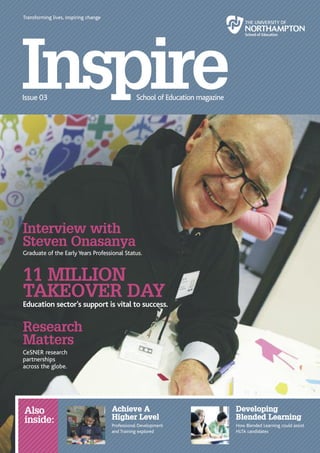
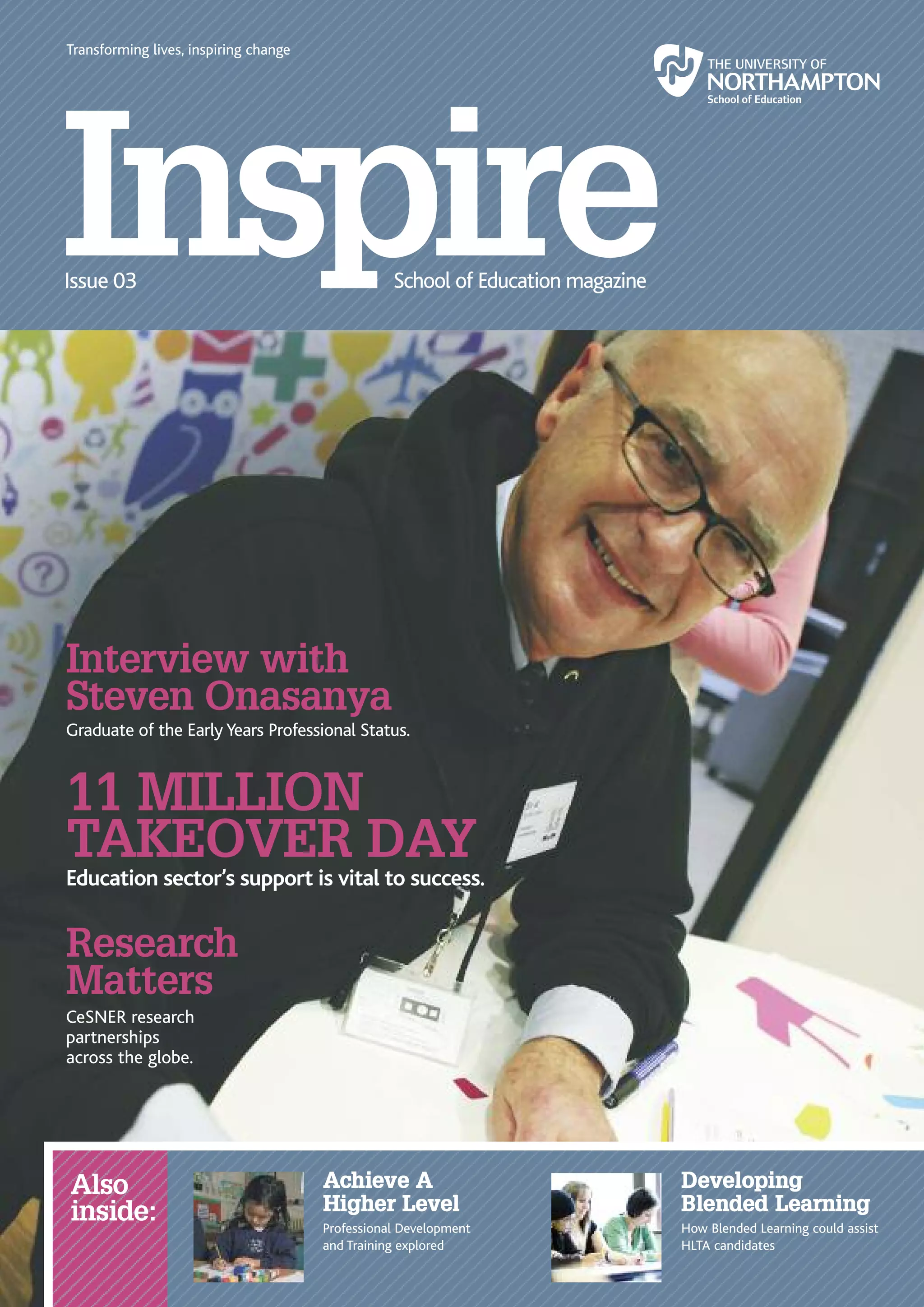
Interview with
Steven Onasanya
Graduate of the Early Years Professional Status.


11 MILLION
TAKEOVER DAY
Education sector’s support is vital to success.


Research
Matters
CeSNER research
partnerships
across the globe.


Also                                   Achieve A                  Developing
inside:                                Higher Level               Blended Learning
                                       Professional Development   How Blended Learning could assist
                                       and Training explored      HLTA candidates
Welcome
       Welcome to this issue of Inspire. The School of Education has had a
       very busy 9 months. Continuing on from last years Ofsted success, the
       school has celebrated another rise in its teacher training ratings, and
       is the first in the country to offer an integrated degree leading to Early
       Years Professional Status.
       The children’s commissioner for England talks to Inspire about
       the 11 million take over day. We will also give you an update on
       the School’s research and our travels around world!
       I hope you enjoy the latest issue of Inspire.

       Paul Bramble,
       Editor, Inspire


       Thank you
       We would like to also take this opportunity to thank everyone who has helped us over the past year, whether you have
       been a mentor on our many courses, a school partner or contributed to the various research projects that have been
       undertaken.
       I hope you and your school, nursery or educational settings have another successful year.


1 | Inspire | www.northampton.ac.uk/education | email: education@northampton.ac.uk
Contents


                                                                                                        11 Million Takeover Day ........................5
                                                                                                        Achieve a Higher Level..........................7
                                                                                                        Bursaries for support staff .....................9


University holds                                                                                        Children and Young People Lecture
                                                                                                        with Dr. Penelope Leach......................10
                                                                                                        Partnership with schools .....................10

record for teaching                                                                                     The Further Mathematics Network ...10
                                                                                                        Research Matters...................................11

jobs after graduation                                                                                   Global success for CeSNER .................13
                                                                                                        Interview with Steven Onasanya .......15
                                                                                                        A model programme.............................17
The School of Education has the best record for newly-trained
                                                                                                        New school based route for
primary teachers in securing teaching posts through their PGCE                                          the Masters in Education ....................18
primary programme, according to the Good Teacher Training                                               Developing Blended Learning ............19
Guide 2009.                                                                                             From Photos to Memories....................21
Within six months (based on 2008 figures)            University and School-based tutors to the
of gaining qualified teacher status (QTS) from       future of primary education.
The University of Northampton, an impressive
92% of trainees were successful in gaining           “We believe our graduates will be in a strong
employment as a teacher. Additionally, the           position to continue to be successful in the
Guide ranks Northampton 7th in its provision         current employment situation”
of primary Initial Teacher Training (ITT).
                                                     The Good Teacher Training Guide 2009 is
Joanna Moxham, Head of ITT, School of                compiled by the Centre for Education and
Education, commented:                                Employment Research at the University of
“We are delighted by the statistics which            Buckingham, and compares teacher training
reflect the hard work and professional qualities     providers in terms their intakes, Ofsted ratings
of our students and the commitment of our            and trainees’ take-up of teaching posts.


  Achieving a higher
  level continues                                                                                       Inspire
                                                                                                        Written and produced by The University of Northampton School of
                                                                                                        Education all submissions are property of Inspire magazine. The entire
  The School of Education’s HLTA team have                                                              content © Copyright The University of Northampton School of
  successfully retained the TDA contract HLTA, for                                                      Education 2008, and cannot be reproduced in whole or part without
                                                                                                        prior written consent.
  Phase 3 Regional Provider of HLTA Assessments.
                                                                                                        Editor Paul Bramble – paul.bramble@northampton.ac.uk
  The team has now been involved in a lead role                                                         Words Paul Bramble – paul.bramble@northampton.ac.uk
  in HLTA assessment across the pilot, phase 1                                                          Photography Design Depot Ltd, Merle Moustafa & Chris Allum
  and phase 2. This marks the continuation                                                              Design by Design Depot Ltd – www.designdepot.net
                                                                                                        Printed by Portland Print Limited
  of a major contribution to the development
  of teaching assistants across schools in the
  East Midlands Region.


                                                                    www.northampton.ac.uk/education | email: education@northampton.ac.uk |                         Inspire | 2
Success for
       University’s
       teacher
       training
       A new PGCE Early Years course
       is starting this term.
       This follows on from the success
       of last year’s Ofsted Grade 1
       award of the University’s
       undergraduate and postgraduate
       courses and the subsequent
       Training and Development
       Agency’s (TDA) award of
       Category ‘A’ provider status.
       Due to these excellent results, the University
       was awarded additional teacher training places,
       resulting in the launch of a new PGCE Early
       Years course to add to the existing suite
       of programmes.


                                                              University welcomes
       The first cohort of 24 students is due to begin
       training this September and they bring with them
       different experiences and backgrounds, including
       Music and Psychology.
       Course Leader Anna Cox commented:
       “As well as developing strong subject knowledge
       our students will consider important issues in the
                                                              special needs teachers
                                                              from India to campus
       field of Early Years such as how to support
       children’s well being, inclusion and working in
       partnership with parents. If you really want to
       influence society and make a difference, be an
       Early Years teacher.”
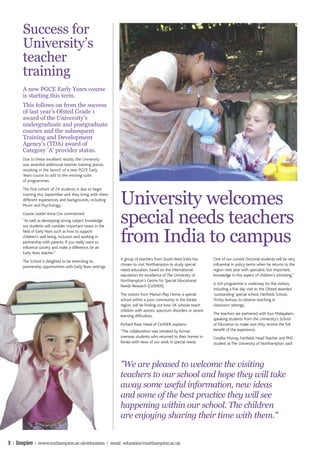
                                                              A group of teachers from South West India has         One of our current Doctoral students will be very
       The School is delighted to be extending its
                                                              chosen to visit Northampton to study special          influential in policy terms when he returns to the
       partnership opportunities with Early Years settings.
                                                              needs education, based on the international           region next year with specialist, but important,
                                                              reputation for excellence of The University of        knowledge in this aspect of children’s schooling.''
                                                              Northampton’s Centre for Special Educational
                                                                                                                    A rich programme is underway for the visitors,
                                                              Needs Research (CeSNER).
                                                                                                                    including a five day visit to the Ofsted awarded
                                                              The visitors from Marion Play Home, a special         'outstanding' special school, Fairfields School,
                                                              school within a poor community in the Kerala          Trinity Avenue, to observe teaching in
                                                              region, will be finding out how UK schools teach      classroom settings.
                                                              children with autistic spectrum disorders or severe
                                                                                                                    The teachers are partnered with four Malayalam-
                                                              learning difficulties.
                                                                                                                    speaking students from the University’s School
                                                              Richard Rose, Head of CeSNER, explains:               of Education to make sure they receive the full
                                                              ''The collaboration was initiated by former           benefit of the experience.
                                                              overseas students who returned to their homes in      Corallie Murray, Fairfields Head Teacher and PhD
                                                              Kerala with news of our work in special needs.        student at The University of Northampton, said:


                                                              ''We are pleased to welcome the visiting
                                                              teachers to our school and hope they will take
                                                              away some useful information, new ideas
                                                              and some of the best practice they will see
                                                              happening within our school. The children
                                                              are enjoying sharing their time with them.''


3 | Inspire | www.northampton.ac.uk/education | email: education@northampton.ac.uk
Teaching assistants celebrate success
Teaching assistants in Northamptonshire schools celebrated their new Higher
Level Teaching Assistant (HLTA) status at an event at The University of
Northampton's Park Campus recently.
Northamptonshire has 436 HLTAs working in schools across the county who
have a wide range of roles and responsibilities.
Ros Burman, Area School Improvement Manager, Children and Young People's
Directorate, Northamptonshire County Council, presented certificates in
recognition of HLTAs' achievements. Ros was involved in the pilot project when
the HLTA status was introduced as part of the National Agreement on Raising
Standards and Tackling Workload in 2003.
Ros drew attention to the newly formed HLTA/Cover Supervisor Support
Network for Northamptonshire, which will be offering support group meetings
and opportunities for training and professional development to HLTAs and
Cover Supervisors across all phases of education from September.


                                                                                                                             1st in the country
                                                                                                                             to provide a new
                                                                                                                             professional route
                        train                                                                                                for EYPS
The School wins bid to s
                           a
         chool teachers
                                                                                                                             Following the success of the initial stages of the

primary s
                                                                                                                             pilot Early Childhood Studies (ECS) to Ealy Years
                                                                                                                             Professional Status (EYPS) in 3.5 years’ a new
                  ialists
    hematics Spec chool of
                                                                                                                             version of the BA (Hons) Early Childhood Studies

M at               S
                                                                                                                             (ECS) was validated in June.

                       orthampton’s
                                                                                                                             This new BA (Hons) Early Childhood Studies

  The  University of N         r to lead a new
                                                                                                                             (Professional Practice) provides a designated

               as won a tende
                                                                                                                             professional pathway for selected ECS students
  Education h                             l authorities                                                                      from years 2 and 3 that will enable them to
                   ve across sixteen loca
  national initiati
                                                                                                                             develop as effective early years’ practitioners and
                                        ol teachers as
                        0 primary scho
                                                                                                                             to prepare for leadership and management roles.
                    100
   to train around                      ext three years.                                                                     As a result, students graduating with the BA (Hons)
                    ecialists over the n                                                                                     Early Childhood Studies (Professional Practice)
   Mathematics Sp                                an exciting                           represents
                                                                                                                             pathway should be able to complete EYPS
                                                                  “The Programme                            ion
                                                                                                                             between 6 to 9 months after graduation.
                          hematics Special
                                               ist
                                                                  opportunity to     work in collaborat
    The Primary Mat                          l                                                  local authorities
    Programme is       a new professiona                           with other unive
                                                                                      rsities,
                           gramme created
                                                 as                                       vide quality
    development pro
                         ommendation in
                                                the                and schools to pro
                                                                               nal development
                                                                                                     for teachers -          TDA approved provider
     a result of a rec                                             professio
     ‘Independent Re
                          view of Mathem
                                                atics
                                                                   and make a signif
                                                                                         icant difference
                                                                                                              to
                                                                                                                             for the national SENCO
                                              and                                                 athematics.”
      Teaching in Ea    rly Years Settings
                                                at every            children's learning
                                                                                           of m
                                                                                                                             qualification
                           ’ (June 2008), th                                            -face training ou
                                                                                                             tside
      Primary Schools                            ss to a            Through face-to
                           should have acce                                                                   and
       primary school
                                      Teacher by 2019
                                                          .
                                                                     school hours,   network meetings                        The School of Education is now a TDA nationally
                            ecialist                                                             t, teachers on
       Mathematics Sp                                                in-school develop
                                                                                           men                               approved centre for the training of SENCOs
                                                                                                                nal
                             the Department
                                                  for                                     will gain professio                (special educational needs coordinators),
        Fully funded by                                               the Programme
                                            s (DCSF),                                       e int  erpersonal skills         which leads to the award of a national SENCO
        Children, Sc   hools and Familie                              knowledge and th
                               by a consortium
                                                    led                                     ive professional                 qualification.
         the course is run                                             to lead collaborat                         hool
                         rsity of Northam
                                               pton, with                                  d team work in sc
         by The Unive                                rsity             development an                         vision         The Training and Development Agency for schools
                               Grosseteste Unive                                              ality and pro
          partners Bishop                                               to improve the qu                                    (TDA) has awarded the University this contract
                               Nottingham    Trent
          College Lincoln,                             e,               of m  athematics.                                    for training teachers with SENCO roles in schools
                                   ty of Bedfordshir
          Un  iversity, Universi                                                              rs will be awarded             across 8 local authorities.
                                rby and Un  iversity of                  Successful teache                  matics
           University of De                                                          of Primary Mathe
                                      close partnership                  the status                                    ,     Steve Cullingford-Agnew, course leader for SENCO
           He  rtfordshire, and in                                                             nis ed national award
                                 ities.                                  Specialist, a recog               a Masters
                                                                                                                             commented that
           with local author                                              in addition to on
                                                                                              e third of
                                                                                                                             “We are delighted to have been chosen to deliver
                                 Senior Lecturer in                          gree in Education
                                                                                                   .
            Debbie Morgan,                              rsity              de                                                the National SENCO course. This course will assist
                                 ucation, The Unive
            Mathematics Ed                 gional                                                                            to recognise the work of SENCOs and their
                                  , and Re
            of Northampton                                  ics                                                              commitment to improving outcomes for children
                                       mary Mathemat
             Pro gramme Lead Pri                                                                                             with SEN and disabilities”.
                                  mme, co   mmented:
             Specialist Progra                                         ail
                                                       n pack please em                                                      This course is fully funded for SENCOs new
                                        d an applicatio
             For further information an                                                                                      to their role or in post after September 2008.
                             pton.ac.uk                                                                                      For further information please contact
             MSP@northam                                                                                                     education@northampton.ac.uk


                                                                                           www.northampton.ac.uk/education | email: education@northampton.ac.uk |         Inspire | 4
Education sector’s support is vital to success
       of 11 MILLION TAKEOVER DAY, says
       Children’s Commissioner
       11 MILLION TAKEOVER DAY was even bigger               students in decision-making through school                Adults also tell me they learn a great deal from
       and better last year and much of this success         councils, student unions and other similar initiatives.   working alongside children and young people and
       was down to the hundreds of education bodies                                                                    welcome the fresh insights and new perspectives
                                                             But today I am encouraging everyone to get
       including schools, colleges and universities who                                                                on their jobs. They all say they look forward to
                                                             involved in this national event and give children
       took part.                                                                                                      taking part again.
                                                             and young people the opportunity to work
       This year’s Takeover Day is on Friday 6 November      alongside teachers, lecturers and staff in other          Anyone can get involved in 11MILLION TAKEOVER
       and I hope that even more institutions will sign up   posts and shout out about what they are doing.            DAY because there is no one size fits all formula.
       and support my organisation 11 MILLION in                                                                       So please sign up via our website now:
                                                             The day benefits all ages – children and young
       highlighting the great contribution to society that                                                             www.11MILLION.org.uk or email:
                                                             people have the chance to influence decision-
       children and young people make.                                                                                 takeover.day@11MILLON.org.uk . Also check out
                                                             makers and what they do on Takeover Day has
                                                                                                                       the website for tips to help you start planning your
       I am well aware that schools, colleges and            helped to change some of the negative public
                                                                                                                       activities for 11 MILLION Takeover Day 2009.
       universities up and down the country are already      attitudes that are reported about them in
       doing fantastic work to involve their pupils and      the media.                                                Sir Al Aynsley-Green
                                                                                                                       Children’s Commissioner for England


5 | Inspire | www.northampton.ac.uk/education | email: education@northampton.ac.uk
What is 11 MILLION
                                                                                                    TAKEOVER DAY?
                                                                                                    11 MILLION TAKEOVER OVER DAY is a national
                                                                                                    event offering children and young people across
                                                                                                    the country opportunities to work alongside adults
                                                                                                    and to get involved in decision-making in a diverse
                                                                                                    range of organisations.
                                                                                                    During Takeover Day 2008, 17,000 children and
                                                                                                    young people ‘takeover’ jobs at nearly 700
                                                                                                    organisations including schools, police and fire
                                                                                                    services, the Department for Children, Schools and
                                                                                                    Families, media, BT, charities, youth groups, local
                                                                                                    authorities, councils and many more.


“It’s really good when people listen
to what you are saying.”
Pupils at Caldecott School who ‘took over’ their teachers’ jobs


“They gave us pretend £2,000 to use to
design the week of action, which we did
and we’re going to stay together to
achieve the next project – hooray!”
Pupil from Bentley Wood High School who worked with Harrow Connextions:


“I enjoyed the interview rooms also
so now I am following my dream to
be a police officer. Thank you.”
Pupil from Pickering High School at Humberside Police:


                                                                  www.northampton.ac.uk/education | email: education@northampton.ac.uk |          Inspire | 6
Achieve A
      Higher Level
      Lurking in corners throughout the education buildings at Park Campus,
      there exists an entity known as the PDT Division. What is it?
      What does it do? Is it dangerous?
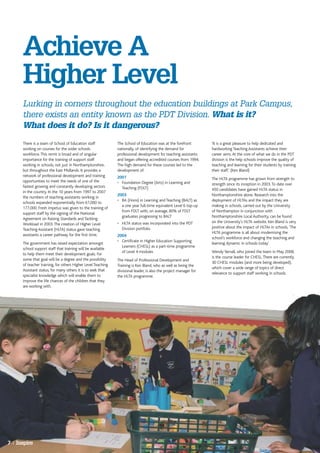
      There is a team of School of Education staff            The School of Education was at the forefront         'It is a great pleasure to help dedicated and
      working on courses for the wider schools                nationally, of identifying the demand for            hardworking Teaching Assistants achieve their
      workforce. This remit is broad and of singular          professional development for teaching assistants     career aims. At the core of what we do in the PDT
      importance for the training of support staff            and began offering accredited courses from 1994.     division is the help schools improve the quality of
      working in schools, not just in Northamptonshire,       The high demand for these courses led to the         teaching and learning for their students by training
      but throughout the East Midlands. It provides a         development of:                                      their staff.' (Ken Bland)
      network of professional development and training        2001                                                 The HLTA programme has grown from strength to
      opportunities to meet the needs of one of the           • Foundation Degree (Arts) in Learning and           strength since its inception in 2003. To date over
      fastest growing and constantly developing sectors         Teaching (FDLT)                                    450 candidates have gained HLTA status in
      in the country. In the 10 years from 1997 to 2007
                                                              2003                                                 Northamptonshire alone. Research into the
      the numbers of teaching assistants working in
                                                              • BA (Hons) in Learning and Teaching (BALT) as       deployment of HLTAs and the impact they are
      schools expanded exponentially from 61,000 to
                                                                a one year full-time equivalent Level 6 top-up     making in schools, carried out by the University
      177,000. Fresh impetus was given to the training of
                                                                from FDLT with, on average, 80% of FDLT            of Northampton in conjunction with
      support staff by the signing of the National
                                                                graduates progressing to BALT                      Northamptonshire Local Authority, can be found
      Agreement on Raising Standards and Tackling
                                                              • HLTA status was incorporated into the PDT          on the University’s HLTA website. Ken Bland is very
      Workload in 2003. The creation of Higher Level
                                                                Division portfolio                                 positive about the impact of HLTAs in schools, 'The
      Teaching Assistant (HLTA) status gave teaching
                                                                                                                   HLTA programme is all about modernising the
      assistants a career pathway for the first time.         2004
                                                                                                                   school's workforce and changing the teaching and
                                                              • Certificate in Higher Education Supporting
      The government has raised expectation amongst                                                                learning dynamic in schools today'
                                                                Learners (CHESL) as a part-time programme
      school support staff that training will be available
                                                                of Level 4 modules                                 Wendy Yarnall, who joined the team in May 2008,
      to help them meet their development goals. For
                                                                                                                   is the course leader for CHESL. There are currently
      some that goal will be a degree and the possibility     The Head of Professional Development and
                                                                                                                   30 CHESL modules (and more being developed),
      of teacher training, for others Higher Level Teaching   Training is Ken Bland, who as well as being the
                                                                                                                   which cover a wide range of topics of direct
      Assistant status, for many others it is to seek that    divisional leader, is also the project manager for
                                                                                                                   relevance to support staff working in schools.
      specialist knowledge which will enable them to          the HLTA programme.
      improve the life chances of the children that they
      are working with.


7 | Inspire
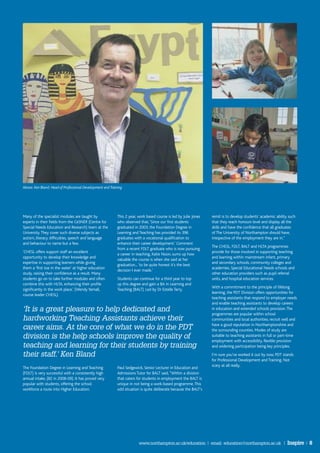
Above: Ken Bland, Head of Professional Development and Training


Many of the specialist modules are taught by                This 2 year, work based course is led by Julie Jones   remit is to develop students' academic ability such
experts in their fields from the CeSNER (Centre for         who observed that, ‘Since our first students           that they reach honours level and display all the
Special Needs Education and Research) team at the           graduated in 2003, the Foundation Degree in            skills and have the confidence that all graduates
University. They cover such diverse subjects as             Learning and Teaching has provided its 396             of The University of Northampton should have,
autism, literacy difficulties, speech and language          graduates with a vocational qualification to           irrespective of the employment they are in."
and behaviour to name but a few.                            enhance their career development.’ Comment
                                                                                                                   The CHESL, FDLT, BALT and HLTA programmes
                                                            from a recent FDLT graduate who is now pursuing
‘CHESL offers support staff an excellent                                                                           provide for those involved in supporting teaching
                                                            a career in teaching, Katie Noon, sums up how
opportunity to develop their knowledge and                                                                         and learning within mainstream infant, primary
                                                            valuable the course is when she said at her
expertise in supporting learners while giving                                                                      and secondary schools, community colleges and
                                                            graduation... 'to be quite honest it's the best
them a 'first toe in the water' at higher education                                                                academies, Special Educational Needs schools and
                                                            decision I ever made.'
study, raising their confidence as a result. Many                                                                  other education providers such as pupil referral
students go on to take further modules and often            Students can continue for a third year to top          units, and hospital education services.
combine this with HLTA, enhancing their profile             up this degree and gain a BA in Learning and
                                                                                                                   With a commitment to the principle of lifelong
significantly in the work place.’ (Wendy Yarnall,           Teaching (BALT). Led by Dr Estelle Tarry.
                                                                                                                   learning, the PDT Division offers opportunities for
course leader CHESL)
                                                                                                                   teaching assistants that respond to employer needs
                                                                                                                   and enable teaching assistants to develop careers
‘It is a great pleasure to help dedicated and                                                                      in education and extended schools provision. The
                                                                                                                   programmes are popular within school
hardworking Teaching Assistants achieve their                                                                      communities and local authorities, recruit well and
                                                                                                                   have a good reputation in Northamptonshire and
career aims. At the core of what we do in the PDT                                                                  the surrounding counties. Modes of study are
division is the help schools improve the quality of                                                                suitable to teaching assistants in full or part-time
                                                                                                                   employment with accessibility, flexible provision
teaching and learning for their students by training                                                               and widening participation being key principles.

their staff.' Ken Bland                                                                                            I’m sure you’ve worked it out by now. PDT stands
                                                                                                                   for Professional Development and Training. Not
                                                                                                                   scary at all really.
The Foundation Degree in Learning and Teaching              Paul Sedgewick, Senior Lecturer in Education and
(FDLT) is very successful with a consistently high          Admissions Tutor for BALT said, "Within a division
annual intake, (82 in 2008-09). It has proved very          that caters for students in employment the BALT is
popular with students, offering the school                  unique in not being a work-based programme. This
workforce a route into Higher Education.                    odd situation is quite deliberate because the BALT's


                                                                         www.northampton.ac.uk/education | email: education@northampton.ac.uk |                  Inspire | 8
Bursaries for support
           staff working in schools
       Northamptonshire School teachers who are offered a place on a Certificate in Higher
       Education Supporting Learners (CHESL) module at The University of Northampton
       this financial year will be able to apply for a bursary from the Northamptonshire
       local authority towards the fees for the course.
       The bursary is good news for those who are             working in schools. There are 30 modules to choose         Similarly there will be full funding for up to 15
       employed to support learning and teaching with         from, all taught by experts in their field, including      applicants accepted for the module, ‘Supporting
       pupils aged three years and over in the county’s       Social, Emotional and Behavioural Difficulties,            Learners with Speech, Language and Communication
       maintained schools, such as teaching assistants and    Supporting Learners with Autistic Spectrum                 Difficulties.’ This is because the content of these two
       Higher Level Teaching Assistants.                      Disorders, Special Educational Needs and                   courses in particular is deemed to meet the local
                                                              Literacy Difficulties.                                     authority’s priorities for school support staff.
       The School Workforce Development Manager for the
       Learning, Achievement and School Improvement           A typical 20 Credit CHESL module costs £350.               The grant is available for this financial year (2009-10)
       Division at Northamptonshire County Council has        The Local Authority is offering a bursary of £200          and there is no guarantee that these funding
       announced new funding arrangements for nationally      for every 20 credit module up to a maximum of              arrangements will continue next year. Individuals
       accredited qualifications that are not supported by    40 credits this year.                                      and school managers who are considering the
       other grants for school support staff in                                                                          professional development needs of their support
                                                              In addition there will be full funding for up to
       Northamptonshire schools.                                                                                         staff should take a look at the website to see what
                                                              15 applicants accepted on the Specialist Teaching
                                                                                                                         is on offer.
       CHESL modules, which are offered by The University     Assistant (STA) course. STA has been popular since
       of Northampton, form a bridge between vocational       its inception 13 years ago and some 260 teaching           For a full list of modules visit
       and higher education qualifications, covering a wide   assistants have gained this qualification in the county.   www.northampton.ac.uk/chesl.
       range of topics of direct relevance to support staff


         To apply, or enquire about the modules, contact admissions on 0800 358 2232 or email admissions@northampton.ac.uk
         You will need to be offered a place before you can apply to the Local Authority for the bursary.


9 | Inspire | www.northampton.ac.uk/education | email: education@northampton.ac.uk
The School of Education’s Annual
Children and Young People Lecture
with Dr. Penelope Leach
Childcare practitioners and students on professional childcare
courses at the University attended this years lecture by Penelope
Leach, eminent child development psychologist and author of
‘Your Baby and Child’, which has been an essential guide for new
parents over several decades.
                                                           wide-ranging international account of what she calls
                                                           "the conundrum of contemporary child care".
                                                           Denise Hevey, Professor of Early Years and organiser
                                                                                                                     Above: Stephen Smith, Head of Partnership
                                                           of the Lecture, is author of new chapter, ‘Professional
                                                           Work in Early Childhood’. She said:
                                                           “We are honoured that such a respected figure in
                                                           the field was present at the launch of our team’s
                                                           book and are hoping that this revised and updated
                                                                                                                     Partnership
                                                           edition will be equally well received and valued by
                                                           students and practitioners.
                                                           “Penelope Leach has always championed
                                                                                                                     with schools
                                                           home-based childcare such as child-minding for
                    Penelope is as an advocate for                                                                   Stephen Smith is our new head
                                                           young children, and her renowned research supports
                    children and parents (Children
                     First Vintage 1994), a Fellow of
                                                           the importance of sensitive, consistent caring            of partnership at the School of
                                                           relationships. We are very proud and excited that
                     the British Psychological Society,
                                                           she came to talk to us.”                                  Education and talks to Inspire.
                      and an Hon. Senior Research
                      Fellow at the Tavistock Clinic and   The University’s annual Children and Young People’s       I have worked in education for nearly thirty years,
at the Centre for the Study of Children, Families and      Lecture has previously attracted other high-profile       mainly in secondary schools in North Yorkshire,
Social Issues, Birkbeck. For the past nine years her       speakers such as Camila Batmanghelidjh,                   East Yorkshire and Hull. I began my career as a
research has been focused on child care; she is            psychotherapist and founder/Director of the               History teacher and went on to become a Head
co-director of the Families, Children and Childcare        charity Kids Company, and Dr Sheila Shribman,             of Department and Senior School Leader. I also
study, the largest study of child care ever carried        NHS National Clinical Director for Children, Young        worked with a large number of primary schools
out in the UK, and author of a new book offering a         People and Maternity.                                     promoting curricular links with their secondary
                                                                                                                     partners. As a Senior School Leader I was responsible
                                                                                                                     for Continuing Professional Development, including
                                                                                                                     Graduate and Initial Teacher Training.


   The Further                                                                                                       Teacher Education eventually became the most
                                                                                                                     satisfying area of my work, and so I am delighted
                                                                                                                     to join the School of Education at The University


   Mathematics Network                                                                                               of Northampton. The School is, clearly, a thriving
                                                                                                                     and successful organisation. Furthermore, it offers
                                                                                                                     an extremely friendly and supportive environment
                                                                                                                     to work in. I have two main roles in the School, as
   The Further Mathematics Network is a government-funded                                                            Head of Partnership and a Divisional Leader for
   initiative. It is managed by Mathematics in Education and                                                         Teacher Education.

   Industry (MEI), an independent educational charity.                                                               I believe strongly that partnership between the
                                                                                                                     University and schools is absolutely central to
   The Further Mathematics Network consists of              opportunities available to them because of their         achieving our aim of producing tomorrow’s high
   46 Further Mathematics Network Centres, which            mathematical ability. Schools and colleges               quality education professionals. The School already
   The School of Education at The University of             report that involvement with their local Further         has a large number of successful partnerships
   Northampton is the centre for the East Midlands          Mathematics Network Centre has raised the                which I am keen to maintain and develop.
   region. Each Centre aims to ensure ASIA level            profile of mathematics amongst their students.           However, the University is also interested in
   Further Mathematics is available to all ASIA level       We need more students to study mathematics               establishing new partnerships with Early Years
   Mathematics students, promote mathematics to             post -16 and we need more well-qualified                 settings, primary and secondary schools. Partnership
   all young people and help support the teaching           students to choose maths-related subjects at             isn’t just about student placements in schools and
   of ASIA level Mathematics and Further                    university. The Further Mathematics Network is           we are keen to explore other ways in which the
   Mathematics in all schools and colleges.                 already starting to make this happen.                    School of Education can contribute to the work
                                                                                                                     of education professionals.
   The Further Mathematics Network, combined                The Further Mathematics Network (FMN) came
   with the change to the structure of ASIA level           to an end on 31 July, but its success means that         If you would like to know more about the
   Further Mathematics, has already led to a                the DCSF will continue to provide funding to             opportunities working in partnership please
   significant increase in the number of students           support Further Mathematics. From 1 August               get in touch.
   achieving Further Mathematics qualifications.            2009, the FMN is replaced by the Further
   Each of these students' exposure to Further              Mathematics Support Programme (FMSP).                    Tel: 01604 892470
   Mathematics has made them more aware of                                                                           Email: stephen.smith@northampton.ac.uk
                                                            Go to www.furthermaths.org.uk for details.
   their own potential, the pleasures of an
   intellectual challenge and the extra


                                                                       www.northampton.ac.uk/education | email: education@northampton.ac.uk |                      Inspire | 10
Research
       Matters
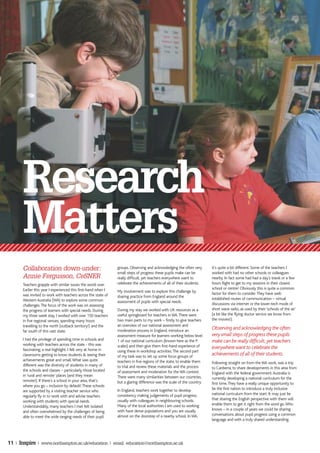
       Collaboration down-under:                                groups. Observing and acknowledging the often very       it’s quite a bit different. Some of the teachers I
                                                                small steps of progress these pupils make can be         worked with had no other schools or colleagues
       Annie Fergusson, CeSNER                                  really difficult, yet teachers everywhere want to        nearby. In fact some had had a day’s travel or a few
       Teachers grapple with similar issues the world over.     celebrate the achievements of all of their students.     hours flight to get to my sessions in their closest
       Earlier this year I experienced this first-hand when I                                                            school or centre! Obviously this is quite a common
                                                                My involvement was to explore this challenge by          factor for them to consider. They have well-
       was invited to work with teachers across the state of    sharing practice from England around the
       Western Australia (WA) to explore some common                                                                     established routes of communication – virtual
                                                                assessment of pupils with special needs.                 discussions via internet or the lower-tech mode of
       challenges. The focus of the work was on assessing
       the progress of learners with special needs. During      During my stay we worked with UK resources as a          short wave radio, as used by their ‘schools of the air’
       my three week stay, I worked with over 150 teachers      useful springboard for teachers in WA. There were        (a bit like the flying doctor service we know from
       in five regional venues, spending many hours             two main parts to my work – firstly to give teachers     the movies!).
       travelling to the north (outback territory!) and the     an overview of our national assessment and
                                                                moderation process in England, introduce an
                                                                                                                         Observing and acknowledging the often
       far south of this vast state.
                                                                assessment measure for learners working below level      very small steps of progress these pupils
       I had the privilege of spending time in schools and      1 of our national curriculum (known here as the P        make can be really difficult, yet teachers
       working with teachers across the state - this was        scales) and then give them first-hand experience of
       fascinating; a real highlight. I felt very at home in                                                             everywhere want to celebrate the
                                                                using these in workshop activities. The second part
       classrooms getting to know students & seeing their       of my task was to set up some focus groups of
                                                                                                                         achievements of all of their students.
       achievements great and small. What was quite             teachers in five regions of the state, to enable them    Following straight on from the WA work, was a trip
       different was the diversity of students in many of       to trial and review these materials and the process      to Canberra, to share developments in this area from
       the schools and classes – particularly those located     of assessment and moderation for the WA context.         England with the federal government. Australia is
       in ‘rural and remote’ places (and they mean              There were many similarities between our countries,      currently developing a national curriculum for the
       remote!). If there’s a school in your area, that’s       but a glaring difference was the scale of the country.   first time. They have a really unique opportunity to
       where you go – inclusion by default! These schools
                                                                In England, teachers work together to develop            be the first nation to introduce a truly inclusive
       are supported by a visiting teacher service who
                                                                consistency making judgements of pupil progress,         national curriculum from the start. It may just be
       regularly fly in to work with and advise teachers
                                                                usually with colleagues in neighbouring schools.         that sharing the English perspective with them will
       working with students with special needs.
                                                                Many of the local authorities I am used to working       enable them to get it right from the word go. Who
       Understandably, many teachers I met felt isolated
                                                                with have dense populations and you are usually          knows – in a couple of years we could be sharing
       and often overwhelmed by the challenges of being
                                                                almost on the doorstep of a nearby school. In WA,        conversations about pupil progress using a common
       able to meet the wide ranging needs of their pupil
                                                                                                                         language and with a truly shared understanding.


11 | Inspire | www.northampton.ac.uk/education | email: education@northampton.ac.uk
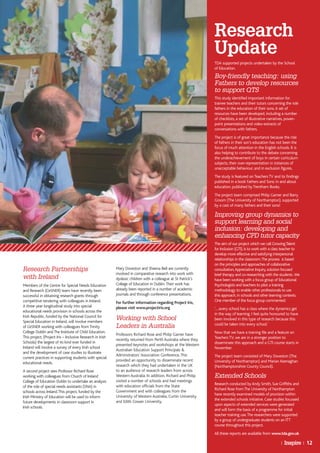
Research
                                                                                                                 Update
                                                                                                                 TDA supported projects undertaken by the School
                                                                                                                 of Education.
                                                                                                                 Boy-friendly teaching: using
                                                                                                                 Fathers to develop resources
                                                                                                                 to support QTS
                                                                                                                 This study identified important information for
                                                                                                                 trainee teachers and their tutors concerning the role
                                                                                                                 fathers in the education of their sons. A set of
                                                                                                                 resources have been developed, including a number
                                                                                                                 of checklists, a set of illustrative narratives, power-
                                                                                                                 point presentations and video-extracts of
                                                                                                                 conversations with fathers.
                                                                                                                 The project is of great importance because the role
                                                                                                                 of fathers in their son’s education has not been the
                                                                                                                 focus of much attention in the English schools. It is
                                                                                                                 also helping to contribute to the debate concerning
                                                                                                                 the underachievement of boys in certain curriculum
                                                                                                                 subjects, their over-representation in instances of
                                                                                                                 unacceptable behaviour, and in exclusion figures.
                                                                                                                 The study is featured on Teachers TV and its findings
                                                                                                                 published in a book Fathers and Sons: in and about
                                                                                                                 education, published by Trentham Books.
                                                                                                                 The project team comprised Philip Garner and Barry
                                                                                                                 Groom (The University of Northampton), supported
                                                                                                                 by a cast of many fathers and their sons!

                                                                                                                 Improving group dynamics to
                                                                                                                 support learning and social
                                                                                                                 inclusion: developing and
                                                                                                                 enhancing CPD tutor capacity
                                                                                                                 The aim of our project which we call Growing Talent
                                                                                                                 for Inclusion (GTI), is to work with a class teacher to
                                                                                                                 develop more effective and satisfying interpersonal
                                                                                                                 relationships in the classroom. The process is based
                                                                                                                 on the principles and approaches of collaborative
Research Partnerships                                       Mary Doveston and Sheena Bell are currently          consultation, Appreciative Inquiry, solution focused
                                                            involved in comparative research into work with      brief therapy and co-researching with the students .We
with Ireland                                                dyslexic children with a colleague at St Patrick’s   have been working with a focus group of Educational
Members of the Centre for Special Needs Education           College of Education in Dublin. Their work has       Psychologists and teachers to pilot a training
and Research (CeSNER) team have recently been               already been reported in a number of academic        methodology to enable other professionals to use
successful in obtaining research grants through             journals and through conference presentations.       this approach, in schools and other learning contexts.
competitive tendering with colleagues in Ireland.           For further information regarding Project Iris,      One member of the focus group commented:
A three year longitudinal study into special                please visit www.projectiris.org                     ‘….every school has a class where the dynamics get
educational needs provision in schools across the
                                                                                                                 in the way of learning. I feel quite honoured to have
Irish Republic, funded by the National Council for
Special Education in Ireland, will involve members
                                                            Working with School                                  been involved in this type of research because this
                                                                                                                 could be taken into every school.’
of CeSNER working with colleagues from Trinity              Leaders in Australia
College Dublin and The Institute of Child Education.                                                             Now that we have a training file and a feature on
                                                            Professors Richard Rose and Philip Garner have
This project, (Project Iris – Inclusive Research in Irish                                                        Teachers TV, we are in a stronger position to
                                                            recently returned from Perth Australia where they
Schools) the largest of its kind ever funded in                                                                  disseminate this approach and a GTI course starts in
                                                            presented keynotes and workshops at the Western
Ireland will involve a survey of every Irish school                                                              November.
                                                            Australian Education Support Principals &
and the development of case studies to illustrate
                                                            Adminstrators’ Association Conference. This          The project team consisted of Mary Doveston (The
current practices in supporting students with special
                                                            provided an opportunity to disseminate recent        University of Northampton) and Marian Keenaghan
educational needs.
                                                            research which they had undertaken in the UK         (Northamptonshire County Council).
A second project sees Professor Richard Rose                to an audience of research leaders from across
working with colleagues from Church of Ireland              Western Australia. In addition, Richard and Philip   Extended Schools
College of Education Dublin to undertake an analysis        visited a number of schools and had meetings
                                                                                                                 Research conducted by Andy Smith, Sue Griffiths and
of the role of special needs assistants (SNA) in            with education officials from the State
                                                                                                                 Richard Rose from The University of Northampton
schools across Ireland. This project, funded by the         Government and with colleagues from the
                                                                                                                 have recently examined models of provision within
Irish Ministry of Education will be used to inform          University of Western Australia, Curtin University
                                                                                                                 the extended schools initiative. Case studies focussed
future developments in classroom support in                 and Edith Cowan University.
                                                                                                                 upon aspects of extended services were generated
Irish schools.
                                                                                                                 and will form the basis of a programme for initial
                                                                                                                 teacher training use. The researchers were supported
                                                                                                                 by a group of undergraduate students on an ITT
                                                                                                                 course throughout this project.
                                                                                                                 All these reports are available from www.tda.gov.uk

                                                                                                                                                            |   Inspire | 12
Global
       success for
       CeSNER
       The Centre for Special Needs Education and
       Research (CeSNER) within the School of
       Education is receiving international acclaim
       for innovative research into inclusion and
       managing behaviour in the classroom.
       Professor Richard Rose, Head of CeSNER,
       recounts some of this year’s successes.


                     UK                                         Annie Fergusson continues to provide advic
                                                                                                            e to the
        CeSNER has been in the national medi
                                               a spotlight
                                                                Western Australia Ministry of Education
                                                                                                        and to                           Hong Kong
       providing expert commentary on educ                     Federal Government officials on the introd
                                               ational                                                     uction of       Steve Cullingford Agnew and Sue Griffi
       issues. The global impact of the Behaviour              P Scales – performance descriptions for                                                             ths delivered
                                                   4Learning                                            measuring          training to education assistants in Englis
       website, led by the University, has been                the progress of pupils for whom the early                                                             h Schools
                                                widely                                                    levels of        Foundation schools as the last stage of
       recognised, with world-wide training event              the National Curriculum are not appro                                                                a course
                                                 s provided.                                          priate.              provided by CeSNER colleagues including
                                                                                                                                                                      Andy
                                                                                                                           Smith and Mary Doveston.
                     Australia                                                India                                       As Visiting Professor at the Hong Kong Instit
                                                                                                                                                                       ute of
      Philip Garner and Richard Rose presented                 A team of teachers from Kerala requested                   Education, Richard Rose is working on a
                                                 the                                                         a visit to                                           project
      keynote address at the West Australia Speci              the University in July based on CeSNER’s                   funded through the Research Council to
                                                   al School                                               reputation                                             look at
      Principals’ Conference. While we were there              for research and practice. They visited our                models of support for inclusion in Hong
                                                   we held                                                  partners                                              Kong schools.
      discussions at four university teacher educa             at Fairfields School, guided by our Mast
                                                  tion                                                  ers and PhD
      departments.                                             students, to plan for future SEN teaching
                                                                                                          in India.                    Singapore
                                                                                                                          Richard Rose will be the keynote speak
                                                                                                                                                                er at a major
                                                                                                                          international conference on SEN and inclus
                                                                                                                                                                     ion in
                                                                                                                          the autumn.


13 | Inspire | www.northampton.ac.uk/education | email: education@northampton.ac.uk
Croatia                                                 USA
              Republic of Ireland
                                                                                                                   Maria Howley had recently returned from North
                                                          Philip Garner is in liaison with colleagues at the
CeSNER successfully achieved two research bids in                                                                  Carolina where she was training colleagues in
                                                          Croatian Ministry of Education regarding a potential
Ireland. One is funded by the Irish Department of                                                                  the education of children with autistic spectrum
                                                          project on disability, teacher training and inclusion.
Education and Science to examine the role of                                                                       disorders.
assistants in schools, and the second is a three year
longitudinal study into SEN provision in schools                         Germany                                                 Armenia
 across the country.
                                                          Philip Garner recently addressed policy-makers and
                                                                                                                   Richard Rose recently worked with colleagues from
Dyslexia research is being conducted by Sheena Bell       teachers from the state government of Schleswig-
                                                                                                                   the University of Aberdeen and with an NGO in
and Mary Doveston in partnership with St Patrick’s        Hostein at the request of the European Agency for
                                                                                                                   Armenia providing support for teachers who will
College in Dublin.                                        Special Needs.
                                                                                                                   begin a programme of education for pupils with
                                                                                                                   special educational needs in the country.
               Estonia                                                   Belgium
                                                                                                                    CeSNER’s work is moving at such a fast pace that
 Research into children with social, emotional and         We are carrying out assessment work on a European        we are already booking our flights to start on our
 behavioural difficulties is being carried out by Barry    joint doctorate project to make sure we are              new projects!
 Groom with colleagues from the University of Tartu.       connected with the international agenda.


                                                                      www.northampton.ac.uk/education | email: education@northampton.ac.uk |                     Inspire | 14
“If you are a graduate and
                   have a passion for working
                   with children then I recommend
                   Early Years Professional Status
                   (EYPS). Your professional
                   development doesn’t come
                   to a halt after training, you
                   can access Professional
                   Development and Training
                   through your local authority.
                   EYPS is here to stay.”


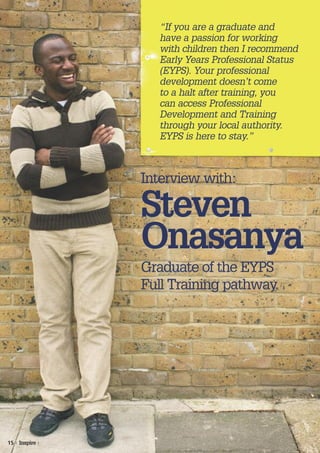
                 Interview with:

                 Steven
                 Onasanya
                 Graduate of the EYPS
                 Full Training pathway


15 | Inspire |
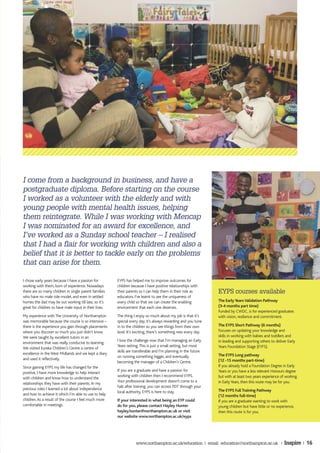
I come from a background in business, and have a
postgraduate diploma. Before starting on the course
I worked as a volunteer with the elderly and with
young people with mental health issues, helping
them reintegrate. While I was working with Mencap
I was nominated for an award for excellence, and
I’ve worked as a Sunday school teacher – I realised
that I had a flair for working with children and also a
belief that it is better to tackle early on the problems
that can arise for them.

I chose early years because I have a passion for        EYPS has helped me to improve outcomes for
working with them, born of experience. Nowadays         children because I have positive relationships with
there are so many children in single parent families    their parents so I can help them in their role as        EYPS courses available
who have no male role model, and even in settled        educators. I’ve learnt to see the uniqueness of
homes the dad may be out working till late, so it’s     every child so that we can create the enabling           The Early Years Validation Pathway
great for children to have male input in their lives.   environment that each one deserves.                      (3-4 months part time)
                                                                                                                 Funded by CWDC, is for experienced graduates
My experience with The University of Northampton        The thing I enjoy so much about my job is that it’s      with vision, resilience and commitment.
was memorable because the course is so intensive –      special every day, it’s always rewarding and you tune
there is the experience you gain through placements     in to the children so you see things from their own      The EYPS Short Pathway (6 months)
where you discover so much you just didn’t know.        level. It’s exciting, there’s something new every day.   Focuses on updating your knowledge and
We were taught by excellent tutors in an                                                                         skills in working with babies and toddlers and
                                                        I love the challenge now that I’m managing an Early      in leading and supporting others to deliver Early
environment that was really conducive to learning.
                                                        Years setting. This is just a small setting, but most    Years Foundation Stage (EYFS).
We visited Eureka Children’s Centre a centre of
                                                        skills are transferable and I’m planning in the future
excellence in the West Midlands and we kept a diary                                                              The EYPS Long pathway
                                                        on running something bigger, and eventually
and used it reflectively.                                                                                        (12 -15 months part-time)
                                                        becoming the manager of a Children’s Centre.
Since gaining EYPS my life has changed for the                                                                   If you already hold a Foundation Degree in Early
                                                        If you are a graduate and have a passion for             Years or you have a less relevant Honours degree
positive, I have more knowledge to help interact
                                                        working with children then I recommend EYPS.             but with at least two years experience of working
with children and know how to understand the
                                                        Your professional development doesn’t come to a          in Early Years, then this route may be for you.
relationships they have with their parents. In my
                                                        halt after training, you can access PDT through your
previous roles I learned a lot about independence                                                                The EYPS Full Training Pathway
                                                        local authority. EYPS is here to stay.
and how to achieve it which I’m able to use to help                                                              (12 months full-time)
children. As a result of the course I feel much more    If your interested in what being an EYP could            If you are a graduate wanting to work with
comfortable in meetings.                                do for you, please contact Hayley Hunter                 young children but have little or no experience,
                                                        hayley.hunter@northampton.ac.uk or visit                 then this route is for you.
                                                        our website www.northampton.ac.uk/eyps


                                                                   www.northampton.ac.uk/education | email: education@northampton.ac.uk |                  Inspire | 16
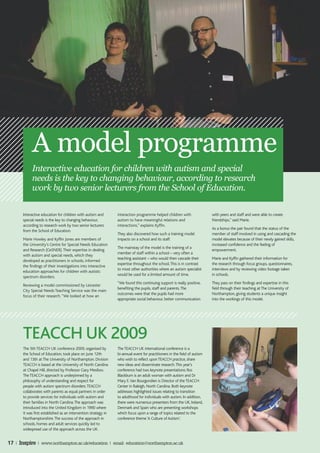
A model programme
            Interactive education for children with autism and special
            needs is the key to changing behaviour, according to research
            work by two senior lecturers from the School of Education.

       Interactive education for children with autism and        interaction programme helped children with                 with peers and staff and were able to create
       special needs is the key to changing behaviour,           autism to have meaningful relations and                    friendships,” said Marie.
       according to research work by two senior lecturers        interactions,” explains Kyffin.
                                                                                                                            As a bonus the pair found that the status of the
       from the School of Education.
                                                                 They also discovered how such a training model             member of staff involved in using and cascading the
       Marie Howley and Kyffin Jones are members of              impacts on a school and its staff.                         model elevates because of their newly gained skills,
       the University’s Centre for Special Needs Education                                                                  increased confidence and the feeling of
                                                                 The mainstay of the model is the training of a
       and Research (CeSNER). Their expertise in dealing                                                                    empowerment.
                                                                 member of staff within a school – very often a
       with autism and special needs, which they
                                                                 teaching assistant – who would then cascade their          Marie and Kyffin gathered their information for
       developed as practitioners in schools, informed
                                                                 expertise throughout the school. This is in contrast       the research through focus groups, questionnaires,
       the findings of their investigations into interactive
                                                                 to most other authorities where an autism specialist       interviews and by reviewing video footage taken
       education approaches for children with autistic
                                                                 would be used for a limited amount of time.                in schools.
       spectrum disorders.
                                                                 “We found this continuing support is really positive,      They pass on their findings and expertise in this
       Reviewing a model commissioned by Leicester
                                                                 benefiting the pupils, staff and parents. The              field through their teaching at The University of
       City Special Needs Teaching Service was the main
                                                                 outcomes were that the pupils had more                     Northampton, giving students a unique insight
       focus of their research. “We looked at how an
                                                                 appropriate social behaviour, better communication         into the workings of this model.


       TEACCH UK 2009
       The 5th TEACCH UK conference 2009, organised by           The TEACCH UK international conference is a
       the School of Education, took place on June 12th          bi-annual event for practitioners in the field of autism
       and 13th at The University of Northampton. Division       who wish to reflect upon TEACCH practice, share
       TEACCH is based at the University of North Carolina       new ideas and disseminate research. This year’s
       at Chapel Hill, directed by Professor Gary Mesibov.       conference had two keynote presentations: Ros
       The TEACCH approach is underpinned by a                   Blackburn is an adult woman with autism and Dr
       philosophy of understanding and respect for               Mary E. Van Bourgondien is Director of the TEACCH
       people with autism spectrum disorders. TEACCH             Center in Raleigh, North Carolina. Both keynote
       collaborates with parents as equal partners in order      addresses highlighted issues relating to transition
       to provide services for individuals with autism and       to adulthood for individuals with autism. In addition,
       their families in North Carolina. The approach was        there were numerous presenters from the UK, Ireland,
       introduced into the United Kingdom in 1990 where          Denmark and Spain who are presenting workshops
       it was first established as an intervention strategy in   which focus upon a range of topics related to the
       Northamptonshire. The success of the approach in          conference theme ‘A Culture of Autism’.
       schools, homes and adult services quickly led to
       widespread use of the approach across the UK.


17 | Inspire | www.northampton.ac.uk/education | email: education@northampton.ac.uk
Interview with Paul
                                                                                                                 Pomerantz, Northampton
                                                                                                                 School for Girls
                                                                                                                 Why did you choose the School of Education
                                                                                                                 (The University of Northampton) to work with?
                                                                                                                  The university is very close to the school, and
                                                                                                                 several departments at school already have close
                                                                                                                 links with the university. Financially it worked out
                                                                                                                 very well too, with the university able to offer a large
                                                                                                                 discount to us depending on the number of people
                                                                                                                 taking the course.

                                                                                                                 What has been the benefit(s) of the Whole
                                                                                                                 School Approach to Action Research with the

New school-based                                                                                                 School of Education?
                                                                                                                 The University were very flexible at meeting the
                                                                                                                 needs of teachers at NSG – for example able to

route for the Masters                                                                                            come to us for lectures when necessary, and
                                                                                                                 ensuring the extra work load has always felt directly
                                                                                                                 relevant to our day to day teaching. The work so far


in Education                                                                                                     has also been an interesting mix, so as well as the
                                                                                                                 reading and assignments undertaken, we have also
                                                                                                                 presented our action research plan to the deputy
                                                                                                                 heads at the school, and taken part in peer
In April 2009, ten members of staff from Northampton School                                                      assessment activities.

for Girls (NSG) took up the opportunity to enrol as part-time                                                    What aspect(s) of the course has been of
students on a new school-based route of the Masters programme.                                                   particular value to your school, colleagues?
                                                                                                                 Gaining a greater understanding of action research,
Designed in collaboration with local schools, this        each gave a presentation of their research proposal    particularly the methods has been important, as the
route enables teachers and other participants to          to colleagues and leaders at the school. Now           skills we learn when doing this can be passed on to
engage in a professional practice approach (whole         enrolled on the follow-up module, the teachers are     colleagues. Ultimately after we do the research, the
school approach) to study and gain Masters level          in the early stages of conducting their own Action     findings can be presented back to colleagues – and
credits for the work they do in their own institutions.   Research study. Several of the group have decided to   having so many people conducting such a variety
                                                          focus their research on different aspects of           of different research will be of great benefit to
The delivery of the school-based route is flexible                                                               the school.
                                                          assessment, others are researching provision for G&T
and aims to take the needs of busy professionals
                                                          students, independent learning, peer assisted
into account. Tutor-led sessions and personal                                                                    What advice do you have for schools and
                                                          learning and enhancing the physical learning
tutorials therefore take place at the school on agreed                                                           colleagues looking to study with The University
                                                          environment.
dates and times. While all students have full access                                                             of Northampton
to the library facilities at the university, book boxes   Each module is worth 30 M level credits and
(containing key texts) have also been loaned to the       participants need to accrue a total of 90 credits to   The University has always been very approachable
group and is kept centrally at school.                    gain a Post Graduate Diploma or 180 credits for the    and keen to meet the needs of the teachers at NSG
                                                          full MA. Some of the NSG participants are able to      – always ensuring the masters fits around our
With the guidance and support of module tutor                                                                    current jobs, rather than adding to an already hectic
                                                          carry forward 60 credits that they gained from their
Dr Chris Derrington, all ten teachers successfully                                                               work load! Don’t be intimidated by the thought of
                                                          PGCE course and are therefore well on the way to
completed the first module ‘Principles and Practice                                                              extra study – they will help make it manageable and
                                                          achieving their MA!
in Action Research’. As part of their assessment, they                                                           beneficial to you.


     MA Education module discount
     TDA supported (until 2011) of £750 for individuals with QTS enrolling
     on two 30 CATs points modules.
     Further discounts available for whole school MA programmes
     For more information please contact:
     Steve Cullingford-Angew
     Tel: 01604 892586 Email: steve.cullingford-agnew.ac.uk


                                                                     www.northampton.ac.uk/education | email: education@northampton.ac.uk |                     Inspire | 18
Developing Blended
       Learning


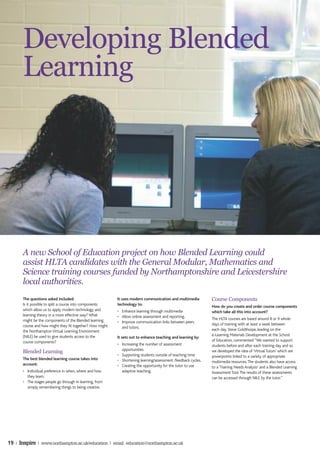
       A new School of Education project on how Blended Learning could
       assist HLTA candidates with the General Modular, Mathematics and
       Science training courses funded by Northamptonshire and Leicestershire
       local authorities.
       The questions asked included:                       It uses modern communication and multimedia          Course Components
       Is it possible to split a course into components    technology to:
                                                                                                                How do you create and order course components
       which allow us to apply modern technology and       • Enhance learning through multimedia                which take all this into account?
       learning theory in a more effective way? What       • Allow online assessment and reporting.
       might be the components of the Blended learning                                                          The HLTA courses are based around 8 or 9 whole
                                                           • Improve communication links between peers
       course and how might they fit together? How might                                                        days of training with at least a week between
                                                             and tutors.
       the Northampton Virtual Learning Environment                                                             each day. Steve Goldthorpe, leading on the
       (NILE) be used to give students access to the                                                            e-Learning Materials Development at the School
                                                           It sets out to enhance teaching and learning by:
       course components?                                                                                       of Education, commented: “We wanted to support
                                                           • Increasing the number of assessment                students before and after each training day and so
                                                             opportunities.
       Blended Learning                                                                                         we developed the idea of ‘Virtual Tutors’ which are
                                                           • Supporting students outside of teaching time       powerpoints linked to a variety of appropriate
       The best blended learning course takes into         • Shortening learning/assessment /feedback cycles.   multimedia resources. The students also have access
       account:                                            • Creating the opportunity for the tutor to use      to a ‘Training Needs Analysis’ and a Blended Learning
       • Individual preference in when, where and how        adaptive teaching.                                 Assessment Tool. The results of these assessments
         they learn.                                                                                            can be accessed through NILE by the tutor.”
       • The stages people go through in learning, from
         simply remembering things to being creative.                                                           Intended Benefits
                                                                                                                For the Student


19 | Inspire | www.northampton.ac.uk/education | email: education@northampton.ac.uk
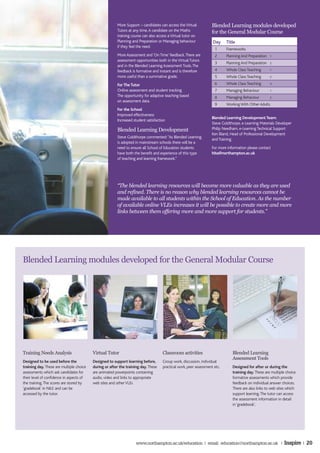
More Support – candidates can access the Virtual          Blended Learning modules developed
                                                        Tutors at any time. A candidate on the Maths              for the General Modular Course
                                                        training course can also access a Virtual tutor on
                                                        Planning and Preparation or Managing behaviour             Day     Title
                                                        if they feel the need.
                                                                                                                    1      Frameworks
                                                        More Assessment and ‘On Time’ feedback. There are           2      Planning And Preparation   1
                                                        assessment opportunities both in the Virtual Tutors
                                                                                                                    3      Planning And Preparation   2
                                                        and in the Blended Learning Assessment Tools. The
                                                        feedback is formative and instant and is therefore          4      Whole Class Teaching       1

                                                        more useful than a summative grade.                         5      Whole Class Teaching       2

                                                        For The Tutor                                               6      Whole Class Teaching       3

                                                        Online assessment and student tracking                      7      Managing Behaviour         1
                                                        The opportunity for adaptive teaching based                 8      Managing Behaviour         2
                                                        on assessment data.
                                                                                                                    9      Working With Other Adults
                                                        For the School
                                                        Improved effectiveness
                                                                                                                  Blended Learning Development Team:
                                                        Increased student satisfaction
                                                                                                                  Steve Goldthorpe, e-Learning Materials Developer
                                                        Blended Learning Development                              Philip Needham, e-Learning Technical Support
                                                                                                                  Ken Bland, Head of Professional Development
                                                        Steve Goldthorpe commented: “As Blended Learning
                                                                                                                  and Training
                                                        is adopted in mainstream schools there will be a
                                                        need to ensure all School of Education students           For more information please contact
                                                        have both the benefit and experience of this type         hlta@northampton.ac.uk
                                                        of teaching and learning framework.”


                                                        “The blended learning resources will become more valuable as they are used
                                                        and refined. There is no reason why blended learning resources cannot be
                                                        made available to all students within the School of Education. As the number
                                                        of available online VLEs increases it will be possible to create more and more
                                                        links between them offering more and more support for students.”


Blended Learning modules developed for the General Modular Course


Training Needs Analysis                   Virtual Tutor                             Classroom activities                      Blended Learning
                                                                                                                              Assessment Tools
Designed to be used before the            Designed to support learning before,      Group work, discussion, individual
training day. These are multiple choice   during or after the training day. These   practical work, peer assessment etc.      Designed for after or during the
assessments which ask candidates for      are animated powerpoints containing                                                 training day. These are multiple choice
their level of confidence in aspects of   audio, video and links to appropriate                                               formative assessments which provide
the training. The scores are stored by    web sites and other VLEs                                                            feedback on individual answer choices.
‘gradebook’ in NILE and can be                                                                                                There are also links to web sites which
accessed by the tutor.                                                                                                        support learning. The tutor can access
                                                                                                                              the assessment information in detail
                                                                                                                              in ‘gradebook’.


                                                                    www.northampton.ac.uk/education | email: education@northampton.ac.uk |                   Inspire | 20
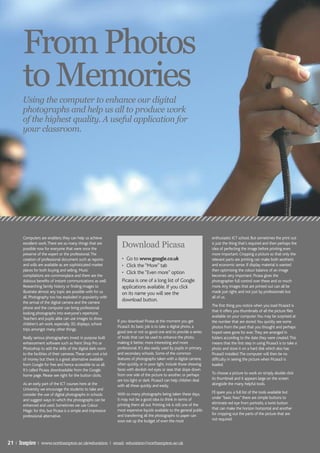
From Photos
       to Memories
       Using the computer to enhance our digital
       photographs and help us all to produce work
       of the highest quality. A useful application for
       your classroom.


       Computers are enablers; they can help us achieve                                                                      enthusiastic ICT school. But sometimes the print out
       excellent work. There are so many things that are
       possible now for everyone that were once the
                                                                    Download Picasa                                          is just the thing that’s required and then perhaps the
                                                                                                                             idea of perfecting the image before printing even
       preserve of the expert or the professional. The                                                                       more important. Cropping a picture so that only the
       creation of professional document such as reports            • Go to www.google.co.uk                                 relevant parts are printing can make both aesthetic
       and wills are available as are sophisticated market          • Click the “More” tab                                   and economic sense. If display material is wanted
       places for both buying and selling. Music                                                                             then optimising the colour balance of an image
                                                                    • Click the “Even more” option
       compilations are commonplace and there are the                                                                        becomes very important. Picasa gives the
       dubious benefits of instant communications as well.          Picasa is one of a long list of Google                   photographer full control over these and so much
       Researching family history or finding images to              applications available. If you click                     more. Any images that are printed out can all be
       illustrate almost any topic are possible with for us         on its name you will see the                             made just right; and not just by professionals but
       all. Photography too has exploded in popularity with                                                                  all of us.
       the arrival of the digital camera and the camera
                                                                    download button.
                                                                                                                             The first thing you notice when you load Picasa3 is
       phone and the computer can bring professional
                                                                                                                             that it offers you thumbnails of all the picture files
       looking photographs into everyone’s repertoire.
                                                                                                                             available on your computer. You may be surprised at
       Teachers and pupils alike can use images to show
                                                                  If you download Picasa at the moment you get               the number that are stored. You quickly see some
       children’s art work, especially 3D, displays, school
                                                                  Picasa3. Its basic job is to take a digital photo, a       photos from the past that you thought and perhaps
       trips amongst many other things.
                                                                  good one or not so good one and to provide a series        hoped were gone for ever. They are arranged in
       Really serious photographers invest in purpose built       of tools that can be used to enhance the photo,            folders according to the date they were created. This
       enhancement software such as Paint Shop Pro or             making it better, more interesting and more                means that the first step in using Picasa3 is to take a
       Photoshop to add the skills of the digital dark room       professional. It’s also easily used by pupils in primary   photo and store it on a hard disk which also has
       to the facilities of their cameras. These can cost a lot   and secondary schools. Some of the common                  Picasa3 installed. The computer will then be no
       of money but there is a great alternative available        features of photographs taken with a digital camera,       difficulty in seeing the picture when Picasa3 is
       from Google for free and hence accessible to us all.       often quickly, or in poor light, include those showing     loaded.
       It’s called Picasa, downloadable from the Google           faces with devilish red eyes or seas that slope down
                                                                  from one side of the picture to another, or perhaps        To choose a picture to work on simply double click
       home page. Please see right for the button clicks.
                                                                  are too light or dark. Picasa3 can help children deal      its thumbnail and it appears large on the screen
       As an early part of the ICT courses here at the            with all these quickly and easily.                         alongside the many helpful tools.
       University we encourage the students to take and
                                                                  With so many photographs being taken these days,           I’ll spare you a full list of the tools available but
       consider the use of digital photographs in schools
                                                                  it may not be a good idea to think in terms of             under “basic fixes” there are simple buttons to
       and suggest ways in which the photographs can be
                                                                  printing them all out. Printing ink is still one of the    eliminate red eye from portraits, a twist button
       enhanced and used. Sometimes we use Colour
                                                                  most expensive liquids available to the general public     that can make the horizon horizontal and another
       Magic for this, but Picasa is a simple and impressive
                                                                  and transferring all the photographs to paper can          for cropping out the parts of the picture that are
       professional alternative.
                                                                  soon eat up the budget of even the most                    not required.


21 | Inspire | www.northampton.ac.uk/education | email: education@northampton.ac.uk
Example 1 – The Sepia Effect


                                                           Example 2 – Using the soft focus option


                                                           Example 3 – A quick and easy collage
Under another tab, another set of tool, the picture
can be changed to sepia tone (Example 1) with one
simple click – just the job for recording the Victorian
project; but my favourite is a soft focus button that
allows you make some of the picture fuzzy so that
the important details can stand out. (Example 2)
There is a useful collage feature as well (Example 3).
Select a few pictures and one click away is an
arrangement of all these pictures on one page with
the pictures displayed at jaunty angles, or in line to
fill the available space. This is great for display work
of all kinds.
These facilities are useful in the classroom, the
lecture room and at home and I hope you enjoy
playing with them.
In the last edition of INSPIRE Pivot Man animation
was looked at and I hope many of you had a good
time investigating this.
This was the first of a series of resources
downloadable for the web for free and which
                                                           Some free downloadable resources
provide a great deal of fun learning in the classroom.     • http://www.snapfiles.com/get/stickfigure.html
But there are others and some details are offered in
the resource list in panel 2.
                                                             for Pivot man animation software for children

The digital world not only gives us the chance to be       • http://www.google.co.uk/intl/en/options/
prolific producers of images but also the tools to           for the Picasa 3 software discussed here
make those images professional looking and able to
stand the test of time. I hope Picasa3 and the             • http://www.microsoft.com/windowsxp/using/digitalphotography/
software that will undoubtedly follow allows you to          photostory/default.mspx for software that provides a moving slideshow
build a really good collection of photographs.               from you still photos – we’ll look at this in more detail in a later edition.
Bob Hopkins                                                • http://photosynth.net/default.aspx for making your own images into
Senior Lecturer in ICT
                                                             panoramic shots. You supply the digital images and Photosynth will stitch
The University of Northampton
                                                             them together to make one big image as a panorama.


                                                              www.northampton.ac.uk/education | email: education@northampton.ac.uk |         Inspire | 22
Call TODAY to place your order!
                                  Tel: 01604 590967 www.northants-black-history.org.uk


          Northamptonshire Black History Association
          Doddridge Centre 109 St. James Road, Northampton NN5 5LD
          Tel 01604 590567


23 | Inspire | www.northampton.ac.uk/education | email: education@northampton.ac.uk
Pam Cormack
  Short Courses and                                                                Research Administrator
                                                                                   The School of Education

  Conferences 2009-2010                                                            Tel: 01604 892897
                                                                                   Email: education@northampton.ac.uk


  Positive Behaviour Management in the Mainstream Junior/Secondary/PCET Classroom
  (PART 1: Introduction)

                                            This is part one in a series of one day professional development events based on the
                                            positive management of behaviour in mainstream classrooms. In part one, participants will:
                                            • Understand & appreciate that there are different theoretical models/perspectives on
                                              behaviour and how these can influence interventions & responses
                                            • Consider how adult behaviour impacts on pupils/students
                                            • Be able to identify hostile/non-assertive and assertive styles of behaviour management
                                            • Reflect on characteristics of their own personal response style and consider a range of
                                              responses to challenging behaviour
                                            • Understand how verbal and non-verbal behaviour can be used more effectively to
Date:         Thurs 14th January 2010         manage pupil/student behaviour
                                            • Explore and rehearse a variety of practical strategies for ensuring least-most intrusive
Led By:       Andy Smith                      intervention
Location:     Sunley Management Centre      • Develop language skills in corrective management
              Park Campus, The              • Develop skills and techniques for diffusing conflict and arguments
              University of Northampton
              Boughton Green Road,          Market
              Northampton NN2 7AL           • NQTs
Registration: 9.30AM                        • Teachers in mainstream primary & secondary schools who wish to develop their
                                              positive behaviour management skills
Lunch:        12:30-1:15PM                  • Lecturers & Support Staff in PCET – particularly those working with school leavers
Finish:       4:15PM                          and school pupils who ‘infill’ on to vocational programmes of study


     Course Cost per delegate: £150 (inc. tea/coffee/squash on arrival; morning tea/coffee; lunch; afternoon tea/coffee)


  Positive Behaviour Management in the Mainstream Junior/Secondary/PCET Classroom
  (PART 2: Raising Self-Esteem & Encouraging and Developing Positive Relationships Between Pupils/Students)

                                            This is part two in a series of one day professional development events based on the
                                            positive management of behaviour in mainstream classrooms. In part two, participants will:
                                            • Consider what is meant by self-concept, ideal-self and self-esteem
                                            • Explore the nature and characteristics of high and low esteem
                                            • Be introduced to the concepts of locus of control and transactional analysis
                                            • Understand the relationship between self-esteem, motivation and classroom behaviour
                                            • Develop their knowledge and repertoire of skills and strategies for enhancing pupil self-
Date:         Thurs 28th January 2010
                                              esteem and begin to explore strategies for raising pupil self-esteem in schools
Led By:       Andy Smith                    • Consider the importance of a positive ethos within the classroom to the development
              & Mary Doveston                 of pupils learning
Location:     Sunley Management Centre      • Develop their repertoire of skills and strategies for supporting pupils to maintain a
              Park Campus, The                network of positive relationships within and outside of the classroom
              University of Northampton     • Critically examine a range of initiatives and programmes that are used to teach and
              Boughton Green Road,            support the development of positive relationships in school
              Northampton NN2 7AL
                                            Market
Registration: 9.30AM                        • NQTs
Lunch:        12:30-1:15PM                  • Teachers in mainstream primary & secondary schools who wish to develop their
Finish:       4:15PM                          positive behaviour management skills


     Course Cost per delegate: £150 (inc. tea/coffee/squash on arrival; morning tea/coffee; lunch; afternoon tea/coffee)

                                                  www.northampton.ac.uk/education | email: education@northampton.ac.uk |        Inspire | 24
Positive Behaviour Management in the Mainstream Junior/Secondary/PCET Classroom
          (PART 3: Behaviour as a Special Need: Exploring Attention Deficit Hyper- Activity Disorder - AD/HD and
          Autistic Spectrum Disorder -ASD)

                                                      This is part three in a series of one day professional development events based on
                                                      the positive management of behaviour in mainstream classrooms. In part three,
                                                      participants will:
                                                       • Gain insight into the nature, prevalence, causal theories, diagnosis and treatment
                                                         of AD/HD (inc. the use of medication)
                                                       • Consider the implications of the condition for schools and colleges
                                                       • Understand how pupils/students with AD/HD can be supported more effectively
                                                       • Learn about the triad of impairment
        Date:          Thurs 11th February 2010
                                                       • Examine a range of behaviour associated with ASD
        Led By:        Andy Smith                      • Gain an understanding as to why some interventions (e.g. the focus on structure)
                       & Mary Doveston                   are considered effective for pupils with ASD
        Location:      Sunley Management Centre
                       Park Campus, The                Market
                       University of Northampton       • NQTs
                       Boughton Green Road,
                                                       • Teachers in mainstream primary & secondary schools who wish to develop their
                       Northampton NN2 7AL               positive behaviour management skills
        Registration: 9.30AM                           • Lecturers in PCET (particularly those working with school leavers/infill students)
        Lunch:         12:30-1:15PM                    • Learning Support Staff from PCET
        Finish:        4:15PM


             Course Cost per delegate: £150 (inc. tea/coffee/squash on arrival; morning tea/coffee; lunch; afternoon tea/coffee)


          Positive Behaviour Management in the Mainstream Junior/Secondary/PCET Classroom
          (PART 4: Observation and Recording & Applied Behavioural Analysis)

                                                      This is part four in a series of one day professional development events based on
                                                      the positive management of behaviour in mainstream classrooms. In part four,
                                                      participants will:
                                                       • Gain an understanding of the purpose of classroom observation
                                                       • Consider a range of issues that might impact on the value and validity of such activity
                                                       • Increase their awareness of the different observation and recording techniques they
                                                         might use
                                                       • Develop the confidence and skills to conduct a formal observation in their schools
                                                       • Appreciate why it is important to analyse challenging behaviour
                                                       • Learn about applied behaviour analysis and how it can be used to follow up pupil
        Date:          Thurs 11th March 2010             observations
        Led By:        Andy Smith                      • Understand why it is important to describe behaviour objectively and specifically
        Location:      Sunley Management Centre        • Gain insight into the process of effective target setting and monitoring
                       Park Campus, The
                       University of Northampton       Market
                       Boughton Green Road,            • Teachers in mainstream primary & secondary schools who wish to develop their
                       Northampton NN2 7AL               positive behaviour management skills
        Registration: 9.30AM                           • Special Educational Needs Co-Ordinators
        Lunch:         12:30-1:15PM
        Finish:        4:15PM


             Course Cost per delegate: £150 (inc. tea/coffee/squash on arrival; morning tea/coffee; lunch; afternoon tea/coffee)


25 | Inspire | www.northampton.ac.uk/education | email: education@northampton.ac.uk
Positive Behaviour Management in the Mainstream Junior/Secondary/PCET Classroom
  (PART 5: Recognising and Dealing with Bullying and Racism (am) and Motivation, Rewards and Sanctions (pm))

                                            This is part five in a series of one day professional development events based on
                                            the positive management of behaviour in mainstream classrooms. In part five,
                                            participants will:
                                            • Consider the effects of stereotyping when considering bullies and victims
                                            • Reflect on the nature of bullying and racial harassment and evaluate some working
                                              definitions
                                            • Appreciate their professional obligations in terms of being alert to bullying and racism
                                              and gain insight into strategies for support
                                            • Share ideas and experiences and gain a better understanding of the nature and range
                                              of rewards and sanctions that are used in schools
Date:         Thurs 6th May 2010            • Understand the distinction between intrinsic and extrinsic reward and between
Led By:       Andy Smith                      tangible, token, symbolic and social rewards
                                            • Explore the relationship between motivation and rewards/sanctions
Location:     Sunley Management Centre
                                            • Produce a bank of ideas and strategies for reinforcing appropriate behaviour
              Park Campus, The
                                            • Consider the nature and effects of sanctions used in schools in relation to research
              University of Northampton
              Boughton Green Road,
                                            Market
              Northampton NN2 7AL
                                            • NQTs
Registration: 9.30AM
                                            • Teachers in mainstream primary & secondary schools who wish to develop their
Lunch:        12:30-1:15PM                    positive behaviour management skills
Finish:       4:15PM


     Course Cost per delegate: £150 (inc. tea/coffee/squash on arrival; morning tea/coffee; lunch; afternoon tea/coffee)


  Positive Behaviour Management in the Mainstream Junior/Secondary/PCET Classroom
  (PART 6: Anger and its Management – with pupils/students and aggressive adults in schools and colleges)

                                            This is part six in a series of professional development events based on the
                                            positive management of behaviour in mainstream classrooms. NOTE: Part 6
                                            is a half-day programme only. In part six, participants will:
                                            •   learn to recognise different anger styles
                                            •   understand the possible triggers
                                            •   recognise physical signs and changes
                                            •   appreciate the stages of aggressive behaviour
                                            •   discuss a range of interventions for managing anger and aggression


                                            Market
Date:         Thurs 20th May 2010
                                            • NQTs
Led By:       Andy Smith
                                            • Teachers in mainstream primary & secondary schools who wish to develop their
Location:     Sunley Management Centre        positive behaviour management skills
              Park Campus, The              • Lecturers and Learning Support Staff in PCET
              University of Northampton
              Boughton Green Road,
              Northampton NN2 7AL
Registration: 1.00AM
Finish:       4:15PM


                               Course Cost per delegate: £60 (inc. tea/coffee/squash on arrival; afternoon tea/coffee)


                                                   www.northampton.ac.uk/education | email: education@northampton.ac.uk |       Inspire | 26
Education Inspire magazine Issue03

Education Inspire magazine Issue03

  • 1.
    Transforming lives, inspiringchange Interview with Steven Onasanya Graduate of the Early Years Professional Status. 11 MILLION TAKEOVER DAY Education sector’s support is vital to success. Research Matters CeSNER research partnerships across the globe. Also Achieve A Developing inside: Higher Level Blended Learning Professional Development How Blended Learning could assist and Training explored HLTA candidates
  • 2.
    Welcome Welcome to this issue of Inspire. The School of Education has had a very busy 9 months. Continuing on from last years Ofsted success, the school has celebrated another rise in its teacher training ratings, and is the first in the country to offer an integrated degree leading to Early Years Professional Status. The children’s commissioner for England talks to Inspire about the 11 million take over day. We will also give you an update on the School’s research and our travels around world! I hope you enjoy the latest issue of Inspire. Paul Bramble, Editor, Inspire Thank you We would like to also take this opportunity to thank everyone who has helped us over the past year, whether you have been a mentor on our many courses, a school partner or contributed to the various research projects that have been undertaken. I hope you and your school, nursery or educational settings have another successful year. 1 | Inspire | www.northampton.ac.uk/education | email: education@northampton.ac.uk
  • 3.
    Contents 11 Million Takeover Day ........................5 Achieve a Higher Level..........................7 Bursaries for support staff .....................9 University holds Children and Young People Lecture with Dr. Penelope Leach......................10 Partnership with schools .....................10 record for teaching The Further Mathematics Network ...10 Research Matters...................................11 jobs after graduation Global success for CeSNER .................13 Interview with Steven Onasanya .......15 A model programme.............................17 The School of Education has the best record for newly-trained New school based route for primary teachers in securing teaching posts through their PGCE the Masters in Education ....................18 primary programme, according to the Good Teacher Training Developing Blended Learning ............19 Guide 2009. From Photos to Memories....................21 Within six months (based on 2008 figures) University and School-based tutors to the of gaining qualified teacher status (QTS) from future of primary education. The University of Northampton, an impressive 92% of trainees were successful in gaining “We believe our graduates will be in a strong employment as a teacher. Additionally, the position to continue to be successful in the Guide ranks Northampton 7th in its provision current employment situation” of primary Initial Teacher Training (ITT). The Good Teacher Training Guide 2009 is Joanna Moxham, Head of ITT, School of compiled by the Centre for Education and Education, commented: Employment Research at the University of “We are delighted by the statistics which Buckingham, and compares teacher training reflect the hard work and professional qualities providers in terms their intakes, Ofsted ratings of our students and the commitment of our and trainees’ take-up of teaching posts. Achieving a higher level continues Inspire Written and produced by The University of Northampton School of Education all submissions are property of Inspire magazine. The entire The School of Education’s HLTA team have content © Copyright The University of Northampton School of successfully retained the TDA contract HLTA, for Education 2008, and cannot be reproduced in whole or part without prior written consent. Phase 3 Regional Provider of HLTA Assessments. Editor Paul Bramble – paul.bramble@northampton.ac.uk The team has now been involved in a lead role Words Paul Bramble – paul.bramble@northampton.ac.uk in HLTA assessment across the pilot, phase 1 Photography Design Depot Ltd, Merle Moustafa & Chris Allum and phase 2. This marks the continuation Design by Design Depot Ltd – www.designdepot.net Printed by Portland Print Limited of a major contribution to the development of teaching assistants across schools in the East Midlands Region. www.northampton.ac.uk/education | email: education@northampton.ac.uk | Inspire | 2
  • 4.
    Success for University’s teacher training A new PGCE Early Years course is starting this term. This follows on from the success of last year’s Ofsted Grade 1 award of the University’s undergraduate and postgraduate courses and the subsequent Training and Development Agency’s (TDA) award of Category ‘A’ provider status. Due to these excellent results, the University was awarded additional teacher training places, resulting in the launch of a new PGCE Early Years course to add to the existing suite of programmes. University welcomes The first cohort of 24 students is due to begin training this September and they bring with them different experiences and backgrounds, including Music and Psychology. Course Leader Anna Cox commented: “As well as developing strong subject knowledge our students will consider important issues in the special needs teachers from India to campus field of Early Years such as how to support children’s well being, inclusion and working in partnership with parents. If you really want to influence society and make a difference, be an Early Years teacher.” A group of teachers from South West India has One of our current Doctoral students will be very The School is delighted to be extending its chosen to visit Northampton to study special influential in policy terms when he returns to the partnership opportunities with Early Years settings. needs education, based on the international region next year with specialist, but important, reputation for excellence of The University of knowledge in this aspect of children’s schooling.'' Northampton’s Centre for Special Educational A rich programme is underway for the visitors, Needs Research (CeSNER). including a five day visit to the Ofsted awarded The visitors from Marion Play Home, a special 'outstanding' special school, Fairfields School, school within a poor community in the Kerala Trinity Avenue, to observe teaching in region, will be finding out how UK schools teach classroom settings. children with autistic spectrum disorders or severe The teachers are partnered with four Malayalam- learning difficulties. speaking students from the University’s School Richard Rose, Head of CeSNER, explains: of Education to make sure they receive the full ''The collaboration was initiated by former benefit of the experience. overseas students who returned to their homes in Corallie Murray, Fairfields Head Teacher and PhD Kerala with news of our work in special needs. student at The University of Northampton, said: ''We are pleased to welcome the visiting teachers to our school and hope they will take away some useful information, new ideas and some of the best practice they will see happening within our school. The children are enjoying sharing their time with them.'' 3 | Inspire | www.northampton.ac.uk/education | email: education@northampton.ac.uk
  • 5.
    Teaching assistants celebratesuccess Teaching assistants in Northamptonshire schools celebrated their new Higher Level Teaching Assistant (HLTA) status at an event at The University of Northampton's Park Campus recently. Northamptonshire has 436 HLTAs working in schools across the county who have a wide range of roles and responsibilities. Ros Burman, Area School Improvement Manager, Children and Young People's Directorate, Northamptonshire County Council, presented certificates in recognition of HLTAs' achievements. Ros was involved in the pilot project when the HLTA status was introduced as part of the National Agreement on Raising Standards and Tackling Workload in 2003. Ros drew attention to the newly formed HLTA/Cover Supervisor Support Network for Northamptonshire, which will be offering support group meetings and opportunities for training and professional development to HLTAs and Cover Supervisors across all phases of education from September. 1st in the country to provide a new professional route train for EYPS The School wins bid to s a chool teachers Following the success of the initial stages of the primary s pilot Early Childhood Studies (ECS) to Ealy Years Professional Status (EYPS) in 3.5 years’ a new ialists hematics Spec chool of version of the BA (Hons) Early Childhood Studies M at S (ECS) was validated in June. orthampton’s This new BA (Hons) Early Childhood Studies The University of N r to lead a new (Professional Practice) provides a designated as won a tende professional pathway for selected ECS students Education h l authorities from years 2 and 3 that will enable them to ve across sixteen loca national initiati develop as effective early years’ practitioners and ol teachers as 0 primary scho to prepare for leadership and management roles. 100 to train around ext three years. As a result, students graduating with the BA (Hons) ecialists over the n Early Childhood Studies (Professional Practice) Mathematics Sp an exciting represents pathway should be able to complete EYPS “The Programme ion between 6 to 9 months after graduation. hematics Special ist opportunity to work in collaborat The Primary Mat l local authorities Programme is a new professiona with other unive rsities, gramme created as vide quality development pro ommendation in the and schools to pro nal development for teachers - TDA approved provider a result of a rec professio ‘Independent Re view of Mathem atics and make a signif icant difference to for the national SENCO and athematics.” Teaching in Ea rly Years Settings at every children's learning of m qualification ’ (June 2008), th -face training ou tside Primary Schools ss to a Through face-to should have acce and primary school Teacher by 2019 . school hours, network meetings The School of Education is now a TDA nationally ecialist t, teachers on Mathematics Sp in-school develop men approved centre for the training of SENCOs nal the Department for will gain professio (special educational needs coordinators), Fully funded by the Programme s (DCSF), e int erpersonal skills which leads to the award of a national SENCO Children, Sc hools and Familie knowledge and th by a consortium led ive professional qualification. the course is run to lead collaborat hool rsity of Northam pton, with d team work in sc by The Unive rsity development an vision The Training and Development Agency for schools Grosseteste Unive ality and pro partners Bishop to improve the qu (TDA) has awarded the University this contract Nottingham Trent College Lincoln, e, of m athematics. for training teachers with SENCO roles in schools ty of Bedfordshir Un iversity, Universi rs will be awarded across 8 local authorities. rby and Un iversity of Successful teache matics University of De of Primary Mathe close partnership the status , Steve Cullingford-Agnew, course leader for SENCO He rtfordshire, and in nis ed national award ities. Specialist, a recog a Masters commented that with local author in addition to on e third of “We are delighted to have been chosen to deliver Senior Lecturer in gree in Education . Debbie Morgan, rsity de the National SENCO course. This course will assist ucation, The Unive Mathematics Ed gional to recognise the work of SENCOs and their , and Re of Northampton ics commitment to improving outcomes for children mary Mathemat Pro gramme Lead Pri with SEN and disabilities”. mme, co mmented: Specialist Progra ail n pack please em This course is fully funded for SENCOs new d an applicatio For further information an to their role or in post after September 2008. pton.ac.uk For further information please contact MSP@northam education@northampton.ac.uk www.northampton.ac.uk/education | email: education@northampton.ac.uk | Inspire | 4
  • 6.
    Education sector’s supportis vital to success of 11 MILLION TAKEOVER DAY, says Children’s Commissioner 11 MILLION TAKEOVER DAY was even bigger students in decision-making through school Adults also tell me they learn a great deal from and better last year and much of this success councils, student unions and other similar initiatives. working alongside children and young people and was down to the hundreds of education bodies welcome the fresh insights and new perspectives But today I am encouraging everyone to get including schools, colleges and universities who on their jobs. They all say they look forward to involved in this national event and give children took part. taking part again. and young people the opportunity to work This year’s Takeover Day is on Friday 6 November alongside teachers, lecturers and staff in other Anyone can get involved in 11MILLION TAKEOVER and I hope that even more institutions will sign up posts and shout out about what they are doing. DAY because there is no one size fits all formula. and support my organisation 11 MILLION in So please sign up via our website now: The day benefits all ages – children and young highlighting the great contribution to society that www.11MILLION.org.uk or email: people have the chance to influence decision- children and young people make. takeover.day@11MILLON.org.uk . Also check out makers and what they do on Takeover Day has the website for tips to help you start planning your I am well aware that schools, colleges and helped to change some of the negative public activities for 11 MILLION Takeover Day 2009. universities up and down the country are already attitudes that are reported about them in doing fantastic work to involve their pupils and the media. Sir Al Aynsley-Green Children’s Commissioner for England 5 | Inspire | www.northampton.ac.uk/education | email: education@northampton.ac.uk
  • 7.
    What is 11MILLION TAKEOVER DAY? 11 MILLION TAKEOVER OVER DAY is a national event offering children and young people across the country opportunities to work alongside adults and to get involved in decision-making in a diverse range of organisations. During Takeover Day 2008, 17,000 children and young people ‘takeover’ jobs at nearly 700 organisations including schools, police and fire services, the Department for Children, Schools and Families, media, BT, charities, youth groups, local authorities, councils and many more. “It’s really good when people listen to what you are saying.” Pupils at Caldecott School who ‘took over’ their teachers’ jobs “They gave us pretend £2,000 to use to design the week of action, which we did and we’re going to stay together to achieve the next project – hooray!” Pupil from Bentley Wood High School who worked with Harrow Connextions: “I enjoyed the interview rooms also so now I am following my dream to be a police officer. Thank you.” Pupil from Pickering High School at Humberside Police: www.northampton.ac.uk/education | email: education@northampton.ac.uk | Inspire | 6
  • 8.
    Achieve A Higher Level Lurking in corners throughout the education buildings at Park Campus, there exists an entity known as the PDT Division. What is it? What does it do? Is it dangerous? There is a team of School of Education staff The School of Education was at the forefront 'It is a great pleasure to help dedicated and working on courses for the wider schools nationally, of identifying the demand for hardworking Teaching Assistants achieve their workforce. This remit is broad and of singular professional development for teaching assistants career aims. At the core of what we do in the PDT importance for the training of support staff and began offering accredited courses from 1994. division is the help schools improve the quality of working in schools, not just in Northamptonshire, The high demand for these courses led to the teaching and learning for their students by training but throughout the East Midlands. It provides a development of: their staff.' (Ken Bland) network of professional development and training 2001 The HLTA programme has grown from strength to opportunities to meet the needs of one of the • Foundation Degree (Arts) in Learning and strength since its inception in 2003. To date over fastest growing and constantly developing sectors Teaching (FDLT) 450 candidates have gained HLTA status in in the country. In the 10 years from 1997 to 2007 2003 Northamptonshire alone. Research into the the numbers of teaching assistants working in • BA (Hons) in Learning and Teaching (BALT) as deployment of HLTAs and the impact they are schools expanded exponentially from 61,000 to a one year full-time equivalent Level 6 top-up making in schools, carried out by the University 177,000. Fresh impetus was given to the training of from FDLT with, on average, 80% of FDLT of Northampton in conjunction with support staff by the signing of the National graduates progressing to BALT Northamptonshire Local Authority, can be found Agreement on Raising Standards and Tackling • HLTA status was incorporated into the PDT on the University’s HLTA website. Ken Bland is very Workload in 2003. The creation of Higher Level Division portfolio positive about the impact of HLTAs in schools, 'The Teaching Assistant (HLTA) status gave teaching HLTA programme is all about modernising the assistants a career pathway for the first time. 2004 school's workforce and changing the teaching and • Certificate in Higher Education Supporting The government has raised expectation amongst learning dynamic in schools today' Learners (CHESL) as a part-time programme school support staff that training will be available of Level 4 modules Wendy Yarnall, who joined the team in May 2008, to help them meet their development goals. For is the course leader for CHESL. There are currently some that goal will be a degree and the possibility The Head of Professional Development and 30 CHESL modules (and more being developed), of teacher training, for others Higher Level Teaching Training is Ken Bland, who as well as being the which cover a wide range of topics of direct Assistant status, for many others it is to seek that divisional leader, is also the project manager for relevance to support staff working in schools. specialist knowledge which will enable them to the HLTA programme. improve the life chances of the children that they are working with. 7 | Inspire
  • 9.
    Above: Ken Bland,Head of Professional Development and Training Many of the specialist modules are taught by This 2 year, work based course is led by Julie Jones remit is to develop students' academic ability such experts in their fields from the CeSNER (Centre for who observed that, ‘Since our first students that they reach honours level and display all the Special Needs Education and Research) team at the graduated in 2003, the Foundation Degree in skills and have the confidence that all graduates University. They cover such diverse subjects as Learning and Teaching has provided its 396 of The University of Northampton should have, autism, literacy difficulties, speech and language graduates with a vocational qualification to irrespective of the employment they are in." and behaviour to name but a few. enhance their career development.’ Comment The CHESL, FDLT, BALT and HLTA programmes from a recent FDLT graduate who is now pursuing ‘CHESL offers support staff an excellent provide for those involved in supporting teaching a career in teaching, Katie Noon, sums up how opportunity to develop their knowledge and and learning within mainstream infant, primary valuable the course is when she said at her expertise in supporting learners while giving and secondary schools, community colleges and graduation... 'to be quite honest it's the best them a 'first toe in the water' at higher education academies, Special Educational Needs schools and decision I ever made.' study, raising their confidence as a result. Many other education providers such as pupil referral students go on to take further modules and often Students can continue for a third year to top units, and hospital education services. combine this with HLTA, enhancing their profile up this degree and gain a BA in Learning and With a commitment to the principle of lifelong significantly in the work place.’ (Wendy Yarnall, Teaching (BALT). Led by Dr Estelle Tarry. learning, the PDT Division offers opportunities for course leader CHESL) teaching assistants that respond to employer needs and enable teaching assistants to develop careers ‘It is a great pleasure to help dedicated and in education and extended schools provision. The programmes are popular within school hardworking Teaching Assistants achieve their communities and local authorities, recruit well and have a good reputation in Northamptonshire and career aims. At the core of what we do in the PDT the surrounding counties. Modes of study are division is the help schools improve the quality of suitable to teaching assistants in full or part-time employment with accessibility, flexible provision teaching and learning for their students by training and widening participation being key principles. their staff.' Ken Bland I’m sure you’ve worked it out by now. PDT stands for Professional Development and Training. Not scary at all really. The Foundation Degree in Learning and Teaching Paul Sedgewick, Senior Lecturer in Education and (FDLT) is very successful with a consistently high Admissions Tutor for BALT said, "Within a division annual intake, (82 in 2008-09). It has proved very that caters for students in employment the BALT is popular with students, offering the school unique in not being a work-based programme. This workforce a route into Higher Education. odd situation is quite deliberate because the BALT's www.northampton.ac.uk/education | email: education@northampton.ac.uk | Inspire | 8
  • 10.
    Bursaries for support staff working in schools Northamptonshire School teachers who are offered a place on a Certificate in Higher Education Supporting Learners (CHESL) module at The University of Northampton this financial year will be able to apply for a bursary from the Northamptonshire local authority towards the fees for the course. The bursary is good news for those who are working in schools. There are 30 modules to choose Similarly there will be full funding for up to 15 employed to support learning and teaching with from, all taught by experts in their field, including applicants accepted for the module, ‘Supporting pupils aged three years and over in the county’s Social, Emotional and Behavioural Difficulties, Learners with Speech, Language and Communication maintained schools, such as teaching assistants and Supporting Learners with Autistic Spectrum Difficulties.’ This is because the content of these two Higher Level Teaching Assistants. Disorders, Special Educational Needs and courses in particular is deemed to meet the local Literacy Difficulties. authority’s priorities for school support staff. The School Workforce Development Manager for the Learning, Achievement and School Improvement A typical 20 Credit CHESL module costs £350. The grant is available for this financial year (2009-10) Division at Northamptonshire County Council has The Local Authority is offering a bursary of £200 and there is no guarantee that these funding announced new funding arrangements for nationally for every 20 credit module up to a maximum of arrangements will continue next year. Individuals accredited qualifications that are not supported by 40 credits this year. and school managers who are considering the other grants for school support staff in professional development needs of their support In addition there will be full funding for up to Northamptonshire schools. staff should take a look at the website to see what 15 applicants accepted on the Specialist Teaching is on offer. CHESL modules, which are offered by The University Assistant (STA) course. STA has been popular since of Northampton, form a bridge between vocational its inception 13 years ago and some 260 teaching For a full list of modules visit and higher education qualifications, covering a wide assistants have gained this qualification in the county. www.northampton.ac.uk/chesl. range of topics of direct relevance to support staff To apply, or enquire about the modules, contact admissions on 0800 358 2232 or email admissions@northampton.ac.uk You will need to be offered a place before you can apply to the Local Authority for the bursary. 9 | Inspire | www.northampton.ac.uk/education | email: education@northampton.ac.uk
  • 11.
    The School ofEducation’s Annual Children and Young People Lecture with Dr. Penelope Leach Childcare practitioners and students on professional childcare courses at the University attended this years lecture by Penelope Leach, eminent child development psychologist and author of ‘Your Baby and Child’, which has been an essential guide for new parents over several decades. wide-ranging international account of what she calls "the conundrum of contemporary child care". Denise Hevey, Professor of Early Years and organiser Above: Stephen Smith, Head of Partnership of the Lecture, is author of new chapter, ‘Professional Work in Early Childhood’. She said: “We are honoured that such a respected figure in the field was present at the launch of our team’s book and are hoping that this revised and updated Partnership edition will be equally well received and valued by students and practitioners. “Penelope Leach has always championed with schools home-based childcare such as child-minding for Penelope is as an advocate for Stephen Smith is our new head young children, and her renowned research supports children and parents (Children First Vintage 1994), a Fellow of the importance of sensitive, consistent caring of partnership at the School of relationships. We are very proud and excited that the British Psychological Society, she came to talk to us.” Education and talks to Inspire. and an Hon. Senior Research Fellow at the Tavistock Clinic and The University’s annual Children and Young People’s I have worked in education for nearly thirty years, at the Centre for the Study of Children, Families and Lecture has previously attracted other high-profile mainly in secondary schools in North Yorkshire, Social Issues, Birkbeck. For the past nine years her speakers such as Camila Batmanghelidjh, East Yorkshire and Hull. I began my career as a research has been focused on child care; she is psychotherapist and founder/Director of the History teacher and went on to become a Head co-director of the Families, Children and Childcare charity Kids Company, and Dr Sheila Shribman, of Department and Senior School Leader. I also study, the largest study of child care ever carried NHS National Clinical Director for Children, Young worked with a large number of primary schools out in the UK, and author of a new book offering a People and Maternity. promoting curricular links with their secondary partners. As a Senior School Leader I was responsible for Continuing Professional Development, including Graduate and Initial Teacher Training. The Further Teacher Education eventually became the most satisfying area of my work, and so I am delighted to join the School of Education at The University Mathematics Network of Northampton. The School is, clearly, a thriving and successful organisation. Furthermore, it offers an extremely friendly and supportive environment to work in. I have two main roles in the School, as The Further Mathematics Network is a government-funded Head of Partnership and a Divisional Leader for initiative. It is managed by Mathematics in Education and Teacher Education. Industry (MEI), an independent educational charity. I believe strongly that partnership between the University and schools is absolutely central to The Further Mathematics Network consists of opportunities available to them because of their achieving our aim of producing tomorrow’s high 46 Further Mathematics Network Centres, which mathematical ability. Schools and colleges quality education professionals. The School already The School of Education at The University of report that involvement with their local Further has a large number of successful partnerships Northampton is the centre for the East Midlands Mathematics Network Centre has raised the which I am keen to maintain and develop. region. Each Centre aims to ensure ASIA level profile of mathematics amongst their students. However, the University is also interested in Further Mathematics is available to all ASIA level We need more students to study mathematics establishing new partnerships with Early Years Mathematics students, promote mathematics to post -16 and we need more well-qualified settings, primary and secondary schools. Partnership all young people and help support the teaching students to choose maths-related subjects at isn’t just about student placements in schools and of ASIA level Mathematics and Further university. The Further Mathematics Network is we are keen to explore other ways in which the Mathematics in all schools and colleges. already starting to make this happen. School of Education can contribute to the work of education professionals. The Further Mathematics Network, combined The Further Mathematics Network (FMN) came with the change to the structure of ASIA level to an end on 31 July, but its success means that If you would like to know more about the Further Mathematics, has already led to a the DCSF will continue to provide funding to opportunities working in partnership please significant increase in the number of students support Further Mathematics. From 1 August get in touch. achieving Further Mathematics qualifications. 2009, the FMN is replaced by the Further Each of these students' exposure to Further Mathematics Support Programme (FMSP). Tel: 01604 892470 Mathematics has made them more aware of Email: stephen.smith@northampton.ac.uk Go to www.furthermaths.org.uk for details. their own potential, the pleasures of an intellectual challenge and the extra www.northampton.ac.uk/education | email: education@northampton.ac.uk | Inspire | 10
  • 12.
    Research Matters Collaboration down-under: groups. Observing and acknowledging the often very it’s quite a bit different. Some of the teachers I small steps of progress these pupils make can be worked with had no other schools or colleagues Annie Fergusson, CeSNER really difficult, yet teachers everywhere want to nearby. In fact some had had a day’s travel or a few Teachers grapple with similar issues the world over. celebrate the achievements of all of their students. hours flight to get to my sessions in their closest Earlier this year I experienced this first-hand when I school or centre! Obviously this is quite a common My involvement was to explore this challenge by factor for them to consider. They have well- was invited to work with teachers across the state of sharing practice from England around the Western Australia (WA) to explore some common established routes of communication – virtual assessment of pupils with special needs. discussions via internet or the lower-tech mode of challenges. The focus of the work was on assessing the progress of learners with special needs. During During my stay we worked with UK resources as a short wave radio, as used by their ‘schools of the air’ my three week stay, I worked with over 150 teachers useful springboard for teachers in WA. There were (a bit like the flying doctor service we know from in five regional venues, spending many hours two main parts to my work – firstly to give teachers the movies!). travelling to the north (outback territory!) and the an overview of our national assessment and moderation process in England, introduce an Observing and acknowledging the often far south of this vast state. assessment measure for learners working below level very small steps of progress these pupils I had the privilege of spending time in schools and 1 of our national curriculum (known here as the P make can be really difficult, yet teachers working with teachers across the state - this was scales) and then give them first-hand experience of fascinating; a real highlight. I felt very at home in everywhere want to celebrate the using these in workshop activities. The second part classrooms getting to know students & seeing their of my task was to set up some focus groups of achievements of all of their students. achievements great and small. What was quite teachers in five regions of the state, to enable them Following straight on from the WA work, was a trip different was the diversity of students in many of to trial and review these materials and the process to Canberra, to share developments in this area from the schools and classes – particularly those located of assessment and moderation for the WA context. England with the federal government. Australia is in ‘rural and remote’ places (and they mean There were many similarities between our countries, currently developing a national curriculum for the remote!). If there’s a school in your area, that’s but a glaring difference was the scale of the country. first time. They have a really unique opportunity to where you go – inclusion by default! These schools In England, teachers work together to develop be the first nation to introduce a truly inclusive are supported by a visiting teacher service who consistency making judgements of pupil progress, national curriculum from the start. It may just be regularly fly in to work with and advise teachers usually with colleagues in neighbouring schools. that sharing the English perspective with them will working with students with special needs. Many of the local authorities I am used to working enable them to get it right from the word go. Who Understandably, many teachers I met felt isolated with have dense populations and you are usually knows – in a couple of years we could be sharing and often overwhelmed by the challenges of being almost on the doorstep of a nearby school. In WA, conversations about pupil progress using a common able to meet the wide ranging needs of their pupil language and with a truly shared understanding. 11 | Inspire | www.northampton.ac.uk/education | email: education@northampton.ac.uk
  • 13.
    Research Update TDA supported projects undertaken by the School of Education. Boy-friendly teaching: using Fathers to develop resources to support QTS This study identified important information for trainee teachers and their tutors concerning the role fathers in the education of their sons. A set of resources have been developed, including a number of checklists, a set of illustrative narratives, power- point presentations and video-extracts of conversations with fathers. The project is of great importance because the role of fathers in their son’s education has not been the focus of much attention in the English schools. It is also helping to contribute to the debate concerning the underachievement of boys in certain curriculum subjects, their over-representation in instances of unacceptable behaviour, and in exclusion figures. The study is featured on Teachers TV and its findings published in a book Fathers and Sons: in and about education, published by Trentham Books. The project team comprised Philip Garner and Barry Groom (The University of Northampton), supported by a cast of many fathers and their sons! Improving group dynamics to support learning and social inclusion: developing and enhancing CPD tutor capacity The aim of our project which we call Growing Talent for Inclusion (GTI), is to work with a class teacher to develop more effective and satisfying interpersonal relationships in the classroom. The process is based on the principles and approaches of collaborative Research Partnerships Mary Doveston and Sheena Bell are currently consultation, Appreciative Inquiry, solution focused involved in comparative research into work with brief therapy and co-researching with the students .We with Ireland dyslexic children with a colleague at St Patrick’s have been working with a focus group of Educational Members of the Centre for Special Needs Education College of Education in Dublin. Their work has Psychologists and teachers to pilot a training and Research (CeSNER) team have recently been already been reported in a number of academic methodology to enable other professionals to use successful in obtaining research grants through journals and through conference presentations. this approach, in schools and other learning contexts. competitive tendering with colleagues in Ireland. For further information regarding Project Iris, One member of the focus group commented: A three year longitudinal study into special please visit www.projectiris.org ‘….every school has a class where the dynamics get educational needs provision in schools across the in the way of learning. I feel quite honoured to have Irish Republic, funded by the National Council for Special Education in Ireland, will involve members Working with School been involved in this type of research because this could be taken into every school.’ of CeSNER working with colleagues from Trinity Leaders in Australia College Dublin and The Institute of Child Education. Now that we have a training file and a feature on Professors Richard Rose and Philip Garner have This project, (Project Iris – Inclusive Research in Irish Teachers TV, we are in a stronger position to recently returned from Perth Australia where they Schools) the largest of its kind ever funded in disseminate this approach and a GTI course starts in presented keynotes and workshops at the Western Ireland will involve a survey of every Irish school November. Australian Education Support Principals & and the development of case studies to illustrate Adminstrators’ Association Conference. This The project team consisted of Mary Doveston (The current practices in supporting students with special provided an opportunity to disseminate recent University of Northampton) and Marian Keenaghan educational needs. research which they had undertaken in the UK (Northamptonshire County Council). A second project sees Professor Richard Rose to an audience of research leaders from across working with colleagues from Church of Ireland Western Australia. In addition, Richard and Philip Extended Schools College of Education Dublin to undertake an analysis visited a number of schools and had meetings Research conducted by Andy Smith, Sue Griffiths and of the role of special needs assistants (SNA) in with education officials from the State Richard Rose from The University of Northampton schools across Ireland. This project, funded by the Government and with colleagues from the have recently examined models of provision within Irish Ministry of Education will be used to inform University of Western Australia, Curtin University the extended schools initiative. Case studies focussed future developments in classroom support in and Edith Cowan University. upon aspects of extended services were generated Irish schools. and will form the basis of a programme for initial teacher training use. The researchers were supported by a group of undergraduate students on an ITT course throughout this project. All these reports are available from www.tda.gov.uk | Inspire | 12
  • 14.
    Global success for CeSNER The Centre for Special Needs Education and Research (CeSNER) within the School of Education is receiving international acclaim for innovative research into inclusion and managing behaviour in the classroom. Professor Richard Rose, Head of CeSNER, recounts some of this year’s successes. UK Annie Fergusson continues to provide advic e to the CeSNER has been in the national medi a spotlight Western Australia Ministry of Education and to Hong Kong providing expert commentary on educ Federal Government officials on the introd ational uction of Steve Cullingford Agnew and Sue Griffi issues. The global impact of the Behaviour P Scales – performance descriptions for ths delivered 4Learning measuring training to education assistants in Englis website, led by the University, has been the progress of pupils for whom the early h Schools widely levels of Foundation schools as the last stage of recognised, with world-wide training event the National Curriculum are not appro a course s provided. priate. provided by CeSNER colleagues including Andy Smith and Mary Doveston. Australia India As Visiting Professor at the Hong Kong Instit ute of Philip Garner and Richard Rose presented A team of teachers from Kerala requested Education, Richard Rose is working on a the a visit to project keynote address at the West Australia Speci the University in July based on CeSNER’s funded through the Research Council to al School reputation look at Principals’ Conference. While we were there for research and practice. They visited our models of support for inclusion in Hong we held partners Kong schools. discussions at four university teacher educa at Fairfields School, guided by our Mast tion ers and PhD departments. students, to plan for future SEN teaching in India. Singapore Richard Rose will be the keynote speak er at a major international conference on SEN and inclus ion in the autumn. 13 | Inspire | www.northampton.ac.uk/education | email: education@northampton.ac.uk
  • 15.
    Croatia USA Republic of Ireland Maria Howley had recently returned from North Philip Garner is in liaison with colleagues at the CeSNER successfully achieved two research bids in Carolina where she was training colleagues in Croatian Ministry of Education regarding a potential Ireland. One is funded by the Irish Department of the education of children with autistic spectrum project on disability, teacher training and inclusion. Education and Science to examine the role of disorders. assistants in schools, and the second is a three year longitudinal study into SEN provision in schools Germany Armenia across the country. Philip Garner recently addressed policy-makers and Richard Rose recently worked with colleagues from Dyslexia research is being conducted by Sheena Bell teachers from the state government of Schleswig- the University of Aberdeen and with an NGO in and Mary Doveston in partnership with St Patrick’s Hostein at the request of the European Agency for Armenia providing support for teachers who will College in Dublin. Special Needs. begin a programme of education for pupils with special educational needs in the country. Estonia Belgium CeSNER’s work is moving at such a fast pace that Research into children with social, emotional and We are carrying out assessment work on a European we are already booking our flights to start on our behavioural difficulties is being carried out by Barry joint doctorate project to make sure we are new projects! Groom with colleagues from the University of Tartu. connected with the international agenda. www.northampton.ac.uk/education | email: education@northampton.ac.uk | Inspire | 14
  • 16.
    “If you area graduate and have a passion for working with children then I recommend Early Years Professional Status (EYPS). Your professional development doesn’t come to a halt after training, you can access Professional Development and Training through your local authority. EYPS is here to stay.” Interview with: Steven Onasanya Graduate of the EYPS Full Training pathway 15 | Inspire |
  • 17.
    I come froma background in business, and have a postgraduate diploma. Before starting on the course I worked as a volunteer with the elderly and with young people with mental health issues, helping them reintegrate. While I was working with Mencap I was nominated for an award for excellence, and I’ve worked as a Sunday school teacher – I realised that I had a flair for working with children and also a belief that it is better to tackle early on the problems that can arise for them. I chose early years because I have a passion for EYPS has helped me to improve outcomes for working with them, born of experience. Nowadays children because I have positive relationships with there are so many children in single parent families their parents so I can help them in their role as EYPS courses available who have no male role model, and even in settled educators. I’ve learnt to see the uniqueness of homes the dad may be out working till late, so it’s every child so that we can create the enabling The Early Years Validation Pathway great for children to have male input in their lives. environment that each one deserves. (3-4 months part time) Funded by CWDC, is for experienced graduates My experience with The University of Northampton The thing I enjoy so much about my job is that it’s with vision, resilience and commitment. was memorable because the course is so intensive – special every day, it’s always rewarding and you tune there is the experience you gain through placements in to the children so you see things from their own The EYPS Short Pathway (6 months) where you discover so much you just didn’t know. level. It’s exciting, there’s something new every day. Focuses on updating your knowledge and We were taught by excellent tutors in an skills in working with babies and toddlers and I love the challenge now that I’m managing an Early in leading and supporting others to deliver Early environment that was really conducive to learning. Years setting. This is just a small setting, but most Years Foundation Stage (EYFS). We visited Eureka Children’s Centre a centre of skills are transferable and I’m planning in the future excellence in the West Midlands and we kept a diary The EYPS Long pathway on running something bigger, and eventually and used it reflectively. (12 -15 months part-time) becoming the manager of a Children’s Centre. Since gaining EYPS my life has changed for the If you already hold a Foundation Degree in Early If you are a graduate and have a passion for Years or you have a less relevant Honours degree positive, I have more knowledge to help interact working with children then I recommend EYPS. but with at least two years experience of working with children and know how to understand the Your professional development doesn’t come to a in Early Years, then this route may be for you. relationships they have with their parents. In my halt after training, you can access PDT through your previous roles I learned a lot about independence The EYPS Full Training Pathway local authority. EYPS is here to stay. and how to achieve it which I’m able to use to help (12 months full-time) children. As a result of the course I feel much more If your interested in what being an EYP could If you are a graduate wanting to work with comfortable in meetings. do for you, please contact Hayley Hunter young children but have little or no experience, hayley.hunter@northampton.ac.uk or visit then this route is for you. our website www.northampton.ac.uk/eyps www.northampton.ac.uk/education | email: education@northampton.ac.uk | Inspire | 16
  • 18.
    A model programme Interactive education for children with autism and special needs is the key to changing behaviour, according to research work by two senior lecturers from the School of Education. Interactive education for children with autism and interaction programme helped children with with peers and staff and were able to create special needs is the key to changing behaviour, autism to have meaningful relations and friendships,” said Marie. according to research work by two senior lecturers interactions,” explains Kyffin. As a bonus the pair found that the status of the from the School of Education. They also discovered how such a training model member of staff involved in using and cascading the Marie Howley and Kyffin Jones are members of impacts on a school and its staff. model elevates because of their newly gained skills, the University’s Centre for Special Needs Education increased confidence and the feeling of The mainstay of the model is the training of a and Research (CeSNER). Their expertise in dealing empowerment. member of staff within a school – very often a with autism and special needs, which they teaching assistant – who would then cascade their Marie and Kyffin gathered their information for developed as practitioners in schools, informed expertise throughout the school. This is in contrast the research through focus groups, questionnaires, the findings of their investigations into interactive to most other authorities where an autism specialist interviews and by reviewing video footage taken education approaches for children with autistic would be used for a limited amount of time. in schools. spectrum disorders. “We found this continuing support is really positive, They pass on their findings and expertise in this Reviewing a model commissioned by Leicester benefiting the pupils, staff and parents. The field through their teaching at The University of City Special Needs Teaching Service was the main outcomes were that the pupils had more Northampton, giving students a unique insight focus of their research. “We looked at how an appropriate social behaviour, better communication into the workings of this model. TEACCH UK 2009 The 5th TEACCH UK conference 2009, organised by The TEACCH UK international conference is a the School of Education, took place on June 12th bi-annual event for practitioners in the field of autism and 13th at The University of Northampton. Division who wish to reflect upon TEACCH practice, share TEACCH is based at the University of North Carolina new ideas and disseminate research. This year’s at Chapel Hill, directed by Professor Gary Mesibov. conference had two keynote presentations: Ros The TEACCH approach is underpinned by a Blackburn is an adult woman with autism and Dr philosophy of understanding and respect for Mary E. Van Bourgondien is Director of the TEACCH people with autism spectrum disorders. TEACCH Center in Raleigh, North Carolina. Both keynote collaborates with parents as equal partners in order addresses highlighted issues relating to transition to provide services for individuals with autism and to adulthood for individuals with autism. In addition, their families in North Carolina. The approach was there were numerous presenters from the UK, Ireland, introduced into the United Kingdom in 1990 where Denmark and Spain who are presenting workshops it was first established as an intervention strategy in which focus upon a range of topics related to the Northamptonshire. The success of the approach in conference theme ‘A Culture of Autism’. schools, homes and adult services quickly led to widespread use of the approach across the UK. 17 | Inspire | www.northampton.ac.uk/education | email: education@northampton.ac.uk
  • 19.
    Interview with Paul Pomerantz, Northampton School for Girls Why did you choose the School of Education (The University of Northampton) to work with? The university is very close to the school, and several departments at school already have close links with the university. Financially it worked out very well too, with the university able to offer a large discount to us depending on the number of people taking the course. What has been the benefit(s) of the Whole School Approach to Action Research with the New school-based School of Education? The University were very flexible at meeting the needs of teachers at NSG – for example able to route for the Masters come to us for lectures when necessary, and ensuring the extra work load has always felt directly relevant to our day to day teaching. The work so far in Education has also been an interesting mix, so as well as the reading and assignments undertaken, we have also presented our action research plan to the deputy heads at the school, and taken part in peer In April 2009, ten members of staff from Northampton School assessment activities. for Girls (NSG) took up the opportunity to enrol as part-time What aspect(s) of the course has been of students on a new school-based route of the Masters programme. particular value to your school, colleagues? Gaining a greater understanding of action research, Designed in collaboration with local schools, this each gave a presentation of their research proposal particularly the methods has been important, as the route enables teachers and other participants to to colleagues and leaders at the school. Now skills we learn when doing this can be passed on to engage in a professional practice approach (whole enrolled on the follow-up module, the teachers are colleagues. Ultimately after we do the research, the school approach) to study and gain Masters level in the early stages of conducting their own Action findings can be presented back to colleagues – and credits for the work they do in their own institutions. Research study. Several of the group have decided to having so many people conducting such a variety focus their research on different aspects of of different research will be of great benefit to The delivery of the school-based route is flexible the school. assessment, others are researching provision for G&T and aims to take the needs of busy professionals students, independent learning, peer assisted into account. Tutor-led sessions and personal What advice do you have for schools and learning and enhancing the physical learning tutorials therefore take place at the school on agreed colleagues looking to study with The University environment. dates and times. While all students have full access of Northampton to the library facilities at the university, book boxes Each module is worth 30 M level credits and (containing key texts) have also been loaned to the participants need to accrue a total of 90 credits to The University has always been very approachable group and is kept centrally at school. gain a Post Graduate Diploma or 180 credits for the and keen to meet the needs of the teachers at NSG full MA. Some of the NSG participants are able to – always ensuring the masters fits around our With the guidance and support of module tutor current jobs, rather than adding to an already hectic carry forward 60 credits that they gained from their Dr Chris Derrington, all ten teachers successfully work load! Don’t be intimidated by the thought of PGCE course and are therefore well on the way to completed the first module ‘Principles and Practice extra study – they will help make it manageable and achieving their MA! in Action Research’. As part of their assessment, they beneficial to you. MA Education module discount TDA supported (until 2011) of £750 for individuals with QTS enrolling on two 30 CATs points modules. Further discounts available for whole school MA programmes For more information please contact: Steve Cullingford-Angew Tel: 01604 892586 Email: steve.cullingford-agnew.ac.uk www.northampton.ac.uk/education | email: education@northampton.ac.uk | Inspire | 18
  • 20.
    Developing Blended Learning A new School of Education project on how Blended Learning could assist HLTA candidates with the General Modular, Mathematics and Science training courses funded by Northamptonshire and Leicestershire local authorities. The questions asked included: It uses modern communication and multimedia Course Components Is it possible to split a course into components technology to: How do you create and order course components which allow us to apply modern technology and • Enhance learning through multimedia which take all this into account? learning theory in a more effective way? What • Allow online assessment and reporting. might be the components of the Blended learning The HLTA courses are based around 8 or 9 whole • Improve communication links between peers course and how might they fit together? How might days of training with at least a week between and tutors. the Northampton Virtual Learning Environment each day. Steve Goldthorpe, leading on the (NILE) be used to give students access to the e-Learning Materials Development at the School It sets out to enhance teaching and learning by: course components? of Education, commented: “We wanted to support • Increasing the number of assessment students before and after each training day and so opportunities. Blended Learning we developed the idea of ‘Virtual Tutors’ which are • Supporting students outside of teaching time powerpoints linked to a variety of appropriate The best blended learning course takes into • Shortening learning/assessment /feedback cycles. multimedia resources. The students also have access account: • Creating the opportunity for the tutor to use to a ‘Training Needs Analysis’ and a Blended Learning • Individual preference in when, where and how adaptive teaching. Assessment Tool. The results of these assessments they learn. can be accessed through NILE by the tutor.” • The stages people go through in learning, from simply remembering things to being creative. Intended Benefits For the Student 19 | Inspire | www.northampton.ac.uk/education | email: education@northampton.ac.uk
  • 21.
    More Support –candidates can access the Virtual Blended Learning modules developed Tutors at any time. A candidate on the Maths for the General Modular Course training course can also access a Virtual tutor on Planning and Preparation or Managing behaviour Day Title if they feel the need. 1 Frameworks More Assessment and ‘On Time’ feedback. There are 2 Planning And Preparation 1 assessment opportunities both in the Virtual Tutors 3 Planning And Preparation 2 and in the Blended Learning Assessment Tools. The feedback is formative and instant and is therefore 4 Whole Class Teaching 1 more useful than a summative grade. 5 Whole Class Teaching 2 For The Tutor 6 Whole Class Teaching 3 Online assessment and student tracking 7 Managing Behaviour 1 The opportunity for adaptive teaching based 8 Managing Behaviour 2 on assessment data. 9 Working With Other Adults For the School Improved effectiveness Blended Learning Development Team: Increased student satisfaction Steve Goldthorpe, e-Learning Materials Developer Blended Learning Development Philip Needham, e-Learning Technical Support Ken Bland, Head of Professional Development Steve Goldthorpe commented: “As Blended Learning and Training is adopted in mainstream schools there will be a need to ensure all School of Education students For more information please contact have both the benefit and experience of this type hlta@northampton.ac.uk of teaching and learning framework.” “The blended learning resources will become more valuable as they are used and refined. There is no reason why blended learning resources cannot be made available to all students within the School of Education. As the number of available online VLEs increases it will be possible to create more and more links between them offering more and more support for students.” Blended Learning modules developed for the General Modular Course Training Needs Analysis Virtual Tutor Classroom activities Blended Learning Assessment Tools Designed to be used before the Designed to support learning before, Group work, discussion, individual training day. These are multiple choice during or after the training day. These practical work, peer assessment etc. Designed for after or during the assessments which ask candidates for are animated powerpoints containing training day. These are multiple choice their level of confidence in aspects of audio, video and links to appropriate formative assessments which provide the training. The scores are stored by web sites and other VLEs feedback on individual answer choices. ‘gradebook’ in NILE and can be There are also links to web sites which accessed by the tutor. support learning. The tutor can access the assessment information in detail in ‘gradebook’. www.northampton.ac.uk/education | email: education@northampton.ac.uk | Inspire | 20
  • 22.
    From Photos to Memories Using the computer to enhance our digital photographs and help us all to produce work of the highest quality. A useful application for your classroom. Computers are enablers; they can help us achieve enthusiastic ICT school. But sometimes the print out excellent work. There are so many things that are possible now for everyone that were once the Download Picasa is just the thing that’s required and then perhaps the idea of perfecting the image before printing even preserve of the expert or the professional. The more important. Cropping a picture so that only the creation of professional document such as reports • Go to www.google.co.uk relevant parts are printing can make both aesthetic and wills are available as are sophisticated market • Click the “More” tab and economic sense. If display material is wanted places for both buying and selling. Music then optimising the colour balance of an image • Click the “Even more” option compilations are commonplace and there are the becomes very important. Picasa gives the dubious benefits of instant communications as well. Picasa is one of a long list of Google photographer full control over these and so much Researching family history or finding images to applications available. If you click more. Any images that are printed out can all be illustrate almost any topic are possible with for us on its name you will see the made just right; and not just by professionals but all. Photography too has exploded in popularity with all of us. the arrival of the digital camera and the camera download button. The first thing you notice when you load Picasa3 is phone and the computer can bring professional that it offers you thumbnails of all the picture files looking photographs into everyone’s repertoire. available on your computer. You may be surprised at Teachers and pupils alike can use images to show If you download Picasa at the moment you get the number that are stored. You quickly see some children’s art work, especially 3D, displays, school Picasa3. Its basic job is to take a digital photo, a photos from the past that you thought and perhaps trips amongst many other things. good one or not so good one and to provide a series hoped were gone for ever. They are arranged in Really serious photographers invest in purpose built of tools that can be used to enhance the photo, folders according to the date they were created. This enhancement software such as Paint Shop Pro or making it better, more interesting and more means that the first step in using Picasa3 is to take a Photoshop to add the skills of the digital dark room professional. It’s also easily used by pupils in primary photo and store it on a hard disk which also has to the facilities of their cameras. These can cost a lot and secondary schools. Some of the common Picasa3 installed. The computer will then be no of money but there is a great alternative available features of photographs taken with a digital camera, difficulty in seeing the picture when Picasa3 is from Google for free and hence accessible to us all. often quickly, or in poor light, include those showing loaded. It’s called Picasa, downloadable from the Google faces with devilish red eyes or seas that slope down from one side of the picture to another, or perhaps To choose a picture to work on simply double click home page. Please see right for the button clicks. are too light or dark. Picasa3 can help children deal its thumbnail and it appears large on the screen As an early part of the ICT courses here at the with all these quickly and easily. alongside the many helpful tools. University we encourage the students to take and With so many photographs being taken these days, I’ll spare you a full list of the tools available but consider the use of digital photographs in schools it may not be a good idea to think in terms of under “basic fixes” there are simple buttons to and suggest ways in which the photographs can be printing them all out. Printing ink is still one of the eliminate red eye from portraits, a twist button enhanced and used. Sometimes we use Colour most expensive liquids available to the general public that can make the horizon horizontal and another Magic for this, but Picasa is a simple and impressive and transferring all the photographs to paper can for cropping out the parts of the picture that are professional alternative. soon eat up the budget of even the most not required. 21 | Inspire | www.northampton.ac.uk/education | email: education@northampton.ac.uk
  • 23.
    Example 1 –The Sepia Effect Example 2 – Using the soft focus option Example 3 – A quick and easy collage Under another tab, another set of tool, the picture can be changed to sepia tone (Example 1) with one simple click – just the job for recording the Victorian project; but my favourite is a soft focus button that allows you make some of the picture fuzzy so that the important details can stand out. (Example 2) There is a useful collage feature as well (Example 3). Select a few pictures and one click away is an arrangement of all these pictures on one page with the pictures displayed at jaunty angles, or in line to fill the available space. This is great for display work of all kinds. These facilities are useful in the classroom, the lecture room and at home and I hope you enjoy playing with them. In the last edition of INSPIRE Pivot Man animation was looked at and I hope many of you had a good time investigating this. This was the first of a series of resources downloadable for the web for free and which Some free downloadable resources provide a great deal of fun learning in the classroom. • http://www.snapfiles.com/get/stickfigure.html But there are others and some details are offered in the resource list in panel 2. for Pivot man animation software for children The digital world not only gives us the chance to be • http://www.google.co.uk/intl/en/options/ prolific producers of images but also the tools to for the Picasa 3 software discussed here make those images professional looking and able to stand the test of time. I hope Picasa3 and the • http://www.microsoft.com/windowsxp/using/digitalphotography/ software that will undoubtedly follow allows you to photostory/default.mspx for software that provides a moving slideshow build a really good collection of photographs. from you still photos – we’ll look at this in more detail in a later edition. Bob Hopkins • http://photosynth.net/default.aspx for making your own images into Senior Lecturer in ICT panoramic shots. You supply the digital images and Photosynth will stitch The University of Northampton them together to make one big image as a panorama. www.northampton.ac.uk/education | email: education@northampton.ac.uk | Inspire | 22
  • 24.
    Call TODAY toplace your order! Tel: 01604 590967 www.northants-black-history.org.uk Northamptonshire Black History Association Doddridge Centre 109 St. James Road, Northampton NN5 5LD Tel 01604 590567 23 | Inspire | www.northampton.ac.uk/education | email: education@northampton.ac.uk
  • 25.
    Pam Cormack Short Courses and Research Administrator The School of Education Conferences 2009-2010 Tel: 01604 892897 Email: education@northampton.ac.uk Positive Behaviour Management in the Mainstream Junior/Secondary/PCET Classroom (PART 1: Introduction) This is part one in a series of one day professional development events based on the positive management of behaviour in mainstream classrooms. In part one, participants will: • Understand & appreciate that there are different theoretical models/perspectives on behaviour and how these can influence interventions & responses • Consider how adult behaviour impacts on pupils/students • Be able to identify hostile/non-assertive and assertive styles of behaviour management • Reflect on characteristics of their own personal response style and consider a range of responses to challenging behaviour • Understand how verbal and non-verbal behaviour can be used more effectively to Date: Thurs 14th January 2010 manage pupil/student behaviour • Explore and rehearse a variety of practical strategies for ensuring least-most intrusive Led By: Andy Smith intervention Location: Sunley Management Centre • Develop language skills in corrective management Park Campus, The • Develop skills and techniques for diffusing conflict and arguments University of Northampton Boughton Green Road, Market Northampton NN2 7AL • NQTs Registration: 9.30AM • Teachers in mainstream primary & secondary schools who wish to develop their positive behaviour management skills Lunch: 12:30-1:15PM • Lecturers & Support Staff in PCET – particularly those working with school leavers Finish: 4:15PM and school pupils who ‘infill’ on to vocational programmes of study Course Cost per delegate: £150 (inc. tea/coffee/squash on arrival; morning tea/coffee; lunch; afternoon tea/coffee) Positive Behaviour Management in the Mainstream Junior/Secondary/PCET Classroom (PART 2: Raising Self-Esteem & Encouraging and Developing Positive Relationships Between Pupils/Students) This is part two in a series of one day professional development events based on the positive management of behaviour in mainstream classrooms. In part two, participants will: • Consider what is meant by self-concept, ideal-self and self-esteem • Explore the nature and characteristics of high and low esteem • Be introduced to the concepts of locus of control and transactional analysis • Understand the relationship between self-esteem, motivation and classroom behaviour • Develop their knowledge and repertoire of skills and strategies for enhancing pupil self- Date: Thurs 28th January 2010 esteem and begin to explore strategies for raising pupil self-esteem in schools Led By: Andy Smith • Consider the importance of a positive ethos within the classroom to the development & Mary Doveston of pupils learning Location: Sunley Management Centre • Develop their repertoire of skills and strategies for supporting pupils to maintain a Park Campus, The network of positive relationships within and outside of the classroom University of Northampton • Critically examine a range of initiatives and programmes that are used to teach and Boughton Green Road, support the development of positive relationships in school Northampton NN2 7AL Market Registration: 9.30AM • NQTs Lunch: 12:30-1:15PM • Teachers in mainstream primary & secondary schools who wish to develop their Finish: 4:15PM positive behaviour management skills Course Cost per delegate: £150 (inc. tea/coffee/squash on arrival; morning tea/coffee; lunch; afternoon tea/coffee) www.northampton.ac.uk/education | email: education@northampton.ac.uk | Inspire | 24
  • 26.
    Positive Behaviour Managementin the Mainstream Junior/Secondary/PCET Classroom (PART 3: Behaviour as a Special Need: Exploring Attention Deficit Hyper- Activity Disorder - AD/HD and Autistic Spectrum Disorder -ASD) This is part three in a series of one day professional development events based on the positive management of behaviour in mainstream classrooms. In part three, participants will: • Gain insight into the nature, prevalence, causal theories, diagnosis and treatment of AD/HD (inc. the use of medication) • Consider the implications of the condition for schools and colleges • Understand how pupils/students with AD/HD can be supported more effectively • Learn about the triad of impairment Date: Thurs 11th February 2010 • Examine a range of behaviour associated with ASD Led By: Andy Smith • Gain an understanding as to why some interventions (e.g. the focus on structure) & Mary Doveston are considered effective for pupils with ASD Location: Sunley Management Centre Park Campus, The Market University of Northampton • NQTs Boughton Green Road, • Teachers in mainstream primary & secondary schools who wish to develop their Northampton NN2 7AL positive behaviour management skills Registration: 9.30AM • Lecturers in PCET (particularly those working with school leavers/infill students) Lunch: 12:30-1:15PM • Learning Support Staff from PCET Finish: 4:15PM Course Cost per delegate: £150 (inc. tea/coffee/squash on arrival; morning tea/coffee; lunch; afternoon tea/coffee) Positive Behaviour Management in the Mainstream Junior/Secondary/PCET Classroom (PART 4: Observation and Recording & Applied Behavioural Analysis) This is part four in a series of one day professional development events based on the positive management of behaviour in mainstream classrooms. In part four, participants will: • Gain an understanding of the purpose of classroom observation • Consider a range of issues that might impact on the value and validity of such activity • Increase their awareness of the different observation and recording techniques they might use • Develop the confidence and skills to conduct a formal observation in their schools • Appreciate why it is important to analyse challenging behaviour • Learn about applied behaviour analysis and how it can be used to follow up pupil Date: Thurs 11th March 2010 observations Led By: Andy Smith • Understand why it is important to describe behaviour objectively and specifically Location: Sunley Management Centre • Gain insight into the process of effective target setting and monitoring Park Campus, The University of Northampton Market Boughton Green Road, • Teachers in mainstream primary & secondary schools who wish to develop their Northampton NN2 7AL positive behaviour management skills Registration: 9.30AM • Special Educational Needs Co-Ordinators Lunch: 12:30-1:15PM Finish: 4:15PM Course Cost per delegate: £150 (inc. tea/coffee/squash on arrival; morning tea/coffee; lunch; afternoon tea/coffee) 25 | Inspire | www.northampton.ac.uk/education | email: education@northampton.ac.uk
  • 27.
    Positive Behaviour Managementin the Mainstream Junior/Secondary/PCET Classroom (PART 5: Recognising and Dealing with Bullying and Racism (am) and Motivation, Rewards and Sanctions (pm)) This is part five in a series of one day professional development events based on the positive management of behaviour in mainstream classrooms. In part five, participants will: • Consider the effects of stereotyping when considering bullies and victims • Reflect on the nature of bullying and racial harassment and evaluate some working definitions • Appreciate their professional obligations in terms of being alert to bullying and racism and gain insight into strategies for support • Share ideas and experiences and gain a better understanding of the nature and range of rewards and sanctions that are used in schools Date: Thurs 6th May 2010 • Understand the distinction between intrinsic and extrinsic reward and between Led By: Andy Smith tangible, token, symbolic and social rewards • Explore the relationship between motivation and rewards/sanctions Location: Sunley Management Centre • Produce a bank of ideas and strategies for reinforcing appropriate behaviour Park Campus, The • Consider the nature and effects of sanctions used in schools in relation to research University of Northampton Boughton Green Road, Market Northampton NN2 7AL • NQTs Registration: 9.30AM • Teachers in mainstream primary & secondary schools who wish to develop their Lunch: 12:30-1:15PM positive behaviour management skills Finish: 4:15PM Course Cost per delegate: £150 (inc. tea/coffee/squash on arrival; morning tea/coffee; lunch; afternoon tea/coffee) Positive Behaviour Management in the Mainstream Junior/Secondary/PCET Classroom (PART 6: Anger and its Management – with pupils/students and aggressive adults in schools and colleges) This is part six in a series of professional development events based on the positive management of behaviour in mainstream classrooms. NOTE: Part 6 is a half-day programme only. In part six, participants will: • learn to recognise different anger styles • understand the possible triggers • recognise physical signs and changes • appreciate the stages of aggressive behaviour • discuss a range of interventions for managing anger and aggression Market Date: Thurs 20th May 2010 • NQTs Led By: Andy Smith • Teachers in mainstream primary & secondary schools who wish to develop their Location: Sunley Management Centre positive behaviour management skills Park Campus, The • Lecturers and Learning Support Staff in PCET University of Northampton Boughton Green Road, Northampton NN2 7AL Registration: 1.00AM Finish: 4:15PM Course Cost per delegate: £60 (inc. tea/coffee/squash on arrival; afternoon tea/coffee) www.northampton.ac.uk/education | email: education@northampton.ac.uk | Inspire | 26