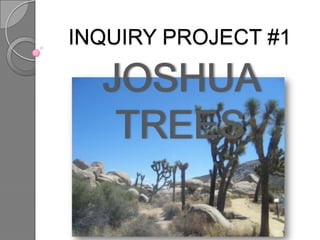
INQUIRY PROJECT #1JOSHUA TREES
MY EXPERIENCEThis summer I flew out to visit family in Palm Springs, California.   While I was in California my aunt and uncle took us sight-seeing to many different places.  One of the most interesting places they took us was to see the Joshua Trees in the Mojave Desert (approximately an hour out of Palm Springs).  We took a drive through the Joshua Tree National Park and it was an amazing sight and experience!
QUESTIONSWhere are Joshua trees found?What are some characteristics of Joshua trees?What does the weather need to be like for these trees to grow?What is the history of these trees?What are some interesting facts about Joshua trees?
Connections with Standards4th Grade Standard:  4.4.3 – Observe and describe that organisms interact with one another in various ways, such as providing food, pollination and seed dispersal.  *Talk about the pollination process of the moth and Joshua trees.5th Grade Standard:  5.4.4 – Explain that in any particular environment, some kinds of plants and animals survive well, some do not survive as well, and some cannot survive at all.  *Talk about the climate in the Mojave Desert, how Joshua trees only grow in this type of climate and how other plants could not survive this weather.
Where can you find Joshua trees?Joshua trees grow best at elevations between 2,000 and 6,000 feet. They also prefer flat or gently sloping terrain, and are usually supplanted on steep hills within their range by blackbrush and other scrubs.  Joshua trees are ONLY found in areas of southwestern California, Nevada, Utah, and Arizona.Taken from: http://www.livingdesert.org/plants/joshua_tree.asp
Characteristics of Joshua Trees  Scientific Name:  Yucca Brevifolia
Giant member of the Lily family
 Joshua trees have relatively short leaf blades and the bark is rough and grayish brown. Also have flower blooms during the months of February to late March
  It blooms from the terminal points of the stems and the flowers are arranged densely in the panicle or compound flower structure.
  Like all desert blooms, Joshua trees depend on just the perfect conditions: well-timed rains, and for the Joshua tree, a crisp winter freeze.
Some of their branches extend to 30 feet.

Educ373 Inquiry Project#1

  • 1.
  • 2.
    MY EXPERIENCEThis summerI flew out to visit family in Palm Springs, California. While I was in California my aunt and uncle took us sight-seeing to many different places. One of the most interesting places they took us was to see the Joshua Trees in the Mojave Desert (approximately an hour out of Palm Springs). We took a drive through the Joshua Tree National Park and it was an amazing sight and experience!
  • 3.
    QUESTIONSWhere are Joshuatrees found?What are some characteristics of Joshua trees?What does the weather need to be like for these trees to grow?What is the history of these trees?What are some interesting facts about Joshua trees?
  • 4.
    Connections with Standards4thGrade Standard: 4.4.3 – Observe and describe that organisms interact with one another in various ways, such as providing food, pollination and seed dispersal. *Talk about the pollination process of the moth and Joshua trees.5th Grade Standard: 5.4.4 – Explain that in any particular environment, some kinds of plants and animals survive well, some do not survive as well, and some cannot survive at all. *Talk about the climate in the Mojave Desert, how Joshua trees only grow in this type of climate and how other plants could not survive this weather.
  • 5.
    Where can youfind Joshua trees?Joshua trees grow best at elevations between 2,000 and 6,000 feet. They also prefer flat or gently sloping terrain, and are usually supplanted on steep hills within their range by blackbrush and other scrubs. Joshua trees are ONLY found in areas of southwestern California, Nevada, Utah, and Arizona.Taken from: http://www.livingdesert.org/plants/joshua_tree.asp
  • 6.
    Characteristics of JoshuaTrees Scientific Name: Yucca Brevifolia
  • 7.
    Giant member ofthe Lily family
  • 8.
    Joshua treeshave relatively short leaf blades and the bark is rough and grayish brown. Also have flower blooms during the months of February to late March
  • 9.
    Itblooms from the terminal points of the stems and the flowers are arranged densely in the panicle or compound flower structure.
  • 10.
    Likeall desert blooms, Joshua trees depend on just the perfect conditions: well-timed rains, and for the Joshua tree, a crisp winter freeze.
  • 11.
    Some of theirbranches extend to 30 feet.