Marion General Hospital Formulary Evaluation
Monograph
Generic Name (Trade Name): Edoxaban (Savaysa)
Manufacturer: Daiichi Sankyo, Inc
Dosage Forms (NDC #): oral tablet
AHFS Class: Anticoagulant
Storage: 20-25°C
Description and Pharmacology: Edoxaban is an oral anticoagulant that inhibits Factor Xa to prevent the formation of
thrombin.
Pharmacokinetics
• See supplementary handout
FDA-Approved Indications1
• Reduce the risk of stroke and systemic embolism in patients with nonvalvular atrial fibrillation.
• Treatment of DVT and PE 5-10 days after initial therapy with a parenteral anticoagulant
Clinical Trials
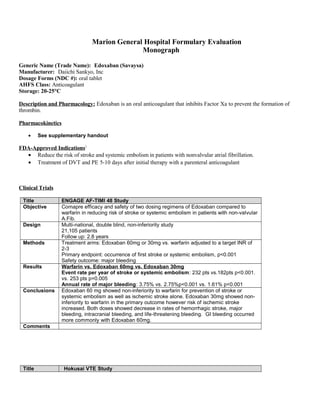
Title ENGAGE AF-TIMI 48 Study
Objective Comapre efficacy and safety of two dosing regimens of Edoxaban compared to
warfarin in reducing risk of stroke or systemic embolism in patients with non-valvular
A.Fib.
Design Multi-national, double blind, non-inferiority study
21,105 patients
Follow up: 2.8 years
Methods Treatment arms: Edoxaban 60mg or 30mg vs. warfarin adjusted to a target INR of
2-3
Primary endpoint: occurrence of first stroke or systemic embolism, p<0.001
Safety outcome: major bleeding
Results Warfarin vs. Edoxaban 60mg vs. Edoxaban 30mg
Event rate per year of stroke or systemic embolism: 232 pts vs.182pts p<0.001.
vs. 253 pts p=0.005
Annual rate of major bleeding: 3.75% vs. 2.75%p<0.001 vs. 1.61% p<0.001
Conclusions Edoxaban 60 mg showed non-inferiority to warfarin for prevention of stroke or
systemic embolism as well as ischemic stroke alone. Edoxaban 30mg showed non-
inferiority to warfarin in the primary outcome however risk of ischemic stroke
increased. Both doses showed decrease in rates of hemorrhagic stroke, major
bleeding, intracranial bleeding, and life-threatening bleeding. GI bleeding occurred
more commonly with Edoxaban 60mg.
Comments
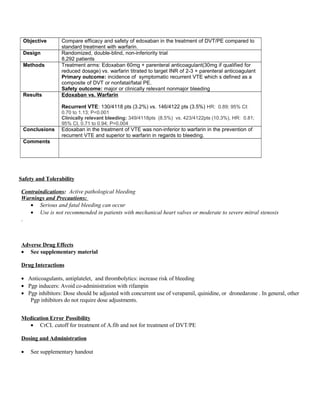
Title Hokusai VTE Study
Objective Compare efficacy and safety of edoxaban in the treatment of DVT/PE compared to
standard treatment with warfarin.
Design Randomized, double-blind, non-inferiority trial
8,292 patients
Methods Treatment arms: Edoxaban 60mg + parenteral anticoagulant(30mg if qualified for
reduced dosage) vs. warfarin titrated to target INR of 2-3 + parenteral anticoagulant
Primary outcome: incidence of symptomatic recurrent VTE which s defined as a
composite of DVT or nonfatal/fatal PE.
Safety outcome: major or clinically relevant nonmajor bleeding
Results Edoxaban vs. Warfarin
Recurrent VTE: 130/4118 pts (3.2%) vs. 146/4122 pts (3.5%) HR: 0.89; 95% CI:
0.70 to 1.13; P<0.001
Clinically relevant bleeding: 349/4118pts (8.5%) vs. 423/4122pts (10.3%), HR: 0.81;
95% CI, 0.71 to 0.94; P=0.004
Conclusions Edoxaban in the treatment of VTE was non-inferior to warfarin in the prevention of
recurrent VTE and superior to warfarin in regards to bleeding.
Comments
Safety and Tolerability
Contraindications: Active pathological bleeding
Warnings and Precautions:
• Serious and fatal bleeding can occur
• Use is not recommended in patients with mechanical heart valves or moderate to severe mitral stenosis
.
Adverse Drug Effects
• See supplementary material
Drug Interactions
• Anticoagulants, antiplatelet, and thrombolytics: increase risk of bleeding
• Pgp inducers: Avoid co-administration with rifampin
• Pgp inhibitors: Dose should be adjusted with concurrent use of verapamil, quinidine, or dronedarone . In general, other
Pgp inhibitors do not require dose adjustments.
Medication Error Possibility
• CrCL cutoff for treatment of A.fib and not for treatment of DVT/PE
Dosing and Administration
• See supplementary handout
References:
1. Edoxaban [Package Insert]. Tokyo: Daiichi Sankyo, Inc; 2015.
2. Giugliano RP. Effective anticoagulation with factor Xa next generation in atrial fibrillation-TIMI 48. Powerpoint
presentation: http://my.americanheart.org/idc/groups/ahamah-
public/@wcm/@sop/@scon/documents/downloadable/ucm_458280.pdf. Accessed April 21, 2015.

Edoxaban monograph

  • 1.
    Marion General HospitalFormulary Evaluation Monograph Generic Name (Trade Name): Edoxaban (Savaysa) Manufacturer: Daiichi Sankyo, Inc Dosage Forms (NDC #): oral tablet AHFS Class: Anticoagulant Storage: 20-25°C Description and Pharmacology: Edoxaban is an oral anticoagulant that inhibits Factor Xa to prevent the formation of thrombin. Pharmacokinetics • See supplementary handout FDA-Approved Indications1 • Reduce the risk of stroke and systemic embolism in patients with nonvalvular atrial fibrillation. • Treatment of DVT and PE 5-10 days after initial therapy with a parenteral anticoagulant Clinical Trials Title ENGAGE AF-TIMI 48 Study Objective Comapre efficacy and safety of two dosing regimens of Edoxaban compared to warfarin in reducing risk of stroke or systemic embolism in patients with non-valvular A.Fib. Design Multi-national, double blind, non-inferiority study 21,105 patients Follow up: 2.8 years Methods Treatment arms: Edoxaban 60mg or 30mg vs. warfarin adjusted to a target INR of 2-3 Primary endpoint: occurrence of first stroke or systemic embolism, p<0.001 Safety outcome: major bleeding Results Warfarin vs. Edoxaban 60mg vs. Edoxaban 30mg Event rate per year of stroke or systemic embolism: 232 pts vs.182pts p<0.001. vs. 253 pts p=0.005 Annual rate of major bleeding: 3.75% vs. 2.75%p<0.001 vs. 1.61% p<0.001 Conclusions Edoxaban 60 mg showed non-inferiority to warfarin for prevention of stroke or systemic embolism as well as ischemic stroke alone. Edoxaban 30mg showed non- inferiority to warfarin in the primary outcome however risk of ischemic stroke increased. Both doses showed decrease in rates of hemorrhagic stroke, major bleeding, intracranial bleeding, and life-threatening bleeding. GI bleeding occurred more commonly with Edoxaban 60mg. Comments Title Hokusai VTE Study
  • 2.
    Objective Compare efficacyand safety of edoxaban in the treatment of DVT/PE compared to standard treatment with warfarin. Design Randomized, double-blind, non-inferiority trial 8,292 patients Methods Treatment arms: Edoxaban 60mg + parenteral anticoagulant(30mg if qualified for reduced dosage) vs. warfarin titrated to target INR of 2-3 + parenteral anticoagulant Primary outcome: incidence of symptomatic recurrent VTE which s defined as a composite of DVT or nonfatal/fatal PE. Safety outcome: major or clinically relevant nonmajor bleeding Results Edoxaban vs. Warfarin Recurrent VTE: 130/4118 pts (3.2%) vs. 146/4122 pts (3.5%) HR: 0.89; 95% CI: 0.70 to 1.13; P<0.001 Clinically relevant bleeding: 349/4118pts (8.5%) vs. 423/4122pts (10.3%), HR: 0.81; 95% CI, 0.71 to 0.94; P=0.004 Conclusions Edoxaban in the treatment of VTE was non-inferior to warfarin in the prevention of recurrent VTE and superior to warfarin in regards to bleeding. Comments Safety and Tolerability Contraindications: Active pathological bleeding Warnings and Precautions: • Serious and fatal bleeding can occur • Use is not recommended in patients with mechanical heart valves or moderate to severe mitral stenosis . Adverse Drug Effects • See supplementary material Drug Interactions • Anticoagulants, antiplatelet, and thrombolytics: increase risk of bleeding • Pgp inducers: Avoid co-administration with rifampin • Pgp inhibitors: Dose should be adjusted with concurrent use of verapamil, quinidine, or dronedarone . In general, other Pgp inhibitors do not require dose adjustments. Medication Error Possibility • CrCL cutoff for treatment of A.fib and not for treatment of DVT/PE Dosing and Administration • See supplementary handout
  • 3.
    References: 1. Edoxaban [PackageInsert]. Tokyo: Daiichi Sankyo, Inc; 2015. 2. Giugliano RP. Effective anticoagulation with factor Xa next generation in atrial fibrillation-TIMI 48. Powerpoint presentation: http://my.americanheart.org/idc/groups/ahamah- public/@wcm/@sop/@scon/documents/downloadable/ucm_458280.pdf. Accessed April 21, 2015.