Consulting with EDA Joe Miller’s Experience What is EDA The Future of Nuclear Energy
Joe Miller’s Experience (Joseph S. Miller is President of EDA) Academics BSIE University of Arkansas BSME University of Arkansas MSNE Kansas State University Post Graduate Courses at Idaho State and America University
Joe Miller’s Experience 35 years of engineering, fuel, operations and maintenance support for nuclear power plants 15 years of nuclear/mechanical design 12 years of operation and maintenance support at operating plants 10 years of regulatory and licensing support 7 years of probabilistic risk assessment support 7 years of nuclear fuel support
Joe Miller’s Experience NUS Corp; Rockville, MD INEL/EGG Idaho; Idaho Falls, ID Black & Veatch; Overland Park, Ks Gulf States Utilities/Entergy;  River Bend Station; St. Francisville, LA Scientech;  Rockville, MD EDA Inc; Vienna, VA; 1996 to present
Joe Miller’s Experience Certifications Professional Engineer in Maryland and Louisiana Microsoft Certified in Windows Server and Windows Professional Cisco Network Certified
Joe Miller’s Experience 26 published papers 2 US Patents 2 Foreign Patents Director of Communications for the ASME Nuclear Engineering Division executive committee.  Track Chair for ICONE14, ICONE15 and ICONE16.   Technical Program Chair for ICONE17
Technical Committees Co-Chair of ASME/NED Systems, Structures and Components Design and Analysis Subcommittee Co-Chair of ASME/NED Thermal Hydraulics Committee on System Software Chair of ASME/NED Plant Operation and Maintenance Committee Member of ASME Energy Committee
What Is EDA? Engineering Design and Analysis Founded in 1996 President and founder is Joe Miller Specializes in Support to the Utilities and the NRC
EDA can Provide Design Support Design Reviews and Evaluations Modification Packages Support Root Cause Evaluations Licensing Support for Design Submittals Full Quality Assurance Support Audit Support
EDA can Provide Analysis Support Analytical Simulation of Systems Design and Support Calculations
EDA Clients/Projects Exelon Computer Code Training Aux Feedwater Modeling Audit of Fuel Vendor Technical Specification Changes NRC Inspection Support at Plants Piping Loads on Reactor Fan Cooler Evaluate RWCU Anomalies  Support Westinghouse on Safety Analyses for New Steam Generators
EDA Clients/Projects NRC Inspection at Plants Small Break Evaluation Using TRACE Phase 2 & 3 b5b Security Inspections New Plant Reviews AmerGen Energy /Oyster Creek Heater Drain System Simulation I & C Sensitivity Study
EDA Clients/Projects Florida Power & Light RHR Restart Evaluation Licensing Support Public Service Enterprise Group/Peach Bottom Moisture Separator Drain Tank Evaluation Plant Modification Recommendations
EDA Clients/Projects Boiling Water Reactor Owners Group Audit of General Electric for BWR Stability Calculations Licensing Support NUPIC (Nuclear Procurement Issues Committee) Audit General Electric on LOCA Analyses Procedure Modification Recommendations
EDA Clients/Projects EDA Establish Corporate QA Procedures Calculation QA Procedures Software QA Procedures Develop Web Sites Develop Intranet for Office
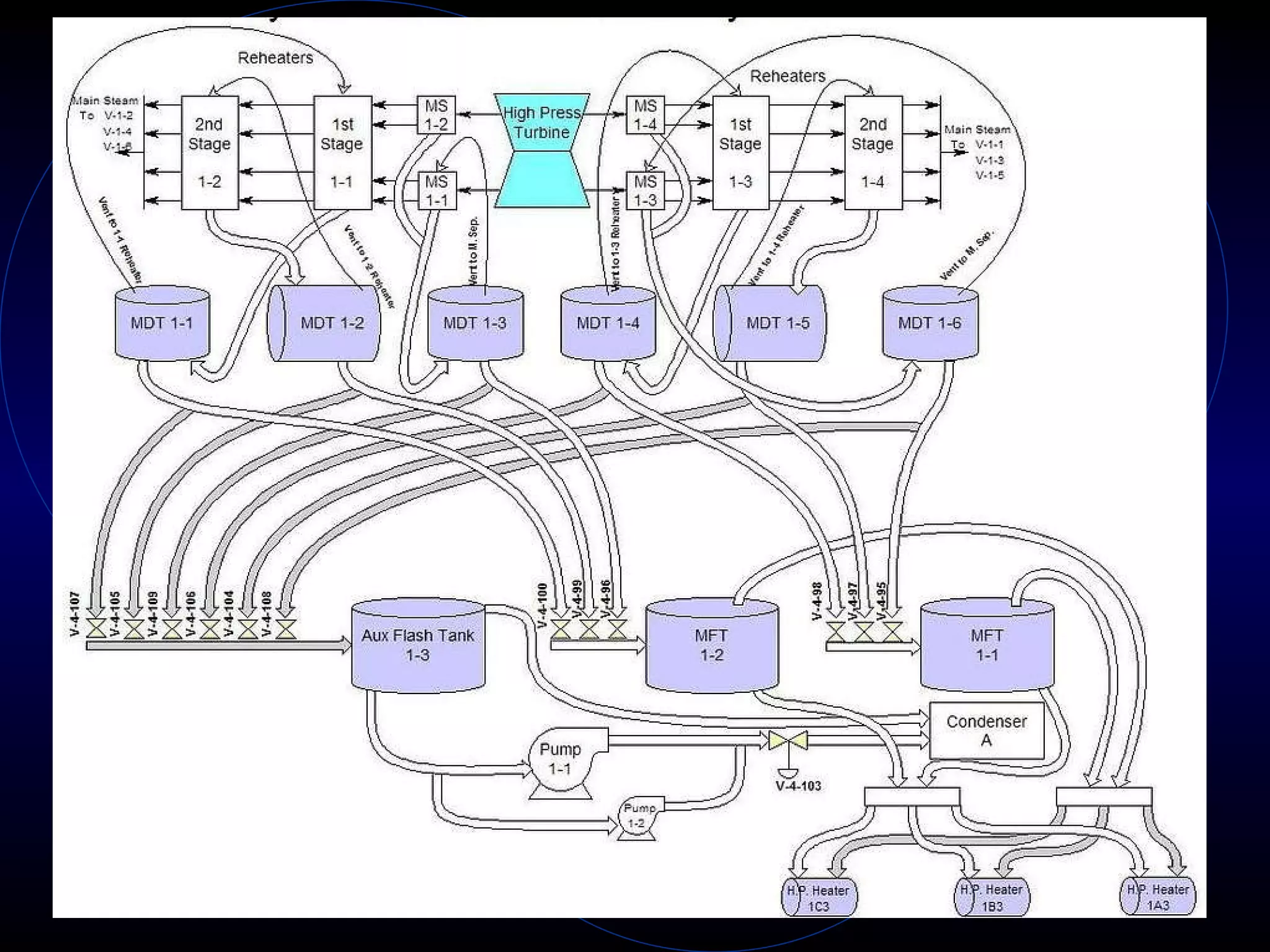
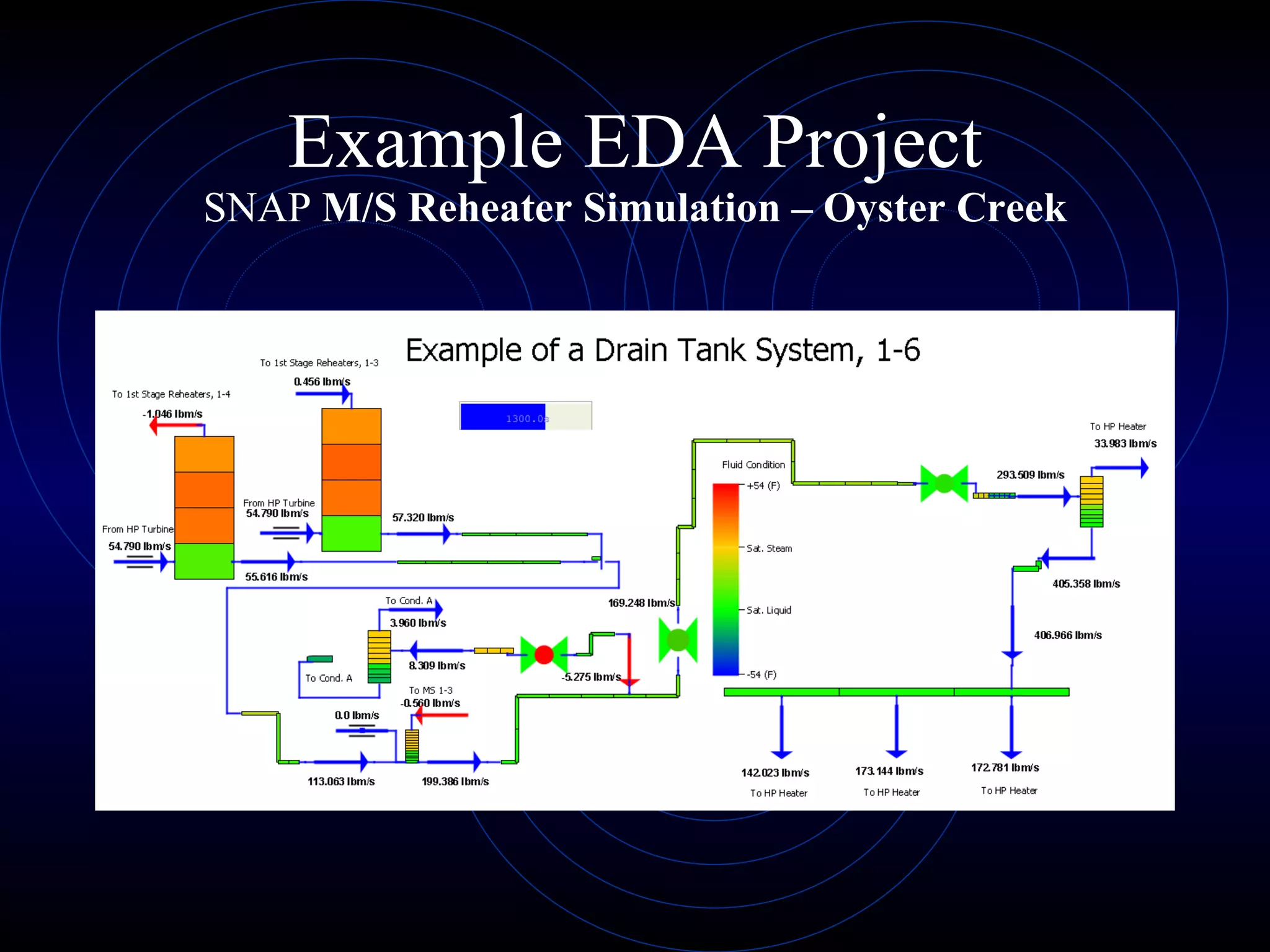
Example EDA Project M/S Reheater Simulation – Oyster Creek EDA received Call from Engineer at Oyster Creek plant An Exelon Engineer recommended EDA for the work that they required. OC asked for a bid on the job. OC paid $5000 so EDA could gather information from the site. EDA developed a bid for $75,000 and sent it to the Utility.
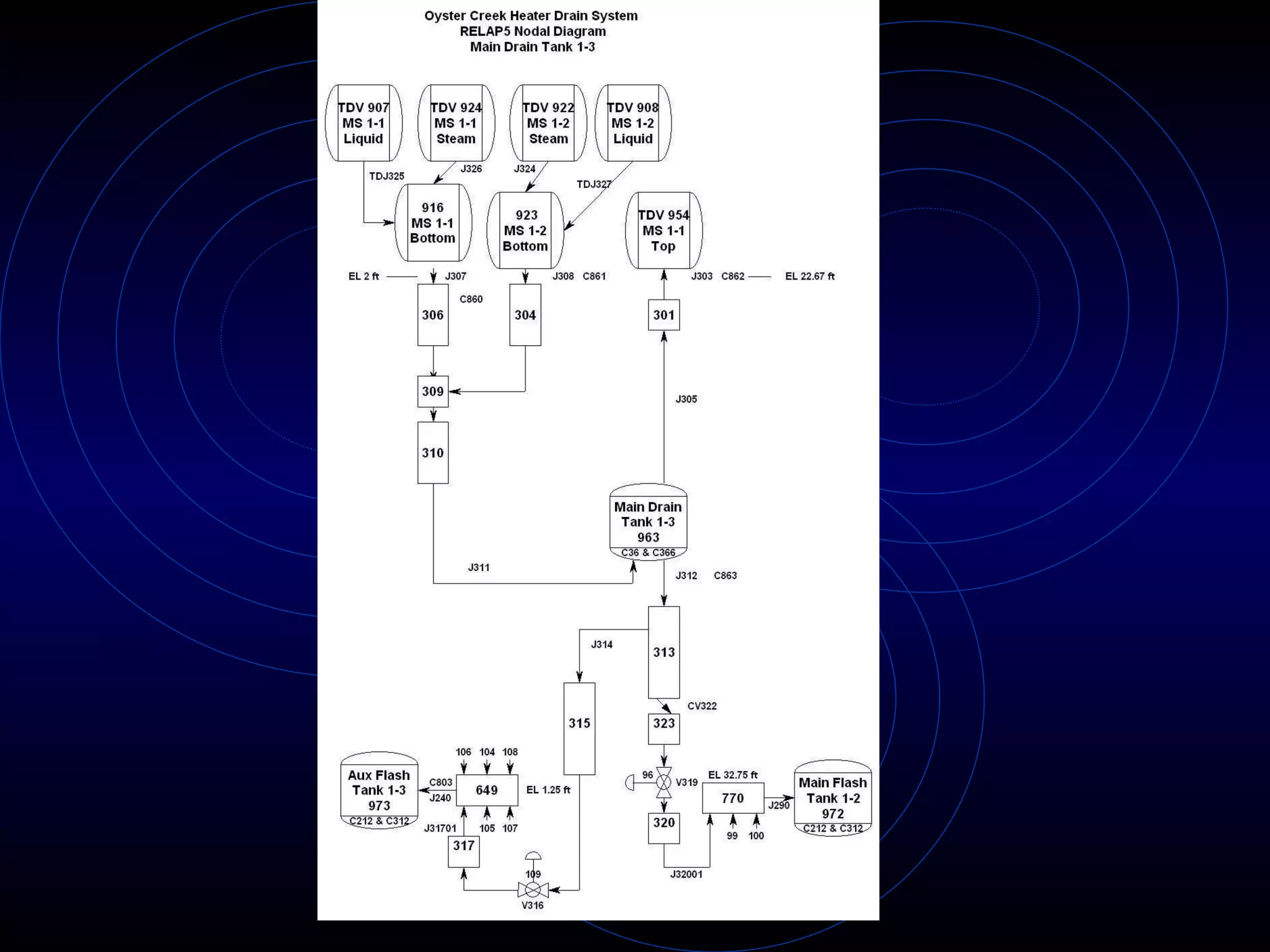
Example EDA Project M/S Reheater Simulation – Oyster Creek The work was projected to be complete in 5 months. EDA used Joe Miller and a associate engineer to perform the work. The RELAP5 program was used to perform the simulation. A model was developed and a simulation of the system was performed.
Example EDA Project M/S Reheater Simulation – Oyster Creek The results showed that the oscillations in two of the six pipe lines caused significant oscillations in the system piping. EDA recommend that level instrumentation for these two tanks be modified with delays. Further sensitivities were performed to determine the instrumentation settings that allowed these delays to occur.
Example EDA Project M/S Reheater Simulation – Oyster Creek
 
Example EDA Project SNAP  M/S Reheater Simulation – Oyster Creek
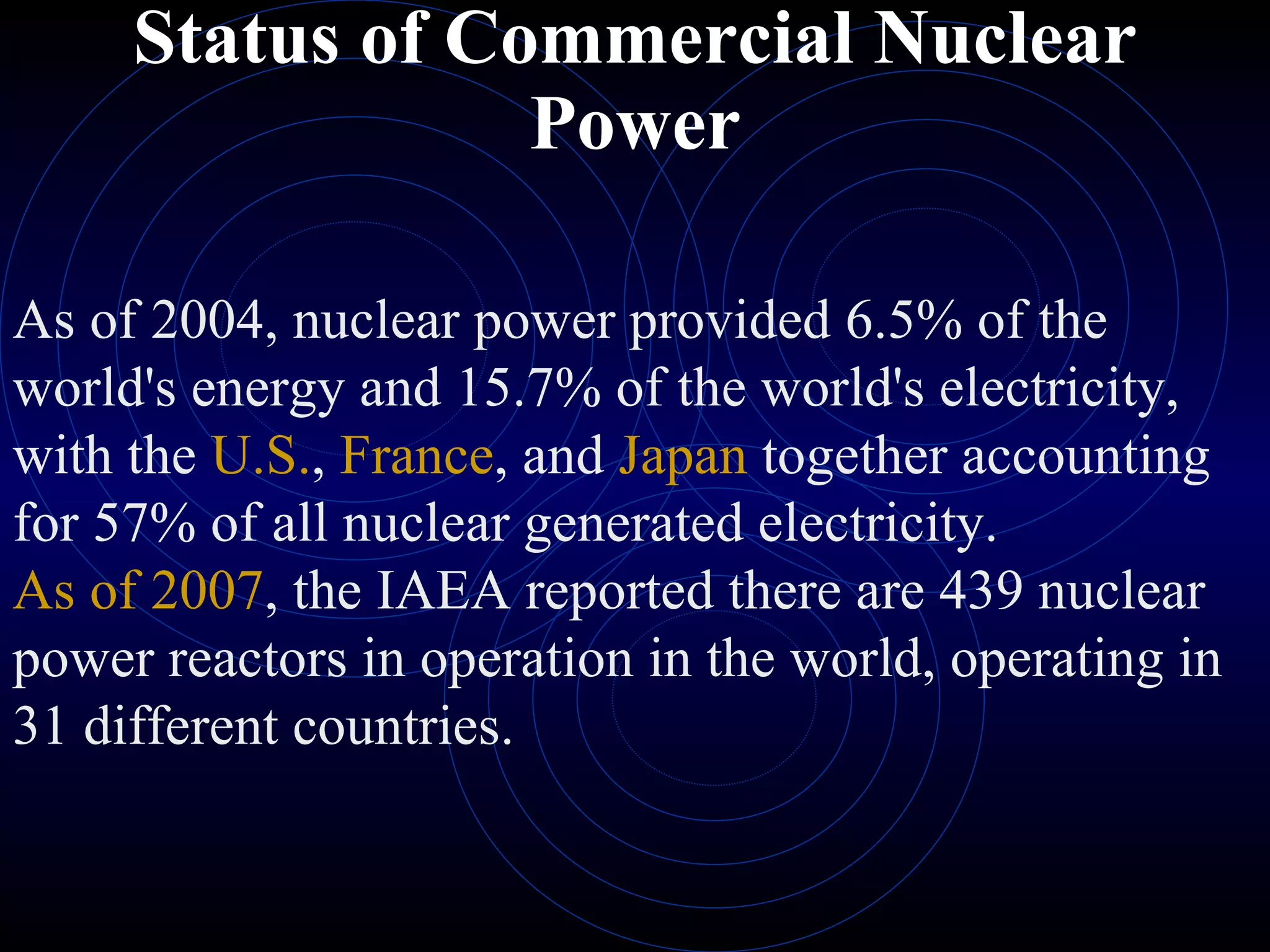
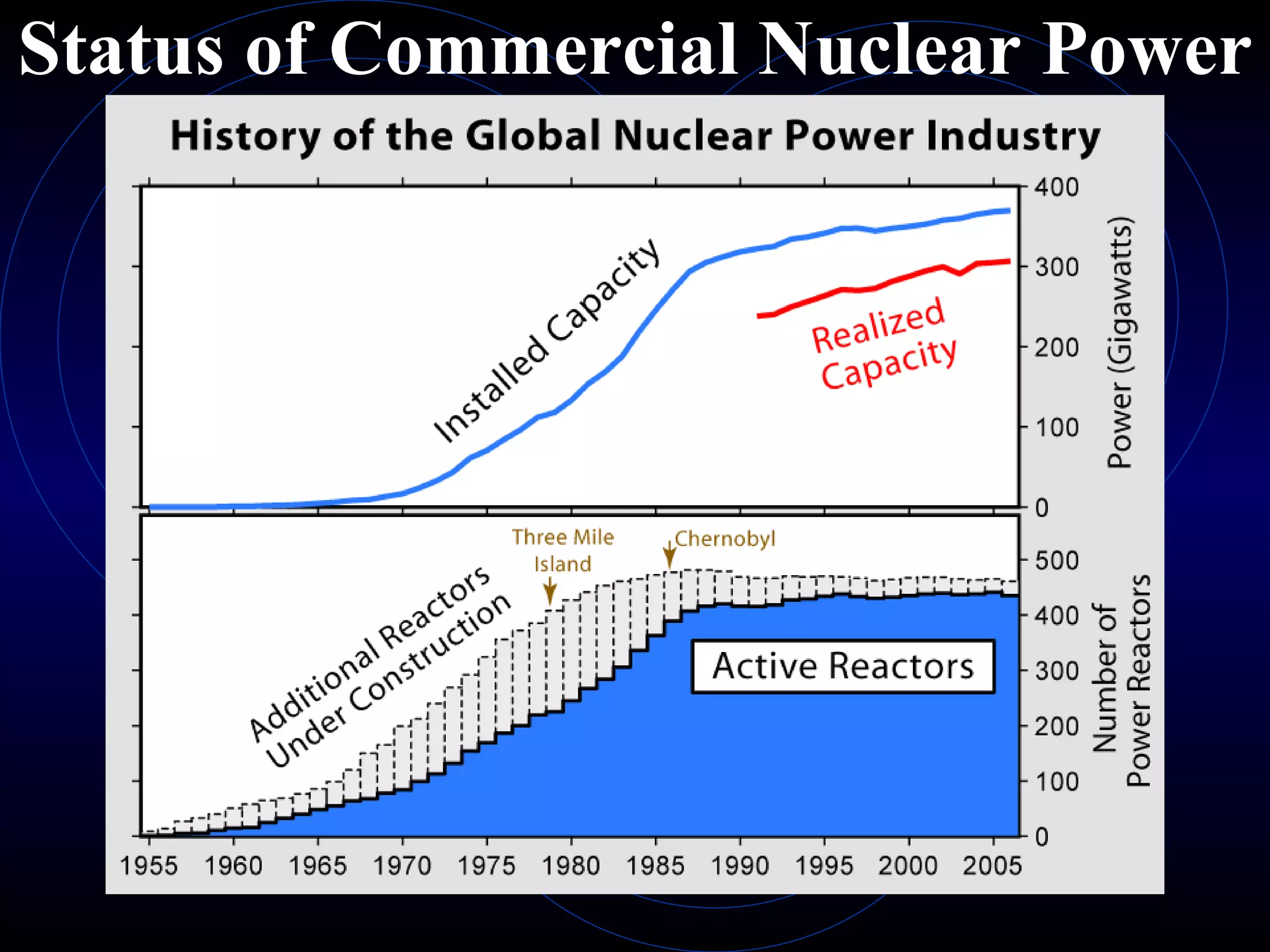
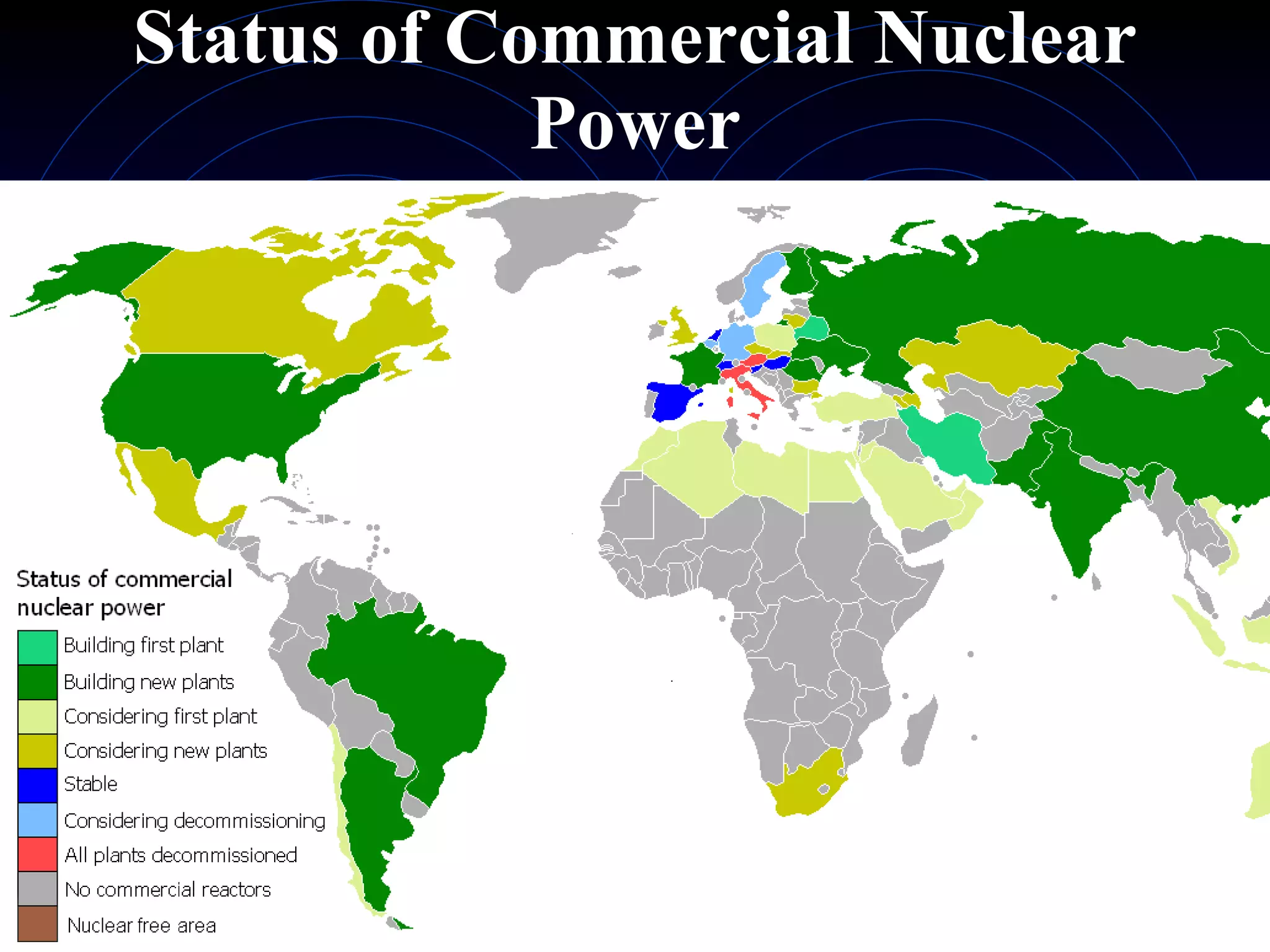
Status of Commercial Nuclear Power As of 2004, nuclear power provided 6.5% of the world's energy and 15.7% of the world's electricity, with the  U.S. ,  France , and  Japan  together accounting for 57% of all nuclear generated electricity.  As of 2007 , the IAEA reported there are 439 nuclear power reactors in operation in the world, operating in 31 different countries.
Status of Commercial Nuclear Power
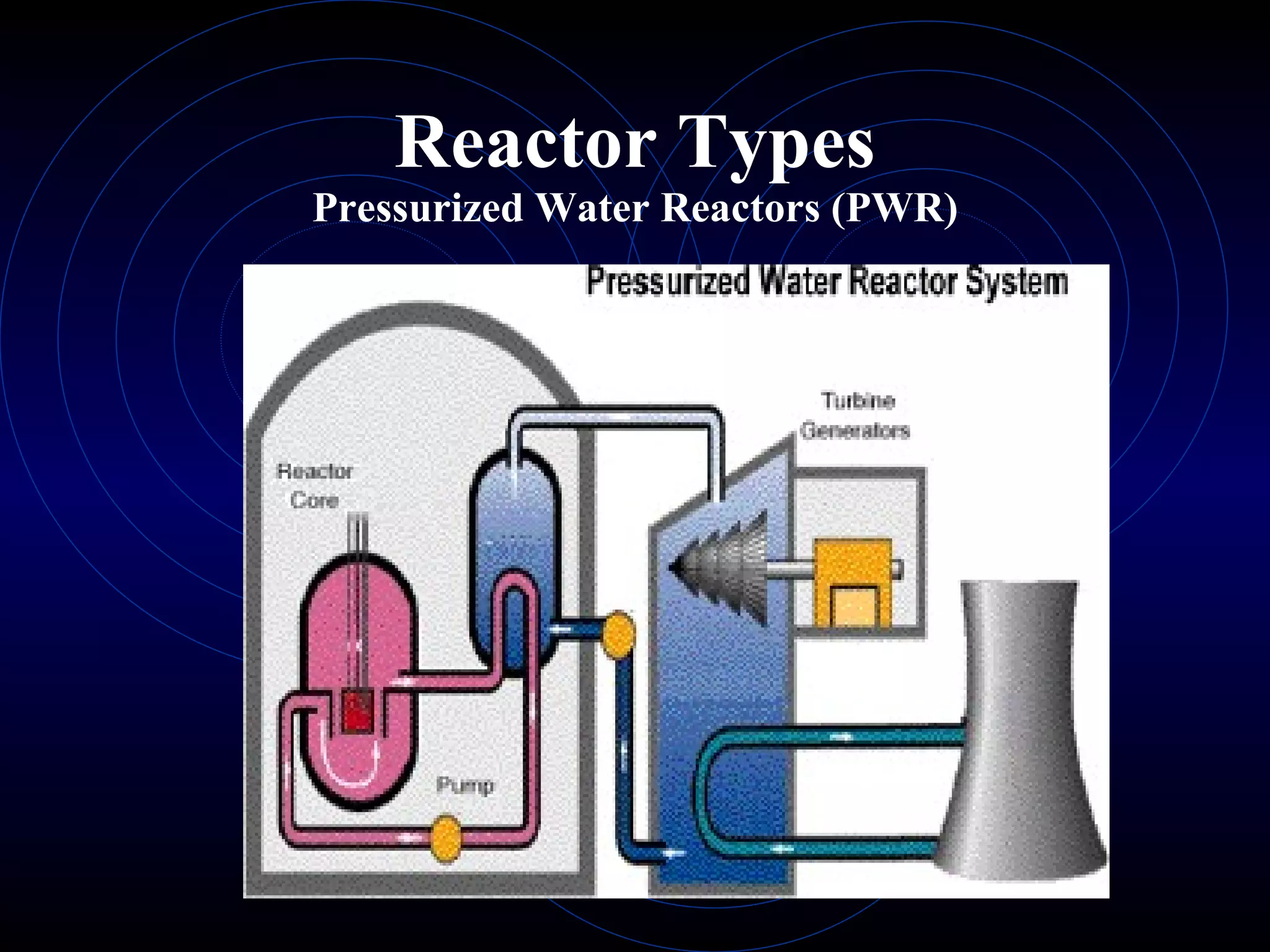
Reactor Types Pressurized Water Reactors (PWR)
 
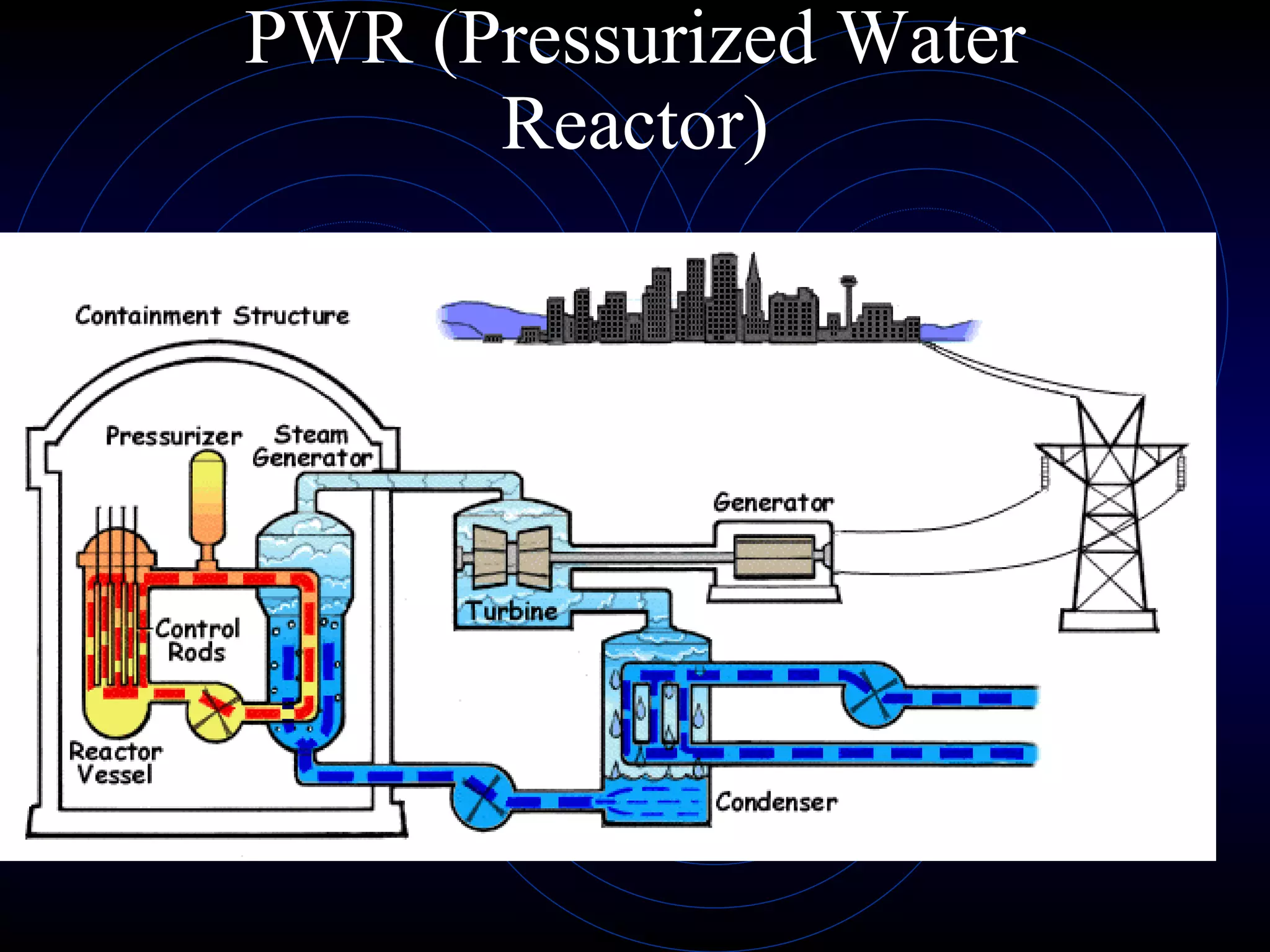
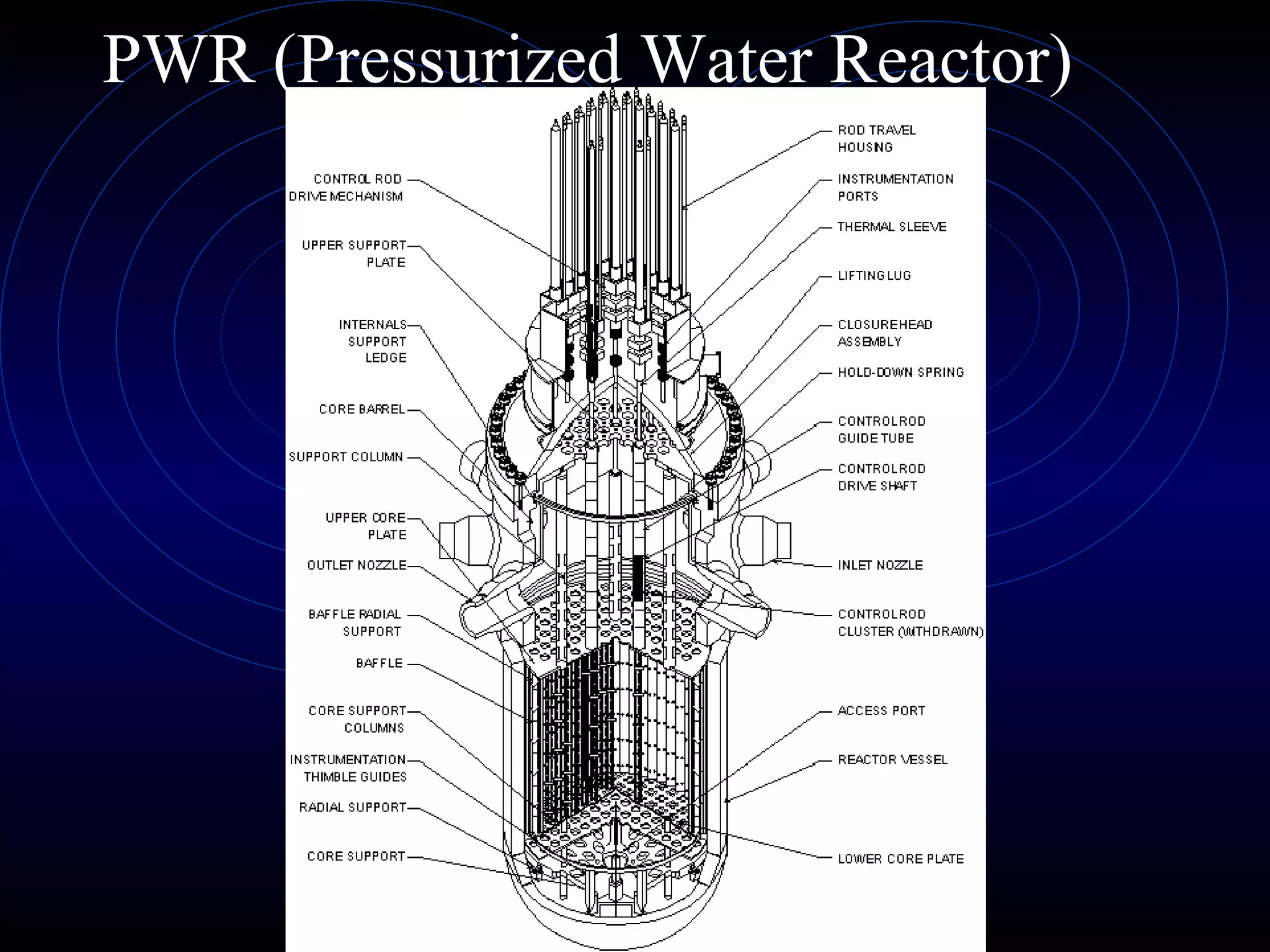
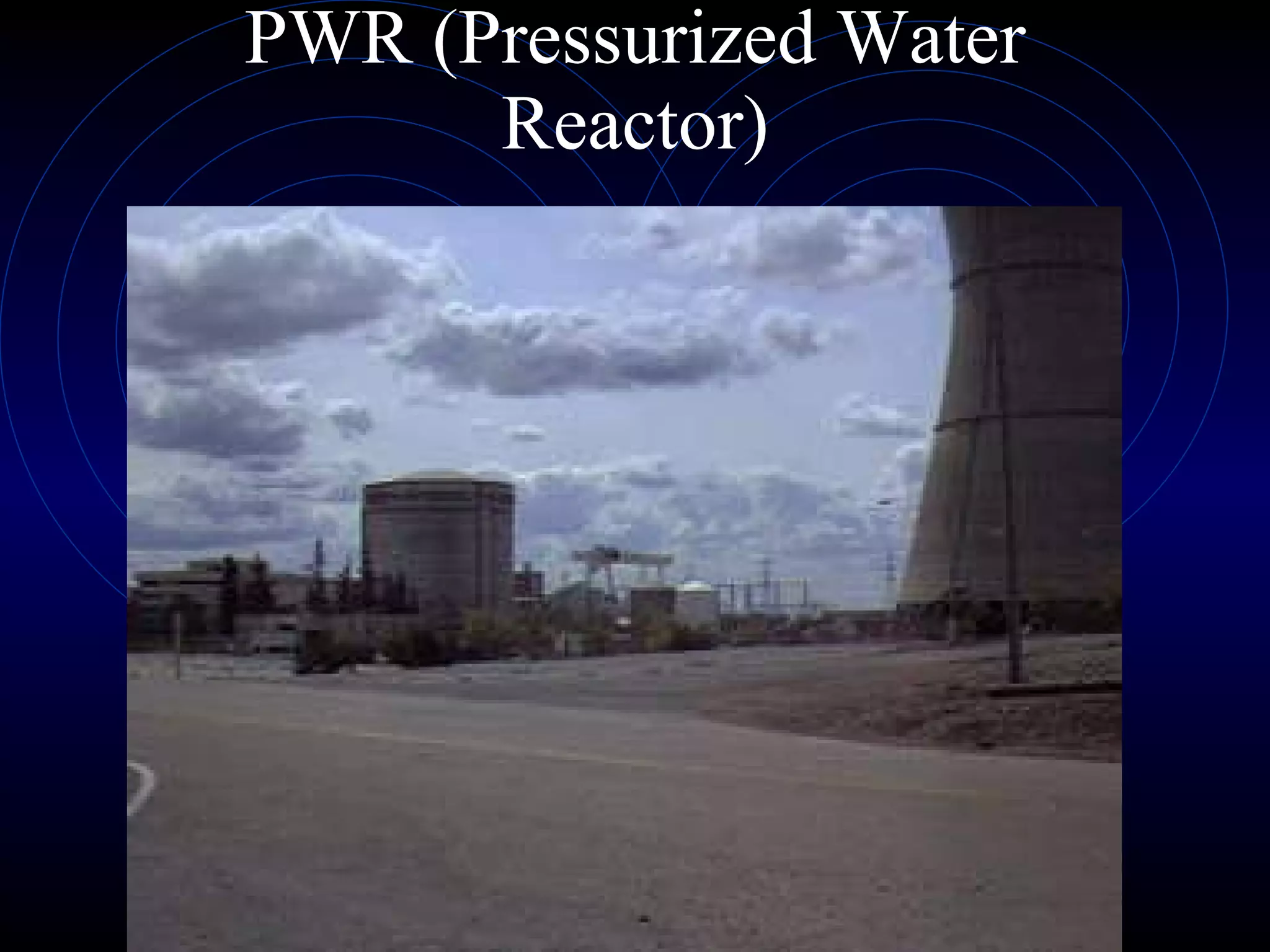
PWR (Pressurized Water Reactor)
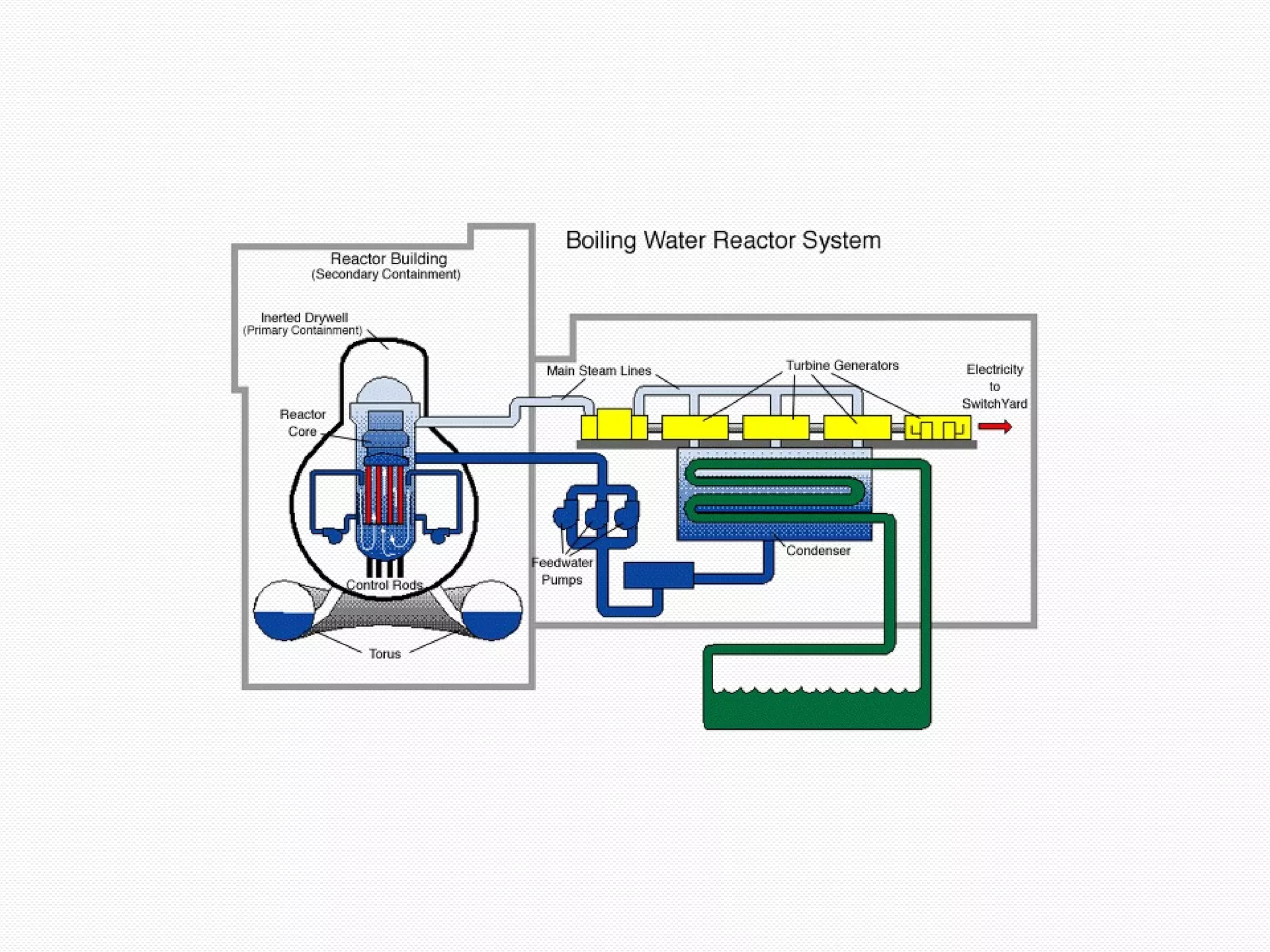
Reactor Types Other Types of Reactors PHW Candu: Pressurized Heavy Water Candu BLW Candu: Boiling Light Water Candu BHWR: Boiling Heavy Water Reactor SGHWR: Steam Generating Heavy Water Reactor PHWR: Pressure Vessel Heavy Water Reactor LWCHWR: Light Water Cooled Heavy Water Reactor GCR: Gas Cooled Reactor MAGNOX: Magnox Type Gas Cooled Reactor AGR: Advanced Gas Cooled Reactor HTGR: High Temperature Gas Cooled Reactor FBR: Fast Breeder Reactor LWBR: Light Water Breeder Reactor GCHWR: Gas Cooled Heavy Water Reactor LWGR: Light Water Cooled Graphite Reactor
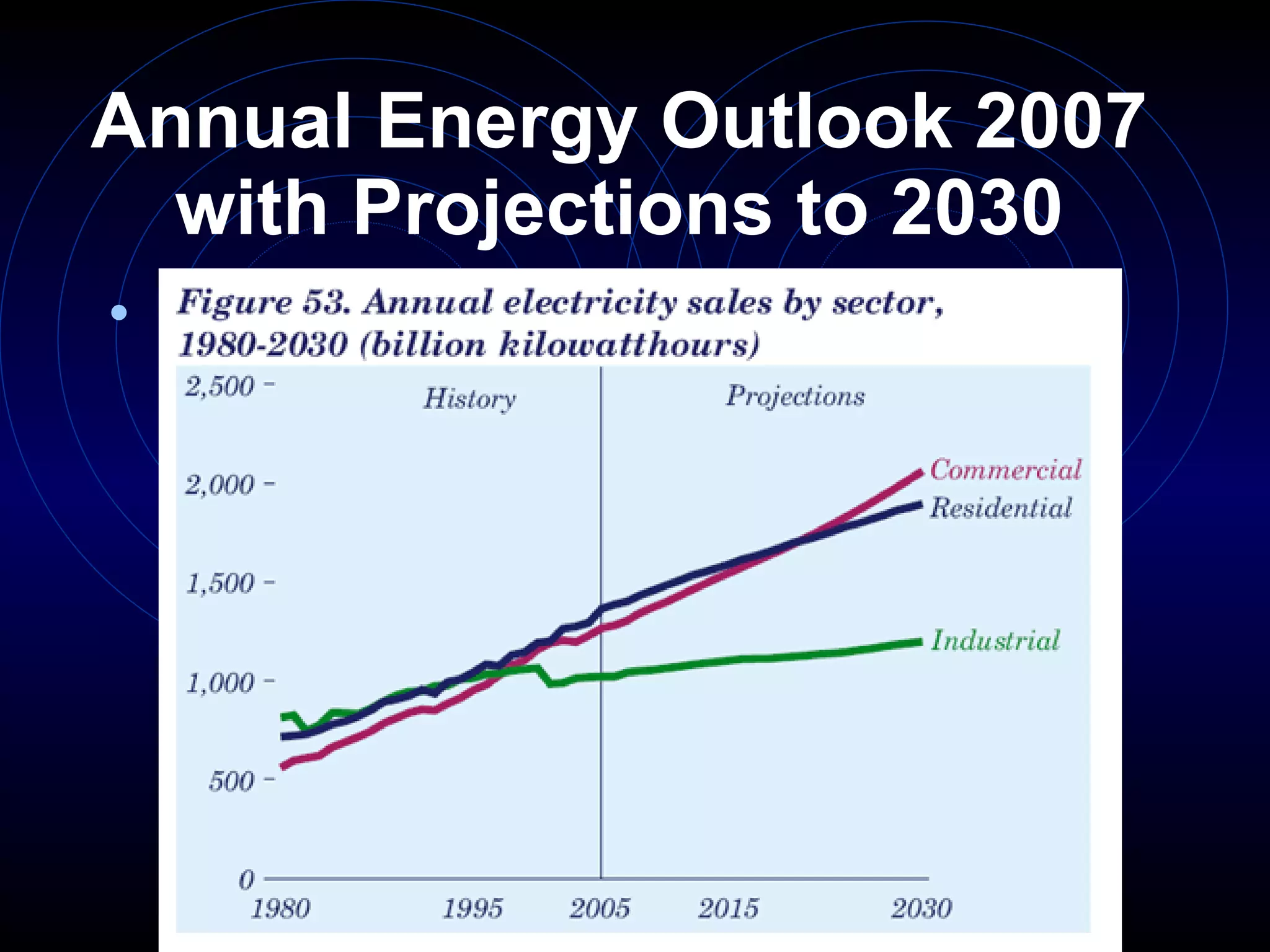
Annual Energy Outlook 2007 with Projections to 2030
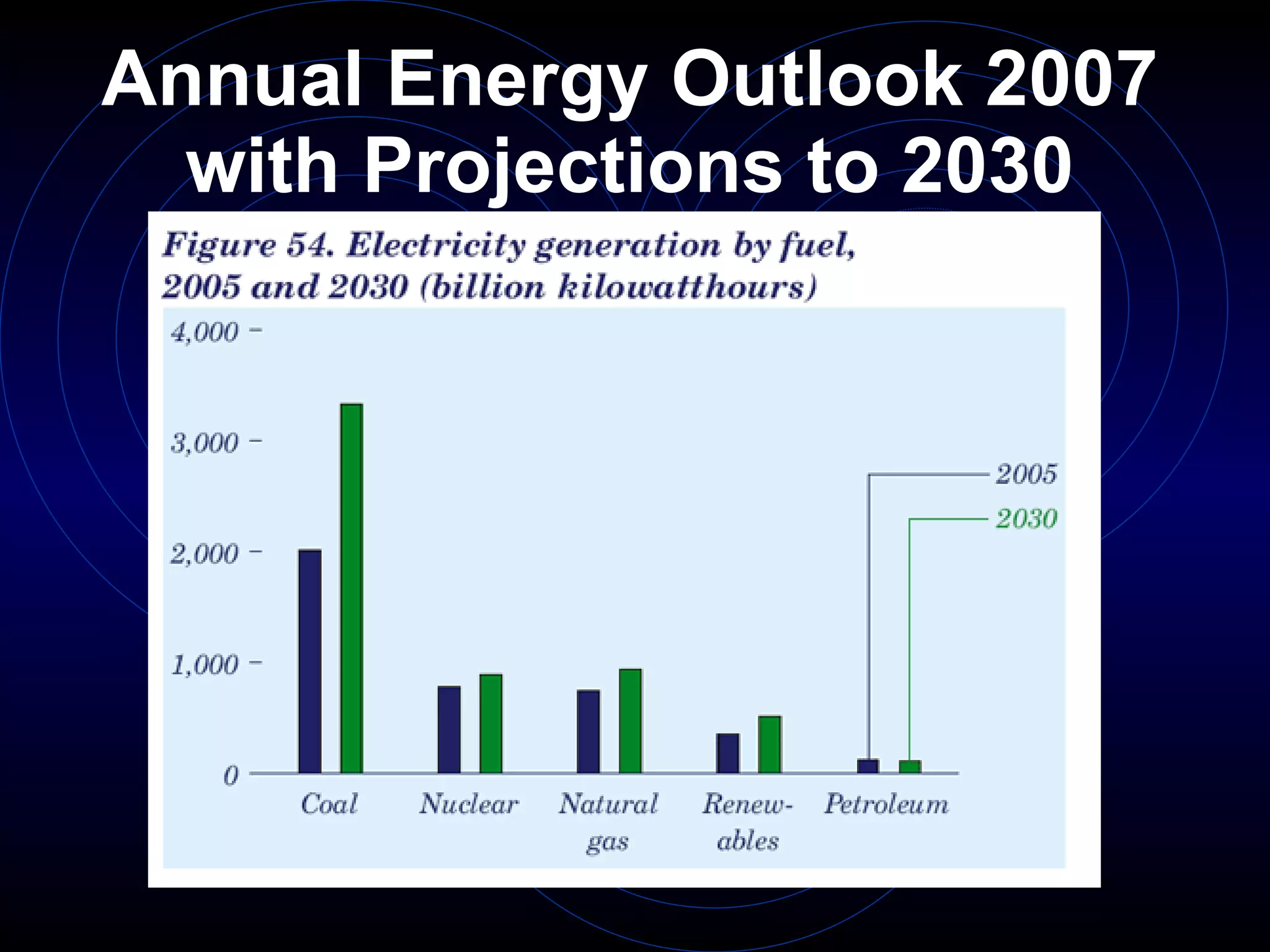
Annual Electric Sales Total electricity sales increase by 41 percent from 3,660 billion kilowatt-hours in 2005 to 5,168 billion kilowatt-hours in 2030.  The largest increase is in the commercial sector (Figure 53), as service industries continue to drive growth.  Electricity sales, which are strongly affected by the rate of economic growth, are projected to grow by 54 percent to 5,654 billion kilowatt-hours in 2030.
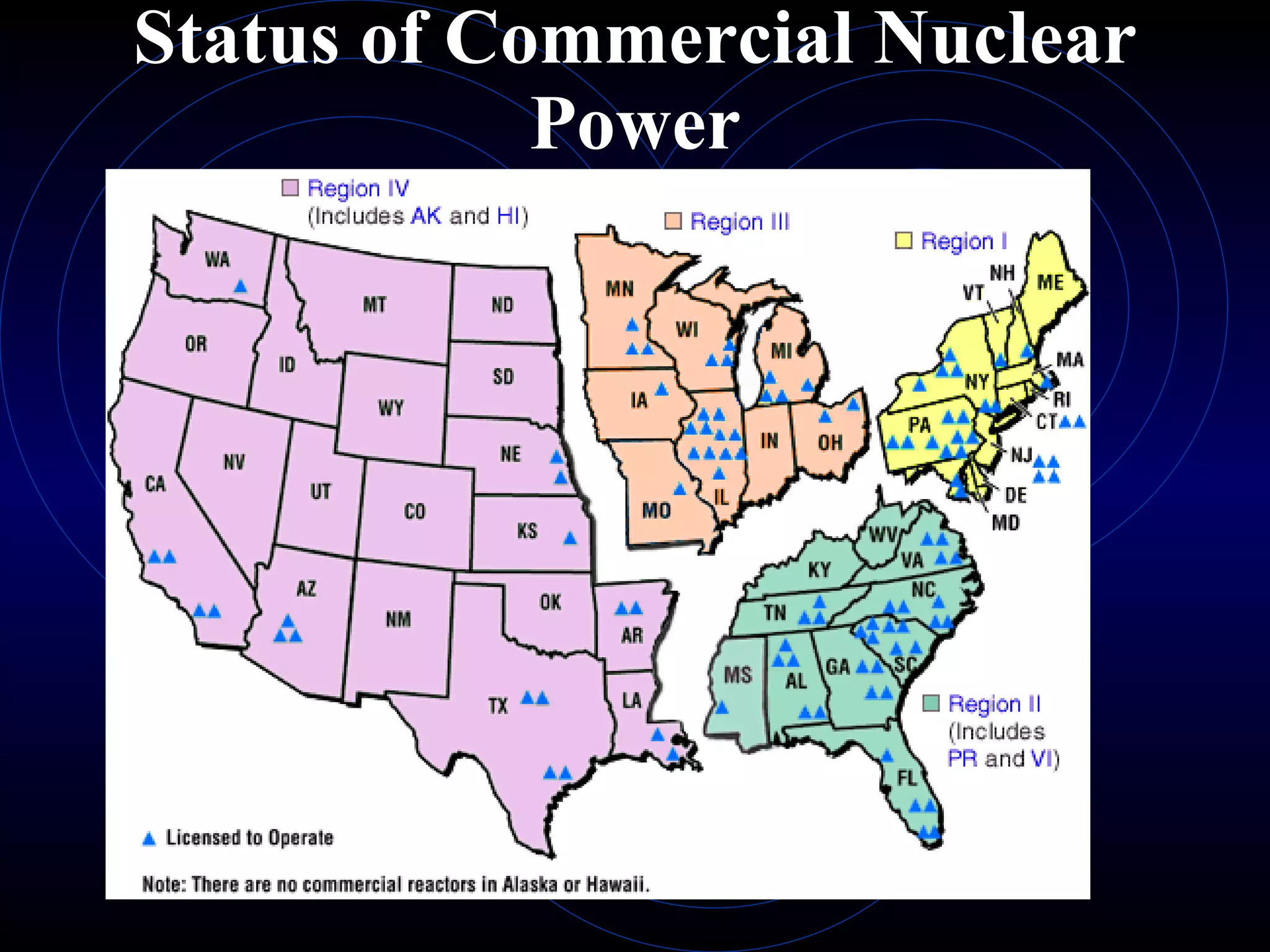
Status of Commercial Nuclear Power
Annual Energy Outlook 2007 with Projections to 2030
Global Fossil Emissions
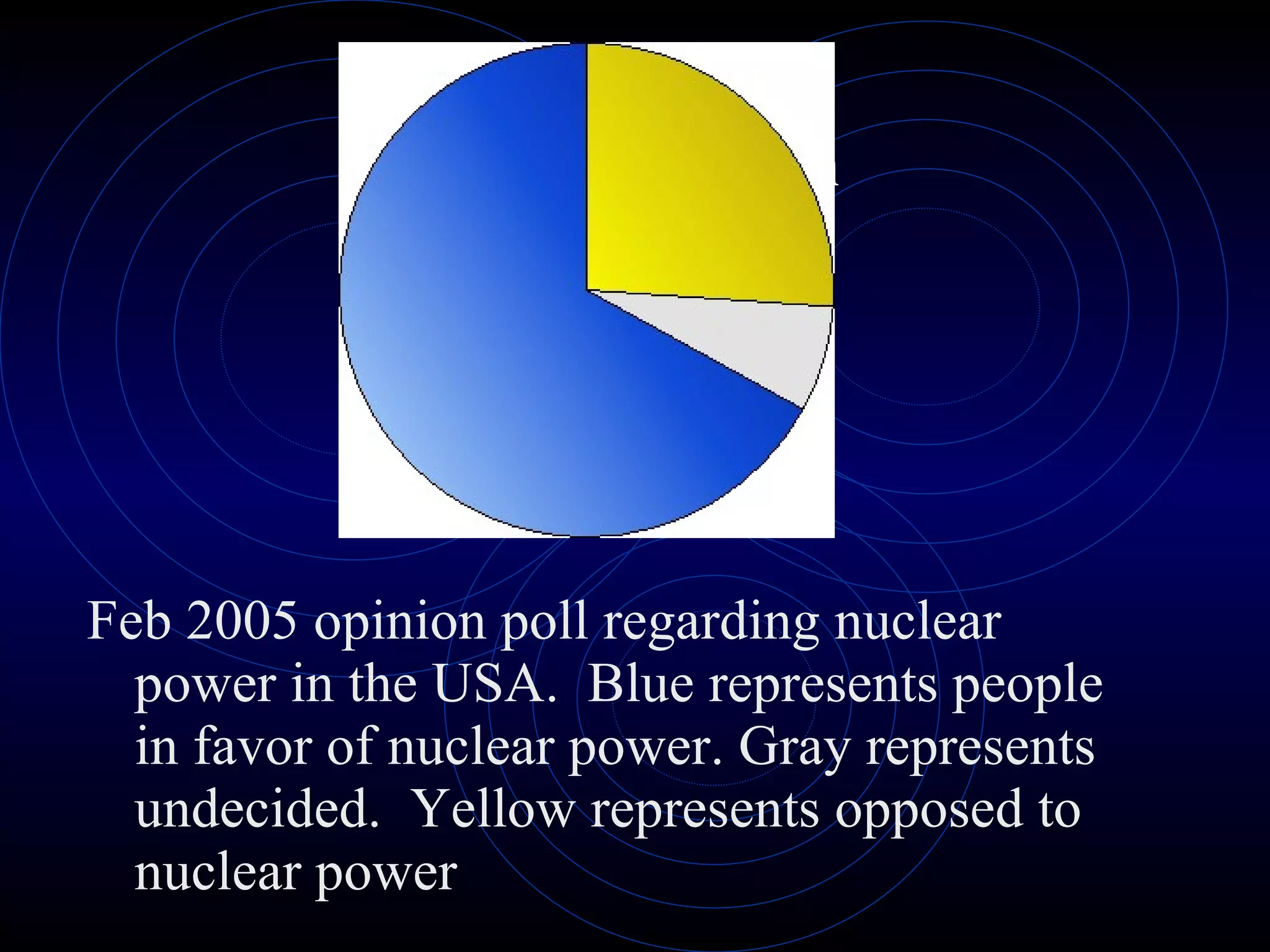
Public Opinion Feb 2005 opinion poll regarding nuclear power in the USA.  Blue represents people in favor of nuclear power. Gray represents undecided.  Yellow represents opposed to nuclear power
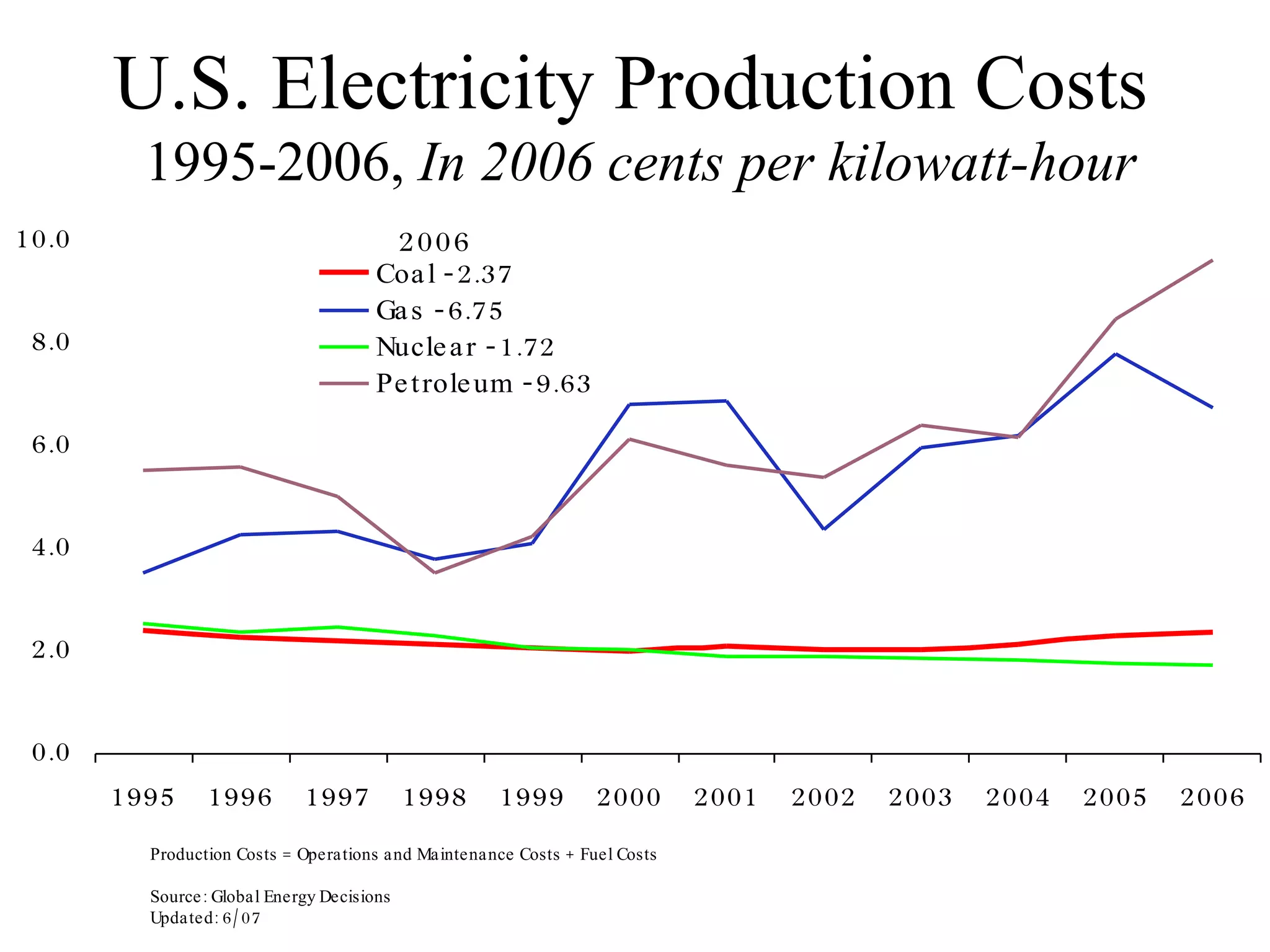
U.S. Electricity Production Costs  1995-2006,  In 2006 cents per kilowatt-hour Production Costs = Operations and Maintenance Costs + Fuel Costs Source: Global Energy Decisions Updated: 6/07
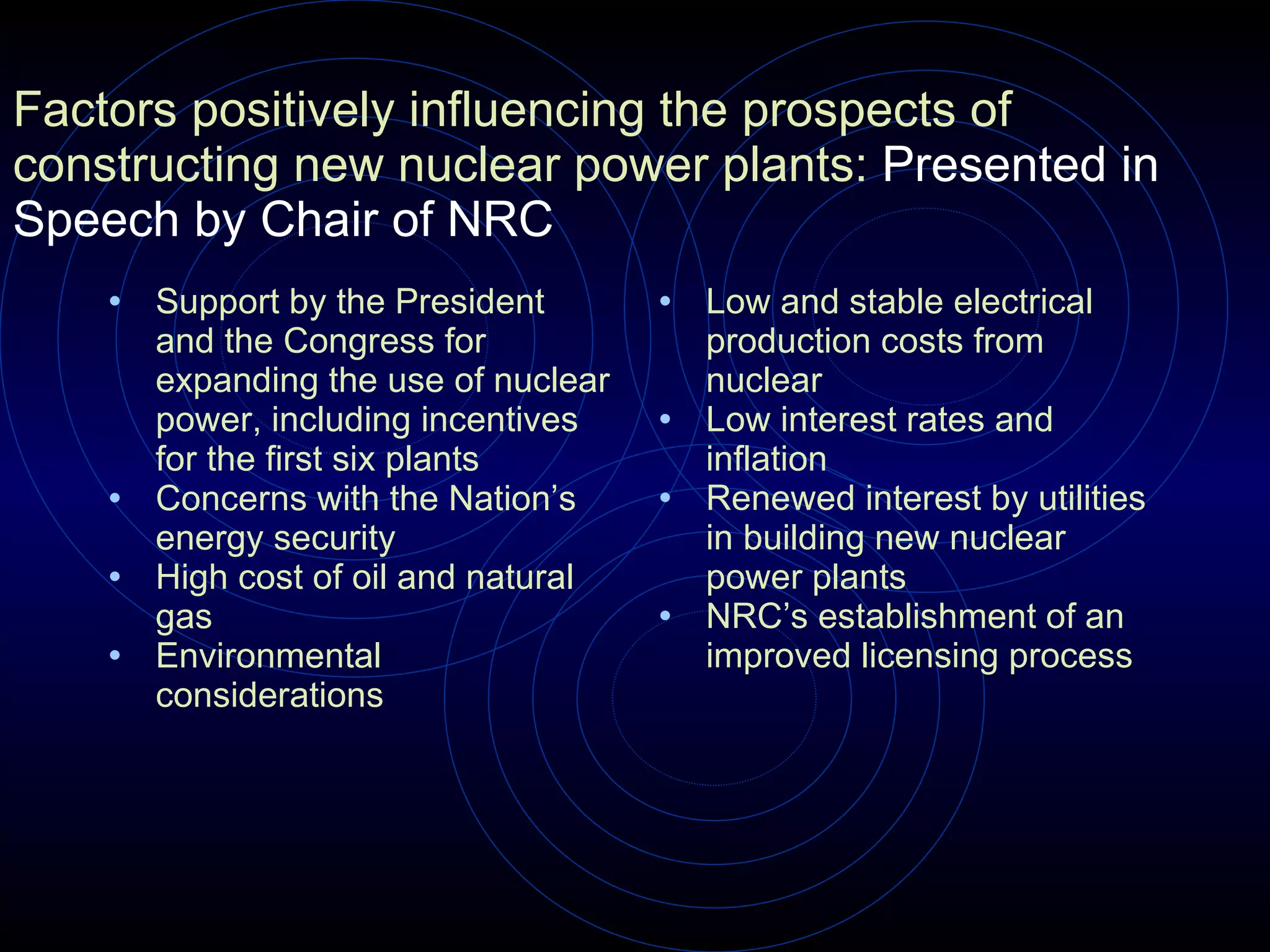
Factors positively influencing the prospects of constructing new nuclear power plants:  Presented in Speech by Chair of NRC Support by the President and the Congress for expanding the use of nuclear power, including incentives for the first six plants      Concerns with the Nation’s energy security  High cost of oil and natural gas  Environmental considerations  Low and stable electrical production costs from nuclear  Low interest rates and inflation  Renewed interest by utilities in building new nuclear power plants  NRC’s establishment of an improved licensing process
Factors Negatively influencing the prospects of constructing new nuclear power plants:  Presented in Speech by Chair of NRC High capital cost of new nuclear power plants  Financing considerations  New licensing processes have not yet been fully tested
New infrastructure needed for new nuclear power plants:   Presented in Speech by Chair of NRC Improved reactor design and construction  Reliable suppliers  Well-qualified personnel
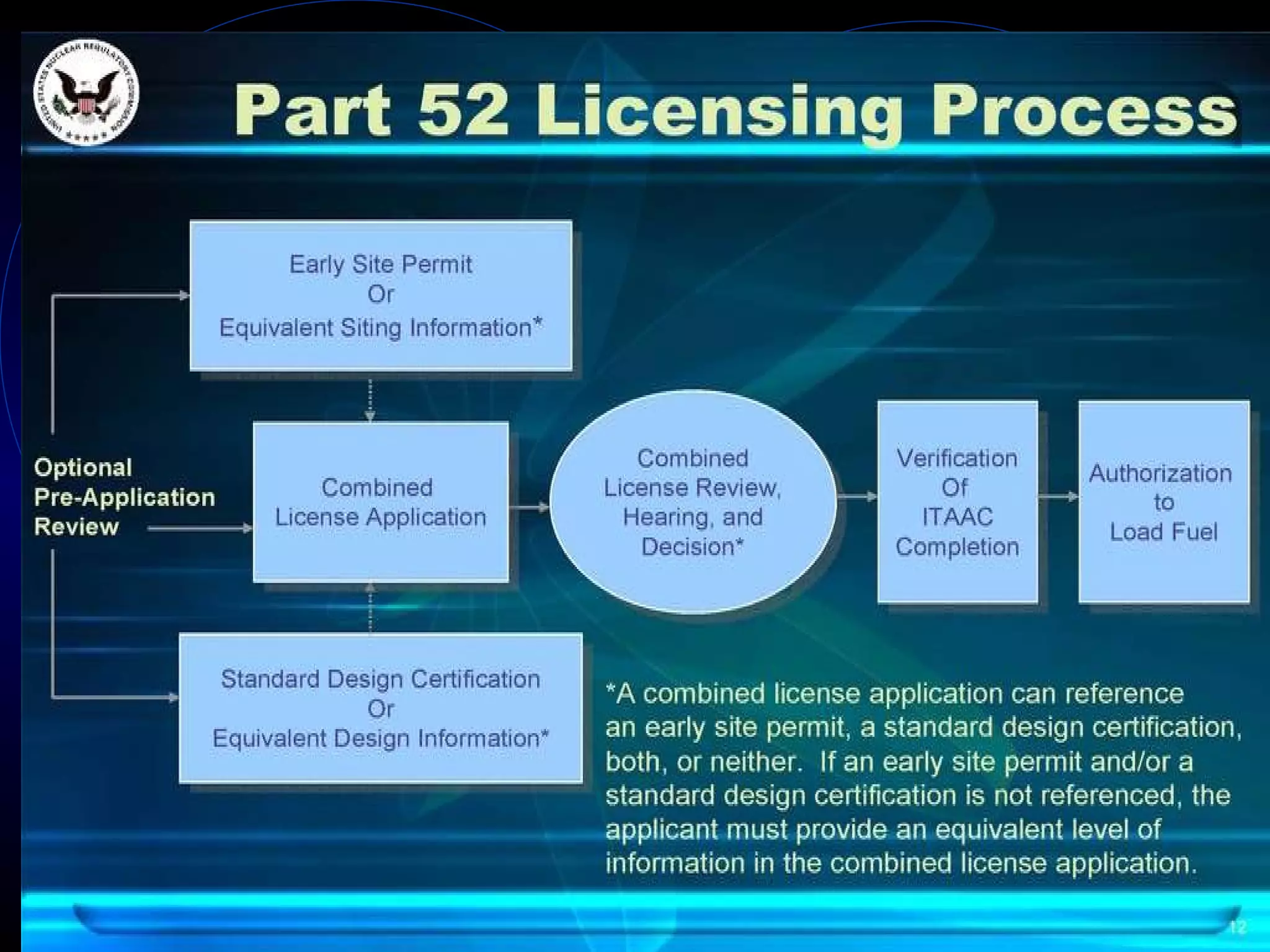
Licensing Process ITAAC Inspection, Test, Analyses, Acceptance Criteria
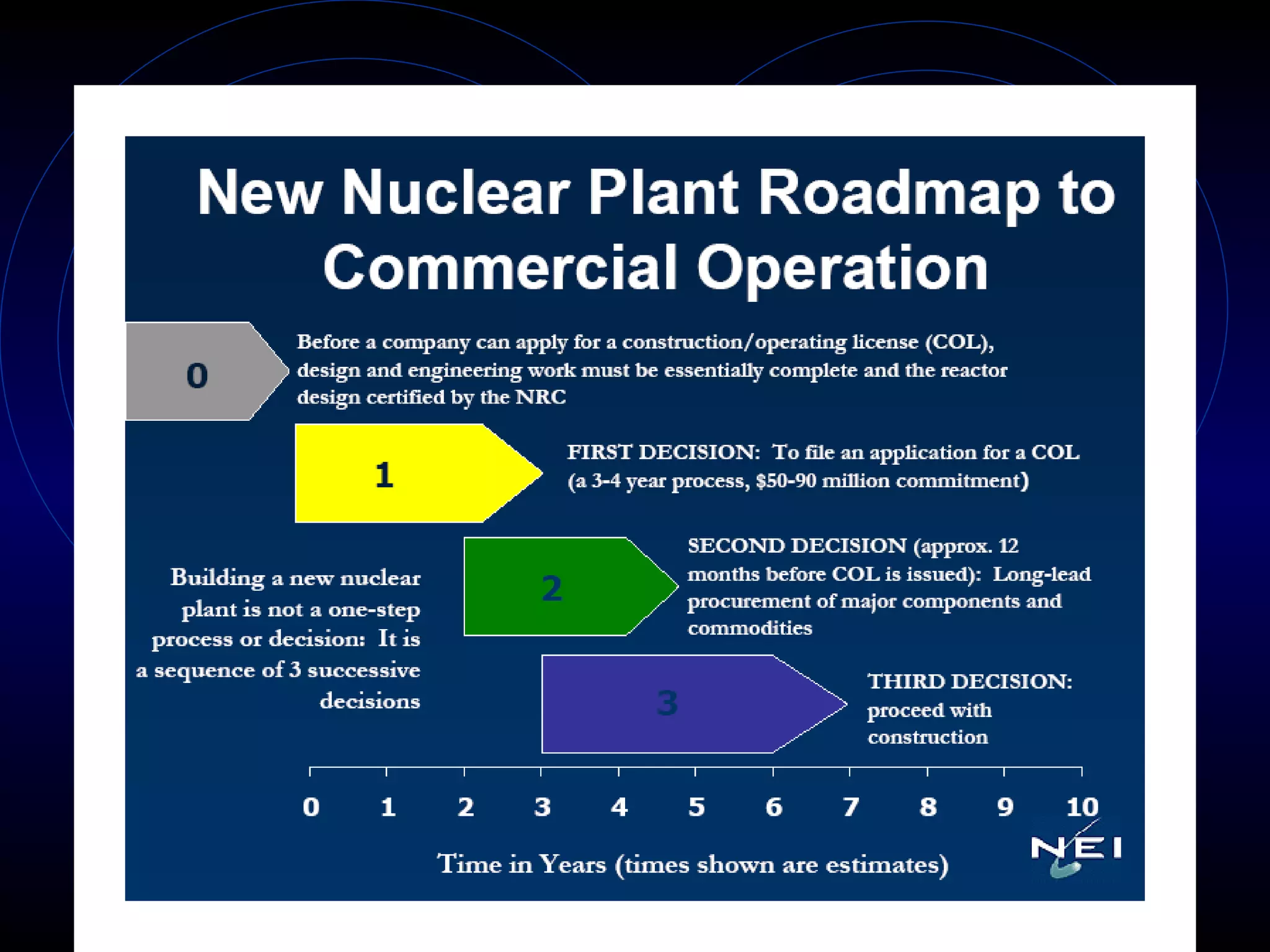
Roadmap to Commercial Operation
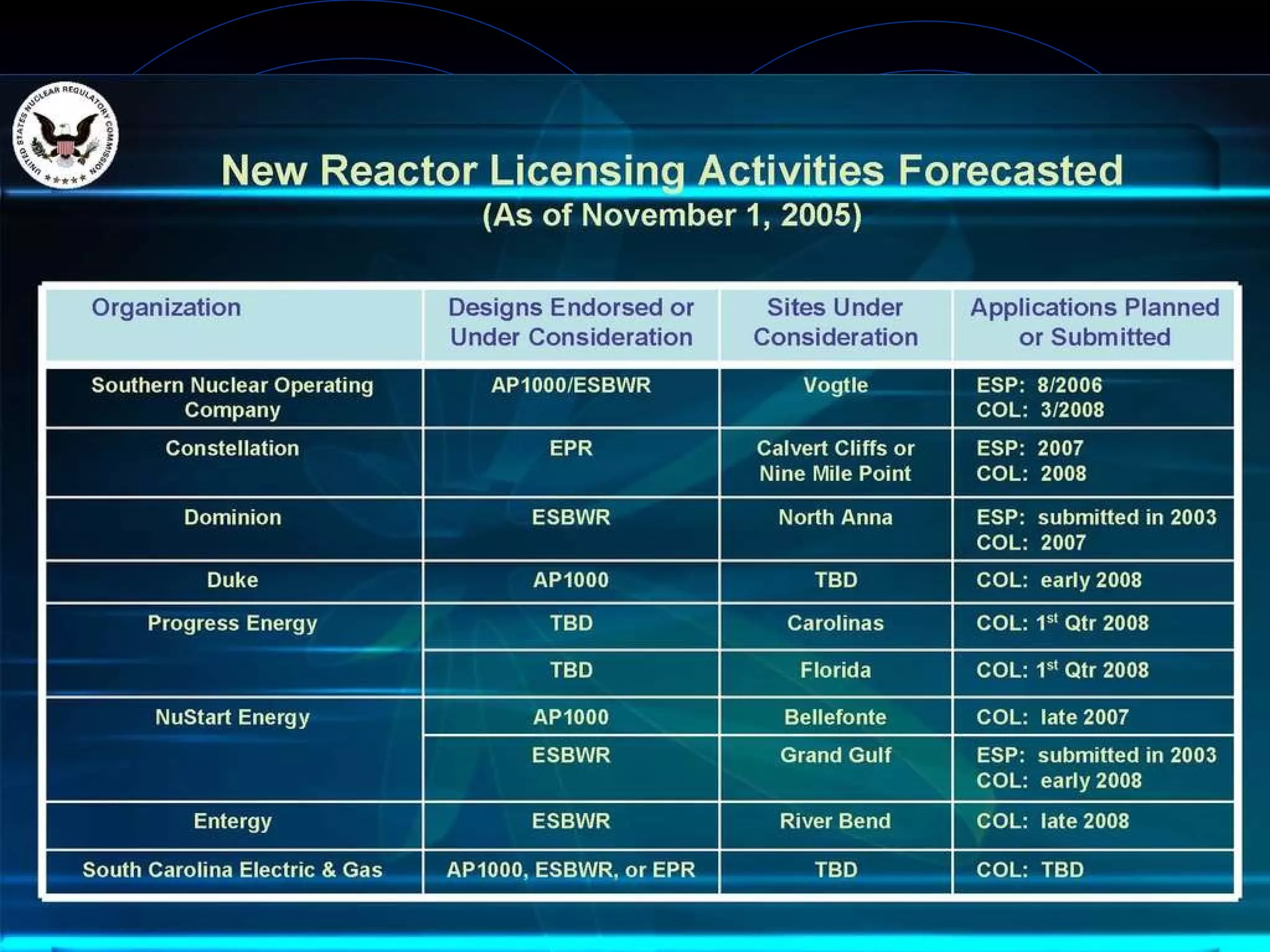
New Reactor Licensing Activities
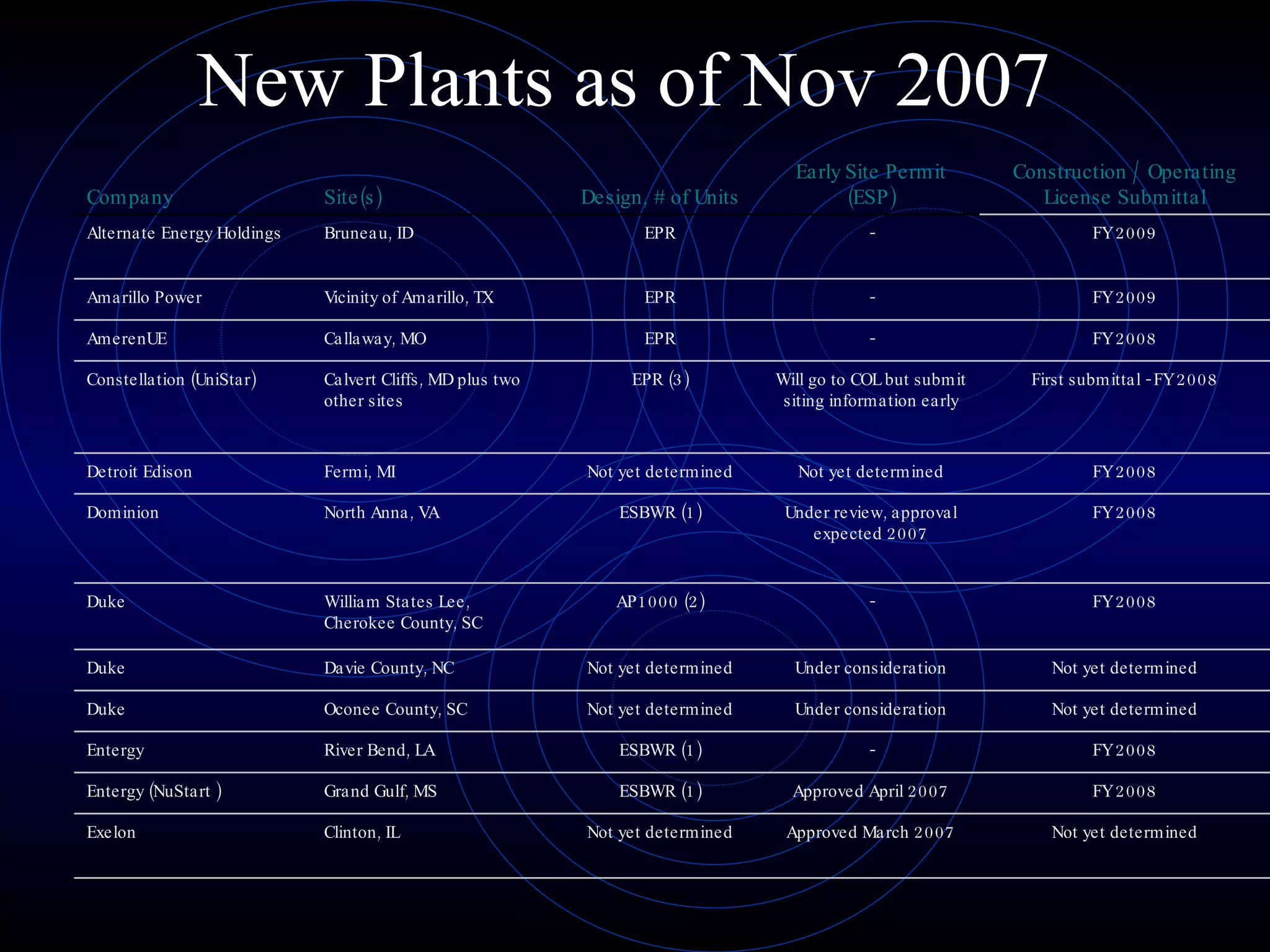
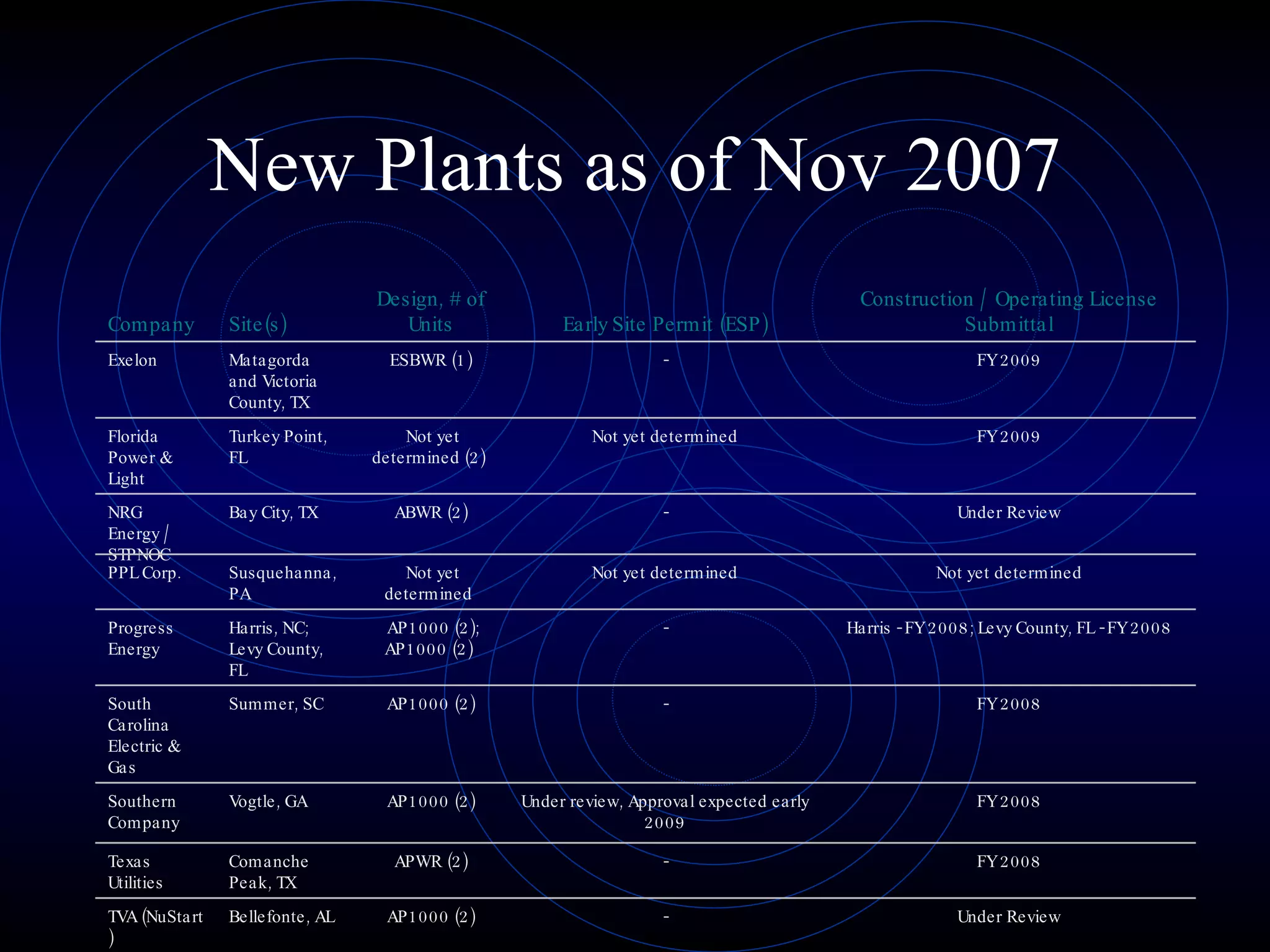
New Plants as of Nov 2007 Company Site(s) Design, # of Units Early Site Permit (ESP) Construction / Operating License Submittal Alternate Energy Holdings Bruneau, ID EPR - FY 2009 Amarillo Power Vicinity of Amarillo, TX EPR - FY 2009 AmerenUE Callaway, MO EPR - FY 2008 Constellation (UniStar) Calvert Cliffs, MD plus two other sites EPR (3)  Will go to COL but submit siting information early First submittal - FY 2008 Detroit Edison Fermi, MI Not yet determined Not yet determined FY 2008 Dominion North Anna, VA ESBWR (1)  Under review, approval expected 2007 FY 2008 Duke William States Lee, Cherokee County, SC AP1000 (2)  - FY 2008 Duke Davie County, NC Not yet determined  Under consideration Not yet determined Duke Oconee County, SC Not yet determined  Under consideration Not yet determined Entergy River Bend, LA ESBWR (1) - FY 2008 Entergy (NuStart ) Grand Gulf, MS ESBWR (1) Approved April 2007 FY 2008 Exelon Clinton, IL Not yet determined  Approved March 2007 Not yet determined
New Plants as of Nov 2007 Company Site(s) Design, # of Units Early Site Permit (ESP) Construction / Operating License Submittal Exelon Matagorda and Victoria County, TX ESBWR (1)  - FY 2009 Florida Power & Light Turkey Point, FL Not yet determined (2)  Not yet determined  FY 2009 NRG Energy / STPNOC Bay City, TX ABWR (2)  - Under Review PPL Corp. Susquehanna, PA Not yet determined  Not yet determined  Not yet determined  Progress Energy Harris, NC; Levy County, FL AP1000 (2); AP1000 (2)  - Harris - FY 2008; Levy County, FL - FY 2008 South Carolina Electric & Gas Summer, SC AP1000 (2)  - FY 2008 Southern Company Vogtle, GA AP1000 (2)  Under review, Approval expected early 2009 FY 2008 Texas Utilities Comanche Peak, TX APWR (2) - FY 2008 TVA (NuStart ) Bellefonte, AL AP1000 (2) - Under Review
Advanced Reactors Scheduled for Review by NRC Evolutionary Power Reactor (EPR) Simplified Boiling Water Reactor (ESBWR) Westinghouse AP1000 Advanced Passive Plant US-APWR is a 4451 MWt pressurized water reactor designed by Mitsubishi Heavy Industries, Ltd.
Evolutionary Power Reactor EPR : The EPR is a large pressurized water reactor of evolutionary design, with design output of approximately 1,600 MWe.  Design features include four 100% capacity trains of engineered safety features, a double-walled containment, and a “core catcher” for containment and cooling of core materials for severe accidents resulting in reactor vessel failure.  The design does not rely on passive safety features. The first EPR is currently being constructed at the Olkiluoto site in Finland.
Evolutionary Power Reactor UniStar   Nuclear will market a standard advanced design called the U.S. Evolutionary Power Reactor (U.S. EPR), a 1,600-megawatt evolutionary power reactor designed for America by AREVA Inc.
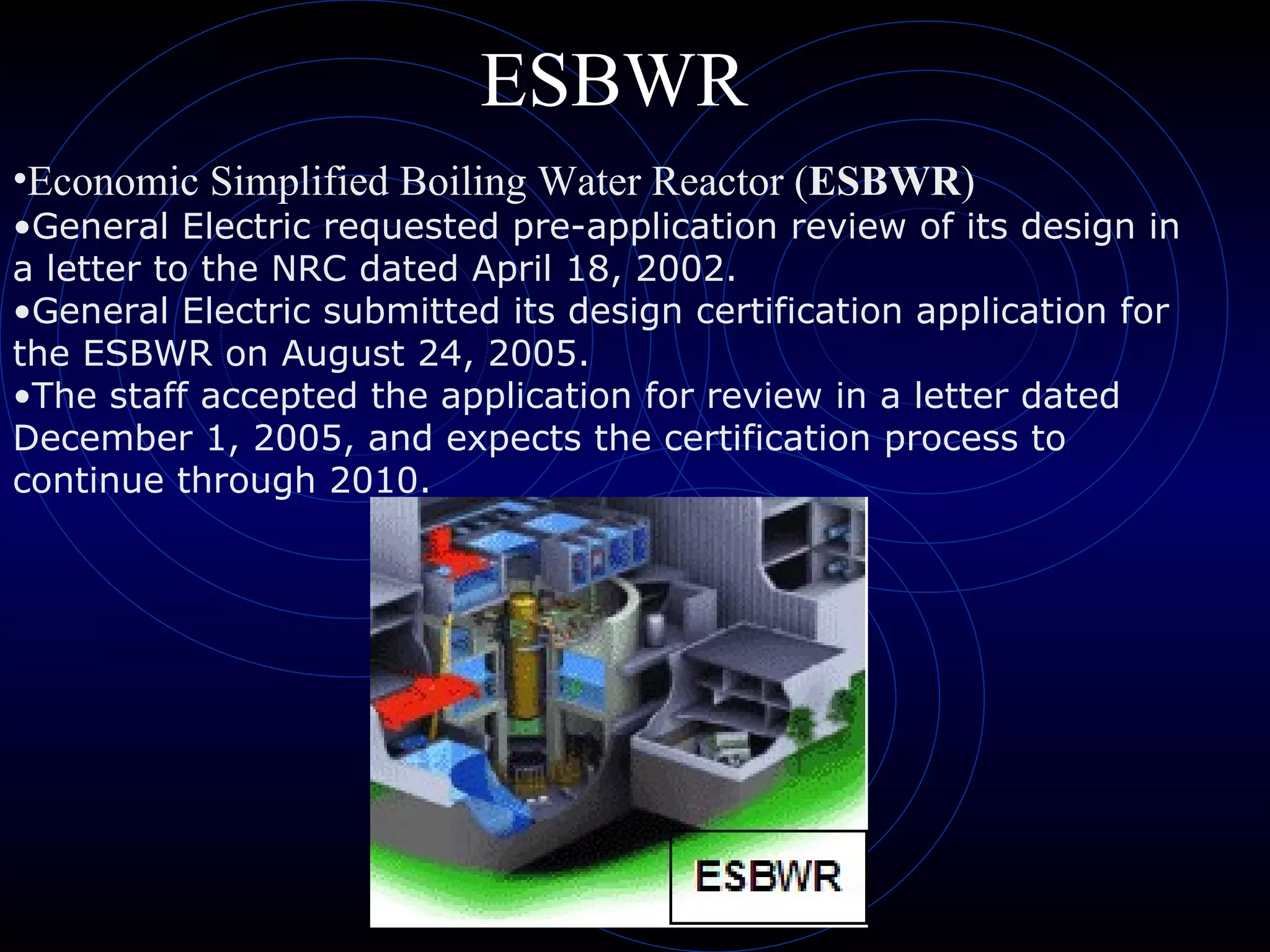
ESBWR Economic Simplified Boiling Water Reactor ( ESBWR )  General Electric requested pre-application review of its design in a letter to the NRC dated April 18, 2002.  General Electric submitted its design certification application for the ESBWR on August 24, 2005.  The staff accepted the application for review in a letter dated December 1, 2005, and expects the certification process to continue through 2010.
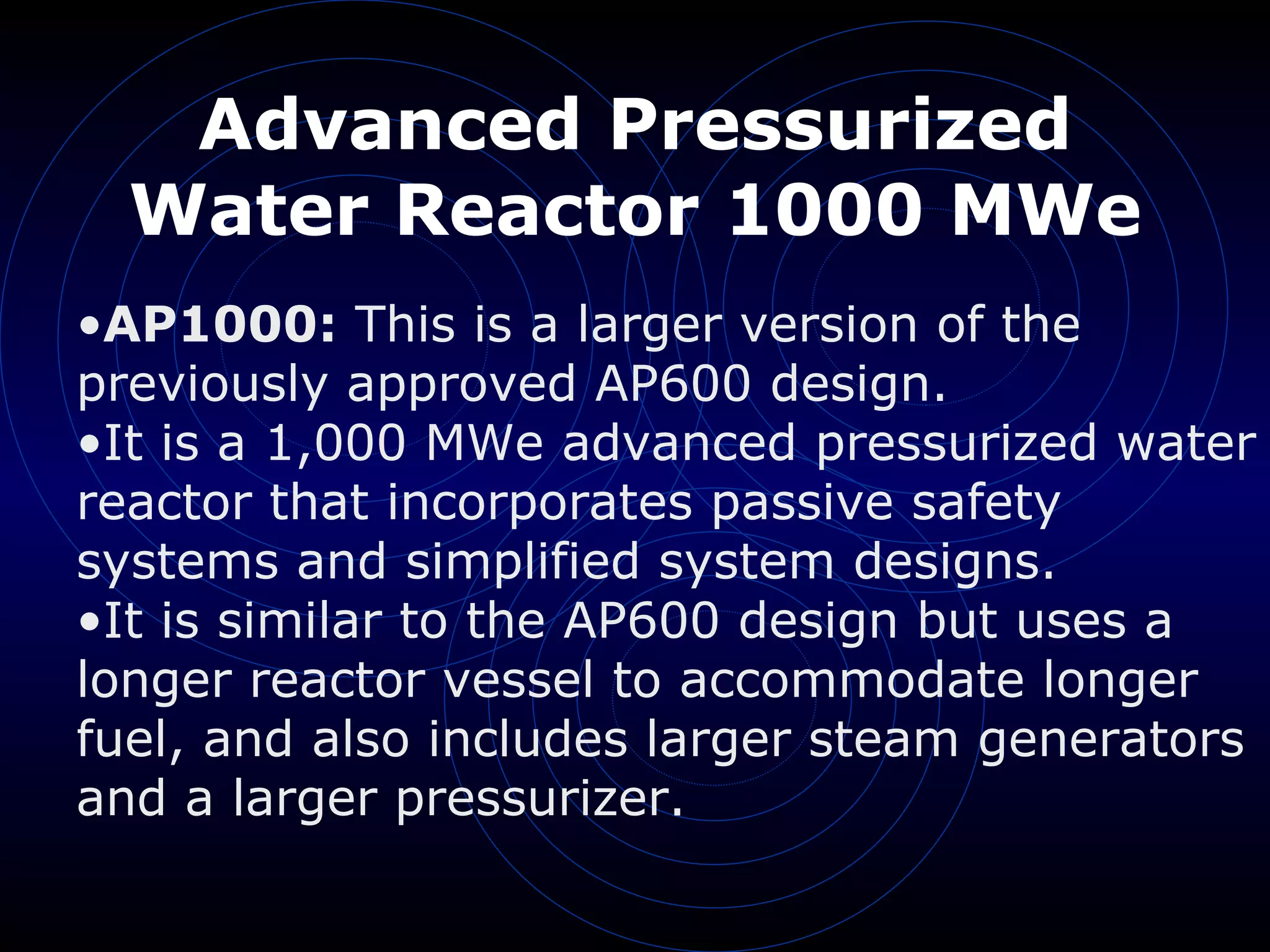
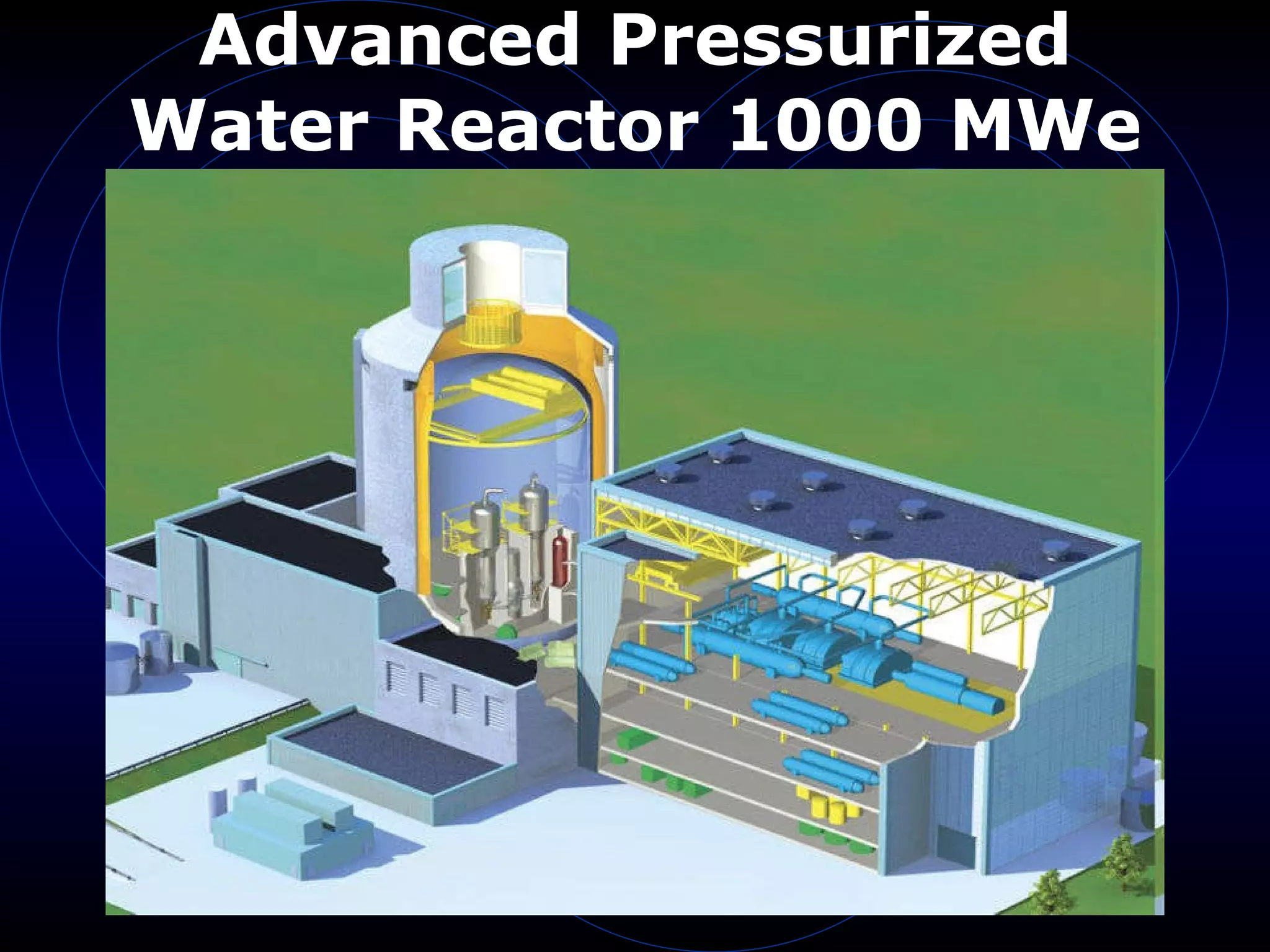
Advanced Pressurized Water Reactor 1000 MWe AP1000:  This is a larger version of the previously approved AP600 design.  It is a 1,000 MWe advanced pressurized water reactor that incorporates passive safety systems and simplified system designs.  It is similar to the AP600 design but uses a longer reactor vessel to accommodate longer fuel, and also includes larger steam generators and a larger pressurizer.
Advanced Pressurized Water Reactor 1000 MWe
NRC Design Certification Review Process The review process for new reactor designs involves the certification of standard reactor designs by rulemaking (Subpart B of Part 52). Design certification applicants must provide the technical information necessary to demonstrate compliance with the safety standards set forth in applicable NRC regulations (10 CFR Parts 20, 50, 73, and 100). Applicants must also provide information to close out unresolved and generic safety issues, as well as issues that arose after the Three Mile Island accident.
NRC Design Certification Review Process Currently there are four certified reactor designs that can be referenced in an application for a combined license. They are: Advanced Boiling Water Reactor  design by GE Nuclear Energy (May 1997);  System 80+  design by Westinghouse (formerly ABB-Combustion Engineering) (May 1997);  AP600  design by Westinghouse (December 1999); and  AP1000  design (pictured) by Westinghouse (February 2006).
Advanced Boiling Water Reactor ABWR:  The U.S. Advanced Boiling Water Reactor design uses a single-cycle, forced circulation, reactor with a rated power of 1,300 megawatts electric (MWe). The design incorporates features of the BWR designs in Europe, Japan, and the United States, and uses improved electronics, computer, turbine, and fuel technology. The design is expected to increase plant availability, operating capacity, safety, and reliability.
Advanced Pressurized Water Reactor 1000 MWe AP1000:  This is a 1000 MWe advanced pressurized water reactor that incorporates passive safety systems and simplified system designs.  The passive systems use natural driving forces without active pumps, diesels, and other support systems after actuation. Use of redundant, non-safety-related, active equipment and systems minimizes unnecessary use of safety-related systems.
Advanced Pressurized Water Reactor 1000 MWe
ABB Combustion Engineering System 80+  The System 80+ is a 1300 MWe advanced pressurized water reactor.  Like previous ABB-CE reactors, the System 80+ reactor coolant system has a two loop configuration, a major feature that has distinguished CE designed units.  Like other ALWRs, improved safety performance and operability are achieved, owing to sophisticated design features.  Another interesting feature of System 80+ is that it can run with Plutonium fuel, which could be a very useful mean to dispose the Weapon Graded Plutonium from dismantled nuclear warheads
Advanced PWR The US-APWR is a 4451 MWt pressurized water reactor designed by Mitsubishi Heavy Industries, Ltd.  It is an evolutionary design with active safety features. The US-APWR is based on established APWR technology.  Mitsubishi Heavy Industries, Ltd formally announced its intent to pursue a Design Certification on June 20, 2006 and formally requested a pre-application review of the U.S. APWR on August 31, 2006.
Advanced Reactors ABWR  developed by General Electric Co (GE), USA, together with Hitachi & Toshiba Japan APWR developed by Westinghouse (W), USA, together with Mitsubishi, Japan BWR 90 developed by ABB Atom, Sweden AP1000 Westinghouse EPR developed by Nuclear Power International (NPI), a joint company of Framatome, France and Siemens, Germany  System 80+ developed by ABB Combustion Engineering Nuclear Power, USA VVER-1000 (V-392) developed by Atomenergo project and Gidropress, Russia
Nuclear Plant Design Expectations 3-6 Nuclear Plant Applications this year 15-30 Nuclear Plant Applications in 2008 Significant Shortages of Nuclear Design Engineers Significant Shortages of Analyst to Perform Calculations for Licensing Evaluations. Significant Shortage of Review Engineers
Contact EDA, Inc Marketing Department EDA, Inc 2015 Woodford Rd Vienna, VA 22182 703 356 4149

Eda Presentation Aug2009

  • 1.
    Consulting with EDAJoe Miller’s Experience What is EDA The Future of Nuclear Energy
  • 2.
    Joe Miller’s Experience(Joseph S. Miller is President of EDA) Academics BSIE University of Arkansas BSME University of Arkansas MSNE Kansas State University Post Graduate Courses at Idaho State and America University
  • 3.
    Joe Miller’s Experience35 years of engineering, fuel, operations and maintenance support for nuclear power plants 15 years of nuclear/mechanical design 12 years of operation and maintenance support at operating plants 10 years of regulatory and licensing support 7 years of probabilistic risk assessment support 7 years of nuclear fuel support
  • 4.
    Joe Miller’s ExperienceNUS Corp; Rockville, MD INEL/EGG Idaho; Idaho Falls, ID Black & Veatch; Overland Park, Ks Gulf States Utilities/Entergy; River Bend Station; St. Francisville, LA Scientech; Rockville, MD EDA Inc; Vienna, VA; 1996 to present
  • 5.
    Joe Miller’s ExperienceCertifications Professional Engineer in Maryland and Louisiana Microsoft Certified in Windows Server and Windows Professional Cisco Network Certified
  • 6.
    Joe Miller’s Experience26 published papers 2 US Patents 2 Foreign Patents Director of Communications for the ASME Nuclear Engineering Division executive committee. Track Chair for ICONE14, ICONE15 and ICONE16. Technical Program Chair for ICONE17
  • 7.
    Technical Committees Co-Chairof ASME/NED Systems, Structures and Components Design and Analysis Subcommittee Co-Chair of ASME/NED Thermal Hydraulics Committee on System Software Chair of ASME/NED Plant Operation and Maintenance Committee Member of ASME Energy Committee
  • 8.
    What Is EDA?Engineering Design and Analysis Founded in 1996 President and founder is Joe Miller Specializes in Support to the Utilities and the NRC
  • 9.
    EDA can ProvideDesign Support Design Reviews and Evaluations Modification Packages Support Root Cause Evaluations Licensing Support for Design Submittals Full Quality Assurance Support Audit Support
  • 10.
    EDA can ProvideAnalysis Support Analytical Simulation of Systems Design and Support Calculations
  • 11.
    EDA Clients/Projects ExelonComputer Code Training Aux Feedwater Modeling Audit of Fuel Vendor Technical Specification Changes NRC Inspection Support at Plants Piping Loads on Reactor Fan Cooler Evaluate RWCU Anomalies Support Westinghouse on Safety Analyses for New Steam Generators
  • 12.
    EDA Clients/Projects NRCInspection at Plants Small Break Evaluation Using TRACE Phase 2 & 3 b5b Security Inspections New Plant Reviews AmerGen Energy /Oyster Creek Heater Drain System Simulation I & C Sensitivity Study
  • 13.
    EDA Clients/Projects FloridaPower & Light RHR Restart Evaluation Licensing Support Public Service Enterprise Group/Peach Bottom Moisture Separator Drain Tank Evaluation Plant Modification Recommendations
  • 14.
    EDA Clients/Projects BoilingWater Reactor Owners Group Audit of General Electric for BWR Stability Calculations Licensing Support NUPIC (Nuclear Procurement Issues Committee) Audit General Electric on LOCA Analyses Procedure Modification Recommendations
  • 15.
    EDA Clients/Projects EDAEstablish Corporate QA Procedures Calculation QA Procedures Software QA Procedures Develop Web Sites Develop Intranet for Office
  • 16.
    Example EDA ProjectM/S Reheater Simulation – Oyster Creek EDA received Call from Engineer at Oyster Creek plant An Exelon Engineer recommended EDA for the work that they required. OC asked for a bid on the job. OC paid $5000 so EDA could gather information from the site. EDA developed a bid for $75,000 and sent it to the Utility.
  • 17.
    Example EDA ProjectM/S Reheater Simulation – Oyster Creek The work was projected to be complete in 5 months. EDA used Joe Miller and a associate engineer to perform the work. The RELAP5 program was used to perform the simulation. A model was developed and a simulation of the system was performed.
  • 18.
    Example EDA ProjectM/S Reheater Simulation – Oyster Creek The results showed that the oscillations in two of the six pipe lines caused significant oscillations in the system piping. EDA recommend that level instrumentation for these two tanks be modified with delays. Further sensitivities were performed to determine the instrumentation settings that allowed these delays to occur.
  • 19.
    Example EDA ProjectM/S Reheater Simulation – Oyster Creek
  • 20.
  • 21.
    Example EDA ProjectSNAP M/S Reheater Simulation – Oyster Creek
  • 22.
    Status of CommercialNuclear Power As of 2004, nuclear power provided 6.5% of the world's energy and 15.7% of the world's electricity, with the U.S. , France , and Japan together accounting for 57% of all nuclear generated electricity. As of 2007 , the IAEA reported there are 439 nuclear power reactors in operation in the world, operating in 31 different countries.
  • 23.
    Status of CommercialNuclear Power
  • 24.
    Status of CommercialNuclear Power
  • 25.
    Reactor Types PressurizedWater Reactors (PWR)
  • 26.
  • 27.
  • 28.
  • 29.
  • 30.
    Reactor Types OtherTypes of Reactors PHW Candu: Pressurized Heavy Water Candu BLW Candu: Boiling Light Water Candu BHWR: Boiling Heavy Water Reactor SGHWR: Steam Generating Heavy Water Reactor PHWR: Pressure Vessel Heavy Water Reactor LWCHWR: Light Water Cooled Heavy Water Reactor GCR: Gas Cooled Reactor MAGNOX: Magnox Type Gas Cooled Reactor AGR: Advanced Gas Cooled Reactor HTGR: High Temperature Gas Cooled Reactor FBR: Fast Breeder Reactor LWBR: Light Water Breeder Reactor GCHWR: Gas Cooled Heavy Water Reactor LWGR: Light Water Cooled Graphite Reactor
  • 31.
    Annual Energy Outlook2007 with Projections to 2030
  • 32.
    Annual Electric SalesTotal electricity sales increase by 41 percent from 3,660 billion kilowatt-hours in 2005 to 5,168 billion kilowatt-hours in 2030. The largest increase is in the commercial sector (Figure 53), as service industries continue to drive growth. Electricity sales, which are strongly affected by the rate of economic growth, are projected to grow by 54 percent to 5,654 billion kilowatt-hours in 2030.
  • 33.
    Status of CommercialNuclear Power
  • 34.
    Annual Energy Outlook2007 with Projections to 2030
  • 35.
  • 36.
    Public Opinion Feb2005 opinion poll regarding nuclear power in the USA. Blue represents people in favor of nuclear power. Gray represents undecided. Yellow represents opposed to nuclear power
  • 37.
    U.S. Electricity ProductionCosts 1995-2006, In 2006 cents per kilowatt-hour Production Costs = Operations and Maintenance Costs + Fuel Costs Source: Global Energy Decisions Updated: 6/07
  • 38.
    Factors positively influencingthe prospects of constructing new nuclear power plants: Presented in Speech by Chair of NRC Support by the President and the Congress for expanding the use of nuclear power, including incentives for the first six plants      Concerns with the Nation’s energy security High cost of oil and natural gas Environmental considerations Low and stable electrical production costs from nuclear Low interest rates and inflation Renewed interest by utilities in building new nuclear power plants NRC’s establishment of an improved licensing process
  • 39.
    Factors Negatively influencingthe prospects of constructing new nuclear power plants: Presented in Speech by Chair of NRC High capital cost of new nuclear power plants Financing considerations New licensing processes have not yet been fully tested
  • 40.
    New infrastructure neededfor new nuclear power plants: Presented in Speech by Chair of NRC Improved reactor design and construction Reliable suppliers Well-qualified personnel
  • 41.
    Licensing Process ITAACInspection, Test, Analyses, Acceptance Criteria
  • 42.
  • 43.
  • 44.
    New Plants asof Nov 2007 Company Site(s) Design, # of Units Early Site Permit (ESP) Construction / Operating License Submittal Alternate Energy Holdings Bruneau, ID EPR - FY 2009 Amarillo Power Vicinity of Amarillo, TX EPR - FY 2009 AmerenUE Callaway, MO EPR - FY 2008 Constellation (UniStar) Calvert Cliffs, MD plus two other sites EPR (3) Will go to COL but submit siting information early First submittal - FY 2008 Detroit Edison Fermi, MI Not yet determined Not yet determined FY 2008 Dominion North Anna, VA ESBWR (1) Under review, approval expected 2007 FY 2008 Duke William States Lee, Cherokee County, SC AP1000 (2) - FY 2008 Duke Davie County, NC Not yet determined Under consideration Not yet determined Duke Oconee County, SC Not yet determined Under consideration Not yet determined Entergy River Bend, LA ESBWR (1) - FY 2008 Entergy (NuStart ) Grand Gulf, MS ESBWR (1) Approved April 2007 FY 2008 Exelon Clinton, IL Not yet determined Approved March 2007 Not yet determined
  • 45.
    New Plants asof Nov 2007 Company Site(s) Design, # of Units Early Site Permit (ESP) Construction / Operating License Submittal Exelon Matagorda and Victoria County, TX ESBWR (1) - FY 2009 Florida Power & Light Turkey Point, FL Not yet determined (2) Not yet determined FY 2009 NRG Energy / STPNOC Bay City, TX ABWR (2) - Under Review PPL Corp. Susquehanna, PA Not yet determined Not yet determined Not yet determined Progress Energy Harris, NC; Levy County, FL AP1000 (2); AP1000 (2) - Harris - FY 2008; Levy County, FL - FY 2008 South Carolina Electric & Gas Summer, SC AP1000 (2) - FY 2008 Southern Company Vogtle, GA AP1000 (2) Under review, Approval expected early 2009 FY 2008 Texas Utilities Comanche Peak, TX APWR (2) - FY 2008 TVA (NuStart ) Bellefonte, AL AP1000 (2) - Under Review
  • 46.
    Advanced Reactors Scheduledfor Review by NRC Evolutionary Power Reactor (EPR) Simplified Boiling Water Reactor (ESBWR) Westinghouse AP1000 Advanced Passive Plant US-APWR is a 4451 MWt pressurized water reactor designed by Mitsubishi Heavy Industries, Ltd.
  • 47.
    Evolutionary Power ReactorEPR : The EPR is a large pressurized water reactor of evolutionary design, with design output of approximately 1,600 MWe. Design features include four 100% capacity trains of engineered safety features, a double-walled containment, and a “core catcher” for containment and cooling of core materials for severe accidents resulting in reactor vessel failure. The design does not rely on passive safety features. The first EPR is currently being constructed at the Olkiluoto site in Finland.
  • 48.
    Evolutionary Power ReactorUniStar Nuclear will market a standard advanced design called the U.S. Evolutionary Power Reactor (U.S. EPR), a 1,600-megawatt evolutionary power reactor designed for America by AREVA Inc.
  • 49.
    ESBWR Economic SimplifiedBoiling Water Reactor ( ESBWR ) General Electric requested pre-application review of its design in a letter to the NRC dated April 18, 2002. General Electric submitted its design certification application for the ESBWR on August 24, 2005. The staff accepted the application for review in a letter dated December 1, 2005, and expects the certification process to continue through 2010.
  • 50.
    Advanced Pressurized WaterReactor 1000 MWe AP1000: This is a larger version of the previously approved AP600 design. It is a 1,000 MWe advanced pressurized water reactor that incorporates passive safety systems and simplified system designs. It is similar to the AP600 design but uses a longer reactor vessel to accommodate longer fuel, and also includes larger steam generators and a larger pressurizer.
  • 51.
  • 52.
    NRC Design CertificationReview Process The review process for new reactor designs involves the certification of standard reactor designs by rulemaking (Subpart B of Part 52). Design certification applicants must provide the technical information necessary to demonstrate compliance with the safety standards set forth in applicable NRC regulations (10 CFR Parts 20, 50, 73, and 100). Applicants must also provide information to close out unresolved and generic safety issues, as well as issues that arose after the Three Mile Island accident.
  • 53.
    NRC Design CertificationReview Process Currently there are four certified reactor designs that can be referenced in an application for a combined license. They are: Advanced Boiling Water Reactor design by GE Nuclear Energy (May 1997); System 80+ design by Westinghouse (formerly ABB-Combustion Engineering) (May 1997); AP600 design by Westinghouse (December 1999); and AP1000 design (pictured) by Westinghouse (February 2006).
  • 54.
    Advanced Boiling WaterReactor ABWR: The U.S. Advanced Boiling Water Reactor design uses a single-cycle, forced circulation, reactor with a rated power of 1,300 megawatts electric (MWe). The design incorporates features of the BWR designs in Europe, Japan, and the United States, and uses improved electronics, computer, turbine, and fuel technology. The design is expected to increase plant availability, operating capacity, safety, and reliability.
  • 55.
    Advanced Pressurized WaterReactor 1000 MWe AP1000: This is a 1000 MWe advanced pressurized water reactor that incorporates passive safety systems and simplified system designs. The passive systems use natural driving forces without active pumps, diesels, and other support systems after actuation. Use of redundant, non-safety-related, active equipment and systems minimizes unnecessary use of safety-related systems.
  • 56.
  • 57.
    ABB Combustion EngineeringSystem 80+ The System 80+ is a 1300 MWe advanced pressurized water reactor. Like previous ABB-CE reactors, the System 80+ reactor coolant system has a two loop configuration, a major feature that has distinguished CE designed units. Like other ALWRs, improved safety performance and operability are achieved, owing to sophisticated design features. Another interesting feature of System 80+ is that it can run with Plutonium fuel, which could be a very useful mean to dispose the Weapon Graded Plutonium from dismantled nuclear warheads
  • 58.
    Advanced PWR TheUS-APWR is a 4451 MWt pressurized water reactor designed by Mitsubishi Heavy Industries, Ltd. It is an evolutionary design with active safety features. The US-APWR is based on established APWR technology. Mitsubishi Heavy Industries, Ltd formally announced its intent to pursue a Design Certification on June 20, 2006 and formally requested a pre-application review of the U.S. APWR on August 31, 2006.
  • 59.
    Advanced Reactors ABWR developed by General Electric Co (GE), USA, together with Hitachi & Toshiba Japan APWR developed by Westinghouse (W), USA, together with Mitsubishi, Japan BWR 90 developed by ABB Atom, Sweden AP1000 Westinghouse EPR developed by Nuclear Power International (NPI), a joint company of Framatome, France and Siemens, Germany System 80+ developed by ABB Combustion Engineering Nuclear Power, USA VVER-1000 (V-392) developed by Atomenergo project and Gidropress, Russia
  • 60.
    Nuclear Plant DesignExpectations 3-6 Nuclear Plant Applications this year 15-30 Nuclear Plant Applications in 2008 Significant Shortages of Nuclear Design Engineers Significant Shortages of Analyst to Perform Calculations for Licensing Evaluations. Significant Shortage of Review Engineers
  • 61.
    Contact EDA, IncMarketing Department EDA, Inc 2015 Woodford Rd Vienna, VA 22182 703 356 4149