The University of Sydney Page 1
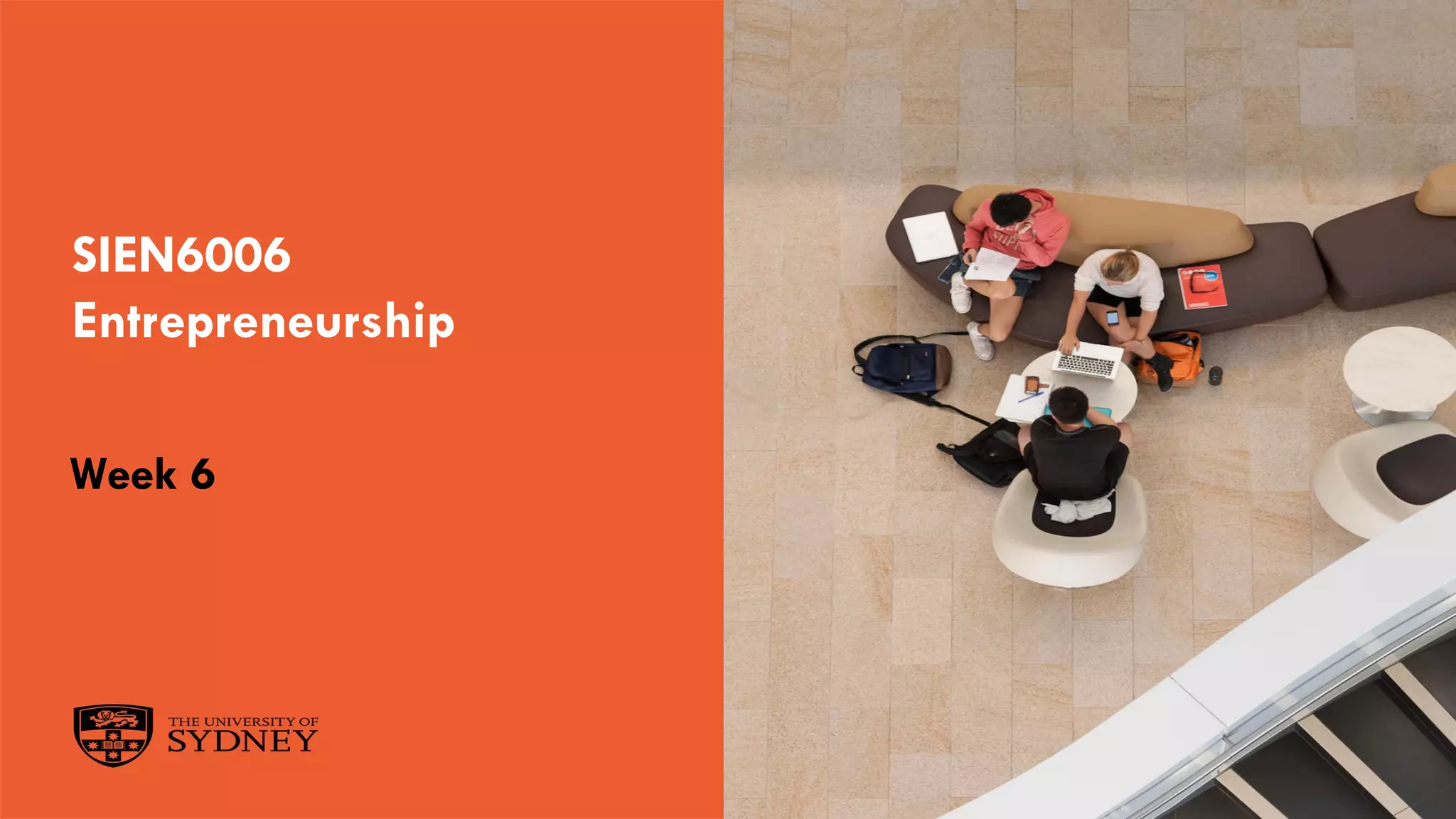
SIEN6006
Entrepreneurship
Week 6
The University of Sydney Page 2
Misconceptions Surrounding entrepreneurship
Without a certain degree of
structure breakthroughs aren’t made
By the time Bill Gates was 16 years old, he
was one of the top 50 programmers in the
world
Experience and knowledge matter
in entrepreneurship
Anders Ericsson has proven Nobel Prize winner
Herbert Simon’s belief that great contributions
in a field require a person to first partake in
10,000 hours, or roughly ten years, of hard,
deliberate practice on a topic.
The University of Sydney Page 3
Misconceptions Surrounding entrepreneurship
Good business ideas are
spontaneous inspiration
Formal schooling does not squash an artist’s creative
contribution, but rather provides the training needed to
develop advanced techniques through their career.
Elon Musk of Tesla, Larry Page and Sergey Brin of Google,
and Jeff Bezos of Amazon—did complete their college
degrees before building their legendary companies.
Many creative works go
unrecognized and are only
discovered decades later.
One overlooked genius is Gregor Mendel and his experiments
on cross-breeding peas. Credited for being the pioneer of
modern genetics, legend has it that it took 35 years for his
work to be known.
The University of Sydney Page 4
Misconceptions Surrounding entrepreneurship
It’s true that everyone has potential to create original work, the hard
work and training needed to shape an idea into acceptance isn’t
always done
Breakthroughs are not the work of superhuman geniuses, but rather
hardworking, real people with a desire and persistence to find
solutions and answers
The University of Sydney Page 5
Debate
To what extent do you agree or
disagree with the following
statement:
Companies should focus solely on routine,
disruptive, architectural, or radical
innovation
The University of Sydney Page 6
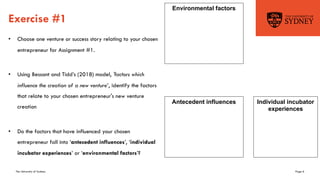
Exercise #1
• Choose one venture or success story relating to your chosen
entrepreneur for Assignment #1.
• Using Bessant and Tidd’s (2018) model, 'factors which
influence the creation of a new venture’, identify the factors
that relate to your chosen entrepreneur's new venture
creation
• Do the factors that have influenced your chosen
entrepreneur fall into ‘antecedent influences’, ‘individual
incubator experiences’ or ‘environmental factors’?
Antecedent influences Individual incubator
experiences
Environmental factors
The University of Sydney Page 7
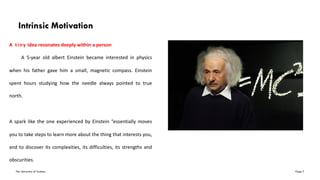
Intrinsic Motivation
A tiny idea resonates deeply within a person
A 5-year old albert Einstein became interested in physics
when his father gave him a small, magnetic compass. Einstein
spent hours studying how the needle always pointed to true
north.
A spark like the one experienced by Einstein “essentially moves
you to take steps to learn more about the thing that interests you,
and to discover its complexities, its difficulties, its strengths and
obscurities.
The University of Sydney Page 8
Steve Jobs- top 100 people on a retreat each year
– Focus
– On the last day, Jobs would stand in front of a whiteboard and ask, “What are the 10
things we should be doing next?” “We can only do three.”
– Jobs advised page to figure out what Google wants to be when it grows up
– It’s now all over the map
– What are the five products you want to focus on?
– Get rid of the rest, because they’re dragging you down.
The University of Sydney Page 9
Today’s agenda
• Story
• Recap
• Entrepreneurship and wider contexts
• Exercises: Ecosystem mapping & Network building
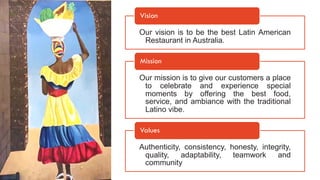
Our vision is to be the best Latin American
Restaurant in Australia.
Vision
Our mission is to give our customers a place
to celebrate and experience special
moments by offering the best food,
service, and ambiance with the traditional
Latino vibe.
Mission
Authenticity, consistency, honesty, integrity,
quality, adaptability, teamwork and
community
Values
The University of Sydney Page 11
Be mindful on how you are using your resources.
Analyze ROI of
your decisions
Outsource
Silver chef
Work with experts Fund your
business smartly.
Loan
Credit cards, back
up)
The University of Sydney Page 12
Talent Hotbeds
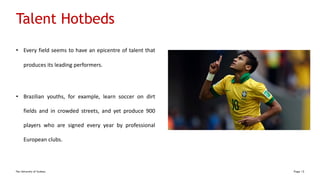
• Every field seems to have an epicentre of talent that
produces its leading performers.
• Brazilian youths, for example, learn soccer on dirt
fields and in crowded streets, and yet produce 900
players who are signed every year by professional
European clubs.
The University of Sydney Page 13
Ecosystems: knowledge and communication
How can networks help entrepreneurs?
The ways knowledge actually flows around an innovation project are complex and interactive
Networks to share knowledge and ideas
Networks to share knowledge and ideas.
Networks to share resources
Networks to help learning
Networks for support
Networking with users
The University of Sydney Page 14
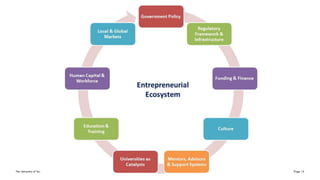
The University of Sydney Page 15
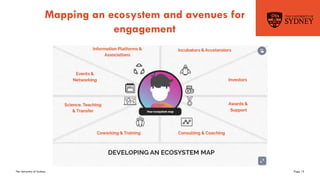
Mapping an ecosystem and avenues for
engagement
The University of Sydney Page 16
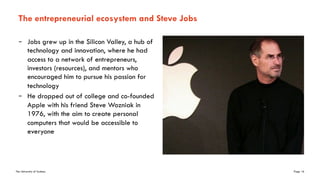
The entrepreneurial ecosystem and Steve Jobs
– Jobs grew up in the Silicon Valley, a hub of
technology and innovation, where he had
access to a network of entrepreneurs,
investors (resources), and mentors who
encouraged him to pursue his passion for
technology
– He dropped out of college and co-founded
Apple with his friend Steve Wozniak in
1976, with the aim to create personal
computers that would be accessible to
everyone
The University of Sydney Page 17
– Jobs was a keen observer of market trends and consumer behavior, which helped him
to create products that met the needs and wants of his customers.
– The entrepreneurial ecosystem also provided Jobs with access to mentors and
advisors who helped him to navigate the challenges of starting and growing a
business. One of his mentors was Mike Markkula, an early investor in Apple, who
provided Jobs with invaluable guidance and support.
The entrepreneurial ecosystem and Steve Jobs
The University of Sydney Page 18
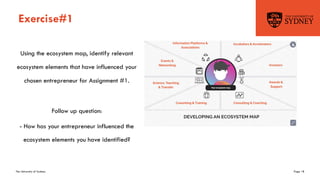
Exercise#1
Using the ecosystem map, identify relevant
ecosystem elements that have influenced your
chosen entrepreneur for Assignment #1.
Follow up question:
- How has your entrepreneur influenced the
ecosystem elements you have identified?
The University of Sydney Page 19
Week 7 – Sustainable Entrepreneurship
We will:
• Understand sustainable entrepreneurship as a form of shared value
• See how the concept of 'opportunity formation' manifests in sustainability-focussed
entrepreneurial efforts
• Evaluate the potential of entrepreneurship as a way of resolving environmental
challenges with innovative solutions.
• Review: Canvas content; required readings
• Lecture: Online Canvas content replaces live lecture
• Reflection and preparation for our next Workshop: Detailed on Canvas
The University of Sydney Page 20
The University of Sydney Page 21

Ecosystem map

  • 1.
    The University ofSydney Page 1 SIEN6006 Entrepreneurship Week 6
  • 2.
    The University ofSydney Page 2 Misconceptions Surrounding entrepreneurship Without a certain degree of structure breakthroughs aren’t made By the time Bill Gates was 16 years old, he was one of the top 50 programmers in the world Experience and knowledge matter in entrepreneurship Anders Ericsson has proven Nobel Prize winner Herbert Simon’s belief that great contributions in a field require a person to first partake in 10,000 hours, or roughly ten years, of hard, deliberate practice on a topic.
  • 3.
    The University ofSydney Page 3 Misconceptions Surrounding entrepreneurship Good business ideas are spontaneous inspiration Formal schooling does not squash an artist’s creative contribution, but rather provides the training needed to develop advanced techniques through their career. Elon Musk of Tesla, Larry Page and Sergey Brin of Google, and Jeff Bezos of Amazon—did complete their college degrees before building their legendary companies. Many creative works go unrecognized and are only discovered decades later. One overlooked genius is Gregor Mendel and his experiments on cross-breeding peas. Credited for being the pioneer of modern genetics, legend has it that it took 35 years for his work to be known.
  • 4.
    The University ofSydney Page 4 Misconceptions Surrounding entrepreneurship It’s true that everyone has potential to create original work, the hard work and training needed to shape an idea into acceptance isn’t always done Breakthroughs are not the work of superhuman geniuses, but rather hardworking, real people with a desire and persistence to find solutions and answers
  • 5.
    The University ofSydney Page 5 Debate To what extent do you agree or disagree with the following statement: Companies should focus solely on routine, disruptive, architectural, or radical innovation
  • 6.
    The University ofSydney Page 6 Exercise #1 • Choose one venture or success story relating to your chosen entrepreneur for Assignment #1. • Using Bessant and Tidd’s (2018) model, 'factors which influence the creation of a new venture’, identify the factors that relate to your chosen entrepreneur's new venture creation • Do the factors that have influenced your chosen entrepreneur fall into ‘antecedent influences’, ‘individual incubator experiences’ or ‘environmental factors’? Antecedent influences Individual incubator experiences Environmental factors
  • 7.
    The University ofSydney Page 7 Intrinsic Motivation A tiny idea resonates deeply within a person A 5-year old albert Einstein became interested in physics when his father gave him a small, magnetic compass. Einstein spent hours studying how the needle always pointed to true north. A spark like the one experienced by Einstein “essentially moves you to take steps to learn more about the thing that interests you, and to discover its complexities, its difficulties, its strengths and obscurities.
  • 8.
    The University ofSydney Page 8 Steve Jobs- top 100 people on a retreat each year – Focus – On the last day, Jobs would stand in front of a whiteboard and ask, “What are the 10 things we should be doing next?” “We can only do three.” – Jobs advised page to figure out what Google wants to be when it grows up – It’s now all over the map – What are the five products you want to focus on? – Get rid of the rest, because they’re dragging you down.
  • 9.
    The University ofSydney Page 9 Today’s agenda • Story • Recap • Entrepreneurship and wider contexts • Exercises: Ecosystem mapping & Network building
  • 10.
    Our vision isto be the best Latin American Restaurant in Australia. Vision Our mission is to give our customers a place to celebrate and experience special moments by offering the best food, service, and ambiance with the traditional Latino vibe. Mission Authenticity, consistency, honesty, integrity, quality, adaptability, teamwork and community Values
  • 11.
    The University ofSydney Page 11 Be mindful on how you are using your resources. Analyze ROI of your decisions Outsource Silver chef Work with experts Fund your business smartly. Loan Credit cards, back up)
  • 12.
    The University ofSydney Page 12 Talent Hotbeds • Every field seems to have an epicentre of talent that produces its leading performers. • Brazilian youths, for example, learn soccer on dirt fields and in crowded streets, and yet produce 900 players who are signed every year by professional European clubs.
  • 13.
    The University ofSydney Page 13 Ecosystems: knowledge and communication How can networks help entrepreneurs? The ways knowledge actually flows around an innovation project are complex and interactive Networks to share knowledge and ideas Networks to share knowledge and ideas. Networks to share resources Networks to help learning Networks for support Networking with users
  • 14.
    The University ofSydney Page 14
  • 15.
    The University ofSydney Page 15 Mapping an ecosystem and avenues for engagement
  • 16.
    The University ofSydney Page 16 The entrepreneurial ecosystem and Steve Jobs – Jobs grew up in the Silicon Valley, a hub of technology and innovation, where he had access to a network of entrepreneurs, investors (resources), and mentors who encouraged him to pursue his passion for technology – He dropped out of college and co-founded Apple with his friend Steve Wozniak in 1976, with the aim to create personal computers that would be accessible to everyone
  • 17.
    The University ofSydney Page 17 – Jobs was a keen observer of market trends and consumer behavior, which helped him to create products that met the needs and wants of his customers. – The entrepreneurial ecosystem also provided Jobs with access to mentors and advisors who helped him to navigate the challenges of starting and growing a business. One of his mentors was Mike Markkula, an early investor in Apple, who provided Jobs with invaluable guidance and support. The entrepreneurial ecosystem and Steve Jobs
  • 18.
    The University ofSydney Page 18 Exercise#1 Using the ecosystem map, identify relevant ecosystem elements that have influenced your chosen entrepreneur for Assignment #1. Follow up question: - How has your entrepreneur influenced the ecosystem elements you have identified?
  • 19.
    The University ofSydney Page 19 Week 7 – Sustainable Entrepreneurship We will: • Understand sustainable entrepreneurship as a form of shared value • See how the concept of 'opportunity formation' manifests in sustainability-focussed entrepreneurial efforts • Evaluate the potential of entrepreneurship as a way of resolving environmental challenges with innovative solutions. • Review: Canvas content; required readings • Lecture: Online Canvas content replaces live lecture • Reflection and preparation for our next Workshop: Detailed on Canvas
  • 20.
    The University ofSydney Page 20
  • 21.
    The University ofSydney Page 21