http://www.bized.co.uk
Copyright 2006 – Biz/ed
Introduction to
Economics
The Economic Problem
Opportunity Cost
Production Possibility
Frontiers
http://www.bized.co.uk
Copyright 2006 – Biz/ed
The Economic Problem
• Unlimited Wants
• Scarce Resources
– Land, Labour,
Capital
• Resource Use
• Choices
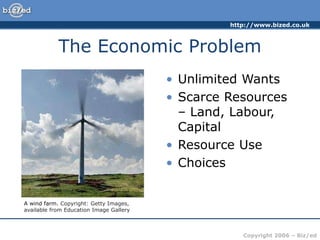
A wind farm. Copyright: Getty Images,
available from Education Image Gallery
http://www.bized.co.uk
Copyright 2006 – Biz/ed
The Economic Problem
• What goods and services should an
economy produce? – should the emphasis
be on agriculture, manufacturing or services,
should it be on sport and leisure or housing?
• How should goods and services be
produced? – labour intensive, land intensive,
capital intensive? Efficiency?
• Who should get the goods and services
produced? – even distribution? more for the
rich? for those who work hard?
http://www.bized.co.uk
Copyright 2006 – Biz/ed
Opportunity Cost
• Definition – the cost expressed in terms
of the next best alternative sacrificed
• Helps us view the true cost of decision
making
• Implies valuing different choices
http://www.bized.co.uk
Copyright 2006 – Biz/ed
Production Possibility Frontiers
• Show the different combinations of goods and
services that can be produced with a given
amount of resources
• No ‘ideal’ point on the curve
• Any point inside the curve – suggests
resources are not being utilised efficiently
• Any point outside the curve – not attainable
with the current level of resources
• Useful to demonstrate economic growth and
opportunity cost
http://www.bized.co.uk
Copyright 2006 – Biz/ed
Production Possibility
Frontiers
Capital Goods
Consumer Goods
Yo
Xo
A
B
Y1
X1
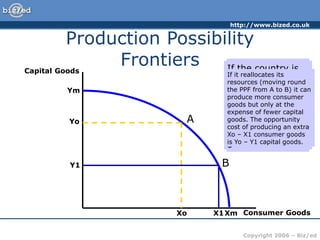
Assume a country
can produce two
types of goods
with its resources
– capital goods
and consumer
goods
If it devotes all
resources to capital
goods it could
produce a maximum
of Ym.
If it devotes all its
resources to
consumer goods it
could produce a
maximum of Xm
Ym
Xm
If the country is
at point A on the
PPF It can
produce the
combination of Yo
capital goods and
Xo consumer
goods
If it reallocates its
resources (moving round
the PPF from A to B) it can
produce more consumer
goods but only at the
expense of fewer capital
goods. The opportunity
cost of producing an extra
Xo – X1 consumer goods
is Yo – Y1 capital goods.
http://www.bized.co.uk
Copyright 2006 – Biz/ed
Production Possibility
Frontiers
Capital Goods
Consumer Goods
Yo
Xo
A
.B
C
Y1
X1
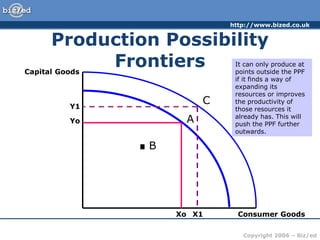
Production
inside the PPF
– e.g. point B
means the
country is not
using all its
resources
It can only produce at
points outside the PPF
if it finds a way of
expanding its
resources or improves
the productivity of
those resources it
already has. This will
push the PPF further
outwards.
http://www.bized.co.uk
Copyright 2006 – Biz/ed
Positive and Normative
Economics
• Health care can be
improved with more tax
funding
• Pollution control is
effective through a
system of fines
• Society ought to provide
homes for all
• Any strategy aimed at
reducing factory closures
in deprived areas would
be helpful
• Positive Statements:
– Capable of being
verified or refuted by
resorting to fact or
further investigation
• Normative
Statements:
– Contains a value
judgement which
cannot be verified by
resort to investigation
or research

economics intro (2).ppt

  • 1.
    http://www.bized.co.uk Copyright 2006 –Biz/ed Introduction to Economics The Economic Problem Opportunity Cost Production Possibility Frontiers
  • 2.
    http://www.bized.co.uk Copyright 2006 –Biz/ed The Economic Problem • Unlimited Wants • Scarce Resources – Land, Labour, Capital • Resource Use • Choices A wind farm. Copyright: Getty Images, available from Education Image Gallery
  • 3.
    http://www.bized.co.uk Copyright 2006 –Biz/ed The Economic Problem • What goods and services should an economy produce? – should the emphasis be on agriculture, manufacturing or services, should it be on sport and leisure or housing? • How should goods and services be produced? – labour intensive, land intensive, capital intensive? Efficiency? • Who should get the goods and services produced? – even distribution? more for the rich? for those who work hard?
  • 4.
    http://www.bized.co.uk Copyright 2006 –Biz/ed Opportunity Cost • Definition – the cost expressed in terms of the next best alternative sacrificed • Helps us view the true cost of decision making • Implies valuing different choices
  • 5.
    http://www.bized.co.uk Copyright 2006 –Biz/ed Production Possibility Frontiers • Show the different combinations of goods and services that can be produced with a given amount of resources • No ‘ideal’ point on the curve • Any point inside the curve – suggests resources are not being utilised efficiently • Any point outside the curve – not attainable with the current level of resources • Useful to demonstrate economic growth and opportunity cost
  • 6.
    http://www.bized.co.uk Copyright 2006 –Biz/ed Production Possibility Frontiers Capital Goods Consumer Goods Yo Xo A B Y1 X1 Assume a country can produce two types of goods with its resources – capital goods and consumer goods If it devotes all resources to capital goods it could produce a maximum of Ym. If it devotes all its resources to consumer goods it could produce a maximum of Xm Ym Xm If the country is at point A on the PPF It can produce the combination of Yo capital goods and Xo consumer goods If it reallocates its resources (moving round the PPF from A to B) it can produce more consumer goods but only at the expense of fewer capital goods. The opportunity cost of producing an extra Xo – X1 consumer goods is Yo – Y1 capital goods.
  • 7.
    http://www.bized.co.uk Copyright 2006 –Biz/ed Production Possibility Frontiers Capital Goods Consumer Goods Yo Xo A .B C Y1 X1 Production inside the PPF – e.g. point B means the country is not using all its resources It can only produce at points outside the PPF if it finds a way of expanding its resources or improves the productivity of those resources it already has. This will push the PPF further outwards.
  • 8.
    http://www.bized.co.uk Copyright 2006 –Biz/ed Positive and Normative Economics • Health care can be improved with more tax funding • Pollution control is effective through a system of fines • Society ought to provide homes for all • Any strategy aimed at reducing factory closures in deprived areas would be helpful • Positive Statements: – Capable of being verified or refuted by resorting to fact or further investigation • Normative Statements: – Contains a value judgement which cannot be verified by resort to investigation or research