Economics in One Lessonby Graham Wright(http://managainstthestate.blogspot.com/)based on the book by Henry Hazlitt
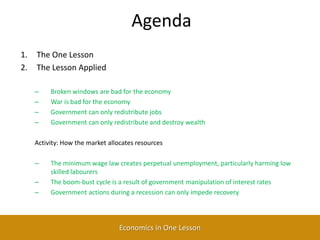
AgendaThe One LessonThe Lesson AppliedThe Broken Window Fallacy“War is good for the economy”“Government can create jobs”“Government can create wealth”Activity: How the market allocates resources“The minimum wage law benefits poor people”“The boom-bust cycle is a market phenomenon”“Government can help an economy recover from a recession”
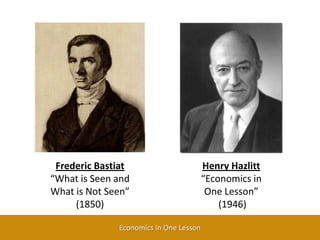
Frederic Bastiat“What is Seen and What is Not Seen” (1850)Henry Hazlitt“Economics in One Lesson” (1946)
The One LessonEconomics is a subject haunted by fallacies.Henry Hazlitt estimated that 90% of the fallacies can be avoided by remembering his One Lesson…“The art of economics consists in looking not merely at the immediate but at the longer effects of any act or policy; it consists in tracing the consequences of that policy not merely for one group but for all groups.”
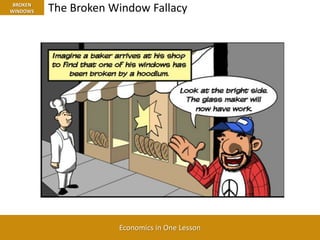
BROKEN WINDOWSThe Broken Window Fallacy
Claim“Broken windows are good for the economy”BROKEN WINDOWSThe Broken Window Fallacy
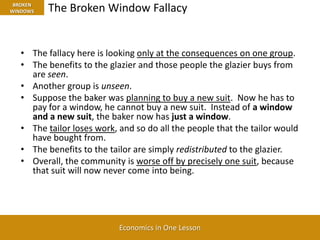
The Broken Window FallacyThe fallacy here is looking only at the consequences on one group.
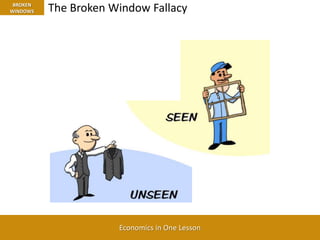
The benefits to the glazier and those people the glazier buys from are seen.
Another group is unseen.
Suppose the baker was planning to buy a new suit.  Now he has to pay for a window, he cannot buy a new suit.  Instead of a window and a new suit, the baker now has just a window.
The tailor loses work, and so do all the people that the tailor would have bought from.
The benefits to the tailor are simply redistributed to the glazier.
Overall, the community is worse off by precisely one suit, because that suit will now never come into being.BROKEN WINDOWS
BROKEN WINDOWSThe Broken Window Fallacy
BROKEN WINDOWSThe Broken Window FallacyClaim“Broken windows are good for the economy”Broken windows are bad for the economy
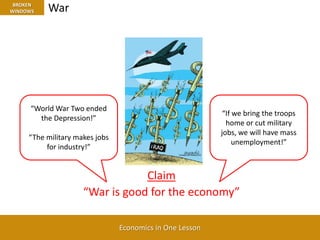
BROKEN WINDOWSWarClaim“War is good for the economy”“World War Two ended the Depression!”“The military makes jobs for industry!”“If we bring the troops home or cut military jobs, we will have mass unemployment!”
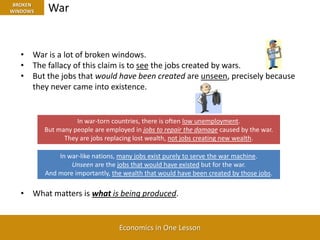
BROKEN WINDOWSWarWar is a lot of broken windows.The fallacy of this claim is to see the jobs created by wars.But the jobs that would have been created are unseen, precisely because they never came into existence.What matters is what is being produced.In war-torn countries, there is often low unemployment.  But many people are employed in jobs to repair the damagecaused by the war.They are jobs replacing lost wealth, not jobs creating new wealth.In war-like nations, many jobs exist purely to serve the war machine.  Unseen are the jobs that would have existed but for the war.And more importantly, the wealth that would have been created by those jobs.
BROKEN WINDOWSWarClaim“War is good for the economy”War is bad for the economy
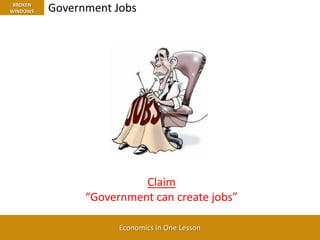
BROKEN WINDOWSGovernment JobsClaim“Government can create jobs”
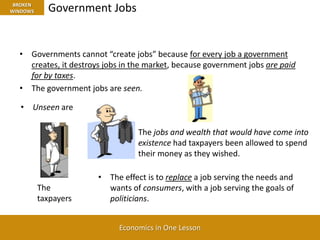
BROKEN WINDOWSGovernment JobsGovernments cannot “create jobs” because for every job a government creates, it destroys jobs in the market, because government jobs are paid for by taxes.The government jobs are seen.Unseen areThe jobs and wealth that would have come into existence had taxpayers been allowed to spend their money as they wished.The effect is to replace a job serving the needs and wants of consumers, with a job serving the goals of politicians.The taxpayers
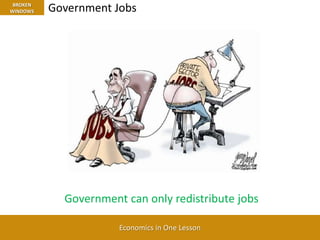
BROKEN WINDOWSGovernment JobsGovernment can only redistribute jobs
BROKEN WINDOWSTaxation and SpendingClaim“Government can create wealth”
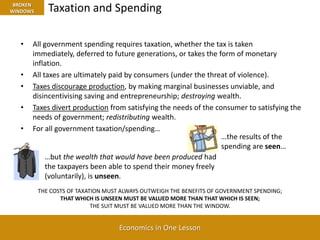
BROKEN WINDOWSTaxation and SpendingAll government spending requires taxation, whether the tax is taken immediately, deferred to future generations, or takes the form of monetary inflation.  All taxes are ultimately paid by consumers (under the threat of violence).Taxes discourage production, by making marginal businesses unviable, and disincentivising saving and entrepreneurship; destroying wealth.Taxes divert production from satisfying the needs of the consumer to satisfying the needs of government; redistributing wealth.For all government taxation/spending……the results of the spending are seen……but the wealth that would have been produced had the taxpayers been able to spend their money freely (voluntarily), is unseen.THE COSTS OF TAXATION MUST ALWAYS OUTWEIGH THE BENEFITS OF GOVERNMENT SPENDING;THAT WHICH IS UNSEEN MUST BE VALUED MORE THAN THAT WHICH IS SEEN;THE SUIT MUST BE VALUED MORE THAN THE WINDOW.
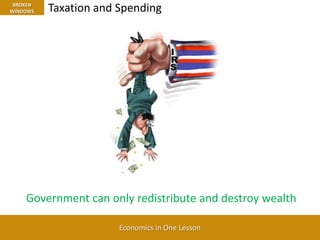
BROKEN WINDOWSTaxation and SpendingGovernment can only redistribute and destroy wealth
AgendaThe One LessonThe Lesson AppliedBroken windows are bad for the economyWar is bad for the economyGovernment can only redistribute and destroy jobs and wealthActivity: How the market allocates resources“The minimum wage law benefits poor people”“The boom-bust cycle is a market phenomenon”“Government can help an economy recover from a recession”
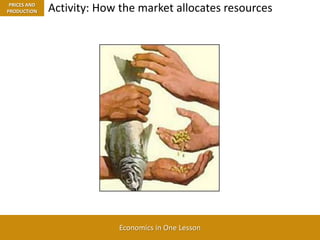
Activity: How the market allocates resourcesPRICES AND PRODUCTION
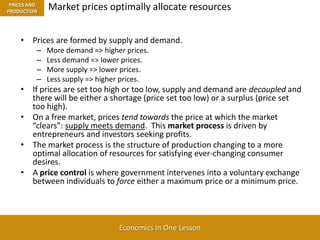
Market prices optimally allocate resourcesPRICES AND PRODUCTIONPrices are formed by supply and demand.
More demand => higher prices.
Less demand => lower prices.
More supply => lower prices.
Less supply => higher prices.
If prices are set too high or too low, supply and demand are decoupled and there will be either a shortage (price set too low) or a surplus (price set too high).
On a free market, prices tend towards the price at which the market “clears”: supply meets demand.  This market process is driven by entrepreneurs and investors seeking profits.
The market process is the structure of production changing to a more optimal allocation of resources for satisfying ever-changing consumer desires.
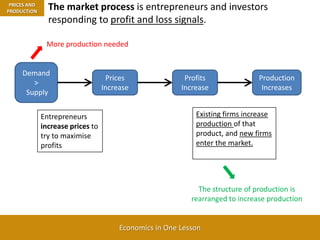
A price control is where government intervenes into a voluntary exchange between individuals to force either a maximum price or a minimum price.The market process is entrepreneurs and investors responding to profit and loss signals. PRICES AND PRODUCTIONMore production neededDemand > SupplyPrices IncreaseProfits IncreaseProduction IncreasesExisting firms increase production of that product, and new firms enter the market.Entrepreneurs increase prices to try to maximise profitsThe structure of production is rearranged to increase production
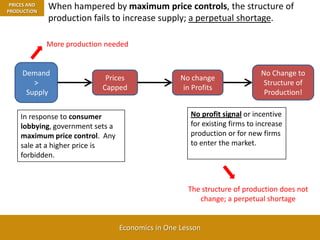
When hampered by maximum price controls, the structure of production fails to increase supply; a perpetual shortage.PRICES AND PRODUCTIONMore production neededDemand > SupplyNo Change to Structure of Production!Prices CappedNo change in ProfitsNo profit signal or incentive for existing firms to increase production or for new firms to enter the market.In response to consumer lobbying, government sets a maximum price control.  Any sale at a higher price is forbidden.The structure of production does not change; a perpetual shortage
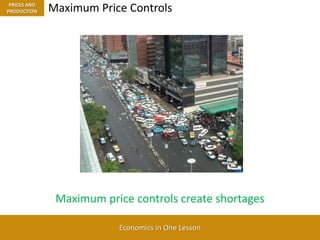
Maximum Price ControlsPRICES AND PRODUCTIONMaximum price controls create shortages
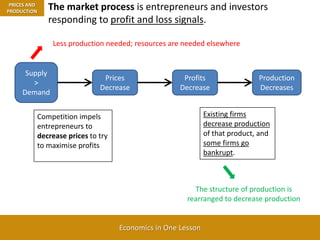
The market process is entrepreneurs and investors responding to profit and loss signals. PRICES AND PRODUCTIONLess production needed; resources are needed elsewhereSupply >DemandPrices DecreaseProfits DecreaseProduction DecreasesExisting firms decrease production of that product, and some firms go bankrupt.Competition impels entrepreneurs to decrease prices to try to maximise profitsThe structure of production is rearranged to decrease production
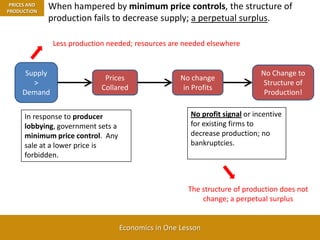
When hampered by minimum price controls, the structure of production fails to decrease supply; a perpetual surplus.PRICES AND PRODUCTIONLess production needed; resources are needed elsewhereSupply >DemandNo Change to Structure of Production!Prices CollaredNo change in ProfitsNo profit signal or incentive for existing firms to decrease production; no bankruptcies.In response to producer lobbying, government sets a minimum price control.  Any sale at a lower price is forbidden.The structure of production does not change; a perpetual surplus
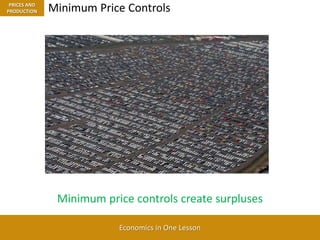
Minimum Price ControlsPRICES AND PRODUCTIONMinimum price controls create surpluses
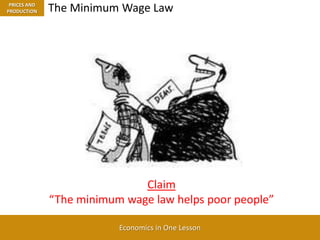
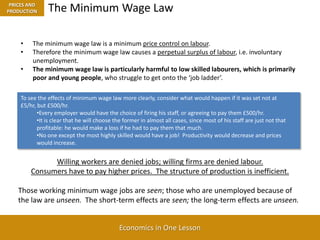
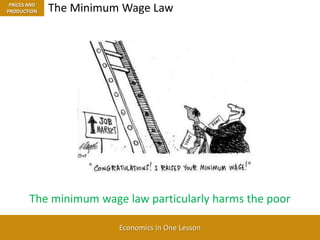
The Minimum Wage LawPRICES AND PRODUCTIONClaim“The minimum wage law helps poor people”

Economics in One Lesson: Wars, Governments, Price Controls and the Boom-Bust Cycle

  • 1.
    Economics in OneLessonby Graham Wright(http://managainstthestate.blogspot.com/)based on the book by Henry Hazlitt
  • 2.
    AgendaThe One LessonTheLesson AppliedThe Broken Window Fallacy“War is good for the economy”“Government can create jobs”“Government can create wealth”Activity: How the market allocates resources“The minimum wage law benefits poor people”“The boom-bust cycle is a market phenomenon”“Government can help an economy recover from a recession”
  • 3.
    Frederic Bastiat“What isSeen and What is Not Seen” (1850)Henry Hazlitt“Economics in One Lesson” (1946)
  • 4.
    The One LessonEconomicsis a subject haunted by fallacies.Henry Hazlitt estimated that 90% of the fallacies can be avoided by remembering his One Lesson…“The art of economics consists in looking not merely at the immediate but at the longer effects of any act or policy; it consists in tracing the consequences of that policy not merely for one group but for all groups.”
  • 5.
  • 6.
    Claim“Broken windows aregood for the economy”BROKEN WINDOWSThe Broken Window Fallacy
  • 7.
    The Broken WindowFallacyThe fallacy here is looking only at the consequences on one group.
  • 8.
    The benefits tothe glazier and those people the glazier buys from are seen.
  • 9.
  • 10.
    Suppose the bakerwas planning to buy a new suit. Now he has to pay for a window, he cannot buy a new suit. Instead of a window and a new suit, the baker now has just a window.
  • 11.
    The tailor loseswork, and so do all the people that the tailor would have bought from.
  • 12.
    The benefits tothe tailor are simply redistributed to the glazier.
  • 13.
    Overall, the communityis worse off by precisely one suit, because that suit will now never come into being.BROKEN WINDOWS
  • 14.
  • 15.
    BROKEN WINDOWSThe BrokenWindow FallacyClaim“Broken windows are good for the economy”Broken windows are bad for the economy
  • 16.
    BROKEN WINDOWSWarClaim“War isgood for the economy”“World War Two ended the Depression!”“The military makes jobs for industry!”“If we bring the troops home or cut military jobs, we will have mass unemployment!”
  • 17.
    BROKEN WINDOWSWarWar isa lot of broken windows.The fallacy of this claim is to see the jobs created by wars.But the jobs that would have been created are unseen, precisely because they never came into existence.What matters is what is being produced.In war-torn countries, there is often low unemployment. But many people are employed in jobs to repair the damagecaused by the war.They are jobs replacing lost wealth, not jobs creating new wealth.In war-like nations, many jobs exist purely to serve the war machine. Unseen are the jobs that would have existed but for the war.And more importantly, the wealth that would have been created by those jobs.
  • 18.
    BROKEN WINDOWSWarClaim“War isgood for the economy”War is bad for the economy
  • 19.
  • 20.
    BROKEN WINDOWSGovernment JobsGovernmentscannot “create jobs” because for every job a government creates, it destroys jobs in the market, because government jobs are paid for by taxes.The government jobs are seen.Unseen areThe jobs and wealth that would have come into existence had taxpayers been allowed to spend their money as they wished.The effect is to replace a job serving the needs and wants of consumers, with a job serving the goals of politicians.The taxpayers
  • 21.
    BROKEN WINDOWSGovernment JobsGovernmentcan only redistribute jobs
  • 22.
    BROKEN WINDOWSTaxation andSpendingClaim“Government can create wealth”
  • 23.
    BROKEN WINDOWSTaxation andSpendingAll government spending requires taxation, whether the tax is taken immediately, deferred to future generations, or takes the form of monetary inflation. All taxes are ultimately paid by consumers (under the threat of violence).Taxes discourage production, by making marginal businesses unviable, and disincentivising saving and entrepreneurship; destroying wealth.Taxes divert production from satisfying the needs of the consumer to satisfying the needs of government; redistributing wealth.For all government taxation/spending……the results of the spending are seen……but the wealth that would have been produced had the taxpayers been able to spend their money freely (voluntarily), is unseen.THE COSTS OF TAXATION MUST ALWAYS OUTWEIGH THE BENEFITS OF GOVERNMENT SPENDING;THAT WHICH IS UNSEEN MUST BE VALUED MORE THAN THAT WHICH IS SEEN;THE SUIT MUST BE VALUED MORE THAN THE WINDOW.
  • 24.
    BROKEN WINDOWSTaxation andSpendingGovernment can only redistribute and destroy wealth
  • 25.
    AgendaThe One LessonTheLesson AppliedBroken windows are bad for the economyWar is bad for the economyGovernment can only redistribute and destroy jobs and wealthActivity: How the market allocates resources“The minimum wage law benefits poor people”“The boom-bust cycle is a market phenomenon”“Government can help an economy recover from a recession”
  • 26.
    Activity: How themarket allocates resourcesPRICES AND PRODUCTION
  • 27.
    Market prices optimallyallocate resourcesPRICES AND PRODUCTIONPrices are formed by supply and demand.
  • 28.
    More demand =>higher prices.
  • 29.
    Less demand =>lower prices.
  • 30.
    More supply =>lower prices.
  • 31.
    Less supply =>higher prices.
  • 32.
    If prices areset too high or too low, supply and demand are decoupled and there will be either a shortage (price set too low) or a surplus (price set too high).
  • 33.
    On a freemarket, prices tend towards the price at which the market “clears”: supply meets demand. This market process is driven by entrepreneurs and investors seeking profits.
  • 34.
    The market processis the structure of production changing to a more optimal allocation of resources for satisfying ever-changing consumer desires.
  • 35.
    A price controlis where government intervenes into a voluntary exchange between individuals to force either a maximum price or a minimum price.The market process is entrepreneurs and investors responding to profit and loss signals. PRICES AND PRODUCTIONMore production neededDemand > SupplyPrices IncreaseProfits IncreaseProduction IncreasesExisting firms increase production of that product, and new firms enter the market.Entrepreneurs increase prices to try to maximise profitsThe structure of production is rearranged to increase production
  • 36.
    When hampered bymaximum price controls, the structure of production fails to increase supply; a perpetual shortage.PRICES AND PRODUCTIONMore production neededDemand > SupplyNo Change to Structure of Production!Prices CappedNo change in ProfitsNo profit signal or incentive for existing firms to increase production or for new firms to enter the market.In response to consumer lobbying, government sets a maximum price control. Any sale at a higher price is forbidden.The structure of production does not change; a perpetual shortage
  • 37.
    Maximum Price ControlsPRICESAND PRODUCTIONMaximum price controls create shortages
  • 38.
    The market processis entrepreneurs and investors responding to profit and loss signals. PRICES AND PRODUCTIONLess production needed; resources are needed elsewhereSupply >DemandPrices DecreaseProfits DecreaseProduction DecreasesExisting firms decrease production of that product, and some firms go bankrupt.Competition impels entrepreneurs to decrease prices to try to maximise profitsThe structure of production is rearranged to decrease production
  • 39.
    When hampered byminimum price controls, the structure of production fails to decrease supply; a perpetual surplus.PRICES AND PRODUCTIONLess production needed; resources are needed elsewhereSupply >DemandNo Change to Structure of Production!Prices CollaredNo change in ProfitsNo profit signal or incentive for existing firms to decrease production; no bankruptcies.In response to producer lobbying, government sets a minimum price control. Any sale at a lower price is forbidden.The structure of production does not change; a perpetual surplus
  • 40.
    Minimum Price ControlsPRICESAND PRODUCTIONMinimum price controls create surpluses
  • 41.
    The Minimum WageLawPRICES AND PRODUCTIONClaim“The minimum wage law helps poor people”