LOGO
                                                        Econ 366


Group: Bryce Hollingsworth, Meiyi Cheng, Daniel Mena, James Hill
Emerging Economies in Global Trade


   South-South Trade

   International Specialization

   Dynamics in Specialization

   Hyper-specialized Exporters

   Final Discussion

                                     Econ 366
                                       LOGO
South-South Trade


 Urbanization and industrialization in China and India
      Increased demand for raw materials
      Developing economies are the supply sources

 Growth has deepened global production networks
      Increased cross-border flows


                                            Econ 366
                                              LOGO
South-South Trade


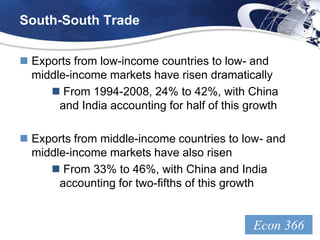
 Exports from low-income countries to low- and
  middle-income markets have risen dramatically
      From 1994-2008, 24% to 42%, with China
       and India accounting for half of this growth

 Exports from middle-income countries to low- and
  middle-income markets have also risen
      From 33% to 46%, with China and India
       accounting for two-fifths of this growth


                                              Econ 366
                                                LOGO
South-South Trade


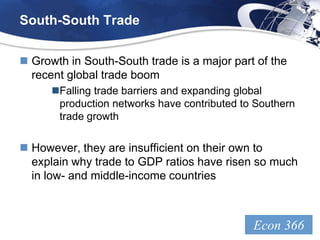
 Growth in South-South trade is a major part of the
  recent global trade boom
      Falling trade barriers and expanding global
       production networks have contributed to Southern
       trade growth

 However, they are insufficient on their own to
  explain why trade to GDP ratios have risen so much
  in low- and middle-income countries


                                              Econ 366
                                                LOGO
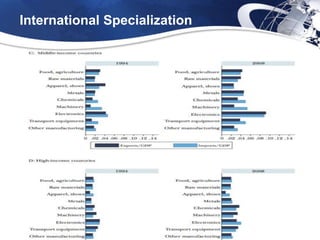
International Specialization


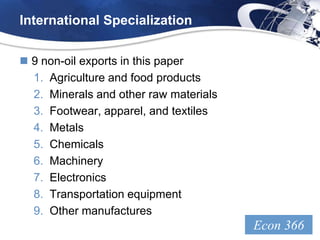
 9 non-oil exports in this paper
  1. Agriculture and food products
  2. Minerals and other raw materials
  3. Footwear, apparel, and textiles
  4. Metals
  5. Chemicals
  6. Machinery
  7. Electronics
  8. Transportation equipment
  9. Other manufactures
                                        Econ 366
                                          LOGO
International Specialization


Page 7
                               Econ 366
                                 LOGO
International Specialization


                               LOGO
Page 8
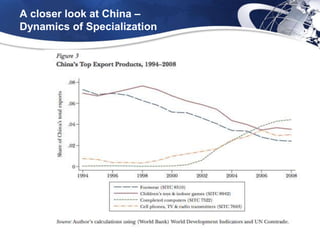
A closer look at China –
Dynamics of Specialization


                             LOGO
Hyper-Specialized Exporters


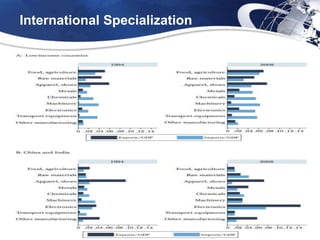
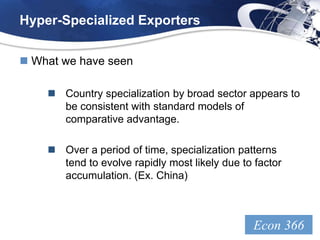
 What we have seen

     Country specialization by broad sector appears to
      be consistent with standard models of
      comparative advantage.

     Over a period of time, specialization patterns
      tend to evolve rapidly most likely due to factor
      accumulation. (Ex. China)


                                                Econ 366
                                                  LOGO
What is Hyper-specialization?


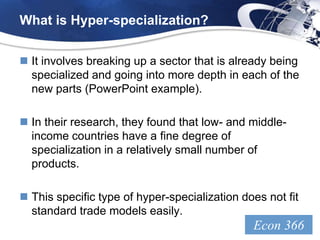
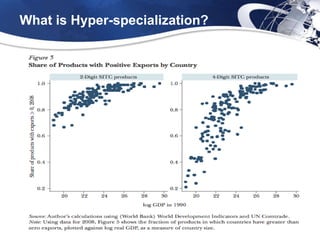
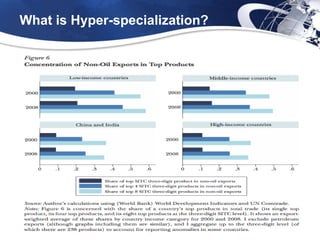
 It involves breaking up a sector that is already being
  specialized and going into more depth in each of the
  new parts (PowerPoint example).

 In their research, they found that low- and middle-
  income countries have a fine degree of
  specialization in a relatively small number of
  products.

 This specific type of hyper-specialization does not fit
  standard trade models easily.
                                               Econ 366
                                                 LOGO
What is Hyper-specialization?


                                LOGO
What is Hyper-specialization?


                                LOGO
Not just Low-income Countries


 Specialization is not solely a function of having
  small economies.

 Middle income economies also hyper-specialize
  (2008 Examples).

 Exports of most countries are concentrated in a
  small number of goods.


                                               Econ 366
                                                 LOGO
What Explains Hyper-
Specialization in Exporting?

   Melitz model(2003) that incorporates Heckscher-
    Ohlin model? Not quite

   Eaton and Kortum(2002) take on the Ricardian
    model?

   Rodik, Easterly, and Reshef(2009).

   Ideal Model.


                                             Econ 366
                                               LOGO
Final Discussion


 Middle-income nations are transforming the global
  economy
 Questions need to be answered:
       How much of the recent growth in global trade
       represents real value added?
       What explains hyper-specialization in exporting?
       Is China’s government pushing the country up the
       product ladder?
       What effect has the global commodity boom had on
       living standards in low-income countries?


                                                 Econ 366
                                                   LOGO
Group:
Bryce Hollingsworth, Meiyi
Cheng, Daniel Mena, James Hill

Econ 366 presentation: International Specialization

  • 1.
    LOGO Econ 366 Group: Bryce Hollingsworth, Meiyi Cheng, Daniel Mena, James Hill
  • 2.
    Emerging Economies inGlobal Trade  South-South Trade  International Specialization  Dynamics in Specialization  Hyper-specialized Exporters  Final Discussion Econ 366 LOGO
  • 3.
    South-South Trade  Urbanizationand industrialization in China and India  Increased demand for raw materials  Developing economies are the supply sources  Growth has deepened global production networks  Increased cross-border flows Econ 366 LOGO
  • 4.
    South-South Trade  Exportsfrom low-income countries to low- and middle-income markets have risen dramatically  From 1994-2008, 24% to 42%, with China and India accounting for half of this growth  Exports from middle-income countries to low- and middle-income markets have also risen  From 33% to 46%, with China and India accounting for two-fifths of this growth Econ 366 LOGO
  • 5.
    South-South Trade  Growthin South-South trade is a major part of the recent global trade boom Falling trade barriers and expanding global production networks have contributed to Southern trade growth  However, they are insufficient on their own to explain why trade to GDP ratios have risen so much in low- and middle-income countries Econ 366 LOGO
  • 6.
    International Specialization  9non-oil exports in this paper 1. Agriculture and food products 2. Minerals and other raw materials 3. Footwear, apparel, and textiles 4. Metals 5. Chemicals 6. Machinery 7. Electronics 8. Transportation equipment 9. Other manufactures Econ 366 LOGO
  • 7.
  • 8.
  • 9.
    A closer lookat China – Dynamics of Specialization LOGO
  • 10.
    Hyper-Specialized Exporters  Whatwe have seen  Country specialization by broad sector appears to be consistent with standard models of comparative advantage.  Over a period of time, specialization patterns tend to evolve rapidly most likely due to factor accumulation. (Ex. China) Econ 366 LOGO
  • 11.
    What is Hyper-specialization? It involves breaking up a sector that is already being specialized and going into more depth in each of the new parts (PowerPoint example).  In their research, they found that low- and middle- income countries have a fine degree of specialization in a relatively small number of products.  This specific type of hyper-specialization does not fit standard trade models easily. Econ 366 LOGO
  • 12.
  • 13.
  • 14.
    Not just Low-incomeCountries  Specialization is not solely a function of having small economies.  Middle income economies also hyper-specialize (2008 Examples).  Exports of most countries are concentrated in a small number of goods. Econ 366 LOGO
  • 15.
    What Explains Hyper- Specializationin Exporting?  Melitz model(2003) that incorporates Heckscher- Ohlin model? Not quite  Eaton and Kortum(2002) take on the Ricardian model?  Rodik, Easterly, and Reshef(2009).  Ideal Model. Econ 366 LOGO
  • 16.
    Final Discussion  Middle-incomenations are transforming the global economy  Questions need to be answered:  How much of the recent growth in global trade represents real value added?  What explains hyper-specialization in exporting?  Is China’s government pushing the country up the product ladder?  What effect has the global commodity boom had on living standards in low-income countries? Econ 366 LOGO
  • 17.