CHAPTER ONE
OVERVIEW OF E-COMMERCE
10:00:55 AM 1
What is E-commerce ?
 E-Commerce or Electronics Commerce is a methodology
of modern business, which addresses the requirements of
business organizations vendors and customers to reduce cost
and improve the quality of goods and services while increasing
the speed of delivery.
 It can be broadly defined as the process of buying or selling of
goods or services using an electronic medium such as the
Internet
 E-Commerce or Electronics Commerce is a methodology of
modern business which addresses the need of business
organizations. 10:00:55 AM 2
…cont’’
 E-commerce is an emerging concept that describes
the process of buying and selling or exchanging of
products, services, and information via computer
networks including the internet.
 Digitally enabled commercial transactions between
and among organizations and individuals.
10:00:55 AM 3
…cont’’’
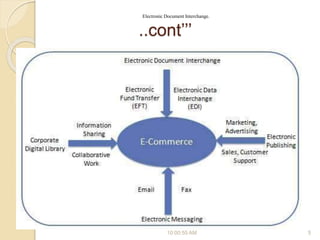
 Ecommerce refers to the paperless exchange
of business information using the following
ways:
Electronic Data Exchange (EDI)
Electronic Mail (e-mail)
Electronic Fund Transfer (EFT)
Other Network-based technologies
10:00:55 AM 4
..cont’’’
10:00:55 AM 5
Electronic Document Interchange.
Definition of E-Commerce from Different
Perspectives:
 Communications Perspective: E-commerce is
the delivery of information, products/services, or
payments over the telephone lines, computer
networks or any other electronic means.
 Business Process Perspective: E-commerce
is the application of technology toward the
automation of business transactions and
work flow.
10:00:55 AM 6
…cont’’’
 Service Perspective: E-commerce is a tool that addresses the
desire of firms, consumers, and management to cut service
costs while improving the quality of goods and increasing the
speed of service delivery.
 Online Perspective: E-commerce provides the capability of
buying and selling products and information on the internet
and other online services.
10:00:55 AM 7
Features of E-Commerce
 E-Commerce provides the following
features:
 Non-Cash Payment : E-Commerce enables use of
credit cards, debit cards, smart cards, electronic fund
transfer via bank's website and other modes of
electronics payment.
 24x7 Service availability: E-commerce automates
business of enterprises and services provided by them
to customers are available anytime, anywhere. Here
24x7 refers to 24 hours of each seven days of a week.
10:00:55 AM 8
Following are the actors in the credit card system.
 The card holder − Customer
 The merchant − seller of product who can accept credit
card payments.
 The card issuer bank − card holder's bank
 The acquirer bank − the merchant's bank
 The card brand − for example , visa or Master card.
 Steps to set up
10:00:55 AM 9
cont
 Advertising / Marketing: E-commerce increases the reach
of advertising of products and services of businesses. It
helps in better marketing management of products / services.
 Improved Sales: Using E-Commerce, orders for the
products can be generated any time, any where without any
human intervention. By this way, dependencies to buy a
product reduce at large and sales increases.
 Support: E-Commerce provides various ways to provide pre
sales and post sales assistance to provide better services to
customers.
10:00:55 AM 10
Cont’’
 Inventory Management: Using E-Commerce, inventory
management of products becomes automated. Reports
get generated instantly when required. Product inventory
management becomes very efficient and easy to
maintain.
 Communication improvement: E-Commerce provides
ways for faster, efficient, reliable communication with
customers and partners.
10:00:55 AM 11
E-commerce and E-business
 E-commerce primarily involves transactions that cross
firm boundaries.
 E-business primarily concerns the application of digital
technologies to business processes within the firm.
 It means-there is no commercial transaction (i.e.
exchange of value) in E-business but E-commerce
involves commercial transaction.
10:00:55 AM 12
Unique Features of E-commerce Technology
 Some unique features of E-commerce technology that is why
it is in more demand comparing to Traditional commerce
 Ubiquity: E-commerce is ubiquitous, meaning that it is
available just about everywhere, at all times.
 Global Reach: The potential market size for e-commerce
merchants is roughly equal to the size of the world’s online
population
 Universal Standards: E-commerce, are universal standards-
they are shared by all nations around the world.
10:00:55 AM 13
Cont’’’
 Information Richness: Information richness refers to
the complexity and content of a message.
 Information Density: Information density the total
amount and quality of information available to all market
participants, consumers, and merchants alike.
 Personalization/Customization: E-commerce
technologies permit personalization. Merchants can target
their marketing messages to specific individuals by adjusting
the message to a person’s name, interests, and past
purchases.
10:00:55 AM 14
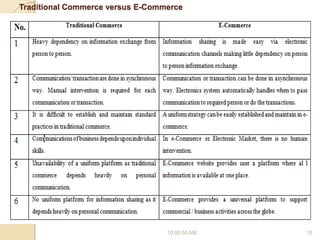
Traditional Commerce versus E-Commerce
10:00:55 AM 15
Limitation of E-commerce over traditional commerce
 Expensive Technology: Using the internet requires
$10/month connect charge.
 Sophisticated Skill Set: The skills required to make effective
use of the internet and e-commerce capabilities are far more
sophisticated than, say, for television or newspapers.
 Cultural Attraction and Social Event: For many, shopping is
a cultural and social event where people meet directly with
merchants and other consumers. This experience cannot yet
be duplicated in digital form.
 Limited Access of Technology: Most of the world’s population
does not have telephone service, PCs, or cell phones.
10:00:55 AM 16
E-Commerce - Advantages
 E-Commerce advantages can be broadly
classified in three major categories:
Advantages to Organizations
Advantages to Consumers (customers)
Advantages to Society
10:00:55 AM 17
Advantages to Organizations
 Using e-commerce, organizations can expand their market
to national and international markets with minimum capital
investment. An organization can easily locate more
customers, best suppliers, and suitable business partners
across the globe.
 E-commerce helps organizations to reduce the cost to create
process, distribute, retrieve and manage the paper based
information by digitizing the information.
 E-commerce improves the brand image of the company.
 E-commerce helps organization to provide better customer
services.
10:00:55 AM 18
…Cont’’’
 E-commerce helps to simplify the business processes and
makes them faster and efficient.
 E-commerce reduces the paper work.
 E-commerce increases the productivity of organizations. It
supports "pull" type supply management. In "pull" type supply
management, a business process starts when a request comes
from a customer and it uses just-in-time manufacturing way.
10:00:55 AM 19
Advantages to Customers
 It provides 24x7 support. Customers can enquire about a
product or service and place orders anytime, anywhere from
any location.
 E-commerce application provides users with more options
and quicker delivery of products.
 E-commerce application provides users with more options to
compare and select the cheaper and better options.
 A customer can put review comments about a product and
can see what others are buying, or see the review comments
of other customers before making a final purchase.
10:00:55 AM 20
…Cont’’’
 E-commerce provides options of virtual auctions.
 It provides readily available information. customer can see
the relevant detailed information within seconds, rather
than waiting for days or weeks.
 E-Commerce increases the competition among
organizations and as a result, organizations provides
substantial discounts to customers.
10:00:55 AM 21
Advantages to Society
◦ Customers need not travel to shop a product, thus less
traffic on road and low air pollution.
◦ E-commerce helps in reducing the cost of products, so less
affluent people can also afford the products.
◦ E-commerce has enabled rural areas to access services
and products, which are otherwise not available to them.
◦ E-commerce helps the government to deliver public
services such as healthcare, education, social services at a
reduced cost and in an improved manner.
10:00:55 AM 22
E-Commerce - Disadvantages
◦ The disadvantages of e-commerce can be broadly
classified into two major categories:
Technical disadvantages
Non-Technical disadvantages
10:00:55 AM 23
Technical Disadvantages
 There can be lack of system security, reliability or
standards owing to poor implementation of e-
commerce.
 The software development industry is still evolving and
keeps changing rapidly.
 In many countries, network bandwidth might cause an
issue.
 Special types of web servers or other software might
be required by the vendor, setting the e-commerce
environment apart from network servers.
10:00:55 AM 24

Ecommerce_Ch1.ppt

  • 1.
    CHAPTER ONE OVERVIEW OFE-COMMERCE 10:00:55 AM 1
  • 2.
    What is E-commerce?  E-Commerce or Electronics Commerce is a methodology of modern business, which addresses the requirements of business organizations vendors and customers to reduce cost and improve the quality of goods and services while increasing the speed of delivery.  It can be broadly defined as the process of buying or selling of goods or services using an electronic medium such as the Internet  E-Commerce or Electronics Commerce is a methodology of modern business which addresses the need of business organizations. 10:00:55 AM 2
  • 3.
    …cont’’  E-commerce isan emerging concept that describes the process of buying and selling or exchanging of products, services, and information via computer networks including the internet.  Digitally enabled commercial transactions between and among organizations and individuals. 10:00:55 AM 3
  • 4.
    …cont’’’  Ecommerce refersto the paperless exchange of business information using the following ways: Electronic Data Exchange (EDI) Electronic Mail (e-mail) Electronic Fund Transfer (EFT) Other Network-based technologies 10:00:55 AM 4
  • 5.
  • 6.
    Definition of E-Commercefrom Different Perspectives:  Communications Perspective: E-commerce is the delivery of information, products/services, or payments over the telephone lines, computer networks or any other electronic means.  Business Process Perspective: E-commerce is the application of technology toward the automation of business transactions and work flow. 10:00:55 AM 6
  • 7.
    …cont’’’  Service Perspective:E-commerce is a tool that addresses the desire of firms, consumers, and management to cut service costs while improving the quality of goods and increasing the speed of service delivery.  Online Perspective: E-commerce provides the capability of buying and selling products and information on the internet and other online services. 10:00:55 AM 7
  • 8.
    Features of E-Commerce E-Commerce provides the following features:  Non-Cash Payment : E-Commerce enables use of credit cards, debit cards, smart cards, electronic fund transfer via bank's website and other modes of electronics payment.  24x7 Service availability: E-commerce automates business of enterprises and services provided by them to customers are available anytime, anywhere. Here 24x7 refers to 24 hours of each seven days of a week. 10:00:55 AM 8
  • 9.
    Following are theactors in the credit card system.  The card holder − Customer  The merchant − seller of product who can accept credit card payments.  The card issuer bank − card holder's bank  The acquirer bank − the merchant's bank  The card brand − for example , visa or Master card.  Steps to set up 10:00:55 AM 9
  • 10.
    cont  Advertising /Marketing: E-commerce increases the reach of advertising of products and services of businesses. It helps in better marketing management of products / services.  Improved Sales: Using E-Commerce, orders for the products can be generated any time, any where without any human intervention. By this way, dependencies to buy a product reduce at large and sales increases.  Support: E-Commerce provides various ways to provide pre sales and post sales assistance to provide better services to customers. 10:00:55 AM 10
  • 11.
    Cont’’  Inventory Management:Using E-Commerce, inventory management of products becomes automated. Reports get generated instantly when required. Product inventory management becomes very efficient and easy to maintain.  Communication improvement: E-Commerce provides ways for faster, efficient, reliable communication with customers and partners. 10:00:55 AM 11
  • 12.
    E-commerce and E-business E-commerce primarily involves transactions that cross firm boundaries.  E-business primarily concerns the application of digital technologies to business processes within the firm.  It means-there is no commercial transaction (i.e. exchange of value) in E-business but E-commerce involves commercial transaction. 10:00:55 AM 12
  • 13.
    Unique Features ofE-commerce Technology  Some unique features of E-commerce technology that is why it is in more demand comparing to Traditional commerce  Ubiquity: E-commerce is ubiquitous, meaning that it is available just about everywhere, at all times.  Global Reach: The potential market size for e-commerce merchants is roughly equal to the size of the world’s online population  Universal Standards: E-commerce, are universal standards- they are shared by all nations around the world. 10:00:55 AM 13
  • 14.
    Cont’’’  Information Richness:Information richness refers to the complexity and content of a message.  Information Density: Information density the total amount and quality of information available to all market participants, consumers, and merchants alike.  Personalization/Customization: E-commerce technologies permit personalization. Merchants can target their marketing messages to specific individuals by adjusting the message to a person’s name, interests, and past purchases. 10:00:55 AM 14
  • 15.
    Traditional Commerce versusE-Commerce 10:00:55 AM 15
  • 16.
    Limitation of E-commerceover traditional commerce  Expensive Technology: Using the internet requires $10/month connect charge.  Sophisticated Skill Set: The skills required to make effective use of the internet and e-commerce capabilities are far more sophisticated than, say, for television or newspapers.  Cultural Attraction and Social Event: For many, shopping is a cultural and social event where people meet directly with merchants and other consumers. This experience cannot yet be duplicated in digital form.  Limited Access of Technology: Most of the world’s population does not have telephone service, PCs, or cell phones. 10:00:55 AM 16
  • 17.
    E-Commerce - Advantages E-Commerce advantages can be broadly classified in three major categories: Advantages to Organizations Advantages to Consumers (customers) Advantages to Society 10:00:55 AM 17
  • 18.
    Advantages to Organizations Using e-commerce, organizations can expand their market to national and international markets with minimum capital investment. An organization can easily locate more customers, best suppliers, and suitable business partners across the globe.  E-commerce helps organizations to reduce the cost to create process, distribute, retrieve and manage the paper based information by digitizing the information.  E-commerce improves the brand image of the company.  E-commerce helps organization to provide better customer services. 10:00:55 AM 18
  • 19.
    …Cont’’’  E-commerce helpsto simplify the business processes and makes them faster and efficient.  E-commerce reduces the paper work.  E-commerce increases the productivity of organizations. It supports "pull" type supply management. In "pull" type supply management, a business process starts when a request comes from a customer and it uses just-in-time manufacturing way. 10:00:55 AM 19
  • 20.
    Advantages to Customers It provides 24x7 support. Customers can enquire about a product or service and place orders anytime, anywhere from any location.  E-commerce application provides users with more options and quicker delivery of products.  E-commerce application provides users with more options to compare and select the cheaper and better options.  A customer can put review comments about a product and can see what others are buying, or see the review comments of other customers before making a final purchase. 10:00:55 AM 20
  • 21.
    …Cont’’’  E-commerce providesoptions of virtual auctions.  It provides readily available information. customer can see the relevant detailed information within seconds, rather than waiting for days or weeks.  E-Commerce increases the competition among organizations and as a result, organizations provides substantial discounts to customers. 10:00:55 AM 21
  • 22.
    Advantages to Society ◦Customers need not travel to shop a product, thus less traffic on road and low air pollution. ◦ E-commerce helps in reducing the cost of products, so less affluent people can also afford the products. ◦ E-commerce has enabled rural areas to access services and products, which are otherwise not available to them. ◦ E-commerce helps the government to deliver public services such as healthcare, education, social services at a reduced cost and in an improved manner. 10:00:55 AM 22
  • 23.
    E-Commerce - Disadvantages ◦The disadvantages of e-commerce can be broadly classified into two major categories: Technical disadvantages Non-Technical disadvantages 10:00:55 AM 23
  • 24.
    Technical Disadvantages  Therecan be lack of system security, reliability or standards owing to poor implementation of e- commerce.  The software development industry is still evolving and keeps changing rapidly.  In many countries, network bandwidth might cause an issue.  Special types of web servers or other software might be required by the vendor, setting the e-commerce environment apart from network servers. 10:00:55 AM 24