Promises and Pitfalls of Policy:
The EU Tobacco Products Directive as Applied
to E-Cigarettes
Lynne Dawkins, Professor of Nicotine & Tobacco Studies,
Centre for Addictive Behaviours Research, London South
Bank University
@LynneDawkins
@CABR_LSBU
Disclosures
• Pharmaceutical industry: consultancy (2014; 2017)
• Law/Litigation: expert witness/consultant (2014)
• E-cigarette companies: research grants, honorarium (2010-2013)
• Tobacco Industry: no funding
Talk Overview
• Background
• The EU Tobacco Products Directive (TPD (2014) Article 20
• Promises & concerns/pitfalls
• The research
• Vapers’ responses & experiences
• Nicotine concentration upper limit in e-liquid
• Nicotine warning messages
• Summary / conclusions
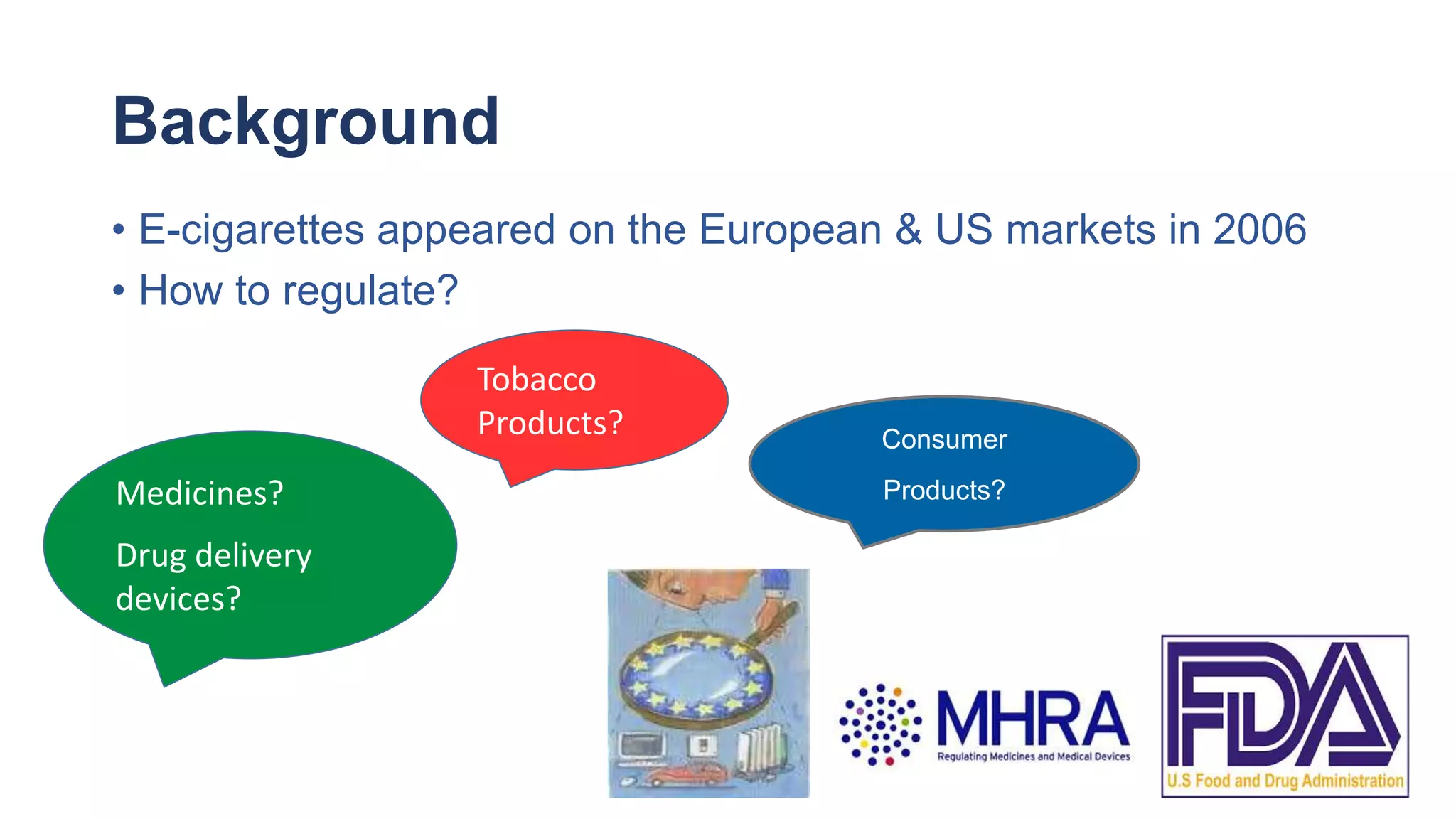
Background
• E-cigarettes appeared on the European & US markets in 2006
• How to regulate?
Medicines?
Drug delivery
devices?
Tobacco
Products? Consumer
Products?
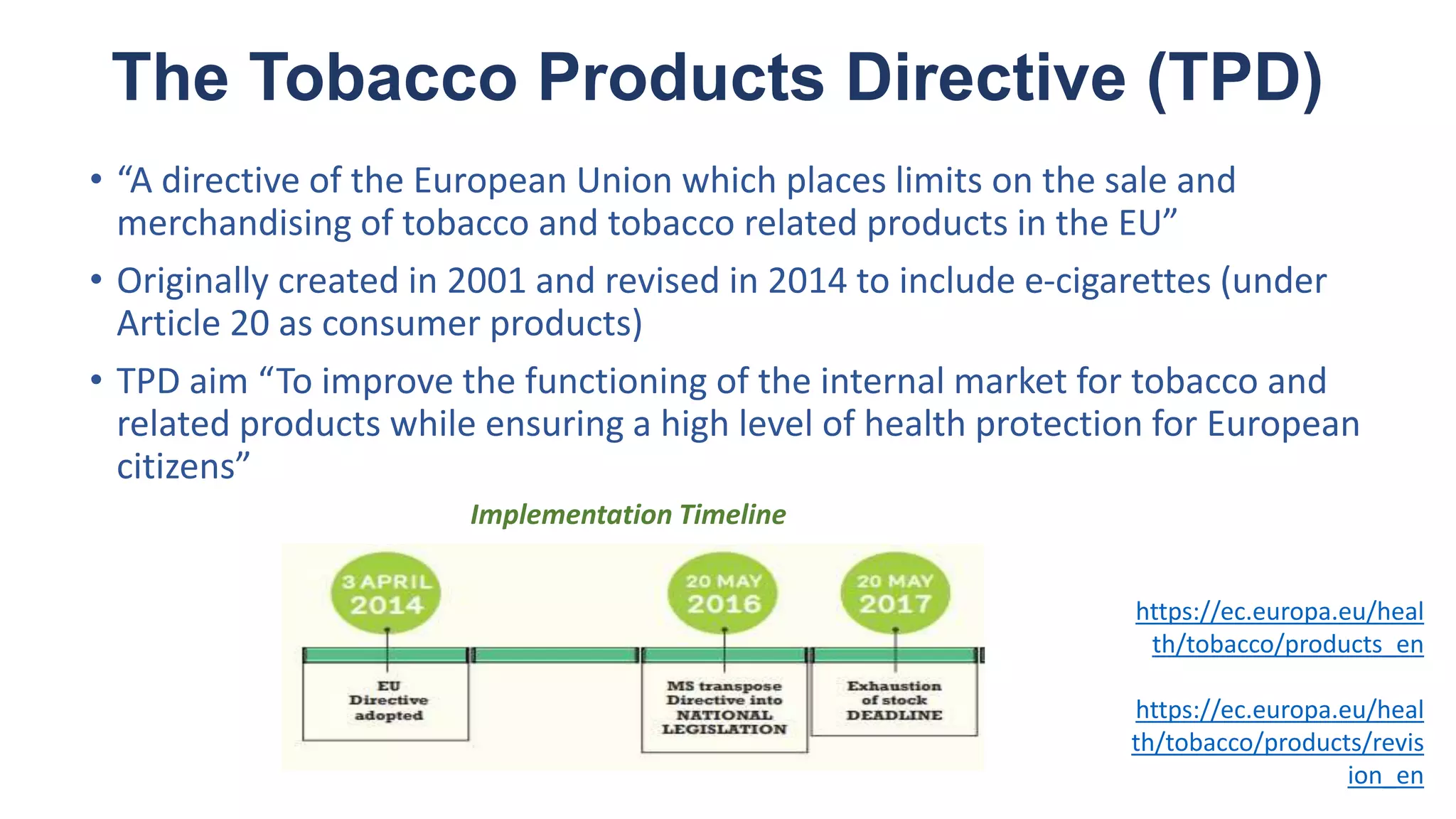
The Tobacco Products Directive (TPD)
• “A directive of the European Union which places limits on the sale and
merchandising of tobacco and tobacco related products in the EU”
• Originally created in 2001 and revised in 2014 to include e-cigarettes (under
Article 20 as consumer products)
• TPD aim “To improve the functioning of the internal market for tobacco and
related products while ensuring a high level of health protection for European
citizens”
https://ec.europa.eu/heal
th/tobacco/products_en
https://ec.europa.eu/heal
th/tobacco/products/revis
ion_en
Implementation Timeline
Promises: The Tobacco Products
Directive (TPD) Article 20: E-cigarettes
• E-cigarette controls introduced to ensure:
• Minimum standards for the safety and quality of all e-cigarettes and
refill containers;
• That information is provided to consumers so that they can make
informed choices;
• An environment that protects children from starting to use these
products
The Tobacco Products Directive (TPD)
Article 20: E-cigarettes
https://ec.europa.eu/health/tobacco/products/revision_en
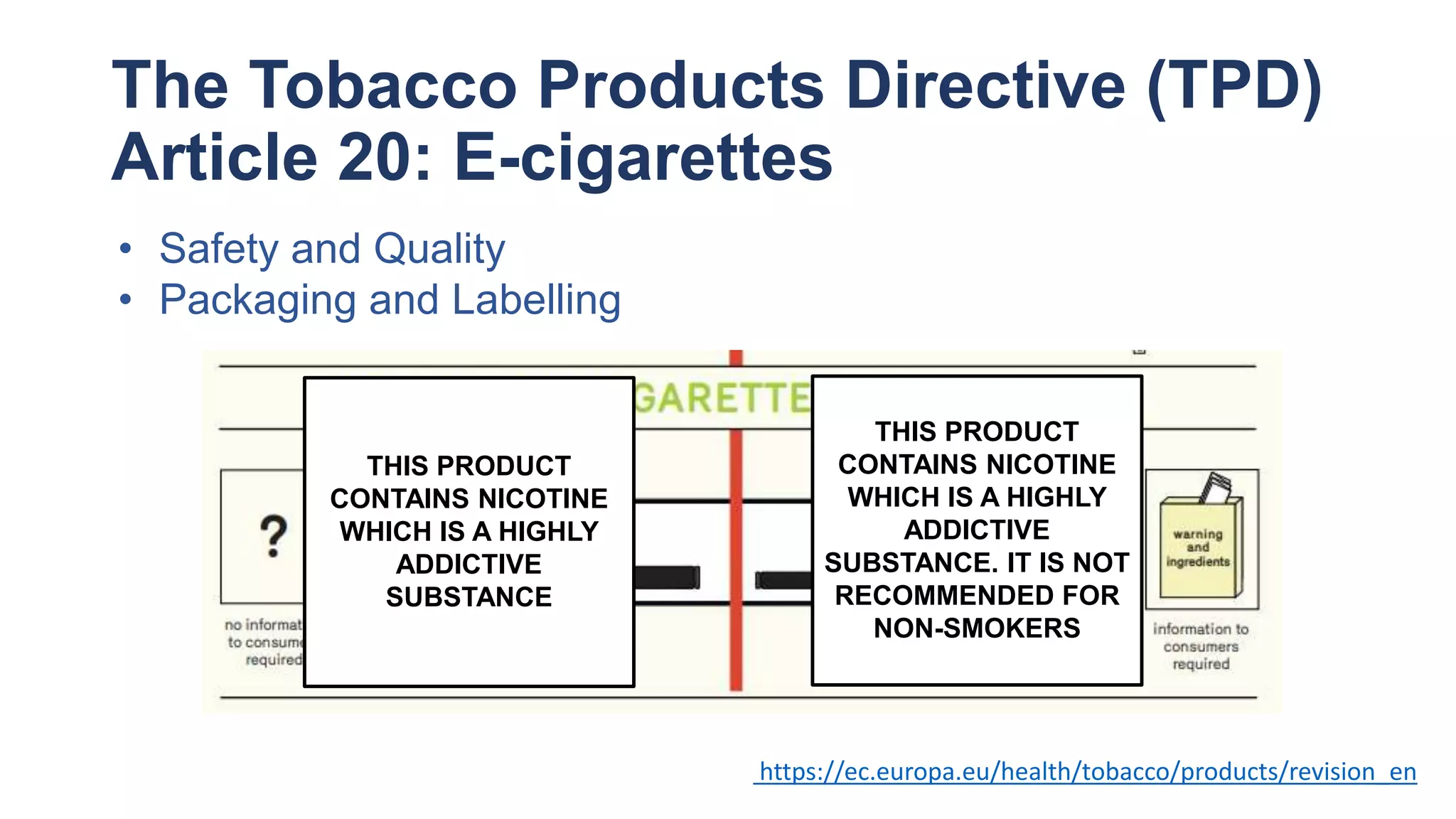
• Safety and Quality
• Packaging and Labelling
THIS PRODUCT
CONTAINS NICOTINE
WHICH IS A HIGHLY
ADDICTIVE
SUBSTANCE
THIS PRODUCT
CONTAINS NICOTINE
WHICH IS A HIGHLY
ADDICTIVE
SUBSTANCE. IT IS NOT
RECOMMENDED FOR
NON-SMOKERS
The Tobacco Products Directive (TPD)
Article 20: E-cigarettes
https://ec.europa.eu/health/tobacco/products/revision_en
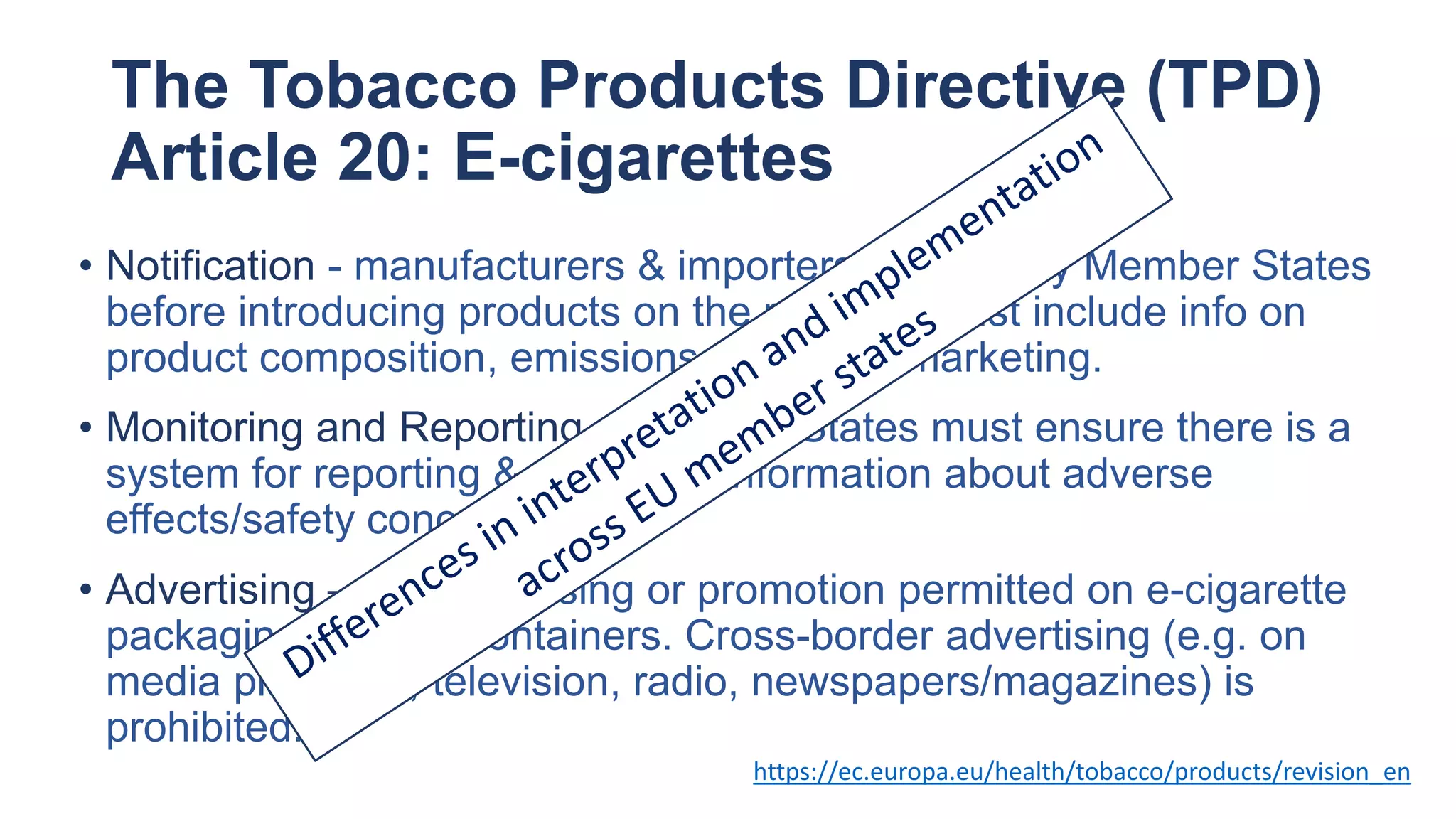
• Notification - manufacturers & importers must notify Member States
before introducing products on the market. Must include info on
product composition, emissions and sales/marketing.
• Monitoring and Reporting – Member States must ensure there is a
system for reporting & collecting information about adverse
effects/safety concerns.
• Advertising – No advertising or promotion permitted on e-cigarette
packaging or re-fill containers. Cross-border advertising (e.g. on
media platforms, television, radio, newspapers/magazines) is
prohibited.
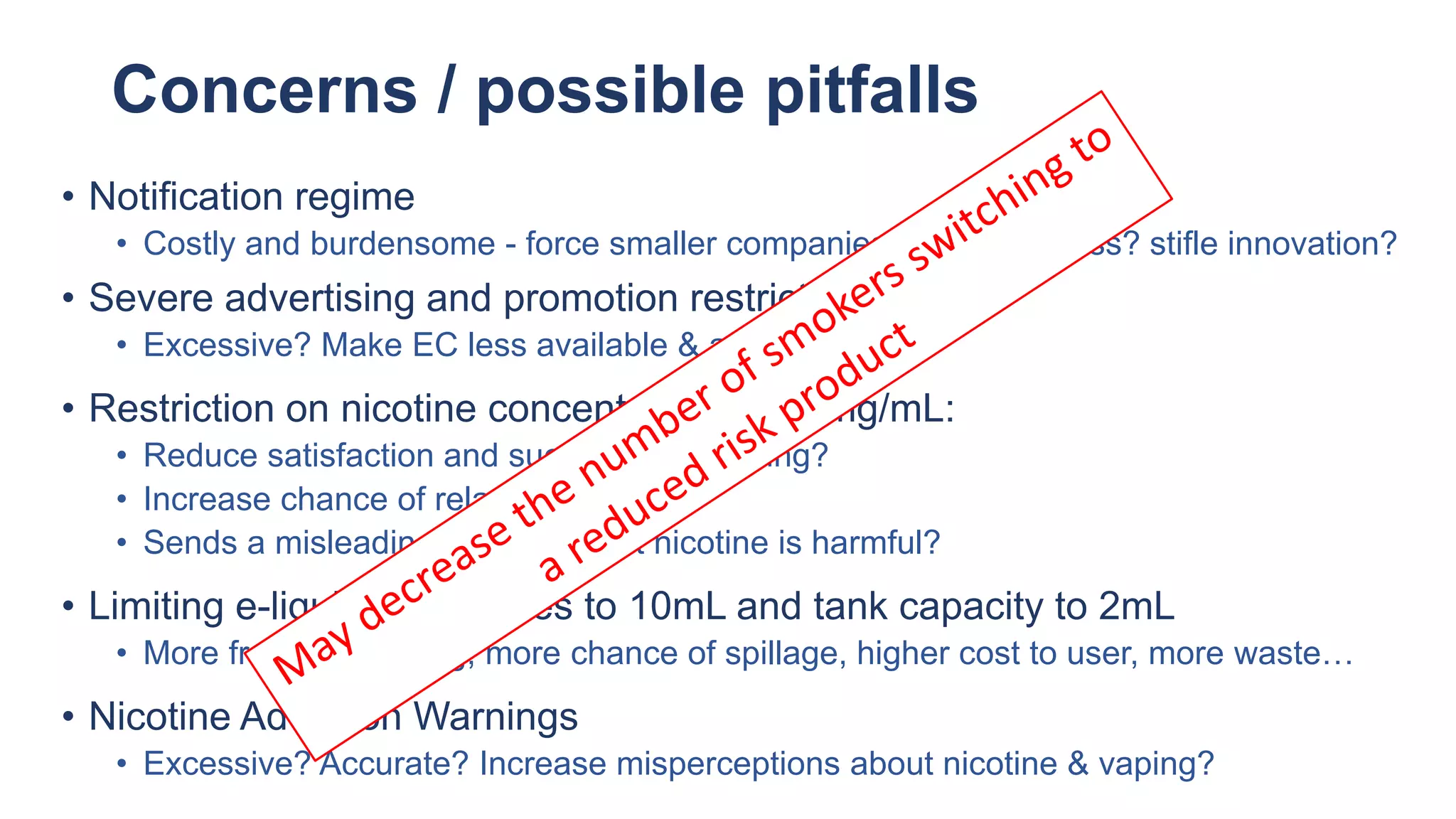
Concerns / possible pitfalls
• Notification regime
• Costly and burdensome - force smaller companies out of business? stifle innovation?
• Severe advertising and promotion restrictions
• Excessive? Make EC less available & attractive?
• Restriction on nicotine concentration at 20mg/mL:
• Reduce satisfaction and successful switching?
• Increase chance of relapse?
• Sends a misleading message that nicotine is harmful?
• Limiting e-liquid refill bottles to 10mL and tank capacity to 2mL
• More frequent refilling, more chance of spillage, higher cost to user, more waste…
• Nicotine Addiction Warnings
• Excessive? Accurate? Increase misperceptions about nicotine & vaping?
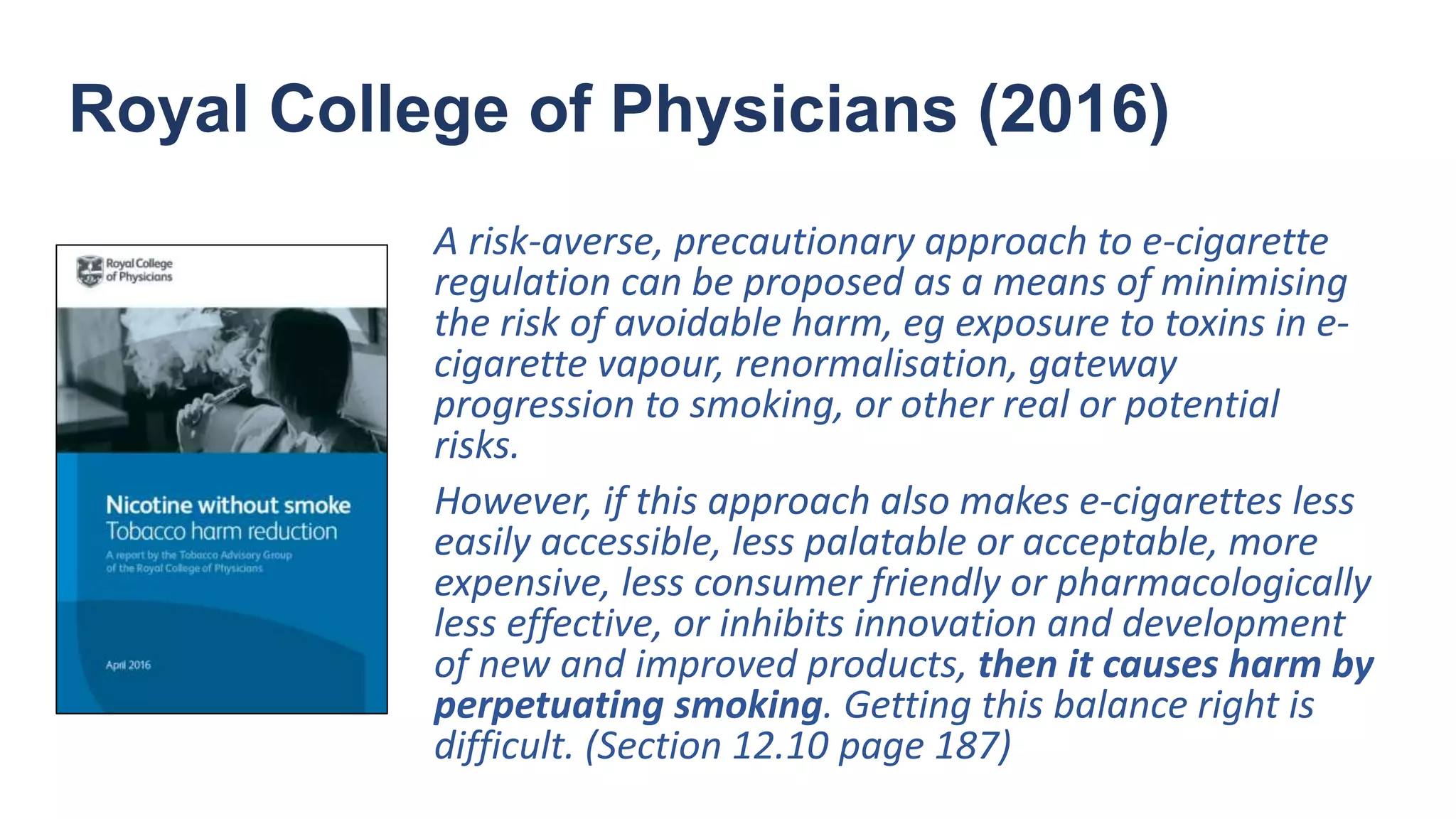
Royal College of Physicians (2016)
A risk-averse, precautionary approach to e-cigarette
regulation can be proposed as a means of minimising
the risk of avoidable harm, eg exposure to toxins in e-
cigarette vapour, renormalisation, gateway
progression to smoking, or other real or potential
risks.
However, if this approach also makes e-cigarettes less
easily accessible, less palatable or acceptable, more
expensive, less consumer friendly or pharmacologically
less effective, or inhibits innovation and development
of new and improved products, then it causes harm by
perpetuating smoking. Getting this balance right is
difficult. (Section 12.10 page 187)
Have these concerns been
borne out?
The Evidence
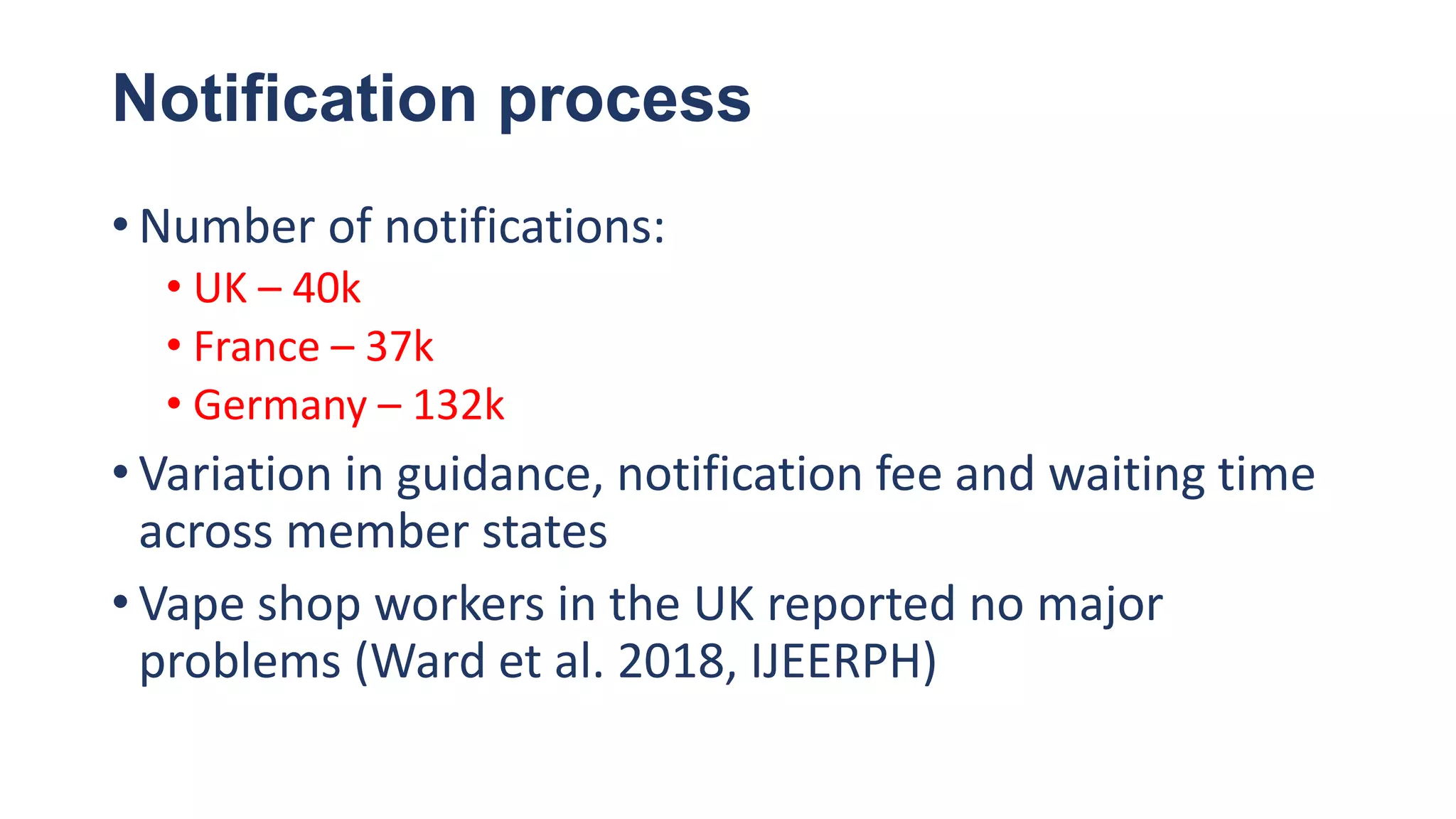
Notification process
• Number of notifications:
• UK – 40k
• France – 37k
• Germany – 132k
• Variation in guidance, notification fee and waiting time
across member states
• Vape shop workers in the UK reported no major
problems (Ward et al. 2018, IJEERPH)
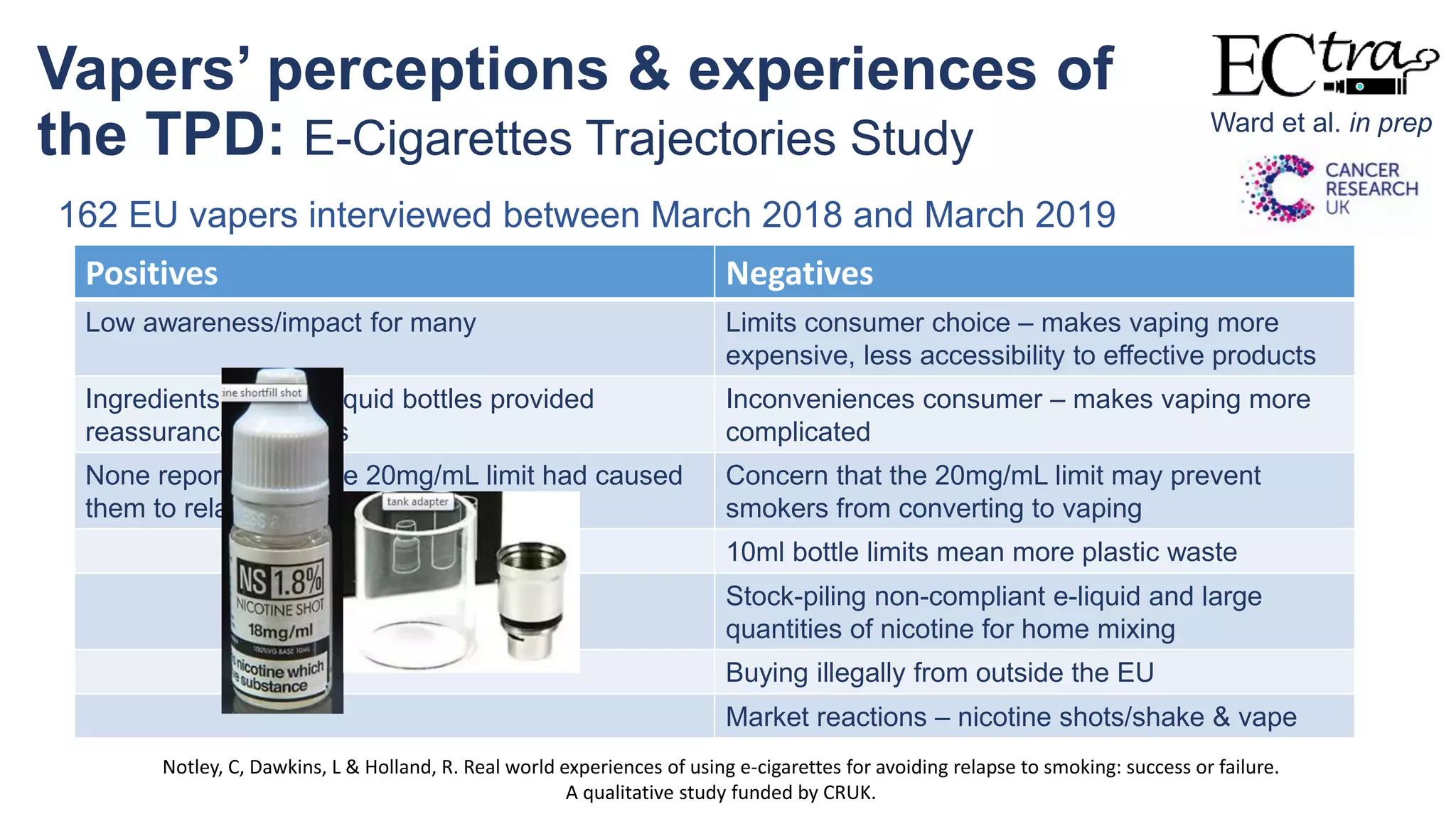
Vapers’ perceptions & experiences of
the TPD: E-Cigarettes Trajectories Study
162 EU vapers interviewed between March 2018 and March 2019
Positives Negatives
Low awareness/impact for many Limits consumer choice – makes vaping more
expensive, less accessibility to effective products
Ingredients list on e-liquid bottles provided
reassurance for users
Inconveniences consumer – makes vaping more
complicated
None reported that the 20mg/mL limit had caused
them to relapse to smoking
Concern that the 20mg/mL limit may prevent
smokers from converting to vaping
10ml bottle limits mean more plastic waste
Stock-piling non-compliant e-liquid and large
quantities of nicotine for home mixing
Buying illegally from outside the EU
Market reactions – nicotine shots/shake & vape
Ward et al. in prep
Notley, C, Dawkins, L & Holland, R. Real world experiences of using e-cigarettes for avoiding relapse to smoking: success or failure.
A qualitative study funded by CRUK.
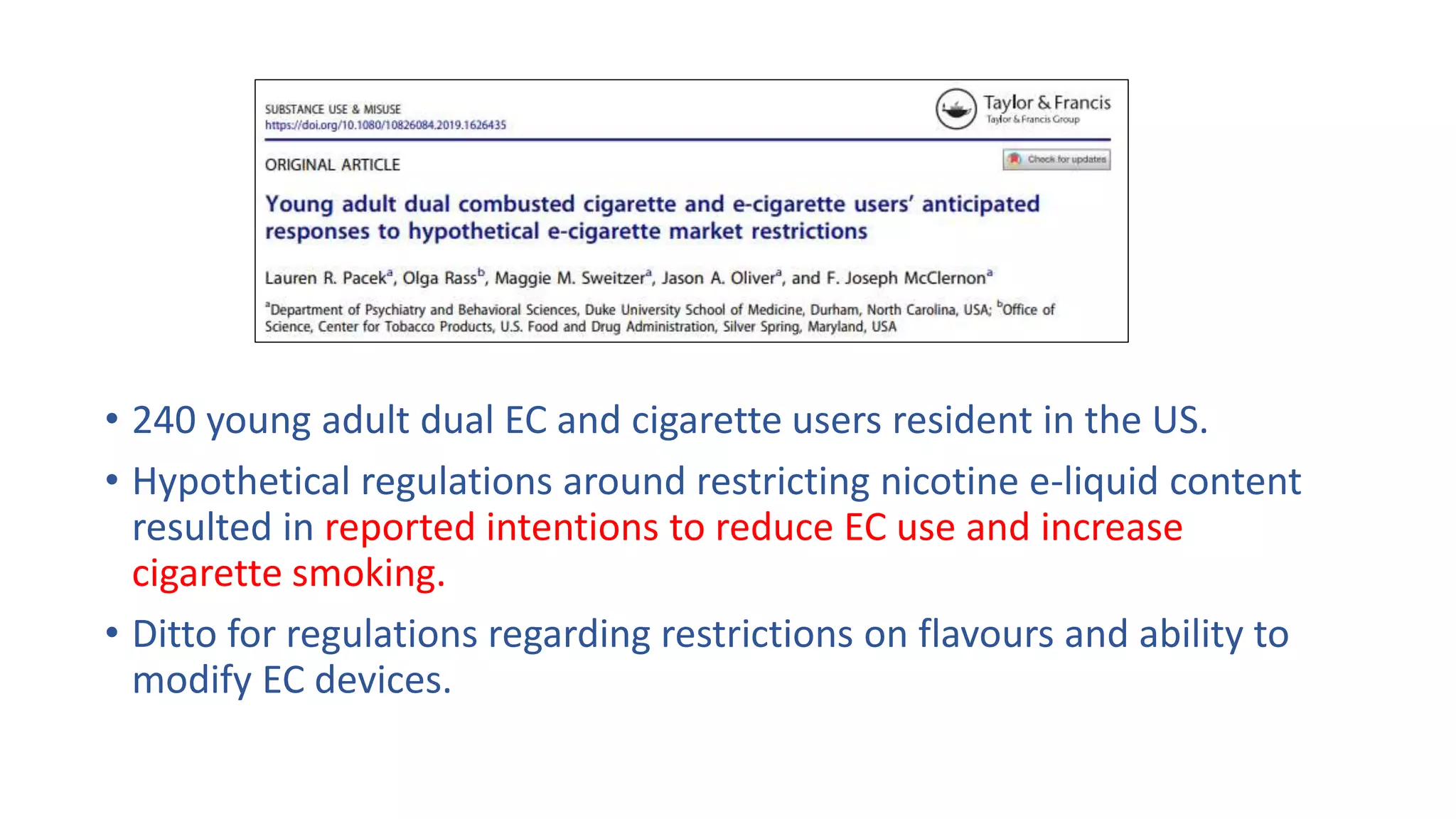
• 240 young adult dual EC and cigarette users resident in the US.
• Hypothetical regulations around restricting nicotine e-liquid content
resulted in reported intentions to reduce EC use and increase
cigarette smoking.
• Ditto for regulations regarding restrictions on flavours and ability to
modify EC devices.
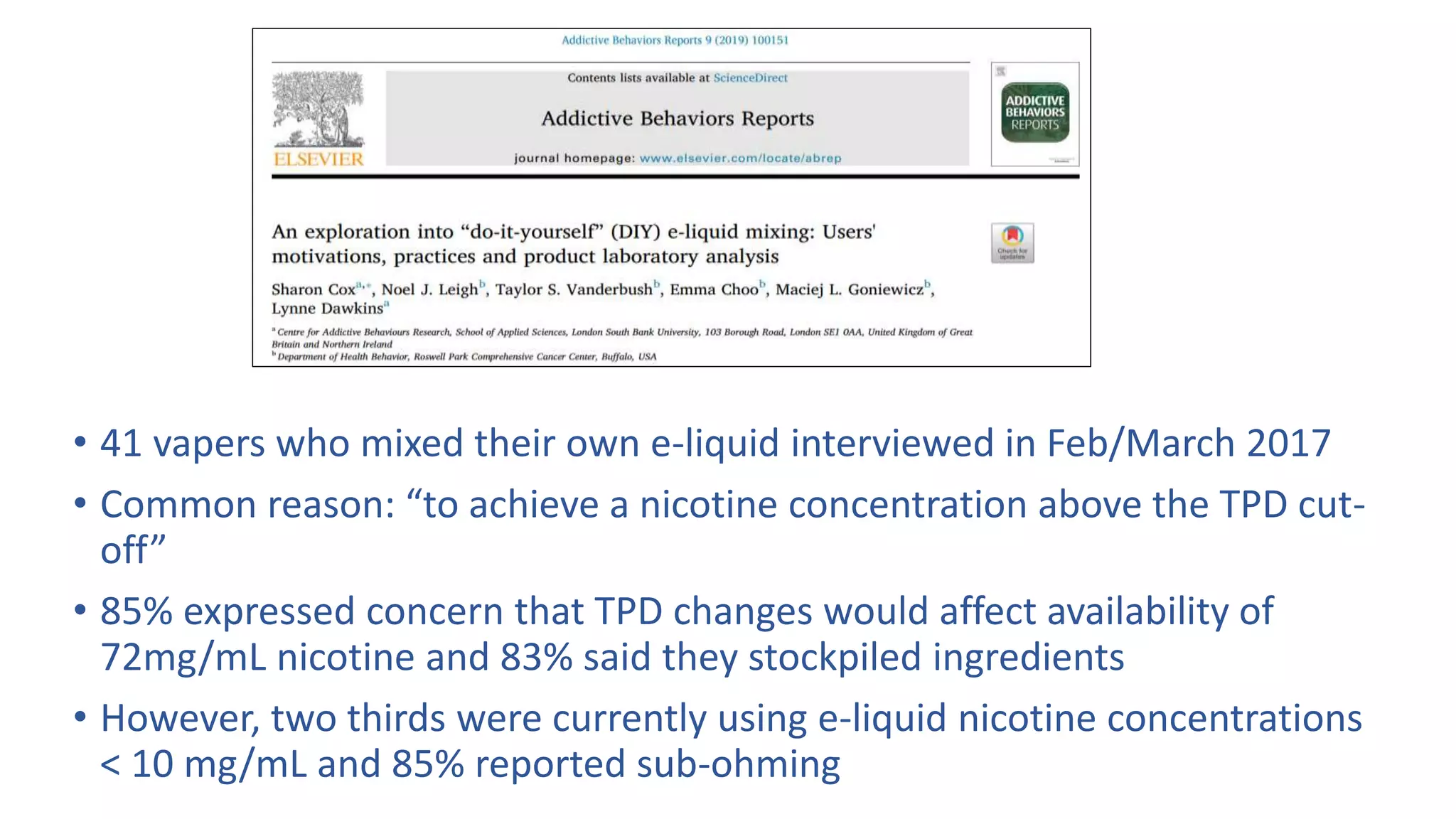
• 41 vapers who mixed their own e-liquid interviewed in Feb/March 2017
• Common reason: “to achieve a nicotine concentration above the TPD cut-
off”
• 85% expressed concern that TPD changes would affect availability of
72mg/mL nicotine and 83% said they stockpiled ingredients
• However, two thirds were currently using e-liquid nicotine concentrations
< 10 mg/mL and 85% reported sub-ohming
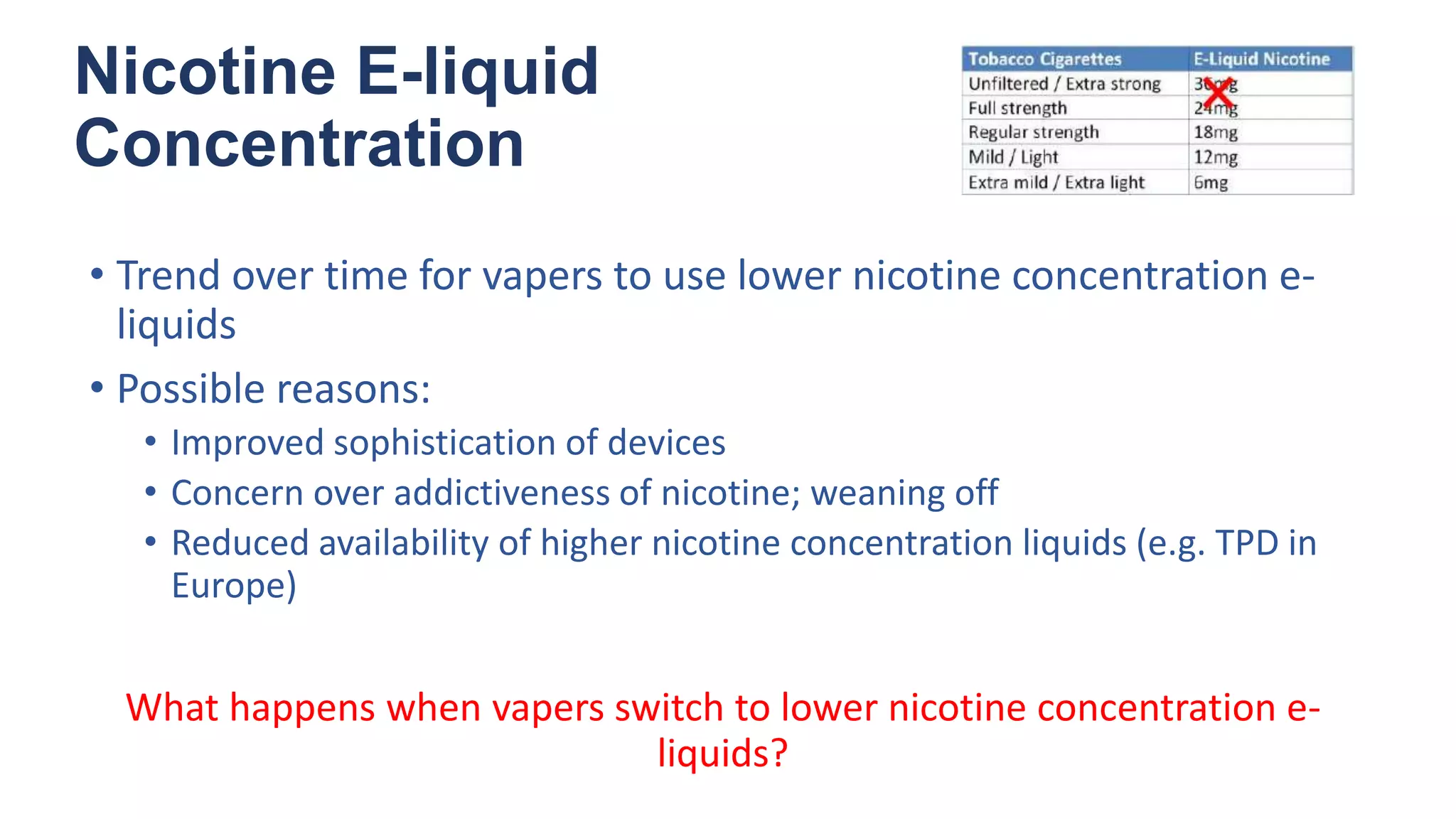
Nicotine E-liquid
Concentration
• Trend over time for vapers to use lower nicotine concentration e-
liquids
• Possible reasons:
• Improved sophistication of devices
• Concern over addictiveness of nicotine; weaning off
• Reduced availability of higher nicotine concentration liquids (e.g. TPD in
Europe)
What happens when vapers switch to lower nicotine concentration e-
liquids?
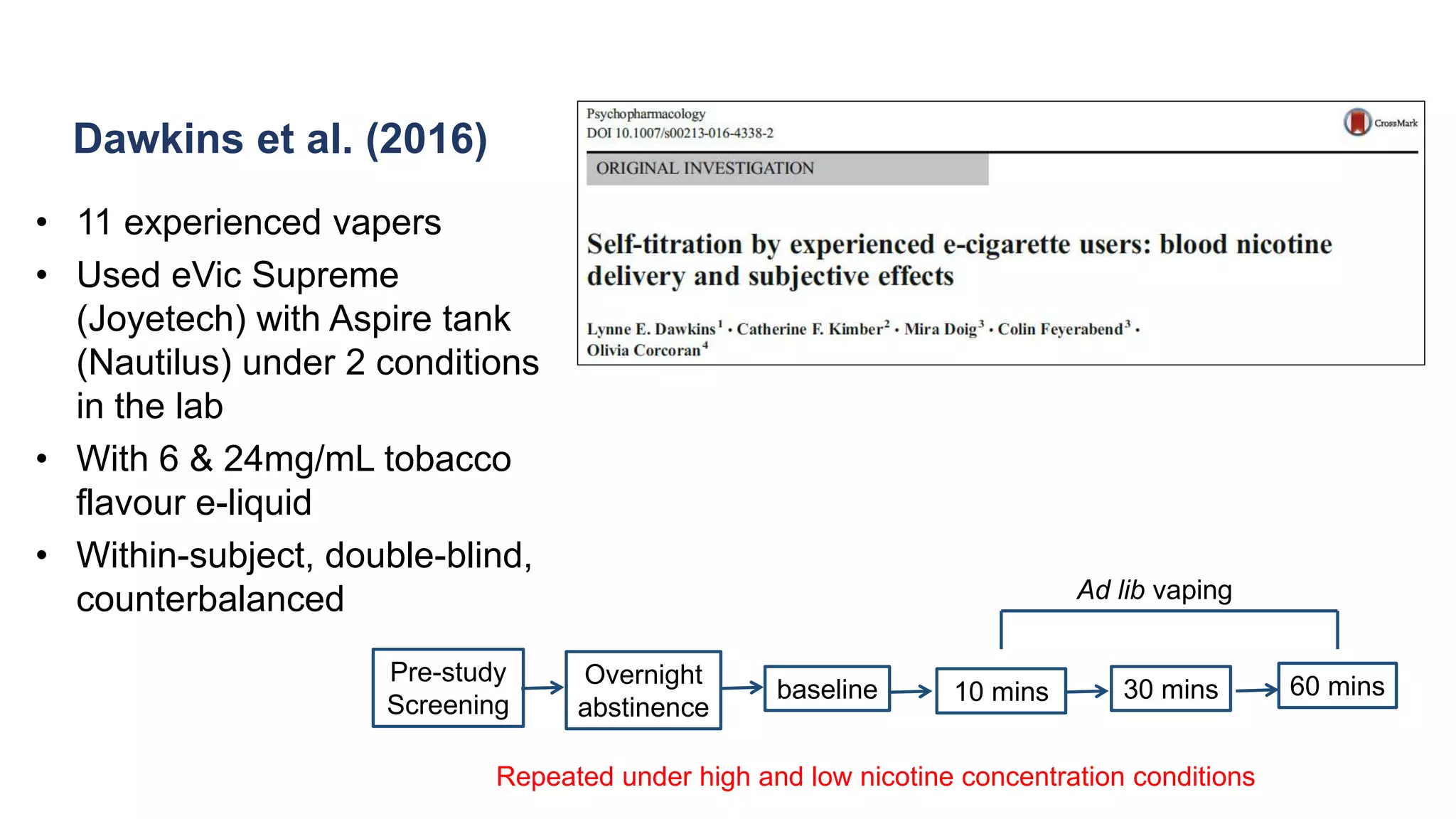
Ad lib vaping
Overnight
abstinence
baseline 10 mins 30 mins 60 mins
Pre-study
Screening
Repeated under high and low nicotine concentration conditions
• 11 experienced vapers
• Used eVic Supreme
(Joyetech) with Aspire tank
(Nautilus) under 2 conditions
in the lab
• With 6 & 24mg/mL tobacco
flavour e-liquid
• Within-subject, double-blind,
counterbalanced
Dawkins et al. (2016)
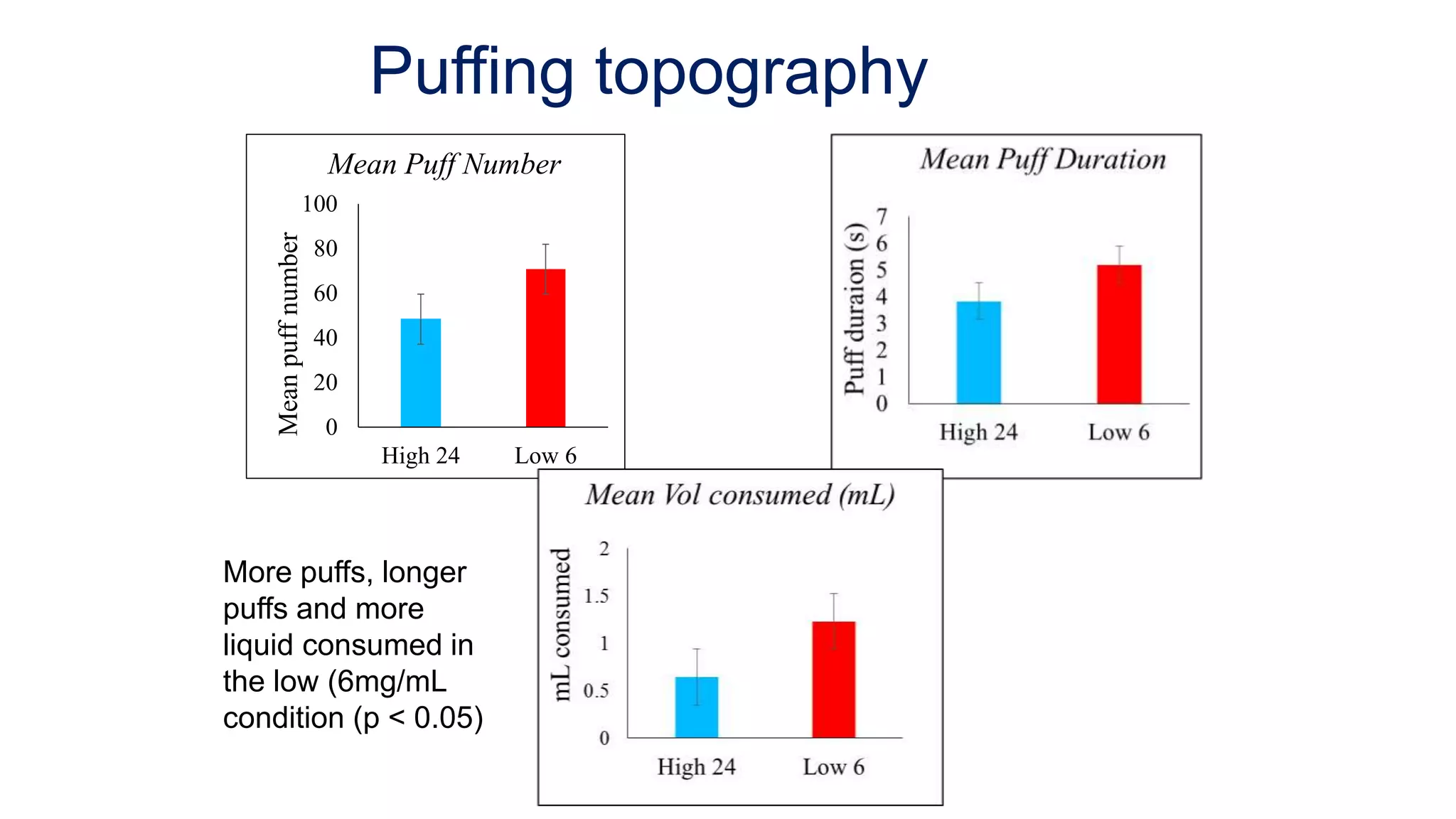
Puffing topography
0
20
40
60
80
100
High 24 Low 6
Meanpuffnumber
Mean Puff Number
More puffs, longer
puffs and more
liquid consumed in
the low (6mg/mL
condition (p < 0.05)
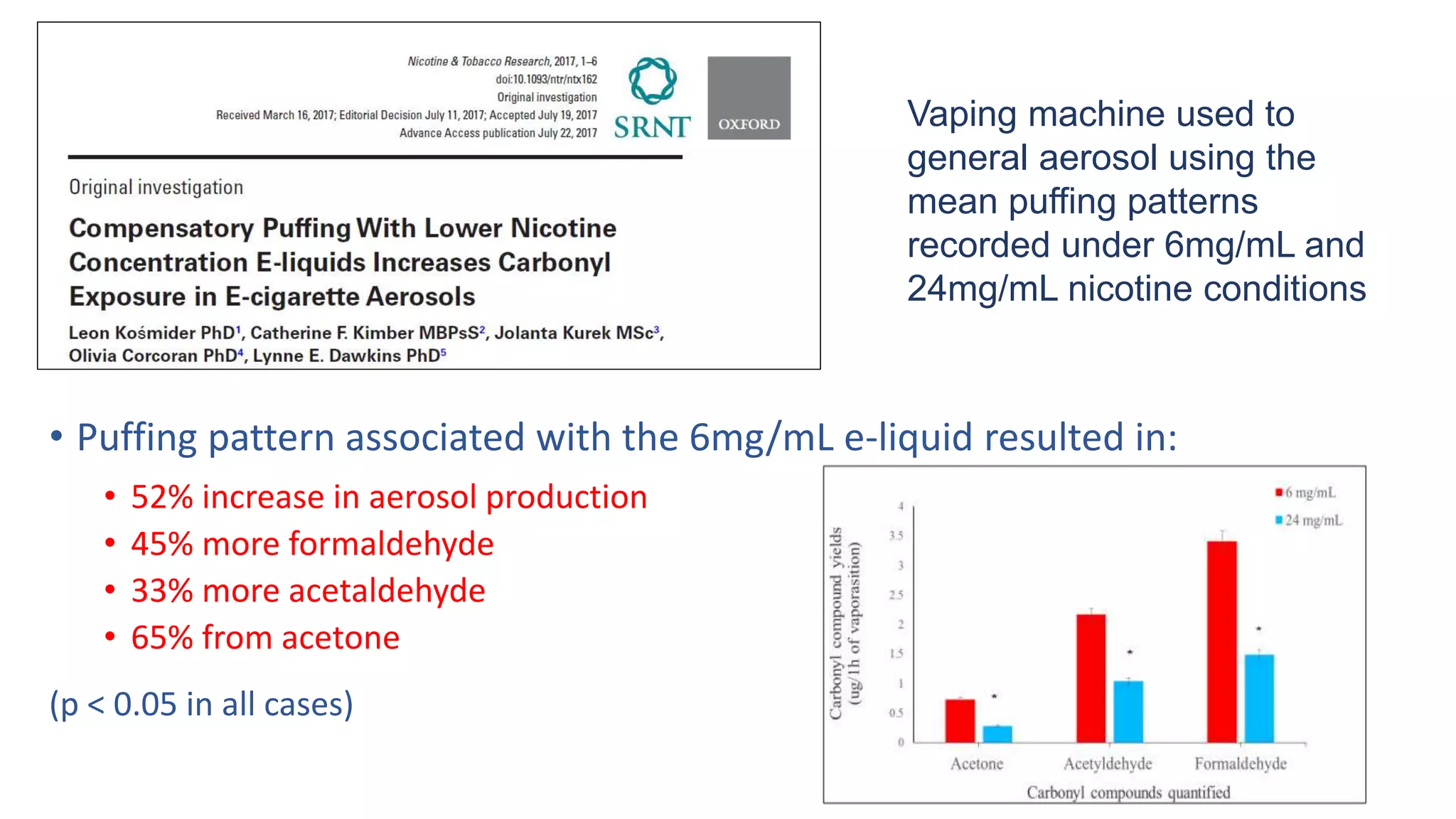
• Puffing pattern associated with the 6mg/mL e-liquid resulted in:
• 52% increase in aerosol production
• 45% more formaldehyde
• 33% more acetaldehyde
• 65% from acetone
(p < 0.05 in all cases)
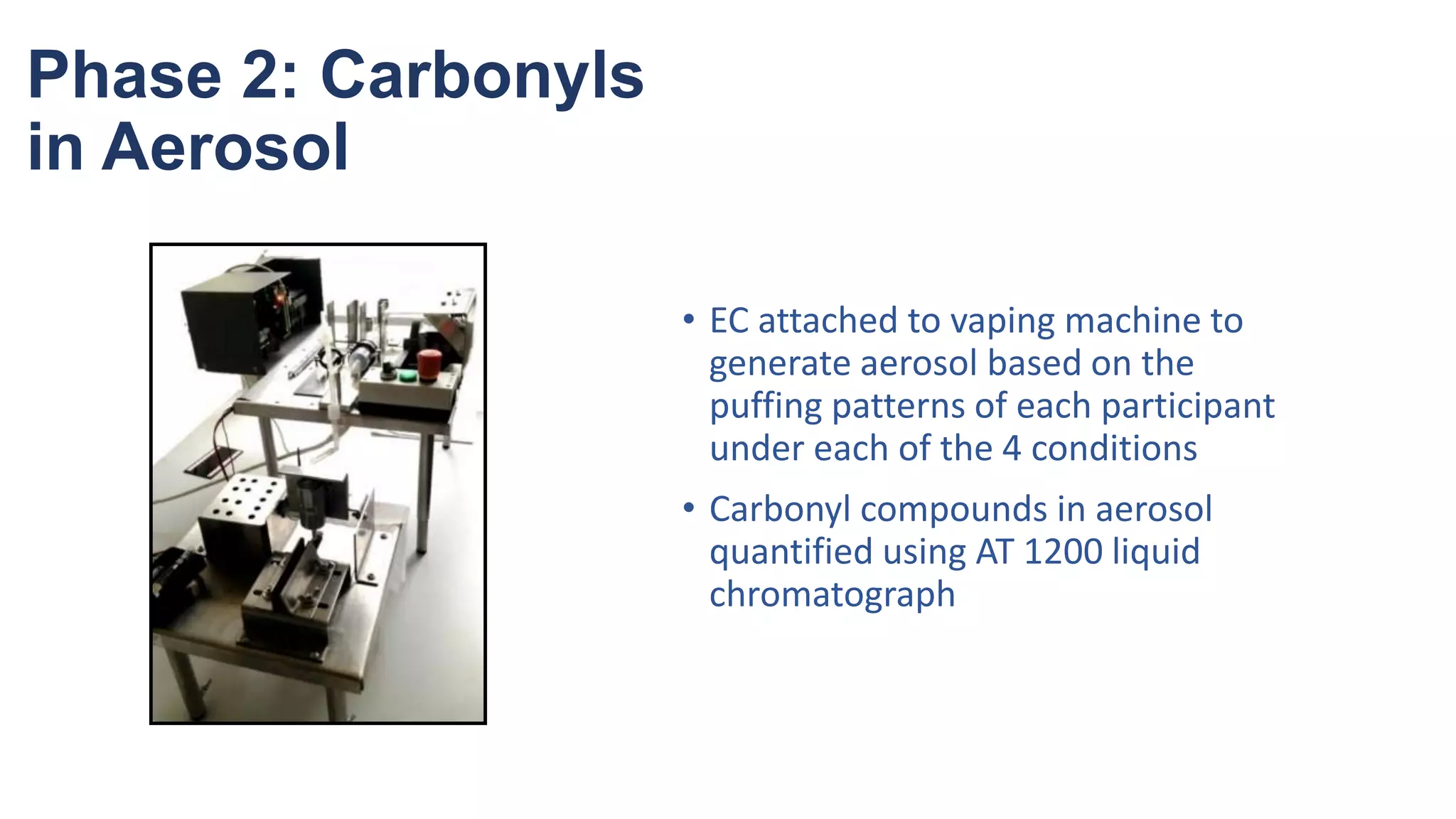
Vaping machine used to
general aerosol using the
mean puffing patterns
recorded under 6mg/mL and
24mg/mL nicotine conditions
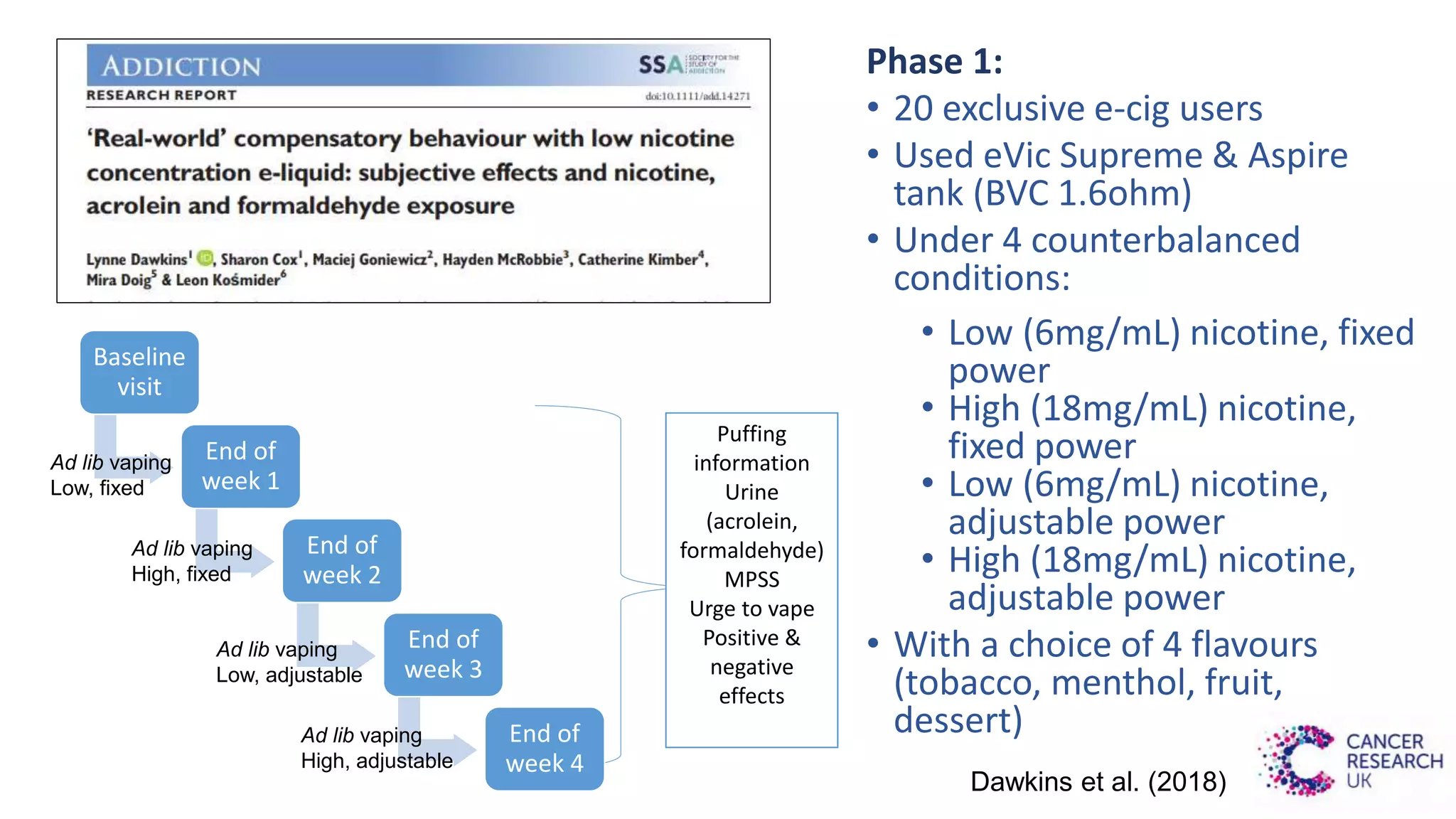
Phase 1:
• 20 exclusive e-cig users
• Used eVic Supreme & Aspire
tank (BVC 1.6ohm)
• Under 4 counterbalanced
conditions:
• Low (6mg/mL) nicotine, fixed
power
• High (18mg/mL) nicotine,
fixed power
• Low (6mg/mL) nicotine,
adjustable power
• High (18mg/mL) nicotine,
adjustable power
• With a choice of 4 flavours
(tobacco, menthol, fruit,
dessert)
Baseline
visit
End of
week 1
End of
week 2
End of
week 3
End of
week 4
Ad lib vaping
Low, fixed
Ad lib vaping
High, fixed
Ad lib vaping
Low, adjustable
Ad lib vaping
High, adjustable
Puffing
information
Urine
(acrolein,
formaldehyde)
MPSS
Urge to vape
Positive &
negative
effects
Dawkins et al. (2018)
Phase 2: Carbonyls
in Aerosol
• EC attached to vaping machine to
generate aerosol based on the
puffing patterns of each participant
under each of the 4 conditions
• Carbonyl compounds in aerosol
quantified using AT 1200 liquid
chromatograph
Results:
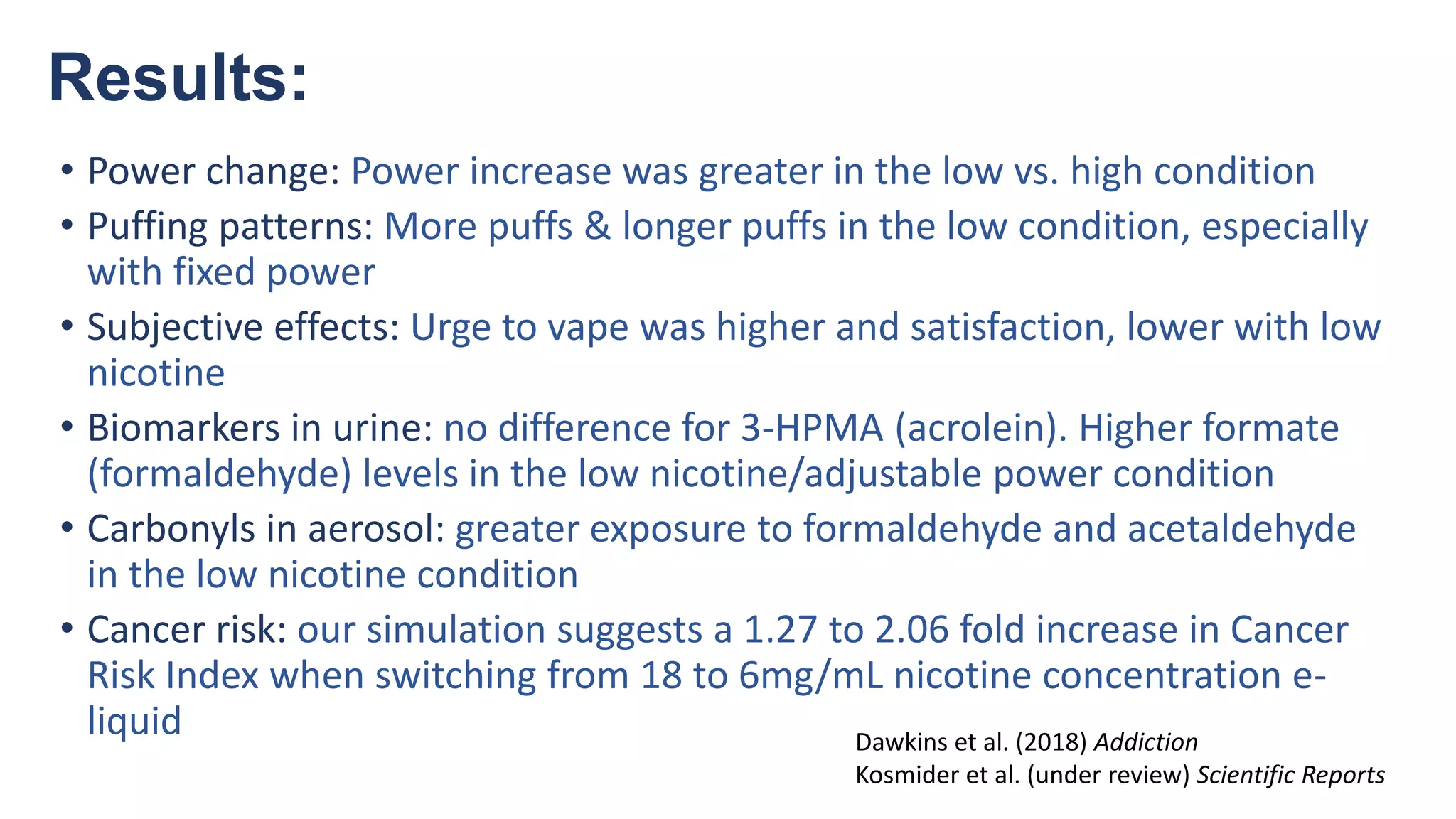
• Power change: Power increase was greater in the low vs. high condition
• Puffing patterns: More puffs & longer puffs in the low condition, especially
with fixed power
• Subjective effects: Urge to vape was higher and satisfaction, lower with low
nicotine
• Biomarkers in urine: no difference for 3-HPMA (acrolein). Higher formate
(formaldehyde) levels in the low nicotine/adjustable power condition
• Carbonyls in aerosol: greater exposure to formaldehyde and acetaldehyde
in the low nicotine condition
• Cancer risk: our simulation suggests a 1.27 to 2.06 fold increase in Cancer
Risk Index when switching from 18 to 6mg/mL nicotine concentration e-
liquid Dawkins et al. (2018) Addiction
Kosmider et al. (under review) Scientific Reports
Pitfalls of Policy
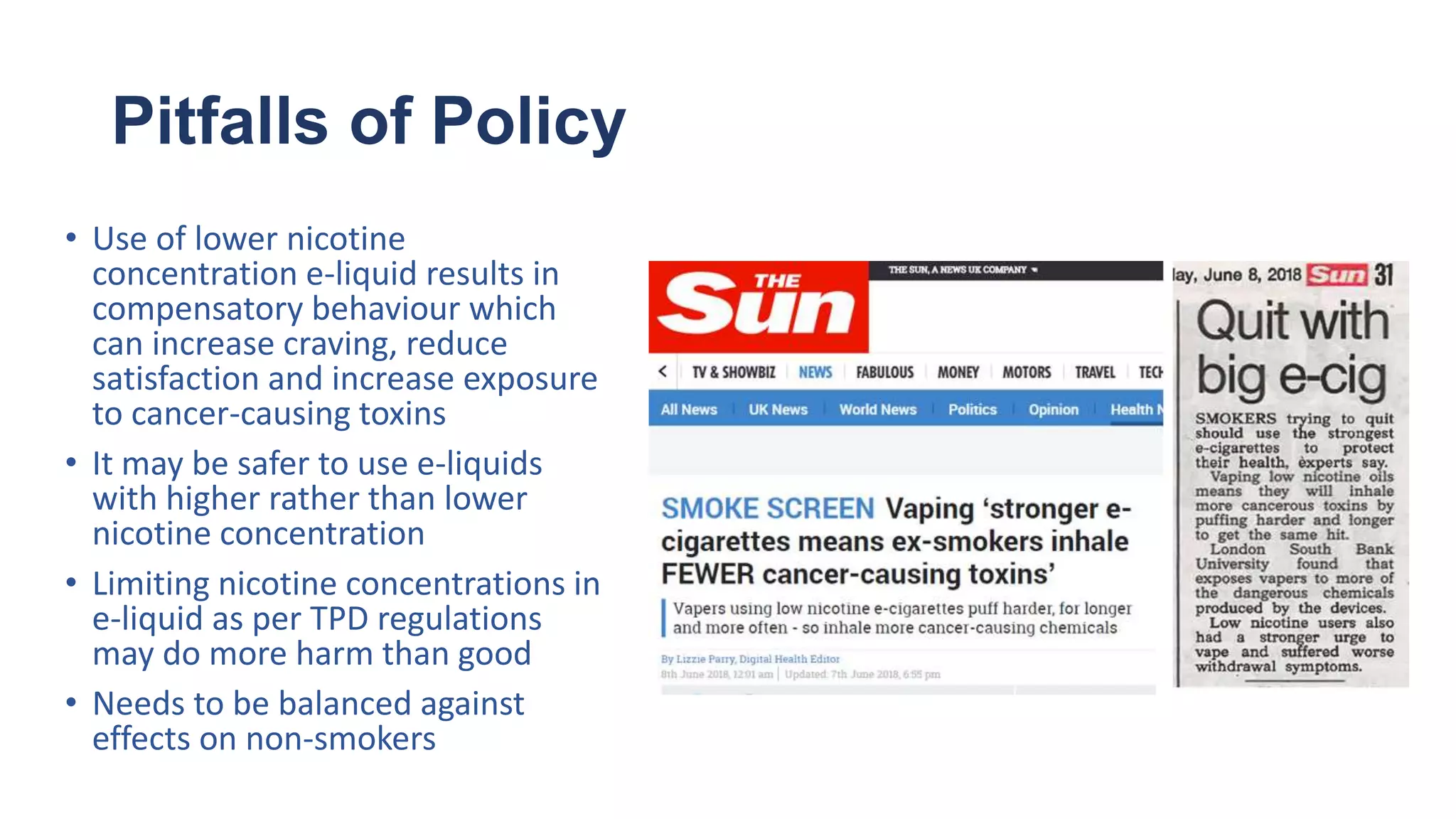
• Use of lower nicotine
concentration e-liquid results in
compensatory behaviour which
can increase craving, reduce
satisfaction and increase exposure
to cancer-causing toxins
• It may be safer to use e-liquids
with higher rather than lower
nicotine concentration
• Limiting nicotine concentrations in
e-liquid as per TPD regulations
may do more harm than good
• Needs to be balanced against
effects on non-smokers
E-cigarette nicotine addiction warnings
• Scares smokers away from using e-cigarettes?
• Proportion of adults perceiving EC to be as harmful or
more harmful than smoking is increasing
• Widespread misperceptions of nicotine: 60% believe
nicotine causes cancer (Villanti et al. 2019)
• “I do not want to substitute one addiction for another” –
main reason given for not trying EC (ASH, 2017; 2018)
• Evidence: Perceptions of addictiveness and toxicity in
smokers and vapers have increased since the
implementation of the TPD (van Mourik et al., 2019;
IJERPH)
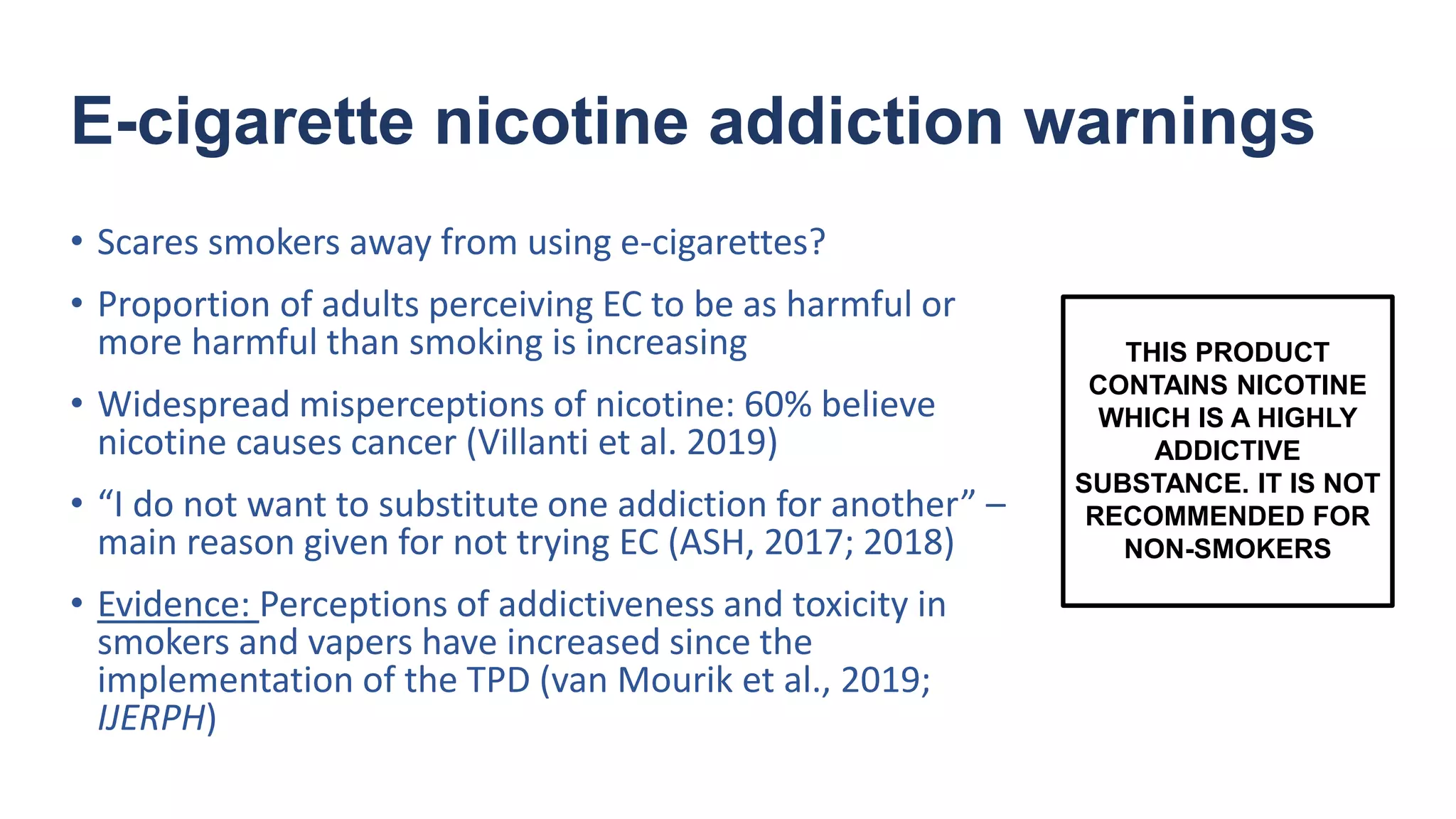
THIS PRODUCT
CONTAINS NICOTINE
WHICH IS A HIGHLY
ADDICTIVE
SUBSTANCE. IT IS NOT
RECOMMENDED FOR
NON-SMOKERS
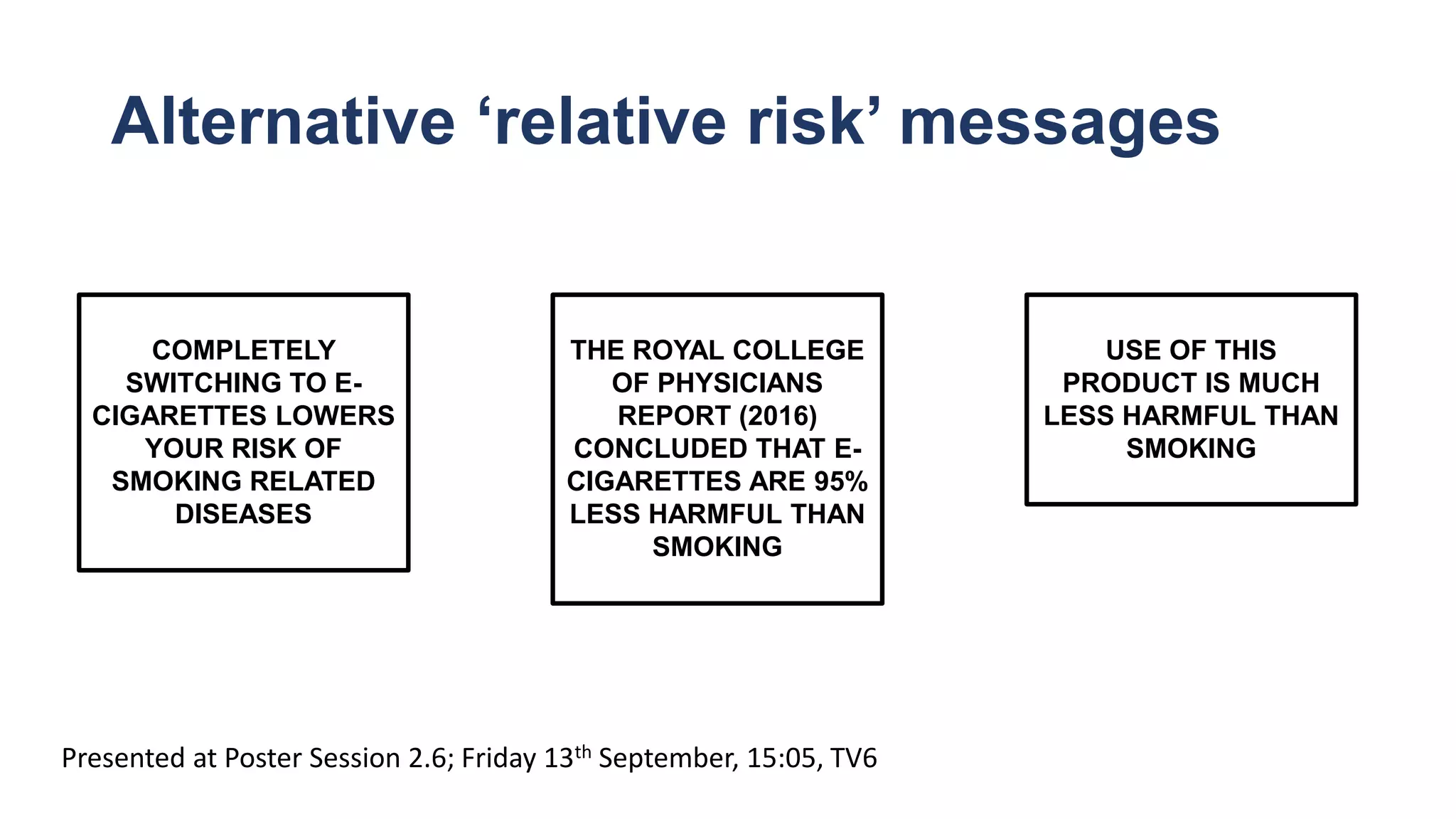
Alternative ‘relative risk’ messages
USE OF THIS
PRODUCT IS MUCH
LESS HARMFUL THAN
SMOKING
COMPLETELY
SWITCHING TO E-
CIGARETTES LOWERS
YOUR RISK OF
SMOKING RELATED
DISEASES
THE ROYAL COLLEGE
OF PHYSICIANS
REPORT (2016)
CONCLUDED THAT E-
CIGARETTES ARE 95%
LESS HARMFUL THAN
SMOKING
Presented at Poster Session 2.6; Friday 13th September, 15:05, TV6
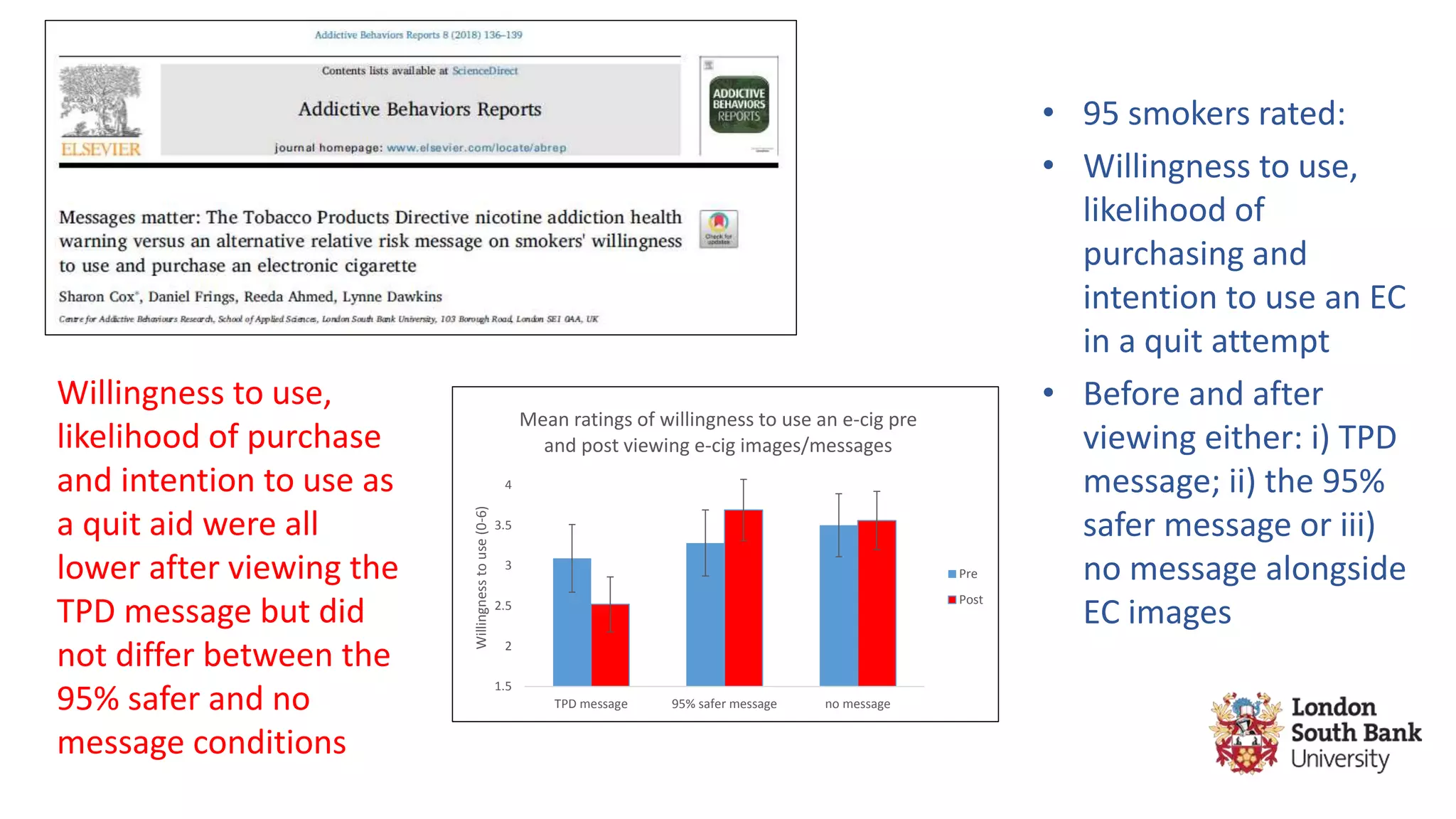
• 95 smokers rated:
• Willingness to use,
likelihood of
purchasing and
intention to use an EC
in a quit attempt
• Before and after
viewing either: i) TPD
message; ii) the 95%
safer message or iii)
no message alongside
EC images
Willingness to use,
likelihood of purchase
and intention to use as
a quit aid were all
lower after viewing the
TPD message but did
not differ between the
95% safer and no
message conditions
1.5
2
2.5
3
3.5
4
TPD message 95% safer message no message
Willingnesstouse(0-6)
Mean ratings of willingness to use an e-cig pre
and post viewing e-cig images/messages
Pre
Post
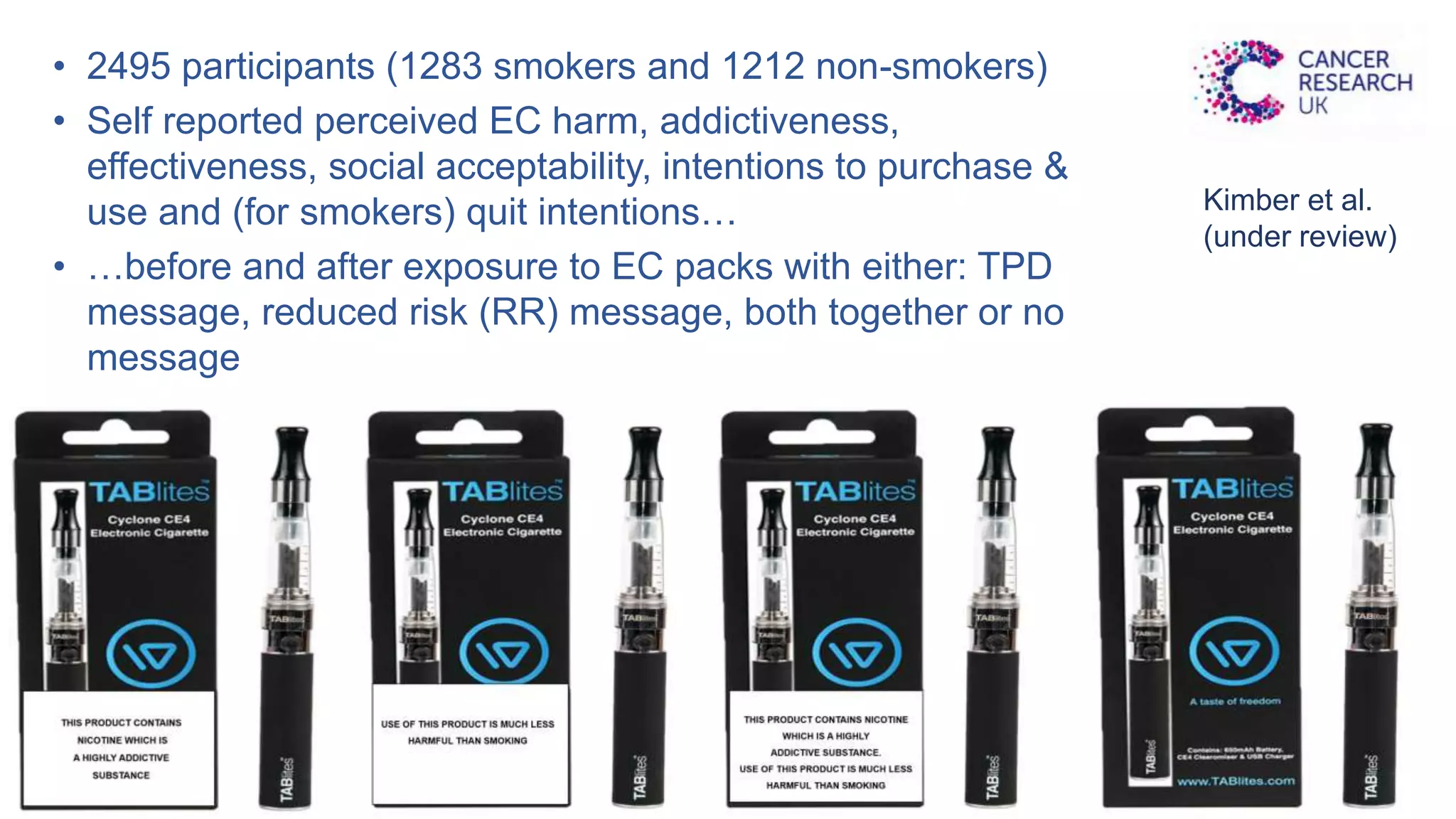
• 2495 participants (1283 smokers and 1212 non-smokers)
• Self reported perceived EC harm, addictiveness,
effectiveness, social acceptability, intentions to purchase &
use and (for smokers) quit intentions…
• …before and after exposure to EC packs with either: TPD
message, reduced risk (RR) message, both together or no
message
Kimber et al.
(under review)
Main findings
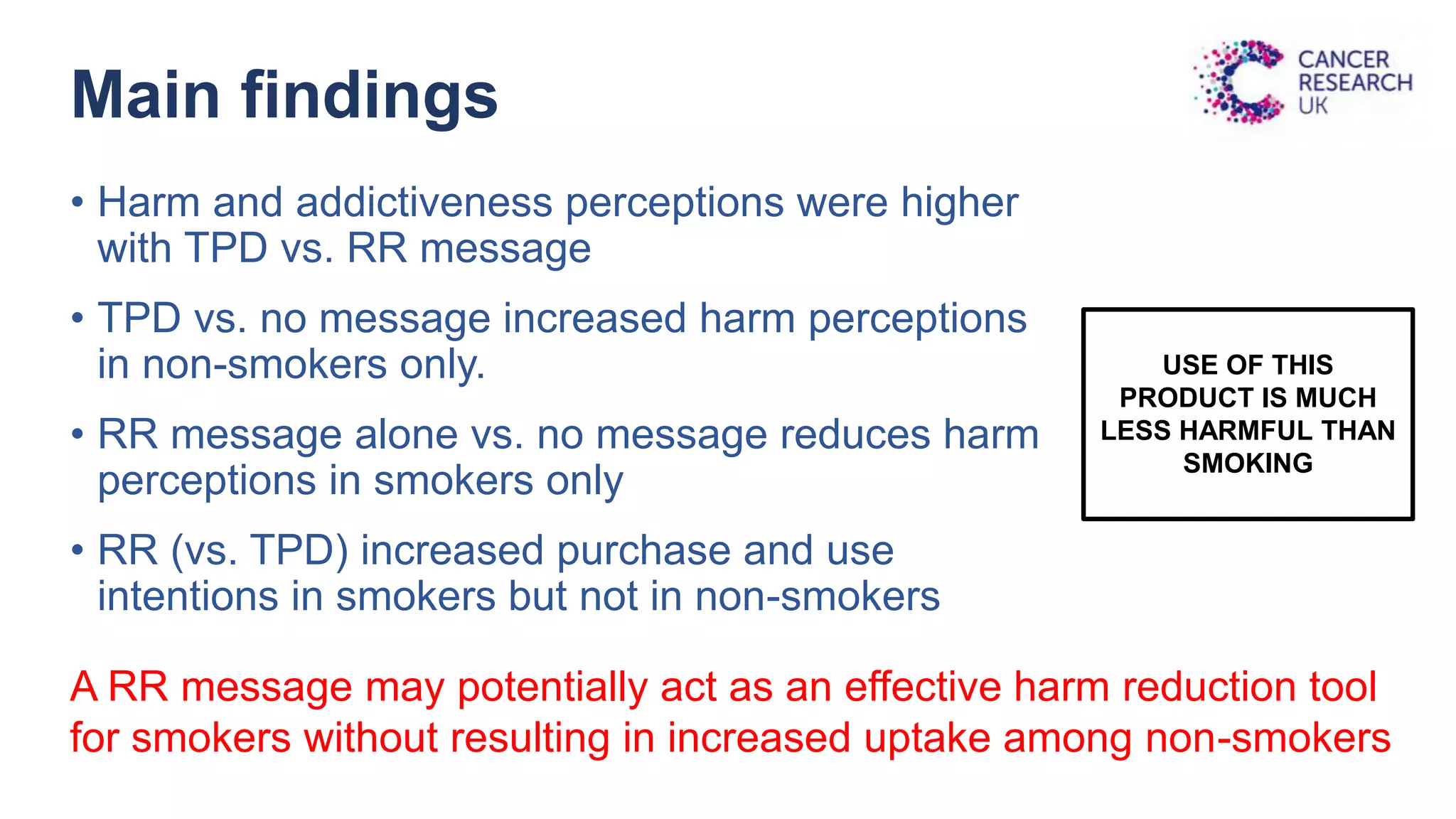
• Harm and addictiveness perceptions were higher
with TPD vs. RR message
• TPD vs. no message increased harm perceptions
in non-smokers only.
• RR message alone vs. no message reduces harm
perceptions in smokers only
• RR (vs. TPD) increased purchase and use
intentions in smokers but not in non-smokers
USE OF THIS
PRODUCT IS MUCH
LESS HARMFUL THAN
SMOKING
A RR message may potentially act as an effective harm reduction tool
for smokers without resulting in increased uptake among non-smokers
The Good
• Restrictions on tanks and liquid
refills: more inconvenience, more
waste
• Limit on nicotine concentrations:
compensatory puffing = increase
toxicant exposure
• EC warning labels: may perpetuate
concerns re EC harms. RR
messages may increase uptake in
smokers without attracting non-
smokers.
• Notification
& monitoring
• Regulation
reassuring
The Bad (unintended consequences)
To conclude…
Smoking kills. Vaping is much less harmful.
Regulations that make vaping more inconvenient, less
satisfying or which increase perceptions of harm or
addiction may increase harm through continued
smoking.
The Ugly (truth)
• What is the purpose of regulation?
• TPD promises: to ensure a high level of health protection;
specifically - safety & quality, provide information and protect
children
• Unclear at this stage if these promises have been fulfilled and if
so, at what cost?

E-Cigarettes: Promises & Pitfalls of Policy

  • 1.
    Promises and Pitfallsof Policy: The EU Tobacco Products Directive as Applied to E-Cigarettes Lynne Dawkins, Professor of Nicotine & Tobacco Studies, Centre for Addictive Behaviours Research, London South Bank University @LynneDawkins @CABR_LSBU
  • 2.
    Disclosures • Pharmaceutical industry:consultancy (2014; 2017) • Law/Litigation: expert witness/consultant (2014) • E-cigarette companies: research grants, honorarium (2010-2013) • Tobacco Industry: no funding
  • 3.
    Talk Overview • Background •The EU Tobacco Products Directive (TPD (2014) Article 20 • Promises & concerns/pitfalls • The research • Vapers’ responses & experiences • Nicotine concentration upper limit in e-liquid • Nicotine warning messages • Summary / conclusions
  • 4.
    Background • E-cigarettes appearedon the European & US markets in 2006 • How to regulate? Medicines? Drug delivery devices? Tobacco Products? Consumer Products?
  • 5.
    The Tobacco ProductsDirective (TPD) • “A directive of the European Union which places limits on the sale and merchandising of tobacco and tobacco related products in the EU” • Originally created in 2001 and revised in 2014 to include e-cigarettes (under Article 20 as consumer products) • TPD aim “To improve the functioning of the internal market for tobacco and related products while ensuring a high level of health protection for European citizens” https://ec.europa.eu/heal th/tobacco/products_en https://ec.europa.eu/heal th/tobacco/products/revis ion_en Implementation Timeline
  • 6.
    Promises: The TobaccoProducts Directive (TPD) Article 20: E-cigarettes • E-cigarette controls introduced to ensure: • Minimum standards for the safety and quality of all e-cigarettes and refill containers; • That information is provided to consumers so that they can make informed choices; • An environment that protects children from starting to use these products
  • 7.
    The Tobacco ProductsDirective (TPD) Article 20: E-cigarettes https://ec.europa.eu/health/tobacco/products/revision_en • Safety and Quality • Packaging and Labelling THIS PRODUCT CONTAINS NICOTINE WHICH IS A HIGHLY ADDICTIVE SUBSTANCE THIS PRODUCT CONTAINS NICOTINE WHICH IS A HIGHLY ADDICTIVE SUBSTANCE. IT IS NOT RECOMMENDED FOR NON-SMOKERS
  • 8.
    The Tobacco ProductsDirective (TPD) Article 20: E-cigarettes https://ec.europa.eu/health/tobacco/products/revision_en • Notification - manufacturers & importers must notify Member States before introducing products on the market. Must include info on product composition, emissions and sales/marketing. • Monitoring and Reporting – Member States must ensure there is a system for reporting & collecting information about adverse effects/safety concerns. • Advertising – No advertising or promotion permitted on e-cigarette packaging or re-fill containers. Cross-border advertising (e.g. on media platforms, television, radio, newspapers/magazines) is prohibited.
  • 9.
    Concerns / possiblepitfalls • Notification regime • Costly and burdensome - force smaller companies out of business? stifle innovation? • Severe advertising and promotion restrictions • Excessive? Make EC less available & attractive? • Restriction on nicotine concentration at 20mg/mL: • Reduce satisfaction and successful switching? • Increase chance of relapse? • Sends a misleading message that nicotine is harmful? • Limiting e-liquid refill bottles to 10mL and tank capacity to 2mL • More frequent refilling, more chance of spillage, higher cost to user, more waste… • Nicotine Addiction Warnings • Excessive? Accurate? Increase misperceptions about nicotine & vaping?
  • 10.
    Royal College ofPhysicians (2016) A risk-averse, precautionary approach to e-cigarette regulation can be proposed as a means of minimising the risk of avoidable harm, eg exposure to toxins in e- cigarette vapour, renormalisation, gateway progression to smoking, or other real or potential risks. However, if this approach also makes e-cigarettes less easily accessible, less palatable or acceptable, more expensive, less consumer friendly or pharmacologically less effective, or inhibits innovation and development of new and improved products, then it causes harm by perpetuating smoking. Getting this balance right is difficult. (Section 12.10 page 187)
  • 11.
    Have these concernsbeen borne out? The Evidence
  • 12.
    Notification process • Numberof notifications: • UK – 40k • France – 37k • Germany – 132k • Variation in guidance, notification fee and waiting time across member states • Vape shop workers in the UK reported no major problems (Ward et al. 2018, IJEERPH)
  • 13.
    Vapers’ perceptions &experiences of the TPD: E-Cigarettes Trajectories Study 162 EU vapers interviewed between March 2018 and March 2019 Positives Negatives Low awareness/impact for many Limits consumer choice – makes vaping more expensive, less accessibility to effective products Ingredients list on e-liquid bottles provided reassurance for users Inconveniences consumer – makes vaping more complicated None reported that the 20mg/mL limit had caused them to relapse to smoking Concern that the 20mg/mL limit may prevent smokers from converting to vaping 10ml bottle limits mean more plastic waste Stock-piling non-compliant e-liquid and large quantities of nicotine for home mixing Buying illegally from outside the EU Market reactions – nicotine shots/shake & vape Ward et al. in prep Notley, C, Dawkins, L & Holland, R. Real world experiences of using e-cigarettes for avoiding relapse to smoking: success or failure. A qualitative study funded by CRUK.
  • 14.
    • 240 youngadult dual EC and cigarette users resident in the US. • Hypothetical regulations around restricting nicotine e-liquid content resulted in reported intentions to reduce EC use and increase cigarette smoking. • Ditto for regulations regarding restrictions on flavours and ability to modify EC devices.
  • 15.
    • 41 vaperswho mixed their own e-liquid interviewed in Feb/March 2017 • Common reason: “to achieve a nicotine concentration above the TPD cut- off” • 85% expressed concern that TPD changes would affect availability of 72mg/mL nicotine and 83% said they stockpiled ingredients • However, two thirds were currently using e-liquid nicotine concentrations < 10 mg/mL and 85% reported sub-ohming
  • 16.
    Nicotine E-liquid Concentration • Trendover time for vapers to use lower nicotine concentration e- liquids • Possible reasons: • Improved sophistication of devices • Concern over addictiveness of nicotine; weaning off • Reduced availability of higher nicotine concentration liquids (e.g. TPD in Europe) What happens when vapers switch to lower nicotine concentration e- liquids?
  • 17.
    Ad lib vaping Overnight abstinence baseline10 mins 30 mins 60 mins Pre-study Screening Repeated under high and low nicotine concentration conditions • 11 experienced vapers • Used eVic Supreme (Joyetech) with Aspire tank (Nautilus) under 2 conditions in the lab • With 6 & 24mg/mL tobacco flavour e-liquid • Within-subject, double-blind, counterbalanced Dawkins et al. (2016)
  • 18.
    Puffing topography 0 20 40 60 80 100 High 24Low 6 Meanpuffnumber Mean Puff Number More puffs, longer puffs and more liquid consumed in the low (6mg/mL condition (p < 0.05)
  • 19.
    • Puffing patternassociated with the 6mg/mL e-liquid resulted in: • 52% increase in aerosol production • 45% more formaldehyde • 33% more acetaldehyde • 65% from acetone (p < 0.05 in all cases) Vaping machine used to general aerosol using the mean puffing patterns recorded under 6mg/mL and 24mg/mL nicotine conditions
  • 20.
    Phase 1: • 20exclusive e-cig users • Used eVic Supreme & Aspire tank (BVC 1.6ohm) • Under 4 counterbalanced conditions: • Low (6mg/mL) nicotine, fixed power • High (18mg/mL) nicotine, fixed power • Low (6mg/mL) nicotine, adjustable power • High (18mg/mL) nicotine, adjustable power • With a choice of 4 flavours (tobacco, menthol, fruit, dessert) Baseline visit End of week 1 End of week 2 End of week 3 End of week 4 Ad lib vaping Low, fixed Ad lib vaping High, fixed Ad lib vaping Low, adjustable Ad lib vaping High, adjustable Puffing information Urine (acrolein, formaldehyde) MPSS Urge to vape Positive & negative effects Dawkins et al. (2018)
  • 21.
    Phase 2: Carbonyls inAerosol • EC attached to vaping machine to generate aerosol based on the puffing patterns of each participant under each of the 4 conditions • Carbonyl compounds in aerosol quantified using AT 1200 liquid chromatograph
  • 22.
    Results: • Power change:Power increase was greater in the low vs. high condition • Puffing patterns: More puffs & longer puffs in the low condition, especially with fixed power • Subjective effects: Urge to vape was higher and satisfaction, lower with low nicotine • Biomarkers in urine: no difference for 3-HPMA (acrolein). Higher formate (formaldehyde) levels in the low nicotine/adjustable power condition • Carbonyls in aerosol: greater exposure to formaldehyde and acetaldehyde in the low nicotine condition • Cancer risk: our simulation suggests a 1.27 to 2.06 fold increase in Cancer Risk Index when switching from 18 to 6mg/mL nicotine concentration e- liquid Dawkins et al. (2018) Addiction Kosmider et al. (under review) Scientific Reports
  • 23.
    Pitfalls of Policy •Use of lower nicotine concentration e-liquid results in compensatory behaviour which can increase craving, reduce satisfaction and increase exposure to cancer-causing toxins • It may be safer to use e-liquids with higher rather than lower nicotine concentration • Limiting nicotine concentrations in e-liquid as per TPD regulations may do more harm than good • Needs to be balanced against effects on non-smokers
  • 24.
    E-cigarette nicotine addictionwarnings • Scares smokers away from using e-cigarettes? • Proportion of adults perceiving EC to be as harmful or more harmful than smoking is increasing • Widespread misperceptions of nicotine: 60% believe nicotine causes cancer (Villanti et al. 2019) • “I do not want to substitute one addiction for another” – main reason given for not trying EC (ASH, 2017; 2018) • Evidence: Perceptions of addictiveness and toxicity in smokers and vapers have increased since the implementation of the TPD (van Mourik et al., 2019; IJERPH) THIS PRODUCT CONTAINS NICOTINE WHICH IS A HIGHLY ADDICTIVE SUBSTANCE. IT IS NOT RECOMMENDED FOR NON-SMOKERS
  • 25.
    Alternative ‘relative risk’messages USE OF THIS PRODUCT IS MUCH LESS HARMFUL THAN SMOKING COMPLETELY SWITCHING TO E- CIGARETTES LOWERS YOUR RISK OF SMOKING RELATED DISEASES THE ROYAL COLLEGE OF PHYSICIANS REPORT (2016) CONCLUDED THAT E- CIGARETTES ARE 95% LESS HARMFUL THAN SMOKING Presented at Poster Session 2.6; Friday 13th September, 15:05, TV6
  • 26.
    • 95 smokersrated: • Willingness to use, likelihood of purchasing and intention to use an EC in a quit attempt • Before and after viewing either: i) TPD message; ii) the 95% safer message or iii) no message alongside EC images Willingness to use, likelihood of purchase and intention to use as a quit aid were all lower after viewing the TPD message but did not differ between the 95% safer and no message conditions 1.5 2 2.5 3 3.5 4 TPD message 95% safer message no message Willingnesstouse(0-6) Mean ratings of willingness to use an e-cig pre and post viewing e-cig images/messages Pre Post
  • 27.
    • 2495 participants(1283 smokers and 1212 non-smokers) • Self reported perceived EC harm, addictiveness, effectiveness, social acceptability, intentions to purchase & use and (for smokers) quit intentions… • …before and after exposure to EC packs with either: TPD message, reduced risk (RR) message, both together or no message Kimber et al. (under review)
  • 28.
    Main findings • Harmand addictiveness perceptions were higher with TPD vs. RR message • TPD vs. no message increased harm perceptions in non-smokers only. • RR message alone vs. no message reduces harm perceptions in smokers only • RR (vs. TPD) increased purchase and use intentions in smokers but not in non-smokers USE OF THIS PRODUCT IS MUCH LESS HARMFUL THAN SMOKING A RR message may potentially act as an effective harm reduction tool for smokers without resulting in increased uptake among non-smokers
  • 29.
    The Good • Restrictionson tanks and liquid refills: more inconvenience, more waste • Limit on nicotine concentrations: compensatory puffing = increase toxicant exposure • EC warning labels: may perpetuate concerns re EC harms. RR messages may increase uptake in smokers without attracting non- smokers. • Notification & monitoring • Regulation reassuring The Bad (unintended consequences) To conclude…
  • 30.
    Smoking kills. Vapingis much less harmful. Regulations that make vaping more inconvenient, less satisfying or which increase perceptions of harm or addiction may increase harm through continued smoking. The Ugly (truth) • What is the purpose of regulation? • TPD promises: to ensure a high level of health protection; specifically - safety & quality, provide information and protect children • Unclear at this stage if these promises have been fulfilled and if so, at what cost?