ASSESSMENT OF LEFT
ATRIAL SIZE AND
FUNCTION
DR AMIR
Assessment of left
atrium size
❖ The left atrium plays role in cardiac function :-
1 Facilitates left ventricular filling
2 Collects pulmonary venous return
3 Transfers blood to the left ventricle
❖ It acts both as a :-
- Contractile Pump: Delivers 15% to 30% of left ventricular filling volume
- Reservoir: Collects pulmonary venous return during ventricular systole
Changes in its size or function can signal adverse cardiovascular outcomes,
making its assessment crucial.
Prognostic Marker:
- Previously: Only maximal LA size was noted
- Recently: LA Minimum volume and phasic function as powerful predictors
- LA Volume:Surrogate marker of diastolic dysfunction severity and chronicity
- maximal LA volume (LAVmax) is a biomarker for adverse cardiac events in
healthy individuals and various cardiovascular conditions:
• Myocardial infarction
• Heart failure
• Stroke
• Degenerative mitral regurgitation
• Atrial fibrillation (AF)
Imaging Techniques
- 2D Echocardiography (2DE):Traditional method
- 3D Echocardiography (3DE): Recent advancement
- Transthoracic Echocardiography: Best for complete visualization and size
measurement of the LA
- Transesophageal Echocardiography: Limited by inability to fully visualize and
measure LA size
Historical Measurement Approach :
● AP Diameter by M-mode or 2D Images: Initially used to estimate LA size
● Ease and Reproducibility: Most frequently used metric worldwide
● Limitation: Underestimates LA size due to asymmetrical enlargement
(mediolateral and superoinferior axes)
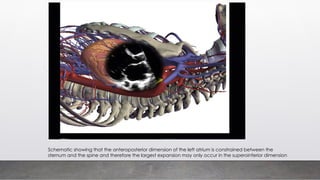
● Constraints: Spine and sternum limit AP enlargement
● Identification Rates: AP dimension identified 49% of enlarged LA cases; LA
volume evaluation identified 76%
● Current Guidelines: Discourage use of AP diameter except in hypertrophic
cardiomyopathy for sudden cardiac death risk stratification
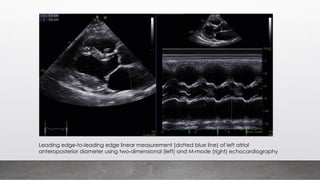
Leading edge-to-leading edge linear measurement (dotted blue line) of left atrial
anteroposterior diameter using two-dimensional (left) and M-mode (right) echocardiography
Schematic showing that the anteroposterior dimension of the left atrium is constrained between the
sternum and the spine and therefore the largest expansion may only occur in the superoinferior dimension
Current Measurement Recommendations
● Biplane LA Volume by 2DE:
○ Currently recommended for evaluating LA size
○ Stronger predictor of outcomes than linear dimensions
● Requirements for Accurate Measurement:
○ Dedicated Apical Views:
○ Use apical four- and two-chamber views optimized for LA
○ Ensure proper endocardial border tracing
○ Alignment:
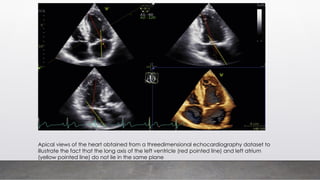
○ The long axis of LV isn’t parallel to LA long axis
○ 3DE has clarified this disparity
Apical views of the heart obtained from a threedimensional echocardiography dataset to
illustrate the fact that the long axis of the left ventricle (red pointed line) and left atrium
(yellow pointed line) do not lie in the same plane
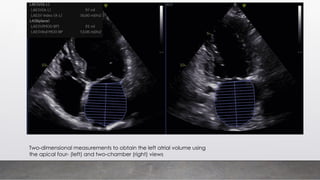
Two-dimensional measurements to obtain the left atrial volume using
the apical four- (left) and two-chamber (right) views
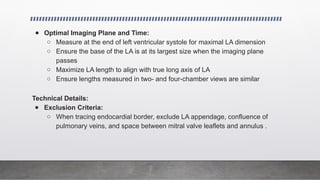
● Optimal Imaging Plane and Time:
○ Measure at the end of left ventricular systole for maximal LA dimension
○ Ensure the base of the LA is at its largest size when the imaging plane
passes
○ Maximize LA length to align with true long axis of LA
○ Ensure lengths measured in two- and four-chamber views are similar
Technical Details:
● Exclusion Criteria:
○ When tracing endocardial border, exclude LA appendage, confluence of
pulmonary veins, and space between mitral valve leaflets and annulus .
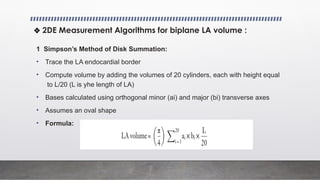
1 Simpson’s Method of Disk Summation:
• Trace the LA endocardial border
• Compute volume by adding the volumes of 20 cylinders, each with height equal
to L/20 (L is yhe length of LA)
• Bases calculated using orthogonal minor (ai) and major (bi) transverse axes
• Assumes an oval shape
• Formula:
❖ 2DE Measurement Algorithms for biplane LA volume :
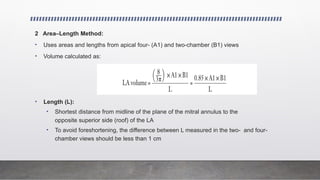
2 Area–Length Method:
• Uses areas and lengths from apical four- (A1) and two-chamber (B1) views
• Volume calculated as:
• Length (L):
• Shortest distance from midline of the plane of the mitral annulus to the
opposite superior side (roof) of the LA
• To avoid foreshortening, the difference between L measured in the two- and four-
chamber views should be less than 1 cm
Note:
• Area length method reduces linear dimensions to a single measurement
• Both methods are accurate compared to computed tomography meas
urements
• Biplane area–length method systematically yields larger LA volumes
than the disk summation method. However, both methods have
comparable prognostic power.
Body Size and LA Volume
• Determinants of LA Size:
• Body size significantly affects LA size
• Absolute LA volumes larger in men than women
• Indexation to Body Surface Area (LAVI):
• Corrects for gender differences
• Leads to similar LA volumes between men and women
• Reference Values of LA volume :
• Derived from 2DE are similar in population-based and normative studies
• Studies on healthy volunteers confirm these values
Effects of Aging:
• Controversial impacts on LA volume
• Some studies: Increase only at extreme ages
• Others: Progressive age-related increase
Ethnicity Differences:
• Larger LA size observed in Europeans compared to South and East
Asians
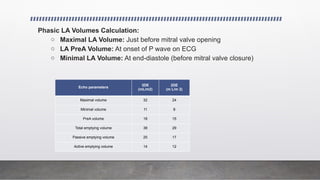
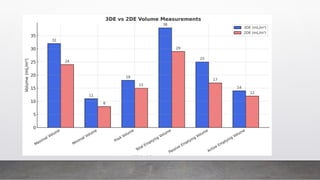
Phasic LA Volumes Calculation:
○ Maximal LA Volume: Just before mitral valve opening
○ LA PreA Volume: At onset of P wave on ECG
○ Minimal LA Volume: At end-diastole (before mitral valve closure)
Echo parameters
3DE
(mL/m2)
2DE
(m L/m 2)
Maximal volume 32 24
Minimal volume 11 8
PreA volume 18 15
Total emptying volume 38 29
Passive emptying volume 25 17
Active emptying volume 14 12
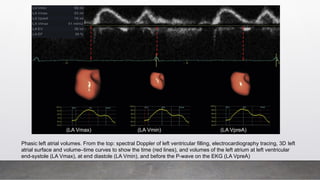
Phasic left atrial volumes. From the top: spectral Doppler of left ventricular filling, electrocardiography tracing, 3D left
atrial surface and volume–time curves to show the time (red lines), and volumes of the left atrium at left ventricular
end-systole (LA Vmax), at end diastole (LA Vmin), and before the P-wave on the EKG (LA VpreA)
LA Vmax
(LA Vmax) (LA Vmin) (LA VpreA)​
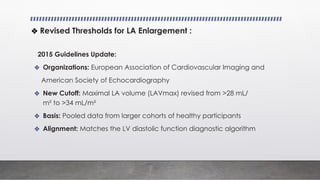
2015 Guidelines Update:
❖ Organizations: European Association of Cardiovascular Imaging and
American Society of Echocardiography
❖ New Cutoff: Maximal LA volume (LAVmax) revised from >28 mL/
m² to >34 mL/m²
❖ Basis: Pooled data from larger cohorts of healthy participants
❖ Alignment: Matches the LV diastolic function diagnostic algorithm
❖ Revised Thresholds for LA Enlargement :
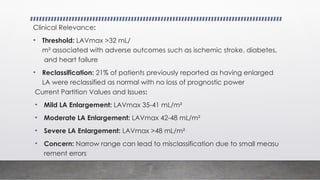
Clinical Relevance:
• Threshold: LAVmax >32 mL/
m² associated with adverse outcomes such as ischemic stroke, diabetes,
and heart failure
• Reclassification: 21% of patients previously reported as having enlarged
LA were reclassified as normal with no loss of prognostic power
Current Partition Values and Issues:
• Mild LA Enlargement: LAVmax 35-41 mL/m²
• Moderate LA Enlargement: LAVmax 42-48 mL/m²
• Severe LA Enlargement: LAVmax >48 mL/m²
• Concern: Narrow range can lead to misclassification due to small measu
rement errors
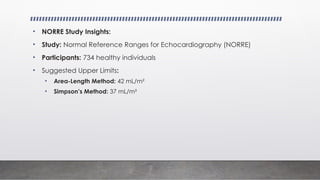
• NORRE Study Insights:
• Study: Normal Reference Ranges for Echocardiography (NORRE)
• Participants: 734 healthy individuals
• Suggested Upper Limits:
• Area-Length Method: 42 mL/m²
• Simpson’s Method: 37 mL/m²
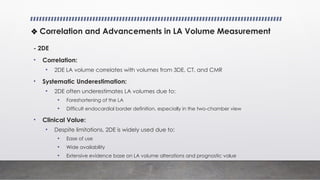
- 2DE
• Correlation:
• 2DE LA volume correlates with volumes from 3DE, CT, and CMR
• Systematic Underestimation:
• 2DE often underestimates LA volumes due to:
• Foreshortening of the LA
• Difficult endocardial border definition, especially in the two-chamber view
• Clinical Value:
• Despite limitations, 2DE is widely used due to:
• Ease of use
• Wide availability
• Extensive evidence base on LA volume alterations and prognostic value
❖ Correlation and Advancements in LA Volume Measurement
3DE Advantages:
• Preferred Modality:
• 3DE is becoming preferred for measuring cardiac chamber volumes
• Benefits:
• Lower Interobserver Variability: Reduces discrepancies between diff
erent observers
• Higher Test Reproducibility: Ensures consistent results across tests
• Technological Advances: Allow easy acquisition of datasets with
good frame rates using single-beat acquisition
• Workflow Improvements:
• Semiautomated Contour Detection:
• Good correlation with manual tracing
• Reduces analysis time
• Increases measurement reproducibility
• Fully Automated Contour Detection:
• Further improvements in efficiency and accuracy
• Studies on 3DE LA Volumes:
• Two studies used 3DE software algorithms developed for the LV to measure
the LA
• A recent study with 276 healthy participants showed 3DE LA phasic volumes
larger than those obtained by 2DE
Study Findings:
• Multicenter Study on LA Enlargement Classification:
• Agreement for 3DE: κ coefficient of 0.88 (4 false negatives, 7 false positives) wh
en compared with CMR
• Agreement for 2DE: κ coefficient of 0.71 (25 false negatives, 2 false positives)
• Conclusion: 3DE provides a more accurate classification of LA enlargement
Recent Developments:
• 3DE Speckle-Tracking and Pattern Recognition:
• Aim for fully automated identification of the endocardial border
• Achieves good correlation with manual methods
• Requires further clinical validation to confirm efficacy and reliability
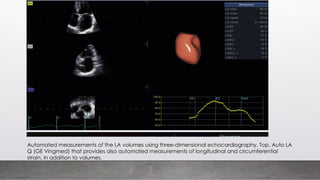
Automated measurements of the LA volumes using three-dimensional echocardiography. Top, Auto LA
Q (GE Vingmed) that provides also automated measurements of longitudinal and circumferential
strain, in addition to volumes.
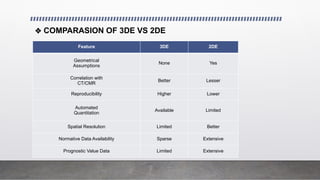
Feature 3DE 2DE
Geometrical
Assumptions
None Yes
Correlation with
CT/CMR
Better Lesser
Reproducibility Higher Lower
Automated
Quantitation
Available Limited
Spatial Resolution Limited Better
Normative Data Availability Sparse Extensive
Prognostic Value Data Limited Extensive
❖ COMPARASION OF 3DE VS 2DE
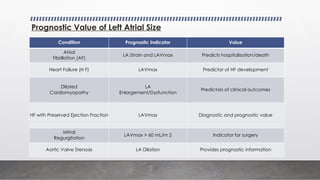
Condition Prognostic Indicator Value
Atrial
Fibrillation (AF)
LA Strain and LAVmax Predicts hospitalization/death
Heart Failure (H F) LAVmax Predictor of HF development
Dilated
Cardiomyopathy
LA
Enlargement/Dysfunction
Predictors of clinical outcomes
HF with Preserved Ejection Fraction LAVmax Diagnostic and prognostic value
Mitral
Regurgitation
LAVmax > 60 mL/m 2 Indicator for surgery
Aortic Valve Stenosis LA Dilation Provides prognostic information
Prognostic Value of Left Atrial Size
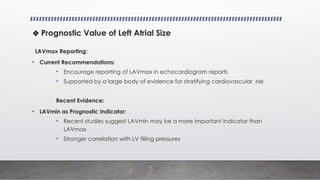
LAVmax Reporting:
• Current Recommendations:
• Encourage reporting of LAVmax in echocardiogram reports
• Supported by a large body of evidence for stratifying cardiovascular risk
Recent Evidence:
• LAVmin as Prognostic Indicator:
• Recent studies suggest LAVmin may be a more important indicator than
LAVmax
• Stronger correlation with LV filling pressures
❖ Prognostic Value of Left Atrial Size
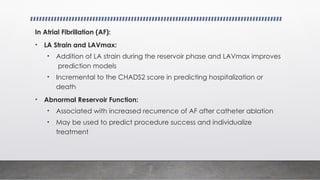
In Atrial Fibrillation (AF):
• LA Strain and LAVmax:
• Addition of LA strain during the reservoir phase and LAVmax improves
prediction models
• Incremental to the CHADS2 score in predicting hospitalization or
death
• Abnormal Reservoir Function:
• Associated with increased recurrence of AF after catheter ablation
• May be used to predict procedure success and individualize
treatment
In Heart Failure (HF):
• Predictor of HF Development:
• LAVmax is a predictor regardless of LV systolic function
• Important in patients with dilated cardiomyopathy and HF
• HF with Preserved Ejection Fraction (HFpEF):
• Greater relevance of LA volume
• LAVmax has diagnostic and prognostic value
In Mitral Regurgitation:
• Surgery Timing:
• LAVmax > 60 mL/m² is an indication for surgery in asymptomatic patients
with severe degenerative mitral regurgitation
In Aortic Valve Stenosis:
• LA Dilation:
• Associated with LV remodeling
• Provides prognostic information in severe asymptomatic aortic valve
stenosis
Assement of
Left Atrial Function
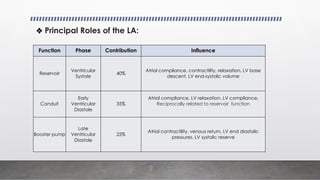
Function Phase Contribution Influence
Reservoir
Ventricular
Systole
40%
Atrial compliance, contractility, relaxation, LV base
descent, LV end-systolic volume
Conduit
Early
Ventricular
Diastole
35%
Atrial compliance, LV relaxation, LV compliance,
Reciprocally related to reservoir function
Booster pump
Late
Ventricular
Diastole
25%
Atrial contractility, venous return, LV end diastolic
pressures, LV systolic reserve
❖ Principal Roles of the LA:
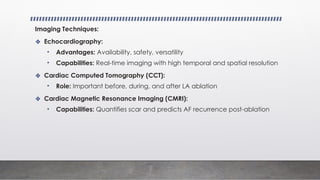
Imaging Techniques:
❖ Echocardiography:
• Advantages: Availability, safety, versatility
• Capabilities: Real-time imaging with high temporal and spatial resolution
❖ Cardiac Computed Tomography (CCT):
• Role: Important before, during, and after LA ablation
❖ Cardiac Magnetic Resonance Imaging (CMRI):
• Capabilities: Quantifies scar and predicts AF recurrence post-ablation
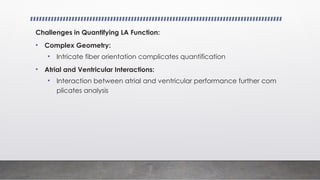
Challenges in Quantifying LA Function:
• Complex Geometry:
• Intricate fiber orientation complicates quantification
• Atrial and Ventricular Interactions:
• Interaction between atrial and ventricular performance further com
plicates analysis
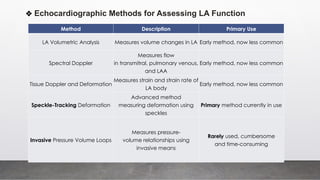
❖ Echocardiographic Methods for Assessing LA Function
Method Description Primary Use
LA Volumetric Analysis Measures volume changes in LA Early method, now less common
Spectral Doppler
Measures flow
in transmitral, pulmonary venous,
and LAA
Early method, now less common
Tissue Doppler and Deformation
Measures strain and strain rate of
LA body
Early method, now less common
Speckle-Tracking Deformation
Advanced method
measuring deformation using
speckles
Primary method currently in use
Invasive Pressure Volume Loops
Measures pressure-
volume relationships using
invasive means
Rarely used, cumbersome
and time-consuming
Techniques in LA Functional Analysis
2D Echocardiography:
• Techniques:
• LA volumetric and speckle-tracking deformation analyses
• Uses two- and four-chamber focused views of the LA
• Ensures the LA is not foreshortened
• Limitations:
• May miss visualization of all LA walls
3D Echocardiography:
• Preferred Method:
• Provides more accurate functional data due to visualization of all LA walls in a
dataset
• Advancements:
• Semi- or fully automated analysis programs are addressing concerns about
time and expertise required for analysis
CCT and CMRI:
• Usage:
• Used to assess volumetric LA functions
• Challenges:
• Less popular due to radiation exposure (CCT) and accessibility issues (CMRI)
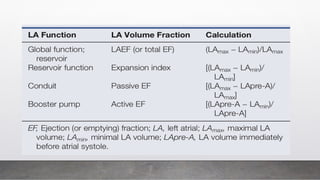
⮚ Volumetric Indices for LA Function
Index Description Function
Maximum Volume Volume at end-systole, just before mitral valve opening Represents reservoir capacity
Minimum Volume Volume at end-diastole, when mitral valve closes Represents emptied LA
Pre-Atrial
Systole Volume
Volume just before atrial systole, before ECG P wave Represents pre-atrial contraction
Expansion Index
Normalizes total LA emptying volume to minimum LA
volume
Related to reservoir function
LAFI (LA
Functional
Index)
Incorporates LAEF, LVOTvti, and LAVi(maximum LA
volume indexed to body surface area)
[LAFI = (LAEF × LVOTvti)/LAVi]
Comprehensive functional measure
Conduit Volume
Volume passing through LA not accounted by other
functions
Conduit volume = [LV stroke volume − (LAmax − LAmin)]
Requires simultaneous LV and LA volumes
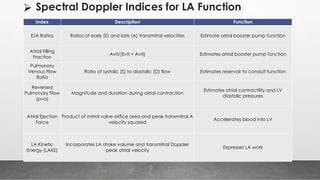
⮚ Spectral Doppler Indices for LA Function
Index Description Function
E/A Ratios Ratios of early (E) and late (A) transmitral velocities Estimate atrial booster pump function
Atrial Filling
Fraction
Avti/(Evti + Avti) Estimates atrial booster pump function
Pulmonary
Venous Flow
Ratio
Ratio of systolic (S) to diastolic (D) flow Estimates reservoir to conduit function
Reversed
Pulmonary Flow
(pva)
Magnitude and duration during atrial contraction
Estimates atrial contractility and LV
diastolic pressures
Atrial Ejection
Force
Product of mitral valve orifice area and peak transmitral A
velocity squared
Accelerates blood into LV
LA Kinetic
Energy (LAKE)
Incorporates LA stroke volume and transmitral Doppler
peak atrial velocity
Expresses LA work
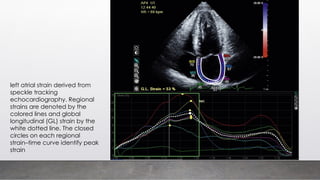
left atrial strain derived from
speckle tracking
echocardiography. Regional
strains are denoted by the
colored lines and global
longitudinal (GL) strain by the
white dotted line. The closed
circles on each regional
strain–time curve identify peak
strain
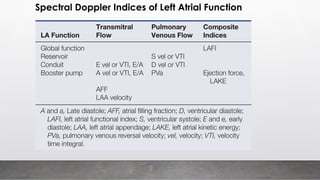
Spectral Doppler Indices of Left Atrial Function
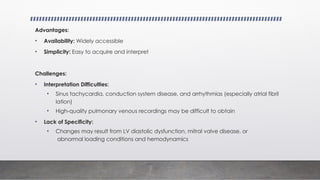
Advantages:
• Availability: Widely accessible
• Simplicity: Easy to acquire and interpret
Challenges:
• Interpretation Difficulties:
• Sinus tachycardia, conduction system disease, and arrhythmias (especially atrial fibril
lation)
• High-quality pulmonary venous recordings may be difficult to obtain
• Lack of Specificity:
• Changes may result from LV diastolic dysfunction, mitral valve disease, or
abnormal loading conditions and hemodynamics
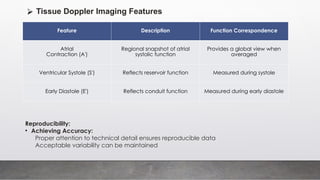
Feature Description Function Correspondence
Atrial
Contraction (A')
Regional snapshot of atrial
systolic function
Provides a global view when
averaged
Ventricular Systole (S') Reflects reservoir function Measured during systole
Early Diastole (E') Reflects conduit function Measured during early diastole
⮚ Tissue Doppler Imaging Features
Reproducibility:
• Achieving Accuracy:
Proper attention to technical detail ensures reproducible data
Acceptable variability can be maintained
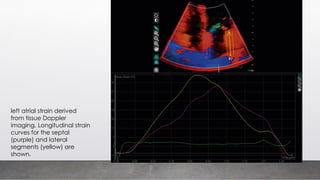
left atrial strain derived
from tissue Doppler
imaging. Longitudinal strain
curves for the septal
(purple) and lateral
segments (yellow) are
shown.
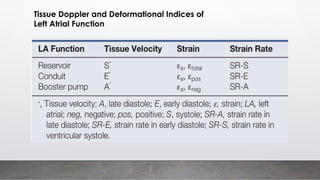
Tissue Doppler and Deformational Indices of
Left Atrial Function
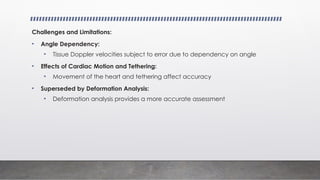
Challenges and Limitations:
• Angle Dependency:
• Tissue Doppler velocities subject to error due to dependency on angle
• Effects of Cardiac Motion and Tethering:
• Movement of the heart and tethering affect accuracy
• Superseded by Deformation Analysis:
• Deformation analysis provides a more accurate assessment
⮚ Deformation Analysis (Strain and Strain Rate Imaging)
Strain and Strain Rates:
• Represent the magnitude and rate of myocardial deformation
• Assessed using either tissue Doppler velocities (TDI) or 2D echocardiographic
techniques (2D speckle-tracking echocardiography [2D STE])
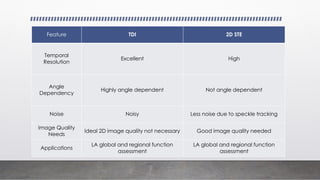
Tissue Doppler Imaging (TDI):
• Advantages:
• Excellent temporal resolution
• Ideal 2D image quality not necessary
• Challenges:
• Highly angle dependent
• Noisy, which can impact accuracy
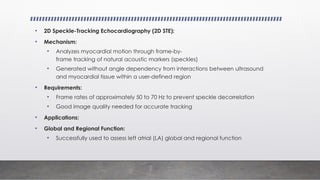
• 2D Speckle-Tracking Echocardiography (2D STE):
• Mechanism:
• Analyzes myocardial motion through frame-by-
frame tracking of natural acoustic markers (speckles)
• Generated without angle dependency from interactions between ultrasound
and myocardial tissue within a user-defined region
• Requirements:
• Frame rates of approximately 50 to 70 Hz to prevent speckle decorrelation
• Good image quality needed for accurate tracking
• Applications:
• Global and Regional Function:
• Successfully used to assess left atrial (LA) global and regional function
Feature TDI 2D STE
Temporal
Resolution
Excellent High
Angle
Dependency
Highly angle dependent Not angle dependent
Noise Noisy Less noise due to speckle tracking
Image Quality
Needs
Ideal 2D image quality not necessary Good image quality needed
Applications
LA global and regional function
assessment
LA global and regional function
assessment
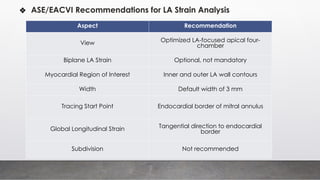
❖ ASE/EACVI Recommendations for LA Strain Analysis
Aspect Recommendation
View Optimized LA-focused apical four-
chamber
Biplane LA Strain Optional, not mandatory
Myocardial Region of Interest Inner and outer LA wall contours
Width Default width of 3 mm
Tracing Start Point Endocardial border of mitral annulus
Global Longitudinal Strain Tangential direction to endocardial
border
Subdivision Not recommended
• Global Longitudinal Strain:
• Definition:
• Strain in the direction tangential to the endocardial atrial border in apic
al view
• Assessment:
• Subdivision into segments and radial/transverse strain not recommended
• Due to thinness of LA myocardium and interpolation across pulmonary v
eins and LAA
❖ Zero-Baseline Reference Points and Corresponding Functions
Ventricular Cycle:
• Zero Reference: Ventricular end-diastole (QRS complex
Atrial Cycle:
• Zero Reference: Atrial end-diastole (onset of P wave)
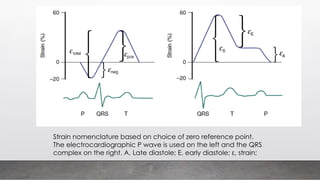
Strain nomenclature based on choice of zero reference point.
The electrocardiographic P wave is used on the left and the QRS
complex on the right. A, Late diastole; E, early diastole; ε, strain;
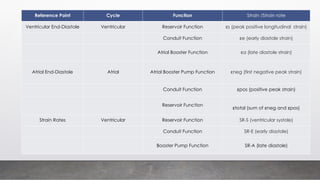
Reference Point Cycle Function Strain /Strain rate
Ventricular End-Diastole Ventricular Reservoir Function s (peak positive longitudinal strain)
ɛ
Conduit Function e (early diastole strain)
ɛ
Atrial Booster Function a (late diastole strain)
ɛ
Atrial End-Diastole Atrial Atrial Booster Pump Function neg (first negative peak strain)
ɛ
Conduit Function pos (positive peak strain)
ɛ
Reservoir Function
total (sum of neg and pos)
ɛ ɛ ɛ
Strain Rates Ventricular Reservoir Function SR-S (ventricular systole)
Conduit Function SR-E (early diastole)
Booster Pump Function SR-A (late diastole)
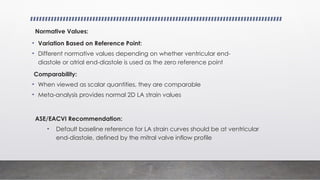
Normative Values:
• Variation Based on Reference Point:
• Different normative values depending on whether ventricular end-
diastole or atrial end-diastole is used as the zero reference point
Comparability:
• When viewed as scalar quantities, they are comparable
• Meta-analysis provides normal 2D LA strain values
ASE/EACVI Recommendation:
• Default baseline reference for LA strain curves should be at ventricular
end-diastole, defined by the mitral valve inflow profile
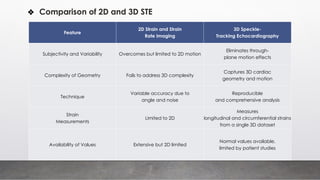
Feature
2D Strain and Strain
Rate Imaging
3D Speckle-
Tracking Echocardiography
Subjectivity and Variability Overcomes but limited to 2D motion
Eliminates through-
plane motion effects
Complexity of Geometry Fails to address 3D complexity
Captures 3D cardiac
geometry and motion
Technique
Variable accuracy due to
angle and noise
Reproducible
and comprehensive analysis
Strain
Measurements
Limited to 2D
Measures
longitudinal and circumferential strains
from a single 3D dataset
Availability of Values Extensive but 2D limited
Normal values available,
limited by patient studies
❖ Comparison of 2D and 3D STE
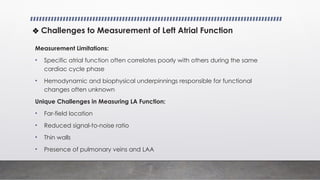
❖ Challenges to Measurement of Left Atrial Function
Measurement Limitations:
• Specific atrial function often correlates poorly with others during the same
cardiac cycle phase
• Hemodynamic and biophysical underpinnings responsible for functional
changes often unknown
Unique Challenges in Measuring LA Function:
• Far-field location
• Reduced signal-to-noise ratio
• Thin walls
• Presence of pulmonary veins and LAA
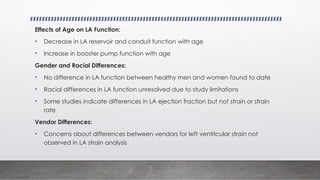
Effects of Age on LA Function:
• Decrease in LA reservoir and conduit function with age
• Increase in booster pump function with age
Gender and Racial Differences:
• No difference in LA function between healthy men and women found to date
• Racial differences in LA function unresolved due to study limitations
• Some studies indicate differences in LA ejection fraction but not strain or strain
rate
Vendor Differences:
• Concerns about differences between vendors for left ventricular strain not
observed in LA strain analysis
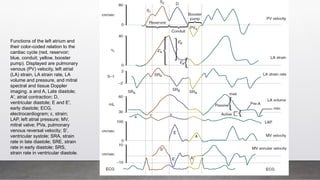
Functions of the left atrium and
their color-coded relation to the
cardiac cycle (red, reservoir;
blue, conduit; yellow, booster
pump). Displayed are pulmonary
venous (PV) velocity, left atrial
(LA) strain, LA strain rate, LA
volume and pressure, and mitral
spectral and tissue Doppler
imaging. a and A, Late diastole;
A′, atrial contraction; D,
ventricular diastole; E and E′,
early diastole; ECG,
electrocardiogram; ε, strain;
LAP, left atrial pressure; MV,
mitral valve; PVa, pulmonary
venous reversal velocity; S′,
ventricular systole; SRA, strain
rate in late diastole; SRE, strain
rate in early diastole; SRS,
strain rate in ventricular diastole.
ECHOCARDIOGRAPHY left atrium size and function.pptx

ECHOCARDIOGRAPHY left atrium size and function.pptx

  • 1.
    ASSESSMENT OF LEFT ATRIALSIZE AND FUNCTION DR AMIR
  • 2.
  • 3.
    ❖ The leftatrium plays role in cardiac function :- 1 Facilitates left ventricular filling 2 Collects pulmonary venous return 3 Transfers blood to the left ventricle ❖ It acts both as a :- - Contractile Pump: Delivers 15% to 30% of left ventricular filling volume - Reservoir: Collects pulmonary venous return during ventricular systole Changes in its size or function can signal adverse cardiovascular outcomes, making its assessment crucial.
  • 4.
    Prognostic Marker: - Previously:Only maximal LA size was noted - Recently: LA Minimum volume and phasic function as powerful predictors - LA Volume:Surrogate marker of diastolic dysfunction severity and chronicity - maximal LA volume (LAVmax) is a biomarker for adverse cardiac events in healthy individuals and various cardiovascular conditions: • Myocardial infarction • Heart failure • Stroke • Degenerative mitral regurgitation • Atrial fibrillation (AF)
  • 5.
    Imaging Techniques - 2DEchocardiography (2DE):Traditional method - 3D Echocardiography (3DE): Recent advancement - Transthoracic Echocardiography: Best for complete visualization and size measurement of the LA - Transesophageal Echocardiography: Limited by inability to fully visualize and measure LA size
  • 6.
    Historical Measurement Approach: ● AP Diameter by M-mode or 2D Images: Initially used to estimate LA size ● Ease and Reproducibility: Most frequently used metric worldwide ● Limitation: Underestimates LA size due to asymmetrical enlargement (mediolateral and superoinferior axes) ● Constraints: Spine and sternum limit AP enlargement ● Identification Rates: AP dimension identified 49% of enlarged LA cases; LA volume evaluation identified 76% ● Current Guidelines: Discourage use of AP diameter except in hypertrophic cardiomyopathy for sudden cardiac death risk stratification
  • 7.
    Leading edge-to-leading edgelinear measurement (dotted blue line) of left atrial anteroposterior diameter using two-dimensional (left) and M-mode (right) echocardiography
  • 8.
    Schematic showing thatthe anteroposterior dimension of the left atrium is constrained between the sternum and the spine and therefore the largest expansion may only occur in the superoinferior dimension
  • 9.
    Current Measurement Recommendations ●Biplane LA Volume by 2DE: ○ Currently recommended for evaluating LA size ○ Stronger predictor of outcomes than linear dimensions ● Requirements for Accurate Measurement: ○ Dedicated Apical Views: ○ Use apical four- and two-chamber views optimized for LA ○ Ensure proper endocardial border tracing ○ Alignment: ○ The long axis of LV isn’t parallel to LA long axis ○ 3DE has clarified this disparity
  • 10.
    Apical views ofthe heart obtained from a threedimensional echocardiography dataset to illustrate the fact that the long axis of the left ventricle (red pointed line) and left atrium (yellow pointed line) do not lie in the same plane
  • 11.
    Two-dimensional measurements toobtain the left atrial volume using the apical four- (left) and two-chamber (right) views
  • 12.
    ● Optimal ImagingPlane and Time: ○ Measure at the end of left ventricular systole for maximal LA dimension ○ Ensure the base of the LA is at its largest size when the imaging plane passes ○ Maximize LA length to align with true long axis of LA ○ Ensure lengths measured in two- and four-chamber views are similar Technical Details: ● Exclusion Criteria: ○ When tracing endocardial border, exclude LA appendage, confluence of pulmonary veins, and space between mitral valve leaflets and annulus .
  • 13.
    1 Simpson’s Methodof Disk Summation: • Trace the LA endocardial border • Compute volume by adding the volumes of 20 cylinders, each with height equal to L/20 (L is yhe length of LA) • Bases calculated using orthogonal minor (ai) and major (bi) transverse axes • Assumes an oval shape • Formula: ❖ 2DE Measurement Algorithms for biplane LA volume :
  • 14.
    2 Area–Length Method: •Uses areas and lengths from apical four- (A1) and two-chamber (B1) views • Volume calculated as: • Length (L): • Shortest distance from midline of the plane of the mitral annulus to the opposite superior side (roof) of the LA • To avoid foreshortening, the difference between L measured in the two- and four- chamber views should be less than 1 cm
  • 15.
    Note: • Area lengthmethod reduces linear dimensions to a single measurement • Both methods are accurate compared to computed tomography meas urements • Biplane area–length method systematically yields larger LA volumes than the disk summation method. However, both methods have comparable prognostic power.
  • 16.
    Body Size andLA Volume • Determinants of LA Size: • Body size significantly affects LA size • Absolute LA volumes larger in men than women • Indexation to Body Surface Area (LAVI): • Corrects for gender differences • Leads to similar LA volumes between men and women • Reference Values of LA volume : • Derived from 2DE are similar in population-based and normative studies • Studies on healthy volunteers confirm these values
  • 17.
    Effects of Aging: •Controversial impacts on LA volume • Some studies: Increase only at extreme ages • Others: Progressive age-related increase Ethnicity Differences: • Larger LA size observed in Europeans compared to South and East Asians
  • 18.
    Phasic LA VolumesCalculation: ○ Maximal LA Volume: Just before mitral valve opening ○ LA PreA Volume: At onset of P wave on ECG ○ Minimal LA Volume: At end-diastole (before mitral valve closure) Echo parameters 3DE (mL/m2) 2DE (m L/m 2) Maximal volume 32 24 Minimal volume 11 8 PreA volume 18 15 Total emptying volume 38 29 Passive emptying volume 25 17 Active emptying volume 14 12
  • 20.
    Phasic left atrialvolumes. From the top: spectral Doppler of left ventricular filling, electrocardiography tracing, 3D left atrial surface and volume–time curves to show the time (red lines), and volumes of the left atrium at left ventricular end-systole (LA Vmax), at end diastole (LA Vmin), and before the P-wave on the EKG (LA VpreA) LA Vmax (LA Vmax) (LA Vmin) (LA VpreA)​
  • 21.
    2015 Guidelines Update: ❖Organizations: European Association of Cardiovascular Imaging and American Society of Echocardiography ❖ New Cutoff: Maximal LA volume (LAVmax) revised from >28 mL/ m² to >34 mL/m² ❖ Basis: Pooled data from larger cohorts of healthy participants ❖ Alignment: Matches the LV diastolic function diagnostic algorithm ❖ Revised Thresholds for LA Enlargement :
  • 22.
    Clinical Relevance: • Threshold:LAVmax >32 mL/ m² associated with adverse outcomes such as ischemic stroke, diabetes, and heart failure • Reclassification: 21% of patients previously reported as having enlarged LA were reclassified as normal with no loss of prognostic power Current Partition Values and Issues: • Mild LA Enlargement: LAVmax 35-41 mL/m² • Moderate LA Enlargement: LAVmax 42-48 mL/m² • Severe LA Enlargement: LAVmax >48 mL/m² • Concern: Narrow range can lead to misclassification due to small measu rement errors
  • 23.
    • NORRE StudyInsights: • Study: Normal Reference Ranges for Echocardiography (NORRE) • Participants: 734 healthy individuals • Suggested Upper Limits: • Area-Length Method: 42 mL/m² • Simpson’s Method: 37 mL/m²
  • 24.
    - 2DE • Correlation: •2DE LA volume correlates with volumes from 3DE, CT, and CMR • Systematic Underestimation: • 2DE often underestimates LA volumes due to: • Foreshortening of the LA • Difficult endocardial border definition, especially in the two-chamber view • Clinical Value: • Despite limitations, 2DE is widely used due to: • Ease of use • Wide availability • Extensive evidence base on LA volume alterations and prognostic value ❖ Correlation and Advancements in LA Volume Measurement
  • 25.
    3DE Advantages: • PreferredModality: • 3DE is becoming preferred for measuring cardiac chamber volumes • Benefits: • Lower Interobserver Variability: Reduces discrepancies between diff erent observers • Higher Test Reproducibility: Ensures consistent results across tests • Technological Advances: Allow easy acquisition of datasets with good frame rates using single-beat acquisition
  • 26.
    • Workflow Improvements: •Semiautomated Contour Detection: • Good correlation with manual tracing • Reduces analysis time • Increases measurement reproducibility • Fully Automated Contour Detection: • Further improvements in efficiency and accuracy • Studies on 3DE LA Volumes: • Two studies used 3DE software algorithms developed for the LV to measure the LA • A recent study with 276 healthy participants showed 3DE LA phasic volumes larger than those obtained by 2DE
  • 27.
    Study Findings: • MulticenterStudy on LA Enlargement Classification: • Agreement for 3DE: κ coefficient of 0.88 (4 false negatives, 7 false positives) wh en compared with CMR • Agreement for 2DE: κ coefficient of 0.71 (25 false negatives, 2 false positives) • Conclusion: 3DE provides a more accurate classification of LA enlargement Recent Developments: • 3DE Speckle-Tracking and Pattern Recognition: • Aim for fully automated identification of the endocardial border • Achieves good correlation with manual methods • Requires further clinical validation to confirm efficacy and reliability
  • 28.
    Automated measurements ofthe LA volumes using three-dimensional echocardiography. Top, Auto LA Q (GE Vingmed) that provides also automated measurements of longitudinal and circumferential strain, in addition to volumes.
  • 29.
    Feature 3DE 2DE Geometrical Assumptions NoneYes Correlation with CT/CMR Better Lesser Reproducibility Higher Lower Automated Quantitation Available Limited Spatial Resolution Limited Better Normative Data Availability Sparse Extensive Prognostic Value Data Limited Extensive ❖ COMPARASION OF 3DE VS 2DE
  • 30.
    Condition Prognostic IndicatorValue Atrial Fibrillation (AF) LA Strain and LAVmax Predicts hospitalization/death Heart Failure (H F) LAVmax Predictor of HF development Dilated Cardiomyopathy LA Enlargement/Dysfunction Predictors of clinical outcomes HF with Preserved Ejection Fraction LAVmax Diagnostic and prognostic value Mitral Regurgitation LAVmax > 60 mL/m 2 Indicator for surgery Aortic Valve Stenosis LA Dilation Provides prognostic information Prognostic Value of Left Atrial Size
  • 31.
    LAVmax Reporting: • CurrentRecommendations: • Encourage reporting of LAVmax in echocardiogram reports • Supported by a large body of evidence for stratifying cardiovascular risk Recent Evidence: • LAVmin as Prognostic Indicator: • Recent studies suggest LAVmin may be a more important indicator than LAVmax • Stronger correlation with LV filling pressures ❖ Prognostic Value of Left Atrial Size
  • 32.
    In Atrial Fibrillation(AF): • LA Strain and LAVmax: • Addition of LA strain during the reservoir phase and LAVmax improves prediction models • Incremental to the CHADS2 score in predicting hospitalization or death • Abnormal Reservoir Function: • Associated with increased recurrence of AF after catheter ablation • May be used to predict procedure success and individualize treatment
  • 33.
    In Heart Failure(HF): • Predictor of HF Development: • LAVmax is a predictor regardless of LV systolic function • Important in patients with dilated cardiomyopathy and HF • HF with Preserved Ejection Fraction (HFpEF): • Greater relevance of LA volume • LAVmax has diagnostic and prognostic value In Mitral Regurgitation: • Surgery Timing: • LAVmax > 60 mL/m² is an indication for surgery in asymptomatic patients with severe degenerative mitral regurgitation
  • 34.
    In Aortic ValveStenosis: • LA Dilation: • Associated with LV remodeling • Provides prognostic information in severe asymptomatic aortic valve stenosis
  • 35.
  • 36.
    Function Phase ContributionInfluence Reservoir Ventricular Systole 40% Atrial compliance, contractility, relaxation, LV base descent, LV end-systolic volume Conduit Early Ventricular Diastole 35% Atrial compliance, LV relaxation, LV compliance, Reciprocally related to reservoir function Booster pump Late Ventricular Diastole 25% Atrial contractility, venous return, LV end diastolic pressures, LV systolic reserve ❖ Principal Roles of the LA:
  • 37.
    Imaging Techniques: ❖ Echocardiography: •Advantages: Availability, safety, versatility • Capabilities: Real-time imaging with high temporal and spatial resolution ❖ Cardiac Computed Tomography (CCT): • Role: Important before, during, and after LA ablation ❖ Cardiac Magnetic Resonance Imaging (CMRI): • Capabilities: Quantifies scar and predicts AF recurrence post-ablation
  • 38.
    Challenges in QuantifyingLA Function: • Complex Geometry: • Intricate fiber orientation complicates quantification • Atrial and Ventricular Interactions: • Interaction between atrial and ventricular performance further com plicates analysis
  • 39.
    ❖ Echocardiographic Methodsfor Assessing LA Function Method Description Primary Use LA Volumetric Analysis Measures volume changes in LA Early method, now less common Spectral Doppler Measures flow in transmitral, pulmonary venous, and LAA Early method, now less common Tissue Doppler and Deformation Measures strain and strain rate of LA body Early method, now less common Speckle-Tracking Deformation Advanced method measuring deformation using speckles Primary method currently in use Invasive Pressure Volume Loops Measures pressure- volume relationships using invasive means Rarely used, cumbersome and time-consuming
  • 40.
    Techniques in LAFunctional Analysis 2D Echocardiography: • Techniques: • LA volumetric and speckle-tracking deformation analyses • Uses two- and four-chamber focused views of the LA • Ensures the LA is not foreshortened • Limitations: • May miss visualization of all LA walls
  • 41.
    3D Echocardiography: • PreferredMethod: • Provides more accurate functional data due to visualization of all LA walls in a dataset • Advancements: • Semi- or fully automated analysis programs are addressing concerns about time and expertise required for analysis CCT and CMRI: • Usage: • Used to assess volumetric LA functions • Challenges: • Less popular due to radiation exposure (CCT) and accessibility issues (CMRI)
  • 42.
    ⮚ Volumetric Indicesfor LA Function Index Description Function Maximum Volume Volume at end-systole, just before mitral valve opening Represents reservoir capacity Minimum Volume Volume at end-diastole, when mitral valve closes Represents emptied LA Pre-Atrial Systole Volume Volume just before atrial systole, before ECG P wave Represents pre-atrial contraction Expansion Index Normalizes total LA emptying volume to minimum LA volume Related to reservoir function LAFI (LA Functional Index) Incorporates LAEF, LVOTvti, and LAVi(maximum LA volume indexed to body surface area) [LAFI = (LAEF × LVOTvti)/LAVi] Comprehensive functional measure Conduit Volume Volume passing through LA not accounted by other functions Conduit volume = [LV stroke volume − (LAmax − LAmin)] Requires simultaneous LV and LA volumes
  • 44.
    ⮚ Spectral DopplerIndices for LA Function Index Description Function E/A Ratios Ratios of early (E) and late (A) transmitral velocities Estimate atrial booster pump function Atrial Filling Fraction Avti/(Evti + Avti) Estimates atrial booster pump function Pulmonary Venous Flow Ratio Ratio of systolic (S) to diastolic (D) flow Estimates reservoir to conduit function Reversed Pulmonary Flow (pva) Magnitude and duration during atrial contraction Estimates atrial contractility and LV diastolic pressures Atrial Ejection Force Product of mitral valve orifice area and peak transmitral A velocity squared Accelerates blood into LV LA Kinetic Energy (LAKE) Incorporates LA stroke volume and transmitral Doppler peak atrial velocity Expresses LA work
  • 45.
    left atrial strainderived from speckle tracking echocardiography. Regional strains are denoted by the colored lines and global longitudinal (GL) strain by the white dotted line. The closed circles on each regional strain–time curve identify peak strain
  • 46.
    Spectral Doppler Indicesof Left Atrial Function
  • 47.
    Advantages: • Availability: Widelyaccessible • Simplicity: Easy to acquire and interpret Challenges: • Interpretation Difficulties: • Sinus tachycardia, conduction system disease, and arrhythmias (especially atrial fibril lation) • High-quality pulmonary venous recordings may be difficult to obtain • Lack of Specificity: • Changes may result from LV diastolic dysfunction, mitral valve disease, or abnormal loading conditions and hemodynamics
  • 48.
    Feature Description FunctionCorrespondence Atrial Contraction (A') Regional snapshot of atrial systolic function Provides a global view when averaged Ventricular Systole (S') Reflects reservoir function Measured during systole Early Diastole (E') Reflects conduit function Measured during early diastole ⮚ Tissue Doppler Imaging Features Reproducibility: • Achieving Accuracy: Proper attention to technical detail ensures reproducible data Acceptable variability can be maintained
  • 49.
    left atrial strainderived from tissue Doppler imaging. Longitudinal strain curves for the septal (purple) and lateral segments (yellow) are shown.
  • 50.
    Tissue Doppler andDeformational Indices of Left Atrial Function
  • 51.
    Challenges and Limitations: •Angle Dependency: • Tissue Doppler velocities subject to error due to dependency on angle • Effects of Cardiac Motion and Tethering: • Movement of the heart and tethering affect accuracy • Superseded by Deformation Analysis: • Deformation analysis provides a more accurate assessment
  • 52.
    ⮚ Deformation Analysis(Strain and Strain Rate Imaging) Strain and Strain Rates: • Represent the magnitude and rate of myocardial deformation • Assessed using either tissue Doppler velocities (TDI) or 2D echocardiographic techniques (2D speckle-tracking echocardiography [2D STE]) Tissue Doppler Imaging (TDI): • Advantages: • Excellent temporal resolution • Ideal 2D image quality not necessary • Challenges: • Highly angle dependent • Noisy, which can impact accuracy
  • 53.
    • 2D Speckle-TrackingEchocardiography (2D STE): • Mechanism: • Analyzes myocardial motion through frame-by- frame tracking of natural acoustic markers (speckles) • Generated without angle dependency from interactions between ultrasound and myocardial tissue within a user-defined region • Requirements: • Frame rates of approximately 50 to 70 Hz to prevent speckle decorrelation • Good image quality needed for accurate tracking • Applications: • Global and Regional Function: • Successfully used to assess left atrial (LA) global and regional function
  • 54.
    Feature TDI 2DSTE Temporal Resolution Excellent High Angle Dependency Highly angle dependent Not angle dependent Noise Noisy Less noise due to speckle tracking Image Quality Needs Ideal 2D image quality not necessary Good image quality needed Applications LA global and regional function assessment LA global and regional function assessment
  • 55.
    ❖ ASE/EACVI Recommendationsfor LA Strain Analysis Aspect Recommendation View Optimized LA-focused apical four- chamber Biplane LA Strain Optional, not mandatory Myocardial Region of Interest Inner and outer LA wall contours Width Default width of 3 mm Tracing Start Point Endocardial border of mitral annulus Global Longitudinal Strain Tangential direction to endocardial border Subdivision Not recommended
  • 56.
    • Global LongitudinalStrain: • Definition: • Strain in the direction tangential to the endocardial atrial border in apic al view • Assessment: • Subdivision into segments and radial/transverse strain not recommended • Due to thinness of LA myocardium and interpolation across pulmonary v eins and LAA
  • 57.
    ❖ Zero-Baseline ReferencePoints and Corresponding Functions Ventricular Cycle: • Zero Reference: Ventricular end-diastole (QRS complex Atrial Cycle: • Zero Reference: Atrial end-diastole (onset of P wave)
  • 58.
    Strain nomenclature basedon choice of zero reference point. The electrocardiographic P wave is used on the left and the QRS complex on the right. A, Late diastole; E, early diastole; ε, strain;
  • 59.
    Reference Point CycleFunction Strain /Strain rate Ventricular End-Diastole Ventricular Reservoir Function s (peak positive longitudinal strain) ɛ Conduit Function e (early diastole strain) ɛ Atrial Booster Function a (late diastole strain) ɛ Atrial End-Diastole Atrial Atrial Booster Pump Function neg (first negative peak strain) ɛ Conduit Function pos (positive peak strain) ɛ Reservoir Function total (sum of neg and pos) ɛ ɛ ɛ Strain Rates Ventricular Reservoir Function SR-S (ventricular systole) Conduit Function SR-E (early diastole) Booster Pump Function SR-A (late diastole)
  • 60.
    Normative Values: • VariationBased on Reference Point: • Different normative values depending on whether ventricular end- diastole or atrial end-diastole is used as the zero reference point Comparability: • When viewed as scalar quantities, they are comparable • Meta-analysis provides normal 2D LA strain values ASE/EACVI Recommendation: • Default baseline reference for LA strain curves should be at ventricular end-diastole, defined by the mitral valve inflow profile
  • 61.
    Feature 2D Strain andStrain Rate Imaging 3D Speckle- Tracking Echocardiography Subjectivity and Variability Overcomes but limited to 2D motion Eliminates through- plane motion effects Complexity of Geometry Fails to address 3D complexity Captures 3D cardiac geometry and motion Technique Variable accuracy due to angle and noise Reproducible and comprehensive analysis Strain Measurements Limited to 2D Measures longitudinal and circumferential strains from a single 3D dataset Availability of Values Extensive but 2D limited Normal values available, limited by patient studies ❖ Comparison of 2D and 3D STE
  • 62.
    ❖ Challenges toMeasurement of Left Atrial Function Measurement Limitations: • Specific atrial function often correlates poorly with others during the same cardiac cycle phase • Hemodynamic and biophysical underpinnings responsible for functional changes often unknown Unique Challenges in Measuring LA Function: • Far-field location • Reduced signal-to-noise ratio • Thin walls • Presence of pulmonary veins and LAA
  • 63.
    Effects of Ageon LA Function: • Decrease in LA reservoir and conduit function with age • Increase in booster pump function with age Gender and Racial Differences: • No difference in LA function between healthy men and women found to date • Racial differences in LA function unresolved due to study limitations • Some studies indicate differences in LA ejection fraction but not strain or strain rate Vendor Differences: • Concerns about differences between vendors for left ventricular strain not observed in LA strain analysis
  • 64.
    Functions of theleft atrium and their color-coded relation to the cardiac cycle (red, reservoir; blue, conduit; yellow, booster pump). Displayed are pulmonary venous (PV) velocity, left atrial (LA) strain, LA strain rate, LA volume and pressure, and mitral spectral and tissue Doppler imaging. a and A, Late diastole; A′, atrial contraction; D, ventricular diastole; E and E′, early diastole; ECG, electrocardiogram; ε, strain; LAP, left atrial pressure; MV, mitral valve; PVa, pulmonary venous reversal velocity; S′, ventricular systole; SRA, strain rate in late diastole; SRE, strain rate in early diastole; SRS, strain rate in ventricular diastole.