PROVEN SHORTCUTS TO BETTER
CIVIL DESIGN WORKFLOWS
AND PROJECTS THAT DID IT RIGHT WITH
MICROSTATION
CHALLENGE #1
VARIOUS FILE FORMATS, MULTIPLE DISCIPLINES, AND PROJECT WORKFLOW EFFICIENCY
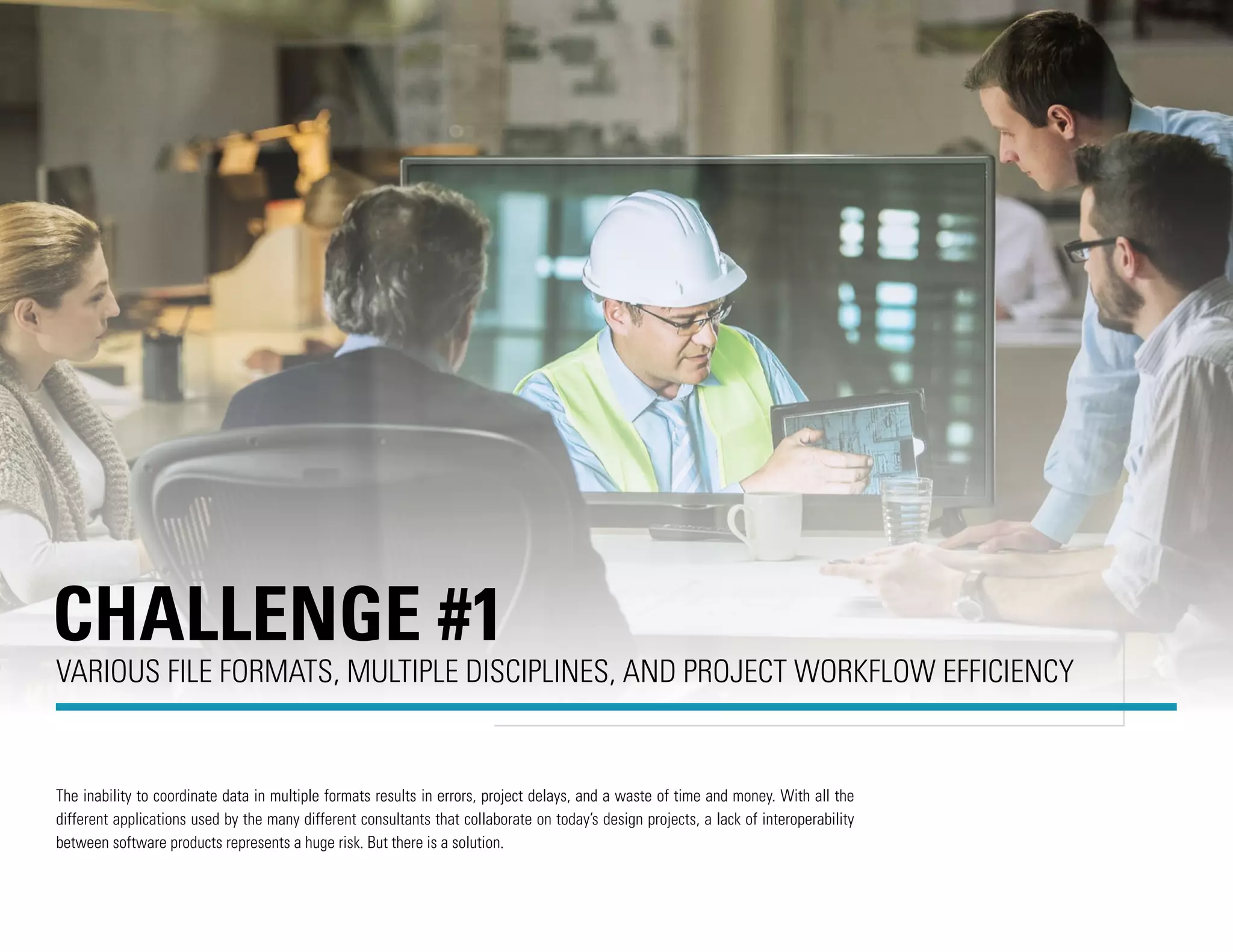
The inability to coordinate data in multiple formats results in errors, project delays, and a waste of time and money. With all the
different applications used by the many different consultants that collaborate on today’s design projects, a lack of interoperability
between software products represents a huge risk. But there is a solution.
With MicroStation®
, data conversions are no longer necessary. Users can incorporate legacy client
data and a variety of natively supported file formats like DWG, SHP, point cloud data, and more,
so workflows are accelerated.
ACCESS &
SHARE DATA
REGARDLESS OF FILE FORMAT
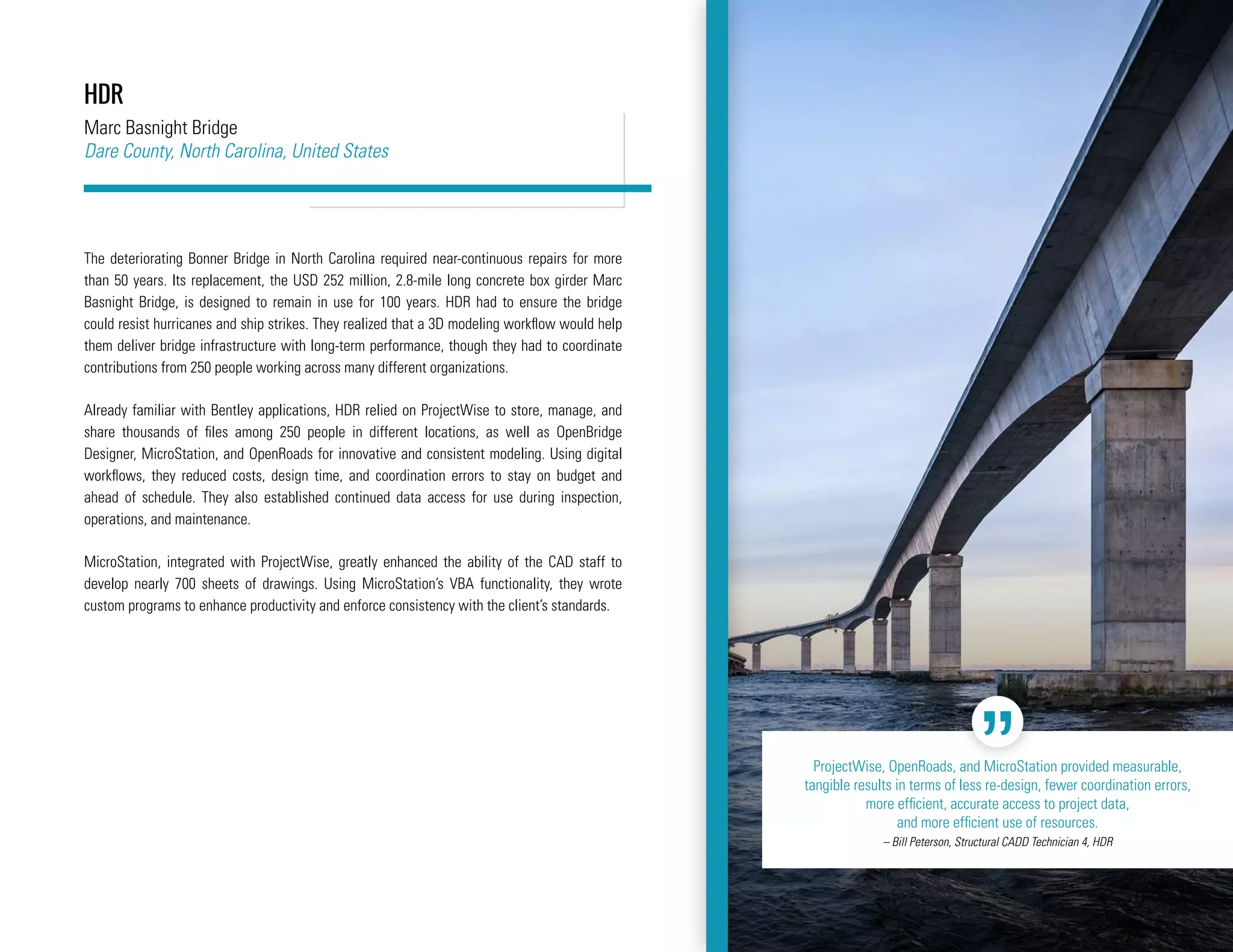
HDR
Marc Basnight Bridge
READ HOW THEY DID IT
Connect project team members to the standards and projects
they work on in a connected modeling environment. MicroStation’s
ability to easily integrate models, drawings, documents, and
data from other sources can significantly improve the design
process by eliminating errors prior to construction.
MULTIPLE
DISCIPLINES
INCORPORATE
WS Atkins & Partners Overseas
Transit Oriented Development, Dubai
READ HOW THEY DID IT
Whether it’s a pond, parking lot, or 20-mile stretch of highway,
MicroStation supports projects both large and small. Its robust
modeling capabilities allow users to rapidly model projects of any
scale and complexity while confidently maintaining design intent.
Equally important, MicroStation’s federated approach to managing
files allows large design teams to easily and reliably share common
files across multiple team members and disciplines whether they’re
working at the office or home. As a result, better quality designs are
developed faster, saving time and money.
SCALE
TO MEET THE NEEDS OF ALL YOUR
PROJECTS — LARGE OR SMALL
JMC2
Civil Engineering
Downtown Pedestrian Improvement Project
READ HOW THEY DID IT
CHALLENGE #2
DELIVER QUALITY CONTRACT REQUIREMENTS ON TIME, EVERY TIME
Delivering and using drawings and models that don’t conform to standards introduces safety risks to field staff, causes errors
and leads to rework during construction. Unstandardized drawings and models can result in losing future work and can damage
the reputation of your organization. But there is a solution.
Integrate representations of existing conditions into designs to
generate accurate 3D models. Leverage raster images, point clouds,
reality meshes, GIS, and more. With MicroStation, users can make
better decisions throughout the project lifecycle and create highly
impactful visuals for stakeholders.
REAL-WORLD
CONTEXT
DESIGN WITHIN
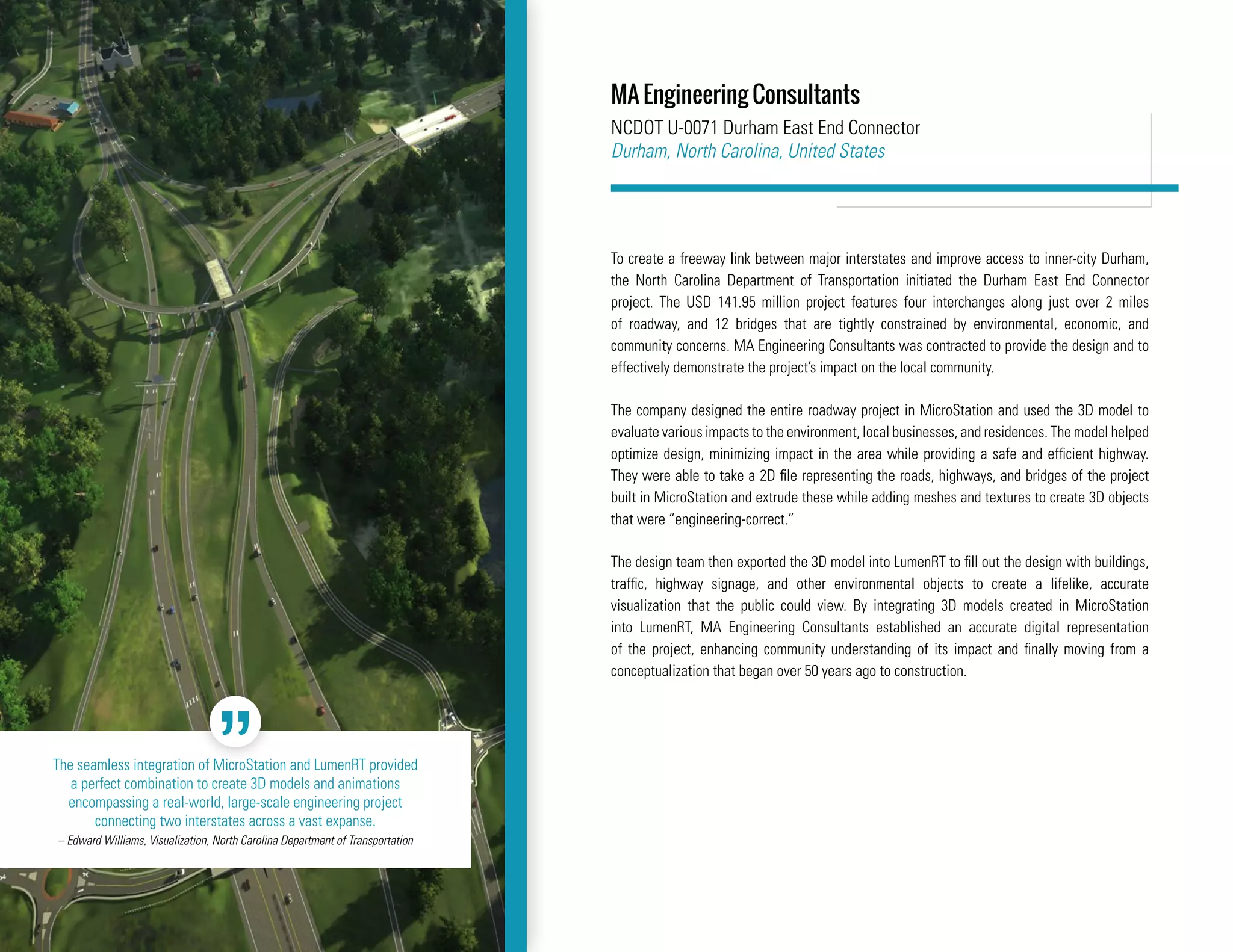
MA Engineering Consultants
NCDOT U-0071 Durham East End Connector
READ HOW THEY DID IT
MicroStation supports a comprehensive set of mesh, solid, surface, and feature modeling tools so users can more easily develop demanding civil engineering
designs. Robust constraint capabilities ensure design intent is maintained. Plus, MicroStation helps users simplify the management and use of similar engineering
components by using a smaller number of parametric components with pre-defined variants that can be easily shared. This means users can complete jobs faster,
explore more design alternatives, and develop better quality designs.
DEVELOP COMPLEX MODELS
MORE EASILY
Image courtesy of Alabama DOT,
The Mobile River Bridge Project
Alabama DOT
Birmingham, AL I-59/I-20 Corridor Project
READ HOW THEY DID IT
OUTPUT DESIGNS
AS PLAN SETS OR 3D VIDEOS — AND EVERYTHING IN BETWEEN
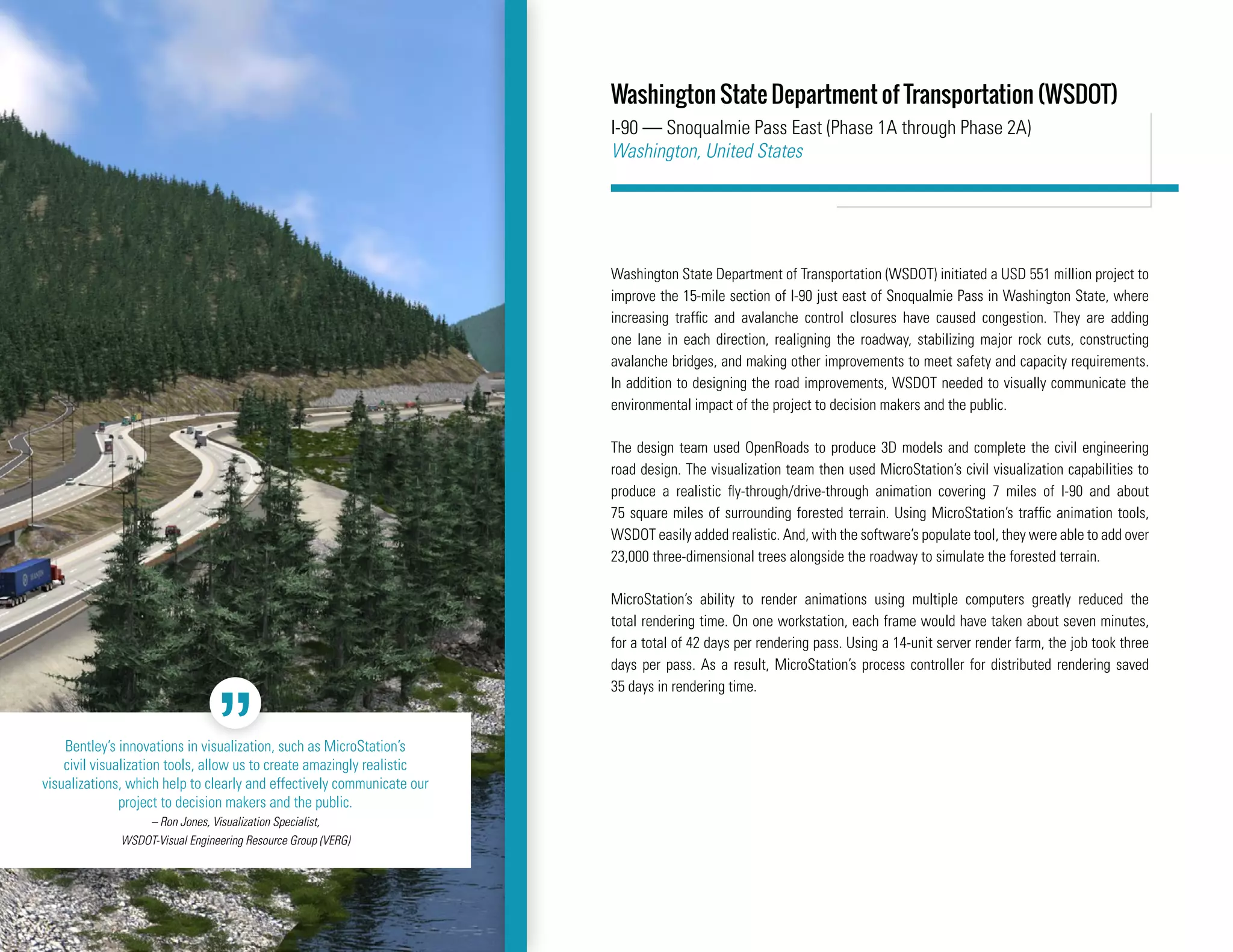
Washington State DOT
I-90 – Snoqualmie Pass East (Phase 1A through Phase 2A)
Produce all deliverables needed to support project demands in one application. Save time automating the creation and sharing of drawing sheets, models, visualizations,
multidiscipline documentation sets, and more. With MicroStation, users reduce the risk of project delays and errors because they can easily adapt to project changes while
assuring standards are met across design teams.
READ HOW THEY DID IT
Alabama Department of Transportation
Birmingham, AL I-59/I-20 Corridor Project
Birmingham, Alabama, United States
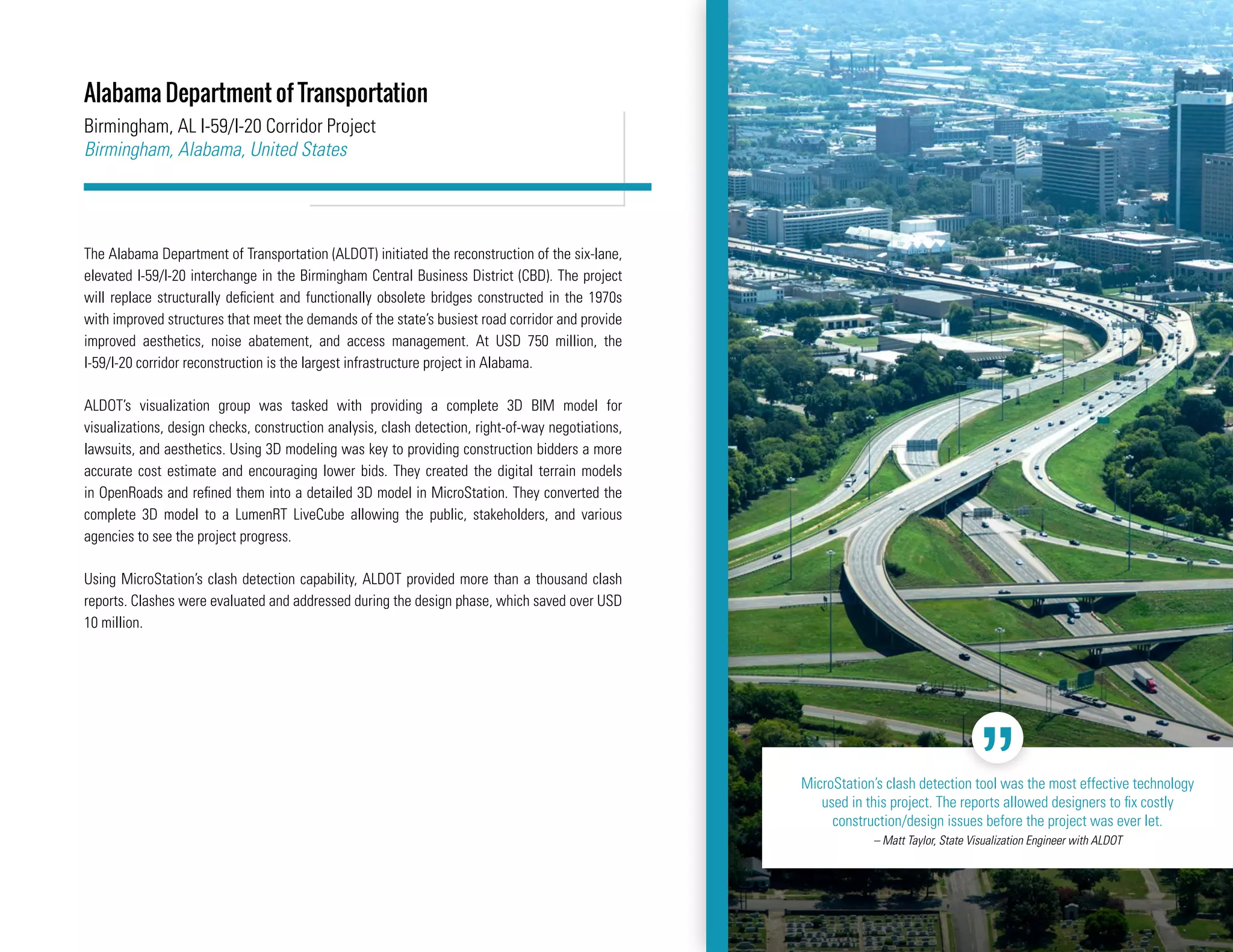
The Alabama Department of Transportation (ALDOT) initiated the reconstruction of the six-lane,
elevated I-59/I-20 interchange in the Birmingham Central Business District (CBD). The project
will replace structurally deficient and functionally obsolete bridges constructed in the 1970s
with improved structures that meet the demands of the state’s busiest road corridor and provide
improved aesthetics, noise abatement, and access management. At USD 750 million, the
I-59/I-20 corridor reconstruction is the largest infrastructure project in Alabama.
ALDOT’s visualization group was tasked with providing a complete 3D BIM model for
visualizations, design checks, construction analysis, clash detection, right-of-way negotiations,
lawsuits, and aesthetics. Using 3D modeling was key to providing construction bidders a more
accurate cost estimate and encouraging lower bids. They created the digital terrain models
in OpenRoads and refined them into a detailed 3D model in MicroStation. They converted the
complete 3D model to a LumenRT LiveCube allowing the public, stakeholders, and various
agencies to see the project progress.
Using MicroStation’s clash detection capability, ALDOT provided more than a thousand clash
reports. Clashes were evaluated and addressed during the design phase, which saved over USD
10 million.
MicroStation’s clash detection tool was the most effective technology
used in this project. The reports allowed designers to fix costly
construction/design issues before the project was ever let.
– Matt Taylor, State Visualization Engineer with ALDOT
JMC2
Civil Engineering
Downtown Pedestrian Improvement Project
Torrance, California, United States
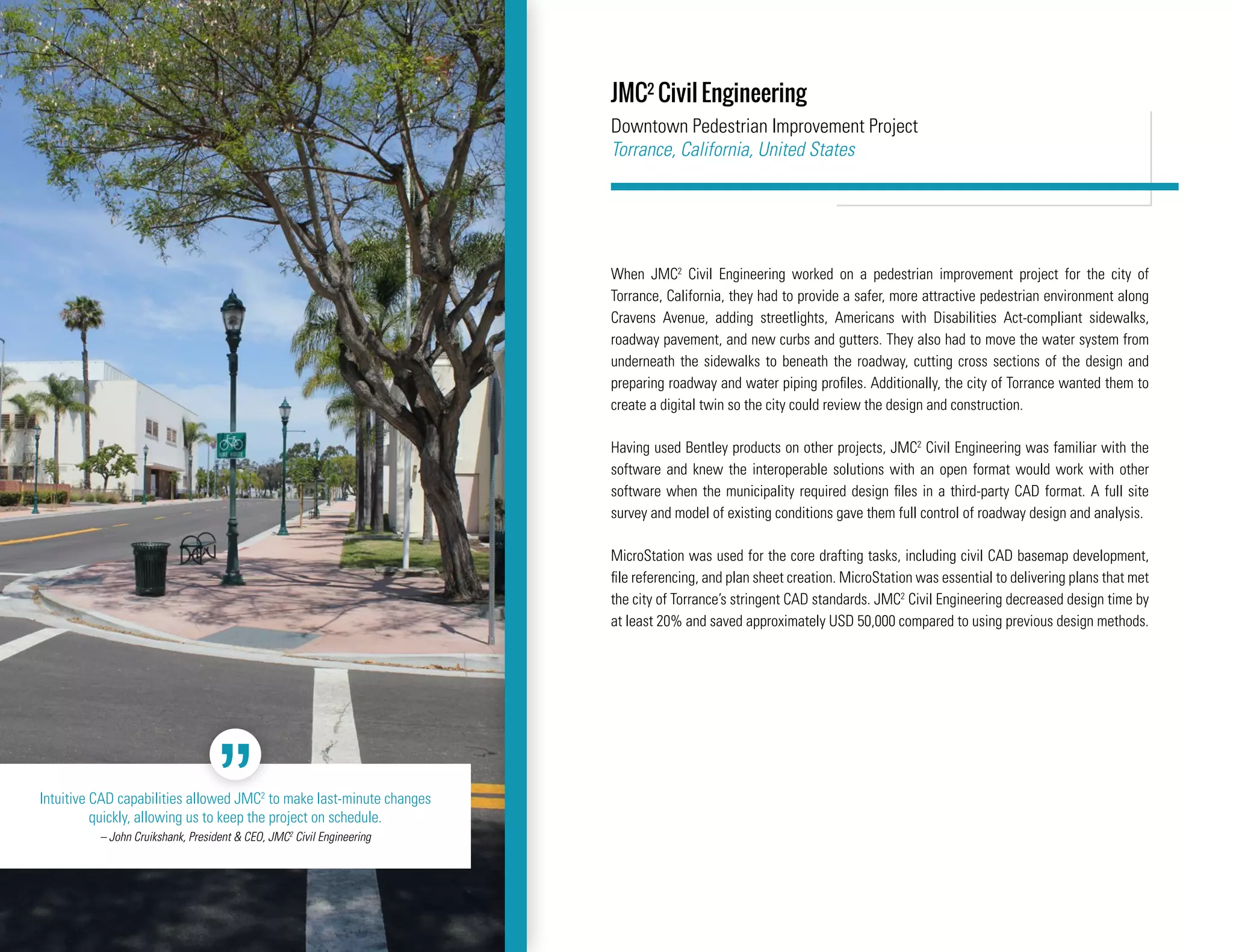
When JMC2
Civil Engineering worked on a pedestrian improvement project for the city of
Torrance, California, they had to provide a safer, more attractive pedestrian environment along
Cravens Avenue, adding streetlights, Americans with Disabilities Act-compliant sidewalks,
roadway pavement, and new curbs and gutters. They also had to move the water system from
underneath the sidewalks to beneath the roadway, cutting cross sections of the design and
preparing roadway and water piping profiles. Additionally, the city of Torrance wanted them to
create a digital twin so the city could review the design and construction.
Having used Bentley products on other projects, JMC2
Civil Engineering was familiar with the
software and knew the interoperable solutions with an open format would work with other
software when the municipality required design files in a third-party CAD format. A full site
survey and model of existing conditions gave them full control of roadway design and analysis.
MicroStation was used for the core drafting tasks, including civil CAD basemap development,
file referencing, and plan sheet creation. MicroStation was essential to delivering plans that met
the city of Torrance’s stringent CAD standards. JMC2
Civil Engineering decreased design time by
at least 20% and saved approximately USD 50,000 compared to using previous design methods.
Intuitive CAD capabilities allowed JMC2
to make last-minute changes
quickly, allowing us to keep the project on schedule.
– John Cruikshank, President & CEO, JMC2
Civil Engineering
HDR
Marc Basnight Bridge
Dare County, North Carolina, United States
The deteriorating Bonner Bridge in North Carolina required near-continuous repairs for more
than 50 years. Its replacement, the USD 252 million, 2.8-mile long concrete box girder Marc
Basnight Bridge, is designed to remain in use for 100 years. HDR had to ensure the bridge
could resist hurricanes and ship strikes. They realized that a 3D modeling workflow would help
them deliver bridge infrastructure with long-term performance, though they had to coordinate
contributions from 250 people working across many different organizations.
Already familiar with Bentley applications, HDR relied on ProjectWise to store, manage, and
share thousands of files among 250 people in different locations, as well as OpenBridge
Designer, MicroStation, and OpenRoads for innovative and consistent modeling. Using digital
workflows, they reduced costs, design time, and coordination errors to stay on budget and
ahead of schedule. They also established continued data access for use during inspection,
operations, and maintenance.
MicroStation, integrated with ProjectWise, greatly enhanced the ability of the CAD staff to
develop nearly 700 sheets of drawings. Using MicroStation’s VBA functionality, they wrote
custom programs to enhance productivity and enforce consistency with the client’s standards.
ProjectWise, OpenRoads, and MicroStation provided measurable,
tangible results in terms of less re-design, fewer coordination errors,
more efficient, accurate access to project data,
and more efficient use of resources.
– Bill Peterson, Structural CADD Technician 4, HDR
Washington State Department of Transportation (WSDOT)
I-90 — Snoqualmie Pass East (Phase 1A through Phase 2A)
Washington, United States
Washington State Department of Transportation (WSDOT) initiated a USD 551 million project to
improve the 15-mile section of I-90 just east of Snoqualmie Pass in Washington State, where
increasing traffic and avalanche control closures have caused congestion. They are adding
one lane in each direction, realigning the roadway, stabilizing major rock cuts, constructing
avalanche bridges, and making other improvements to meet safety and capacity requirements.
In addition to designing the road improvements, WSDOT needed to visually communicate the
environmental impact of the project to decision makers and the public.
The design team used OpenRoads to produce 3D models and complete the civil engineering
road design. The visualization team then used MicroStation’s civil visualization capabilities to
produce a realistic fly-through/drive-through animation covering 7 miles of I-90 and about
75 square miles of surrounding forested terrain. Using MicroStation’s traffic animation tools,
WSDOT easily added realistic. And, with the software’s populate tool, they were able to add over
23,000 three-dimensional trees alongside the roadway to simulate the forested terrain.
MicroStation’s ability to render animations using multiple computers greatly reduced the
total rendering time. On one workstation, each frame would have taken about seven minutes,
for a total of 42 days per rendering pass. Using a 14-unit server render farm, the job took three
days per pass. As a result, MicroStation’s process controller for distributed rendering saved
35 days in rendering time.
Bentley’s innovations in visualization, such as MicroStation’s
civil visualization tools, allow us to create amazingly realistic
visualizations, which help to clearly and effectively communicate our
project to decision makers and the public.
– Ron Jones, Visualization Specialist,
WSDOT-Visual Engineering Resource Group (VERG)
WS Atkins & Partners Overseas
Transit Oriented Development, Dubai
Dubai, UAE
WS Atkins & Partners Overseas had to be innovative when designing an underground rail
station for Dubai’s Green and Red metro lines near an existing shopping mall. The USD 2.9
billion development will reduce roadway traffic, boost sales, and separate the flow of shoppers
from daily commuters. However, right-of-way limitations, a shallow foundation, inadequate
vehicle drop-off space, and a small utility tunnel presented design challenges. WS Atkins also
had to achieve LEED GOLD certification and deliver a high-quality, under-budget design on time.
They initially used Autodesk software, but when they found it insufficient for integrating the
project with surrounding buildings and effectively delivering their BIM vision, they deployed
Bentley software. WS Atkins overcame site constraints with MicroStation’s parametric
modeling capabilities. MicroStation’s powerful constraints capabilities, usable in both drawing
and modeling workflows, enabled them to maintain design intent while rapidly moving
through design iterations and progressing development. They solved the station’s complex
interface geometry within the application, eliminating on-site measuring. Accurate quantity
estimations reduced construction waste by 45% and material waste by 65%. They shared
over 100 files of varying formats among the multidiscipline team to enhance collaboration
and deliver the design one month early.
The project required working with very large files. MicroStation is
high-performance software. Its system architecture allowed us to
open and work with very large raster, vector, and point cloud data
much faster than you can with AutoCAD.
– Godson Jasper Sundaramony - Senior Architect, WS Atkins & Partners Overseas
MA Engineering Consultants
NCDOT U-0071 Durham East End Connector
Durham, North Carolina, United States
To create a freeway link between major interstates and improve access to inner-city Durham,
the North Carolina Department of Transportation initiated the Durham East End Connector
project. The USD 141.95 million project features four interchanges along just over 2 miles
of roadway, and 12 bridges that are tightly constrained by environmental, economic, and
community concerns. MA Engineering Consultants was contracted to provide the design and to
effectively demonstrate the project’s impact on the local community.
The company designed the entire roadway project in MicroStation and used the 3D model to
evaluate various impacts to the environment, local businesses, and residences. The model helped
optimize design, minimizing impact in the area while providing a safe and efficient highway.
They were able to take a 2D file representing the roads, highways, and bridges of the project
built in MicroStation and extrude these while adding meshes and textures to create 3D objects
that were “engineering-correct.”
The design team then exported the 3D model into LumenRT to fill out the design with buildings,
traffic, highway signage, and other environmental objects to create a lifelike, accurate
visualization that the public could view. By integrating 3D models created in MicroStation
into LumenRT, MA Engineering Consultants established an accurate digital representation
of the project, enhancing community understanding of its impact and finally moving from a
conceptualization that began over 50 years ago to construction.
The seamless integration of MicroStation and LumenRT provided
a perfect combination to create 3D models and animations
encompassing a real-world, large-scale engineering project
connecting two interstates across a vast expanse.
– Edward Williams, Visualization, North Carolina Department of Transportation
Leighton Asia
Hong Kong Boundary Crossing Facilities, Hong Kong-Zhuhai-Macao Bridge
Hong Kong
The new Hong Kong-Zhuhai-Macao Bridge is a 50-kilometer link that comprises a series of
bridges and tunnels that will connect the three cities. Vehicles traveling to and from Hong Kong
will leave and enter via a 130-hectare island that is being reclaimed to the east of Chek Lap Kok.
A 40,000-square-meter, 30-meter-high passenger clearance building will accommodate vehicles
passing through customs and immigration and become a distinctive entry point to Hong Kong.
The Leighton-Chun Wo Joint Venture is responsible for constructing the passenger clearance
building, the drop off deck/area footbridges, and a district cooling system for the Hong Kong
Boundary Crossing Facilities.
The project scope includes bored pile foundations, reinforced concrete structures, a profiled
steel roof, curtain walling and glazing, architectural finishes, and mechanical and electrical
work. Leighton-Chun Wo used MicroStation and OpenRoads to create a common platform to
collaborate on all structures and manage all project information. They used a BIM methodology
and co-constructed a BIM model with the survey department for contractor works. Leveraging
the accuracy of MicroStation, the survey department created a georeferenced BIM model that
was used for survey checking. Later, the BIM model was exported to an iModel format for senior
management to view and compare during site visits. Leighton-Chun Wo identified clashes before
the construction stage using MicroStation, saving about 12 percent of the budget.
MicroStation is a common platform for all our files.
No matter whether it is an engineer, surveyor, contractor,
or owner-operator, we all use and view the model with the same
DGN format in MicroStation.
– Michael Wong, Survey Manager
MicroStation — and all Bentley BIM applications — are built on the same comprehensive modeling platform so that
users can easily progress MicroStation work into discipline-specific BIM workflows. It enables every civil engineer
and designer to:
• Create better designs, faster: With MicroStation, users can model, document, and visualize infrastructure projects of any type, scale, and
complexity using a comprehensive set of design and documentation capabilities. Reliably integrate any existing design content and work with
any-size team using virtually any mix of design applications. MicroStation enables users to develop and document better designs in less time by
better connecting tools, data, and the team.
• Better integrated project teams: MicroStation provides a common environment for comprehensive project delivery and connects users, projects,
and the enterprise. With MicroStation, users have a personal portal to access learning, communities, and project information.
Plus, MicroStation offers the flexibility you need to work the way you want - with several customizable user
interfaces, including a dark mode. There’s also native support for RealDWG to ensure 100% compatibility and
confidence in your data.
To learn more, visit www.virtuosity.com/MicroStation
MICROSTATION
THE FOUNDATION OF EFFICIENT CIVIL ENGINEERING DESIGN WORKFLOWS
© 2022 Bentley Systems, Incorporated. Bentley, the Bentley logo, CulvertMaster, Descartes, FlowMaster, iTwin, LEGION, LumenRT, MicroStation, OpenBridge, OpenBridge Designer, OpenFlows,
OpenRoads, ProjectWise, STAAD, and StormCAD are either registered or unregistered trademarks or service marks of Bentley Systems, Incorporated or one of its direct or indirect wholly owned
subsidiaries. Other brands and product names are trademarks of their respective owners. 06/22

eBook-MicroStation-Civil-Engineering.pdf

  • 1.
    PROVEN SHORTCUTS TOBETTER CIVIL DESIGN WORKFLOWS AND PROJECTS THAT DID IT RIGHT WITH MICROSTATION
  • 2.
    CHALLENGE #1 VARIOUS FILEFORMATS, MULTIPLE DISCIPLINES, AND PROJECT WORKFLOW EFFICIENCY The inability to coordinate data in multiple formats results in errors, project delays, and a waste of time and money. With all the different applications used by the many different consultants that collaborate on today’s design projects, a lack of interoperability between software products represents a huge risk. But there is a solution.
  • 3.
    With MicroStation® , dataconversions are no longer necessary. Users can incorporate legacy client data and a variety of natively supported file formats like DWG, SHP, point cloud data, and more, so workflows are accelerated. ACCESS & SHARE DATA REGARDLESS OF FILE FORMAT HDR Marc Basnight Bridge READ HOW THEY DID IT
  • 4.
    Connect project teammembers to the standards and projects they work on in a connected modeling environment. MicroStation’s ability to easily integrate models, drawings, documents, and data from other sources can significantly improve the design process by eliminating errors prior to construction. MULTIPLE DISCIPLINES INCORPORATE WS Atkins & Partners Overseas Transit Oriented Development, Dubai READ HOW THEY DID IT
  • 5.
    Whether it’s apond, parking lot, or 20-mile stretch of highway, MicroStation supports projects both large and small. Its robust modeling capabilities allow users to rapidly model projects of any scale and complexity while confidently maintaining design intent. Equally important, MicroStation’s federated approach to managing files allows large design teams to easily and reliably share common files across multiple team members and disciplines whether they’re working at the office or home. As a result, better quality designs are developed faster, saving time and money. SCALE TO MEET THE NEEDS OF ALL YOUR PROJECTS — LARGE OR SMALL JMC2 Civil Engineering Downtown Pedestrian Improvement Project READ HOW THEY DID IT
  • 6.
    CHALLENGE #2 DELIVER QUALITYCONTRACT REQUIREMENTS ON TIME, EVERY TIME Delivering and using drawings and models that don’t conform to standards introduces safety risks to field staff, causes errors and leads to rework during construction. Unstandardized drawings and models can result in losing future work and can damage the reputation of your organization. But there is a solution.
  • 7.
    Integrate representations ofexisting conditions into designs to generate accurate 3D models. Leverage raster images, point clouds, reality meshes, GIS, and more. With MicroStation, users can make better decisions throughout the project lifecycle and create highly impactful visuals for stakeholders. REAL-WORLD CONTEXT DESIGN WITHIN MA Engineering Consultants NCDOT U-0071 Durham East End Connector READ HOW THEY DID IT
  • 8.
    MicroStation supports acomprehensive set of mesh, solid, surface, and feature modeling tools so users can more easily develop demanding civil engineering designs. Robust constraint capabilities ensure design intent is maintained. Plus, MicroStation helps users simplify the management and use of similar engineering components by using a smaller number of parametric components with pre-defined variants that can be easily shared. This means users can complete jobs faster, explore more design alternatives, and develop better quality designs. DEVELOP COMPLEX MODELS MORE EASILY Image courtesy of Alabama DOT, The Mobile River Bridge Project Alabama DOT Birmingham, AL I-59/I-20 Corridor Project READ HOW THEY DID IT
  • 9.
    OUTPUT DESIGNS AS PLANSETS OR 3D VIDEOS — AND EVERYTHING IN BETWEEN Washington State DOT I-90 – Snoqualmie Pass East (Phase 1A through Phase 2A) Produce all deliverables needed to support project demands in one application. Save time automating the creation and sharing of drawing sheets, models, visualizations, multidiscipline documentation sets, and more. With MicroStation, users reduce the risk of project delays and errors because they can easily adapt to project changes while assuring standards are met across design teams. READ HOW THEY DID IT
  • 10.
    Alabama Department ofTransportation Birmingham, AL I-59/I-20 Corridor Project Birmingham, Alabama, United States The Alabama Department of Transportation (ALDOT) initiated the reconstruction of the six-lane, elevated I-59/I-20 interchange in the Birmingham Central Business District (CBD). The project will replace structurally deficient and functionally obsolete bridges constructed in the 1970s with improved structures that meet the demands of the state’s busiest road corridor and provide improved aesthetics, noise abatement, and access management. At USD 750 million, the I-59/I-20 corridor reconstruction is the largest infrastructure project in Alabama. ALDOT’s visualization group was tasked with providing a complete 3D BIM model for visualizations, design checks, construction analysis, clash detection, right-of-way negotiations, lawsuits, and aesthetics. Using 3D modeling was key to providing construction bidders a more accurate cost estimate and encouraging lower bids. They created the digital terrain models in OpenRoads and refined them into a detailed 3D model in MicroStation. They converted the complete 3D model to a LumenRT LiveCube allowing the public, stakeholders, and various agencies to see the project progress. Using MicroStation’s clash detection capability, ALDOT provided more than a thousand clash reports. Clashes were evaluated and addressed during the design phase, which saved over USD 10 million. MicroStation’s clash detection tool was the most effective technology used in this project. The reports allowed designers to fix costly construction/design issues before the project was ever let. – Matt Taylor, State Visualization Engineer with ALDOT
  • 11.
    JMC2 Civil Engineering Downtown PedestrianImprovement Project Torrance, California, United States When JMC2 Civil Engineering worked on a pedestrian improvement project for the city of Torrance, California, they had to provide a safer, more attractive pedestrian environment along Cravens Avenue, adding streetlights, Americans with Disabilities Act-compliant sidewalks, roadway pavement, and new curbs and gutters. They also had to move the water system from underneath the sidewalks to beneath the roadway, cutting cross sections of the design and preparing roadway and water piping profiles. Additionally, the city of Torrance wanted them to create a digital twin so the city could review the design and construction. Having used Bentley products on other projects, JMC2 Civil Engineering was familiar with the software and knew the interoperable solutions with an open format would work with other software when the municipality required design files in a third-party CAD format. A full site survey and model of existing conditions gave them full control of roadway design and analysis. MicroStation was used for the core drafting tasks, including civil CAD basemap development, file referencing, and plan sheet creation. MicroStation was essential to delivering plans that met the city of Torrance’s stringent CAD standards. JMC2 Civil Engineering decreased design time by at least 20% and saved approximately USD 50,000 compared to using previous design methods. Intuitive CAD capabilities allowed JMC2 to make last-minute changes quickly, allowing us to keep the project on schedule. – John Cruikshank, President & CEO, JMC2 Civil Engineering
  • 12.
    HDR Marc Basnight Bridge DareCounty, North Carolina, United States The deteriorating Bonner Bridge in North Carolina required near-continuous repairs for more than 50 years. Its replacement, the USD 252 million, 2.8-mile long concrete box girder Marc Basnight Bridge, is designed to remain in use for 100 years. HDR had to ensure the bridge could resist hurricanes and ship strikes. They realized that a 3D modeling workflow would help them deliver bridge infrastructure with long-term performance, though they had to coordinate contributions from 250 people working across many different organizations. Already familiar with Bentley applications, HDR relied on ProjectWise to store, manage, and share thousands of files among 250 people in different locations, as well as OpenBridge Designer, MicroStation, and OpenRoads for innovative and consistent modeling. Using digital workflows, they reduced costs, design time, and coordination errors to stay on budget and ahead of schedule. They also established continued data access for use during inspection, operations, and maintenance. MicroStation, integrated with ProjectWise, greatly enhanced the ability of the CAD staff to develop nearly 700 sheets of drawings. Using MicroStation’s VBA functionality, they wrote custom programs to enhance productivity and enforce consistency with the client’s standards. ProjectWise, OpenRoads, and MicroStation provided measurable, tangible results in terms of less re-design, fewer coordination errors, more efficient, accurate access to project data, and more efficient use of resources. – Bill Peterson, Structural CADD Technician 4, HDR
  • 13.
    Washington State Departmentof Transportation (WSDOT) I-90 — Snoqualmie Pass East (Phase 1A through Phase 2A) Washington, United States Washington State Department of Transportation (WSDOT) initiated a USD 551 million project to improve the 15-mile section of I-90 just east of Snoqualmie Pass in Washington State, where increasing traffic and avalanche control closures have caused congestion. They are adding one lane in each direction, realigning the roadway, stabilizing major rock cuts, constructing avalanche bridges, and making other improvements to meet safety and capacity requirements. In addition to designing the road improvements, WSDOT needed to visually communicate the environmental impact of the project to decision makers and the public. The design team used OpenRoads to produce 3D models and complete the civil engineering road design. The visualization team then used MicroStation’s civil visualization capabilities to produce a realistic fly-through/drive-through animation covering 7 miles of I-90 and about 75 square miles of surrounding forested terrain. Using MicroStation’s traffic animation tools, WSDOT easily added realistic. And, with the software’s populate tool, they were able to add over 23,000 three-dimensional trees alongside the roadway to simulate the forested terrain. MicroStation’s ability to render animations using multiple computers greatly reduced the total rendering time. On one workstation, each frame would have taken about seven minutes, for a total of 42 days per rendering pass. Using a 14-unit server render farm, the job took three days per pass. As a result, MicroStation’s process controller for distributed rendering saved 35 days in rendering time. Bentley’s innovations in visualization, such as MicroStation’s civil visualization tools, allow us to create amazingly realistic visualizations, which help to clearly and effectively communicate our project to decision makers and the public. – Ron Jones, Visualization Specialist, WSDOT-Visual Engineering Resource Group (VERG)
  • 14.
    WS Atkins &Partners Overseas Transit Oriented Development, Dubai Dubai, UAE WS Atkins & Partners Overseas had to be innovative when designing an underground rail station for Dubai’s Green and Red metro lines near an existing shopping mall. The USD 2.9 billion development will reduce roadway traffic, boost sales, and separate the flow of shoppers from daily commuters. However, right-of-way limitations, a shallow foundation, inadequate vehicle drop-off space, and a small utility tunnel presented design challenges. WS Atkins also had to achieve LEED GOLD certification and deliver a high-quality, under-budget design on time. They initially used Autodesk software, but when they found it insufficient for integrating the project with surrounding buildings and effectively delivering their BIM vision, they deployed Bentley software. WS Atkins overcame site constraints with MicroStation’s parametric modeling capabilities. MicroStation’s powerful constraints capabilities, usable in both drawing and modeling workflows, enabled them to maintain design intent while rapidly moving through design iterations and progressing development. They solved the station’s complex interface geometry within the application, eliminating on-site measuring. Accurate quantity estimations reduced construction waste by 45% and material waste by 65%. They shared over 100 files of varying formats among the multidiscipline team to enhance collaboration and deliver the design one month early. The project required working with very large files. MicroStation is high-performance software. Its system architecture allowed us to open and work with very large raster, vector, and point cloud data much faster than you can with AutoCAD. – Godson Jasper Sundaramony - Senior Architect, WS Atkins & Partners Overseas
  • 15.
    MA Engineering Consultants NCDOTU-0071 Durham East End Connector Durham, North Carolina, United States To create a freeway link between major interstates and improve access to inner-city Durham, the North Carolina Department of Transportation initiated the Durham East End Connector project. The USD 141.95 million project features four interchanges along just over 2 miles of roadway, and 12 bridges that are tightly constrained by environmental, economic, and community concerns. MA Engineering Consultants was contracted to provide the design and to effectively demonstrate the project’s impact on the local community. The company designed the entire roadway project in MicroStation and used the 3D model to evaluate various impacts to the environment, local businesses, and residences. The model helped optimize design, minimizing impact in the area while providing a safe and efficient highway. They were able to take a 2D file representing the roads, highways, and bridges of the project built in MicroStation and extrude these while adding meshes and textures to create 3D objects that were “engineering-correct.” The design team then exported the 3D model into LumenRT to fill out the design with buildings, traffic, highway signage, and other environmental objects to create a lifelike, accurate visualization that the public could view. By integrating 3D models created in MicroStation into LumenRT, MA Engineering Consultants established an accurate digital representation of the project, enhancing community understanding of its impact and finally moving from a conceptualization that began over 50 years ago to construction. The seamless integration of MicroStation and LumenRT provided a perfect combination to create 3D models and animations encompassing a real-world, large-scale engineering project connecting two interstates across a vast expanse. – Edward Williams, Visualization, North Carolina Department of Transportation
  • 16.
    Leighton Asia Hong KongBoundary Crossing Facilities, Hong Kong-Zhuhai-Macao Bridge Hong Kong The new Hong Kong-Zhuhai-Macao Bridge is a 50-kilometer link that comprises a series of bridges and tunnels that will connect the three cities. Vehicles traveling to and from Hong Kong will leave and enter via a 130-hectare island that is being reclaimed to the east of Chek Lap Kok. A 40,000-square-meter, 30-meter-high passenger clearance building will accommodate vehicles passing through customs and immigration and become a distinctive entry point to Hong Kong. The Leighton-Chun Wo Joint Venture is responsible for constructing the passenger clearance building, the drop off deck/area footbridges, and a district cooling system for the Hong Kong Boundary Crossing Facilities. The project scope includes bored pile foundations, reinforced concrete structures, a profiled steel roof, curtain walling and glazing, architectural finishes, and mechanical and electrical work. Leighton-Chun Wo used MicroStation and OpenRoads to create a common platform to collaborate on all structures and manage all project information. They used a BIM methodology and co-constructed a BIM model with the survey department for contractor works. Leveraging the accuracy of MicroStation, the survey department created a georeferenced BIM model that was used for survey checking. Later, the BIM model was exported to an iModel format for senior management to view and compare during site visits. Leighton-Chun Wo identified clashes before the construction stage using MicroStation, saving about 12 percent of the budget. MicroStation is a common platform for all our files. No matter whether it is an engineer, surveyor, contractor, or owner-operator, we all use and view the model with the same DGN format in MicroStation. – Michael Wong, Survey Manager
  • 17.
    MicroStation — andall Bentley BIM applications — are built on the same comprehensive modeling platform so that users can easily progress MicroStation work into discipline-specific BIM workflows. It enables every civil engineer and designer to: • Create better designs, faster: With MicroStation, users can model, document, and visualize infrastructure projects of any type, scale, and complexity using a comprehensive set of design and documentation capabilities. Reliably integrate any existing design content and work with any-size team using virtually any mix of design applications. MicroStation enables users to develop and document better designs in less time by better connecting tools, data, and the team. • Better integrated project teams: MicroStation provides a common environment for comprehensive project delivery and connects users, projects, and the enterprise. With MicroStation, users have a personal portal to access learning, communities, and project information. Plus, MicroStation offers the flexibility you need to work the way you want - with several customizable user interfaces, including a dark mode. There’s also native support for RealDWG to ensure 100% compatibility and confidence in your data. To learn more, visit www.virtuosity.com/MicroStation MICROSTATION THE FOUNDATION OF EFFICIENT CIVIL ENGINEERING DESIGN WORKFLOWS © 2022 Bentley Systems, Incorporated. Bentley, the Bentley logo, CulvertMaster, Descartes, FlowMaster, iTwin, LEGION, LumenRT, MicroStation, OpenBridge, OpenBridge Designer, OpenFlows, OpenRoads, ProjectWise, STAAD, and StormCAD are either registered or unregistered trademarks or service marks of Bentley Systems, Incorporated or one of its direct or indirect wholly owned subsidiaries. Other brands and product names are trademarks of their respective owners. 06/22