(eBook PDF) Information Technology Project Management, 5th Edition
1.
(eBook PDF) InformationTechnology Project
Management, 5th Edition download
https://ebookluna.com/product/ebook-pdf-information-technology-
project-management-5th-edition/
Download more ebook from https://ebookluna.com
3.
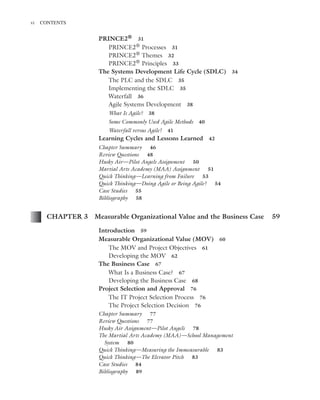
Marchewka ftoc.tex October27, 2014 9:11 P.M. Page vi
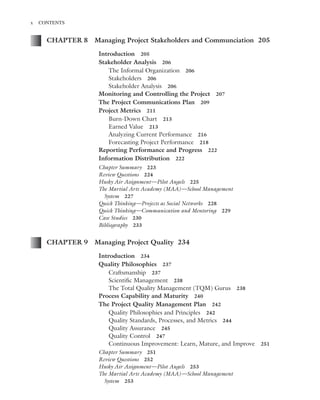
vi CONTENTS
PRINCE2® 31
PRINCE2® Processes 31
PRINCE2® Themes 32
PRINCE2® Principles 33
The Systems Development Life Cycle (SDLC) 34
The PLC and the SDLC 35
Implementing the SDLC 35
Waterfall 36
Agile Systems Development 38
What Is Agile? 38
Some Commonly Used Agile Methods 40
Waterfall versus Agile? 41
Learning Cycles and Lessons Learned 42
Chapter Summary 46
Review Questions 48
Husky Air—Pilot Angels Assignment 50
Martial Arts Academy (MAA) Assignment 51
Quick Thinking—Learning from Failure 53
Quick Thinking—Doing Agile or Being Agile? 54
Case Studies 55
Bibliography 58
CHAPTER 3 Measurable Organizational Value and the Business Case 59
Introduction 59
Measurable Organizational Value (MOV) 60
The MOV and Project Objectives 61
Developing the MOV 62
The Business Case 67
What Is a Business Case? 67
Developing the Business Case 68
Project Selection and Approval 76
The IT Project Selection Process 76
The Project Selection Decision 76
Chapter Summary 77
Review Questions 77
Husky Air Assignment—Pilot Angels 78
The Martial Arts Academy (MAA)—School Management
System 80
Quick Thinking—Measuring the Immeasurable 83
Quick Thinking—The Elevator Pitch 83
Case Studies 84
Bibliography 89
4.
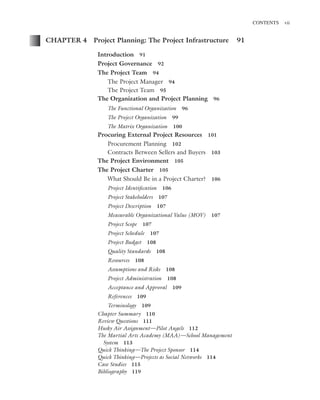
Marchewka ftoc.tex October27, 2014 9:11 P.M. Page vii
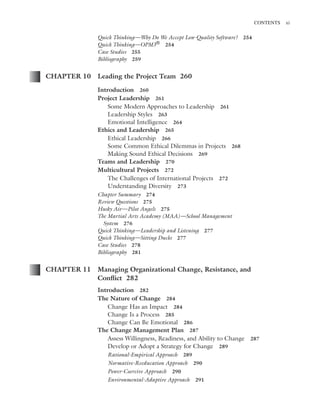
CONTENTS vii
CHAPTER 4 Project Planning: The Project Infrastructure 91
Introduction 91
Project Governance 92
The Project Team 94
The Project Manager 94
The Project Team 95
The Organization and Project Planning 96
The Functional Organization 96
The Project Organization 99
The Matrix Organization 100
Procuring External Project Resources 101
Procurement Planning 102
Contracts Between Sellers and Buyers 103
The Project Environment 105
The Project Charter 105
What Should Be in a Project Charter? 106
Project Identification 106
Project Stakeholders 107
Project Description 107
Measurable Organizational Value (MOV) 107
Project Scope 107
Project Schedule 107
Project Budget 108
Quality Standards 108
Resources 108
Assumptions and Risks 108
Project Administration 108
Acceptance and Approval 109
References 109
Terminology 109
Chapter Summary 110
Review Questions 111
Husky Air Assignment—Pilot Angels 112
The Martial Arts Academy (MAA)—School Management
System 113
Quick Thinking—The Project Sponsor 114
Quick Thinking—Projects as Social Networks 114
Case Studies 115
Bibliography 119
5.
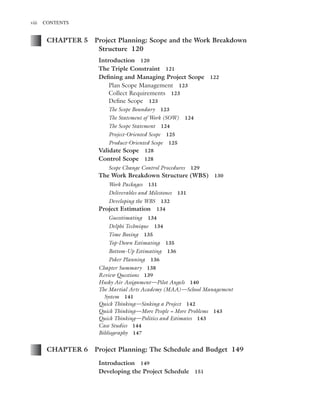
Marchewka ftoc.tex October27, 2014 9:11 P.M. Page viii
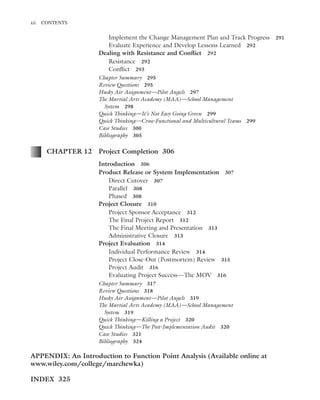
viii CONTENTS
CHAPTER 5 Project Planning: Scope and the Work Breakdown
Structure 120
Introduction 120
The Triple Constraint 121
Defining and Managing Project Scope 122
Plan Scope Management 123
Collect Requirements 123
Define Scope 123
The Scope Boundary 123
The Statement of Work (SOW) 124
The Scope Statement 124
Project-Oriented Scope 125
Product-Oriented Scope 125
Validate Scope 128
Control Scope 128
Scope Change Control Procedures 129
The Work Breakdown Structure (WBS) 130
Work Packages 131
Deliverables and Milestones 131
Developing the WBS 132
Project Estimation 134
Guesstimating 134
Delphi Technique 134
Time Boxing 135
Top-Down Estimating 135
Bottom-Up Estimating 136
Poker Planning 136
Chapter Summary 138
Review Questions 139
Husky Air Assignment—Pilot Angels 140
The Martial Arts Academy (MAA)—School Management
System 141
Quick Thinking—Sinking a Project 142
Quick Thinking—More People = More Problems 143
Quick Thinking—Politics and Estimates 143
Case Studies 144
Bibliography 147
CHAPTER 6 Project Planning: The Schedule and Budget 149
Introduction 149
Developing the Project Schedule 151
6.
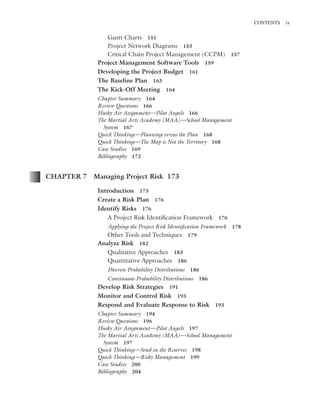
Marchewka ftoc.tex October27, 2014 9:11 P.M. Page ix
CONTENTS ix
Gantt Charts 151
Project Network Diagrams 153
Critical Chain Project Management (CCPM) 157
Project Management Software Tools 159
Developing the Project Budget 161
The Baseline Plan 163
The Kick-Off Meeting 164
Chapter Summary 164
Review Questions 166
Husky Air Assignment—Pilot Angels 166
The Martial Arts Academy (MAA)—School Management
System 167
Quick Thinking—Planning versus the Plan 168
Quick Thinking—The Map is Not the Territory 168
Case Studies 169
Bibliography 172
CHAPTER 7 Managing Project Risk 173
Introduction 173
Create a Risk Plan 176
Identify Risks 176
A Project Risk Identification Framework 176
Applying the Project Risk Identification Framework 178
Other Tools and Techniques 179
Analyze Risk 182
Qualitative Approaches 183
Quantitative Approaches 186
Discrete Probability Distributions 186
Continuous Probability Distributions 186
Develop Risk Strategies 191
Monitor and Control Risk 193
Respond and Evaluate Response to Risk 193
Chapter Summary 194
Review Questions 196
Husky Air Assignment—Pilot Angels 197
The Martial Arts Academy (MAA)—School Management
System 197
Quick Thinking—Send in the Reserves 198
Quick Thinking—Risky Management 199
Case Studies 200
Bibliography 204
7.
Marchewka ftoc.tex October27, 2014 9:11 P.M. Page x
x CONTENTS
CHAPTER 8 Managing Project Stakeholders and Communciation 205
Introduction 205
Stakeholder Analysis 206
The Informal Organization 206
Stakeholders 206
Stakeholder Analysis 206
Monitoring and Controlling the Project 207
The Project Communications Plan 209
Project Metrics 211
Burn-Down Chart 213
Earned Value 213
Analyzing Current Performance 216
Forecasting Project Performance 218
Reporting Performance and Progress 222
Information Distribution 222
Chapter Summary 223
Review Questions 224
Husky Air Assignment—Pilot Angels 225
The Martial Arts Academy (MAA)—School Management
System 227
Quick Thinking—Projects as Social Networks 228
Quick Thinking—Communication and Mentoring 229
Case Studies 230
Bibliography 233
CHAPTER 9 Managing Project Quality 234
Introduction 234
Quality Philosophies 237
Craftsmanship 237
Scientific Management 238
The Total Quality Management (TQM) Gurus 238
Process Capability and Maturity 240
The Project Quality Management Plan 242
Quality Philosophies and Principles 242
Quality Standards, Processes, and Metrics 244
Quality Assurance 245
Quality Control 247
Continuous Improvement: Learn, Mature, and Improve 251
Chapter Summary 251
Review Questions 252
Husky Air Assignment—Pilot Angels 253
The Martial Arts Academy (MAA)—School Management
System 253
8.
Marchewka ftoc.tex October27, 2014 9:11 P.M. Page xi
CONTENTS xi
Quick Thinking—Why Do We Accept Low-Quality Software? 254
Quick Thinking—OPM3® 254
Case Studies 255
Bibliography 259
CHAPTER 10 Leading the Project Team 260
Introduction 260
Project Leadership 261
Some Modern Approaches to Leadership 261
Leadership Styles 263
Emotional Intelligence 264
Ethics and Leadership 265
Ethical Leadership 266
Some Common Ethical Dilemmas in Projects 268
Making Sound Ethical Decisions 269
Teams and Leadership 270
Multicultural Projects 272
The Challenges of International Projects 272
Understanding Diversity 273
Chapter Summary 274
Review Questions 275
Husky Air—Pilot Angels 275
The Martial Arts Academy (MAA)—School Management
System 276
Quick Thinking—Leadership and Listening 277
Quick Thinking—Sitting Ducks 277
Case Studies 278
Bibliography 281
CHAPTER 11 Managing Organizational Change, Resistance, and
Conflict 282
Introduction 282
The Nature of Change 284
Change Has an Impact 284
Change Is a Process 285
Change Can Be Emotional 286
The Change Management Plan 287
Assess Willingness, Readiness, and Ability to Change 287
Develop or Adopt a Strategy for Change 289
Rational-Empirical Approach 289
Normative-Reeducation Approach 290
Power-Coercive Approach 290
Environmental-Adaptive Approach 291
9.
Marchewka ftoc.tex October27, 2014 9:11 P.M. Page xii
xii CONTENTS
Implement the Change Management Plan and Track Progress 291
Evaluate Experience and Develop Lessons Learned 292
Dealing with Resistance and Conflict 292
Resistance 292
Conflict 293
Chapter Summary 295
Review Questions 295
Husky Air Assignment—Pilot Angels 297
The Martial Arts Academy (MAA)—School Management
System 298
Quick Thinking—It’s Not Easy Going Green 299
Quick Thinking—Cross-Functional and Multicultural Teams 299
Case Studies 300
Bibliography 305
CHAPTER 12 Project Completion 306
Introduction 306
Product Release or System Implementation 307
Direct Cutover 307
Parallel 308
Phased 308
Project Closure 310
Project Sponsor Acceptance 312
The Final Project Report 312
The Final Meeting and Presentation 313
Administrative Closure 313
Project Evaluation 314
Individual Performance Review 314
Project Close-Out (Postmortem) Review 315
Project Audit 316
Evaluating Project Success—The MOV 316
Chapter Summary 317
Review Questions 318
Husky Air Assignment—Pilot Angels 319
The Martial Arts Academy (MAA)—School Management
System 319
Quick Thinking—Killing a Project 320
Quick Thinking—The Post-Implementation Audit 320
Case Studies 321
Bibliography 324
APPENDIX: An Introduction to Function Point Analysis (Available online at
www.wiley.com/college/marchewka)
INDEX 325
10.
Marchewka f03.tex V2- October 30, 2014 5:35 P.M. Page xiii
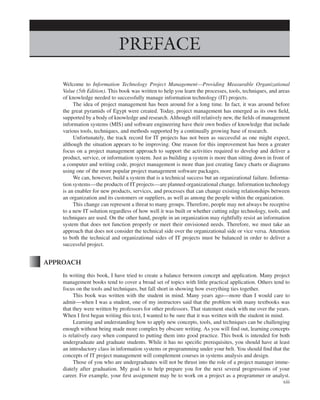
PREFACE
Welcome to Information Technology Project Management—Providing Measurable Organizational
Value (5th Edition). This book was written to help you learn the processes, tools, techniques, and areas
of knowledge needed to successfully manage information technology (IT) projects.
The idea of project management has been around for a long time. In fact, it was around before
the great pyramids of Egypt were created. Today, project management has emerged as its own field,
supported by a body of knowledge and research. Although still relatively new, the fields of management
information systems (MIS) and software engineering have their own bodies of knowledge that include
various tools, techniques, and methods supported by a continually growing base of research.
Unfortunately, the track record for IT projects has not been as successful as one might expect,
although the situation appears to be improving. One reason for this improvement has been a greater
focus on a project management approach to support the activities required to develop and deliver a
product, service, or information system. Just as building a system is more than sitting down in front of
a computer and writing code, project management is more than just creating fancy charts or diagrams
using one of the more popular project management software packages.
We can, however, build a system that is a technical success but an organizational failure. Informa-
tion systems—the products of IT projects—are planned organizational change. Information technology
is an enabler for new products, services, and processes that can change existing relationships between
an organization and its customers or suppliers, as well as among the people within the organization.
This change can represent a threat to many groups. Therefore, people may not always be receptive
to a new IT solution regardless of how well it was built or whether cutting edge technology, tools, and
techniques are used. On the other hand, people in an organization may rightfully resist an information
system that does not function properly or meet their envisioned needs. Therefore, we must take an
approach that does not consider the technical side over the organizational side or vice versa. Attention
to both the technical and organizational sides of IT projects must be balanced in order to deliver a
successful project.
APPROACH
In writing this book, I have tried to create a balance between concept and application. Many project
management books tend to cover a broad set of topics with little practical application. Others tend to
focus on the tools and techniques, but fall short in showing how everything ties together.
This book was written with the student in mind. Many years ago—more than I would care to
admit—when I was a student, one of my instructors said that the problem with many textbooks was
that they were written by professors for other professors. That statement stuck with me over the years.
When I first began writing this text, I wanted to be sure that it was written with the student in mind.
Learning and understanding how to apply new concepts, tools, and techniques can be challenging
enough without being made more complex by obscure writing. As you will find out, learning concepts
is relatively easy when compared to putting them into good practice. This book is intended for both
undergraduate and graduate students. While it has no specific prerequisites, you should have at least
an introductory class in information systems or programming under your belt. You should find that the
concepts of IT project management will complement courses in systems analysis and design.
Those of you who are undergraduates will not be thrust into the role of a project manager imme-
diately after graduation. My goal is to help prepare you for the next several progressions of your
career. For example, your first assignment may be to work on a project as a programmer or analyst.
xiii
11.
Marchewka f03.tex V2- October 30, 2014 5:35 P.M. Page xiv
xiv PREFACE
The knowledge that you will gain from this text will give you a good idea of how your work fits into
the big picture so that you can be a more valuable project team member.
More challenging and interesting assignments and opportunities for advancement will follow as
you continue to gain more knowledge and experience. Eventually, this may lead to a leadership role
where your knowledge and experience will be put to the optimal test.
On the other hand, you may have already acquired some experience and now find yourself in the role
of a project manager. This text will provide you not only with the big picture but also with a foundation
for applying directly the tools, processes, and methods to support the management and delivery of a
successful IT project.
Most students who read this book will never have been on a real project. I have written this book
based on a flexible methodology that attempts to bridge the questions: How do I get started? What do
I do next? How do we know when we’re finished? This methodology provides a structure for under-
standing how projects are initiated, conceptualized, planned, carried out, terminated, and evaluated.
This methodology will take you through the different phases of the project life cycle and introduce the
concepts and tools that are appropriate for each specific phase or stage of the project. In addition, you
will find the methodology and central theme of this text is that projects should provide measurable value
to organizations.
The text provides an integrated approach to project management. It incorporates the ten areas out-
lined in the Project Management Institute’s Project Management Body of Knowledge (PMBOK®), as
well as many of the themes and principles outlined in the PRINCE2® project methodology. The con-
cepts associated with information systems management and software engineering when integrated with
PMBOK® provide an important base of knowledge that builds a foundation for IT project manage-
ment. This integration helps to distinguish IT projects from other types of projects such as construction
or engineering.
The text also integrates a knowledge management approach. The area of knowledge management
is an area of growing interest and development. Knowledge management is a systematic process for
acquiring, creating, synthesizing, sharing, and using information, insights, and experiences to create
business value. Here, the concept of learning cycles provides a unique approach for defining and creat-
ing new knowledge in terms of lessons learned. These lessons learned can be stored in a repository
and made available throughout the organization. Best practices can be developed from the lessons
learned and integrated or made a part of an organization’s project methodology. Over time, the generic
methodology may evolve and become a valuable asset to an organization as it becomes aligned with
the organization’s culture and business. In turn, this evolving process will provide the organization with
increased capability and maturity that, hopefully, will increase the likelihood of successful projects.
CHAPTER OVERVIEWS
The material in each chapter provides a logical flow in terms of the phases and processes required to
plan and manage a project. The text begins with an introduction to project management and why IT
projects are organizational investments. Once a decision to approve and fund a project is made, the
project must be planned at a detailed level to determine the schedule and budget. The planning and
subsequent execution of the project’s plan are supported by the project management and information
technology bodies of knowledge.
▪ Chapter 1: The Nature of Information Technology Projects provides an introduction to what a
project is and why projects must be viewed as organizational investments that must align with a
chosen business strategy. In addition, this chapter discusses how the disciplines of information
technology and project management have evolved together and have led to how we manage
projects today.
12.
Marchewka f03.tex V2- October 30, 2014 5:35 P.M. Page xv
CHAPTER OVERVIEWS xv
▪ Chapter 2: Project Methodologies and Processes introduces the concepts of lifecycles,
methodologies, and processes for managing and developing the project’s product, service, or
system. Overviews of the knowledge areas and processes associated with Project Management
Body of Knowledge (PMBOK®), as well as the core principles, processes, and themes of the
PRINCE2® methodology are provided. This chapter also describes the waterfall method and
two common Agile approaches for developing the project’s product or system. In addition, the
concept of Learning Cycles is introduced and can be used throughout the end of chapter case
assignments.
▪ Chapter 3: Measurable Organizational Value and the Business Case focuses on the processes,
tools, and deliverables to conceptualize and start a project. Conceptualizing a project begins by
developing a clear goal defined as the project’s measurable organizational value (MOV). The
MOV provides a clear understanding of the project’s purpose and is the foundation for writing
the business case. In addition to learning how to prepare a business case, students are provided
with an understanding of how projects are often selected among other competing projects.
▪ Chapter 4: Project Planning: The Project Infrastructure focuses on defining the infrastructure
required to support and plan the project. This includes governance of the project, selection of
the project team, the acquisition of internal and external resources, and procurement contracts
that are summarized in the next project deliverable called the project charter.
▪ Chapter 5: Project Planning: Scope and the Work Breakdown Structure describes the relation-
ship among scope, schedule, and budget. It introduces a set of processes and tools for defining
and managing the project and product deliverables. Students also learn how to develop a work
breakdown structure (WBS) and several methods for estimating the work to be completed.
▪ Chapter 6: Project Planning: The Schedule and Budget introduces several project management
tools, including Gantt charts, activity on the node (AON), critical path analysis, program evalu-
ation and review technique (PERT), and precedence diagramming, that aid in the development
of the project schedule. A budget can then be developed based upon the activities defined in
the WBS and the resources defined in the project infrastructure in order to develop the baseline
project plan. In addition, the concept of critical chain project management (CCPM) is discussed.
▪ Chapter 7: Managing Project Risk describes the concept of risk management and introduces
a framework for defining and understanding the integrative nature of risks associated with a
project. Several qualitative and quantitative approaches and tools are introduced for analyzing
and assessing risks so that appropriate risk strategies can be formulated.
▪ Chapter 8: Managing Project Stakeholders and Communication focuses on understanding the
informal organization by developing a stakeholder analysis. This analysis provides the basis
for creating a communication plan for reporting the project’s progress to various project stake-
holders. This chapter also introduces the concept of earned value and several common project
metrics to monitor and control the project.
▪ Chapter 9: Managing Project Quality describes planning for quality, quality assurance, and
quality control in order to improve the project’s products and supporting processes continu-
ously. This chapter also introduces several founders of the quality movement, as well as their
philosophies that form an underlying basis for the project’s quality plan. In addition, the qual-
ity management system called the capability maturity model and verification and validation
activities are discussed.
▪ Chapter 10: Leading the Project Team focuses on project leadership and two important related
components—ethics and development of the project team. This chapter also discusses some
common ethical dilemmas that may be encountered on projects and a process is introduced
for making sound ethical decisions. Moreover, several challenges and issues associated with
managing multicultural projects are discussed as more organizations attempt to diversify their
workforce or conduct business across the globe.
13.
Marchewka f03.tex V2- October 30, 2014 5:35 P.M. Page xvi
xvi PREFACE
▪ Chapter 11: Managing Organizational Change, Resistance, and Conflict describes the nature
and impact of change associated with the delivery of a new product or system on the people
within an organization. Several organizational change theories are introduced so that a change
management plan can be formulated and executed in order to ease the transition from the current
system to the system that will be implemented.
▪ Chapter 12: Project Completion focuses on three important areas necessary for project com-
pletion: project implementation, closure, and evaluation
▪ Appendix: An Introduction to Function Point Analysis provides a more detailed discussion on
counting function points and is provided online at www.wiley.com/college/marchewka.
WHAT’S NEW IN THE FIFTH EDITION
▪ The new edition has been updated to reflect changes from the latest version of A Guide to the
Project Management Body of Knowledge (PMBOK Guide), 2013.
▪ CHAPTER 2 PROJECT METHODOLOGIES AND PROCESSES was completely re-written.
▪ CHAPTER 8: MANAGING PROJECT STAKEHOLDERS AND COMMUNCIATION com-
bines two chapters from the previous edition.
▪ The author has also added an overview of PRINCE2® Methodology.
▪ The discussion of an Agile approach to product/system development has been expanded.
▪ Integration of learning cycles has been added to end-of-chapter assignments.
▪ The discussion (including examples) of measurable organizational value (MOV) has been
expanded.
▪ Content on project governance and its role in project management has been added to the text.
▪ CHAPTER 4: PROJECT PLANNING: THE PROJECT INFRASTRUCTURE now integrates
procurement contracts.
▪ There is an expanded discussion on the relationship among scope, schedule, and budget—the
triple constraint.
▪ A relatively new Agile estimation technique called Poker Planning has been added to the text.
▪ Content throughout the book has been streamlined and reorganized so that it is now 12 chapters
instead of 14.
ORGANIZATION AND SUPPORT
Instructor Resources (go to www.wiley.com/college/marchewka)
Instructor’s Manual
This manual contains detailed solutions to questions in the textbook.
Test Bank
Test your students’ comprehension with this digital collection of true/false, multiple-choice, short
answer, and essay questions.
Lecture Presentation Slides
These PowerPoint™ presentations contain a combination of key concepts allowing instructors to
illustrate important topics with images and figures from the textbook.
14.
Marchewka f03.tex V2- October 30, 2014 5:35 P.M. Page xvii
ACKNOWLEDGMENTS xvii
Husky Air Case Sample Solutions
Solutions are provided to this integrated case study that provides students with the opportunity to
work as a project team and apply the concepts presented in each chapter.
Student Resources
Microsoft Project Tutorials
The author has provided a set of online-only Microsoft Project tutorials at www.wiley.com/go/
marchewka/msprojecttutorial. Using these tutorials, students can learn some basic skills that will
help them create a work breakdown structure using Microsoft Project.
Project Management Software
Students can download a 60-day trial of Microsoft Project Professional 2013 from the following web-
site: http://www.microsoft.com/en-us/evalcenter/evaluate-project-professional-2013. Note that Micro-
soft has changed its policy and no longer offers the 120-day trial previously available.
Another option now available to education institutions adopting this Wiley title is a free intro-
ductory 3-year membership for DreamSpark Premium. DreamSpark Premium is designed to provide
the easiest and most inexpensive way for academic departments to make the latest Microsoft soft-
ware available in labs, classrooms, and on student’s and instructor’s PCs. Microsoft Project software
is available through this Wiley and Microsoft publishing partnership, free of charge with the adop-
tion of any qualified Wiley title. Each copy of Microsoft Project is the full version of the software,
with no time limitation, and can be used indefinitely for educational purposes. Contact your Wiley
sales representative for details. For more information about the DreamSpark Premium program, contact
drmspkna@Microsoft.com.
ACKNOWLEDGMENTS
I would like to thank Beth Lang Golub, Ellen Keohane, Sangeetha Parthasarathy, and Mary O’Sullivan
for all their help in writing this 5th edition. Also, I would like to thank the following reviewers for their
valuable insight, comments, and suggestions.
Rajeev Agrawal, North Carolina A&T State University
David Bantz, University of Southern Maine
Phyllis Chasser, Nova Southeastern University
Barbara Cullis, University of Delaware
Robert Fredericks, Drexel University
Valarie Griep, University of Minnesota
Mark Kwandrans, State University of New York at Buffalo
Paul Licker, Oakland University
Miriam Masullo, University of Maryland University College
Toru Sakaguchi, Northern Kentucky University
Jeanne Sawyer, San Jose State University
Patricia Shamamy, Lawrence Technological University
Gerhard Steinke, Seattle Pacific University
Jeremy St. John, Texas A&M University Commerce
15.
Marchewka f02.tex V2- October 27, 2014 9:09 P.M. Page xviii
ABOUT THE AUTHOR
Jack T. Marchewka is a professor of Management Information Systems at Northern Illinois Uni-
versity. He received his Ph.D. from Georgia State University’s department of Computer Informa-
tion Systems and was a former faculty member at Kennesaw State University. Prior to entering
academia, Dr. Marchewka was a vice president of MIS for a healthcare company in Atlanta, Georgia.
Dr. Marchewka has taught a number of courses at both the undergraduate and graduate levels and
has been a guest lecturer at the Rotterdam School of Management at Erasmus University in the Nether-
lands and the University of Bordeaux in France. His current research primarily focuses on IT project
management, and his articles have appeared in such journals as Information Resources Management
Journal, Information Technology and People, Journal of International Technology and Information
Management, Communications of the IIMA, and Information Management.
He is currently a board member and fellow of the International Information Management Associ-
ation, where he has served as program chair, conference chair, and past president.
Dr. Marchewka was also editor of the Communications of the IIMA.
Jack Marchewka is also a black belt in Kajukenbo and an instrument-rated commercial pilot who
enjoys his family, karate, fishing, playing guitar, good BBQ, riding his motorcycle, and a good laugh.
xviii
16.
Marchewka c01.tex V2- November 25, 2014 3:33 P.M. Page 1
C H A P T E R
1
The Nature of Information
Technology Projects
CHAPTER OBJECTIVES
Chapter 1 provides an overview of information technology project management (ITPM). After studying
this chapter, you should be able to:
▪ Understand why information technology (IT) projects are organizational investments.
▪ Understand why projects are planned organizational change and why they must align with an orga-
nization’s business strategy.
▪ Define what a project is and describe the attributes of a project.
▪ Define the discipline called project management.
▪ Understand the relationship among project portfolios, programs, and projects.
▪ Understand how the disciplines of information technology and project management have evolved
together and have led to how we manage projects today.
▪ Understand the current state of IT project management.
▪ Understand why some projects fail and how to improve the likelihood of success.
INTRODUCTION
Information technology (IT) projects are organizational investments. When an organization builds or
implements a new IT-based product, service, or solution, it commits time, money, and resources to
the project with an expectation of receiving something of value in return. Just as an investor considers
the expected return and risk of a financial opportunity, an organization must weigh the expected costs,
benefits, and risks of a project in order to make an effective business decision. It is up to the project
manager and project team to deliver that value to the organization.
Projects play an important role in organizations and can have a major impact. Business strategy
supports the vision and mission of an organization’s current or desired markets, products, and services.
While an organization must have an effective business strategy to be successful, projects are the
planned organizational changes or means for achieving a chosen strategy. More specifically, IT
projects enable the integration of technology in new products, services, or processes that can change
existing relationships between an organization and its customers or suppliers, as well as among the
people within the organization. An IT-based product, service, or solution can be a technical success
if it functions properly, but it can also be an organizational failure if it fails to meet the needs and
expectations of the customer, client, or user group.
1
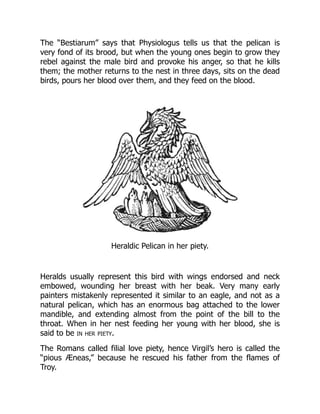
The “Bestiarum” saysthat Physiologus tells us that the pelican is
very fond of its brood, but when the young ones begin to grow they
rebel against the male bird and provoke his anger, so that he kills
them; the mother returns to the nest in three days, sits on the dead
birds, pours her blood over them, and they feed on the blood.
Heraldic Pelican in her piety.
Heralds usually represent this bird with wings endorsed and neck
embowed, wounding her breast with her beak. Very many early
painters mistakenly represented it similar to an eagle, and not as a
natural pelican, which has an enormous bag attached to the lower
mandible, and extending almost from the point of the bill to the
throat. When in her nest feeding her young with her blood, she is
said to be in her piety.
The Romans called filial love piety, hence Virgil’s hero is called the
“pious Æneas,” because he rescued his father from the flames of
Troy.
19.
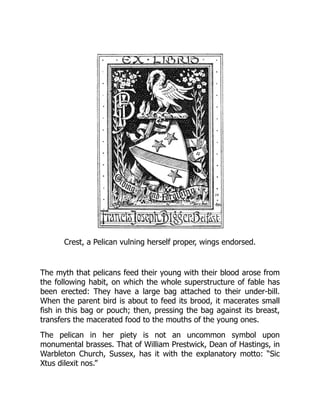
Crest, a Pelicanvulning herself proper, wings endorsed.
The myth that pelicans feed their young with their blood arose from
the following habit, on which the whole superstructure of fable has
been erected: They have a large bag attached to their under-bill.
When the parent bird is about to feed its brood, it macerates small
fish in this bag or pouch; then, pressing the bag against its breast,
transfers the macerated food to the mouths of the young ones.
The pelican in her piety is not an uncommon symbol upon
monumental brasses. That of William Prestwick, Dean of Hastings, in
Warbleton Church, Sussex, has it with the explanatory motto: “Sic
Xtus dilexit nos.”
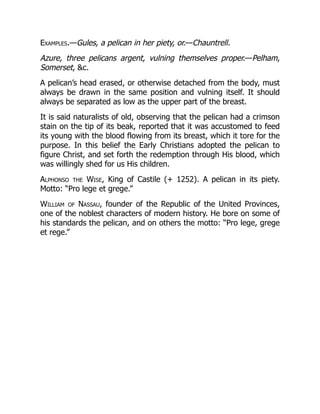
20.
Examples.—Gules, a pelicanin her piety, or.—Chauntrell.
Azure, three pelicans argent, vulning themselves proper.—Pelham,
Somerset, &c.
A pelican’s head erased, or otherwise detached from the body, must
always be drawn in the same position and vulning itself. It should
always be separated as low as the upper part of the breast.
It is said naturalists of old, observing that the pelican had a crimson
stain on the tip of its beak, reported that it was accustomed to feed
its young with the blood flowing from its breast, which it tore for the
purpose. In this belief the Early Christians adopted the pelican to
figure Christ, and set forth the redemption through His blood, which
was willingly shed for us His children.
Alphonso the Wise, King of Castile (+ 1252). A pelican in its piety.
Motto: “Pro lege et grege.”
William of Nassau, founder of the Republic of the United Provinces,
one of the noblest characters of modern history. He bore on some of
his standards the pelican, and on others the motto: “Pro lege, grege
et rege.”
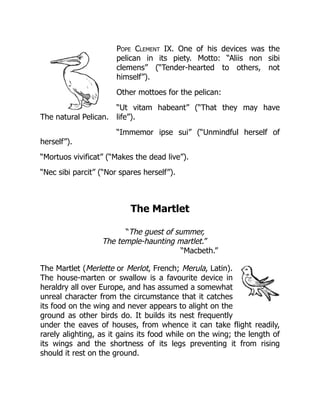
21.
The natural Pelican.
PopeClement IX. One of his devices was the
pelican in its piety. Motto: “Aliis non sibi
clemens” (“Tender-hearted to others, not
himself”).
Other mottoes for the pelican:
“Ut vitam habeant” (“That they may have
life”).
“Immemor ipse sui” (“Unmindful herself of
herself”).
“Mortuos vivificat” (“Makes the dead live”).
“Nec sibi parcit” (“Nor spares herself”).
The Martlet
“The guest of summer,
The temple-haunting martlet.”
“Macbeth.”
The Martlet (Merlette or Merlot, French; Merula, Latin).
The house-marten or swallow is a favourite device in
heraldry all over Europe, and has assumed a somewhat
unreal character from the circumstance that it catches
its food on the wing and never appears to alight on the
ground as other birds do. It builds its nest frequently
under the eaves of houses, from whence it can take flight readily,
rarely alighting, as it gains its food while on the wing; the length of
its wings and the shortness of its legs preventing it from rising
should it rest on the ground.
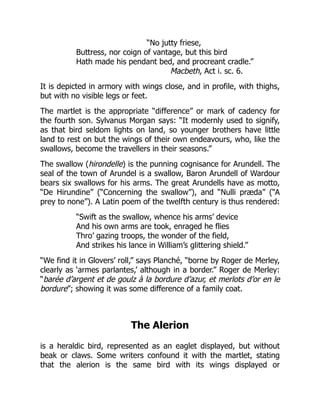
22.
“No jutty friese,
Buttress,nor coign of vantage, but this bird
Hath made his pendant bed, and procreant cradle.”
Macbeth, Act i. sc. 6.
It is depicted in armory with wings close, and in profile, with thighs,
but with no visible legs or feet.
The martlet is the appropriate “difference” or mark of cadency for
the fourth son. Sylvanus Morgan says: “It modernly used to signify,
as that bird seldom lights on land, so younger brothers have little
land to rest on but the wings of their own endeavours, who, like the
swallows, become the travellers in their seasons.”
The swallow (hirondelle) is the punning cognisance for Arundell. The
seal of the town of Arundel is a swallow, Baron Arundell of Wardour
bears six swallows for his arms. The great Arundells have as motto,
“De Hirundine” (“Concerning the swallow”), and “Nulli præda” (“A
prey to none”). A Latin poem of the twelfth century is thus rendered:
“Swift as the swallow, whence his arms’ device
And his own arms are took, enraged he flies
Thro’ gazing troops, the wonder of the field,
And strikes his lance in William’s glittering shield.”
“We find it in Glovers’ roll,” says Planché, “borne by Roger de Merley,
clearly as ‘armes parlantes,’ although in a border.” Roger de Merley:
“barée d’argent et de goulz à la bordure d’azur, et merlots d’or en le
bordure”; showing it was some difference of a family coat.
The Alerion
is a heraldic bird, represented as an eaglet displayed, but without
beak or claws. Some writers confound it with the martlet, stating
that the alerion is the same bird with its wings displayed or
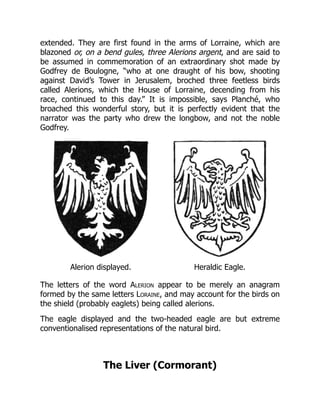
23.
extended. They arefirst found in the arms of Lorraine, which are
blazoned or, on a bend gules, three Alerions argent, and are said to
be assumed in commemoration of an extraordinary shot made by
Godfrey de Boulogne, “who at one draught of his bow, shooting
against David’s Tower in Jerusalem, broched three feetless birds
called Alerions, which the House of Lorraine, decending from his
race, continued to this day.” It is impossible, says Planché, who
broached this wonderful story, but it is perfectly evident that the
narrator was the party who drew the longbow, and not the noble
Godfrey.
Alerion displayed. Heraldic Eagle.
The letters of the word Alerion appear to be merely an anagram
formed by the same letters Loraine, and may account for the birds on
the shield (probably eaglets) being called alerions.
The eagle displayed and the two-headed eagle are but extreme
conventionalised representations of the natural bird.
The Liver (Cormorant)
24.
Liver, a fabulousbird, supposed to have given its name to Liverpool
and commemorated in the arms of that city. It is traditionally
described as a bird that frequented the pool, near which the town
was afterwards founded. The arms granted in 1797 are thus
blazoned: Argent a cormorant, in the beak a branch of seaweed all
proper, and for crest, on a wreath of the colours, a cormorant, the
wings elevated, in the beak a branch of Laver proper. It is more than
probable that the bird on the arms suggested the name “Liver” being
applied to it. The fiction naturally arose from the desire to find a
derivation for the name of the town. It is, however, always depicted
as a cormorant. On the shield the bird is always depicted with the
wings close, and on the crest the wings are elevated.
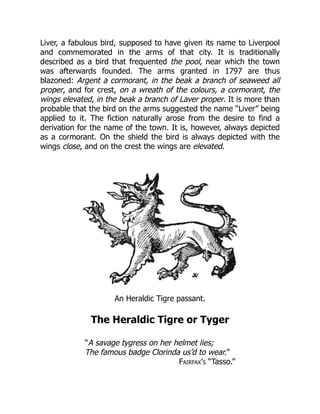
An Heraldic Tigre passant.
The Heraldic Tigre or Tyger
“A savage tygress on her helmet lies;
The famous badge Clorinda us’d to wear.”
Fairfax’s “Tasso.”
25.
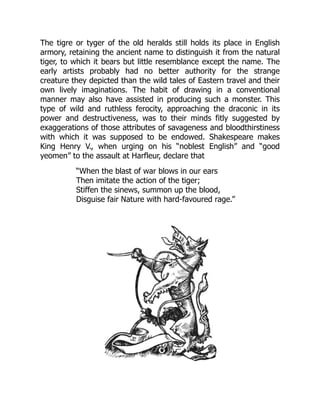
The tigre ortyger of the old heralds still holds its place in English
armory, retaining the ancient name to distinguish it from the natural
tiger, to which it bears but little resemblance except the name. The
early artists probably had no better authority for the strange
creature they depicted than the wild tales of Eastern travel and their
own lively imaginations. The habit of drawing in a conventional
manner may also have assisted in producing such a monster. This
type of wild and ruthless ferocity, approaching the draconic in its
power and destructiveness, was to their minds fitly suggested by
exaggerations of those attributes of savageness and bloodthirstiness
with which it was supposed to be endowed. Shakespeare makes
King Henry V., when urging on his “noblest English” and “good
yeomen” to the assault at Harfleur, declare that
“When the blast of war blows in our ears
Then imitate the action of the tiger;
Stiffen the sinews, summon up the blood,
Disguise fair Nature with hard-favoured rage.”
26.
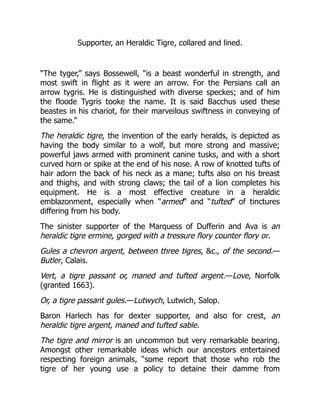
Supporter, an HeraldicTigre, collared and lined.
“The tyger,” says Bossewell, “is a beast wonderful in strength, and
most swift in flight as it were an arrow. For the Persians call an
arrow tygris. He is distinguished with diverse speckes; and of him
the floode Tygris tooke the name. It is said Bacchus used these
beastes in his chariot, for their marveilous swiftness in conveying of
the same.”
The heraldic tigre, the invention of the early heralds, is depicted as
having the body similar to a wolf, but more strong and massive;
powerful jaws armed with prominent canine tusks, and with a short
curved horn or spike at the end of his nose. A row of knotted tufts of
hair adorn the back of his neck as a mane; tufts also on his breast
and thighs, and with strong claws; the tail of a lion completes his
equipment. He is a most effective creature in a heraldic
emblazonment, especially when “armed” and “tufted” of tinctures
differing from his body.
The sinister supporter of the Marquess of Dufferin and Ava is an
heraldic tigre ermine, gorged with a tressure flory counter flory or.
Gules a chevron argent, between three tigres, &c., of the second.—
Butler, Calais.
Vert, a tigre passant or, maned and tufted argent.—Love, Norfolk
(granted 1663).
Or, a tigre passant gules.—Lutwych, Lutwich, Salop.
Baron Harlech has for dexter supporter, and also for crest, an
heraldic tigre argent, maned and tufted sable.
The tigre and mirror is an uncommon but very remarkable bearing.
Amongst other remarkable ideas which our ancestors entertained
respecting foreign animals, “some report that those who rob the
tigre of her young use a policy to detaine their damme from
27.
following them bycasting sundry looking-glasses in the way,
whereat she useth to long to gaze, whether it be to beholde her
owne beauty or because when she seeth her shape in the glasse she
thinketh she seeth one of her young ones; and so they escape the
swiftness of her pursuit.”[21]
Tigre and Mirror.
“Argent, a tigre passant regardant looking into a mirror lying
fessways, the handle to the dexter all proper,” is said to have been
the coat of Hadrian de Bardis (probably an Italian), Prebendary of
Oxfordshire. These arms still remain, or were lately remaining, in a
window of Thame Church. Only two other examples occur, viz.:
“Argent a tigre and mirror (as before) gules.”—Sibell, Kent.
The Royal Tiger
28.
Next to thelion in power is the tiger, an animal not possessed of the
noble qualities of the lion, being fierce without provocation, and
cruel without cause. The chief difference of the tiger from every
other animal of the mottled kind is in the shape of the spots on the
skin, which run in streaks or bands in the direction of the ribs. The
leopard, panther and the ounce are all, in a certain degree, marked
like this animal, except that the lines are broken by round spots,
which cover the whole surface of the skin. The use of the royal tiger
in modern coats of arms is frequent, and has reference to services in
the East.
Outram, Bart., has for supporters: two royal Bengal tigers guardant
proper, gorged with a wreath of laurel vert, crowned with an Eastern
crown.
Note.—In a heraldic description (or blazon as it is termed) it is
necessary for the sake of greater clearness, and to prevent
confusion, to name the older mythical creature the “Heraldic Tigre,”
that it may not be confounded with its natural representative usually
called the “Royal Tiger.”
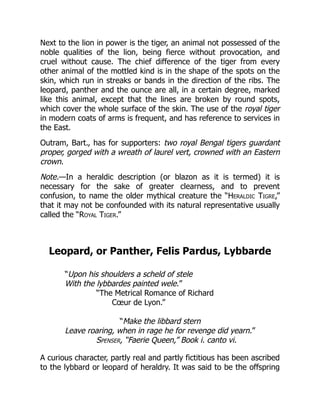
Leopard, or Panther, Felis Pardus, Lybbarde
“Upon his shoulders a scheld of stele
With the lybbardes painted wele.”
“The Metrical Romance of Richard
Cœur de Lyon.”
“Make the libbard stern
Leave roaring, when in rage he for revenge did yearn.”
Spenser, “Faerie Queen,” Book i. canto vi.
A curious character, partly real and partly fictitious has been ascribed
to the lybbard or leopard of heraldry. It was said to be the offspring
29.
of a lionessand a panther, the Northmen or Normans, according to
some authorities, having adopted that beast of prey, noted for
rashness, as typical of themselves, so characterised by boldness and
impetuosity. The standard of Rollo, first Duke of Normandy, they say,
bore a leopard. A second lion or leopard was added to the Norman
shield when the county of Maine became annexed to the Duchy of
Normandy; and the two lions or leopards—for they are
indiscriminately so termed—were thus borne, it is said, upon the
standard of William the Conqueror, and by his descendants. A third
lion was added by Henry II. on his marriage with Eleanor of
Aquitain, a lion being also the arms of that province.
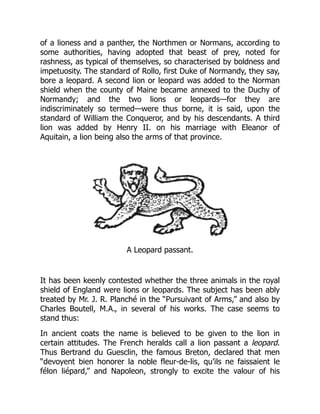
A Leopard passant.
It has been keenly contested whether the three animals in the royal
shield of England were lions or leopards. The subject has been ably
treated by Mr. J. R. Planché in the “Pursuivant of Arms,” and also by
Charles Boutell, M.A., in several of his works. The case seems to
stand thus:
In ancient coats the name is believed to be given to the lion in
certain attitudes. The French heralds call a lion passant a leopard.
Thus Bertrand du Guesclin, the famous Breton, declared that men
“devoyent bien honorer la noble fleur-de-lis, qu’ils ne faissaient le
félon liépard,” and Napoleon, strongly to excite the valour of his
30.
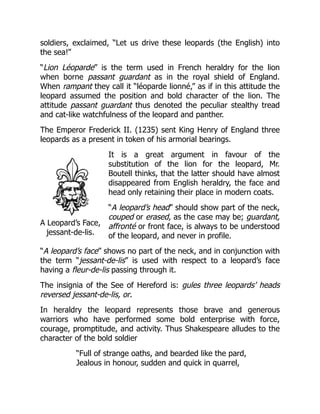
A Leopard’s Face,
jessant-de-lis.
soldiers,exclaimed, “Let us drive these leopards (the English) into
the sea!”
“Lion Léoparde” is the term used in French heraldry for the lion
when borne passant guardant as in the royal shield of England.
When rampant they call it “léoparde lionné,” as if in this attitude the
leopard assumed the position and bold character of the lion. The
attitude passant guardant thus denoted the peculiar stealthy tread
and cat-like watchfulness of the leopard and panther.
The Emperor Frederick II. (1235) sent King Henry of England three
leopards as a present in token of his armorial bearings.
It is a great argument in favour of the
substitution of the lion for the leopard, Mr.
Boutell thinks, that the latter should have almost
disappeared from English heraldry, the face and
head only retaining their place in modern coats.
“A leopard’s head” should show part of the neck,
couped or erased, as the case may be; guardant,
affronté or front face, is always to be understood
of the leopard, and never in profile.
“A leopard’s face” shows no part of the neck, and in conjunction with
the term “jessant-de-lis” is used with respect to a leopard’s face
having a fleur-de-lis passing through it.
The insignia of the See of Hereford is: gules three leopards’ heads
reversed jessant-de-lis, or.
In heraldry the leopard represents those brave and generous
warriors who have performed some bold enterprise with force,
courage, promptitude, and activity. Thus Shakespeare alludes to the
character of the bold soldier
“Full of strange oaths, and bearded like the pard,
Jealous in honour, sudden and quick in quarrel,
31.
Seeking the bubblereputation
Even in the cannon’s mouth.”
In Christian Art the leopard is employed to represent that beast
spoken of in the Apocalypse, with seven heads and ten horns. Six of
the heads are nimbed, but the seventh, being “wounded to death,”
has lost its power, and consequently has no nimbus.
Three leopards passant guardant or, pelletée, appear on the arms of
the Marquis of Downshire. It is also the sinister supporter.
The supporters of the town of Aberdeen are leopards.
Sable three leopards rampant argent spotted sable are given as the
arms of Lynch. It is, however, probable that the lynx was the animal
originally blazoned as “arms parlantes” for the name.
Ermine on a cross patonce sable, a leopard’s head, issuing out of a
ducal coronet or, crest, a demi-leopard erect, proper.—Dickens.
A leopard’s face, breaking with his mouth a sword, is the crest of
Disne.
The supporters of the Earl of Northesk are two leopards reguardant.
The leopard or panther, says Dr. P. M. Duncan, F.R.S.,[22] was the
only one of the greater feline animals, except the lion and tiger,
which seems to have been known to the ancients. It is always
represented as drawing the chariot of Bacchus, and the forlorn
Ariadne is sculptured as riding on one of the spotted steeds of her
divine lover. The panther was also constantly used in the barbarous
sports of the amphitheatre, and, in common with the lion and tiger,
has been both executioner and grave to many a bold-hearted martyr.
The leopard’s skin was a favourite mantle in the olden times in
Greece. In the “Iliad,” Homer, speaking of Menelaus, says:
“With a pard’s spotted hide his shoulders broad
He mantled o’er,”
32.
and the leopard,or panther, is given in the “Odyssey” as one of the
forms assumed by Proteus, “the Ancient of the Deep.”
A curious ancient superstition about the leopard is embodied in its
name. It was thought not to be actually the same animal as the
panther or pard, but to be a mongrel or hybrid between the male
pard and the lioness, hence it was called the lion-panther, or
leopardus. This error, as Archbishop Trench tells us, “has lasted into
modern times”; thus Fuller: “Leopards and mules are properly no
creatures.”
Some writers, says Boutell, describe the leopard as the issue of the
pard and lioness, and they assign the unproductiveness of such
hybrids as a reason for its frequent adoption in the arms of abbots
and abbesses. “Mulus et abbates sunt in honore pares.”
The leopard and panther are now acknowledged to be but slight
varieties of the same species. In Wood’s “Natural History” some
slight difference is mentioned as to the number of spots. “The
panther is fawn-coloured above, white underneath, with six or seven
ranges of patches resembling rosettes—that is to say, each
composed of an assemblage of five or six simple black spots. It very
much resembles the leopard, which inhabits the same region (but
has ten rows of spots which are of smaller size), It is the wildest of
the feline tribe, always retaining its fierce aspect and perpetual
growl.”
The Panther “Incensed”
“The panther, knowing that his spotted hide
Doth please all beasts, but that his looks them fray,
Within a bush his dreadful head doth hide
To let them gaze, while he on them doth prey.”
Spenser, Sonnet.
33.
This beast, likethe leopard, has been the object of much mistaken
or fictitious history. Pliny, who is responsible for many of the errors
in natural history since his time, says of the panther: “It is said that
all four-footed beasts are wonderfully delighted and enticed by the
smell of panthers; but their hideous looke and crabbed countenance
which they bewray so soon as they show their heads skareth them
as much again: therefore their manner is to hide their heads, and
when they have trained other beasts within their reach by their
sweet savour, they fall upon them and worry them.”[23] And again,
Sir William Segar, Garter King-of-Arms, following the same credulous
historian, says: “The panther is admired of all other beasts for the
beauty of his skyn, being spotted with variable colours, and beloved
of them for the sweetness of his breath that streameth forth of his
nostrils and ears like smoke which our paynters mistaking, corruptly
do make fire.”[24]
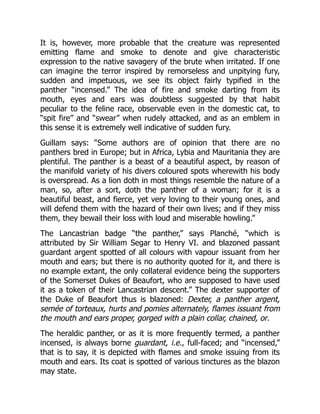
Panther incensed.
34.
It is, however,more probable that the creature was represented
emitting flame and smoke to denote and give characteristic
expression to the native savagery of the brute when irritated. If one
can imagine the terror inspired by remorseless and unpitying fury,
sudden and impetuous, we see its object fairly typified in the
panther “incensed.” The idea of fire and smoke darting from its
mouth, eyes and ears was doubtless suggested by that habit
peculiar to the feline race, observable even in the domestic cat, to
“spit fire” and “swear” when rudely attacked, and as an emblem in
this sense it is extremely well indicative of sudden fury.
Guillam says: “Some authors are of opinion that there are no
panthers bred in Europe; but in Africa, Lybia and Mauritania they are
plentiful. The panther is a beast of a beautiful aspect, by reason of
the manifold variety of his divers coloured spots wherewith his body
is overspread. As a lion doth in most things resemble the nature of a
man, so, after a sort, doth the panther of a woman; for it is a
beautiful beast, and fierce, yet very loving to their young ones, and
will defend them with the hazard of their own lives; and if they miss
them, they bewail their loss with loud and miserable howling.”
The Lancastrian badge “the panther,” says Planché, “which is
attributed by Sir William Segar to Henry VI. and blazoned passant
guardant argent spotted of all colours with vapour issuant from her
mouth and ears; but there is no authority quoted for it, and there is
no example extant, the only collateral evidence being the supporters
of the Somerset Dukes of Beaufort, who are supposed to have used
it as a token of their Lancastrian descent.” The dexter supporter of
the Duke of Beaufort thus is blazoned: Dexter, a panther argent,
semée of torteaux, hurts and pomies alternately, flames issuant from
the mouth and ears proper, gorged with a plain collar, chained, or.
The heraldic panther, or as it is more frequently termed, a panther
incensed, is always borne guardant, i.e., full-faced; and “incensed,”
that is to say, it is depicted with flames and smoke issuing from its
mouth and ears. Its coat is spotted of various tinctures as the blazon
may state.
35.
Odet de Foix,Sieur de Lautrec, Marshal of France (+ 1528) being
considered a person of fierce appearance, took for device a panther,
with the motto “Allicit ulterius” (“He entices further”), alluding to the
attractive power of that animal notwithstanding its fierce exterior,
“an evidence,” remarks a modern writer, “that he had as much vanity
as ambition.”
The town of Lucca for arms bears a panther: “La pantera, che Lucca
abbraccia e onora.”
Gian Giacomo Trivulzio, surnamed the Great (+ 1518), a celebrated
Italian soldier, bore a panther on his standard, with the motto, “Mens
sibi conscia facti” (“The mind conscious to itself of the deed”), the
panther signifying foresight (providence) from the number of eyes in
his coat. Others said he wished to imply that he knew how to
manage for himself in the various changes of his capricious fortune.
[25]
The Lynx.
The Lynx
36.
Felis Lynx, ormountain cat, is found in the northern parts of Europe,
Asia and America, and climbs the highest trees. He preys on
squirrels, deer, hares, &c. He is fond of blood and kills great
numbers of animals to satisfy his unconquerable thirst. He is smaller
than the panther, about three feet and a half in length, his tail is
much shorter and black at the extremity. His ears are erect with a
pencil of black hair at the tips. The fur is long and thick, the upper
part of the body is a pale grey, the under parts white.
The sight of the lynx is said to be so piercing that the ancients
attributed to it the faculty of seeing through stone walls: it may,
however, be asserted with truth that it distinguishes its prey at a
greater distance than any other carnivorous quadruped. On this
account it is frequently employed in heraldry, symbolising
watchfulness, keenness of vision, and also the ability to profit by it.
Lynx-eyed, “oculis lynceis,” originally referred to Lynceus, the
argonaut, who was famed for the keenness of his vision; then it was
transferred to the lynx and gave rise to the fable that it could see
through a wall (notes to “Philobiblon,” by E. C. Thomas).
The Accademia de Lincei, founded in Rome in 1603, with the object
of encouraging a taste for natural history, adopted the name and
device of the lynx because the members should have the eyes of a
lynx to penetrate the secrets of nature. Galileo, Fabio Colonna, and
Gianbattista Porta were among the members of the academy, the
latter philosopher and mathematician, who was the inventor of the
camera obscura, bore the device of the academy, the lynx, and the
motto “Aspicit et inspicit” (“Looks at and looks into”).
Charles IV. of Luxemburg, Emperor of Germany, adopted the lynx for
his impress, with the motto, “Nullius pavit occursum” (“He fears not
meeting with any one”).
The Lizard Lynx is an animal of the lynx or wild cat kind of a dark
brown colour, spotted black; the ears and tail are short. They are
37.
frequent in thewoods of Sweden, Denmark and Norway, where they
are usually termed lizards.
Cat-a-Mountain saliant, collared and lined.
Cat-a-Mountain—Tiger Cat or Wild Cat
The Clan Chattan, who gave their name to the county of Caithness,
bore as their cognisance the wild mountain cat, and called their
chieftain, the Earl of Sutherland, “Mohr an chat” (The Great Wild
Cat). The Mackintoshes still bear as their crests and supporters these
ferocious cats, with the appropriate warning as a motto, “Touch not
the cat but a glove.”
The whole is a pun upon the word “Catti,” the Teutonic settlers of
Caithness, i.e., Catti-ness, and means “Touch not the Clan Cattan (or
mountain cat) without a glove.” Here “but” is used in the original
meaning, beout, i.e., without. For another example of “but” meaning
38.
without, see Amosiii. 7. The same words are also used as the motto
of several Scottish families.
None will forget how the cat-a-mountain showed her claws to the
Clan Kay, in the Wynds of Perth in Sir Walter Scott’s “Fair Maid of
Perth.”
Crest, a Cat-a-Mountain, sejant, collared and lined.
The Heraldic Musion.—Bossewell, in his work on heraldry published
1572, describes a musion as “a beaste that is enimie to myse and
rattes.” He adds also that he is “slye and wittie, and seeth so sharply,
that he overcommeth darkness of the nighte by the shyninge lighte
of his eyne. In the shape of body, he is like unto a leoparde, and
hath a greate mouthe. He doth delighte that he enjoyeth his libertie,
and in his youthe he is swifte, plyante, and merrie. He maketh a
rufull noyse, and a gastefull when he proffereth to fighte with
another. He is a cruel beaste when he is wilde and falleth on his
39.
owne feet frommoste high places, and uneth (scarce) is hurte
therewith. When he hathe a fayre skinne, he is, as it were, prowde
thereof, and then he goeth fast aboute to be seene.”
Childebert, King of France, in token of his having taken captive
Gondomar of Bourgogne, assumed the device of a tiger-cat or ounce
behind a grating or troillis, gules cloué argent. This recalls the
famous scene between Sanglier Rouge and Toison d’Or in “Quentin
Durward,” when Charles the Bold’s jester professes to help the
unhappy envoy of De la Marck by describing it as a cat looking out
of a dairy window.
The cat, though domesticated, is considered as possessed of
ingratitude; in its friendship so uncertain and so vicious in its nature,
“that,” say old writers, “it is only calculated for destroying the
obnoxious race of rats and other small game.”
From the mediæval superstition that Satan’s favourite form was a
black cat, it was superstitiously called “a familiar.” Hence witches
were said to have a cat as their familiar.
The Cat: A symbol of liberty.—The Roman goddess of Liberty was
represented as holding a cup in one hand, a broken sceptre in the
other, and a cat lying at her feet. No animal is so great an enemy to
all constraint as a cat.
The cat was held in veneration by the Egyptians as sacred to the
goddess Bubastis. This deity is represented with a human body and
a cat’s head. Diodorus tells us that whoever killed a cat, even by
accident, was by the Egyptians punished with death. According to
Egyptian tradition, Diana assumed the form of a cat, and thus
excited the fury of the giants. The London Review says: “The
Egyptians worshipped the cat as a symbol of the moon, not only
because it is more active after sunset, but from the dilation and
contraction of its orb, symbolical of the waxing and waning of the
night goddess.”
40.
In heraldry itshould always be represented full-faced like the
leopard.
Erminois three cats-a-mountain passant gardant, in pale azure, each
charged on the body with an ermine spot or. Crest: a demi cat-a-
mountain gardant, azure, gorged with a collar gemel, and charged
with ermine spots, two and one.—Tibbets.
The supporters of the Earl of Clanricarde are wild cats, and also
those of the Earl of Belmore. It is the crest of De Burgh.
“Æneas.—His mantle was the lion’s,
With all its tawny bars,
His falchion, like Orion’s,
Was gemmed with golden stars.
Upon his lofty helmet
A brazen terror rode;
No sword could overwhelm it
When in the fight it glowed.
For like a wild cat brindled,
It spat with eyes on fire,
And in the battle kindled
Immortal rage and ire,
Now in the sunshine sleeping,
How gently it reposed;
But still in wisdom keeping
A single eye unclosed.”
Queen Dido, by T. S.
41.
The Crowned Salamanderof Francis I.
The Salamander
The salamander has been immemorially credited with certain
fabulous powers. Less than a century ago the creature was seriously
described as a “spotted lizard, which will endure the flames of fire.”
Divested of its supernatural powers it is simply a harmless little
amphibian of the “newt” family, from six to eight inches in length,
with black skin and yellow spots. The skin was long thought to be
poisonous, though it is in reality perfectly harmless; but the moist
surface is so extremely cold to the touch that, from this peculiar
quality in the creature, the idea must have arisen, not only that it
could withstand any heat to which it was exposed, but it would
actually subdue and put out fire.
This was a widespread belief long before the time of Pliny, whose
account of the creature is thus paraphrased by Swift:
“Further, we are by Pliny told
This serpent is extremely cold;
So cold that, put it in the fire,
’Twill make the very flames expire.”
42.
Marco Polo, theearly Venetian traveller, who tells of many strange
and wonderful things seen and heard of in his journeyings, was not
a believer in the fabulous stories of the salamander, for he dismisses
the subject with the curt remark, “Everybody knows that it could be
no animal’s nature to live in fire.” An early heraldic writer of a
somewhat later period, with greater credulity, stoutly maintains its
reality, and in describing the creature states that he actually
possessed some of the hair or down of the salamander. “This,” he
goes on to say, “I have several times put in the fire and made it red-
hot, and after taken out; which, being cold, yet remaineth perfect
wool, or fine downy hair.”
Marco Polo further on assures his readers that the true salamander
is nothing but an incombustible substance found in the earth, “all
the rest being fabulous nonsense.” He tells of a mountain in Tartary,
“there or thereabouts,” in which a “vein” of salamander was found;
and so we arrive at the fact that this salamander’s wool was nothing
but the “asbestos” of the ancients. It is easy to see why asbestos
became known as “salamanders’ wool.” The name resulted from the
juxtaposition of ideas, and shows how deeply impressed was the
belief in the salamander’s mysterious powers. A late writer tells us
that some of the lizard tribe are known to enjoy warmth, and
alligators are said to revel in hot water. It needed only that an
insignificant member of the genus should have been found among
the dead embers of a fire to prove at once the invulnerability of the
reptile and its ability to extinguish the flames.
The salamander of mediæval superstition was a creature in the
shape of a man, which lived in fire (Greek, salambeander, chimney-
man), meaning a man that lives in a chimney. It was described by
the ancients as bred by fire and existing in flames, an element which
must inevitably prove destructive of life. Pliny describes it as “a sort
of lizard which seeks the hottest fire to breed in, but quenches it
with the extreme frigidity of its body.” He tells us he tried the
experiment once, but the creature was soon reduced to powder.[26]
43.
Gregory of Nazianzensays that the salamander not only lived in and
delighted in flames, but extinguished fire. St. Epiphanius compares
the virtues of the hyacinth and the salamander. The hyacinth, he
states, is unaffected by fire, and will even extinguish it as the
salamander does. “The salamander and the hyacinth were symbols
of enduring faith, which triumphs over the ardour of the passions.
Submitted to fire the hyacinth is discoloured and becomes white. We
may here perceive,” says M. Portal, “a symbol of enduring and
triumphant faith.”
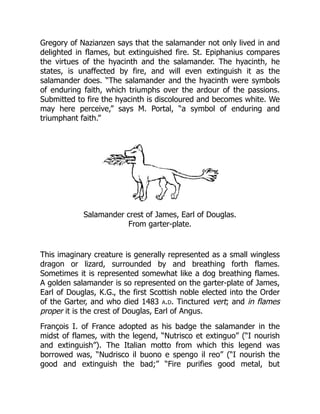
Salamander crest of James, Earl of Douglas.
From garter-plate.
This imaginary creature is generally represented as a small wingless
dragon or lizard, surrounded by and breathing forth flames.
Sometimes it is represented somewhat like a dog breathing flames.
A golden salamander is so represented on the garter-plate of James,
Earl of Douglas, K.G., the first Scottish noble elected into the Order
of the Garter, and who died 1483 a.d. Tinctured vert; and in flames
proper it is the crest of Douglas, Earl of Angus.
François I. of France adopted as his badge the salamander in the
midst of flames, with the legend, “Nutrisco et extinguo” (“I nourish
and extinguish”). The Italian motto from which this legend was
borrowed was, “Nudrisco il buono e spengo il reo” (“I nourish the
good and extinguish the bad;” “Fire purifies good metal, but
44.
consumes rubbish”). Inhis castle of Chambord, the galleries of the
Palace of Fontainebleau, and the Hôtel St. Bourg Thoroulde at
Rouen, this favourite device of the crowned salamander, with the
motto, may be everywhere seen.
Azure, a salamander or, in flames proper, is the charge on the shield
of the Italian family of Cennio.
The “lizards” which form the crest of the Ironmongers’ Company,
were probably intended for salamanders on the old seal of the
company in 1483, but are now blazoned as lizards.
The heraldic signification of the salamander was that of a brave and
generous courage that the fire of affliction cannot destroy or
consume.
In the animal symbolism of the ancients the salamander may be said
to represent the element of Fire; the eagle, Air; the lion, Earth; the
dolphin, Water.
Heraldic Antelope
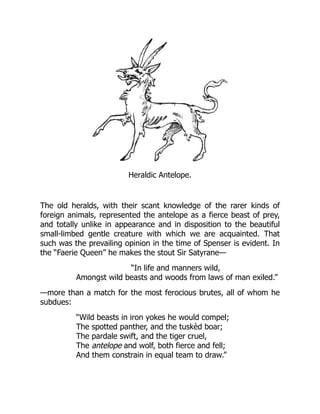
This fictitious animal, when depicted in heraldry, has a body like that
of a stag, the tail of a unicorn, a head like the heraldic tiger, with
two serrated horns, and a tusk growing from the tip of his nose, a
row of tufts down the back of his neck, and the like on his tail, chest
and thighs. Thus represented it is termed an heraldic antelope to
distinguish it from the real or natural antelope, which is also borne in
modern coats of arms.
45.
Heraldic Antelope.
The oldheralds, with their scant knowledge of the rarer kinds of
foreign animals, represented the antelope as a fierce beast of prey,
and totally unlike in appearance and in disposition to the beautiful
small-limbed gentle creature with which we are acquainted. That
such was the prevailing opinion in the time of Spenser is evident. In
the “Faerie Queen” he makes the stout Sir Satyrane—
“In life and manners wild,
Amongst wild beasts and woods from laws of man exiled.”
—more than a match for the most ferocious brutes, all of whom he
subdues:
“Wild beasts in iron yokes he would compel;
The spotted panther, and the tuskèd boar;
The pardale swift, and the tiger cruel,
The antelope and wolf, both fierce and fell;
And them constrain in equal team to draw.”
46.
Welcome to ourwebsite – the ideal destination for book lovers and
knowledge seekers. With a mission to inspire endlessly, we offer a
vast collection of books, ranging from classic literary works to
specialized publications, self-development books, and children's
literature. Each book is a new journey of discovery, expanding
knowledge and enriching the soul of the reade
Our website is not just a platform for buying books, but a bridge
connecting readers to the timeless values of culture and wisdom. With
an elegant, user-friendly interface and an intelligent search system,
we are committed to providing a quick and convenient shopping
experience. Additionally, our special promotions and home delivery
services ensure that you save time and fully enjoy the joy of reading.
Let us accompany you on the journey of exploring knowledge and
personal growth!
ebookluna.com



![following them by casting sundry looking-glasses in the way,
whereat she useth to long to gaze, whether it be to beholde her
owne beauty or because when she seeth her shape in the glasse she
thinketh she seeth one of her young ones; and so they escape the
swiftness of her pursuit.”[21]
Tigre and Mirror.
“Argent, a tigre passant regardant looking into a mirror lying
fessways, the handle to the dexter all proper,” is said to have been
the coat of Hadrian de Bardis (probably an Italian), Prebendary of
Oxfordshire. These arms still remain, or were lately remaining, in a
window of Thame Church. Only two other examples occur, viz.:
“Argent a tigre and mirror (as before) gules.”—Sibell, Kent.
The Royal Tiger](https://image.slidesharecdn.com/14038-250407034703-55c75551/85/eBook-PDF-Information-Technology-Project-Management-5th-Edition-27-320.jpg)
![Seeking the bubble reputation
Even in the cannon’s mouth.”
In Christian Art the leopard is employed to represent that beast
spoken of in the Apocalypse, with seven heads and ten horns. Six of
the heads are nimbed, but the seventh, being “wounded to death,”
has lost its power, and consequently has no nimbus.
Three leopards passant guardant or, pelletée, appear on the arms of
the Marquis of Downshire. It is also the sinister supporter.
The supporters of the town of Aberdeen are leopards.
Sable three leopards rampant argent spotted sable are given as the
arms of Lynch. It is, however, probable that the lynx was the animal
originally blazoned as “arms parlantes” for the name.
Ermine on a cross patonce sable, a leopard’s head, issuing out of a
ducal coronet or, crest, a demi-leopard erect, proper.—Dickens.
A leopard’s face, breaking with his mouth a sword, is the crest of
Disne.
The supporters of the Earl of Northesk are two leopards reguardant.
The leopard or panther, says Dr. P. M. Duncan, F.R.S.,[22] was the
only one of the greater feline animals, except the lion and tiger,
which seems to have been known to the ancients. It is always
represented as drawing the chariot of Bacchus, and the forlorn
Ariadne is sculptured as riding on one of the spotted steeds of her
divine lover. The panther was also constantly used in the barbarous
sports of the amphitheatre, and, in common with the lion and tiger,
has been both executioner and grave to many a bold-hearted martyr.
The leopard’s skin was a favourite mantle in the olden times in
Greece. In the “Iliad,” Homer, speaking of Menelaus, says:
“With a pard’s spotted hide his shoulders broad
He mantled o’er,”](https://image.slidesharecdn.com/14038-250407034703-55c75551/85/eBook-PDF-Information-Technology-Project-Management-5th-Edition-31-320.jpg)
![This beast, like the leopard, has been the object of much mistaken
or fictitious history. Pliny, who is responsible for many of the errors
in natural history since his time, says of the panther: “It is said that
all four-footed beasts are wonderfully delighted and enticed by the
smell of panthers; but their hideous looke and crabbed countenance
which they bewray so soon as they show their heads skareth them
as much again: therefore their manner is to hide their heads, and
when they have trained other beasts within their reach by their
sweet savour, they fall upon them and worry them.”[23] And again,
Sir William Segar, Garter King-of-Arms, following the same credulous
historian, says: “The panther is admired of all other beasts for the
beauty of his skyn, being spotted with variable colours, and beloved
of them for the sweetness of his breath that streameth forth of his
nostrils and ears like smoke which our paynters mistaking, corruptly
do make fire.”[24]
Panther incensed.](https://image.slidesharecdn.com/14038-250407034703-55c75551/85/eBook-PDF-Information-Technology-Project-Management-5th-Edition-33-320.jpg)
![Odet de Foix, Sieur de Lautrec, Marshal of France (+ 1528) being
considered a person of fierce appearance, took for device a panther,
with the motto “Allicit ulterius” (“He entices further”), alluding to the
attractive power of that animal notwithstanding its fierce exterior,
“an evidence,” remarks a modern writer, “that he had as much vanity
as ambition.”
The town of Lucca for arms bears a panther: “La pantera, che Lucca
abbraccia e onora.”
Gian Giacomo Trivulzio, surnamed the Great (+ 1518), a celebrated
Italian soldier, bore a panther on his standard, with the motto, “Mens
sibi conscia facti” (“The mind conscious to itself of the deed”), the
panther signifying foresight (providence) from the number of eyes in
his coat. Others said he wished to imply that he knew how to
manage for himself in the various changes of his capricious fortune.
[25]
The Lynx.
The Lynx](https://image.slidesharecdn.com/14038-250407034703-55c75551/85/eBook-PDF-Information-Technology-Project-Management-5th-Edition-35-320.jpg)
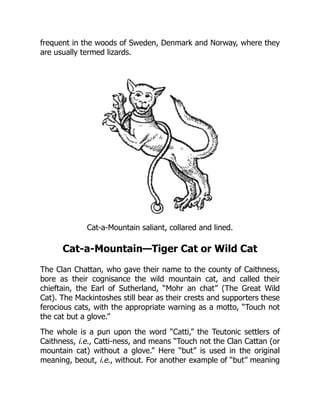
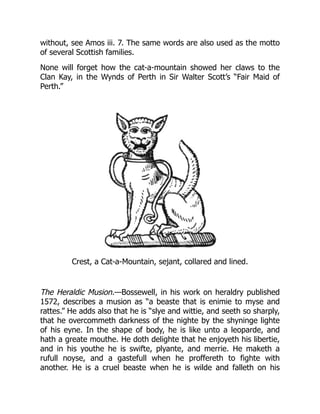
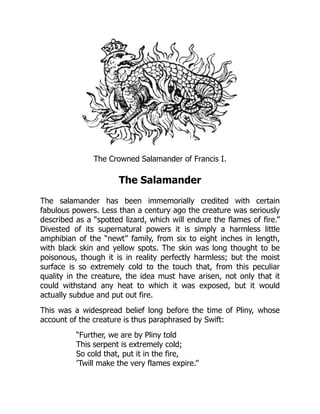
![Marco Polo, the early Venetian traveller, who tells of many strange
and wonderful things seen and heard of in his journeyings, was not
a believer in the fabulous stories of the salamander, for he dismisses
the subject with the curt remark, “Everybody knows that it could be
no animal’s nature to live in fire.” An early heraldic writer of a
somewhat later period, with greater credulity, stoutly maintains its
reality, and in describing the creature states that he actually
possessed some of the hair or down of the salamander. “This,” he
goes on to say, “I have several times put in the fire and made it red-
hot, and after taken out; which, being cold, yet remaineth perfect
wool, or fine downy hair.”
Marco Polo further on assures his readers that the true salamander
is nothing but an incombustible substance found in the earth, “all
the rest being fabulous nonsense.” He tells of a mountain in Tartary,
“there or thereabouts,” in which a “vein” of salamander was found;
and so we arrive at the fact that this salamander’s wool was nothing
but the “asbestos” of the ancients. It is easy to see why asbestos
became known as “salamanders’ wool.” The name resulted from the
juxtaposition of ideas, and shows how deeply impressed was the
belief in the salamander’s mysterious powers. A late writer tells us
that some of the lizard tribe are known to enjoy warmth, and
alligators are said to revel in hot water. It needed only that an
insignificant member of the genus should have been found among
the dead embers of a fire to prove at once the invulnerability of the
reptile and its ability to extinguish the flames.
The salamander of mediæval superstition was a creature in the
shape of a man, which lived in fire (Greek, salambeander, chimney-
man), meaning a man that lives in a chimney. It was described by
the ancients as bred by fire and existing in flames, an element which
must inevitably prove destructive of life. Pliny describes it as “a sort
of lizard which seeks the hottest fire to breed in, but quenches it
with the extreme frigidity of its body.” He tells us he tried the
experiment once, but the creature was soon reduced to powder.[26]](https://image.slidesharecdn.com/14038-250407034703-55c75551/85/eBook-PDF-Information-Technology-Project-Management-5th-Edition-42-320.jpg)