Power Supply Chain
Network Design with
Location Intelligence
Introduction
Optimized supply chain network
implies finding optimal locations for
warehouses, distribution centers (DCs),
factories, or production sites.
Define the flow of goods to balance
delivery schedules, routes, fleet
requirements, etc., with an agile
supply chain network design.
Master the art of network design
with location intelligence and build
agile supply chains.
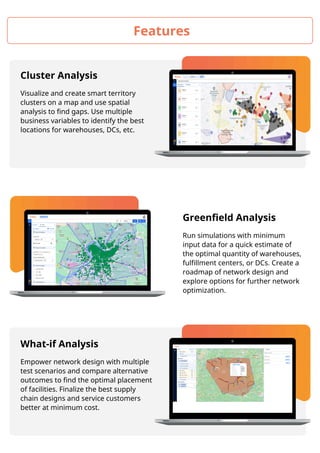
What-if Analysis
Empower network design with multiple
test scenarios and compare alternative
outcomes to find the optimal placement
of facilities. Finalize the best supply
chain designs and service customers
better at minimum cost.
Cluster Analysis
Visualize and create smart territory
clusters on a map and use spatial
analysis to find gaps. Use multiple
business variables to identify the best
locations for warehouses, DCs, etc.
Features
Greenfield Analysis
Run simulations with minimum
input data for a quick estimate of
the optimal quantity of warehouses,
fulfillment centers, or DCs. Create a
roadmap of network design and
explore options for further network
optimization.
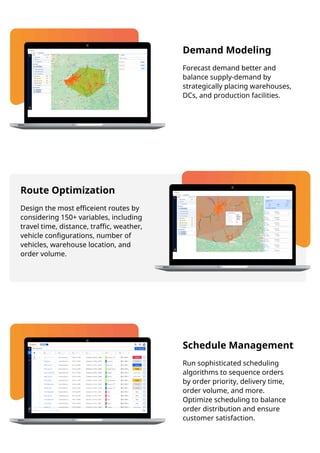
Route Optimization
Design the most efficeient routes by
considering 150+ variables, including
travel time, distance, traffic, weather,
vehicle configurations, number of
vehicles, warehouse location, and
order volume.
Demand Modeling
Forecast demand better and
balance supply-demand by
strategically placing warehouses,
DCs, and production facilities.
Schedule Management
Run sophisticated scheduling
algorithms to sequence orders
by order priority, delivery time,
order volume, and more.
Optimize scheduling to balance
order distribution and ensure
customer satisfaction.
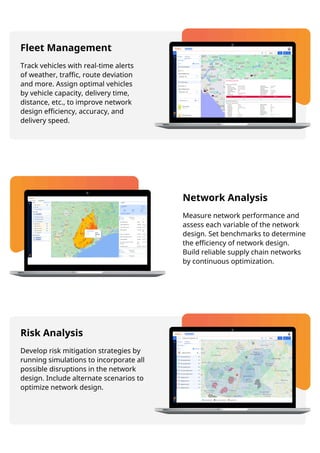
Fleet Management
Track vehicles with real-time alerts
of weather, traffic, route deviation
and more. Assign optimal vehicles
by vehicle capacity, delivery time,
distance, etc., to improve network
design efficiency, accuracy, and
delivery speed.
Risk Analysis
Develop risk mitigation strategies by
running simulations to incorporate all
possible disruptions in the network
design. Include alternate scenarios to
optimize network design.
Network Analysis
Measure network performance and
assess each variable of the network
design. Set benchmarks to determine
the efficiency of network design.
Build reliable supply chain networks
by continuous optimization.
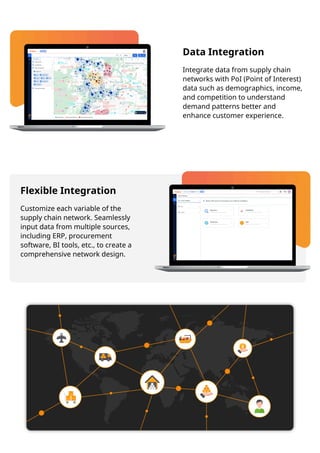
Flexible Integration
Customize each variable of the
supply chain network. Seamlessly
input data from multiple sources,
including ERP, procurement
software, BI tools, etc., to create a
comprehensive network design.
Data Integration
Integrate data from supply chain
networks with PoI (Point of Interest)
data such as demographics, income,
and competition to understand
demand patterns better and
enhance customer experience.
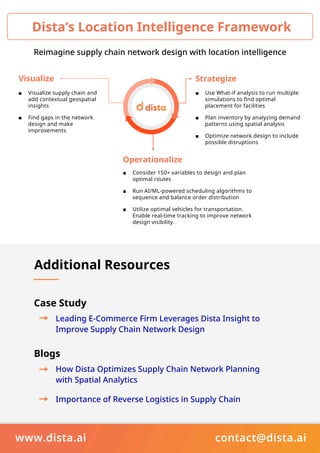
Visualize Strategize
Operationalize
■ Consider 150+ variables to design and plan
optimal routes
■ Run AI/ML-powered scheduling algorithms to
sequence and balance order distribution
■ Utilize optimal vehicles for transportation.
Enable real-time tracking to improve network
design visibility.
■ Use What-if analysis to run multiple
simulations to find optimal
placement for facilities
■ Plan inventory by analyzing demand
patterns using spatial analysis
■ Optimize network design to include
possible disruptions
■ Visualize supply chain and
add contextual geospatial
insights
■ Find gaps in the network
design and make
improvements
Dista’s Location Intelligence Framework
Reimagine supply chain network design with location intelligence
Additional Resources
www.dista.ai contact@dista.ai
Case Study
Blogs
Leading E-Commerce Firm Leverages Dista Insight to
Improve Supply Chain Network Design
How Dista Optimizes Supply Chain Network Planning
with Spatial Analytics
Importance of Reverse Logistics in Supply Chain

Supply Chain Network Optimization Data Sheet

  • 1.
    Power Supply Chain NetworkDesign with Location Intelligence Introduction Optimized supply chain network implies finding optimal locations for warehouses, distribution centers (DCs), factories, or production sites. Define the flow of goods to balance delivery schedules, routes, fleet requirements, etc., with an agile supply chain network design. Master the art of network design with location intelligence and build agile supply chains.
  • 2.
    What-if Analysis Empower networkdesign with multiple test scenarios and compare alternative outcomes to find the optimal placement of facilities. Finalize the best supply chain designs and service customers better at minimum cost. Cluster Analysis Visualize and create smart territory clusters on a map and use spatial analysis to find gaps. Use multiple business variables to identify the best locations for warehouses, DCs, etc. Features Greenfield Analysis Run simulations with minimum input data for a quick estimate of the optimal quantity of warehouses, fulfillment centers, or DCs. Create a roadmap of network design and explore options for further network optimization.
  • 3.
    Route Optimization Design themost efficeient routes by considering 150+ variables, including travel time, distance, traffic, weather, vehicle configurations, number of vehicles, warehouse location, and order volume. Demand Modeling Forecast demand better and balance supply-demand by strategically placing warehouses, DCs, and production facilities. Schedule Management Run sophisticated scheduling algorithms to sequence orders by order priority, delivery time, order volume, and more. Optimize scheduling to balance order distribution and ensure customer satisfaction.
  • 4.
    Fleet Management Track vehicleswith real-time alerts of weather, traffic, route deviation and more. Assign optimal vehicles by vehicle capacity, delivery time, distance, etc., to improve network design efficiency, accuracy, and delivery speed. Risk Analysis Develop risk mitigation strategies by running simulations to incorporate all possible disruptions in the network design. Include alternate scenarios to optimize network design. Network Analysis Measure network performance and assess each variable of the network design. Set benchmarks to determine the efficiency of network design. Build reliable supply chain networks by continuous optimization.
  • 5.
    Flexible Integration Customize eachvariable of the supply chain network. Seamlessly input data from multiple sources, including ERP, procurement software, BI tools, etc., to create a comprehensive network design. Data Integration Integrate data from supply chain networks with PoI (Point of Interest) data such as demographics, income, and competition to understand demand patterns better and enhance customer experience.
  • 6.
    Visualize Strategize Operationalize ■ Consider150+ variables to design and plan optimal routes ■ Run AI/ML-powered scheduling algorithms to sequence and balance order distribution ■ Utilize optimal vehicles for transportation. Enable real-time tracking to improve network design visibility. ■ Use What-if analysis to run multiple simulations to find optimal placement for facilities ■ Plan inventory by analyzing demand patterns using spatial analysis ■ Optimize network design to include possible disruptions ■ Visualize supply chain and add contextual geospatial insights ■ Find gaps in the network design and make improvements Dista’s Location Intelligence Framework Reimagine supply chain network design with location intelligence Additional Resources www.dista.ai contact@dista.ai Case Study Blogs Leading E-Commerce Firm Leverages Dista Insight to Improve Supply Chain Network Design How Dista Optimizes Supply Chain Network Planning with Spatial Analytics Importance of Reverse Logistics in Supply Chain