(Ebook) JavaScript Cookbook, 2nd Edition_ Programming the Web by kan
(Ebook) JavaScript Cookbook, 2nd Edition_ Programming the Web by kan
(Ebook) JavaScript Cookbook, 2nd Edition_ Programming the Web by kan
(Ebook) JavaScript Cookbook, 2nd Edition_ Programming the Web by kan
(Ebook) JavaScript Cookbook, 2nd Edition_ Programming the Web by kan
1.
Instant Ebook Access,One Click Away – Begin at ebooknice.com
(Ebook) JavaScript Cookbook, 2nd Edition_
Programming the Web by kan
https://ebooknice.com/product/javascript-cookbook-2nd-
edition-programming-the-web-50195402
OR CLICK BUTTON
DOWLOAD EBOOK
Get Instant Ebook Downloads – Browse at https://ebooknice.com
2.
Instant digital products(PDF, ePub, MOBI) ready for you
Download now and discover formats that fit your needs...
Start reading on any device today!
(Ebook) Jasmine JavaScript Testing, 2nd Edition_ Test your JavaScript applications
efficiently using Jasmine and React.js by kan
https://ebooknice.com/product/jasmine-javascript-testing-2nd-edition-test-your-
javascript-applications-efficiently-using-jasmine-and-react-js-50195432
ebooknice.com
(Ebook) Reactive Programming with JavaScript by kan
https://ebooknice.com/product/reactive-programming-with-javascript-50194990
ebooknice.com
(Ebook) JavaScript Cookbook: Programming the Web by Scott, Adam, MacDonald, Matthew,
Powers, Shelley ISBN 9781492055686, 9781492055754, 1492055689, 1492055751
https://ebooknice.com/product/javascript-cookbook-programming-the-web-11119016
ebooknice.com
(Ebook) Web API Cookbook: Level Up Your JavaScript Applications by Joe Attardi
https://ebooknice.com/product/web-api-cookbook-level-up-your-javascript-
applications-56376958
ebooknice.com
3.
(Ebook) learning javascript3e by kan
https://ebooknice.com/product/learning-javascript-3e-50195302
ebooknice.com
(Ebook) Learning Highcharts 4_ Design eye-catching and interactive JavaScript charts
for your web page with Highcharts, one of the leading tools in web charting by kan
https://ebooknice.com/product/learning-highcharts-4-design-eye-catching-and-
interactive-javascript-charts-for-your-web-page-with-highcharts-one-of-the-
leading-tools-in-web-charting-50195336
ebooknice.com
(Ebook) JavaScript JSON Cookbook_ Over 80 recipes to make the most of JSON in your
desktop, server, web, and mobile applications by kan
https://ebooknice.com/product/javascript-json-cookbook-over-80-recipes-to-make-
the-most-of-json-in-your-desktop-server-web-and-mobile-applications-50195396
ebooknice.com
(Ebook) The Complete Web Design Edition by kan
https://ebooknice.com/product/the-complete-web-design-edition-50194588
ebooknice.com
(Ebook) Web API Cookbook: Level Up Your Javascript Applications by Joe Attardi ISBN
9781098150693, 1098150694
https://ebooknice.com/product/web-api-cookbook-level-up-your-javascript-
applications-56785342
ebooknice.com
5.
JAVASCRIPT/WEB
JavaScript Cookbook
ISBN: 978-1-491-90188-5
US$49.99 CAN $57.99
“
Acomprehensive,example-
driventourofthelanguage
and its platforms.”
—Dr. Axel Rauschmayer
author of Speaking JavaScript
Shelley Powers has been working
with and writing about web tech-
nologies—from the first release
of JavaScript to the latest graphics
and design tools—for more than 18
years. Her recent O’Reilly books have
covered JavaScript, HTML5 media
objects, Ajax, and web graphics.
Twitter: @oreillymedia
facebook.com/oreilly
Problem solving with JavaScript is a lot trickier now that its use has expanded
considerably in size, scope, and complexity. This cookbook has your back,
with recipes for common tasks across the JavaScript world, whether you’re
working in the browser, the server, or a mobile environment. Each recipe
includes reusable code and practical advice for tackling JavaScript objects,
Node,Ajax,JSON,datapersistence,graphicalandmediaapplications,complex
frameworks, modular JavaScript, APIs, and many related technologies.
Aimed at people who have some experience with JavaScript, the first part
covers traditional uses of JavaScript, along with new ideas and improved
functionality. The second part dives into the server, mobile development,
and a plethora of leading-edge tools. You’ll save time—and learn more
about JavaScript in the process.
Topics include:
Classic JavaScript:
■
■ Arrays, functions, and the JavaScript Object
■
■ Accessing the user interface
■
■ Testing and accessibility
■
■ Creating and using JavaScript libraries
■
■ Client-server communication with Ajax
■
■ Rich, interactive web effects
JavaScript, All Blown Up:
■
■ New ECMAScript standard objects
■
■ Using Node on the server
■
■ Modularizing and managing JavaScript
■
■ Complex JavaScript frameworks
■
■ Advanced client-server communications
■
■ Visualizations and client-server graphics
■
■ Mobile application development
JavaScript
Cookbook
SECOND EDITION
Powers
Shelley Powers
JavaScript
Cookbook
PROGRAMMING THE WEB
2
n
d
E
d
i
t
i
o
n
6.
JAVASCRIPT/WEB
JavaScript Cookbook
ISBN: 978-1-491-90188-5
US$49.99 CAN $57.99
“
Acomprehensive,example-
driventourofthelanguage
and its platforms.”
—Dr. Axel Rauschmayer
author of Speaking JavaScript
Shelley Powers has been working
with and writing about web tech-
nologies—from the first release
of JavaScript to the latest graphics
and design tools—for more than 18
years. Her recent O’Reilly books have
covered JavaScript, HTML5 media
objects, Ajax, and web graphics.
Twitter: @oreillymedia
facebook.com/oreilly
Problem solving with JavaScript is a lot trickier now that its use has expanded
considerably in size, scope, and complexity. This cookbook has your back,
with recipes for common tasks across the JavaScript world, whether you’re
working in the browser, the server, or a mobile environment. Each recipe
includes reusable code and practical advice for tackling JavaScript objects,
Node,Ajax,JSON,datapersistence,graphicalandmediaapplications,complex
frameworks, modular JavaScript, APIs, and many related technologies.
Aimed at people who have some experience with JavaScript, the first part
covers traditional uses of JavaScript, along with new ideas and improved
functionality. The second part dives into the server, mobile development,
and a plethora of leading-edge tools. You’ll save time—and learn more
about JavaScript in the process.
Topics include:
Classic JavaScript:
■
■ Arrays, functions, and the JavaScript Object
■
■ Accessing the user interface
■
■ Testing and accessibility
■
■ Creating and using JavaScript libraries
■
■ Client-server communication with Ajax
■
■ Rich, interactive web effects
JavaScript, All Blown Up:
■
■ New ECMAScript standard objects
■
■ Using Node on the server
■
■ Modularizing and managing JavaScript
■
■ Complex JavaScript frameworks
■
■ Advanced client-server communications
■
■ Visualizations and client-server graphics
■
■ Mobile application development
JavaScript
Cookbook
SECOND EDITION
Powers
Shelley Powers
JavaScript
Cookbook
PROGRAMMING THE WEB
2
n
d
E
d
i
t
i
o
n
Table of Contents
TheWorld of JavaScript. . . . . . . . . . . . . . . . . . . . . . . . . . . . . . . . . . . . . . . . . . . . . . . . . . . . . . . . . ix
Part I. Classic JavaScript
1. The JavaScript Not-So-Simple Building Blocks. . . . . . . . . . . . . . . . . . . . . . . . . . . . . . . . . . . 3
1.1. Differentiating Between a JavaScript Object, Primitive, and Literal 3
1.2. Extracting a List from a String 7
1.3. Checking for an Existing, Nonempty String 10
1.4. Inserting Special Characters 14
1.5. Replacing Patterns with New Strings 16
1.6. Finding and Highlighting All Instances of a Pattern 18
1.7. Swapping Words in a String Using Capturing Parentheses 22
1.8. Replacing HTML Tags with Named Entities 25
1.9. Converting an ISO 8601 Formatted Date to a Date Object Acceptable
Format 25
1.10. Using Function Closures with Timers 29
1.11. Tracking Elapsed Time 31
1.12. Converting a Decimal to a Hexadecimal Value 32
1.13. Summing All Numbers in a Table Column 33
1.14. Converting Between Degrees and Radians 36
1.15. Find the Radius and Center of a Circle to Fit Within a Page Element 37
1.16. Calculating the Length of a Circular Arc 39
1.17. Using ES6 String Extras Without Leaving Users in the Dirt 40
2. JavaScript Arrays. . . . . . . . . . . . . . . . . . . . . . . . . . . . . . . . . . . . . . . . . . . . . . . . . . . . . . . . . . . 43
2.1. Searching Through an Array 43
2.2. Flattening a Two-Dimensional Array with concat() and apply() 45
2.3. Removing or Replacing Array Elements 46
2.4. Extracting a Portion of an Array 48
iii
www.it-ebooks.info
10.
2.5. Applying aFunction Against Each Array Element 48
2.6. Traversing the Results from querySelectorAll() with forEach() and call() 50
2.7. Applying a Function to Every Element in an Array and Returning a New
Array 51
2.8. Creating a Filtered Array 52
2.9. Validating Array Contents 52
2.10. Using an Associative Array to Store Form Element Names and Values 54
2.11. Using a Destructuring Assignment to Simplify Code 58
3. Functions: The JavaScript Building Blocks. . . . . . . . . . . . . . . . . . . . . . . . . . . . . . . . . . . . . . 61
3.1. Placing Your Function and Hoisting 61
3.2. Passing a Function As an Argument to Another Function 63
3.3. Implementing a Recursive Algorithm 65
3.4. Preventing Code Blocking with a Timer and a Callback 68
3.5. Creating a Function That Remembers Its State 72
3.6. Converting Function Arguments into an Array 75
3.7. Reducing Redundancy by Using a Partial Application 77
3.8. Improving Application Performance with Memoization (Caching
Calculations) 80
3.9. Using an Anonymous Function to Wrap Global Variables 82
3.10. Providing a Default Parameter 83
4. The Malleable JavaScript Object. . . . . . . . . . . . . . . . . . . . . . . . . . . . . . . . . . . . . . . . . . . . . . 85
4.1. Keeping Object Members Private 86
4.2. Using Prototype to Create Objects 87
4.3. Inheriting an Object’s Functionality 90
4.4. Extending an Object by Defining a New Property 92
4.5. Preventing Object Extensibility 94
4.6. Preventing Any Changes to an Object 95
4.7. Namespacing Your JavaScript Objects 97
4.8. Rediscovering this with Prototype.bind 100
4.9. Chaining Your Object’s Methods 103
5. JavaScript and Directly Accessing the User Interface. . . . . . . . . . . . . . . . . . . . . . . . . . . . 107
5.1. Accessing a Given Element and Finding Its Parent and Child Elements 107
5.2. Accessing All Images in the Web Page 110
5.3. Discovering All Images in Articles Using the Selectors API 116
5.4. Setting an Element’s Style Attribute 119
5.5. Applying a Striped Theme to an Unordered List 122
5.6. Finding All Elements That Share an Attribute 123
5.7. Inserting a New Paragraph 124
5.8. Adding Text to a New Paragraph 125
iv | Table of Contents
www.it-ebooks.info
11.
5.9. Deleting Rowsfrom an HTML Table 127
5.10. Adding a Page Overlay 129
5.11. Creating Collapsible Form Sections 133
5.12. Hiding Page Sections 136
5.13. Creating Hover-Based Pop-Up Info Windows 137
5.14. Displaying a Flash of Color to Signal an Action 140
6. Preliminary Testing and Accessibility. . . . . . . . . . . . . . . . . . . . . . . . . . . . . . . . . . . . . . . . . 143
6.1. Cleaning Up Your Code with JSHint 143
6.2. Unit Testing Your Code with QUnit 145
6.3. Testing Your Application in Various Environments 148
6.4. Performance Testing Different Coding Techniques 152
6.5. Highlighting Errors Accessibly 156
6.6. Creating an Accessible Automatically Updated Region 163
7. Creating and Using JavaScript Libraries. . . . . . . . . . . . . . . . . . . . . . . . . . . . . . . . . . . . . . . 165
7.1. Finding the Perfect Library 165
7.2. Testing for Features with Modernizr.load 166
7.3. Going Beyond the Math Object’s Capability 168
7.4. Finding the Number of Days Between Two Dates 170
7.5. Using an External Library: Building on the jQuery Framework 171
7.6. Using a jQuery Plugin 174
7.7. Handling Keyboard Shortcuts with Mousetrap 177
7.8. Utilizing the Utility Library Underscore 180
7.9. Packaging Your Code 182
7.10. Adding Support for Private Data Members 185
7.11. Minify Your Library 187
7.12. Hosting Your Library 189
7.13. Serving Code from a CDN 192
7.14. Convert Your Library to a jQuery Plug-in 193
7.15. Safely Combining Several Libraries in Your Applications 195
8. Simplified Client-Server Communication and Data. . . . . . . . . . . . . . . . . . . . . . . . . . . . . 199
8.1. Handling an XML Document Returned via an Ajax Call 199
8.2. Extracting Pertinent Information from an XML Tree 201
8.3. Parsing and Automatically Modifying JSON 206
8.4. Converting an Object to a Filtered/Transformed String with JSON 208
8.5. Making an Ajax Request to Another Domain (Using JSONP) 209
8.6. Processing JSON from an Ajax Request 212
8.7. Populating a Selection List from the Server 214
8.8. Using a Timer to Automatically Update the Page with Fresh Data 218
Table of Contents | v
www.it-ebooks.info
12.
9. Creating MediaRich, Interactive Web Effects. . . . . . . . . . . . . . . . . . . . . . . . . . . . . . . . . . 221
9.1. Creating a Dynamic Line Chart in Canvas 221
9.2. Adding JavaScript to SVG 227
9.3. Accessing SVG from Web Page Script 231
9.4. Integrating SVG and the Canvas Element in HTML 233
9.5. Running a Routine When an Audio File Begins Playing 235
9.6. Controlling Video from JavaScript with the video Element 237
9.7. Adding Filter Effects to Video via Canvas 241
Part II. JavaScript, All Blown Up
10. The New ECMAScript Standard Objects. . . . . . . . . . . . . . . . . . . . . . . . . . . . . . . . . . . . . . . . 249
10.1. Using let in Your Browser Application 250
10.2. Creating a Collection of Non-Duplicated Values 253
10.3. Creating Unique Key/Value Pairs with Uniquely Different Keys 255
10.4. Creating Absolutely Unique Object Property Keys 258
10.5. Iterating Through Tasks Made Easy 260
10.6. Creating Functions that Gracefully Yield 261
10.7. Implementing Just-in-Time Object Behavioral Modifications with
Proxies 263
10.8. Creating a True Class and Extending It (with a Little Help from Traceur) 266
10.9. Using Promises for Efficient Asynchronous Processing 270
11. Node: JavaScript on the Server. . . . . . . . . . . . . . . . . . . . . . . . . . . . . . . . . . . . . . . . . . . . . . 273
11.1. Responding to a Simple Browser Request 273
11.2. Serving Up Formatted Data 276
11.3. Reading and Writing File Data 278
11.4. Using let and Other ES 6 Additions in Node 283
11.5. Interactively Trying Out Node Code Snippets with REPL 284
11.6. Getting Input from the Terminal 287
11.7. Working with Node Timers and Understanding the Node Event Loop 289
11.8. Managing Callback Hell 293
11.9. Accessing Command-Line Functionality Within a Node Application 297
11.10. Running Node and Apache on the Same Port 300
11.11. Keeping a Node Instance Up and Running 302
11.12. Monitoring Application Changes and Restarting 304
11.13. Screen Scraping with Request 305
11.14. Creating a Command-Line Utility with Help From Commander 307
12. Modularizing and Managing JavaScript. . . . . . . . . . . . . . . . . . . . . . . . . . . . . . . . . . . . . . . 311
12.1. Loading Scripts with a Script Loader 312
vi | Table of Contents
www.it-ebooks.info
13.
12.2. Loading ScriptsAsynchronously the HTML5 Way 315
12.3. Converting Your JavaScript to AMD and RequireJS 316
12.4. Using RequireJS with jQuery or Another Library 319
12.5. Loading and Using Dojo Modules 323
12.6. Installing and Maintaining Node Modules with npm 325
12.7. Searching for a Specific Node Module via npm 326
12.8. Converting Your Library into a Node Module 327
12.9. Taking Your Code Across All Module Environments 329
12.10. Creating an Installable Node Module 333
12.11. Packaging and Managing Your Client-Side Dependencies with Bower 338
12.12. Compiling Node.js Modules for Use in the Browser with Browserify 340
12.13. Unit Testing Your Node Modules 342
12.14. Running Tasks with Grunt 345
13. Fun with APIs. . . . . . . . . . . . . . . . . . . . . . . . . . . . . . . . . . . . . . . . . . . . . . . . . . . . . . . . . . . . . 351
13.1. Accessing JSON-Formatted Data via a RESTful API 351
13.2. Creating a RESTFul API with Restify 355
13.3. Enabling a Mobile-Like Notification in the Desktop Browser 360
13.4. Loading a File Locally in the Browser 362
13.5. Creating a Mini E-Pub Reader Using Web Workers and the File API 365
13.6. Exploring Google Maps and Other APIS 371
13.7. Accessing Twitter’s API from a Node Application 379
14. JavaScript Frameworks. . . . . . . . . . . . . . . . . . . . . . . . . . . . . . . . . . . . . . . . . . . . . . . . . . . . . 387
14.1. Using the Express-Generator to Generate an Express Site 388
14.2. Converting a Generated Express Site into a Basic MVC App 396
14.3. Choosing a SPA Framework: Deconstructing the TodoMVC 410
14.4. Working with the OAuth Framework 422
14.5. Extending the Possible with Web Components 436
15. Advanced Client-Server Communications and Streams. . . . . . . . . . . . . . . . . . . . . . . . . . 447
15.1. Allowing Cross-Domain Requests 447
15.2. Implementing a PUT Request in Ajax 450
15.3. Sending Binary Data Through Ajax and Loading into an Image 453
15.4. Sharing HTTP Cookies Across Domains 455
15.5. Establishing Two-Way Communication Between Client and Server 458
15.6. Unloading and Zipping Files Using Transform Streams 464
15.7. Testing the Performance and Capability of Your WebSockets Application 466
16. Data Visualizations and Client/Server Graphics. . . . . . . . . . . . . . . . . . . . . . . . . . . . . . . . 469
16.1. Creating an SVG Bar Chart with D3 470
16.2. Mapping Data Point Variations with a Radar Chart 476
Table of Contents | vii
www.it-ebooks.info
14.
16.3. Feeding aScrolling Timeline via WebSocket 478
16.4. Generating Screenshots of Generated Web Page Content (PhantomJS) 483
16.5. Converting Graphics to Text (Ocrad.js) 489
16.6. Cropping (or Otherwise Modifying) Uploaded Images 491
17. Data and Persistence. . . . . . . . . . . . . . . . . . . . . . . . . . . . . . . . . . . . . . . . . . . . . . . . . . . . . . . 495
17.1. Validating Form Data 495
17.2. Persisting Information Using HTML5 502
17.3. Using sessionStorage for Client-Side Storage 505
17.4. Creating a localStorage Client-Side Data Storage Item 513
17.5. Using Squel.js to Query a MySQL Database 517
17.6. Persisting Larger Chunks of Data on the Client Using IndexedDB 520
17.7. Accessing Data in the Cloud Using Dropbox Datastores 523
18. JavaScript Hits the (Mobile) Road. . . . . . . . . . . . . . . . . . . . . . . . . . . . . . . . . . . . . . . . . . . . 535
18.1. Creating an Installable, Hosted Web App 535
18.2. Packaging Web Apps for the Amazon Appstore 541
18.3. Building a Basic Android App Using Cordova (PhoneGap) 543
18.4. Porting Where Am I? to Android 551
18.5. Creating a Geolocation Firefox OS App 559
18.6. Porting the Geolocation App to a Google Chrome App 569
18.7. Publishing Your Geolocation App in the Kindle Fire OS Environment 577
18.8. Debugging Your Android or Amazon Fire OS App 580
18.9. Getting Information About the Device 583
A. Up and Running in jsBin and jsFiddle. . . . . . . . . . . . . . . . . . . . . . . . . . . . . . . . . . . . . . . . . 589
Index. . . . . . . . . . . . . . . . . . . . . . . . . . . . . . . . . . . . . . . . . . . . . . . . . . . . . . . . . . . . . . . . . . . . . . . 595
viii | Table of Contents
www.it-ebooks.info
15.
The World ofJavaScript
I wrote my first book on JavaScript in 1996. At the time, we had to really dig to fill the
book. This was before DHTML, before ECMAScript, before mobile development, and
definitely before Node.js. Form validation and popping up alerts were the big things.
With this second edition of the JavaScript Cookbook, I had the opposite problem: the
world of JavaScript is just too immense to stuff into one book. But I gave it my all.
The world of JavaScript is the key to this book. The use of JavaScript has expanded from
the browser to the server, to the mobile environment, to the cloud. We’ve gone beyond
simple libraries to complex modular systems; from basic animations to rich data visu‐
alizations, with a little audio and video tossed in for fun and giggles. Entire applications
are served in one HTML page thanks to sophisticated frameworks, and MEAN is no
longer an adjective to apply to nasty folk.
Ajax is still around and still relevant, but now it’s joined by direct and immediate bi‐
directional communication—no more having to fake server-client communication, be‐
cause we have it, for real. We can connect to Twitter and Dropbox, create apps for
Android devices, and open ePub files directly in the browser for reading. The libraries
and modules available in both the client and server take care of so much of the complex,
tedious bits, that we can focus on creating what’s unique to our applications. Ten years
ago, we’d be surprised at finding a library that met our needs. Now, we’re surprised when
we don’t.
We have all of this, but we still have JavaScript, the language. We still have String and
Number, Array and Function, and the most basic of statements:
var someVar = 'Hello, World?';
However, today’s JavaScript is not the same as the language I first wrote about in 1996.
It’s growing and expanding, with ECMAScript 5, and now ECMAScript 6, and even the
newest additions for ECMAScript 7. It seem as if there’s a new addition to the language
every month. What am I saying…there is a new edition every month.
ix
www.it-ebooks.info
16.
Just to makeit even more interesting and rich is the increasing number of APIs provided
by both standards organizations and sevice providers.
There’s never been a more exciting time to be a JavaScript developer. But it can also be
a little overwhelming, and that’s the focus of this book: getting a handle on this big
wonderful world of JavaScript.
Book Audience
In order to encompass the many subjects and topics reflective of JavaScript in use today,
we had to start with one premise: this is not a book for a JavaScript newbie. There are
so many good books and tutorials for those new to JavaScript that we felt comfortable
setting the bar a little higher than the first edition of the JavaScript Cookbook.
Ifyou’vebeenplayingaroundwithJavaScriptforseveralmonths,maybetriedyourhand
with a little Node or Ajax development, you should be comfortable with the book ma‐
terial. Some of the subjects might be challenging, but in a good way.
Book Architecture or Why Is This Book Organized in This
Way?
I originally had this idea of a large graphic diagramming the world of JavaScript, which
I would split into fragments, which I would then use to introduce each chapter. It didn’t
take long for me to realize that no component of JavaScript exists in isolation from the
others. If anything, JavaScript is one big Venn diagram, with dozens of intersections—
moreofaspirographthandistinct,connectedbubbles.Somuchforgrandvisualizations.
Instead, I split the book into 18 loosely defined chapters, with overlap handled by cross
references.
The book is split into two parts labeled Classic JavaScript and JavaScript, All Blown Up.
The classic parts of JavaScript are the solid foundations of the language we’ve had for
the last decade, and aren’t going away. But they aren’t standing still, either. We have our
friends String, Number, Boolean, Array, Function, and Object, but thanks to ECMA‐
Script 5 and 6, there’s a lot more we can do with these objects. In addition, before we
can get into the more leading-edge, complex uses of JavaScript, we still need to under‐
stand how to use Ajax, work with JSON, create and use libraries, as well as incorporate
one of the more popular (jQuery) into our applications. We also need to understand
how to work within the browser, which is still the working environment for most Java‐
Script development, as well as test our creations and make sure they’re accessible.
Now that video and audio, as well as the Canvas element and SVG, are supported in all
modern browsers, a basic understanding of these rich media elements is fundamental.
x | The World of JavaScript
www.it-ebooks.info
17.
The All BlownUp part of JavaScript is basically everything else. This includes the new
objects introduced in ECMAScript 6, JavaScript in the server (Node), complex frame‐
works (in the server and client), and modular JavaScript. It also includes JavaScript in
mobile devices, data visualizatons, graphical tools available in the server, bidirectional
client-server communication, and the rich world of available APIs, libraries, and
modules.
It seems a bewildering mess at times, but the more examples you try in the different
environments, the more you realize that JavaScript is the key that makes it all come
together.
A break down of the chapters follows in the next sections.
Part I, Classic JavaScript
Part I focuses on traditional uses of JavaScript as they’ve been practiced the last several
years,butupdatedtoincorporatenewideas,modifications,andimprovedfunctionality:
Chapter 1, The JavaScript Not-So-Simple Building Blocks
Covering use of some familiar old friends: String, Number, Boolean, RegExp, Math,
and Date. The coverage goes beyond the basic, and also touches on some of the new
extensions that come to us via ECMAScript 5 and 6.
Chapter 2, JavaScript Arrays
Probably no component of JavaScript, the language, has changed more than the
simple, essential Array. This chapter goes beyond basic Array use, and covers some
of the newer functionality.
Chapter 3, Functions: The JavaScript Building Blocks
The ubiquitous Function—what would we do without it? In JavaScript, very little.
This chapter covers some of the more advanced function uses, and introduces more
modern functional uses. We’ll look at the three basic function construction types,
as well as the extremely useful IIFE (Immediately Invoked Function Expression).
Chapter 4, The Malleable JavaScript Object
Following closely on the heels of the Array in undergoing change, both in percep‐
tion and use, the JavaScript Object is nothing if not malleable, hence the chapter
title. Most of the chapter focuses on this malleability, both the good uses and the
not as good. I also briefly touch on the increasing popularity of functional pro‐
gramming versus object-oriented.
Chapter 5, JavaScript and Directly Accessing the User Interface
You can’t escape the DOM, the DOM knows all (nless it’s Shadow DOM, covered
in Chapter 14). It’s a whole lot more fun to work with the DOM nowadays, thanks
to new querying capabilitiy. And though most folks use jQuery, it’s still important
The World of JavaScript | xi
www.it-ebooks.info
18.
to understand what’shappening beneath the surface of this and other popular
libraries.
Chapter 6, Preliminary Testing and Accessibility
No matter how new JavaScript is, there are still JavaScript best practices to follow,
such as keeping our code clean, testing, and ensuring accessibility. We now have
new tools to make these necessary tasks a little easier, and a little more entertaining.
Chapter 7, Creating and Using JavaScript Libraries
Herewe’lllookatthebasicsoflibrarycreation,includingminification,hostingyour
library in GitHub or CDN, using external libraries (jQuery and Underscore), and
converting your library to a jQuery plug-in. We’ll take jQuery for a spin, but not
all libraries do all things—we’ll also take a look at libraries that focus on one single
type of task. Once we have the basics of library building under our belt, we can
continue with modularizing our code, in Chapter 12.
Chapter 8, Simplified Client-Server Communication and Data
You can’t play with the new communication techniques (e.g. WebSockets) without
a good understanding of Ajax, as well as how to work with JSON and XML. Yes,
XML still does exist. Understanding the technology covered in this chapter is nec‐
essary before working with the newer client-server communication covered in
Chapter 14.
Chapter 9, Creating Media Rich, Interactive Web Effects
This chapter provides basic usage techniques for the Canvas element and 2D
graphics, SVG, and the audio and video elements. It also touches on combining the
media types (integrating SVG and Canvas) and altering videos as they run. Data
visualizations, more escoteric graphical tools, and server-side graphics are covered
in Chapter 16.
Part II, JavaScript, All Blown Up
PartIIislabeledAll Blown Upbecauseafewyearsago,JavaScriptdevelopersnevercould
have imagined all the things we can do today. Not all of the technology covered is brand
new, but most is leading-edge. This part of the book also gets into the more complex
uses of JavaScript, such as advanced client-server communication, data visualization,
OAuth, and mobile development:
Chapter 10, The New ECMAScript Standard Objects
ThereareseveralnewobjectsintroducedwithECMAScript6.Itouchonallofthem,
or at least, all of them known at the time the book was written. (Yes, JavaScript is
changing…a bit too fast to keep up with, at times.) What’s my favorite new addi‐
tions? Function generators and iterators.
xii | The World of JavaScript
www.it-ebooks.info
19.
Chapter 11, Node:JavaScript on the Server
This chapter provides a faster paced introduction to working with Node.js. You
don’t need past experience with Node to work with the examples in this chapter,
but the chapter does move along quickly. It also answers those most commonly
asked Node questions: How do you keep a Node server running; how do you run
Node on the same server as Apache; how do you automatically restart Node when
the application changes, or it goes down for some reason. It also explores how to
use Node modules, and how to create a stand alone application based on Node.
Chapter 12, Modularizing and Managing JavaScript
This chapter is all about the new world of JavaScript modularization. It takes the
older but still necessary components of code reuse, covered in Chapter 7, and in‐
corporates the many new tools and approaches for creating, distributing, and using
modular code. The chapter introduces the different approaches to modularization
(AMD and Common JS), creating Node modules, working with RequireJS, Bower,
Browserify, and that task master, Grunt. We in JavaScript are nothing if not creative
with our application names.
Chapter 13, Fun with APIs
An API is a programmer contract. It’s an interface into the inner working of the
browser, but it’s also a way of accessing services or data from a media server or
remote resource. APIs are also used in graphical, data, and mobile applications,
covered in Chapters 16 through 18. This chapter introduces three different kinds
of APIs: remote APIs built on the principle of REST, new W3C APIs that introduce
us to new capabilities in the browser, and remote APIs that act locally.
Chapter 14, JavaScript Frameworks
Some of the more complex JavaScript components are the frameworks, whether
they’re located on the server (ExpressJS), or in the client (AngularJS, Backbone, or
Ember). Frameworks also encompass complex strategies for certain problems or
business use, like OAuth for authorization, and the very new Web Components.
A few asides about this chapter before moving on: I wanted to include a demon‐
stration of at least one of the popular client-side MV* framework tools in the book,
but couldn’t decide which one. They do differ enough that covering one results in
recipes that aren’t helpful for folks not using that specific framework. That’s when
I decided on deconstructing the ToDoMVC web application, and diving into how
it’s implemented using three of the more popular framework tools: Angular, Em‐
ber.js, and Backbone. Hopefully, the process I used can be used with the other
frameworks.
I did go into much more depth with the OAuth framework, because of its increasing
use authorizing access for data and services at the many APIs we’re interested in
using. OAuth is also used with the Twitter API, covered in Chapter 13, as well as
the Dropbox Datastores, covered in Chapter 17.
The World of JavaScript | xiii
www.it-ebooks.info
20.
I also coveredWeb Components, but without reliance on a polyfill (e.g. Google’s
Polymer), as I’m wary of replying on roprietary technology when learning about
something new.
Chapter 15, Advanced Client-Server Communications and Streams
Client-server communications is so much better now that WebSockets and CORS
(Cross-Origin Resource Sharing) are standard in all modern browsers. Real-time,
bidirectional communication can greatly simplify our lives. And because this type
of communication is a stream, this chapter also takes a look at Node’s new transform
streams.
Chapter 16, Data Visualizations and Client/Server Graphics
Some of the graphical applications we had fun with when the Canvas element and
SVG first received broader support are giving way to more serious data visualiza‐
tions, most of which use data provided directly from the server. This chapter takes
a closer look at data visualization tools, including one that partners with a Web‐
Socket server application.
Speaking of the server, we now have access to the same rich visualization and
graphics tools in the server that we’ve had in the client, and we’ll explore some of
the more interesting possibilities.
Chapter 17, Data and Persistence
Data. The world runs on data. This chapter first checks in with form validation,
because a good data system depends on good data. Next, we look at the new data
storage mechanisms now available in our browsers, including the more complex
IndexedDB.AndbecauseJavaScriptisnowontheserver,wetakeapeekataccessing
SQL databases (accessing MongoDB is covered in Chapter 15). Lastly, we’ll explore
data in the cloud, by working with Dropbox’s Datastores.
Chapter 18, JavaScript Hits the (Mobile) Road
The last chapter is about all things mobile. Well, Android and web apps mobile
(sorry, no iOS coverage). Thanks to Cordova/PhoneGap, and new mobile APIs, we
can now take our mad HTML5, CSS, and JavaScript skills to Android and Kindle
Fire tablets and smart phones. How fun is that?
Appendix A, Up and Running in jsBin and jsFiddle
This appendix introduces you to jsBin and jsFiddle, which are useful for trying out
the different examples in the book.
Conventions Used in This Book
The following typographical conventions are used in this book:
Italic
Indicates new terms, URLs, email addresses, filenames, and file extensions.
xiv | The World of JavaScript
www.it-ebooks.info
21.
Constant width
Indicates computercode in a broad sense, including commands, arrays, elements,
statements, options, switches, variables, attributes, keys, functions, types, classes,
namespaces, methods, modules, properties, parameters, values, objects, events,
event handlers, XML tags, HTML tags, macros, the contents of files, and the output
from commands.
Constant width bold
Shows commands or other text that should be typed literally by the user.
Constant width italic
Shows text that should be replaced with user-supplied values or by values deter‐
mined by context.
This icon signifies a tip, suggestion, or general note.
This icon indicates a warning or caution.
Websites and pages are mentioned in this book to help you locate online information
that might be useful. Normally both the address (URL) and the name (title, heading) of
a page are mentioned. Some addresses are relatively complicated, but you can probably
locate the pages easier using your favorite search engine to find a page by its name,
typically by writing it inside quotation marks. This may also help if the page cannot be
found by its address; it may have moved elsewhere, but the name may still work.
Using Code Examples
Supplemental material (code examples, exercises, etc.) is available for download at
https://github.com/shelleyp/javascriptcookbook.
This book is here to help you get your job done. In general, you may use the code in
this book in your programs and documentation. You do not need to contact us for
permission unless you’re reproducing a significant portion of the code. For example,
writing a program that uses several chunks of code from this book does not require
permission. Selling or distributing a CD-ROM of examples from O’Reilly books does
requirepermission.Answeringaquestionbycitingthisbookandquotingexamplecode
The World of JavaScript | xv
www.it-ebooks.info
22.
does not requirepermission. Incorporating a significant amount of example code from
this book into your product’s documentation does require permission.
We appreciate, but do not require, attribution. An attribution usually includes the title,
author, publisher, and ISBN. For example: JavaScript Cookbook, Second Edition, by
Shelley Powers. Copyright 2015 Shelley Powers, 978-1-491-90188-5.
If you feel your use of code examples falls outside fair use or the permission given here,
feel free to contact us at permissions@oreilly.com.
Safari® Books Online
Safari Books Online is an on-demand digital library that
delivers expert content in both book and video form from
the world’s leading authors in technology and business.
Technology professionals, software developers, web designers, and business and crea‐
tive professionals use Safari Books Online as their primary resource for research, prob‐
lem solving, learning, and certification training.
Safari Books Online offers a range of plans and pricing for enterprise, government,
education, and individuals.
Members have access to thousands of books, training videos, and prepublication manu‐
scripts in one fully searchable database from publishers like O’Reilly Media, Prentice
Hall Professional, Addison-Wesley Professional, Microsoft Press, Sams, Que, Peachpit
Press, Focal Press, Cisco Press, John Wiley Sons, Syngress, Morgan Kaufmann, IBM
Redbooks, Packt, Adobe Press, FT Press, Apress, Manning, New Riders, McGraw-Hill,
Jones Bartlett, Course Technology, and hundreds more. For more information about
Safari Books Online, please visit us online.
How to Contact Us
Please address comments and questions concerning this book to the publisher:
O’Reilly Media, Inc.
1005 Gravenstein Highway North
Sebastopol, CA 95472
800-998-9938 (in the United States or Canada)
707-829-0515 (international or local)
707-829-0104 (fax)
We have a web page for this book, where we list errata, examples, and any additional
information. You can access this page at http://bit.ly/js-cookbook-2e.
xvi | The World of JavaScript
www.it-ebooks.info
23.
To comment orask technical questions about this book, send email to bookques
tions@oreilly.com.
For more information about our books, courses, conferences, and news, see our website
at http://www.oreilly.com.
Find us on Facebook: http://facebook.com/oreilly
Follow us on Twitter: http://twitter.com/oreillymedia
Watch us on YouTube: http://www.youtube.com/oreillymedia
Acknowledgments
My appreciation to my editors, Simon St. Laurent and Brian McDonald, as well as all of
the rest of the O’Reilly production staff.
I also want to extend a thank you to my tech reviewers, Dr. Axel Rauschmayer and
Semmy Purewal, with the caveat that any errors or gotchas still in the finished work are
my responsibility.
I also want to thank the many people in the JavaScript community who generously give
their time in extending the language, creating the JavaScript implementations, and the
other technologies so many of us have come to depend on and appreciate. I also want
to include those who write about the technologies online so the rest of us don’t have to
stumble around in the dark.
The World of JavaScript | xvii
www.it-ebooks.info
PART I
Classic JavaScript
ClassicJavaScript is the JavaScript that’s stable, well used, well known, and still a fun‐
damental component of any and all JavaScript applications. From working with the
built-in objects, such as String and Number, to communicating with the server via Ajax
and creating media effects with SVG, Canvas, Video, and Audio, the JavaScript in this
section has broad support and well defined understanding.
www.it-ebooks.info
CHAPTER 1
The JavaScriptNot-So-Simple
Building Blocks
Most JavaScript functionality comes to us via a very basic set of objects and data types.
The functionality associated with strings, numbers, and booleans is provided via the
String, Number, and Boolean data types. Other fundamental functionality, including
regular expressions, dates, and necessary mathematical operations, are provided via the
built-in RegExp, Date, and Math objects, respectively.
The fundamental building blocks of JavaScript have changed over time, but their core
functionalityremainsthesame.Inthischapter,I’mfocusinglessonthesyntaxassociated
with the objects, and more on understanding their place in JavaScript.
A good, introductory overview of the JavaScript standard built-in
objects can be found in the Mozilla Developer Network JavaScript
Reference.
1.1. Differentiating Between a JavaScript Object,
Primitive, and Literal
Problem
People toss around terms like object, primitive, and literal. What is the difference be‐
tween the three, and how can you tell which is which?
3
www.it-ebooks.info
28.
Solution
A JavaScript literalrepresents a value of a specific type, such as a quoted string (String),
floating-point number (Number), or boolean (Boolean):
this is a string
1.45
true
A JavaScript primitive is an instance of a particular data type, and there are five such in
the language: String, Number, Boolean, null, and undefined. The following are exam‐
ples of JavaScript primitives:
this is a string
null
Of the primitive data types, three have complementary constructor objects: String,
Number, and Boolean. These objects provide access to the built-in properties and
methods that allow us to do more than simple assignment and subsequent access:
var str1 = this is a string;
console.log(str1.length); // using String object's length property
Many of the examples in this book use the console.log() function
to display JavaScript results. “The Console Is Your Friend” on page 589
provides a quick how-to on accessing the JavaScript console in
modern browers, and Appendix A also provides directions for set‐
ting up your environment and running the code snippets found in
the solutions.
Discussion
It may seem as if we’re working with simple strings or numbers when we declare a
variable:
var str1 = this is a simple string;
However, we’re actually creating doorways into an extensive set of functionality.
Without reliance on JavaScript objects, we can assign a string, number, or boolean value
to a variable and then access it at a later time. However, if we want to do more with the
variable, we’ll need to use the data type’s complementary JavaScript object and its
properties.
As an example, if we want to see the length of a string, we’ll access the String object’s
length property:
var str1 = this is a simple string;
console.log(str1.length); // prints out 23 to browser console
4 | Chapter 1: The JavaScript Not-So-Simple Building Blocks
www.it-ebooks.info
29.
Behind the scenes,when the code accesses a String object’s property on the literal, a new
String object is created and its value is set to the value of the string contained in the
variable. The length property is accessed and printed out, and the newly created String
object is discarded.
JavaScript engines don’t have to actually create an object to wrap the
primitive when you access object properties; they only have to emu‐
late this type behavior.
There are exactly five primitive data types in JavaScript: string, number, boolean, null,
and undefined. Only the string, number, and boolean data types have complementary
constructor objects. The actual representation of strings, floating-point numbers, inte‐
gers, and booleans are literals:
var str1 = this is a simple string; // the quoted string is the literal
var num1 = 1.45; // the value of 1.45 is the literal
var answer = true; // the values of true and false are boolean literals
We can create primitive boolean, string, and number variables either by using a literal
representation or using the object without using the new operator:
var str1 = String(this is a simple string); // primitive string
var num1 = Number(1.45); // primitive number
var bool1 = Boolean(true); // primitive boolean
To deliberately instantiate an object, use the new operator:
var str2 = new String(this is a simple string); // String object instance
var num2 = new Number(1.45); // Number object instance
var bool2 = new Boolean(true); // primitive boolean
You can quickly tell the difference between a primitive and an object instance when you
compare an object instance to a literal value using strict equality. For example, running
the following code in a browser:
var str1 = String(string);
var num1 = Number(1.45);
var bool1 = Boolean(true);
if (str1 === string) {
console.log('equal');
}
1.1. Differentiating Between a JavaScript Object, Primitive, and Literal | 5
www.it-ebooks.info
30.
if (num1 ===1.45) {
console.log('equal');
}
if (bool1 === true) {
console.log('equal');
}
var str2 = new String(string);
var num2 = new Number(1.45);
var bool2 = new Boolean(true);
if (str2 === string) {
console.log('equal');
} else {
console.log('not equal');
}
if (num2 === 1.45) {
console.log('equal');
} else {
console.log('not equal');
}
if (bool2 === true) {
console.log('equal');
} else {
console.log('not equal');
}
Results in the following print outs to the console:
equal
equal
equal
not equal
not equal
not equal
The primitive variables (those not created with new) are strictly equal to the literals,
while the object instances are not. Why are the primitive variables strictly equal to the
literals? Because primitives are compared by value, and values are literals.
For the most part, JavaScript developers don’t directly create object instances for the
three primitive data types. Developers just want a number, boolean, or string variable
toactlikeanumber,boolean,orstring,ratherthananobject;wedon’tneedtheenhanced
functionalityoftheobject.Moreimportantly,whendevelopersusestrictequalityortype
checkinginthecode,theywantavariabletomatchtheirexpectationsofdatatype,rather
than be defined as “object”:
6 | Chapter 1: The JavaScript Not-So-Simple Building Blocks
www.it-ebooks.info
31.
var num1 =1.45;
var num2 = new Number(1.45);
console.log(typeof num1); // prints out number
console.log(typeof num2); // prints out object
Code validators, such as JSHint, output a warning if you instantiate a primitive data
type object directly for just this reason.
See Also
Recipe 1.3 has a more detailed look at the strict equality operators, as compared to the
standard equality operators.
1.2. Extracting a List from a String
Problem
You have a string with several sentences, one of which includes a list of items. The list
beginswithacolon(:)andendswithaperiod(.),andeachitemisseparatedbyacomma.
You want to extract just the list.
Before:
This is a list of items: cherries, limes, oranges, apples.
After:
['cherries','limes','oranges','apples']
Solution
The solution requires two actions: extract out the string containing the list of items, and
then convert this string into a list.
Use String’s indexOf() to locate the colon, and then use it again to find the first period
following the colon. With these two locations, extract the string using String’s sub
string():
var sentence = 'This is one sentence. This is a sentence with a list of items:' +
'cherries, oranges, apples, bananas. That was the list of items.';
var start = sentence.indexOf(':');
var end = sentence.indexOf('.', start+1);
var listStr = sentence.substring(start+1, end);
Once you have the string consisting of the list items, use the String split() to break
the string into an array:
1.2. Extracting a List from a String | 7
www.it-ebooks.info
32.
var fruits =listStr.split(',');
console.log(fruits); // ['cherries', ' oranges', ' apples', ' bananas']
Discussion
The indexOf() method takes a search value, as first parameter, and an optional begin‐
ning index position, as second.
The list is delimited by a beginning colon character and an ending period. The index
Of() method is used without the second parameter in the first search, to find the colon.
The method is used again but the colon’s position (plus 1) is used to modify the begin‐
ning location of the search for the period:
var end = sentence.indexOf('.',start+1);
If we didn’t modify the search for the ending period, we’d end up with the location of
the first sentence’s period rather than the period for the sentence containing the list.
Once we have the beginning and ending location for the list, we’ll use the sub
string() method, passing in the two index values representing the beginning and end‐
ing positions of the string:
var listStr = sentence.substring(start+1, end);
The extracted string is:
cherries, oranges, apples, bananas
We’ll finish by using split() to split the list into its individual values:
var fruits = listStr.split(',') ; // ['cherries', ' oranges',
' apples', ' bananas']
There is another string extraction method, substr(), that begins extraction at an index
position marking the start of the substring and passing in the length of the substring as
the second parameter. We can easily find the length just by subtracting the beginning
position of the string from the end position:
var listStr = sentence.substr(start+1, end-start);
var fruits = listStr.split(',');
See Also
Another way to extract the string is to use regular expressions and the RegExp object,
covered beginning in Recipe 1.5.
8 | Chapter 1: The JavaScript Not-So-Simple Building Blocks
www.it-ebooks.info
33.
Advanced
The result ofsplitting the extracted string is an array of list items. However, the items
come with artifacts (leading spaces) from sentence white space. In most applications,
we’ll want to clean up the resulting array elements.
We’ll discuss the Array object in more detail in Chapter 2, but for now, we’ll use the
Array forEach() method in addition to the String object’s trim() method to clean up
the array:
fruits = listStr.split(',');
console.log(fruits); // [' cherries', ' oranges', ' apples', ' bananas']
fruits.forEach(function(elmnt,indx,arry) {
arry[indx] = elmnt.trim();
});
console.log(fruits); // ['cherries', 'oranges', 'apples, bananas]
The forEach() method applies the function passed as parameter (the callback) to each
array element. The callback function supports three arguments: the array element value,
and optionally, the array element index and the array itself.
Another simpler approach is to pass a regular expression to the split() that trims the
result before it’s returned:
var fruits = listStr.split(/s*,s*/);
Now the matching returned value is just the string without the surrounding white space.
The forEach() method is also covered in Recipe 2.5. The code in this
section mutates the array in place, which means it actually modifies
the array as it’s traversed. Another nondestructive approach is to use
the newer map() Array method, covered in Recipe 2.7.
Extra: Simplifying the Code Using Chaining
The example code in this recipe is correct, but a little verbose. We can compress the
code by using JavaScript’s method chaining, allowing us to attach one method call to the
end of a previous method call if the object and methods allow it. In this case, we can
chain the split() method directly to the substring() method:
var start = sentence.indexOf(:);
var end = sentence.indexOf(., start+1);
var fruits = sentence.substring(start+1, end).split(,);
1.2. Extracting a List from a String | 9
www.it-ebooks.info
34.
The code isn’tmore accurate, but it uses less space and can be easier to read. I’ll cover
method chaining in more detail in Recipe 4.9.
1.3. Checking for an Existing, Nonempty String
Problem
You want to verify that a variable is defined, is a string, and is not empty.
Solution
The simplest solution when testing for a nonempty string is the following:
if (typeof unknownVariable === 'string' unknownVariable.length 0)
If the variable isn’t a string, the test will fail, and if the string’s length isn’t longer than
zero (0), it will fail.
However, if you’re interested in testing for a string, regardless of whether it’s a String
object or a string literal, you’ll need a different typeof test, as well as test to ensure the
variable isn’t null:
if (((typeof unknownVariable != 'undefined' unknownVariable)
unknownVariable.length() 0)
typeof unknownVariable.valueOf() == 'string') ...
Discussion
You can use length to find out how long the string is and test whether the string variable
is an empty string (zero length):
if (strFromFormElement.length == 0) // testing for empty string
However, when you’re working with strings and aren’t sure whether they’re set or not,
you can’t just check their length, as you’ll get an undefined JavaScript error if the variable
has never been set (or even declared). You have to combine the length test with another
test for existence and this brings us to the typeof operator.
The JavaScript typeof operator returns the type of a variable. The list of possible re‐
turned values are:
• number if the variable is a number
• string if the variable is a string
• boolean if the variable is a Boolean
• function if the variable is a function
• object if the variable is null, an array, or another JavaScript object
10 | Chapter 1: The JavaScript Not-So-Simple Building Blocks
www.it-ebooks.info
35.
• undefined ifthe variable is undefined
Combining the test for a string and a test on the string length ensures our app knows
if the variable is a non-zero length string or not:
if (typeof unknownVariable == 'string' unknownVariable.length 0) ...
However, if you’re looking for a nonempty string regardless of whether the string is a
literal or an object, than things get a little more interesting. A string that’s created using
the String constructor:
var str = new String('test');
has a typeof value equal to object not string. We need a more sophisticated test.
First,weneedawaytotestwhetheravariablehasbeendefinedandisn’tnull.Thetypeof
can be used to ensure the variable isn’t undefined:
if (typeof unknownVariable != 'undefined')...
But it’s not sufficient, because null variables have a typeof value equal to object.
So the defined and not null test is changed to check to see if the variable is defined and
isn’t null:
if (typeof unknownVariable != 'undefined' unknownVariable) ...
Just listing the variable is sufficient to test whether it’s null or not.
We still don’t know, though, if the variable is a nonempty string. We’ll return the length
test, which should allow us to test whether the variable is a string, and is not empty:
if ((typeof unknownVariable != 'undefined' unknownVariable)
unknownVariable.length 0) ...
If the variable is a number, the test fails because a number doesn’t have a length. The
Stringobjectandstringliteralvariablessucceed,becausebothsupportlength.However,
an array also succeeds, because the Array object also supports length.
To finish the test, turn to a little used method, valueOf(). The valueOf() method is
available on all JavaScript objects, and returns the primitive (unwrapped) value of the
object. For Number, String, and Boolean, valueOf() returns the primitive value. So if
the variable is a String object, valueOf() returns a string literal. If the variable is already
a string literal, applying the valueOf() method temporarily wraps it in a String object,
which means the valueOf() method will still return a string literal.
Our finished test then becomes:
if(((typeof unknownVariable != undefined unknownVariable)
(typeof unknownVariable.valueOf() == string))
1.3. Checking for an Existing, Nonempty String | 11
www.it-ebooks.info
36.
Now, the testfunctions without throwing an error regardless of the value and type of
the unknown variable, and only succeeds with a nonempty string, regardless of whether
the string is a string object or literal.
Our use of valueOf() is limited. The method is primarily used by the
JavaScript engine, itself, to handle conversions in instances when a
primitive is expected and the engine is given an object.
The process is complex, and normally your application usually won’t have to be this
extensive when testing a value. You’ll typically only need to test whether a variable has
been set (typeof returns the correct data type), or find the length of a string in order to
ensure it’s not an empty string.
Extra: Loose and Strict Equality Operators
I used loose equality (== and !=) in this section, but I use strict equality (=== and !==)
elsewhere in the book. My use of both types of operators is not a typo.
Some folks (Douglas Crockford being the most outspoken) consider the loose equality
operators (== and !=) to be evil, and discourage their use. The main reason many de‐
velopers eschew loose equality operators is that they test primitive values rather than
the variable object, in totality, and the results of the test can be unexpected.
For instance, the following code succeeds:
var str1 = new String('test');
if (str1 == 'test') { ...}
whereas this code fails:
var str1 = new String('test');
if (str1 === 'test') { ...}
The first code snippet succeeds because the string literal (test) and the primitive value
the str1 variable contains are identical. The second code snippet fails the conditional
test because the objects being compared are not equivalent, though they both share the
same primitive value (test): the str1 variable is a String object, while the compared
value is a string literal.
While results of this comparison are relatively intuitive, others are less so. In the fol‐
lowing code snippet, a string is compared to a number, and the results may be
unexpected:
var num = 0;
var str = '0';
12 | Chapter 1: The JavaScript Not-So-Simple Building Blocks
www.it-ebooks.info
37.
console.log(num == str);// true
console.log(num === str); // false
IntheAbstractEqualityComparisonAlgorithm,whenastringiscomparedtoanumber,
the loose equality comparison is treated as if the following occurs:
console.log(num === toNumber(str));
And therein lies the risk of loose equality: not understanding the implicit type
conversion.
Sometimes, though, the very nature of the loose equality operator can be useful. For
instance, the following code snippet demonstrates how the loose equality operator saves
us time and code. The test to see if the variable is “bad” succeeds with standard equality
regardless of whether the variable is undefined or null, where it wouldn’t succeed if
strict equality had been used:
var str1;
if (str1 == null) {
console.log('bad variable');
}
Ratherthanusingthefirsttypeofinthesolution,Icouldshortenthetesttothefollowing
and get the same result:
if ((unknownVariable != null unknownVariable.length 0)
typeof unknownVariable.valueOf() == 'string') ...
Should you always use strict equality except in these rare instances? Just to ensure you
don’t get unexpected results?
I’m going to buck the industry trend and say “No.” As long as you’re cognizant of how
the equality operators work, and your code is such that you’re either only interested in
primitive values or you want the object type coercion I just demonstrated, you can use
loose equality operators in addition to strict equality.
Consider the following scenario: in a function, you’re testing to see if a counter is a
certain value (100, for example). You’re expecting the counter, passed into the function,
to be a number, but the developer who sent the value to your function passed it as a
string.
When you perform the test, you are only interested in the value of the variable, not
whether it’s a string or number. In this case, strict equality would fail, but not because
the value isn’t what you’re testing for, but because the tested value and the function
argument are different types. And the failure may be such that the developer using your
function thinks that the application generating the value is in error, not that a type
conversion hasn’t been made.
1.3. Checking for an Existing, Nonempty String | 13
www.it-ebooks.info
38.
You don’t carein your function that the variable is a string and not a number. In this
case, what you’re implicitly doing is converting the variable to what you expect and then
doing the comparison. The following are equivalent:
if (counter == 100) ...
if (parseInt(counter) === 100) ...
If the type is critically important, then a first test should be on the
type and a relevant error generated. But this is what I mean by be‐
ing cognizant of your code.
In a more realistic scenario, you may be working with a string, and you don’t care if the
person who passed the string value to your function used a String constructor to create
the string, or used a string literal—all you care about is the primitive value:
var str = 'test';
var str2 = new String('test');
doSomething(str);
doSomething(str2);
...
function doSomething (passedString) {
if (passedString == 'test')
...
}
See Also
For more on the equality operators and their differences, as well as a view from the other
side on the issue, I recommend JS101: Equality. The Mozilla Developer Network has a
lovely, in-depth overview of the comparison operators and how they work in their doc‐
umentation on comparison operators. And do check out the Abstract Equality Com‐
parison Algorithm, directly.
1.4. Inserting Special Characters
Problem
You want to insert a special character, such as a line feed, into a string.
14 | Chapter 1: The JavaScript Not-So-Simple Building Blocks
www.it-ebooks.info
39.
Solution
Use one ofthe escape sequences in the string. For instance, to include the copyright
symbol in a block of text to be added to the page (shown in Figure 1-1), use the escape
sequence u00A9:
var resultString = pThis page u00A9 Shelley Powers /p;
// print out to page
var blk = document.getElementById(result);
blk.innerHTML = resultString;
Figure 1-1. Using an escape sequence to create the copyright symbol
Discussion
The escape sequences in JavaScript all begin with the backslash character, (). This char‐
acter signals the application processing the string that what follows is a sequence of
characters that need special handling. Table 1-1 lists the other escape sequences.
Table 1-1. Escape sequences
Sequence Character
' Single quote
Double quote
Backslash
b Backspace
f Form feed
n Newline
r Carriage return
t Horizontal tab
ddd Octal sequence (3 digits: ddd)
xdd Hexadecimal sequence (2 digits: dd)
udddd Unicode sequence (4 hex digits: dddd)
1.4. Inserting Special Characters | 15
www.it-ebooks.info
40.
The last threeescape sequences in Table 1-1 are patterns, where providing different
numeric values will result in differing escape sequences. The copyright symbol in the
solution is an example of the Unicode sequence pattern.
The escape sequences listed in Table 1-1 can also be represented as a Unicode se‐
quence. Unicode is a computing standard for consistent encoding, and a Unicode se‐
quence is a specific pattern for a given character. For instance, the horizontal tab (t),
can also be represented as the Unicode escape sequence, u0009. Of course, if the user
agent disregards the special character, as browsers do with the horizontal tab, the use is
moot.
One of the most common uses of escape sequences is to include double or single quotes
within strings delimited by the same character:
var newString = 'You can't use single quotes ' +
'in a string surrounded by single quotes.' +
'Oh, wait a sec...yes you can.';
1.5. Replacing Patterns with New Strings
Problem
You want to replace all matched substrings with a new substring.
Solution
Use the String’s replace() method, with a regular expression:
var searchString = Now is the time, this is the tame;
var re = /tw{2}e/g;
var replacement = searchString.replace(re, place);
console.log(replacement); // Now is the place, this is the place
Discussion
The solution also makes use of a global search. Using the global flag (g) with the regular
expression in combination with the String replace() method will replace all instances
of the matched text with the replacement string. If we didn’t use the global flag, only the
first match would trigger a replacement.
The literal regular expression begins and ends with a slash (/). As an alternative, I could
have used the built-in RegExp object:
var re = new RegExp('tw{2}e',g);
var replacement = searchString.replace(re,place);
console.log(p);
16 | Chapter 1: The JavaScript Not-So-Simple Building Blocks
www.it-ebooks.info
41.
The difference isthe surrounding slashes aren’t necessary when using RegExp, but the
use of the backslash in the pattern has to be escaped. In addition, the global indicator
is a second, optional argument to the RegExp constructor.
You can use a regular expression literal or a RegExp object instance interchangeably.
The primary difference is that the RegExp constructor allows you to create the regular
expression dynamically.
Extra: Regular Expression Quick Primer
Regular expressions are made up of characters that are used alone or in combination
with special characters. For instance, the following is a regular expression for a pattern
that matches against a string that contains the word technology and the word book, in
that order, and separated by one or more whitespace characters:
var re = /technologys+book/;
The backslash character () serves two purposes: either it’s used with a regular character,
to designate that it’s a special character, or it’s used with a special character, such as the
plus sign (+), to designate that the character should be treated literally. In this case, the
backslash is used with s, which transforms the letter s to a special character designating
a whitespace character (space, tab, line feed, or form feed). The s special character is
followed by the plus sign, s+, which is a signal to match the preceding character (in
this example, a whitespace character) one or more times. This regular expression would
work with the following:
technology book
It would also work with the following:
technology book
Itwouldnotworkwiththefollowing,becausethereisnowhitespacebetweenthewords:
technologybook
It doesn’t matter how much whitespace is between technology and book, because of the
use of s+. However, using the plus sign does require at least one whitespace character.
Table 1-2 shows the most commonly used special characters in JavaScript applications.
Table 1-2. Regular expression special characters
Character Matches Example
^ Matches beginning of input /^This/ matches This is…
$ Matches end of input /end$/ matches This is the end
* Matches zero or more times /se*/ matches seeee as well as se
? Matches zero or one time /ap?/ matches apple and and
+ Matches one or more times /ap+/ matches apple but not and
1.5. Replacing Patterns with New Strings | 17
www.it-ebooks.info
42.
Character Matches Example
{n}Matches exactly n times /ap{2}/ matches apple but not apie
{n,} Matches n or more times /ap{2,}/ matches all p’s in apple and appple but not apie
{n,m} Matches at least n, at most m times /ap{2,4}/ matches four p’s in apppppple
. Any character except newline /a.e/ matches ape and axe
[…] Any character within brackets /a[px]e/ matches ape and axe but not ale
[^…] Any character but those within brackets /a[^px]/ matches ale but not axe or ape
b Matches on word boundary /bno/ matches the first no in nono
B Matches on nonword boundary /Bno/ matches the second no in nono
d Digits from 0 to 9 /d{3}/ matches 123 in Now in 123
D Any nondigit character /D{2,4}/ matches Now ' in ‘Now in 123;
w Matcheswordcharacter(letters,digits,underscores) /w/ matches j in javascript
W Matches any nonword character (not letters, digits,
or underscores)
/W/ matches % in 100%
n Matches a line feed
s A single whitespace character
S A single character that is not whitespace
t A tab
(x) Capturing parentheses Remembers the matched characters
Regular expressions are powerful but can be tricky. I’m only cover‐
ing them lightly in this book. If you want more in-depth coverage of
regular expressions, I recommend the excellent Regular Expressions
Cookbook by Jan Goyvaerts and Steven Levithan (O’Reilly).
See Also
Recipe 1.7 shows variations of using regular expressions with the String replace meth‐
od, including the use of capturing parenthesis.
1.6. Finding and Highlighting All Instances of a Pattern
Problem
You want to find all instances of a pattern within a string.
18 | Chapter 1: The JavaScript Not-So-Simple Building Blocks
www.it-ebooks.info
43.
Solution
Use the RegExpexec method and the global flag (g) in a loop to locate all instances of
a pattern, such as any word that begins with t and ends with e, with any number of
characters in between:
var searchString = Now is the time and this is the time and that is the time;
var pattern = /tw*e/g;
var matchArray;
var str = ;
// check for pattern with regexp exec, if not null, process
while((matchArray = pattern.exec(searchString)) != null) {
str+=at + matchArray.index + we found + matchArray[0] + n;
}
console.log(str);
The results are:
at 7 we found the
at 11 we found time
at 28 we found the
at 32 we found time
at 49 we found the
at 53 we found time
Discussion
The RegExp exec() method executes the regular expression, returning null if a match
is not found, or an object with information about the match, if found. Included in the
returned array is the actual matched value, the index in the string where the match is
found, any parenthetical substring matches, and the original string:
• index: The index of the located match
• input: The original input string
• [0]: The matched value
• [1],…,[n]+: Parenthesized substring matches, if any
The parentheses capture the matched values. Given a regular expression like that in the
following code snippet:
var re = /a(p+).*(pie)/ig;
var result = re.exec(The apples in the apple pie are tart);
console.log(result);
console.log(result.index);
console.log(result.input);
the resulting output is:
1.6. Finding and Highlighting All Instances of a Pattern | 19
www.it-ebooks.info
44.
[apples in theapple pie, pp, pie]
4
The apples in the apple pie are tart
The array results contain the complete matched value at index zero (0), and the rest of
the array entries are the parenthetical matches. The index is the index of the match, and
the input is just a repeat of the string being matched. In the solution, the index where
the match was found is printed out in addition to the matched value.
The solution also uses the global flag (g). This triggers the RegExp object to preserve
the location of each match, and to begin the search after the previously discovered
match. When used in a loop, we can find all instances where the pattern matches the
string. In the solution, the following are printed out:
at 7 we found the
at 11 we found time
at 28 we found the
at 32 we found time
at 49 we found the
at 53 we found time
Both time and the match the pattern.
Let’s look at the nature of global searching in action. In Example 1-1, a web page is
created with a textarea and an input text box for accessing both a search string and a
pattern. The pattern is used to create a RegExp object, which is then applied against the
string. A result string is built, consisting of both the unmatched text and the matched
text, except the matched text is surrounded by a span element (with a CSS class used to
highlight the text). The resulting string is then inserted into the page, using the
innerHTML for a div element.
Example 1-1. Using exec and global flag to search and highlight all matches in a text
string
!DOCTYPE html
html
head
titleSearching for strings/title
style
.found
{
background-color: #ff0;
}
/style
/head
body
form id=textsearch
textarea id=incoming cols=150 rows=10
/textarea
p
20 | Chapter 1: The JavaScript Not-So-Simple Building Blocks
www.it-ebooks.info
45.
Search pattern: inputid=pattern type=text /
/p
/form
button id=searchSubmitSearch for pattern/button
div id=searchResult/div
script
document.getElementById(searchSubmit).onclick=function() {
// get pattern
var pattern = document.getElementById(pattern).value;
var re = new RegExp(pattern,g);
// get string
var searchString = document.getElementById(incoming).value;
var matchArray;
var resultString = pre;
var first=0;
var last=0;
// find each match
while((matchArray = re.exec(searchString)) != null) {
last = matchArray.index;
// get all of string up to match, concatenate
resultString += searchString.substring(first, last);
// add matched, with class
resultString += span class='found' + matchArray[0] + /span;
first = re.lastIndex;
}
// finish off string
resultString += searchString.substring(first,searchString.length);
resultString += /pre;
// insert into page
document.getElementById(searchResult).innerHTML = resultString;
}
/script
/body
/html
Figure 1-2 shows the application in action on William Wordsworth’s poem, “The Kitten
and the Falling Leaves” after a search for the following pattern:
lea(f|ves)
1.6. Finding and Highlighting All Instances of a Pattern | 21
www.it-ebooks.info
46.
The bar (|)is a conditional test, and will match a word based on the value on either side
of the bar. So leaf matches, as well as leaves, but not leap.
Figure 1-2. Application finding and highlighting all matched strings
You can access the last index found through the RegExp’s lastIndex property. The
lastIndex property is handy if you want to track both the first and last matches.
See Also
Recipe 1.5 describes another way to do a standard find-and-replace behavior, and
Recipe 1.7 provides a simpler approach to finding and highlighting text in a string.
1.7. Swapping Words in a String Using Capturing
Parentheses
Problem
You want to accept an input string with first and last name, and swap the names so the
last name is first.
22 | Chapter 1: The JavaScript Not-So-Simple Building Blocks
www.it-ebooks.info
47.
Solution
Usecapturingparenthesesandaregularexpressiontofindandrememberthetwonames
in the string,and reverse them:
var name = Abe Lincoln;
var re = /^(w+)s(w+)$/;
var newname = name.replace(re,$2, $1);
Discussion
Capturing parentheses allow us to not only match specific patterns in a string, but to
reference the matched substrings at a later time. The matched substrings are referenced
numerically, from left to right, as represented by $1 and $2 in the replace() method.
In the solution, the regular expression matches two words separated by a space. Cap‐
turing parentheses were used with both words, so the first name is accessible using $1,
the last name with $2.
The capturing parentheses aren’t the only special characters available with replace().
Table 1-3 shows the other special characters that can be used with regular expressions
and String replace().
Table 1-3. String.replace special patterns
Pattern Purpose
$$ Allows a literal dollar sign ($) in replacement
$ Inserts matched substring
$` Inserts portion of string before match
$' Inserts portion of string after match
$n Inserts n th captured parenthetical value when using RegExp
The second pattern, which reinserts the matched substring, can be used to provide a
simplified version of the Example 1-1 application shown in Recipe 1.6. That example
found and provided markup and CSS to highlight the matched substring. It used a loop
to find and replace all entries, but in Example 1-2 we’ll use replace() with the matched
substring special pattern ($).
Example 1-2. Using String.replace and special pattern to find and highlight text in a
string
!DOCTYPE html
html
head
titleSearching for strings/title
style
.found
{
1.7. Swapping Words in a String Using Capturing Parentheses | 23
www.it-ebooks.info
48.
background-color: #ff0;
}
/style
/head
body
form id=textsearch
textareaid=incoming cols=100 rows=10
/textarea
p
Search pattern: input id=pattern type=text /
/p
/form
button id=searchSubmitSearch for pattern/button
div id=searchResult/div
script
document.getElementById(searchSubmit).onclick=function() {
// get pattern
var pattern = document.getElementById(pattern).value;
var re = new RegExp(pattern,g);
// get string
var searchString = document.getElementById(incoming).value;
// replace
var resultString = searchString.replace(re,span class='found'$/span);
// insert into page
document.getElementById(searchResult).innerHTML = resultString;
}
/script
/body
/html
This is a simpler alternative, but the result isn’t quite the same: the line feeds aren’t
preserved with Example 1-2, but they are with Example 1-1.
The captured text can also be accessed via the RegExp object using the exec() method.
Let’s return to the Recipe 1.7 solution code, this time using exec():
var name = Abe Lincoln;
var re = /^(w+)s(w+)$/;
var result = re.exec(name);
var newname = result[2] + , + result[1];
This approach is handy if you want to access the capturing parentheses values, but
without having to use them within a string replacement.
24 | Chapter 1: The JavaScript Not-So-Simple Building Blocks
www.it-ebooks.info
49.
1.8. Replacing HTMLTags with Named Entities
Problem
You want to paste example markup into a web page, and escape the markup (i.e., have
the angle brackets print out rather than have the contents parsed).
Solution
Use regular expressions to convert angle brackets () into the named entities lt; and
gt;:
var pieceOfHtml = pThis is a spanparagraph/span/p;
pieceOfHtml = pieceOfHtml.replace(//g,lt;);
pieceOfHtml = pieceOfHtml.replace(//g,gt;);
console.log(pieceOfHtml);
Discussion
It’s not unusual to want to paste samples of markup into another web page. The only
way to have the text printed out, as is, without having the browser parse it, is to convert
all angle brackets into their equivalent named entities.
The process is simple with the use of regular expressions and the String replace
method, as demonstrated in the solution. The key is to remember to use the global flag
with the regular expression, to match all instances of the angle brackets.
Of course, if the regular expression finds the use of or in a
mathematical or conditional expression, it will replace these, too.
1.9. Converting an ISO 8601 Formatted Date to a Date
Object Acceptable Format
Problem
You need to convert an ISO 8601 formatted date string into values that can be used to
create a new Date object instance.
Solution
Parse the ISO 8601 string into the individual date values, and use it to create a new
JavaScript Date object instance:
1.8. Replacing HTML Tags with Named Entities | 25
www.it-ebooks.info
got to marryEleanor—and the day after to-morrow; Finetta's
confession—like most confessions by the way—had come too late!
In a frame of mind which beggars description he went to Bury Street
and resumed his packing; then, in the midst of it, he remembered
that he had promised to go to White Place that evening.
This butterfly o' the wind, this dancing girl, had wrecked his life! As
he thought of this, he found the locket in his pocket, and transferred
it to that of the waistcoat he was putting on.
52.
CHAPTER XL.
MY SWEETGIRL LOVE.
When he got down to White Place—he had walked from the station
—he found Lady Denby alone.
Eleanor has gone out, she said, but only for a stroll. As you did
not come by the usual train she gave you up. Why didn't you wire?
I forgot it, he replied absently.
Lady Denby laughed ironically.
What is the use of having a special wire if you don't use it? she
said. Have you had your dinner?
Oh, yes, he replied, though he had eaten nothing since the
morning.
Lady Denby looked at him curiously.
You are not looking very well, Yorke, she said. You seem tired and
fagged, and a change is what you want.
Well, I shall get it directly, he said, with unconscious grimness.
Which way has Eleanor gone? I'll see if I can find her.
She said something about going to the village, Lady Denby replied;
but I don't expect she will get beyond the grounds. Have some
coffee or something.
He mixed a brandy and soda, more to please her than himself, and
then went out.
Remembering what Lady Denby had said, he should have kept to
the park, but he was not thinking of Lady Eleanor or the way she
53.
had taken, andhe went straight out of the gate and along the road
to the village.
He was thinking, alas! not of the woman he was going to marry in
two days' time, but of Leslie Lisle; thinking that, perhaps, some day
he should meet her. What would he say to her then? Would it be just
simply How do you do, Miss Lisle? and go on his way again? Ah,
no! Let him meet her when he might, sooner or later he would have
to tell her how they had been separated, and why, when the
knowledge of Finetta's perfidy had come to him, it was too late to go
back to her! He would have to tell her that, would have to clear
himself in her eyes!
He walked on, wrapt in bitter thoughts, haunted by the spectre
which takes the shape of 'It might have been,' and found himself far
on the London Road. He had, all unconsciously, passed the village,
and he would have still kept striding along, but that a heavy shower,
which had been threatening for some time, came pelting down. So
he turned back at a slower pace, and, as most men do when they
are getting wet, thought of a pipe.
He found his pipe and a tobacco pouch, but his match box was
absent. He hunted in the corners and crevices of his pockets for a
match, but unsuccessfully, and he was about to give up the idea of a
smoke, when he came upon the school and school-house. He
stopped and looked at it absently; he had been so absorbed in
gloomy reverie as he passed it on his way from White Place that he
had not noticed it.
He stood by the little white gate in the close-cut hedge for a
moment or two to see if any one was about of whom he could ask a
light; then, as no one appeared, he pushed open the gate, walked
up the narrow, weedless path, and knocked at the door.
A neat, a remarkably neat, little handmaid answered the knock, and
in severe accents said:
Round to the back-door, my man.
54.
Yorke had hiscoat collar turned up, and his short pipe in his mouth,
and the little maid had taken him for a tramp or a pedlar.
He smiled, and entering into the humor of the thing, obediently, not
to say humbly, went round the house and presented himself at the
back-door.
Well, what is it? asked the girl.
Oh, I only want a light for my pipe, said Yorke. Will you be good
enough to give me one?
She saw her mistake in a moment, and grew crimson.
Oh, I beg your pardon, sir, but we have so many tra—er—so many
strange kind of people come knocking.
Then you do well to be careful, he said.
She ran and brought him a box of matches, and he lit his pipe and
thanked her, raising his hat, and was turning to go out of the
garden, when she said:
Wouldn't you like to wait till the heaviest of the rain is over, sir?
Yorke would have declined, but that he was afraid she might think
he was wounded by her mistaking him for a tramp, so he said:
Thank you, I'll stand up under the hedge for a minute or two, and
he stood under a couple of the limes that bordered the side of the
garden, and puffed at his pipe. It did occur to him to wonder
whether Lady Eleanor had got back to White Place before the storm
broke, and whether she, in her turn, would wonder where he was;
but he was just in that frame of mind in which a man is glad to
stand still and smoke and think, and keep as far away as possible
from friends and acquaintances. Besides, after the next two days he
might find it difficult, if not impossible, to smoke a pipe in solitude.
So he leant against the trunk of the lime and went over in his mind
all the details of Finetta's confession. He saw it all as plainly as if he
had been present at the scene between her and Leslie. He
understood how quick Leslie would be to surrender him to the
55.
woman who had,as she thought, a prior right; how greatly Leslie's
maiden pride and jealousy would aid Finetta in her task. And as he
thought, his soul rose in bitter protest against the fate which had
wrecked both their lives.
He finished his pipe, and was refilling it, and had his hand upon the
tobacco pouch, when suddenly he heard a voice singing.
He paid no attention for a moment, then his hands grew motionless,
and he clutched the pouch tightly, and he looked up with a sudden
flush, a sudden light flashing in his eyes. For the voice was singing
this song:
My sweet girl love, with frank blue eyes,
Though years have passed, I see you still,
There where you stand beside the mill,
Beneath the bright autumnal skies.
Then he laughed, laughed with a bitter, self-mockery.
I'm going out of my mind, he said, with intense self-scorn. Here's
some girl singing a silly ballad, which no doubt sells by the
thousand, and I'm actually trying to persuade myself that the voice
is like Leslie's, just because I once heard her singing it! Yes, I'm
going mad, there's no doubt of that, and half-angrily he pressed his
cap on his forehead, savagely struck a light and lit his pipe, and
prepared to march out, though it was still raining in torrents. But as
he passed the front window, framed in the red autumnal leaves of
the Virginian creeper, he heard the voice more distinctly, and he
stopped and began to tremble, looking hard toward the window.
I am a fool! he told himself. I have been thinking of her so
constantly. I am so much upset that I should think any young girl I
happened to meet like her, any voice I heard like hers. This one, for
instance, is—is——.
The perspiration broke out upon his forehead, and the hand that
held the pipe shook, for at that moment the last words of the song
56.
died away witha peculiar little trill, a soft little sigh, which he
remembered in Leslie's voice, and hers alone, most distinctly.
It is easily proved, he muttered, and he stole across the small
square of grass up to the window, and looked in.
For a moment or two the room seemed dark, the objects within it
indistinct; then he saw a girl seated at the piano, a slim, graceful
figure in some black, softly draping stuff, that of itself seemed to
speak of Leslie. She was seated with her back toward the window,
but as he leant on the window-sill she moved her head, and a cry
burst from him. It was Leslie!
He drew back from the window-sill and leant against the wall, under
the dripping Virginian creeper, his heart knocking against his ribs, his
lips parched and dry.
What should he do? Go into the house and speak to her? Ah, not
now! Not now, just before his marriage! And yet—oh, God!—how
hard it was! Leslie in there—Leslie in there, still deeming him false,
and a few words would undeceive her. He took a couple of steps to
the door, then pulled up, and in another moment or two he would
have rushed down the path and out of the gate, but there rose,
even as he turned, the sweet, sad voice again, and his resolution
melted like wax in a furnace. He opened the door, went along the
passage, paused a moment to collect some fragment of self-
possession and self-restraint, then entered the parlor.
He stood gazing at her with hungry, longing eyes, and an ache in his
heart, which grew almost unendurable, then he said as softly as he
could:
Leslie!
She stopped singing, but did not turn her head. She had, in fancy,
heard him breathe her name so often.
Leslie! he repeated, drawing nearer.
Her hands grew motionless on the keys, and she looked round. Then
she rose slowly, like a ghost, her face growing whiter and whiter, her
57.
eyes dilating, andYorke breathed from her parted lips.
Leslie! he said again. Oh, Leslie! and he held out his arms to her.
She seemed to struggle against the potent influence he exerted,
then she came nearer, swaying a little, like one walking in her sleep.
Oh, my darling, my darling, is it you? Really you? he said in a
subdued voice, as if he feared to startle, frighten her.
She was almost in his arms, her bosom heaving, her lips quivering,
when she seemed to remember; and with a cry, the saddest he had
ever heard, she swayed away from him, extending one hand as if to
keep him off.
He caught the hand, and held it in a grasp like that of a vice.
You shrink from me, Leslie? Oh, my dearest—to shrink from me!
She seemed to struggle for voice, and found it at last.
Why—why have you come? she breathed.
Why have you hidden from me? he responded, and there was
almost a touch of indignation in the earnest, pleading voice. Why
did you do it, Leslie? Oh, God, if you knew what I have suffered
——.
You—have—suffered? she repeated. Ah, no, not you! It is I——.
She stopped and sighed deeply.
He almost forced her, by her hand, into a chair and knelt beside her.
Leslie, Leslie! he cried, striving hard to speak calmly and coolly.
Listen to me. I'll try and explain. I'll try and tell you how this cruel
thing has been brought about. It will be hard work, for the words
sound like a jumble in my ears, and it is all I can do to keep myself
from taking you in my arms—ah, don't shrink, don't be frightened! I
will leave you to be the judge when—when you have heard all.
Leslie, that woman Finetta——.
She started and turned her face from him.
58.
Leslie! Leslie! Shelied. She told you she was to be my wife. It was
not true, then or ever! As Heaven is my witness, there was not even
love between us, on my side. I had parted from her two days before
——.
Oh, hush! she broke out with a kind of jerk. I remember every
word—every word. It is burnt into my heart.
It was false! he said vehemently. I can understand, imagine, all
she would say! She is an actress—would have deceived a woman of
the world, much more easily one all innocence and purity like
yourself, dearest.
She looked at him as if a glimmer of hope was dawning, then her
face clouded again, and she tried to take her hand from his, but
unsuccessfully.
You—you forget, she murmured. The portrait. You sent it to her
the day you sent my gift to me! Your portrait!
He could have groaned.
No, he thundered, gripping her hand. I sent that to you!
To—me? fell from her lips.
Yes, to you! The diamond thing I sent to her—listen and believe
me, Leslie. Look in my eyes! Ah, dearest, do you think—how could
you ever have thought—that I would be false to you? Why, I should
never have believed you false to me, though an angel had whispered
it. I sent the pendant to her because we had been good friends, and
—and—ah, I must speak openly—because I knew that she wished
we might be something more. It was a parting gift—a parting gift—
from friend to friend, that was all! But fate chose that I, like a fool,
should misdirect the packages! Leslie, the portrait was for you, the
diamonds for her! Ah, think, consider, dearest! Should I send such a
thing to you? To you, whose taste is so pure and refined!
She began to tremble, and he drew still nearer to her.
59.
Why—why—did you notcome—and—tell me this sooner? she
almost wailed.
He hung his head for a moment, then he looked up and met her
eyes steadily.
Leslie, I will tell you all. I—I have wronged you cruelly. I have been
a fool. Yes, so great, so insensate a fool as to believe that, having
learned the imposition we had practised on you, having discovered
that I was not the Duke of Rothbury, you repented of our
engagement——.
You were not the Duke of Rothbury, she said, her brows knit; are
you not?
Oh, if Dolph were only here! he groaned. No, dearest, I am not;
and at that time there was little chance of my ever being the duke.
It is Dolph—Mr. Temple—as we called him, who is the duke. It was a
whim—a freak of his. Oh, you see!
Yes, she saw, and the color came to her face, and a proud, wounded
look into her lovely eyes.
And—and you thought that it was because I believed you to be a
duke—and only because of that—that I——.
Leslie, here on my knees I plead guilty. You cannot despise me
more than I despise myself! But, dearest, think! The last words you
spoke to Dolph the morning you parted with him! Think, was there
not some slight excuse?
She hung her head.
It—it is all past now, she said at last with a deep sigh. We cannot
re-live it all! Ah, no!
And she turned her face away as a tear rolled down her cheek.
Before that tear he lost his self-command. He forgot Lady Eleanor,
forgot that his wedding-day, as fixed, was within a few hours, and
he caught her in his arms. She uttered a low cry, and bent away
from him, her hands against his breast; but before the fire, the
60.
anguish of appeal,in his eyes her own fell; she trembled and
quivered like an imprisoned bird, then felt herself crushed against his
breast.
Oh, my darling, my darling! he murmured brokenly. As if you and
I could part again! No, no, never again while life lasts! Never again,
dearest. Oh, don't cry! He kissed the tears away, and laid her face
against his lovingly, protectingly. Don't cry, Leslie, or I shall think
you can never forgive me! And——. He looked at the black dress.
Where is your father?
Oh, Yorke, Yorke! she sobbed.
Hush, hush! dearest! And you bore it all alone! he groaned. And I
should have been by your side to help and comfort you! What shall I
say, what shall I do, to prove my remorse? It was all my fault!
No, no, she responded, woman-like. Not all, Yorke! I—I ought not
to have believed that—that woman. I felt that she was not—not a
good woman, and I ought not to have trusted her. But the portrait,
Yorke! It all seemed so clear, so conclusive.
I know, he said gravely; I have heard it from her own lips.
From her own lips?
Yes, he said gently. She has confessed it all. If she sinned, she
has been punished. Finetta, the dancing girl, will never dance again;
she is helpless and crippled for life.
Leslie uttered a low cry of horror and shuddered.
Oh, God forgive me! and I was just wishing she might be punished.
Oh, Yorke, where is she? I—I cannot forget her temptation, and I—I
will try and forgive her!
She wants to see you, dearest! he said; I left her this morning
with a prayer for your forgiveness on her lips. I will take you to see
her, and she will explain all that may be still dark. See, she sent you
this, and he put the locket in her hand. But, dearest, I want to
hear all about yourself. Why are you here—and are you here alone?
61.
I am theteacher here, she said. Let me go now, Yorke, dear!
No, no! he said, I cannot! and he held her still closer. Tell it to
me with your head lying on my shoulder, your heart to mine——.
He stopped suddenly, and Leslie following his eyes, would have
broken from him, for two persons had entered, Lucy and Ralph
Duncombe, but Yorke still held her.
Lucy uttered a low cry of amazement, and the color flew to her face.
Oh, come away, she whispered to Ralph.
But he strode in and confronted Yorke with indignant menace.
No! he said, sternly; I am Miss Lisle's friend, and it is my duty to
protect her!
To protect her! repeated Yorke mechanically, and staring at him.
Yes! said Ralph. Leslie—Miss Lisle—do you know who this
gentleman is?
Leslie, white and red by turns, raised her eyes.
Yes! she said, almost inaudibly.
Ralph Duncombe started.
You know who he is? And—and that he is engaged—to be married
to Lady Eleanor Dallas the day after to-morrow!
62.
CHAPTER XLI.
IT ISTHE TRUTH.
Leslie looked at Ralph Duncombe vacantly for a moment, as if she
had failed to understand him; then the color began to ebb from her
face and left it white, and she strove feebly to release herself from
Yorke's enfolding arms.
He did not speak, but he glared at Ralph Duncombe in a kind of half-
dazed fury.
Lucy was the first to break the awful silence which followed Ralph's
announcement.
Oh, no, no, it is not—it cannot be true! There must be some
mistake, Ralph, she exclaimed, almost inaudibly.
Ralph Duncombe bit his lip. He had spoken in the first heat of his
amazement and indignation, and was, perhaps, sorry that he had
done so, or, at any rate, that he had spoken so precipitately.
It is true, he said doggedly. Ask him! It is for him to explain.
All eyes were fixed on Yorke. The two women's with an anxious,
expectant look in them, as if they were only waiting for his
contradiction and denial.
But his face grew as white as Leslie's, and after looking round wildly
he hung his head and groaned.
Leslie drew herself away from him slowly, her gaze still fixed on him,
her bosom heaving, and dropped the locket from her hand. It went
with a dull thud to the floor. She had been in Paradise a moment or
two ago, had been filled with a joy which in its intensity almost
63.
atoned for thepast months of sorrow and anguish; and now she was
plunged back into the depths again.
It was Lucy who spoke again. Losing her timidity in her anxiety for
the friend she loved so dearly; she glided to Yorke, and put her hand
on his arm.
Oh, speak, sir! she implored him. Say that it is not true! Don't you
see that she is waiting? And she looked over her shoulder at Leslie.
Yorke followed her eyes, then looked down at her pretty, anxious
face despairingly.
I cannot! fell from his lips.
Lucy shrank back from him, and stole her arm round Leslie to
support her.
You cannot! Oh!
Ralph Duncombe came further into the room.
He cannot deny it, he said. I know—am a friend of Lady Eleanor
Dallas. I know this gentleman, though he does not know me. He is
Lord Auchester, the heir, now, to the Duke of Rothbury, and he is
engaged to marry Lady Eleanor. The wedding is to take place the
day after to-morrow. I am sorry—yes, I am sorry—that I blurted out
the truth! but the sight of him—well, I am an old friend of Miss
Lisle's, and I claim the right to protect her. If his lordship considers
that I have exceeded a friend's privilege he is at liberty to demand
any satisfaction I can give him.
Yorke raised his head. His face was set and white, his eyes heavy
with despair. He felt as the ancient gladiator felt at the moment the
fatal net caught him in its meshes, and the dagger was descending
to strike him to the heart; as the miserable wretch in the dock feels
when the sentence of death is being pronounced. For a moment it
seemed as if he could not speak, and he wiped the cold sweat from
his face mechanically; then he said in a low, broken voice:
64.
It is thetruth! He looked at Leslie, scarcely imploringly so much as
hopelessly, despairingly. I had forgotten it! Yes, he went on almost
fiercely, I had forgotten it! I was so happy that I lost all memory of
it! You, sir, who came as an accuser, who no doubt, think me an
utter blackguard and lost to all sense of honour, shall be my judge as
well as my accuser.
Ralph Duncombe shook his head.
I do not wish——, he began; but Yorke silenced him with a gesture
that was full of the dignity of despair.
Hear me, please! Miss Lisle and I were engaged to be married—that
is, months ago. We met at a place called Portmaris, and— he
glanced at Lucy—sir, I loved her as truly and devotedly as you can
love this young lady. We were to have been married——.
You! exclaimed Ralph Duncombe. No, it was the Duke of Rothbury
to whom she was engaged.
Yorke sighed.
No, it was to me, he said. I exchanged titles with my cousin, the
duke; why, need not be explained. Leslie—Miss Lisle understands. It
was a foolish trick, and, like most follies, has brought trouble and
sorrow in its wake. But for that stupid freak—. We were to have
been married, but on the eve of our marriage we were separated,
torn apart by a wicked lie, which, aided by a wrongly addressed
envelope, served to ruin our happiness. Miss Lisle thought I had
deceived her, and, acting on the promptings of a heart that is all
truth and purity, she cast me off. I lost her in all senses of the word,
and I felt that I deserved to lose her. Now, sir, call your imagination
to your aid. Look on this young lady whom you love, and try and put
yourself in my place. Picture to yourself my state and condition,
having lost all that made life worth living! Ah, you can! for Ralph
Duncombe looked down and bit his lip.
Yorke passed his hand across his brow and sighed heavily, and for a
moment seemed as if he had finished his explanation; then he
looked up, as if awaking suddenly.
65.
I was inthat state in which a man might win pity from his worst
enemy; but I had an enemy—of whose existence I was and am still
ignorant—and he chose that moment to hunt me into still greater
straits. I have been a fool in more senses of the word than one. I
was heavily in debt. It was because of that millstone of debt that I
had induced Miss Lisle to consent to a secret marriage. My enemy,
whoever he was, discovered this; he bought up all my debts and
liabilities, and constituting himself my sole creditor, he came down
upon me with all the weight of those debts, meaning to crush me. I
should have gone under, never to rise again. I should have been
ruined and disgraced, should have brought disgrace upon the name
I bear and all connected with me. But——. He paused, and his face
worked. There was one who—who had some little regard for me,
and—and she stepped in and saved me; lifted me out of the mire
and set me on my feet again; saved me from the consequences of
my folly, and saved the old name from shame. Gratitude is a poor
word to describe what I felt toward her! I—I made the debt I owed
her still heavier by asking her to take that which she had saved. And
—and in the goodness of her heart she consented! From that time
until now—until now!—I have been true to her in deed and intent. I
have striven to forget the woman to whom I had given my heart,
there at Portmaris, the woman who was all the world to me—his
voice broke—the woman whom I lost on our wedding eve! To-day,
to-day only, have I heard from the woman who separated us a full
confession of the deception by which she effected her purpose. But I
knew it was too late to regain my lost happiness. Too late! I never
expected to see Miss Lisle again, scarcely hoped to do so, excepting
that it might be once before I died, that I might say to her, 'With all
my faults and follies, I was true to you, Leslie!'
Leslie, standing rigid and motionless, moaned faintly.
He cast an agonized look at her.
Then—then I came by the merest chance to this cottage. I heard
her voice. I stole in, and in the joy of meeting her, and reconciliation
with her, in that great joy the past was blotted out from my mind,
66.
and I forgot—Isay I forgot that I was betrothed to another, that I
was within a few hours of being wedded to another.
His voice died away, and he stood with downcast head and vacant
eyes. Then he looked up.
There is my story, sir! You say that you are a friend of—of Miss
Lisle's. It is for you to demand—exact satisfaction for the wrong that
I have done her. But, mind, that wrong dates only from to-day! I
have loved her——. He broke down for a moment; then went on
almost sternly, What I have to do, what I can do to atone, I will do!
I—I can never hope for Miss Lisle's forgiveness——.
Leslie's hands writhed together, and Lucy's arm held her still more
firmly.
I can never hope to see her again. But I will say this in her hearing,
that I would lay down my life to wipe out the past, to render her
happy in the future.
Leslie's hands stole up to her face.
For the rest, he went on, I will tell Lady Eleanor all that I have
told you. It is her due. She shall be the judge; she shall dispose of
my future. I owe her much more than can be told.
He stopped, then looked up, and there was a light in his eyes which
made Lucy shrink.
One thing more. I have spoken of the way in which I was hunted
down. That part of the business is a mystery still. But I am going to
solve it! I am going to find Mr. Ralph Duncombe.
Lucy broke from Leslie, and with a cry of terror flung herself on
Ralph's arm, and looked over her shoulder at Yorke's stern face.
Yorke stopped and started, his face grew red and then white, and he
strode forward.
What! he cried, under his breath. Are you——.
67.
Ralph Duncombe putLucy from him gently, and came a step forward
to meet him.
Yes, he said gravely, my name is Ralph Duncombe.
You! said Yorke, as if his amazement over-mastered his anger. Do
you mean that it is you who bought up my debts and hunted me
down?
It was I! said Ralph stolidly.
But—but——. Yorke groaned. Why? Why, what harm did I ever do
you? Why, man, I never saw you before to-day. I never saw your
name until I read it in the writs! Why? Why? and he stood with
clenched hands, the veins standing out on his forehead.
Ralph bit his lip, but he looked full into Yorke's blazing eyes.
Why did you do it? demanded Yorke in a low voice, which was all
the more ominous for its quietude. What was I to you that you
should concern yourself in my affairs? That you should try and ruin
me? It was you who drove me——, he was going to say into a
marriage with Lady Eleanor, but he stopped himself in time. Why
did you do it?
Ralph Duncombe remained silent for a moment, then he said:
My lord, I desired to break off the engagement between you and
Miss Lisle.
You? Why? Ah——.
The light flashed upon him; then he glanced at Lucy, who stood,
trembling, with one hand upon Ralph's arm.
Yes, said Ralph. But Miss Lisle had rejected me, she would never
have been my wife, and, in saying this, I will say no more! I have
another reason.
That reason? demanded Yorke, with barely restrained fury.
I decline to answer, said Ralph.
68.
Yorke made amovement as if to seize him or strike him. Lucy
screamed, Leslie seemed as if to spring between them, then flung
herself on her knees beside a chair, and this recalled Yorke to
himself.
Forgive me, he murmured, casting a glance at her; then in a loud
tone he said to Ralph significantly:
This is not the place for a scene, Mr. Duncombe. I shall demand an
explanation from you elsewhere. I—I will go now. He put his hand
to his brow, and his face lost its fury as he turned it to Leslie,
kneeling, with her face in her hands. Yes, I will go now. Good-by,
Les—Miss Lisle. Forgive me all the trouble and sorrow I have caused
you! God knows, as I said, I would lay down my life to win a day's
happiness for you! I—I think in your heart of hearts you know that. I
—I have been a wretchedly unfortunate man! It is all my own fault, I
dare say, and yet——. Well! All the talking in the world will not talk
out the past, will not help me through the future! Good-by! God
bless you, Leslie.
His voice broke into a kind of sob, and he strode toward the door.
As he did so, as, half-blind with misery, he fumbled at the handle,
the door opened from the outside, and a tall figure stood on the
threshold.
It was Lady Eleanor Dallas! She was wrapped in a very dark cloak,
dripping wet, above which her beautiful face gleamed white as that
of a Grecian statue.
She held the door, and leaned against it to support herself, and the
hand she raised, as if to stop him, shook and quivered as if with
ague.
Stop, Yorke! she moaned, rather than said.
69.
CHAPTER XLII.
LOVE ANDPRIDE.
Eleanor! he said hoarsely.
She looked at him as if she found it impossible to speak for a
moment; then she drew herself upright, and pushed the wet hair
from her forehead.
Yes, it is I, she said, in a low voice, in which agony and pride
struggled for the mastery.
Where—where did you come from? How long——.
Yes, she said, answering his unfinished question, I have been
listening. They told me at home that you had gone out to look for
me, and I followed you. I heard your voice as I was passing, and I
came into the garden. I have been standing by the window and——.
Every word! fell from her white lips.
You—you should not have listened, he said Come away, and he
put out his hand as if to draw her outside; but she did not move.
I am going presently, she said, speaking as if with an effort. I—I
want to say something. Yorke——. She seemed as if she were
about to break down, but mastered her emotion and came a step or
two farther into the room. Yorke, you have not heard all yet, not
the whole truth. He, she glanced at Ralph Duncombe, could not
tell you, but I will.
A presentiment of what was coming fell on Yorke and he tried to
stop her.
No! he said. Say no more, Eleanor, but come home with me.
70.
I cannot, shesaid. I must speak. Miss Lisle——. She drew nearer
to Leslie, who had risen and stood against the window, her hands
clasped, her head turned away. Miss Lisle, you have been cruelly
wronged. And by me!
Leslie started and looked up quickly. Lady Eleanor gazed at her,
seeing her face distinctly for the first time, and so the two stood and
looked at each other—these two beautiful women who were fated to
love the same man!
It was I who—who separated you from Lord Auchester.
Yorke held up his hand to stop her.
Eleanor!
But she did not remove her eyes from Leslie's face.
Yes, I. It was I who employed Mr. Duncombe to buy the debts and
summon Lord Auchester.
Ralph Duncombe looked up.
Is—is this necessary, Lady Eleanor? he said gravely. I am ready to
take all the responsibility.
No, she said. It was I! The woman Finetta told me that the
marriage was to take place, and I did all I could to prevent it. You
wonder that I should admit it? she smiled, with a mixture of pride
and despair. I have told you that I have been standing by the
window there, and have heard all. Do you think that I would hold
Lord Auchester to his promise, that I would consent to his marrying
me now that I know he is in love with another woman?
Her eyes flashed and her lips curved haughtily, though her voice was
as low as before.
I tell you this now, she went on, that Lord Auchester may not
hold Mr. Duncombe to blame. The sin, if sin there was, was mine,
and I atone for it! As she spoke the last words she glided across the
room and stood in front of Leslie.
71.
Miss Lisle, ifI were to say that I am sorry, you would not believe
me. You are a woman like myself, and—you will understand! I knew
Lord Auchester before you did, and—she looked round haughtily—I
loved him. If there is any shame in that, I accept it. He knew that I
loved him.
For God's sake, be silent—come away! exclaimed Yorke almost
inaudibly.
She glanced at him as if she scarcely saw him.
It was the happiest, proudest day of my life when he asked me to
be his wife, and—and in the conviction that I could, and should,
make him happy, I did not regret the means by which I had won
him. I forgot, you see, she smiled bitterly, that the day of
reckoning might come. It has come and I face it! All the world may
know the story——.
No, no! Oh, no! panted Lucy, whose gentle heart was melted by
the agony which she knew this proud woman was suffering.
Lady Eleanor did not even look at her.
I do not care who knows! she said. I have made my confession,
and I have done with it. She made an eloquent gesture with her
hands.
There was silence for a moment; then she said, addressing Leslie, in
a low, distinct voice:
I do not ask for your forgiveness, Miss Lisle. If I stood in your place
I should find it as impossible to forgive as you do. I will not even
utter the conventional wish that you may be happy. I tried to ruin
your happiness in securing my own, and I have failed. Let that
console you, as it will torture me! If you need further consolation,
take it in the assurance that he has loved you all the time he has
been promised to me. Yes! she said with a deep sigh, I have felt
that all through. His heart was always yours, never mine. If this
evening's work had never been, if we had married, he would have
72.
gone on lovingyou, and my punishment would have been greater
than it is.
She was silent a moment; then, still looking at Leslie, she said,
inaudibly to the rest:
That woman, Finetta, lied when she spoke of you. Yes! I can
understand how he came to choose you before me!
She turned and drew her cloak round her and moved to the door.
Yorke started as if roused from a kind of stupor, and went forward as
if to accompany her, but she drew away from him.
Your place is here, she said icily, not with me!
He stopped, irresolute, half dazed by conflicting emotions, and she
looked over her shoulder at Ralph Duncombe.
I ordered my carriage to follow me, she said in a dull, mechanical
voice. Will you see if it is on the road, Mr. Duncombe?
He started forward and offered his arm; but Yorke motioned him
aside and took her hand.
No! he said hoarsely. My place is by your side. You are my
promised wife, Eleanor!
He spoke the words in the tone a man might use who is about to
lead a forlorn hope which must end in death, as a man who is
resigning all chance of happiness. She understood and smiled
bitterly as she drew her hand from his.
Pardon me, Lord Auchester, she said pointing bitterly to Leslie,
there stands your promised wife, and with one long look into his
face she turned and left them.
Yorke was a gentleman. He could not let the woman whom he was
pledged to marry in a few hours go out into the night like an
outcast. He followed her and Ralph Duncombe.
Eleanor, he said in deep agitation, you will let me come with you?
73.
Welcome to ourwebsite – the ideal destination for book lovers and
knowledge seekers. With a mission to inspire endlessly, we offer a
vast collection of books, ranging from classic literary works to
specialized publications, self-development books, and children's
literature. Each book is a new journey of discovery, expanding
knowledge and enriching the soul of the reade
Our website is not just a platform for buying books, but a bridge
connecting readers to the timeless values of culture and wisdom. With
an elegant, user-friendly interface and an intelligent search system,
we are committed to providing a quick and convenient shopping
experience. Additionally, our special promotions and home delivery
services ensure that you save time and fully enjoy the joy of reading.
Let us accompany you on the journey of exploring knowledge and
personal growth!
ebooknice.com




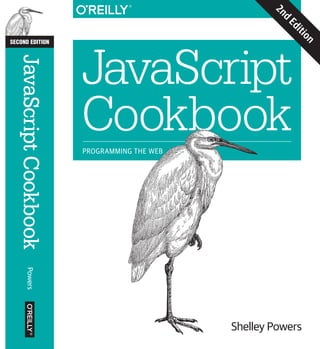
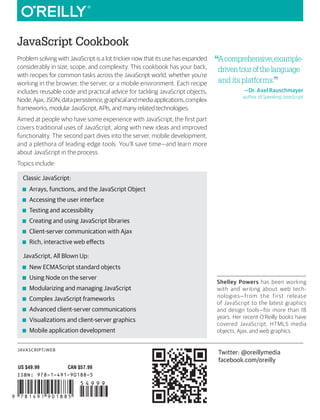
![JavaScript Cookbook, Second Edition
by Shelley Powers
Copyright © 2015 Shelley Powers. All rights reserved.
Printed in the United States of America.
Published by O’Reilly Media, Inc., 1005 Gravenstein Highway North, Sebastopol, CA 95472.
O’Reilly books may be purchased for educational, business, or sales promotional use. Online editions are
also available for most titles (http://safaribooksonline.com). For more information, contact our corporate/
institutional sales department: 800-998-9938 or corporate@oreilly.com.
Editors: Simon St. Laurent and Brian MacDonald
Production Editor: Kara Ebrahim
Copyeditor: Jasmine Kwityn
Proofreader: Kara Ebrahim
Indexer: Judy McConville
Cover Designer: Ellie Volckhausen
Interior Designer: David Futato
Illustrator: Rebecca Demarest
February 2015: Second Edition
Revision History for the Second Edition:
2015-01-23: First release
See http://oreilly.com/catalog/errata.csp?isbn=9781491901885 for release details.
The O’Reilly logo is a registered trademark of O’Reilly Media, Inc. JavaScript Cookbook, Second Edition, the
cover image of a little egret, and related trade dress are trademarks of O’Reilly Media, Inc.
While the publisher and the author have used good faith efforts to ensure that the information and instruc‐
tions contained in this work are accurate, the publisher and the author disclaim all responsibility for errors
or omissions, including without limitation responsibility for damages resulting from the use of or reliance
on this work. Use of the information and instructions contained in this work is at your own risk. If any code
samples or other technology this work contains or describes is subject to open source licenses or the intel‐
lectual property rights of others, it is your responsibility to ensure that your use thereof complies with such
licenses and/or rights.
ISBN: 978-1-491-90188-5
[LSI]
www.it-ebooks.info](https://image.slidesharecdn.com/100390804-250317090306-07eed417/85/Ebook-JavaScript-Cookbook-2nd-Edition_-Programming-the-Web-by-kan-8-320.jpg)
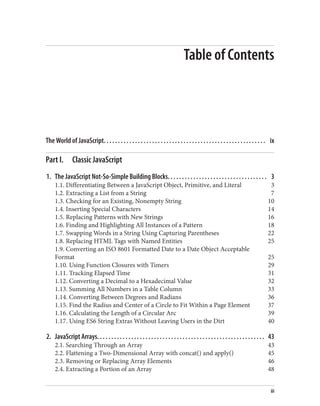
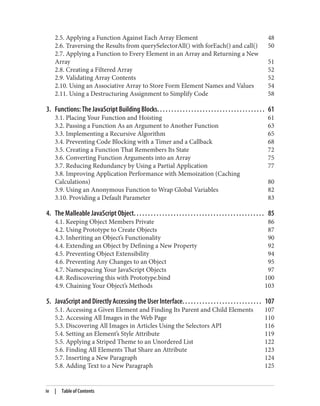
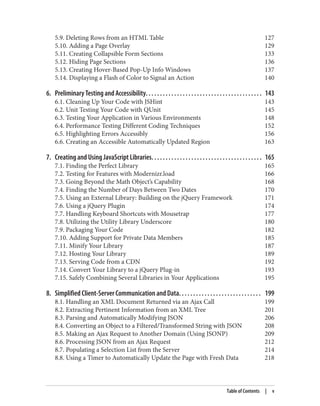
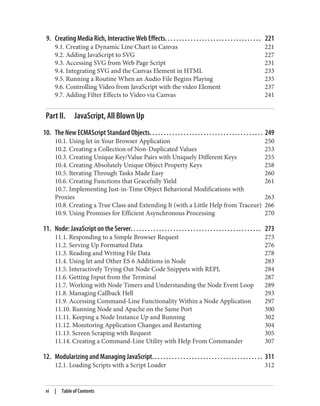




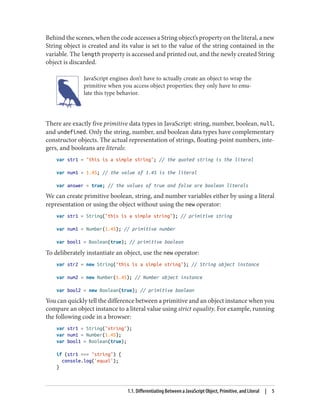
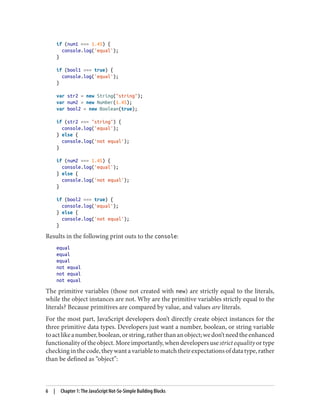
![var num1 = 1.45;
var num2 = new Number(1.45);
console.log(typeof num1); // prints out number
console.log(typeof num2); // prints out object
Code validators, such as JSHint, output a warning if you instantiate a primitive data
type object directly for just this reason.
See Also
Recipe 1.3 has a more detailed look at the strict equality operators, as compared to the
standard equality operators.
1.2. Extracting a List from a String
Problem
You have a string with several sentences, one of which includes a list of items. The list
beginswithacolon(:)andendswithaperiod(.),andeachitemisseparatedbyacomma.
You want to extract just the list.
Before:
This is a list of items: cherries, limes, oranges, apples.
After:
['cherries','limes','oranges','apples']
Solution
The solution requires two actions: extract out the string containing the list of items, and
then convert this string into a list.
Use String’s indexOf() to locate the colon, and then use it again to find the first period
following the colon. With these two locations, extract the string using String’s sub
string():
var sentence = 'This is one sentence. This is a sentence with a list of items:' +
'cherries, oranges, apples, bananas. That was the list of items.';
var start = sentence.indexOf(':');
var end = sentence.indexOf('.', start+1);
var listStr = sentence.substring(start+1, end);
Once you have the string consisting of the list items, use the String split() to break
the string into an array:
1.2. Extracting a List from a String | 7
www.it-ebooks.info](https://image.slidesharecdn.com/100390804-250317090306-07eed417/85/Ebook-JavaScript-Cookbook-2nd-Edition_-Programming-the-Web-by-kan-31-320.jpg)
![var fruits = listStr.split(',');
console.log(fruits); // ['cherries', ' oranges', ' apples', ' bananas']
Discussion
The indexOf() method takes a search value, as first parameter, and an optional begin‐
ning index position, as second.
The list is delimited by a beginning colon character and an ending period. The index
Of() method is used without the second parameter in the first search, to find the colon.
The method is used again but the colon’s position (plus 1) is used to modify the begin‐
ning location of the search for the period:
var end = sentence.indexOf('.',start+1);
If we didn’t modify the search for the ending period, we’d end up with the location of
the first sentence’s period rather than the period for the sentence containing the list.
Once we have the beginning and ending location for the list, we’ll use the sub
string() method, passing in the two index values representing the beginning and end‐
ing positions of the string:
var listStr = sentence.substring(start+1, end);
The extracted string is:
cherries, oranges, apples, bananas
We’ll finish by using split() to split the list into its individual values:
var fruits = listStr.split(',') ; // ['cherries', ' oranges',
' apples', ' bananas']
There is another string extraction method, substr(), that begins extraction at an index
position marking the start of the substring and passing in the length of the substring as
the second parameter. We can easily find the length just by subtracting the beginning
position of the string from the end position:
var listStr = sentence.substr(start+1, end-start);
var fruits = listStr.split(',');
See Also
Another way to extract the string is to use regular expressions and the RegExp object,
covered beginning in Recipe 1.5.
8 | Chapter 1: The JavaScript Not-So-Simple Building Blocks
www.it-ebooks.info](https://image.slidesharecdn.com/100390804-250317090306-07eed417/85/Ebook-JavaScript-Cookbook-2nd-Edition_-Programming-the-Web-by-kan-32-320.jpg)
![Advanced
The result of splitting the extracted string is an array of list items. However, the items
come with artifacts (leading spaces) from sentence white space. In most applications,
we’ll want to clean up the resulting array elements.
We’ll discuss the Array object in more detail in Chapter 2, but for now, we’ll use the
Array forEach() method in addition to the String object’s trim() method to clean up
the array:
fruits = listStr.split(',');
console.log(fruits); // [' cherries', ' oranges', ' apples', ' bananas']
fruits.forEach(function(elmnt,indx,arry) {
arry[indx] = elmnt.trim();
});
console.log(fruits); // ['cherries', 'oranges', 'apples, bananas]
The forEach() method applies the function passed as parameter (the callback) to each
array element. The callback function supports three arguments: the array element value,
and optionally, the array element index and the array itself.
Another simpler approach is to pass a regular expression to the split() that trims the
result before it’s returned:
var fruits = listStr.split(/s*,s*/);
Now the matching returned value is just the string without the surrounding white space.
The forEach() method is also covered in Recipe 2.5. The code in this
section mutates the array in place, which means it actually modifies
the array as it’s traversed. Another nondestructive approach is to use
the newer map() Array method, covered in Recipe 2.7.
Extra: Simplifying the Code Using Chaining
The example code in this recipe is correct, but a little verbose. We can compress the
code by using JavaScript’s method chaining, allowing us to attach one method call to the
end of a previous method call if the object and methods allow it. In this case, we can
chain the split() method directly to the substring() method:
var start = sentence.indexOf(:);
var end = sentence.indexOf(., start+1);
var fruits = sentence.substring(start+1, end).split(,);
1.2. Extracting a List from a String | 9
www.it-ebooks.info](https://image.slidesharecdn.com/100390804-250317090306-07eed417/85/Ebook-JavaScript-Cookbook-2nd-Edition_-Programming-the-Web-by-kan-33-320.jpg)
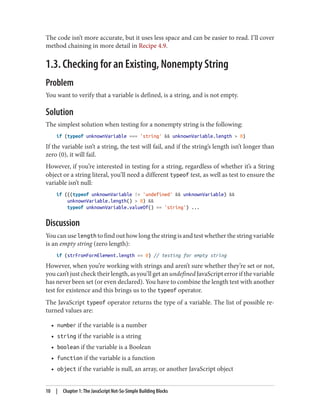
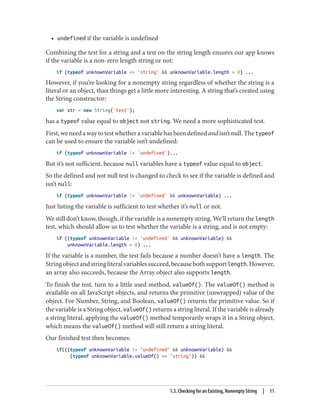
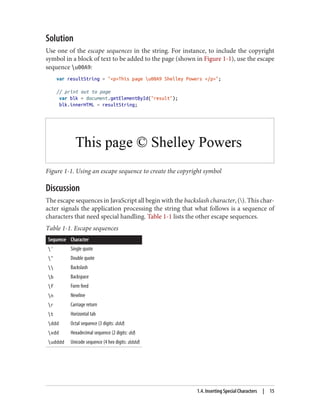
![Character Matches Example
{n} Matches exactly n times /ap{2}/ matches apple but not apie
{n,} Matches n or more times /ap{2,}/ matches all p’s in apple and appple but not apie
{n,m} Matches at least n, at most m times /ap{2,4}/ matches four p’s in apppppple
. Any character except newline /a.e/ matches ape and axe
[…] Any character within brackets /a[px]e/ matches ape and axe but not ale
[^…] Any character but those within brackets /a[^px]/ matches ale but not axe or ape
b Matches on word boundary /bno/ matches the first no in nono
B Matches on nonword boundary /Bno/ matches the second no in nono
d Digits from 0 to 9 /d{3}/ matches 123 in Now in 123
D Any nondigit character /D{2,4}/ matches Now ' in ‘Now in 123;
w Matcheswordcharacter(letters,digits,underscores) /w/ matches j in javascript
W Matches any nonword character (not letters, digits,
or underscores)
/W/ matches % in 100%
n Matches a line feed
s A single whitespace character
S A single character that is not whitespace
t A tab
(x) Capturing parentheses Remembers the matched characters
Regular expressions are powerful but can be tricky. I’m only cover‐
ing them lightly in this book. If you want more in-depth coverage of
regular expressions, I recommend the excellent Regular Expressions
Cookbook by Jan Goyvaerts and Steven Levithan (O’Reilly).
See Also
Recipe 1.7 shows variations of using regular expressions with the String replace meth‐
od, including the use of capturing parenthesis.
1.6. Finding and Highlighting All Instances of a Pattern
Problem
You want to find all instances of a pattern within a string.
18 | Chapter 1: The JavaScript Not-So-Simple Building Blocks
www.it-ebooks.info](https://image.slidesharecdn.com/100390804-250317090306-07eed417/85/Ebook-JavaScript-Cookbook-2nd-Edition_-Programming-the-Web-by-kan-42-320.jpg)
![Solution
Use the RegExp exec method and the global flag (g) in a loop to locate all instances of
a pattern, such as any word that begins with t and ends with e, with any number of
characters in between:
var searchString = Now is the time and this is the time and that is the time;
var pattern = /tw*e/g;
var matchArray;
var str = ;
// check for pattern with regexp exec, if not null, process
while((matchArray = pattern.exec(searchString)) != null) {
str+=at + matchArray.index + we found + matchArray[0] + n;
}
console.log(str);
The results are:
at 7 we found the
at 11 we found time
at 28 we found the
at 32 we found time
at 49 we found the
at 53 we found time
Discussion
The RegExp exec() method executes the regular expression, returning null if a match
is not found, or an object with information about the match, if found. Included in the
returned array is the actual matched value, the index in the string where the match is
found, any parenthetical substring matches, and the original string:
• index: The index of the located match
• input: The original input string
• [0]: The matched value
• [1],…,[n]+: Parenthesized substring matches, if any
The parentheses capture the matched values. Given a regular expression like that in the
following code snippet:
var re = /a(p+).*(pie)/ig;
var result = re.exec(The apples in the apple pie are tart);
console.log(result);
console.log(result.index);
console.log(result.input);
the resulting output is:
1.6. Finding and Highlighting All Instances of a Pattern | 19
www.it-ebooks.info](https://image.slidesharecdn.com/100390804-250317090306-07eed417/85/Ebook-JavaScript-Cookbook-2nd-Edition_-Programming-the-Web-by-kan-43-320.jpg)
![[apples in the apple pie, pp, pie]
4
The apples in the apple pie are tart
The array results contain the complete matched value at index zero (0), and the rest of
the array entries are the parenthetical matches. The index is the index of the match, and
the input is just a repeat of the string being matched. In the solution, the index where
the match was found is printed out in addition to the matched value.
The solution also uses the global flag (g). This triggers the RegExp object to preserve
the location of each match, and to begin the search after the previously discovered
match. When used in a loop, we can find all instances where the pattern matches the
string. In the solution, the following are printed out:
at 7 we found the
at 11 we found time
at 28 we found the
at 32 we found time
at 49 we found the
at 53 we found time
Both time and the match the pattern.
Let’s look at the nature of global searching in action. In Example 1-1, a web page is
created with a textarea and an input text box for accessing both a search string and a
pattern. The pattern is used to create a RegExp object, which is then applied against the
string. A result string is built, consisting of both the unmatched text and the matched
text, except the matched text is surrounded by a span element (with a CSS class used to
highlight the text). The resulting string is then inserted into the page, using the
innerHTML for a div element.
Example 1-1. Using exec and global flag to search and highlight all matches in a text
string
!DOCTYPE html
html
head
titleSearching for strings/title
style
.found
{
background-color: #ff0;
}
/style
/head
body
form id=textsearch
textarea id=incoming cols=150 rows=10
/textarea
p
20 | Chapter 1: The JavaScript Not-So-Simple Building Blocks
www.it-ebooks.info](https://image.slidesharecdn.com/100390804-250317090306-07eed417/85/Ebook-JavaScript-Cookbook-2nd-Edition_-Programming-the-Web-by-kan-44-320.jpg)
![Search pattern: input id=pattern type=text /
/p
/form
button id=searchSubmitSearch for pattern/button
div id=searchResult/div
script
document.getElementById(searchSubmit).onclick=function() {
// get pattern
var pattern = document.getElementById(pattern).value;
var re = new RegExp(pattern,g);
// get string
var searchString = document.getElementById(incoming).value;
var matchArray;
var resultString = pre;
var first=0;
var last=0;
// find each match
while((matchArray = re.exec(searchString)) != null) {
last = matchArray.index;
// get all of string up to match, concatenate
resultString += searchString.substring(first, last);
// add matched, with class
resultString += span class='found' + matchArray[0] + /span;
first = re.lastIndex;
}
// finish off string
resultString += searchString.substring(first,searchString.length);
resultString += /pre;
// insert into page
document.getElementById(searchResult).innerHTML = resultString;
}
/script
/body
/html
Figure 1-2 shows the application in action on William Wordsworth’s poem, “The Kitten
and the Falling Leaves” after a search for the following pattern:
lea(f|ves)
1.6. Finding and Highlighting All Instances of a Pattern | 21
www.it-ebooks.info](https://image.slidesharecdn.com/100390804-250317090306-07eed417/85/Ebook-JavaScript-Cookbook-2nd-Edition_-Programming-the-Web-by-kan-45-320.jpg)
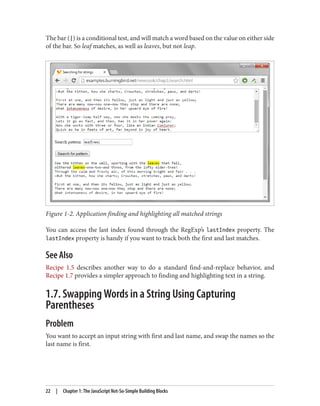
![background-color: #ff0;
}
/style
/head
body
form id=textsearch
textarea id=incoming cols=100 rows=10
/textarea
p
Search pattern: input id=pattern type=text /
/p
/form
button id=searchSubmitSearch for pattern/button
div id=searchResult/div
script
document.getElementById(searchSubmit).onclick=function() {
// get pattern
var pattern = document.getElementById(pattern).value;
var re = new RegExp(pattern,g);
// get string
var searchString = document.getElementById(incoming).value;
// replace
var resultString = searchString.replace(re,span class='found'$/span);
// insert into page
document.getElementById(searchResult).innerHTML = resultString;
}
/script
/body
/html
This is a simpler alternative, but the result isn’t quite the same: the line feeds aren’t
preserved with Example 1-2, but they are with Example 1-1.
The captured text can also be accessed via the RegExp object using the exec() method.
Let’s return to the Recipe 1.7 solution code, this time using exec():
var name = Abe Lincoln;
var re = /^(w+)s(w+)$/;
var result = re.exec(name);
var newname = result[2] + , + result[1];
This approach is handy if you want to access the capturing parentheses values, but
without having to use them within a string replacement.
24 | Chapter 1: The JavaScript Not-So-Simple Building Blocks
www.it-ebooks.info](https://image.slidesharecdn.com/100390804-250317090306-07eed417/85/Ebook-JavaScript-Cookbook-2nd-Edition_-Programming-the-Web-by-kan-48-320.jpg)
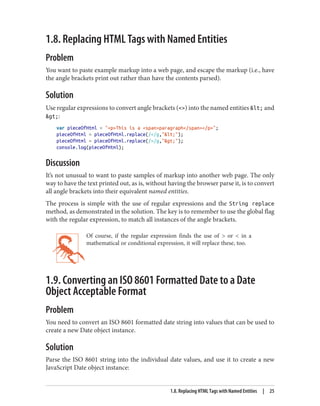


![www.webre24h.com - [Wordware] advanced javascript, 3rd ed. - [easttom]](https://cdn.slidesharecdn.com/ss_thumbnails/wordware-advancedjavascript3rded-160421130838-thumbnail.jpg?width=640&height=640&fit=bounds)


![[PDF]_Learning_ECMAScript_6.pdf](https://cdn.slidesharecdn.com/ss_thumbnails/pdflearningecmascript6-220528214349-96293cd1-thumbnail.jpg?width=640&height=640&fit=bounds)

![Backend Development Bootcamp - Node [Online & Offline] In Bangla](https://cdn.slidesharecdn.com/ss_thumbnails/backendboothcamp-200705133638-thumbnail.jpg?width=640&height=640&fit=bounds)


