Download the Full Version of textbook for Fast Typing at textbookfull.com
Learning Node Moving to the Server Side Early
Release Shelley Powers
https://textbookfull.com/product/learning-node-moving-to-
the-server-side-early-release-shelley-powers/
OR CLICK BUTTON
DOWNLOAD NOW
Download More textbook Instantly Today - Get Yours Now at textbookfull.com
Recommended digital products (PDF, EPUB, MOBI) that
you can download immediately if you are interested.
Node js web development server side development with Node
10 made easy Fourth Edition. Edition David Herron
https://textbookfull.com/product/node-js-web-development-server-side-
development-with-node-10-made-easy-fourth-edition-edition-david-
herron/
textboxfull.com
Node js 8 the Right Way Practical Server Side JavaScript
That Scales 1st Edition Jim Wilson
https://textbookfull.com/product/node-js-8-the-right-way-practical-
server-side-javascript-that-scales-1st-edition-jim-wilson/
textboxfull.com
Node js Design Patterns Master best practices to build
modular and scalable server side web applications 2nd
Edition Casciaro
https://textbookfull.com/product/node-js-design-patterns-master-best-
practices-to-build-modular-and-scalable-server-side-web-
applications-2nd-edition-casciaro/
textboxfull.com
Learning PHP MySQL JavaScript Early Release 6th Edition
Robin Nixon
https://textbookfull.com/product/learning-php-mysql-javascript-early-
release-6th-edition-robin-nixon/
textboxfull.com
Server Side Swift Paul Hudson
https://textbookfull.com/product/server-side-swift-paul-hudson/
textboxfull.com
Building React Apps with Server Side Rendering Use React
Redux and Next to Build Full Server Side Rendering
Applications Thakkar Mohit
https://textbookfull.com/product/building-react-apps-with-server-side-
rendering-use-react-redux-and-next-to-build-full-server-side-
rendering-applications-thakkar-mohit/
textboxfull.com
Building React Apps with Server Side Rendering Use React
Redux and Next to Build Full Server Side Rendering
Applications Thakkar Mohit
https://textbookfull.com/product/building-react-apps-with-server-side-
rendering-use-react-redux-and-next-to-build-full-server-side-
rendering-applications-thakkar-mohit-2/
textboxfull.com
Exploring Blazor: Creating Hosted, Server-side, and
Client-side Applications with C# Taurius Litvinavicius
https://textbookfull.com/product/exploring-blazor-creating-hosted-
server-side-and-client-side-applications-with-c-taurius-litvinavicius/
textboxfull.com
Hands On Machine Learning with Scikit Learn and TensorFlow
Early Release 2nd Edition Aurélien Géron
https://textbookfull.com/product/hands-on-machine-learning-with-
scikit-learn-and-tensorflow-early-release-2nd-edition-aurelien-geron/
textboxfull.com
Learning Node Second Edition
Author Name
Learning Node
by Shelley Powers
Copyright © 2016 Shelly Powers. All rights reserved.
Printed in the United States of America.
Published by O’Reilly Media, Inc. , 1005 Gravenstein Highway North, Sebasto-
pol, CA 95472.
O’Reilly books may be purchased for educational, business, or sales promotion-
al use. Online editions are also available for most titles ( http://safaribookson-
line.com ). For more information, contact our corporate/institutional sales de-
partment: 800-998-9938 or corporate@oreilly.com .
• Editor: Meg Foley
• Production Editor: FILL IN PRODUCTION EDITOR
• Copyeditor: FILL IN COPYEDITOR
• Proofreader: FILL IN PROOFREADER
• Indexer: FILL IN INDEXER
• Interior Designer: David Futato
• Cover Designer: Karen Montgomery
• Illustrator: Rebecca Demarest
• January -4712: Second Edition
Revision History for the Second Edition
• 2016-03-15: First Early Release
See http://oreilly.com/catalog/errata.csp?isbn=9781491943052 for release
details.
The O’Reilly logo is a registered trademark of O’Reilly Media, Inc. Learning
Node, the cover image, and related trade dress are trademarks of O’Reilly Me-
dia, Inc.
While the publisher and the author(s) have used good faith efforts to ensure
that the information and instructions contained in this work are accurate, the
publisher and the author(s) disclaim all responsibility for errors or omissions,
including without limitation responsibility for damages resulting from the use
of or reliance on this work. Use of the information and instructions contained in
this work is at your own risk. If any code samples or other technology this work
contains or describes is subject to open source licenses or the intellectual prop-
erty rights of others, it is your responsibility to ensure that your use thereof
complies with such licenses and/or rights.
978-1-491-94305-2
[FILL IN]
Table of Contents
Preface ix
CHAPTER 1: The Node Environment 15
Installing Node 15
Saying Hello to the World with Node 17
A Basic Hello World Application 17
Hello World, Tweaked 21
Node Command-Line Options 24
Node Hosting Environments 25
Hosting Node on Your Server, VPS, or Managed Host 25
Cloud Hosting 26
The Node LTS and Upgrading Node 27
Node’s New Semantic Versioning 27
Upgrading Node 29
Node, V8, and ES6 30
Advanced: Node C/C++ Add-ons 31
CHAPTER 2: Node Building Blocks: the Global Objects, Events, and Node’s
Asynchronous Nature 33
The global and process objects 33
The global Object 34
The process Object 35
Buffers, Typed Arrays, and Strings 39
iii
Buffer, JSON, StringDecoder, and UTF-8 Strings 41
Buffer Manipulation 43
Node’s Callback and Asynchronous Event Handling 46
The Event Queue (Loop) 47
Creating an Asynchronous Callback Function 50
EventEmitter 53
The Node Event Loop and Timers 57
Nested Callbacks and Exception Handling 60
CHAPTER 3: Basics of Node Modules and Npm 71
An Overview of the Node Module System 71
How Node Finds and Loads a Module 72
Sandboxing and the VM Module 76
An In-Depth Exploration of NPM 80
Creating and Publishing Your Own Node Module 86
Creating a Module 86
Packaging an Entire Directory 87
Preparing Your Module for Publication 88
Publishing the Module 92
Discovering Node Modules and Three Must-Have Modules 93
Better Callback Management with async 94
Command-Line Magic with Commander 100
The Ubiquitous Underscore 102
CHAPTER 4: Interactive Node with REPL and More on the Console 105
REPL: First Looks and Undefined Expressions 105
Benefits of REPL: Getting a Closer Understanding of JavaScript Under
the Hood 107
Multiline and More Complex JavaScript 108
REPL Commands 113
REPL and rlwrap 114
Custom REPL 115
Stuff Happens—Save Often 119
The Necessity of Console 120
Console Message Types, Console Class, and Blocking 120
Table of Contents
iv
Formatting the Message, with Help From util.format() and
util.inspect() 122
Providing Richer Feedback with console and a Timer 126
CHAPTER 5: Node and the Web 129
The HTTP Module: Server and Client 129
What’s Involved in Creating a Static Web Server 134
Using Apache to Proxy a Node Application 143
Parsing the Query with Query String 145
DNS Resolution 146
CHAPTER 6: Node and the Local System 149
Exploring the Operating System 149
Streams and Pipes 151
A Formal Introduction to the File System (fs) 153
The fs.Stats Class 153
The File System Watcher 155
File Read and Write 156
Directory Access and Maintenance 158
File Streams 158
Resource Access with Path 161
Creating a Command-Line Utility 163
Compression/Decompression with ZLib 165
Pipes and ReadLine 169
CHAPTER 7: Networking, Sockets, and Security 173
Servers, Streams, and Sockets 173
Sockets and Streams 173
TCP Sockets and Servers 174
UDP/Datagram Socket 180
Guards at the Gate 181
Setting Up TLS/SSL 181
Working with HTTPS 183
The Crypto Module 186
CHAPTER 8: Child Processes 191
Table of Contents
v
child_process.spawn 191
child_process.exec and child_process.execFile 194
child_process.fork 196
Running a Child Process Application in Windows 197
CHAPTER 9: Node and ES6 199
Strict Mode 199
let and const 201
Arrow Functions 203
Classes 205
Promises with Bluebird 208
CHAPTER 10: Full-stack Node Development 213
The Express Application Framework 213
MongoDB and Redis Database Systems 219
MongoDB 219
Redis Key/Value Store 223
AngularJS and Other Full-Stack Frameworks 231
CHAPTER 11: Node in Development and Production 239
Debugging Node Applications 239
The Node Debugger 239
Node Inspector 245
Unit Testing 248
Unit Testing with Assert 248
Unit Testing with Nodeunit 252
Other Testing Frameworks 254
Keeping Node Up and Running 257
Benchmark and Load Testing with Apache Bench 260
CHAPTER 12: Node in New Environments 263
Samsung IoT and GPIO 263
Windows with Charka Node 265
Node for Microcontrollers and Microcomputers 266
Fritzing 267
Table of Contents
vi
Node and Adruino 270
Node and Raspberry Pi 2 275
Table of Contents
vii
Preface
Node.js has been around long enough to have achieved adoption by some ma-
jor players (LinkedIn, Yahoo!, and Netflix), but is still young enough to be cause
for concern from your typical corporate middle manager. It’s become a driving
force for a more sophisticated JavaScript, as well as the only safe place one can
then use the newly improved scripting language. And, since turn-about is fair
play, the cutting edge JavaScript has now become the driver for a newly re-
vamped Node.js organization and release paradigm.
Node.js has also redefined what we do with JavaScript. Nowadays, an em-
ployer is just as likely to demand that JavaScript developers work in a server
environment, as well as the more familiar browser. In addition, Node.js has cre-
ated a new server language that’s generating attention from Ruby, C++, Java,
and PHP server-side developers. Especially if these same developers also know
JavaScript.
To me, Node.js is fun. Compared to so many other environments, it takes lit-
tle effort to get started, to create and host an application, and to try out new
things. The scaffolding necessary for a Node project just isn’t as complex, or pe-
dantic, as what’s required for other environments. Only PHP has as simple an
environment, and even it requires tight integration with Apache to create
outward-facing applications.
As simple as it is, though, Node.js has its bits that can be hard to discover.
Learning Node.js requires obtaining a mastery of its environment and the core
APIs, true. But it’s also about finding and mastering these hard-to-discover
bits.
The Learning Node Audience
I see two audiences for this book.
The first audience is the developer who has been creating front-end applica-
tions using a variety of libraries and frameworks, who now wants to take their
JavaScript skills to the server.
The second audience is the server-side developer who wants to try some-
thing new, or needs to make a shift to a newer technology. They’ve worked with
ix
Java or C++, Ruby or PHP, but now they want to take the JavaScript they’ve
picked up over time, and their knowledge of the server environment, and
merge the two.
Two seemingly separate audiences with one shared knowledge: JavaScript.
Or ECMAScript if you want to be more precise. This book does require that you
are very comfortable with working with JavaScript. Another commonality is
that both audiences need to learn the same Node basics, including the core
Node API.
However, each audience brings a different perspective, and skills, to the
learning experience. To enhance the usefulness, I’ll work to incorporate both
perspectives into the material. For instance, a C++ or Java developer might be
interested in creating C++ Node add-ons, which might not be interesting to the
front-end developer. At the same time, some concepts like big-endian may be
very familiar to the server-side developer, but unknown to the front-end per-
son. I can’t dive too deeply into either viewpoint, but I will work to ensure all
readers don’t come away frustrated or bored.
One thing I’m not going to do is force rote memorization on you. We’ll get
into the core module APIs, but I’m not going to cover every object and function,
because these are documented at the Node web site. What I’ll do instead is
touch on important aspects of each core module or specific Node functionality I
think is essential in order to, hopefully, give you a baseline so you can hold your
own with other Node developers. Of course, practice makes mastery, and this
book is a learning tool. Once you’re finished with the book you’ll need to con-
tinue on for more in-depth introductions to specific types of functionality, such
as working the MEAN (Mongo-Express-Angular-Node) stack. But you’ll have the
grounding you need to branch out in any of the many Node directions.
SPEAKING OF NODE DOCUMENTATION
At the time this was written, several of us were involved in discussions associated
with various issues associated with the Node.js website. Among them is defining
what is the “current” version of Node.js, which is what should be documented
when one accesses “the” documentation.
When last I joined the discussion, the plan was to list all current LTS (Long Term
Support) versions of Node.js in the /docs page, as well as the most current Stable
release, and to provide a dropdown or other indicator for Node documentation ver-
sions on the top of each documentation page.
Eventually, the documentation people would like to generate “version diffs” of the
API for each page, but that’s going to be a challenging project.
x
Preface
We’re still discussing what exactly what “current” is for when people access
the /api URL. At this time, it’s the latest Stable release, but several of us believe it
should be the latest LTS release.
Regardless, when you do access documentation of APIs at the Node.js web site, al-
ways check to make sure the documentation matches your version of Node.js. And it
doesn’t hurt to check newer versions to see what new thing is coming your way.
NODE.JS BECOMES NODE
The formal name is Node.js, but no one uses it. Everyone uses “Node”.
End of story. And that’s what we’ll be using, for the most part, from this
point on.
Book Structure
Learning Node is a back-to-basics book. It’s focus is on Node, and the modules
that make up Node core. I do lightly touch on some third-party modules, and
provide extensive coverage of npm, of course, but the primary goal of this book
is to bring you, the reader, up to speed on basic Node functionality. From this
solid platform, you can then move in the directions you need to move.
Chapter 1 includes an introduction to Node, including a brief section on
how to install it. You’ll also get a chance to take Node out for a spin, first by cre-
ating the web server listed in the Node documentation, and then by creating a
bit more advanced server using the code I provide. In addition, I’ll also touch on
creating Node add-ons, for the C/C++ coders among you. And what would an
introduction to Node be without an overview of the history of this application,
that actually released at version 4.0, rather than version 1.0.
Chapter 2 covers essential Node functionality including how events are han-
dled, the global objects underlying the necessary functionality to create Node
applications, and the asynchronous nature of Node. In addition, I also cover the
buffer object, which is the data structure transmitted via most network services
in Node.
Chapter 3 dives into the nature of Node’s module system, as well as provid-
ing an in-depth look at npm, a Node third-party module management system.
In this chapter, you’ll discover how your application finds the Node modules
you’re using, and how you can create a Node module of your own to use. Lastly,
I get into the more advanced aspects of Node functionality by exploring the
support for sandboxing. Just for fun, I also cover three popular Node third-party
modules: Async, Commander, and Underscore.
xi
Preface
The interactive console that comes with Node, and which goes by the name
of REPL, is an invaluable learning tool and environment, and it gets its own
chapter in Chapter 4. I cover how to use the tool, in detail, as well as how to
create your own custom REPL.
We explore developing Node applications for the web in Chapter 5, includ-
ing taking a much closer look at the Node modules that support web develop-
ment. You’ll get a chance to see what it takes to create a fully functional static
web server, as well as learning how you can run a Node application alongside
Apache, via the use of an Apache proxy.
Node works in a variety of environments, including both Windows and Unix-
based systems such as the Mac OS X, and Linux. It does so by providing a set of
functionality that normalizes system differences, and this functionality is ex-
plored in Chapter 6. In addition, I also cover the fundamental nature of Node
streams and pipes—essential elements of all input/output—as well as exploring
Node’s file system support.
Chapter 7 is all about networks, and you can’t touch on networking without
also touching on security. The two should go hand-in-hand, like peanut butter
and jelly, or chocolate with anything. I’ll introduce you to Node’s TCP and UDP
support, as well as cover how to implement an HTTPS server, in addition to the
HTTP server you learned how to create in Chapter 5. I’ll also cover the mechan-
ics behind digital certificates and the fundamentals of SSL (Secure Sockets Lay-
er), and its upgrade, TLS (Transport Layer Security). Lastly, we’ll look at the
Node crypto module, or storing encrypted data.
One of my favorite aspects of Node is its ability to work with operating sys-
tem functionality via child processes. Some of my favorite Node applications are
small utility programs for working with compressed files, the popular graphics
application, ImageMagick, and creating a screenshot application for grabbing
screenshots from web sites. They’re not big-time applications with sophistica-
ted cloud interfaces, but they are a fun way to learn to work with child process-
es. Child processes are covered in Chapter 8.
Most of the examples in the book are using the same JavaScript you’ve been
using for years. However, one of the main impetuses behind the io.js split, and
the new, merged release schedule, is support for the newer ECMAScript ver-
sions, such as ES 6 (or ECMAScript 2015, if you prefer). In Chapter 9, I’ll cover
what’s currently supported in Node, the impact of the new functionality, and
when to use new functionality over old, and why. I’ll also cover the gotchas re-
lated to using the newer JavaScript capabilities. One specific ES 6 functionality
we’ll look at is the concept of promises, for asynchronous development.
Chapter 10 takes a look at the frameworks and functionality that make up
what is known as full stack Node development. We’ll take a look at Express, a
now ubiquitous component of most Node development, as well as trying out
both MongoDB and Redis. We’ll also explore a couple of the frameworks that
xii
Preface
make up the “full stack” in full stack Node Development: AngularJS and Back-
bone.js.
Once you’ve coded your Node application, you’ll want to push it to produc-
tion. Chapter 11 covers tools and techniques for Node development and pro-
duction support, including unit, load, and benchmark testing, as well as essen-
tial debugging skills and tools. You’ll also learn how to run your Node applica-
tion forever, and restore it if it fails.
Chapter 12 is dessert. In this chapter, I’ll introduce you to the ways of taking
your mad Node skills to all new worlds, including Node in microcontrollers/
microcomputers, as a part of the Internet-of-Things, and a version of Node that
does not run on V8.
xiii
Preface
The Node Environment
Forget what you’ve heard about Node being a server-side tool only. Node is pri-
marily used in server applications, true. But Node can be installed on almost
any machine and used for any purpose, including running applications on your
PC or even your tablet, smartphone, or microcomputer.
I have Node installed on my Linux-based server, but I also have it installed
on my Windows 10-based PCs, as well as a microcomputer (Raspberry Pi). I
have an extra Android tablet that I’m thinking of trying Node on, can use Node
to program my Adruino Uno microcontroller, and am currently playing around
with incorporating Node into my smart home setup thanks to IFTTT’s Maker
Channel. On my PC, I use Node as a test environment for JavaScript, as well as
an interface to ImageMagick for batch photo editing. Node is my go-to tool for
any batch operation on my PCs or my server.
And yes, I use Node for server-side processing when I want a web interface
that bypasses my Apache server, or provides a back-end server process for a
web application.
The point is, the Node environment is rich in functionality and reach. To start
exploring this environment, we have to start at the beginning: installing Node.
IFTTT
IFTTT is a marvelous site that allows you to connect triggers and actions
from a host of companies, services, and products using simple if-then
logic. Each end point of the equation is a channel, including the afore-
mentioned Maker Channel.
Installing Node
The best place to start when installing Node is the Node.js Downloads page.
From here, you can download binaries (pre-compiled executables) for Win-
dows, Mac OS, SunOS, Linux, and ARM architectures. The page also provides ac-
cess to installers for a specific architecture that can greatly simplify the installa-
15
1
tion process—particularly with Windows. If your environment is set up for build-
ing, download the source code and build Node, directly. That’s my preference
for my Ubuntu server.
You can also install Node using a package installer for your architecture. This
is a helpful option not only for installing Node, but also keeping it up to date (as
we’ll discuss further, in the section on Upgrading Node).
If you decide to compile Node directly on your machine, you’ll need to set up
the proper build environment, and install the proper build tools. For instance,
on Ubuntu (Linux), you’ll need to run the following command to install the tools
needed for Node:
apt-get install make g++ libssl-dev git
There are some differences in behavior when first installing Node in the vari-
ous architectures. For instance, when installing Node in Windows, the installer
not only installs Node, it also creates a Command window you’ll use to access
Node on your machine. Node is a command-line application, and doesn’t have
a graphical UI like the typical Windows application. If you want to use Node to
program an Arduino Uno, you’ll install Node and Johnny-Five, and use both to
program the connected device.
ACCEPT DEFAULTS IN WINDOWS WORLD
You’ll want to accept the default location and feature installation when
installing Node in Windows. The installer adds Node to the PATH vari-
able, which means you can type “node” without having to provide the
entire Node installation path.
If you’re installing Node on Raspberry Pi, download the appropriate ARM
version, such as ARMv6 for the original Raspberry Pi, and ARMv7 for the newer
Raspberry Pi 2. Once downloaded, extract the binary from the compressed tar-
ball, and then move the application to /usr/local:
wget https://nodejs.org/dist/v4.0.0/node-v4.0.0-linux-armv7l.tar.gz
tar -xvf node-v4.0.0-linux-armv7l.tar.gz
cd node-v4.0.0-linux-armv7l
sudo cp -R * /usr/local/
You can also set up a build environment and build Node directly.
CHAPTER 1: The Node Environment
16
NEW NODE ENVIRONMENTS
Speaking of Node with Arduino and Raspberry Pi, I cover Node in non-
traditional environments, such as the Internet of Things, in Chapter 12.
Saying Hello to the World with Node
You’ve just installed Node and you naturally want to take it for a spin. There is a
tradition among programmers that the first application in a language is the
well-known “Hello, World” application. The application typically writes out the
words “Hello, World” to whatever is the output stream, demonstrating how an
application is created, run, and can process input and output.
The same holds for Node: it is the application that the Node.js includes in
the Synopsis in the application’s documentation. And it is the first application
we’ll create in this book, but with a few tweaks.
A Basic Hello World Application
First, let’s take a look at the “Hello, World” application included in the Node
documentation. To re-create the application, create a text document with the
following JavaScript, using your favorite text editing tool. I use Nodepad++ in
Windows, and Vim in Linux.
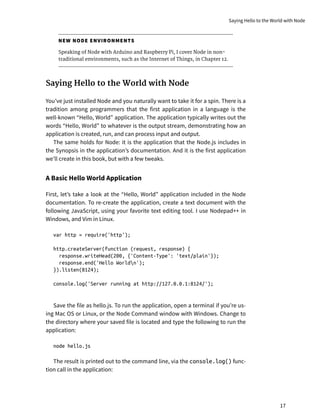
var http = require('http');
http.createServer(function (request, response) {
response.writeHead(200, {'Content-Type': 'text/plain'});
response.end('Hello Worldn');
}).listen(8124);
console.log('Server running at http://127.0.0.1:8124/');
Save the file as hello.js. To run the application, open a terminal if you’re us-
ing Mac OS or Linux, or the Node Command window with Windows. Change to
the directory where your saved file is located and type the following to run the
application:
node hello.js
The result is printed out to the command line, via the console.log() func-
tion call in the application:
Saying Hello to the World with Node
17
FIGURE 1-1
Figure 1-1: Your first
Node application
Server running at http://127.0.0.1:8124/
Now open a browser and type either http://localhost:8124/ or
http://127.0.0.1:8124 into the address bar (or your domain, if you’re host-
ing Node on your server). What appears is a simple unadorned web page with
“Hello World” in text at the top, as shown in Figure 1-1.
If you’re running your application in Windows, you’ll most likely receive a
Windows Firewall alert, as shown in Figure 1-2. Uncheck the Public Network op-
tion, check the Private network option, and then click the button to Allow ac-
cess.
CHAPTER 1: The Node Environment
18
FIGURE 1-2
Figure 1-2: Allowing
access to Node
application in
Windows
figure1-2.png
You won’t have to repeat this process in Windows: the system remembers
your choice.
To end the program, you can either close the terminal/Command window
(just terminal from this point), or type CTRL-C. When you ran the application,
you did so in the foreground. This means you can’t type any other command in
the terminal. It also means when you closed the terminal, you stopped the
Node process.
RUNNING NODE FOREVER
For now, running Node in the foreground is a good thing. You’re learning
how to use the tool, you don’t yet want your applications to be externally
available to everyone, and you want it to terminate when you’re finished
for the day. In Chapter 11, I’ll cover how you can create a more robust
Node runtime environment.
To return to the Hello World code, the JavaScript creates a web server that
displays a web page with the words, “Hello World” when accessed via a brows-
er. It demonstrates several key components of a Node application.
First, it includes the module necessary to run a simple HTTP server: the ap-
propriately named HTTP module. External functionality for Node is incorpora-
Saying Hello to the World with Node
19
ted via modules that export specific types of functionality that can then be used
in an application (or another module). They’re very similar to the libraries
you’ve used in other languages.
var http = require('http');
NODE MODULES, CORE MODULES, AND THE HTTP MODULE
The HTTP module is one of Node’s core modules, all of which are the pri-
mary focus of this book. I’ll cover Node modules and module manage-
ment thoroughly in Chapter 3, and the HTTP module in Chapter 5.
The module is imported using the Node require statement, and the result
assigned to a local variable. Once imported, the local variable can be used to
instantiate the web server, via the http.createServer() function. In the
function parameters, we see one of the fundamental constructs of Node: the
callback (bold text in the code). It’s the anonymous function that’s passing the
web request and response into the code to process the web request and pro-
vide a response.
http.createServer(function (request, response) {
response.writeHead(200, {'Content-Type': 'text/plain'});
response.end('Hello Worldn');
}).listen(8124);
Since JavaScript is single-threaded, the way Node emulates an asynchro-
nous environment in a single-threaded environment is via an event loop, with
associated callback functions that are called once a specific event has been
triggered. In the example, when a web request is received, the callback function
is called.
The console.log() message is output to the terminal as soon as the call to
create the server is made. The program doesn’t stop and block, waiting for a
web request to be made.
console.log('Server running at http://127.0.0.1:8124/');
MORE ON THE EVENT LOOP AND CALLBACK FUNCTION
I’ll be covering the Node event loop, its support for asynchronous pro-
gramming, and the callback function in more detail in Chapter 2.
Once the server is created and has received a request, the callback function
writes a plain text header with server status of 200 back to the browser, writes
out the Hello World message, and then ends the response.
CHAPTER 1: The Node Environment
20
Congratulations, you’ve created your first web server in Node in just few
lines of code. Of course, it’s not particularly useful, unless your only interest is
in greeting the world. Throughout the book you’ll learn how to make more use-
ful Node applications, but before we leave Hello World, let’s make some modifi-
cations to the basic application to make it a little more interesting.
Hello World, Tweaked
Just printing out a static message does demonstrate that the application is,
first of all, working and, second, how to create a simple web server. The basic
example also demonstrated several key elements of a Node application. But it
could be just a little richer, a little more fun to play with. So I tweaked it to pro-
vide you a second application you can try out that has a few more moving
parts.
The tweaked code is in Example 1-1. In it, I modified the basic application to
parse the incoming request to look for a query string. The name in the string is
extracted and used to determine the type of content returned. Almost any
name will return a personalized response, but if you use name=burningbird as
the query, you’ll get an image. If no query string is used, or no name passed, the
name variable is set to “world”.
EXAMPLE 1-1. Hello World, Tweaked
var http = require('http');
var fs = require('fs');
http.createServer(function (req, res) {
var name = require('url').parse(req.url, true).query.name;
if (name === undefined) name = 'world';
if (name == 'burningbird') {
var file = 'phoenix5a.png';
fs.stat(file, function (err, stat) {
if (err) {
console.error(err);
res.writeHead(200, {'Content-Type': 'text/plain'});
res.end("Sorry, Burningbird isn't around right now n");
} else {
var img = fs.readFileSync(file);
res.contentType = 'image/png';
res.contentLength = stat.size;
res.end(img, 'binary');
}
});
} else {
Saying Hello to the World with Node
21
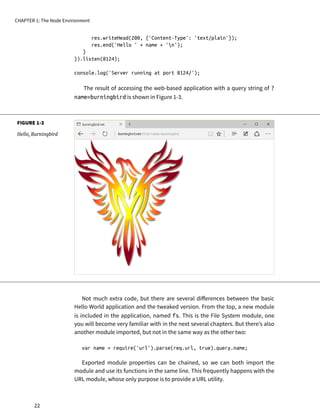
FIGURE 1-3
Hello, Burningbird
res.writeHead(200, {'Content-Type': 'text/plain'});
res.end('Hello ' + name + 'n');
}
}).listen(8124);
console.log('Server running at port 8124/');
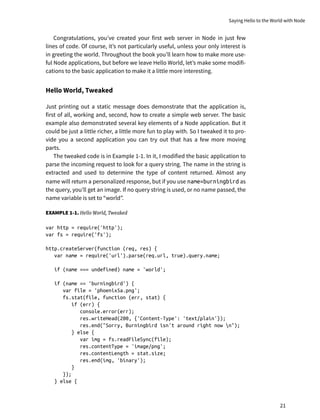
The result of accessing the web-based application with a query string of ?
name=burningbird is shown in Figure 1-3.
Not much extra code, but there are several differences between the basic
Hello World application and the tweaked version. From the top, a new module
is included in the application, named fs. This is the File System module, one
you will become very familiar with in the next several chapters. But there’s also
another module imported, but not in the same way as the other two:
var name = require('url').parse(req.url, true).query.name;
Exported module properties can be chained, so we can both import the
module and use its functions in the same line. This frequently happens with the
URL module, whose only purpose is to provide a URL utility.
CHAPTER 1: The Node Environment
22
The response and request parameter variable names are shortened to res
and req make them easier to access. Once we parse out the request to get the
name value, we first test to see if it’s undefined. If not, the value is set to the
fallback result, world. If name does exist, it’s tested again to see if it’s equal to
burningbird. If it isn’t, then the response is close to what we had in the basic
application, except inserting the supplied name into the return message.
If the name is burningbird, though, we’re dealing with an image rather
than text. The fs.stat() method not only verifies that the file exists, but also
returns an object with information about the file, including its size. This value is
used in creating the content header.
If the file doesn’t exist, the application handles the situation gracefully: it is-
sues a friendly message that the bird has flown the coop, but also provides er-
ror information at the console, using the console.error() method this time:
{ [Error: ENOENT: no such file or directory, stat 'phoenix5a.png']
errno: -2,
code: 'ENOENT',
syscall: 'stat',
path: 'phoenix5a.png' }
If the file does exist, then we’ll read the image into a variable and return it in
the response, adjusting the header values accordingly.
The fs.stats() method uses the standard Node callback function pattern
with the error value as the first parameter—frequently called an errback. How-
ever, the part about reading the image may have you scratching your head. It
doesn’t look right, not like other Node functions you’ve seen in this chap-
ter (and most likely in other online examples). What’s different is that I’m using
a synchronous function, readFileSync(), rather than the asynchronous ver-
sion, readFile().
Node does support both synchronous and asynchronous versions of most
File System functions. Normally, using a synchronous operation in a web re-
quest in Node is taboo, but the capability is there. An asynchronous version of
the same bit of code is the following:
fs.readFile(file, function(err,data) {
res.contentType = 'image/png';
res.contentLength = stat.size;
res.end(data, 'binary');
});
Why use one over the other? In some circumstances, file I/O may not impact
on performance regardless of which type of function you use, and the synchro-
nous version can be cleaner and easier to use. It can also lead to less nested
Saying Hello to the World with Node
23
code—a particular problem with Node’s callback system, and one in which I’ll
cover in more detail in Chapter 2.
Additionally, though I don’t use exception handling in the example, you can
use try...catch with synchronous functions. You can’t use this more tradi-
tional error handling with asynchronous functions (hence the error value as the
first parameter to the anonymous callback function).
The important fact to take away from this second example, though, is that
not all Node I/O is asynchronous.
FILE SYSTEM AND URL MODULES, BUFFERS, AND
AYNCHRONOUS I/O
I’ll cover URL in more detail in Chapter 5, and File System is explored in
Chapter 6. Note, though, that File System is used all throughout the
book. Buffers and asynchronous processing are covered in Chapter 2.
Node Command-Line Options
In the last two sections, Node is invoked at the command line without the use
of any command-line options. I wanted to briefly introduce some of these op-
tions before we move on. Others will be introduced when needed throughout
the book.
To discover all the available options and arguments, use the help option,
written as either -h or --help:
$ node --help
This option will list out all of the options and provides the syntax to follow
when running the Node application:
Usage: node [options] [ -e script | script.js ] [arguments]
node debug script.js [arguments]
To find the version of Node, use the following command:
$ node -v or --version
To check the syntax of a Node application, use the -c option. This checks the
syntax without running the application:
$ node -c or --check script.js
To discover the V8 options, type the following:
CHAPTER 1: The Node Environment
24
$ node --v8-options
This returns several different options, including the --harmony option,
used to enable all completed Harmony JavaScript features. This includes all
ES6 functionality that’s been implemented but not yet staged into either the
LTS or Stable release.
A favorite Node option of mine is -p or --print, which can evaluate a line of
Node script and print the results. This is especially helpful if you’re checking out
the Process environmental properties, discussed more fully in Chapter 2. An ex-
ample is the following, which prints out all of the values for the process.env
property:
$ node -p "process.env"
Node Hosting Environments
As you learn Node, you’ll want to become familiar with it in your own local envi-
ronment, be it Windows, Mac OS, or Linux. When you’re ready to start providing
greater access to your applications, you’ll either need to find an environment
where you can run a Node application, such as a virtual private network (VPN),
which is what I use, or a host that specifically provides for Node application
support. The former requires that you have significant experience running a
internet-faced server, while the latter may limit what you can or cannot do with
your Node application.
Hosting Node on Your Server, VPS, or Managed Host
Hosting Node on the same server you have your WordPress weblog is likely go-
ing to be a dead end, because of Node’s requirements. You don’t have to have
root or administrative access to run Node, but you should. In addition, many
hosting companies are not going to be happy with you hosting an application
on various ports that may or may not play havoc with their systems.
Hosting Node on a virtual private server (VPS), like my VPN at Linode, is a
simple matter. You do have root access for your VPS and can pretty much do
whatever you want, as long as you don’t endanger other users who may be on
the same machine. Most companies that provide VPSs ensure that each individ-
ual account is isolated from the others, and that no one account can hog all the
available resources either.
The issue, though, with a VPS is the same issue you’d have if you hosted your
own server: you have to maintain the server. This includes setting up an email
system, and alternative web server, most likely Apache or Nginx, handle fire-
walls and other security, email, etc. It’s not trivial.
Saying Hello to the World with Node
25
Still, if you’re comfortable with managing all aspects of a internet-faced en-
vironment, a VPS can be an affordable option for hosting a Node application. At
least until you’re ready to push it into production, in which case you may want
to look at hosting the application in the cloud.
Cloud Hosting
Nowadays, an application is just as likely to reside in a cloud server rather than
an individual or group’s own computers. Node applications are well-suited to
cloud-based implementations.
When you host a Node application in the cloud, what you’re really doing,
typically, is creating the application on your own server or PC, testing it, making
sure it’s what you want, and then pushing the application out to the cloud serv-
er. A cloud server for Node allows you to create the Node application you want
to create, using the resources of whatever database system or other system you
wish, but without having to manage the server, directly. You can focus specifi-
cally on the Node application without having to worry about FTP or email
servers, or general server maintenance.
GIT AND GITHUB: PREREQUISITES FOR NODE DEVELOPMENT
If you’ve not used the Git source code control system, you’ll need to install it into
your environments and learn how to use it. Almost all transitioning of Node appli-
cations, including pushing the applications to a cloud server, happens through Git.
Git is open source, freely available, and easy to install. You can access the software
at the Git web site. There’s also an interactive guide you can use to learn the basic
Git commands, at GitHub.
Speaking of Git, where there’s Git, there’s typically GitHub. The Node.js source is
maintained at GitHub, as are most, if not all, of available Node modules. The source
for the examples for this book are available at GitHub.
GitHub is probably the largest repository of open source code in the world. It’s defi-
nitely the center of the Universe for the Node world. It is a commercial enterprise,
but free to most users. The GitHub organization provides excellent documentation
for how to use the site, and there are books and other tutorials you can access to get
up to speed with both Git and GitHub. Among them is a free, online book on Git, as
well as O’Reilly’s, “Version Control with Git”, and “Introducing GitHub”.
CHAPTER 1: The Node Environment
26
The paradigm for hosting a Node application in the cloud is fairly similar
across all of the hosts. First, create the Node application, either locally or on
your own server. When you’re ready to start testing a deployment environment,
then it’s time to look for a cloud server. For most I’m familiar with, you sign up
for an account, create a new project, and specify that is Node-based, if the
cloud is capable of hosting many environments. You may or may not need to
specify which other resources are needed, such as database access.
Once ready to deploy, you’ll push the application to the cloud. You’ll either
use Git to push the application, or you may need to use a toolset provided by
the cloud provider. As an example, Microsoft’s Azure cloud utilizes Git to push
the application from your local environment to the cloud, while Google’s Cloud
Platform provides a toolset to perform the same process.
FINDING A HOST
Though not completely up to date, a good place to start looking for a
Node host is a GitHub page devoted to the topic.
The Node LTS and Upgrading Node
In 2014, the Node world was stunned (or at least some of us were taken by sur-
prise) when a group of Node maintainers split from the rest and formed their
own fork of Node.js called io.js. The reason for the split is that the io.js folks felt
that Joyent, the company that had been maintaining Node, wasn’t moving fast
enough to open governance of Node. The group also felt that Joyent was be-
hind in its support of the latest V8 engine updates.
Thankfully the two groups resolved the issues leading to the split, merging
their efforts back to one product, still named Node.js. Node is now managed
through a governing non-profit, the Node Foundation, managed under the aus-
pices of the Linux Foundation. As a result, the codebase for both groups was
combined, and rather than the first official release of Node being Node 1.0, it
became Node 4.0: representing Node’s original slow pace to Node 1.0, and
io.js’s faster 3.0 version.
Node’s New Semantic Versioning
One result of the merge is a strict timeline of Node releases, based on semantic
versioning (Semver), familiar to Linux users. Semver releases feature three
groups of numbers, each with a specific meaning. For instance, as I’m writing
this, I’m currently using Node.js version 4.3.2 on my server. This translates to:
The Node LTS and Upgrading Node
27
Exploring the Variety of Random
Documents with Different Content
CHAPTER LXVIII.
SKETCHES ON THE RIVER FROM BINDACHUN
TO ALLAHABAD.
“if you believe, it is a god; if not, plaster detached from a wall
[51].”
Bindachun—Devī Ghāt—The Temple of Bhawānī—Bhagwān—The Thug—The
Hajjam—The Tashma-baz Thugs—The Pleasure of Wandering—Sirsya—
Munyah Ghāt—Arail—Arrival at Allahabad—Native Sugar-cane Mills.
1844, Dec. 11th.—We lugāoed early in the evening four miles
above Mirzapūr at the far-famed Bindachun. The first remarkable
object on approaching the place is the ghāt of the Devī (goddess)
which stands out into the river; it is adorned with six bastions, which
present a very fort-like appearance, and just above it we moored our
boats. Taking an old bearer with me, whilst our people were
preparing their evening meal, I hastened up to see the famous
temple of Bhawānī, the place of resort of the Thugs, where they
meet and take the vows. I ascended the steps of the ghāt of which
there are about eighty, and very steep; from their summit you enter
the bazār. This is a most curious place, and it is so narrow it can
scarcely be called a street, being not more than six feet in the widest
part, and in many places the breadth does not exceed three or four.
It is lined on both sides with native shops, as thick as possible, and
paved throughout with flag-stones. The people from the shops called
out to me, “Will you not buy a garland for the goddess, or a tāgah?”
“Will you not buy sweetmeats for the shrine?” Garlands of fresh
flowers were in profusion for sale.
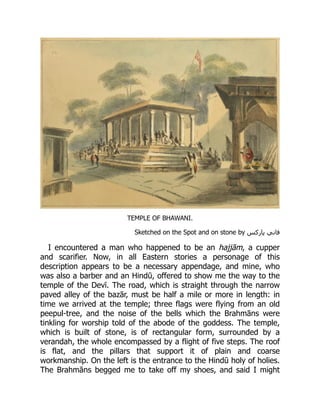
THE TEMPLE OF BHAWĀNĪ.
TEMPLE OF BHAWANI.
Sketched on the Spot and on stone by ‎
‫‏‬
‫س‬‫پارک‬ ‫‏فاني‬
‎
I encountered a man who happened to be an hajjām, a cupper
and scarifier. Now, in all Eastern stories a personage of this
description appears to be a necessary appendage, and mine, who
was also a barber and an Hindū, offered to show me the way to the
temple of the Devī. The road, which is straight through the narrow
paved alley of the bazār, must be half a mile or more in length: in
time we arrived at the temple; three flags were flying from an old
peepul-tree, and the noise of the bells which the Brahmāns were
tinkling for worship told of the abode of the goddess. The temple,
which is built of stone, is of rectangular form, surrounded by a
verandah, the whole encompassed by a flight of five steps. The roof
is flat, and the pillars that support it of plain and coarse
workmanship. On the left is the entrance to the Hindū holy of holies.
The Brahmāns begged me to take off my shoes, and said I might
then enter and see the face of the goddess. I thought of the Thugs,
and my curiosity induced me to leave my shoes at the door, and to
advance about three yards into the little dark chamber. The place
was in size so small, that when six people were in it, it appeared
quite full; the walls were of large coarse stones. The worshippers
were turned out of the apartment, and they gave me a full view of
the Devī, the great goddess, the renowned Bhagwān!
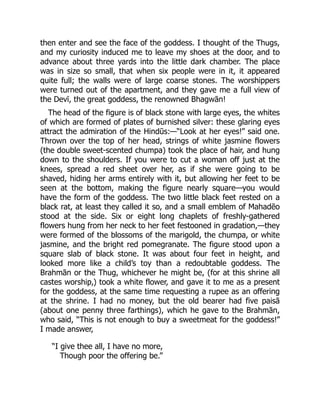
The head of the figure is of black stone with large eyes, the whites
of which are formed of plates of burnished silver: these glaring eyes
attract the admiration of the Hindūs:—“Look at her eyes!” said one.
Thrown over the top of her head, strings of white jasmine flowers
(the double sweet-scented chumpa) took the place of hair, and hung
down to the shoulders. If you were to cut a woman off just at the
knees, spread a red sheet over her, as if she were going to be
shaved, hiding her arms entirely with it, but allowing her feet to be
seen at the bottom, making the figure nearly square—you would
have the form of the goddess. The two little black feet rested on a
black rat, at least they called it so, and a small emblem of Mahadēo
stood at the side. Six or eight long chaplets of freshly-gathered
flowers hung from her neck to her feet festooned in gradation,—they
were formed of the blossoms of the marigold, the chumpa, or white
jasmine, and the bright red pomegranate. The figure stood upon a
square slab of black stone. It was about four feet in height, and
looked more like a child’s toy than a redoubtable goddess. The
Brahmān or the Thug, whichever he might be, (for at this shrine all
castes worship,) took a white flower, and gave it to me as a present
for the goddess, at the same time requesting a rupee as an offering
at the shrine. I had no money, but the old bearer had five paisā
(about one penny three farthings), which he gave to the Brahmān,
who said, “This is not enough to buy a sweetmeat for the goddess!”
I made answer,
“I give thee all, I have no more,
Though poor the offering be.”
The man saw it was the truth, and was satisfied. The old bearer
then requested me to hold my sketch-book for a few moments whilst
he went in and put up a prayer: this I did, and the old man returned
very quickly, much pleased at having seen the Devī.
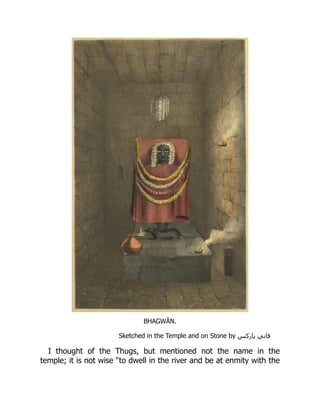
I sketched the goddess when before the shrine, the Brahmān
holding the lamp for me. Over her head was suspended from the
ceiling an ornament of white flowers, and a lamp like that in the
robber’s cave in “Gil Blas” was also hanging from the roof. There was
also a lamp on the black slab, which had the appearance of a Roman
lamp. Ornaments worn on the wrists of Hindū women, called
kangan, formed of a small hank of red, or rather flame-coloured
cotton, intermixed with yellow, were offered to the Devī: the
Brahmāns put them on her shoulders, as arms she had none. Why
and wherefore the kangan is offered, I know not. Before a satī
ascends the funeral-pile, some red cotton is tied on both wrists. This
may, probably, account for the kangan offered to Bhagwān, the
patroness of satīs.
BHAGWĀN.
Sketched in the Temple and on Stone by ‎
‫‏‬
‫س‬‫پارک‬ ‫‏فاني‬
‎
I thought of the Thugs, but mentioned not the name in the
temple; it is not wise “to dwell in the river and be at enmity with the
crocodile[52].” In the verandah of the temple were two massive bells
of a metal looking like bronze.
I can fancy terror acting on the Hindoos when worshipping the
great black hideous idol, Kalī Ma, at Kalī-ghāt, near Calcutta; but this
poor stump of a woman, with quiet features, staring eyes of silver,
and little black feet, inspires no terror:—and yet she is Bhagwān—
the dreaded Bhagwān!
The temple was crowded by men and women coming and going,
as fast as possible, in great numbers. The month of Aghar is the
time of the annual meeting; it begins November 15th, and ends the
13th of December; therefore Bindachun must be full of rascals and
Thugs at this present time, who have come here to arrange their
religious murders, and to make vows and pūja.
This visit to Bindachun interested me extremely; the style of the
temple surprised me; it is unlike any of the Hindoo places of worship
I have seen, and must be of very ancient date. The pillars are of a
single stone without ornament, rough and rude. Some of the shops
in the bazār, like the one on the right where sweetmeats are sold,
are of curious architecture; stone is used for all the buildings,
quarries being abundant in this part of the country.
The people crowded around me whilst I was sketching the exterior
of the temple, but were all extremely civil: the Brahmāns and
beggars clamoured for paisā (copper coins), but were civil
nevertheless. It is a disreputable neighbourhood: I hope they will
not rob the boats to-night, as all the rascals and murderers in India
flock to this temple at the time of the annual fair, which is now being
held. Having made my salām to the great goddess, I was guided by
the barber to another idol, which he said was worshipped by very
few people. It was a female figure, very well executed in stone, with
four or five figures around it, carved on the same block. I was much
inclined to carry it off; it is one of the handsomest pieces of Hindū
sculpture I have seen. A few flowers were lying withered before it in
the hovel where it stood, placed there, it may be, by the piety of the
barber. Even my husband was induced to climb the steps of the
ghāt, and to walk through the bazār to the temple, but he did not
enter it. A number of idols were under a peepul-tree in the bazār;
they were a great temptation, but in this high place of superstition it
might be dangerous to carry off a god.
This wandering life is very delightful; I shall never again be
content “to sit in a parlour sewing a seam,” which the old song gives
forth as the height of feminine felicity! Much sooner would I grope
through a dark alley idol hunting—Apropos, by the idols under the
peepul-tree was a satī mound, broken and deserted, not even a
kālsa was there to claim the passing salām of the Hindū, nor a
flower to mark the spot: perhaps the great goddess draws off the
worshippers from the deified mortal, although all satīs are peculiarly
under her protection.
THE TASHMA-BAZ THUGS.
“Thuggee and Meypunnaism are no sooner suppressed
than a new system of secret assassination and robbery is
discovered, proving the truth of Colonel Sleeman’s remark,
that ‘India is a strange land; and live in it as long as we may,
and mix with its people as much as we please, we shall to the
last be constantly liable to stumble upon new moral
phenomena to excite our special wonder.’ As anticipated, at
least one set of new actors have to be introduced to the
public, and these are the Tashma-baz Thugs.
“The Thugs formerly discovered went forth on their
murderous expeditions under the protection of a goddess, the
Tashmabazes have for their genius a European! Who in
England would be prepared to credit that the thimble-riggers
of English fairs have in India given rise to an association that,
in the towns, bazārs, and highways of these provinces,
employs the game of stick and garter as the lure for victims
destined to be robbed or murdered? Yet this is the simple
fact. The British had hardly gained possession of this territory
before the seeds of the flourishing system of iniquity, brought
to light almost half a century afterwards, were sowed in 1802
by a private soldier in one of his majesty’s regiments
stationed at Cawnpore. The name of this man was Creagh.
He initiated several natives into the mysteries of the stick and
garter, and these afterwards appeared as the leaders of as
many gangs, who traversed the country, gambling with
whomsoever they could entrap to try their luck at this game.
It consists of rolling up a doubled strap, the player putting a
stick between any two of its convolutions, and when the ends
of the strap are pulled, it unrolls, and either comes away
altogether, or is held at the double by the stick, and this
decides whether the player loses or wins. A game requiring
apparently no peculiar skill, and played by parties cleverly
acting their parts as strangers to each other,—being even
dressed in character,—readily tempted any greedy simpleton
to try his luck, and show his cash. If he lost, he might go
about his business; if he won, he was induced to remain with
the gamblers, or was followed, and as opportunity offered
was either stupified with poisonous drugs, or by any
convenient method murdered. Many corpses found from time
to time along the vicinity of the Grand Trunk road, without
any trace of the assassins, are now believed to have been the
remains of the Tashmabazes’ victims; and distinct information
has been obtained from their own members of murders
committed by them. The merest trifle, it seems, was sufficient
inducement to them to commit the crime, there being one
case of three poor grass-cutters murdered by those
miscreants in a jungle, merely for the sake of their trifling
personal property. Indeed, these gangs seem to have been of
a more hardened character than any other yet discovered, for
their sole aim was gain, however it might be secured, without
the plea of religious motive which regulated the proceedings
of the other fraternities. Parties of them used to visit all the
chief towns and stations of the Doab and its neighbourhood,
and established themselves in the thoroughfares leading to
the principal cities. Under the guise of gamblers, they were
often brought to the notice of the authorities, and subjected
to the trifling punishments due to minor offences; but this
was the very thing that lulled suspicion as to their real
character. They were constantly in the power of many
dangerous acquaintances; but these were bribed to silence
out of their abundant spoils. The police almost every where
seem to have been bought over. In the city of Gwalior, the
kotwal got one-fourth of their profits; and in the British
territory, five rupees a day have been paid as hush-money to
the neighbouring thannah. Amongst their friends was the
mess khansaman of a regiment at Meerut, the brother of one
of their chiefs, and an accomplice. Gold and silver coin, and
ornaments of pearl and coral, formed part of the remittances
that used to be sent to their head-quarters at Cawnpore.
Indeed, they seem to have carried on a very safe and
lucrative business, until the magistrates of Boolundshuhr and
Cawnpore pounced upon them in the beginning of this year.
Mr. Montgomery followed up their apprehension by a full
report to Government, when the matter was taken up by the
Thuggee Department, the sifting machinery of which, in the
hands of Major Graham, soon brought to light all the facts
necessary to establish that the gang formed a hitherto
unknown class of Thugs.”—Agra Messenger, Dec. 2, 1848.
12th.—One mile above Bindachun are the dangerous granite rocks
of Seebpūr. After a very quiet day and very little difficulty, we
anchored off the village of Bhoghwa, where we were informed by
the chaukidār, that turkeys, fowls, and birds were abundant.
The exertion of yesterday quite fagged me; I was up and
sketching from six in the morning to eleven a.m., at Mirzapūr, and
again in the evening at the temple of Bhawānī,—a day of over-
fatigue, but a very agreeable one. How I love this roaming life on
the river, with the power of stopping at any picturesque spot!—Even
tracking against the stream is most delightful to one who, like Dr.
Syntax, is in search of the picturesque. My husband objects to
accompanying me through the bazārs, because such a crowd collect
after me;—he goes along quietly, but with me it is different:—the
moment I stop to sketch, a crowd collects, and the attendants are
obliged to drive them off to enable me to see the object. I have a
great sympathy for Dr. Syntax, and perfectly comprehend the delight
he took even in a picturesque horsepond. India would have driven
him wild;—it is the country of the picturesque. How I love this life in
the wilderness! I shall never be content to vegetate in England in
some quiet country place.
“Oh! it settles the spirits, when nothing is seen
But a pig on a common, a goose on a green.”
13th.—After an uninteresting passage with monotonous scenery,
we moored off Poorooā, a village on the left bank. Wild ducks,
geese, and Brahmanī ducks are numerous on the river-side: it is very
cold, so much so that I shall be glad to retire to rest to keep myself
warm.
14th.—No wind—a warmer day, and no difficulty on the river.
Anchored at a bastī (village) about three miles below Sirsya. The
Directory says, “Twenty-eight miles above Mirzapūr, on the left bank
of the river, is Suttamaree. Passengers generally land in the cold
season, and have a walk across the neck of land in a w.n.w.
direction, two miles wide to Taila, and rejoin the steamer off that
place, she having to go a détour of twenty-one miles round the
point. Two miles above Suttamaree is Deega-kunkur Spit, with a
deep bight.
“Letchyagurree and its ravine on the left bank of the river is
twenty-two miles above Deega, noted for its robbers, when it was
attached to the Oude territories.”
We have now arrived within a very short distance of Allahabad; I
shall be quite sorry to end my voyage, and feel the greatest
reluctance to returning into society.
15th.—“Sirsya is a large cotton mart on the right bank; it is sixty
miles above Mirzapūr and twenty-three miles below Allahabad, to
which place there is a good road. There are several pakka (brick)
houses here, and two very fine tanks at the back of it, and an old
mud fort; thence to Prāg, the river is very intricate and shallow. Iron
work in a small way can be done for boats at this place. Turkeys and
guinea-fowls abound.”
We passed Sirsya early, and found that the Queen’s 40th regiment
had just quitted the place. No fowls or provisions were to be had,—
the 40th, like a flight of locusts, had devoured every thing around
the spot on which they descended; some hilsā fish alone were to be
procured, and most delicious they proved,—not only when fresh, but
also when cured with tamarinds and vinegar. There is a house, some
temples, and a peepul-tree on the cliff, that would make a good
sketch, if taken looking up the river a little below the spot. In
consequence of the shallowness of the stream we have had much
trouble all day, and were unable to lugāo until half-past seven p.m.—
cold and misty.
16th.—Arrived at Munyah ghāt, on the right bank, at noon,—eight
miles from Prāg. The river is so intricate, and the navigation so
difficult, we shall be a length of time going those eight miles.
The “Directory” says,—“Allahabad is eighty-three miles above
Mirzapūr; its fort is at the junction of the Ganges and Jumna. The
steamers put up at the Jama Masjid, half a mile inside the Jumna.
The native military cantonments, and the place where most of the
civilians and officers live, are from three to four miles inland. State
prisoners are kept here in the fort. There is also a large stone pillar,
said to have been erected by Alexander the Great to mark his
conquests. This is the seat of the Sadr Dewanī, or principal court of
justice; it was formerly the seat of the Presidency. Bread, butter,
eggs, beef, mutton, lamb, kids, fowls, pigeons, turkeys, guinea-fowl,
quail, partridge, teal, wild ducks, and wild geese, are procurable
here: Europe shops are at the station, and auctions are held. About
two miles from the ghāt is the chauk or market, where all sorts of
cloth, European and native, are procurable. Shawl-men board the
steamers, if sent for, with every kind of Cashmere shawl,
waistcoating, caps, gloves, socks, and Afghanistān woollen cloths: as
also Delhi jewellers, and manufacturers of cotton carpeting, of
various colours, showy on rooms, and rather durable. A little beyond
the chauk is the native sarā’e, where beautiful horses are at times to
be purchased, of the Persian, Cabul, and Tūrkī breeds. You must
send for your letters to the post-office.
“The distance from Calcutta, viâ Bhagirathī, is 831 miles; viâ
Sunderbands, 1186; and by dāk route, 504 miles.
“Steamer’s regulated distance is 800 miles. Steamers remain here
three entire days, when they depart on their return, taking
passengers and cargo. Apply to the agent there, or to the
commander, for passage downwards.”
In 1844 the Sadr Board of Revenue and the Criminal and Civil
Court, or Sadr Dewanī, were removed to Agra.
At half-past one, p.m., we caught the first sight of the fort and the
telegraph. The flags were flying at the junction of the rivers, and the
road from the sands over the Mahratta Band was plainly visible. Near
Arail, just below the ferry, the river is intricate; and the passage
being difficult, we lugāoed off the ferry.
17th.—The Fort of Allahabad had an imposing appearance from
the river, and as we approached nearer we observed the flags flying
at the bathing-place in great numbers, although the fair was not set.
It was delightful once again to see old Prāg, the Jama Masjid, the
old well, surmounted by the temple—so like that of the Sibyl, where
dwells the Gossein,—the shrine of Mahadēo a little above it, our old
friend’s bungalow beyond, and the fine peepul-tree on the high bank
of the Jumna, that almost hides the house and chabūtara, where we
had passed so many years. Our old acquaintances are flocking down
to welcome our return: we are once more at Allahabad, once more
lugāoed in the blue waters of the Jumna, off the steamer ghāt.
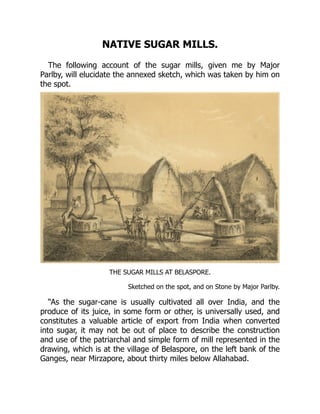
NATIVE SUGAR MILLS.
The following account of the sugar mills, given me by Major
Parlby, will elucidate the annexed sketch, which was taken by him on
the spot.
THE SUGAR MILLS AT BELASPORE.
Sketched on the spot, and on Stone by Major Parlby.
“As the sugar-cane is usually cultivated all over India, and the
produce of its juice, in some form or other, is universally used, and
constitutes a valuable article of export from India when converted
into sugar, it may not be out of place to describe the construction
and use of the patriarchal and simple form of mill represented in the
drawing, which is at the village of Belaspore, on the left bank of the
Ganges, near Mirzapore, about thirty miles below Allahabad.
“It is supposed that sugar has been known and used in India and
China from the earliest ages; and historians say that it was not
introduced into the western world until after the conquest of
Alexander the Great. This construction of mill is common in many
parts of India; and, rude and simple as it is, it is found to succeed in
expressing the juice from the sugar-cane more perfectly than the
rude cylinder mills which are used in other places. The villagers
knew nothing more of its origin than that their fathers and
grandfathers had used the same mills without alteration, except the
occasional renewing and repairs of the wood-work, as required.
“Some writers,—and amongst the rest, Colonel Sleeman,—in
describing this construction of mill, term it the “Pestle and Mortar
sugar mill:” but this name is improperly applied, for the vertical
beam has no reciprocating up-and-down motion, as the pestle of a
common mortar has, but merely turns round in the cavity of the bed,
as the bullocks walk round in their circular course. The bed of the
mill is formed of a large mass of stone, of as hard a nature as can
be procured in the locality, and free from any mixture of limestone,
on which, probably, the action of the acid of the expressed juice of
the cane might be injurious.
“The beds are cylindrical, ornamented externally with figures,
emblematical or religious, which are cut in relief.
“The upright beam of the mill is generally selected from a tree, the
wood of which is heavy, hard, tough, and durable; and for this
purpose the trunk of the babūl, which is indigenous in these parts, is
well suited, and is generally chosen.
“The bark is stripped off, one end is rounded, and the other is cut
to a point; the rounded end works in the hollow bed of the mill, and
on the pointed end is hitched the end of a stay, properly formed for
the purpose, the other end of which is attached to a horizontal
beam, generally formed from a strong crotched piece of wood,
which is cut at the crotched end to fit into a groove cut on the
outside of the bed in which it traverses round, and the bullocks are
yoked to the end of this beam. The stay leading from the top of the
vertical beam is generally made of two pieces, which are capable of
adjustment, so that the horizontal beam to which the bullocks are
yoked may be kept at a proper distance from the ground.
“The short pieces of cane, as they are supplied by a native, are
bruised and squeezed against the internal sides of the mortar as the
vertical beam moves round, the expressed juice running off by the
channel which is cut from the bottom, opposite to which is an
earthen pan let into the ground to receive it, a small piece of
bamboo generally serving to connect them.
“The driver sits on a frame or seat upon the end of the horizontal
beam, his own weight increasing the bruising power of the mill,
which is also assisted by adding a weight of stones, if necessary. As
the process of bruising the cane takes place in the cold season, in
December, the driver sometimes keeps himself warm by a pan of hot
embers placed on the frame.
“To each of these mills at Belaspore there were six bullocks,
forming three reliefs: they work night and day as long as the cane is
cutting, three hours at a time; and in three hours about four seer or
eight pounds of juice are expressed. The juice, as the pan fills, is
immediately taken to the hut, whence the smoke is seen escaping at
the door; and there, in a boiler fixed on a rude furnace, the process
of boiling the juice to concentrate it is carried on; it is boiled down
until it becomes a substance called goor, much thicker than treacle;
and in this state is carried to the neighbouring market of Mirzapūr,
where it is sold at the rate of eighteen seer for the rupee. Sixteen
seer, or thirty-two pounds of goor are obtained from one maund of
cane (eighty pounds).
“In the foreground of the sketch are three heaps of sugar-cane,
cut into pieces of six or eight inches long, ready to be supplied to
the mill. A native carries the pieces of sugar-cane in a basket, and
charges the mill by occasional supplies, as represented in the
drawing; and he also takes out the bruised cane, from which the
juice has been sufficiently expressed, and carries it to the hut, to
assist, with a mixture of oplā (dried cow-dung) in making the fire for
the boiling process. The sugar-cane is slightly wetted when put into
the mill, about two pints of water being used to moisten about
eighty pounds’ weight of it. The goor is purchased by the sugar-
refiner, who dissolves and refines it again in the process of making
sugar. But goor is also used for several purposes,—as in preparing
tobacco for smoking, and by masons, to mix with lime in forming
hard cements for floors, terraces, baths, &c., for which the Indian
masons are celebrated.
It is impossible to contemplate the scene in the drawing without
being struck with the strong contrast it bears to any mechanical
process in our own country. The sketch was taken from life, and
there was a quietude and apathy in all the persons engaged, which
was remarkable: even the bullocks are urged round at a very slow
pace, hardly two miles an hour, by the voice, more than by the short
whip occasionally used by the driver. Thus it is ever in climates
where the necessaries of life, shelter, food, and clothing are cheap,
and easily procured; in more severe climates the expenses attendant
on the social state call forth the more active energies of human
nature. ‘God gives sugar to him who eats sugar[53],’—i.e. He
provides for His creatures in proportion to their wants.”
CHAPTER LXIX.
RESIDENCE AT PRĀG, AND RETURN TO
CALCUTTA.
The Sibylline Temple—Mr. Berrill’s Hotel—A Barouche drawn by Camels—The
Murdār-khor—A Kharīta from the Bāiza Bā’ī—Marriage of the Chimna Raja—
Sultan Khusrū’s Garden—The Tombs—Tamarind Trees—The Sarā’e—The Bāolī
—Tattoos used for Palanquins—Reasons for the Murder of a Wife and Child—
The Lāt—A Skilful Swordsman—An Eclipse—Tufāns—Death of Mr. James
Gardner—Quitted Allahabad—The Ganges—A Wreck—A Storm—Indian Corn—
Colgong—Terīyāgalī Hills and Ruins—Nuddea—Suspension Bridge—Prinsep
Ghāt at Calcutta—Engaged a passage in the “Essex.”
1844, Dec. 18th.—The whole day was employed in receiving visits
from our old acquaintances at the station, the mūnshī, the ’amala of
the office, and the natives whom we formerly employed. The
pleasure they testified at our return was very gratifying; and the
delight of Lutchman, my old Barha’ī mistree (carpenter), was so
genuine, it brought tears from my eyes, as well as from his own. We
have moored the boats just below an old būrj (bastion) of the
ancient city of Prāg; there is a gateway below,—the water-gate,
perhaps, of the old Fort: the Sibylline temple crowns it. The old
gossein who lives in the temple came this evening to make salām;
he reminded me of my having given him a present of sixteen rupees
for having aided in recovering two hundred, that had been stolen
from me; he was young, and good-looking then, now he is old and
wily: he brought his son, a fine young Brahmān, to introduce to me.
Many are the strange stories related respecting this old Brahmān and
his solitary temple; and I have before mentioned its curious
resemblance to that of the Sibyl. Having defended the truth and
faithfulness of my pencil in England, I was glad of an opportunity of
again particularly observing the Ionic style of architecture of this
little building; and while pondering on its singular appearance,
Colonel Edward Smith came on board, and solved the mystery by
mentioning that General Ouchterlony, finding the Jama Masjid
seldom used as a place of worship, took possession of it as his
dwelling-place, and formed magnificent rooms between the arches.
He built the temple of the Sibyl on the top of the ancient water-gate
of the old city. The Muhammadans, some years afterwards,
petitioned Government not to allow the mosque to be used as a
dwelling-place; it was therefore restored to them, and is now used
as a masjid.
A pretty little modern building,—a small temple, dedicated to
Mahadēo, is near the ancient well of the water-gate.
I am quite fatigued with seeing old faces, and saying kind words
to the poor people. To my surprise an old woman, with a basket full
of worsted balls, came to make salām; she was fat and well,—I had
left her a poor wretched creature; she used to make worsted balls
for my dog Nero to fetch and carry. How many ānās a month the
poor old woman got from Nero; she used to throw her ball to the
dog, and then come to ask for payment; she was in fact a pensioner.
The beautiful dog is dead; and the wretched old hag is fat and well,
and makes worsted balls as usual. She got her little present, and
went off quite happy.
The ghāt off which we are moored has been recently made by the
Steam Agency; and just above is an hotel, which has been
established for the convenience of the passengers from the
steamers, and is well conducted by Mr. Berrill. This little hotel on the
banks of the Jumna-jee is well described in the following curious
lines, which were written in four languages on the window of an inn
in Russia.
“In questa casa troverte
Tout ce qu’on peut souhaiter,
Vinum, panem, pisces, carnes,
Coaches, chaises, horses, harness.”
23rd.—We quitted the boats, and went up to stay with our friends,
Mr. and Mrs. M⸺; they received us with all that kindness and
hospitality for which India is renowned; their bungalow, a very fine
one, is well situated at the other end of the station. We met a
barouche drawn by two camels, harnessed like horses; they went
along at a fine pace, and I envied the possessor that pair of well
broken-in carriage camels: in double harness they look well; in single
harness,—especially in a Stanhope, or any other sort of buggy,—the
animal appears too large for the carriage.
1845, Jan. 11th.—Saw a small comet, the nucleus of which was
more distinct than that of the immense comet I saw when at sea,
although the tail was so small, that it looked not unlike the thin
switch tail of a horse.
18th.—Finding it necessary to remain up the country for a time,
we dug a tank and made a house for the wild ducks, and turned
sixty-five birds into it. It was amusing to see the delight with which
the murghabīs splashed into the water when freed from the baskets
in which they had been brought from the jangal, and such a
confabulation as there was amongst them!
I omitted to mention that during my former residence at this
station, the jamadar came to tell me that a murdār-khor (an eater of
carrion), who had lately arrived, was anxious to perform before us.
The man did not ask for money, but requested to have a sheep
given him; he said he would eat the whole at one meal, body and
entrails, leaving only the horns and the skin, which he wished to
carry away; the wretch said that he would kill the sheep by tearing
open its throat with his teeth, and would drink the blood. This feat
they told me he had performed before in the bazār. I saw the man at
a distance, and was so much disgusted that I ordered him to be
turned out of the compound (the grounds around the house). In
Colonel Tod’s “Travels in Western India” there is a most interesting
account of the murdi-khor, or man-eaters; he made an attempt to
visit the shrine of Kalka, the dread mother, whose rites are
performed by the hideous Aghori, whose patroness she is, as
Aghoriswara Mata. At one time they existed in those regions, but
were only found in the wildest retreats, in the mountain-cave, or the
dark recesses of the forest. Colonel Tod saw a man perform pūja at
the shrine of Goraknāth, whom he had every reason to believe was
one of these wretched people,—but whether he was a murdi-khor he
could not determine; although, as he went off direct to the Aghori
peak, said to be frequented only by his sect, it is probable that he
belonged to the fraternity. It appears that the murdār-khor (the
carrion-eater) is almost the same as the ādam-khor or cannibal.
24th.—This life is very monotonous, and the only variety I have is
a nervous fever now and then.
March 1st.—During a visit at the house of a friend I received a
kharīta from her Highness the Bāiza Bā’ī, and was greatly pleased to
see the signature of the dear old lady, and also felt much flattered
by her remembrance. After I quitted Allahabad for England her
Highness remained there some time; at last, on her positive refusal
to live at Bunarus, it was agreed that she should reside at Nassuk, a
holy place, about one hundred miles from Bombay. She quitted the
Upper Provinces, marched across the country, and established
herself at Nassuk. Having heard from some of her people of my
return to India, and arrival at Prāg, her Highness did me the honour
to write to me, and after the usual compliments with which a native
letter always commences, the Bāiza Bā’ī added, “I received your
letter in which you acknowledged the receipt of mine; but I have not
since heard from you, and therefore beg you will write and tell me
how you and the sāhib are; do not be so long again without writing,
because it makes me anxious.”
I sent in answer a letter of thanks to her Highness for her
kindness in having borne me in remembrance; it was written by a
mūnshī in the Persian character, and enclosed in a kharīta. At the
same time I sent a bunch of the most beautiful artificial flowers to
the Gaja Raja, to testify my respect; it would have been incorrect to
have sent the flowers to the Bā’ī. They were Parisian, and
remarkably well made; the Gaja Raja, being fond of flowers, will be
pleased. I gave the letter and bouquet to one of her attendants,
Bulwunt Rāo, who promised to send them across the country to
Nassuk. The title of Gaja, i.e. elephant, is curiously applied to the
young Princess, her form being fragile, delicate, and fairy-like.
In 1848 I received a letter from a friend at Gwalior, mentioning
that the Chimna Raja, the daughter of the Gaja Raja Sāhib, who was
born at Allahabad, and who was then about eight years of age, had
been betrothed by her great grandmother, the Bāiza Bā’ī, to Jhankī
Rāo, the Maharaj of Gwalior; after which ceremony the young bride
returned to Oojein with the ex-Queen. This intelligence pleased me
greatly, because the marriage of the great grand-daughter of Dāolut
Rāo Scindia with the reigning sovereign of the Mahrattas will give
great satisfaction to her Highness; and the wandering Hājī rejoices
that her great grand-niece (by courtesy) will share the throne of her
ancestors with the Maharaj of Gwalior.
5th.—This evening, while cantering at a sharp pace round the
Mahratta Bandh, my horse fell, and my companion thus described
the accident in a letter to his brother. “Kābul came down upon his
nose and knees; nineteen women out of twenty would have been
spilt. The Mem Sāhiba sat her horse splendidly, and pulled him up
like a flash of lightning. The infernal brute must have put his foot in
a hole. The evening passed hearing music, and talking philosophy.”
9th.—I was invited to spend the day at Sultan Khusrū’s garden, to
which place a tent had been sent, which was pitched under the fine
tamarind trees in a most picturesque place. The garden is a large
space of ground, enclosed by a high wall, containing tombs and
some very fine trees: the entrance is through a lofty gateway. There
are three tombs, and a Baithak-khāna or pavilion. The first and
largest monument is that of Sultan Khusrū, in which he is buried; it
is a handsome building, and within it is deposited a beautifully
illuminated kurān, which the dārogha showed us with great pride.
Sultan Khusrū married a daughter of the Wuzeer Azim Khan; he was
the son of Jahāngīr, and his mother was the daughter of the Rajpūt
Prince Bagwandas of Amber. The next monument is that of the Jodh
Bā’ī, but in honour of which lady of that name I know not. Akbar
married a Jodh Bā’ī, the daughter of Oodi Singh, of Jodpoor; she
was the mother of Jahāngīr, and was buried on the Chand-maree,
near Fathīpūr Sicri. Jahāngīr married a Jodh Bā’ī, the daughter of
Rae Singh, of Bickaner; she was the mother of Shāhjahān, and her
tomb is at Secundra. I forget to whose memory the tomb in Sultan
Khusrū’s bāghīcha (garden) was erected.
There is also a third mausoleum, which is not so handsome as the
two before mentioned; and the fourth building is a pavilion, in which
visitors are allowed to live for a short time during a visit to the
garden. Around the tombs are some of the largest tamarind trees I
ever beheld: the imlī, as the natives call the tamarind tree, is one of
the finest and most beautiful in the world; and they are generally
found around or sheltering the tombs of revered or sacred
characters. The sherbet prepared from the fruit is excellent; the
leaves and fruit are used medicinally. The natives are impressed with
a notion that it is dangerous to sleep under the tamarind tree,
especially during the night; grass or vegetation of any kind is seldom
seen growing in such situations, and never with luxuriance. In times
of scarcity the seeds are eaten by the poor; they resemble a
common field bean.
Part of Sultan Khusrū’s garden has been cultivated English fashion,
that is, for vegetables; seeds are given to the mālīs, (gardeners),
and rewards for the first, second, third, and fourth best dālī—that is,
basket of vegetables: this is good; the highest prize is fifty rupees,
which will be to natives worth the contest. The mālī in charge,
kneeling on one knee, presented me with a bouquet of flowers; it
was not ungracefully done,—nevertheless, it was bad taste to teach
a man an European style of reverence, which in gracefulness is far
inferior to the salām of the native.
The sarā’e (caravansary), with its gateways, and the handsome
one through which you pass to the garden, are well worth visiting;
on the doors of the latter a number of horse-shoes are nailed for
good luck, and the variety in shape and size is so great it is
absolutely curious.
Just beyond the gates of the sarā’e is a bāolī, a magnificent well,
with underground apartments; it is a most remarkable and curious
place, and the well is a noble one. The top of the bāolī is level with
the ground, from which place water can be drawn up, as also from
the underground apartments, which open on the well. You descend
by a long broad flight of stone steps to the water’s edge, where
there is an arch, ornamented with two large fish, the arms of Oude.
Half way down is a pathway of stone that juts out from the wall, and
communicates with the third apartment, from which you ascend by
small circular staircases to the top. A nervous person might object to
the walk along the pathway, it being very narrow, and having no
defence—no parapet on the inner side. Parties of natives resort here
during the hot winds, and spend the hours in the coolness of the
bāolī.
March 15th.—Hired a large bungalow of a very respectable native
for eighty rupees a month, garden included, and removed into it.
20th.—My husband received permission from Government to visit
England on furlough. A friend quitted us for the up-country in a
palanquin placed on a truck, and drawn by a tattoo (a pony), with
relays on the road. In former times a palanquin was always carried
by bearers,—by the present method a dāk trip is performed much
more quickly than it was formerly by relays of natives.
26th.—The other day a native was brought before Mr. R. M⸺,
the magistrate of Allahabad, charged with the murder of his wife and
daughter. The man confessed to having cut their heads off with his
sword; he said he had reason to believe his wife unfaithful, therefore
he killed her; and as he supposed the magistrate would murder him
for the act, and, as in that case, his young daughter would have no
one to marry her, and would be obliged to beg her bread, he killed
her also. “But,” said he to Mr. M⸺, “beware how you murder me
for having killed my wife. If the women find their husbands are hung
for killing them should they be unfaithful, what man will be safe?” I
know not the name of the frail fair one who fell a sacrifice to
jealousy; doubtless it was soft and pleasing, for although her
husband did not attend to the words of the Hindū sage, who says,
“Strike not even with a blossom a wife guilty of a hundred faults!”
still, in all probability, her parents bestowed an harmonious name
upon her, in obedience to the directions of Menu, who suggests that
“the names of women should be agreeable, soft, clear, captivating
the fancy, auspicious, ending in long vowels, resembling words of
benediction.” He also says, “Let mutual fidelity continue to death:
this, in few words, may be considered as the supreme law between
husband and wife.” The conjugal duties of the Rajpūts are
comprehended in that single text.
30th.—When I was formerly at Allahabad the Bāiza Bā’ī was
anxious to have leave from Government to erect a most remarkable
pillar of stone, that was prostrate in the Fort, near the gateway. This
lāt, as before mentioned, is covered with inscriptions in unknown
characters, that puzzle the learned. The design of her Highness was
not carried into execution, and the lāt was afterwards erected in the
Fort at the expense of the Asiatic Society, by Colonel Edward Smith,
C.B. We drove to see it in the evening, admired it very much, and
thought it erected with great judgment: it is highly ornamental to
the Fort. Whilst we were examining the pillar, the buggy horse took
fright, became very violent, upset five of the small stone pillars that
support the chains that surround the lāt, and broke his harness in
divers places. The scene was good.
April 1st.—I fell by accident on the stones in the verandah with
considerable force, and fainted away; the blow which I received on
my left shoulder was severe; painful and useless my arm hangs by
my side,—I have no power to move a finger.
The oriental proverb, that “A sharp sword will not cut raw silk[54],”
does not apply to silk when manufactured; as I this morning saw a
gentleman place a silk handkerchief upon his sword, and, with one
skilful drawing cut, divide it exactly and diagonally.
27th.—Divine service was performed in the new church, that has
been erected at Allahabad at the expense of the inhabitants; it
formerly took place in the Circuit Bungalow, or in the Fort. The
church is a very handsome one, and the internal arrangements are
good.
29th.—About 3 p.m. a tufān came on,—rain in torrents, with heavy
hail,—dust in whirlwinds; in the course of a quarter of an hour the
thermometer fell ten degrees, from 88° to 78°. It was fine to
witness such a commotion. The roof of our house was under repair,
—streams of water came pouring into every room from all parts of
the roof, until the house was full of it; much damage was done to
the pictures; and we were obliged to quit the place, and take refuge
at the house of a friend.
May 11th.—The ice-pits opened, the allowance to each subscriber
eight seer per diem,—about sixteen pounds’ weight daily. The
thermometer is 89°. There being no wind, the tattīs are useless, and
in spite of the thermantidote the heat is overpowering; we begin to
long for the fresh breezes of England; I shall rejoice when we are on
board a good vessel and out at sea again.
21st.—About half-past 9 p.m. the moon was almost completely
eclipsed, and the night was so dark I could not see the way as I was
driving home. The natives were making offerings of rice, fruit,
vegetables, &c., to restore the light quickly, and to ward off
impending calamities.
22nd.—A tufān or a storm of dust blew furiously at night,
succeeded the next morning by heavy rain, thunder, and lightning;
the day after it was oppressively hot,—another storm cleared the
atmosphere, and the thermantidote became quite delicious, it
poured in such a volume of cold air.
31st.—Went to the Bandh in the evening, but soon returned; the
air was so hot, it was like breathing liquid fire.
June 1st.—The heat in church was so oppressive, I will not
venture there again; pankhas and thermantidotes are in full play
during the time of Divine service,—but even with their aid in cooling
the air, the heat is intolerable.
26th.—The rains appear to have set in, accompanied with thunder
and lightning. The darkness was so great to-day at 4 p.m. that we
were obliged to dine by lamp-light; the evening is dull and heavy,
the rain is falling in torrents, and the darkness is relieved at intervals
by forked lightning; the thunder is distant.
30th.—Very hot during the day, and very oppressive; this damp
heat is worse for the health than the dry heat of the hot winds.
Heard with regret of the death of Mr. James Gardner, at Khāsgunge.
July 8th.—Engaged a fourteen-oared pinnace, a woolāk of 900
mŭns, a pataila of 600, and a small cook-boat, to take us down to
Calcutta.
20th.—We quitted dear old Prāg at 6 a.m. under heavy rain and a
contrary wind. I bade adieu to a place in which I had spent so many
happy days with much sorrow, and without any prospect of ever
revisiting the spot.
22nd.—Anchored at Rāj ghāt, Benares: the ghāts have lost much
of their picturesque beauty from the height of the river, the water
having covered the steps. The Hindū temples that have partially
fallen merely show their spiral domes above the waters; and the
Ganges is as full of mud as a river may well be; the water is quite
thick, of a muddy colour, and a small quantity in a tumbler gives a
most marvellous sediment.
24th.—A heavy wind against us; the waves were so high on the
Ganga, and the boats rolled so violently, that the natives on deck
were quite overcome by sea-sickness, and I was also suffering from
mal de mer.
31st.—Picked up a large heavy chest afloat from some wreck. It
contained fifty boxes of G. Davis’ Chinsurah cheroots, and was
marked Jan Mahomed Shah, in the Persian character: the cheroots
were all destroyed from having been in the water. Soon afterwards
we picked up another chest of the same size and description, with
the bottom stove in; also a box of cigars that was floating by the
side of it, evidently from the same wreck. Lugāoed off the bāstī of
Tipperiah, in the midst of an expanse of water. About 8 p.m. the
strong easterly wind, which had been blowing all day, veered and
sunk; a deep silence fell around—the whole canopy of heaven was
covered with a pall of black clouds: there was not a gleam of light
excepting on the horizon in one part, where there was one low
gleam of whitish pale light, in form like a bow. The muddy colour of
the interminable river assumed an inky blackness, and united with
the horizon all around: a few minutes afterwards the light on the
horizon disappeared, and all was intense darkness,—a rushing sound
then arose, and the rain fell in torrents, the drops were of great size,
it more resembled the fall of sheets of water; soon afterwards the
lightning blazed over the river, and some peals of thunder like the
roar of cannon and the sharp discharge of fire-arms, added to the
stormy scene. During this time the wind rose, and suddenly changed
to the opposite quarter of the heavens. I made the dandīs look well
to their moorings, as we were fastened on a wet field, covered by
the river, so that there was a fear the bamboos would be torn out of
the wet earth by the force of the wind acting on the vessel, and that
she would be carried down the fierce stream; however, she stood it
well, being in rather slack water, therefore I went to bed and slept
quietly through the gale, after I had sufficiently enjoyed the first part
of it.
August 1st.—The rock of Dolepaharry, with its temple and
beautiful trees standing far distant inland and of very great height,
was a beautiful object—it is near Janghīra—the latter rock sank into
insignificance and appeared very low, in consequence of the height
to which the Ganges had risen. The whole country is overflowed—
the river appears like one vast sea with a number of fine trees in it—
their trunks rising out of the water, and the earth completely hidden.
Passed Sultangunge and anchored on a wet bank, just on the
entrance of that branch of the river that leads to Bhagulpūr. The
Hindūs must go without their dinners to-night; they will not cook on
board, and in the wet swamp they cannot make a fire: this is a
wretched anchorage, and here comes the rain in torrents again.
Stolen goods cannot be digested, or never thrive, and so it proved
with a boy employed to pull the pankha. He stole a great quantity of
Indian corn; it was not ripe, but of full size; abounding in milk,
sweet, and tempting to eat when raw; but when fried in butter, with
pepper and salt, it is delicious. In spite of the caution given by an
old havildār, to whom the field belonged, the boy ate a great
quantity—his body swelled, he became in great pain, and is now ill
with fever.
3rd.—Last night the distant roar of the waters as they rushed past
the rocks of Colgong lulled me to sleep. This morning, about 7 a.m.,
we came up to the rocks, the stream was rushing past at a fearful
rate, and forming very large and powerful whirlpools. Two large
patailas were on before us; the first was twirled round by the eddy
and carried back against the other; they became entangled, and
both were carried back with great velocity for about three hundred
yards. Our pinnace was flying along aided by the cars on board, and
also by the towing of her little boat; but the powerful eddy turned
the vessel straight across the stream, and there she was stopped,
the eddy pulling one way and the men the other—just at this
moment an immense pataila of about two thousand mŭns, heavily
laden with gram, was coming down upon us with full force, borne on
by the violent stream; it was a disagreeable sight, it appeared as if
the shock must sink the pinnace: fortunately a woolāk was between
us and the monster vessel; she came with great force first upon the
woolāk, and drove her against the pinnace in front of herself; the
pinnace reeled with the shock, but it saved us greatly, and the large
vessel, disengaging herself from us, went on shoving our stern right
round in her impetuous course. I ran on deck, having a dislike to be
drowned in a cabin, but escaped with only a fright. The dandīs
recommenced their exertions, and in a short time we were out of the
eddies and whirlpools around the rocks, and in calm water. Colgong
is very beautiful, both during the rains and the cold weather, and this
is perhaps the most beautiful part of the Ganges. At 11 a.m. passed
the Terīyāgalī Hills. The dandīs say there are fine ruins in the jangal
on the largest hill, but no road to them; and they speak of the
immense doorways—entrances; I should like to explore the place.
8th.—At 1 p.m. passed Nuddea, eighty-two and a half miles from
Calcutta; at this spot the Jellingee unites with the Bhagirathī, and
they flow forward under the name of the Hoogly: the tide is
perceptible at Nuddea, it just comes so far.
Welcome to our website – the ideal destination for book lovers and
knowledge seekers. With a mission to inspire endlessly, we offer a
vast collection of books, ranging from classic literary works to
specialized publications, self-development books, and children's
literature. Each book is a new journey of discovery, expanding
knowledge and enriching the soul of the reade
Our website is not just a platform for buying books, but a bridge
connecting readers to the timeless values of culture and wisdom. With
an elegant, user-friendly interface and an intelligent search system,
we are committed to providing a quick and convenient shopping
experience. Additionally, our special promotions and home delivery
services ensure that you save time and fully enjoy the joy of reading.
Let us accompany you on the journey of exploring knowledge and
personal growth!
textbookfull.com

Learning Node Moving to the Server Side Early Release Shelley Powers 2024 scribd download

  • 1.
    Download the FullVersion of textbook for Fast Typing at textbookfull.com Learning Node Moving to the Server Side Early Release Shelley Powers https://textbookfull.com/product/learning-node-moving-to- the-server-side-early-release-shelley-powers/ OR CLICK BUTTON DOWNLOAD NOW Download More textbook Instantly Today - Get Yours Now at textbookfull.com
  • 2.
    Recommended digital products(PDF, EPUB, MOBI) that you can download immediately if you are interested. Node js web development server side development with Node 10 made easy Fourth Edition. Edition David Herron https://textbookfull.com/product/node-js-web-development-server-side- development-with-node-10-made-easy-fourth-edition-edition-david- herron/ textboxfull.com Node js 8 the Right Way Practical Server Side JavaScript That Scales 1st Edition Jim Wilson https://textbookfull.com/product/node-js-8-the-right-way-practical- server-side-javascript-that-scales-1st-edition-jim-wilson/ textboxfull.com Node js Design Patterns Master best practices to build modular and scalable server side web applications 2nd Edition Casciaro https://textbookfull.com/product/node-js-design-patterns-master-best- practices-to-build-modular-and-scalable-server-side-web- applications-2nd-edition-casciaro/ textboxfull.com Learning PHP MySQL JavaScript Early Release 6th Edition Robin Nixon https://textbookfull.com/product/learning-php-mysql-javascript-early- release-6th-edition-robin-nixon/ textboxfull.com
  • 3.
    Server Side SwiftPaul Hudson https://textbookfull.com/product/server-side-swift-paul-hudson/ textboxfull.com Building React Apps with Server Side Rendering Use React Redux and Next to Build Full Server Side Rendering Applications Thakkar Mohit https://textbookfull.com/product/building-react-apps-with-server-side- rendering-use-react-redux-and-next-to-build-full-server-side- rendering-applications-thakkar-mohit/ textboxfull.com Building React Apps with Server Side Rendering Use React Redux and Next to Build Full Server Side Rendering Applications Thakkar Mohit https://textbookfull.com/product/building-react-apps-with-server-side- rendering-use-react-redux-and-next-to-build-full-server-side- rendering-applications-thakkar-mohit-2/ textboxfull.com Exploring Blazor: Creating Hosted, Server-side, and Client-side Applications with C# Taurius Litvinavicius https://textbookfull.com/product/exploring-blazor-creating-hosted- server-side-and-client-side-applications-with-c-taurius-litvinavicius/ textboxfull.com Hands On Machine Learning with Scikit Learn and TensorFlow Early Release 2nd Edition Aurélien Géron https://textbookfull.com/product/hands-on-machine-learning-with- scikit-learn-and-tensorflow-early-release-2nd-edition-aurelien-geron/ textboxfull.com
  • 7.
    Learning Node SecondEdition Author Name
  • 8.
    Learning Node by ShelleyPowers Copyright © 2016 Shelly Powers. All rights reserved. Printed in the United States of America. Published by O’Reilly Media, Inc. , 1005 Gravenstein Highway North, Sebasto- pol, CA 95472. O’Reilly books may be purchased for educational, business, or sales promotion- al use. Online editions are also available for most titles ( http://safaribookson- line.com ). For more information, contact our corporate/institutional sales de- partment: 800-998-9938 or corporate@oreilly.com . • Editor: Meg Foley • Production Editor: FILL IN PRODUCTION EDITOR • Copyeditor: FILL IN COPYEDITOR • Proofreader: FILL IN PROOFREADER • Indexer: FILL IN INDEXER • Interior Designer: David Futato • Cover Designer: Karen Montgomery • Illustrator: Rebecca Demarest • January -4712: Second Edition Revision History for the Second Edition • 2016-03-15: First Early Release See http://oreilly.com/catalog/errata.csp?isbn=9781491943052 for release details. The O’Reilly logo is a registered trademark of O’Reilly Media, Inc. Learning Node, the cover image, and related trade dress are trademarks of O’Reilly Me- dia, Inc. While the publisher and the author(s) have used good faith efforts to ensure that the information and instructions contained in this work are accurate, the publisher and the author(s) disclaim all responsibility for errors or omissions, including without limitation responsibility for damages resulting from the use of or reliance on this work. Use of the information and instructions contained in this work is at your own risk. If any code samples or other technology this work contains or describes is subject to open source licenses or the intellectual prop- erty rights of others, it is your responsibility to ensure that your use thereof complies with such licenses and/or rights. 978-1-491-94305-2 [FILL IN]
  • 9.
    Table of Contents Prefaceix CHAPTER 1: The Node Environment 15 Installing Node 15 Saying Hello to the World with Node 17 A Basic Hello World Application 17 Hello World, Tweaked 21 Node Command-Line Options 24 Node Hosting Environments 25 Hosting Node on Your Server, VPS, or Managed Host 25 Cloud Hosting 26 The Node LTS and Upgrading Node 27 Node’s New Semantic Versioning 27 Upgrading Node 29 Node, V8, and ES6 30 Advanced: Node C/C++ Add-ons 31 CHAPTER 2: Node Building Blocks: the Global Objects, Events, and Node’s Asynchronous Nature 33 The global and process objects 33 The global Object 34 The process Object 35 Buffers, Typed Arrays, and Strings 39 iii
  • 10.
    Buffer, JSON, StringDecoder,and UTF-8 Strings 41 Buffer Manipulation 43 Node’s Callback and Asynchronous Event Handling 46 The Event Queue (Loop) 47 Creating an Asynchronous Callback Function 50 EventEmitter 53 The Node Event Loop and Timers 57 Nested Callbacks and Exception Handling 60 CHAPTER 3: Basics of Node Modules and Npm 71 An Overview of the Node Module System 71 How Node Finds and Loads a Module 72 Sandboxing and the VM Module 76 An In-Depth Exploration of NPM 80 Creating and Publishing Your Own Node Module 86 Creating a Module 86 Packaging an Entire Directory 87 Preparing Your Module for Publication 88 Publishing the Module 92 Discovering Node Modules and Three Must-Have Modules 93 Better Callback Management with async 94 Command-Line Magic with Commander 100 The Ubiquitous Underscore 102 CHAPTER 4: Interactive Node with REPL and More on the Console 105 REPL: First Looks and Undefined Expressions 105 Benefits of REPL: Getting a Closer Understanding of JavaScript Under the Hood 107 Multiline and More Complex JavaScript 108 REPL Commands 113 REPL and rlwrap 114 Custom REPL 115 Stuff Happens—Save Often 119 The Necessity of Console 120 Console Message Types, Console Class, and Blocking 120 Table of Contents iv
  • 11.
    Formatting the Message,with Help From util.format() and util.inspect() 122 Providing Richer Feedback with console and a Timer 126 CHAPTER 5: Node and the Web 129 The HTTP Module: Server and Client 129 What’s Involved in Creating a Static Web Server 134 Using Apache to Proxy a Node Application 143 Parsing the Query with Query String 145 DNS Resolution 146 CHAPTER 6: Node and the Local System 149 Exploring the Operating System 149 Streams and Pipes 151 A Formal Introduction to the File System (fs) 153 The fs.Stats Class 153 The File System Watcher 155 File Read and Write 156 Directory Access and Maintenance 158 File Streams 158 Resource Access with Path 161 Creating a Command-Line Utility 163 Compression/Decompression with ZLib 165 Pipes and ReadLine 169 CHAPTER 7: Networking, Sockets, and Security 173 Servers, Streams, and Sockets 173 Sockets and Streams 173 TCP Sockets and Servers 174 UDP/Datagram Socket 180 Guards at the Gate 181 Setting Up TLS/SSL 181 Working with HTTPS 183 The Crypto Module 186 CHAPTER 8: Child Processes 191 Table of Contents v
  • 12.
    child_process.spawn 191 child_process.exec andchild_process.execFile 194 child_process.fork 196 Running a Child Process Application in Windows 197 CHAPTER 9: Node and ES6 199 Strict Mode 199 let and const 201 Arrow Functions 203 Classes 205 Promises with Bluebird 208 CHAPTER 10: Full-stack Node Development 213 The Express Application Framework 213 MongoDB and Redis Database Systems 219 MongoDB 219 Redis Key/Value Store 223 AngularJS and Other Full-Stack Frameworks 231 CHAPTER 11: Node in Development and Production 239 Debugging Node Applications 239 The Node Debugger 239 Node Inspector 245 Unit Testing 248 Unit Testing with Assert 248 Unit Testing with Nodeunit 252 Other Testing Frameworks 254 Keeping Node Up and Running 257 Benchmark and Load Testing with Apache Bench 260 CHAPTER 12: Node in New Environments 263 Samsung IoT and GPIO 263 Windows with Charka Node 265 Node for Microcontrollers and Microcomputers 266 Fritzing 267 Table of Contents vi
  • 13.
    Node and Adruino270 Node and Raspberry Pi 2 275 Table of Contents vii
  • 15.
    Preface Node.js has beenaround long enough to have achieved adoption by some ma- jor players (LinkedIn, Yahoo!, and Netflix), but is still young enough to be cause for concern from your typical corporate middle manager. It’s become a driving force for a more sophisticated JavaScript, as well as the only safe place one can then use the newly improved scripting language. And, since turn-about is fair play, the cutting edge JavaScript has now become the driver for a newly re- vamped Node.js organization and release paradigm. Node.js has also redefined what we do with JavaScript. Nowadays, an em- ployer is just as likely to demand that JavaScript developers work in a server environment, as well as the more familiar browser. In addition, Node.js has cre- ated a new server language that’s generating attention from Ruby, C++, Java, and PHP server-side developers. Especially if these same developers also know JavaScript. To me, Node.js is fun. Compared to so many other environments, it takes lit- tle effort to get started, to create and host an application, and to try out new things. The scaffolding necessary for a Node project just isn’t as complex, or pe- dantic, as what’s required for other environments. Only PHP has as simple an environment, and even it requires tight integration with Apache to create outward-facing applications. As simple as it is, though, Node.js has its bits that can be hard to discover. Learning Node.js requires obtaining a mastery of its environment and the core APIs, true. But it’s also about finding and mastering these hard-to-discover bits. The Learning Node Audience I see two audiences for this book. The first audience is the developer who has been creating front-end applica- tions using a variety of libraries and frameworks, who now wants to take their JavaScript skills to the server. The second audience is the server-side developer who wants to try some- thing new, or needs to make a shift to a newer technology. They’ve worked with ix
  • 16.
    Java or C++,Ruby or PHP, but now they want to take the JavaScript they’ve picked up over time, and their knowledge of the server environment, and merge the two. Two seemingly separate audiences with one shared knowledge: JavaScript. Or ECMAScript if you want to be more precise. This book does require that you are very comfortable with working with JavaScript. Another commonality is that both audiences need to learn the same Node basics, including the core Node API. However, each audience brings a different perspective, and skills, to the learning experience. To enhance the usefulness, I’ll work to incorporate both perspectives into the material. For instance, a C++ or Java developer might be interested in creating C++ Node add-ons, which might not be interesting to the front-end developer. At the same time, some concepts like big-endian may be very familiar to the server-side developer, but unknown to the front-end per- son. I can’t dive too deeply into either viewpoint, but I will work to ensure all readers don’t come away frustrated or bored. One thing I’m not going to do is force rote memorization on you. We’ll get into the core module APIs, but I’m not going to cover every object and function, because these are documented at the Node web site. What I’ll do instead is touch on important aspects of each core module or specific Node functionality I think is essential in order to, hopefully, give you a baseline so you can hold your own with other Node developers. Of course, practice makes mastery, and this book is a learning tool. Once you’re finished with the book you’ll need to con- tinue on for more in-depth introductions to specific types of functionality, such as working the MEAN (Mongo-Express-Angular-Node) stack. But you’ll have the grounding you need to branch out in any of the many Node directions. SPEAKING OF NODE DOCUMENTATION At the time this was written, several of us were involved in discussions associated with various issues associated with the Node.js website. Among them is defining what is the “current” version of Node.js, which is what should be documented when one accesses “the” documentation. When last I joined the discussion, the plan was to list all current LTS (Long Term Support) versions of Node.js in the /docs page, as well as the most current Stable release, and to provide a dropdown or other indicator for Node documentation ver- sions on the top of each documentation page. Eventually, the documentation people would like to generate “version diffs” of the API for each page, but that’s going to be a challenging project. x Preface
  • 17.
    We’re still discussingwhat exactly what “current” is for when people access the /api URL. At this time, it’s the latest Stable release, but several of us believe it should be the latest LTS release. Regardless, when you do access documentation of APIs at the Node.js web site, al- ways check to make sure the documentation matches your version of Node.js. And it doesn’t hurt to check newer versions to see what new thing is coming your way. NODE.JS BECOMES NODE The formal name is Node.js, but no one uses it. Everyone uses “Node”. End of story. And that’s what we’ll be using, for the most part, from this point on. Book Structure Learning Node is a back-to-basics book. It’s focus is on Node, and the modules that make up Node core. I do lightly touch on some third-party modules, and provide extensive coverage of npm, of course, but the primary goal of this book is to bring you, the reader, up to speed on basic Node functionality. From this solid platform, you can then move in the directions you need to move. Chapter 1 includes an introduction to Node, including a brief section on how to install it. You’ll also get a chance to take Node out for a spin, first by cre- ating the web server listed in the Node documentation, and then by creating a bit more advanced server using the code I provide. In addition, I’ll also touch on creating Node add-ons, for the C/C++ coders among you. And what would an introduction to Node be without an overview of the history of this application, that actually released at version 4.0, rather than version 1.0. Chapter 2 covers essential Node functionality including how events are han- dled, the global objects underlying the necessary functionality to create Node applications, and the asynchronous nature of Node. In addition, I also cover the buffer object, which is the data structure transmitted via most network services in Node. Chapter 3 dives into the nature of Node’s module system, as well as provid- ing an in-depth look at npm, a Node third-party module management system. In this chapter, you’ll discover how your application finds the Node modules you’re using, and how you can create a Node module of your own to use. Lastly, I get into the more advanced aspects of Node functionality by exploring the support for sandboxing. Just for fun, I also cover three popular Node third-party modules: Async, Commander, and Underscore. xi Preface
  • 18.
    The interactive consolethat comes with Node, and which goes by the name of REPL, is an invaluable learning tool and environment, and it gets its own chapter in Chapter 4. I cover how to use the tool, in detail, as well as how to create your own custom REPL. We explore developing Node applications for the web in Chapter 5, includ- ing taking a much closer look at the Node modules that support web develop- ment. You’ll get a chance to see what it takes to create a fully functional static web server, as well as learning how you can run a Node application alongside Apache, via the use of an Apache proxy. Node works in a variety of environments, including both Windows and Unix- based systems such as the Mac OS X, and Linux. It does so by providing a set of functionality that normalizes system differences, and this functionality is ex- plored in Chapter 6. In addition, I also cover the fundamental nature of Node streams and pipes—essential elements of all input/output—as well as exploring Node’s file system support. Chapter 7 is all about networks, and you can’t touch on networking without also touching on security. The two should go hand-in-hand, like peanut butter and jelly, or chocolate with anything. I’ll introduce you to Node’s TCP and UDP support, as well as cover how to implement an HTTPS server, in addition to the HTTP server you learned how to create in Chapter 5. I’ll also cover the mechan- ics behind digital certificates and the fundamentals of SSL (Secure Sockets Lay- er), and its upgrade, TLS (Transport Layer Security). Lastly, we’ll look at the Node crypto module, or storing encrypted data. One of my favorite aspects of Node is its ability to work with operating sys- tem functionality via child processes. Some of my favorite Node applications are small utility programs for working with compressed files, the popular graphics application, ImageMagick, and creating a screenshot application for grabbing screenshots from web sites. They’re not big-time applications with sophistica- ted cloud interfaces, but they are a fun way to learn to work with child process- es. Child processes are covered in Chapter 8. Most of the examples in the book are using the same JavaScript you’ve been using for years. However, one of the main impetuses behind the io.js split, and the new, merged release schedule, is support for the newer ECMAScript ver- sions, such as ES 6 (or ECMAScript 2015, if you prefer). In Chapter 9, I’ll cover what’s currently supported in Node, the impact of the new functionality, and when to use new functionality over old, and why. I’ll also cover the gotchas re- lated to using the newer JavaScript capabilities. One specific ES 6 functionality we’ll look at is the concept of promises, for asynchronous development. Chapter 10 takes a look at the frameworks and functionality that make up what is known as full stack Node development. We’ll take a look at Express, a now ubiquitous component of most Node development, as well as trying out both MongoDB and Redis. We’ll also explore a couple of the frameworks that xii Preface
  • 19.
    make up the“full stack” in full stack Node Development: AngularJS and Back- bone.js. Once you’ve coded your Node application, you’ll want to push it to produc- tion. Chapter 11 covers tools and techniques for Node development and pro- duction support, including unit, load, and benchmark testing, as well as essen- tial debugging skills and tools. You’ll also learn how to run your Node applica- tion forever, and restore it if it fails. Chapter 12 is dessert. In this chapter, I’ll introduce you to the ways of taking your mad Node skills to all new worlds, including Node in microcontrollers/ microcomputers, as a part of the Internet-of-Things, and a version of Node that does not run on V8. xiii Preface
  • 21.
    The Node Environment Forgetwhat you’ve heard about Node being a server-side tool only. Node is pri- marily used in server applications, true. But Node can be installed on almost any machine and used for any purpose, including running applications on your PC or even your tablet, smartphone, or microcomputer. I have Node installed on my Linux-based server, but I also have it installed on my Windows 10-based PCs, as well as a microcomputer (Raspberry Pi). I have an extra Android tablet that I’m thinking of trying Node on, can use Node to program my Adruino Uno microcontroller, and am currently playing around with incorporating Node into my smart home setup thanks to IFTTT’s Maker Channel. On my PC, I use Node as a test environment for JavaScript, as well as an interface to ImageMagick for batch photo editing. Node is my go-to tool for any batch operation on my PCs or my server. And yes, I use Node for server-side processing when I want a web interface that bypasses my Apache server, or provides a back-end server process for a web application. The point is, the Node environment is rich in functionality and reach. To start exploring this environment, we have to start at the beginning: installing Node. IFTTT IFTTT is a marvelous site that allows you to connect triggers and actions from a host of companies, services, and products using simple if-then logic. Each end point of the equation is a channel, including the afore- mentioned Maker Channel. Installing Node The best place to start when installing Node is the Node.js Downloads page. From here, you can download binaries (pre-compiled executables) for Win- dows, Mac OS, SunOS, Linux, and ARM architectures. The page also provides ac- cess to installers for a specific architecture that can greatly simplify the installa- 15 1
  • 22.
    tion process—particularly withWindows. If your environment is set up for build- ing, download the source code and build Node, directly. That’s my preference for my Ubuntu server. You can also install Node using a package installer for your architecture. This is a helpful option not only for installing Node, but also keeping it up to date (as we’ll discuss further, in the section on Upgrading Node). If you decide to compile Node directly on your machine, you’ll need to set up the proper build environment, and install the proper build tools. For instance, on Ubuntu (Linux), you’ll need to run the following command to install the tools needed for Node: apt-get install make g++ libssl-dev git There are some differences in behavior when first installing Node in the vari- ous architectures. For instance, when installing Node in Windows, the installer not only installs Node, it also creates a Command window you’ll use to access Node on your machine. Node is a command-line application, and doesn’t have a graphical UI like the typical Windows application. If you want to use Node to program an Arduino Uno, you’ll install Node and Johnny-Five, and use both to program the connected device. ACCEPT DEFAULTS IN WINDOWS WORLD You’ll want to accept the default location and feature installation when installing Node in Windows. The installer adds Node to the PATH vari- able, which means you can type “node” without having to provide the entire Node installation path. If you’re installing Node on Raspberry Pi, download the appropriate ARM version, such as ARMv6 for the original Raspberry Pi, and ARMv7 for the newer Raspberry Pi 2. Once downloaded, extract the binary from the compressed tar- ball, and then move the application to /usr/local: wget https://nodejs.org/dist/v4.0.0/node-v4.0.0-linux-armv7l.tar.gz tar -xvf node-v4.0.0-linux-armv7l.tar.gz cd node-v4.0.0-linux-armv7l sudo cp -R * /usr/local/ You can also set up a build environment and build Node directly. CHAPTER 1: The Node Environment 16
  • 23.
    NEW NODE ENVIRONMENTS Speakingof Node with Arduino and Raspberry Pi, I cover Node in non- traditional environments, such as the Internet of Things, in Chapter 12. Saying Hello to the World with Node You’ve just installed Node and you naturally want to take it for a spin. There is a tradition among programmers that the first application in a language is the well-known “Hello, World” application. The application typically writes out the words “Hello, World” to whatever is the output stream, demonstrating how an application is created, run, and can process input and output. The same holds for Node: it is the application that the Node.js includes in the Synopsis in the application’s documentation. And it is the first application we’ll create in this book, but with a few tweaks. A Basic Hello World Application First, let’s take a look at the “Hello, World” application included in the Node documentation. To re-create the application, create a text document with the following JavaScript, using your favorite text editing tool. I use Nodepad++ in Windows, and Vim in Linux. var http = require('http'); http.createServer(function (request, response) { response.writeHead(200, {'Content-Type': 'text/plain'}); response.end('Hello Worldn'); }).listen(8124); console.log('Server running at http://127.0.0.1:8124/'); Save the file as hello.js. To run the application, open a terminal if you’re us- ing Mac OS or Linux, or the Node Command window with Windows. Change to the directory where your saved file is located and type the following to run the application: node hello.js The result is printed out to the command line, via the console.log() func- tion call in the application: Saying Hello to the World with Node 17
  • 24.
    FIGURE 1-1 Figure 1-1:Your first Node application Server running at http://127.0.0.1:8124/ Now open a browser and type either http://localhost:8124/ or http://127.0.0.1:8124 into the address bar (or your domain, if you’re host- ing Node on your server). What appears is a simple unadorned web page with “Hello World” in text at the top, as shown in Figure 1-1. If you’re running your application in Windows, you’ll most likely receive a Windows Firewall alert, as shown in Figure 1-2. Uncheck the Public Network op- tion, check the Private network option, and then click the button to Allow ac- cess. CHAPTER 1: The Node Environment 18
  • 25.
    FIGURE 1-2 Figure 1-2:Allowing access to Node application in Windows figure1-2.png You won’t have to repeat this process in Windows: the system remembers your choice. To end the program, you can either close the terminal/Command window (just terminal from this point), or type CTRL-C. When you ran the application, you did so in the foreground. This means you can’t type any other command in the terminal. It also means when you closed the terminal, you stopped the Node process. RUNNING NODE FOREVER For now, running Node in the foreground is a good thing. You’re learning how to use the tool, you don’t yet want your applications to be externally available to everyone, and you want it to terminate when you’re finished for the day. In Chapter 11, I’ll cover how you can create a more robust Node runtime environment. To return to the Hello World code, the JavaScript creates a web server that displays a web page with the words, “Hello World” when accessed via a brows- er. It demonstrates several key components of a Node application. First, it includes the module necessary to run a simple HTTP server: the ap- propriately named HTTP module. External functionality for Node is incorpora- Saying Hello to the World with Node 19
  • 26.
    ted via modulesthat export specific types of functionality that can then be used in an application (or another module). They’re very similar to the libraries you’ve used in other languages. var http = require('http'); NODE MODULES, CORE MODULES, AND THE HTTP MODULE The HTTP module is one of Node’s core modules, all of which are the pri- mary focus of this book. I’ll cover Node modules and module manage- ment thoroughly in Chapter 3, and the HTTP module in Chapter 5. The module is imported using the Node require statement, and the result assigned to a local variable. Once imported, the local variable can be used to instantiate the web server, via the http.createServer() function. In the function parameters, we see one of the fundamental constructs of Node: the callback (bold text in the code). It’s the anonymous function that’s passing the web request and response into the code to process the web request and pro- vide a response. http.createServer(function (request, response) { response.writeHead(200, {'Content-Type': 'text/plain'}); response.end('Hello Worldn'); }).listen(8124); Since JavaScript is single-threaded, the way Node emulates an asynchro- nous environment in a single-threaded environment is via an event loop, with associated callback functions that are called once a specific event has been triggered. In the example, when a web request is received, the callback function is called. The console.log() message is output to the terminal as soon as the call to create the server is made. The program doesn’t stop and block, waiting for a web request to be made. console.log('Server running at http://127.0.0.1:8124/'); MORE ON THE EVENT LOOP AND CALLBACK FUNCTION I’ll be covering the Node event loop, its support for asynchronous pro- gramming, and the callback function in more detail in Chapter 2. Once the server is created and has received a request, the callback function writes a plain text header with server status of 200 back to the browser, writes out the Hello World message, and then ends the response. CHAPTER 1: The Node Environment 20
  • 27.
    Congratulations, you’ve createdyour first web server in Node in just few lines of code. Of course, it’s not particularly useful, unless your only interest is in greeting the world. Throughout the book you’ll learn how to make more use- ful Node applications, but before we leave Hello World, let’s make some modifi- cations to the basic application to make it a little more interesting. Hello World, Tweaked Just printing out a static message does demonstrate that the application is, first of all, working and, second, how to create a simple web server. The basic example also demonstrated several key elements of a Node application. But it could be just a little richer, a little more fun to play with. So I tweaked it to pro- vide you a second application you can try out that has a few more moving parts. The tweaked code is in Example 1-1. In it, I modified the basic application to parse the incoming request to look for a query string. The name in the string is extracted and used to determine the type of content returned. Almost any name will return a personalized response, but if you use name=burningbird as the query, you’ll get an image. If no query string is used, or no name passed, the name variable is set to “world”. EXAMPLE 1-1. Hello World, Tweaked var http = require('http'); var fs = require('fs'); http.createServer(function (req, res) { var name = require('url').parse(req.url, true).query.name; if (name === undefined) name = 'world'; if (name == 'burningbird') { var file = 'phoenix5a.png'; fs.stat(file, function (err, stat) { if (err) { console.error(err); res.writeHead(200, {'Content-Type': 'text/plain'}); res.end("Sorry, Burningbird isn't around right now n"); } else { var img = fs.readFileSync(file); res.contentType = 'image/png'; res.contentLength = stat.size; res.end(img, 'binary'); } }); } else { Saying Hello to the World with Node 21
  • 28.
    FIGURE 1-3 Hello, Burningbird res.writeHead(200,{'Content-Type': 'text/plain'}); res.end('Hello ' + name + 'n'); } }).listen(8124); console.log('Server running at port 8124/'); The result of accessing the web-based application with a query string of ? name=burningbird is shown in Figure 1-3. Not much extra code, but there are several differences between the basic Hello World application and the tweaked version. From the top, a new module is included in the application, named fs. This is the File System module, one you will become very familiar with in the next several chapters. But there’s also another module imported, but not in the same way as the other two: var name = require('url').parse(req.url, true).query.name; Exported module properties can be chained, so we can both import the module and use its functions in the same line. This frequently happens with the URL module, whose only purpose is to provide a URL utility. CHAPTER 1: The Node Environment 22
  • 29.
    The response andrequest parameter variable names are shortened to res and req make them easier to access. Once we parse out the request to get the name value, we first test to see if it’s undefined. If not, the value is set to the fallback result, world. If name does exist, it’s tested again to see if it’s equal to burningbird. If it isn’t, then the response is close to what we had in the basic application, except inserting the supplied name into the return message. If the name is burningbird, though, we’re dealing with an image rather than text. The fs.stat() method not only verifies that the file exists, but also returns an object with information about the file, including its size. This value is used in creating the content header. If the file doesn’t exist, the application handles the situation gracefully: it is- sues a friendly message that the bird has flown the coop, but also provides er- ror information at the console, using the console.error() method this time: { [Error: ENOENT: no such file or directory, stat 'phoenix5a.png'] errno: -2, code: 'ENOENT', syscall: 'stat', path: 'phoenix5a.png' } If the file does exist, then we’ll read the image into a variable and return it in the response, adjusting the header values accordingly. The fs.stats() method uses the standard Node callback function pattern with the error value as the first parameter—frequently called an errback. How- ever, the part about reading the image may have you scratching your head. It doesn’t look right, not like other Node functions you’ve seen in this chap- ter (and most likely in other online examples). What’s different is that I’m using a synchronous function, readFileSync(), rather than the asynchronous ver- sion, readFile(). Node does support both synchronous and asynchronous versions of most File System functions. Normally, using a synchronous operation in a web re- quest in Node is taboo, but the capability is there. An asynchronous version of the same bit of code is the following: fs.readFile(file, function(err,data) { res.contentType = 'image/png'; res.contentLength = stat.size; res.end(data, 'binary'); }); Why use one over the other? In some circumstances, file I/O may not impact on performance regardless of which type of function you use, and the synchro- nous version can be cleaner and easier to use. It can also lead to less nested Saying Hello to the World with Node 23
  • 30.
    code—a particular problemwith Node’s callback system, and one in which I’ll cover in more detail in Chapter 2. Additionally, though I don’t use exception handling in the example, you can use try...catch with synchronous functions. You can’t use this more tradi- tional error handling with asynchronous functions (hence the error value as the first parameter to the anonymous callback function). The important fact to take away from this second example, though, is that not all Node I/O is asynchronous. FILE SYSTEM AND URL MODULES, BUFFERS, AND AYNCHRONOUS I/O I’ll cover URL in more detail in Chapter 5, and File System is explored in Chapter 6. Note, though, that File System is used all throughout the book. Buffers and asynchronous processing are covered in Chapter 2. Node Command-Line Options In the last two sections, Node is invoked at the command line without the use of any command-line options. I wanted to briefly introduce some of these op- tions before we move on. Others will be introduced when needed throughout the book. To discover all the available options and arguments, use the help option, written as either -h or --help: $ node --help This option will list out all of the options and provides the syntax to follow when running the Node application: Usage: node [options] [ -e script | script.js ] [arguments] node debug script.js [arguments] To find the version of Node, use the following command: $ node -v or --version To check the syntax of a Node application, use the -c option. This checks the syntax without running the application: $ node -c or --check script.js To discover the V8 options, type the following: CHAPTER 1: The Node Environment 24
  • 31.
    $ node --v8-options Thisreturns several different options, including the --harmony option, used to enable all completed Harmony JavaScript features. This includes all ES6 functionality that’s been implemented but not yet staged into either the LTS or Stable release. A favorite Node option of mine is -p or --print, which can evaluate a line of Node script and print the results. This is especially helpful if you’re checking out the Process environmental properties, discussed more fully in Chapter 2. An ex- ample is the following, which prints out all of the values for the process.env property: $ node -p "process.env" Node Hosting Environments As you learn Node, you’ll want to become familiar with it in your own local envi- ronment, be it Windows, Mac OS, or Linux. When you’re ready to start providing greater access to your applications, you’ll either need to find an environment where you can run a Node application, such as a virtual private network (VPN), which is what I use, or a host that specifically provides for Node application support. The former requires that you have significant experience running a internet-faced server, while the latter may limit what you can or cannot do with your Node application. Hosting Node on Your Server, VPS, or Managed Host Hosting Node on the same server you have your WordPress weblog is likely go- ing to be a dead end, because of Node’s requirements. You don’t have to have root or administrative access to run Node, but you should. In addition, many hosting companies are not going to be happy with you hosting an application on various ports that may or may not play havoc with their systems. Hosting Node on a virtual private server (VPS), like my VPN at Linode, is a simple matter. You do have root access for your VPS and can pretty much do whatever you want, as long as you don’t endanger other users who may be on the same machine. Most companies that provide VPSs ensure that each individ- ual account is isolated from the others, and that no one account can hog all the available resources either. The issue, though, with a VPS is the same issue you’d have if you hosted your own server: you have to maintain the server. This includes setting up an email system, and alternative web server, most likely Apache or Nginx, handle fire- walls and other security, email, etc. It’s not trivial. Saying Hello to the World with Node 25
  • 32.
    Still, if you’recomfortable with managing all aspects of a internet-faced en- vironment, a VPS can be an affordable option for hosting a Node application. At least until you’re ready to push it into production, in which case you may want to look at hosting the application in the cloud. Cloud Hosting Nowadays, an application is just as likely to reside in a cloud server rather than an individual or group’s own computers. Node applications are well-suited to cloud-based implementations. When you host a Node application in the cloud, what you’re really doing, typically, is creating the application on your own server or PC, testing it, making sure it’s what you want, and then pushing the application out to the cloud serv- er. A cloud server for Node allows you to create the Node application you want to create, using the resources of whatever database system or other system you wish, but without having to manage the server, directly. You can focus specifi- cally on the Node application without having to worry about FTP or email servers, or general server maintenance. GIT AND GITHUB: PREREQUISITES FOR NODE DEVELOPMENT If you’ve not used the Git source code control system, you’ll need to install it into your environments and learn how to use it. Almost all transitioning of Node appli- cations, including pushing the applications to a cloud server, happens through Git. Git is open source, freely available, and easy to install. You can access the software at the Git web site. There’s also an interactive guide you can use to learn the basic Git commands, at GitHub. Speaking of Git, where there’s Git, there’s typically GitHub. The Node.js source is maintained at GitHub, as are most, if not all, of available Node modules. The source for the examples for this book are available at GitHub. GitHub is probably the largest repository of open source code in the world. It’s defi- nitely the center of the Universe for the Node world. It is a commercial enterprise, but free to most users. The GitHub organization provides excellent documentation for how to use the site, and there are books and other tutorials you can access to get up to speed with both Git and GitHub. Among them is a free, online book on Git, as well as O’Reilly’s, “Version Control with Git”, and “Introducing GitHub”. CHAPTER 1: The Node Environment 26
  • 33.
    The paradigm forhosting a Node application in the cloud is fairly similar across all of the hosts. First, create the Node application, either locally or on your own server. When you’re ready to start testing a deployment environment, then it’s time to look for a cloud server. For most I’m familiar with, you sign up for an account, create a new project, and specify that is Node-based, if the cloud is capable of hosting many environments. You may or may not need to specify which other resources are needed, such as database access. Once ready to deploy, you’ll push the application to the cloud. You’ll either use Git to push the application, or you may need to use a toolset provided by the cloud provider. As an example, Microsoft’s Azure cloud utilizes Git to push the application from your local environment to the cloud, while Google’s Cloud Platform provides a toolset to perform the same process. FINDING A HOST Though not completely up to date, a good place to start looking for a Node host is a GitHub page devoted to the topic. The Node LTS and Upgrading Node In 2014, the Node world was stunned (or at least some of us were taken by sur- prise) when a group of Node maintainers split from the rest and formed their own fork of Node.js called io.js. The reason for the split is that the io.js folks felt that Joyent, the company that had been maintaining Node, wasn’t moving fast enough to open governance of Node. The group also felt that Joyent was be- hind in its support of the latest V8 engine updates. Thankfully the two groups resolved the issues leading to the split, merging their efforts back to one product, still named Node.js. Node is now managed through a governing non-profit, the Node Foundation, managed under the aus- pices of the Linux Foundation. As a result, the codebase for both groups was combined, and rather than the first official release of Node being Node 1.0, it became Node 4.0: representing Node’s original slow pace to Node 1.0, and io.js’s faster 3.0 version. Node’s New Semantic Versioning One result of the merge is a strict timeline of Node releases, based on semantic versioning (Semver), familiar to Linux users. Semver releases feature three groups of numbers, each with a specific meaning. For instance, as I’m writing this, I’m currently using Node.js version 4.3.2 on my server. This translates to: The Node LTS and Upgrading Node 27
  • 34.
    Exploring the Varietyof Random Documents with Different Content
  • 35.
    CHAPTER LXVIII. SKETCHES ONTHE RIVER FROM BINDACHUN TO ALLAHABAD. “if you believe, it is a god; if not, plaster detached from a wall [51].”
  • 36.
    Bindachun—Devī Ghāt—The Templeof Bhawānī—Bhagwān—The Thug—The Hajjam—The Tashma-baz Thugs—The Pleasure of Wandering—Sirsya— Munyah Ghāt—Arail—Arrival at Allahabad—Native Sugar-cane Mills. 1844, Dec. 11th.—We lugāoed early in the evening four miles above Mirzapūr at the far-famed Bindachun. The first remarkable object on approaching the place is the ghāt of the Devī (goddess) which stands out into the river; it is adorned with six bastions, which present a very fort-like appearance, and just above it we moored our boats. Taking an old bearer with me, whilst our people were preparing their evening meal, I hastened up to see the famous temple of Bhawānī, the place of resort of the Thugs, where they meet and take the vows. I ascended the steps of the ghāt of which there are about eighty, and very steep; from their summit you enter the bazār. This is a most curious place, and it is so narrow it can scarcely be called a street, being not more than six feet in the widest part, and in many places the breadth does not exceed three or four. It is lined on both sides with native shops, as thick as possible, and paved throughout with flag-stones. The people from the shops called out to me, “Will you not buy a garland for the goddess, or a tāgah?” “Will you not buy sweetmeats for the shrine?” Garlands of fresh flowers were in profusion for sale. THE TEMPLE OF BHAWĀNĪ.
  • 37.
    TEMPLE OF BHAWANI. Sketchedon the Spot and on stone by ‎ ‫‏‬ ‫س‬‫پارک‬ ‫‏فاني‬ ‎ I encountered a man who happened to be an hajjām, a cupper and scarifier. Now, in all Eastern stories a personage of this description appears to be a necessary appendage, and mine, who was also a barber and an Hindū, offered to show me the way to the temple of the Devī. The road, which is straight through the narrow paved alley of the bazār, must be half a mile or more in length: in time we arrived at the temple; three flags were flying from an old peepul-tree, and the noise of the bells which the Brahmāns were tinkling for worship told of the abode of the goddess. The temple, which is built of stone, is of rectangular form, surrounded by a verandah, the whole encompassed by a flight of five steps. The roof is flat, and the pillars that support it of plain and coarse workmanship. On the left is the entrance to the Hindū holy of holies. The Brahmāns begged me to take off my shoes, and said I might
  • 38.
    then enter andsee the face of the goddess. I thought of the Thugs, and my curiosity induced me to leave my shoes at the door, and to advance about three yards into the little dark chamber. The place was in size so small, that when six people were in it, it appeared quite full; the walls were of large coarse stones. The worshippers were turned out of the apartment, and they gave me a full view of the Devī, the great goddess, the renowned Bhagwān! The head of the figure is of black stone with large eyes, the whites of which are formed of plates of burnished silver: these glaring eyes attract the admiration of the Hindūs:—“Look at her eyes!” said one. Thrown over the top of her head, strings of white jasmine flowers (the double sweet-scented chumpa) took the place of hair, and hung down to the shoulders. If you were to cut a woman off just at the knees, spread a red sheet over her, as if she were going to be shaved, hiding her arms entirely with it, but allowing her feet to be seen at the bottom, making the figure nearly square—you would have the form of the goddess. The two little black feet rested on a black rat, at least they called it so, and a small emblem of Mahadēo stood at the side. Six or eight long chaplets of freshly-gathered flowers hung from her neck to her feet festooned in gradation,—they were formed of the blossoms of the marigold, the chumpa, or white jasmine, and the bright red pomegranate. The figure stood upon a square slab of black stone. It was about four feet in height, and looked more like a child’s toy than a redoubtable goddess. The Brahmān or the Thug, whichever he might be, (for at this shrine all castes worship,) took a white flower, and gave it to me as a present for the goddess, at the same time requesting a rupee as an offering at the shrine. I had no money, but the old bearer had five paisā (about one penny three farthings), which he gave to the Brahmān, who said, “This is not enough to buy a sweetmeat for the goddess!” I made answer, “I give thee all, I have no more, Though poor the offering be.”
  • 39.
    The man sawit was the truth, and was satisfied. The old bearer then requested me to hold my sketch-book for a few moments whilst he went in and put up a prayer: this I did, and the old man returned very quickly, much pleased at having seen the Devī. I sketched the goddess when before the shrine, the Brahmān holding the lamp for me. Over her head was suspended from the ceiling an ornament of white flowers, and a lamp like that in the robber’s cave in “Gil Blas” was also hanging from the roof. There was also a lamp on the black slab, which had the appearance of a Roman lamp. Ornaments worn on the wrists of Hindū women, called kangan, formed of a small hank of red, or rather flame-coloured cotton, intermixed with yellow, were offered to the Devī: the Brahmāns put them on her shoulders, as arms she had none. Why and wherefore the kangan is offered, I know not. Before a satī ascends the funeral-pile, some red cotton is tied on both wrists. This may, probably, account for the kangan offered to Bhagwān, the patroness of satīs.
  • 40.
    BHAGWĀN. Sketched in theTemple and on Stone by ‎ ‫‏‬ ‫س‬‫پارک‬ ‫‏فاني‬ ‎ I thought of the Thugs, but mentioned not the name in the temple; it is not wise “to dwell in the river and be at enmity with the
  • 41.
    crocodile[52].” In theverandah of the temple were two massive bells of a metal looking like bronze. I can fancy terror acting on the Hindoos when worshipping the great black hideous idol, Kalī Ma, at Kalī-ghāt, near Calcutta; but this poor stump of a woman, with quiet features, staring eyes of silver, and little black feet, inspires no terror:—and yet she is Bhagwān— the dreaded Bhagwān! The temple was crowded by men and women coming and going, as fast as possible, in great numbers. The month of Aghar is the time of the annual meeting; it begins November 15th, and ends the 13th of December; therefore Bindachun must be full of rascals and Thugs at this present time, who have come here to arrange their religious murders, and to make vows and pūja. This visit to Bindachun interested me extremely; the style of the temple surprised me; it is unlike any of the Hindoo places of worship I have seen, and must be of very ancient date. The pillars are of a single stone without ornament, rough and rude. Some of the shops in the bazār, like the one on the right where sweetmeats are sold, are of curious architecture; stone is used for all the buildings, quarries being abundant in this part of the country. The people crowded around me whilst I was sketching the exterior of the temple, but were all extremely civil: the Brahmāns and beggars clamoured for paisā (copper coins), but were civil nevertheless. It is a disreputable neighbourhood: I hope they will not rob the boats to-night, as all the rascals and murderers in India flock to this temple at the time of the annual fair, which is now being held. Having made my salām to the great goddess, I was guided by the barber to another idol, which he said was worshipped by very few people. It was a female figure, very well executed in stone, with four or five figures around it, carved on the same block. I was much inclined to carry it off; it is one of the handsomest pieces of Hindū sculpture I have seen. A few flowers were lying withered before it in the hovel where it stood, placed there, it may be, by the piety of the barber. Even my husband was induced to climb the steps of the
  • 42.
    ghāt, and towalk through the bazār to the temple, but he did not enter it. A number of idols were under a peepul-tree in the bazār; they were a great temptation, but in this high place of superstition it might be dangerous to carry off a god. This wandering life is very delightful; I shall never again be content “to sit in a parlour sewing a seam,” which the old song gives forth as the height of feminine felicity! Much sooner would I grope through a dark alley idol hunting—Apropos, by the idols under the peepul-tree was a satī mound, broken and deserted, not even a kālsa was there to claim the passing salām of the Hindū, nor a flower to mark the spot: perhaps the great goddess draws off the worshippers from the deified mortal, although all satīs are peculiarly under her protection. THE TASHMA-BAZ THUGS. “Thuggee and Meypunnaism are no sooner suppressed than a new system of secret assassination and robbery is discovered, proving the truth of Colonel Sleeman’s remark, that ‘India is a strange land; and live in it as long as we may, and mix with its people as much as we please, we shall to the last be constantly liable to stumble upon new moral phenomena to excite our special wonder.’ As anticipated, at least one set of new actors have to be introduced to the public, and these are the Tashma-baz Thugs. “The Thugs formerly discovered went forth on their murderous expeditions under the protection of a goddess, the Tashmabazes have for their genius a European! Who in England would be prepared to credit that the thimble-riggers of English fairs have in India given rise to an association that, in the towns, bazārs, and highways of these provinces, employs the game of stick and garter as the lure for victims destined to be robbed or murdered? Yet this is the simple fact. The British had hardly gained possession of this territory before the seeds of the flourishing system of iniquity, brought
  • 43.
    to light almosthalf a century afterwards, were sowed in 1802 by a private soldier in one of his majesty’s regiments stationed at Cawnpore. The name of this man was Creagh. He initiated several natives into the mysteries of the stick and garter, and these afterwards appeared as the leaders of as many gangs, who traversed the country, gambling with whomsoever they could entrap to try their luck at this game. It consists of rolling up a doubled strap, the player putting a stick between any two of its convolutions, and when the ends of the strap are pulled, it unrolls, and either comes away altogether, or is held at the double by the stick, and this decides whether the player loses or wins. A game requiring apparently no peculiar skill, and played by parties cleverly acting their parts as strangers to each other,—being even dressed in character,—readily tempted any greedy simpleton to try his luck, and show his cash. If he lost, he might go about his business; if he won, he was induced to remain with the gamblers, or was followed, and as opportunity offered was either stupified with poisonous drugs, or by any convenient method murdered. Many corpses found from time to time along the vicinity of the Grand Trunk road, without any trace of the assassins, are now believed to have been the remains of the Tashmabazes’ victims; and distinct information has been obtained from their own members of murders committed by them. The merest trifle, it seems, was sufficient inducement to them to commit the crime, there being one case of three poor grass-cutters murdered by those miscreants in a jungle, merely for the sake of their trifling personal property. Indeed, these gangs seem to have been of a more hardened character than any other yet discovered, for their sole aim was gain, however it might be secured, without the plea of religious motive which regulated the proceedings of the other fraternities. Parties of them used to visit all the chief towns and stations of the Doab and its neighbourhood, and established themselves in the thoroughfares leading to the principal cities. Under the guise of gamblers, they were
  • 44.
    often brought tothe notice of the authorities, and subjected to the trifling punishments due to minor offences; but this was the very thing that lulled suspicion as to their real character. They were constantly in the power of many dangerous acquaintances; but these were bribed to silence out of their abundant spoils. The police almost every where seem to have been bought over. In the city of Gwalior, the kotwal got one-fourth of their profits; and in the British territory, five rupees a day have been paid as hush-money to the neighbouring thannah. Amongst their friends was the mess khansaman of a regiment at Meerut, the brother of one of their chiefs, and an accomplice. Gold and silver coin, and ornaments of pearl and coral, formed part of the remittances that used to be sent to their head-quarters at Cawnpore. Indeed, they seem to have carried on a very safe and lucrative business, until the magistrates of Boolundshuhr and Cawnpore pounced upon them in the beginning of this year. Mr. Montgomery followed up their apprehension by a full report to Government, when the matter was taken up by the Thuggee Department, the sifting machinery of which, in the hands of Major Graham, soon brought to light all the facts necessary to establish that the gang formed a hitherto unknown class of Thugs.”—Agra Messenger, Dec. 2, 1848. 12th.—One mile above Bindachun are the dangerous granite rocks of Seebpūr. After a very quiet day and very little difficulty, we anchored off the village of Bhoghwa, where we were informed by the chaukidār, that turkeys, fowls, and birds were abundant. The exertion of yesterday quite fagged me; I was up and sketching from six in the morning to eleven a.m., at Mirzapūr, and again in the evening at the temple of Bhawānī,—a day of over- fatigue, but a very agreeable one. How I love this roaming life on the river, with the power of stopping at any picturesque spot!—Even tracking against the stream is most delightful to one who, like Dr. Syntax, is in search of the picturesque. My husband objects to
  • 45.
    accompanying me throughthe bazārs, because such a crowd collect after me;—he goes along quietly, but with me it is different:—the moment I stop to sketch, a crowd collects, and the attendants are obliged to drive them off to enable me to see the object. I have a great sympathy for Dr. Syntax, and perfectly comprehend the delight he took even in a picturesque horsepond. India would have driven him wild;—it is the country of the picturesque. How I love this life in the wilderness! I shall never be content to vegetate in England in some quiet country place. “Oh! it settles the spirits, when nothing is seen But a pig on a common, a goose on a green.” 13th.—After an uninteresting passage with monotonous scenery, we moored off Poorooā, a village on the left bank. Wild ducks, geese, and Brahmanī ducks are numerous on the river-side: it is very cold, so much so that I shall be glad to retire to rest to keep myself warm. 14th.—No wind—a warmer day, and no difficulty on the river. Anchored at a bastī (village) about three miles below Sirsya. The Directory says, “Twenty-eight miles above Mirzapūr, on the left bank of the river, is Suttamaree. Passengers generally land in the cold season, and have a walk across the neck of land in a w.n.w. direction, two miles wide to Taila, and rejoin the steamer off that place, she having to go a détour of twenty-one miles round the point. Two miles above Suttamaree is Deega-kunkur Spit, with a deep bight. “Letchyagurree and its ravine on the left bank of the river is twenty-two miles above Deega, noted for its robbers, when it was attached to the Oude territories.” We have now arrived within a very short distance of Allahabad; I shall be quite sorry to end my voyage, and feel the greatest reluctance to returning into society.
  • 46.
    15th.—“Sirsya is alarge cotton mart on the right bank; it is sixty miles above Mirzapūr and twenty-three miles below Allahabad, to which place there is a good road. There are several pakka (brick) houses here, and two very fine tanks at the back of it, and an old mud fort; thence to Prāg, the river is very intricate and shallow. Iron work in a small way can be done for boats at this place. Turkeys and guinea-fowls abound.” We passed Sirsya early, and found that the Queen’s 40th regiment had just quitted the place. No fowls or provisions were to be had,— the 40th, like a flight of locusts, had devoured every thing around the spot on which they descended; some hilsā fish alone were to be procured, and most delicious they proved,—not only when fresh, but also when cured with tamarinds and vinegar. There is a house, some temples, and a peepul-tree on the cliff, that would make a good sketch, if taken looking up the river a little below the spot. In consequence of the shallowness of the stream we have had much trouble all day, and were unable to lugāo until half-past seven p.m.— cold and misty. 16th.—Arrived at Munyah ghāt, on the right bank, at noon,—eight miles from Prāg. The river is so intricate, and the navigation so difficult, we shall be a length of time going those eight miles. The “Directory” says,—“Allahabad is eighty-three miles above Mirzapūr; its fort is at the junction of the Ganges and Jumna. The steamers put up at the Jama Masjid, half a mile inside the Jumna. The native military cantonments, and the place where most of the civilians and officers live, are from three to four miles inland. State prisoners are kept here in the fort. There is also a large stone pillar, said to have been erected by Alexander the Great to mark his conquests. This is the seat of the Sadr Dewanī, or principal court of justice; it was formerly the seat of the Presidency. Bread, butter, eggs, beef, mutton, lamb, kids, fowls, pigeons, turkeys, guinea-fowl, quail, partridge, teal, wild ducks, and wild geese, are procurable here: Europe shops are at the station, and auctions are held. About two miles from the ghāt is the chauk or market, where all sorts of
  • 47.
    cloth, European andnative, are procurable. Shawl-men board the steamers, if sent for, with every kind of Cashmere shawl, waistcoating, caps, gloves, socks, and Afghanistān woollen cloths: as also Delhi jewellers, and manufacturers of cotton carpeting, of various colours, showy on rooms, and rather durable. A little beyond the chauk is the native sarā’e, where beautiful horses are at times to be purchased, of the Persian, Cabul, and Tūrkī breeds. You must send for your letters to the post-office. “The distance from Calcutta, viâ Bhagirathī, is 831 miles; viâ Sunderbands, 1186; and by dāk route, 504 miles. “Steamer’s regulated distance is 800 miles. Steamers remain here three entire days, when they depart on their return, taking passengers and cargo. Apply to the agent there, or to the commander, for passage downwards.” In 1844 the Sadr Board of Revenue and the Criminal and Civil Court, or Sadr Dewanī, were removed to Agra. At half-past one, p.m., we caught the first sight of the fort and the telegraph. The flags were flying at the junction of the rivers, and the road from the sands over the Mahratta Band was plainly visible. Near Arail, just below the ferry, the river is intricate; and the passage being difficult, we lugāoed off the ferry. 17th.—The Fort of Allahabad had an imposing appearance from the river, and as we approached nearer we observed the flags flying at the bathing-place in great numbers, although the fair was not set. It was delightful once again to see old Prāg, the Jama Masjid, the old well, surmounted by the temple—so like that of the Sibyl, where dwells the Gossein,—the shrine of Mahadēo a little above it, our old friend’s bungalow beyond, and the fine peepul-tree on the high bank of the Jumna, that almost hides the house and chabūtara, where we had passed so many years. Our old acquaintances are flocking down to welcome our return: we are once more at Allahabad, once more lugāoed in the blue waters of the Jumna, off the steamer ghāt.
  • 48.
    NATIVE SUGAR MILLS. Thefollowing account of the sugar mills, given me by Major Parlby, will elucidate the annexed sketch, which was taken by him on the spot. THE SUGAR MILLS AT BELASPORE. Sketched on the spot, and on Stone by Major Parlby. “As the sugar-cane is usually cultivated all over India, and the produce of its juice, in some form or other, is universally used, and constitutes a valuable article of export from India when converted into sugar, it may not be out of place to describe the construction and use of the patriarchal and simple form of mill represented in the drawing, which is at the village of Belaspore, on the left bank of the Ganges, near Mirzapore, about thirty miles below Allahabad.
  • 49.
    “It is supposedthat sugar has been known and used in India and China from the earliest ages; and historians say that it was not introduced into the western world until after the conquest of Alexander the Great. This construction of mill is common in many parts of India; and, rude and simple as it is, it is found to succeed in expressing the juice from the sugar-cane more perfectly than the rude cylinder mills which are used in other places. The villagers knew nothing more of its origin than that their fathers and grandfathers had used the same mills without alteration, except the occasional renewing and repairs of the wood-work, as required. “Some writers,—and amongst the rest, Colonel Sleeman,—in describing this construction of mill, term it the “Pestle and Mortar sugar mill:” but this name is improperly applied, for the vertical beam has no reciprocating up-and-down motion, as the pestle of a common mortar has, but merely turns round in the cavity of the bed, as the bullocks walk round in their circular course. The bed of the mill is formed of a large mass of stone, of as hard a nature as can be procured in the locality, and free from any mixture of limestone, on which, probably, the action of the acid of the expressed juice of the cane might be injurious. “The beds are cylindrical, ornamented externally with figures, emblematical or religious, which are cut in relief. “The upright beam of the mill is generally selected from a tree, the wood of which is heavy, hard, tough, and durable; and for this purpose the trunk of the babūl, which is indigenous in these parts, is well suited, and is generally chosen. “The bark is stripped off, one end is rounded, and the other is cut to a point; the rounded end works in the hollow bed of the mill, and on the pointed end is hitched the end of a stay, properly formed for the purpose, the other end of which is attached to a horizontal beam, generally formed from a strong crotched piece of wood, which is cut at the crotched end to fit into a groove cut on the outside of the bed in which it traverses round, and the bullocks are yoked to the end of this beam. The stay leading from the top of the
  • 50.
    vertical beam isgenerally made of two pieces, which are capable of adjustment, so that the horizontal beam to which the bullocks are yoked may be kept at a proper distance from the ground. “The short pieces of cane, as they are supplied by a native, are bruised and squeezed against the internal sides of the mortar as the vertical beam moves round, the expressed juice running off by the channel which is cut from the bottom, opposite to which is an earthen pan let into the ground to receive it, a small piece of bamboo generally serving to connect them. “The driver sits on a frame or seat upon the end of the horizontal beam, his own weight increasing the bruising power of the mill, which is also assisted by adding a weight of stones, if necessary. As the process of bruising the cane takes place in the cold season, in December, the driver sometimes keeps himself warm by a pan of hot embers placed on the frame. “To each of these mills at Belaspore there were six bullocks, forming three reliefs: they work night and day as long as the cane is cutting, three hours at a time; and in three hours about four seer or eight pounds of juice are expressed. The juice, as the pan fills, is immediately taken to the hut, whence the smoke is seen escaping at the door; and there, in a boiler fixed on a rude furnace, the process of boiling the juice to concentrate it is carried on; it is boiled down until it becomes a substance called goor, much thicker than treacle; and in this state is carried to the neighbouring market of Mirzapūr, where it is sold at the rate of eighteen seer for the rupee. Sixteen seer, or thirty-two pounds of goor are obtained from one maund of cane (eighty pounds). “In the foreground of the sketch are three heaps of sugar-cane, cut into pieces of six or eight inches long, ready to be supplied to the mill. A native carries the pieces of sugar-cane in a basket, and charges the mill by occasional supplies, as represented in the drawing; and he also takes out the bruised cane, from which the juice has been sufficiently expressed, and carries it to the hut, to assist, with a mixture of oplā (dried cow-dung) in making the fire for
  • 51.
    the boiling process.The sugar-cane is slightly wetted when put into the mill, about two pints of water being used to moisten about eighty pounds’ weight of it. The goor is purchased by the sugar- refiner, who dissolves and refines it again in the process of making sugar. But goor is also used for several purposes,—as in preparing tobacco for smoking, and by masons, to mix with lime in forming hard cements for floors, terraces, baths, &c., for which the Indian masons are celebrated. It is impossible to contemplate the scene in the drawing without being struck with the strong contrast it bears to any mechanical process in our own country. The sketch was taken from life, and there was a quietude and apathy in all the persons engaged, which was remarkable: even the bullocks are urged round at a very slow pace, hardly two miles an hour, by the voice, more than by the short whip occasionally used by the driver. Thus it is ever in climates where the necessaries of life, shelter, food, and clothing are cheap, and easily procured; in more severe climates the expenses attendant on the social state call forth the more active energies of human nature. ‘God gives sugar to him who eats sugar[53],’—i.e. He provides for His creatures in proportion to their wants.”
  • 52.
    CHAPTER LXIX. RESIDENCE ATPRĀG, AND RETURN TO CALCUTTA.
  • 53.
    The Sibylline Temple—Mr.Berrill’s Hotel—A Barouche drawn by Camels—The Murdār-khor—A Kharīta from the Bāiza Bā’ī—Marriage of the Chimna Raja— Sultan Khusrū’s Garden—The Tombs—Tamarind Trees—The Sarā’e—The Bāolī —Tattoos used for Palanquins—Reasons for the Murder of a Wife and Child— The Lāt—A Skilful Swordsman—An Eclipse—Tufāns—Death of Mr. James Gardner—Quitted Allahabad—The Ganges—A Wreck—A Storm—Indian Corn— Colgong—Terīyāgalī Hills and Ruins—Nuddea—Suspension Bridge—Prinsep Ghāt at Calcutta—Engaged a passage in the “Essex.” 1844, Dec. 18th.—The whole day was employed in receiving visits from our old acquaintances at the station, the mūnshī, the ’amala of the office, and the natives whom we formerly employed. The pleasure they testified at our return was very gratifying; and the delight of Lutchman, my old Barha’ī mistree (carpenter), was so genuine, it brought tears from my eyes, as well as from his own. We have moored the boats just below an old būrj (bastion) of the ancient city of Prāg; there is a gateway below,—the water-gate, perhaps, of the old Fort: the Sibylline temple crowns it. The old gossein who lives in the temple came this evening to make salām; he reminded me of my having given him a present of sixteen rupees for having aided in recovering two hundred, that had been stolen from me; he was young, and good-looking then, now he is old and wily: he brought his son, a fine young Brahmān, to introduce to me. Many are the strange stories related respecting this old Brahmān and his solitary temple; and I have before mentioned its curious resemblance to that of the Sibyl. Having defended the truth and faithfulness of my pencil in England, I was glad of an opportunity of again particularly observing the Ionic style of architecture of this little building; and while pondering on its singular appearance, Colonel Edward Smith came on board, and solved the mystery by mentioning that General Ouchterlony, finding the Jama Masjid seldom used as a place of worship, took possession of it as his dwelling-place, and formed magnificent rooms between the arches. He built the temple of the Sibyl on the top of the ancient water-gate of the old city. The Muhammadans, some years afterwards, petitioned Government not to allow the mosque to be used as a
  • 54.
    dwelling-place; it wastherefore restored to them, and is now used as a masjid. A pretty little modern building,—a small temple, dedicated to Mahadēo, is near the ancient well of the water-gate. I am quite fatigued with seeing old faces, and saying kind words to the poor people. To my surprise an old woman, with a basket full of worsted balls, came to make salām; she was fat and well,—I had left her a poor wretched creature; she used to make worsted balls for my dog Nero to fetch and carry. How many ānās a month the poor old woman got from Nero; she used to throw her ball to the dog, and then come to ask for payment; she was in fact a pensioner. The beautiful dog is dead; and the wretched old hag is fat and well, and makes worsted balls as usual. She got her little present, and went off quite happy. The ghāt off which we are moored has been recently made by the Steam Agency; and just above is an hotel, which has been established for the convenience of the passengers from the steamers, and is well conducted by Mr. Berrill. This little hotel on the banks of the Jumna-jee is well described in the following curious lines, which were written in four languages on the window of an inn in Russia. “In questa casa troverte Tout ce qu’on peut souhaiter, Vinum, panem, pisces, carnes, Coaches, chaises, horses, harness.” 23rd.—We quitted the boats, and went up to stay with our friends, Mr. and Mrs. M⸺; they received us with all that kindness and hospitality for which India is renowned; their bungalow, a very fine one, is well situated at the other end of the station. We met a barouche drawn by two camels, harnessed like horses; they went along at a fine pace, and I envied the possessor that pair of well broken-in carriage camels: in double harness they look well; in single
  • 55.
    harness,—especially in aStanhope, or any other sort of buggy,—the animal appears too large for the carriage. 1845, Jan. 11th.—Saw a small comet, the nucleus of which was more distinct than that of the immense comet I saw when at sea, although the tail was so small, that it looked not unlike the thin switch tail of a horse. 18th.—Finding it necessary to remain up the country for a time, we dug a tank and made a house for the wild ducks, and turned sixty-five birds into it. It was amusing to see the delight with which the murghabīs splashed into the water when freed from the baskets in which they had been brought from the jangal, and such a confabulation as there was amongst them! I omitted to mention that during my former residence at this station, the jamadar came to tell me that a murdār-khor (an eater of carrion), who had lately arrived, was anxious to perform before us. The man did not ask for money, but requested to have a sheep given him; he said he would eat the whole at one meal, body and entrails, leaving only the horns and the skin, which he wished to carry away; the wretch said that he would kill the sheep by tearing open its throat with his teeth, and would drink the blood. This feat they told me he had performed before in the bazār. I saw the man at a distance, and was so much disgusted that I ordered him to be turned out of the compound (the grounds around the house). In Colonel Tod’s “Travels in Western India” there is a most interesting account of the murdi-khor, or man-eaters; he made an attempt to visit the shrine of Kalka, the dread mother, whose rites are performed by the hideous Aghori, whose patroness she is, as Aghoriswara Mata. At one time they existed in those regions, but were only found in the wildest retreats, in the mountain-cave, or the dark recesses of the forest. Colonel Tod saw a man perform pūja at the shrine of Goraknāth, whom he had every reason to believe was one of these wretched people,—but whether he was a murdi-khor he could not determine; although, as he went off direct to the Aghori peak, said to be frequented only by his sect, it is probable that he
  • 56.
    belonged to thefraternity. It appears that the murdār-khor (the carrion-eater) is almost the same as the ādam-khor or cannibal. 24th.—This life is very monotonous, and the only variety I have is a nervous fever now and then. March 1st.—During a visit at the house of a friend I received a kharīta from her Highness the Bāiza Bā’ī, and was greatly pleased to see the signature of the dear old lady, and also felt much flattered by her remembrance. After I quitted Allahabad for England her Highness remained there some time; at last, on her positive refusal to live at Bunarus, it was agreed that she should reside at Nassuk, a holy place, about one hundred miles from Bombay. She quitted the Upper Provinces, marched across the country, and established herself at Nassuk. Having heard from some of her people of my return to India, and arrival at Prāg, her Highness did me the honour to write to me, and after the usual compliments with which a native letter always commences, the Bāiza Bā’ī added, “I received your letter in which you acknowledged the receipt of mine; but I have not since heard from you, and therefore beg you will write and tell me how you and the sāhib are; do not be so long again without writing, because it makes me anxious.” I sent in answer a letter of thanks to her Highness for her kindness in having borne me in remembrance; it was written by a mūnshī in the Persian character, and enclosed in a kharīta. At the same time I sent a bunch of the most beautiful artificial flowers to the Gaja Raja, to testify my respect; it would have been incorrect to have sent the flowers to the Bā’ī. They were Parisian, and remarkably well made; the Gaja Raja, being fond of flowers, will be pleased. I gave the letter and bouquet to one of her attendants, Bulwunt Rāo, who promised to send them across the country to Nassuk. The title of Gaja, i.e. elephant, is curiously applied to the young Princess, her form being fragile, delicate, and fairy-like. In 1848 I received a letter from a friend at Gwalior, mentioning that the Chimna Raja, the daughter of the Gaja Raja Sāhib, who was born at Allahabad, and who was then about eight years of age, had
  • 57.
    been betrothed byher great grandmother, the Bāiza Bā’ī, to Jhankī Rāo, the Maharaj of Gwalior; after which ceremony the young bride returned to Oojein with the ex-Queen. This intelligence pleased me greatly, because the marriage of the great grand-daughter of Dāolut Rāo Scindia with the reigning sovereign of the Mahrattas will give great satisfaction to her Highness; and the wandering Hājī rejoices that her great grand-niece (by courtesy) will share the throne of her ancestors with the Maharaj of Gwalior. 5th.—This evening, while cantering at a sharp pace round the Mahratta Bandh, my horse fell, and my companion thus described the accident in a letter to his brother. “Kābul came down upon his nose and knees; nineteen women out of twenty would have been spilt. The Mem Sāhiba sat her horse splendidly, and pulled him up like a flash of lightning. The infernal brute must have put his foot in a hole. The evening passed hearing music, and talking philosophy.” 9th.—I was invited to spend the day at Sultan Khusrū’s garden, to which place a tent had been sent, which was pitched under the fine tamarind trees in a most picturesque place. The garden is a large space of ground, enclosed by a high wall, containing tombs and some very fine trees: the entrance is through a lofty gateway. There are three tombs, and a Baithak-khāna or pavilion. The first and largest monument is that of Sultan Khusrū, in which he is buried; it is a handsome building, and within it is deposited a beautifully illuminated kurān, which the dārogha showed us with great pride. Sultan Khusrū married a daughter of the Wuzeer Azim Khan; he was the son of Jahāngīr, and his mother was the daughter of the Rajpūt Prince Bagwandas of Amber. The next monument is that of the Jodh Bā’ī, but in honour of which lady of that name I know not. Akbar married a Jodh Bā’ī, the daughter of Oodi Singh, of Jodpoor; she was the mother of Jahāngīr, and was buried on the Chand-maree, near Fathīpūr Sicri. Jahāngīr married a Jodh Bā’ī, the daughter of Rae Singh, of Bickaner; she was the mother of Shāhjahān, and her tomb is at Secundra. I forget to whose memory the tomb in Sultan Khusrū’s bāghīcha (garden) was erected.
  • 58.
    There is alsoa third mausoleum, which is not so handsome as the two before mentioned; and the fourth building is a pavilion, in which visitors are allowed to live for a short time during a visit to the garden. Around the tombs are some of the largest tamarind trees I ever beheld: the imlī, as the natives call the tamarind tree, is one of the finest and most beautiful in the world; and they are generally found around or sheltering the tombs of revered or sacred characters. The sherbet prepared from the fruit is excellent; the leaves and fruit are used medicinally. The natives are impressed with a notion that it is dangerous to sleep under the tamarind tree, especially during the night; grass or vegetation of any kind is seldom seen growing in such situations, and never with luxuriance. In times of scarcity the seeds are eaten by the poor; they resemble a common field bean. Part of Sultan Khusrū’s garden has been cultivated English fashion, that is, for vegetables; seeds are given to the mālīs, (gardeners), and rewards for the first, second, third, and fourth best dālī—that is, basket of vegetables: this is good; the highest prize is fifty rupees, which will be to natives worth the contest. The mālī in charge, kneeling on one knee, presented me with a bouquet of flowers; it was not ungracefully done,—nevertheless, it was bad taste to teach a man an European style of reverence, which in gracefulness is far inferior to the salām of the native. The sarā’e (caravansary), with its gateways, and the handsome one through which you pass to the garden, are well worth visiting; on the doors of the latter a number of horse-shoes are nailed for good luck, and the variety in shape and size is so great it is absolutely curious. Just beyond the gates of the sarā’e is a bāolī, a magnificent well, with underground apartments; it is a most remarkable and curious place, and the well is a noble one. The top of the bāolī is level with the ground, from which place water can be drawn up, as also from the underground apartments, which open on the well. You descend by a long broad flight of stone steps to the water’s edge, where
  • 59.
    there is anarch, ornamented with two large fish, the arms of Oude. Half way down is a pathway of stone that juts out from the wall, and communicates with the third apartment, from which you ascend by small circular staircases to the top. A nervous person might object to the walk along the pathway, it being very narrow, and having no defence—no parapet on the inner side. Parties of natives resort here during the hot winds, and spend the hours in the coolness of the bāolī. March 15th.—Hired a large bungalow of a very respectable native for eighty rupees a month, garden included, and removed into it. 20th.—My husband received permission from Government to visit England on furlough. A friend quitted us for the up-country in a palanquin placed on a truck, and drawn by a tattoo (a pony), with relays on the road. In former times a palanquin was always carried by bearers,—by the present method a dāk trip is performed much more quickly than it was formerly by relays of natives. 26th.—The other day a native was brought before Mr. R. M⸺, the magistrate of Allahabad, charged with the murder of his wife and daughter. The man confessed to having cut their heads off with his sword; he said he had reason to believe his wife unfaithful, therefore he killed her; and as he supposed the magistrate would murder him for the act, and, as in that case, his young daughter would have no one to marry her, and would be obliged to beg her bread, he killed her also. “But,” said he to Mr. M⸺, “beware how you murder me for having killed my wife. If the women find their husbands are hung for killing them should they be unfaithful, what man will be safe?” I know not the name of the frail fair one who fell a sacrifice to jealousy; doubtless it was soft and pleasing, for although her husband did not attend to the words of the Hindū sage, who says, “Strike not even with a blossom a wife guilty of a hundred faults!” still, in all probability, her parents bestowed an harmonious name upon her, in obedience to the directions of Menu, who suggests that “the names of women should be agreeable, soft, clear, captivating the fancy, auspicious, ending in long vowels, resembling words of
  • 60.
    benediction.” He alsosays, “Let mutual fidelity continue to death: this, in few words, may be considered as the supreme law between husband and wife.” The conjugal duties of the Rajpūts are comprehended in that single text. 30th.—When I was formerly at Allahabad the Bāiza Bā’ī was anxious to have leave from Government to erect a most remarkable pillar of stone, that was prostrate in the Fort, near the gateway. This lāt, as before mentioned, is covered with inscriptions in unknown characters, that puzzle the learned. The design of her Highness was not carried into execution, and the lāt was afterwards erected in the Fort at the expense of the Asiatic Society, by Colonel Edward Smith, C.B. We drove to see it in the evening, admired it very much, and thought it erected with great judgment: it is highly ornamental to the Fort. Whilst we were examining the pillar, the buggy horse took fright, became very violent, upset five of the small stone pillars that support the chains that surround the lāt, and broke his harness in divers places. The scene was good. April 1st.—I fell by accident on the stones in the verandah with considerable force, and fainted away; the blow which I received on my left shoulder was severe; painful and useless my arm hangs by my side,—I have no power to move a finger. The oriental proverb, that “A sharp sword will not cut raw silk[54],” does not apply to silk when manufactured; as I this morning saw a gentleman place a silk handkerchief upon his sword, and, with one skilful drawing cut, divide it exactly and diagonally. 27th.—Divine service was performed in the new church, that has been erected at Allahabad at the expense of the inhabitants; it formerly took place in the Circuit Bungalow, or in the Fort. The church is a very handsome one, and the internal arrangements are good. 29th.—About 3 p.m. a tufān came on,—rain in torrents, with heavy hail,—dust in whirlwinds; in the course of a quarter of an hour the thermometer fell ten degrees, from 88° to 78°. It was fine to
  • 61.
    witness such acommotion. The roof of our house was under repair, —streams of water came pouring into every room from all parts of the roof, until the house was full of it; much damage was done to the pictures; and we were obliged to quit the place, and take refuge at the house of a friend. May 11th.—The ice-pits opened, the allowance to each subscriber eight seer per diem,—about sixteen pounds’ weight daily. The thermometer is 89°. There being no wind, the tattīs are useless, and in spite of the thermantidote the heat is overpowering; we begin to long for the fresh breezes of England; I shall rejoice when we are on board a good vessel and out at sea again. 21st.—About half-past 9 p.m. the moon was almost completely eclipsed, and the night was so dark I could not see the way as I was driving home. The natives were making offerings of rice, fruit, vegetables, &c., to restore the light quickly, and to ward off impending calamities. 22nd.—A tufān or a storm of dust blew furiously at night, succeeded the next morning by heavy rain, thunder, and lightning; the day after it was oppressively hot,—another storm cleared the atmosphere, and the thermantidote became quite delicious, it poured in such a volume of cold air. 31st.—Went to the Bandh in the evening, but soon returned; the air was so hot, it was like breathing liquid fire. June 1st.—The heat in church was so oppressive, I will not venture there again; pankhas and thermantidotes are in full play during the time of Divine service,—but even with their aid in cooling the air, the heat is intolerable. 26th.—The rains appear to have set in, accompanied with thunder and lightning. The darkness was so great to-day at 4 p.m. that we were obliged to dine by lamp-light; the evening is dull and heavy, the rain is falling in torrents, and the darkness is relieved at intervals by forked lightning; the thunder is distant.
  • 62.
    30th.—Very hot duringthe day, and very oppressive; this damp heat is worse for the health than the dry heat of the hot winds. Heard with regret of the death of Mr. James Gardner, at Khāsgunge. July 8th.—Engaged a fourteen-oared pinnace, a woolāk of 900 mŭns, a pataila of 600, and a small cook-boat, to take us down to Calcutta. 20th.—We quitted dear old Prāg at 6 a.m. under heavy rain and a contrary wind. I bade adieu to a place in which I had spent so many happy days with much sorrow, and without any prospect of ever revisiting the spot. 22nd.—Anchored at Rāj ghāt, Benares: the ghāts have lost much of their picturesque beauty from the height of the river, the water having covered the steps. The Hindū temples that have partially fallen merely show their spiral domes above the waters; and the Ganges is as full of mud as a river may well be; the water is quite thick, of a muddy colour, and a small quantity in a tumbler gives a most marvellous sediment. 24th.—A heavy wind against us; the waves were so high on the Ganga, and the boats rolled so violently, that the natives on deck were quite overcome by sea-sickness, and I was also suffering from mal de mer. 31st.—Picked up a large heavy chest afloat from some wreck. It contained fifty boxes of G. Davis’ Chinsurah cheroots, and was marked Jan Mahomed Shah, in the Persian character: the cheroots were all destroyed from having been in the water. Soon afterwards we picked up another chest of the same size and description, with the bottom stove in; also a box of cigars that was floating by the side of it, evidently from the same wreck. Lugāoed off the bāstī of Tipperiah, in the midst of an expanse of water. About 8 p.m. the strong easterly wind, which had been blowing all day, veered and sunk; a deep silence fell around—the whole canopy of heaven was covered with a pall of black clouds: there was not a gleam of light excepting on the horizon in one part, where there was one low
  • 63.
    gleam of whitishpale light, in form like a bow. The muddy colour of the interminable river assumed an inky blackness, and united with the horizon all around: a few minutes afterwards the light on the horizon disappeared, and all was intense darkness,—a rushing sound then arose, and the rain fell in torrents, the drops were of great size, it more resembled the fall of sheets of water; soon afterwards the lightning blazed over the river, and some peals of thunder like the roar of cannon and the sharp discharge of fire-arms, added to the stormy scene. During this time the wind rose, and suddenly changed to the opposite quarter of the heavens. I made the dandīs look well to their moorings, as we were fastened on a wet field, covered by the river, so that there was a fear the bamboos would be torn out of the wet earth by the force of the wind acting on the vessel, and that she would be carried down the fierce stream; however, she stood it well, being in rather slack water, therefore I went to bed and slept quietly through the gale, after I had sufficiently enjoyed the first part of it. August 1st.—The rock of Dolepaharry, with its temple and beautiful trees standing far distant inland and of very great height, was a beautiful object—it is near Janghīra—the latter rock sank into insignificance and appeared very low, in consequence of the height to which the Ganges had risen. The whole country is overflowed— the river appears like one vast sea with a number of fine trees in it— their trunks rising out of the water, and the earth completely hidden. Passed Sultangunge and anchored on a wet bank, just on the entrance of that branch of the river that leads to Bhagulpūr. The Hindūs must go without their dinners to-night; they will not cook on board, and in the wet swamp they cannot make a fire: this is a wretched anchorage, and here comes the rain in torrents again. Stolen goods cannot be digested, or never thrive, and so it proved with a boy employed to pull the pankha. He stole a great quantity of Indian corn; it was not ripe, but of full size; abounding in milk, sweet, and tempting to eat when raw; but when fried in butter, with pepper and salt, it is delicious. In spite of the caution given by an old havildār, to whom the field belonged, the boy ate a great
  • 64.
    quantity—his body swelled,he became in great pain, and is now ill with fever. 3rd.—Last night the distant roar of the waters as they rushed past the rocks of Colgong lulled me to sleep. This morning, about 7 a.m., we came up to the rocks, the stream was rushing past at a fearful rate, and forming very large and powerful whirlpools. Two large patailas were on before us; the first was twirled round by the eddy and carried back against the other; they became entangled, and both were carried back with great velocity for about three hundred yards. Our pinnace was flying along aided by the cars on board, and also by the towing of her little boat; but the powerful eddy turned the vessel straight across the stream, and there she was stopped, the eddy pulling one way and the men the other—just at this moment an immense pataila of about two thousand mŭns, heavily laden with gram, was coming down upon us with full force, borne on by the violent stream; it was a disagreeable sight, it appeared as if the shock must sink the pinnace: fortunately a woolāk was between us and the monster vessel; she came with great force first upon the woolāk, and drove her against the pinnace in front of herself; the pinnace reeled with the shock, but it saved us greatly, and the large vessel, disengaging herself from us, went on shoving our stern right round in her impetuous course. I ran on deck, having a dislike to be drowned in a cabin, but escaped with only a fright. The dandīs recommenced their exertions, and in a short time we were out of the eddies and whirlpools around the rocks, and in calm water. Colgong is very beautiful, both during the rains and the cold weather, and this is perhaps the most beautiful part of the Ganges. At 11 a.m. passed the Terīyāgalī Hills. The dandīs say there are fine ruins in the jangal on the largest hill, but no road to them; and they speak of the immense doorways—entrances; I should like to explore the place. 8th.—At 1 p.m. passed Nuddea, eighty-two and a half miles from Calcutta; at this spot the Jellingee unites with the Bhagirathī, and they flow forward under the name of the Hoogly: the tide is perceptible at Nuddea, it just comes so far.
  • 65.
    Welcome to ourwebsite – the ideal destination for book lovers and knowledge seekers. With a mission to inspire endlessly, we offer a vast collection of books, ranging from classic literary works to specialized publications, self-development books, and children's literature. Each book is a new journey of discovery, expanding knowledge and enriching the soul of the reade Our website is not just a platform for buying books, but a bridge connecting readers to the timeless values of culture and wisdom. With an elegant, user-friendly interface and an intelligent search system, we are committed to providing a quick and convenient shopping experience. Additionally, our special promotions and home delivery services ensure that you save time and fully enjoy the joy of reading. Let us accompany you on the journey of exploring knowledge and personal growth! textbookfull.com