Ebola Threat 2014 
Tabletop Exercise (TTX) 
W. SEAN HOLLAND 
P u b l i c He a l t h Eme r g e n c y 
P r e p a r e d ne s s C o o r d i n a t o r 
Gr e e n e C o u n t y P u b l i c He a l t h De p a r tme nt
Introductions 
 Name, Agency, Position 
 Current Ebola-related activities 
 What you hope to learn from TTX?
Exercise Overview 
Exercise Scope: 
This is a Tabletop Exercise, planned for approximately 2 
hours at Greene County Emergency Services & Training 
Center. Exercise play is limited to discussion. 
Mission Area(s): 
Prevention, Response
Objective and Core Capabilities 
Determine current resource and system/process gaps 
within Greene County’s ability to prevent and respond 
to Ebola Virus Disease. 
Core Capabilities (Appendix D): 
Operational Coordination 
Environmental Response/Health and Safety 
Public Health and Medical Services
Participant Roles and Responsibilities 
 Players: Respond to situation presented based on current 
plans, policies, and procedures 
 Observers: Support players in developing responses, but 
do not participate in moderated discussion 
 Facilitator: Provide situation updates and moderate 
discussions 
 Evaluators: Observe and document player discussions
Exercise Structure 
This exercise will be a multimedia, facilitated exercise 
by a facilitator. 
Players will participate in the following three modules: 
Module 1: Person Under Investigation 
Module 2: Confirmed Case 
Module 3: Exposed Family Members
Exercise Structure 
 Each module begins with the facilitator presenting a 
multimedia update (Powerpoint) that summarizes key 
events occurring within that time period. After the 
updates, participants review the situation and engage in 
functional group discussions of appropriate issues 
for pre-event and incident. 
 After these functional group discussions, participants will 
engage in a moderated plenary discussion in which a 
spokesperson from each group will present a 
synopsis of the group’s actions, based on the scenario.
Exercise Guidelines 
 This is an open, low-stress, no-fault environment. 
Varying viewpoints, even disagreements, are expected 
 Base your responses on the current plans and 
capabilities of your organization 
 Decisions are not precedent setting; consider different 
approaches and suggest improvements 
 Issue identification is not as valuable as suggestions 
and recommended actions that could improve 
response efforts; problem-solving efforts should be the 
focus
Assumptions and Artificialities 
 The exercise is conducted in a no-fault learning 
environment wherein capabilities, plans, systems, and 
processes will be evaluated 
 The exercise scenario is plausible, and events occur as 
they are presented 
 All players receive information at the same time
Agenda (Appendix A) 
Time: 
0940 Background Information 
0950 Module 1: Person Under Investigation 
1010 Break 
1020 Module 2: Confirmed Case 
1040 Module 3: Exposed Family Members 
1100 Break 
1110 Hot Wash 
1120 Closing Comments
Background Info on Ebola 
 Ebola virus disease (EVD) 
 First identified 1976; 1,716 Total Cases 1976-2013 
(WHO) 
 Symptoms include: fever, headaches, muscle pain, 
weakness, diarrhea, vomiting, abdominal pain, and 
unexplained hemorrhage (late sign) 
 Symptoms on average develop between 8 to 10 days 
after exposure (can range between 2-21 days)
Background Info on Ebola 
Key Points: 
 Persons traveling are not considered at risk unless 
they visit one of the affected countries 
 Virus spread through DIRECT CONTACT with blood 
or bodily fluids of a patient with Ebola 
 A person infected with Ebola is not contagious until 
symptoms appear
Background Info on Ebola 
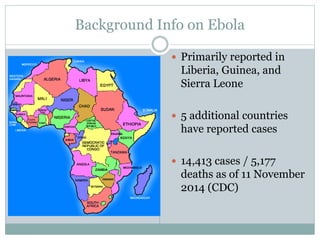
 Primarily reported in 
Liberia, Guinea, and 
Sierra Leone 
 5 additional countries 
have reported cases 
 14,413 cases / 5,177 
deaths as of 11 November 
2014 (CDC)
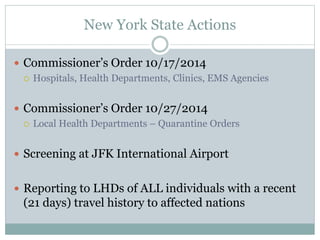
New York State Actions 
 Commissioner’s Order 10/17/2014 
 Hospitals, Health Departments, Clinics, EMS Agencies 
 Commissioner’s Order 10/27/2014 
 Local Health Departments – Quarantine Orders 
 Screening at JFK International Airport 
 Reporting to LHDs of ALL individuals with a recent 
(21 days) travel history to affected nations
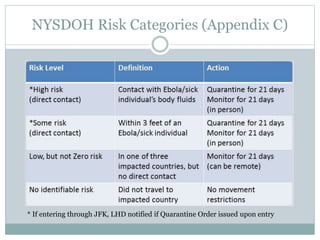
NYSDOH Risk Categories (Appendix C) 
* If entering through JFK, LHD notified if Quarantine Order issued upon entry
Module 1: Person Under Investigation 
November 20, 2014; 09:00 
An individual returned to Greene County from missionary 
work in Liberia. (Departed Liberia on November 18, 2014) 
Screening at JFK International determines no active 
symptoms. 
NYSDOH determined this person to be High Risk and issued 
a Quarantine Order in NYC. NYSDOH has provided transport 
to residence in Greene County with notification to GCPHD.
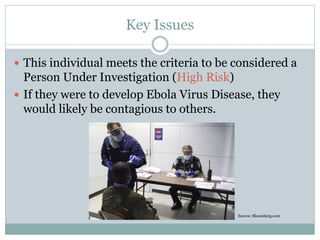
Key Issues 
 This individual meets the criteria to be considered a 
Person Under Investigation (High Risk) 
 If they were to develop Ebola Virus Disease, they 
would likely be contagious to others. 
Source: Bloomberg.com
Public Health and Medical Services 
 How will public health share necessary information 
regarding a PUI in Greene County to other agencies? 
 Will quarantine be required and what would be the 
process for initiating an Order? 
 What notification(s) will occur, when and to whom?
Operational Coordination 
 What actions must be taken to serve an Order for 
quarantine? 
 What systems/processes are in place at 911 Center or 
law enforcement agencies to facilitate this? 
 What resources might be necessary to enforce the 
Order? 
 What notification(s) will occur, when and to whom?
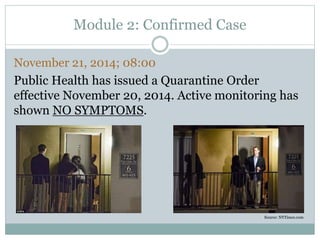
Module 2: Confirmed Case 
November 21, 2014; 08:00 
Public Health has issued a Quarantine Order 
effective November 20, 2014. Active monitoring has 
shown NO SYMPTOMS. 
Source: NYTimes.com
Module 2: Confirmed Case 
November 22, 2014; 09:00 
Person has developed a fever and diarrhea this morning. 
They dial 911 and request emergency medical services. 
Patient is transported to appropriate hospital facility for 
evaluation/treatment. 
The patient isolated at a local hospital facility and laboratory 
testing has returned a positive result for Ebola Virus Disease.
Key Issues 
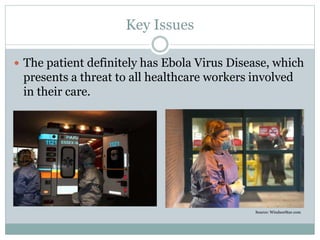
 The patient definitely has Ebola Virus Disease, which 
presents a threat to all healthcare workers involved 
in their care. 
Source: WindsorStar.com
Public Health and Medical Services 
 Will the emergency medical service providers require a 
quarantine order or active monitoring? 
 What epidemiological investigations will be necessary and 
how will they be performed? 
 What resources and systems/processes are in place for 
emergency medical services?
Operational Coordination 
 What coordination needs exist between various 
departments/agencies? 
 What will the messaging be to the public and how 
will it be delivered? 
 What resources and systems/processes are in place 
for the receiving hospital?
Module 3: Exposed Family Members 
November 22, 2014; 17:00 
The patient who has laboratory confirmed Ebola Virus 
Disease has a spouse and two children at home. They 
have no symptoms at this time but the spouse is 
concerned regarding their health and welfare.
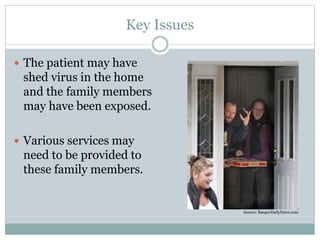
Key Issues 
 The patient may have 
shed virus in the home 
and the family members 
may have been exposed. 
 Various services may 
need to be provided to 
these family members. 
Source: BangorDailyNews.com
Public Health and Medical Services 
 What epidemiological investigations will be necessary and 
how will they be performed? 
 Will the family members require a quarantine order; what 
is their risk level? 
 How will the family members be provided food and other 
essentials?
Operational Coordination 
 What will the messaging be to the public and how will it be 
delivered? 
 Will there be a need for law enforcement to enforce the 
quarantine order or restrict access of others to the 
residence? How would this be coordinated? 
 In the event that the family needs to be relocated, how will 
this coordination occur and who would be the likely lead 
agency?
Hot Wash 
 Strengths 
 Areas for Improvement 
 Please complete Participant Feedback Forms
Closing Comments 
 Did we meet our objective and will participation in 
this TTX assist you with your agency goals? 
 Thank you for attending! 
 After-Action Report will be sent to all participants.

Greene County Ebola Threat 2014 TTX

  • 1.
    Ebola Threat 2014 Tabletop Exercise (TTX) W. SEAN HOLLAND P u b l i c He a l t h Eme r g e n c y P r e p a r e d ne s s C o o r d i n a t o r Gr e e n e C o u n t y P u b l i c He a l t h De p a r tme nt
  • 2.
    Introductions  Name,Agency, Position  Current Ebola-related activities  What you hope to learn from TTX?
  • 3.
    Exercise Overview ExerciseScope: This is a Tabletop Exercise, planned for approximately 2 hours at Greene County Emergency Services & Training Center. Exercise play is limited to discussion. Mission Area(s): Prevention, Response
  • 4.
    Objective and CoreCapabilities Determine current resource and system/process gaps within Greene County’s ability to prevent and respond to Ebola Virus Disease. Core Capabilities (Appendix D): Operational Coordination Environmental Response/Health and Safety Public Health and Medical Services
  • 5.
    Participant Roles andResponsibilities  Players: Respond to situation presented based on current plans, policies, and procedures  Observers: Support players in developing responses, but do not participate in moderated discussion  Facilitator: Provide situation updates and moderate discussions  Evaluators: Observe and document player discussions
  • 6.
    Exercise Structure Thisexercise will be a multimedia, facilitated exercise by a facilitator. Players will participate in the following three modules: Module 1: Person Under Investigation Module 2: Confirmed Case Module 3: Exposed Family Members
  • 7.
    Exercise Structure Each module begins with the facilitator presenting a multimedia update (Powerpoint) that summarizes key events occurring within that time period. After the updates, participants review the situation and engage in functional group discussions of appropriate issues for pre-event and incident.  After these functional group discussions, participants will engage in a moderated plenary discussion in which a spokesperson from each group will present a synopsis of the group’s actions, based on the scenario.
  • 8.
    Exercise Guidelines This is an open, low-stress, no-fault environment. Varying viewpoints, even disagreements, are expected  Base your responses on the current plans and capabilities of your organization  Decisions are not precedent setting; consider different approaches and suggest improvements  Issue identification is not as valuable as suggestions and recommended actions that could improve response efforts; problem-solving efforts should be the focus
  • 9.
    Assumptions and Artificialities  The exercise is conducted in a no-fault learning environment wherein capabilities, plans, systems, and processes will be evaluated  The exercise scenario is plausible, and events occur as they are presented  All players receive information at the same time
  • 10.
    Agenda (Appendix A) Time: 0940 Background Information 0950 Module 1: Person Under Investigation 1010 Break 1020 Module 2: Confirmed Case 1040 Module 3: Exposed Family Members 1100 Break 1110 Hot Wash 1120 Closing Comments
  • 11.
    Background Info onEbola  Ebola virus disease (EVD)  First identified 1976; 1,716 Total Cases 1976-2013 (WHO)  Symptoms include: fever, headaches, muscle pain, weakness, diarrhea, vomiting, abdominal pain, and unexplained hemorrhage (late sign)  Symptoms on average develop between 8 to 10 days after exposure (can range between 2-21 days)
  • 12.
    Background Info onEbola Key Points:  Persons traveling are not considered at risk unless they visit one of the affected countries  Virus spread through DIRECT CONTACT with blood or bodily fluids of a patient with Ebola  A person infected with Ebola is not contagious until symptoms appear
  • 13.
    Background Info onEbola  Primarily reported in Liberia, Guinea, and Sierra Leone  5 additional countries have reported cases  14,413 cases / 5,177 deaths as of 11 November 2014 (CDC)
  • 14.
    New York StateActions  Commissioner’s Order 10/17/2014  Hospitals, Health Departments, Clinics, EMS Agencies  Commissioner’s Order 10/27/2014  Local Health Departments – Quarantine Orders  Screening at JFK International Airport  Reporting to LHDs of ALL individuals with a recent (21 days) travel history to affected nations
  • 15.
    NYSDOH Risk Categories(Appendix C) * If entering through JFK, LHD notified if Quarantine Order issued upon entry
  • 16.
    Module 1: PersonUnder Investigation November 20, 2014; 09:00 An individual returned to Greene County from missionary work in Liberia. (Departed Liberia on November 18, 2014) Screening at JFK International determines no active symptoms. NYSDOH determined this person to be High Risk and issued a Quarantine Order in NYC. NYSDOH has provided transport to residence in Greene County with notification to GCPHD.
  • 17.
    Key Issues This individual meets the criteria to be considered a Person Under Investigation (High Risk)  If they were to develop Ebola Virus Disease, they would likely be contagious to others. Source: Bloomberg.com
  • 18.
    Public Health andMedical Services  How will public health share necessary information regarding a PUI in Greene County to other agencies?  Will quarantine be required and what would be the process for initiating an Order?  What notification(s) will occur, when and to whom?
  • 19.
    Operational Coordination What actions must be taken to serve an Order for quarantine?  What systems/processes are in place at 911 Center or law enforcement agencies to facilitate this?  What resources might be necessary to enforce the Order?  What notification(s) will occur, when and to whom?
  • 20.
    Module 2: ConfirmedCase November 21, 2014; 08:00 Public Health has issued a Quarantine Order effective November 20, 2014. Active monitoring has shown NO SYMPTOMS. Source: NYTimes.com
  • 21.
    Module 2: ConfirmedCase November 22, 2014; 09:00 Person has developed a fever and diarrhea this morning. They dial 911 and request emergency medical services. Patient is transported to appropriate hospital facility for evaluation/treatment. The patient isolated at a local hospital facility and laboratory testing has returned a positive result for Ebola Virus Disease.
  • 22.
    Key Issues The patient definitely has Ebola Virus Disease, which presents a threat to all healthcare workers involved in their care. Source: WindsorStar.com
  • 23.
    Public Health andMedical Services  Will the emergency medical service providers require a quarantine order or active monitoring?  What epidemiological investigations will be necessary and how will they be performed?  What resources and systems/processes are in place for emergency medical services?
  • 24.
    Operational Coordination What coordination needs exist between various departments/agencies?  What will the messaging be to the public and how will it be delivered?  What resources and systems/processes are in place for the receiving hospital?
  • 25.
    Module 3: ExposedFamily Members November 22, 2014; 17:00 The patient who has laboratory confirmed Ebola Virus Disease has a spouse and two children at home. They have no symptoms at this time but the spouse is concerned regarding their health and welfare.
  • 26.
    Key Issues The patient may have shed virus in the home and the family members may have been exposed.  Various services may need to be provided to these family members. Source: BangorDailyNews.com
  • 27.
    Public Health andMedical Services  What epidemiological investigations will be necessary and how will they be performed?  Will the family members require a quarantine order; what is their risk level?  How will the family members be provided food and other essentials?
  • 28.
    Operational Coordination What will the messaging be to the public and how will it be delivered?  Will there be a need for law enforcement to enforce the quarantine order or restrict access of others to the residence? How would this be coordinated?  In the event that the family needs to be relocated, how will this coordination occur and who would be the likely lead agency?
  • 29.
    Hot Wash Strengths  Areas for Improvement  Please complete Participant Feedback Forms
  • 30.
    Closing Comments Did we meet our objective and will participation in this TTX assist you with your agency goals?  Thank you for attending!  After-Action Report will be sent to all participants.