Running head: ELB FINANCIAL ANALYSIS 1
ELB Financial Analysis
Name
Institution Affiliation
ELB FINANCIAL ANALYSIS 2
Introduction
Typically, financial analysis involves the analysis of the stability, solvency, as well as the
liquidity or profitability of the enterprise to guarantee monetary investment. Usually, the financial
report focusses on the financial information like income statement, the balance sheet, and the cash
flow statement. Financial performance of ELB company is established using the horizontal
analysis of the report where the information of the company over two years (2017 and 2018).
Various ratios were calculated to determine the relative size of one number concerning another.
Income Statement
The financial performance of ELB Company weakened from 2017 to 2018. For one fiscal
year, ELB reported a fall in the annual net profit from $3.5 million to $3.26 million. Operational
expenses increased more than the revenue thus a fall in net profit. For instance, the differences are
attributed to the rise in the cost of sales from $20.25 million in 2017 to $24 million in 2018. There
was an increase in the distribution costs together with the administrative expenses of the company,
which rose to $5.12 million from $3.3 million. There is an increase in financial costs that contribute
to the fall in the total profit of the entity. In 2018, the cost was $0.5 2 million while in the previous
year it was a total of $0.45 million. The increase in the expenses of the company reduces the net
profit (Johnson, 2018). The rise in the costs results in a drastic fall in the profit before tax by $ 21
million. The company realized high losses.
It is evident for the cost of sale and other related expenses to increase with a rise in the
revenue. It is essential for the company to erasure that the latter is higher than the former for an
increase in the net profit of the firm. In 2018, ELB Company reported a rise in the revenue
representation of the effectiveness of performance in the company. A growth in the cost of sold is
as a consequence of a rise in the firm’s cost of operations, which has significant effects on the net
ELB FINANCIAL ANALYSIS 3
profit of the firm. Despite the increase in the worth of the goods sold, the firm still reported a rise
in the gross profit in 2018 as compared to 2017. In the case of 2017, ELB had a gross profit of $
8.65 million, which rose to $ 10.2 million in the subsequent year. It was a good indication that the
company's financial performance was improving (Ego, 2017). Rise in sales contributes to the gross
profit of the organization. It affected the overall revenue of the firm in 2018.
The management needs to develop strategies to ensure a decline in the expenses of the firm
and eventually raise the net profit of the company in subsequent years. A fall in the profit before
tax influences the amount of tax deducted. In this case, the decline led to the fall of the tax charges
from $ 0.14 million in 2017 to $ 0.13 million in 2018. Usually, the tax imposed on the corporation
depends on the profit earned by the company during the financial year (Muthee et al., 2016). In
this case, a rise in the gross profit leads to an increase in tax, while a decline leads to lower tax
imposition. The rise or fall of taxation affects the net income. Net profit in 2018 reduced by 6.9%,
thus the likelihood of changing the financial performance of the entity in case of continued decline
in the future.
Vertical Analysis
From the change in the percentage change of the various particulars in ELB, the total
revenue of the firm increased by 18.3% in 2018 as compared to 2017. The increase in income of
the company is due to rising sales in 2018 compared to 2017. In 2018, ELB's cost of purchase
increased by 18.5 %, which may be as a result of the economic conditions that may have influenced
production. Even with the rise in the cost of goods, the gross profit of the entity still increased by
17.9%. The increase in net expenses in 2018 led to a 6.9% fall in the net profit.
ELB FINANCIAL ANALYSIS 4
Balance sheet
Based on the ELB’s balance sheet, the financial position of the enterprise increased in 2018
as compared to the year before. In 2018, the economic situation of ELB was $ 40.93 million, which
is $ 8.73 million from $32.2 million. The increase is as a result of the excellent performance in
terms of the business activities in the market (Myšková & Hájek, 2017). Both the current and non-
current assets of the entity increased in 2018 related to 2017, thus contributing to a significant
change in ELB’s financial position.
Factors leading to an increase in the assets include a rise in the entity's value of property,
plant, and equipment. An increase of the PPE from $ 17.88 million in 2017 to $ 25.93 million in
2018 is an indication of the rise in the value of fixed assets of ELB over the year. Besides, the
increase in the cost of investment of the company that is available for sale from $5.4 million to $
6.2 million increases the overall financial position if the ELB enterprise.
The increase in the current assets of ELB contributes to the significant rise in the financial
position of the entity. In 2018, the inventory of the company was higher than in 2017. The stock
in 2018 was $ 4.4 million, which was a rise from $ 3.6 million in the previous year. Onthe contrary,
there was a decline in the cash and the cash equivalent of the enterprise. The value changed from
$ 0.12 million in 2017 to zero in 2018, thus the incapability of the ELB enterprise to address its
short-term responsibilities in the subsequent year. A decline in the cash and cash equivalent added
to a decline in total assets of the company in 2018.
Nonetheless, despite the decrease in the cash and cash equivalent, the total current assets
in both years are higher than the current liability; thus, the company's quick ratio of more than 1.0.
The rate shows the ability of ELB to settle and meet its short-term obligation. In the case of
solvency, the entity can be in the position to solve short-term and debts; thus, the inability to be
ELB FINANCIAL ANALYSIS 5
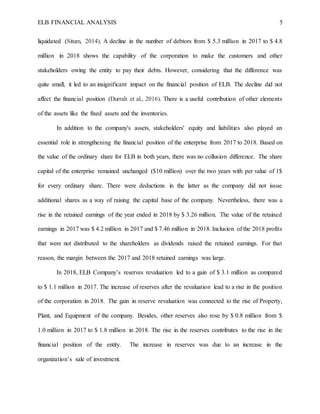
liquidated (Situm, 2014). A decline in the number of debtors from $ 5.3 million in 2017 to $ 4.8
million in 2018 shows the capability of the corporation to make the customers and other
stakeholders owing the entity to pay their debts. However, considering that the difference was
quite small, it led to an insignificant impact on the financial position of ELB. The decline did not
affect the financial position (Durrah et al., 2016). There is a useful contribution of other elements
of the assets like the fixed assets and the inventories.
In addition to the company's assets, stakeholders' equity and liabilities also played an
essential role in strengthening the financial position of the enterprise from 2017 to 2018. Based on
the value of the ordinary share for ELB in both years, there was no collusion difference. The share
capital of the enterprise remained unchanged ($10 million) over the two years with per value of 1$
for every ordinary share. There were deductions in the latter as the company did not issue
additional shares as a way of raising the capital base of the company. Nevertheless, there was a
rise in the retained earnings of the year ended in 2018 by $ 3.26 million. The value of the retained
earnings in 2017 was $ 4.2 million in 2017 and $ 7.46 million in 2018. Inclusion of the 2018 profits
that were not distributed to the shareholders as dividends raised the retained earnings. For that
reason, the margin between the 2017 and 2018 retained earnings was large.
In 2018, ELB Company’s reserves revaluation led to a gain of $ 3.1 million as compared
to $ 1.1 million in 2017. The increase of reserves after the revaluation lead to a rise in the position
of the corporation in 2018. The gain in reserve revaluation was connected to the rise of Property,
Plant, and Equipment of the company. Besides, other reserves also rose by $ 0.8 million from $
1.0 million in 2017 to $ 1.8 million in 2018. The rise in the reserves contributes to the rise in the
financial position of the entity. The increase in reserves was due to an increase in the
organization’s sale of investment.
ELB FINANCIAL ANALYSIS 6
ELB’s other sources of capital besides the ordinary shares are the loans and borrowings.
For the long-term borrowings, they did not change over the period between 2017 and 2018. This
implies that ELB did not acquire more loans to increase liquidity nature of the capital. The
company has a 6% payable bond, which is due in 2020, which rises from $ 5.2 million in 2017 to
$ 5.4 million in 2018. There was an increase in the debt-equity ratio of the enterprise.
Finally, the trade and other payables of the firm in 2018 increased as compared to 2017. In
2017, it had the value of $ 4.7 million, which rose by $ 1.1 million, leading to $ 5.8 million in
2018. The financial position of the firm was influenced by the rise in the current liabilities of the
firm by making it weak. An increase in debt reduces the capability of the entity to settle its short-
term responsibilities in case of solvency (Tongli et al., 2018). On the same situation, the firm
increased its short-term borrowing from zero in 2017 to $ 0.27 million in the subsequent year, thus
increasing the current liabilities of the enterprise in 2018. Burgstahler & Sawers (2017) argue that
a decrease in the existing assets and increase in current liabilities in ELB can affect the company
adversely as available assets may fail to meet the obligations when they are due.
Financial Ratios: Liquidity ratios
Current Ratio
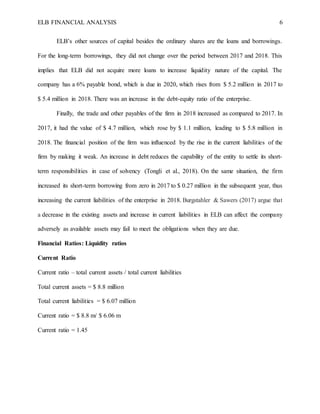
Current ratio – total current assets / total current liabilities
Total current assets = $ 8.8 million
Total current liabilities = $ 6.07 million
Current ratio = $ 8.8 m/ $ 6.06 m
Current ratio = 1.45
ELB FINANCIAL ANALYSIS 7
The current ration of ELB Enterprise is higher than one. As a result, the corporation can
settle its short-term obligations without further borrowings and koans (Nuhu, 2014). Also,
the value is favorable as it is close to the anticipated target value of the management.
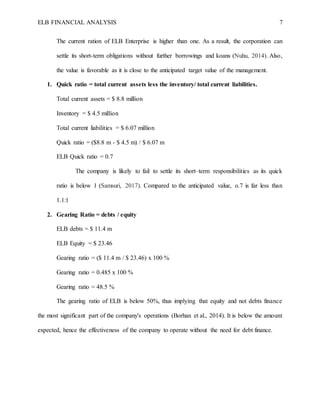
1. Quick ratio = total current assets less the inventory/ total current liabilities.
Total current assets = $ 8.8 million
Inventory = $ 4.5 million
Total current liabilities = $ 6.07 million
Quick ratio = ($8.8 m - $ 4.5 m) / $ 6.07 m
ELB Quick ratio = 0.7
The company is likely to fail to settle its short–term responsibilities as its quick
ratio is below 1 (Samsuri, 2017). Compared to the anticipated value, o.7 is far less than
1.1:1
2. Gearing Ratio = debts / equity
ELB debts = $ 11.4 m
ELB Equity = $ 23.46
Gearing ratio = ($ 11.4 m / $ 23.46) x 100 %
Gearing ratio = 0.485 x 100 %
Gearing ratio = 48.5 %
The gearing ratio of ELB is below 50%, thus implying that equity and not debts finance
the most significant part of the company's operations (Borhan et al., 2014). It is below the amount
expected, hence the effectiveness of the company to operate without the need for debt finance.
ELB FINANCIAL ANALYSIS 8
Recommendations
The following are among the proposals that ELB management needs to consider
and ensure improved performance of the entity in the industry.
1. The company should aim at reducing the leverage ratio through a reduction in the
number of debt finances used to finance the operation of the entity.
2. Appropriate and effective operational techniques should be put in place to minimize
the operating expense that reduces the gross profit of the entity.
3. The administrative and distribution cost should be reduced to ensure the realization of
higher net profits.
ELB FINANCIAL ANALYSIS 9
References
Borhan, H., Naina Mohamed, R., & Azmi, N. (2014). The impact of financial ratios on the
financial performance of a chemical company: The case of LyondellBasell
Industries. World Journal of Entrepreneurship, Management and Sustainable
Development, 10(2), 154-160.
Burgstahler, D. C., & Sawers, K. M. (2017). Management of Financial Performance Measures:
Evidence from Private Colleges and Universities. Journal of Governmental & Nonprofit
Accounting, 6(1), 1-29.
Durrah, O., Rahman, A. A. A., Jamil, S. A., & Ghafeer, N. A. (2016). Exploring the relationship
between liquidity ratios and indicators of financial performance: An analytical study on
food industrial companies listed in Amman Bursa. International Journal of Economics
and Financial Issues, 6(2), 435-441.
Ego, C. I. (2017). Liquidity and the Market Share Ratios as Indicators of Fraud (Doctoral
dissertation, Northcentral University).
Johnson, G. (2018). An Investigation into Why Not All Net Operating Losses Reported are Net
Operating Losses(Doctoral dissertation, Northcentral University).
Muthee, B., Adudah, J., & Ondigo, H. (2016). Relationship between Interest Rates and Gearing
Ratios of Firms Listed in the Nairobi Securities Exchange. International Journal of
Finance and Accounting, 1(1), 30-44.
Myšková, R., & Hájek, P. (2017). Comprehensive assessment of firm financial performance using
financial ratios and linguistic analysis of annual reports. Journal of International Studies,
volume 10, issue: 4.
ELB FINANCIAL ANALYSIS
10
Nuhu, M. (2014). Role of ratio analysis in business decisions: A case study NBC Maiduguri
Plant. Journal of Educational and Social Research, 4(5), 105.
Samsuri, N. (2017). Affin Bank Performance: Relationship Liquidity Ratio, Leverage Ratio and
GDP to Profitability.
Situm, M. (2014). Inability of gearing-ratio as predictor for early warning systems. Business
systems research journal: international journal of the Society for Advancing Business &
Information Technology (BIT), 5(2), 23-45.
Tongli, B., Tono, H., & Tanasal, S. (2018). Financial Performance Analysis in Manufacturing
Companies of The Cement Sectors Listing On Indonesia Stock Exchange (IDX) Period
2013-2017. Available at SSRN 3306516.

Ebl 5

  • 1.
    Running head: ELBFINANCIAL ANALYSIS 1 ELB Financial Analysis Name Institution Affiliation
  • 2.
    ELB FINANCIAL ANALYSIS2 Introduction Typically, financial analysis involves the analysis of the stability, solvency, as well as the liquidity or profitability of the enterprise to guarantee monetary investment. Usually, the financial report focusses on the financial information like income statement, the balance sheet, and the cash flow statement. Financial performance of ELB company is established using the horizontal analysis of the report where the information of the company over two years (2017 and 2018). Various ratios were calculated to determine the relative size of one number concerning another. Income Statement The financial performance of ELB Company weakened from 2017 to 2018. For one fiscal year, ELB reported a fall in the annual net profit from $3.5 million to $3.26 million. Operational expenses increased more than the revenue thus a fall in net profit. For instance, the differences are attributed to the rise in the cost of sales from $20.25 million in 2017 to $24 million in 2018. There was an increase in the distribution costs together with the administrative expenses of the company, which rose to $5.12 million from $3.3 million. There is an increase in financial costs that contribute to the fall in the total profit of the entity. In 2018, the cost was $0.5 2 million while in the previous year it was a total of $0.45 million. The increase in the expenses of the company reduces the net profit (Johnson, 2018). The rise in the costs results in a drastic fall in the profit before tax by $ 21 million. The company realized high losses. It is evident for the cost of sale and other related expenses to increase with a rise in the revenue. It is essential for the company to erasure that the latter is higher than the former for an increase in the net profit of the firm. In 2018, ELB Company reported a rise in the revenue representation of the effectiveness of performance in the company. A growth in the cost of sold is as a consequence of a rise in the firm’s cost of operations, which has significant effects on the net
  • 3.
    ELB FINANCIAL ANALYSIS3 profit of the firm. Despite the increase in the worth of the goods sold, the firm still reported a rise in the gross profit in 2018 as compared to 2017. In the case of 2017, ELB had a gross profit of $ 8.65 million, which rose to $ 10.2 million in the subsequent year. It was a good indication that the company's financial performance was improving (Ego, 2017). Rise in sales contributes to the gross profit of the organization. It affected the overall revenue of the firm in 2018. The management needs to develop strategies to ensure a decline in the expenses of the firm and eventually raise the net profit of the company in subsequent years. A fall in the profit before tax influences the amount of tax deducted. In this case, the decline led to the fall of the tax charges from $ 0.14 million in 2017 to $ 0.13 million in 2018. Usually, the tax imposed on the corporation depends on the profit earned by the company during the financial year (Muthee et al., 2016). In this case, a rise in the gross profit leads to an increase in tax, while a decline leads to lower tax imposition. The rise or fall of taxation affects the net income. Net profit in 2018 reduced by 6.9%, thus the likelihood of changing the financial performance of the entity in case of continued decline in the future. Vertical Analysis From the change in the percentage change of the various particulars in ELB, the total revenue of the firm increased by 18.3% in 2018 as compared to 2017. The increase in income of the company is due to rising sales in 2018 compared to 2017. In 2018, ELB's cost of purchase increased by 18.5 %, which may be as a result of the economic conditions that may have influenced production. Even with the rise in the cost of goods, the gross profit of the entity still increased by 17.9%. The increase in net expenses in 2018 led to a 6.9% fall in the net profit.
  • 4.
    ELB FINANCIAL ANALYSIS4 Balance sheet Based on the ELB’s balance sheet, the financial position of the enterprise increased in 2018 as compared to the year before. In 2018, the economic situation of ELB was $ 40.93 million, which is $ 8.73 million from $32.2 million. The increase is as a result of the excellent performance in terms of the business activities in the market (Myšková & Hájek, 2017). Both the current and non- current assets of the entity increased in 2018 related to 2017, thus contributing to a significant change in ELB’s financial position. Factors leading to an increase in the assets include a rise in the entity's value of property, plant, and equipment. An increase of the PPE from $ 17.88 million in 2017 to $ 25.93 million in 2018 is an indication of the rise in the value of fixed assets of ELB over the year. Besides, the increase in the cost of investment of the company that is available for sale from $5.4 million to $ 6.2 million increases the overall financial position if the ELB enterprise. The increase in the current assets of ELB contributes to the significant rise in the financial position of the entity. In 2018, the inventory of the company was higher than in 2017. The stock in 2018 was $ 4.4 million, which was a rise from $ 3.6 million in the previous year. Onthe contrary, there was a decline in the cash and the cash equivalent of the enterprise. The value changed from $ 0.12 million in 2017 to zero in 2018, thus the incapability of the ELB enterprise to address its short-term responsibilities in the subsequent year. A decline in the cash and cash equivalent added to a decline in total assets of the company in 2018. Nonetheless, despite the decrease in the cash and cash equivalent, the total current assets in both years are higher than the current liability; thus, the company's quick ratio of more than 1.0. The rate shows the ability of ELB to settle and meet its short-term obligation. In the case of solvency, the entity can be in the position to solve short-term and debts; thus, the inability to be
  • 5.
    ELB FINANCIAL ANALYSIS5 liquidated (Situm, 2014). A decline in the number of debtors from $ 5.3 million in 2017 to $ 4.8 million in 2018 shows the capability of the corporation to make the customers and other stakeholders owing the entity to pay their debts. However, considering that the difference was quite small, it led to an insignificant impact on the financial position of ELB. The decline did not affect the financial position (Durrah et al., 2016). There is a useful contribution of other elements of the assets like the fixed assets and the inventories. In addition to the company's assets, stakeholders' equity and liabilities also played an essential role in strengthening the financial position of the enterprise from 2017 to 2018. Based on the value of the ordinary share for ELB in both years, there was no collusion difference. The share capital of the enterprise remained unchanged ($10 million) over the two years with per value of 1$ for every ordinary share. There were deductions in the latter as the company did not issue additional shares as a way of raising the capital base of the company. Nevertheless, there was a rise in the retained earnings of the year ended in 2018 by $ 3.26 million. The value of the retained earnings in 2017 was $ 4.2 million in 2017 and $ 7.46 million in 2018. Inclusion of the 2018 profits that were not distributed to the shareholders as dividends raised the retained earnings. For that reason, the margin between the 2017 and 2018 retained earnings was large. In 2018, ELB Company’s reserves revaluation led to a gain of $ 3.1 million as compared to $ 1.1 million in 2017. The increase of reserves after the revaluation lead to a rise in the position of the corporation in 2018. The gain in reserve revaluation was connected to the rise of Property, Plant, and Equipment of the company. Besides, other reserves also rose by $ 0.8 million from $ 1.0 million in 2017 to $ 1.8 million in 2018. The rise in the reserves contributes to the rise in the financial position of the entity. The increase in reserves was due to an increase in the organization’s sale of investment.
  • 6.
    ELB FINANCIAL ANALYSIS6 ELB’s other sources of capital besides the ordinary shares are the loans and borrowings. For the long-term borrowings, they did not change over the period between 2017 and 2018. This implies that ELB did not acquire more loans to increase liquidity nature of the capital. The company has a 6% payable bond, which is due in 2020, which rises from $ 5.2 million in 2017 to $ 5.4 million in 2018. There was an increase in the debt-equity ratio of the enterprise. Finally, the trade and other payables of the firm in 2018 increased as compared to 2017. In 2017, it had the value of $ 4.7 million, which rose by $ 1.1 million, leading to $ 5.8 million in 2018. The financial position of the firm was influenced by the rise in the current liabilities of the firm by making it weak. An increase in debt reduces the capability of the entity to settle its short- term responsibilities in case of solvency (Tongli et al., 2018). On the same situation, the firm increased its short-term borrowing from zero in 2017 to $ 0.27 million in the subsequent year, thus increasing the current liabilities of the enterprise in 2018. Burgstahler & Sawers (2017) argue that a decrease in the existing assets and increase in current liabilities in ELB can affect the company adversely as available assets may fail to meet the obligations when they are due. Financial Ratios: Liquidity ratios Current Ratio Current ratio – total current assets / total current liabilities Total current assets = $ 8.8 million Total current liabilities = $ 6.07 million Current ratio = $ 8.8 m/ $ 6.06 m Current ratio = 1.45
  • 7.
    ELB FINANCIAL ANALYSIS7 The current ration of ELB Enterprise is higher than one. As a result, the corporation can settle its short-term obligations without further borrowings and koans (Nuhu, 2014). Also, the value is favorable as it is close to the anticipated target value of the management. 1. Quick ratio = total current assets less the inventory/ total current liabilities. Total current assets = $ 8.8 million Inventory = $ 4.5 million Total current liabilities = $ 6.07 million Quick ratio = ($8.8 m - $ 4.5 m) / $ 6.07 m ELB Quick ratio = 0.7 The company is likely to fail to settle its short–term responsibilities as its quick ratio is below 1 (Samsuri, 2017). Compared to the anticipated value, o.7 is far less than 1.1:1 2. Gearing Ratio = debts / equity ELB debts = $ 11.4 m ELB Equity = $ 23.46 Gearing ratio = ($ 11.4 m / $ 23.46) x 100 % Gearing ratio = 0.485 x 100 % Gearing ratio = 48.5 % The gearing ratio of ELB is below 50%, thus implying that equity and not debts finance the most significant part of the company's operations (Borhan et al., 2014). It is below the amount expected, hence the effectiveness of the company to operate without the need for debt finance.
  • 8.
    ELB FINANCIAL ANALYSIS8 Recommendations The following are among the proposals that ELB management needs to consider and ensure improved performance of the entity in the industry. 1. The company should aim at reducing the leverage ratio through a reduction in the number of debt finances used to finance the operation of the entity. 2. Appropriate and effective operational techniques should be put in place to minimize the operating expense that reduces the gross profit of the entity. 3. The administrative and distribution cost should be reduced to ensure the realization of higher net profits.
  • 9.
    ELB FINANCIAL ANALYSIS9 References Borhan, H., Naina Mohamed, R., & Azmi, N. (2014). The impact of financial ratios on the financial performance of a chemical company: The case of LyondellBasell Industries. World Journal of Entrepreneurship, Management and Sustainable Development, 10(2), 154-160. Burgstahler, D. C., & Sawers, K. M. (2017). Management of Financial Performance Measures: Evidence from Private Colleges and Universities. Journal of Governmental & Nonprofit Accounting, 6(1), 1-29. Durrah, O., Rahman, A. A. A., Jamil, S. A., & Ghafeer, N. A. (2016). Exploring the relationship between liquidity ratios and indicators of financial performance: An analytical study on food industrial companies listed in Amman Bursa. International Journal of Economics and Financial Issues, 6(2), 435-441. Ego, C. I. (2017). Liquidity and the Market Share Ratios as Indicators of Fraud (Doctoral dissertation, Northcentral University). Johnson, G. (2018). An Investigation into Why Not All Net Operating Losses Reported are Net Operating Losses(Doctoral dissertation, Northcentral University). Muthee, B., Adudah, J., & Ondigo, H. (2016). Relationship between Interest Rates and Gearing Ratios of Firms Listed in the Nairobi Securities Exchange. International Journal of Finance and Accounting, 1(1), 30-44. Myšková, R., & Hájek, P. (2017). Comprehensive assessment of firm financial performance using financial ratios and linguistic analysis of annual reports. Journal of International Studies, volume 10, issue: 4.
  • 10.
    ELB FINANCIAL ANALYSIS 10 Nuhu,M. (2014). Role of ratio analysis in business decisions: A case study NBC Maiduguri Plant. Journal of Educational and Social Research, 4(5), 105. Samsuri, N. (2017). Affin Bank Performance: Relationship Liquidity Ratio, Leverage Ratio and GDP to Profitability. Situm, M. (2014). Inability of gearing-ratio as predictor for early warning systems. Business systems research journal: international journal of the Society for Advancing Business & Information Technology (BIT), 5(2), 23-45. Tongli, B., Tono, H., & Tanasal, S. (2018). Financial Performance Analysis in Manufacturing Companies of The Cement Sectors Listing On Indonesia Stock Exchange (IDX) Period 2013-2017. Available at SSRN 3306516.