Optimizing Battery Swapping Station
(BSS) Locations for e-Bikes in NYC
19.12.24
Salsabil Salah
Srimantini Bhattacharya
Develop an optimization model to maximize
utilization of BSS.
2
Problem Statement
The U.S. e-bike market size reached $940 million in
2023 and is expected to reach $2.4 billion by 2032. In
2023, ~6% of NYC adults reported riding an e-bike or
e-scooter once a week or more. In NYC, the bike
incentive program also offsets 50% of e-bike costs upto
$1,100 instantly as rebate. In Manhattan, delivery
workers are also slowly adopting e-bikes for deliveries.
There is significant growth in the demand for e-bikes
which will soon require urban infrastructure to be
replenished effectively.
In NYC, the number of fires caused by lithium-ion
batteries in e-bikes has increased dramatically in
recent years, from 30 in 2019 to 268 in 2023. In
2023, 91 fires originated while charging e-bikes at
home/work. Battery swapping stations are a safe
alternative to replenishing e-bike energy while
minimizing fire incidents especially in homes. BSS
can also reduce vehicle downtime and increase
efficiency especially for delivery workers. NYC has
~52,000 delivery drivers, majority of whom use
e-bikes.
Market Status Market Concerns
3
Benchmark
To optimise battery swapping stations in NYC following
parameters are to be considered, using current NYC battery
swapping stations as a benchmark.
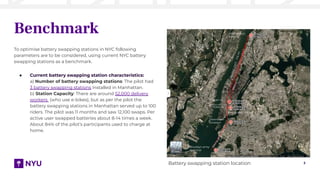
● Current battery swapping station characteristics:
a) Number of battery swapping stations: The pilot had
3 battery swapping stations installed in Manhattan.
b) Station Capacity: There are around 52,000 delivery
workers (who use e-bikes), but as per the pilot the
battery swapping stations in Manhattan served up to 100
riders. The pilot was 11 months and saw 12,100 swaps. Per
active user swapped batteries about 8-14 times a week.
About 84% of the pilot’s participants used to charge at
home.
Battery swapping station location
B
I
K
I
N
G
D
I
S
T
-
1
1
.6
m
i
Biking dist - 1.1 mi
Biking dist - 2.4 mi
B
i
k
i
n
g
d
i
s
t
-
5
m
i
Brooklyn army
terminal
Downtown
brooklyn
Essex st
Copper sq
Washington
heights
B
i
k
i
n
g
d
i
s
t
-
1
0
.8
m
i
4
Benchmark
● Spatial Distribution and accessibility: The pilot had 3 BSS in Manhattan: Cooper Square (Noho),
Essex Market (Lower east side) and Plaza de Las Americas (Washington Heights). This meant that
there was a large gap of infrastructure between lower and upper Manhattan. This may be a
problem since majority of workers work all over Manhattan. NYC’s pilot saw 83% of participants
working in Manhattan.
● Safety: NYC has witnessed a huge influx of e-bikes but it has also led to deadly fires. NYC has
decided to combat this by implementing battery swapping stations. With the help of this the riders
can power up their e-bikes faster and more efficiently and also the risk of fire hazard will be
reduced. The pilot project saw about half participants opting to not charge at home by the end of
the first five months, indicating a path towards successful safety measures through the
introduction of BSS.
● Utilization Efficiency: Although currently the number of battery swapping stations are very less in
NYC but referencing other cities like Taiwan, on increasing the number of battery swapping stations
in NYC, the wait time for swapping of the battery will be few minutes whereas it can take hours to
recharge an e-bike depending on the battery’s state of charge (SOC).
5
Benchmark
● Economic Factors: NYC partnered with three companies Swobbee, SwiftMile and Pop Wheels to
develop new charging hubs. Swobbee and Pop Wheels have installed the battery swapping
stations. During the pilot program 100 delivery workers were to volunteer to use these charging
stations. The program costs around $950,000 in city funding.
● Equity and policy consideration:
a) Regulatory Compliance : NYC has been increasingly regulating the use of e-bikes and
lithium-ion batteries due to fire risks, meaning BSS installations must meet strict safety standards.
The current battery swapping stations installed by Swobbee and Pop Wheels include fire safety
measures, such as sensors to monitor the batteries and an automatic shut-off function if a battery is
overheating. Batteries need to be compliant with UL certification of e-bikes.
b) Equity: Currently the battery swapping stations are mostly located in lower Manhattan, Brooklyn
and Washington Heights. Other areas like Queens, other parts of Brooklyn, Midtown and Upper
Manhattan would also need to be covered in order to effectively help delivery workers .
6
Objective
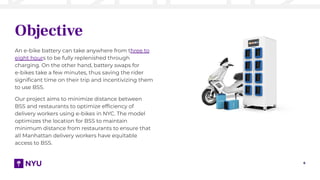
An e-bike battery can take anywhere from three to
eight hours to be fully replenished through
charging. On the other hand, battery swaps for
e-bikes take a few minutes, thus saving the rider
significant time on their trip and incentivizing them
to use BSS.
Our project aims to minimize distance between
BSS and restaurants to optimize efficiency of
delivery workers using e-bikes in NYC. The model
optimizes the location for BSS to maintain
minimum distance from restaurants to ensure that
all Manhattan delivery workers have equitable
access to BSS.
7
Literature Review
1. A study in China used simulated annealing to optimize station locations and battery capacities to
minimize costs.
2. Another study in Shanghai developed a NP-hard optimization problem model to identify optimal cabinet
locations from candidate sites to minimize the deviation from riders’ planned routes and reduce the cost.
3. In Beijing, a study used the spatial distribution of BSSs and related facilities like restaurants, offices, and
residences with ML mod-els like Random Forest, Support Vector Regression (SVR), Gradient Boosting
Decision Tree (GBDT), and Stacking Ensemble models.
4. In Colombia, a simulation case study was done to find waiting times, battery usage cycles, energy
demand, and service coverage related to BSS.
5. In India, a study examined the role of battery swapping (BS) technology in the passenger transportation
sector, analyzing its economic viability, potential to increase electric vehicle (EV) adoption, impact on
energy demand, and contribution to reducing CO2 emissions.
6. From our literature review, we saw that there were few studies done on battery swapping station location
optimization but few that focused on a North American urban system catering to delivery workers.
8
BSS in Manhattan
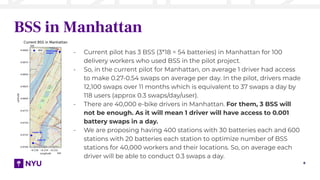
- Current pilot has 3 BSS (3*18 = 54 batteries) in Manhattan for 100
delivery workers who used BSS in the pilot project.
- So, in the current pilot for Manhattan, on average 1 driver had access
to make 0.27-0.54 swaps on average per day. In the pilot, drivers made
12,100 swaps over 11 months which is equivalent to 37 swaps a day by
118 users (approx 0.3 swaps/day/user).
- There are 40,000 e-bike drivers in Manhattan. For them, 3 BSS will
not be enough. As it will mean 1 driver will have access to 0.001
battery swaps in a day.
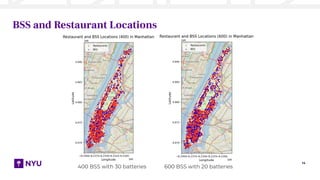
- We are proposing having 400 stations with 30 batteries each and 600
stations with 20 batteries each station to optimize number of BSS
stations for 40,000 workers and their locations. So, on average each
driver will be able to conduct 0.3 swaps a day.
Essex St
Cooper Sq
Washington
Heights
9
Restaurants in Manhattan
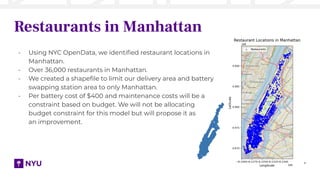
- Using NYC OpenData, we identified restaurant locations in
Manhattan.
- Over 36,000 restaurants in Manhattan.
- We created a shapefile to limit our delivery area and battery
swapping station area to only Manhattan.
- Per battery cost of $400 and maintenance costs will be a
constraint based on budget. We will not be allocating
budget constraint for this model but will propose it as
an improvement.
10
Minimum number of battery swapping stations
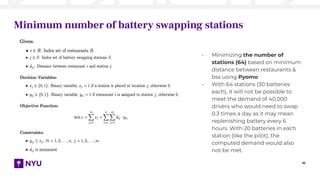
- Minimizing the number of
stations (64) based on minimum
distance between restaurants &
bss using Pyomo
- With 64 stations (30 batteries
each), it will not be possible to
meet the demand of 40,000
drivers who would need to swap
0.3 times a day as it may mean
replenishing battery every 6
hours. With 20 batteries in each
station (like the pilot), the
computed demand would also
not be met.
11
Minimum number of battery swapping stations
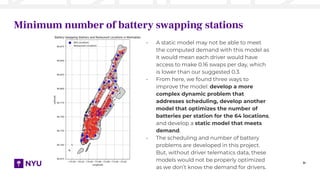
- A static model may not be able to meet
the computed demand with this model as
it would mean each driver would have
access to make 0.16 swaps per day, which
is lower than our suggested 0.3.
- From here, we found three ways to
improve the model: develop a more
complex dynamic problem that
addresses scheduling, develop another
model that optimizes the number of
batteries per station for the 64 locations,
and develop a static model that meets
demand.
- The scheduling and number of battery
problems are developed in this project.
But, without driver telematics data, these
models would not be properly optimized
as we don’t know the demand for drivers.
12
Min no. of battery swapping stations with scheduling
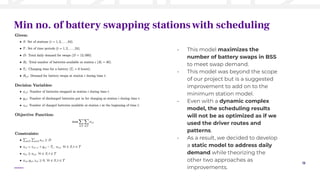
- This model maximizes the
number of battery swaps in BSS
to meet swap demand.
- This model was beyond the scope
of our project but is a suggested
improvement to add on to the
minimum station model.
- Even with a dynamic complex
model, the scheduling results
will not be as optimized as if we
used the driver routes and
patterns.
- As a result, we decided to develop
a static model to address daily
demand while theorizing the
other two approaches as
improvements.
13
Minimizing distance - P Median Problem
- Similar model as the
minimum station p-median
problem
- Number of stations is
constrained to meet demand
in a day (static model)
14
BSS and Restaurant Locations
400 BSS with 30 batteries 600 BSS with 20 batteries
15
Set Covering Problem (proposed improvement)
- Identifies a small subset from
400 stations that covers most
restaurants
- Could be redundant as
solution could be very similar
to minimum number of
station problem
- Very inefficient, took hours and
used computer memory while
running on pyomo
16
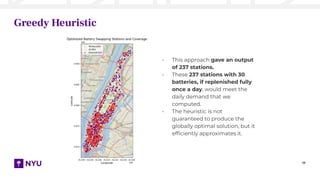
Greedy Heuristic
17
Greedy Heuristic
- This approach gave an output
of 237 stations.
- These 237 stations with 30
batteries, if replenished fully
once a day, would meet the
daily demand that we
computed.
- The heuristic is not
guaranteed to produce the
globally optimal solution, but it
efficiently approximates it.
18
Results and Benchmark
1. With our proposed BSS locations, delivery drivers can access stations within
0.2 miles of the restaurants, ensuring equitable access, which would not
happen with only 3 BSS.
2. There are also more BSS to cover the rest of Manhattan, ensuring efficient
delivery trips for the drivers.
3. Our proposed 237 stations with 30 batteries fully replenished daily would
provide each driver access to 0.4 swaps/day, which is also better than the
swap rate witnessed in the pilot.
19
Next steps:
As there was a lack of driver travel behavior, this can be obtained next by utilizing surveys or
other stakeholders with such information.
• Dynamic Optimization: Incorporate real-time swapping behavior and scheduling mod-
els to reflect operational conditions better using driver telematics.
• Cost-Constrained Models: Develop frameworks considering installation and opera-
tional costs.
• Survey Integration: Use delivery worker surveys to refine demand estimation and loca-
tion preferences.
• Equity Expansion: Address gaps in underserved areas through targeted investments.
Place stations near delivery workers’ home locations.
• Battery Optimization: Use driver telematics to identify high-frequency zones and assign
more batteries to such locations while assigning fewer batteries to low-frequency zones.
20
Thank You!

Ebike Battery Swapping Station Location Optimization

  • 1.
    Optimizing Battery SwappingStation (BSS) Locations for e-Bikes in NYC 19.12.24 Salsabil Salah Srimantini Bhattacharya Develop an optimization model to maximize utilization of BSS.
  • 2.
    2 Problem Statement The U.S.e-bike market size reached $940 million in 2023 and is expected to reach $2.4 billion by 2032. In 2023, ~6% of NYC adults reported riding an e-bike or e-scooter once a week or more. In NYC, the bike incentive program also offsets 50% of e-bike costs upto $1,100 instantly as rebate. In Manhattan, delivery workers are also slowly adopting e-bikes for deliveries. There is significant growth in the demand for e-bikes which will soon require urban infrastructure to be replenished effectively. In NYC, the number of fires caused by lithium-ion batteries in e-bikes has increased dramatically in recent years, from 30 in 2019 to 268 in 2023. In 2023, 91 fires originated while charging e-bikes at home/work. Battery swapping stations are a safe alternative to replenishing e-bike energy while minimizing fire incidents especially in homes. BSS can also reduce vehicle downtime and increase efficiency especially for delivery workers. NYC has ~52,000 delivery drivers, majority of whom use e-bikes. Market Status Market Concerns
  • 3.
    3 Benchmark To optimise batteryswapping stations in NYC following parameters are to be considered, using current NYC battery swapping stations as a benchmark. ● Current battery swapping station characteristics: a) Number of battery swapping stations: The pilot had 3 battery swapping stations installed in Manhattan. b) Station Capacity: There are around 52,000 delivery workers (who use e-bikes), but as per the pilot the battery swapping stations in Manhattan served up to 100 riders. The pilot was 11 months and saw 12,100 swaps. Per active user swapped batteries about 8-14 times a week. About 84% of the pilot’s participants used to charge at home. Battery swapping station location B I K I N G D I S T - 1 1 .6 m i Biking dist - 1.1 mi Biking dist - 2.4 mi B i k i n g d i s t - 5 m i Brooklyn army terminal Downtown brooklyn Essex st Copper sq Washington heights B i k i n g d i s t - 1 0 .8 m i
  • 4.
    4 Benchmark ● Spatial Distributionand accessibility: The pilot had 3 BSS in Manhattan: Cooper Square (Noho), Essex Market (Lower east side) and Plaza de Las Americas (Washington Heights). This meant that there was a large gap of infrastructure between lower and upper Manhattan. This may be a problem since majority of workers work all over Manhattan. NYC’s pilot saw 83% of participants working in Manhattan. ● Safety: NYC has witnessed a huge influx of e-bikes but it has also led to deadly fires. NYC has decided to combat this by implementing battery swapping stations. With the help of this the riders can power up their e-bikes faster and more efficiently and also the risk of fire hazard will be reduced. The pilot project saw about half participants opting to not charge at home by the end of the first five months, indicating a path towards successful safety measures through the introduction of BSS. ● Utilization Efficiency: Although currently the number of battery swapping stations are very less in NYC but referencing other cities like Taiwan, on increasing the number of battery swapping stations in NYC, the wait time for swapping of the battery will be few minutes whereas it can take hours to recharge an e-bike depending on the battery’s state of charge (SOC).
  • 5.
    5 Benchmark ● Economic Factors:NYC partnered with three companies Swobbee, SwiftMile and Pop Wheels to develop new charging hubs. Swobbee and Pop Wheels have installed the battery swapping stations. During the pilot program 100 delivery workers were to volunteer to use these charging stations. The program costs around $950,000 in city funding. ● Equity and policy consideration: a) Regulatory Compliance : NYC has been increasingly regulating the use of e-bikes and lithium-ion batteries due to fire risks, meaning BSS installations must meet strict safety standards. The current battery swapping stations installed by Swobbee and Pop Wheels include fire safety measures, such as sensors to monitor the batteries and an automatic shut-off function if a battery is overheating. Batteries need to be compliant with UL certification of e-bikes. b) Equity: Currently the battery swapping stations are mostly located in lower Manhattan, Brooklyn and Washington Heights. Other areas like Queens, other parts of Brooklyn, Midtown and Upper Manhattan would also need to be covered in order to effectively help delivery workers .
  • 6.
    6 Objective An e-bike batterycan take anywhere from three to eight hours to be fully replenished through charging. On the other hand, battery swaps for e-bikes take a few minutes, thus saving the rider significant time on their trip and incentivizing them to use BSS. Our project aims to minimize distance between BSS and restaurants to optimize efficiency of delivery workers using e-bikes in NYC. The model optimizes the location for BSS to maintain minimum distance from restaurants to ensure that all Manhattan delivery workers have equitable access to BSS.
  • 7.
    7 Literature Review 1. Astudy in China used simulated annealing to optimize station locations and battery capacities to minimize costs. 2. Another study in Shanghai developed a NP-hard optimization problem model to identify optimal cabinet locations from candidate sites to minimize the deviation from riders’ planned routes and reduce the cost. 3. In Beijing, a study used the spatial distribution of BSSs and related facilities like restaurants, offices, and residences with ML mod-els like Random Forest, Support Vector Regression (SVR), Gradient Boosting Decision Tree (GBDT), and Stacking Ensemble models. 4. In Colombia, a simulation case study was done to find waiting times, battery usage cycles, energy demand, and service coverage related to BSS. 5. In India, a study examined the role of battery swapping (BS) technology in the passenger transportation sector, analyzing its economic viability, potential to increase electric vehicle (EV) adoption, impact on energy demand, and contribution to reducing CO2 emissions. 6. From our literature review, we saw that there were few studies done on battery swapping station location optimization but few that focused on a North American urban system catering to delivery workers.
  • 8.
    8 BSS in Manhattan -Current pilot has 3 BSS (3*18 = 54 batteries) in Manhattan for 100 delivery workers who used BSS in the pilot project. - So, in the current pilot for Manhattan, on average 1 driver had access to make 0.27-0.54 swaps on average per day. In the pilot, drivers made 12,100 swaps over 11 months which is equivalent to 37 swaps a day by 118 users (approx 0.3 swaps/day/user). - There are 40,000 e-bike drivers in Manhattan. For them, 3 BSS will not be enough. As it will mean 1 driver will have access to 0.001 battery swaps in a day. - We are proposing having 400 stations with 30 batteries each and 600 stations with 20 batteries each station to optimize number of BSS stations for 40,000 workers and their locations. So, on average each driver will be able to conduct 0.3 swaps a day. Essex St Cooper Sq Washington Heights
  • 9.
    9 Restaurants in Manhattan -Using NYC OpenData, we identified restaurant locations in Manhattan. - Over 36,000 restaurants in Manhattan. - We created a shapefile to limit our delivery area and battery swapping station area to only Manhattan. - Per battery cost of $400 and maintenance costs will be a constraint based on budget. We will not be allocating budget constraint for this model but will propose it as an improvement.
  • 10.
    10 Minimum number ofbattery swapping stations - Minimizing the number of stations (64) based on minimum distance between restaurants & bss using Pyomo - With 64 stations (30 batteries each), it will not be possible to meet the demand of 40,000 drivers who would need to swap 0.3 times a day as it may mean replenishing battery every 6 hours. With 20 batteries in each station (like the pilot), the computed demand would also not be met.
  • 11.
    11 Minimum number ofbattery swapping stations - A static model may not be able to meet the computed demand with this model as it would mean each driver would have access to make 0.16 swaps per day, which is lower than our suggested 0.3. - From here, we found three ways to improve the model: develop a more complex dynamic problem that addresses scheduling, develop another model that optimizes the number of batteries per station for the 64 locations, and develop a static model that meets demand. - The scheduling and number of battery problems are developed in this project. But, without driver telematics data, these models would not be properly optimized as we don’t know the demand for drivers.
  • 12.
    12 Min no. ofbattery swapping stations with scheduling - This model maximizes the number of battery swaps in BSS to meet swap demand. - This model was beyond the scope of our project but is a suggested improvement to add on to the minimum station model. - Even with a dynamic complex model, the scheduling results will not be as optimized as if we used the driver routes and patterns. - As a result, we decided to develop a static model to address daily demand while theorizing the other two approaches as improvements.
  • 13.
    13 Minimizing distance -P Median Problem - Similar model as the minimum station p-median problem - Number of stations is constrained to meet demand in a day (static model)
  • 14.
    14 BSS and RestaurantLocations 400 BSS with 30 batteries 600 BSS with 20 batteries
  • 15.
    15 Set Covering Problem(proposed improvement) - Identifies a small subset from 400 stations that covers most restaurants - Could be redundant as solution could be very similar to minimum number of station problem - Very inefficient, took hours and used computer memory while running on pyomo
  • 16.
  • 17.
    17 Greedy Heuristic - Thisapproach gave an output of 237 stations. - These 237 stations with 30 batteries, if replenished fully once a day, would meet the daily demand that we computed. - The heuristic is not guaranteed to produce the globally optimal solution, but it efficiently approximates it.
  • 18.
    18 Results and Benchmark 1.With our proposed BSS locations, delivery drivers can access stations within 0.2 miles of the restaurants, ensuring equitable access, which would not happen with only 3 BSS. 2. There are also more BSS to cover the rest of Manhattan, ensuring efficient delivery trips for the drivers. 3. Our proposed 237 stations with 30 batteries fully replenished daily would provide each driver access to 0.4 swaps/day, which is also better than the swap rate witnessed in the pilot.
  • 19.
    19 Next steps: As therewas a lack of driver travel behavior, this can be obtained next by utilizing surveys or other stakeholders with such information. • Dynamic Optimization: Incorporate real-time swapping behavior and scheduling mod- els to reflect operational conditions better using driver telematics. • Cost-Constrained Models: Develop frameworks considering installation and opera- tional costs. • Survey Integration: Use delivery worker surveys to refine demand estimation and loca- tion preferences. • Equity Expansion: Address gaps in underserved areas through targeted investments. Place stations near delivery workers’ home locations. • Battery Optimization: Use driver telematics to identify high-frequency zones and assign more batteries to such locations while assigning fewer batteries to low-frequency zones.
  • 20.