Daniel Ames Investigating Earthquakes with ArcExplorer GIS
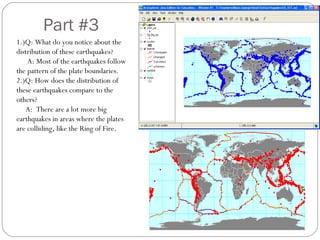
Part #3 1.)Q: What do you notice about the distribution of these earthquakes? A: Most of the earthquakes follow the pattern of the plate boundaries. 2.)Q: How does the distribution of these earthquakes compare to the others? A:  There are a lot more big earthquakes in areas where the plates are colliding, like the Ring of Fire.
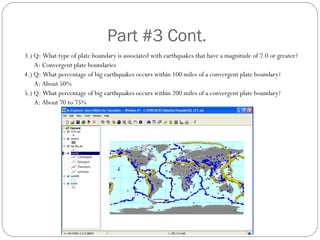
Part #3 Cont. 3.) Q: What type of plate boundary is associated with earthquakes that have a magnitude of 7.0 or greater? A: Convergent plate boundaries  4.) Q: What percentage of big earthquakes occurs within 100 miles of a convergent plate boundary? A: About 50% 5.) Q: What percentage of big earthquakes occurs within 200 miles of a convergent plate boundary? A: About 70 to 75%
Part #4 1.)Top 10 List of Places Overdue for an Earthquake: Area around Crete California Coast Afghanistan Pakistan area Malaysia Spain and Portugal New Guinea East Upper Russia New Zealand Area around Thailand Latin America 2.) Q:What new tools and techniques are seismologists using to help them better predict earthquakes? A: They are using satellites and searching for infrared radiation, as well as detecting magnetic signals by satellite. The place with the next big earthquake will be Crete
Part #4 Cont. 2.) Q: What have you learned about earthquakes and earthquake prediction? A: Some things I have learned about earthquakes and earthquakes prediction are: Earthquakes follow plate boundaries Most big earthquakes happen on convergent plate boundaries Seismologists use satellites to search for radiation Earthquakes can be predicted quite easily  3.) Q: What factors influence earthquake prediction? A: Some factors that influence earthquake prediction are: The time sense the last earthquake The location of prediction If on a boundary, the boundary type Amount of previous earthquakes on location 4.) Q: Where on Earth do most of the really big earthquakes strike? A: Most of the really big earthquakes happen on Tectonic and Convergent plate boundaries.

Earthquakes

  • 1.
    Daniel Ames InvestigatingEarthquakes with ArcExplorer GIS
  • 2.
    Part #3 1.)Q:What do you notice about the distribution of these earthquakes? A: Most of the earthquakes follow the pattern of the plate boundaries. 2.)Q: How does the distribution of these earthquakes compare to the others? A: There are a lot more big earthquakes in areas where the plates are colliding, like the Ring of Fire.
  • 3.
    Part #3 Cont.3.) Q: What type of plate boundary is associated with earthquakes that have a magnitude of 7.0 or greater? A: Convergent plate boundaries 4.) Q: What percentage of big earthquakes occurs within 100 miles of a convergent plate boundary? A: About 50% 5.) Q: What percentage of big earthquakes occurs within 200 miles of a convergent plate boundary? A: About 70 to 75%
  • 4.
    Part #4 1.)Top10 List of Places Overdue for an Earthquake: Area around Crete California Coast Afghanistan Pakistan area Malaysia Spain and Portugal New Guinea East Upper Russia New Zealand Area around Thailand Latin America 2.) Q:What new tools and techniques are seismologists using to help them better predict earthquakes? A: They are using satellites and searching for infrared radiation, as well as detecting magnetic signals by satellite. The place with the next big earthquake will be Crete
  • 5.
    Part #4 Cont.2.) Q: What have you learned about earthquakes and earthquake prediction? A: Some things I have learned about earthquakes and earthquakes prediction are: Earthquakes follow plate boundaries Most big earthquakes happen on convergent plate boundaries Seismologists use satellites to search for radiation Earthquakes can be predicted quite easily 3.) Q: What factors influence earthquake prediction? A: Some factors that influence earthquake prediction are: The time sense the last earthquake The location of prediction If on a boundary, the boundary type Amount of previous earthquakes on location 4.) Q: Where on Earth do most of the really big earthquakes strike? A: Most of the really big earthquakes happen on Tectonic and Convergent plate boundaries.