Presentation on
EARTHQUAKE & VOLCANISM
SUBMITTED TO
Prof. Dr. Ashraf Ali Seddique
Chairman
Dept. of Environmental Science & Engineering
Jatiya Kabi Kazi Nazrul Islam University
PRESENTED BY
Name: Maksudul Amin Talukder
Roll no: 07
Session: 2019-20
1st semester 1st year
Dept. of Environmental Science & Engineering
Jatiya Kabi Kazi Nazrul Islam University
What is an Earthquake ?
 Earthquake what is the shaking and trembling that result from the sudden
movement of part of the earth crust
 Earthquakes are the shaking rolling sudden shock of the earth's surface
 They are the earth's natural mean of releasing stress
 Earthquakes can be felt over large areas although they usually last less than one
minute
 Earthquakes cannot be predicted, although scientists are working on it
What causes an earthquake ?
 There are about 20 plates along the surface of the earth that move continuously
and slowly past each other. When the plates squeeze or stretch, huge rocks from at
their edges & the rock shift with great force, causing an earthquake.
 As the plates move they put forces on themselves and each other. When the force
is a large enough , the crust is forced to break.when the break occurs, the stress is
released as energy, which moves through the earth in the form of waves, which we
feel & call an earthquake
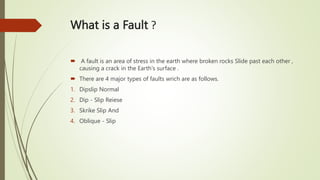
What is a Fault ?
 A fault is an area of stress in the earth where broken rocks Slide past each other ,
causing a crack in the Earth's surface .
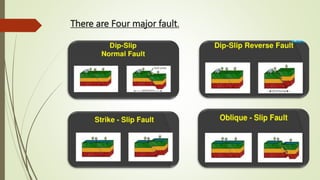
 There are 4 major types of faults wrich are as follows.
1. Dipslip Normal
2. Dip - Slip Reiese
3. Skrike Slip And
4. Oblique - Slip
There are Four major fault.
Focus
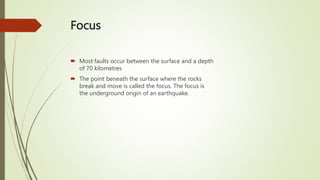
 Most faults occur between the surface and a depth
of 70 kilometres
 The point beneath the surface where the rocks
break and move is called the focus. The focus is
the underground origin of an earthquake.
Epicenter
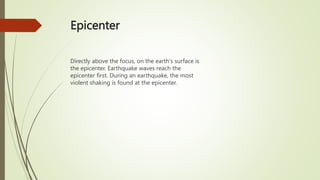
Directly above the focus, on the earth's surface is
the epicenter. Earthquake waves reach the
epicenter first. During an earthquake, the most
violent shaking is found at the epicenter.
Seismic wave
There are three main types of seismic waves
1. Primary waves
2. Secondary waves
3. Surface waves
Primary waves
 Seismic waves that travel fastest are P waves. They travel through solids, liquids and
gases.
 They move at different speeds depending on the density of the material through
which they are moving. As they move deeper in the Earth they move faster.
 P waves are push-pull waves.
Secondary waves
 Seismic waves that do not travel through the Earth as fast as P waves do are called
secondary or S waves.
 S waves travel through solids but not liquids or gases.
 S waves cause particles to move from side to side. They move at right angles to the
direction of the wave.
Surface waves
 The slowest moving seismic waves are called surface waves or L waves.
 L waves originate on the Earth's surface at the epicenter. They move along the
surface the way waves travel in the ocean. The Earth's surface moves up and down
with each L wave.
 L waves cause most of the damage.
The seismograph
Invented in 1893 by John Milne, a seismograph detects and
measures seismic waves. • A weight attached to a spring remains
nearly still even when the Earth moves. A pen attached to the
weight records any movement on a roll of paper on a constantly
rotating drum. The drum moves with the Earth and affects the line.
Predicting Earthquakes
 Scientists have identified warning signals the help predict earthquakes with greater
accuracy.
 Often changes occur in the speed of P and S waves before an earthquake occurs.
 Sometimes slight changes in the tilt of the Earth's surface can be detected.
 Some scientists believe animals behavior is affected.
What is volcanoa ?
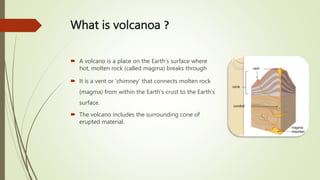
 A volcano is a place on the Earth's surface where
hot, molten rock (called magma) breaks through
 It is a vent or 'chimney' that connects molten rock
(magma) from within the Earth's crust to the Earth's
surface.
 The volcano includes the surrounding cone of
erupted material.
How and why do volcanoes erupt ?
How and why do volcanoes erupt ? Hot , molten rock ( magma ) is buoyant ( has a
lower density than the surrounding rocks ) and will rise up through the crust to erupt
on the surface . Same principle as hot air rising , e.g. how a hot air balloon works At
depths > 20 km the temperature = 800-1,600 degrees Celsius When magma reaches
the surface it depends on how easily it flows
( viscosity ) and the amount of gas ( H2O , CO2 , S ) it has in it as to how it erupts .
Large amounts of gas and a high viscosity ( sticky ) magma will form an explosive
eruption ! Think about shaking a carbonated drink and then releasing the cap . Small
amounts of gas and ( or ) low viscosity ( runny ) magma will form an effusive eruption
Where the magma just trickles out of the volcano ( lava flow ) .
How do volcanoes work ?
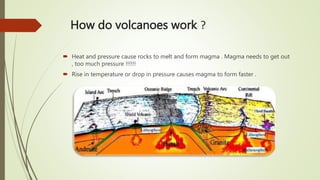
 Heat and pressure cause rocks to melt and form magma . Magma needs to get out
, too much pressure !!!!!!
 Rise in temperature or drop in pressure causes magma to form faster .
How do volcanoes work ?
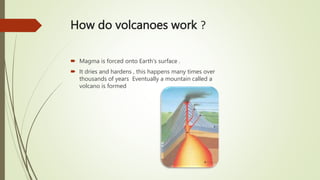
 Magma is forced onto Earth's surface .
 It dries and hardens , this happens many times over
thousands of years Eventually a mountain called a
volcano is formed
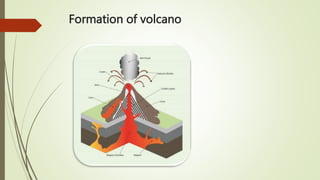
Formation of volcano
Types of volcanoes
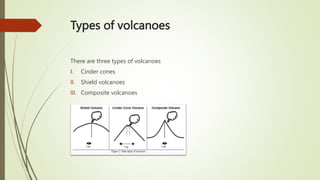
There are three types of volcanoes
I. Cinder cones
II. Shield volcanoes
III. Composite volcanoes
Magma
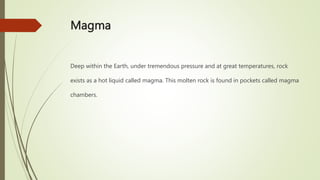
Deep within the Earth, under tremendous pressure and at great temperatures, rock
exists as a hot liquid called magma. This molten rock is found in pockets called magma
chambers.
Lava
 When the magma reaches the surface, it is called lava. The place in the Earth's
surface through which magma and other materials reach the surface is called a
volcano. In some places, lava can build up to forma cone - shaped mountain.
 The opening from which lava erupts is the vent. Volcanoes often have more than
one vent.
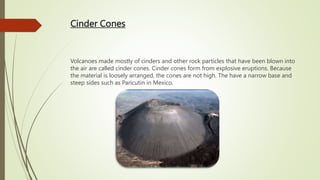
Cinder Cones
Volcanoes made mostly of cinders and other rock particles that have been blown into
the air are called cinder cones. Cinder cones form from explosive eruptions. Because
the material is loosely arranged, the cones are not high. The have a narrow base and
steep sides such as Paricutin in Mexico.
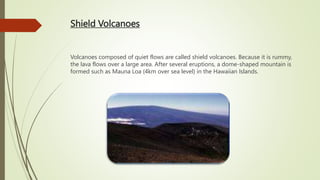
Shield Volcanoes
Volcanoes composed of quiet flows are called shield volcanoes. Because it is rummy,
the lava flows over a large area. After several eruptions, a dome-shaped mountain is
formed such as Mauna Loa (4km over sea level) in the Hawaiian Islands.
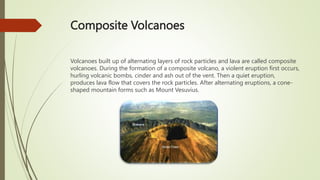
Composite Volcanoes
Volcanoes built up of alternating layers of rock particles and lava are called composite
volcanoes. During the formation of a composite volcano, a violent eruption first occurs,
hurling volcanic bombs, cinder and ash out of the vent. Then a quiet eruption,
produces lava flow that covers the rock particles. After alternating eruptions, a cone-
shaped mountain forms such as Mount Vesuvius.
Earthquake & volcanism.pptx

Earthquake & volcanism.pptx

  • 1.
    Presentation on EARTHQUAKE &VOLCANISM SUBMITTED TO Prof. Dr. Ashraf Ali Seddique Chairman Dept. of Environmental Science & Engineering Jatiya Kabi Kazi Nazrul Islam University PRESENTED BY Name: Maksudul Amin Talukder Roll no: 07 Session: 2019-20 1st semester 1st year Dept. of Environmental Science & Engineering Jatiya Kabi Kazi Nazrul Islam University
  • 2.
    What is anEarthquake ?  Earthquake what is the shaking and trembling that result from the sudden movement of part of the earth crust  Earthquakes are the shaking rolling sudden shock of the earth's surface  They are the earth's natural mean of releasing stress  Earthquakes can be felt over large areas although they usually last less than one minute  Earthquakes cannot be predicted, although scientists are working on it
  • 3.
    What causes anearthquake ?  There are about 20 plates along the surface of the earth that move continuously and slowly past each other. When the plates squeeze or stretch, huge rocks from at their edges & the rock shift with great force, causing an earthquake.  As the plates move they put forces on themselves and each other. When the force is a large enough , the crust is forced to break.when the break occurs, the stress is released as energy, which moves through the earth in the form of waves, which we feel & call an earthquake
  • 4.
    What is aFault ?  A fault is an area of stress in the earth where broken rocks Slide past each other , causing a crack in the Earth's surface .  There are 4 major types of faults wrich are as follows. 1. Dipslip Normal 2. Dip - Slip Reiese 3. Skrike Slip And 4. Oblique - Slip
  • 5.
    There are Fourmajor fault.
  • 6.
    Focus  Most faultsoccur between the surface and a depth of 70 kilometres  The point beneath the surface where the rocks break and move is called the focus. The focus is the underground origin of an earthquake.
  • 7.
    Epicenter Directly above thefocus, on the earth's surface is the epicenter. Earthquake waves reach the epicenter first. During an earthquake, the most violent shaking is found at the epicenter.
  • 8.
    Seismic wave There arethree main types of seismic waves 1. Primary waves 2. Secondary waves 3. Surface waves
  • 9.
    Primary waves  Seismicwaves that travel fastest are P waves. They travel through solids, liquids and gases.  They move at different speeds depending on the density of the material through which they are moving. As they move deeper in the Earth they move faster.  P waves are push-pull waves.
  • 10.
    Secondary waves  Seismicwaves that do not travel through the Earth as fast as P waves do are called secondary or S waves.  S waves travel through solids but not liquids or gases.  S waves cause particles to move from side to side. They move at right angles to the direction of the wave.
  • 11.
    Surface waves  Theslowest moving seismic waves are called surface waves or L waves.  L waves originate on the Earth's surface at the epicenter. They move along the surface the way waves travel in the ocean. The Earth's surface moves up and down with each L wave.  L waves cause most of the damage.
  • 12.
    The seismograph Invented in1893 by John Milne, a seismograph detects and measures seismic waves. • A weight attached to a spring remains nearly still even when the Earth moves. A pen attached to the weight records any movement on a roll of paper on a constantly rotating drum. The drum moves with the Earth and affects the line.
  • 13.
    Predicting Earthquakes  Scientistshave identified warning signals the help predict earthquakes with greater accuracy.  Often changes occur in the speed of P and S waves before an earthquake occurs.  Sometimes slight changes in the tilt of the Earth's surface can be detected.  Some scientists believe animals behavior is affected.
  • 14.
    What is volcanoa?  A volcano is a place on the Earth's surface where hot, molten rock (called magma) breaks through  It is a vent or 'chimney' that connects molten rock (magma) from within the Earth's crust to the Earth's surface.  The volcano includes the surrounding cone of erupted material.
  • 15.
    How and whydo volcanoes erupt ? How and why do volcanoes erupt ? Hot , molten rock ( magma ) is buoyant ( has a lower density than the surrounding rocks ) and will rise up through the crust to erupt on the surface . Same principle as hot air rising , e.g. how a hot air balloon works At depths > 20 km the temperature = 800-1,600 degrees Celsius When magma reaches the surface it depends on how easily it flows ( viscosity ) and the amount of gas ( H2O , CO2 , S ) it has in it as to how it erupts . Large amounts of gas and a high viscosity ( sticky ) magma will form an explosive eruption ! Think about shaking a carbonated drink and then releasing the cap . Small amounts of gas and ( or ) low viscosity ( runny ) magma will form an effusive eruption Where the magma just trickles out of the volcano ( lava flow ) .
  • 16.
    How do volcanoeswork ?  Heat and pressure cause rocks to melt and form magma . Magma needs to get out , too much pressure !!!!!!  Rise in temperature or drop in pressure causes magma to form faster .
  • 17.
    How do volcanoeswork ?  Magma is forced onto Earth's surface .  It dries and hardens , this happens many times over thousands of years Eventually a mountain called a volcano is formed
  • 18.
  • 19.
    Types of volcanoes Thereare three types of volcanoes I. Cinder cones II. Shield volcanoes III. Composite volcanoes
  • 20.
    Magma Deep within theEarth, under tremendous pressure and at great temperatures, rock exists as a hot liquid called magma. This molten rock is found in pockets called magma chambers.
  • 21.
    Lava  When themagma reaches the surface, it is called lava. The place in the Earth's surface through which magma and other materials reach the surface is called a volcano. In some places, lava can build up to forma cone - shaped mountain.  The opening from which lava erupts is the vent. Volcanoes often have more than one vent.
  • 22.
    Cinder Cones Volcanoes mademostly of cinders and other rock particles that have been blown into the air are called cinder cones. Cinder cones form from explosive eruptions. Because the material is loosely arranged, the cones are not high. The have a narrow base and steep sides such as Paricutin in Mexico.
  • 23.
    Shield Volcanoes Volcanoes composedof quiet flows are called shield volcanoes. Because it is rummy, the lava flows over a large area. After several eruptions, a dome-shaped mountain is formed such as Mauna Loa (4km over sea level) in the Hawaiian Islands.
  • 24.
    Composite Volcanoes Volcanoes builtup of alternating layers of rock particles and lava are called composite volcanoes. During the formation of a composite volcano, a violent eruption first occurs, hurling volcanic bombs, cinder and ash out of the vent. Then a quiet eruption, produces lava flow that covers the rock particles. After alternating eruptions, a cone- shaped mountain forms such as Mount Vesuvius.