BSI Standards Publication
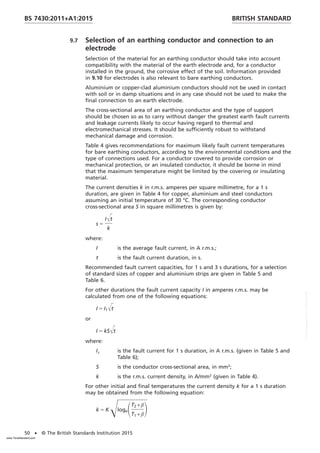
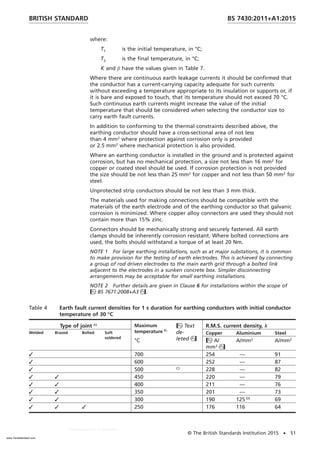
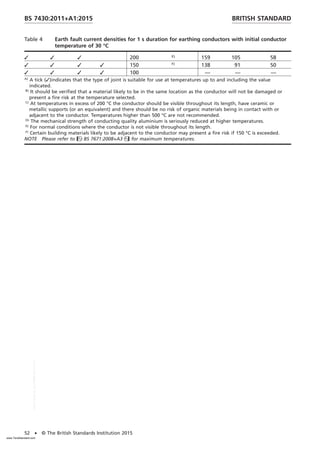
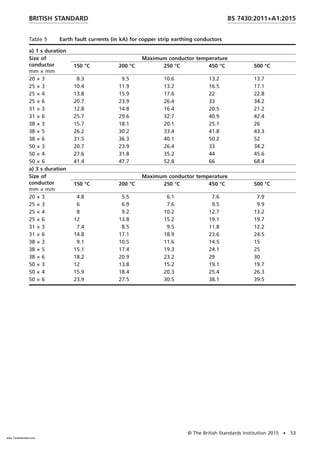
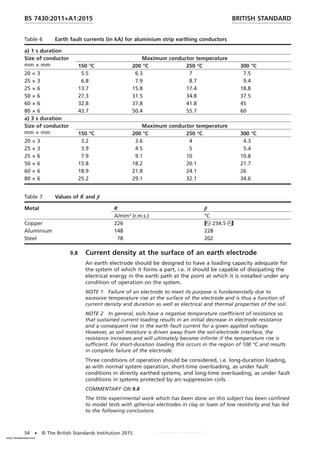
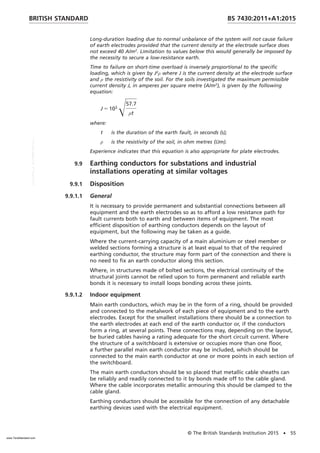
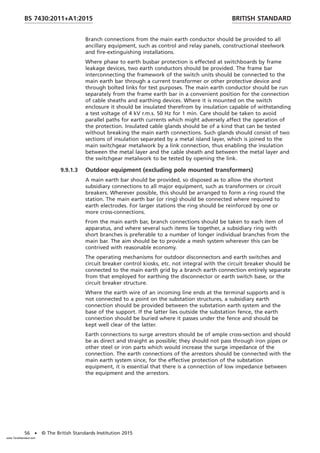
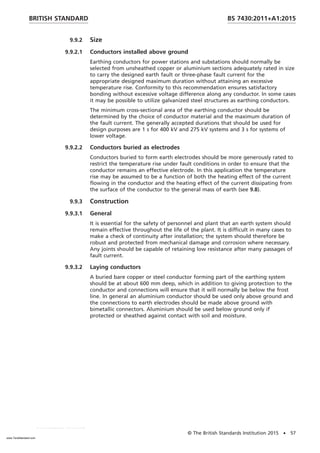
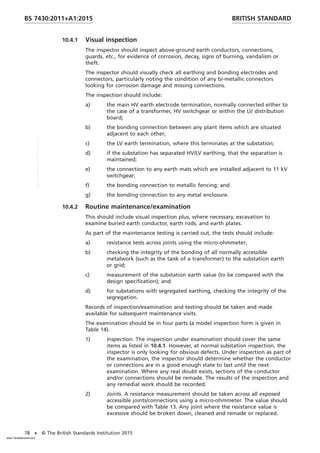
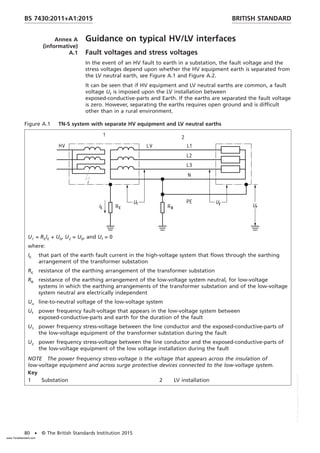
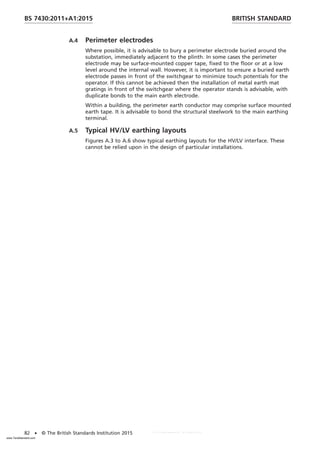
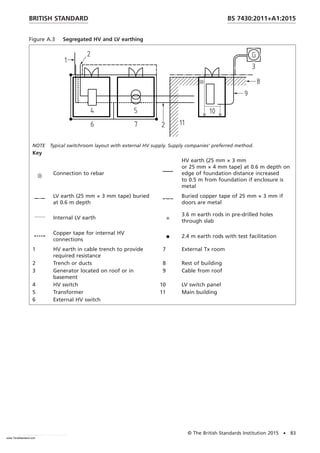
BS 7430:2011+A1:2015
Code of practice for
protective earthing of
electrical installations
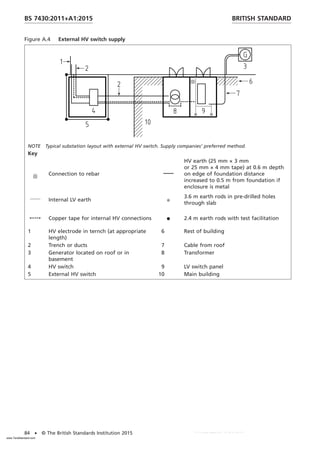
www.TeraStandard.com
--``,`,`,`,,,,`,,,,,,,`,,`,,```,-`-`,,`,,`,`,,`---
Publishing and copyright information
The BSI copyright notice displayed in this document indicates when the document
was last issued.
© The British Standards Institution 2015
Published by BSI Standards Limited 2015
ISBN 978 0 580 90007 5
ICS 13.260; 29.240.01
The following BSI references relate to the work on this standard:
Committee reference GEL/600
Drafts for comment 11/30249994 DC, 15/30322343 DC
Publication history
First published as CP 1013:1965
First published as BS 7430, January 1992
Second edition, November 1998
Third (present) edition, December 2011
Amendments issued since publication
Date Text affected
August 2015 A1 - See Foreword
BS 7430:2011+A1:2015 BRITISH STANDARD
www.TeraStandard.com
--``,`,`,`,,,,`,,,,,,,`,,`,,```,-`-`,,`,,`,`,,`---
Contents
Foreword iii
1 Scope 1
2 Normative references 1
3 Terms and definitions 4
4 Earthing principles 5
5 HV/LV interface 12
6 Low voltage installations 12
7 Generators 19
8 Special installations 29
9 Earth electrode systems 33
10 Inspection and testing of the earthing system 67
Annexes
Annex A (informative) Guidance on typical HV/LV interfaces 80
Annex B (informative) Typical simple installation of an earthing system for a
small LV substation 86
Bibliography 89
List of figures
Figure 1 – TN-S system 7
Figure 2 – TN-C system 8
Figure 3 – TN-C-S system 9
Figure 4 – TT system 10
Figure 5 – IT system 11
Figure 6 – Earthing arrangement and protective conductors for consumers’
installations 15
Figure 7 – Small low voltage single phase generator run as a floating system 20
Figure 8 – Small low voltage generator supplying a fixed installation 21
Figure 9 – Small unearthed generator supplying a mobile or transportable
unit 22
Figure 10 – Low voltage standby generators with star-point switching 25
Figure 11 – Low voltage standby generators with neutral earthing
transformers 26
Figure 12 – Single low voltage standby generator (without paralleling
facility) 27
Figure 13 – Measurement of earth resistivity 36
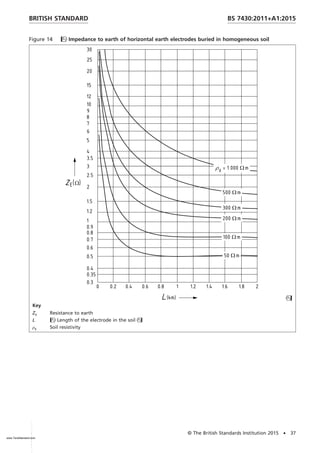
Figure 14 – Impedance to earth of horizontal earth electrodes buried in
homogeneous soil 37
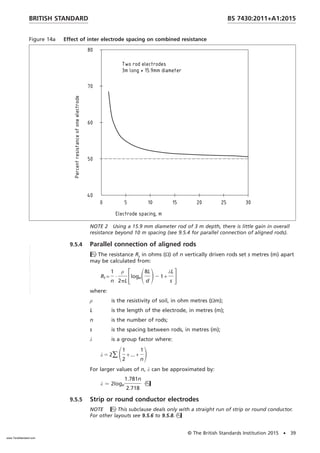
Figure 14a – Effect of inter electrode spacing on combined resistance 39
Figure 15 – Miscellaneous electrode configurations 41
Figure 16 – Ground surface potentials around a single rod and three rods in
line 48
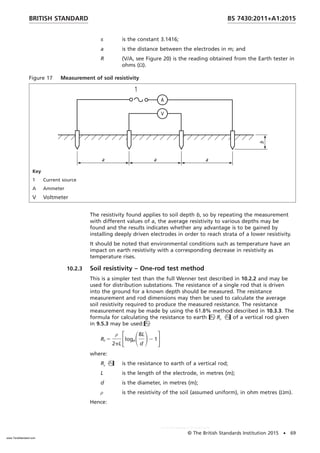
Figure 17 – Measurement of soil resistivity 69
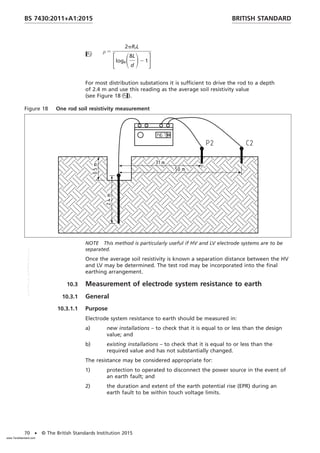
Figure 18 – One rod soil resistivity measurement 70
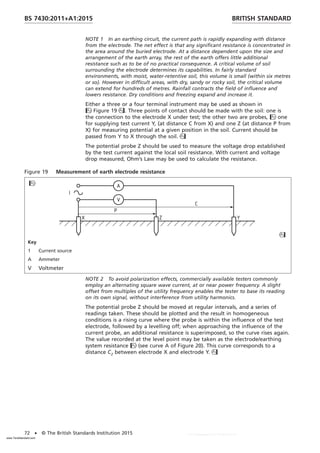
Figure 19 – Measurement of earth electrode resistance 72
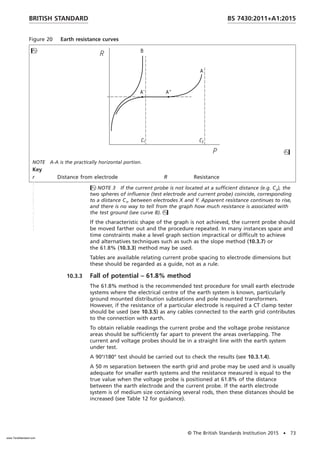
Figure 20 – Earth resistance curves 73
Figure 21 – 3-terminal tester with CT clamp 75
Figure 22 – Clamp-on tester 75
Figure 23 – 90°/180° test 77
Figure 24 – Typical 90°/180° test results 77
Figure A.1 – TN-S system with separate HV equipment and LV neutral earths 80
Figure A.2 – TN-S system with common HV equipment and LV neutral earth 81
Figure A.3 – Segregated HV and LV earthing 83
Figure A.4 – External HV switch supply 84
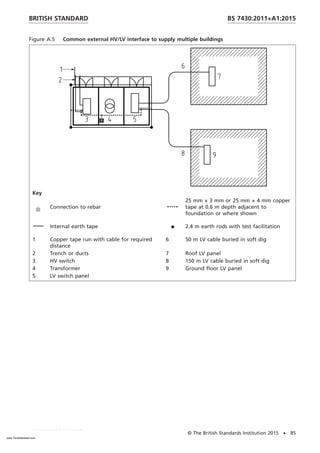
Figure A.5 – Common external HV/LV interface to supply multiple buildings 85
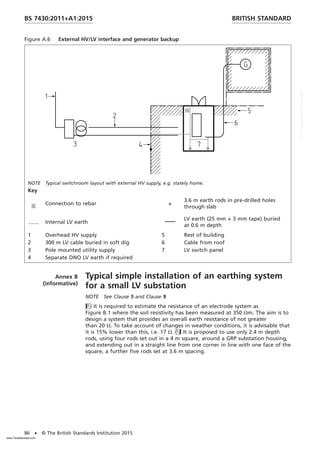
Figure A.6 – External HV/LV interface and generator backup 86
BRITISH STANDARD BS 7430:2011+A1:2015
© The British Standards Institution 2015 • i
www.TeraStandard.com
--``,`,`,`,,,,`,,,,,,,`,,`,,```,-`-`,,`,,`,`,,`---
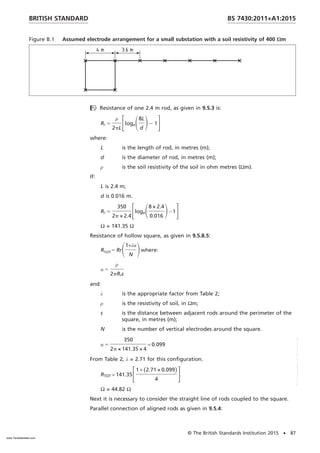
Figure B.1 – Assumed electrode arrangement for a small substation with a soil
resistivity of 400 Ωm 87
List of tables
Table 1 – Examples of soil resistivity in Ωm 35
Table 2 – Factors for vertical electrodes arranged in a hollow square 43
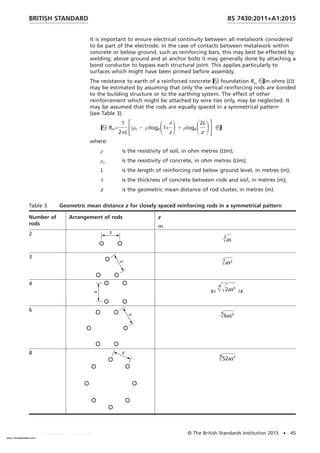
Table 3 – Geometric mean distance z for closely spaced reinforcing rods in a
symmetrical pattern 45
Table 4 – Earth fault current densities for 1 s duration for earthing conductors
with initial conductor temperature of 30 °C 51
Table 5 – Earth fault currents (in kA) for copper strip earthing conductors 53
Table 6 – Earth fault currents (in kA) for aluminium strip earthing
conductors 54
Table 7 – Values of K and β 54
Table 8 – Corrosion resistance of some electrodes materials related to soil
parameters 61
Table 9 – Suitability of materials for bonding together 62
Table 10 – Minimum sizes of components for earth electrodes 63
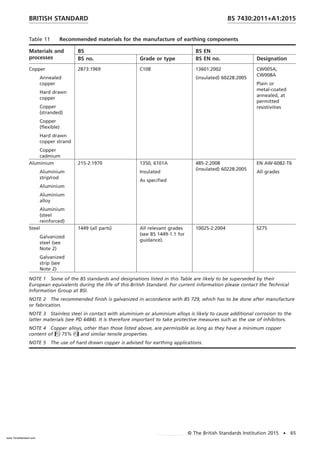
Table 11 – Recommended materials for the manufacture of earthing
components 63
Table 12 – 61.8% test probe spacing for various grid sizes 74
Table 13 – Acceptable bonding readings within distribution substations 79
Table 14 – Ground mounted plant installation model inspection form 79
Summary of pages
This document comprises a front cover, an inside front cover, pages i to iv,
pages 1 to 90, an inside back cover and a back cover.
BRITISH STANDARD
BS 7430:2011+A1:2015
ii • © The British Standards Institution 2015
www.TeraStandard.com
--``,`,`,`,,,,`,,,,,,,`,,`,,```,-`-`,,`,,`,`,,`---
Foreword
Publishing information
This British Standard is published by BSI Standards Limited, under licence from
The British Standards Institution, and came into effect on 31 December 2011. It
was prepared by Technical Committee GEL/600, Earthing. A list of organizations
represented on this committee can be obtained on request to its secretary.
Supersession
This British Standard supersedes BS 7430:2011, which is withdrawn.
Information about this document
Text introduced or altered by Amendment No. 1 is indicated in the text by tags
. Minor editorial changes are not tagged.
Relationship with other publications
This revision of BS 7430 takes into account changes in legislation
(implementation of the Electricity Safety, Quality and Continuity
Regulations 2002 as amended [1]) and changes in and publication of other
relevant industry standards such as BS 7671:2008+A3:2015,
BS EN IEC 61936-1:2011 and BS EN 50522:2011.
Legislation
In Great Britain earthing of an electricity supply system is governed by the
Electricity Safety, Quality and Continuity Regulations 2002 as amended
(ESQCR) [1] and the Electricity at Work Regulations 1989 [2]. In Northern
Ireland, the Electricity Safety, Quality and Continuity Regulations 2012 (Northern
Ireland) as amended [ESQCR (NI)] apply [3].
Presentational conventions
The provisions in this standard are presented in roman (i.e. upright) type. Its
recommendations are expressed in sentences in which the principal auxiliary
verb is “should”.
Commentary, explanation and general informative material is presented in
smaller italic type, and does not constitute a normative element.
The word “should” is used to express recommendations of this standard. The
word “may” is used in the text to express permissibility, e.g. as an alternative to
the primary recommendation of the Clause. The word “can” is used to express
possibility, e.g. a consequence of an action or an event.
Notes and commentaries are provided throughout the text of this standard.
Notes give references and additional information that are important but do not
form part of the recommendations. Commentaries give background information.
Contractual and legal considerations
This publication does not purport to include all the necessary provisions of a
contract. Users are responsible for its correct application.
Compliance with a British Standard cannot confer immunity from legal
obligations.
BRITISH STANDARD BS 7430:2011+A1:2015
© The British Standards Institution 2015 • iii
www.TeraStandard.com
--``,`,`,`,,,,`,,,,,,,`,,`,,```,-`-`,,`,,`,`,,`---
BRITISH STANDARD
BS 7430:2011+A1:2015
This page deliberately left blank
iv • © The British Standards Institution 2015
www.TeraStandard.com
--``,`,`,`,,,,`,,,,,,,`,,`,,```,-`-`,,`,,`,`,,`---
1 Scope
This British Standard primarily provides recommendations and guidance on
meeting the requirements for the earthing of electrical installations, including:
a) protective earthing of low voltage installations to
BS 7671:2008+A3:2015;
b) the interface between LV and HV substations of 11 000/400 V to
BS EN 61936-1:2010+A1:2014 within buildings; and
c) protective earthing and changeover switch arrangements for generators
supplying low voltage installations.
The earthing of a system or installation is generally provided for reasons of
safety.
This British Standard applies only to land-based installations in and around
buildings. It does not apply to:
1) ships, aircraft or offshore installations;
2) earthing of medical equipment [see BS EN 60601 (all parts)];
3) special problems encountered with solid state electronic components;
4) equipment sensitive to static electricity;
5) requirements for functional earthing;
6) earthing of overhead lines between electrical installations; or
7) the internal earthing of equipment.
2 Normative references
The following referenced documents are indispensable for the application of
this document. For dated references, only the edition cited applies. For undated
references, the latest edition of the referenced document (including any
amendments) applies.
BS 215-2:1970, Specification for aluminium conductors and aluminium
conductors, steel-reinforced for overhead power transmission – Aluminium
conductors, steel-reinforced (withdrawn)
BS 729, Specification for hot dip galvanized coatings on iron and steel articles
(withdrawn)
BS 951, Electrical earthing – Clamps for earthing and bonding – Specification
BS 1400, Specification for copper alloy ingots and copper alloy and high
conductivity copper castings (withdrawn)
BS 1449:1991 (all parts), Steel plate, sheet and strip (withdrawn)
BS 1473:1972, Specification for wrought aluminium and aluminium alloys for
general engineering purposes – Rivet, bolt and screw stock
BS 1474:1987, Specification for wrought aluminium and aluminium alloys for
general engineering purposes: bars, extruded round tubes and sections
(withdrawn)
BS 1561:1997, Founding – Grey cast irons
BS 1562:1997, Founding – Malleable cast irons
BS 1377-3, Methods of test for soils for civil engineering purposes – Part 3:
Chemical and electro-chemical tests
Text deleted
BRITISH STANDARD BS 7430:2011+A1:2015
© The British Standards Institution 2015 • 1
www.TeraStandard.com
--``,`,`,`,,,,`,,,,,,,`,,`,,```,-`-`,,`,,`,`,,`---
BS 2871-1:1971, Specification for copper and copper alloys – Tubes – Part 1:
Copper tubes for water, gas and sanitation (withdrawn)
BS 2871-2:1972, Specification for copper and copper alloys – Tubes – Part 2:
Tubes for general purposes (withdrawn)
BS 2871-3:1972, Specification for copper and copper alloys – Tubes – Part 3:
Tubes for heat exchangers (withdrawn)
BS 2873:1969, Specification for copper and copper alloys – Wire (withdrawn)
BS 2874:1986, Specification for copper and copper alloy rods and sections (other
than forging stock) (withdrawn)
BS 3288-1, Insulator and conductor fittings for overhead power lines – Part 1:
Performance and general requirements
BS 7375, Distribution of electricity on construction and demolition sites – Code
of practice
BS 7671:2008+A3:2015, Requirements For Electrical Installations – IEE
Wiring Regulations – Seventeenth edition
BS EN 485-2:2008, Aluminium and aluminium alloys – Sheet, strip and plate –
Part 2: Mechanical properties
BS EN 586-2:1994, Aluminium and aluminium alloys – Forgings – Part 2:
Mechanical properties and additional property requirements
BS EN 755-2:2008, Aluminium and aluminium alloys – Extruded rod/bar, tube and
profiles – Part 2: Mechanical properties
BS EN 1011-4, Welding – Recommendations for welding of metallic materials –
Part 4: Arc welding of aluminium and aluminium alloys
BS EN 1652:1998, Copper and copper alloys – Plate, sheet, strip and circles for
general purposes
BS EN 1780-1:2002, Aluminium and aluminium alloys – Designation of alloyed
aluminium ingots for remelting, master alloys and castings – Part 1: Numerical
designation system
BS EN 1982:2008, Copper and copper alloys – Ingots and castings
BS EN 10025-2:2004, Hot rolled products of structural steels – Part 2: Technical
delivery conditions for non-alloy structural steels
BS EN 10088-1:2005, Stainless steels – List of stainless steels
BS EN 10263-4:2001, Steel rod, bars and wire for cold heading and cold
extrusion – Technical delivery conditions for steels for quenching and tempering
BS EN 12163:2011: Copper and copper alloys – Rod for general purposes
BS EN 12165:2011, Copper and copper alloys – Wrought and unwrought forging
stock
BS EN 12167:2011, Copper and copper alloys – Profiles and bars for general
purposes
BS EN 12420:1999, Copper and copper alloys – Forgings
BS EN 12449:1999, Copper and copper alloys – Seamless, round tubes for general
purposes
Text deleted
BS EN 13601:2002, Copper and copper alloys – Copper rod, bar and wire for
general electrical purposes
BRITISH STANDARD
BS 7430:2011+A1:2015
2 • © The British Standards Institution 2015
www.TeraStandard.com
--``,`,`,`,,,,`,,,,,,,`,,`,,```,-`-`,,`,,`,`,,`---
BS EN 50122-1, Railway applications – Fixed installations – Electrical safety,
earthing and the return circuit – Part 1: Protective provisions against electric
shock
BS EN 50122-2, Railway applications – Fixed installations – Electrical safety,
earthing and the return circuit – Part 2: Provisions against the effects of stray
currents caused by d.c. traction systems
Text deleted
BS EN 50522:2011, Earthing of power installations exceeding 1 kV a.c.
BS EN 60228:2005, Conductors of insulated cables
BS EN 60309/IEC 60309 (all parts), Plugs, socket-outlets and couplers for
industrial purposes
BS EN 61010 (all parts), Safety requirements for electrical equipment for
measurement, control, and laboratory use
Text deleted
BS EN 61140, Protection against electric shock – Common aspects for
installation and equipment
BS EN 61557/IEC 61557 (all parts), Electrical safety in low voltage distribution
systems up to 1 000 V a.c. and 1 500 V d.c. – Equipment for testing, measuring
or monitoring of protective measures
BS EN 61936-1:2010+A1:2014, Power installations exceeding 1 kV a.c. –
Part 1: Common rules
Text deleted
BS EN 62305-2, Protection against lightning – Part 2: Risk management
BS EN 62305-3, Protection against lightning – Part 3: Physical damage to
structures and life hazard
BS EN 62035-4, Protection against lightning – Part 4: Electrical and electronic
systems within structures
BS IEC 60050-195, International electrotechnical vocabulary – Part 195: Earthing
and protection against electric shock
Text deleted
ER G59, Recommendations for the connection of embedded generating plant to
the Regional Electricity Companies’ distribution systems
ER G83, Recommendations For The Connection Of Small-Scale Embedded
Generators (Up To 16 A Per Phase) In Parallel With Public Low-Voltage
Distribution Networks
ER G84, Recommendations for the Connection of Mobile Generating Sets to
Public Distribution Networks
ER S36-1, Identification and Recording of “Hot Sites” – Joint Electricity
Industry/BT Procedure
ISO/IEC Guide 51, Safety aspects – Guidelines for their inclusion in standards
IEC 60050-604, International electrotechnical vocabulary – Part 604: Generation,
transmission and distribution of electricity – Operation
IEC Guide 104, The preparation of safety publications and the use of basic safety
publications and group safety publications
PD 970:2005, Wrought steels for mechanical and allied engineering purposes –
Requirements for carbon, carbon manganese and alloy hot worked or cold
finished steels
BRITISH STANDARD BS 7430:2011+A1:2015
© The British Standards Institution 2015 • 3
www.TeraStandard.com
--``,`,`,`,,,,`,,,,,,,`,,`,,```,-`-`,,`,,`,`,,`---
3 Terms and definitions
For the purposes of this British Standard, the terms and definitions given in
BS 7671:2008+A3 and BS IEC 60050-195, together with the following
apply.
3.1 earth grid
earth electrode in the form of two overlapping groups of buried, parallel,
horizontal electrodes, usually laid approximately at right angles to each other,
with the electrodes bonded at each intersection
3.2 earth potential
electric potential with respect to the general mass of earth which occurs in, or
on the surface of, the ground around an earth electrode when an electric
current flows from the electrode to earth
3.3 earth potential rise
voltage between an earthing system and reference earth
[BS EN 50522:2011]
3.4 earth resistance
resistance to earth of an earth electrode or earth grid
3.5 earthing system
arrangement of connections and devices necessary to earth equipment or a
system separately or jointly
[IEC 60050-604, 604-04-02]
3.6 global earthing system
equivalent earthing system created by the interconnection of local earthing
systems that ensures, by the proximity of the earthing systems, that there are no
dangerous touch voltages
NOTE 1 Such systems permit the division of the earth fault current in a way that
results in a reduction of the earth potential rise at the local earthing system. Such a
system could be said to form a quasi equipotential surface.
NOTE 2 The existence of a global earthing system may be determined by sample
measurements or calculation for typical systems. Typical examples of global earthing
systems are in city centres; urban or industrial areas with distributed low- and
high-voltage earthing.
[BS EN 50522:2011]
3.7 hot site
substation where the rise of earth potential, under the maximum earth fault
condition, can exceed the value either 430 V or 650 V depending upon the fault
clearance time
3.8 potential gradient (at a point)
rate of change of voltage measured at that point in the direction in which it is a
maximum
3.9 transferred potential
potential rise of an earthing system caused by a current to earth transferred by
means of a connected conductor (for example a metallic cable sheath,
PEN conductor, pipeline, rail) into areas with low or no potential rise relative to
reference earth resulting in a potential difference occurring between the
conductor and its surroundings
BRITISH STANDARD
BS 7430:2011+A1:2015
4 • © The British Standards Institution 2015
www.TeraStandard.com
--``,`,`,`,,,,`,,,,,,,`,,`,,```,-`-`,,`,,`,`,,`---
NOTE 1 The definition also applies where a conductor, which is connected to
reference earth, leads into the area of the potential rise.
NOTE 2 Transferred potentials can result in electrocution paths through the human
body other than the “touch voltage” path, e.g. hand to hand.
[BS EN 50522:2011]
3.10 (effective) touch potential
voltage between conductive parts when touched simultaneously
NOTE The value of the effective touch voltage may be appreciably influenced by
the impedance of the person in electric contact with these conductive parts.
[BS IEC 60050-195, 195-05-11, modified]
3.11 prospective touch potential
voltage between simultaneously accessible conductive parts when those
conductive parts are not being touched
[IEV 195-05-09, modified]
3.12 step voltage
step potential
voltage between two points on the earth’s surface that are 1 m distant from
each other, which is considered to be the stride length of a person
[BS IEC 60050-195, 195-05-12]
3.13 transferred potential
potential rise of an earthing system caused by a current to earth transferred by
means of a connected conductor (for example a metallic cable sheath,
PEN conductor, pipeline, rail) into areas with low or no potential rise relative to
reference earth resulting in a potential difference occurring between the
conductor and its surroundings
NOTE 1 The definition also applies where a conductor, which is connected to
reference earth, leads into the area of the potential rise.
NOTE 2 Transferred potentials can result in electrocution paths through the human
body other than the “touch voltage” path, e.g. hand to hand.
[BS EN 50522:2011]
4 Earthing principles
4.1 Fundamental rule of protection against electric shock
BS EN 61140 gives fundamental principles and requirements which are common
to electrical installations, systems and equipment or necessary for their
co-ordination, for installations, systems and equipment without a voltage limit.
BS EN 61140 states that the fundamental rule of protection against electric
shock is that:
• …hazardous-live-parts shall not be accessible and accessible conductive
parts shall not be hazardous live:
• either under normal conditions (operation in intended use,
see ISO/IEC Guide 51, 3.13 and absence of a fault); or
• under single-fault conditions (see also IEC Guide 104, 2.8).
The system and equipment standards are being amended to comply with
BS EN 61140 so that the fundamental rule is met and to adopt the same
terminology.
BRITISH STANDARD BS 7430:2011+A1:2015
© The British Standards Institution 2015 • 5
www.TeraStandard.com
--``,`,`,`,,,,`,,,,,,,`,,`,,```,-`-`,,`,,`,`,,`---
In order to achieve the principles within BS EN 61140 within electrical
installations standards, BS 7671:2008+A3 makes certain requirements for
the earthing of an installation and its sub-structure in order to achieve safety.
With the exception of earth free locations, the main requirement under single
fault conditions is for automatic disconnection of supply with selecting cable
impedances in order to achieve certain touch voltages.
4.2 Supply system earthing
4.2.1 Legislation
In Great Britain the earthing of an electricity supply system is covered by the
requirements of the Electricity Safety Quality and Continuity Regulations 2002 as
amended (ESQCR) [1]. Part II, Protection and Earthing is particularly relevant to
users of this standard. Guidance is given in DTI publication Guidance on the
Electricity Safety, Quality and Continuity Regulations [4].
In Northern Ireland, the Electricity Safety, Quality and Continuity
Regulations 2012 (Northern Ireland) as amended [ESQCR (NI)] apply [3]. The
general provisions in the ESQCR [1] apply to both overhead and underground
systems of supply.
The regulations require that every network at whatever voltage be connected
with Earth and that the connection is maintained under fault conditions
[Regulation 8(1)]. This requirement is designed primarily to preserve the security
of the system by ensuring that the potential on each conductor is restricted to
such a value as is consistent with the level of insulation applied. Every supply
neutral conductor (of LV networks) is required to be connected with earth
generally at the source of voltage [Regulation 8 (3(b))].
The regulations include a particular requirement where the neutral and
protective conductors are combined that is in protective multiply earthed (PME)
systems (see Regulation 9). This is the most common system adopted,
see Figure 3.
4.2.2 High voltage (HV) power supply systems
NOTE Requirements for earthing HV installations are given in
BS EN 61936-1:2010+A1:2014 and BS EN 50522:2011. See also Clause 5.
4.2.3 Classification of low voltage systems
4.2.3.1 General
For the purpose of this standard the following earthing systems are defined:
TN-S, TN-C, TN-C-S, TT and IT.
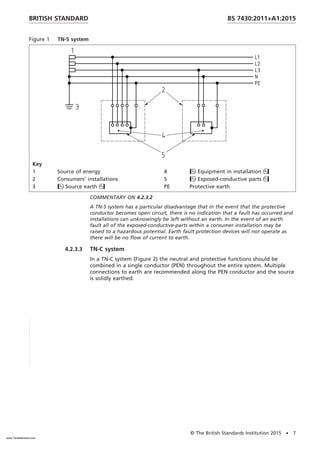
4.2.3.2 TN-S system
In a TN-S (Figure 1) the Neutral and Protective conductors should be kept
separate throughout the system and the source is solidly earthed.
BRITISH STANDARD
BS 7430:2011+A1:2015
6 • © The British Standards Institution 2015
www.TeraStandard.com
--``,`,`,`,,,,`,,,,,,,`,,`,,```,-`-`,,`,,`,`,,`---
Figure 1 TN-S system
Key
1 Source of energy 4 Equipment in installation
2 Consumers’ installations 5 Exposed-conductive parts
3 Source earth PE Protective earth
COMMENTARY ON 4.2.3.2
A TN-S system has a particular disadvantage that in the event that the protective
conductor becomes open circuit, there is no indication that a fault has occurred and
installations can unknowingly be left without an earth. In the event of an earth
fault all of the exposed-conductive-parts within a consumer installation may be
raised to a hazardous potential. Earth fault protection devices will not operate as
there will be no flow of current to earth.
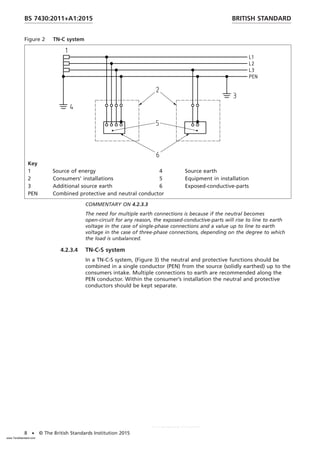
4.2.3.3 TN-C system
In a TN-C system (Figure 2) the neutral and protective functions should be
combined in a single conductor (PEN) throughout the entire system. Multiple
connections to earth are recommended along the PEN conductor and the source
is solidly earthed.
BRITISH STANDARD BS 7430:2011+A1:2015
© The British Standards Institution 2015 • 7
www.TeraStandard.com
--``,`,`,`,,,,`,,,,,,,`,,`,,```,-`-`,,`,,`,`,,`---
Figure 2 TN-C system
Key
1 Source of energy 4 Source earth
2 Consumers’ installations 5 Equipment in installation
3 Additional source earth 6 Exposed-conductive-parts
PEN Combined protective and neutral conductor
COMMENTARY ON 4.2.3.3
The need for multiple earth connections is because if the neutral becomes
open-circuit for any reason, the exposed-conductive-parts will rise to line to earth
voltage in the case of single-phase connections and a value up to line to earth
voltage in the case of three-phase connections, depending on the degree to which
the load is unbalanced.
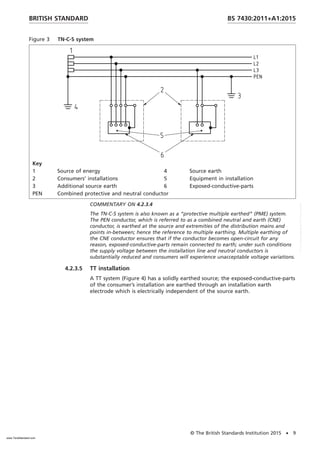
4.2.3.4 TN-C-S system
In a TN-C-S system, (Figure 3) the neutral and protective functions should be
combined in a single conductor (PEN) from the source (solidly earthed) up to the
consumers intake. Multiple connections to earth are recommended along the
PEN conductor. Within the consumer’s installation the neutral and protective
conductors should be kept separate.
BRITISH STANDARD
BS 7430:2011+A1:2015
8 • © The British Standards Institution 2015
www.TeraStandard.com
--``,`,`,`,,,,`,,,,,,,`,,`,,```,-`-`,,`,,`,`,,`---
Figure 3 TN-C-S system
Key
1 Source of energy 4 Source earth
2 Consumers’ installations 5 Equipment in installation
3 Additional source earth 6 Exposed-conductive-parts
PEN Combined protective and neutral conductor
COMMENTARY ON 4.2.3.4
The TN-C-S system is also known as a “protective multiple earthed” (PME) system.
The PEN conductor, which is referred to as a combined neutral and earth (CNE)
conductor, is earthed at the source and extremities of the distribution mains and
points in-between; hence the reference to multiple earthing. Multiple earthing of
the CNE conductor ensures that if the conductor becomes open-circuit for any
reason, exposed-conductive-parts remain connected to earth; under such conditions
the supply voltage between the installation line and neutral conductors is
substantially reduced and consumers will experience unacceptable voltage variations.
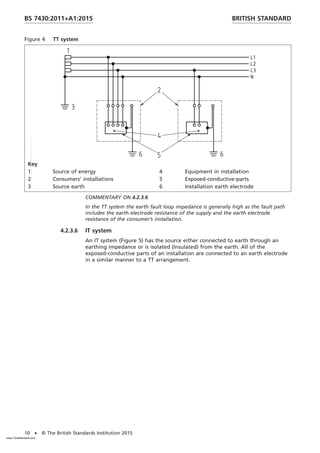
4.2.3.5 TT installation
A TT system (Figure 4) has a solidly earthed source; the exposed-conductive-parts
of the consumer’s installation are earthed through an installation earth
electrode which is electrically independent of the source earth.
BRITISH STANDARD BS 7430:2011+A1:2015
© The British Standards Institution 2015 • 9
www.TeraStandard.com
--``,`,`,`,,,,`,,,,,,,`,,`,,```,-`-`,,`,,`,`,,`---
Figure 4 TT system
Key
1 Source of energy 4 Equipment in installation
2 Consumers’ installations 5 Exposed-conductive-parts
3 Source earth 6 Installation earth electrode
COMMENTARY ON 4.2.3.6
In the TT system the earth fault loop impedance is generally high as the fault path
includes the earth electrode resistance of the supply and the earth electrode
resistance of the consumer’s installation.
4.2.3.6 IT system
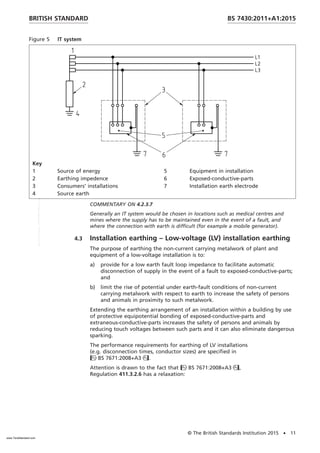
An IT system (Figure 5) has the source either connected to earth through an
earthing impedance or is isolated (Insulated) from the earth. All of the
exposed-conductive parts of an installation are connected to an earth electrode
in a similar manner to a TT arrangement.
BRITISH STANDARD
BS 7430:2011+A1:2015
10 • © The British Standards Institution 2015
www.TeraStandard.com
--``,`,`,`,,,,`,,,,,,,`,,`,,```,-`-`,,`,,`,`,,`---
Figure 5 IT system
Key
1 Source of energy 5 Equipment in installation
2 Earthing impedence 6 Exposed-conductive-parts
3 Consumers’ installations 7 Installation earth electrode
4 Source earth
COMMENTARY ON 4.2.3.7
Generally an IT system would be chosen in locations such as medical centres and
mines where the supply has to be maintained even in the event of a fault, and
where the connection with earth is difficult (for example a mobile generator).
4.3 Installation earthing – Low-voltage (LV) installation earthing
The purpose of earthing the non-current carrying metalwork of plant and
equipment of a low-voltage installation is to:
a) provide for a low earth fault loop impedance to facilitate automatic
disconnection of supply in the event of a fault to exposed-conductive-parts;
and
b) limit the rise of potential under earth-fault conditions of non-current
carrying metalwork with respect to earth to increase the safety of persons
and animals in proximity to such metalwork.
Extending the earthing arrangement of an installation within a building by use
of protective equipotential bonding of exposed-conductive-parts and
extraneous-conductive-parts increases the safety of persons and animals by
reducing touch voltages between such parts and it can also eliminate dangerous
sparking.
The performance requirements for earthing of LV installations
(e.g. disconnection times, conductor sizes) are specified in
BS 7671:2008+A3.
Attention is drawn to the fact that BS 7671:2008+A3,
Regulation 411.3.2.6 has a relaxation:
BRITISH STANDARD BS 7430:2011+A1:2015
© The British Standards Institution 2015 • 11
www.TeraStandard.com
--``,`,`,`,,,,`,,,,,,,`,,`,,```,-`-`,,`,,`,`,,`---
411.3.2.6 Where automatic disconnection according to
Regulation 411.3.2.1 cannot be achieved in the time required by
Regulation 411.3.2.2, 411.3.2.3 or 411.3.2.4, as appropriate, supplementary
equipotential bonding shall be provided in accordance with Regulation 415.2.
Also, Regulation 411.4.9 permits RCD protection to be used to satisfy the
requirements of these regulations and maximum values of earth fault loop
impedance are now provided in Table 41.5 within this standard.
4.4 Current-using equipment
The purpose of earthing current-using equipment is similar to that for earthing
electrical installations. However, for certain standards, e.g. those in the
BS EN 60335 series, automatic disconnection of supply is not required in the
event of a fault to accessible conductive parts (see BS EN 60335-1:2002+A14,
Clause 27).
27 Provision for earthing
27.1 Accessible metal parts of class 0I appliances and class I appliances that
may become live in the event of an insulation fault, shall be permanently and
reliably connected to an earthing terminal within the appliance or to the
earthing contact of the appliance inlet. Earthing terminals and earthing
contacts shall not be connected to the neutral terminal.
The fuse in the BS 1363 plug fitted to appliances in the UK is not required by
the relevant part of BS EN 60335; its rating is selected to provide protection to
the flexible cable supplying the appliance.
In the remainder of Europe, plug fuses are not required.
5 HV/LV interface
Specific requirements that should be followed for high voltage installations
including substations are found in BS EN 61936-1:2010+A1:2014 and
BS EN 50522:2011.Requirements that should be followed for the protection of
LV installations against temporary overvoltages due to earth faults in an HV
supply system are given in BS 7671:2008+A3, Section 442.
NOTE Further guidance on the interface between LV and HV subsystems, including
examples of earthing layouts, is given in Annex A.
6 Low voltage installations
NOTE The earthing requirements for low-voltage installations are specified in
BS 7671:2008+A3. In BS 7671:2008+A3, Chapter 44, requirements for
protection of low voltage installations against temporary overvoltages due to earth
faults in the high voltage system and due to faults in the low voltage system are
detailed. This is considered in Clause 5.
6.1 Automatic disconnection
COMMENTARY ON 6.1
When an earth fault occurs within an installation, dangerous voltages can appear
between conductive parts, and if these parts are simultaneously accessible they
might constitute a shock hazard. The severity of any shock experienced by a person
at risk depends on, among other factors, the type of current (i.e. a.c. or d.c.), the
magnitude of the voltages and the amount of time which the earth fault is allowed
to persist.
BRITISH STANDARD
BS 7430:2011+A1:2015
12 • © The British Standards Institution 2015
www.TeraStandard.com
--``,`,`,`,,,,`,,,,,,,`,,`,,```,-`-`,,`,,`,`,,`---
The earth fault current can also be of such magnitude and duration as to cause an
excessive temperature rise in the conductors through which it flows, thereby
creating a fire hazard.
BS 7671:2008+A3 includes a number of protective measures which can be
applied for protection against earth faults. However, this standard only considers the
protective measure known as automatic disconnection of supply. This is the most
commonly utilised of the protective measures contained in BS 7671:2008+A3.
Furthermore, the others do not depend on earthing and have very limited
applications.
ADS is a protective measure in which:
a) basic protection is provided by basic insulation of live parts or by barriers or
enclosures; and
b) fault protection is provided by protective earthing, protective equipotential
bonding and automatic disconnection in case of a fault.
A brief summary of the requirements of BS 7671:2008+A3 for automatic
disconnection of supply is given in 6.2 to 6.11.
Where automatic disconnection of supply is applied, Class I and Class II
equipment may be used.
In designing the protective system of any installation, due account should be
taken of the need to ensure that periodic inspection, testing and maintenance
can be readily and safely undertaken.
6.2 Earthing of installations
Most installations are part of either a TN system or a TT system, and in both
types of installation the exposed-conductive-parts of all the electrical equipment
of an installation should be connected by means of circuit protective conductors
to the main earthing terminal. The earth fault loop impedance should be
sufficiently low for the protective device (fuse, circuit breaker, RCD) to operate
in the required time in the event of a fault to earth.
Class II equipment, whether metal encased or insulation encased, embodies in its
construction not only basic insulation but also supplementary or reinforced
insulation; exposed metalwork of such equipment should not be considered to
become live under fault conditions, i.e. is not considered to be an
exposed-conductive-part.
The various earthing systems are considered in 4.2.
6.3 Information to be provided on request
As necessary, the owner of an installation, the employer or a contractor should
determine from the electricity distributor the relevant information as described
in the ESQCR [1] and ESQCR (NI) [3]. The owner or his agent should satisfy
themselves that the characteristics of the earth fault current path, including any
part of that path provided by a supply undertaking, are suitable for operation
of the type of earth fault protection intended for use in the installation
concerned.
COMMENTARY ON 6.3
When it is intended to install standby supplies to operate in parallel with the
normal supply provided by a supply undertaking, the arrangements have to be
agreed with the distributor {see regulation 22(1)(d) of the ESQCR [1] and
Regulation 23(1)(d) of the ESQCR (NI) [3]}.
Regulation 28 of the ESQCR [1] and Regulation 29 of the ESQCR (NI) [3] require the
distributor to provide certain information as follows (the exact text here is taken
from the ESQCR [1]):
BRITISH STANDARD BS 7430:2011+A1:2015
© The British Standards Institution 2015 • 13
www.TeraStandard.com
--``,`,`,`,,,,`,,,,,,,`,,`,,```,-`-`,,`,,`,`,,`---
28. A distributor shall provide, in respect of any existing or proposed
consumer’s installation which is connected or is to be connected to his
network, to any person who can show a reasonable cause for requiring the
information, a written statement of –
(a) the maximum prospective short circuit current at the supply terminals;
(b) for low voltage connections, the maximum earth loop impedance of
the earth fault path outside the installation;
(c) the type and rating of the distributor’s protective device or devices
nearest to the supply terminals;
(d) the type of earthing system applicable to the connection; and
(e) the information specified in regulation 27(1),
which apply, or will apply, to that installation.
The main bonding to other services, considered in 6.4, might require permission
of the undertakings responsible for those services, and such bonding to
telephone and telegraphic circuits should not be undertaken unless authorized
by those undertakings; guidance is contained in relevant Telecoms industry
standards such as BS 7671:2008+A3 and BS EN 50173 (all parts).
6.4 Protective equipotential bonding
NOTE 1 The protective measure automatic disconnection of supply, requires:
a) automatic disconnection in the event of a fault to earth;
b) protective earthing (to facilitate this); and
c) protective equipotential bonding to reduce touch voltages.
Where the automatic disconnection of supply is adopted, protective
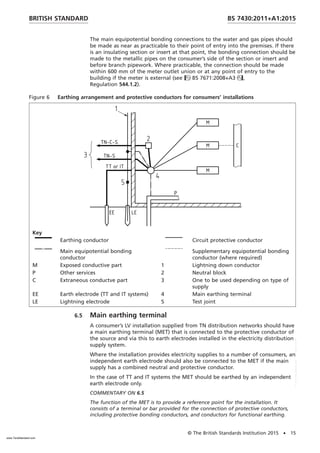
equipotential bonding is recommended (see Figure 6), whatever the type of
supply system. Bonding, by means of main equipotential bonding conductors, of
extraneous-conductive-parts to the main earthing terminal of the installation is
recommended; these extraneous-conductive-parts include:
a) water installation pipes;
b) gas installation pipes;
c) other installation pipework and ducting;
d) central heating and air conditioning systems;
e) exposed metallic structural parts of the building structure; and
f) other metallic parts such as cable trays and cable ladder racks.
Connection of a lightning protection system to the protective equipotential
bonding should be made in accordance with BS EN 62305-4.
NOTE 2 BS EN 62305-4 requires that a bond is made between the lightning
protecting system and the installation equipotential bonding system. The
responsibility for specifying and installing this bond is that of the organization
responsible for the lightning protection system.
Where both main gas pipes and main water pipes enter a location, a common
bonding conductor may be used, but in such cases that conductor should be
continuous or should be permanently jointed (by soldering or crimping) in order
to preserve continuity. Such a bonding conductor may also be used in
association with other extraneous-conductive-parts.
BRITISH STANDARD
BS 7430:2011+A1:2015
14 • © The British Standards Institution 2015
www.TeraStandard.com
--``,`,`,`,,,,`,,,,,,,`,,`,,```,-`-`,,`,,`,`,,`---
The main equipotential bonding connections to the water and gas pipes should
be made as near as practicable to their point of entry into the premises. If there
is an insulating section or insert at that point, the bonding connection should be
made to the metallic pipes on the consumer’s side of the section or insert and
before branch pipework. Where practicable, the connection should be made
within 600 mm of the meter outlet union or at any point of entry to the
building if the meter is external (see BS 7671:2008+A3,
Regulation 544.1.2).
Figure 6 Earthing arrangement and protective conductors for consumers’ installations
Key
Earthing conductor Circuit protective conductor
Main equipotential bonding
conductor
Supplementary equipotential bonding
conductor (where required)
M Exposed conductive part 1 Lightning down conductor
P Other services 2 Neutral block
C Extraneous conductve part 3 One to be used depending on type of
supply
EE Earth electrode (TT and IT systems) 4 Main earthing terminal
LE Lightning electrode 5 Test joint
6.5 Main earthing terminal
A consumer’s LV installation supplied from TN distribution networks should have
a main earthing terminal (MET) that is connected to the protective conductor of
the source and via this to earth electrodes installed in the electricity distribution
supply system.
Where the installation provides electricity supplies to a number of consumers, an
independent earth electrode should also be connected to the MET if the main
supply has a combined neutral and protective conductor.
In the case of TT and IT systems the MET should be earthed by an independent
earth electrode only.
COMMENTARY ON 6.5
The function of the MET is to provide a reference point for the installation. It
consists of a terminal or bar provided for the connection of protective conductors,
including protective bonding conductors, and conductors for functional earthing.
BRITISH STANDARD BS 7430:2011+A1:2015
© The British Standards Institution 2015 • 15
www.TeraStandard.com
--``,`,`,`,,,,`,,,,,,,`,,`,,```,-`-`,,`,,`,`,,`---
Although the MET is connected to Earth it is seldom at zero potential because of the
potential difference caused by leakage and other currents flowing to Earth.
See also BS 7671:2008+A3, 411.4.2.
6.6 Protective conductors
The generic term “protective conductor” embraces the specific types shown in
Figure 6; in any particular case, the function intended should be correctly
identified, because this determines which of the numerous requirements
prescribed in BS 7671:2008+A3 are applicable.
COMMENTARY ON 6.6
BS 7671:2008+A3 requires that all protective conductors are suitably protected
against mechanical and chemical deterioration and electrodynamic effects.
Two methods are given for determining the cross-sectional area required for a
protective conductor. In the first the cross-sectional area is related empirically to that
of the associated line conductor (see BS 7671:2008+A3, Table 54.7) and in the
second method it is calculated using the “adiabatic equation” of
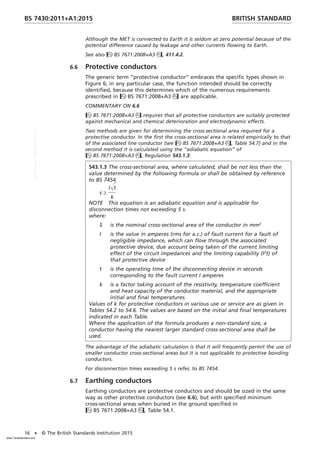
BS 7671:2008+A3, Regulation 543.1.3:
543.1.3 The cross-sectional area, where calculated, shall be not less than the
value determined by the following formula or shall be obtained by reference
to BS 7454.
s ≥
IŒt
k
NOTE This equation is an adiabatic equation and is applicable for
disconnection times not exceeding 5 s.
where:
S is the nominal cross-sectional area of the conductor in mm2
I is the value in amperes (rms for a.c.) of fault current for a fault of
negligible impedance, which can flow through the associated
protective device, due account being taken of the current limiting
effect of the circuit impedances and the limiting capability (I2
t) of
that protective device
t is the operating time of the disconnecting device in seconds
corresponding to the fault current I amperes
k is a factor taking account of the resistivity, temperature coefficient
and heat capacity of the conductor material, and the appropriate
initial and final temperatures.
Values of k for protective conductors in various use or service are as given in
Tables 54.2 to 54.6. The values are based on the initial and final temperatures
indicated in each Table.
Where the application of the formula produces a non-standard size, a
conductor having the nearest larger standard cross-sectional area shall be
used.
The advantage of the adiabatic calculation is that it will frequently permit the use of
smaller conductor cross-sectional areas but it is not applicable to protective bonding
conductors.
For disconnection times exceeding 5 s refer, to BS 7454.
6.7 Earthing conductors
Earthing conductors are protective conductors and should be sized in the same
way as other protective conductors (see 6.6), but with specified minimum
cross-sectional areas when buried in the ground specified in
BS 7671:2008+A3, Table 54.1.
BRITISH STANDARD
BS 7430:2011+A1:2015
16 • © The British Standards Institution 2015
www.TeraStandard.com
--``,`,`,`,,,,`,,,,,,,`,,`,,```,-`-`,,`,,`,`,,`---
NOTE 1 Uncoated buried copper is electro-positive to uncoated buried steel and
when interconnected by a current-carrying conductor, these metals form an
electrochemical cell that can cause accelerated corrosion of steel
(see BS EN 14505). As a rough guide, a direct current of 1 A leaving a buried
steel structure can remove nearly 9 kg of metal in 1 year.
Aluminium or copper-clad aluminium conductors should not be used for final
connections to earth electrodes. Where a copper conductor is to be joined to
aluminium the procedure described in 9.9.4.3 should be followed.
The connection of the earthing conductor to the earth electrode or other means
of earthing should be soundly made by the use of compound filled,
encapsulated or substantial clamps of non-ferrous material. Where the earthing
conductor is to be connected to the metal sheath and armour of a cable, the
sheath and armour should be bonded together and the principal connection
between the cable and the earthing conductor should be to the metal sheath
and should be plumbed.
Alternatively, if a clamp is used for this connection it should be so designed and
installed as to provide reliable connection without damage to the cable.
Earthing and bonding clamps should conform to BS 951.
NOTE 2 Whilst the connection referred to might be in a link box underground and
therefore not readily accessible, BS 7671:2008+A3 stipulates that provision is
made in an accessible position for disconnecting the main earthing terminal of an
installation from the means of earthing to facilitate measurement of the resistance
of the earthing arrangements.
6.8 Circuit protective conductors
When the metallic sheath of a cable is used as a circuit protective conductor,
every joint in that sheath should be so made that its current-carrying capacity is
not less than that of the sheath and, where non-metallic joint boxes are used,
means such as a metal strip having the same effective current-carrying capacity
as the largest cable entering the box should be provided to maintain continuity.
When using the metallic sheath or armour, attention should also be paid to the
ability of the cable glands and connections to carry prospective earth fault
currents and it might be necessary to seek advice from the manufacturers on
this aspect. Special precautions may be considered necessary with metal parts of
the assembly, particularly gland plates where abrasion resistant finishes,
e.g. powder coatings, are used.
Metallic enclosures for cables, such as conduit, ducting and trunking, may be
used as circuit protective conductors but where flexible or pliable conduit is used
separate protective conductors should be included inside the conduit to
maintain the integrity of the earth path. Where conduit and trunking are used,
a high standard of workmanship in installation is essential. Joints should be so
made such that their current-carrying capacity is not less than that of the
conduit itself. Joints should also have the same properties, as regards insulation,
mechanical strength and protection, as those of the wiring system or conduit of
which they are part. Slackness in joints can result in deterioration in, and even
complete loss of, continuity; plain slip or pin-grip sockets should not be used. In
the case of unscrewed conduit, the use of lug-grip fitting is recommended, but
for outdoor installations and where otherwise subjected to atmospheric
corrosion, screwed conduit should always be used, suitably protected against
corrosion. In screwed-conduit installations the use of locknuts is recommended.
Joints in all conduit systems should be painted overall after assembly.
These precautions ought to be adequate, but periodical tests should be made to
verify that electrical continuity is satisfactorily maintained.
BRITISH STANDARD BS 7430:2011+A1:2015
© The British Standards Institution 2015 • 17
www.TeraStandard.com
--``,`,`,`,,,,`,,,,,,,`,,`,,```,-`-`,,`,,`,`,,`---
NOTE Electrolytic corrosion is liable to occur under damp conditions at contacts
between dissimilar metals. Copper and alloys having a high copper content are
particularly liable to cause corrosion under these conditions when in contact with
aluminium alloys.
When dissimilar metals form part of an electrical circuit, the joints should be
clean and assembled free of moisture, and then immediately treated with a
suitable medium against the ingress of moisture.
Where damp conditions prevail, the fittings, fixing screws and saddles used to
secure aluminium-based alloy conductors should be made of aluminium alloy or
suitably protected steel (zinc coated) and the surfaces which are in contact with
a conductor should be painted before assembly.
6.9 Installations and locations of increased shock risk
For installations and locations of increased shock risk, additional measures may
be considered necessary; these include:
a) supplementary equipotential bonding;
b) RCDs with a rated residual current of 30 MA or less; and
c) protective extra-low voltage (PELV) and separated extra-low voltage (SELV)
equipment.
When an installation supplies a number of buildings, main equipotential
bonding is essential in each building, so that each has a reference point to
which are connected the conductive parts referred to in 6.4. In order to reduce
the voltages occurring in the event of an earth fault still further, it is sometimes
necessary to install supplementary local equipotential bonding.
6.10 Supplementary bonding – Circuits where disconnection times
cannot be met
COMMENTARY ON 6.10
Where the disconnection times of BS 7671:2008+A3, Chapter 41, cannot be
met (typically 0.4 s and 5 s for 230 V TN systems) Regulation 411.3.2.6 requires
supplementary bonding in accordance with Regulation 415.2.2:
415.2.2 Where doubt exists regarding the effectiveness of supplementary
equipotential bonding, it shall be confirmed that the resistance R between
simultaneously accessible exposed-conductive-parts and
extraneous-conductive-parts fulfils the following condition:
R ≤ 50 V/Ia in a.c. systems
R ≤ 120 V/Ia in d.c. systems
where Ia is the operating current in amperes of the protective device –
• for RCDs, IΔn.
• for overcurrent devices, the current causing automatic operation
in 5 s.
These formulae allow relatively long lengths and are unlikely to require other than
standard conductor cross-sectional areas.
BRITISH STANDARD
BS 7430:2011+A1:2015
18 • © The British Standards Institution 2015
www.TeraStandard.com
--``,`,`,`,,,,`,,,,,,,`,,`,,```,-`-`,,`,,`,`,,`---
6.11 Industrial and commercial installations
6.11.1 General
Many industrial installations take their electrical power from a public
distribution network operator at a voltage which might be above 1 000 V a.c.;
fault capacities might also be greater than those encountered in domestic
premises and great care should be exercised in the design of all protective
conductors and their terminations.
Equally important is the consideration that should be given to the effect that
earthing might have on the processes employed in some factories.
Where problems related to flammable liquids and gases are concerned, or if
there is a need for detailed knowledge of protective earthing that is not directly
related to electrical safety, reference should be made to the relevant British
Standards.
NOTE Further information is obtainable from the Health and Safety Executive
concerning statutes, codes and standards that apply to particular processes.
Where instrumentation and data circuits are involved, particular care should be
exercised when interconnecting earthing systems. The designer should also
consider transients or circulating currents in the earthing system that might
introduce unwanted voltages within electronic circuits by magnetic induction.
There might be occasions, which should be considered, when direct earthing of
exposed metalwork could interfere with other systems that employ the general
mass of earth as a current transmission path; typical examples are telephony and
cathodic protection.
6.11.2 Earth fault loop impedance
As in the case of high voltage supplies, the use of low resistance paths for the
return of earth fault current in low voltage industrial systems is necessary, and
the total loop impedance should be sufficiently low as to allow the operation of
a suitably chosen protective device, fuse, circuit-breaker or RCD within the time
given in BS 7671:2008+A3.
6.11.3 Single-core cables
Where single-core cables are used in a low voltage installation it is generally
preferable to bond and earth all metallic sheaths or armour at both ends of
each run (solid bonding). Induced voltages in the sheaths or armour should be
reduced to low values and the sheaths or armour may then be used as a
protective conductor, in parallel if necessary with an additional conductor.
Currents circulating in the armour or sheath reduce the current-carrying capacity
of the cables; where this reduction is not acceptable, sheaths and armour may
be bonded at one end of a run only (single-point bonding) and a separate
protective conductor is then necessary.
NOTE Consideration of the values of standing voltage which will appear at the
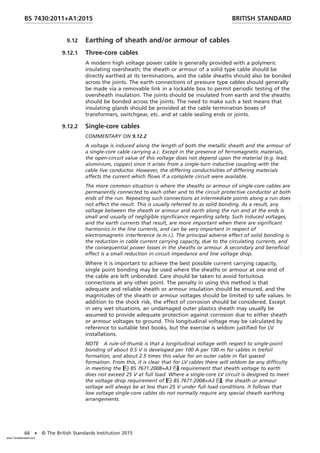
open circuit ends of the sheaths or armour is covered in 9.12.2.
7 Generators
COMMENTARY ON CLAUSE 7
Three main types of generating set are considered in this Clause:
a) small sets having ratings below 10 kW that are not earthed and not operated in
parallel with the electricity supply;
b) sets having ratings usually in excess of 10 kW that are normally 3-phase and
require earthing; and
BRITISH STANDARD BS 7430:2011+A1:2015
© The British Standards Institution 2015 • 19
www.TeraStandard.com
--``,`,`,`,,,,`,,,,,,,`,,`,,```,-`-`,,`,,`,`,,`---
c) small-scale embedded generators (up to 16 A/phase) for operation in parallel
with public low-voltage distribution networks.
7.1 Unearthed generating sets (ratings below 10 kW)
7.1.1 General
NOTE 1 Low-voltage, single-phase generating sets are generally mobile or
transportable machines ranging in size from 0.2 kW to 10 kW.
NOTE 2 Winding connections are normally brought out to a socket-outlet in which
the third or protective conductor is connected to the generator enclosure.
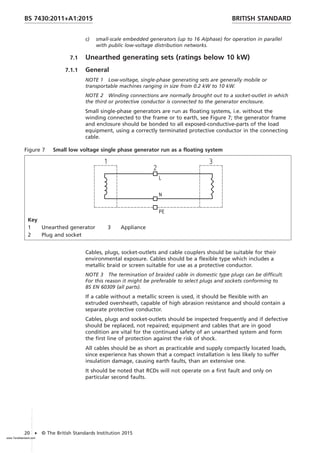
Small single-phase generators are run as floating systems, i.e. without the
winding connected to the frame or to earth, see Figure 7; the generator frame
and enclosure should be bonded to all exposed-conductive-parts of the load
equipment, using a correctly terminated protective conductor in the connecting
cable.
Figure 7 Small low voltage single phase generator run as a floating system
Key
1 Unearthed generator 3 Appliance
2 Plug and socket
Cables, plugs, socket-outlets and cable couplers should be suitable for their
environmental exposure. Cables should be a flexible type which includes a
metallic braid or screen suitable for use as a protective conductor.
NOTE 3 The termination of braided cable in domestic type plugs can be difficult.
For this reason it might be preferable to select plugs and sockets conforming to
BS EN 60309 (all parts).
If a cable without a metallic screen is used, it should be flexible with an
extruded oversheath, capable of high abrasion resistance and should contain a
separate protective conductor.
Cables, plugs and socket-outlets should be inspected frequently and if defective
should be replaced, not repaired; equipment and cables that are in good
condition are vital for the continued safety of an unearthed system and form
the first line of protection against the risk of shock.
All cables should be as short as practicable and supply compactly located loads,
since experience has shown that a compact installation is less likely to suffer
insulation damage, causing earth faults, than an extensive one.
It should be noted that RCDs will not operate on a first fault and only on
particular second faults.
BRITISH STANDARD
BS 7430:2011+A1:2015
20 • © The British Standards Institution 2015
www.TeraStandard.com
--``,`,`,`,,,,`,,,,,,,`,,`,,```,-`-`,,`,,`,`,,`
7.1.2 Protective measure electrical separation
As required by BS 7671:2008+A3, Section 413, such an unearthed
construction in conformity with 7.1.1 should be limited to one item of
equipment unless under the supervision of a skilled or instructed person
(see BS 7671:2008+A3, Regulation group 418.3).
7.1.3 Unearthed generators (rating below 10 kW) supplying a fixed
installation
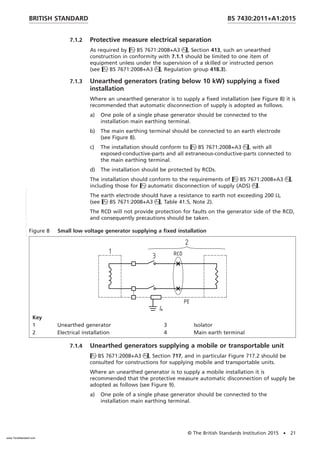
Where an unearthed generator is to supply a fixed installation (see Figure 8) it is
recommended that automatic disconnection of supply is adopted as follows.
a) One pole of a single phase generator should be connected to the
installation main earthing terminal.
b) The main earthing terminal should be connected to an earth electrode
(see Figure 8).
c) The installation should conform to BS 7671:2008+A3, with all
exposed-conductive-parts and all extraneous-conductive-parts connected to
the main earthing terminal.
d) The installation should be protected by RCDs.
The installation should conform to the requirements of BS 7671:2008+A3,
including those for automatic disconnection of supply (ADS).
The earth electrode should have a resistance to earth not exceeding 200 Ω,
(see BS 7671:2008+A3, Table 41.5, Note 2).
The RCD will not provide protection for faults on the generator side of the RCD,
and consequently precautions should be taken.
Figure 8 Small low voltage generator supplying a fixed installation
Key
1 Unearthed generator 3 Isolator
2 Electrical installation 4 Main earth terminal
7.1.4 Unearthed generators supplying a mobile or transportable unit
BS 7671:2008+A3, Section 717, and in particular Figure 717.2 should be
consulted for constructions for supplying mobile and transportable units.
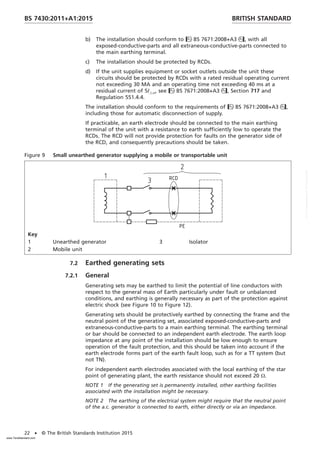
Where an unearthed generator is to supply a mobile installation it is
recommended that the protective measure automatic disconnection of supply be
adopted as follows (see Figure 9).
a) One pole of a single phase generator should be connected to the
installation main earthing terminal.
BRITISH STANDARD BS 7430:2011+A1:2015
© The British Standards Institution 2015 • 21
www.TeraStandard.com
--``,`,`,`,,,,`,,,,,,,`,,`,,```,-`-`,,`,,`,`,,`---
b) The installation should conform to BS 7671:2008+A3, with all
exposed-conductive-parts and all extraneous-conductive-parts connected to
the main earthing terminal.
c) The installation should be protected by RCDs.
d) If the unit supplies equipment or socket outlets outside the unit these
circuits should be protected by RCDs with a rated residual operating current
not exceeding 30 MA and an operating time not exceeding 40 ms at a
residual current of 5I_n, see BS 7671:2008+A3, Section 717 and
Regulation 551.4.4.
The installation should conform to the requirements of BS 7671:2008+A3,
including those for automatic disconnection of supply.
If practicable, an earth electrode should be connected to the main earthing
terminal of the unit with a resistance to earth sufficiently low to operate the
RCDs. The RCD will not provide protection for faults on the generator side of
the RCD, and consequently precautions should be taken.
Figure 9 Small unearthed generator supplying a mobile or transportable unit
Key
1 Unearthed generator 3 Isolator
2 Mobile unit
7.2 Earthed generating sets
7.2.1 General
Generating sets may be earthed to limit the potential of line conductors with
respect to the general mass of Earth particularly under fault or unbalanced
conditions, and earthing is generally necessary as part of the protection against
electric shock (see Figure 10 to Figure 12).
Generating sets should be protectively earthed by connecting the frame and the
neutral point of the generating set, associated exposed-conductive-parts and
extraneous-conductive-parts to a main earthing terminal. The earthing terminal
or bar should be connected to an independent earth electrode. The earth loop
impedance at any point of the installation should be low enough to ensure
operation of the fault protection, and this should be taken into account if the
earth electrode forms part of the earth fault loop, such as for a TT system (but
not TN).
For independent earth electrodes associated with the local earthing of the star
point of generating plant, the earth resistance should not exceed 20 Ω.
NOTE 1 If the generating set is permanently installed, other earthing facilities
associated with the installation might be necessary.
NOTE 2 The earthing of the electrical system might require that the neutral point
of the a.c. generator is connected to earth, either directly or via an impedance.
BRITISH STANDARD
BS 7430:2011+A1:2015
22 • © The British Standards Institution 2015
www.TeraStandard.com
--``,`,`,`,,,,`,,,,,,,`,,`,,```,-`-`,,`,,`,`,,`---
Where an installation is supplied by more than one source of energy (e.g. a
supply from a distributor and a supply from a generating set), the earthing
system of the installation should be designed so that each source that can
operate independently of other sources and remain earthed if all the other
sources are not connected.
NOTE 3 There are many variations in system design and, for any particular
application, the precise method of earthing of each energy source is subject to the
recommendations of the equipment supplier and to the system parameters.
NOTE 4 Public low voltage distribution networks have to be directly earthed in
conformity to the current ESQCR (Regulations 7 to 10) [1] and ESQCR (NI) [3].
Since an installation connected to a distributors network might be expected to be
designed accordingly, direct earthing is also normally adopted for any generating set
which supplies such an installation.
Whenever it is intended that a private generating set be used to supply any part
of a consumer’s system normally supplied by a distributor, the distributor and
supplier should be consulted.
NOTE 5 The ESQCR [Regulation 22(1)(d)] [1] and ESQCR (NI) Regulation 23(1)(d)
[3] require that, where operation in parallel with a distributors network is intended,
the agreement of the distributor has to be obtained first, subject to Regulation 22(2)
{Regulation 23(2) in ESQCR (NI) [3]} for generators rated up to a total of 16 A per
phase.
7.2.2 References
The following ENA Engineering Recommendations should be consulted where
relevant:
• ER G59, Recommendations for the connection of embedded generating
plant to the Regional Electricity Companies’ distribution systems;
• ER G83, Recommendations For The Connection Of Small-Scale Embedded
Generators (Up To 16 A Per Phase) In Parallel With Public Low-Voltage
Distribution Networks;
• ER G84, Recommendations for the Connection of Mobile Generating Sets to
Public Distribution Networks.
NOTE ER G84 gives recommend working procedures for the connection of
small portable generating sets and larger mobile generating sets for the
purposes of providing a temporary supply to customers or for network support.
It addresses direct connections to the low voltage network and connections via a
step-up unit to the high voltage network.
7.2.3 Generating sets having ratings above 10 kW
Generating sets with outputs above 10 kW are normally 3-phase; these types of
set may be permanently installed in buildings, enclosed in weatherproof and
sound attenuated enclosure, and vehicle or trolley mounted. It should not be
assumed that they will be provided with the generator windings connected to a
mounting frame.
An independent generator may be installed to supply construction sites
(BS 7671:2008, Section 704) or temporary electrical installations (BS 7671:2008,
Section 740) as an alternative to a distributor’s supply which is as yet
unavailable. Such installations though temporary should be robust and conform
to the requirements of BS 7671:2008, with a main earthing terminal provided
connected to earth, usually by an earth electrode.
BRITISH STANDARD BS 7430:2011+A1:2015
© The British Standards Institution 2015 • 23
www.TeraStandard.com
--``,`,`,`,,,,`,,,,,,,`,,`,,```,-`-`,,`,,`,`,,`---
7.2.4 Generators operating independently of the supply
In this mode of operation the generating plant should be the only source of
supply to an installation. If there is only one machine, both protective and
supply system earthing should be achieved by connecting the generator neutral,
the generator frame and exposed-conductive-parts and
extraneous-conductive-parts to a main earthing terminal and by the use of an
independent earth electrode. Where two or more generators are operating in
parallel, neutral/earth circulating currents should be dealt with by the methods
described in 7.2.6.
7.2.5 Generators providing a changeover supply
In this mode of operation the generating plant may be used to provide a full
alternative supply to either the whole or part of an installation. Special
attention should be given to the changeover arrangements so that operation in
parallel with the incoming supply is not possible. Line and neutral isolation from
the incoming supply should be provided.
Where there is only one generating set, the neutral point of its windings, the
generator frame, all exposed-conductive-parts and extraneous-conductive-parts
should be connected to the main earthing terminal. This earthing terminal
should be connected to an independent earth electrode and, where appropriate,
to the protective earth terminal provided by the distributor.
7.2.6 Two or more generators operating in parallel (providing a
changeover supply)
When two or more generating sets, operating in parallel, are used to supply an
installation, the protective earthing of the generator frames and associated
metalwork should follow the same procedure as that described for only one
generating set. However, the method of supply system earthing for the
generator windings should be chosen considering the magnitude of the
circulating currents, commonly third harmonic, which can flow in the
neutral/earthing conductors.
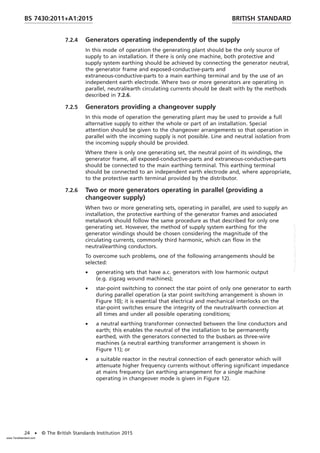
To overcome such problems, one of the following arrangements should be
selected:
• generating sets that have a.c. generators with low harmonic output
(e.g. zigzag wound machines);
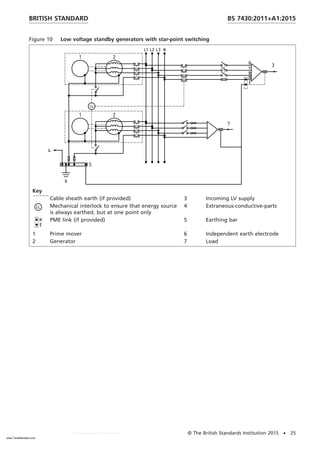
• star-point switching to connect the star point of only one generator to earth
during parallel operation (a star point switching arrangement is shown in
Figure 10); it is essential that electrical and mechanical interlocks on the
star-point switches ensure the integrity of the neutral/earth connection at
all times and under all possible operating conditions;
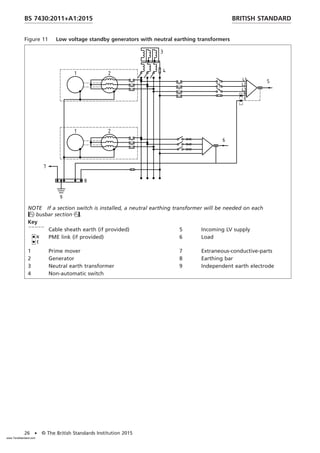
• a neutral earthing transformer connected between the line conductors and
earth; this enables the neutral of the installation to be permanently
earthed, with the generators connected to the busbars as three-wire
machines (a neutral earthing transformer arrangement is shown in
Figure 11); or
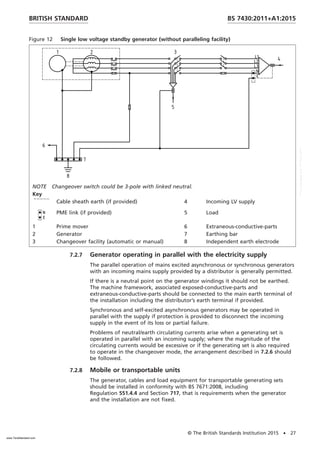
• a suitable reactor in the neutral connection of each generator which will
attenuate higher frequency currents without offering significant impedance
at mains frequency (an earthing arrangement for a single machine
operating in changeover mode is given in Figure 12).
BRITISH STANDARD
BS 7430:2011+A1:2015
24 • © The British Standards Institution 2015
www.TeraStandard.com
--``,`,`,`,,,,`,,,,,,,`,,`,,```,-`-`,,`,,`,`,,`---
Figure 10 Low voltage standby generators with star-point switching
Key
Cable sheath earth (if provided) 3 Incoming LV supply
Mechanical interlock to ensure that energy source
is always earthed, but at one point only
4 Extraneous-conductive-parts
PME link (if provided) 5 Earthing bar
1 Prime mover 6 Independent earth electrode
2 Generator 7 Load
BRITISH STANDARD BS 7430:2011+A1:2015
© The British Standards Institution 2015 • 25
www.TeraStandard.com
--``,`,`,`,,,,`,,,,,,,`,,`,,```,-`-`,,`,,`,`,,`---
Figure 11 Low voltage standby generators with neutral earthing transformers
NOTE If a section switch is installed, a neutral earthing transformer will be needed on each
busbar section.
Key
Cable sheath earth (if provided) 5 Incoming LV supply
PME link (if provided) 6 Load
1 Prime mover 7 Extraneous-conductive-parts
2 Generator 8 Earthing bar
3 Neutral earth transformer 9 Independent earth electrode
4 Non-automatic switch
BRITISH STANDARD
BS 7430:2011+A1:2015
26 • © The British Standards Institution 2015
www.TeraStandard.com
--``,`,`,`,,,,`,,,,,,,`,,`,,```,-`-`,,`,,`,`,,`---
Figure 12 Single low voltage standby generator (without paralleling facility)
NOTE Changeover switch could be 3-pole with linked neutral.
Key
Cable sheath earth (if provided) 4 Incoming LV supply
PME link (if provided) 5 Load
1 Prime mover 6 Extraneous-conductive-parts
2 Generator 7 Earthing bar
3 Changeover facility (automatic or manual) 8 Independent earth electrode
7.2.7 Generator operating in parallel with the electricity supply
The parallel operation of mains excited asynchronous or synchronous generators
with an incoming mains supply provided by a distributor is generally permitted.
If there is a neutral point on the generator windings it should not be earthed.
The machine framework, associated exposed-conductive-parts and
extraneous-conductive-parts should be connected to the main earth terminal of
the installation including the distributor’s earth terminal if provided.
Synchronous and self-excited asynchronous generators may be operated in
parallel with the supply if protection is provided to disconnect the incoming
supply in the event of its loss or partial failure.
Problems of neutral/earth circulating currents arise when a generating set is
operated in parallel with an incoming supply; where the magnitude of the
circulating currents would be excessive or if the generating set is also required
to operate in the changeover mode, the arrangement described in 7.2.6 should
be followed.
7.2.8 Mobile or transportable units
The generator, cables and load equipment for transportable generating sets
should be installed in conformity with BS 7671:2008, including
Regulation 551.4.4 and Section 717, that is requirements when the generator
and the installation are not fixed.
BRITISH STANDARD BS 7430:2011+A1:2015
© The British Standards Institution 2015 • 27
www.TeraStandard.com
--``,`,`,`,,,,`,,,,,,,`,,`,,```,-`-`,,`,,`,`,,`---
These transportable units may be trailer, skid or vehicle mounted with outputs in
excess of 10 kW (as supplied, the generator windings might not be connected to
the machine frame). The three-phase terminals and the neutral connections
should be brought out independently to the generator terminal box or, on
smaller units, to a socket-outlet conforming to BS EN 60309 (all parts).
To limit the potential of the conductors to the metallic enclosures and to ensure
correct operation of protective devices, the star point of the generator windings
should be connected to a common reference point. The generator frame, all
exposed metalwork, the under frame or vehicle chassis and all protective
conductors should be connected to form this common reference point.
The terminal box or socket-outlet should make provision for five connections,
i.e. there should be a separate connection for a protective conductor in addition
to the usual four connections for the three lines and the neutral. Where
connections for only four conductors are provided, the generator should be used
to provide balanced three-phase loads only, the fourth connection being
reserved for the protective conductor. The fourth connection and conductor
should not be used for combined neutral/protective purposes, because of the
risk which can arise if this conductor fails.
It is essential that separate neutral and protective conductors are used and that
there is no connection between neutral and earth on the load side of the RCD.
7.2.9 Additional protection against electric shock
NOTE 1 Some three-phase generators are supplied with a built-in RCD and the star
point of the windings is internally bonded to the generator frame and the
protective conductor terminal. Alternatively, it might be necessary to install a
separate RCD and to make the appropriate connections externally.
To provide protection against electric shock when in contact with a live part and
the general mass of earth a 30 MA RCD in accordance with
BS 7671:2008+A3, Regulation 411.3.3, should be provided and the
common reference point/main earthing terminal connected to true earth.
NOTE 2 Although, in the absence of a deliberate connection between the
protective conductor and earth, fortuitous contact between metal cladding of
equipment and earth can be such that any earth fault current likely to involve a risk
of shock would be sufficient to cause the RCD to operate, it is better to ensure
operation by making the earth connection wherever it is at all practicable.
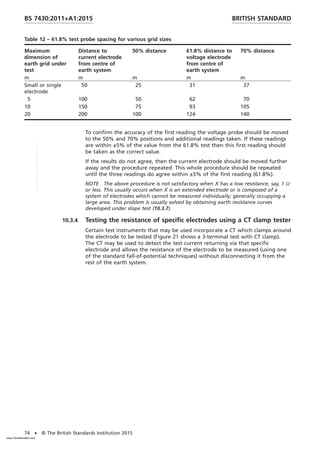
In conformity to BS 7671:2008+A3, the resistance of the earth electrode
should be less than 50/IΔn where IΔn is the rated operating current of the RCD.
NOTE 3 For a 30 MA RCD at 230 V, this would allow a resistance to earth
of 1667 Ω. However, a note to BS 7671:2008, Table 41.5 advises the resistance be as
low as practicable and a value exceeding 200 Ω might not be stable.
7.3 Uninterruptible power supplies (UPSs)
Fault protection of UPSs should conform to BS 7671:2008+A3, 551.4.3.3.
7.4 Other sources
Fault protection of any other sources should conform to BS 7671:2008+A3.
BRITISH STANDARD
BS 7430:2011+A1:2015
28 • © The British Standards Institution 2015
www.TeraStandard.com
--``,`,`,`,,,,`,,,,,,,`,,`,,```,-`-`,,`,,`,`,,`---
8 Special installations
8.1 Temporary scaffolding and similar metallic structures
8.1.1 Metallic structures assembled by means of bolted joints or screw
clamps
NOTE 1 Where structures are assembled using bolted joints or screw clamps, a
multiplicity of such connections is likely to provide several paths of relatively low
resistance. Although such structures are not designed to be electrically continuous, it
is reasonable to assume that they have a low value of electrical resistance.
Whatever type of structural fastenings or footings in contact with the ground
are employed, and however a temporary structure may be fastened to a
permanent structure, it should not be assumed that a temporary metallic
structure is effectively earthed.
NOTE 2 Most erections of metallic scaffolding are the subject of statutory
regulations concerning construction work.
The distribution of electricity on construction sites should conform to BS 7375.
Except where it is necessary for lightning protection purposes (see 8.2),
scaffolding external to a structure should not be connected to the means of
earthing within the structure that is afforded by supply authorities.
Where scaffolding is erected against or around a structure which does not have
electrical services, and electrical equipment is not likely to be used for
construction work, electrical bonding for shock protection purposes may be
omitted.
Where protective conductors are required, they should be of copper and
protected against corrosion by a covering at least equivalent to the insulation of
a single non-sheathed cable, and should be routed to avoid damage from work
equipment and work activities. A conductor should be connected to scaffolding
by a corrosion-resistant clamp conforming to BS 951, and which is suitably
protected against mechanical damage.
For extensive scaffolding structures, where earthed, connections should be made
at points not more than 20 m apart laterally.
8.1.2 Structures forming part of precautions to avoid danger from live
overhead electric lines
COMMENTARY ON 8.1.2
The Health and Safety Executive publishes guidance on the dangers of live overhead
power lines, see Guidance Note GS6 Avoidance of Danger from Overhead Electrical
Lines [5].
Paragraph 20 b) of GS6 refers to the use of a tensioned wire fence as a high level
barrier, and notes that the electricity distributor has to be consulted about the
erection and earthing of the barrier.
8.2 Lightning protection
If scaffolding is associated with an existing structure which has an external
lightning protection system (LPS), it should be bonded to the earth termination
network and the air termination network of the LPS. Lightning protection
should otherwise be provided where indicated by risk assessment performed in
accordance with BS EN 62305-2.
BRITISH STANDARD BS 7430:2011+A1:2015
© The British Standards Institution 2015 • 29
www.TeraStandard.com
--``,`,`,`,,,,`,,,,,,,`,,`,,```,-`-`,,`,,`,`,,`---
Other temporary tall metallic structures might require separate earthing
electrodes to afford adequate lightning protection, which will depend on the
construction of the temporary foundations and footings; BS EN 62305-3 should
be consulted for further guidance and expert opinion should be obtained if
necessary.
8.3 Other temporary structures
There are no recommendations for special earthing or bonding arrangements,
i.e. structures that do not require lightning protection, which are not in the
vicinity of electric overhead lines and which do not carry electrical circuits
operating at a voltage in excess of 25 V a.c. to earth.
8.4 Telecommunication circuits and equipment
Recommendations for installing the cabling and earthing of telecommunication
equipment, including equipment associated with high voltage stations, are given
in ER S36-1.
Where the telecommunication equipment is associated with high-voltage
generating, transmission or distribution equipment, special precautions should
be taken to prevent the rise of voltage on the earthing system of the high
voltage equipment being transferred to the telecommunication circuits.
8.5 Street furniture
8.5.1 General
NOTE Street furniture includes permanently sited lighting columns, traffic and
pedestrian signals, illuminated traffic signs, bollards and other electrically supplied
equipment.
Reference should be made to the requirements for luminaires and lighting
installations specified in BS 7671:2008+A3, Section 559.
Street furniture may be of:
a) Class I construction, in which exposed-conductive-parts are connected to the
earthing terminal within the equipment, as described in 8.5.2; or
b) Class II construction, in which no provision is made for connection of
exposed metallic parts of the street furniture to earth; with this form of
construction, care should be taken to ensure that any protective or
PEN conductor in the supply cable has an insulated termination preventing
contact with or connection to the metallic parts of the street furniture.
The system of supply should be a TN-S system with separate line, neutral and
protective conductors, a TN-C-S system where the source of supply is a concentric
cable having a combined neutral and earth under a PME system, or a TT system
where the source of supply consists of a line and neutral conductor only. The
supply voltage should be extra-low (typically just less than 50 V), or low voltage
(typically single-phase at 230 V or three-phase at 400 V).
Access panels, covers or doors of street furniture may be of non-metallic or
metallic construction and may be hinged or may have to be removed to gain
access. Access panels, covers or doors of street furniture should not be relied
upon as a means of basic protection for contact with live parts within street
furniture. Adequate enclosures or barriers should be provided within the street
furniture to give the necessary level of protection (for further details,
see BS 7671:2008+A3).
For street furniture of class II construction, no electrical connection should be
made between metallic access panels, covers or doors and other metallic parts of
the furniture.
BRITISH STANDARD
BS 7430:2011+A1:2015
30 • © The British Standards Institution 2015
www.TeraStandard.com
--``,`,`,`,,,,`,,,,,,,`,,`,,```,-`-`,,`,,`,`,,`---
For street furniture of class I construction, the characteristics of the supply
system, the characteristics of the earthing system, including consumer earthing
provisions, the material of the street furniture and any surface protection, and
that of the access panels, covers or doors together with whether they are
hinged or have to be lifted off to gain access should inform the designer’s risk
assessment as to whether they do or do not require any electrical connection.
In coming to a reasoned engineering judgement, note should be taken of the
recorded instances and future possibility of reversed polarity of the supply or
the loss of the neutral connection on the supply side of a TN-C-S system (for
example, it would be reasonable for small isolated metal doors of
non-conductive columns such as concrete columns, supplied from a PME
distribution system that conform to the ESQCR [1] and ESQCR (NI) [3], not
to be earthed).
In all cases, the distributor should be consulted before design work on new
street furniture is commenced to ascertain the type of system that will supply
the new installation.
8.5.2 Supply systems for street furniture
8.5.2.1 General
Street furniture may normally be fed from TN-S or TN-C-S systems.
8.5.2.2 TN-S systems
Street furniture may be fed from and protected by a TN-S system and in such
arrangements a supply cable with separate line, neutral and protective
conductors should be used. In Class I street furniture the wiring on the load side
of the protective device in the unit should consist of separate line, neutral and
circuit protective conductors. Exposed-conductive-parts of the item of street
furniture being supplied should be earthed by connecting them to the earthing
terminal within the equipment. The earthing terminal itself should be connected
to the supply protective conductor.
If an installation is all Class II, no protective conductor is required and the wiring
on the load side of the protective device should consist of line and neutral
conductors only.
It is recommended that a circuit supplying one or more items of Class II
equipment or a mixture of Class I and Class II should have a circuit protective
conductor run to and appropriately terminated at each point in wiring and at
each accessory.
8.5.2.3 TN-C-S systems
An alternative method of supplying and protecting street furniture that may be
used is by means of a TN-C-S system. In such cases a combined neutral and earth
conductor cable may normally be used at the source of supply (for example to
an individual lighting column or for larger installations a local supply authority
PME supply into a feeder pillar, with cables using separate line, neutral and
circuit protective conductors to feed individual items of street furniture as might
be used on footpaths, or to feed items of street furniture in the carriageway).
In the case of circuits feeding more than one item of street furniture, e.g. by
looping using a cable with separate line, neutral and protective conductors,
an earth electrode should be installed both at the point of supply and at the
last or penultimate unit and this electrode should be such as to make the
resistance to earth of the neutral at any point less than 20 Ω before the
connection of any circuit protective or bonding conductors to the neutral
terminal. If a single electrode produces a resistance of more than 20 Ω, other
earth electrodes equally spaced along the circuit should be installed.
BRITISH STANDARD BS 7430:2011+A1:2015
© The British Standards Institution 2015 • 31
www.TeraStandard.com
--``,`,`,`,,,,`,,,,,,,`,,`,,```,-`-`,,`,,`,`,,`---
8.5.2.4 TT systems
There is one further possibility that can arise, in which case the lighting
authority should provide its own protective earthing electrode(s): that is where
the electricity distributor does not provide an earth terminal (a TT system).
In this case, it is essential to ensure that both the initial and continuing
impedance of the fault path is sufficiently low to ensure the operation of the
protective device on the occurrence of a fault in the fixtures.
8.5.3 Protection arrangements for street furniture
The neutral earth electrode at the supply transformer is an important part of
the fault loop but its resistance to earth is not under the control of the lighting
authority; in such circumstances consideration should be given to the use of
RCDs to ensure disconnection of faulty equipment.
Metallic street light columns or the metal carcasses of feeder pillars or control
units, etc., may be used as protective earth electrodes, providing appropriate
calculations and subsequent measurements show that such use is suitable.
8.6 Railways and traction rails
8.6.1 General
Railways and tramways are a case where there is a need to apply specific rules,
depending upon the electrification and signalling systems in use. Most railways
and tramways have their own detailed technical standards for earthing, bonding
and ensuring the safety of adjacent electrical systems.
The following European Standards deal with the railway specific issues:
BS EN 50122-1 and BS EN 50122-2.
For installations outside of the railway boundary, there is generally no need to
apply specific rules.
For any installation that comes in to immediate contact with the electrical
systems of the railway the designer should consult with the technical
department of the railway or tramway company concerned.
No connections may be made to, or removed from, any part of a railway or
tramway installation without the explicit agreement of their technical
department.
8.6.2 Non-electrified lines in private premises
The rails of non-electrified lines within private premises or electrical substations
should be electrically separated from any adjoining railway, and connected to
the premises’ earthing system.
Suitable insulating rail joints should be included at the site boundary such that
electrical separation is maintained from the adjacent railway system.
NOTE In some cases two insulating rail joints might be needed to prevent the
insulation being bridged by rolling stock.
8.6.3 Railway electrifications systems in use in the UK
8.6.3.1 600 V to 750 V d.c. – Ground level contact systems (UK main line
railways in London, Southern England and Liverpool; the London
Underground; and the Docklands Light Railway)
Precautions need to be taken to limit stray currents from the railway, and care
should be taken to avoid bonding equipment to the railway traction systems.
BRITISH STANDARD
BS 7430:2011+A1:2015
32 • © The British Standards Institution 2015
www.TeraStandard.com
--``,`,`,`,,,,`,,,,,,,`,,`,,```,-`-`,,`,,`,`,,`---
8.6.3.2 600 V to 750 V, 1 500 V d.c. – Overhead contact system (UK tramway
and metro systems)
Precautions need to be taken to limit stray currents from the railway, and care
should be taken to avoid bonding equipment to the railway traction systems.
8.6.3.3 Other systems
Some heritage or museum operations use other forms of electrification, and
there might in future be newly installed railways, tramways or electric bus
operations that use electrification systems that are new to the UK.
8.7 Uninterruptible power supplies (UPSs)
NOTE There are two kinds of UPS systems; both provide a continuous supply of
electrical power in the event of failure of a distribution network operator’s network.
One type are static UPSs that utilize rechargeable storage batteries to provide the
alternative form of input power and the output power is generated by static
converters as specified by BS EN 62040-1-2. The other are rotary UPSs where the
input power is provided by stored energy and/or internal combustion engine and the
output power is provided by one or more rotating electrical machines as specified by
BS EN 88528-11.
Earth fault protection of UPSs should conform to BS 7671:2008+A3,
Chapter 55.
9 Earth electrode systems
9.1 General
Earthing of either a system or equipment involves the provision of a connection
to the general mass of earth; this connection should have a resistance not
greater than that required to operate safety mechanisms to isolate the
electricity supply from a fault situation, and be capable of carrying the
maximum expected fault current. The value of resistance required might not
always be amenable to an automatically set value.
Therefore, the various factors which affect the resistance to earth and fault
current capacity of the buried conductor, designated the earth electrode, should
be considered. This should include the size and shape of the earth conductor,
the resistivity of the soil in which it is buried and the connection of the system
to it. It is also essential to consider the current density at the surface of the
earth electrode and the ground potentials in its vicinity.
9.2 Nature of site
9.2.1 General
The basic nature and properties of soil in a given location cannot be changed
without considerable expense, and careful consideration of the geology should
be used to determine the best location for an earthing system.
Where there is an option, a site should be chosen in one of the following types
of situations in the order of preference given:
a) wet marshy ground;
b) clay, loamy soil, arable land, clayey soil, clayey soil or loam mixed with small
quantities of sand;
c) clay and loam mixed with varying proportions of sand, gravel, and stones;
d) damp and wet sand, peat.
BRITISH STANDARD BS 7430:2011+A1:2015
© The British Standards Institution 2015 • 33
www.TeraStandard.com
--``,`,`,`,,,,`,,,,,,,`,,`,,```,-`-`,,`,,`,`,,`---
Dry sand, gravel, chalk, limestone, whinstone, granite, any very stony ground,
and all locations where virgin rock is very close to the surface should be avoided
if possible. A site should be chosen where the moisture content is ideally
continuously within the range of 15% to 20%. A waterlogged location is not
essential unless the soil is sand or gravel. Care should be taken to avoid a site
where water flows over it (e.g. the bed of a stream) for the beneficial salts can
be entirely removed from the soil in such situations.
9.2.2 Soil treatment
In high resistivity locations or on rocky ground where long term performance is
required, it may be considered necessary to utilize a conductive concrete to
improve earth contact resistance around an earth rod or strip (tape) where
applicable. There are commercially available materials to achieve this effectively,
but care should be taken to understand how they work during installation to
ensure that they remain in contact with the rod or strip and do not shrink or
swell away after drying out.
Chemical treatment of soil has environmental implications and should not be
considered as a long term solution in order to meet a specified level of
resistance, apart from the risk of corrosion to the earthling system. Coke breeze
should also not be used due to its highly corrosive nature.
9.3 Soil resistivity
NOTE 1 The resistance to earth of a given electrode depends upon the electrical
resistivity of the soil. Most first approximation formulae are related to homogenous
soil, which is rarely the case in practice, where the different layers of strata will
affect the distribution of current passing through the electrode.
Table 1 gives examples of resistivity only; these figures are very general and
should not be used to replace actual measurements made at the proposed site.
They may be used to give an indication of the difficulties that one might face in
preparing an adequate design at the chosen location. The effective resistivity is
also controlled by the mineral salts in the ground and the level of moisture
content, which is why it should be remembered that readings taken long after
installation can vary considerably from the original test results.
Soil temperature has some effect on the upper layers of strata, but is only
important under frosty conditions; therefore any part of an electrode system
which is less that 0.5 m below ground level should not be considered to be
effective.
NOTE 2 Table 1 is only to be taken as a general guide. Earth resistivity is essentially
electrolytic and affected by the moisture content and the soil’s ability to retain
moisture plus the chemical composition and concentration of beneficial salts
dissolved in the water. Columns 2 and 3 relate to most of the British Isles, but
column 5 is more specific to marshy flats around river estuaries
BRITISH STANDARD
BS 7430:2011+A1:2015
34 • © The British Standards Institution 2015
www.TeraStandard.com
--``,`,`,`,,,,`,,,,,,,`,,`,,```,-`-`,,`,,`,`,,`---
Table 1 Examples of soil resistivity in Ωm
Type of soil Climatic condition
Normal and high rainfall,
i.e. >500 mm/year
Low rainfall and
desert
conditions,
i.e.<250 mm/
year
Underground
waters (saline)
Probable
value
Range of
values
encountered
Range of values
encountered
Range of
values
encountered
1 2 3 4 5
Alluvium and lighter clays 5 A) A)
1–5
Clays (except alluvium) 10 5–20 10–100 1–5
Marls (e.g. Keuper marl) 20 10–30 50–300 —
Porous limestone (e.g. chalk) 50 30–100 — —
Porous sandstone (e.g. Keuper
sandstone and clay shales)
100 30–300 — —
Quartzite, compact and
crystalline limestone
(e.g. carboniferous sediments,
marble, etc.)
300 100–1 000 — —
Clay slates and slatey shales 1 000 300–3 000 1 000 upward 30–100
Granite 1 000 — — —
Fissiles shales, schists, gneiss and
igneous rocks
2 000 1 000 upward — —
A)
Depends on water level of locality.
9.4 Measurement of soil resistivity
Soil resistivity may be measured in a similar manner to the establishment of the
resistance of the earth electrode. It should be noted that these types of
measurement are not always simple and can often result in a wide range of
resistance values depending upon a number of factors such as those mentioned
in 9.3.
Measurements of the soil resistivity for the pre-determination of the resistance
to earth or the impedance to earth should be carried out using a four probe
method (widely known as the Wenner method, see also 10.2.2) as follows.
a) Drive four equally spaced test electrodes to a depth of not greater 5% of
their spacing apart. It is important to ensure that their resistance areas do
not overlap (see Figure 13).
b) Pass current between the two outer electrodes.
c) Measure the earth potential between the two inner electrodes.
The resistance R should be taken as the ratio of the voltage between the inner
electrodes and the current between the outer electrodes. In homogenous soil
the average resistivity ρ in ohm metres (Ωm) may be taken as:
ρ = 2πaR
where:
a is the spacing between electrodes, in metres (m);
R is the resistance measured between the middle electrodes, in ohms
(Ω).
BRITISH STANDARD BS 7430:2011+A1:2015
© The British Standards Institution 2015 • 35
www.TeraStandard.com
--``,`,`,`,,,,`,,,,,,,`,,`,,```,-`-`,,`,,`,`,,`---
The resistivity so determined applies to an electrode separation distance a,
which is related to the depth of investigation. By repeating the measurement
with increasing values of a, the apparent resistivity involving greater depths may
be assessed. This may be taken as an indication of the possible gain from driving
deeper rods, etc., into strata of a lower resistivity to get the required resistance.
Figure 13 Measurement of earth resistivity
Key
1 Current source
A Ammeter
V Voltmeter
9.5 Types of earth electrodes and their resistance calculation
9.5.1 General
An earthing system should be of the highest integrity and of robust construction
to ensure that it remains safe and will not endanger the health and safety of
persons or their surroundings. The majority of the formulae presented in this
subclause relate to low frequency currents and high frequency examples are not
included; if a long horizontal conductor is being considered for producing a
low earth resistance, the impedance is ultimately limited to a final value
(see Figure 14).
Earthing systems should consist of copper conductors, copper clad or austenitic
steel rods of appropriate dimensions (see 9.7 for more detail), cast iron plates, or
steel piles used individually or connected together in combination to form a
single local earth electrode system.
The formulae which follow are all based on homogeneous soil conditions, so in
most practical situations only give a reasonable idea of the problems that
might exist if the strata is such that the resistivity changes at different levels. It
may be considered necessary to apply numerical methods which are more
complex than the formulae given below and software is available to carry out
the more detailed calculations. The results from the formulae below often give
results within 15% accuracy and may be assumed to be sufficient for
guidance on what might be the outcome of a given design. However, onsite
resistivity testing should always be carried out prior to carrying out an earth
system design and installation.
The effect of shape on an electrode resistance is related to the current density
around the particular electrode considered. To obtain a low overall resistance
the current density should be as low as possible in the medium surrounding the
electrode. This may be achieved by making the dimensions in one direction large
by comparison to the other two; thus a pipe rod or strip has a much lower
resistance than a plate of equal surface area.
BRITISH STANDARD
BS 7430:2011+A1:2015
36 • © The British Standards Institution 2015
www.TeraStandard.com
--``,`,`,`,,,,`,,,,,,,`,,`,,```,-`-`,,`,,`,`,,`---
Figure 14 Impedance to earth of horizontal earth electrodes buried in homogeneous soil

Key
ZE Resistance to earth
L Length of the electrode in the soil
ρE Soil resistivity
BRITISH STANDARD BS 7430:2011+A1:2015
© The British Standards Institution 2015 • 37
www.TeraStandard.com
--``,`,`,`,,,,`,,,,,,,`,,`,,```,-
9.5.2 Plates
The approximate resistance to earth of a plate R in ohms (Ω) may be calculated
from:
R 5
ρ
4
Œp
A

where:
ρ is the resistivity of the soil (assumed uniform), in ohm metres (Ωm);
A is the area of one face of the plate, in square metres (m2
).
Plates, if used, should be installed as small units of not greater
than 1.2 m × 1.2 m connected in parallel vertically and at least 2 m apart. The
minimum ground cover should not be less than 600 mm and ideally the
surrounding soil should be damp. Connections to the plate should be by copper
conductor, welded, riveted or otherwise attached with material that will not
cause corrosion at the joint. The finished joint should be covered with a heavy
coat of bitumen. The connecting strip to the above ground disconnection point
should be fully insulated to avoid electrolytic action
Where the plate is placed in a cut out slot, e.g. in a chalk bed near the surface,
the slot should be big enough to allow at least 300 mm thickness of soil or
other conducting low resistivity medium cover around the whole plate. This
requires careful assembly during installation to ensure that the bottom of the
plate is resting in the medium used and not on the chalk or high resistivity
substrata.
NOTE For conventional sizes, the resistance is approximately inversely proportional
to the linear dimensions, not to the surface area, i.e. a 0.9 m × 0.9 m plate has a
resistance approximately 25% higher than a 1.2 m × 1.2 m plate.
9.5.3 Rod electrode
The resistance of a rod Rr in ohms (Ω) may be calculated from:
Rr =
ρ
2pL
FlogeS8L
d
D2 1G
where:
ρ is the resistivity of soil, in ohm metres (Ωm);
L is the length of the electrode, in metres (m);
d is the diameter of the rod, in metres (m).
NOTE 1 Change of diameter has little effect on the overall value of resistance, and
the size is more governed by the mechanical strength of the rod to withstand being
mechanically driven when deep earth rods are required e.g. to depths of 20 m or
more.
A number of rods may be connected in parallel and the resistance is
approximately reciprocal to the number of rods employed, so long as the
separation is outside of the resistance area of each rod.
BRITISH STANDARD
BS 7430:2011+A1:2015
38 • © The British Standards Institution 2015
www.TeraStandard.com
--``,`,`,`,,,,`,,,,,,,`,,`,,```,-`-`,,`,,`,`,,`---
Figure 14a Effect of inter electrode spacing on combined resistance
NOTE 2 Using a 15.9 mm diameter rod of 3 m depth, there is little gain in overall
resistance beyond 10 m spacing (see 9.5.4 for parallel connection of aligned rods).
9.5.4 Parallel connection of aligned rods
The resistance Rt in ohms (Ω) of n vertically driven rods set s metres (m) apart
may be calculated from:
Rt =
1
n
·
ρ
2pL
FlogeS8L
d
D2 1 +
λL
s
G
where:
ρ is the resistivity of soil, in ohm metres (Ωm);
L is the length of the electrode, in metres (m);
n is the number of rods;
s is the spacing between rods, in metres (m);
λ is a group factor where:
λ 5 2∑S1
2
+ ... +
1
n
D
For larger values of n, λ can be approximated by:
λ . 2loge
1.781n
2.718

9.5.5 Strip or round conductor electrodes
NOTE This subclause deals only with a straight run of strip or round conductor.
For other layouts see 9.5.6 to 9.5.8.
BRITISH STANDARD BS 7430:2011+A1:2015
© The British Standards Institution 2015 • 39
www.TeraStandard.com
--``,`,`,`,,,,`,,,,,,,`,,`,,```,-`-`,,`,,`,`,,`---
The resistance Rta in ohms (Ω) of a strip or round conductor may be calculated
from:
Rta 5
ρ
2pL
logeSL2
κhd
D
where:
ρ is the resistivity of soil, in ohm metres (Ωm);
L is the length of the strip or conductor, in metres (m);
h is the depth of the electrode, in metres (m);
d is the width of the strip or the diameter of the round conductor, in
metres (m);
κ has the value 1.36 for strip or 1.83 for round conductor.
When two or more straight lengths, each of length L in metres (m) and a
separation distance s metres (m) are laid parallel to each other and
connected together at one end only the combined resistance may be calculated
from the following equation:
Rn = FR1
where:
Rn is the resistance of n conductors in parallel, in ohms (Ω)
R1 is the resistance of a single strip of length L, calculated from the
preceding Rta equation, in ohms (Ω).
F has the following value:
For two lengths, F = 0.5 + 0.078(s/L)−0.307
For three lengths, F = 0.33 + 0.071(s/L)−0.408
For four lengths, F = 0.25 + 0.067(s/L)−0.451

Provided that 0.02 < (s/L) < 0.3.
9.5.6 Mesh
The resistance of a mesh (grid) Rm ohms (Ω) may be calculated from:
Rm
= 0.443
ρ
ŒA
1
ρ
L
where:
ρ is the resistivity of soil, in ohm metres (Ωm);
A is the actual area covered by the mesh, in square metres (m2
);
L is the total length of strip used in the mesh, in metres (m).
9.5.7 Resistance of an electrode encased in low resistivity material,
e.g. conducting concrete
The resistance of a backfilled electrode Rb in ohms (Ω) may be calculated from:
 Rb 5
1
2pL
H共ρ 2 ρc兲FlogeS8L
D
D2 1G+ ρcFlogeS8L
d
D2 1GJ 
where:
BRITISH STANDARD
BS 7430:2011+A1:2015
40 • © The British Standards Institution 2015
www.TeraStandard.com
--``,`,`,`,,,,`,,,,,,,`,,`,,```,-`-`,,`,,`,`,,`---
ρ is the resistivity of soil, in ohm metres (Ωm);
ρc is the resistivity of the conducting material used for the backfill,
in ohm metres (Ωm);
L is the length of rod, in metres (m);
d is the diameter of the rod, in metres (m)
D is the diameter of the in-fill, in metres (m).
9.5.8 Miscellaneous electrodes
NOTE There are many configurations that can be set out under this heading, but a
few of those which one is most likely to try first in order to achieve the required
value are included especially when dealing with deep reinforced piles, etc.
9.5.8.1 Three rods at the vertices of an equilateral triangle
The resistance Re in ohms (Ω) of three interconnected rods set out at the vertices
of an equilateral triangle [see Figure 15a)] of side s metres length may be
calculated from:
Re 5
1
3
·
ρ
2pL
FlogeS8L
d
D2 1+
2L
s
G
where:
ρ is the resistivity of soil, in ohm metres (Ωm);
L is the length of rod, in metres (m);
d is the diameter of rod, in metres (m);
s is the length of one side of the equilateral triangle, in metres (m).
Figure 15 Miscellaneous electrode configurations


a) Three rods at the vertices of an equilateral triangle b) Two strips set at right angles to each
other meeting at one corner
c) Three strips set at 120° meeting at the star point all
of equal length
d) Four strips set in a cruciform
e) Vertical electrodes arranged in a hollow square
BRITISH STANDARD BS 7430:2011+A1:2015
© The British Standards Institution 2015 • 41
www.TeraStandard.com
--``,`,`,`,,,,`,,,,,,,`,,`,,```,-`-`,,`,,`,`,,`---
9.5.8.2 Two equal length conductors set at right angles to each other,
meeting at one corner
The resistance RL in ohms (Ω) of two strips or round conductors of equal length
set at 90° with one corner touching [see Figure 15b)] may be calculated from:
RL 5
ρ
2pL
logeSL2
κhd
D
where:
ρ is the resistivity of soil, in ohm metres (Ωm);
L is the total length of strip or round conductor in metres (m);
h is the depth of burial in metres (m);
d is the width of the strip or the diameter of the round
conductor in metres (m);
κ has the value 1.21 for strip or 0.813 for round conductor.
9.5.8.3 Three equal length conductors set at 120°, meeting at the star point
The resistance RS in ohms (Ω) of three star arranged strips or round conductors
of equal length [see Figure 15c)] may be calculated from:
Rs 5
ρ
2pL
logeSL2
κhd
D
where:
ρ is the resistivity of soil, in ohm metres (Ωm);
L is the total length of strip or round conductor in metres (m);
h is the depth of burial in metres (m);
d is the width of the strip or the diameter of the round
conductor in metres (m);
κ has the value 0.734 for strip or 0.499 for round conductor.
9.5.8.4 Four equal length conductors set in a cruciform
The resistance Rcr in ohms (Ω) of four strips or round conductors of equal length
set out in a cruciform [see Figure 15d)] may be calculated from:
Rcr 5
ρ
2pL
logeSL2
κhd
D
where:
ρ is the resistivity of soil, in ohm metres (Ωm);
L is the total length of strip or round conductor in metres (m);
h is the depth of burial in metres (m);
d is the width of the strip or the diameter of the round
conductor in metres (m);
κ has the value 0.219 for strip or 0.133 for round conductor.
BRITISH STANDARD
BS 7430:2011+A1:2015
42 • © The British Standards Institution 2015
www.TeraStandard.com
--``,`,`,`,,,,`,,,,,,,`,,`,,```,-`-`,,`,,`,`,,`---
9.5.8.5 Vertical rods in a hollow square
The resistance RTOT of rods set out in a hollow square [see Figure 15e)] may
be calculated from:
RTOT = RrS1 + λα
N
D
where:
α 5
ρ
2pRrs

Rr is the resistance of one rod, in oms (Ω);
λ is the factor in Table 2;
ρ is the resistivity of soil, in ohm metres (Ωm);
s is the spacing of rods, in metres (m);
N is the number of rods used as electrodes (see the note to
Table 2).
Table 2 Factors for vertical electrodes arranged in a hollow square
Number of electrodes (n) along the
side of the square
Factor λ Number of electrodes (n) along the
side of the square
Factor λ
2 2.71 9 7.65
3 4.51 10 7.90
4 5.46 12 8.22
5 6.14 14 8.67
6 6.63 16 8.95
7 7.03 18 9.22
8 7.30 20 9.40
NOTE The number of electrodes N around the square is 4(n − 1).
NOTE Table 2 may also be used for electrodes arranged in a rectangle, where n
is given by n 5
N
4
+1 , where N is the total number of electrodes. Provided that the
length to width ratio of the rectangle does not exceed 2, the error will be smaller
than 6%.
9.5.8.6 Structural steelwork
Foundation metalwork in concrete may be used as a ready made and effective
earth electrode. The total electrode area formed by the underground metalwork
of large structure may often be used to provide an earth resistance lower then
that obtainable by other methods; overall values well below 1 Ω are obtainable.
It is important that consideration is given to the possibility of corrosion of the
metalwork reinforcement; the products of corrosion occupy a greater volume
than the original metal and cracking might occur. In particular, continuous earth
currents should be given attention; a possible source of such current might be
incompatibility with other buried metalwork, including other types of earth
electrode to which foundation metalwork may be bonded (see 9.6).
NOTE 1 It might be necessary to consider the need for cathodic protection.
BRITISH STANDARD BS 7430:2011+A1:2015
© The British Standards Institution 2015 • 43
www.TeraStandard.com
--``,`,`,`,,,,`,,,,,,,`,,`,,```,-`-`,,`,,`,`,,`---
Alternating current should not be expected to cause corrosion, but, rectification
sufficient to produce a very small proportion of direct current might take place.
Wherever significant continuous earth leakage current is expected, it is
recommended that a main electrode of the types described in previous
subclauses be provided to which the foundation electrodes can be bonded to
provide auxiliary electrodes, thus giving assistance to high fault currents.
Corrosion of concrete encased steelwork, subject to a.c. fault currents within its
carrying capability, may be assumed to be negligible.
NOTE 2 Damage to the concrete in the form of cracking, due to arcing or the rapid
evaporation of moisture, can occur where the long-term duration earth fault
currents exceed the carrying capability of the electrode. This situation is unlikely to
arise if the electrode has a resistance sufficiently low to avoid dangerous voltages to
earth.
The resistance to earth of concrete encased steelwork or of concrete reinforcing
bars varies according to the type of soil, its moisture content, and the design of
the foundation. Concrete is hygroscopic and, except in dry locations, when
buried in soil, it may be expected to have a resistivity of about 30 Ωm to 90 Ωm,
at normal temperatures; this is lower than some types of soil.
It is essential to measure the resistance to earth of any metalwork it is intended
to use as an electrode, and to monitor its value at regular intervals afterwards,
in order to confirm that it continues to provide an adequate connection to earth
(see Clause 10).
Ideally confirmation of the combined resistance of all the electrodes should be
obtained, but the earth resistance of a structure covering a large area might be
quite low and an accurate measurement on a completed structure might be
difficult or impossible to achieve. Where the structure is supported on many
similar footings, it may be considered feasible and more satisfactory to measure
the resistance of one footing before it is electrically connected to others, and
before there are any other electrically paralleled footings close by. If possible, it
is advantageous and recommended to measure the resistance of several such
footings to gain an indication of the likely variation of resistance. On the
assumption that a representative value of footing resistance can be obtained,
the combined effect of all similar footings RTOT in ohms (Ω), assumed to be
arranged in an approximately rectangular plan, may be determined from the
following:
RTOT = R1
1 + λρ ⁄ 2pR1s
n
where:
R1 is the resistance of one footing, in ohms (Ω);
λ is the factor from Table 2;
ρ is the resistivity of soil, in ohm metres (Ωm);
s is the spacing of footings, in metres (m);
n is the number of footings used as electrodes.
NOTE 3 This equation is based on the assumption that the spacing between
adjacent electrodes is such that the ratio ρ/2πR1s is less than approximately 0.2.
NOTE 4 The large proportion of the resistance is due to the concrete to earth is
immediately around the metalwork and is dependent on its moisture content. After
construction and with the passage of time this moisture content will approach
equilibrium with that of the soil, and will usually be dryer than when first laid.
Allowance should be made for the consequent increase in electrode resistance
due to changes in moisture content when using measurements made during the
installation of a structure.
BRITISH STANDARD
BS 7430:2011+A1:2015
44 • © The British Standards Institution 2015
www.TeraStandard.com
--``,`,`,`,,,,`,,,,,,,`,,`,,```,-`-`,,`,,`,`,,`---
It is important to ensure electrical continuity between all metalwork considered
to be part of the electrode. In the case of contacts between metalwork within
concrete or below ground, such as reinforcing bars, this may best be effected by
welding; above ground and at anchor bolts it may generally done by attaching a
bond conductor to bypass each structural joint. This applies particularly to
surfaces which might have been primed before assembly.
The resistance to earth of a reinforced concrete foundation Rrcin ohms (Ω)
may be estimated by assuming that only the vertical reinforcing rods are bonded
to the building structure or to the earthing system. The effect of other
reinforcement which might be attached by wire ties only, may be neglected. It
may be assumed that the rods are equally spaced in a symmetrical pattern
(see Table 3).
Rrc=
1
2pL
F共ρc 2 ρ兲logeS1+
δ
z
D1 ρlogeS2L
z
DG
where:
ρ is the resistivity of soil, in ohm metres (Ωm);
ρc is the resistivity of concrete, in ohm metres (Ωm);
L is the length of reinforcing rod below ground level, in metres (m);
δ is the thickness of concrete between rods and soil, in metres (m);
z is the geometric mean distance of rod cluster, in metres (m).
Table 3 Geometric mean distance z for closely spaced reinforcing rods in a symmetrical pattern
Number of
rods
Arrangement of rods z
m
2
Œ
2
as
3
Œ
3
as2
4

Œ
4
Œ2as3

6
Œ
6
6as5
8
Œ
8
52as7
BRITISH STANDARD BS 7430:2011+A1:2015
© The British Standards Institution 2015 • 45
www.TeraStandard.com
--``,`,`,`,,,,`,,,,,,,`,,`,,```,-`-`,,`,,`,`,,`---
Table 3 Geometric mean distance z for closely spaced reinforcing rods in a symmetrical pattern
8
Œ
8
23as7
Key
a is the radius of a reinforcing rod, in metres (m)
s is the distance between adjacent rods, in metres (m)
z is the geometric mean distance, in metres (m)
9.5.8.7 Sheet steel piling
In consultation with the engineer in charge of works, it is often possible and
permissible to secure an effective earth electrode by providing a suitable means
of connection to steel reinforcement in concrete piles or to sheet steel piling.
9.5.8.8 Mains water supplies and water pipe work generally
The use of water mains for earthing purposes is not recommended. In older
systems where a still existing metallic pipe was used for an earth connection, an
alternative means of earthing should be installed. In many cases discussion with
the electricity supplier should help to deal with this issue.
9.5.8.9 Service pipes
In general, metallic pipes, e.g. for gas, oil, compressed air, or drainage, should
only be bonded to the protective conductors but not used for the sole means of
earthing. Where, in an existing installation, a service pipe has been used as the
sole earth electrode, an alternative means of earthing should be provided.
9.6 Potential gradient around earth electrodes
9.6.1 General
Under fault conditions an earth electrode is raised to a potential with respect to
the general mass of Earth that may be calculated from the prospective fault
current and the earth resistance of the electrode; this results in the existence of
potential differences in the ground around the electrode that might be
damaging to telephone and pilot cables, whose cores are substantially at earth
potential. Such a risk should be considered mainly in connection with large
electrode systems, as at power stations and substations. The potential gradient
over the surface of the ground is should also be considered because personnel
or livestock can be in contact with two points sufficiently far apart that the
potential difference constitutes a danger to life; cattle are most at risk.
Figure 16 may be used to predict the ground surface potential gradient around
an isolated 3 m rod electrode. The high potential gradient within the first few
centimetres of the rod is clearly seen and, depending on the electrode voltage,
a barrier to prevent contact by personnel or livestock may be advisable out to a
radius of 1 m or 2 m.
NOTE Further recommendations on reducing this gradient by placing the top of the
electrode below ground level are made later in this Clause.
BRITISH STANDARD
BS 7430:2011+A1:2015
46 • © The British Standards Institution 2015
www.TeraStandard.com
--``,`,`,`,,,,`,,,,,,,`,,`,,```,-`-`,,`,,`,`,,`---
The potential gradient on a perpendicular to a line of three electrodes may be
taken from Figure 16; this shows that, for a given electrode voltage, although
the initial gradient within about 2 m of the rods is slightly reduced, the general
effect at greater distances is to increase both the ground potential and the
gradient. However, for a given fault current the multiple electrode arrangement
may be used for a lower resistance compared to a single electrode and results in
considerably smaller ground potentials and gradients than those of a single
electrode.
The distribution of ground surface potential in the vicinity of a horizontal
electrode (wire or strip) may be assumed to have gradients much smaller than
those of a vertical electrode, the highest gradient occurring at a distance from
the electrode equal to its depth. Likewise, the potential gradients between
horizontal electrodes may be assumed to be smaller. Depth of laying, within the
range normally used, may be assumed to have little effect on ground surface
potential.
It should be borne in mind that the ground potential contours associated with
installations of more than one electrode consist of isolated areas around each
electrode where the potential and its gradient are high and possibly dangerous;
between these areas there are troughs of minimum potential which can
nevertheless have a value which presents a danger to a person or animal
touching conducting items in contact with either the electrode or the mass of
earth at a more remote location, e.g. a metallic fence.
Such variations in ground potential within and close to an installation may be
considered unacceptable and measures to reduce them might be necessary.
These measures may be more conveniently implemented by the use of
additional electrodes in the form of buried horizontal strip or wire,
possibly 0.25 m to 0.6 m below the surface (see Clause 5 for further comment on
the laying of such electrodes).
The large fraction of the electrode potential developed over the few
centimetres of soil next to the electrode indicates how important it is to
consider the resistivity of the material in this region. In high resistivity soils, for
cases where the use of additional rods is not practicable and it is desired to
reduce the electrode resistance by soil treatment or by replacement with
concrete, only the soil in this region should be considered. Since soil conductivity
is affected by soil density (except for very wet soils), good compaction, or lack of
disturbance, of soil in contact with the electrode is important.
Earth electrodes should not be installed close to a metal fence, unless they are
used for earthing that fence; this is to avoid the possibility of the fence
becoming live and thus dangerous at points remote from the substation, or
alternatively giving rise to danger within the resistance area of the electrode by
introducing a good connection with the general mass of the earth.
In rural areas, danger to animals in the vicinity of earthed poles may be
minimized by the use of insulated earthing connections and by having no earth
electrode less than 0.6 m below the surface of the ground.
BRITISH STANDARD BS 7430:2011+A1:2015
© The British Standards Institution 2015 • 47
www.TeraStandard.com
--``,`,`,`,,,,`,,,,,,,`,,`,,```,-`-`,,`,,`,`,,`---
Figure 16 Ground surface potentials around a single rod and three rods in line
Key
A Single electrode
B Centre electrode of three
electrodes 3 m deep, 0.015 m
diameter and spaced 3 m
apart
r Distance from electrode
E Fraction of electrode
potential
9.6.2 Calculation of ground surface potentials
9.6.2.1 Vertical electrodes
For vertical electrodes, the fraction E of the potential arising on the electrode(s)
which appears at a point P on the ground surface may be estimated
approximately by the following equation:
E 5
o
i51
n
loge共vi 1 Œvi
2
+ 1)
(1 + λβ兲logeS4L
d
D
where:
vi = L/ri;
n is the number of electrodes;
L is the buried length of an electrode, in metres (m);
ri is the distance of point P on the ground surface to the ith
electrode,
in metres (m) (ri is greater than the radius of an electrode);
λ is the grouping factor given in 9.5.4;
BRITISH STANDARD
BS 7430:2011+A1:2015
48 • © The British Standards Institution 2015
www.TeraStandard.com
--``,`,`,`,,,,`,,,,,,,`,,`,,```,-`-`,,`,,`,`,,`---
β 5
L
slogeS4L
d
D
where:
d is the diameter of the electrodes(s), in metres (m);
s is the spacing between the electrodes, in metres (m) (it is assumed
that the electrodes are evenly spaced).
NOTE It is assumed that spacing between electrodes is not less than two-thirds of
the electrode length and that electrode currents are equal.
For a single electrode, it may be assumed that n = 1, λ = 0 and E is the fraction
of the electrode potential for an equipotential at a radius r around the
electrode.
Table deleted
9.6.2.2 Horizontal electrodes
For horizontal electrodes, the fraction E of the electrode potential, at a point P
on a line perpendicular to the line of the electrodes, may be obtained from the
following equation:
E 5
o
i51
n
2loge共vi 1 Œvi
2
+ 1)
FlogeSL2
hd
D
where:
n is the number of electrodes;
vi 5
L
2Œh2 + ri
2
where:
h is the depth of electrodes from the ground surface, in metres (m);
ri is the distance along the ground surface from point P to a point
vertically above the ith
electrode, in metres (m);
L is the length of each electrode, in metres (m);
F is the group factor given in 9.5.5;
d is the diameter of each electrode, in metres (m).
For a strip electrode, d may be obtained from:
d 5
2w
p
where:
w is the width of a strip electrode, in metres (m).
Where there is one electrode, i.e. n = 1, the group factor may be assumed to be
unity, i.e. F = 1.
NOTE These equations assume that electrode depth is small compared with its
length and that electrode currents are equal.
BRITISH STANDARD BS 7430:2011+A1:2015
© The British Standards Institution 2015 • 49
www.TeraStandard.com
--``,`,`,`,,,,`,,,,,,,`,,`,,```,-`-`,,`,,`,`,,`---
9.7 Selection of an earthing conductor and connection to an
electrode
Selection of the material for an earthing conductor should take into account
compatibility with the material of the earth electrode and, for a conductor
installed in the ground, the corrosive effect of the soil. Information provided
in 9.10 for electrodes is also relevant to bare earthing conductors.
Aluminium or copper-clad aluminium conductors should not be used in contact
with soil or in damp situations and in any case should not be used to make the
final connection to an earth electrode.
The cross-sectional area of an earthing conductor and the type of support
should be chosen so as to carry without danger the greatest earth fault currents
and leakage currents likely to occur having regard to thermal and
electromechanical stresses. It should be sufficiently robust to withstand
mechanical damage and corrosion.
Table 4 gives recommendations for maximum likely fault current temperatures
for bare earthing conductors, according to the environmental conditions and the
type of connections used. For a conductor covered to provide corrosion or
mechanical protection, or an insulated conductor, it should be borne in mind
that the maximum temperature might be limited by the covering or insulating
material.
The current densities k in r.m.s. amperes per square millimetre, for a 1 s
duration, are given in Table 4 for copper, aluminium and steel conductors
assuming an initial temperature of 30 °C. The corresponding conductor
cross-sectional area S in square millimetres is given by:
s 5
IŒt
k
where:
I is the average fault current, in A r.m.s.;
t is the fault current duration, in s.
Recommended fault current capacities, for 1 s and 3 s durations, for a selection
of standard sizes of copper and aluminium strips are given in Table 5 and
Table 6.
For other durations the fault current capacity I in amperes r.m.s. may be
calculated from one of the following equations:
I 5 I1
Œt
or
I 5 kSŒt
where:
I1 is the fault current for 1 s duration, in A r.m.s. (given in Table 5 and
Table 6);
S is the conductor cross-sectional area, in mm2
;
k is the r.m.s. current density, in A/mm2
(given in Table 4).
For other initial and final temperatures the current density k for a 1 s duration
may be obtained from the following equation:
k 5 KŒlogeST2 + β
T1 + β
D
BRITISH STANDARD
BS 7430:2011+A1:2015
50 • © The British Standards Institution 2015
www.TeraStandard.com
--``,`,`,`,,,,`,,,,,,,`,,`,,```,-`-`,,`,,`,`,,`---
where:
T1 is the initial temperature, in °C;
T2 is the final temperature, in °C;
K and β have the values given in Table 7.
Where there are continuous earth leakage currents it should be confirmed that
the conductor has a current-carrying capacity adequate for such currents
without exceeding a temperature appropriate to its insulation or supports or, if
it is bare and exposed to touch, that its temperature should not exceed 70 °C.
Such continuous earth currents might increase the value of the initial
temperature that should be considered when selecting the conductor size to
carry earth fault currents.
In addition to conforming to the thermal constraints described above, the
earthing conductor should have a cross-sectional area of not less
than 4 mm2
where protection against corrosion only is provided
or 2.5 mm2
where mechanical protection is also provided.
Where an earthing conductor is installed in the ground and is protected against
corrosion, but has no mechanical protection, a size not less than 16 mm2
for
copper or coated steel should be used. If corrosion protection is not provided
the size should be not less than 25 mm2
for copper and not less than 50 mm2
for
steel.
Unprotected strip conductors should be not less than 3 mm thick.
The materials used for making connections should be compatible with the
materials of the earth electrode and of the earthing conductor so that galvanic
corrosion is minimized. Where copper alloy connectors are used they should not
contain more than 15% zinc.
Connectors should be mechanically strong and securely fastened. All earth
clamps should be inherently corrosion resistant. Where bolted connections are
used, the bolts should withstand a torque of at least 20 Nm.
NOTE 1 For large earthing installations, such as at major substations, it is common
to make provision for the testing of earth electrodes. This is achieved by connecting
a group of rod driven electrodes to the main earth grid through a bolted link
adjacent to the electrodes in a sunken concrete box. Simpler disconnecting
arrangements may be acceptable for small earthing installations.
NOTE 2 Further details are given in Clause 6 for installations within the scope of
BS 7671:2008+A3.
Table 4 Earth fault current densities for 1 s duration for earthing conductors with initial conductor
temperature of 30 °C
Type of joint A) Maximum
temperature B)
Text
de-
leted
R.M.S. current density, k
Welded Brazed Bolted Soft
soldered
Copper Aluminium Steel
°C A/
mm2

A/mm2
A/mm2
✓ 700 254 — 91
✓ 600 252 — 87
✓ 500 C)
228 — 82
✓ ✓ 450 220 — 79
✓ ✓ 400 211 — 76
✓ ✓ 350 201 — 73
✓ ✓ 300 190 125 D)
69
✓ ✓ ✓ 250 176 116 64
BRITISH STANDARD BS 7430:2011+A1:2015
© The British Standards Institution 2015 • 51
www.TeraStandard.com
--``,`,`,`,,,,`,,,,,,,`,,`,,```,-`-`,,`,,`,`,,`---
Table 4 Earth fault current densities for 1 s duration for earthing conductors with initial conductor
temperature of 30 °C
✓ ✓ ✓ 200 E)
159 105 58
✓ ✓ ✓ ✓ 150 F)
138 91 50
✓ ✓ ✓ ✓ 100 — — —
A)
A tick (✓)indicates that the type of joint is suitable for use at temperatures up to and including the value
indicated.
B)
It should be verified that a material likely to be in the same location as the conductor will not be damaged or
present a fire risk at the temperature selected.
C)
At temperatures in excess of 200 °C the conductor should be visible throughout its length, have ceramic or
metallic supports (or an equivalent) and there should be no risk of organic materials being in contact with or
adjacent to the conductor. Temperatures higher than 500 °C are not recommended.
D)
The mechanical strength of conducting quality aluminium is seriously reduced at higher temperatures.
E)
For normal conditions where the conductor is not visible throughout its length.
F)
Certain building materials likely to be adjacent to the conductor may present a fire risk if 150 °C is exceeded.
NOTE Please refer to BS 7671:2008+A3 for maximum temperatures.
BRITISH STANDARD
BS 7430:2011+A1:2015
52 • © The British Standards Institution 2015
www.TeraStandard.com
--``,`,`,`,,,,`,,,,,,,`,,`,,```,-`-`,,`,,`,`,,`---
Table 5 Earth fault currents (in kA) for copper strip earthing conductors
a) 1 s duration
Size of
conductor
mm × mm
Maximum conductor temperature
150 °C 200 °C 250 °C 450 °C 500 °C
20 × 3 8.3 9.5 10.6 13.2 13.7
25 × 3 10.4 11.9 13.2 16.5 17.1
25 × 4 13.8 15.9 17.6 22 22.8
25 × 6 20.7 23.9 26.4 33 34.2
31 × 3 12.8 14.8 16.4 20.5 21.2
31 × 6 25.7 29.6 32.7 40.9 42.4
38 × 3 15.7 18.1 20.1 25.1 26
38 × 5 26.2 30.2 33.4 41.8 43.3
38 × 6 31.5 36.3 40.1 50.2 52
50 × 3 20.7 23.9 26.4 33 34.2
50 × 4 27.6 31.8 35.2 44 45.6
50 × 6 41.4 47.7 52.8 66 68.4
a) 3 s duration
Size of
conductor
mm × mm
Maximum conductor temperature
150 °C 200 °C 250 °C 450 °C 500 °C
20 × 3 4.8 5.5 6.1 7.6 7.9
25 × 3 6 6.9 7.6 9.5 9.9
25 × 4 8 9.2 10.2 12.7 13.2
25 × 6 12 13.8 15.2 19.1 19.7
31 × 3 7.4 8.5 9.5 11.8 12.2
31 × 6 14.8 17.1 18.9 23.6 24.5
38 × 3 9.1 10.5 11.6 14.5 15
38 × 5 15.1 17.4 19.3 24.1 25
38 × 6 18.2 20.9 23.2 29 30
50 × 3 12 13.8 15.2 19.1 19.7
50 × 4 15.9 18.4 20.3 25.4 26.3
50 × 6 23.9 27.5 30.5 38.1 39.5
BRITISH STANDARD BS 7430:2011+A1:2015
© The British Standards Institution 2015 • 53
www.TeraStandard.com
--``,`,`,`,,,,`,,,,,,,`,,`,,```,-`-`,,`,,`,`,,`---
Table 6 Earth fault currents (in kA) for aluminium strip earthing conductors
a) 1 s duration
Size of conductor
mm × mm
Maximum conductor temperature
150 °C 200 °C 250 °C 300 °C
20 × 3 5.5 6.3 7 7.5
25 × 3 6.8 7.9 8.7 9.4
25 × 6 13.7 15.8 17.4 18.8
50 × 6 27.3 31.5 34.8 37.5
60 × 6 32.8 37.8 41.8 45
80 × 6 43.7 50.4 55.7 60
a) 3 s duration
Size of conductor
mm × mm
Maximum conductor temperature
150 °C 200 °C 250 °C 300 °C
20 × 3 3.2 3.6 4 4.3
25 × 3 3.9 4.5 5 5.4
25 × 6 7.9 9.1 10 10.8
50 × 6 15.8 18.2 20.1 21.7
60 × 6 18.9 21.8 24.1 26
80 × 6 25.2 29.1 32.1 34.6
Table 7 Values of K and β
Metal K β
A/mm2
(r.m.s.) °C
Copper 226 234.5
Aluminium 148 228
Steel 78 202
9.8 Current density at the surface of an earth electrode
An earth electrode should be designed to have a loading capacity adequate for
the system of which it forms a part, i.e. it should be capable of dissipating the
electrical energy in the earth path at the point at which it is installed under any
condition of operation on the system.
NOTE 1 Failure of an electrode to meet its purpose is fundamentally due to
excessive temperature rise at the surface of the electrode and is thus a function of
current density and duration as well as electrical and thermal properties of the soil.
NOTE 2 In general, soils have a negative temperature coefficient of resistance so
that sustained current loading results in an initial decrease in electrode resistance
and a consequent rise in the earth fault current for a given applied voltage.
However, as soil moisture is driven away from the soil-electrode interface, the
resistance increases and will ultimately become infinite if the temperature rise is
sufficient. For short-duration loading this occurs in the region of 100 °C and results
in complete failure of the electrode.
Three conditions of operation should be considered, i.e. long-duration loading,
as with normal system operation, short-time overloading, as under fault
conditions in directly earthed systems, and long-time overloading, as under fault
conditions in systems protected by arc-suppression coils.
COMMENTARY ON 9.8
The little experimental work which has been done on this subject has been confined
to model tests with spherical electrodes in clay or loam of low resistivity and has led
to the following conclusions.
BRITISH STANDARD
BS 7430:2011+A1:2015
54 • © The British Standards Institution 2015
www.TeraStandard.com
--``,`,`,`,,,,`,,,,,,,`,,`,,```,-`-`,,`,,`,`,,`---
Long-duration loading due to normal unbalance of the system will not cause failure
of earth electrodes provided that the current density at the electrode surface does
not exceed 40 A/m2
. Limitation to values below this would generally be imposed by
the necessity to secure a low-resistance earth.
Time to failure on short-time overload is inversely proportional to the specific
loading, which is given by J2
ρ where J is the current density at the electrode surface
and ρ the resistivity of the soil. For the soils investigated the maximum permissible
current density J, in amperes per square metre (A/m2
), is given by the following
equation:
J 5 103
Œ57.7
ρt
where:
t is the duration of the earth fault, in seconds (s);
ρ is the resistivity of the soil, in ohm metres (Ωm).
Experience indicates that this equation is also appropriate for plate electrodes.
9.9 Earthing conductors for substations and industrial
installations operating at similar voltages
9.9.1 Disposition
9.9.1.1 General
It is necessary to provide permanent and substantial connections between all
equipment and the earth electrodes so as to afford a low resistance path for
fault currents both to earth and between items of equipment. The most
efficient disposition of earthing conductors depends on the layout of
equipment, but the following may be taken as a guide.
Where the current-carrying capacity of a main aluminium or steel member or
welded sections forming a structure is at least equal to that of the required
earthing conductor, the structure may form part of the connection and there is
no need to fix an earth conductor along this section.
Where, in structures made of bolted sections, the electrical continuity of the
structural joints cannot be relied upon to form permanent and reliable earth
bonds it is necessary to install loops bonding across these joints.
9.9.1.2 Indoor equipment
Main earth conductors, which may be in the form of a ring, should be provided
and connected to the metalwork of each piece of equipment and to the earth
electrodes. Except for the smallest installations there should be a connection to
the earth electrodes at each end of the earth conductor or, if the conductors
form a ring, at several points. These connections may, depending on the layout,
be buried cables having a rating adequate for the short circuit current. Where
the structure of a switchboard is extensive or occupies more than one floor,
a further parallel main earth conductor may be included, which should be
connected to the main earth conductor at one or more points in each section of
the switchboard.
The main earth conductors should be so placed that metallic cable sheaths can
be reliably and readily connected to it by bonds made off to the cable gland.
Where the cable incorporates metallic armouring this should be clamped to the
cable gland.
Earthing conductors should be accessible for the connection of any detachable
earthing devices used with the electrical equipment.
BRITISH STANDARD BS 7430:2011+A1:2015
© The British Standards Institution 2015 • 55
www.TeraStandard.com
--``,`,`,`,,,,`,,,,,,,`,,`,,```,-`-`,,`,,`,`,,`---
Branch connections from the main earth conductor should be provided to all
ancillary equipment, such as control and relay panels, constructional steelwork
and fire-extinguishing installations.
Where phase to earth busbar protection is effected at switchboards by frame
leakage devices, two earth conductors should be provided. The frame bar
interconnecting the framework of the switch units should be connected to the
main earth bar through a current transformer or other protective device and
through bolted links for test purposes. The main earth conductor should be run
separately from the frame earth bar in a convenient position for the connection
of cable sheaths and earthing devices. Where it is mounted on the switch
enclosure it should be insulated therefrom by insulation capable of withstanding
a test voltage of 4 kV r.m.s. 50 Hz for 1 min. Care should be taken to avoid
parallel paths for earth currents which might adversely affect the operation of
the protection. Insulated cable glands should be of a kind that can be tested
without breaking the main earth connections. Such glands should consist of two
sections of insulation separated by a metal island layer, which is joined to the
main switchgear metalwork by a link connection, thus enabling the insulation
between the metal layer and the cable sheath and between the metal layer and
the switchgear metalwork to be tested by opening the link.
9.9.1.3 Outdoor equipment (excluding pole mounted transformers)
A main earth bar should be provided, so disposed as to allow the shortest
subsidiary connections to all major equipment, such as transformers or circuit
breakers. Wherever possible, this should be arranged to form a ring round the
station. The main earth bar (or ring) should be connected where required to
earth electrodes. For larger stations the ring should be reinforced by one or
more cross-connections.
From the main earth bar, branch connections should be taken to each item of
apparatus, and where several such items lie together, a subsidiary ring with
short branches is preferable to a number of longer individual branches from the
main bar. The aim should be to provide a mesh system wherever this can be
contrived with reasonable economy.
The operating mechanisms for outdoor disconnectors and earth switches and
circuit breaker control kiosks, etc. not integral with the circuit breaker should be
connected to the main earth grid by a branch earth connection entirely separate
from that employed for earthing the disconnector or earth switch base, or the
circuit breaker structure.
Where the earth wire of an incoming line ends at the terminal supports and is
not connected to a point on the substation structures, a subsidiary earth
connection should be provided between the substation earth system and the
base of the support. If the latter lies outside the substation fence, the earth
connection should be buried where it passes under the fence and should be
kept well clear of the latter.
Earth connections to surge arrestors should be of ample cross-section and should
be as direct and straight as possible; they should not pass through iron pipes or
other steel or iron parts which would increase the surge impedance of the
connection. The earth connections of the arrestors should be connected with the
main earth system since, for the effective protection of the substation
equipment, it is essential that there is a connection of low impedance between
the equipment and the arrestors.
BRITISH STANDARD
BS 7430:2011+A1:2015
56 • © The British Standards Institution 2015
www.TeraStandard.com
--``,`,`,`,,,,`,,,,,,,`,,`,,```,-`-`,,`,,`,`,,`---
9.9.2 Size
9.9.2.1 Conductors installed above ground
Earthing conductors for power stations and substations should normally be
selected from unsheathed copper or aluminium sections adequately rated in size
to carry the designed earth fault or three-phase fault current for the
appropriate designed maximum duration without attaining an excessive
temperature rise. Conformity to this recommendation ensures satisfactory
bonding without excessive voltage difference along any conductor. In some cases
it may be possible to utilize galvanized steel structures as earthing conductors.
The minimum cross-sectional area of the earthing conductor should be
determined by the choice of conductor material and the maximum duration of
the fault current. The generally accepted durations that should be used for
design purposes are 1 s for 400 kV and 275 kV systems and 3 s for systems of
lower voltage.
9.9.2.2 Conductors buried as electrodes
Conductors buried to form earth electrodes should be more generously rated to
restrict the temperature rise under fault conditions in order to ensure that the
conductor remains an effective electrode. In this application the temperature
rise may be assumed to be a function of both the heating effect of the current
flowing in the conductor and the heating effect of the current dissipating from
the surface of the conductor to the general mass of earth (see 9.8).
9.9.3 Construction
9.9.3.1 General
It is essential for the safety of personnel and plant that an earth system should
remain effective throughout the life of the plant. It is difficult in many cases to
make a check of continuity after installation; the system should therefore be
robust and protected from mechanical damage and corrosion where necessary.
Any joints should be capable of retaining low resistance after many passages of
fault current.
9.9.3.2 Laying conductors
A buried bare copper or steel conductor forming part of the earthing system
should be at about 600 mm deep, which in addition to giving protection to the
conductor and connections will ensure that it will normally be below the frost
line. In general an aluminium conductor should be used only above ground and
the connections to earth electrodes should be made above ground with
bimetallic connectors. Aluminium should be used below ground only if
protected or sheathed against contact with soil and moisture.
BRITISH STANDARD BS 7430:2011+A1:2015
© The British Standards Institution 2015 • 57
www.TeraStandard.com
--``,`,`,`,,,,`,,,,,,,`,,`,,```,-`-`,,`,,`,`,,`---
Where an adequate earthing installation is provided, subsidiary conductors
connecting the main earth grid to equipment may be laid at a depth and by
routes most appropriate to site conditions. For convenience in connecting to
equipment they may be laid at a depth of the order of 250 mm, and as they are
therefore in ground more subject to seasonal or progressive changes of
resistivity, it should be assumed that they make negligible contribution towards
reducing station earth resistance. On the other hand subsidiary connectors may
be assumed to serve to reduce ground surface voltage gradients within the
station site. Conversely where these conductors are intended to reduce the value
of the earth resistance of a station, their minimum depth should be 600 mm.
These recommendations apply mainly with stations on normal sites. Where
ground conditions restrict the installation depth or where the soil resistivity is
excessive, additional measures may be needed to achieve acceptable ground
surface potential gradients. Where a bare metal conductor is buried under metal
fencing, and the fencing is independently earthed, the conductor should be
insulated by threading through a non-metallic pipe extending for at least 2 m
each side of the fence, or by using an insulated conductor.
When laying stranded conductor for earthing purposes, care should be taken to
avoid “birdcaging” of the strands.
9.9.3.3 Fixing conductors
Aluminium or copper conductors should not be drilled for fixing to structures.
Clips should be used that prevent contact between conductor and structure and
which are of suitable material so that there is no electrolytic action between clip
and conductor. Fixings should be spaced not more than 1 m apart.
Earth conductors in trenches containing power and/or multi-core cables should
be fixed to the walls near the top (e.g. 100 mm from the top).
Copper earth strip supported from or in contact with galvanized steel should be
tinned to prevent electrolytic action.
If sharp bends are required in aluminium strip they should be formed by the use
of a bending machine to avoid stress concentration.
Aluminium is prone to corrosion when in contact with Portland cement and
mortar mixes; contact of aluminium conductors with such materials should,
therefore, be avoided by the use of stand-off fixings.
Unless it is protected, an aluminium earthing conductor should not be installed
within 250 mm of ground level.
9.9.4 Jointing conductors
9.9.4.1 General
All crossings of conductors in the main earth grid should be jointed.
Compression type joints may be used for stranded conductors and when
compressed firmly onto its associated conductor the joint should conform to
BS 3288-1.
No conductor strip should be drilled for a bolt having a diameter greater than
one-third of the width of the strip. If this diameter would be exceeded then a
flat should be jointed to the strip.
9.9.4.2 Aluminium to aluminium
When possible, joints on strip conductors should be arc welded using either the
inert-gas tungsten-arc (TIG) or inert-gas metal-arc (MIG) techniques in
accordance with BS EN 1011-4. Oxy-acetylene gas welding brazing or cold
pressure welding may also be used.
BRITISH STANDARD
BS 7430:2011+A1:2015
58 • © The British Standards Institution 2015
www.TeraStandard.com
--``,`,`,`,,,,`,,,,,,,`,,`,,```,-`-`,,`,,`,`,,`---
Ranges of compression fittings and tools are available for circular conductors;
circular conductors may also be flattened and punched with suitable tools to
form a terminal.
Circular and rectangular conductors may be joined with bolted clamps.
Rectangular conductors may be joined or terminated by drilling and bolting.
When making a bolted type joint, the surface of the aluminium should be
cleaned thoroughly by wire brushing and an approved jointing compound
applied immediately to both mating surfaces. Bolts should then be tightened
and all excess grease or compound wiped off and discarded.
To ensure adequate contact pressure and avoid overstressing, torque spanners
should be used. The conductor manufacturer’s literature should be consulted for
further details of the joints and procedures.
Cold pressure welding and explosive bonding may be used for jointing
rectangular conductors. The appropriate manufacturer should be consulted for
details of these procedures.
9.9.4.3 Aluminium to copper
Joints between aluminium and copper should be bolted, cold pressure welded or
friction welded and should be installed with mating faces in the vertical plane at
a minimum distance of 250 mm above ground level. For bolted joints the
aluminium mating surface should be cleaned thoroughly (e.g. by wire brushing)
and a suitable grease or jointing compound applied; the copper surface should
be hot tinned. After applying the correct torque to the bolt(s) the excess grease
or compound should be wiped off. Where appropriate the protection of the
joint from ingress of moisture may be achieved by the application of suitable
mastic compound or irradiated polyethylene sleeve with mastic lining, over the
complete joint. Alternatively, the joint may be protected by a bitumastic paint or
a suitable protective wrapping.
Aluminium conductor connections to equipment should, where possible, be
arranged so that joint faces are in the vertical plane. Surface preparation of the
aluminium, joint fabrication and protection against moisture should be as
previously described.
9.9.4.4 Copper to copper
The following methods have been found to be satisfactory and may be used:
a) brazing, using zinc-free brazing material with a melting point of at
least 600 °C;
b) bolting;
c) thermic welding.
Earthing conductor connections to equipment should, as far as practicable, be
arranged so that mating surfaces are vertical. In the case of painted metal, the
paint should be carefully removed. Earthing conductors should be tinned when
connected to galvanized steelwork.
No connection point should be less than 250 mm above ground level. In any
installations where the finished joint is subject to corrosion, it should be
protected by a bitumastic paint or a suitable protective wrapping.
BRITISH STANDARD BS 7430:2011+A1:2015
© The British Standards Institution 2015 • 59
www.TeraStandard.com
--``,`,`,`,,,,`,,,,,,,`,,`,,```,-`-`,,`,,`,`,,`---
9.9.4.5 Loops for portable earths
Loops of aluminium or copper should be provided on the earth conductor at
each location where portable earth leads might be applied. The loops should be
of a length appropriate to the earthing devices which might be used, should be
at a convenient height and should be separately formed, not by bending the
earth strip itself. Loops should be jointed to the earth conductor using one of
the methods given in 9.9.4.2 to 9.9.4.4.
9.10 Corrosion
9.10.1 Type of soil
The factors associated with the corrosion of metals in contact with soil that
should be considered are: the chemical nature of the soil, in particular acidity
and salt content, differential aeration, and the presence of anaerobic bacteria.
A general picture of the aggressiveness of soils may be found in the following
list, which places various types of soil in increasing order of aggressiveness:
• gravelly soils;
• sandy soils;
• silty soils (loam);
• clays;
• peat and other organic soils;
• made up soils containing cinders and other corrosive materials.
NOTE Calcium carbonate in a soil will reduce the rate of corrosion. Non-cohesive
soils, made from mixtures of the first three items above, are generally the least
aggressive providing they are well drained and contain little or no dissolved salts.
The least aggressive soils tend to be those having a high resistivity.
Location of electrodes should be chosen to avoid the drainage of fertilizer and
other materials into the area. Top soil should not be mixed with the backfill
around an electrode.
More detail may be obtained by measuring the electrical resistivity of the soil,
which provides an indication of corrosivity under aerated conditions, and the
redox potential, which indicates the risk of corrosion due to the presence of
anaerobic bacteria. These tests should be performed in compliance with
BS 1377-3.
Guidance on the corrosivity of some electrode materials in relation to these soil
parameters may be found in Table 8. Further information may be obtained from
King, from which Table 8 has been summarized.
Copper is one of the better and commonly used materials for earth electrodes
and underground conductors; solid copper is particularly suitable and
recommended where high fault currents are expected. For other installations
copper-covered steel (e.g. as earth rods) may be found effective and provides
better mechanical strength in the smaller sections. However, the adverse effect
of dissolved salts, organic acids and acid soils generally should be noted.
Steel in concrete foundation work is generally protected against corrosion by
the concrete and may act as a satisfactory electrode, if provision is made to
ensure electrical continuity and adequate conductivity. Steel in concrete has an
electropotential similar to that of copper and may therefore be bonded to
copper or copper-covered earth electrodes. Note, however, that galvanized steel
is strongly electronegative to both copper and steel in concrete so that an earth
electrode of bare galvanized steel should not be bonded to either of them.
BRITISH STANDARD
BS 7430:2011+A1:2015
60 • © The British Standards Institution 2015
www.TeraStandard.com
--``,`,`,`,,,,`,,,,,,,`,,`,,```,-`-`,,`,,`,`,,`---
Table 8 Corrosion resistance of some electrodes materials related to soil parameters
Soil parameter Electrode materials
Copper Galvanized steel Austenitic
steel
Mild steel
Resistivity, Ωm <7 g n g nn
7 to 40 g n gg n
>40 gg gg gg gg
Redox potential,
mV
<200 n nn n nn
200 to 400 g g gg g
400 gg gg gg gg
Moisture
content,%
<10 gg gg gg gg
10 to 80 g n g n
>80 g g g g
Dissolved:
salts
chlorides
n
n
n
n
g
g
n
n
pH
acidic
neutral
alkaline
<6
6 to 8
>8
n
gg
g
nn
gg
n
g
gg
gg
n
gg
g
Organic acids nn n g n
Key
gg indicates corrosion resistance generally unaffected
g indicates corrosion resistance only slightly reduced
n indicates corrosion resistance moderately reduced
nn indicates corrosion resistance considerably reduced
9.10.2 Corrosion due to interconnection with another metallic item
The possibility of damage to cables, other underground services and structural
metalwork in the vicinity of earth electrodes, to which the earthing system is to
be bonded, due to electrolytic action between dissimilar metals should not be
overlooked; the rate of corrosion depends on the metals involved and to some
extent on their relative surface areas. In some cases connection of neighbouring
undergound metalwork can also increase the rate of corrosion of earth
electrode material; materials compatible with the neighbouring items should be
selected or other precautions taken. Table 9 summarizes the situation for some
construction and earthing materials.
BRITISH STANDARD BS 7430:2011+A1:2015
© The British Standards Institution 2015 • 61
www.TeraStandard.com
--``,`,`,`,,,,`,,,,,,,`,,`,,```,-`-`,,`,,`,`,,`---
Table 9 Suitability of materials for bonding together
Material assumed to have the
larger surface area
Electrode material or item assumed to have the smaller surface area
Steel Galvanized steel Copper Tinned copper
Galvanized steel ✓ ✓ ✓ ✓
Steel in concrete ✘ ✘ ✓ ✓
Galvanized steel in concrete ✓ ✓ A)
✓ ✓
Lead ✓ ✓ A)
✓ ✓
Key
✘ = not suitable for bonding
✓ = suitable for bonding
A)
The galvanizing on the smaller surfaces might suffer.
9.10.3 Selection with respect to corrosion and mechanical strength
Selection of the material for an earthing conductor should take into account
compatibility with the material of the earth electrode and, for a conductor
installed in the ground, the corrosive effect of the soil. Text deleted
There are two aspects which should be considered regarding the corrosion
resistance of an earth electrode or an earthing conductor: compatibility with the
soil itself and possible galvanic effects when it is connected electrically to
neighbouring metalwork; the latter is most likely to occur when the earthing
system is bonded to exposed metal structural components.
Electrodes, being directly in contact with the soil, should be of materials capable
of withstanding corrosion (chemical or biological attack, oxidation, formation of
an electrolytic couple, electrolysis, etc.). They should be able to resist the
mechanical influences during their installation as well as those occurring during
normal service. Steel embedded in concrete foundations and steel piles or other
natural earth electrodes may be used as a part of the earthing system.
Mechanical strength and corrosion considerations dictate the minimum
recommended dimensions for earth electrodes given in Table 10. Text
deleted
Solid copper rods should be used in soft ground or ground which is highly
corrosive (e.g. it has a high salt content), whereas electroplated steel may
normally be used when mechanical driving is necessary due to the depth
required or hardness of the ground.
Steel rods with a copper cable attached near to their points should be used
when rods are required to be driven to depths of many metres in areas of high
soil resistivity; eventually the steel rod will corrode away leaving the cable as the
earth electrode.
Earthing and bonding conductors made of steel should be provided with
appropriate and suitable protection against corrosion.
The calculation of the cross-section of the earthing conductors or earth
electrodes should be calculated depending on the value and the duration of the
fault current, see BS 7671:2008, Section 543 and 9.11 of this standard.
The final temperature should be chosen taking into account the material and
the surroundings Text deleted.
BRITISH STANDARD
BS 7430:2011+A1:2015
62 • © The British Standards Institution 2015
www.TeraStandard.com
--``,`,`,`,,,,`,,,,,,,`,,`,,```,-`-`,,`,,`,`,,`---
Table 10 Minimum sizes of components for earth electrodes
Electrode type Cross-sectional area Diameter or thickness
mm2
mm
Copper strip 50 3
Hard drawn or annealed copper
rods or solid wires for driving or
laying in ground
50 8
Copper-clad or galvanized steel
rods (see notes) for harder
ground
153 14
Stranded copper 50 3 per strand
For copper-clad steel rods the core should be of a low carbon steel with a
tensile strength of approximately 600 N/mm2
and a quality not inferior to grade
S275 conforming to BS EN 10025. The cladding should be of 99.9% purity
electrolytic copper, molecularly bonded to the steel core. The radial thickness of
the copper should be not less than 0.25 mm.
Couplings for copper-clad steel rods should be made from copper-silicon alloy or
aluminium bronze alloy with a minimum copper content of 75%.
For galvanized steel rods, steel of grade S275 conforming to BS EN 10025 should
be used, the threads being cut before hot-dip galvanizing in accordance with
BS 729.
The current carrying capability of the type of joints used (especially bolted
joints) should also be taken into account. Reference should be made to
BS EN 50164-2 for minimum earthing conductor and earth electrode dimensions.
9.11 Selection of a material for an earth electrode or a buried
uninsulated earthing conductor
Although the material does not affect the earth resistance of an electrode, care
should be taken to select a material that is resistant to corrosion in the type of
soil in which it will be used. Some recommended materials for the manufacture
of earthing components are listed in Table 11.
There are two aspects which should be considered regarding the corrosion
resistance of an earth electrode or an earthing conductor: compatibility with the
soil itself and possible galvanic effects when it is connected electrically to
neighbouring metalwork; the latter is most likely to come about when the
earthing system is bonded to exposed metal structural components.
Table 11 Recommended materials for the manufacture of earthing components
Materials and
processes
BS BS EN
BS no. Grade or type BS EN no. Designation
Ingots for cast components
Leaded gunmetal 1982:2008 CB490K, CB491K
Aluminium silicon
bronze
1400 AB3 [no equivalent
in EN 1982]
1982:2008 CB331G,
Aluminium alloy 1780-1:2002 EN AB-44000,
EN AB-42000
Cast iron 1561:1997
Malleable iron 1562:1997
Forgings and stampings (hot and cold formed)
BRITISH STANDARD BS 7430:2011+A1:2015
© The British Standards Institution 2015 • 63
www.TeraStandard.com
--``,`,`,`,,,,`,,,,,,,`,,`,,```,-`-`,,`,,`,`,,`---
Table 11 Recommended materials for the manufacture of earthing components
Materials and
processes
BS BS EN
BS no. Grade or type BS EN no. Designation
Copper 12165:2011, 12420:1999 CW004A,
CW008A,
CW024A
Aluminium 586-2:1994 EN AW-6082-T6
Steel PD 970:2005 All grades PD 970:2005 provides a guide to relevant
ENs.
Pressings and fabrications (from strip, coil, foil and sheet)
Annealed copper 1652:1998 CW004A,
CW006A,
CW008A,
CW024A
Aluminium 485-2:2008 EN AW-6082-T6
Stainless steel 1449-2:1991 316S11 10088-1:2005 1.4404
Steel (for
galvanizing)
1449:1991 (all parts) All relevant grades
(see BS1449-1.1:1991
for guidance).
10025-2:2004 S275
Bars, rods and tubes (for machined components and fittings)
Copper, hard
drawn or
annealed
2871-1:1971, 2871-2:1972,
2874
C101, C102, C103 12449:1999,
12163:2011, 12167:2011
CW006A,
CW023A,
CW024A
Copper silicon 12163:2011 CW116C
Phosphor bronze 12163:2011 CW451K
Aluminium bronze 2871-3:1972 CA102 No equivalent
Aluminium 1474:1987 6082-TF 755-2:1997 EN AW-6082-T6
Steel (for general
use)
PD 970:2005 All grades PD 970:2005 provides a guide to relevant
ENs.
Steel (for
galvanizing)
PD 970:2005 All grades PD 970:2005 provides a guide to relevant
ENs.
Stainless steel
(general use)
PD 970:2005 325S31
316S11
10088-1:2005 1.4404
Stainless steel
(austenitic)
PD 970:2005 325S11
325S31
10088-1:2005 1.4301
Nuts, bolts, washers, screws, rivet fixings and internal dowels in earth rods
For use on copper:
Phosphor
bronze
Copper
silicon
12163:2011 CW451K
CW116C
For use on
aluminium:
Aluminium
alloy
Stainless steel
Galvanized
steel (see
Note 2)
1473:1972 6082-T6 10263-4:2001 All grades
Solid rounds, flats and stranded conductors
BRITISH STANDARD
BS 7430:2011+A1:2015
64 • © The British Standards Institution 2015
www.TeraStandard.com
--``,`,`,`,,,,`,,,,,,,`,,`,,```,-`-`,,`,,`,`,,`---
Table 11 Recommended materials for the manufacture of earthing components
Materials and
processes
BS BS EN
BS no. Grade or type BS EN no. Designation
Copper
Annealed
copper
Hard drawn
copper
Copper
(stranded)
Copper
(flexible)
Hard drawn
copper strand
Copper
cadmium
2873:1969 C108 13601:2002
(insulated) 60228:2005
CW005A,
CW008A
Plain or
metal-coated
annealed, at
permitted
resistivities
Aluminium
Aluminium
strip/rod
Aluminium
Aluminium
alloy
Aluminium
(steel
reinforced)
215-2:1970 1350, 6101A
Insulated
As specified
485-2:2008
(insulated) 60228:2005
EN AW-6082-T6
All grades
Steel
Galvanized
steel (see
Note 2)
Galvanized
strip (see
Note 2)
1449 (all parts) All relevant grades
(see BS 1449-1.1 for
guidance).
10025-2:2004 S275
NOTE 1 Some of the BS standards and designations listed in this Table are likely to be superseded by their
European equivalents during the life of this British Standard. For current information please contact the Technical
Information Group at BSI.
NOTE 2 The recommended finish is galvanized in accordance with BS 729, which has to be done after manufacture
or fabrication.
NOTE 3 Stainless steel in contact with aluminium or aluminium alloys is likely to cause additional corrosion to the
latter materials (see PD 6484). It is therefore important to take protective measures such as the use of inhibitors.
NOTE 4 Copper alloys, other than those listed above, are permissible as long as they have a minimum copper
content of 75% and similar tensile properties.
NOTE 5 The use of hard drawn copper is advised for earthing applications.
BRITISH STANDARD BS 7430:2011+A1:2015
© The British Standards Institution 2015 • 65
www.TeraStandard.com
--``,`,`,`,,,,`,,,,,,,`,,`,,```,-`-`,,`,,`,`,,`---
9.12 Earthing of sheath and/or armour of cables
9.12.1 Three-core cables
A modern high voltage power cable is generally provided with a polymeric
insulating oversheath; the sheath or armour of a solid type cable should be
directly earthed at its terminations, and the cable sheaths should also be bonded
across the joints. The earth connections of pressure type cables should generally
be made via a removable link in a lockable box to permit periodic testing of the
oversheath insulation. The joints should be insulated from earth and the sheaths
should be bonded across the joints. The need to make such a test means that
insulating glands should be provided at the cable termination boxes of
transformers, switchgear, etc. and at cable sealing ends or joints.
9.12.2 Single-core cables
COMMENTARY ON 9.12.2
A voltage is induced along the length of both the metallic sheath and the armour of
a single-core cable carrying a.c. Except in the presence of ferromagnetic materials,
the open-circuit value of this voltage does not depend upon the material (e.g. lead,
aluminium, copper) since it arises from a single-turn inductive coupling with the
cable live conductor. However, the differing conductivities of differing materials
affects the current which flows if a complete circuit were available.
The more common situation is where the sheaths or armour of single-core cables are
permanently connected to each other and to the circuit protective conductor at both
ends of the run. Repeating such connections at intermediate points along a run does
not affect the result. This is usually referred to as solid bonding. As a result, any
voltage between the sheath or armour and earth along the run and at the ends is
small and usually of negligible significance regarding safety. Such induced voltages,
and the earth currents that result, are more important when there are significant
harmonics in the line currents, and can be very important in respect of
electromagnetic interference (e.m.i.). The principal adverse effect of solid bonding is
the reduction in cable current carrying capacity, due to the circulating currents, and
the consequential power losses in the sheaths or armour. A secondary and beneficial
effect is a small reduction in circuit impedance and line voltage drop.
Where it is important to achieve the best possible current carrying capacity,
single point bonding may be used where the sheaths or armour at one end of
the cable are left unbonded. Care should be taken to avoid fortuitous
connections at any other point. The penalty in using this method is that
adequate and reliable sheath or armour insulation should be ensured, and the
magnitudes of the sheath or armour voltages should be limited to safe values. In
addition to the shock risk, the effect of corrosion should be considered. Except
in very wet situations, an undamaged outer plastics sheath may usually be
assumed to provide adequate protection against corrosion due to either sheath
or armour voltages to ground. This longitudinal voltage may be calculated by
reference to suitable text books, but the exercise is seldom justified for LV
installations.
NOTE A rule-of-thumb is that a longitudinal voltage with respect to single-point
bonding of about 0.5 V is developed per 100 A per 100 m for cables in trefoil
formation, and about 2.5 times this value for an outer cable in flat spaced
formation. From this, it is clear that for LV cables there will seldom be any difficulty
in meeting the BS 7671:2008+A3 requirement that sheath voltage to earth
does not exceed 25 V at full load. Where a single-core LV circuit is designed to meet
the voltage drop requirement of BS 7671:2008+A3, the sheath or armour
voltage will always be at less than 25 V under full load conditions. It follows that
low voltage single-core cables do not normally require any special sheath earthing
arrangements.
BRITISH STANDARD
BS 7430:2011+A1:2015
66 • © The British Standards Institution 2015
www.TeraStandard.com
--``,`,`,`,,,,`,,,,,,,`,,`,,```,-`-`,,`,,`,`,,`---
It is essential to avoid the use of both steel wire or tape armouring, and of
ferrous ducts or conduits which enclose single cables. Non-ferrous gland plates
are recommended at single-core cable terminations. Bonding and earthing at
both ends of multiple runs of single-core cables are usually recommended.
Under fault conditions, longitudinal sheath or armour voltages are
proportionately much higher, (perhaps 15 to 20 times), so it is essential that
appropriate measures are taken to provide protection against electric shock, and
the insulation at terminations should be adequate to avoid breakdown or
flashover.
10 Inspection and testing of the earthing system
10.1 Safety
Safety precautions should be taken whilst testing earthing arrangements.
Making an installation (including substations) “dead′ may not make the earthing
system ′dead′; voltages can be impressed from adjacent substation (via LV
neutrals and cable sheaths, etc.) due to faults and switching operations.
Precautions that should be taken include:
a) Competence. All work should be carried out under the control and
direction of a competent person. All staff involved in the testing
procedure should be instructed persons (particularily they should not
touch leads or terminations during testing, except as instructed).
Particular attention should be given to supervision of the test leads
where they are laid across land accessible to the public or livestock.
b) Lightning. Work should not start or continue if there is lightning activity
(visible or audible) and if lightning risk warning has been issued, likely
to affect the network connected to the earthing arrangements. Work
should not take place if fault switching is in progress on associated
networks; this makes it necessary for the competent person to contact
the control to agree testing can take place.
c) Personal protective equipment. Introducing earth electrodes
(extraneous-conductive-parts) into an otherwise bonded earthing
arrangement can result in high touch voltages. Consequently
appropriate insulated footwear, fire-retardant clothing and insulated
gloves (7.5 kV) should be worn during testing.
d) Test equipment. To ensure operator safety and consistency of
performance on earthing systems all test equipment should be selected
to conform to BS EN 61010 Installation Category IV for safety and
BS EN 61557 for performance. If other equipment is used it should
provide no lesser degree of safety and performance. Insulated test leads
should be suitably rated, and be of sufficient length and strength to
pull out along the test route. Plug-in connectors on the leads should
have shrouded contacts so as to prevent inadvertent contact with a
remote earth (when unplugged). The voltage and current leads should
be of different colour to prevent confusion when connecting to the test
set. The continuity of all leads should be checked prior to use. An
insulated mat large enough for the test equipment and operator should
be available and used when testing.
BRITISH STANDARD BS 7430:2011+A1:2015
© The British Standards Institution 2015 • 67
www.TeraStandard.com
--``,`,`,`,,,,`,,,,,,,`,,`,,```,-`-`,,`,,`,`,,`---
e) Test route. The test route should be selected to be as straight as
possible, whilst minimizing any risks. Wherever possible, the route
should not cross over busy roads or footpaths in frequent use, unless
suitable precautions and appropriate signs, etc., are in place. Where test
leads are required to pass through fields containing livestock, they
should be continually supervised to avoid risk to the animals or damage
to the leads. Where long test leads are supplied coiled they should,
whereever possible, be unwound fully prior to tests commencing, so
reducing the inductance of the lead and potential measurement errors.
Test leads should preferably not be run parallel with, overhead power
lines for any significant length. A record should be made of the test
route and probe positions so that comparisons can be made in the
future.
f) Communication. The competent person should remain in constant
communication with staff that are placing, connecting or disconnecting
test leads remote from the testing point.
g) Testing for voltages on earth system. Prior to any earth test, it is
necessary to make sure that no significant stray voltages are present on
the earth under test. An approved voltage detector is preferred. Some
earth test instruments incorporate a voltage test facility which may be
used. However, in either case safe working practices are essential to
prove the correct operation of the detector before use and to ensure no
hazardous voltages prevail. On overhead poles an HV indicator Text
deleted should be used to confirm no voltages exist on the HV earth
electrode. This test is important on overhead systems because if the
earth is severed at the base of the pole any HV faults on the pole are
unlikely to be cleared by the main protection and so could give rise to a
significant voltage on the earth to be tested.
10.2 Measurement of soil resistivity
10.2.1 General
The resistance to the earth of any earth electrode may be determined by the
resistivity of the surrounding soil.
NOTE Resistivity depends upon the soil structure, strata, rock formation. The
resistivity can change with:
a) depth;
b) temperature;
c) moisture content; and
d) can vary from place to place.
The design of the earthing installation may be started with knowledge of the
soil resistivity. For example, for a simple installation the type and number of
earth electrodes may be estimated and the separation needed of HV and LV
earths may be determined. For grid substations sample measurements should be
taken at many locations around the site and at various electrode depths.
10.2.2 Soil resistivity – Wenner test
In a technique developed by Dr Frank Wenner of the U.S. Bureau of Standards
(now NIST); it was demonstrated that provided the electrode depth bis small
with respect to the spacing, of the electrodes, in homogeneous soil, the average
soil resistivity ρ - in Ωm may be found from:
ρ 5 2paR
where:
BRITISH STANDARD
BS 7430:2011+A1:2015
68 • © The British Standards Institution 2015
www.TeraStandard.com
--``,`,`,`,,,,`,,,,,,,`,,`,,```,-`-`,,`,,`,`,,`---
π is the constant 3.1416;
a is the distance between the electrodes in m; and
R (V/A, see Figure 20) is the reading obtained from the Earth tester in
ohms (Ω).
Figure 17 Measurement of soil resistivity
Key
1 Current source
A Ammeter
V Voltmeter
The resistivity found applies to soil depth b, so by repeating the measurement
with different values of a, the average resistivity to various depths may be
found and the results indicates whether any advantage is to be gained by
installing deeply driven electrodes in order to reach strata of a lower resistivity.
It should be noted that environmental conditions such as temperature have an
impact on earth resistivity with a corresponding decrease in resistivity as
temperature rises.
10.2.3 Soil resistivity – One-rod test method
This is a simpler test than the full Wenner test described in 10.2.2 and may be
used for distribution substations. The resistance of a single rod that is driven
into the ground for a known depth should be measured. The resistance
measurement and rod dimensions may then be used to calculate the average
soil resistivity required to produce the measured resistance. The resistance
measurement may be made by using the 61.8% method described in 10.3.3. The
formula for calculating the resistance to earth Rr  of a vertical rod given
in 9.5.3 may be used:
Rr 5
ρ
2pL
FlogeS8L
d
D2 1G
where:
Rr  is the resistance to earth of a vertical rod;
L is the length of the electrode, in metres (m);
d is the diameter, in metres (m);
ρ is the resistivity of the soil (assumed uniform), in ohm metres (Ωm).
Hence:
BRITISH STANDARD BS 7430:2011+A1:2015
© The British Standards Institution 2015 • 69
www.TeraStandard.com
--``,`,`,`,,,,`,,,,,,,`,,`,,```,-`-`,,`,,`,`,,`---
 ρ 5
2pRrL
FlogeS8L
d
D2 1G
For most distribution substations it is sufficient to drive the rod to a depth
of 2.4 m and use this reading as the average soil resistivity value
(see Figure 18).
Figure 18 One rod soil resistivity measurement
NOTE This method is particularly useful if HV and LV electrode systems are to be
separated.
Once the average soil resistivity is known a separation distance between the HV
and LV may be determined. The test rod may be incorporated into the final
earthing arrangement.
10.3 Measurement of electrode system resistance to earth
10.3.1 General
10.3.1.1 Purpose
Electrode system resistance to earth should be measured in:
a) new installations – to check that it is equal to or less than the design
value; and
b) existing installations – to check that it is equal to or less than the
required value and has not substantially changed.
The resistance may be considered appropriate for:
1) protection to operated to disconnect the power source in the event of
an earth fault; and
2) the duration and extent of the earth potential rise (EPR) during an
earth fault to be within touch voltage limits.
BRITISH STANDARD
BS 7430:2011+A1:2015
70 • © The British Standards Institution 2015
www.TeraStandard.com
--``,`,`,`,,,,`,,,,,,,`,,`,,```,-`-`,,`,,`,`,,`---
10.3.1.2 Avoiding buried metal
For accurate results, the current flowing between the probe and the earth
system being measured should return through the soil, not through any
extraneous metalwork. It is important that the test electrode “line” avoids
cables, metal pipes, buried structural steelwork and other earthing systems. The
route may be surveyed with cable location equipment to attempt to locate
buried metal. Where it is not possible to completely avoid buried metalwork,
the current probe may be inserted so that current flowing back to the test
electrode point is as near 90° as possible to any buried metal.
10.3.1.3 Accuracy
NOTE Measurement of the resistance to earth of an earth electrode is not a simple
matter. While certain fairly simple rules can be laid down, circumstances frequently
arise which make it necessary to modify them. The resistance of an earth electrode is
unique in that only the terminal provided by the electrode itself is definite, the
other terminal of the resistance being theoretically at an infinite distance. There is
no point in striving for a high degree of accuracy with such a measurement since,
within the volume of such a resistance, there might be considerable non-uniformity
in the soil and other disturbing features.
In practice, a measurement should be made which includes the greater part,
say 98%, of the total resistance; there is no point in striving for a high degree of
accuracy with such a measurement since, within the volume of such a resistance,
there can be considerable nonuniformity in the soil and other disturbing
features. An accuracy of 2% should therefore be accepted, and accuracies of the
order of 5% may usually be considered acceptable.
10.3.1.4 Selection of test method
A number of different test methods may be used to measure a site’s overall
resistance which are based on a fall of potential (FOP) technique. There are
situations, typically in urban areas, where the earth electrode resistance may not
be directly measured practicably. Alternative methods of assessing the earth
resistance may include computer simulations carried out by earthing specialists.
However, in general the following common test methods may be used.
a) Fall of potential 61.8% test
This test is suitable for simple earth electrode systems such as found in LV
installations and in 11 kV distribution substations.
b) Fall of potential 61.8% – Test using a clamp-on CT
This test procedure is similar to the standard 3 terminal FOP test and has the
advantages that it may be used to measure the resistance of a system without
disconnecting the earthing and can measure the resistance if an individual
electrode (again without disconnecting).
c) Fall of potential – Slope test
This test is recommended for earth electrode networks covering large areas,
such as grid and primary substation sites, but may be used elsewhere if required.
d) Fall of potential – 90°/180° test
This technique may be used in conjunction with the 61.8% or slope method to
verify the results obtained.
10.3.2 Fall of potential technique
There are a number of different test methods that may be used to measure a
site’s overall earth electrode resistance which are based on a fall of potential
(FOP) technique.
BRITISH STANDARD BS 7430:2011+A1:2015
© The British Standards Institution 2015 • 71
www.TeraStandard.com
--``,`,`,`,,,,`,,,,,,,`,,`,,```,-`-`,,`,,`,`,,`---
NOTE 1 In an earthing circuit, the current path is rapidly expanding with distance
from the electrode. The net effect is that any significant resistance is concentrated in
the area around the buried electrode. At a distance dependent upon the size and
arrangement of the earth array, the rest of the earth offers little additional
resistance such as to be of no practical consequence. A critical volume of soil
surrounding the electrode determines its capabilities. In fairly standard
environments, with moist, water-retentive soil, this volume is small (within six metres
or so). However in difficult areas, with dry, sandy or rocky soil, the critical volume
can extend for hundreds of metres. Rainfall contracts the field of influence and
lowers resistance. Dry conditions and freezing expand and increase it.
Either a three or a four terminal instrument may be used as shown in
Figure 19. Three points of contact should be made with the soil: one is
the connection to the electrode X under test; the other two are probes, one
for supplying test current Y, (at distance C from X) and one Z (at distance P from
X) for measuring potential at a given position in the soil. Current should be
passed from Y to X through the soil.
The potential probe Z should be used to measure the voltage drop established
by the test current against the local soil resistance. With current and voltage
drop measured, Ohm’s Law may be used to calculate the resistance.
Figure 19 Measurement of earth electrode resistance


Key
1 Current source
A Ammeter
V Voltmeter
NOTE 2 To avoid polarization effects, commercially available testers commonly
employ an alternating square wave current, at or near power frequency. A slight
offset from multiples of the utility frequency enables the tester to base its reading
on its own signal, without interference from utility harmonics.
The potential probe Z should be moved at regular intervals, and a series of
readings taken. These should be plotted and the result in homogeneous
conditions is a rising curve where the probe is within the influence of the test
electrode, followed by a levelling off; when approaching the influence of the
current probe, an additional resistance is superimposed, so the curve rises again.
The value recorded at the level point may be taken as the electrode/earthing
system resistance (see curve A of Figure 20). This curve corresponds to a
distance C2 between electrode X and electrode Y.
BRITISH STANDARD
BS 7430:2011+A1:2015
72 • © The British Standards Institution 2015
www.TeraStandard.com
--``,`,`,`,,,,`,,,,,,,`,,`,,```,-`-`,,`,,`,`,,`---
Figure 20 Earth resistance curves


NOTE A-A is the practically horizontal portion.
Key
r Distance from electrode R Resistance
NOTE 3 If the current probe is not located at a sufficient distance (e.g. C2), the
two spheres of influence (test electrode and current probe) coincide, corresponding
to a distance C1, between electrodes X and Y. Apparent resistance continues to rise,
and there is no way to tell from the graph how much resistance is associated with
the test ground (see curve B).
If the characteristic shape of the graph is not achieved, the current probe should
be moved farther out and the procedure repeated. In many instances space and
time constraints make a level graph section impractical or difficult to achieve
and alternatives techniques such as such as the slope method (10.3.7) or
the 61.8% (10.3.3) method may be used.
Tables are available relating current probe spacing to electrode dimensions but
these should be regarded as a guide, not as a rule.
10.3.3 Fall of potential – 61.8% method
The 61.8% method is the recommended test procedure for small earth electrode
systems where the electrical centre of the earth system is known, particularly
ground mounted distribution substations and pole mounted transformers.
However, if the resistance of a particular electrode is required a CT clamp tester
should be used (see 10.3.5) as any cables connected to the earth grid contributes
to the connection with earth.
To obtain reliable readings the current probe and the voltage probe resistance
areas should be sufficiently far apart to prevent the areas overlapping. The
current and voltage probes should be in a straight line with the earth system
under test.
A 90°/180° test should be carried out to check the results (see 10.3.1.4).
A 50 m separation between the earth grid and probe may be used and is usually
adequate for smaller earth systems and the resistance measured is equal to the
true value when the voltage probe is positioned at 61.8% of the distance
between the earth electrode and the current probe. If the earth electrode
system is of medium size containing several rods, then these distances should be
increased (see Table 12 for guidance).
BRITISH STANDARD BS 7430:2011+A1:2015
© The British Standards Institution 2015 • 73
www.TeraStandard.com
--``,`,`,`,,,,`,,,,,,,`,,`,,```,-`-`,,`,,`,`,,`---
Table 12 – 61.8% test probe spacing for various grid sizes
Maximum
dimension of
earth grid under
test
Distance to
current electrode
from centre of
earth system
50% distance 61.8% distance to
voltage electrode
from centre of
earth system
70% distance
m m m m m
Small or single
electrode
50 25 31 37
5 100 50 62 70
10 150 75 93 105
20 200 100 124 140
To confirm the accuracy of the first reading the voltage probe should be moved
to the 50% and 70% positions and additional readings taken. If these readings
are within ±5% of the value from the 61.8% test then this first reading should
be taken as the correct value.
If the results do not agree, then the current electrode should be moved further
away and the procedure repeated. This whole procedure should be repeated
until the three readings do agree within ±5% of the first reading (61.8%).
NOTE The above procedure is not satisfactory when X has a low resistance, say, 1 Ω
or less. This usually occurs when X is an extended electrode or is composed of a
system of electrodes which cannot be measured individually; generally occupying a
large area. This problem is usually solved by obtaining earth resistance curves
developed under slope test (10.3.7)
10.3.4 Testing the resistance of specific electrodes using a CT clamp tester
Certain test instruments that may be used incorporate a CT which clamps around
the electrode to be tested (Figure 21 shows a 3-terminal test with CT clamp).
The CT may be used to detect the test current returning via that specific
electrode and allows the resistance of the electrode to be measured (using one
of the standard fall-of-potential techniques) without disconnecting it from the
rest of the earth system.
BRITISH STANDARD
BS 7430:2011+A1:2015
74 • © The British Standards Institution 2015
www.TeraStandard.com
--``,`,`,`,,,,`,,,,,,,`,,`,,```,-`-`,,`,,`,`,,`---
Figure 21 – 3-terminal tester with CT clamp
Key
1 Earth tester 3 Current measuring clamp
2 Installation 4 Electrode
This test may be used where an electrode is connected to an Earthing system
with a much lower overall resistance than the electrode in question. In effect
this test may be used to measure the loop impedance of the electrode under
test and the rest of the earth system it is connected to.
This may be used to give an approximate resistance value for the electrode and
when compared to previous results, gives an indication of any deterioration of
the electrode. This test may also be used for measuring the resistance of deep
high frequency earth rods when connected to a larger earth system.
EXAMPLE In Figure 25, if the electrode in question was actually 10 Ω and the
rest of the network was 0.5 Ω then the reading given by the instrument would
be 10.5 Ω, which would be sufficiently accurate. However, if the electrode
was 1 Ω and the rest of the network also 1 Ω then the reading would be 2 Ω
and hence the result is unreliable. This tester cannot be used on isolated
electrodes as no alternative low resistance path exists to form the “loop”.
Figure 22 Clamp-on tester
NOTE Rest of earth network overall resistance is 0.5 Ω.
Key
1 Instrument (reading 10.5 Ω) 2 Substation
BRITISH STANDARD BS 7430:2011+A1:2015
© The British Standards Institution 2015 • 75
www.TeraStandard.com
--``,`,`,`,,,,`,,,,,,,`,,`,,```,-`-`,,`,,`,`,,`---
10.3.5 Fall of potential – Slope method
NOTE A large earthing grid, such as underlies a substation or encircles a
transmission tower, has a commensurately large electrical field in the soil. Locating a
current test probe beyond this influence can typically require several hundred feet,
which might be quite impractical. Also the electrical centre of the earthing system
(grid) cannot be known. If the current probe isn’t far enough away, the plotted
graph will show the rising resistance curve associated with the grid running directly
into the curve from the test probe. The slope method permits an estimate of where
the resistance of the electrode under test maximizes.
Critical data points should be measurements made with the potential probe
placed at 0.2, 0.4, and 0.6 times the distance to the current probe, at points R1,
R2, and R3, respectively. The current probe may be positioned somewhat
arbitrarily, but it is best to obtain as much distance as the site allows.
The slope coefficient µ showing the rate of change of slope, may then be
calculated from the formula:
µ 5
R3 − R2
R2 − R1
A relationship may be derived between the slope coefficient µ, the distance
to the current probe Dc and the distance at which the potential probe would
measure the true earth resistance Dp. Equipment manufacturers provide tables
from which the value of Dp/Dc for various values of µ may be taken. From this,
using the known distance Dc to the current probe, the theoretical distance Dp at
which the potential probe should be placed may be calculated. The true
resistance of the electrode may be taken from the graph (or by taking a reading
at the distance Dp).
If the calculated µ value is outside the range of the information provided by the
manufacturers the current probe should be moved further out and the test
repeated. Problems might arise from interference from buried cables, etc., in
which case a different test “line” should be taken. If confirmation of test results
is thought necessary a 90°/180° test (see 10.3.4) should be taken.
10.3.6 90°/180° test
This technique should be used in conjunction with the slope (10.3.7) or 61.8%
method (10.3.3) to verify the results obtained. The test equipment should be set
up as shown in Figure 22.
The current probe C2 should be positioned as far as away from the earthing
system under test as practicable and the voltage probe P2 should be positioned
at an angle between 90°/180° to the current electrode route. A number of tests
are carried out at say 0.2 Dc, 0.4 Dc, and 0.6Dc, where Dc is defined in 10.3.7.
When the graph is drawn, it ought to level off, but never quite reach the true
resistance value; by extrapolating, the true value may be estimated
(see Figure 23).
NOTE Underground metallic objects or cables can produce a misshaped graph
which might lead to false results.
BRITISH STANDARD
BS 7430:2011+A1:2015
76 • © The British Standards Institution 2015
www.TeraStandard.com
--``,`,`,`,,,,`,,,,,,,`,,`,,```,-`-`,,`,,`,`,,`---
Figure 23 – 90°/180° test
Figure 24 Typical 90°/180° test results
Key
%Dc Position of P2 electrode measured
from the earth grid as a percentage of
the distance of the C2 electrode from
the earth grid
2 Expected curve from slope test
R Resistance 3 Results affected by buried structures
1 True resistance 4 Expected curve from 90°/180° test
10.4 Maintenance/inspection of 11 kV substation earthing systems
COMMENTARY ON 10.4
The maintenance regime considered here comprises:
a) visual inspection carried out annually as part of the substation inspection; and
b) routine maintenance as part of planned maintenance say every 5 years.
BRITISH STANDARD BS 7430:2011+A1:2015
© The British Standards Institution 2015 • 77
www.TeraStandard.com
--``,`,`,`,,,,`,,,,,,,`,,`,,```,-`-`,,`,,`,`,,`---
10.4.1 Visual inspection
The inspector should inspect above-ground earth conductors, connections,
guards, etc., for evidence of corrosion, decay, signs of burning, vandalism or
theft.
The inspector should visually check all earthing and bonding electrodes and
connectors, particularly noting the condition of any bi-metallic connectors
looking for corrosion damage and missing connections.
The inspection should include:
a) the main HV earth electrode termination, normally connected either to
the case of a transformer, HV switchgear or within the LV distribution
board;
b) the bonding connection between any plant items which are situated
adjacent to each other;
c) the LV earth termination, where this terminates at the substation;
d) if the substation has separated HV/LV earthing, that the separation is
maintained;
e) the connection to any earth mats which are installed adjacent to 11 kV
switchgear;
f) the bonding connection to metallic fencing; and
g) the bonding connection to any metal enclosure.
10.4.2 Routine maintenance/examination
This should include visual inspection plus, where necessary, excavation to
examine buried earth conductor, earth rods, and earth plates.
As part of the maintenance testing is carried out, the tests should include:
a) resistance tests across joints using the micro-ohmmeter;
b) checking the integrity of the bonding of all normally accessible
metalwork (such as the tank of a transformer) to the substation earth
or grid;
c) measurement of the substation earth value (to be compared with the
design specification); and
d) for substations with segregated earthing, checking the integrity of the
segregation.
Records of inspection/examination and testing should be taken and made
available for subsequent maintenance visits.
The examination should be in four parts (a model inspection form is given in
Table 14).
1) Inspection. The inspection under examination should cover the same
items as listed in 10.4.1. However, at normal substation inspection, the
inspector is only looking for obvious defects. Under inspection as part of
the examination, the inspector should determine whether the conductor
or connections are in a good enough state to last until the next
examination. Where any real doubt exists, sections of the conductor
and/or connections should be remade. The results of the inspection and
any remedial work should be recorded.
2) Joints. A resistance measurement should be taken across all exposed
accessible joints/connections using a micro-ohmmeter. The value should
be compared with Table 13. Any joint where the resistance value is
excessive should be broken down, cleaned and remade or replaced.
BRITISH STANDARD
BS 7430:2011+A1:2015
78 • © The British Standards Institution 2015
www.TeraStandard.com
--``,`,`,`,,,,`,,,,,,,`,,`,,```,-`-`,,`,,`,`,,`---
Table 13 – Acceptable bonding readings within distribution substations
Equipment Typical values expected Max. acceptable values
Individual Joints (e.g. bolted connection to
plant)
5 µΩ to 50 µΩ 100 µΩ
Between any two items of plant or
equipment within 2 m of each other
(i.e. touching distance apart)
200 µΩ to 2 500 µΩ
(2.5 mΩ)
2 500 µΩ (2.5 mΩ)
Maximum resistance between any items
within the whole substation
— 10 000 µΩ (10 mΩ)
Example resistance of 1 m length of 25 mm
x 3 mm copper tape or 70 mm2
copper
conductor
200 µΩ —
WARNING The remaking or replacing of an existing joint can be a hazardous
procedure even if the local plant has been made dead. Fault current can pass
through the substation’s earthing system from a remote earth fault.
Approved procedures have to be used.
3) Bonding checks. The integrity of bonding of each item on site, as listed
in 10.4.1 should be checked using a micro-ohmmeter and be compared
with the values in Table 13.
4) Substation earthing resistance. On completion of all other testing the
final check that should be carried out is the measurement of the
substation earth values (HV and LV where appropriate). Where the HV
and LV earths are separate then the resistance between the two earths
should be measured as this gives an indication of the effective
separation (see Annex A).
Table 14 – Ground mounted plant installation model inspection form
Items to check Damaged
(Yes/No)
Corroded
(Yes/No)
Missing
(Yes/No)
Main H.V. earth termination
Bonding connections between plant items
LV neutral earth termination
Earth mat connections
Bonding connections metal enclosure
Bonding connections to metallic fence
Bonding connection to an associated customer’s substation
Inspector’s name:
Date of inspection:
BRITISH STANDARD BS 7430:2011+A1:2015
© The British Standards Institution 2015 • 79
www.TeraStandard.com
--``,`,`,`,,,,`,,,,,,,`,,`,,```,-`-`,,`,,`,`,,`---
Annex A
(informative)
Guidance on typical HV/LV interfaces
A.1 Fault voltages and stress voltages
In the event of an HV fault to earth in a substation, the fault voltage and the
stress voltages depend upon whether the HV equipment earth is separated from
the LV neutral earth, see Figure A.1 and Figure A.2.
It can be seen that if HV equipment and LV neutral earths are common, a fault
voltage Uf is imposed upon the LV installation between
exposed-conductive-parts and Earth. If the earths are separated the fault voltage
is zero. However, separating the earths requires open ground and is difficult
other than in a rural environment.
Figure A.1 TN-S system with separate HV equipment and LV neutral earths
U1 = REIE + U0, U2 = U0, and Uf = 0
where:
IE that part of the earth fault current in the high-voltage system that flows through the earthing
arrangement of the transformer substation
RE resistance of the earthing arrangement of the transformer substation
RB resistance of the earthing arrangement of the low-voltage system neutral, for low-voltage
systems in which the earthing arrangements of the transformer substation and of the low-voltage
system neutral are electrically independent
Uo line-to-neutral voltage of the low-voltage system
Uf power frequency fault-voltage that appears in the low-voltage system between
exposed-conductive-parts and earth for the duration of the fault
U1 power frequency stress-voltage between the line conductor and the exposed-conductive-parts of
the low-voltage equipment of the transformer substation during the fault
U2 power frequency stress-voltage between the line conductor and the exposed-conductive-parts of
the low-voltage equipment of the low voltage installation during the fault
NOTE The power frequency stress-voltage is the voltage that appears across the insulation of
low-voltage equipment and across surge protective devices connected to the low-voltage system.
Key
1 Substation 2 LV installation
BRITISH STANDARD
BS 7430:2011+A1:2015
80 • © The British Standards Institution 2015
www.TeraStandard.com
--``,`,`,`,,,,`,,,,,,,`,,`,,```,-`-`,,`,,`,`,,`---
Figure A.2 TN-S system with common HV equipment and LV neutral earth
U1 = U0, U2 = U1 = U0, and Uf = REIE
Key
1 Substation 2 LV installation
A.2 Legislation
The Electricity Supply Regulations (replaced by The Electricity Safety, Quality
and Continuity Regulations [1], [3]) required that where in a substation the
HV equipment earth and the LV neutral earth were common, that the resistance
to earth has to not exceed 1 Ω. For most substations this value was provided by
the un-insulated protective sheaths of the older types of cables in use and was
normally sufficient to lower the impedance of these cable sheaths to ensure
sufficiently low earth potential rise (EPR) for general combination of HV and LV
earth systems even with very high earth-fault current. However this simple
requirement is no longer adequate.
Regulation 8(2) of The ESQCR [1],[3] requires that in respect of any
high-voltage installation, the earthing has to be designed, installed and
maintained so as to prevent danger in any low-voltage network occurring as a
result of any fault in the high-voltage network. The advice in the Guidance on
the ESQCR [4] and the Guidance on the ESQCR (NI) [6] is:
Duty holders must ensure that persons are not at risk of danger from low
voltage networks due to the rise in potential of the earthing system caused
by the release of earth fault current from the high voltage system. In practice
duty holders will either interconnect the earthing conductors connected to
high voltage equipment and those connected to low voltage system where
the combined resistance to earth is very low or alternatively operate separate
earth electrodes in which case the effect of overlapping resistance areas
should be minimal.
The current advice of the Health and Safety Executive is that touch voltages
should not exceed curve the recommendations of BS EN 50522:2011, National
Annex NA.2.
A.3 Combined HV/LV earth resistance
BS EN 50522:2011 gives requirements for determining if the HV and LV Earth
nests can be connected together and to determine the combined HV/LV earth
resistance.
BRITISH STANDARD BS 7430:2011+A1:2015
© The British Standards Institution 2015 • 81
www.TeraStandard.com
--``,`,`,`,,,,`,,,,,,,`,,`,,```,-`-`,,`,,`,`,,`---
A.4 Perimeter electrodes
Where possible, it is advisable to bury a perimeter electrode buried around the
substation, immediately adjacent to the plinth. In some cases the perimeter
electrode may be surface-mounted copper tape, fixed to the floor or at a low
level around the internal wall. However, it is important to ensure a buried earth
electrode passes in front of the switchgear to minimize touch potentials for the
operator. If this cannot be achieved then the installation of metal earth mat
gratings in front of the switchgear where the operator stands is advisable, with
duplicate bonds to the main earth electrode.
Within a building, the perimeter earth conductor may comprise surface mounted
earth tape. It is advisable to bond the structural steelwork to the main earthing
terminal.
A.5 Typical HV/LV earthing layouts
Figures A.3 to A.6 show typical earthing layouts for the HV/LV interface. These
cannot be relied upon in the design of particular installations.
BRITISH STANDARD
BS 7430:2011+A1:2015
82 • © The British Standards Institution 2015
www.TeraStandard.com
--``,`,`,`,,,,`,,,,,,,`,,`,,```,-`-`,,`,,`,`,,`---
Figure A.3 Segregated HV and LV earthing
NOTE Typical switchroom layout with external HV supply. Supply companies’ preferred method.
Key
Connection to rebar
HV earth (25 mm × 3 mm
or 25 mm × 4 mm tape) at 0.6 m depth on
edge of foundation distance increased
to 0.5 m from foundation if enclosure is
metal
LV earth (25 mm × 3 mm tape) buried
at 0.6 m depth
Buried copper tape of 25 mm × 3 mm if
doors are metal
Internal LV earth
3.6 m earth rods in pre-drilled holes
through slab
Copper tape for internal HV
connections
2.4 m earth rods with test facilitation
1 HV earth in cable trench to provide
required resistance
7 External Tx room
2 Trench or ducts 8 Rest of building
3 Generator located on roof or in
basement
9 Cable from roof
4 HV switch 10 LV switch panel
5 Transformer 11 Main building
6 External HV switch
BRITISH STANDARD BS 7430:2011+A1:2015
© The British Standards Institution 2015 • 83
www.TeraStandard.com
--``,`,`,`,,,,`,,,,,,,`,,`,,```,-`-`,,`,,`,`,,`---
Figure A.4 External HV switch supply
NOTE Typical substation layout with external HV switch. Supply companies’ preferred method.
Key
Connection to rebar
HV earth (25 mm × 3 mm
or 25 mm × 4 mm tape) at 0.6 m depth
on edge of foundation distance
increased to 0.5 m from foundation if
enclosure is metal
Internal LV earth
3.6 m earth rods in pre-drilled holes
through slab
Copper tape for internal HV connections 2.4 m earth rods with test facilitation
1 HV electrode in ternch (at appropriate
length)
6 Rest of building
2 Trench or ducts 7 Cable from roof
3 Generator located on roof or in
basement
8 Transformer
4 HV switch 9 LV switch panel
5 External HV switch 10 Main building
BRITISH STANDARD
BS 7430:2011+A1:2015
84 • © The British Standards Institution 2015
www.TeraStandard.com
--``,`,`,`,,,,`,,,,,,,`,,`,,```,-`-`,,`,,`,`,,`---
Figure A.5 Common external HV/LV interface to supply multiple buildings
Key
Connection to rebar
25 mm × 3 mm or 25 mm × 4 mm copper
tape at 0.6 m depth adjacent to
foundation or where shown
Internal earth tape 2.4 m earth rods with test facilitation
1 Copper tape run with cable for required
distance
6 50 m LV cable buried in soft dig
2 Trench or ducts 7 Roof LV panel
3 HV switch 8 150 m LV cable buried in soft dig
4 Transformer 9 Ground floor LV panel
5 LV switch panel
BRITISH STANDARD BS 7430:2011+A1:2015
© The British Standards Institution 2015 • 85
www.TeraStandard.com
--``,`,`,`,,,,`,,,,,,,`,,`,,```,-`-`,,`,,`,`,,`---
Figure A.6 External HV/LV interface and generator backup
NOTE Typical switchroom layout with external HV supply, e.g. stately home.
Key
Connection to rebar
3.6 m earth rods in pre-drilled holes
through slab
Internal LV earth
LV earth (25 mm × 3 mm tape) buried
at 0.6 m depth
1 Overhead HV supply 5 Rest of building
2 300 m LV cable buried in soft dig 6 Cable from roof
3 Pole mounted utility supply 7 LV switch panel
4 Separate DNO LV earth if required
Annex B
(informative)
Typical simple installation of an earthing system
for a small LV substation
NOTE See Clause 5 and Clause 9.
It is required to estimate the resistance of an electrode system as
Figure B.1 where the soil resistivity has been measured at 350 Ωm. The aim is to
design a system that provides an overall earth resistance of not greater
than 20 Ω. To take account of changes in weather conditions, it is advisable that
it is 15% lower than this, i.e. 17 Ω. It is proposed to use only 2.4 m depth
rods, using four rods set out in a 4 m square, around a GRP substation housing,
and extending out in a straight line from one corner in line with one face of the
square, a further five rods set at 3.6 m spacing.
BRITISH STANDARD
BS 7430:2011+A1:2015
86 • © The British Standards Institution 2015
www.TeraStandard.com
--``,`,`,`,,,,`,,,,,,,`,,`,,```,-`-`,,`,,`,`,,`---
Figure B.1 Assumed electrode arrangement for a small substation with a soil resistivity of 400 Ωm
 Resistance of one 2.4 m rod, as given in 9.5.3 is:
Rr 5
ρ
2pL
FlogeS8L
d
D2 1G
where:
L is the length of rod, in metres (m);
d is the diameter of rod, in metres (m);
ρ is the soil resistivity of the soil in ohm metres (Ωm).
If:
L is 2.4 m;
d is 0.016 m.
Rr 5
350
2p × 2.4
FlogeS8 × 2.4
0.016
D− 1G
Ω = 141.35 Ω
Resistance of hollow square, as given in 9.5.8.5:
RTOT5 RrS1+λα
N
Dwhere:
α 5
ρ
2pRrs
and:
λ is the appropriate factor from Table 2;
ρ is the resistivity of soil, in Ωm;
s is the distance between adjacent rods around the perimeter of the
square, in metres (m);
N is the number of vertical electrodes around the square.
α 5
350
2p × 141.35 × 4
= 0.099
From Table 2, λ = 2.71 for this configuration.
RTOT = 141.35F1 + (2.71 × 0.099)
4
G
Ω = 44.82 Ω
Next it is necessary to consider the straight line of rods coupled to the square.
Parallel connection of aligned rods as given in 9.5.4:
BRITISH STANDARD BS 7430:2011+A1:2015
© The British Standards Institution 2015 • 87
www.TeraStandard.com
--``,`,`,`,,,,`,,,,,,,`,,`,,```,-`-`,,`,,`,`,,`---
Rt 5
1
n
·
ρ
2pL
FlogeS8L
d
D2 1 +
λL
s
G
where:
λ 5 2 ∑S1
2
+ ... +
1
n
D
In this case, n is 6 (the corner rod of the hollow square to which the aligned row
is attached is also included in this calculation)
ρ is 350 Ωm
L is 2.4 m
d is 0.016 m
s is 3.6 m
λ 5 2F1
2
+
1
3
+
1
4
+
1
5
+
1
6
G= 2.90
Rt =
1
6
·
350
2p × 2.4
FlogeS8 × 2.4
0.016
D− 1 + S2.90 × 2.4
3.6
DG
Ω = 31.04 Ω
These two components of the hollow square and aligned rods can now be
considered as a parallel pair of resistances R and calculated as:
R 5
Rt × RTOT
Rt + RTOT
=
31.04 × 44.82
31.04 + 44.82
Ω = 18.3 Ω
The effect of the earthing resistance of the horizontal connecting conductor
would make a minimal reduction in this answer because the values of s and L
mean its zone of influence overlaps considerably with that of the vertical rods. It
is therefore ignored for the purposes of an estimated result.
The answer found is above the target resistance of 17 Ω and the designer would
need to review how to arrive at a more suitable figure to allow for weather
condition changes. Increasing the aligned array by one further 2.4 m rod
at 3.6 m spacing gives a more acceptable design starting point. In the above
calculation for parallel connection for aligned rods, n increases to 7, which
reduces Rt to 27.24 Ω. This reduces the final overall resistance R to 16.9 Ω, giving
the required 15% margin for weather change.
BRITISH STANDARD
BS 7430:2011+A1:2015
88 • © The British Standards Institution 2015
www.TeraStandard.com
--``,`,`,`,,,,`,,,,,,,`,,`,,`
Bibliography
Standards publications
For dated references, only the edition cited applies. For undated references, the
latest edition of the referenced document (including any amendments) applies.
Text deleted
BS 7454/IEC 60909, Method for calculation of thermally permissible
short-circuit currents, taking into account non-adiabatic heating effects
Text deleted
BS EN 14505, Cathodic protection of complex structures
BS EN 88528-11, Reciprocating internal combustion engine driven alternating
current generating sets – Part 11: Rotary uninterruptible power systems –
Performance requirements and test methods
BS EN 50173 (all parts), Information technology – Generic cabling systems
BS EN 60335-1:2012+A11:2014, Household and similar electrical appliances
– Safety – Part 1: General requirements
BS EN 60601 (all parts), Medical electrical equipment
BS EN 61140/IEC 61140, Protection against electric shock – Common aspects for
installation and equipment
BS EN 62040-1-2, Uninterruptible power systems (UPS) – General and safety
requirements for UPS used in restricted access locations
Text deleted
PD 6484, Commentary on corrosion at bimetallic contacts and its alleviation
BS EN ISO 1460, Metallic coatings – Hot dip galvanized coatings on ferrous
materials – Gravimetric determination of the mass per unit area
BS EN ISO 1461:1999, Hot dip galvanized coatings on fabricated iron and steel
articles. Specifications and test methods
Other publications
[1] GREAT BRITAIN. Electricity Safety, Quality and Continuity
Regulations 2002 (incorporating any amendments).
[2] GREAT BRITAIN. The Electricity at Work Regulations 1989.
[3] NORTHERN IRELAND. Electricity Safety, Quality & Continuity Regulations
(Northern Ireland), 2012 1)
(incorporating any amendments).
[4] DTI, Guidance on Regulations. Guidance on the Electricity Safety, Quality
and Continuity Regulations 2002 2)
. URN 02/1544.
[5] HSE, Guidance Note GS6. Avoiding danger from overhead power lines. 2013.
[6] DEPARTMENT OF ENTERPRISE, TRADE AND INVESTMENT, NORTHERN
IRELAND. Guidance on the Electricity Safety, Quality and Continuity
Regulations (Northern Ireland) 2012. Belfast. December 2012.
1)
http://www.legislation.gov.uk/nisr/2012/381/made (Last accessed 27th
August 2015.)
2)
http://www.legislation.gov.uk/uksi/2002/2665/contents/made (Last accessed 27th
August
2015.)
BRITISH STANDARD BS 7430:2011+A1:2015
© The British Standards Institution 2015 • 89
www.TeraStandard.com
--``,`,`,`,,,,`,,,,,,,`,,`,,```,-`-`,,`,,`,`,,`---
BRITISH STANDARD
BS 7430:2011+A1:2015
90 • © The British Standards Institution 2015 This page deliberately left blank
www.TeraStandard.com
--``,`,`,`,,,,`,,,,,,,`,,`,,```,-`-`,,`,,`,`,,`---
This page deliberately left blank
www.TeraStandard.com
--``,`,`,`,,,,`,,,,,,,`,,`,,```,-`-`,,`,,`,`,,`---
BSI is the national body responsible for preparing British Standards and other
standards-related publications, information and services.
BSI is incorporated by Royal Charter. British Standards and other standardization
products are published by BSI Standards Limited.
British Standards Institution (BSI)
BSI Group Headquarters
389 Chiswick High Road London W4 4AL UK
About us
We bring together business, industry, government, consumers, innovators
and others to shape their combined experience and expertise into standards
-based solutions.
The knowledge embodied in our standards has been carefully assembled in
a dependable format and refined through our open consultation process.
Organizations of all sizes and across all sectors choose standards to help
them achieve their goals.
Information on standards
We can provide you with the knowledge that your organization needs
to succeed. Find out more about British Standards by visiting our website at
bsigroup.com/standards or contacting our Customer Services team or
Knowledge Centre.
Buying standards
You can buy and download PDF versions of BSI publications, including British
and adopted European and international standards, through our website at
bsigroup.com/shop, where hard copies can also be purchased.
If you need international and foreign standards from other Standards Development
Organizations, hard copies can be ordered from our Customer Services team.
Subscriptions
Our range of subscription services are designed to make using standards
easier for you. For further information on our subscription products go to
bsigroup.com/subscriptions.
With British Standards Online (BSOL) you’ll have instant access to over 55,000
British and adopted European and international standards from your desktop.
It’s available 24/7 and is refreshed daily so you’ll always be up to date.
You can keep in touch with standards developments and receive substantial
discounts on the purchase price of standards, both in single copy and subscription
format, by becoming a BSI Subscribing Member.
PLUS is an updating service exclusive to BSI Subscribing Members. You will
automatically receive the latest hard copy of your standards when they’re
revised or replaced.
To find out more about becoming a BSI Subscribing Member and the benefits
of membership, please visit bsigroup.com/shop.
With a Multi-User Network Licence (MUNL) you are able to host standards
publications on your intranet. Licences can cover as few or as many users as you
wish. With updates supplied as soon as they’re available, you can be sure your
documentation is current. For further information, email bsmusales@bsigroup.com.
Revisions
Our British Standards and other publications are updated by amendment or revision.
We continually improve the quality of our products and services to benefit your
business. If you find an inaccuracy or ambiguity within a British Standard or other
BSI publication please inform the Knowledge Centre.
Copyright
All the data, software and documentation set out in all British Standards and
other BSI publications are the property of and copyrighted by BSI, or some person
or entity that owns copyright in the information used (such as the international
standardization bodies) and has formally licensed such information to BSI for
commercial publication and use. Except as permitted under the Copyright, Designs
and Patents Act 1988 no extract may be reproduced, stored in a retrieval system
or transmitted in any form or by any means – electronic, photocopying, recording
or otherwise – without prior written permission from BSI. Details and advice can
be obtained from the Copyright & Licensing Department.
Useful Contacts:
Customer Services
Tel: +44 845 086 9001
Email (orders): orders@bsigroup.com
Email (enquiries): cservices@bsigroup.com
Subscriptions
Tel: +44 845 086 9001
Email: subscriptions@bsigroup.com
Knowledge Centre
Tel: +44 20 8996 7004
Email: knowledgecentre@bsigroup.com
Copyright & Licensing
Tel: +44 20 8996 7070
Email: copyright@bsigroup.com
NO COPYING WITHOUT BSI PERMISSION EXCEPT AS PERMITTED BY COPYRIGHT LAW
www.TeraStandard.com
--``,`,`,`,,,,`,,,,,,,`,,`,,```,-`-`,,`,,`,`,,`---

EARTHING SYSTEM CALCULATION WITH EARTHIG STRIP SIZE

  • 1.
    BSI Standards Publication BS7430:2011+A1:2015 Code of practice for protective earthing of electrical installations www.TeraStandard.com --``,`,`,`,,,,`,,,,,,,`,,`,,```,-`-`,,`,,`,`,,`---
  • 2.
    Publishing and copyrightinformation The BSI copyright notice displayed in this document indicates when the document was last issued. © The British Standards Institution 2015 Published by BSI Standards Limited 2015 ISBN 978 0 580 90007 5 ICS 13.260; 29.240.01 The following BSI references relate to the work on this standard: Committee reference GEL/600 Drafts for comment 11/30249994 DC, 15/30322343 DC Publication history First published as CP 1013:1965 First published as BS 7430, January 1992 Second edition, November 1998 Third (present) edition, December 2011 Amendments issued since publication Date Text affected August 2015 A1 - See Foreword BS 7430:2011+A1:2015 BRITISH STANDARD www.TeraStandard.com --``,`,`,`,,,,`,,,,,,,`,,`,,```,-`-`,,`,,`,`,,`---
  • 3.
    Contents Foreword iii 1 Scope1 2 Normative references 1 3 Terms and definitions 4 4 Earthing principles 5 5 HV/LV interface 12 6 Low voltage installations 12 7 Generators 19 8 Special installations 29 9 Earth electrode systems 33 10 Inspection and testing of the earthing system 67 Annexes Annex A (informative) Guidance on typical HV/LV interfaces 80 Annex B (informative) Typical simple installation of an earthing system for a small LV substation 86 Bibliography 89 List of figures Figure 1 – TN-S system 7 Figure 2 – TN-C system 8 Figure 3 – TN-C-S system 9 Figure 4 – TT system 10 Figure 5 – IT system 11 Figure 6 – Earthing arrangement and protective conductors for consumers’ installations 15 Figure 7 – Small low voltage single phase generator run as a floating system 20 Figure 8 – Small low voltage generator supplying a fixed installation 21 Figure 9 – Small unearthed generator supplying a mobile or transportable unit 22 Figure 10 – Low voltage standby generators with star-point switching 25 Figure 11 – Low voltage standby generators with neutral earthing transformers 26 Figure 12 – Single low voltage standby generator (without paralleling facility) 27 Figure 13 – Measurement of earth resistivity 36 Figure 14 – Impedance to earth of horizontal earth electrodes buried in homogeneous soil 37 Figure 14a – Effect of inter electrode spacing on combined resistance 39 Figure 15 – Miscellaneous electrode configurations 41 Figure 16 – Ground surface potentials around a single rod and three rods in line 48 Figure 17 – Measurement of soil resistivity 69 Figure 18 – One rod soil resistivity measurement 70 Figure 19 – Measurement of earth electrode resistance 72 Figure 20 – Earth resistance curves 73 Figure 21 – 3-terminal tester with CT clamp 75 Figure 22 – Clamp-on tester 75 Figure 23 – 90°/180° test 77 Figure 24 – Typical 90°/180° test results 77 Figure A.1 – TN-S system with separate HV equipment and LV neutral earths 80 Figure A.2 – TN-S system with common HV equipment and LV neutral earth 81 Figure A.3 – Segregated HV and LV earthing 83 Figure A.4 – External HV switch supply 84 Figure A.5 – Common external HV/LV interface to supply multiple buildings 85 Figure A.6 – External HV/LV interface and generator backup 86 BRITISH STANDARD BS 7430:2011+A1:2015 © The British Standards Institution 2015 • i www.TeraStandard.com --``,`,`,`,,,,`,,,,,,,`,,`,,```,-`-`,,`,,`,`,,`---
  • 4.
    Figure B.1 –Assumed electrode arrangement for a small substation with a soil resistivity of 400 Ωm 87 List of tables Table 1 – Examples of soil resistivity in Ωm 35 Table 2 – Factors for vertical electrodes arranged in a hollow square 43 Table 3 – Geometric mean distance z for closely spaced reinforcing rods in a symmetrical pattern 45 Table 4 – Earth fault current densities for 1 s duration for earthing conductors with initial conductor temperature of 30 °C 51 Table 5 – Earth fault currents (in kA) for copper strip earthing conductors 53 Table 6 – Earth fault currents (in kA) for aluminium strip earthing conductors 54 Table 7 – Values of K and β 54 Table 8 – Corrosion resistance of some electrodes materials related to soil parameters 61 Table 9 – Suitability of materials for bonding together 62 Table 10 – Minimum sizes of components for earth electrodes 63 Table 11 – Recommended materials for the manufacture of earthing components 63 Table 12 – 61.8% test probe spacing for various grid sizes 74 Table 13 – Acceptable bonding readings within distribution substations 79 Table 14 – Ground mounted plant installation model inspection form 79 Summary of pages This document comprises a front cover, an inside front cover, pages i to iv, pages 1 to 90, an inside back cover and a back cover. BRITISH STANDARD BS 7430:2011+A1:2015 ii • © The British Standards Institution 2015 www.TeraStandard.com --``,`,`,`,,,,`,,,,,,,`,,`,,```,-`-`,,`,,`,`,,`---
  • 5.
    Foreword Publishing information This BritishStandard is published by BSI Standards Limited, under licence from The British Standards Institution, and came into effect on 31 December 2011. It was prepared by Technical Committee GEL/600, Earthing. A list of organizations represented on this committee can be obtained on request to its secretary. Supersession This British Standard supersedes BS 7430:2011, which is withdrawn. Information about this document Text introduced or altered by Amendment No. 1 is indicated in the text by tags . Minor editorial changes are not tagged. Relationship with other publications This revision of BS 7430 takes into account changes in legislation (implementation of the Electricity Safety, Quality and Continuity Regulations 2002 as amended [1]) and changes in and publication of other relevant industry standards such as BS 7671:2008+A3:2015, BS EN IEC 61936-1:2011 and BS EN 50522:2011. Legislation In Great Britain earthing of an electricity supply system is governed by the Electricity Safety, Quality and Continuity Regulations 2002 as amended (ESQCR) [1] and the Electricity at Work Regulations 1989 [2]. In Northern Ireland, the Electricity Safety, Quality and Continuity Regulations 2012 (Northern Ireland) as amended [ESQCR (NI)] apply [3]. Presentational conventions The provisions in this standard are presented in roman (i.e. upright) type. Its recommendations are expressed in sentences in which the principal auxiliary verb is “should”. Commentary, explanation and general informative material is presented in smaller italic type, and does not constitute a normative element. The word “should” is used to express recommendations of this standard. The word “may” is used in the text to express permissibility, e.g. as an alternative to the primary recommendation of the Clause. The word “can” is used to express possibility, e.g. a consequence of an action or an event. Notes and commentaries are provided throughout the text of this standard. Notes give references and additional information that are important but do not form part of the recommendations. Commentaries give background information. Contractual and legal considerations This publication does not purport to include all the necessary provisions of a contract. Users are responsible for its correct application. Compliance with a British Standard cannot confer immunity from legal obligations. BRITISH STANDARD BS 7430:2011+A1:2015 © The British Standards Institution 2015 • iii www.TeraStandard.com --``,`,`,`,,,,`,,,,,,,`,,`,,```,-`-`,,`,,`,`,,`---
  • 6.
    BRITISH STANDARD BS 7430:2011+A1:2015 Thispage deliberately left blank iv • © The British Standards Institution 2015 www.TeraStandard.com --``,`,`,`,,,,`,,,,,,,`,,`,,```,-`-`,,`,,`,`,,`---
  • 7.
    1 Scope This BritishStandard primarily provides recommendations and guidance on meeting the requirements for the earthing of electrical installations, including: a) protective earthing of low voltage installations to BS 7671:2008+A3:2015; b) the interface between LV and HV substations of 11 000/400 V to BS EN 61936-1:2010+A1:2014 within buildings; and c) protective earthing and changeover switch arrangements for generators supplying low voltage installations. The earthing of a system or installation is generally provided for reasons of safety. This British Standard applies only to land-based installations in and around buildings. It does not apply to: 1) ships, aircraft or offshore installations; 2) earthing of medical equipment [see BS EN 60601 (all parts)]; 3) special problems encountered with solid state electronic components; 4) equipment sensitive to static electricity; 5) requirements for functional earthing; 6) earthing of overhead lines between electrical installations; or 7) the internal earthing of equipment. 2 Normative references The following referenced documents are indispensable for the application of this document. For dated references, only the edition cited applies. For undated references, the latest edition of the referenced document (including any amendments) applies. BS 215-2:1970, Specification for aluminium conductors and aluminium conductors, steel-reinforced for overhead power transmission – Aluminium conductors, steel-reinforced (withdrawn) BS 729, Specification for hot dip galvanized coatings on iron and steel articles (withdrawn) BS 951, Electrical earthing – Clamps for earthing and bonding – Specification BS 1400, Specification for copper alloy ingots and copper alloy and high conductivity copper castings (withdrawn) BS 1449:1991 (all parts), Steel plate, sheet and strip (withdrawn) BS 1473:1972, Specification for wrought aluminium and aluminium alloys for general engineering purposes – Rivet, bolt and screw stock BS 1474:1987, Specification for wrought aluminium and aluminium alloys for general engineering purposes: bars, extruded round tubes and sections (withdrawn) BS 1561:1997, Founding – Grey cast irons BS 1562:1997, Founding – Malleable cast irons BS 1377-3, Methods of test for soils for civil engineering purposes – Part 3: Chemical and electro-chemical tests Text deleted BRITISH STANDARD BS 7430:2011+A1:2015 © The British Standards Institution 2015 • 1 www.TeraStandard.com --``,`,`,`,,,,`,,,,,,,`,,`,,```,-`-`,,`,,`,`,,`---
  • 8.
    BS 2871-1:1971, Specificationfor copper and copper alloys – Tubes – Part 1: Copper tubes for water, gas and sanitation (withdrawn) BS 2871-2:1972, Specification for copper and copper alloys – Tubes – Part 2: Tubes for general purposes (withdrawn) BS 2871-3:1972, Specification for copper and copper alloys – Tubes – Part 3: Tubes for heat exchangers (withdrawn) BS 2873:1969, Specification for copper and copper alloys – Wire (withdrawn) BS 2874:1986, Specification for copper and copper alloy rods and sections (other than forging stock) (withdrawn) BS 3288-1, Insulator and conductor fittings for overhead power lines – Part 1: Performance and general requirements BS 7375, Distribution of electricity on construction and demolition sites – Code of practice BS 7671:2008+A3:2015, Requirements For Electrical Installations – IEE Wiring Regulations – Seventeenth edition BS EN 485-2:2008, Aluminium and aluminium alloys – Sheet, strip and plate – Part 2: Mechanical properties BS EN 586-2:1994, Aluminium and aluminium alloys – Forgings – Part 2: Mechanical properties and additional property requirements BS EN 755-2:2008, Aluminium and aluminium alloys – Extruded rod/bar, tube and profiles – Part 2: Mechanical properties BS EN 1011-4, Welding – Recommendations for welding of metallic materials – Part 4: Arc welding of aluminium and aluminium alloys BS EN 1652:1998, Copper and copper alloys – Plate, sheet, strip and circles for general purposes BS EN 1780-1:2002, Aluminium and aluminium alloys – Designation of alloyed aluminium ingots for remelting, master alloys and castings – Part 1: Numerical designation system BS EN 1982:2008, Copper and copper alloys – Ingots and castings BS EN 10025-2:2004, Hot rolled products of structural steels – Part 2: Technical delivery conditions for non-alloy structural steels BS EN 10088-1:2005, Stainless steels – List of stainless steels BS EN 10263-4:2001, Steel rod, bars and wire for cold heading and cold extrusion – Technical delivery conditions for steels for quenching and tempering BS EN 12163:2011: Copper and copper alloys – Rod for general purposes BS EN 12165:2011, Copper and copper alloys – Wrought and unwrought forging stock BS EN 12167:2011, Copper and copper alloys – Profiles and bars for general purposes BS EN 12420:1999, Copper and copper alloys – Forgings BS EN 12449:1999, Copper and copper alloys – Seamless, round tubes for general purposes Text deleted BS EN 13601:2002, Copper and copper alloys – Copper rod, bar and wire for general electrical purposes BRITISH STANDARD BS 7430:2011+A1:2015 2 • © The British Standards Institution 2015 www.TeraStandard.com --``,`,`,`,,,,`,,,,,,,`,,`,,```,-`-`,,`,,`,`,,`---
  • 9.
    BS EN 50122-1,Railway applications – Fixed installations – Electrical safety, earthing and the return circuit – Part 1: Protective provisions against electric shock BS EN 50122-2, Railway applications – Fixed installations – Electrical safety, earthing and the return circuit – Part 2: Provisions against the effects of stray currents caused by d.c. traction systems Text deleted BS EN 50522:2011, Earthing of power installations exceeding 1 kV a.c. BS EN 60228:2005, Conductors of insulated cables BS EN 60309/IEC 60309 (all parts), Plugs, socket-outlets and couplers for industrial purposes BS EN 61010 (all parts), Safety requirements for electrical equipment for measurement, control, and laboratory use Text deleted BS EN 61140, Protection against electric shock – Common aspects for installation and equipment BS EN 61557/IEC 61557 (all parts), Electrical safety in low voltage distribution systems up to 1 000 V a.c. and 1 500 V d.c. – Equipment for testing, measuring or monitoring of protective measures BS EN 61936-1:2010+A1:2014, Power installations exceeding 1 kV a.c. – Part 1: Common rules Text deleted BS EN 62305-2, Protection against lightning – Part 2: Risk management BS EN 62305-3, Protection against lightning – Part 3: Physical damage to structures and life hazard BS EN 62035-4, Protection against lightning – Part 4: Electrical and electronic systems within structures BS IEC 60050-195, International electrotechnical vocabulary – Part 195: Earthing and protection against electric shock Text deleted ER G59, Recommendations for the connection of embedded generating plant to the Regional Electricity Companies’ distribution systems ER G83, Recommendations For The Connection Of Small-Scale Embedded Generators (Up To 16 A Per Phase) In Parallel With Public Low-Voltage Distribution Networks ER G84, Recommendations for the Connection of Mobile Generating Sets to Public Distribution Networks ER S36-1, Identification and Recording of “Hot Sites” – Joint Electricity Industry/BT Procedure ISO/IEC Guide 51, Safety aspects – Guidelines for their inclusion in standards IEC 60050-604, International electrotechnical vocabulary – Part 604: Generation, transmission and distribution of electricity – Operation IEC Guide 104, The preparation of safety publications and the use of basic safety publications and group safety publications PD 970:2005, Wrought steels for mechanical and allied engineering purposes – Requirements for carbon, carbon manganese and alloy hot worked or cold finished steels BRITISH STANDARD BS 7430:2011+A1:2015 © The British Standards Institution 2015 • 3 www.TeraStandard.com --``,`,`,`,,,,`,,,,,,,`,,`,,```,-`-`,,`,,`,`,,`---
  • 10.
    3 Terms anddefinitions For the purposes of this British Standard, the terms and definitions given in BS 7671:2008+A3 and BS IEC 60050-195, together with the following apply. 3.1 earth grid earth electrode in the form of two overlapping groups of buried, parallel, horizontal electrodes, usually laid approximately at right angles to each other, with the electrodes bonded at each intersection 3.2 earth potential electric potential with respect to the general mass of earth which occurs in, or on the surface of, the ground around an earth electrode when an electric current flows from the electrode to earth 3.3 earth potential rise voltage between an earthing system and reference earth [BS EN 50522:2011] 3.4 earth resistance resistance to earth of an earth electrode or earth grid 3.5 earthing system arrangement of connections and devices necessary to earth equipment or a system separately or jointly [IEC 60050-604, 604-04-02] 3.6 global earthing system equivalent earthing system created by the interconnection of local earthing systems that ensures, by the proximity of the earthing systems, that there are no dangerous touch voltages NOTE 1 Such systems permit the division of the earth fault current in a way that results in a reduction of the earth potential rise at the local earthing system. Such a system could be said to form a quasi equipotential surface. NOTE 2 The existence of a global earthing system may be determined by sample measurements or calculation for typical systems. Typical examples of global earthing systems are in city centres; urban or industrial areas with distributed low- and high-voltage earthing. [BS EN 50522:2011] 3.7 hot site substation where the rise of earth potential, under the maximum earth fault condition, can exceed the value either 430 V or 650 V depending upon the fault clearance time 3.8 potential gradient (at a point) rate of change of voltage measured at that point in the direction in which it is a maximum 3.9 transferred potential potential rise of an earthing system caused by a current to earth transferred by means of a connected conductor (for example a metallic cable sheath, PEN conductor, pipeline, rail) into areas with low or no potential rise relative to reference earth resulting in a potential difference occurring between the conductor and its surroundings BRITISH STANDARD BS 7430:2011+A1:2015 4 • © The British Standards Institution 2015 www.TeraStandard.com --``,`,`,`,,,,`,,,,,,,`,,`,,```,-`-`,,`,,`,`,,`---
  • 11.
    NOTE 1 Thedefinition also applies where a conductor, which is connected to reference earth, leads into the area of the potential rise. NOTE 2 Transferred potentials can result in electrocution paths through the human body other than the “touch voltage” path, e.g. hand to hand. [BS EN 50522:2011] 3.10 (effective) touch potential voltage between conductive parts when touched simultaneously NOTE The value of the effective touch voltage may be appreciably influenced by the impedance of the person in electric contact with these conductive parts. [BS IEC 60050-195, 195-05-11, modified] 3.11 prospective touch potential voltage between simultaneously accessible conductive parts when those conductive parts are not being touched [IEV 195-05-09, modified] 3.12 step voltage step potential voltage between two points on the earth’s surface that are 1 m distant from each other, which is considered to be the stride length of a person [BS IEC 60050-195, 195-05-12] 3.13 transferred potential potential rise of an earthing system caused by a current to earth transferred by means of a connected conductor (for example a metallic cable sheath, PEN conductor, pipeline, rail) into areas with low or no potential rise relative to reference earth resulting in a potential difference occurring between the conductor and its surroundings NOTE 1 The definition also applies where a conductor, which is connected to reference earth, leads into the area of the potential rise. NOTE 2 Transferred potentials can result in electrocution paths through the human body other than the “touch voltage” path, e.g. hand to hand. [BS EN 50522:2011] 4 Earthing principles 4.1 Fundamental rule of protection against electric shock BS EN 61140 gives fundamental principles and requirements which are common to electrical installations, systems and equipment or necessary for their co-ordination, for installations, systems and equipment without a voltage limit. BS EN 61140 states that the fundamental rule of protection against electric shock is that: • …hazardous-live-parts shall not be accessible and accessible conductive parts shall not be hazardous live: • either under normal conditions (operation in intended use, see ISO/IEC Guide 51, 3.13 and absence of a fault); or • under single-fault conditions (see also IEC Guide 104, 2.8). The system and equipment standards are being amended to comply with BS EN 61140 so that the fundamental rule is met and to adopt the same terminology. BRITISH STANDARD BS 7430:2011+A1:2015 © The British Standards Institution 2015 • 5 www.TeraStandard.com --``,`,`,`,,,,`,,,,,,,`,,`,,```,-`-`,,`,,`,`,,`---
  • 12.
    In order toachieve the principles within BS EN 61140 within electrical installations standards, BS 7671:2008+A3 makes certain requirements for the earthing of an installation and its sub-structure in order to achieve safety. With the exception of earth free locations, the main requirement under single fault conditions is for automatic disconnection of supply with selecting cable impedances in order to achieve certain touch voltages. 4.2 Supply system earthing 4.2.1 Legislation In Great Britain the earthing of an electricity supply system is covered by the requirements of the Electricity Safety Quality and Continuity Regulations 2002 as amended (ESQCR) [1]. Part II, Protection and Earthing is particularly relevant to users of this standard. Guidance is given in DTI publication Guidance on the Electricity Safety, Quality and Continuity Regulations [4]. In Northern Ireland, the Electricity Safety, Quality and Continuity Regulations 2012 (Northern Ireland) as amended [ESQCR (NI)] apply [3]. The general provisions in the ESQCR [1] apply to both overhead and underground systems of supply. The regulations require that every network at whatever voltage be connected with Earth and that the connection is maintained under fault conditions [Regulation 8(1)]. This requirement is designed primarily to preserve the security of the system by ensuring that the potential on each conductor is restricted to such a value as is consistent with the level of insulation applied. Every supply neutral conductor (of LV networks) is required to be connected with earth generally at the source of voltage [Regulation 8 (3(b))]. The regulations include a particular requirement where the neutral and protective conductors are combined that is in protective multiply earthed (PME) systems (see Regulation 9). This is the most common system adopted, see Figure 3. 4.2.2 High voltage (HV) power supply systems NOTE Requirements for earthing HV installations are given in BS EN 61936-1:2010+A1:2014 and BS EN 50522:2011. See also Clause 5. 4.2.3 Classification of low voltage systems 4.2.3.1 General For the purpose of this standard the following earthing systems are defined: TN-S, TN-C, TN-C-S, TT and IT. 4.2.3.2 TN-S system In a TN-S (Figure 1) the Neutral and Protective conductors should be kept separate throughout the system and the source is solidly earthed. BRITISH STANDARD BS 7430:2011+A1:2015 6 • © The British Standards Institution 2015 www.TeraStandard.com --``,`,`,`,,,,`,,,,,,,`,,`,,```,-`-`,,`,,`,`,,`---
  • 13.
    Figure 1 TN-Ssystem Key 1 Source of energy 4 Equipment in installation 2 Consumers’ installations 5 Exposed-conductive parts 3 Source earth PE Protective earth COMMENTARY ON 4.2.3.2 A TN-S system has a particular disadvantage that in the event that the protective conductor becomes open circuit, there is no indication that a fault has occurred and installations can unknowingly be left without an earth. In the event of an earth fault all of the exposed-conductive-parts within a consumer installation may be raised to a hazardous potential. Earth fault protection devices will not operate as there will be no flow of current to earth. 4.2.3.3 TN-C system In a TN-C system (Figure 2) the neutral and protective functions should be combined in a single conductor (PEN) throughout the entire system. Multiple connections to earth are recommended along the PEN conductor and the source is solidly earthed. BRITISH STANDARD BS 7430:2011+A1:2015 © The British Standards Institution 2015 • 7 www.TeraStandard.com --``,`,`,`,,,,`,,,,,,,`,,`,,```,-`-`,,`,,`,`,,`---
  • 14.
    Figure 2 TN-Csystem Key 1 Source of energy 4 Source earth 2 Consumers’ installations 5 Equipment in installation 3 Additional source earth 6 Exposed-conductive-parts PEN Combined protective and neutral conductor COMMENTARY ON 4.2.3.3 The need for multiple earth connections is because if the neutral becomes open-circuit for any reason, the exposed-conductive-parts will rise to line to earth voltage in the case of single-phase connections and a value up to line to earth voltage in the case of three-phase connections, depending on the degree to which the load is unbalanced. 4.2.3.4 TN-C-S system In a TN-C-S system, (Figure 3) the neutral and protective functions should be combined in a single conductor (PEN) from the source (solidly earthed) up to the consumers intake. Multiple connections to earth are recommended along the PEN conductor. Within the consumer’s installation the neutral and protective conductors should be kept separate. BRITISH STANDARD BS 7430:2011+A1:2015 8 • © The British Standards Institution 2015 www.TeraStandard.com --``,`,`,`,,,,`,,,,,,,`,,`,,```,-`-`,,`,,`,`,,`---
  • 15.
    Figure 3 TN-C-Ssystem Key 1 Source of energy 4 Source earth 2 Consumers’ installations 5 Equipment in installation 3 Additional source earth 6 Exposed-conductive-parts PEN Combined protective and neutral conductor COMMENTARY ON 4.2.3.4 The TN-C-S system is also known as a “protective multiple earthed” (PME) system. The PEN conductor, which is referred to as a combined neutral and earth (CNE) conductor, is earthed at the source and extremities of the distribution mains and points in-between; hence the reference to multiple earthing. Multiple earthing of the CNE conductor ensures that if the conductor becomes open-circuit for any reason, exposed-conductive-parts remain connected to earth; under such conditions the supply voltage between the installation line and neutral conductors is substantially reduced and consumers will experience unacceptable voltage variations. 4.2.3.5 TT installation A TT system (Figure 4) has a solidly earthed source; the exposed-conductive-parts of the consumer’s installation are earthed through an installation earth electrode which is electrically independent of the source earth. BRITISH STANDARD BS 7430:2011+A1:2015 © The British Standards Institution 2015 • 9 www.TeraStandard.com --``,`,`,`,,,,`,,,,,,,`,,`,,```,-`-`,,`,,`,`,,`---
  • 16.
    Figure 4 TTsystem Key 1 Source of energy 4 Equipment in installation 2 Consumers’ installations 5 Exposed-conductive-parts 3 Source earth 6 Installation earth electrode COMMENTARY ON 4.2.3.6 In the TT system the earth fault loop impedance is generally high as the fault path includes the earth electrode resistance of the supply and the earth electrode resistance of the consumer’s installation. 4.2.3.6 IT system An IT system (Figure 5) has the source either connected to earth through an earthing impedance or is isolated (Insulated) from the earth. All of the exposed-conductive parts of an installation are connected to an earth electrode in a similar manner to a TT arrangement. BRITISH STANDARD BS 7430:2011+A1:2015 10 • © The British Standards Institution 2015 www.TeraStandard.com --``,`,`,`,,,,`,,,,,,,`,,`,,```,-`-`,,`,,`,`,,`---
  • 17.
    Figure 5 ITsystem Key 1 Source of energy 5 Equipment in installation 2 Earthing impedence 6 Exposed-conductive-parts 3 Consumers’ installations 7 Installation earth electrode 4 Source earth COMMENTARY ON 4.2.3.7 Generally an IT system would be chosen in locations such as medical centres and mines where the supply has to be maintained even in the event of a fault, and where the connection with earth is difficult (for example a mobile generator). 4.3 Installation earthing – Low-voltage (LV) installation earthing The purpose of earthing the non-current carrying metalwork of plant and equipment of a low-voltage installation is to: a) provide for a low earth fault loop impedance to facilitate automatic disconnection of supply in the event of a fault to exposed-conductive-parts; and b) limit the rise of potential under earth-fault conditions of non-current carrying metalwork with respect to earth to increase the safety of persons and animals in proximity to such metalwork. Extending the earthing arrangement of an installation within a building by use of protective equipotential bonding of exposed-conductive-parts and extraneous-conductive-parts increases the safety of persons and animals by reducing touch voltages between such parts and it can also eliminate dangerous sparking. The performance requirements for earthing of LV installations (e.g. disconnection times, conductor sizes) are specified in BS 7671:2008+A3. Attention is drawn to the fact that BS 7671:2008+A3, Regulation 411.3.2.6 has a relaxation: BRITISH STANDARD BS 7430:2011+A1:2015 © The British Standards Institution 2015 • 11 www.TeraStandard.com --``,`,`,`,,,,`,,,,,,,`,,`,,```,-`-`,,`,,`,`,,`---
  • 18.
    411.3.2.6 Where automaticdisconnection according to Regulation 411.3.2.1 cannot be achieved in the time required by Regulation 411.3.2.2, 411.3.2.3 or 411.3.2.4, as appropriate, supplementary equipotential bonding shall be provided in accordance with Regulation 415.2. Also, Regulation 411.4.9 permits RCD protection to be used to satisfy the requirements of these regulations and maximum values of earth fault loop impedance are now provided in Table 41.5 within this standard. 4.4 Current-using equipment The purpose of earthing current-using equipment is similar to that for earthing electrical installations. However, for certain standards, e.g. those in the BS EN 60335 series, automatic disconnection of supply is not required in the event of a fault to accessible conductive parts (see BS EN 60335-1:2002+A14, Clause 27). 27 Provision for earthing 27.1 Accessible metal parts of class 0I appliances and class I appliances that may become live in the event of an insulation fault, shall be permanently and reliably connected to an earthing terminal within the appliance or to the earthing contact of the appliance inlet. Earthing terminals and earthing contacts shall not be connected to the neutral terminal. The fuse in the BS 1363 plug fitted to appliances in the UK is not required by the relevant part of BS EN 60335; its rating is selected to provide protection to the flexible cable supplying the appliance. In the remainder of Europe, plug fuses are not required. 5 HV/LV interface Specific requirements that should be followed for high voltage installations including substations are found in BS EN 61936-1:2010+A1:2014 and BS EN 50522:2011.Requirements that should be followed for the protection of LV installations against temporary overvoltages due to earth faults in an HV supply system are given in BS 7671:2008+A3, Section 442. NOTE Further guidance on the interface between LV and HV subsystems, including examples of earthing layouts, is given in Annex A. 6 Low voltage installations NOTE The earthing requirements for low-voltage installations are specified in BS 7671:2008+A3. In BS 7671:2008+A3, Chapter 44, requirements for protection of low voltage installations against temporary overvoltages due to earth faults in the high voltage system and due to faults in the low voltage system are detailed. This is considered in Clause 5. 6.1 Automatic disconnection COMMENTARY ON 6.1 When an earth fault occurs within an installation, dangerous voltages can appear between conductive parts, and if these parts are simultaneously accessible they might constitute a shock hazard. The severity of any shock experienced by a person at risk depends on, among other factors, the type of current (i.e. a.c. or d.c.), the magnitude of the voltages and the amount of time which the earth fault is allowed to persist. BRITISH STANDARD BS 7430:2011+A1:2015 12 • © The British Standards Institution 2015 www.TeraStandard.com --``,`,`,`,,,,`,,,,,,,`,,`,,```,-`-`,,`,,`,`,,`---
  • 19.
    The earth faultcurrent can also be of such magnitude and duration as to cause an excessive temperature rise in the conductors through which it flows, thereby creating a fire hazard. BS 7671:2008+A3 includes a number of protective measures which can be applied for protection against earth faults. However, this standard only considers the protective measure known as automatic disconnection of supply. This is the most commonly utilised of the protective measures contained in BS 7671:2008+A3. Furthermore, the others do not depend on earthing and have very limited applications. ADS is a protective measure in which: a) basic protection is provided by basic insulation of live parts or by barriers or enclosures; and b) fault protection is provided by protective earthing, protective equipotential bonding and automatic disconnection in case of a fault. A brief summary of the requirements of BS 7671:2008+A3 for automatic disconnection of supply is given in 6.2 to 6.11. Where automatic disconnection of supply is applied, Class I and Class II equipment may be used. In designing the protective system of any installation, due account should be taken of the need to ensure that periodic inspection, testing and maintenance can be readily and safely undertaken. 6.2 Earthing of installations Most installations are part of either a TN system or a TT system, and in both types of installation the exposed-conductive-parts of all the electrical equipment of an installation should be connected by means of circuit protective conductors to the main earthing terminal. The earth fault loop impedance should be sufficiently low for the protective device (fuse, circuit breaker, RCD) to operate in the required time in the event of a fault to earth. Class II equipment, whether metal encased or insulation encased, embodies in its construction not only basic insulation but also supplementary or reinforced insulation; exposed metalwork of such equipment should not be considered to become live under fault conditions, i.e. is not considered to be an exposed-conductive-part. The various earthing systems are considered in 4.2. 6.3 Information to be provided on request As necessary, the owner of an installation, the employer or a contractor should determine from the electricity distributor the relevant information as described in the ESQCR [1] and ESQCR (NI) [3]. The owner or his agent should satisfy themselves that the characteristics of the earth fault current path, including any part of that path provided by a supply undertaking, are suitable for operation of the type of earth fault protection intended for use in the installation concerned. COMMENTARY ON 6.3 When it is intended to install standby supplies to operate in parallel with the normal supply provided by a supply undertaking, the arrangements have to be agreed with the distributor {see regulation 22(1)(d) of the ESQCR [1] and Regulation 23(1)(d) of the ESQCR (NI) [3]}. Regulation 28 of the ESQCR [1] and Regulation 29 of the ESQCR (NI) [3] require the distributor to provide certain information as follows (the exact text here is taken from the ESQCR [1]): BRITISH STANDARD BS 7430:2011+A1:2015 © The British Standards Institution 2015 • 13 www.TeraStandard.com --``,`,`,`,,,,`,,,,,,,`,,`,,```,-`-`,,`,,`,`,,`---
  • 20.
    28. A distributorshall provide, in respect of any existing or proposed consumer’s installation which is connected or is to be connected to his network, to any person who can show a reasonable cause for requiring the information, a written statement of – (a) the maximum prospective short circuit current at the supply terminals; (b) for low voltage connections, the maximum earth loop impedance of the earth fault path outside the installation; (c) the type and rating of the distributor’s protective device or devices nearest to the supply terminals; (d) the type of earthing system applicable to the connection; and (e) the information specified in regulation 27(1), which apply, or will apply, to that installation. The main bonding to other services, considered in 6.4, might require permission of the undertakings responsible for those services, and such bonding to telephone and telegraphic circuits should not be undertaken unless authorized by those undertakings; guidance is contained in relevant Telecoms industry standards such as BS 7671:2008+A3 and BS EN 50173 (all parts). 6.4 Protective equipotential bonding NOTE 1 The protective measure automatic disconnection of supply, requires: a) automatic disconnection in the event of a fault to earth; b) protective earthing (to facilitate this); and c) protective equipotential bonding to reduce touch voltages. Where the automatic disconnection of supply is adopted, protective equipotential bonding is recommended (see Figure 6), whatever the type of supply system. Bonding, by means of main equipotential bonding conductors, of extraneous-conductive-parts to the main earthing terminal of the installation is recommended; these extraneous-conductive-parts include: a) water installation pipes; b) gas installation pipes; c) other installation pipework and ducting; d) central heating and air conditioning systems; e) exposed metallic structural parts of the building structure; and f) other metallic parts such as cable trays and cable ladder racks. Connection of a lightning protection system to the protective equipotential bonding should be made in accordance with BS EN 62305-4. NOTE 2 BS EN 62305-4 requires that a bond is made between the lightning protecting system and the installation equipotential bonding system. The responsibility for specifying and installing this bond is that of the organization responsible for the lightning protection system. Where both main gas pipes and main water pipes enter a location, a common bonding conductor may be used, but in such cases that conductor should be continuous or should be permanently jointed (by soldering or crimping) in order to preserve continuity. Such a bonding conductor may also be used in association with other extraneous-conductive-parts. BRITISH STANDARD BS 7430:2011+A1:2015 14 • © The British Standards Institution 2015 www.TeraStandard.com --``,`,`,`,,,,`,,,,,,,`,,`,,```,-`-`,,`,,`,`,,`---
  • 21.
    The main equipotentialbonding connections to the water and gas pipes should be made as near as practicable to their point of entry into the premises. If there is an insulating section or insert at that point, the bonding connection should be made to the metallic pipes on the consumer’s side of the section or insert and before branch pipework. Where practicable, the connection should be made within 600 mm of the meter outlet union or at any point of entry to the building if the meter is external (see BS 7671:2008+A3, Regulation 544.1.2). Figure 6 Earthing arrangement and protective conductors for consumers’ installations Key Earthing conductor Circuit protective conductor Main equipotential bonding conductor Supplementary equipotential bonding conductor (where required) M Exposed conductive part 1 Lightning down conductor P Other services 2 Neutral block C Extraneous conductve part 3 One to be used depending on type of supply EE Earth electrode (TT and IT systems) 4 Main earthing terminal LE Lightning electrode 5 Test joint 6.5 Main earthing terminal A consumer’s LV installation supplied from TN distribution networks should have a main earthing terminal (MET) that is connected to the protective conductor of the source and via this to earth electrodes installed in the electricity distribution supply system. Where the installation provides electricity supplies to a number of consumers, an independent earth electrode should also be connected to the MET if the main supply has a combined neutral and protective conductor. In the case of TT and IT systems the MET should be earthed by an independent earth electrode only. COMMENTARY ON 6.5 The function of the MET is to provide a reference point for the installation. It consists of a terminal or bar provided for the connection of protective conductors, including protective bonding conductors, and conductors for functional earthing. BRITISH STANDARD BS 7430:2011+A1:2015 © The British Standards Institution 2015 • 15 www.TeraStandard.com --``,`,`,`,,,,`,,,,,,,`,,`,,```,-`-`,,`,,`,`,,`---
  • 22.
    Although the METis connected to Earth it is seldom at zero potential because of the potential difference caused by leakage and other currents flowing to Earth. See also BS 7671:2008+A3, 411.4.2. 6.6 Protective conductors The generic term “protective conductor” embraces the specific types shown in Figure 6; in any particular case, the function intended should be correctly identified, because this determines which of the numerous requirements prescribed in BS 7671:2008+A3 are applicable. COMMENTARY ON 6.6 BS 7671:2008+A3 requires that all protective conductors are suitably protected against mechanical and chemical deterioration and electrodynamic effects. Two methods are given for determining the cross-sectional area required for a protective conductor. In the first the cross-sectional area is related empirically to that of the associated line conductor (see BS 7671:2008+A3, Table 54.7) and in the second method it is calculated using the “adiabatic equation” of BS 7671:2008+A3, Regulation 543.1.3: 543.1.3 The cross-sectional area, where calculated, shall be not less than the value determined by the following formula or shall be obtained by reference to BS 7454. s ≥ IŒt k NOTE This equation is an adiabatic equation and is applicable for disconnection times not exceeding 5 s. where: S is the nominal cross-sectional area of the conductor in mm2 I is the value in amperes (rms for a.c.) of fault current for a fault of negligible impedance, which can flow through the associated protective device, due account being taken of the current limiting effect of the circuit impedances and the limiting capability (I2 t) of that protective device t is the operating time of the disconnecting device in seconds corresponding to the fault current I amperes k is a factor taking account of the resistivity, temperature coefficient and heat capacity of the conductor material, and the appropriate initial and final temperatures. Values of k for protective conductors in various use or service are as given in Tables 54.2 to 54.6. The values are based on the initial and final temperatures indicated in each Table. Where the application of the formula produces a non-standard size, a conductor having the nearest larger standard cross-sectional area shall be used. The advantage of the adiabatic calculation is that it will frequently permit the use of smaller conductor cross-sectional areas but it is not applicable to protective bonding conductors. For disconnection times exceeding 5 s refer, to BS 7454. 6.7 Earthing conductors Earthing conductors are protective conductors and should be sized in the same way as other protective conductors (see 6.6), but with specified minimum cross-sectional areas when buried in the ground specified in BS 7671:2008+A3, Table 54.1. BRITISH STANDARD BS 7430:2011+A1:2015 16 • © The British Standards Institution 2015 www.TeraStandard.com --``,`,`,`,,,,`,,,,,,,`,,`,,```,-`-`,,`,,`,`,,`---
  • 23.
    NOTE 1 Uncoatedburied copper is electro-positive to uncoated buried steel and when interconnected by a current-carrying conductor, these metals form an electrochemical cell that can cause accelerated corrosion of steel (see BS EN 14505). As a rough guide, a direct current of 1 A leaving a buried steel structure can remove nearly 9 kg of metal in 1 year. Aluminium or copper-clad aluminium conductors should not be used for final connections to earth electrodes. Where a copper conductor is to be joined to aluminium the procedure described in 9.9.4.3 should be followed. The connection of the earthing conductor to the earth electrode or other means of earthing should be soundly made by the use of compound filled, encapsulated or substantial clamps of non-ferrous material. Where the earthing conductor is to be connected to the metal sheath and armour of a cable, the sheath and armour should be bonded together and the principal connection between the cable and the earthing conductor should be to the metal sheath and should be plumbed. Alternatively, if a clamp is used for this connection it should be so designed and installed as to provide reliable connection without damage to the cable. Earthing and bonding clamps should conform to BS 951. NOTE 2 Whilst the connection referred to might be in a link box underground and therefore not readily accessible, BS 7671:2008+A3 stipulates that provision is made in an accessible position for disconnecting the main earthing terminal of an installation from the means of earthing to facilitate measurement of the resistance of the earthing arrangements. 6.8 Circuit protective conductors When the metallic sheath of a cable is used as a circuit protective conductor, every joint in that sheath should be so made that its current-carrying capacity is not less than that of the sheath and, where non-metallic joint boxes are used, means such as a metal strip having the same effective current-carrying capacity as the largest cable entering the box should be provided to maintain continuity. When using the metallic sheath or armour, attention should also be paid to the ability of the cable glands and connections to carry prospective earth fault currents and it might be necessary to seek advice from the manufacturers on this aspect. Special precautions may be considered necessary with metal parts of the assembly, particularly gland plates where abrasion resistant finishes, e.g. powder coatings, are used. Metallic enclosures for cables, such as conduit, ducting and trunking, may be used as circuit protective conductors but where flexible or pliable conduit is used separate protective conductors should be included inside the conduit to maintain the integrity of the earth path. Where conduit and trunking are used, a high standard of workmanship in installation is essential. Joints should be so made such that their current-carrying capacity is not less than that of the conduit itself. Joints should also have the same properties, as regards insulation, mechanical strength and protection, as those of the wiring system or conduit of which they are part. Slackness in joints can result in deterioration in, and even complete loss of, continuity; plain slip or pin-grip sockets should not be used. In the case of unscrewed conduit, the use of lug-grip fitting is recommended, but for outdoor installations and where otherwise subjected to atmospheric corrosion, screwed conduit should always be used, suitably protected against corrosion. In screwed-conduit installations the use of locknuts is recommended. Joints in all conduit systems should be painted overall after assembly. These precautions ought to be adequate, but periodical tests should be made to verify that electrical continuity is satisfactorily maintained. BRITISH STANDARD BS 7430:2011+A1:2015 © The British Standards Institution 2015 • 17 www.TeraStandard.com --``,`,`,`,,,,`,,,,,,,`,,`,,```,-`-`,,`,,`,`,,`---
  • 24.
    NOTE Electrolytic corrosionis liable to occur under damp conditions at contacts between dissimilar metals. Copper and alloys having a high copper content are particularly liable to cause corrosion under these conditions when in contact with aluminium alloys. When dissimilar metals form part of an electrical circuit, the joints should be clean and assembled free of moisture, and then immediately treated with a suitable medium against the ingress of moisture. Where damp conditions prevail, the fittings, fixing screws and saddles used to secure aluminium-based alloy conductors should be made of aluminium alloy or suitably protected steel (zinc coated) and the surfaces which are in contact with a conductor should be painted before assembly. 6.9 Installations and locations of increased shock risk For installations and locations of increased shock risk, additional measures may be considered necessary; these include: a) supplementary equipotential bonding; b) RCDs with a rated residual current of 30 MA or less; and c) protective extra-low voltage (PELV) and separated extra-low voltage (SELV) equipment. When an installation supplies a number of buildings, main equipotential bonding is essential in each building, so that each has a reference point to which are connected the conductive parts referred to in 6.4. In order to reduce the voltages occurring in the event of an earth fault still further, it is sometimes necessary to install supplementary local equipotential bonding. 6.10 Supplementary bonding – Circuits where disconnection times cannot be met COMMENTARY ON 6.10 Where the disconnection times of BS 7671:2008+A3, Chapter 41, cannot be met (typically 0.4 s and 5 s for 230 V TN systems) Regulation 411.3.2.6 requires supplementary bonding in accordance with Regulation 415.2.2: 415.2.2 Where doubt exists regarding the effectiveness of supplementary equipotential bonding, it shall be confirmed that the resistance R between simultaneously accessible exposed-conductive-parts and extraneous-conductive-parts fulfils the following condition: R ≤ 50 V/Ia in a.c. systems R ≤ 120 V/Ia in d.c. systems where Ia is the operating current in amperes of the protective device – • for RCDs, IΔn. • for overcurrent devices, the current causing automatic operation in 5 s. These formulae allow relatively long lengths and are unlikely to require other than standard conductor cross-sectional areas. BRITISH STANDARD BS 7430:2011+A1:2015 18 • © The British Standards Institution 2015 www.TeraStandard.com --``,`,`,`,,,,`,,,,,,,`,,`,,```,-`-`,,`,,`,`,,`---
  • 25.
    6.11 Industrial andcommercial installations 6.11.1 General Many industrial installations take their electrical power from a public distribution network operator at a voltage which might be above 1 000 V a.c.; fault capacities might also be greater than those encountered in domestic premises and great care should be exercised in the design of all protective conductors and their terminations. Equally important is the consideration that should be given to the effect that earthing might have on the processes employed in some factories. Where problems related to flammable liquids and gases are concerned, or if there is a need for detailed knowledge of protective earthing that is not directly related to electrical safety, reference should be made to the relevant British Standards. NOTE Further information is obtainable from the Health and Safety Executive concerning statutes, codes and standards that apply to particular processes. Where instrumentation and data circuits are involved, particular care should be exercised when interconnecting earthing systems. The designer should also consider transients or circulating currents in the earthing system that might introduce unwanted voltages within electronic circuits by magnetic induction. There might be occasions, which should be considered, when direct earthing of exposed metalwork could interfere with other systems that employ the general mass of earth as a current transmission path; typical examples are telephony and cathodic protection. 6.11.2 Earth fault loop impedance As in the case of high voltage supplies, the use of low resistance paths for the return of earth fault current in low voltage industrial systems is necessary, and the total loop impedance should be sufficiently low as to allow the operation of a suitably chosen protective device, fuse, circuit-breaker or RCD within the time given in BS 7671:2008+A3. 6.11.3 Single-core cables Where single-core cables are used in a low voltage installation it is generally preferable to bond and earth all metallic sheaths or armour at both ends of each run (solid bonding). Induced voltages in the sheaths or armour should be reduced to low values and the sheaths or armour may then be used as a protective conductor, in parallel if necessary with an additional conductor. Currents circulating in the armour or sheath reduce the current-carrying capacity of the cables; where this reduction is not acceptable, sheaths and armour may be bonded at one end of a run only (single-point bonding) and a separate protective conductor is then necessary. NOTE Consideration of the values of standing voltage which will appear at the open circuit ends of the sheaths or armour is covered in 9.12.2. 7 Generators COMMENTARY ON CLAUSE 7 Three main types of generating set are considered in this Clause: a) small sets having ratings below 10 kW that are not earthed and not operated in parallel with the electricity supply; b) sets having ratings usually in excess of 10 kW that are normally 3-phase and require earthing; and BRITISH STANDARD BS 7430:2011+A1:2015 © The British Standards Institution 2015 • 19 www.TeraStandard.com --``,`,`,`,,,,`,,,,,,,`,,`,,```,-`-`,,`,,`,`,,`---
  • 26.
    c) small-scale embeddedgenerators (up to 16 A/phase) for operation in parallel with public low-voltage distribution networks. 7.1 Unearthed generating sets (ratings below 10 kW) 7.1.1 General NOTE 1 Low-voltage, single-phase generating sets are generally mobile or transportable machines ranging in size from 0.2 kW to 10 kW. NOTE 2 Winding connections are normally brought out to a socket-outlet in which the third or protective conductor is connected to the generator enclosure. Small single-phase generators are run as floating systems, i.e. without the winding connected to the frame or to earth, see Figure 7; the generator frame and enclosure should be bonded to all exposed-conductive-parts of the load equipment, using a correctly terminated protective conductor in the connecting cable. Figure 7 Small low voltage single phase generator run as a floating system Key 1 Unearthed generator 3 Appliance 2 Plug and socket Cables, plugs, socket-outlets and cable couplers should be suitable for their environmental exposure. Cables should be a flexible type which includes a metallic braid or screen suitable for use as a protective conductor. NOTE 3 The termination of braided cable in domestic type plugs can be difficult. For this reason it might be preferable to select plugs and sockets conforming to BS EN 60309 (all parts). If a cable without a metallic screen is used, it should be flexible with an extruded oversheath, capable of high abrasion resistance and should contain a separate protective conductor. Cables, plugs and socket-outlets should be inspected frequently and if defective should be replaced, not repaired; equipment and cables that are in good condition are vital for the continued safety of an unearthed system and form the first line of protection against the risk of shock. All cables should be as short as practicable and supply compactly located loads, since experience has shown that a compact installation is less likely to suffer insulation damage, causing earth faults, than an extensive one. It should be noted that RCDs will not operate on a first fault and only on particular second faults. BRITISH STANDARD BS 7430:2011+A1:2015 20 • © The British Standards Institution 2015 www.TeraStandard.com --``,`,`,`,,,,`,,,,,,,`,,`,,```,-`-`,,`,,`,`,,`
  • 27.
    7.1.2 Protective measureelectrical separation As required by BS 7671:2008+A3, Section 413, such an unearthed construction in conformity with 7.1.1 should be limited to one item of equipment unless under the supervision of a skilled or instructed person (see BS 7671:2008+A3, Regulation group 418.3). 7.1.3 Unearthed generators (rating below 10 kW) supplying a fixed installation Where an unearthed generator is to supply a fixed installation (see Figure 8) it is recommended that automatic disconnection of supply is adopted as follows. a) One pole of a single phase generator should be connected to the installation main earthing terminal. b) The main earthing terminal should be connected to an earth electrode (see Figure 8). c) The installation should conform to BS 7671:2008+A3, with all exposed-conductive-parts and all extraneous-conductive-parts connected to the main earthing terminal. d) The installation should be protected by RCDs. The installation should conform to the requirements of BS 7671:2008+A3, including those for automatic disconnection of supply (ADS). The earth electrode should have a resistance to earth not exceeding 200 Ω, (see BS 7671:2008+A3, Table 41.5, Note 2). The RCD will not provide protection for faults on the generator side of the RCD, and consequently precautions should be taken. Figure 8 Small low voltage generator supplying a fixed installation Key 1 Unearthed generator 3 Isolator 2 Electrical installation 4 Main earth terminal 7.1.4 Unearthed generators supplying a mobile or transportable unit BS 7671:2008+A3, Section 717, and in particular Figure 717.2 should be consulted for constructions for supplying mobile and transportable units. Where an unearthed generator is to supply a mobile installation it is recommended that the protective measure automatic disconnection of supply be adopted as follows (see Figure 9). a) One pole of a single phase generator should be connected to the installation main earthing terminal. BRITISH STANDARD BS 7430:2011+A1:2015 © The British Standards Institution 2015 • 21 www.TeraStandard.com --``,`,`,`,,,,`,,,,,,,`,,`,,```,-`-`,,`,,`,`,,`---
  • 28.
    b) The installationshould conform to BS 7671:2008+A3, with all exposed-conductive-parts and all extraneous-conductive-parts connected to the main earthing terminal. c) The installation should be protected by RCDs. d) If the unit supplies equipment or socket outlets outside the unit these circuits should be protected by RCDs with a rated residual operating current not exceeding 30 MA and an operating time not exceeding 40 ms at a residual current of 5I_n, see BS 7671:2008+A3, Section 717 and Regulation 551.4.4. The installation should conform to the requirements of BS 7671:2008+A3, including those for automatic disconnection of supply. If practicable, an earth electrode should be connected to the main earthing terminal of the unit with a resistance to earth sufficiently low to operate the RCDs. The RCD will not provide protection for faults on the generator side of the RCD, and consequently precautions should be taken. Figure 9 Small unearthed generator supplying a mobile or transportable unit Key 1 Unearthed generator 3 Isolator 2 Mobile unit 7.2 Earthed generating sets 7.2.1 General Generating sets may be earthed to limit the potential of line conductors with respect to the general mass of Earth particularly under fault or unbalanced conditions, and earthing is generally necessary as part of the protection against electric shock (see Figure 10 to Figure 12). Generating sets should be protectively earthed by connecting the frame and the neutral point of the generating set, associated exposed-conductive-parts and extraneous-conductive-parts to a main earthing terminal. The earthing terminal or bar should be connected to an independent earth electrode. The earth loop impedance at any point of the installation should be low enough to ensure operation of the fault protection, and this should be taken into account if the earth electrode forms part of the earth fault loop, such as for a TT system (but not TN). For independent earth electrodes associated with the local earthing of the star point of generating plant, the earth resistance should not exceed 20 Ω. NOTE 1 If the generating set is permanently installed, other earthing facilities associated with the installation might be necessary. NOTE 2 The earthing of the electrical system might require that the neutral point of the a.c. generator is connected to earth, either directly or via an impedance. BRITISH STANDARD BS 7430:2011+A1:2015 22 • © The British Standards Institution 2015 www.TeraStandard.com --``,`,`,`,,,,`,,,,,,,`,,`,,```,-`-`,,`,,`,`,,`---
  • 29.
    Where an installationis supplied by more than one source of energy (e.g. a supply from a distributor and a supply from a generating set), the earthing system of the installation should be designed so that each source that can operate independently of other sources and remain earthed if all the other sources are not connected. NOTE 3 There are many variations in system design and, for any particular application, the precise method of earthing of each energy source is subject to the recommendations of the equipment supplier and to the system parameters. NOTE 4 Public low voltage distribution networks have to be directly earthed in conformity to the current ESQCR (Regulations 7 to 10) [1] and ESQCR (NI) [3]. Since an installation connected to a distributors network might be expected to be designed accordingly, direct earthing is also normally adopted for any generating set which supplies such an installation. Whenever it is intended that a private generating set be used to supply any part of a consumer’s system normally supplied by a distributor, the distributor and supplier should be consulted. NOTE 5 The ESQCR [Regulation 22(1)(d)] [1] and ESQCR (NI) Regulation 23(1)(d) [3] require that, where operation in parallel with a distributors network is intended, the agreement of the distributor has to be obtained first, subject to Regulation 22(2) {Regulation 23(2) in ESQCR (NI) [3]} for generators rated up to a total of 16 A per phase. 7.2.2 References The following ENA Engineering Recommendations should be consulted where relevant: • ER G59, Recommendations for the connection of embedded generating plant to the Regional Electricity Companies’ distribution systems; • ER G83, Recommendations For The Connection Of Small-Scale Embedded Generators (Up To 16 A Per Phase) In Parallel With Public Low-Voltage Distribution Networks; • ER G84, Recommendations for the Connection of Mobile Generating Sets to Public Distribution Networks. NOTE ER G84 gives recommend working procedures for the connection of small portable generating sets and larger mobile generating sets for the purposes of providing a temporary supply to customers or for network support. It addresses direct connections to the low voltage network and connections via a step-up unit to the high voltage network. 7.2.3 Generating sets having ratings above 10 kW Generating sets with outputs above 10 kW are normally 3-phase; these types of set may be permanently installed in buildings, enclosed in weatherproof and sound attenuated enclosure, and vehicle or trolley mounted. It should not be assumed that they will be provided with the generator windings connected to a mounting frame. An independent generator may be installed to supply construction sites (BS 7671:2008, Section 704) or temporary electrical installations (BS 7671:2008, Section 740) as an alternative to a distributor’s supply which is as yet unavailable. Such installations though temporary should be robust and conform to the requirements of BS 7671:2008, with a main earthing terminal provided connected to earth, usually by an earth electrode. BRITISH STANDARD BS 7430:2011+A1:2015 © The British Standards Institution 2015 • 23 www.TeraStandard.com --``,`,`,`,,,,`,,,,,,,`,,`,,```,-`-`,,`,,`,`,,`---
  • 30.
    7.2.4 Generators operatingindependently of the supply In this mode of operation the generating plant should be the only source of supply to an installation. If there is only one machine, both protective and supply system earthing should be achieved by connecting the generator neutral, the generator frame and exposed-conductive-parts and extraneous-conductive-parts to a main earthing terminal and by the use of an independent earth electrode. Where two or more generators are operating in parallel, neutral/earth circulating currents should be dealt with by the methods described in 7.2.6. 7.2.5 Generators providing a changeover supply In this mode of operation the generating plant may be used to provide a full alternative supply to either the whole or part of an installation. Special attention should be given to the changeover arrangements so that operation in parallel with the incoming supply is not possible. Line and neutral isolation from the incoming supply should be provided. Where there is only one generating set, the neutral point of its windings, the generator frame, all exposed-conductive-parts and extraneous-conductive-parts should be connected to the main earthing terminal. This earthing terminal should be connected to an independent earth electrode and, where appropriate, to the protective earth terminal provided by the distributor. 7.2.6 Two or more generators operating in parallel (providing a changeover supply) When two or more generating sets, operating in parallel, are used to supply an installation, the protective earthing of the generator frames and associated metalwork should follow the same procedure as that described for only one generating set. However, the method of supply system earthing for the generator windings should be chosen considering the magnitude of the circulating currents, commonly third harmonic, which can flow in the neutral/earthing conductors. To overcome such problems, one of the following arrangements should be selected: • generating sets that have a.c. generators with low harmonic output (e.g. zigzag wound machines); • star-point switching to connect the star point of only one generator to earth during parallel operation (a star point switching arrangement is shown in Figure 10); it is essential that electrical and mechanical interlocks on the star-point switches ensure the integrity of the neutral/earth connection at all times and under all possible operating conditions; • a neutral earthing transformer connected between the line conductors and earth; this enables the neutral of the installation to be permanently earthed, with the generators connected to the busbars as three-wire machines (a neutral earthing transformer arrangement is shown in Figure 11); or • a suitable reactor in the neutral connection of each generator which will attenuate higher frequency currents without offering significant impedance at mains frequency (an earthing arrangement for a single machine operating in changeover mode is given in Figure 12). BRITISH STANDARD BS 7430:2011+A1:2015 24 • © The British Standards Institution 2015 www.TeraStandard.com --``,`,`,`,,,,`,,,,,,,`,,`,,```,-`-`,,`,,`,`,,`---
  • 31.
    Figure 10 Lowvoltage standby generators with star-point switching Key Cable sheath earth (if provided) 3 Incoming LV supply Mechanical interlock to ensure that energy source is always earthed, but at one point only 4 Extraneous-conductive-parts PME link (if provided) 5 Earthing bar 1 Prime mover 6 Independent earth electrode 2 Generator 7 Load BRITISH STANDARD BS 7430:2011+A1:2015 © The British Standards Institution 2015 • 25 www.TeraStandard.com --``,`,`,`,,,,`,,,,,,,`,,`,,```,-`-`,,`,,`,`,,`---
  • 32.
    Figure 11 Lowvoltage standby generators with neutral earthing transformers NOTE If a section switch is installed, a neutral earthing transformer will be needed on each busbar section. Key Cable sheath earth (if provided) 5 Incoming LV supply PME link (if provided) 6 Load 1 Prime mover 7 Extraneous-conductive-parts 2 Generator 8 Earthing bar 3 Neutral earth transformer 9 Independent earth electrode 4 Non-automatic switch BRITISH STANDARD BS 7430:2011+A1:2015 26 • © The British Standards Institution 2015 www.TeraStandard.com --``,`,`,`,,,,`,,,,,,,`,,`,,```,-`-`,,`,,`,`,,`---
  • 33.
    Figure 12 Singlelow voltage standby generator (without paralleling facility) NOTE Changeover switch could be 3-pole with linked neutral. Key Cable sheath earth (if provided) 4 Incoming LV supply PME link (if provided) 5 Load 1 Prime mover 6 Extraneous-conductive-parts 2 Generator 7 Earthing bar 3 Changeover facility (automatic or manual) 8 Independent earth electrode 7.2.7 Generator operating in parallel with the electricity supply The parallel operation of mains excited asynchronous or synchronous generators with an incoming mains supply provided by a distributor is generally permitted. If there is a neutral point on the generator windings it should not be earthed. The machine framework, associated exposed-conductive-parts and extraneous-conductive-parts should be connected to the main earth terminal of the installation including the distributor’s earth terminal if provided. Synchronous and self-excited asynchronous generators may be operated in parallel with the supply if protection is provided to disconnect the incoming supply in the event of its loss or partial failure. Problems of neutral/earth circulating currents arise when a generating set is operated in parallel with an incoming supply; where the magnitude of the circulating currents would be excessive or if the generating set is also required to operate in the changeover mode, the arrangement described in 7.2.6 should be followed. 7.2.8 Mobile or transportable units The generator, cables and load equipment for transportable generating sets should be installed in conformity with BS 7671:2008, including Regulation 551.4.4 and Section 717, that is requirements when the generator and the installation are not fixed. BRITISH STANDARD BS 7430:2011+A1:2015 © The British Standards Institution 2015 • 27 www.TeraStandard.com --``,`,`,`,,,,`,,,,,,,`,,`,,```,-`-`,,`,,`,`,,`---
  • 34.
    These transportable unitsmay be trailer, skid or vehicle mounted with outputs in excess of 10 kW (as supplied, the generator windings might not be connected to the machine frame). The three-phase terminals and the neutral connections should be brought out independently to the generator terminal box or, on smaller units, to a socket-outlet conforming to BS EN 60309 (all parts). To limit the potential of the conductors to the metallic enclosures and to ensure correct operation of protective devices, the star point of the generator windings should be connected to a common reference point. The generator frame, all exposed metalwork, the under frame or vehicle chassis and all protective conductors should be connected to form this common reference point. The terminal box or socket-outlet should make provision for five connections, i.e. there should be a separate connection for a protective conductor in addition to the usual four connections for the three lines and the neutral. Where connections for only four conductors are provided, the generator should be used to provide balanced three-phase loads only, the fourth connection being reserved for the protective conductor. The fourth connection and conductor should not be used for combined neutral/protective purposes, because of the risk which can arise if this conductor fails. It is essential that separate neutral and protective conductors are used and that there is no connection between neutral and earth on the load side of the RCD. 7.2.9 Additional protection against electric shock NOTE 1 Some three-phase generators are supplied with a built-in RCD and the star point of the windings is internally bonded to the generator frame and the protective conductor terminal. Alternatively, it might be necessary to install a separate RCD and to make the appropriate connections externally. To provide protection against electric shock when in contact with a live part and the general mass of earth a 30 MA RCD in accordance with BS 7671:2008+A3, Regulation 411.3.3, should be provided and the common reference point/main earthing terminal connected to true earth. NOTE 2 Although, in the absence of a deliberate connection between the protective conductor and earth, fortuitous contact between metal cladding of equipment and earth can be such that any earth fault current likely to involve a risk of shock would be sufficient to cause the RCD to operate, it is better to ensure operation by making the earth connection wherever it is at all practicable. In conformity to BS 7671:2008+A3, the resistance of the earth electrode should be less than 50/IΔn where IΔn is the rated operating current of the RCD. NOTE 3 For a 30 MA RCD at 230 V, this would allow a resistance to earth of 1667 Ω. However, a note to BS 7671:2008, Table 41.5 advises the resistance be as low as practicable and a value exceeding 200 Ω might not be stable. 7.3 Uninterruptible power supplies (UPSs) Fault protection of UPSs should conform to BS 7671:2008+A3, 551.4.3.3. 7.4 Other sources Fault protection of any other sources should conform to BS 7671:2008+A3. BRITISH STANDARD BS 7430:2011+A1:2015 28 • © The British Standards Institution 2015 www.TeraStandard.com --``,`,`,`,,,,`,,,,,,,`,,`,,```,-`-`,,`,,`,`,,`---
  • 35.
    8 Special installations 8.1Temporary scaffolding and similar metallic structures 8.1.1 Metallic structures assembled by means of bolted joints or screw clamps NOTE 1 Where structures are assembled using bolted joints or screw clamps, a multiplicity of such connections is likely to provide several paths of relatively low resistance. Although such structures are not designed to be electrically continuous, it is reasonable to assume that they have a low value of electrical resistance. Whatever type of structural fastenings or footings in contact with the ground are employed, and however a temporary structure may be fastened to a permanent structure, it should not be assumed that a temporary metallic structure is effectively earthed. NOTE 2 Most erections of metallic scaffolding are the subject of statutory regulations concerning construction work. The distribution of electricity on construction sites should conform to BS 7375. Except where it is necessary for lightning protection purposes (see 8.2), scaffolding external to a structure should not be connected to the means of earthing within the structure that is afforded by supply authorities. Where scaffolding is erected against or around a structure which does not have electrical services, and electrical equipment is not likely to be used for construction work, electrical bonding for shock protection purposes may be omitted. Where protective conductors are required, they should be of copper and protected against corrosion by a covering at least equivalent to the insulation of a single non-sheathed cable, and should be routed to avoid damage from work equipment and work activities. A conductor should be connected to scaffolding by a corrosion-resistant clamp conforming to BS 951, and which is suitably protected against mechanical damage. For extensive scaffolding structures, where earthed, connections should be made at points not more than 20 m apart laterally. 8.1.2 Structures forming part of precautions to avoid danger from live overhead electric lines COMMENTARY ON 8.1.2 The Health and Safety Executive publishes guidance on the dangers of live overhead power lines, see Guidance Note GS6 Avoidance of Danger from Overhead Electrical Lines [5]. Paragraph 20 b) of GS6 refers to the use of a tensioned wire fence as a high level barrier, and notes that the electricity distributor has to be consulted about the erection and earthing of the barrier. 8.2 Lightning protection If scaffolding is associated with an existing structure which has an external lightning protection system (LPS), it should be bonded to the earth termination network and the air termination network of the LPS. Lightning protection should otherwise be provided where indicated by risk assessment performed in accordance with BS EN 62305-2. BRITISH STANDARD BS 7430:2011+A1:2015 © The British Standards Institution 2015 • 29 www.TeraStandard.com --``,`,`,`,,,,`,,,,,,,`,,`,,```,-`-`,,`,,`,`,,`---
  • 36.
    Other temporary tallmetallic structures might require separate earthing electrodes to afford adequate lightning protection, which will depend on the construction of the temporary foundations and footings; BS EN 62305-3 should be consulted for further guidance and expert opinion should be obtained if necessary. 8.3 Other temporary structures There are no recommendations for special earthing or bonding arrangements, i.e. structures that do not require lightning protection, which are not in the vicinity of electric overhead lines and which do not carry electrical circuits operating at a voltage in excess of 25 V a.c. to earth. 8.4 Telecommunication circuits and equipment Recommendations for installing the cabling and earthing of telecommunication equipment, including equipment associated with high voltage stations, are given in ER S36-1. Where the telecommunication equipment is associated with high-voltage generating, transmission or distribution equipment, special precautions should be taken to prevent the rise of voltage on the earthing system of the high voltage equipment being transferred to the telecommunication circuits. 8.5 Street furniture 8.5.1 General NOTE Street furniture includes permanently sited lighting columns, traffic and pedestrian signals, illuminated traffic signs, bollards and other electrically supplied equipment. Reference should be made to the requirements for luminaires and lighting installations specified in BS 7671:2008+A3, Section 559. Street furniture may be of: a) Class I construction, in which exposed-conductive-parts are connected to the earthing terminal within the equipment, as described in 8.5.2; or b) Class II construction, in which no provision is made for connection of exposed metallic parts of the street furniture to earth; with this form of construction, care should be taken to ensure that any protective or PEN conductor in the supply cable has an insulated termination preventing contact with or connection to the metallic parts of the street furniture. The system of supply should be a TN-S system with separate line, neutral and protective conductors, a TN-C-S system where the source of supply is a concentric cable having a combined neutral and earth under a PME system, or a TT system where the source of supply consists of a line and neutral conductor only. The supply voltage should be extra-low (typically just less than 50 V), or low voltage (typically single-phase at 230 V or three-phase at 400 V). Access panels, covers or doors of street furniture may be of non-metallic or metallic construction and may be hinged or may have to be removed to gain access. Access panels, covers or doors of street furniture should not be relied upon as a means of basic protection for contact with live parts within street furniture. Adequate enclosures or barriers should be provided within the street furniture to give the necessary level of protection (for further details, see BS 7671:2008+A3). For street furniture of class II construction, no electrical connection should be made between metallic access panels, covers or doors and other metallic parts of the furniture. BRITISH STANDARD BS 7430:2011+A1:2015 30 • © The British Standards Institution 2015 www.TeraStandard.com --``,`,`,`,,,,`,,,,,,,`,,`,,```,-`-`,,`,,`,`,,`---
  • 37.
    For street furnitureof class I construction, the characteristics of the supply system, the characteristics of the earthing system, including consumer earthing provisions, the material of the street furniture and any surface protection, and that of the access panels, covers or doors together with whether they are hinged or have to be lifted off to gain access should inform the designer’s risk assessment as to whether they do or do not require any electrical connection. In coming to a reasoned engineering judgement, note should be taken of the recorded instances and future possibility of reversed polarity of the supply or the loss of the neutral connection on the supply side of a TN-C-S system (for example, it would be reasonable for small isolated metal doors of non-conductive columns such as concrete columns, supplied from a PME distribution system that conform to the ESQCR [1] and ESQCR (NI) [3], not to be earthed). In all cases, the distributor should be consulted before design work on new street furniture is commenced to ascertain the type of system that will supply the new installation. 8.5.2 Supply systems for street furniture 8.5.2.1 General Street furniture may normally be fed from TN-S or TN-C-S systems. 8.5.2.2 TN-S systems Street furniture may be fed from and protected by a TN-S system and in such arrangements a supply cable with separate line, neutral and protective conductors should be used. In Class I street furniture the wiring on the load side of the protective device in the unit should consist of separate line, neutral and circuit protective conductors. Exposed-conductive-parts of the item of street furniture being supplied should be earthed by connecting them to the earthing terminal within the equipment. The earthing terminal itself should be connected to the supply protective conductor. If an installation is all Class II, no protective conductor is required and the wiring on the load side of the protective device should consist of line and neutral conductors only. It is recommended that a circuit supplying one or more items of Class II equipment or a mixture of Class I and Class II should have a circuit protective conductor run to and appropriately terminated at each point in wiring and at each accessory. 8.5.2.3 TN-C-S systems An alternative method of supplying and protecting street furniture that may be used is by means of a TN-C-S system. In such cases a combined neutral and earth conductor cable may normally be used at the source of supply (for example to an individual lighting column or for larger installations a local supply authority PME supply into a feeder pillar, with cables using separate line, neutral and circuit protective conductors to feed individual items of street furniture as might be used on footpaths, or to feed items of street furniture in the carriageway). In the case of circuits feeding more than one item of street furniture, e.g. by looping using a cable with separate line, neutral and protective conductors, an earth electrode should be installed both at the point of supply and at the last or penultimate unit and this electrode should be such as to make the resistance to earth of the neutral at any point less than 20 Ω before the connection of any circuit protective or bonding conductors to the neutral terminal. If a single electrode produces a resistance of more than 20 Ω, other earth electrodes equally spaced along the circuit should be installed. BRITISH STANDARD BS 7430:2011+A1:2015 © The British Standards Institution 2015 • 31 www.TeraStandard.com --``,`,`,`,,,,`,,,,,,,`,,`,,```,-`-`,,`,,`,`,,`---
  • 38.
    8.5.2.4 TT systems Thereis one further possibility that can arise, in which case the lighting authority should provide its own protective earthing electrode(s): that is where the electricity distributor does not provide an earth terminal (a TT system). In this case, it is essential to ensure that both the initial and continuing impedance of the fault path is sufficiently low to ensure the operation of the protective device on the occurrence of a fault in the fixtures. 8.5.3 Protection arrangements for street furniture The neutral earth electrode at the supply transformer is an important part of the fault loop but its resistance to earth is not under the control of the lighting authority; in such circumstances consideration should be given to the use of RCDs to ensure disconnection of faulty equipment. Metallic street light columns or the metal carcasses of feeder pillars or control units, etc., may be used as protective earth electrodes, providing appropriate calculations and subsequent measurements show that such use is suitable. 8.6 Railways and traction rails 8.6.1 General Railways and tramways are a case where there is a need to apply specific rules, depending upon the electrification and signalling systems in use. Most railways and tramways have their own detailed technical standards for earthing, bonding and ensuring the safety of adjacent electrical systems. The following European Standards deal with the railway specific issues: BS EN 50122-1 and BS EN 50122-2. For installations outside of the railway boundary, there is generally no need to apply specific rules. For any installation that comes in to immediate contact with the electrical systems of the railway the designer should consult with the technical department of the railway or tramway company concerned. No connections may be made to, or removed from, any part of a railway or tramway installation without the explicit agreement of their technical department. 8.6.2 Non-electrified lines in private premises The rails of non-electrified lines within private premises or electrical substations should be electrically separated from any adjoining railway, and connected to the premises’ earthing system. Suitable insulating rail joints should be included at the site boundary such that electrical separation is maintained from the adjacent railway system. NOTE In some cases two insulating rail joints might be needed to prevent the insulation being bridged by rolling stock. 8.6.3 Railway electrifications systems in use in the UK 8.6.3.1 600 V to 750 V d.c. – Ground level contact systems (UK main line railways in London, Southern England and Liverpool; the London Underground; and the Docklands Light Railway) Precautions need to be taken to limit stray currents from the railway, and care should be taken to avoid bonding equipment to the railway traction systems. BRITISH STANDARD BS 7430:2011+A1:2015 32 • © The British Standards Institution 2015 www.TeraStandard.com --``,`,`,`,,,,`,,,,,,,`,,`,,```,-`-`,,`,,`,`,,`---
  • 39.
    8.6.3.2 600 Vto 750 V, 1 500 V d.c. – Overhead contact system (UK tramway and metro systems) Precautions need to be taken to limit stray currents from the railway, and care should be taken to avoid bonding equipment to the railway traction systems. 8.6.3.3 Other systems Some heritage or museum operations use other forms of electrification, and there might in future be newly installed railways, tramways or electric bus operations that use electrification systems that are new to the UK. 8.7 Uninterruptible power supplies (UPSs) NOTE There are two kinds of UPS systems; both provide a continuous supply of electrical power in the event of failure of a distribution network operator’s network. One type are static UPSs that utilize rechargeable storage batteries to provide the alternative form of input power and the output power is generated by static converters as specified by BS EN 62040-1-2. The other are rotary UPSs where the input power is provided by stored energy and/or internal combustion engine and the output power is provided by one or more rotating electrical machines as specified by BS EN 88528-11. Earth fault protection of UPSs should conform to BS 7671:2008+A3, Chapter 55. 9 Earth electrode systems 9.1 General Earthing of either a system or equipment involves the provision of a connection to the general mass of earth; this connection should have a resistance not greater than that required to operate safety mechanisms to isolate the electricity supply from a fault situation, and be capable of carrying the maximum expected fault current. The value of resistance required might not always be amenable to an automatically set value. Therefore, the various factors which affect the resistance to earth and fault current capacity of the buried conductor, designated the earth electrode, should be considered. This should include the size and shape of the earth conductor, the resistivity of the soil in which it is buried and the connection of the system to it. It is also essential to consider the current density at the surface of the earth electrode and the ground potentials in its vicinity. 9.2 Nature of site 9.2.1 General The basic nature and properties of soil in a given location cannot be changed without considerable expense, and careful consideration of the geology should be used to determine the best location for an earthing system. Where there is an option, a site should be chosen in one of the following types of situations in the order of preference given: a) wet marshy ground; b) clay, loamy soil, arable land, clayey soil, clayey soil or loam mixed with small quantities of sand; c) clay and loam mixed with varying proportions of sand, gravel, and stones; d) damp and wet sand, peat. BRITISH STANDARD BS 7430:2011+A1:2015 © The British Standards Institution 2015 • 33 www.TeraStandard.com --``,`,`,`,,,,`,,,,,,,`,,`,,```,-`-`,,`,,`,`,,`---
  • 40.
    Dry sand, gravel,chalk, limestone, whinstone, granite, any very stony ground, and all locations where virgin rock is very close to the surface should be avoided if possible. A site should be chosen where the moisture content is ideally continuously within the range of 15% to 20%. A waterlogged location is not essential unless the soil is sand or gravel. Care should be taken to avoid a site where water flows over it (e.g. the bed of a stream) for the beneficial salts can be entirely removed from the soil in such situations. 9.2.2 Soil treatment In high resistivity locations or on rocky ground where long term performance is required, it may be considered necessary to utilize a conductive concrete to improve earth contact resistance around an earth rod or strip (tape) where applicable. There are commercially available materials to achieve this effectively, but care should be taken to understand how they work during installation to ensure that they remain in contact with the rod or strip and do not shrink or swell away after drying out. Chemical treatment of soil has environmental implications and should not be considered as a long term solution in order to meet a specified level of resistance, apart from the risk of corrosion to the earthling system. Coke breeze should also not be used due to its highly corrosive nature. 9.3 Soil resistivity NOTE 1 The resistance to earth of a given electrode depends upon the electrical resistivity of the soil. Most first approximation formulae are related to homogenous soil, which is rarely the case in practice, where the different layers of strata will affect the distribution of current passing through the electrode. Table 1 gives examples of resistivity only; these figures are very general and should not be used to replace actual measurements made at the proposed site. They may be used to give an indication of the difficulties that one might face in preparing an adequate design at the chosen location. The effective resistivity is also controlled by the mineral salts in the ground and the level of moisture content, which is why it should be remembered that readings taken long after installation can vary considerably from the original test results. Soil temperature has some effect on the upper layers of strata, but is only important under frosty conditions; therefore any part of an electrode system which is less that 0.5 m below ground level should not be considered to be effective. NOTE 2 Table 1 is only to be taken as a general guide. Earth resistivity is essentially electrolytic and affected by the moisture content and the soil’s ability to retain moisture plus the chemical composition and concentration of beneficial salts dissolved in the water. Columns 2 and 3 relate to most of the British Isles, but column 5 is more specific to marshy flats around river estuaries BRITISH STANDARD BS 7430:2011+A1:2015 34 • © The British Standards Institution 2015 www.TeraStandard.com --``,`,`,`,,,,`,,,,,,,`,,`,,```,-`-`,,`,,`,`,,`---
  • 41.
    Table 1 Examplesof soil resistivity in Ωm Type of soil Climatic condition Normal and high rainfall, i.e. >500 mm/year Low rainfall and desert conditions, i.e.<250 mm/ year Underground waters (saline) Probable value Range of values encountered Range of values encountered Range of values encountered 1 2 3 4 5 Alluvium and lighter clays 5 A) A) 1–5 Clays (except alluvium) 10 5–20 10–100 1–5 Marls (e.g. Keuper marl) 20 10–30 50–300 — Porous limestone (e.g. chalk) 50 30–100 — — Porous sandstone (e.g. Keuper sandstone and clay shales) 100 30–300 — — Quartzite, compact and crystalline limestone (e.g. carboniferous sediments, marble, etc.) 300 100–1 000 — — Clay slates and slatey shales 1 000 300–3 000 1 000 upward 30–100 Granite 1 000 — — — Fissiles shales, schists, gneiss and igneous rocks 2 000 1 000 upward — — A) Depends on water level of locality. 9.4 Measurement of soil resistivity Soil resistivity may be measured in a similar manner to the establishment of the resistance of the earth electrode. It should be noted that these types of measurement are not always simple and can often result in a wide range of resistance values depending upon a number of factors such as those mentioned in 9.3. Measurements of the soil resistivity for the pre-determination of the resistance to earth or the impedance to earth should be carried out using a four probe method (widely known as the Wenner method, see also 10.2.2) as follows. a) Drive four equally spaced test electrodes to a depth of not greater 5% of their spacing apart. It is important to ensure that their resistance areas do not overlap (see Figure 13). b) Pass current between the two outer electrodes. c) Measure the earth potential between the two inner electrodes. The resistance R should be taken as the ratio of the voltage between the inner electrodes and the current between the outer electrodes. In homogenous soil the average resistivity ρ in ohm metres (Ωm) may be taken as: ρ = 2πaR where: a is the spacing between electrodes, in metres (m); R is the resistance measured between the middle electrodes, in ohms (Ω). BRITISH STANDARD BS 7430:2011+A1:2015 © The British Standards Institution 2015 • 35 www.TeraStandard.com --``,`,`,`,,,,`,,,,,,,`,,`,,```,-`-`,,`,,`,`,,`---
  • 42.
    The resistivity sodetermined applies to an electrode separation distance a, which is related to the depth of investigation. By repeating the measurement with increasing values of a, the apparent resistivity involving greater depths may be assessed. This may be taken as an indication of the possible gain from driving deeper rods, etc., into strata of a lower resistivity to get the required resistance. Figure 13 Measurement of earth resistivity Key 1 Current source A Ammeter V Voltmeter 9.5 Types of earth electrodes and their resistance calculation 9.5.1 General An earthing system should be of the highest integrity and of robust construction to ensure that it remains safe and will not endanger the health and safety of persons or their surroundings. The majority of the formulae presented in this subclause relate to low frequency currents and high frequency examples are not included; if a long horizontal conductor is being considered for producing a low earth resistance, the impedance is ultimately limited to a final value (see Figure 14). Earthing systems should consist of copper conductors, copper clad or austenitic steel rods of appropriate dimensions (see 9.7 for more detail), cast iron plates, or steel piles used individually or connected together in combination to form a single local earth electrode system. The formulae which follow are all based on homogeneous soil conditions, so in most practical situations only give a reasonable idea of the problems that might exist if the strata is such that the resistivity changes at different levels. It may be considered necessary to apply numerical methods which are more complex than the formulae given below and software is available to carry out the more detailed calculations. The results from the formulae below often give results within 15% accuracy and may be assumed to be sufficient for guidance on what might be the outcome of a given design. However, onsite resistivity testing should always be carried out prior to carrying out an earth system design and installation. The effect of shape on an electrode resistance is related to the current density around the particular electrode considered. To obtain a low overall resistance the current density should be as low as possible in the medium surrounding the electrode. This may be achieved by making the dimensions in one direction large by comparison to the other two; thus a pipe rod or strip has a much lower resistance than a plate of equal surface area. BRITISH STANDARD BS 7430:2011+A1:2015 36 • © The British Standards Institution 2015 www.TeraStandard.com --``,`,`,`,,,,`,,,,,,,`,,`,,```,-`-`,,`,,`,`,,`---
  • 43.
    Figure 14 Impedanceto earth of horizontal earth electrodes buried in homogeneous soil  Key ZE Resistance to earth L Length of the electrode in the soil ρE Soil resistivity BRITISH STANDARD BS 7430:2011+A1:2015 © The British Standards Institution 2015 • 37 www.TeraStandard.com --``,`,`,`,,,,`,,,,,,,`,,`,,```,-
  • 44.
    9.5.2 Plates The approximateresistance to earth of a plate R in ohms (Ω) may be calculated from: R 5 ρ 4 Œp A  where: ρ is the resistivity of the soil (assumed uniform), in ohm metres (Ωm); A is the area of one face of the plate, in square metres (m2 ). Plates, if used, should be installed as small units of not greater than 1.2 m × 1.2 m connected in parallel vertically and at least 2 m apart. The minimum ground cover should not be less than 600 mm and ideally the surrounding soil should be damp. Connections to the plate should be by copper conductor, welded, riveted or otherwise attached with material that will not cause corrosion at the joint. The finished joint should be covered with a heavy coat of bitumen. The connecting strip to the above ground disconnection point should be fully insulated to avoid electrolytic action Where the plate is placed in a cut out slot, e.g. in a chalk bed near the surface, the slot should be big enough to allow at least 300 mm thickness of soil or other conducting low resistivity medium cover around the whole plate. This requires careful assembly during installation to ensure that the bottom of the plate is resting in the medium used and not on the chalk or high resistivity substrata. NOTE For conventional sizes, the resistance is approximately inversely proportional to the linear dimensions, not to the surface area, i.e. a 0.9 m × 0.9 m plate has a resistance approximately 25% higher than a 1.2 m × 1.2 m plate. 9.5.3 Rod electrode The resistance of a rod Rr in ohms (Ω) may be calculated from: Rr = ρ 2pL FlogeS8L d D2 1G where: ρ is the resistivity of soil, in ohm metres (Ωm); L is the length of the electrode, in metres (m); d is the diameter of the rod, in metres (m). NOTE 1 Change of diameter has little effect on the overall value of resistance, and the size is more governed by the mechanical strength of the rod to withstand being mechanically driven when deep earth rods are required e.g. to depths of 20 m or more. A number of rods may be connected in parallel and the resistance is approximately reciprocal to the number of rods employed, so long as the separation is outside of the resistance area of each rod. BRITISH STANDARD BS 7430:2011+A1:2015 38 • © The British Standards Institution 2015 www.TeraStandard.com --``,`,`,`,,,,`,,,,,,,`,,`,,```,-`-`,,`,,`,`,,`---
  • 45.
    Figure 14a Effectof inter electrode spacing on combined resistance NOTE 2 Using a 15.9 mm diameter rod of 3 m depth, there is little gain in overall resistance beyond 10 m spacing (see 9.5.4 for parallel connection of aligned rods). 9.5.4 Parallel connection of aligned rods The resistance Rt in ohms (Ω) of n vertically driven rods set s metres (m) apart may be calculated from: Rt = 1 n · ρ 2pL FlogeS8L d D2 1 + λL s G where: ρ is the resistivity of soil, in ohm metres (Ωm); L is the length of the electrode, in metres (m); n is the number of rods; s is the spacing between rods, in metres (m); λ is a group factor where: λ 5 2∑S1 2 + ... + 1 n D For larger values of n, λ can be approximated by: λ . 2loge 1.781n 2.718  9.5.5 Strip or round conductor electrodes NOTE This subclause deals only with a straight run of strip or round conductor. For other layouts see 9.5.6 to 9.5.8. BRITISH STANDARD BS 7430:2011+A1:2015 © The British Standards Institution 2015 • 39 www.TeraStandard.com --``,`,`,`,,,,`,,,,,,,`,,`,,```,-`-`,,`,,`,`,,`---
  • 46.
    The resistance Rtain ohms (Ω) of a strip or round conductor may be calculated from: Rta 5 ρ 2pL logeSL2 κhd D where: ρ is the resistivity of soil, in ohm metres (Ωm); L is the length of the strip or conductor, in metres (m); h is the depth of the electrode, in metres (m); d is the width of the strip or the diameter of the round conductor, in metres (m); κ has the value 1.36 for strip or 1.83 for round conductor. When two or more straight lengths, each of length L in metres (m) and a separation distance s metres (m) are laid parallel to each other and connected together at one end only the combined resistance may be calculated from the following equation: Rn = FR1 where: Rn is the resistance of n conductors in parallel, in ohms (Ω) R1 is the resistance of a single strip of length L, calculated from the preceding Rta equation, in ohms (Ω). F has the following value: For two lengths, F = 0.5 + 0.078(s/L)−0.307 For three lengths, F = 0.33 + 0.071(s/L)−0.408 For four lengths, F = 0.25 + 0.067(s/L)−0.451  Provided that 0.02 < (s/L) < 0.3. 9.5.6 Mesh The resistance of a mesh (grid) Rm ohms (Ω) may be calculated from: Rm = 0.443 ρ ŒA 1 ρ L where: ρ is the resistivity of soil, in ohm metres (Ωm); A is the actual area covered by the mesh, in square metres (m2 ); L is the total length of strip used in the mesh, in metres (m). 9.5.7 Resistance of an electrode encased in low resistivity material, e.g. conducting concrete The resistance of a backfilled electrode Rb in ohms (Ω) may be calculated from:  Rb 5 1 2pL H共ρ 2 ρc兲FlogeS8L D D2 1G+ ρcFlogeS8L d D2 1GJ  where: BRITISH STANDARD BS 7430:2011+A1:2015 40 • © The British Standards Institution 2015 www.TeraStandard.com --``,`,`,`,,,,`,,,,,,,`,,`,,```,-`-`,,`,,`,`,,`---
  • 47.
    ρ is theresistivity of soil, in ohm metres (Ωm); ρc is the resistivity of the conducting material used for the backfill, in ohm metres (Ωm); L is the length of rod, in metres (m); d is the diameter of the rod, in metres (m) D is the diameter of the in-fill, in metres (m). 9.5.8 Miscellaneous electrodes NOTE There are many configurations that can be set out under this heading, but a few of those which one is most likely to try first in order to achieve the required value are included especially when dealing with deep reinforced piles, etc. 9.5.8.1 Three rods at the vertices of an equilateral triangle The resistance Re in ohms (Ω) of three interconnected rods set out at the vertices of an equilateral triangle [see Figure 15a)] of side s metres length may be calculated from: Re 5 1 3 · ρ 2pL FlogeS8L d D2 1+ 2L s G where: ρ is the resistivity of soil, in ohm metres (Ωm); L is the length of rod, in metres (m); d is the diameter of rod, in metres (m); s is the length of one side of the equilateral triangle, in metres (m). Figure 15 Miscellaneous electrode configurations   a) Three rods at the vertices of an equilateral triangle b) Two strips set at right angles to each other meeting at one corner c) Three strips set at 120° meeting at the star point all of equal length d) Four strips set in a cruciform e) Vertical electrodes arranged in a hollow square BRITISH STANDARD BS 7430:2011+A1:2015 © The British Standards Institution 2015 • 41 www.TeraStandard.com --``,`,`,`,,,,`,,,,,,,`,,`,,```,-`-`,,`,,`,`,,`---
  • 48.
    9.5.8.2 Two equallength conductors set at right angles to each other, meeting at one corner The resistance RL in ohms (Ω) of two strips or round conductors of equal length set at 90° with one corner touching [see Figure 15b)] may be calculated from: RL 5 ρ 2pL logeSL2 κhd D where: ρ is the resistivity of soil, in ohm metres (Ωm); L is the total length of strip or round conductor in metres (m); h is the depth of burial in metres (m); d is the width of the strip or the diameter of the round conductor in metres (m); κ has the value 1.21 for strip or 0.813 for round conductor. 9.5.8.3 Three equal length conductors set at 120°, meeting at the star point The resistance RS in ohms (Ω) of three star arranged strips or round conductors of equal length [see Figure 15c)] may be calculated from: Rs 5 ρ 2pL logeSL2 κhd D where: ρ is the resistivity of soil, in ohm metres (Ωm); L is the total length of strip or round conductor in metres (m); h is the depth of burial in metres (m); d is the width of the strip or the diameter of the round conductor in metres (m); κ has the value 0.734 for strip or 0.499 for round conductor. 9.5.8.4 Four equal length conductors set in a cruciform The resistance Rcr in ohms (Ω) of four strips or round conductors of equal length set out in a cruciform [see Figure 15d)] may be calculated from: Rcr 5 ρ 2pL logeSL2 κhd D where: ρ is the resistivity of soil, in ohm metres (Ωm); L is the total length of strip or round conductor in metres (m); h is the depth of burial in metres (m); d is the width of the strip or the diameter of the round conductor in metres (m); κ has the value 0.219 for strip or 0.133 for round conductor. BRITISH STANDARD BS 7430:2011+A1:2015 42 • © The British Standards Institution 2015 www.TeraStandard.com --``,`,`,`,,,,`,,,,,,,`,,`,,```,-`-`,,`,,`,`,,`---
  • 49.
    9.5.8.5 Vertical rodsin a hollow square The resistance RTOT of rods set out in a hollow square [see Figure 15e)] may be calculated from: RTOT = RrS1 + λα N D where: α 5 ρ 2pRrs  Rr is the resistance of one rod, in oms (Ω); λ is the factor in Table 2; ρ is the resistivity of soil, in ohm metres (Ωm); s is the spacing of rods, in metres (m); N is the number of rods used as electrodes (see the note to Table 2). Table 2 Factors for vertical electrodes arranged in a hollow square Number of electrodes (n) along the side of the square Factor λ Number of electrodes (n) along the side of the square Factor λ 2 2.71 9 7.65 3 4.51 10 7.90 4 5.46 12 8.22 5 6.14 14 8.67 6 6.63 16 8.95 7 7.03 18 9.22 8 7.30 20 9.40 NOTE The number of electrodes N around the square is 4(n − 1). NOTE Table 2 may also be used for electrodes arranged in a rectangle, where n is given by n 5 N 4 +1 , where N is the total number of electrodes. Provided that the length to width ratio of the rectangle does not exceed 2, the error will be smaller than 6%. 9.5.8.6 Structural steelwork Foundation metalwork in concrete may be used as a ready made and effective earth electrode. The total electrode area formed by the underground metalwork of large structure may often be used to provide an earth resistance lower then that obtainable by other methods; overall values well below 1 Ω are obtainable. It is important that consideration is given to the possibility of corrosion of the metalwork reinforcement; the products of corrosion occupy a greater volume than the original metal and cracking might occur. In particular, continuous earth currents should be given attention; a possible source of such current might be incompatibility with other buried metalwork, including other types of earth electrode to which foundation metalwork may be bonded (see 9.6). NOTE 1 It might be necessary to consider the need for cathodic protection. BRITISH STANDARD BS 7430:2011+A1:2015 © The British Standards Institution 2015 • 43 www.TeraStandard.com --``,`,`,`,,,,`,,,,,,,`,,`,,```,-`-`,,`,,`,`,,`---
  • 50.
    Alternating current shouldnot be expected to cause corrosion, but, rectification sufficient to produce a very small proportion of direct current might take place. Wherever significant continuous earth leakage current is expected, it is recommended that a main electrode of the types described in previous subclauses be provided to which the foundation electrodes can be bonded to provide auxiliary electrodes, thus giving assistance to high fault currents. Corrosion of concrete encased steelwork, subject to a.c. fault currents within its carrying capability, may be assumed to be negligible. NOTE 2 Damage to the concrete in the form of cracking, due to arcing or the rapid evaporation of moisture, can occur where the long-term duration earth fault currents exceed the carrying capability of the electrode. This situation is unlikely to arise if the electrode has a resistance sufficiently low to avoid dangerous voltages to earth. The resistance to earth of concrete encased steelwork or of concrete reinforcing bars varies according to the type of soil, its moisture content, and the design of the foundation. Concrete is hygroscopic and, except in dry locations, when buried in soil, it may be expected to have a resistivity of about 30 Ωm to 90 Ωm, at normal temperatures; this is lower than some types of soil. It is essential to measure the resistance to earth of any metalwork it is intended to use as an electrode, and to monitor its value at regular intervals afterwards, in order to confirm that it continues to provide an adequate connection to earth (see Clause 10). Ideally confirmation of the combined resistance of all the electrodes should be obtained, but the earth resistance of a structure covering a large area might be quite low and an accurate measurement on a completed structure might be difficult or impossible to achieve. Where the structure is supported on many similar footings, it may be considered feasible and more satisfactory to measure the resistance of one footing before it is electrically connected to others, and before there are any other electrically paralleled footings close by. If possible, it is advantageous and recommended to measure the resistance of several such footings to gain an indication of the likely variation of resistance. On the assumption that a representative value of footing resistance can be obtained, the combined effect of all similar footings RTOT in ohms (Ω), assumed to be arranged in an approximately rectangular plan, may be determined from the following: RTOT = R1 1 + λρ ⁄ 2pR1s n where: R1 is the resistance of one footing, in ohms (Ω); λ is the factor from Table 2; ρ is the resistivity of soil, in ohm metres (Ωm); s is the spacing of footings, in metres (m); n is the number of footings used as electrodes. NOTE 3 This equation is based on the assumption that the spacing between adjacent electrodes is such that the ratio ρ/2πR1s is less than approximately 0.2. NOTE 4 The large proportion of the resistance is due to the concrete to earth is immediately around the metalwork and is dependent on its moisture content. After construction and with the passage of time this moisture content will approach equilibrium with that of the soil, and will usually be dryer than when first laid. Allowance should be made for the consequent increase in electrode resistance due to changes in moisture content when using measurements made during the installation of a structure. BRITISH STANDARD BS 7430:2011+A1:2015 44 • © The British Standards Institution 2015 www.TeraStandard.com --``,`,`,`,,,,`,,,,,,,`,,`,,```,-`-`,,`,,`,`,,`---
  • 51.
    It is importantto ensure electrical continuity between all metalwork considered to be part of the electrode. In the case of contacts between metalwork within concrete or below ground, such as reinforcing bars, this may best be effected by welding; above ground and at anchor bolts it may generally done by attaching a bond conductor to bypass each structural joint. This applies particularly to surfaces which might have been primed before assembly. The resistance to earth of a reinforced concrete foundation Rrcin ohms (Ω) may be estimated by assuming that only the vertical reinforcing rods are bonded to the building structure or to the earthing system. The effect of other reinforcement which might be attached by wire ties only, may be neglected. It may be assumed that the rods are equally spaced in a symmetrical pattern (see Table 3). Rrc= 1 2pL F共ρc 2 ρ兲logeS1+ δ z D1 ρlogeS2L z DG where: ρ is the resistivity of soil, in ohm metres (Ωm); ρc is the resistivity of concrete, in ohm metres (Ωm); L is the length of reinforcing rod below ground level, in metres (m); δ is the thickness of concrete between rods and soil, in metres (m); z is the geometric mean distance of rod cluster, in metres (m). Table 3 Geometric mean distance z for closely spaced reinforcing rods in a symmetrical pattern Number of rods Arrangement of rods z m 2 Œ 2 as 3 Œ 3 as2 4  Œ 4 Œ2as3  6 Œ 6 6as5 8 Œ 8 52as7 BRITISH STANDARD BS 7430:2011+A1:2015 © The British Standards Institution 2015 • 45 www.TeraStandard.com --``,`,`,`,,,,`,,,,,,,`,,`,,```,-`-`,,`,,`,`,,`---
  • 52.
    Table 3 Geometricmean distance z for closely spaced reinforcing rods in a symmetrical pattern 8 Œ 8 23as7 Key a is the radius of a reinforcing rod, in metres (m) s is the distance between adjacent rods, in metres (m) z is the geometric mean distance, in metres (m) 9.5.8.7 Sheet steel piling In consultation with the engineer in charge of works, it is often possible and permissible to secure an effective earth electrode by providing a suitable means of connection to steel reinforcement in concrete piles or to sheet steel piling. 9.5.8.8 Mains water supplies and water pipe work generally The use of water mains for earthing purposes is not recommended. In older systems where a still existing metallic pipe was used for an earth connection, an alternative means of earthing should be installed. In many cases discussion with the electricity supplier should help to deal with this issue. 9.5.8.9 Service pipes In general, metallic pipes, e.g. for gas, oil, compressed air, or drainage, should only be bonded to the protective conductors but not used for the sole means of earthing. Where, in an existing installation, a service pipe has been used as the sole earth electrode, an alternative means of earthing should be provided. 9.6 Potential gradient around earth electrodes 9.6.1 General Under fault conditions an earth electrode is raised to a potential with respect to the general mass of Earth that may be calculated from the prospective fault current and the earth resistance of the electrode; this results in the existence of potential differences in the ground around the electrode that might be damaging to telephone and pilot cables, whose cores are substantially at earth potential. Such a risk should be considered mainly in connection with large electrode systems, as at power stations and substations. The potential gradient over the surface of the ground is should also be considered because personnel or livestock can be in contact with two points sufficiently far apart that the potential difference constitutes a danger to life; cattle are most at risk. Figure 16 may be used to predict the ground surface potential gradient around an isolated 3 m rod electrode. The high potential gradient within the first few centimetres of the rod is clearly seen and, depending on the electrode voltage, a barrier to prevent contact by personnel or livestock may be advisable out to a radius of 1 m or 2 m. NOTE Further recommendations on reducing this gradient by placing the top of the electrode below ground level are made later in this Clause. BRITISH STANDARD BS 7430:2011+A1:2015 46 • © The British Standards Institution 2015 www.TeraStandard.com --``,`,`,`,,,,`,,,,,,,`,,`,,```,-`-`,,`,,`,`,,`---
  • 53.
    The potential gradienton a perpendicular to a line of three electrodes may be taken from Figure 16; this shows that, for a given electrode voltage, although the initial gradient within about 2 m of the rods is slightly reduced, the general effect at greater distances is to increase both the ground potential and the gradient. However, for a given fault current the multiple electrode arrangement may be used for a lower resistance compared to a single electrode and results in considerably smaller ground potentials and gradients than those of a single electrode. The distribution of ground surface potential in the vicinity of a horizontal electrode (wire or strip) may be assumed to have gradients much smaller than those of a vertical electrode, the highest gradient occurring at a distance from the electrode equal to its depth. Likewise, the potential gradients between horizontal electrodes may be assumed to be smaller. Depth of laying, within the range normally used, may be assumed to have little effect on ground surface potential. It should be borne in mind that the ground potential contours associated with installations of more than one electrode consist of isolated areas around each electrode where the potential and its gradient are high and possibly dangerous; between these areas there are troughs of minimum potential which can nevertheless have a value which presents a danger to a person or animal touching conducting items in contact with either the electrode or the mass of earth at a more remote location, e.g. a metallic fence. Such variations in ground potential within and close to an installation may be considered unacceptable and measures to reduce them might be necessary. These measures may be more conveniently implemented by the use of additional electrodes in the form of buried horizontal strip or wire, possibly 0.25 m to 0.6 m below the surface (see Clause 5 for further comment on the laying of such electrodes). The large fraction of the electrode potential developed over the few centimetres of soil next to the electrode indicates how important it is to consider the resistivity of the material in this region. In high resistivity soils, for cases where the use of additional rods is not practicable and it is desired to reduce the electrode resistance by soil treatment or by replacement with concrete, only the soil in this region should be considered. Since soil conductivity is affected by soil density (except for very wet soils), good compaction, or lack of disturbance, of soil in contact with the electrode is important. Earth electrodes should not be installed close to a metal fence, unless they are used for earthing that fence; this is to avoid the possibility of the fence becoming live and thus dangerous at points remote from the substation, or alternatively giving rise to danger within the resistance area of the electrode by introducing a good connection with the general mass of the earth. In rural areas, danger to animals in the vicinity of earthed poles may be minimized by the use of insulated earthing connections and by having no earth electrode less than 0.6 m below the surface of the ground. BRITISH STANDARD BS 7430:2011+A1:2015 © The British Standards Institution 2015 • 47 www.TeraStandard.com --``,`,`,`,,,,`,,,,,,,`,,`,,```,-`-`,,`,,`,`,,`---
  • 54.
    Figure 16 Groundsurface potentials around a single rod and three rods in line Key A Single electrode B Centre electrode of three electrodes 3 m deep, 0.015 m diameter and spaced 3 m apart r Distance from electrode E Fraction of electrode potential 9.6.2 Calculation of ground surface potentials 9.6.2.1 Vertical electrodes For vertical electrodes, the fraction E of the potential arising on the electrode(s) which appears at a point P on the ground surface may be estimated approximately by the following equation: E 5 o i51 n loge共vi 1 Œvi 2 + 1) (1 + λβ兲logeS4L d D where: vi = L/ri; n is the number of electrodes; L is the buried length of an electrode, in metres (m); ri is the distance of point P on the ground surface to the ith electrode, in metres (m) (ri is greater than the radius of an electrode); λ is the grouping factor given in 9.5.4; BRITISH STANDARD BS 7430:2011+A1:2015 48 • © The British Standards Institution 2015 www.TeraStandard.com --``,`,`,`,,,,`,,,,,,,`,,`,,```,-`-`,,`,,`,`,,`---
  • 55.
    β 5 L slogeS4L d D where: d isthe diameter of the electrodes(s), in metres (m); s is the spacing between the electrodes, in metres (m) (it is assumed that the electrodes are evenly spaced). NOTE It is assumed that spacing between electrodes is not less than two-thirds of the electrode length and that electrode currents are equal. For a single electrode, it may be assumed that n = 1, λ = 0 and E is the fraction of the electrode potential for an equipotential at a radius r around the electrode. Table deleted 9.6.2.2 Horizontal electrodes For horizontal electrodes, the fraction E of the electrode potential, at a point P on a line perpendicular to the line of the electrodes, may be obtained from the following equation: E 5 o i51 n 2loge共vi 1 Œvi 2 + 1) FlogeSL2 hd D where: n is the number of electrodes; vi 5 L 2Œh2 + ri 2 where: h is the depth of electrodes from the ground surface, in metres (m); ri is the distance along the ground surface from point P to a point vertically above the ith electrode, in metres (m); L is the length of each electrode, in metres (m); F is the group factor given in 9.5.5; d is the diameter of each electrode, in metres (m). For a strip electrode, d may be obtained from: d 5 2w p where: w is the width of a strip electrode, in metres (m). Where there is one electrode, i.e. n = 1, the group factor may be assumed to be unity, i.e. F = 1. NOTE These equations assume that electrode depth is small compared with its length and that electrode currents are equal. BRITISH STANDARD BS 7430:2011+A1:2015 © The British Standards Institution 2015 • 49 www.TeraStandard.com --``,`,`,`,,,,`,,,,,,,`,,`,,```,-`-`,,`,,`,`,,`---
  • 56.
    9.7 Selection ofan earthing conductor and connection to an electrode Selection of the material for an earthing conductor should take into account compatibility with the material of the earth electrode and, for a conductor installed in the ground, the corrosive effect of the soil. Information provided in 9.10 for electrodes is also relevant to bare earthing conductors. Aluminium or copper-clad aluminium conductors should not be used in contact with soil or in damp situations and in any case should not be used to make the final connection to an earth electrode. The cross-sectional area of an earthing conductor and the type of support should be chosen so as to carry without danger the greatest earth fault currents and leakage currents likely to occur having regard to thermal and electromechanical stresses. It should be sufficiently robust to withstand mechanical damage and corrosion. Table 4 gives recommendations for maximum likely fault current temperatures for bare earthing conductors, according to the environmental conditions and the type of connections used. For a conductor covered to provide corrosion or mechanical protection, or an insulated conductor, it should be borne in mind that the maximum temperature might be limited by the covering or insulating material. The current densities k in r.m.s. amperes per square millimetre, for a 1 s duration, are given in Table 4 for copper, aluminium and steel conductors assuming an initial temperature of 30 °C. The corresponding conductor cross-sectional area S in square millimetres is given by: s 5 IŒt k where: I is the average fault current, in A r.m.s.; t is the fault current duration, in s. Recommended fault current capacities, for 1 s and 3 s durations, for a selection of standard sizes of copper and aluminium strips are given in Table 5 and Table 6. For other durations the fault current capacity I in amperes r.m.s. may be calculated from one of the following equations: I 5 I1 Œt or I 5 kSŒt where: I1 is the fault current for 1 s duration, in A r.m.s. (given in Table 5 and Table 6); S is the conductor cross-sectional area, in mm2 ; k is the r.m.s. current density, in A/mm2 (given in Table 4). For other initial and final temperatures the current density k for a 1 s duration may be obtained from the following equation: k 5 KŒlogeST2 + β T1 + β D BRITISH STANDARD BS 7430:2011+A1:2015 50 • © The British Standards Institution 2015 www.TeraStandard.com --``,`,`,`,,,,`,,,,,,,`,,`,,```,-`-`,,`,,`,`,,`---
  • 57.
    where: T1 is theinitial temperature, in °C; T2 is the final temperature, in °C; K and β have the values given in Table 7. Where there are continuous earth leakage currents it should be confirmed that the conductor has a current-carrying capacity adequate for such currents without exceeding a temperature appropriate to its insulation or supports or, if it is bare and exposed to touch, that its temperature should not exceed 70 °C. Such continuous earth currents might increase the value of the initial temperature that should be considered when selecting the conductor size to carry earth fault currents. In addition to conforming to the thermal constraints described above, the earthing conductor should have a cross-sectional area of not less than 4 mm2 where protection against corrosion only is provided or 2.5 mm2 where mechanical protection is also provided. Where an earthing conductor is installed in the ground and is protected against corrosion, but has no mechanical protection, a size not less than 16 mm2 for copper or coated steel should be used. If corrosion protection is not provided the size should be not less than 25 mm2 for copper and not less than 50 mm2 for steel. Unprotected strip conductors should be not less than 3 mm thick. The materials used for making connections should be compatible with the materials of the earth electrode and of the earthing conductor so that galvanic corrosion is minimized. Where copper alloy connectors are used they should not contain more than 15% zinc. Connectors should be mechanically strong and securely fastened. All earth clamps should be inherently corrosion resistant. Where bolted connections are used, the bolts should withstand a torque of at least 20 Nm. NOTE 1 For large earthing installations, such as at major substations, it is common to make provision for the testing of earth electrodes. This is achieved by connecting a group of rod driven electrodes to the main earth grid through a bolted link adjacent to the electrodes in a sunken concrete box. Simpler disconnecting arrangements may be acceptable for small earthing installations. NOTE 2 Further details are given in Clause 6 for installations within the scope of BS 7671:2008+A3. Table 4 Earth fault current densities for 1 s duration for earthing conductors with initial conductor temperature of 30 °C Type of joint A) Maximum temperature B) Text de- leted R.M.S. current density, k Welded Brazed Bolted Soft soldered Copper Aluminium Steel °C A/ mm2  A/mm2 A/mm2 ✓ 700 254 — 91 ✓ 600 252 — 87 ✓ 500 C) 228 — 82 ✓ ✓ 450 220 — 79 ✓ ✓ 400 211 — 76 ✓ ✓ 350 201 — 73 ✓ ✓ 300 190 125 D) 69 ✓ ✓ ✓ 250 176 116 64 BRITISH STANDARD BS 7430:2011+A1:2015 © The British Standards Institution 2015 • 51 www.TeraStandard.com --``,`,`,`,,,,`,,,,,,,`,,`,,```,-`-`,,`,,`,`,,`---
  • 58.
    Table 4 Earthfault current densities for 1 s duration for earthing conductors with initial conductor temperature of 30 °C ✓ ✓ ✓ 200 E) 159 105 58 ✓ ✓ ✓ ✓ 150 F) 138 91 50 ✓ ✓ ✓ ✓ 100 — — — A) A tick (✓)indicates that the type of joint is suitable for use at temperatures up to and including the value indicated. B) It should be verified that a material likely to be in the same location as the conductor will not be damaged or present a fire risk at the temperature selected. C) At temperatures in excess of 200 °C the conductor should be visible throughout its length, have ceramic or metallic supports (or an equivalent) and there should be no risk of organic materials being in contact with or adjacent to the conductor. Temperatures higher than 500 °C are not recommended. D) The mechanical strength of conducting quality aluminium is seriously reduced at higher temperatures. E) For normal conditions where the conductor is not visible throughout its length. F) Certain building materials likely to be adjacent to the conductor may present a fire risk if 150 °C is exceeded. NOTE Please refer to BS 7671:2008+A3 for maximum temperatures. BRITISH STANDARD BS 7430:2011+A1:2015 52 • © The British Standards Institution 2015 www.TeraStandard.com --``,`,`,`,,,,`,,,,,,,`,,`,,```,-`-`,,`,,`,`,,`---
  • 59.
    Table 5 Earthfault currents (in kA) for copper strip earthing conductors a) 1 s duration Size of conductor mm × mm Maximum conductor temperature 150 °C 200 °C 250 °C 450 °C 500 °C 20 × 3 8.3 9.5 10.6 13.2 13.7 25 × 3 10.4 11.9 13.2 16.5 17.1 25 × 4 13.8 15.9 17.6 22 22.8 25 × 6 20.7 23.9 26.4 33 34.2 31 × 3 12.8 14.8 16.4 20.5 21.2 31 × 6 25.7 29.6 32.7 40.9 42.4 38 × 3 15.7 18.1 20.1 25.1 26 38 × 5 26.2 30.2 33.4 41.8 43.3 38 × 6 31.5 36.3 40.1 50.2 52 50 × 3 20.7 23.9 26.4 33 34.2 50 × 4 27.6 31.8 35.2 44 45.6 50 × 6 41.4 47.7 52.8 66 68.4 a) 3 s duration Size of conductor mm × mm Maximum conductor temperature 150 °C 200 °C 250 °C 450 °C 500 °C 20 × 3 4.8 5.5 6.1 7.6 7.9 25 × 3 6 6.9 7.6 9.5 9.9 25 × 4 8 9.2 10.2 12.7 13.2 25 × 6 12 13.8 15.2 19.1 19.7 31 × 3 7.4 8.5 9.5 11.8 12.2 31 × 6 14.8 17.1 18.9 23.6 24.5 38 × 3 9.1 10.5 11.6 14.5 15 38 × 5 15.1 17.4 19.3 24.1 25 38 × 6 18.2 20.9 23.2 29 30 50 × 3 12 13.8 15.2 19.1 19.7 50 × 4 15.9 18.4 20.3 25.4 26.3 50 × 6 23.9 27.5 30.5 38.1 39.5 BRITISH STANDARD BS 7430:2011+A1:2015 © The British Standards Institution 2015 • 53 www.TeraStandard.com --``,`,`,`,,,,`,,,,,,,`,,`,,```,-`-`,,`,,`,`,,`---
  • 60.
    Table 6 Earthfault currents (in kA) for aluminium strip earthing conductors a) 1 s duration Size of conductor mm × mm Maximum conductor temperature 150 °C 200 °C 250 °C 300 °C 20 × 3 5.5 6.3 7 7.5 25 × 3 6.8 7.9 8.7 9.4 25 × 6 13.7 15.8 17.4 18.8 50 × 6 27.3 31.5 34.8 37.5 60 × 6 32.8 37.8 41.8 45 80 × 6 43.7 50.4 55.7 60 a) 3 s duration Size of conductor mm × mm Maximum conductor temperature 150 °C 200 °C 250 °C 300 °C 20 × 3 3.2 3.6 4 4.3 25 × 3 3.9 4.5 5 5.4 25 × 6 7.9 9.1 10 10.8 50 × 6 15.8 18.2 20.1 21.7 60 × 6 18.9 21.8 24.1 26 80 × 6 25.2 29.1 32.1 34.6 Table 7 Values of K and β Metal K β A/mm2 (r.m.s.) °C Copper 226 234.5 Aluminium 148 228 Steel 78 202 9.8 Current density at the surface of an earth electrode An earth electrode should be designed to have a loading capacity adequate for the system of which it forms a part, i.e. it should be capable of dissipating the electrical energy in the earth path at the point at which it is installed under any condition of operation on the system. NOTE 1 Failure of an electrode to meet its purpose is fundamentally due to excessive temperature rise at the surface of the electrode and is thus a function of current density and duration as well as electrical and thermal properties of the soil. NOTE 2 In general, soils have a negative temperature coefficient of resistance so that sustained current loading results in an initial decrease in electrode resistance and a consequent rise in the earth fault current for a given applied voltage. However, as soil moisture is driven away from the soil-electrode interface, the resistance increases and will ultimately become infinite if the temperature rise is sufficient. For short-duration loading this occurs in the region of 100 °C and results in complete failure of the electrode. Three conditions of operation should be considered, i.e. long-duration loading, as with normal system operation, short-time overloading, as under fault conditions in directly earthed systems, and long-time overloading, as under fault conditions in systems protected by arc-suppression coils. COMMENTARY ON 9.8 The little experimental work which has been done on this subject has been confined to model tests with spherical electrodes in clay or loam of low resistivity and has led to the following conclusions. BRITISH STANDARD BS 7430:2011+A1:2015 54 • © The British Standards Institution 2015 www.TeraStandard.com --``,`,`,`,,,,`,,,,,,,`,,`,,```,-`-`,,`,,`,`,,`---
  • 61.
    Long-duration loading dueto normal unbalance of the system will not cause failure of earth electrodes provided that the current density at the electrode surface does not exceed 40 A/m2 . Limitation to values below this would generally be imposed by the necessity to secure a low-resistance earth. Time to failure on short-time overload is inversely proportional to the specific loading, which is given by J2 ρ where J is the current density at the electrode surface and ρ the resistivity of the soil. For the soils investigated the maximum permissible current density J, in amperes per square metre (A/m2 ), is given by the following equation: J 5 103 Œ57.7 ρt where: t is the duration of the earth fault, in seconds (s); ρ is the resistivity of the soil, in ohm metres (Ωm). Experience indicates that this equation is also appropriate for plate electrodes. 9.9 Earthing conductors for substations and industrial installations operating at similar voltages 9.9.1 Disposition 9.9.1.1 General It is necessary to provide permanent and substantial connections between all equipment and the earth electrodes so as to afford a low resistance path for fault currents both to earth and between items of equipment. The most efficient disposition of earthing conductors depends on the layout of equipment, but the following may be taken as a guide. Where the current-carrying capacity of a main aluminium or steel member or welded sections forming a structure is at least equal to that of the required earthing conductor, the structure may form part of the connection and there is no need to fix an earth conductor along this section. Where, in structures made of bolted sections, the electrical continuity of the structural joints cannot be relied upon to form permanent and reliable earth bonds it is necessary to install loops bonding across these joints. 9.9.1.2 Indoor equipment Main earth conductors, which may be in the form of a ring, should be provided and connected to the metalwork of each piece of equipment and to the earth electrodes. Except for the smallest installations there should be a connection to the earth electrodes at each end of the earth conductor or, if the conductors form a ring, at several points. These connections may, depending on the layout, be buried cables having a rating adequate for the short circuit current. Where the structure of a switchboard is extensive or occupies more than one floor, a further parallel main earth conductor may be included, which should be connected to the main earth conductor at one or more points in each section of the switchboard. The main earth conductors should be so placed that metallic cable sheaths can be reliably and readily connected to it by bonds made off to the cable gland. Where the cable incorporates metallic armouring this should be clamped to the cable gland. Earthing conductors should be accessible for the connection of any detachable earthing devices used with the electrical equipment. BRITISH STANDARD BS 7430:2011+A1:2015 © The British Standards Institution 2015 • 55 www.TeraStandard.com --``,`,`,`,,,,`,,,,,,,`,,`,,```,-`-`,,`,,`,`,,`---
  • 62.
    Branch connections fromthe main earth conductor should be provided to all ancillary equipment, such as control and relay panels, constructional steelwork and fire-extinguishing installations. Where phase to earth busbar protection is effected at switchboards by frame leakage devices, two earth conductors should be provided. The frame bar interconnecting the framework of the switch units should be connected to the main earth bar through a current transformer or other protective device and through bolted links for test purposes. The main earth conductor should be run separately from the frame earth bar in a convenient position for the connection of cable sheaths and earthing devices. Where it is mounted on the switch enclosure it should be insulated therefrom by insulation capable of withstanding a test voltage of 4 kV r.m.s. 50 Hz for 1 min. Care should be taken to avoid parallel paths for earth currents which might adversely affect the operation of the protection. Insulated cable glands should be of a kind that can be tested without breaking the main earth connections. Such glands should consist of two sections of insulation separated by a metal island layer, which is joined to the main switchgear metalwork by a link connection, thus enabling the insulation between the metal layer and the cable sheath and between the metal layer and the switchgear metalwork to be tested by opening the link. 9.9.1.3 Outdoor equipment (excluding pole mounted transformers) A main earth bar should be provided, so disposed as to allow the shortest subsidiary connections to all major equipment, such as transformers or circuit breakers. Wherever possible, this should be arranged to form a ring round the station. The main earth bar (or ring) should be connected where required to earth electrodes. For larger stations the ring should be reinforced by one or more cross-connections. From the main earth bar, branch connections should be taken to each item of apparatus, and where several such items lie together, a subsidiary ring with short branches is preferable to a number of longer individual branches from the main bar. The aim should be to provide a mesh system wherever this can be contrived with reasonable economy. The operating mechanisms for outdoor disconnectors and earth switches and circuit breaker control kiosks, etc. not integral with the circuit breaker should be connected to the main earth grid by a branch earth connection entirely separate from that employed for earthing the disconnector or earth switch base, or the circuit breaker structure. Where the earth wire of an incoming line ends at the terminal supports and is not connected to a point on the substation structures, a subsidiary earth connection should be provided between the substation earth system and the base of the support. If the latter lies outside the substation fence, the earth connection should be buried where it passes under the fence and should be kept well clear of the latter. Earth connections to surge arrestors should be of ample cross-section and should be as direct and straight as possible; they should not pass through iron pipes or other steel or iron parts which would increase the surge impedance of the connection. The earth connections of the arrestors should be connected with the main earth system since, for the effective protection of the substation equipment, it is essential that there is a connection of low impedance between the equipment and the arrestors. BRITISH STANDARD BS 7430:2011+A1:2015 56 • © The British Standards Institution 2015 www.TeraStandard.com --``,`,`,`,,,,`,,,,,,,`,,`,,```,-`-`,,`,,`,`,,`---
  • 63.
    9.9.2 Size 9.9.2.1 Conductorsinstalled above ground Earthing conductors for power stations and substations should normally be selected from unsheathed copper or aluminium sections adequately rated in size to carry the designed earth fault or three-phase fault current for the appropriate designed maximum duration without attaining an excessive temperature rise. Conformity to this recommendation ensures satisfactory bonding without excessive voltage difference along any conductor. In some cases it may be possible to utilize galvanized steel structures as earthing conductors. The minimum cross-sectional area of the earthing conductor should be determined by the choice of conductor material and the maximum duration of the fault current. The generally accepted durations that should be used for design purposes are 1 s for 400 kV and 275 kV systems and 3 s for systems of lower voltage. 9.9.2.2 Conductors buried as electrodes Conductors buried to form earth electrodes should be more generously rated to restrict the temperature rise under fault conditions in order to ensure that the conductor remains an effective electrode. In this application the temperature rise may be assumed to be a function of both the heating effect of the current flowing in the conductor and the heating effect of the current dissipating from the surface of the conductor to the general mass of earth (see 9.8). 9.9.3 Construction 9.9.3.1 General It is essential for the safety of personnel and plant that an earth system should remain effective throughout the life of the plant. It is difficult in many cases to make a check of continuity after installation; the system should therefore be robust and protected from mechanical damage and corrosion where necessary. Any joints should be capable of retaining low resistance after many passages of fault current. 9.9.3.2 Laying conductors A buried bare copper or steel conductor forming part of the earthing system should be at about 600 mm deep, which in addition to giving protection to the conductor and connections will ensure that it will normally be below the frost line. In general an aluminium conductor should be used only above ground and the connections to earth electrodes should be made above ground with bimetallic connectors. Aluminium should be used below ground only if protected or sheathed against contact with soil and moisture. BRITISH STANDARD BS 7430:2011+A1:2015 © The British Standards Institution 2015 • 57 www.TeraStandard.com --``,`,`,`,,,,`,,,,,,,`,,`,,```,-`-`,,`,,`,`,,`---
  • 64.
    Where an adequateearthing installation is provided, subsidiary conductors connecting the main earth grid to equipment may be laid at a depth and by routes most appropriate to site conditions. For convenience in connecting to equipment they may be laid at a depth of the order of 250 mm, and as they are therefore in ground more subject to seasonal or progressive changes of resistivity, it should be assumed that they make negligible contribution towards reducing station earth resistance. On the other hand subsidiary connectors may be assumed to serve to reduce ground surface voltage gradients within the station site. Conversely where these conductors are intended to reduce the value of the earth resistance of a station, their minimum depth should be 600 mm. These recommendations apply mainly with stations on normal sites. Where ground conditions restrict the installation depth or where the soil resistivity is excessive, additional measures may be needed to achieve acceptable ground surface potential gradients. Where a bare metal conductor is buried under metal fencing, and the fencing is independently earthed, the conductor should be insulated by threading through a non-metallic pipe extending for at least 2 m each side of the fence, or by using an insulated conductor. When laying stranded conductor for earthing purposes, care should be taken to avoid “birdcaging” of the strands. 9.9.3.3 Fixing conductors Aluminium or copper conductors should not be drilled for fixing to structures. Clips should be used that prevent contact between conductor and structure and which are of suitable material so that there is no electrolytic action between clip and conductor. Fixings should be spaced not more than 1 m apart. Earth conductors in trenches containing power and/or multi-core cables should be fixed to the walls near the top (e.g. 100 mm from the top). Copper earth strip supported from or in contact with galvanized steel should be tinned to prevent electrolytic action. If sharp bends are required in aluminium strip they should be formed by the use of a bending machine to avoid stress concentration. Aluminium is prone to corrosion when in contact with Portland cement and mortar mixes; contact of aluminium conductors with such materials should, therefore, be avoided by the use of stand-off fixings. Unless it is protected, an aluminium earthing conductor should not be installed within 250 mm of ground level. 9.9.4 Jointing conductors 9.9.4.1 General All crossings of conductors in the main earth grid should be jointed. Compression type joints may be used for stranded conductors and when compressed firmly onto its associated conductor the joint should conform to BS 3288-1. No conductor strip should be drilled for a bolt having a diameter greater than one-third of the width of the strip. If this diameter would be exceeded then a flat should be jointed to the strip. 9.9.4.2 Aluminium to aluminium When possible, joints on strip conductors should be arc welded using either the inert-gas tungsten-arc (TIG) or inert-gas metal-arc (MIG) techniques in accordance with BS EN 1011-4. Oxy-acetylene gas welding brazing or cold pressure welding may also be used. BRITISH STANDARD BS 7430:2011+A1:2015 58 • © The British Standards Institution 2015 www.TeraStandard.com --``,`,`,`,,,,`,,,,,,,`,,`,,```,-`-`,,`,,`,`,,`---
  • 65.
    Ranges of compressionfittings and tools are available for circular conductors; circular conductors may also be flattened and punched with suitable tools to form a terminal. Circular and rectangular conductors may be joined with bolted clamps. Rectangular conductors may be joined or terminated by drilling and bolting. When making a bolted type joint, the surface of the aluminium should be cleaned thoroughly by wire brushing and an approved jointing compound applied immediately to both mating surfaces. Bolts should then be tightened and all excess grease or compound wiped off and discarded. To ensure adequate contact pressure and avoid overstressing, torque spanners should be used. The conductor manufacturer’s literature should be consulted for further details of the joints and procedures. Cold pressure welding and explosive bonding may be used for jointing rectangular conductors. The appropriate manufacturer should be consulted for details of these procedures. 9.9.4.3 Aluminium to copper Joints between aluminium and copper should be bolted, cold pressure welded or friction welded and should be installed with mating faces in the vertical plane at a minimum distance of 250 mm above ground level. For bolted joints the aluminium mating surface should be cleaned thoroughly (e.g. by wire brushing) and a suitable grease or jointing compound applied; the copper surface should be hot tinned. After applying the correct torque to the bolt(s) the excess grease or compound should be wiped off. Where appropriate the protection of the joint from ingress of moisture may be achieved by the application of suitable mastic compound or irradiated polyethylene sleeve with mastic lining, over the complete joint. Alternatively, the joint may be protected by a bitumastic paint or a suitable protective wrapping. Aluminium conductor connections to equipment should, where possible, be arranged so that joint faces are in the vertical plane. Surface preparation of the aluminium, joint fabrication and protection against moisture should be as previously described. 9.9.4.4 Copper to copper The following methods have been found to be satisfactory and may be used: a) brazing, using zinc-free brazing material with a melting point of at least 600 °C; b) bolting; c) thermic welding. Earthing conductor connections to equipment should, as far as practicable, be arranged so that mating surfaces are vertical. In the case of painted metal, the paint should be carefully removed. Earthing conductors should be tinned when connected to galvanized steelwork. No connection point should be less than 250 mm above ground level. In any installations where the finished joint is subject to corrosion, it should be protected by a bitumastic paint or a suitable protective wrapping. BRITISH STANDARD BS 7430:2011+A1:2015 © The British Standards Institution 2015 • 59 www.TeraStandard.com --``,`,`,`,,,,`,,,,,,,`,,`,,```,-`-`,,`,,`,`,,`---
  • 66.
    9.9.4.5 Loops forportable earths Loops of aluminium or copper should be provided on the earth conductor at each location where portable earth leads might be applied. The loops should be of a length appropriate to the earthing devices which might be used, should be at a convenient height and should be separately formed, not by bending the earth strip itself. Loops should be jointed to the earth conductor using one of the methods given in 9.9.4.2 to 9.9.4.4. 9.10 Corrosion 9.10.1 Type of soil The factors associated with the corrosion of metals in contact with soil that should be considered are: the chemical nature of the soil, in particular acidity and salt content, differential aeration, and the presence of anaerobic bacteria. A general picture of the aggressiveness of soils may be found in the following list, which places various types of soil in increasing order of aggressiveness: • gravelly soils; • sandy soils; • silty soils (loam); • clays; • peat and other organic soils; • made up soils containing cinders and other corrosive materials. NOTE Calcium carbonate in a soil will reduce the rate of corrosion. Non-cohesive soils, made from mixtures of the first three items above, are generally the least aggressive providing they are well drained and contain little or no dissolved salts. The least aggressive soils tend to be those having a high resistivity. Location of electrodes should be chosen to avoid the drainage of fertilizer and other materials into the area. Top soil should not be mixed with the backfill around an electrode. More detail may be obtained by measuring the electrical resistivity of the soil, which provides an indication of corrosivity under aerated conditions, and the redox potential, which indicates the risk of corrosion due to the presence of anaerobic bacteria. These tests should be performed in compliance with BS 1377-3. Guidance on the corrosivity of some electrode materials in relation to these soil parameters may be found in Table 8. Further information may be obtained from King, from which Table 8 has been summarized. Copper is one of the better and commonly used materials for earth electrodes and underground conductors; solid copper is particularly suitable and recommended where high fault currents are expected. For other installations copper-covered steel (e.g. as earth rods) may be found effective and provides better mechanical strength in the smaller sections. However, the adverse effect of dissolved salts, organic acids and acid soils generally should be noted. Steel in concrete foundation work is generally protected against corrosion by the concrete and may act as a satisfactory electrode, if provision is made to ensure electrical continuity and adequate conductivity. Steel in concrete has an electropotential similar to that of copper and may therefore be bonded to copper or copper-covered earth electrodes. Note, however, that galvanized steel is strongly electronegative to both copper and steel in concrete so that an earth electrode of bare galvanized steel should not be bonded to either of them. BRITISH STANDARD BS 7430:2011+A1:2015 60 • © The British Standards Institution 2015 www.TeraStandard.com --``,`,`,`,,,,`,,,,,,,`,,`,,```,-`-`,,`,,`,`,,`---
  • 67.
    Table 8 Corrosionresistance of some electrodes materials related to soil parameters Soil parameter Electrode materials Copper Galvanized steel Austenitic steel Mild steel Resistivity, Ωm <7 g n g nn 7 to 40 g n gg n >40 gg gg gg gg Redox potential, mV <200 n nn n nn 200 to 400 g g gg g 400 gg gg gg gg Moisture content,% <10 gg gg gg gg 10 to 80 g n g n >80 g g g g Dissolved: salts chlorides n n n n g g n n pH acidic neutral alkaline <6 6 to 8 >8 n gg g nn gg n g gg gg n gg g Organic acids nn n g n Key gg indicates corrosion resistance generally unaffected g indicates corrosion resistance only slightly reduced n indicates corrosion resistance moderately reduced nn indicates corrosion resistance considerably reduced 9.10.2 Corrosion due to interconnection with another metallic item The possibility of damage to cables, other underground services and structural metalwork in the vicinity of earth electrodes, to which the earthing system is to be bonded, due to electrolytic action between dissimilar metals should not be overlooked; the rate of corrosion depends on the metals involved and to some extent on their relative surface areas. In some cases connection of neighbouring undergound metalwork can also increase the rate of corrosion of earth electrode material; materials compatible with the neighbouring items should be selected or other precautions taken. Table 9 summarizes the situation for some construction and earthing materials. BRITISH STANDARD BS 7430:2011+A1:2015 © The British Standards Institution 2015 • 61 www.TeraStandard.com --``,`,`,`,,,,`,,,,,,,`,,`,,```,-`-`,,`,,`,`,,`---
  • 68.
    Table 9 Suitabilityof materials for bonding together Material assumed to have the larger surface area Electrode material or item assumed to have the smaller surface area Steel Galvanized steel Copper Tinned copper Galvanized steel ✓ ✓ ✓ ✓ Steel in concrete ✘ ✘ ✓ ✓ Galvanized steel in concrete ✓ ✓ A) ✓ ✓ Lead ✓ ✓ A) ✓ ✓ Key ✘ = not suitable for bonding ✓ = suitable for bonding A) The galvanizing on the smaller surfaces might suffer. 9.10.3 Selection with respect to corrosion and mechanical strength Selection of the material for an earthing conductor should take into account compatibility with the material of the earth electrode and, for a conductor installed in the ground, the corrosive effect of the soil. Text deleted There are two aspects which should be considered regarding the corrosion resistance of an earth electrode or an earthing conductor: compatibility with the soil itself and possible galvanic effects when it is connected electrically to neighbouring metalwork; the latter is most likely to occur when the earthing system is bonded to exposed metal structural components. Electrodes, being directly in contact with the soil, should be of materials capable of withstanding corrosion (chemical or biological attack, oxidation, formation of an electrolytic couple, electrolysis, etc.). They should be able to resist the mechanical influences during their installation as well as those occurring during normal service. Steel embedded in concrete foundations and steel piles or other natural earth electrodes may be used as a part of the earthing system. Mechanical strength and corrosion considerations dictate the minimum recommended dimensions for earth electrodes given in Table 10. Text deleted Solid copper rods should be used in soft ground or ground which is highly corrosive (e.g. it has a high salt content), whereas electroplated steel may normally be used when mechanical driving is necessary due to the depth required or hardness of the ground. Steel rods with a copper cable attached near to their points should be used when rods are required to be driven to depths of many metres in areas of high soil resistivity; eventually the steel rod will corrode away leaving the cable as the earth electrode. Earthing and bonding conductors made of steel should be provided with appropriate and suitable protection against corrosion. The calculation of the cross-section of the earthing conductors or earth electrodes should be calculated depending on the value and the duration of the fault current, see BS 7671:2008, Section 543 and 9.11 of this standard. The final temperature should be chosen taking into account the material and the surroundings Text deleted. BRITISH STANDARD BS 7430:2011+A1:2015 62 • © The British Standards Institution 2015 www.TeraStandard.com --``,`,`,`,,,,`,,,,,,,`,,`,,```,-`-`,,`,,`,`,,`---
  • 69.
    Table 10 Minimumsizes of components for earth electrodes Electrode type Cross-sectional area Diameter or thickness mm2 mm Copper strip 50 3 Hard drawn or annealed copper rods or solid wires for driving or laying in ground 50 8 Copper-clad or galvanized steel rods (see notes) for harder ground 153 14 Stranded copper 50 3 per strand For copper-clad steel rods the core should be of a low carbon steel with a tensile strength of approximately 600 N/mm2 and a quality not inferior to grade S275 conforming to BS EN 10025. The cladding should be of 99.9% purity electrolytic copper, molecularly bonded to the steel core. The radial thickness of the copper should be not less than 0.25 mm. Couplings for copper-clad steel rods should be made from copper-silicon alloy or aluminium bronze alloy with a minimum copper content of 75%. For galvanized steel rods, steel of grade S275 conforming to BS EN 10025 should be used, the threads being cut before hot-dip galvanizing in accordance with BS 729. The current carrying capability of the type of joints used (especially bolted joints) should also be taken into account. Reference should be made to BS EN 50164-2 for minimum earthing conductor and earth electrode dimensions. 9.11 Selection of a material for an earth electrode or a buried uninsulated earthing conductor Although the material does not affect the earth resistance of an electrode, care should be taken to select a material that is resistant to corrosion in the type of soil in which it will be used. Some recommended materials for the manufacture of earthing components are listed in Table 11. There are two aspects which should be considered regarding the corrosion resistance of an earth electrode or an earthing conductor: compatibility with the soil itself and possible galvanic effects when it is connected electrically to neighbouring metalwork; the latter is most likely to come about when the earthing system is bonded to exposed metal structural components. Table 11 Recommended materials for the manufacture of earthing components Materials and processes BS BS EN BS no. Grade or type BS EN no. Designation Ingots for cast components Leaded gunmetal 1982:2008 CB490K, CB491K Aluminium silicon bronze 1400 AB3 [no equivalent in EN 1982] 1982:2008 CB331G, Aluminium alloy 1780-1:2002 EN AB-44000, EN AB-42000 Cast iron 1561:1997 Malleable iron 1562:1997 Forgings and stampings (hot and cold formed) BRITISH STANDARD BS 7430:2011+A1:2015 © The British Standards Institution 2015 • 63 www.TeraStandard.com --``,`,`,`,,,,`,,,,,,,`,,`,,```,-`-`,,`,,`,`,,`---
  • 70.
    Table 11 Recommendedmaterials for the manufacture of earthing components Materials and processes BS BS EN BS no. Grade or type BS EN no. Designation Copper 12165:2011, 12420:1999 CW004A, CW008A, CW024A Aluminium 586-2:1994 EN AW-6082-T6 Steel PD 970:2005 All grades PD 970:2005 provides a guide to relevant ENs. Pressings and fabrications (from strip, coil, foil and sheet) Annealed copper 1652:1998 CW004A, CW006A, CW008A, CW024A Aluminium 485-2:2008 EN AW-6082-T6 Stainless steel 1449-2:1991 316S11 10088-1:2005 1.4404 Steel (for galvanizing) 1449:1991 (all parts) All relevant grades (see BS1449-1.1:1991 for guidance). 10025-2:2004 S275 Bars, rods and tubes (for machined components and fittings) Copper, hard drawn or annealed 2871-1:1971, 2871-2:1972, 2874 C101, C102, C103 12449:1999, 12163:2011, 12167:2011 CW006A, CW023A, CW024A Copper silicon 12163:2011 CW116C Phosphor bronze 12163:2011 CW451K Aluminium bronze 2871-3:1972 CA102 No equivalent Aluminium 1474:1987 6082-TF 755-2:1997 EN AW-6082-T6 Steel (for general use) PD 970:2005 All grades PD 970:2005 provides a guide to relevant ENs. Steel (for galvanizing) PD 970:2005 All grades PD 970:2005 provides a guide to relevant ENs. Stainless steel (general use) PD 970:2005 325S31 316S11 10088-1:2005 1.4404 Stainless steel (austenitic) PD 970:2005 325S11 325S31 10088-1:2005 1.4301 Nuts, bolts, washers, screws, rivet fixings and internal dowels in earth rods For use on copper: Phosphor bronze Copper silicon 12163:2011 CW451K CW116C For use on aluminium: Aluminium alloy Stainless steel Galvanized steel (see Note 2) 1473:1972 6082-T6 10263-4:2001 All grades Solid rounds, flats and stranded conductors BRITISH STANDARD BS 7430:2011+A1:2015 64 • © The British Standards Institution 2015 www.TeraStandard.com --``,`,`,`,,,,`,,,,,,,`,,`,,```,-`-`,,`,,`,`,,`---
  • 71.
    Table 11 Recommendedmaterials for the manufacture of earthing components Materials and processes BS BS EN BS no. Grade or type BS EN no. Designation Copper Annealed copper Hard drawn copper Copper (stranded) Copper (flexible) Hard drawn copper strand Copper cadmium 2873:1969 C108 13601:2002 (insulated) 60228:2005 CW005A, CW008A Plain or metal-coated annealed, at permitted resistivities Aluminium Aluminium strip/rod Aluminium Aluminium alloy Aluminium (steel reinforced) 215-2:1970 1350, 6101A Insulated As specified 485-2:2008 (insulated) 60228:2005 EN AW-6082-T6 All grades Steel Galvanized steel (see Note 2) Galvanized strip (see Note 2) 1449 (all parts) All relevant grades (see BS 1449-1.1 for guidance). 10025-2:2004 S275 NOTE 1 Some of the BS standards and designations listed in this Table are likely to be superseded by their European equivalents during the life of this British Standard. For current information please contact the Technical Information Group at BSI. NOTE 2 The recommended finish is galvanized in accordance with BS 729, which has to be done after manufacture or fabrication. NOTE 3 Stainless steel in contact with aluminium or aluminium alloys is likely to cause additional corrosion to the latter materials (see PD 6484). It is therefore important to take protective measures such as the use of inhibitors. NOTE 4 Copper alloys, other than those listed above, are permissible as long as they have a minimum copper content of 75% and similar tensile properties. NOTE 5 The use of hard drawn copper is advised for earthing applications. BRITISH STANDARD BS 7430:2011+A1:2015 © The British Standards Institution 2015 • 65 www.TeraStandard.com --``,`,`,`,,,,`,,,,,,,`,,`,,```,-`-`,,`,,`,`,,`---
  • 72.
    9.12 Earthing ofsheath and/or armour of cables 9.12.1 Three-core cables A modern high voltage power cable is generally provided with a polymeric insulating oversheath; the sheath or armour of a solid type cable should be directly earthed at its terminations, and the cable sheaths should also be bonded across the joints. The earth connections of pressure type cables should generally be made via a removable link in a lockable box to permit periodic testing of the oversheath insulation. The joints should be insulated from earth and the sheaths should be bonded across the joints. The need to make such a test means that insulating glands should be provided at the cable termination boxes of transformers, switchgear, etc. and at cable sealing ends or joints. 9.12.2 Single-core cables COMMENTARY ON 9.12.2 A voltage is induced along the length of both the metallic sheath and the armour of a single-core cable carrying a.c. Except in the presence of ferromagnetic materials, the open-circuit value of this voltage does not depend upon the material (e.g. lead, aluminium, copper) since it arises from a single-turn inductive coupling with the cable live conductor. However, the differing conductivities of differing materials affects the current which flows if a complete circuit were available. The more common situation is where the sheaths or armour of single-core cables are permanently connected to each other and to the circuit protective conductor at both ends of the run. Repeating such connections at intermediate points along a run does not affect the result. This is usually referred to as solid bonding. As a result, any voltage between the sheath or armour and earth along the run and at the ends is small and usually of negligible significance regarding safety. Such induced voltages, and the earth currents that result, are more important when there are significant harmonics in the line currents, and can be very important in respect of electromagnetic interference (e.m.i.). The principal adverse effect of solid bonding is the reduction in cable current carrying capacity, due to the circulating currents, and the consequential power losses in the sheaths or armour. A secondary and beneficial effect is a small reduction in circuit impedance and line voltage drop. Where it is important to achieve the best possible current carrying capacity, single point bonding may be used where the sheaths or armour at one end of the cable are left unbonded. Care should be taken to avoid fortuitous connections at any other point. The penalty in using this method is that adequate and reliable sheath or armour insulation should be ensured, and the magnitudes of the sheath or armour voltages should be limited to safe values. In addition to the shock risk, the effect of corrosion should be considered. Except in very wet situations, an undamaged outer plastics sheath may usually be assumed to provide adequate protection against corrosion due to either sheath or armour voltages to ground. This longitudinal voltage may be calculated by reference to suitable text books, but the exercise is seldom justified for LV installations. NOTE A rule-of-thumb is that a longitudinal voltage with respect to single-point bonding of about 0.5 V is developed per 100 A per 100 m for cables in trefoil formation, and about 2.5 times this value for an outer cable in flat spaced formation. From this, it is clear that for LV cables there will seldom be any difficulty in meeting the BS 7671:2008+A3 requirement that sheath voltage to earth does not exceed 25 V at full load. Where a single-core LV circuit is designed to meet the voltage drop requirement of BS 7671:2008+A3, the sheath or armour voltage will always be at less than 25 V under full load conditions. It follows that low voltage single-core cables do not normally require any special sheath earthing arrangements. BRITISH STANDARD BS 7430:2011+A1:2015 66 • © The British Standards Institution 2015 www.TeraStandard.com --``,`,`,`,,,,`,,,,,,,`,,`,,```,-`-`,,`,,`,`,,`---
  • 73.
    It is essentialto avoid the use of both steel wire or tape armouring, and of ferrous ducts or conduits which enclose single cables. Non-ferrous gland plates are recommended at single-core cable terminations. Bonding and earthing at both ends of multiple runs of single-core cables are usually recommended. Under fault conditions, longitudinal sheath or armour voltages are proportionately much higher, (perhaps 15 to 20 times), so it is essential that appropriate measures are taken to provide protection against electric shock, and the insulation at terminations should be adequate to avoid breakdown or flashover. 10 Inspection and testing of the earthing system 10.1 Safety Safety precautions should be taken whilst testing earthing arrangements. Making an installation (including substations) “dead′ may not make the earthing system ′dead′; voltages can be impressed from adjacent substation (via LV neutrals and cable sheaths, etc.) due to faults and switching operations. Precautions that should be taken include: a) Competence. All work should be carried out under the control and direction of a competent person. All staff involved in the testing procedure should be instructed persons (particularily they should not touch leads or terminations during testing, except as instructed). Particular attention should be given to supervision of the test leads where they are laid across land accessible to the public or livestock. b) Lightning. Work should not start or continue if there is lightning activity (visible or audible) and if lightning risk warning has been issued, likely to affect the network connected to the earthing arrangements. Work should not take place if fault switching is in progress on associated networks; this makes it necessary for the competent person to contact the control to agree testing can take place. c) Personal protective equipment. Introducing earth electrodes (extraneous-conductive-parts) into an otherwise bonded earthing arrangement can result in high touch voltages. Consequently appropriate insulated footwear, fire-retardant clothing and insulated gloves (7.5 kV) should be worn during testing. d) Test equipment. To ensure operator safety and consistency of performance on earthing systems all test equipment should be selected to conform to BS EN 61010 Installation Category IV for safety and BS EN 61557 for performance. If other equipment is used it should provide no lesser degree of safety and performance. Insulated test leads should be suitably rated, and be of sufficient length and strength to pull out along the test route. Plug-in connectors on the leads should have shrouded contacts so as to prevent inadvertent contact with a remote earth (when unplugged). The voltage and current leads should be of different colour to prevent confusion when connecting to the test set. The continuity of all leads should be checked prior to use. An insulated mat large enough for the test equipment and operator should be available and used when testing. BRITISH STANDARD BS 7430:2011+A1:2015 © The British Standards Institution 2015 • 67 www.TeraStandard.com --``,`,`,`,,,,`,,,,,,,`,,`,,```,-`-`,,`,,`,`,,`---
  • 74.
    e) Test route.The test route should be selected to be as straight as possible, whilst minimizing any risks. Wherever possible, the route should not cross over busy roads or footpaths in frequent use, unless suitable precautions and appropriate signs, etc., are in place. Where test leads are required to pass through fields containing livestock, they should be continually supervised to avoid risk to the animals or damage to the leads. Where long test leads are supplied coiled they should, whereever possible, be unwound fully prior to tests commencing, so reducing the inductance of the lead and potential measurement errors. Test leads should preferably not be run parallel with, overhead power lines for any significant length. A record should be made of the test route and probe positions so that comparisons can be made in the future. f) Communication. The competent person should remain in constant communication with staff that are placing, connecting or disconnecting test leads remote from the testing point. g) Testing for voltages on earth system. Prior to any earth test, it is necessary to make sure that no significant stray voltages are present on the earth under test. An approved voltage detector is preferred. Some earth test instruments incorporate a voltage test facility which may be used. However, in either case safe working practices are essential to prove the correct operation of the detector before use and to ensure no hazardous voltages prevail. On overhead poles an HV indicator Text deleted should be used to confirm no voltages exist on the HV earth electrode. This test is important on overhead systems because if the earth is severed at the base of the pole any HV faults on the pole are unlikely to be cleared by the main protection and so could give rise to a significant voltage on the earth to be tested. 10.2 Measurement of soil resistivity 10.2.1 General The resistance to the earth of any earth electrode may be determined by the resistivity of the surrounding soil. NOTE Resistivity depends upon the soil structure, strata, rock formation. The resistivity can change with: a) depth; b) temperature; c) moisture content; and d) can vary from place to place. The design of the earthing installation may be started with knowledge of the soil resistivity. For example, for a simple installation the type and number of earth electrodes may be estimated and the separation needed of HV and LV earths may be determined. For grid substations sample measurements should be taken at many locations around the site and at various electrode depths. 10.2.2 Soil resistivity – Wenner test In a technique developed by Dr Frank Wenner of the U.S. Bureau of Standards (now NIST); it was demonstrated that provided the electrode depth bis small with respect to the spacing, of the electrodes, in homogeneous soil, the average soil resistivity ρ - in Ωm may be found from: ρ 5 2paR where: BRITISH STANDARD BS 7430:2011+A1:2015 68 • © The British Standards Institution 2015 www.TeraStandard.com --``,`,`,`,,,,`,,,,,,,`,,`,,```,-`-`,,`,,`,`,,`---
  • 75.
    π is theconstant 3.1416; a is the distance between the electrodes in m; and R (V/A, see Figure 20) is the reading obtained from the Earth tester in ohms (Ω). Figure 17 Measurement of soil resistivity Key 1 Current source A Ammeter V Voltmeter The resistivity found applies to soil depth b, so by repeating the measurement with different values of a, the average resistivity to various depths may be found and the results indicates whether any advantage is to be gained by installing deeply driven electrodes in order to reach strata of a lower resistivity. It should be noted that environmental conditions such as temperature have an impact on earth resistivity with a corresponding decrease in resistivity as temperature rises. 10.2.3 Soil resistivity – One-rod test method This is a simpler test than the full Wenner test described in 10.2.2 and may be used for distribution substations. The resistance of a single rod that is driven into the ground for a known depth should be measured. The resistance measurement and rod dimensions may then be used to calculate the average soil resistivity required to produce the measured resistance. The resistance measurement may be made by using the 61.8% method described in 10.3.3. The formula for calculating the resistance to earth Rr  of a vertical rod given in 9.5.3 may be used: Rr 5 ρ 2pL FlogeS8L d D2 1G where: Rr  is the resistance to earth of a vertical rod; L is the length of the electrode, in metres (m); d is the diameter, in metres (m); ρ is the resistivity of the soil (assumed uniform), in ohm metres (Ωm). Hence: BRITISH STANDARD BS 7430:2011+A1:2015 © The British Standards Institution 2015 • 69 www.TeraStandard.com --``,`,`,`,,,,`,,,,,,,`,,`,,```,-`-`,,`,,`,`,,`---
  • 76.
     ρ 5 2pRrL FlogeS8L d D21G For most distribution substations it is sufficient to drive the rod to a depth of 2.4 m and use this reading as the average soil resistivity value (see Figure 18). Figure 18 One rod soil resistivity measurement NOTE This method is particularly useful if HV and LV electrode systems are to be separated. Once the average soil resistivity is known a separation distance between the HV and LV may be determined. The test rod may be incorporated into the final earthing arrangement. 10.3 Measurement of electrode system resistance to earth 10.3.1 General 10.3.1.1 Purpose Electrode system resistance to earth should be measured in: a) new installations – to check that it is equal to or less than the design value; and b) existing installations – to check that it is equal to or less than the required value and has not substantially changed. The resistance may be considered appropriate for: 1) protection to operated to disconnect the power source in the event of an earth fault; and 2) the duration and extent of the earth potential rise (EPR) during an earth fault to be within touch voltage limits. BRITISH STANDARD BS 7430:2011+A1:2015 70 • © The British Standards Institution 2015 www.TeraStandard.com --``,`,`,`,,,,`,,,,,,,`,,`,,```,-`-`,,`,,`,`,,`---
  • 77.
    10.3.1.2 Avoiding buriedmetal For accurate results, the current flowing between the probe and the earth system being measured should return through the soil, not through any extraneous metalwork. It is important that the test electrode “line” avoids cables, metal pipes, buried structural steelwork and other earthing systems. The route may be surveyed with cable location equipment to attempt to locate buried metal. Where it is not possible to completely avoid buried metalwork, the current probe may be inserted so that current flowing back to the test electrode point is as near 90° as possible to any buried metal. 10.3.1.3 Accuracy NOTE Measurement of the resistance to earth of an earth electrode is not a simple matter. While certain fairly simple rules can be laid down, circumstances frequently arise which make it necessary to modify them. The resistance of an earth electrode is unique in that only the terminal provided by the electrode itself is definite, the other terminal of the resistance being theoretically at an infinite distance. There is no point in striving for a high degree of accuracy with such a measurement since, within the volume of such a resistance, there might be considerable non-uniformity in the soil and other disturbing features. In practice, a measurement should be made which includes the greater part, say 98%, of the total resistance; there is no point in striving for a high degree of accuracy with such a measurement since, within the volume of such a resistance, there can be considerable nonuniformity in the soil and other disturbing features. An accuracy of 2% should therefore be accepted, and accuracies of the order of 5% may usually be considered acceptable. 10.3.1.4 Selection of test method A number of different test methods may be used to measure a site’s overall resistance which are based on a fall of potential (FOP) technique. There are situations, typically in urban areas, where the earth electrode resistance may not be directly measured practicably. Alternative methods of assessing the earth resistance may include computer simulations carried out by earthing specialists. However, in general the following common test methods may be used. a) Fall of potential 61.8% test This test is suitable for simple earth electrode systems such as found in LV installations and in 11 kV distribution substations. b) Fall of potential 61.8% – Test using a clamp-on CT This test procedure is similar to the standard 3 terminal FOP test and has the advantages that it may be used to measure the resistance of a system without disconnecting the earthing and can measure the resistance if an individual electrode (again without disconnecting). c) Fall of potential – Slope test This test is recommended for earth electrode networks covering large areas, such as grid and primary substation sites, but may be used elsewhere if required. d) Fall of potential – 90°/180° test This technique may be used in conjunction with the 61.8% or slope method to verify the results obtained. 10.3.2 Fall of potential technique There are a number of different test methods that may be used to measure a site’s overall earth electrode resistance which are based on a fall of potential (FOP) technique. BRITISH STANDARD BS 7430:2011+A1:2015 © The British Standards Institution 2015 • 71 www.TeraStandard.com --``,`,`,`,,,,`,,,,,,,`,,`,,```,-`-`,,`,,`,`,,`---
  • 78.
    NOTE 1 Inan earthing circuit, the current path is rapidly expanding with distance from the electrode. The net effect is that any significant resistance is concentrated in the area around the buried electrode. At a distance dependent upon the size and arrangement of the earth array, the rest of the earth offers little additional resistance such as to be of no practical consequence. A critical volume of soil surrounding the electrode determines its capabilities. In fairly standard environments, with moist, water-retentive soil, this volume is small (within six metres or so). However in difficult areas, with dry, sandy or rocky soil, the critical volume can extend for hundreds of metres. Rainfall contracts the field of influence and lowers resistance. Dry conditions and freezing expand and increase it. Either a three or a four terminal instrument may be used as shown in Figure 19. Three points of contact should be made with the soil: one is the connection to the electrode X under test; the other two are probes, one for supplying test current Y, (at distance C from X) and one Z (at distance P from X) for measuring potential at a given position in the soil. Current should be passed from Y to X through the soil. The potential probe Z should be used to measure the voltage drop established by the test current against the local soil resistance. With current and voltage drop measured, Ohm’s Law may be used to calculate the resistance. Figure 19 Measurement of earth electrode resistance   Key 1 Current source A Ammeter V Voltmeter NOTE 2 To avoid polarization effects, commercially available testers commonly employ an alternating square wave current, at or near power frequency. A slight offset from multiples of the utility frequency enables the tester to base its reading on its own signal, without interference from utility harmonics. The potential probe Z should be moved at regular intervals, and a series of readings taken. These should be plotted and the result in homogeneous conditions is a rising curve where the probe is within the influence of the test electrode, followed by a levelling off; when approaching the influence of the current probe, an additional resistance is superimposed, so the curve rises again. The value recorded at the level point may be taken as the electrode/earthing system resistance (see curve A of Figure 20). This curve corresponds to a distance C2 between electrode X and electrode Y. BRITISH STANDARD BS 7430:2011+A1:2015 72 • © The British Standards Institution 2015 www.TeraStandard.com --``,`,`,`,,,,`,,,,,,,`,,`,,```,-`-`,,`,,`,`,,`---
  • 79.
    Figure 20 Earthresistance curves   NOTE A-A is the practically horizontal portion. Key r Distance from electrode R Resistance NOTE 3 If the current probe is not located at a sufficient distance (e.g. C2), the two spheres of influence (test electrode and current probe) coincide, corresponding to a distance C1, between electrodes X and Y. Apparent resistance continues to rise, and there is no way to tell from the graph how much resistance is associated with the test ground (see curve B). If the characteristic shape of the graph is not achieved, the current probe should be moved farther out and the procedure repeated. In many instances space and time constraints make a level graph section impractical or difficult to achieve and alternatives techniques such as such as the slope method (10.3.7) or the 61.8% (10.3.3) method may be used. Tables are available relating current probe spacing to electrode dimensions but these should be regarded as a guide, not as a rule. 10.3.3 Fall of potential – 61.8% method The 61.8% method is the recommended test procedure for small earth electrode systems where the electrical centre of the earth system is known, particularly ground mounted distribution substations and pole mounted transformers. However, if the resistance of a particular electrode is required a CT clamp tester should be used (see 10.3.5) as any cables connected to the earth grid contributes to the connection with earth. To obtain reliable readings the current probe and the voltage probe resistance areas should be sufficiently far apart to prevent the areas overlapping. The current and voltage probes should be in a straight line with the earth system under test. A 90°/180° test should be carried out to check the results (see 10.3.1.4). A 50 m separation between the earth grid and probe may be used and is usually adequate for smaller earth systems and the resistance measured is equal to the true value when the voltage probe is positioned at 61.8% of the distance between the earth electrode and the current probe. If the earth electrode system is of medium size containing several rods, then these distances should be increased (see Table 12 for guidance). BRITISH STANDARD BS 7430:2011+A1:2015 © The British Standards Institution 2015 • 73 www.TeraStandard.com --``,`,`,`,,,,`,,,,,,,`,,`,,```,-`-`,,`,,`,`,,`---
  • 80.
    Table 12 –61.8% test probe spacing for various grid sizes Maximum dimension of earth grid under test Distance to current electrode from centre of earth system 50% distance 61.8% distance to voltage electrode from centre of earth system 70% distance m m m m m Small or single electrode 50 25 31 37 5 100 50 62 70 10 150 75 93 105 20 200 100 124 140 To confirm the accuracy of the first reading the voltage probe should be moved to the 50% and 70% positions and additional readings taken. If these readings are within ±5% of the value from the 61.8% test then this first reading should be taken as the correct value. If the results do not agree, then the current electrode should be moved further away and the procedure repeated. This whole procedure should be repeated until the three readings do agree within ±5% of the first reading (61.8%). NOTE The above procedure is not satisfactory when X has a low resistance, say, 1 Ω or less. This usually occurs when X is an extended electrode or is composed of a system of electrodes which cannot be measured individually; generally occupying a large area. This problem is usually solved by obtaining earth resistance curves developed under slope test (10.3.7) 10.3.4 Testing the resistance of specific electrodes using a CT clamp tester Certain test instruments that may be used incorporate a CT which clamps around the electrode to be tested (Figure 21 shows a 3-terminal test with CT clamp). The CT may be used to detect the test current returning via that specific electrode and allows the resistance of the electrode to be measured (using one of the standard fall-of-potential techniques) without disconnecting it from the rest of the earth system. BRITISH STANDARD BS 7430:2011+A1:2015 74 • © The British Standards Institution 2015 www.TeraStandard.com --``,`,`,`,,,,`,,,,,,,`,,`,,```,-`-`,,`,,`,`,,`---
  • 81.
    Figure 21 –3-terminal tester with CT clamp Key 1 Earth tester 3 Current measuring clamp 2 Installation 4 Electrode This test may be used where an electrode is connected to an Earthing system with a much lower overall resistance than the electrode in question. In effect this test may be used to measure the loop impedance of the electrode under test and the rest of the earth system it is connected to. This may be used to give an approximate resistance value for the electrode and when compared to previous results, gives an indication of any deterioration of the electrode. This test may also be used for measuring the resistance of deep high frequency earth rods when connected to a larger earth system. EXAMPLE In Figure 25, if the electrode in question was actually 10 Ω and the rest of the network was 0.5 Ω then the reading given by the instrument would be 10.5 Ω, which would be sufficiently accurate. However, if the electrode was 1 Ω and the rest of the network also 1 Ω then the reading would be 2 Ω and hence the result is unreliable. This tester cannot be used on isolated electrodes as no alternative low resistance path exists to form the “loop”. Figure 22 Clamp-on tester NOTE Rest of earth network overall resistance is 0.5 Ω. Key 1 Instrument (reading 10.5 Ω) 2 Substation BRITISH STANDARD BS 7430:2011+A1:2015 © The British Standards Institution 2015 • 75 www.TeraStandard.com --``,`,`,`,,,,`,,,,,,,`,,`,,```,-`-`,,`,,`,`,,`---
  • 82.
    10.3.5 Fall ofpotential – Slope method NOTE A large earthing grid, such as underlies a substation or encircles a transmission tower, has a commensurately large electrical field in the soil. Locating a current test probe beyond this influence can typically require several hundred feet, which might be quite impractical. Also the electrical centre of the earthing system (grid) cannot be known. If the current probe isn’t far enough away, the plotted graph will show the rising resistance curve associated with the grid running directly into the curve from the test probe. The slope method permits an estimate of where the resistance of the electrode under test maximizes. Critical data points should be measurements made with the potential probe placed at 0.2, 0.4, and 0.6 times the distance to the current probe, at points R1, R2, and R3, respectively. The current probe may be positioned somewhat arbitrarily, but it is best to obtain as much distance as the site allows. The slope coefficient µ showing the rate of change of slope, may then be calculated from the formula: µ 5 R3 − R2 R2 − R1 A relationship may be derived between the slope coefficient µ, the distance to the current probe Dc and the distance at which the potential probe would measure the true earth resistance Dp. Equipment manufacturers provide tables from which the value of Dp/Dc for various values of µ may be taken. From this, using the known distance Dc to the current probe, the theoretical distance Dp at which the potential probe should be placed may be calculated. The true resistance of the electrode may be taken from the graph (or by taking a reading at the distance Dp). If the calculated µ value is outside the range of the information provided by the manufacturers the current probe should be moved further out and the test repeated. Problems might arise from interference from buried cables, etc., in which case a different test “line” should be taken. If confirmation of test results is thought necessary a 90°/180° test (see 10.3.4) should be taken. 10.3.6 90°/180° test This technique should be used in conjunction with the slope (10.3.7) or 61.8% method (10.3.3) to verify the results obtained. The test equipment should be set up as shown in Figure 22. The current probe C2 should be positioned as far as away from the earthing system under test as practicable and the voltage probe P2 should be positioned at an angle between 90°/180° to the current electrode route. A number of tests are carried out at say 0.2 Dc, 0.4 Dc, and 0.6Dc, where Dc is defined in 10.3.7. When the graph is drawn, it ought to level off, but never quite reach the true resistance value; by extrapolating, the true value may be estimated (see Figure 23). NOTE Underground metallic objects or cables can produce a misshaped graph which might lead to false results. BRITISH STANDARD BS 7430:2011+A1:2015 76 • © The British Standards Institution 2015 www.TeraStandard.com --``,`,`,`,,,,`,,,,,,,`,,`,,```,-`-`,,`,,`,`,,`---
  • 83.
    Figure 23 –90°/180° test Figure 24 Typical 90°/180° test results Key %Dc Position of P2 electrode measured from the earth grid as a percentage of the distance of the C2 electrode from the earth grid 2 Expected curve from slope test R Resistance 3 Results affected by buried structures 1 True resistance 4 Expected curve from 90°/180° test 10.4 Maintenance/inspection of 11 kV substation earthing systems COMMENTARY ON 10.4 The maintenance regime considered here comprises: a) visual inspection carried out annually as part of the substation inspection; and b) routine maintenance as part of planned maintenance say every 5 years. BRITISH STANDARD BS 7430:2011+A1:2015 © The British Standards Institution 2015 • 77 www.TeraStandard.com --``,`,`,`,,,,`,,,,,,,`,,`,,```,-`-`,,`,,`,`,,`---
  • 84.
    10.4.1 Visual inspection Theinspector should inspect above-ground earth conductors, connections, guards, etc., for evidence of corrosion, decay, signs of burning, vandalism or theft. The inspector should visually check all earthing and bonding electrodes and connectors, particularly noting the condition of any bi-metallic connectors looking for corrosion damage and missing connections. The inspection should include: a) the main HV earth electrode termination, normally connected either to the case of a transformer, HV switchgear or within the LV distribution board; b) the bonding connection between any plant items which are situated adjacent to each other; c) the LV earth termination, where this terminates at the substation; d) if the substation has separated HV/LV earthing, that the separation is maintained; e) the connection to any earth mats which are installed adjacent to 11 kV switchgear; f) the bonding connection to metallic fencing; and g) the bonding connection to any metal enclosure. 10.4.2 Routine maintenance/examination This should include visual inspection plus, where necessary, excavation to examine buried earth conductor, earth rods, and earth plates. As part of the maintenance testing is carried out, the tests should include: a) resistance tests across joints using the micro-ohmmeter; b) checking the integrity of the bonding of all normally accessible metalwork (such as the tank of a transformer) to the substation earth or grid; c) measurement of the substation earth value (to be compared with the design specification); and d) for substations with segregated earthing, checking the integrity of the segregation. Records of inspection/examination and testing should be taken and made available for subsequent maintenance visits. The examination should be in four parts (a model inspection form is given in Table 14). 1) Inspection. The inspection under examination should cover the same items as listed in 10.4.1. However, at normal substation inspection, the inspector is only looking for obvious defects. Under inspection as part of the examination, the inspector should determine whether the conductor or connections are in a good enough state to last until the next examination. Where any real doubt exists, sections of the conductor and/or connections should be remade. The results of the inspection and any remedial work should be recorded. 2) Joints. A resistance measurement should be taken across all exposed accessible joints/connections using a micro-ohmmeter. The value should be compared with Table 13. Any joint where the resistance value is excessive should be broken down, cleaned and remade or replaced. BRITISH STANDARD BS 7430:2011+A1:2015 78 • © The British Standards Institution 2015 www.TeraStandard.com --``,`,`,`,,,,`,,,,,,,`,,`,,```,-`-`,,`,,`,`,,`---
  • 85.
    Table 13 –Acceptable bonding readings within distribution substations Equipment Typical values expected Max. acceptable values Individual Joints (e.g. bolted connection to plant) 5 µΩ to 50 µΩ 100 µΩ Between any two items of plant or equipment within 2 m of each other (i.e. touching distance apart) 200 µΩ to 2 500 µΩ (2.5 mΩ) 2 500 µΩ (2.5 mΩ) Maximum resistance between any items within the whole substation — 10 000 µΩ (10 mΩ) Example resistance of 1 m length of 25 mm x 3 mm copper tape or 70 mm2 copper conductor 200 µΩ — WARNING The remaking or replacing of an existing joint can be a hazardous procedure even if the local plant has been made dead. Fault current can pass through the substation’s earthing system from a remote earth fault. Approved procedures have to be used. 3) Bonding checks. The integrity of bonding of each item on site, as listed in 10.4.1 should be checked using a micro-ohmmeter and be compared with the values in Table 13. 4) Substation earthing resistance. On completion of all other testing the final check that should be carried out is the measurement of the substation earth values (HV and LV where appropriate). Where the HV and LV earths are separate then the resistance between the two earths should be measured as this gives an indication of the effective separation (see Annex A). Table 14 – Ground mounted plant installation model inspection form Items to check Damaged (Yes/No) Corroded (Yes/No) Missing (Yes/No) Main H.V. earth termination Bonding connections between plant items LV neutral earth termination Earth mat connections Bonding connections metal enclosure Bonding connections to metallic fence Bonding connection to an associated customer’s substation Inspector’s name: Date of inspection: BRITISH STANDARD BS 7430:2011+A1:2015 © The British Standards Institution 2015 • 79 www.TeraStandard.com --``,`,`,`,,,,`,,,,,,,`,,`,,```,-`-`,,`,,`,`,,`---
  • 86.
    Annex A (informative) Guidance ontypical HV/LV interfaces A.1 Fault voltages and stress voltages In the event of an HV fault to earth in a substation, the fault voltage and the stress voltages depend upon whether the HV equipment earth is separated from the LV neutral earth, see Figure A.1 and Figure A.2. It can be seen that if HV equipment and LV neutral earths are common, a fault voltage Uf is imposed upon the LV installation between exposed-conductive-parts and Earth. If the earths are separated the fault voltage is zero. However, separating the earths requires open ground and is difficult other than in a rural environment. Figure A.1 TN-S system with separate HV equipment and LV neutral earths U1 = REIE + U0, U2 = U0, and Uf = 0 where: IE that part of the earth fault current in the high-voltage system that flows through the earthing arrangement of the transformer substation RE resistance of the earthing arrangement of the transformer substation RB resistance of the earthing arrangement of the low-voltage system neutral, for low-voltage systems in which the earthing arrangements of the transformer substation and of the low-voltage system neutral are electrically independent Uo line-to-neutral voltage of the low-voltage system Uf power frequency fault-voltage that appears in the low-voltage system between exposed-conductive-parts and earth for the duration of the fault U1 power frequency stress-voltage between the line conductor and the exposed-conductive-parts of the low-voltage equipment of the transformer substation during the fault U2 power frequency stress-voltage between the line conductor and the exposed-conductive-parts of the low-voltage equipment of the low voltage installation during the fault NOTE The power frequency stress-voltage is the voltage that appears across the insulation of low-voltage equipment and across surge protective devices connected to the low-voltage system. Key 1 Substation 2 LV installation BRITISH STANDARD BS 7430:2011+A1:2015 80 • © The British Standards Institution 2015 www.TeraStandard.com --``,`,`,`,,,,`,,,,,,,`,,`,,```,-`-`,,`,,`,`,,`---
  • 87.
    Figure A.2 TN-Ssystem with common HV equipment and LV neutral earth U1 = U0, U2 = U1 = U0, and Uf = REIE Key 1 Substation 2 LV installation A.2 Legislation The Electricity Supply Regulations (replaced by The Electricity Safety, Quality and Continuity Regulations [1], [3]) required that where in a substation the HV equipment earth and the LV neutral earth were common, that the resistance to earth has to not exceed 1 Ω. For most substations this value was provided by the un-insulated protective sheaths of the older types of cables in use and was normally sufficient to lower the impedance of these cable sheaths to ensure sufficiently low earth potential rise (EPR) for general combination of HV and LV earth systems even with very high earth-fault current. However this simple requirement is no longer adequate. Regulation 8(2) of The ESQCR [1],[3] requires that in respect of any high-voltage installation, the earthing has to be designed, installed and maintained so as to prevent danger in any low-voltage network occurring as a result of any fault in the high-voltage network. The advice in the Guidance on the ESQCR [4] and the Guidance on the ESQCR (NI) [6] is: Duty holders must ensure that persons are not at risk of danger from low voltage networks due to the rise in potential of the earthing system caused by the release of earth fault current from the high voltage system. In practice duty holders will either interconnect the earthing conductors connected to high voltage equipment and those connected to low voltage system where the combined resistance to earth is very low or alternatively operate separate earth electrodes in which case the effect of overlapping resistance areas should be minimal. The current advice of the Health and Safety Executive is that touch voltages should not exceed curve the recommendations of BS EN 50522:2011, National Annex NA.2. A.3 Combined HV/LV earth resistance BS EN 50522:2011 gives requirements for determining if the HV and LV Earth nests can be connected together and to determine the combined HV/LV earth resistance. BRITISH STANDARD BS 7430:2011+A1:2015 © The British Standards Institution 2015 • 81 www.TeraStandard.com --``,`,`,`,,,,`,,,,,,,`,,`,,```,-`-`,,`,,`,`,,`---
  • 88.
    A.4 Perimeter electrodes Wherepossible, it is advisable to bury a perimeter electrode buried around the substation, immediately adjacent to the plinth. In some cases the perimeter electrode may be surface-mounted copper tape, fixed to the floor or at a low level around the internal wall. However, it is important to ensure a buried earth electrode passes in front of the switchgear to minimize touch potentials for the operator. If this cannot be achieved then the installation of metal earth mat gratings in front of the switchgear where the operator stands is advisable, with duplicate bonds to the main earth electrode. Within a building, the perimeter earth conductor may comprise surface mounted earth tape. It is advisable to bond the structural steelwork to the main earthing terminal. A.5 Typical HV/LV earthing layouts Figures A.3 to A.6 show typical earthing layouts for the HV/LV interface. These cannot be relied upon in the design of particular installations. BRITISH STANDARD BS 7430:2011+A1:2015 82 • © The British Standards Institution 2015 www.TeraStandard.com --``,`,`,`,,,,`,,,,,,,`,,`,,```,-`-`,,`,,`,`,,`---
  • 89.
    Figure A.3 SegregatedHV and LV earthing NOTE Typical switchroom layout with external HV supply. Supply companies’ preferred method. Key Connection to rebar HV earth (25 mm × 3 mm or 25 mm × 4 mm tape) at 0.6 m depth on edge of foundation distance increased to 0.5 m from foundation if enclosure is metal LV earth (25 mm × 3 mm tape) buried at 0.6 m depth Buried copper tape of 25 mm × 3 mm if doors are metal Internal LV earth 3.6 m earth rods in pre-drilled holes through slab Copper tape for internal HV connections 2.4 m earth rods with test facilitation 1 HV earth in cable trench to provide required resistance 7 External Tx room 2 Trench or ducts 8 Rest of building 3 Generator located on roof or in basement 9 Cable from roof 4 HV switch 10 LV switch panel 5 Transformer 11 Main building 6 External HV switch BRITISH STANDARD BS 7430:2011+A1:2015 © The British Standards Institution 2015 • 83 www.TeraStandard.com --``,`,`,`,,,,`,,,,,,,`,,`,,```,-`-`,,`,,`,`,,`---
  • 90.
    Figure A.4 ExternalHV switch supply NOTE Typical substation layout with external HV switch. Supply companies’ preferred method. Key Connection to rebar HV earth (25 mm × 3 mm or 25 mm × 4 mm tape) at 0.6 m depth on edge of foundation distance increased to 0.5 m from foundation if enclosure is metal Internal LV earth 3.6 m earth rods in pre-drilled holes through slab Copper tape for internal HV connections 2.4 m earth rods with test facilitation 1 HV electrode in ternch (at appropriate length) 6 Rest of building 2 Trench or ducts 7 Cable from roof 3 Generator located on roof or in basement 8 Transformer 4 HV switch 9 LV switch panel 5 External HV switch 10 Main building BRITISH STANDARD BS 7430:2011+A1:2015 84 • © The British Standards Institution 2015 www.TeraStandard.com --``,`,`,`,,,,`,,,,,,,`,,`,,```,-`-`,,`,,`,`,,`---
  • 91.
    Figure A.5 Commonexternal HV/LV interface to supply multiple buildings Key Connection to rebar 25 mm × 3 mm or 25 mm × 4 mm copper tape at 0.6 m depth adjacent to foundation or where shown Internal earth tape 2.4 m earth rods with test facilitation 1 Copper tape run with cable for required distance 6 50 m LV cable buried in soft dig 2 Trench or ducts 7 Roof LV panel 3 HV switch 8 150 m LV cable buried in soft dig 4 Transformer 9 Ground floor LV panel 5 LV switch panel BRITISH STANDARD BS 7430:2011+A1:2015 © The British Standards Institution 2015 • 85 www.TeraStandard.com --``,`,`,`,,,,`,,,,,,,`,,`,,```,-`-`,,`,,`,`,,`---
  • 92.
    Figure A.6 ExternalHV/LV interface and generator backup NOTE Typical switchroom layout with external HV supply, e.g. stately home. Key Connection to rebar 3.6 m earth rods in pre-drilled holes through slab Internal LV earth LV earth (25 mm × 3 mm tape) buried at 0.6 m depth 1 Overhead HV supply 5 Rest of building 2 300 m LV cable buried in soft dig 6 Cable from roof 3 Pole mounted utility supply 7 LV switch panel 4 Separate DNO LV earth if required Annex B (informative) Typical simple installation of an earthing system for a small LV substation NOTE See Clause 5 and Clause 9. It is required to estimate the resistance of an electrode system as Figure B.1 where the soil resistivity has been measured at 350 Ωm. The aim is to design a system that provides an overall earth resistance of not greater than 20 Ω. To take account of changes in weather conditions, it is advisable that it is 15% lower than this, i.e. 17 Ω. It is proposed to use only 2.4 m depth rods, using four rods set out in a 4 m square, around a GRP substation housing, and extending out in a straight line from one corner in line with one face of the square, a further five rods set at 3.6 m spacing. BRITISH STANDARD BS 7430:2011+A1:2015 86 • © The British Standards Institution 2015 www.TeraStandard.com --``,`,`,`,,,,`,,,,,,,`,,`,,```,-`-`,,`,,`,`,,`---
  • 93.
    Figure B.1 Assumedelectrode arrangement for a small substation with a soil resistivity of 400 Ωm  Resistance of one 2.4 m rod, as given in 9.5.3 is: Rr 5 ρ 2pL FlogeS8L d D2 1G where: L is the length of rod, in metres (m); d is the diameter of rod, in metres (m); ρ is the soil resistivity of the soil in ohm metres (Ωm). If: L is 2.4 m; d is 0.016 m. Rr 5 350 2p × 2.4 FlogeS8 × 2.4 0.016 D− 1G Ω = 141.35 Ω Resistance of hollow square, as given in 9.5.8.5: RTOT5 RrS1+λα N Dwhere: α 5 ρ 2pRrs and: λ is the appropriate factor from Table 2; ρ is the resistivity of soil, in Ωm; s is the distance between adjacent rods around the perimeter of the square, in metres (m); N is the number of vertical electrodes around the square. α 5 350 2p × 141.35 × 4 = 0.099 From Table 2, λ = 2.71 for this configuration. RTOT = 141.35F1 + (2.71 × 0.099) 4 G Ω = 44.82 Ω Next it is necessary to consider the straight line of rods coupled to the square. Parallel connection of aligned rods as given in 9.5.4: BRITISH STANDARD BS 7430:2011+A1:2015 © The British Standards Institution 2015 • 87 www.TeraStandard.com --``,`,`,`,,,,`,,,,,,,`,,`,,```,-`-`,,`,,`,`,,`---
  • 94.
    Rt 5 1 n · ρ 2pL FlogeS8L d D2 1+ λL s G where: λ 5 2 ∑S1 2 + ... + 1 n D In this case, n is 6 (the corner rod of the hollow square to which the aligned row is attached is also included in this calculation) ρ is 350 Ωm L is 2.4 m d is 0.016 m s is 3.6 m λ 5 2F1 2 + 1 3 + 1 4 + 1 5 + 1 6 G= 2.90 Rt = 1 6 · 350 2p × 2.4 FlogeS8 × 2.4 0.016 D− 1 + S2.90 × 2.4 3.6 DG Ω = 31.04 Ω These two components of the hollow square and aligned rods can now be considered as a parallel pair of resistances R and calculated as: R 5 Rt × RTOT Rt + RTOT = 31.04 × 44.82 31.04 + 44.82 Ω = 18.3 Ω The effect of the earthing resistance of the horizontal connecting conductor would make a minimal reduction in this answer because the values of s and L mean its zone of influence overlaps considerably with that of the vertical rods. It is therefore ignored for the purposes of an estimated result. The answer found is above the target resistance of 17 Ω and the designer would need to review how to arrive at a more suitable figure to allow for weather condition changes. Increasing the aligned array by one further 2.4 m rod at 3.6 m spacing gives a more acceptable design starting point. In the above calculation for parallel connection for aligned rods, n increases to 7, which reduces Rt to 27.24 Ω. This reduces the final overall resistance R to 16.9 Ω, giving the required 15% margin for weather change. BRITISH STANDARD BS 7430:2011+A1:2015 88 • © The British Standards Institution 2015 www.TeraStandard.com --``,`,`,`,,,,`,,,,,,,`,,`,,`
  • 95.
    Bibliography Standards publications For datedreferences, only the edition cited applies. For undated references, the latest edition of the referenced document (including any amendments) applies. Text deleted BS 7454/IEC 60909, Method for calculation of thermally permissible short-circuit currents, taking into account non-adiabatic heating effects Text deleted BS EN 14505, Cathodic protection of complex structures BS EN 88528-11, Reciprocating internal combustion engine driven alternating current generating sets – Part 11: Rotary uninterruptible power systems – Performance requirements and test methods BS EN 50173 (all parts), Information technology – Generic cabling systems BS EN 60335-1:2012+A11:2014, Household and similar electrical appliances – Safety – Part 1: General requirements BS EN 60601 (all parts), Medical electrical equipment BS EN 61140/IEC 61140, Protection against electric shock – Common aspects for installation and equipment BS EN 62040-1-2, Uninterruptible power systems (UPS) – General and safety requirements for UPS used in restricted access locations Text deleted PD 6484, Commentary on corrosion at bimetallic contacts and its alleviation BS EN ISO 1460, Metallic coatings – Hot dip galvanized coatings on ferrous materials – Gravimetric determination of the mass per unit area BS EN ISO 1461:1999, Hot dip galvanized coatings on fabricated iron and steel articles. Specifications and test methods Other publications [1] GREAT BRITAIN. Electricity Safety, Quality and Continuity Regulations 2002 (incorporating any amendments). [2] GREAT BRITAIN. The Electricity at Work Regulations 1989. [3] NORTHERN IRELAND. Electricity Safety, Quality & Continuity Regulations (Northern Ireland), 2012 1) (incorporating any amendments). [4] DTI, Guidance on Regulations. Guidance on the Electricity Safety, Quality and Continuity Regulations 2002 2) . URN 02/1544. [5] HSE, Guidance Note GS6. Avoiding danger from overhead power lines. 2013. [6] DEPARTMENT OF ENTERPRISE, TRADE AND INVESTMENT, NORTHERN IRELAND. Guidance on the Electricity Safety, Quality and Continuity Regulations (Northern Ireland) 2012. Belfast. December 2012. 1) http://www.legislation.gov.uk/nisr/2012/381/made (Last accessed 27th August 2015.) 2) http://www.legislation.gov.uk/uksi/2002/2665/contents/made (Last accessed 27th August 2015.) BRITISH STANDARD BS 7430:2011+A1:2015 © The British Standards Institution 2015 • 89 www.TeraStandard.com --``,`,`,`,,,,`,,,,,,,`,,`,,```,-`-`,,`,,`,`,,`---
  • 96.
    BRITISH STANDARD BS 7430:2011+A1:2015 90• © The British Standards Institution 2015 This page deliberately left blank www.TeraStandard.com --``,`,`,`,,,,`,,,,,,,`,,`,,```,-`-`,,`,,`,`,,`---
  • 97.
    This page deliberatelyleft blank www.TeraStandard.com --``,`,`,`,,,,`,,,,,,,`,,`,,```,-`-`,,`,,`,`,,`---
  • 98.
    BSI is thenational body responsible for preparing British Standards and other standards-related publications, information and services. BSI is incorporated by Royal Charter. British Standards and other standardization products are published by BSI Standards Limited. British Standards Institution (BSI) BSI Group Headquarters 389 Chiswick High Road London W4 4AL UK About us We bring together business, industry, government, consumers, innovators and others to shape their combined experience and expertise into standards -based solutions. The knowledge embodied in our standards has been carefully assembled in a dependable format and refined through our open consultation process. Organizations of all sizes and across all sectors choose standards to help them achieve their goals. Information on standards We can provide you with the knowledge that your organization needs to succeed. Find out more about British Standards by visiting our website at bsigroup.com/standards or contacting our Customer Services team or Knowledge Centre. Buying standards You can buy and download PDF versions of BSI publications, including British and adopted European and international standards, through our website at bsigroup.com/shop, where hard copies can also be purchased. If you need international and foreign standards from other Standards Development Organizations, hard copies can be ordered from our Customer Services team. Subscriptions Our range of subscription services are designed to make using standards easier for you. For further information on our subscription products go to bsigroup.com/subscriptions. With British Standards Online (BSOL) you’ll have instant access to over 55,000 British and adopted European and international standards from your desktop. It’s available 24/7 and is refreshed daily so you’ll always be up to date. You can keep in touch with standards developments and receive substantial discounts on the purchase price of standards, both in single copy and subscription format, by becoming a BSI Subscribing Member. PLUS is an updating service exclusive to BSI Subscribing Members. You will automatically receive the latest hard copy of your standards when they’re revised or replaced. To find out more about becoming a BSI Subscribing Member and the benefits of membership, please visit bsigroup.com/shop. With a Multi-User Network Licence (MUNL) you are able to host standards publications on your intranet. Licences can cover as few or as many users as you wish. With updates supplied as soon as they’re available, you can be sure your documentation is current. For further information, email bsmusales@bsigroup.com. Revisions Our British Standards and other publications are updated by amendment or revision. We continually improve the quality of our products and services to benefit your business. If you find an inaccuracy or ambiguity within a British Standard or other BSI publication please inform the Knowledge Centre. Copyright All the data, software and documentation set out in all British Standards and other BSI publications are the property of and copyrighted by BSI, or some person or entity that owns copyright in the information used (such as the international standardization bodies) and has formally licensed such information to BSI for commercial publication and use. Except as permitted under the Copyright, Designs and Patents Act 1988 no extract may be reproduced, stored in a retrieval system or transmitted in any form or by any means – electronic, photocopying, recording or otherwise – without prior written permission from BSI. Details and advice can be obtained from the Copyright & Licensing Department. Useful Contacts: Customer Services Tel: +44 845 086 9001 Email (orders): orders@bsigroup.com Email (enquiries): cservices@bsigroup.com Subscriptions Tel: +44 845 086 9001 Email: subscriptions@bsigroup.com Knowledge Centre Tel: +44 20 8996 7004 Email: knowledgecentre@bsigroup.com Copyright & Licensing Tel: +44 20 8996 7070 Email: copyright@bsigroup.com NO COPYING WITHOUT BSI PERMISSION EXCEPT AS PERMITTED BY COPYRIGHT LAW www.TeraStandard.com --``,`,`,`,,,,`,,,,,,,`,,`,,```,-`-`,,`,,`,`,,`---