Early
Recovery
Cluster
Background
• Focus on supporting municipalities/palikas to put in
place, administer, fund, and implement livelihood
specific programme interventions targeting those who
have been impacted the most.
• First and foremost, activities need to be informed by
local needs assessments conducted (or being conducted)
by respective Local Governments (LG), for which
MoFAGA has issued guidance.
• Activities need to be closely coordinated with the Local
Governments with national anchoring with MoFAGA.
• ERC can help to put in place a strong coordination,
information management and sharing system.
ER Cluster -
Objectives
1. National Early Recovery Cluster Nepal provisioned in the National Disaster
Response Framework – 2013 (review 2019).
2. In the C-19 response context, ERC is one of the 10 humanitarian clusters activated
in Nepal, as part of the Nepal Preparedness and Response Plan (NPRP) along
with the humanitarian country team (HCT).
3. ERC focuses on early recovery of affected populations, mostly through livelihood
recovery efforts.
4. Core objective is to address early recovery needs that arise during the
humanitarian phase of the ongoing crisis.
5. ER will focus on the short term to establish a process of recovery from crisis by
laying the foundations for longer-term sustainable recovery for those who have
been impacted the most.
6. Its work should focus primarily on supporting Local Governments (LGs) in the
short-term to restore and stabilize the livelihoods of the impacted people at the
community/local level.
7. Information management function – i.e. who does what, where – and how much
(funding) is being deployed.
8. Mechanism for identifying decisions that require fast-tracking or prioritization.
Activities and Interventions
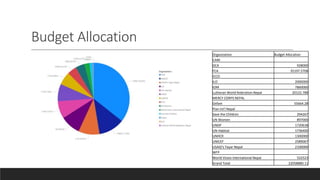
Budget Allocation
Organization Budget Allocation
CARE
DCA 928000
FCA 35197.5708
ICCO
ILO 2000000
IOM 7860000
Lutheran World federation Nepal 20122.788
MERCY CORPS NEPAL
Oxfam 55664.28
Plan Int'l Nepal
Save the Children 294267
UN Women 897000
UNDP 1720638
UN-Habitat 1736400
UNHCR 1300000
UNICEF 2589067
USAID's Tayar Nepal 2100000
WFP
World Vision International Nepal 522523
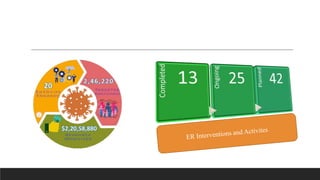
Grand Total 22058880.11
Beneficiaries
Organization
Targeted
Beneficiaries
Beneficiaries Affected
Till Now
CARE 1334 300
DCA 13000 4000
FCA 3700 3700
ICCO 2000
ILO
IOM
Lutheran World federation Nepal 900 269
MERCY CORPS NEPAL 27105
Oxfam 3100 602
Plan Int'l Nepal 9324 7824
Save the Children 4951
UN Women 3370 650
UNDP 151040 25896
UN-Habitat 2500 2680
UNHCR
UNICEF 13062
USAID's Tayar Nepal
WFP
World Vision International Nepal 10834 10834
Grand Total 246220 56755
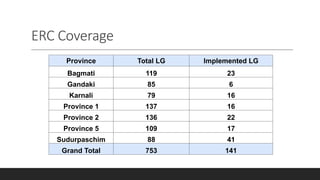
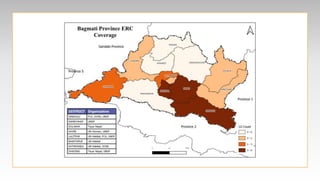
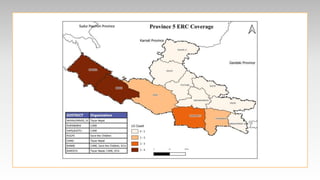
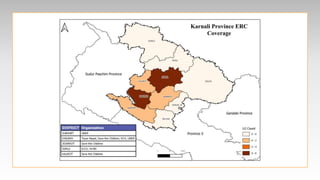
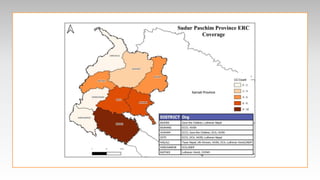
ERC Coverage
Province Total LG Implemented LG
Bagmati 119 23
Gandaki 85 6
Karnali 79 16
Province 1 137 16
Province 2 136 22
Province 5 109 17
Sudurpaschim 88 41
Grand Total 753 141
Early recovery cluster

Early recovery cluster

  • 1.
  • 2.
    Background • Focus onsupporting municipalities/palikas to put in place, administer, fund, and implement livelihood specific programme interventions targeting those who have been impacted the most. • First and foremost, activities need to be informed by local needs assessments conducted (or being conducted) by respective Local Governments (LG), for which MoFAGA has issued guidance. • Activities need to be closely coordinated with the Local Governments with national anchoring with MoFAGA. • ERC can help to put in place a strong coordination, information management and sharing system.
  • 3.
    ER Cluster - Objectives 1.National Early Recovery Cluster Nepal provisioned in the National Disaster Response Framework – 2013 (review 2019). 2. In the C-19 response context, ERC is one of the 10 humanitarian clusters activated in Nepal, as part of the Nepal Preparedness and Response Plan (NPRP) along with the humanitarian country team (HCT). 3. ERC focuses on early recovery of affected populations, mostly through livelihood recovery efforts. 4. Core objective is to address early recovery needs that arise during the humanitarian phase of the ongoing crisis. 5. ER will focus on the short term to establish a process of recovery from crisis by laying the foundations for longer-term sustainable recovery for those who have been impacted the most. 6. Its work should focus primarily on supporting Local Governments (LGs) in the short-term to restore and stabilize the livelihoods of the impacted people at the community/local level. 7. Information management function – i.e. who does what, where – and how much (funding) is being deployed. 8. Mechanism for identifying decisions that require fast-tracking or prioritization.
  • 5.
  • 6.
    Budget Allocation Organization BudgetAllocation CARE DCA 928000 FCA 35197.5708 ICCO ILO 2000000 IOM 7860000 Lutheran World federation Nepal 20122.788 MERCY CORPS NEPAL Oxfam 55664.28 Plan Int'l Nepal Save the Children 294267 UN Women 897000 UNDP 1720638 UN-Habitat 1736400 UNHCR 1300000 UNICEF 2589067 USAID's Tayar Nepal 2100000 WFP World Vision International Nepal 522523 Grand Total 22058880.11
  • 7.
    Beneficiaries Organization Targeted Beneficiaries Beneficiaries Affected Till Now CARE1334 300 DCA 13000 4000 FCA 3700 3700 ICCO 2000 ILO IOM Lutheran World federation Nepal 900 269 MERCY CORPS NEPAL 27105 Oxfam 3100 602 Plan Int'l Nepal 9324 7824 Save the Children 4951 UN Women 3370 650 UNDP 151040 25896 UN-Habitat 2500 2680 UNHCR UNICEF 13062 USAID's Tayar Nepal WFP World Vision International Nepal 10834 10834 Grand Total 246220 56755
  • 8.
    ERC Coverage Province TotalLG Implemented LG Bagmati 119 23 Gandaki 85 6 Karnali 79 16 Province 1 137 16 Province 2 136 22 Province 5 109 17 Sudurpaschim 88 41 Grand Total 753 141