Determines the objective and structures of various kinds of
reports
BS in Civil Engineering (University of Science and Technology of Southern Philippines)
Scan to open on Studocu
Studocu is not sponsored or endorsed by any college or university
Determines the objective and structures of various kinds of
reports
BS in Civil Engineering (University of Science and Technology of Southern Philippines)
Scan to open on Studocu
Studocu is not sponsored or endorsed by any college or university
Downloaded by Lyka Eubina (kayl10bhe@gmail.com)
lOMoARcPSD|29236441
WEEKLY LEARNING ACTIVITY SHEETS
English for Academic and Professional Purposes,
Quarter 2, Week 3
SURVEY REPORT
Name: ___________________________ Section: ____________
Learning Objective:
Determines the objective and structures of various kinds of
reports.
(CS_EN11/12A-EAPPIIe-j-6)
Key Concepts
What is a Report?
• A report is an informative piece of writing concerning a
particular person, place, situation, plan, etc. It is addressed to
one’s superior/colleagues, members of a committee, etc., and
is written in response to a request or instruction.
• A report is slightly different to an essay in the sense that it is a
far more formal and professional way of conducting an analysis
of your topic, in this case your customer service results.
Types of Reports
1. Assessment Reports. Aim at evaluating the positive and/or
negative features of a person, place, plan, etc. They also
include your opinion and/or recommendation.
2. Informative Reports. Present information about a meeting,
progress made on a project, etc.
3. Survey Reports. Present and analyze the results /findings of
research (information gathered from door-to-door
surveys/questionnaires) concerning reactions to a product,
plan, etc., including general assessment, conclusions and
suggestions or recommendation(s).
Downloaded by Lyka Eubina (kayl10bhe@gmail.com)
lOMoARcPSD|29236441
4. Proposal Reports. Present plans, decisions or suggestions
concerning possible future courses of action for approval by
one’s superior at work, a bank manager, members of a
committee, etc.
What is a Survey?
• Survey is a method of gathering information from a sample of
people, traditionally with the intention of generalizing the
results to a larger population.
• A survey is a research method used for collecting data from a
predefined group of respondents or
“informants/representatives” to gain information and insights
into various topics of interest. They can have multiple
purposes, and researchers can conduct it in many ways
depending on the methodology chosen and the study’s goal.
• Usually used by researchers to study issues affecting a large
population, survey research requires data-gathering
techniques such as face-to-face interview, telephone interview,
and questionnaire.
Methods in Conducting Survey
1. Face-to-face interviews are the costliest in terms of time and
money. This allows a direct interface between the research or
data gatherer. However, the interviewers can explain complex
issues and explore unanticipated responses.
2. Phone interviews are cheaper and quicker than face-to-face
interviews. It uses a telephone/smartphone to gather data from
respondents. They also allow the interviewer to explain
questions and react to responses. However, personal
observation is not possible. Furthermore, some respondents
may feel that the survey call, like a telemarketer's call, is an
invasion of personal time. This would inhibit honest,
thoughtful answers.
3. Written questionnaire is the cheapest way to reach a lot of
people. It is a type of instrument in which the respondents are
asked to express their views, opinions, or knowledge using a
scale. It also allows respondents to remain anonymous,
Downloaded by Lyka Eubina (kayl10bhe@gmail.com)
lOMoARcPSD|29236441
probably the questionnaire's strongest advantage. However,
response rate may be low and this can lead to biased results.
Furthermore, poorly constructed questions can lead to
inaccurate results.
Strengths and Weaknesses of Survey Method
Strengths
1. Versatility. It can tackle any issue affecting society.
2. Efficiency. It is not costly in terms of money and time,
assuming there is excellent communication or postal system.
3. Generality. It can get a good representation or sample of a large
group of people.
4. Confidentiality. It is capable of safeguarding the privacy or
anonymity of the respondents.
Weaknesses
1. It cannot provide sufficient evidence about the relationships of
variables.
2. It cannot examine the significance of some issues affecting
people’s social life.
3. It cannot account for real or actual happenings, but can give
ideas on respondents’ views, beliefs, concepts, and emotions.
4. It cannot have an effective application to all topics for research.
Survey Report
• A survey report is a document whose task is to present the
information gathered during the survey in an objective
manner. It presents a summary of all the responses that were
collected in a simple and visually appealing manner.
• The report follows a standard organization, with different
sections, headings, subheadings, etc. It is usually created at
the end of a survey (i.e. after constructing and gathering
responses).
• Survey reports are an integral part of the research, and it is
very important that you always represent accurate data in your
report.
Downloaded by Lyka Eubina (kayl10bhe@gmail.com)
lOMoARcPSD|29236441
Structure of Survey Reports
1.Introduction. State the purpose/aim of the report, when
and how the information was gathered.
2.Main Body. All the information collected and analyzed is
presented clearly and in detail (break down the respondents
into groups according to sex, age and place of residence,
state the main differences between groups). Subheadings,
numbers or letters can be used to separate each piece of
information.
3. Conclusion. Sum up the points mentioned above. If
necessary, a recommendation can be included as well (one
way of summing up is making some general comments).
Useful Hints and Phrases
1. Present Tenses, Reported Speech and an impersonal style
should be used in survey reports. Use a variety of
reporting verbs such as claim, state, report, agree,
complain, suggest, etc.
2. When reporting the results of a survey, the figures
gathered should be given in the form of percentages and
proportions. Expressions such as “one in four” or “six out
of ten” can be used, or exact percentages e.g. 25% of the
people questioned, 68% of those who filled in the
questionnaire, etc. Less exact expressions such as: the
majority of those questioned, a large proportion of, a
significant number of, etc. can also be used.
Useful Language for Reports
1. To introduce: The purpose/aim of this report, As requested,
This survey was carried out/ conducted by means of…,the
questionnaire consisted of etc.
2. To generalize: In general, generally, on the whole, etc.
Downloaded by Lyka Eubina (kayl10bhe@gmail.com)
lOMoARcPSD|29236441
3. To refer to a fact: The fact is that…, In fact, In practice, etc.
4. To conclude/ summarize: In conclusion, All things considered,
To sum up, All in all, It is not easy to reach any definite
conclusions, If any conclusions may be drawn from the data, It
is clear that, The survey shows/indicates/demonstrates, etc.
Survey Report Sample
Survey of Academic and General Reading in English
On 8th February 1999, a survey was conducted among 16
overseas postgraduate students at the University of England. The
purpose of the survey was to discover the reading habits in English
of the students.
The survey was conducted by means of a questionnaire given to
the students to complete. The first part of the questionnaire dealt
with the type of reading and its frequency. The second section was
concerned with newspapers: the type of items read and those that
were read first.
From the table of data, the most significant items are as follows.
In the first section 81% of the students regularly read academic
books" while 44% regularly read academic journals. Nothing else is
read regularly or often by 40% or more of the students. The
following comments can be made about the reading of newspapers,
magazines and fiction. 75% sometimes read regional or local
newspapers, 69% sometimes read books of fiction, 62% sometimes
read general magazines, and 56% sometimes read national daily
newspapers. On the other hand, 37% never read Sunday
newspapers and 31% never read fiction.
In the second section, not surprisingly, 100% read news about
their own country in newspapers and 56% read this first. 94% read
international news, 25% read this first. 81% read about Britain and
look at radio and TV information. The only other item that is usually
read by more than 50% of the students is current affairs (read by
56%).
If any conclusions may be drawn from the data, they are, perhaps,
as follows. Overseas students presumably have little time for
general reading: most of their reading time is spent on books and
journals on their own subject. Outside their studies, apart from
reading news about their own country, international news, and
news about Britain, they probably spend most time watching TV
and listening to the radio.
/from Academic Writing Course by R.R.
Jordan/
Downloaded by Lyka Eubina (kayl10bhe@gmail.com)
lOMoARcPSD|29236441
Exercises / Activities
Activity No. 1. Survey Methods: Advantages and
Disadvantages
Direction/ Instruction:
Complete the table below by filling in the advantages and
disadvantages of the various Survey Methods.
Methods of Survey Advantages Disadvantages
Face-to-face Interview
- at home or work
- in public places
Telephone survey
Written questionnaire
- face- to- face
- by e-mail
- web survey
Activity No. 2. Interpreting Bar Graph
Direction/ Instruction:
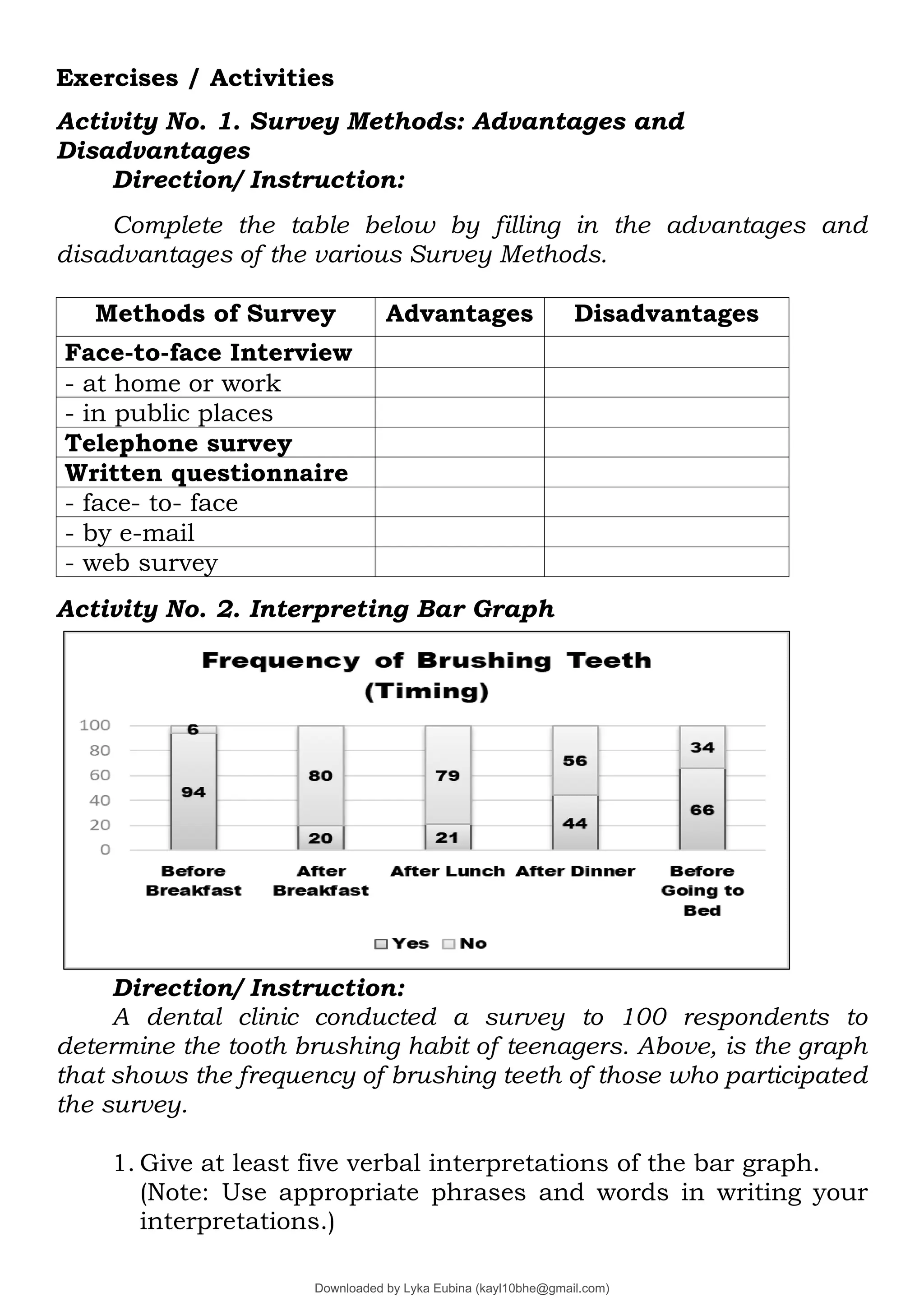
A dental clinic conducted a survey to 100 respondents to
determine the tooth brushing habit of teenagers. Above, is the graph
that shows the frequency of brushing teeth of those who participated
the survey.
1. Give at least five verbal interpretations of the bar graph.
(Note: Use appropriate phrases and words in writing your
interpretations.)
Downloaded by Lyka Eubina (kayl10bhe@gmail.com)
lOMoARcPSD|29236441
Activity No. 3. Test Your Knowledge!
Direction/ Instruction:
Read and understand the following sentences. Write TRUE if the
statement is correct, write FALSE if otherwise.
1. In phone interviews, personal observation is still possible.
2. When reporting the results of a survey, the figures gathered
should be given in the form of percentages and proportions.
3. A survey report is an informal way of conducting an analysis of
surveys.
4. Less exact expressions should not be used when reporting the
results of a survey.
5. In writing the conclusion of the report, the writer may include
recommendations and general comments.
Reflection
1. In what learning areas you can apply your knowledge in
writing survey reports? In what ways this knowledge can help
you perform well in these learning areas?
References for learners:
Baraceros, E. (2016) Practical Research 2. Rex Book Store, Inc.
formplus. “How to Create a Survey Report in 5 Steps”. Accessed
October 28, 2020. https://www.formpl.us/blog/survey-report
Gomez, Elena. 2010. Writing a survey report. Accessed October 28,
2020. https://www.slideshare.net/Elenag77/writing-a-
survey-report
mgimo.ru. HOW TO WRITE SURVEY REPORT. Accessed October
28,
2020. https://mgimo.ru/files/640/HOW_TO_WRITE_SURVE
Y_REPORT_2010
Downloaded by Lyka Eubina (kayl10bhe@gmail.com)
lOMoARcPSD|29236441
qualtrics.com. “What is Survey?”. Accessed October 28, 2020.
https://www.qualtrics.com/au/experience-
management/research/survey-basics/
QuestionPro. “What is a Survey – Definition, templates, methods,
characteristics, and examples”. Accessed October 28, 2020.
https://www.questionpro.com/blog/surveys/
Suantengco. R (2013) A Reviewer for the Licensure Examination for
Teachers: Language and Literature Research. FCA, Printhouse.
Answer Key
Activity No. 1. Survey Methods: Advantages and Disadvantages (Answers may vary)
Activity No. 2. Interpreting Bar Graph (Answers may vary)
Activity No. 3. Test Your Knowledge!
1. FALSE
2. TRUE
3. FALSE
4. FALSE
5. FALSE
Writers: RAMISES V. ZAPICO Reviewers: DOLYNESSA J. GALEON
HUMSS 12 Group Head
CYD BATALON
School/Station: Agusan NHS - SHS
Division: Butuan City
email address: ramises.zapico@deped.gov.ph
lawrence.cyd30@gmail.com AMALIA B. RINGOR
Track Head
RUTH A. CASTROMAYOR
Principal IV
Assistant Principal – SHS
ISRAEL B. REVECHE, PhD.
EPS-Values
Division SHS Coordinator
Downloaded by Lyka Eubina (kayl10bhe@gmail.com)
lOMoARcPSD|29236441

EAPP MODULE FOR ALTERNATIVE LEARNING STUDENTS.pdf

  • 1.
    Determines the objectiveand structures of various kinds of reports BS in Civil Engineering (University of Science and Technology of Southern Philippines) Scan to open on Studocu Studocu is not sponsored or endorsed by any college or university Determines the objective and structures of various kinds of reports BS in Civil Engineering (University of Science and Technology of Southern Philippines) Scan to open on Studocu Studocu is not sponsored or endorsed by any college or university Downloaded by Lyka Eubina (kayl10bhe@gmail.com) lOMoARcPSD|29236441
  • 2.
    WEEKLY LEARNING ACTIVITYSHEETS English for Academic and Professional Purposes, Quarter 2, Week 3 SURVEY REPORT Name: ___________________________ Section: ____________ Learning Objective: Determines the objective and structures of various kinds of reports. (CS_EN11/12A-EAPPIIe-j-6) Key Concepts What is a Report? • A report is an informative piece of writing concerning a particular person, place, situation, plan, etc. It is addressed to one’s superior/colleagues, members of a committee, etc., and is written in response to a request or instruction. • A report is slightly different to an essay in the sense that it is a far more formal and professional way of conducting an analysis of your topic, in this case your customer service results. Types of Reports 1. Assessment Reports. Aim at evaluating the positive and/or negative features of a person, place, plan, etc. They also include your opinion and/or recommendation. 2. Informative Reports. Present information about a meeting, progress made on a project, etc. 3. Survey Reports. Present and analyze the results /findings of research (information gathered from door-to-door surveys/questionnaires) concerning reactions to a product, plan, etc., including general assessment, conclusions and suggestions or recommendation(s). Downloaded by Lyka Eubina (kayl10bhe@gmail.com) lOMoARcPSD|29236441
  • 3.
    4. Proposal Reports.Present plans, decisions or suggestions concerning possible future courses of action for approval by one’s superior at work, a bank manager, members of a committee, etc. What is a Survey? • Survey is a method of gathering information from a sample of people, traditionally with the intention of generalizing the results to a larger population. • A survey is a research method used for collecting data from a predefined group of respondents or “informants/representatives” to gain information and insights into various topics of interest. They can have multiple purposes, and researchers can conduct it in many ways depending on the methodology chosen and the study’s goal. • Usually used by researchers to study issues affecting a large population, survey research requires data-gathering techniques such as face-to-face interview, telephone interview, and questionnaire. Methods in Conducting Survey 1. Face-to-face interviews are the costliest in terms of time and money. This allows a direct interface between the research or data gatherer. However, the interviewers can explain complex issues and explore unanticipated responses. 2. Phone interviews are cheaper and quicker than face-to-face interviews. It uses a telephone/smartphone to gather data from respondents. They also allow the interviewer to explain questions and react to responses. However, personal observation is not possible. Furthermore, some respondents may feel that the survey call, like a telemarketer's call, is an invasion of personal time. This would inhibit honest, thoughtful answers. 3. Written questionnaire is the cheapest way to reach a lot of people. It is a type of instrument in which the respondents are asked to express their views, opinions, or knowledge using a scale. It also allows respondents to remain anonymous, Downloaded by Lyka Eubina (kayl10bhe@gmail.com) lOMoARcPSD|29236441
  • 4.
    probably the questionnaire'sstrongest advantage. However, response rate may be low and this can lead to biased results. Furthermore, poorly constructed questions can lead to inaccurate results. Strengths and Weaknesses of Survey Method Strengths 1. Versatility. It can tackle any issue affecting society. 2. Efficiency. It is not costly in terms of money and time, assuming there is excellent communication or postal system. 3. Generality. It can get a good representation or sample of a large group of people. 4. Confidentiality. It is capable of safeguarding the privacy or anonymity of the respondents. Weaknesses 1. It cannot provide sufficient evidence about the relationships of variables. 2. It cannot examine the significance of some issues affecting people’s social life. 3. It cannot account for real or actual happenings, but can give ideas on respondents’ views, beliefs, concepts, and emotions. 4. It cannot have an effective application to all topics for research. Survey Report • A survey report is a document whose task is to present the information gathered during the survey in an objective manner. It presents a summary of all the responses that were collected in a simple and visually appealing manner. • The report follows a standard organization, with different sections, headings, subheadings, etc. It is usually created at the end of a survey (i.e. after constructing and gathering responses). • Survey reports are an integral part of the research, and it is very important that you always represent accurate data in your report. Downloaded by Lyka Eubina (kayl10bhe@gmail.com) lOMoARcPSD|29236441
  • 5.
    Structure of SurveyReports 1.Introduction. State the purpose/aim of the report, when and how the information was gathered. 2.Main Body. All the information collected and analyzed is presented clearly and in detail (break down the respondents into groups according to sex, age and place of residence, state the main differences between groups). Subheadings, numbers or letters can be used to separate each piece of information. 3. Conclusion. Sum up the points mentioned above. If necessary, a recommendation can be included as well (one way of summing up is making some general comments). Useful Hints and Phrases 1. Present Tenses, Reported Speech and an impersonal style should be used in survey reports. Use a variety of reporting verbs such as claim, state, report, agree, complain, suggest, etc. 2. When reporting the results of a survey, the figures gathered should be given in the form of percentages and proportions. Expressions such as “one in four” or “six out of ten” can be used, or exact percentages e.g. 25% of the people questioned, 68% of those who filled in the questionnaire, etc. Less exact expressions such as: the majority of those questioned, a large proportion of, a significant number of, etc. can also be used. Useful Language for Reports 1. To introduce: The purpose/aim of this report, As requested, This survey was carried out/ conducted by means of…,the questionnaire consisted of etc. 2. To generalize: In general, generally, on the whole, etc. Downloaded by Lyka Eubina (kayl10bhe@gmail.com) lOMoARcPSD|29236441
  • 6.
    3. To referto a fact: The fact is that…, In fact, In practice, etc. 4. To conclude/ summarize: In conclusion, All things considered, To sum up, All in all, It is not easy to reach any definite conclusions, If any conclusions may be drawn from the data, It is clear that, The survey shows/indicates/demonstrates, etc. Survey Report Sample Survey of Academic and General Reading in English On 8th February 1999, a survey was conducted among 16 overseas postgraduate students at the University of England. The purpose of the survey was to discover the reading habits in English of the students. The survey was conducted by means of a questionnaire given to the students to complete. The first part of the questionnaire dealt with the type of reading and its frequency. The second section was concerned with newspapers: the type of items read and those that were read first. From the table of data, the most significant items are as follows. In the first section 81% of the students regularly read academic books" while 44% regularly read academic journals. Nothing else is read regularly or often by 40% or more of the students. The following comments can be made about the reading of newspapers, magazines and fiction. 75% sometimes read regional or local newspapers, 69% sometimes read books of fiction, 62% sometimes read general magazines, and 56% sometimes read national daily newspapers. On the other hand, 37% never read Sunday newspapers and 31% never read fiction. In the second section, not surprisingly, 100% read news about their own country in newspapers and 56% read this first. 94% read international news, 25% read this first. 81% read about Britain and look at radio and TV information. The only other item that is usually read by more than 50% of the students is current affairs (read by 56%). If any conclusions may be drawn from the data, they are, perhaps, as follows. Overseas students presumably have little time for general reading: most of their reading time is spent on books and journals on their own subject. Outside their studies, apart from reading news about their own country, international news, and news about Britain, they probably spend most time watching TV and listening to the radio. /from Academic Writing Course by R.R. Jordan/ Downloaded by Lyka Eubina (kayl10bhe@gmail.com) lOMoARcPSD|29236441
  • 7.
    Exercises / Activities ActivityNo. 1. Survey Methods: Advantages and Disadvantages Direction/ Instruction: Complete the table below by filling in the advantages and disadvantages of the various Survey Methods. Methods of Survey Advantages Disadvantages Face-to-face Interview - at home or work - in public places Telephone survey Written questionnaire - face- to- face - by e-mail - web survey Activity No. 2. Interpreting Bar Graph Direction/ Instruction: A dental clinic conducted a survey to 100 respondents to determine the tooth brushing habit of teenagers. Above, is the graph that shows the frequency of brushing teeth of those who participated the survey. 1. Give at least five verbal interpretations of the bar graph. (Note: Use appropriate phrases and words in writing your interpretations.) Downloaded by Lyka Eubina (kayl10bhe@gmail.com) lOMoARcPSD|29236441
  • 8.
    Activity No. 3.Test Your Knowledge! Direction/ Instruction: Read and understand the following sentences. Write TRUE if the statement is correct, write FALSE if otherwise. 1. In phone interviews, personal observation is still possible. 2. When reporting the results of a survey, the figures gathered should be given in the form of percentages and proportions. 3. A survey report is an informal way of conducting an analysis of surveys. 4. Less exact expressions should not be used when reporting the results of a survey. 5. In writing the conclusion of the report, the writer may include recommendations and general comments. Reflection 1. In what learning areas you can apply your knowledge in writing survey reports? In what ways this knowledge can help you perform well in these learning areas? References for learners: Baraceros, E. (2016) Practical Research 2. Rex Book Store, Inc. formplus. “How to Create a Survey Report in 5 Steps”. Accessed October 28, 2020. https://www.formpl.us/blog/survey-report Gomez, Elena. 2010. Writing a survey report. Accessed October 28, 2020. https://www.slideshare.net/Elenag77/writing-a- survey-report mgimo.ru. HOW TO WRITE SURVEY REPORT. Accessed October 28, 2020. https://mgimo.ru/files/640/HOW_TO_WRITE_SURVE Y_REPORT_2010 Downloaded by Lyka Eubina (kayl10bhe@gmail.com) lOMoARcPSD|29236441
  • 9.
    qualtrics.com. “What isSurvey?”. Accessed October 28, 2020. https://www.qualtrics.com/au/experience- management/research/survey-basics/ QuestionPro. “What is a Survey – Definition, templates, methods, characteristics, and examples”. Accessed October 28, 2020. https://www.questionpro.com/blog/surveys/ Suantengco. R (2013) A Reviewer for the Licensure Examination for Teachers: Language and Literature Research. FCA, Printhouse. Answer Key Activity No. 1. Survey Methods: Advantages and Disadvantages (Answers may vary) Activity No. 2. Interpreting Bar Graph (Answers may vary) Activity No. 3. Test Your Knowledge! 1. FALSE 2. TRUE 3. FALSE 4. FALSE 5. FALSE Writers: RAMISES V. ZAPICO Reviewers: DOLYNESSA J. GALEON HUMSS 12 Group Head CYD BATALON School/Station: Agusan NHS - SHS Division: Butuan City email address: ramises.zapico@deped.gov.ph lawrence.cyd30@gmail.com AMALIA B. RINGOR Track Head RUTH A. CASTROMAYOR Principal IV Assistant Principal – SHS ISRAEL B. REVECHE, PhD. EPS-Values Division SHS Coordinator Downloaded by Lyka Eubina (kayl10bhe@gmail.com) lOMoARcPSD|29236441