CS211 Computers and Programming 
Matthew Harris and Alexa Sharp July 8, 2002 
Exam 1 Solutions 
Recursion, Induction, and Object-Oriented Programming 
Problems 
1. Recursion 
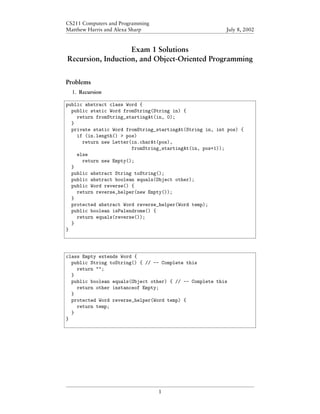
public abstract class Word { 
public static Word fromString(String in) { 
return fromString_startingAt(in, 0); 
} 
private static Word fromString_startingAt(String in, int pos) { 
if (in.length() > pos) 
return new Letter(in.charAt(pos), 
fromString_startingAt(in, pos+1)); 
else 
return new Empty(); 
} 
public abstract String toString(); 
public abstract boolean equals(Object other); 
public Word reverse() { 
return reverse_helper(new Empty()); 
} 
protected abstract Word reverse_helper(Word temp); 
public boolean isPalendrome() { 
return equals(reverse()); 
} 
} 
class Empty extends Word { 
public String toString() { // -- Complete this 
return ""; 
} 
public boolean equals(Object other) { // -- Complete this 
return other instanceof Empty; 
} 
protected Word reverse_helper(Word temp) { 
return temp; 
} 
} 
1
CS211 Computers and Programming 
Matthew Harris and Alexa Sharp July 8, 2002 
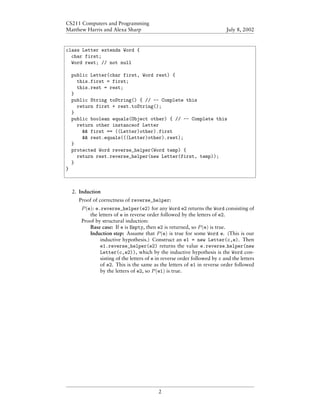
class Letter extends Word { 
char first; 
Word rest; // not null 
public Letter(char first, Word rest) { 
this.first = first; 
this.rest = rest; 
} 
public String toString() { // -- Complete this 
return first + rest.toString(); 
} 
public boolean equals(Object other) { // -- Complete this 
return other instanceof Letter 
&& first == ((Letter)other).first 
&& rest.equals(((Letter)other).rest); 
} 
protected Word reverse_helper(Word temp) { 
return rest.reverse_helper(new Letter(first, temp)); 
} 
} 
2. Induction 
Proof of correctness of reverse_helper: 
P(e): e.reverse_helper(e2) for any Word e2 returns the Word consisting of 
the letters of e in reverse order followed by the letters of e2. 
Proof by structural induction: 
Base case: If e is Empty, then e2 is returned, so P(e) is true. 
Induction step: Assume that P(e) is true for some Word e. (This is our 
inductive hypothesis.) Construct an e1 = new Letter(c,e). Then 
e1.reverse_helper(e2) returns the value e.reverse helper(new 
Letter(c,e2)), which by the inductive hypothesis is the Word con-sisting 
of the letters of e in reverse order followed by c and the letters 
of e2. This is the same as the letters of e1 in reverse order followed 
by the letters of e2, so P(e1) is true. 
2
CS211 Computers and Programming 
Matthew Harris and Alexa Sharp July 8, 2002 
3. Inheritance 
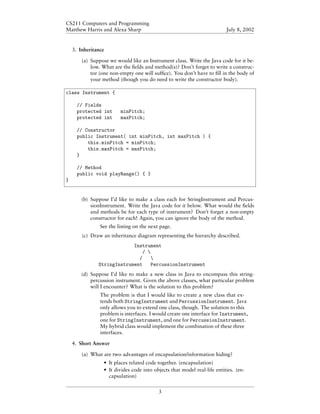
(a) Suppose we would like an Instrument class. Write the Java code for it be-low. 
What are the fields and method(s)? Don’t forget to write a construc-tor 
(one non-empty one will suffice). You don’t have to fill in the body of 
your method (though you do need to write the constructor body). 
class Instrument { 
// Fields 
protected int minPitch; 
protected int maxPitch; 
// Constructor 
public Instrument( int minPitch, int maxPitch ) { 
this.minPitch = minPitch; 
this.maxPitch = maxPitch; 
} 
// Method 
public void playRange() { } 
} 
(b) Suppose I’d like to make a class each for StringInstrument and Percus-sionInstrument. 
Write the Java code for it below. What would the fields 
and methods be for each type of instrument? Don’t forget a non-empty 
constructor for each! Again, you can ignore the body of the method. 
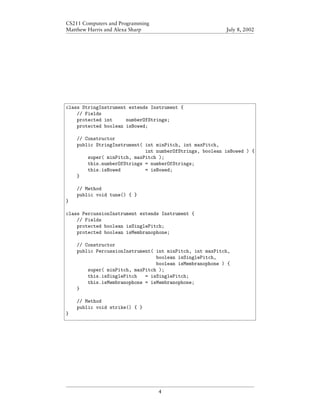
See the listing on the next page. 
(c) Draw an inheritance diagram representing the hierarchy described. 
Instrument 
/  
/  
StringInstrument PercussionInstrument 
(d) Suppose I’d like to make a new class in Java to encompass this string-percussion 
instrument. Given the above classes, what particular problem 
will I encounter? What is the solution to this problem? 
The problem is that I would like to create a new class that ex-tends 
both StringInstrument and PercussionInstrument. Java 
only allows you to extend one class, though. The solution to this 
problem is interfaces. I would create one interface for Instrument, 
one for StringInstrument, and one for PercussionInstrument. 
My hybrid class would implement the combination of these three 
interfaces. 
4. Short Answer 
(a) What are two advantages of encapsulation/information hiding? 
• It places related code together. (encapsulation) 
• It divides code into objects that model real-life entities. (en-capsulation) 
3
CS211 Computers and Programming 
Matthew Harris and Alexa Sharp July 8, 2002 
class StringInstrument extends Instrument { 
// Fields 
protected int numberOfStrings; 
protected boolean isBowed; 
// Constructor 
public StringInstrument( int minPitch, int maxPitch, 
int numberOfStrings, boolean isBowed ) { 
super( minPitch, maxPitch ); 
this.numberOfStrings = numberOfStrings; 
this.isBowed = isBowed; 
} 
// Method 
public void tune() { } 
} 
class PercussionInstrument extends Instrument { 
// Fields 
protected boolean isSinglePitch; 
protected boolean isMembranophone; 
// Constructor 
public PercussionInstrument( int minPitch, int maxPitch, 
boolean isSinglePitch, 
boolean isMembranophone ) { 
super( minPitch, maxPitch ); 
this.isSinglePitch = isSinglePitch; 
this.isMembranophone = isMembranophone; 
} 
// Method 
public void strike() { } 
} 
4
CS211 Computers and Programming 
Matthew Harris and Alexa Sharp July 8, 2002 
• It prevents abusive users from accessing/modifying the inner 
workings of an object. (information hiding) 
• It lets the programmer make code changes without affecting 
the user’s code. (information hiding) 
(b) What is the difference between a public field and a protected field? 
A public field can be accessed from outside the class and is inher-ited. 
A protected field cannot be accessed from outside the class, 
but is also inherited. 
(c) Suppose class SciFiMovie and class ComedyMovie are subclasses of class 
Movie. Which of the following are legal? 
ComedyMovie c = new Movie(); // illegal 
Movie m = new SciFiMovie(); // legal 
SciFiMovie s = new ComedyMovie(); // illegal 
(d) Why would you make a method (and hence class) abstract? 
If there were a method, m say, that I would like all subclasses to 
have, but has no meaning in the superclass itself then I would 
make m abstract in the superclass. This would declare m()’s sig-nature 
in the abstract superclass, and all subclasses would either 
have to implement m or be abstract themselves. 
(e) I have the following incomplete implementation of a IntArrayIterator 
class, that iterates over an array of integers. Fill in the remaining portion 
of the next() method. 
class ListIterator implements Iterator { 
int[] myArray; // an array over which I want to iterate 
int cursor; // my current position in my array 
// constructor 
public ListIterator( int[] myArray ) { this.myArray = myArray; } 
// Returns true if there is another element to return 
boolean hasNext() { return cursor < myArray.length; } 
// Returns the next element to return 
Object next() throws NoSuchElementException { 
// If there are no elements left, throw an exception 
if( !hasNext() ) 
throw new NoSuchElementException(); 
// Otherwise, return the next element, etc. 
else { 
// FILL IN HERE 
return myList[cursor++]; 
} 
} 
} 
5

E6

  • 1.
    CS211 Computers andProgramming Matthew Harris and Alexa Sharp July 8, 2002 Exam 1 Solutions Recursion, Induction, and Object-Oriented Programming Problems 1. Recursion public abstract class Word { public static Word fromString(String in) { return fromString_startingAt(in, 0); } private static Word fromString_startingAt(String in, int pos) { if (in.length() > pos) return new Letter(in.charAt(pos), fromString_startingAt(in, pos+1)); else return new Empty(); } public abstract String toString(); public abstract boolean equals(Object other); public Word reverse() { return reverse_helper(new Empty()); } protected abstract Word reverse_helper(Word temp); public boolean isPalendrome() { return equals(reverse()); } } class Empty extends Word { public String toString() { // -- Complete this return ""; } public boolean equals(Object other) { // -- Complete this return other instanceof Empty; } protected Word reverse_helper(Word temp) { return temp; } } 1
  • 2.
    CS211 Computers andProgramming Matthew Harris and Alexa Sharp July 8, 2002 class Letter extends Word { char first; Word rest; // not null public Letter(char first, Word rest) { this.first = first; this.rest = rest; } public String toString() { // -- Complete this return first + rest.toString(); } public boolean equals(Object other) { // -- Complete this return other instanceof Letter && first == ((Letter)other).first && rest.equals(((Letter)other).rest); } protected Word reverse_helper(Word temp) { return rest.reverse_helper(new Letter(first, temp)); } } 2. Induction Proof of correctness of reverse_helper: P(e): e.reverse_helper(e2) for any Word e2 returns the Word consisting of the letters of e in reverse order followed by the letters of e2. Proof by structural induction: Base case: If e is Empty, then e2 is returned, so P(e) is true. Induction step: Assume that P(e) is true for some Word e. (This is our inductive hypothesis.) Construct an e1 = new Letter(c,e). Then e1.reverse_helper(e2) returns the value e.reverse helper(new Letter(c,e2)), which by the inductive hypothesis is the Word con-sisting of the letters of e in reverse order followed by c and the letters of e2. This is the same as the letters of e1 in reverse order followed by the letters of e2, so P(e1) is true. 2
  • 3.
    CS211 Computers andProgramming Matthew Harris and Alexa Sharp July 8, 2002 3. Inheritance (a) Suppose we would like an Instrument class. Write the Java code for it be-low. What are the fields and method(s)? Don’t forget to write a construc-tor (one non-empty one will suffice). You don’t have to fill in the body of your method (though you do need to write the constructor body). class Instrument { // Fields protected int minPitch; protected int maxPitch; // Constructor public Instrument( int minPitch, int maxPitch ) { this.minPitch = minPitch; this.maxPitch = maxPitch; } // Method public void playRange() { } } (b) Suppose I’d like to make a class each for StringInstrument and Percus-sionInstrument. Write the Java code for it below. What would the fields and methods be for each type of instrument? Don’t forget a non-empty constructor for each! Again, you can ignore the body of the method. See the listing on the next page. (c) Draw an inheritance diagram representing the hierarchy described. Instrument / / StringInstrument PercussionInstrument (d) Suppose I’d like to make a new class in Java to encompass this string-percussion instrument. Given the above classes, what particular problem will I encounter? What is the solution to this problem? The problem is that I would like to create a new class that ex-tends both StringInstrument and PercussionInstrument. Java only allows you to extend one class, though. The solution to this problem is interfaces. I would create one interface for Instrument, one for StringInstrument, and one for PercussionInstrument. My hybrid class would implement the combination of these three interfaces. 4. Short Answer (a) What are two advantages of encapsulation/information hiding? • It places related code together. (encapsulation) • It divides code into objects that model real-life entities. (en-capsulation) 3
  • 4.
    CS211 Computers andProgramming Matthew Harris and Alexa Sharp July 8, 2002 class StringInstrument extends Instrument { // Fields protected int numberOfStrings; protected boolean isBowed; // Constructor public StringInstrument( int minPitch, int maxPitch, int numberOfStrings, boolean isBowed ) { super( minPitch, maxPitch ); this.numberOfStrings = numberOfStrings; this.isBowed = isBowed; } // Method public void tune() { } } class PercussionInstrument extends Instrument { // Fields protected boolean isSinglePitch; protected boolean isMembranophone; // Constructor public PercussionInstrument( int minPitch, int maxPitch, boolean isSinglePitch, boolean isMembranophone ) { super( minPitch, maxPitch ); this.isSinglePitch = isSinglePitch; this.isMembranophone = isMembranophone; } // Method public void strike() { } } 4
  • 5.
    CS211 Computers andProgramming Matthew Harris and Alexa Sharp July 8, 2002 • It prevents abusive users from accessing/modifying the inner workings of an object. (information hiding) • It lets the programmer make code changes without affecting the user’s code. (information hiding) (b) What is the difference between a public field and a protected field? A public field can be accessed from outside the class and is inher-ited. A protected field cannot be accessed from outside the class, but is also inherited. (c) Suppose class SciFiMovie and class ComedyMovie are subclasses of class Movie. Which of the following are legal? ComedyMovie c = new Movie(); // illegal Movie m = new SciFiMovie(); // legal SciFiMovie s = new ComedyMovie(); // illegal (d) Why would you make a method (and hence class) abstract? If there were a method, m say, that I would like all subclasses to have, but has no meaning in the superclass itself then I would make m abstract in the superclass. This would declare m()’s sig-nature in the abstract superclass, and all subclasses would either have to implement m or be abstract themselves. (e) I have the following incomplete implementation of a IntArrayIterator class, that iterates over an array of integers. Fill in the remaining portion of the next() method. class ListIterator implements Iterator { int[] myArray; // an array over which I want to iterate int cursor; // my current position in my array // constructor public ListIterator( int[] myArray ) { this.myArray = myArray; } // Returns true if there is another element to return boolean hasNext() { return cursor < myArray.length; } // Returns the next element to return Object next() throws NoSuchElementException { // If there are no elements left, throw an exception if( !hasNext() ) throw new NoSuchElementException(); // Otherwise, return the next element, etc. else { // FILL IN HERE return myList[cursor++]; } } } 5