COVERSTORY
1E-3 SPECIAL
E F F I C I E N T E X T E N D E D E N T E R P R I S E
E-3 Special: CISCO E-3.de | E-3.at | E-3.ch
Innovative
Optimization
Automotive industry: growth and news
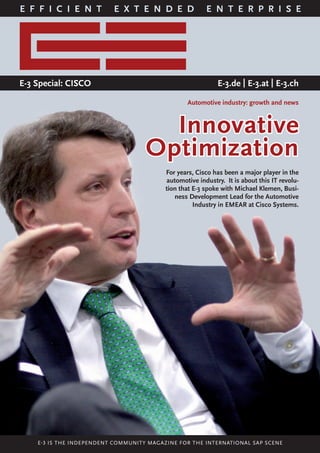
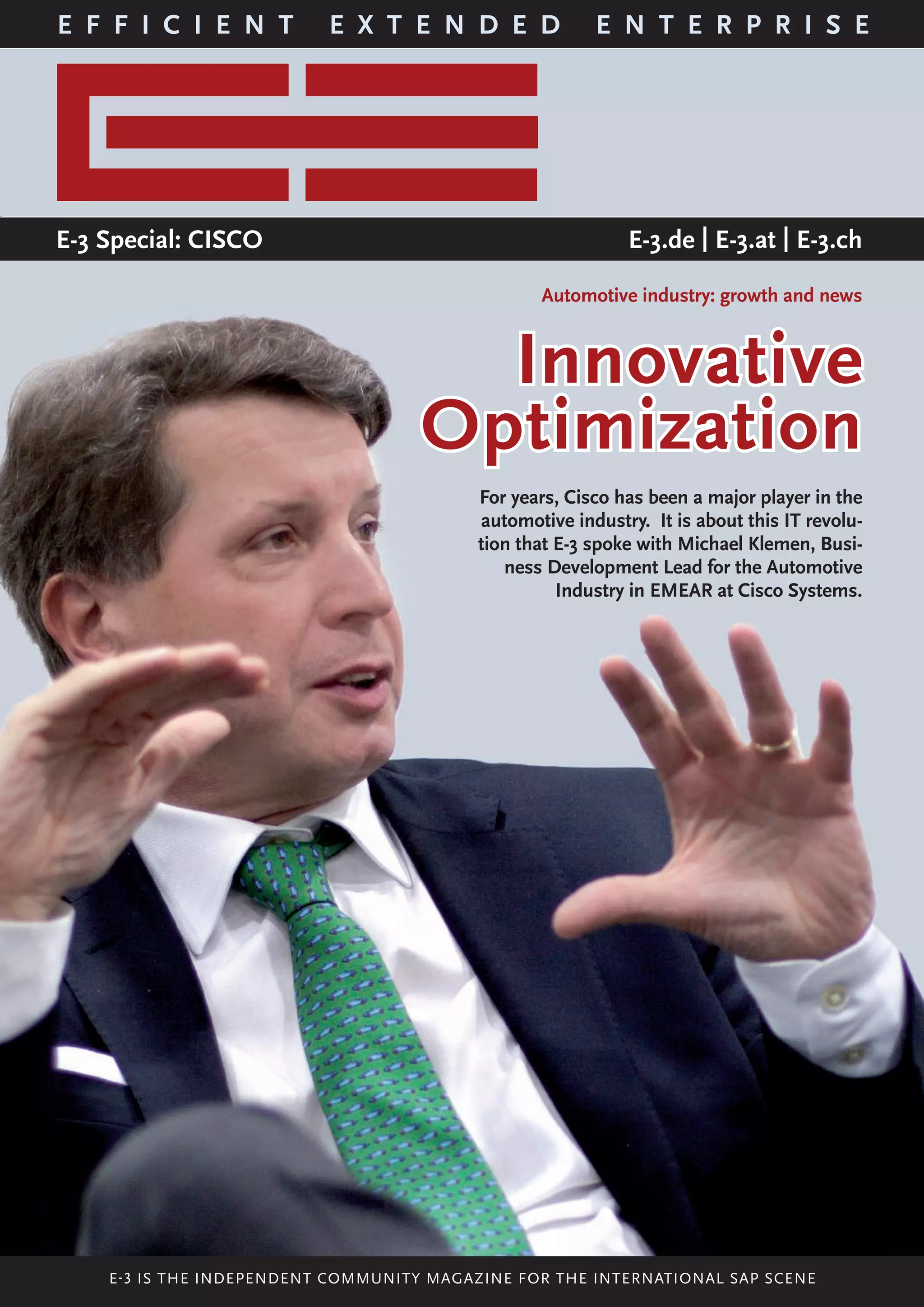
For years, Cisco has been a major player in the
automotive industry. It is about this IT revolu-
tion that E-3 spoke with Michael Klemen, Busi-
ness Development Lead for the Automotive
Industry in EMEAR at Cisco Systems.
E-3 IS THE INDEPENDENT COMMUNITY MAGAZINE FOR THE INTERNATIONAL SAP SCENE
MANAGEMENT
2 E-3 SPECIAL
Innovative Optimization
The automotive industry , which is beginning to exhibit strong
growth, is also experiencing dramatic changes. When dealing
with diverse challenges, innovative technology is essential. For
years, Cisco has been a major player in the automotive industry.
It is about this IT revolution that E-3 spoke with Michael Klemen,
Business Development Lead for the Automotive Industry in
EMEAR at Cisco Systems.
E-3: For all the key players in infor-
mation and communication technology,
the automotive sector represents a key
industry. To what extent can the automo-
tive industry absorb all the various new
features, which are offered by the IT in-
dustry?
Klemen: The need for optimization
in the automotive industry is steadily
growing. Virtually all car manufacturers
and their suppliers – use advanced tech-
nology to continuously optimize their
business, mainly to accelerate innova-
tion in both internal and external pro-
cesses while improving cost structures.
Without up-to-date networking, compu-
ting and communications systems, brin-
ging 30 new car models to market in a
two year period is nearly impossible. It is
essential to ensure that the automotive
industry has access to innovative tools
and technologies that support collabora-
tion internally and externally, especially if
they are to manage business processes
seamlessly, adapt organizational structu-
re changes and avoid untimely incidents
within their business.
E-3: What does this mean? Do you
have any real-world examples?
Klemen: The automotive industry
operates on a worldwide basis, and Sup-
ply Chains and resources are linked inter-
nationally. How can an error in a produc-
tion unit be fixed quickly and accurately,
so that business continues without inter-
ruption? A specialist can operate from a
site in Europe while solving a problem in
Asia. Or they might participate in solving
an error at a U.S. production facility in
real time. Powerful TelePresence systems
and online Webex conferencing tools
manufactured by Cisco, eliminate unne-
cessary delays and accelerate collabora-
tion, thus solving problems more quickly
and in real time. Time-consuming and
costly travel is becoming obsolete. The
problem can be discussed immediately
by the tiger team, and remedied instan-
taneously. Another example: the rapid
deployment of SAP-Services/SAP appli-
cations, or HANA-enabled data, from a
European data center, perhaps for a new
location in South America. The classic
roll-out of server resources consumes an
inordinate amount of time. Using Cisco’s
UCS blade servers, a collaboration-ena-
bled business transformation, can be
executed faster and with considerable
cost savings. Further improvements can
be achieved in borderless networks, in
clean air and collaborative usage of LAN
iPad Plus
Without up-to-date networking, compu-
ting and communications systems, brin-
ging 30 new car models to market in a
two year period is nearly impossible. It is
they are to manage business processes
seamlessly, adapt organizational structu-
re changes and avoid untimely incidents
within their business.
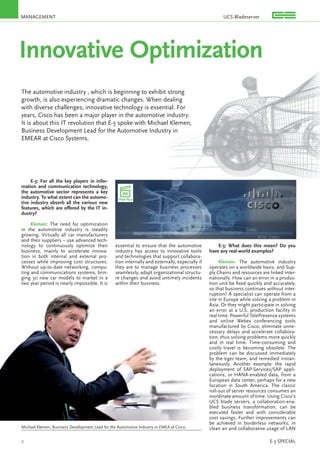
Michael Klemen, Business Development Lead for the Automotive Industry in EMEA at Cisco.
UCS-Bladeserver
MANAGEMENT
3E-3 SPECIAL
MANAGEMENT
or WAN, as well as in shorter product li-
fecycle management times for new vehic-
le development. Transparency is brought
into production through digital media
systems, leading to the indoor and out-
door facility management at dealerships,
and bringing the Internet usage into the
car itself.
E-3: Are companies using such in-
struments for the collaborative optimiza-
tion of their business today?
Klemen: Yes, an Italian automotive
company is a good example. The compa-
ny currently has 29 TelePresence systems
in operation, including 15 Librestream
cameras with further expansion already
planned. Top management and engi-
neers or project officers from different
organizational units communicate via
video- or web-sessions. Travel, especial-
ly between the HQ´s of the Italian auto-
motive company and its US operations,
has been reduced or simply eliminated.
The utilization of this technology is high,
with approximately seven hours of daily
TP room usage.
E-3: For professional video-or tele-
conferencing, special studios are often
required, which makes users reluctant to
use such solutions...
Klemen: Of course technology needs
to be affordable. Cisco TelePresence so-
lutions are not only “in room” or work-
place technology, but extend to mobile
e.g. with our Cisco Cius Business Tablet.
The CIUS goes where you go, regardless
of the location. You might use it on the
production line, in a design center or in
a showroom. Cisco intentionally deve-
loped the CIUS with open, standards-
based connectivity that allows content-
enriched collaboration at an affordable
price.
E-3: Who will install the various col-
laboration solutions or tools on site at a
company in the automotive industry?
Klemen: Installations are usually de-
livered and implemented by Cisco Chan-
nel partners. Cisco made the decision
early in its history to work closely with
partners around the world – which servi-
ces the global automotive environment.
However, it is important to know that
Cisco maintains centers of excellence for
various industries, including the automo-
tive industry. The Automotive Innovation
Center for the EMEAR region was opened
in 2011 in Stuttgart. There, customers
can experience innovation personally,
gather further information and discuss
architectural designs in depth with global
automotive specialists via Tele Presence.
In addition focus areas, such as UCS for
SAP or HANA, as it pertains to the Auto-
motive Industry, are covered by Cisco’s
SAP Competence Center in Walldorf.
E-3: What does Cisco want to achie-
ve, especially in the automotive sector in
the short term?
Klemen: The current growth – espe-
cially outside of Europe – calls for the on-
going expansion. In addition to Cisco´s
proven networking solutions, Cisco is fo-
cusing its attendtion on using innovative
approaches, such as high-performance
virtualization and cloud and in-memory
computing, to provide the basis for col-
laboration-enabled business transfor-
mation. Employees no longer deal with
only one system or just one office, but
are mobile in the use of tools and ap-
plications regardless of location. These
specialist are quickly becoming the stan-
dard. Systems today operate 24 hours a
day. Business events to trigger adjust-
ments and corrective action in global
processes receive greater attention with
a keener focus. For example, how and by
whom can a SAP escalation be executed
more precisely than in the past? And last
but not least virtualization resides on a
much higher level than in the past. Ten
years ago, Daimler operated two planes
daily to shuttle experts, engineers and
managers between Stuttgart and the
U.S. Today those same engineers resolve
problems immediately using collaborati-
on tools making TelePresence a must. Ci-
sco has helped to make daily life simpler
through Cisco solutions which ultimately
benefits the automotive companies.
www.cisco.com
» The need for optimization in the automotive
industry is steadily growing. «
Michael Klemen, Business Development Lead for Automotive,
EMEAR Region at Cisco Systems.
UCS-Bladeserver
COVERSTORY
4 E-3 SPECIAL
While innovation comes rapidly in the IT industry, basic server
architectures haven’t changed for decades. That’s why
Cisco answered the need for innovation by introducing the
Cisco® Unified Computing System—which integrates computing,
high-speed networking, storage access, and virtualization
in one system. Since its introduction, IT departments have
dramatically reduced data center complexity while:
• Lowering operating costs by up to 30%.
• Reducing SAP deployment times from weeks to minutes.
• Harnessing the power of over 30 world-record performance
benchmarks including SAP SD Benchmarks for both Microsoft
Windows and Linux.
The Cisco Unified Computing System, powered by
intelligent Intel® Xeon® processors, signals the next evolution
of the data center—where everything, and everyone, works
together like never before.
Find out more at www.cisco.com/go/sapinsider
©2011CiscoSystems,Inc.Allrightsreserved.Allthird-
partyproductsbelongtothecompaniesthatownthem.
we’re not just
making servers.
we’re making
server history.

E3Special Cisco-automotive_E.PDF

  • 1.
    COVERSTORY 1E-3 SPECIAL E FF I C I E N T E X T E N D E D E N T E R P R I S E E-3 Special: CISCO E-3.de | E-3.at | E-3.ch Innovative Optimization Automotive industry: growth and news For years, Cisco has been a major player in the automotive industry. It is about this IT revolu- tion that E-3 spoke with Michael Klemen, Busi- ness Development Lead for the Automotive Industry in EMEAR at Cisco Systems. E-3 IS THE INDEPENDENT COMMUNITY MAGAZINE FOR THE INTERNATIONAL SAP SCENE
  • 2.
    MANAGEMENT 2 E-3 SPECIAL InnovativeOptimization The automotive industry , which is beginning to exhibit strong growth, is also experiencing dramatic changes. When dealing with diverse challenges, innovative technology is essential. For years, Cisco has been a major player in the automotive industry. It is about this IT revolution that E-3 spoke with Michael Klemen, Business Development Lead for the Automotive Industry in EMEAR at Cisco Systems. E-3: For all the key players in infor- mation and communication technology, the automotive sector represents a key industry. To what extent can the automo- tive industry absorb all the various new features, which are offered by the IT in- dustry? Klemen: The need for optimization in the automotive industry is steadily growing. Virtually all car manufacturers and their suppliers – use advanced tech- nology to continuously optimize their business, mainly to accelerate innova- tion in both internal and external pro- cesses while improving cost structures. Without up-to-date networking, compu- ting and communications systems, brin- ging 30 new car models to market in a two year period is nearly impossible. It is essential to ensure that the automotive industry has access to innovative tools and technologies that support collabora- tion internally and externally, especially if they are to manage business processes seamlessly, adapt organizational structu- re changes and avoid untimely incidents within their business. E-3: What does this mean? Do you have any real-world examples? Klemen: The automotive industry operates on a worldwide basis, and Sup- ply Chains and resources are linked inter- nationally. How can an error in a produc- tion unit be fixed quickly and accurately, so that business continues without inter- ruption? A specialist can operate from a site in Europe while solving a problem in Asia. Or they might participate in solving an error at a U.S. production facility in real time. Powerful TelePresence systems and online Webex conferencing tools manufactured by Cisco, eliminate unne- cessary delays and accelerate collabora- tion, thus solving problems more quickly and in real time. Time-consuming and costly travel is becoming obsolete. The problem can be discussed immediately by the tiger team, and remedied instan- taneously. Another example: the rapid deployment of SAP-Services/SAP appli- cations, or HANA-enabled data, from a European data center, perhaps for a new location in South America. The classic roll-out of server resources consumes an inordinate amount of time. Using Cisco’s UCS blade servers, a collaboration-ena- bled business transformation, can be executed faster and with considerable cost savings. Further improvements can be achieved in borderless networks, in clean air and collaborative usage of LAN iPad Plus Without up-to-date networking, compu- ting and communications systems, brin- ging 30 new car models to market in a two year period is nearly impossible. It is they are to manage business processes seamlessly, adapt organizational structu- re changes and avoid untimely incidents within their business. Michael Klemen, Business Development Lead for the Automotive Industry in EMEA at Cisco. UCS-Bladeserver
  • 3.
    MANAGEMENT 3E-3 SPECIAL MANAGEMENT or WAN,as well as in shorter product li- fecycle management times for new vehic- le development. Transparency is brought into production through digital media systems, leading to the indoor and out- door facility management at dealerships, and bringing the Internet usage into the car itself. E-3: Are companies using such in- struments for the collaborative optimiza- tion of their business today? Klemen: Yes, an Italian automotive company is a good example. The compa- ny currently has 29 TelePresence systems in operation, including 15 Librestream cameras with further expansion already planned. Top management and engi- neers or project officers from different organizational units communicate via video- or web-sessions. Travel, especial- ly between the HQ´s of the Italian auto- motive company and its US operations, has been reduced or simply eliminated. The utilization of this technology is high, with approximately seven hours of daily TP room usage. E-3: For professional video-or tele- conferencing, special studios are often required, which makes users reluctant to use such solutions... Klemen: Of course technology needs to be affordable. Cisco TelePresence so- lutions are not only “in room” or work- place technology, but extend to mobile e.g. with our Cisco Cius Business Tablet. The CIUS goes where you go, regardless of the location. You might use it on the production line, in a design center or in a showroom. Cisco intentionally deve- loped the CIUS with open, standards- based connectivity that allows content- enriched collaboration at an affordable price. E-3: Who will install the various col- laboration solutions or tools on site at a company in the automotive industry? Klemen: Installations are usually de- livered and implemented by Cisco Chan- nel partners. Cisco made the decision early in its history to work closely with partners around the world – which servi- ces the global automotive environment. However, it is important to know that Cisco maintains centers of excellence for various industries, including the automo- tive industry. The Automotive Innovation Center for the EMEAR region was opened in 2011 in Stuttgart. There, customers can experience innovation personally, gather further information and discuss architectural designs in depth with global automotive specialists via Tele Presence. In addition focus areas, such as UCS for SAP or HANA, as it pertains to the Auto- motive Industry, are covered by Cisco’s SAP Competence Center in Walldorf. E-3: What does Cisco want to achie- ve, especially in the automotive sector in the short term? Klemen: The current growth – espe- cially outside of Europe – calls for the on- going expansion. In addition to Cisco´s proven networking solutions, Cisco is fo- cusing its attendtion on using innovative approaches, such as high-performance virtualization and cloud and in-memory computing, to provide the basis for col- laboration-enabled business transfor- mation. Employees no longer deal with only one system or just one office, but are mobile in the use of tools and ap- plications regardless of location. These specialist are quickly becoming the stan- dard. Systems today operate 24 hours a day. Business events to trigger adjust- ments and corrective action in global processes receive greater attention with a keener focus. For example, how and by whom can a SAP escalation be executed more precisely than in the past? And last but not least virtualization resides on a much higher level than in the past. Ten years ago, Daimler operated two planes daily to shuttle experts, engineers and managers between Stuttgart and the U.S. Today those same engineers resolve problems immediately using collaborati- on tools making TelePresence a must. Ci- sco has helped to make daily life simpler through Cisco solutions which ultimately benefits the automotive companies. www.cisco.com » The need for optimization in the automotive industry is steadily growing. « Michael Klemen, Business Development Lead for Automotive, EMEAR Region at Cisco Systems. UCS-Bladeserver
  • 4.
    COVERSTORY 4 E-3 SPECIAL Whileinnovation comes rapidly in the IT industry, basic server architectures haven’t changed for decades. That’s why Cisco answered the need for innovation by introducing the Cisco® Unified Computing System—which integrates computing, high-speed networking, storage access, and virtualization in one system. Since its introduction, IT departments have dramatically reduced data center complexity while: • Lowering operating costs by up to 30%. • Reducing SAP deployment times from weeks to minutes. • Harnessing the power of over 30 world-record performance benchmarks including SAP SD Benchmarks for both Microsoft Windows and Linux. The Cisco Unified Computing System, powered by intelligent Intel® Xeon® processors, signals the next evolution of the data center—where everything, and everyone, works together like never before. Find out more at www.cisco.com/go/sapinsider ©2011CiscoSystems,Inc.Allrightsreserved.Allthird- partyproductsbelongtothecompaniesthatownthem. we’re not just making servers. we’re making server history.