Download the Full Version of the Ebook with Added Features ebookname.com
e Research Transformation in Scholarly Practice
1st Edition Nick Jankowski
https://ebookname.com/product/e-research-transformation-in-
scholarly-practice-1st-edition-nick-jankowski/
OR CLICK HERE
DOWLOAD NOW
Download more ebook instantly today at https://ebookname.com
Instant digital products (PDF, ePub, MOBI) available
Download now and explore formats that suit you...
Urban Teens in the Library Research and Practice Denise E.
Agosto
https://ebookname.com/product/urban-teens-in-the-library-research-and-
practice-denise-e-agosto/
ebookname.com
Global Leadership Research Practice and Development Mark
E. Mendenhall
https://ebookname.com/product/global-leadership-research-practice-and-
development-mark-e-mendenhall/
ebookname.com
Treating Neurodevelopmental Disabilities Clinical Research
and Practice 1st Edition Janet E. Farmer Phd
https://ebookname.com/product/treating-neurodevelopmental-
disabilities-clinical-research-and-practice-1st-edition-janet-e-
farmer-phd/
ebookname.com
Webster s New World Essential Vocabulary 1st Edition David
Alan Herzog
https://ebookname.com/product/webster-s-new-world-essential-
vocabulary-1st-edition-david-alan-herzog/
ebookname.com
Taber s Cyclopedic Medical Dictionary 22nd Edition Donald
Venes
https://ebookname.com/product/taber-s-cyclopedic-medical-
dictionary-22nd-edition-donald-venes/
ebookname.com
Nested algorithms for optimal reservoir operation and
their embedding in a decision support platform 1st Edition
Delipetrev
https://ebookname.com/product/nested-algorithms-for-optimal-reservoir-
operation-and-their-embedding-in-a-decision-support-platform-1st-
edition-delipetrev/
ebookname.com
Learning Evidence From the Federal Rules to the Courtroom
American Casebooks 1st Edition Deborah Jones Merritt
https://ebookname.com/product/learning-evidence-from-the-federal-
rules-to-the-courtroom-american-casebooks-1st-edition-deborah-jones-
merritt/
ebookname.com
Somatostatin Analogs in Diagnostics and Therapy 1st
Edition M Pawlikowski
https://ebookname.com/product/somatostatin-analogs-in-diagnostics-and-
therapy-1st-edition-m-pawlikowski/
ebookname.com
Photoshop CC Digital Classroom 1st Edition Jennifer Smith
https://ebookname.com/product/photoshop-cc-digital-classroom-1st-
edition-jennifer-smith/
ebookname.com
How to Form a Limited Liability Company in Florida 3rd
Edition Mark Warda
https://ebookname.com/product/how-to-form-a-limited-liability-company-
in-florida-3rd-edition-mark-warda/
ebookname.com
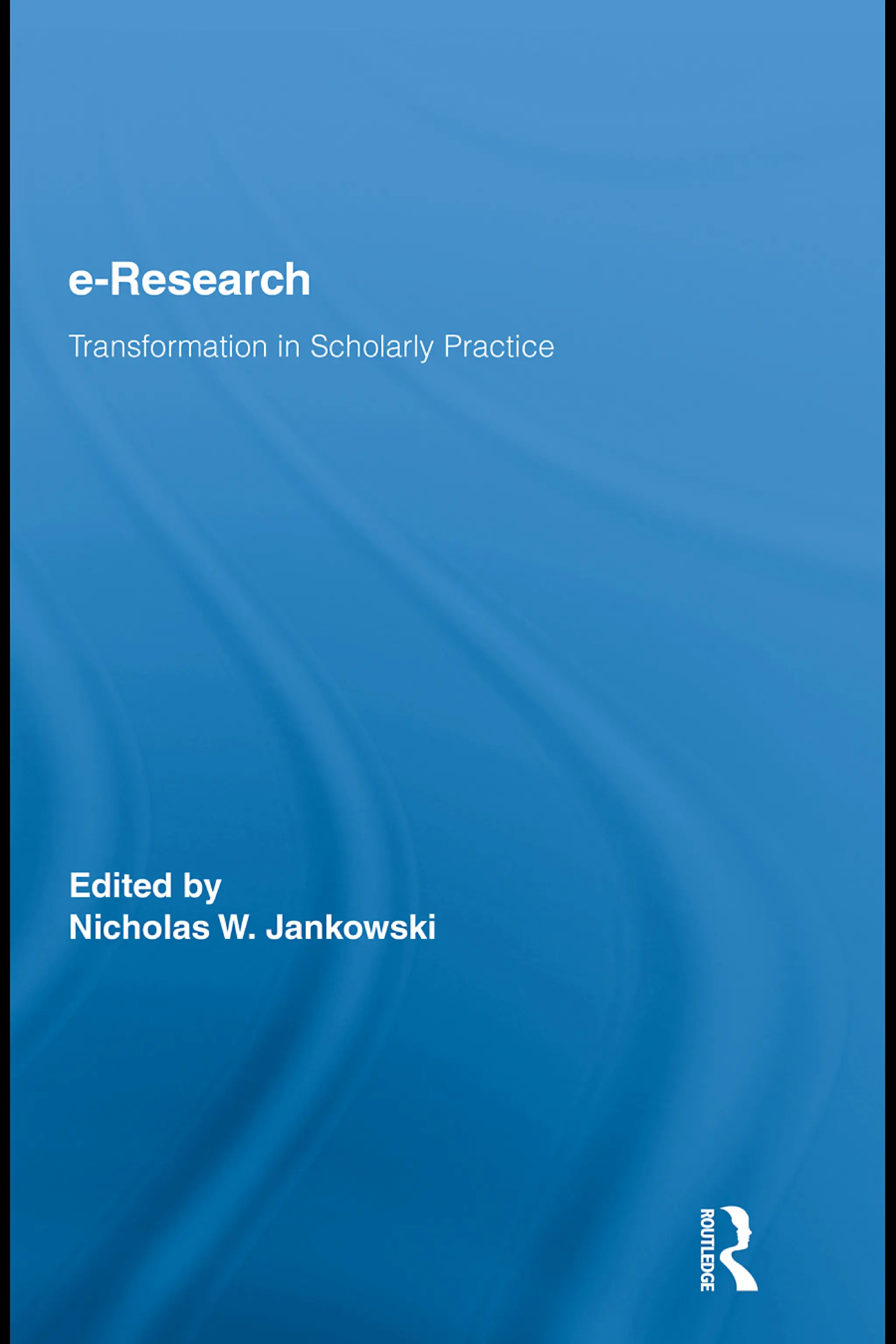
e-Research
Routledge Advances in Research Methods
1. e-Research
Transformation in Scholarly Practice
Edited by Nicholas W. Jankowski
e-Research
Transformation in Scholarly Practice
Edited by
Nicholas W. Jankowski
New York London
First published 2009
by Routledge
270 Madison Ave, New York, NY 10016
Simultaneously published in the UK
by Routledge
2 Park Square, Milton Park, Abingdon, Oxon OX14 4RN
Routledge is an imprint of the Taylor & Francis Group, an informa business
© 2009 Taylor & Francis
All rights reserved. No part of this book may be reprinted or reproduced or utilised
in any form or by any electronic, mechanical, or other means, now known or hereaf-
ter invented, including photocopying and recording, or in any information storage or
retrieval system, without permission in writing from the publishers.
Trademark Notice: Product or corporate names may be trademarks or registered trade-
marks, and are used only for identification and explanation without intent to infringe.
Library of Congress Cataloging-in-Publication Data
E-research : transformation in scholarly practice / edited by Nicholas W. Jankowski.
p. cm.—(Routledge advances in research methods ; 1)
Includes bibliographical references and index.
1. Social sciences—Computer network resources. 2. Social sciences—
Research. 3. Social sciences—Methodology. 4. Internet research. I. Jankowski, Nick.
H61.95.E22 2009
300.285'4678—dc22
2009003903
Book Web site: http://www.virtualknowledgestudio.nl/scholarly-transformation/
ISBN10: 0-415-99028-9 (hbk)
ISBN10: 0-203-87504-4 (ebk)
ISBN13: 978-0-415-99028-8 (hbk)
ISBN13: 978-0-203-87504-9 (ebk)
ISBN 0-203-87504-4 Master e-book ISBN
This edition published in the Taylor & Francis e-Library, 2009.
To purchase your own copy of this or any of Taylor & Francis or Routledge’s
collection of thousands of eBooks please go to www.eBookstore.tandf.co.uk.
Contents
List of Figures ix
List of Tables xi
Acknowledgments xiii
PART I
Introduction
1 The Contours and Challenges of e-Research 3
NICHOLAS W. JANKOWSKI
PART II
Conceptualization
2 Towards a Sociology of e-Research:
Shaping Practice and Advancing Knowledge 35
JENNY FRY AND RALPH SCHROEDER
3 e-Research as Intervention 54
ANNE BEAULIEU AND PAUL WOUTERS
PART III
Development
4 Developing the UK-based e-Social Science Research Program 73
PETER HALFPENNY, ROB PROCTER, YU-WEI LIN AND ALEX VOSS
5 e-Research and Scholarly Community in the Humanities 91
PAUL GENONI, HELEN MERRICK AND MICHELE WILLSON
6 The Rise of e-Science in Asia. Dreams and Realities for Social
Science Research: Case Studies of Singapore and South Korea 109
CAROL SOON AND HAN WOO PARK
vi Contents
PART IV
Collaboration
7 Creating Shared Understanding across Distance: Distance
Collaboration across Cultures In R&D 129
PETRA SONDEREGGER
8 Moving from Small Science to Big Science: Social and
Organizational Impediments to Large Scale Data Sharing 147
ERIC T. MEYER
PART V
Visualization
9 Visualization in e-Social Science 163
MIKE THELWALL
10 A Picture is Worth a Thousand Questions: Visualization
Techniques for Social Science Discovery in Computational Spaces 182
HOWARD T. WELSER, THOMAS M. LENTO, MARC A. SMITH, ERIC GLEAVE
AND ITAI HIMELBOIM
PART VI
Data Preservation and Reuse
11 Web Archiving as e-Research 205
STEVEN M. SCHNEIDER, KIRSTEN A. FOOT AND PAUL WOUTERS
12 The Promise of Data in e-Research: Many Challenges,
Multiple Solutions, Diverse Outcomes 222
ANN ZIMMERMAN, NATHAN BOS, JUDITH S. OLSON AND GARY M. OLSON
13 Naming, Documenting and Contributing to e-Science 240
SAMUELLE CARLSON AND BEN ANDERSON
PART VII
Access and Intellectual Property
14 Open Access to e-Research 259
ROBERT LUCAS AND JOHN WILLINSKY
15 Intellectual Property in the Context of e-Science 273
DAN L. BURK
Contents vii
PART VIII: Case Studies
16 Situated Innovations in e-Social Science 291
BRIDGETTE WESSELS AND MAX CRAGLIA
17 Wikipedia as Distributed Knowledge Laboratory:
The Case of Neoliberalism 310
CLIFFORD TATUM AND MICHELLE LAFRANCE
Contributors 329
Index 339
Figures
1.1 e-Research as interrelated clusters of scholarly tasks. 8
6.1 Organization structure of the national Grid. 112
9.1 Basic visualization choices for researchers. 168
9.2 A history flow visualization of the Wikipedia chocolate
page. 170
9.3 A screen-shot of an Evolino simulation. 171
9.4 Blog posts alluding to visualization during
2007–2008. 173
9.5 A Google TouchGraph of ‘Cyberinfrastructure’ 174
9.6 The MySpace friends of one person, illustrated
by a mashup. 176
9.7 The Figure 9.6 mashup after zooming in with four
mouse clicks. 176
10.1 Treemap of posts to Microsoft public hierarchy,
circa 2001. 192
10.2 Treemap and hyperbolic graph of invitation and
language group. 192
10.3 Detail tree map of 528111’s descendents and
Highlight of 528111’s lineage. 193
10.4 Community size compared to number of posts across
classes of discussion groups. 194
10.5 Days active compared to posts per thread within
different support newsgroups. 195
x Figures
10.6 Graphs of a thread and the larger group context. 197
10.7 Egocentric neighborhood visualizations of social
network participants. 198
10.8 Combining types of visualizations to identify roles. 199
16.1 The White Rose Grid portal architecture. 299
16.2 Modeled distribution of offenders, England at 5 km. 303
16.3 Scheduling the job from the White Rose Grid portal. 303
16.4 OGC-compliant Web Map Service allowing overlay
and query of distributed data. 305
17.1 Wikipedia page layout. 316
17.2 Neoliberalism article: Edit activity and word count. 319
17.3 Neutral point of view (NPOV) placard. 320
Tables
2.1 Approaches to e-Research as an Object of Research 39
2.2 Approaches to e-Research as an Object of Development 39
4.1 Node Research Themes 2004–2007 77
6.1 Expenditure of National e-Science Budget 115
6.2 Web site Sizes of Korean Politician Homepages 120
9.1 Classification of Visualizations 165
10.1 Dimensions of Social Spaces that Alter Social Action 186
17.1 Edit Distribution among Contributors to the
Neoliberalism Article & Talk Page 318
Acknowledgments
So many people contributed so much to this project, an undertaking
stretching across four years, that it is difficult knowing how to formulate
an adequate expression of appreciation. The project was conceived during
a half-year fellowship in the spring of 2004 at the Oxford Internet Institute
(OII). I was invited to join OII while helping coordinate another project
on the uptake of the Internet by a range of political actors during national
elections. Without knowing it at the time, that Internet & Elections (I&E)
Project reflected many of the core features of what was labeled elsewhere
e-science: international collaboration, Internet-based data collection and
analysis, use of large datasets, research management performed primarily
through mediated forms of communication. OII provided a diverse and
stimulating intellectual environment within which to undertake that proj-
ect. Conversations with Bill Dutton, Stephen Coleman, Ted Nelson, Alex-
andre Caldas, Miriam Lips, and John Taylor were particularly refreshing
and provoking. I had the exceptionally good fortune to secure temporary
housing in the same student-style brick house in Oxford’s Jericho neigh-
borhood where OII staff member Ralph Schroeder was then lodging. This
chance arrangement facilitated opportunity for frequent collective walks to
the office, and end-of-the-day drinks and meals. During the course of this
project, Ralph and I collaborated on several events including preparation
of a day-long workshop at a conference of the National Centre of e-Social
Science (NCeSS) in Manchester and of a panel that was part of the Associa-
tion of Internet Researchers (AoIR) conference in Vancouver.
Near the end of my stint at OII I had come to realize that ‘something was
a brew’, often going by the name ‘e-science’. My experiences with the I&E
Project, a quick scan of the then limited literature, and my own basic instincts
convinced me of its potential importance. About that time I approached
Susan Herring, then editor of the Journal of Computer-Mediated Com-
munication (JCMC) whether she would be interested in a theme issue. Her
response was positive, and her editorial guidance throughout the trajectory
of announcing the issue, selecting submissions, and preparing manuscripts
for publication was exemplary of quality editorship. I am grateful for her
guidance in preparing that issue, released in January 2007.
xiv Acknowledgments
Arrangements with JCMC and Susan were such that some of the mate-
rial prepared for that theme issue might constitute the basis for an edited
volume. Many people contributed to the refinement of the proposal for that
book, particularly staff members of the Virtual Knowledge Studio for the
Social Sciences and Humanities (VKS) in Amsterdam, an initiative of the
Royal Netherlands Academy of the Arts and Sciences. I became a Visiting
Fellow of VKS in mid-2006, mainly with a mandate to complete the e-sci-
ence book project, subsequently renamed ‘e-research’ for reasons provided
in Chapter 1. During the two years at VKS I have enjoyed exposure to the
broad range of intellectual interests reflected by its staff, past and pres-
ent: Paul Wouters, Anne Beaulieu, Sally Wyatt, Charles van den Heuvel,
Ernst Thoutenhoofd, Jan Kok, Andrea Scharnhorst, Iina Hellsten, Katie
Vann, and Matt Ratto. The weekly VKS research meetings have been high
points in my association with this group of colleagues, generous with their
ideas and constructive criticisms. In addition, Andrea and I quite recently
co-organized a double-billed panel on e-collaboration at the 2008 Oxford
e-science conference.
Of course, the authors of the chapters to this book deserve special
acknowledgement because of their intellectual labor, and their persever-
ance and commitment to this project. It has been a genuine pleasure work-
ing with this large, diverse, and talented group of scholars, and particularly
pleasurable when that collaboration would transpire in face-to-face venues.
Many of us have met at conferences, like at the NCeSS workshop, the AoIR
panel, and the e-collaboration panel that was part of the Oxford eResearch
Conference 2008. Several of us also took part in a special meeting at the
Department of Media and Communications at Goldsmiths, University of
London. The Goldsmiths event was notable for several reasons, including
exposure to the healthy skepticism that several department staff expressed
towards aspects of e-science. I am grateful to Natalie Fenton for initially
arranging this event and to Guinevere Narraway and Tamara Witschge
for arranging the logistics. Other presentations of material related to this
project were made under the auspices of the European COST A30 Action
research program ‘East of West: Setting a New Central Eastern European
Media Research Agenda’ in Budapest, Milan, and Sarajevo. Those discus-
sions were rich, enlightening, and illustrative of the large differences evi-
dent in the thinking about e-research across Europe.
Many others have contributed along the way, including students at a
University of Ljubljana graduate seminar who engaged me in extended dis-
cussion about early versions of the introductory chapter. VKS colleagues
also provided comment on that chapter—particularly Paul, Anne, Charles,
Sally, and Ernst—as did several chapter authors, especially Eric Gleave and
Ann Zimmerman. Loet Leydesdorft reminded me of the communication
‘turn’ and the need for discussion of research directions; Maja Turnšek
Hančič made valuable suggestions on a range of issues, including the
political economy of e-research initiatives; Steve Jones frequently shared
Discovering Diverse Content Through
Random Scribd Documents
gratification or the benefit of other persons than himself; he is
working toward some result which in a measure depends upon their
approval, and to that extent tends to bring him into closer relations
to his fellow man.
In the future, to an even greater extent than in the recent past,
crude labour will be replaced by mechanical contrivances. The kind
of labour which can command its price is the kind which has trained
intelligence behind it. One of the great needs of our time is the
multiplication of skilled and special labour. The demand for the
products of intelligence is far greater than that for mere crude
products of labour, and it will be more and more so. For there comes
a time when the latter products have satisfied the limit to which a
man can consume food and drink and shelter,—those things which
merely keep the animal alive. But to those things which minister to
the requirements of the spiritual side of a man there is almost no
limit. The demand one can conceive is well-nigh infinite. One of the
philosophical things that have been said, in discriminating man from
the lower animals, is that he is the one creature who is never
satisfied. It is well for him that he is so, that there is always
something more for which he craves. To my mind this fact most
strongly hints that man is infinitely more than a mere animate
machine.
THE NEW STUDY OF CHILDREN
Top
Professor James Sully
[This eminent writer is Grote Professor of the Philosophy of
Mind and of Logic at University College, London. His works
published by D. Appleton & Co., New York, are “Illusions,”
“Outlines of Psychology with Special Reference to the Theory of
Education,” “Teachers' Handbook of Psychology,” “The Human
Mind,” “Pessimism,” “Children's Ways,” and “Studies of
Childhood.” From the last mentioned work, copyright by D.
Appleton & Co., the following is the introductory chapter.]
Man has always had the child with him, and one might be sure
that since he became gentle and alive to the beauty of things he
must have come under the spell of the baby. We have evidence
beyond the oft-quoted departure of Hector and other pictures of
childish grace in early literature that baby-worship and baby-
subjection are not wholly things of modern times. There is a pretty
story taken down by Mr. Leland from the lips of an old Indian
woman, which relates how Glooskap, the hero-god, after conquering
all his enemies, rashly tried his hand at managing a certain baby,
Wasis by name, and how he got punished for his rashness.
Yet there is good reason to suppose that it is only within
comparatively recent times that the more subtle charm and the
deeper significance of infancy have been discerned. We have come
to appreciate babyhood as we have come to appreciate the finer
lineaments of nature as a whole. This applies of course more
especially to the ruder sex. The man has in him much of the boy's
contempt for small things, and he needed ages of education at the
hands of the better-informed woman before he could perceive the
charm of infantile ways.
One of the first males to do justice to this attractive subject was
Rousseau. He made short work with the theological dogma that the
child is born morally depraved, and can only be made good by
miraculous appliances. His watchword, return to nature, included a
reversion to the infant as coming virginal and unspoilt by man's
tinkering from the hands of its Maker. To gain a glimpse of this
primordial beauty before it was marred by man's awkward touch was
something, and so Rousseau set men in the way of sitting reverently
at the feet of infancy, watching and learning.
For us of to-day, who have learned to go to the pure springs of
nature for much of our spiritual refreshment, the child has acquired
a high place among the things of beauty. Indeed, the grace of
childhood may almost be said to have been discovered by the
modern poet. Wordsworth has stooped over his cradle intent on
catching, ere they passed, the “visionary gleams” of “the glories he
hath known.” Blake, R. L. Stevenson, and others, have tried to put
into language his day-dreamings, his quaint fancyings. Dickens and
Victor Hugo have shown us something of his delicate quivering
heart-strings; Swinburne has summed up the divine charm of
“children's ways and wiles.” The page of modern literature is, indeed,
a monument of our child-love and our child-admiration.
Nor is it merely as to a pure untarnished nature that we go back
admiringly to childhood. The æsthetic charm of the infant which
draws us so potently to its side and compels us to watch its words
and actions is, like everything else which moves the modern mind,
highly complex. Among other sources of this charm we may discern
the perfect serenity, the happy “insouciance” [unconcern] of the
childish mind. The note of world-complaint in modern life has
penetrated into most domains, yet it has not, one would hope,
penetrated into the charmed circle of childish experience. Childhood
has, no doubt, its sad aspect:
Poor stumbler on the rocky coast of woe,
Tutored by pain each source of pain to know:
neglect and cruelty may bring much misery into the first bright
years. Yet the very instinct of childhood to be glad in its self-created
world, an instinct which with consummate art Victor Hugo keeps
warm and quick in the breast of the half-starved ill-used child
Cosette, secures for it a peculiar blessedness. The true nature-child,
who has not become used-up, is happy, untroubled with the future,
knowing nothing of the misery of disillusion. As, with hearts
chastened by many experiences, we take a peep over the wall of his
fancy-built pleasance, we seem to be taken back to a real golden
age. With Amiel, we say: “The little of paradise which still remains
on earth is due to his presence.” Yet the thought, which the same
moment brings, of the flitting of the nursery visions, of the coming
storm and stress, adds a pathos to the spectacle, and we feel as
Heine felt when he wrote:
I look at you and sadness
Steals into my heart.
Other and strangely unlike feelings mingle with this caressing,
half-pitiful admiration. We moderns are given to relieving the
strained attitude of reverence and pity by momentary outbursts of
humorous merriment. The child, while appealing to our admiration
and our pity, makes a large and many-voiced appeal also to our
sense of the laughter in things. It is indeed hard to say whether he
is most amusing when setting at naught in his quiet, lordly way, our
most extolled views, our ideas of what is true and false, of the
proper uses of things, and so forth, or when labouring in his
perfectly self-conceived fashion to overtake us and be as
experienced and as conventional as ourselves. This ever new play of
droll feature in childish thought and action forms one of the deepest
sources of delight for the modern lover of childhood.
With the growth of a poetic or sentimental interest in childhood
there has come a new and different kind of interest. Ours is a
scientific age, and science has cast its inquisitive eye on the infant.
We want to know what happens in these first all-decisive two or
three years of human life, by what steps exactly the wee amorphous
thing takes shape and bulk, both physically and mentally. And we
can now speak of the beginning of a careful and methodical
investigation of child-nature, by men trained in scientific observation.
This line of inquiry, started by physicians, as the German Sigismund,
in connection with their special professional aims, has been carried
on by a number of fathers and others having access to the infant,
among whom it may be enough to name Darwin and Preyer.
This eagerness to know what the child is like, an eagerness
illustrated further by the number of reminiscences of early years
recently published, is the outcome of a many-sided interest which it
may be worth while to analyze.
The most obvious source of interest in the doings of infancy lies
in its primitiveness. At the cradle we are watching the beginnings of
things, the first tentative thrustings forward into life. Our modern
science is before all things historical and genetic, going back to
beginnings so as to understand the later and more complex phases
of things as the outcome of these beginnings. The same kind of
curiosity which prompts the geologist to get back to the first stages
in the building up of the planet, or the biologist to search out the
pristine forms of life, is beginning to urge the student of man to
discover by a careful study of infancy the way in which human life
begins to take its characteristic forms.
The appearance of Darwin's name among those who have
deemed the child worthy of study suggests that the subject is closely
connected with natural history. However man in his proud maturity
may be related to Nature, it is certain that in his humble inception he
is immersed in Nature and saturated with her. As we all know, the
lowest races of mankind stand in close proximity to the animal
world. The same is true of the infants of civilized races. Their life is
outward and visible, forming a part of nature's spectacle; reason and
will, the noble prerogatives of humanity, are scarce discernible;
sense, appetite, instinct, these animal functions seem to sum up the
first year of human life.
To the evolutionist, moreover, the infant exhibits a still closer
kinship to the natural world. In the successive stages of fœtal
development he sees the gradual unfolding of human lineaments out
of a widely typical animal form. And even after birth he can discern
new evidences of this genealogical relation of the “lord” of creation
to his inferiors. How significant, for example, is the fact recently
established by a medical man, Dr. Louis Robinson, that the new-born
infant is able just like the ape to suspend his whole weight by
grasping a small horizontal rod.
Yet even as nature-object for the biologist the child presents
distinctive attributes. Though sharing in animal instinct, he shares in
it only to a very small extent. The most striking characteristic of the
new-born offspring of man is its unpreparedness for life. Compare
with the young of other animals the infant so feeble and incapable.
He can neither use his limbs nor see the distance of objects as a
new-born chick or calf is able to do. His brain-centres are, we are
told, in a pitiable state of undevelopment—and are not even securely
encased within their bony covering. Indeed, he resembles for all the
world a public building which has to be opened by a given date, and
is found when the day arrives to be in a humiliating state of
incompleteness.
This fact of the special helplessness of the human offspring at
birth, of its long period of dependence on parental or other aids—a
period which, probably, tends to grow longer as civilization advances
—is rich in biological and sociological significance. For one thing, it
presupposes a specially high development of the protective and
fostering instincts in the human parents, and particularly the mother
—for if the helpless wee thing were not met by these instincts, what
would become of our race? It is probable, too, as Mr. Spencer and
others have argued, that the institution by nature of this condition of
infantile weakness has reacted on the social affections of the race,
helping to develop our pitifulness for all frail and helpless things.
Nor is this all. The existence of the infant, with its large and
imperative claims, has been a fact of capital importance in the
development of social customs. Ethnological researches show that
communities have been much exercised with the problem of infancy,
have paid it the homage due to its supreme sacredness, girding it
about with a whole group of protective and beneficial customs.
Enough has been said, perhaps, to show the far-reaching
significance of babyhood to the modern savant. It is hardly too much
to say that it has become one of the most eloquent of nature's
phenomena, telling us at once of our affinity to the animal world,
and of the forces by which our race has, little by little, lifted itself to
so exalted a position above this world; and so it has happened that
not merely to the perennial baby-worshipper, the mother, and not
merely to the poet touched with the mystery of far off things, but to
the grave man of science the infant has become a centre of lively
interest.
Nevertheless, it is not to the mere naturalist that the babe reveals
all its significance. Physical organism as it seems to be more than
anything else, hardly more than a vegetative thing indeed, it carries
with it the germ of a human consciousness, and this consciousness
begins to expand and to form itself into a truly human shape from
the very beginning. And here a new source of interest presents itself.
It is the human psychologist, the student of those impalpable,
unseizable, evanescent phenomena which we call “state of
consciousness,” who has a supreme interest, and a scientific
property in these first years of a human existence. What is of most
account in these crude tentatives at living after the human fashion is
the play of mind, the first spontaneous manifestations of recognition,
of reasoning expectation, of feelings of sympathy and antipathy, of
definite persistent purpose.
Rude, inchoate, vague enough, no doubt, are these first groping
movements of a human mind: yet of supreme value to the
psychologist just because they are the first. If, reflects the
psychologist, he can only get at this baby's consciousness so as to
understand what is passing there, he will be in an infinitely better
position to find his way through the intricacies of the adult
consciousness. It may be, as we shall see by-and-by, that the baby's
mind is not so perfectly simple, so absolutely primitive as it at first
looks. Yet it is the simplest type of human consciousness to which
we can have access. The investigator of this consciousness can
never take any known sample of the animal mind as his starting
point if for no other reason than this, that while possessing many of
the elements of the human mind, it presents these in so unlike, so
peculiar a pattern.
In this genetic tracing back of the complexities of man's mental
life to their primitive elements in the child's consciousness, questions
of peculiar interest will arise. A problem which though having a
venerable antiquity is still full of meaning concerns the precise
relation of the higher forms of intelligence and of sentiment to the
elementary facts of the individual's life-experience. Are we to regard
all our ideas, even those of God, as woven by the mind out of its
experiences, as Locke thought, or have we certain “innate ideas”
from the first? Locke thought he could settle this point by observing
children. To-day, when the philosophic emphasis is laid not on the
date of appearance of the “innate” intuition, but on its originality and
spontaneity, this method of interrogating the child's mind may seem
less promising. Yet if of less philosophical importance than was once
supposed, it is of great psychological importance. There are certain
questions, such as that of how we come to see things at a distance
from us, which can be approached most advantageously by a study
of infant movements. In like manner I believe the growth of a moral
sentiment, of that feeling of reverence for duty to which Kant gave
so eloquent an expression, can only be understood by the most
painstaking observation of the mental activities of the first years.
There is, however, another, and in a sense a larger, source of
psychological interest in studying the processes and development of
the infant mind. It was pointed out above that to the evolutional
biologist the child exhibits man in his kinship to the lower sentient
world. This same evolutional point of view enables the psychologist
to connect the unfolding of an infant's mind with something which
has gone before, with the mental history of the race. According to
this way of looking at infancy the successive phases of its mental life
are a brief resume of the more important features in the slow
upward progress of the species. The periods dominated successively
by sense and appetite, by blind wondering and superstitious fancy,
and by a calmer observation and a juster reasoning about things,
these steps mark the pathway both of the child-mind and of the
race-mind.
This being so, the first years of a child, with their imperfect verbal
expression, their crude fanciful ideas, their seizures by rage and
terror, their absorption in the present moment, acquire a new and
antiquarian interest. They mirror for us, in a diminished distorted
reflection no doubt, the probable condition of primitive man. As Sir
John Lubbock and other anthropologists have told us, the intellectual
and moral resemblances between the lowest existing races of
mankind and children are numerous and close.
Yet this way of viewing childhood is not merely of antiquarian
interest. While a monument of his race, and in a manner a key to its
history, the child is also its product. In spite of the fashionable
Weismannism of the hour, there are evolutionists who hold that in
the early manifested tendencies of the child we can discern signs of
a hereditary transmission of the effects of ancestral experiences and
activities. His first manifestations of rage, for example, are a survival
of actions of remote ancestors in their life and death struggles. The
impulse of obedience, which is as much a characteristic of the child
as that of disobedience, may in like manner be regarded as a
transmitted rudiment of a long-practised action of socialized
ancestors. This idea of an increment of intelligence and moral
disposition, earned for the individual not by himself but by his
ancestors, has its peculiar interest. It gives a new meaning to
human progress to suppose that the dawn of infant intelligence,
instead of being a return to a primitive darkness, contains from the
first a faint light reflected on it from the lamp of racial intelligence
which has preceded that instead of a return to the race's starting
point, the lowest form of the school of experience, it is a start in a
higher form, the promotion being a reward conferred on the child for
the exertions of his ancestors. Psychological observation will be well
employed in scanning the features of the infant's mind in order to
see whether they yield evidence of such ancestral dowering.
So much with respect to the rich and varied scientific interest
attaching to the movements of the child's mind. It only remains to
touch on a third main interest in childhood, the practical or
educational interest. The modern world, while erecting the child into
an object of æsthetic contemplation, while bringing to bear on him
the bull's eye lamp of scientific observation, has become sorely
troubled by the momentous problem of rearing him. What was once
a matter of instinct and unthinking rule-of-thumb has become the
subject of profound and perplexing discussion. Mothers—the right
sort of mothers that is—feel that they must know to the core this
wee speechless creature which they are called upon to direct into
the safe road to manhood. And professional teachers, more
particularly the beginners in the work of training, whose work is in
some respects the most difficult and the most honourable, have
come to see that a clear insight into child-nature and its
spontaneous movements must precede any intelligent attempt to
work beneficially upon this nature. In this way the teacher has lent
his support to the savant and the psychologist in their investigation
of infancy. More particularly he has betaken him to the psychologist
in order to discover more of the native tendencies and the governing
laws of that unformed child-mind which it is his in a special manner
to form. In addition to this, the growing educational interest in the
spontaneous behaviour of the child's mind may be expected to issue
in a demand for a statistic of childhood, that is to say, carefully
arranged collections of observations bearing on such points as
children's questions, their first thoughts about nature, their
manifestations of sensibility and insensibility.
The awakening in the modern mind of this keen and varied
interest in childhood has led, and is destined to lead still more, to
the observation of infantile ways. This observation will, of course, be
of very different value according as it subserves the contemplation of
the humorous or other æsthetically valuable aspect of child-nature,
or as it is directed towards a scientific understanding of this. Pretty
anecdotes of children which tickle the emotions may or may not add
to our insight into the peculiar mechanism of children's minds. There
is no necessary connection between smiling at infantile drolleries
and understanding the laws of infantile intelligence. Indeed, the
mood of merriment, if too exuberant, will pretty certainly swamp for
the moment any desire to understand.
The observation which is to further understanding, which is to be
acceptable to science, must itself be scientific. That is to say, it must
be at once guided by foreknowledge, specially directed to what is
essential in a phenomenon and its surroundings or conditions, and
perfectly exact. If anybody supposes this to be easy, he should first
try his hand at the work, and then compare what he has seen with
what Darwin or Preyer has been able to discover.
How difficult this is may be seen even with reference to the
outward physical part of the phenomena to be observed. Ask any
mother untrained in observation to note the first appearance of that
complex facial movement which we call a smile, and you know what
kind of result you are likely to get. The phenomena of a child's
mental life, even on its physical and visible side, are of so subtle and
fugitive a character that only a fine and quick observation is able to
cope with them. But observation of children is never merely seeing.
Even the smile has to be interpreted as a smile by a process of
imaginative inference. Many careless onlookers would say that a
baby smiles in the first days from very happiness, when another and
simpler explanation of the movement is forthcoming. Similarly, it
wants much fine judgment to say whether an infant is merely
stumbling accidentally on an articulate sound, or is imitating your
sound. A glance at some of the best memoirs will show how
enormously difficult it is to be sure of a right interpretation of these
early and comparatively simple manifestations of mind.
Things grow a great deal worse when we try to throw our
scientific lasso about the elusive spirit of a child of four or six, and to
catch the exact meaning of its swiftly changing movements. Children
are, no doubt, at this age frank before the eye of love, and their
minds are vastly more accessible than that of the dumb dog that can
only look his ardent thoughts. Yet they are by no means so open to
view as is often supposed. All kinds of shy reticences hamper them:
they feel unskilled in using our cumbrous language; they soon find
out that their thoughts are not as ours, but often make us laugh.
And how carefully are they wont to hide from our sight their
nameless terrors, physical and moral. Much of the deeper childish
experience can only reach us, if at all, years after it is over, through
the faulty medium of adult memory—faulty even when it is the
memory of a Goethe, a George Sand, a Robert Louis Stevenson.
Even when there is perfect candour, and the little one does his
best to instruct us as to what is passing in his mind by his “whys”
and his “I 'sposes,” accompanied by the most eloquent of looks, we
find ourselves ever and again unequal to comprehending. Child-
thought follows its own paths—roads, as Mr. Rudyard Kipling has
well said, “unknown to those who have left childhood behind.” The
dark sayings of childhood, as when child asks, “Why am I not
somebody else?” will be fully illustrated below.
This being so, it might well seem arrogant to speak of any
“scientific” investigation of the child's mind; and, to be candid, I may
as well confess that, in spite of some recently published highly
hopeful forecasts of what child-psychology is going to do for us, I
think we are a long way off from a perfectly scientific account of it.
Our so-called theories of children's mental activity have so often
been hasty generalizations from imperfect observation. Children are
probably much more diverse in their ways of thinking and feeling
than our theories suppose. But of this more presently. Even where
we meet with a common and comparatively prominent trait, we are
far as yet from having a perfect comprehension of it. I at least
believe that children's play, about which so much has confidently
been written, is but imperfectly understood. Is it serious business,
half-conscious make-believe, more than half-conscious acting, or, no
one of these, or all of them by turns? I think he would be a bold
man who ventured to answer this question straight away.
In this state of things it might seem well to wait. Possibly by-and-
by we shall light on new methods of tapping the childish
consciousness. Patients in a certain stage of the hypnotic trance
have returned, it is said, to their childish experience and feelings.
Some people do this, or appear to do this, in their dreams. I know a
young man who revives vivid recollections of the experiences of the
third year of life when he is sleepy, and more especially if he is
suffering from a cold. These facts suggest that if we only knew more
about the mode of working of the brain we might reinstate a special
group of conditions which would secure a re-emergence of childish
ideas and sentiments.
Yet our case is not so hopeless that we need defer inquiry into
the child's mind until human science has fathomed all the mysteries
of the brain. We can know many things of this mind, and these of
great importance, even now. The naturalist discusses the actions of
the lower animals, confidently attributing intelligent planning here
and a germ of vanity or even of moral sense there; and it would be
hard were we forbidden to study the little people that are of our own
race, and are a thousand times more open to inspection. Really good
work has already been done here, and one should be grateful. At the
same time, it seems to me of the greatest importance to recognize
that it is but a beginning: that the child which the modern world has
in the main discovered is after all only half discovered: that if we are
to get at his inner life, his playful conceits, his solemn broodings
over the mysteries of things, his way of responding to the motley
show of life, we must carry this work of noting and interpreting to a
much higher point.
Now, if progress is to be made in this work, we must have
specially qualified workers. All who know anything of the gross
misunderstandings of children of which many so-called intelligent
adults are capable, will bear me out when I say that a certain gift of
penetration is absolutely indispensable here. If any one asks me
what the qualifications of a good child-observer amount to, I may
perhaps answer, for the sake of brevity, “A divining faculty, the
offspring of child-love, perfected by scientific training.” Let us see
what this includes.
That the observer of children must be a diviner, a sort of
clairvoyant reader of their secret thoughts, seems to me perfectly
obvious. Watch half a dozen men who find themselves unexpectedly
ushered into a room tenanted by a small child, and you will soon be
able to distinguish the diviners, who, just because they have in
themselves something akin to the child, seem able at once to get
into touch with children. It is probable that women's acknowledged
superiority in knowledge of child-nature is owing to their higher gift
of sympathetic insight. This faculty, so far from being purely
intellectual, is very largely the outgrowth of a peculiar moral nature
to which the life of all small things, and of children more than all, is
always sweet and congenial. It is very much of a secondary, or
acquired instinct; that is, an unreflecting intuition which is the
outgrowth of a large experience. For the child-lover seeks the object
of his love, and is never so happy as when associating with children
and sharing in their thoughts and their pleasures. And it is through
such habitual intercourse that there forms itself the instinct or tact
by which the significance of childish manifestation is at once
unerringly discerned.
There is in this tact or fineness of spiritual touch one constituent
so important as to deserve special mention. I mean a lively memory
of one's own childhood. As I have observed above, I do not believe
in an exact and trustworthy reproduction in later life of particular
incidents of childhood. All recalling of past experiences illustrates the
modifying influence of the later self in its attempt to assimilate and
understand the past self; and this transforming effect is at its
maximum when we try to get back to childhood. But though our
memory of childhood is not in itself exact enough to furnish facts, it
may be sufficiently strong for the purposes of interpreting our
observations of the children we see about us. It is said, and said
rightly, that in order to read a child's mind we need imagination, and
since all imagination is merely readjustment of individual experience,
it follows that the skilled decipherer of infantile characters needs
before all things to be in touch with his own early feelings and
thoughts. And this is just what we find. The vivacious, genial woman
who is never so much at home as when surrounded by a bevy of
eager-minded children is a woman who remains young in the
important sense that she retains much of the freshness and
unconventionality of mind, much of the gaiety and expansiveness of
early life. Conversely one may feel pretty sure that a woman who
retains a vivid memory of her childish ideas and feelings will be
drawn to the companionship of children. After reading their
autobiographies one hardly needs to be told that Goethe carried into
old age his quick responsiveness to the gaiety of the young heart;
and that George Sand when grown old was never so happy as when
gathering the youngsters about her.
Yet valuable as is this gift of sympathetic insight, it will not, of
course, conduce to that methodical, exact kind of observation which
is required by science. Hence the need of the second qualification:
psychological training. By this is meant that special knowledge which
comes from studying the principles of the science, its peculiar
problems, and the methods appropriate to these, together with the
special skill which is attained by a methodical, practical application of
this knowledge in the actual observation and interpretation of
manifestations of mind. Thus a woman who wishes to observe to
good effect the mind of a child of three must have a sufficient
acquaintance with the general course of the mental life to know
what to expect, and in what way the phenomena observed have to
be interpreted. Really fine and fruitful observation is the outcome of
a large knowledge, and anybody who is to carry out in a scientific
fashion the observation of the humblest phase of a child's mental life
must already know this life as a whole, so far as psychology can as
yet describe its characteristics, and determine the conditions of its
activity.
And here the question naturally arises: “Who is to carry out this
new line of scientific observation?” To begin with the first stage of it,
who is to carry out the exact methodical record of the movements of
the infant? It is evident that qualification or capacity is not all that is
necessary here; capacity must be favoured with opportunity before
the work can be actually begun.
It has been pointed out that the pioneers who struck out this new
line of experimental research were medical men. The meaning of
this fact is pretty apparent. The doctor has not only a turn for
scientific observation: he is a privileged person in the nursery. The
natural guardians of infancy, the mother and the nurse, exempt him
from their general ban on the male. He excepted, no man, not even
the child's own father, is allowed to meddle too much with that
divine mystery, that meeting point of all the graces and all the
beatitudes, the infant.
Consider for a moment the natural prejudice which the inquirer
into the characteristics of the infant has to face. Such inquiry is not
merely passively watching what spontaneously presents itself; it is
emphatically experimenting, that is, the calling out of reactions by
applying appropriate stimuli. Even to try whether the new-born babe
will close its fingers on your finger when brought into contact with
their anterior surface may well seem impious to a properly
constituted nurse. To propose to test the wee creature's sense of
taste by applying drops of various solutions, as acid, bitters, etc., to
the tongue, or to provoke ocular movements to the right or the left,
would pretty certainly seem a profanation of the temple of infancy, if
not fraught with danger to its tiny deity. And as to trying Dr.
Robinson's experiment of getting the newly arrived visitor to
suspend his whole precious weight by clasping a bar, it is pretty
certain that, women being constituted as at present, only a medical
man could have dreamt of so daring a feat.
There is no doubt that baby-worship, the sentimental adoration of
infant ways, is highly inimical to the carrying out of a perfectly cool
and impartial process of scientific observation. Hence the average
mother can hardly be expected to do more than barely to tolerate
this encroaching of experiment into the hallowed retreat of the
nursery. Even in these days of rapid modification of what used to be
thought unalterable sexual characters, one may be bold enough to
hazard the prophecy that women who have had scientific training
will, if they happen to become mothers, hardly be disposed to give
their minds at the very outset to the rather complex and difficult
work, say, of making an accurate scientific inventory of the several
modes of infantile sensibility, visual, auditory, and so forth, and of
the alterations in these from day to day.
It is for the coarser fibred man, then, to undertake much of the
earlier experimental work in the investigation of child-nature. And if
fathers will duly qualify themselves they will probably find that
permission will little by little be given them to carry out
investigations, short, of course, of anything that looks distinctly
dangerous to the little being's comfort.
At the same time it is evident that a complete series of
observations of the infant can hardly be carried out by a man alone.
It is for the mother, or some other woman with a pass-key to the
nursery, with her frequent and prolonged opportunities of
observation to attempt a careful and methodical register of mental
progress. Hence the importance of enlisting the mother or her
female representative as collaborateur or at least as assistant. Thus
supposing the father is bent on ascertaining the exact dates and the
order of appearance of the different articulate sounds, which is
rather a subject of passive observation than of active experiment; he
will be almost compelled to call in the aid of one who has the
considerable advantage of passing a good part of each day near the
child.[1]
As the wee thing grows and its nervous system becomes more
stable and robust more in the way of research may of course be
safely attempted. In this higher stage the work of observation will be
less simple and involve more of special psychological knowledge. It
is a comparatively easy thing to say whether the sudden approach of
an object to the eye of a baby a week or so old calls forth the reflex
known as blinking: it is a much more difficult thing to say what are
the preferences of a child of twelve months in the matter of simple
forms, or even colours.
The problem of the order of development of the colour-sense in
children looks at first easy enough. Any mother, it may be thought,
can say which colours the child first recognizes by naming them
when seen, or picking them out when another names them. Yet
simple as it looks, the problem is in reality anything but simple. A
German investigator, Professor Preyer of Berlin, went to work
methodically with his little boy of two years in order to see in what
order he would discriminate colours. Two colours, red and green,
were first shown, the name added to each, and the child then asked:
“Which is red?” “Which is green?” Then other colours were added
and the experiments repeated. According to these researches this
particular child first acquired a clear discriminative awareness of
yellow. Preyer's results have not, however, been confirmed by other
investigators, as M. Binet, of Paris, who followed a similar method of
inquiry. Thus according to Binet it is not yellow but blue which
carries the day in the competition for the child's preferential
recognition.
What, it may be asked, is the explanation of this? Is it that
children differ in the mode of development of their colour-sensibility
to this extent, or can it be that there is some fault in the method of
investigation? It has been recently suggested that the mode of
testing colour-discrimination by naming is open to the objection that
a child may get hold of one verbal sound as “red” more easily than
another as “green” and that this would facilitate the recognition of
the former. If in this way the recognition of a colour is aided by the
retention of its name, we must get rid of this disturbing element of
sound. Accordingly new methods of experiment have been
attempted in France and America. Thus Professor Baldwin
investigates the matter by placing two colours opposite the child's
two arms and noting which is reached out to by right or left arm,
which is ignored. He has tabulated the results of a short series of
these simple experiments for testing childish preference, and
supports the conclusions of Binet, as against those of Preyer, that
blue comes in for the first place in the child's discriminative
recognition.[2] It is, however, easy to see that this method has its
own characteristic defects. Thus, to begin with, it evidently does not
directly test colour-discrimination at all, but the liking for or interest
in colours, which though it undoubtedly implies a measure of
discrimination must not be confused with this. And even as a test of
preference it is very likely to be misapplied. Thus supposing that the
two colours are not equally bright, then the child will grasp at one
rather than at the other, because it is a brighter object and not
because it is this particular colour. Again if one colour falls more into
the first and fresh period of the exercise when the child is fresh and
active, whereas another falls more into the second period when he is
tired and inactive, the results would, it is evident, give too much
value to the former. Similarly, if one colour were brought in after
longer intervals of time than another it would have more attractive
force through its greater novelty.
Enough has been said to show how very delicate a problem we
have here to deal with. And if scientific men are still busy settling the
point how the problem can be best dealt with, it seems hopeless for
the amateur to dabble in the matter.
I have purposely chosen a problem of peculiar complexity and
delicacy in order to illustrate the importance of that training which
makes the mental eye of the observer quick to analyse the
phenomenon to be dealt with so as to take in all its conditions. Yet
there are many parts of this work of observing the child's mind
which do not make so heavy a demand on technical ability, but can
be done by any intelligent observer prepared for the task by a
reasonable amount of psychological study. I refer more particularly
to that rich and highly interesting field of exploration which opens up
when the child begins to talk. It is in the spontaneous utterances of
children, their first quaint uses of words, that we can best watch the
play of the instinctive tendencies of thought. Children's talk is always
valuable to a psychologist; and for my part I would be glad of as
many anecdotal records of their sayings as I could collect.
Here, then, there seems to be room for a relatively simple and
unskilled kind of observing work. Yet it would be a mistake to
suppose that even this branch of child-observation requires nothing
but ordinary intelligence. To begin with, we are all prone, till by
special training we have learned to check the inclination, to read far
too much of our older thought and sentiment into children. As M.
Drox observes, “we are the dupes of ourselves when we observe the
babe.”
Again, there is a subtle source of error connected with the very
attitude of undergoing examination which only a carefully trained
observer of childish ways will avoid. A child is very quick in spying
whether he is being observed, and as soon as he suspects that you
are specially interested in his talk he is apt to try to produce an
effect. This wish to say something startling, wonderful, or what not,
will, it is obvious, detract from the value of the utterance.
But once more the saying which it is so easy to report has had its
history, and the observer who knows something of psychology will
look out for facts, that is to say, experiences of the child,
suggestions made by others' words which throw light on the saying.
No fact is really quite simple, and the reason why some facts look so
simple is that the observer does not include in his view all the
connections of the occurrence which he is inspecting. The unskilled
observer of children is apt to send scraps, fragments of facts, which
have not their natural setting. The value of psychological training is
that it makes one as jealously mindful of wholeness in facts as a
housewife of wholeness in her porcelain. It is, indeed, only when the
whole fact is before us, in well-defined contour, that we can begin to
deal with its meaning. Thus although those ignorant of psychology
may assist us in this region of fact-finding, they can never
accomplish that completer and exacter kind of observation which we
dignify by the name of Science.
One may conclude then that women may be fitted to become
valuable labourers in this new field of investigation, if only they will
acquire a genuine scientific interest in babyhood, and a fair amount
of scientific training. That a large number of women will get so far is
I think doubtful: the sentimental or æsthetic attraction of the baby is
apt to be a serious obstacle to a cold matter-of-fact examination of it
as a scientific specimen. The natural delight of a mother in every
new exhibition of infantile wisdom or prowess is liable to blind her to
the exceedingly modest significance of the child's performances as
seen from the scientific point of view. Yet as I have hinted, this very
fondness for infantile ways, may, if only the scientific caution is
added, prove a valuable excitant to study. In England, and in
America, there are already a considerable number of women who
have undergone some serious training in psychology, and it may not
be too much to hope that before long we shall have a band of
mothers and aunts busily engaged in noting and recording the
movements of children's minds.
I have assumed here that what is wanted is careful studies of
individual children as they may be approached in the nursery. And
these records of individual children, after the pattern of Preyer's
monograph, are I think our greatest need. We are wont to talk
rather too glibly about that abstraction, “the child,” as if all children
rigorously corresponded to one pattern, of which pattern we have a
perfect knowledge. Mothers at least know that this is not so.
Children of the same family will be found to differ very widely (within
the comparatively narrow field of childish traits), as, for example, in
respect of matter-of-factness, of fancifulness, of inquisitiveness.
Thus, while it is probably true that most children at a certain age are
greedy of the pleasures of the imagination, Nature in her well-known
dislike of monotony has taken care to make a few decidedly
unimaginative. We need to know much more about these variations:
and what will best help us here is a number of careful records of
infant progress, embracing examples not only of different sexes and
temperaments, but also of different social conditions and
nationalities. When we have such a collection of monographs we
shall be in a much better position to fill out the hazy outline of our
abstract conception of childhood with definite and characteristic
lineaments.
At the same time I gladly allow that other modes of observation
are possible and in their way useful. This applies to older children
who pass into the collective existence of the school-class. Here
something like collective or statistical inquiry may be begun, as that
into the contents of children's minds, their ignorances and
misapprehensions about common objects. Some part of this inquiry
into the minds of school children may very well be undertaken by an
intelligent teacher. Thus it would be valuable to have careful records
of children's progress carried out by pre-arranged tests, so as to get
collections of examples of mental activity at different ages. More
special lines of inquiry having a truly experimental character might
be carried out by experts, as those already begun with reference to
children's “span of apprehension,” i.e., the number of digits or
nonsense syllables that can be reproduced after a single hearing,
investigations into the effects of fatigue on mental processes, into
the effect of number of repetitions on the certainty of reproduction,
into musical sensitiveness and so forth.
Valuable as such statistical investigation undoubtedly is, it is no
substitute for the careful methodical study of the individual child.
This seems to me the greatest desideratum just now. Since the
teacher needs for practical reasons to make a careful study of
individuals he might well assist here. In these days of literary
collaboration it might not be amiss for a kindergarten teacher to
write an account of a child's mind in co-operation with the mother.
Such a record if well done would be of the greatest value. The co-
operation of the mother seems to me quite indispensable, since even
where there is out-of-class intercourse between teacher and pupil
the knowledge acquired by the former never equals that of the
mother.
FOOTNOTES:
[1]The great advantage which the female observer of
the infant's mind has over her male competitor is clearly
illustrated in some recent studies of childhood by American
women. I would especially call attention to a study by Miss
M. W. Shinn, (University of California series) Notes on the
Development of a Child (the writer's niece), where the
minute and painstaking record (e.g. of the child's colour-
discrimination and visual space exploration) points to the
ample opportunity of observation which comes more
readily to women.
[2]“Mental Development in the Child and the Race,”
chap. III.
TWINS, THEIR HISTORY AS A
CRITERION
OF THE RELATIVE POWERS
OF NATURE AND NURTURE
Top
FRANCIS GALTON
[Francis Galton, a cousin of Charles Darwin, has won
eminence by bringing problems of human development to the
test of statistical inquiry. Among his works are “Hereditary
Genius,” “English Men of Science, Their Nature and Nurture,”
“Human Faculty,” and “Natural Inheritance.” The study of Twins
here presented is taken from “Human Faculty,” published by
Macmillan & Co., London, 1883.]
The exceedingly close resemblance attributed to twins has been
the subject of many novels and plays, and most persons have felt a
desire to know upon what basis of truth those works of fiction may
rest. But twins have many other claims to attention, one of which
will be discussed in the present memoir. It is, that their history
affords means of distinguishing between the effects of tendencies
received at birth, and of those that were imposed by the
circumstances of their after lives; in other words, between the
effects of nature and of nurture. This is a subject of especial
importance in its bearings on investigations into mental heredity, and
I, for my part, have keenly felt the difficulty of drawing the
necessary distinction whenever I tried to estimate the degree in
which mental ability was, on the average, inherited. The objection to
statistical evidence in proof of its inheritance has always been: “The
persons whom you compare may have lived under similar social
conditions and have had similar advantages of education, but such
prominent conditions are only a small part of those that determine
the future of each man's life. It is to trifling accidental circumstances
that the bent of his disposition and his success are mainly due, and
these you leave wholly out of account—in fact, they do not admit of
being tabulated, and therefore your statistics, however plausible at
first sight, are really of very little use.” No method of enquiry which I
have been able to carry out—and I have tried many methods—is
wholly free from this objection. I have therefore attacked the
problem from the opposite side, seeking for some new method by
which it would be possible to weigh in just scales the respective
effects of nature and nurture, and to ascertain their several shares in
framing the disposition and intellectual ability of men. The life
history of twins supplies what I wanted. We might begin by
enquiring about twins who were closely alike in boyhood and youth,
and who were educated together for many years, and learn whether
they subsequently grew unlike, and, if so, what the main causes
were which, in the opinion of the family, produced the dissimilarity.
In this way we may obtain much direct evidence of the kind we
want; but we can also obtain yet more valuable evidence by a
converse method. We can enquire into the history of twins who were
exceedingly unlike in childhood, and learn how far they became
assimilated under the influence of their identical nurtures; having the
same home, the same teachers, the same associates, and in every
other respect the same surroundings.
My materials were obtained by sending circulars of enquiry to
persons who were either twins themselves or the near relations of
twins. The printed questions were in thirteen groups; the last of
them asked for the addresses of other twins known to the recipient
who might be likely to respond if I wrote to them. This happily led to
a continually widening circle of correspondence, which I pursued
until enough material was accumulated for a general reconnaissance
of the subject.
The reader will easily understand that the word “twins” is a vague
expression, which covers two very dissimilar events; the one
corresponding to the progeny of animals that have usually more
than one young one at a birth, and the other corresponding to those
double-yolked eggs that are due to two germinal spots in a single
ovum. The consequence of this is, that I find a curious discontinuity
in my results. One would have expected that twins would commonly
be found to possess a certain average likeness to one another; that
a few would greatly exceed that degree of likeness, and a few would
greatly fall short of it; but this is not at all the case. Twins may be
divided into three groups, so distinct that there are not many
intermediate instances; namely, strongly alike, moderately alike, and
extremely dissimilar. When the twins are a boy and a girl, they are
never closely alike; in fact, their origin never corresponds to that of
the above-mentioned double-yolked eggs.
I have received about eighty returns of cases of close similarity,
thirty-five of which entered into many instructive details. In a few of
these not a single point of difference could be specified. In the
remainder, the colour of the hair and eyes were almost always
identical; the height, weight, and strength were generally very
nearly so, but I have a few cases of a notable difference in these,
notwithstanding the resemblance was otherwise very near. The
manner and address of the thirty-five pairs of twins is usually
described as being very similar, though there often exists a
difference of expression familiar to near relatives but unperceived by
strangers. The intonation of the voice when speaking is commonly
the same, but it frequently happens that the twins sing in different
keys. Most singularly, that one point in which similarity is rare is the
handwriting. I cannot account for this, considering how strongly
handwriting runs in families, but I am sure of the fact. I have only
one case in which nobody, not even the twins themselves, could
distinguish their own notes of lectures, etc.; barely two or three in
which the handwriting was undistinguishable by others, and only a
few in which it was described as closely alike. On the other hand, I
have many in which it is stated to be unlike, and some in which it is
alluded to as the only point of difference.
One of my enquiries was for anecdotes as regards the mistakes
made by near relatives between the twins. They are numerous, but
not very varied in character. When the twins are children, they have
commonly to be distinguished by ribbons tied round their wrist or
neck; nevertheless the one is sometimes fed, physicked, and
whipped by mistake for the other, and the description of these little
domestic catastrophes is usually given to me by the mother, in a
phraseology that is somewhat touching by reason of its seriousness.
I have one case in which a doubt remains whether the children were
not changed in their bath, and the presumed A is not really B, and
vice versa. In another case an artist was engaged on the portraits of
twins who were between three and four years of age; he had to lay
aside his work for three weeks, and, on resuming it, could not tell to
which child the respective likenesses he had in hand belonged. The
mistakes are less numerous on the part of the mother during the
boyhood and girlhood of the twins, but almost as frequent on the
part of strangers. I have many instances of tutors being unable to
distinguish their twin pupils. Thus, two girls used regularly to impose
on their music teacher when one of them wanted a whole holiday;
they had their lessons at separate hours, and the one girl sacrificed
herself to receive two lessons on the same day, while the other one
enjoyed herself. Here is a brief and comprehensive account: “Exactly
alike in all, their schoolmasters never could tell them apart; at
dancing parties they constantly changed partners without discovery;
their close resemblance is scarcely diminished by age.” The following
is a typical schoolboy anecdote: Two twins were fond of playing
tricks, and complaints were frequently made; but the boys would
never own which was the guilty one, and the complainants were
never certain which of the two he was. One head master used to say
he would never flog the innocent for the guilty, and another used to
flog both. No less than nine anecdotes have reached me of a twin
seeing his or her reflection in a looking-glass, and addressing it, in
the belief it was the other twin in person. I have many anecdotes of
mistakes when the twins were nearly grown up. Thus: “Amusing
scenes occurred at college when one twin came to visit the other;
the porter on one occasion refused to let the visitor out of the
college gates, for, though they stood side by side, he professed
ignorance as to which he ought to allow to depart.”
Children are usually quick in distinguishing between their parents
and his or her twin: but I have two cases to the contrary. Thus, the
daughter of a twin says: “Such was the marvellous similarity of their
features, voice, manner, etc. that I remember, as a child, being very
much puzzled, and I think, had my aunt lived much with us, I should
have ended by thinking I had two mothers.” The other, a father of
twins, remarks: “We were extremely alike, and are so at this
moment, so much so that our children up to five and six years old
did not know us apart.”
I have four or five instances of doubt during an engagement of
marriage. Thus: “A married first, but both twins met the lady
together for the first time, and fell in love with her there and then. A
managed to see her home and to gain her affection, though B went
sometimes courting in his place, and neither the lady nor her parents
could tell which was which.” I have also a German letter, written in
quaint terms, about twin brothers who married sisters, but could not
easily be distinguished by them. In the well-known novel by Mr.
Wilkie Collins of “Poor Miss Finch,” the blind girl distinguishes the
twin she loves by the touch of his hand, which gives her a thrill that
the touch of the other brother does not. Philosophers have not, I
believe, as yet investigated the conditions of such thrills; but I have
a case in which Miss Finch's test would have failed. Two persons,
both friends of a certain twin lady, told me that she had frequently
remarked to them that “kissing her twin sister was not like kissing
her other sisters, but like kissing herself—her own hand, for
example.”
It would be an interesting experiment for twins who were closely
alike, to try how far dogs could distinguish between them by scent.
I have a few anecdotes of strange mistakes made between twins
in adult life. Thus, an officer writes: “On one occasion when I
returned from foreign service my father turned to me and said, 'I
thought you were in London,' thinking I was my brother—yet he had
not seen me for nearly four years—our resemblance was so great.”
The next and last anecdote I shall give is, perhaps, the most
remarkable of those that I have: it was sent me by the brother of
the twins, who were in middle life at the time of its occurrence: “A
was again coming home from India, on leave; the ship did not arrive
for some days after it was due; the twin brother B had come up
from his quarters to receive A, and their old mother was very
nervous. One morning A rushed in, saying, 'Oh, mother, how are
you?' Her answer was, 'No, B, it's a bad joke; you know how anxious
I am!' and it was a little time before A could persuade her that he
was the real man.”
Enough has been said to prove that an extremely close personal
resemblance frequently exists between twins of the same sex; and
that, although the resemblance usually diminishes as they grow into
manhood and womanhood, some cases occur in which the
resemblance is lessened in a hardly perceptible degree. It must be
borne in mind that the divergence of development, when it occurs,
need not be ascribed to the effect of different nurtures, but that it is
quite possible that it may be due to the appearance of qualities
inherited at birth, though dormant, like gout, in early life. To this I
shall recur.
There is a curious feature in the character of the resemblance
between twins, which has been alluded to by a few correspondents:
it is well illustrated by the following quotations. A mother of twins
says: “There seems to be a sort of interchangeable likeness in
expression, that often gave to each the affect of being more like his
brother than himself.” Again, two twin brothers, writing to me, after
analysing their points of resemblance, which are close and
numerous, and pointing out certain shades of difference, add:
“These seem to have marked us through life, though for a while
when we were first separated, the one to go to business, and the
other to college, our respective characters were inverted; we both
think that at that time we each ran into the character of the other.
The proof of this consists in our own recollections, in our
correspondence by letter, and in the views which we then took of
matters in which we were interested.” In explanation of this
apparent interchangeableness, we must recollect that no character is
simple, and that in twins who strongly resemble each other every
expression in the one may be matched by a corresponding
expression in the other, but it does not follow that the same
expression should be the dominant one in both cases. Now it is by
their dominant expressions that we should distinguish between the
twins; consequently when one twin has temporarily the expression
which is the dominant one in his brother, he is apt to be mistaken for
him. There are also cases where the development of the two twins is
not strictly by equal steps; they reach the same goal at the same
time, but not by identical stages. Thus: A is born the larger, then B
overtakes and surpasses A, the end being that the twins become
closely alike. This process would aid in giving an interchangeable
likeness at certain periods of their growth, and is undoubtedly due to
nature more frequently than to nurture.
Among my thirty-five detailed cases of close similarity, there are
no less than seven in which both twins suffered from some special
ailment or had some exceptional peculiarity. One twin writes that she
and her sister “have both the defect of not being able to come down
stairs quickly, which, however, was not born with them, but came on
at the age of twenty.” Another pair of twins have a slight congenital
flexure of one of the joints of the little finger: it was inherited from a
grandmother, but neither parents, nor brothers, nor sisters show the
Welcome to our website – the ideal destination for book lovers and
knowledge seekers. With a mission to inspire endlessly, we offer a
vast collection of books, ranging from classic literary works to
specialized publications, self-development books, and children's
literature. Each book is a new journey of discovery, expanding
knowledge and enriching the soul of the reade
Our website is not just a platform for buying books, but a bridge
connecting readers to the timeless values of culture and wisdom. With
an elegant, user-friendly interface and an intelligent search system,
we are committed to providing a quick and convenient shopping
experience. Additionally, our special promotions and home delivery
services ensure that you save time and fully enjoy the joy of reading.
Let us accompany you on the journey of exploring knowledge and
personal growth!
ebookname.com

e Research Transformation in Scholarly Practice 1st Edition Nick Jankowski 2024 scribd download

  • 1.
    Download the FullVersion of the Ebook with Added Features ebookname.com e Research Transformation in Scholarly Practice 1st Edition Nick Jankowski https://ebookname.com/product/e-research-transformation-in- scholarly-practice-1st-edition-nick-jankowski/ OR CLICK HERE DOWLOAD NOW Download more ebook instantly today at https://ebookname.com
  • 2.
    Instant digital products(PDF, ePub, MOBI) available Download now and explore formats that suit you... Urban Teens in the Library Research and Practice Denise E. Agosto https://ebookname.com/product/urban-teens-in-the-library-research-and- practice-denise-e-agosto/ ebookname.com Global Leadership Research Practice and Development Mark E. Mendenhall https://ebookname.com/product/global-leadership-research-practice-and- development-mark-e-mendenhall/ ebookname.com Treating Neurodevelopmental Disabilities Clinical Research and Practice 1st Edition Janet E. Farmer Phd https://ebookname.com/product/treating-neurodevelopmental- disabilities-clinical-research-and-practice-1st-edition-janet-e- farmer-phd/ ebookname.com Webster s New World Essential Vocabulary 1st Edition David Alan Herzog https://ebookname.com/product/webster-s-new-world-essential- vocabulary-1st-edition-david-alan-herzog/ ebookname.com
  • 3.
    Taber s CyclopedicMedical Dictionary 22nd Edition Donald Venes https://ebookname.com/product/taber-s-cyclopedic-medical- dictionary-22nd-edition-donald-venes/ ebookname.com Nested algorithms for optimal reservoir operation and their embedding in a decision support platform 1st Edition Delipetrev https://ebookname.com/product/nested-algorithms-for-optimal-reservoir- operation-and-their-embedding-in-a-decision-support-platform-1st- edition-delipetrev/ ebookname.com Learning Evidence From the Federal Rules to the Courtroom American Casebooks 1st Edition Deborah Jones Merritt https://ebookname.com/product/learning-evidence-from-the-federal- rules-to-the-courtroom-american-casebooks-1st-edition-deborah-jones- merritt/ ebookname.com Somatostatin Analogs in Diagnostics and Therapy 1st Edition M Pawlikowski https://ebookname.com/product/somatostatin-analogs-in-diagnostics-and- therapy-1st-edition-m-pawlikowski/ ebookname.com Photoshop CC Digital Classroom 1st Edition Jennifer Smith https://ebookname.com/product/photoshop-cc-digital-classroom-1st- edition-jennifer-smith/ ebookname.com
  • 4.
    How to Forma Limited Liability Company in Florida 3rd Edition Mark Warda https://ebookname.com/product/how-to-form-a-limited-liability-company- in-florida-3rd-edition-mark-warda/ ebookname.com
  • 6.
  • 7.
    Routledge Advances inResearch Methods 1. e-Research Transformation in Scholarly Practice Edited by Nicholas W. Jankowski
  • 8.
    e-Research Transformation in ScholarlyPractice Edited by Nicholas W. Jankowski New York London
  • 9.
    First published 2009 byRoutledge 270 Madison Ave, New York, NY 10016 Simultaneously published in the UK by Routledge 2 Park Square, Milton Park, Abingdon, Oxon OX14 4RN Routledge is an imprint of the Taylor & Francis Group, an informa business © 2009 Taylor & Francis All rights reserved. No part of this book may be reprinted or reproduced or utilised in any form or by any electronic, mechanical, or other means, now known or hereaf- ter invented, including photocopying and recording, or in any information storage or retrieval system, without permission in writing from the publishers. Trademark Notice: Product or corporate names may be trademarks or registered trade- marks, and are used only for identification and explanation without intent to infringe. Library of Congress Cataloging-in-Publication Data E-research : transformation in scholarly practice / edited by Nicholas W. Jankowski. p. cm.—(Routledge advances in research methods ; 1) Includes bibliographical references and index. 1. Social sciences—Computer network resources. 2. Social sciences— Research. 3. Social sciences—Methodology. 4. Internet research. I. Jankowski, Nick. H61.95.E22 2009 300.285'4678—dc22 2009003903 Book Web site: http://www.virtualknowledgestudio.nl/scholarly-transformation/ ISBN10: 0-415-99028-9 (hbk) ISBN10: 0-203-87504-4 (ebk) ISBN13: 978-0-415-99028-8 (hbk) ISBN13: 978-0-203-87504-9 (ebk) ISBN 0-203-87504-4 Master e-book ISBN This edition published in the Taylor & Francis e-Library, 2009. To purchase your own copy of this or any of Taylor & Francis or Routledge’s collection of thousands of eBooks please go to www.eBookstore.tandf.co.uk.
  • 10.
    Contents List of Figuresix List of Tables xi Acknowledgments xiii PART I Introduction 1 The Contours and Challenges of e-Research 3 NICHOLAS W. JANKOWSKI PART II Conceptualization 2 Towards a Sociology of e-Research: Shaping Practice and Advancing Knowledge 35 JENNY FRY AND RALPH SCHROEDER 3 e-Research as Intervention 54 ANNE BEAULIEU AND PAUL WOUTERS PART III Development 4 Developing the UK-based e-Social Science Research Program 73 PETER HALFPENNY, ROB PROCTER, YU-WEI LIN AND ALEX VOSS 5 e-Research and Scholarly Community in the Humanities 91 PAUL GENONI, HELEN MERRICK AND MICHELE WILLSON 6 The Rise of e-Science in Asia. Dreams and Realities for Social Science Research: Case Studies of Singapore and South Korea 109 CAROL SOON AND HAN WOO PARK
  • 11.
    vi Contents PART IV Collaboration 7Creating Shared Understanding across Distance: Distance Collaboration across Cultures In R&D 129 PETRA SONDEREGGER 8 Moving from Small Science to Big Science: Social and Organizational Impediments to Large Scale Data Sharing 147 ERIC T. MEYER PART V Visualization 9 Visualization in e-Social Science 163 MIKE THELWALL 10 A Picture is Worth a Thousand Questions: Visualization Techniques for Social Science Discovery in Computational Spaces 182 HOWARD T. WELSER, THOMAS M. LENTO, MARC A. SMITH, ERIC GLEAVE AND ITAI HIMELBOIM PART VI Data Preservation and Reuse 11 Web Archiving as e-Research 205 STEVEN M. SCHNEIDER, KIRSTEN A. FOOT AND PAUL WOUTERS 12 The Promise of Data in e-Research: Many Challenges, Multiple Solutions, Diverse Outcomes 222 ANN ZIMMERMAN, NATHAN BOS, JUDITH S. OLSON AND GARY M. OLSON 13 Naming, Documenting and Contributing to e-Science 240 SAMUELLE CARLSON AND BEN ANDERSON PART VII Access and Intellectual Property 14 Open Access to e-Research 259 ROBERT LUCAS AND JOHN WILLINSKY 15 Intellectual Property in the Context of e-Science 273 DAN L. BURK
  • 12.
    Contents vii PART VIII:Case Studies 16 Situated Innovations in e-Social Science 291 BRIDGETTE WESSELS AND MAX CRAGLIA 17 Wikipedia as Distributed Knowledge Laboratory: The Case of Neoliberalism 310 CLIFFORD TATUM AND MICHELLE LAFRANCE Contributors 329 Index 339
  • 14.
    Figures 1.1 e-Research asinterrelated clusters of scholarly tasks. 8 6.1 Organization structure of the national Grid. 112 9.1 Basic visualization choices for researchers. 168 9.2 A history flow visualization of the Wikipedia chocolate page. 170 9.3 A screen-shot of an Evolino simulation. 171 9.4 Blog posts alluding to visualization during 2007–2008. 173 9.5 A Google TouchGraph of ‘Cyberinfrastructure’ 174 9.6 The MySpace friends of one person, illustrated by a mashup. 176 9.7 The Figure 9.6 mashup after zooming in with four mouse clicks. 176 10.1 Treemap of posts to Microsoft public hierarchy, circa 2001. 192 10.2 Treemap and hyperbolic graph of invitation and language group. 192 10.3 Detail tree map of 528111’s descendents and Highlight of 528111’s lineage. 193 10.4 Community size compared to number of posts across classes of discussion groups. 194 10.5 Days active compared to posts per thread within different support newsgroups. 195
  • 15.
    x Figures 10.6 Graphsof a thread and the larger group context. 197 10.7 Egocentric neighborhood visualizations of social network participants. 198 10.8 Combining types of visualizations to identify roles. 199 16.1 The White Rose Grid portal architecture. 299 16.2 Modeled distribution of offenders, England at 5 km. 303 16.3 Scheduling the job from the White Rose Grid portal. 303 16.4 OGC-compliant Web Map Service allowing overlay and query of distributed data. 305 17.1 Wikipedia page layout. 316 17.2 Neoliberalism article: Edit activity and word count. 319 17.3 Neutral point of view (NPOV) placard. 320
  • 16.
    Tables 2.1 Approaches toe-Research as an Object of Research 39 2.2 Approaches to e-Research as an Object of Development 39 4.1 Node Research Themes 2004–2007 77 6.1 Expenditure of National e-Science Budget 115 6.2 Web site Sizes of Korean Politician Homepages 120 9.1 Classification of Visualizations 165 10.1 Dimensions of Social Spaces that Alter Social Action 186 17.1 Edit Distribution among Contributors to the Neoliberalism Article & Talk Page 318
  • 18.
    Acknowledgments So many peoplecontributed so much to this project, an undertaking stretching across four years, that it is difficult knowing how to formulate an adequate expression of appreciation. The project was conceived during a half-year fellowship in the spring of 2004 at the Oxford Internet Institute (OII). I was invited to join OII while helping coordinate another project on the uptake of the Internet by a range of political actors during national elections. Without knowing it at the time, that Internet & Elections (I&E) Project reflected many of the core features of what was labeled elsewhere e-science: international collaboration, Internet-based data collection and analysis, use of large datasets, research management performed primarily through mediated forms of communication. OII provided a diverse and stimulating intellectual environment within which to undertake that proj- ect. Conversations with Bill Dutton, Stephen Coleman, Ted Nelson, Alex- andre Caldas, Miriam Lips, and John Taylor were particularly refreshing and provoking. I had the exceptionally good fortune to secure temporary housing in the same student-style brick house in Oxford’s Jericho neigh- borhood where OII staff member Ralph Schroeder was then lodging. This chance arrangement facilitated opportunity for frequent collective walks to the office, and end-of-the-day drinks and meals. During the course of this project, Ralph and I collaborated on several events including preparation of a day-long workshop at a conference of the National Centre of e-Social Science (NCeSS) in Manchester and of a panel that was part of the Associa- tion of Internet Researchers (AoIR) conference in Vancouver. Near the end of my stint at OII I had come to realize that ‘something was a brew’, often going by the name ‘e-science’. My experiences with the I&E Project, a quick scan of the then limited literature, and my own basic instincts convinced me of its potential importance. About that time I approached Susan Herring, then editor of the Journal of Computer-Mediated Com- munication (JCMC) whether she would be interested in a theme issue. Her response was positive, and her editorial guidance throughout the trajectory of announcing the issue, selecting submissions, and preparing manuscripts for publication was exemplary of quality editorship. I am grateful for her guidance in preparing that issue, released in January 2007.
  • 19.
    xiv Acknowledgments Arrangements withJCMC and Susan were such that some of the mate- rial prepared for that theme issue might constitute the basis for an edited volume. Many people contributed to the refinement of the proposal for that book, particularly staff members of the Virtual Knowledge Studio for the Social Sciences and Humanities (VKS) in Amsterdam, an initiative of the Royal Netherlands Academy of the Arts and Sciences. I became a Visiting Fellow of VKS in mid-2006, mainly with a mandate to complete the e-sci- ence book project, subsequently renamed ‘e-research’ for reasons provided in Chapter 1. During the two years at VKS I have enjoyed exposure to the broad range of intellectual interests reflected by its staff, past and pres- ent: Paul Wouters, Anne Beaulieu, Sally Wyatt, Charles van den Heuvel, Ernst Thoutenhoofd, Jan Kok, Andrea Scharnhorst, Iina Hellsten, Katie Vann, and Matt Ratto. The weekly VKS research meetings have been high points in my association with this group of colleagues, generous with their ideas and constructive criticisms. In addition, Andrea and I quite recently co-organized a double-billed panel on e-collaboration at the 2008 Oxford e-science conference. Of course, the authors of the chapters to this book deserve special acknowledgement because of their intellectual labor, and their persever- ance and commitment to this project. It has been a genuine pleasure work- ing with this large, diverse, and talented group of scholars, and particularly pleasurable when that collaboration would transpire in face-to-face venues. Many of us have met at conferences, like at the NCeSS workshop, the AoIR panel, and the e-collaboration panel that was part of the Oxford eResearch Conference 2008. Several of us also took part in a special meeting at the Department of Media and Communications at Goldsmiths, University of London. The Goldsmiths event was notable for several reasons, including exposure to the healthy skepticism that several department staff expressed towards aspects of e-science. I am grateful to Natalie Fenton for initially arranging this event and to Guinevere Narraway and Tamara Witschge for arranging the logistics. Other presentations of material related to this project were made under the auspices of the European COST A30 Action research program ‘East of West: Setting a New Central Eastern European Media Research Agenda’ in Budapest, Milan, and Sarajevo. Those discus- sions were rich, enlightening, and illustrative of the large differences evi- dent in the thinking about e-research across Europe. Many others have contributed along the way, including students at a University of Ljubljana graduate seminar who engaged me in extended dis- cussion about early versions of the introductory chapter. VKS colleagues also provided comment on that chapter—particularly Paul, Anne, Charles, Sally, and Ernst—as did several chapter authors, especially Eric Gleave and Ann Zimmerman. Loet Leydesdorft reminded me of the communication ‘turn’ and the need for discussion of research directions; Maja Turnšek Hančič made valuable suggestions on a range of issues, including the political economy of e-research initiatives; Steve Jones frequently shared
  • 20.
    Discovering Diverse ContentThrough Random Scribd Documents
  • 21.
    gratification or thebenefit of other persons than himself; he is working toward some result which in a measure depends upon their approval, and to that extent tends to bring him into closer relations to his fellow man. In the future, to an even greater extent than in the recent past, crude labour will be replaced by mechanical contrivances. The kind of labour which can command its price is the kind which has trained intelligence behind it. One of the great needs of our time is the multiplication of skilled and special labour. The demand for the products of intelligence is far greater than that for mere crude products of labour, and it will be more and more so. For there comes a time when the latter products have satisfied the limit to which a man can consume food and drink and shelter,—those things which merely keep the animal alive. But to those things which minister to the requirements of the spiritual side of a man there is almost no limit. The demand one can conceive is well-nigh infinite. One of the philosophical things that have been said, in discriminating man from the lower animals, is that he is the one creature who is never satisfied. It is well for him that he is so, that there is always something more for which he craves. To my mind this fact most strongly hints that man is infinitely more than a mere animate machine.
  • 22.
    THE NEW STUDYOF CHILDREN Top Professor James Sully [This eminent writer is Grote Professor of the Philosophy of Mind and of Logic at University College, London. His works published by D. Appleton & Co., New York, are “Illusions,” “Outlines of Psychology with Special Reference to the Theory of Education,” “Teachers' Handbook of Psychology,” “The Human Mind,” “Pessimism,” “Children's Ways,” and “Studies of Childhood.” From the last mentioned work, copyright by D. Appleton & Co., the following is the introductory chapter.] Man has always had the child with him, and one might be sure that since he became gentle and alive to the beauty of things he must have come under the spell of the baby. We have evidence beyond the oft-quoted departure of Hector and other pictures of childish grace in early literature that baby-worship and baby- subjection are not wholly things of modern times. There is a pretty story taken down by Mr. Leland from the lips of an old Indian woman, which relates how Glooskap, the hero-god, after conquering all his enemies, rashly tried his hand at managing a certain baby, Wasis by name, and how he got punished for his rashness.
  • 23.
    Yet there isgood reason to suppose that it is only within comparatively recent times that the more subtle charm and the deeper significance of infancy have been discerned. We have come to appreciate babyhood as we have come to appreciate the finer lineaments of nature as a whole. This applies of course more especially to the ruder sex. The man has in him much of the boy's contempt for small things, and he needed ages of education at the hands of the better-informed woman before he could perceive the charm of infantile ways. One of the first males to do justice to this attractive subject was Rousseau. He made short work with the theological dogma that the child is born morally depraved, and can only be made good by miraculous appliances. His watchword, return to nature, included a reversion to the infant as coming virginal and unspoilt by man's tinkering from the hands of its Maker. To gain a glimpse of this primordial beauty before it was marred by man's awkward touch was something, and so Rousseau set men in the way of sitting reverently at the feet of infancy, watching and learning. For us of to-day, who have learned to go to the pure springs of nature for much of our spiritual refreshment, the child has acquired a high place among the things of beauty. Indeed, the grace of childhood may almost be said to have been discovered by the modern poet. Wordsworth has stooped over his cradle intent on catching, ere they passed, the “visionary gleams” of “the glories he hath known.” Blake, R. L. Stevenson, and others, have tried to put into language his day-dreamings, his quaint fancyings. Dickens and Victor Hugo have shown us something of his delicate quivering heart-strings; Swinburne has summed up the divine charm of “children's ways and wiles.” The page of modern literature is, indeed, a monument of our child-love and our child-admiration. Nor is it merely as to a pure untarnished nature that we go back admiringly to childhood. The æsthetic charm of the infant which draws us so potently to its side and compels us to watch its words and actions is, like everything else which moves the modern mind,
  • 24.
    highly complex. Amongother sources of this charm we may discern the perfect serenity, the happy “insouciance” [unconcern] of the childish mind. The note of world-complaint in modern life has penetrated into most domains, yet it has not, one would hope, penetrated into the charmed circle of childish experience. Childhood has, no doubt, its sad aspect: Poor stumbler on the rocky coast of woe, Tutored by pain each source of pain to know: neglect and cruelty may bring much misery into the first bright years. Yet the very instinct of childhood to be glad in its self-created world, an instinct which with consummate art Victor Hugo keeps warm and quick in the breast of the half-starved ill-used child Cosette, secures for it a peculiar blessedness. The true nature-child, who has not become used-up, is happy, untroubled with the future, knowing nothing of the misery of disillusion. As, with hearts chastened by many experiences, we take a peep over the wall of his fancy-built pleasance, we seem to be taken back to a real golden age. With Amiel, we say: “The little of paradise which still remains on earth is due to his presence.” Yet the thought, which the same moment brings, of the flitting of the nursery visions, of the coming storm and stress, adds a pathos to the spectacle, and we feel as Heine felt when he wrote: I look at you and sadness Steals into my heart. Other and strangely unlike feelings mingle with this caressing, half-pitiful admiration. We moderns are given to relieving the strained attitude of reverence and pity by momentary outbursts of humorous merriment. The child, while appealing to our admiration and our pity, makes a large and many-voiced appeal also to our sense of the laughter in things. It is indeed hard to say whether he is most amusing when setting at naught in his quiet, lordly way, our most extolled views, our ideas of what is true and false, of the
  • 25.
    proper uses ofthings, and so forth, or when labouring in his perfectly self-conceived fashion to overtake us and be as experienced and as conventional as ourselves. This ever new play of droll feature in childish thought and action forms one of the deepest sources of delight for the modern lover of childhood. With the growth of a poetic or sentimental interest in childhood there has come a new and different kind of interest. Ours is a scientific age, and science has cast its inquisitive eye on the infant. We want to know what happens in these first all-decisive two or three years of human life, by what steps exactly the wee amorphous thing takes shape and bulk, both physically and mentally. And we can now speak of the beginning of a careful and methodical investigation of child-nature, by men trained in scientific observation. This line of inquiry, started by physicians, as the German Sigismund, in connection with their special professional aims, has been carried on by a number of fathers and others having access to the infant, among whom it may be enough to name Darwin and Preyer. This eagerness to know what the child is like, an eagerness illustrated further by the number of reminiscences of early years recently published, is the outcome of a many-sided interest which it may be worth while to analyze. The most obvious source of interest in the doings of infancy lies in its primitiveness. At the cradle we are watching the beginnings of things, the first tentative thrustings forward into life. Our modern science is before all things historical and genetic, going back to beginnings so as to understand the later and more complex phases of things as the outcome of these beginnings. The same kind of curiosity which prompts the geologist to get back to the first stages in the building up of the planet, or the biologist to search out the pristine forms of life, is beginning to urge the student of man to discover by a careful study of infancy the way in which human life begins to take its characteristic forms.
  • 26.
    The appearance ofDarwin's name among those who have deemed the child worthy of study suggests that the subject is closely connected with natural history. However man in his proud maturity may be related to Nature, it is certain that in his humble inception he is immersed in Nature and saturated with her. As we all know, the lowest races of mankind stand in close proximity to the animal world. The same is true of the infants of civilized races. Their life is outward and visible, forming a part of nature's spectacle; reason and will, the noble prerogatives of humanity, are scarce discernible; sense, appetite, instinct, these animal functions seem to sum up the first year of human life. To the evolutionist, moreover, the infant exhibits a still closer kinship to the natural world. In the successive stages of fœtal development he sees the gradual unfolding of human lineaments out of a widely typical animal form. And even after birth he can discern new evidences of this genealogical relation of the “lord” of creation to his inferiors. How significant, for example, is the fact recently established by a medical man, Dr. Louis Robinson, that the new-born infant is able just like the ape to suspend his whole weight by grasping a small horizontal rod. Yet even as nature-object for the biologist the child presents distinctive attributes. Though sharing in animal instinct, he shares in it only to a very small extent. The most striking characteristic of the new-born offspring of man is its unpreparedness for life. Compare with the young of other animals the infant so feeble and incapable. He can neither use his limbs nor see the distance of objects as a new-born chick or calf is able to do. His brain-centres are, we are told, in a pitiable state of undevelopment—and are not even securely encased within their bony covering. Indeed, he resembles for all the world a public building which has to be opened by a given date, and is found when the day arrives to be in a humiliating state of incompleteness. This fact of the special helplessness of the human offspring at birth, of its long period of dependence on parental or other aids—a
  • 27.
    period which, probably,tends to grow longer as civilization advances —is rich in biological and sociological significance. For one thing, it presupposes a specially high development of the protective and fostering instincts in the human parents, and particularly the mother —for if the helpless wee thing were not met by these instincts, what would become of our race? It is probable, too, as Mr. Spencer and others have argued, that the institution by nature of this condition of infantile weakness has reacted on the social affections of the race, helping to develop our pitifulness for all frail and helpless things. Nor is this all. The existence of the infant, with its large and imperative claims, has been a fact of capital importance in the development of social customs. Ethnological researches show that communities have been much exercised with the problem of infancy, have paid it the homage due to its supreme sacredness, girding it about with a whole group of protective and beneficial customs. Enough has been said, perhaps, to show the far-reaching significance of babyhood to the modern savant. It is hardly too much to say that it has become one of the most eloquent of nature's phenomena, telling us at once of our affinity to the animal world, and of the forces by which our race has, little by little, lifted itself to so exalted a position above this world; and so it has happened that not merely to the perennial baby-worshipper, the mother, and not merely to the poet touched with the mystery of far off things, but to the grave man of science the infant has become a centre of lively interest. Nevertheless, it is not to the mere naturalist that the babe reveals all its significance. Physical organism as it seems to be more than anything else, hardly more than a vegetative thing indeed, it carries with it the germ of a human consciousness, and this consciousness begins to expand and to form itself into a truly human shape from the very beginning. And here a new source of interest presents itself. It is the human psychologist, the student of those impalpable, unseizable, evanescent phenomena which we call “state of consciousness,” who has a supreme interest, and a scientific
  • 28.
    property in thesefirst years of a human existence. What is of most account in these crude tentatives at living after the human fashion is the play of mind, the first spontaneous manifestations of recognition, of reasoning expectation, of feelings of sympathy and antipathy, of definite persistent purpose. Rude, inchoate, vague enough, no doubt, are these first groping movements of a human mind: yet of supreme value to the psychologist just because they are the first. If, reflects the psychologist, he can only get at this baby's consciousness so as to understand what is passing there, he will be in an infinitely better position to find his way through the intricacies of the adult consciousness. It may be, as we shall see by-and-by, that the baby's mind is not so perfectly simple, so absolutely primitive as it at first looks. Yet it is the simplest type of human consciousness to which we can have access. The investigator of this consciousness can never take any known sample of the animal mind as his starting point if for no other reason than this, that while possessing many of the elements of the human mind, it presents these in so unlike, so peculiar a pattern. In this genetic tracing back of the complexities of man's mental life to their primitive elements in the child's consciousness, questions of peculiar interest will arise. A problem which though having a venerable antiquity is still full of meaning concerns the precise relation of the higher forms of intelligence and of sentiment to the elementary facts of the individual's life-experience. Are we to regard all our ideas, even those of God, as woven by the mind out of its experiences, as Locke thought, or have we certain “innate ideas” from the first? Locke thought he could settle this point by observing children. To-day, when the philosophic emphasis is laid not on the date of appearance of the “innate” intuition, but on its originality and spontaneity, this method of interrogating the child's mind may seem less promising. Yet if of less philosophical importance than was once supposed, it is of great psychological importance. There are certain questions, such as that of how we come to see things at a distance
  • 29.
    from us, whichcan be approached most advantageously by a study of infant movements. In like manner I believe the growth of a moral sentiment, of that feeling of reverence for duty to which Kant gave so eloquent an expression, can only be understood by the most painstaking observation of the mental activities of the first years. There is, however, another, and in a sense a larger, source of psychological interest in studying the processes and development of the infant mind. It was pointed out above that to the evolutional biologist the child exhibits man in his kinship to the lower sentient world. This same evolutional point of view enables the psychologist to connect the unfolding of an infant's mind with something which has gone before, with the mental history of the race. According to this way of looking at infancy the successive phases of its mental life are a brief resume of the more important features in the slow upward progress of the species. The periods dominated successively by sense and appetite, by blind wondering and superstitious fancy, and by a calmer observation and a juster reasoning about things, these steps mark the pathway both of the child-mind and of the race-mind. This being so, the first years of a child, with their imperfect verbal expression, their crude fanciful ideas, their seizures by rage and terror, their absorption in the present moment, acquire a new and antiquarian interest. They mirror for us, in a diminished distorted reflection no doubt, the probable condition of primitive man. As Sir John Lubbock and other anthropologists have told us, the intellectual and moral resemblances between the lowest existing races of mankind and children are numerous and close. Yet this way of viewing childhood is not merely of antiquarian interest. While a monument of his race, and in a manner a key to its history, the child is also its product. In spite of the fashionable Weismannism of the hour, there are evolutionists who hold that in the early manifested tendencies of the child we can discern signs of a hereditary transmission of the effects of ancestral experiences and activities. His first manifestations of rage, for example, are a survival
  • 30.
    of actions ofremote ancestors in their life and death struggles. The impulse of obedience, which is as much a characteristic of the child as that of disobedience, may in like manner be regarded as a transmitted rudiment of a long-practised action of socialized ancestors. This idea of an increment of intelligence and moral disposition, earned for the individual not by himself but by his ancestors, has its peculiar interest. It gives a new meaning to human progress to suppose that the dawn of infant intelligence, instead of being a return to a primitive darkness, contains from the first a faint light reflected on it from the lamp of racial intelligence which has preceded that instead of a return to the race's starting point, the lowest form of the school of experience, it is a start in a higher form, the promotion being a reward conferred on the child for the exertions of his ancestors. Psychological observation will be well employed in scanning the features of the infant's mind in order to see whether they yield evidence of such ancestral dowering. So much with respect to the rich and varied scientific interest attaching to the movements of the child's mind. It only remains to touch on a third main interest in childhood, the practical or educational interest. The modern world, while erecting the child into an object of æsthetic contemplation, while bringing to bear on him the bull's eye lamp of scientific observation, has become sorely troubled by the momentous problem of rearing him. What was once a matter of instinct and unthinking rule-of-thumb has become the subject of profound and perplexing discussion. Mothers—the right sort of mothers that is—feel that they must know to the core this wee speechless creature which they are called upon to direct into the safe road to manhood. And professional teachers, more particularly the beginners in the work of training, whose work is in some respects the most difficult and the most honourable, have come to see that a clear insight into child-nature and its spontaneous movements must precede any intelligent attempt to work beneficially upon this nature. In this way the teacher has lent his support to the savant and the psychologist in their investigation of infancy. More particularly he has betaken him to the psychologist
  • 31.
    in order todiscover more of the native tendencies and the governing laws of that unformed child-mind which it is his in a special manner to form. In addition to this, the growing educational interest in the spontaneous behaviour of the child's mind may be expected to issue in a demand for a statistic of childhood, that is to say, carefully arranged collections of observations bearing on such points as children's questions, their first thoughts about nature, their manifestations of sensibility and insensibility. The awakening in the modern mind of this keen and varied interest in childhood has led, and is destined to lead still more, to the observation of infantile ways. This observation will, of course, be of very different value according as it subserves the contemplation of the humorous or other æsthetically valuable aspect of child-nature, or as it is directed towards a scientific understanding of this. Pretty anecdotes of children which tickle the emotions may or may not add to our insight into the peculiar mechanism of children's minds. There is no necessary connection between smiling at infantile drolleries and understanding the laws of infantile intelligence. Indeed, the mood of merriment, if too exuberant, will pretty certainly swamp for the moment any desire to understand. The observation which is to further understanding, which is to be acceptable to science, must itself be scientific. That is to say, it must be at once guided by foreknowledge, specially directed to what is essential in a phenomenon and its surroundings or conditions, and perfectly exact. If anybody supposes this to be easy, he should first try his hand at the work, and then compare what he has seen with what Darwin or Preyer has been able to discover. How difficult this is may be seen even with reference to the outward physical part of the phenomena to be observed. Ask any mother untrained in observation to note the first appearance of that complex facial movement which we call a smile, and you know what kind of result you are likely to get. The phenomena of a child's mental life, even on its physical and visible side, are of so subtle and fugitive a character that only a fine and quick observation is able to
  • 32.
    cope with them.But observation of children is never merely seeing. Even the smile has to be interpreted as a smile by a process of imaginative inference. Many careless onlookers would say that a baby smiles in the first days from very happiness, when another and simpler explanation of the movement is forthcoming. Similarly, it wants much fine judgment to say whether an infant is merely stumbling accidentally on an articulate sound, or is imitating your sound. A glance at some of the best memoirs will show how enormously difficult it is to be sure of a right interpretation of these early and comparatively simple manifestations of mind. Things grow a great deal worse when we try to throw our scientific lasso about the elusive spirit of a child of four or six, and to catch the exact meaning of its swiftly changing movements. Children are, no doubt, at this age frank before the eye of love, and their minds are vastly more accessible than that of the dumb dog that can only look his ardent thoughts. Yet they are by no means so open to view as is often supposed. All kinds of shy reticences hamper them: they feel unskilled in using our cumbrous language; they soon find out that their thoughts are not as ours, but often make us laugh. And how carefully are they wont to hide from our sight their nameless terrors, physical and moral. Much of the deeper childish experience can only reach us, if at all, years after it is over, through the faulty medium of adult memory—faulty even when it is the memory of a Goethe, a George Sand, a Robert Louis Stevenson. Even when there is perfect candour, and the little one does his best to instruct us as to what is passing in his mind by his “whys” and his “I 'sposes,” accompanied by the most eloquent of looks, we find ourselves ever and again unequal to comprehending. Child- thought follows its own paths—roads, as Mr. Rudyard Kipling has well said, “unknown to those who have left childhood behind.” The dark sayings of childhood, as when child asks, “Why am I not somebody else?” will be fully illustrated below. This being so, it might well seem arrogant to speak of any “scientific” investigation of the child's mind; and, to be candid, I may
  • 33.
    as well confessthat, in spite of some recently published highly hopeful forecasts of what child-psychology is going to do for us, I think we are a long way off from a perfectly scientific account of it. Our so-called theories of children's mental activity have so often been hasty generalizations from imperfect observation. Children are probably much more diverse in their ways of thinking and feeling than our theories suppose. But of this more presently. Even where we meet with a common and comparatively prominent trait, we are far as yet from having a perfect comprehension of it. I at least believe that children's play, about which so much has confidently been written, is but imperfectly understood. Is it serious business, half-conscious make-believe, more than half-conscious acting, or, no one of these, or all of them by turns? I think he would be a bold man who ventured to answer this question straight away. In this state of things it might seem well to wait. Possibly by-and- by we shall light on new methods of tapping the childish consciousness. Patients in a certain stage of the hypnotic trance have returned, it is said, to their childish experience and feelings. Some people do this, or appear to do this, in their dreams. I know a young man who revives vivid recollections of the experiences of the third year of life when he is sleepy, and more especially if he is suffering from a cold. These facts suggest that if we only knew more about the mode of working of the brain we might reinstate a special group of conditions which would secure a re-emergence of childish ideas and sentiments. Yet our case is not so hopeless that we need defer inquiry into the child's mind until human science has fathomed all the mysteries of the brain. We can know many things of this mind, and these of great importance, even now. The naturalist discusses the actions of the lower animals, confidently attributing intelligent planning here and a germ of vanity or even of moral sense there; and it would be hard were we forbidden to study the little people that are of our own race, and are a thousand times more open to inspection. Really good work has already been done here, and one should be grateful. At the
  • 34.
    same time, itseems to me of the greatest importance to recognize that it is but a beginning: that the child which the modern world has in the main discovered is after all only half discovered: that if we are to get at his inner life, his playful conceits, his solemn broodings over the mysteries of things, his way of responding to the motley show of life, we must carry this work of noting and interpreting to a much higher point. Now, if progress is to be made in this work, we must have specially qualified workers. All who know anything of the gross misunderstandings of children of which many so-called intelligent adults are capable, will bear me out when I say that a certain gift of penetration is absolutely indispensable here. If any one asks me what the qualifications of a good child-observer amount to, I may perhaps answer, for the sake of brevity, “A divining faculty, the offspring of child-love, perfected by scientific training.” Let us see what this includes. That the observer of children must be a diviner, a sort of clairvoyant reader of their secret thoughts, seems to me perfectly obvious. Watch half a dozen men who find themselves unexpectedly ushered into a room tenanted by a small child, and you will soon be able to distinguish the diviners, who, just because they have in themselves something akin to the child, seem able at once to get into touch with children. It is probable that women's acknowledged superiority in knowledge of child-nature is owing to their higher gift of sympathetic insight. This faculty, so far from being purely intellectual, is very largely the outgrowth of a peculiar moral nature to which the life of all small things, and of children more than all, is always sweet and congenial. It is very much of a secondary, or acquired instinct; that is, an unreflecting intuition which is the outgrowth of a large experience. For the child-lover seeks the object of his love, and is never so happy as when associating with children and sharing in their thoughts and their pleasures. And it is through such habitual intercourse that there forms itself the instinct or tact
  • 35.
    by which thesignificance of childish manifestation is at once unerringly discerned. There is in this tact or fineness of spiritual touch one constituent so important as to deserve special mention. I mean a lively memory of one's own childhood. As I have observed above, I do not believe in an exact and trustworthy reproduction in later life of particular incidents of childhood. All recalling of past experiences illustrates the modifying influence of the later self in its attempt to assimilate and understand the past self; and this transforming effect is at its maximum when we try to get back to childhood. But though our memory of childhood is not in itself exact enough to furnish facts, it may be sufficiently strong for the purposes of interpreting our observations of the children we see about us. It is said, and said rightly, that in order to read a child's mind we need imagination, and since all imagination is merely readjustment of individual experience, it follows that the skilled decipherer of infantile characters needs before all things to be in touch with his own early feelings and thoughts. And this is just what we find. The vivacious, genial woman who is never so much at home as when surrounded by a bevy of eager-minded children is a woman who remains young in the important sense that she retains much of the freshness and unconventionality of mind, much of the gaiety and expansiveness of early life. Conversely one may feel pretty sure that a woman who retains a vivid memory of her childish ideas and feelings will be drawn to the companionship of children. After reading their autobiographies one hardly needs to be told that Goethe carried into old age his quick responsiveness to the gaiety of the young heart; and that George Sand when grown old was never so happy as when gathering the youngsters about her. Yet valuable as is this gift of sympathetic insight, it will not, of course, conduce to that methodical, exact kind of observation which is required by science. Hence the need of the second qualification: psychological training. By this is meant that special knowledge which comes from studying the principles of the science, its peculiar
  • 36.
    problems, and themethods appropriate to these, together with the special skill which is attained by a methodical, practical application of this knowledge in the actual observation and interpretation of manifestations of mind. Thus a woman who wishes to observe to good effect the mind of a child of three must have a sufficient acquaintance with the general course of the mental life to know what to expect, and in what way the phenomena observed have to be interpreted. Really fine and fruitful observation is the outcome of a large knowledge, and anybody who is to carry out in a scientific fashion the observation of the humblest phase of a child's mental life must already know this life as a whole, so far as psychology can as yet describe its characteristics, and determine the conditions of its activity. And here the question naturally arises: “Who is to carry out this new line of scientific observation?” To begin with the first stage of it, who is to carry out the exact methodical record of the movements of the infant? It is evident that qualification or capacity is not all that is necessary here; capacity must be favoured with opportunity before the work can be actually begun. It has been pointed out that the pioneers who struck out this new line of experimental research were medical men. The meaning of this fact is pretty apparent. The doctor has not only a turn for scientific observation: he is a privileged person in the nursery. The natural guardians of infancy, the mother and the nurse, exempt him from their general ban on the male. He excepted, no man, not even the child's own father, is allowed to meddle too much with that divine mystery, that meeting point of all the graces and all the beatitudes, the infant. Consider for a moment the natural prejudice which the inquirer into the characteristics of the infant has to face. Such inquiry is not merely passively watching what spontaneously presents itself; it is emphatically experimenting, that is, the calling out of reactions by applying appropriate stimuli. Even to try whether the new-born babe will close its fingers on your finger when brought into contact with
  • 37.
    their anterior surfacemay well seem impious to a properly constituted nurse. To propose to test the wee creature's sense of taste by applying drops of various solutions, as acid, bitters, etc., to the tongue, or to provoke ocular movements to the right or the left, would pretty certainly seem a profanation of the temple of infancy, if not fraught with danger to its tiny deity. And as to trying Dr. Robinson's experiment of getting the newly arrived visitor to suspend his whole precious weight by clasping a bar, it is pretty certain that, women being constituted as at present, only a medical man could have dreamt of so daring a feat. There is no doubt that baby-worship, the sentimental adoration of infant ways, is highly inimical to the carrying out of a perfectly cool and impartial process of scientific observation. Hence the average mother can hardly be expected to do more than barely to tolerate this encroaching of experiment into the hallowed retreat of the nursery. Even in these days of rapid modification of what used to be thought unalterable sexual characters, one may be bold enough to hazard the prophecy that women who have had scientific training will, if they happen to become mothers, hardly be disposed to give their minds at the very outset to the rather complex and difficult work, say, of making an accurate scientific inventory of the several modes of infantile sensibility, visual, auditory, and so forth, and of the alterations in these from day to day. It is for the coarser fibred man, then, to undertake much of the earlier experimental work in the investigation of child-nature. And if fathers will duly qualify themselves they will probably find that permission will little by little be given them to carry out investigations, short, of course, of anything that looks distinctly dangerous to the little being's comfort. At the same time it is evident that a complete series of observations of the infant can hardly be carried out by a man alone. It is for the mother, or some other woman with a pass-key to the nursery, with her frequent and prolonged opportunities of observation to attempt a careful and methodical register of mental
  • 38.
    progress. Hence theimportance of enlisting the mother or her female representative as collaborateur or at least as assistant. Thus supposing the father is bent on ascertaining the exact dates and the order of appearance of the different articulate sounds, which is rather a subject of passive observation than of active experiment; he will be almost compelled to call in the aid of one who has the considerable advantage of passing a good part of each day near the child.[1] As the wee thing grows and its nervous system becomes more stable and robust more in the way of research may of course be safely attempted. In this higher stage the work of observation will be less simple and involve more of special psychological knowledge. It is a comparatively easy thing to say whether the sudden approach of an object to the eye of a baby a week or so old calls forth the reflex known as blinking: it is a much more difficult thing to say what are the preferences of a child of twelve months in the matter of simple forms, or even colours. The problem of the order of development of the colour-sense in children looks at first easy enough. Any mother, it may be thought, can say which colours the child first recognizes by naming them when seen, or picking them out when another names them. Yet simple as it looks, the problem is in reality anything but simple. A German investigator, Professor Preyer of Berlin, went to work methodically with his little boy of two years in order to see in what order he would discriminate colours. Two colours, red and green, were first shown, the name added to each, and the child then asked: “Which is red?” “Which is green?” Then other colours were added and the experiments repeated. According to these researches this particular child first acquired a clear discriminative awareness of yellow. Preyer's results have not, however, been confirmed by other investigators, as M. Binet, of Paris, who followed a similar method of inquiry. Thus according to Binet it is not yellow but blue which carries the day in the competition for the child's preferential recognition.
  • 39.
    What, it maybe asked, is the explanation of this? Is it that children differ in the mode of development of their colour-sensibility to this extent, or can it be that there is some fault in the method of investigation? It has been recently suggested that the mode of testing colour-discrimination by naming is open to the objection that a child may get hold of one verbal sound as “red” more easily than another as “green” and that this would facilitate the recognition of the former. If in this way the recognition of a colour is aided by the retention of its name, we must get rid of this disturbing element of sound. Accordingly new methods of experiment have been attempted in France and America. Thus Professor Baldwin investigates the matter by placing two colours opposite the child's two arms and noting which is reached out to by right or left arm, which is ignored. He has tabulated the results of a short series of these simple experiments for testing childish preference, and supports the conclusions of Binet, as against those of Preyer, that blue comes in for the first place in the child's discriminative recognition.[2] It is, however, easy to see that this method has its own characteristic defects. Thus, to begin with, it evidently does not directly test colour-discrimination at all, but the liking for or interest in colours, which though it undoubtedly implies a measure of discrimination must not be confused with this. And even as a test of preference it is very likely to be misapplied. Thus supposing that the two colours are not equally bright, then the child will grasp at one rather than at the other, because it is a brighter object and not because it is this particular colour. Again if one colour falls more into the first and fresh period of the exercise when the child is fresh and active, whereas another falls more into the second period when he is tired and inactive, the results would, it is evident, give too much value to the former. Similarly, if one colour were brought in after longer intervals of time than another it would have more attractive force through its greater novelty. Enough has been said to show how very delicate a problem we have here to deal with. And if scientific men are still busy settling the
  • 40.
    point how theproblem can be best dealt with, it seems hopeless for the amateur to dabble in the matter. I have purposely chosen a problem of peculiar complexity and delicacy in order to illustrate the importance of that training which makes the mental eye of the observer quick to analyse the phenomenon to be dealt with so as to take in all its conditions. Yet there are many parts of this work of observing the child's mind which do not make so heavy a demand on technical ability, but can be done by any intelligent observer prepared for the task by a reasonable amount of psychological study. I refer more particularly to that rich and highly interesting field of exploration which opens up when the child begins to talk. It is in the spontaneous utterances of children, their first quaint uses of words, that we can best watch the play of the instinctive tendencies of thought. Children's talk is always valuable to a psychologist; and for my part I would be glad of as many anecdotal records of their sayings as I could collect. Here, then, there seems to be room for a relatively simple and unskilled kind of observing work. Yet it would be a mistake to suppose that even this branch of child-observation requires nothing but ordinary intelligence. To begin with, we are all prone, till by special training we have learned to check the inclination, to read far too much of our older thought and sentiment into children. As M. Drox observes, “we are the dupes of ourselves when we observe the babe.” Again, there is a subtle source of error connected with the very attitude of undergoing examination which only a carefully trained observer of childish ways will avoid. A child is very quick in spying whether he is being observed, and as soon as he suspects that you are specially interested in his talk he is apt to try to produce an effect. This wish to say something startling, wonderful, or what not, will, it is obvious, detract from the value of the utterance. But once more the saying which it is so easy to report has had its history, and the observer who knows something of psychology will
  • 41.
    look out forfacts, that is to say, experiences of the child, suggestions made by others' words which throw light on the saying. No fact is really quite simple, and the reason why some facts look so simple is that the observer does not include in his view all the connections of the occurrence which he is inspecting. The unskilled observer of children is apt to send scraps, fragments of facts, which have not their natural setting. The value of psychological training is that it makes one as jealously mindful of wholeness in facts as a housewife of wholeness in her porcelain. It is, indeed, only when the whole fact is before us, in well-defined contour, that we can begin to deal with its meaning. Thus although those ignorant of psychology may assist us in this region of fact-finding, they can never accomplish that completer and exacter kind of observation which we dignify by the name of Science. One may conclude then that women may be fitted to become valuable labourers in this new field of investigation, if only they will acquire a genuine scientific interest in babyhood, and a fair amount of scientific training. That a large number of women will get so far is I think doubtful: the sentimental or æsthetic attraction of the baby is apt to be a serious obstacle to a cold matter-of-fact examination of it as a scientific specimen. The natural delight of a mother in every new exhibition of infantile wisdom or prowess is liable to blind her to the exceedingly modest significance of the child's performances as seen from the scientific point of view. Yet as I have hinted, this very fondness for infantile ways, may, if only the scientific caution is added, prove a valuable excitant to study. In England, and in America, there are already a considerable number of women who have undergone some serious training in psychology, and it may not be too much to hope that before long we shall have a band of mothers and aunts busily engaged in noting and recording the movements of children's minds. I have assumed here that what is wanted is careful studies of individual children as they may be approached in the nursery. And these records of individual children, after the pattern of Preyer's
  • 42.
    monograph, are Ithink our greatest need. We are wont to talk rather too glibly about that abstraction, “the child,” as if all children rigorously corresponded to one pattern, of which pattern we have a perfect knowledge. Mothers at least know that this is not so. Children of the same family will be found to differ very widely (within the comparatively narrow field of childish traits), as, for example, in respect of matter-of-factness, of fancifulness, of inquisitiveness. Thus, while it is probably true that most children at a certain age are greedy of the pleasures of the imagination, Nature in her well-known dislike of monotony has taken care to make a few decidedly unimaginative. We need to know much more about these variations: and what will best help us here is a number of careful records of infant progress, embracing examples not only of different sexes and temperaments, but also of different social conditions and nationalities. When we have such a collection of monographs we shall be in a much better position to fill out the hazy outline of our abstract conception of childhood with definite and characteristic lineaments. At the same time I gladly allow that other modes of observation are possible and in their way useful. This applies to older children who pass into the collective existence of the school-class. Here something like collective or statistical inquiry may be begun, as that into the contents of children's minds, their ignorances and misapprehensions about common objects. Some part of this inquiry into the minds of school children may very well be undertaken by an intelligent teacher. Thus it would be valuable to have careful records of children's progress carried out by pre-arranged tests, so as to get collections of examples of mental activity at different ages. More special lines of inquiry having a truly experimental character might be carried out by experts, as those already begun with reference to children's “span of apprehension,” i.e., the number of digits or nonsense syllables that can be reproduced after a single hearing, investigations into the effects of fatigue on mental processes, into the effect of number of repetitions on the certainty of reproduction, into musical sensitiveness and so forth.
  • 43.
    Valuable as suchstatistical investigation undoubtedly is, it is no substitute for the careful methodical study of the individual child. This seems to me the greatest desideratum just now. Since the teacher needs for practical reasons to make a careful study of individuals he might well assist here. In these days of literary collaboration it might not be amiss for a kindergarten teacher to write an account of a child's mind in co-operation with the mother. Such a record if well done would be of the greatest value. The co- operation of the mother seems to me quite indispensable, since even where there is out-of-class intercourse between teacher and pupil the knowledge acquired by the former never equals that of the mother. FOOTNOTES: [1]The great advantage which the female observer of the infant's mind has over her male competitor is clearly illustrated in some recent studies of childhood by American women. I would especially call attention to a study by Miss M. W. Shinn, (University of California series) Notes on the Development of a Child (the writer's niece), where the minute and painstaking record (e.g. of the child's colour- discrimination and visual space exploration) points to the ample opportunity of observation which comes more readily to women. [2]“Mental Development in the Child and the Race,” chap. III.
  • 44.
    TWINS, THEIR HISTORYAS A CRITERION OF THE RELATIVE POWERS OF NATURE AND NURTURE Top FRANCIS GALTON [Francis Galton, a cousin of Charles Darwin, has won eminence by bringing problems of human development to the test of statistical inquiry. Among his works are “Hereditary Genius,” “English Men of Science, Their Nature and Nurture,” “Human Faculty,” and “Natural Inheritance.” The study of Twins here presented is taken from “Human Faculty,” published by Macmillan & Co., London, 1883.] The exceedingly close resemblance attributed to twins has been the subject of many novels and plays, and most persons have felt a desire to know upon what basis of truth those works of fiction may rest. But twins have many other claims to attention, one of which will be discussed in the present memoir. It is, that their history affords means of distinguishing between the effects of tendencies received at birth, and of those that were imposed by the circumstances of their after lives; in other words, between the
  • 45.
    effects of natureand of nurture. This is a subject of especial importance in its bearings on investigations into mental heredity, and I, for my part, have keenly felt the difficulty of drawing the necessary distinction whenever I tried to estimate the degree in which mental ability was, on the average, inherited. The objection to statistical evidence in proof of its inheritance has always been: “The persons whom you compare may have lived under similar social conditions and have had similar advantages of education, but such prominent conditions are only a small part of those that determine the future of each man's life. It is to trifling accidental circumstances that the bent of his disposition and his success are mainly due, and these you leave wholly out of account—in fact, they do not admit of being tabulated, and therefore your statistics, however plausible at first sight, are really of very little use.” No method of enquiry which I have been able to carry out—and I have tried many methods—is wholly free from this objection. I have therefore attacked the problem from the opposite side, seeking for some new method by which it would be possible to weigh in just scales the respective effects of nature and nurture, and to ascertain their several shares in framing the disposition and intellectual ability of men. The life history of twins supplies what I wanted. We might begin by enquiring about twins who were closely alike in boyhood and youth, and who were educated together for many years, and learn whether they subsequently grew unlike, and, if so, what the main causes were which, in the opinion of the family, produced the dissimilarity. In this way we may obtain much direct evidence of the kind we want; but we can also obtain yet more valuable evidence by a converse method. We can enquire into the history of twins who were exceedingly unlike in childhood, and learn how far they became assimilated under the influence of their identical nurtures; having the same home, the same teachers, the same associates, and in every other respect the same surroundings. My materials were obtained by sending circulars of enquiry to persons who were either twins themselves or the near relations of twins. The printed questions were in thirteen groups; the last of
  • 46.
    them asked forthe addresses of other twins known to the recipient who might be likely to respond if I wrote to them. This happily led to a continually widening circle of correspondence, which I pursued until enough material was accumulated for a general reconnaissance of the subject. The reader will easily understand that the word “twins” is a vague expression, which covers two very dissimilar events; the one corresponding to the progeny of animals that have usually more than one young one at a birth, and the other corresponding to those double-yolked eggs that are due to two germinal spots in a single ovum. The consequence of this is, that I find a curious discontinuity in my results. One would have expected that twins would commonly be found to possess a certain average likeness to one another; that a few would greatly exceed that degree of likeness, and a few would greatly fall short of it; but this is not at all the case. Twins may be divided into three groups, so distinct that there are not many intermediate instances; namely, strongly alike, moderately alike, and extremely dissimilar. When the twins are a boy and a girl, they are never closely alike; in fact, their origin never corresponds to that of the above-mentioned double-yolked eggs. I have received about eighty returns of cases of close similarity, thirty-five of which entered into many instructive details. In a few of these not a single point of difference could be specified. In the remainder, the colour of the hair and eyes were almost always identical; the height, weight, and strength were generally very nearly so, but I have a few cases of a notable difference in these, notwithstanding the resemblance was otherwise very near. The manner and address of the thirty-five pairs of twins is usually described as being very similar, though there often exists a difference of expression familiar to near relatives but unperceived by strangers. The intonation of the voice when speaking is commonly the same, but it frequently happens that the twins sing in different keys. Most singularly, that one point in which similarity is rare is the handwriting. I cannot account for this, considering how strongly
  • 47.
    handwriting runs infamilies, but I am sure of the fact. I have only one case in which nobody, not even the twins themselves, could distinguish their own notes of lectures, etc.; barely two or three in which the handwriting was undistinguishable by others, and only a few in which it was described as closely alike. On the other hand, I have many in which it is stated to be unlike, and some in which it is alluded to as the only point of difference. One of my enquiries was for anecdotes as regards the mistakes made by near relatives between the twins. They are numerous, but not very varied in character. When the twins are children, they have commonly to be distinguished by ribbons tied round their wrist or neck; nevertheless the one is sometimes fed, physicked, and whipped by mistake for the other, and the description of these little domestic catastrophes is usually given to me by the mother, in a phraseology that is somewhat touching by reason of its seriousness. I have one case in which a doubt remains whether the children were not changed in their bath, and the presumed A is not really B, and vice versa. In another case an artist was engaged on the portraits of twins who were between three and four years of age; he had to lay aside his work for three weeks, and, on resuming it, could not tell to which child the respective likenesses he had in hand belonged. The mistakes are less numerous on the part of the mother during the boyhood and girlhood of the twins, but almost as frequent on the part of strangers. I have many instances of tutors being unable to distinguish their twin pupils. Thus, two girls used regularly to impose on their music teacher when one of them wanted a whole holiday; they had their lessons at separate hours, and the one girl sacrificed herself to receive two lessons on the same day, while the other one enjoyed herself. Here is a brief and comprehensive account: “Exactly alike in all, their schoolmasters never could tell them apart; at dancing parties they constantly changed partners without discovery; their close resemblance is scarcely diminished by age.” The following is a typical schoolboy anecdote: Two twins were fond of playing tricks, and complaints were frequently made; but the boys would never own which was the guilty one, and the complainants were
  • 48.
    never certain whichof the two he was. One head master used to say he would never flog the innocent for the guilty, and another used to flog both. No less than nine anecdotes have reached me of a twin seeing his or her reflection in a looking-glass, and addressing it, in the belief it was the other twin in person. I have many anecdotes of mistakes when the twins were nearly grown up. Thus: “Amusing scenes occurred at college when one twin came to visit the other; the porter on one occasion refused to let the visitor out of the college gates, for, though they stood side by side, he professed ignorance as to which he ought to allow to depart.” Children are usually quick in distinguishing between their parents and his or her twin: but I have two cases to the contrary. Thus, the daughter of a twin says: “Such was the marvellous similarity of their features, voice, manner, etc. that I remember, as a child, being very much puzzled, and I think, had my aunt lived much with us, I should have ended by thinking I had two mothers.” The other, a father of twins, remarks: “We were extremely alike, and are so at this moment, so much so that our children up to five and six years old did not know us apart.” I have four or five instances of doubt during an engagement of marriage. Thus: “A married first, but both twins met the lady together for the first time, and fell in love with her there and then. A managed to see her home and to gain her affection, though B went sometimes courting in his place, and neither the lady nor her parents could tell which was which.” I have also a German letter, written in quaint terms, about twin brothers who married sisters, but could not easily be distinguished by them. In the well-known novel by Mr. Wilkie Collins of “Poor Miss Finch,” the blind girl distinguishes the twin she loves by the touch of his hand, which gives her a thrill that the touch of the other brother does not. Philosophers have not, I believe, as yet investigated the conditions of such thrills; but I have a case in which Miss Finch's test would have failed. Two persons, both friends of a certain twin lady, told me that she had frequently remarked to them that “kissing her twin sister was not like kissing
  • 49.
    her other sisters,but like kissing herself—her own hand, for example.” It would be an interesting experiment for twins who were closely alike, to try how far dogs could distinguish between them by scent. I have a few anecdotes of strange mistakes made between twins in adult life. Thus, an officer writes: “On one occasion when I returned from foreign service my father turned to me and said, 'I thought you were in London,' thinking I was my brother—yet he had not seen me for nearly four years—our resemblance was so great.” The next and last anecdote I shall give is, perhaps, the most remarkable of those that I have: it was sent me by the brother of the twins, who were in middle life at the time of its occurrence: “A was again coming home from India, on leave; the ship did not arrive for some days after it was due; the twin brother B had come up from his quarters to receive A, and their old mother was very nervous. One morning A rushed in, saying, 'Oh, mother, how are you?' Her answer was, 'No, B, it's a bad joke; you know how anxious I am!' and it was a little time before A could persuade her that he was the real man.” Enough has been said to prove that an extremely close personal resemblance frequently exists between twins of the same sex; and that, although the resemblance usually diminishes as they grow into manhood and womanhood, some cases occur in which the resemblance is lessened in a hardly perceptible degree. It must be borne in mind that the divergence of development, when it occurs, need not be ascribed to the effect of different nurtures, but that it is quite possible that it may be due to the appearance of qualities inherited at birth, though dormant, like gout, in early life. To this I shall recur. There is a curious feature in the character of the resemblance between twins, which has been alluded to by a few correspondents: it is well illustrated by the following quotations. A mother of twins
  • 50.
    says: “There seemsto be a sort of interchangeable likeness in expression, that often gave to each the affect of being more like his brother than himself.” Again, two twin brothers, writing to me, after analysing their points of resemblance, which are close and numerous, and pointing out certain shades of difference, add: “These seem to have marked us through life, though for a while when we were first separated, the one to go to business, and the other to college, our respective characters were inverted; we both think that at that time we each ran into the character of the other. The proof of this consists in our own recollections, in our correspondence by letter, and in the views which we then took of matters in which we were interested.” In explanation of this apparent interchangeableness, we must recollect that no character is simple, and that in twins who strongly resemble each other every expression in the one may be matched by a corresponding expression in the other, but it does not follow that the same expression should be the dominant one in both cases. Now it is by their dominant expressions that we should distinguish between the twins; consequently when one twin has temporarily the expression which is the dominant one in his brother, he is apt to be mistaken for him. There are also cases where the development of the two twins is not strictly by equal steps; they reach the same goal at the same time, but not by identical stages. Thus: A is born the larger, then B overtakes and surpasses A, the end being that the twins become closely alike. This process would aid in giving an interchangeable likeness at certain periods of their growth, and is undoubtedly due to nature more frequently than to nurture. Among my thirty-five detailed cases of close similarity, there are no less than seven in which both twins suffered from some special ailment or had some exceptional peculiarity. One twin writes that she and her sister “have both the defect of not being able to come down stairs quickly, which, however, was not born with them, but came on at the age of twenty.” Another pair of twins have a slight congenital flexure of one of the joints of the little finger: it was inherited from a grandmother, but neither parents, nor brothers, nor sisters show the
  • 51.
    Welcome to ourwebsite – the ideal destination for book lovers and knowledge seekers. With a mission to inspire endlessly, we offer a vast collection of books, ranging from classic literary works to specialized publications, self-development books, and children's literature. Each book is a new journey of discovery, expanding knowledge and enriching the soul of the reade Our website is not just a platform for buying books, but a bridge connecting readers to the timeless values of culture and wisdom. With an elegant, user-friendly interface and an intelligent search system, we are committed to providing a quick and convenient shopping experience. Additionally, our special promotions and home delivery services ensure that you save time and fully enjoy the joy of reading. Let us accompany you on the journey of exploring knowledge and personal growth! ebookname.com