eDiscovery Tools in Treasury Library Focusing on Open URL Resolver as eDiscovery enabler ACT Law Librarians, NLA, 19 Mar 2009 Renata Dyer, Treasury
Traditional discovery tools Catalogue Search Library Web site browsing/searching Digital Collections Portal  e-Discovery Layers Information Enterprise Portals Federated/faceted Search RSS feeds MARC records OpenURL Resolver (known as Article Linker)
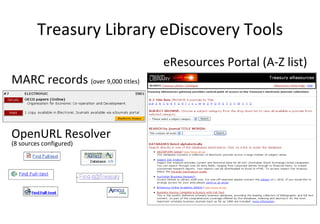
Treasury Library eDiscovery Tools eResources Portal (A-Z list) MARC records  (over 9,000 titles) OpenURL Resolver  (8 sources configured)
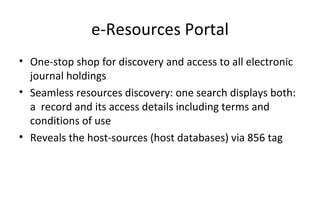
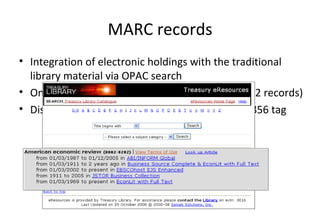
e-Resources Portal One-stop shop for discovery and access to all electronic journal holdings Seamless resources discovery: one search displays both: a  record and its access details including terms and conditions of use Reveals the host-sources (host databases) via 856 tag
MARC records Integration of electronic holdings with the traditional library material via OPAC search One search retrieves both holdings if available (2 records) Discovery of  e-Resources (host databases) via 856 tag
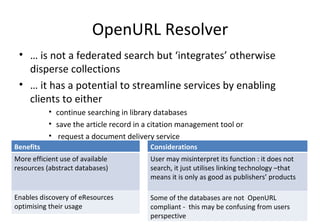
OpenURL Resolver …  is not a federated search but ‘integrates’ otherwise disperse collections …  it has a potential to streamline services by enabling clients to either  continue searching in library databases save the article record in a citation management tool or request a document delivery service Benefits More efficient use of available resources (abstract databases)  Enables discovery of eResources optimising their usage Considerations User may misinterpret its function : it does not search, it just utilises linking technology –that means it is only as good as publishers’ products Some of the databases are not  OpenURL compliant -  this may be confusing from users perspective
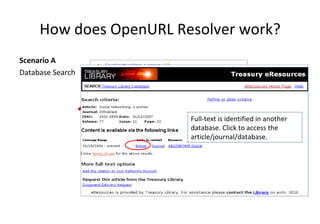
How does OpenURL Resolver work? Scenario A Database Search Article not available in full-text Clicking on this icon will trigger OpenURL resolver that will try to ‘resolve’ the link in other subscribed databases configured for this service. Full-text is identified in another database. Click to access the article/journal/database.
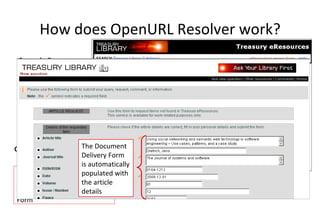
How does OpenURL Resolver work? Scenario B Database Search Article not found Options for users Cite this article in the citation management tool Access Document  Delivery Services by clicking on this link – it opens Article Request Form The Document Delivery Form is automatically populated with the article details
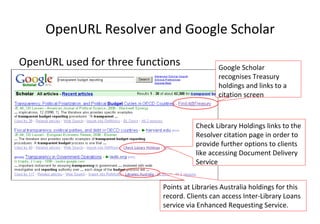
OpenURL Resolver and Google Scholar OpenURL used for three functions Google Scholar recognises Treasury holdings and links to a citation screen Points at Libraries Australia holdings for this record. Clients can access Inter-Library Loans service via Enhanced Requesting Service. Check Library Holdings links to the Resolver citation page in order to provide further options to clients like accessing Document Delivery Service
More Discovery Tools … Libraries Australia and Enhanced Requesting Service Google Scholar, RefWorks and Libraries Australia all compatible with the OpenURL Resolver RefWorks enables OPAC search via z39.50 port functionality
In summary … MARC records and OpenURL Resolver both great discovery enablers Consider the users’ needs and expectations Carefully plan your discovery map Provide training, guides and other support Promote and brand new tool/s Questions? Comments? Write to  [email_address]

E Discovery Tools In Treasury Library Mar09

  • 1.
    eDiscovery Tools inTreasury Library Focusing on Open URL Resolver as eDiscovery enabler ACT Law Librarians, NLA, 19 Mar 2009 Renata Dyer, Treasury
  • 2.
    Traditional discovery toolsCatalogue Search Library Web site browsing/searching Digital Collections Portal e-Discovery Layers Information Enterprise Portals Federated/faceted Search RSS feeds MARC records OpenURL Resolver (known as Article Linker)
  • 3.
    Treasury Library eDiscoveryTools eResources Portal (A-Z list) MARC records (over 9,000 titles) OpenURL Resolver (8 sources configured)
  • 4.
    e-Resources Portal One-stopshop for discovery and access to all electronic journal holdings Seamless resources discovery: one search displays both: a record and its access details including terms and conditions of use Reveals the host-sources (host databases) via 856 tag
  • 5.
    MARC records Integrationof electronic holdings with the traditional library material via OPAC search One search retrieves both holdings if available (2 records) Discovery of e-Resources (host databases) via 856 tag
  • 6.
    OpenURL Resolver … is not a federated search but ‘integrates’ otherwise disperse collections … it has a potential to streamline services by enabling clients to either continue searching in library databases save the article record in a citation management tool or request a document delivery service Benefits More efficient use of available resources (abstract databases) Enables discovery of eResources optimising their usage Considerations User may misinterpret its function : it does not search, it just utilises linking technology –that means it is only as good as publishers’ products Some of the databases are not OpenURL compliant - this may be confusing from users perspective
  • 7.
    How does OpenURLResolver work? Scenario A Database Search Article not available in full-text Clicking on this icon will trigger OpenURL resolver that will try to ‘resolve’ the link in other subscribed databases configured for this service. Full-text is identified in another database. Click to access the article/journal/database.
  • 8.
    How does OpenURLResolver work? Scenario B Database Search Article not found Options for users Cite this article in the citation management tool Access Document Delivery Services by clicking on this link – it opens Article Request Form The Document Delivery Form is automatically populated with the article details
  • 9.
    OpenURL Resolver andGoogle Scholar OpenURL used for three functions Google Scholar recognises Treasury holdings and links to a citation screen Points at Libraries Australia holdings for this record. Clients can access Inter-Library Loans service via Enhanced Requesting Service. Check Library Holdings links to the Resolver citation page in order to provide further options to clients like accessing Document Delivery Service
  • 10.
    More Discovery Tools… Libraries Australia and Enhanced Requesting Service Google Scholar, RefWorks and Libraries Australia all compatible with the OpenURL Resolver RefWorks enables OPAC search via z39.50 port functionality
  • 11.
    In summary …MARC records and OpenURL Resolver both great discovery enablers Consider the users’ needs and expectations Carefully plan your discovery map Provide training, guides and other support Promote and brand new tool/s Questions? Comments? Write to [email_address]

Editor's Notes

  • #2 This presentation aims to outline the principles of OpenURL Resolver functionality made available to Treasury Library via the 360 Link service. This service is outlined here in the context of all e-discovery tools.