Controlling User Access  http://ecomputernotes.com
Objectives  After completing this lesson, you should be able to  do the following:  "  Create users  "C reate roles to ease setup and maintenance of the  security model  "  Use the   GRANT   and   REVOKE   statements to grant and revoke object privileges  "C reate and access database links  http://ecomputernotes.com
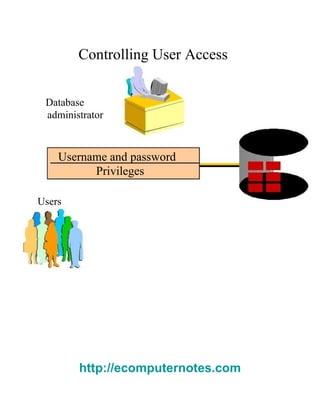
Controlling User Access  Database  administrator  Username and password  Privileges  Users  http://ecomputernotes.com
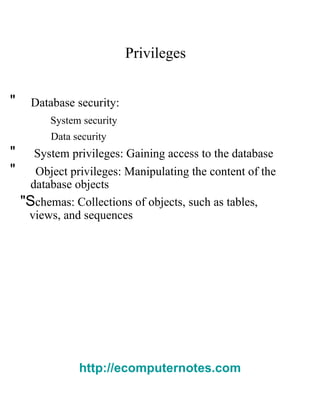
Privileges  "  Database security:  System security  Data security  "  System privileges: Gaining access to the database  "  Object privileges: Manipulating the content of the  database objects  "S chemas: Collections of objects, such as tables,  views, and sequences  http://ecomputernotes.com
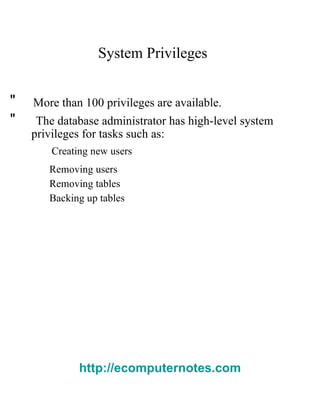
System Privileges  "  More than 100 privileges are available.  "  The database administrator has high-level system  privileges for tasks such as:  Creating new users  Removing users Removing tables Backing up tables  http://ecomputernotes.com
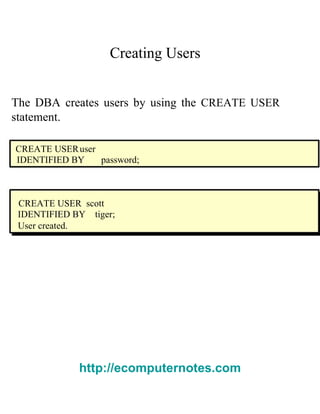
Creating Users  The DBA creates users by using the   CREATE USER  statement.  CREATE USER   user  IDENTIFIED BY  password ;  CREATE USER  scott  IDENTIFIED BY  tiger;  User created.  http://ecomputernotes.com
User System Privileges  "  Once a user is created, the DBA can grant specific  system privileges to a user.  GRANT   privilege  [,  privilege ...]  TO   user  [,  user| role, PUBLIC ...];  "  An application developer, for example, may have  the following system privileges:  ±  CREATE SESSION  ±  CREATE TABLE  ±  CREATE SEQUENCE  ±  CREATE VIEW  ±  CREATE PROCEDURE  http://ecomputernotes.com
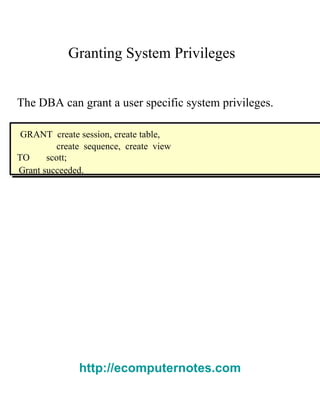
Granting System Privileges  The DBA can grant a user specific system privileges.  GRANT  create session, create table,  create sequence, create view TO  scott;  Grant succeeded.  http://ecomputernotes.com
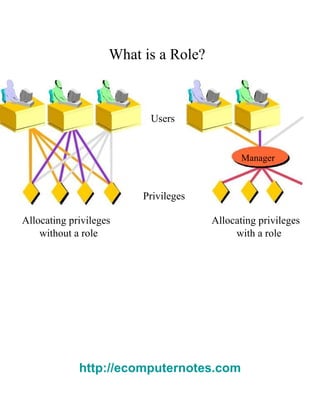
What is a Role?  Users  Manager  Privileges  Allocating privileges  Allocating privileges  without a role  with a role  http://ecomputernotes.com
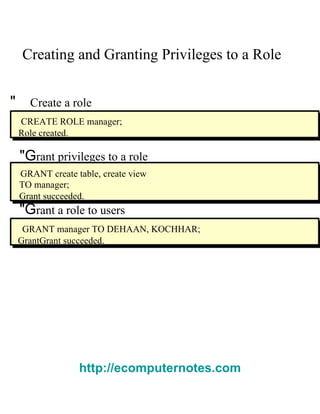
Creating and Granting Privileges to a Role  "  Create a role  CREATE ROLE manager;  Role created.  "G rant privileges to a role  GRANT create table, create view  TO manager;  Grant succeeded.  "G rant a role to users  GRANT manager TO DEHAAN, KOCHHAR;  GrantGrant succeeded.  http://ecomputernotes.com
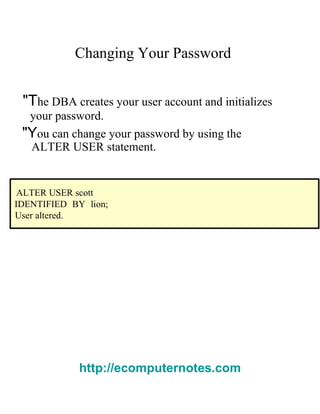
Changing Your Password  "T he DBA creates your user account and initializes  your password.  "Y ou can change your password by using the  ALTER USER   statement.  ALTER USER scott  IDENTIFIED BY lion; User altered.  http://ecomputernotes.com
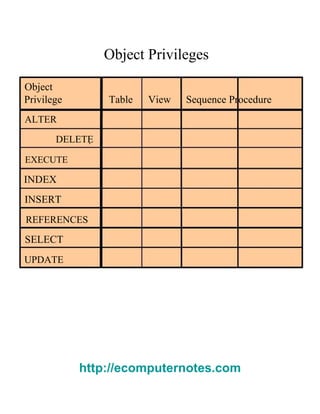
Object Privileges  Object  Privilege  Table  View  Sequence Procedure  ALTER         DELETE          EXECUTE         INDEX          INSERT         REFERENCES        SELECT       UPDATE    http://ecomputernotes.com
Object Privileges  "  Object privileges vary from object to object.  "  An owner has all the privileges on the object.  "  An owner can give specific privileges on that  owner¶s object.  GRANT  object_priv  [( columns )]  ON  objec t  TO  { user | role |PUBLIC}  http://ecomputernotes.com
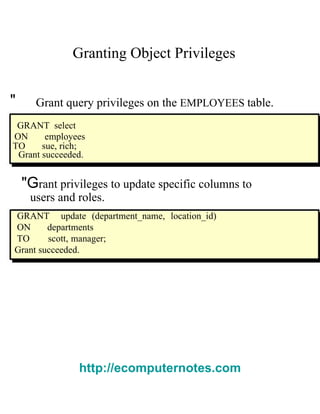
Granting Object Privileges  "  Grant query privileges on the   EMPLOYEES   table.  GRANT  select  ON  employees  TO  sue, rich;  Grant succeeded.  "G rant privileges to update specific columns to  users and roles.  GRANT  update (department_name, location_id) ON  departments  TO  scott, manager; Grant succeeded.  http://ecomputernotes.com
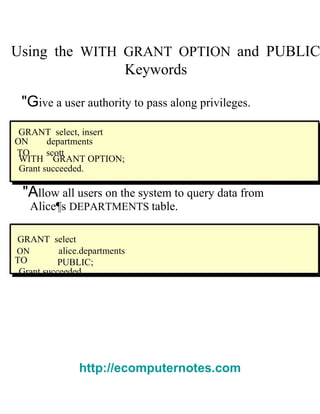
Using the   WITH GRANT OPTION   and   PUBLIC Keywords  "G ive a user authority to pass along privileges.  GRANT  select, insert  ON  departments TO  scott  WITH  GRANT OPTION;  Grant succeeded.  "A llow all users on the system to query data from  Alice¶s   DEPARTMENTS   table.  GRANT  select  ON  alice.departments  TO  PUBLIC;  Grant succeeded.  http://ecomputernotes.com
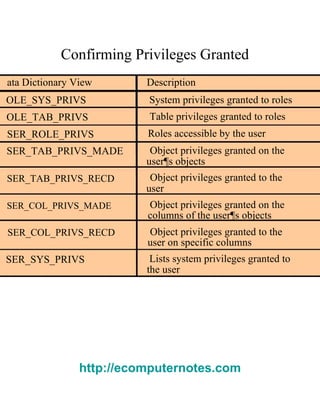
Confirming Privileges Granted  ata Dictionary View  Description  OLE_SYS_PRIVS  System privileges granted to roles  OLE_TAB_PRIVS  Table privileges granted to roles  SER_ROLE_PRIVS  Roles accessible by the user  SER_TAB_PRIVS_MADE  Object privileges granted on the  user¶s objects  SER_TAB_PRIVS_RECD  Object privileges granted to the  user  SER_COL_PRIVS_MADE  Object privileges granted on the  columns of the user¶s objects  SER_COL_PRIVS_RECD  Object privileges granted to the  user on specific columns  SER_SYS_PRIVS  Lists system privileges granted to  the user  http://ecomputernotes.com
How to Revoke Object Privileges  "  You use the   REVOKE   statement to revoke privileges granted to other users.  "P rivileges granted to others through the  W ITH  GRANT OPTION   clause are also revoked.  REVOKE {privilege [, privilege...]|ALL}  ON  object  FROM  {user[, user...]|role|PUBLIC} [CASCADE CONSTRAINTS];  http://ecomputernotes.com
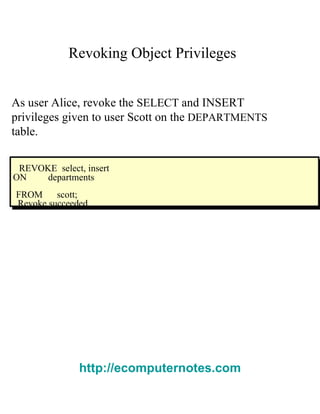
Revoking Object Privileges  As user Alice, revoke the   SELECT   and   INSERT privileges given to user Scott on the   DEPARTMENTS  table.  REVOKE  select, insert  ON  departments  FROM  scott;  Revoke succeeded.  http://ecomputernotes.com
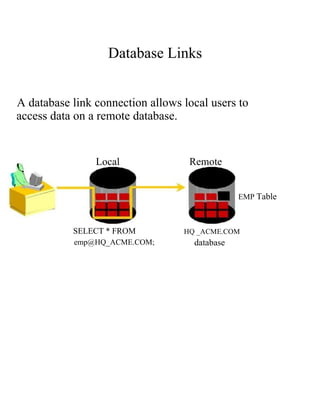
Database Links  A database link connection allows local users to  access data on a remote database.  Local  Remote  EMP   Table  SELECT * FROM  HQ _ACME.COM  emp@HQ_ACME.COM;  database
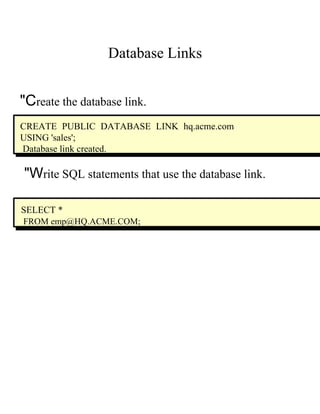
Database Links  "C reate the database link.  CREATE PUBLIC DATABASE LINK hq.acme.com USING 'sales';  Database link created.  "W rite SQL statements that use the database link.  SELECT *  FROM emp@HQ.ACME.COM;

e computer notes - Controlling user access

  • 1.
    Controlling User Access http://ecomputernotes.com
  • 2.
    Objectives Aftercompleting this lesson, you should be able to do the following: " Create users "C reate roles to ease setup and maintenance of the security model " Use the GRANT and REVOKE statements to grant and revoke object privileges "C reate and access database links http://ecomputernotes.com
  • 3.
    Controlling User Access Database administrator Username and password Privileges Users http://ecomputernotes.com
  • 4.
    Privileges " Database security: System security Data security " System privileges: Gaining access to the database " Object privileges: Manipulating the content of the database objects "S chemas: Collections of objects, such as tables, views, and sequences http://ecomputernotes.com
  • 5.
    System Privileges " More than 100 privileges are available. " The database administrator has high-level system privileges for tasks such as: Creating new users Removing users Removing tables Backing up tables http://ecomputernotes.com
  • 6.
    Creating Users The DBA creates users by using the CREATE USER statement. CREATE USER user IDENTIFIED BY password ; CREATE USER scott IDENTIFIED BY tiger; User created. http://ecomputernotes.com
  • 7.
    User System Privileges " Once a user is created, the DBA can grant specific system privileges to a user. GRANT privilege [, privilege ...] TO user [, user| role, PUBLIC ...]; " An application developer, for example, may have the following system privileges: ± CREATE SESSION ± CREATE TABLE ± CREATE SEQUENCE ± CREATE VIEW ± CREATE PROCEDURE http://ecomputernotes.com
  • 8.
    Granting System Privileges The DBA can grant a user specific system privileges. GRANT create session, create table, create sequence, create view TO scott; Grant succeeded. http://ecomputernotes.com
  • 9.
    What is aRole? Users Manager Privileges Allocating privileges Allocating privileges without a role with a role http://ecomputernotes.com
  • 10.
    Creating and GrantingPrivileges to a Role " Create a role CREATE ROLE manager; Role created. "G rant privileges to a role GRANT create table, create view TO manager; Grant succeeded. "G rant a role to users GRANT manager TO DEHAAN, KOCHHAR; GrantGrant succeeded. http://ecomputernotes.com
  • 11.
    Changing Your Password "T he DBA creates your user account and initializes your password. "Y ou can change your password by using the ALTER USER statement. ALTER USER scott IDENTIFIED BY lion; User altered. http://ecomputernotes.com
  • 12.
    Object Privileges Object Privilege Table View Sequence Procedure ALTER        DELETE          EXECUTE        INDEX         INSERT        REFERENCES       SELECT      UPDATE   http://ecomputernotes.com
  • 13.
    Object Privileges " Object privileges vary from object to object. " An owner has all the privileges on the object. " An owner can give specific privileges on that owner¶s object. GRANT object_priv [( columns )] ON objec t TO { user | role |PUBLIC} http://ecomputernotes.com
  • 14.
    Granting Object Privileges " Grant query privileges on the EMPLOYEES table. GRANT select ON employees TO sue, rich; Grant succeeded. "G rant privileges to update specific columns to users and roles. GRANT update (department_name, location_id) ON departments TO scott, manager; Grant succeeded. http://ecomputernotes.com
  • 15.
    Using the WITH GRANT OPTION and PUBLIC Keywords "G ive a user authority to pass along privileges. GRANT select, insert ON departments TO scott WITH GRANT OPTION; Grant succeeded. "A llow all users on the system to query data from Alice¶s DEPARTMENTS table. GRANT select ON alice.departments TO PUBLIC; Grant succeeded. http://ecomputernotes.com
  • 16.
    Confirming Privileges Granted ata Dictionary View Description OLE_SYS_PRIVS System privileges granted to roles OLE_TAB_PRIVS Table privileges granted to roles SER_ROLE_PRIVS Roles accessible by the user SER_TAB_PRIVS_MADE Object privileges granted on the user¶s objects SER_TAB_PRIVS_RECD Object privileges granted to the user SER_COL_PRIVS_MADE Object privileges granted on the columns of the user¶s objects SER_COL_PRIVS_RECD Object privileges granted to the user on specific columns SER_SYS_PRIVS Lists system privileges granted to the user http://ecomputernotes.com
  • 17.
    How to RevokeObject Privileges " You use the REVOKE statement to revoke privileges granted to other users. "P rivileges granted to others through the W ITH GRANT OPTION clause are also revoked. REVOKE {privilege [, privilege...]|ALL} ON object FROM {user[, user...]|role|PUBLIC} [CASCADE CONSTRAINTS]; http://ecomputernotes.com
  • 18.
    Revoking Object Privileges As user Alice, revoke the SELECT and INSERT privileges given to user Scott on the DEPARTMENTS table. REVOKE select, insert ON departments FROM scott; Revoke succeeded. http://ecomputernotes.com
  • 19.
    Database Links A database link connection allows local users to access data on a remote database. Local Remote EMP Table SELECT * FROM HQ _ACME.COM emp@HQ_ACME.COM; database
  • 20.
    Database Links "C reate the database link. CREATE PUBLIC DATABASE LINK hq.acme.com USING 'sales'; Database link created. "W rite SQL statements that use the database link. SELECT * FROM emp@HQ.ACME.COM;