Prepared by –Nazmul Hasan, Senior Civil Judge at 11th
BJS. (Prime
Minister Gold Medalist)
Page
1
Prepared by –Nazmul Hasan, Senior Civil Judge at 11th
BJS. (Prime
Minister Gold Medalist)
Page
2
About the Author
Nazmul Hasan
Senior Judicial Magistrate/ Senior Civil Judge.
Professional Highlights
 Senior Judicial Magistrate/ Senior Civil Judge, 11th
Bangladesh Judicial Service (BJS)
 Merit Position: 7th
in the 11th
BJS
Academic Qualifications
 LL.B. (Hons.) – First Class First, University of Rajshahi
 LL.M. – First Class, University of Rajshahi
Honors & Achievements
 Prime Minister Gold Medalist – 2017
 Agrani Bank Gold Medalist for Academic Excellence –
2023
Author’s E-book: A Guide to Excelling in the 18th BJS Exam
Nazmul Hasan is the author of the e-book "Comprehensive Strategy
for Excelling in the 18th Bangladesh Judicial Service Examination".
This pioneering work is the first-ever e-book in Bangladesh
dedicated to BJS exam preparation. The book has been widely
praised and attracted a large number of candidates, providing them
with effective strategies, valuable insights, and a structured
approach to excel in the challenging BJS examination.
Prepared by –Nazmul Hasan, Senior Civil Judge at 11th
BJS. (Prime
Minister Gold Medalist)
Page
3
Dedicated to
My teachers of Bogura Cantonment Public School and
Colleges, whose invaluable guidance, support, and encouragement
have been instrumental in my learning journey. Their wisdom and
mentorship laid the foundation for my academic achievements, and
I am deeply grateful for their continuous support in shaping my path
to success.
Prepared by –Nazmul Hasan, Senior Civil Judge at 11th
BJS. (Prime
Minister Gold Medalist)
Page
4
📚 Premium Study Material Inquiry
🎯 Subject: Inquiry Regarding Paid E-Books and Study
Notes for the BJS Examination
Dear Future Legal Professional,
To streamline your preparation for the Bangladesh Judicial Service
(BJS) Examination, our platform offers comprehensive and
expertly curated paid e-books and study notes.
We invite you to contact our team regarding the purchase and
availability of these premium resources, which are specifically
designed to enhance your understanding and boost your score.
Contact Details:
 Email Correspondence: lawebookplatform@gmail.com
 WhatsApp (SMS ONLY): +880 1797-103804
We look forward to assisting you on your path to success.
Prepared by –Nazmul Hasan, Senior Civil Judge at 11th
BJS. (Prime
Minister Gold Medalist)
Page
5
📚 Index:
This index is organized by legal topic and lists the specific
questions, along with their corresponding BJS Exam reference.
I. General Principles, Nature, Scope, and Object
This section covers the foundational aspects, purpose, and legal
nature of the Act.
 Describe the nature, scope and object of the Limitation Act, 1908.
(4th BJS, 2008)
 What are the objects of Law of limitation? (5th BJS, 2010)
 Discuss the policy behind the Limitation Act, 1908. (9th BJS, 2014)
 The law of Limitation is an adjective law -Justify your opinion. (9th
BJS, 2014)
 What are the perspectives of enacting the Limitation Act, 1908?
(15th BJS, 2022)
 What are the differences between limitation and prescription? (5th
BJS, 2010)
Prepared by –Nazmul Hasan, Senior Civil Judge at 11th
BJS. (Prime
Minister Gold Medalist)
Page
6 II. Computation of Time: General Rules and Exclusion
(Sections 3, 12-15)
This section deals with the standard rules and specific circumstances
for calculating the limitation period.
 What are the general rules of computation of the period of
limitation? (12th BJS, 2018)
 Mention the days which are excluded in computing limitation. (4th
BJS, 2008)
 Specify three situations where the time spent in those situations shall
be excluded in computing the limitation period prescribed by the
Limitation Act, 1908? (5th BJS, 2010)
 Discuss the provisions relating to exclusion of time due to legal
proceeding and death of a person before his right to sue accrues. (8th
BJS, 2013)
 Can a Court exclude the time of defendant's absence from the
territory of Bangladesh? Explain. (8th BJS, 2013)
 What are the rules for computation of limitation by exclusion of time
in the following cases: (9th BJS, 2014)
o Legal proceedings
o When the proceeding are suspended
Prepared by –Nazmul Hasan, Senior Civil Judge at 11th
BJS. (Prime
Minister Gold Medalist)
Page
7 o When the plaintiff bonafide prosecuting a civil proceeding without
jurisdiction.
 Writ down the basic differences between sections 5 and 14 of the
Limitation Act, 1908. (15th BJS, 2022)
III. Condonation of Delay (Section 5)
This section focuses on the court's power to excuse delay on the
ground of 'sufficient cause'.
 When has the court discretion to exempt the strict rules of
limitation? (4th BJS, 2008)
 In what type of cases and from what reasons delay may be condoned
under section 5 of the Limitation Act, 1908? (5th BJS, 2010)
 Do you think that this section may be misused? (5th BJS, 2010)
 Explain the principle of condonation of delay. On what grounds can
a court condone the delay in an application or an appeal? (7th BJS,
2012)
 Explain the concept of sufficient cause. (14th BJS, 2021)
 Discuss the scope of condonation of delay in the light of section 12
of the Limitation Act, 1908. Differentiate with illustration between
Prepared by –Nazmul Hasan, Senior Civil Judge at 11th
BJS. (Prime
Minister Gold Medalist)
Page
8 the provisions of condonation of delay provided under sections 5
and 12 of the Act. (13th BJS, 2019)
 State the procedure of extension of the period of limitation. (12th
BJS, 2018)
 Legal Consequence Problems (9th BJS, 2014)
o What will the legal consequence in the following case: Limitation
for appeal expired on a day when the Court is closed?
o What will the legal consequence in the following case: time barred
appeal entertained and disposed of by the Appellate Court?
o What will the legal consequence in the following case: In case of a
time-barred appeal against a decree if the appellant can show that he
had sufficient causes for not filing in time.
IV. Special Rules of Computation (Sections 6, 7, 18, 19,
21)
This section covers specific legal provisions that modify the
standard computation of time.
 Legal Disability (Sections 6 & 7)
o Amplify the principles of legal disability as enunciated under
sections 6 and 7 of the Limitation Act? What are the exceptions to
those principles? (7th BJS, 2012)
Prepared by –Nazmul Hasan, Senior Civil Judge at 11th
BJS. (Prime
Minister Gold Medalist)
Page
9 o Whether any subsequent disability can stop any right to sue where
limitation has begun? Discuss. (7th BJS, 2012)
o Elucidate the effect of legal disability in computing the period of
limitation. (15th BJS, 2022)
o Discuss the characteristics of section 6 and 17 of the Limitation Act,
1908. (17th BJS, 2024)
o Case Problem: Successive Disability (7th BJS, 2012)
 A right to sue accurses to 'Ka' during his minority. Ka dies before
attaining majority, and is succeeded by Kha, his minor son. From
which date time will run against Kha? Discuss.
 Fraud and Mistake (Section 18)
o What is fraud? If a plaintiff files a suit alleging fraud, form which
date the period of limitation for filing the suit shall be computed?
(3rd BJS, 2007)
o If a fraud is proved, the limitation will run from the date when fraud
was detected. Explain. (8th BJS, 2013)
o What is the effect of fraud in computing the period of limitation is a
suit? Answer with reference to the relevant provision of law. (12th
BJS, 2018)
o Limitation shall be computed from the time when fraud first
becomes known. (16th BJS, 2023)
Prepared by –Nazmul Hasan, Senior Civil Judge at 11th
BJS. (Prime
Minister Gold Medalist)
Page
10 o Describe the rules for computation of the period of limitation to
initiate legal proceedings in the following case: Allegation of fraud.
(10th BJS, 2015)
 Acknowledgment (Section 19)
o When and how an acknowledgment of a particular liability by a
person before expiration of prescribed time-limit affects the process
of computing limitation of a suit against that person? (8th BJS,
2013)
 Addition or Substitution of Parties (Section 21)
o Discuss briefly the consequence of addition or substitution of new
plaintiff or defendant in a continuing suit according to the provisions
of the Limitation Act, 1908. (17th BJS, 2024)
V. Acquisition of Rights (Prescription/Easements) and
Adverse Possession (Sections 26-28)
This section covers the acquisition of rights, especially Easements,
and the extinguishment of title by limitation.
 Extinguishment of Title (Section 28)
o How right to a property is extinguished? (3rd BJS, 2007)
o Laps of time not only bars legal remedy but also extinguishes title
of a claimant. Explain. (7th BJS, 2012)
Prepared by –Nazmul Hasan, Senior Civil Judge at 11th
BJS. (Prime
Minister Gold Medalist)
Page
11  Adverse Possession
o What is meant by adverse possession? (3rd BJS, 2007)
o Does the plea of adverse possession give absolute title to the person
in possession? (4th BJS, 2008)
o Discuss the essential ingredients of adverse possession as provided
in the Limitation Act, 1908. (4th BJS, 2008)
 Easement Rights (Sections 26 & 27)
o What is meant by easement? How right of easement of light, air,
pathway or any other easement can be acquired? (3rd BJS, 2007)
o What is by easement right? How the right of easement to light, air,
way or any other easement can by acquired? (8th BJS, 2013)
o Write a short-note on acquisition of right to easement under the
Limitation Act, 1908? What period of limitation has been provided
for institution of a suit for such right? (13th BJS, 2019)
VI. Specific Articles (The Schedule)
This section addresses questions about the limitation period for
specific types of suits, referring to the Articles in the Schedule.
 Suits for Possession and Title
Prepared by –Nazmul Hasan, Senior Civil Judge at 11th
BJS. (Prime
Minister Gold Medalist)
Page
12 o What is the time limit for filing a suit for recovery of possession?
(3rd BJS, 2007)
o Describe the rules for computation of the period of limitation to
initiate legal proceedings in the following case: Suit for declaration
of title to and recovery of possession of immovable property. (10th
BJS, 2015)
o What is the basic difference between article 142 and 144 of the
schedule to the limitation act, 1908? Discuss. (12th BJS, 2018)
 Residuary Articles
o Describe the rules for computation of the period of limitation to
initiate legal proceedings in the following case: Suit for which no
period of limitation is provided elsewhere in the schedule of the
Limitation Act, 1908. (10th BJS, 2015)
o Describe the rules for computation of the period of limitation to
initiate legal proceedings in the following case: Applications for
which no period of limitation is provided elsewhere in the schedule
of the Limitation Act, 1908. (10th BJS, 2015)
 Suit for Specific Performance of Contract
o Describe the rules for computation of the period of limitation to
initiate legal proceedings in the following case: Suit for Specific
Performance of Contract. (10th BJS, 2015)
Prepared by –Nazmul Hasan, Senior Civil Judge at 11th
BJS. (Prime
Minister Gold Medalist)
Page
13 VII. Applicability to Special Laws (Section 29)
This section addresses the interaction between the general law of
limitation and specific local or special laws.
 Is this provision [Section 5] applicable to special laws? Give your
answer with reference to the relevant provisions. (7th BJS, 2012)
 To what extent the provisions of the Limitation Act, 1908 is
applicable in respect of special laws? Discuss stating the relevant
provisions of the Limitation Act, 1908. (14th BJS, 2021)
 How much the provisions of the Limitation Act, 1908 are applicable
to special laws? (16th BJS, 2023)
Prepared by –Nazmul Hasan, Senior Civil Judge at 11th
BJS. (Prime
Minister Gold Medalist)
Page
14
📚 E-book: The Limitation Act, 1908
for BJS Written Exam
I. General Principles, Nature, Scope, and
Object
This section covers the foundational aspects, purpose, and legal
nature of the Act.
 Describe the nature, scope and object of the Limitation Act, 1908.
(4th BJS, 2008)
 What are the objects of Law of limitation? (5th BJS, 2010)
 Discuss the policy behind the Limitation Act, 1908. (9th BJS, 2014)
 The law of Limitation is an adjective law -Justify your opinion. (9th
BJS, 2014)
 What are the perspectives of enacting the Limitation Act, 1908?
(15th BJS, 2022)
 What are the differences between limitation and prescription? (5th
BJS, 2010)
Prepared by –Nazmul Hasan, Senior Civil Judge at 11th
BJS. (Prime
Minister Gold Medalist)
Page
15 ⚖️ The Limitation Act, 1908: Nature,
Scope, and Object
The Limitation Act, 1908, is a foundational law in the legal system
of Bangladesh (and was originally applicable in the broader Indian
subcontinent). It is concerned with the timeframe within which an
aggrieved party must approach a court for legal redress.
1. Nature of the Act
 Adjective Law: The Act is primarily an adjective or procedural
law, not a substantive law.
o Meaning: It does not create or define any rights or causes of action
(which is the job of substantive laws, like the Contract Act). Instead,
it regulates the procedure for enforcing existing rights in a court of
law.
 Bars the Remedy, Not the Right: A crucial principle is that the Act
generally only bars the remedy (the ability to sue in court) after the
prescribed time, but it does not extinguish the right itself.
o Example: If a debt becomes 'time-barred' (limitation period is over),
the right to recover the money through a lawsuit is lost. However, if
the debtor chooses to pay the debt later, they cannot demand the
money back, as the right to the money still existed.
Prepared by –Nazmul Hasan, Senior Civil Judge at 11th
BJS. (Prime
Minister Gold Medalist)
Page
16 2. Scope of the Act
The Act is comprehensive in its application to various legal
proceedings:
 Applies to Civil Proceedings: It applies to all Suits, Appeals, and
Applications filed in civil courts, subject to the specific time
periods detailed in the Schedule.
o The term "suit" does not include appeals or applications.
 Fixes Time Limits: The scope involves specifying a particular
period (e.g., 3 years for contract suits, 12 years for possession of
immovable property) within which a legal action must be initiated
from the date the cause of action arises.
 Excludes Time: It also prescribes rules for the computation and
exclusion of time, such as:
o Exclusion of the time required to obtain copies of a judgment/decree
for filing an appeal.
o Extension of the period in cases of legal disability (like being a
minor or of unsound mind) or when there is sufficient cause (like
illness, or bona fide mistake in choosing the court) for the delay.
3. Object of the Act
The Limitation Act is based on maxims of public policy and equity.
Its main objects are:
Prepared by –Nazmul Hasan, Senior Civil Judge at 11th
BJS. (Prime
Minister Gold Medalist)
Page
17  To End Litigation (Interest Republicae Ut Sit Finis Litium): The
primary object is to bring finality to disputes. The law aims to
prevent grievances from being kept pending indefinitely, ensuring
that parties cannot prolong litigation for an unreasonable time.
 To Aid the Vigilant, Not the Indolent (Vigilantibus Non
Dormientibus Jura Subveniunt): The law protects people who are
diligent and pursue their rights promptly. It discourages negligence
and 'sleeping on one's rights.' If someone fails to seek legal remedy
within the statutory period, they forfeit their chance.
 To Prevent Disturbance of Vested Rights: Over time, possession
or the state of affairs may change. Allowing very old claims to be
enforced would destabilize ownership, peace, and security in
society. The Act helps to quiet title to property by ensuring long-
undisturbed possession is protected (e.g., through the acquisition of
easements or ownership by prescription/adverse possession).
 To Preserve Evidence: After a long lapse of time, evidence (both
documentary and testimonial) is likely to be lost or unreliable. The
Act forces people to file cases when evidence is still fresh and
available.
Prepared by –Nazmul Hasan, Senior Civil Judge at 11th
BJS. (Prime
Minister Gold Medalist)
Page
18 🎯 Objects and Policy of the Law of
Limitation (The Limitation Act, 1908)
The Law of Limitation is a procedural law rooted deeply in public
policy. Its object is not to create or define rights, but to impose a
time-limit on how long a person can delay approaching the court to
enforce their existing rights.
The primary objects of the Limitation Act, 1908, are based on
several fundamental legal maxims:
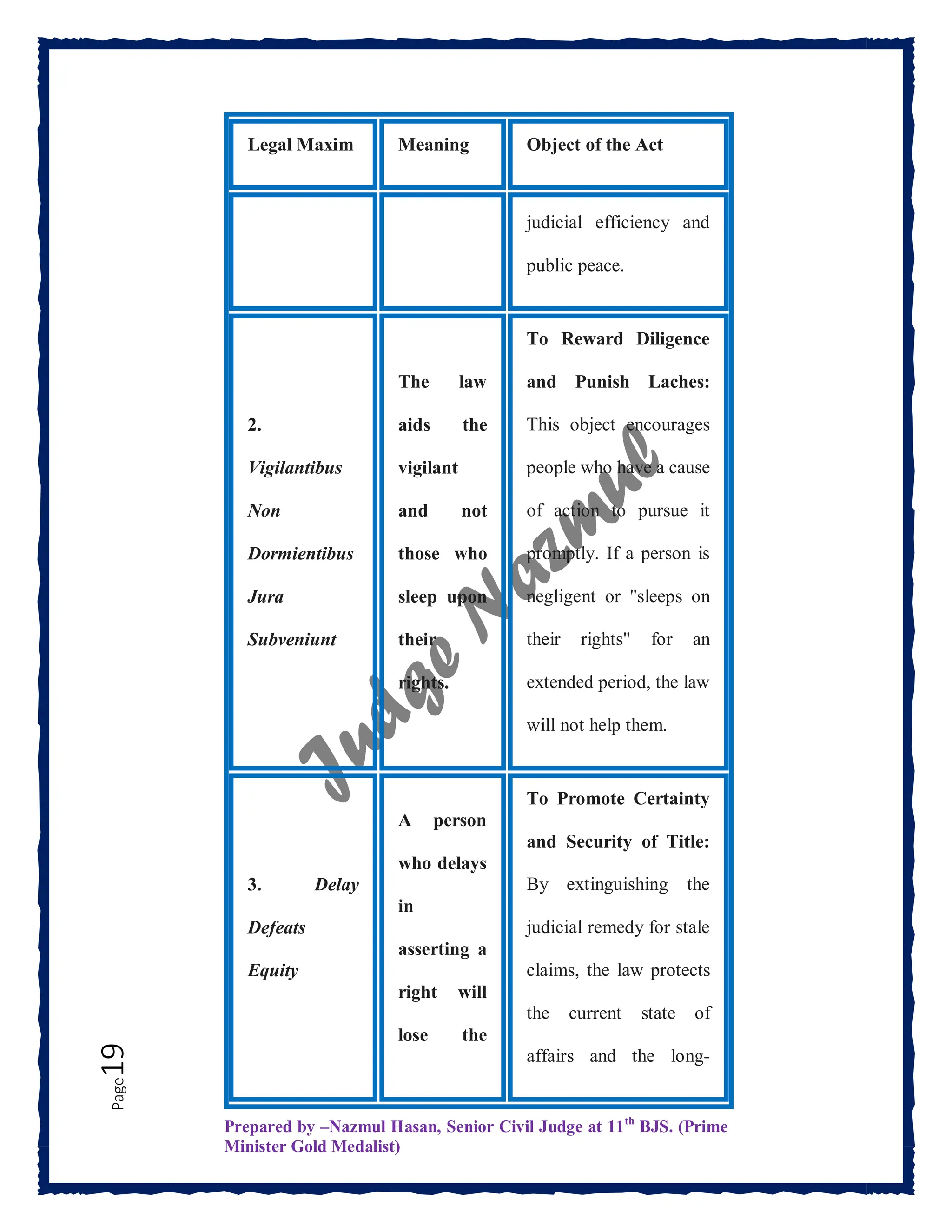
Legal Maxim Meaning Object of the Act
1. Interest
Reipublicae
Ut Sit Finis
Litium
It is in the
interest of
the state
that there
should be
an end to
litigation.
To Bring Finality to
Disputes: The most
important object is to
prevent the never-
ending possibility of
litigation. The law
dictates that a dispute
must be resolved or put
to rest within a fixed
period, which ensures
Prepared by –Nazmul Hasan, Senior Civil Judge at 11th
BJS. (Prime
Minister Gold Medalist)
Page
19
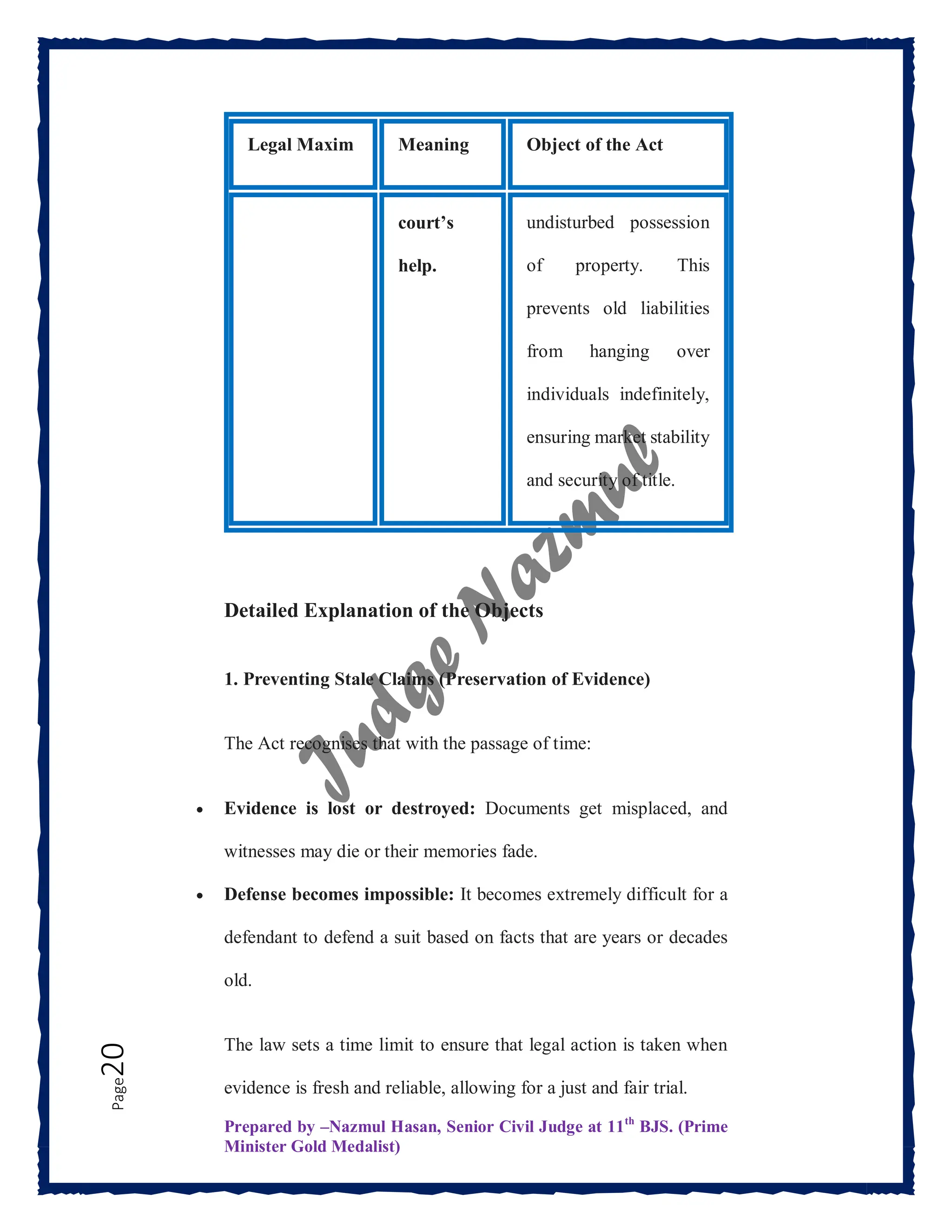
Legal Maxim Meaning Object of the Act
judicial efficiency and
public peace.
2.
Vigilantibus
Non
Dormientibus
Jura
Subveniunt
The law
aids the
vigilant
and not
those who
sleep upon
their
rights.
To Reward Diligence
and Punish Laches:
This object encourages
people who have a cause
of action to pursue it
promptly. If a person is
negligent or "sleeps on
their rights" for an
extended period, the law
will not help them.
3. Delay
Defeats
Equity
A person
who delays
in
asserting a
right will
lose the
To Promote Certainty
and Security of Title:
By extinguishing the
judicial remedy for stale
claims, the law protects
the current state of
affairs and the long-
Prepared by –Nazmul Hasan, Senior Civil Judge at 11th
BJS. (Prime
Minister Gold Medalist)
Page
20
Legal Maxim Meaning Object of the Act
court’s
help.
undisturbed possession
of property. This
prevents old liabilities
from hanging over
individuals indefinitely,
ensuring market stability
and security of title.
Detailed Explanation of the Objects
1. Preventing Stale Claims (Preservation of Evidence)
The Act recognises that with the passage of time:
 Evidence is lost or destroyed: Documents get misplaced, and
witnesses may die or their memories fade.
 Defense becomes impossible: It becomes extremely difficult for a
defendant to defend a suit based on facts that are years or decades
old.
The law sets a time limit to ensure that legal action is taken when
evidence is fresh and reliable, allowing for a just and fair trial.
Prepared by –Nazmul Hasan, Senior Civil Judge at 11th
BJS. (Prime
Minister Gold Medalist)
Page
21 2. Quieting Title and Establishing Security (Adverse Possession)
 The Act not only bars a judicial remedy (Section 3) but, in certain
cases involving property, also extinguishes the right itself (Section
28).
 For example, if a person remains in adverse possession (hostile
possession against the true owner) of immovable property for the
prescribed period (usually 12 years in Bangladesh), the right of the
true owner to recover that property is lost, and the possessor gains a
new title.
 This objective is crucial for maintaining the social order and the
certainty of property ownership.
3. Serving as a Rule of Procedure (Adjective Law)
The Act serves a procedural object: it provides the machinery to
manage the flow of civil justice.
 It makes the court's job clear: if a suit, appeal, or application is filed
after the expiry of the prescribed period, the court must dismiss it,
even if the opposite party (the defendant) does not raise the defense
of limitation (Section 3). This mandatory requirement ensures that
the time limit is respected as a matter of law.
In essence, the Limitation Act is a benevolent law of peace and
repose. It sacrifices the private interest of a negligent person to sue
Prepared by –Nazmul Hasan, Senior Civil Judge at 11th
BJS. (Prime
Minister Gold Medalist)
Page
22 in favour of the larger public interest of finality, stability, and
reliable justice.
📜 Policy Behind the Limitation Act, 1908
The Law of Limitation is not just a collection of deadlines; it is a
vital part of the public policy governing civil justice. The policy
behind the Limitation Act, 1908, can be discussed under three main
heads, which are derived from classical legal maxims.
1. Policy of Repose (Interest Reipublicae Ut Sit Finis
Litium)
This is the paramount policy, meaning: "It is in the interest of the
State that there should be an end to litigation."
 Finality and Certainty: The law prevents the perpetual possibility
of lawsuits. If claims could be brought up at any time, uncertainty
would reign in business, property ownership, and personal affairs.
The Act ensures that after a specified period, a person can live
without the threat of a potential lawsuit regarding an old matter.
 Judicial Efficiency: Courts would be overwhelmed with ancient
disputes where facts are hard to ascertain and evidence is lost. By
establishing a fixed cut-off date (like 3 years for contract suits or 12
Prepared by –Nazmul Hasan, Senior Civil Judge at 11th
BJS. (Prime
Minister Gold Medalist)
Page
23 years for property suits), the Act allows the judicial system to focus
on current, timely disputes.
2. Policy Against Indolence (Vigilantibus Non
Dormientibus Jura Subveniunt)
This policy means: "The law assists those who are vigilant, not
those who sleep upon their rights."
 Encouraging Diligence: The law is intended to be a shield for the
defendant, not a weapon for the plaintiff. It pressures the aggrieved
party (plaintiff) to seek their remedy through the court system
promptly after the cause of action arises.
 Protecting the Defendant: The defendant should not have to
preserve evidence, documents, and memories indefinitely.7
After the
limitation period has passed, the defendant gains a kind of "right to
peace," knowing that the stale claim can no longer be judicially
enforced.
3. Policy of Evidence Preservation and Security of Title
 Reliable Justice: Time inevitably affects the quality of evidence.
Witnesses may forget details or die, and documents may be lost or
destroyed. If a case is filed years later, the court cannot arrive at a
Prepared by –Nazmul Hasan, Senior Civil Judge at 11th
BJS. (Prime
Minister Gold Medalist)
Page
24 fair and reliable conclusion. The Act enforces action while evidence
is fresh.
 Extinguishment of Rights (Adverse Possession): In certain crucial
cases, particularly those involving the possession of immovable
property (Section 28), the Act goes beyond barring the remedy; it
extinguishes the right itself of the true owner who failed to act
within the prescribed 12-year period. This is the strongest
expression of the policy to quiet title and protect long-undisturbed
possession, thereby promoting social security and stability.
Key Takeaway
The policy of the Limitation Act, 1908, is a pragmatic compromise.
While it may sometimes prevent the enforcement of a legitimate, but
delayed, right, it does so to serve the greater public good by
promoting certainty, discouraging negligence, and ensuring that
judicial resources are spent on current disputes where a fair trial,
based on reliable evidence, is still possible.
Prepared by –Nazmul Hasan, Senior Civil Judge at 11th
BJS. (Prime
Minister Gold Medalist)
Page
25
⚖️ Justification: The Law of Limitation is
an Adjective Law
The statement that the Law of Limitation is an Adjective Law (also
called Procedural Law) is generally correct and is supported by the
fundamental principles of the Limitation Act, 1908.
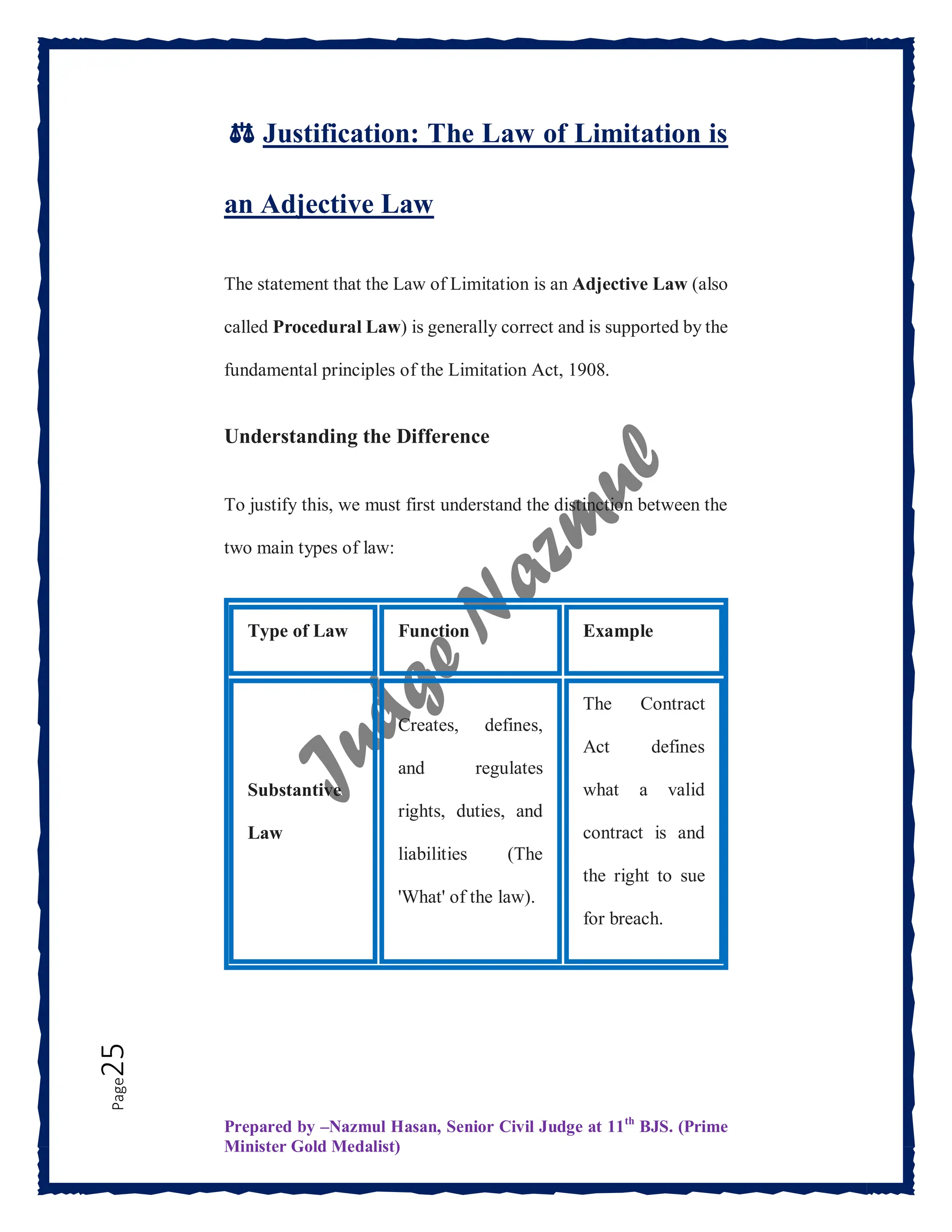
Understanding the Difference
To justify this, we must first understand the distinction between the
two main types of law:
Type of Law Function Example
Substantive
Law
Creates, defines,
and regulates
rights, duties, and
liabilities (The
'What' of the law).
The Contract
Act defines
what a valid
contract is and
the right to sue
for breach.
Prepared by –Nazmul Hasan, Senior Civil Judge at 11th
BJS. (Prime
Minister Gold Medalist)
Page
26
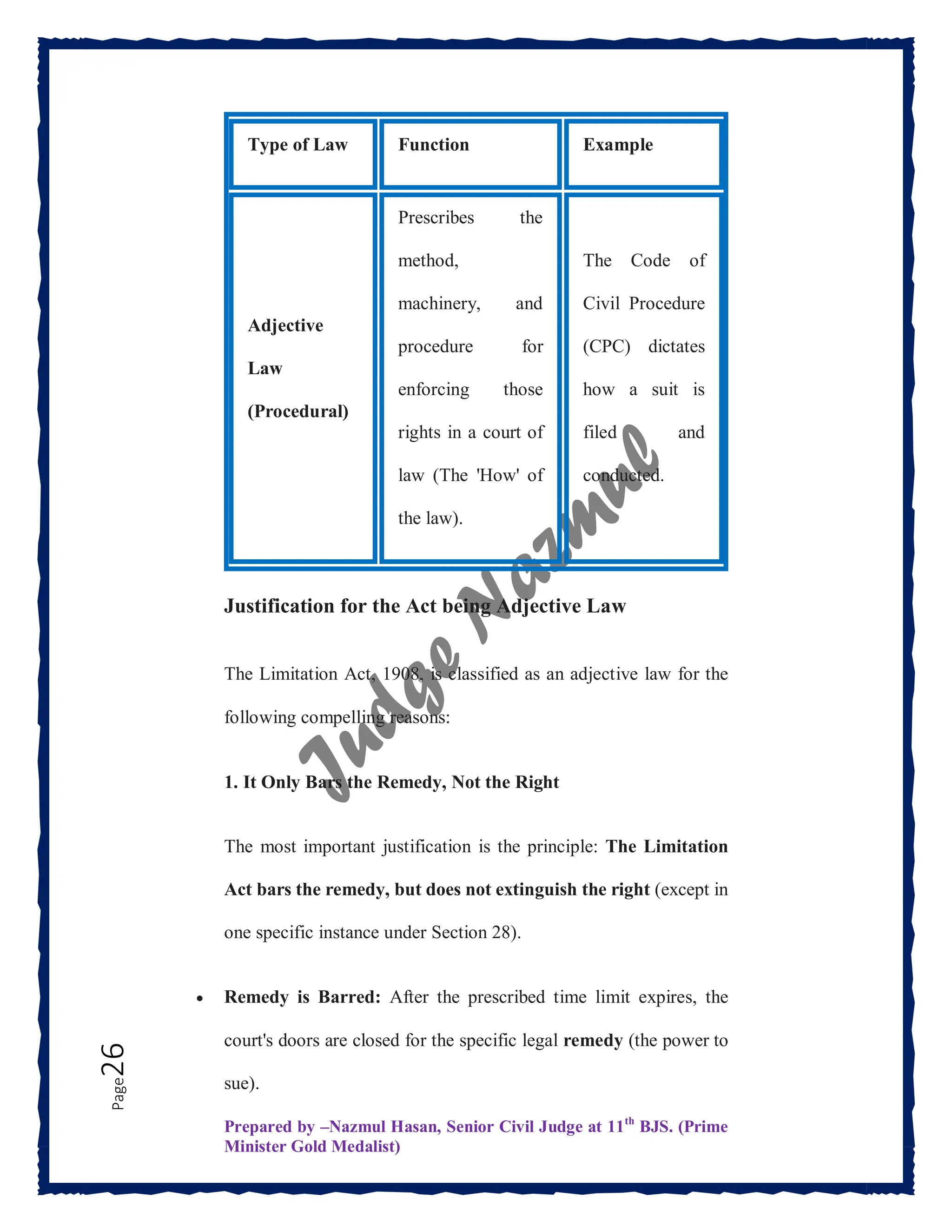
Type of Law Function Example
Adjective
Law
(Procedural)
Prescribes the
method,
machinery, and
procedure for
enforcing those
rights in a court of
law (The 'How' of
the law).
The Code of
Civil Procedure
(CPC) dictates
how a suit is
filed and
conducted.
Justification for the Act being Adjective Law
The Limitation Act, 1908, is classified as an adjective law for the
following compelling reasons:
1. It Only Bars the Remedy, Not the Right
The most important justification is the principle: The Limitation
Act bars the remedy, but does not extinguish the right (except in
one specific instance under Section 28).
 Remedy is Barred: After the prescribed time limit expires, the
court's doors are closed for the specific legal remedy (the power to
sue).
Prepared by –Nazmul Hasan, Senior Civil Judge at 11th
BJS. (Prime
Minister Gold Medalist)
Page
27  Right Persists: The underlying right or the legal obligation itself
remains.
o Example: If a debt is time-barred (e.g., the 3-year period for
recovery has passed), the creditor cannot sue for it. However, if the
debtor later voluntarily pays the time-barred debt, they cannot
demand the money back, as the moral and legal obligation to pay
(the right) still exists. This clearly shows the law is regulating the
procedure (the suit) and not the substance (the right).
2. It Regulates the Judicial Process
The entire Act is dedicated to regulating the timeline for
approaching a court, which is a matter of procedure.
 Mandatory Dismissal (Section 3): The Act mandates that every suit,
appeal, or application filed after the prescribed period must be
dismissed, even if the defendant does not raise the plea of
limitation.9 This mandatory instruction to the court governs the
procedure of entertaining a case.
 Computation and Extension: The rules governing the exclusion of
time (e.g., time taken for obtaining certified copies) and the
extension of time in certain cases (condonation of delay under
Section 5) are purely procedural tools meant to ensure fairness
within the judicial machinery.
Prepared by –Nazmul Hasan, Senior Civil Judge at 11th
BJS. (Prime
Minister Gold Medalist)
Page
28 3. It Does Not Create Causes of Action
The Limitation Act does not define what a breach of contract is,
what negligence is, or what constitutes property ownership. These
substantive definitions are provided by other laws (like the Contract
Act, Penal Code, or Transfer of Property Act).
 The Limitation Act simply takes the rights and causes of action
defined by substantive laws and puts a time constraint on their
enforcement.
Exception to the General Rule (Substantive Aspect)
It is important to note the single major exception where the
Limitation Act does touch upon a substantive right:
 Section 28 (Extinguishment of Right to Property): This Section
specifically provides that when the period limited to institute a suit
for possession of immovable property has expired, the right of the
person to such property shall be extinguished. This provision is
considered a substantive part of the Act, as the lapse of time destroys
the legal right entirely and allows the adverse possessor to acquire a
new, absolute title.
Prepared by –Nazmul Hasan, Senior Civil Judge at 11th
BJS. (Prime
Minister Gold Medalist)
Page
29 Conclusion: Despite the substantive element in Section 28, the
overwhelming majority of the Act's provisions and its governing
principle—that it merely bars the remedy—confirm its nature as
primarily an Adjective or Procedural Law.
📜 Perspectives of Enacting the Limitation
Act, 1908
The Limitation Act, 1908, was enacted to consolidate and amend the
law relating to the time limit for civil suits, appeals, and
applications. The perspectives, or underlying reasons and policy
considerations, for establishing this law are centered on public
utility, justice, and legal efficiency.
These perspectives can be grouped into the following three
fundamental policies:
1. The Perspective of Public Peace and Finality (Public
Policy)
This is the most dominant perspective and is captured by the legal
maxim: Interest Reipublicae Ut Sit Finis Litium (It is in the interest
of the state that there should be an end to litigation).
Prepared by –Nazmul Hasan, Senior Civil Judge at 11th
BJS. (Prime
Minister Gold Medalist)
Page
30  Quieting Titles: The law ensures that legal rights and disputes,
especially concerning land and property, do not remain in perpetual
suspense. By imposing a deadline, it helps to quiet titles, meaning
it secures the ownership and possession of those who have been in
long-undisturbed possession.
 Preventing Uncertainty: If there were no limit, every transaction
or event could theoretically lead to a lawsuit decades later. This
would create pervasive uncertainty and anarchy in personal and
commercial life. The Act ensures that liabilities have a fixed expiry
date.
 Judicial Repose: It brings a degree of "repose" (peace) to society
and the courts. It prevents the judiciary from being burdened by
"stale demands" or excessively old cases, thereby allowing
resources to be focused on current and relevant disputes.
2. The Perspective of Vigilance and Fairness (Equity)
This perspective is based on the legal maxim: Vigilantibus Non
Dormientibus Jura Subveniunt (The law aids the vigilant, not those
who sleep upon their rights).
 Discouraging Indolence: The Act assumes that a genuinely
aggrieved and diligent person will seek legal redress promptly. By
imposing a time bar, the law punishes the party who is careless,
negligent, or delays pursuing their legal remedy (laches).
Prepared by –Nazmul Hasan, Senior Civil Judge at 11th
BJS. (Prime
Minister Gold Medalist)
Page
31  Protecting the Defendant: After a long time, it becomes
increasingly difficult for the defendant to effectively defend
themselves. They may have lost witnesses, destroyed documents, or
forgotten critical details. The law protects the defendant from being
unfairly surprised by a claim that is too old to be reliably contested.
3. The Perspective of Practical Justice (Procedural
Necessity)
This perspective addresses the practical requirements for
administering justice.
 Preserving Reliable Evidence: The passage of time leads to the
destruction of documentary evidence and the fading or failure of
human memory. The Act forces the institution of suits when the
evidence is still fresh, reliable, and available, thereby ensuring a
more just and fair adjudication process.
 Consolidation and Amendment: The Preamble of the 1908 Act
explicitly states that it was enacted "to consolidate and amend the
law relating to the limitation of suits, appeals and certain
applications to Courts; and... to provide rules for acquiring by
possession the ownership of easements and other property." This
highlights the legislative intent to create a single, clear, and uniform
framework for time limits across the entire civil judiciary.
Prepared by –Nazmul Hasan, Senior Civil Judge at 11th
BJS. (Prime
Minister Gold Medalist)
Page
32 In summary, the Limitation Act was enacted to balance the right of
the claimant to sue with the public need for finality and security,
deciding that beyond a reasonable time, the interest of the public and
the defendant outweighs the right of the negligent claimant.
⚖️ Differences Between Limitation and
Prescription
Limitation and Prescription are two legal concepts that deal with the
effect of the lapse of time on legal rights.1
While they are related
and often confused, they operate differently and have distinct effects
on the underlying legal right.2
The Indian/Bangladesh Limitation
Act, 1908, actually covers both concepts, though its title only refers
to Limitation.
Here are the key differences:
Prepared by –Nazmul Hasan, Senior Civil Judge at 11th
BJS. (Prime
Minister Gold Medalist)
Page
33
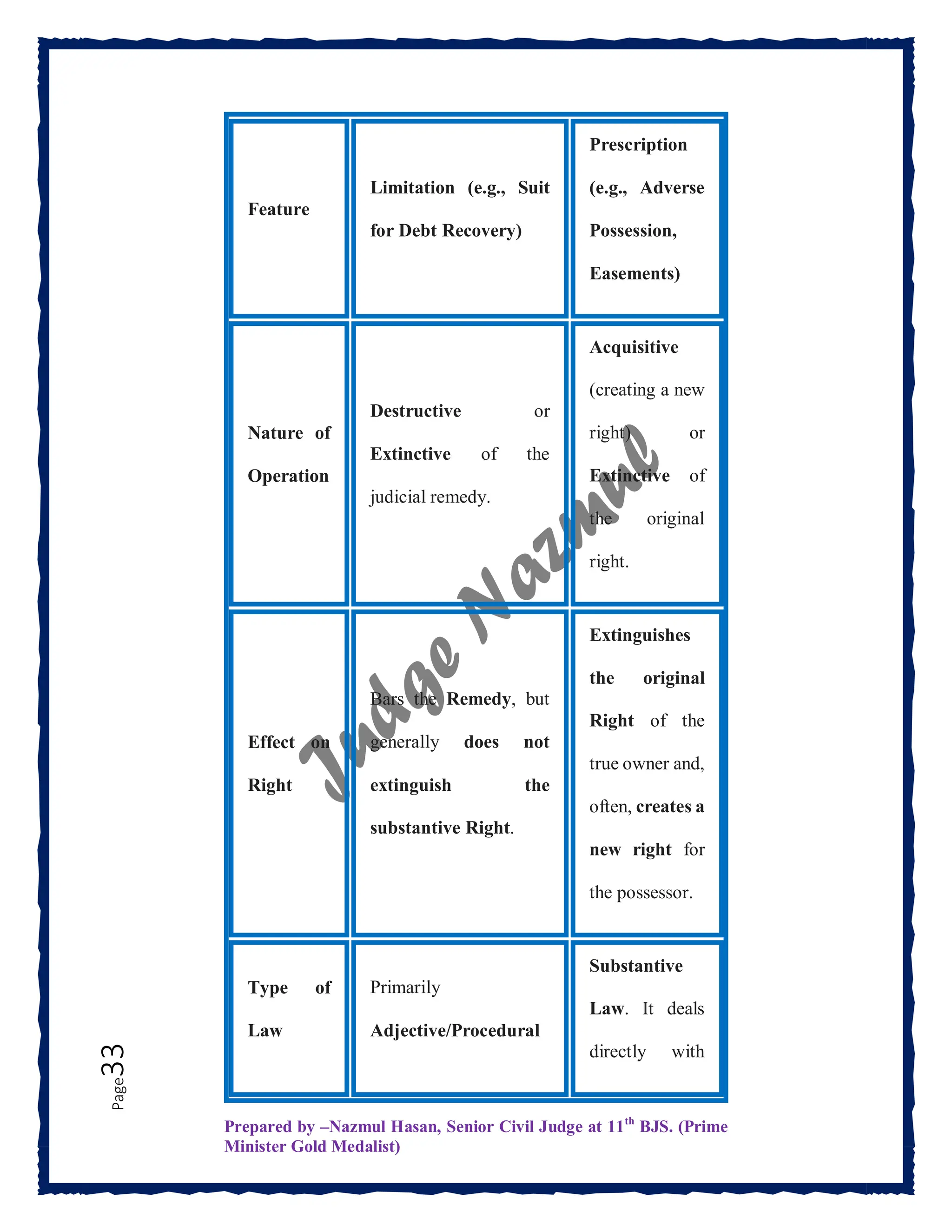
Feature
Limitation (e.g., Suit
for Debt Recovery)
Prescription
(e.g., Adverse
Possession,
Easements)
Nature of
Operation
Destructive or
Extinctive of the
judicial remedy.
Acquisitive
(creating a new
right) or
Extinctive of
the original
right.
Effect on
Right
Bars the Remedy, but
generally does not
extinguish the
substantive Right.
Extinguishes
the original
Right of the
true owner and,
often, creates a
new right for
the possessor.
Type of
Law
Primarily
Adjective/Procedural
Substantive
Law. It deals
directly with
Prepared by –Nazmul Hasan, Senior Civil Judge at 11th
BJS. (Prime
Minister Gold Medalist)
Page
34
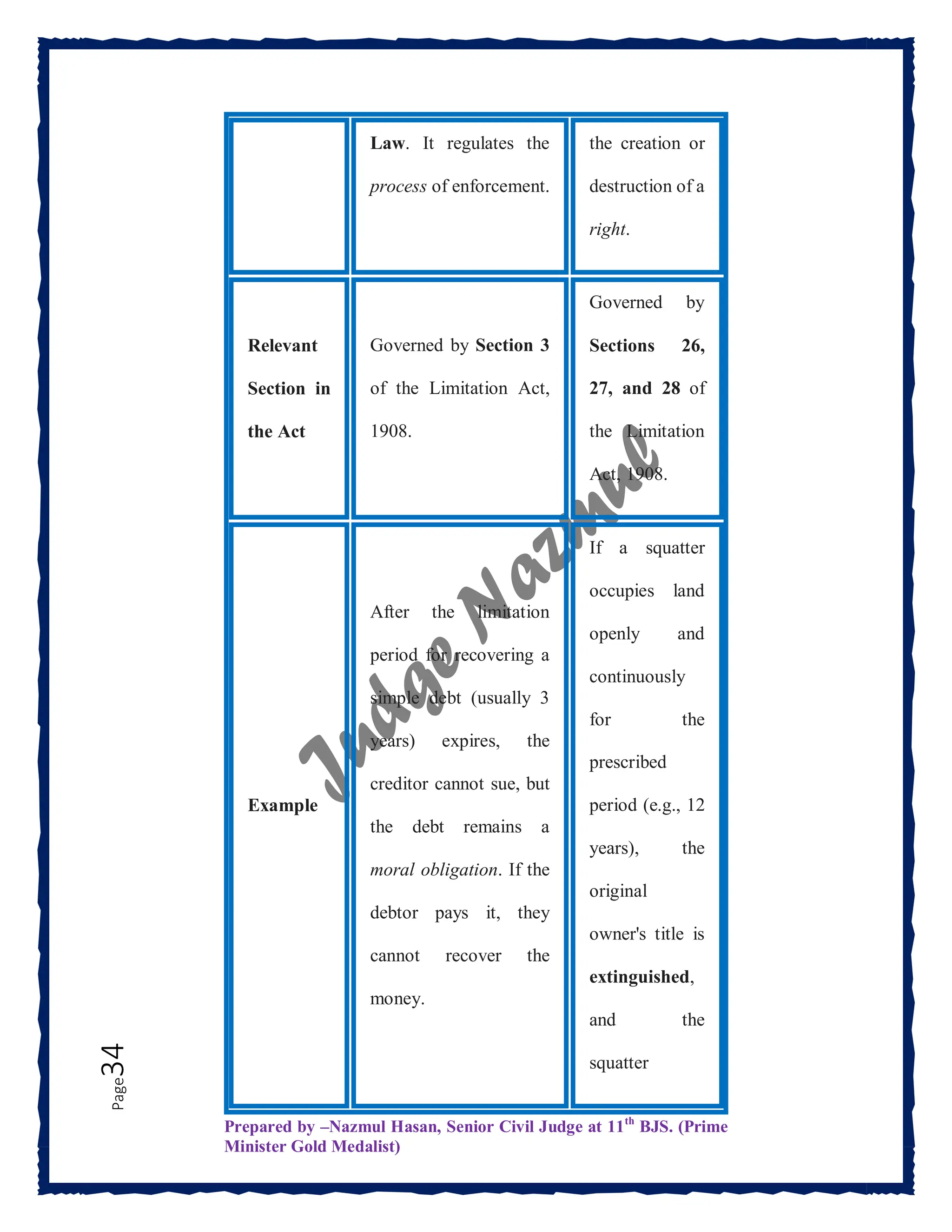
Law. It regulates the
process of enforcement.
the creation or
destruction of a
right.
Relevant
Section in
the Act
Governed by Section 3
of the Limitation Act,
1908.
Governed by
Sections 26,
27, and 28 of
the Limitation
Act, 1908.
Example
After the limitation
period for recovering a
simple debt (usually 3
years) expires, the
creditor cannot sue, but
the debt remains a
moral obligation. If the
debtor pays it, they
cannot recover the
money.
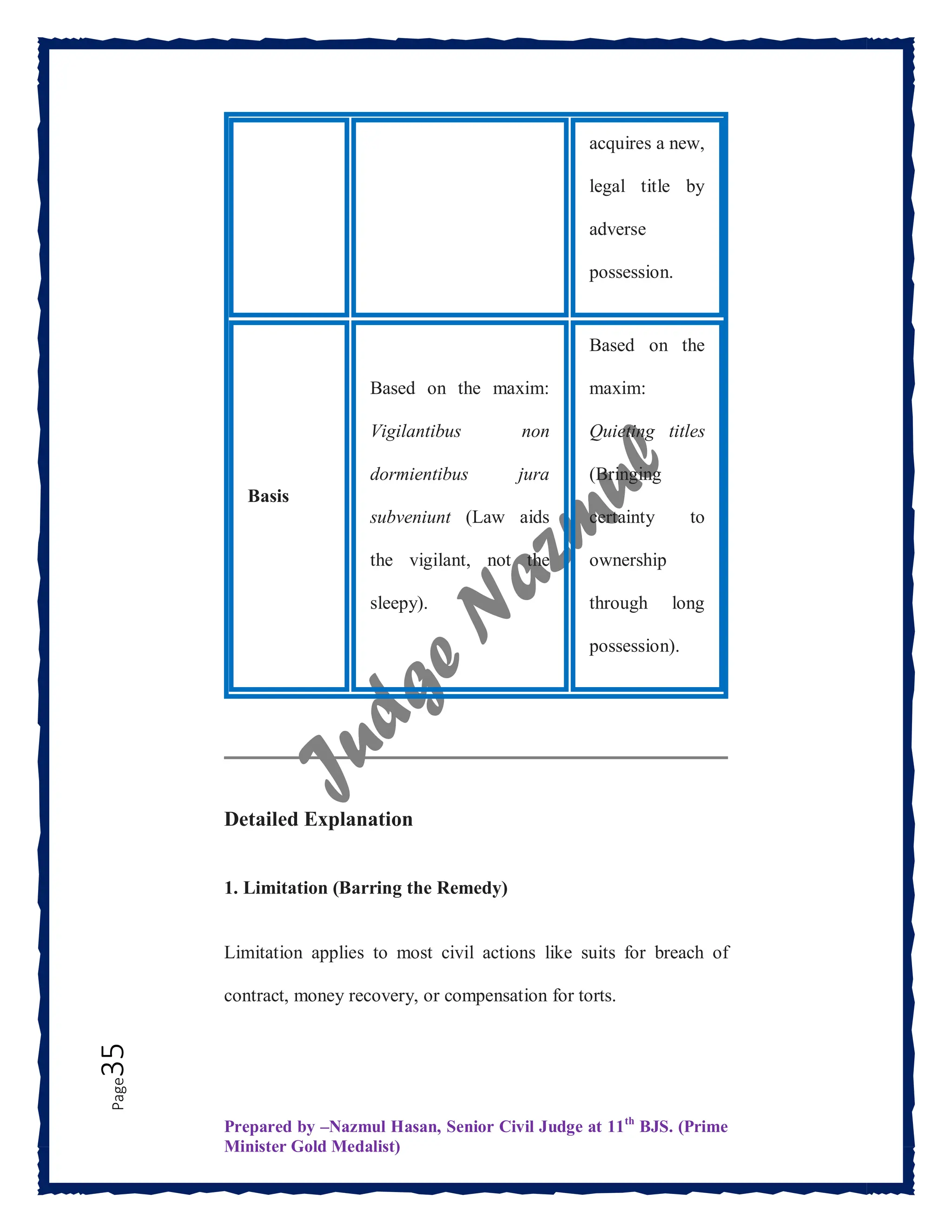
If a squatter
occupies land
openly and
continuously
for the
prescribed
period (e.g., 12
years), the
original
owner's title is
extinguished,
and the
squatter
Prepared by –Nazmul Hasan, Senior Civil Judge at 11th
BJS. (Prime
Minister Gold Medalist)
Page
35
Detailed Explanation
1. Limitation (Barring the Remedy)
Limitation applies to most civil actions like suits for breach of
contract, money recovery, or compensation for torts.
acquires a new,
legal title by
adverse
possession.
Basis
Based on the maxim:
Vigilantibus non
dormientibus jura
subveniunt (Law aids
the vigilant, not the
sleepy).
Based on the
maxim:
Quieting titles
(Bringing
certainty to
ownership
through long
possession).
Prepared by –Nazmul Hasan, Senior Civil Judge at 11th
BJS. (Prime
Minister Gold Medalist)
Page
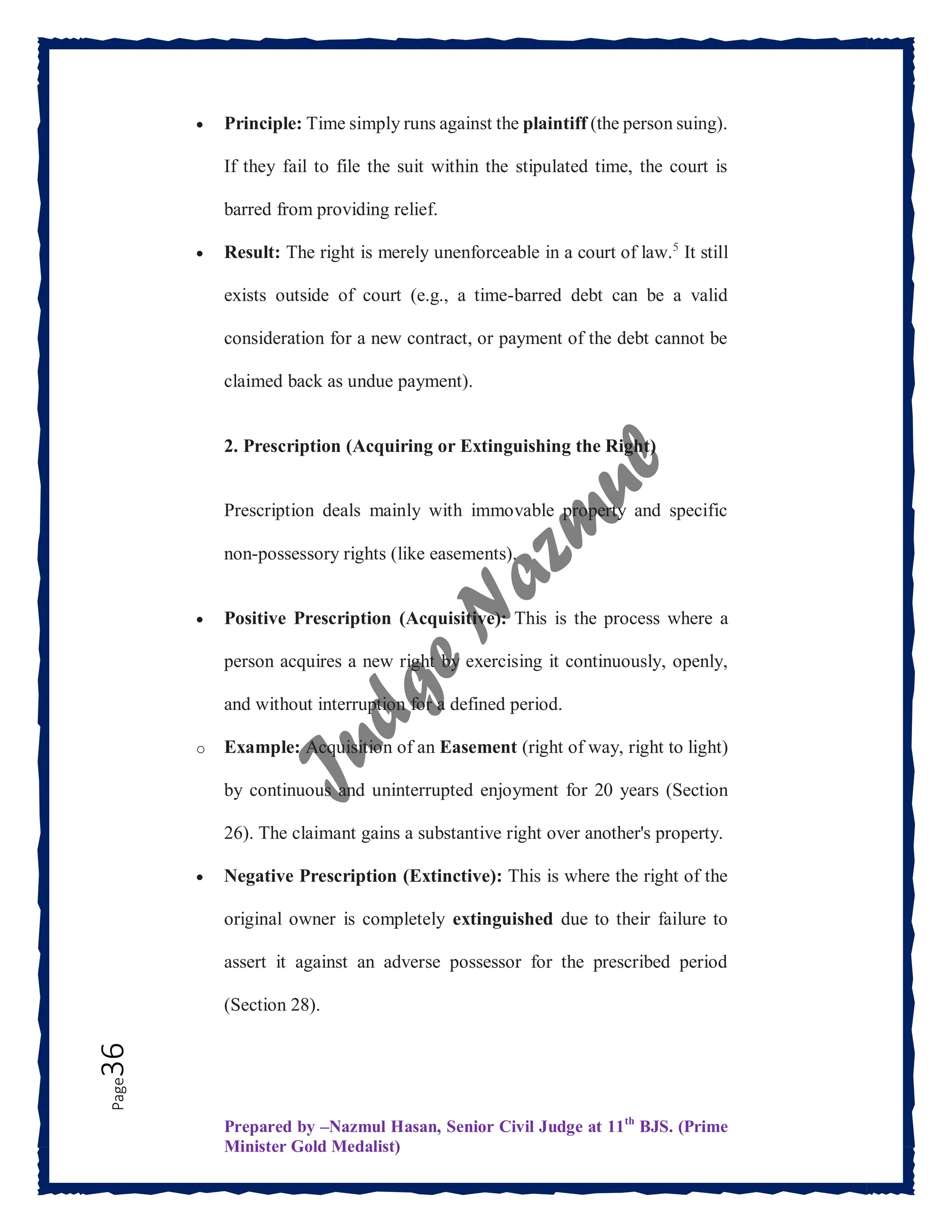
36  Principle: Time simply runs against the plaintiff (the person suing).
If they fail to file the suit within the stipulated time, the court is
barred from providing relief.
 Result: The right is merely unenforceable in a court of law.5
It still
exists outside of court (e.g., a time-barred debt can be a valid
consideration for a new contract, or payment of the debt cannot be
claimed back as undue payment).
2. Prescription (Acquiring or Extinguishing the Right)
Prescription deals mainly with immovable property and specific
non-possessory rights (like easements).
 Positive Prescription (Acquisitive): This is the process where a
person acquires a new right by exercising it continuously, openly,
and without interruption for a defined period.
o Example: Acquisition of an Easement (right of way, right to light)
by continuous and uninterrupted enjoyment for 20 years (Section
26). The claimant gains a substantive right over another's property.
 Negative Prescription (Extinctive): This is where the right of the
original owner is completely extinguished due to their failure to
assert it against an adverse possessor for the prescribed period
(Section 28).
Prepared by –Nazmul Hasan, Senior Civil Judge at 11th
BJS. (Prime
Minister Gold Medalist)
Page
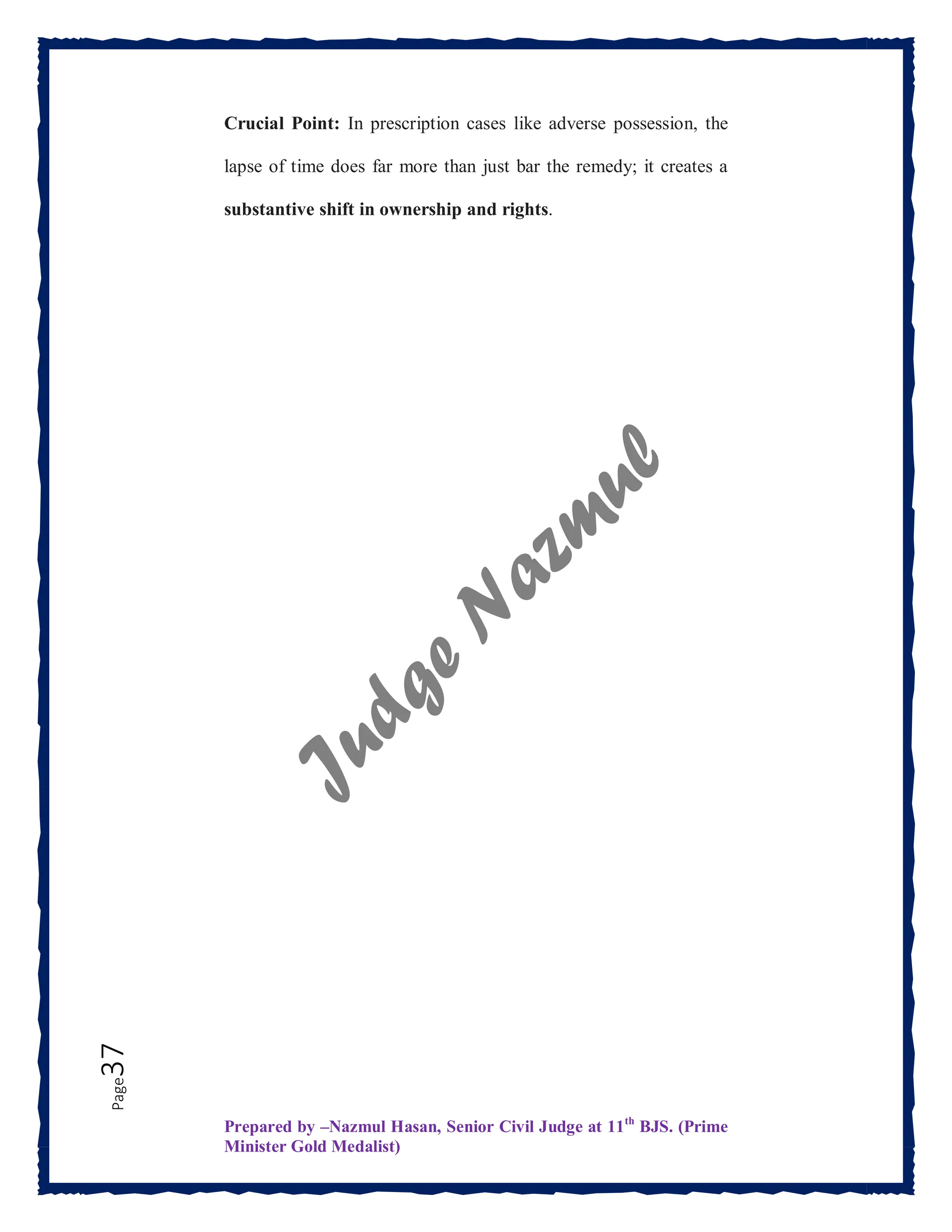
37 Crucial Point: In prescription cases like adverse possession, the
lapse of time does far more than just bar the remedy; it creates a
substantive shift in ownership and rights.
Prepared by –Nazmul Hasan, Senior Civil Judge at 11th
BJS. (Prime
Minister Gold Medalist)
Page
38
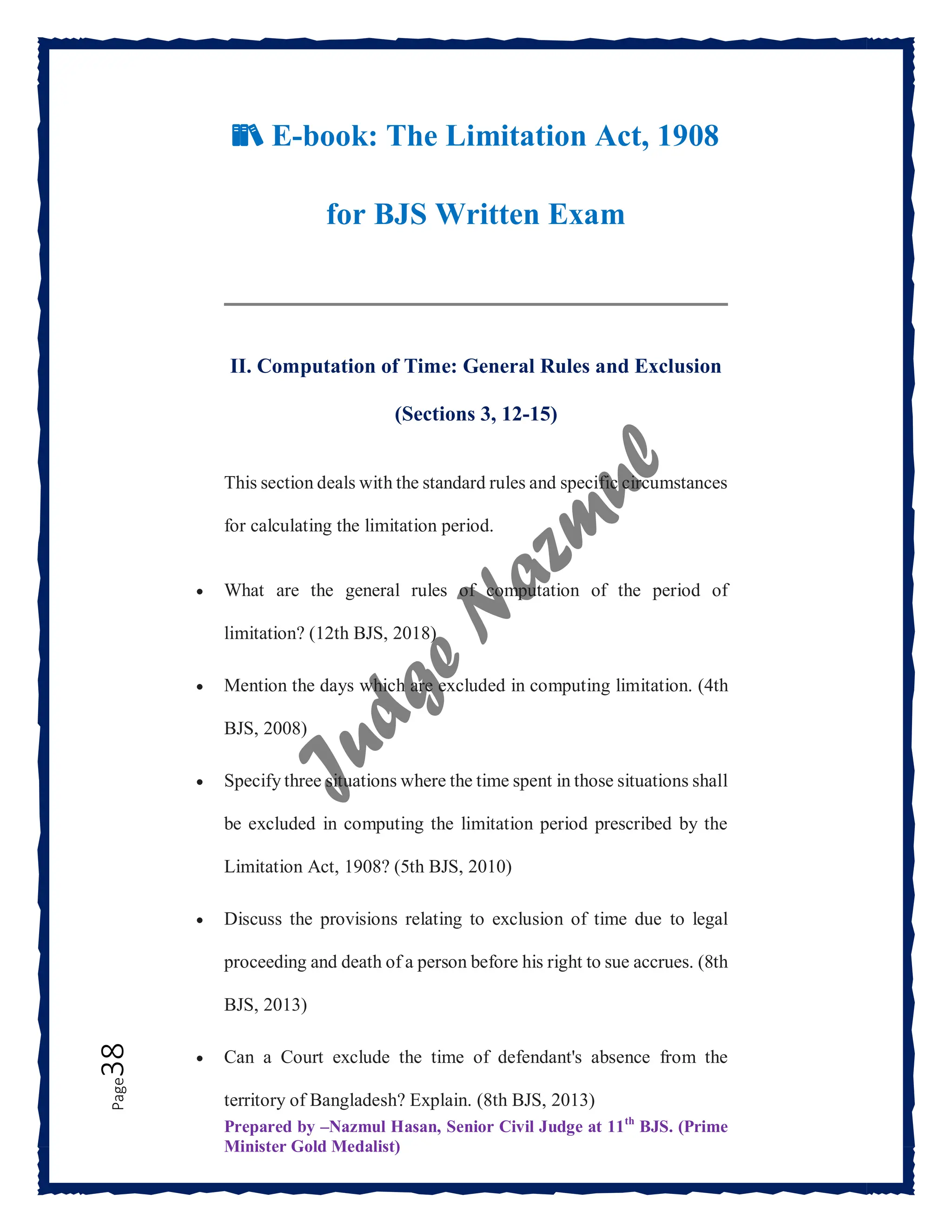
📚 E-book: The Limitation Act, 1908
for BJS Written Exam
II. Computation of Time: General Rules and Exclusion
(Sections 3, 12-15)
This section deals with the standard rules and specific circumstances
for calculating the limitation period.
 What are the general rules of computation of the period of
limitation? (12th BJS, 2018)
 Mention the days which are excluded in computing limitation. (4th
BJS, 2008)
 Specify three situations where the time spent in those situations shall
be excluded in computing the limitation period prescribed by the
Limitation Act, 1908? (5th BJS, 2010)
 Discuss the provisions relating to exclusion of time due to legal
proceeding and death of a person before his right to sue accrues. (8th
BJS, 2013)
 Can a Court exclude the time of defendant's absence from the
territory of Bangladesh? Explain. (8th BJS, 2013)
Prepared by –Nazmul Hasan, Senior Civil Judge at 11th
BJS. (Prime
Minister Gold Medalist)
Page
39  What are the rules for computation of limitation by exclusion of time
in the following cases: (9th BJS, 2014)
o Legal proceedings
o When the proceeding are suspended
o When the plaintiff bonafide prosecuting a civil proceeding without
jurisdiction.
 Writ down the basic differences between sections 5 and 14 of the
Limitation Act, 1908. (15th BJS, 2022)
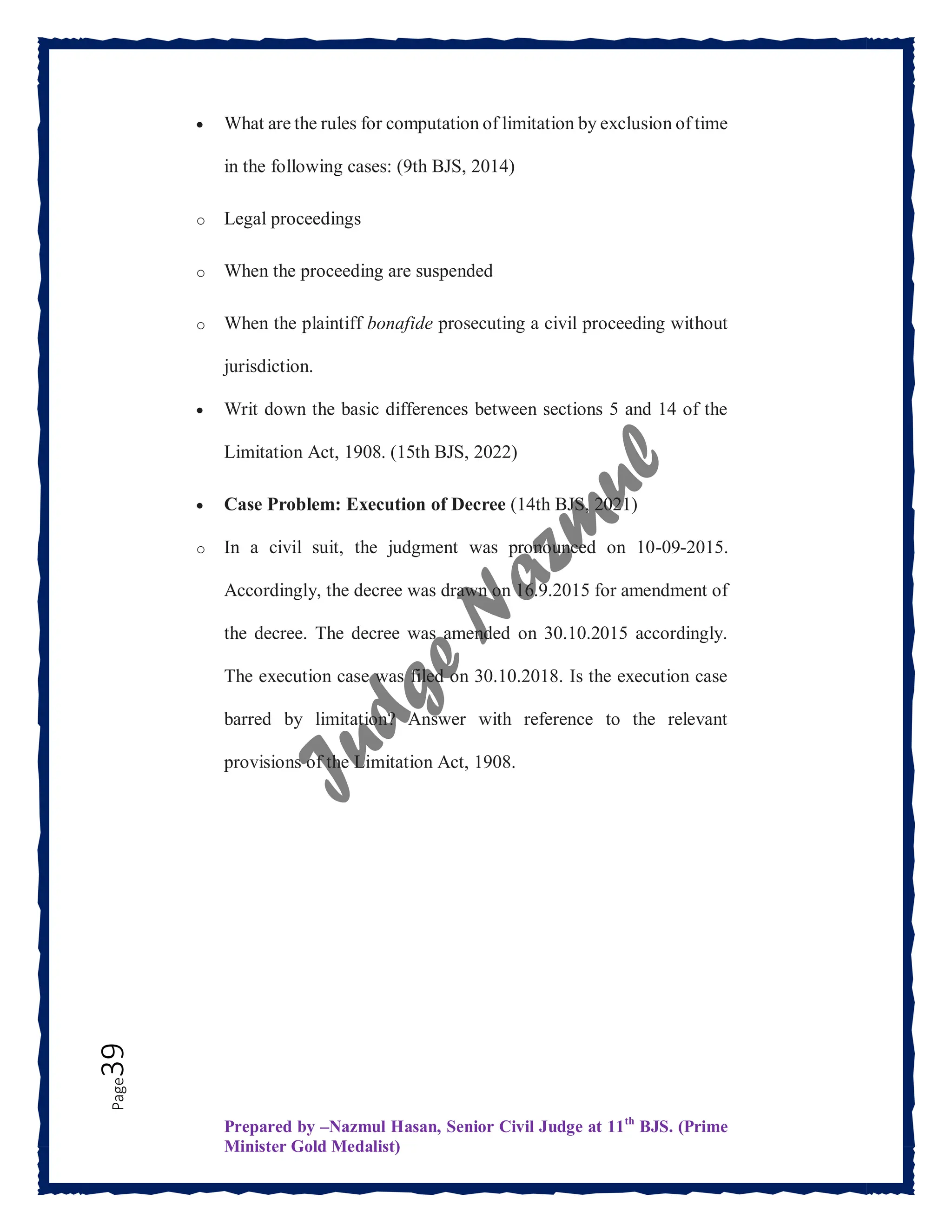
 Case Problem: Execution of Decree (14th BJS, 2021)
o In a civil suit, the judgment was pronounced on 10-09-2015.
Accordingly, the decree was drawn on 16.9.2015 for amendment of
the decree. The decree was amended on 30.10.2015 accordingly.
The execution case was filed on 30.10.2018. Is the execution case
barred by limitation? Answer with reference to the relevant
provisions of the Limitation Act, 1908.
Prepared by –Nazmul Hasan, Senior Civil Judge at 11th
BJS. (Prime
Minister Gold Medalist)
Page
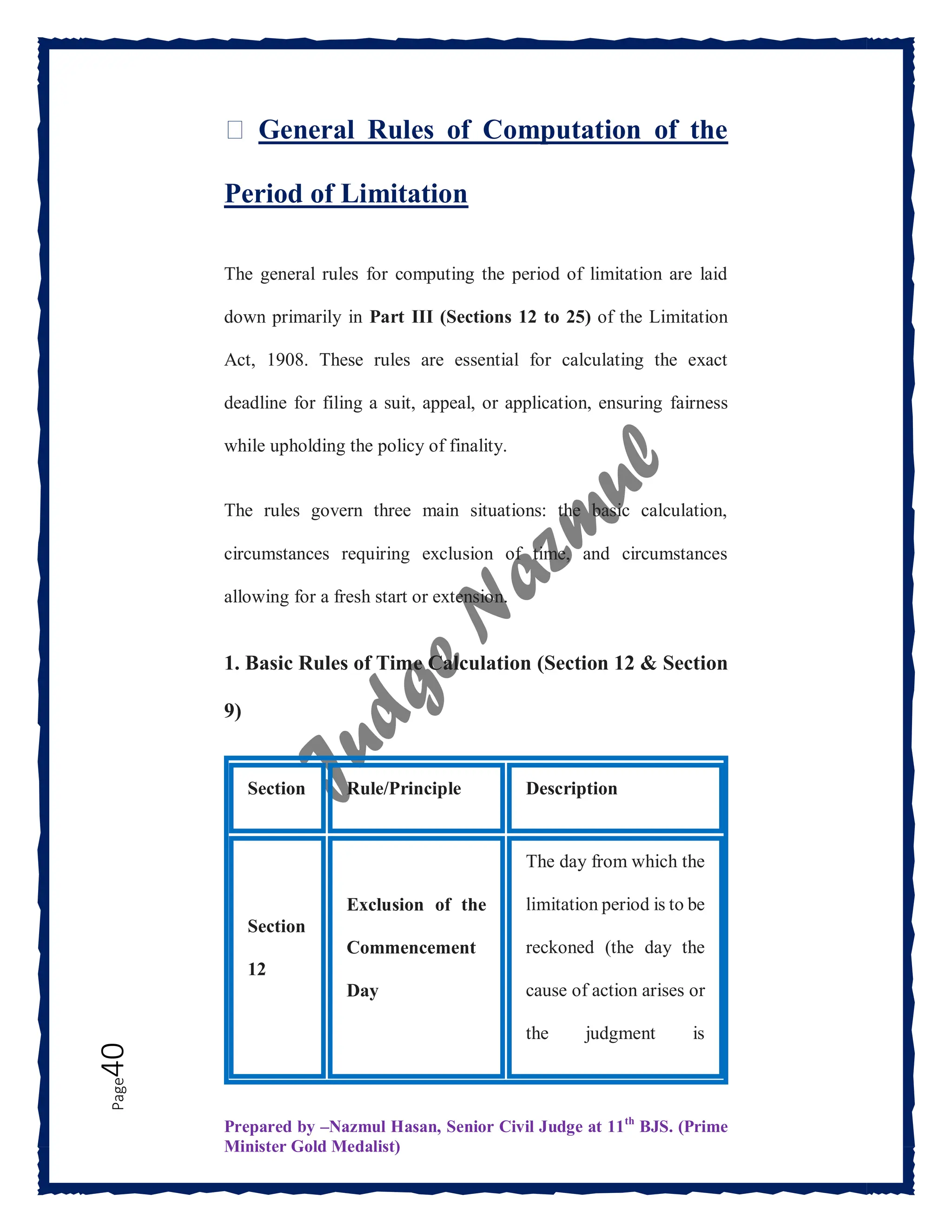
40 ⏳ General Rules of Computation of the
Period of Limitation
The general rules for computing the period of limitation are laid
down primarily in Part III (Sections 12 to 25) of the Limitation
Act, 1908. These rules are essential for calculating the exact
deadline for filing a suit, appeal, or application, ensuring fairness
while upholding the policy of finality.
The rules govern three main situations: the basic calculation,
circumstances requiring exclusion of time, and circumstances
allowing for a fresh start or extension.
1. Basic Rules of Time Calculation (Section 12 & Section
9)
Section Rule/Principle Description
Section
12
Exclusion of the
Commencement
Day
The day from which the
limitation period is to be
reckoned (the day the
cause of action arises or
the judgment is
Prepared by –Nazmul Hasan, Senior Civil Judge at 11th
BJS. (Prime
Minister Gold Medalist)
Page
41
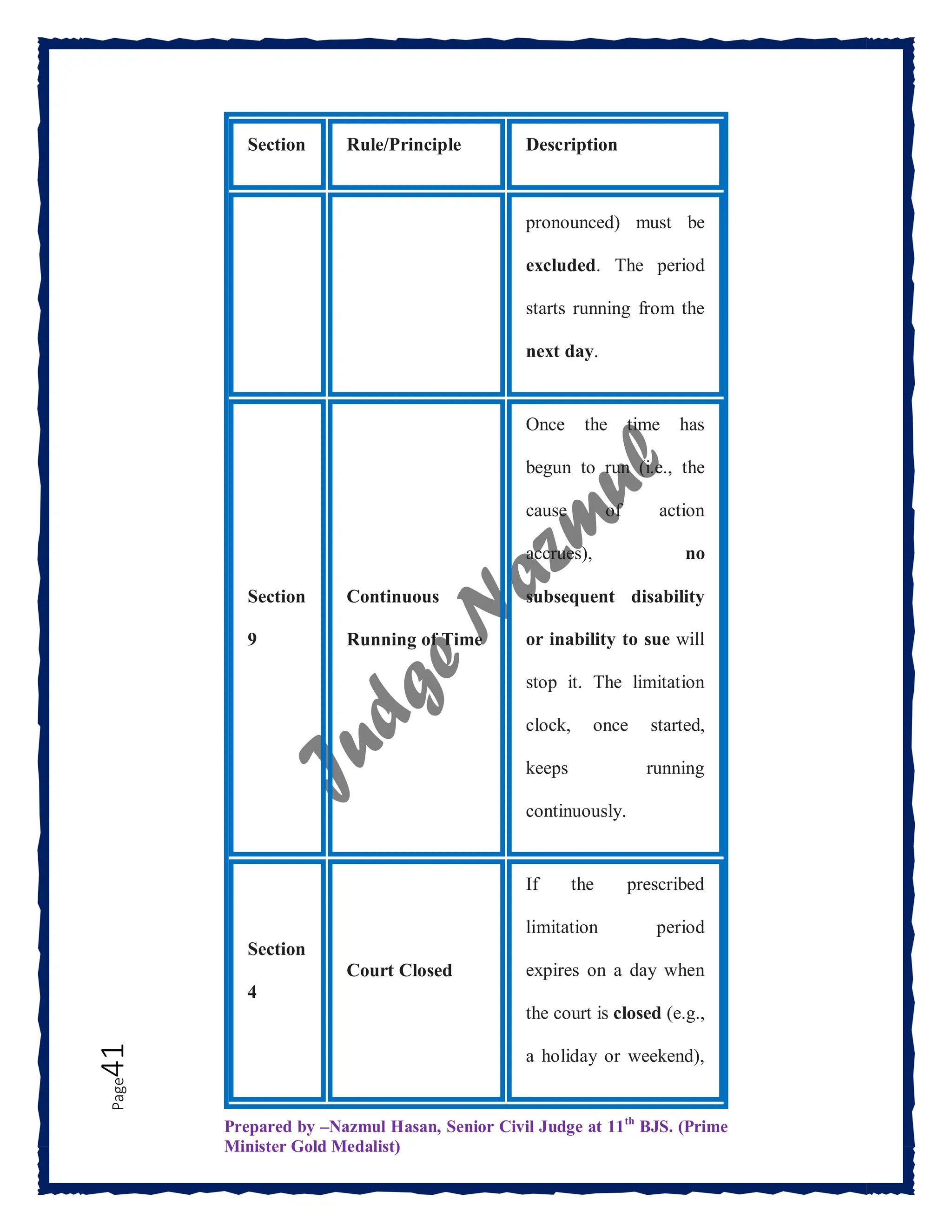
Section Rule/Principle Description
pronounced) must be
excluded. The period
starts running from the
next day.
Section
9
Continuous
Running of Time
Once the time has
begun to run (i.e., the
cause of action
accrues), no
subsequent disability
or inability to sue will
stop it. The limitation
clock, once started,
keeps running
continuously.
Section
4
Court Closed
If the prescribed
limitation period
expires on a day when
the court is closed (e.g.,
a holiday or weekend),
Prepared by –Nazmul Hasan, Senior Civil Judge at 11th
BJS. (Prime
Minister Gold Medalist)
Page
42
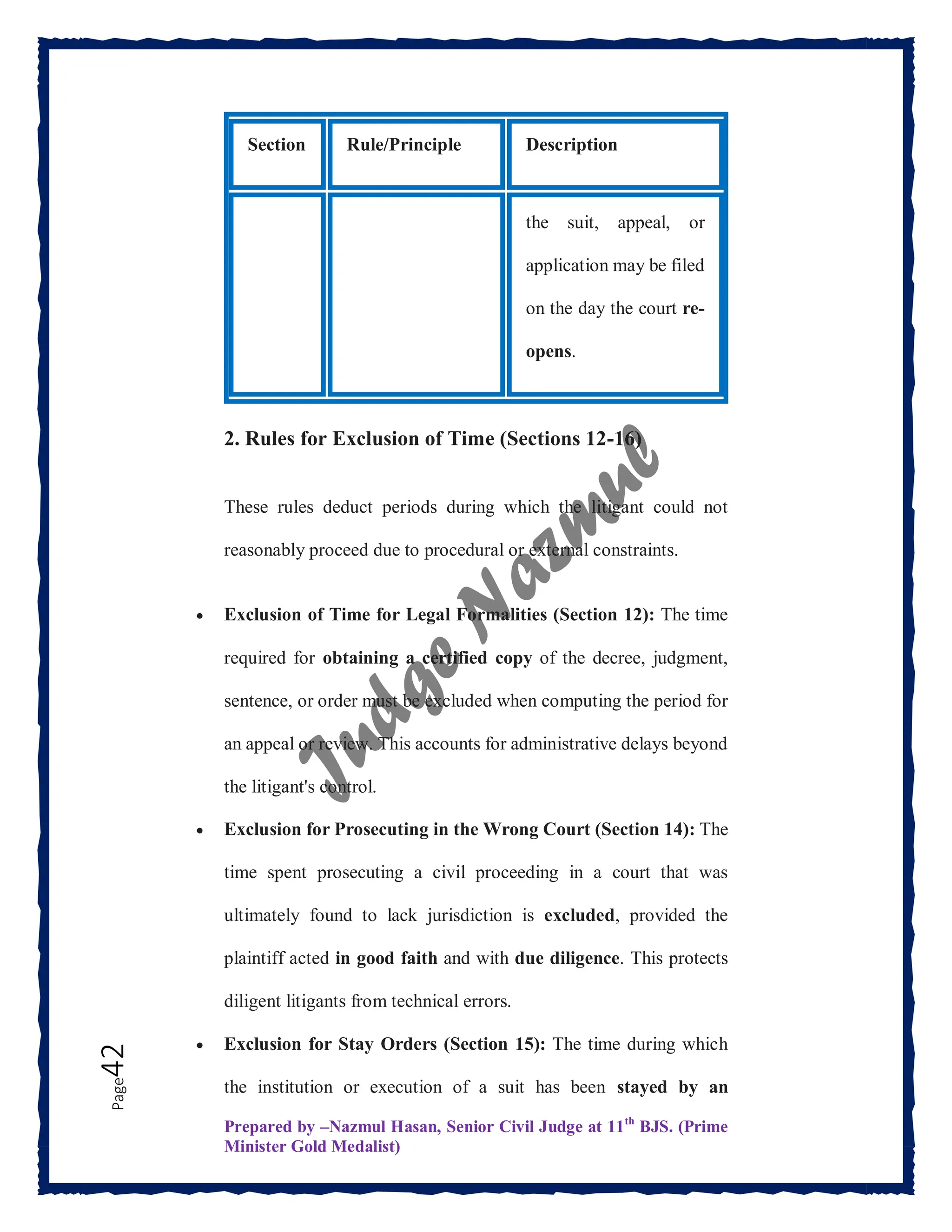
Section Rule/Principle Description
the suit, appeal, or
application may be filed
on the day the court re-
opens.
2. Rules for Exclusion of Time (Sections 12-16)
These rules deduct periods during which the litigant could not
reasonably proceed due to procedural or external constraints.
 Exclusion of Time for Legal Formalities (Section 12): The time
required for obtaining a certified copy of the decree, judgment,
sentence, or order must be excluded when computing the period for
an appeal or review. This accounts for administrative delays beyond
the litigant's control.
 Exclusion for Prosecuting in the Wrong Court (Section 14): The
time spent prosecuting a civil proceeding in a court that was
ultimately found to lack jurisdiction is excluded, provided the
plaintiff acted in good faith and with due diligence. This protects
diligent litigants from technical errors.
 Exclusion for Stay Orders (Section 15): The time during which
the institution or execution of a suit has been stayed by an
Prepared by –Nazmul Hasan, Senior Civil Judge at 11th
BJS. (Prime
Minister Gold Medalist)
Page
43 injunction or order of a court must be excluded. Similarly, the
period required for a statutory notice (e.g., notice to the
government) is excluded.
 Exclusion for Defendant's Absence (Section 13): The time during
which the defendant has been absent from the country is excluded
when calculating the limitation period for any suit against them.
3. Rules for Extension and Fresh Commencement
(Sections 6, 18-20)
These rules allow the limitation period to be extended or to restart
entirely based on the condition of the parties or their actions.
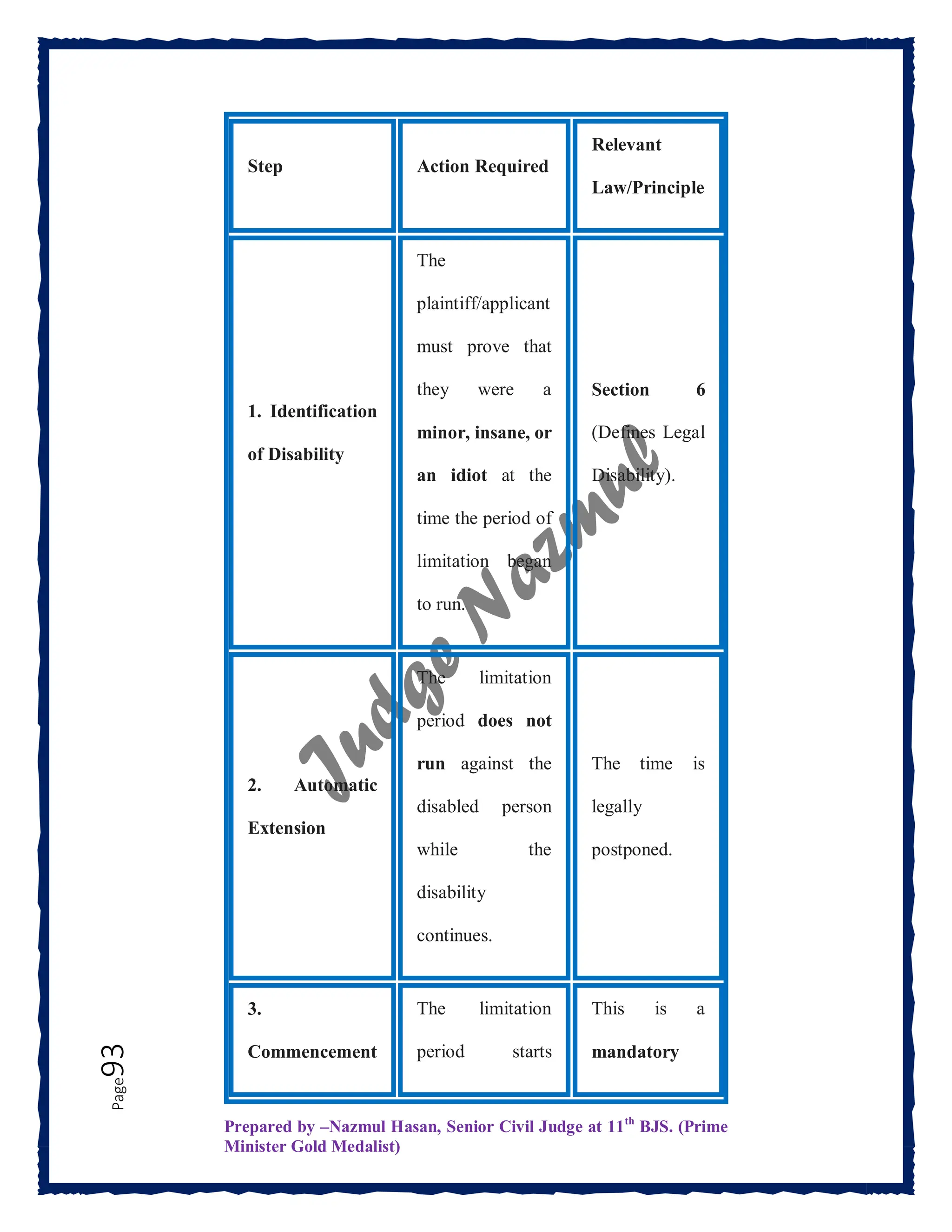
 Legal Disability (Section 6): If the person entitled to sue is a minor,
insane, or an idiot when the cause of action arises, the limitation
period starts running only after the disability ceases. This ensures
that vulnerable persons are not deprived of their rights.
 Effect of Fraud (Section 18): If the defendant has committed fraud
or has concealed the right to sue, the limitation period does not
begin to run until the plaintiff first discovers the fraud or first had
the means of discovering the concealed fact.
 Acknowledgement in Writing (Section 19): If a person liable for
a property or debt makes a signed acknowledgement of that
liability before the limitation period expires, a fresh period of
Prepared by –Nazmul Hasan, Senior Civil Judge at 11th
BJS. (Prime
Minister Gold Medalist)
Page
44 limitation shall be computed from the date of the
acknowledgement.
 Effect of Payment (Section 20): A fresh period of limitation is
computed from the time a payment is made on account of a debt or
of interest, provided the payment is made by the person liable before
the limitation period has expired.
Understanding how time is computed is essential for every litigant
and lawyer to ensure that an otherwise valid claim is not summarily
dismissed under Section 3 as being time-barred.
🗓️ Days Excluded in Computing
Limitation
The Limitation Act, 1908, provides specific rules for the exclusion
of time (deducting certain days from the total limitation period) to
ensure that a vigilant litigant is not penalised for delays beyond their
control or due to legal necessities.
The days/periods that are typically excluded when computing the
period of limitation are primarily covered under Sections 12
through 16 of the Act:
1. Exclusion of the First Day (Section 12(1))
Prepared by –Nazmul Hasan, Senior Civil Judge at 11th
BJS. (Prime
Minister Gold Medalist)
Page
45  The day from which the period is to be reckoned shall be
excluded.
o Meaning: The day the cause of action arises, or the day the
judgment/decree is signed, is not counted. The limitation period
begins on the very next day.
2. Exclusion for Legal Formalities (Section 12(2) & (3))
 The time requisite for obtaining a copy of the decree, sentence, or
order appealed from or sought to be revised/reviewed.
 The time requisite for obtaining a copy of the judgment on which
the decree or order is founded.
3. Exclusion for Court Closure (Section 4)
 If the period of limitation expires on a day when the Court
is closed (e.g., a holiday, weekend, or vacation), that day is
excluded.
o Action: The suit, appeal, or application may be
instituted on the day the Court re-opens.
4. Exclusion for Legal Obstruction/Stay (Section 15)
 The time during which the institution or execution of the
suit/application has been stayed by an injunction or order
of a court.
Prepared by –Nazmul Hasan, Senior Civil Judge at 11th
BJS. (Prime
Minister Gold Medalist)
Page
46  The time required for giving mandatory notice or
obtaining the required sanction/consent before instituting a
suit (e.g., statutory notice to the government).
5. Exclusion for Wrong Court (Section 14)
 The time spent by the plaintiff in prosecuting a previous civil
proceeding relating to the same matter in a court that
lacked jurisdiction (or had a similar defect).
o Condition: This time is excluded only if the earlier
proceeding was prosecuted in good faith and with
due diligence.
6. Exclusion for the Defendant’s Absence (Section 13)
 The time during which the defendant has been absent from
Bangladesh is excluded when computing the limitation
period for any suit against them.
7. Exclusion for Insolvency Proceedings (Section 16)
 The time during which the plaintiff or defendant has been
pursuing insolvency proceedings is excluded under certain
circumstances where the suit is related to the proceedings.
Prepared by –Nazmul Hasan, Senior Civil Judge at 11th
BJS. (Prime
Minister Gold Medalist)
Page
47 These exclusions ensure that the rules of limitation serve as a shield
against delayed claims, not as a technical trap against diligent
litigants.
⏳ Three Situations Where Time is
Excluded in Computing Limitation
The Limitation Act, 1908, ensures that certain time periods are
excluded from the overall limitation calculation. This protects the
diligent litigant from losing their right to sue due to delays that are
either procedural or caused by factors beyond their control.
Here are three key situations (governed by Sections 12, 14, and 15)
where the time spent is excluded:
1. Time for Obtaining Certified Copies (Section 12)
This time is excluded when computing the period of limitation for
filing an appeal, a review, or an application for leave to appeal.
 Situation: The time required to procure a certified copy of the
decree, judgment, sentence, or order that is being appealed against.
 Reason for Exclusion: A party is legally required to attach a
certified copy of the judgment/decree when filing an appeal. The
Prepared by –Nazmul Hasan, Senior Civil Judge at 11th
BJS. (Prime
Minister Gold Medalist)
Page
48 time spent by the court administration in preparing this copy should
not be counted against the litigant.
2. Time Spent in a Wrong Court (Section 14)
This time is excluded when the plaintiff initiates a proceeding in
good faith but later discovers the court lacked the necessary
jurisdiction.
 Situation: The time during which the plaintiff was prosecuting a
civil proceeding in a court that was unable to entertain it due to a
defect of jurisdiction or a similar technical ground.
 Conditions: The exclusion is granted only if the plaintiff was acting
in good faith and with due diligence.
 Reason for Exclusion: The law should not penalize a diligent
litigant who makes a bona fide mistake regarding which court has
the power to hear the case.
3. Time Subject to a Stay Order (Section 15)
This time is excluded when a competent authority or court has
legally prohibited the filing of the suit or the execution of a decree.
 Situation: The time during which the institution of the suit or the
execution of the decree has been stayed by an injunction or order
of a court or authority.
Prepared by –Nazmul Hasan, Senior Civil Judge at 11th
BJS. (Prime
Minister Gold Medalist)
Page
49  Reason for Exclusion: It would be unjust to allow the limitation
clock to run while a litigant is legally prohibited from initiating or
continuing the action. The time during which the hands of the
litigant are tied by a court order must be deducted.
📜 Exclusion of Time: Legal Proceedings
and Death
The Limitation Act, 1908, provides specific provisions to exclude
time spent under certain unavoidable circumstances, ensuring that a
diligent party is not barred from remedy due to legal technicalities
or fate. The provisions relating to the exclusion of time due to legal
proceedings and the death of a person are detailed in Sections 14
and 16 respectively.
1. Exclusion Due to Legal Proceedings (Section 14)
Section 14 deals with the exclusion of time when a plaintiff pursues
a civil remedy in the wrong court. This provision aims to protect a
litigant acting in good faith.
A. Prosecution of Other Civil Proceedings (Section 14(1))
Prepared by –Nazmul Hasan, Senior Civil Judge at 11th
BJS. (Prime
Minister Gold Medalist)
Page
50 When computing the limitation period for any suit, the time during
which the plaintiff has been prosecuting with due diligence another
civil proceeding (in a court, first court of appeal, or court of
revision) shall be excluded, provided:
1. The Parties are the Same: The former and later proceedings relate
to the same matter.
2. Lack of Jurisdiction: The former proceeding was prosecuted in
good faith in a court which, from defect of jurisdiction or other
cause of a like nature, was unable to entertain it.
3. Due Diligence and Good Faith: The plaintiff acted with due
diligence and in good faith.
B. Execution Proceedings (Section 14(2))
When computing the limitation period for an application for the
execution of a decree, the time during which the applicant has been
prosecuting with due diligence another civil proceeding for the same
relief shall be excluded, provided the former proceeding was
frustrated due to lack of jurisdiction or a similar technical defect.
Policy Behind Section 14
The policy here is one of equity and fairness. The law does not
punish a litigant who is genuinely trying to seek justice but makes a
bona fide mistake about the court's jurisdiction. The time spent
Prepared by –Nazmul Hasan, Senior Civil Judge at 11th
BJS. (Prime
Minister Gold Medalist)
Page
51 battling a claim where the court had no legal power is essentially
wasted time and is, therefore, deducted from the limitation period.
2. Exclusion Due to Death Before Right to Sue Accrues
(Section 16)
Section 16 addresses the scenario where the death of the plaintiff or
the defendant occurs before the right to sue or be sued arises. This
section applies to cases where the cause of action is based on a
wrong independent of contract.
A. Death of a Person Who Should Sue
Where a person who would have been entitled to institute a suit or
make an application dies before the right accrues, the limitation
period shall not begin to run until there is a legal representative of
the deceased capable of instituting the suit or making the
application.
B. Death of a Person Who Should be Sued
Where a person against whom the right to institute a suit or make an
application would have accrued dies before the right accrues, the
limitation period shall not begin to run until there is a legal
Prepared by –Nazmul Hasan, Senior Civil Judge at 11th
BJS. (Prime
Minister Gold Medalist)
Page
52 representative of the deceased against whom the plaintiff may
institute or make the suit or application.
Difference from Section 6 and 9
 Section 6 (Legal Disability): Applies when the cause of action
accrues while the person is under disability (minor, insane, idiot).
 Section 9 (Continuous Running): States that once time begins to
run, no subsequent disability or inability stops it.
Section 16 is unique because it applies only when the death occurs
before the right to sue or be sued even comes into existence. It
ensures that the limitation clock remains dormant until a party exists
who can legally carry on the suit (either as plaintiff or defendant).
In summary: Section 14 protects the litigant from procedural
pitfalls, while Section 16 ensures that the limitation period does not
run when, due to death, there is no one legally competent to sue or
be sued.
Prepared by –Nazmul Hasan, Senior Civil Judge at 11th
BJS. (Prime
Minister Gold Medalist)
Page
53 Exclusion of Time for Defendant's
Absence from Bangladesh
Yes, a Court can exclude the time during which the defendant has
been absent from the territory of Bangladesh when computing the
period of limitation for a suit. This rule is explicitly provided under
Section 13 of the Limitation Act, 1908.
The Provision (Section 13)
Section 13, titled "Exclusion of time during absence of defendant
from Bangladesh," states that:
"In computing the period of limitation prescribed for any suit, the
time during which the defendant has been absent from Bangladesh
shall be excluded."
Explanation and Conditions
1. Applies Only to Suits
The exclusion under Section 13 applies only to suits and does not
apply to appeals or applications. The primary focus is on the right
of the plaintiff to initiate a lawsuit against the defendant.
2. Absence from Bangladesh
Prepared by –Nazmul Hasan, Senior Civil Judge at 11th
BJS. (Prime
Minister Gold Medalist)
Page
54 The defendant must be physically absent from the territory of
Bangladesh (where the Act is in force). It is not enough that the
defendant is merely hiding or has changed residence within the
country.
3. Automatic Exclusion
The exclusion is mandatory once the plaintiff proves the
defendant's absence. Unlike Section 5 (Condonation of Delay), the
court does not have to be satisfied that the plaintiff acted with due
diligence. The law simply recognizes that a defendant who is outside
the country is practically beyond the reach of the court's process
(like issuing a summons) for the purpose of the suit.
4. Time Starts Running Again
The limitation period that was paused during the defendant's
absence will start running again as soon as the defendant returns to
the territory of Bangladesh.
Policy Behind the Exclusion
The policy is one of basic fairness and practicality:
 To Preserve the Plaintiff's Right: The plaintiff cannot effectively
file a suit and serve legal process on a defendant who is abroad. If
the limitation period continued to run, the plaintiff would lose their
Prepared by –Nazmul Hasan, Senior Civil Judge at 11th
BJS. (Prime
Minister Gold Medalist)
Page
55 right to sue due to an event (the defendant's travel) they cannot
control.
 Preventing Evasion: Without this section, a defendant could easily
evade a legitimate lawsuit simply by leaving the country until the
limitation period expires, thereby defeating justice.
In summary: Section 13 is a statutory safeguard that ensures the
plaintiff gets the full limitation period to sue by automatically
excluding the time the defendant spends outside Bangladesh.
⏳ Rules for Exclusion of Time in Specific
Legal Situations
The Limitation Act, 1908, ensures that a party does not lose their
remedy due to delays that are either judicially mandated or caused
by a good-faith mistake. The rules for exclusion of time in the
scenarios you mentioned are governed mainly by Section 14 and
Section 15 of the Act.
1. Exclusion of Time When the Plaintiff Bonafide
Prosecuting a Civil Proceeding Without Jurisdiction
(Section 14)
Prepared by –Nazmul Hasan, Senior Civil Judge at 11th
BJS. (Prime
Minister Gold Medalist)
Page
56 This rule is designed to protect a diligent litigant who makes an
honest mistake about the proper court to file their case.
 Rule: The time during which the plaintiff (for a suit) or applicant
(for an application) has been prosecuting another civil proceeding,
relating to the same matter and against the same party, shall be
excluded from the period of limitation.
 Conditions for Exclusion:
1. Good Faith and Due Diligence: The plaintiff must have acted with
honesty (bona fide) and with proper care and attention (due
diligence).
2. Defect of Jurisdiction: The former court must have been unable to
entertain the proceeding due to a defect of jurisdiction or "other
cause of a like nature" (e.g., non-joinder of necessary parties,
misjoinder of causes of action).
 Policy: The law recognizes that a party should not be penalized for
an understandable legal error if they were genuinely trying to pursue
their claim.
2. Exclusion of Time When the Proceedings are
Suspended (Section 15)
This rule applies when the hands of the litigant are tied by an
external legal constraint, preventing them from proceeding.
Prepared by –Nazmul Hasan, Senior Civil Judge at 11th
BJS. (Prime
Minister Gold Medalist)
Page
57  Rule: In computing the period of limitation for any suit or
application for the execution of a decree, the time during which the
institution or execution of the suit/application has been stayed by
an injunction or order of a court shall be excluded.
 Duration of Exclusion: The period of exclusion includes the day
the order/injunction was issued and the day it was withdrawn.
 Exclusion for Statutory Notice: Additionally, the time required for
giving a mandatory notice (e.g., notice required by law before
suing the government) shall also be excluded when calculating the
limitation period for that suit.
 Policy: It would be unfair to let the limitation period run against a
party who is legally prohibited from acting. The clock stops when
the court's order or a statutory requirement suspends the ability to
proceed.
3. General Rule for Exclusion Due to Legal Proceedings
(Sections 12, 14, 15)
While "Legal Proceedings" is a broad category, the most common
exclusion rules related to ongoing legal action are:
 Time for Legal Copies (Section 12): The time required for
obtaining a certified copy of the decree, judgment, or order that is
being appealed against is excluded when computing the period for
an appeal or review.
Prepared by –Nazmul Hasan, Senior Civil Judge at 11th
BJS. (Prime
Minister Gold Medalist)
Page
58  Time in Wrong Court (Section 14): (As explained above) Time
spent in a court without jurisdiction is excluded.
 Time under Stay Order (Section 15): (As explained above) Time
during which the suit was legally suspended is excluded.
These sections, located in Part III (Computation of Period of
Limitation), work together to ensure that the time prescribed by the
Act is a true measure of the time available to the litigant, free from
procedural obstacles and mandatory delays.
⚖️ Key Differences Between Section 5 and
Section 14 of the Limitation Act, 1908
Section 5 and Section 14 are two crucial provisions that allow a
court to entertain legal proceedings filed after the standard limitation
period has expired. However, they operate on different principles
and apply to different types of proceedings.
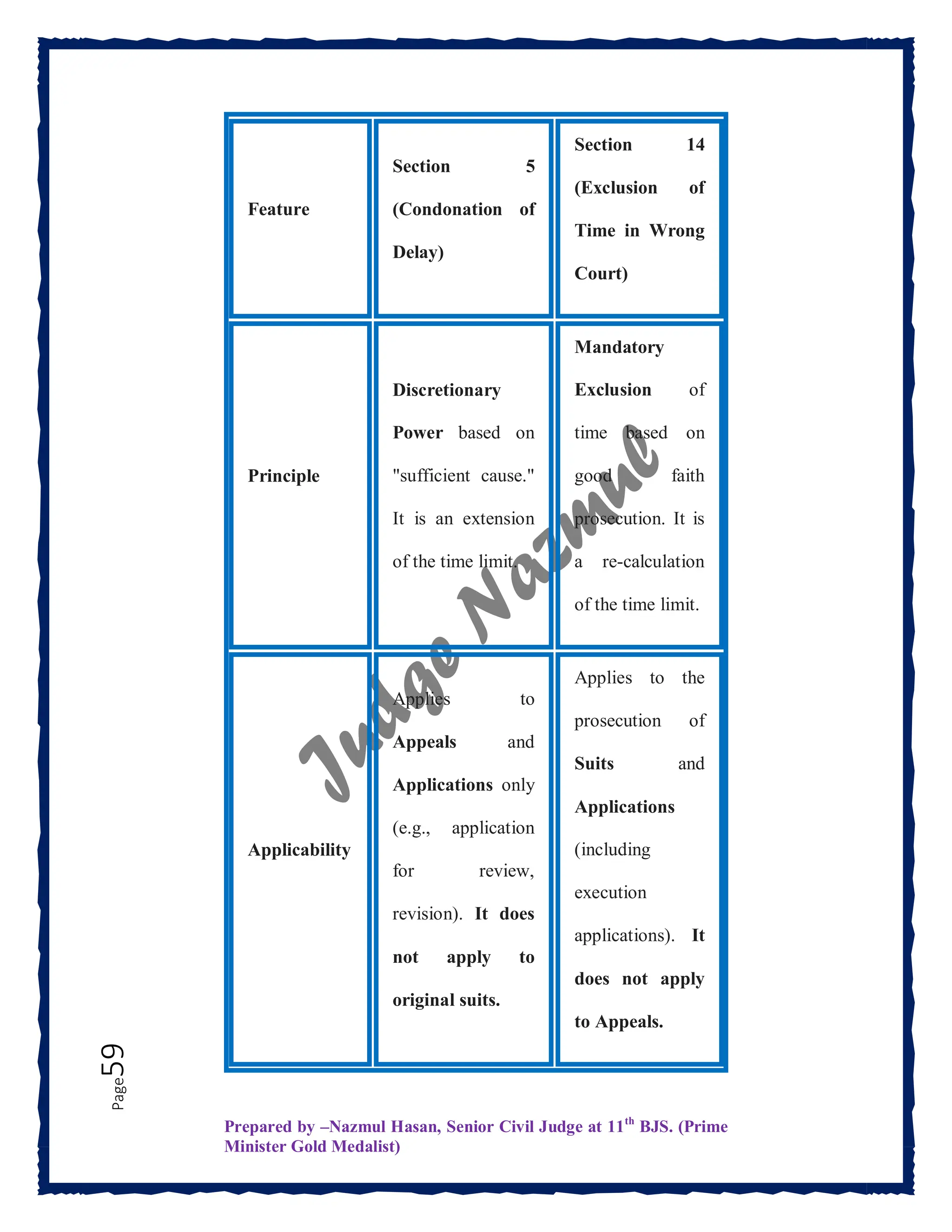
Here are the basic differences between them:
Prepared by –Nazmul Hasan, Senior Civil Judge at 11th
BJS. (Prime
Minister Gold Medalist)
Page
59
Feature
Section 5
(Condonation of
Delay)
Section 14
(Exclusion of
Time in Wrong
Court)
Principle
Discretionary
Power based on
"sufficient cause."
It is an extension
of the time limit.
Mandatory
Exclusion of
time based on
good faith
prosecution. It is
a re-calculation
of the time limit.
Applicability
Applies to
Appeals and
Applications only
(e.g., application
for review,
revision). It does
not apply to
original suits.
Applies to the
prosecution of
Suits and
Applications
(including
execution
applications). It
does not apply
to Appeals.
Prepared by –Nazmul Hasan, Senior Civil Judge at 11th
BJS. (Prime
Minister Gold Medalist)
Page
60
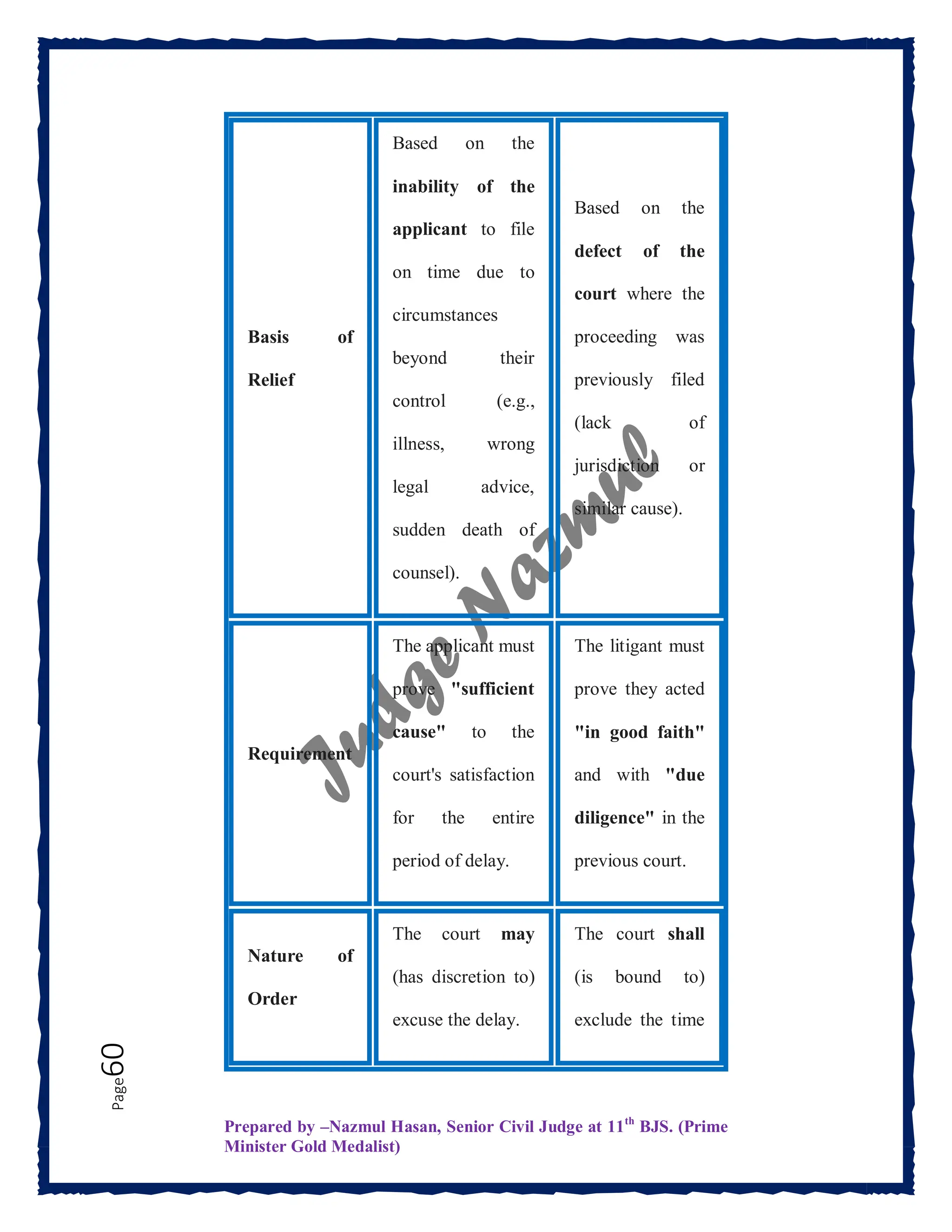
Basis of
Relief
Based on the
inability of the
applicant to file
on time due to
circumstances
beyond their
control (e.g.,
illness, wrong
legal advice,
sudden death of
counsel).
Based on the
defect of the
court where the
proceeding was
previously filed
(lack of
jurisdiction or
similar cause).
Requirement
The applicant must
prove "sufficient
cause" to the
court's satisfaction
for the entire
period of delay.
The litigant must
prove they acted
"in good faith"
and with "due
diligence" in the
previous court.
Nature of
Order
The court may
(has discretion to)
excuse the delay.
The court shall
(is bound to)
exclude the time
Prepared by –Nazmul Hasan, Senior Civil Judge at 11th
BJS. (Prime
Minister Gold Medalist)
Page
61
Summary of Function
 Section 5 asks the court to overlook a delay because the party was
prevented by a genuine and unavoidable inability. It is an appeal to
the court's mercy and discretion.
 Section 14 asks the court to recognize a time period that was
essentially wasted due to a genuine legal technicality (jurisdiction)
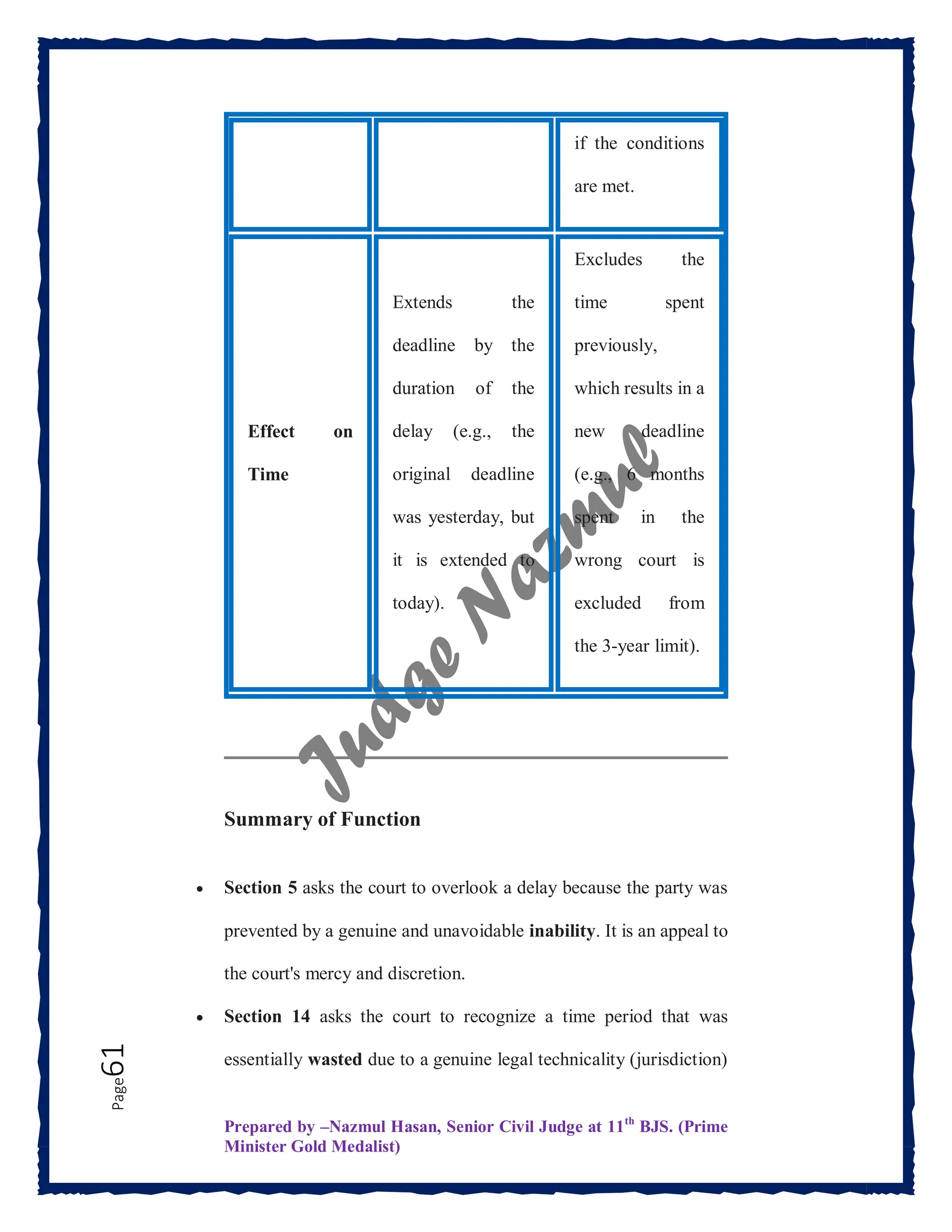
if the conditions
are met.
Effect on
Time
Extends the
deadline by the
duration of the
delay (e.g., the
original deadline
was yesterday, but
it is extended to
today).
Excludes the
time spent
previously,
which results in a
new deadline
(e.g., 6 months
spent in the
wrong court is
excluded from
the 3-year limit).
Prepared by –Nazmul Hasan, Senior Civil Judge at 11th
BJS. (Prime
Minister Gold Medalist)
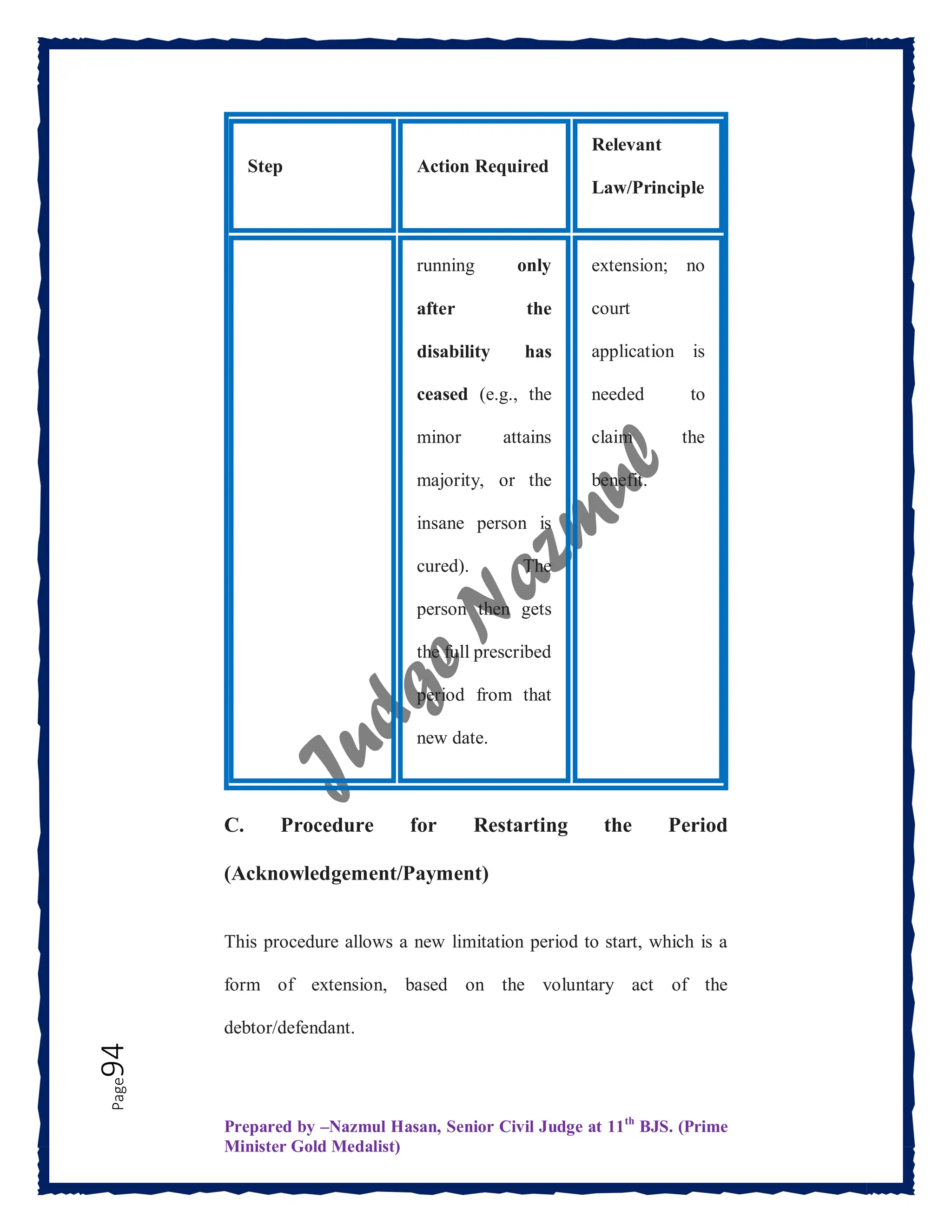
Page
62 and, therefore, exclude that wasted time from the total limitation
period. It is a right the diligent litigant can claim.
Prepared by –Nazmul Hasan, Senior Civil Judge at 11th
BJS. (Prime
Minister Gold Medalist)
Page
63
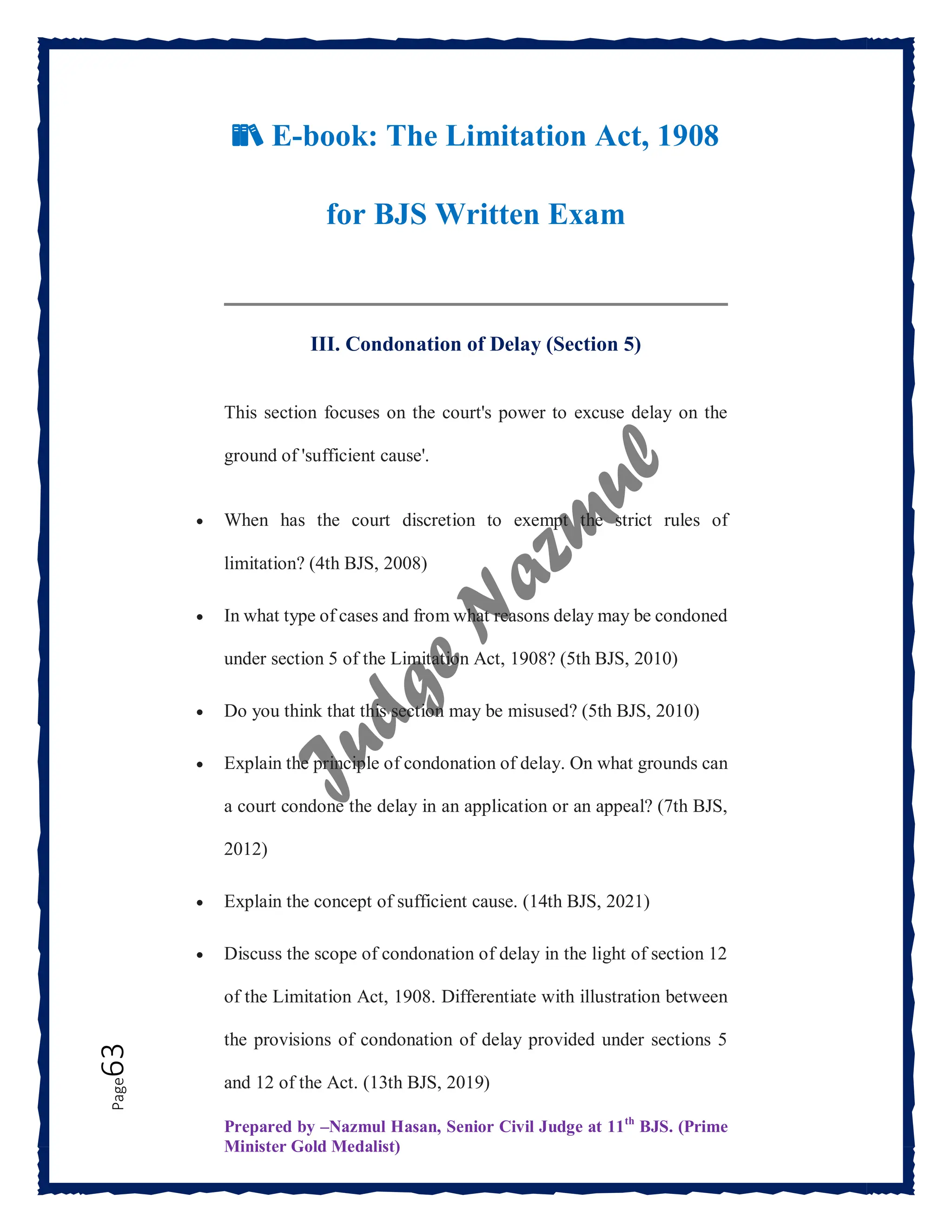
📚 E-book: The Limitation Act, 1908
for BJS Written Exam
III. Condonation of Delay (Section 5)
This section focuses on the court's power to excuse delay on the
ground of 'sufficient cause'.
 When has the court discretion to exempt the strict rules of
limitation? (4th BJS, 2008)
 In what type of cases and from what reasons delay may be condoned
under section 5 of the Limitation Act, 1908? (5th BJS, 2010)
 Do you think that this section may be misused? (5th BJS, 2010)
 Explain the principle of condonation of delay. On what grounds can
a court condone the delay in an application or an appeal? (7th BJS,
2012)
 Explain the concept of sufficient cause. (14th BJS, 2021)
 Discuss the scope of condonation of delay in the light of section 12
of the Limitation Act, 1908. Differentiate with illustration between
the provisions of condonation of delay provided under sections 5
and 12 of the Act. (13th BJS, 2019)
Prepared by –Nazmul Hasan, Senior Civil Judge at 11th
BJS. (Prime
Minister Gold Medalist)
Page
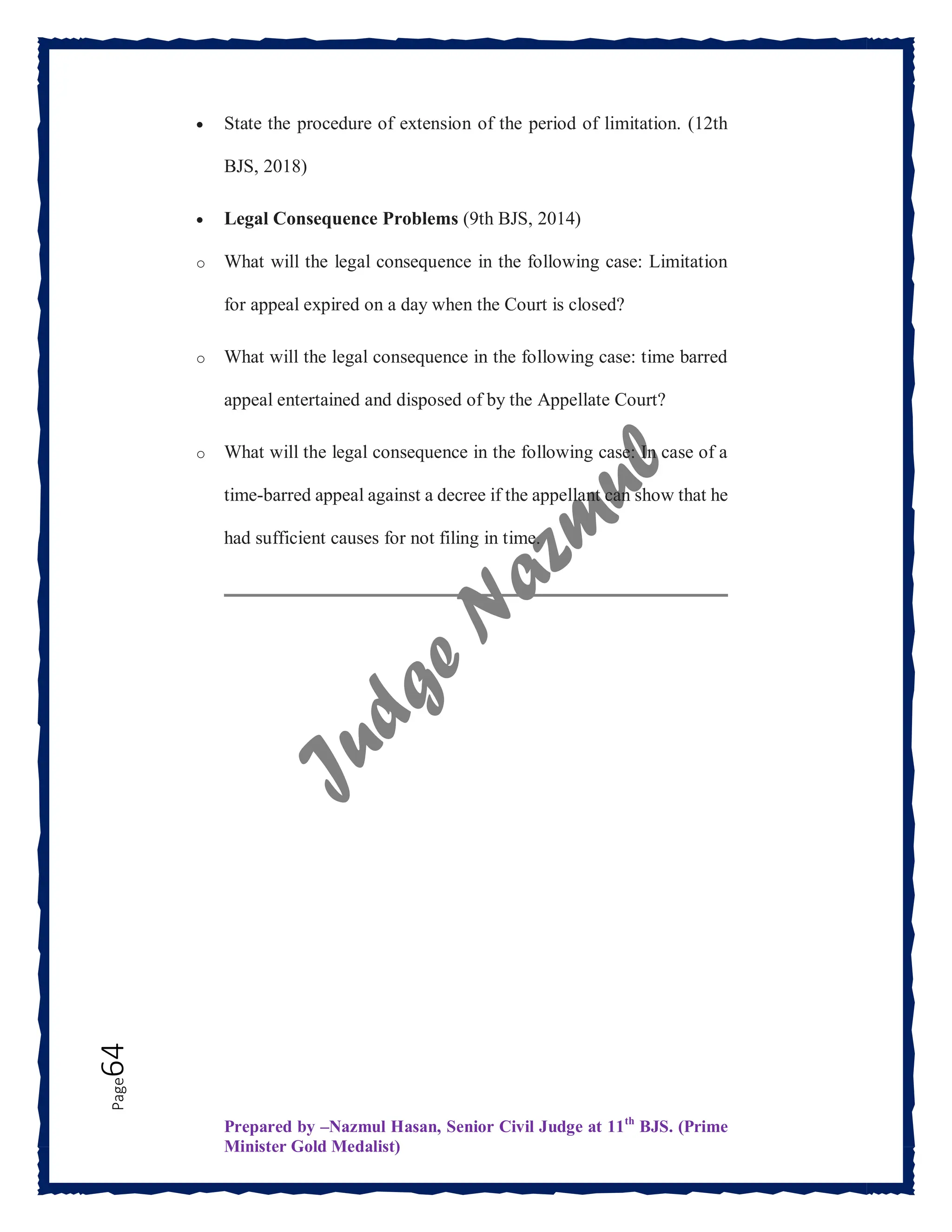
64  State the procedure of extension of the period of limitation. (12th
BJS, 2018)
 Legal Consequence Problems (9th BJS, 2014)
o What will the legal consequence in the following case: Limitation
for appeal expired on a day when the Court is closed?
o What will the legal consequence in the following case: time barred
appeal entertained and disposed of by the Appellate Court?
o What will the legal consequence in the following case: In case of a
time-barred appeal against a decree if the appellant can show that he
had sufficient causes for not filing in time.
Prepared by –Nazmul Hasan, Senior Civil Judge at 11th
BJS. (Prime
Minister Gold Medalist)
Page
65
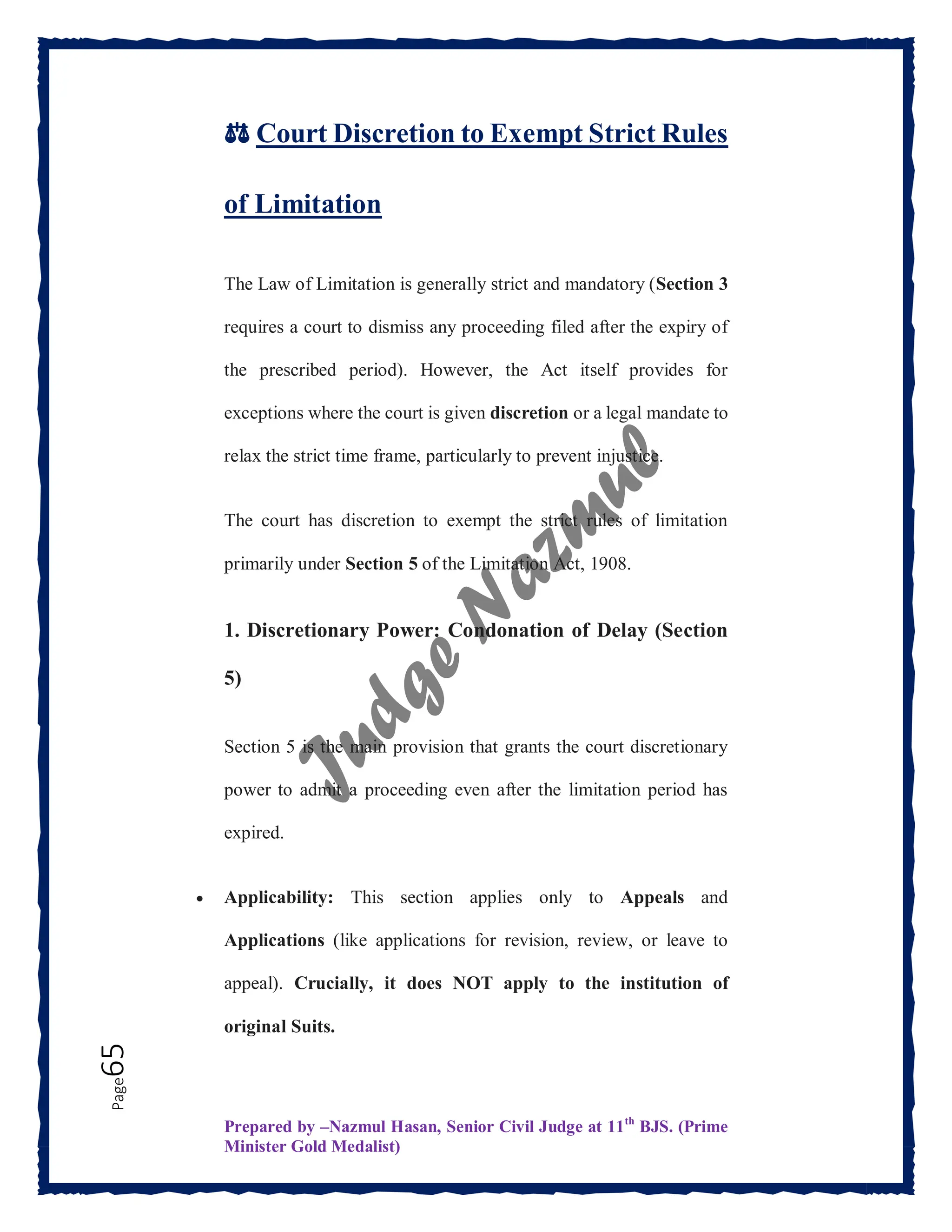
⚖️ Court Discretion to Exempt Strict Rules
of Limitation
The Law of Limitation is generally strict and mandatory (Section 3
requires a court to dismiss any proceeding filed after the expiry of
the prescribed period). However, the Act itself provides for
exceptions where the court is given discretion or a legal mandate to
relax the strict time frame, particularly to prevent injustice.
The court has discretion to exempt the strict rules of limitation
primarily under Section 5 of the Limitation Act, 1908.
1. Discretionary Power: Condonation of Delay (Section
5)
Section 5 is the main provision that grants the court discretionary
power to admit a proceeding even after the limitation period has
expired.
 Applicability: This section applies only to Appeals and
Applications (like applications for revision, review, or leave to
appeal). Crucially, it does NOT apply to the institution of
original Suits.
Prepared by –Nazmul Hasan, Senior Civil Judge at 11th
BJS. (Prime
Minister Gold Medalist)
Page
66  The Condition: The court may admit the appeal or application after
the prescribed period if the appellant or applicant satisfies the court
that they had "sufficient cause" for not preferring the appeal or
making the application within the prescribed period.
 Sufficient Cause: The term "sufficient cause" is not rigidly defined,
giving the court wide judicial discretion. It must be a cause that was
beyond the control of the party and not due to their own negligence
or lack of bona fide (good faith).
o Examples Accepted as Sufficient Cause:
 Serious illness of the party or their immediate family.
 Wrong legal advice given in good faith by a competent legal
practitioner.
 Misleading order or practice of the court in computing the period.
 Non-availability of necessary court records.
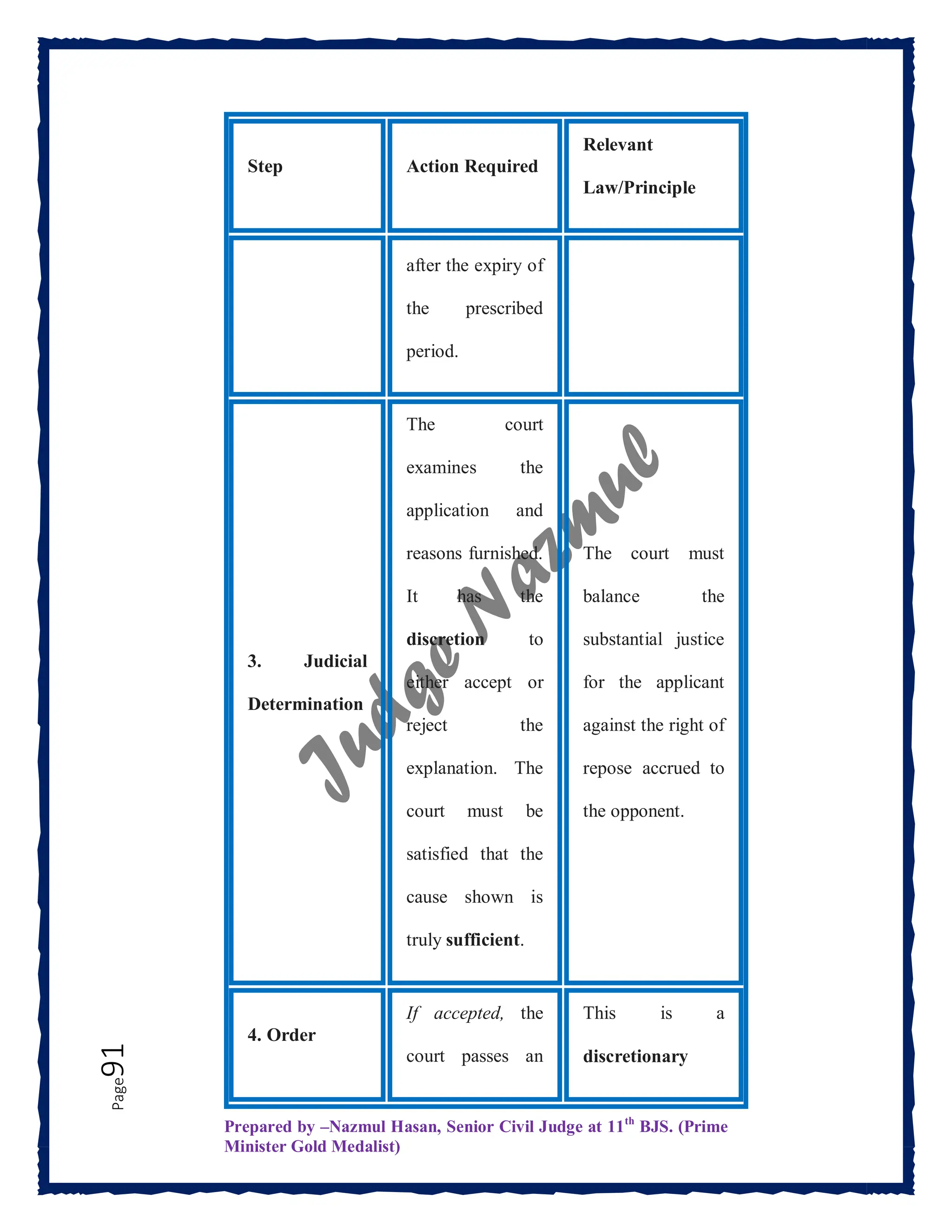
 Nature of the Power: The power under Section 5 is discretionary.
Even if "sufficient cause" is shown, the court may (not must)
condone the delay. This discretion must be exercised judiciously,
balancing the claimant's right to justice against the opposite party's
accrued right of repose.
2. Mandatory Exemptions (Exclusion of Time)
Prepared by –Nazmul Hasan, Senior Civil Judge at 11th
BJS. (Prime
Minister Gold Medalist)
Page
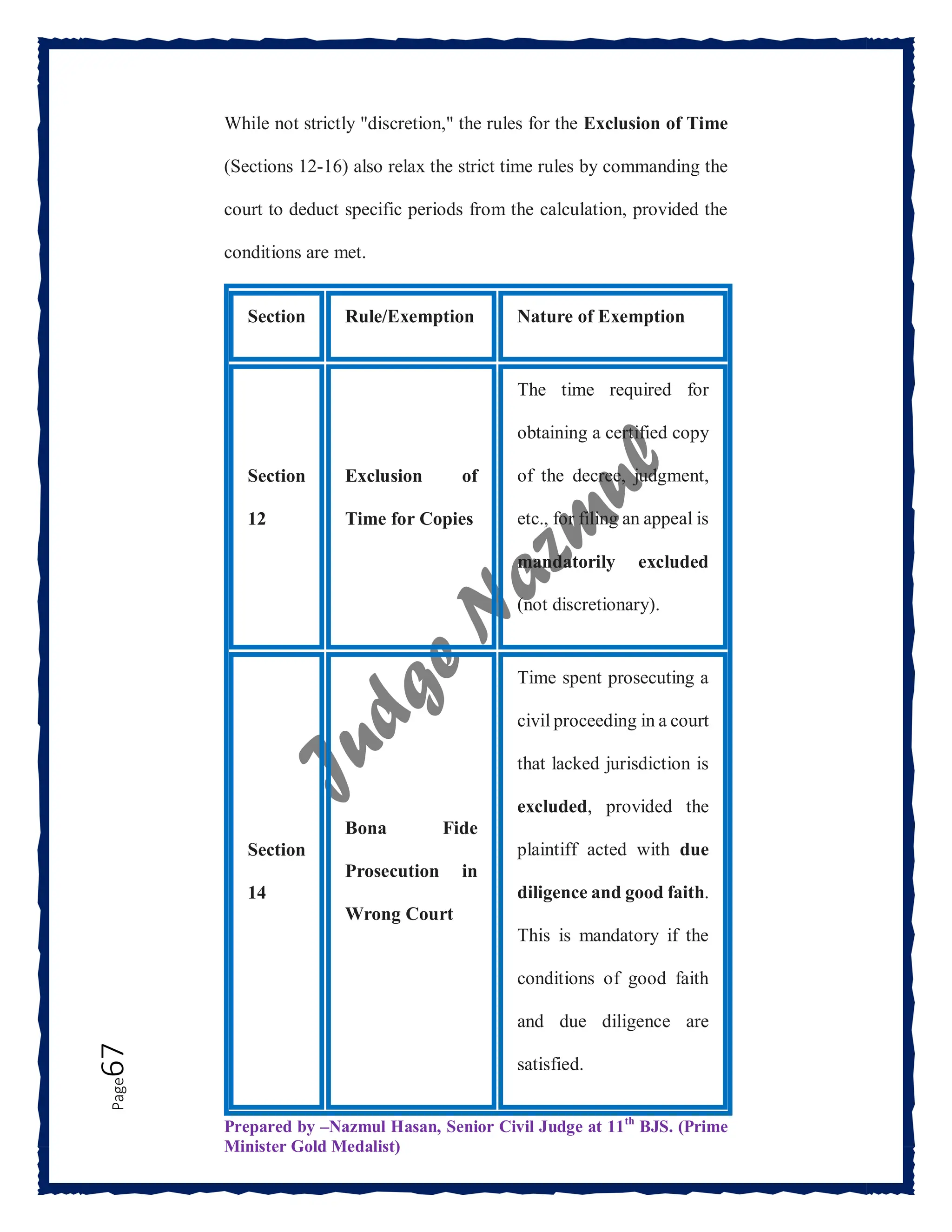
67 While not strictly "discretion," the rules for the Exclusion of Time
(Sections 12-16) also relax the strict time rules by commanding the
court to deduct specific periods from the calculation, provided the
conditions are met.
Section Rule/Exemption Nature of Exemption
Section
12
Exclusion of
Time for Copies
The time required for
obtaining a certified copy
of the decree, judgment,
etc., for filing an appeal is
mandatorily excluded
(not discretionary).
Section
14
Bona Fide
Prosecution in
Wrong Court
Time spent prosecuting a
civil proceeding in a court
that lacked jurisdiction is
excluded, provided the
plaintiff acted with due
diligence and good faith.
This is mandatory if the
conditions of good faith
and due diligence are
satisfied.
Prepared by –Nazmul Hasan, Senior Civil Judge at 11th
BJS. (Prime
Minister Gold Medalist)
Page
68
In essence, the court's true power to exempt or extend the rules
based on individual circumstances lies in the judicial application of
Section 5 (Condonation of Delay), where the test is whether the
party was prevented by sufficient cause from acting in time.
⏳ Condonation of Delay Under Section 5
of the Limitation Act, 1908
Section 5 of the Limitation Act, 1908, grants the court the judicial
discretion to extend the prescribed period of limitation, provided the
delay is not intentional and the party was prevented from acting in
time by a "sufficient cause."
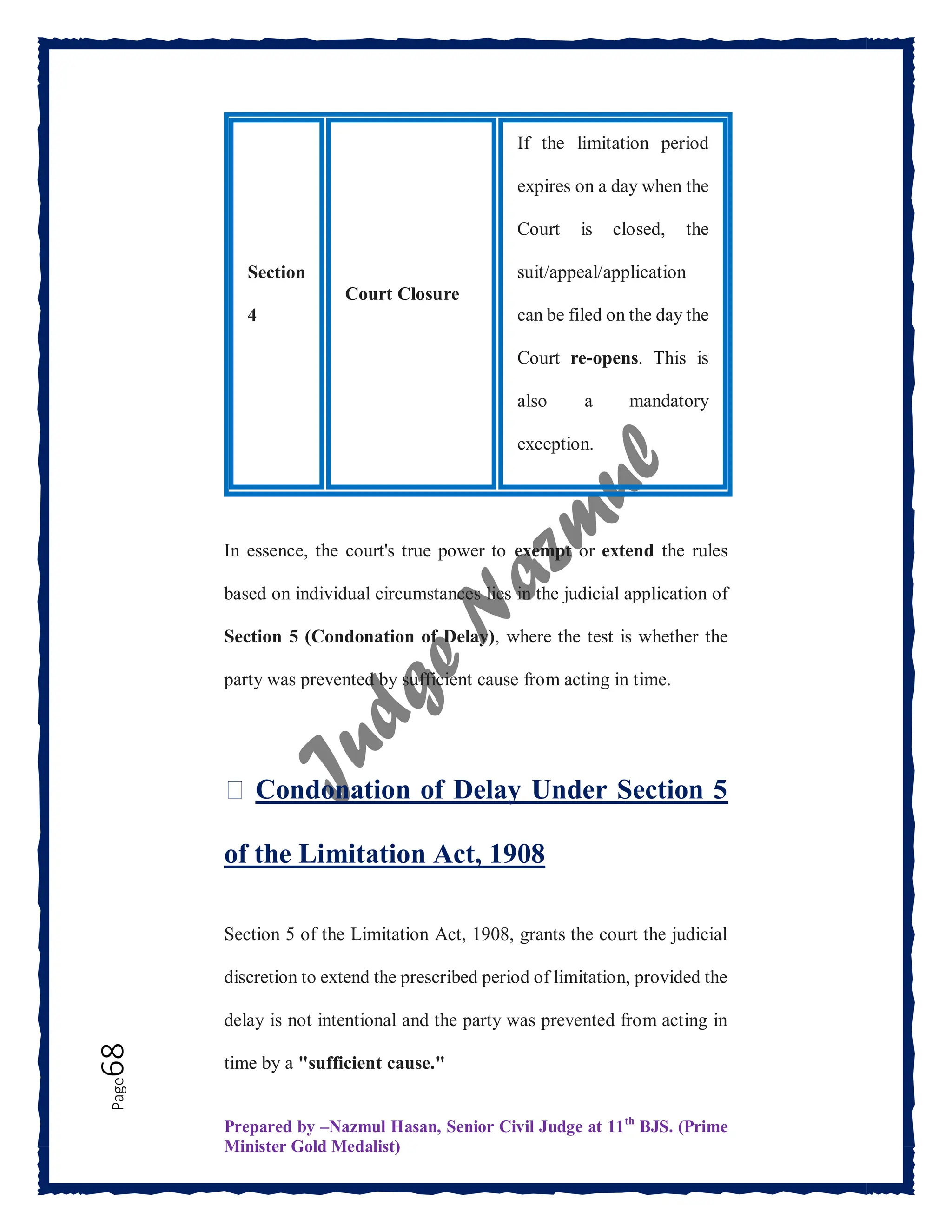
Section
4
Court Closure
If the limitation period
expires on a day when the
Court is closed, the
suit/appeal/application
can be filed on the day the
Court re-opens. This is
also a mandatory
exception.
Prepared by –Nazmul Hasan, Senior Civil Judge at 11th
BJS. (Prime
Minister Gold Medalist)
Page
69 1. Types of Cases Where Delay May Be Condoned
The applicability of Section 5 is strictly limited and does not cover
all civil proceedings:
 Appeals: Any appeal filed after the expiry of the period prescribed
in the First Schedule of the Act.
 Applications:
o Application for a Revision of judgment.
o Application for a Review of judgment.
o Application for Leave to Appeal.
o Any other application to which Section 5 is specifically made
applicable by or under any special or local law for the time being in
force.
Crucial Exclusion: Section 5 does not apply to the institution of
original suits. A suit filed after the limitation period must be
dismissed under Section 3, irrespective of any "sufficient cause."
2. Reasons for Condonation ("Sufficient Cause")
The court's power under Section 5 is discretionary, and the sole legal
ground for exercising it is the existence of "sufficient cause" for
the delay. This term is deliberately left undefined by the Act to allow
the court flexibility to administer substantial justice.
Prepared by –Nazmul Hasan, Senior Civil Judge at 11th
BJS. (Prime
Minister Gold Medalist)
Page
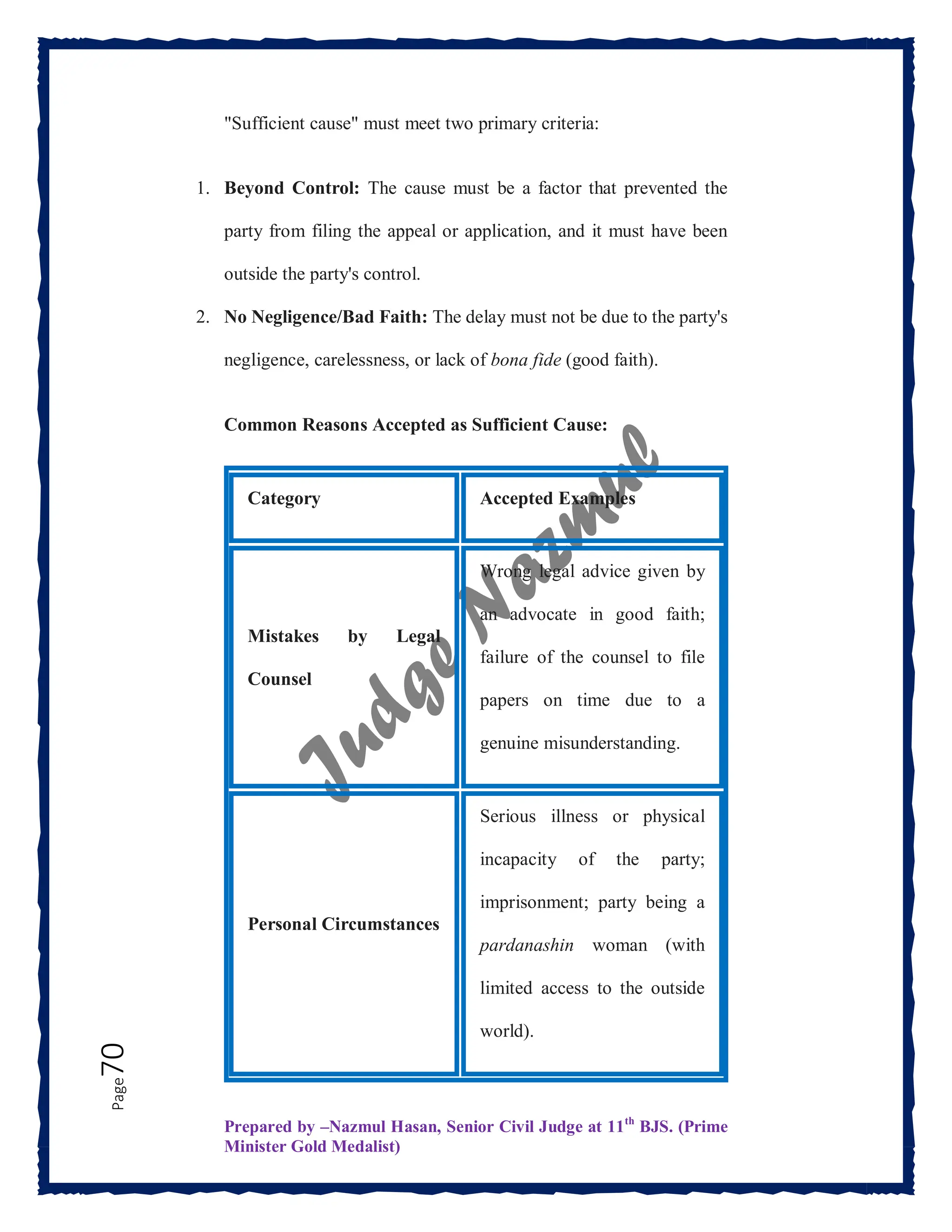
70 "Sufficient cause" must meet two primary criteria:
1. Beyond Control: The cause must be a factor that prevented the
party from filing the appeal or application, and it must have been
outside the party's control.
2. No Negligence/Bad Faith: The delay must not be due to the party's
negligence, carelessness, or lack of bona fide (good faith).
Common Reasons Accepted as Sufficient Cause:
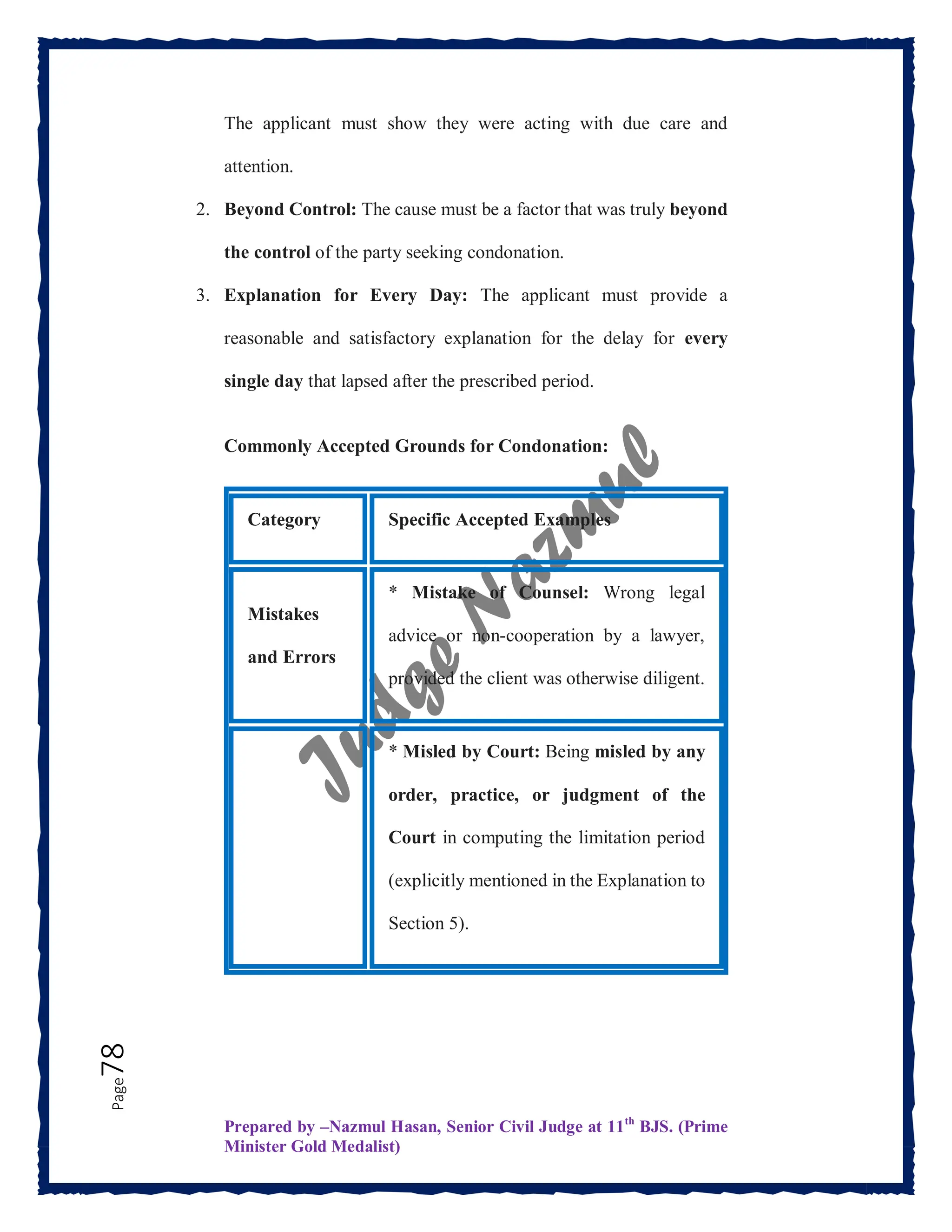
Category Accepted Examples
Mistakes by Legal
Counsel
Wrong legal advice given by
an advocate in good faith;
failure of the counsel to file
papers on time due to a
genuine misunderstanding.
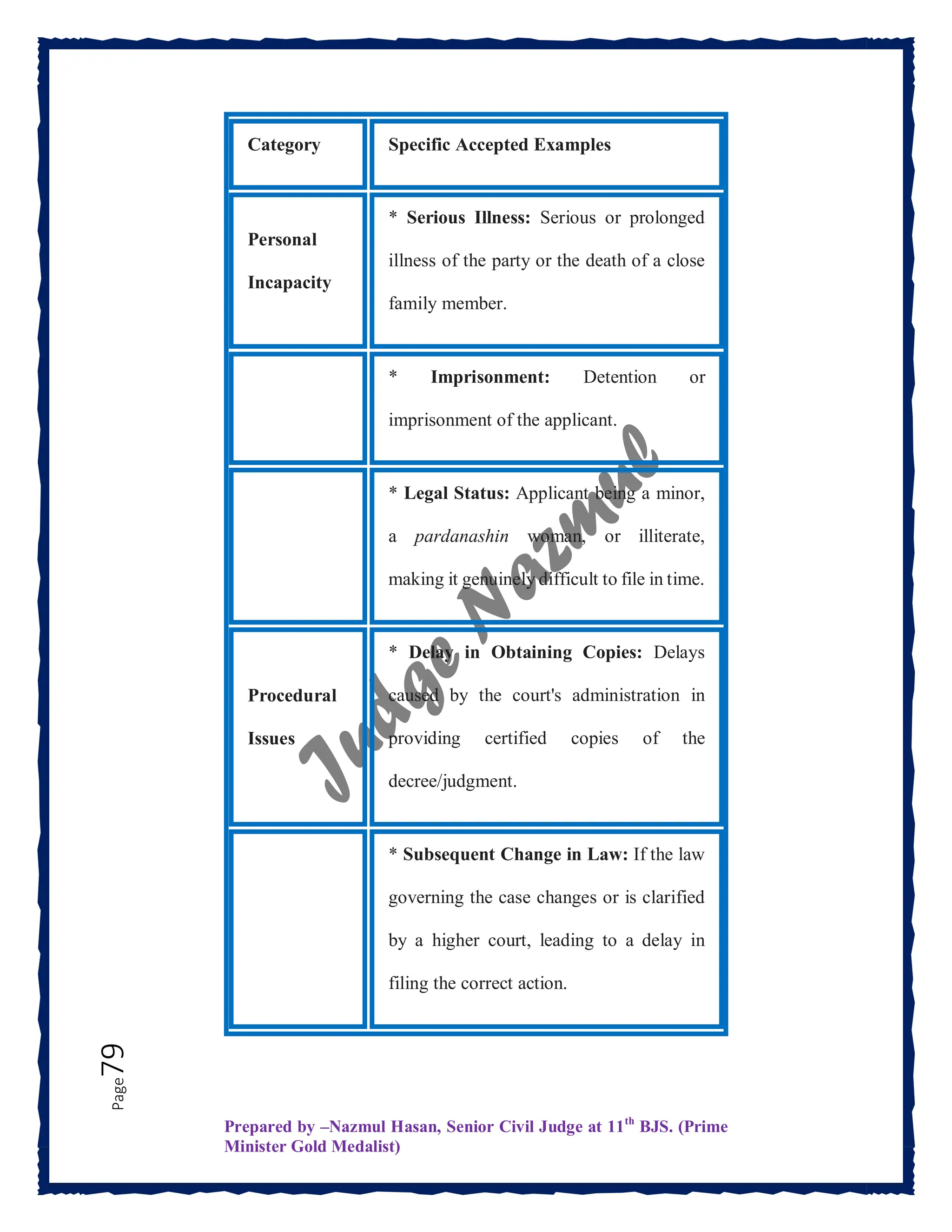
Personal Circumstances
Serious illness or physical
incapacity of the party;
imprisonment; party being a
pardanashin woman (with
limited access to the outside
world).
Prepared by –Nazmul Hasan, Senior Civil Judge at 11th
BJS. (Prime
Minister Gold Medalist)
Page
71
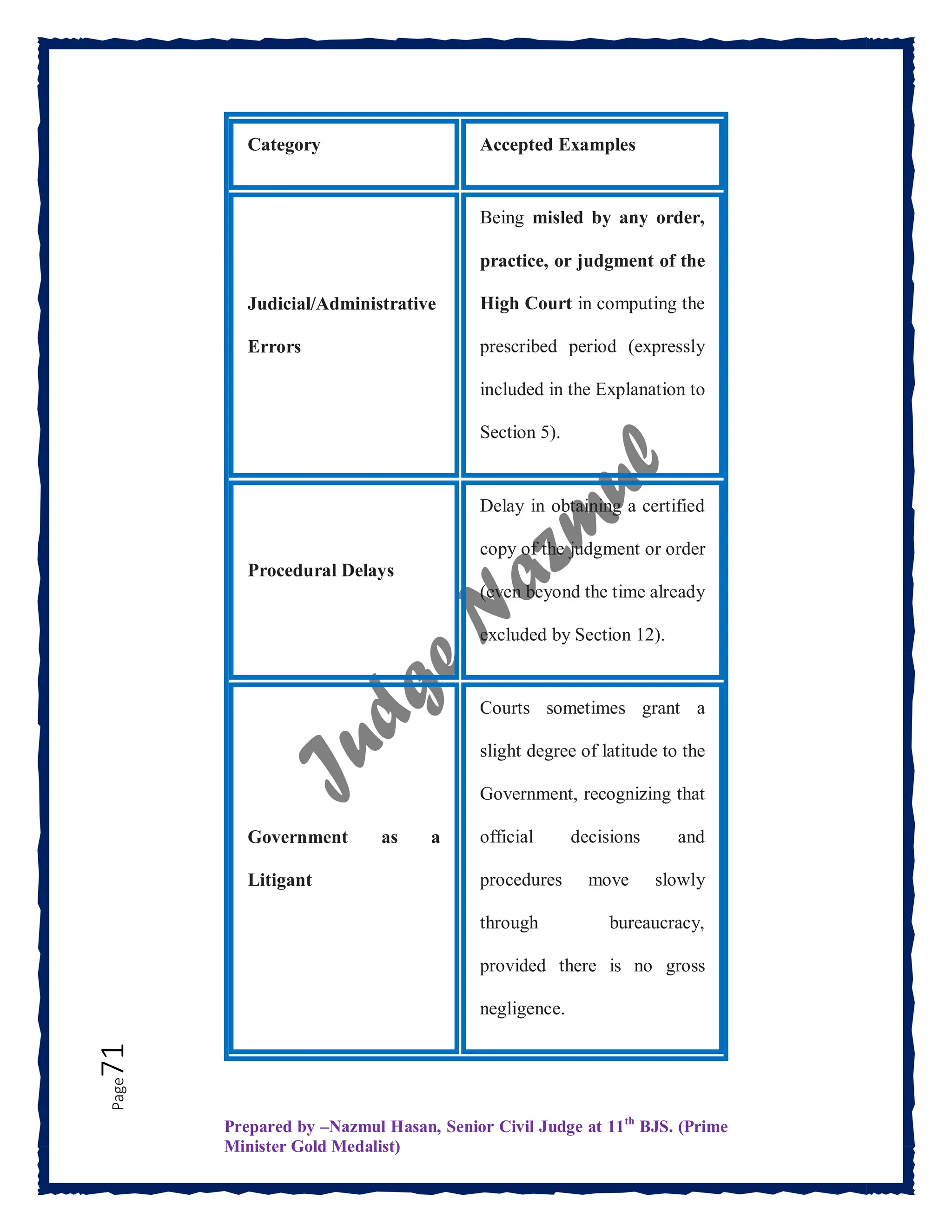
Category Accepted Examples
Judicial/Administrative
Errors
Being misled by any order,
practice, or judgment of the
High Court in computing the
prescribed period (expressly
included in the Explanation to
Section 5).
Procedural Delays
Delay in obtaining a certified
copy of the judgment or order
(even beyond the time already
excluded by Section 12).
Government as a
Litigant
Courts sometimes grant a
slight degree of latitude to the
Government, recognizing that
official decisions and
procedures move slowly
through bureaucracy,
provided there is no gross
negligence.
Prepared by –Nazmul Hasan, Senior Civil Judge at 11th
BJS. (Prime
Minister Gold Medalist)
Page
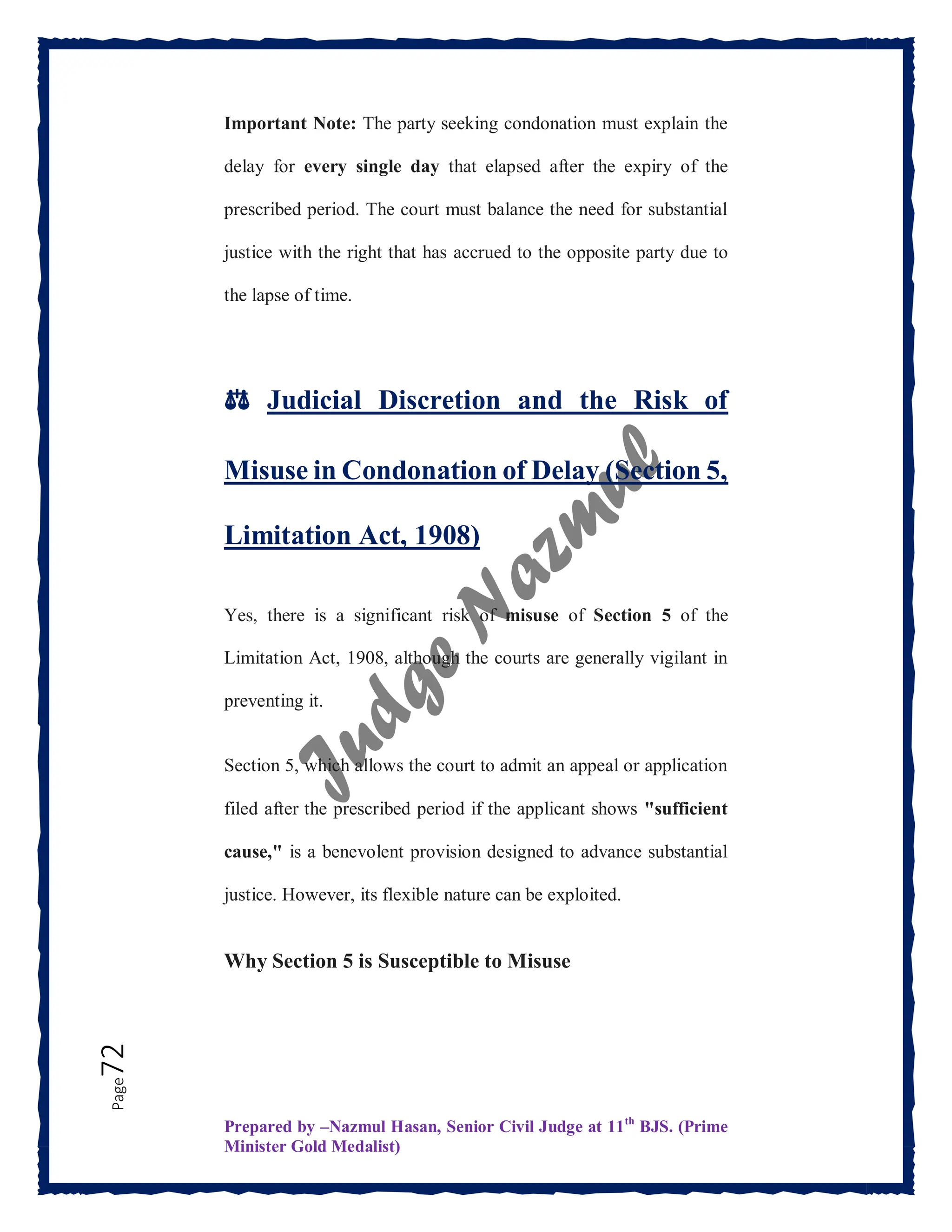
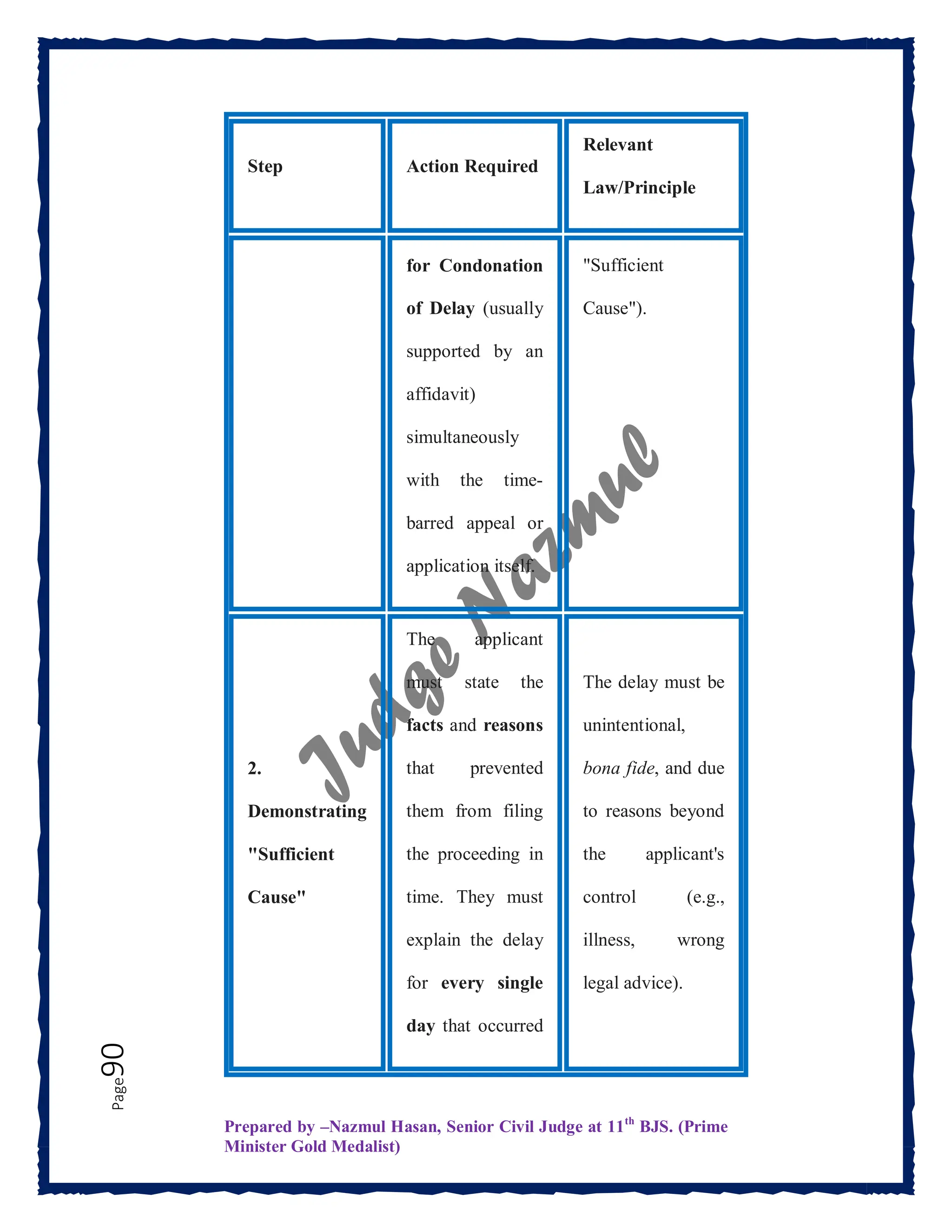
72 Important Note: The party seeking condonation must explain the
delay for every single day that elapsed after the expiry of the
prescribed period. The court must balance the need for substantial
justice with the right that has accrued to the opposite party due to
the lapse of time.
⚖️ Judicial Discretion and the Risk of
Misuse in Condonation of Delay (Section 5,
Limitation Act, 1908)
Yes, there is a significant risk of misuse of Section 5 of the
Limitation Act, 1908, although the courts are generally vigilant in
preventing it.
Section 5, which allows the court to admit an appeal or application
filed after the prescribed period if the applicant shows "sufficient
cause," is a benevolent provision designed to advance substantial
justice. However, its flexible nature can be exploited.
Why Section 5 is Susceptible to Misuse
Prepared by –Nazmul Hasan, Senior Civil Judge at 11th
BJS. (Prime
Minister Gold Medalist)
Page
73 The potential for misuse stems from the subjective nature of the term
"sufficient cause" and the inherent desire of every litigant to have
their case heard, even if they were negligent.
1. Fabricating "Sufficient Cause"
 Vague Explanations: Litigants may provide vague, general, or
fabricated reasons (e.g., minor illness, misplaced file, brief memory
lapse) to cover up delays caused by their own gross negligence or
willful inaction.
 Targeted Negligence: Parties who are aware that their case is weak
may intentionally delay the appeal/application, betting on the court's
leniency under Section 5 rather than filing a timely, well-prepared
case.
2. Misuse by Claiming Professional Negligence
 A common practice is for litigants to blame their legal counsel,
claiming "wrong legal advice" or "negligence of the lawyer" as
the sufficient cause for the delay.
 The Risk: While genuine mistakes by counsel are condoned, this
defense can be misused to deflect responsibility from the client who
was himself negligent, or to force the court to grant condonation
under the guise of protecting the innocent client. Courts are often
reluctant to penalize the client for their lawyer's error.
Prepared by –Nazmul Hasan, Senior Civil Judge at 11th
BJS. (Prime
Minister Gold Medalist)
Page
74 3. Undermining the Policy of Repose
 The core policy of Limitation Law is "Interest Reipublicae Ut Sit
Finis Litium" (that there should be an end to litigation).
 Misuse of Section 5 directly undermines this policy. If courts are too
liberal in condoning delays without demanding a rigorous
explanation for every day of delay, the valuable right that has
accrued to the opposite party (the right to be free from litigation) is
lost.
 Encouraging Indolence: Over-leniency encourages litigants to be
careless, knowing they have a safety net in Section 5, thereby
defeating the maxim: Vigilantibus Non Dormientibus Jura
Subveniunt (Law aids the vigilant, not the sleepy).
Judicial Safeguards Against Misuse
To counter the misuse of Section 5, superior courts have laid down
strict guidelines for its application:
Safeguard Description
Explanation
for Every Day
The applicant must provide a
satisfactory explanation for the delay of
Prepared by –Nazmul Hasan, Senior Civil Judge at 11th
BJS. (Prime
Minister Gold Medalist)
Page
75
Safeguard Description
every single day that occurred after the
expiry of the prescribed period.
Focus on Bona
Fides
The court must first ascertain the good
faith (bona fides) of the explanation
before considering the merits of the case.
Delay is not presumed to be deliberate,
but it must be accounted for.
No Absolute
Right
Condonation is a remedy, not an
absolute right. The court's power is
entirely discretionary, and it must be
exercised judiciously, not arbitrarily or
whimsically.
Negligence is
Fatal
If the reasons assigned show gross
negligence, recklessness, or lack of due
diligence on the part of the litigant, the
delay will generally not be condoned.
In conclusion, the potential for misuse of Section 5 exists because
of its necessary flexibility. However, the courts mitigate this risk by
Prepared by –Nazmul Hasan, Senior Civil Judge at 11th
BJS. (Prime
Minister Gold Medalist)
Page
76 adopting a rational, pragmatic, and cautious approach, ensuring that
the delay is condoned only when substantial justice demands it, and
not as a reward for negligence.
⚖️ Principle of Condonation of Delay
(Section 5, Limitation Act, 1908)
The principle of condonation of delay is encapsulated in Section 5
of the Limitation Act, 1908. It serves as a necessary safety valve
against the harsh and mandatory nature of the law of limitation
(Section 3).
The Principle
The core principle of Section 5 is that substantive justice should
be preferred over technical considerations.
 Substantial Justice vs. Technicality: While the Limitation Act
exists on the public policy maxim Interest Reipublicae Ut Sit Finis
Litium (there must be an end to litigation), Section 5 recognizes that
refusing to condone a genuine delay can result in a meritorious case
being thrown out purely on a technicality.
 Discretionary Remedy, Not a Right: Condonation is not a right
that the litigant can claim; it is a remedy granted only at the
Prepared by –Nazmul Hasan, Senior Civil Judge at 11th
BJS. (Prime
Minister Gold Medalist)
Page
77 discretion of the court. The court must exercise this discretion
judiciously, balancing the interest of the vigilant party against the
prejudice caused to the opposing party (who has acquired a valuable
right by the lapse of time).
 The Litmus Test: The court must be satisfied that the appellant or
applicant had "sufficient cause" for not preferring the appeal or
application within the prescribed period.
Key Rule of Interpretation: While Section 3 (dismissal of time-
barred cases) is interpreted strictly, Section 5 (Condonation of
Delay) is interpreted liberally to advance the cause of justice,
provided the delay is non-deliberate and satisfactorily explained.
Grounds for Condoning Delay in an Application or an
Appeal
The relief under Section 5 is conditional upon the applicant
demonstrating "sufficient cause" for the delay. This term is
deliberately left undefined in the Act to give the courts maximum
flexibility, but judicial decisions have established clear parameters.
Essential Requirements of "Sufficient Cause":
1. Good Faith and Due Diligence: The delay must not be due to the
party's own negligence, recklessness, or mala fides (bad faith).
Prepared by –Nazmul Hasan, Senior Civil Judge at 11th
BJS. (Prime
Minister Gold Medalist)
Page
78 The applicant must show they were acting with due care and
attention.
2. Beyond Control: The cause must be a factor that was truly beyond
the control of the party seeking condonation.
3. Explanation for Every Day: The applicant must provide a
reasonable and satisfactory explanation for the delay for every
single day that lapsed after the prescribed period.
Commonly Accepted Grounds for Condonation:
Category Specific Accepted Examples
Mistakes
and Errors
* Mistake of Counsel: Wrong legal
advice or non-cooperation by a lawyer,
provided the client was otherwise diligent.
* Misled by Court: Being misled by any
order, practice, or judgment of the
Court in computing the limitation period
(explicitly mentioned in the Explanation to
Section 5).
Prepared by –Nazmul Hasan, Senior Civil Judge at 11th
BJS. (Prime
Minister Gold Medalist)
Page
79
Category Specific Accepted Examples
Personal
Incapacity
* Serious Illness: Serious or prolonged
illness of the party or the death of a close
family member.
* Imprisonment: Detention or
imprisonment of the applicant.
* Legal Status: Applicant being a minor,
a pardanashin woman, or illiterate,
making it genuinely difficult to file in time.
Procedural
Issues
* Delay in Obtaining Copies: Delays
caused by the court's administration in
providing certified copies of the
decree/judgment.
* Subsequent Change in Law: If the law
governing the case changes or is clarified
by a higher court, leading to a delay in
filing the correct action.
Prepared by –Nazmul Hasan, Senior Civil Judge at 11th
BJS. (Prime
Minister Gold Medalist)
Page
80 Important Distinction: Inadequate financial resources or mere lack
of knowledge of the law are generally not considered sufficient
cause, as a person is expected to be vigilant about their legal rights.
However, the determination is always based on the unique facts and
circumstances of the individual case.
✨ The Concept of "Sufficient Cause"
(Section 5, Limitation Act, 1908)
The term "Sufficient Cause" is the cornerstone of Section 5 of the
Limitation Act, 1908. This section allows a court to admit an appeal
or application (but not an original suit) after the prescribed
limitation period has expired, provided the appellant or applicant
can demonstrate "sufficient cause" for the delay.
Since the term is not explicitly defined in the Act, its meaning has
been shaped by judicial interpretation to serve one overarching goal:
to advance substantial justice.
1. The Judicial Interpretation and Principle
"Sufficient cause" must be interpreted in a way that balances the
right of the claimant to be heard on the merits against the right of
the opposite party to be free from stale litigation.
Prepared by –Nazmul Hasan, Senior Civil Judge at 11th
BJS. (Prime
Minister Gold Medalist)
Page
81  Liberal Construction: Courts consistently hold that the phrase
"sufficient cause" should receive a liberal construction (broad
interpretation). The law of limitation is not meant to destroy the
rights of parties; rather, it is meant to ensure that claims are brought
forward in a timely manner.
 Justice Over Technicality: When substantial justice and
technical considerations are pitted against each other, the cause of
substantial justice deserves to be preferred, provided the delay is not
deliberate.
 Focus on Bona Fides (Good Faith): The inquiry is primarily
concerned with the honesty and diligence of the applicant. There is
no presumption that a delay is deliberate or due to mala fides (bad
faith).
2. The Standard of Proof: What Constitutes "Sufficient
Cause"?
To satisfy the court, the cause must meet stringent standards
demonstrating that the party was genuinely prevented from filing the
proceeding in time.
Prepared by –Nazmul Hasan, Senior Civil Judge at 11th
BJS. (Prime
Minister Gold Medalist)
Page
82
Standard Description
Beyond
Control
The reason for the delay must be an event
or circumstance that was genuinely
beyond the control of the party (e.g.,
natural calamity, court-imposed
restriction, severe sudden illness).
No
Negligence or
Inaction
The delay must not be attributable to the
party's own gross negligence,
carelessness, or willful inaction. The
litigant must demonstrate they acted with
due care and attention (the definition of
"good faith" in the Act).
Daily
Explanation
The applicant is required to provide a
satisfactory and cogent explanation for
the delay for every single day that
occurred after the prescribed period
expired. Vague or general statements are
insufficient.
Prepared by –Nazmul Hasan, Senior Civil Judge at 11th
BJS. (Prime
Minister Gold Medalist)
Page
83
Standard Description
Not based on
Merits
The sufficiency of the cause must be
determined independently of the merits
of the case. The court first decides if the
delay is condonable, and only then
proceeds to hear the case on its merits.
3. Statutory Example of Sufficient Cause
The Explanation attached to Section 5 itself provides a concrete
example of what constitutes sufficient cause:
"The fact that the appellant or applicant was misled by any order,
practice or judgment of the High Court Division in ascertaining
or computing the prescribed period of limitation may be sufficient
cause within the meaning of this section."12
This statutory clarification ensures that a litigant is not penalised for3
relying in good faith on the actions or pronouncements of the highest
court.
Prepared by –Nazmul Hasan, Senior Civil Judge at 11th
BJS. (Prime
Minister Gold Medalist)
Page
84
📜 Scope of Condonation of Delay and the
Distinction Between Section 5 and Section
12
The Limitation Act, 1908, contains two primary, yet distinct,
provisions that address the filing of proceedings after the prescribed
deadline: Section 5 (Condonation of Delay) and Section 12
(Exclusion of Time in Legal Proceedings).
1. Scope of Condonation of Delay (Section 5)
Section 5 grants the court a discretionary power to admit certain
proceedings even after the period of limitation has expired, provided
the applicant satisfies the court of "sufficient cause" for the delay.
 Limited Applicability: The scope of Section 5 is limited only to:
o Appeals
o Applications (including applications for revision, review, or leave
to appeal).
o It does not apply to original Suits.
 Nature of Relief: The relief is based on the discretion of the court.
The applicant must explain every day of the delay due to a cause
Prepared by –Nazmul Hasan, Senior Civil Judge at 11th
BJS. (Prime
Minister Gold Medalist)
Page
85 beyond their control (e.g., severe illness, lawyer's mistake,
misleading court practice).
 Effect: Section 5 does not recalculate the limitation period; it
effectively grants an extension of time based on equity and justice.
The court uses its power to "condone" the negligence.
2. Distinction Between Section 5 and Section 12
While both sections benefit the litigant by providing a remedy
against time-bar, they operate on entirely different legal principles.
Feature
Section 5
(Condonation
of Delay)
Section 12
(Exclusion of Time
for Copies)
Principle
Discretionary
& Equitable.
Based on the
litigant's
inability to act
in time.
Mandatory &
Computational.
Based on legal
necessity and the
court's
administrative
function.
Prepared by –Nazmul Hasan, Senior Civil Judge at 11th
BJS. (Prime
Minister Gold Medalist)
Page
86
Applicability
Applies to
Appeals and
Applications.
Applies to Suits,
Appeals, and
Applications (The
exclusion for
obtaining copies
applies only to
Appeals, Review,
etc.).
Nature of
Time
Deals with
delay that
occurs after the
time should
have expired.
Deals with the
mandatory
exclusion of a
period from the
original calculation.
Requirement
The litigant
must prove
"sufficient
cause" for the
delay.
No proof of
"sufficient cause" is
needed; the litigant
only needs to show
the time was
"requisite"
(necessary) for
obtaining the copy.
Prepared by –Nazmul Hasan, Senior Civil Judge at 11th
BJS. (Prime
Minister Gold Medalist)
Page
87
Illustration of the Difference
Imagine the prescribed limitation period for filing an appeal is 30
days. The judgment was passed on January 1st, and the 30th day is
January 31st.
A. Application of Section 12 (Exclusion)
A litigant applies for a certified copy of the judgment on January
2nd and receives it on January 10th. The time taken is 8 days.
 Computation: The 8 days requisite for obtaining the copy must be
excluded from the original 30-day period.
 Result: The litigant effectively has 30 days of filing time, which
now expires on (January 31st + 8 days) $rightarrow$ February
8th.
Court's Role
Court has
discretion (may
condone).
Court must
mandatorily
exclude the time
(shall be excluded).
Prepared by –Nazmul Hasan, Senior Civil Judge at 11th
BJS. (Prime
Minister Gold Medalist)
Page
88  Principle: This is a re-calculation of the limitation period due to a
procedural necessity. The appeal filed on February 7th is considered
filed within time, regardless of any "cause" for the delay.
B. Application of Section 5 (Condonation)
Assume the litigant filed the appeal on February 15th (7 days after
the newly calculated deadline of February 8th).
 Computation: The appeal is time-barred by 7 days.
 Action Required: The litigant must now file an application under
Section 5, demonstrating sufficient cause for the 7-day delay (e.g.,
the lawyer fell ill on February 8th and was hospitalized until
February 14th).
 Result: If the court accepts the reason as "sufficient cause," it will
condone the 7-day delay and admit the appeal. If not, the appeal is
dismissed.
 Principle: This is a discretionary extension granted to rectify a
failure caused by external factors.
In essence, Section 12 determines the true expiry date of the
limitation period by excluding time that was statutorily necessary,
while Section 5 provides a judicial power to forgive a failure to
meet that true expiry date.
Prepared by –Nazmul Hasan, Senior Civil Judge at 11th
BJS. (Prime
Minister Gold Medalist)
Page
89
📜 Procedure for Extension of the Period
of Limitation
The Limitation Act, 1908, does not contain a single "extension"
procedure, but rather several distinct methods for extending or
altering the limitation period, depending on the cause. The primary
procedure for seeking an extension due to delay is governed by
Section 5 (Condonation of Delay).
The general procedures for extension or alteration of the limitation
period are:
A. Procedure for Condonation of Delay (Section 5)
This procedure is used when an appeal or application is filed after
the prescribed limitation period has expired due to circumstances
beyond the party's control.
Step Action Required
Relevant
Law/Principle
1. Application
for
Condonation
The appellant or
applicant must file
an Application
Section 5
(Requires
Prepared by –Nazmul Hasan, Senior Civil Judge at 11th
BJS. (Prime
Minister Gold Medalist)
Page
90
Step Action Required
Relevant
Law/Principle
for Condonation
of Delay (usually
supported by an
affidavit)
simultaneously
with the time-
barred appeal or
application itself.
"Sufficient
Cause").
2.
Demonstrating
"Sufficient
Cause"
The applicant
must state the
facts and reasons
that prevented
them from filing
the proceeding in
time. They must
explain the delay
for every single
day that occurred
The delay must be
unintentional,
bona fide, and due
to reasons beyond
the applicant's
control (e.g.,
illness, wrong
legal advice).
Prepared by –Nazmul Hasan, Senior Civil Judge at 11th
BJS. (Prime
Minister Gold Medalist)
Page
91
Step Action Required
Relevant
Law/Principle
after the expiry of
the prescribed
period.
3. Judicial
Determination
The court
examines the
application and
reasons furnished.
It has the
discretion to
either accept or
reject the
explanation. The
court must be
satisfied that the
cause shown is
truly sufficient.
The court must
balance the
substantial justice
for the applicant
against the right of
repose accrued to
the opponent.
4. Order
If accepted, the
court passes an
This is a
discretionary
Prepared by –Nazmul Hasan, Senior Civil Judge at 11th
BJS. (Prime
Minister Gold Medalist)
Page
92
Step Action Required
Relevant
Law/Principle
order condoning
the delay and
admits the
appeal/application
for hearing on its
merits. If rejected,
the court
dismisses the
appeal/application
as time-barred.
relief; the court
may admit the
appeal/application.
B. Procedure for Legal Disability (Section 6)
This procedure allows for an extension not because of a delay, but
because the person entitled to sue is legally disabled.
Prepared by –Nazmul Hasan, Senior Civil Judge at 11th
BJS. (Prime
Minister Gold Medalist)
Page
93
Step Action Required
Relevant
Law/Principle
1. Identification
of Disability
The
plaintiff/applicant
must prove that
they were a
minor, insane, or
an idiot at the
time the period of
limitation began
to run.
Section 6
(Defines Legal
Disability).
2. Automatic
Extension
The limitation
period does not
run against the
disabled person
while the
disability
continues.
The time is
legally
postponed.
3.
Commencement
The limitation
period starts
This is a
mandatory
Prepared by –Nazmul Hasan, Senior Civil Judge at 11th
BJS. (Prime
Minister Gold Medalist)
Page
94
Step Action Required
Relevant
Law/Principle
running only
after the
disability has
ceased (e.g., the
minor attains
majority, or the
insane person is
cured). The
person then gets
the full prescribed
period from that
new date.
extension; no
court
application is
needed to
claim the
benefit.
C. Procedure for Restarting the Period
(Acknowledgement/Payment)
This procedure allows a new limitation period to start, which is a
form of extension, based on the voluntary act of the
debtor/defendant.
Prepared by –Nazmul Hasan, Senior Civil Judge at 11th
BJS. (Prime
Minister Gold Medalist)
Page
95
Step
Action
Required
Relevant
Law/Principle
1.
Acknowledgem
ent or Payment
Before the
original
limitation
period expires,
the debtor
(person liable)
must make a
written
acknowledgem
ent of liability
or make a part
payment on the
principal debt or
interest.
Section 19
(Acknowledgem
ent in Writing)
or Section 20
(Payment on
Account).
2.
Commencemen
t of Fresh
Period
Once the
acknowledgmen
t is signed or the
payment is
made, a fresh
The extension is
automatic upon
the act being
legally valid.
Prepared by –Nazmul Hasan, Senior Civil Judge at 11th
BJS. (Prime
Minister Gold Medalist)
Page
96
Step
Action
Required
Relevant
Law/Principle
period of
limitation
begins to run
from the date of
the
acknowledgmen
t or payment.
3. Legal Effect
The new period
of limitation is
calculated as if
the cause of
action had
accrued on the
date of the new
payment or
acknowledgmen
t.
This is a
mandatory
extension
resulting in a full
fresh period.
Prepared by –Nazmul Hasan, Senior Civil Judge at 11th
BJS. (Prime
Minister Gold Medalist)
Page
97 The most common procedure for seeking an extension due to the
party's failure to file on time is the Condonation of Delay under
Section 5.
⚖️ Legal Consequences in Limitation Act
Scenarios
The Limitation Act, 1908, provides specific legal consequences for
actions related to the expiry of the limitation period, ensuring that
justice is served while maintaining procedural clarity.
1. Consequence when Limitation for Appeal Expired on
a Day when the Court is Closed
The legal consequence in this case is governed by Section 4 of the
Limitation Act, 1908.
 Rule: Where the period of limitation prescribed for any suit, appeal,
or application expires on a day when the Court is closed, the legal
consequence is that the suit, appeal, or application may be
instituted, preferred, or made on the day that the Court re-
opens.
Prepared by –Nazmul Hasan, Senior Civil Judge at 11th
BJS. (Prime
Minister Gold Medalist)
Page
98  Legal Consequence: The appeal is deemed to be filed within time
if it is presented on the very next day the court resumes its normal
functions.
 Nature of the Provision: This is a mandatory provision and not a
matter of judicial discretion. It protects the litigant from being
penalized by the accident of judicial vacation or holiday.
2. Consequence when a Time-Barred Appeal is
Entertained and Disposed of by the Appellate Court
The legal consequence in this scenario is governed by Section 3 of
the Limitation Act, 1908.
 Rule: Section 3 imposes a mandatory duty on the court to dismiss
any suit, appeal, or application that is instituted or preferred after the
prescribed period of limitation. This duty is incumbent on the court
even if limitation has not been set up as a defence by the opposing
party.
 Legal Consequence: If an appellate court entertains and disposes
of a time-barred appeal without legally condoning the delay under
Section 5 (or finding another exemption under Sections 4 or 12), the
decree or order passed by the appellate court is generally considered
to be:
o Voidable/Illegal: The order is illegal because the court failed to
exercise its mandatory duty under Section 3.
Prepared by –Nazmul Hasan, Senior Civil Judge at 11th
BJS. (Prime
Minister Gold Medalist)
Page
99 o Subject to Reversal: The decree or order is liable to be challenged
and set aside by a higher court (e.g., in a revision or further appeal)
on the sole ground that the original appeal was time-barred and the
Appellate Court committed an error of law by failing to dismiss it
suo motu (on its own motion).
 Note: The Appellate Court must first determine the question of
limitation, and only if it finds the appeal to be within time (either
originally or after condonation) can it proceed to the merits.
3. Consequence when, in Case of a Time-Barred Appeal
against a Decree, the Appellant can Show that he had
Sufficient Cause for not Filing in Time
The legal consequence in this scenario is governed by Section 5 of
the Limitation Act, 1908.
 Rule: Section 5 allows the Appellate Court to admit an appeal after
the prescribed period if the appellant satisfies the court that they had
"sufficient cause" for the delay.
 Legal Consequence: If the Appellate Court is satisfied that the
appellant's reasons (e.g., severe illness, genuine mistake by counsel,
misleading court order) constitute "sufficient cause," the court will:
1. Condonate the Delay: The court passes an order condoning the
delay.
Prepared by –Nazmul Hasan, Senior Civil Judge at 11th
BJS. (Prime
Minister Gold Medalist)
Page
100 2. Admit the Appeal: The appeal is then formally admitted.
3. Proceed on Merits: The appeal is treated as if it were filed within
the period of limitation and is subsequently heard and disposed of
on its merits (i.e., based on the evidence and law, not on technical
grounds).
 Nature of the Provision: This is a discretionary power. The court
may condone the delay; it is not compelled to do so, even if a cause
is shown, but must exercise its discretion judiciously.
Prepared by –Nazmul Hasan, Senior Civil Judge at 11th
BJS. (Prime
Minister Gold Medalist)
Page
101
📚 E-book: The Limitation Act, 1908
for BJS Written Exam
IV. Special Rules of Computation (Sections 6, 7, 18, 19,
21)
This section covers specific legal provisions that modify the
standard computation of time.
 Legal Disability (Sections 6 & 7)
o Amplify the principles of legal disability as enunciated under
sections 6 and 7 of the Limitation Act? What are the exceptions to
those principles? (7th BJS, 2012)
o Whether any subsequent disability can stop any right to sue where
limitation has begun? Discuss. (7th BJS, 2012)
o Elucidate the effect of legal disability in computing the period of
limitation. (15th BJS, 2022)
o Discuss the characteristics of section 6 and 17 of the Limitation Act,
1908. (17th BJS, 2024)
o Case Problem: Successive Disability (7th BJS, 2012)
Prepared by –Nazmul Hasan, Senior Civil Judge at 11th
BJS. (Prime
Minister Gold Medalist)
Page
102  A right to sue accurses to 'Ka' during his minority. Ka dies before
attaining majority, and is succeeded by Kha, his minor son. From
which date time will run against Kha? Discuss.
 Fraud and Mistake (Section 18)
o What is fraud? If a plaintiff files a suit alleging fraud, form which
date the period of limitation for filing the suit shall be computed?
(3rd BJS, 2007)
o If a fraud is proved, the limitation will run from the date when fraud
was detected. Explain. (8th BJS, 2013)
o What is the effect of fraud in computing the period of limitation is a
suit? Answer with reference to the relevant provision of law. (12th
BJS, 2018)
o Limitation shall be computed from the time when fraud first
becomes known. (16th BJS, 2023)
o Describe the rules for computation of the period of limitation to
initiate legal proceedings in the following case: Allegation of fraud.
(10th BJS, 2015)
 Acknowledgment (Section 19)
o When and how an acknowledgment of a particular liability by a
person before expiration of prescribed time-limit affects the process
of computing limitation of a suit against that person? (8th BJS,
2013)
Prepared by –Nazmul Hasan, Senior Civil Judge at 11th
BJS. (Prime
Minister Gold Medalist)
Page
103  Addition or Substitution of Parties (Section 21)
o Discuss briefly the consequence of addition or substitution of new
plaintiff or defendant in a continuing suit according to the provisions
of the Limitation Act, 1908. (17th BJS, 2024)
Prepared by –Nazmul Hasan, Senior Civil Judge at 11th
BJS. (Prime
Minister Gold Medalist)
Page
104
📜 Principles of Legal Disability and
Exceptions (Sections 6, 7 & 8)
The principles of legal disability are enshrined in Sections 6 and 7
of the Limitation Act, 1908. These sections serve as a powerful
safeguard, providing an extension of the limitation period for certain
classes of persons who are legally incapable of asserting their rights.
1. Amplifying the Principles of Legal Disability (Section
6)
Section 6 deals with the disability of a single person entitled to sue
or make an application.
A. Definition of Legal Disability (Section 6(1))
The principles apply only when the person entitled to institute a suit
or application is, at the time from which the period of limitation
is to be reckoned, a:
1. Minor (A person who has not attained the age of majority).
2. Insane (A person of unsound mind, lacking legal capacity).
3. Idiot (A person with a severe mental deficiency from birth).
B. The Principle of Postponement
Prepared by –Nazmul Hasan, Senior Civil Judge at 11th
BJS. (Prime
Minister Gold Medalist)
Page
105  The Rule: The limitation period shall not run against such
a disabled person.
 Commencement: The person may institute the suit or make
the application within the same period that would otherwise
have been allowed, but the time is calculated after the
disability has ceased.
o Example: If the limitation period is 3 years, and the
cause of action accrues when the plaintiff is 10 years
old, the 3-year period begins only when the plaintiff
attains the age of majority (18 years), giving them
until they are 21 years old to sue.
C. Multiple and Successive Disabilities (Section 6(2))
 The Rule: If the person is affected by two such disabilities
at the time the period begins to run, or if a second disability
accrues before the first has ceased, the limitation period
starts running only after both disabilities have ceased.
o Example: A right to sue accrues during Z's minority.
While Z is still a minor, he becomes insane. Time
will run against Z only after both his insanity and
minority have ceased.
D. Death of the Disabled Person (Section 6(3) & (4))
Prepared by –Nazmul Hasan, Senior Civil Judge at 11th
BJS. (Prime
Minister Gold Medalist)
Page
106  Disability Continues up to Death: If the disability
continues up to the person's death, the legal representative
may institute the suit within the same period allowed,
calculated from the date of the death.
 Legal Representative is also Disabled: If the legal
representative is also under a disability at the date of the
death, the rules of postponement (Sub-sections (1) and (2))
apply to the legal representative as well.
2. Amplifying the Principle of Joint Disability (Section 7)
Section 7 addresses the situation where the right to sue belongs
jointly to several persons, and one or more of them are under a
disability.
 The Test: The key determinant is whether the person who is
not disabled can give a valid discharge of the debt or
liability without the concurrence of the disabled person.
 Rule A (Discharge Possible): Where discharge can be
given without the concurrence of the disabled person, time
will run against them all (both the disabled and the non-
disabled). The disability of one is ignored.
o Example: A debt is owed to a partnership firm of B,
C, and D. B is insane, C is a minor, but D, as a
partner, can legally discharge the debt without their
Prepared by –Nazmul Hasan, Senior Civil Judge at 11th
BJS. (Prime
Minister Gold Medalist)
Page
107 concurrence. Time runs against B, C, and D
immediately.
 Rule B (Discharge Not Possible): Where no such
discharge can be given, time will not run against any of
them until one of them becomes capable of giving such
discharge or until the disability has ceased.
o Example: A debt is owed jointly to E and F, who are
both insane and minors, and neither can act alone.
Time will not run against either of them until the
disability of at least one ceases.
3. Exceptions to the Principles of Legal Disability
(Section 8)
Section 8 limits the broad privileges granted under Sections 6 and 7.
A. Suits for Pre-emption
 The Exception: Nothing in Section 6 or Section 7 applies to
suits to enforce rights of pre-emption.
 Legal Consequence: The disability of the plaintiff in a pre-
emption suit will not extend the limitation period; the suit
must be filed within the normal period prescribed.
B. The Three-Year Cap on Extension
Prepared by –Nazmul Hasan, Senior Civil Judge at 11th
BJS. (Prime
Minister Gold Medalist)
Page
108  The Exception: Sections 6 and 7 shall not be deemed to
extend the period of limitation for more than three years
from the cessation of the disability or the death of the person
affected thereby.
 Legal Consequence: This imposes an absolute ceiling on
the extension. If the ordinary limitation period minus the
time under disability is less than three years, the person gets
the benefit of Section 6. However, in no case will the total
extended time after the disability ceases be more than three
years.
o Illustration: If the ordinary limitation period is 12
years and the disability ceases after 11 years, the
person has only 1 year remaining under the ordinary
period. Section 6 grants an extension, but Section 8
caps this extension at 3 years. The person thus gets 3
years from the cessation of the disability to file the
suit, even though the ordinary period would have
been longer.
Prepared by –Nazmul Hasan, Senior Civil Judge at 11th
BJS. (Prime
Minister Gold Medalist)
Page
109
🛑 Effect of Subsequent Disability on
Limitation (Section 9)
The question of whether a subsequent disability can stop the running
of the limitation period, once it has commenced, is governed by a
fundamental principle of the Limitation Act, 1908, enshrined in
Section 9.
The Principle: Continuous Running of Time
The core principle is stated unequivocally in Section 9, titled
"Continuous running of time":
"Where once time has begun to run, no subsequent disability or
inability to sue stops it."
This principle is one of the most rigorous and strict rules in the law
of limitation.
A. When Time Begins to Run
Time begins to run the moment the cause of action accrues (i.e.,
the moment the right to institute the suit or application arises). This
is the key moment when the plaintiff is legally entitled to seek a
remedy from the court.
Prepared by –Nazmul Hasan, Senior Civil Judge at 11th
BJS. (Prime
Minister Gold Medalist)
Page
110 B. The Rule of No Stoppage
Once time starts running against a person, it continues to run
uninterruptedly, regardless of any event that subsequently happens
to the litigant.
The Rationale for the Rule
The rule is designed to ensure certainty and prevent the indefinite
extension of the limitation period:
1. Certainty in Law: It gives the defendant a sense of repose and
certainty. Once the limitation period starts, the defendant can be
assured that, subject only to the standard limitation period, the threat
of legal action will eventually cease.
2. Preventing Indefinite Extension: If time could stop due to
subsequent events (like the plaintiff becoming ill or insane), the
calculation would become complex, uncertain, and potentially lead
to an indefinite prolongation of the period, which defeats the
purpose of the Limitation Act.
3. Contrast with Section 6: Section 6 (Legal Disability) only provides
an exemption if the disability exists at the time the cause of action
accrues. Section 9 clarifies that if the person was competent to sue
at the initial moment, any later disability is irrelevant.
Illustration of the Principle
Prepared by –Nazmul Hasan, Senior Civil Judge at 11th
BJS. (Prime
Minister Gold Medalist)
Page
111  Scenario: A owes B money. The cause of action for recovery of the
debt accrues on January 1, 2025. B has 3 years to sue (until January
1, 2028).
 Subsequent Event: On June 1, 2025, B suffers an injury and
becomes insane (a legal disability).
 Legal Consequence (Section 9): Even though B is now insane, the
time started running on January 1, 2025, when he was competent to
sue. The subsequent insanity does not stop the running of the 3-year
period. The limitation period will still expire on January 1, 2028.
Exceptions to the Principle
While Section 9 states that subsequent disability or inability to sue
cannot stop the clock, the running of time can be altered or paused
under other specific provisions of the Act, which are considered
statutory exceptions to the general rule of continuous running:
1. Acknowledgement or Payment (Sections 19 & 20): If the
defendant makes a written acknowledgement of liability or a part
payment before the limitation period expires, a fresh period of
limitation starts running from the date of the acknowledgment or
payment. This effectively pauses the old clock and starts a new one.
2. Exclusion of Time Due to Stay (Section 15): The time during
which the institution of the suit or the execution of the decree is
stayed by an injunction or court order must be excluded. This
Prepared by –Nazmul Hasan, Senior Civil Judge at 11th
BJS. (Prime
Minister Gold Medalist)
Page
112 means the limitation clock is temporarily paused while the stay is in
force.
3. Exclusion of Time Due to Defendant's Absence (Section 13): The
time during which the defendant is absent from the territory of
Bangladesh is excluded. The time remains paused until the
defendant returns.
These exceptions pause the clock based on external legal events or
defendant's actions, not on the subsequent personal disability or
inability of the plaintiff, thereby upholding the core principle of
Section 9.
⚖️ Effect of Legal Disability in Computing
the Period of Limitation
The effect of legal disability on the computation of the limitation
period is governed by Section 6 and, in cases of joint rights, Section
7 of the Limitation Act, 1908. These sections provide a crucial
protection for individuals who are legally incompetent to manage
their own affairs and assert their rights in court.
1. The Core Principle: Postponement (Section 6)
Prepared by –Nazmul Hasan, Senior Civil Judge at 11th
BJS. (Prime
Minister Gold Medalist)
Page
113 The primary effect of legal disability is the postponement of the
commencement of the limitation period.
A. When Disability Must Exist
The benefit of Section 6 is available only if the person entitled to
institute a suit or make an application is under a disability at the
time the period of limitation begins to run (i.e., when the cause of
action accrues).
B. Definition of Legal Disability
Legal disability, for the purposes of this section, is defined as being
a:
1. Minor (under the age of majority).
2. Insane (of unsound mind).
3. Idiot (severely mentally deficient).
C. Effect on Computation
 Time Does Not Run: The period of limitation shall not run against
the disabled person so long as the disability continues. The clock
remains dormant.
 Commencement After Cessation: The person may institute the suit
or make the application within the same period that would
Prepared by –Nazmul Hasan, Senior Civil Judge at 11th
BJS. (Prime
Minister Gold Medalist)
Page
114 otherwise have been allowed, counting from the time after the
disability has ceased.
Illustration: If the limitation period for a suit is 12 years, and the
cause of action accrues when the plaintiff is 10 years old (minority
is a disability), the 12-year period will only begin to run when the
plaintiff attains the age of majority (18 years). The plaintiff will then
have until they are 30 years old to file the suit.
2. Effect of Successive Disabilities (Section 6(2))
The principle of postponement is extended to successive disabilities:
 If a person is affected by two such disabilities at the time the period
begins to run, or if a second disability accrues before the first has
ceased, the limitation period starts running only after both
disabilities have ceased. The time continues to be postponed until
the last disability ends.
3. Effect of Death During Disability (Section 6(3))
If the disabled person dies while the disability continues:
 The legal representative of the deceased may institute the suit or
make the application within the same period that would otherwise
have been allowed, counting from the date of the death of the
disabled person.
Prepared by –Nazmul Hasan, Senior Civil Judge at 11th
BJS. (Prime
Minister Gold Medalist)
Page
115  If the legal representative themselves is also disabled, the rules of
Section 6 apply to them as well.
4. Effect of Joint Disability (Section 7)
Section 7 governs cases where the right to sue or apply belongs to
several persons jointly:
 Discharge Possible: If one or more of the joint owners are disabled,
but the non-disabled joint owner(s) can give a valid discharge
(settlement) without the concurrence of the disabled person, the
legal consequence is that time runs against them all, and the
disability is ignored.
 Discharge Not Possible: If a valid discharge cannot be given
without the concurrence of the disabled person, the legal
consequence is that time will not run against any of them until the
disability of one of them ceases and that person becomes capable of
giving a valid discharge.
5. Limitation to the Effect of Disability (Section 8)
The beneficial effect of Section 6 and 7 is subject to a vital
restriction under Section 8, which prevents indefinite extension:
 Three-Year Cap: Section 8 provides that the extension afforded by
Sections 6 and 7 shall not be deemed to extend the period of
Prepared by –Nazmul Hasan, Senior Civil Judge at 11th
BJS. (Prime
Minister Gold Medalist)
Page
116 limitation for more than three years from the cessation of the
disability or the death of the person affected thereby.
In summary, the effect of legal disability is to postpone the running
of the limitation clock entirely, ensuring that the person gets the
full prescribed period to sue only when they are mentally and legally
competent to do so.
📜 Characteristics of Section 6 and Section
17 of the Limitation Act, 1908
Section 6 (Legal Disability) and Section 17 (Effect of Death Before
Right to Sue Accrues) are both critical provisions under Part II and
Part III of the Limitation Act, 1908, respectively. They provide
mechanisms to postpone the running of the limitation period, but
they operate on fundamentally different grounds.
1. Characteristics of Section 6: Legal Disability
Section 6 provides a statutory shield to protect individuals who lack
the legal capacity to manage their own affairs and assert their rights
in court at the crucial moment the cause of action arises.
Prepared by –Nazmul Hasan, Senior Civil Judge at 11th
BJS. (Prime
Minister Gold Medalist)
Page
117
Characteristic Description
Nature of
Benefit
Postponement of Commencement. It
does not deduct time; it prevents the
limitation period from starting.
Ground of
Exemption
Personal Status. The exemption is
based on the inherent legal status of the
claimant: Minority, Insanity, or
Idiocy.
Applicability
Time
The disability must exist at the time
from which the period of limitation is to
be reckoned (i.e., when the cause of
action accrues).
Effect of
Cessation
The full prescribed limitation period
starts running only after the disability
has ceased.
Successive
Disabilities
If the person is under two disabilities
(or acquires a second before the first
Prepared by –Nazmul Hasan, Senior Civil Judge at 11th
BJS. (Prime
Minister Gold Medalist)
Page
118
Characteristic Description
ceases), time does not run until both
have ceased (Section 6(2)).
Limitation to
Privilege
The extension granted by Section 6
(read with Section 8) cannot exceed
three years from the cessation of the
disability or death, and it does not
apply to suits for pre-emption.
2. Characteristics of Section 17: Effect of Death Before
Right to Sue Accrues
Section 17 addresses a gap in the legal timeline—the situation where
the person who would sue (creditor) or be sued (debtor) dies before
the transaction completes or the right to sue technically matures.
Characteristic Description
Nature of
Benefit
Postponement of Commencement. It
defines a later starting point for the
limitation period.
Prepared by –Nazmul Hasan, Senior Civil Judge at 11th
BJS. (Prime
Minister Gold Medalist)
Page
119
Ground of
Exemption
Absence of a Legal Person. The
exemption is based on the non-
existence of a party (either the plaintiff
or the defendant) who is legally capable
of being part of the suit.
Death of
Plaintiff
If the person who would have the right
to sue dies before the right accrues, the
limitation period is computed from the
time when there is a legal
representative (LR) capable of
instituting the suit (Section 17(1)).
Death of
Defendant
If the person against whom the right to
sue would have accrued dies before the
right accrues, the limitation period is
computed from the time when there is
an LR against whom the suit may be
instituted (Section 17(2)).
Scope of Suits
Unlike Section 6 (which applies
generally), Section 17 has specific
exceptions (Section 17(3)): it does not
Prepared by –Nazmul Hasan, Senior Civil Judge at 11th
BJS. (Prime
Minister Gold Medalist)
Page
120
Comparative Summary
Feature
Section 6
(Legal
Disability)
Section 17 (Effect of
Death Before
Accrual)
Primary
Focus
The incapacity
of the person
entitled to sue
(Minority,
Insanity,
Idiocy).
The absence of a legal
entity (due to death)
capable of suing or
being sued.
When
Delay
Ends
When the
personal
disability
ceases (e.g.,
When a Legal
Representative
capable of acting
comes into existence.
apply to suits to enforce rights of pre-
emption or suits for the possession of
immoveable property or an hereditary
office.
Prepared by –Nazmul Hasan, Senior Civil Judge at 11th
BJS. (Prime
Minister Gold Medalist)
Page
121
Feature
Section 6
(Legal
Disability)
Section 17 (Effect of
Death Before
Accrual)
attaining
majority).
Suits
Excepted
Suits for pre-
emption
(Section 8).
Suits for pre-emption,
immoveable property
possession, and
hereditary office
(Section 17(3)).
Section 6 protects a party's right to sue by postponing the limitation
period until they are personally capable of acting, whereas Section
17 ensures that the period does not run during the legal void created
by a death occurring before the cause of action arises.
📝 Case Problem: Successive Disability
The case problem involves a succession of legal disabilities, where
the right to sue passes from one minor to another. The solution is
determined by the application of Section 6 of the Limitation Act,
1908, specifically Sub-sections (3) and (4).
Prepared by –Nazmul Hasan, Senior Civil Judge at 11th
BJS. (Prime
Minister Gold Medalist)
Page
122 Facts of the Case
 Original Claimant (Ka): A right to sue accrues to Ka during his
minority.
 Death of Ka: Ka dies before attaining majority.
 Successor (Kha): Ka is succeeded by Kha, who is also his minor
son (and therefore, Ka's legal representative).
1. The Legal Provisions
The relevant provisions governing this case are:
Section Principle
Application to
the Case
Section
6(1)
Postpones the limitation
period for a disabled
person until the
disability ceases.
Applied to Ka
initially.
Section
6(3)
Where the disability
continues up to the death
of the person, the legal
representative may sue
The period should
run against Kha
from the date of
Ka's death, but
Prepared by –Nazmul Hasan, Senior Civil Judge at 11th
BJS. (Prime
Minister Gold Medalist)
Page
123
Section Principle
Application to
the Case
within the same period
allowed, counting from
the date of death.
Kha is also a
minor.
Section
6(4)
Where the legal
representative (Kha) is,
at the date of the death,
affected by any such
disability, the rules
contained in Sub-
sections (1) and (2) shall
apply.
This sub-section
is the definitive
rule for Kha.
2. Analysis and Application
1. Ka's Position: Since the cause of action accrued during Ka's
minority, the running of the limitation period was postponed under
Section 6(1).
2. Kha's Succession: Ka died while still disabled (minor). Under
Section 6(3), the limitation period would ordinarily start running
against Ka's legal representative (Kha) from the date of Ka's death.
Prepared by –Nazmul Hasan, Senior Civil Judge at 11th
BJS. (Prime
Minister Gold Medalist)
Page
124 3. Kha's Disability: However, Kha is also a minor at the date of Ka's
death. Section 6(4) steps in, mandating that the rules of Sub-section
(1) apply to Kha as well.
4. Effect of Section 6(4): Since the rules of Section 6(1) apply, the
running of the limitation period against Kha is again postponed due
to his own personal disability (minority).
3. Conclusion
Time will run against Kha from the date of his attaining majority.
Kha gets the benefit of his own legal disability (minority) that
existed when the right to sue devolved upon him (at the death of
Ka). Therefore, the full period of limitation prescribed for the suit
will begin to be reckoned only after Kha's minority ceases.
Supporting Authority (Illustration): This specific scenario is
covered by Illustration (c) of Section 6 of the Limitation Act, 1908:
"A right to sue accrues to X during his minority. X dies before
attaining majority, and is succeeded by Y, his minor son. Time runs
against Y from the date of his attaining majority."
4. Special Exception (Section 8)
It must be noted that the benefit of this extension is subject to the
restriction under Section 8 (Special Exceptions). The extension
Prepared by –Nazmul Hasan, Senior Civil Judge at 11th
BJS. (Prime
Minister Gold Medalist)
Page
125 granted to Kha due to his minority shall not be deemed to extend
the period of limitation for more than three years from the date of
his attaining majority. Kha gets the full ordinary period, or three
years from attaining majority, whichever is later, but cannot exceed
the total extension cap.
📜 Fraud and Limitation (Section 18,
Limitation Act, 1908)
Section 18 of the Limitation Act, 1908, is an equitable provision
designed to ensure that a person who is the victim of fraud does not
lose their right to sue before they even discover the wrong
committed against them.
1. What is Fraud?
The Limitation Act, 1908, itself does not contain an exhaustive
definition of "fraud." Instead, the term is interpreted broadly,
drawing from the principles of justice, equity, and good conscience,
as well as the definition provided under Section 17 of the Contract
Act, 1872.
For the purposes of Section 18 of the Limitation Act, fraud refers to
any act by which a person entitled to sue is deliberately and
Prepared by –Nazmul Hasan, Senior Civil Judge at 11th
BJS. (Prime
Minister Gold Medalist)
Page
126 successfully kept from the knowledge of their right to sue or the
title on which the right is founded.
Key Features of Fraud under Section 18:
 Deception/Concealment: It involves an act of active deception or
fraudulent concealment.
 Knowledge Suppression: The fraudulent person must have kept
the plaintiff from the knowledge of:
o The plaintiff's right to institute the suit or application.
o The title on which that right is founded.
 Concealment of Document: Fraudulently concealing a document
necessary to establish the plaintiff's right is also included.
 Actionable Fraud: The fraud must be directly related to the action,
meaning the suit is "based upon the fraud of the defendant" or the
defendant's fraud concealed the facts necessary for the suit.
2. Date from which the Period of Limitation Shall be
Computed
The core effect of Section 18 is to postpone the commencement of
the limitation period. Normally, the period of limitation begins when
the cause of action accrues (the wrong is committed). However, in
cases of fraud, the clock starts running much later.
Prepared by –Nazmul Hasan, Senior Civil Judge at 11th
BJS. (Prime
Minister Gold Medalist)
Page
127 The time limited for instituting a suit or making an application shall
be computed from the time when the fraud first became known to
the person injuriously affected thereby.
The Starting Point of Limitation (The "Knowledge Date"):
The limitation period starts from the earliest of the following dates:
1. Discovery of Fraud (Actual Knowledge): The date when the
plaintiff first became aware of the fraud committed against them.
2. Discovery with Due Diligence (Constructive Knowledge): The
date when the plaintiff could, with reasonable diligence, have
discovered the fraud or the mistake. The law does not reward a
negligent plaintiff.
3. Discovery of Concealed Document: In the case of a fraudulently
concealed document, the date when the plaintiff first had the
means of producing it or compelling its production.
Applicability of Section 18
The benefit of this section is restricted:
 Against the Guilty Party: It applies against the person guilty of the
fraud or accessory thereto.
 Against Non-Bona Fide Claimants: It applies against any person
claiming through the guilty party, unless that person is a purchaser
Prepared by –Nazmul Hasan, Senior Civil Judge at 11th
BJS. (Prime
Minister Gold Medalist)
Page
128 in good faith and for valuable consideration who had no
knowledge of the fraud at the time of purchase.
Illustrative Example: A sells land to B by fraudulently concealing
a defect in the title on January 1, 2020. The ordinary limitation
period for a suit relating to the land is 12 years. B discovers the fraud
on July 1, 2025. The limitation period of 12 years will be counted
not from January 1, 2020, but from July 1, 2025 (the date of
discovery).
The effect of Section 18 is mandatory: it prevents the limitation
period from commencing until the concealment is unveiled.
🔍 The Rule of Postponement in Cases of
Fraud (Section 18, Limitation Act, 1908)
The statement "If a fraud is proved, the limitation will run from the
date when fraud was detected" is a correct and fundamental principle
enshrined in Section 18 of the Limitation Act, 1908. This section
provides an equitable exception to the general rule that time begins
to run from the date the cause of action accrues.
1. Rationale for Postponement
Prepared by –Nazmul Hasan, Senior Civil Judge at 11th
BJS. (Prime
Minister Gold Medalist)
Page
129 The law of limitation is based on the idea that a vigilant person
should not sleep on their rights. However, if a person is prevented
from knowing about their right due to the fraudulent act of the
defendant, they cannot be considered negligent.
The rationale behind Section 18 is simple: it would be highly unjust
and against the principles of equity to allow a defendant to benefit
from their own dishonest act of concealment. The limitation period
cannot start running against a person who is intentionally kept
ignorant of the very existence of their cause of action.
2. Statutory Mandate of Section 18
Section 18 mandates that in a suit or application based upon the
fraud of the defendant, the time limited for instituting the proceeding
shall be computed from a later date.
The core principle is:
The time shall be computed from the time when the fraud first
became known to the person injuriously affected thereby.
3. Key Elements for Invoking the Rule
For the limitation period to be postponed until the date of detection,
the plaintiff must prove three essential elements:
Prepared by –Nazmul Hasan, Senior Civil Judge at 11th
BJS. (Prime
Minister Gold Medalist)
Page
130 1. Existence of Fraud: There must be a definite, actionable fraud
committed by the defendant, or by someone through whom the
defendant claims.
2. Concealment of Right: The fraud must have successfully
concealed from the plaintiff the knowledge of their right to sue or
the title upon which it is founded.
3. Discovery Date: The plaintiff must demonstrate the exact date
when they first detected or discovered the fraud.
4. The Standard of Discovery (When Detection is
Deemed)
The law does not allow a person to claim ignorance indefinitely.
Therefore, the date when the fraud was detected is not just the date
of actual knowledge, but also the date of constructive knowledge.
The limitation will run from the date when the plaintiff could, with
reasonable diligence, have discovered the fraud.
 Actual Knowledge: The date the plaintiff physically read a
document or received information revealing the fraud.
 Constructive Knowledge: The date the plaintiff was put on inquiry
notice, and by exercising the diligence expected of a prudent person,
they would have uncovered the fraud.
5. Legal Consequence
Prepared by –Nazmul Hasan, Senior Civil Judge at 11th
BJS. (Prime
Minister Gold Medalist)
Page
131 When fraud is proved, the legal consequence is that the entire
limitation period prescribed for the suit or application starts afresh
from the date of detection/discovery. This ensures the plaintiff gets
the full statutory time (e.g., 3 years, 12 years) to file their case,
counting from the day they were first truly capable of acting.
📜 The Effect of Fraud on Computing the
Period of Limitation (Section 18)
The effect of fraud on the computation of the limitation period in a
suit or application is specifically governed by Section 18 of the
Limitation Act, 1908, titled "Effect of fraud or mistake."
1. The Legal Provision (Section 18)
Section 18 provides an equitable remedy to a plaintiff who has been
deprived of their right to sue due to the dishonest actions of the
defendant. It essentially postpones the starting date of the limitation
period.
The rule is triggered in the following circumstances:
1. Where the suit or application is based upon the fraud of the
defendant or their agent.
Prepared by –Nazmul Hasan, Senior Civil Judge at 11th
BJS. (Prime
Minister Gold Medalist)
Page
132 2. Where the fraud has concealed from the plaintiff the knowledge of
their right to sue or the title on which the right is founded.
3. Where a document necessary to establish the plaintiff's right has
been fraudulently concealed.
2. The Effect: Postponement of Commencement
The primary effect of fraud is to prevent the limitation period from
commencing when the cause of action normally accrues. Instead, the
period begins to run much later.
The statutory effect is that the time limited for instituting the suit or
making the application shall be computed from the time when the
fraud first became known to the person injuriously affected
thereby.
This effect involves two key components:
A. New Starting Date
The limitation period does not start running until the plaintiff has
actual knowledge of the fraud or until they have constructive
knowledge (i.e., when the fraud could have been discovered with
reasonable diligence).
 Illustration: If the limitation period is three years, and a fraud was
committed on January 1, 2020, but the plaintiff did not discover it
Prepared by –Nazmul Hasan, Senior Civil Judge at 11th
BJS. (Prime
Minister Gold Medalist)
Page
133 until July 1, 2025, the three-year limitation period begins on July 1,
2025.
B. Full Prescribed Period
When the fraud is discovered, the plaintiff gets the benefit of the full
prescribed period of limitation, counted from the date of discovery.
The time elapsed between the commission of the fraud and its
detection is entirely disregarded.
3. Limitations on the Effect
The postponement of the limitation period due to fraud is not
absolute. Section 18 ensures that the benefit is not claimed against
an innocent third party:
 Against the Fraudulent Party: The postponement effect applies
fully against the person who committed the fraud or their agent.
 Against the Purchaser in Good Faith: The benefit of Section 18
shall not affect a bona fide purchaser (a person who bought the
property or right for valuable consideration without notice of the
fraud). If an innocent third party acquired the property after the
fraudulent act, the limitation period may run against the plaintiff
from the date of the sale to that innocent party, not the date of
discovery.
Prepared by –Nazmul Hasan, Senior Civil Judge at 11th
BJS. (Prime
Minister Gold Medalist)
Page
134 In essence, the law recognizes that a right that is concealed cannot
be asserted, and therefore, the time limit to assert that right cannot
begin until the concealment is lifted.
The statement, "Limitation shall be computed from the
time when fraud first becomes known," is a direct and
accurate articulation of the fundamental principle contained
in Section 18 of the Limitation Act, 1908.
This rule is an equitable safeguard that prevents a wrongdoer from
using the law of limitation to protect themselves from the
consequences of their own dishonest conduct.
1. The Principle and Statutory Basis
The effect of fraud is to postpone the running of the limitation
period. The legal basis for this is found in Section 18(1):
"The time limited for instituting a suit or making an application...
shall be computed from the time when the fraud first became
known to the person injuriously affected thereby..."
Key Implications of the Principle:
 Ignorance Protects the Victim: If a plaintiff is intentionally kept
ignorant of their right to sue due to the defendant's fraud, they cannot
be held negligent for failing to sue within the prescribed period. The
Prepared by –Nazmul Hasan, Senior Civil Judge at 11th
BJS. (Prime
Minister Gold Medalist)
Page
135 law cannot punish a party for not asserting a right they did not know
they possessed.
 Full Period Starts Afresh: When the fraud is detected, the plaintiff
is given the benefit of the full prescribed period of limitation (e.g.,
3 years, 6 years, or 12 years, depending on the Article) starting from
the date of discovery. The time elapsed between the commission of
the fraud and its detection is disregarded for computation.
2. The Standard of "Known" (Detection)
The term "known" or "detected" under Section 18 does not require
absolute certainty. The law imposes a duty of diligence on the
plaintiff. The detection date is the earliest of:
1. Actual Knowledge: The date the plaintiff physically acquired
knowledge of the fraud.
2. Constructive Knowledge: The date the plaintiff could, with
reasonable diligence, have discovered the fraud. If the facts were
available, and a reasonably prudent person would have uncovered
the fraud through diligent inquiry, the law treats the plaintiff as if
they had knowledge, and the time starts running from that date.
3. Application to Concealed Documents
Section 18 also extends this rule to cases where a document
necessary to establish the plaintiff's right has been fraudulently
Prepared by –Nazmul Hasan, Senior Civil Judge at 11th
BJS. (Prime
Minister Gold Medalist)
Page
136 concealed. In such a case, the limitation period starts running from
the time when the plaintiff first had the means of producing the
document or compelling its production.
4. Against Whom the Rule Operates
The benefit of the postponement applies:
1. Against the person guilty of the fraud or accessory thereto.
2. Against any person claiming through the guilty party, unless that
person is a bona fide purchaser (for valuable consideration and
without notice of the fraud).
This is a powerful exception to the strictness of the Limitation Act,
ensuring that fraud, once proven, cannot be used as a shield against
justice.
📜 Rules for Computation of Limitation
Period: Allegation of Fraud (Section 18)
The rules for computing the period of limitation in a suit or
application where there is an allegation of fraud are specifically
governed by Section 18 of the Limitation Act, 1908. This provision
provides an equitable and mandatory postponement of the limitation
period.
Prepared by –Nazmul Hasan, Senior Civil Judge at 11th
BJS. (Prime
Minister Gold Medalist)
Page
137 1. The Core Rule: Postponement Until Discovery
The primary rule is that the limitation period does not begin to run
until the fraud is discovered.
The time limited for instituting the suit or making the application
shall be computed from the time when the fraud first became
known to the person injuriously affected thereby.
Effect on Computation:
 The time elapsed between the commission of the fraudulent act
(when the cause of action normally accrues) and the date of its
detection is completely disregarded for the purpose of limitation.
 The plaintiff is entitled to the full prescribed period of limitation
(as per the Schedule to the Act) commencing from the date of
discovery.
2. Conditions for Invoking Section 18
For the benefit of postponement to apply, the plaintiff must
successfully prove that the case falls under one of these categories:
 Fraud as Basis of Suit: The suit or application is based upon the
fraud of the defendant (or their agent).
Prepared by –Nazmul Hasan, Senior Civil Judge at 11th
BJS. (Prime
Minister Gold Medalist)
Page
138  Concealment of Right: The defendant's fraud has kept the
plaintiff from the knowledge of their right to sue or the title on
which the right is founded.
3. The Standard of Discovery (When Knowledge is
Imputed)
The date from which the limitation is computed is not only the date
of actual knowledge but also the date when knowledge should have
been acquired through diligence.
The limitation period starts running from the time when the plaintiff
could, with reasonable diligence, have discovered the fraud.
 Reasonable Diligence: The plaintiff cannot be willfully ignorant or
negligent. If the facts revealing the fraud were public or easily
accessible, and a reasonably prudent person would have discovered
them, the law imputes knowledge, and the clock starts running from
that date of presumed discovery.
4. Rule for Concealed Documents
Section 18 provides a specific rule for cases involving documentary
fraud:
Prepared by –Nazmul Hasan, Senior Civil Judge at 11th
BJS. (Prime
Minister Gold Medalist)
Page
139  Where a document necessary to establish the plaintiff's right has
been fraudulently concealed, the limitation period is computed
from the time when the plaintiff first had the means of producing
it or compelling its production.
5. Against Whom the Rule Operates
The benefit of postponement is restricted and does not operate
against an innocent third party:
 Applies Against: The fraudulent party or accessory thereto, or any
person claiming through them who did not purchase the property in
good faith.
 Does NOT Apply Against: A person who has, in good faith and for
valuable consideration, purchased the property affected by the fraud
and who had no knowledge of the fraud at the time of purchase.
📝 Acknowledgment of Liability (Section
19)
Section 19 of the Limitation Act, 1908, provides for the effect of an
acknowledgment of liability on the computation of the limitation
period. This provision is based on the equitable principle that a
Prepared by –Nazmul Hasan, Senior Civil Judge at 11th
BJS. (Prime
Minister Gold Medalist)
Page
140 debtor who consciously admits an existing debt or liability should
not be allowed to claim the benefit of the limitation bar.
1. When an Acknowledgment Must be Made
An acknowledgment of a particular liability must be made before
the expiration of the period prescribed for a suit or application
in respect of that property or right.
 Timing is Crucial: The acknowledgment must occur while the
liability is still legally subsisting (enforceable).
 Irrevocable Effect: If the acknowledgment is made after the
prescribed limitation period has expired, it has no effect under
Section 19. A time-barred debt cannot be revived by a subsequent
acknowledgment, as the right to sue would already be extinguished.
2. How Acknowledgment Affects the Computation of
Limitation
An acknowledgment, when properly made, affects the computation
of limitation by causing a fresh period of limitation to commence.
Prepared by –Nazmul Hasan, Senior Civil Judge at 11th
BJS. (Prime
Minister Gold Medalist)
Page
141
Element
Description of
Requirement
Effect on
Computation
Acknowledgment
of Liability
The writing must
constitute an
affirmative
admission of an
existing liability
in respect of the
property or right
claimed. The
admission can be
express or
implied.
The
admission
implies a
promise to
pay/discharge
the liability,
renewing the
relationship
between the
parties.
Form of
Acknowledgment
Must be made in
writing. Oral
evidence of the
acknowledgment
itself is not
permitted.
The formality
ensures
certainty and
prevents false
claims. (If
undated, oral
evidence of
Prepared by –Nazmul Hasan, Senior Civil Judge at 11th
BJS. (Prime
Minister Gold Medalist)
Page
142
Element
Description of
Requirement
Effect on
Computation
the date may
be given.)
Signature
Must be signed
by the party
against whom the
property or right
is claimed, or by
some person
through whom
they derive title
or liability (e.g., a
duly authorized
agent).
The signature
authenticates
the debtor's
admission of
the subsisting
liability.
3. The Legal Consequence: Fresh Period of Limitation
Where the requisite conditions of Section 19 are met, the effect on
the computation of the limitation period is mandatory and profound:
Prepared by –Nazmul Hasan, Senior Civil Judge at 11th
BJS. (Prime
Minister Gold Medalist)
Page
143  Fresh Period Starts: A fresh period of limitation shall be
computed from the time when the acknowledgment was so signed.
 New Starting Point: The date the acknowledgment was signed
becomes the new date from which the entire prescribed limitation
period is calculated, regardless of how much time had already lapsed
from the original cause of action.
 Renewal, Not Extension: It is important to note that this is not a
mere extension of the existing period; it is a renewal or refreshing
of the limitation period, starting the clock over entirely.
Example Illustration:
 A debt is due on January 1, 2024. The limitation period for recovery
is 3 years, expiring on January 1, 2027.
 On July 1, 2025 (before the 3-year period expires), the debtor writes
and signs a letter to the creditor acknowledging the debt.
 Consequence: A fresh 3-year period of limitation begins to run
from July 1, 2025. The suit can now be filed up until July 1, 2028.
4. Characteristics of a Valid Acknowledgment (Section
19, Explanation I)
The law is liberal regarding the content of the acknowledgment,
focusing on the admission of liability rather than a new promise to
pay:
Prepared by –Nazmul Hasan, Senior Civil Judge at 11th
BJS. (Prime
Minister Gold Medalist)
Page
144  It may omit to specify the exact nature of the property or right.
 It may state that the time for payment has not yet come.
 It may be accompanied by a refusal to pay (as long as the liability
itself is admitted).
 It may be coupled with a claim to a set-off.
 It may be addressed to a person other than the person entitled to the
property or right.
The essential test remains whether the writing contains an admission
that the debtor is under an existing liability.
Addition or Substitution of Parties (Section 21)
The consequence of the addition or substitution of a new plaintiff or
defendant in a continuing suit is governed by Section 22 of the
Limitation Act, 1908 (Note: This provision was Section 22 in the
1908 Act, though later Acts may number it differently).
This section lays down a general, strict rule that protects the
opposing party from having the original limitation period of the new
party revived after its expiry.
1. The General Rule of Deemed Institution
Prepared by –Nazmul Hasan, Senior Civil Judge at 11th
BJS. (Prime
Minister Gold Medalist)
Page
145 The primary consequence of adding or substituting a new party is
that the suit, as regards that new party, is treated as being a new
suit instituted only on the date they were brought into the case.
 Statutory Consequence (Section 22(1)):
"Where, after the institution of a suit, a new plaintiff or defendant is
substituted or added, the suit shall, as regards him, be deemed to
have been instituted when he was so made a party."
 Limitation Effect: If the limitation period against the newly added
defendant or by the newly added plaintiff had already expired on the
date of their addition/substitution, the claim by or against them will
be time-barred and must be dismissed under Section 3 of the Act.
 Rationale: The newly added party is being brought into the suit
after the original limitation period may have expired. The law grants
the opposing party a "right of repose" after the expiry of the
limitation period, and this rule prevents that right from being
arbitrarily defeated.
2. The Exceptions to the General Rule
The general rule stated in Section 22(1) is subject to important
exceptions, where the time of the original institution is retained or
an earlier date is allowed.
Prepared by –Nazmul Hasan, Senior Civil Judge at 11th
BJS. (Prime
Minister Gold Medalist)
Page
146 A. Exception Due to Assignment or Devolution (Section 22(2))
The strict rule does not apply in cases where a party is added or
substituted owing to:
1. Assignment of Interest: When a party transfers their interest to
another person (e.g., A sells their right to B during the pendency of
the suit).
2. Devolution of Interest: When the interest passes by operation of
law (most commonly, the death of a party, resulting in the
substitution of their legal heirs/representatives).
 Legal Consequence: In these cases, the substitution or addition is
merely a continuation of the original plaintiff's or defendant's
interest. The suit, as regards the new party, is deemed to have been
instituted on the original date of filing.
B. Exception for Changing Capacity (Section 22(2))
The rule also does not apply where:
 A plaintiff is made a defendant, or
 A defendant is made a plaintiff.
This change in capacity is treated as a correction of misdescription,
and the suit is generally considered to have been instituted on the
original date.
Prepared by –Nazmul Hasan, Senior Civil Judge at 11th
BJS. (Prime
Minister Gold Medalist)
Page
147  Principle (Developed Law): If the court is satisfied that the
omission to include a necessary party was due to a mistake made
in good faith (with due care and attention), the court may direct
that the suit, as regards the new party, shall be deemed to have been
instituted on any earlier date (potentially the original filing date).
 Legal Consequence: This allows a claim that would otherwise be
time-barred against the new party to survive, provided the court
finds the original omission was an honest error.
Summary
The consequence of adding or substituting a party is, typically, the
application of a fresh limitation period starting from the date of the
addition/substitution. If the original limitation period against that
new party has already expired by that date, the suit will be barred
against them. This strict consequence, however, is waived when the
new party is added due to the death of the original party or the
assignment of interest, as this is treated as a continuation of the
original proceeding.
Prepared by –Nazmul Hasan, Senior Civil Judge at 11th
BJS. (Prime
Minister Gold Medalist)
Page
148
📚 E-book: The Limitation Act, 1908
for BJS Written Exam
V. Acquisition of Rights (Prescription/Easements) and
Adverse Possession (Sections 26-28)
This section covers the acquisition of rights, especially Easements,
and the extinguishment of title by limitation.
 Extinguishment of Title (Section 28)
o How right to a property is extinguished? (3rd BJS, 2007)
o Laps of time not only bars legal remedy but also extinguishes title
of a claimant. Explain. (7th BJS, 2012)
 Adverse Possession
o What is meant by adverse possession? (3rd BJS, 2007)
o Does the plea of adverse possession give absolute title to the person
in possession? (4th BJS, 2008)
o Discuss the essential ingredients of adverse possession as provided
in the Limitation Act, 1908. (4th BJS, 2008)
 Easement Rights (Sections 26 & 27)
Prepared by –Nazmul Hasan, Senior Civil Judge at 11th
BJS. (Prime
Minister Gold Medalist)
Page
149 o What is meant by easement? How right of easement of light, air,
pathway or any other easement can be acquired? (3rd BJS, 2007)
o What is by easement right? How the right of easement to light, air,
way or any other easement can by acquired? (8th BJS, 2013)
o Write a short-note on acquisition of right to easement under the
Limitation Act, 1908? What period of limitation has been provided
for institution of a suit for such right? (13th BJS, 2019)
Prepared by –Nazmul Hasan, Senior Civil Judge at 11th
BJS. (Prime
Minister Gold Medalist)
Page
150
🏠 Extinguishment of Title to Property
(Section 28)
The right to property is primarily extinguished under the Limitation
Act, 1908, through the operation of Section 28, which deals with the
concept of Adverse Possession. Unlike most other limitation
provisions that merely bar the remedy (the right to sue), Section 28
takes the drastic step of extinguishing the substantive right itself (the
title to the property).
1. The Statutory Rule of Extinguishment (Section 28)
Section 28 of the Limitation Act, 1908, is titled "Extinguishment of
right to property" and states:
"At the determination of the period hereby limited to any person for
instituting a suit for possession of any property, his right to such
property shall be extinguished."
This rule operates as a corollary to the law governing the recovery
of possession of immovable property (Articles 64 and 65 of the
Schedule to the Act, which generally prescribe a 12-year period of
limitation for a suit for possession based on title).
2. How the Right is Extinguished: Adverse Possession
Prepared by –Nazmul Hasan, Senior Civil Judge at 11th
BJS. (Prime
Minister Gold Medalist)
Page
151 The extinguishment of the right is the direct legal consequence of
the original owner's failure to file a suit for recovery of possession
within the prescribed period of limitation. This process is commonly
known as Adverse Possession.
The right to property is extinguished under the following conditions:
Condition Explanation
Possession by
Trespasser
A person (the trespasser or defendant)
must be in actual, open, and
continuous possession of the
property.
Hostile
Possession
The trespasser's possession must be
adverse to the true owner, meaning it
must be held in denial of the true
owner's title and known to the owner.
It must be nec vi, nec clam, nec
precario (without force, without
secrecy, and without permission).
Failure to Sue
The rightful owner fails to institute a
suit for recovery of possession of the
Prepared by –Nazmul Hasan, Senior Civil Judge at 11th
BJS. (Prime
Minister Gold Medalist)
Page
152
Condition Explanation
property within the period prescribed
by the law (generally 12 years from
the date the possession of the
defendant became adverse to the
plaintiff).
Automatic
Extinguishment
Once the statutory period (e.g., 12
years) expires, and the owner has not
filed a suit, the law states that the
owner's original right and title to the
property shall be extinguished
automatically and entirely.
3. The Legal Effect
The operation of Section 28 has a dual effect:
1. Destruction of Original Title: The title of the original owner is not
merely barred from being enforced, but is absolutely extinguished
and ceases to exist.
Prepared by –Nazmul Hasan, Senior Civil Judge at 11th
BJS. (Prime
Minister Gold Medalist)
Page
153 2. Creation of New Title (Prescriptive Title): Simultaneously, by
continuous, open, and hostile possession for the prescribed statutory
period, the adverse possessor acquires a new prescriptive title over
the property. This new title is acquired against the previous owner
whose right was extinguished.
Therefore, the right to a property is extinguished when the original
owner sleeps on their right for the entire period fixed for filing a suit
for recovery, allowing the adverse possessor to acquire an
indefeasible title by operation of law.
Laps of time not only bars legal
remedy but also extinguishes title of a
claimant. Explain. (7th BJS, 2012)
The statement, "Lapse of time not only bars legal remedy but also
extinguishes title of a claimant," refers to a critical distinction in the
operation of the Limitation Act, 1908. While the general rule of
limitation only bars the remedy, there is a sole, crucial exception
where the substantive right or title itself is destroyed.
1. The General Rule: Barring the Remedy (Section 3)
Prepared by –Nazmul Hasan, Senior Civil Judge at 11th
BJS. (Prime
Minister Gold Medalist)
Page
154 The fundamental principle governing the majority of suits, appeals,
and applications is that the lapse of the prescribed time limit only
bars the judicial remedy but does not extinguish the underlying
right.
 Statutory Basis: Section 3 of the Limitation Act requires a court to
dismiss any proceeding instituted after the prescribed period. This
dismissal is procedural—it prevents the enforcement of the right in
a court of law.
 Survival of Right (Imperfect Right): Even if the legal remedy is
barred, the substantive right continues to exist outside the court. The
right becomes an "imperfect right"—it cannot be judicially
enforced, but it can be satisfied in other lawful ways.
 Illustration (Debt): If the limitation period for recovering a simple
debt expires (e.g., 3 years), the creditor cannot sue the debtor.
However, the debt itself is not wiped out.
o If the debtor voluntarily pays the time-barred debt, they cannot later
sue to recover it.
o The time-barred debt can still be used as a basis for a valid set-off
or counter-claim in certain circumstances (provided the counter-
claim itself is within time).
2. The Exception: Extinguishment of Title (Section 28)
Prepared by –Nazmul Hasan, Senior Civil Judge at 11th
BJS. (Prime
Minister Gold Medalist)
Page
155 The principle that lapse of time also extinguishes the title is the sole
exception to the general rule and is specifically enacted under
Section 28 of the Limitation Act, 1908.
 Statutory Basis: Section 28 applies specifically to suits for the
possession of any property (primarily immovable property, but
also rights like easements). It states:
"At the determination of the period hereby limited to any person for
instituting a suit for possession of any property, his right to such
property shall be extinguished."
 The Process (Adverse Possession): The extinguishment is the legal
consequence of the owner's failure to sue within the prescribed
period (generally 12 years) to recover possession from a person
holding it adversely to the owner's title.
 Legal Consequence:
o Extinguishment of Original Title: The original owner's legal and
proprietary right (title) is completely destroyed and nullified by the
lapse of time.
o Creation of New Title: The person in adverse possession for the
statutory period (the defendant) automatically acquires a new
prescriptive title by operation of law, a title which is indefeasible
and superior to the original owner's now-extinguished title.
Prepared by –Nazmul Hasan, Senior Civil Judge at 11th
BJS. (Prime
Minister Gold Medalist)
Page
156 Conclusion
The phrase "lapse of time not only bars legal remedy but also
extinguishes title" highlights the profound difference between the
procedural bar of Section 3 (applicable to contract, tort, etc.) and the
substantive extinction under Section 28 (applicable only to
possession of property through adverse possession).
The law of limitation generally aims to promote diligence and
prevent stale claims, but in the case of immovable property, it goes
a step further by rewarding continuous, open possession for the
statutory period with the grant of a superior title, thereby ensuring
quiet title and certainty in land ownership.
Would you like to discuss any of the other general principles of the
Limitation Act, such as Section 5 (Condonation of Delay) or Section
18 (Fraud)?
🏡 What is Meant by Adverse Possession?
Adverse possession is a legal doctrine under property law and the
law of limitation that allows a person who is not the original owner
to acquire legal title to immovable property (land) by occupying it
in a manner that is hostile to the true owner's rights for a continuous,
statutorily defined period.
Prepared by –Nazmul Hasan, Senior Civil Judge at 11th
BJS. (Prime
Minister Gold Medalist)
Page
157 The concept is encapsulated in Section 28 of the Limitation Act,
1908, which states that when the time limited for an owner to sue
for possession of any property expires, their right to that property is
extinguished.
Essential Meaning and Rationale
Adverse Possession essentially means possession that is held
against the interest and title of the true owner. It is based on the
maxim vigilantibus non dormientibus aequitas subvenit (equity aids
the vigilant, not those who sleep on their rights).
The doctrine serves two main purposes:
1. Penalizing Negligence: It penalizes a true owner who neglects their
property for a long period of time and fails to assert their proprietary
rights in court.
2. Quiet Title: It provides certainty in property ownership by
legalizing a state of affairs that has existed de facto (in fact) for a
significant duration, thereby preventing stale claims and
encouraging the productive use of land.
Key Characteristics (The "HOSEA" Test)
Prepared by –Nazmul Hasan, Senior Civil Judge at 11th
BJS. (Prime
Minister Gold Medalist)
Page
158 To successfully claim adverse possession, the possession must be
proven to be hostile, open, exclusive, continuous, and actual for
the full statutory period.
Characteristic Explanation
Hostile
(Adverse)
The possession must be without the
permission of the true owner and in
denial of their title. If possession began
with permission (e.g., as a tenant or
licensee), it is not adverse unless the
possessor clearly and openly repudiates
the owner's title.
Open
(Notorious)
The possession must be visible and
apparent, such that the true owner, or
any person inspecting the property,
would be aware of the occupation. It
must not be secret or stealthy.
Exclusive
The possessor must hold the property for
themselves and exclude the true owner
and all others from its enjoyment.
Prepared by –Nazmul Hasan, Senior Civil Judge at 11th
BJS. (Prime
Minister Gold Medalist)
Page
159
The Statutory Period
The time period required for adverse possession to extinguish the
title is prescribed by the First Schedule of the Limitation Act, 1908
(specifically Articles 64 and 65).
 Private Property: The statutory period is generally 12 years.
 Government/State Property: The statutory period is 60 years.
Legal Consequence (Section 28)
Continuous
The possession must be uninterrupted
throughout the entire statutory period.
Any break in possession or any
successful intervention by the true
owner stops the clock.
Actual
The possessor must have physical
occupation of the property and perform
acts consistent with ownership (e.g.,
cultivation, construction, or
maintenance) that demonstrate actual
control.
Prepared by –Nazmul Hasan, Senior Civil Judge at 11th
BJS. (Prime
Minister Gold Medalist)
Page
160 Once the person (the adverse possessor) has held the property in an
adverse manner for the entire statutory period, the legal consequence
under Section 28 is that:
1. The right and title of the true owner to that property is
extinguished.
2. The adverse possessor acquires a new prescriptive title over the
property, making them the lawful owner.
Does the plea of adverse possession
give absolute title to the person in
possession? (4th BJS, 2008)
Yes, the plea of adverse possession, when successfully established,
gives the person in possession an absolute and indefeasible title
against the original true owner whose right has been extinguished.
This is the most critical distinction between the general law of
limitation and the specific rule governing possession of property.
1. The Principle of Extinguishment (Section 28)
The foundation for this absolute title is Section 28 of the Limitation
Act, 1908, which states:
Prepared by –Nazmul Hasan, Senior Civil Judge at 11th
BJS. (Prime
Minister Gold Medalist)
Page
161 "At the determination of the period hereby limited to any person for
instituting a suit for possession of any property, his right to such
property shall be extinguished."
 Extinction of Right: When the true owner fails to file a suit for
possession within the prescribed period (generally 12 years for
private property) from the date the possession of the trespasser
became adverse, the owner's legal and proprietary title is
permanently extinguished. The right is not merely barred; it is
destroyed.
2. Acquisition of Absolute Title
The extinguishment of the original owner's title is followed by the
creation of a new, absolute title in favor of the adverse possessor.
 Prescriptive Title: By holding the property hostilely, openly,
exclusively, continuously, and actually (HOSEA) for the entire
statutory period, the adverse possessor acquires a prescriptive title
by operation of law.
 Effect of New Title: This title is absolute in the sense that it is a
good title against the whole world, including the previous true
owner. The possessor can use this title not just as a shield (to defend
against the original owner's claim) but also as a sword (to file a suit
Prepared by –Nazmul Hasan, Senior Civil Judge at 11th
BJS. (Prime
Minister Gold Medalist)
Page
162 to protect their own possession or to declare their ownership against
the former true owner).
 Legal Standing: The former true owner, having had their title
extinguished, is reduced to the status of a trespasser if they attempt
to re-enter the property after the 12-year period has run.
3. Limitation on the Absolute Title (Relativity)
While the title acquired through adverse possession is absolute
against the former owner, it is often referred to as being relative in
its origin:
 The Original Owner: The adverse possessor's title is
unchallengeable by the person whose right was extinguished.
 Against Third Parties: The title gained through adverse possession
is based on possession itself. However, if a third party could prove
that their own title is superior to both the original owner's (before
extinguishment) and the adverse possessor's, then the new title may
be challenged by that third party (though this is rare in practice). The
title by adverse possession is primarily a defense that "quiets" the
title against the person who was barred by the statute.
Therefore, the plea of adverse possession gives the possessor an
absolute title because it legally wipes out the very existence of the
opposing title.
Prepared by –Nazmul Hasan, Senior Civil Judge at 11th
BJS. (Prime
Minister Gold Medalist)
Page
163
🔑 Essential Ingredients of Adverse
Possession
Adverse possession is a powerful legal mechanism provided under
the Limitation Act, 1908, specifically resulting from the operation
of Section 28 . It operates to extinguish the title of the rightful owner
and create a new title for the person in wrongful possession.
To successfully establish a claim of adverse possession, the person
claiming title must prove, with cogent and unequivocal evidence,
that their possession met several strict legal requirements for the
entire statutory period.
The essential ingredients are often summarized by the acronym
"HOSEA":
1. Hostile (Adverse)
This is the most crucial element and refers to the animus or mental
intention of the possessor.
 Denial of Title: The possession must be held against the interest
and title of the true owner. It must be a notorious disavowal of
the true owner's right.
Prepared by –Nazmul Hasan, Senior Civil Judge at 11th
BJS. (Prime
Minister Gold Medalist)
Page
164  Without Permission: Possession cannot be adverse if it began with
the permission of the true owner (e.g., as a tenant, licensee, or
caretaker). If permission was given, the possessor must prove that
they later openly repudiated that permission and started possessing
the property in denial of the owner’s title.
 Known to the Owner: The possessor must be able to prove a hostile
animus that the rightful owner knew or ought to have known of.
2. Open (Notorious)
The possession must be visible and apparent to the true owner and
the public.
 Visibility: The actions of the possessor on the land must be such
that the true owner, inspecting the property, would be aware that
someone else is exercising rights of ownership.
 No Secrecy: The possession must not be secret, hidden, or
clandestine. The owner must have a clear opportunity to discover
the possession and take legal action.
3. Exclusive
The possessor must hold the property for themselves alone, to the
exclusion of the true owner and all others.
Prepared by –Nazmul Hasan, Senior Civil Judge at 11th
BJS. (Prime
Minister Gold Medalist)
Page
165  Sole Possession: The person claiming adverse possession must
demonstrate that they treated the land as their own, effectively
excluding the true owner from enjoying or using the property.
 Co-Owners: In the case of co-sharers (co-owners), one co-sharer's
possession is presumed to be on behalf of all. To claim adverse
possession against a co-sharer, there must be a clear act of ouster
(declaration of hostile claim) that is known to the other co-sharer.
4. Continuous (Uninterrupted)
The possession must be maintained for the entire period prescribed
by the law without any break.
 Statutory Period: The possession must last for the full statutory
period, which is generally 12 years for private property (Article 65
of the Limitation Act, 1908) and 60 years for property belonging to
the Government.
 Interruption: Any interruption in the possessor's control, or any
successful action by the true owner to re-enter or take symbolic
possession, breaks the continuity, and the clock restarts.
5. Actual (Factual)
The possessor must have physical occupation and exercise physical
control over the property.
Prepared by –Nazmul Hasan, Senior Civil Judge at 11th
BJS. (Prime
Minister Gold Medalist)
Page
166  Physical Control: This is proven by overt acts consistent with
ownership, such as fencing, cultivation, construction, or
maintenance of the land.
 Intention to Possess: The possessor must show not just physical
occupation (corpus possessionis), but also the intention to possess
the land to the exclusion of the world (animus possidendi).
Summary
The burden of proof lies entirely on the person claiming adverse
possession. They must show that the owner has been dispossessed
or has discontinued their possession, and that the claimant has
thereafter held the property in a manner that is adverse to the
owner's interest for the required statutory period.
🏞️ Easement Rights: Meaning and
Acquisition by Prescription
The concept of easement is fundamental to property law, enabling
the beneficial enjoyment of one piece of land by imposing a burden
on another. The acquisition of such rights through long use is
primarily governed by Section 26 of the Limitation Act, 1908.
1. What is Meant by Easement?
Prepared by –Nazmul Hasan, Senior Civil Judge at 11th
BJS. (Prime
Minister Gold Medalist)
Page
167 An easement is a right that the owner or occupier of one piece of
land (the dominant heritage) possesses, as such, for the beneficial
enjoyment of that land, to do or continue to do something, or to
prevent and continue to prevent something being done, in or upon,
or in respect of, certain other land not his own (the servient
heritage).
Key Characteristics:
Term Meaning
Dominant
Heritage
The land that enjoys the benefit of the
right.
Servient
Heritage
The land over which the right is exercised
(the burdened land).
Right In Rem
An easement is a right in rem (against the
world) and is attached to the land, not to
the individual. It runs with the land.
Not
Ownership:
An easement grants a right to use the
servient heritage, but does not transfer any
Prepared by –Nazmul Hasan, Senior Civil Judge at 11th
BJS. (Prime
Minister Gold Medalist)
Page
168
Term Meaning
right of ownership or possession of the
servient heritage.
Types of
Easement:
Can be Affirmative (allowing the
dominant owner to do something, e.g.,
right of way) or Negative (preventing the
servient owner from doing something,
e.g., blocking light or air).
The Limitation Act itself, in Section 2(5), broadly includes in the
definition of easement: "a right not arising from contract, by which
one person is entitled to remove and appropriate for his own profit
any part of the soil belonging to another or anything growing in, or
attached to or subsisting upon, the land of another."
2. How Right of Easement is Acquired (Acquisition by
Prescription)
The most common method for acquiring an easement right, such as
light, air, or a pathway, under the Limitation Act is through
prescription (long and continuous enjoyment), as laid down in
Section 26.
Prepared by –Nazmul Hasan, Senior Civil Judge at 11th
BJS. (Prime
Minister Gold Medalist)
Page
169 To acquire an absolute and indefeasible right of easement, the
claimant must prove continuous enjoyment for a specific statutory
period under certain conditions:
A. Statutory Period of Enjoyment
 Private Property: The easement must have been enjoyed for a
continuous period of twenty years (20 years).
 Government Property: If the property over which the right is
claimed belongs to the Government, the period is sixty years (60
years).
B. Essential Conditions for Enjoyment
The enjoyment must satisfy all of the following conditions during
the entire statutory period:
1. Peaceably: The enjoyment must be without force, stealth, or
violence. The claimant should not have been compelled to resort to
physical force, nor should they have been prevented by force from
enjoying the right.
2. Openly: The enjoyment must be visible and manifest (not secret or
hidden), such that the servient owner has notice and full opportunity
to object or interrupt the use.
3. As an Easement and as of Right: The enjoyment must be claimed
as a right (not merely a privilege or license), and must be exercised
Prepared by –Nazmul Hasan, Senior Civil Judge at 11th
BJS. (Prime
Minister Gold Medalist)
Page
170 in the character of an easement (i.e., for the beneficial enjoyment of
the dominant heritage, not for any other purpose). Enjoyment under
an agreement or with the permission of the servient owner is not "as
of right."
4. Without Interruption: The enjoyment must be continuous and not
broken by an obstruction that the claimant has submitted to or
acquiesced in for one year after having notice of the obstruction.
C. The End-Period Clause
The law adds a strict condition regarding the measurement of the
period:
 The required period (20 or 60 years) shall be taken as the period
ending within two years next before the institution of the suit
wherein the claim to which such period relates is contested.
This means that the claim is only protected if the enjoyment
continued until within two years of the legal challenge in court. If
the enjoyment stopped more than two years before the suit, the
prescriptive title fails.
3. Extinguishment of Easements (Section 27)
It is important to note that the right of easement, once acquired, may
be lost. Section 27 provides an exception for the reversioner (the
Prepared by –Nazmul Hasan, Senior Civil Judge at 11th
BJS. (Prime
Minister Gold Medalist)
Page
171 person entitled to the property after a life interest or long lease
expires) of the servient heritage. The period of enjoyment against a
tenant for life or for a term exceeding three years is generally
excluded, protecting the true owner (the reversioner) from having
an easement established against their property while they had no
right to contest it.
🏞️ Easement Rights: Meaning and
Acquisition by Prescription (Section 26)
The right of easement is a crucial concept in property law, allowing
one landowner to benefit from another's property without owning it.
The method of acquiring such rights through long, uninterrupted use
is called acquisition by prescription, which is governed by Section
26 of the Limitation Act, 1908.
1. What is Meant by Easement Right?
An easement is defined in Section 2(5) of the Limitation Act, 1908
(and more comprehensively in Section 4 of the Easements Act,
1882) as a right which the owner or occupier of one piece of land
(the dominant heritage) possesses, as such, for the beneficial
enjoyment of that land, to do or continue to do something, or to
prevent and continue to prevent something being done, in or upon,
Prepared by –Nazmul Hasan, Senior Civil Judge at 11th
BJS. (Prime
Minister Gold Medalist)
Page
172 or in respect of, certain other land not his own (the servient
heritage).
 Dominant Heritage: The land that receives the benefit (e.g., the
house whose owner uses a right of way).
 Servient Heritage: The land over which the right is exercised (e.g.,
the land containing the pathway).
 Nature: It is a right attached to the land, not the individual, and is a
right in rem (against the world). It gives the owner a right of user,
not ownership or possession, over the servient land.
Examples of Easement Rights:
 Right of Way (a pathway across another's land).
 Right to the Access and Use of Light or Air to and for a building.
 Right to a Watercourse (leading water across another's land).
2. How the Right of Easement is Acquired by
Prescription (Section 26)
The right of easement to light, air, way, or any other easement can
be acquired as an absolute and indefeasible right if the claimant
proves continuous and uninterrupted enjoyment for the statutory
period under specific conditions.
A. The Statutory Period
Prepared by –Nazmul Hasan, Senior Civil Judge at 11th
BJS. (Prime
Minister Gold Medalist)
Page
173 The enjoyment must have been for a continuous period:
 Twenty Years (20 years): Where the servient property (over which
the right is claimed) belongs to a private individual.
 Sixty Years (60 years): Where the servient property belongs to the
Government.
B. The Essential Conditions of Enjoyment
The enjoyment for the statutory period must satisfy the following
four strict conditions:
1. Peaceably: The enjoyment must be without force, stealth, or
violence. It implies the absence of effective physical or legal
opposition by the servient owner.
2. Openly: The use must be notorious and visible, such that the
servient owner has a clear opportunity to know about the exercise of
the right and object to it. The law assumes that the owner of the
servient heritage is aware of what is happening on their land.
3. As an Easement and as of Right: The claimant must exercise the
right by claiming it as an easement (for the beneficial enjoyment of
their own land) and not merely as a privilege, license, or by stealth.
Enjoyment by permission (licence) or agreement cannot ripen into
a prescriptive easement.
Prepared by –Nazmul Hasan, Senior Civil Judge at 11th
BJS. (Prime
Minister Gold Medalist)
Page
174 4. Without Interruption: The enjoyment must not be interrupted by
the act of the servient owner or any third party, provided such
obstruction is submitted to or acquiesced in by the claimant for
one year after they had notice of the obstruction. If the claimant
allows the obstruction to continue for a full year after notice, the
continuity of the enjoyment is broken, and the period restarts.
C. The "End-Period" Clause
The computation of the statutory period is subject to a strict
condition:
 The 20-year or 60-year period must be a period ending within two
years next before the institution of the suit wherein the claim is
contested.
This means that the prescriptive right is vulnerable until it is
confirmed by a court decree, and the claimant must have been
exercising the right up until nearly the date of the legal challenge.
📝 Acquisition of Right to Easement by
Prescription (Section 26)
The acquisition of a right to easement under the Limitation Act,
1908, is governed by Section 26 (Part IV: Acquisition of Ownership
Prepared by –Nazmul Hasan, Senior Civil Judge at 11th
BJS. (Prime
Minister Gold Medalist)
Page
175 by Possession). This section establishes the doctrine of prescriptive
easement, whereby continuous, long-term use of another's property
can ripen into an absolute and legally recognized right.
1. The Method of Acquisition
A right of easement (such as light, air, way, water-course, or any
other affirmative or negative easement) is acquired not through
formal grant or contract, but through uninterrupted enjoyment for a
specified period, provided certain conditions are met.
A. Essential Ingredients for Prescription
For a right to be acquired under Section 26(1), the enjoyment must
be:
1. Peaceably Enjoyed: The claimant must not have been obliged to
resort to force or violence to exercise the right. There must be an
absence of effective physical or legal opposition.
2. Openly Enjoyed: The use must be visible and notorious, giving the
servient owner clear notice and an opportunity to object. It cannot
be secret or stealthy.
3. As an Easement and as of Right: The enjoyment must be in the
capacity of claiming a right attached to the dominant heritage, and
not by virtue of a license, permission, or agreement from the
servient owner.
Prepared by –Nazmul Hasan, Senior Civil Judge at 11th
BJS. (Prime
Minister Gold Medalist)
Page
176 4. Without Interruption: The enjoyment must be continuous. An
interruption only counts if it is an actual discontinuance of
enjoyment due to the act of the servient owner, and the claimant has
submitted to or acquiesced in the obstruction for one year after
having notice of it.
If these conditions are met for the statutory period, the right to such
easement becomes absolute and indefeasible.
B. The Special End-Period Clause
Section 26 imposes a crucial condition on the computation of the
prescriptive period:
 The required period of enjoyment shall be taken to be a period
ending within two years next before the institution of the suit
wherein the claim to which such period relates is contested.
This means that the prescriptive right is vulnerable up until it is
formally established by a court. If the enjoyment is successfully
interrupted or challenged, and the claimant acquiesces for more than
one year, the right fails unless a suit is brought quickly.
2. Period of Limitation for Acquisition of Right
The period of limitation provided for the enjoyment of the right,
leading to its acquisition, is:
Prepared by –Nazmul Hasan, Senior Civil Judge at 11th
BJS. (Prime
Minister Gold Medalist)
Page
177
Servient
Property
Owner
Required Period
of Continuous
Enjoyment
Statutory
Basis
(Section 26)
Private
Individual
Twenty Years (20
years)
Section 26(1)
Government
Sixty Years (60
years)
Section 26(2)
The time is not merely a bar to a legal remedy; upon completion of
this period under the specified conditions, the right itself is created
and made absolute.
Prepared by –Nazmul Hasan, Senior Civil Judge at 11th
BJS. (Prime
Minister Gold Medalist)
Page
178
📚 E-book: The Limitation Act, 1908
for BJS Written Exam
VI. Specific Articles (The Schedule)
This section addresses questions about the limitation period for
specific types of suits, referring to the Articles in the Schedule.
 Suits for Possession and Title
o What is the time limit for filing a suit for recovery of possession?
(3rd BJS, 2007)
o Describe the rules for computation of the period of limitation to
initiate legal proceedings in the following case: Suit for declaration
of title to and recovery of possession of immovable property. (10th
BJS, 2015)
o What is the basic difference between article 142 and 144 of the
schedule to the limitation act, 1908? Discuss. (12th BJS, 2018)
 Residuary Articles
o Describe the rules for computation of the period of limitation to
initiate legal proceedings in the following case: Suit for which no
Prepared by –Nazmul Hasan, Senior Civil Judge at 11th
BJS. (Prime
Minister Gold Medalist)
Page
179 period of limitation is provided elsewhere in the schedule of the
Limitation Act, 1908. (10th BJS, 2015)
o Describe the rules for computation of the period of limitation to
initiate legal proceedings in the following case: Applications for
which no period of limitation is provided elsewhere in the schedule
of the Limitation Act, 1908. (10th BJS, 2015)
 Suit for Specific Performance of Contract
o Describe the rules for computation of the period of limitation to
initiate legal proceedings in the following case: Suit for Specific
Performance of Contract. (10th BJS, 2015)
Prepared by –Nazmul Hasan, Senior Civil Judge at 11th
BJS. (Prime
Minister Gold Medalist)
Page
180 ⏳ Time Limit for Filing a Suit for
Recovery of Possession
The time limit for filing a suit for recovery of possession of
immovable property is primarily 12 years under the Limitation Act,
1908.
The specific limitation period is determined by the nature of the
plaintiff's claim, which is governed by the relevant Articles in the
First Schedule of the Act.
1. The General Rule: Twelve Years (12)
Suits for possession of immovable property are generally covered
by two main Articles, both of which prescribe a period of twelve
years:
Prepared by –Nazmul Hasan, Senior Civil Judge at 11th
BJS. (Prime
Minister Gold Medalist)
Page
181
Articl
e (of
the
1908
Act)
Description
of Suit
Period of
Limitatio
n
Time from
which period
begins to run
Articl
e 142
Suit for
possession
of
immovable
property
when the
plaintiff,
while in
possession
of the
property,
has been
dispossesse
d or has
discontinue
12 years
The date of the
dispossession
or
discontinuanc
e.
Prepared by –Nazmul Hasan, Senior Civil Judge at 11th
BJS. (Prime
Minister Gold Medalist)
Page
182
Articl
e (of
the
1908
Act)
Description
of Suit
Period of
Limitatio
n
Time from
which period
begins to run
d the
possession.
Articl
e 144
Suit for
possession
of
immovable
property or
any interest
therein not
otherwise
specially
provided for
in the
Schedule
(The
12 years
When the
possession of
the defendant
becomes
adverse to the
plaintiff.
Prepared by –Nazmul Hasan, Senior Civil Judge at 11th
BJS. (Prime
Minister Gold Medalist)
Page
183
Articl
e (of
the
1908
Act)
Description
of Suit
Period of
Limitatio
n
Time from
which period
begins to run
Residuary
Article for
Title).
2. Distinction Between the Articles
The distinction between these two Articles is vital for determining
the starting point of the limitation period and the burden of proof:
 Under Article 142: The plaintiff must prove not only their title but
also that they were in possession of the property within 12 years
immediately preceding the suit. The burden is on the plaintiff to
prove their possession and subsequent loss within the statutory
period.
 Under Article 144: This Article applies when the suit is based on
the plaintiff's title, and the plaintiff does not rely on recent
possession and subsequent dispossession. In this case, the burden
shifts to the defendant to prove that they have been in adverse
Prepared by –Nazmul Hasan, Senior Civil Judge at 11th
BJS. (Prime
Minister Gold Medalist)
Page
184 possession (i.e., possession hostile to the plaintiff's title) for a
continuous period of 12 years or more, thereby extinguishing the
plaintiff's title under Section 28 of the Act.
3. Exception for Government Property
Where the suit for recovery of possession relates to immovable
property belonging to the Government (or the State/Union), the
time limit is much longer:
 Period: Sixty Years (60 years).
 Rationale: The law grants an extended limitation period to the
Government due to its large holdings and the difficulties inherent in
supervising all its properties.
Summary
The time limit for filing a suit for recovery of possession of
immovable property is 12 years for suits against private individuals,
running either from the date of dispossession/discontinuance
(Article 142) or from the date the defendant's possession became
adverse (Article 144).
Prepared by –Nazmul Hasan, Senior Civil Judge at 11th
BJS. (Prime
Minister Gold Medalist)
Page
185 Describe the rules for computation of
the period of limitation to initiate
legal proceedings in the following
case: Suit for declaration of title to
and recovery of possession of
immovable property. (10th BJS,
2015)
The computation of the period of limitation for a suit involving a
claim for the declaration of title to and recovery of possession of
immovable property is primarily governed by the Articles relating
to immovable property in the First Schedule of the Limitation Act,
1908.
The specific Article applicable depends entirely on the nature of the
plaintiff's pleading regarding their prior possession.
1. General Limitation Period
The general limitation period for suits involving the possession of
immovable property against a private individual is twelve years (12
Prepared by –Nazmul Hasan, Senior Civil Judge at 11th
BJS. (Prime
Minister Gold Medalist)
Page
186 years). The relevant starting point is determined by the specific
Article:
Applicable
Article
Description of Suit
Time from which
period begins to
run
Article 142
Suit for possession
of immovable
property when the
plaintiff, while in
possession of the
property, has been
dispossessed or
has discontinued
the possession.
The date of the
dispossession or
discontinuance.
Article 144
Suit for possession
of immovable
property or any
interest therein not
hereby otherwise
specially provided
When the
possession of the
defendant
becomes adverse
to the plaintiff.
Prepared by –Nazmul Hasan, Senior Civil Judge at 11th
BJS. (Prime
Minister Gold Medalist)
Page
187
Applicable
Article
Description of Suit
Time from which
period begins to
run
for (The Residuary
Article for Title).
2. Rules for Computation Based on Plaintiff's Pleading
The specific rules for computation depend on how the plaintiff
frames their claim for possession:
A. When the Plaintiff Pleads Dispossession or Discontinuance
(Article 142)
If the plaintiff asserts that they were in possession of the property
and were subsequently dispossessed by the defendant, or
discontinued their possession, the computation rules are:
 Commencement: The limitation period of 12 years runs from the
date of the plaintiff's dispossession or discontinuance of
possession.
 Burden of Proof: The burden lies squarely on the plaintiff to prove
not only their superior title but also that they were in possession of
the property at some point within the 12 years immediately
Prepared by –Nazmul Hasan, Senior Civil Judge at 11th
BJS. (Prime
Minister Gold Medalist)
Page
188 preceding the date of the suit. If the plaintiff fails to prove possession
within 12 years of the suit, the claim is time-barred.
B. When the Plaintiff Pleads Title (Article 144)
If the plaintiff simply sues for possession based on their clear title,
without alleging recent possession and subsequent dispossession,
the computation rules shift:
 Commencement: The limitation period of 12 years runs from the
date when the possession of the defendant became adverse to the
plaintiff.
 Burden of Proof: Once the plaintiff establishes their title, the
burden shifts to the defendant to prove that they have been in
adverse possession (i.e., possession that is open, continuous, and
hostile to the true owner's title) for a continuous period of 12 years
or more. If the defendant proves continuous adverse possession for
12 years, the plaintiff's title is extinguished under Section 28 of the
Act, and the suit is barred.
3. Computation Rule for Government Property
If the suit for recovery of possession is filed by the Government (or
the State/Union), the period of limitation is significantly extended:
 Period: Sixty Years (60 years).
Prepared by –Nazmul Hasan, Senior Civil Judge at 11th
BJS. (Prime
Minister Gold Medalist)
Page
189  Commencement: This period runs from the date when the cause of
action arises, either based on dispossession or when the adverse
possession commences.
In summary, for a suit of declaration of title and recovery of
possession, the critical rule is the 12-year period, the
commencement of which is determined by whether the plaintiff
relies on recent possession (starting from the date of dispossession)
or relies solely on their title (starting from the date the defendant's
possession became adverse).
⚖️ Distinction Between Article 142 and
Article 144 of the Limitation Act, 1908
Articles 142 and 144 of the First Schedule to the Limitation Act,
1908, were the primary provisions governing the limitation period
for suits for possession of immovable property. Although both
prescribe a limitation period of twelve years, they apply to
fundamentally different sets of facts and place the burden of proof
on opposing parties.
The basic difference lies in the basis of the suit as pleaded by the
plaintiff.
Prepared by –Nazmul Hasan, Senior Civil Judge at 11th
BJS. (Prime
Minister Gold Medalist)
Page
190 1. Key Differences
Feature Article 142 Article 144
Nature of
Suit
Suit for possession
where the plaintiff
was in possession
and was
dispossessed or
discontinued
possession.
Residuary
Article for suits
for possession
based on title
where no other
specific
provision
applies.
Pleading
Requirement
Plaintiff must
specifically plead
and prove prior
possession and
subsequent
dispossession or
discontinuance.
Plaintiff
primarily relies
on their legal
title (ownership)
and does not rely
on recent
possession.
Prepared by –Nazmul Hasan, Senior Civil Judge at 11th
BJS. (Prime
Minister Gold Medalist)
Page
191
Feature Article 142 Article 144
Starting
Point of
Limitation
The date of the
dispossession or
discontinuance of
possession.
The date when
the defendant's
possession
becomes
adverse to the
plaintiff.
Burden of
Proof
(Plaintiff)
The Plaintiff must
prove their title
AND that they
were in possession
of the property
within 12 years
immediately
preceding the suit.
The Plaintiff
must only prove
their legal title.
Burden of
Proof
(Defendant)
The Defendant
generally defends
on facts, but the
primary onus is on
the Plaintiff.
The Defendant
must
affirmatively
prove that they
have been in
Prepared by –Nazmul Hasan, Senior Civil Judge at 11th
BJS. (Prime
Minister Gold Medalist)
Page
192
Feature Article 142 Article 144
adverse
possession
(open,
continuous,
hostile) for the
full 12 years,
thereby
extinguishing the
plaintiff's title
(Section 28).
Scope of
Application
Limited to suits for
possession of the
immovable
property itself.
Wider scope,
including suits
for possession of
immovable
property OR
any interest
therein.
Prepared by –Nazmul Hasan, Senior Civil Judge at 11th
BJS. (Prime
Minister Gold Medalist)
Page
193 2. Detailed Discussion on Applicability and Burden
A. Article 142: Focus on Recent Possession
Article 142 is applied when the plaintiff's case is one of recent
disturbance. The law presumes that if a person with title was
recently dispossessed, they would immediately seek legal recourse.
 The Anomaly: Under this Article, merely proving title is not
enough. The plaintiff must bridge the 12-year gap from the date of
the suit backward, proving possession at some point during that
period. If the plaintiff cannot prove possession within 12 years, the
suit is time-barred, even if the defendant has not successfully proved
adverse possession for the full term. This is often viewed as being
slightly harsh on the true owner.
B. Article 144: Focus on Adverse Possession
Article 144 is the residuary Article for suits for possession based
on title. It applies when the property is either vacant or when the
plaintiff cannot rely on recent possession and dispossession.
 The Critical Factor: The limitation period does not start running
until the defendant's possession is proven to be adverse (hostile,
open, continuous) to the plaintiff's title.
Prepared by –Nazmul Hasan, Senior Civil Judge at 11th
BJS. (Prime
Minister Gold Medalist)
Page
194  The Rule of Adverse Possession: The burden is firmly on the
defendant to prove that they perfected their title by adverse
possession for 12 years. If the defendant fails to prove all the
essential ingredients of adverse possession for the entire 12-year
period, the plaintiff's suit (based on title) will succeed, regardless of
how long the plaintiff has been out of possession.
Conclusion
The distinction between Articles 142 and 144 is crucial because it
determines the onus of proof.
 If the plaintiff's case falls under Article 142, they have the heavy
burden of proving their possession within the last 12 years.
 If the plaintiff's case falls under Article 144 (i.e., not covered by
Article 142), the defendant bears the heavy burden of proving
adverse possession for 12 years to defeat the plaintiff’s established
title.
The determination of which Article applies depends entirely on the
factual averments (pleadings) made by the plaintiff in the plaint.8
Prepared by –Nazmul Hasan, Senior Civil Judge at 11th
BJS. (Prime
Minister Gold Medalist)
Page
195 ⏳ Computation of Limitation under the
Residuary Article (Article 120)
When a suit is of a nature for which no specific period of limitation
is provided elsewhere in the Schedule to the Limitation Act, 1908,
it falls under the Residuary Article for Suits. This provision
ensures that no civil remedy is left without a time limit.
1. The Applicable Residuary Article
The rule for the computation of the period of limitation in this
specific case is governed by Article 120 of the First Schedule to the
Limitation Act, 1908.
Article
(of the
1908
Act)
Description of
Suit
Period of
Limitation
Time
from
which
period
begins to
run
Article
120
Suit for which
no period of
limitation is
Six Years
(6 years)
When the
right to
Prepared by –Nazmul Hasan, Senior Civil Judge at 11th
BJS. (Prime
Minister Gold Medalist)
Page
196
Article
(of the
1908
Act)
Description of
Suit
Period of
Limitation
Time
from
which
period
begins to
run
provided
elsewhere in
this Schedule.
sue
accrues.
2. Rules for Computation
The computation of the limitation period under the Residuary
Article 120 follows these rules:
A. Period of Limitation
The prescribed period for any such suit is six years.
 Note: The courts must meticulously check the entire Schedule
before concluding that a suit falls under Article 120. If any specific
Article applies, the period prescribed therein will supersede the six-
year period of the Residuary Article.
Prepared by –Nazmul Hasan, Senior Civil Judge at 11th
BJS. (Prime
Minister Gold Medalist)
Page
197 B. Commencement of Limitation
The period of six years starts to run from the time "when the right
to sue accrues."
 Accrual of Right to Sue: The "right to sue" means the right to seek
relief by judicial means. It accrues when the cause of action arises,
that is, when the facts giving the plaintiff the right to claim relief
have come into existence.
 Knowledge is Key: Generally, the right to sue is deemed to accrue
when the plaintiff first becomes aware (or ought to have been aware
through reasonable diligence) of the facts constituting the cause of
action, leading to the injury or infringement of their rights.
 Unequivocal Threat: In declaratory suits (which often fall under
the Residuary Article), the right to sue accrues when the defendant
has clearly or unequivocally threatened to infringe the right asserted
by the plaintiff. A mere apprehension of a threat is not enough; the
threat must be concrete.
C. General Rules of Computation
Once the starting date is determined under Article 120, the
calculation of the six-year period is subject to the general rules of
computation provided in Part III of the Act, which include:
Prepared by –Nazmul Hasan, Senior Civil Judge at 11th
BJS. (Prime
Minister Gold Medalist)
Page
198  Exclusion of Starting Day (Section 12): The day from which the
period is reckoned (i.e., the day the right to sue accrues) must be
excluded.
 Legal Disability (Section 6): If the person entitled to sue is a minor,
insane, or an idiot when the right to sue accrues, the limitation period
is postponed until the disability ceases.
 Fraud (Section 18): If the plaintiff was kept from the knowledge of
the right to sue by means of the defendant's fraud, the time is
computed from the date the fraud first became known.
 Acknowledgment (Section 19): An acknowledgment of liability
before the expiry of the period will start a fresh period of six years
from the date of the acknowledgment.
In summary, the Residuary Article (120) provides a six-year
maximum time frame for any unclassified suit, commencing from
the crucial date when the plaintiff's cause of action—or the right to
approach the court for relief—actually arises.
⏳ Computation of Limitation for
Residuary Applications (Article 181)
When a legal application is filed for which no specific period of
limitation is provided elsewhere in the Schedule to the Limitation
Prepared by –Nazmul Hasan, Senior Civil Judge at 11th
BJS. (Prime
Minister Gold Medalist)
Page
199 Act, 1908, it falls under the Residuary Article for Applications.
This provision, historically Article 181 of the 1908 Act, serves as a
safety net to ensure a time limit is imposed on all proceedings.
1. The Applicable Residuary Article
The rule for the computation of the limitation period in this case is
governed by the Residuary Article for Applications in the First
Schedule:
Article
(of the
1908
Act)
Description of
Application
Period of
Limitation
Time
from
which
period
begins to
run
Article
181
Application for
which no
period of
limitation is
provided
elsewhere in
this Schedule,
Three
Years (3
years)
When the
right to
apply
accrues.
Prepared by –Nazmul Hasan, Senior Civil Judge at 11th
BJS. (Prime
Minister Gold Medalist)
Page
200
Article
(of the
1908
Act)
Description of
Application
Period of
Limitation
Time
from
which
period
begins to
run
or by the Code
of Civil
Procedure, 1908
(or other
specific laws).
2. Rules for Computation
The computation of the limitation period under the Residuary
Article 181 follows these specific rules:
A. Period of Limitation
The prescribed period for any such unclassified application is three
years.
 Prerequisite: Before applying Article 181, the court must be
satisfied that the application does not fall under any other specific
Prepared by –Nazmul Hasan, Senior Civil Judge at 11th
BJS. (Prime
Minister Gold Medalist)
Page
201 Article listed in the Schedule (Articles 158 to 180, covering appeals
and specific applications).
B. Commencement of Limitation
The period of three years starts to run from the time "when the right
to apply accrues."
 Accrual of Right: The "right to apply" accrues when the applicant
is legally entitled to seek the court's assistance for the relief claimed.
This usually means the date on which the relevant provision of law
enables the application to be made, or when the facts giving rise to
the application come into existence.
 Contextual Determination: The exact date the right accrues
depends heavily on the nature of the application. For instance, an
application to set aside a sale on grounds not covered by specific
rules may accrue when the applicant suffers injury or first learns of
the facts that enable the application.
C. General Rules of Computation (Part III)
Once the starting date is determined under Article 181, the
computation of the three-year period is subject to the general rules
provided in Part III of the Act, which allow for the exclusion or
extension of time in certain circumstances:
Prepared by –Nazmul Hasan, Senior Civil Judge at 11th
BJS. (Prime
Minister Gold Medalist)
Page
202
Section Rule for Computation
Section
12
Exclusion of Time in Legal Proceedings: The
day from which the period is reckoned (the
accrual date) and the time requisite for obtaining
copies of any judgment, decree, or order
relevant to the application shall be excluded.
Section
14
Exclusion of Time of Bona Fide Proceeding:
The time spent by the applicant prosecuting
another civil proceeding with due diligence and
good faith in a court that was unable to entertain
it due to a defect of jurisdiction or a similar
cause shall be excluded.
Section
6
Legal Disability: If the person entitled to make
the application is a minor, insane, or an idiot
when the right to apply accrues, the period of
limitation is postponed until the disability
ceases.
Section
18
Fraud: If the applicant was kept from the
knowledge of the right to apply by means of the
Prepared by –Nazmul Hasan, Senior Civil Judge at 11th
BJS. (Prime
Minister Gold Medalist)
Page
203
Section Rule for Computation
defendant/respondent's fraud, the time is
computed from the date the fraud first became
known to the applicant.
In summary, the Residuary Article for Applications provides a
three-year time frame, running from the date the right to approach
the court first arises, subject to the various saving and exclusion
provisions in Part III of the Act.
⏳ Rules for Computation of Limitation:
Suit for Specific Performance of Contract
The rules for computing the period of limitation for initiating a suit
for Specific Performance of Contract are specifically governed by
the provisions relating to contracts in the First Schedule of the
Limitation Act, 1908.
1. The Applicable Article and Period
The suit for specific performance of a contract is covered by Article
113 which prescribes a limitation period of one year.
Prepared by –Nazmul Hasan, Senior Civil Judge at 11th
BJS. (Prime
Minister Gold Medalist)
Page
204 2. Computation Rules (Commencement of Limitation)
The most critical aspect in computing limitation for specific
performance is determining the exact date the period begins to run,
as this depends on the terms of the contract:
Rule A: When a Date is Fixed for Performance
If the contract itself specifies a fixed date or time frame for its
performance, the computation rule is straightforward:
 Commencement: The limitation period of three years runs from the
date fixed for the performance in the contract.
 Example: If a contract stipulates that the sale deed must be executed
"on or before December 31, 2025," the limitation period commences
on January 1, 2026.
Rule B: When No Date is Fixed for Performance
If the contract does not fix any date or time for performance, the
computation rules change to focus on the plaintiff's knowledge of
the breach:
 Commencement: The limitation period of three years runs from the
date when the plaintiff has notice that performance is refused by
the defendant (the person who should perform the contract).
Prepared by –Nazmul Hasan, Senior Civil Judge at 11th
BJS. (Prime
Minister Gold Medalist)
Page
205  Proof of Refusal: The plaintiff must prove the date they received
clear and unequivocal notice of the refusal. Mere delay or silence
by the defendant is often not sufficient; there must be a firm refusal
that makes the cause of action accrue.
3. Application of General Rules of Computation (Part
III)
Once the starting date is fixed based on Rule A or Rule B, the
computation of the three-year period is subject to the general rules
of computation provided in Part III of the Act, which can extend or
suspend the period:
Section Applicable Rule
Section
6
Legal Disability: If the plaintiff is a minor,
insane, or an idiot when the right to sue accrues,
the limitation is postponed until the disability
ceases.
Section
12
Exclusion of Starting Day: The day from
which the period is reckoned (the fixed date or
date of notice) must be excluded.
Prepared by –Nazmul Hasan, Senior Civil Judge at 11th
BJS. (Prime
Minister Gold Medalist)
Page
206
Section Applicable Rule
Section
14
Exclusion of Time of Bona Fide Proceeding:
Time spent prosecuting a civil proceeding with
due diligence against the same defendant for the
same relief in a court lacking jurisdiction must
be excluded.
Section
18
Effect of Fraud: If the plaintiff was kept from
the knowledge of their right to sue by the
defendant's fraud, the time is computed from the
date the fraud first became known.
Section
19
Acknowledgment: An acknowledgment of the
liability to perform the contract, made in writing
and signed before the expiry of the three-year
period, starts a fresh period of limitation from
the date of the acknowledgment.
In summary, for a suit for specific performance, the computation
hinges on establishing the correct date of accrual: either the fixed
date for performance or the date of notice of refusal.
Prepared by –Nazmul Hasan, Senior Civil Judge at 11th
BJS. (Prime
Minister Gold Medalist)
Page
207
Prepared by –Nazmul Hasan, Senior Civil Judge at 11th
BJS. (Prime
Minister Gold Medalist)
Page
208
📚 E-book: The Limitation Act, 1908
for BJS Written Exam
VII. Applicability to Special Laws (Section 29)
This section addresses the interaction between the general law of
limitation and specific local or special laws.
 Is this provision [Section 5] applicable to special laws? Give your
answer with reference to the relevant provisions. (7th BJS, 2012)
 To what extent the provisions of the Limitation Act, 1908 is
applicable in respect of special laws? Discuss stating the relevant
provisions of the Limitation Act, 1908. (14th BJS, 2021)
 How much the provisions of the Limitation Act, 1908 are applicable
to special laws? (16th BJS, 2023)
Prepared by –Nazmul Hasan, Senior Civil Judge at 11th
BJS. (Prime
Minister Gold Medalist)
Page
209
📜 Applicability of Section 5 to Special
Laws (Section 29)
The question of whether the provisions of Section 5 (Extension of
prescribed period in certain cases, i.e., Condonation of Delay) are
applicable to proceedings under Special or Local Laws is addressed
by Section 29 of the Limitation Act, 1908.
The answer is Yes, Section 5 is applicable to special or local laws,
but only to suits, appeals, and applications for which the special
or local law itself does not exclude its application.
1. The General Rule (Section 29(2))
Section 29(2) of the Limitation Act, 1908, lays down the rule for the
application of the general provisions of the Act to special or local
laws.
If a special or local law prescribes a period of limitation different
from the period prescribed by the Schedule of the Limitation Act,
then the following general provisions of the Limitation Act shall
apply as if the special period were prescribed in the Schedule:
1. Section 4 (Expiry of prescribed period when court is closed).
2. Section 9 (Continuous running of time).
Prepared by –Nazmul Hasan, Senior Civil Judge at 11th
BJS. (Prime
Minister Gold Medalist)
Page
210 3. Sections 10 to 28 (Including provisions for exclusion of
time, legal disability, fraud, and acknowledgment).
Crucially, Section 5 of the Limitation Act (Condonation of Delay)
is included in the group of Sections (specifically, Section 10 to 28)
that are made applicable by virtue of Section 29(2).
2. The Condition for Applicability
The applicability of Section 5 is subject to a vital condition:
The provisions of Section 5 apply to a proceeding under a special or
local law unless and only in so far as they are expressly excluded
by that special or local law.
 Positive Effect: If the special or local law is silent on the
applicability of Section 5, then Section 5 is automatically
attracted, and the court has the power to condone a delay in
filing an appeal or application if sufficient cause is shown.
 Negative Effect: If the special or local law expressly states
that Section 5 of the Limitation Act shall not apply to
proceedings under that law, then the court cannot condone
the delay, and the appeal or application must be dismissed as
time-barred.
Prepared by –Nazmul Hasan, Senior Civil Judge at 11th
BJS. (Prime
Minister Gold Medalist)
Page
211 3. Conclusion
Therefore, the provision of Section 5 (Condonation of Delay) is
applicable to Special and Local Laws by the express mandate of
Section 29(2) of the Limitation Act, 1908.
The only way to prevent its application is for the special or local law
itself to contain a provision that either expressly or by necessary
implication excludes the operation of Section 5. Absent such an
exclusion, the power to condone delay is available to the courts even
for proceedings initiated under special statutes.
📜 Applicability of the Limitation Act,
1908 to Special Laws (Section 29)
The extent to which the provisions of the Limitation Act, 1908, are
applicable to Special or Local Laws is precisely determined by
Section 29 of the Act. This section acts as a bridge between the
general law of limitation and periods prescribed under specialized
statutes.
1. General Principle (Section 29(1))
Section 29(1) establishes the supremacy of the Limitation Act in
areas not covered by Special or Local Laws:
Prepared by –Nazmul Hasan, Senior Civil Judge at 11th
BJS. (Prime
Minister Gold Medalist)
Page
212 "Nothing in this Act shall affect section 25 of the Contract Act,
1872."
This clause is an introductory caveat, but the main principle
governing the interaction is found in Section 29(2).
2. The Core Rule: Application to Special/Local Laws
(Section 29(2))
Section 29(2) is the relevant provision that outlines the applicability
of the Limitation Act's general principles to other laws:
 When a Special Period is Prescribed: If any special or local law
prescribes a period of limitation different from the period
prescribed by the First Schedule of the Limitation Act, 1908.
 The Difference is Key: The special law must prescribe a different
period (either longer or shorter) for the suit, appeal, or application.
If these conditions are met, the general provisions of the Limitation
Act are applied in the following manner:
A. Provisions that are Automatically Applicable
The following provisions of the Limitation Act shall apply as if the
period prescribed by the special or local law were prescribed by the
First Schedule:
Prepared by –Nazmul Hasan, Senior Civil Judge at 11th
BJS. (Prime
Minister Gold Medalist)
Page
213 1. Section 4 (Expiry of prescribed period when court is closed).
2. Section 9 (Continuous running of time).
3. Sections 10 to 28 (The provisions relating to disability,
acknowledgment, fraud, etc.).
B. The Most Important Consequence (Section 5 Included)
Since Sections 10 to 28 are made applicable, the most consequential
provisions extended to special and local laws are:
 Section 5 (Condonation of Delay): This provision allows a
court to admit an appeal or application after the prescribed
period if the appellant or applicant shows "sufficient cause"
for the delay.
 Section 6 (Legal Disability): This allows time to be
extended when the person entitled to sue is a minor, insane,
or an idiot.
 Section 14 (Exclusion of Time of Bona Fide Proceeding):
This allows the exclusion of time spent prosecuting a case in
a wrong court due to a defect of jurisdiction, provided it was
done in good faith.
 Section 19 (Acknowledgment): The principles of
acknowledgment of liability apply to restart the limitation
period.
Prepared by –Nazmul Hasan, Senior Civil Judge at 11th
BJS. (Prime
Minister Gold Medalist)
Page
214 3. The Limitation to Applicability (The Exclusion
Clause)
The applicability of the general provisions (including Section 5) to
Special/Local Laws is subject to one major restriction:
The provisions shall apply "only in so far as, and to the extent to
which, they are not expressly excluded by such special or local
law."
 Express Exclusion: If the special or local law explicitly
states that a particular section of the Limitation Act (e.g.,
"Section 5 shall not apply") or the entire Act shall not apply,
then the exclusion is enforced, and the general provision is
rendered inapplicable.
 Necessary Implication: If the special law creates a self-
contained code on limitation that is so comprehensive or
structured that applying a section of the Limitation Act (like
Section 5) would contradict the express intent of the special
law, then the provision is excluded by "necessary
implication."
Prepared by –Nazmul Hasan, Senior Civil Judge at 11th
BJS. (Prime
Minister Gold Medalist)
Page
215 Conclusion
In essence, Section 29(2) establishes the supremacy of the special
law only regarding the prescribed period. However, it mandates
the application of the general mechanism and principles of the
Limitation Act (Sections 4 and 9-28) to that special period, unless
the special law affirmatively and clearly excludes their operation.
📜 Applicability of the Limitation Act,
1908 to Special Laws
The extent to which the general provisions of the Limitation Act,
1908, apply to special or local laws is determined by Section 29 of
the Act. This section harmonizes the general law of limitation with
specific periods prescribed under specialized statutes.
1. General Principle: Supremacy of the Special Period
The Limitation Act recognizes the authority of Special or Local
Laws to prescribe their own periods of limitation. This recognition
is implied by Section 29(2):
 Trigger Condition: The mechanism of Section 29(2) is triggered if
a special or local law prescribes a period of limitation that is
Prepared by –Nazmul Hasan, Senior Civil Judge at 11th
BJS. (Prime
Minister Gold Medalist)
Page
216 different from the period prescribed by the First Schedule of the
Limitation Act.
In such a case, the different period prescribed by the special law is
the governing time limit for that particular proceeding.
2. Extent of Applicability: Adoption of General Rules
While the special law dictates the time limit, Section 29(2)
mandates that certain general provisions of the Limitation Act shall
nonetheless apply to the special period, unless expressly excluded.
The following provisions are made applicable to proceedings under
a special or local law:
A. Automatic Applicability
1. Section 4 (Court Closure): This allows the filing of a suit, appeal,
or application on the day the court re-opens if the period of
limitation expires on a day when the court is closed.
2. Section 9 (Continuous Running): The rule that once time has
begun to run, no subsequent disability or inability to sue or apply
can stop it.
3. Sections 10 to 28: The provisions relating to the computation and
extension of time.
B. Key Provisions Extended
Prepared by –Nazmul Hasan, Senior Civil Judge at 11th
BJS. (Prime
Minister Gold Medalist)
Page
217 The extension of Sections 10 to 28 includes several critical rules that
often save an action from being barred:
 Section 5 (Condonation of Delay): This is the most frequently
tested provision. It grants the court the power to admit an appeal or
application after the prescribed period if the applicant shows
"sufficient cause" for the delay.
 Section 6 (Legal Disability): This extends the period of limitation
if the person entitled to sue is a minor, insane, or an idiot when the
cause of action accrues.
 Section 14 (Exclusion of Time): This allows the exclusion of time
spent prosecuting a civil proceeding with due diligence and in good
faith in a court that lacked jurisdiction.
 Section 19 (Acknowledgment): This allows a fresh period of
limitation to start from the date of a written acknowledgment of
liability.
3. The Condition of Exclusion
The application of these general rules to the special law is not
absolute; it is subject to a vital condition known as the Exclusion
Clause:
Prepared by –Nazmul Hasan, Senior Civil Judge at 11th
BJS. (Prime
Minister Gold Medalist)
Page
218 The provisions of the Limitation Act shall apply "only in so far as,
and to the extent to which, they are not expressly excluded by
such special or local law."
 The Test: To determine if a provision of the Limitation Act is
excluded, a court must check the special law. If the special law is
silent, the general provisions (including Section 5) apply. If the
special law has an express provision or creates a comprehensive,
self-contained code that is inconsistent with the general provision
(exclusion by necessary implication), then the general provision is
inapplicable.
Conclusion
In summary, the Limitation Act, 1908, has a limited but significant
application to special laws. It defers to the special law regarding the
period itself, but imposes its general machinery and principles
(such as Section 5, 6, 14, etc.) for computing that period, unless the
special law explicitly negates them.
Prepared by –Nazmul Hasan, Senior Civil Judge at 11th
BJS. (Prime
Minister Gold Medalist)
Page
219

E-book- The Limitation Act, 1908 for BJS Written Exam by Judge Nazmul Hasan.pdf

  • 1.
    Prepared by –NazmulHasan, Senior Civil Judge at 11th BJS. (Prime Minister Gold Medalist) Page 1
  • 2.
    Prepared by –NazmulHasan, Senior Civil Judge at 11th BJS. (Prime Minister Gold Medalist) Page 2 About the Author Nazmul Hasan Senior Judicial Magistrate/ Senior Civil Judge. Professional Highlights  Senior Judicial Magistrate/ Senior Civil Judge, 11th Bangladesh Judicial Service (BJS)  Merit Position: 7th in the 11th BJS Academic Qualifications  LL.B. (Hons.) – First Class First, University of Rajshahi  LL.M. – First Class, University of Rajshahi Honors & Achievements  Prime Minister Gold Medalist – 2017  Agrani Bank Gold Medalist for Academic Excellence – 2023 Author’s E-book: A Guide to Excelling in the 18th BJS Exam Nazmul Hasan is the author of the e-book "Comprehensive Strategy for Excelling in the 18th Bangladesh Judicial Service Examination". This pioneering work is the first-ever e-book in Bangladesh dedicated to BJS exam preparation. The book has been widely praised and attracted a large number of candidates, providing them with effective strategies, valuable insights, and a structured approach to excel in the challenging BJS examination.
  • 3.
    Prepared by –NazmulHasan, Senior Civil Judge at 11th BJS. (Prime Minister Gold Medalist) Page 3 Dedicated to My teachers of Bogura Cantonment Public School and Colleges, whose invaluable guidance, support, and encouragement have been instrumental in my learning journey. Their wisdom and mentorship laid the foundation for my academic achievements, and I am deeply grateful for their continuous support in shaping my path to success.
  • 4.
    Prepared by –NazmulHasan, Senior Civil Judge at 11th BJS. (Prime Minister Gold Medalist) Page 4 📚 Premium Study Material Inquiry 🎯 Subject: Inquiry Regarding Paid E-Books and Study Notes for the BJS Examination Dear Future Legal Professional, To streamline your preparation for the Bangladesh Judicial Service (BJS) Examination, our platform offers comprehensive and expertly curated paid e-books and study notes. We invite you to contact our team regarding the purchase and availability of these premium resources, which are specifically designed to enhance your understanding and boost your score. Contact Details:  Email Correspondence: lawebookplatform@gmail.com  WhatsApp (SMS ONLY): +880 1797-103804 We look forward to assisting you on your path to success.
  • 5.
    Prepared by –NazmulHasan, Senior Civil Judge at 11th BJS. (Prime Minister Gold Medalist) Page 5 📚 Index: This index is organized by legal topic and lists the specific questions, along with their corresponding BJS Exam reference. I. General Principles, Nature, Scope, and Object This section covers the foundational aspects, purpose, and legal nature of the Act.  Describe the nature, scope and object of the Limitation Act, 1908. (4th BJS, 2008)  What are the objects of Law of limitation? (5th BJS, 2010)  Discuss the policy behind the Limitation Act, 1908. (9th BJS, 2014)  The law of Limitation is an adjective law -Justify your opinion. (9th BJS, 2014)  What are the perspectives of enacting the Limitation Act, 1908? (15th BJS, 2022)  What are the differences between limitation and prescription? (5th BJS, 2010)
  • 6.
    Prepared by –NazmulHasan, Senior Civil Judge at 11th BJS. (Prime Minister Gold Medalist) Page 6 II. Computation of Time: General Rules and Exclusion (Sections 3, 12-15) This section deals with the standard rules and specific circumstances for calculating the limitation period.  What are the general rules of computation of the period of limitation? (12th BJS, 2018)  Mention the days which are excluded in computing limitation. (4th BJS, 2008)  Specify three situations where the time spent in those situations shall be excluded in computing the limitation period prescribed by the Limitation Act, 1908? (5th BJS, 2010)  Discuss the provisions relating to exclusion of time due to legal proceeding and death of a person before his right to sue accrues. (8th BJS, 2013)  Can a Court exclude the time of defendant's absence from the territory of Bangladesh? Explain. (8th BJS, 2013)  What are the rules for computation of limitation by exclusion of time in the following cases: (9th BJS, 2014) o Legal proceedings o When the proceeding are suspended
  • 7.
    Prepared by –NazmulHasan, Senior Civil Judge at 11th BJS. (Prime Minister Gold Medalist) Page 7 o When the plaintiff bonafide prosecuting a civil proceeding without jurisdiction.  Writ down the basic differences between sections 5 and 14 of the Limitation Act, 1908. (15th BJS, 2022) III. Condonation of Delay (Section 5) This section focuses on the court's power to excuse delay on the ground of 'sufficient cause'.  When has the court discretion to exempt the strict rules of limitation? (4th BJS, 2008)  In what type of cases and from what reasons delay may be condoned under section 5 of the Limitation Act, 1908? (5th BJS, 2010)  Do you think that this section may be misused? (5th BJS, 2010)  Explain the principle of condonation of delay. On what grounds can a court condone the delay in an application or an appeal? (7th BJS, 2012)  Explain the concept of sufficient cause. (14th BJS, 2021)  Discuss the scope of condonation of delay in the light of section 12 of the Limitation Act, 1908. Differentiate with illustration between
  • 8.
    Prepared by –NazmulHasan, Senior Civil Judge at 11th BJS. (Prime Minister Gold Medalist) Page 8 the provisions of condonation of delay provided under sections 5 and 12 of the Act. (13th BJS, 2019)  State the procedure of extension of the period of limitation. (12th BJS, 2018)  Legal Consequence Problems (9th BJS, 2014) o What will the legal consequence in the following case: Limitation for appeal expired on a day when the Court is closed? o What will the legal consequence in the following case: time barred appeal entertained and disposed of by the Appellate Court? o What will the legal consequence in the following case: In case of a time-barred appeal against a decree if the appellant can show that he had sufficient causes for not filing in time. IV. Special Rules of Computation (Sections 6, 7, 18, 19, 21) This section covers specific legal provisions that modify the standard computation of time.  Legal Disability (Sections 6 & 7) o Amplify the principles of legal disability as enunciated under sections 6 and 7 of the Limitation Act? What are the exceptions to those principles? (7th BJS, 2012)
  • 9.
    Prepared by –NazmulHasan, Senior Civil Judge at 11th BJS. (Prime Minister Gold Medalist) Page 9 o Whether any subsequent disability can stop any right to sue where limitation has begun? Discuss. (7th BJS, 2012) o Elucidate the effect of legal disability in computing the period of limitation. (15th BJS, 2022) o Discuss the characteristics of section 6 and 17 of the Limitation Act, 1908. (17th BJS, 2024) o Case Problem: Successive Disability (7th BJS, 2012)  A right to sue accurses to 'Ka' during his minority. Ka dies before attaining majority, and is succeeded by Kha, his minor son. From which date time will run against Kha? Discuss.  Fraud and Mistake (Section 18) o What is fraud? If a plaintiff files a suit alleging fraud, form which date the period of limitation for filing the suit shall be computed? (3rd BJS, 2007) o If a fraud is proved, the limitation will run from the date when fraud was detected. Explain. (8th BJS, 2013) o What is the effect of fraud in computing the period of limitation is a suit? Answer with reference to the relevant provision of law. (12th BJS, 2018) o Limitation shall be computed from the time when fraud first becomes known. (16th BJS, 2023)
  • 10.
    Prepared by –NazmulHasan, Senior Civil Judge at 11th BJS. (Prime Minister Gold Medalist) Page 10 o Describe the rules for computation of the period of limitation to initiate legal proceedings in the following case: Allegation of fraud. (10th BJS, 2015)  Acknowledgment (Section 19) o When and how an acknowledgment of a particular liability by a person before expiration of prescribed time-limit affects the process of computing limitation of a suit against that person? (8th BJS, 2013)  Addition or Substitution of Parties (Section 21) o Discuss briefly the consequence of addition or substitution of new plaintiff or defendant in a continuing suit according to the provisions of the Limitation Act, 1908. (17th BJS, 2024) V. Acquisition of Rights (Prescription/Easements) and Adverse Possession (Sections 26-28) This section covers the acquisition of rights, especially Easements, and the extinguishment of title by limitation.  Extinguishment of Title (Section 28) o How right to a property is extinguished? (3rd BJS, 2007) o Laps of time not only bars legal remedy but also extinguishes title of a claimant. Explain. (7th BJS, 2012)
  • 11.
    Prepared by –NazmulHasan, Senior Civil Judge at 11th BJS. (Prime Minister Gold Medalist) Page 11  Adverse Possession o What is meant by adverse possession? (3rd BJS, 2007) o Does the plea of adverse possession give absolute title to the person in possession? (4th BJS, 2008) o Discuss the essential ingredients of adverse possession as provided in the Limitation Act, 1908. (4th BJS, 2008)  Easement Rights (Sections 26 & 27) o What is meant by easement? How right of easement of light, air, pathway or any other easement can be acquired? (3rd BJS, 2007) o What is by easement right? How the right of easement to light, air, way or any other easement can by acquired? (8th BJS, 2013) o Write a short-note on acquisition of right to easement under the Limitation Act, 1908? What period of limitation has been provided for institution of a suit for such right? (13th BJS, 2019) VI. Specific Articles (The Schedule) This section addresses questions about the limitation period for specific types of suits, referring to the Articles in the Schedule.  Suits for Possession and Title
  • 12.
    Prepared by –NazmulHasan, Senior Civil Judge at 11th BJS. (Prime Minister Gold Medalist) Page 12 o What is the time limit for filing a suit for recovery of possession? (3rd BJS, 2007) o Describe the rules for computation of the period of limitation to initiate legal proceedings in the following case: Suit for declaration of title to and recovery of possession of immovable property. (10th BJS, 2015) o What is the basic difference between article 142 and 144 of the schedule to the limitation act, 1908? Discuss. (12th BJS, 2018)  Residuary Articles o Describe the rules for computation of the period of limitation to initiate legal proceedings in the following case: Suit for which no period of limitation is provided elsewhere in the schedule of the Limitation Act, 1908. (10th BJS, 2015) o Describe the rules for computation of the period of limitation to initiate legal proceedings in the following case: Applications for which no period of limitation is provided elsewhere in the schedule of the Limitation Act, 1908. (10th BJS, 2015)  Suit for Specific Performance of Contract o Describe the rules for computation of the period of limitation to initiate legal proceedings in the following case: Suit for Specific Performance of Contract. (10th BJS, 2015)
  • 13.
    Prepared by –NazmulHasan, Senior Civil Judge at 11th BJS. (Prime Minister Gold Medalist) Page 13 VII. Applicability to Special Laws (Section 29) This section addresses the interaction between the general law of limitation and specific local or special laws.  Is this provision [Section 5] applicable to special laws? Give your answer with reference to the relevant provisions. (7th BJS, 2012)  To what extent the provisions of the Limitation Act, 1908 is applicable in respect of special laws? Discuss stating the relevant provisions of the Limitation Act, 1908. (14th BJS, 2021)  How much the provisions of the Limitation Act, 1908 are applicable to special laws? (16th BJS, 2023)
  • 14.
    Prepared by –NazmulHasan, Senior Civil Judge at 11th BJS. (Prime Minister Gold Medalist) Page 14 📚 E-book: The Limitation Act, 1908 for BJS Written Exam I. General Principles, Nature, Scope, and Object This section covers the foundational aspects, purpose, and legal nature of the Act.  Describe the nature, scope and object of the Limitation Act, 1908. (4th BJS, 2008)  What are the objects of Law of limitation? (5th BJS, 2010)  Discuss the policy behind the Limitation Act, 1908. (9th BJS, 2014)  The law of Limitation is an adjective law -Justify your opinion. (9th BJS, 2014)  What are the perspectives of enacting the Limitation Act, 1908? (15th BJS, 2022)  What are the differences between limitation and prescription? (5th BJS, 2010)
  • 15.
    Prepared by –NazmulHasan, Senior Civil Judge at 11th BJS. (Prime Minister Gold Medalist) Page 15 ⚖️ The Limitation Act, 1908: Nature, Scope, and Object The Limitation Act, 1908, is a foundational law in the legal system of Bangladesh (and was originally applicable in the broader Indian subcontinent). It is concerned with the timeframe within which an aggrieved party must approach a court for legal redress. 1. Nature of the Act  Adjective Law: The Act is primarily an adjective or procedural law, not a substantive law. o Meaning: It does not create or define any rights or causes of action (which is the job of substantive laws, like the Contract Act). Instead, it regulates the procedure for enforcing existing rights in a court of law.  Bars the Remedy, Not the Right: A crucial principle is that the Act generally only bars the remedy (the ability to sue in court) after the prescribed time, but it does not extinguish the right itself. o Example: If a debt becomes 'time-barred' (limitation period is over), the right to recover the money through a lawsuit is lost. However, if the debtor chooses to pay the debt later, they cannot demand the money back, as the right to the money still existed.
  • 16.
    Prepared by –NazmulHasan, Senior Civil Judge at 11th BJS. (Prime Minister Gold Medalist) Page 16 2. Scope of the Act The Act is comprehensive in its application to various legal proceedings:  Applies to Civil Proceedings: It applies to all Suits, Appeals, and Applications filed in civil courts, subject to the specific time periods detailed in the Schedule. o The term "suit" does not include appeals or applications.  Fixes Time Limits: The scope involves specifying a particular period (e.g., 3 years for contract suits, 12 years for possession of immovable property) within which a legal action must be initiated from the date the cause of action arises.  Excludes Time: It also prescribes rules for the computation and exclusion of time, such as: o Exclusion of the time required to obtain copies of a judgment/decree for filing an appeal. o Extension of the period in cases of legal disability (like being a minor or of unsound mind) or when there is sufficient cause (like illness, or bona fide mistake in choosing the court) for the delay. 3. Object of the Act The Limitation Act is based on maxims of public policy and equity. Its main objects are:
  • 17.
    Prepared by –NazmulHasan, Senior Civil Judge at 11th BJS. (Prime Minister Gold Medalist) Page 17  To End Litigation (Interest Republicae Ut Sit Finis Litium): The primary object is to bring finality to disputes. The law aims to prevent grievances from being kept pending indefinitely, ensuring that parties cannot prolong litigation for an unreasonable time.  To Aid the Vigilant, Not the Indolent (Vigilantibus Non Dormientibus Jura Subveniunt): The law protects people who are diligent and pursue their rights promptly. It discourages negligence and 'sleeping on one's rights.' If someone fails to seek legal remedy within the statutory period, they forfeit their chance.  To Prevent Disturbance of Vested Rights: Over time, possession or the state of affairs may change. Allowing very old claims to be enforced would destabilize ownership, peace, and security in society. The Act helps to quiet title to property by ensuring long- undisturbed possession is protected (e.g., through the acquisition of easements or ownership by prescription/adverse possession).  To Preserve Evidence: After a long lapse of time, evidence (both documentary and testimonial) is likely to be lost or unreliable. The Act forces people to file cases when evidence is still fresh and available.
  • 18.
    Prepared by –NazmulHasan, Senior Civil Judge at 11th BJS. (Prime Minister Gold Medalist) Page 18 🎯 Objects and Policy of the Law of Limitation (The Limitation Act, 1908) The Law of Limitation is a procedural law rooted deeply in public policy. Its object is not to create or define rights, but to impose a time-limit on how long a person can delay approaching the court to enforce their existing rights. The primary objects of the Limitation Act, 1908, are based on several fundamental legal maxims: Legal Maxim Meaning Object of the Act 1. Interest Reipublicae Ut Sit Finis Litium It is in the interest of the state that there should be an end to litigation. To Bring Finality to Disputes: The most important object is to prevent the never- ending possibility of litigation. The law dictates that a dispute must be resolved or put to rest within a fixed period, which ensures
  • 19.
    Prepared by –NazmulHasan, Senior Civil Judge at 11th BJS. (Prime Minister Gold Medalist) Page 19 Legal Maxim Meaning Object of the Act judicial efficiency and public peace. 2. Vigilantibus Non Dormientibus Jura Subveniunt The law aids the vigilant and not those who sleep upon their rights. To Reward Diligence and Punish Laches: This object encourages people who have a cause of action to pursue it promptly. If a person is negligent or "sleeps on their rights" for an extended period, the law will not help them. 3. Delay Defeats Equity A person who delays in asserting a right will lose the To Promote Certainty and Security of Title: By extinguishing the judicial remedy for stale claims, the law protects the current state of affairs and the long-
  • 20.
    Prepared by –NazmulHasan, Senior Civil Judge at 11th BJS. (Prime Minister Gold Medalist) Page 20 Legal Maxim Meaning Object of the Act court’s help. undisturbed possession of property. This prevents old liabilities from hanging over individuals indefinitely, ensuring market stability and security of title. Detailed Explanation of the Objects 1. Preventing Stale Claims (Preservation of Evidence) The Act recognises that with the passage of time:  Evidence is lost or destroyed: Documents get misplaced, and witnesses may die or their memories fade.  Defense becomes impossible: It becomes extremely difficult for a defendant to defend a suit based on facts that are years or decades old. The law sets a time limit to ensure that legal action is taken when evidence is fresh and reliable, allowing for a just and fair trial.
  • 21.
    Prepared by –NazmulHasan, Senior Civil Judge at 11th BJS. (Prime Minister Gold Medalist) Page 21 2. Quieting Title and Establishing Security (Adverse Possession)  The Act not only bars a judicial remedy (Section 3) but, in certain cases involving property, also extinguishes the right itself (Section 28).  For example, if a person remains in adverse possession (hostile possession against the true owner) of immovable property for the prescribed period (usually 12 years in Bangladesh), the right of the true owner to recover that property is lost, and the possessor gains a new title.  This objective is crucial for maintaining the social order and the certainty of property ownership. 3. Serving as a Rule of Procedure (Adjective Law) The Act serves a procedural object: it provides the machinery to manage the flow of civil justice.  It makes the court's job clear: if a suit, appeal, or application is filed after the expiry of the prescribed period, the court must dismiss it, even if the opposite party (the defendant) does not raise the defense of limitation (Section 3). This mandatory requirement ensures that the time limit is respected as a matter of law. In essence, the Limitation Act is a benevolent law of peace and repose. It sacrifices the private interest of a negligent person to sue
  • 22.
    Prepared by –NazmulHasan, Senior Civil Judge at 11th BJS. (Prime Minister Gold Medalist) Page 22 in favour of the larger public interest of finality, stability, and reliable justice. 📜 Policy Behind the Limitation Act, 1908 The Law of Limitation is not just a collection of deadlines; it is a vital part of the public policy governing civil justice. The policy behind the Limitation Act, 1908, can be discussed under three main heads, which are derived from classical legal maxims. 1. Policy of Repose (Interest Reipublicae Ut Sit Finis Litium) This is the paramount policy, meaning: "It is in the interest of the State that there should be an end to litigation."  Finality and Certainty: The law prevents the perpetual possibility of lawsuits. If claims could be brought up at any time, uncertainty would reign in business, property ownership, and personal affairs. The Act ensures that after a specified period, a person can live without the threat of a potential lawsuit regarding an old matter.  Judicial Efficiency: Courts would be overwhelmed with ancient disputes where facts are hard to ascertain and evidence is lost. By establishing a fixed cut-off date (like 3 years for contract suits or 12
  • 23.
    Prepared by –NazmulHasan, Senior Civil Judge at 11th BJS. (Prime Minister Gold Medalist) Page 23 years for property suits), the Act allows the judicial system to focus on current, timely disputes. 2. Policy Against Indolence (Vigilantibus Non Dormientibus Jura Subveniunt) This policy means: "The law assists those who are vigilant, not those who sleep upon their rights."  Encouraging Diligence: The law is intended to be a shield for the defendant, not a weapon for the plaintiff. It pressures the aggrieved party (plaintiff) to seek their remedy through the court system promptly after the cause of action arises.  Protecting the Defendant: The defendant should not have to preserve evidence, documents, and memories indefinitely.7 After the limitation period has passed, the defendant gains a kind of "right to peace," knowing that the stale claim can no longer be judicially enforced. 3. Policy of Evidence Preservation and Security of Title  Reliable Justice: Time inevitably affects the quality of evidence. Witnesses may forget details or die, and documents may be lost or destroyed. If a case is filed years later, the court cannot arrive at a
  • 24.
    Prepared by –NazmulHasan, Senior Civil Judge at 11th BJS. (Prime Minister Gold Medalist) Page 24 fair and reliable conclusion. The Act enforces action while evidence is fresh.  Extinguishment of Rights (Adverse Possession): In certain crucial cases, particularly those involving the possession of immovable property (Section 28), the Act goes beyond barring the remedy; it extinguishes the right itself of the true owner who failed to act within the prescribed 12-year period. This is the strongest expression of the policy to quiet title and protect long-undisturbed possession, thereby promoting social security and stability. Key Takeaway The policy of the Limitation Act, 1908, is a pragmatic compromise. While it may sometimes prevent the enforcement of a legitimate, but delayed, right, it does so to serve the greater public good by promoting certainty, discouraging negligence, and ensuring that judicial resources are spent on current disputes where a fair trial, based on reliable evidence, is still possible.
  • 25.
    Prepared by –NazmulHasan, Senior Civil Judge at 11th BJS. (Prime Minister Gold Medalist) Page 25 ⚖️ Justification: The Law of Limitation is an Adjective Law The statement that the Law of Limitation is an Adjective Law (also called Procedural Law) is generally correct and is supported by the fundamental principles of the Limitation Act, 1908. Understanding the Difference To justify this, we must first understand the distinction between the two main types of law: Type of Law Function Example Substantive Law Creates, defines, and regulates rights, duties, and liabilities (The 'What' of the law). The Contract Act defines what a valid contract is and the right to sue for breach.
  • 26.
    Prepared by –NazmulHasan, Senior Civil Judge at 11th BJS. (Prime Minister Gold Medalist) Page 26 Type of Law Function Example Adjective Law (Procedural) Prescribes the method, machinery, and procedure for enforcing those rights in a court of law (The 'How' of the law). The Code of Civil Procedure (CPC) dictates how a suit is filed and conducted. Justification for the Act being Adjective Law The Limitation Act, 1908, is classified as an adjective law for the following compelling reasons: 1. It Only Bars the Remedy, Not the Right The most important justification is the principle: The Limitation Act bars the remedy, but does not extinguish the right (except in one specific instance under Section 28).  Remedy is Barred: After the prescribed time limit expires, the court's doors are closed for the specific legal remedy (the power to sue).
  • 27.
    Prepared by –NazmulHasan, Senior Civil Judge at 11th BJS. (Prime Minister Gold Medalist) Page 27  Right Persists: The underlying right or the legal obligation itself remains. o Example: If a debt is time-barred (e.g., the 3-year period for recovery has passed), the creditor cannot sue for it. However, if the debtor later voluntarily pays the time-barred debt, they cannot demand the money back, as the moral and legal obligation to pay (the right) still exists. This clearly shows the law is regulating the procedure (the suit) and not the substance (the right). 2. It Regulates the Judicial Process The entire Act is dedicated to regulating the timeline for approaching a court, which is a matter of procedure.  Mandatory Dismissal (Section 3): The Act mandates that every suit, appeal, or application filed after the prescribed period must be dismissed, even if the defendant does not raise the plea of limitation.9 This mandatory instruction to the court governs the procedure of entertaining a case.  Computation and Extension: The rules governing the exclusion of time (e.g., time taken for obtaining certified copies) and the extension of time in certain cases (condonation of delay under Section 5) are purely procedural tools meant to ensure fairness within the judicial machinery.
  • 28.
    Prepared by –NazmulHasan, Senior Civil Judge at 11th BJS. (Prime Minister Gold Medalist) Page 28 3. It Does Not Create Causes of Action The Limitation Act does not define what a breach of contract is, what negligence is, or what constitutes property ownership. These substantive definitions are provided by other laws (like the Contract Act, Penal Code, or Transfer of Property Act).  The Limitation Act simply takes the rights and causes of action defined by substantive laws and puts a time constraint on their enforcement. Exception to the General Rule (Substantive Aspect) It is important to note the single major exception where the Limitation Act does touch upon a substantive right:  Section 28 (Extinguishment of Right to Property): This Section specifically provides that when the period limited to institute a suit for possession of immovable property has expired, the right of the person to such property shall be extinguished. This provision is considered a substantive part of the Act, as the lapse of time destroys the legal right entirely and allows the adverse possessor to acquire a new, absolute title.
  • 29.
    Prepared by –NazmulHasan, Senior Civil Judge at 11th BJS. (Prime Minister Gold Medalist) Page 29 Conclusion: Despite the substantive element in Section 28, the overwhelming majority of the Act's provisions and its governing principle—that it merely bars the remedy—confirm its nature as primarily an Adjective or Procedural Law. 📜 Perspectives of Enacting the Limitation Act, 1908 The Limitation Act, 1908, was enacted to consolidate and amend the law relating to the time limit for civil suits, appeals, and applications. The perspectives, or underlying reasons and policy considerations, for establishing this law are centered on public utility, justice, and legal efficiency. These perspectives can be grouped into the following three fundamental policies: 1. The Perspective of Public Peace and Finality (Public Policy) This is the most dominant perspective and is captured by the legal maxim: Interest Reipublicae Ut Sit Finis Litium (It is in the interest of the state that there should be an end to litigation).
  • 30.
    Prepared by –NazmulHasan, Senior Civil Judge at 11th BJS. (Prime Minister Gold Medalist) Page 30  Quieting Titles: The law ensures that legal rights and disputes, especially concerning land and property, do not remain in perpetual suspense. By imposing a deadline, it helps to quiet titles, meaning it secures the ownership and possession of those who have been in long-undisturbed possession.  Preventing Uncertainty: If there were no limit, every transaction or event could theoretically lead to a lawsuit decades later. This would create pervasive uncertainty and anarchy in personal and commercial life. The Act ensures that liabilities have a fixed expiry date.  Judicial Repose: It brings a degree of "repose" (peace) to society and the courts. It prevents the judiciary from being burdened by "stale demands" or excessively old cases, thereby allowing resources to be focused on current and relevant disputes. 2. The Perspective of Vigilance and Fairness (Equity) This perspective is based on the legal maxim: Vigilantibus Non Dormientibus Jura Subveniunt (The law aids the vigilant, not those who sleep upon their rights).  Discouraging Indolence: The Act assumes that a genuinely aggrieved and diligent person will seek legal redress promptly. By imposing a time bar, the law punishes the party who is careless, negligent, or delays pursuing their legal remedy (laches).
  • 31.
    Prepared by –NazmulHasan, Senior Civil Judge at 11th BJS. (Prime Minister Gold Medalist) Page 31  Protecting the Defendant: After a long time, it becomes increasingly difficult for the defendant to effectively defend themselves. They may have lost witnesses, destroyed documents, or forgotten critical details. The law protects the defendant from being unfairly surprised by a claim that is too old to be reliably contested. 3. The Perspective of Practical Justice (Procedural Necessity) This perspective addresses the practical requirements for administering justice.  Preserving Reliable Evidence: The passage of time leads to the destruction of documentary evidence and the fading or failure of human memory. The Act forces the institution of suits when the evidence is still fresh, reliable, and available, thereby ensuring a more just and fair adjudication process.  Consolidation and Amendment: The Preamble of the 1908 Act explicitly states that it was enacted "to consolidate and amend the law relating to the limitation of suits, appeals and certain applications to Courts; and... to provide rules for acquiring by possession the ownership of easements and other property." This highlights the legislative intent to create a single, clear, and uniform framework for time limits across the entire civil judiciary.
  • 32.
    Prepared by –NazmulHasan, Senior Civil Judge at 11th BJS. (Prime Minister Gold Medalist) Page 32 In summary, the Limitation Act was enacted to balance the right of the claimant to sue with the public need for finality and security, deciding that beyond a reasonable time, the interest of the public and the defendant outweighs the right of the negligent claimant. ⚖️ Differences Between Limitation and Prescription Limitation and Prescription are two legal concepts that deal with the effect of the lapse of time on legal rights.1 While they are related and often confused, they operate differently and have distinct effects on the underlying legal right.2 The Indian/Bangladesh Limitation Act, 1908, actually covers both concepts, though its title only refers to Limitation. Here are the key differences:
  • 33.
    Prepared by –NazmulHasan, Senior Civil Judge at 11th BJS. (Prime Minister Gold Medalist) Page 33 Feature Limitation (e.g., Suit for Debt Recovery) Prescription (e.g., Adverse Possession, Easements) Nature of Operation Destructive or Extinctive of the judicial remedy. Acquisitive (creating a new right) or Extinctive of the original right. Effect on Right Bars the Remedy, but generally does not extinguish the substantive Right. Extinguishes the original Right of the true owner and, often, creates a new right for the possessor. Type of Law Primarily Adjective/Procedural Substantive Law. It deals directly with
  • 34.
    Prepared by –NazmulHasan, Senior Civil Judge at 11th BJS. (Prime Minister Gold Medalist) Page 34 Law. It regulates the process of enforcement. the creation or destruction of a right. Relevant Section in the Act Governed by Section 3 of the Limitation Act, 1908. Governed by Sections 26, 27, and 28 of the Limitation Act, 1908. Example After the limitation period for recovering a simple debt (usually 3 years) expires, the creditor cannot sue, but the debt remains a moral obligation. If the debtor pays it, they cannot recover the money. If a squatter occupies land openly and continuously for the prescribed period (e.g., 12 years), the original owner's title is extinguished, and the squatter
  • 35.
    Prepared by –NazmulHasan, Senior Civil Judge at 11th BJS. (Prime Minister Gold Medalist) Page 35 Detailed Explanation 1. Limitation (Barring the Remedy) Limitation applies to most civil actions like suits for breach of contract, money recovery, or compensation for torts. acquires a new, legal title by adverse possession. Basis Based on the maxim: Vigilantibus non dormientibus jura subveniunt (Law aids the vigilant, not the sleepy). Based on the maxim: Quieting titles (Bringing certainty to ownership through long possession).
  • 36.
    Prepared by –NazmulHasan, Senior Civil Judge at 11th BJS. (Prime Minister Gold Medalist) Page 36  Principle: Time simply runs against the plaintiff (the person suing). If they fail to file the suit within the stipulated time, the court is barred from providing relief.  Result: The right is merely unenforceable in a court of law.5 It still exists outside of court (e.g., a time-barred debt can be a valid consideration for a new contract, or payment of the debt cannot be claimed back as undue payment). 2. Prescription (Acquiring or Extinguishing the Right) Prescription deals mainly with immovable property and specific non-possessory rights (like easements).  Positive Prescription (Acquisitive): This is the process where a person acquires a new right by exercising it continuously, openly, and without interruption for a defined period. o Example: Acquisition of an Easement (right of way, right to light) by continuous and uninterrupted enjoyment for 20 years (Section 26). The claimant gains a substantive right over another's property.  Negative Prescription (Extinctive): This is where the right of the original owner is completely extinguished due to their failure to assert it against an adverse possessor for the prescribed period (Section 28).
  • 37.
    Prepared by –NazmulHasan, Senior Civil Judge at 11th BJS. (Prime Minister Gold Medalist) Page 37 Crucial Point: In prescription cases like adverse possession, the lapse of time does far more than just bar the remedy; it creates a substantive shift in ownership and rights.
  • 38.
    Prepared by –NazmulHasan, Senior Civil Judge at 11th BJS. (Prime Minister Gold Medalist) Page 38 📚 E-book: The Limitation Act, 1908 for BJS Written Exam II. Computation of Time: General Rules and Exclusion (Sections 3, 12-15) This section deals with the standard rules and specific circumstances for calculating the limitation period.  What are the general rules of computation of the period of limitation? (12th BJS, 2018)  Mention the days which are excluded in computing limitation. (4th BJS, 2008)  Specify three situations where the time spent in those situations shall be excluded in computing the limitation period prescribed by the Limitation Act, 1908? (5th BJS, 2010)  Discuss the provisions relating to exclusion of time due to legal proceeding and death of a person before his right to sue accrues. (8th BJS, 2013)  Can a Court exclude the time of defendant's absence from the territory of Bangladesh? Explain. (8th BJS, 2013)
  • 39.
    Prepared by –NazmulHasan, Senior Civil Judge at 11th BJS. (Prime Minister Gold Medalist) Page 39  What are the rules for computation of limitation by exclusion of time in the following cases: (9th BJS, 2014) o Legal proceedings o When the proceeding are suspended o When the plaintiff bonafide prosecuting a civil proceeding without jurisdiction.  Writ down the basic differences between sections 5 and 14 of the Limitation Act, 1908. (15th BJS, 2022)  Case Problem: Execution of Decree (14th BJS, 2021) o In a civil suit, the judgment was pronounced on 10-09-2015. Accordingly, the decree was drawn on 16.9.2015 for amendment of the decree. The decree was amended on 30.10.2015 accordingly. The execution case was filed on 30.10.2018. Is the execution case barred by limitation? Answer with reference to the relevant provisions of the Limitation Act, 1908.
  • 40.
    Prepared by –NazmulHasan, Senior Civil Judge at 11th BJS. (Prime Minister Gold Medalist) Page 40 ⏳ General Rules of Computation of the Period of Limitation The general rules for computing the period of limitation are laid down primarily in Part III (Sections 12 to 25) of the Limitation Act, 1908. These rules are essential for calculating the exact deadline for filing a suit, appeal, or application, ensuring fairness while upholding the policy of finality. The rules govern three main situations: the basic calculation, circumstances requiring exclusion of time, and circumstances allowing for a fresh start or extension. 1. Basic Rules of Time Calculation (Section 12 & Section 9) Section Rule/Principle Description Section 12 Exclusion of the Commencement Day The day from which the limitation period is to be reckoned (the day the cause of action arises or the judgment is
  • 41.
    Prepared by –NazmulHasan, Senior Civil Judge at 11th BJS. (Prime Minister Gold Medalist) Page 41 Section Rule/Principle Description pronounced) must be excluded. The period starts running from the next day. Section 9 Continuous Running of Time Once the time has begun to run (i.e., the cause of action accrues), no subsequent disability or inability to sue will stop it. The limitation clock, once started, keeps running continuously. Section 4 Court Closed If the prescribed limitation period expires on a day when the court is closed (e.g., a holiday or weekend),
  • 42.
    Prepared by –NazmulHasan, Senior Civil Judge at 11th BJS. (Prime Minister Gold Medalist) Page 42 Section Rule/Principle Description the suit, appeal, or application may be filed on the day the court re- opens. 2. Rules for Exclusion of Time (Sections 12-16) These rules deduct periods during which the litigant could not reasonably proceed due to procedural or external constraints.  Exclusion of Time for Legal Formalities (Section 12): The time required for obtaining a certified copy of the decree, judgment, sentence, or order must be excluded when computing the period for an appeal or review. This accounts for administrative delays beyond the litigant's control.  Exclusion for Prosecuting in the Wrong Court (Section 14): The time spent prosecuting a civil proceeding in a court that was ultimately found to lack jurisdiction is excluded, provided the plaintiff acted in good faith and with due diligence. This protects diligent litigants from technical errors.  Exclusion for Stay Orders (Section 15): The time during which the institution or execution of a suit has been stayed by an
  • 43.
    Prepared by –NazmulHasan, Senior Civil Judge at 11th BJS. (Prime Minister Gold Medalist) Page 43 injunction or order of a court must be excluded. Similarly, the period required for a statutory notice (e.g., notice to the government) is excluded.  Exclusion for Defendant's Absence (Section 13): The time during which the defendant has been absent from the country is excluded when calculating the limitation period for any suit against them. 3. Rules for Extension and Fresh Commencement (Sections 6, 18-20) These rules allow the limitation period to be extended or to restart entirely based on the condition of the parties or their actions.  Legal Disability (Section 6): If the person entitled to sue is a minor, insane, or an idiot when the cause of action arises, the limitation period starts running only after the disability ceases. This ensures that vulnerable persons are not deprived of their rights.  Effect of Fraud (Section 18): If the defendant has committed fraud or has concealed the right to sue, the limitation period does not begin to run until the plaintiff first discovers the fraud or first had the means of discovering the concealed fact.  Acknowledgement in Writing (Section 19): If a person liable for a property or debt makes a signed acknowledgement of that liability before the limitation period expires, a fresh period of
  • 44.
    Prepared by –NazmulHasan, Senior Civil Judge at 11th BJS. (Prime Minister Gold Medalist) Page 44 limitation shall be computed from the date of the acknowledgement.  Effect of Payment (Section 20): A fresh period of limitation is computed from the time a payment is made on account of a debt or of interest, provided the payment is made by the person liable before the limitation period has expired. Understanding how time is computed is essential for every litigant and lawyer to ensure that an otherwise valid claim is not summarily dismissed under Section 3 as being time-barred. 🗓️ Days Excluded in Computing Limitation The Limitation Act, 1908, provides specific rules for the exclusion of time (deducting certain days from the total limitation period) to ensure that a vigilant litigant is not penalised for delays beyond their control or due to legal necessities. The days/periods that are typically excluded when computing the period of limitation are primarily covered under Sections 12 through 16 of the Act: 1. Exclusion of the First Day (Section 12(1))
  • 45.
    Prepared by –NazmulHasan, Senior Civil Judge at 11th BJS. (Prime Minister Gold Medalist) Page 45  The day from which the period is to be reckoned shall be excluded. o Meaning: The day the cause of action arises, or the day the judgment/decree is signed, is not counted. The limitation period begins on the very next day. 2. Exclusion for Legal Formalities (Section 12(2) & (3))  The time requisite for obtaining a copy of the decree, sentence, or order appealed from or sought to be revised/reviewed.  The time requisite for obtaining a copy of the judgment on which the decree or order is founded. 3. Exclusion for Court Closure (Section 4)  If the period of limitation expires on a day when the Court is closed (e.g., a holiday, weekend, or vacation), that day is excluded. o Action: The suit, appeal, or application may be instituted on the day the Court re-opens. 4. Exclusion for Legal Obstruction/Stay (Section 15)  The time during which the institution or execution of the suit/application has been stayed by an injunction or order of a court.
  • 46.
    Prepared by –NazmulHasan, Senior Civil Judge at 11th BJS. (Prime Minister Gold Medalist) Page 46  The time required for giving mandatory notice or obtaining the required sanction/consent before instituting a suit (e.g., statutory notice to the government). 5. Exclusion for Wrong Court (Section 14)  The time spent by the plaintiff in prosecuting a previous civil proceeding relating to the same matter in a court that lacked jurisdiction (or had a similar defect). o Condition: This time is excluded only if the earlier proceeding was prosecuted in good faith and with due diligence. 6. Exclusion for the Defendant’s Absence (Section 13)  The time during which the defendant has been absent from Bangladesh is excluded when computing the limitation period for any suit against them. 7. Exclusion for Insolvency Proceedings (Section 16)  The time during which the plaintiff or defendant has been pursuing insolvency proceedings is excluded under certain circumstances where the suit is related to the proceedings.
  • 47.
    Prepared by –NazmulHasan, Senior Civil Judge at 11th BJS. (Prime Minister Gold Medalist) Page 47 These exclusions ensure that the rules of limitation serve as a shield against delayed claims, not as a technical trap against diligent litigants. ⏳ Three Situations Where Time is Excluded in Computing Limitation The Limitation Act, 1908, ensures that certain time periods are excluded from the overall limitation calculation. This protects the diligent litigant from losing their right to sue due to delays that are either procedural or caused by factors beyond their control. Here are three key situations (governed by Sections 12, 14, and 15) where the time spent is excluded: 1. Time for Obtaining Certified Copies (Section 12) This time is excluded when computing the period of limitation for filing an appeal, a review, or an application for leave to appeal.  Situation: The time required to procure a certified copy of the decree, judgment, sentence, or order that is being appealed against.  Reason for Exclusion: A party is legally required to attach a certified copy of the judgment/decree when filing an appeal. The
  • 48.
    Prepared by –NazmulHasan, Senior Civil Judge at 11th BJS. (Prime Minister Gold Medalist) Page 48 time spent by the court administration in preparing this copy should not be counted against the litigant. 2. Time Spent in a Wrong Court (Section 14) This time is excluded when the plaintiff initiates a proceeding in good faith but later discovers the court lacked the necessary jurisdiction.  Situation: The time during which the plaintiff was prosecuting a civil proceeding in a court that was unable to entertain it due to a defect of jurisdiction or a similar technical ground.  Conditions: The exclusion is granted only if the plaintiff was acting in good faith and with due diligence.  Reason for Exclusion: The law should not penalize a diligent litigant who makes a bona fide mistake regarding which court has the power to hear the case. 3. Time Subject to a Stay Order (Section 15) This time is excluded when a competent authority or court has legally prohibited the filing of the suit or the execution of a decree.  Situation: The time during which the institution of the suit or the execution of the decree has been stayed by an injunction or order of a court or authority.
  • 49.
    Prepared by –NazmulHasan, Senior Civil Judge at 11th BJS. (Prime Minister Gold Medalist) Page 49  Reason for Exclusion: It would be unjust to allow the limitation clock to run while a litigant is legally prohibited from initiating or continuing the action. The time during which the hands of the litigant are tied by a court order must be deducted. 📜 Exclusion of Time: Legal Proceedings and Death The Limitation Act, 1908, provides specific provisions to exclude time spent under certain unavoidable circumstances, ensuring that a diligent party is not barred from remedy due to legal technicalities or fate. The provisions relating to the exclusion of time due to legal proceedings and the death of a person are detailed in Sections 14 and 16 respectively. 1. Exclusion Due to Legal Proceedings (Section 14) Section 14 deals with the exclusion of time when a plaintiff pursues a civil remedy in the wrong court. This provision aims to protect a litigant acting in good faith. A. Prosecution of Other Civil Proceedings (Section 14(1))
  • 50.
    Prepared by –NazmulHasan, Senior Civil Judge at 11th BJS. (Prime Minister Gold Medalist) Page 50 When computing the limitation period for any suit, the time during which the plaintiff has been prosecuting with due diligence another civil proceeding (in a court, first court of appeal, or court of revision) shall be excluded, provided: 1. The Parties are the Same: The former and later proceedings relate to the same matter. 2. Lack of Jurisdiction: The former proceeding was prosecuted in good faith in a court which, from defect of jurisdiction or other cause of a like nature, was unable to entertain it. 3. Due Diligence and Good Faith: The plaintiff acted with due diligence and in good faith. B. Execution Proceedings (Section 14(2)) When computing the limitation period for an application for the execution of a decree, the time during which the applicant has been prosecuting with due diligence another civil proceeding for the same relief shall be excluded, provided the former proceeding was frustrated due to lack of jurisdiction or a similar technical defect. Policy Behind Section 14 The policy here is one of equity and fairness. The law does not punish a litigant who is genuinely trying to seek justice but makes a bona fide mistake about the court's jurisdiction. The time spent
  • 51.
    Prepared by –NazmulHasan, Senior Civil Judge at 11th BJS. (Prime Minister Gold Medalist) Page 51 battling a claim where the court had no legal power is essentially wasted time and is, therefore, deducted from the limitation period. 2. Exclusion Due to Death Before Right to Sue Accrues (Section 16) Section 16 addresses the scenario where the death of the plaintiff or the defendant occurs before the right to sue or be sued arises. This section applies to cases where the cause of action is based on a wrong independent of contract. A. Death of a Person Who Should Sue Where a person who would have been entitled to institute a suit or make an application dies before the right accrues, the limitation period shall not begin to run until there is a legal representative of the deceased capable of instituting the suit or making the application. B. Death of a Person Who Should be Sued Where a person against whom the right to institute a suit or make an application would have accrued dies before the right accrues, the limitation period shall not begin to run until there is a legal
  • 52.
    Prepared by –NazmulHasan, Senior Civil Judge at 11th BJS. (Prime Minister Gold Medalist) Page 52 representative of the deceased against whom the plaintiff may institute or make the suit or application. Difference from Section 6 and 9  Section 6 (Legal Disability): Applies when the cause of action accrues while the person is under disability (minor, insane, idiot).  Section 9 (Continuous Running): States that once time begins to run, no subsequent disability or inability stops it. Section 16 is unique because it applies only when the death occurs before the right to sue or be sued even comes into existence. It ensures that the limitation clock remains dormant until a party exists who can legally carry on the suit (either as plaintiff or defendant). In summary: Section 14 protects the litigant from procedural pitfalls, while Section 16 ensures that the limitation period does not run when, due to death, there is no one legally competent to sue or be sued.
  • 53.
    Prepared by –NazmulHasan, Senior Civil Judge at 11th BJS. (Prime Minister Gold Medalist) Page 53 Exclusion of Time for Defendant's Absence from Bangladesh Yes, a Court can exclude the time during which the defendant has been absent from the territory of Bangladesh when computing the period of limitation for a suit. This rule is explicitly provided under Section 13 of the Limitation Act, 1908. The Provision (Section 13) Section 13, titled "Exclusion of time during absence of defendant from Bangladesh," states that: "In computing the period of limitation prescribed for any suit, the time during which the defendant has been absent from Bangladesh shall be excluded." Explanation and Conditions 1. Applies Only to Suits The exclusion under Section 13 applies only to suits and does not apply to appeals or applications. The primary focus is on the right of the plaintiff to initiate a lawsuit against the defendant. 2. Absence from Bangladesh
  • 54.
    Prepared by –NazmulHasan, Senior Civil Judge at 11th BJS. (Prime Minister Gold Medalist) Page 54 The defendant must be physically absent from the territory of Bangladesh (where the Act is in force). It is not enough that the defendant is merely hiding or has changed residence within the country. 3. Automatic Exclusion The exclusion is mandatory once the plaintiff proves the defendant's absence. Unlike Section 5 (Condonation of Delay), the court does not have to be satisfied that the plaintiff acted with due diligence. The law simply recognizes that a defendant who is outside the country is practically beyond the reach of the court's process (like issuing a summons) for the purpose of the suit. 4. Time Starts Running Again The limitation period that was paused during the defendant's absence will start running again as soon as the defendant returns to the territory of Bangladesh. Policy Behind the Exclusion The policy is one of basic fairness and practicality:  To Preserve the Plaintiff's Right: The plaintiff cannot effectively file a suit and serve legal process on a defendant who is abroad. If the limitation period continued to run, the plaintiff would lose their
  • 55.
    Prepared by –NazmulHasan, Senior Civil Judge at 11th BJS. (Prime Minister Gold Medalist) Page 55 right to sue due to an event (the defendant's travel) they cannot control.  Preventing Evasion: Without this section, a defendant could easily evade a legitimate lawsuit simply by leaving the country until the limitation period expires, thereby defeating justice. In summary: Section 13 is a statutory safeguard that ensures the plaintiff gets the full limitation period to sue by automatically excluding the time the defendant spends outside Bangladesh. ⏳ Rules for Exclusion of Time in Specific Legal Situations The Limitation Act, 1908, ensures that a party does not lose their remedy due to delays that are either judicially mandated or caused by a good-faith mistake. The rules for exclusion of time in the scenarios you mentioned are governed mainly by Section 14 and Section 15 of the Act. 1. Exclusion of Time When the Plaintiff Bonafide Prosecuting a Civil Proceeding Without Jurisdiction (Section 14)
  • 56.
    Prepared by –NazmulHasan, Senior Civil Judge at 11th BJS. (Prime Minister Gold Medalist) Page 56 This rule is designed to protect a diligent litigant who makes an honest mistake about the proper court to file their case.  Rule: The time during which the plaintiff (for a suit) or applicant (for an application) has been prosecuting another civil proceeding, relating to the same matter and against the same party, shall be excluded from the period of limitation.  Conditions for Exclusion: 1. Good Faith and Due Diligence: The plaintiff must have acted with honesty (bona fide) and with proper care and attention (due diligence). 2. Defect of Jurisdiction: The former court must have been unable to entertain the proceeding due to a defect of jurisdiction or "other cause of a like nature" (e.g., non-joinder of necessary parties, misjoinder of causes of action).  Policy: The law recognizes that a party should not be penalized for an understandable legal error if they were genuinely trying to pursue their claim. 2. Exclusion of Time When the Proceedings are Suspended (Section 15) This rule applies when the hands of the litigant are tied by an external legal constraint, preventing them from proceeding.
  • 57.
    Prepared by –NazmulHasan, Senior Civil Judge at 11th BJS. (Prime Minister Gold Medalist) Page 57  Rule: In computing the period of limitation for any suit or application for the execution of a decree, the time during which the institution or execution of the suit/application has been stayed by an injunction or order of a court shall be excluded.  Duration of Exclusion: The period of exclusion includes the day the order/injunction was issued and the day it was withdrawn.  Exclusion for Statutory Notice: Additionally, the time required for giving a mandatory notice (e.g., notice required by law before suing the government) shall also be excluded when calculating the limitation period for that suit.  Policy: It would be unfair to let the limitation period run against a party who is legally prohibited from acting. The clock stops when the court's order or a statutory requirement suspends the ability to proceed. 3. General Rule for Exclusion Due to Legal Proceedings (Sections 12, 14, 15) While "Legal Proceedings" is a broad category, the most common exclusion rules related to ongoing legal action are:  Time for Legal Copies (Section 12): The time required for obtaining a certified copy of the decree, judgment, or order that is being appealed against is excluded when computing the period for an appeal or review.
  • 58.
    Prepared by –NazmulHasan, Senior Civil Judge at 11th BJS. (Prime Minister Gold Medalist) Page 58  Time in Wrong Court (Section 14): (As explained above) Time spent in a court without jurisdiction is excluded.  Time under Stay Order (Section 15): (As explained above) Time during which the suit was legally suspended is excluded. These sections, located in Part III (Computation of Period of Limitation), work together to ensure that the time prescribed by the Act is a true measure of the time available to the litigant, free from procedural obstacles and mandatory delays. ⚖️ Key Differences Between Section 5 and Section 14 of the Limitation Act, 1908 Section 5 and Section 14 are two crucial provisions that allow a court to entertain legal proceedings filed after the standard limitation period has expired. However, they operate on different principles and apply to different types of proceedings. Here are the basic differences between them:
  • 59.
    Prepared by –NazmulHasan, Senior Civil Judge at 11th BJS. (Prime Minister Gold Medalist) Page 59 Feature Section 5 (Condonation of Delay) Section 14 (Exclusion of Time in Wrong Court) Principle Discretionary Power based on "sufficient cause." It is an extension of the time limit. Mandatory Exclusion of time based on good faith prosecution. It is a re-calculation of the time limit. Applicability Applies to Appeals and Applications only (e.g., application for review, revision). It does not apply to original suits. Applies to the prosecution of Suits and Applications (including execution applications). It does not apply to Appeals.
  • 60.
    Prepared by –NazmulHasan, Senior Civil Judge at 11th BJS. (Prime Minister Gold Medalist) Page 60 Basis of Relief Based on the inability of the applicant to file on time due to circumstances beyond their control (e.g., illness, wrong legal advice, sudden death of counsel). Based on the defect of the court where the proceeding was previously filed (lack of jurisdiction or similar cause). Requirement The applicant must prove "sufficient cause" to the court's satisfaction for the entire period of delay. The litigant must prove they acted "in good faith" and with "due diligence" in the previous court. Nature of Order The court may (has discretion to) excuse the delay. The court shall (is bound to) exclude the time
  • 61.
    Prepared by –NazmulHasan, Senior Civil Judge at 11th BJS. (Prime Minister Gold Medalist) Page 61 Summary of Function  Section 5 asks the court to overlook a delay because the party was prevented by a genuine and unavoidable inability. It is an appeal to the court's mercy and discretion.  Section 14 asks the court to recognize a time period that was essentially wasted due to a genuine legal technicality (jurisdiction) if the conditions are met. Effect on Time Extends the deadline by the duration of the delay (e.g., the original deadline was yesterday, but it is extended to today). Excludes the time spent previously, which results in a new deadline (e.g., 6 months spent in the wrong court is excluded from the 3-year limit).
  • 62.
    Prepared by –NazmulHasan, Senior Civil Judge at 11th BJS. (Prime Minister Gold Medalist) Page 62 and, therefore, exclude that wasted time from the total limitation period. It is a right the diligent litigant can claim.
  • 63.
    Prepared by –NazmulHasan, Senior Civil Judge at 11th BJS. (Prime Minister Gold Medalist) Page 63 📚 E-book: The Limitation Act, 1908 for BJS Written Exam III. Condonation of Delay (Section 5) This section focuses on the court's power to excuse delay on the ground of 'sufficient cause'.  When has the court discretion to exempt the strict rules of limitation? (4th BJS, 2008)  In what type of cases and from what reasons delay may be condoned under section 5 of the Limitation Act, 1908? (5th BJS, 2010)  Do you think that this section may be misused? (5th BJS, 2010)  Explain the principle of condonation of delay. On what grounds can a court condone the delay in an application or an appeal? (7th BJS, 2012)  Explain the concept of sufficient cause. (14th BJS, 2021)  Discuss the scope of condonation of delay in the light of section 12 of the Limitation Act, 1908. Differentiate with illustration between the provisions of condonation of delay provided under sections 5 and 12 of the Act. (13th BJS, 2019)
  • 64.
    Prepared by –NazmulHasan, Senior Civil Judge at 11th BJS. (Prime Minister Gold Medalist) Page 64  State the procedure of extension of the period of limitation. (12th BJS, 2018)  Legal Consequence Problems (9th BJS, 2014) o What will the legal consequence in the following case: Limitation for appeal expired on a day when the Court is closed? o What will the legal consequence in the following case: time barred appeal entertained and disposed of by the Appellate Court? o What will the legal consequence in the following case: In case of a time-barred appeal against a decree if the appellant can show that he had sufficient causes for not filing in time.
  • 65.
    Prepared by –NazmulHasan, Senior Civil Judge at 11th BJS. (Prime Minister Gold Medalist) Page 65 ⚖️ Court Discretion to Exempt Strict Rules of Limitation The Law of Limitation is generally strict and mandatory (Section 3 requires a court to dismiss any proceeding filed after the expiry of the prescribed period). However, the Act itself provides for exceptions where the court is given discretion or a legal mandate to relax the strict time frame, particularly to prevent injustice. The court has discretion to exempt the strict rules of limitation primarily under Section 5 of the Limitation Act, 1908. 1. Discretionary Power: Condonation of Delay (Section 5) Section 5 is the main provision that grants the court discretionary power to admit a proceeding even after the limitation period has expired.  Applicability: This section applies only to Appeals and Applications (like applications for revision, review, or leave to appeal). Crucially, it does NOT apply to the institution of original Suits.
  • 66.
    Prepared by –NazmulHasan, Senior Civil Judge at 11th BJS. (Prime Minister Gold Medalist) Page 66  The Condition: The court may admit the appeal or application after the prescribed period if the appellant or applicant satisfies the court that they had "sufficient cause" for not preferring the appeal or making the application within the prescribed period.  Sufficient Cause: The term "sufficient cause" is not rigidly defined, giving the court wide judicial discretion. It must be a cause that was beyond the control of the party and not due to their own negligence or lack of bona fide (good faith). o Examples Accepted as Sufficient Cause:  Serious illness of the party or their immediate family.  Wrong legal advice given in good faith by a competent legal practitioner.  Misleading order or practice of the court in computing the period.  Non-availability of necessary court records.  Nature of the Power: The power under Section 5 is discretionary. Even if "sufficient cause" is shown, the court may (not must) condone the delay. This discretion must be exercised judiciously, balancing the claimant's right to justice against the opposite party's accrued right of repose. 2. Mandatory Exemptions (Exclusion of Time)
  • 67.
    Prepared by –NazmulHasan, Senior Civil Judge at 11th BJS. (Prime Minister Gold Medalist) Page 67 While not strictly "discretion," the rules for the Exclusion of Time (Sections 12-16) also relax the strict time rules by commanding the court to deduct specific periods from the calculation, provided the conditions are met. Section Rule/Exemption Nature of Exemption Section 12 Exclusion of Time for Copies The time required for obtaining a certified copy of the decree, judgment, etc., for filing an appeal is mandatorily excluded (not discretionary). Section 14 Bona Fide Prosecution in Wrong Court Time spent prosecuting a civil proceeding in a court that lacked jurisdiction is excluded, provided the plaintiff acted with due diligence and good faith. This is mandatory if the conditions of good faith and due diligence are satisfied.
  • 68.
    Prepared by –NazmulHasan, Senior Civil Judge at 11th BJS. (Prime Minister Gold Medalist) Page 68 In essence, the court's true power to exempt or extend the rules based on individual circumstances lies in the judicial application of Section 5 (Condonation of Delay), where the test is whether the party was prevented by sufficient cause from acting in time. ⏳ Condonation of Delay Under Section 5 of the Limitation Act, 1908 Section 5 of the Limitation Act, 1908, grants the court the judicial discretion to extend the prescribed period of limitation, provided the delay is not intentional and the party was prevented from acting in time by a "sufficient cause." Section 4 Court Closure If the limitation period expires on a day when the Court is closed, the suit/appeal/application can be filed on the day the Court re-opens. This is also a mandatory exception.
  • 69.
    Prepared by –NazmulHasan, Senior Civil Judge at 11th BJS. (Prime Minister Gold Medalist) Page 69 1. Types of Cases Where Delay May Be Condoned The applicability of Section 5 is strictly limited and does not cover all civil proceedings:  Appeals: Any appeal filed after the expiry of the period prescribed in the First Schedule of the Act.  Applications: o Application for a Revision of judgment. o Application for a Review of judgment. o Application for Leave to Appeal. o Any other application to which Section 5 is specifically made applicable by or under any special or local law for the time being in force. Crucial Exclusion: Section 5 does not apply to the institution of original suits. A suit filed after the limitation period must be dismissed under Section 3, irrespective of any "sufficient cause." 2. Reasons for Condonation ("Sufficient Cause") The court's power under Section 5 is discretionary, and the sole legal ground for exercising it is the existence of "sufficient cause" for the delay. This term is deliberately left undefined by the Act to allow the court flexibility to administer substantial justice.
  • 70.
    Prepared by –NazmulHasan, Senior Civil Judge at 11th BJS. (Prime Minister Gold Medalist) Page 70 "Sufficient cause" must meet two primary criteria: 1. Beyond Control: The cause must be a factor that prevented the party from filing the appeal or application, and it must have been outside the party's control. 2. No Negligence/Bad Faith: The delay must not be due to the party's negligence, carelessness, or lack of bona fide (good faith). Common Reasons Accepted as Sufficient Cause: Category Accepted Examples Mistakes by Legal Counsel Wrong legal advice given by an advocate in good faith; failure of the counsel to file papers on time due to a genuine misunderstanding. Personal Circumstances Serious illness or physical incapacity of the party; imprisonment; party being a pardanashin woman (with limited access to the outside world).
  • 71.
    Prepared by –NazmulHasan, Senior Civil Judge at 11th BJS. (Prime Minister Gold Medalist) Page 71 Category Accepted Examples Judicial/Administrative Errors Being misled by any order, practice, or judgment of the High Court in computing the prescribed period (expressly included in the Explanation to Section 5). Procedural Delays Delay in obtaining a certified copy of the judgment or order (even beyond the time already excluded by Section 12). Government as a Litigant Courts sometimes grant a slight degree of latitude to the Government, recognizing that official decisions and procedures move slowly through bureaucracy, provided there is no gross negligence.
  • 72.
    Prepared by –NazmulHasan, Senior Civil Judge at 11th BJS. (Prime Minister Gold Medalist) Page 72 Important Note: The party seeking condonation must explain the delay for every single day that elapsed after the expiry of the prescribed period. The court must balance the need for substantial justice with the right that has accrued to the opposite party due to the lapse of time. ⚖️ Judicial Discretion and the Risk of Misuse in Condonation of Delay (Section 5, Limitation Act, 1908) Yes, there is a significant risk of misuse of Section 5 of the Limitation Act, 1908, although the courts are generally vigilant in preventing it. Section 5, which allows the court to admit an appeal or application filed after the prescribed period if the applicant shows "sufficient cause," is a benevolent provision designed to advance substantial justice. However, its flexible nature can be exploited. Why Section 5 is Susceptible to Misuse
  • 73.
    Prepared by –NazmulHasan, Senior Civil Judge at 11th BJS. (Prime Minister Gold Medalist) Page 73 The potential for misuse stems from the subjective nature of the term "sufficient cause" and the inherent desire of every litigant to have their case heard, even if they were negligent. 1. Fabricating "Sufficient Cause"  Vague Explanations: Litigants may provide vague, general, or fabricated reasons (e.g., minor illness, misplaced file, brief memory lapse) to cover up delays caused by their own gross negligence or willful inaction.  Targeted Negligence: Parties who are aware that their case is weak may intentionally delay the appeal/application, betting on the court's leniency under Section 5 rather than filing a timely, well-prepared case. 2. Misuse by Claiming Professional Negligence  A common practice is for litigants to blame their legal counsel, claiming "wrong legal advice" or "negligence of the lawyer" as the sufficient cause for the delay.  The Risk: While genuine mistakes by counsel are condoned, this defense can be misused to deflect responsibility from the client who was himself negligent, or to force the court to grant condonation under the guise of protecting the innocent client. Courts are often reluctant to penalize the client for their lawyer's error.
  • 74.
    Prepared by –NazmulHasan, Senior Civil Judge at 11th BJS. (Prime Minister Gold Medalist) Page 74 3. Undermining the Policy of Repose  The core policy of Limitation Law is "Interest Reipublicae Ut Sit Finis Litium" (that there should be an end to litigation).  Misuse of Section 5 directly undermines this policy. If courts are too liberal in condoning delays without demanding a rigorous explanation for every day of delay, the valuable right that has accrued to the opposite party (the right to be free from litigation) is lost.  Encouraging Indolence: Over-leniency encourages litigants to be careless, knowing they have a safety net in Section 5, thereby defeating the maxim: Vigilantibus Non Dormientibus Jura Subveniunt (Law aids the vigilant, not the sleepy). Judicial Safeguards Against Misuse To counter the misuse of Section 5, superior courts have laid down strict guidelines for its application: Safeguard Description Explanation for Every Day The applicant must provide a satisfactory explanation for the delay of
  • 75.
    Prepared by –NazmulHasan, Senior Civil Judge at 11th BJS. (Prime Minister Gold Medalist) Page 75 Safeguard Description every single day that occurred after the expiry of the prescribed period. Focus on Bona Fides The court must first ascertain the good faith (bona fides) of the explanation before considering the merits of the case. Delay is not presumed to be deliberate, but it must be accounted for. No Absolute Right Condonation is a remedy, not an absolute right. The court's power is entirely discretionary, and it must be exercised judiciously, not arbitrarily or whimsically. Negligence is Fatal If the reasons assigned show gross negligence, recklessness, or lack of due diligence on the part of the litigant, the delay will generally not be condoned. In conclusion, the potential for misuse of Section 5 exists because of its necessary flexibility. However, the courts mitigate this risk by
  • 76.
    Prepared by –NazmulHasan, Senior Civil Judge at 11th BJS. (Prime Minister Gold Medalist) Page 76 adopting a rational, pragmatic, and cautious approach, ensuring that the delay is condoned only when substantial justice demands it, and not as a reward for negligence. ⚖️ Principle of Condonation of Delay (Section 5, Limitation Act, 1908) The principle of condonation of delay is encapsulated in Section 5 of the Limitation Act, 1908. It serves as a necessary safety valve against the harsh and mandatory nature of the law of limitation (Section 3). The Principle The core principle of Section 5 is that substantive justice should be preferred over technical considerations.  Substantial Justice vs. Technicality: While the Limitation Act exists on the public policy maxim Interest Reipublicae Ut Sit Finis Litium (there must be an end to litigation), Section 5 recognizes that refusing to condone a genuine delay can result in a meritorious case being thrown out purely on a technicality.  Discretionary Remedy, Not a Right: Condonation is not a right that the litigant can claim; it is a remedy granted only at the
  • 77.
    Prepared by –NazmulHasan, Senior Civil Judge at 11th BJS. (Prime Minister Gold Medalist) Page 77 discretion of the court. The court must exercise this discretion judiciously, balancing the interest of the vigilant party against the prejudice caused to the opposing party (who has acquired a valuable right by the lapse of time).  The Litmus Test: The court must be satisfied that the appellant or applicant had "sufficient cause" for not preferring the appeal or application within the prescribed period. Key Rule of Interpretation: While Section 3 (dismissal of time- barred cases) is interpreted strictly, Section 5 (Condonation of Delay) is interpreted liberally to advance the cause of justice, provided the delay is non-deliberate and satisfactorily explained. Grounds for Condoning Delay in an Application or an Appeal The relief under Section 5 is conditional upon the applicant demonstrating "sufficient cause" for the delay. This term is deliberately left undefined in the Act to give the courts maximum flexibility, but judicial decisions have established clear parameters. Essential Requirements of "Sufficient Cause": 1. Good Faith and Due Diligence: The delay must not be due to the party's own negligence, recklessness, or mala fides (bad faith).
  • 78.
    Prepared by –NazmulHasan, Senior Civil Judge at 11th BJS. (Prime Minister Gold Medalist) Page 78 The applicant must show they were acting with due care and attention. 2. Beyond Control: The cause must be a factor that was truly beyond the control of the party seeking condonation. 3. Explanation for Every Day: The applicant must provide a reasonable and satisfactory explanation for the delay for every single day that lapsed after the prescribed period. Commonly Accepted Grounds for Condonation: Category Specific Accepted Examples Mistakes and Errors * Mistake of Counsel: Wrong legal advice or non-cooperation by a lawyer, provided the client was otherwise diligent. * Misled by Court: Being misled by any order, practice, or judgment of the Court in computing the limitation period (explicitly mentioned in the Explanation to Section 5).
  • 79.
    Prepared by –NazmulHasan, Senior Civil Judge at 11th BJS. (Prime Minister Gold Medalist) Page 79 Category Specific Accepted Examples Personal Incapacity * Serious Illness: Serious or prolonged illness of the party or the death of a close family member. * Imprisonment: Detention or imprisonment of the applicant. * Legal Status: Applicant being a minor, a pardanashin woman, or illiterate, making it genuinely difficult to file in time. Procedural Issues * Delay in Obtaining Copies: Delays caused by the court's administration in providing certified copies of the decree/judgment. * Subsequent Change in Law: If the law governing the case changes or is clarified by a higher court, leading to a delay in filing the correct action.
  • 80.
    Prepared by –NazmulHasan, Senior Civil Judge at 11th BJS. (Prime Minister Gold Medalist) Page 80 Important Distinction: Inadequate financial resources or mere lack of knowledge of the law are generally not considered sufficient cause, as a person is expected to be vigilant about their legal rights. However, the determination is always based on the unique facts and circumstances of the individual case. ✨ The Concept of "Sufficient Cause" (Section 5, Limitation Act, 1908) The term "Sufficient Cause" is the cornerstone of Section 5 of the Limitation Act, 1908. This section allows a court to admit an appeal or application (but not an original suit) after the prescribed limitation period has expired, provided the appellant or applicant can demonstrate "sufficient cause" for the delay. Since the term is not explicitly defined in the Act, its meaning has been shaped by judicial interpretation to serve one overarching goal: to advance substantial justice. 1. The Judicial Interpretation and Principle "Sufficient cause" must be interpreted in a way that balances the right of the claimant to be heard on the merits against the right of the opposite party to be free from stale litigation.
  • 81.
    Prepared by –NazmulHasan, Senior Civil Judge at 11th BJS. (Prime Minister Gold Medalist) Page 81  Liberal Construction: Courts consistently hold that the phrase "sufficient cause" should receive a liberal construction (broad interpretation). The law of limitation is not meant to destroy the rights of parties; rather, it is meant to ensure that claims are brought forward in a timely manner.  Justice Over Technicality: When substantial justice and technical considerations are pitted against each other, the cause of substantial justice deserves to be preferred, provided the delay is not deliberate.  Focus on Bona Fides (Good Faith): The inquiry is primarily concerned with the honesty and diligence of the applicant. There is no presumption that a delay is deliberate or due to mala fides (bad faith). 2. The Standard of Proof: What Constitutes "Sufficient Cause"? To satisfy the court, the cause must meet stringent standards demonstrating that the party was genuinely prevented from filing the proceeding in time.
  • 82.
    Prepared by –NazmulHasan, Senior Civil Judge at 11th BJS. (Prime Minister Gold Medalist) Page 82 Standard Description Beyond Control The reason for the delay must be an event or circumstance that was genuinely beyond the control of the party (e.g., natural calamity, court-imposed restriction, severe sudden illness). No Negligence or Inaction The delay must not be attributable to the party's own gross negligence, carelessness, or willful inaction. The litigant must demonstrate they acted with due care and attention (the definition of "good faith" in the Act). Daily Explanation The applicant is required to provide a satisfactory and cogent explanation for the delay for every single day that occurred after the prescribed period expired. Vague or general statements are insufficient.
  • 83.
    Prepared by –NazmulHasan, Senior Civil Judge at 11th BJS. (Prime Minister Gold Medalist) Page 83 Standard Description Not based on Merits The sufficiency of the cause must be determined independently of the merits of the case. The court first decides if the delay is condonable, and only then proceeds to hear the case on its merits. 3. Statutory Example of Sufficient Cause The Explanation attached to Section 5 itself provides a concrete example of what constitutes sufficient cause: "The fact that the appellant or applicant was misled by any order, practice or judgment of the High Court Division in ascertaining or computing the prescribed period of limitation may be sufficient cause within the meaning of this section."12 This statutory clarification ensures that a litigant is not penalised for3 relying in good faith on the actions or pronouncements of the highest court.
  • 84.
    Prepared by –NazmulHasan, Senior Civil Judge at 11th BJS. (Prime Minister Gold Medalist) Page 84 📜 Scope of Condonation of Delay and the Distinction Between Section 5 and Section 12 The Limitation Act, 1908, contains two primary, yet distinct, provisions that address the filing of proceedings after the prescribed deadline: Section 5 (Condonation of Delay) and Section 12 (Exclusion of Time in Legal Proceedings). 1. Scope of Condonation of Delay (Section 5) Section 5 grants the court a discretionary power to admit certain proceedings even after the period of limitation has expired, provided the applicant satisfies the court of "sufficient cause" for the delay.  Limited Applicability: The scope of Section 5 is limited only to: o Appeals o Applications (including applications for revision, review, or leave to appeal). o It does not apply to original Suits.  Nature of Relief: The relief is based on the discretion of the court. The applicant must explain every day of the delay due to a cause
  • 85.
    Prepared by –NazmulHasan, Senior Civil Judge at 11th BJS. (Prime Minister Gold Medalist) Page 85 beyond their control (e.g., severe illness, lawyer's mistake, misleading court practice).  Effect: Section 5 does not recalculate the limitation period; it effectively grants an extension of time based on equity and justice. The court uses its power to "condone" the negligence. 2. Distinction Between Section 5 and Section 12 While both sections benefit the litigant by providing a remedy against time-bar, they operate on entirely different legal principles. Feature Section 5 (Condonation of Delay) Section 12 (Exclusion of Time for Copies) Principle Discretionary & Equitable. Based on the litigant's inability to act in time. Mandatory & Computational. Based on legal necessity and the court's administrative function.
  • 86.
    Prepared by –NazmulHasan, Senior Civil Judge at 11th BJS. (Prime Minister Gold Medalist) Page 86 Applicability Applies to Appeals and Applications. Applies to Suits, Appeals, and Applications (The exclusion for obtaining copies applies only to Appeals, Review, etc.). Nature of Time Deals with delay that occurs after the time should have expired. Deals with the mandatory exclusion of a period from the original calculation. Requirement The litigant must prove "sufficient cause" for the delay. No proof of "sufficient cause" is needed; the litigant only needs to show the time was "requisite" (necessary) for obtaining the copy.
  • 87.
    Prepared by –NazmulHasan, Senior Civil Judge at 11th BJS. (Prime Minister Gold Medalist) Page 87 Illustration of the Difference Imagine the prescribed limitation period for filing an appeal is 30 days. The judgment was passed on January 1st, and the 30th day is January 31st. A. Application of Section 12 (Exclusion) A litigant applies for a certified copy of the judgment on January 2nd and receives it on January 10th. The time taken is 8 days.  Computation: The 8 days requisite for obtaining the copy must be excluded from the original 30-day period.  Result: The litigant effectively has 30 days of filing time, which now expires on (January 31st + 8 days) $rightarrow$ February 8th. Court's Role Court has discretion (may condone). Court must mandatorily exclude the time (shall be excluded).
  • 88.
    Prepared by –NazmulHasan, Senior Civil Judge at 11th BJS. (Prime Minister Gold Medalist) Page 88  Principle: This is a re-calculation of the limitation period due to a procedural necessity. The appeal filed on February 7th is considered filed within time, regardless of any "cause" for the delay. B. Application of Section 5 (Condonation) Assume the litigant filed the appeal on February 15th (7 days after the newly calculated deadline of February 8th).  Computation: The appeal is time-barred by 7 days.  Action Required: The litigant must now file an application under Section 5, demonstrating sufficient cause for the 7-day delay (e.g., the lawyer fell ill on February 8th and was hospitalized until February 14th).  Result: If the court accepts the reason as "sufficient cause," it will condone the 7-day delay and admit the appeal. If not, the appeal is dismissed.  Principle: This is a discretionary extension granted to rectify a failure caused by external factors. In essence, Section 12 determines the true expiry date of the limitation period by excluding time that was statutorily necessary, while Section 5 provides a judicial power to forgive a failure to meet that true expiry date.
  • 89.
    Prepared by –NazmulHasan, Senior Civil Judge at 11th BJS. (Prime Minister Gold Medalist) Page 89 📜 Procedure for Extension of the Period of Limitation The Limitation Act, 1908, does not contain a single "extension" procedure, but rather several distinct methods for extending or altering the limitation period, depending on the cause. The primary procedure for seeking an extension due to delay is governed by Section 5 (Condonation of Delay). The general procedures for extension or alteration of the limitation period are: A. Procedure for Condonation of Delay (Section 5) This procedure is used when an appeal or application is filed after the prescribed limitation period has expired due to circumstances beyond the party's control. Step Action Required Relevant Law/Principle 1. Application for Condonation The appellant or applicant must file an Application Section 5 (Requires
  • 90.
    Prepared by –NazmulHasan, Senior Civil Judge at 11th BJS. (Prime Minister Gold Medalist) Page 90 Step Action Required Relevant Law/Principle for Condonation of Delay (usually supported by an affidavit) simultaneously with the time- barred appeal or application itself. "Sufficient Cause"). 2. Demonstrating "Sufficient Cause" The applicant must state the facts and reasons that prevented them from filing the proceeding in time. They must explain the delay for every single day that occurred The delay must be unintentional, bona fide, and due to reasons beyond the applicant's control (e.g., illness, wrong legal advice).
  • 91.
    Prepared by –NazmulHasan, Senior Civil Judge at 11th BJS. (Prime Minister Gold Medalist) Page 91 Step Action Required Relevant Law/Principle after the expiry of the prescribed period. 3. Judicial Determination The court examines the application and reasons furnished. It has the discretion to either accept or reject the explanation. The court must be satisfied that the cause shown is truly sufficient. The court must balance the substantial justice for the applicant against the right of repose accrued to the opponent. 4. Order If accepted, the court passes an This is a discretionary
  • 92.
    Prepared by –NazmulHasan, Senior Civil Judge at 11th BJS. (Prime Minister Gold Medalist) Page 92 Step Action Required Relevant Law/Principle order condoning the delay and admits the appeal/application for hearing on its merits. If rejected, the court dismisses the appeal/application as time-barred. relief; the court may admit the appeal/application. B. Procedure for Legal Disability (Section 6) This procedure allows for an extension not because of a delay, but because the person entitled to sue is legally disabled.
  • 93.
    Prepared by –NazmulHasan, Senior Civil Judge at 11th BJS. (Prime Minister Gold Medalist) Page 93 Step Action Required Relevant Law/Principle 1. Identification of Disability The plaintiff/applicant must prove that they were a minor, insane, or an idiot at the time the period of limitation began to run. Section 6 (Defines Legal Disability). 2. Automatic Extension The limitation period does not run against the disabled person while the disability continues. The time is legally postponed. 3. Commencement The limitation period starts This is a mandatory
  • 94.
    Prepared by –NazmulHasan, Senior Civil Judge at 11th BJS. (Prime Minister Gold Medalist) Page 94 Step Action Required Relevant Law/Principle running only after the disability has ceased (e.g., the minor attains majority, or the insane person is cured). The person then gets the full prescribed period from that new date. extension; no court application is needed to claim the benefit. C. Procedure for Restarting the Period (Acknowledgement/Payment) This procedure allows a new limitation period to start, which is a form of extension, based on the voluntary act of the debtor/defendant.
  • 95.
    Prepared by –NazmulHasan, Senior Civil Judge at 11th BJS. (Prime Minister Gold Medalist) Page 95 Step Action Required Relevant Law/Principle 1. Acknowledgem ent or Payment Before the original limitation period expires, the debtor (person liable) must make a written acknowledgem ent of liability or make a part payment on the principal debt or interest. Section 19 (Acknowledgem ent in Writing) or Section 20 (Payment on Account). 2. Commencemen t of Fresh Period Once the acknowledgmen t is signed or the payment is made, a fresh The extension is automatic upon the act being legally valid.
  • 96.
    Prepared by –NazmulHasan, Senior Civil Judge at 11th BJS. (Prime Minister Gold Medalist) Page 96 Step Action Required Relevant Law/Principle period of limitation begins to run from the date of the acknowledgmen t or payment. 3. Legal Effect The new period of limitation is calculated as if the cause of action had accrued on the date of the new payment or acknowledgmen t. This is a mandatory extension resulting in a full fresh period.
  • 97.
    Prepared by –NazmulHasan, Senior Civil Judge at 11th BJS. (Prime Minister Gold Medalist) Page 97 The most common procedure for seeking an extension due to the party's failure to file on time is the Condonation of Delay under Section 5. ⚖️ Legal Consequences in Limitation Act Scenarios The Limitation Act, 1908, provides specific legal consequences for actions related to the expiry of the limitation period, ensuring that justice is served while maintaining procedural clarity. 1. Consequence when Limitation for Appeal Expired on a Day when the Court is Closed The legal consequence in this case is governed by Section 4 of the Limitation Act, 1908.  Rule: Where the period of limitation prescribed for any suit, appeal, or application expires on a day when the Court is closed, the legal consequence is that the suit, appeal, or application may be instituted, preferred, or made on the day that the Court re- opens.
  • 98.
    Prepared by –NazmulHasan, Senior Civil Judge at 11th BJS. (Prime Minister Gold Medalist) Page 98  Legal Consequence: The appeal is deemed to be filed within time if it is presented on the very next day the court resumes its normal functions.  Nature of the Provision: This is a mandatory provision and not a matter of judicial discretion. It protects the litigant from being penalized by the accident of judicial vacation or holiday. 2. Consequence when a Time-Barred Appeal is Entertained and Disposed of by the Appellate Court The legal consequence in this scenario is governed by Section 3 of the Limitation Act, 1908.  Rule: Section 3 imposes a mandatory duty on the court to dismiss any suit, appeal, or application that is instituted or preferred after the prescribed period of limitation. This duty is incumbent on the court even if limitation has not been set up as a defence by the opposing party.  Legal Consequence: If an appellate court entertains and disposes of a time-barred appeal without legally condoning the delay under Section 5 (or finding another exemption under Sections 4 or 12), the decree or order passed by the appellate court is generally considered to be: o Voidable/Illegal: The order is illegal because the court failed to exercise its mandatory duty under Section 3.
  • 99.
    Prepared by –NazmulHasan, Senior Civil Judge at 11th BJS. (Prime Minister Gold Medalist) Page 99 o Subject to Reversal: The decree or order is liable to be challenged and set aside by a higher court (e.g., in a revision or further appeal) on the sole ground that the original appeal was time-barred and the Appellate Court committed an error of law by failing to dismiss it suo motu (on its own motion).  Note: The Appellate Court must first determine the question of limitation, and only if it finds the appeal to be within time (either originally or after condonation) can it proceed to the merits. 3. Consequence when, in Case of a Time-Barred Appeal against a Decree, the Appellant can Show that he had Sufficient Cause for not Filing in Time The legal consequence in this scenario is governed by Section 5 of the Limitation Act, 1908.  Rule: Section 5 allows the Appellate Court to admit an appeal after the prescribed period if the appellant satisfies the court that they had "sufficient cause" for the delay.  Legal Consequence: If the Appellate Court is satisfied that the appellant's reasons (e.g., severe illness, genuine mistake by counsel, misleading court order) constitute "sufficient cause," the court will: 1. Condonate the Delay: The court passes an order condoning the delay.
  • 100.
    Prepared by –NazmulHasan, Senior Civil Judge at 11th BJS. (Prime Minister Gold Medalist) Page 100 2. Admit the Appeal: The appeal is then formally admitted. 3. Proceed on Merits: The appeal is treated as if it were filed within the period of limitation and is subsequently heard and disposed of on its merits (i.e., based on the evidence and law, not on technical grounds).  Nature of the Provision: This is a discretionary power. The court may condone the delay; it is not compelled to do so, even if a cause is shown, but must exercise its discretion judiciously.
  • 101.
    Prepared by –NazmulHasan, Senior Civil Judge at 11th BJS. (Prime Minister Gold Medalist) Page 101 📚 E-book: The Limitation Act, 1908 for BJS Written Exam IV. Special Rules of Computation (Sections 6, 7, 18, 19, 21) This section covers specific legal provisions that modify the standard computation of time.  Legal Disability (Sections 6 & 7) o Amplify the principles of legal disability as enunciated under sections 6 and 7 of the Limitation Act? What are the exceptions to those principles? (7th BJS, 2012) o Whether any subsequent disability can stop any right to sue where limitation has begun? Discuss. (7th BJS, 2012) o Elucidate the effect of legal disability in computing the period of limitation. (15th BJS, 2022) o Discuss the characteristics of section 6 and 17 of the Limitation Act, 1908. (17th BJS, 2024) o Case Problem: Successive Disability (7th BJS, 2012)
  • 102.
    Prepared by –NazmulHasan, Senior Civil Judge at 11th BJS. (Prime Minister Gold Medalist) Page 102  A right to sue accurses to 'Ka' during his minority. Ka dies before attaining majority, and is succeeded by Kha, his minor son. From which date time will run against Kha? Discuss.  Fraud and Mistake (Section 18) o What is fraud? If a plaintiff files a suit alleging fraud, form which date the period of limitation for filing the suit shall be computed? (3rd BJS, 2007) o If a fraud is proved, the limitation will run from the date when fraud was detected. Explain. (8th BJS, 2013) o What is the effect of fraud in computing the period of limitation is a suit? Answer with reference to the relevant provision of law. (12th BJS, 2018) o Limitation shall be computed from the time when fraud first becomes known. (16th BJS, 2023) o Describe the rules for computation of the period of limitation to initiate legal proceedings in the following case: Allegation of fraud. (10th BJS, 2015)  Acknowledgment (Section 19) o When and how an acknowledgment of a particular liability by a person before expiration of prescribed time-limit affects the process of computing limitation of a suit against that person? (8th BJS, 2013)
  • 103.
    Prepared by –NazmulHasan, Senior Civil Judge at 11th BJS. (Prime Minister Gold Medalist) Page 103  Addition or Substitution of Parties (Section 21) o Discuss briefly the consequence of addition or substitution of new plaintiff or defendant in a continuing suit according to the provisions of the Limitation Act, 1908. (17th BJS, 2024)
  • 104.
    Prepared by –NazmulHasan, Senior Civil Judge at 11th BJS. (Prime Minister Gold Medalist) Page 104 📜 Principles of Legal Disability and Exceptions (Sections 6, 7 & 8) The principles of legal disability are enshrined in Sections 6 and 7 of the Limitation Act, 1908. These sections serve as a powerful safeguard, providing an extension of the limitation period for certain classes of persons who are legally incapable of asserting their rights. 1. Amplifying the Principles of Legal Disability (Section 6) Section 6 deals with the disability of a single person entitled to sue or make an application. A. Definition of Legal Disability (Section 6(1)) The principles apply only when the person entitled to institute a suit or application is, at the time from which the period of limitation is to be reckoned, a: 1. Minor (A person who has not attained the age of majority). 2. Insane (A person of unsound mind, lacking legal capacity). 3. Idiot (A person with a severe mental deficiency from birth). B. The Principle of Postponement
  • 105.
    Prepared by –NazmulHasan, Senior Civil Judge at 11th BJS. (Prime Minister Gold Medalist) Page 105  The Rule: The limitation period shall not run against such a disabled person.  Commencement: The person may institute the suit or make the application within the same period that would otherwise have been allowed, but the time is calculated after the disability has ceased. o Example: If the limitation period is 3 years, and the cause of action accrues when the plaintiff is 10 years old, the 3-year period begins only when the plaintiff attains the age of majority (18 years), giving them until they are 21 years old to sue. C. Multiple and Successive Disabilities (Section 6(2))  The Rule: If the person is affected by two such disabilities at the time the period begins to run, or if a second disability accrues before the first has ceased, the limitation period starts running only after both disabilities have ceased. o Example: A right to sue accrues during Z's minority. While Z is still a minor, he becomes insane. Time will run against Z only after both his insanity and minority have ceased. D. Death of the Disabled Person (Section 6(3) & (4))
  • 106.
    Prepared by –NazmulHasan, Senior Civil Judge at 11th BJS. (Prime Minister Gold Medalist) Page 106  Disability Continues up to Death: If the disability continues up to the person's death, the legal representative may institute the suit within the same period allowed, calculated from the date of the death.  Legal Representative is also Disabled: If the legal representative is also under a disability at the date of the death, the rules of postponement (Sub-sections (1) and (2)) apply to the legal representative as well. 2. Amplifying the Principle of Joint Disability (Section 7) Section 7 addresses the situation where the right to sue belongs jointly to several persons, and one or more of them are under a disability.  The Test: The key determinant is whether the person who is not disabled can give a valid discharge of the debt or liability without the concurrence of the disabled person.  Rule A (Discharge Possible): Where discharge can be given without the concurrence of the disabled person, time will run against them all (both the disabled and the non- disabled). The disability of one is ignored. o Example: A debt is owed to a partnership firm of B, C, and D. B is insane, C is a minor, but D, as a partner, can legally discharge the debt without their
  • 107.
    Prepared by –NazmulHasan, Senior Civil Judge at 11th BJS. (Prime Minister Gold Medalist) Page 107 concurrence. Time runs against B, C, and D immediately.  Rule B (Discharge Not Possible): Where no such discharge can be given, time will not run against any of them until one of them becomes capable of giving such discharge or until the disability has ceased. o Example: A debt is owed jointly to E and F, who are both insane and minors, and neither can act alone. Time will not run against either of them until the disability of at least one ceases. 3. Exceptions to the Principles of Legal Disability (Section 8) Section 8 limits the broad privileges granted under Sections 6 and 7. A. Suits for Pre-emption  The Exception: Nothing in Section 6 or Section 7 applies to suits to enforce rights of pre-emption.  Legal Consequence: The disability of the plaintiff in a pre- emption suit will not extend the limitation period; the suit must be filed within the normal period prescribed. B. The Three-Year Cap on Extension
  • 108.
    Prepared by –NazmulHasan, Senior Civil Judge at 11th BJS. (Prime Minister Gold Medalist) Page 108  The Exception: Sections 6 and 7 shall not be deemed to extend the period of limitation for more than three years from the cessation of the disability or the death of the person affected thereby.  Legal Consequence: This imposes an absolute ceiling on the extension. If the ordinary limitation period minus the time under disability is less than three years, the person gets the benefit of Section 6. However, in no case will the total extended time after the disability ceases be more than three years. o Illustration: If the ordinary limitation period is 12 years and the disability ceases after 11 years, the person has only 1 year remaining under the ordinary period. Section 6 grants an extension, but Section 8 caps this extension at 3 years. The person thus gets 3 years from the cessation of the disability to file the suit, even though the ordinary period would have been longer.
  • 109.
    Prepared by –NazmulHasan, Senior Civil Judge at 11th BJS. (Prime Minister Gold Medalist) Page 109 🛑 Effect of Subsequent Disability on Limitation (Section 9) The question of whether a subsequent disability can stop the running of the limitation period, once it has commenced, is governed by a fundamental principle of the Limitation Act, 1908, enshrined in Section 9. The Principle: Continuous Running of Time The core principle is stated unequivocally in Section 9, titled "Continuous running of time": "Where once time has begun to run, no subsequent disability or inability to sue stops it." This principle is one of the most rigorous and strict rules in the law of limitation. A. When Time Begins to Run Time begins to run the moment the cause of action accrues (i.e., the moment the right to institute the suit or application arises). This is the key moment when the plaintiff is legally entitled to seek a remedy from the court.
  • 110.
    Prepared by –NazmulHasan, Senior Civil Judge at 11th BJS. (Prime Minister Gold Medalist) Page 110 B. The Rule of No Stoppage Once time starts running against a person, it continues to run uninterruptedly, regardless of any event that subsequently happens to the litigant. The Rationale for the Rule The rule is designed to ensure certainty and prevent the indefinite extension of the limitation period: 1. Certainty in Law: It gives the defendant a sense of repose and certainty. Once the limitation period starts, the defendant can be assured that, subject only to the standard limitation period, the threat of legal action will eventually cease. 2. Preventing Indefinite Extension: If time could stop due to subsequent events (like the plaintiff becoming ill or insane), the calculation would become complex, uncertain, and potentially lead to an indefinite prolongation of the period, which defeats the purpose of the Limitation Act. 3. Contrast with Section 6: Section 6 (Legal Disability) only provides an exemption if the disability exists at the time the cause of action accrues. Section 9 clarifies that if the person was competent to sue at the initial moment, any later disability is irrelevant. Illustration of the Principle
  • 111.
    Prepared by –NazmulHasan, Senior Civil Judge at 11th BJS. (Prime Minister Gold Medalist) Page 111  Scenario: A owes B money. The cause of action for recovery of the debt accrues on January 1, 2025. B has 3 years to sue (until January 1, 2028).  Subsequent Event: On June 1, 2025, B suffers an injury and becomes insane (a legal disability).  Legal Consequence (Section 9): Even though B is now insane, the time started running on January 1, 2025, when he was competent to sue. The subsequent insanity does not stop the running of the 3-year period. The limitation period will still expire on January 1, 2028. Exceptions to the Principle While Section 9 states that subsequent disability or inability to sue cannot stop the clock, the running of time can be altered or paused under other specific provisions of the Act, which are considered statutory exceptions to the general rule of continuous running: 1. Acknowledgement or Payment (Sections 19 & 20): If the defendant makes a written acknowledgement of liability or a part payment before the limitation period expires, a fresh period of limitation starts running from the date of the acknowledgment or payment. This effectively pauses the old clock and starts a new one. 2. Exclusion of Time Due to Stay (Section 15): The time during which the institution of the suit or the execution of the decree is stayed by an injunction or court order must be excluded. This
  • 112.
    Prepared by –NazmulHasan, Senior Civil Judge at 11th BJS. (Prime Minister Gold Medalist) Page 112 means the limitation clock is temporarily paused while the stay is in force. 3. Exclusion of Time Due to Defendant's Absence (Section 13): The time during which the defendant is absent from the territory of Bangladesh is excluded. The time remains paused until the defendant returns. These exceptions pause the clock based on external legal events or defendant's actions, not on the subsequent personal disability or inability of the plaintiff, thereby upholding the core principle of Section 9. ⚖️ Effect of Legal Disability in Computing the Period of Limitation The effect of legal disability on the computation of the limitation period is governed by Section 6 and, in cases of joint rights, Section 7 of the Limitation Act, 1908. These sections provide a crucial protection for individuals who are legally incompetent to manage their own affairs and assert their rights in court. 1. The Core Principle: Postponement (Section 6)
  • 113.
    Prepared by –NazmulHasan, Senior Civil Judge at 11th BJS. (Prime Minister Gold Medalist) Page 113 The primary effect of legal disability is the postponement of the commencement of the limitation period. A. When Disability Must Exist The benefit of Section 6 is available only if the person entitled to institute a suit or make an application is under a disability at the time the period of limitation begins to run (i.e., when the cause of action accrues). B. Definition of Legal Disability Legal disability, for the purposes of this section, is defined as being a: 1. Minor (under the age of majority). 2. Insane (of unsound mind). 3. Idiot (severely mentally deficient). C. Effect on Computation  Time Does Not Run: The period of limitation shall not run against the disabled person so long as the disability continues. The clock remains dormant.  Commencement After Cessation: The person may institute the suit or make the application within the same period that would
  • 114.
    Prepared by –NazmulHasan, Senior Civil Judge at 11th BJS. (Prime Minister Gold Medalist) Page 114 otherwise have been allowed, counting from the time after the disability has ceased. Illustration: If the limitation period for a suit is 12 years, and the cause of action accrues when the plaintiff is 10 years old (minority is a disability), the 12-year period will only begin to run when the plaintiff attains the age of majority (18 years). The plaintiff will then have until they are 30 years old to file the suit. 2. Effect of Successive Disabilities (Section 6(2)) The principle of postponement is extended to successive disabilities:  If a person is affected by two such disabilities at the time the period begins to run, or if a second disability accrues before the first has ceased, the limitation period starts running only after both disabilities have ceased. The time continues to be postponed until the last disability ends. 3. Effect of Death During Disability (Section 6(3)) If the disabled person dies while the disability continues:  The legal representative of the deceased may institute the suit or make the application within the same period that would otherwise have been allowed, counting from the date of the death of the disabled person.
  • 115.
    Prepared by –NazmulHasan, Senior Civil Judge at 11th BJS. (Prime Minister Gold Medalist) Page 115  If the legal representative themselves is also disabled, the rules of Section 6 apply to them as well. 4. Effect of Joint Disability (Section 7) Section 7 governs cases where the right to sue or apply belongs to several persons jointly:  Discharge Possible: If one or more of the joint owners are disabled, but the non-disabled joint owner(s) can give a valid discharge (settlement) without the concurrence of the disabled person, the legal consequence is that time runs against them all, and the disability is ignored.  Discharge Not Possible: If a valid discharge cannot be given without the concurrence of the disabled person, the legal consequence is that time will not run against any of them until the disability of one of them ceases and that person becomes capable of giving a valid discharge. 5. Limitation to the Effect of Disability (Section 8) The beneficial effect of Section 6 and 7 is subject to a vital restriction under Section 8, which prevents indefinite extension:  Three-Year Cap: Section 8 provides that the extension afforded by Sections 6 and 7 shall not be deemed to extend the period of
  • 116.
    Prepared by –NazmulHasan, Senior Civil Judge at 11th BJS. (Prime Minister Gold Medalist) Page 116 limitation for more than three years from the cessation of the disability or the death of the person affected thereby. In summary, the effect of legal disability is to postpone the running of the limitation clock entirely, ensuring that the person gets the full prescribed period to sue only when they are mentally and legally competent to do so. 📜 Characteristics of Section 6 and Section 17 of the Limitation Act, 1908 Section 6 (Legal Disability) and Section 17 (Effect of Death Before Right to Sue Accrues) are both critical provisions under Part II and Part III of the Limitation Act, 1908, respectively. They provide mechanisms to postpone the running of the limitation period, but they operate on fundamentally different grounds. 1. Characteristics of Section 6: Legal Disability Section 6 provides a statutory shield to protect individuals who lack the legal capacity to manage their own affairs and assert their rights in court at the crucial moment the cause of action arises.
  • 117.
    Prepared by –NazmulHasan, Senior Civil Judge at 11th BJS. (Prime Minister Gold Medalist) Page 117 Characteristic Description Nature of Benefit Postponement of Commencement. It does not deduct time; it prevents the limitation period from starting. Ground of Exemption Personal Status. The exemption is based on the inherent legal status of the claimant: Minority, Insanity, or Idiocy. Applicability Time The disability must exist at the time from which the period of limitation is to be reckoned (i.e., when the cause of action accrues). Effect of Cessation The full prescribed limitation period starts running only after the disability has ceased. Successive Disabilities If the person is under two disabilities (or acquires a second before the first
  • 118.
    Prepared by –NazmulHasan, Senior Civil Judge at 11th BJS. (Prime Minister Gold Medalist) Page 118 Characteristic Description ceases), time does not run until both have ceased (Section 6(2)). Limitation to Privilege The extension granted by Section 6 (read with Section 8) cannot exceed three years from the cessation of the disability or death, and it does not apply to suits for pre-emption. 2. Characteristics of Section 17: Effect of Death Before Right to Sue Accrues Section 17 addresses a gap in the legal timeline—the situation where the person who would sue (creditor) or be sued (debtor) dies before the transaction completes or the right to sue technically matures. Characteristic Description Nature of Benefit Postponement of Commencement. It defines a later starting point for the limitation period.
  • 119.
    Prepared by –NazmulHasan, Senior Civil Judge at 11th BJS. (Prime Minister Gold Medalist) Page 119 Ground of Exemption Absence of a Legal Person. The exemption is based on the non- existence of a party (either the plaintiff or the defendant) who is legally capable of being part of the suit. Death of Plaintiff If the person who would have the right to sue dies before the right accrues, the limitation period is computed from the time when there is a legal representative (LR) capable of instituting the suit (Section 17(1)). Death of Defendant If the person against whom the right to sue would have accrued dies before the right accrues, the limitation period is computed from the time when there is an LR against whom the suit may be instituted (Section 17(2)). Scope of Suits Unlike Section 6 (which applies generally), Section 17 has specific exceptions (Section 17(3)): it does not
  • 120.
    Prepared by –NazmulHasan, Senior Civil Judge at 11th BJS. (Prime Minister Gold Medalist) Page 120 Comparative Summary Feature Section 6 (Legal Disability) Section 17 (Effect of Death Before Accrual) Primary Focus The incapacity of the person entitled to sue (Minority, Insanity, Idiocy). The absence of a legal entity (due to death) capable of suing or being sued. When Delay Ends When the personal disability ceases (e.g., When a Legal Representative capable of acting comes into existence. apply to suits to enforce rights of pre- emption or suits for the possession of immoveable property or an hereditary office.
  • 121.
    Prepared by –NazmulHasan, Senior Civil Judge at 11th BJS. (Prime Minister Gold Medalist) Page 121 Feature Section 6 (Legal Disability) Section 17 (Effect of Death Before Accrual) attaining majority). Suits Excepted Suits for pre- emption (Section 8). Suits for pre-emption, immoveable property possession, and hereditary office (Section 17(3)). Section 6 protects a party's right to sue by postponing the limitation period until they are personally capable of acting, whereas Section 17 ensures that the period does not run during the legal void created by a death occurring before the cause of action arises. 📝 Case Problem: Successive Disability The case problem involves a succession of legal disabilities, where the right to sue passes from one minor to another. The solution is determined by the application of Section 6 of the Limitation Act, 1908, specifically Sub-sections (3) and (4).
  • 122.
    Prepared by –NazmulHasan, Senior Civil Judge at 11th BJS. (Prime Minister Gold Medalist) Page 122 Facts of the Case  Original Claimant (Ka): A right to sue accrues to Ka during his minority.  Death of Ka: Ka dies before attaining majority.  Successor (Kha): Ka is succeeded by Kha, who is also his minor son (and therefore, Ka's legal representative). 1. The Legal Provisions The relevant provisions governing this case are: Section Principle Application to the Case Section 6(1) Postpones the limitation period for a disabled person until the disability ceases. Applied to Ka initially. Section 6(3) Where the disability continues up to the death of the person, the legal representative may sue The period should run against Kha from the date of Ka's death, but
  • 123.
    Prepared by –NazmulHasan, Senior Civil Judge at 11th BJS. (Prime Minister Gold Medalist) Page 123 Section Principle Application to the Case within the same period allowed, counting from the date of death. Kha is also a minor. Section 6(4) Where the legal representative (Kha) is, at the date of the death, affected by any such disability, the rules contained in Sub- sections (1) and (2) shall apply. This sub-section is the definitive rule for Kha. 2. Analysis and Application 1. Ka's Position: Since the cause of action accrued during Ka's minority, the running of the limitation period was postponed under Section 6(1). 2. Kha's Succession: Ka died while still disabled (minor). Under Section 6(3), the limitation period would ordinarily start running against Ka's legal representative (Kha) from the date of Ka's death.
  • 124.
    Prepared by –NazmulHasan, Senior Civil Judge at 11th BJS. (Prime Minister Gold Medalist) Page 124 3. Kha's Disability: However, Kha is also a minor at the date of Ka's death. Section 6(4) steps in, mandating that the rules of Sub-section (1) apply to Kha as well. 4. Effect of Section 6(4): Since the rules of Section 6(1) apply, the running of the limitation period against Kha is again postponed due to his own personal disability (minority). 3. Conclusion Time will run against Kha from the date of his attaining majority. Kha gets the benefit of his own legal disability (minority) that existed when the right to sue devolved upon him (at the death of Ka). Therefore, the full period of limitation prescribed for the suit will begin to be reckoned only after Kha's minority ceases. Supporting Authority (Illustration): This specific scenario is covered by Illustration (c) of Section 6 of the Limitation Act, 1908: "A right to sue accrues to X during his minority. X dies before attaining majority, and is succeeded by Y, his minor son. Time runs against Y from the date of his attaining majority." 4. Special Exception (Section 8) It must be noted that the benefit of this extension is subject to the restriction under Section 8 (Special Exceptions). The extension
  • 125.
    Prepared by –NazmulHasan, Senior Civil Judge at 11th BJS. (Prime Minister Gold Medalist) Page 125 granted to Kha due to his minority shall not be deemed to extend the period of limitation for more than three years from the date of his attaining majority. Kha gets the full ordinary period, or three years from attaining majority, whichever is later, but cannot exceed the total extension cap. 📜 Fraud and Limitation (Section 18, Limitation Act, 1908) Section 18 of the Limitation Act, 1908, is an equitable provision designed to ensure that a person who is the victim of fraud does not lose their right to sue before they even discover the wrong committed against them. 1. What is Fraud? The Limitation Act, 1908, itself does not contain an exhaustive definition of "fraud." Instead, the term is interpreted broadly, drawing from the principles of justice, equity, and good conscience, as well as the definition provided under Section 17 of the Contract Act, 1872. For the purposes of Section 18 of the Limitation Act, fraud refers to any act by which a person entitled to sue is deliberately and
  • 126.
    Prepared by –NazmulHasan, Senior Civil Judge at 11th BJS. (Prime Minister Gold Medalist) Page 126 successfully kept from the knowledge of their right to sue or the title on which the right is founded. Key Features of Fraud under Section 18:  Deception/Concealment: It involves an act of active deception or fraudulent concealment.  Knowledge Suppression: The fraudulent person must have kept the plaintiff from the knowledge of: o The plaintiff's right to institute the suit or application. o The title on which that right is founded.  Concealment of Document: Fraudulently concealing a document necessary to establish the plaintiff's right is also included.  Actionable Fraud: The fraud must be directly related to the action, meaning the suit is "based upon the fraud of the defendant" or the defendant's fraud concealed the facts necessary for the suit. 2. Date from which the Period of Limitation Shall be Computed The core effect of Section 18 is to postpone the commencement of the limitation period. Normally, the period of limitation begins when the cause of action accrues (the wrong is committed). However, in cases of fraud, the clock starts running much later.
  • 127.
    Prepared by –NazmulHasan, Senior Civil Judge at 11th BJS. (Prime Minister Gold Medalist) Page 127 The time limited for instituting a suit or making an application shall be computed from the time when the fraud first became known to the person injuriously affected thereby. The Starting Point of Limitation (The "Knowledge Date"): The limitation period starts from the earliest of the following dates: 1. Discovery of Fraud (Actual Knowledge): The date when the plaintiff first became aware of the fraud committed against them. 2. Discovery with Due Diligence (Constructive Knowledge): The date when the plaintiff could, with reasonable diligence, have discovered the fraud or the mistake. The law does not reward a negligent plaintiff. 3. Discovery of Concealed Document: In the case of a fraudulently concealed document, the date when the plaintiff first had the means of producing it or compelling its production. Applicability of Section 18 The benefit of this section is restricted:  Against the Guilty Party: It applies against the person guilty of the fraud or accessory thereto.  Against Non-Bona Fide Claimants: It applies against any person claiming through the guilty party, unless that person is a purchaser
  • 128.
    Prepared by –NazmulHasan, Senior Civil Judge at 11th BJS. (Prime Minister Gold Medalist) Page 128 in good faith and for valuable consideration who had no knowledge of the fraud at the time of purchase. Illustrative Example: A sells land to B by fraudulently concealing a defect in the title on January 1, 2020. The ordinary limitation period for a suit relating to the land is 12 years. B discovers the fraud on July 1, 2025. The limitation period of 12 years will be counted not from January 1, 2020, but from July 1, 2025 (the date of discovery). The effect of Section 18 is mandatory: it prevents the limitation period from commencing until the concealment is unveiled. 🔍 The Rule of Postponement in Cases of Fraud (Section 18, Limitation Act, 1908) The statement "If a fraud is proved, the limitation will run from the date when fraud was detected" is a correct and fundamental principle enshrined in Section 18 of the Limitation Act, 1908. This section provides an equitable exception to the general rule that time begins to run from the date the cause of action accrues. 1. Rationale for Postponement
  • 129.
    Prepared by –NazmulHasan, Senior Civil Judge at 11th BJS. (Prime Minister Gold Medalist) Page 129 The law of limitation is based on the idea that a vigilant person should not sleep on their rights. However, if a person is prevented from knowing about their right due to the fraudulent act of the defendant, they cannot be considered negligent. The rationale behind Section 18 is simple: it would be highly unjust and against the principles of equity to allow a defendant to benefit from their own dishonest act of concealment. The limitation period cannot start running against a person who is intentionally kept ignorant of the very existence of their cause of action. 2. Statutory Mandate of Section 18 Section 18 mandates that in a suit or application based upon the fraud of the defendant, the time limited for instituting the proceeding shall be computed from a later date. The core principle is: The time shall be computed from the time when the fraud first became known to the person injuriously affected thereby. 3. Key Elements for Invoking the Rule For the limitation period to be postponed until the date of detection, the plaintiff must prove three essential elements:
  • 130.
    Prepared by –NazmulHasan, Senior Civil Judge at 11th BJS. (Prime Minister Gold Medalist) Page 130 1. Existence of Fraud: There must be a definite, actionable fraud committed by the defendant, or by someone through whom the defendant claims. 2. Concealment of Right: The fraud must have successfully concealed from the plaintiff the knowledge of their right to sue or the title upon which it is founded. 3. Discovery Date: The plaintiff must demonstrate the exact date when they first detected or discovered the fraud. 4. The Standard of Discovery (When Detection is Deemed) The law does not allow a person to claim ignorance indefinitely. Therefore, the date when the fraud was detected is not just the date of actual knowledge, but also the date of constructive knowledge. The limitation will run from the date when the plaintiff could, with reasonable diligence, have discovered the fraud.  Actual Knowledge: The date the plaintiff physically read a document or received information revealing the fraud.  Constructive Knowledge: The date the plaintiff was put on inquiry notice, and by exercising the diligence expected of a prudent person, they would have uncovered the fraud. 5. Legal Consequence
  • 131.
    Prepared by –NazmulHasan, Senior Civil Judge at 11th BJS. (Prime Minister Gold Medalist) Page 131 When fraud is proved, the legal consequence is that the entire limitation period prescribed for the suit or application starts afresh from the date of detection/discovery. This ensures the plaintiff gets the full statutory time (e.g., 3 years, 12 years) to file their case, counting from the day they were first truly capable of acting. 📜 The Effect of Fraud on Computing the Period of Limitation (Section 18) The effect of fraud on the computation of the limitation period in a suit or application is specifically governed by Section 18 of the Limitation Act, 1908, titled "Effect of fraud or mistake." 1. The Legal Provision (Section 18) Section 18 provides an equitable remedy to a plaintiff who has been deprived of their right to sue due to the dishonest actions of the defendant. It essentially postpones the starting date of the limitation period. The rule is triggered in the following circumstances: 1. Where the suit or application is based upon the fraud of the defendant or their agent.
  • 132.
    Prepared by –NazmulHasan, Senior Civil Judge at 11th BJS. (Prime Minister Gold Medalist) Page 132 2. Where the fraud has concealed from the plaintiff the knowledge of their right to sue or the title on which the right is founded. 3. Where a document necessary to establish the plaintiff's right has been fraudulently concealed. 2. The Effect: Postponement of Commencement The primary effect of fraud is to prevent the limitation period from commencing when the cause of action normally accrues. Instead, the period begins to run much later. The statutory effect is that the time limited for instituting the suit or making the application shall be computed from the time when the fraud first became known to the person injuriously affected thereby. This effect involves two key components: A. New Starting Date The limitation period does not start running until the plaintiff has actual knowledge of the fraud or until they have constructive knowledge (i.e., when the fraud could have been discovered with reasonable diligence).  Illustration: If the limitation period is three years, and a fraud was committed on January 1, 2020, but the plaintiff did not discover it
  • 133.
    Prepared by –NazmulHasan, Senior Civil Judge at 11th BJS. (Prime Minister Gold Medalist) Page 133 until July 1, 2025, the three-year limitation period begins on July 1, 2025. B. Full Prescribed Period When the fraud is discovered, the plaintiff gets the benefit of the full prescribed period of limitation, counted from the date of discovery. The time elapsed between the commission of the fraud and its detection is entirely disregarded. 3. Limitations on the Effect The postponement of the limitation period due to fraud is not absolute. Section 18 ensures that the benefit is not claimed against an innocent third party:  Against the Fraudulent Party: The postponement effect applies fully against the person who committed the fraud or their agent.  Against the Purchaser in Good Faith: The benefit of Section 18 shall not affect a bona fide purchaser (a person who bought the property or right for valuable consideration without notice of the fraud). If an innocent third party acquired the property after the fraudulent act, the limitation period may run against the plaintiff from the date of the sale to that innocent party, not the date of discovery.
  • 134.
    Prepared by –NazmulHasan, Senior Civil Judge at 11th BJS. (Prime Minister Gold Medalist) Page 134 In essence, the law recognizes that a right that is concealed cannot be asserted, and therefore, the time limit to assert that right cannot begin until the concealment is lifted. The statement, "Limitation shall be computed from the time when fraud first becomes known," is a direct and accurate articulation of the fundamental principle contained in Section 18 of the Limitation Act, 1908. This rule is an equitable safeguard that prevents a wrongdoer from using the law of limitation to protect themselves from the consequences of their own dishonest conduct. 1. The Principle and Statutory Basis The effect of fraud is to postpone the running of the limitation period. The legal basis for this is found in Section 18(1): "The time limited for instituting a suit or making an application... shall be computed from the time when the fraud first became known to the person injuriously affected thereby..." Key Implications of the Principle:  Ignorance Protects the Victim: If a plaintiff is intentionally kept ignorant of their right to sue due to the defendant's fraud, they cannot be held negligent for failing to sue within the prescribed period. The
  • 135.
    Prepared by –NazmulHasan, Senior Civil Judge at 11th BJS. (Prime Minister Gold Medalist) Page 135 law cannot punish a party for not asserting a right they did not know they possessed.  Full Period Starts Afresh: When the fraud is detected, the plaintiff is given the benefit of the full prescribed period of limitation (e.g., 3 years, 6 years, or 12 years, depending on the Article) starting from the date of discovery. The time elapsed between the commission of the fraud and its detection is disregarded for computation. 2. The Standard of "Known" (Detection) The term "known" or "detected" under Section 18 does not require absolute certainty. The law imposes a duty of diligence on the plaintiff. The detection date is the earliest of: 1. Actual Knowledge: The date the plaintiff physically acquired knowledge of the fraud. 2. Constructive Knowledge: The date the plaintiff could, with reasonable diligence, have discovered the fraud. If the facts were available, and a reasonably prudent person would have uncovered the fraud through diligent inquiry, the law treats the plaintiff as if they had knowledge, and the time starts running from that date. 3. Application to Concealed Documents Section 18 also extends this rule to cases where a document necessary to establish the plaintiff's right has been fraudulently
  • 136.
    Prepared by –NazmulHasan, Senior Civil Judge at 11th BJS. (Prime Minister Gold Medalist) Page 136 concealed. In such a case, the limitation period starts running from the time when the plaintiff first had the means of producing the document or compelling its production. 4. Against Whom the Rule Operates The benefit of the postponement applies: 1. Against the person guilty of the fraud or accessory thereto. 2. Against any person claiming through the guilty party, unless that person is a bona fide purchaser (for valuable consideration and without notice of the fraud). This is a powerful exception to the strictness of the Limitation Act, ensuring that fraud, once proven, cannot be used as a shield against justice. 📜 Rules for Computation of Limitation Period: Allegation of Fraud (Section 18) The rules for computing the period of limitation in a suit or application where there is an allegation of fraud are specifically governed by Section 18 of the Limitation Act, 1908. This provision provides an equitable and mandatory postponement of the limitation period.
  • 137.
    Prepared by –NazmulHasan, Senior Civil Judge at 11th BJS. (Prime Minister Gold Medalist) Page 137 1. The Core Rule: Postponement Until Discovery The primary rule is that the limitation period does not begin to run until the fraud is discovered. The time limited for instituting the suit or making the application shall be computed from the time when the fraud first became known to the person injuriously affected thereby. Effect on Computation:  The time elapsed between the commission of the fraudulent act (when the cause of action normally accrues) and the date of its detection is completely disregarded for the purpose of limitation.  The plaintiff is entitled to the full prescribed period of limitation (as per the Schedule to the Act) commencing from the date of discovery. 2. Conditions for Invoking Section 18 For the benefit of postponement to apply, the plaintiff must successfully prove that the case falls under one of these categories:  Fraud as Basis of Suit: The suit or application is based upon the fraud of the defendant (or their agent).
  • 138.
    Prepared by –NazmulHasan, Senior Civil Judge at 11th BJS. (Prime Minister Gold Medalist) Page 138  Concealment of Right: The defendant's fraud has kept the plaintiff from the knowledge of their right to sue or the title on which the right is founded. 3. The Standard of Discovery (When Knowledge is Imputed) The date from which the limitation is computed is not only the date of actual knowledge but also the date when knowledge should have been acquired through diligence. The limitation period starts running from the time when the plaintiff could, with reasonable diligence, have discovered the fraud.  Reasonable Diligence: The plaintiff cannot be willfully ignorant or negligent. If the facts revealing the fraud were public or easily accessible, and a reasonably prudent person would have discovered them, the law imputes knowledge, and the clock starts running from that date of presumed discovery. 4. Rule for Concealed Documents Section 18 provides a specific rule for cases involving documentary fraud:
  • 139.
    Prepared by –NazmulHasan, Senior Civil Judge at 11th BJS. (Prime Minister Gold Medalist) Page 139  Where a document necessary to establish the plaintiff's right has been fraudulently concealed, the limitation period is computed from the time when the plaintiff first had the means of producing it or compelling its production. 5. Against Whom the Rule Operates The benefit of postponement is restricted and does not operate against an innocent third party:  Applies Against: The fraudulent party or accessory thereto, or any person claiming through them who did not purchase the property in good faith.  Does NOT Apply Against: A person who has, in good faith and for valuable consideration, purchased the property affected by the fraud and who had no knowledge of the fraud at the time of purchase. 📝 Acknowledgment of Liability (Section 19) Section 19 of the Limitation Act, 1908, provides for the effect of an acknowledgment of liability on the computation of the limitation period. This provision is based on the equitable principle that a
  • 140.
    Prepared by –NazmulHasan, Senior Civil Judge at 11th BJS. (Prime Minister Gold Medalist) Page 140 debtor who consciously admits an existing debt or liability should not be allowed to claim the benefit of the limitation bar. 1. When an Acknowledgment Must be Made An acknowledgment of a particular liability must be made before the expiration of the period prescribed for a suit or application in respect of that property or right.  Timing is Crucial: The acknowledgment must occur while the liability is still legally subsisting (enforceable).  Irrevocable Effect: If the acknowledgment is made after the prescribed limitation period has expired, it has no effect under Section 19. A time-barred debt cannot be revived by a subsequent acknowledgment, as the right to sue would already be extinguished. 2. How Acknowledgment Affects the Computation of Limitation An acknowledgment, when properly made, affects the computation of limitation by causing a fresh period of limitation to commence.
  • 141.
    Prepared by –NazmulHasan, Senior Civil Judge at 11th BJS. (Prime Minister Gold Medalist) Page 141 Element Description of Requirement Effect on Computation Acknowledgment of Liability The writing must constitute an affirmative admission of an existing liability in respect of the property or right claimed. The admission can be express or implied. The admission implies a promise to pay/discharge the liability, renewing the relationship between the parties. Form of Acknowledgment Must be made in writing. Oral evidence of the acknowledgment itself is not permitted. The formality ensures certainty and prevents false claims. (If undated, oral evidence of
  • 142.
    Prepared by –NazmulHasan, Senior Civil Judge at 11th BJS. (Prime Minister Gold Medalist) Page 142 Element Description of Requirement Effect on Computation the date may be given.) Signature Must be signed by the party against whom the property or right is claimed, or by some person through whom they derive title or liability (e.g., a duly authorized agent). The signature authenticates the debtor's admission of the subsisting liability. 3. The Legal Consequence: Fresh Period of Limitation Where the requisite conditions of Section 19 are met, the effect on the computation of the limitation period is mandatory and profound:
  • 143.
    Prepared by –NazmulHasan, Senior Civil Judge at 11th BJS. (Prime Minister Gold Medalist) Page 143  Fresh Period Starts: A fresh period of limitation shall be computed from the time when the acknowledgment was so signed.  New Starting Point: The date the acknowledgment was signed becomes the new date from which the entire prescribed limitation period is calculated, regardless of how much time had already lapsed from the original cause of action.  Renewal, Not Extension: It is important to note that this is not a mere extension of the existing period; it is a renewal or refreshing of the limitation period, starting the clock over entirely. Example Illustration:  A debt is due on January 1, 2024. The limitation period for recovery is 3 years, expiring on January 1, 2027.  On July 1, 2025 (before the 3-year period expires), the debtor writes and signs a letter to the creditor acknowledging the debt.  Consequence: A fresh 3-year period of limitation begins to run from July 1, 2025. The suit can now be filed up until July 1, 2028. 4. Characteristics of a Valid Acknowledgment (Section 19, Explanation I) The law is liberal regarding the content of the acknowledgment, focusing on the admission of liability rather than a new promise to pay:
  • 144.
    Prepared by –NazmulHasan, Senior Civil Judge at 11th BJS. (Prime Minister Gold Medalist) Page 144  It may omit to specify the exact nature of the property or right.  It may state that the time for payment has not yet come.  It may be accompanied by a refusal to pay (as long as the liability itself is admitted).  It may be coupled with a claim to a set-off.  It may be addressed to a person other than the person entitled to the property or right. The essential test remains whether the writing contains an admission that the debtor is under an existing liability. Addition or Substitution of Parties (Section 21) The consequence of the addition or substitution of a new plaintiff or defendant in a continuing suit is governed by Section 22 of the Limitation Act, 1908 (Note: This provision was Section 22 in the 1908 Act, though later Acts may number it differently). This section lays down a general, strict rule that protects the opposing party from having the original limitation period of the new party revived after its expiry. 1. The General Rule of Deemed Institution
  • 145.
    Prepared by –NazmulHasan, Senior Civil Judge at 11th BJS. (Prime Minister Gold Medalist) Page 145 The primary consequence of adding or substituting a new party is that the suit, as regards that new party, is treated as being a new suit instituted only on the date they were brought into the case.  Statutory Consequence (Section 22(1)): "Where, after the institution of a suit, a new plaintiff or defendant is substituted or added, the suit shall, as regards him, be deemed to have been instituted when he was so made a party."  Limitation Effect: If the limitation period against the newly added defendant or by the newly added plaintiff had already expired on the date of their addition/substitution, the claim by or against them will be time-barred and must be dismissed under Section 3 of the Act.  Rationale: The newly added party is being brought into the suit after the original limitation period may have expired. The law grants the opposing party a "right of repose" after the expiry of the limitation period, and this rule prevents that right from being arbitrarily defeated. 2. The Exceptions to the General Rule The general rule stated in Section 22(1) is subject to important exceptions, where the time of the original institution is retained or an earlier date is allowed.
  • 146.
    Prepared by –NazmulHasan, Senior Civil Judge at 11th BJS. (Prime Minister Gold Medalist) Page 146 A. Exception Due to Assignment or Devolution (Section 22(2)) The strict rule does not apply in cases where a party is added or substituted owing to: 1. Assignment of Interest: When a party transfers their interest to another person (e.g., A sells their right to B during the pendency of the suit). 2. Devolution of Interest: When the interest passes by operation of law (most commonly, the death of a party, resulting in the substitution of their legal heirs/representatives).  Legal Consequence: In these cases, the substitution or addition is merely a continuation of the original plaintiff's or defendant's interest. The suit, as regards the new party, is deemed to have been instituted on the original date of filing. B. Exception for Changing Capacity (Section 22(2)) The rule also does not apply where:  A plaintiff is made a defendant, or  A defendant is made a plaintiff. This change in capacity is treated as a correction of misdescription, and the suit is generally considered to have been instituted on the original date.
  • 147.
    Prepared by –NazmulHasan, Senior Civil Judge at 11th BJS. (Prime Minister Gold Medalist) Page 147  Principle (Developed Law): If the court is satisfied that the omission to include a necessary party was due to a mistake made in good faith (with due care and attention), the court may direct that the suit, as regards the new party, shall be deemed to have been instituted on any earlier date (potentially the original filing date).  Legal Consequence: This allows a claim that would otherwise be time-barred against the new party to survive, provided the court finds the original omission was an honest error. Summary The consequence of adding or substituting a party is, typically, the application of a fresh limitation period starting from the date of the addition/substitution. If the original limitation period against that new party has already expired by that date, the suit will be barred against them. This strict consequence, however, is waived when the new party is added due to the death of the original party or the assignment of interest, as this is treated as a continuation of the original proceeding.
  • 148.
    Prepared by –NazmulHasan, Senior Civil Judge at 11th BJS. (Prime Minister Gold Medalist) Page 148 📚 E-book: The Limitation Act, 1908 for BJS Written Exam V. Acquisition of Rights (Prescription/Easements) and Adverse Possession (Sections 26-28) This section covers the acquisition of rights, especially Easements, and the extinguishment of title by limitation.  Extinguishment of Title (Section 28) o How right to a property is extinguished? (3rd BJS, 2007) o Laps of time not only bars legal remedy but also extinguishes title of a claimant. Explain. (7th BJS, 2012)  Adverse Possession o What is meant by adverse possession? (3rd BJS, 2007) o Does the plea of adverse possession give absolute title to the person in possession? (4th BJS, 2008) o Discuss the essential ingredients of adverse possession as provided in the Limitation Act, 1908. (4th BJS, 2008)  Easement Rights (Sections 26 & 27)
  • 149.
    Prepared by –NazmulHasan, Senior Civil Judge at 11th BJS. (Prime Minister Gold Medalist) Page 149 o What is meant by easement? How right of easement of light, air, pathway or any other easement can be acquired? (3rd BJS, 2007) o What is by easement right? How the right of easement to light, air, way or any other easement can by acquired? (8th BJS, 2013) o Write a short-note on acquisition of right to easement under the Limitation Act, 1908? What period of limitation has been provided for institution of a suit for such right? (13th BJS, 2019)
  • 150.
    Prepared by –NazmulHasan, Senior Civil Judge at 11th BJS. (Prime Minister Gold Medalist) Page 150 🏠 Extinguishment of Title to Property (Section 28) The right to property is primarily extinguished under the Limitation Act, 1908, through the operation of Section 28, which deals with the concept of Adverse Possession. Unlike most other limitation provisions that merely bar the remedy (the right to sue), Section 28 takes the drastic step of extinguishing the substantive right itself (the title to the property). 1. The Statutory Rule of Extinguishment (Section 28) Section 28 of the Limitation Act, 1908, is titled "Extinguishment of right to property" and states: "At the determination of the period hereby limited to any person for instituting a suit for possession of any property, his right to such property shall be extinguished." This rule operates as a corollary to the law governing the recovery of possession of immovable property (Articles 64 and 65 of the Schedule to the Act, which generally prescribe a 12-year period of limitation for a suit for possession based on title). 2. How the Right is Extinguished: Adverse Possession
  • 151.
    Prepared by –NazmulHasan, Senior Civil Judge at 11th BJS. (Prime Minister Gold Medalist) Page 151 The extinguishment of the right is the direct legal consequence of the original owner's failure to file a suit for recovery of possession within the prescribed period of limitation. This process is commonly known as Adverse Possession. The right to property is extinguished under the following conditions: Condition Explanation Possession by Trespasser A person (the trespasser or defendant) must be in actual, open, and continuous possession of the property. Hostile Possession The trespasser's possession must be adverse to the true owner, meaning it must be held in denial of the true owner's title and known to the owner. It must be nec vi, nec clam, nec precario (without force, without secrecy, and without permission). Failure to Sue The rightful owner fails to institute a suit for recovery of possession of the
  • 152.
    Prepared by –NazmulHasan, Senior Civil Judge at 11th BJS. (Prime Minister Gold Medalist) Page 152 Condition Explanation property within the period prescribed by the law (generally 12 years from the date the possession of the defendant became adverse to the plaintiff). Automatic Extinguishment Once the statutory period (e.g., 12 years) expires, and the owner has not filed a suit, the law states that the owner's original right and title to the property shall be extinguished automatically and entirely. 3. The Legal Effect The operation of Section 28 has a dual effect: 1. Destruction of Original Title: The title of the original owner is not merely barred from being enforced, but is absolutely extinguished and ceases to exist.
  • 153.
    Prepared by –NazmulHasan, Senior Civil Judge at 11th BJS. (Prime Minister Gold Medalist) Page 153 2. Creation of New Title (Prescriptive Title): Simultaneously, by continuous, open, and hostile possession for the prescribed statutory period, the adverse possessor acquires a new prescriptive title over the property. This new title is acquired against the previous owner whose right was extinguished. Therefore, the right to a property is extinguished when the original owner sleeps on their right for the entire period fixed for filing a suit for recovery, allowing the adverse possessor to acquire an indefeasible title by operation of law. Laps of time not only bars legal remedy but also extinguishes title of a claimant. Explain. (7th BJS, 2012) The statement, "Lapse of time not only bars legal remedy but also extinguishes title of a claimant," refers to a critical distinction in the operation of the Limitation Act, 1908. While the general rule of limitation only bars the remedy, there is a sole, crucial exception where the substantive right or title itself is destroyed. 1. The General Rule: Barring the Remedy (Section 3)
  • 154.
    Prepared by –NazmulHasan, Senior Civil Judge at 11th BJS. (Prime Minister Gold Medalist) Page 154 The fundamental principle governing the majority of suits, appeals, and applications is that the lapse of the prescribed time limit only bars the judicial remedy but does not extinguish the underlying right.  Statutory Basis: Section 3 of the Limitation Act requires a court to dismiss any proceeding instituted after the prescribed period. This dismissal is procedural—it prevents the enforcement of the right in a court of law.  Survival of Right (Imperfect Right): Even if the legal remedy is barred, the substantive right continues to exist outside the court. The right becomes an "imperfect right"—it cannot be judicially enforced, but it can be satisfied in other lawful ways.  Illustration (Debt): If the limitation period for recovering a simple debt expires (e.g., 3 years), the creditor cannot sue the debtor. However, the debt itself is not wiped out. o If the debtor voluntarily pays the time-barred debt, they cannot later sue to recover it. o The time-barred debt can still be used as a basis for a valid set-off or counter-claim in certain circumstances (provided the counter- claim itself is within time). 2. The Exception: Extinguishment of Title (Section 28)
  • 155.
    Prepared by –NazmulHasan, Senior Civil Judge at 11th BJS. (Prime Minister Gold Medalist) Page 155 The principle that lapse of time also extinguishes the title is the sole exception to the general rule and is specifically enacted under Section 28 of the Limitation Act, 1908.  Statutory Basis: Section 28 applies specifically to suits for the possession of any property (primarily immovable property, but also rights like easements). It states: "At the determination of the period hereby limited to any person for instituting a suit for possession of any property, his right to such property shall be extinguished."  The Process (Adverse Possession): The extinguishment is the legal consequence of the owner's failure to sue within the prescribed period (generally 12 years) to recover possession from a person holding it adversely to the owner's title.  Legal Consequence: o Extinguishment of Original Title: The original owner's legal and proprietary right (title) is completely destroyed and nullified by the lapse of time. o Creation of New Title: The person in adverse possession for the statutory period (the defendant) automatically acquires a new prescriptive title by operation of law, a title which is indefeasible and superior to the original owner's now-extinguished title.
  • 156.
    Prepared by –NazmulHasan, Senior Civil Judge at 11th BJS. (Prime Minister Gold Medalist) Page 156 Conclusion The phrase "lapse of time not only bars legal remedy but also extinguishes title" highlights the profound difference between the procedural bar of Section 3 (applicable to contract, tort, etc.) and the substantive extinction under Section 28 (applicable only to possession of property through adverse possession). The law of limitation generally aims to promote diligence and prevent stale claims, but in the case of immovable property, it goes a step further by rewarding continuous, open possession for the statutory period with the grant of a superior title, thereby ensuring quiet title and certainty in land ownership. Would you like to discuss any of the other general principles of the Limitation Act, such as Section 5 (Condonation of Delay) or Section 18 (Fraud)? 🏡 What is Meant by Adverse Possession? Adverse possession is a legal doctrine under property law and the law of limitation that allows a person who is not the original owner to acquire legal title to immovable property (land) by occupying it in a manner that is hostile to the true owner's rights for a continuous, statutorily defined period.
  • 157.
    Prepared by –NazmulHasan, Senior Civil Judge at 11th BJS. (Prime Minister Gold Medalist) Page 157 The concept is encapsulated in Section 28 of the Limitation Act, 1908, which states that when the time limited for an owner to sue for possession of any property expires, their right to that property is extinguished. Essential Meaning and Rationale Adverse Possession essentially means possession that is held against the interest and title of the true owner. It is based on the maxim vigilantibus non dormientibus aequitas subvenit (equity aids the vigilant, not those who sleep on their rights). The doctrine serves two main purposes: 1. Penalizing Negligence: It penalizes a true owner who neglects their property for a long period of time and fails to assert their proprietary rights in court. 2. Quiet Title: It provides certainty in property ownership by legalizing a state of affairs that has existed de facto (in fact) for a significant duration, thereby preventing stale claims and encouraging the productive use of land. Key Characteristics (The "HOSEA" Test)
  • 158.
    Prepared by –NazmulHasan, Senior Civil Judge at 11th BJS. (Prime Minister Gold Medalist) Page 158 To successfully claim adverse possession, the possession must be proven to be hostile, open, exclusive, continuous, and actual for the full statutory period. Characteristic Explanation Hostile (Adverse) The possession must be without the permission of the true owner and in denial of their title. If possession began with permission (e.g., as a tenant or licensee), it is not adverse unless the possessor clearly and openly repudiates the owner's title. Open (Notorious) The possession must be visible and apparent, such that the true owner, or any person inspecting the property, would be aware of the occupation. It must not be secret or stealthy. Exclusive The possessor must hold the property for themselves and exclude the true owner and all others from its enjoyment.
  • 159.
    Prepared by –NazmulHasan, Senior Civil Judge at 11th BJS. (Prime Minister Gold Medalist) Page 159 The Statutory Period The time period required for adverse possession to extinguish the title is prescribed by the First Schedule of the Limitation Act, 1908 (specifically Articles 64 and 65).  Private Property: The statutory period is generally 12 years.  Government/State Property: The statutory period is 60 years. Legal Consequence (Section 28) Continuous The possession must be uninterrupted throughout the entire statutory period. Any break in possession or any successful intervention by the true owner stops the clock. Actual The possessor must have physical occupation of the property and perform acts consistent with ownership (e.g., cultivation, construction, or maintenance) that demonstrate actual control.
  • 160.
    Prepared by –NazmulHasan, Senior Civil Judge at 11th BJS. (Prime Minister Gold Medalist) Page 160 Once the person (the adverse possessor) has held the property in an adverse manner for the entire statutory period, the legal consequence under Section 28 is that: 1. The right and title of the true owner to that property is extinguished. 2. The adverse possessor acquires a new prescriptive title over the property, making them the lawful owner. Does the plea of adverse possession give absolute title to the person in possession? (4th BJS, 2008) Yes, the plea of adverse possession, when successfully established, gives the person in possession an absolute and indefeasible title against the original true owner whose right has been extinguished. This is the most critical distinction between the general law of limitation and the specific rule governing possession of property. 1. The Principle of Extinguishment (Section 28) The foundation for this absolute title is Section 28 of the Limitation Act, 1908, which states:
  • 161.
    Prepared by –NazmulHasan, Senior Civil Judge at 11th BJS. (Prime Minister Gold Medalist) Page 161 "At the determination of the period hereby limited to any person for instituting a suit for possession of any property, his right to such property shall be extinguished."  Extinction of Right: When the true owner fails to file a suit for possession within the prescribed period (generally 12 years for private property) from the date the possession of the trespasser became adverse, the owner's legal and proprietary title is permanently extinguished. The right is not merely barred; it is destroyed. 2. Acquisition of Absolute Title The extinguishment of the original owner's title is followed by the creation of a new, absolute title in favor of the adverse possessor.  Prescriptive Title: By holding the property hostilely, openly, exclusively, continuously, and actually (HOSEA) for the entire statutory period, the adverse possessor acquires a prescriptive title by operation of law.  Effect of New Title: This title is absolute in the sense that it is a good title against the whole world, including the previous true owner. The possessor can use this title not just as a shield (to defend against the original owner's claim) but also as a sword (to file a suit
  • 162.
    Prepared by –NazmulHasan, Senior Civil Judge at 11th BJS. (Prime Minister Gold Medalist) Page 162 to protect their own possession or to declare their ownership against the former true owner).  Legal Standing: The former true owner, having had their title extinguished, is reduced to the status of a trespasser if they attempt to re-enter the property after the 12-year period has run. 3. Limitation on the Absolute Title (Relativity) While the title acquired through adverse possession is absolute against the former owner, it is often referred to as being relative in its origin:  The Original Owner: The adverse possessor's title is unchallengeable by the person whose right was extinguished.  Against Third Parties: The title gained through adverse possession is based on possession itself. However, if a third party could prove that their own title is superior to both the original owner's (before extinguishment) and the adverse possessor's, then the new title may be challenged by that third party (though this is rare in practice). The title by adverse possession is primarily a defense that "quiets" the title against the person who was barred by the statute. Therefore, the plea of adverse possession gives the possessor an absolute title because it legally wipes out the very existence of the opposing title.
  • 163.
    Prepared by –NazmulHasan, Senior Civil Judge at 11th BJS. (Prime Minister Gold Medalist) Page 163 🔑 Essential Ingredients of Adverse Possession Adverse possession is a powerful legal mechanism provided under the Limitation Act, 1908, specifically resulting from the operation of Section 28 . It operates to extinguish the title of the rightful owner and create a new title for the person in wrongful possession. To successfully establish a claim of adverse possession, the person claiming title must prove, with cogent and unequivocal evidence, that their possession met several strict legal requirements for the entire statutory period. The essential ingredients are often summarized by the acronym "HOSEA": 1. Hostile (Adverse) This is the most crucial element and refers to the animus or mental intention of the possessor.  Denial of Title: The possession must be held against the interest and title of the true owner. It must be a notorious disavowal of the true owner's right.
  • 164.
    Prepared by –NazmulHasan, Senior Civil Judge at 11th BJS. (Prime Minister Gold Medalist) Page 164  Without Permission: Possession cannot be adverse if it began with the permission of the true owner (e.g., as a tenant, licensee, or caretaker). If permission was given, the possessor must prove that they later openly repudiated that permission and started possessing the property in denial of the owner’s title.  Known to the Owner: The possessor must be able to prove a hostile animus that the rightful owner knew or ought to have known of. 2. Open (Notorious) The possession must be visible and apparent to the true owner and the public.  Visibility: The actions of the possessor on the land must be such that the true owner, inspecting the property, would be aware that someone else is exercising rights of ownership.  No Secrecy: The possession must not be secret, hidden, or clandestine. The owner must have a clear opportunity to discover the possession and take legal action. 3. Exclusive The possessor must hold the property for themselves alone, to the exclusion of the true owner and all others.
  • 165.
    Prepared by –NazmulHasan, Senior Civil Judge at 11th BJS. (Prime Minister Gold Medalist) Page 165  Sole Possession: The person claiming adverse possession must demonstrate that they treated the land as their own, effectively excluding the true owner from enjoying or using the property.  Co-Owners: In the case of co-sharers (co-owners), one co-sharer's possession is presumed to be on behalf of all. To claim adverse possession against a co-sharer, there must be a clear act of ouster (declaration of hostile claim) that is known to the other co-sharer. 4. Continuous (Uninterrupted) The possession must be maintained for the entire period prescribed by the law without any break.  Statutory Period: The possession must last for the full statutory period, which is generally 12 years for private property (Article 65 of the Limitation Act, 1908) and 60 years for property belonging to the Government.  Interruption: Any interruption in the possessor's control, or any successful action by the true owner to re-enter or take symbolic possession, breaks the continuity, and the clock restarts. 5. Actual (Factual) The possessor must have physical occupation and exercise physical control over the property.
  • 166.
    Prepared by –NazmulHasan, Senior Civil Judge at 11th BJS. (Prime Minister Gold Medalist) Page 166  Physical Control: This is proven by overt acts consistent with ownership, such as fencing, cultivation, construction, or maintenance of the land.  Intention to Possess: The possessor must show not just physical occupation (corpus possessionis), but also the intention to possess the land to the exclusion of the world (animus possidendi). Summary The burden of proof lies entirely on the person claiming adverse possession. They must show that the owner has been dispossessed or has discontinued their possession, and that the claimant has thereafter held the property in a manner that is adverse to the owner's interest for the required statutory period. 🏞️ Easement Rights: Meaning and Acquisition by Prescription The concept of easement is fundamental to property law, enabling the beneficial enjoyment of one piece of land by imposing a burden on another. The acquisition of such rights through long use is primarily governed by Section 26 of the Limitation Act, 1908. 1. What is Meant by Easement?
  • 167.
    Prepared by –NazmulHasan, Senior Civil Judge at 11th BJS. (Prime Minister Gold Medalist) Page 167 An easement is a right that the owner or occupier of one piece of land (the dominant heritage) possesses, as such, for the beneficial enjoyment of that land, to do or continue to do something, or to prevent and continue to prevent something being done, in or upon, or in respect of, certain other land not his own (the servient heritage). Key Characteristics: Term Meaning Dominant Heritage The land that enjoys the benefit of the right. Servient Heritage The land over which the right is exercised (the burdened land). Right In Rem An easement is a right in rem (against the world) and is attached to the land, not to the individual. It runs with the land. Not Ownership: An easement grants a right to use the servient heritage, but does not transfer any
  • 168.
    Prepared by –NazmulHasan, Senior Civil Judge at 11th BJS. (Prime Minister Gold Medalist) Page 168 Term Meaning right of ownership or possession of the servient heritage. Types of Easement: Can be Affirmative (allowing the dominant owner to do something, e.g., right of way) or Negative (preventing the servient owner from doing something, e.g., blocking light or air). The Limitation Act itself, in Section 2(5), broadly includes in the definition of easement: "a right not arising from contract, by which one person is entitled to remove and appropriate for his own profit any part of the soil belonging to another or anything growing in, or attached to or subsisting upon, the land of another." 2. How Right of Easement is Acquired (Acquisition by Prescription) The most common method for acquiring an easement right, such as light, air, or a pathway, under the Limitation Act is through prescription (long and continuous enjoyment), as laid down in Section 26.
  • 169.
    Prepared by –NazmulHasan, Senior Civil Judge at 11th BJS. (Prime Minister Gold Medalist) Page 169 To acquire an absolute and indefeasible right of easement, the claimant must prove continuous enjoyment for a specific statutory period under certain conditions: A. Statutory Period of Enjoyment  Private Property: The easement must have been enjoyed for a continuous period of twenty years (20 years).  Government Property: If the property over which the right is claimed belongs to the Government, the period is sixty years (60 years). B. Essential Conditions for Enjoyment The enjoyment must satisfy all of the following conditions during the entire statutory period: 1. Peaceably: The enjoyment must be without force, stealth, or violence. The claimant should not have been compelled to resort to physical force, nor should they have been prevented by force from enjoying the right. 2. Openly: The enjoyment must be visible and manifest (not secret or hidden), such that the servient owner has notice and full opportunity to object or interrupt the use. 3. As an Easement and as of Right: The enjoyment must be claimed as a right (not merely a privilege or license), and must be exercised
  • 170.
    Prepared by –NazmulHasan, Senior Civil Judge at 11th BJS. (Prime Minister Gold Medalist) Page 170 in the character of an easement (i.e., for the beneficial enjoyment of the dominant heritage, not for any other purpose). Enjoyment under an agreement or with the permission of the servient owner is not "as of right." 4. Without Interruption: The enjoyment must be continuous and not broken by an obstruction that the claimant has submitted to or acquiesced in for one year after having notice of the obstruction. C. The End-Period Clause The law adds a strict condition regarding the measurement of the period:  The required period (20 or 60 years) shall be taken as the period ending within two years next before the institution of the suit wherein the claim to which such period relates is contested. This means that the claim is only protected if the enjoyment continued until within two years of the legal challenge in court. If the enjoyment stopped more than two years before the suit, the prescriptive title fails. 3. Extinguishment of Easements (Section 27) It is important to note that the right of easement, once acquired, may be lost. Section 27 provides an exception for the reversioner (the
  • 171.
    Prepared by –NazmulHasan, Senior Civil Judge at 11th BJS. (Prime Minister Gold Medalist) Page 171 person entitled to the property after a life interest or long lease expires) of the servient heritage. The period of enjoyment against a tenant for life or for a term exceeding three years is generally excluded, protecting the true owner (the reversioner) from having an easement established against their property while they had no right to contest it. 🏞️ Easement Rights: Meaning and Acquisition by Prescription (Section 26) The right of easement is a crucial concept in property law, allowing one landowner to benefit from another's property without owning it. The method of acquiring such rights through long, uninterrupted use is called acquisition by prescription, which is governed by Section 26 of the Limitation Act, 1908. 1. What is Meant by Easement Right? An easement is defined in Section 2(5) of the Limitation Act, 1908 (and more comprehensively in Section 4 of the Easements Act, 1882) as a right which the owner or occupier of one piece of land (the dominant heritage) possesses, as such, for the beneficial enjoyment of that land, to do or continue to do something, or to prevent and continue to prevent something being done, in or upon,
  • 172.
    Prepared by –NazmulHasan, Senior Civil Judge at 11th BJS. (Prime Minister Gold Medalist) Page 172 or in respect of, certain other land not his own (the servient heritage).  Dominant Heritage: The land that receives the benefit (e.g., the house whose owner uses a right of way).  Servient Heritage: The land over which the right is exercised (e.g., the land containing the pathway).  Nature: It is a right attached to the land, not the individual, and is a right in rem (against the world). It gives the owner a right of user, not ownership or possession, over the servient land. Examples of Easement Rights:  Right of Way (a pathway across another's land).  Right to the Access and Use of Light or Air to and for a building.  Right to a Watercourse (leading water across another's land). 2. How the Right of Easement is Acquired by Prescription (Section 26) The right of easement to light, air, way, or any other easement can be acquired as an absolute and indefeasible right if the claimant proves continuous and uninterrupted enjoyment for the statutory period under specific conditions. A. The Statutory Period
  • 173.
    Prepared by –NazmulHasan, Senior Civil Judge at 11th BJS. (Prime Minister Gold Medalist) Page 173 The enjoyment must have been for a continuous period:  Twenty Years (20 years): Where the servient property (over which the right is claimed) belongs to a private individual.  Sixty Years (60 years): Where the servient property belongs to the Government. B. The Essential Conditions of Enjoyment The enjoyment for the statutory period must satisfy the following four strict conditions: 1. Peaceably: The enjoyment must be without force, stealth, or violence. It implies the absence of effective physical or legal opposition by the servient owner. 2. Openly: The use must be notorious and visible, such that the servient owner has a clear opportunity to know about the exercise of the right and object to it. The law assumes that the owner of the servient heritage is aware of what is happening on their land. 3. As an Easement and as of Right: The claimant must exercise the right by claiming it as an easement (for the beneficial enjoyment of their own land) and not merely as a privilege, license, or by stealth. Enjoyment by permission (licence) or agreement cannot ripen into a prescriptive easement.
  • 174.
    Prepared by –NazmulHasan, Senior Civil Judge at 11th BJS. (Prime Minister Gold Medalist) Page 174 4. Without Interruption: The enjoyment must not be interrupted by the act of the servient owner or any third party, provided such obstruction is submitted to or acquiesced in by the claimant for one year after they had notice of the obstruction. If the claimant allows the obstruction to continue for a full year after notice, the continuity of the enjoyment is broken, and the period restarts. C. The "End-Period" Clause The computation of the statutory period is subject to a strict condition:  The 20-year or 60-year period must be a period ending within two years next before the institution of the suit wherein the claim is contested. This means that the prescriptive right is vulnerable until it is confirmed by a court decree, and the claimant must have been exercising the right up until nearly the date of the legal challenge. 📝 Acquisition of Right to Easement by Prescription (Section 26) The acquisition of a right to easement under the Limitation Act, 1908, is governed by Section 26 (Part IV: Acquisition of Ownership
  • 175.
    Prepared by –NazmulHasan, Senior Civil Judge at 11th BJS. (Prime Minister Gold Medalist) Page 175 by Possession). This section establishes the doctrine of prescriptive easement, whereby continuous, long-term use of another's property can ripen into an absolute and legally recognized right. 1. The Method of Acquisition A right of easement (such as light, air, way, water-course, or any other affirmative or negative easement) is acquired not through formal grant or contract, but through uninterrupted enjoyment for a specified period, provided certain conditions are met. A. Essential Ingredients for Prescription For a right to be acquired under Section 26(1), the enjoyment must be: 1. Peaceably Enjoyed: The claimant must not have been obliged to resort to force or violence to exercise the right. There must be an absence of effective physical or legal opposition. 2. Openly Enjoyed: The use must be visible and notorious, giving the servient owner clear notice and an opportunity to object. It cannot be secret or stealthy. 3. As an Easement and as of Right: The enjoyment must be in the capacity of claiming a right attached to the dominant heritage, and not by virtue of a license, permission, or agreement from the servient owner.
  • 176.
    Prepared by –NazmulHasan, Senior Civil Judge at 11th BJS. (Prime Minister Gold Medalist) Page 176 4. Without Interruption: The enjoyment must be continuous. An interruption only counts if it is an actual discontinuance of enjoyment due to the act of the servient owner, and the claimant has submitted to or acquiesced in the obstruction for one year after having notice of it. If these conditions are met for the statutory period, the right to such easement becomes absolute and indefeasible. B. The Special End-Period Clause Section 26 imposes a crucial condition on the computation of the prescriptive period:  The required period of enjoyment shall be taken to be a period ending within two years next before the institution of the suit wherein the claim to which such period relates is contested. This means that the prescriptive right is vulnerable up until it is formally established by a court. If the enjoyment is successfully interrupted or challenged, and the claimant acquiesces for more than one year, the right fails unless a suit is brought quickly. 2. Period of Limitation for Acquisition of Right The period of limitation provided for the enjoyment of the right, leading to its acquisition, is:
  • 177.
    Prepared by –NazmulHasan, Senior Civil Judge at 11th BJS. (Prime Minister Gold Medalist) Page 177 Servient Property Owner Required Period of Continuous Enjoyment Statutory Basis (Section 26) Private Individual Twenty Years (20 years) Section 26(1) Government Sixty Years (60 years) Section 26(2) The time is not merely a bar to a legal remedy; upon completion of this period under the specified conditions, the right itself is created and made absolute.
  • 178.
    Prepared by –NazmulHasan, Senior Civil Judge at 11th BJS. (Prime Minister Gold Medalist) Page 178 📚 E-book: The Limitation Act, 1908 for BJS Written Exam VI. Specific Articles (The Schedule) This section addresses questions about the limitation period for specific types of suits, referring to the Articles in the Schedule.  Suits for Possession and Title o What is the time limit for filing a suit for recovery of possession? (3rd BJS, 2007) o Describe the rules for computation of the period of limitation to initiate legal proceedings in the following case: Suit for declaration of title to and recovery of possession of immovable property. (10th BJS, 2015) o What is the basic difference between article 142 and 144 of the schedule to the limitation act, 1908? Discuss. (12th BJS, 2018)  Residuary Articles o Describe the rules for computation of the period of limitation to initiate legal proceedings in the following case: Suit for which no
  • 179.
    Prepared by –NazmulHasan, Senior Civil Judge at 11th BJS. (Prime Minister Gold Medalist) Page 179 period of limitation is provided elsewhere in the schedule of the Limitation Act, 1908. (10th BJS, 2015) o Describe the rules for computation of the period of limitation to initiate legal proceedings in the following case: Applications for which no period of limitation is provided elsewhere in the schedule of the Limitation Act, 1908. (10th BJS, 2015)  Suit for Specific Performance of Contract o Describe the rules for computation of the period of limitation to initiate legal proceedings in the following case: Suit for Specific Performance of Contract. (10th BJS, 2015)
  • 180.
    Prepared by –NazmulHasan, Senior Civil Judge at 11th BJS. (Prime Minister Gold Medalist) Page 180 ⏳ Time Limit for Filing a Suit for Recovery of Possession The time limit for filing a suit for recovery of possession of immovable property is primarily 12 years under the Limitation Act, 1908. The specific limitation period is determined by the nature of the plaintiff's claim, which is governed by the relevant Articles in the First Schedule of the Act. 1. The General Rule: Twelve Years (12) Suits for possession of immovable property are generally covered by two main Articles, both of which prescribe a period of twelve years:
  • 181.
    Prepared by –NazmulHasan, Senior Civil Judge at 11th BJS. (Prime Minister Gold Medalist) Page 181 Articl e (of the 1908 Act) Description of Suit Period of Limitatio n Time from which period begins to run Articl e 142 Suit for possession of immovable property when the plaintiff, while in possession of the property, has been dispossesse d or has discontinue 12 years The date of the dispossession or discontinuanc e.
  • 182.
    Prepared by –NazmulHasan, Senior Civil Judge at 11th BJS. (Prime Minister Gold Medalist) Page 182 Articl e (of the 1908 Act) Description of Suit Period of Limitatio n Time from which period begins to run d the possession. Articl e 144 Suit for possession of immovable property or any interest therein not otherwise specially provided for in the Schedule (The 12 years When the possession of the defendant becomes adverse to the plaintiff.
  • 183.
    Prepared by –NazmulHasan, Senior Civil Judge at 11th BJS. (Prime Minister Gold Medalist) Page 183 Articl e (of the 1908 Act) Description of Suit Period of Limitatio n Time from which period begins to run Residuary Article for Title). 2. Distinction Between the Articles The distinction between these two Articles is vital for determining the starting point of the limitation period and the burden of proof:  Under Article 142: The plaintiff must prove not only their title but also that they were in possession of the property within 12 years immediately preceding the suit. The burden is on the plaintiff to prove their possession and subsequent loss within the statutory period.  Under Article 144: This Article applies when the suit is based on the plaintiff's title, and the plaintiff does not rely on recent possession and subsequent dispossession. In this case, the burden shifts to the defendant to prove that they have been in adverse
  • 184.
    Prepared by –NazmulHasan, Senior Civil Judge at 11th BJS. (Prime Minister Gold Medalist) Page 184 possession (i.e., possession hostile to the plaintiff's title) for a continuous period of 12 years or more, thereby extinguishing the plaintiff's title under Section 28 of the Act. 3. Exception for Government Property Where the suit for recovery of possession relates to immovable property belonging to the Government (or the State/Union), the time limit is much longer:  Period: Sixty Years (60 years).  Rationale: The law grants an extended limitation period to the Government due to its large holdings and the difficulties inherent in supervising all its properties. Summary The time limit for filing a suit for recovery of possession of immovable property is 12 years for suits against private individuals, running either from the date of dispossession/discontinuance (Article 142) or from the date the defendant's possession became adverse (Article 144).
  • 185.
    Prepared by –NazmulHasan, Senior Civil Judge at 11th BJS. (Prime Minister Gold Medalist) Page 185 Describe the rules for computation of the period of limitation to initiate legal proceedings in the following case: Suit for declaration of title to and recovery of possession of immovable property. (10th BJS, 2015) The computation of the period of limitation for a suit involving a claim for the declaration of title to and recovery of possession of immovable property is primarily governed by the Articles relating to immovable property in the First Schedule of the Limitation Act, 1908. The specific Article applicable depends entirely on the nature of the plaintiff's pleading regarding their prior possession. 1. General Limitation Period The general limitation period for suits involving the possession of immovable property against a private individual is twelve years (12
  • 186.
    Prepared by –NazmulHasan, Senior Civil Judge at 11th BJS. (Prime Minister Gold Medalist) Page 186 years). The relevant starting point is determined by the specific Article: Applicable Article Description of Suit Time from which period begins to run Article 142 Suit for possession of immovable property when the plaintiff, while in possession of the property, has been dispossessed or has discontinued the possession. The date of the dispossession or discontinuance. Article 144 Suit for possession of immovable property or any interest therein not hereby otherwise specially provided When the possession of the defendant becomes adverse to the plaintiff.
  • 187.
    Prepared by –NazmulHasan, Senior Civil Judge at 11th BJS. (Prime Minister Gold Medalist) Page 187 Applicable Article Description of Suit Time from which period begins to run for (The Residuary Article for Title). 2. Rules for Computation Based on Plaintiff's Pleading The specific rules for computation depend on how the plaintiff frames their claim for possession: A. When the Plaintiff Pleads Dispossession or Discontinuance (Article 142) If the plaintiff asserts that they were in possession of the property and were subsequently dispossessed by the defendant, or discontinued their possession, the computation rules are:  Commencement: The limitation period of 12 years runs from the date of the plaintiff's dispossession or discontinuance of possession.  Burden of Proof: The burden lies squarely on the plaintiff to prove not only their superior title but also that they were in possession of the property at some point within the 12 years immediately
  • 188.
    Prepared by –NazmulHasan, Senior Civil Judge at 11th BJS. (Prime Minister Gold Medalist) Page 188 preceding the date of the suit. If the plaintiff fails to prove possession within 12 years of the suit, the claim is time-barred. B. When the Plaintiff Pleads Title (Article 144) If the plaintiff simply sues for possession based on their clear title, without alleging recent possession and subsequent dispossession, the computation rules shift:  Commencement: The limitation period of 12 years runs from the date when the possession of the defendant became adverse to the plaintiff.  Burden of Proof: Once the plaintiff establishes their title, the burden shifts to the defendant to prove that they have been in adverse possession (i.e., possession that is open, continuous, and hostile to the true owner's title) for a continuous period of 12 years or more. If the defendant proves continuous adverse possession for 12 years, the plaintiff's title is extinguished under Section 28 of the Act, and the suit is barred. 3. Computation Rule for Government Property If the suit for recovery of possession is filed by the Government (or the State/Union), the period of limitation is significantly extended:  Period: Sixty Years (60 years).
  • 189.
    Prepared by –NazmulHasan, Senior Civil Judge at 11th BJS. (Prime Minister Gold Medalist) Page 189  Commencement: This period runs from the date when the cause of action arises, either based on dispossession or when the adverse possession commences. In summary, for a suit of declaration of title and recovery of possession, the critical rule is the 12-year period, the commencement of which is determined by whether the plaintiff relies on recent possession (starting from the date of dispossession) or relies solely on their title (starting from the date the defendant's possession became adverse). ⚖️ Distinction Between Article 142 and Article 144 of the Limitation Act, 1908 Articles 142 and 144 of the First Schedule to the Limitation Act, 1908, were the primary provisions governing the limitation period for suits for possession of immovable property. Although both prescribe a limitation period of twelve years, they apply to fundamentally different sets of facts and place the burden of proof on opposing parties. The basic difference lies in the basis of the suit as pleaded by the plaintiff.
  • 190.
    Prepared by –NazmulHasan, Senior Civil Judge at 11th BJS. (Prime Minister Gold Medalist) Page 190 1. Key Differences Feature Article 142 Article 144 Nature of Suit Suit for possession where the plaintiff was in possession and was dispossessed or discontinued possession. Residuary Article for suits for possession based on title where no other specific provision applies. Pleading Requirement Plaintiff must specifically plead and prove prior possession and subsequent dispossession or discontinuance. Plaintiff primarily relies on their legal title (ownership) and does not rely on recent possession.
  • 191.
    Prepared by –NazmulHasan, Senior Civil Judge at 11th BJS. (Prime Minister Gold Medalist) Page 191 Feature Article 142 Article 144 Starting Point of Limitation The date of the dispossession or discontinuance of possession. The date when the defendant's possession becomes adverse to the plaintiff. Burden of Proof (Plaintiff) The Plaintiff must prove their title AND that they were in possession of the property within 12 years immediately preceding the suit. The Plaintiff must only prove their legal title. Burden of Proof (Defendant) The Defendant generally defends on facts, but the primary onus is on the Plaintiff. The Defendant must affirmatively prove that they have been in
  • 192.
    Prepared by –NazmulHasan, Senior Civil Judge at 11th BJS. (Prime Minister Gold Medalist) Page 192 Feature Article 142 Article 144 adverse possession (open, continuous, hostile) for the full 12 years, thereby extinguishing the plaintiff's title (Section 28). Scope of Application Limited to suits for possession of the immovable property itself. Wider scope, including suits for possession of immovable property OR any interest therein.
  • 193.
    Prepared by –NazmulHasan, Senior Civil Judge at 11th BJS. (Prime Minister Gold Medalist) Page 193 2. Detailed Discussion on Applicability and Burden A. Article 142: Focus on Recent Possession Article 142 is applied when the plaintiff's case is one of recent disturbance. The law presumes that if a person with title was recently dispossessed, they would immediately seek legal recourse.  The Anomaly: Under this Article, merely proving title is not enough. The plaintiff must bridge the 12-year gap from the date of the suit backward, proving possession at some point during that period. If the plaintiff cannot prove possession within 12 years, the suit is time-barred, even if the defendant has not successfully proved adverse possession for the full term. This is often viewed as being slightly harsh on the true owner. B. Article 144: Focus on Adverse Possession Article 144 is the residuary Article for suits for possession based on title. It applies when the property is either vacant or when the plaintiff cannot rely on recent possession and dispossession.  The Critical Factor: The limitation period does not start running until the defendant's possession is proven to be adverse (hostile, open, continuous) to the plaintiff's title.
  • 194.
    Prepared by –NazmulHasan, Senior Civil Judge at 11th BJS. (Prime Minister Gold Medalist) Page 194  The Rule of Adverse Possession: The burden is firmly on the defendant to prove that they perfected their title by adverse possession for 12 years. If the defendant fails to prove all the essential ingredients of adverse possession for the entire 12-year period, the plaintiff's suit (based on title) will succeed, regardless of how long the plaintiff has been out of possession. Conclusion The distinction between Articles 142 and 144 is crucial because it determines the onus of proof.  If the plaintiff's case falls under Article 142, they have the heavy burden of proving their possession within the last 12 years.  If the plaintiff's case falls under Article 144 (i.e., not covered by Article 142), the defendant bears the heavy burden of proving adverse possession for 12 years to defeat the plaintiff’s established title. The determination of which Article applies depends entirely on the factual averments (pleadings) made by the plaintiff in the plaint.8
  • 195.
    Prepared by –NazmulHasan, Senior Civil Judge at 11th BJS. (Prime Minister Gold Medalist) Page 195 ⏳ Computation of Limitation under the Residuary Article (Article 120) When a suit is of a nature for which no specific period of limitation is provided elsewhere in the Schedule to the Limitation Act, 1908, it falls under the Residuary Article for Suits. This provision ensures that no civil remedy is left without a time limit. 1. The Applicable Residuary Article The rule for the computation of the period of limitation in this specific case is governed by Article 120 of the First Schedule to the Limitation Act, 1908. Article (of the 1908 Act) Description of Suit Period of Limitation Time from which period begins to run Article 120 Suit for which no period of limitation is Six Years (6 years) When the right to
  • 196.
    Prepared by –NazmulHasan, Senior Civil Judge at 11th BJS. (Prime Minister Gold Medalist) Page 196 Article (of the 1908 Act) Description of Suit Period of Limitation Time from which period begins to run provided elsewhere in this Schedule. sue accrues. 2. Rules for Computation The computation of the limitation period under the Residuary Article 120 follows these rules: A. Period of Limitation The prescribed period for any such suit is six years.  Note: The courts must meticulously check the entire Schedule before concluding that a suit falls under Article 120. If any specific Article applies, the period prescribed therein will supersede the six- year period of the Residuary Article.
  • 197.
    Prepared by –NazmulHasan, Senior Civil Judge at 11th BJS. (Prime Minister Gold Medalist) Page 197 B. Commencement of Limitation The period of six years starts to run from the time "when the right to sue accrues."  Accrual of Right to Sue: The "right to sue" means the right to seek relief by judicial means. It accrues when the cause of action arises, that is, when the facts giving the plaintiff the right to claim relief have come into existence.  Knowledge is Key: Generally, the right to sue is deemed to accrue when the plaintiff first becomes aware (or ought to have been aware through reasonable diligence) of the facts constituting the cause of action, leading to the injury or infringement of their rights.  Unequivocal Threat: In declaratory suits (which often fall under the Residuary Article), the right to sue accrues when the defendant has clearly or unequivocally threatened to infringe the right asserted by the plaintiff. A mere apprehension of a threat is not enough; the threat must be concrete. C. General Rules of Computation Once the starting date is determined under Article 120, the calculation of the six-year period is subject to the general rules of computation provided in Part III of the Act, which include:
  • 198.
    Prepared by –NazmulHasan, Senior Civil Judge at 11th BJS. (Prime Minister Gold Medalist) Page 198  Exclusion of Starting Day (Section 12): The day from which the period is reckoned (i.e., the day the right to sue accrues) must be excluded.  Legal Disability (Section 6): If the person entitled to sue is a minor, insane, or an idiot when the right to sue accrues, the limitation period is postponed until the disability ceases.  Fraud (Section 18): If the plaintiff was kept from the knowledge of the right to sue by means of the defendant's fraud, the time is computed from the date the fraud first became known.  Acknowledgment (Section 19): An acknowledgment of liability before the expiry of the period will start a fresh period of six years from the date of the acknowledgment. In summary, the Residuary Article (120) provides a six-year maximum time frame for any unclassified suit, commencing from the crucial date when the plaintiff's cause of action—or the right to approach the court for relief—actually arises. ⏳ Computation of Limitation for Residuary Applications (Article 181) When a legal application is filed for which no specific period of limitation is provided elsewhere in the Schedule to the Limitation
  • 199.
    Prepared by –NazmulHasan, Senior Civil Judge at 11th BJS. (Prime Minister Gold Medalist) Page 199 Act, 1908, it falls under the Residuary Article for Applications. This provision, historically Article 181 of the 1908 Act, serves as a safety net to ensure a time limit is imposed on all proceedings. 1. The Applicable Residuary Article The rule for the computation of the limitation period in this case is governed by the Residuary Article for Applications in the First Schedule: Article (of the 1908 Act) Description of Application Period of Limitation Time from which period begins to run Article 181 Application for which no period of limitation is provided elsewhere in this Schedule, Three Years (3 years) When the right to apply accrues.
  • 200.
    Prepared by –NazmulHasan, Senior Civil Judge at 11th BJS. (Prime Minister Gold Medalist) Page 200 Article (of the 1908 Act) Description of Application Period of Limitation Time from which period begins to run or by the Code of Civil Procedure, 1908 (or other specific laws). 2. Rules for Computation The computation of the limitation period under the Residuary Article 181 follows these specific rules: A. Period of Limitation The prescribed period for any such unclassified application is three years.  Prerequisite: Before applying Article 181, the court must be satisfied that the application does not fall under any other specific
  • 201.
    Prepared by –NazmulHasan, Senior Civil Judge at 11th BJS. (Prime Minister Gold Medalist) Page 201 Article listed in the Schedule (Articles 158 to 180, covering appeals and specific applications). B. Commencement of Limitation The period of three years starts to run from the time "when the right to apply accrues."  Accrual of Right: The "right to apply" accrues when the applicant is legally entitled to seek the court's assistance for the relief claimed. This usually means the date on which the relevant provision of law enables the application to be made, or when the facts giving rise to the application come into existence.  Contextual Determination: The exact date the right accrues depends heavily on the nature of the application. For instance, an application to set aside a sale on grounds not covered by specific rules may accrue when the applicant suffers injury or first learns of the facts that enable the application. C. General Rules of Computation (Part III) Once the starting date is determined under Article 181, the computation of the three-year period is subject to the general rules provided in Part III of the Act, which allow for the exclusion or extension of time in certain circumstances:
  • 202.
    Prepared by –NazmulHasan, Senior Civil Judge at 11th BJS. (Prime Minister Gold Medalist) Page 202 Section Rule for Computation Section 12 Exclusion of Time in Legal Proceedings: The day from which the period is reckoned (the accrual date) and the time requisite for obtaining copies of any judgment, decree, or order relevant to the application shall be excluded. Section 14 Exclusion of Time of Bona Fide Proceeding: The time spent by the applicant prosecuting another civil proceeding with due diligence and good faith in a court that was unable to entertain it due to a defect of jurisdiction or a similar cause shall be excluded. Section 6 Legal Disability: If the person entitled to make the application is a minor, insane, or an idiot when the right to apply accrues, the period of limitation is postponed until the disability ceases. Section 18 Fraud: If the applicant was kept from the knowledge of the right to apply by means of the
  • 203.
    Prepared by –NazmulHasan, Senior Civil Judge at 11th BJS. (Prime Minister Gold Medalist) Page 203 Section Rule for Computation defendant/respondent's fraud, the time is computed from the date the fraud first became known to the applicant. In summary, the Residuary Article for Applications provides a three-year time frame, running from the date the right to approach the court first arises, subject to the various saving and exclusion provisions in Part III of the Act. ⏳ Rules for Computation of Limitation: Suit for Specific Performance of Contract The rules for computing the period of limitation for initiating a suit for Specific Performance of Contract are specifically governed by the provisions relating to contracts in the First Schedule of the Limitation Act, 1908. 1. The Applicable Article and Period The suit for specific performance of a contract is covered by Article 113 which prescribes a limitation period of one year.
  • 204.
    Prepared by –NazmulHasan, Senior Civil Judge at 11th BJS. (Prime Minister Gold Medalist) Page 204 2. Computation Rules (Commencement of Limitation) The most critical aspect in computing limitation for specific performance is determining the exact date the period begins to run, as this depends on the terms of the contract: Rule A: When a Date is Fixed for Performance If the contract itself specifies a fixed date or time frame for its performance, the computation rule is straightforward:  Commencement: The limitation period of three years runs from the date fixed for the performance in the contract.  Example: If a contract stipulates that the sale deed must be executed "on or before December 31, 2025," the limitation period commences on January 1, 2026. Rule B: When No Date is Fixed for Performance If the contract does not fix any date or time for performance, the computation rules change to focus on the plaintiff's knowledge of the breach:  Commencement: The limitation period of three years runs from the date when the plaintiff has notice that performance is refused by the defendant (the person who should perform the contract).
  • 205.
    Prepared by –NazmulHasan, Senior Civil Judge at 11th BJS. (Prime Minister Gold Medalist) Page 205  Proof of Refusal: The plaintiff must prove the date they received clear and unequivocal notice of the refusal. Mere delay or silence by the defendant is often not sufficient; there must be a firm refusal that makes the cause of action accrue. 3. Application of General Rules of Computation (Part III) Once the starting date is fixed based on Rule A or Rule B, the computation of the three-year period is subject to the general rules of computation provided in Part III of the Act, which can extend or suspend the period: Section Applicable Rule Section 6 Legal Disability: If the plaintiff is a minor, insane, or an idiot when the right to sue accrues, the limitation is postponed until the disability ceases. Section 12 Exclusion of Starting Day: The day from which the period is reckoned (the fixed date or date of notice) must be excluded.
  • 206.
    Prepared by –NazmulHasan, Senior Civil Judge at 11th BJS. (Prime Minister Gold Medalist) Page 206 Section Applicable Rule Section 14 Exclusion of Time of Bona Fide Proceeding: Time spent prosecuting a civil proceeding with due diligence against the same defendant for the same relief in a court lacking jurisdiction must be excluded. Section 18 Effect of Fraud: If the plaintiff was kept from the knowledge of their right to sue by the defendant's fraud, the time is computed from the date the fraud first became known. Section 19 Acknowledgment: An acknowledgment of the liability to perform the contract, made in writing and signed before the expiry of the three-year period, starts a fresh period of limitation from the date of the acknowledgment. In summary, for a suit for specific performance, the computation hinges on establishing the correct date of accrual: either the fixed date for performance or the date of notice of refusal.
  • 207.
    Prepared by –NazmulHasan, Senior Civil Judge at 11th BJS. (Prime Minister Gold Medalist) Page 207
  • 208.
    Prepared by –NazmulHasan, Senior Civil Judge at 11th BJS. (Prime Minister Gold Medalist) Page 208 📚 E-book: The Limitation Act, 1908 for BJS Written Exam VII. Applicability to Special Laws (Section 29) This section addresses the interaction between the general law of limitation and specific local or special laws.  Is this provision [Section 5] applicable to special laws? Give your answer with reference to the relevant provisions. (7th BJS, 2012)  To what extent the provisions of the Limitation Act, 1908 is applicable in respect of special laws? Discuss stating the relevant provisions of the Limitation Act, 1908. (14th BJS, 2021)  How much the provisions of the Limitation Act, 1908 are applicable to special laws? (16th BJS, 2023)
  • 209.
    Prepared by –NazmulHasan, Senior Civil Judge at 11th BJS. (Prime Minister Gold Medalist) Page 209 📜 Applicability of Section 5 to Special Laws (Section 29) The question of whether the provisions of Section 5 (Extension of prescribed period in certain cases, i.e., Condonation of Delay) are applicable to proceedings under Special or Local Laws is addressed by Section 29 of the Limitation Act, 1908. The answer is Yes, Section 5 is applicable to special or local laws, but only to suits, appeals, and applications for which the special or local law itself does not exclude its application. 1. The General Rule (Section 29(2)) Section 29(2) of the Limitation Act, 1908, lays down the rule for the application of the general provisions of the Act to special or local laws. If a special or local law prescribes a period of limitation different from the period prescribed by the Schedule of the Limitation Act, then the following general provisions of the Limitation Act shall apply as if the special period were prescribed in the Schedule: 1. Section 4 (Expiry of prescribed period when court is closed). 2. Section 9 (Continuous running of time).
  • 210.
    Prepared by –NazmulHasan, Senior Civil Judge at 11th BJS. (Prime Minister Gold Medalist) Page 210 3. Sections 10 to 28 (Including provisions for exclusion of time, legal disability, fraud, and acknowledgment). Crucially, Section 5 of the Limitation Act (Condonation of Delay) is included in the group of Sections (specifically, Section 10 to 28) that are made applicable by virtue of Section 29(2). 2. The Condition for Applicability The applicability of Section 5 is subject to a vital condition: The provisions of Section 5 apply to a proceeding under a special or local law unless and only in so far as they are expressly excluded by that special or local law.  Positive Effect: If the special or local law is silent on the applicability of Section 5, then Section 5 is automatically attracted, and the court has the power to condone a delay in filing an appeal or application if sufficient cause is shown.  Negative Effect: If the special or local law expressly states that Section 5 of the Limitation Act shall not apply to proceedings under that law, then the court cannot condone the delay, and the appeal or application must be dismissed as time-barred.
  • 211.
    Prepared by –NazmulHasan, Senior Civil Judge at 11th BJS. (Prime Minister Gold Medalist) Page 211 3. Conclusion Therefore, the provision of Section 5 (Condonation of Delay) is applicable to Special and Local Laws by the express mandate of Section 29(2) of the Limitation Act, 1908. The only way to prevent its application is for the special or local law itself to contain a provision that either expressly or by necessary implication excludes the operation of Section 5. Absent such an exclusion, the power to condone delay is available to the courts even for proceedings initiated under special statutes. 📜 Applicability of the Limitation Act, 1908 to Special Laws (Section 29) The extent to which the provisions of the Limitation Act, 1908, are applicable to Special or Local Laws is precisely determined by Section 29 of the Act. This section acts as a bridge between the general law of limitation and periods prescribed under specialized statutes. 1. General Principle (Section 29(1)) Section 29(1) establishes the supremacy of the Limitation Act in areas not covered by Special or Local Laws:
  • 212.
    Prepared by –NazmulHasan, Senior Civil Judge at 11th BJS. (Prime Minister Gold Medalist) Page 212 "Nothing in this Act shall affect section 25 of the Contract Act, 1872." This clause is an introductory caveat, but the main principle governing the interaction is found in Section 29(2). 2. The Core Rule: Application to Special/Local Laws (Section 29(2)) Section 29(2) is the relevant provision that outlines the applicability of the Limitation Act's general principles to other laws:  When a Special Period is Prescribed: If any special or local law prescribes a period of limitation different from the period prescribed by the First Schedule of the Limitation Act, 1908.  The Difference is Key: The special law must prescribe a different period (either longer or shorter) for the suit, appeal, or application. If these conditions are met, the general provisions of the Limitation Act are applied in the following manner: A. Provisions that are Automatically Applicable The following provisions of the Limitation Act shall apply as if the period prescribed by the special or local law were prescribed by the First Schedule:
  • 213.
    Prepared by –NazmulHasan, Senior Civil Judge at 11th BJS. (Prime Minister Gold Medalist) Page 213 1. Section 4 (Expiry of prescribed period when court is closed). 2. Section 9 (Continuous running of time). 3. Sections 10 to 28 (The provisions relating to disability, acknowledgment, fraud, etc.). B. The Most Important Consequence (Section 5 Included) Since Sections 10 to 28 are made applicable, the most consequential provisions extended to special and local laws are:  Section 5 (Condonation of Delay): This provision allows a court to admit an appeal or application after the prescribed period if the appellant or applicant shows "sufficient cause" for the delay.  Section 6 (Legal Disability): This allows time to be extended when the person entitled to sue is a minor, insane, or an idiot.  Section 14 (Exclusion of Time of Bona Fide Proceeding): This allows the exclusion of time spent prosecuting a case in a wrong court due to a defect of jurisdiction, provided it was done in good faith.  Section 19 (Acknowledgment): The principles of acknowledgment of liability apply to restart the limitation period.
  • 214.
    Prepared by –NazmulHasan, Senior Civil Judge at 11th BJS. (Prime Minister Gold Medalist) Page 214 3. The Limitation to Applicability (The Exclusion Clause) The applicability of the general provisions (including Section 5) to Special/Local Laws is subject to one major restriction: The provisions shall apply "only in so far as, and to the extent to which, they are not expressly excluded by such special or local law."  Express Exclusion: If the special or local law explicitly states that a particular section of the Limitation Act (e.g., "Section 5 shall not apply") or the entire Act shall not apply, then the exclusion is enforced, and the general provision is rendered inapplicable.  Necessary Implication: If the special law creates a self- contained code on limitation that is so comprehensive or structured that applying a section of the Limitation Act (like Section 5) would contradict the express intent of the special law, then the provision is excluded by "necessary implication."
  • 215.
    Prepared by –NazmulHasan, Senior Civil Judge at 11th BJS. (Prime Minister Gold Medalist) Page 215 Conclusion In essence, Section 29(2) establishes the supremacy of the special law only regarding the prescribed period. However, it mandates the application of the general mechanism and principles of the Limitation Act (Sections 4 and 9-28) to that special period, unless the special law affirmatively and clearly excludes their operation. 📜 Applicability of the Limitation Act, 1908 to Special Laws The extent to which the general provisions of the Limitation Act, 1908, apply to special or local laws is determined by Section 29 of the Act. This section harmonizes the general law of limitation with specific periods prescribed under specialized statutes. 1. General Principle: Supremacy of the Special Period The Limitation Act recognizes the authority of Special or Local Laws to prescribe their own periods of limitation. This recognition is implied by Section 29(2):  Trigger Condition: The mechanism of Section 29(2) is triggered if a special or local law prescribes a period of limitation that is
  • 216.
    Prepared by –NazmulHasan, Senior Civil Judge at 11th BJS. (Prime Minister Gold Medalist) Page 216 different from the period prescribed by the First Schedule of the Limitation Act. In such a case, the different period prescribed by the special law is the governing time limit for that particular proceeding. 2. Extent of Applicability: Adoption of General Rules While the special law dictates the time limit, Section 29(2) mandates that certain general provisions of the Limitation Act shall nonetheless apply to the special period, unless expressly excluded. The following provisions are made applicable to proceedings under a special or local law: A. Automatic Applicability 1. Section 4 (Court Closure): This allows the filing of a suit, appeal, or application on the day the court re-opens if the period of limitation expires on a day when the court is closed. 2. Section 9 (Continuous Running): The rule that once time has begun to run, no subsequent disability or inability to sue or apply can stop it. 3. Sections 10 to 28: The provisions relating to the computation and extension of time. B. Key Provisions Extended
  • 217.
    Prepared by –NazmulHasan, Senior Civil Judge at 11th BJS. (Prime Minister Gold Medalist) Page 217 The extension of Sections 10 to 28 includes several critical rules that often save an action from being barred:  Section 5 (Condonation of Delay): This is the most frequently tested provision. It grants the court the power to admit an appeal or application after the prescribed period if the applicant shows "sufficient cause" for the delay.  Section 6 (Legal Disability): This extends the period of limitation if the person entitled to sue is a minor, insane, or an idiot when the cause of action accrues.  Section 14 (Exclusion of Time): This allows the exclusion of time spent prosecuting a civil proceeding with due diligence and in good faith in a court that lacked jurisdiction.  Section 19 (Acknowledgment): This allows a fresh period of limitation to start from the date of a written acknowledgment of liability. 3. The Condition of Exclusion The application of these general rules to the special law is not absolute; it is subject to a vital condition known as the Exclusion Clause:
  • 218.
    Prepared by –NazmulHasan, Senior Civil Judge at 11th BJS. (Prime Minister Gold Medalist) Page 218 The provisions of the Limitation Act shall apply "only in so far as, and to the extent to which, they are not expressly excluded by such special or local law."  The Test: To determine if a provision of the Limitation Act is excluded, a court must check the special law. If the special law is silent, the general provisions (including Section 5) apply. If the special law has an express provision or creates a comprehensive, self-contained code that is inconsistent with the general provision (exclusion by necessary implication), then the general provision is inapplicable. Conclusion In summary, the Limitation Act, 1908, has a limited but significant application to special laws. It defers to the special law regarding the period itself, but imposes its general machinery and principles (such as Section 5, 6, 14, etc.) for computing that period, unless the special law explicitly negates them.
  • 219.
    Prepared by –NazmulHasan, Senior Civil Judge at 11th BJS. (Prime Minister Gold Medalist) Page 219